EP2997895B1 - Computer-implementiertes verfahren und vorrichtung zur erkennung von gangtätigkeit - Google Patents
Computer-implementiertes verfahren und vorrichtung zur erkennung von gangtätigkeit Download PDFInfo
- Publication number
- EP2997895B1 EP2997895B1 EP15179279.3A EP15179279A EP2997895B1 EP 2997895 B1 EP2997895 B1 EP 2997895B1 EP 15179279 A EP15179279 A EP 15179279A EP 2997895 B1 EP2997895 B1 EP 2997895B1
- Authority
- EP
- European Patent Office
- Prior art keywords
- gait
- data
- task
- pattern
- feature
- Prior art date
- Legal status (The legal status is an assumption and is not a legal conclusion. Google has not performed a legal analysis and makes no representation as to the accuracy of the status listed.)
- Active
Links
Images








Classifications
-
- A—HUMAN NECESSITIES
- A61—MEDICAL OR VETERINARY SCIENCE; HYGIENE
- A61B—DIAGNOSIS; SURGERY; IDENTIFICATION
- A61B5/00—Measuring for diagnostic purposes; Identification of persons
- A61B5/103—Measuring devices for testing the shape, pattern, colour, size or movement of the body or parts thereof, for diagnostic purposes
- A61B5/11—Measuring movement of the entire body or parts thereof, e.g. head or hand tremor or mobility of a limb
- A61B5/112—Gait analysis
-
- A—HUMAN NECESSITIES
- A61—MEDICAL OR VETERINARY SCIENCE; HYGIENE
- A61B—DIAGNOSIS; SURGERY; IDENTIFICATION
- A61B5/00—Measuring for diagnostic purposes; Identification of persons
- A61B5/103—Measuring devices for testing the shape, pattern, colour, size or movement of the body or parts thereof, for diagnostic purposes
- A61B5/11—Measuring movement of the entire body or parts thereof, e.g. head or hand tremor or mobility of a limb
- A61B5/1121—Determining geometric values, e.g. centre of rotation or angular range of movement
- A61B5/1122—Determining geometric values, e.g. centre of rotation or angular range of movement of movement trajectories
-
- A—HUMAN NECESSITIES
- A61—MEDICAL OR VETERINARY SCIENCE; HYGIENE
- A61B—DIAGNOSIS; SURGERY; IDENTIFICATION
- A61B5/00—Measuring for diagnostic purposes; Identification of persons
- A61B5/103—Measuring devices for testing the shape, pattern, colour, size or movement of the body or parts thereof, for diagnostic purposes
- A61B5/11—Measuring movement of the entire body or parts thereof, e.g. head or hand tremor or mobility of a limb
- A61B5/1123—Discriminating type of movement, e.g. walking or running
-
- A—HUMAN NECESSITIES
- A61—MEDICAL OR VETERINARY SCIENCE; HYGIENE
- A61B—DIAGNOSIS; SURGERY; IDENTIFICATION
- A61B5/00—Measuring for diagnostic purposes; Identification of persons
- A61B5/48—Other medical applications
- A61B5/4851—Prosthesis assessment or monitoring
-
- A—HUMAN NECESSITIES
- A61—MEDICAL OR VETERINARY SCIENCE; HYGIENE
- A61B—DIAGNOSIS; SURGERY; IDENTIFICATION
- A61B5/00—Measuring for diagnostic purposes; Identification of persons
- A61B5/72—Signal processing specially adapted for physiological signals or for diagnostic purposes
- A61B5/7235—Details of waveform analysis
- A61B5/7264—Classification of physiological signals or data, e.g. using neural networks, statistical classifiers, expert systems or fuzzy systems
-
- A—HUMAN NECESSITIES
- A61—MEDICAL OR VETERINARY SCIENCE; HYGIENE
- A61B—DIAGNOSIS; SURGERY; IDENTIFICATION
- A61B5/00—Measuring for diagnostic purposes; Identification of persons
- A61B5/72—Signal processing specially adapted for physiological signals or for diagnostic purposes
- A61B5/7235—Details of waveform analysis
- A61B5/7264—Classification of physiological signals or data, e.g. using neural networks, statistical classifiers, expert systems or fuzzy systems
- A61B5/7267—Classification of physiological signals or data, e.g. using neural networks, statistical classifiers, expert systems or fuzzy systems involving training the classification device
-
- A—HUMAN NECESSITIES
- A61—MEDICAL OR VETERINARY SCIENCE; HYGIENE
- A61H—PHYSICAL THERAPY APPARATUS, e.g. DEVICES FOR LOCATING OR STIMULATING REFLEX POINTS IN THE BODY; ARTIFICIAL RESPIRATION; MASSAGE; BATHING DEVICES FOR SPECIAL THERAPEUTIC OR HYGIENIC PURPOSES OR SPECIFIC PARTS OF THE BODY
- A61H1/00—Apparatus for passive exercising; Vibrating apparatus; Chiropractic devices, e.g. body impacting devices, external devices for briefly extending or aligning unbroken bones
- A61H1/02—Stretching or bending or torsioning apparatus for exercising
- A61H1/0237—Stretching or bending or torsioning apparatus for exercising for the lower limbs
- A61H1/0244—Hip
-
- A—HUMAN NECESSITIES
- A61—MEDICAL OR VETERINARY SCIENCE; HYGIENE
- A61H—PHYSICAL THERAPY APPARATUS, e.g. DEVICES FOR LOCATING OR STIMULATING REFLEX POINTS IN THE BODY; ARTIFICIAL RESPIRATION; MASSAGE; BATHING DEVICES FOR SPECIAL THERAPEUTIC OR HYGIENIC PURPOSES OR SPECIFIC PARTS OF THE BODY
- A61H3/00—Appliances for aiding patients or disabled persons to walk about
-
- A—HUMAN NECESSITIES
- A61—MEDICAL OR VETERINARY SCIENCE; HYGIENE
- A61H—PHYSICAL THERAPY APPARATUS, e.g. DEVICES FOR LOCATING OR STIMULATING REFLEX POINTS IN THE BODY; ARTIFICIAL RESPIRATION; MASSAGE; BATHING DEVICES FOR SPECIAL THERAPEUTIC OR HYGIENIC PURPOSES OR SPECIFIC PARTS OF THE BODY
- A61H3/00—Appliances for aiding patients or disabled persons to walk about
- A61H2003/001—Appliances for aiding patients or disabled persons to walk about on steps or stairways
-
- A—HUMAN NECESSITIES
- A61—MEDICAL OR VETERINARY SCIENCE; HYGIENE
- A61H—PHYSICAL THERAPY APPARATUS, e.g. DEVICES FOR LOCATING OR STIMULATING REFLEX POINTS IN THE BODY; ARTIFICIAL RESPIRATION; MASSAGE; BATHING DEVICES FOR SPECIAL THERAPEUTIC OR HYGIENIC PURPOSES OR SPECIFIC PARTS OF THE BODY
- A61H3/00—Appliances for aiding patients or disabled persons to walk about
- A61H2003/007—Appliances for aiding patients or disabled persons to walk about secured to the patient, e.g. with belts
-
- A—HUMAN NECESSITIES
- A61—MEDICAL OR VETERINARY SCIENCE; HYGIENE
- A61H—PHYSICAL THERAPY APPARATUS, e.g. DEVICES FOR LOCATING OR STIMULATING REFLEX POINTS IN THE BODY; ARTIFICIAL RESPIRATION; MASSAGE; BATHING DEVICES FOR SPECIAL THERAPEUTIC OR HYGIENIC PURPOSES OR SPECIFIC PARTS OF THE BODY
- A61H2201/00—Characteristics of apparatus not provided for in the preceding codes
- A61H2201/50—Control means thereof
- A61H2201/5007—Control means thereof computer controlled
- A61H2201/501—Control means thereof computer controlled connected to external computer devices or networks
- A61H2201/5012—Control means thereof computer controlled connected to external computer devices or networks using the internet
-
- A—HUMAN NECESSITIES
- A61—MEDICAL OR VETERINARY SCIENCE; HYGIENE
- A61H—PHYSICAL THERAPY APPARATUS, e.g. DEVICES FOR LOCATING OR STIMULATING REFLEX POINTS IN THE BODY; ARTIFICIAL RESPIRATION; MASSAGE; BATHING DEVICES FOR SPECIAL THERAPEUTIC OR HYGIENIC PURPOSES OR SPECIFIC PARTS OF THE BODY
- A61H2230/00—Measuring physical parameters of the user
- A61H2230/60—Muscle strain, i.e. measured on the user, e.g. Electromyography [EMG]
- A61H2230/605—Muscle strain, i.e. measured on the user, e.g. Electromyography [EMG] used as a control parameter for the apparatus
-
- G—PHYSICS
- G16—INFORMATION AND COMMUNICATION TECHNOLOGY [ICT] SPECIALLY ADAPTED FOR SPECIFIC APPLICATION FIELDS
- G16H—HEALTHCARE INFORMATICS, i.e. INFORMATION AND COMMUNICATION TECHNOLOGY [ICT] SPECIALLY ADAPTED FOR THE HANDLING OR PROCESSING OF MEDICAL OR HEALTHCARE DATA
- G16H50/00—ICT specially adapted for medical diagnosis, medical simulation or medical data mining; ICT specially adapted for detecting, monitoring or modelling epidemics or pandemics
- G16H50/20—ICT specially adapted for medical diagnosis, medical simulation or medical data mining; ICT specially adapted for detecting, monitoring or modelling epidemics or pandemics for computer-aided diagnosis, e.g. based on medical expert systems
Definitions
- Example embodiments relate to methods and/or apparatuses for recognizing a gait task.
- motion assistance apparatuses that enable the elderly and/or patients having joint problems to walk with less effort.
- motion assistance apparatuses for intensifying muscular strength of human bodies may be useful for military purposes.
- motion assistance apparatuses for assisting motion of lower parts of bodies may include body frames disposed on trunks of users, pelvic frames coupled to lower sides of the body frames to cover pelvises of the users, femoral frames disposed on thighs of the users, sural frames disposed on calves of the users, and/or pedial frames disposed on feet of the users.
- the pelvic frames and femoral frames may be connected rotatably by hip joint portions
- the femoral frames and sural frames may be connected rotatably by knee joint portions
- the sural frames and pedial frames may be connected rotatably by ankle joint portions.
- CN 101 388080 B discloses an image based pedestrian gender classification method inter alia involving gait feature extraction and similarity calculation with regard to previously stored gait data.
- the invention relates to an apparatus for recognizing a gait task as defined by claim 1 and a computer-implemented method of recognizing a gait task as defined by claim 8.
- an apparatus for recognizing a gait task includes a gait pattern detector configured to detect a gait pattern of a user based on sensed data, a gait feature generator configured to extract gait data similar to the detected gait pattern from each of a plurality of databases corresponding to each of a plurality of gait tasks, and generate a gait feature of the gait pattern based on similarities between the gait pattern and the similar gait data, a gait task estimator configured to estimate a gait task corresponding to the gait pattern by applying the gait feature to a set learning model, and a drive controller configured to drive a walking assistance apparatus based on the estimated gait task.
- the gait pattern detector may be configured to sense a heal strike indicating a state in which a sole of the user touches a ground from the sensed data, and detect the gait pattern based on a basic unit of one of a step including a single heel strike and a stride including two steps.
- the sensed data may include at least one of acceleration data sensed by an inertial measurement unit (IMU) sensor, angular velocity data sensed by the IMU sensor, joint angle data sensed by a potentiometer, joint angular velocity data sensed by the potentiometer, and electromyography (EMG) data extracted from an EMG sensor.
- IMU inertial measurement unit
- EMG electromyography
- the gait pattern detector may include a normalizer configured to normalize the gait pattern with respect to at least one of a time axis and a data axis.
- the gait feature generator may be configured to calculate the similarities between the gait pattern and gait data included in each of the plurality of databases, and extract the similar gait data from the each of the plurality of databases based on the calculated similarities.
- the gait feature generator may be configured to calculate a mean value of the similarities between the gait pattern and the similar gait data, and generate a gait feature vector including a feature value corresponding to each of the plurality of gait tasks based on the mean value as an element.
- the gait feature generator may be configured to generate the gait feature by normalizing the gait feature vector.
- the gait feature generator may be configured to calculate the similarities between the gait pattern and the gait data or the similarities between the gait pattern and the similar gait data using at least one of an L1 norm, an L2 norm, a normalized cross correlation (NCC), and dynamic time warping (DTW).
- an L1 norm an L2 norm
- NCC normalized cross correlation
- DTW dynamic time warping
- the gait task estimator may be configured to input the gait feature into the set learning model, and estimate the gait task corresponding to the gait pattern by applying a set learning parameter to the set learning model.
- the set learning parameter may be extracted from gait data included in each of the plurality of databases based on the set learning model.
- the gait task estimator may be configured to obtain the set learning parameter from an external device using a communication interface.
- a preprocessing apparatus for gait task recognition includes a gait pattern detector configured to detect a plurality of gait patterns based on sensed data, a database constructor configured to classify the plurality of gait patterns based on a plurality of gait tasks, and store the classified plurality of gait patterns as gait data in each of a plurality of databases corresponding to each of the plurality of gait tasks, a gait feature generator configured to generate a gait feature with respect to each of the gait data based on similarities among the gait data, and a learning parameter extractor configured to extract a learning parameter with respect to a set learning model by applying the gait feature with respect to the each of the gait data to the set learning model.
- the gait pattern detector may be configured to sense a heal strike indicating a state in which a sole of a user touches a ground from the sensed data, and detect the gait pattern based on a basic unit of a step including a single heel strike or a stride including two steps.
- the sensed data may include at least one of acceleration data sensed by an IMU sensor, angular velocity data sensed by the IMU sensor, joint angle data sensed by a potentiometer, joint angular velocity data sensed by the potentiometer, and EMG data extracted from an EMG sensor.
- the gait pattern detector may include a normalizer configured to normalize the plurality of gait patterns with respect to at least one of a time axis and a data axis.
- the data constructor may be configured to store the classified plurality of gait patterns as the gait data in each of the plurality of databases using a k-d tree structure.
- the gait feature generator may be configured to extract gait data similar to each of the gait data from each of the plurality of databases, and generate the gait feature of the each of the gait data based on the similarities between the each of the gait data and gait data similar thereto.
- the gait feature generator may be configured to calculate a mean value of the similarities between the each of the gait data and the similar gait data, and generate a gait feature vector including a feature value corresponding to each of the plurality of gait tasks based on the mean value as an element.
- the gait feature generator may be configured to generate the gait feature by normalizing the gait feature vector with respect to each of the gait data.
- the learning parameter extractor may be configured to map the gait feature with respect to each of the gait data to a feature space of a set dimension, and input the mapped gait feature into the set learning model.
- the learning parameter extractor may be configured to transmit the extracted learning parameter to an external device using a communication interface.
- an apparatus for recognizing a gait task includes a gait pattern detector configured to detect a plurality of gait patterns based on first sensed data, a database constructor configured to classify the plurality of gait patterns based on a plurality of gait tasks, and store the classified plurality of gait patterns as gait data in each of a plurality of databases corresponding to each of the plurality of gait tasks, a gait feature generator configured to generate a gait feature with respect to each of the gait data based on similarities among the gait data, a learning parameter extractor configured to extract a learning parameter with respect to a set learning model by applying the gait feature with respect to the each of the gait data to the set learning model, a user gait pattern detector configured to detect a gait pattern of a user based on second sensed data, a user gait feature generator configured to extract gait data similar to the gait pattern of the user from each of the plurality of databases, and generate a gait feature of the gait pattern of the
- a method of recognizing a gait task includes detecting a gait pattern of a user based on sensed data, extracting gait data similar to the detected gait pattern from each of a plurality of databases corresponding to each of a plurality of gait tasks, and generating a gait feature of the gait pattern based on similarities between the gait pattern and the similar gait data, estimating a gait task corresponding to the gait pattern by applying the gait feature to a set learning model, and controlling a drive of a walking assistance apparatus based on the estimated gait task.
- a preprocessing method for gait task recognition including detecting a plurality of gait patterns based on sensed data, classifying the plurality of gait patterns based on a plurality of gait tasks, and storing the classified plurality of gait patterns as gait data in each of a plurality of databases corresponding to each of the plurality of gait tasks, generating a gait feature with respect to each of the gait data based on similarities among the gait data, and extracting a learning parameter with respect to a set learning model by applying the gait feature with respect to each of the gait data to the set learning model.
- a method of recognizing a gait task includes detecting a plurality of gait patterns based on first sensed data, classifying the plurality of gait patterns based on a plurality of gait tasks, and storing the classified plurality of gait patterns as gait data in each of a plurality of databases corresponding to each of the plurality of gait tasks, generating a gait feature with respect to each of the gait data based on similarities among the gait data, extracting a learning parameter with respect to a set learning model by applying the gait feature with respect to the each of the gait data to the set learning model, detecting a gait pattern of a user based on second sensed data, extracting gait data similar to the gait pattern of the user from each of the plurality of databases, and generating a gait feature of the gait pattern of the user based on similarities between the gait pattern of the user and the similar gait data, estimating a gait task corresponding to the gait pattern of the user by applying the gait data
- an apparatus for adaptively recognizing a gait task includes a gait pattern detector configured to detect a gait pattern based on first sensed data, a gait feature generator configured to search a plurality of databases corresponding a plurality of gait tasks, respectively, and generate a gait feature corresponding the detected gait pattern based on the search, a gait task estimator configured to estimate a gait task corresponding to the detected gait pattern by applying the gait feature to a set learning model, and a drive controller configured to drive a walking assistance apparatus based on the estimated gait task.
- the gait feature generator may be configured to search the plurality of databases for gait data similar to the detected gait pattern.
- the gait feature generator may be configured to generate the gait feature corresponding to the detected gait pattern based on similarities between the detected gait pattern and the similar gait data.
- the gait task estimator may be configured to estimate the gait task corresponding to the detected gait pattern by inputting the gait feature into the set learning model, and apply a set learning parameter, which is extracted by applying the gait feature corresponding to the detected gait pattern, to the set learning model.
- FIGS. 1A and 1B illustrate gait tasks according to an example embodiment.
- a walking assistance apparatus may be attached to a lower body of a user to assist walking of the user by performing different operations based on gait tasks.
- gait tasks for example, a level-walking task 111, an inclined-walking task 112, a declined-walking task 113, a stepping-up task 114, and a stepping-down task 115
- the walking assistance apparatus may perform different gait motions based on respective gait tasks.
- FIG. 1 illustrates the five gait tasks, the gait tasks are not limited thereto.
- the walking assistance apparatus may include a plurality of operation modes respectively corresponding to a plurality of gait tasks. The walking assistance apparatus may recognize a gait task each time the user walks, and perform an operation mode corresponding to the recognized gait task.
- a walking assistance apparatus 121 may operate in a first operation mode based on the level-walking task 111.
- the walking assistance apparatus 121 may recognize the inclined-walking task 112 at a point 131 by sensing a motion of a user using a sensor attached to the walking assistance apparatus 121 and thus, may change an operation mode to a second operation mode based on the inclined-walking task 112.
- the walking assistance apparatus 121 may recognize the level-walking task 113 at a point 132 and change the operation mode to the first operation mode.
- the walking assistance apparatus 121 may recognize the stepping-down task 115 at a point 133 and change the operation mode to a third operation mode based on the stepping-down task 115.
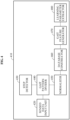
- FIG. 2 is a block diagram illustrating a preprocessing apparatus for gait task recognition according to an example embodiment.
- a preprocessing apparatus 210 may construct a database to be used to recognize a gait task by a gait pattern recognition apparatus 310 which will be described with reference to FIG. 3 , and extract a learning parameter with respect to a desired (or alternatively, predetermined) learning model.
- FIGS. 2 and 3 illustrate the preprocessing apparatus 210 and the gait pattern recognition apparatus 310 as different apparatuses, the preprocessing apparatus 210 and the gait pattern recognition apparatus 310 may be included in the same apparatus or may be implemented as different apparatuses.
- the preprocessing apparatus 210 includes a gait pattern detector 220, a database constructor 230, a gait feature generator 240, and a learning parameter extractor 250.
- the gait pattern detector 220 may detect a plurality of gait patterns based on sensed data.
- the sensed data may refer to data obtained by sensing a change in a biosignal or a quantity of motion of a user with respect to a gait motion using a sensor attached to a walking assistance apparatus.
- the sensed data may refer to virtual data based on motion data obtained through a simulation.
- the sensed data may refer to data sensed with respect to a single user, or data sensed with respect to a plurality of users.
- the sensed data may have an intrinsic pattern.
- the sensed data may include at least one of acceleration data sensed by an inertial measurement unit (IMU) sensor, angular velocity data sensed by the IMU sensor, joint angle data sensed by a potentiometer, joint angular velocity data sensed by the potentiometer, and electromyography (EMG) data extracted from an EMG sensor.
- IMU inertial measurement unit
- EMG electromyography
- the acceleration data or the angular velocity data may refer to acceleration data or angular velocity data with respect to at least one of an X axis, a Y axis, and a Z axis.
- the joint angle data or the joint angular velocity data may refer to joint angle data or joint angular velocity data with respect to at least one of a right (R) axis and a left (L) axis.
- the sensed data may be extracted from a plurality of IMU sensors, a plurality of potentiometers, or a plurality of EMG sensors. Further, the sensor is not limited to the IMU sensor, the potentiometer, or the EMG sensor, and may include all other sensors that may sense a change in a biosignal or a quantity of motion of a user with respect to a gait motion.
- the gait pattern may refer to a pattern to be used to recognize a gait task.
- a basic unit of the gait pattern may be a step or a stride.
- the step may include a single heel strike, and the heel strike may indicate a state in which a sole of a user touches the ground.
- the stride may include two steps.
- the gait pattern detector 220 may extract a plurality of gait patterns by dividing the sensed data into steps or strides.
- the gait pattern detector 220 may extract a step duration based on an angle difference between the R-axis joint angle data and the L-axis joint angle data, and detect a heel strike based on acceleration data with respect to the extracted step duration. For example, the gait pattern detector 220 may extract the step duration as an interval between points at which the angle difference between the R-axis joint angle data and the L-axis joint angle data sharply increases, and extract a plurality of steps by dividing the sensed data by a time duration corresponding to the extracted step duration. The gait pattern detector 220 may verify, for each step, whether acceleration data divided by a time duration corresponding to a step duration of each step include a peak.
- the gait pattern detector 220 may determine that the corresponding step includes a heel strike, and verify the corresponding step as a valid step.
- the gait pattern detector 220 may determine that the corresponding step does not include a heel strike, and verify the corresponding step as an invalid step.
- the gait pattern detector 220 may normalize a plurality of gait patterns with respect to at least one of a time axis and a data axis.
- the normalization with respect to the time axis may be referred to as a time normalization
- the normalization with respect to the data axis may be referred to as a Z normalization.
- each of the plurality of gait patterns may include a step or a stride
- sizes of the plurality of gait patterns with respect to the time axis may differ from each other.
- a quantity of motion with respect to a gait may not be uniform each time, sizes of the plurality of gait patterns with respect to the data axis may also differ from each other.
- the database constructor 230 may store the gait patterns in a database.
- a database search speed may decrease.
- the gait pattern detector 220 may perform the time normalization or the Z normalization on the plurality of gait patterns to increase database search efficiency.
- the gait pattern detector 220 may perform the time normalization by correcting a time error in the plurality of gait patterns based on a desired (or alternatively, predetermined) period. For example, the gait pattern detector 220 may correct a sampling rate of the plurality of gait patterns at equal intervals based on a desired (or alternatively, predetermined) sampling rate. The gait pattern detector 220 may interpolate the plurality of gait patterns based on the desired (or alternatively, predetermined) period, in view of a linearity of the plurality of gait patterns.
- the gait pattern detector 220 may perform the Z normalization based on an average and a standard deviation of the sensed data with respect to each of the plurality of gait patterns. For example, the gait pattern detector 220 may calculate the average and the standard deviation of the sensed data with respect to each of the plurality of gait patterns, and normalize the calculated average and the standard deviation using Equation 1.
- z x ⁇ ⁇ x ⁇ x
- the database constructor 230 constructs a plurality of databases by classifying the plurality of gait patterns based on a plurality of gait tasks, and storing the classified plurality of gait patterns as gait data in a plurality of databases respectively corresponding to the plurality of gait tasks.
- the plurality of databases may refer to separate databases, or a plurality of sub-databases belonging to a single database.
- the plurality of gait tasks may include a level-walking task, an inclined-walking task, a declined-walking task, a stepping-up task, and a stepping-down task, respectively.
- the plurality of gait tasks is not limited thereto.
- the plurality of gait tasks may include three gait tasks (e.g., a level-walking task, an inclined-walking task, and a declined-walking task), or may include seven gait tasks, (e.g., a level-walking task, a 15-degree inclined-walking task, a 30-degree inclined-walking task, a 15-degree declined-walking task, a 30-degree declined-walking task, a stepping-up task, and a stepping-down task).
- three gait tasks e.g., a level-walking task, an inclined-walking task, and a declined-walking task
- seven gait tasks e.g., a level-walking task, a 15-degree inclined-walking task, a 30-degree inclined-walking task, a 15-degree declined-walking task, a 30-degree declined-walking task, a stepping-up task, and a stepping-down task.
- the database constructor 230 classifies the plurality of gait patterns based on the plurality of gait tasks. For example, the database constructor 230 may classify the plurality of gait patterns, respectively, based on a gait task at a time at which data constituting the plurality of gait patterns are sensed. Further, because the sensed data may have an intrinsic pattern based on a gait task, the database constructor 230 may classify the plurality of gait patterns based on the plurality of gait tasks by analyzing the plurality of gait patterns based on intrinsic patterns with respect to gait tasks.
- the database constructor 230 stores the classified plurality of gait patterns as gait data in each of the plurality of databases. Accordingly, each of the plurality of databases may include ni items of gait data.
- i denotes an index of a gait task.
- the database constructor 230 may store the classified plurality of gait patterns as gait data in each of the plurality of databases using a k-d tree structure (short for k-dimensional tree in computer science that is a space-partitioning data structure for organizing points in a k-dimensional space).
- a k-d tree structure short for k-dimensional tree in computer science that is a space-partitioning data structure for organizing points in a k-dimensional space.
- a time of O( n i log n i ) may be used to store the ni items of gait data as the gait data in each of the plurality of databases using the k-d tree structure.
- a time of may be used to search the plurality of databases for the gait data.
- the gait task recognition apparatus 310 for recognizing a gait task may search the plurality of databases for the gait data in real time.
- the database constructor 230 may store the classified plurality of gait patterns as gait data in each of the plurality of databases using a database construction structure other than the k-d tree structure.
- the gait feature generator 240 generates a gait feature with respect to each of the gait data based on similarities among the gait data. For example, the gait feature generator 240 extracts with respect to each of the gait data, gait data similar to each the gait data. In this example, the gait feature generator 240 may calculate, with respect to each of the gait data, similarities between one gait data and the remaining gait data, which exclude the one gait data, and extract one or more gait data similar to the one gait data with respect to each of the plurality of databases based on calculated similarities.
- a similarity may be calculated not only based on a distance between one of gait data and another of gait data, but also based on all indices that may indicate a degree of match between the one gait data and each of the remaining gait data.
- the similarity may be calculated based on a mean value or an intermediate value between a size of the one gait data and a size of each of the remaining gait data, a gait velocity between the one gait data and each of the remaining gait data, a stride length, a root-mean square (RMS) error, a cadence, a walk ratio, or frequency domain information between the one gait data and each of the remaining gait data.
- RMS root-mean square
- the cadence may refer to a value obtained by dividing a number of steps by a desired (or alternatively, predetermined) time.
- the walk ratio may refer to a value obtained by dividing a step length by a cadence.
- the gait feature generator 240 may calculate similarities between the one gait data and one or more similar gait data using at least one of an L1 norm, an L2 norm, a normalized cross correlation (NCC), and dynamic time warping (DTW).
- the gait feature generator 240 may calculate, with respect to each of the plurality of gait data, DTW distances between the one gait data and each of the remaining gait data, which exclude the one gait data, and extract one or more gait data having relatively small DTW distances as gait data having relatively high similarities to the one gait data.
- the gait feature generator 240 extracts the gait data similar to the one gait data from each of the plurality of databases.
- the gait feature generator 240 may calculate a mean value of similarities between the one gait data and the one or more gait data similar to the one gait data, and generate a gait feature vector including a feature value corresponding to each of the plurality of gait tasks based on the calculated mean value as an element.
- the first mean value, the second mean value, and the third mean value may indicate feature values of the first gait data corresponding to a first gait task, a second gait task, and a third gait task, respectively.
- the gait feature generator 240 may generate a 3 x 1 gait feature vector including the first mean value, the second mean value, and the third mean value as elements.
- the gait feature generator 240 may generate such a gait feature vector with respect to each gait data included in the plurality of databases.
- the gait feature generator 240 may generate a gait feature by normalizing the gait feature vector generated with respect to each gait data.
- the gait feature generator 240 may generate the gait feature by normalizing gait feature vectors, which are generated with respect to respective gait data included in the plurality of databases, into vectors having the same sizes.
- the preprocessing apparatus 210 may detect a plurality of gait patterns with respect to the new user based on the sensed data, classify the plurality of gait patterns based on a plurality of gait tasks, and store the classified plurality of gait patterns as gait data in each of the plurality of databases.
- the preprocessing apparatus 210 may delete the unused gait data.
- the learning parameter extractor 250 may map the gait feature with respect to each of the gait data to a feature space of a desired (or alternatively, predetermined) dimension.
- the desired (or alternatively, predetermined) learning model is the SVR model
- the learning parameter extractor 250 may map the gait feature with respect to each gait data to a feature space using a homogeneous kernel map.
- the learning parameter extractor 250 may map a 5 x 1 gait feature to a feature space of 15 x 1 dimensions using the homogeneous kernel map.
- the learning parameter extractor 250 may input the mapped gait feature with respect to each gait data into the desired (or alternatively, predetermined) learning model.
- the learning parameter extractor 250 may extract the learning parameter by applying the gait feature to a non-linear learning model (e.g., a non-linear SVR model) in a space of relatively low dimensions. Accordingly, a calculation time for extracting the learning parameter may decrease.
- the learning parameter extractor 250 may map the gait feature with respect to each gait data to a feature space using a principle component analysis (PCA) or a linear discriminant analysis (LDA).
- PCA principle component analysis
- LDA linear discriminant analysis
- the gait pattern detector 320 may normalize the gait pattern with respect to at least one of a time axis and a data axis.
- the normalization with respect to the time axis may be referred to as a time normalization, and the normalization with respect to the data axis may be referred to as a Z normalization.
- a gait pattern may include a step or a stride, a size of each gait pattern with respect to the time axis may differ from each other. Further, because a quantity of motion may not be uniform each time a user walks, sizes of gait patterns with respect to the data axis may differ from each other.
- the gait feature generator 330 may search a database constructed by the preprocessing apparatus 210 of FIG. 2 using the gait pattern.
- the gait pattern detector 320 may perform the Z normalization based on an average and a standard deviation of the sensed data with respect to the gait pattern. For example, the gait pattern detector 320 may calculate the average and the standard deviation of the sensed data with respect to the gait pattern, and normalize the calculated average and the standard deviation using Equation 1.
- Equation 1 When the Z normalization is performed, an error in data between gait patterns occurring due to an environmental difference may decrease. Thus, the gait task recognition performance may be improved.
- the first mean value, the second mean value, the third mean value, and the fourth mean value may indicate feature values of the gait pattern corresponding to a first gait task, a second gait task, a third gait task, and a fourth gait task, respectively.
- the gait feature generator 330 may generate a 4 x 1 gait feature vector including the first mean value, the second mean value, the third mean value, and the fourth mean value as elements.
- the gait task estimator 340 may input the gait feature into the desired (or alternatively, predetermined) learning model, and estimate the gait task corresponding to the gait pattern by applying a desired (or alternatively, predetermined) learning parameter to the desired (or alternatively, predetermined) learning model.
- the desired (or alternatively, predetermined) learning model may be extracted from the gait data included in each of the plurality of databases.
- the preprocessing apparatus 210 may fit the learning parameter to be suitable for gait task recognition by applying the gait feature with respect to each of the gait data to the desired (or alternatively, predetermined) learning model.
- the gait task estimator 340 may input the gait feature into the desired (or alternatively, predetermined) learning model, and estimate the gait task by applying the learning parameter fit by the preprocessing apparatus 210.
- the gait task estimator 340 may obtain the learning parameter from the preprocessing apparatus 210 using a communication interface. Accordingly, the gait task estimator 340 may estimate the gait task more rapidly and accurately without performing a separate learning process for learning parameter extraction.
- a preprocessing apparatus 410 includes a sensed data input unit 420, a step detector 430, a gait pattern divider 440, a normalizer 450, a database constructor 460, a gait feature generator 470, and a learning parameter extractor 480.
- the step detector 430 may receive the sensed data from the sensed data input unit 420, and detect a step based on the sensed data.
- the step detector 430 may extract a step duration by defining an interval between points at which an angle difference between R-axis joint angle data and L-axis joint angle data sharply increases as the step duration. Further, the step detector 430 may verify, for each step, whether acceleration data divided by a time duration corresponding to a step duration include a single peak. When the acceleration data includes a single peak, the step detector 430 may determine that the corresponding step includes a heel strike, and verify the corresponding step as a valid step.
- the database constructor 460 may construct a plurality of databases by storing the plurality of gait patterns as gait data in each of the plurality of databases.
- the plurality of databases may correspond to the plurality of gait tasks, respectively.
- each of the plurality of databases may include ni items of gait data.
- the database constructor 460 may classify the plurality of gait patterns based on the plurality of gait tasks, and store the classified plurality of gait patterns as gait data in each of the plurality of databases using a k-d tree structure.
- the gait feature generator 470 may calculate a mean value of similarities between the one gait data and the similar gait data, and generate a gait feature vector including a feature value corresponding to each of the plurality of gait tasks based on the calculated mean value as an element. Further, the gait feature generator 470 may generate the gait feature by normalizing the generated gait feature vector with respect to each gait data.
- the learning parameter extractor 480 may extract a learning parameter with respect to a desired (or alternatively, predetermined) learning model by applying the gait feature with respect to each gait data to the desired (or alternatively, predetermined) learning model.
- the learning parameter extractor 480 may map the gait feature with respect to each gait data to a feature space of a desired (or alternatively, predetermined) dimension, and extract a learning parameter suitable for performing a gait task recognition by applying the mapped gait feature with respect to each gait data to the desired (or alternatively, predetermined) learning model.
- FIG. 5 is a block diagram illustrating a gait task recognition apparatus according to an example embodiment.
- a gait task recognition apparatus 510 includes a sensed data input unit 520, a step detector 530, a gait pattern divider 540, a normalizer 550, a database search unit 560, a gait feature extractor 570, a gait task estimator 580, and a drive controller 590.
- the sensed data input unit 520 may obtain sensed data.
- the sensed data may be obtained by sensing a change in a biosignal or a quantity of motion of a user with respect to a gait motion using a sensor.
- the sensed data may include at least one of 3-axis acceleration data sensed by an IMU sensor, 3-axis angular velocity data sensed by the IMU sensor, 2-axis joint angle data sensed by a potentiometer, 2-axis joint angular velocity data sensed by the potentiometer, and EMG data extracted from an EMG sensor.
- the sensed data may be extracted from a plurality of IMU sensors, a plurality of potentiometers, or a plurality of EMG sensors.
- the senor is not limited to the IMU sensor, the potentiometer, or the EMG sensor, and may include all sensors that may sense a change in a biosignal or a quantity of motion of a user with respect to a gait motion.
- the step detector 530 may receive the sensed data from the sensed data input unit 520, and detect a step based on the sensed data.
- the gait task estimator 580 may input the gait feature into the desired (or alternatively, predetermined) learning model, and estimate the gait task corresponding to the gait pattern by applying a desired (or alternatively, predetermined) learning parameter to the desired (or alternatively, predetermined) learning model.
- the gait task estimator 580 may receive the desired (or alternatively, predetermined) learning parameter from an external device, for example, the preprocessing apparatus 410 of FIG. 4 , using a communication interface. Accordingly, the gait task estimator 580 may estimate the gait task more rapidly and accurately without performing a separate learning process for learning parameter extraction.
- FIG. 6 illustrates sensors according to an example embodiment.
- the walking assistance apparatus 610 includes an IMU sensor 620 and a potentiometer 630.
- the IMU sensor 620 may sense at least one of variations in an X-axis acceleration, a Y-axis acceleration, and an Z-axis acceleration, and variations in an X-axis angular velocity, a Y-axis angular velocity, and an Z-axis angular velocity.
- the potentiometer 630 may sense at least one of variations in an R-axis joint angle and an L-axis joint angle, and variations in an R-axis joint angular velocity and an L-axis joint angular velocity.
- the walking assistance apparatus 610 may include a plurality of IMU sensors 620 and a plurality of potentiometers 630.
- the walking assistance apparatus 610 may include, in addition to the IMU sensor 620 and the potentiometer 630, another sensor that may sense a change in a biosignal or a quantity of motion of a user with respect to a gait motion.
- Another sensor may include, for example, an EMG sensor.
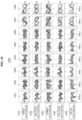
- FIG. 7 illustrates sensed data according to an example embodiment.
- gait tasks may be defined as a level-walking task 711, an inclined-walking task 712, a stepping-down task 713, a stepping-up task 714, and a declined-walking task 715.
- the sensed data may have an intrinsic pattern and thus, a variation in the sensed data may change.
- the X-axis acceleration data 721 may have a greatest variation in the declined-walking task 715
- the X-axis angular velocity data 731 may have a greatest variation in the level-walking task 711
- the joint angle data 741 and 742 may have a greatest variation in the stepping-up task 714.
- FIG. 8 illustrates a detection of a gait pattern according to an example embodiment.
- a gait task recognition apparatus may detect a gait pattern based on acceleration data and joint angle data.
- the gait task recognition apparatus may extract a step duration based on an angle difference 802 between R-axis joint angle data and L-axis joint angle data.
- the gait task recognition apparatus may extract steps 811, 812, 813, 814, 815, and 816 by defining an interval between points at which the angle difference 802 sharply increases as the step duration.
- the gait task recognition apparatus may verify, with respect to each of the steps 811, 812, 813, 814, 815, and 816, whether acceleration data 801 divided by a time duration corresponding to a step duration include a single peak.
- Gait patterns 931, 932, and 933 may be extracted from data sensed at different points in time in the same gait task. As shown in FIG. 9B , in the same gait task, the gait patterns 931, 932, and 933 may have different data ranges depending on a situation of a user.
- the gait task recognition apparatus may perform a Z normalization based on an average and a standard deviation of the sensed data with respect to each of the gait patterns 931, 932, and 933.
- FIG. 10 illustrates databases according to an example embodiment.
- the preprocessing apparatus may construct the plurality of databases 1010, 1020, 1030, 1040, and 1050 using a k-d tree structure.
- a time of O(log n 1 ) may be used to search the plurality of databases 1010, 1020, 1030, 1040, and 1050 for the gait data.
- a gait task recognition apparatus may search a plurality of databases for gait data in real time.
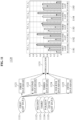
- FIG. 11 illustrates an extraction of a gait feature in a preprocessing apparatus for gait task recognition according to an example embodiment.
- the preprocessing apparatus may generate a gait feature with respect to each item of gait data based on similarities among the gait data. For example, when five gait tasks are defined, the preprocessing apparatus may construct five databases. To generate a gait feature of first gait data 1111 included in a first database 1121, the preprocessing apparatus may calculate similarities between the first gait data 1111 and the remaining gait data excluding the first gait data 1111 from the first database 1121, and extract gait data similar to the first gait data 1111 from the first database 1121 based on the calculated similarities.
- the preprocessing apparatus may calculate similarities between the first gait data 1111 and the remaining gait data, which exclude the first gait data 1111, included in each of a second database 1122 through a fifth database 1125, and extract gait data similar to the first gait data 1111 from each of the second database 1122 through the fifth database 1125 based on the calculated similarities.
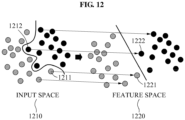
- an input space 1210 may include 5 x 1 gait features.
- a gait feature 1211 and a gait feature 1212 may correspond to different gait tasks. However, in the input space 1210, the gait feature 1211 and the gait feature 1212 may not be distinguished from each other.
- a gait task recognition apparatus may map the gait features 1211 and 1212 to a feature space 1220 of a desired (or alternatively, predetermined) dimension.
- the gait task recognition apparatus may map the gait features 1211 and 1212 to the feature space 1220 of 15 x 1 dimensions using a homogeneous kernel map.
- gait features 1221 and 1222 may be distinguished from each other in the feature space 1220.
- the gait task recognition apparatus may estimate a gait task by applying a gait feature to a non-linear SVR model in a space of relatively low dimensions, whereby a calculation time to be used to estimate a gait task may decrease.
- the gait task recognition apparatus may calculate similarities between a gait pattern 1410 and similar gait data included in each of five databases 1421, 1422, 1423, 1424, and 1425.
- the gait task recognition apparatus may extract five gait data having relatively high similarities to the gait pattern 1410 from each of the five databases 1421, 1422, 1423, 1424, and 1425, and calculate similarities between the gait pattern 1410 and five similar gait data included in each of the five databases 1421, 1422, 1423, 1424, and 1425.
- the gait task recognition apparatus may calculate a mean value of the calculated similarities. For example, the apparatus for recognizing a gait task may calculate a first mean value 1431 corresponding to a mean value of similarities between the gait pattern 1410 and the five similar gait data extracted from the first database 1421. The gait task recognition apparatus may calculate a second mean value 1432 through a fifth mean value 1435 corresponding to mean values of similarities between the gait pattern 1410 and respective five similar gait data extracted from the second database 1422 through the fifth database 1425. The gait task recognition apparatus may configure the first mean value 1431 through the fifth mean value 1435 as a first element through a fifth element of a gait feature vector, respectively. The apparatus for recognizing a gait task may generate a gait feature 1450 by performing a normalization 1440 on the gait feature vector.
- a gait task recognition apparatus 1610 may be included in a walking assistance apparatus. When a user walks, the gait task recognition apparatus 1610 may obtain sensed data.
- the sensed data may refer to data obtained by sensing a change in a biosignal or a quantity of motion of the user with respect to a gait motion from a sensor included in the gait task recognition apparatus 1610.
- the gait task recognition apparatus 1610 may detect a gait pattern of the user based on the sensed data.
- a server 1620 may include a plurality of databases respectively corresponding to a plurality of gait tasks. For example, the plurality of databases may be pre-generated by a preprocessing apparatus, and stored in the server 1620.
- the gait task recognition apparatus 1710 includes a gait pattern detector 1720, a database constructor 1730, a gait feature generator 1740, a learning parameter extractor 1750, a user gait pattern detector 1760, a user gait feature generator 1770, a gait task estimator 1780, and a drive controller 1790.
- the gait task recognition apparatus estimates a gait task corresponding to the gait pattern by applying the gait feature to a desired (or alternatively, predetermined) learning model.
- the preprocessing apparatus may extract a learning parameter with respect to a desired (or alternatively, predetermined) learning model by applying the gait feature with respect to each gait data to the desired (or alternatively, predetermined) learning model.
- FIGS. 1A through 16 may be applicable to the method of recognizing a gait task as shown in FIG. 20 and thus, detailed descriptions will be omitted for conciseness.
Landscapes
- Health & Medical Sciences (AREA)
- Life Sciences & Earth Sciences (AREA)
- Engineering & Computer Science (AREA)
- Physics & Mathematics (AREA)
- Public Health (AREA)
- Veterinary Medicine (AREA)
- Animal Behavior & Ethology (AREA)
- General Health & Medical Sciences (AREA)
- Heart & Thoracic Surgery (AREA)
- Surgery (AREA)
- Biophysics (AREA)
- Pathology (AREA)
- Biomedical Technology (AREA)
- Medical Informatics (AREA)
- Molecular Biology (AREA)
- Physiology (AREA)
- Artificial Intelligence (AREA)
- Oral & Maxillofacial Surgery (AREA)
- Dentistry (AREA)
- Evolutionary Computation (AREA)
- Psychiatry (AREA)
- Signal Processing (AREA)
- Fuzzy Systems (AREA)
- Mathematical Physics (AREA)
- Computer Vision & Pattern Recognition (AREA)
- Pain & Pain Management (AREA)
- Epidemiology (AREA)
- Rehabilitation Therapy (AREA)
- Physical Education & Sports Medicine (AREA)
- Transplantation (AREA)
- Geometry (AREA)
- Measurement Of The Respiration, Hearing Ability, Form, And Blood Characteristics Of Living Organisms (AREA)
- Rehabilitation Tools (AREA)
- Manipulator (AREA)
- Image Analysis (AREA)
Claims (8)
- Vorrichtung (310) zum Erkennen einer Gangtätigkeit, wobei die Vorrichtung Folgendes umfasst:einen Gangmusterdetektor (320, 1720, 1760), der ausgelegt ist, um ein Gangmuster eines Benutzers basierend auf gemessenen Daten zu erfassen;einen Gangmerkmalgenerator (330, 470, 1770), der ausgelegt ist, um Gangdaten, die dem erfassten Gangmuster ähnlich sind, die jeder aus einer Vielzahl von Gangtätigkeiten entsprechen, aus jeder aus einer Vielzahl von Datenbanken zu extrahieren, wobei jede Datenbank als Gangdaten eine Vielzahl von Gangmustern aufweist, die von einem Datenbankkonstrukteur konstruiert wurden, der dadurch klassifizierte Gangmuster basierend auf jeder von einer Vielzahl von Gangtätigkeiten gespeichert hat, und um ein Gangmerkmal des erkannten Gangmusters basierend auf Ähnlichkeiten zwischen dem erfassten Gangmuster und den ähnlichen Gangdaten zu erzeugen;einen Gangtätigkeitsschätzer (340, 580, 1780), der ausgelegt ist, um eine dem erfassten Gangmuster entsprechende Gangtätigkeit durch Anwenden des Gangmerkmals auf ein eingestelltes Lernmodell zu schätzen; undeine Antriebssteuerung (350, 590, 1790), die ausgelegt ist, um eine Gehunterstützungsvorrichtung basierend auf der geschätzten Gangtätigkeit anzutreiben.
- Vorrichtung (310) nach Anspruch 1, ferner umfassend einen Datenkonstrukteur, der ausgelegt ist, um die Vielzahl von Gangmustern basierend auf einer Vielzahl von Gangtätigkeiten zu klassifizieren und die klassifizierte Vielzahl von Gangmustern als Gangdaten, die jeder aus der Vielzahl von Gangtätigkeiten entsprechen, in jeder aus einer Vielzahl von Datenbanken zu speichern.
- Vorrichtung (310) nach Anspruch 1, wobei der Gangmerkmalgenerator (330, 470, 1770) ausgelegt ist, um die Ähnlichkeiten zwischen dem Gangmuster und den Gangdaten, die in jeder der Vielzahl von Datenbanken enthalten sind, zu berechnen und die ähnlichen Gangdaten aus jeder aus der Vielzahl von Datenbanken basierend auf den berechneten Ähnlichkeiten zu extrahieren.
- Vorrichtung (310) nach Anspruch 1, wobei der Gangmerkmalgenerator (330, 470, 1770) ausgelegt ist, um einen Mittelwert der Ähnlichkeiten zwischen dem Gangmuster und den ähnlichen Gangdaten zu berechnen und einen Gangmerkmalvektor, der einen Merkmalswert enthält, der jeder aus der Vielzahl von Gangtätigkeiten entspricht, basierend auf dem Mittelwert als ein Element zu erzeugen,
wobei der Gangmerkmalgenerator (330, 470, 1770) vorzugsweise ausgelegt ist, um die Ähnlichkeiten zwischen dem Gangmuster und den Gangdaten oder die Ähnlichkeiten zwischen dem Gangmuster und den ähnlichen Gangdaten unter Verwendung mindestens einer von einer L1-Norm, einer L2-Norm, einer normalisierten Kreuzkorrelation (NCC, Normalized Cross Correlation) und einer dynamischen Zeitverzerrung (DTW, Dynamic Time Warping) zu berechnen. - Vorrichtung (310) nach Anspruch 4, wobei der Gangmerkmalgenerator (330, 470, 1770) ausgelegt ist, um das Gangmerkmal durch Normalisieren des Gangmerkmalvektors zu erzeugen.
- Vorrichtung (310) nach einem der vorhergehenden Ansprüche, wobei der Gangtätigkeitsschätzer (340, 580, 1780) so ausgelegt ist, dass er das Gangmerkmal in das eingestellte Lernmodell eingibt und die dem Gangmuster entsprechende Gangtätigkeit schätzt, indem er einen eingestellten Lernparameter auf das eingestellte Lernmodell anwendet, wobei der eingestellte Lernparameter aus Gangdaten, die in jeder der Vielzahl von Datenbanken enthalten sind, basierend auf dem eingestellten Lernmodell extrahiert wird und/oder wobei der Gangtätigkeitsschätzer (340, 580, 1780) ausgelegt ist, um den eingestellten Lernparameter unter Verwendung einer Kommunikationsschnittstelle aus einer externen Vorrichtung zu erhalten.
- Vorrichtung (310) nach einem der vorhergehenden Ansprüche, wobei der Gangtätigkeitsschätzer (340, 580, 1780) ausgelegt ist, um das Gangmerkmal auf einen Merkmalsraum einer eingestellten Dimension abzubilden und das abgebildete Gangmerkmal in das eingestellte Lernmodell einzugeben.
- Prozessorimplementiertes Verfahren zur Erkennung einer Gangtätigkeit, wobei das Verfahren Folgendes umfasst:Erfassen eines Gangmusters eines Benutzers basierend auf erfassten Daten;Extrahieren von Gangdaten, die dem erfassten Gangmuster ähnlich sind, die jeder einer Vielzahl von Gangtätigkeiten entsprechen, aus jeder aus einer Vielzahl von Datenbanken, wobei jede Datenbank als Gangdaten eine Vielzahl von Gangmustern aufweist, die von einem Datenbankkonstrukteur konstruiert wurden, der dadurch klassifizierte Gangmuster basierend auf jeder von einer Vielzahl von Gangtätigkeiten gespeichert hat;Erzeugen eines Gangmerkmals des erfassten Gangmusters basierend auf Ähnlichkeiten zwischen dem erfassten Gangmuster und den ähnlichen Gangdaten;Schätzen einer dem erfassten Gangmuster entsprechenden Gangtätigkeit durch Anwenden des Gangmerkmals auf ein eingestelltes Lernmodell; undSteuern eines Antriebs einer Gehunterstützungsvorrichtung basierend auf der geschätzten Gangtätigkeit.
Priority Applications (1)
| Application Number | Priority Date | Filing Date | Title |
|---|---|---|---|
| EP24151733.3A EP4331473A3 (de) | 2014-09-12 | 2015-07-31 | Verfahren und vorrichtung zur erkennung von gangaufgaben |
Applications Claiming Priority (1)
| Application Number | Priority Date | Filing Date | Title |
|---|---|---|---|
| KR1020140121026A KR102292683B1 (ko) | 2014-09-12 | 2014-09-12 | 보행 환경 인식 방법 및 장치 |
Related Child Applications (2)
| Application Number | Title | Priority Date | Filing Date |
|---|---|---|---|
| EP24151733.3A Division-Into EP4331473A3 (de) | 2014-09-12 | 2015-07-31 | Verfahren und vorrichtung zur erkennung von gangaufgaben |
| EP24151733.3A Division EP4331473A3 (de) | 2014-09-12 | 2015-07-31 | Verfahren und vorrichtung zur erkennung von gangaufgaben |
Publications (3)
| Publication Number | Publication Date |
|---|---|
| EP2997895A1 EP2997895A1 (de) | 2016-03-23 |
| EP2997895B1 true EP2997895B1 (de) | 2024-06-26 |
| EP2997895C0 EP2997895C0 (de) | 2024-06-26 |
Family
ID=54014480
Family Applications (2)
| Application Number | Title | Priority Date | Filing Date |
|---|---|---|---|
| EP24151733.3A Pending EP4331473A3 (de) | 2014-09-12 | 2015-07-31 | Verfahren und vorrichtung zur erkennung von gangaufgaben |
| EP15179279.3A Active EP2997895B1 (de) | 2014-09-12 | 2015-07-31 | Computer-implementiertes verfahren und vorrichtung zur erkennung von gangtätigkeit |
Family Applications Before (1)
| Application Number | Title | Priority Date | Filing Date |
|---|---|---|---|
| EP24151733.3A Pending EP4331473A3 (de) | 2014-09-12 | 2015-07-31 | Verfahren und vorrichtung zur erkennung von gangaufgaben |
Country Status (5)
| Country | Link |
|---|---|
| US (1) | US11234890B2 (de) |
| EP (2) | EP4331473A3 (de) |
| JP (1) | JP6629543B2 (de) |
| KR (1) | KR102292683B1 (de) |
| CN (1) | CN105411593B (de) |
Families Citing this family (59)
| Publication number | Priority date | Publication date | Assignee | Title |
|---|---|---|---|---|
| US10611020B2 (en) | 2013-12-19 | 2020-04-07 | Roam Robotics Inc. | Pneumatic exomuscle system and method |
| EP3196658A1 (de) * | 2014-09-18 | 2017-07-26 | Kunihiro Shiina | Aufzeichnungsvorrichtung, mobiles endgerät, analysevorrichtung, programm und speichermedium |
| US10052047B2 (en) | 2015-08-07 | 2018-08-21 | University Of Virginia Patent Foundation | System and method for functional gait re-trainer for lower extremity pathology |
| CN107536698B (zh) * | 2016-06-29 | 2022-06-03 | 松下知识产权经营株式会社 | 行走辅助机器人以及行走辅助方法 |
| CN107960064B (zh) | 2016-08-17 | 2021-05-11 | 电力助力国际公司 | 穿戴型支援机器人装置 |
| KR101940898B1 (ko) * | 2017-01-20 | 2019-01-21 | 국방과학연구소 | 외골격 로봇의 하강보행 제어 방법 |
| KR101909743B1 (ko) * | 2017-01-26 | 2018-10-18 | 주식회사 제윤메디컬 | 스마트 인솔을 기반의 차량용 전장 기기 제어 방법 및 시스템 |
| KR102624560B1 (ko) | 2017-01-31 | 2024-01-15 | 엘지전자 주식회사 | 청소기 |
| CN110603021B (zh) * | 2017-02-03 | 2023-12-05 | 漫游机械人技术公司 | 用于用户意图识别的系统和方法 |
| JP6887274B2 (ja) * | 2017-03-21 | 2021-06-16 | パナソニック株式会社 | 歩行支援ロボット及び歩行支援方法 |
| CN107411753A (zh) * | 2017-06-06 | 2017-12-01 | 深圳市科迈爱康科技有限公司 | 一种识别步态的可穿戴设备 |
| KR102550887B1 (ko) * | 2017-09-20 | 2023-07-06 | 삼성전자주식회사 | 개인화된 보행 정책을 갱신하는 방법 및 장치 |
| KR101972662B1 (ko) * | 2017-09-29 | 2019-04-25 | 숭실대학교산학협력단 | 발동작 패턴 분석을 통한 스마트 홈 시스템 및 스마트 홈 서비스 제공방법 |
| KR102566114B1 (ko) | 2017-11-10 | 2023-08-14 | 삼성전자주식회사 | 회전 보행을 위한 제어 방법 및 제어 장치 |
| KR102155134B1 (ko) * | 2017-11-28 | 2020-09-11 | 인하대학교 산학협력단 | Emg 신호에 기반한 보행패턴을 이용한 사용자 인식 장치 및 방법 |
| KR101989477B1 (ko) * | 2017-12-06 | 2019-06-14 | 인하대학교 산학협력단 | Emg신호 분석을 위한 tas 특징 추출 장치 및 방법 |
| CN108013998A (zh) * | 2017-12-12 | 2018-05-11 | 深圳市罗伯医疗科技有限公司 | 一种下肢康复仪器训练方法和系统 |
| WO2019116255A1 (en) | 2017-12-12 | 2019-06-20 | Mindmaze Holding Sa | System, apparatus and method for activity classification |
| KR102085372B1 (ko) * | 2017-12-26 | 2020-03-05 | 한국산업기술대학교산학협력단 | 보행 상태 추정 방법 및 장치 |
| CN108014001B (zh) * | 2018-01-02 | 2020-03-17 | 北京理工大学 | 一种柔性助行外骨骼 |
| KR102546547B1 (ko) * | 2018-01-11 | 2023-06-22 | 삼성전자주식회사 | 보행 보조 방법 및 장치 |
| DE102018206823A1 (de) * | 2018-05-03 | 2019-11-07 | Krones Ag | Behälterbehandlungsanlage |
| WO2020100961A1 (ja) * | 2018-11-16 | 2020-05-22 | 日本電気株式会社 | 負荷軽減装置、負荷軽減方法、及びプログラムを記憶する記憶媒体 |
| KR102701449B1 (ko) * | 2019-01-04 | 2024-09-03 | 삼성전자주식회사 | 보행 보조 장치의 제어 방법 및 장치 |
| JP7192528B2 (ja) * | 2019-01-24 | 2022-12-20 | 株式会社ジェイテクト | アシスト装置 |
| KR102771792B1 (ko) | 2019-01-30 | 2025-02-25 | 삼성전자주식회사 | 정보 처리 장치 및 이의 동작 방법 |
| CN109998551B (zh) * | 2019-04-11 | 2020-09-11 | 北京航空航天大学 | 一种分段式局部峰值检测的步态相位分析方法 |
| CN110246561A (zh) * | 2019-04-30 | 2019-09-17 | 华为技术有限公司 | 一种移动距离计算方法、装置以及系统 |
| CN111860063B (zh) * | 2019-04-30 | 2023-08-11 | 杭州海康威视数字技术股份有限公司 | 步态数据构建系统、方法及装置 |
| KR102304300B1 (ko) * | 2019-05-08 | 2021-09-23 | 주식회사 비플렉스 | 머리부 가속도 센서를 통한 보행인자 검출 방법 및 장치 |
| WO2020240749A1 (ja) * | 2019-05-29 | 2020-12-03 | 日本電気株式会社 | 情報処理装置、歩行環境判定装置、歩行環境判定システム、情報処理方法及び記憶媒体 |
| EP3751361A1 (de) * | 2019-06-13 | 2020-12-16 | ABB Schweiz AG | System zur aktionsanzeigebestimmung |
| CN110236523A (zh) * | 2019-06-17 | 2019-09-17 | 杭州电子科技大学 | 基于高斯回归的步态-心电rr间隔关联方法 |
| JP7326927B2 (ja) * | 2019-06-27 | 2023-08-16 | トヨタ自動車株式会社 | 学習装置、リハビリ支援システム、方法、プログラム、及び学習済みモデル |
| JP7243486B2 (ja) * | 2019-06-27 | 2023-03-22 | トヨタ自動車株式会社 | 学習装置、歩行訓練システム、方法、及びプログラム |
| JP7293915B2 (ja) * | 2019-06-28 | 2023-06-20 | トヨタ自動車株式会社 | 学習装置、歩行訓練装置、システム、方法、プログラム、及び学習済みモデル |
| WO2021046423A1 (en) * | 2019-09-06 | 2021-03-11 | University Of Miami | Quantification of symmetry and repeatability in limb motion for treatment of abnormal motion patterns |
| CN110710976A (zh) * | 2019-10-14 | 2020-01-21 | 深圳市迈步机器人科技有限公司 | 个性化步态生成方法存储介质、控制系统及外骨骼机器人 |
| CN111028374B (zh) * | 2019-10-30 | 2021-09-21 | 中科南京人工智能创新研究院 | 基于步态识别的考勤机及考勤系统 |
| KR102345636B1 (ko) * | 2019-12-03 | 2021-12-31 | 중앙대학교 산학협력단 | 모터 자동제어시스템을 적용한 가변압박슬리브 및 그 가변압박슬리브의 제어방법 |
| US11931307B2 (en) | 2019-12-13 | 2024-03-19 | Roam Robotics Inc. | Skiing exoskeleton control method and system |
| US12408846B2 (en) | 2019-12-25 | 2025-09-09 | Nec Corporation | Estimation device, estimation system, estimation method, and program recording medium |
| US11216074B2 (en) | 2020-03-13 | 2022-01-04 | OnTracMD, LLC | Motion classification user library |
| KR102350633B1 (ko) * | 2020-03-26 | 2022-01-11 | 한국로봇융합연구원 | 낙상 유도 장치 및 낙상 유도 방법 |
| CA3179856A1 (en) | 2020-05-27 | 2021-12-02 | Callum Lamb | Fit and suspension systems and methods for a mobile robot |
| WO2021242991A1 (en) | 2020-05-27 | 2021-12-02 | Roam Robotics Inc. | Data logging and third-party administration of a mobile robot |
| KR102350593B1 (ko) * | 2020-11-04 | 2022-01-14 | 단국대학교 산학협력단 | 딥러닝 앙상블을 이용한 멀티모달 센서 기반의 보행 패턴 분류를 위한 장치 및 방법 |
| KR102521682B1 (ko) * | 2021-05-10 | 2023-04-13 | 서강대학교산학협력단 | 인공신경망을 활용한 표면근전도 기반 보행 환경 분류 방법과 그 장치 |
| CN113762072B (zh) * | 2021-07-27 | 2024-04-19 | 新绎健康科技有限公司 | 一种基于互相关性的对步态信号进行识别的方法及系统 |
| US12115663B2 (en) | 2021-08-17 | 2024-10-15 | Roam Robotics Inc. | Maritime applications for a mobile robot |
| KR102836469B1 (ko) * | 2021-12-31 | 2025-07-21 | 플랜비포유 주식회사 | 보행 속도 추정 방법 및 장치 |
| WO2024044252A1 (en) * | 2022-08-23 | 2024-02-29 | The University Of North Carolina At Chapel Hill | Methods, systems, and computer readable media for detecting and monitoring gait using a portable gait biofeedback system |
| KR102793729B1 (ko) * | 2022-09-02 | 2025-04-09 | 이화여자대학교 산학협력단 | 이미지 학습을 이용한 보행환경 최적모델 생성 방법 및 이를 이용한 보행환경 개선 방법 |
| KR20240062560A (ko) | 2022-11-02 | 2024-05-09 | 김민석 | 고령자의 보행 패턴 분석 방법, 그리고 분석된 보행 패턴을 이용한 보행 보조 장치, 방법 및 시스템 |
| KR102518801B1 (ko) * | 2023-02-11 | 2023-04-06 | 엑소아틀레트아시아 주식회사 | 외골격 장치를 사용하기 위한 보행패턴 획득시스템 및 이를 이용한 보행패턴 획득방법 |
| CN116959035B (zh) * | 2023-09-19 | 2024-07-09 | 深圳市博锐高科科技有限公司 | 一种基于步态的身份识别方法、装置、芯片及终端 |
| WO2025075216A1 (ko) * | 2023-10-05 | 2025-04-10 | 엑소아틀레트아시아 주식회사 | 보행보조 웨어러블 로봇장치 및 이의 제어 방법과 이를 위한 컴퓨터 프로그램 |
| CN117421605B (zh) * | 2023-10-27 | 2024-04-30 | 绍兴清研微科技有限公司 | 一种基于区块链技术的步态识别方法及系统 |
| CN118902478B (zh) * | 2024-01-15 | 2025-10-28 | 国家康复辅具研究中心 | 一种基于肌电及深度学习的行走步态相位和速度识别方法 |
Citations (1)
| Publication number | Priority date | Publication date | Assignee | Title |
|---|---|---|---|---|
| CN101388080B (zh) * | 2008-10-23 | 2010-08-11 | 北京航空航天大学 | 一种基于多角度步态信息融合的行人性别分类方法 |
Family Cites Families (32)
| Publication number | Priority date | Publication date | Assignee | Title |
|---|---|---|---|---|
| JP3833921B2 (ja) * | 2001-10-18 | 2006-10-18 | 本田技研工業株式会社 | 歩行状態判定装置及び方法 |
| JP3930399B2 (ja) * | 2002-08-21 | 2007-06-13 | 本田技研工業株式会社 | 歩行補助装置 |
| JP4178186B2 (ja) | 2003-08-21 | 2008-11-12 | 国立大学法人 筑波大学 | 装着式動作補助装置、装着式動作補助装置の制御方法および制御用プログラム |
| JP2005211086A (ja) | 2004-01-27 | 2005-08-11 | Yaskawa Electric Corp | 歩行訓練装置 |
| CA2605239A1 (en) * | 2005-05-02 | 2006-11-09 | University Of Virginia Patent Foundation | Systems, devices, and methods for interpreting movement |
| US9149222B1 (en) * | 2008-08-29 | 2015-10-06 | Engineering Acoustics, Inc | Enhanced system and method for assessment of disequilibrium, balance and motion disorders |
| US10342461B2 (en) * | 2007-10-15 | 2019-07-09 | Alterg, Inc. | Method of gait evaluation and training with differential pressure system |
| KR20100094998A (ko) * | 2007-12-27 | 2010-08-27 | 고쿠리쯔 다이가쿠 호징 츠쿠바 다이가쿠 | 중심위치 검출장치 및 중심위치 검출장치를 구비한 장착식 동작보조장치 |
| US8652218B2 (en) * | 2008-04-21 | 2014-02-18 | Vanderbilt University | Powered leg prosthesis and control methodologies for obtaining near normal gait |
| JP5309743B2 (ja) | 2008-07-14 | 2013-10-09 | 大日本印刷株式会社 | 歩行補助装置 |
| KR20100037833A (ko) * | 2008-10-02 | 2010-04-12 | (주)대호테크 | 약 근력자의 보행 보조시스템 |
| KR100957985B1 (ko) | 2008-11-07 | 2010-05-17 | 신대섭 | 보행 보조 로봇의 제어장치 |
| US20100132464A1 (en) * | 2008-12-01 | 2010-06-03 | Honda Motor Co., Ltd. | Motion assisting device |
| JP5493142B2 (ja) * | 2009-05-12 | 2014-05-14 | 国立大学法人 筑波大学 | 動作補助装置、及び該動作補助装置を管理する情報管理装置 |
| JP5386253B2 (ja) * | 2009-07-15 | 2014-01-15 | サンコールエンジニアリング株式会社 | 歩行診断支援システム、歩行パターン生成装置、歩行パターン生成プログラム、及び歩行パターン生成方法 |
| DE112010005453B4 (de) | 2009-10-21 | 2022-09-01 | Honda Motor Co., Ltd. | Bewegungsunterstützungseinrichtung |
| KR101159437B1 (ko) * | 2010-04-29 | 2012-06-22 | 숭실대학교산학협력단 | 시각장애인용 보행유도 장치 및 방법 |
| KR101082161B1 (ko) | 2010-06-23 | 2011-11-09 | 고려대학교 산학협력단 | 보행 보조 장치 |
| US8548740B2 (en) * | 2010-10-07 | 2013-10-01 | Honeywell International Inc. | System and method for wavelet-based gait classification |
| CN102119877B (zh) | 2010-12-15 | 2012-11-07 | 河北工业大学 | 建立下肢假肢自动训练专家知识库的方法 |
| JP6175050B2 (ja) * | 2011-04-08 | 2017-08-02 | ヨンセイ ユニヴァーシティ ウォンジュ インダストリー−アカデミック コオぺレイション ファウンデイション | 能動的ロボティック歩行訓練システム及び方法 |
| KR101224056B1 (ko) | 2011-06-27 | 2013-01-21 | 엘지전자 주식회사 | 보행 보조 장치 및 그 작동 제어 방법 |
| KR20130010609A (ko) * | 2011-07-19 | 2013-01-29 | 한국생산기술연구원 | 보행 보조 로봇 및 보행 보조 로봇의 제어 방법 |
| WO2013054258A1 (en) * | 2011-10-09 | 2013-04-18 | The Medical Research, Infrastructure and Health Services Fund of the Tel Aviv Medical Center | Freezing of gait (fog), detection, prediction and/or treatment |
| KR101383059B1 (ko) | 2012-07-23 | 2014-04-08 | 한국과학기술연구원 | 착용형 진동 자극 장치 및 그 작동 방법 |
| KR101340085B1 (ko) * | 2012-11-14 | 2013-12-09 | 한국과학기술연구원 | 보행 패턴 생성 장치 및 방법 |
| KR101422669B1 (ko) * | 2013-07-08 | 2014-07-24 | 한국과학기술연구원 | 보행 주기 검출 시스템 |
| CN103431929B (zh) * | 2013-08-29 | 2016-01-20 | 电子科技大学 | 一种力量增强型动力外骨骼行走步态感知方法及装置 |
| CN103462619A (zh) * | 2013-09-30 | 2013-12-25 | 厦门大学 | 一种足底压力测量装置及其用于步态模式识别的方法 |
| KR102172954B1 (ko) | 2013-11-08 | 2020-11-02 | 삼성전자주식회사 | 보행 보조 로봇 및 보행 보조 로봇의 제어 방법 |
| KR102150297B1 (ko) | 2014-01-15 | 2020-09-01 | 삼성전자주식회사 | 보행 보조 로봇 및 보행 보조 로봇의 제어 방법 |
| CN104008398B (zh) * | 2014-06-11 | 2017-07-07 | 北京大学 | 一种基于多传感器信息融合的步态分类方法 |
-
2014
- 2014-09-12 KR KR1020140121026A patent/KR102292683B1/ko active Active
-
2015
- 2015-07-31 EP EP24151733.3A patent/EP4331473A3/de active Pending
- 2015-07-31 EP EP15179279.3A patent/EP2997895B1/de active Active
- 2015-08-06 JP JP2015155822A patent/JP6629543B2/ja active Active
- 2015-09-10 US US14/850,288 patent/US11234890B2/en active Active
- 2015-09-11 CN CN201510579072.0A patent/CN105411593B/zh active Active
Patent Citations (1)
| Publication number | Priority date | Publication date | Assignee | Title |
|---|---|---|---|---|
| CN101388080B (zh) * | 2008-10-23 | 2010-08-11 | 北京航空航天大学 | 一种基于多角度步态信息融合的行人性别分类方法 |
Also Published As
| Publication number | Publication date |
|---|---|
| JP2016059795A (ja) | 2016-04-25 |
| CN105411593B (zh) | 2019-12-24 |
| EP4331473A2 (de) | 2024-03-06 |
| US11234890B2 (en) | 2022-02-01 |
| KR102292683B1 (ko) | 2021-08-23 |
| EP2997895C0 (de) | 2024-06-26 |
| JP6629543B2 (ja) | 2020-01-15 |
| KR20160031246A (ko) | 2016-03-22 |
| EP2997895A1 (de) | 2016-03-23 |
| EP4331473A3 (de) | 2024-09-18 |
| CN105411593A (zh) | 2016-03-23 |
| US20160074272A1 (en) | 2016-03-17 |
Similar Documents
| Publication | Publication Date | Title |
|---|---|---|
| EP2997895B1 (de) | Computer-implementiertes verfahren und vorrichtung zur erkennung von gangtätigkeit | |
| US10535015B2 (en) | Walking assistance apparatus and method of controlling same | |
| US11865709B2 (en) | Assisting torque setting method and apparatus | |
| Zhong et al. | Sensor orientation invariant mobile gait biometrics | |
| US10449106B2 (en) | Method and apparatus for walking assistance | |
| US20220142850A1 (en) | Method and apparatus for recognizing gait task | |
| Dikovski et al. | Evaluation of different feature sets for gait recognition using skeletal data from Kinect | |
| Benson et al. | Classifying running speed conditions using a single wearable sensor: Optimal segmentation and feature extraction methods | |
| Thiemjarus et al. | A study on instance-based learning with reduced training prototypes for device-context-independent activity recognition on a mobile phone | |
| San-Segundo et al. | I-vector analysis for gait-based person identification using smartphone inertial signals | |
| Ponce et al. | Sensor location analysis and minimal deployment for fall detection system | |
| Hajjej et al. | Deep human motion detection and multi-features analysis for smart healthcare learning tools | |
| Malawski et al. | Classification of basic footwork in fencing using accelerometer | |
| EP3897890B1 (de) | Verfahren und vorrichtung für unüberwachtes maschinelles lernen zur klassifizierung von gesten und schätzung von angewandten kräften | |
| Zhao et al. | Towards a data-driven approach to injury prevention in construction | |
| Zhang et al. | RGB-D camera based walking pattern recognition by support vector machines for a smart rollator | |
| Permatasari et al. | Inertial sensor fusion for gait recognition with symmetric positive definite Gaussian kernels analysis | |
| Kuduz et al. | Biomechanical sensor signal analysis based on machine learning for human gait classification | |
| US20230000391A1 (en) | Method and system for assessing a biological movement | |
| CN116509381B (zh) | 训练步态识别模型的方法、步态识别方法及相关装置 | |
| Wang et al. | EXACT: A Meta-Learning Framework for Precise Exercise Segmentation in Physical Therapy | |
| Giacomossi et al. | Comparison Between Features Extracted in the Time and Frequency Domain with the Triangulation Method | |
| Kwankhoom et al. | An incremental dynamic time warping for person re-identification | |
| Hema et al. | Research Article Design and Development of Polymer-Based Optical Fiber Sensor for GAIT Analysis | |
| Sharma et al. | Human recognition based on gait features and genetic programming |
Legal Events
| Date | Code | Title | Description |
|---|---|---|---|
| PUAI | Public reference made under article 153(3) epc to a published international application that has entered the european phase |
Free format text: ORIGINAL CODE: 0009012 |
|
| AK | Designated contracting states |
Kind code of ref document: A1 Designated state(s): AL AT BE BG CH CY CZ DE DK EE ES FI FR GB GR HR HU IE IS IT LI LT LU LV MC MK MT NL NO PL PT RO RS SE SI SK SM TR |
|
| AX | Request for extension of the european patent |
Extension state: BA ME |
|
| 17P | Request for examination filed |
Effective date: 20160921 |
|
| RBV | Designated contracting states (corrected) |
Designated state(s): AL AT BE BG CH CY CZ DE DK EE ES FI FR GB GR HR HU IE IS IT LI LT LU LV MC MK MT NL NO PL PT RO RS SE SI SK SM TR |
|
| STAA | Information on the status of an ep patent application or granted ep patent |
Free format text: STATUS: EXAMINATION IS IN PROGRESS |
|
| 17Q | First examination report despatched |
Effective date: 20190816 |
|
| GRAP | Despatch of communication of intention to grant a patent |
Free format text: ORIGINAL CODE: EPIDOSNIGR1 |
|
| STAA | Information on the status of an ep patent application or granted ep patent |
Free format text: STATUS: GRANT OF PATENT IS INTENDED |
|
| INTG | Intention to grant announced |
Effective date: 20230912 |
|
| GRAJ | Information related to disapproval of communication of intention to grant by the applicant or resumption of examination proceedings by the epo deleted |
Free format text: ORIGINAL CODE: EPIDOSDIGR1 |
|
| STAA | Information on the status of an ep patent application or granted ep patent |
Free format text: STATUS: EXAMINATION IS IN PROGRESS |
|
| GRAP | Despatch of communication of intention to grant a patent |
Free format text: ORIGINAL CODE: EPIDOSNIGR1 |
|
| STAA | Information on the status of an ep patent application or granted ep patent |
Free format text: STATUS: GRANT OF PATENT IS INTENDED |
|
| INTC | Intention to grant announced (deleted) | ||
| INTG | Intention to grant announced |
Effective date: 20240123 |
|
| GRAS | Grant fee paid |
Free format text: ORIGINAL CODE: EPIDOSNIGR3 |
|
| GRAA | (expected) grant |
Free format text: ORIGINAL CODE: 0009210 |
|
| STAA | Information on the status of an ep patent application or granted ep patent |
Free format text: STATUS: THE PATENT HAS BEEN GRANTED |
|
| AK | Designated contracting states |
Kind code of ref document: B1 Designated state(s): AL AT BE BG CH CY CZ DE DK EE ES FI FR GB GR HR HU IE IS IT LI LT LU LV MC MK MT NL NO PL PT RO RS SE SI SK SM TR |
|
| REG | Reference to a national code |
Ref country code: GB Ref legal event code: FG4D |
|
| REG | Reference to a national code |
Ref country code: CH Ref legal event code: EP |
|
| REG | Reference to a national code |
Ref country code: DE Ref legal event code: R096 Ref document number: 602015089052 Country of ref document: DE |
|
| U01 | Request for unitary effect filed |
Effective date: 20240725 |
|
| U07 | Unitary effect registered |
Designated state(s): AT BE BG DE DK EE FI FR IT LT LU LV MT NL PT SE SI Effective date: 20240806 |
|
| U20 | Renewal fee for the european patent with unitary effect paid |
Year of fee payment: 10 Effective date: 20240802 |
|
| PG25 | Lapsed in a contracting state [announced via postgrant information from national office to epo] |
Ref country code: HR Free format text: LAPSE BECAUSE OF FAILURE TO SUBMIT A TRANSLATION OF THE DESCRIPTION OR TO PAY THE FEE WITHIN THE PRESCRIBED TIME-LIMIT Effective date: 20240626 |
|
| PG25 | Lapsed in a contracting state [announced via postgrant information from national office to epo] |
Ref country code: GR Free format text: LAPSE BECAUSE OF FAILURE TO SUBMIT A TRANSLATION OF THE DESCRIPTION OR TO PAY THE FEE WITHIN THE PRESCRIBED TIME-LIMIT Effective date: 20240927 |
|
| PG25 | Lapsed in a contracting state [announced via postgrant information from national office to epo] |
Ref country code: NO Free format text: LAPSE BECAUSE OF FAILURE TO SUBMIT A TRANSLATION OF THE DESCRIPTION OR TO PAY THE FEE WITHIN THE PRESCRIBED TIME-LIMIT Effective date: 20240926 Ref country code: HR Free format text: LAPSE BECAUSE OF FAILURE TO SUBMIT A TRANSLATION OF THE DESCRIPTION OR TO PAY THE FEE WITHIN THE PRESCRIBED TIME-LIMIT Effective date: 20240626 Ref country code: GR Free format text: LAPSE BECAUSE OF FAILURE TO SUBMIT A TRANSLATION OF THE DESCRIPTION OR TO PAY THE FEE WITHIN THE PRESCRIBED TIME-LIMIT Effective date: 20240927 Ref country code: RS Free format text: LAPSE BECAUSE OF FAILURE TO SUBMIT A TRANSLATION OF THE DESCRIPTION OR TO PAY THE FEE WITHIN THE PRESCRIBED TIME-LIMIT Effective date: 20240926 |
|
| PG25 | Lapsed in a contracting state [announced via postgrant information from national office to epo] |
Ref country code: PL Free format text: LAPSE BECAUSE OF FAILURE TO SUBMIT A TRANSLATION OF THE DESCRIPTION OR TO PAY THE FEE WITHIN THE PRESCRIBED TIME-LIMIT Effective date: 20240626 |
|
| PG25 | Lapsed in a contracting state [announced via postgrant information from national office to epo] |
Ref country code: IS Free format text: LAPSE BECAUSE OF FAILURE TO SUBMIT A TRANSLATION OF THE DESCRIPTION OR TO PAY THE FEE WITHIN THE PRESCRIBED TIME-LIMIT Effective date: 20241026 |
|
| PG25 | Lapsed in a contracting state [announced via postgrant information from national office to epo] |
Ref country code: CZ Free format text: LAPSE BECAUSE OF FAILURE TO SUBMIT A TRANSLATION OF THE DESCRIPTION OR TO PAY THE FEE WITHIN THE PRESCRIBED TIME-LIMIT Effective date: 20240626 |
|
| PG25 | Lapsed in a contracting state [announced via postgrant information from national office to epo] |
Ref country code: RO Free format text: LAPSE BECAUSE OF FAILURE TO SUBMIT A TRANSLATION OF THE DESCRIPTION OR TO PAY THE FEE WITHIN THE PRESCRIBED TIME-LIMIT Effective date: 20240626 Ref country code: SK Free format text: LAPSE BECAUSE OF FAILURE TO SUBMIT A TRANSLATION OF THE DESCRIPTION OR TO PAY THE FEE WITHIN THE PRESCRIBED TIME-LIMIT Effective date: 20240626 |
|
| PG25 | Lapsed in a contracting state [announced via postgrant information from national office to epo] |
Ref country code: ES Free format text: LAPSE BECAUSE OF FAILURE TO SUBMIT A TRANSLATION OF THE DESCRIPTION OR TO PAY THE FEE WITHIN THE PRESCRIBED TIME-LIMIT Effective date: 20240626 Ref country code: SM Free format text: LAPSE BECAUSE OF FAILURE TO SUBMIT A TRANSLATION OF THE DESCRIPTION OR TO PAY THE FEE WITHIN THE PRESCRIBED TIME-LIMIT Effective date: 20240626 |
|
| PG25 | Lapsed in a contracting state [announced via postgrant information from national office to epo] |
Ref country code: SM Free format text: LAPSE BECAUSE OF FAILURE TO SUBMIT A TRANSLATION OF THE DESCRIPTION OR TO PAY THE FEE WITHIN THE PRESCRIBED TIME-LIMIT Effective date: 20240626 Ref country code: SK Free format text: LAPSE BECAUSE OF FAILURE TO SUBMIT A TRANSLATION OF THE DESCRIPTION OR TO PAY THE FEE WITHIN THE PRESCRIBED TIME-LIMIT Effective date: 20240626 Ref country code: RO Free format text: LAPSE BECAUSE OF FAILURE TO SUBMIT A TRANSLATION OF THE DESCRIPTION OR TO PAY THE FEE WITHIN THE PRESCRIBED TIME-LIMIT Effective date: 20240626 Ref country code: PL Free format text: LAPSE BECAUSE OF FAILURE TO SUBMIT A TRANSLATION OF THE DESCRIPTION OR TO PAY THE FEE WITHIN THE PRESCRIBED TIME-LIMIT Effective date: 20240626 Ref country code: IS Free format text: LAPSE BECAUSE OF FAILURE TO SUBMIT A TRANSLATION OF THE DESCRIPTION OR TO PAY THE FEE WITHIN THE PRESCRIBED TIME-LIMIT Effective date: 20241026 Ref country code: ES Free format text: LAPSE BECAUSE OF FAILURE TO SUBMIT A TRANSLATION OF THE DESCRIPTION OR TO PAY THE FEE WITHIN THE PRESCRIBED TIME-LIMIT Effective date: 20240626 Ref country code: CZ Free format text: LAPSE BECAUSE OF FAILURE TO SUBMIT A TRANSLATION OF THE DESCRIPTION OR TO PAY THE FEE WITHIN THE PRESCRIBED TIME-LIMIT Effective date: 20240626 |
|
| REG | Reference to a national code |
Ref country code: CH Ref legal event code: PL |
|
| PG25 | Lapsed in a contracting state [announced via postgrant information from national office to epo] |
Ref country code: MC Free format text: LAPSE BECAUSE OF FAILURE TO SUBMIT A TRANSLATION OF THE DESCRIPTION OR TO PAY THE FEE WITHIN THE PRESCRIBED TIME-LIMIT Effective date: 20240626 |
|
| PG25 | Lapsed in a contracting state [announced via postgrant information from national office to epo] |
Ref country code: MC Free format text: LAPSE BECAUSE OF FAILURE TO SUBMIT A TRANSLATION OF THE DESCRIPTION OR TO PAY THE FEE WITHIN THE PRESCRIBED TIME-LIMIT Effective date: 20240626 |
|
| PG25 | Lapsed in a contracting state [announced via postgrant information from national office to epo] |
Ref country code: CH Free format text: LAPSE BECAUSE OF NON-PAYMENT OF DUE FEES Effective date: 20240731 |
|
| PLBE | No opposition filed within time limit |
Free format text: ORIGINAL CODE: 0009261 |
|
| STAA | Information on the status of an ep patent application or granted ep patent |
Free format text: STATUS: NO OPPOSITION FILED WITHIN TIME LIMIT |
|
| 26N | No opposition filed |
Effective date: 20250327 |
|
| PGFP | Annual fee paid to national office [announced via postgrant information from national office to epo] |
Ref country code: GB Payment date: 20250624 Year of fee payment: 11 |
|
| PG25 | Lapsed in a contracting state [announced via postgrant information from national office to epo] |
Ref country code: IE Free format text: LAPSE BECAUSE OF NON-PAYMENT OF DUE FEES Effective date: 20240731 |
|
| U20 | Renewal fee for the european patent with unitary effect paid |
Year of fee payment: 11 Effective date: 20250723 |