EP2991982B1 - Novel compounds for selective histone deacetylase inhibitors, and pharmaceutical composition comprising the same - Google Patents
Novel compounds for selective histone deacetylase inhibitors, and pharmaceutical composition comprising the same Download PDFInfo
- Publication number
- EP2991982B1 EP2991982B1 EP14792173.8A EP14792173A EP2991982B1 EP 2991982 B1 EP2991982 B1 EP 2991982B1 EP 14792173 A EP14792173 A EP 14792173A EP 2991982 B1 EP2991982 B1 EP 2991982B1
- Authority
- EP
- European Patent Office
- Prior art keywords
- benzyl
- hydroxycarbamoyl
- carboxamide
- phenyl
- morpholine
- Prior art date
- Legal status (The legal status is an assumption and is not a legal conclusion. Google has not performed a legal analysis and makes no representation as to the accuracy of the status listed.)
- Active
Links
- 0 C(C1)C1(*C12)*3*11C2C3CC1 Chemical compound C(C1)C1(*C12)*3*11C2C3CC1 0.000 description 22
- SXUCIGIQJWQWAG-UHFFFAOYSA-N COc1cc(N(Cc(cc2)ccc2C(NO)=O)C(N2CCOCC2)=O)ccc1 Chemical compound COc1cc(N(Cc(cc2)ccc2C(NO)=O)C(N2CCOCC2)=O)ccc1 SXUCIGIQJWQWAG-UHFFFAOYSA-N 0.000 description 2
- YCXAXOSCNALUGQ-UHFFFAOYSA-N ONC(c1ccc(CN(C(N(C2)CC2(F)F)=O)c2ccc(C(F)(F)F)cc2)c(F)c1)=O Chemical compound ONC(c1ccc(CN(C(N(C2)CC2(F)F)=O)c2ccc(C(F)(F)F)cc2)c(F)c1)=O YCXAXOSCNALUGQ-UHFFFAOYSA-N 0.000 description 2
- UHRGARLVJHCNPZ-IYJUZEOBSA-N C/C(/CN(C(N1CCOCC1)=O)c1cc(C(CC2)CCN2S(C)(=O)=O)ccc1)=C\C=C(\C(NO)=O)/C#C Chemical compound C/C(/CN(C(N1CCOCC1)=O)c1cc(C(CC2)CCN2S(C)(=O)=O)ccc1)=C\C=C(\C(NO)=O)/C#C UHRGARLVJHCNPZ-IYJUZEOBSA-N 0.000 description 1
- LGUIGKRHHVSSBZ-YBFXNURJSA-N C/C(/c1cc(N(Cc(cc2)ccc2C(NO)=O)C(N2CCOCC2)=O)ccc1)=C\CNN(C)C Chemical compound C/C(/c1cc(N(Cc(cc2)ccc2C(NO)=O)C(N2CCOCC2)=O)ccc1)=C\CNN(C)C LGUIGKRHHVSSBZ-YBFXNURJSA-N 0.000 description 1
- JEADVZWQDUWSMW-UHFFFAOYSA-N CC(C)(C)CC(N1CCOCC1)=O Chemical compound CC(C)(C)CC(N1CCOCC1)=O JEADVZWQDUWSMW-UHFFFAOYSA-N 0.000 description 1
- KSYJOYKCYFSDDO-UHFFFAOYSA-N CC(C)(C)OC(N(CC1)CCC1c1cc(N(Cc(cc2)ccc2C(NO)=O)C(N2CCOCC2)=O)ccc1)=O Chemical compound CC(C)(C)OC(N(CC1)CCC1c1cc(N(Cc(cc2)ccc2C(NO)=O)C(N2CCOCC2)=O)ccc1)=O KSYJOYKCYFSDDO-UHFFFAOYSA-N 0.000 description 1
- PRKVAEAAFDZQMV-UHFFFAOYSA-N CC(C)(CN(CC1)CCC1c1cc(N(Cc(cc2)ccc2C(NO)=O)C(N2CCOCC2)=O)ccc1)F Chemical compound CC(C)(CN(CC1)CCC1c1cc(N(Cc(cc2)ccc2C(NO)=O)C(N2CCOCC2)=O)ccc1)F PRKVAEAAFDZQMV-UHFFFAOYSA-N 0.000 description 1
- QKVSMSABRNCNRS-UHFFFAOYSA-N CC(C)CN1CCOCC1 Chemical compound CC(C)CN1CCOCC1 QKVSMSABRNCNRS-UHFFFAOYSA-N 0.000 description 1
- XWSKKCZWUAAXMJ-UHFFFAOYSA-N CC(CC1)CCN1C(N(Cc(cc1)ccc1C(OC)=O)c1ncccc1)=O Chemical compound CC(CC1)CCN1C(N(Cc(cc1)ccc1C(OC)=O)c1ncccc1)=O XWSKKCZWUAAXMJ-UHFFFAOYSA-N 0.000 description 1
- VTUNLWHFMBOBOZ-UHFFFAOYSA-N CC(N(CC1)CC=C1c1cc(N(Cc(cc2)ccc2C(NO)=O)C(N2CCOCC2)=O)ccc1)=O Chemical compound CC(N(CC1)CC=C1c1cc(N(Cc(cc2)ccc2C(NO)=O)C(N2CCOCC2)=O)ccc1)=O VTUNLWHFMBOBOZ-UHFFFAOYSA-N 0.000 description 1
- KYWXRBNOYGGPIZ-UHFFFAOYSA-N CC(N1CCOCC1)=O Chemical compound CC(N1CCOCC1)=O KYWXRBNOYGGPIZ-UHFFFAOYSA-N 0.000 description 1
- QRDJCCQTEQVLKC-UHFFFAOYSA-N CC1C(C2)C2CC1 Chemical compound CC1C(C2)C2CC1 QRDJCCQTEQVLKC-UHFFFAOYSA-N 0.000 description 1
- QYCGHFOTMYKMIY-UHFFFAOYSA-N CC1CC(C2)C2CC1 Chemical compound CC1CC(C2)C2CC1 QYCGHFOTMYKMIY-UHFFFAOYSA-N 0.000 description 1
- QGAGXORUYVXWBA-UHFFFAOYSA-N CCN(CC1)CCN1C(N(Cc(cc1)ccc1C(NO)=O)c(cc1)cc(C(F)(F)F)c1Cl)=O Chemical compound CCN(CC1)CCN1C(N(Cc(cc1)ccc1C(NO)=O)c(cc1)cc(C(F)(F)F)c1Cl)=O QGAGXORUYVXWBA-UHFFFAOYSA-N 0.000 description 1
- NZVVKTQOCRTDFF-UHFFFAOYSA-N CCN(CC1)CCN1C(N(Cc(cc1)ccc1C(OC)=O)c1cccc(C(F)(F)F)n1)=O Chemical compound CCN(CC1)CCN1C(N(Cc(cc1)ccc1C(OC)=O)c1cccc(C(F)(F)F)n1)=O NZVVKTQOCRTDFF-UHFFFAOYSA-N 0.000 description 1
- VWXLLPKOLOCIKI-WVWLDRAISA-N CCN(CCO)C(N(Cc(cc1)ccc1C(NO)=O)/C(/C=C\C)=C/C(C)C1=CCOCC1)=O Chemical compound CCN(CCO)C(N(Cc(cc1)ccc1C(NO)=O)/C(/C=C\C)=C/C(C)C1=CCOCC1)=O VWXLLPKOLOCIKI-WVWLDRAISA-N 0.000 description 1
- GYRQSMZLMFYYDF-WVWLDRAISA-N CCN(CCO)C(N(Cc(cc1)ccc1C(NO)=O)/C(/C=C\C)=C/C(C)C1CCNCC1)=O Chemical compound CCN(CCO)C(N(Cc(cc1)ccc1C(NO)=O)/C(/C=C\C)=C/C(C)C1CCNCC1)=O GYRQSMZLMFYYDF-WVWLDRAISA-N 0.000 description 1
- QPDOQKLHOCJFRM-UHFFFAOYSA-N CN(CC1)CCN1C(N(Cc(cc1)ccc1C(NO)=O)c(ccc(F)c1)c1F)=O Chemical compound CN(CC1)CCN1C(N(Cc(cc1)ccc1C(NO)=O)c(ccc(F)c1)c1F)=O QPDOQKLHOCJFRM-UHFFFAOYSA-N 0.000 description 1
- UTTKDQQDOIAKJL-UHFFFAOYSA-N CN(CC1)CCN1C(N(Cc(cc1)ccc1C(OC)=O)c(cc1)cc(Cl)c1F)=O Chemical compound CN(CC1)CCN1C(N(Cc(cc1)ccc1C(OC)=O)c(cc1)cc(Cl)c1F)=O UTTKDQQDOIAKJL-UHFFFAOYSA-N 0.000 description 1
- BAYHVBNETVVPKM-UHFFFAOYSA-N CN(CC1)CCN1C(N(Cc(cc1)ccc1C(OC)=O)c1ncccc1)=O Chemical compound CN(CC1)CCN1C(N(Cc(cc1)ccc1C(OC)=O)c1ncccc1)=O BAYHVBNETVVPKM-UHFFFAOYSA-N 0.000 description 1
- MXYSPZHNDQDQNM-UHFFFAOYSA-N CN1CCN(Cc(cc2)ccc2-c(cc2)ccc2N(Cc(cc2)ccc2C(OC)=O)C(N2CCOCC2)O)CC1 Chemical compound CN1CCN(Cc(cc2)ccc2-c(cc2)ccc2N(Cc(cc2)ccc2C(OC)=O)C(N2CCOCC2)O)CC1 MXYSPZHNDQDQNM-UHFFFAOYSA-N 0.000 description 1
- NPQRJSQUUMQQOI-UHFFFAOYSA-N CNCOCc1ccc(CN(C(N2CCN(C)CC2)=O)c2cccc(-c(cc3)cc4c3OCO4)c2)cc1 Chemical compound CNCOCc1ccc(CN(C(N2CCN(C)CC2)=O)c2cccc(-c(cc3)cc4c3OCO4)c2)cc1 NPQRJSQUUMQQOI-UHFFFAOYSA-N 0.000 description 1
- HSVQBLJZIGXBHJ-UHFFFAOYSA-N COC(c1ccc(CN(C(N2CCNCC2)=O)c2cccc(CF)c2)cc1)=O Chemical compound COC(c1ccc(CN(C(N2CCNCC2)=O)c2cccc(CF)c2)cc1)=O HSVQBLJZIGXBHJ-UHFFFAOYSA-N 0.000 description 1
- QNHKLOJMCWKIPQ-UHFFFAOYSA-N COC(c1ccc(CN(C(N2CCOCC2)=O)c2cccc(-c3cc(F)cc(F)c3)c2)cc1)=O Chemical compound COC(c1ccc(CN(C(N2CCOCC2)=O)c2cccc(-c3cc(F)cc(F)c3)c2)cc1)=O QNHKLOJMCWKIPQ-UHFFFAOYSA-N 0.000 description 1
- HSOZMIPAUFREBM-UHFFFAOYSA-N COC(c1ccc(CN(C(Oc(cc2)ccc2[N+]([O-])=O)=O)c2cccc(CO)c2)cc1)=O Chemical compound COC(c1ccc(CN(C(Oc(cc2)ccc2[N+]([O-])=O)=O)c2cccc(CO)c2)cc1)=O HSOZMIPAUFREBM-UHFFFAOYSA-N 0.000 description 1
- YFWPQNVNWRGEFE-UHFFFAOYSA-N COC(c1ccc(CN(C2C=CC(C(F)(F)F)=CC2)C(N(CC2)CCC2(c2ccccc2)O)=O)cc1)=O Chemical compound COC(c1ccc(CN(C2C=CC(C(F)(F)F)=CC2)C(N(CC2)CCC2(c2ccccc2)O)=O)cc1)=O YFWPQNVNWRGEFE-UHFFFAOYSA-N 0.000 description 1
- ZXTALMKHKXBKGF-UHFFFAOYSA-N COC(c1ccc(CNc(cc(C(F)(F)F)cc2)c2Cl)cc1)=O Chemical compound COC(c1ccc(CNc(cc(C(F)(F)F)cc2)c2Cl)cc1)=O ZXTALMKHKXBKGF-UHFFFAOYSA-N 0.000 description 1
- BIRFFQSQZPGKCZ-UHFFFAOYSA-N COC(c1ccc(CNc(cc2)cc(Cl)c2F)cc1)=O Chemical compound COC(c1ccc(CNc(cc2)cc(Cl)c2F)cc1)=O BIRFFQSQZPGKCZ-UHFFFAOYSA-N 0.000 description 1
- IPWZVYVRXIXUTF-UHFFFAOYSA-N COC(c1ccc(CNc2cccc(F)c2)cc1)=O Chemical compound COC(c1ccc(CNc2cccc(F)c2)cc1)=O IPWZVYVRXIXUTF-UHFFFAOYSA-N 0.000 description 1
- DCGMAVMKRIYBBH-UHFFFAOYSA-N COC(c1ccc(CNc2ncccn2)cc1)=O Chemical compound COC(c1ccc(CNc2ncccn2)cc1)=O DCGMAVMKRIYBBH-UHFFFAOYSA-N 0.000 description 1
- UWLJZKODYMOMGP-UHFFFAOYSA-N CS(CC1(CCC1)C(F)(F)F)=C Chemical compound CS(CC1(CCC1)C(F)(F)F)=C UWLJZKODYMOMGP-UHFFFAOYSA-N 0.000 description 1
- URBWSBSZTOGQIC-UHFFFAOYSA-N C[U]C(c1ccc(CNc2cccc(C(F)(F)F)c2)c(F)c1)=O Chemical compound C[U]C(c1ccc(CNc2cccc(C(F)(F)F)c2)c(F)c1)=O URBWSBSZTOGQIC-UHFFFAOYSA-N 0.000 description 1
- HNAGVUKUSOHFSN-UHFFFAOYSA-N C[n]1ncc2c1ccc(-c1cc(N(Cc(cc3)ccc3C(OC)=O)C(Oc(cc3)ccc3[N+]([O-])=O)=[U])ccc1)c2 Chemical compound C[n]1ncc2c1ccc(-c1cc(N(Cc(cc3)ccc3C(OC)=O)C(Oc(cc3)ccc3[N+]([O-])=O)=[U])ccc1)c2 HNAGVUKUSOHFSN-UHFFFAOYSA-N 0.000 description 1
- QLCVXQGKSLDJCP-UHFFFAOYSA-N C[n]1ncc2c1ccc(-c1cccc(N(Cc(cc3)ccc3C(OC)=O)C(N3CCOCC3)=O)c1)c2 Chemical compound C[n]1ncc2c1ccc(-c1cccc(N(Cc(cc3)ccc3C(OC)=O)C(N3CCOCC3)=O)c1)c2 QLCVXQGKSLDJCP-UHFFFAOYSA-N 0.000 description 1
- DIUHDHYEYHIEMN-UHFFFAOYSA-N Cc(cc1)cc(F)c1N(Cc(cc1)ccc1C(OC)=O)C(N1CCCCC1)=O Chemical compound Cc(cc1)cc(F)c1N(Cc(cc1)ccc1C(OC)=O)C(N1CCCCC1)=O DIUHDHYEYHIEMN-UHFFFAOYSA-N 0.000 description 1
- PGCQCDNHGHSKRZ-UHFFFAOYSA-N Cc1cc(F)c(CN(CC2=CC=C(CC(NO)=O)CC2)C(N2CCOCC2)=O)cc1 Chemical compound Cc1cc(F)c(CN(CC2=CC=C(CC(NO)=O)CC2)C(N2CCOCC2)=O)cc1 PGCQCDNHGHSKRZ-UHFFFAOYSA-N 0.000 description 1
- LTFFMDUEHKTQQX-UHFFFAOYSA-N OC(CC1)CCN1C(N(Cc(ccc(C(NO)=O)c1)c1F)c1cccc(C2=CCOCC2)c1)=O Chemical compound OC(CC1)CCN1C(N(Cc(ccc(C(NO)=O)c1)c1F)c1cccc(C2=CCOCC2)c1)=O LTFFMDUEHKTQQX-UHFFFAOYSA-N 0.000 description 1
- OBKXFPWJQIHRDJ-VTBWFHPJSA-N OC(N(Cc(cc1)ccc1C(NO)=O)c1cccc(C(F)(F)F)c1)N(CC1)C[C@@H]1F Chemical compound OC(N(Cc(cc1)ccc1C(NO)=O)c1cccc(C(F)(F)F)c1)N(CC1)C[C@@H]1F OBKXFPWJQIHRDJ-VTBWFHPJSA-N 0.000 description 1
- OMRDEMUDLHCPQE-UHFFFAOYSA-N OC(c1ccc(CNc2cccc(C(F)(F)F)c2)c(F)c1)=O Chemical compound OC(c1ccc(CNc2cccc(C(F)(F)F)c2)c(F)c1)=O OMRDEMUDLHCPQE-UHFFFAOYSA-N 0.000 description 1
- FUFAWEVGUZXKMP-UHFFFAOYSA-N ONC(c1cc(F)c(CN(C(N2CCOCC2)=O)c2ccc(C(F)(F)F)cc2)cc1)=O Chemical compound ONC(c1cc(F)c(CN(C(N2CCOCC2)=O)c2ccc(C(F)(F)F)cc2)cc1)=O FUFAWEVGUZXKMP-UHFFFAOYSA-N 0.000 description 1
- QBXOCYREJHRTRD-UHFFFAOYSA-N ONC(c1ccc(CN(C(N(CC2)CCC2N=O)=O)c2cccc(-c(cc3)cc4c3OCO4)c2)c(F)c1)=O Chemical compound ONC(c1ccc(CN(C(N(CC2)CCC2N=O)=O)c2cccc(-c(cc3)cc4c3OCO4)c2)c(F)c1)=O QBXOCYREJHRTRD-UHFFFAOYSA-N 0.000 description 1
- XSKBTDFPTVJUPD-UHFFFAOYSA-N ONC(c1ccc(CN(C(N2CCCCC2)=O)c2cccc(C(F)(F)F)n2)cc1)=O Chemical compound ONC(c1ccc(CN(C(N2CCCCC2)=O)c2cccc(C(F)(F)F)n2)cc1)=O XSKBTDFPTVJUPD-UHFFFAOYSA-N 0.000 description 1
- MRACRDKGGJHCGG-UHFFFAOYSA-N ONC(c1ccc(CN(C(N2CCOCC2)=O)c(cccc2)c2OC(F)(F)F)cc1)=O Chemical compound ONC(c1ccc(CN(C(N2CCOCC2)=O)c(cccc2)c2OC(F)(F)F)cc1)=O MRACRDKGGJHCGG-UHFFFAOYSA-N 0.000 description 1
- LJKPKWIPZWMTQH-UHFFFAOYSA-N ONC(c1ccc(CN(C(N2CCOCC2)=O)c2cc(-c3c[o]cc3)ccc2)cc1)=O Chemical compound ONC(c1ccc(CN(C(N2CCOCC2)=O)c2cc(-c3c[o]cc3)ccc2)cc1)=O LJKPKWIPZWMTQH-UHFFFAOYSA-N 0.000 description 1
- SJRLHHZJZWSUJU-UHFFFAOYSA-N ONC(c1ccc(CN(C(N2CCOCC2)=O)c2cccc(-c(cc3)cc4c3OCCO4)c2)cc1)=O Chemical compound ONC(c1ccc(CN(C(N2CCOCC2)=O)c2cccc(-c(cc3)cc4c3OCCO4)c2)cc1)=O SJRLHHZJZWSUJU-UHFFFAOYSA-N 0.000 description 1
- JQQUBHLWRGXFDN-UHFFFAOYSA-N ONC(c1ccc(CN(C(N2CCOCC2)=O)c2ncccn2)cc1)=O Chemical compound ONC(c1ccc(CN(C(N2CCOCC2)=O)c2ncccn2)cc1)=O JQQUBHLWRGXFDN-UHFFFAOYSA-N 0.000 description 1
Images

Classifications
-
- C—CHEMISTRY; METALLURGY
- C07—ORGANIC CHEMISTRY
- C07D—HETEROCYCLIC COMPOUNDS
- C07D231/00—Heterocyclic compounds containing 1,2-diazole or hydrogenated 1,2-diazole rings
- C07D231/54—Heterocyclic compounds containing 1,2-diazole or hydrogenated 1,2-diazole rings condensed with carbocyclic rings or ring systems
- C07D231/56—Benzopyrazoles; Hydrogenated benzopyrazoles
-
- A—HUMAN NECESSITIES
- A61—MEDICAL OR VETERINARY SCIENCE; HYGIENE
- A61P—SPECIFIC THERAPEUTIC ACTIVITY OF CHEMICAL COMPOUNDS OR MEDICINAL PREPARATIONS
- A61P1/00—Drugs for disorders of the alimentary tract or the digestive system
- A61P1/16—Drugs for disorders of the alimentary tract or the digestive system for liver or gallbladder disorders, e.g. hepatoprotective agents, cholagogues, litholytics
-
- A—HUMAN NECESSITIES
- A61—MEDICAL OR VETERINARY SCIENCE; HYGIENE
- A61P—SPECIFIC THERAPEUTIC ACTIVITY OF CHEMICAL COMPOUNDS OR MEDICINAL PREPARATIONS
- A61P11/00—Drugs for disorders of the respiratory system
-
- A—HUMAN NECESSITIES
- A61—MEDICAL OR VETERINARY SCIENCE; HYGIENE
- A61P—SPECIFIC THERAPEUTIC ACTIVITY OF CHEMICAL COMPOUNDS OR MEDICINAL PREPARATIONS
- A61P13/00—Drugs for disorders of the urinary system
- A61P13/12—Drugs for disorders of the urinary system of the kidneys
-
- A—HUMAN NECESSITIES
- A61—MEDICAL OR VETERINARY SCIENCE; HYGIENE
- A61P—SPECIFIC THERAPEUTIC ACTIVITY OF CHEMICAL COMPOUNDS OR MEDICINAL PREPARATIONS
- A61P17/00—Drugs for dermatological disorders
-
- A—HUMAN NECESSITIES
- A61—MEDICAL OR VETERINARY SCIENCE; HYGIENE
- A61P—SPECIFIC THERAPEUTIC ACTIVITY OF CHEMICAL COMPOUNDS OR MEDICINAL PREPARATIONS
- A61P19/00—Drugs for skeletal disorders
- A61P19/02—Drugs for skeletal disorders for joint disorders, e.g. arthritis, arthrosis
-
- A—HUMAN NECESSITIES
- A61—MEDICAL OR VETERINARY SCIENCE; HYGIENE
- A61P—SPECIFIC THERAPEUTIC ACTIVITY OF CHEMICAL COMPOUNDS OR MEDICINAL PREPARATIONS
- A61P21/00—Drugs for disorders of the muscular or neuromuscular system
- A61P21/02—Muscle relaxants, e.g. for tetanus or cramps
-
- A—HUMAN NECESSITIES
- A61—MEDICAL OR VETERINARY SCIENCE; HYGIENE
- A61P—SPECIFIC THERAPEUTIC ACTIVITY OF CHEMICAL COMPOUNDS OR MEDICINAL PREPARATIONS
- A61P25/00—Drugs for disorders of the nervous system
- A61P25/14—Drugs for disorders of the nervous system for treating abnormal movements, e.g. chorea, dyskinesia
-
- A—HUMAN NECESSITIES
- A61—MEDICAL OR VETERINARY SCIENCE; HYGIENE
- A61P—SPECIFIC THERAPEUTIC ACTIVITY OF CHEMICAL COMPOUNDS OR MEDICINAL PREPARATIONS
- A61P27/00—Drugs for disorders of the senses
- A61P27/02—Ophthalmic agents
-
- A—HUMAN NECESSITIES
- A61—MEDICAL OR VETERINARY SCIENCE; HYGIENE
- A61P—SPECIFIC THERAPEUTIC ACTIVITY OF CHEMICAL COMPOUNDS OR MEDICINAL PREPARATIONS
- A61P27/00—Drugs for disorders of the senses
- A61P27/02—Ophthalmic agents
- A61P27/06—Antiglaucoma agents or miotics
-
- A—HUMAN NECESSITIES
- A61—MEDICAL OR VETERINARY SCIENCE; HYGIENE
- A61P—SPECIFIC THERAPEUTIC ACTIVITY OF CHEMICAL COMPOUNDS OR MEDICINAL PREPARATIONS
- A61P29/00—Non-central analgesic, antipyretic or antiinflammatory agents, e.g. antirheumatic agents; Non-steroidal antiinflammatory drugs [NSAID]
-
- A—HUMAN NECESSITIES
- A61—MEDICAL OR VETERINARY SCIENCE; HYGIENE
- A61P—SPECIFIC THERAPEUTIC ACTIVITY OF CHEMICAL COMPOUNDS OR MEDICINAL PREPARATIONS
- A61P3/00—Drugs for disorders of the metabolism
- A61P3/08—Drugs for disorders of the metabolism for glucose homeostasis
- A61P3/10—Drugs for disorders of the metabolism for glucose homeostasis for hyperglycaemia, e.g. antidiabetics
-
- A—HUMAN NECESSITIES
- A61—MEDICAL OR VETERINARY SCIENCE; HYGIENE
- A61P—SPECIFIC THERAPEUTIC ACTIVITY OF CHEMICAL COMPOUNDS OR MEDICINAL PREPARATIONS
- A61P35/00—Antineoplastic agents
-
- A—HUMAN NECESSITIES
- A61—MEDICAL OR VETERINARY SCIENCE; HYGIENE
- A61P—SPECIFIC THERAPEUTIC ACTIVITY OF CHEMICAL COMPOUNDS OR MEDICINAL PREPARATIONS
- A61P37/00—Drugs for immunological or allergic disorders
- A61P37/02—Immunomodulators
- A61P37/06—Immunosuppressants, e.g. drugs for graft rejection
-
- A—HUMAN NECESSITIES
- A61—MEDICAL OR VETERINARY SCIENCE; HYGIENE
- A61P—SPECIFIC THERAPEUTIC ACTIVITY OF CHEMICAL COMPOUNDS OR MEDICINAL PREPARATIONS
- A61P43/00—Drugs for specific purposes, not provided for in groups A61P1/00-A61P41/00
-
- A—HUMAN NECESSITIES
- A61—MEDICAL OR VETERINARY SCIENCE; HYGIENE
- A61P—SPECIFIC THERAPEUTIC ACTIVITY OF CHEMICAL COMPOUNDS OR MEDICINAL PREPARATIONS
- A61P9/00—Drugs for disorders of the cardiovascular system
-
- A—HUMAN NECESSITIES
- A61—MEDICAL OR VETERINARY SCIENCE; HYGIENE
- A61P—SPECIFIC THERAPEUTIC ACTIVITY OF CHEMICAL COMPOUNDS OR MEDICINAL PREPARATIONS
- A61P9/00—Drugs for disorders of the cardiovascular system
- A61P9/04—Inotropic agents, i.e. stimulants of cardiac contraction; Drugs for heart failure
-
- C—CHEMISTRY; METALLURGY
- C07—ORGANIC CHEMISTRY
- C07D—HETEROCYCLIC COMPOUNDS
- C07D209/00—Heterocyclic compounds containing five-membered rings, condensed with other rings, with one nitrogen atom as the only ring hetero atom
- C07D209/02—Heterocyclic compounds containing five-membered rings, condensed with other rings, with one nitrogen atom as the only ring hetero atom condensed with one carbocyclic ring
- C07D209/04—Indoles; Hydrogenated indoles
- C07D209/08—Indoles; Hydrogenated indoles with only hydrogen atoms or radicals containing only hydrogen and carbon atoms, directly attached to carbon atoms of the hetero ring
-
- C—CHEMISTRY; METALLURGY
- C07—ORGANIC CHEMISTRY
- C07D—HETEROCYCLIC COMPOUNDS
- C07D209/00—Heterocyclic compounds containing five-membered rings, condensed with other rings, with one nitrogen atom as the only ring hetero atom
- C07D209/02—Heterocyclic compounds containing five-membered rings, condensed with other rings, with one nitrogen atom as the only ring hetero atom condensed with one carbocyclic ring
- C07D209/04—Indoles; Hydrogenated indoles
- C07D209/10—Indoles; Hydrogenated indoles with substituted hydrocarbon radicals attached to carbon atoms of the hetero ring
- C07D209/14—Radicals substituted by nitrogen atoms, not forming part of a nitro radical
-
- C—CHEMISTRY; METALLURGY
- C07—ORGANIC CHEMISTRY
- C07D—HETEROCYCLIC COMPOUNDS
- C07D211/00—Heterocyclic compounds containing hydrogenated pyridine rings, not condensed with other rings
- C07D211/04—Heterocyclic compounds containing hydrogenated pyridine rings, not condensed with other rings with only hydrogen or carbon atoms directly attached to the ring nitrogen atom
- C07D211/06—Heterocyclic compounds containing hydrogenated pyridine rings, not condensed with other rings with only hydrogen or carbon atoms directly attached to the ring nitrogen atom having no double bonds between ring members or between ring members and non-ring members
- C07D211/08—Heterocyclic compounds containing hydrogenated pyridine rings, not condensed with other rings with only hydrogen or carbon atoms directly attached to the ring nitrogen atom having no double bonds between ring members or between ring members and non-ring members with hydrocarbon or substituted hydrocarbon radicals directly attached to ring carbon atoms
- C07D211/18—Heterocyclic compounds containing hydrogenated pyridine rings, not condensed with other rings with only hydrogen or carbon atoms directly attached to the ring nitrogen atom having no double bonds between ring members or between ring members and non-ring members with hydrocarbon or substituted hydrocarbon radicals directly attached to ring carbon atoms with substituted hydrocarbon radicals attached to ring carbon atoms
- C07D211/26—Heterocyclic compounds containing hydrogenated pyridine rings, not condensed with other rings with only hydrogen or carbon atoms directly attached to the ring nitrogen atom having no double bonds between ring members or between ring members and non-ring members with hydrocarbon or substituted hydrocarbon radicals directly attached to ring carbon atoms with substituted hydrocarbon radicals attached to ring carbon atoms with hydrocarbon radicals, substituted by nitrogen atoms
-
- C—CHEMISTRY; METALLURGY
- C07—ORGANIC CHEMISTRY
- C07D—HETEROCYCLIC COMPOUNDS
- C07D211/00—Heterocyclic compounds containing hydrogenated pyridine rings, not condensed with other rings
- C07D211/04—Heterocyclic compounds containing hydrogenated pyridine rings, not condensed with other rings with only hydrogen or carbon atoms directly attached to the ring nitrogen atom
- C07D211/06—Heterocyclic compounds containing hydrogenated pyridine rings, not condensed with other rings with only hydrogen or carbon atoms directly attached to the ring nitrogen atom having no double bonds between ring members or between ring members and non-ring members
- C07D211/36—Heterocyclic compounds containing hydrogenated pyridine rings, not condensed with other rings with only hydrogen or carbon atoms directly attached to the ring nitrogen atom having no double bonds between ring members or between ring members and non-ring members with hetero atoms or with carbon atoms having three bonds to hetero atoms with at the most one bond to halogen, e.g. ester or nitrile radicals, directly attached to ring carbon atoms
- C07D211/40—Oxygen atoms
- C07D211/44—Oxygen atoms attached in position 4
- C07D211/46—Oxygen atoms attached in position 4 having a hydrogen atom as the second substituent in position 4
-
- C—CHEMISTRY; METALLURGY
- C07—ORGANIC CHEMISTRY
- C07D—HETEROCYCLIC COMPOUNDS
- C07D211/00—Heterocyclic compounds containing hydrogenated pyridine rings, not condensed with other rings
- C07D211/04—Heterocyclic compounds containing hydrogenated pyridine rings, not condensed with other rings with only hydrogen or carbon atoms directly attached to the ring nitrogen atom
- C07D211/06—Heterocyclic compounds containing hydrogenated pyridine rings, not condensed with other rings with only hydrogen or carbon atoms directly attached to the ring nitrogen atom having no double bonds between ring members or between ring members and non-ring members
- C07D211/36—Heterocyclic compounds containing hydrogenated pyridine rings, not condensed with other rings with only hydrogen or carbon atoms directly attached to the ring nitrogen atom having no double bonds between ring members or between ring members and non-ring members with hetero atoms or with carbon atoms having three bonds to hetero atoms with at the most one bond to halogen, e.g. ester or nitrile radicals, directly attached to ring carbon atoms
- C07D211/40—Oxygen atoms
- C07D211/44—Oxygen atoms attached in position 4
- C07D211/52—Oxygen atoms attached in position 4 having an aryl radical as the second substituent in position 4
-
- C—CHEMISTRY; METALLURGY
- C07—ORGANIC CHEMISTRY
- C07D—HETEROCYCLIC COMPOUNDS
- C07D213/00—Heterocyclic compounds containing six-membered rings, not condensed with other rings, with one nitrogen atom as the only ring hetero atom and three or more double bonds between ring members or between ring members and non-ring members
- C07D213/02—Heterocyclic compounds containing six-membered rings, not condensed with other rings, with one nitrogen atom as the only ring hetero atom and three or more double bonds between ring members or between ring members and non-ring members having three double bonds between ring members or between ring members and non-ring members
- C07D213/04—Heterocyclic compounds containing six-membered rings, not condensed with other rings, with one nitrogen atom as the only ring hetero atom and three or more double bonds between ring members or between ring members and non-ring members having three double bonds between ring members or between ring members and non-ring members having no bond between the ring nitrogen atom and a non-ring member or having only hydrogen or carbon atoms directly attached to the ring nitrogen atom
- C07D213/60—Heterocyclic compounds containing six-membered rings, not condensed with other rings, with one nitrogen atom as the only ring hetero atom and three or more double bonds between ring members or between ring members and non-ring members having three double bonds between ring members or between ring members and non-ring members having no bond between the ring nitrogen atom and a non-ring member or having only hydrogen or carbon atoms directly attached to the ring nitrogen atom with hetero atoms or with carbon atoms having three bonds to hetero atoms with at the most one bond to halogen, e.g. ester or nitrile radicals, directly attached to ring carbon atoms
- C07D213/72—Nitrogen atoms
- C07D213/74—Amino or imino radicals substituted by hydrocarbon or substituted hydrocarbon radicals
-
- C—CHEMISTRY; METALLURGY
- C07—ORGANIC CHEMISTRY
- C07D—HETEROCYCLIC COMPOUNDS
- C07D239/00—Heterocyclic compounds containing 1,3-diazine or hydrogenated 1,3-diazine rings
- C07D239/02—Heterocyclic compounds containing 1,3-diazine or hydrogenated 1,3-diazine rings not condensed with other rings
- C07D239/24—Heterocyclic compounds containing 1,3-diazine or hydrogenated 1,3-diazine rings not condensed with other rings having three or more double bonds between ring members or between ring members and non-ring members
- C07D239/26—Heterocyclic compounds containing 1,3-diazine or hydrogenated 1,3-diazine rings not condensed with other rings having three or more double bonds between ring members or between ring members and non-ring members with only hydrogen atoms, hydrocarbon or substituted hydrocarbon radicals, directly attached to ring carbon atoms
-
- C—CHEMISTRY; METALLURGY
- C07—ORGANIC CHEMISTRY
- C07D—HETEROCYCLIC COMPOUNDS
- C07D239/00—Heterocyclic compounds containing 1,3-diazine or hydrogenated 1,3-diazine rings
- C07D239/02—Heterocyclic compounds containing 1,3-diazine or hydrogenated 1,3-diazine rings not condensed with other rings
- C07D239/24—Heterocyclic compounds containing 1,3-diazine or hydrogenated 1,3-diazine rings not condensed with other rings having three or more double bonds between ring members or between ring members and non-ring members
- C07D239/28—Heterocyclic compounds containing 1,3-diazine or hydrogenated 1,3-diazine rings not condensed with other rings having three or more double bonds between ring members or between ring members and non-ring members with hetero atoms or with carbon atoms having three bonds to hetero atoms with at the most one bond to halogen, directly attached to ring carbon atoms
- C07D239/32—One oxygen, sulfur or nitrogen atom
- C07D239/42—One nitrogen atom
-
- C—CHEMISTRY; METALLURGY
- C07—ORGANIC CHEMISTRY
- C07D—HETEROCYCLIC COMPOUNDS
- C07D265/00—Heterocyclic compounds containing six-membered rings having one nitrogen atom and one oxygen atom as the only ring hetero atoms
- C07D265/28—1,4-Oxazines; Hydrogenated 1,4-oxazines
- C07D265/30—1,4-Oxazines; Hydrogenated 1,4-oxazines not condensed with other rings
-
- C—CHEMISTRY; METALLURGY
- C07—ORGANIC CHEMISTRY
- C07D—HETEROCYCLIC COMPOUNDS
- C07D295/00—Heterocyclic compounds containing polymethylene-imine rings with at least five ring members, 3-azabicyclo [3.2.2] nonane, piperazine, morpholine or thiomorpholine rings, having only hydrogen atoms directly attached to the ring carbon atoms
- C07D295/16—Heterocyclic compounds containing polymethylene-imine rings with at least five ring members, 3-azabicyclo [3.2.2] nonane, piperazine, morpholine or thiomorpholine rings, having only hydrogen atoms directly attached to the ring carbon atoms acylated on ring nitrogen atoms
- C07D295/20—Heterocyclic compounds containing polymethylene-imine rings with at least five ring members, 3-azabicyclo [3.2.2] nonane, piperazine, morpholine or thiomorpholine rings, having only hydrogen atoms directly attached to the ring carbon atoms acylated on ring nitrogen atoms by radicals derived from carbonic acid, or sulfur or nitrogen analogues thereof
- C07D295/215—Radicals derived from nitrogen analogues of carbonic acid
-
- C—CHEMISTRY; METALLURGY
- C07—ORGANIC CHEMISTRY
- C07D—HETEROCYCLIC COMPOUNDS
- C07D309/00—Heterocyclic compounds containing six-membered rings having one oxygen atom as the only ring hetero atom, not condensed with other rings
- C07D309/02—Heterocyclic compounds containing six-membered rings having one oxygen atom as the only ring hetero atom, not condensed with other rings having no double bonds between ring members or between ring members and non-ring members
- C07D309/08—Heterocyclic compounds containing six-membered rings having one oxygen atom as the only ring hetero atom, not condensed with other rings having no double bonds between ring members or between ring members and non-ring members with hetero atoms or with carbon atoms having three bonds to hetero atoms with at the most one bond to halogen, e.g. ester or nitrile radicals, directly attached to ring carbon atoms
- C07D309/10—Oxygen atoms
-
- C—CHEMISTRY; METALLURGY
- C07—ORGANIC CHEMISTRY
- C07D—HETEROCYCLIC COMPOUNDS
- C07D317/00—Heterocyclic compounds containing five-membered rings having two oxygen atoms as the only ring hetero atoms
- C07D317/08—Heterocyclic compounds containing five-membered rings having two oxygen atoms as the only ring hetero atoms having the hetero atoms in positions 1 and 3
- C07D317/44—Heterocyclic compounds containing five-membered rings having two oxygen atoms as the only ring hetero atoms having the hetero atoms in positions 1 and 3 ortho- or peri-condensed with carbocyclic rings or ring systems
- C07D317/46—Heterocyclic compounds containing five-membered rings having two oxygen atoms as the only ring hetero atoms having the hetero atoms in positions 1 and 3 ortho- or peri-condensed with carbocyclic rings or ring systems condensed with one six-membered ring
- C07D317/48—Methylenedioxybenzenes or hydrogenated methylenedioxybenzenes, unsubstituted on the hetero ring
- C07D317/50—Methylenedioxybenzenes or hydrogenated methylenedioxybenzenes, unsubstituted on the hetero ring with only hydrogen atoms, hydrocarbon or substituted hydrocarbon radicals, directly attached to atoms of the carbocyclic ring
- C07D317/58—Radicals substituted by nitrogen atoms
-
- C—CHEMISTRY; METALLURGY
- C07—ORGANIC CHEMISTRY
- C07D—HETEROCYCLIC COMPOUNDS
- C07D319/00—Heterocyclic compounds containing six-membered rings having two oxygen atoms as the only ring hetero atoms
- C07D319/10—1,4-Dioxanes; Hydrogenated 1,4-dioxanes
- C07D319/14—1,4-Dioxanes; Hydrogenated 1,4-dioxanes condensed with carbocyclic rings or ring systems
- C07D319/16—1,4-Dioxanes; Hydrogenated 1,4-dioxanes condensed with carbocyclic rings or ring systems condensed with one six-membered ring
- C07D319/18—Ethylenedioxybenzenes, not substituted on the hetero ring
-
- C—CHEMISTRY; METALLURGY
- C07—ORGANIC CHEMISTRY
- C07D—HETEROCYCLIC COMPOUNDS
- C07D401/00—Heterocyclic compounds containing two or more hetero rings, having nitrogen atoms as the only ring hetero atoms, at least one ring being a six-membered ring with only one nitrogen atom
- C07D401/02—Heterocyclic compounds containing two or more hetero rings, having nitrogen atoms as the only ring hetero atoms, at least one ring being a six-membered ring with only one nitrogen atom containing two hetero rings
- C07D401/12—Heterocyclic compounds containing two or more hetero rings, having nitrogen atoms as the only ring hetero atoms, at least one ring being a six-membered ring with only one nitrogen atom containing two hetero rings linked by a chain containing hetero atoms as chain links
-
- C—CHEMISTRY; METALLURGY
- C07—ORGANIC CHEMISTRY
- C07D—HETEROCYCLIC COMPOUNDS
- C07D403/00—Heterocyclic compounds containing two or more hetero rings, having nitrogen atoms as the only ring hetero atoms, not provided for by group C07D401/00
- C07D403/02—Heterocyclic compounds containing two or more hetero rings, having nitrogen atoms as the only ring hetero atoms, not provided for by group C07D401/00 containing two hetero rings
- C07D403/12—Heterocyclic compounds containing two or more hetero rings, having nitrogen atoms as the only ring hetero atoms, not provided for by group C07D401/00 containing two hetero rings linked by a chain containing hetero atoms as chain links
-
- C—CHEMISTRY; METALLURGY
- C07—ORGANIC CHEMISTRY
- C07D—HETEROCYCLIC COMPOUNDS
- C07D405/00—Heterocyclic compounds containing both one or more hetero rings having oxygen atoms as the only ring hetero atoms, and one or more rings having nitrogen as the only ring hetero atom
- C07D405/02—Heterocyclic compounds containing both one or more hetero rings having oxygen atoms as the only ring hetero atoms, and one or more rings having nitrogen as the only ring hetero atom containing two hetero rings
- C07D405/12—Heterocyclic compounds containing both one or more hetero rings having oxygen atoms as the only ring hetero atoms, and one or more rings having nitrogen as the only ring hetero atom containing two hetero rings linked by a chain containing hetero atoms as chain links
-
- C—CHEMISTRY; METALLURGY
- C07—ORGANIC CHEMISTRY
- C07D—HETEROCYCLIC COMPOUNDS
- C07D407/00—Heterocyclic compounds containing two or more hetero rings, at least one ring having oxygen atoms as the only ring hetero atoms, not provided for by group C07D405/00
- C07D407/02—Heterocyclic compounds containing two or more hetero rings, at least one ring having oxygen atoms as the only ring hetero atoms, not provided for by group C07D405/00 containing two hetero rings
- C07D407/12—Heterocyclic compounds containing two or more hetero rings, at least one ring having oxygen atoms as the only ring hetero atoms, not provided for by group C07D405/00 containing two hetero rings linked by a chain containing hetero atoms as chain links
-
- C—CHEMISTRY; METALLURGY
- C07—ORGANIC CHEMISTRY
- C07D—HETEROCYCLIC COMPOUNDS
- C07D413/00—Heterocyclic compounds containing two or more hetero rings, at least one ring having nitrogen and oxygen atoms as the only ring hetero atoms
- C07D413/02—Heterocyclic compounds containing two or more hetero rings, at least one ring having nitrogen and oxygen atoms as the only ring hetero atoms containing two hetero rings
- C07D413/12—Heterocyclic compounds containing two or more hetero rings, at least one ring having nitrogen and oxygen atoms as the only ring hetero atoms containing two hetero rings linked by a chain containing hetero atoms as chain links
-
- C—CHEMISTRY; METALLURGY
- C07—ORGANIC CHEMISTRY
- C07D—HETEROCYCLIC COMPOUNDS
- C07D417/00—Heterocyclic compounds containing two or more hetero rings, at least one ring having nitrogen and sulfur atoms as the only ring hetero atoms, not provided for by group C07D415/00
- C07D417/02—Heterocyclic compounds containing two or more hetero rings, at least one ring having nitrogen and sulfur atoms as the only ring hetero atoms, not provided for by group C07D415/00 containing two hetero rings
- C07D417/12—Heterocyclic compounds containing two or more hetero rings, at least one ring having nitrogen and sulfur atoms as the only ring hetero atoms, not provided for by group C07D415/00 containing two hetero rings linked by a chain containing hetero atoms as chain links
-
- C—CHEMISTRY; METALLURGY
- C07—ORGANIC CHEMISTRY
- C07D—HETEROCYCLIC COMPOUNDS
- C07D207/00—Heterocyclic compounds containing five-membered rings not condensed with other rings, with one nitrogen atom as the only ring hetero atom
- C07D207/02—Heterocyclic compounds containing five-membered rings not condensed with other rings, with one nitrogen atom as the only ring hetero atom with only hydrogen or carbon atoms directly attached to the ring nitrogen atom
- C07D207/04—Heterocyclic compounds containing five-membered rings not condensed with other rings, with one nitrogen atom as the only ring hetero atom with only hydrogen or carbon atoms directly attached to the ring nitrogen atom having no double bonds between ring members or between ring members and non-ring members
- C07D207/08—Heterocyclic compounds containing five-membered rings not condensed with other rings, with one nitrogen atom as the only ring hetero atom with only hydrogen or carbon atoms directly attached to the ring nitrogen atom having no double bonds between ring members or between ring members and non-ring members with hydrocarbon radicals, substituted by hetero atoms, attached to ring carbon atoms
-
- C—CHEMISTRY; METALLURGY
- C07—ORGANIC CHEMISTRY
- C07D—HETEROCYCLIC COMPOUNDS
- C07D207/00—Heterocyclic compounds containing five-membered rings not condensed with other rings, with one nitrogen atom as the only ring hetero atom
- C07D207/02—Heterocyclic compounds containing five-membered rings not condensed with other rings, with one nitrogen atom as the only ring hetero atom with only hydrogen or carbon atoms directly attached to the ring nitrogen atom
- C07D207/04—Heterocyclic compounds containing five-membered rings not condensed with other rings, with one nitrogen atom as the only ring hetero atom with only hydrogen or carbon atoms directly attached to the ring nitrogen atom having no double bonds between ring members or between ring members and non-ring members
- C07D207/10—Heterocyclic compounds containing five-membered rings not condensed with other rings, with one nitrogen atom as the only ring hetero atom with only hydrogen or carbon atoms directly attached to the ring nitrogen atom having no double bonds between ring members or between ring members and non-ring members with hetero atoms or with carbon atoms having three bonds to hetero atoms with at the most one bond to halogen, e.g. ester or nitrile radicals, directly attached to ring carbon atoms
-
- C—CHEMISTRY; METALLURGY
- C07—ORGANIC CHEMISTRY
- C07D—HETEROCYCLIC COMPOUNDS
- C07D213/00—Heterocyclic compounds containing six-membered rings, not condensed with other rings, with one nitrogen atom as the only ring hetero atom and three or more double bonds between ring members or between ring members and non-ring members
- C07D213/02—Heterocyclic compounds containing six-membered rings, not condensed with other rings, with one nitrogen atom as the only ring hetero atom and three or more double bonds between ring members or between ring members and non-ring members having three double bonds between ring members or between ring members and non-ring members
- C07D213/04—Heterocyclic compounds containing six-membered rings, not condensed with other rings, with one nitrogen atom as the only ring hetero atom and three or more double bonds between ring members or between ring members and non-ring members having three double bonds between ring members or between ring members and non-ring members having no bond between the ring nitrogen atom and a non-ring member or having only hydrogen or carbon atoms directly attached to the ring nitrogen atom
- C07D213/24—Heterocyclic compounds containing six-membered rings, not condensed with other rings, with one nitrogen atom as the only ring hetero atom and three or more double bonds between ring members or between ring members and non-ring members having three double bonds between ring members or between ring members and non-ring members having no bond between the ring nitrogen atom and a non-ring member or having only hydrogen or carbon atoms directly attached to the ring nitrogen atom with substituted hydrocarbon radicals attached to ring carbon atoms
- C07D213/36—Radicals substituted by singly-bound nitrogen atoms
- C07D213/40—Acylated substituent nitrogen atom
-
- C—CHEMISTRY; METALLURGY
- C07—ORGANIC CHEMISTRY
- C07D—HETEROCYCLIC COMPOUNDS
- C07D213/00—Heterocyclic compounds containing six-membered rings, not condensed with other rings, with one nitrogen atom as the only ring hetero atom and three or more double bonds between ring members or between ring members and non-ring members
- C07D213/02—Heterocyclic compounds containing six-membered rings, not condensed with other rings, with one nitrogen atom as the only ring hetero atom and three or more double bonds between ring members or between ring members and non-ring members having three double bonds between ring members or between ring members and non-ring members
- C07D213/04—Heterocyclic compounds containing six-membered rings, not condensed with other rings, with one nitrogen atom as the only ring hetero atom and three or more double bonds between ring members or between ring members and non-ring members having three double bonds between ring members or between ring members and non-ring members having no bond between the ring nitrogen atom and a non-ring member or having only hydrogen or carbon atoms directly attached to the ring nitrogen atom
- C07D213/60—Heterocyclic compounds containing six-membered rings, not condensed with other rings, with one nitrogen atom as the only ring hetero atom and three or more double bonds between ring members or between ring members and non-ring members having three double bonds between ring members or between ring members and non-ring members having no bond between the ring nitrogen atom and a non-ring member or having only hydrogen or carbon atoms directly attached to the ring nitrogen atom with hetero atoms or with carbon atoms having three bonds to hetero atoms with at the most one bond to halogen, e.g. ester or nitrile radicals, directly attached to ring carbon atoms
- C07D213/72—Nitrogen atoms
- C07D213/75—Amino or imino radicals, acylated by carboxylic or carbonic acids, or by sulfur or nitrogen analogues thereof, e.g. carbamates
-
- C—CHEMISTRY; METALLURGY
- C07—ORGANIC CHEMISTRY
- C07D—HETEROCYCLIC COMPOUNDS
- C07D215/00—Heterocyclic compounds containing quinoline or hydrogenated quinoline ring systems
- C07D215/02—Heterocyclic compounds containing quinoline or hydrogenated quinoline ring systems having no bond between the ring nitrogen atom and a non-ring member or having only hydrogen atoms or carbon atoms directly attached to the ring nitrogen atom
- C07D215/12—Heterocyclic compounds containing quinoline or hydrogenated quinoline ring systems having no bond between the ring nitrogen atom and a non-ring member or having only hydrogen atoms or carbon atoms directly attached to the ring nitrogen atom with substituted hydrocarbon radicals attached to ring carbon atoms
-
- C—CHEMISTRY; METALLURGY
- C07—ORGANIC CHEMISTRY
- C07D—HETEROCYCLIC COMPOUNDS
- C07D309/00—Heterocyclic compounds containing six-membered rings having one oxygen atom as the only ring hetero atom, not condensed with other rings
- C07D309/02—Heterocyclic compounds containing six-membered rings having one oxygen atom as the only ring hetero atom, not condensed with other rings having no double bonds between ring members or between ring members and non-ring members
- C07D309/08—Heterocyclic compounds containing six-membered rings having one oxygen atom as the only ring hetero atom, not condensed with other rings having no double bonds between ring members or between ring members and non-ring members with hetero atoms or with carbon atoms having three bonds to hetero atoms with at the most one bond to halogen, e.g. ester or nitrile radicals, directly attached to ring carbon atoms
Definitions
- the present invention relates to novel compounds having histone deacetylase (HDAC) inhibitory activity, optical isomers thereof, pharmaceutically acceptable salts thereof, their use for the preparation of medicaments for the treatment of HDAC-mediated diseases, a pharmaceutical composition comprising the same, a preparation method thereof and a pharmaceutical composition comprising the same for use in the prevention or treatment of HDAC mediated diseases.
- HDAC histone deacetylase
- the cellular transcriptional regulation is a complex biological process.
- One of the basic principles is the post-translation modification of histone proteins H2A/B, H3 and H4 that form the octameric histone core complex.
- the complex N-terminal modifications at lysine residues by acetylation or methylation and at serine residues by phosphorylation constitute part of the so-called "histone code” ( Stahl & Ellis, Nature 403,41-45, 2000 ).
- Histone acetylation and deacetylation is catalysed by histone acetyltransferases (HATs) and histone deacetylases (HDACs), respectively.
- HATs histone acetyltransferases
- HDACs histone deacetylases
- the HDAC is associated with transcriptional repressor complexes, switching chromatin to a transcriptionally inactive, silent structure ( Marks et al. Nature Cancer Rev 1, 189-202, 2001 ). The opposite holds true for certain HATs which are associated with transcriptional activator complexes.
- HDACs located in the nucleus
- TSA Trichostatin A
- Sir2 class III
- HDACs histone deacetylases
- HDACs histone deacetylases
- the HDAC inhibitors By targeting histone deacetylases (HDACs), the HDAC inhibitors affect histone (protein) acetylation and chromatin structure, inducing a complex transcriptional reprogramming, exemplified by reactivation of tumor suppressor genes and repression of oncogenes.
- HSP90 heat-shock-protein
- tubulin or p53 tumor suppressor protein there are non-histone targets important for cancer cell biology, including heat-shock-protein (HSP90), tubulin or p53 tumor suppressor protein. Therefore, the HDAC inhibitors can be used for the treatment of cancers as well as inherited metabolic diseases, autoimmune diseases, etc., since the efficacy in animal models for inflammatory diseases, rheumatoid arthritis, and neurodegeneration has been shown.
- histone deacetylase-mediated diseases include cell proliferative diseases including malignant tumors such as cancers, etc., autosomal dominant diseases such as Huntington's diseases, etc., inherited metabolic diseases such as cystic fibrosis, hepatic fibrosis, kidney fibrosis, pulmonary fibrosis, skin fibrosis, etc, autoimmune diseases such as rheumatoid arthritis, etc., acute and chronic neurological diseases such as diabetes, stroke, etc., hypertrophy such as cardiac hypertrophy, etc., hemorrhagic heart failure, amyotrophic lateral sclerosis, glaucoma, ocular diseases (associated with angiogenesis), Alzheimer's disease, etc.
- cell proliferative diseases including malignant tumors such as cancers, etc., autosomal dominant diseases such as Huntington's diseases, etc., inherited metabolic diseases such as cystic fibrosis, hepatic fibrosis, kidney fibrosis, pulmonary fibrosis, skin fibros
- HDAC inhibitors known up to now can be classified into four categories according to their structures: 1) short chain fatty acids (butyric acid, valproic acid); 2) hydroxamic acids (trichostatin A, SAHA, LBH-589); 3) cyclic peptides (desipeptide); and 4) benzamide (MS-275, MGCD-0103) ( International Journal of Onocology 33, 637-646, 2008 ).
- HDAC inhibitors SAHA, LBH-589, MS-275, etc.
- HDAC inhibitors effectively induce growth inhibition, differentiation, and apoptosis of various transformed cells in culture medium as well as in animal models ( Marks, P.A et. al., Curr Opin Oncol. 2001. 13.
- HDAC inhibitor compounds such as SAHA, LBH-589, MS-275, etc. are clinically evaluated for the treatment of various cancers ( Johnstone, R. W Nat. Rev. Drug Discov. 2002 1. 287-299 ).
- HDAC inhibitor compounds that are currently known include hydroxamate compounds, such as SAHA ( U.S. Patent No. 771,760 , Zolinza, Vorinostat), PXD101 ( WO 02/30879 , Belinostat), LBH-589 ( WO 02/22577 , Panobinostat), and benzamide compounds such as MS-275 (EP8799) and MGCD0103 ( WO 04/69823 ).
- WO 2009/026446 describes hydroxamic acid compounds and pharmaceutical compositions comprising hydroxamic acid compounds for use in treating a cell proliferative disorder such as cancer.
- WO 03/070691 describes N-hydroxycarboxamide derivatives with potent HDAC activity, which are useful in the treatment of diseases concerning cell proliferation.
- EP 2305643A describes compounds derived from trisubstituted 1H-pyrrole rings and aromatic rings and the use thereof for the treatment of cancer by inhibiting HDACs.
- WO 2011/106632 describes hydroxamic acid compounds as useful inhibitors of HDAC6 and pharmaceutical compositions comprising the compounds for use in the treatment of proliferative diseases.
- WO 2007/017728 describes heterocyclic compounds, which are useful in the treatment of cancer.
- An object of the present invention is to provide novel compounds, optical isomers thereof, or pharmaceutical salts thereof.
- Another object of the present invention is to provide a pharmaceutical composition
- a pharmaceutical composition comprising novel compounds with highly selective histone deacetylase (HDAC) Inhibitory activity, optical isomers thereof, or pharmaceutical salts thereof.
- HDAC histone deacetylase
- Still another object of the present invention is to provide a preparation method thereof.
- Yet another object of the present invention is to provide a pharmaceutical composition comprising the above compounds for the treatment of diseases associated with HDAC activity, including cancers, inflammatory diseases, autoimmune diseases, neurological or neurodegenerative diseases, etc.
- HDAC histone deacetylase
- the present invention provides a compound of the following Formula I, an optical isomer thereof, or a pharmaceutically acceptable salt thereof:
- the compound optical isomer thereof or pharmaceutically acceptable salt thereof represented by the above Formula I may be a compound represented by the following Formula II: wherein
- one compound represented by the above Formula II optical isomer thereof or pharmaceutically acceptable salt thereof may preferably include the following structure: wherein
- the compound represented by the above Formula II optical isomer thereof or pharmaceutically acceptable salt thereof may be a compound represented by the following Formula III: wherein
- the compound represented by the above Formula 1-1 maybe Compound 255, 256, 279, 374, 385, 386, 389, 390, 391, 392, 393, 394, 413, 414, 415, 416, 438, 439, 440, 441, 453, 454, 455, 456, 457, 458, 459, 460, 461, 477, 478, 479, 480, 481, 482, 484, 485, 486, 494, 495, 496, 497, 498, 520, 521, 522, 529, 530, 543, 544, 545, 580, 683, 684, 717, 718, 771, 772, 773, 774, 776, 791, 800 or 801 described in the present invention.
- the compound represented by the above Formula I optical isomer thereof or pharmaceutically acceptable salt thereof may be a compound represented by the following Formula 1-2: wherein R 4 is indole, pyridine, difluorophenyl, (dimethylamino)pyridine, pyrimidine, bis(trifluoromethyl)phenyl,2,3-dihydrobenzo[b][1,4]dioxin, trimethoxyphenyl, dimethylphenyl, furan, 3,6-dihydro-2H-pyran, 1-methyl-1,2,3,6-tetrahydropyridine, 1-Boc-1,2,3,6-tetrahydropyridine, benzo[d][1,3]dioxole, or tetrahydro-2H-pyran.
- R 4 is indole, pyridine, difluorophenyl, (dimethylamino)pyridine, pyrimidine, bis(trifluoromethyl)phenyl,2,3-dihydrobenz
- the compound represented by the above Formula 1-2 may be Compound 261, 262, 263, 395, 396, 397, 398, 399, 400, 401, 402, 403, 404, 405, 418 or 483 described in the present invention.
- the compound represented by the above Formula I optical isomer thereof or pharmaceutically acceptable salt thereof may be a compound represented by the following Formula 1-3: wherein R 4 is 1-C 1-3 alkyl-1H-indazole and R 6 is morpholine, piperidine, or piperazine, wherein the piperazine is unsubstituted or substituted with -C 1-3 alkyl.
- the compound represented by the above Formula 1-3 may be Compound 252, 253, 254 or 260 described in the present invention.
- the compound represented by the above Formula I optical isomer thereof or pharmaceutically acceptable salt thereof may be a compound represented by the following Formula 1-4: wherein R 4 is tetrahydropyridine or piperidine and R 7 is nothing, acetyl, methylsulfonyl, N-isopropylcarbamoyl, 2-hydroxy-2-methylpropyl, 2-fluoro-2-methylpropyl, t-butylcarboxylate.
- the compound represented by the above Formula 1-4 may be Compound 419, 420, 489, 490, 491, 492, 493, 517 or 518 described in the present invention.
- the compound represented by the above Formula I optical isomer thereof or pharmaceutically acceptable salt thereof may be a compound represented by the following Formula I-5: wherein R 6 is piperidine, piperidinol, dimethylmorpholine, phenylpiperidinol, methylpiperazine, 2-(piperazin-1-yl)ethanol, pyrrolidine, (S)-pyrrolidin-2-ylmethanol, cyclopropyl(piperazin-1-yl)methanol, or azetidine.
- the compound represented by the above Formula 1-5 may be Compound 462, 463, 464, 465, 466, 467, 468, 469, 470 or 471 described in the present invention.
- the compound represented by the above Formula I optical isomer thereof or pharmaceutically acceptable salt thereof may be a compound represented by the following Formula 1-6: wherein R 3 and R 4 are each independently hydrogen, -F, -Cl, -Br, -I, -CF 3 , benzo[d][1,3]dioxole or dihydro-2H-pyran, and R 6 is morpholine, hydroxypiperidine or difluoroazetidine.
- the compound represented by the above Formula 1-6 may be Compound 487, 488, 511, 512, 513, 514, 532, 577 or 578 described in the present invention.
- the compound represented by the above Formula I optical isomer thereof or pharmaceutically acceptable salt thereof may be a compound represented by the following Formula 1-7: wherein P, Q 1 and Q 2 are each independently C or N, R 3 and R 4 are each independently hydrogen, -F, -Cl, -Br, -I, or -CF 3 , and R 6 is piperidine, piperidine substituted with one or more C 1-3 alkyl, morpholine, morpholine substituted with one or more C 1-3 alkyl, phenyltetrahydropyridine, piperazine substituted with one or more C 1-3 alkyl, benzylpiperazine, phenylpiperidinol, (methoxyphenyl)piperazine, (fluorophenyl)piperazine, pyrrolidine, diazepane substituted with one or more C 1-3 alkyl, azetidine, (dimethylphenyl)piperazine, (1,4-diazepan-1-yl)
- the compound represented by the above Formula 1-7 may be Compound 280, 281, 309, 311, 312, 313, 341, 342, 343, 352, 353, 354, 355, 356, 357, 358, 376, 377, 379, 450, 451, 533, 778, 826, 827, 828 or 829 described in the present invention.
- the compound represented by the above Formula I optical isomer thereof or pharmaceutically acceptable salt thereof may be a compound represented by the following Formula 1-8: wherein R 3 is 1-methyl-1H-indazole, phenyl, difluorophenyl, pyridine, pyrimidine, quinoline, biphenyl, indole, trimethoxyphenyl, bis(trifluoromethyl)phenyl, -F, -Cl, -Br, or-1.
- the compound represented by the above Formula 1-8 may be Compound 329, 330, 331, 332, 333, 334, 335, 336, 337, 338, 339, 340 or 372 described in the present invention.
- the compound represented by the above Formula I optical isomer thereof or pharmaceutically acceptable salt thereof may be a compound represented by the following Formula I-9: wherein R 7 is morpholine, N-methyl piperazine, (S)-pyrrolidin-2-ylmethanol, or (methylamino)ethanol,
- the compound represented by the above Formula 1-9 may be Compound 380, 381, 382 or 383 described in the present invention.
- the compound represented by the above Formula I optical isomer thereof or pharmaceutically acceptable salt thereof may be a compound represented by the following Formula 1-10: wherein R 8 is hydroxy, -F, -Cl, -Br, or -I and R 6 is morpholine, ethylpiperazine, or piperazinyl-2-fluoro-2-methylpropyl.
- the compound represented by the above Formula 1-10 may be Compound 499, 500, 765 or 766 described in the present invention.
- the compound represented by the above Formula I optical isomer thereof or pharmaceutically acceptable salt thereof may be a compound represented by the following Formula 1-11: wherein R 9 is hydrogen, hydroxy, -F, -Cl, -Br, or -I.
- the compound represented by the above Formula 1-11 may be Compound 370 or 371 described in the present invention.
- the compound represented by the above Formula I optical isomer thereof or pharmaceutically active salt thereof may be a compound represented by the following Formula 1-12: wherein R 6 may be selected from the following group:
- the compound represented by the above Formula 1-12 maybe Compound 531, 651, 716, 797, 802 or 803 described in the present invention.
- the compounds represented by Formulas I and 1-1 to 1-12 are as follows: 252 N-(4-(hydroxycarbamoyl)benzyl)-N-(3-(1-methyl-1H-indazol-5-yl)phenyl)morpholine-4-carboxamide 253 N-(4-(hydroxycarbamoyl)benzyl)-4-methyl-N-(3-(1-methyl-1H-indazol-5-yl)phenyl)piperazine-1-carboxamide 254 N-(4-(hydroxycarbamoyl)benzyl)-N-(3-(1-methyl-1H-indazol-6-yl)phenyl)morpholine-4-carboxamide 255 N-(3-bromophenyl)-N-(4-(hydroxycarbamoyl)benzyl)morpholine-4-carboxamide 256 N-(3-bromophenyl)-N-(4-(hydroxycarbamoyl)benzy
- the pharmaceutically acceptable salt refers to salts commonly used in the pharmaceutical industry, such as inorganic ion salts formed with calcium, potassium, sodium, magnesium, etc., inorganic acid salts formed with hydrochloric acid, nitric acid, phosphoric acid, bromic acid, iodic acid, perchloric acid, tartaric acid, sulfuric acid, etc., organic acid salts formed with acetic acid, trifluoroacetic acid, citric acid, maleic acid, succinic acid, oxalic acid, benzoic acid, tartaric acid, fumaric acid, mandelic acid, propionic acid, citric acid, lactic acid, glycolic acid, gluconic acid, galacturonic acid, glutamic acid, glutaric acid, glucuronic acid, aspartic acid, ascorbic acid, carbonic acid, vanillic acid, hydroiodic acid, etc, sulfonic acid salts formed with methanesulfonic acid, ethanesulf
- a preferred salt is a hydrochloric acid salt, and preferred examples of this compound include Compounds 461 and 493 described in the present specification.
- reaction scheme 1 the compound of Formula 1-2 was synthesized by the reductive amination of the compound of Formula 1-1 with methyl 4-formylbenzoate at room temperature for 12 to 24 hours or with methyl 4-(bromomethyl)benzoate at room temperature for 16 hours, and the compound of Formula 1-3 was synthesized by the reaction of the compound of Formula 1-2 with 4-nitrophenyl carbonochloridate at room temperature for 12 to 24 hours.
- the compound of Formula 1-4 was synthesized by the reaction of the compound of Formula 1-3 with amine derivative (R 6 ) in the presence of dimethylformamide solvent at room temperature or at 60 °C for 1 to 2 days.
- the compound of Formula 2-2 was synthesized by the Suzuki reaction of the compound of Formula 2-1 with boronic acid, and then the compound of Formula 2-4 was synthesized by the reduction of the compound of Formula 2-3 with hydrogen and palladium.
- the target compound 261, 262, 263, 395, 396, 397, 398, 399, 400, 401, 402, 403, 404, 405, 418 or 483 was synthesized by dissolving the compound of Formula 2-2 or 2-4 in methanol, followed by the reaction with hydroxylamine hydrochloride (HONH2 HCl) and potassium hydroxide (KOH) at room temperature or with hydroxylamine (NH 2 OH) aqueous solution and potassium hydroxide (KOH), which were sequentially added dropwise, at room temperature.
- HONH2 HCl hydroxylamine hydrochloride
- KOH potassium hydroxide
- reaction scheme 3 the compound of Formula 3-2 was synthesized by the Suzuki reaction of the compound of Formula 3-1 with boronic acid, and then the compound of Formula 3-3 was synthesized by the reaction of the compound of Formula 3-2 with amine derivative (R 6 ) at 50 to 60 °C. Finally, the target compound 252, 253, 254 or 260 was synthesized by dissolving the compound of Formula 3-3 in methanol, followed by the reaction with hydroxylamine hydrochloride, potassium hydroxide (KOH), and hydroxylamine aqueous solution (50 wt%), which were added dropwise, at room temperature.
- reaction scheme 4 the compound of Formula 4-2 was synthesized by the reaction of the compound of Formula 4-1 with hydrogen chloride, and then the compound of Formula 4-3 was synthesized using acetic acid anhydride or methane sulfonyl chloride.
- the compound of Formula 4-4 was synthesized by the reduction of the compound of Formula 4-1 with hydrogen and palladium, and the compound of Formula 4-6 was synthesized by the same method.
- the compound of Formula 4-7 was synthesized by the reaction of the compound of Formula 4-5 with 2,2-dimethyloxiane in a microwave reactor at 120 °C, and then the compound of Formula 4-8 was synthesized using diethylaminosulfur trifluoride (DAST).
- DAST diethylaminosulfur trifluoride
- the target compound 419, 420, 489, 490, 491, 492, 493, 517 or 518 was synthesized by dissolving compound formula 4-3, 4-6, 4-4, 4-7 or 4-8 in methanol, followed by the reaction with hydroxylamine (NH 2 OH) aqueous solution and potassium hydroxide (KOH), which were sequentially added dropwise, at room temperature.
- hydroxylamine NH 2 OH
- KOH potassium hydroxide
- reaction scheme 5 the compound of Formula 5-2 was synthesized by the Suzuki reaction of the compound of Formula 5-1 with boronic acid, and then the compound of Formula 5-3 was synthesized by the reaction of the compound of Formula 5-2 with 4-nitrophenyl chloroformate at room temperature. Next, the compound of Formula 5-4 was synthesized by the reaction of the compound of Formula 5-3 with amine derivative (R 6 ) at 50 °C.
- the target compound 462, 463, 464, 465, 466, 467, 468, 469, 470 or 471 was synthesized by dissolving the compound of Formula 5-4 in methanol, followed by the reaction with hydroxylamine (NH 2 OH) aqueous solution and potassium hydroxide (KOH), which were sequentially added dropwise, at room temperature.
- hydroxylamine NH 2 OH
- KOH potassium hydroxide
- reaction scheme 6 the compound of Formula 6-2 was synthesized by the substitution of the compound of Formula 1-1 with the compound of Formula 6-1, and then the compound of Formula 6-3 was synthesized by the hydrolysis of the compound of Formula 6-2 with lithium hydroxide (LiOH).
- the compound of Formula 6-4 was synthesized by the reaction of the compound of Formula 6-3 with methanol, 1-ethyl-3-[3-dimethylaminopropyl]carbodiimide hydrochloride (EDC) and 1-hydroxybenzotriazole hydrate (HOBt), and then the compound of Formula 6-5 was synthesized by the reaction of the compound of Formula 6-4 with 4-nitrophenyl chloroformate at room temperature.
- the compound of Formula 6-6 was synthesized by the reaction of the compound of Formula 6-5 with amine derivative (R 6 ) at 50 °C, and then the compound of Formula 6-7 was synthesized by the Suzuki reaction of the compound of Formula 6-6 with boronic acid, if necessary.
- the target compound 487, 488, 511, 512, 513, 514, 532, 577 or 578 was synthesized by dissolving the compound of Formula 6-6 or 6-7 in methanol, followed by the reaction with hydroxylamine (NH 2 OH) aqueous solution and potassium hydroxide (KOH), which were sequentially added dropwise, at room temperature.
- reaction scheme 7 the compound of Formula 7-4 was synthesized by the reductive amination of the compound of Formula 7-3 or by the substitution of the compound of Formula 7-1 with the compound of Formula 7-2. Then, the compound of Formula 7-5 was synthesized by the reaction of the compound of Formula 7-4 with 4-nitrophenyl chloroformate at room temperature or at 60 °C. Subsequently, the compound of Formula 7-6 was synthesized by the reaction of the compound of Formula 7-5 with amine derivative (R 6 ) at 60 °C or by adding acyl chloride to the compound of Formula 7-4.
- the target compound 280, 281, 309, 311, 312, 313, 341, 342, 343, 352, 353, 354, 355, 356, 357, 358, 376, 377, 379, 450, 451, 533, 778, 826, 827, 828 or 829 was synthesized by dissolving the compound of Formula 7-6 in methanol, followed by the reaction with hydroxylamine (NH 2 OH) aqueous solution and potassium hydroxide (KOH), which were sequentially added dropwise, at room temperature.
- hydroxylamine NH 2 OH
- KOH potassium hydroxide
- the compound of Formula 8-2 was synthesized by the substitution of the compound of Formula 8-1 with aniline, and then the compound of Formula 8-3 was synthesized by the reaction of the compound of Formula 8-2 with N-bromosuccinimide at room temperature.
- the compound of Formula 8-4 was synthesized by the reaction of the compound of Formula 8-3 with 4-nitrophenyl chloroformate at room temperature, and then the compound of Formula 8-5 was synthesized by the substitution of the compound of Formula 8-4 with morpholine at 60 °C.
- the compound of Formula 8-6 was synthesized by the Suzuki reaction of the compound of Formula 8-5 with boronic acid.
- the target compound 329, 330, 331, 332, 333, 334, 335, 336, 337, 338, 339, 340 or 372 was synthesized by dissolving the compound of Formula 8-5 or 8-6 in methanol, followed by the reaction with hydroxylamine (NH 2 OH) aqueous solution and potassium hydroxide (KOH), which were sequentially added dropwise, at room temperature.
- hydroxylamine NH 2 OH
- KOH potassium hydroxide
- the compound of Formula 9-1 was synthesized by the Suzuki reaction of the compound of Formula 8-5 with 4-formylphenylboronic acid, and then the compound of Formula 9-2 was synthesized by the reductive amination of the compound of Formula 9-1 with amine derivative (R 7 ). Finally, the target compound 380, 381, 382 or 383 was synthesized by dissolving the compound of Formula 9-2 in methanol, followed by the reaction with hydroxylamine (NH 2 OH) aqueous solution and potassium hydroxide (KOH), which were sequentially added dropwise, at room temperature.
- hydroxylamine NH 2 OH
- KOH potassium hydroxide
- reaction scheme 10 the compound of Formula 10-2 was synthesized by the reductive amination of the compound of Formula 10-1 with methyl 4-formylbenzoate, and the compound of Formula 10-3 was synthesized by the reaction of the compound of Formula 10-2 with 4-nitrophenyl chloroformate at room temperature.
- the compound of Formula 10-4 was synthesized by the substitution of the compound of Formula 10-3 with morpholine at room temperature, and then the compound of Formula 10-5 was synthesized by the hydrolysis of the compound of Formula 10-4 with lithium hydroxide (LiOH).
- the compound of Formula 10-6 was synthesized by the reaction of the compound of Formula 10-5 with (tetrahydropyran-2-yl)hydroxylamine, 1-ethyl-3-[3- dimethylaminopropyl]carbodiimide hydrochloride (EDC) and 1-hydroxybenzotriazole hydrate (HOBt) at room temperature. Then, the target Compound 499 was synthesized by dissolving the compound of Formula 10-6 in methanol and adding hydrogen chloride at room temperature.
- EDC 1-ethyl-3-[3- dimethylaminopropyl]carbodiimide hydrochloride
- HOBt 1-hydroxybenzotriazole hydrate
- the compound of Formula 10-7 was synthesized by the reaction of the compound of Formula 10-4 with diethylaminosulfur trifluoride (DAST), and then the target Compound 500 was synthesized by dissolving the compound of Formula 10-7 in methanol, followed by the reaction with hydroxylamine (NH 2 OH) aqueous solution and potassium hydroxide (KOH), which were sequentially added dropwise, at room temperature.
- DAST diethylaminosulfur trifluoride
- KOH potassium hydroxide
- the compound of Formula 10-8 was synthesized by the substitution of the compound of Formula 10-3 with ethylpiperazine, and then the compound of Formula 10-9 was synthesized using diethylaminosulfur trifluoride (DAST).
- DAST diethylaminosulfur trifluoride
- the target Compound 765 was synthesized by dissolving the compound of Formula 10-9 in methanol, followed by the reaction with hydroxylamine (NH 2 OH) aqueous solution and potassium hydroxide (KOH), which were sequentially added dropwise, at room temperature.
- the compound of Formula 10-11 was synthesized by the introduction of Boc-piperazine into the compound of Formula 10-3, followed by the reaction with diethylaminosulfur trifluoride (DAST). And then, the compound of Formula 10-12 was synthesized by Boc-deprotection under acidic conditions. Next, the compound of Formula 10-13 was synthesized by the reaction of the compound of Formula 10-12 with 2,2-dimethyloxirane under microwave irradiation, and then the compound of Formula 10-14 was synthesized using diethylaminosulfur trifluoride (DAST).
- DAST diethylaminosulfur trifluoride
- the target Compound 766 was synthesized by dissolving the compound of Formula 10-14 in methanol, followed by the reaction with hydroxylamine (NH 2 OH) aqueous solution and potassium hydroxide (KOH), which were sequentially added dropwise, at room temperature.
- hydroxylamine NH 2 OH
- KOH potassium hydroxide
- reaction scheme 11 the compound of Formula 11-3 was synthesized by the substitution of the compound of Formula 11-2 with the compound of Formula 11-1 twice, and then the compound of Formula 11-5 was synthesized by the cyclization of the compound of Formula 11-3 with the compound of Formula 11-4 by stirring under reflux in the presence of ethanol solvent.
- the compound of Formula 11-6 was synthesized by the reaction of the compound of Formula 11-5 with 4-nitrophenyl chloroformate at room temperature, and then the compound of Formula 11-7 was synthesized by the substitution of the compound of Formula 11-6 with morpholine at 60 °C.
- the target Compounds 370 or 731 were synthesized by dissolving the compound of Formula 11-7 in methanol, followed by the reaction with hydroxylamine (NH 2 OH) aqueous solution and potassium hydroxide (KOH), which were sequentially added dropwise, at room temperature.
- hydroxylamine NH 2 OH
- KOH potassium hydroxide
- reaction scheme 12 the compound of Formula 12-1 was synthesized by the reaction of the compound of Formula 1-3 with N-boc-piperazine, and then the compound of Formula 12-2 was synthesized by Boc-deprotection under acidic conditions.
- the compound of Formula 12-3 was synthesized by the reaction of the compound of Formula 12-2 with 2,2-dimethyloxirane under microwave irradiation, and then the compound of Formula 12-4 was synthesized using diethylaminosulfur trifluoride (DAST).
- DAST diethylaminosulfur trifluoride
- the Compound 531 was synthesized by dissolving the compound of Formula 12-4 in methanol, followed by the reaction with hydroxylamine (NH 2 OH) aqueous solution and potassium hydroxide (KOH), which were sequentially added dropwise, at room temperature.
- hydroxylamine NH 2 OH
- KOH potassium hydroxide
- the compound of Formula 12-5 was synthesized by the reaction of the compound of Formula 12-2 with 1,6-dioxaspiro[2,5]octane under microwave irradiation, and then the Compound 651 was synthesized by dissolving the compound of Formula 12-5 in methanol, followed by the reaction with hydroxylamine (NH 2 OH) aqueous solution and potassium hydroxide (KOH), which were sequentially added dropwise, at room temperature.
- hydroxylamine NH 2 OH
- KOH potassium hydroxide
- the compound of Formula 12-6 was synthesized by the reaction of the compound of Formula 12-5 with DAST, and then the Compound 716 was synthesized by dissolving the compound of Formula 12-6 in methanol, followed by the reaction with hydroxylamine (NH 2 OH) aqueous solution and potassium hydroxide (KOH), which were sequentially added dropwise, at room temperature.
- hydroxylamine NH 2 OH
- KOH potassium hydroxide
- the compound of Formula 12-8 was synthesized by the introduction of amine derivative (R 6 ) into the compound of Formula 1-3, followed by the substitution, and then the target compound 797, 802 or 803 was synthesized by dissolving the compound of Formula 12-8 in methanol, followed by the reaction with hydroxylamine (NH 2 OH) aqueous solution and potassium hydroxide (KOH), which were sequentially added dropwise, at room temperature.
- the present invention provides a pharmaceutical composition for use in the prevention or treatment of histone deacetylase-mediated diseases, comprising a compound represented by the following Formula I, an optical isomer thereof, or a pharmaceutically acceptable salt thereof as an active ingredient wherein the histone deacetylase-mediated diseases are one or more selected from the group consisting of cancer, inflammatory diseases, Huntington's disease, cystic fibrosis, hepatic fibrosis, kidney fibrosis, pulmonary fibrosis, skin fibrosis, autoimmune disease, diabetes, acute and chronic neurological disease, hypertrophy, haemorrhagic heart failure, amyotrophic lateral sclerosis, glaucoma, ocular disease, and neurodegenerative disease.
- Y, Q, Z and A are the same as defined above.
- histone deacetylase-mediated diseases may include cell proliferative diseases including malignant tumors such as cancers, etc., inflammatory diseases, autosomal dominant diseases such as Huntington's diseases, etc., inherited metabolic diseases such as cystic fibrosis, hepatic fibrosis, kidney fibrosis, pulmonary fibrosis, skin fibrosis, etc, autoimmune diseases such as rheumatoid arthritis, etc., acute and chronic neurological diseases such as diabetes, stroke, etc., hypertrophy such as cardiac hypertrophy, etc., hemorrhagic heart failure, amyotrophic lateral sclerosis, glaucoma, ocular diseases (associated with angiogenesis), neurodegenerative diseases, etc., and further include symptoms and diseases associated with abnormal function of histone deacetylase.
- malignant tumors such as cancers, etc.
- inflammatory diseases such as Huntington's diseases, etc.
- inherited metabolic diseases such as cystic fibrosis, hepatic fibrosis
- the compound represented by Formula I of the present invention may be one of the compounds represented by the above Formula 1-1 to 1-12, Formula II or Formula III.
- the pharmaceutically acceptable salt is the same as those described with respect to the compound represented by the above Formula I.
- the pharmaceutical composition of the present invention may further comprise one or more pharmaceutically acceptable carriers in addition to the compound represented by the above Formula I, an optical isomer thereof or a pharmaceutically acceptable salt thereof.
- pharmaceutically acceptable carriers include saline, sterile water, Ringer's solution, buffered saline, dextrose solution, maltodextrin solution, glycerol, ethanol and combinations thereof. If necessary, other general additives, such as antioxidant, buffer solution, anti-bacterial agent, etc., may be added to the composition.
- the pharmaceutical composition of the present invention may be formulated into injections such as aqueous solution, suspension, emulsion, etc., pills, capsules, granule, or tablets by adding diluent, dispersant, surfactant, binder, and lubricant.
- the composition of the present invention can be presented as patches, liquids, pills, capsules, granules, tablets, suppositories, etc.
- These formulations may be formulated by suitable methods in the art or methods described in Remington's Pharmaceutical Science (latest edition), Mack Publishing Company, Easton PA , depending on the disease and/or ingredients.
- composition of the present invention may be administered orally or parenterally (e.g., intravenously, subcutaneously, intraperitoneally, or topically) at a dose depending on various factors including the patient's weight, age, gender, state of health, diet, administration time, administration route, excretion rate, severity of disease, etc.
- the daily dose of the composition of the present invention may be about 1 to 500 mg/kg, preferably 5 to 100 mg/kg, and the composition of the present invention may be administered once or several times a day.
- the pharmaceutical composition of the present invention may further comprise one or more active ingredients having the same or similar efficacy in addition to the compound represented by the above Formula I, an optical isomer thereof or a pharmaceutically acceptable salt thereof.
- the present invention provides a compound represented by the above Formula I, an optical isomer thereof or a pharmaceutically acceptable salt thereof for use in the treatment of histone deacetaylase-mediated diseases, wherein the histone deacetylase-mediated diseases are one or more selected from the group consisting of cancer, inflammatory diseases, Huntington's disease, cystic fibrosis, hepatic fibrosis, kidney fibrosis, pulmonary fibrosis, skin fibrosis, autoimmune disease, diabetes, acute and chronic neurological disease, hypertrophy, hemorrhagic heart failure, amytrophic lateral sclerosis, glaucoma, ocular disease and neurodegenerative disease.
- cancer inflammatory diseases
- cystic fibrosis hepatic fibrosis
- kidney fibrosis hepatic fibrosis
- pulmonary fibrosis fibrosis
- skin fibrosis autoimmune disease
- diabetes acute and chronic neurological disease
- hypertrophy hemorrhagic heart failure
- terapéuticaally effective amount refers to the amount of a compound represented by the above Formula I, which is effective for the prevention or treatment of histone deacetylase-mediated diseases.
- the prevention or treatment of histone deacetylase-mediated diseases described further includes managing the disease itself before the onset of symptoms as well as inhibiting or avoiding the symptoms by administering the compound represented by the above Formula I.
- the preventive or therapeutic dose of a specific active ingredient may vary depending on the nature and severity of the disease or condition and the administration route of the active ingredient.
- the dose and the frequency of the dose may vary depending on the individual patient's age, weight, and response. The suitable dose and use may be easily selected by those having ordinary skill in the art based on these factors.
- the prevention or treatment of histone deacetylase-mediated diseases described herein may further comprise administering a therapeutically effective amount of an additional active ingredient that improve the treatment of disease together with the compound represented by the above Formula I.
- the additional active ingredient may exhibit a synergistic or additive effect together with the compound represented by the above Formula I.
- a compound represented by the above Formula I an optical isomer thereof or a pharmaceutically acceptable salt thereof in the preparation of medicaments for the treatment of HDAC-mediated diseases.
- the compound represented by the above Formula I for the preparation of medicaments may comprise a pharmaceutically acceptable adjuvant, diluent, carrier, etc. and may be prepared into combined formulations together with other active ingredients to have synergistic activities.
- the compound represented by the above Formula I, an optical isomer thereof or a pharmaceutically acceptable salt thereof according to the present invention can be used in the prevention and treatment of histone deacetylase-mediated diseases, wherein the histone deacetylase-mediated diseases are one or more selected from the group consisting of cancer, inflammatory diseases, Huntington's disease, cystic fibrosis, hepatic fibrosis, kidney fibrosis, pulmonary fibrosis, skin fibrosis, autoimmune disease, diabetes, acute and chronic neurological disease, hypertrophy, hemorrhagic heart failure, amytrophic lateral sclerosis, glaucoma, ocular disease and neurodegenerative disease.
- histone deacetylase-mediated diseases are one or more selected from the group consisting of cancer, inflammatory diseases, Huntington's disease, cystic fibrosis, hepatic fibrosis, kidney fibrosis, pulmonary fibrosis, skin fibrosis, autoimmune disease, diabetes, acute and chronic neurological disease, hypert
- the organic solvent was concentrated under reduced pressure, washed twice with ether after adding water, neutralized by adding 2 N hydrochloric acid, and then further extracted with ethyl acetate. Then, the organic layer was washed twice with saturated sodium chloride aqueous solution, dehydrated with anhydrous sodium sulfate, and then filtered to give the desired Compound 279 (0.080 g, 53%) in the form of a white solid.
- Formula 7-4 (methyl 4-((pyridin-2-ylamino)methyl)benzoate; 0.040 g, 0.16 mmol) was dissolved in dimethylformamide (3 mL), and then potassium carbonate (0.046 g, 0.33 mmol) was slowly added. Then, 4-nitrophenyl chloroformate (0.037 g, 0.18 mmol) was added, the temperature was slowly raised to 50 °C, and the mixture was stirred for 2 days hours. After completion of the reaction, the ethyl acetate layer was washed three times with saturated ammonium chloride aqueous solution, and then the organic layer was dehydrated with sodium sulfate, and then filtered.
- reaction solution was concentrated under reduced pressure until its volume became about 2 mL, and the organic layer was extracted with ethyl acetate and saturated ammonium chloride aqueous solution. The organic layer was dehydrated with anhydrous magnesium sulfate, filtered, and then concentrated under reduced pressure. The residue was recrystallized with dichloromethane and hexane to give the desired Compound 381 (0.093 g, 66%) in the form of a white solid.
- reaction solution was concentrated under reduced pressure until its volume became about 2 mL, and the organic layer was extracted with ethyl acetate and saturated ammonium chloride aqueous solution. The organic layer was dehydrated with anhydrous magnesium sulfate, filtered, and then concentrated under reduced pressure to give the desired Compound 382 (0.036 g, 30%) in the form of a colorless liquid.
- reaction solution was concentrated under reduced pressure until its volume became about 2 mL, and the organic layer was extracted with ethyl acetate and saturated ammonium chloride aqueous solution. The organic layer was dehydrated with anhydrous magnesium sulfate, filtered, and then concentrated under reduced pressure to give the desired Compound 383 (0.023 g, 15%) in the form of a colorless liquid.
- reaction solution was concentrated under reduced pressure until its volume became about 1 mL, and then saturated ammonium chloride aqueous solution (1-2 mL) was added and stirred. Then, the solid product was filtered, washed with water, and then vacuum dried to give the desired Compound 396 (0.118 g, 87%) in the form of a light brown solid.
- reaction solution was concentrated under reduced pressure until its volume became about 1 mL, and then saturated ammonium chloride aqueous solution (1-2 mL) was added and stirred. Then, the solid product was filtered, washed with water, and then vacuum dried to give the desired Compound 399 (0.165 g, 91%) in the form of a light brown solid.
- reaction solution was concentrated under reduced pressure until its volume became about 1 mL, and then saturated ammonium chloride aqueous solution (1-2 mL) was added and stirred. Then, the solid product was filtered, washed with water, and then vacuum dried to give the desired Compound 404 (0.015 g, 30%) in the form of a brown solid.
- reaction solution was concentrated under reduced pressure until its volume became about 1 mL, and then saturated ammonium chloride aqueous solution (1-2 mL) was added and stirred. Then, the solid product was filtered, washed with water, and then vacuum dried to give the desired Compound 405 (0.030 g, 60%) in the form of a white solid.
- reaction solution was concentrated under reduced pressure until its volume became about 2 mL, and then extracted with ethyl acetate and saturated ammonium chloride aqueous solution. Then, the organic layer was washed with water and dehydrated with anhydrous magnesium sulfate. It was filtered and concentrated under reduced pressure to give the desired Compound 418 (0.121 g, 83%) in the form of a light brown solid.
- reaction solution was concentrated under reduced pressure until its volume became about 2 mL, and the organic layer was extracted with ethyl acetate and saturated ammonium chloride aqueous solution. The organic layer was washed with water, dehydrated with anhydrous magnesium sulfate, filtered, and then concentrated under reduced pressure to give the desired Compound 419 (0.043 g, 42%) in the form of a white solid.
- reaction solution was concentrated under reduced pressure until its volume became about 2 mL, and the organic layer was extracted with ethyl acetate and saturated ammonium chloride aqueous solution. The organic layer was washed with water, dehydrated with anhydrous magnesium sulfate, filtered, and then concentrated under reduced pressure to give the desired Compound 420 (0.038 g, 33%) in the form of a light brown solid.
Landscapes
- Organic Chemistry (AREA)
- Chemical & Material Sciences (AREA)
- Health & Medical Sciences (AREA)
- Medicinal Chemistry (AREA)
- Engineering & Computer Science (AREA)
- Bioinformatics & Cheminformatics (AREA)
- Chemical Kinetics & Catalysis (AREA)
- General Chemical & Material Sciences (AREA)
- Veterinary Medicine (AREA)
- Nuclear Medicine, Radiotherapy & Molecular Imaging (AREA)
- Public Health (AREA)
- Pharmacology & Pharmacy (AREA)
- Life Sciences & Earth Sciences (AREA)
- Animal Behavior & Ethology (AREA)
- General Health & Medical Sciences (AREA)
- Immunology (AREA)
- Cardiology (AREA)
- Diabetes (AREA)
- Ophthalmology & Optometry (AREA)
- Pain & Pain Management (AREA)
- Heart & Thoracic Surgery (AREA)
- Physical Education & Sports Medicine (AREA)
- Orthopedic Medicine & Surgery (AREA)
- Neurology (AREA)
- Rheumatology (AREA)
- Psychology (AREA)
- Emergency Medicine (AREA)
- Transplantation (AREA)
- Hematology (AREA)
- Biomedical Technology (AREA)
- Endocrinology (AREA)
- Neurosurgery (AREA)
- Pulmonology (AREA)
- Urology & Nephrology (AREA)
- Gastroenterology & Hepatology (AREA)
- Dermatology (AREA)
- Hospice & Palliative Care (AREA)
- Obesity (AREA)
- Pharmaceuticals Containing Other Organic And Inorganic Compounds (AREA)
- Plural Heterocyclic Compounds (AREA)
Description
- The present invention relates to novel compounds having histone deacetylase (HDAC) inhibitory activity, optical isomers thereof, pharmaceutically acceptable salts thereof, their use for the preparation of medicaments for the treatment of HDAC-mediated diseases, a pharmaceutical composition comprising the same, a preparation method thereof and a pharmaceutical composition comprising the same for use in the prevention or treatment of HDAC mediated diseases.
- The cellular transcriptional regulation is a complex biological process. One of the basic principles is the post-translation modification of histone proteins H2A/B, H3 and H4 that form the octameric histone core complex. The complex N-terminal modifications at lysine residues by acetylation or methylation and at serine residues by phosphorylation constitute part of the so-called "histone code" (Stahl & Ellis, Nature 403,41-45, 2000).
- In a simple model, acetylation of positively charged lysine residues decreases affinity to negatively charged DNA, thus transcription factors may be easily entered.
- Histone acetylation and deacetylation is catalysed by histone acetyltransferases (HATs) and histone deacetylases (HDACs), respectively. The HDAC is associated with transcriptional repressor complexes, switching chromatin to a transcriptionally inactive, silent structure (Marks et al. Nature Cancer Rev 1, 189-202, 2001). The opposite holds true for certain HATs which are associated with transcriptional activator complexes. Three different classes of HDACs, located in the nucleus, have been described so far, namely, class I (HDAC 1-3, 8; Mr=42-55 kDa) sensitive towards inhibition Trichostatin A (TSA), class II (HDAC 4-7, 9, 10; Mr=120-130 kDa) sensitive to TSA, and class III (Sir2) which are quite distinct by their NAD+ dependency and TSA insensitivity.
- Inhibitors of histone deacetylases (HDACs) constitute a new class of anticancer drugs with differentiation and apoptosis activity. By targeting histone deacetylases (HDACs), the HDAC inhibitors affect histone (protein) acetylation and chromatin structure, inducing a complex transcriptional reprogramming, exemplified by reactivation of tumor suppressor genes and repression of oncogenes. In addition to generating acetylation of N-terminal lysine residue in core histone protein, there are non-histone targets important for cancer cell biology, including heat-shock-protein (HSP90), tubulin or p53 tumor suppressor protein. Therefore, the HDAC inhibitors can be used for the treatment of cancers as well as inherited metabolic diseases, autoimmune diseases, etc., since the efficacy in animal models for inflammatory diseases, rheumatoid arthritis, and neurodegeneration has been shown.
- Examples of histone deacetylase-mediated diseases include cell proliferative diseases including malignant tumors such as cancers, etc., autosomal dominant diseases such as Huntington's diseases, etc., inherited metabolic diseases such as cystic fibrosis, hepatic fibrosis, kidney fibrosis, pulmonary fibrosis, skin fibrosis, etc, autoimmune diseases such as rheumatoid arthritis, etc., acute and chronic neurological diseases such as diabetes, stroke, etc., hypertrophy such as cardiac hypertrophy, etc., hemorrhagic heart failure, amyotrophic lateral sclerosis, glaucoma, ocular diseases (associated with angiogenesis), Alzheimer's disease, etc.
- HDAC inhibitors known up to now can be classified into four categories according to their structures: 1) short chain fatty acids (butyric acid, valproic acid); 2) hydroxamic acids (trichostatin A, SAHA, LBH-589); 3) cyclic peptides (desipeptide); and 4) benzamide (MS-275, MGCD-0103) (International Journal of Onocology 33, 637-646, 2008). These many HDAC inhibitors (SAHA, LBH-589, MS-275, etc.) effectively induce growth inhibition, differentiation, and apoptosis of various transformed cells in culture medium as well as in animal models (Marks, P.A et. al., Curr Opin Oncol. 2001. 13. 477-483), and some HDAC inhibitors such as SAHA, LBH-589, MS-275, etc. are clinically evaluated for the treatment of various cancers (Johnstone, R. W Nat. Rev. Drug Discov. 2002 1. 287-299). Typical examples of HDAC inhibitor compounds that are currently known include hydroxamate compounds, such as SAHA (
U.S. Patent No. 771,760 , Zolinza, Vorinostat), PXD101 (WO 02/30879 WO 02/22577 WO 04/69823
WO 2009/026446 describes hydroxamic acid compounds and pharmaceutical compositions comprising hydroxamic acid compounds for use in treating a cell proliferative disorder such as cancer. -
WO 03/070691 -
EP 2305643A describes compounds derived from trisubstituted 1H-pyrrole rings and aromatic rings and the use thereof for the treatment of cancer by inhibiting HDACs. -
WO 2011/106632 describes hydroxamic acid compounds as useful inhibitors of HDAC6 and pharmaceutical compositions comprising the compounds for use in the treatment of proliferative diseases. -
WO 2007/017728 describes heterocyclic compounds, which are useful in the treatment of cancer. - That is, although many HDAC inhibitors have been reported to date, most of the HDAC inhibitors have drawbacks in terms of efficacy and side effects. Therefore, in order to overcome these drawbacks, there is a continuous need to develop an effective HDAC inhibitor with high selectivity and less side effects (Mol Cancer Res, 5, 981, 2007).
- An object of the present invention is to provide novel compounds, optical isomers thereof, or pharmaceutical salts thereof.
- Another object of the present invention is to provide a pharmaceutical composition comprising novel compounds with highly selective histone deacetylase (HDAC) Inhibitory activity, optical isomers thereof, or pharmaceutical salts thereof.
- Still another object of the present invention is to provide a preparation method thereof.
- Yet another object of the present invention is to provide a pharmaceutical composition comprising the above compounds for the treatment of diseases associated with HDAC activity, including cancers, inflammatory diseases, autoimmune diseases, neurological or neurodegenerative diseases, etc.
- The present inventors have found novel compounds with histone deacetylase (HDAC) inhibitory activity and used the same for the treatment of histone deacetylasemediated diseases, thus completing the present invention.
- According to the above objects, the present invention provides a compound of the following Formula I, an optical isomer thereof, or a pharmaceutically acceptable salt thereof:

- wherein A is

- Xa and Xb are each independently C or N,
- L1 and L2 are each independently hydrogen, -F, -Cl, -Br, -I, -CF3, or -C13 straight or branched chain alkyl,
- Q is C(=O), S((=O)2), S(=O), or C(=NH),
- Y is selected from the group consisting of:


- M is C, O, N, S(=O)2, or S,
- 1 and m are each independently an integer of 0 or 1,
- Ra1 and Ra2 are each independently hydrogen; hydroxy; -C1-4 straight or branched chain alkyl, unsubstituted or substituted with one or more F, Cl, Br or I; -C1-4 straight or branched chain alcohol; benzhydryl; -C1-4 straight or branched chain alkyl substituted with a saturated or unsaturated 5- to 7-membered heterocyclic compound comprising 1 to 3 heteroatoms selected from N, O, and S as a ring member (wherein the heterocyclic compound may be unsubstituted or at least one hydrogen may be optionally substituted with OH, OCH3, CH3, CH2CH3, F, Cl, Br, or I); a saturated or unsaturated 5- to 7-membered heterocyclic compound comprising 1 to 3 heteroatoms selected from N, O, and S as a ring member (wherein the heterocyclic compound may be unsubstituted or at least one hydrogen may be optionally substituted with OH, OCH 3, CH3, CH2CH3, F, Cl, Br, or I); phenyl, unsubstituted or substituted with one or more F, Cl, Br, I, C1-4 alkoxy, C1-2 alkyl, or hydroxy; benzyl, unsubstituted or substituted with one or more F, Cl, Br, I, C1-4 alkoxy, C1-2 alkyl, or hydroxy; -S((=O)2)CH3; -F; -Cl; -Br; -I; -C1-6 straight or branched chain alkoxy; -C2-6 alkyl alkoxy; -C(=O)Rx, wherein Rx is straight or branched C1-3 alkyl or C3-10 cycloalkyl;

- wherein Rc and Rd are each independently hydrogen, C1-3 straight or branched chain alkyl;

- (wherein the structure of heterocyclic compound in Ra1 and Ra2 mentioned as alkyl substituted with heterocyclic compound or heterocyclic compound is preferably pyridine, morpholine or tetrahydropyran)
- n is an integer of 0, 1, or 2,
- Rb is hydrogen; hydroxy; -C1-6 straight or branched chain alkyl, unsubstituted or substituted with one or more F, Cl, Br, or I; -C(=O)CH3; -C1-4 straight or branched chain alcohol; -C16 straight or branched chain alkoxy; -C26 straight or branched chain alkyl alkoxy; -CF3; -F; - Cl; -Br;

- Z is be selected from the group consisting of the following compounds:


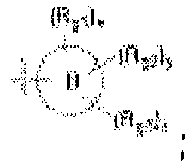
- wherein Ⓑ is selected from phenyl, pyridine, pyrimidine, thiazole, indole, indazole, piperazine, quinoline, furan, tetrahydropyridine, piperidine, or the following group:

- x, y and z are each independently an integer of 0 or 1, and
- Rg1, Rg2 and Rg3 are each independently selected from hydrogen; hydroxy; -C1-3 alkyl;
- -CF3; -C1-6 straight or branched chain alkoxy; -C2-6 straight or branched chain alkyl alkoxy;
- -C(=O)CH3; -C1-4 straight or branched chain alcohol; -N(CH3)2; -F; -Cl; -Br; -I; phenyl; -S((=O)2)CH3; or the following group:


- Preferably, the compound optical isomer thereof or pharmaceutically acceptable salt thereof represented by the above Formula I may be a compound represented by the following Formula II:

- a is an integer of 0, 1 or 2,
- K is independently hydrogen, -F, -Cl, -Br or -I,
- Y is selected from the group consisting of:

- M is C, O or N,
- 1 and mare each independently an integer of 0 or 1,
- Ra1 and Ra2 are each independently hydrogen; hydroxy; -C1-4 straight or branched chain alkyl, unsubstituted or substituted with one or more F, Cl, Br or I; -C1-4 straight or branched chain alcohol; benzhydryl; -C1-4 straight or branched chain alkyl substituted with a saturated or unsaturated 5- to 7-membered heterocyclic compound comprising 1 to 3 heteroatoms selected from N, 0, and S as a ring member (wherein the heterocyclic compound may be unsubstituted or at least one hydrogen may be optionally substituted with OH, OCH3, CH3, CH2CH3, F, Cl, Br, or I); a saturated or unsaturated 5- to 7-membered heterocyclic compound comprising 1 to 3 heteroatoms selected from N, O, and S as a ring member (wherein the heterocyclic compound may be unsubstituted or at least one hydrogen may be optionally substituted with OH, OCH3, CH3, CH2CH3, F, Cl, Br, or I); phenyl, unsubstituted or substituted with one or more
- F, Cl, Br, I, C1-4 alkoxy, C1-2 alkyl, or hydroxy; benzyl, unsubstituted or substituted with one or more F, Cl, Br, I, C1-4 alkoxy, C1-2 alkyl, or hydroxy; -S((=O)2)CH3; -F; -Cl;
- -Br; -I; -C1-6 straight or branched chain alkoxy; -C2-6 alkyl alkoxy; -C(=O)Rx, wherein Rx is straight or branched C1-3 alkyl or C3-10 cycloalkyl;


- n is an integer of 0, 1, or 2,
- Rb is hydrogen; hydroxy; -C1-6 straight or branched chain alkyl, unsubstituted or substituted with one or more F, Cl, Br, or I; -C(=O)CH3; -C1-4 straight or branched chain alcohol; -C1-6 straight or branched chain alkoxy; -C2-6 straight or branched chain alkyl alkoxy; -CF3; -F; -Cl; -Br; -I; or

- Z is selected from the group consisting of the following compounds:


- wherein Pa and Pb are each independently

- wherein Ⓑ is selected from phenyl, pyridine, pyrimidine, thiazole, indole, indazole, piperazine, quinoline, furan, tetrahydropyridine, piperidine, or the following group:

- the indazole of Ⓑ may be indazol-5-yl or indazol-6-yl,
- the pyridine of Ⓑ may be pyridine-3-yl,
- the indole of Ⓑ may be indol-4-yl, indol-5-yl or indol-6-yl,
- the pyrimidine of Ⓑ may be pyrimidin-5-yl,
- the quinoline of Ⓑ may be quinolin-7yl,
- the furan of Ⓑ may be furan-3-yl,
- the tetrahydropyridine of Ⓑ may be 1,2,3,6-tetrahydropyridn-4-yl,
- the piperidine of Ⓑ may be piperidin-4-yl,
- the

- the

- the

- the

- x, y and z are each independently an integer of 0 or 1, and
- Rg1, Rg2 and Rg3 are each independently selected from hydrogen; hydroxy; -C1-3 alkyl; -CF3; -C1-6 straight or branched chain alkoxy; -C2-6 straight or branched chain alkyl alkoxy; -C(=O)CH3; -C1-4 straight or branched chain alcohol; -N(CH3)2; -F; -Cl; -Br; -I; phenyl; -S((=0)2)CH3; or the following group:


- wherein Pa and Pb are each independently
- According to embodiments of the present invention, one compound represented by the above Formula II optical isomer thereof or pharmaceutically acceptable salt thereof may preferably include the following structure:
wherein - a is an integer of 0, 1 or 2,
- K is independently hydrogen, -F, -Cl, -Br or -I,
- Y is

- M is C, 0 or N,
- l and m are each independently an integer of 0 or 1,
- Ra1 and Ra2 are each independently hydrogen; hydroxy; -C1-4 straight or branched chain alkyl, unsubstituted or substituted with one or more F, Cl, Br or I; -C1-4 straight or branched chain alcohol; benzhydryl; -C1-4 straight or branched chain alkyl substituted with a saturated or unsaturated 5- to 7-membered heterocyclic compound comprising 1 to 3 heteroatoms selected from N, O, and S as a ring member (wherein the heterocyclic compound may be unsubstituted or at least one hydrogen may be optionally substituted with OH, OCH3, CH3, CH2CH3, F, Cl, Br, or I); a saturated or unsaturated 5- to 7-membered heterocyclic compound comprising 1 to 3 heteroatoms selected from N, O, and S as a ring member (wherein the heterocyclic compound may be unsubstituted or at least one hydrogen may be optionally substituted with OH, OCH 3, CH3, CH2CH3, F, Cl, Br, or I); phenyl, unsubstituted or substituted with one or more F, Cl, Br, I, C1-4 alkoxy, C1-2 alkyl, or hydroxy; benzyl, unsubstituted or substituted with one or more F, Cl, Br, I, C1-4 alkoxy, C1-2 alkyl, or hydroxy; -S((=O)2)CH3; -F; -Cl; -Br; -I; -C1-6 straight or branched chain alkoxy; -C2-6 alkyl alkoxy; -C(=O)Rx, wherein Rx is straight or branched C1-3 alkyl or C3-10 cycloalkyl; or,

- n is an integer of 0, 1, or 2,
- Rb is hydrogen; -C1-6 straight or branched chain alkyl, unsubstituted or substituted with one or more F, Cl, Br, or I; and
- Z is selected from the group consisting of the following compounds:


- the

- More preferably, the compound represented by the above Formula II optical isomer thereof or pharmaceutically acceptable salt thereof may be a compound represented by the following Formula III:

- Y is
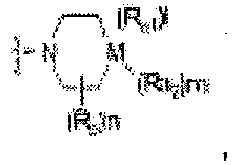
- 1 and mare each independently an integer of 0 or 1,
- Ra1 and Ra2 are each independently hydrogen; -C1-4 straight or branched chain alkyl, unsubstituted or substituted with one or more F, Cl, Br or I; -C1-4 straight or branched chain alkyl substituted with a phenyl, pyridine or pyrimidine (wherein the phenyl, pyridine or pyrimidine may be unsubstituted or at least one hydrogen may be optionally substituted with OH, OCH3, CH3, CH2CH3, F, Cl, Br, or I);
- n is an integer of 0, 1, or 2,
- Rb is hydrogen; -C1-6 straight or branched chain alkyl, unsubstituted or substituted with one or more F, Cl, Br, or I; and
- Z is selected from the group consisting of the following compounds:

- wherein Pa and Pb are each independently hydrogen; -F; -Cl; -Br; -CF3; -OCF3; -CH2F;


- the

- the

- The compound represented by the above Formula I optical isomer thereof or pharmaceutically acceptable salt thereof may be a compound represented by the following Formula I-1:

- Preferably, the compound represented by the above Formula 1-1 maybe Compound 255, 256, 279, 374, 385, 386, 389, 390, 391, 392, 393, 394, 413, 414, 415, 416, 438, 439, 440, 441, 453, 454, 455, 456, 457, 458, 459, 460, 461, 477, 478, 479, 480, 481, 482, 484, 485, 486, 494, 495, 496, 497, 498, 520, 521, 522, 529, 530, 543, 544, 545, 580, 683, 684, 717, 718, 771, 772, 773, 774, 776, 791, 800 or 801 described in the present invention.
- The compound represented by the above Formula I optical isomer thereof or pharmaceutically acceptable salt thereof may be a compound represented by the following Formula 1-2:

- Preferably, the compound represented by the above Formula 1-2 may be Compound 261, 262, 263, 395, 396, 397, 398, 399, 400, 401, 402, 403, 404, 405, 418 or 483 described in the present invention.
- The compound represented by the above Formula I optical isomer thereof or pharmaceutically acceptable salt thereof may be a compound represented by the following Formula 1-3:

- Preferably, the compound represented by the above Formula 1-3 may be
Compound - The compound represented by the above Formula I optical isomer thereof or pharmaceutically acceptable salt thereof may be a compound represented by the following Formula 1-4:

- Preferably, the compound represented by the above Formula 1-4 may be Compound 419, 420, 489, 490, 491, 492, 493, 517 or 518 described in the present invention.
- The compound represented by the above Formula I optical isomer thereof or pharmaceutically acceptable salt thereof may be a compound represented by the following Formula I-5:

- Preferably, the compound represented by the above Formula 1-5 may be Compound 462, 463, 464, 465, 466, 467, 468, 469, 470 or 471 described in the present invention.
- The compound represented by the above Formula I optical isomer thereof or pharmaceutically acceptable salt thereof may be a compound represented by the following Formula 1-6:

- Preferably, the compound represented by the above Formula 1-6 may be Compound 487, 488, 511, 512, 513, 514, 532, 577 or 578 described in the present invention.
- The compound represented by the above Formula I optical isomer thereof or pharmaceutically acceptable salt thereof may be a compound represented by the following Formula 1-7:

- Preferably, the compound represented by the above Formula 1-7 may be Compound 280, 281, 309, 311, 312, 313, 341, 342, 343, 352, 353, 354, 355, 356, 357, 358, 376, 377, 379, 450, 451, 533, 778, 826, 827, 828 or 829 described in the present invention.
- The compound represented by the above Formula I optical isomer thereof or pharmaceutically acceptable salt thereof may be a compound represented by the following Formula 1-8:


- Preferably, the compound represented by the above Formula 1-8 may be Compound 329, 330, 331, 332, 333, 334, 335, 336, 337, 338, 339, 340 or 372 described in the present invention.
- The compound represented by the above Formula I optical isomer thereof or pharmaceutically acceptable salt thereof may be a compound represented by the following Formula I-9:

- Preferably, the compound represented by the above Formula 1-9 may be Compound 380, 381, 382 or 383 described in the present invention.
- The compound represented by the above Formula I optical isomer thereof or pharmaceutically acceptable salt thereof may be a compound represented by the following Formula 1-10:

- Preferably, the compound represented by the above Formula 1-10 may be Compound 499, 500, 765 or 766 described in the present invention.
- The compound represented by the above Formula I optical isomer thereof or pharmaceutically acceptable salt thereof may be a compound represented by the following Formula 1-11:


- Preferably, the compound represented by the above Formula 1-11 may be Compound 370 or 371 described in the present invention.
- The compound represented by the above Formula I optical isomer thereof or pharmaceutically active salt thereof may be a compound represented by the following Formula 1-12:


- Preferably, the compound represented by the above Formula 1-12 maybe Compound 531, 651, 716, 797, 802 or 803 described in the present invention.
- The compounds represented by Formulas I and 1-1 to 1-12 are as follows:
252 N-(4-(hydroxycarbamoyl)benzyl)-N-(3-(1-methyl-1H-indazol-5-yl)phenyl)morpholine-4-carboxamide 253 N-(4-(hydroxycarbamoyl)benzyl)-4-methyl-N-(3-(1-methyl-1H-indazol-5-yl)phenyl)piperazine-1-carboxamide 254 N-(4-(hydroxycarbamoyl)benzyl)-N-(3-(1-methyl-1H-indazol-6-yl)phenyl)morpholine-4-carboxamide 255 N-(3-bromophenyl)-N-(4-(hydroxycarbamoyl)benzyl)morpholine-4-carboxamide 256 N-(3-bromophenyl)-N-(4-(hydroxycarbamoyl)benzyl)-4-methylpiperazine-1-carboxamide 260 N-(4-(hydroxycarbamoyl)benzyl)-N-(3-(1-methyl-1H-indazol-5-yl)phenyl)piperidine-1-carboxamide 261 N-(3-(1H-indol-6-yl)phenyl)-N-(4-(hydroxycarbamoyl)benzyl)morpholine-4-carboxamide 262 N-(4-(hydroxycarbamoyl)benzyl)-N-(3-(pyridin-3-yl)phenyl)morpholine-4-carboxamide 263 N-(3-(1H-indol-5-yl)phenyl)-N-(4-(hydroxycarbamoyl)benzyl)morpholine-4-carboxamide 279 N-(4-(hydroxycarbamoyl)benzyl)-N-phenylmorpholine-4-carboxamide 280 N-(4-(hydroxycarbamoyl)benzyl)-N-(pyridin-2-yl)morpholine-4-carboxamide 281 N-(4-(hydroxycarbamoyl)benzyl)-N-(pyridin-3-yl)morpholine-4-carboxamide 309 4-benzyl-N-(4-(hydroxycarbamoyl)benzyl)-N-(pyrimidin-2-yl)piperazine-1-carboxamide 311 4-hydroxy-N-(4-(hydroxycarbamoyl)benzyl)-4-phenyl-N-(pyrimidin-2-yl)piperidine-1-carboxamide 312 N-(4-(hydroxycarbamoyl)benzyl)-N-(pyrimidin-2-yl)morpholine-4-carboxamide 313 N-(4-(hydroxycarbamoyl)benzyl)-2,6-dimethyl-N-(pyrimidin-2-yl)morpholine-4-carboxamide 329 N-(4-(hydroxycarbamoyl)benzyl)-N-(4-(1-methyl-1H-indazol-6-yl)phenyl)morpholine-4-carboxamide 330 N-(biphenyl-4-yl)-N-(4-(hydroxycarbamoyl)benzyl)morpholine-4-carboxamide 331 N-(3',5'-difluorobiphenyl-4-yl)-N-(4-(hydroxycarbamoyl)benzyl)morpholine-4-carboxamide 332 N-(4-(hydroxycarbamoyl)benzyl)-N-(4-(pyridin-3-yl)phenyl)morpholine-4-carboxamide 333 N-(4-(hydroxycarbamoyl)benzyl)-N-(4-(pyrimidin-5-yl)phenyl)morpholine-4-carboxamide 334 N-(4-(hydroxycarbamoyl)benzyl)-N-(4-(quinolin-7-yl)phenyl)morpholine-4-carboxamide 335 N-(4-(hydroxycarbamoyl)benzyl)-N-(4-(biphenyl-3-yl)phenyl)morpholine-4-carboxamide 336 N-(4-(1H-indol-5-yl)phenyl)-N-(4-(hydroxycarbamoyl)benzyl)morpholine-4-carboxamide 337 N-(4-(1H-indol-6-yl)phenyl)-N-(4-(hydroxycarbamoyl)benzyl)morpholine-4-carboxamide 338 N-(4-(hydroxycarbamoyl)benzyl)-N-(3',4',5'-trimethoxybiphenyl-4-yl)morpholine-4-carboxamide 339 N-(3',5'-bis(trifluoromethyl)biphenyl-4-yl)-N-(4-(hydroxycarbamoyl)benzyl)morpholine-4-carboxamide 340 N-(4-(1H-indol-4-yl)phenyl)-N-(4-(hydroxycarbamoyl)benzyl)morpholine-4-carboxamide 341 N-(4-(hydroxycarbamoyl)benzyl)-N-(pyridin-2-yl)piperidine-1-carboxamide 342 N-(4-(hydroxycarbamoyl)benzyl)-4-methyl-N-(pyridin-2-yl)piperidine-1-carboxamide 343 N-(4-(hydroxycarbamoyl)benzyl)-2,6-dimethyl-N-(pyridin-2-yl)morpholine-4-carboxamide 352 N-(4-(hydroxycarbamoyl)benzyl)-4-phenyl-N-(pyridin-2-yl)-5,6-dihydropyridine-1(2H)-carboxamide 353 N-(4-(hydroxycarbamoyl)benzyl)-4-methyl-N-(pyridin-2-yl)piperazine-1-carboxamide 354 4-ethyl-N-(4-(hydroxycarbamoyl)benzyl)-N-(pyridin-2-yl)piperazine-1-carboxamide 355 4-benzyl-N-(4-(hydroxycarbamoyl)benzyl)-N-(pyridin-2-yl)piperazine-1-carboxamide 356 N-(4-(hydroxycarbamoyl)benzyl)-4-(2-methoxyphenyl)-N-(pyridin-2-yl)piperazine-1-carboxamide 357 4-(4-fluorophenyl)-N-(4-(hydroxycarbamoyl)benzyl)-N-(pyridin-2-yl)piperazine-1-carboxamide 358 N-(4-(hydroxycarbamoyl)benzyl)-N-(pyridin-2-yl)pyrrolidine-1-carboxamide 370 N-(4-(hydroxycarbamoyl)benzyl)-N-(4-phenylthiazol-2-yl)morpholine-4-carboxamide 371 N-(4-(4-chlorophenyl)thiazol-2-yl)-N-(4-(hydroxycarbamoyl)benzyl)morpholine-4-carboxamide 372 N-(4-bromophenyl)-N-(4-(hydroxycarbamoyl)benzyl)morpholine-4-carboxamide 374 N-(4-(hydroxycarbamoyl)benzyl)-N-(3-(trifluoromethyl)phenyl)morpholine-4-carboxamide 376 N-(4-(hydroxycarbamoyl)benzyl)-4-methyl-N-(pyridin-2-yl)-1,4-diazepane-1-carboxamide 377 N-(4-(hydroxycarbamoyl)benzyl)-N-(pyridin-2-yl)azetidine-1-carboxamide 379 4-(3,4-dimethylphenyl)-N-(4-(hydroxycarbamoyl)benzyl)-N-(pyridin-2-yl)piperazine-1-carboxamide 380 N-(4-(hydroxycarbamoyl)benzyl)-N-(4'-(morpholinomethyl)biphenyl-4-yl)morpholine-4-carboxamide 381 N-(4-(hydroxycarbamoyl)benzyl)-N-(4'-((4-methylpiperazin-1-yl)methyl)biphenyl-4-yl)morpholine-4-carboxamide 382 (S)-N-(4-(hydroxycarbamoyl)benzyl)-N-(4'-((2-(hydroxymethyl)pyrrolidin-1-yl)methyl)biphenyl-4-yl)morpholine-4-carboxamide 383 N-(4-(hydroxycarbamoyl)benzyl)-N-(4'-(((2-hydroxyethyl) (methyl)amino)methyl)biphenyl-4-yl)morpholine-4-carboxamide 385 N-(4-(hydroxycarbamoyl)benzyl)-N-(4-(trifluoromethyl)phenyl)morpholine-4-carboxamide 386 N-(4-(hydroxycarbamoyl)benzyl)-2,6-dimethyl-N-(3-(trifluoromethyl)phenyl)morpholine-4-carboxamide 389 N-(4-chloro-3-(trifluoromethyl)phenyl)-N-(4-(hydroxycarbamoyl)benzy1)piperidine-1-carboxamide 390 N-(4-chloro-3-(trifluoromethyl)phenyl)-N-(4-(hydroxycarbamoyl)benzyl)-4-methylpiperidine-1-carboxamide 391 N-(4-chloro-3-(trifluoromethyl)phenyl)-N-(4-(hydroxycarbamoyl)benzyl)morpholine-4-carboxamide 392 N-(4-chloro-3-(trifluoromethyl)phenyl)-N-(4-(hydroxycarbamoyl)benzyl)-2,6-dimethylmorpholine-4-carboxamide 393 N-(4-chloro-3-(trifluoromethyl)phenyl)-N-(4-(hydroxycarbamoyl)benzyl)-4-methylpiperazine-1-carboxamide 394 N-(4-chloro-3-(trifluoromethyl)phenyl)-4-ethyl-N-(4-(hydroxycarbamoyl)benzyl)piperazine-1-carboxamide 395 N-(3',5'-difluorobiphenyl-3-yl)-N-(4-(hydroxycarbamoyl)benzyl)morpholine-4-carboxamide 396 N-(3-(6-(dimethylamino)pyridin-3-yl)phenyl)-N-(4-(hydroxycarbamoyl)benzyl)morpholine-4-carboxamide 397 N-(4-(hydroxycarbamoyl)benzyl)-N-(3-(pyrimidin-5-yl)phenyl)morpholine-4-carboxamide 398 N-(3',5'-bis(trifluoromethyl)biphenyl-3-yl)-N-(4-(hydroxycarbamoyl)benzyl)morpholine-4-carboxamide 399 N-(3-(2,3-dihydrobenzo[b][1,4]dioxin-6-yl)phenyl)-N-(4-(hydroxycarbamoyl)benzyl)morpholine-4-carboxamide 400 N-(4-(hydroxycarbamoyl)benzyl)-N-(3',4',5'-trimethoxybiphenyl-3-yl)morpholine-4-carboxamide 401 N-(2',6'-dimethylbiphenyl-3-yl)-N-(4-(hydroxycarbamoyl)benzyl)morpholine-4-carboxamide 402 N-(3-(furan-3-yl)phenyl)-N-(4-(hydroxycarbamoyl)benzyl)morpholine-4-carboxamide 403 N-(3-(3,6-dihydro-2H-pyran-4-yl)phenyl)-N-(4-(hydroxycarbamoyl)benzyl)morpholine-4-carboxamide 404 N-(4-(hydroxycarbamoyl)benzyl)-N-(3-(1-methyl-1,2,3,6-tetrahydropyridin-4-yl)phenyl)morpholine-4-carboxamide 405 tert-butyl-4-(3-(N-(4-(hydroxycarbamoyl)benzyl)morpholine-4-carboxamido)phenyl)-5,6-dihydropyridine-1(2H)-carboxylate 413 N-(2,4-difluorophenyl)-N-(4-(hydroxycarbamoyl)benzyl)morpholine-4-carboxamide 414 N-(2,4-difluorophenyl)-N-(4-(hydroxycarbamoyl)benzyl)piperidine-1-carboxamide 415 N-(2,4-difluorophenyl)-N-(4-(hydroxycarbamoyl)benzyl)-2,6-dimethylmorpholine-4-carboxamide 416 N-(2,4-difluorophenyl)-N-(4-(hydroxycarbamoyl)benzyl)-4-methylpiperazine-1-carboxamide 418 N-(3-(benzo[d][1,3]dioxol-5-yl)phenyl)-N-(4-(hydroxycarbamoyl)benzyl)morpholine-4-carboxamide 419 N-(3-(1-acetyl-1,2,3,6-tetrahydropyridin-4-yl)phenyl)-N-(4-(hydroxycarbamoyl)benzyl)morpholine-4-carboxamide 420 N-(4-(hydroxycarbamoyl)benzyl)-N-(3-(1-(methylsulfonyl)-1,2,3,6-tetrahydropyridin-4-yl)phenyl)morpholine-4-carboxamide 438 N-(2-fluoro-4-methylphenyl)-N-(4-(hydroxycarbamoyl)benzyl)piperidine-1-carboxamide 439 N-(2-fluoro-4-methylphenyl)-N-(4-(hydroxycarbamoyl)benzyl)morpholine-4-carboxamide 440 N-(2-fluoro-4-methylphenyl)-N-(4-(hydroxycarbamoyl)benzyl)-2,6-dimethylmorpholine-4-carboxamide 441 N-(2-fluoro-4-methylphenyl)-N-(4-(hydroxycarbamoyl)benzyl)-4-methylpiperazine-1-carboxamide 450 4-acetyl-N-(4-(hydroxycarbamoyl)benzyl)-N-(pyridin-2-yl)-1,4-diazepane-1-carboxamide 451 4-(cyclopropanecarbonyl)-N-(4-(hydroxycarbamoyl)benzyl)-N-(pyridin-2-yl)piperazine-1-carboxamide 453 4-ethyl-N-(2-fluoro-4-methylphenyl)-N-(4-(hydroxycarbamoyl)benzyl)piperazine-1-carboxamide 454 N-(2-fluoro-4-methylphenyl)-N-(4-(hydroxycarbamoyl)benzyl)-4-(2-methoxyphenyl)piperazine-1-carboxamide 455 N-(2-fluoro-4-methylphenyl)-4-(4-fluorophenyl)-N-(4-(hydroxycarbamoyl)benzyl)piperazine-1-carboxamide 456 N-(3-chloro-4-fluorophenyl)-N-(4-(hydroxycarbamoyl)benzyl)piperidine-1-carboxamide 457 N-(3-chloro-4-fluorophenyl)-N-(4-(hydroxycarbamoyl)benzyl)-4-methylpiperidine-1-carboxamide 458 N-(3-chloro-4-fluorophenyl)-N-(4-(hydroxycarbamoyl)benzyl)morpholine-4-carboxamide 459 N-(4-(hydroxycarbamoyl)benzyl)-4-methyl-N-(3-(trifluoromethyl)phenyl)piperidine-1-carboxamide 460 N-(4-(hydroxycarbamoyl)benzyl)-N-(3-(trifluoromethyl)phenyl)piperidine-1-carboxamide 461 4-ethyl-N-(4-(hydroxycarbamoyl)benzyl)-N-(3-(trifluoromethyl)phenyl)piperazine-1-carboxamide 462 N-(3-(benzo[d][1,3]dioxol-5-yl)phenyl)-N-(4-(hydroxycarbamoyl)benzyl)piperidine-1-carboxamide 463 N-(3-(benzo[d][1,3]dioxol-5-yl)phenyl)-4-hydroxy-N-(4-(hydroxycarbamoyl)benzyl)piperidine-1-carboxamide 464 N-(3-(benzo[d][1,3]dioxol-5-yl)phenyl)-N-(4-(hydroxycarbamoyl)benzyl)-2,6-dimethylmorpholine-4-carboxamide 465 N-(3-(benzo[d][1,3]dioxol-5-yl)phenyl)-4-hydroxy-N-(4-(hydroxycarbamoyl)benzyl)-4-phenylpiperidine-1-carboxamide 466 N-(3-(benzo[d][1,3]dioxol-5-yl)phenyl)-N-(4-(hydroxycarbamoyl)benzyl)-4-methylpiperazine-1-carboxamide 467 N-(3-(benzo[d][1,3]dioxol-5-yl)phenyl)-N-(4-(hydroxycarbamoyl)benzyl)-4-(2-hydroxyethyl)piperazine-1-carboxamide 468 N-(3-(benzo[d][1,3]dioxol-5-yl)phenyl)-N-(4-(hydroxycarbamoyl)benzyl)pyrrolidine-1-carboxamide 469 (S)-N-(3-(benzo[d][1,3]dioxol-5-yl)phenyl)-N-(4-(hydroxycarbamoyl)benzyl)-2-(hydroxymethyl)pyrrolidine-1-carboxamide 470 N-(3-(benzo[d][1,3]dioxol-5-yl)phenyl)-4-(cyclopropanecarbonyl)-N-(4-(hydroxycarbamoyl)benzyl)piperazine-1-carboxamide 471 N-(3-(benzo[d][1,3]dioxol-5-yl)phenyl)-N-(4-(hydroxycarbamoyl)benzyl)azetidine-1-carboxamide 477 N-(3-chloro-4-fluorophenyl)-N-(4-(hydroxycarbamoyl)benzyl)-2,6-dimethylmorpholine-4-carboxamide 478 N-(3-chloro-4-fluorophenyl)-N-(4-(hydroxycarbamoyl)benzyl)-4-methylpiperazine-1-carboxamide 479 N-(3-chloro-4-fluorophenyl)-4-ethyl-N-(4-(hydroxycarbamoyl)benzyl)piperazine-1-carboxamide 480 4-benzyl-N-(3-chloro-4-fluorophenyl)-N-(4-(hydroxycarbamoyl)benzyl)piperazine-1-carboxamide 481 N-(3-chloro-4-fluorophenyl)-N-(4-(hydroxycarbamoyl)benzyl)-4-(2-methoxyphenyl)piperazine-1-carboxamide 482 N-(3-chloro-4-fluorophenyl)-4-(4-fluorophenyl)-N-(4-(hydroxycarbamoyl)benzyl)piperazine-1-carboxamide 483 N-(4-(hydroxycarbamoyl)benzyl)-N-(3-(tetrahydro-2H-pyran-4-yl)phenyl)morpholine-4-carboxamide 484 N-(4-(hydroxycarbamoyl)benzyl)-N-(3-methoxyphenyl)morpholine-4-carboxamide 485 3,3-difluoro-N-(4-(hydroxycarbamoyl)benzyl)-N-(4-(trifluoromethyl)phenyl)azetidine-1-carboxamide 486 4-hydroxy-N-(4-(hydroxycarbamoyl)benzyl)-4-phenyl-N-(4-(trifluoromethyl)phenyl)piperidine-1-carboxamide 487 N-(3-bromophenyl)-N-(2-fluoro-4-(hydroxycarbamoyl)benzyl)morpholine-4-carboxamide 488 N-(3-bromophenyl)-N-(2-fluoro-4-(hydroxycarbamoyl)benzyl)-4-hydroxypiperidine-1-carboxamide 489 tert-butyl-4-(3-(N-(4-(hydroxycarbamoyl)benzyl)morpholine-4-carboxamido)phenyl)piperidine-1-carboxylate 490 N-(3-(1-acetylpiperidin-4-yl)phenyl)-N-(4-(hydroxycarbamoyl)benzyl)morpholine-4-carboxamide 491 N-(4-(hydroxycarbamoyl)benzyl)-N-(3-(1-(methylsulfonyl)piperidin-4-yl)phenyl)morpholine-4-carboxamide 492 N-(4-(hydroxycarbamoyl)benzyl)-N-(3-(1-(isopropylcarbamoyl)piperidin-4-yl)phenyl)morpholine-4-carboxamide 493 N-(4-(hydroxycarbamoyl)benzyl)-N-(3-(piperidin-4-yl)phenyl)morpholine-4-carboxamidehydrochloride 494 4-acetyl-N-(4-(hydroxycarbamoyl)benzyl)-N-(3-(trifluoromethyl)phenyl)piperazine-1-carboxamide 495 (R)-3-fluoro-N-(4-(hydroxycarbamoyl)benzyl)-N-(3-(trifluoromethyl)phenyl)pyrrolidine-1-carboxamide 496 (S)-3-fluoro-N-(4-(hydroxycarbamoyl)benzyl)-N-(3-(trifluoromethyl)phenyl)pyrrolidine-1-carboxamide 497 (R)-N-(4-(hydroxycarbamoyl)benzyl)-2-(hydroxymethyl)-N-(3-(trifluoromethyl)phenyl)pyrrolidine-1-carboxamide 498 (S)-N-(4-(hydroxycarbamoyl)benzyl)-2-(trifluoromethyl)-N-(3-(trifluoromethyl)phenyl)pyrrolidine-1-carboxamide 499 N-(4-(hydroxycarbamoyl)benzyl)-N-(3-(hydroxymethyl)phenyl)morpholine-4-carboxamide 500 N-(3-(fluoromethyl)phenyl)-N-(4-(hydroxycarbamoyl)benzyl)morpholine-4-carboxamide 511 N-(3-(benzo[d][1,3]dioxol-5-yl)phenyl)-N-(2-fluoro-4-(hydroxycarbamoyl)benzyl)morpholine-4-carboxamide 512 N-(3-(3,6-dihydro-2H-pyran-4-yl)phenyl)-N-(2-fluoro-4-(hydroxycarbamoyl)benzyl)morpholine-4-carboxamide 513 N-(3-(benzo[d][1,3]dioxol-5-yl)phenyl)-N-(2-fluoro-4-(hydroxycarbamoyl)benzyl)-4-hydroxypiperidine-1-carboxamide 514 N-(3-(3,6-dihydro-2H-pyran-4-yl)phenyl)-N-(2-fluoro-4-(hydroxycarbamoyl)benzyl)-4-hydroxypiperidine-1-carboxamide 517 N-(3-(1-(2-hydroxy-2-methylpropyl)piperidin-4-yl)phenyl)-N-(4-(hydroxycarbamoyl)benzyl)morpholine-4-carboxamide 518 N-(3-(1-(2-fluoro-2-methylpropyl)piperidin-4-yl)phenyl)-N-(4-(hydroxycarbamoyl)benzyl)morpholine-4-carboxamide 520 (R)-3-fluoro-N-(4-(hydroxycarbamoyl)benzyl)-N-(4-(trifluoromethyl)phenyl)pyrrolidine-1-carboxamide 521 (S)-3-fluoro-N-(4-(hydroxycarbamoyl)benzyl)-N-(4-(trifluoromethyl)phenyl)pyrrolidine-1-carboxamide 522 (R)-N-(4-(hydroxycarbamoyl)benzyl)-2-(hydroxymethyl)-N-(4-(trifluoromethyl)phenyl)pyrrolidine-1-carboxamide 529 4-acetyl-N-(3-fluorophenyl)-N-(4-(hydroxycarbamoyl)benzyl)piperazine-1-carboxamide 530 N-(3-fluorophenyl)-N-(4-(hydroxycarbamoyl)benzyl)morpholine-4-carboxamide 531 4-(2-fluoro-2-methylpropyl)-N-(4-(hydroxycarbamoyl)benzyl)-N-(3-(trifluoromethyl)phenyl)piperazine-1-carboxamide 532 N-(2-fluoro-4-(hydroxycarbamoyl)benzyl)-N-(3-(trifluoromethyl)phenyl)morpholine-4-carboxamide 533 N-(5-chloropyridin-2-yl)-N-(4-(hydroxycarbamoyl)benzyl)morpholine-4-carboxamide 543 N-(4-(hydroxycarbamoyl)benzyl)-4-(2-morpholinoethyl)-N-(4-(trifluoromethyl)phenyl)piperazine-1-carboxamide 544 N-(4-(hydroxycarbamoyl)benzyl)-4-(pyridin-4-yl)-N-(4-(trifluoromethyl)phenyl)piperazine-1-carboxamide 545 N-(4-(hydroxycarbamoyl)benzyl)-4-(2-morpholino-2-oxoethyl)-N-(4-(trifluoromethyl)phenyl)piperazine-1-carboxamide 577 N-(2-fluoro-4-(hydroxycarbamoyl)benzyl)-N-(4-(trifluoromethyl)phenyl)morpholine-4-carboxamide 578 3,3-difluoro-N-(2-fluoro-4-(hydroxycarbamoyl)benzyl)-N-(4-(trifluoromethyl)phenyl)azetidine-1-carboxamide 580 N-(4-(hydroxycarbamoyl)benzyl)-N-(4-(trifluoromethyl)phenyl)-1,4-oxazepane-4-carboxamide 651 N-(4-(hydroxycarbamoyl)benzyl)-4-((4-hydroxytetrahydro-2H-pyran-4-yl)methyl)-N-(3-(trifluoromethyl)phenyl)piperazine-1-carboxamide 683 4-benzyl-N-(4-(hydroxycarbamoyl)benzyl)-N-(3-(trifluoromethyl)phenyl)piperazine-1-carboxamide 684 N-(4-(hydroxycarbamoyl)benzyl)-4-(3-methoxyphenyl)-N-(3-(trifluoromethyl)phenyl)piperazine-1-carboxamide 716 4-((4-fluorotetrahydro-2H-pyran-4-yl)methyl)-N-(4-(hydroxycarbamoyl)benzyl)-N-(3-(trifluoromethyl)phenyl)piperazine-1-carboxamide 717 N-(4-(hydroxycarbamoyl)benzyl)-4-phenyl-N-(3-(trifluoromethyl)phenyl)piperazine-1-carboxamide 718 4-benzhydryl-N-(4-(hydroxycarbamoyl)benzyl)-N-(3-(trifluoromethyl)phenyl)piperazine-1-carboxamide 765 4-ethyl-N-(3-(fluoromethyl)phenyl)-N-(4-(hydroxycarbamoyl)benzyl)piperazine-1-carboxamide 766 4-(2-fluoro-2-methylpropyl)-N-(3-(fluoromethyl)phenyl)-N-(4-(hydroxycarbamoyl)benzyl)piperazine-1-carboxamide 771 N-(4-(hydroxycarbamoyl)benzyl)-N-(2-(trifluoromethoxy)phenyl)morpholine-4-carboxamide 772 N-(4-(hydroxycarbamoyl)benzyl)-N-(4-(trifluoromethoxy)phenyl)morpholine-4-carboxamide 773 N-(4-(hydroxycarbamoyl)benzyl)-N-(3-(trifluoromethoxy)phenyl)morpholine-4-carboxamide 774 N-(4-(hydroxycarbamoyl)benzyl)-N-(2-methoxy-5-(trifluoromethyl)phenyl)morpholine-4-carboxamide 776 N-(2-chloro-5-(trifluoromethyl)phenyl)-N-(4-(hydroxycarbamoyl)benzyl)morpholine-4-carboxamide 778 N-(4-(hydroxycarbamoyl)benzyl)-N-(6-(trifluoromethyl)pyridin-2-yl)morpholine-4-carboxamide 791 N-(2,3-difluorophenyl)-N-(4-(hydroxycarbamoyl)benzyl)morpholine-4-carboxamide 797 (3S,5R)-4-ethyl-N-(4-(hydroxycarbamoyl)benzyl)-3,5-dimethyl-N-(3-(trifluoromethyl)phenyl)piperazine-1-carboxamide 800 N-(4-(hydroxycarbamoyl)benzyl)-2,6-dimethyl-N-(3-(trifluoromethoxy)phenyl)morpholine-4-carboxamide 801 N-(4-(hydroxycarbamoyl)benzyl)-2,6-dimethyl-N-(2-(trifluoromethoxy)phenyl)morpholine-4-carboxamide 802 (3S,5R)-4-benzyl-N-(4-(hydroxycarbamoyl)benzyl)-3,5-dimethyl-N-(3-(trifluoromethyl)phenyl)piperazine-1-carboxamide 803 (3S,5R)-N-(4-(hydroxycarbamoyl)benzyl)-3,5-dimethyl-4-(2,2,3,3,3-pentafluoropropyl)-N-(3-(trifluoromethyl)phenyl)piperazine-1-carboxamide 826 4-ethyl-N-(4-(hydroxycarbamoyl)benzyl)-N-(6-(trifluoromethyl)pyridin-2-yl)piperazine-1-carboxamide 827 N-(4-(hydroxycarbamoyl)benzyl)-2,6-dimethyl-N-(6-(trifluoromethyl)pyridin-2-yl)morpholine-4-carboxamide 828 N-(4-(hydroxycarbamoyl)benzyl)-N-(6-(trifluoromethyl)pyridin-2-yl)piperidine-1-carboxamide 829 (S)-3-fluoro-N-(4-(hydroxycarbamoyl)benzyl)-N-(6-(trifluoromethyl)pyridin-2-yl)pyrrolidine-1-carboxamide - In the present invention, the pharmaceutically acceptable salt refers to salts commonly used in the pharmaceutical industry, such as inorganic ion salts formed with calcium, potassium, sodium, magnesium, etc., inorganic acid salts formed with hydrochloric acid, nitric acid, phosphoric acid, bromic acid, iodic acid, perchloric acid, tartaric acid, sulfuric acid, etc., organic acid salts formed with acetic acid, trifluoroacetic acid, citric acid, maleic acid, succinic acid, oxalic acid, benzoic acid, tartaric acid, fumaric acid, mandelic acid, propionic acid, citric acid, lactic acid, glycolic acid, gluconic acid, galacturonic acid, glutamic acid, glutaric acid, glucuronic acid, aspartic acid, ascorbic acid, carbonic acid, vanillic acid, hydroiodic acid, etc, sulfonic acid salts formed with methanesulfonic acid, ethanesulfonic acid, benzenesulfonic acid, p-toluenesulfonic acid, naphthalenesulfonic acid, etc., amino acid salts formed with glycine, arginine, lysine, etc., and amine salts formed with trimethylamine, triethylamine, ammonia, pyridine, picoline, but the types of salts used in the present invention are not limited to the above-mentioned salts.
- In the present invention, a preferred salt is a hydrochloric acid salt, and preferred examples of this compound include
Compounds 461 and 493 described in the present specification. - A specific preparation method of a novel compound of Formula I, an optical isomer thereof, or a pharmaceutically acceptable salt thereof is shown in the following reaction schemes 1 to 12.


- In reaction scheme 1, the compound of Formula 1-2 was synthesized by the reductive amination of the compound of Formula 1-1 with methyl 4-formylbenzoate at room temperature for 12 to 24 hours or with methyl 4-(bromomethyl)benzoate at room temperature for 16 hours, and the compound of Formula 1-3 was synthesized by the reaction of the compound of Formula 1-2 with 4-nitrophenyl carbonochloridate at room temperature for 12 to 24 hours.
- Then, the compound of Formula 1-4 was synthesized by the reaction of the compound of Formula 1-3 with amine derivative (R6) in the presence of dimethylformamide solvent at room temperature or at 60 °C for 1 to 2 days. Finally, the
target compound 
- In reaction scheme 2, the compound of Formula 2-2 was synthesized by the Suzuki reaction of the compound of Formula 2-1 with boronic acid, and then the compound of Formula 2-4 was synthesized by the reduction of the compound of Formula 2-3 with hydrogen and palladium. Finally, the target compound 261, 262, 263, 395, 396, 397, 398, 399, 400, 401, 402, 403, 404, 405, 418 or 483 was synthesized by dissolving the compound of Formula 2-2 or 2-4 in methanol, followed by the reaction with hydroxylamine hydrochloride (HONH2 HCl) and potassium hydroxide (KOH) at room temperature or with hydroxylamine (NH2OH) aqueous solution and potassium hydroxide (KOH), which were sequentially added dropwise, at room temperature.

- In
reaction scheme 3, the compound of Formula 3-2 was synthesized by the Suzuki reaction of the compound of Formula 3-1 with boronic acid, and then the compound of Formula 3-3 was synthesized by the reaction of the compound of Formula 3-2 with amine derivative (R6) at 50 to 60 °C. Finally, thetarget compound 
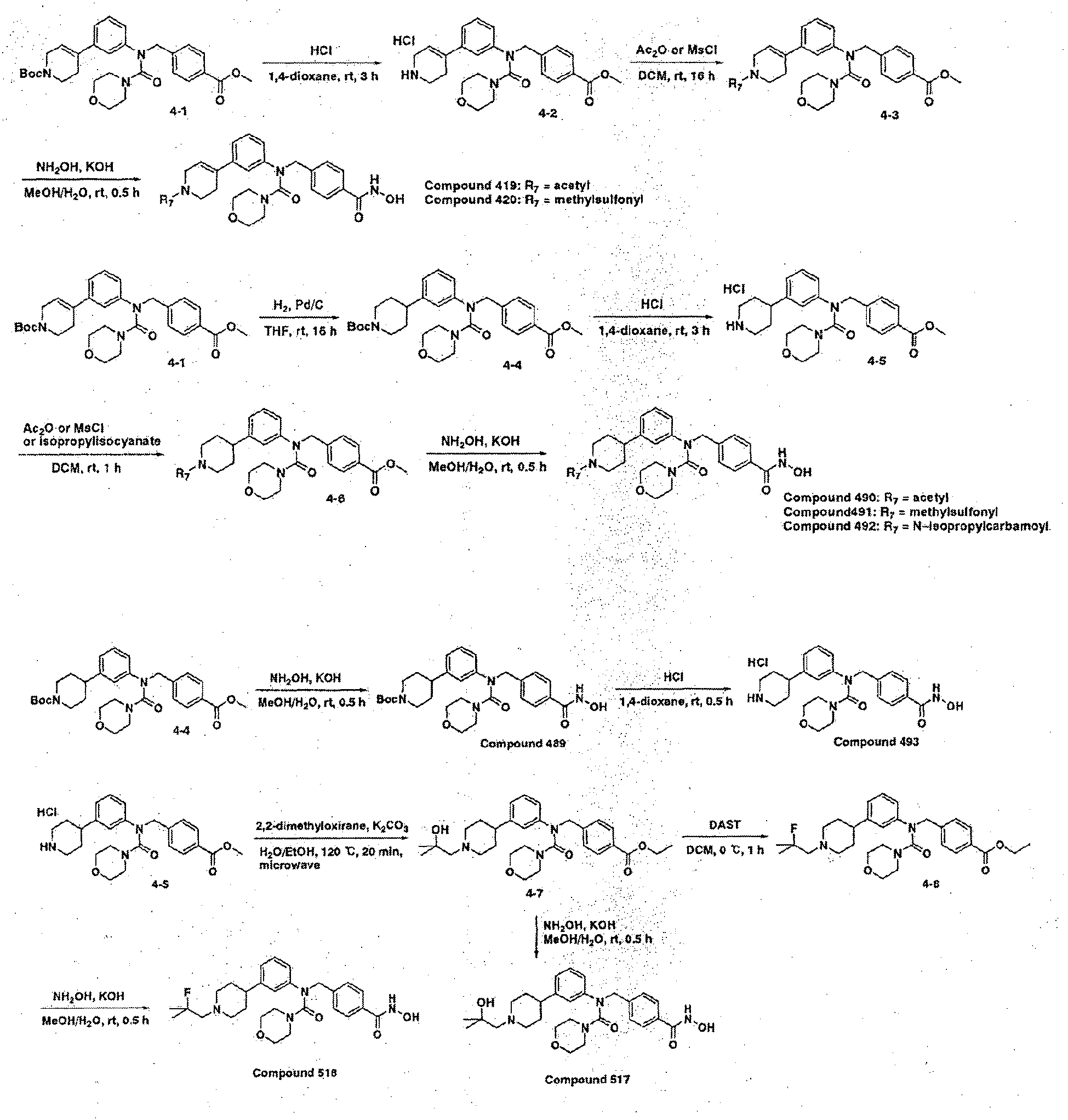
- In reaction scheme 4, the compound of Formula 4-2 was synthesized by the reaction of the compound of Formula 4-1 with hydrogen chloride, and then the compound of Formula 4-3 was synthesized using acetic acid anhydride or methane sulfonyl chloride. Next, the compound of Formula 4-4 was synthesized by the reduction of the compound of Formula 4-1 with hydrogen and palladium, and the compound of Formula 4-6 was synthesized by the same method. Subsequently, the compound of Formula 4-7 was synthesized by the reaction of the compound of Formula 4-5 with 2,2-dimethyloxiane in a microwave reactor at 120 °C, and then the compound of Formula 4-8 was synthesized using diethylaminosulfur trifluoride (DAST). Finally, the target compound 419, 420, 489, 490, 491, 492, 493, 517 or 518 was synthesized by dissolving compound formula 4-3, 4-6, 4-4, 4-7 or 4-8 in methanol, followed by the reaction with hydroxylamine (NH2OH) aqueous solution and potassium hydroxide (KOH), which were sequentially added dropwise, at room temperature.


- In reaction scheme 5, the compound of Formula 5-2 was synthesized by the Suzuki reaction of the compound of Formula 5-1 with boronic acid, and then the compound of Formula 5-3 was synthesized by the reaction of the compound of Formula 5-2 with 4-nitrophenyl chloroformate at room temperature. Next, the compound of Formula 5-4 was synthesized by the reaction of the compound of Formula 5-3 with amine derivative (R6) at 50 °C. Finally, the target compound 462, 463, 464, 465, 466, 467, 468, 469, 470 or 471 was synthesized by dissolving the compound of Formula 5-4 in methanol, followed by the reaction with hydroxylamine (NH2OH) aqueous solution and potassium hydroxide (KOH), which were sequentially added dropwise, at room temperature.


- In reaction scheme 6, the compound of Formula 6-2 was synthesized by the substitution of the compound of Formula 1-1 with the compound of Formula 6-1, and then the compound of Formula 6-3 was synthesized by the hydrolysis of the compound of Formula 6-2 with lithium hydroxide (LiOH). Next, the compound of Formula 6-4 was synthesized by the reaction of the compound of Formula 6-3 with methanol, 1-ethyl-3-[3-dimethylaminopropyl]carbodiimide hydrochloride (EDC) and 1-hydroxybenzotriazole hydrate (HOBt), and then the compound of Formula 6-5 was synthesized by the reaction of the compound of Formula 6-4 with 4-nitrophenyl chloroformate at room temperature. Subsequently, the compound of Formula 6-6 was synthesized by the reaction of the compound of Formula 6-5 with amine derivative (R6) at 50 °C, and then the compound of Formula 6-7 was synthesized by the Suzuki reaction of the compound of Formula 6-6 with boronic acid, if necessary. Finally, the target compound 487, 488, 511, 512, 513, 514, 532, 577 or 578 was synthesized by dissolving the compound of Formula 6-6 or 6-7 in methanol, followed by the reaction with hydroxylamine (NH2OH) aqueous solution and potassium hydroxide (KOH), which were sequentially added dropwise, at room temperature.


- In reaction scheme 7, the compound of Formula 7-4 was synthesized by the reductive amination of the compound of Formula 7-3 or by the substitution of the compound of Formula 7-1 with the compound of Formula 7-2. Then, the compound of Formula 7-5 was synthesized by the reaction of the compound of Formula 7-4 with 4-nitrophenyl chloroformate at room temperature or at 60 °C. Subsequently, the compound of Formula 7-6 was synthesized by the reaction of the compound of Formula 7-5 with amine derivative (R6) at 60 °C or by adding acyl chloride to the compound of Formula 7-4. Finally, the target compound 280, 281, 309, 311, 312, 313, 341, 342, 343, 352, 353, 354, 355, 356, 357, 358, 376, 377, 379, 450, 451, 533, 778, 826, 827, 828 or 829 was synthesized by dissolving the compound of Formula 7-6 in methanol, followed by the reaction with hydroxylamine (NH2OH) aqueous solution and potassium hydroxide (KOH), which were sequentially added dropwise, at room temperature.


- In reaction scheme 8, the compound of Formula 8-2 was synthesized by the substitution of the compound of Formula 8-1 with aniline, and then the compound of Formula 8-3 was synthesized by the reaction of the compound of Formula 8-2 with N-bromosuccinimide at room temperature. Next, the compound of Formula 8-4 was synthesized by the reaction of the compound of Formula 8-3 with 4-nitrophenyl chloroformate at room temperature, and then the compound of Formula 8-5 was synthesized by the substitution of the compound of Formula 8-4 with morpholine at 60 °C. Subsequently, the compound of Formula 8-6 was synthesized by the Suzuki reaction of the compound of Formula 8-5 with boronic acid. Finally, the target compound 329, 330, 331, 332, 333, 334, 335, 336, 337, 338, 339, 340 or 372 was synthesized by dissolving the compound of Formula 8-5 or 8-6 in methanol, followed by the reaction with hydroxylamine (NH2OH) aqueous solution and potassium hydroxide (KOH), which were sequentially added dropwise, at room temperature.


- In reaction scheme 9, the compound of Formula 9-1 was synthesized by the Suzuki reaction of the compound of Formula 8-5 with 4-formylphenylboronic acid, and then the compound of Formula 9-2 was synthesized by the reductive amination of the compound of Formula 9-1 with amine derivative (R7). Finally, the target compound 380, 381, 382 or 383 was synthesized by dissolving the compound of Formula 9-2 in methanol, followed by the reaction with hydroxylamine (NH2OH) aqueous solution and potassium hydroxide (KOH), which were sequentially added dropwise, at room temperature.

- In
reaction scheme 10, the compound of Formula 10-2 was synthesized by the reductive amination of the compound of Formula 10-1 with methyl 4-formylbenzoate, and the compound of Formula 10-3 was synthesized by the reaction of the compound of Formula 10-2 with 4-nitrophenyl chloroformate at room temperature. Next, the compound of Formula 10-4 was synthesized by the substitution of the compound of Formula 10-3 with morpholine at room temperature, and then the compound of Formula 10-5 was synthesized by the hydrolysis of the compound of Formula 10-4 with lithium hydroxide (LiOH). Subsequently, the compound of Formula 10-6 was synthesized by the reaction of the compound of Formula 10-5 with (tetrahydropyran-2-yl)hydroxylamine, 1-ethyl-3-[3- dimethylaminopropyl]carbodiimide hydrochloride (EDC) and 1-hydroxybenzotriazole hydrate (HOBt) at room temperature. Then, the target Compound 499 was synthesized by dissolving the compound of Formula 10-6 in methanol and adding hydrogen chloride at room temperature. - The compound of Formula 10-7 was synthesized by the reaction of the compound of Formula 10-4 with diethylaminosulfur trifluoride (DAST), and then the target Compound 500 was synthesized by dissolving the compound of Formula 10-7 in methanol, followed by the reaction with hydroxylamine (NH2OH) aqueous solution and potassium hydroxide (KOH), which were sequentially added dropwise, at room temperature.
- The compound of Formula 10-8 was synthesized by the substitution of the compound of Formula 10-3 with ethylpiperazine, and then the compound of Formula 10-9 was synthesized using diethylaminosulfur trifluoride (DAST). Next, the target Compound 765 was synthesized by dissolving the compound of Formula 10-9 in methanol, followed by the reaction with hydroxylamine (NH2OH) aqueous solution and potassium hydroxide (KOH), which were sequentially added dropwise, at room temperature.
- The compound of Formula 10-11 was synthesized by the introduction of Boc-piperazine into the compound of Formula 10-3, followed by the reaction with diethylaminosulfur trifluoride (DAST). And then, the compound of Formula 10-12 was synthesized by Boc-deprotection under acidic conditions. Next, the compound of Formula 10-13 was synthesized by the reaction of the compound of Formula 10-12 with 2,2-dimethyloxirane under microwave irradiation, and then the compound of Formula 10-14 was synthesized using diethylaminosulfur trifluoride (DAST). Finally, the target Compound 766 was synthesized by dissolving the compound of Formula 10-14 in methanol, followed by the reaction with hydroxylamine (NH2OH) aqueous solution and potassium hydroxide (KOH), which were sequentially added dropwise, at room temperature.


- In reaction scheme 11, the compound of Formula 11-3 was synthesized by the substitution of the compound of Formula 11-2 with the compound of Formula 11-1 twice, and then the compound of Formula 11-5 was synthesized by the cyclization of the compound of Formula 11-3 with the compound of Formula 11-4 by stirring under reflux in the presence of ethanol solvent. Next, the compound of Formula 11-6 was synthesized by the reaction of the compound of Formula 11-5 with 4-nitrophenyl chloroformate at room temperature, and then the compound of Formula 11-7 was synthesized by the substitution of the compound of Formula 11-6 with morpholine at 60 °C. Finally, the target Compounds 370 or 731 were synthesized by dissolving the compound of Formula 11-7 in methanol, followed by the reaction with hydroxylamine (NH2OH) aqueous solution and potassium hydroxide (KOH), which were sequentially added dropwise, at room temperature.


- In
reaction scheme 12, the compound of Formula 12-1 was synthesized by the reaction of the compound of Formula 1-3 with N-boc-piperazine, and then the compound of Formula 12-2 was synthesized by Boc-deprotection under acidic conditions. Next, the compound of Formula 12-3 was synthesized by the reaction of the compound of Formula 12-2 with 2,2-dimethyloxirane under microwave irradiation, and then the compound of Formula 12-4 was synthesized using diethylaminosulfur trifluoride (DAST). Then, the Compound 531 was synthesized by dissolving the compound of Formula 12-4 in methanol, followed by the reaction with hydroxylamine (NH2OH) aqueous solution and potassium hydroxide (KOH), which were sequentially added dropwise, at room temperature. - The compound of Formula 12-5 was synthesized by the reaction of the compound of Formula 12-2 with 1,6-dioxaspiro[2,5]octane under microwave irradiation, and then the Compound 651 was synthesized by dissolving the compound of Formula 12-5 in methanol, followed by the reaction with hydroxylamine (NH2OH) aqueous solution and potassium hydroxide (KOH), which were sequentially added dropwise, at room temperature.
- The compound of Formula 12-6 was synthesized by the reaction of the compound of Formula 12-5 with DAST, and then the Compound 716 was synthesized by dissolving the compound of Formula 12-6 in methanol, followed by the reaction with hydroxylamine (NH2OH) aqueous solution and potassium hydroxide (KOH), which were sequentially added dropwise, at room temperature.
- The compound of Formula 12-8 was synthesized by the introduction of amine derivative (R6) into the compound of Formula 1-3, followed by the substitution, and then the target compound 797, 802 or 803 was synthesized by dissolving the compound of Formula 12-8 in methanol, followed by the reaction with hydroxylamine (NH2OH) aqueous solution and potassium hydroxide (KOH), which were sequentially added dropwise, at room temperature.
- The present invention provides a pharmaceutical composition for use in the prevention or treatment of histone deacetylase-mediated diseases, comprising a compound represented by the following Formula I, an optical isomer thereof, or a pharmaceutically acceptable salt thereof as an active ingredient wherein the histone deacetylase-mediated diseases are one or more selected from the group consisting of cancer, inflammatory diseases, Huntington's disease, cystic fibrosis, hepatic fibrosis, kidney fibrosis, pulmonary fibrosis, skin fibrosis, autoimmune disease, diabetes, acute and chronic neurological disease, hypertrophy, haemorrhagic heart failure, amyotrophic lateral sclerosis, glaucoma, ocular disease, and neurodegenerative disease.

- Further examples of histone deacetylase-mediated diseases may include cell proliferative diseases including malignant tumors such as cancers, etc., inflammatory diseases, autosomal dominant diseases such as Huntington's diseases, etc., inherited metabolic diseases such as cystic fibrosis, hepatic fibrosis, kidney fibrosis, pulmonary fibrosis, skin fibrosis, etc, autoimmune diseases such as rheumatoid arthritis, etc., acute and chronic neurological diseases such as diabetes, stroke, etc., hypertrophy such as cardiac hypertrophy, etc., hemorrhagic heart failure, amyotrophic lateral sclerosis, glaucoma, ocular diseases (associated with angiogenesis), neurodegenerative diseases, etc., and further include symptoms and diseases associated with abnormal function of histone deacetylase.
- The compound represented by Formula I of the present invention may be one of the compounds represented by the above Formula 1-1 to 1-12, Formula II or Formula III.
- The pharmaceutically acceptable salt is the same as those described with respect to the compound represented by the above Formula I.
- For administration, the pharmaceutical composition of the present invention may further comprise one or more pharmaceutically acceptable carriers in addition to the compound represented by the above Formula I, an optical isomer thereof or a pharmaceutically acceptable salt thereof. Examples of the pharmaceutically acceptable carrier include saline, sterile water, Ringer's solution, buffered saline, dextrose solution, maltodextrin solution, glycerol, ethanol and combinations thereof. If necessary, other general additives, such as antioxidant, buffer solution, anti-bacterial agent, etc., may be added to the composition. Moreover, the pharmaceutical composition of the present invention may be formulated into injections such as aqueous solution, suspension, emulsion, etc., pills, capsules, granule, or tablets by adding diluent, dispersant, surfactant, binder, and lubricant. Accordingly, the composition of the present invention can be presented as patches, liquids, pills, capsules, granules, tablets, suppositories, etc. These formulations may be formulated by suitable methods in the art or methods described in Remington's Pharmaceutical Science (latest edition), Mack Publishing Company, Easton PA, depending on the disease and/or ingredients.
- The composition of the present invention may be administered orally or parenterally (e.g., intravenously, subcutaneously, intraperitoneally, or topically) at a dose depending on various factors including the patient's weight, age, gender, state of health, diet, administration time, administration route, excretion rate, severity of disease, etc. The daily dose of the composition of the present invention may be about 1 to 500 mg/kg, preferably 5 to 100 mg/kg, and the composition of the present invention may be administered once or several times a day.
- The pharmaceutical composition of the present invention may further comprise one or more active ingredients having the same or similar efficacy in addition to the compound represented by the above Formula I, an optical isomer thereof or a pharmaceutically acceptable salt thereof.
- The present invention provides a compound represented by the above Formula I, an optical isomer thereof or a pharmaceutically acceptable salt thereof for use in the treatment of histone deacetaylase-mediated diseases, wherein the histone deacetylase-mediated diseases are one or more selected from the group consisting of cancer, inflammatory diseases, Huntington's disease, cystic fibrosis, hepatic fibrosis, kidney fibrosis, pulmonary fibrosis, skin fibrosis, autoimmune disease, diabetes, acute and chronic neurological disease, hypertrophy, hemorrhagic heart failure, amytrophic lateral sclerosis, glaucoma, ocular disease and neurodegenerative disease.
- As used herein, the term "therapeutically effective amount" refers to the amount of a compound represented by the above Formula I, which is effective for the prevention or treatment of histone deacetylase-mediated diseases.
- As described herein the prevention or treatment of histone deacetylase-mediated diseases described further includes managing the disease itself before the onset of symptoms as well as inhibiting or avoiding the symptoms by administering the compound represented by the above Formula I. In the management of the disease, the preventive or therapeutic dose of a specific active ingredient may vary depending on the nature and severity of the disease or condition and the administration route of the active ingredient. The dose and the frequency of the dose may vary depending on the individual patient's age, weight, and response. The suitable dose and use may be easily selected by those having ordinary skill in the art based on these factors.
- Moreover, the prevention or treatment of histone deacetylase-mediated diseases described herein may further comprise administering a therapeutically effective amount of an additional active ingredient that improve the treatment of disease together with the compound represented by the above Formula I. The additional active ingredient may exhibit a synergistic or additive effect together with the compound represented by the above Formula I.
- Further described herein is the use of a compound represented by the above Formula I, an optical isomer thereof or a pharmaceutically acceptable salt thereof in the preparation of medicaments for the treatment of HDAC-mediated diseases. The compound represented by the above Formula I for the preparation of medicaments may comprise a pharmaceutically acceptable adjuvant, diluent, carrier, etc. and may be prepared into combined formulations together with other active ingredients to have synergistic activities.
- The matters mentioned in the use and the composition, of the present invention are applied equally unless they are contradictory to each other.
- The compound represented by the above Formula I, an optical isomer thereof or a pharmaceutically acceptable salt thereof according to the present invention can be used in the prevention and treatment of histone deacetylase-mediated diseases, wherein the histone deacetylase-mediated diseases are one or more selected from the group consisting of cancer, inflammatory diseases, Huntington's disease, cystic fibrosis, hepatic fibrosis, kidney fibrosis, pulmonary fibrosis, skin fibrosis, autoimmune disease, diabetes, acute and chronic neurological disease, hypertrophy, hemorrhagic heart failure, amytrophic lateral sclerosis, glaucoma, ocular disease and neurodegenerative disease.
-
-
FIG. 1 shows the acetylation levels of Tubulin, Histone H3 and Histone H4 after the treatment withCompound 255. -
FIG. 2 shows the acetylation levels of Tubulin, Histone H3 and Histone H4 after the treatment withCompound 374. -
FIG. 3 shows the improvement of arthritis after the treatment withCompound 254 orCompound 255 to collagen-induced arthritis models. -
FIG. 4 shows the improvement of arthritis after the treatment withCompound 374 to collagen-induced arthritis models. -
FIG. 5 shows the improvement of arthritis after the treatment withCompound -
FIG. 6 shows the recovery of weight after the treatment withCompound -
FIG. 7 shows the combination index after the combination treatment ofCompound 255 and Velcade. - Hereinafter, the present invention will be described in further detail with reference to examples, preparation examples and test examples. It is to be understood, however, that these examples are for illustrative purposes only and are not intended to limit the scope of the present invention.
- Unless otherwise stated, reagents and solvents mentioned below were those available from Sigma-Aldrich and TCI, HPLC was Waters e2695, silica gel for column chromatography was Merck(230∼400 mesh), 1H NMR data was measured using Bruker 400 MHz and Mass spectrum was agilent 1100 series.
-

- Compound of Formula 1-1 (3-bromobenzenamine; 5 g, 29 mmol) was dissolved in dichloromethane (200 mL), and then methyl 4-fomylbenzoate (5.7 g, 35 mmol) and acetic acid (1.74 mL, 29 mmol) were added and stirred for 1 hour. Then, sodium cyanoborohydride (2.2 g, 35 mmol) was slowly added dropwise and stirred for 1 day. Water was poured into the reaction mixture, and the organic layer was extracted. The organic layer was washed with saturated sodium chloride aqueous solution, dehydrated with anhydrous magnesium sulfate, and then concentrated under reduced pressure. The residue was purified and concentrated by column chromatography (silica; ethyl acetate/hexane=20%) to give the desired compound of Formula 1-2 (7.8 g, 84%) in the form of a white solid.
-

- Compound of Formula 1-2 (methyl 4-((3-bromophenylamino)methyl)benzoate; 5.90 g, 18.4 mmol) was dissolved in acetonitrile (200 mL), and then potassium carbonate (5.09 g, 36.9 mmol) and 4-nitrophenyl chloroformate (4.09 g, 20.3 mmol) were added. Then, the mixture was heated and stirred at 50 °C for 1 day. Water was poured into the reaction mixture, and the organic layer was extracted with ethyl acetate. The organic layer was washed with saturated sodium chloride aqueous solution, dehydrated with anhydrous magnesium sulfate, and then concentrated under reduced pressure. The residue was purified and concentrated by column chromatography (silica; methanol/ dichloromethane=1%) to give the desired compound of Formula 3-1 (7.3 g, 82%) in the form of a white solid.
-

- Compound of Formula 3-1 (methyl 4-(((3-bromophenyl)((4-nitrophenoxy)carbonyl)amino)methyl)benzoate; 1.00 g, 2.06 mmol), 1-methyl-1H-indazol-5-ylboronic acid (0.435 g, 2.473 mmol), Pd(dppf)Cl2 (0.168 g, 0.206 mmol), and sodium carbonate (0.693 g, 4.53 mmol) were mixed with dimethoxyethane (5 mL)/H2O (5 mL), heated at 120 °C for 15 minutes under microwave irradiation, and then the temperature was lowered to room temperature. Water was poured into the reaction mixture, and the organic layer was extracted with ethyl acetate. The organic layer was washed with saturated sodium chloride aqueous solution, dehydrated with anhydrous magnesium sulfate, and then concentrated under reduced pressure. The residue was purified and concentrated by column chromatography (silica; ethyl acetate/hexane=30%) to give the desired compound of Formula 3-2 (0.620 g, 56%) in the form of a white solid.
-

- Compound of Formula 3-2 (methyl 4-(((3-(1-methyl-1H-indazol-5-yl)phenyl)((4-nitrophenoxy)carbonyl)amino)methyl)be nzoate; 0.05 g, 0.093 mmol) was dissolved in dimethylformamide (10 mL), and then morpholine (0.012 mL, 0.14 mmol) and potassium carbonate (0.039 g, 0.28 mmol) were added. Then, the mixture was heated and stirred at 60 °C for 12 hours. Water was poured into the reaction mixture, and the organic layer was extracted with ethyl acetate. The organic layer was washed with saturated sodium chloride aqueous solution, dehydrated with anhydrous magnesium sulfate, and then concentrated under reduced pressure. The residue was purified and concentrated by column chromatography (silica; ethyl acetate/hexane=30%) to give the desired compound of Formula 3-3 (0.035 g, 77%) in the form of a colorless liquid.
-

- Compound of Formula 3-3 (methyl 4-((N-(3-(1-methyl-1H-indazol-5-yl)phenyl)morpholine-4-carboxamido)methyl)benzo ate; 0.035 g, 0.072 mmol) was dissolved in methanol (10 mL), and then hydroxylamine hydrochloride (0.025 g, 0.361 mmol), potassium hydroxide (0.041 g, 0.722 mmol), and hydroxylamine (50 wt% aqueous solution; 0.186 mL, 1.445 mmol) were added dropwise and stirred at room temperature for 6 hours. After completion of the reaction, the methanol was removed under reduced pressured, and then 2 N hydrogen chloride was added to precipitate a solid. Then, the resulting solid was filtered and dried to give the desired Compound 252 (0.016 g, 46%) in the form of a white solid.
1H NMR (400 MHz, DMSO-d6) δ 8.08 (s, 1 H), 7.97 (s, 1 H), 7.69 - 7.64 (m, 4 H), 7.43 - 7.35 (m, 5 H), 7.08 (d, 1 H, J = 7.0 Hz), 4.93 (s, 2 H), 4.05 (s, 3 H), 3.40 - 3.37 (m, 4 H), 3.19 - 3.16 (m, 4 H); MS (ESI) m/z 486.1 (M+ + H). -

- Compound of Formula 3-2 (methyl 4-(((3-(1-methyl-1H-indazol-5-yl)phenyl)((4-nitrophenoxy)carbonyl)amino)methyl)be nzoate; 0.05 g, 0.093 mmol) was dissolved in dimethylformamide (10 mL), and then n-methylpiperazine (0.016 mL, 0.14 mmol) and potassium carbonate (0.039 g, 0.28 mmol) were added. Then, the mixture was heated and stirred at 55 °C for 12 hours. Water was poured into the reaction mixture, and the organic layer was extracted with ethyl acetate. The organic layer was washed with saturated sodium chloride aqueous solution, dehydrated with anhydrous magnesium sulfate, and then concentrated under reduced pressure. The residue was purified and concentrated by column chromatography (silica; methanol/ dichloromethane=5%) to give the desired compound of Formula 3-3 (0.044 g, 95%) in the form of a colorless liquid.
-

- Compound of Formula 3-3 (methyl 4-((4-methyl-N-(3-(1-methyl-1H-indazol-5-yl)phenyl)piperazine-1-carboxamido)meth yl)benzoate; 0.044 g, 0.088 mmol) was dissolved in methanol (5 mL), and then hydroxylamine hydrochloride (0.031 g, 0.442 mmol), potassium hydroxide (0.049 g, 0.884 mmol), and hydroxylamine (50 wt% aqueous solution; 0.228 mL, 1.77 mmol) were added dropwise and stirred at room temperature for 6 hours. After completion of the reaction, the methanol was removed under reduced pressured, and then 2 N hydrogen chloride was added to precipitate a white solid. Then, the resulting solid was filtered and dried to give the desired Compound 253 (0.02 g, 45%) in the form of a white solid.
1H NMR (400 MHz, DMSO-d6) δ 8.08 (s, 1 H), 7.97 (s, 1 H), 7.69 - 7.64 (m, 4 H), 7.41 - 7.37 (m, 5 H), 7.07 - 7.06 (m, 1 H), 4.92 (s, 2 H), 4.06 (s, 3 H), 3.20 - 3.19 (m, 4 H), 2.13 - 2.11 (m, 4 H), 2.06 (s, 3 H); MS (ESI) m/z 499.2 (M+ + H). -

- Compound of Formula 3-1 (methyl 4-(((3-bromophenyl)((4-nitrophenoxy)carbonyl)amino)methyl)benzoate; 1.00 g, 2.06 mmol), 1-methyl-1H-indazol-6-ylboronic acid (0.435 g, 2.47 mmol), Pd(dppf)Cl2 (0.168 g, 0.206 mmol), and sodium carbonate (0.693 g, 4.53 mmol) were mixed with dimethoxyethane (5 mL)/H2O (5 mL), heated at 120 °C for 15 minutes under microwave irradiation, and then the temperature was lowered to room temperature. Water was poured into the reaction mixture, and the organic layer was extracted with ethyl acetate. The organic layer was washed with saturated sodium chloride aqueous solution, dehydrated with anhydrous magnesium sulfate, and then concentrated under reduced pressure. The residue was purified and concentrated by column chromatography (silica; ethyl acetate/hexane=30 %) to give the desired compound of Formula 3-2 (1.03 g, 93%) in the form of a white solid.
-

- Compound of Formula 3-2 (methyl 4-(((3-(1-methyl-1H-indazol-6-yl)phenyl)((4-nitrophenoxy)carbonyl)amino)methyl)be nzoate; 0.05 g, 0.093 mmol) was dissolved in dimethylformamide (10 mL), and then morpholine (0.011 mL, 0.14 mmol) and potassium carbonate (0.0386 g, 0.28 mmol) were added. Then, the mixture was heated and stirred at 60 °C for 12 hours. Water was poured into the reaction mixture, and the organic layer was extracted with ethyl acetate. The organic layer was washed with saturated sodium chloride aqueous solution, dehydrated with anhydrous magnesium sulfate, and then concentrated under reduced pressure. The residue was purified and concentrated by column chromatography (silica; ethyl acetate/hexane=30%) to give the desired compound of Formula 3-3 (0.035 g, 78%) in the form of a white solid.
-

- Compound of Formula 3-3 (methyl 4-((N-(3-(1-methyl-1H-indazol-6-yl)phenyl)morpholine-4-carboxamido)methyl)benzo ate; 0.035 g, 0.072 mmol) was dissolved in methanol (5 mL), and then hydroxylamine hydrochloride (0.025 g, 0.361 mmol), potassium hydroxide (0.041 g, 0.722 mmol), and hydroxylamine (50 wt% aqueous solution; 0.186 mL, 1.45 mmol) were added dropwise and stirred at room temperature for 6 hours. After completion of the reaction, the methanol was removed under reduced pressured, and then 2 N hydrogen chloride was added to precipitate a solid. Then, the resulting solid was filtered and dried to give the desired Compound 254 (0.024 g, 68%) in the form of a white solid.
1H NMR (400 MHz, DMSO-d6) δ 8.04 (s, 1 H), 7.83 (s, 1 H), 7.80 (d, 1 H, J = 8.4 Hz), 7.65 (d, 2 H, J = 8.2 Hz), 7.52 (s, 1 H), 7.48 (d, 1 H, J = 7.9 Hz), 7.43 - 7.38 (m, 4 H), 7.14 (d, 1 H, J = 7.9 Hz), 4.95 (s, 2 H), 4.09 (s, 2 H), 3.41 - 3.40 (m, 4 H), 3.19 - 3.18 (m, 4 H); MS (ESI) m/z 486.1 (M+ + H). -

- Compound of Formula 1-3 (methyl 4-(((3-bromophenyl)((4-nitrophenoxy)carbonyl)amino)methyl)benzoate; 1.5 g, 3.09 mmol) was dissolved in acetonitrile (50 ml), and potassium carbonate (1.28 g, 9.3 mmol) and morpholine (0.40 mL, 4.64 mmol) were slowly added. Then, the temperature was slowly raised and the mixture was stirred at 80 °C for 3 hours. The temperature was lowered to room temperature, and dimethylformamide (50 ml) was further added and stirred at 80 °C for 5 hours. Then, the reaction was completed, and the organic layer was washed three times with saturated ammonium chloride aqueous solution, dehydrated with sodium sulfate, and filtered. Then, the filtrate was then concentrated under reduced pressure, and the concentrate was purified by column chromatography (silica; ethyl acetate/hexane=0-50%) to give the desired compound of Formula 1-4 (0.45 g, 33.6%) in the form of a transparent oil.
-

- Compound of Formula 1-4 (methyl 4-((N-(3-bromophenyl)morpholine-4-carboxamido)methyl)benzoate; 0.05 g, 0.12 mmol) was dissolved in methanol (2 ml), and hydroxylamine hydrochloride (0.040 g, 0.58 mmol) was slowly added. Then, potassium hydroxide (0.065 g, 1.15 mmol) was added and stirred at room temperature for 10 minutes, and hydroxylamine (50.0 wt% aqueous solution; 0.14 mL, 2.31 mmol) was added. The mixture was stirred at room temperature for 1 day, and the organic solvent was then concentrated under reduced pressure and then neutralized by adding 2 N hydrochloric acid. Then, organic layer was washed three times with saturated sodium chloride aqueous solution, dehydrated with anhydrous sodium sulfate, and filtered, and the filtrate was then concentrated under reduced pressure. The concentrate was purified by column chromatography (silica; ethyl acetate/hexane=0-80%) to give the desired Compound 255 (0.036 g, 72%) in the form of a white solid.
1H NMR (400 MHz, CDCl3-d6) δ 7.63 (d, 2 H, J = 7.8 Hz), 7.27 - 7.20 (m, 4 H), 7.13 (t, 1 H, J = 7.8 Hz), 6.96 (d, 1 H, J = 7.1 Hz), 4.83 (s, 2 H), 3.49 (brs, 4 H), 3.23 (brs, 4 H); MS (ESI) m/z 436 (M+ + H). -

- Compound of Formula 1-3 (methyl 4-(((3-bromophenyl)((4-nitrophenoxy)carbonyl)amino)methyl)benzoate; 1.5 g, 3.09 mmol) was dissolved in acetonitrile (50 ml), and potassium carbonate (1.28 g, 9.3 mmol) and 1-methylpiperazine (0.52 mL, 4.64 mmol) were slowly added. Then, the temperature was slowly raised and the mixture was stirred at 80 °C for 3 hours. The temperature was lowered to room temperature, and dimethylformamide (50 ml) was further added and stirred at 80 °C for 5 hours. Then, the reaction was completed, and the organic layer was washed three times with saturated ammonium chloride aqueous solution, dehydrated with sodium sulfate, and filtered. Then, the filtrate was then concentrated under reduced pressure, and the concentrate was purified by column chromatography (silica; ethyl acetate/hexane=0-50%) to give the desired compound of Formula 1-4 (0.9 g, 65%) in the form of a transparent oil.
-

- Compound of Formula 1-4 (methyl 4-((N-(3-bromophenyl)-4-methylpiperazine-1-carboxamido)methyl)benzoate; 0.05 g, 0.12 mmol) was dissolved in methanol (2 ml), and hydroxylamine hydrochloride (0.039 g, 0.56 mmol) was slowly added. Then, potassium hydroxide (0.063 g, 1.12 mmol) was added and stirred at room temperature for 10 minutes, and hydroxylamine (50.0 wt% aqueous solution; 0.14 mL, 2.24 mmol) was added. The mixture was stirred at room temperature for 1 day, and the organic solvent was then concentrated under reduced pressure and then neutralized by adding 2 N hydrochloric acid. Then, organic layer was washed three times with saturated sodium chloride aqueous solution, dehydrated with anhydrous sodium sulfate, and filtered to give the desired Compound 256 (0.05 g, 99%) in the form of a yellow solid.
1H NMR (400 MHz, MeOD-d3) δ 7.65 (d, 2 H, J = 8.2 Hz), 7.39 (d, 2 H, J = 8.0 Hz), 7.30 - 7.09 (m, 4 H), 4.91 (brs, 2 H), 3.26 (m, 4 H), 2.26 (m, 4 H), 2.22 (s, 3 H); MS (ESI) m/z 449 (M+ + H). -

- Compound of Formula 3-2 (methyl 4-(((3-(1-methyl-1H-indazol-5-yl)phenyl)((4-nitrophenoxy)carbonyl)amino)methyl)be nzoate; 0.05 g, 0.093 mmol) was dissolved in dimethylformamide (3 mL), and then piperidine (0.012 mL, 0.14 mmol) and potassium carbonate (0.039 g, 0.28 mmol) were added. Then, the mixture was heated and stirred at 60 °C for 12 hours. Water was poured into the reaction mixture, and the organic layer was extracted with ethyl acetate. The organic layer was washed with saturated sodium chloride aqueous solution, dehydrated with anhydrous magnesium sulfate, and then concentrated under reduced pressure. The residue was purified and concentrated by column chromatography (silica; ethyl acetate/hexane= 20-30 %) to give the desired compound of Formula 3-3 (0.042 g, 93.4%) in the form of a colorless liquid.
-

- Compound of Formula 3-3 (methyl 4-((N-(3-(1-methyl-1H-indazol-5-yl)phenyl)piperidine-1-carboxamido)methyl)benzoat e; 0.042 g, 0.087 mmol) was dissolved in methanol (5 mL), and then hydroxylamine hydrochloride (0.030 g, 0.435 mmol), potassium hydroxide (0.049 g, 0.87 mmol), and hydroxylamine (50 wt% aqueous solution; 0.224 mL, 1.74 mmol) were added dropwise and stirred at room temperature for 6 hours. After completion of the reaction, the methanol was removed under reduced pressured, and then 2 N hydrogen chloride was added to precipitate a solid. Then, the resulting solid was filtered and dried to give the desired Compound 260 (0.036 g, 85.5%) in the form of a white solid.
1H NMR (400 MHz, DMSO-d6) δ 8.08 (s, 1 H), 7.95 (s, 1 H), 7.71 - 7.64 (m, 4 H), 7.37 - 7.36 (m, 5 H), 7.04 - 7.03 (m, 1 H), 4.90 (s, 2 H), 4.05 (s, 3 H), 3.18 - 3.17 (m, 4 H), 1.42 - 1.41 (m, 2 H), 1.29 - 1.28 (m, 4 H); MS (ESI) m/z 483.56 (M+ + H). -
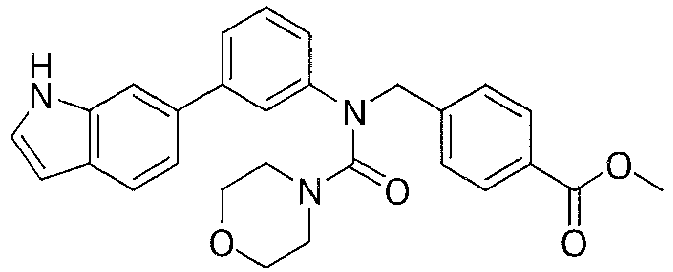
- Compound of Formula 2-1 (methyl 4-((N-(3-bromophenyl)morpholine-4-carboxamido)methyl)benzoate; 0.12 g, 0.28 mmol) was placed in a microwave reactor, and then dimethoxyethane (5 mL) was added. Then, indole-6-boronic acid (0.054 g, 0.33 mmol) and Pd(dppf)Cl2 (0.023 g, 0.028 mmol) were slowly added, and saturated sodium carbonate aqueous solution (0.093 g, 0.61 mmol) was then added. The mixture was stirred at 120 °C for 15 minutes under microwave irradiation, and then the reaction was completed. After washing three times with saturated sodium chloride aqueous solution, the organic layer was dehydrated with sodium sulfate, filtered, and concentrated. Then, the filtrate was concentrated under reduced pressure. The concentrate was purified by column chromatography (silica; ethyl acetate/hexane=0-80%) to give the desired compound of Formula 2-2 (0.091 g, 70%) in the form of a whit solid.
-

- Compound of Formula 2-2 (methyl 4-((N-(3-(1H-indol-6-yl)phenyl)morpholine-4-carboxamido)methyl)benzoate; 0.09 g, 0.19 mmol) was dissolved in methanol(10 mL), and then hydroxylamine hydrochloride (0.067 g, 0.96 mmol) was slowly added. Then, potassium hydroxide (0.11 g, 1.92 mmol) was added and stirred at room temperature for 10 minutes, and then hydroxylamine (50.0 wt% aqueous solution; 0.23 mL, 3.83 mmol) was added and stirred at room temperature for 1 day. The organic solvent was concentrated under reduced pressure and then neutralized by adding 2 N hydrochloric acid. Then, the produced solid was filtered and dried to give the desired Compound 261 (0.05 g, 55%) in the form of a yellow solid.
1H NMR (400 MHz, CDCl3-d6) δ 7.65 (d, 2 H, J = 8.2 Hz), 7.60 - 7.57 (m, 2 H), 7.40 - 7.36 (m, 6 H, J = 7.8 Hz), 7.24 (d, 1 H, J = 8.2 Hz), 7.09 - 7.07 (m, 1 H), 6.43 (s, 1 H), 4.93 (s, 2 H), 3.50 (m, 4 H), 4.93 (m, 4 H), 2.49 (s, 3H); MS (ESI) m/z 471 (M+ + H). -

- Compound of Formula 2-1 (methyl 4-((N-(3-bromophenyl)morpholine-4-carboxamido)methyl)benzoate; 0.11 g, 0.25 mmol) was placed in a microwave reactor, and then dimethoxyethane (5 mL) was added. Then, pyridine-3-boronic acid (0.037 g, 0.31 mmol) and Pd(dppf)Cl2 (0.021 g, 0.025 mmol) were slowly added, and saturated sodium carbonate aqueous solution (0.085 g, 0.56 mmol) was then added. The mixture was stirred at 120 °C for 15 minutes under microwave irradiation, and then the reaction was completed. After washing three times with saturated sodium chloride aqueous solution, the organic layer was dehydrated with sodium sulfate, filtered, and concentrated. Then, the filtrate was concentrated under reduced pressure. The concentrate was purified by column chromatography (silica; ethyl acetate/hexane=0-80 %) to give the desired compound of Formula 2-2 (0.064 g, 58%) in the form of a whit solid.
-

- Compound of Formula 2-2 (methyl 4-((N-(3-(pyridin-3-yl)phenyl)morpholine-4-carboxamido)methyl)benzoate; 0.06 g, 0.14 mmol) was dissolved in methanol (10 mL), and then hydroxylamine hydrochloride (0.048 g, 0.70 mmol) was slowly added. Then, potassium hydroxide (0.078 g, 1.40 mmol) was added and stirred at room temperature for 10 minutes, and then hydroxylamine (50.0 wt% aqueous solution; 0.17 mL, 2.78 mmol) was added and stirred at room temperature for 1 day. The organic solvent was concentrated under reduced pressure and then neutralized by adding 2 N hydrochloric acid. The organic layer was washed with ether and three times with saturated sodium chloride aqueous solution, dehydrated with anhydrous sodium sulfate, and then filtered to give the desired Compound 262 (0.045 g, 75%) in the form of a white solid.
1H NMR (400 MHz, MeOD-d3) δ 8.86 (s, 1 H), 8.64 (d, 1 H, J = 4.0 Hz), 8.29 (d, 1 H, J = 8.1 Hz), 7.24 - 7.26 (m, 9 H), 5.02 (m, 4 H), 3.30 (m, 4 H); MS (ESI) m/z 433 (M+ + H). -

- Compound of Formula 2-1 (methyl 4-((N-(3-bromophenyl)morpholine-4-carboxamido)methyl)benzoate; 0.05 g, 0.12 mmol) was placed in a microwave reactor, and then dimethoxyethane (5 mL) was added. Then, indole-5-boronic acid (0.023 g, 0.14 mmol) and Pd(dppf)Cl2 (0.009 g, 0.012 mmol) were slowly added, and saturated sodium carbonate aqueous solution (0.039 g, 0.25 mmol) was then added. The mixture was stirred at 120 °C for 15 minutes under microwave irradiation, and then the reaction was completed. After washing three times with saturated sodium chloride aqueous solution, the organic layer was dehydrated with sodium sulfate, filtered, and concentrated. Then, the filtrate was concentrated under reduced pressure. The concentrate was purified by column chromatography (silica; ethyl acetate/hexane=0-80 %) to give the desired compound of Formula 2-2 (0.040 g, 74%) in the form of a whit solid.
-

- Compound of Formula 2-2 (methyl 4-((N-(3-(1H-indole-5-yl)phenyl)morpholine-4-carboxamido)methyl)benzoate; 0.040 g, 0.085 mmol) was dissolved in methanol (2 mL), and then hydroxylamine hydrochloride (0.030 g, 0.43 mmol) was slowly added. Then, potassium hydroxide (0.48 g, 0.85 mmol) was added and stirred at room temperature for 10 minutes, and then hydroxylamine (50.0 wt% aqueous solution; 0.11 mL, 1.70 mmol) was added and stirred at room temperature for 1 day. The organic solvent was concentrated under reduced pressure and then neutralized by adding 2 N hydrochloric acid. Then, the produced solid was filtered and dried to give the desired Compound 263 (0.03 g, 82%) in the form of a yellow solid.
1H NMR (400 MHz, CDCl3) δ 8.99 (brs, 1 H), 7.75 (s, 1 H), 7.64 (d, 1 H, J = 7.8 Hz), 7.44 - 7.05 (m, 9 H), 6.46 (s, 1 H), 4.93 (s, 2 H), 3.39 (m, 4 H), 3.17 (m, 4 H); MS (ESI) m/z 471 (M+ + H). -

- Compound of Formula 1-1 (aniline; 0.20 g, 2.15 mmol) was dissolved in dichloroethane (10 mL), and then triethylamine (0.45 mL, 3.22 mmol) was slowly added. Then, methyl 4-(bromomethyl)benzoate (0.74 g, 3.22 mmol) was added, the temperature was slowly raised to 60 °C, and the mixture was stirred for 1 hour. The reaction was completed, and the organic layer was washed three times with saturated sodium chloride aqueous solution, dehydrated with anhydrous sodium sulfate, and then filtered. The filtrate was concentrated under reduced pressure, and then the concentrate was purified by column chromatography (silica; ethyl acetate/hexane= 0-50%) to give the desired compound of Formula 1-2 (0.15 g, 29%) in the form of a yellow oil.
-

- Compound of Formula 1-2 (methyl 4-((phenylamino)methyl)benzoate; 0.15 g, 0.62 mmol) was dissolved in acetonitrile (3 mL), and then potassium carbonate (0.17 g, 1.24 mmol) was slowly added and stirred at room temperature for 10 minutes. Then, 4-nitrophenyl chloroformate (0.14 g, 0.68 mmol) was added, the temperature was slowly raised to 50 °C, and the mixture was stirred for 12 hours. After completion of the reaction, the solvent was evaporated under reduced pressure, and the ethyl acetate layer was washed three times with saturated sodium chloride aqueous solution, and then the organic layer was dehydrated with sodium sulfate, and then filtered. The filtrate was concentrated under reduced pressure, and then the concentrate was purified by column chromatography (silica; ethyl acetate/hexane=0-20%) to give the desired compound of Formula 1-3 (0.18 g, 71%) in the form of a transparent oil.
-

- Compound of Formula 1-4 (methyl 4-((((4-nitrophenoxy)carbonyl)(phenyl)amino)methyl)benzoate; 0.18 g, 0.44 mmol) was dissolved in dimethylformamide (5 mL), and then potassium carbonate (0.18 g, 1.33 mmol) and morpholine (0.060 g, 0.67 mmol) were slowly added. The temperature was lowered to room temperature, and dimethylformamide (50 ml) was further added. Then, the temperature was slowly raised to 80 °C, and the mixture was stirred for 3 hours. Then, the temperature was raised again to 80 °C, and the mixture was stirred for 5 hours. The reaction was completed, and the organic layer was washed three times with saturated ammonium chloride aqueous solution, dehydrated with sodium sulfate, and then filtered. The filtrate was concentrated under reduced pressure, and the concentrate was purified by column chromatography (silica; ethyl acetate/hexane=0-50%) to give the desired compound of Formula 1-4 (0.10 g, 64%) in the form of a pale yellow solid.
-

- Compound of Formula 1-4 (methyl 4-((N-phenylmorpholine-4-carboxamido)methyl)benzoate; 0.15 g, 0.42 mmol) was dissolved in methanol (5 ml), and then hydroxylamine hydrochloride (0.15 g, 2.12 mmol) was slowly added. Then, potassium hydroxide (0.24 g, 4.23 mmol) was added and stirred at room temperature for about 10 minutes, and then hydroxylamine (50.0 wt% aqueous solution; 0.56 mL, 8.46 mmol) was added and stirred at room temperature for 1 day. The organic solvent was concentrated under reduced pressure, washed twice with ether after adding water, neutralized by adding 2 N hydrochloric acid, and then further extracted with ethyl acetate. Then, the organic layer was washed twice with saturated sodium chloride aqueous solution, dehydrated with anhydrous sodium sulfate, and then filtered to give the desired Compound 279 (0.080 g, 53%) in the form of a white solid.
1H NMR (400 MHz, MeOD-d3) δ 7.66 (d, 2 H, J = 8.1 Hz), 7.41 (d, 2 H, J = 8.1 Hz), 7.34 (t, 2 H, J = 7.8 Hz), 7.15 (d, 2 H, J = 8.4 Hz), 4.92 (s, 2 H), 3.46 (t, 4 H, J = 4.7 Hz), 3.22 (t, 4 H, J = 4.7 Hz); MS (ESI) m/z 356 (M+ + H). -

- Compound of Formula 7-3 (pyridin-2-amine, 0.2 g, 2.13 mmol) was dissolved in methanol (10 mL), and then methyl 4-formylbenzoate (0.35 g, 2.13 mmol) was added and stirred at room temperature for 20 minutes. Then, sodium cyanoborohydride (0.13 g, 2.13 mmol) and acetic acid (0.12 mL, 2.13 mmol) were slowly added and stirred at room temperature for 5 hours. The organic layer was washed three times with saturated sodium chloride aqueous solution, dehydrated with sodium sulfate, and then filtered. The filtrate was concentrated under reduced pressure, and the concentrate was purified by column chromatography (silica; ethyl acetate/hexane=0-30%) to give the desired compound of Formula 7-4 (0.10 g, 19%) in the form of a transparent oil.
1H NMR (400 MHz, CDCl3) δ 8.17 (d, 1 H, J = 5.8 Hz), 8.06 (d, 2 H, J = 8.4 Hz), 7.66 (t, 1 H, J = 7.8 Hz), 7.44 (d, 2 H, J = 8.0 Hz), 6.76 (t, 1 H, J = 6.7 Hz), 6.58 (d, 1 H, J = 8.6 Hz), 4.67 (d, 2 H, J = 6.0 Hz), 3.92 (s, 3 H) -

- Formula 7-4 (methyl 4-((pyridin-2-ylamino)methyl)benzoate; 0.040 g, 0.16 mmol) was dissolved in dimethylformamide (3 mL), and then potassium carbonate (0.046 g, 0.33 mmol) was slowly added. Then, 4-nitrophenyl chloroformate (0.037 g, 0.18 mmol) was added, the temperature was slowly raised to 50 °C, and the mixture was stirred for 2 days hours. After completion of the reaction, the ethyl acetate layer was washed three times with saturated ammonium chloride aqueous solution, and then the organic layer was dehydrated with sodium sulfate, and then filtered. The filtrate was concentrated under reduced pressure, and then the concentrate was purified by column chromatography (silica; ethyl acetate/hexane=0-50%) to give the desired compound of Formula 7-5 (0.048 g, 71%) in the form of a yellow oil.
1H NMR (400 MHz, CDCl3) δ 8.49 - 8.48 (m, 1 H), 8.24 (dd, 2 H, J = 7.0, 2.2 Hz), 8.17 (dd, 2 H, J = 7.2, 2.0 Hz), 8.00 (d, 2 H, J = 8.4 Hz), 7.78 (t, 1 H, J = 3.8 Hz), 7.44 (d, 2 H, J = 8.0 Hz), 6.91 (dd, 2 H, J = 7.3, 2.1 Hz), 5.39 (brs, 2 H), 3.92 (s, 3 H); MS (ESI) m/z 408 (M+ + H) -

- Compound of Formula 7-5 (methyl 4-((((4-nitrophenoxy)carbonyl)(pyridin-2-yl)amino)methyl)benzoate; 0.040 g, 0.098 mmol) was dissolved in dimethylformamide (5 ml), and then potassium carbonate (0.040 g, 0.30 mmol) and morpholine (0.013 mL, 0.15 mmol) were slowly added. Then, the temperature was slowly raised to 80 °C, and the mixture was stirred for 3 hours. The reaction was completed, and the organic layer was washed three times with saturated ammonium chloride, dehydrated with sodium sulfate, and then filtered. The filtrate was concentrated under reduced pressure, and then the concentrate was purified by column chromatography (silica; ethyl acetate/hexane=0-50%) to give the desired compound of Formula 7-6 (0.022 g, 63%) in the form of a pale yellow solid.
1H NMR (400 MHz, CDCl3) δ 8.37 - 8.35 (m, 1 H), 7.95 (d, 2 H, J = 8.4 Hz), 7.60 - 7.58 (m, 1 H), 7.47 (d, 2 H, J = 8.4 Hz), 6.94 - 6.89 (m, 2 H), 5.13 (s, 2 H), 3.89 (s, 3 H), 3.53 - 3.51 (m, 4 H), 3.31 - 3.29 (m, 4 H) -
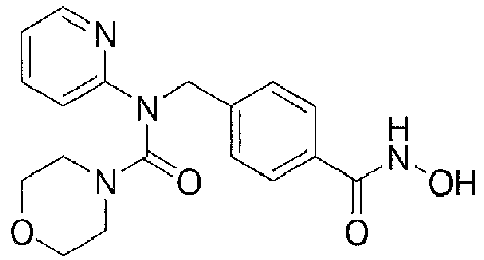
- Compound of Formula 7-6 (methyl 4-((N-(pyridin-2-yl)morpholine-4-carboxamido)methyl)benzoate; 0.022 g, 0.062 mmol) was dissolved in methanol (2 mL), and then hydroxylamine hydrochloride (0.022 g, 0.31 mmol) was slowly added. Then, potassium hydroxide (0.035 g, 0.62 mmol) was added and stirred at room temperature for about 10 minutes, and then hydroxylamine (50.0 wt% aqueous solution; 0.082 mL, 1.24 mmol) was added and stirred at room temperature for 1 day. Then, the organic solvent was concentrated under reduced pressure and then neutralized by adding 2 N hydrochloric acid. Then, the organic layer was washed three times with saturated sodium chloride aqueous solution, dehydrated with anhydrous sodium sulfate, and then filtered to give the desired Compound 280 (0.007 g, 32%) in the form of a white solid.
1H NMR (400 MHz, MeOD-d3) δ 8.32 (d, 1 H, J = 3.6 Hz), 7.72 (t, 1 H, J = 6.6 Hz), 7.67 (d, 2 H, J = 8.2 Hz), 7.48 (d, 2 H, J = 8.2 Hz), 7.08-7.01 (m, 2 H), 5.08 (s, 2 H), 3.52 (t, 4 H, J = 4.8 Hz), 3.29 (t, 4 H, J = 4.8 Hz); MS (ESI) m/z 357 (M+ + H). -

- Compound of Formula 7-3 (pyridin-3-amine, 0.5 g, 5.31 mmol) was dissolved in methanol (10 mL), and then methyl 4-formylbenzoate (1.03 g, 5.31 mmol) was added and stirred at room temperature for 20 minutes. Then, sodium cyanoborohydride (0.33 g, 5.31 mmol) and acetic acid (0.32 mL, 5.31 mmol) were slowly added and stirred at room temperature for 5 hours. The organic layer was washed three times with saturated sodium chloride aqueous solution, dehydrated with sodium sulfate, and then filtered. The filtrate was concentrated under reduced pressure, and the concentrate was purified by column chromatography (silica; ethyl acetate/hexane=0-30%) to give the desired compound of Formula 7-4 (0.85 g, 66%) in the form of a white solid.
-

- Compound of Formula 7-4 (methyl 4-((pyridin-3-ylamino)methyl)benzoate; 0.20 g, 0.83 mmol) was dissolved in dimethylformamide (3 mL), and then 4-nitrophenyl chloroformate (0.18 g, 0.90 mmol) and potassium carbonate (0.23 g, 1.65 mmol) were added. Then, the temperature was slowly raised to 90 °C, and the mixture was stirred for 1 day. After completion of the reaction, the ethyl acetate layer was washed three times with saturated ammonium chloride aqueous solution, and then the organic layer was dehydrated with sodium sulfate, and then filtered. The filtrate was concentrated under reduced pressure, and then the concentrate was purified by column chromatography (silica; ethyl acetate/hexane=0-100%) to give the desired compound of Formula 7-5 (0.030 g, 8%) in the form of a white solid.
-

- Compound of Formula 7-5 (methyl 4-((((4-nitrophenoxy)carbonyl)(pyridin-3-yl)amino)methyl)benzoate; 0.025 g, 0.061 mmol) was dissolved in dimethylformamide (1 mL), and then potassium carbonate (0.025 g, 0.184 mmol) and morpholine (0.008 g, 0.092 mmol) were added. Then, the temperature was slowly raised to 60 °C, and the mixture was stirred for 3 hours. After completion of the reaction, the ethyl acetate layer was washed three times with saturated ammonium chloride aqueous solution, and then the organic layer was dehydrated with sodium sulfate, and then filtered. The filtrate was concentrated under reduced pressure, and then the concentrate was purified by column chromatography (silica; methanol/dichloromethane=0-10%) to give the desired compound of Formula 7-6 (0.018 g, 83%) in the form of a pale yellow solid.
-

- Compound of Formula 7-6 (methyl 4-((N-(pyridin-3-yl)morpholine-4-carboxamido)methyl)benzoate; 0.018 g, 0.051 mmol) was dissolved in methanol (5 mL), and then hydroxylamine hydrochloride (0.018 g, 0.25 mmol) was slowly added. Then, potassium hydroxide (0.028 g, 0.51 mmol) was added and stirred at room temperature for about 10 minutes, and then hydroxylamine (50.0 wt% aqueous solution; 0.067 mL, 1.0 mmol) was added and stirred at room temperature for 1 day. Then, the organic layer was concentrated under reduced pressure and then neutralized by adding 2 N hydrochloric acid. Then, the organic layer was washed three times with saturated sodium chloride aqueous solution, dehydrated with anhydrous sodium sulfate, and then filtered to give the desired Compound 281 (0.010 g, 55%) in the form of a white solid.
1H NMR (400 MHz, MeOD-d3) δ 8.11 (s, 1 H), 8.06 (d, 1 H, J = 4.1 Hz), 8.03 (d, 2 H, J = 8.3 Hz), 7.42 (d, 2 H, J = 2.8 Hz), 7.27 - 7.21 (m, 2 H), 4.93 (s, 2 H), 3.51 (t, 4 H, J = 4.7 Hz), 3.25 (t, 4 H, J = 4.8 Hz); MS (ESI) m/z 357 (M+ + H). -

- Compound of Formula 7-1 (2-chloropyrimidine; 6.25 g, 54.6 mmol) and compound of Formula 7-2 (methyl 4-(aminomethyl)benzoate hydrochloride; 10.0 g, 49.6 mmol) were dissolved in ethanol (150 mL), and the triethylamine (17.0 mL, 124 mmol) was added and stirred under reflux for 3 days. After completion of the reaction, the organic layer was extracted with ethyl acetate and saturated sodium hydrogen carbonate aqueous solution, dehydrated with anhydrous magnesium sulfate, and then filtered. The filtrate was concentrated under reduced pressure, and then the residue was purified and concentrated by column chromatography (silica; ethyl acetate/hexane=30%) to give the desired compound of Formula 7-4 (8.06 g, 67%) in the form of a white solid.
-

- Compound of Formula 7-4 (methyl4-((pyrimidin-2-ylamino)methyl)benzoate; 8.06 g, 33.1 mmol) and 4-nitrophenyl chloroformate (7.01 g, 34.8 mmol) were dissolved in acetonitrile (150 mL), and then potassium carbonate (6.87 g, 49.7 mmol) was added and stirred at room temperature for 16 hours. Then, the organic layer was extracted with ethyl acetate and saturated sodium hydrogen carbonate aqueous solution, dehydrated with anhydrous magnesium sulfate, and then filtered. The filtrate was concentrated under reduced pressure, and then the residue was purified and concentrated by column chromatography (silica; ethyl acetate/hexane=30%) to give the desired compound of Formula 7-5 (1.50 g, 11%) in the form of a light yellow liquid.
-

- Compound of Formula 7-5 (methyl 4-((((4-nitrophenoxy)carbonyl)(pyrimidin-2-yl)amino)methyl)benzoate; 0.150 g, 0.367 mmol) was dissolved in dimethylformamide (1 mL), and then 1-benzylpiperazine (0.130 g, 0.735 mmol) and potassium carbonate (0.152 g, 1.10 mmol) were added and stirred at 60 °C for 16 hours. After completion of the reaction, the organic layer was extracted with ethyl acetate and saturated sodium hydrogen carbonate aqueous solution and concentrated under reduced pressure, and then the residue was purified and concentrated by column chromatography (silica; ethyl acetate/hexane=50%) to give the desired compound of Formula 7-6 (0.132 g, 81%) in the form of a yellow liquid.
-

- Compound of Formula 7-6 (methyl 4-((4-benzyl-N-(pyrimidin-2-yl)piperazine-1-carboxamido)methyl)benzoate; 0.132 g, 0.296 mmol) was dissolved in methanol (5 mL), and then hydroxylamine (50.0 wt% aqueous solution; 0.906 mL, 14.8 mmol) and potassium hydroxide (0.166 g, 2.96 mmol) were added sequentially and then stirred at room temperature for 30 minutes. After completion of the reaction, the reaction solution was concentrated under reduced pressure until its volume became about 2 mL, and saturated sodium hydrogen carbonate aqueous solution (1-2 mL) was added and stirred. Then, the solid product was filtered, washed with water, and then vacuum dried to give the desired Compound 309 (0.079 g, 60%) in the form of a light yellow solid.
1H NMR (400 MHz, DMSO-d6) δ 11.18 (s, 1 H), 9.03 (s, 1 H), 8.50 (d, 2 H, J = 4.8 Hz), 7.68 (d, 2 H, J = 8.4 Hz), 7.39 (d, 2 H, J = 8.4 Hz), 7.32 - 7.21 (m, 5 H) 6.93 (t, 1 H, J = 4.8 Hz), 4.97 (s, 2 H), 3.40 (s, 2 H), 3.29 (m, 4 H), 2.19 (m, 4 H). MS (ESI) m/z 447 (M+ + H). -

- Compound of Formula 7-5 (methyl 4-((((4-nitrophenoxy)carbonyl)(pyrimidin-2-yl)amino)methyl)benzoate; 0.150 g, 0.367 mmol) was dissolved in dimethylformamide (1 mL), and then 4-phenylpiperidine-4-ol (0.130 g, 0.735 mmol) and potassium carbonate (0.152 g, 1.10 mmol) were added and stirred at 60 °C for 16 hours. After completion of the reaction, the organic layer was extracted with ethyl acetate and saturated sodium hydrogen carbonate aqueous solution and concentrated under reduced pressure, and then the residue was purified and concentrated by column chromatography (silica; ethyl acetate/hexane=30%) to give the desired compound of Formula 7-6 (0.104 g, 63%) in the form of a light yellow liquid.
-
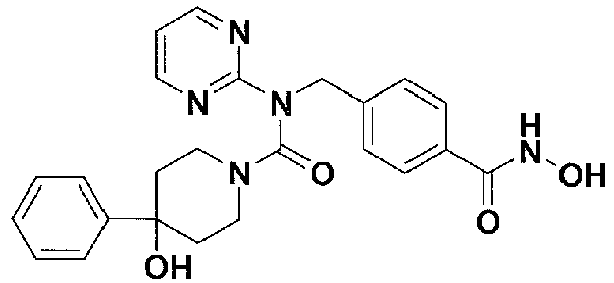
- Compound of Formula 7-6 (methyl 4-((4-hydroxy-4-phenyl-N-(pyrimidin-2-yl)piperidine-1-carboxamido)methyl)benzoate ; 0.104 g, 0.233 mmol) was dissolved in methanol (5 mL), and then hydroxylamine (50.0 wt% aqueous solution; 1.43 mL, 23.3 mmol) and potassium hydroxide (0.131 g, 2.33 mmol) were added sequentially and then stirred at room temperature for 30 minutes. After completion of the reaction, the reaction solution was concentrated under reduced pressure until its volume became about 2 mL, and saturated sodium hydrogen carbonate aqueous solution (1-2 mL) was added and stirred. Then, the solid product was filtered, washed with water, and then vacuum dried to give the desired Compound 311 (0.072 g, 69%) in the form of a white solid.
1H NMR (400 MHz, DMSO-d6) δ 11.19 (s, 1 H), 9.04 (s, 1 H), 8.54 (d, 2 H, J = 4.8 Hz), 7.73 (d, 2 H, J = 8.3 Hz), 7.45 (d, 2 H, J = 8.3 Hz), 7.30 - 7.26 (m, 4 H), 7.19 (m, 1 H), 6.93 (t, 1 H, J= 4.8 Hz), 5.08 (s, 1 H), 5.01 (brs, 2 H), 3.73 (brs, 2 H), 3.18 - 3.11 (m, 2 H), 1.56 - 1.47 (m, 4 H). MS (ESI) m/z 448 (M+ + H). -

- Compound of Formula 7-4 (methyl 4-((pyrimidin-2-ylamino)methyl)benzoate; 0.200 g, 0.822 mmol) was dissolved in acetonitrile (2 mL), and then morpholine-4-carbonyl chloride (0.185 g, 1.23 mmol) and N,N-diisopropylethylamine (0.291 mL, 1.64 mmol) were added and stirred at 60 °C for 16 hours. After completion of the reaction, the organic layer was extracted with ethyl acetate and saturated sodium hydrogen carbonate aqueous solution and concentrated under reduced pressure, and then the residue was purified and concentrated by column chromatography (silica; ethyl acetate/hexane=30%) to give the desired compound of Formula 7-6 (0.179 g, 61%) in the form of a light yellow solid.
-

- Compound of Formula 7-6 (methyl 4-((N-(pyrimidin-2-yl)morpholine-4-carboxamido)methyl)benzoate; 0.179 g, 0.502 mmol) was dissolved in methanol (5 mL), and then hydroxylamine (50.0 wt% aqueous solution; 2.15 mL, 35.2 mmol) and potassium hydroxide (0.282 g, 5.02 mmol) were added sequentially and then stirred at room temperature for 30 minutes. After completion of the reaction, the reaction solution was concentrated under reduced pressure until its volume became about 2 mL, and the organic layer was extracted with ethyl acetate and saturated sodium hydrogen carbonate aqueous solution. The organic layer was washed three times with water, dehydrated with anhydrous magnesium sulfate, filtered, and then concentrated under reduced pressure. The residue was recrystallized with diethylether and hexane to give the desired Compound 312 (0.036 g, 20%) in the form of a white solid.
1H NMR (400 MHz, DMSO-d6) δ 11.18 (s, 1 H), 8.53 (d, 2 H, J = 4.8 Hz), 7.68 (d, 2 H, J = 7.6 Hz), 7.40 (d, 2 H, J = 8.1 Hz), 6.96 (t, 1 H, J = 4.8 Hz), 4.98 (s, 2 H), 3.40 (m, 4 H), 3.28 (m, 4 H). MS (ESI) m/z 358 (M+ + H). -

- Compound of Formula 7-5 (methyl 4-((((4-nitrophenoxy)carbonyl)(pyrimidin-2-yl)amino)methyl)benzoate; 0.150 g, 0.367 mmol) was dissolved in dimethylformamide (1 mL), and then 2,6-dimethylmorpholine (0.085 g, 0.735 mmol) and potassium carbonate (0.152 g, 1.10 mmol) were added and stirred at 60 °C for 16 hours. After completion of the reaction, the organic layer was extracted with ethyl acetate and saturated sodium hydrogen carbonate aqueous solution and concentrated under reduced pressure, and then the residue was purified and concentrated by column chromatography (silica; ethyl acetate/hexane=50%) to give the desired compound of Formula 7-6 (0.062 g, 44%) in the form of a yellow liquid.
-

- Compound of Formula 7-6 (methyl 4-((2,6-dimethyl-N-(pyrimidin-2-yl)morpholine-4-carboxamido)methyl)benzoate; 0.062 g, 0.161 mmol) was dissolved in methanol (5 mL), and then hydroxylamine (50.0 wt% aqueous solution; 0.986 mL, 16.1 mmol) and potassium hydroxide (0.091 g, 1.61 mmol) were added sequentially and then stirred at room temperature for 30 minutes. After completion of the reaction, the reaction solution was concentrated under reduced pressure until its volume became about 2 mL, and the organic layer was extracted with ethyl acetate and saturated sodium hydrogen carbonate aqueous solution. The organic layer was washed three times with water, dehydrated with anhydrous magnesium sulfate, filtered, and then concentrated under reduced pressure. The residue was recrystallized with diethylether and hexane to give the desired Compound 313 (0.037 g, 60%) in the form of a white solid.
1H NMR (400 MHz, DMSO-d6) δ 11.18 (s, 1 H), 9.02 (s, 1 H), 8.52 (d, 2 H, J = 4.4 Hz), 7.68 (d, 2 H, J = 7.8 Hz), 7.40 (d, 2 H, J = 7.8 Hz), 6.95 (t, 1 H, J = 4.6 Hz), 4.98 (s, 2 H), 3.68 (brs, 2 H), 3.21 (brs, 2 H), 2.44 - 2.41 (m, 2 H), 0.97 (s, 3 H), 0.96 (s, 3 H). MS (ESI) m/z 386 (M+ + H). -

- Compound of Formula 8-1 (methyl 4-(bromomethyl)benzoate; 12.5 g, 54.8 mmol) and aniline (5.00 mL, 54.8 mmol) were dissolved in acetonitrile (70 mL), and then N,N-diisopropylethylamine (11.6 mL, 65.7 mmol) were added and stirred at room temperature for 16 hours. After completion of the reaction, the organic layer was extracted with ethyl acetate and saturated sodium hydrogen carbonate aqueous solution, dehydrated with anhydrous magnesium sulfate, and then filtered. The filtrate was concentrated under reduced pressure, and then the residue was purified and concentrated by column chromatography (silica; ethyl acetate/hexane=15%) to give the desired compound of Formula 8-2 (9.13 g, 69%) in the form of a yellow liquid.
-

- Compound of Formula 8-2 (methyl 4-((phenylamino)methyl)benzoate; 9.13 g, 37.8 mmol) was dissolved in dichloromethane (70 mL), and the N-bromosuccinimide (7.07 g, 39.7 mmol) was added and stirred at room temperature for 16 hours. After completion of the reaction, the organic layer was concentrated under reduced pressure, and then the residue was purified and concentrated by column chromatography (silica; ethyl acetate/hexane=15%) to give the desired compound of Formula 8-3 (9.57 g, 79%) in the form of a white solid.
-

- Compound of Formula 8-3 (methyl 4-((4-bromophenylamino)methyl)benzoate; 7.67 g, 24.0 mmol) and 4-nitrophenyl chloroformate (5.31 g, 26.4 mmol) were dissolved in acetonitrile (70 mL), and then potassium carbonate (4.97 g, 35.9 mmol) was added and stirred at room temperature for 16 hours. After completion of the reaction, the organic layer was extracted with ethyl acetate and saturated sodium hydrogen carbonate aqueous solution, dehydrated with anhydrous magnesium sulfate, and then filtered. The filtrate was concentrated under reduced pressure, and then the residue was purified and concentrated by column chromatography (silica; ethyl acetate/hexane=20%) to give the desired compound of Formula 8-4 (11.2 g, 96%) in the form of a yellow liquid.
-

- Compound of Formula 8-4 (methyl 4-(((4-bromophenyl)((4-nitrophenoxy)carbonyl)amino)methyl)benzoate; 5.00 g, 10.3 mmol) was dissolved in dimethylformamide (20 mL), and then morpholine (1.35 g, 15.5 mmol) and potassium carbonate (2.85 g, 20.6 mmol) were added and stirred at 60 °C for 5 hours. After completion of the reaction, the organic layer was extracted with ethyl acetate and saturated ammonium chlorideaqueous solution, dehydrated with anhydrous magnesium sulfate, and then filtered. The filtrate was concentrated under reduced pressure, and then the residue was purified and concentrated by column chromatography (silica; ethyl acetate/hexane= 30%) to give the desired compound of Formula 8-5 (3.86 g, 87%) in the form of a yellow solid.
-

- Compound of Formula 8-5 (methyl 4-((N-(4-bromophenyl)morpholine-4-carboxamido)methyl)benzoate; 0.185 g, 0.427 mmol), 1-methyl-indazol-6-ylboronic acid (0.090 g, 0.512 mmol), and Pd(dppf)Cl2 (0.035 g, 0.043 mmol) were dissolved in 1,4-dioxane (3 mL), and then sodium carbonate (0.181 g, 1.71 mmol) dissolved in water (1 mL) was added to the reaction solution and stirred at 80 °C for 16 hours. After completion of the reaction, the organic layer was extracted with ethyl acetate and saturated sodium hydrogen carbonate aqueous solution and concentrated under reduced pressure, and then the residue was purified and concentrated by column chromatography (silica; ethyl acetate/ hexane=30%) to give the desired compound of Formula 8-6 (0.112 g, 71%) in the form of a white solid.
-

- Compound of Formula 8-6 (methyl 4-((N-(4-(1-methyl-1H-indazol-6-yl)phenyl)morpholine-4-carboxamido)methyl)benzo ate; 0.112 g, 0.231 mmol) was dissolved in methanol (5 mL), and then hydroxylamine (50.0 wt% aqueous solution; 1.41 mL, 23.1 mmol) and potassium hydroxide (0.130 g, 2.31 mmol) added sequentially and then stirred at room temperature for 30 minutes. After completion of the reaction, the reaction solution was concentrated under reduced pressure until its volume became about 2 mL, and saturated ammonium chloride aqueous solution (1-2 mL) was added and stirred. Then, the solid product was filtered, washed with water, and then vacuum dried to give the desired Compound 329 (0.096 g, 86%) in the form of a light brown solid.
1H NMR (400 MHz, DMSO-d6) δ 8.02 (s, 1 H), 7.88 (s, 1 H), 7.77 (d, 1 H, J = 8.4 Hz), 7.73 (d, 2 H, J = 8.6 Hz), 7.66 (d, 2 H, J = 8.2 Hz), 7.42 - 7.39 (m, 3 H), 7.26 (d, 2 H, J = 8.5 Hz), 4.93 (s, 2 H), 4.07 (s, 3 H), 3.47 - 3.43 (m, 4 H), 3.22-3.17 (m, 4 H). MS (ESI) m/z 486 (M+ + H). -

- Compound of Formula 8-5 (methyl 4-((N-(4-bromophenyl)morpholine-4-carboxamido)methyl)benzoate; 0.200 g, 0.462 mmol), phenylboronic acid (0.068 g, 0.554 mmol), and Pd(dppf)Cl2 (0.038 g, 0.046 mmol) were dissolved in 1,4-dioxane (3 mL), and then sodium carbonate (0.196 g, 1.85 mmol) dissolved in water (1 mL) was added to the reaction solution and stirred at 100 °C for 6 hours. After completion of the reaction, the organic layer was extracted with ethyl acetate and saturated sodium hydrogen carbonate aqueous solution and concentrated under reduced pressure, and then the residue was purified and concentrated by column chromatography (silica; ethyl acetate/hexane=60%) to give the desired compound of Formula 8-6 (0.160 g, 81%) in the form of a white solid.
-

- Compound of Formula 8-6 (methyl 4-((N-(biphenyl-4-yl)morpholine-4-carboxamido)methyl)benzoate; 0.160 g, 0.372 mmol) was dissolved in methanol (10 mL), and then hydroxylamine (50.0 wt% aqueous solution; 2.27 mL, 37.2 mmol) and potassium hydroxide (0.209 g, 3.72 mmol) added sequentially and then stirred at room temperature for 30 minutes. After completion of the reaction, the reaction solution was concentrated under reduced pressure until its volume became about 3 mL, and saturated ammonium chloride aqueous solution (1-2 mL) was added and stirred. Then, the solid product was filtered, washed with water, and then vacuum dried to give the desired Compound 330 (0.120 g, 75%) in the form of a light brown solid.
MS (ESI) m/z 432 (M+ + H). -

- Compound of Formula 8-5 (methyl 4-((N-(4-bromophenyl)morpholine-4-carboxamido)methyl)benzoate; 0.200 g, 0.462 mmol), 3'5'-difluorophenylboronic acid (0.088 g, 0.554 mmol), and Pd(dppf)Cl2 (0.038 g, 0.046 mmol) were dissolved in 1,4-dioxane (3 mL), and then sodium carbonate (0.196 g, 1.85 mmol) dissolved in water (1 mL) was added to the reaction solution and stirred at 100 °C for 6 hours. After completion of the reaction, the organic layer was extracted with ethyl acetate and saturated sodium hydrogen carbonate aqueous solution and concentrated under reduced pressure, and then the residue was purified and concentrated by column chromatography (silica; ethyl acetate/ hexane=60%) to give the desired compound of Formula 8-6 (0.169 g, 79%) in the form of a white solid.
-

- Compound of Formula 8-6 (methyl 4-((N-(3',5'-difluorobiphenyl-4-yl)morpholine-4-carboxamido)methyl)benzoate; 0.169 g, 0.362 mmol) was dissolved in methanol (10 mL), and then hydroxylamine (50.0 wt% aqueous solution; 2.22 mL, 36.2 mmol) and potassium hydroxide (0.203 g, 3.62 mmol) added sequentially and then stirred at room temperature for 30 minutes. After completion of the reaction, the reaction solution was concentrated under reduced pressure until its volume became about 3 mL, and saturated ammonium chloride aqueous solution (1-2 mL) was added and stirred. Then, the solid product was filtered, washed with water, and then vacuum dried to give the desired Compound 331 (0.102 g, 60%) in the form of a light brown solid.
1H NMR (400 MHz, DMSO-d6) δ 7.70 (d, 2 H, J = 8.8 Hz), 7.65 (d, 2 H, J = 8.3 Hz), 7.43 - 7.37 (m, 4 H), 7.22 (d, 2 H, J = 8.8 Hz), 7.17 (m, 1 H), 4.92 (s, 2 H), 3.44 (t, 4 H, J = 4.6 Hz), 3.18 (t, 4 H, J = 4.6 Hz). MS (ESI) m/z 468 (M+ + H). -

- Compound of Formula 8-5 (methyl 4-((N-(4-bromophenyl)morpholine-4-carboxamido)methyl)benzoate; 0.200 g, 0.462 mmol), pyridine-3-ylboronic acid (0.068 g, 0.554 mmol), and Pd(dppf)Cl2 (0.038 g, 0.046 mmol) were dissolved in 1,4-dioxane (3 mL), and then sodium carbonate (0.196 g, 1.85 mmol) dissolved in water (1 mL) was added to the reaction solution and stirred at 100 °C for 6 hours. After completion of the reaction, the organic layer was extracted with ethyl acetate and saturated sodium hydrogen carbonate aqueous solution and concentrated under reduced pressure, and then the residue was purified and concentrated by column chromatography (silica; ethyl acetate/hexane=75%) to give the desired compound of Formula 8-6 (0.132 g, 66%) in the form of a white solid.
-

- Compound of Formula 8-6 (methyl 4-((N-(4-(pyridine-3-yl)phenyl)morpholine-4-carboxamido)methyl)benzoate; 0.132 g, 0.306 mmol) was dissolved in methanol (10 mL), and then hydroxylamine (50.0 wt% aqueous solution; 1.87 mL, 30.6 mmol) and potassium hydroxide (0.172 g, 3.06 mmol) added sequentially and then stirred at room temperature for 30 minutes. After completion of the reaction, the reaction solution was concentrated under reduced pressure until its volume became about 3 mL, and saturated ammonium chloride aqueous solution (1-2 mL) was added and stirred. Then, the solid product was filtered, washed with water, and then vacuum dried to give the desired Compound 332 (0.051 g, 39%) in the form of a brown solid.
1H NMR (400 MHz, DMSO-d6) δ 11.15 (s, 1 H), 9.00 (s, 1 H), 8.86 (s, 1 H), 8.52 (s, 1 H), 8.04 (d, 1 H, J = 5.2 Hz), 7.71 - 7.65(m, 4 H), 7.43 - 7.38 (m, 3 H), 7.26 (d, 2 H, J = 6.8 Hz), 4.93 (s, 2 H), 3.44 (m, 4 H), 3.19 (m, 4 H). MS (ESI) m/z 433 (M+ + H). -

- Compound of Formula 8-5 (methyl 4-((N-(4-bromophenyl)morpholine-4-carboxamido)methyl)benzoate; 0.200 g, 0.462 mmol), pyrimidin-5-ylboronic acid (0.069 g, 0.554 mmol), and Pd(dppf)Cl2 (0.038 g, 0.046 mmol) were dissolved in 1,4-dioxane (3 mL), and then sodium carbonate (0.196 g, 1.85 mmol) dissolved in water (1 mL) was added to the reaction solution and stirred at 100 °C for 6 hours. After completion of the reaction, the organic layer was extracted with ethyl acetate and saturated sodium hydrogen carbonate aqueous solution and concentrated under reduced pressure, and then the residue was purified and concentrated by column chromatography (silica; ethyl acetate/hexane=75%) to give the desired compound of Formula 8-6 (0.148 g, 74%) in the form of a white solid.
-

- Compound of Formula 8-6 (methyl 4-((N-(4-(pyrimidin-5-yl)phenyl)morpholine-4-carboxamido)methyl)benzoate; 0.148 g, 0.342 mmol) was dissolved in methanol (10 mL), and then hydroxylamine (50.0 wt% aqueous solution; 2.09 mL, 34.2 mmol) and potassium hydroxide (0.192 g, 3.42 mmol) were added sequentially and then stirred at room temperature for 30 minutes. After completion of the reaction, the reaction solution was concentrated under reduced pressure until its volume became about 3 mL, and the organic layer was extracted with ethyl acetate and saturated sodium hydrogen carbonate aqueous solution. The organic layer was dehydrated with anhydrous magnesium sulfate, filtered, and then concentrated under reduced pressure. The residue was recrystallized with dichloromethane and hexane to give the desired Compound 333 (0.060 g, 40%) in the form of a white solid.
1H NMR (400 MHz, DMSO-d6) δ 9.13 (s, 1 H), 9.10 (s, 2 H), 7.77 (d, 2 H, J = 8.7 Hz), 7.65 (d, 2 H, J = 8.3 Hz), 7.39 (d, 2 H, J = 8.2 Hz), 7.29 (d, 2 H, J = 8.7 Hz), 4.94 (s, 2 H), 3.45 (t, 4 H, J = 4.6 Hz), 3.19 (t, 4 H, J = 4.6 Hz). MS(ESI) m/z 434 (M+ + H). -

- Compound of Formula 8-5 (methyl 4-((N-(4-bromophenyl)morpholine-4-carboxamido)methyl)benzoate; 0.200 g, 0.462 mmol), quinolin-7-ylboronic acid (0.096 g, 0.554 mmol), and Pd(dppf)Cl2 (0.038 g, 0.046 mmol) were dissolved in 1,4-dioxane (3 mL), and then sodium carbonate (0.196 g, 1.85 mmol) dissolved in water (1 mL) was added to the reaction solution and stirred at 100 °C for 6 hours. After completion of the reaction, the organic layer was extracted with ethyl acetate and saturated sodium hydrogen carbonate aqueous solution and concentrated under reduced pressure, and then the residue was purified and concentrated by column chromatography (silica; ethyl acetate/hexane=70%) to give the desired compound of Formula 8-6 (0.192 g, 86%) in the form of a light brown solid.
-

- 4-((N-(4-(quinolin-7-yl)phenyl)morpholine-4-carboxamido)methyl)benzoate; 0.192 g, 0.399 mmol) was dissolved in methanol (10 mL), and then hydroxylamine (50.0 wt% aqueous solution; 2.44 mL, 39.9 mmol) and potassium hydroxide (0.224 g, 3.99 mmol) added sequentially and then stirred at room temperature for 30 minutes. After completion of the reaction, the reaction solution was concentrated under reduced pressure until its volume became about 3 mL, and saturated ammonium chloride aqueous solution (1-2 mL) was added and stirred. Then, the solid product was filtered, washed with water, and then vacuum dried to give the desired Compound 334 (0.173 g, 90%) in the form of a light brown solid.
1H NMR (400 MHz, DMSO-d6) δ 8.89 (m, 1 H), 8.41 (dd, 1 H, J = 8.3, 1.7 Hz), 7.96 (m, 1 H), 7.74 (m, 1 H), 7.71 - 7.63 (m, 5 H), 7.55 (dd, 1 H, J = 8.2, 4.1 Hz), 7.43 (d, 2 H, J = 8.2 Hz), 7.25 (d, 2 H, J = 8.6 Hz), 4.95 (s, 2 H), 3.48 - 3.45 (m, 4 H), 3.24 - 3.20 (m, 4 H). MS(ESI) m/z 483 (M+ + H). -

- Compound of Formula 8-5 (methyl 4-((N-(4-bromophenyl)morpholine-4-carboxamido)methyl)benzoate; 0.200 g, 0.462 mmol), biphenyl-3-ylboronic acid (0.110 g, 0.554 mmol), and Pd(dppf)Cl2 (0.038 g, 0.046 mmol) were dissolved in 1,4-dioxane (3 mL), and then sodium carbonate (0.196 g, 1.85 mmol) dissolved in water (1 mL) was added to the reaction solution and stirred at 100 °C for 6 hours. After completion of the reaction, the organic layer was extracted with ethyl acetate and saturated sodium hydrogen carbonate aqueous solution and concentrated under reduced pressure, and then the residue was purified and concentrated by column chromatography (silica; ethyl acetate/hexane=70%) to give the desired compound of Formula 8-6 (0.230 g, 98%) in the form of a white solid.
-

- Compound of Formula 8-6 (methyl 4-((N-(4-(biphenyl-3-yl)phenyl)morpholine-4-carboxamido)methyl)benzoate; 0.230 g, 0.454 mmol) was dissolved in methanol (10 mL), and then hydroxylamine (50.0 wt% aqueous solution; 2.78 mL, 45.4 mmol) and potassium hydroxide (0.255 g, 4.54 mmol) added sequentially and then stirred at room temperature for 30 minutes. After completion of the reaction, the reaction solution was concentrated under reduced pressure until its volume became about 3 mL, and saturated ammonium chloride aqueous solution (1-2 mL) was added and stirred. Then, the solid product was filtered, washed with water, and then vacuum dried to give the desired Compound 335 (0.220 g, 96%) in the form of a light brown solid.
1H NMR (400 MHz, DMSO-d6) δ 7.86 (s, 1 H), 7.75 - 7.70 (m, 4 H), 7.67 (d, 2 H, J = 8.3 Hz), 7.63 - 7.60 (m, 2 H), 7.53 - 7.45 (m, 3 H), 7.41 - 7.39 (m, 3 H), 7.24 (d, 2 H, J = 8.6 Hz), 4.92 (s, 2 H), 3.44 - 3.42 (m, 4 H), 3.19 - 3.17 (m, 4 H). MS (ESI) m/z 508 (M+ + H). -

- Compound of Formula 8-5 (methyl 4-((N-(4-bromophenyl)morpholine-4-carboxamido)methyl)benzoate; 0.200 g, 0.462 mmol), indol-5-ylboronic acid (0.089 g, 0.554 mmol), and Pd(dppf)Cl2 (0.038 g, 0.046 mmol) were dissolved in 1,4-dioxane (3 mL), and then sodium carbonate (0.196 g, 1.85 mmol) dissolved in water (1 mL) was added to the reaction solution and stirred at 100 °C for 6 hours. After completion of the reaction, the organic layer was extracted with ethyl acetate and saturated sodium hydrogen carbonate aqueous solution and concentrated under reduced pressure, and then the residue was purified and concentrated by column chromatography (silica; ethyl acetate/hexane=70%) to give the desired compound of Formula 8-6 (0.191 g, 88%) in the form of a light brown solid.
-

- Compound of Formula 8-6 (methyl 4-((N-(4-(1H-indol-5-yl)phenyl)morpholine-4-carboxamido)methyl)benzoate; 0.191 g, 0.407 mmol) was dissolved in methanol (10 mL), and then hydroxylamine (50.0 wt% aqueous solution; 2.49 mL, 40.7 mmol) and potassium hydroxide (0.228 g, 4.07 mmol) added sequentially and then stirred at room temperature for 30 minutes. After completion of the reaction, the reaction solution was concentrated under reduced pressure until its volume became about 3 mL, and saturated ammonium chloride aqueous solution (1-2 mL) was added and stirred. Then, the solid product was filtered, washed with water, and then vacuum dried to give the desired Compound 336 (0.185 g, 97%) in the form of a white solid.
1H NMR (400 MHz, DMSO-d6) δ 11.14 (s, 1 H), 7.77 (s, 1 H), 7.66 (d, 2 H, J = 8.2 Hz), 7.61 (d, 2 H, J = 8.6 Hz), 7.44 - 7.38 (m, 3 H), 7.36 - 7.33 (m, 2 H), 7.19 (d, 2 H, J = 8.6 Hz), 6.44 (s, 1 H), 4.90 (s, 2 H), 3.45 - 3.41 (m, 4 H), 3.21 - 3.17 (m, 4H). MS (ESI) m/z 471 (M+ + H). -

- Compound of Formula 8-5 (methyl 4-((N-(4-bromophenyl)morpholine-4-carboxamido)methyl)benzoate; 0.200 g, 0.462 mmol), indol-6-ylboronic acid (0.089 g, 0.554 mmol), and Pd(dppf)Cl2 (0.038 g, 0.046 mmol) were dissolved in 1,4-dioxane (3 mL), and then sodium carbonate (0.196 g, 1.85 mmol) dissolved in water (1 mL) was added to the reaction solution and stirred at 100 °C for 6 hours. After completion of the reaction, the organic layer was extracted with ethyl acetate and saturated sodium hydrogen carbonate aqueous solution and concentrated under reduced pressure, and then the residue was purified and concentrated by column chromatography (silica; ethyl acetate/hexane=70%) to give the desired compound of Formula 8-6 (0.201 g, 93%) in the form of a light brown solid.
-

- Compound of Formula 8-6 (methyl 4-((N-(4-(1H-indol-6-yl)phenyl)morpholine-4-carboxamido)methyl)benzoate; 0.201 g, 0.428 mmol) was dissolved in methanol (10 mL), and then hydroxylamine (50.0 wt% aqueous solution; 2.62 mL, 42.8 mmol) and potassium hydroxide (0.240 g, 4.28 mmol) added sequentially and then stirred at room temperature for 30 minutes. After completion of the reaction, the reaction solution was concentrated under reduced pressure until its volume became about 3 mL, and saturated ammonium chloride aqueous solution (1-2 mL) was added and stirred. Then, the solid product was filtered, washed with water, and then vacuum dried to give the desired Compound 337 (0.195 g, 97%) in the form of a light brown solid.
1H NMR (400 MHz, DMSO-d6) δ 11.15 (s, 1 H), 7.67 (d, 2 H, J = 8.2 Hz), 7.63 - 7.56 (m, 4H), 7.39 (d, 2 H, J = 8.2 Hz), 7.36 (m, 1 H), 7.26 (m, 1 H), 7.21 (d, 2 H, J = 8.6 Hz), 6.42 (s, 1 H), 4.91 (s, 2 H), 3.44 - 3.42 (m, 4 H), 3.19 - 3.17 (m, 4 H). MS (ESI) m/z 471 (M+ + H). -

- Compound of Formula 8-5 (methyl 4-((N-(4-bromophenyl)morpholine-4-carboxamido)methyl)benzoate; 0.200 g, 0.462 mmol), 3,4,5-trimethoxyphenylboronic acid (0.117 g, 0.554 mmol), and Pd(dppf)Cl2 (0.038 g, 0.046 mmol) were dissolved in 1,4-dioxane (3 mL), and then sodium carbonate (0.196 g, 1.85 mmol) dissolved in water (1 mL) was added to the reaction solution and stirred at 100 °C for 6 hours. After completion of the reaction, the organic layer was extracted with ethyl acetate and saturated sodium hydrogen carbonate aqueous solution and concentrated under reduced pressure, and then the residue was purified and concentrated by column chromatography (silica; ethyl acetate/ hexane=70%) to give the desired compound of Formula 8-6 (0.121 g, 50%) in the form of a white solid.
-

- Compound of Formula 8-6 (methyl 4-((N-(3',4',5'-trimethoxybiphenyl-4-yl)phenyl)morpholine-4-carboxamido)methyl)be nzoate; 0.121 g, 0.232 mmol) was dissolved in methanol (10 mL), and then hydroxylamine (50.0 wt% aqueous solution; 1.42 mL, 23.2 mmol) and potassium hydroxide (0.130 g, 2.32 mmol) added sequentially and then stirred at room temperature for 30 minutes. After completion of the reaction, the reaction solution was concentrated under reduced pressure until its volume became about 3 mL, and saturated ammonium chloride aqueous solution (1-2 mL) was added and stirred. Then, the solid product was filtered, washed with water, and then vacuum dried to give the desired Compound 338 (0.038 g, 31%) in the form of a white solid.
1H NMR (400 MHz, DMSO-d6) δ 7.66-7.61 (m, 4 H), 7.38 (d, 2 H, J = 8.2 Hz), 7.20 (d, 2 H, J = 8.6 Hz), 6.86 (s, 2 H), 4.91 (s, 2 H), 3.83 (s, 6 H), 3.66 (s, 3 H), 3.44 (t, 4 H, J = 4.3 Hz), 3.17 (t, 4 H, J = 4.4 Hz). MS (ESI) m/z 522 (M+ + H). -

- Compound of Formula 8-5 (methyl 4-((N-(4-bromophenyl)morpholine-4-carboxamido)methyl)benzoate; 0.200 g, 0.462 mmol), 3,5- bis(trifluoromethyl)phenylboronic acid (0.143 g, 0.554 mmol), and Pd(dppf)Cl2 (0.038 g, 0.046 mmol) were dissolved in 1,4-dioxane (3 mL), and then sodium carbonate (0.196 g, 1.85 mmol) dissolved in water (1 mL) was added to the reaction solution and stirred at 100 °C for 6 hours. After completion of the reaction, the organic layer was extracted with ethyl acetate and saturated sodium hydrogen carbonate aqueous solution and concentrated under reduced pressure, and then the residue was purified and concentrated by column chromatography (silica; ethyl acetate/hexane=50%) to give the desired compound of Formula 8-6 (0.203 g, 78%) in the form of a white solid.
-

- Compound of Formula 8-6 (methyl 4-((N-(3',5'-bis(trifluoromethyl)biphenyl-4-yl))morpholine-4-carboxamido)methyl)be nzoate; 0.203 g, 0.358 mmol) was dissolved in methanol (10 mL), and then hydroxylamine (50.0 wt% aqueous solution; 2.19 mL, 35.8 mmol) and potassium hydroxide (0.201 g, 3.58 mmol) added sequentially and then stirred at room temperature for 30 minutes. After completion of the reaction, the reaction solution was concentrated under reduced pressure until its volume became about 3 mL, and saturated ammonium chloride aqueous solution (1-2 mL) was added and stirred. Then, the solid product was filtered, washed with water, and then vacuum dried to give the desired Compound 339 (0.197 g, 97%) in the form of a light brown solid.
1H NMR (400 MHz, DMSO-d6) δ 8.29 (s, 2 H), 8.03 (s, 1 H), 7.82 (d, 2 H, J = 8.6 Hz), 7.66 (d, 2 H, J = 8.2 Hz), 7.40 (d, 2 H, J = 8.2 Hz), 7.28 (d, 2 H, J = 8.6 Hz), 4.94 (s, 2 H), 3.47 - 3.43 (m, 4 H), 3.21 - 3.15 (m, 4 H). MS (ESI) m/z 568 (M+ + H). -

- Compound of Formula 8-5 (methyl 4-((N-(4-bromophenyl)morpholine-4-carboxamido)methyl)benzoate; 0.200 g, 0.462 mmol), indol-4-ylboronic acid (0.089 g, 0.554 mmol), and Pd(dppf)Cl2 (0.038 g, 0.046 mmol) were dissolved in 1,4-dioxane (3 mL), and then sodium carbonate (0.196 g, 1.85 mmol) dissolved in water (1 mL) was added to the reaction solution and stirred at 100 °C for 6 hours. After completion of the reaction, the organic layer was extracted with ethyl acetate and saturated sodium hydrogen carbonate aqueous solution and concentrated under reduced pressure, and then the residue was purified and concentrated by column chromatography (silica; ethyl acetate/hexane=70%) to give the desired compound of Formula 8-6 (0.142 g, 66%) in the form of a light yellow solid.
-

- Compound of Formula 8-6 (methyl 4-((N-(4-(1H-indol-4-yl)phenyl)morpholine-4-carboxamido)methyl)benzoate; 0.142 g, 0.302 mmol) was dissolved in methanol (10 mL), and then hydroxylamine (50.0 wt% aqueous solution; 1.85 mL, 30.2 mmol) and potassium hydroxide (0.170 g, 3.02 mmol) added sequentially and then stirred at room temperature for 30 minutes. After completion of the reaction, the reaction solution was concentrated under reduced pressure until its volume became about 3 mL, and saturated ammonium chloride aqueous solution (1-2 mL) was added and stirred. Then, the solid product was filtered, washed with water, and then vacuum dried to give the desired Compound 340 (0.105 g, 74%) in the form of a white solid.
1H NMR (400 MHz, DMSO-d6) δ 11.25 (s, 1 H), 7.68 (d, 2 H, J = 8.3 Hz), 7.61 (d, 2 H, J = 8.6 Hz), 7.41 - 7.36 (m, 4 H), 7.25 (d, 2 H, J = 8.6 Hz), 7.14 (t, 1 H, J = 7.7 Hz), 7.04 (d, 1 H, J = 7.3 Hz), 6.51 (s, 1 H), 4.92 (s, 2 H), 3.45 - 3.43 (m, 4 H), 3.22 - 3.20 (m, 4 H). MS (ESI) m/z 471 (M+ + H). -

- Compound of Formula 7-3 (pyridin-2-amine; 10.0 g, 106 mmol) was dissolved in methanol (100 mL), and then methyl 4-formylbenzoate (17.4 g, 106 mmol) and acetic acid (6.08 mL, 106 mmol) were added and stirred for 1 day. Then, sodium cyanoborohydride (22.5 g, 106 mmol) was added and stirred for 1 day. After completion of the reaction, the produced solid was filtered, and the organic layer was washed with saturated sodium chloride aqueous solution, dehydrated with anhydrous magnesium sulfate, and then concentrated under reduced pressure. The residue was purified and concentrated by column chromatography (silica; dichloromethane/ethyl acetate=5%) to give the desired compound of Formula 7-4 (8.0 g, 31%) in the form of a white solid.
-

- Compound of Formula 7-4 (methyl4-((pyridin-2-ylamino)methyl)benzoate; 1.80 g, 7.43 mmol) was dissolved in acetonitrile (50 mL), and then potassium carbonate (3.08 g, 22.3 mmol) and 4-nitrophenyl chloroformate (2.24 g, 11.1 mmol) were added. Then, the mixture was heated and stirred at about 50 °C for 1 day. Water was poured into the reaction mixture, and the organic layer was extracted with ethyl acetate. The organic layer was washed with saturated sodium chloride aqueous solution, dehydrated with anhydrous magnesium sulfate, and then concentrated under reduced pressure. The residue was purified and concentrated by column chromatography (silica; hexane/ethyl acetate=30%) to give the desired compound of Formula 7-5 (0.98 g, 32%) in the form of a white solid.
-
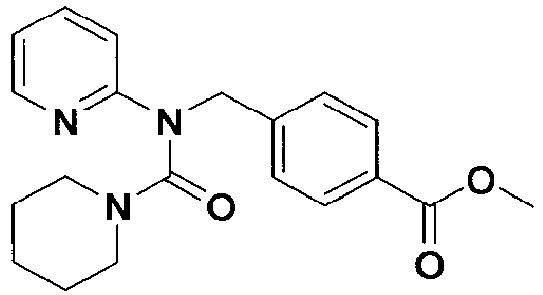
- Compound of Formula 7-5 (methyl 4-((((4-nitrophenoxy)carbonyl)(pyridin-2-yl)amino)methyl)benzoate; 0.30 g, 0.736 mmol) was dissolved in dimethylformamide (4 mL), and then piperidine (0.06 mL, 0.736 mmol) and potassium carbonate (0.122 g, 0.884 mmol) were added, and the mixture was heated and stirred at 60 °C for 12 hours. Then, the dimethylformamide was removed under reduced pressure, water was poured into the reaction mixture, and the organic layer was extracted with ethyl acetate. The organic layer was washed with saturated sodium chloride aqueous solution, dehydrated with anhydrous magnesium sulfate, and then concentrated under reduced pressure. The residue was purified and concentrated by column chromatography (silica; ethyl acetate/hexane=30%) to give the desired compound of Formula 7-6 (0.27 g, 104%) in the form of a yellow oil.
-

- Compound of Formula 7-6 (methyl 4-((N-(pyridin-2-yl)piperidine-1-carboxamido)methyl)benzoate; 0.13 g, 0.38 mmol) was dissolved in methanol (10 mL), and then hydroxylamine (0.13 g, 1.89 mmol) and potassium hydroxide (0.21 g, 3.79 mmol) were added and stirred for 5 minutes. Then, hydroxylamine (50 wt% aqueous solution; 0.98 mL, 7.58 mmol) was added dropwise and stirred at room temperature for 12 hours. After completion of the reaction, 2 N hydrogen chloride was added, and the organic layer was extracted with ethyl acetate, washed with saturated sodium chloride aqueous solution, dehydrated with anhydrous magnesium sulfate, and then concentrated under reduced pressure. The residue was purified and concentrated by column chromatography (silica; methanol/ dichloromethane =5%) to give the desired Compound 341 (0.09 g, 70%) in the form of a white solid.
1H NMR (400 MHz, MeOD-d3) δ 8.31 - 8.29 (m, 1 H), 7.72 - 7.66 (m, 3 H), 7.49 (d, 2 H, J = 8.3 Hz), 7.01 - 6.98 (m, 2 H), 5.07 (s, 2 H), 3.27 (t, 4 H, J = 5.5 Hz), 1.57 - 1.53 (m, 2 H), 1.45 - 1.41 (m, 4 H); MS (ESI) m/z 355.2 (M+ + H). -

- Compound of Formula 7-5 (methyl 4-((((4-nitrophenoxy)carbonyl)(pyridin-2-yl)amino)methyl)benzoate; 0.300 g, 0.736 mmol) was dissolved in dimethylformamide (4 mL), and then 4-methylpiperidine (0.07 g, 0.736 mmol) and potassium carbonate (0.122 g, 0.884 mmol) were added, and the mixture was heated and stirred at 60 °C for 12 hours. Then, the dimethylformamide was removed under reduced pressure, water was poured into the reaction mixture, and the organic layer was extracted with ethyl acetate. The organic layer was washed with saturated sodium chloride aqueous solution, dehydrated with anhydrous magnesium sulfate, and then concentrated under reduced pressure. The residue was purified and concentrated by column chromatography (silica; ethyl acetate/hexane=30%) to give the desired compound of Formula 7-6 (0.27 g, 100%) in the form of a yellow oil.
-

- Compound of Formula 7-6 (methyl 4-((4-methyl-N-(pyridin-2-yl)piperidine-1-carboxamido)methyl)benzoate; 0.15 g, 0.40 mmol) was dissolved in methanol (10 mL), and then hydroxylamine (0.14 g, 2.00 mmol) and potassium hydroxide (0.22 g, 4.00 mmol) were added and stirred for 5 minutes. Then, hydroxylamine (50 wt% aqueous solution; 1.03 mL, 8.00 mmol) was added dropwise and stirred at room temperature for 12 hours. After completion of the reaction, 2 N hydrogen chloride was added, and the organic layer was extracted with ethyl acetate, washed with saturated sodium chloride aqueous solution, dehydrated with anhydrous magnesium sulfate, and then concentrated under reduced pressure. The residue was purified and concentrated by column chromatography (silica; methanol/ dichloromethane =5%) to give the desired Compound 342 (0.09 g, 64%) in the form of a colorless oil.
1H NMR (400 MHz, MeOD-d3) δ 8.31 - 8.29 (m, 1 H), 7.71 - 7.67 (m, 3 H), 7.48 (d, 2 H, J = 8.3 Hz), 7.01 - 6.98 (m, 2 H), 5.07 (s, 2 H), 3.83 (d, 2 H, J = 13.2 Hz), 2.72 (td, 2 H, J = 12.6, 2.0 Hz), 1.55 - 1.50 (m, 3 H), 0.97 - 0.93 (m, 2 H), 0.95 (m, 3 H); MS (ESI) m/z 369.1 (M+ + H). -

- Compound of Formula 7-5 (methyl 4-((((4-nitrophenoxy)carbonyl)(pyridin-2-yl)amino)methyl)benzoate; 0.300 g, 0.736 mmol) was dissolved in dimethylformamide (4 mL), and then 2,6-dimethylmorpholine (0.085 g, 0.736 mmol) and potassium carbonate (0.122 g, 0.884 mmol) were added, and the mixture was heated and stirred at 60 °C for 12 hours. Then, the dimethylformamide was removed under reduced pressure, water was poured into the reaction mixture, and the organic layer was extracted with ethyl acetate. The organic layer was washed with saturated sodium chloride aqueous solution, dehydrated with anhydrous magnesium sulfate, and then concentrated under reduced pressure. The residue was purified and concentrated by column chromatography (silica; ethyl acetate/ hexane=30%) to give the desired compound of Formula 7-6 (0.17 g, 60%) in the form of a white oil.
-
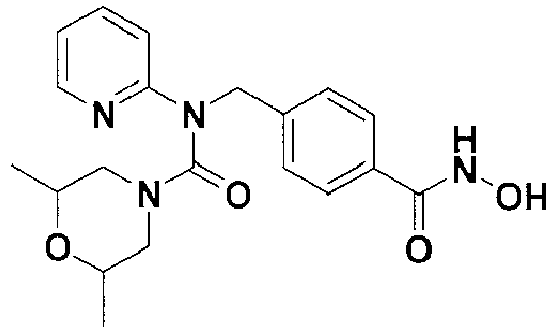
- Compound of Formula 7-6 (methyl 4-((2,6-dimethyl-N-(pyridin-2-yl)morpholine-4-carboxamido)methyl)benzoate; 0.116 g, 0.303 mmol) was dissolved in methanol (10 mL), and then hydroxylamine (0.105 g, 1.51 mmol) and potassium hydroxide (0.169 g, 3.02 mmol) were added and stirred for 5 minutes. Then, hydroxylamine (50 wt% aqueous solution; 0.778 mL, 6.05 mmol) was added dropwise and stirred at room temperature for 12 hours. After completion of the reaction, 2 N hydrogen chloride was added, and the organic layer was extracted with ethyl acetate, washed with saturated sodium chloride aqueous solution, dehydrated with anhydrous magnesium sulfate, and then concentrated under reduced pressure. The residue was purified and concentrated by column chromatography (silica; methanol/dichloromethane =5%) to give the desired Compound 343 (0.107 g, 92%) in the form of a colorless oil.
1H NMR (400 MHz, MeOD-d3) δ 8.32 (dd, 1 H, J = 4.9, 1.1 Hz), 7.74 - 7.69 (m, 1 H), 7.67 (d, 2 H, J = 8.2 Hz), 7.48 (d, 2 H, J = 8.2 Hz), 7.05 - 7.02 (m, 2 H), 5.08 (s, 2 H), 3.65 (d, 2 H, J = 12.9 Hz), 3.43 - 3.37 (m, 2 H), 2.46 - 2.40 (m, 2 H), 1.03 (d, 6 H, J = 6.2 Hz); MS (ESI) m/z 385.1 (M+ + H). -
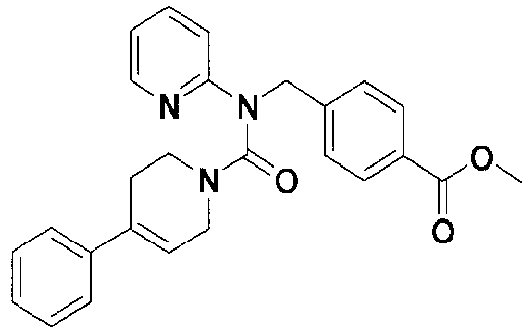
- Compound of Formula 7-5 (methyl 4-((((4-nitrophenoxy)carbonyl)(pyridin-2-yl)amino)methyl)benzoate; 0.50 g, 1.23 mmol) was dissolved in dimethylformamide (3 mL), and then 4-phenyl-1,2,3,6-tetrahydropyridine (0.264 g, 1.35 mmol) and potassium carbonate (0.339 g, 2.46 mmol) were added, and the mixture was heated and stirred at 55 °C for 12 hours. Then, the dimethylformamide was removed under reduced pressure, water was poured into the reaction mixture, and the organic layer was extracted with ethyl acetate. The organic layer was washed with saturated sodium chloride aqueous solution, dehydrated with anhydrous magnesium sulfate, and then concentrated under reduced pressure. The residue was purified and concentrated by column chromatography (silica; ethyl acetate/hexane=25%) to give the desired compound of Formula 7-6 (0.57 g, 108%) in the form of a yellow oil.
-

- Compound of Formula 7-6 (methyl 4-((4-phenyl-N-(pyridin-2-yl)-1,2,3,6-tetrahydropyridine-1-carboxamido)methyl)benz oate; 0.386 g, 0.903 mmol) was dissolved in methanol (20 mL), and then hydroxylamine (0.313 g, 4.51 mmol) and potassium hydroxide (0.507 g, 9.03 mmol) were added and stirred for 5 minutes. Then, hydroxylamine (50 wt% aqueous solution; 2.33 mL, 18.1 mmol) was added dropwise and stirred at room temperature for 12 hours. After completion of the reaction, the methanol was evaporated under reduced pressure, and the solid was precipitated by adding 2 N hydrogen chloride. The solid was filtered and dried to give the desired Compound 352 (0.22 g, 57%) in the form of a white solid.
1H NMR (400 MHz, MeOD-d3) δ 8.33 (dd, 1 H, J = 5.0, 1.2 Hz), 7.74 - 7.70 (m, 1 H), 7.65 (d, 2 H, J = 8.3 Hz), 7.49 (d, 2 H, J = 8.3 Hz), 7.36 - 7.23 (m, 5 H), 7.09 - 7.02 (m, 2 H), 5.97 (t, 1 H, J = 3.2 Hz), 5.12 (s, 2 H), 3.90 (d, 2 H, J = 3.0 Hz), 3.59 (t, 2 H, J = 5.7 Hz), 2.43 (d, 2 H, J = 5.7 Hz); MS (ESI) m/z 429.1 (M+ + H). -

- Compound of Formula 7-5 (methyl 4-((((4-nitrophenoxy)carbonyl)(pyridin-2-yl)amino)methyl)benzoate; 0.5 g, 1.23 mmol) was dissolved in dimethylformamide (3 mL), and then 1-methylpiperazine(0.15 ml, 1.35 mmol) and potassium carbonate (0.339 g, 2.46 mmol) were added, and the mixture was heated and stirred at 55 °C for 12 hours. Then, the dimethylformamide was removed under reduced pressure, water was poured into the reaction mixture, and the organic layer was extracted with ethyl acetate. The organic layer was washed with saturated sodium chloride aqueous solution, dehydrated with anhydrous magnesium sulfate, and then concentrated under reduced pressure. The residue was purified and concentrated by column chromatography (silica; methanol/dichloromethane=5%) to give the desired compound of Formula 7-6 (0.33 g, 73%) in the form of a yellow oil.
-

- Compound of Formula 7-6 (methyl 4-((4-methyl-N-(pyridin-2-yl)-piperazine-1-carboxamido)methyl)benzoate; 0.23 g, 0.624 mmol) was dissolved in methanol (20 mL), and then hydroxylamine (0.217 g, 3.12 mmol) and potassium hydroxide (0.35 g, 6.24 mmol) were added and stirred for 5 minutes. Then, hydroxylamine (50 wt% aqueous solution; 1.61 mL, 12.49 mmol) was added dropwise and stirred at room temperature for 12 hours. After completion of the reaction, the methanol was evaporated under reduced pressure, 2 N hydrogen chloride was added, and the organic layer was extracted with ethyl acetate. The organic layer was washed with saturated sodium chloride aqueous solution, dehydrated with anhydrous magnesium sulfate, and then concentrated under reduced pressure. The residue was purified and concentrated by column chromatography (silica; methanol/ dichloromethane=10%) to give the desired Compound 353 (0.04 g, 17%) in the form of a colorless oil.
1H NMR (400 MHz, MeOD-d3) δ 8.33 (dd, 1 H, J = 4.9, 1.6 Hz), 7.75 - 7.71 (m, 1 H), 7.68 (d, 2 H, J = 8.2 Hz), 7.48 (d, 2 H, J = 8.1 Hz), 7.09 (d, 1 H, J = 8.2 Hz), 7.06 - 7.03 (m, 1 H), 5.08 (s, 2 H), 3.41 - 3.38 (m, 4 H), 2.59 - 2.57 (m, 4 H), 2.44 (s, 3 H); MS (ESI) m/z 370.1 (M+ + H). -

- Compound of Formula 7-5 (methyl 4-((((4-nitrophenoxy)carbonyl)(pyridin-2-yl)amino)methyl)benzoate; 0.50 g, 1.23 mmol) was dissolved in dimethylformamide (3 mL), and then 1-ethylpiperazine(0.154 g, 1.35 mmol) and potassium carbonate (0.339 g, 2.45 mmol) were added, and the mixture was heated and stirred at 55 °C for 12 hours. Then, the dimethylformamide was removed under reduced pressure, water was poured into the reaction mixture, and the organic layer was extracted with dichloromethane. The organic layer was washed with saturated sodium chloride aqueous solution, dehydrated with anhydrous magnesium sulfate, and then concentrated under reduced pressure. The residue was purified and concentrated by column chromatography (silica; methanol/ dichloromethane=30%) to give the desired compound of Formula 7-6 (0.3 g, 64%) in the form of a yellow oil.
-

- Compound of Formula 7-6 (methyl 4-((4-ethyl-N-(pyridin-2-yl)-piperazine-1-carboxamido)methyl)benzoate; 0.23 g, 0.60 mmol) was dissolved in methanol (20 mL), and then hydroxylamine (0.209 g, 3.01 mmol) and potassium hydroxide (0.337 g, 6.01 mmol) were added and stirred for 5 minutes. Then, hydroxylamine (50 wt% aqueous solution; 1.55 mL, 12.02 mmol) was added dropwise and stirred at room temperature for 12 hours. After completion of the reaction, 2 N hydrogen chloride was added and the organic layer was extracted with ethyl acetate. The organic layer was washed with saturated sodium chloride aqueous solution, dehydrated with anhydrous magnesium sulfate, and then concentrated under reduced pressure. The residue was purified and concentrated by column chromatography (silica; methanol/dichloromethane =10%) to give the desired Compound 354 (0.038 g, 17%) in the form of a colorless oil.
1H NMR (400 MHz, MeOD-d3) δ 8.31 (dd, 1 H, J = 4.8, 1.2 Hz), 7.73 - 7.66 (m, 3 H), 7.48 (d, 2 H, J = 8.2 Hz), 7.06 - 7.01 (m, 2 H), 5.08 (s, 2 H), 3.36 - 3.31 (m, 4 H), 2.46 - 2.37 (m, 6 H), 1.07 (t, 3 H, J = 7.2 Hz); MS (ESI) m/z 384.1 (M+ + H). -

- Compound of Formula 7-5 (methyl 4-((((4-nitrophenoxy)carbonyl)(pyridin-2-yl)amino)methyl)benzoate; 0.50 g, 1.23 mmol) was dissolved in dimethylformamide (3 mL), and then 1-benzylpiperazine(0.231 ml, 1.35 mmol) and potassium carbonate (0.339 g, 2.46 mmol) were added, and the mixture was heated and stirred at 55 °C for 12 hours. Then, the dimethylformamide was removed under reduced pressure, water was poured into the reaction mixture, and the organic layer was extracted with ethyl acetate. The organic layer was washed with saturated sodium chloride aqueous solution, dehydrated with anhydrous magnesium sulfate, and then concentrated under reduced pressure. The residue was purified and concentrated by column chromatography (silica; ethyl acetate/hexane=25%) to give the desired compound of Formula 7-6 (0.185 g, 34%) in the form of a yellow oil.
-
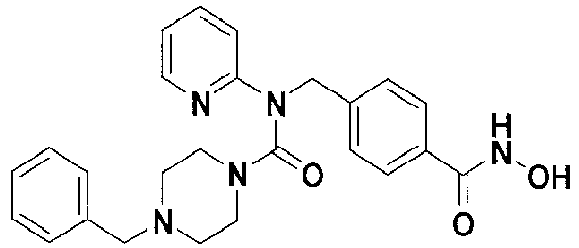
- Compound of Formula 7-6 (methyl 4-((4-benzyl-N-(pyridin-2-yl)-piperazine-1-carboxamido)methyl)benzoate; 0.136 g, 0.31 mmol) was dissolved in methanol (20 mL), and then hydroxylamine (0.106 g, 1.53 mmol) and potassium hydroxide (0.172 g, 3.06 mmol) were added and stirred for 5 minutes. Then, hydroxylamine (50 wt% aqueous solution; 0.788 mL, 6.12 mmol) was added dropwise and stirred at room temperature for 12 hours. After completion of the reaction, the methanol was evaporated under reduced pressure, and the solid was precipitated by adding 2 N hydrogen chloride. The solid was filtered to give the desired Compound 355 (0.077 g, 57%) in the form of a white solid.
1H NMR (400 MHz, MeOD-d3) δ 8.31 (dd, 1 H, J = 4.8, 0.9 Hz), 7.72 - 7.65 (m, 3 H), 7.47 (d, 2 H, J = 8.2 Hz), 7.32 - 7.24 (m, 5 H), 7.03 - 7.00 (m, 2 H), 5.07 (s, 2 H), 3.48 (s, 2 H), 3.31 - 3.30 (m, 4 H), 2.32 - 2.29 (m, 4 H); MS (ESI) m/z 446.1 (M+ + H). -

- Compound of Formula 7-5 (methyl 4-((((4-nitrophenoxy)carbonyl)(pyridin-2-yl)amino)methyl)benzoate; 0.50 g, 1.23 mmol) was dissolved in dimethylformamide (3 mL), and then 1-(2-methoxyphenyl)piperazine (0.236 mL, 1.35 mmol) and potassium carbonate (0.339 g, 2.46 mmol) were added, and the mixture was heated and stirred at 55 °C for 12 hours. Then, the dimethylformamide was removed under reduced pressure, water was poured into the reaction mixture, and the organic layer was extracted with dichloromethane. The organic layer was washed with saturated sodium chloride aqueous solution, dehydrated with anhydrous magnesium sulfate, and then concentrated under reduced pressure. The residue was purified and concentrated by column chromatography (silica; ethyl acetate/hexane=30%) to give the desired compound of Formula 7-6 (0.565 g, 100%) in the form of a yellow oil.
-

- Compound of Formula 7-6 (methyl 4-((4-(2-methoxyphenyl)-N-(pyridin-2-yl)piperazine-1-carboxamido)methyl)benzoate; 0.395 g, 0.858 mmol) was dissolved in methanol (20 mL), and then hydroxylamine (0.298 g, 4.29 mmol) and potassium hydroxide (0.481 g, 8.58 mmol) were added and stirred for 5 minutes. Then, hydroxylamine (50 wt% aqueous solution; 2.21 mL, 17.15 mmol) was added dropwise and stirred at room temperature for 12 hours. After completion of the reaction, 2 N hydrogen chloride was added, and the organic layer was extracted with ethyl acetate. The organic layer was washed with saturated sodium chloride aqueous solution, dehydrated with anhydrous magnesium sulfate, and then concentrated under reduced pressure. The residue was purified and concentrated by column chromatography (silica; methanol/dichloromethane =10%) to give the desired Compound 356 (0.28 g, 70%) in the form of a colorless oil.
1H NMR (400 MHz, MeOD-d3) δ 8.33 (dd, 1 H, J = 4.9, 1.2 Hz), 7.74 - 7.71 (m, 1 H), 7.68 (d, 2 H, J = 8.2 Hz), 7.51 (d, 2 H, J = 8.2 Hz), 7.09 - 6.87 (m, 6 H), 5.11 (s, 2 H), 3.82 (s, 3 H), 3.47 - 3.44 (m, 4 H), 2.87 - 2.85 (m, 4 H); MS (ESI) m/z 446.1 (M+ + H). -

- Compound of Formula 7-5 (methyl 4-((((4-nitrophenoxy)carbonyl)(pyridin-2-yl)amino)methyl)benzoate; 0.50 g, 1.23 mmol) was dissolved in dimethylformamide (3 mL), and then 1-(4-fluorophenyl)piperazine (0.243 mL, 1.35 mmol) and potassium carbonate (0.339 g, 2.46 mmol) were added, and the mixture was heated and stirred at 55 °C for 12 hours. Then, the dimethylformamide was removed under reduced pressure, water was poured into the reaction mixture, and the organic layer was extracted with dichloromethane. The organic layer was washed with saturated sodium chloride aqueous solution, dehydrated with anhydrous magnesium sulfate, and then concentrated under reduced pressure. The residue was purified and concentrated by column chromatography (silica; ethyl acetate/hexane=25%) to give the desired compound of Formula 7-6 (0.54 g, 98%) in the form of a yellow oil.
-

- Compound of Formula 7-6 (methyl 4-((4-(4-fluorophenyl)-N-(pyridin-2-yl)piperazine-1-carboxamido)methyl)benzoate; 0.31 g, 0.691 mmol) was dissolved in methanol (20 mL), and then hydroxylamine (0.24 g, 3.46 mmol) and potassium hydroxide (0.3881 g, 6.91 mmol) were added and stirred for 5 minutes. Then, hydroxylamine (50 wt% aqueous solution; 1.78 mL, 13.8 mmol) was added dropwise and stirred at room temperature for 12 hours. After completion of the reaction, 2 N hydrogen chloride was added, and the organic layer was extracted with ethyl acetate. The organic layer was washed with saturated sodium chloride aqueous solution, dehydrated with anhydrous magnesium sulfate, and then concentrated under reduced pressure. The residue was purified and concentrated by column chromatography (silica; methanol/dichloromethane =10%) to give the desired Compound 357 (0.27 g, 87%) in the form of a colorless oil.
1H NMR (400 MHz, MeOD-d3) δ 8.34 - 8.33 (m, 1 H), 7.75 - 7.71 (m, 1 H), 7.67 (d, 2 H, J = 8.2 Hz), 7.51 (d, 2 H, J = 8.2 Hz), 7.09 (d, 1 H, J = 8.3 Hz), 7.05 - 6.89 (m, 5 H), 5.11 (s, 2 H), 3.46 - 3.44 (m, 4 H), 2.96 - 2.93 (m, 4 H); MS (ESI) m/z 450.1 (M+ + H). -

- Compound of Formula 7-5 (methyl 4-((((4-nitrophenoxy)carbonyl)(pyridin-2-yl)amino)methyl)benzoate; 0.20 g, 0.491 mmol) was dissolved in dimethylformamide (4 mL), and then pyrrolidine (0.035 mL, 0.491 mmol) and potassium carbonate (0.081 g, 0.589 mmol) were added, and the mixture was heated and stirred at 55 °C for 12 hours. Then, the dimethylformamide was removed under reduced pressure, water was poured into the reaction mixture, and the organic layer was extracted with ethyl acetate. The organic layer was washed with saturated sodium chloride aqueous solution, dehydrated with anhydrous magnesium sulfate, and then concentrated under reduced pressure. The residue was purified and concentrated by column chromatography (silica; ethyl acetate/hexane=30%) to give the desired compound of Formula 7-6 (0.031 g, 19%) in the form of a colorless oil.
-

- Compound of Formula 7-6 (methyl 4-((N-(pyridin-2-yl)pyrrolidine-1-carboxamido)methyl)benzoate; 0.031 g, 0.091 mmol) was dissolved in methanol (4 mL), and then hydroxylamine (0.032 g, 0.457 mmol) and potassium hydroxide (0.051 g, 0.913 mmol) were added and stirred for 5 minutes. Then, hydroxylamine (50 wt% aqueous solution; 0.135 mL, 1.83 mmol) was added dropwise and stirred at room temperature for 12 hours. After completion of the reaction, the methanol was evaporated under reduced pressure, 2 N hydrogen chloride was added, and the organic layer was extracted with ethyl acetate. The organic layer was washed with saturated sodium chloride aqueous solution, dehydrated with anhydrous magnesium sulfate, and then concentrated under reduced pressure. The residue was purified and concentrated by column chromatography (silica; methanol/ dichloromethane=10%) to give the desired Compound 358 (0.012 g, 39%) in the form of a colorless oil.
1H NMR (400 MHz, MeOD-d3) δ 8.31 (dd, 1 H, J = 4.9, 1.3 Hz), 7.73 - 7.69 (m, 1 H), 7.65 (d, 2 H, J = 8.2 Hz), 7.47 (d, 2 H, J = 8.2 Hz), 7.07 - 7.02 (m, 2 H), 5.08 (s, 2 H), 3.19 - 3.18 (m, 4 H), 1.80 - 1.77 (m, 4 H); MS (ESI) m/z 341.2 (M+ + H). -

- Compound of Formula 11-2 (1,1'- thiocarbonyldiimidazole; 8.26 g, 46.4 mmol) was dissolved in hydrogen chloride (40 mL), and then triethylamine (6.34 mL, 46.4 mmol) and compound of Formula 11-1 (4-(aminomethyl)benzoate hydrochloride; 8.50 g, 42.2 mmol) were slowly added sequentially and then stirred at room temperature for 3 hours. Then, ammonia (28.0 wt% aqueous solution; 30 mL) and methanol (10 mL) were added to the mixture and stirred at room temperature for 2 hours, and then hexane (85 mL) and water (45 mL) were further added and stirred at the same temperature for 1 hour. The solid product was filtered, washed with hexane and then with water, and then vacuum dried to give the desired compound of Formula 11-3 (9.40 g, 99%) in the form of a light brown solid.
-

- Compound of Formula 11-3 (methyl 4-(thioureidomethyl)benzoate; 0.180 g, 0.803 mmol) and compound of Formula 11-4 (2-bromoacetophenone; 0.084 g, 0.843 mmol) were dissolved in ethanol (5 mL) and then stirred under reflux for 16 hours. After completion of the reaction, the temperature reaction solution was cooled to room temperature, and then ethyl acetate and hexane were added and stirred. Then, the solid product was filtered and vacuum dried to give the desired compound of Formula 11-5 (0.175 g, 67%) in the form of a light brown solid.
-

- Compound of Formula 11-5 (methyl 4-((4-phenylthiazol-2-ylamino)methyl)benzoate; 0.175 g, 0.539 mmol) and 4-nitrophenyl chloroformate (0.141 g, 0.701 mmol) were dissolved in acetonitrile (10 mL), and then potassium carbonate (0.112 g, 0.809 mmol) was added and stirred at room temperature for 16 hours. After completion of the reaction, the organic layer was extracted with ethyl acetate and saturated sodium hydrogen carbonate aqueous solution, dehydrated with anhydrous magnesium sulfate, and then filtered. The filtrate was concentrated under reduced pressure, and then the residue was purified and concentrated by column chromatography (silica; ethyl acetate/hexane= 20%) to give the desired compound of Formula 11-6 (0.160 g, 61%) in the form of a yellow solid.
-

- Compound of Formula 11-6 (methyl 4-((((4-nitrophenoxy)carbonyl)(4-phenylthiazol-2-yl)amino)methyl)benzoate; 0.160 g, 0.327 mmol) was dissolved in dimethylformamide (5 mL), and then morpholine (0.057 g, 0.654 mmol) and potassium carbonate (0.136 g, 0.981 mmol) were added and stirred at 60 °C for 16 hours. After completion of the reaction, the organic layer was extracted with ethyl acetate and saturated ammonium chloride aqueous solution, dehydrated with anhydrous magnesium sulfate, and then filtered. The filtrate was concentrated under reduced pressure, and then the residue was purified and concentrated by column chromatography (silica; ethyl acetate/hexane=30%) to give the desired compound of Formula 11-7 (0.085 g, 59%) in the form of a light yellow solid.
-

- Compound of Formula 11-7 (methyl 4-((N-(4-phenylthiazol-2-yl)morpholine-4-carboxamido)methyl)benzoate; 0.085 g, 0.194 mmol) was dissolved in methanol (5 mL), and then hydroxylamine (50.0 wt% aqueous solution; 1.19 mL, 19.4 mmol) and potassium hydroxide (0.109 g, 1.94 mmol) were added sequentially and then stirred at room temperature for 30 minutes. After completion of the reaction, the reaction solution was concentrated under reduced pressure until its volume became about 1 mL, and saturated ammonium chloride aqueous solution (1-2 mL) was added and stirred. Then, the solid product was filtered, washed with water, and then vacuum dried to give the desired Compound 370 (0.059 g, 69%) in the form of a white solid.
1H NMR (400 MHz, DMSO-d6) δ 7.82 (d, 2 H, J = 8.5 Hz), 7.67 (d, 2 H, J = 8.3 Hz), 7.55 (s, 1 H), 7.41 - 7.35 (m, 4 H), 7.29 (m, 1 H), 5.13 (s, 2 H), 3.59 - 3.57 (m, 4 H), 3.39 - 3.36 (m, 4 H). MS (ESI) m/z 439 (M+ + H). -

- Compound of Formula 11-3 (methyl 4-(thioureidomethyl)benzoate; 0.500 g, 2.23 mmol) and 2-bromo-4-chloroacetophenone (0.573 g, 2.45 mmol) were dissolved in ethanol (20 mL) and then stirred under reflux for 16 hours. After completion of the reaction, the temperature reaction solution was cooled to room temperature, and then ethyl acetate and hexane were added and stirred. Then, the solid product was filtered and vacuum dried to give the desired compound of Formula 11-5 (0.700 g, 88%) in the form of a white solid.
-

- Compound of Formula 11-5 (methyl 4-((4-(4-chlorophenyl)thiazol-2-ylamino)methyl)benzoate; 0.500 g, 1.39 mmol) and 4-nitrophenyl chloroformate (0.337 g, 1.67 mmol) were dissolved in dimethylformamide (10 mL), and then N,N-diisopropylethylamine(0.370 ml, 2.09 mmol) was added and stirred at room temperature for 16 hours. After completion of the reaction, the organic layer was extracted with ethyl acetate and saturated sodium hydrogen carbonate aqueous solution, dehydrated with anhydrous magnesium sulfate, and then filtered. The filtrate was concentrated under reduced pressure, and then the residue was purified and concentrated by column chromatography (silica; ethyl acetate/hexane= 15%) to give the desired compound of Formula 11-6 (0.520 g, 71%) in the form of a yellow solid.
-

- Compound of Formula 11-6 (methyl 4-(((4-(4-chlorophenyl)thiazol-2-yl)((4-nitrophenoxy)carbonyl)amino)methyl)benzoate ; 0.520 g, 0.992 mmol) was dissolved in dimethylformamide (5 mL), and then morpholine (0.173 g, 1.99 mmol) and potassium carbonate (0.412 g, 2.98 mmol) were added and stirred at 60 °C for 16 hours. After completion of the reaction, the organic layer was extracted with ethyl acetate and saturated ammonium chloride aqueous solution, dehydrated with anhydrous magnesium sulfate, and then filtered. The filtrate was concentrated under reduced pressure, and then the residue was purified and concentrated by column chromatography (silica; ethyl acetate/hexane=50%) to give the desired compound of Formula 11-7 (0.460 g, 98%) in the form of a white solid.
-

- Compound of Formula 11-7 (methyl 4-((N-(4-(4-chlorophenyl)thiazol-2-yl)morpholine-4-carboxamido)methyl)benzoate; 0.460 g, 0.975 mmol) was dissolved in methanol (10 mL), and then hydroxylamine (50.0 wt% aqueous solution; 2.98 mL, 48.7 mmol) and potassium hydroxide (0.547 g, 9.75 mmol) were added sequentially and then stirred at room temperature for 30 minutes. After completion of the reaction, the reaction solution was concentrated under reduced pressure until its volume became about 1 mL, and saturated ammonium chloride aqueous solution (1-2 mL) was added and stirred. Then, the solid product was filtered, washed with water, and then vacuum dried to give the desired Compound 371 (0.435 g, 94%) in the form of a white solid.
1H NMR (400 MHz, DMSO-d6) δ 11.14 (s, 1 H), 9.00 (s, 1 H), 7.83 (d, 2 H, J = 8.5 Hz), 7.67 (d, 2 H, J = 8.2 Hz), 7.62 (s, 1 H), 7.45 (d, 2 H, J = 8.6 Hz), 7.39 (d, 2 H, J = 8.0 Hz), 5.14 (s, 2 H), 3.60 - 3.57 (m, 4 H), 3.41 - 3.38 (m, 4 H). MS (ESI) m/z 473 (M+ + H). -

- Compound of Formula 8-5 (methyl 4-((N-(4-bromophenyl)morpholine-4-carboxamido)methyl)benzoate; 0.085 g, 0.196 mmol) was dissolved in methanol (5 mL), and then hydroxylamine (50.0 wt% aqueous solution; 1.20 mL, 19.6 mmol) and potassium hydroxide (0.110 g, 1.96 mmol) were added sequentially and then stirred at room temperature for 30 minutes. After completion of the reaction, the reaction solution was concentrated under reduced pressure until its volume became about 1 mL, and saturated ammonium chloride aqueous solution (1-2 mL) was added and stirred. Then, the solid product was filtered, washed with water, and then vacuum dried to give the desired Compound 372 (0.049 g, 58%) in the form of a light yellow solid.
1H NMR (400 MHz, DMSO-d6) δ 7.64 (d, 2 H, J = 8.4 Hz), 7.45 (dd, 2 H, J = 6.8, 2.1 Hz), 7.33 (d, 2 H, J = 8.2 Hz), 7.09 (dd, 2 H, J = 6.8, 2.1 Hz), 4.85 (s, 2H), 3.41 (t, 4 H, J = 4.7 Hz), 3.13 (t, 4 H, J = 4.6 Hz). MS (ESI) m/z 434, 436 (M+ + H). -

- Compound Formula 1-1 (3-(trifluoromethyl)benzenamine; 0.30 g, 1.84 mmol) and potassium carbonate (0.76 g, 5.53 mmol) were dissolved in dimethylformamide (DMF, 5 mL), and methyl 4-(bromomethyl)benzoate (0.42 g, 1.84 mmol) was then added. The mixture was reacted at room temperature for 1 day and then diluted with ethyl acetate. The reaction mixture was washed with saturated sodium chloride aqueous solution, dehydrated with anhydrous magnesium sulfate, filtered, and then concentrated under reduced pressure. The residue was purified by column chromatography (silica; ethyl acetate/hexane =20%) to give the desired compound of Formula 1-2 (0.37 g, 65%).
1H NMR (400 MHz, DMSO-d6) δ 7.93 (d, 2 H, J = 8.3 Hz), 7.49 (d, 2 H, J = 8.3 Hz), 7.24 (t, 1 H, J = 7.9 Hz), 6.88-6.78 (m, 4 H), 4.42 (d, 2 H, J = 6.1 Hz), 3.83 (s, 3H), MS (ESI) m/z 310 (M+ + H). -

- Compound of Formula 1-2 (methyl 4-((3-(trifluoromethyl)phenylamino)methyl)benzoate; 0.26 g, 0.82 mmol) and 4-nitrophenyl carbonochloridate (0.33 g, 1.65 mmol) were dissolved in acetonitrile (10 mL), and potassium carbonate (0.34 g, 2.47 mmol) was then added. The mixture was reacted at room temperature for 1 day and then diluted with ethyl acetate. The reaction mixture was washed with saturated sodium chloride aqueous solution, dehydrated with anhydrous sodium sulfate, filtered, and then concentrated under reduced pressure. The residue was purified by column chromatography (silica; ethyl acetate/hexane=20%) to give the desired compound of Formula 1-3 (0.35 g, 89%) in the form of a colorless oil.
1H NMR (400 MHz, CDCl3) δ 8.20 (d, 2 H, J = 10.2 Hz), 8.01 (d, 2 H, J = 7.8 Hz), 7.56-7.46 (m, 3H), 7.35 (d, 3 H, J = 8.0 Hz), 7.26 (d, 2 H, J = 8.1 Hz), 5.01 (bs, 2H), 3.90 (s, 3H). -
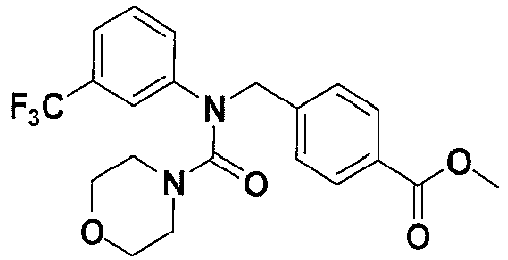
- Compound of Formula 1-3 (methyl 4-((((4-nitrophenoxy)carbonyl)(3-(trifluoromethyl)phenyl)amino)methyl)benzoate; 0.29 g, 0.60 mmol) was dissolved in dimethylformamide (10 mL), and potassium carbonate (0.25 g, 1.81 mmol) and morpholine (0.05 mL, 0.60 mmol) were then added. The mixture was reacted at 60 °C for 2 days and then diluted with saturated ammonium chloride solution. The organic layer was extracted with ethyl acetate, dehydrated with anhydrous sodium sulfate, filtered, and then concentrated under reduced pressure. The residue was purified by column chromatography (silica; ethyl acetate/hexane=50%) to give the desired compound of Formula 1-4 (0.15 g, 60%).
1H NMR (400 MHz, DMSO-d6) δ 7.97 (d, 2 H, J = 8.2 Hz), 7.43-7.32 (m, 5H), 7.20 (d, 1 H, J = 8.0 Hz), 4.94 (s, 2H), 3.90 (s, 3H), 3.50 (t, 4 H, J = 4.8 Hz), 3.25 (t, 4 H, J = 4.8 Hz), MS (ESI) m/z 423 (M+ + H). -
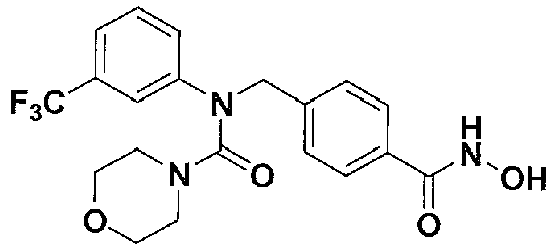
- Compound of Formula 1-4 (methyl 4-((N-(3-(trifluoromethyl)phenyl)morpholine-4-carboxamido)methyl)benzoate; 0.15 g, 0.36 mmol) was dissolved in methanol (5 mL), and hydroxylamine aqueous solution (50 wt%, 1 mL) and potassium hydroxide (0.10 g, 1.81 mmol) were then added and stirred overnight. After completion of the reaction, the methanol was removed by distillation under reduced pressure, and the organic layer was extracted with ethyl acetate and water, dehydrated with anhydrous sodium sulfate, filtered, and then concentrated under reduced pressure. The residue was stirred in diethyl ether to give a solid product, and the resulting solid was filter and dried to give the desired Compound 374 (0.082 g, 54%) in the form of a white solid.
1H NMR (400 MHz, MeOD-d3) δ 11.14 (brs, 1 H), 8.99 (brs, 1 H), 7.85 (d, 2 H, J= 8.0 Hz), 7.66-7.27 (m, 6 H), 4.94 (s, 2 H), 3.41 (s, 2 H), 3.15 (s, 2 H). MS (ESI) m/z 424 (M+ + H). -
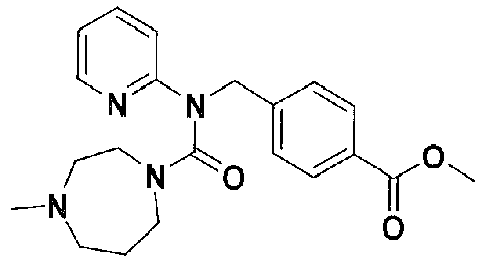
- Compound of Formula 7-5 (methyl 4-((((4-nitrophenoxy)carbonyl)(pyridin-2-yl)amino)methyl)benzoate; 0.50 g, 1.23 mmol) was dissolved in dimethylformamide (4 mL), and then 1-methyl-1,4-diazepane (0.183 mL, 1.47 mmol) and potassium carbonate (0.339 g, 2.45 mmol) were added, and the mixture was heated and stirred at 55 °C for 12 hours. Then, the dimethylformamide was removed under reduced pressure, saturated ammonium chloride aqueous solution was poured into the reaction mixture, and the organic layer was extracted with dichloromethane. The organic layer was washed with saturated sodium chloride aqueous solution, dehydrated with anhydrous magnesium sulfate, and then concentrated under reduced pressure. The residue was purified and concentrated by column chromatography (silica; ethyl acetate/hexane=50%) to give the desired compound of Formula 7-6 (0.32 g, 68%) in the form of a pale yellow oil.
-

- Compound of Formula 7-6 (methyl 4-((4-methyl-N-(pyridin-2-yl)-1,4-diazepane-1-carboxamido)methyl)benzoate; 0.15 g, 0.39 mmol) was dissolved in methanol (20 mL), and then hydroxylamine (0.136 g, 1.96 mmol) and potassium hydroxide (0.22 g, 3.92 mmol) were added and stirred for 5 minutes. Then, hydroxylamine (50 wt% aqueous solution; 1.01 mL, 7.84 mmol) was added dropwise and stirred at room temperature for 6 hours. After completion of the reaction, the methanol was evaporated by reduced pressure, 1 N hydrogen chloride was added, and the organic layer was extracted with ethyl acetate. The organic layer was washed with saturated sodium chloride aqueous solution, dehydrated with anhydrous magnesium sulfate, and then concentrated under reduced pressure. The residue was purified and concentrated by column chromatography (silica; methanol/ dichloromethane=5%) to give the desired Compound 376 (0.009 g, 6%) in the form of a white solid.
1H NMR (400 MHz, MeOD-d3) δ 8.33 - 8.31 (m, 1 H), 7.74 - 7.72 (m, 1 H), 7.67 (d, 2 H, J = 8.3 Hz), 7.50 (d, 2 H, J = 8.2 Hz), 7.10 - 7.04 (m, 2 H), 5.09 (d, 2 H, J = 2.4 Hz), 3.96 - 3.93 (m, 2 H), 3.56 - 2.95 (m, 6 H), 2.88 (s, 3 H), 2.06 - 2.02 (m, 2H); MS (ESI) m/z 384.1 (M+ + H). -

- Compound of Formula 7-5 (methyl 4-((((4-nitrophenoxy)carbonyl)(pyridin-2-yl)amino)methyl)benzoate; 0.50 g, 1.23 mmol) was dissolved in dimethylformamide (4 mL), and then azetidine (0.183 g, 1.47 mmol) and potassium carbonate (0.339 g, 2.45 mmol) were added, and the mixture was heated and stirred at 55 °C for 1 day. Then, the dimethylformamide was removed under reduced pressure, water was poured into the reaction mixture, and the organic layer was extracted with dichloromethane. The organic layer was washed with saturated sodium chloride aqueous solution, dehydrated with anhydrous magnesium sulfate, and then concentrated under reduced pressure. The residue was purified and concentrated by column chromatography (silica; ethyl acetate/hexane=30%) to give the desired compound of Formula 7-6 (0.03 g, 8%) in the form of a white solid.
-

- Compound of Formula 7-6 (methyl 4-((N-(pyridin-2-yl)azetidine-1-carboxamido)methyl)benzoate; 0.03 g, 0.09 mmol) was dissolved in methanol (20 mL), and then hydroxylamine (0.032 g, 0.092 mmol) and potassium hydroxide (0.052 g, 0.922 mmol) were added and stirred for 5 minutes. Then, hydroxylamine (50 wt% aqueous solution; 0.238 mL, 1.84 mmol) was added dropwise and stirred at room temperature for 6 hours. After completion of the reaction, 1 N hydrogen chloride was added and the organic layer was extracted with ethyl acetate. The organic layer was washed with saturated sodium chloride aqueous solution, dehydrated with anhydrous magnesium sulfate, and then concentrated under reduced pressure. The residue was purified and concentrated by column chromatography (silica; methanol/dichloromethane=5%) to give the desired Compound 377 (0.013 g, 43%) in the form of a white solid.
1H NMR (400 MHz, MeOD-d3) δ 8.38 - 8.36 (m, 1 H), 7.78 - 7.74 (m, 1 H), 7.64 (d, 2 H, J = 8.3 Hz), 7.40 (d, 2 H, J = 8.3 Hz), 7.24 (d, 1 H, J = 8.2 Hz), 7.15 - 7.11 (m, 1 H), 5.09 (s, 2 H), 3.73 (t, 4 H, J = 7.7 Hz), 2.12 (tt, 2H, J = 7.7 Hz); MS (ESI) m/z 327.2 (M+ + H). -

- Compound of Formula 7-5 (methyl 4-((((4-nitrophenoxy)carbonyl)(pyridin-2-yl)amino)methyl)benzoate; 0.50 g, 1.23 mmol) was dissolved in dimethylformamide (4 mL), and then 1-(3,4-dimethylphenyl)piperazine (0.28 g, 1.47 mmol) and potassium carbonate (0.339 g, 2.46 mmol) were added, and the mixture was heated and stirred at 55 °C for 1 day. Then, the dimethylformamide was removed under reduced pressure, water was poured into the reaction mixture, and the organic layer was extracted with dichloromethane. The organic layer was washed with saturated sodium chloride aqueous solution, dehydrated with anhydrous magnesium sulfate, and then concentrated under reduced pressure. The residue was purified and concentrated by column chromatography (silica; ethyl acetate/hexane=30%) to give the desired compound of Formula 7-6 (0.4 g, 71%) in the form of a yellow oil.
-

- Compound of Formula 7-6 (methyl 4-((4-(3,4-dimethylphenyl-N-(pyridin-2-yl)piperazine-1-carboxamido)methyl)benzoate; 0.1 g, 0.218 mmol) was dissolved in methanol (20 mL), and then hydroxylamine (0.076 g, 1.09 mmol) and potassium hydroxide (0.122 g, 2.18 mmol) were added and stirred for 5 minutes. Then, hydroxylamine (50 wt% aqueous solution; 0.56 mL, 4.36 mmol) was added dropwise and stirred at room temperature for 6 hours. After completion of the reaction, 2 N hydrogen chloride was added and the organic layer was extracted with ethyl acetate. The organic layer was washed with saturated sodium chloride aqueous solution, dehydrated with anhydrous magnesium sulfate, and then concentrated under reduced pressure. The residue was purified and concentrated by column chromatography (silica; methanol/dichloromethane=5%) to give the desired Compound 379 (0.05 g, 52%) in the form of a white solid.
1H NMR (400 MHz, MeOD-d3) δ 8.33 (dd, 1 H, J = 4.9, 1.2 Hz), 7.74 - 7.70 (m, 1 H), 7.67 (d, 2 H, J = 8.3 Hz), 7.50 (d, 2 H, J = 8.3 Hz), 7.08 (d, 1 H, J = 8.3 Hz), 7.05 - 7.02 (m, 1 H), 6.97 (d, 1 H, J = 8.3 Hz), 6.72 (d, 1 H, J = 2.2 Hz), 6.63 (dd, 1 H, J = 8.2, 2.4 Hz), 5.10 (s, 2 H), 3.45 - 3.43 (m, 4 H), 2.95 - 2.93 (m, 4 H), 2.20 (s, 3 H), 2.15 (s, 3 H); MS (ESI) m/z 460.2 (M+ + H). -

- 4-((N-(4-bromophenyl)morpholine-4-carboxamido)methyl)benzoate; 1.00 g, 2.31 mmol), 4-formylphenylboronic acid(0.415 g, 2.77 mmol), and Pd(dppf)Cl2 (0.094 g, 0.115 mmol) were dissolved in 1,4-dioxane (12 mL), and then cesium carbonate (2.24 g, 6.92 mmol) dissolved in water (3 mL) was added to the reaction solution and then stirred at 140 °C for 15 minutes in a microwave reactor. After completion of the reaction, the organic layer was extracted with ethyl acetate and saturated sodium hydrogen carbonate aqueous solution, dehydrated with anhydrous magnesium sulfate, and then filtered. The filtrate was concentrated under reduced pressure, and then the residue was purified and concentrated by column chromatography (silica; ethyl acetate/hexane=50%) to give the desired compound of Formula 9-1 (0.750 g, 71%) in the form of a light yellow solid.
-

- Compound of Formula 9-1 (methyl 4-((N-(4'-formylbiphenyl-4-yl)morpholine-4-carboxamido)methyl)benzoate; 0.150 g, 0.327 mmol) was dissolved in methanol (5 mL), and then morpholine (0.086 g, 0.981 mmol) and acetic acid (0.094 mL, 1.64 mmol) were added and stirred at room temperature for 1 hour. Then, sodium cyanoborohydride (0.041 g, 0.654 mmol) was added and stirred at the same temperature for 16 hours. After completion of the reaction, the organic layer was extracted with ethyl acetate and saturated sodium hydrogen carbonate aqueous solution and concentrated under reduced pressure. Then, the organic layer was dehydrated with anhydrous magnesium sulfate and filtered, and then the filtrate was concentrated under reduced pressure. Then, the residue was purified and concentrated by column chromatography (silica; ethyl acetate/hexane=25%) to give the desired compound of Formula 9-2 (0.136 g, 79%) in the form of a white solid.
-
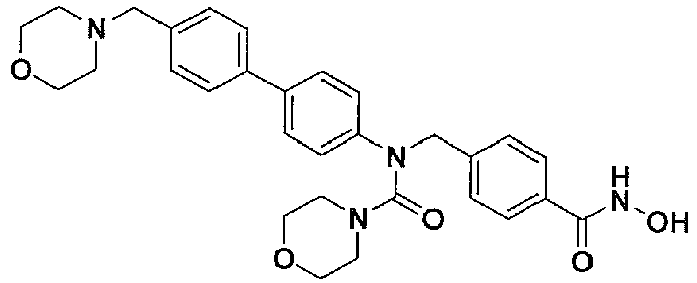
- Compound of Formula 9-2 (methyl 4-((N-(4'-(morpholinomethyl)biphenyl-4-yl)morpholine-4-carboxamido)methyl)benzo ate; 0.130 g, 0.245 mmol) was dissolved in methanol (10 mL), and hydroxylamine (50.0 wt% aqueous solution; 1.50 mL, 24.5 mmol) and potassium hydroxide (0.138 g, 2.46 mmol) were added and then stirred at room temperature for 30 minutes. After completion of the reaction, the reaction solution was concentrated under reduced pressure until its volume became about 2 mL, and the organic layer was extracted with ethyl acetate and saturated saturated ammonium chloride aqueous solution. The organic layer was dehydrated with anhydrous magnesium sulfate, filtered, and then concentrated under reduced pressure. The residue was recrystallized with dichloromethane and hexane to give the desired Compound 380 (0.073 g, 56%) in the form of a white solid.
1H NMR (400 MHz, DMSO-d6) δ 11.14 (brs, H), 9.14 (brs, 1 H), 7.65 (d, 2 H, J = 8.1 Hz), 7.62 - 7.56 (m, 4 H), 7.39 - 7.33 (m, 4 H), 7.21 (d, 2 H, J = 8.5 Hz), 4.90 (s, 2 H), 3.58 - 3.55 (m, 4 H), 3.46 (s, 2 H), 3.42 - 3.37 (m, 8 H), 3.17 (m, 4 H). MS (ESI) m/z 529 (M+ + H). -
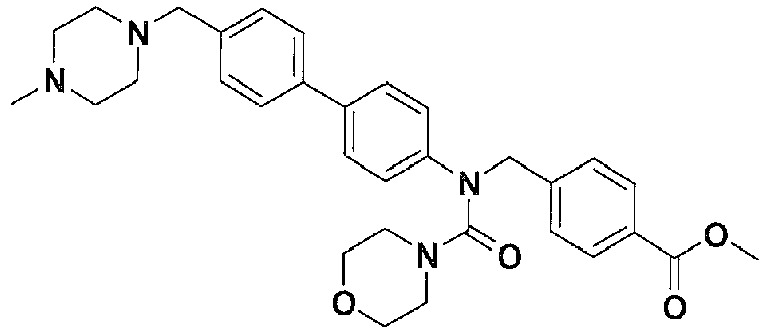
- Compound of Formula 9-1 (methyl 4-((N-(4'-formylbiphenyl-4-yl)morpholine-4-carboxamido)methyl)benzoate; 0.150 g, 0.327 mmol) was dissolved in methanol (5 mL), and then 1-methylpiperazine (0.098 g, 0.981 mmol) and acetic acid (0.094 mL, 1.64 mmol) were added and stirred at room temperature for 1 hour. Then, sodium cyanoborohydride (0.041 g, 0.654 mmol) was added and stirred at the same temperature for 16 hours. After completion of the reaction, the organic layer was extracted with ethyl acetate and saturated sodium hydrogen carbonate aqueous solution and concentrated under reduced pressure. Then, the organic layer was dehydrated with anhydrous magnesium sulfate and filtered, and then the filtrate was concentrated under reduced pressure. Then, the residue was purified and concentrated by column chromatography (silica; methanol/ dichloromethane =10%) to give the desired compound of Formula 9-2 (0.140 g, 79%) in the form of a white solid.
-

- Compound of Formula 9-2 (methyl 4-((N-(4'-((4-methylpiperazin-1-yl)methyl)biphenyl-4-yl)morpholine-4-carboxamido) methyl)benzoate; 0.140 g, 0.258 mmol) was dissolved in methanol (10 mL), and hydroxylamine (50.0 wt% aqueous solution; 1.58 mL, 25.8 mmol) and potassium hydroxide (0.145 g, 2.58 mmol) were added and then stirred at room temperature for 30 minutes. After completion of the reaction, the reaction solution was concentrated under reduced pressure until its volume became about 2 mL, and the organic layer was extracted with ethyl acetate and saturated ammonium chloride aqueous solution. The organic layer was dehydrated with anhydrous magnesium sulfate, filtered, and then concentrated under reduced pressure. The residue was recrystallized with dichloromethane and hexane to give the desired Compound 381 (0.093 g, 66%) in the form of a white solid.
1H NMR (400 MHz, DMSO-d6) δ 7.65 (d, 2 H, J = 7.8 Hz), 7.61 - 7.56 (m, 4 H), 7.38 (d, 2 H, J = 8.0 Hz), 7.32 (d, 2 H, J = 7.6 Hz), 7.21 (d, 2 H, J = 8.5 Hz), 4.90 (s, 2 H), 3.59 - 3.39 (m, 10 H), 3.17 (m, 4 H), 2.40 - 2.23 (m, 4 H), 2.18 (s, 3 H). MS (ESI) m/z 544 (M+ + H). -
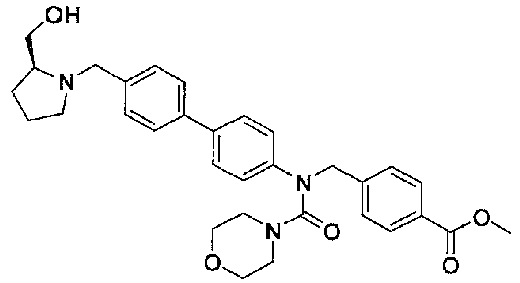
- Compound of Formula 9-1 (methyl 4-((N-(4'-formylbiphenyl-4-yl)morpholine-4-carboxamido)melthyl)benzoate; 0.150 g, 0.327 mmol) was dissolved in methanol (5 mL), and then (S)-pyrrolidin-2yl-methanol (0.099 g, 0.981 mmol) and acetic acid (0.094 mL, 1.64 mmol) were added and stirred at room temperature for 1 hour. Then, sodium cyanoborohydride (0.041 g, 0.654 mmol) was added and stirred at the same temperature for 16 hours. After completion of the reaction, the organic layer was extracted with ethyl acetate and saturated sodium hydrogen carbonate aqueous solution and concentrated under reduced pressure. Then, the organic layer was dehydrated with anhydrous magnesium sulfate and filtered, and then the filtrate was concentrated under reduced pressure. Then, the residue was purified and concentrated by column chromatography (silica; methanol/ dichloromethane = 10%) to give the desired compound of Formula 9-2 (0.123 g, 69%) in the form of a white solid.
-

- Compound of Formula 9-2 ((S)-methyl 4-((N-(4'-((2-(hydroxymethyl)pyrrolidin-1-yl)methyl)biphenyl-4-yl)morpholine-4-carb oxamido)methyl)benzoate; 0.120 g, 0.221 mmol) was dissolved in methanol (10 mL), and hydroxylamine (50.0 wt% aqueous solution; 1.35 mL, 22.1 mmol) and potassium hydroxide (0.124 g, 2.21 mmol) were added and then stirred at room temperature for 30 minutes. After completion of the reaction, the reaction solution was concentrated under reduced pressure until its volume became about 2 mL, and the organic layer was extracted with ethyl acetate and saturated ammonium chloride aqueous solution. The organic layer was dehydrated with anhydrous magnesium sulfate, filtered, and then concentrated under reduced pressure to give the desired Compound 382 (0.036 g, 30%) in the form of a colorless liquid.
1H NMR (400 MHz, DMSO-d6) δ 7.65 (d, 2 H, J = 7.8 Hz), 7.61 - 7.55 (m, 4 H), 7.39 - 7.34 (m, 4 H), 7.21 (d, 2 H, J = 8.3 Hz), 4.90 (s, 2 H), 4.06 (m, 1 H), 3.47 - 3.39 (m, 6 H), 3.37 - 3.35 (m, 2 H), 3.17 (m, 4 H), 2.24 - 2.20 (m, 2 H), 1.64 - 1.52 (m, 5 H). MS (ESI) m/z 545 (M+ + H). -

- Compound of Formula 9-1 (methyl 4-((N-(4'-formylbiphenyl-4-yl)morpholine-4-carboxamido)melthyl)benzoate; 0.150 g, 0.327 mmol) was dissolved in methanol (5 mL), and then 2-(methylamino)ethanol (0.074 g, 0.981 mmol) and acetic acid (0.094 mL, 1.64 mmol) were added and stirred at room temperature for 1 hour. Then, sodium cyanoborohydride (0.041 g, 0.654 mmol) was added and stirred at the same temperature for 16 hours. After completion of the reaction, the organic layer was extracted with ethyl acetate and saturated sodium hydrogen carbonate aqueous solution and concentrated under reduced pressure. Then, the organic layer was dehydrated with anhydrous magnesium sulfate and filtered, and then the filtrate was concentrated under reduced pressure. Then, the residue was purified and concentrated by column chromatography (silica; methanol/ dichloromethane= 7%) to give the desired compound of Formula 9-2 (0.152 g, 90%) in the form of a white solid.
-

- Compound of Formula 9-2 (methyl 4-((N-(4'-(((2-(hydroxyethyl)(methyl)amino)methyl)biphenyl-4-yl)morpholine-4-carb oxamido)methyl)benzoate; 0.150 g, 0.290 mmol) was dissolved in methanol (10 mL), and hydroxylamine (50.0 wt% aqueous solution; 1.77 mL, 29.0 mmol) and potassium hydroxide (0.163 g, 2.90 mmol) were added and then stirred at room temperature for 30 minutes. After completion of the reaction, the reaction solution was concentrated under reduced pressure until its volume became about 2 mL, and the organic layer was extracted with ethyl acetate and saturated ammonium chloride aqueous solution. The organic layer was dehydrated with anhydrous magnesium sulfate, filtered, and then concentrated under reduced pressure to give the desired Compound 383 (0.023 g, 15%) in the form of a colorless liquid.
1H NMR (400 MHz, DMSO-d6) δ 7.66 - 7.56 (m, 6 H), 7.39 - 7.34 (m, 4 H), 7.21 (d, 2 H, J = 8.6 Hz), 4.90 (s, 2 H), 3.51 - 3.48 (m, 4 H), 3.42 - 3.37 (m, 4 H), 3.17 (m, 4 H), 2.45 - 2.43 (m, 2 H), 2.22 (m, 1 H), 2.15 (s, 3 H). MS (ESI) m/z 519 (M+ + H). -

- Compound of Formula 1-1 (4-(trifluoromethyl)benzenamine; 0.30 g, 1.84 mmol) and potassium carbonate (0.76 g, 5.53 mmol) were dissolved in dimethylformamide (10 mL), and methyl 4-(bromomethyl)benzoate (0.84 g, 3.67 mmol) was then added. The mixture was reacted at room temperature for 1 day and then diluted with ethyl acetate. The reaction mixture was washed with water and saturated sodium chloride aqueous solution, dehydrated with anhydrous sodium sulfate, filtered, and then concentrated under reduced pressure. The residue was purified by column chromatography (silica; ethyl acetate/hexane =20%) to give the desired compound of Formula 1-2 (0.27 g, 47%).
-

- Compound of Formula 1-2 (methyl 4-((4-(trifluoromethyl)phenylamino)methyl)benzoate; 0.27 g, 0.87 mmol) and 4-nitrophenyl carbonochloridate (0.35 g, 1.74 mmol) were dissolved in acetonitrile (10 mL), and potassium carbonate (0.36 g, 2.61 mmol) was then added. The mixture was reacted at room temperature for 1 day and then diluted with ethyl acetate. The reaction mixture was washed with water and saturated sodium chloride aqueous solution, dehydrated with anhydrous sodium sulfate, filtered, and then concentrated under reduced pressure. The residue was purified by column chromatography (silica; ethyl acetate/ hexane =20%) to give the desired compound of Formula 1-3 (0.40 g, 97%).
-

- Compound of Formula 1-3 (methyl 4-((((4-nitrophenoxy)carbonyl)(4-(trifluoromethyl)phenyl)amino)methyl)benzoate; 0.39 g, 0.84 mmol) was dissolved in dimethylformamide, and potassium carbonate (0.25 g, 1.81 mmol) and morpholine (10 mL) were then added. The mixture was reacted at 60 °C for 2 days and diluted with saturated ammonium chloride solution. The organic layer was extracted with ethyl acetate, dehydrated with anhydrous sodium sulfate, filtered, and then concentrated under reduced pressure. The residue was purified by column chromatography (silica; ethyl acetate/hexane =50%) to give the desired compound of Formula 1-4 (0.20 g, 60%).
-

- Compound of Formula 1-4 (methyl 4-((N-(4-(trifluoromethyl)phenyl)morpholine-4-carboxamido)methyl)benzoate; 0.20 g, 0.48 mmol) was dissolved in methanol, and hydroxylamine (50 wt% aqueous solution; 0.29 mL) and potassium hydroxide (0.13 g, 2.39 mmol) were then added and stirred overnight. After completion of the reaction, the methanol was removed by distillation under reduced pressure, and the organic layer was extracted with ethyl acetate and water, dehydrated with anhydrous sodium sulfate, filtered, and then concentrated under reduced pressure. The residue was stirred in diethyl ether to give a white solid, and the resulting solid was filter and dried to give the desired Compound 385 (0.10 g, 50%) in the form of a white solid.
1H NMR (400 MHz, DMSO-d6) δ 11.14 (brs, 1 H), 8.99 (brs, 1 H), 7.67 - 7.62 (m, 4 H), 7.38 (d, 2 H, J = 8.2 Hz), 7.29 (d, 2 H, J = 8.5 Hz), 4.94 (s, 2 H), 3.47 - 3.44 (m, 4 H), 3.21 - 3.18 (m, 4 H). MS (ESI) m/z 424 (M+ + H). -

- Compound of Formula 1-1 (3-(trifluoromethyl)benzenamine; 1.00 g, 6.21 mmol) and methyl 4-formylbenzoate (1.02 g, 6.21 mmol) were dissolved in methanol(10 ml), and sodium cyanoborohydride(NaCNBH3) (0.41 g, 6.21 mmol) and acetic acid (0.71 mL, 2.00 mmol) was added. The mixture was reacted at room temperature for 2 day and then the methanol was evaporated by reduced pressure. The reaction was completed by adding saturated sodium hydrogen carbonate solution. The reaction mixture was extracted with ethyl acetate, dehydrated with anhydrous sodium sulfate, filtered, and then concentrated under reduced pressure. The residue was purified by column chromatography (silica; ethyl acetate/hexane=20%) to give the desired compound of Formula 1-2 (1.43 g, 74.5%).
-

- Compound of Formula 1-2 (methyl 4-((3-(trifluoromethyl)phenylamino)methyl)benzoate; 1.04 g, 3.36 mmol) and 4-nitrophenyl carbonochloridate (1.36 g, 6.73 mmol) were dissolved in acetonitrile (30 mL), and potassium carbonate (1.39 g, 10.1 mmol) was then added. The mixture was reacted at room temperature for 1 day and then diluted with ethyl acetate. The reaction mixture was washed with water and saturated sodium chloride aqueous solution and water, dehydrated with anhydrous sodium sulfate, filtered, and then concentrated under reduced pressure. The residue was purified by column chromatography (silica; ethyl acetate/ hexane=20%) to give the desired compound of Formula 1-3 (1.51 g, 95%).
-

- Compound of Formula 1-3 (methyl 4-((((4-nitrophenoxy)carbonyl)(3-(trifluoromethyl)phenyl)amino)methyl)benzoate; 0.38 g, 0.80 mmol) was dissolved in dimethylformamide (10ml), and potassium carbonate (0.33 g, 2.38 mmol) and 2,6-dimethylmorpholine (0.09, 0.80 mmol) were then added. The mixture was reacted at 60 °C for 2 days and then it was diluted with ethyl acetate and washed with saturated ammonium chloride solution. The organic layer was dehydrated with anhydrous magnesiumsulfate, filtered, and then concentrated under reduced pressure. The residue was purified by column chromatography (silica; ethyl acetate/hexane =50%) to give the desired compound of Formula 1-4 (0.21 g, 59%).
-

- Compound of Formula 1-4 (methyl 4-((2,6-dimethyl-N-(3-(trifluoromethyl)phenyl)morpholine-4-carboxamido)methyl)ben zoate; 0.21 g, 0.47 mmol) was dissolved in methanol (50 mL), and hydroxylamine aqueous solution(50 wt%, 0.29 mL) and potassium hydroxide (0.13 g, 2.35 mmol) were then added and stirred overnight. After completion of the reaction, the methanol was removed by distillation under reduced pressure, and the organic layer was extracted with ethyl acetate and water, dehydrated with anhydrous magnesiumsulfate, filtered, and then concentrated under reduced pressure. The residue was stirred in diethyl ether to give a white solid, and the resulting solid was filter and dried to give the desired Compound 386 (0.10 g, 48%) in the form of a white solid.
1H NMR (400 MHz, DMSO-d6) δ 11.13 (brs, 1 H), 8.98 (brs, 1 H), 7.65 (d, 2 H, J = 8.3 Hz), 7.54-7.50 (m, 1 H), 7.43-7.36 (m, 5 H), 3.55 (d, 2 H, J = 12.4 Hz), 2.36-2.31 (m, 2 H), 0.94 (s, 3 H), 0.93 (s, 3 H). MS (ESI) m/z 452 (M+ + H). -

- Compound of Formula 1-1 (4-chloro-3-(trifluoromethyl)benzenamine; 5 g, 25.6 mmol) and methyl 4-formylbenzoate (4.19 g, 25.6 mmol) were dissolved in methanol (100 mL) and stirred for 1 hour. Then, acetic acid (1.58 mL, 25.6 mmol) and sodium cyanoborohydride (1.61 g, 25.6 mmol) were added and stirred for 1 day. The methanol was partially removed by air-drying to precipitate a solid, and the resulting solid was filtered and dried to give the desired compound of Formula 1-2 (3.4 g, 39%) in the form of a white solid.
-
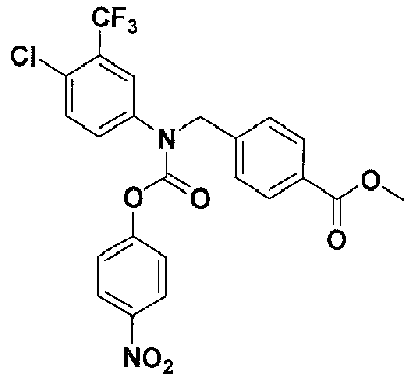
- Compound of Formula 1-2 (methyl 4-((4-chloro-3-(trifluoromethyl)phenylamino)methyl)benzoate; 2 g, 5.82 mmol) and 4-nitrophenyl chloroformate (1.17 g, 5.82 mmol) were dissolved in dichloromethane (50 mL) and stirred at room temperature for 2 days to precipitate a solid, and the resulting solid was filter and dried to give the desired compound of Formula 1-3 (3.14 g, 106%) in the form of a yellow solid.
-

- Compound of Formula 1-3 (methyl 4-(((4-chloro-3-(trifluoromethyl)phenyl)((4-nitrophenoxy)carbonyl)amino)methyl)ben zoate; 0.50 g, 0.983 mmol) and piperidine (0.097 mL, 0.983 mmol) were dissolved in dimethylformamide (10 mL), and the mixture was heated and stirred at 60 °C for 2 days. Then, the dimethylformamide was removed under reduced pressure, water was poured into the reaction mixture, and the organic layer was extracted with ethyl acetate. The organic layer was washed with saturated sodium chloride aqueous solution, dehydrated with anhydrous magnesium sulfate, and then concentrated under reduced pressure. The residue was purified and concentrated by column chromatography (silica; ethyl acetate/hexane=20%) to give the desired compound of Formula 1-4 (0.425 g, 95%) in the form of a colorless oil.
-

- Compound of Formula 1-4 (methyl 4-((N-(4-chloro-3-(trifluoromethyl)phenyl)piperidine-1-carboxamido)methyl)benzoate; 0.263 g, 0.578 mmol) was dissolved in methanol (20 mL), and hydroxylamine hydrochloride (0.201 g, 2.89 mmol) and potassium hydroxide (0.324 g, 5.78 mmol) were added and stirred. Then, hydroxylamine (50 wt% aqueous solution; 1.49 mL, 11.56 mmol) was added dropwise and stirred at room temperature for 6 hours. After completion of the reaction, the methanol was removed under reduced pressure, saturated sodium hydrogen carbonate aqueous solution was added to precipitate a solid, and the resulting solid was filter and dried to give the desired Compound 389 (0.18 g, 68%) in the form of an apricot solid.
1H NMR (400 MHz, DMSO-d6) δ 7.64 (d, 2 H, J = 8.1 Hz), 7.58 (d, 1 H, J = 8.7 Hz), 7.43 (d, 1 H, J = 2.6 Hz), 7.35 (dd, 1 H, J = 8.8, 2.6 Hz), 7.28 (d, 2 H, J = 8.1 Hz), 4.87 (s, 2 H), 3.71 - 3.68 (m, 2 H), 2.69 - 2.63 (m, 2 H), 1.50 - 1.44 (m, 2 H), 0.87 - 0.81 (m, 4 H); MS (ESI) m/z 456.1 (M+ + H). -

- Compound of Formula 1-3 (methyl 4-(((4-chloro-3-(trifluoromethyl)phenyl)((4-nitrophenoxy)carbonyl)amino)methyl)ben zoate; 0.50 g, 0.983 mmol) and 4-methylpiperidine (0.116 mL, 0.983 mmol) were dissolved in dimethylformamide (10 mL), and the mixture was heated and stirred at 60 °C for 2 days. Then, the dimethylformamide was removed under reduced pressure, water was poured into the reaction mixture, and the organic layer was extracted with ethyl acetate. The organic layer was washed with saturated sodium chloride aqueous solution, dehydrated with anhydrous magnesium sulfate, and then concentrated under reduced pressure. The residue was purified and concentrated by column chromatography (silica; ethyl acetate/hexane=20%) to give the desired compound of Formula 1-4 (0.369 g, 80%) in the form of a white oil.
-

- Compound of Formula 1-4 (methyl 4-((N-(4-chloro-3-(trifluoromethyl)phenyl)-4-methylpiperidine-1-carboxamido)methyl )benzoate, 0.239 g, 0.51 mmol) was dissolved in methanol (20 mL), and hydroxylamine hydrochloride (0.177 g, 2.55 mmol) and potassium hydroxide (0.286 g, 5.09 mmol) were added and stirred. Then, hydroxylamine (50 wt% aqueous solution; 1.31 mL, 10.19 mmol) was added dropwise and stirred at room temperature for 6 hours. After completion of the reaction, the methanol was removed under reduced pressure, saturated sodium hydrogen carbonate aqueous solution was added to precipitate a solid, and the resulting solid was filter and dried to give the desired Compound 390 (0.175 g, 73%) in the form of an apricot solid.
1H NMR (400 MHz, DMSO-d6) δ 7.64 (d, 2 H, J = 8.2 Hz), 7.58 (d, 1 H, J = 8.8 Hz), 7.44 (d, 1 H, J = 2.6 Hz), 7.34 (dd, 1 H, J = 8.8, 2.6 Hz), 7.29 (d, 2 H, J = 8.2 Hz), 4.88 (s, 2 H), 3.18 - 3.15 (m, 4 H), 1.46 - 1.45 (m, 3 H), 1.33 - 1.32 (m, 5 H); MS (ESI) m/z 470.1 (M+ + H). -

- Compound of Formula 1-3 (methyl 4-(((4-chloro-3-(trifluoromethyl)phenyl)((4-nitrophenoxy)carbonyl)amino)methyl)ben zoate; 0.50 g, 0.983 mmol) and morpholine (0.086 mL, 0.983 mmol) were dissolved in dimethylformamide (10 mL), and the mixture was heated and stirred at 60 °C for 2 days. Then, the dimethylformamide was removed under reduced pressure, water was poured into the reaction mixture, and the organic layer was extracted with ethyl acetate. The organic layer was washed with saturated sodium chloride aqueous solution, dehydrated with anhydrous magnesium sulfate, and then concentrated under reduced pressure. The residue was purified and concentrated by column chromatography (silica; ethyl acetate/hexane=20%) to give the desired compound of Formula 1-4 (0.229 g, 51%) in the form of a white oil.
-

- Compound of Formula 1-4 (methyl 4-((N-(4-chloro-3-(trifluoromethyl)phenyl)morpholine-4-carboxamido)methyl)benzoat e, 0.138 g, 0.302 mmol) was dissolved in methanol (20 mL), and hydroxylamine hydrochloride (0.105 g, 1.51 mmol) and potassium hydroxide (0.169 g, 3.02 mmol) were added and stirred. Then, hydroxylamine (50 wt% aqueous solution; 0.778 mL, 6.04 mmol) was added dropwise and stirred at room temperature for 6 hours. After completion of the reaction, the methanol was removed under reduced pressure, saturated sodium hydrogen carbonate aqueous solution was added to precipitate a solid, and the resulting solid was filter and dried to give the desired Compound 391 (0.089 g, 64%) in the form of an white solid.
1H NMR (400 MHz, DMSO-d6) δ 11.13 (s, 1 H), 8.99 (s, 1 H), 7.65 (d, 2 H, J = 8.3 Hz), 7.60 (d, 1 H, J = 8.7 Hz), 7.54 (d, 1 H, J = 2.6 Hz), 7.43 - 7.40 (m, 1 H), 7.36 (d, 2 H, J = 8.2 Hz), 4.94 (s, 2 H), 3.44 - 3.42 (m, 4 H), 3.18 - 3.16 (m, 4 H); MS (ESI) m/z 458.1 (M+ + H). -

- Compound of Formula 1-3 (methyl 4-(((4-chloro-3-(trifluoromethyl)phenyl)((4-nitrophenoxy)carbonyl)amino)methyl)ben zoate; 0.50 g, 0.983 mmol) and 2,6-dimethylmorpholine (0.12 mL, 0.983 mmol) were dissolved in dimethylformamide (10 mL), and the mixture was heated and stirred at 60 °C for 2 days. Then, the dimethylformamide was removed under reduced pressure, water was poured into the reaction mixture, and the organic layer was extracted with ethyl acetate. The organic layer was washed with saturated sodium chloride aqueous solution, dehydrated with anhydrous magnesium sulfate, and then concentrated under reduced pressure. The residue was purified and concentrated by column chromatography (silica; ethyl acetate/hexane=20%) to give the desired compound of Formula 1-4 (0.2 g, 42%) in the form of a white oil.
-

- Compound of Formula 1-4 (methyl 4-((N-(4-chloro-3-(trifluoromethyl)phenyl)-2,6-dimethylmorpholine-4-carboxamido)m ethyl)benzoate, 0.121 g, 0.250 mmol) was dissolved in methanol (20 mL), and hydroxylamine hydrochloride (0.087 g, 1.25 mmol) and potassium hydroxide (0.14 g, 2.49 mmol) were added and stirred. Then, hydroxylamine (50 wt% aqueous solution; 0.643 mL, 4.99 mmol) was added dropwise and stirred at room temperature for 6 hours. After completion of the reaction, the methanol was removed under reduced pressure, saturated sodium hydrogen carbonate aqueous solution was added to precipitate a solid, and the resulting solid was filter and dried to give the desired Compound 392 (0.056 g, 46%) in the form of an white solid.
1H NMR (400 MHz, DMSO-d6) δ 7.64 (d, 2 H, J = 8.3 Hz), 7.59 (d, 1 H, J = 8.8 Hz), 7.49 (d, 1 H, J = 2.6 Hz), 7.39 - 7.36 (m 1 H), 7.30 (d, 2 H, J = 8.2 Hz), 4.89 (s, 2 H), 3.58 - 3.55 (m, 2 H), 2.40 - 2.32 (m, 4 H), 0.96 (d, 6 H, J = 6.2 Hz); MS (ESI) m/z 486.1 (M+ + H). -

- Compound of Formula 1-3 (methyl 4-(((4-chloro-3-(trifluoromethyl)phenyl)((4-nitrophenoxy)carbonyl)amino)methyl)ben zoate; 0.50 g, 0.983 mmol) and 1-methylpiperazine (0.109 mL, 0.983 mmol) were dissolved in dimethylformamide (10 mL), and the mixture was heated and stirred at 60 °C for 2 days. Then, the dimethylformamide was removed under reduced pressure, water was poured into the reaction mixture, and the organic layer was extracted with ethyl acetate. The organic layer was washed with saturated sodium chloride aqueous solution, dehydrated with anhydrous magnesium sulfate, and then concentrated under reduced pressure. The residue was purified and concentrated by column chromatography (silica; methanol/dichloromethane= 5%) to give the desired compound of Formula 1-4 (0.420 g, 91%) in the form of a yellow oil.
-

- Compound of Formula 1-4 (methyl 4-((N-(4-chloro-3-(trifluoromethyl)phenyl)-4-methylpiperazine-1-carboxamido)methyl )benzoate, 0.251 g, 0.534 mmol) was dissolved in methanol (20 mL), and hydroxylamine hydrochloride (0.185 g, 2.67 mmol) and potassium hydroxide (0.299 g, 5.34 mmol) were added and stirred. Then, hydroxylamine (50 wt% aqueous solution; 1.38 mL, 10.7 mmol) was added dropwise and stirred at room temperature for 6 hours. After completion of the reaction, the methanol was removed under reduced pressure, saturated sodium hydrogen carbonate aqueous solution was added to precipitate a solid, and the resulting solid was filter and dried to give the desired Compound 393 (0.19 g, 75%) in the form of an white solid.
1H NMR (400 MHz, DMSO-d6) δ 11.13 (s, 1 H), 8.99 (s, 1 H), 7.65 (d, 2 H, J = 8.1 Hz), 7.60 (d, 1 H, J = 8.7 Hz), 7.49 (d, 1 H, J = 2.4 Hz), 7.40 - 7.35 (m, 3 H), 5.75 (s, 1 H), 4.92 (s, 2 H), 3.17 (m, 4 H), 2.14 (m, 4 H), 2.10 (s, 3 H); MS (ESI) m/z 471.1 (M+ + H). -

- Compound of Formula 1-3 (methyl 4-(((4-chloro-3-(trifluoromethyl)phenyl)((4-nitrophenoxy)carbonyl)amino)methyl)ben zoate; 0.5 g, 0.983 mmol) and 1-ethylpiperazine (0.125 mL, 0.983 mmol) were dissolved in dimethylformamide (10 mL), and the mixture was heated and stirred at 60 °C for 2 days. Then, the dimethylformamide was removed under reduced pressure, water was poured into the reaction mixture, and the organic layer was extracted with ethyl acetate. The organic layer was washed with saturated sodium chloride aqueous solution, dehydrated with anhydrous magnesium sulfate, and then concentrated under reduced pressure. The residue was purified and concentrated by column chromatography (silica; methanol/dichloromethane = 5%) to give the desired compound of Formula 1-4 (0.411 g, 86%) in the form of a yellow oil.
-

- Compound of Formula 1-4 (methyl 4-((N-(4-chloro-3-(trifluoromethyl)phenyl)-4-ethylpiperazine-1-carboxamido)methyl)b enzoate, 0.261 g, 0.539 mmol) was dissolved in methanol (20 mL), and hydroxylamine hydrochloride (0.187 g, 2.69 mmol) and potassium hydroxide (0.303 g, 5.39 mmol) were added and stirred. Then, hydroxylamine (50 wt% aqueous solution; 1.39 mL, 10.79 mmol) was added dropwise and stirred at room temperature for 6 hours. After completion of the reaction, the methanol was removed under reduced pressure, saturated sodium hydrogen carbonate aqueous solution was added to precipitate a solid, and the resulting solid was filter and dried to give the desired Compound 394 (0.25 g, 95%) in the form of an pale yellow solid.
1H NMR (400 MHz, DMSO-d6) δ 11.13 (s, 1 H), 9.00 (s, 1 H), 7.65 (d, 2 H, J = 8.2 Hz), 7.60 (d, 1 H, J = 8.8 Hz), 7.49 (d, 1 H, J = 2.4 Hz), 7.40 - 7.35 (m, 3 H), 5.75 (s, 2 H), 4.92 (s, 2 H), 3.18 (m, 4 H), 2.24 (q, 2 H, J = 7.2 Hz), 2.19 (m, 4 H), 0.93 (t, 3 H, J = 7.1 Hz); MS (ESI) m/z 485.1 (M+ + H). -

- Compound of Formula 2-1 (methyl 4-((N-(3-bromophenyl)morpholine-4-carboxamido)methyl)benzoate; 0.200 g, 0.462 mmol), 3,5-difluorophenylboronic acid (0.088 g, 0.554 mmol), and Pd(dppf)Cl2 (0.038 g, 0.046 mmol) were dissolved in 1,4-dioxane (3 mL), and potassium carbonate (0.128 g, 0.923 mmol) dissolved in water (1 mL) was added to the reaction solution and stirred at 100 °C for 4 hours. After completion of the reaction, the organic layer was extracted with ethyl acetate and saturated sodium hydrogen carbonate aqueous solution and concentrated under reduced pressure, and then the residue was purified and concentrated by column chromatography (silica; ethyl acetate/hexane=50%) to give the desired compound of Formula 2-2 (0.180 g, 84%) in the form of a light brown solid.
-

- Compound of Formula 2-2 (methyl 4-((N-(3',5'-difluorobiphenyl-3-yl)morpholine-4-carboxamido)methyl)benzoate; 0.180 g, 0.386 mmol) was dissolved in methanol (10 mL), and hydroxylamine (50.0 wt% aqueous solution; 2.36 mL, 38.6 mmol) and potassium hydroxide (0.217 g, 3.86 mmol) were added sequentially and then stirred at room temperature for 30 minutes. After completion of the reaction, the reaction solution was concentrated under reduced pressure until its volume became about 1 mL, and then saturated ammonium chloride aqueous solution (1-2 mL) was added and stirred. Then, the solid product was filtered, washed with water, and then vacuum dried to give the desired Compound 395 (0.159 g, 88%) in the form of a light brown solid.
1H NMR (400 MHz, DMSO-d6) δ 7.64 (d, 2 H, J = 8.2 Hz), 7.57 (s, 1 H), 7.46 - 7.36 (m, 6 H), 7.23 (m, 1 H), 7.15 (m, 1 H), 4.96 (s, 2 H), 3.40 - 3.37 (m, 4 H), 3.17 - 3.14 (m, 4 H). MS (ESI) m/z 468 (M+ + H). -

- Compound of Formula 2-1 (methyl 4-((N-(3-bromophenyl)morpholine-4-carboxamido)methyl)benzoate; 0.200 g, 0.462 mmol), 6-dimethylaminopyridin-3-ylboronic acid (0.092 g, 0.554 mmol), and Pd(dppf)Cl2 (0.038 g, 0.046 mmol) were dissolved in 1,4-dioxane (3 mL), and potassium carbonate (0.128 g, 0.923 mmol) dissolved in water (1 mL) was added to the reaction solution and stirred at 100 °C for 4 hours. After completion of the reaction, the organic layer was extracted with ethyl acetate and saturated sodium hydrogen carbonate aqueous solution and concentrated under reduced pressure, and then the residue was purified and concentrated by column chromatography (silica; ethyl acetate/hexane=50%) to give the desired compound of Formula 2-2 (0.136 g, 62%) in the form of a light brown solid.
-

- Compound of Formula 2-2 (methyl 4-((N-(3-(6-(dimethylamino)pyridin-3-yl)phenyl)morpholine-4-carboxamido)methyl)b enzoate; 0.136 g, 0.287 mmol) was dissolved in methanol (10 mL), and hydroxylamine (50.0 wt% aqueous solution; 1.75 mL, 28.7 mmol) and potassium hydroxide (0.161 g, 2.87 mmol) were added sequentially and then stirred at room temperature for 30 minutes. After completion of the reaction, the reaction solution was concentrated under reduced pressure until its volume became about 1 mL, and then saturated ammonium chloride aqueous solution (1-2 mL) was added and stirred. Then, the solid product was filtered, washed with water, and then vacuum dried to give the desired Compound 396 (0.118 g, 87%) in the form of a light brown solid.
1H NMR (400 MHz, DMSO-d6) δ 8.38 (d, 1 H, J = 2.5 Hz), 7.78 (m, 1 H), 7.64 (d, 2 H, J = 8.3 Hz), 7.39 - 7.35 (m, 3 H), 7.32 - 7.29 (m, 2 H), 7.05 (m, 1 H), 6.69 (d, 1 H, J = 8.9 Hz), 4.93 (s, 2 H), 3.41 - 3.38 (m, 4 H), 3.18 - 3.15 (m, 4 H), 3.05 (s, 6 H). MS (ESI) m/z 476 (M+ + H). -

- Compound of Formula 2-1 (methyl 4-((N-(3-bromophenyl)morpholine-4-carboxamido)methyl)benzoate; 0.200 g, 0.462 mmol), pyrimidin-5-ylboronic acid (0.069 g, 0.554 mmol), and Pd(dppf)Cl2 (0.038 g, 0.046 mmol) were dissolved in 1,4-dioxane (3 mL), and potassium carbonate (0.128 g, 0.923 mmol) dissolved in water (1 mL) was added to the reaction solution and stirred at 100 °C for 4 hours. After completion of the reaction, the organic layer was extracted with ethyl acetate and saturated sodium hydrogen carbonate aqueous solution and concentrated under reduced pressure, and then the residue was purified and concentrated by column chromatography (silica; ethyl acetate/hexane=25%) to give the desired compound of Formula 2-2 (0.120 g, 60%) in the form of a yellow solid.
-

- Compound of Formula 2-2 (methyl 4-((N-(3-(pyrimidin-5-yl)phenyl)morpholine-4-carboxamido)methyl)benzoate; 0.120 g, 0.277 mmol) was dissolved in methanol (10 mL), and hydroxylamine (50.0 wt% aqueous solution; 1.70 mL, 27.7 mmol) and potassium hydroxide (0.156 g, 2.78 mmol) were added sequentially and then stirred at room temperature for 30 minutes. After completion of the reaction, the reaction solution was concentrated under reduced pressure until its volume became about 2 mL, and then extracted by ethyl acetate and saturated ammonium chloride aqueous solution. Then, the organic layer was dehydrated with anhydrous magnesium sulfate, and filtered, and the filtrate was then concentrated under reduced pressure to give the desired Compound 397 (0.056 g, 47 %) in the form of a brown solid.
1H NMR (400 MHz, DMSO-d6) δ 11.21 (brs, 1 H), 9.18 (brs, 1 H), 9.13 (s, 2 H), 8.97 (s, 1 H), 7.66 - 7.63 (m, 3 H), 7.51 - 7.41 (m, 4 H), 7.20 (m, 1 H), 4.97 (s, 2 H), 3.41 - 3.37 (m, 4 H), 3.19 - 3.16 (m, 4 H). MS (ESI) m/z 434 (M+ + H). -

- Compound of Formula 2-1 (methyl 4-((N-(3-bromophenyl)morpholine-4-carboxamido)methyl)benzoate; 0.200 g, 0.462 mmol), 3,5-bis(trifluoromethyl)phenylboronic acid (0.143 g, 0.554 mmol), and Pd(dppf)Cl2 (0.038 g, 0.046 mmol) were dissolved in 1,4-dioxane (3 mL), and potassium carbonate (0.128 g, 0.923 mmol) dissolved in water (1 mL) was added to the reaction solution and stirred at 100 °C for 4 hours. After completion of the reaction, the organic layer was extracted with ethyl acetate and saturated sodium hydrogen carbonate aqueous solution and concentrated under reduced pressure, and then the residue was purified and concentrated by column chromatography (silica; ethyl acetate/hexane=30%) to give the desired compound of Formula 2-2 (0.185 g, 71%) in the form of a white solid.
-

- 4-((N-(3',5'-bis(trifluoromethyl)biphenyl-3-yl)morpholine-4-carboxamido)methyl)ben zoate; 0.185 g, 0.327 mmol) was dissolved in methanol (10 mL), and hydroxylamine (50.0 wt% aqueous solution; 2.00 mL, 32.7 mmol) and potassium hydroxide (0.183 g, 3.27 mmol) were added sequentially and then stirred at room temperature for 30 minutes. After completion of the reaction, the reaction solution was concentrated under reduced pressure until its volume became about 1 mL, and then saturated ammonium chloride aqueous solution (1-2 mL) was added and stirred. Then, the solid product was filtered, washed with water, and then vacuum dried to give the desired Compound 398 (0.160 g, 86%) in the form of a white solid.
1H NMR (400 MHz, DMSO-d6) δ 8.31 (s, 2 H), 8.09 (s, 1 H), 7.74 (s, 1 H), 7.64 (d, 2 H, J = 8.4 Hz), 7.57 (m, 1 H), 7.43 - 7.40 (m, 3 H), 7.22 (m, 1 H), 4.98 (s, 2 H), 3.41 - 3.38 (m, 4 H), 3.19 - 3.16 (m, 4 H). MS (ESI) m/z 568 (M+ + H). -

- Compound of Formula 2-1 (methyl 4-((N-(3-bromophenyl)morpholine-4-carboxamido)methyl)benzoate; 0.200 g, 0.462 mmol), 2,3-dihydrobenzo[b][1,4]dioxin-6-ylboronic acid (0.100 g, 0.554 mmol), and Pd(dppf)Cl2 (0.038 g, 0.046 mmol) were dissolved in 1,4-dioxane (3 mL), and potassium carbonate (0.128 g, 0.923 mmol) dissolved in water (1 mL) was added to the reaction solution and stirred at 100 °C for 4 hours. After completion of the reaction, the organic layer was extracted with ethyl acetate and saturated sodium hydrogen carbonate aqueous solution and concentrated under reduced pressure, and then the residue was purified and concentrated by column chromatography (silica; ethyl acetate/hexane=50%) to give the desired compound of Formula 2-2 (0.182 g, 81%) in the form of a yellow liquid.
-

- Compound of Formula 2-2 (methyl 4-((N-(3-(2,3-dihydrobenzo[b][1,4]dioxin-6-yl)phenyl)morpholine-4-carboxamido)met hyl)benzoate; 0.182 g, 0.373 mmol) was dissolved in methanol (10 mL), and hydroxylamine (50.0 wt% aqueous solution; 2.28 mL, 37.3 mmol) and potassium hydroxide (0.209 g, 3.73 mmol) were added sequentially and then stirred at room temperature for 30 minutes. After completion of the reaction, the reaction solution was concentrated under reduced pressure until its volume became about 1 mL, and then saturated ammonium chloride aqueous solution (1-2 mL) was added and stirred. Then, the solid product was filtered, washed with water, and then vacuum dried to give the desired Compound 399 (0.165 g, 91%) in the form of a light brown solid.
1H NMR (400 MHz, DMSO-d6) δ 7.64 (d, 2 H, J = 8.2 Hz), 7.38 (d, 2 H, J = 8.2 Hz), 7.34 - 7.27 (m, 3 H), 7.12 - 7.04 (m, 3 H), 6.91 (d, 1 H, J = 8.3 Hz), 4.92 (s, 2 H), 4.26 (s, 4 H), 3.40 - 3.37 (m, 4 H), 3.17 - 3.15 (m, 4 H). MS (ESI) m/z 490 (M+ + H). -

- Compound of Formula 2-1 (methyl 4-((N-(3-bromophenyl)morpholine-4-carboxamido)methyl)benzoate; 0.200 g, 0.462 mmol), 3,4,5-trimethoxyphenylboronic acid (0.117 g, 0.554 mmol), and Pd(dppf)Cl2 (0.038 g, 0.046 mmol) were dissolved in 1,4-dioxane (3 mL), and potassium carbonate (0.128 g, 0.923 mmol) dissolved in water (1 mL) was added to the reaction solution and stirred at 100 °C for 4 hours. After completion of the reaction, the organic layer was extracted with ethyl acetate and saturated sodium hydrogen carbonate aqueous solution and concentrated under reduced pressure, and then the residue was purified and concentrated by column chromatography (silica; ethyl acetate/hexane=50%) to give the desired compound of Formula 2-2 (0.146 g, 61%) in the form of a white solid.
-

- Compound of Formula 2-2 (methyl 4-((N-(3',4',5'-trimethoxybiphenyl-3-yl)morpholine-4-carboxamido)methyl)benzoate; 0.146 g, 0.280 mmol) was dissolved in methanol (10 mL), and hydroxylamine (50.0 wt% aqueous solution; 1.72 mL, 28.1 mmol) and potassium hydroxide (0.157 g, 2.81 mmol) were added sequentially and then stirred at room temperature for 30 minutes. After completion of the reaction, the reaction solution was concentrated under reduced pressure until its volume became about 1 mL, and then saturated ammonium chloride aqueous solution (1-2 mL) was added and stirred. Then, the solid product was filtered, washed with water, and then vacuum dried to give the desired Compound 400 (0.125 g, 86%) in the form of a light brown solid.
1H NMR (400 MHz, DMSO-d6) δ 7.65 (d, 2 H, J = 8.2 Hz), 7.41 - 7.39 (m, 3 H), 7.37 - 7.35 (m, 2 H), 7.12 (m, 1 H), 6.81 (s, 2 H), 4.95 (s, 2 H), 3.83 (s, 6 H), 3.67 (s, 3 H), 3.43 - 3.40 (m, 4 H), 3.19 - 3.16 (m, 4 H). MS (ESI) m/z 522 (M+ + H). -

- Compound of Formula 2-1 (methyl 4-((N-(3-bromophenyl)morpholine-4-carboxamido)methyl)benzoate; 0.200 g, 0.462 mmol), 2,6-dimethylphenylboronic acid (0.083 g, 0.554 mmol), and Pd(dppf)Cl2 (0.038 g, 0.046 mmol) were dissolved in 1,4-dioxane (3 mL), and potassium carbonate (0.128 g, 0.923 mmol) dissolved in water (1 mL) was added to the reaction solution and stirred at 100 °C for 4 hours. After completion of the reaction, the organic layer was extracted with ethyl acetate and saturated sodium hydrogen carbonate aqueous solution and concentrated under reduced pressure, and then the residue was purified and concentrated by column chromatography (silica; ethyl acetate/hexane=50%) to give the desired compound of Formula 2-2 (0.205 g, 97%) in the form of a white solid.
-

- Compound of Formula 2-2 (methyl 4-((N-(2',6'-dimethylbiphenyl-3-yl)morpholine-4-carboxamido)methyl)benzoate; 0.205 g, 0.447 mmol) was dissolved in methanol (10 mL), and hydroxylamine (50.0 wt% aqueous solution; 2.74 mL, 44.7 mmol) and potassium hydroxide (0.251 g, 4.47 mmol) were added sequentially and then stirred at room temperature for 30 minutes. After completion of the reaction, the reaction solution was concentrated under reduced pressure until its volume became about 1 mL, and then saturated ammonium chloride aqueous solution (1-2 mL) was added and stirred. Then, the solid product was filtered, washed with water, and then vacuum dried to give the desired Compound 401 (0.195 g, 95%) in the form of a white solid.
1H NMR (400 MHz, DMSO-d6) δ 7.61 (d, 2 H, J = 8.2 Hz), 7.38 (t, 1 H, J = 7.8 Hz), 7.33 (d, 2 H, J = 8.3 Hz), 7.16 - 7.11 (m, 2 H), 7.06 (d, 2 H, J = 7.4 Hz), 6.81 (d, 1 H, J = 7.6 Hz), 6.77 (m, 1 H), 4.86 (s, 2 H), 3.40 - 3.37 (m, 4 H), 3.17 - 3.14 (m, 4 H), 1.83 (s, 6 H). MS (ESI) m/z 460 (M+ + H). -

- Compound of Formula 2-1 (methyl 4-((N-(3-bromophenyl)morpholine-4-carboxamido)methyl)benzoate; 0.200 g, 0.462 mmol), furan-3-ylboronic acid (0.062 g, 0.554 mmol), and Pd(dppf)Cl2 (0.038 g, 0.046 mmol) were dissolved in 1,4-dioxane (3 mL), and potassium carbonate (0.128 g, 0.923 mmol) dissolved in water (1 mL) was added to the reaction solution and stirred at 100 °C for 4 hours. After completion of the reaction, the organic layer was extracted with ethyl acetate and saturated sodium hydrogen carbonate aqueous solution and concentrated under reduced pressure, and then the residue was purified and concentrated by column chromatography (silica; ethyl acetate/hexane=50%) to give the desired compound of Formula 2-2 (0.113 g, 58%) in the form of a brown solid.
-

- Compound of Formula 2-2 (methyl 4-((N-(3-(furan-3-yl)phenyl)morpholine-4-carboxamido)methyl)benzoate; 0.113 g, 0.269 mmol) was dissolved in methanol (10 mL), and hydroxylamine (50.0 wt% aqueous solution; 1.64 mL, 26.9 mmol) and potassium hydroxide (0.151 g, 2.69 mmol) were added sequentially and then stirred at room temperature for 30 minutes. After completion of the reaction, the reaction solution was concentrated under reduced pressure until its volume became about 1 mL, and then saturated ammonium chloride aqueous solution (1-2 mL) was added and stirred. Then, the solid product was filtered, washed with water, and then vacuum dried to give the desired Compound 402 (0.060 g, 53%) in the form of a brown solid.
1H NMR (400 MHz, DMSO-d6) δ 8.20 (s, 1 H), 7.73 (s, 1 H), 7.63 (d, 2 H, J = 8.1 Hz), 7.43 (s, 1 H), 7.38 (d, 2 H, J = 8.1 Hz), 7.30 - 7.28 (m, 2 H), 7.00 (m, 1 H), 6.95 (m, 1 H), 4.91 (s, 2 H), 3.39 - 3.36 (m, 4 H), 3.16 - 3.13 (m, 4 H). MS (ESI) m/z 422 (M+ + H). -

- Compound of Formula 2-1 (methyl 4-((N-(3-bromophenyl)morpholine-4-carboxamido)methyl)benzoate; 0.400 g, 0.923 mmol), 1,2,3,6-tetrahydropyran-4-boronic acid pinacol ester (0.233 g, 1.11 mmol), and Pd(dppf)Cl2 (0.030 g, 0.046 mmol) were dissolved in 1,4-dioxane (4 mL), and cesium carbonate (0.897 g, 2.77 mmol) dissolved in water (1 mL) was added to the reaction solution and stirred at 140 °C for 15 minutes by using microwave reactor. After completion of the reaction, the organic layer was extracted with ethyl acetate and saturated sodium hydrogen carbonate aqueous solution. Then, the organic layer dehydrated with anhydrous magnesium sulfate and filtered. It was concentrated under reduced pressure, and then the residue was purified and concentrated by column chromatography (silica; ethyl acetate/hexane=50%) to give the desired compound of Formula 2-2 (0.132 g, 33%) in the form of a brown solid.
-

- Compound of Formula 2-2 (methyl 4-((N-(3-(3,6-dihydro-2H-pyran-4-yl)phenyl)morpholine-4-carboxamido)methyl)benz oate; 0.050 g, 0.115 mmol) was dissolved in methanol (5 mL), and hydroxylamine (50.0 wt% aqueous solution; 1.40 mL, 22.9 mmol) and potassium hydroxide (0.064 g, 1.15 mmol) were added sequentially and then stirred at room temperature for 30 minutes. After completion of the reaction, the reaction solution was concentrated under reduced pressure until its volume became about 1 mL, and then saturated ammonium chloride aqueous solution (1-2 mL) was added and stirred. Then, the solid product was filtered, washed with water, and then vacuum dried to give the desired Compound 403 (0.030 g, 60%) in the form of a white solid.
1H NMR (400 MHz, DMSO-d6) 6 11.12 (s, 1 H), 8.97 (s, 1 H), 7.63 (d, 2 H, J = 8.3 Hz), 7.36 (d, 2 H, J = 8.3 Hz), 7.27 (t, 1 H, J = 7.9 Hz), 7.18 (s, 1 H), 7.14 (d, 1 H, J = 7.6 Hz), 7.03 (d, 1 H, J = 7.8 Hz), 6.23 (m, 1H), 4.88 (s, 2 H), 4.19 (d, 2 H, J = 2.6 Hz), 3.78 (t, 2 H, J = 5.5 Hz), 3.39 - 3.36 (m, 4 H), 3.14 - 3.11 (m, 4 H), 2.38 - 2.36 (m, 2 H). MS (ESI) m/z 438 (M+ + H). -

- Compound of Formula 2-1 (methyl 4-((N-(3-bromophenyl)morpholine-4-carboxamido)methyl)benzoate; 0.400 g, 0.923 mmol), 1-methyl-1,2,3,6-tetrahydropyridine-4-boronic acid pinacol ester (0.247 g, 1.11 mmol), and Pd(dppf)Cl2 (0.030 g, 0.046 mmol) were dissolved in 1,4-dioxane (4 mL), and cesium carbonate (0.897 g, 2.77 mmol) dissolved in water (1 mL) was added to the reaction solution and stirred at 140 °C for 15 minutes by using microwave reactor. After completion of the reaction, the organic layer was extracted with ethyl acetate and saturated sodium hydrogen carbonate aqueous solution. Then, the organic layer dehydrated with anhydrous magnesium sulfate and filtered. It was concentrated under reduced pressure, and then the residue was purified and concentrated by column chromatography (silica; methanol/dichloromethane=10%) to give the desired compound of Formula 2-2 (0.193 g, 47%) in the form of a brown solid.
-

- Compound of Formula 2-2 (methyl 4-((N-(3-(1-methyl-1,2,3,6-tetrahydropyridn-4-yl)phenyl)morpholine-4-carboxamido) methyl)benzoate; 0.050 g, 0.111 mmol) was dissolved in methanol (5 mL), and hydroxylamine (50.0 wt% aqueous solution; 1.36 mL, 22.2 mmol) and potassium hydroxide (0.062 g, 1.11 mmol) were added sequentially and then stirred at room temperature for 30 minutes. After completion of the reaction, the reaction solution was concentrated under reduced pressure until its volume became about 1 mL, and then saturated ammonium chloride aqueous solution (1-2 mL) was added and stirred. Then, the solid product was filtered, washed with water, and then vacuum dried to give the desired Compound 404 (0.015 g, 30%) in the form of a brown solid.
-

- Compound of Formula 2-1 (methyl 4-((N-(3-bromophenyl)morpholine-4-carboxamido)methyl)benzoate; 0.800 g, 1.85 mmol), N-Boc-1,2,3,6-tetrahydropyridin-4-boronic acid pinacol ester (0.685 g, 2.22 mmol), and Pd(dppf)Cl2 (0.060 g, 0.092 mmol) were dissolved in 1,4-dioxane (8 mL), and cesium carbonate (1.79 g, 5.54 mmol) dissolved in water (2 mL) was added to the reaction solution and stirred at 140 °C for 15 minutes by using microwave reactor. After completion of the reaction, the organic layer was extracted with ethyl acetate and saturated sodium hydrogen carbonate aqueous solution. Then, the organic layer dehydrated with anhydrous magnesium sulfate and filtered. It was concentrated under reduced pressure, and then the residue was purified and concentrated by column chromatography (silica; ethyl acetate/hexane=50%) to give the desired compound of Formula 2-2 (0.832 g, 84%) in the form of a brown solid.
-

- Compound of Formula 2-2 (tert-butyl 4-(3-(N-(4-(methoxycarbonyl)benzyl)morpholine-4-carboxamido)phenyl)-5,6-dihydro pyridin-1(2H)-carboxlate; 0.050 g, 0.093 mmol) was dissolved in methanol (5 mL), and hydroxylamine (50.0 wt% aqueous solution; 1.14 mL, 18.7 mmol) and potassium hydroxide (0.052 g, 0.933 mmol) were added sequentially and then stirred at room temperature for 30 minutes. After completion of the reaction, the reaction solution was concentrated under reduced pressure until its volume became about 1 mL, and then saturated ammonium chloride aqueous solution (1-2 mL) was added and stirred. Then, the solid product was filtered, washed with water, and then vacuum dried to give the desired Compound 405 (0.030 g, 60%) in the form of a white solid.
1H NMR (400 MHz, DMSO-d6) δ 7.63 (d, 2 H, J = 8.3 Hz), 7.35 (d, 2 H, J = 8.2 Hz), 7.26 (t, 1 H, J = 7.9 Hz), 7.18 (s, 1 H), 7.12 (d, 1 H, J = 8.2 Hz), 7.02 (d, 1 H, J = 8.0 Hz), 6.17 (m, 1 H), 4.87 (s, 2 H), 3.97 (brs, 2 H), 3.50 (t, 2 H, J = 5.7 Hz), 3.38 (t, 4 H, J = 4.6 Hz), 3.12 (t, 4 H, J = 4.5 Hz), 2.40 (brs, 2 H), 1.41 (s, 9 H). MS (ESI) m/z 537. -

- Compound of Formula 1-1 (2,4-difluorobenzenamine; 3.0 g, 23.2 mmol) and methyl 4-formylbenzoate (3.81 g, 23.2 mmol) were dissolved in methanol (500 mL) and stirred at room temperature for 2 hours. Then, acetic acid (1.33 mL, 23.2 mmol) and sodium cyanoborohydride (1.46 g, 23.2 mmol) were added and stirred for 1 day. The methanol was partially removed by air-drying to precipitate a solid, and the resulting solid was filtered and dried to give the desired compound of Formula 1-2 (2.9 g, 45%) in the form of a white solid.
-

- Compound of Formula 1-2 (methyl 4-((2,4-difluorophenylamido)methyl)benzonate; 2 g, 7.21 mmol) and 4-nitrophenyl chloroformate (1.45 g, 7.21 mmol) were dissolved in dichloromethane (50 mL) and stirred at room temperature for 3 days. Then, water was added to extract the organic layer. The organic layer was washed with saturated sodium chloride aqueous solution, dehydrated with anhydrous magnesium sulfate, and then concentrated under reduced pressure. The residue was dried to give the desired compound of Formula 1-3 (2.5 g, 78%) in the form of a yellow oil.
-

- Compound of Formula 1-3 (methyl 4-(((2,4-difluorophenyl)((4-nitrophenoxy)carbonyl)amino)methyl)benzoate; 0.50 g, 1.13 mmol) and morpholine (0.098 mL, 1.13 mmol) were dissolved in dimethylformamide (10 mL), and the mixture was heated and stirred at 60 °C for 2 days. Then, the dimethylformamide was removed under reduced pressure, water was poured into the reaction mixture, and the organic layer was extracted with ethyl acetate. The organic layer was washed with saturated sodium chloride aqueous solution, dehydrated with anhydrous magnesium sulfate, and then concentrated under reduced pressure. The residue was purified and concentrated by column chromatography (silica; ethyl acetate/hexane=30%) to give the desired compound of Formula 1-4 (0.44 g, 98%) in the form of a colorless oil.
-

- Compound of Formula 1-4 (methyl 4-((N-(2,4-difluorophenyl)morpholine-4-carboxamido)methyl)benzoate; 0.10 g, 0.256 mmol) was dissolved in methanol (20 mL), and hydroxylamine hydrochloride (0.089 g, 1.28 mmol) and potassium hydroxide (0.144 g, 2.56 mmol) were added and stirred. Then, hydroxylamine (50 wt% aqueous solution; 0.329 mL, 5.12 mmol) was added dropwise and stirred at room temperature for 3 hours. After completion of the reaction, the methanol was removed under reduced pressure, water was poured into the reaction mixture, and the organic layer was extracted with ethyl acetate. The organic layer was washed with saturated sodium chloride aqueous solution, dehydrated with anhydrous magnesium sulfate, and then concentrated under reduced pressure. Then, the residue was dissolved in dichloromethane and hexane was added to precipitate a solid, and the resulting solid was filtered and dried to give the desired Compound 413 (0.076 g, 76%) in the form of a pale yellow solid.
1H NMR (400 MHz, MeOD-d3) δ 7.65 (d, 2 H, J = 8.3 Hz), 7.41 (d, 2 H, J = 8.2 Hz), 7.27 - 7.25 (m, 1 H), 7.04 - 6.96 (m, 2 H), 4.80 (s, 2 H), 3.46 - 3.43 (m, 4 H), 3.22 - 3.19 (m, 4 H); MS (ESI) m/z 392.1 (M+ + H). -

- Compound of Formula 1-3 (methyl 4-(((2,4-difluorophenyl)((4-nitrophenoxy)carbonyl)amino)methyl)benzoate; 0.50 g, 1.13 mmol) and piperidine (0.112 mL, 1.13 mmol) were dissolved in dimethylformamide (10 mL), and the mixture was heated and stirred at 60 °C for 2 days. Then, the dimethylformamide was removed under reduced pressure, water was poured into the reaction mixture, and the organic layer was extracted with ethyl acetate. The organic layer was washed with saturated sodium chloride aqueous solution, dehydrated with anhydrous magnesium sulfate, and then concentrated under reduced pressure. The residue was purified and concentrated by column chromatography (silica; ethyl acetate/hexane=10%) to give the desired compound of Formula 1-4 (0.46 g, 104.8%) in the form of a colorless oil.
-

- Compound of Formula 1-4 (methyl 4-((N-(2,4-difluorophenyl)piperidne-1-carboxamido)methyl)benzoate; 0.15 g, 0.386 mmol) was dissolved in methanol (20 mL), and hydroxylamine hydrochloride (0.134 g, 1.93 mmol) and potassium hydroxide (0.217 g, 3.86 mmol) were added and stirred. Then, hydroxylamine (50 wt% aqueous solution; 0.496 mL, 7.72 mmol) was added dropwise and stirred at room temperature for 3 hours. After completion of the reaction, the methanol was removed under reduced pressure, water was poured into the reaction mixture, and the organic layer was extracted with ethyl acetate. The organic layer was washed with saturated sodium chloride aqueous solution, dehydrated with anhydrous magnesium sulfate, and then concentrated under reduced pressure. Then, the residue was dissolved in dichloromethane and hexane was added to precipitate a solid, and the resulting solid was filtered and dried to give the desired Compound 414 (0.118 g, 79%) in the form of a pale yellow solid.
1H NMR (400 MHz, MeOD-d3) δ 7.65 (d, 2 H, J = 8.2 Hz), 7.41 (d, 2 H, J = 8.1 Hz), 7.23 - 7.20 (m, 1 H), 7.05 - 6.94 (m, 2 H), 4.77 (s, 2 H), 3.21 - 3.18 (m, 4 H), 1.51 - 1.49 (m, 2 H), 1.32 - 1.31 (m, 4 H); MS (ESI) m/z 390.1 (M+ + H). -

- Compound of Formula 1-3 (methyl 4-(((2,4-difluorophenyl)((4-nitrophenoxy)carbonyl)amino)methyl)benzoate; 0.50 g, 1.13 mmol) and 2,6-dimethylmorpholine(0.138 mL, 1.13 mmol) were dissolved in dimethylformamide (10 mL), and the mixture was heated and stirred at 60 °C for 2 days. Then, the dimethylformamide was removed under reduced pressure, water was poured into the reaction mixture, and the organic layer was extracted with ethyl acetate. The organic layer was washed with saturated sodium chloride aqueous solution, dehydrated with anhydrous magnesium sulfate, and then concentrated under reduced pressure. The residue was purified and concentrated by column chromatography (silica; ethyl acetate/hexane=30%) to give the desired compound of Formula 1-4 (0.40 g, 85%) in the form of a colorless oil.
-

- Compound of Formula 1-4 (methyl 4-((N-(2,4-difluorophenyl)2,6-dimethylmorpholine-4-carboxamido)methyl)benzoate; 0.20 g, 0.478 mmol) was dissolved in methanol (20 mL), and hydroxylamine hydrochloride (0.166 g, 2.39 mmol) and potassium hydroxide (0.268 g, 4.78 mmol) were added and stirred. Then, hydroxylamine (50 wt% aqueous solution; 0.614 mL, 9.56 mmol) was added dropwise and stirred at room temperature for 3 hours. After completion of the reaction, the methanol was removed under reduced pressure, water was poured into the reaction mixture, and the organic layer was extracted with ethyl acetate. The organic layer was washed with saturated sodium chloride aqueous solution, dehydrated with anhydrous magnesium sulfate, and then concentrated under reduced pressure. Then, the residue was dissolved in dichloromethane and hexane was added to precipitate a solid, and the resulting solid was filtered and dried to give the desired Compound 415 (0.086 g, 43%) in the form of a pale yellow solid.
1H NMR (400 MHz, MeOD-d3) δ 7.65 (d, 2 H, J = 8.0 Hz), 7.41 (d, 2 H, J = 8.0 Hz), 7.27 - 7.26 (m, 1 H), 7.04 - 6.94 (m, 2 H), 4.79 (s, 2 H), 3.58 (d, 2 H, J = 12.9 Hz), 2.38 - 2.32 (m, 2 H), 1.01 (d, 6 H, J = 6.2 Hz); MS (ESI) m/z 420.1 (M+ + H). -

- Compound of Formula 1-3 (methyl 4-(((2,4-difluorophenyl)((4-nitrophenoxy)carbonyl)amino)methyl)benzoate; 0.50 g, 1.13 mmol) and 1-methylpiperazine (0.126 mL, 1.13 mmol) were dissolved in dimethylformamide (10 mL), and the mixture was heated and stirred at 60 °C for 2 days. Then, the dimethylformamide was removed under reduced pressure, water was poured into the reaction mixture, and the organic layer was extracted with ethyl acetate. The organic layer was washed with saturated sodium chloride aqueous solution, dehydrated with anhydrous magnesium sulfate, and then concentrated under reduced pressure. The residue was purified and concentrated by column chromatography (silica; methanol/dichloromethane=5%) to give the desired compound of Formula 1-4 (0.46 g, 101%) in the form of a yellow oil.
-

- Compound of Formula 1-4 (methyl 4-((N-(2,4-difluorophenyl)-4-methylpiperazine-1-carboxamido)methyl)benzoate; 0.22 g, 0.545 mmol) was dissolved in methanol (20 mL), and hydroxylamine hydrochloride (0.189 g, 2.73 mmol) and potassium hydroxide (0.306 g, 5.45 mmol) were added and stirred. Then, hydroxylamine (50 wt% aqueous solution; 0.701 mL, 10.9 mmol) was added dropwise and stirred at room temperature for 3 hours. After completion of the reaction, the methanol was removed under reduced pressure, water was poured into the reaction mixture, and the organic layer was extracted with ethyl acetate. The organic layer was washed with saturated sodium chloride aqueous solution, dehydrated with anhydrous magnesium sulfate, and then concentrated under reduced pressure. Then, the residue was dissolved in dichloromethane and hexane was added to precipitate a solid, and the resulting solid was filtered and dried to give the desired Compound 416 (0.154 g, 70%) in the form of a yellow solid.
1H NMR (400 MHz, MeOD-d3) δ 7.65 (d, 2 H, J = 8.2 Hz), 7.40 (d, 2 H, J = 8.2 Hz), 7.26 - 7.25 (m, 1 H), 7.04 - 6.96 (m, 2 H), 4.79 (s, 2 H), 3.25 - 3.23 (m, 4 H), 2.24 - 2.21 (m, 7 H); MS (ESI) m/z 405.1 (M+ + H). -
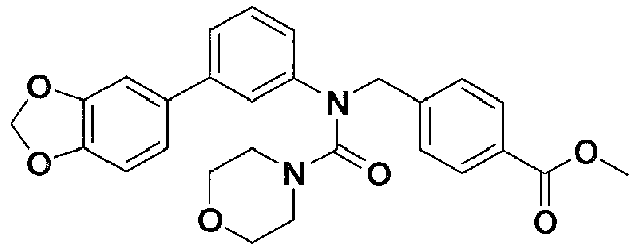
- Compound of Formula 2-1 (methyl 4-((N-(3-bromophenyl)morpholine-4-carboxamido)methyl)benzoate; 0.200 g, 0.462 mmol), benzo[d][1,3]dioxol-5-ylboronic acid (0.092 g, 0.554 mmol), and Pd(dppf)Cl2 (0.015 g, 0.023 mmol) were dissolved in 1,4-dioxane (4 mL), and cesium carbonate (0.448 g, 1.39 mmol) dissolved in water (1 mL) was added to the reaction solution and stirred at 140 °C for 15 minutes by using microwave reactor. After completion of the reaction, the organic layer was extracted with ethyl acetate and saturated sodium hydrogen carbonate aqueous solution. Then, the organic layer dehydrated with anhydrous magnesium sulfate and filtered. It was concentrated under reduced pressure, and then the residue was purified and concentrated by column chromatography (silica; ethyl acetate/hexane=30%) to give the desired compound of Formula 2-2 (0.146 g, 67%) in the form of a light brown solid.
-

- Compound of Formula 2-2 (methyl 4-((N-(3-(benzo[d][1,3]dioxol-5-yl)phenyl)morpholine-4-carboxamido)methyl)benzoat e; 0.146 g, 0.308 mmol) was dissolved in methanol (10 mL), and hydroxylamine (50.0 wt% aqueous solution; 1.88 mL, 30.8 mmol) and potassium hydroxide (0.173 g, 3.08 mmol) were added sequentially and then stirred at room temperature for 30 minutes. After completion of the reaction, the reaction solution was concentrated under reduced pressure until its volume became about 2 mL, and then extracted with ethyl acetate and saturated ammonium chloride aqueous solution. Then, the organic layer was washed with water and dehydrated with anhydrous magnesium sulfate. It was filtered and concentrated under reduced pressure to give the desired Compound 418 (0.121 g, 83%) in the form of a light brown solid.
1H NMR (400 MHz, DMSO-d6) δ 7.63 (d, 2 H, J = 8.2 Hz), 7.34 - 7.27 (m, 5 H), 7.21 (d, 1 H, J = 1.7 Hz), 7.09 (dd, 1 H, J = 8.1, 1.8 Hz), 7.05 (d, 1 H, J = 7.7 Hz), 6.97 (d, 1 H, J = 8.1 Hz), 6.05 (s, 2 H), 4.90 (s, 2 H), 3.39 (t, 4 H, J = 4.5 Hz), 3.16 (t, 4 H, J = 4.4 Hz). MS (ESI) m/z 476 (M+ + H). -

- Compound of Formula 4-1 (tert-butyl 4-(3-(N-(4-(methoxycarbonyl)benzyl)morpholine-4-carboxamido)phenyl)-5,6-dihydro pyridine-1(2H)-carboxylate; 0.510 g, 0.952 mmol) was dissolved in 1,4-dioxane (5 mL), and then hydrogen chloride (4.0 M 1,4-dioxane solution; 4.76 mL, 19.0 mmol) was added and stirred at room temperature for 3 hours. After completion of the reaction, the organic layer was concentrated under reduced pressure, and the residue was recrystallized with dichloromethane and hexane to give the desired compound of Formula 4-2 (0.440 g, 98%) in the form of a brown solid.
-

- Compound of Formula 4-2 (methyl 4-((N-(3-(1,2,3,6-tetrahydropyridin-4-yl)phenyl)morpholine-4-carboxamido)methyl)be nzoate hydrochloride; 0.140 g, 0.297 mmol) was suspended in dichloromethane (5 mL), and then N,N-diisopropylethylamine (0.158 mL, 0.890 mmol) and acetic acid anhydride (0.036 g, 0.356 mmol) were added sequentially and then stirred at room temperature for 16 hours. After completion of the reaction, the organic layer was extracted with ethyl acetate and saturated sodium hydrogen carbonate aqueous solution, dehydrated with anhydrous magnesium sulfate, and then filtered. The filtrate was concentrated under reduced pressure, and then the residue was purified and concentrated by column chromatography (silica; ethyl acetate/hexane=25%) to give the desired compound of Formula 4-3 (0.103 g, 73%) in the form of a white solid.
-

- Compound of Formula 4-3 (methyl 4-((N-(3-(1-acetyl-1,2,3,6-tetrahydropyridin-4-yl)phenyl)morpholine-4-carboxamido) methyl)benzoate; 0.103 g, 0.216 mmol) was dissolved in methanol (10 mL), and then hydroxylamine (50.0 wt% aqueous solution; 1.32 mL, 21.6 mmol) and potassium hydroxide (0.121 g, 2.16 mmol) were added sequentially and then stirred at room temperature for 30 minutes. After completion of the reaction, the reaction solution was concentrated under reduced pressure until its volume became about 2 mL, and the organic layer was extracted with ethyl acetate and saturated ammonium chloride aqueous solution. The organic layer was washed with water, dehydrated with anhydrous magnesium sulfate, filtered, and then concentrated under reduced pressure to give the desired Compound 419 (0.043 g, 42%) in the form of a white solid.
1H NMR (400 MHz, DMSO-d6) δ 11.13 (s, 1 H), 8.98 (s, 1 H), 7.63 (d, 2 H, J = 8.2 Hz), 7.36 (d, 2 H, J = 8.2 Hz), 7.27 (t, 1 H, J = 7.9 Hz), 7.18 - 7.12 (m, 2 H), 7.03 (d, 1 H, J = 8.4 Hz), 6.16 (m, 1 H), 4.87 (s, 2 H), 4.12 - 4.06 (m, 2 H), 3.63 - 3.58 (m, 2 H), 3.39 (t, 4 H, J = 4.5 Hz), 3.12 (t, 4 H, J = 4.4 Hz), 2.38 (brs, 2 H), 2.07 (d, 3 H, J = 9.0 Hz). MS (ESI) m/z 479 (M+ + H). -

- Compound of Formula 4-2 (methyl 4-((N-(3-(1,2,3,6-tetrahydropyridin-4-yl)phenyl)morpholine-4-carboxamido)methyl)be nzoate hydrochloride; 0.140 g, 0.297 mmol) was suspended in dichloromethane (5 mL), and then N,N-diisopropylethylamine (0.158 mL, 0.890 mmol) and methylsulfonyl chloride (0.040 g, 0.356 mmol) were added sequentially and then stirred at room temperature for 16 hours. After completion of the reaction, the organic layer was extracted with ethyl acetate and saturated sodium hydrogen carbonate aqueous solution, dehydrated with anhydrous magnesium sulfate, and then filtered. The filtrate was concentrated under reduced pressure, and then the residue was purified and concentrated by column chromatography (silica; ethyl acetate/hexane=70%) to give the desired compound of Formula 4-3 (0.114 g, 75%) in the form of a white solid.
-

- Compound of Formula 4-3 (methyl 4-((N-(3-(1-(methylsulfonyl)-1,2,3,6-tetrahydropyridin-4-yl)phenyl)morpholine-4-carb oxamido)methyl)benzoate; 0.114 g, 0.222 mmol) was dissolved in methanol (10 mL), and then hydroxylamine (50.0 wt% aqueous solution; 1.36 mL, 22.2 mmol) and potassium hydroxide (0.125 g, 2.22 mmol) were added sequentially and then stirred at room temperature for 30 minutes. After completion of the reaction, the reaction solution was concentrated under reduced pressure until its volume became about 2 mL, and the organic layer was extracted with ethyl acetate and saturated ammonium chloride aqueous solution. The organic layer was washed with water, dehydrated with anhydrous magnesium sulfate, filtered, and then concentrated under reduced pressure to give the desired Compound 420 (0.038 g, 33%) in the form of a light brown solid.
1H NMR (400 MHz, DMSO-d6) δ 7.63 (d, 2 H, J = 8.0 Hz), 7.34 (d, 2 H, J = 7.9 Hz), 7.27 (t, 1 H, J = 7.8 Hz), 7.20 (s, 1 H), 7.14 (d, 1 H, J = 8.3 Hz), 7.04 (d, 1 H, J = 7.0 Hz), 6.19 (s, 1 H), 4.85 (s, 2 H), 3.83 (d, 2 H, J = 2.2 Hz), 3.39 - 3.35 (m, 6 H), 3.14 - 3.11 (m, 4 H), 2.92 (s, 3 H), 2.54 (m, 2 H). MS (ESI) m/z 515 (M+ + H). -

- Compound of Formula 1-1 (2-fluoro-4-methylbenzenamine; 3.0 g, 23.9 mmol) and methyl 4-formylbenzoate (3.94 g, 23.9 mmol) were dissolved in methanol (500 mL) and stirred at room temperature for 2 hours. Then, acetic acid (1.44 mL, 23.9 mmol) and sodium cyanoborohydride (1.51 g, 23.9 mmol) were added and stirred for 1 day. The methanol was partially removed by air-drying to precipitate a solid, and the resulting solid was filtered and dried to give the desired compound of Formula 1-2 (4.2 g, 64%) in the form of a white solid.
-

- Compound of Formula 1-2 (methyl 4-((2-fluoro-4-methylphenylamino)methyl)benzoate; 2 g, 7.32 mmol) and 4-nitrophenyl chloroformate (1.48 g, 7.32 mmol) were dissolved in dichloromethane (50 mL) and stirred at room temperature for 3 days, and then the organic layer was extracted with water. The organic layer was washed with saturated sodium chloride aqueous solution, dehydrated with anhydrous magnesium sulfate, and then concentrated under reduced pressure. The residue was dried to give the desired compound of Formula 1-3 (2.5 g, 78%) in the form of a yellow solid.
-

- Compound of Formula 1-3 (methyl 4-(((2-fluoro-4-methylphenyl)((4-nitrophenoxy)carbonyl)amino)methyl)benzoate; 0.50 g, 1.14 mmol) and piperidine (0.113 mL, 1.14 mmol) were dissolved in dimethylformamide (10 mL), and the mixture was heated and stirred at 60 °C for 2 days. Then, the dimethylformamide was removed under reduced pressure, water was poured into the reaction mixture, and the organic layer was extracted with ethyl acetate. The organic layer was washed with saturated sodium chloride aqueous solution, dehydrated with anhydrous magnesium sulfate, and then concentrated under reduced pressure. The residue was purified and concentrated by column chromatography (silica; ethyl acetate/hexane=10%) to give the desired compound of Formula 1-4 (0.56 g, 127%) in the form of a white oil.
-

- Compound of Formula 1-4 (methyl 4-((N-(2-fluoro-4-methylphenyl)piperidine- l-carboxamido)methyl)benzoate; 0.281 g, 0.731 mmol) was dissolved in methanol (20 mL), and hydroxylamine hydrochloride (0.254 g, 3.66 mmol) and potassium hydroxide (0.41 g, 7.31 mmol) were added and stirred. Then, hydroxylamine (50 wt% aqueous solution; 0.94 mL, 14.6 mmol) was added dropwise and stirred at room temperature for 3 hours. After completion of the reaction, the methanol was removed under reduced pressure, and saturated sodium hydrogen carbonate aqueous solution was added to precipitate a solid, and the resulting solid was filtered and dried to give the desired Compound 438 (0.23 g, 82%) in the form of a yellow solid.
1H NMR (400 MHz, DMSO-d6) δ 7.61 (d, 2 H, J = 8.2 Hz), 7.34 (d, 2 H, J = 8.2 Hz), 7.13 - 7.08 (m, 1 H), 7.03 (d, 1 H, J = 11.6 Hz), 6.94 (d, 1 H, J = 8.2 Hz), 4.68 (s, 2 H), 3.09 - 3.06 (m, 4 H), 2.24 (s, 3 H), 1.39 (m, 2 H), 1.19 (m, 4 H); MS (ESI) m/z 386.1 (M+ + H). -

- Compound of Formula 1-3 (methyl 4-(((2-fluoro-4-methylphenyl)((4-nitrophenoxy)carbonyl)amino)methyl)benzoate; 0.50 g, 1.14 mmol) and morpholine (0.099 mL, 1.14 mmol) were dissolved in dimethylformamide (10 mL), and the mixture was heated and stirred at 60 °C for 2 days. Then, the dimethylformamide was removed under reduced pressure, water was poured into the reaction mixture, and the organic layer was extracted with ethyl acetate. The organic layer was washed with saturated sodium chloride aqueous solution, dehydrated with anhydrous magnesium sulfate, and then concentrated under reduced pressure. The residue was purified and concentrated by column chromatography (silica; ethyl acetate/hexane=20%) to give the desired compound of Formula 1-4 (0.50 g, 114%) in the form of a white oil.
-

- Compound of Formula 1-4 (methyl 4-((N-(2-fluoro-4-methylphenyl)morpholine-4-carboxamido)methyl)benzoate; 0.213 g, 0.551 mmol) was dissolved in methanol (20 mL), and hydroxylamine hydrochloride (0.191 g, 2.76 mmol) and potassium hydroxide (0.309 g, 5.51 mmol) were added and stirred. Then, hydroxylamine (50 wt% aqueous solution; 0.709 mL, 11.0 mmol) was added dropwise and stirred at room temperature for 3 hours. After completion of the reaction, the methanol was removed under reduced pressure, and saturated sodium hydrogen carbonate aqueous solution was added to precipitate a solid, and the resulting solid was filtered and dried to give the desired Compound 439 (0.175 g, 82%) in the form of a white solid.
1H NMR (400 MHz, DMSO-d6) δ 11.14 (s, 1 H), 9.01 (s, 1 H), 7.62 (d, 2 H, J = 8.2 Hz), 7.33 (d, 2 H, J = 8.2 Hz), 7.17 - 7.13 (m, 1 H), 7.05 (d, 1 H, J = 11.6 Hz), 6.96 (d, 1 H, J = 8.2 Hz), 4.72 (s, 2 H), 3.33 - 3.29 (m, 4 H), 3.09 - 3.06 (m, 4 H), 3.42 (s, 3 H); MS (ESI) m/z 388.2 (M+ + H). -
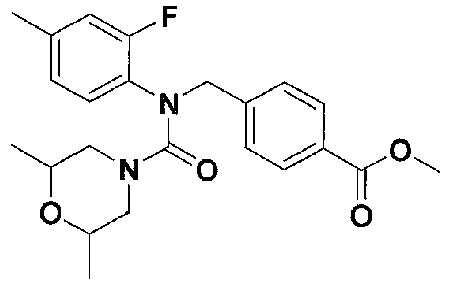
- Compound of Formula 1-3 (methyl 4-(((2-fluoro-4-methylphenyl)((4-nitrophenoxy)carbonyl)amino)methyl)benzoate; 0.50 g, 1.14 mmol) and 2,6-dimethylmorpholine (0.14 mL, 1.14 mmol) were dissolved in dimethylformamide (10 mL), and the mixture was heated and stirred at 60 °C for 2 days. Then, the dimethylformamide was removed under reduced pressure, water was poured into the reaction mixture, and the organic layer was extracted with ethyl acetate. The organic layer was washed with saturated sodium chloride aqueous solution, dehydrated with anhydrous magnesium sulfate, and then concentrated under reduced pressure. The residue was purified and concentrated by column chromatography (silica; ethyl acetate/hexane=20%) to give the desired compound of Formula 1-4 (0.27 g, 57%) in the form of a white oil.
-

- Compound of Formula 1-4 (methyl 4-((N-(2-fluoro-4-methylphenyl)-2,6-dimethylmorpholine-4-carboxamido)methyl)benz oate; 0.104 g, 0.251 mmol) was dissolved in methanol (20 mL), and hydroxylamine hydrochloride (0.087 g, 1.26 mmol) and potassium hydroxide (0.141 g, 2.51 mmol) were added and stirred. Then, hydroxylamine (50 wt% aqueous solution; 0.323 mL, 5.02 mmol) was added dropwise and stirred at room temperature for 3 hours. After completion of the reaction, the methanol was removed under reduced pressure, and saturated sodium hydrogen carbonate aqueous solution was added to precipitate a solid, and the resulting solid was filtered and dried to give the desired Compound 440 (0.086 g, 83%) in the form of a white solid.
1H NMR (400 MHz, DMSO-d6) δ 7.60 (d, 2 H, J = 7.8 Hz), 7.27 (d, 2 H, J = 6.7 Hz), 7.14 - 7.12 (m, 1 H), 7.03 (d, 1 H, J = 11.8 Hz), 6.94 (d, 1 H, J = 8.0 Hz), 4.68 (s, 2 H), 3.49 (d, 2 H, J = 12.7 Hz), 3.19 - 3.17 (m, 2 H), 2.27 - 2.21 (m, 2 H), 0.90 (d, 6 H, J = 6.1 Hz); MS (ESI) m/z 416.2 (M+ + H). -

- Compound of Formula 1-3 (methyl 4-(((2-fluoro-4-methylphenyl)((4-nitrophenoxy)carbonyl)amino)methyl)benzoate; 0.50 g, 1.14 mmol) and 1-methylpiperazine (0.127 mL, 1.14 mmol) were dissolved in dimethylformamide (10 mL), and the mixture was heated and stirred at 60 °C for 2 days. Then, the dimethylformamide was removed under reduced pressure, water was poured into the reaction mixture, and the organic layer was extracted with ethyl acetate. The organic layer was washed with saturated sodium chloride aqueous solution, dehydrated with anhydrous magnesium sulfate, and then concentrated under reduced pressure. The residue was purified and concentrated by column chromatography (silica; ethyl acetate/hexane=5 %) to give the desired compound of Formula 1-4 (0.43 g, 94%) in the form of a yellow oil.
-

- Compound of Formula 1-4 (methyl 4-((N-(2-fluoro-4-methylphenyl)4-methylpiperazine-1-carboxamido)methyl)benzoate; 0.095 g, 0.238 mmol) was dissolved in methanol (20 mL), and hydroxylamine hydrochloride (0.083 g, 1.19 mmol) and potassium hydroxide (0.133 g, 2.38 mmol) were added and stirred. Then, hydroxylamine (50 wt% aqueous solution; 0.306 mL, 4.76 mmol) was added dropwise and stirred at room temperature for 3 hours. After completion of the reaction, the methanol was removed under reduced pressure, and saturated sodium hydrogen carbonate aqueous solution was added to precipitate a solid, and the resulting solid was filtered and dried to give the desired Compound 441 (0.008 g, 8%) in the form of a white solid.
1H NMR (400 MHz, DMSO-d6) δ 11.14 (s, 1 H), 9.01 (s, 1 H), 7.61 (d, 2 H, J = 8.3 Hz), 7.32 (d, 2 H, J = 8.2 Hz), 7.14 - 7.10 (m, 1 H), 7.05 - 7.02 (m, 1 H), 6.95 (d, 1 H, J = 8.2 Hz), 4.70 (s, 2 H), 3.09 - 3.07 (m, 4 H), 2.24 (s, 3 H), 2.05 - 2.02 (m, 4 H); MS (ESI) m/z 401.2 (M+ + H). -

- Compound of Formula 7-5 (methyl 4-((((4-nitrophenoxy)carbonyl)(pyridin-2-yl)amino)methyl)benzoate; 0.40 g, 0.74 mmol) was dissolved in dimethylformamide (10 mL), and then 1-(1,4-diazepane-1-yl)ethanone (0.102 mL, 1.08 mmol) was added, and the mixture was heated and stirred at 60 °C for 2 days. Then, the dimethylformamide was removed under reduced pressure, water was poured into the reaction mixture, and the organic layer was extracted with ethyl acetate. The organic layer was washed with saturated sodium chloride aqueous solution, dehydrated with anhydrous magnesium sulfate, and then concentrated under reduced pressure. The residue was purified and concentrated by column chromatography (silica; methanol/dichloromethane=5%) to give the desired compound of Formula 7-6 (0.378 g, 94%) in the form of a white oil.
-

- Compound of Formula 7-6 (methyl 4-((4-acetyl-N-(pyridin-2-yl)-1,4-diazepane-1-carboxamido)methyl)benzoate; 0.20 g, 0.487 mmol) was dissolved in methanol (20 mL), hydroxylamine (0.169 g, 2.44 mmol) and potassium hydroxide (0.273 g, 4.87 mmol) were added. Then, hydroxylamine (50 wt% aqueous solution; 0.626 mL, 9.75 mmol) was added dropwise and stirred at room temperature for 3 hours. After completion of the reaction, the methanol was removed under reduced pressure, saturated sodium hydrogen carbonate aqueous solution was added to precipitate a solid, and the resulting solid was filter and dried to give the desired Compound 450 (0.07 g, 35%) in the form of a yellow oil.
1H NMR (400 MHz, MeOD-d3) δ 8.33 - 8.30 (m, 1 H), 7.74 - 7.63 (m, 3 H), 7.51 - 7.46 (m, 2 H), 7.06 - 6.99 (m, 2 H), 4.89 (s, 2 H), 3.58 - 3.27 (m, 8 H, 1.99 - 1.96 (m, 3 H), 1.76 - 1.57 (m, 2 H); MS (ESI) m/z 412.2 (M+ + H). -

- Compound of Formula 7-5 (methyl 4-((((4-nitrophenoxy)carbonyl)(pyridin-2-yl)amino)methyl)benzoate; 0.40 g, 0.982 mmol) was dissolved in dimethylformamide (10 mL), and then cyclopropyl(piperazin-1-yl)methanone (0.167 mL, 1.17 mmol) was added, and the mixture was heated and stirred at 60 °C for 2 days. Then, the dimethylformamide was removed under reduced pressure, water was poured into the reaction mixture, and the organic layer was extracted with ethyl acetate. The organic layer was washed with saturated sodium chloride aqueous solution, dehydrated with anhydrous magnesium sulfate, and then concentrated under reduced pressure. The residue was purified and concentrated by column chromatography (silica; methanol/dichloromethane=5%) to give the desired compound of Formula 7-6 (0.4 g, 96%) in the form of a white oil.
-

- Compound of Formula 7-6 (methyl 4-((4-(cyclopropanecarbonyl)-N-(pyridin-2-yl)piperazine-1-carboxamido)methyl)benz oate; 0.20 g, 0.473 mmol) was dissolved in methanol (20 mL), hydroxylamine (0.164 g, 2.38 mmol) and potassium hydroxide (0.265 g, 4.73 mmol) were added and stirred. Then, hydroxylamine (50 wt% aqueous solution; 0.61 mL, 9.47 mmol) was added dropwise and stirred at room temperature for 3 hours. After completion of the reaction, saturated sodium hydrogen carbonate aqueous solution was added to precipitate a solid, and the resulting solid was filter and dried to give the desired Compound 451 (0.05 g, 25%) in the form of a yellow oil.
1H NMR (400 MHz, MeOD-d3) δ 8.33 (d, 1 H, J = 3.7 Hz), 7.75 - 7.71 (m, 1 H), 7.67 (d, 2 H, J = 8.2 Hz), 7.49 (d, 2 H, J = 8.2 Hz), 7.10 (d, 1 H, J = 8.3 Hz), 7.06 - 7.03 (m, 1 H), 5.05 (s, 2 H), 3.67 (m, 4 H), 3.31 (m, 4 H), 1.89 - 1.86 (m, 1 H), 0.89 - 0.88 (m, 4 H); MS (ESI) m/z 424.2 (M+ + H). -

- Compound of Formula 1-3 (methyl 4-(((2-fluoro-4-methylphenyl)((4-nitrophenoxy)carbonyl)amino)methyl)benzoate; 0.20 g, 0.456 mmol) and 1-ethylpiperazine (0.116 mL, 0.912 mmol) were dissolved in dimethylformamide (10 mL), and the mixture was heated and stirred at 60 °C for 12 hours. Then, the dimethylformamide was removed under reduced pressure, water was poured into the reaction mixture, and the organic layer was extracted with ethyl acetate. The organic layer was washed with saturated sodium chloride aqueous solution, dehydrated with anhydrous magnesium sulfate, and then concentrated under reduced pressure. The residue was purified and concentrated by column chromatography (silica; methanol/dichloromethane=5 %) to give the desired compound of Formula 1-4 (0.14 g, 74%) in the form of a yellow oil.
-

- Compound of Formula 1-4 (methyl 4-((4-ethyl-N-(2-fluoro-4-methylphenyl)piperazine-1-carboxamido)methyl)benzoate; 0.14 g, 0.339 mmol) was dissolved in methanol (5 mL), and hydroxylamine hydrochloride (0.118 g, 1.69 mmol) and potassium hydroxide (0.19 g, 3.39 mmol) were added and stirred. Then, hydroxylamine (50 wt% aqueous solution; 0.435 mL, 6.77 mmol) was added dropwise and stirred at room temperature for 3 hours. After completion of the reaction, the methanol was removed under reduced pressure, and saturated sodium hydrogen carbonate aqueous solution was added to precipitate a solid, and the resulting solid was filtered and dried to give the desired Compound 453 (0.12 g, 86%) in the form of a yellow oil.
1H NMR (400 MHz, MeOD-d3) δ 7.64 (d, 2 H, J = 8.2 Hz), 7.33 (d, 2 H, J = 8.2 Hz), 7.06 - 6.93 (m, 3 H), 4.77 (s, 2 H), 3.26 - 3.24 (m, 4 H), 2.34 (q, 2 H, J = 7.2 Hz), 2.29 (s, 3 H), 2.26 - 2.23 (m, 4 H), 1.03 (t, 3 H, J = 7.2 Hz); MS (ESI) m/z 415.2 (M+ + H). -

- Compound of Formula 1-3 (methyl 4-(((2-fluoro-4-methylphenyl)((4-nitrophenoxy)carbonyl)amino)methyl)benzoate; 0.20 g, 0.456 mmol) and 4-(2-methoxyphenyl)piperazine (0.175 mL, 0.912 mmol) were dissolved in dimethylformamide (10 mL), and the mixture was heated and stirred at 60 °C for 12 hours. Then, the dimethylformamide was removed under reduced pressure, water was poured into the reaction mixture, and the organic layer was extracted with ethyl acetate. The organic layer was washed with saturated sodium chloride aqueous solution, dehydrated with anhydrous magnesium sulfate, and then concentrated under reduced pressure. The residue was purified and concentrated by column chromatography (silica; ethyl acetate/hexane = 30 %) to give the desired compound of Formula 1-4 (0.15 g, 67%) in the form of a yellow oil.
-

- Compound of Formula 1-4 (methyl 4-((N-(2-fluoro-4-methylphenyl)-4-(2-methoxyphenyl)piperazine-1-carboxamido)meth yl)benzoate; 0.15 g, 0.305 mmol) was dissolved in methanol (5 mL), and hydroxylamine hydrochloride (0.106 g, 1.53 mmol) and potassium hydroxide (0.171 g, 3.05 mmol) were added and stirred. Then, hydroxylamine (50 wt% aqueous solution; 0.392 mL, 6.10 mmol) was added dropwise and stirred at room temperature for 3 hours. After completion of the reaction, the methanol was removed under reduced pressure, and saturated sodium hydrogen carbonate aqueous solution was added to precipitate a solid, and the resulting solid was filtered and dried to give the desired Compound 454 (0.06 g, 43%) in the form of a yellow solid.
1H NMR (400 MHz, MeOD-d3) δ 7.67 (d, 2 H, J = 8.0 Hz), 7.44 (d, 2 H, J = 8.0 Hz), 7.14 - 7.10 (m, 1 H), 7.03 - 6.84 (m, 6 H), 4.83 (s, 2 H), 3.82 (s, 3 H), 3.38 (m, 4 H), 2.80 (m, 4 H), 2.33 (s, 3 H); MS (ESI) m/z 493.2 (M+ + H). -

- Compound of Formula 1-3 (methyl 4-(((2-fluoro-4-methylphenyl)((4-nitrophenoxy)carbonyl)amino)methyl)benzoate; 0.20 g, 0.456 mmol) and 1-(4-fluorophenyl)piperazine (0.164 mL, 0.912 mmol) were dissolved in dimethylformamide (10 mL), and the mixture was heated and stirred at 60 °C for 12 hours. Then, the dimethylformamide was removed under reduced pressure, water was poured into the reaction mixture, and the organic layer was extracted with ethyl acetate. The organic layer was washed with saturated sodium chloride aqueous solution, dehydrated with anhydrous magnesium sulfate, and then concentrated under reduced pressure. The residue was purified and concentrated by column chromatography (silica; ethyl acetate/hexane = 20 %) to give the desired compoud of Formula 1-4 (0.12 g, 55%) in the form of a yellow oil.
-

- Compound of Formula 1-4 (methyl 4-((N-(2-fluoro-4-methylphenyl)-4-(4-fluorophenyl)piperazine-1-carboxamido)methyl) benzoate; 0.12 g, 0.25 mmol) was dissolved in methanol (5 mL), and hydroxylamine hydrochloride (0.087 g, 1.25 mmol) and potassium hydroxide (0.14 g, 2.50 mmol) were added and stirred. Then, hydroxylamine (50 wt% aqueous solution; 0.322 mL, 5.01 mmol) was added dropwise and stirred at room temperature for 3 hours. After completion of the reaction, the methanol was removed under reduced pressure, and saturated sodium hydrogen carbonate aqueous solution was added to precipitate a solid, and the resulting solid was filtered and dried to give the desired Compound 455 (0.051 g, 42%) in the form of a yellow solid.
1H NMR (400 MHz, MeOD-d3) δ 7.65 (d, 2 H, J = 8.1 Hz), 7.38 (d, 2 H, J = 8.1 Hz), 7.10 - 7.06 (m, 1 H), 6.99 - 6.86 (m, 6 H), 4.80 (s, 2 H), 3.38 - 3.35 (m, 4 H), 2.87 - 2.84 (m, 4 H), 2.30 (s, 3 H); MS (ESI) m/z 481.2 (M+ + H). -

- Compound of Formula 1-1 (3-chloro-4-fluorobenzenamine; 2.0 g, 13.7 mmol) and methyl 4-formylbenzoate (2.26 g, 13.7 mmol) were dissolved in methanol (500 mL) and stirred at room temperature for 3 hours. Then, acetic acid (0.786 mL, 13.7 mmol) and sodium cyanoborohydride (0.86 g, 13.7 mmol) were added and stirred for 1 day. The methanol was partially removed by air-drying to precipitate a solid, and the resulting solid was filtered and dried to give the desired compound of Formula 1-2 (2.9 g, 72%) in the form of a gray solid.
-

- Compound of Formula 1-2 (methyl 4-((3-chloro-4-fluorophenylamido)methyl)benzoate; 2.5 g, 8.51 mmol) and 4-nitrophenyl chloroformate (2.06 g, 10.2 mmol) were dissolved in dichloromethane (50 mL) and stirred at room temperature for 3 days, and then the organic layer was extracted with water. The organic layer was washed with saturated sodium chloride aqueous solution, dehydrated with anhydrous magnesium sulfate, and then concentrated under reduced pressure. The residue was dried to give the desired compound of Formula 1-3 (2.5 g, 64%) in the form of a purple oil.
-

- Compound of Formula 1-3 (methyl 4-(((3-chloro-4-fluorophenyl)((4-nitrophenoxy)carbonyl)amino)methyl)benzoate; 0.20 g, 0.436 mmol) and piperidine (0.043 mL, 0.436 mmol) were dissolved in dimethylformamide (10 mL), and the mixture was heated and stirred at 60 °C for 12 hours. Then, the dimethylformamide was removed under reduced pressure, water was poured into the reaction mixture, and the organic layer was extracted with ethyl acetate. The organic layer was washed with saturated sodium chloride aqueous solution, dehydrated with anhydrous magnesium sulfate, and then concentrated under reduced pressure. The residue was purified and concentrated by column chromatography (silica; ethyl acetate/hexane=20%) to give the desired compound of Formula 1-4 (0.15 g, 85%) in the form of a white solid.
-

- Compound of Formula 1-4 (methyl 4-((N-(3-chloro-4-fluorophenyl)piperidine-1-carboxamido)methyl)benzoate; 0.10 g, 0.247 mmol) was dissolved in methanol (5 mL), and hydroxylamine hydrochloride (0.086 g, 1.23 mmol) and potassium hydroxide (0.139 g, 2.47 mmol) were added and stirred. Then, hydroxylamine (50 wt% aqueous solution; 0.318 mL, 4.94 mmol) was added dropwise and stirred at room temperature for 3 hours. After completion of the reaction, the methanol was removed under reduced pressure, and saturated sodium hydrogen carbonate aqueous solution was added to precipitate a solid, and the resulting solid was filtered and dried to give the desired Compound 456 (0.066 g, 66%) in the form of a white solid.
1H NMR (400 MHz, DMSO-d6) δ 7.64 (d, 2 H, J = 8.2 Hz), 7.35 - 7.29 (m, 4 H), 7.10 - 7.06 (m, 1 H), 4.82 (s, 2 H), 3.14 - 3.12 (m, 4 H), 1.44- 1.43 (m, 2 H), 1.30 (m, 4 H); MS (ESI) m/z 406.1 (M+ + H). -

- Compound of Formula 1-3 (methyl 4-(((3-chloro-4-fluorophenyl)((4-nitrophenoxy)carbonyl)amino)methyl)benzoate; 0.20 g, 0.436 mmol) and 4-methylpiperidine (0.051 mL, 0.436 mmol) were dissolved in dimethylformamide (10 mL), and the mixture was heated and stirred at 60 °C for 12 hours. Then, the dimethylformamide was removed under reduced pressure, water was poured into the reaction mixture, and the organic layer was extracted with ethyl acetate. The organic layer was washed with saturated sodium chloride aqueous solution, dehydrated with anhydrous magnesium sulfate, and then concentrated under reduced pressure. The residue was purified and concentrated by column chromatography (silica; ethyl acetate/hexane=20%) to give the desired compound of Formula 1-4 (0.17 g, 93%) in the form of a yellow oil.
-

- Compound of Formula 1-4 (methyl 4-((N-(3-chloro-4-fluorophenyl)4-methylpiperidine-1-carboxamido)methyl)benzoate; 0.10 g, 0.239 mmol) was dissolved in methanol (5 mL), and hydroxylamine hydrochloride (0.083 g, 1.19 mmol) and potassium hydroxide (0.134 g, 2.39 mmol) were added and stirred. Then, hydroxylamine (50 wt% aqueous solution; 0.307 mL, 4.78 mmol) was added dropwise and stirred at room temperature for 3 hours. After completion of the reaction, the methanol was removed under reduced pressure, and saturated sodium hydrogen carbonate aqueous solution was added to precipitate a solid, and the resulting solid was filtered and dried to give the desired Compound 457 (0.04 g, 40 %) in the form of a white solid.
1H NMR (400 MHz, DMSO-d6) δ 7.64 (d, 2 H, J = 8.2 Hz), 7.35 - 7.31 (m, 4 H), 7.06 - 7.04 (m, 1 H), 4.82 (s, 2 H), 3.69 - 3.66 (m, 2 H), 2.59 (m, 2 H), 1.46 - 1.44 (m, 3 H), 0.82 - 0.81 (m, 5 H); MS (ESI) m/z 420.2 (M+ + H). -

- Compound of Formula 1-3 (methyl 4-(((3-chloro-4-fluorophenyl)((4-nitrophenoxy)carbonyl)amino)methyl)benzoate; 0.20 g, 0.436 mmol) and morpholine (0.038 mL, 0.436 mmol) were dissolved in dimethylformamide (10 mL), and the mixture was heated and stirred at 60 °C for 12 hours. Then, the dimethylformamide was removed under reduced pressure, water was poured into the reaction mixture, and the organic layer was extracted with ethyl acetate. The organic layer was washed with saturated sodium chloride aqueous solution, dehydrated with anhydrous magnesium sulfate, and then concentrated under reduced pressure. The residue was purified and concentrated by column chromatography (silica; ethyl acetate/hexane=20%) to give the desired compound of Formula 1-4 (0.022 g, 12%) in the form of a colorless oil.
-

- Compound of Formula 1-4 (methyl 4-((N-(3-chloro-4-fluorophenyl)morpholine-4-carboxamido)methyl)benzoate; 0.050 g, 0.123 mmol) was dissolved in methanol (5 mL), and hydroxylamine hydrochloride (0.043 g, 0.614 mmol) and potassium hydroxide (0.069 g, 1.23 mmol) were added and stirred. Then, hydroxylamine (50 wt% aqueous solution; 0.158 mL, 2.46 mmol) was added dropwise and stirred at room temperature for 3 hours. After completion of the reaction, the methanol was removed under reduced pressure, and saturated sodium hydrogen carbonate aqueous solution was added to precipitate a solid, and the resulting solid was filtered and dried to give the desired Compound 458 (0.017 g, 34 %) in the form of a white solid.
1H NMR (400 MHz, DMSO-d6) δ 7.63 (d, 2 H, J = 8.2 Hz), 7.44 - 7.42 (m, 1 H), 7.33 - 7.29 (m, 3 H), 7.15 - 7.11 (m, 1 H), 4.84 (s, 2 H), 3.41 - 3.40 (m, 4 H), 3.14 - 3.12 (m, 4 H); MS (ESI) m/z 408.1 (M+ + H). -

- Compound of Formula 1-3 (methyl 4-((((4-nitrophenoxy)carbonyl)(3-(trifluoromethyl)phenyl)amino)methyl)benzoate; 0.38 g, 0.80 mmol) was dissolved in dimethylformamide (10 mL), and potassium carbonate (0.33 g, 2.38 mmol) and 4-methylpiperidine (0.10 mL, 0.80 mmol) were then added. The mixture was reacted at 60 °C for 2 days and then diluted with ethyl acetate and washed with saturated ammonium chloride solution. The organic layer was dehydrated with anhydrous sodium sulfate, filtered, and then concentrated under reduced pressure. The residue was purified by column chromatography (silica; ethyl acetate/ hexane= 50%) to give the desired compound of Formula 1-4 (0.26 g, 75%).
-

- Compound of Formula 1-4 (methyl 4-((4-methyl-N-(3-(trifluoromethyl)phenyl)piperidine-1-carboxamido)methyl)benzoate ; 0.26 g, 0.60 mmol) was dissolved in methanol (5 mL), and hydroxylamine (50 wt% aqueous solution; 0.37 mL) and potassium hydroxide (0.17 g, 2.98 mmol) were then added and stirred overnight. After completion of the reaction, the methanol was removed by distillation under reduced pressure, and the organic layer was extracted with ethyl acetate and water, dehydrated with anhydrous magnesium sulfate, filtered, and then concentrated under reduced pressure. The residue was stirred in diethyl ether to give a white solid product, and the resulting solid was filter and dried to give the desired Compound 459 (0.07 g, 26%) in the form of a white solid.
1H NMR (400 MHz, DMSO-d6) δ 11.13 (brs, 1 H), 8.98 (brs, 1 H), 7.65 (d, 2 H, J = 8.3 Hz), 7.54-7.50 (m, 1 H), 7.43-7.36 (m, 5 H), 4.92 (s, 2 H), 3.41-3.36 (m, 4 H), 2.36-2.26 (m, 3 H), 0.94 (s, 3 H). -

- Compound of Formula 1-3 (methyl 4-((((4-nitrophenoxy)carbonyl)(3-(trifluoromethyl)phenyl)amino)methyl)benzoate; 0.44 g, 0.94 mmol) was dissolved in dimethylformamide (10 mL), and potassium carbonate (0.39 g, 2.81 mmol) and piperidine (0.09 mL, 0.94 mmol) were then added. The mixture was reacted at 60 °C for 1 day and then diluted with ethyl acetate and washed with saturated ammonium chloride solution. The organic layer was dehydrated with anhydrous magnesium sulfate, filtered, and then concentrated under reduced pressure. The residue was purified by column chromatography (silica; ethyl acetate hexane = 20%) to give the desired compound of Formula 1-4 (0.16 g, 41%).
-

- Compound of Formula 1-4 (methyl 4-((N-(3-(trifluoromethyl)phenyl)piperidine-1-carboxamido)methyl)benzoate; 0.27 g, 0.65 mmol) was dissolved in methanol (5 mL), and hydroxylamine (50 wt% aqueous solution; 0.40 mL) and potassium hydroxide (0.18 g, 3.27 mmol) were then added and stirred overnight. After completion of the reaction, the methanol was removed by distillation under reduced pressure, and the organic layer was extracted with ethyl acetate and water, dehydrated with anhydrous magnesium sulfate, filtered, and then concentrated under reduced pressure. The residue was stirred in diethyl ether to give a solid product, and the resulting solid was filtered and dried to give the desired Compound 460 (0.07 g, 24%) in the form of a yellow solid.
1H NMR (400 MHz, DMSO-d6) δ 7.65 (d, 2 H, J = 8.2 Hz), 7.53-7.49 (m, 1 H), 7.38-7.32 (m, 5 H), 7.15-7.11 (m, 1 H), 4.91 (s, 2 H), 3.17-3.14 (m, 4 H), 1.45-1.46 (m, 2 H), 1.30 (brs, 4 H); MS (ESI) m/z 422.1 (M+ + H). -

- Compound of Formula 1-3 (methyl 4-((((4-nitrophenoxy)carbonyl)(3-(trifluoromethyl)phenyl)amino)methyl)benzoate; 0.346 g, 0.73 mmol) was dissolved in dimethylformamide (10 mL), and potassium carbonate (0.30 g, 2.19 mmol) and 1-ethylpiperazine (0.09 mL, 0.73 mmol) were then added. The mixture was reacted at 60 °C for 1 day and then diluted with ethyl acetate and washed with saturated ammonium chloride solution. The organic layer was dehydrated with anhydrous magnesium sulfate, filtered, and then concentrated under reduced pressure. The residue was purified by column chromatography (silica; ethyl acetate hexane = 50%) to give the desired compound of Formula 1-4 (0.15 g, 46%).
-

- Compound of Formula 1-4 (methyl 4-((4-ethyl-N-(3-(trifluoromethyl)phenyl)piperazine-1-carboxamido)methyl)benzoate; 0.15 g, 0.33 mmol) was dissolved in methanol (10 mL), and hydroxylamine (50 wt% aqueous solution; 0.20 mL) and potassium hydroxide (0.09 g, 1.67 mmol) were then added and stirred overnight. After completion of the reaction, the methanol was removed by distillation under reduced pressure, and the organic layer was extracted with ethyl acetate and water, dehydrated with anhydrous magnesium sulfate, filtered, and then concentrated under reduced pressure. The residue was stirred in diethyl ether to give a solid product, and the resulting solid was filtered and dried to give the desired Compound 461 (0.09 g, 61%) in the form of a yellow solid.
1H NMR (400 MHz, DMSO-d6) δ 11.1 (brs, 1 H), 7.65 (d, 2 H, J = 8.2 Hz), 7.51 (t, 1 H, J = 7.9 Hz), 7.41-7.36 (m, 5 H), 4.92 (s, 2 H), 3.17-3.14 (m, 4 H), 2.25, 2.22 (ABq, 2 H, J = 12.4, 7.2 Hz), 2.18-2.15 (m, 4 H), 0.92 (t, 3 H, J = 7.2 Hz); MS (ESI) m/z 451.1 (M+ + H). -

- Compound of Formula 5-1 (methyl 4-((3-bromophenylamino)methyl)benzoate; 3.00 g, 9.37 mmol), benzo[d][1,3]dioxol-5-ylboronic acid (1.87 g, 11.2 mmol), and Pd(dbpf)Cl2 (0.305 g, 0.468 mmol) were dissolved in 1,4-dioxane (24 mL), and sodium carbonate (1.99 g, 18.7 mmol) dissolved in water (6 mL) was added to the reaction solution and stirred in a microwave reactor at 120 °C for 30 minutes. After completion of the reaction, the organic layer was extracted with ethyl acetate and saturated sodium hydrogen carbonate aqueous solution, dehydrated with anhydrous magnesium sulfate, and then filtered. The filtrate was concentrated under reduced pressure, and then the residue was purified and concentrated by column chromatography (silica; ethyl acetate/hexane=10%) to give the desired compound of Formula 5-2 (1.52 g, 45%) in the form of a brown solid.
-

- Compound of Formula 5-2 (methyl 4-((3-(benzo[d][1,3]dioxol-5-yl)phenylamino)methyl)benzoate; 1.52 g, 4.21 mmol) and 4-nitrophenyl chloroformate (0.933 g, 4.63 mmol) were dissolved in acetonitrile (20 mL), and then potassium carbonate (0.872 g, 6.31 mmol) was added and stirred at room temperature for 3 hours. After completion of the reaction, the organic layer was extracted with ethyl acetate and saturated sodium hydrogen carbonate aqueous solution, dehydrated with anhydrous magnesium sulfate, and then filtered. The filtrate was concentrated under reduced pressure, and then the residue was purified and concentrated by column chromatography (silica; ethyl acetate/hexane=20%) to give the desired compound of Formula 5-3 (1.87 g, 84%) in the form of a light yellow solid.
-

- Compound of Formula 5-3 (methyl 4-(((3-(benzo[d][1,3]dioxol-5-yl)phenyl)((4-nitrophenoxy)carbonyl)amino)methyl)ben zoate; 0.180 g, 0.342 mmol) was dissolved in dimethylformamide (2 mL), and then piperidine (0.087 g, 1.03 mmol) and potassium carbonate (0.142 g, 1.03 mmol) were added and stirred at 50 °C for 16 hours. After completion of the reaction, the organic layer was extracted with ethyl acetate and saturated ammonium chloride aqueous solution, dehydrated with anhydrous magnesium sulfate, and then filtered. The filtrate was concentrated under reduced pressure, and then the residue was purified and concentrated by column chromatography (silica; ethyl acetate/hexane=30%) to give the desired compound of Formula 5-4 (0.155 g, 96%) in the form of a light yellow liquid.
-
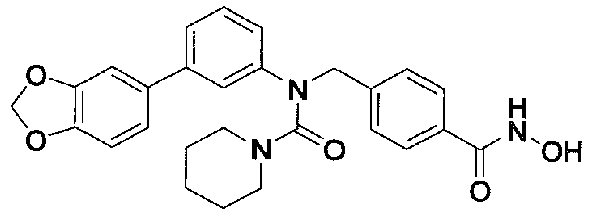
- Compound of Formula 5-4 (methyl 4-((N-(3-(benzo[d][1,3]dioxol-5-yl)phenyl)piperidine-1-carboxamido)methyl)benzoate ; 0.155 g, 0.328 mmol) was dissolved in methanol (10 mL), and then hydroxylamine (50.0 wt% aqueous solution; 1.00 mL, 16.4 mmol) and potassium hydroxide (0.184 g, 3.28 mmol) were added sequentially and then stirred at room temperature for 30 minutes. After completion of the reaction, the reaction solution was concentrated under reduced pressure until its volume became about 1 mL, and saturated ammonium chloride aqueous solution (1-2 mL) was added and stirred. Then, the solid product was filtered, washed with water, and then vacuum dried to give the desired Compound 462 (0.153 g, 99%) in the form of a white solid.
1H NMR (400 MHz, DMSO-d6) δ 7.64 (d, 2 H, J = 8.3 Hz), 7.39 (d, 2 H, J = 8.2 Hz), 7.36 - 7.25 (m, 3 H), 7.19 (d, 1 H, J = 1.8 Hz), 7.08 (dd, 1 H, J = 8.1, 1.8 Hz), 7.02 - 6.95 (m, 2 H), 6.05 (s, 2 H), 4.90 (s, 2 H), 3.17 - 3.14 (m, 4 H), 1.43 (m, 2 H), 1.28 (m, 4 H). MS (ESI) m/z 474 (M+ + H). -

- Compound of Formula 5-3 (methyl 4-(((3-(benzo[d][1,3]dioxol-5-yl)phenyl)((4-nitrophenoxy)carbonyl)amino)methyl)ben zoate; 0.180 g, 0.342 mmol) was dissolved in dimethylformamide (2 mL), and then 4-hydroxypiperidine (0.104 g, 1.03 mmol) and potassium carbonate (0.142 g, 1.03 mmol) were added and stirred at 50 °C for 16 hours. After completion of the reaction, the organic layer was extracted with ethyl acetate and saturated ammonium chloride aqueous solution, dehydrated with anhydrous magnesium sulfate, and then filtered. The filtrate was concentrated under reduced pressure, and then the residue was purified and concentrated by column chromatography (silica; ethyl acetate/hexane= 25%) to give the desired compound of Formula 5-4 (0.128 g, 77%) in the form of a light yellow liquid.
-

- Compound of Formula 5-4 (methyl 4-((N-(3-(benzo[d][1,3]dioxol-5-yl)phenyl)-4-hydoxypiperidine-1-carboxamido)methy l)benzoate; 0.128 g, 0.262 mmol) was dissolved in methanol (10 mL), and then hydroxylamine (50.0 wt% aqueous solution; 0.801 mL, 13.1 mmol) and potassium hydroxide (0.147 g, 2.62 mmol) were added sequentially and then stirred at room temperature for 30 minutes. After completion of the reaction, the reaction solution was concentrated under reduced pressure until its volume became about 1 mL, and saturated ammonium chloride aqueous solution (1-2 mL) was added and stirred. Then, the solid product was filtered, washed with water, and then vacuum dried to give the desired Compound 463 (0.085 g, 66%) in the form of a light brown solid.
1H NMR (400 MHz, DMSO-d6) δ 7.64 (d, 2 H, J = 8.3 Hz), 7.39 (d, 2 H, J = 8.3 Hz), 7.33 - 7.27 (m, 3 H), 7.20 (d, 1 H, J = 1.8 Hz), 7.08 (dd, 1 H, J = 8.1, 1.8 Hz), 7.02 - 7.00 (m, 1 H), 6.97 (d, 1 H, J = 8.1 Hz), 6.05 (s, 2 H), 4.90 (s, 2 H), 4.65 (brs, 1 H), 3.54 - 3.51 (m, 3 H), 2.87 - 2.81 (m, 2 H), 1.56 - 1.53 (m, 2 H), 1.14 - 1.09 (m, 2 H). MS (ESI) m/z 490 (M+ + H). -

- Compound of Formula 5-3 (methyl 4-(((3-(benzo[d][1,3]dioxol-5-yl)phenyl)((4-nitrophenoxy)carbonyl)amino)methyl)ben zoate; 0.180 g, 0.342 mmol) was dissolved in dimethylformamide (2 mL), and then 2,6-dimethymorpholine(0.118 g, 1.03 mmol) and potassium carbonate (0.142 g, 1.03 mmol) were added and stirred at 50 °C for 16 hours. After completion of the reaction, the organic layer was extracted with ethyl acetate and saturated ammonium chloride aqueous solution, dehydrated with anhydrous magnesium sulfate, and then filtered. The filtrate was concentrated under reduced pressure, and then the residue was purified and concentrated by column chromatography (silica; ethyl acetate/hexane= 25%) to give the desired compound of Formula 5-4 (0.116 g, 68%) in the form of a colorless liquid.
-

- Compound of Formula 5-4 (methyl 4-((N-(3-(benzo[d][1,3]dioxol-5-yl)phenyl)-2,6-dimethylmorpholine-4-carboxamido)m ethyl)benzoate; 0.116 g, 0.231 mmol) was dissolved in methanol (10 mL), and then hydroxylamine (50.0 wt% aqueous solution; 0.706 mL, 11.5 mmol) and potassium hydroxide (0.130 g, 2.31 mmol) were added sequentially and then stirred at room temperature for 30 minutes. After completion of the reaction, the reaction solution was concentrated under reduced pressure until its volume became about 1 mL, and saturated ammonium chloride aqueous solution (1-2 mL) was added and stirred. Then, the solid product was filtered, washed with water, and then vacuum dried to give the desired Compound 464 (0.085 g, 73%) in the form of a white solid.
1H NMR (400 MHz, DMSO-d6) δ 7.63 (d, 2 H, J = 8.3 Hz), 7.40 (d, 2 H, J = 8.2 Hz), 7.37 - 7.27 (m, 3 H), 7.21 (d, 1 H, J = 1.8 Hz), 7.09 (dd, 1 H, J = 8.1, 1.8 Hz), 7.04 (m, 1 H), 6.98 (d, 1 H, J = 8.1 Hz), 6.05 (s, 2 H), 4.90 (s, 2 H), 3.61 - 3.58 (m, 2 H), 3.29 - 3.27 (m, 2 H), 2.30 - 2.27 (m, 2 H), 0.92 (s, 3 H), 0.90 (s, 3 H). MS (ESI) m/z 504 (M+ + H). -

- Compound of Formula 5-3 (methyl 4-(((3-(benzo[d][1,3]dioxol-5-yl)phenyl)((4-nitrophenoxy)carbonyl)amino)methyl)ben zoate; 0.180 g, 0.342 mmol) was dissolved in dimethylformamide (2 mL), and then 4-phenylpiperidin-4ol (0.182 g, 1.03 mmol) and potassium carbonate (0.142 g, 1.03 mmol) were added and stirred at 50 °C for 16 hours. After completion of the reaction, the organic layer was extracted with ethyl acetate and saturated ammonium chloride aqueous solution, dehydrated with anhydrous magnesium sulfate, and then filtered. The filtrate was concentrated under reduced pressure, and then the residue was purified and concentrated by column chromatography (silica; ethyl acetate/hexane= 30%) to give the desired compound of Formula 5-4 (0.137 g, 71%) in the form of a light yellow liquid.
-

- Compound of Formula 5-4 (methyl 4-((N-(3-(benzo[d][1,3]dioxol-5-yl)phenyl)-4-hydroxy-4-phenylpiperidine-1-carboxam ido)methyl)benzoate; 0.137 g, 0.243 mmol) was dissolved in methanol (10 mL), and then hydroxylamine (50.0 wt% aqueous solution; 0.742 mL, 12.1 mmol) and potassium hydroxide (0.136 g, 2.43 mmol) were added sequentially and then stirred at room temperature for 30 minutes. After completion of the reaction, the reaction solution was concentrated under reduced pressure until its volume became about 1 mL, and saturated ammonium chloride aqueous solution (1-2 mL) was added and stirred. Then, the solid product was filtered, washed with water, and then vacuum dried to give the desired Compound 465 (0.118 g, 86%) in the form of a white solid.
1H NMR (400 MHz, DMSO-d6) δ 7.66 (d, 2 H, J = 8.2 Hz), 7.41 (d, 2 H, J = 7.9 Hz), 7.38 - 7.33 (m, 2 H), 7.29 - 7.20 (m, 6 H), 7.17 - 7.06 (m, 3 H), 6.99 (d, 1 H, J = 8.2 Hz), 6.06 (s, 2 H), 4.98 (s, 1 H), 4.92 (s, 2 H), 3.69 (d, 2 H, J = 11.8 Hz), 3.04 (t, 2 H, J = 12.2 Hz), 1.63 - 1.58 (m, 2 H), 1.40 - 1.36 (m, 2 H). MS (ESI) m/z 566 (M+ + H). -
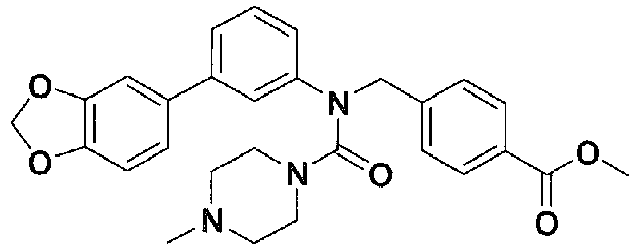
- Compound of Formula 5-3 (methyl 4-(((3-(benzo[d][1,3]dioxol-5-yl)phenyl)((4-nitrophenoxy)carbonyl)amino)methyl)ben zoate; 0.180 g, 0.342 mmol) was dissolved in dimethylformamide (2 mL), and then 1-methylpiperazine (0.103 g, 1.03 mmol) and potassium carbonate (0.142 g, 1.03 mmol) were added and stirred at 50 °C for 16 hours. After completion of the reaction, the organic layer was extracted with ethyl acetate and saturated ammonium chloride aqueous solution, dehydrated with anhydrous magnesium sulfate, and then filtered. The filtrate was concentrated under reduced pressure, and then the residue was purified and concentrated by column chromatography (silica; methanol/dichloromethane= 10%) to give the desired compound of Formula 5-4 (0.099 g, 59%) in the form of a yellow liquid.
-

- Compound of Formula 5-4 (methyl 4-((N-(3-(benzo[d][1,3]dioxol-5-yl)phenyl)-4-methylpiperazine-1-carboxamido)methy l)benzoate; 0.099 g, 0.203 mmol) was dissolved in methanol (10 mL), and then hydroxylamine (50.0 wt% aqueous solution; 0.621 mL, 10.2 mmol) and potassium hydroxide (0.114 g, 2.03 mmol) were added sequentially and then stirred at room temperature for 30 minutes. After completion of the reaction, the reaction solution was concentrated under reduced pressure until its volume became about 1 mL, and saturated sodium hydrogen carbonate aqueous solution (1-2 mL) was added and stirred. Then, the solid product was filtered, washed with water, and then vacuum dried to give the desired Compound 466 (0.036 g, 36%) in the form of a light yellow solid.
1H NMR (400 MHz, DMSO-d6) δ 7.63 (d, 2 H, J = 8.1 Hz), 7.35 (d, 2 H, J = 8.2 Hz), 7.32 - 7.26 (m, 3 H), 7.21 (d, 1 H, J = 1.8 Hz), 7.09 (dd, 1 H, J = 8.2, 1.7 Hz), 7.02 (m, 1 H), 6.98 (d, 1 H, J = 8.1 Hz), 6.05 (s, 2 H), 4.90 (s, 2 H), 3.17 (m, 4 H), 2.10 (m, 4 H), 2.06 (s, 3 H). MS (ESI) m/z 489 (M+ + H). -

- Compound of Formula 5-3 (methyl 4-(((3-(benzo[d][1,3]dioxol-5-yl)phenyl)((4-nitrophenoxy)carbonyl)amino)methyl)ben zoate; 0.180 g, 0.342 mmol) was dissolved in dimethylformamide (2 mL), and then 2-(piperazin-1-yl)ethanol (0.134 g, 1.03 mmol) and potassium carbonate (0.142 g, 1.03 mmol) were added and stirred at 50 °C for 16 hours. After completion of the reaction, the organic layer was extracted with ethyl acetate and saturated ammonium chloride aqueous solution, dehydrated with anhydrous magnesium sulfate, and then filtered. The filtrate was concentrated under reduced pressure, and then the residue was purified and concentrated by column chromatography (silica; methanol/dichloromethane= 10%) to give the desired compound of Formula 5-4 (0.101 g, 57%) in the form of a yellow liquid.
-

- Compound of Formula 5-4 (methyl 4-((N-(3-(benzo[d][1,3]dioxol-5-yl)phenyl)-4-(2-hydroxyethyl)piperazine-1-carboxami do)methyl)benzoate; 0.101 g, 0.195 mmol) was dissolved in methanol (10 mL), and then hydroxylamine (50.0 wt% aqueous solution; 0.597 mL, 9.76 mmol) and potassium hydroxide (0.110 g, 1.95 mmol) were added sequentially and then stirred at room temperature for 30 minutes. After completion of the reaction, the reaction solution was concentrated under reduced pressure until its volume became about 1 mL and extracted with ethyl acetate and saturated sodium hydrogen carbonate aqueous solution. The organic layer was washed with water and dehydrated with anhydrous magnesium sulfate, filtered and then concentrated under reduced pressure to give the desired Compound 467 (0.054 g, 53%) in the form of a light yellow solid.
1H NMR (400 MHz, DMSO-d6) δ 11.12 (s, 1 H), 9.00 (s, 1 H), 7.64 (d, 2 H, J = 8.2 Hz), 7.38 (d, 2 H, J = 8.2 Hz), 7.34 - 7.26 (m, 3 H), 7.21 (d, 1 H, J = 1.7 Hz), 7.09 (dd, 1 H, J = 8.2, 1.8 Hz), 7.02 (d, 1 H, J = 7.9 Hz), 6.98 (d, 1 H, J = 8.1 Hz), 6.05 (s, 2 H), 4.91 (s, 2 H), 4.36 (t, 1 H, J = 5.3 Hz), 3.41 (q, 2 H, J = 5.9 Hz), 3.16 (m, 4 H), 2.27 (t, 2 H, J = 6.2 Hz), 2.22 (m, 4 H). MS (ESI) m/z 519 (M+ + H). -

- Compound of Formula 5-3 (methyl 4-(((3-(benzo[d][1,3]dioxol-5-yl)phenyl)((4-nitrophenoxy)carbonyl)amino)methyl)ben zoate; 0.180 g, 0.342 mmol) was dissolved in dimethylformamide (2 mL), and then pyrrolidine (0.073 g, 1.03 mmol) and potassium carbonate (0.142 g, 1.03 mmol) were added and stirred at 50 °C for 16 hours. After completion of the reaction, the organic layer was extracted with ethyl acetate and saturated ammonium chloride aqueous solution, dehydrated with anhydrous magnesium sulfate, and then filtered. The filtrate was concentrated under reduced pressure, and then the residue was purified and concentrated by column chromatography (silica; ethyl acetate/hexane= 30%) to give the desired compound of Formula 5-4 (0.148 g, 94%) in the form of a colorless liquid.
-

- Compound of Formula 5-4 (methyl 4-((N-(3-(benzo[d][1,3]dioxol-5-yl)phenyl)pyrrolidine-1-carboxamido)methyl)benzoat e; 0.148 g, 0.323 mmol) was dissolved in methanol (10 mL), and then hydroxylamine (50.0 wt% aqueous solution; 0.987 mL, 16.1 mmol) and potassium hydroxide (0.181 g, 3.23 mmol) were added sequentially and then stirred at room temperature for 30 minutes. After completion of the reaction, the reaction solution was concentrated under reduced pressure until its volume became about 1 mL, and saturated ammonium chloride aqueous solution (1-2 mL) was added and stirred. Then, the solid product was filtered, washed with water, and then vacuum dried to give the desired Compound 468 (0.137 g, 92%) in the form of a white solid.
1H NMR (400 MHz, DMSO-d6) δ 7.63 (d, 2 H, J = 8.1 Hz), 7.38 (d, 2 H, J = 8.2 Hz), 7.31 - 7.28 (m, 3 H), 7.18 (d, 1 H, J = 1.7 Hz), 7.05 (dd, 1 H, J = 8.1, 1.9 Hz), 7.00 - 6.95 (m, 2 H), 6.04 (s, 2 H), 4.91 (s, 2 H), 3.04 (m, 4 H), 1.64 (m, 4 H). MS (ESI) m/z 460 (M+ + H). -
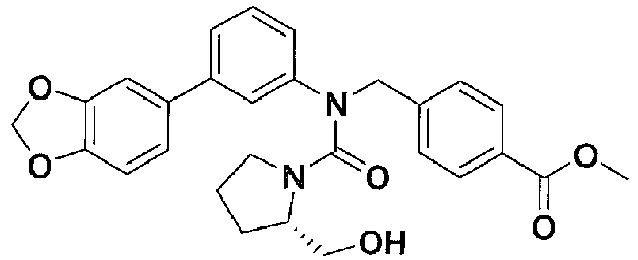
- Compound of Formula 5-3 (methyl 4-(((3-(benzo[d][1,3]dioxol-5-yl)phenyl)((4-nitrophenoxy)carbonyl)amino)methyl)ben zoate; 0.180 g, 0.342 mmol) was dissolved in dimethylformamide (2 mL), and then (S)- pyrrolidin-2-yl-methanol (0.104 g, 1.03 mmol) and potassium carbonate (0.142 g, 1.03 mmol) were added and stirred at 50 °C for 16 hours. After completion of the reaction, the organic layer was extracted with ethyl acetate and saturated ammonium chloride aqueous solution, dehydrated with anhydrous magnesium sulfate, and then filtered. The filtrate was concentrated under reduced pressure, and then the residue was purified and concentrated by column chromatography (silica; ethyl acetate/hexane= 30%) to give the desired compound of Formula 5-4 (0.142 g, 85%) in the form of a colorless liquid.
-

- Compound of Formula 5-4 ((S)-methyl 4-((N-(3-(benzo[d][1,3]dioxol-5-yl)phenyl)-2(hydroxymethyl)pyrrolidine-1-carboxami do)methyl)benzoate; 0.142 g, 0.291 mmol) was dissolved in methanol (10 mL), and then hydroxylamine (50.0 wt% aqueous solution; 0.889 mL, 14.5 mmol) and potassium hydroxide (0.163 g, 2.91 mmol) were added sequentially and then stirred at room temperature for 30 minutes. After completion of the reaction, the reaction solution was concentrated under reduced pressure until its volume became about 1 mL, and saturated ammonium chloride aqueous solution (1-2 mL) was added and stirred. Then, the solid product was filtered, washed with water, and then vacuum dried to give the desired Compound 469 (0.112 g, 79%) in the form of a light yellow solid.
1H NMR (400 MHz, DMSO-d6) δ 7.63 (d, 2 H, J = 8.2 Hz), 7.39 - 7.36 (m, 3 H), 7.31 - 7.25 (m, 2 H), 7.20 (d, 1 H, J = 1.8 Hz), 7.11 - 7.07 (m, 2 H), 6.95 (d, 1 H, J = 8.1 Hz), 6.04 (s, 2 H), 5.01 (d, 1 H, J = 16.1 Hz), 4.85 - 4.81 (m, 2 H), 3.93 (m, 1 H), 3.54 (m, 2 H), 3.10 (m, 1 H), 2.55 (m, 1 H), 1.82 (m, 1 H), 1.65 (m, 2 H), 1.56 (m, 1 H). MS (ESI) m/z 490 (M+ + H). -

- Compound of Formula 5-3 (methyl 4-(((3-(benzo[d][1,3]dioxol-5-yl)phenyl)((4-nitrophenoxy)carbonyl)amino)methyl)ben zoate; 0.180 g, 0.342 mmol) was dissolved in dimethylformamide (2 mL), and then cyclopropyl(piperazin-l-yl)methanone(0.158 g, 1.03 mmol) and potassium carbonate (0.142 g, 1.03 mmol) were added and stirred at 50 °C for 16 hours. After completion of the reaction, the organic layer was extracted with ethyl acetate and saturated ammonium chloride aqueous solution, dehydrated with anhydrous magnesium sulfate, and then filtered. The filtrate was concentrated under reduced pressure, and then the residue was purified and concentrated by column chromatography (silica; ethyl acetate/hexane= 30%) to give the desired compound of Formula 5-4 (0.096 g, 52%) in the form of a yellow liquid.
-

- Compound of Formula 5-4 (methyl 4-((N-(3-(benzo[d][1,3]dioxol-5-yl)phenyl)-4-(cyclopropanecarbonyl)piperazine-1-car boxamido)methyl)benzoate; 0.096 g, 0.177 mmol) was dissolved in methanol (10 mL), and then hydroxylamine (50.0 wt% aqueous solution; 0.542 mL, 8.86 mmol) and potassium hydroxide (0.100 g, 1.77 mmol) were added sequentially and then stirred at room temperature for 30 minutes. After completion of the reaction, the reaction solution was concentrated under reduced pressure until its volume became about 1 mL, and saturated ammonium chloride aqueous solution (1-2 mL) was added and stirred. Then, the solid product was filtered, washed with water, and then vacuum dried to give the desired Compound 470 (0.048 g, 50%) in the form of a light yellow solid.
1H NMR (400 MHz, DMSO-d6) δ 7.63 (d, 2 H, J = 8.1 Hz), 7.40 - 7.38 (m, 3 H), 7.33 - 7.31 (m, 2 H), 7.23 (d, 1 H, J = 1.6 Hz), 7.10 (dd, 1 H, J = 8.1, 1.6 Hz), 7.06 (m, 1 H), 6.97 (d, 1 H, J = 8.2 Hz), 6.05 (s, 2 H), 4.93 (s, 2 H), 3.50 (m, 4 H), 3.21 - 3.17 (m, 4 H), 1.88 (m, 1 H), 0.68 - 0.63 (m, 4 H). MS (ESI) m/z 543 (M+ + H). -

- Compound of Formula 5-3 (methyl 4-(((3-(benzo[d][1,3]dioxol-5-yl)phenyl)((4-nitrophenoxy)carbonyl)amino)methyl)ben zoate; 0.180 g, 0.342 mmol) was dissolved in dimethylformamide (2 mL), and then azetidine hydrochloride (0.096 g, 1.03 mmol) and potassium carbonate (0.142 g, 1.03 mmol) were added and stirred at 50 °C for 16 hours. After completion of the reaction, the organic layer was extracted with ethyl acetate and saturated ammonium chloride aqueous solution, dehydrated with anhydrous magnesium sulfate, and then filtered. The filtrate was concentrated under reduced pressure, and then the residue was purified and concentrated by column chromatography (silica; ethyl acetate/hexane= 30%) to give the desired compound of Formula 5-4 (0.150 g, 99%) in the form of a white solid.
-

- Compound of Formula 5-4 (methyl 4-((N-(3-(benzo[d][1,3]dioxol-5-yl)phenyl)azetidine-1-carboxamido)methyl)benzoate; 0.150 g, 0.337 mmol) was dissolved in methanol (10 mL), and then hydroxylamine (50.0 wt% aqueous solution; 1.03 mL, 16.9 mmol) and potassium hydroxide (0.189 g, 3.38 mmol) were added sequentially and then stirred at room temperature for 30 minutes. After completion of the reaction, the reaction solution was concentrated under reduced pressure until its volume became about 1 mL, and saturated sodium hydrogen carbonate aqueous solution (1-2 mL) was added and stirred. Then, the solid product was filtered, washed with water, and then vacuum dried to give the desired Compound 471 (0.150 g, 99%) in the form of a white solid.
1H NMR (400 MHz, DMSO-d6) δ 7.63 (d, 2 H, J = 8.2 Hz), 7.40 - 7.37 (m, 2 H), 7.34 - 7.30 (m, 3 H), 7.19 (d, 1 H, J = 1.8 Hz), 7.08 - 7.05 (m, 2 H), 6.97 (d, 1 H, J = 8.1 Hz), 6.04 (s, 2 H), 4.90 (s, 2 H), 3.52 - 3.48 (m, 4 H), 1.94 - 1.92 (m, 2 H). MS (ESI) m/z 446 (M+ + H). -

- Compound of Formula 1-3 (methyl 4-(((3-chloro-4-fluorophenyl)((4-nitrophenoxy)carbonyl)amino)methyl)benzoate; 0.20 g, 0.436 mmol) and 2,6-dimethylmorpholine (0.053 mL, 0.436 mmol) were dissolved in dimethylformamide (10 mL), and the mixture was heated and stirred at 60 °C for 12 hours. Then, the dimethylformamide was removed under reduced pressure, water was poured into the reaction mixture, and the organic layer was extracted with ethyl acetate. The organic layer was washed with saturated sodium chloride aqueous solution, dehydrated with anhydrous magnesium sulfate, and then concentrated under reduced pressure. The residue was purified and concentrated by column chromatography (silica; ethyl acetate/hexane=20%) to give the desired compound of Formula 1-4 (0.048 g, 25%) in the form of a yellow oil.
-

- Compound of Formula 1-4 (methyl 4-((N-(3-chloro-4-fluorophenyl)-2,6-dimethylmorpholine-4-carboxamido)methyl)benz oate; 0.048 g, 0.11 mmol) was dissolved in methanol (5 mL), and hydroxylamine hydrochloride (0.038 g, 0.552 mmol) and potassium hydroxide (0.062 g, 1.10 mmol) were added and stirred. Then, hydroxylamine (50 wt% aqueous solution; 0.142 mL, 2.21 mmol) was added dropwise and stirred at room temperature for 3 hours. After completion of the reaction, the methanol was removed under reduced pressure, and saturated sodium hydrogen carbonate aqueous solution was added to precipitate a solid, and the resulting solid was filtered and dried to give the desired Compound 477 (0.022 g, 46 %) in the form of a yellow solid.
1H NMR (400 MHz, MeOD-d3) δ 7.67 (d, 2 H, J = 7.7 Hz), 7.40 (d, 2 H, J = 7.6 Hz), 7.31 - 7.30 (m, 1 H), 7.22 - 7.18 (m, 1 H), 7.11 - 7.09 (m, 1 H), 3.66 - 3.62 (m, 2 H), 3.43 - 3.39 (m, 2 H), 2.40 - 2.34 (m, 2 H), 1.03 (d, 6 H, J = 6.1 Hz); MS (ESI) m/z 436.1 (M+ + H). -

- Compound of Formula 1-3 (methyl 4-(((3-chloro-4-fluorophenyl)((4-nitrophenoxy)carbonyl)amino)methyl)benzoate; 0.20 g, 0.436 mmol) and 1-methylpiperazine (0.049 mL, 0.436 mmol) were dissolved in dimethylformamide (10 mL), and the mixture was heated and stirred at 60 °C for 12 hours. Then, the dimethylformamide was removed under reduced pressure, water was poured into the reaction mixture, and the organic layer was extracted with ethyl acetate. The organic layer was washed with saturated sodium chloride aqueous solution, dehydrated with anhydrous magnesium sulfate, and then concentrated under reduced pressure. The residue was purified and concentrated by column chromatography (silica; methanol/dichloromethane =5%) to give the desired compound of Formula 1-4 (0.13 g, 72%) in the form of a yellow oil.
-

- Compound of Formula 1-4 (methyl 4-((N-(3-chloro-4-fluorophenyl)-4-methylpiperazine-1-carboxamido)methyl)benzoate; 0.10 g, 0.238 mmol) was dissolved in methanol (5 mL), and hydroxylamine hydrochloride (0.083 g, 1.19 mmol) and potassium hydroxide (0.134 g, 2.38 mmol) were added and stirred. Then, hydroxylamine (50 wt% aqueous solution; 0.307 mL, 4.76 mmol) was added dropwise and stirred at room temperature for 3 hours. After completion of the reaction, the methanol was removed under reduced pressure, and saturated sodium hydrogen carbonate aqueous solution was added to precipitate a solid, and the resulting solid was filtered and dried to give the desired Compound 478 (0.077 g, 77 %) in the form of a yellow oil.
1H NMR (400 MHz, MeOD-d3) δ 7.67 (d, 2 H, J = 8.1 Hz), 7.38 (d, 2 H, J = 8.1 Hz), 7.30 - 7.28 (m, 1 H), 7.22 - 7.17 (m, 1 H), 7.10 - 7.07 (m, 1 H), 4.89 (s, 2 H), 3.29 - 3.27 (m, 4 H), 2.30 - 2.27 (m, 4 H), 2.23 (s, 3 H); MS (ESI) m/z 421.1 (M+ + H). -

- Compound of Formula 1-3 (methyl 4-(((3-chloro-4-fluorophenyl)((4-nitrophenoxy)carbonyl)amino)methyl)benzoate; 0.20 g, 0.436 mmol) and 1-ethylpiperazine (0.055 mL, 0.436 mmol) were dissolved in dimethylformamide (10 mL), and the mixture was heated and stirred at 60 °C for 12 hours. Then, the dimethylformamide was removed under reduced pressure, water was poured into the reaction mixture, and the organic layer was extracted with ethyl acetate. The organic layer was washed with saturated sodium chloride aqueous solution, dehydrated with anhydrous magnesium sulfate, and then concentrated under reduced pressure. The residue was purified and concentrated by column chromatography (silica; methanol/dichloromethane =5%) to give the desired compound of Formula 1-4 (0.165 g, 87%) in the form of a yellow oil.
-

- Compound of Formula 1-4 (methyl 4-((N-(3-chloro-4-fluorophenyl)-4-ethylpiperazine-1-carboxamido)methyl)benzoate; 0.10 g, 0.23 mmol) was dissolved in methanol (5 mL), and hydroxylamine hydrochloride (0.08 g, 1.15 mmol) and potassium hydroxide (0.129 g, 2.31 mmol) were added and stirred. Then, hydroxylamine (50 wt% aqueous solution; 0.297 mL, 4.61 mmol) was added dropwise and stirred at room temperature for 3 hours. After completion of the reaction, the methanol was removed under reduced pressure, and saturated sodium hydrogen carbonate aqueous solution was added to precipitate a solid, and the resulting solid was filtered and dried to give the desired Compound 479 (0.092 g, 92 %) in the form of a yellow solid.
1H NMR (400 MHz, MeOD-d3) δ 7.67 (d, 2 H, J = 8.2 Hz), 7.39 (d, 2 H, J = 8.2 Hz), 7.30 - 7.28 (m, 1 H), 7.22 - 7.17 (m, 1 H), 7.10 (m, 1 H), 4.90 (s, 2 H), 3.31 - 3.28 (m, 4 H), 2.41 - 2.36 (m, 2 H), 2.33 - 2.31 (m, 4 H), 1.06 (t, 3 H, J = 7.2 Hz); MS (ESI) m/ z 435.1 (M+ + H). -

- Compound of Formula 1-3 (methyl 4-(((3-chloro-4-fluorophenyl)((4-nitrophenoxy)carbonyl)amino)methyl)benzoate; 0.20 g, 0.436 mmol) and 1-benzylpiperazine (0.075 mL, 0.436 mmol) were dissolved in dimethylformamide (10 mL), and the mixture was heated and stirred at 60 °C for 12 hours. Then, the dimethylformamide was removed under reduced pressure, water was poured into the reaction mixture, and the organic layer was extracted with ethyl acetate. The organic layer was washed with saturated sodium chloride aqueous solution, dehydrated with anhydrous magnesium sulfate, and then concentrated under reduced pressure. The residue was purified and concentrated by column chromatography (silica; ethyl acetate/hexane =20%) to give the desired compound of Formula 1-4 (0.151 g, 70%) in the form of a yellow oil.
-

- Compound of Formula 1-4 (methyl 4-((4-benzyl-N-(3-chloro-4-fluorophenyl)piperazine-1-carboxamido)methyl)benzoate; 0.10 g, 0.202 mmol) was dissolved in methanol (5 mL), and hydroxylamine hydrochloride (0.07 g, 1.01 mmol) and potassium hydroxide (0.113 g, 2.02 mmol) were added and stirred. Then, hydroxylamine (50 wt% aqueous solution; 0.26 mL, 4.03 mmol) was added dropwise and stirred at room temperature for 3 hours. After completion of the reaction, the methanol was removed under reduced pressure, and saturated sodium hydrogen carbonate aqueous solution was added to precipitate a solid, and the resulting solid was filtered and dried to give the desired Compound 480 (0.057 g, 57 %) in the form of a yellow solid.
1H NMR (400 MHz, MeOD-d3) δ 7.67 (d, 2 H, J = 8.2 Hz), 7.39 (d, 2 H, J = 8.2 Hz), 7.32 - 7.15 (m, 6 H), 7.09 - 7.05 (m, 1 H), 4.88 (s, 2 H), 3.48 (s, 2 H), 3.27 (m, 4 H), 2.30 (m, 4 H); MS (ESI) m/z 497.2 (M+ + H). -

- Compound of Formula 1-3 (methyl 4-(((3-chloro-4-fluorophenyl)((4-nitrophenoxy)carbonyl)amino)methyl)benzoate; 0.20 g, 0.436 mmol) and 4-(2-methoxyphenyl)piperazine (0.076 mL, 0.436 mmol) were dissolved in dimethylformamide (10 mL), and the mixture was heated and stirred at 60 °C for 12 hours. Then, the dimethylformamide was removed under reduced pressure, water was poured into the reaction mixture, and the organic layer was extracted with ethyl acetate. The organic layer was washed with saturated sodium chloride aqueous solution, dehydrated with anhydrous magnesium sulfate, and then concentrated under reduced pressure. The residue was purified and concentrated by column chromatography (silica; ethyl acetate/hexane =20%) to give the desired compound of Formula 1-4 (0.157 g, 70%) in the form of a yellow oil.
-

- Compound of Formula 1-4 (methyl 4-((N-(3-chloro-4-fluorophenyl)-4-(2-methoxyphenyl)piperazine-1-carboxamido)meth yl)benzoate; 0.10 g, 0.195 mmol) was dissolved in methanol (5 mL), and hydroxylamine hydrochloride (0.068 g, 0.977 mmol) and potassium hydroxide (0.109 g, 1.95 mmol) were added and stirred. Then, hydroxylamine (50 wt% aqueous solution; 0.252 mL, 3.91 mmol) was added dropwise and stirred at room temperature for 3 hours. After completion of the reaction, the methanol was removed under reduced pressure, and saturated sodium hydrogen carbonate aqueous solution was added to precipitate a solid, and the resulting solid was filtered and dried to give the desired Compound 481 (0.037 g, 37 %) in the form of a white solid.
1H NMR (400 MHz, MeOD-d3) δ 7.75 (d, 2 H, J = 8.1 Hz), 7.44 (d, 2 H, J = 8.1 Hz), 7.41 - 7.39 (m, 1 H), 7.31 - 7.19 (m, 2 H), 7.05 - 6.93 (m, 4 H), 4.96 (s, 2 H), 3.86 (s, 3 H), 3.44 (m, 4 H), 2.92 - 2.91 (m, 4 H); MS (ESI) m/z 513.1 (M+ + H). -

- Compound of Formula 1-3 (methyl 4-(((3-chloro-4-fluorophenyl)((4-nitrophenoxy)carbonyl)amino)methyl)benzoate; 0.20 g, 0.436 mmol) and 1-(4-fluorophenyl)piperazine (0.079 mL, 0.436 mmol) were dissolved in dimethylformamide (10 mL), and the mixture was heated and stirred at 60 °C for 12 hours. Then, the dimethylformamide was removed under reduced pressure, water was poured into the reaction mixture, and the organic layer was extracted with ethyl acetate. The organic layer was washed with saturated sodium chloride aqueous solution, dehydrated with anhydrous magnesium sulfate, and then concentrated under reduced pressure. The residue was purified and concentrated by column chromatography (silica; ethyl acetate/hexane =20%) to give the desired compound of Formula 1-4 (0.184 g, 84%) in the form of a yellow oil.
-

- Compound of Formula 1-4 (methyl 4-((N-(3-chloro-4-fluorophenyl)-4-(4-fluorophenyl)piperazine-1-carboxamido)methyl) benzoate; 0.10 g, 0.20 mmol) was dissolved in methanol (5 mL), and hydroxylamine hydrochloride (0.069 g, 1.00 mmol) and potassium hydroxide (0.112 g, 2.00 mmol) were added and stirred. Then, hydroxylamine (50 wt% aqueous solution; 0.258 mL, 4.00 mmol) was added dropwise and stirred at room temperature for 3 hours. After completion of the reaction, the methanol was removed under reduced pressure, and saturated sodium hydrogen carbonate aqueous solution was added to precipitate a solid, and the resulting solid was filtered and dried to give the desired Compound 482 (0.029 g, 29 %) in the form of a white solid.
1H NMR (400 MHz, MeOD-d3) δ 7.75 (d, 2 H, J = 6.8 Hz), 7.48 - 7.43 (m, 3 H), 7.34 - 7.30 (m, 1 H), 7.22 (m, 1 H), 7.08 - 6.99 (m, 4 H), 4.98 (s, 2 H), 3.45 (m, 4 H), 3.01 (m, 4H); MS (ESI) m/z 501.1 (M+ + H). -
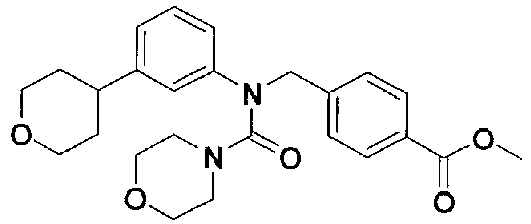
- Compound of Formula 2-3 (methyl 4-((N-(3-(3,6-dihydro-2H-pyran-4-yl)phenyl)morpholine-4-carboxamido)methyl)benz oate; 0.260 g, 0.596 mmol) was dissolved in tetrahydrofuran (10 mL) at room temperature, Pd/C (10.0%, 0.032 g, 0.030 mmol) was slowly added, a hydrogen balloon was attached, and then the mixture was stirred at the same temperature for 16 hours. The reaction mixture was filtered through celite pad, and the filtrate was concentrated under reduced pressure. Then, the residue was purified and concentrated by column chromatography (silica; ethyl acetate/hexane=20-50%) to give the desired compound of Formula 2-4 (0.217 g, 83%) in the form of a white solid.
-

- Compound of Formula 2-4 (methyl 4-((N-(3-(tetrahydro-2H-pyran-4-yl)phenyl)morpholine-4-carboxamido)methyl)benzoa te; 0.217 g, 0.495 mmol) was dissolved in methanol (10 mL), hydroxylamine (50.0 wt% aqueous solution; 1.51 mL, 24.7 mmol) was added at room temperature, and then potassium hydroxide (0.278 g, 4.95 mmol) was added and stirred at the same temperature for 30 minutes. Then, the reaction mixture was concentrated under reduced pressure until its volume became about 1 mL, and saturated sodium hydrogen carbonate aqueous solution (1-2 mL) was added and stirred. Then, the precipitated solid was filtered and dried to give the desired Compound 483 (0.120 g, 55%) in the form of a white solid.
1H NMR (400 MHz, DMSO-d6) δ 11.12 (brs, 1 H), 8.97 (brs, 1 H), 7.64 (d, 2 H, J = 8.2 Hz), 7.34 (d, 2 H, J = 8.3 Hz), 7.23 (t, 1 H, J = 7.7 Hz), 6.98 - 6.94 (m, 3 H), 4.84 (s, 2 H), 3.93 - 3.90 (m, 2 H), 3.42 - 3.37 (m, 6 H), 3.12 - 3.10 (m, 4 H), 2.69 (m, 1 H), 1.62 - 1.54 (m, 4 H). MS (ESI) m/z 440 (M+ + H). -

- Compound of Formula 1-1 (m- anisidine; 3.23 g, 26.2 mmol) and methyl 4-(bromomethyl)benzoate (5.00 g, 21.8 mmol) were dissolved in acetonitrile (50 mL), and N,N-diisopropylethylamine (5.80 mL, 32.7 mmol) was added and stirred at room temperature for 16 hours. After completion of the reaction, the organic layer was extracted with ethyl acetate and saturated sodium hydrogen carbonate aqueous solution, dehydrated with anhydrous magnesium sulfate, and then filtered. The filtrate was concentrated under reduced pressure, and then the residue was purified and concentrated by column chromatography (silica; ethyl acetate/hexane= 5%) to give the desired compound of Formula 1-2 (5.14 g, 87%) in the form of a light yellow liquid.
-

- Compound of Formula 1-2 (methyl 4-(((3-methoxyphenyl)amino)methyl)benzoate; 5.14 g, 18.9 mmol) and 4-nitrophenyl chloroformate (4.20 g, 20.8 mmol) were dissolved in acetonitrile (100 mL), and potassium carbonate (3.93 g, 28.4 mmol) was added and stirred at room temperature for 3 hours. After completion of the reaction, the organic layer was extracted with ethyl acetate and saturated sodium hydrogen carbonate aqueous solution, dehydrated with anhydrous magnesium sulfate, and then filtered. The filtrate was concentrated under reduced pressure, and then the residue was purified and concentrated by column chromatography (silica; ethyl acetate/ hexane=20%) to give the desired compound of Formula 1-3 (5.88 g, 71%) in the form of a yellow liquid.
-

- Compound of Formula 1-3 (methyl 4-(((3-methoxyphenyl)((4-nitrophenoxy)carbonyl)amino)methyl)benzoate; 5.88 g, 13.5 mmol) was dissolved in dimethylformamide (50 mL), and morpholine (2.35 g, 27.0 mmol) and potassium carbonate (5.60 g, 40.5 mmol) were added and stirred at 60 °C for 16 hours. After completion of the reaction, the organic layer was extracted with ethyl acetate and saturated ammonium chloride aqueous solution, dehydrated with anhydrous magnesium sulfate, and then filtered. The filtrate was concentrated under reduced pressure, and then the residue was purified and concentrated by column chromatography (silica; ethyl acetate/hexane=30%) to give the desired compound of Formula 1-4 (3.69 g, 71%) in the form of a yellow solid.
-

- Compound of Formula 1-4 (methyl 4-((N-(3-methoxyphenyl)morpholine-4-carboxamino)methyl)benzoate; 0.180 g, 0.468 mmol) was dissolved in methanol (10 mL), hydroxylamine (50.0 wt% aqueous solution; 1.43 mL, 23.4 mmol) was added at room temperature, and then potassium hydroxide (0.263 g, 4.68 mmol) was added and stirred at the same temperature for 30 minutes. Then, the concentrate was obtained by removing the solvent from the reaction mixture under reduced pressure. Saturated ammonium chloride aqueous solution was poured into the obtained concentrate, and the organic layer was extracted with ethyl acetate. The organic layer was washed with saturated sodium chloride aqueous solution, dehydrated with anhydrous magnesium sulfate, and then concentrated under reduced pressure. The residue was crystallized with dichloromethane (2 mL) and hexane (10 mL) to give the desired Compound 484 (0.140 g, 78%) in the form of a white solid.
1H NMR (400 MHz, DMSO-d6) δ 7.63 (d, 2 H, J = 8.1 Hz), 7.32 (m, 2 H), 7.19 (t, 1 H, J = 8.4 Hz), 6.69 - 6.67 (m, 2 H), 6.62 (m, 1 H), 4.84 (s, 2 H), 3.69 (s, 3 H), 3.39 - 3.36 (m, 4 H), 3.15 - 3.12 (m, 4 H). MS (ESI) m/z 386 (M+ + H). -

- Compound of Formula 1-3 (methyl 4-((((4-nitrophenoxy)carbonyl)(4-(trifluoromethyl)phenyl)amino)methyl)benzoate; 0.22 g, 0.46 mmol) was dissolved in dimethylformamide (5 ml), and potassium carbonate (0.19 g, 1.37 mmol) and 3,3-difluoroazetidine (0.19 g, 0.92 mmol) were then added. The mixture was reacted at 60 °C for 2 days, diluted with ethyl acetate and washed with saturated sodium ammonium chloride solution. The organic layer was dehydrated with anhydrous sodium sulfate, filtered, and then concentrated under reduced pressure. The residue was purified by column chromatography (silica; ethyl acetate/ hexane=50%) to give the desired compound of Formula 1-4 (0.20 g, 101%).
-

- Compound of Formula 1-4 (methyl 4-((3,3-difluoro-N-(4-(trifluoromethyl)phenyl)azetidine-1-carboxamido)methyl)benzoa te; 0.20 g, 0.47 mmol) was dissolved in methanol (10 ml), and hydroxylamine (50 wt% aqueous solution; 0.29 mL) and potassium hydroxide (0.13 g, 2.33 mmol) were then added and stirred overnight. After completion of the reaction, the methanol was removed by distillation under reduced pressure, and the organic layer was extracted with ethyl acetate and water, dehydrated with anhydrous sodium sulfate, filtered, and then concentrated under reduced pressure. The residue was purified by column chromatography (silica; methanol/dichloromethane= 10%) to give the desired Compound 485 (0.07 g, 36%) in the form of a white solid.
1H NMR (400 MHz, DMSO-d6) δ 11.13 (brs, 1 H), 8.98 (brs, 1 H), 7.84-7.81 (m, 2 H), 7.43-7.34 (m, 6 H), 4.42 (s, 2 H), 4.18-4.14 (m, 4 H). MS (ESI) m/z 430 (M+ + H). -

- Compound of Formula 1-3 (methyl 4-((((4-nitrophenoxy)carbonyl)(4-(trifluoromethyl)phenyl)amino)methyl)benzoate; 0.25 g, 0.53 mmol) was dissolved in dimethylformamide (5 ml), and potassium carbonate (0.22 g, 1.61 mmol) and 4-phenylpiperidin-4-ol (0.19 g, 1.07 mmol) were then added. The mixture was reacted at 60 °C for 2 days, diluted with ethyl acetate and washed with saturated sodium ammonium chloride solution. The organic layer was dehydrated with anhydrous sodium sulfate, filtered, and then concentrated under reduced pressure. The residue was purified by column chromatography (silica; ethyl acetate/ hexane=50%) to give the desired compound of Formula 1-4 (0.17 g, 60%).
-
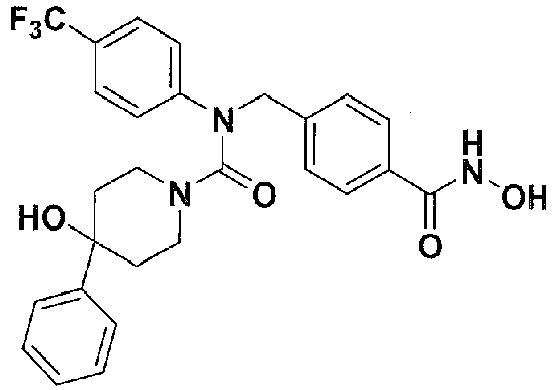
- Compound of Formula 1-4 (methyl 4-((4-hydroxy-4-phenyl-N-(4-(trifluoromethyl)phenyl)piperidine-1-carboxamido)meth yl)benzoate; 0.17 g, 0.32 mmol) was dissolved in methanol (10 ml), and hydroxylamine (50 wt% aqueous solution; 0.20 mL) and potassium hydroxide (0.09 g, 1.61 mmol) were then added and stirred overnight. After completion of the reaction, the methanol was removed by distillation under reduced pressure, and the organic layer was extracted with ethyl acetate and water, dehydrated with anhydrous magnesium sulfate, filtered, and then concentrated under reduced pressure. The residue was purified by column chromatography (silica; methanol/dichloromethane= 10%) to give the desired Compound 486 (0.09 g, 55%) in the form of a white solid.
1H NMR (400 MHz, DMSO-d6) δ 11.13 (brs, 1 H), 8.98 (brs, 1 H), 7.84-7.82 (m, 2 H), 7.55-7.53 (m, 2 H), 7.43-7.30 (m, 9 H), 4.42 (s, 2 H), 3.39-3.29 (m, 4 H), 2.10-2.05 (m, 2 H), 1.84-1.81 (m, 2 H). MS (ESI) m/z 496 (M+ + H). -

- Compound of Formula 6-1 (4-(bromomethyl)-3-fluorobenzonitrile; 1.93 g, 9.02 mmol) was dissolved in acetonitrile (20 mL), and then 3-bromoaniline (1.18 mL, 10.8 mmol) and N,N-diisopropylethylamine (2.40 mL, 13.5 mmol) were added at room temperature and stirred at the same temperature for 16 hours. Then, saturated sodium hydrogen carbonate aqueous solution was poured into the reaction mixture, and the organic layer was extracted with ethyl acetate. The organic layer was washed with saturated sodium chloride aqueous solution, dehydrated with anhydrous magnesium sulfate, and then concentrated under reduced pressure. The residue was purified and concentrated by column chromatography (silica; ethyl acetate/hexane=20%) to give the desired compound of Formula 6-2 (2.57 g, 93%) in the form of a light yellow liquid.
-

- Compound of Formula 6-2 (4-((3-bromophenylamino)methyl)-3- fluorobenzonitrile; 2.57 g, 8.42 mmol) and lithium hydroxide monohydrate (3.53 g, 84.2 mmol) were dissolved in methanol (20 mL)/water (10 mL) and stirred under reflux for 16 hours. Then, the concentrate was obtained by removing the solvent from the reaction mixture under reduced pressure. 1 N hydrochloric acid aqueous solution was poured into the obtained concentrate, and the organic layer was extracted with ethyl acetate. The organic layer was washed with saturated sodium chloride aqueous solution, dehydrated with anhydrous magnesium sulfate, and then concentrated under reduced pressure to give the desired compound of Formula 6-3 (2.57 g, 94%) in the form of a light yellow solid.
-

- Compound of Formula 6-3 (4-((3-bromophenylamino)methyl)-3-fluorobenzoic acid; 2.57 g, 7.93 mmol), methanol (6.43 mL, 159 mmol), and N,N-diisopropylethylamine (4.21 mL, 23.8 mmol) were dissolved in THF (50 mL), and then 1-ethyl-3-[3-dimethylaminopropyl]carbodiimide hydrochloride (EDC, 3.04 g, 15.9 mmol) and 1-hydroxybenzotriazole hydrate (HOBt, 2.14 g, 15.9 mmol) were added at room temperature and stirred at the same temperature for 16 hours. Then, saturated sodium hydrogen carbonate aqueous solution was poured into the reaction mixture, and the organic layer was extracted with ethyl acetate. The organic layer was washed with saturated sodium chloride aqueous solution, dehydrated with anhydrous magnesium sulfate, and then concentrated under reduced pressure. The residue was purified and concentrated by column chromatography (silica; ethyl acetate/hexane=20%) to give the desired compound of Formula 6-4 (2.48 g, 93%) in the form of a yellow liquid.
-

- Compound of Formula 6-4 (methyl 4-((3-bromophenylamino)methyl)-3-fluorobenzoate; 2.48 g, 7.33 mmol), 4-nitrophenyl chloroformate (1.63 g, 8.07 mmol), and potassium carbonate (1.52 g, 11.0 mmol) were dissolved in acetonitrile (30 mL) at room temperature and stirred at the same temperature for 16 hours. Then, saturated sodium hydrogen carbonate aqueous solution was poured into the reaction mixture, and the organic layer was extracted with ethyl acetate. The organic layer was washed with saturated sodium chloride aqueous solution, dehydrated with anhydrous magnesium sulfate, and then concentrated under reduced pressure to give the desired compound of Formula 6-5 (3.40 g, 92%) in the form of a yellow liquid.
-

- Compound of Formula 6-5 (methyl 4-(((3-bromophenyl)((4-nitrophenoxy)carbonyl)amino)methyl)-3-fluorobenzoate; 1.80 g, 3.58 mmol), morpholine (0.944 mL, 10.7 mmol), and potassium carbonate (2.47 g, 17.9 mmol) were dissolved in dimethylformamide (15 mL) at 50 °C and stirred at the same temperature for 16 hours. Then, saturated ammonium chloride aqueous solution was poured into the reaction mixture, and the organic layer was extracted with ethyl acetate. The organic layer was washed with saturated sodium chloride aqueous solution, dehydrated with anhydrous magnesium sulfate, and then concentrated under reduced pressure. The residue was purified and concentrated by column chromatography (silica; ethyl acetate/hexane=30-60%) to give the desired compound of Formula 6-6 (1.58 g, 98%) in the form of a yellow liquid.
-

- Compound of Formula 6-6 (methyl 4-((N-(3-bromophenyl)morpholine-4-carboxamido)methyl)-3-fluorobenzoate; 0.200 g, 0.443 mmol) was dissolved in methanol (10 mL), hydroxylamine (50.0 wt% aqueous solution; 1.90 mL, 31.0 mmol) was added at room temperature, and then potassium hydroxide (0.249 g, 4.43 mmol) was added and stirred at the same temperature for 30 minutes. Then, the concentrate was obtained by removing the solvent from the reaction mixture under reduced pressure. Saturated sodium hydrogen carbonate aqueous solution was poured into the obtained concentrate, and the organic layer was extracted with ethyl acetate. The organic layer was washed with saturated sodium chloride aqueous solution, dehydrated with anhydrous magnesium sulfate, and then concentrated under reduced pressure. Dichloromethane (2 mL) and diethylether (20 mL) were added to the concentrate and stirred. Then, the precipitated solid was filtered and dried to give the desired Compound 487 (0.162 g, 81%) in the form of a light brown solid.
1H NMR (400 MHz, DMSO-d6) δ 11.23 (brs, 1 H), 9.14 (brs, 1 H), 7.54 - 7.45 (m, 3 H), 7.40 (s, 1 H), 7.31 - 7.27 (m, 2 H), 7.15 (m, 1 H), 4.88 (s, 2 H), 3.41 - 3.38 (m, 4 H), 3.14 - 3.12 (m, 4 H). MS (ESI) m/z 452, 454 (M+ + H). -

- Compound of Formula 6-5 (methyl 4-(((3-bromophenyl)((4-nitrophenoxy)carbonyl)amino)methyl)-3-fluorobenzoate; 1.60 g, 3.18 mmol), 4-hydroxypiperidine (0.965 g, 9.54 mmol), and potassium carbonate (2.20 g, 15.9 mmol) were dissolved in dimethylformamide (15 mL) at 50 °C and stirred at the same temperature for 16 hours. Then, saturated ammonium chloride aqueous solution was poured into the reaction mixture, and the organic layer was extracted with ethyl acetate. The organic layer was washed with saturated sodium chloride aqueous solution, dehydrated with anhydrous magnesium sulfate, and then concentrated under reduced pressure. The residue was purified and concentrated by column chromatography (silica; ethyl acetate/hexane=50-80%) to give the desired compound of Formula 6-6 (1.16 g, 78%) in the form of a yellow liquid.
-

- Compound of Formula 6-6 (methyl 4-((N-(3-bromophenyl)-4-hydroxypiperidine-1-carboxamido)methyl)-3-fluorobenzoate ; 0.200 g, 0.430 mmol) was dissolved in methanol (10 mL), hydroxylamine (50.0 wt% aqueous solution; 1.84 mL, 30.1 mmol) was added at room temperature, and then potassium hydroxide (0.241 g, 4.30 mmol) was added and stirred at the same temperature for 30 minutes. Then, the concentrate was obtained by removing the solvent from the reaction mixture under reduced pressure. Saturated sodium hydrogen carbonate aqueous solution was poured into the obtained concentrate, and the organic layer was extracted with ethyl acetate. The organic layer was washed with saturated sodium chloride aqueous solution, dehydrated with anhydrous magnesium sulfate, and then concentrated under reduced pressure. Dichloromethane (2 mL) and diethylether (20 mL) were added to the concentrate and stirred. Then, the precipitated solid was filtered and dried to give the desired Compound 488 (0.101 g, 50%) in the form of a light yellow solid.
1H NMR (400 MHz, DMSO-d6) δ 11.23 (brs, 1 H), 9.14 (brs, 1 H), 7.63 - 7.46 (m, 3 H), 7.32 (s, 1 H), 7.27 - 7.24 (m, 2 H), 6.90 (m, 1 H), 4.85 (s, 2 H), 4.68 (s, 1 H), 3.55 - 3.45 (m, 3 H), 2.87 - 2.82 (m, 2H), 1.56 - 1.53 (m, 2 H), 1.15 - 1.12 (m, 2 H). MS (ESI) m/z 466, 468 (M+ + H). -

- Compound of Formula 4-4 (tert-butyl 4-(3-(N-(4-(methoxycarbonyl)benzyl)morpholine-4-carboxamido)phenyl)piperydine-1 -carboxylate; 0.100 g, 0.186 mmol) was dissolved in methanol (10 mL), hydroxylamine (50.0 wt% aqueous solution; 1.14 mL, 18.6 mmol) was added at room temperature, and then potassium hydroxide (0.104 g, 1.86 mmol) was added and stirred at the same temperature for 30 minutes. Then, the reaction mixture was concentrated under reduced pressure until its volume became about 1 mL, and saturated sodium hydrogen carbonate aqueous solution (1 mL) was added and stirred. Then, the precipitated solid was filtered and dried to give the desired Compound 489 (0.086 g, 86%) in the form of a white solid.
1H NMR (400 MHz, DMSO-d6) δ 7.63 (d, 2 H, J = 8.4 Hz), 7.34 (d, 2 H, J = 8.3 Hz), 7.22 (t, 1 H, J = 7.6 Hz), 6.99 - 6.93 (m, 3 H), 4.84 (s, 2 H), 4.06 - 4.02 (m, 2 H), 3.40 - 3.37 (m, 4 H), 3.12 - 3.10 (m, 4 H), 2.66 - 2.63 (m, 2 H), 1.71 - 1.68 (m, 2 H), 1.44 (m, 3 H), 1.40 (s, 9 H). MS (ESI) m/z 539 (M+ + H). -

- Compound of Formula 4-1 (tert-butyl 4-(3-(N-(4-(methoxycarbonyl)benzyl)morpholine-4-carboxamido)phenyl)-5,6-dihydro pyridine-1(2H)-carboxylate; 3.28 g, 6.12 mmol) was dissolved in THF (30 mL) at room temperature, Pd/C (130 mg) was slowly added, a hydrogen balloon was attached, and then the mixture was stirred at the same temperature for 16 hours. The reaction mixture was filtered through celite pad, and the filtrate was concentrated under reduced pressure to give the desired compound of Formula 4-4 (3.28 g, 99%) in the form of a white solid.
-

- Compound of Formula 4-4 (tert-butyl 4-(3-(N-(4-(methoxycarbonyl)benzyl)morpholine-4-carboxamido)phenyl)piperidin-1-c arboxylate; 3.10 g, 5.77 mmol) was dissolved in 1,4-dioxane (10 mL), and then hydrogen chloride (4.0 M 1,4-dioxane solution; 14.4 mL, 57.7 mmol) was added at room temperature and stirred at the same temperature for 3 hours. The reaction mixture was concentrated under reduced pressure to give the desired compound of Formula 4-5 (2.65 g, 99%) in the form of a white solid.
-

- Compound of Formula 4-5 (methyl 4-((N-(3-(piperidine-4-yl)phenyl)morpholine-4-carboxamido)methyl)bezonate hydrochloride; 0.150 g, 0.316 mmol) and N,N-diisopropylethylamine (0.168 mL, 0.949 mmol) were dissolved in dichloromethane (3 mL), and then acetic acid anhydride (0.065 g, 0.633 mmol) was added at room temperature and stirred at the same temperature for 1 hour. Saturated sodium hydrogen carbonate aqueous solution was poured into the reaction mixture, and the organic layer was extracted with ethyl acetate. The organic layer was washed with saturated sodium chloride aqueous solution, dehydrated with anhydrous magnesium sulfate, and then concentrated under reduced pressure. The residue was purified and concentrated by column chromatography (silica; ethyl acetate/hexane=80-100%) to give the desired compound of Formula 4-6 (0.148 g, 98%) in the form of a colorless liquid.
-

- Compound of Formula 4-6 (methyl 4-((N-(3-(1-acetylpiperidin-4-yl)phenyl)morpholine-4-carboxamido)methyl)benzoate; 0.148 g, 0.309 mmol) was dissolved in methanol (10 mL), hydroxylamine (50.0 wt% aqueous solution; 1.32 mL, 21.6 mmol) was added at room temperature, and then potassium hydroxide (0.173 g, 3.09 mmol) was added and stirred at the same time for 30 minutes. The concentrate was obtained by removing the solvent from the reaction mixture under reduced pressure. Saturated sodium hydrogen carbonate aqueous solution was poured into the obtained concentrate, and the organic layer was extracted with ethyl acetate. The organic layer was washed with saturated sodium chloride aqueous solution, dehydrated with anhydrous magnesium sulfate, and then concentrated under reduced pressure. Dichloromethane (5 mL) and hexane (20 mL) were added to the concentrate and stirred. Then, the precipitated solid was filtered and dried to give the desired Compound 490 (0.036 g, 24%) in the form of a white solid.
1H NMR (400 MHz, DMSO-d6) δ 11.12 (brs, 1 H), 9.03 (brs, 1 H), 7.63 (d, 2 H, J = 8.4 Hz), 7.33 (d, 2 H, J = 8.4 Hz), 7.22 (t, 1 H, J = 7.9 Hz), 6.99 - 6.93 (m, 3 H), 4.84 (s, 2 H), 4.50 (m, 1 H), 3.89 (m, 1 H), 3.39 - 3.36 (m, 4 H), 3.12 - 3.10 (m, 4 H), 2.68 (m, 1 H), 2.57 - 2.53 (m, 2 H), 2.01 (s, 3 H), 1.74 - 1.70 (m, 2 H), 1.54 (m, 1 H), 1.38 (m, 1 H). MS (ESI) m/z 481 (M+ + H). -

- Compound of Formula 4-5 (methyl 4-((N-(3-(piperidine-4-yl)phenyl)morpholine-4-carboxamido)methyl)bezonate hydrochloride; 0.150 g, 0.316 mmol) and N,N-diisopropylethylamine (0.168 mL, 0.949 mmol) were dissolved in dichloromethane (3 mL), and then methanesulfonyl chloride (0.049 ml, 0.633 mmol) was added at room temperature and stirred at the same temperature for 1 hour. Saturated sodium hydrogen carbonate aqueous solution was poured into the reaction mixture, and the organic layer was extracted with ethyl acetate. The organic layer was washed with saturated sodium chloride aqueous solution, dehydrated with anhydrous magnesium sulfate, and then concentrated under reduced pressure. The residue was purified and concentrated by column chromatography (silica; ethyl acetate/hexane=50-100%) to give the desired compound of Formula 4-6 (0.119 g, 73%) in the form of a colorless liquid.
-

- Compound of Formula 4-6 (methyl 4-((N-(3-(1-(methylsulfonyl)piperidin-4-yl)phenyl)morpholine-4-carboxamido)methyl) benzoate; 0.119 g, 0.231 mmol) was dissolved in methanol(10 mL), hydroxylamine (50.0 wt% aqueous solution; 0.988 mL, 16.2 mmol) was added at room temperature, and then potassium hydroxide (0.129 g, 2.31 mmol) was added and stirred at the same time for 30 minutes. The concentrate was obtained by removing the solvent from the reaction mixture under reduced pressure. Saturated sodium hydrogen carbonate aqueous solution was poured into the obtained concentrate, and the organic layer was extracted with ethyl acetate. The organic layer was washed with saturated sodium chloride aqueous solution, dehydrated with anhydrous magnesium sulfate, and then concentrated under reduced pressure. Dichloromethane (5 mL) and hexane (20 mL) were added to the concentrate and stirred. Then, the precipitated solid was filtered and dried to give the desired Compound 491 (0.043 g, 36%) in the form of a white solid.
1H NMR (400 MHz, DMSO-d6) δ 11.13 (brs, 1 H), 8.98 (brs, 1 H), 7.64 (d, 2 H, J = 8.2 Hz), 7.34 (d, 2 H, J = 8.3 Hz), 7.23 (t, 1 H, J = 7.8 Hz), 7.02 (s, 1 H), 6.97 (d, 2 H, J = 7.9 Hz), 4.85 (s, 2 H), 3.66 - 3.63 (m, 2 H), 3.38 - 3.36 (m, 4 H), 3.28 - 3.26 (m, 2 H), 3.12 - 3.10 (m, 4 H), 2.79 - 2.76 (m, 2 H), 2.66 - 2.61 (m, 2 H), 1.82 - 1.79 (m, 2 H), 1.64 - 1.60 (m, 2 H). MS (ESI) m/z 517 (M+ + H). -

- Compound of Formula 4-5 (methyl 4-((N-(3-(piperidine-4-yl)phenyl)morpholine-4-carboxamido)methyl)bezonate hydrochloride; 0.150 g, 0.316 mmol) and N,N-diisopropylethylamine (0.168 mL, 0.949 mmol) were dissolved in dichloromethane (3 mL), and then isopropyl isocyanate (0.054 ml, 0.633 mmol) was added at room temperature and stirred at the same temperature for 1 hour. Saturated sodium hydrogen carbonate aqueous solution was poured into the reaction mixture, and the organic layer was extracted with ethyl acetate. The organic layer was washed with saturated sodium chloride aqueous solution, dehydrated with anhydrous magnesium sulfate, and then concentrated under reduced pressure. The residue was purified and concentrated by column chromatography (silica; ethyl acetate/hexane=50-100%) to give the desired compound of Formula 4-6 (0.101 g, 61%) in the form of a white solid.
-

- Compound of Formula 4-6 (methyl 4-((N-(3-(1-(isopropylcarbamoyl)piperidin-4-yl)phenyl)morpholine-4-carboxamido)m ethyl)benzoate; 0.101 g, 0.193 mmol) was dissolved in methanol(10 mL), hydroxylamine (50.0 wt% aqueous solution; 0.827 mL, 13.5 mmol) was added at room temperature, and then potassium hydroxide (0.108 g, 1.93 mmol) was added and stirred at the same time for 30 minutes. The concentrate was obtained by removing the solvent from the reaction mixture under reduced pressure. Saturated sodium hydrogen carbonate aqueous solution was poured into the obtained concentrate, and the organic layer was extracted with ethyl acetate. The organic layer was washed with saturated sodium chloride aqueous solution, dehydrated with anhydrous magnesium sulfate, and then concentrated under reduced pressure. Dichloromethane (5 mL) and hexane (20 mL) were added to the concentrate and stirred. Then, the precipitated solid was filtered and dried to give the desired Compound 492 (0.047 g, 46%) in the form of a light brown solid.
1H NMR (400 MHz, DMSO-d6) δ 7.63 (d, 2 H, J = 8.2 Hz), 7.34 (d, 2 H, J = 8.2 Hz), 7.22 (t, 1 H, J = 8.2 Hz), 6.97 - 6.92 (m, 3 H), 6.13 (d, 1 H, J = 7.5 Hz), 4.84 (s, 2 H), 4.08 - 4.05 (m, 2 H), 3.76 (m, 1 H), 3.34 (m, 4 H), 3.11 (m, 4 H), 2.69 - 2.63 (m, 3 H), 1.67 - 1.64 (m, 2 H), 1.47 - 1.42 (m, 2 H), 1.04 (d, 6 H, J = 6.6 Hz). MS (ESI) m/z 524 (M+ + H). -

- Compound 489 (tert-butyl 4-(3-(N-(4-(hydroxycarbamoyl)benzyl)morpholine-4-carboxamido)phenyl)piperidine-1-carboxylate; 0.050 g, 0.093 mmol) was dissolved in 1,4-dioxane (3 mL), hydrogen chloride (4.0 M 1,4-dioxane solution; 0.696 mL, 2.79 mmol) was then added at room temperature and stirred at the same temperature, and the reaction mixture was concentrated under reduced pressure. Diethylether (10 mL) was added to the concentrate and stirred. Then, the precipitated solid was filtered and dried to give the desired Compound 493 (0.027 g, 61%) in the form of a brown solid.
1H NMR (400 MHz, DMSO-d6) δ 11.16 (brs, 1 H), 9.04 (brs, 1 H), 8.88 (brs, 1 H), 7.64 (d, 2 H, J = 7.8 Hz), 7.37 - 7.24 (m, 3 H), 7.12 - 6.98 (m, 2 H), 4.87 (s, 2 H), 3.26 (m, 3 H), 3.11 (m, 4 H), 2.94 (m, 2 H), 2.82 (m, 2 H), 1.83 - 1.78 (m, 3 H), 1.39 (m, 4 H). MS (ESI) m/z 439 (M+ + H). -

- Compound of Formula 1-3 (methyl 4-((((4-nitrophenoxy)carbonyl)(3-(trifluoromethyl)phenyl)amino)methyl)benzoate; 0.21 g, 0.45 mmol) was dissolved in dimethylformamide (3 mL), and potassium carbonate (0.19 g, 1.34 mmol) and 1-(piperazin-1-yl)ethanone (0.06 g, 0.45 mmol) were then added. The mixture was reacted at 60 °C for 1 day and then diluted with saturated ammonium chloride solution. The organic layer was extracted with ethyl acetate, dehydrated with anhydrous sodium sulfate, filtered, and then concentrated under reduced pressure. The residue was purified by column chromatography (silica; ethyl acetate/ hexane = 60%) to give the desired compound of Formula 1-4 (0.16 g, 75%).
-

- Compound of Formula 1-4 (methyl 4-((4-acetyl-N-(3-(trifluoromethyl)phenyl)piperazine-1-carboxamido)methyl)benzoate; 0.16 g, 0.33 mmol) was dissolved in methanol (5 mL), and hydroxylamine (50 wt% aqueous solution; 0.21 mL) and potassium hydroxide (0.09 g, 1.67 mmol) were then added and stirred overnight. After completion of the reaction, the methanol was removed by distillation under reduced pressure, and the organic layer was extracted with ethyl acetate and water, dehydrated with anhydrous sodium sulfate, filtered, and then concentrated under reduced pressure. The residue was purified by column chromatography (silica; methanol/dichloromethane=10%) to give the desired Compound 494 (0.02 g, 10%) in the form of a yellow solid.
1H NMR (400 MHz, DMSO-d6) δ 11.16 (brs, 1 H), 9.17 (brs, 1 H), 7.65 (d, 2 H, J = 8.2 Hz), 7.53-7.36 (m, 6 H), 4.95 (s, 2 H), 3.29 (m, 4 H), 3.15 (m, 4 H), 1.94 (s, 3 H). MS (ESI) m/z 465 (M+ + H). -

- Compound of Formula 1-3 (methyl 4-((((4-nitrophenoxy)carbonyl)(3-(trifluoromethyl)phenyl)amino)methyl)benzoate; 0.23 g, 0.49 mmol) was dissolved in dimethylformamide (5 mL), and potassium carbonate (0.20 g, 1.48 mmol) and (R)-3-fluoropyrrolidine hydrochloride (0.12 g, 0.99 mmol) were then added. The mixture was reacted at 60 °C for 1 day and then diluted with saturated ammonium chloride solution. The organic layer was extracted with ethyl acetate, dehydrated with anhydrous sodium sulfate, filtered, and then concentrated under reduced pressure. The residue was purified by column chromatography (silica; ethyl acetate/ hexane = 40%) to give the desired compound of Formula 1-4 (0.18 g, 87%).
-

- Compound of Formula 1-4 ((R)-methyl 4-((3-fluoro-N-(3-(trifluoromethyl)phenyl)pyrrolidine-1-carboxamido)methyl)benzoate ; 0.18 g, 0.43 mmol) was dissolved in methanol (5 mL), and hydroxylamine (50 wt% aqueous solution; 0.26 mL) and potassium hydroxide (0.12 g, 2.16 mmol) were then added and stirred overnight. After completion of the reaction, the methanol was removed by distillation under reduced pressure, and the organic layer was extracted with ethyl acetate and saturated potassium carbonate aqueous solution, dehydrated with anhydrous sodium sulfate, filtered, and then concentrated under reduced pressure. The residue was purified by column chromatography (silica; methanol/ dichloromethane=10%) to give the desired Compound 495 (0.10 g, 54%) in the form of a white solid.
1H NMR (400 MHz, DMSO-d6) δ 11.14 (brs, 1 H), 9.00 (brs, 1 H), 7.64 (d, 2 H, J = 7.7 Hz), 7.52 (t, 1 H, J = 7.9 Hz), 7.45-7.35 (m, 5 H), 5.19 (d, 1 H, J = 53.1 Hz), 4.99-4.89 (m, 2 H), 3.32-3.18 (m, 3 H), 3.09-3.02 (m, 1 H), 1.99-1.83 (m, 2 H). MS (ESI) m/z 426 (M+ + H). -

- Compound of Formula 1-3 (methyl 4-((((4-nitrophenoxy)carbonyl)(3-(trifluoromethyl)phenyl)amino)methyl)benzoate; 0.29 g, 0.62 mmol) was dissolved in dimethylformamide (5 mL), and potassium carbonate (0.26 g, 1.86 mmol) and (S)-3-fluoropyrrolidine hydrochloride (0.16 g, 1.24 mmol) were then added. The mixture was reacted at 60 °C for 1 day and then diluted with saturated ammonium chloride solution. The organic layer was extracted with ethyl acetate, dehydrated with anhydrous sodium sulfate, filtered, and then concentrated under reduced pressure. The residue was purified by column chromatography (silica; ethyl acetate/ hexane = 40%) to give the desired compound of Formula 1-4 (0.20 g, 75 %).
-

- Compound of Formula 1-4 ((S)-methyl 4-((3-fluoro-N-(3-(trifluoromethyl)phenyl)pyrrolidine-1-carboxamido)methyl)benzoate ; 0.20 g, 0.47 mmol) was dissolved in methanol (5 mL), and hydroxylamine (50 wt% aqueous solution; 0.29 mL) and potassium hydroxide (0.13 g, 2.33 mmol) were then added and stirred overnight. After completion of the reaction, the methanol was removed by distillation under reduced pressure, and the organic layer was extracted with ethyl acetate and saturated potassium carbonate aqueous solution, dehydrated with anhydrous sodium sulfate, filtered, and then concentrated under reduced pressure. The residue was purified by column chromatography (silica; methanol/ dichloromethane=10%) to give the desired Compound 496 (0.14 g, 72%) in the form of a white solid.
1H NMR (400 MHz, DMSO-d6) δ 11.15 (brs, 1 H), 10.18 (brs, 1 H), 9.00 (brs, 1 H), 7.65 (d, 2 H, J = 8.2 Hz), 7.53-7.49 (m, 1 H), 7.45-7.33 (m, 5 H), 5.19 (d, 1 H, J = 53.2 Hz), 4.99-4.89 (m, 2 H), 3.36-3.19 (m, 3 H), 3.09-3.02 (m, 1 H), 1.99-1.83 (m, 2 H). MS (ESI) m/z 426 (M+ + H). -

- Compound of Formula 1-3 (methyl 4-((((4-nitrophenoxy)carbonyl)(3-(trifluoromethyl)phenyl)amino)methyl)benzoate; 0.23 g, 0.48 mmol) was dissolved in dimethylformamide (5 mL), and potassium carbonate (0.20 g, 1.44 mmol) and (R)- pyrrolidin-2-ylmethanol (0.10 g, 0.96 mmol) were then added. The mixture was reacted at 60 °C for 1 day and then diluted with saturated ammonium chloride solution. The organic layer was extracted with ethyl acetate, dehydrated with anhydrous sodium sulfate, filtered, and then concentrated under reduced pressure. The residue was purified by column chromatography (silica; ethyl acetate/ hexane = 40%) to give the desired compound of Formula 1-4 (0.15 g, 73%).
-

- Compound of Formula 1-4 ((R)-methyl 4-((2-(hydorxymethyl)-N-(3-(trifluoromethyl)phenyl)pyrrolidine-1-carboxamido)meth yl)benzoate; 0.15 g, 0.39 mmol) was dissolved in methanol (5 mL), and hydroxylamine (50 wt% aqueous solution; 0.21 mL) and potassium hydroxide (0.10 g, 1.74 mmol) were then added and stirred overnight. After completion of the reaction, the methanol was removed by distillation under reduced pressure, and the organic layer was extracted with ethyl acetate and saturated potassium carbonate aqueous solution, dehydrated with anhydrous sodium sulfate, filtered, and then concentrated under reduced pressure. The residue was purified by column chromatography (silica; methanol/ dichloromethane=10%) to give the desired Compound 497 (0.04 g, 28%) in the form of a white solid.
1H NMR (400 MHz, DMSO-d6) δ 11.13 (brs, 1 H), 8.98 (brs, 1 H), 7.84-7.82 (m, 3 H), 7.65-7.63 (m, 1 H), 7.41-7.17 (m, 4 H), 4.42 (s, 2 H), 3.88-3.63 (m, 2 H), 3.43-3.30 (m, 3 H), 1.67-1.42 (m, 4 H). MS (ESI) m/z 438 (M+ + H). -

- Compound of Formula 1-3 (methyl 4-((((4-nitrophenoxy)carbonyl)(3-(trifluoromethyl)phenyl)amino)methyl)benzoate; 0.22 g, 0.47 mmol) was dissolved in dimethylformamide (5 mL), and potassium carbonate (0.20 g, 1.42 mmol) and (S)- 2-(trifluoromethyl)pyrrolidine (0.13 g, 0.95 mmol) were then added. The mixture was reacted at 60 °C for 1 day and then diluted with saturated ammonium chloride solution. The organic layer was extracted with ethyl acetate, dehydrated with anhydrous sodium sulfate, filtered, and then concentrated under reduced pressure. The residue was purified by column chromatography (silica; ethyl acetate/ hexane = 30%) to give the desired compound of Formula 1-4 (0.17 g, 74%).
-
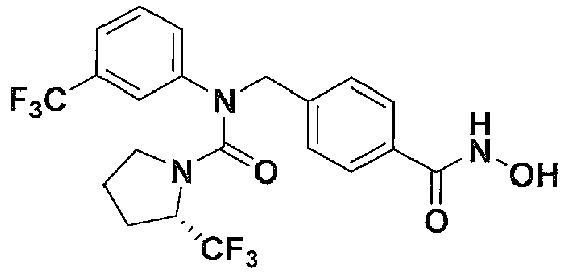
- Compound of Formula 1-4 ((S)-methyl 4-((2-(trifluoromethyl)-N-(3-(trifluoromethyl)phenyl)pyrrolidine-1-carboxamido)meth yl)benzoate; 0.17 g, 0.35 mmol) was dissolved in methanol (5 mL), and hydroxylamine (50 wt% aqueous solution; 0.21 mL) and potassium hydroxide (0.10 g, 1.74 mmol) were then added and stirred overnight. After completion of the reaction, the methanol was removed by distillation under reduced pressure, and the organic layer was extracted with ethyl acetate and saturated potassium carbonate aqueous solution, dehydrated with anhydrous sodium sulfate, filtered, and then concentrated under reduced pressure. The residue was purified by column chromatography (silica; methanol/ dichloromethane=10%) to give the desired Compound 498 (0.07 g, 44%) in the form of a white solid.
1H NMR (400 MHz, DMSO-d6) δ 11.13 (brs, 1 H), 8.98 (brs, 1 H), 7.84-7.82 (m, 3 H), 7.65-7.63 (m, 1 H), 7.41-7.17 (m, 4 H), 4.42 (s, 2 H), 4.17-4.15 (m, 1 H), 3.40-3.30 (m, 2 H), 1.67-1.42 (m, 4 H). MS (ESI) m/z 438 (M+ + H). -

- Compound of Formula 10-1 (3-hydroxymethylaniline; 5.00 g, 40.6 mmol), methyl 4-formylbenzoate (8.00 g, 48.7 mmol) and acetic acid (4.64 mL, 81.2 mmol) were dissolved in methanol (100 mL) and stirred at room temperature for 30 minutes, and then sodium cyanoborohydride (3.83 g, 60.9 mmol) was added and stirred at the same temperature for 16 hours. Then, the concentrate was obtained by removing the solvent from the reaction mixture under reduced pressure. Saturated sodium hydrogen carbonate aqueous solution was poured into the obtained concentrate, and then the organic layer was extracted with ethyl acetate. The organic layer was washed with saturated sodium chloride aqueous solution, dehydrated with anhydrous magnesium sulfate, and then concentrated under reduced pressure. The residue was purified and concentrated by column chromatography (silica; ethyl acetate/hexane=20-50%) to give the desired compound of Formula 10-2 (10.9 g, 99%) in the form of a light yellow solid.
-

- Compound of Formula 10-2 (methyl 4-((3-(hydroxymethyl)phenylamino)methyl)benzoate; 1.60 g, 5.90 mmol) and potassium carbonate (1.63 g, 11.8 mmol) were dissolved in acetonitrile (100 mL), and then 4-nitrophenyl chloroformate (1.31 g, 6.49 mmol) was added at room temperature and stirred at the same temperature for 16 hours. Then, saturated sodium hydrogen carbonate aqueous solution was poured into the reaction mixture, and the organic layer was extracted with ethyl acetate. The organic layer was washed with saturated sodium chloride aqueous solution, dehydrated with anhydrous magnesium sulfate, and then concentrated under reduced pressure to give the desired compound of Formula 10-3 (2.43 g, 94%) in the form of a yellow liquid.
-

- Compound of Formula 10-3 (methyl 4-(((3-(hydroxymethyl)phenyl)((4-nitrophenoxy)carbonyl)amino)methyl)benzoate; 2.43 g, 5.57 mmol), morpholine (2.45 mL, 27.8 mmol) and potassium carbonate (3.85 g, 27.8 mmol) were dissolved in dimethylformamide (20 mL) at room temperature and stirred at the same temperature for 60 hours. Then, saturated ammonium chloride aqueous solution was poured into the reaction mixture, and the organic layer was extracted with ethyl acetate. The organic layer was washed with saturated sodium chloride aqueous solution, dehydrated with anhydrous magnesium sulfate, and then concentrated under reduced pressure. The residue was purified and concentrated by column chromatography (silica; ethyl acetate/hexane=50-100%) to give the desired compound of Formula 10-4 (1.96 g, 92%) in the form of a yellow liquid.
-

- Compound of Formula 10-4 (methyl 4-((N-(3-(hydroxymethyl)phenyl)morpholine-4-carboxamido)methyl)benzoate; 1.96 g, 5.10 mmol) and lithium hydroxide monohydrate (2.14 g, 51.0 mmol) were dissolved in methanol (10 mL)/water (5 mL) and stirred at 50 °C for 16 hours. Then, the concentrate was obtained by removing the solvent from the reaction mixture under reduced pressure. 0.5 N hydrochloric acid aqueous solution was poured into the obtained concentrate, and the organic layer was extracted with ethyl acetate. The organic layer was washed with saturated sodium chloride aqueous solution, dehydrated with anhydrous magnesium sulfate, and then concentrated under reduced pressure to give the desired compound of Formula 10-5 (1.82 g, 96%) in the form of a light yellow solid.
-

- Compound of Formula 10-5 (4-((N-(3-(hydroxymethyl)phenyl)morpholine-4-carboxamido)methyl)benzoic acid; 1.82 g, 4.91 mmol) and N,N-diisopropylethylamine (2.61 mL, 14.7 mmol) were dissolved in dichloromethane (30 mL), and then O-(tetrahydropyran-2-yl)hydroxylamine (0.748 g, 6.39 mmol) was added at room temperature. Then, 1-ethyl-3-[3-dimethylaminopropyl]carbodiimide hydrochloride (EDC, 1.88 g, 9.83 mmol) and 1-hydroxybenzotriazole hydrate (HOBt, 1.34 g, 9.83 mmol) were added and then stirred at the same temperature for 16 hours. Then, saturated sodium hydrogen carbonate aqueous solution was poured into the reaction mixture, and the organic layer was extracted with dichloromethane. The organic layer was washed with saturated sodium chloride aqueous solution, dehydrated with anhydrous magnesium sulfate, and then concentrated under reduced pressure. The residue was purified and concentrated by column chromatography (silica; ethyl acetate/ hexane=70-100%) to give the desired compound of Formula 10-6 (1.35 g, 58%) in the form of a white solid.
-

- Compound of Formula 10-6 (N-(3-(hydroxymethyl)phenyl)-N-(4-(tetrahydro-2H-pyran-2-yloxycarbamoyl)benzyl) morpholine-4-carboxamide; 0.050 g, 0.106 mmol) was dissolved in methanol (3 mL), and then hydrogen chloride (4.0 M 1,4-dioxane solution; 0.799 mL, 3.20 mmol) was added at room temperature and stirred at the same temperature for 1 hour. Then, the concentrate was obtained by removing the solvent from the reaction mixture under reduced pressure. Saturated sodium hydrogen carbonate aqueous solution was poured into the obtained concentrate, and then the organic layer was extracted with ethyl acetate. The organic layer was washed with saturated sodium chloride aqueous solution, dehydrated with anhydrous magnesium sulfate, and then concentrated under reduced pressure to give the desired Compound 499 (0.016 g, 39%) in the form of a light yellow solid.
1H NMR (400 MHz, DMSO-d6) δ 11.12 (brs, 1 H), 8.97 (brs, 1 H), 7.64 (d, 2 H, J = 8.2 Hz), 7.35 (d, 2 H, J = 8.2 Hz), 7.27 (m, 1 H), 7.10 (s, 1 H), 6.99 - 6.97 (m, 2 H), 4.88 (s, 2 H), 4.43 (s, 2 H), 3.38 (m, 4 H), 3.16 (m, 4 H). MS (ESI) m/z 386 (M+ + H). -
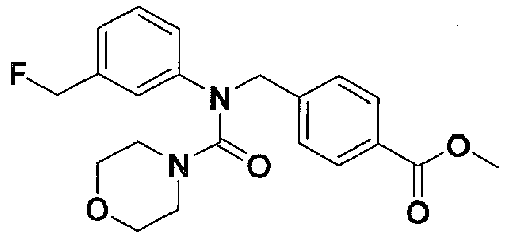
- Compound of Formula 10-5 (4-((N-(3-(hydroxymethyl)phenyl)morpholine-4-carboxamido)methyl)benzoic acid; 1.25 g, 3.25 mmol) was dissolved in dichloromethane (20 mL), and then diethylaminosulfur trifluoride (DAST, 0.424 mL, 3.58 mmol) was added 0 °C and stirred at the same temperature for 1 hour. Then, saturated sodium hydrogen carbonate aqueous solution was poured into the reaction mixture, and the organic layer was extracted with dichloromethane. The organic layer was washed with saturated sodium chloride aqueous solution, dehydrated with anhydrous magnesium sulfate, and then concentrated under reduced pressure. The residue was purified and concentrated by column chromatography (silica; ethyl acetate/hexane=30-50%) to give the desired compound of Formula 10-7 (0.617 g, 49%) in the form of a colorless liquid.
-

- Compound of Formula 10-7 (methyl 4-((N-(3-(fluoromethyl)phenyl)morpholine-4-carboxamido)methyl)benzoate; 0.100 g, 0.259 mmol) was dissolved in methanol (10 mL), hydroxylamine (50.0 wt% aqueous solution; 1.11 mL, 18.1 mmol) was added room temperature, and then potassium hydroxide (0.145 g, 2.59 mmol) was added and stirred at the same temperature for 30 minutes. Then, the concentrate was obtained by removing the solvent from the reaction mixture under reduced pressure. saturated sodium hydrogen carbonate aqueous solution was poured into the obtained concentrate, and then the organic layer was extracted with ethyl acetate. The organic layer was washed with saturated sodium chloride aqueous solution, dehydrated with anhydrous magnesium sulfate, and then concentrated under reduced pressure. Dichloromethane (5 mL) and hexane (30 mL) were added to the concentrate and stirred. Then, the precipitated solid was filtered and dried to give the desired Compound 500 (0.089 g, 89%) in the form of a white solid.
1H NMR (400 MHz, DMSO-d6) δ 11.12 (brs, 1 H), 8.98 (brs, 1 H), 7.64 (d, 2 H, J = 8.3 Hz), 7.36 - 7.32 (m, 3 H), 7.20 (s, 1 H), 7.15 (d, 1 H, J = 7.5 Hz), 7.09 (d, 1 H, J = 7.4 Hz), 5.36 (d, 2 H, J = 47.5 Hz), 4.87 (s, 2 H), 3.39 (t, 4 H, J = 4.6 Hz), 3.13 (t, 4 H, J = 4.6 Hz). MS (ESI) m/z 388 (M+ + H). -

- Compound of Formula 6-6 (methyl 4-((N-(3-bromophenyl)morpholine-4-carboxamido)methyl)-3-fluorobenzoate; 0.200 g, 0.443 mmol), benzo[d][1,3]dioxol-5-ylboronic acid (0.096 g, 0.576 mmol), Pd(dppf)Cl 2 (0.018 g, 0.022 mmol) and sodium carbonate (2.0 M aqueous solution; 0.665 mL, 1.33 mmol) were dissolved in 1,4-dioxane (2 mL) and stirred at 110 °C for 16 hours. Then, saturated sodium hydrogen carbonate aqueous solution was poured into the reaction mixture, and the organic layer was extracted with ethyl acetate. The organic layer was washed with saturated sodium chloride aqueous solution, dehydrated with anhydrous magnesium sulfate, and then concentrated under reduced pressure. The residue was purified and concentrated by column chromatography (silica; ethyl acetate/hexane=30-60%) to give the desired compound of Formula 6-7 (0.077 g, 35%) in the form of a white solid.
-

- Compound of Formula 6-7 (methyl 4-((N-(3-(benzo[d][1,3]dioxol-5-yl)phenyl)morpholine-4-carboxamido)methyl)-3-fluor obenzoate; 0.077 g, 0.156 mmol) was dissolved in methanol (10 mL), hydroxylamine (50.0 wt% aqueous solution; 0.956 mL, 15.6 mmol) was added at room temperature, and then potassium hydroxide (0.088 g, 1.56 mmol) was added and stirred at the same temperature for 30 minutes. Then, the concentrate was obtained by removing the solvent from the reaction mixture under reduced pressure. saturated sodium hydrogen carbonate aqueous solution was poured into the obtained concentrate and stirred. Then, the precipitated solid was filtered and dried to give the desired Compound 511 (0.056 g, 73%) in the form of a white solid.
MS (ESI) m/z 494 (M+ + H). -

- Compound of Formula 6-6 (methyl 4-((N-(3-bromophenyl)morpholine-4-carboxamido)methyl)-3-fluorobenzoate; 0.300 g, 0.665 mmol), 3,6-dihydro-2H-pyran-4-boronic acid pinacol ester (0.182 g, 0.864 mmol), Pd(dppf)Cl2 (0.027 g, 0.033 mmol) and sodium carbonate (2.0 M aqueous solution; 0.997 mL, 1.99 mmol) were dissolved in 1,4-dioxane (3 mL) and stirred at 110 °C for 16 hours. Then, saturated sodium hydrogen carbonate aqueous solution was poured into the reaction mixture, and the organic layer was extracted with ethyl acetate. The organic layer was washed with saturated sodium chloride aqueous solution, dehydrated with anhydrous magnesium sulfate, and then concentrated under reduced pressure. The residue was purified and concentrated by column chromatography (silica; ethyl acetate/hexane=20-50%) to give the desired compound of Formula 6-7 (0.068 g, 23%) in the form of a light brown solid.
-
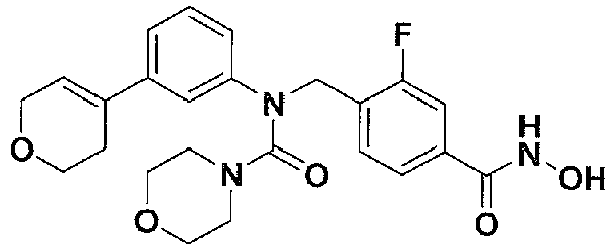
- Compound of Formula 6-7 (methyl 4-((N-(3-(3,6-dihydro-2H-pyran-4-yl)phenyl)morpholine-4-carboxamido)methyl)-3-flu orobenzoate; 0.068 g, 0.150 mmol) was dissolved in methanol (10 mL), hydroxylamine (50.0 wt% aqueous solution; 0.915 mL, 15.0 mmol) was added at room temperature, and then potassium hydroxide (0.084 g, 1.50 mmol) was added and stirred at the same temperature for 30 minutes. Then, the concentrate was obtained by removing the solvent from the reaction mixture under reduced pressure. saturated sodium hydrogen carbonate aqueous solution was poured into the obtained concentrate and was extracted with ethyl acetate. The organic layer was washed with saturated sodium chloride aqueous solution, dehydrated with anhydrous magnesium sulfate, and then concentrated under reduced pressure. Dichloromethane (3 mL) and hexane (20 mL) were added to the concentrate and stirred. Then, the precipitated solid was filtered and dried to give the desired Compound 512 (0.028 g, 41%) in the form of a white solid.
1H NMR (400 MHz, DMSO-d6) δ 11.25 (brs, 1 H), 9.11 (brs, 1 H), 7.53 - 7.43 (m, 3 H), 7.29 (m, 1 H), 7.21 - 7.17 (m, 2 H), 7.04 (m, 1 H), 6.25 (s, 1 H), 4.88 (s, 2 H), 4.20 (m, 2 H), 3.79 (m, 2 H), 3.36 (m, 4 H), 3.12 (m, 4 H), 2.38 (m, 2 H). MS (ESI) m/z 456 (M+ + H). -

- Compound of Formula 6-6 (methyl 4-((N-(3-bromophenyl)-4-hydroxypiperidine-1-carboxamido)methyl)-3-fluorobenzoate ; 0.200 g, 0.430 mmol), benzo[d][1,3]dioxol-5-ylboronic acid (0.093g, 0.559 mmol), Pd(dppf)Cl2 (0.018 g, 0.021 mmol) and sodium carbonate (2.0 M aqueous solution; 0.645 mL, 1.29 mmol) were dissolved in 1,4-dioxane (2 mL) and stirred at 110 °C for 16 hours. Then, saturated sodium hydrogen carbonate aqueous solution was poured into the reaction mixture, and the organic layer was extracted with ethyl acetate. The organic layer was washed with saturated sodium chloride aqueous solution, dehydrated with anhydrous magnesium sulfate, and then concentrated under reduced pressure. The residue was purified and concentrated by column chromatography (silica; ethyl acetate/hexane=40-70%) to give the desired compound of Formula 6-7 (0.037 g, 17%) in the form of a light yellow solid.
-
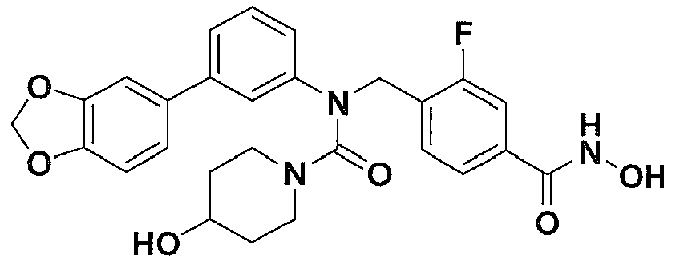
- Compound of Formula 6-7 (methyl 4-((N-(3-(benzo[d][1,3]dioxol-5-yl)phenyl)-4-hydroxypiperidine-1-carboxamido)meth yl)-3-fluorobenzoate; 0.037 g, 0.073 mmol) was dissolved in methanol (10 mL), hydroxylamine (50.0 wt% aqueous solution; 0.447 mL, 7.31 mmol) was added at room temperature, and then potassium hydroxide (0.041 g, 0.730 mmol) was added and stirred at the same temperature for 30 minutes. Then, the concentrate was obtained by removing the solvent from the reaction mixture under reduced pressure. Saturated sodium hydrogen carbonate aqueous solution was poured into the obtained concentrate and stirred. Then, the precipitated solid was filtered and dried to give the desired Compound 513 (0.032 g, 86%) in the form of a light brown solid.
1H NMR (400 MHz, DMSO-d6) δ 7.63 - 7.59 (m, 2 H), 7.54 (m, 1 H), 7.36 - 7.32 (m, 3 H), 7.21 (m, 1 H), 7.09 (m, 1 H), 7.02 (m, 1 H), 6.96 (m, 1 H), 6.65 (s, 2 H), 4.89 (s, 2 H), 4.63 (d, 1 H, J = 4.0 Hz), 3.52 - 3.49 (m, 3 H), 2.85 - 2.82 (m, 2 H), 1.53 - 1.50 (m, 2 H), 1.13 - 1.09 (m, 2 H).MS (ESI) m/z 508 (M+ + H). -

- Compound of Formula 6-6 (methyl 4-((N-(3-bromophenyl)-4-hydroxypiperidine-1-carboxamido)methyl)-3-fluorobenzoate ; 0.300 g, 0.645 mmol), 3,6-dihydro-2H-pyran-4-boronic acid pinacol ester (0.176 g, 0.838 mmol), Pd(dppf)Cl2 (0.026 g, 0.032 mmol) and sodium carbonate (2.0 M aqueous solution; 0.967 mL, 1.93 mmol) were dissolved in 1,4-dioxane (3 mL) and stirred at 110 °C for 16 hours. Then, saturated sodium hydrogen carbonate aqueous solution was poured into the reaction mixture, and the organic layer was extracted with ethyl acetate. The organic layer was washed with saturated sodium chloride aqueous solution, dehydrated with anhydrous magnesium sulfate, and then concentrated under reduced pressure. The residue was purified and concentrated by column chromatography (silica; ethyl acetate/hexane=50-80%) to give the desired compound of Formula 6-7 (0.078 g, 26%) in the form of a light yellow solid.
-

- Compound of Formula 6-7 (methyl 4-((N-(3-(3,6-dihydro-2H-pyran-4-yl)phenyl)-4-hydroxypiperidine-1-carboxamido)me thyl)-3-fluorobenzoate; 0.078 g, 0.166 mmol) was dissolved in methanol (10 mL), hydroxylamine (50.0 wt% aqueous solution; 1.02 mL, 16.6 mmol) was added at room temperature, and then potassium hydroxide (0.093 g, 1.67 mmol) was added and stirred at the same temperature for 30 minutes. Then, the concentrate was obtained by removing the solvent from the reaction mixture under reduced pressure. saturated sodium hydrogen carbonate aqueous solution was poured into the obtained concentrate and was extracted with ethyl acetate. The organic layer was washed with saturated sodium chloride aqueous solution, dehydrated with anhydrous magnesium sulfate, and then concentrated under reduced pressure. Dichloromethane (3 mL) and hexane (20 mL) were added to the concentrate and stirred. Then, the precipitated solid was filtered and dried to give the desired Compound 514 (0.036 g, 46%) in the form of a light green solid.
1H NMR (400 MHz, DMSO-d6) δ 11.25 (brs, 1 H), 9.11 (brs, 1 H), 7.54 - 7.44 (m, 3 H), 7.28 (t, 1 H, J = 7.8 Hz), 7.18 - 7.15 (m, 2 H), 7.00 (d, 1 H, J = 8.6 Hz), 6.23 (s, 1 H), 4.84 (s, 2 H), 4.63 (d, 1 H, J = 4.0 Hz), 4.19 (m, 2 H), 3.79 (t, 2 H, J = 5.4 Hz), 3.52 - 3.46 (m, 3 H), 2.83 - 2.76 (m, 2 H), 2.37 (m, 2 H), 1.52 - 1.49 (m, 2 H), 1.16-1.13 (m, 2 H). MS (ESI) m/z 470 (M+ + H). -

- Compound of Formula 4-5 (methyl 4-((N-(3-(piperidin-4-yl)phenyl)morpholine-4-carboxyamido)methyl)benzoate hydrochloride; 0.540 g, 1.139 mmol), 2,2-dimethyloxirane (0.411 g, 5.696 mmol) and potassium carbonate (0.472 g, 3.42 mmol) were mixed with water (1 mL)/ethanol (3 mL). Then, the mixture was heated at 120 °C for 20 minutes under microwave irradiation, and then the temperature was lowered to room temperature. Then, the concentrate was obtained by removing the solvent from the reaction mixture under reduced pressure. water was poured into the obtained concentrate, and the organic layer was extracted with ethyl acetate. The organic layer was washed with saturated sodium chloride aqueous solution, dehydrated with anhydrous magnesium sulfate, and then concentrated under reduced pressure. The residue was purified and concentrated by column chromatography (silica; methanol/dichloromethane=2-10%) to give the desired compound of Formula 4-7 (0.325 g, 55%) in the form of a colorless liquid.
-

- Compound of Formula 4-7 (ethyl 4-((N-(3-(1-(2-hydroxy-2-methylpropyl)piperidine-4-yl)phenyl)morpholine-4-carboxa mido)methyl)benzoate; 0.050 g, 0.095 mmol) was dissolved in methanol (10 mL), hydroxylamine (50.0 wt% aqueous solution; 0.584 mL, 9.55 mmol) was added at room temperature, and then potassium hydroxide (0.054 g, 0.955 mmol) was added and stirred at the same temperature for 30 minutes. Then, the concentrate was obtained by removing the solvent from the reaction mixture under reduced pressure. Saturated sodium hydrogen carbonate aqueous solution was poured into the obtained concentrate, and the organic layer was extracted with ethyl acetate. The organic layer was washed with saturated sodium chloride aqueous solution, dehydrated with anhydrous magnesium sulfate, and then concentrated under reduced pressure. Dichloromethane (2 mL) and hexane (20 mL) were added to the concentrate and stirred. Then, the precipitated solid was filtered and dried to give the desired Compound 517 (0.032 g, 66%) in the form of a white solid.
1H NMR (400 MHz, DMSO-d6) δ 11.12 (brs, 1 H), 8.98 (brs, 1 H), 7.63 (d, 2 H, J = 8.2 Hz), 7.34 (d, 2 H, J = 8.1 Hz), 7.21 (m, 1 H), 6.97 - 6.93 (m, 3 H), 4.83 (s, 2 H), 3.37 - 3.34 (m, 6 H), 3.12 - 3.10 (m, 4 H), 3.00 (m, 1 H), 2.32 (m, 1 H), 2.19 - 2.14 (m, 3 H), 1.68 - 1.62 (m, 4 H), 1.22 (s, 3 H), 1.10 (m, 4 H). MS (ESI) m/z 511 (M+ + H). -

- Compound of Formula 4-7 (ethyl 4-((N-(3-(1-(2-hydroxy-2-methylpropyl)piperidine-4-yl)phenyl)morpholine-4-carboxa mido)methyl)benzoate; 0.275 g, 0.525 mmol) was dissolved in dichloromethane (20 mL), and then diethylaminosulfur trifluoride (DAST, 0.068 mL, 0.578 mmol) was added at 0 °C and stirred at the same temperature for 1 hour. Then, saturated sodium hydrogen carbonate aqueous solution was poured into the reaction mixture, and the organic layer was extracted with ethyl acetate. The organic layer was washed with saturated sodium chloride aqueous solution, dehydrated with anhydrous magnesium sulfate, and then concentrated under reduced pressure. The residue was purified and concentrated by column chromatography (silica; methanol/dichloromethane=2-10%) to give the desired compound of Formula 4-8 (0.146 g, 53%) in the form of a colorless liquid.
-

- Compound of Formula 4-8 (ethyl 4-((N-(3-(1-(2-fluoro-2-methylpropyl)piperidine-4-yl)phenyl)morpholine-4-carboxami do)methyl)benzoate; 0.146 g, 0.278 mmol) was dissolved in methanol(10 mL), hydroxylamine (50.0 wt% aqueous solution; 1.19 mL, 19.4 mmol) was added at room temperature, and then potassium hydroxide (0.156 g, 2.78 mmol) was added and stirred at the same temperature. Then, the concentrate was obtained by removing the solvent from the reaction mixture under reduced pressure. Saturated sodium hydrogen carbonate aqueous solution was poured into the obtained concentrate, and the organic layer was extracted with ethyl acetate. The organic layer was washed with saturated sodium chloride aqueous solution, dehydrated with anhydrous magnesium sulfate, and then concentrated under reduced pressure. Dichloromethane (2 mL) and hexane (20 mL) were added to the concentrate and stirred. Then, the precipitated solid was filtered and dried to give the desired Compound 518 (0.092 g, 65%) in the form of a white solid.
1H NMR (400 MHz, DMSO-d6) δ 11.12 (brs, 1 H), 8.99 (brs, 1 H), 7.64 (d, 2 H, J = 8.3 Hz), 7.34 (d, 2 H, J = 8.2 Hz), 7.21 (t, 1 H, J = 7.7 Hz), 6.98 - 6.94 (m, 3 H), 4.84 (s, 2 H), 3.37 - 3.35 (m, 4 H), 3.14 - 3.10 (m, 4 H), 2.97 - 2.95 (m, 2 H), 2.46 - 2.38 (m, 3 H), 2.17 - 2.14 (m, 2 H), 1.67 - 1.60 (m, 4 H), 1.33 (s, 3 H), 1.28 (s, 3 H). MS (ESI) m/z 513 (M+ + H). -

- Compound of Formula 1-3 (methyl 4-((((4-nitrophenoxy)carbonyl)(4-(trifluoromethyl)phenyl)amino)methyl)benzoate; 0.239 g, 0.504 mmol), (R)-3-fluoropyrrolidine hydrochloride (0.127 g, 1.008 mmol) and potassium carbonate (0.209 g, 1.513 mmol) were dissolved in N,N-dimethylformamide (5 ml) and it was stirred at 60 °C for 24 hours, and then the reaction was completed with lowering the temperature to room temperature. Saturated sodium hydrogen carbonate aqueous solution was poured into the reaction mixture and the organic layer was extracted with ethyl acetate. The organic layer was washed with saturated sodium chloride aqueous solution, dehydrated with anhydrous sodium sulfate, filtered, and then concentrated under reduced pressure. The concentrate was purified and concentrated by column chromatography (silica; ethyl acetate/ hexane=40%) to give the desired compound of Formula 1-4 (0.081 g, 37.8%) in the form of white solid.
-

- Compound of Formula 1-4 ((R)-methyl 4-((3-fluoro-N-(4-(trifluoromethyl)phenyl)pyrrolidine-1-carboxamido)methyl)benzoate; 0.081 g, 0.191 mmol) and hydroxylamine (50 wt% aqueous solution; 0.063 g, 1.909 mmol) were dissolved in methanol (5 ml) and stirred at room temperature for 24 hours. the concentrate was obtained by removing the solvent from the reaction mixture under reduced pressure. Saturated sodium hydrogen carbonate aqueous solution was poured into the obtained concentrate, and the organic layer was extracted with ethyl acetate. The organic layer was washed with saturated sodium chloride aqueous solution, dehydrated with anhydrous magnesium sulfate, and then concentrated under reduced pressure. The concentrate was purified and concentrated by column chromatography (silica; methanol/dichloromethane= 10%) to give the desired Compound 520 (0.067 g, 83.0%) in the form of a white solid.
1H NMR (400 MHz, DMSO-d6) δ 11.1 (s, 1 H), 8.99 (s, 1 H), 7.66 - 7.63 (m, 4 H), 7.37 (d, 2 H, J = 8.1 Hz), 7.30 (d, 2 H, J = 8.4 Hz), 5.27 (s, 0.5 H), 5.14 (s, 0.5 H), 4.98 - 4.88 (m, 2 H), 3.34 - 3.30 (m, 2 H), 3.18 - 3.11 (m, 2 H), 2.02 - 1.92 (m, 2 H); MS (ESI) m/z 426.1 (M+ + H). -

- Compound of Formula 1-3 (methyl 4-((((4-nitrophenoxy)carbonyl)(4-(trifluoromethyl)phenyl)amino)methyl)benzoate; 0.312 g, 0.659 mmol), (S)-3-fluoropyrrolidine hydrochloride (0.165 g, 1.317 mmol) and potassium carbonate (0.273 g, 1.976 mmol) were dissolved in N,N-dimethylformamide (5 ml) and it was stirred at 60 °C for 24 hours, and then the reaction was completed with lowering the temperature to room temperature. Saturated sodium hydrogen carbonate aqueous solution was poured into the reaction mixture and the organic layer was extracted with ethyl acetate. The organic layer was washed with saturated sodium chloride aqueous solution, dehydrated with anhydrous sodium sulfate, filtered, and then concentrated under reduced pressure. The concentrate was purified and concentrated by column chromatography (silica; ethyl acetate/ hexane=40%) to give the desired compound of Formula 1-4 (0.115 g, 41.0%) in the form of white solid.
-

- Compound of Formula 1-4 ((S)-methyl 4-((3- fluoro-N-(4-(trifluoromethyl)phenyl)pyrrolidine-1-carboxamido)methyl)benzoate ; 0.115 g, 0.271 mmol) and hydroxylamine (50 wt% aqueous solution; 0.090 g, 2.710 mmol) were dissolved in methanol (5 ml) and stirred at room temperature for 24 hours. the concentrate was obtained by removing the solvent from the reaction mixture under reduced pressure. Saturated sodium hydrogen carbonate aqueous solution was poured into the obtained concentrate, and the organic layer was extracted with ethyl acetate. The organic layer was washed with saturated sodium chloride aqueous solution, dehydrated with anhydrous magnesium sulfate, and then concentrated under reduced pressure. The concentrate was purified and concentrated by column chromatography (silica; methanol/dichloromethane= 10%) to give the desired Compound 521 (0.075 g, 65.2%) in the form of a white solid.
1H NMR (400 MHz, DMSO-d6) δ 11.1 (s, 1 H), 9.00 (s, 1 H), 7.66 - 7.63 (m, 4 H), 7.37 (d, 2 H, J = 8.1 Hz), 7.30 (d, 2 H, J = 8.4 Hz), 5.27 (s, 0.5 H), 5.14 (s, 0.5 H), 5.02 - 4.88 (m, 2 H), 3.34 - 3.30 (m, 2 H), 3.24 - 3.11 (m, 2 H), 2.07 - 1.86 (m, 2 H); MS (ESI) m/z 426.1 (M+ + H). -

- Compound of Formula 1-3 (methyl 4-((((4-nitrophenoxy)carbonyl)(4-(trifluoromethyl)phenyl)amino)methyl)benzoate; 0.312 g, 0.659 mmol), (R)-pyrrolidin-2-ylmethanol (0.133 g, 1.317 mmol) and potassium carbonate (0.273 g, 1.976 mmol) were dissolved in N,N-dimethylformamide (5 ml) and it was stirred at 60 °C for 24 hours, and then the reaction was completed with lowering the temperature to room temperature. Saturated sodium hydrogen carbonate aqueous solution was poured into the reaction mixture and the organic layer was extracted with ethyl acetate. The organic layer was washed with saturated sodium chloride aqueous solution, dehydrated with anhydrous sodium sulfate, filtered, and then concentrated under reduced pressure. The concentrate was purified and concentrated by column chromatography (silica; ethyl acetate/hexane=50%) to give the desired compound of Formula 1-4 (0.116 g, 40.4%) in the form of yellow liquid.
-

- Compound of Formula 1-4 (((R)-methyl 4-((2-(hydroxymethyl)-N-(4-(trifluoromethyl)phenyl)pyrrolidine-1-carboxamido)meth yl)benzoate; 0.116 g, 0.273 mmol) and hydroxylamine (50 wt% aqueous solution; 0.088 g, 2.658 mmol) were dissolved in methanol (5 ml) and stirred at room temperature for 24 hours. the concentrate was obtained by removing the solvent from the reaction mixture under reduced pressure. Saturated sodium hydrogen carbonate aqueous solution was poured into the obtained concentrate, and the organic layer was extracted with ethyl acetate. The organic layer was washed with saturated sodium chloride aqueous solution, dehydrated with anhydrous magnesium sulfate, and then concentrated under reduced pressure. The concentrate was purified and concentrated by column chromatography (silica; methanol/dichloromethane= 10%) to give the desired Compound 522 (0.025 g, 20.7%) in the form of a white solid.
1H NMR (400 MHz, DMSO-d6) δ 11.1 (s, 1 H), 8.99 (s, 1 H), 7.65 (d, 2 H, J = 8.3 Hz), 7.59 (d, 2 H, J = 8.6 Hz), 7.38 (d, 2 H, J = 8.2 Hz), 7.32 (d, 2 H, J = 8.5 Hz), 5.07 (s, 0.5 H), 5.03 (s, 0.5 H), 4.85 - 4.79 (m, 2 H), 3.99 - 3.94 (m, 1 H), 3.60 - 3.50 (m, 2 H), 3.12 - 3.07 (m, 1 H), 2.67 - 2.59 (m, 1 H), 1.89 - 1.83 (m, 1 H), 1.75 - 1.66 (m, 2 H), 1.62 - 1.60 (m, 1 H); MS (ESI) m/z 438.2 (M+ + H). -

- Compound of Formula 1-1 (3-fluoroaniline; 0.865 mL, 8.999 mmol) and methyl 4-formylbenzoate (1.477 g, 8.999 mmol) were dissolved in methanol (50 mL) and stirred at room temperature for 3 hours. Then, acetic acid (1.029 mL, 17.999 mmol) and sodium cyanoborohydride (95.0%, 0.595 g, 8.999 mmol) were added and further stirred at the same temperature for 24 hours. Saturated sodium hydrogen carbonate aqueous solution was poured into the reaction mixture, and the organic layer was extracted with ethyl acetate. The organic layer was washed with saturated sodium chloride aqueous solution, dehydrated with anhydrous magnesium sulfate, filtered, and then concentrated under reduced pressure. The concentrate was purified and concentrated by column chromatography (silica; ethyl acetate/hexane=0-20%) to give the desired compound of Formula 1-2 (1.840 g, 78.9%) in the form of a colorless liquid.
-

- Compound of Formula 1-2 (methyl 4-(((3-fluorophenyl)amino)methyl)benzoate; 2.700 g, 10.413 mmol), 4-nitrophenyl carbonochloridate (4.198 g, 20.827 mmol), and then potassium carbonate (4.318 g, 31.240 mmol) were dissolved in acetonitrile (100 mL) at room temperature and stirred at the same temperature for 24 hours. Saturated sodium chloride aqueous solution was poured into the reaction mixture, and the organic layer was extracted with ethyl acetate. The organic layer was washed with saturated sodium chloride aqueous solution, dehydrated with anhydrous magnesium sulfate, filtered, and then concentrated under reduced pressure. The concentrate was purified and concentrated by column chromatography (silica; ethyl acetate/ hexane=0-20%) to give the desired compound of Formula 1-3 (2.650 g, 60.0%) in the form of a colorless liquid.
-

- Compound of Formula 1-3 (methyl 4-(((3-fluorophenyl)((4-nitrophenoxy)carbonyl)amino)methyl)benzoate; 0.247 g, 0.582 mmol), 1-(piperazine-1-yl)ethanone (0.145 mL, 1.164 mmol) and potassium carbonate (0.241 g, 1.746 mmol) were dissolved in N,N-dimethylformamide (5 mL) at 60 °C and stirred at the same temperature for 16 hours. Saturated sodium hydrogen carbonate aqueous solution was poured into the reaction mixture, and the organic layer was extracted with ethyl acetate. The organic layer was washed with saturated sodium chloride aqueous solution, dehydrated with anhydrous magnesium sulfate, and then concentrated under reduced pressure. The concentrate was purified and concentrated by column chromatography (silica; ethyl acetate/hexane=40-100%) to give the desired compound of Formula 1-4 (0.112 g, 46.7%) in the form of a light yellow liquid.
-

- Compound of Formula 1-4 (methyl 4-((4-acetyl-N-(3-fluorophenyl)piperazine-1-carboxamido)methyl)benzoate; 0.112 g, 0.271 mmol) and hydroxylamine (50.0 wt% aqueous solution, 0.166 mL, 2.709 mmol) were dissolved in methanol (10 mL), and then potassium hydroxide (0.076 g, 1.354 mmol) was added at room temperature and stirred at the same temperature for 16 hours. Then, the concentrate was obtained by removing the solvent from the reaction mixture under reduced pressure. saturated sodium hydrogen carbonate aqueous solution was poured into the obtained concentrate, and the organic layer was extracted with ethyl acetate. The organic layer was dehydrated with anhydrous magnesium sulfate, and then concentrated under reduced pressure. The precipitated solid was filtered and dried to give the desired Compound 529 (0.048 g, 42.8%) in the form of a yellow solid.
1H NMR (400 MHz, DMSO-d6) δ 11.1 (s, 1 H), 8.99 (s, 1 H), 7.64 (d, 2 H, J = 8.2 Hz), 7.37 (d, 2 H, J = 8.2 Hz), 7.33 - 7.28 (m, 1 H), 7.07 - 7.02 (m, 1 H), 6.99 - 6.94 (m, 1 H), 6.89 - 6.84 (m, 1 H), 4.89 (s, 2 H), 3.30 - 3.29 (m, 2 H), 3.20 - 3.15 (m, 4 H), 2.55 - 2.54 (m, 1 H), 2.45 - 2.44 (m, 1 H), 1.94 (s, 3 H); MS (ESI) m/z 415.1 (M+ + H). -

- Compound of Formula 1-1 (methyl 4-formylbenzoate; 1.47 g, 8.99 mmol) was dissolved in methanol (50 mL), and 3-fluorobenzenamine (1.0 g, 8.99 mmol) was then added. The mixture was reacted at room temperature for 3 hours, and sodium cyanoborohydride (NaCNBH3; 0.56 g, 8.99 mmol) and acetic acid (1.03 mL, 17.99 mmol) were then added. After the mixture was reacted at room temperature for 1 day, the concentrate was obtained by removing the solvent from the reaction mixture under reduced pressure. Saturated sodium hydrogen carbonate aqueous solution was poured into the obtained concentrate, and the organic layer was extracted with ethyl acetate. The organic layer was dehydrated with anhydrous magnesium sulfate and then concentrated under reduced pressure. The residue was purified by column chromatography (silica; ethyl acetate/ hexane = 20%) to give the desired compound of Formula 1-2 (1.84 g, 79%).
-

- Compound of Formula 1-2 (methyl 4-((3-fluorophenylamino)methyl)benzoate; 2.7 g, 10.4 mmol) and 4-nitrophenyl chloroformate (4.20 g, 20.8 mmol) were dissolved in acetonitrile (100 mL), and potassium carbonate (4.32 g, 31.2 mmol) was then added. The mixture was reacted at room temperature for 1 day and then diluted with ethyl acetate. The reaction mixture was washed with saturated sodium chloride aqueous solution, dehydrated with anhydrous sodium sulfate, filtered, and then concentrated under reduced pressure. The residue was purified by column chromatography (silica; ethyl acetate/hexane=20%) to give the desired compound of Formula 1-3 (2.65 g, 60%) in the form of a colorless oil.
-

- Compound of Formula 1-3 (methyl 4-(((3-fluorophenyl)((4-nitrophenoxy)carbonyl)amino)methyl)benzoate; 0.32 g, 0.75 mmol) was dissolved in dimethylformamide (5 mL), and potassium carbonate (0.31 g, 2.24 mmol) and morpholine (0.13 mL, 1.49 mmol) were then added. The mixture was reacted at 60 °C for 1 day and diluted with saturated ammonium chloride solution. The organic layer was extracted with ethyl acetate, dehydrated with anhydrous sodium sulfate, filtered, and then concentrated under reduced pressure. The residue was purified by column chromatography (silica; ethyl acetate/hexane =30%) to give the desired compound of Formula 1-4 (0.13 g, 45%).
-

- Compound of Formula 1-4 (methyl 4-((N-(3-fluorophenyl)morpholine-4-carboxamido)methyl)benzoate; 0.108 g, 0.290 mmol) was dissolved in methanol (10 mL), hydroxylamine (50.0 wt% aqueous solution; 1.19 mL, 19.4 mmol) was added at room temperature, and then potassium hydroxide (0.156 g, 2.78 mmol) was added and stirred at the same temperature for 16 hours. The concentrate was obtained by removing the solvent from the reaction mixture under reduced pressure. Saturated sodium hydrogen carbonate aqueous solution was poured into the obtained concentrate, and the organic layer was extracted with ethyl acetate. The organic layer was washed with saturated sodium chloride aqueous solution, dehydrated with anhydrous magnesium sulfate, and then concentrated under reduced pressure. The precipitated solid was filtered and dried to give the desired Compound 530 (0.062 g, 57%) in the form of a white solid.
1H NMR (400 MHz, DMSO-d6) δ 11.14 (brs, 1 H), 8.99 (brs, 1 H), 7.65 (d, 2 H, J = 7.0 Hz), 7.38-7.30 (m, 3H), 7.05-6.85 (m, 3H), 4.89 (s, 1H), 3.44-3.42 (m, 4H), 3.18-3.15 (m, 4H), 2.08 (s, 3H). MS (ESI) m/z 374 (M+ + H). -

- Compound of Formula 1-3 (methyl 4-((((4-nitrophenoxy)carbonyl)(3-(trifluoromethyl)phenyl)amino)methyl)benzoate; 1.040 g, 2.192 mmol), tert-butyl piperazine-1-carboxylate (0.817 g, 4.385 mmol) and potassium carbonate (0.909 g, 6.577 mmol) were dissolved in N,N-dimethylformamide (10 mL) at 60 °C and stirred at the same temperature for 1 day. Then, saturated sodium hydrogen carbonate aqueous solution was poured into the reaction mixture, and the organic layer was extracted with ethyl acetate. The organic layer was washed with saturated sodium chloride aqueous solution, dehydrated with anhydrous magnesium sulfate, and then concentrated under reduced pressure. The concentrate was purified and concentrated by column chromatography (silica; ethyl acetate/hexane=20-60%) to give the desired compound of Formula 12-1 (0.679 g, 59.4%) in the form of a white solid.
-

- Compound of Formula 12-1 (tert-butyl 4-((4-(methoxycarbonyl)benzyl)(3-(trifluoromethyl)phenyl)carbamoyl)piperazine-1-ca rboxylate; 0.360 g, 0.690 mmol) was dissolved in 1,4-dioxane (5 mL) at room temperature, and then hydrochloric acid (4.0 M 1,4-dioxane solution; 0.863 mL, 3.451 mmol) was added to the solution and stirred at the same temperature for 2 hours. Then, the reaction mixture was concentrated under reduced pressure. The obtained product was used without any purification process and compound of Formula 12-2 (0.370 g, 117.1%) was obtained in the form of a light yellow liquid.
-

- Compound of Formula 12-2 (methyl 4-((N-(3-(trifluoromethyl)phenyl)piperazine-1-carboxamido)methyl)benzoate hydrochloride; 0.310 g, 0.677 mmol), 2,2-dimethyloxirane (0.610 mL, 6.770 mmol) and potassium carbonate (0.936 g, 6.770 mmol) were mixed with ethanol (4 mL)/water (1 mL) and heated at 110 °C for 1 hour under microwave irradiation, and then the temperature was lowered to room temperature. Then, saturated sodium hydrogen carbonate aqueous solution was poured into the reaction mixture, and the organic layer was extracted with ethyl acetate. The organic layer was washed with saturated sodium chloride aqueous solution, dehydrated with anhydrous magnesium sulfate, and then concentrated under reduced pressure. The concentrate was purified and concentrated by column chromatography (silica; ethyl acetate/hexane=30-70%) to give the desired compound of Formula 12-3 (0.121 g, 35.2%) in the form of a colorless liquid.
-

- Compound of Formula 12-3 (ethyl 4-((4-(2-hydroxy-2-methylpropyl)-N-(3-(trifluoromethyl)phenyl)piperazine-1-carboxa mido)methyl)benzoate; 0.121 g, 0.238 mmol) was dissolved in methylene chloride (10 mL), and then DAST (0.034 mL, 0.262 mmol) was added at 0 °C and stirred at the same temperature for 2 hours. Then, saturated sodium hydrogen carbonate aqueous solution was poured into the reaction mixture, and the organic layer was extracted with methylene chloride. The organic layer was washed with saturated sodium chloride aqueous solution, dehydrated with anhydrous magnesium sulfate, and then concentrated under reduced pressure. The concentrate was purified and concentrated by column chromatography (silica; ethyl acetate/hexane=30-60%) to give the desired compound of Formula 12-4 (0.056 g, 46.0%) in the form of a colorless liquid.
-

- Compound of Formula 12-4 (ethyl 4-((4-(2-fluoro-2-methylpropyl)-N-(3-(trifluoromethyl)phenyl)piperazine-1-carboxami do)methyl)benzoate; 0.056 g, 0.110 mmol), hydroxylamine (50.0 wt% aqueous solution; 0.067 mL, 1.099 mmol) and potassium hydroxide (0.031 g, 0.550 mmol) were dissolved in methanol (5 mL) at room temperature and stirred and the same temperature for 16 hours. Then, the concentrate was obtained by removing the solvent from the reaction mixture under reduced pressure. saturated sodium hydrogen carbonate aqueous solution was poured into the obtained concentrate, and then the organic layer was extracted with ethyl acetate. The organic layer was dehydrated with anhydrous magnesium sulfate and then concentrated under reduced pressure. The precipitated solid was filtered and dried to give the desired Compound 531 (0.045 g, 82.5%) in the form of a light yellow solid.
1H NMR (400 MHz, DMSO-d6) δ 11.1 (brs, 1 H), 9.20 (brs, 1 H), 7.65 (d, 2 H, J = 8.1 Hz), 7.53 - 7.49 (m, 1 H), 7.39 - 7.36 (m, 5 H), 4.92 (s, 2 H), 3.61 - 3.56 (m, 1 H), 3.42 - 3.37 (m, 2 H), 2.55 - 2.45 (m, 2 H), 2.44 - 2.38 (m, 1 H), 2.32 - 2.29 (m, 4 H), 1.28 (s, 3 H), 1.23 (s, 3 H); MS (ESI) m/z 497.2 (M+ + H). -

- Compound of Formula 1-1 (3-(trifluoromethyl)aniline; 0.998 mL, 8.068 mmol) was dissolved in acetonitrile (60 mL), and then 4-(bromomethyl)-3-fluorobenzonitrile (2.072 g, 9.682 mmol) and DIPEA (2.143 mL, 12.102 mmol) were added at room temperature and stirred at the same temperature for 1 day. Then, saturated sodium hydrogen carbonate aqueous solution was poured into the reaction mixture, and the organic layer was extracted with ethyl acetate. The organic layer was washed with saturated sodium chloride aqueous solution, dehydrated with anhydrous magnesium sulfate, and then concentrated under reduced pressure. The concentrate was purified and concentrated by column chromatography (silica; ethyl acetate/hexane=5-20%) to give the desired compound of Formula 6-2 (2.380 g, 64.4%) in the form of a yellow liquid.
-

- Compound of Formula 6-2 (3-fluoro-4-(((3-(trifluoromethyl)phenyl)amino)methyl)benzonitrile; 2.310 g, 7.850 mmol) and lithium hydroxide (3.294 g, 78.505 mmol) were mixed with methanol (40 mL) / H2O (20 mL) and then stirred under reflux for 16 hours. Then, the temperature was lowered to room temperature, and the reaction mixture was concentrated under reduced pressure. 2 M hydrochloric acid aqueous solution was added to adjust the pH to 1, and then the precipitated solid was filtered and dried to give the desired compound of Formula 6-3 (1.700 g, 69.1%) in the form of a white solid.
-

- Compound of Formula 6-3 (3-fluoro-4-(((3-(trifluoromethyl)phenyl)amino)methyl)benzoic acid; 1.700 g, 5.427 mmol), methanol (4.402 mL, 108.540 mmol), EDC (2.081 g, 10.854 mmol), HOBt (1.467 g, 10.854 mmol) and DIPEA (2.883 mL, 16.281 mmol) were dissolved in tetrahydrofuran (50 mL) at room temperature and stirred at the same temperature for 16 hours. Then, saturated sodium hydrogen carbonate aqueous solution was poured into the reaction mixture, and the organic layer was extracted with ethyl acetate. The organic layer was washed with saturated sodium chloride aqueous solution, dehydrated with anhydrous magnesium sulfate, and then concentrated under reduced pressure. The concentrate was purified and concentrated by column chromatography (silica; ethyl acetate/hexane=10-40%) to give the desired compound of Formula 6-4 (1.500 g, 84.5%) in the form of a colorless liquid.
-

- Compound of Formula 6-4 (methyl 3-fluoro-4-(((3-(trifluoromethyl)phenyl)amino)methyl)benzoate; 1.500 g, 4.583 mmol), 4-nitrophenyl carbonochloridate (1.848 g, 9.167 mmol) and potassium carbonate (1.900 g, 13.750 mmol) were dissolved in acetonitrile (80 mL) at room temperature and stirred at the same temperature for 16 hours. Then, saturated sodium hydrogen carbonate aqueous solution was poured into the reaction mixture, and the organic layer was extracted with ethyl acetate. The organic layer was washed with saturated sodium chloride aqueous solution, dehydrated with anhydrous magnesium sulfate, and then concentrated under reduced pressure. The concentrate was purified and concentrated by column chromatography (silica; ethyl acetate/hexane=10-40%) to give the desired compound of Formula 6-5 (0.927 g, 41.1%) in the form of a colorless liquid.
-

- Compound of Formula 6-5 (methyl 3-fluoro-4-((((4-nitrophenoxy)carbonyl)(3-(trifluoromethyl)phenyl)amino)methyl)benz oate; 0.129 g, 0.262 mmol), morpholine (0.046 mL, 0.524 mmol) and potassium carbonate (0.109 g, 0.786 mmol) were dissolved in N,N-dimethylformamide (5 mL) at 60 °C and stirred at the same temperature for 2 days. Then, saturated sodium hydrogen carbonate aqueous solution was poured into the reaction mixture, and the organic layer was extracted with ethyl acetate. The organic layer was washed with saturated sodium chloride aqueous solution, dehydrated with anhydrous magnesium sulfate, and then concentrated under reduced pressure. The concentrate was purified and concentrated by column chromatography (silica; ethyl acetate/hexane=30-60%) to give the desired compound of Formula 6-6 (0.094 g, 81.5%) in the form of a colorless liquid.
-

- Compound of Formula 6-6 (methyl 3-fluoro-4-((N-(3-(trifluoromethyl)phenyl)morpholine-4-carboxamido)methyl)benzoat e; 0.094 g, 0.213 mmol) and hydroxylamine (50.0 wt% aqueous solution; 0.071 g, 2.134 mmol) were dissolved in methanol (5 mL), and then potassium hydroxide (0.060 g, 1.067 mmol) was added at room temperature and stirred at the same temperature for 2 hours, and the reaction mixture was concentrated under reduced pressure. Diethylether (10 mL) was added to the concentrate and stirred. Then, the precipitated solid was filtered and dried to give the desired Compound 532 (0.068 g, 72.2%) in the form of a light yellow solid.
1H NMR (400 MHz, DMSO-d6) δ 11.2 (brs, 1 H), 9.13 (brs, 1 H), 7.57 - 7.42 (m, 7 H), 4.94 (s, 2 H), 3.44 - 3.34 (m, 4 H), 3.18 - 3.12 (m, 4 H); MS (ESI) m/z 442.1 (M+ + H). -

- Compound of Formula 7-3 (5-chloropyridin-2-amine, 2.000 g, 15.557 mmol) and methyl 4-formylbenzoate (2.554 g, 15.557 mmol) were dissolved in methanol (50 mL), and then acetic acid (0.890 mL, 15.557 mmol) was added to the reaction solution and stirred at room temperature for 2 hours. Then, sodium cyanoborohydride (0.978 g, 15.557 mmol) was added and stirred for 1 day. Then, the methanol was removed by air-drying to precipitate a solid, and the resulting solid was filtered and dried to give the desired compound of Formula 7-4 (2.700 g, 62.7%) in the form of a white solid.
-
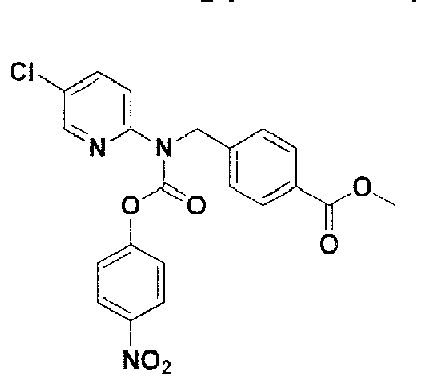
- Compound of Formula 7-4 (methyl 4-(((5-chloropyridin-2-yl)amino)methyl)benzoate; 1.000 g, 3.614 mmol) and 4-nitrophenyl chloroformate (0.801 g, 3.975 mmol) were dissolved in dichloromethane (30 mL) at room temperature and stirred at the same temperature for 3 days, and the solid was filtered out. Then, water was poured into the reaction mixture, and the organic layer was extracted with dichloromethane. Then, the organic layer was washed with saturated sodium chloride aqueous solution, dehydrated with anhydrous magnesium sulfate, and then concentrated under reduced pressure. The concentrate was purified and concentrated by column chromatography (silica; ethyl acetate:hexane=20-30%) to give the desired compound of Formula 7-5 (0.160 g, 10.0%) in the form of a white solid.
-
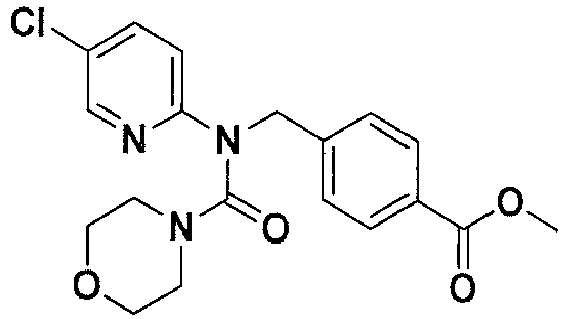
- Compound of Formula 7-5 (methyl 4-(((5-chloropyridin-2-yl)((4-nitrophenoxy)carbonyl)amino)methyl)benzoate; 0.100 g, 0.226 mmol) and morpholine (0.024 mL, 0.272 mmol) were dissolved in dimethylformamide (10 mL) at 60 °C and stirred at the same temperature for 12 hours. Then, the dimethylformamide was removed under reduced pressure, water was poured into the reaction mixture, and the organic layer was extracted with ethyl acetate. The organic layer was washed with saturated sodium chloride aqueous solution, dehydrated with anhydrous magnesium sulfate, and then concentrated under reduced pressure. The concentrate was purified and concentrated by column chromatography (silica; ethyl acetate/hexane=20-30%) to give the desired compound of Formula 7-6 (0.032 g, 36.3%) in the form of a colorless oil.
-

- Compound of Formula 7-6 (methyl 4-((N-(5-chloropyridin-2-yl)morpholine-4-carboxamido)methyl)benzoate; 0.032 g, 0.082 mmol) was dissolved in methanol (10 mL) at room temperature, and then hydroxylamine hydrochloride (0.028 g, 0.410 mmol), potassium hydroxide (0.046 g, 0.821 mmol) and hydroxylamine (50 wt% aqueous solution; 0.211 mL, 1.642 mmol) were added to the reaction solution and stirred at the same temperature for 6 hours. Then, water was poured into the reaction mixture, and the organic layer was extracted with ethyl acetate. Then, the organic layer was washed with saturated sodium chloride aqueous solution, dehydrated with anhydrous magnesium sulfate, and then concentrated under reduced pressure. Dichloromethane and hexane were added to the concentrate and stirred. Then, the precipitated solid was filtered and dried to give the desired Compound 533 (0.011 g, 34.3%) in the form of a white solid.
1H NMR (400 MHz, DMSO-d6) δ 8.31 (d, 1 H, J = 1.5 Hz), 7.79 - 7.76 (m, 1 H), 7.64 (d, 2 H, J = 7.3 Hz), 7.29 (d, 2 H, J = 7.8 Hz), 7.08 (d, 1 H, J = 8.9 Hz), 4.95 (s, 2 H), 3.46 - 3.45 (m, 4 H), 3.24 - 3.23 (m, 4 H); MS (ESI) m/z 391.1 (M+ + H). -

- Compound of Formula 1-3 (methyl 4-((((4-nitrophenoxy)carbonyl)(4-(trifluoromethyl)phenyl)amino)methyl)benzoate; 0.253 g, 0.534 mmol), 4-(2-(piperazin-1-yl)ethyl)morpholine (0.213 g, 1.068 mmol) and potassium carbonate (0.221 g, 1.602 mmol) were dissolved in N,N-dimethylformamide (5 ml) and it was stirred at 60 °C for 2 days. saturated sodium hydrogen carbonate aqueous solution was poured into the reaction mixture and the organic layer was extracted with ethyl acetate. The organic layer was washed with saturated sodium chloride aqueous solution, dehydrated with anhydrous sodium sulfate, filtered, and then concentrated under reduced pressure. The concentrate was purified and concentrated by column chromatography (silica; methanol/ dichloromethane=10%) to give the desired compound of Formula 1-4 (0.139 g, 48.5%) in the form of colorless liquid.
-

- Compound of Formula 1-4 (methyl 4-((4-(2-morpholinoehtyl)-N-(4-(trifluoromethyl)phenyl)piperazine-1-carboxamido)me thyl)benzoate; 0.139 g, 0.260 mmol) and hydroxylamine (50 wt% aqueous solution; 0.159 ml, 2.600 mmol) were dissolved in methanol (5 ml) and potassium hydroxide (0.073 g, 1.300 mmol) was added. It was stirred at room temperature for 16 hours. the concentrate was obtained by removing the solvent from the reaction mixture under reduced pressure. saturated sodium hydrogen carbonate aqueous solution was poured into the obtained concentrate, and the organic layer was extracted with ethyl acetate. The organic layer was dehydrated with anhydrous magnesium sulfate, and then concentrated under reduced pressure. The precipitated solid was filtered and dried to give the desired Compound 543 (0.055 g, 39.5%) in the form of a white solid.
1H NMR (400 MHz, DMSO-d6) δ 11.2 (brs, 1 H), 9.10 (brs, 1 H), 7.64 - 7.56 (m, 4 H), 7.34 (d, 2 H, J = 8.0 Hz), 7.20 (d, 2 H, J = 8.8 Hz), 4.89 (s, 2 H), 3.49 - 3.47 (m, 4 H), 3.16 - 3.14 (m, 4 H), 2.31 - 2.24 (m, 12 H); MS (ESI) m/z 536.2 (M+ + H). -

- Compound of Formula 1-3 (methyl 4-((((4-nitrophenoxy)carbonyl)(4-(trifluoromethyl)phenyl)amino)methyl)benzoate; 0.230 g, 0.484 mmol), 1-(pyridin-4-yl)piperazine (0.159 g, 0.968 mmol) and potassium carbonate (0.201 g, 1.451 mmol) were dissolved in N,N-dimethylformamide (5 ml) and it was stirred at 60 °C for 2 days. Saturated sodium hydrogen carbonate aqueous solution was poured into the reaction mixture and the organic layer was extracted with ethyl acetate. The organic layer was washed with saturated sodium chloride aqueous solution, dehydrated with anhydrous sodium sulfate, filtered, and then concentrated under reduced pressure. The concentrate was purified and concentrated by column chromatography (silica; methanol/dichloromethane=10%) to give the desired compound of Formula 1-4 (0.104 g, 43.0%) in the form of colorless liquid.
-

- Compound of Formula 1-4 (methyl 4-((4-(pyridin-4-yl)-N-(4-(trifluoromethyl)phenyl)piperazine-1-carboxamido)methyl)b enzoate; 0.104 g, 0.209 mmol) and hydroxylamine (50 wt% aqueous solution; 0.128 ml, 2.086 mmol) were dissolved in methanol (5 ml) and potassium hydroxide (0.059 g, 1.043 mmol) was added. It was stirred at room temperature for 16 hours. the reaction mixture was concentrated under reduced pressure. Saturated sodium hydrogen carbonate aqueous solution(30 ml) was poured into the concentrate and stirred. The precipitated solid was filtered and dried to give the desired Compound 544 (0.086 g, 82.7%) in the form of a white solid.
1H NMR (400 MHz, DMSO-d6) δ 11.1 (brs, 1 H), 8.99 (brs, 1 H), 8.10 (d, 2 H, J = 6.4 Hz), 7.63 - 7.58 (m, 4 H), 7.35 (d, 2 H, J = 8.4 Hz), 7.29 (d, 2 H, J = 8.0 Hz), 6.72 (d, 2 H, J = 6.4 Hz), 4.93 (s, 2 H), 3.28 (s, 4 H); MS (ESI) m/z 500.2 (M+ + H). -

- Compound of Formula 1-3 (methyl 4-((((4-nitrophenoxy)carbonyl)(4-(trifluoromethyl)phenyl)amino)methyl)benzoate; 0.213 g, 0.450 mmol), 1-morpholino-2-(piperazin-1-yl)ethanone (0.192 g, 0.900 mmol) and potassium carbonate (0.187 g, 1.350 mmol) were dissolved in N,N-dimethylformamide (5 ml) and it was stirred at 60 °C for 2 days. Saturated sodium hydrogen carbonate aqueous solution was poured into the reaction mixture and the organic layer was extracted with ethyl acetate. The organic layer was washed with saturated sodium chloride aqueous solution, dehydrated with anhydrous sodium sulfate, filtered, and then concentrated under reduced pressure. The concentrate was purified and concentrated by column chromatography (silica; methanol/ dichloromethane=10%) to give the desired compound of Formula 1-4 (0.109 g, 44.1%) in the form of colorless liquid.
-

- Compound of Formula 1-4 (methyl 4-((4-(2-morpholino-2-oxoethyl)-N-(4-(trifluoromethyl)phenyl)piperazine-1-carboxam ido)methyl)benzoate; 0.109 g, 0.199 mmol) and hydroxylamine (50 wt% aqueous solution; 0.122 ml, 1.987 mmol) were dissolved in methanol (5 ml) and potassium hydroxide (0.056 g, 0.994 mmol) was added. It was stirred at room temperature for 16 hours. the reaction mixture was concentrated under reduced pressure. Saturated sodium hydrogen carbonate aqueous solution (30 ml) was poured into the concentrate and stirred. The precipitated solid was filtered and dried to give the desired Compound 545 (0.057 g, 52.0%) in the form of a white solid.
1H NMR (400 MHz, DMSO-d6) δ 11.1 (brs, 1 H), 8.99 (brs, 1 H), 7.64 - 7.57 (m, 4 H), 7.32 - 7.30 (m, 2 H), 7.20 (d, 2 H, J = 8.4 Hz), 4.88 (s, 2 H), 3.48 - 3.46 (m, 6 H), 3.36 - 3.35 (m, 2 H), 3.17 (brs, 4 H), 3.08 (s, 2 H), 2.26 (brs, 4 H); MS (ESI) m/z 550.2 (M+ + H). -

- Compound of Formula 6-1 (4-(bromomethyl)-3-fluorobenzonitrile; 1.10 g, 5.06 mmol) was dissolved in acetonitrile (60 mL), and then 4-(trifluoromethyl)benzenamine (0.39 mL, 4.30 mmol) and N,N-diisopropylethylamine (1.14 mL, 6.45 mmol) were added at room temperature and stirred at the same temperature for 16 hours. Then, saturated sodium hydrogen carbonate aqueous solution was poured into the reaction mixture, and the organic layer was extracted with ethyl acetate. The organic layer was washed with saturated sodium chloride aqueous solution, dehydrated with anhydrous magnesium sulfate, and then concentrated under reduced pressure. The residue was purified and concentrated by column chromatography (silica; ethyl acetate/ hexane=10-30%) to give the desired compound of Formula 6-2 (0.11 g, 28%) in the form of a colorless oil.
-

- Compound of Formula 6-2 (3-fluoro-4-((4-trifluoromethyl)phenylamino)methyl)benzonitrile; 0.93 g, 3.17 mmol) and lithium hydroxide monohydrate (1.33 g, 31.73 mmol) were dissolved in methanol (30 mL)/water (15 mL) and stirred under reflux for 16 hours. Then, the concentrate was obtained by removing the solvent from the reaction mixture under reduced pressure. 2 N hydrochloric acid aqueous solution was poured into the obtained concentrate, and the precipitated solid was filtered to give the desired compound of Formula 6-3 (0.36 g, 37%) in the form of a light white solid.
-

- Compound of Formula 6-3 (3-fluoro-4-((4-(trifluoromethyl)phenylamino)methyl)benzoic acid; 0.36 g, 1.17 mmol), methanol (0.95 mL, 23.49 mmol) and N,N-diisopropylethylamine (0.62 mL, 3.52 mmol) were dissolved in THF (30 mL), and then 1-ethyl-3-[3-dimethylaminopropyl] carbodiimide hydrochloride (EDC, 0.45 g, 2.35 mmol) and 1-hydroxybenzotriazole hydrate (HOBt, 0.31 g, 2.35 mmol) were added at room temperature and stirred at the same temperature for 16 hours. Then, saturated sodium hydrogen carbonate aqueous solution was poured into the reaction mixture, and the organic layer was extracted with ethyl acetate. The organic layer was washed with saturated sodium chloride aqueous solution, dehydrated with anhydrous magnesium sulfate, and then concentrated under reduced pressure. The residue was purified and concentrated by column chromatography (silica; ethyl acetate/hexane=10-40%) to give the desired compound of Formula 6-4 (0.11 g, 28%) in the form of a white solid.
-

- Compound of Formula 6-4 (methyl 3-fluoro-4-((4-(trifluoromethyl)phenylamino)methyl)benzoate; 0.61 g, 1.86 mmol), 4-nitrophenyl chloroformate (0.75 g, 3.72 mmol) and potassium carbonate (0.77 g, 5.59 mmol) were dissolved in acetonitrile (50 mL) at room temperature and stirred at the same temperature for 16 hours. Then, saturated sodium hydrogen carbonate aqueous solution was poured into the reaction mixture, and the organic layer was extracted with ethyl acetate. The organic layer was washed with saturated sodium chloride aqueous solution, dehydrated with anhydrous magnesium sulfate, and then concentrated under reduced pressure. The residue was purified and concentrated by column chromatography (silica; ethyl acetate/hexane=10-30%) to give the desired compound of Formula 6-5 (0.62 g, 67%) in the form of a colorless oil.
-

- Compound of Formula 6-5 (methyl 3-fluroro-4-((((4-nitrophenoxy)carbonyl)(4-(trifluoromethyl)phenyl)amino)methyl)ben zoate; 0.31 g, 0.63 mmol), morpholine (0.11 mL, 1.25 mmol) and potassium carbonate (0.26 g, 1.88 mmol) were dissolved in dimethylformamide (5 mL) at 60 °C and stirred at the same temperature for 16 hours. Then, saturated ammonium chloride aqueous solution was poured into the reaction mixture, and the organic layer was extracted with ethyl acetate. The organic layer was washed with saturated sodium chloride aqueous solution, dehydrated with anhydrous magnesium sulfate, and then concentrated under reduced pressure. The residue was purified and concentrated by column chromatography (silica; ethyl acetate/hexane=20-60%) to give the desired compound of Formula 6-6 (1.58 g, 98%) in the form of a colorless liquid.
-

- Compound of Formula 6-6 (methyl 3-fluoro-4-((N-(4-(trifluoromethyl)phenyl)morpholine-4-carboxamido)methyl)benzoat e; 0.15 g, 0.35 mmol) was dissolved in MeOH (10 mL), and the hydroxylamine (50.0 wt% aqueous solution; 0.21 mL, 3.49 mmol) and potassium hydroxide (0.078 g, 1.40 mmol) were added at room temperature and stirred at the same temperature overnight. Then, the concentrate was obtained by removing the solvent from the reaction mixture under reduced pressure. Saturated sodium hydrogen carbonate aqueous solution was poured into the obtained concentrate, and the organic layer was extracted with ethyl acetate. The organic layer was washed with saturated sodium chloride aqueous solution, dehydrated with anhydrous magnesium sulfate, and then concentrated under reduced pressure. The concentrate was purified and concentrated by column chromatography (silica; methanol/dichloromethane= 10%) to give the desired Compound 577 (0.084 g, 54%) in the form of a white solid.
1H NMR (400 MHz, DMSO-d6) δ 11.2 (brs, 1 H), 9.11 (brs, 1 H), 7.63 (d, 2 H, J = 8.8 Hz), 7.52 - 7.43 (m, 3 H), 7.28 (d, 2 H, J = 8.4 Hz), 4.92 (s, 2 H), 3.41 - 3.39 (m, 4 H), 3.16 - 3.15 (m, 4 H). -

- Compound of Formula 6-5 (methyl 3-fluroro-4-((((4-nitrophenoxy)carbonyl)(4-(trifluoromethyl)phenyl)amino)methyl)ben zoate; 0.31 g, 0.63 mmol), 3,3-difluoroazetidine hydrochloride (0.16 g, 1.25 mmol) and potassium carbonate (0.26 g, 1.88 mmol) were dissolved in dimethylformamide (5 mL) at 60 °C and stirred at the same temperature for 16 hours. Then, saturated ammonium chloride aqueous solution was poured into the reaction mixture, and the organic layer was extracted with ethyl acetate. The organic layer was washed with saturated sodium chloride aqueous solution, dehydrated with anhydrous magnesium sulfate, and then concentrated under reduced pressure. The residue was purified and concentrated by column chromatography (silica; ethyl acetate/hexane=10-40%) to give the desired compound of Formula 6-6 (0.19 g, 68%) in the form of a colorless liquid.
-
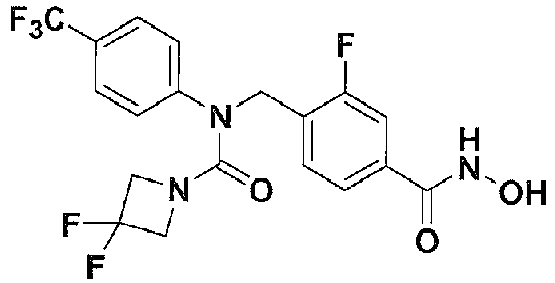
- Compound of Formula 6-6 (methyl 4-((3,3-difluoro-N-(4-(trifluoromethyl)phenyl)azetidine-1-carboxamido)methyl)3-fluor obenzoate; 0.19 g, 0.42 mmol) was dissolved in MeOH (10 mL), and the hydroxylamine (50.0 wt% aqueous solution; 0.26 mL, 4.27 mmol) and potassium hydroxide (0.12 g, 2.14 mmol) were added at room temperature and stirred at the same temperature overnight. Then, the reaction mixture was concentrated under reduced pressure. Saturated sodium hydrogen carbonate aqueous solution (50 ml) was poured into the concentrate and stirred. The precipitated solid was filtered and dried to give the desired Compound 578 (0.15 g, 82%) in the form of a white solid.
1H NMR (400 MHz, DMSO-d6) δ 11.2 (brs, 1 H), 9.10 (brs, 1 H), 7.70 (d, 2 H, J = 8.4 Hz), 7.52 - 7.44 (m, 4 H), 7.42 - 7.39 (m, 1 H), 4.95 (s, 2 H), 3.94 - 3.88 (m, 4 H). -

- Compound of Formula 1-3 (methyl 4-((((4-nitrophenoxy)carbonyl)(4-(trifluoromethyl)phenyl)amino)methyl)benzoate; 0.29 g, 0.62 mmol was dissolved in dimethylformamide. 1,4-oxazepane (0.17 g, 1.24 mmol) and potassium carbonate (0.25 g, 1.86 mmol) were added. It was reacted at 60 °C for one day, and then diluted with saturated ammonium chloride solution. The organic layer was extracted with ethyl acetate, dehydrated with anhydrous sodium sulfate, filtered, and then concentrated under reduced pressure. The residue was purified and concentrated by column chromatography (silica; ethyl acetate/ hexane=10-40%) to give the desired compound of Formula 1-4 (0.08 g, 30%) in the form of colorless liquid.
-

- Compound of Formula 1-4 (methyl 4-((N-(4-(trifluoromethyl)phenyl)-1,4-oxazepane-4-carboxamido)methyl)benzoate; 0.082 g, 0.18 mmol) was dissolved in MeOH (10 ml). Hydroxylamine (50 wt% aqueous solution; 0.057 ml, 0.939 mmol) and potassium hydroxide (0.10 g, 1.87 mmol) were added and reacted at room temperature for overnight. The concentrate was obtained by removing the solvent from the reaction mixture under reduced pressure. Saturated sodium hydrogen carbonate aqueous solution was poured into the obtained concentrate, and the organic layer was extracted with ethyl acetate. The organic layer was washed with saturated sodium chloride aqueous solution, dehydrated with anhydrous magnesium sulfate, and then concentrated under reduced pressure. The concentrate was purified and concentrated by column chromatography (silica; methanol/ dichloromethane= 10%) to give the desired Compound 580 (0.03 g, 40%) in the form of a white solid.
1H NMR (400 MHz, DMSO-d6) δ 11.2 (brs, 1 H), 9.19 (brs, 1 H), 7.63 - 7.59 (m, 4 H), 7.39 (d, 2 H, J = 8.0 Hz), 7.22 (d, 2 H, J = 8.4 Hz), 4.88 (s, 2 H), 3.54 - 3.49 (m, 4 H), 3.40 - 3.28 (m, 4 H), 1.75 - 1.66 (m, 2 H). -

- Compound of Formula 12-2 (methyl 4-((N-(3-(trifluoromethyl)phenyl)piperazine-1-carboxamido)methyl)benzoate hydrochloride; 0.15 g, 0.35 mmol), 1,6-dioxaspiro[2,5]octane (0.12 mL, 1.06 mmol) and N,N-diisopropylethylamine (0.30 mL, 1.78 mmol) were mixed with ethanol (10 mL) and heated at 110 °C for 40 minutes under microwave irradiation, and then the temperature was lowered to room temperature. Then, saturated sodium hydrogen carbonate aqueous solution was poured into the reaction mixture, and the organic layer was extracted with ethyl acetate. The organic layer was washed with saturated sodium chloride aqueous solution, dehydrated with anhydrous magnesium sulfate, and then concentrated under reduced pressure. The concentrate was purified and concentrated by column chromatography (silica; methanol/methylene chloride=10%) to give the desired compound of Formula 12-5 (0.11 g, 58%) in the form of a colorless liquid.
-

- Compound of Formula 12-5 (methyl 4-((4-((4-hydroxy-tetrahydro-2H-pyran-4-yl)methyl)-N-(3-(trifluoromethyl)phenyl)pip erazine-1-carboxamido)methyl)benzoate; 0.11 g, 0.20 mmol) and hydroxylamine (50.0 wt% aqueous solution; 0.06 mL, 1.04 mmol) were dissolved in methanol (10 mL), and then potassium hydroxide (0.11 g, 2.09 mmol) was added at room temperature and stirred at the same temperature for 16 hours. Then, saturated sodium hydrogen carbonate aqueous solution was poured into the reaction mixture, and the organic layer was extracted with ethyl acetate. The organic layer was washed with saturated sodium chloride aqueous solution, dehydrated with anhydrous magnesium sulfate, and then concentrated under reduced pressure. The concentrate was purified and concentrated by column chromatography (silica; methanol/methylene chloride=10%) to give the desired Compound 651 (0.07 g, 70%) in the form of a white solid.
1H NMR (400 MHz, DMSO-d6) δ 11.1 (brs, 1 H), 9.02 (brs, 1 H), 7.66 (d, 2 H, J = 7.7 Hz), 7.53 - 7.49 (m, 1 H), 7.39 - 7.37 (m, 5 H), 4.92 (s, 2 H), 4.15 (s, 1 H), 3.60 - 3.54 (m, 4 H), 3.16 (s, 4 H), 2.35 (s, 4 H), 2.18 (s, 2 H), 1.52 - 1.47 (m, 2 H), 1.35-1.31 (m, 2 H). -

- Compound of Formula 1-3 (methyl 4-((((4-nitrophenoxy)carbonyl)(3-(trifluoromethyl)phenyl amino)methyl)benzoate; 0.13 g, 0.27 mmol) was dissolved in dimethylformamide (2 mL), and potassium carbonate (0.11 g, 0.83 mmol) and 1-benzylpiperazine (0.10 mL, 0.55 mmol) were then added. The mixture was reacted at 40 °C for 16 hours. The dimethyformamide was removed under reduced pressure, water was poured into the reaction mixture and the organic layer was extract with ethyl acetate. The organic layer was washed with saturated sodium chloride aqueous solution, dehydrated with anhydrous sodium sulfate, and then concentrated under reduced pressure. The residue was purified and concentrated by column chromatography (silica; ethyl acetate/hexane= 20-60%) to give the desired compound of Formula 1-4 (0.07 g, 53%) in the form of a colorless oil.
-

- Compound of Formula 1-4 (methyl 4-((4-benzyl-N-(3-(trifluromethyl)phenyl)piperazine-1-carboxamido)methyl)benzoate; 0.07 g, 0.14 mmol) and hydroxylamine (50.0 wt% aqueous solution; 0.045 mL, 0.743 mmol) were dissolved in methanol (10 mL) at room temperature, and then potassium hydroxide (0.08 g, 1.48 mmol) was added and stirred at the same temperature for 16 hours. The reaction mixture was concentrated under reduced pressure. Saturated sodium hydrogen carbonate (50 ml) was poured into the concentrate and stirred. The precipitated solid was filtered and dried to give the desired Compound 683 (0.06 g, 89%) in the form of a white solid.
1H NMR (400 MHz, DMSO-d6) δ 11.1 (brs, 1 H), 9.03 (brs, 1 H), 7.64 (d, 2 H, J = 8.2 Hz), 7.52 - 7.48 (m, 1 H), 7.39 - 7.35 (m, 5 H), 7.31 - 7.17 (m, 5 H), 4.87 (s, 2 H), 3.39 (s, 2 H), 3.17 (s, 4 H), 2.33 (s, 4 H). -

- Compound of Formula 1-3 (methyl 4-((((4-nitrophenoxy)carbonyl)(3-(trifluoromethyl)phenyl amino)methyl)benzoate; 0.13 g, 0.28 mmol) was dissolved in dimethylformamide (2 mL), and potassium carbonate (0.11 g, 0.85 mmol) and 1-(3-methoxyphenyl)piperazine (0.10 mL, 0.56 mmol) were then added. The mixture was reacted at 40 °C for 16 hours. The dimethyformamide was removed under reduced pressure, water was poured into the reaction mixture and the organic layer was extract with ethyl acetate. The organic layer was washed with saturated sodium chloride aqueous solution, dehydrated with anhydrous sodium sulfate, and then concentrated under reduced pressure. The residue was purified and concentrated by column chromatography (silica; ethyl acetate/hexane= 10-40%) to give the desired compound of Formula 1-4 (0.07 g, 47%) in the form of a colorless oil.
-

- Compound of Formula 1-4 (methyl 4-((4-(3-methoxyphenyl)-N-(3-(trifluromethyl)phenyl)piperazine-1-carboxamido)meth yl)benzoate; 0.07 g, 0.13 mmol) and hydroxylamine (50.0 wt% aqueous solution; 0.04 mL, 0.67 mmol) were dissolved in methanol (10 mL) at room temperature, and then potassium hydroxide (0.07 g, 1.34 mmol) was added and stirred at the same temperature for 16 hours. The reaction mixture was concentrated under reduced pressure. Saturated sodium hydrogen carbonate (50 ml) was poured into the concentrate and stirred. The precipitated solid was filtered and dried to give the desired Compound 684 (0.05 g, 77%) in the form of a white solid.
1H NMR (400 MHz, DMSO-d6) δ 7.65 (d, 2 H, J = 8.1 Hz), 7.54 - 7.44 (m, 3 H), 7.39 - 7.34 (m, 3 H), 7.08 (t, 1 H, J = 8.2 Hz), 6.46 - 6.35 (m, 3 H), 4.92 (s, 2 H), 3.68 (s, 3 H), 3.30 (s, 4 H), 2.97 (s, 4 H). -

- Compound of Formula 12-5 (methyl 4-((4-((4-hydroxy-tetrahydro-2H-pyran-4-yl)methyl)-N-(3-(trifluoromethyl)phenyl)pip erazine-1-carboxamido)methyl)benzoate; 0.28 g, 0.52 mmol) was dissolved in methylene chloride (15 mL), and then DAST (0.08 mL, 0.58 mmol) was added at 0 °C and stirred at the same temperature for 3 hours. Then, saturated sodium hydrogen carbonate aqueous solution was poured into the reaction mixture, and the organic layer was extracted with ethyl acetate. The organic layer was washed with saturated sodium chloride aqueous solution, dehydrated with anhydrous magnesium sulfate, and then concentrated under reduced pressure. The concentrate was purified and concentrated by column chromatography (silica; ethyl acetate/hexane=30-90%) to give the desired compound of Formula 12-6 (0.15 g, 54%) in the form of a colorless liquid.
-

- Compound of Formula 12-6 (methyl 4-((4-fluoro-tetrahydro-2H-pyran-4-yl)methyl)-N-(3-(trifluoromethyl)phenyl)piperazin e-1-carboxamido)methyl)benzoate; 0.15 g, 0.28 mmol) and hydroxylamine (50.0 wt% aqueous solution; 0.08 mL, 1.44 mmol) were dissolved in MeOH (10 mL), and potassium hydroxide (0.16 g, 2.88 mmol) was to the mixture and stirred at room temperature and stirred at the same temperature for 16 hours. Then, the concentrate was obtained by removing the solvent from the reaction mixture under reduced pressure. saturated sodium hydrogen carbonate aqueous solution was poured into the obtained concentrate, and the organic layer was extracted with ethyl acetate. The organic layer was washed with saturated sodium chloride aqueous solution, dehydrated with anhydrous magnesium sulfate, and then concentrated under reduced pressure. The concentrate was purified and concentrated by column chromatography (silica; methanol/ dichloromethane=10%) to give the desired Compound 716 (0.06 g, 41%) in the form of a white solid.
1H NMR (400 MHz, DMSO-d6) δ 11.1 (brs, 1 H), 9.00 (brs, 1 H), 7.65 (d, 2 H, J = 7.7 Hz), 7.53 - 7.49 (m, 1 H), 7.39 - 7.35 (m, 5 H), 4.92 (s, 2 H), 3.64 - 3.61 (m, 2 H), 3.52 - 3.49 (m, 2 H), 3.22 - 3.16 (m, 4 H), 2.46 (s, 2 H), 2.33 - 2.29 (m, 4 H), 1.69-1.67 (m, 4 H). -

- Compound of Formula 1-3 (methyl 4-((((4-nitrophenoxy)carbonyl)(3-(trifluoromethyl)phenyl amino)methyl)benzoate; 0.12 g, 0.26 mmol) was dissolved in dimethylformamide (5 mL), and potassium carbonate (0.10 g, 0.79 mmol) and 1-phenylpiperazine (0.08 mL, 0.56 mmol) were then added. The mixture was reacted at 40 °C for 16 hours. The dimethyformamide was removed under reduced pressure, water was poured into the reaction mixture and the organic layer was extract with ethyl acetate. The organic layer was washed with saturated sodium chloride aqueous solution, dehydrated with anhydrous sodium sulfate, and then concentrated under reduced pressure. The residue was purified and concentrated by column chromatography (silica; ethyl acetate/hexane= 5-70%) to give the desired compound of Formula 1-4 (0.07 g, 57%) in the form of a colorless oil.
- (Compound 717: N-(4-(hydroxycarbamoyl)benzyl)-4-phenyl-N-(3-(trifluoromethyl)phenyl)piperazine-1-ca rboxamide)
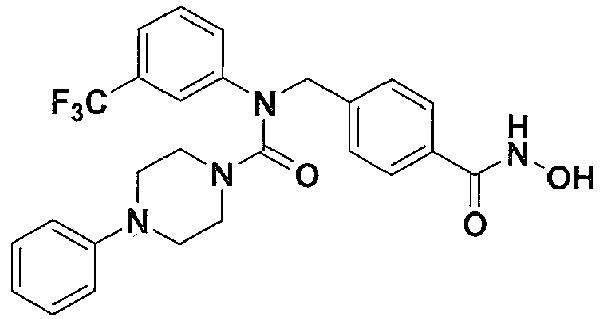
- Compound of Formula 1-4 (methyl 4-((4-phenyl-N-(3-(trifluromethyl)phenyl)piperazine-1-carboxamido)methyl)benzoate; 0.07 g, 0.15 mmol) was dissolved in methanol (10 mL) at room temperature, and then hydroxylamine (50.0 wt% aqueous solution; 0.04 mL, 0.76 mmol) and potassium hydroxide (0.08 g, 1.52 mmol) was added and stirred at the same temperature for 16 hours. The reaction mixture was concentrated under reduced pressure. Saturated sodium hydrogen carbonate (30 ml) was poured into the concentrate and stirred. The precipitated solid was filtered and dried to give the desired Compound 717 (0.05 g, 70%) in the form of a white solid.
1H NMR (400 MHz, DMSO-d6) δ 7.65 (d, 2 H, J = 8.2 Hz), 7.58 - 7.46 (m, 3 H), 7.39 - 7.31 (m, 3 H), 7.20 - 7.16 (m, 2 H), 6.87 (d, 2 H, J = 8.0 Hz), 6.80 - 6.76 (m, 1 H), 4.95 (s, 2 H), 3.32 - 3.30 (m, 4 H), 2.98 - 2.95 (m, 4 H). -

- Compound of Formula 1-3 (methyl 4-((((4-nitrophenoxy)carbonyl)(3-(trifluoromethyl)phenyl amino)methyl)benzoate; 0.14 g, 0.29 mmol) was dissolved in dimethylformamide (5 mL), and potassium carbonate (0.12 g, 0.88 mmol) and 1-benzhydrylpiperazine (0.15 g, 0.59 mmol) were then added. The mixture was reacted at 40 °C for 16 hours. The dimethyformamide was removed under reduced pressure, water was poured into the reaction mixture and the organic layer was extract with ethyl acetate. The organic layer was washed with saturated sodium chloride aqueous solution, dehydrated with anhydrous sodium sulfate, and then concentrated under reduced pressure. The residue was purified and concentrated by column chromatography (silica; ethyl acetate/hexane= 5-70%) to give the desired compound of Formula 1-4 (0.13 g, 77%) in the form of a colorless oil.
-

- Compound of Formula 1-4 (methyl 4-((4-benzhydryl-N-(3-(trifluromethyl)phenyl)piperazine-1-carboxamido)methyl)benz oate; 0.13 g, 0.22 mmol) was dissolved in methanol (10 mL) at room temperature, and then hydroxylamine (50.0 wt% aqueous solution; 0.07 mL, 1.14 mmol) and potassium hydroxide (0.12 g, 2.28 mmol) was added and stirred at the same temperature for 16 hours. The reaction mixture was concentrated under reduced pressure. The precipitated solid was filtered and dried to give the desired Compound 718 (0.06 g, 46%) in the form of a pale yellow solid.
1H NMR (400 MHz, DMSO-d6) δ 7.62 - 7.59 (m, 2 H), 7.49 - 7.43 (m, 1 H), 7.38-7.32 (m, 7 H), 7.27 - 7.22 (m, 6 H), 7.17 - 7.13 (m, 2 H), 4.85 (s, 2 H), 4.20 (s, 1 H), 3.19 (brs, 4 H), 2.13 (brs, 4 H). -

- Compound of Formula 10-3 (methyl 4-(((3-(hydroxymethyl)phenyl)((4-nitrophenoxy)carbonyl)amino)methyl)benzoate; 0.500 g, 1.15 mmol), 1-ethyl-piperazine (0.392 g, 3.44 mmol) and potassium carbonate (0.792 g, 5.73 mmol) were mixed with N,N-dimethylformaldehyde (5 mL) at room temperature and stirred at the same temperature for 60 hours. Then, saturated ammonium chloride aqueous solution was poured into the reaction mixture, and the organic layer was extracted with ethyl acetate. The organic layer was washed with saturated sodium hydrogen carbonate aqueous solution, dehydrated with anhydrous magnesium sulfate, and then concentrated under reduced pressure. The concentrate was purified and concentrated by column chromatography (silica; methanol/methylene chloride=10%) to give the desired compound of Formula 10-8 (0.252 g, 54%) in the form of a light yellow liquid.
-

- Compound of Formula 10-8 (methyl 4-((4-ethyl-N-(3-(hydroxymethyl)phenyl)piperazine-1-carboxamido)methyl)benzoate; 0.252 g, 0.61 mmol) was dissolved in methylene chloride (10 mL) at room temperature, and then diethylaminosulfur trifluoride (0.089 mL, 0.67 mmol) was added to the solution and stirred at the same temperature for 2 hours. Then, saturated sodium hydrogen carbonate aqueous solution was poured into the reaction mixture, and the organic layer was extracted with methylene chloride. The organic layer was washed with saturated sodium chloride aqueous solution, dehydrated with anhydrous magnesium sulfate, filtered, and then concentrated under reduced pressure. The concentrate was purified and concentrated by column chromatography (silica; methanol/ methylene chloride= 10%) to give the desired compound of Formula 10-9 (0.210 g, 83%) in the form of a yellow liquid.
-

- Compound of Formula 10-9 (methyl 4-((4-ethyl-N-(3-(fluoromethyl)phenyl)piperazine-1-carboxamido)methyl)benzoate; 0.210 g, 0.508 mmol) was dissolved in methanol (10 mL) at room temperature, and then hydroxylamine (50 wt% aqueous solution; 3.11 mL, 50.79 mmol) and potassium hydroxide (0.285 g, 5.08 mmol) were added to the solution and stirred at the same temperature for 3 hours. Then, the concentrate was obtained by removing the solvent from the reaction mixture under reduced pressure. Saturated sodium hydrogen carbonate aqueous solution was poured into the obtained concentrate, and then the organic layer was extracted with ethyl acetate. The organic layer was washed with saturated sodium chloride aqueous solution, dehydrated with anhydrous magnesium sulfate, filtered, and then concentrated under reduced pressure. The obtained product was used without any purification process to give the desired Compound 765 (0.137 g, 65.1%) in the form of a white solid.
1H NMR (400 MHz, DMSO-d6) δ 11.16 (brs, 1 H), 9.10 (brs, 1 H), 7.66 (d, 2 H, J = 8.1 Hz), 7.38 - 7.29 (m, 3 H), 7.17 (s, 1 H), 7.13 - 7.08 (m, 2 H), 5.37 (d, 2 H, J = 47.5 Hz), 4.88 (s, 2 H), 3.16 (m, 4 H), 2.23 (q, 2 H, J = 7.1 Hz), 2.17 (m, 4 H), 0.93 (t, 3 H, J = 7.1 Hz). MS (ESI) m/z 415 (M+ + H). -

- Compound of Formula 10-3 (methyl 4-(((3-(hydroxymethyl)phenyl)((4-nitrophenoxy)carbonyl)amino)methyl)benzoate; 1.000 g, 2.29 mmol), 1-Boc-piperazine (1.280 g, 6.87 mmol) and potassium carbonate (1.583 g, 11.46 mmol) were mixed with N,N-dimethylformamide (7 mL) at room temperature and stirred at the same temperature for 60 hours. Then, saturated ammonium chloride aqueous solution was poured into the reaction mixture, and the organic layer was extracted with ethyl acetate. The organic layer was washed with saturated sodium hydrogen carbonate aqueous solution, dehydrated with anhydrous magnesium sulfate, and then concentrated under reduced pressure. The concentrate was purified and concentrated by column chromatography (silica; ethyl acetate/hexane=30-60%) to give the desired compound of Formula 10-10 (0.263 g, 24%) in the form of a white solid.
-

- Compound of Formula 10-10 (tert-butyl 4-((3-(hydroxymethyl)phenyl)(4-(methoxycarbonyl)benzyl)carbamoyl)piperazine-1-ca rboxylate; 0.263 g, 0.54 mmol) was dissolved in methylene chloride (10 mL) at room temperature, and then diethylaminosulfur trifluoride (0.079 mL, 0.60 mmol) was added to the solution and stirred at the same temperature for 2 hours. Then, saturated sodium hydrogen carbonate aqueous solution was poured into the reaction mixture, and the organic layer was extracted with methylene chloride. The organic layer was washed with saturated sodium chloride aqueous solution, dehydrated with anhydrous magnesium sulfate, filtered, and then concentrated under reduced pressure. The concentrate was purified and concentrated by column chromatography (silica; ethyl acetate/hexane=20-50%) to give the desired compound of Formula 10-11 (0.221 g, 84%) in the form of a colorless liquid.
-

- Compound of Formula 10-11 (tert-butyl 4-((3-(fluoromethyl)phenyl)(4-(methoxycarbonyl)benzyl)carbamoyl)piperazine-1-carb oxylate; 0.221 g, 0.46 mmol) was dissolved in 1,4-dioxane (5 mL) at room temperature, and then hydrochloric acid (4 M 1,4-dioxane solution; 5.689 mL, 22.76 mmol) was added to the solution and stirred at the same temperature for 1 hour. Then, the solvent was removed from the reaction mixture under reduced pressure, and ethyl acetate (10 mL) and hexane (30 mL) were added to the concentrate and stirred. Then, the precipitated solid was filtered, washed with hexane, and dried to give the desired compound of Formula 10-12 (0.160 g, 83%) in the form of a white solid.
-

- Compound of Formula 10-12 (methyl 4-((N-(3-(fluoromethyl)phenyl)piperazine-1-carboxamido)methyl)benzoate hydrochloride; 0.137 g, 0.33 mmol), 2,2-dimethyloxirane (0.289 mL, 3.25 mmol) and potassium carbonate (0.224 g, 1.62 mmol) were mixed with ethanol (10 mL) and heated at 110 °C for 20 minutes under microwave irradiation. Then, the temperature was lowered to room temperature, and the reaction was completed. Then, the concentrate was obtained by removing the solvent from the reaction mixture under reduced pressure. water was poured into the obtained concentrate, and the organic layer was extracted with ethyl acetate. The organic layer was washed with saturated sodium chloride aqueous solution, dehydrated with anhydrous magnesium sulfate, filtered, and then concentrated under reduced pressure. The obtained product was used without any purification process to give the desired compound of Formula 10-13 (0.129 g, 87%) in the form of a blight yellow liquid.
-

- Compound of Formula 10-13 (methyl 4-((N-(3-(fluoromethyl)phenyl)-4-(2-hydroxy-2-methylpropyl)piperazine-1-carboxami do)methyl)benzoate; 0.129 g, 0.28 mmol) was dissolved in methylene chloride (10 mL) at room temperature, and then diethylaminosulfurtrifluoride (0.041 mL, 0.31 mmol) was added to the solution and stirred at the same temperature for 2 hours. Then, saturated sodium hydrogen carbonate aqueous solution was poured into the reaction mixture, and the organic layer was extracted with methylene chloride. The organic layer was washed with saturated sodium chloride aqueous solution, dehydrated with anhydrous magnesium sulfate, filtered, and then concentrated under reduced pressure. The concentrate was purified and concentrated by column chromatography (silica; ethyl acetate/hexane=10-40%) to give the desired compound of Formula 10-14 (0.111 g, 86%) in the form of a colorless liquid.
-

- Compound of Formula 10-14 (methyl 4-((4-(2-fluoro-2-methylpropyl)-N-(3-(fluoromethyl)phenyl)piperazine-1-carboxamido )methyl)benzoate; 0.111 g, 0.24 mmol) was dissolved in methanol (10 mL) at room temperature, and then hydroxylamine (50 wt% aqueous solution; 1.477 mL, 24.16 mmol) and potassium hydroxide (0.136 g, 2.42 mmol) were added to the solution and stirred at the same temperature for 3 hours. Then, the concentrate was obtained by removing the solvent from the reaction mixture under reduced pressure. saturated sodium hydrogen carbonate aqueous solution was poured into the obtained concentrate, and then the organic layer was extracted with ethyl acetate. The organic layer was washed with saturated sodium chloride aqueous solution, dehydrated with anhydrous magnesium sulfate, filtered, and then concentrated under reduced pressure. The obtained product was used without any purification process to give the desired Compound 766 (0.087 g, 78%) in the form of a white solid.
1H NMR (400 MHz, DMSO-d6) δ 11.15 (brs, 1 H), 9.04 (brs, 1 H), 7.65 (d, 2 H, J = 8.2 Hz), 7.37 - 7.32 (m, 3 H), 7.16 (s, 1H), 7.12 - 7.08 (m, 2 H), 5.37 (d, 2 H, J = 47.5 Hz), 4.87 (s, 2 H), 3.16 (m, 4 H), 2.36 (s, 2 H, J = 23.0 Hz), 2.33 (m, 4 H), 1.29 (s, 3 H), 1.23 (s, 3 H). MS (ESI) m/z 461 (M+ + H). -

- Compound of Formula 1-1 (2-(trifluoromethoxy)aniline; 0.385 mL, 4.625 mmol), methyl 4-(bromomethyl)benzoate (1.271 g, 5.550 mmol) and DIPEA (1.228 mL, 6.937 mmol) were dissolved in acetonitrile (5 mL) at room temperature and stirred at the same temperature for 16 hours. Water was poured into the reaction mixture, and the organic layer was extracted with ethyl acetate. The organic layer was washed with saturated sodium chloride aqueous solution, dehydrated with anhydrous magnesium sulfate, filtered, and then concentrated under reduced pressure. The concentrate was purified and concentrated by column chromatography (silica; ethyl acetate/ hexane=20%) to give the desired compound of Formula 1-2 (0.806 g, 53.6%) in the form of a colorless liquid.
-

- Compound of Formula 1-2 (methyl 4-(((2-(trifluoromethoxy)phenyl)amino)methyl)benzoate; 0.806 g, 2.477 mmol), 4-nitrophenyl chloroformate (0.549 g, 2.725 mmol) and potassium carbonate (0.685 g, 4.955 mmol) were dissolved in acetonitrile (5 mL) at room temperature and stirred at the same temperature for 16 hours. Water was poured into the reaction mixture, and the organic layer was extracted with ethyl acetate. The organic layer was washed with saturated sodium chloride aqueous solution, dehydrated with anhydrous magnesium sulfate, filtered, and then concentrated under reduced pressure. The concentrate was purified and concentrated by column chromatography (silica; ethyl acetate/ hexane=20%) to give the desired compound of Formula 1-3 (1.172 g, 96.5%) in the form of a yellow liquid.
-

- Compound of Formula 1-3 (methyl 4-((((4-nitrophenoxy)carbonyl)(2-(trifluoromethoxy)phenyl)amino)methyl)benzoate; 1.172 g, 2.390 mmol), morpholine (2.082 g, 23.899 mmol) and potassium carbonate (1.652 g, 11.950 mmol) were dissolved in N,N-dimethylformamide (5 mL) at 40 °C and stirred at the same temperature for 16 hours. Then, the temperature was lowered to room temperature, and the reaction was completed. Water was poured into the reaction mixture, and the organic layer was extracted with ethyl acetate. The organic layer was washed with saturated sodium chloride aqueous solution, dehydrated with anhydrous magnesium sulfate, filtered, and then concentrated under reduced pressure. The concentrate was purified and concentrated by column chromatography (silica; ethyl acetate/hexane=30%) to give the desired compound of Formula 1-4 (0.948 g, 90.4%) in the form of a colorless liquid.
-

- Compound of Formula 1-4 (methyl 4-((N-(2-(trifluoromethoxy)phenyl)morpholine-4-carboxamido)methyl)benzoate; 0.948 g, 2.162 mmol), hydroxylamine (50.0 wt% aqueous solution; 1.323 mL, 21.624 mmol) and potassium hydroxide (1.213 g, 21.624 mmol) were dissolved in methanol (3 mL) at room temperature and stirred at the same temperature for 3 hours. Water was poured into the reaction mixture, and the organic layer was extracted with ethyl acetate. The organic layer was washed with saturated sodium chloride aqueous solution, dehydrated with anhydrous magnesium sulfate, filtered, and then concentrated under reduced pressure. The concentrate was purified and concentrated by column chromatography (silica; ethyl acetate/hexane=50-80%) to give the desired Compound 771 (0.656 g, 69.0%) in the form of a white solid.
1H NMR (400 MHz, DMSO-d6) d 7.68 (d, 2 H, J = 8.0 Hz), 7.39 - 7.32 (m, 6 H), 4.76 (s, 2 H), 3.36 ∼ 3.35 (m, 4 H), 3.10 (m, 4 H); MS (ESI) m/z 440.1 (M+ + H). -

- Compound of Formula 1-1 (4-(trifluoromethoxy)aniline; 0.385 mL, 4.625 mmol), methyl 4-(bromomethyl)benzoate (1.271 g, 5.550 mmol) and DIPEA (1.228 mL, 6.937 mmol) were dissolved in acetonitrile (5 mL) at room temperature and stirred at the same temperature for 16 hours. Water was poured into the reaction mixture, and the organic layer was extracted with ethyl acetate. The organic layer was washed with saturated sodium chloride aqueous solution, dehydrated with anhydrous magnesium sulfate, filtered, and then concentrated under reduced pressure. The concentrate was purified and concentrated by column chromatography (silica; ethyl acetate/ hexane=20%) to give the desired compound of Formula 1-2 (0.645 g, 42.8%) in the form of a colorless liquid.
-

- Compound of Formula 1-2 (methyl 4-(((4-(trifluoromethoxy)phenyl)amino)methyl)benzoate; 0.645 g, 1.981 mmol), 4-nitrophenyl chloroformate (0.439 g, 2.180 mmol) and potassium carbonate (0.548 g, 3.963 mmol) were dissolved in acetonitrile (5 mL) at room temperature and stirred at the same temperature for 16 hours. Water was poured into the reaction mixture, and the organic layer was extracted with ethyl acetate. The organic layer was washed with saturated sodium chloride aqueous solution, dehydrated with anhydrous magnesium sulfate, filtered, and then concentrated under reduced pressure. The concentrate was purified and concentrated by column chromatography (silica; ethyl acetate/ hexane=20%) to give the desired compound of Formula 1-3 (0.633 g, 65.1%) in the form of a white solid.
-

- Compound of Formula 1-3 (methyl 4-((((4-nitrophenoxy)carbonyl)(4-(trifluoromethoxy)phenyl)amino)methyl)benzoate; 0.633 g, 1.291 mmol), morpholine (1.125 g, 12.909 mmol) and potassium carbonate (0.892 g, 6.454 mmol) were dissolved in N,N-dimethylformamide (5 mL) at 40 °C and stirred at the same temperature for 16 hours. Then, the temperature was lowered to room temperature, and the reaction was completed. Water was poured into the reaction mixture, and the organic layer was extracted with ethyl acetate. The organic layer was washed with saturated sodium chloride aqueous solution, dehydrated with anhydrous magnesium sulfate, filtered, and then concentrated under reduced pressure. The concentrate was purified and concentrated by column chromatography (silica; ethyl acetate/hexane=30%) to give the desired compound of Formula 1-4 (0.555 g, 98.1%) in the form of a colorless liquid.
-

- Compound of Formula 1-4 (methyl 4-((N-(4-(trifluoromethoxy)phenyl)morpholine-4-carboxamido)methyl)benzoate; 0.555 g, 1.266 mmol), hydroxylamine (50.0 wt% aqueous solution; 0.774 mL, 12.660 mmol) and potassium hydroxide (0.710 g, 12.660 mmol) were dissolved in methanol (3 mL) at room temperature and stirred at the same temperature for 3 hours. Water was poured into the reaction mixture, and the organic layer was extracted with ethyl acetate. The organic layer was washed with saturated sodium chloride aqueous solution, dehydrated with anhydrous magnesium sulfate, filtered, and then concentrated under reduced pressure. The concentrate was purified and concentrated by column chromatography (silica; ethyl acetate/hexane=50-80%) to give the desired Compound 772 (0.544 g, 97.8%) in the form of a white solid.
1H NMR (400 MHz, DMSO-d6) d 10.33 (brs, 1 H), 9.78 (brs, 1 H), 7.65 (d, 2 H, J= 7.8 Hz), 7.42 (t, 1 H, J = 8.2 Hz), 7.37 (d, 2 H, J = 7.8 Hz), 7.18 (d, 1 H, J = 7.6 Hz), 7.12 (s, 1 H), 7.03 (d, 1 H, J = 8.3 Hz), 4.91 (s, 2 H), 3.43 (m, 4 H), 3.17 (m, 4 H) ; MS (ESI) m/z 440.1 (M+ + H). -

- Compound of Formula 1-1 (3-(trifluoromethoxy)aniline; 0.385 mL, 4.625 mmol), methyl 4-(bromomethyl)benzoate (1.271 g, 5.550 mmol) and DIPEA (1.228 mL, 6.937 mmol) were dissolved in acetonitrile (5 mL) at room temperature and stirred at the same temperature for 16 hours. Water was poured into the reaction mixture, and the organic layer was extracted with ethyl acetate. The organic layer was washed with saturated sodium chloride aqueous solution, dehydrated with anhydrous magnesium sulfate, filtered, and then concentrated under reduced pressure. The concentrate was purified and concentrated by column chromatography (silica; ethyl acetate/ hexane=20%) to give the desired compound of Formula 1-2 (0.607 g, 40.3%) in the form of a white solid.
-

- Compound of Formula 1-2 (methyl 4-(((3-(trifluoromethoxy)phenyl)amino)methyl)benzoate; 0.607 g, 1.865 mmol), 4-nitrophenyl chloroformate (0.413 g, 2.051 mmol) and potassium carbonate (0.515 g, 3.730 mmol) were dissolved in acetonitrile (5 mL) at room temperature and stirred at the same temperature for 16 hours. Water was poured into the reaction mixture, and the organic layer was extracted with ethyl acetate. The organic layer was washed with saturated sodium chloride aqueous solution, dehydrated with anhydrous magnesium sulfate, filtered, and then concentrated under reduced pressure. The concentrate was purified and concentrated by column chromatography (silica; ethyl acetate/ hexane=20%) to give the desired compound of Formula 1-3 (0.649 g, 71.0%) in the form of a white solid.
-

- Compound of Formula 1-3 (methyl 4-((((4-nitrophenoxy)carbonyl)(3-(trifluoromethoxy)phenyl)amino)methyl)benzoate; 0.649 g, 1.324 mmol), morpholine (1.154 g, 13.243 mmol) and potassium carbonate (0.915 g, 6.621 mmol) were dissolved in N,N-dimethylformamide (5 mL) at 40 °C and stirred at the same temperature for 16 hours. Then, the temperature was lowered to room temperature, and the reaction was completed. Water was poured into the reaction mixture, and the organic layer was extracted with ethyl acetate. The organic layer was washed with saturated sodium chloride aqueous solution, dehydrated with anhydrous magnesium sulfate, filtered, and then concentrated under reduced pressure. The concentrate was purified and concentrated by column chromatography (silica; ethyl acetate/hexane=30%) to give the desired compound of Formula 1-4 (0.512 g, 88.2%) in the form of a colorless liquid.
-

- Compound of Formula 1-4 (methyl 4-((N-(3-(trifluoromethoxy)phenyl)morpholine-4-carboxamido)methyl)benzoate; 0.512 g, 1.168 mmol), hydroxylamine (50.0 wt% aqueous solution; 0.714 mL, 11.679 mmol) and potassium hydroxide (0.655 g, 11.679 mmol) were dissolved in methanol (3 mL) at room temperature and stirred at the same temperature for 3 hours. Water was poured into the reaction mixture, and the organic layer was extracted with ethyl acetate. The organic layer was washed with saturated sodium chloride aqueous solution, dehydrated with anhydrous magnesium sulfate, filtered, and then concentrated under reduced pressure. The concentrate was purified and concentrated by column chromatography (silica; ethyl acetate/hexane=50-80%) to give the desired Compound 773 (0.417 g, 81.3%) in the form of a white solid.
1H NMR (400 MHz, DMSO-d6) d 10.35 (brs, 1 H), 8.68 (brs, 1 H), 7.67 (d, 2 H, J = 8.0 Hz), 7.37 (d, 2 H, J = 8.0 Hz), 7.31 ∼ 7.24 (m, 4 H), 4.88 (s, 2 H), 3.42 (m, 4 H), 3.15 (m, 4 H) ; MS (ESI) m/z 440.1 (M+ + H). -

- Compound of Formula 1-1 (2-methoxy-5-(trifluoromethyl)aniline; 0.385 mL, 4.625 mmol), methyl 4-(bromomethyl)benzoate (1.271 g, 5.550 mmol) and DIPEA (1.228 mL, 6.937 mmol) were dissolved in acetonitrile (5 mL) at room temperature and stirred at the same temperature for 16 hours. Water was poured into the reaction mixture, and the organic layer was extracted with ethyl acetate. The organic layer was washed with saturated sodium chloride aqueous solution, dehydrated with anhydrous magnesium sulfate, filtered, and then concentrated under reduced pressure. The concentrate was purified and concentrated by column chromatography (silica; ethyl acetate/ hexane=20%) to give the desired compound of Formula 1-2 (0.607 g, 40.3%) in the form of a white solid.
-
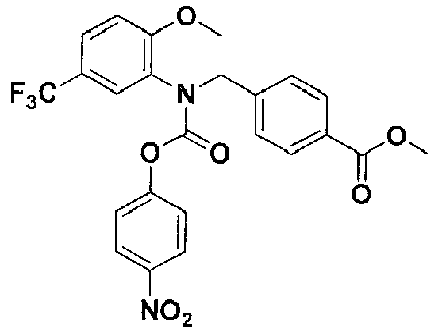
- Compound of Formula 1-2 (methyl 4-(((2-methoxy-5-(trifluoromethyl)phenyl)amino)methyl)benzoate; 0.607 g, 1.865 mmol), 4-nitrophenyl chloroformate (0.413 g, 2.051 mmol) and potassium carbonate (0.515 g, 3.730 mmol) were dissolved in acetonitrile (5 mL) at room temperature and stirred at the same temperature for 16 hours. Water was poured into the reaction mixture, and the organic layer was extracted with ethyl acetate. The organic layer was washed with saturated sodium chloride aqueous solution, dehydrated with anhydrous magnesium sulfate, filtered, and then concentrated under reduced pressure. The concentrate was purified and concentrated by column chromatography (silica; ethyl acetate/hexane=20%) to give the desired compound of Formula 1-3 (0.649 g, 71.0%) in the form of a white solid.
-

- Compound of Formula 1-3 (methyl 4-(((2-methoxy-5-(trifluoromethyl)phenyl)((4-nitrophenoxy)carbonyl) amino)methyl)benzoate; 0.649 g, 1.324 mmol), morpholine (1.154 g, 13.243 mmol) and potassium carbonate (0.915 g, 6.621 mmol) were dissolved in N,N-dimethylformamide (5 mL) at 40 °C and stirred at the same temperature for 16 hours. Then, the temperature was lowered to room temperature, and the reaction was completed. Water was poured into the reaction mixture, and the organic layer was extracted with ethyl acetate. The organic layer was washed with saturated sodium chloride aqueous solution, dehydrated with anhydrous magnesium sulfate, filtered, and then concentrated under reduced pressure. The concentrate was purified and concentrated by column chromatography (silica; ethyl acetate/hexane=30%) to give the desired compound of Formula 1-4 (0.512 g, 88.2%) in the form of a colorless liquid.
-

- Compound of Formula 1-4 (methyl 4-((N-(2-methoxy-5-(trifluoromethyl)phenyl)morpholine-4-carboxamido)methyl)benz oate; 0.512 g, 1.168 mmol), hydroxylamine (50.0 wt% aqueous solution; 0.714 mL, 11.679 mmol) and potassium hydroxide (0.655 g, 11.679 mmol) were dissolved in methanol (3 mL) at room temperature and stirred at the same temperature for 3 hours. Water was poured into the reaction mixture, and the organic layer was extracted with ethyl acetate. The organic layer was washed with saturated sodium chloride aqueous solution, dehydrated with anhydrous magnesium sulfate, filtered, and then concentrated under reduced pressure. The concentrate was purified and concentrated by column chromatography (silica; ethyl acetate/hexane=50-80%) to give the desired Compound 774 (0.417 g, 81.3%) in the form of a white solid.
1H NMR (400 MHz, DMSO-d6) d 10.35 (brs, 1 H), 8.68 (brs, 1 H), 7.67 (d, 2 H, J = 8.0 Hz), 7.37 (d, 2 H, J = 8.0 Hz), 7.31 ∼ 7.24 (m, 4 H), 4.88 (s, 2 H), 3.42 (m, 4 H), 3.15 (m, 4 H) ; MS (ESI) m/z 454.1 (M+ + H). -

- Compound of Formula 1-1 (2-chloro-5-(trifluoromethyl)aniline; 0.352 mL, 2.557 mmol), methyl 4-(bromomethyl)benzoate (0.703 g, 3.068 mmol) and DIPEA (0.679 mL, 3.835 mmol) were dissolved in acetonitrile (5 mL) at room temperature and stirred at the same temperature for 16 hours. Water was poured into the reaction mixture, and the organic layer was extracted with ethyl acetate. The organic layer was washed with saturated sodium chloride aqueous solution, dehydrated with anhydrous magnesium sulfate, filtered, and then concentrated under reduced pressure. The concentrate was purified and concentrated by column chromatography (silica; ethyl acetate/ hexane=20%) to give the desired compound of Formula 1-2 (0.752 g, 85.6%) in the form of a white solid.
-

- Compound of Formula 1-2 (methyl 4-(((2-chloro-5-(trifluoromethyl)phenyl)amino)methyl)benzoate; 0.752 g, 2.188 mmol), 4-nitrophenyl chloroformate (0.485 g, 2.407 mmol) and potassium carbonate (0.605 g, 4.376 mmol) were dissolved in acetonitrile (5 mL) at room temperature and stirred at the same temperature for 16 hours. Water was poured into the reaction mixture, and the organic layer was extracted with ethyl acetate. The organic layer was washed with saturated sodium chloride aqueous solution, dehydrated with anhydrous magnesium sulfate, filtered, and then concentrated under reduced pressure. The concentrate was purified and concentrated by column chromatography (silica; ethyl acetate/hexane=20%) to give the desired compound of Formula 1-3 (0.903 g, 81.1%) in the form of a white solid.
-

- Compound of Formula 1-3 (methyl 4-(((2-chloro-5-(trifluoromethyl)phenyl)((4-nitrophenoxy)carbonyl)amino)methyl)ben zoate; 0.903 g, 1.775 mmol), morpholine (1.546 g, 17.747 mmol) and potassium carbonate (1.226 g, 8.873 mmol) were dissolved in N,N-dimethylformamide (5 mL) at 40 °C and stirred at the same temperature for 16 hours. Then, the temperature was lowered to room temperature, and the reaction was completed. Water was poured into the reaction mixture, and the organic layer was extracted with ethyl acetate. The organic layer was washed with saturated sodium chloride aqueous solution, dehydrated with anhydrous magnesium sulfate, filtered, and then concentrated under reduced pressure. The concentrate was purified and concentrated by column chromatography (silica; ethyl acetate/hexane=30%) to give the desired compound of Formula 1-4 (0.582 g, 71.8%) in the form of a colorless liquid.
-

- Compound of Formula 1-4 (methyl 4-((N-(2-chloro-5-(trifluoromethyl)phenyl)morpholine-4-carboxamido)methyl)benzoat e; 0.582 g, 1.274 mmol), hydroxylamine (50.0 wt% aqueous solution; 0.779 mL, 12.740 mmol) and potassium hydroxide (0.715 g, 12.740 mmol) were dissolved in methanol (3 mL) at room temperature and stirred at the same temperature for 3 hours. Water was poured into the reaction mixture, and the organic layer was extracted with ethyl acetate. The organic layer was washed with saturated sodium chloride aqueous solution, dehydrated with anhydrous magnesium sulfate, filtered, and then concentrated under reduced pressure. The concentrate was purified and concentrated by column chromatography (silica; ethyl acetate/hexane=50-80%) to give the desired Compound 776 (0.521 g, 89.3%) in the form of a ivory solid.
1H NMR (400 MHz, DMSO-d6) d 10.33 (brs, 1 H), 8.67 (brs, 1 H), 7.76 (d, 1 H, J = 8.1 Hz), 7.65 (s, 1 H), 7.64 (s, 2 H), 7.60 (d, 1 H, J = 8.3 Hz), 7.36 (d, 2 H, J = 8.1 Hz), 4.82 (s, 2 H), 3.33 (m, 4 H), 3.13 ∼ 3.12 (m, 4 H) ; MS (ESI) m/z 458.0 (M+ + H). -

- Compound of Formula 7-3 (6-(trifluoromethyl)pyridin-2-amine (0.500 g, 3.084 mmol), methyl 4-(bromomethyl)benzoate (1.413 g, 6.169 mmol) and DIPEA(1.092 mL, 6.169 mmol) were dissolved in acetonitrile (10 mL) at room temperature and stirred at the same temperature for 16 hours. Then, water was poured into the reaction mixture, and the organic layer was extracted with ethyl acetate. Then, the organic layer was washed with saturated sodium chloride aqueous solution, dehydrated with anhydrous magnesium sulfate, filtered, and then concentrated under reduced pressure. The concentrate was purified and concentrated by column chromatography (silica; ethyl acetate/hexane=20%) to give the desired compound of Formula 7-4 (0.588 g, 61.4%) in the form of a white solid.
-

- Compound of Formula 7-4 (methyl 4-(((6-(trifluoromethyl)pyridin-2-yl)amino)methyl)benzoate; 0.588 g, 1.895 mmol), 4-nitrophenyl chloroformate (0.420 g, 2.085 mmol) and potassium carbonate (0.524 g, 3.790 mmol) were dissolved in acetonitrile (10 mL) at room temperature and stirred at the same temperature for 16 hours. Then, water was poured into the reaction mixture, and the organic layer was extracted with ethyl acetate. Then, the organic layer was washed with saturated sodium chloride aqueous solution, dehydrated with anhydrous magnesium sulfate, filtered, and then concentrated under reduced pressure. The concentrate was purified and concentrated by column chromatography (silica; ethyl acetate/hexane=20%) to give the desired compound of Formula 7-5 (0.295 g, 32.7%) in the form of a yellow liquid.
-

- Compound of Formula 7-5 (methyl 4-((((4-nitrophenoxy)carbonyl)(6-(trifluoromethyl)pyridin-2-yl)amino)methyl)benzoat e; 0.295 g, 0.621 mmol), morpholine (0.541 mL, 6.206 mmol) and potassium carbonate (0.429 g, 3.103 mmol) were dissolved in N,N-dimethylformamide (5 mL) at room temperature and stirred at the same temperature for 1 hour. Then, water was poured into the reaction mixture, and the organic layer was extracted with ethyl acetate. Then, the organic layer was washed with saturated sodium chloride aqueous solution, dehydrated with anhydrous magnesium sulfate, filtered, and then concentrated under reduced pressure. The concentrate was purified and concentrated by column chromatography (silica; ethyl acetate/hexane=50%) to give the desired compound of Formula 7-6 (0.112 g, 42.6%) in the form of a colorless liquid.
-

- Compound of Formula 7-6 (methyl 4-((N-(6-(trifluoromethyl)pyridin-2-yl)morpholine-4-carboxamido)methyl)benzoate; 0.112 g, 0.265 mmol), hydroxylamine (50.0 wt% aqueous solution; 0.162 mL, 2.645 mmol) and potassium hydroxide (0.148 g, 2.645 mmol) were dissolved in methanol (5 mL) at room temperature and stirred at the same temperature for 1 hour. Then, water was poured into the reaction mixture, and the organic layer was extracted with ethyl acetate. Then, the organic layer was washed with saturated sodium chloride aqueous solution, dehydrated with anhydrous magnesium sulfate, filtered, and then concentrated under reduced pressure. The concentrate was purified and concentrated by column chromatography (silica; ethyl acetate/hexane=50-80%) to give the desired Compound 778 (0.072 g, 64.1%) in the form of a white solid.
1H NMR (400 MHz, CD3OD) d 7.88 (t, 1 H, J = 7.9 Hz), 7.70 (d, 2 H, J = 8.1 Hz), 7.53 (d, 2 H, J = 8.1 Hz), 7.35 (d, 1 H, J = 7.4 Hz), 7.24 (d, 1 H, J = 8.4 Hz), 5.11 (s, 2 H), 3.55 (t, 4 H, J = 4.7 Hz), 3.36 (t, 4 H, J = 4.6 Hz) ; MS (ESI) m/z 425.1 (M+ + H). -
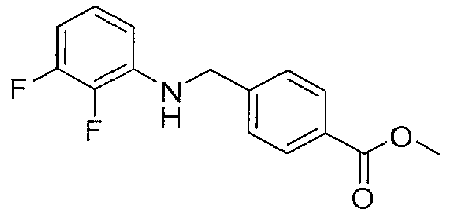
- Compound of Formula 1-1 (2,3-difluoroaniline (0.300 g, 2.324 mmol), methyl 4-(bromomethyl)benzoate (0.639 g, 2.788 mmol) and DIPEA (0.809 mL, 4.647 mmol) were dissolved in acetonitrile (3 mL) at room temperature and stirred at the same temperature for 17 hours. Water was poured into the reaction mixture, and the organic layer was extracted with dichloromethane. The organic layer was washed with saturated sodium chloride aqueous solution, dehydrated with anhydrous magnesium sulfate, filtered, and then concentrated under reduced pressure. The concentrate was purified and concentrated by column chromatography (silica; ethyl acetate/ hexane=10%) to give the desired compound of Formula 1-2 (0.284 g, 44.1%) in the form of a white solid.
-
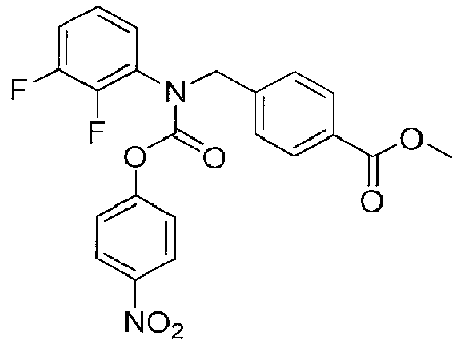
- Compound of Formula 1-2 (methyl 4-(((2,3-difluorophenyl)amino)methyl)benzoate ; 0.275 g, 0.992 mmol), 4-nitrophentl chloroformate (0.240 g, 1.190 mmol) and potassium carbonate (0.274 g, 1.948 mmol) were dissolved in dichloromethane (3 mL) at room temperature and stirred at the same temperature for 20 hours. Water was poured into the reaction mixture, and the organic layer was extracted with dichloromethane. The organic layer was washed with saturated sodium chloride aqueous solution, dehydrated with anhydrous magnesium sulfate, filtered, and then concentrated under reduced pressure. The concentrate was purified and concentrated by column chromatography (silica; ethyl acetate/hexane=20%) to give the desired compound of Formula 1-3 (0.177 g, 40.3%) in the form of a colorless oil.
-

- Compound of Formula 1-3 (methyl 4-(((2,3-difluorophenyl)((4-nitrophenoxy)carbonyl)amino)methyl)benzoate; 0.170 g, 0.384 mmol), morpholine (0.338 ml, 3.843 mmol) and potassium carbonate (0.265 g, 1.921 mmol) were dissolved in N,N-dimethylformamide (2 mL) at 50 °C and stirred at the same temperature for 18 hours. Then, the temperature was lowered to room temperature, and the reaction was completed. Water was poured into the reaction mixture, and the organic layer was extracted with ethyl acetate. The organic layer was washed with saturated sodium chloride aqueous solution, dehydrated with anhydrous magnesium sulfate, filtered, and then concentrated under reduced pressure. The concentrate was purified and concentrated by column chromatography (silica; ethyl acetate/hexane=20%) to give the desired compound of Formula 1-4 (0.113 g, 75.3%) in the form of a colorless liquid.
-

- Compound of Formula 1-4 (methyl 4-((N-(2,3-difluorophenyl)morpholine-4-carboxamido)methyl)benzoate; 0.105 g, 0.269 mmol), hydroxylamine (50.0 wt% aqueous solution; 0.329 mL, 5.379 mmol) and potassium hydroxide (0.151 g, 2.690 mmol) were mixed and stirred at room temperature for 1 hour. Saturated sodium hydrogen carbonate aqueous solution was poured into the reaction solution, and the organic layer was extracted with dichloromethane. The organic layer was dehydrated with anhydrous magnesium sulfate, filtered, and then concentrated under reduced pressure to give the desired Compound 791 (0.074 g, 70.3%) in the form of a light brown solid.
MS (ESI) m/z 392.13 (M+ + H). -

- Compound of Formula 1-3 (methyl 4-((((4-nitrophenoxy)carbonyl)(3-(trifluoromethyl)phenyl)amino)methyl)benzoate; 1.263 g, 2.662 mmol), (2S,6R)-2,6-dimethylpiperazine (1.520 g, 13.309 mmol) and potassium carbonate (0.736 g, 5.323 mmol) were dissolved in N,N-dimethylformamide (5 mL) at 40 °C and stirred at the same temperature for 16 hours. Then, the temperature was lowered to room temperature, and the reaction was completed. Then, water was poured into the reaction mixture, and the organic layer was extracted with ethyl acetate. Then, the organic layer was washed with saturated sodium chloride aqueous solution, dehydrated with anhydrous magnesium sulfate, filtered, and then concentrated under reduced pressure. The concentrate was purified and concentrated by column chromatography (silica; ethyl acetate/hexane=20-50%) to give the desired compound of Formula 12-7 (0.726 g, 60.7%) in the form of a yellow liquid.
-

- Compound of Formula 12-7 (methyl 4-(((3S,5R)-3,5-dimethyl-N-(3-(trifluoromethyl)phenyl)piperazine-1-carboxamido)met hyl)benzoate; 0.200 g, 0.445 mmol), iodoethane (0.107 mL, 1.335 mmol) and potassium carbonate (0.184 g, 1.335 mmol) were mixed with acetonitrile (10 mL) and heated at 120 °C for 20 minutes under microwave irradiation. Then, the temperature was lowered to room temperature, and the reaction was completed. Then, water was poured into the reaction mixture, and the organic layer was extracted with ethyl acetate. Then, the organic layer was washed with saturated sodium chloride aqueous solution, dehydrated with anhydrous magnesium sulfate, filtered, and then concentrated under reduced pressure. The concentrate was purified and concentrated by column chromatography (silica; ethyl acetate/hexane=30-80%) to give the desired compound of Formula 12-8 (0.109 g, 51.3%) in the form of a colorless liquid.
-

- Compound of Formula 12-8 (methyl 4-(((3S,5R)-4-ethyl-3,5-dimethyl-N-(3-(trifluoromethyl)phenyl)piperazine-1-carboxam ido)methyl)benzoate; 0.109 g, 0.228 mmol), hydroxylamine (50.0 wt% aqueous solution; 0.140 mL, 2.283 mmol) and potassium hydroxide (0.128 g, 2.283 mmol) were dissolved in methanol (2 mL) at room temperature and stirred at the same temperature for 1 hour. Then, the solvent was removed from the reaction mixture under reduced pressure, and saturated sodium hydrogen carbonate aqueous solution (20 mL) was added to the concentrate and stirred. Then, the precipitated solid was filtered, washed with diethylether, and dried to give the desired Compound 797 (0.071 g, 65.0%) in the form of a white solid.
1H NMR (400 MHz, CD3OD) d 7.68 (d, 2 H, J = 8.3 Hz), 7.55 (t, 1 H, J = 8.2 Hz), 7.45 ∼ 7.42 (m, 5 H), 4.98 (s, 2 H), 3.65 (d, 2 H, J = 11.6 Hz), 2.89 (q, 2 H, J = 7.1 Hz), 2.52 ∼ 2.42 (m, 4 H), 0.96 (d, 6 H, J = 5.8 Hz), 0.97 (s, 3 H), 0.95 (s, 3 H), 0.86 (t, 3 H, J = 7.2 Hz) ; MS (ESI) m/z 479.1 (M+ + H). -
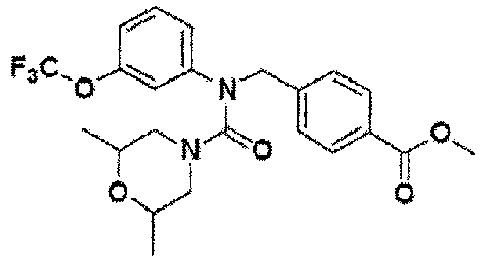
- Compound of Formula 1-3 (methyl 4-((((4-nitrophenoxy)carbonyl)(3-(trifluoromethoxy)phenyl)amino)methyl)benzoate; 0.200 g, 0.408 mmol), 2,6-dimethylmorpholine (0.235 g, 2.039 mmol) and potassium carbonate (0.169 g, 1.224 mmol) were dissolved in N,N-dimethylformamide (5 mL) at 40 °C and stirred at the same temperature for 16 hours. Then, the temperature was lowered to room temperature, and the reaction was completed. Water was poured into the reaction mixture, and the organic layer was extracted with ethyl acetate. The organic layer was washed with saturated sodium chloride aqueous solution, dehydrated with anhydrous magnesium sulfate, filtered, and then concentrated under reduced pressure. The concentrate was purified and concentrated by column chromatography (silica; ethyl acetate/hexane=50%) to give the desired compound of Formula 1-4 (0.166 g, 87.3%) in the form of a yeloow liquid.
-

- Compound of Formula 1-4 (methyl 4-((2,6-dimethyl-N-(3-(trifluoromethoxy)phenyl)morpholine-4-carboxamido)methyl)b enzoate; 0.166 g, 0.356 mmol), hydroxylamine (50.0 wt% aqueous solution; 0.218 mL, 3.559 mmol) and potassium hydroxide (0.200 g, 3.559 mmol) were dissolved in methanol (2 mL) at room temperature and stirred at the same temperature for 3 hours. Then, the solvent was removed from the reaction mixture under reduced pressure, and saturated sodium hydrogen carbonate aqueous solution (20 mL) was added to the concentrate and stirred. Then, the precipitated solid was filtered, washed with hexane, and dried to give the desired Compound 800 (0.098 g, 59.0%) in the form of a light ivory solid.
1H NMR (400 MHz, CD3OD) d 7.68 (d, 2 H, J = 8.4 Hz), 7.43 (d, 2 H, J = 8.4 Hz), 7.43 (t, 1 H, J = 8.1 Hz), 7.16 (ddd, 1 H, J = 8.2, 2.0, 0.8 Hz), 7.06 (d, 1 H, J = 0.9 Hz), 7.04 (d, 1 H, J = 1.0 Hz), 4.96 (s, 2 H), 3.66 (d, 2 H, J = 12.4 Hz), 3.44 ∼ 3.40 (m, 2 H), 2.38 (dd, 2 H, J = 13.2, 10.6 Hz), 1.04 (s, 3 H), 1.02 (s, 3 H) ; MS (ESI) m/z 468.1 (M+ + H). -

- Compound of Formula 1-3 (methyl 4-((((4-nitrophenoxy)carbonyl)(2-(trifluoromethoxy)phenyl)amino)methyl)benzoate; 0.300 g, 0.612 mmol), 2,6-dimethylmorpholine (0.352 g, 3.059 mmol) and potassium carbonate (0.254 g, 1.835 mmol) were dissolved in N,N-dimethylformamide (5 mL) at room temperature and stirred at the same temperature for 16 hours. Water was poured into the reaction mixture, and the organic layer was extracted with ethyl acetate. The organic layer was washed with saturated sodium chloride aqueous solution, dehydrated with anhydrous magnesium sulfate, filtered, and then concentrated under reduced pressure. The concentrate was purified and concentrated by column chromatography (silica; ethyl acetate/hexane=50%) to give the desired compound of Formula 1-4 (0.116 g, 40.7%) in the form of a yellow liquid.
-

- Compound of Formula 1-4 (methyl 4-((2,6-dimethyl-N-(2-(trifluoromethoxy)phenyl)morpholine-4-carboxamido)methyl)b enzoate; 0.116 g, 0.249 mmol), hydroxylamine (50.0 wt% aqueous solution; 0.152 mL, 2.487 mmol) and potassium hydroxide (0.140 g, 2.487 mmol) were dissolved in methanol (2 mL) at room temperature and stirred at the same temperature for 3 hours. Then, water was poured into the reaction mixture and the organic layer was extracted with ethyl acetate. The organic layer was washed with saturated sodium chloride aqueous solution, dehydrated with anhydrous magnesium sulfate, filtered, and then concentrated under reduced pressure. The concentrate was purified by column chromatography (Waters, C18; acetonitrile / 0.1 % trifluoro acetic acid aqueous solution = 5-70%) and concentrated with SPE cartridge to give the desired compound of Compound 801 (0.020 g, 17.5%) in the form of a white solid.
1H NMR (400 MHz, DMSO-d6) d 7.66 (d, 2 H, J = 8.4 Hz), 7.40 ∼ 7.32 (m, 6 H), 4.73 (s, 2 H), 3.52 (s, 2 H), 3.25 ∼ 3.18 (m, 2 H), 2.25 (dd, 2 H, J = 13.0, 10.7 Hz), 0.92 (s, 3 H), 0.91 (s, 3 H) ; MS (ESI) m/z 468.1 (M+ + H). -

- Compound of Formula 12-7 (methyl 4-(((3S,SR)-3,5-dimethyl-N-(3-(trifluoromethyl)phenyl)piperazine-1-carboxamido)met hyl)benzoate; 0.200 g, 0.445 mmol), (bromomethyl)benzene (2.324 g, 1.335 mmol) and potassium carbonate (0.184 g, 1.335 mmol) were mixed with acetonitrile (3 mL) and heated at 120 °C for 40 minutes under microwave irradiation. Then, the temperature was lowered to room temperature, and the reaction was completed. Then, water was poured into the reaction mixture, and the organic layer was extracted with ethyl acetate. Then, the organic layer was washed with saturated sodium chloride aqueous solution, dehydrated with anhydrous magnesium sulfate, filtered, and then concentrated under reduced pressure. The concentrate was purified and concentrated by column chromatography (silica; ethyl acetate/hexane=20%) to give the desired compound of Formula 12-8 (0.113 g, 47.1%) in the form of a colorless liquid.
-

- Compound of Formula 12-8 (methyl 4-(((3S,5R)-4-benzyl-3,5-dimethyl-N-(3-(trifluoromethyl)phenyl)piperazine-1-carboxa mido)methyl)benzoate; 0.113 g, 0.209 mmol), hydroxylamine (50.0 wt% aqueous solution; 0.128 mL, 2.094 mmol) and potassium hydroxide (0.118 g, 2.094 mmol) were dissolved in methanol (2 mL) at room temperature and stirred at the same temperature for 3 hour. Then, the solvent was removed from the reaction mixture under reduced pressure, and saturated sodium hydrogen carbonate aqueous solution (10 mL) was added to the concentrate and stirred. Then, the precipitated solid was filtered, washed with hexane, and dried to give the desired Compound 802 (0.010 g, 8.8%) in the form of a ivory solid.
1H NMR (400 MHz, DMSO-d6) d 7.63 (d, 2 H, J = 8.3 Hz), 7.50 (t, 1 H, J = 8.0 Hz), 7.39 ∼ 7.38 (m, 3 H), 7.31 ∼ 7.25 (m, 6 H), 7.18 ∼ 7.15 (m, 1 H), 4.88 (s, 2 H), 3.65 (s, 2 H), 3.57 (s, 2 H), 3.52 (s, 2 H), 2.38 ∼ 2.29 (m, 2 H), 0.81 (s, 3 H), 0.79 (s, 3 H) ; MS (ESI) m/z 541.1 (M+ + H). -

- Compound of Formula 12-7 (methyl 4-(((3S,5R)-3,5-dimethyl-N-(3-(trifluoromethyl)phenyl)piperazine-1-carboxamido)met hyl)benzoate; 0.200 g, 0.445 mmol), 2,2,3,3,3-pentafluoropropyltrifluoromethansulfonate (0.221 ml, 1.335 mmol) and potassium carbonate (0.184 g, 1.335 mmol) were mixed with acetonitrile (3 mL) and heated at 120 °C for 30 minutes under microwave irradiation. Then, the temperature was lowered to room temperature, and the reaction was completed. Then, water was poured into the reaction mixture, and the organic layer was extracted with ethyl acetate. Then, the organic layer was washed with saturated sodium chloride aqueous solution, dehydrated with anhydrous magnesium sulfate, filtered, and then concentrated under reduced pressure. The concentrate was purified and concentrated by column chromatography (silica; ethyl acetate/hexane=20%) to give the desired compound of Formula 12-8 (0.042 g, 16.2%) in the form of a colorless liquid.
-

- Compound of Formula 12-8 (methyl 4-(((3S,5R)-3,5-dimethyl-4-(2,2,3,3,3-pentafluoropropyl)-N-(3-(trifluoromethyl)pheny l)piperazine-1-carboxamido)methyl)benzoate; 0.042 g, 0.072 mmol), hydroxylamine (50.0 wt% aqueous solution; 0.044 mL, 0.722 mmol) and potassium hydroxide (0.041 g, 0.722 mmol) were dissolved in methanol (2 mL) at room temperature and stirred at the same temperature for 1 hour. Then, the solvent was removed from the reaction mixture under reduced pressure, and saturated sodium hydrogen carbonate aqueous solution (10 mL) was added to the concentrate and stirred. Then, the precipitated solid was filtered, washed with hexane, and dried to give the desired Compound 803 (0.016 g, 38.0%) in the form of a white solid.
1H NMR (400 MHz, CD3OD) d 7.69 (d, 2 H, J = 8.3 Hz), 7.53 (t, 1 H, J = 7.8 Hz), 7.43 ∼ 7.38 (m, 5 H), 4.96 (s, 2 H), 3.59 (d, 2 H, J = 12.5 Hz), 2.63 ∼ 2.53 (m, 4 H), 1.36 ∼ 1.31 (m, 2 H), 0.97 (s, 3 H), 0.96 (s, 3 H) ; MS (ESI) m/z 583.2 (M+ + H). -

- Compound of Formula 7-5 (methyl 4-((((4-nitrophenoxy)carbonyl)(6-(trifluoromethyl)pyridin-2-yl)amino)methyl)benzoat e; 0.500 g, 1.052 mmol), 1-ethylpiperazine (0.240 g, 2.104 mmol) and potassium carbonate (0.291 g, 2.104 mmol) were mixed with N,N-dimethylformamide (3 mL) and heated at 150 °C for 30 minutes under microwave irradiation. Then, the temperature was lowered to room temperature, and the reaction was completed. Then, water was poured into the reaction mixture, and the organic layer was extracted with ethyl acetate. Then, the organic layer was washed with saturated sodium chloride aqueous solution, dehydrated with anhydrous magnesium sulfate, filtered, and then concentrated under reduced pressure. The concentrate was purified and concentrated by column chromatography (silica; ethyl acetate/hexane= 50%) to give the desired compound of Formula 7-6 (0.276 g, 58.2%) in the form of a yellow liquid.
-

- Compound of Formula 7-6 (methyl 4-((4-ethyl-N-(6-(trifluoromethyl)pyridin-2-yl)piperazine-1-carboxamido)methyl)benz oate; 0.276 g, 0.613 mmol), hydroxylamine (50.0 wt% aqueous solution; 0.375 mL, 6.127 mmol) and potassium hydroxide (0.344 g, 6.127 mmol) were dissolved in methanol (1 mL) at room temperature and stirred at the same temperature for 1 hours. The solvent was removed from the reaction mixture, and the saturated sodium hydrogen carbonate aqueous solution (20 mL) was added to the concentrate and stirred. Then, the precipitated solid was filtered and dried to give the desired Compound 826 (0.089 g, 32.2%) in the form of a yellow solid.
1H NMR (400 MHz, CD3OD) d 7.88 (t, 1 H, J = 7.9 Hz), 7.71 (d, 2 H, J = 8.3 Hz), 7.49 (d, 2 H, J = 8.3 Hz), 7.35 (d, 1 H, J = 7.5 Hz), 7.20 (d, 1 H, J = 8.5 Hz), 5.10 (s, 2 H), 3.40 (t, 4 H, J = 4.9 Hz), 2.40 (q, 2 H, J = 7.3 Hz), 2.35 (t, 4 H, J = 5.0 Hz), 1.07 (t, 3 H, J = 7.2 Hz) ; MS (ESI) m/z 452.1 (M+ + H). -

- Compound of Formula 7-5 (methyl 4-((((4-nitrophenoxy)carbonyl)(6-(trifluoromethyl)pyridin-2-yl)amino)methyl)benzoat e; 0.100 g, 0.210 mmol), 2,6-dimethylmorpholine (0.048 g, 0.421 mmol) and potassium carbonate (0.058 g, 0.421 mmol) were mixed with N,N-dimethylformamide (3 mL) and heated at 150 °C for 30 minutes under microwave irradiation. Then, the temperature was lowered to room temperature, and the reaction was completed. Then, water was poured into the reaction mixture, and the organic layer was extracted with ethyl acetate. Then, the organic layer was washed with saturated sodium chloride aqueous solution, dehydrated with anhydrous magnesium sulfate, filtered, and then concentrated under reduced pressure. The concentrate was purified and concentrated by column chromatography (silica; ethyl acetate/hexane= 50%) to give the desired compound of Formula 7-6 (0.076 g, 79.7 %) in the form of a yellow liquid.
-

- Compound of Formula 7-6 (methyl 4-((2,6-dimethyl-N-(6-(trifluoromethyl)pyridin-2-yl)morpholine-4-carboxamido)methy l)benzoate; 0.076 g, 0.168 mmol), hydroxylamine (50.0 wt% aqueous solution; 0.103 mL, 1.684 mmol) and potassium hydroxide (0.094 g, 1.684 mmol) were dissolved in methanol (1 mL) at room temperature and stirred at the same temperature for 1 hours. The solvent was removed from the reaction mixture, and the saturated sodium hydrogen carbonate aqueous solution (20 mL) was added to the concentrate and stirred. Then, the precipitated solid was filtered and dried to give the desired Compound 827 (0.042 g, 55.5%) in the form of a white solid.
1H NMR (400 MHz, CD3OD) d 7.88 (t, 1 H, J = 7.7 Hz), 7.70 (d, 2 H, J = 8.4 Hz), 7.53 (d, 2 H, J = 8.4 Hz), 7.36 (d, 1 H, J = 7.4 Hz), 7.21 (d, 1 H, J = 8.5 Hz), 5.12 (s, 2 H), 3.71 (d, 2 H, J = 12.5 Hz), 3.45 ∼ 3.38 (m, 2 H), 2.53 (dd, 2 H, J = 10.7, 13.1 Hz), 1.07 (s, 3 H), 1.05 (s, 3 H) ; MS (ESI) m/z 453.1 (M+ + H) -

- Compound of Formula 7-5 (methyl 4-((((4-nitrophenoxy)carbonyl)(6-(trifluoromethyl)pyridin-2-yl)amino)methyl)benzoat e; 0.100 g, 0.210 mmol), piperidine (0.036 g, 0.421 mmol) and potassium carbonate (0.058 g, 0.421 mmol) were mixed with N,N-dimethylformamide (3 mL) and heated at 150 °C for 30 minutes under microwave irradiation. Then, the temperature was lowered to room temperature, and the reaction was completed. Then, water was poured into the reaction mixture, and the organic layer was extracted with ethyl acetate. Then, the organic layer was washed with saturated sodium chloride aqueous solution, dehydrated with anhydrous magnesium sulfate, filtered, and then concentrated under reduced pressure. The concentrate was purified and concentrated by column chromatography (silica; ethyl acetate/hexane= 50%) to give the desired compound of Formula 7-6 (0.063 g, 71.1 %) in the form of a yellow liquid.
-

- Compound of Formula 7-6 (methyl 4-((N-(6-(trifluoromethyl)pyridin-2-yl)piperidine-1-carboxamido)methyl)benzoate; 0.063 g, 0.149 mmol), hydroxylamine (50.0 wt% aqueous solution; 0.091 mL, 1.495 mmol) and potassium hydroxide (0.084 g, 1.495 mmol) were dissolved in methanol (1 mL) at room temperature and stirred at the same temperature for 1 hours. The solvent was removed from the reaction mixture, and the saturated sodium hydrogen carbonate aqueous solution (20 mL) was added to the concentrate and stirred. Then, the precipitated solid was filtered, washed with hexane and dried to give the desired Compound 828 (0.017 g, 26.6 %) in the form of a white solid.
1H NMR (400 MHz, CD3OD) d 7.86 (t, 1 H, J = 8.0 Hz), 7.70 (d, 2 H, J = 8.3 Hz), 7.54 (d, 2 H, J = 8.4 Hz), 7.33 (d, 1 H, J = 7.4 Hz), 7.16 (d, 1 H, J = 8.6 Hz), 5.11 (s, 2 H), 3.50 ∼ 3.39 (m, 4 H), 1.65 ∼ 1.53 (m, 6 H) ; MS (ESI) m/z 423.1 (M+ + H). -

- Compound of Formula 7-5 (methyl 4-((((4-nitrophenoxy)carbonyl)(6-(trifluoromethyl)pyridin-2-yl)amino)methyl)benzoat e; 0.100 g, 0.210 mmol), (S)-3-fluoropyrrolidine (0.037 g, 0.421 mmol) and potassium carbonate (0.058 g, 0.421 mmol) were mixed with N,N-dimethylformamide (3 mL) and heated at 150 °C for 30 minutes under microwave irradiation. Then, the temperature was lowered to room temperature, and the reaction was completed. Then, water was poured into the reaction mixture, and the organic layer was extracted with ethyl acetate. Then, the organic layer was washed with saturated sodium chloride aqueous solution, dehydrated with anhydrous magnesium sulfate, filtered, and then concentrated under reduced pressure. The concentrate was purified and concentrated by column chromatography (silica; ethyl acetate/hexane= 50%) to give the desired compound of Formula 7-6 (0.077 g, 85.4 %) in the form of a yellow liquid.
-

- Compound of Formula 7-6 ((S)-methyl 4-((3-fluoro-N-(6-(trifluoromethyl)pyridin-2-yl)pyrrolidine-1-carboxamido)methyl)ben zoate; 0.100 g, 0.235 mmol), hydroxylamine (50.0 wt% aqueous solution; 0.144 mL, 2.351 mmol) and potassium hydroxide (0.132 g, 2.351 mmol) were dissolved in methanol (1 mL) at room temperature and stirred at the same temperature for 1 hours. The solvent was removed from the reaction mixture, and the saturated sodium hydrogen carbonate aqueous solution (20 mL) was added to the concentrate and stirred. Then, the precipitated solid was filtered, washed with hexane and dried to give the desired Compound 829 (0.051 g, 51.1 %) in the form of a white solid.
1H NMR (400 MHz, CD3OD) d 7.94 (d, 1 H, J = 8.4 Hz), 7.89 (t, 1 H, J = 7.7 Hz), 7.68 (d, 1 H, J = 8.3 Hz), 7.53 (d, 2 H, J = 8.4 Hz), 7.37 (d, 1 H, J = 7.4 Hz), 7.24 (d, 1 H, J = 8.4 Hz), 5.14 (s, 2 H), 3.56 ∼ 3.38 (m, 5 H), 2.21 ∼ 1.92 (m, 2 H) ; MS (ESI) m/ z 427.1 (M+ + H). - A structural formula of compound is shown in table 1 to table 13.
[table 1] Compound Structural formula Compound Structural formula 252 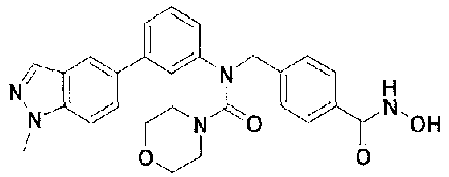
262 
253 
263 
254 
279 
255 
280 
256 
281 
260 
309 
261 
311 
[table 2] Compound Structural formula Compound Structural formula 312 
334 
313 
335 
329 
336 
330 
337 
331 
338 
332 
339 
333 
340 
[Table 3] Compound Structural formula Compound Structural formula 341 
356 
342 
357 
343 
358 
352 
370 
353 
371 
354 
372 
355 
374 
[Table 4] Compound Structural formula Compound Structural formula 376 
385 
377 
386 
379 
389 
380 
390 
381 
391 
382 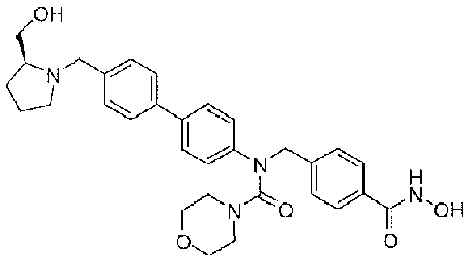
392 
383 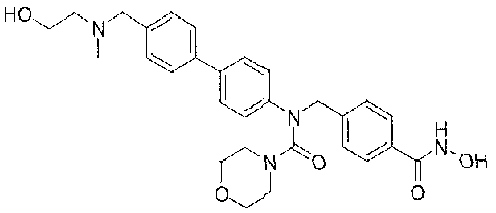
393 
[Table 5] Compound Structural formula Compound Structural formula 394 
401 
395 
402 
396 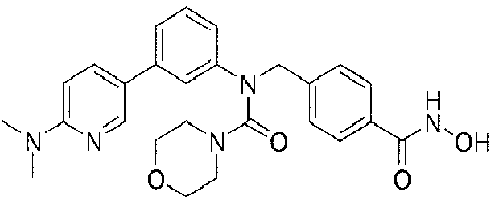
403 
397 
404 
398 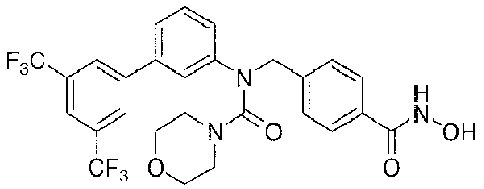
405 
399 
413 
400 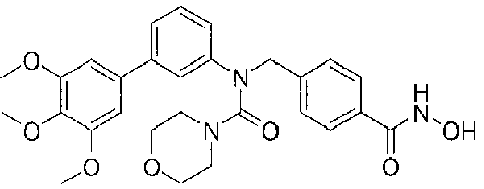
414 
[Table 6] Compound Structural formula Compound Structural formula 415 
440 
416 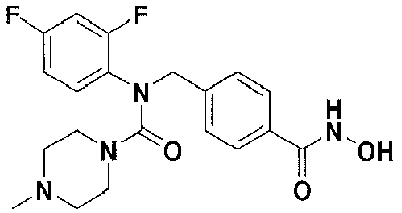
441 
418 
450 
419 
451 
420 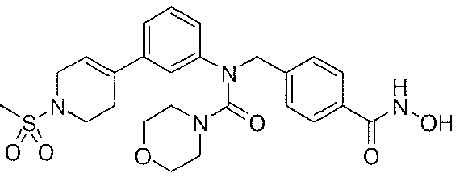
453 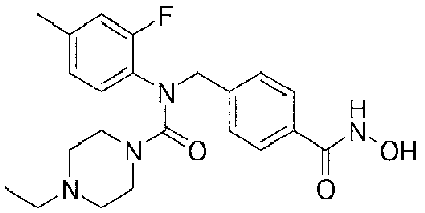
438 
454 
439 
455 
[Table 7] Compound Structural formula Compound Structural formula 456 
463 
457 
464 
458 
465 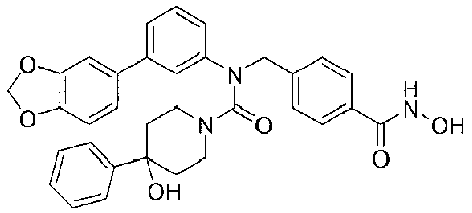
459 
466 
460 
467 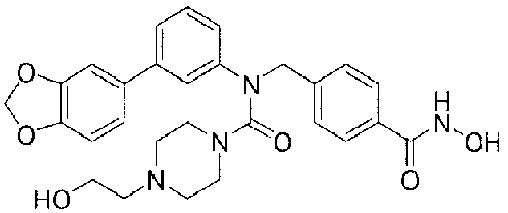
461 
468 
462 
469 
[Table 8] Compound Structural formula Compound Structural formula 470 
482 
471 
483 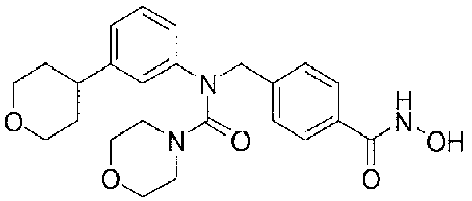
477 
484 
478 
485 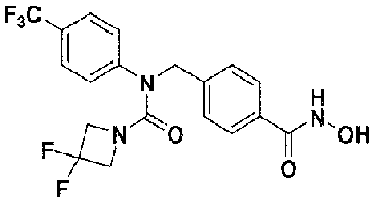
479 
486 
480 
487 
481 
488 
[Table 9] Compound Structural formula Compound Structural formula 489 
496 
490 
497 
491 
498 
492 
499 
493 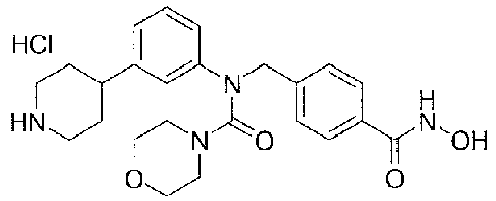
500 
494 
511 
495 
512 
[Table 10] Compound Structural formula Compound Structural formula 513 
529 
514 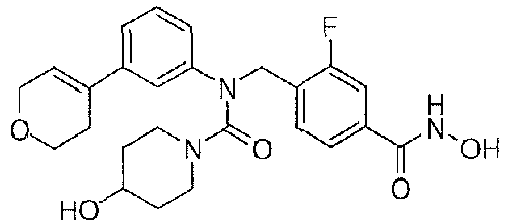
530 
517 
531 
518 
532 
520 
533 
521 
543 
522 
544 
[Table 11] Compound Structural formula Compound Structural formula 545 
716 
577 
717 
578 
718 
580 
765 
651 
766 
683 
771 
684 
772 
[Table 12] Compound Structural formula Compound Structural formula 773 
800 
774 
801 
776 
802 
778 
803 
791 
826 
797 
827 
[Table 13] Compound Structural formula Compound Structural formula 828 
829 
- Selective HDAC6 inhibitors are critical for the selectivity of HDAC1 inhibition, which causes side effects, and thus the selectivity of HDAC1/6 enzymes and the cell selectivity (HDAC1: Histone acetylation/HDAC6: Tubulin acetylation) were determined.
- The HDAC inhibitory activities of test materials were measured using the HDAC1 Fluorimetric Drug Discovery Assay Kit (Enzolifesciences: BML-AK511) and HDAC6 human recombinant (Calbiochem: 382180). In the HDAC1 assay, the samples were treated with concentrations of 100, 1000, and 10000 nM, and in the HDAC6 assay, the samples were treated with concentrations of 0.1, 1, 10, 100, and 1000 nM. After the treatment of the samples, the samples were reacted at 37 °C for 60 minutes, treated with a developer, and then reacted at 37 °C for 30 minutes. Then, the fluorescence intensity (Ex 390, Em 460) was measured using the FlexStatin 3 (Molecular device).
- The results are shown in Table 14.
- As shown in Table 14, the novel urea derivatives of the present invention exhibit excellent HDAC1/6 enzyme selectivity.
[Table 14] HDAC inhibitory activities (HDAC 1, 6) Compound HDAC6 (uM) HDAC1 (uM) Compound HDAC6 (uM) HDAC1 (uM) 252 0.006 0.151 376 0.004 ND 254 0.002 0.173 377 0.005 ND 256 0.001 0.148 379 0.004 ND 260 0.007 0.551 385 0.005 0.976 261 0.002 0.072 386 0.006 4.04 262 0.001 0.164 389 0.037 7.83 263 0.002 0.075 390 0.020 6.22 279 0.001 0.292 391 0.003 2.12 280 0.005 1.26 392 0.005 2.87 281 0.027 3.91 393 0.005 1.11 309 0.003 ND 394 0.011 2.59 311 0.013 22.9 395 0.005 0.489 312 0.007 22.7 396 0.005 0.257 313 0.007 35.9 397 0.014 1.0 352 0.007 4.62 398 0.032 4.45 353 0.010 4.53 399 0.007 0.302 354 0.009 3.91 400 0.008 0.770 355 0.005 2.34 401 0.008 1.79 356 0.004 3.82 402 0.003 0.170 357 0.003 3.28 403 0.001 0.453 358 0.009 4.17 404 0.016 3.50 370 0.001 0.710 405 0.003 1.45 371 0.020 1.33 413 0.0004 0.860 372 0.001 0.212 414 0.001 1.17 415 0.005 1.22 465 0.009 2.28 416 0.002 0.930 466 0.003 0.408 418 0.002 0.190 467 0.001 0.240 419 0.005 0.460 468 0.010 12.3 420 0.004 0.310 469 0.012 5.34 438 0.004 1.74 470 0.001 0.635 439 0.002 0.632 471 0.014 1.15 440 0.002 0.988 478 0.009 0.190 441 0.002 0.447 479 0.007 0.280 450 0.005 6.40 480 0.018 1.07 451 0.005 4.81 481 0.015 2.08 453 0.003 0.604 482 0.001 0.680 454 0.005 1.32 483 0.007 0.840 455 0.006 1.98 484 0.002 0.680 456 0.003 1.27 485 0.008 0.860 457 0.005 3.36 486 0.006 1.45 458 0.001 0.474 487 0.007 0.178 459 0.014 7.35 488 0.0005 1.17 460 0.003 2.37 489 0.0005 1.22 461 0.001 2.72 490 0.019 0.703 462 0.014 1.93 491 0.009 3.22 463 0.003 0.284 492 0.002 1.26 464 0.010 1.17 493 0.011 0.883 494 0.001 0.692 580 0.021 0.667 495 0.011 3.33 651 0.0046 0.765 496 0.001 1.12 683 0.0014 0.545 497 0.002 0.936 684 0.019 4.981 498 0.027 4.71 716 0.0064 0.727 499 0.005 3.63 717 0.024 2.372 500 0.003 1.00 718 0.405 8.541 511 0.012 0.636 765 0.0018 0.433 512 0.014 1.45 766 0.003 0.838 513 0.015 0.654 771 0.0645 >10 514 0.015 1.24 772 0.0025 0.349 517 0.028 0.427 773 0.0028 0.312 518 0.014 0.495 774 0.119 12.294 520 0.036 1.172 776 0.0315 1.983 521 0.010 0.261 778 0.011 6.435 522 0.011 0.177 791 0.0011 0.585 529 0.002 0.574 797 0.002 1.601 530 0.0014 0.161 800 0.078 0.633 531 0.0051 1.820 801 0.0597 14.925 532 0.0019 0.577 802 0.0094 1.596 533 0.0045 1.888 803 0.213 5.323 543 0.009 0.447 826 0.0118 1.853 544 0.021 0.503 827 0.0247 1.743 545 0.017 0.545 828 0.0367 4.142 577 0.0012 1.004 829 0.0082 1.603 578 0.0093 1.254 - The inhibitory activities of
Compounds [Table 15] HDAC inhibitory activities of Compounds uM 255 374 HDAC 1 0.16 2.12 HDAC 2 0.69 4.88 HDAC 31.63 10.3 H DAC 4 6.86 16.4 HDAC 5 8.27 ND HDAC 6 0.001 0.005 HDAC 7 1.50 5.25 HDAC 8 0.65 2.07 HDAC 9 3.52 10.3 HDAC 101.47 16.2 HDAC 11 0.78 8.42 Selectivity (HDAC6/1) 160 424 - As shown in Table 15, it was found that
Compound 255 had a selectivity of 160 times for HDAC6: 0.001 uM and HDAC1: 0.16 uM andCompound 374 had a selectivity of 424 times for HDAC6: 0.005 uM and HDAC1: 2.12uM. - To determine the selectivity for HDAC6 in cells, the acetylation levels of Tubulin, Histone H3 and Histone H4 depending on the concentration of compounds were measured by Western blot.
- RPMI8226 (1.0 x 10⁶cells/well) cells were seeded on six-well plates and treated with drugs (
Compounds 255 and 374) at each concentration. After 24 hours, the proteins were extracted with RIPA buffer and quantified by the Bradford method. 25 µg of protein was lysed in sample buffer, electrophoresed on a 4-12% gradient gel, and then transferred to nitrocellulose membranes for 50 minutes. Then transferred protein was blocked with 5% skim milk for 1 hour. Anti-acetyl H3 (1:2,000), anti-acetyl H4 (1:5,000), anti-acetyl tubulin (1:5,000), and anti-β-actin antibody (1:10,000) were added into 5% skim milk, and the membranes were immersed in the skim milk, reacted at 4 °C for 16 hours, and then washed three times for 10 minutes each with 1X TBS-T. Then, IgG-HRP antibody (1:5,000) was added into 5% skim milk, and then the membranes were immersed in the skim milk, reacted at room temperature for 40 minutes, and then washed three times for -10 minutes each with 1X TBS-T. Then, the acetylation levels were determined with aLAS 3000 using ECL solution. - The results are shown in
FIGS. 1 and 2 . - As shown in
FIGS. 1 and 2 , it was found that both Compound 255 (FIG. 1 ) and Compound 374 (FIG. 2 ) had excellent activities at low concentrations as tubulin acetylation (HDAC6) was expressed at a low concentration of about 10 nM. On the contrary, it was found thatCompound 255 andCompound 374 had little or no activity at low concentrations as histone acetylation (HDAC1) was expressed at a concentration of 1 uM ofCompound Compound 374. Therefore, it was found from the difference in the expressed concentration of tubulin and histone that the novel urea compounds of the present invention have excellent cell selectivity. - The efficacy of the novel urea derivatives of the present invention on the treatment of arthritis in collagen-induced arthritis models was determined.
- An emulsion was prepared by mixing bovine collagen type II (Chondrex) and complete Freund's adjuvant (Chondrex) at a ratio of 1:1 until the viscosity was measured using a 1 ml pipette. Each 100 ul of emulsion was intradermally injected into the tail of DBA/1J mice for the first immunization. After 21 days, an emulsion was prepared by mixing bovine collagen type II and incomplete Freund's adjuvant (Chondrex) at a ratio of 1:1 by the same method as above. Each of 100 ul of emulsion was intradermally injected into the upper part of the tail of DBA/1J mice for the second boosting immunization. After the second boosting immunization, the mice were grouped according to body weight, the test drug was administered to each group, and the effects of the test drugs were measured by measuring the clinical score and the body weight. The clinical scores were assigned from 0 to 4, and the total clinical score was determined by evaluating the feet of each mouse and summing up the scores (normal: 0, most severe edema: 16). That is, the efficacy in the arthritis models was evaluated with the severity of edema of the joint, and a higher score was assigned to more severe edema.
- The above experimental results are shown in
FIGS. 3 and 4 . - As shown in
FIG. 3 , the clinical score of the vehicle group was 11.6, and that of the group treated withCompound 254 in an amount of 30 mg/kg twice a day was 6.4, from which it can be seen that the arthritis symptoms were improved by more than 40%. Moreover, the clinical scores of the groups treated withCompound 255 in an amount of 10 and 30 mg/kg twice a day were 5.2 and 6.5, from which it can be seen that the arthritis symptoms were improved by more than 50%. Moreover, as shown inFIG. 4 , the clinical score of the vehicle (v) group was 6.7, and those of the group treated withCompound 374 at different concentrations were 2.8 and 2.5, from which it can be seen that the arthritis symptoms were improved by more than 60%. That is, severe edema was observed in the vehicle group untreated with no drugs, while the edema was significantly reduced in the group treated with the novel urea compounds of the present invention, from which it can be seen that the arthritis symptoms were significantly reduced. - The efficacy of the novel urea derivatives of the present invention on the treatment of arthritis in adjuvant-induced arthritis models was determined.
- Complete Freund's Adjuvant (Chondrex) containing 10 mg/mL Heat killed my-cobacteria toxin was sufficiently mixed, and then 100 uL was taken and intradermally injected into the upper part of the tail of Lewis rat to induce arthritis. After 10 days, the length of the ankle circumference of rats was measured, and then the rats were grouped and used in the experiment. Each compound was intraperitoneally injected twice a day. The clinical score, the length of the ankle circumference, and the weight were measured twice a week after the administration of the compounds. The clinical scores were assigned from 0 to 4 based on the thesis of Woods, etc. (J. Immunology, 1214-1222, 2001), and the total clinical score was determined by evaluating the feet of each rat and summing up the scores (normal: 0, most severe edema: 16). The length of the ankle circumference was calculated based on the formula of 2 X 3.14(√(a2+b2/2)) after measuring top-bottom sides (a) of the foot and lateral sides (b) of the foot. The final value was determined by averaging the calculated values of each foot.
- The results are shown in
FIG. 5 . InFIG. 5 , (A) shows the experimental results ofCompound 255, (B) shows the experimental results ofCompound 374, and (C) shows the experimental results ofCompound 461. In (A) ofFIG. 5 , the clinical store of the vehicle group was 4.9, and those of the experimental groups treated withCompound 255 in an amount of 3, 10, and 30 mg/kg twice a day were 3.0, 2.6, and 0.7, from which it can be seen that the arthritis symptoms were improved by 40 to 90%. In (B) ofFIG. 5 , the clinical store of the vehicle group was 8.1, and those of the experimental groups treated withCompound 374 in an amount of 3, 10, and 30 mg/kg twice a day were 2.5, 0.8, and 1.3, from which it can be seen that the arthritis symptoms were improved by 70 to 90%. In each experiment, the comparison ofCompounds FIG. 5 , the clinical store of the vehicle group was 4.2, and those of the experimental groups treated withCompound 461 in an amount of 25 and 50 mg/kg twice a day were 1.9 and 1.3, from which it can be seen that the arthritis symptoms were improved by more than 50 to 70%, which were higher than that of MTX used as the control group. - The efficacy of the novel urea derivatives of the present invention on the treatment of colitis in colitis models was determined.
- 3.0% dextran sulfate sodium (DSS: MP biomedicals) was dissolved in deionized water and supplied to 9-week-old C57BL/6J mice for 5 to 7 days and then water was normally supplied to the mice to induce colitis in animal models. The experimental animals were classified into a solvent control group and each group treated with
Compound 254 andCompound 255 as test materials based on the body weight of the experimental animals. The test material was intraperitoneally injected twice a day after 8 days from the supply of DSS. The evaluation of the efficacy in colitis models was made by determining the degree to which the weight, lost due to the disease, was recovered to normal level, and the results are shown inFIG. 6 . - As shown in
FIG. 6 , the weights of the disease-induced models were lost as 17.5 to 18 g and then recovered to 18.5 to 19.0 g by the administration ofCompound Compound 255, indicating that the efficacy was excellent. As a result, the efficacy of the novel urea derivatives on treatment of colitis was confirmed. - The efficacy of the novel urea derivatives of the present invention on the treatment of multiple myeloma was determined by western blot, MTT assay and combination index.
- The acetylation of tubulin, histone H3 and Histone H4 on RPMI8226 cells (1.0 x 10⁶cells/well) derived from myeloma was determined in the same manner as the cell determination in Example 1.
- The results are shown in
FIGS. 1 and 2 . - As shown in
FIGS. 1 and 2 , it was found thatCompounds - RPMI 8226 cells were seeded in 96-well U-bottom plate at 3 x 10⁵ cells/ml in 180 µl per well, and 20 µl of test material was added to the plate. The cells were incubated in a 37 °C humidified 5% CO2 incubator for 48 hours, and each 20 µl of 5 mg/ml 2-(4,5-dimethylthiazol-2-yl)-2,5-diphenyltetrazolium bromide (MTT) solution dissolved in PBS was added and incubated again for 4 hours. After the formation of formazan, the medium was completely removed, 200 µl of DMSO was added, and then the absorbance was measured using a microplate reader at 570 nm.
- For the quantitative analysis of drug interaction between the novel urea compounds of the present invention and Velcade (BOZ) well known as a therapeutic agent for multiple myeloma, the combination index (CI) of cell fractions on cytotoxicity caused by the drugs was calculated based on the dose-response curve of single and combination treatments. For the analysis of the interaction between two drugs, the CI was measured using Compusyn software (Combosyn Inc.) according to the method of Chou and Talalay (CompuSyn by Ting-Chao Chou and Nick Martin, 2005). The CI is the dose ratio of two anticancer agents treated with the dose of two anticancers at the point representing the equivalent cytotoxic effects. CI<1, CI=1, and CI>1 are interpreted as synergism, additivity, and antagonism, respectively.
- The results are shown in Table 16 and
FIG. 7 .[Table 16] Analysis of Combination Index for Combination Treatment Compound 255 (µM) BOZ (nM) CI (1) CI (2) CI (3) 1.0 10.0 0.416 0.518 0.417 1.0 5.0 0.469 0.679 0.475 1.0 2.5 0.940 1.146 0.998 0.5 10.0 0.491 0.529 0.428 0.5 5.0 0.751 0.789 0.727 0.5 2.5 1.120 1.115 1.087 0.25 10.0 0.482 0.309 0.417 0.25 5.0 0.560 0.710 0.737 0.25 2.5 1.182 1.034 1.068 - As shown in Table 16 and
FIG. 7 , the efficacy of the combination of two drugs can be determined by the combination index (CI), and the combination effect is excellent when this index is not less than 1. In the case ofCompound 255, the CI is not less than 1 in most doses, from which it can be seen that the combination effect is excellent.

Claims (8)
- A compound represented by the following Formula I, optical isomer thereof or pharmaceutically acceptable salt thereof:
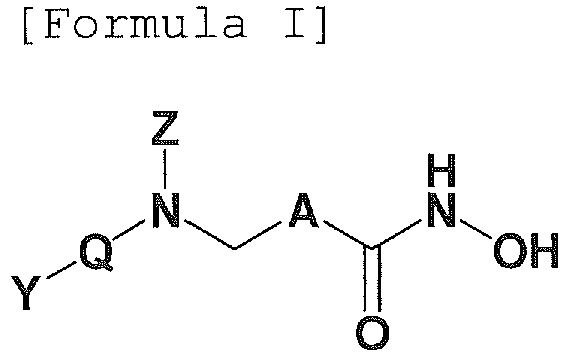 A is
A is Xa and Xb are each independently C or N,L1 and L2 are each independently hydrogen, -F, -Cl, -Br, -I, -CF3 or -C1-3 straight or branched chain alkyl, Q is C(=O), S((=O)2), S(=O), or C(=NH),Y is selected from the group consisting of:
 M is C, O, N, S(=O)2, or S,l and m are each independently an integer of 0 or 1, Ra1 and Ra2 are each independently hydrogen; hydroxy; -C1-4 straight or branched chain alkyl, unsubstituted or substituted with one or more F, Cl, Br or I; -C1-4 straight or branched chain alcohol; benzhydryl; -C1-4 straight or branched chain alkyl substituted with a saturated or unsaturated 5- to 7-membered heterocyclic compound comprising 1 to 3 heteroatoms selected from N, O, and S as a ring member (wherein the heterocyclic compound may be unsubstituted or at least one hydrogen may be optionally substituted with OH, OCH3, CH3, CH2CH3, F, Cl, Br, or I) ; a saturated or unsaturated 5- to 7-membered heterocyclic compound comprising 1 to 3 heteroatoms selected from N, O, and S as a ring member (wherein the heterocyclic compound may be unsubstituted or at least one hydrogen may be optionally substituted with OH, OCH3, CH3, CH2CH3, F, Cl, Br, or I); phenyl, unsubstituted or substituted with one or more F, Cl, Br, I, C1-4 alkoxy, C1-2 alkyl, or hydroxy; benzyl, unsubstituted or substituted with one or more F, Cl, Br, I, C1-4 alkoxy, C1-2 alkyl, or hydroxy; -S((=O)2) CH3; -F;-Cl; -Br; -I; -C1-6 straight or branched chain alkoxy; -C2-6 alkyl alkoxy; -C(=O)Rx, wherein Rx is straight or branched C1-3 alkyl or C3-10 cycloalkyl;
 n is an integer of 0, 1, or 2,Rb is hydrogen; hydroxy; -C1-6 straight or branched chain alkyl, unsubstituted or substituted with one or more F, Cl, Br, or I; -C(=O) CH3; -C1-4 straight or branched chain alcohol; -C1-6 straight or branched chain alkoxy;-C2-6 straight or branched chain alkyl alkoxy; -CF3; -F;-Cl; -Br; -I; or
andZ is selected from the group consisting of the following compounds:
 wherein Pa and Pb are each independently
 wherein Ⓑ is selected from phenyl, pyridine, pyrimidine, thiazole, indole, indazole, piperazine, quinoline, furan, tetrahydropyridine, piperidine, or the following group:
 x, y and z are each independently an integer of 0 or 1, andRg1, Rg2 and Rg3 are each independently selected from hydrogen; hydroxy; -C1-3 alkyl; -CF3; -C1-6 straight or branched chain alkoxy; -C2-6 straight or branched chain alkyl alkoxy; -C(=O)CH3; -C1-4 straight or branched chain alcohol; -N(CH3)2; -F; -Cl; -Br; -I; phenyl; -S((=O)2)CH3; or the following group:

- The compound of Formula I, optical isomer thereof or pharmaceutically acceptable salt thereof according to claim 1, wherein the compound represented by the above Formula I is a compound represented by the following Formula II:
 a is an integer of 0, 1 or 2,K is independently hydrogen, -F, -Cl, -Br or -I,Y is selected from the group consisting of:
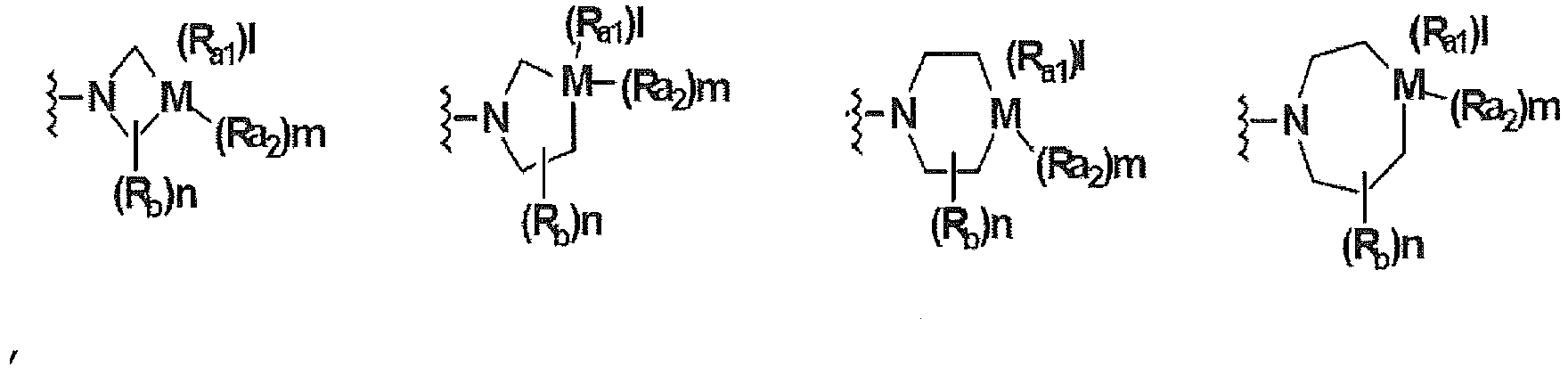 M is C, O or N,1 and m are each independently an integer of 0 or 1, Ra1 and Ra2 are each independently hydrogen; hydroxy; -C1-4 straight or branched chain alkyl, unsubstituted or substituted with one or more F, Cl, Br or I; -C1-4 straight or branched chain alcohol; benzhydryl; -C1-4 straight or branched chain alkyl substituted with a saturated or unsaturated 5- to 7-membered heterocyclic compound comprising 1 to 3 heteroatoms selected from N, 0, and S as a ring member (wherein the heterocyclic compound may be unsubstituted or at least one hydrogen may be optionally substituted with OH, OCH3, CH3, CH2CH3, F, Cl, Br, or I); a saturated or unsaturated 5- to 7-membered heterocyclic compound comprising 1 to 3 heteroatoms selected from N, O, and S as a ring member (wherein the heterocyclic compound may be unsubstituted or at least one hydrogen may be optionally substituted with OH, OCH3, CH3, CH2CH3, F, Cl, Br, or I); phenyl, unsubstituted or substituted with one or more F, Cl, Br, I, C1-4 alkoxy, C1-2 alkyl, or hydroxy; benzyl, unsubstituted or substituted with one or more F, Cl, Br, I, C1-4 alkoxy, C1-2 alkyl, or hydroxy; -S((=O)2) CH3; -F; - Cl; -Br; -I; -C1-6 straight or branched chain alkoxy; -C2-6 alkyl alkoxy; -C(=O)Rx, wherein Rx is straight or branched C1-3 alkyl or C3-10 cycloalkyl;
 n is an integer of 0, 1, or 2,Rb is hydrogen; hydroxy; -C1-6 straight or branched chain alkyl, unsubstituted or substituted with one or more F, Cl, Br, or I; -C(=O) CH3; -C1-4 straight or branched chain alcohol; -C1-6 straight or branched chain alkoxy; - C2-6 straight or branched chain alkyl alkoxy; -CF3; -F; - Cl; -Br; -I; or
 Z is selected from the group consisting of the following compounds:

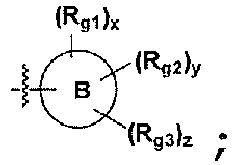 wherein Ⓑ is selected from phenyl, pyridine, pyrimidine, thiazole, indole, indazole, piperazine, quinoline, furan, tetrahydropyridine, piperidine, or the following group:
 x, y and z are each independently an integer of 0 or 1, andRg1, Rg2 and Rg3 are each independently selected from hydrogen; hydroxy; -C1-3 alkyl; -CF3; -C1-6 straight or branched chain alkoxy; -C2-6 straight or branched chain alkyl alkoxy; -C(=O) CH3; -C1-4 straight or branched chain alcohol; -N(CH3)2; -F; -Cl; -Br; -I; phenyl; -S((=O)2) CH3; or the following group:

- The compound of Formula II, optical isomer thereof or pharmaceutically acceptable salt thereof according to claim 2, wherein
a is an integer of 0, 1 or 2,
K is independently hydrogen, -F, -Cl, -Br or -I,
Y is
1 and m are each independently an integer of 0 or 1,
Ra1 and Ra2 are each independently hydrogen; hydroxy; -C1-4 straight or branched chain alkyl, unsubstituted or substituted with one or more F, Cl, Br or I; -C1-4 straight or branched chain alcohol; benzhydryl; -C1-4 straight or branched chain alkyl substituted with a saturated or unsaturated 5- to 7-membered heterocyclic compound comprising 1 to 3 heteroatoms selected from N, O, and S as a ring member (wherein the heterocyclic compound may be unsubstituted or at least one hydrogen may be optionally substituted with OH, OCH3, CH3, CH2CH3, F, Cl, Br, or I) ; a saturated or unsaturated 5- to 7-membered heterocyclic compound comprising 1 to 3 heteroatoms selected from N, O, and S as a ring member (wherein the heterocyclic compound may be unsubstituted or at least one hydrogen may be optionally substituted with OH, OCH3, CH3, CH2CH3, F, Cl, Br, or I); phenyl, unsubstituted or substituted with one or more F, Cl, Br, I, C1-4 alkoxy, C1-2 alkyl, or hydroxy; benzyl, unsubstituted or substituted with one or more F, Cl, Br, I, C1-4 alkoxy, C1-2 alkyl, or hydroxy; -S((=O)2) CH3; -F; - Cl; -Br; -I; -C1-6 straight or branched chain alkoxy; -C2-6 alkyl alkoxy; -C(=O)Rx, wherein Rx is straight or branched C1-3 alkyl or C3-10 cycloalkyl; or,
Rb is hydrogen; -C1-6 straight or branched chain alkyl, unsubstituted or substituted with one or more F, Cl, Br, or I; and
Z is selected from the group consisting of the following compounds:

- The compound of Formula II, optical isomer thereof or pharmaceutically acceptable salt thereof according to claim 2, wherein the compound represented by the above Formula II is a compound represented by the following Formula III:
 Y is
Y is M is C, O or N,1 and m are each independently an integer of 0 or 1,Ra1 and Ra2 are each independently hydrogen; -C1-4 straight or branched chain alkyl, unsubstituted or substituted with one or more F, Cl, Br or I; -C1-4 straight or branched chain alkyl substituted with a phenyl, pyridine or pyrimidine (wherein the phenyl, pyridine or pyrimidine may be unsubstituted or at least one hydrogen may be optionally substituted with OH, OCH3, CH3, CH2CH3, F, Cl, Br, or I);n is an integer of 0, 1, or 2,Rb is hydrogen; -C1-6 straight or branched chain alkyl, unsubstituted or substituted with one or more F, Cl, Br, or I; andZ is selected from the group consisting of the following compounds:

- The compounds of Formula I, optical isomers thereof or pharmaceutically acceptable salts thereof according to claim 1, wherein the compounds of Formula I are selected from the group consisting of the following compounds:N-(4-(hydroxycarbamoyl)benzyl)-N-(3-(1-methyl-1H-indazol-5-yl)phenyl)morpholine-4-carboxamide;N-(4-(hydroxycarbamoyl)benzyl)-4-methyl-N-(3-(1-methyl-1H-indazol-5-yl)phenyl)piperazine-1-carboxamide;N-(4-(hydroxycarbamoyl)benzyl)-N-(3-(1-methyl-1H-indazol-6-yl)phenyl)morpholine-4-carboxamide;N-(3-bromophenyl)-N-(4-(hydroxycarbamoyl)benzyl)-morpholine-4-carboxamide;N-(3-bromophenyl)-N-(4-(hydroxycarbamoyl)benzyl)-4-methylpiperazine-1-carboxamide;N-(4-(hydroxycarbamoyl)benzyl)-N-(3-(1-methyl-1H-indazol-5-yl)phenyl)piperidine-1-carboxamide;N-(3-(1H-indol-6-yl)phenyl)-N-(4-(hydroxycarbamoyl)-benzyl)morpholine-4-carboxamide;N-(4-(hydroxycarbamoyl)benzyl)-N-(3-(pyridin-3-yl)phenyl)morpholine-4-carboxamide;N-(3-(1H-indol-5-yl)phenyl)-N-(4-(hydroxycarbamoyl)benzyl)morpholine-4-carboxamide;N-(4-(hydroxycarbamoyl)benzyl)-N-phenylmorpholine-4-carboxamide;N-(4-(hydroxycarbamoyl)benzyl)-N-(pyridin-2-yl)morpholine-4-carboxamide;N-(4-(hydroxycarbamoyl)benzyl)-N-(pyridin-3-yl)morpholine-4-carboxamide;4-benzyl-N-(4-(hydroxycarbamoyl)benzyl)-N-(pyrimidin-2-yl)piperazine-1-carboxamide;4-hydroxy-N-(4-(hydroxycarbamoyl)benzyl)-4-phenyl-N-(pyrimidin-2-yl)piperidine-1-carboxamide;N-(4-(hydroxycarbamoyl)benzyl)-N-(pyrimidin-2-yl)morpholine-4-carboxamide;N-(4-(hydroxycarbamoyl)benzyl)-2,6-dimethyl-N-(pyrimidin-2-yl)morpholine-4-carboxamide;N-(4-(hydroxycarbamoyl)benzyl)-N-(4-(1-methyl-1H-indazol-6-yl)phenyl)morpholine-4-carboxamide;N-(biphenyl-4-yl)-N-(4-(hydroxycarbamoyl)benzyl)-morpholine-4-carboxamide;N-(3',5'-difluorobiphenyl-4-yl)-N-(4-(hydroxycarbamoyl)benzyl)morpholine-4-carboxamide;N-(4-(hydroxycarbamoyl)benzyl)-N-(4-(pyridin-3-yl)phenyl)morpholine-4-carboxamide;N-(4-(hydroxycarbamoyl)benzyl)-N-(4-(pyrimidin-5-yl)phenyl)morpholine-4-carboxamide;N-(4-(hydroxycarbamoyl)benzyl)-N-(4-(quinolin-7-yl)phenyl)morpholine-4-carboxamide;N-(4-(hydroxycarbamoyl)benzyl)-N-(4-(biphenyl-3-yl)phenyl)morpholine-4-carboxamide;N-(4-(1H-indol-5-yl)phenyl)-N-(4-(hydroxycarbamoyl)benzyl)morpholine-4-carboxamide;N-(4-(1H-indol-6-yl)phenyl)-N-(4-(hydroxycarbamoyl)benzyl)morpholine-4-carboxamide;N-(4-(hydroxycarbamoyl)benzyl)-N-(3',4',5'-trimethoxybiphenyl-4-yl)morpholine-4-carboxamide;N-(3',5'-bis(trifluoromethyl)biphenyl-4-yl)-N-(4-(hydroxycarbamoyl)benzyl)morpholine-4-carboxamide;N-(4-(1H-indol-4-yl)phenyl)-N-(4-(hydroxycarbamoyl)benzyl)morpholine-4-carboxamide;N-(4-(hydroxycarbamoyl)benzyl)-N-(pyridin-2-yl)piperidine-1-carboxamide;N-(4-(hydroxycarbamoyl)benzyl)-4-methyl-N-(pyridin-2-yl)piperidine-1-carboxamide;N-(4-(hydroxycarbamoyl)benzyl)-2,6-dimethyl-N-(pyridin-2-yl)morpholine-4-carboxamide;N-(4-(hydroxycarbamoyl)benzyl)-4-phenyl-N-(pyridin-2-yl)-5,6-dihydropyridine-1(2H)-carboxamide;N-(4-(hydroxycarbamoyl)benzyl)-4-methyl-N-(pyridin-2-yl)piperazine-1-carboxamide;4-ethyl-N-(4-(hydroxycarbamoyl)benzyl)-N-(pyridin-2-yl)piperazine-1-carboxamide;4-benzyl-N-(4-(hydroxycarbamoyl)benzyl)-N-(pyridin-2-yl)piperazine-1-carboxamide;N-(4-(hydroxycarbamoyl)benzyl)-4-(2-methoxyphenyl)-N-(pyridin-2-yl)piperazine-1-carboxamide;4-(4-fluorophenyl)-N-(4-(hydroxycarbamoyl)benzyl)-N-(pyridin-2-yl)piperazine-1-carboxamide;N-(4-(hydroxycarbamoyl)benzyl)-N-(pyridin-2-yl)pyrrolidine-1-carboxamide;N-(4-(hydroxycarbamoyl)benzyl)-N-(4-phenylthiazol-2-yl)morpholine-4-carboxamide;N-(4-(4-chlorophenyl)thiazol-2-yl)-N-(4-(hydroxycarbamoyl)benzyl)morpholine-4-carboxamide;N-(4-bromophenyl)-N-(4-(hydroxycarbamoyl)benzyl)morpholine-4-carboxamide;N-(4-(hydroxycarbamoyl)benzyl)-N-(3-(trifluoromethyl)phenyl)morpholine-4-carboxamide;N-(4-(hydroxycarbamoyl)benzyl)-4-methyl-N-(pyridin-2-yl)-1,4-diazepane-1-carboxamide;N-(4-(hydroxycarbamoyl)benzyl)-N-(pyridin-2-yl)azetidine-1-carboxamide;4-(3,4-dimethylphenyl)-N-(4-(hydroxycarbamoyl)benzyl)-N-(pyridin-2-yl)piperazine-1-carboxamide;N-(4-(hydroxycarbamoyl)benzyl)-N-(4'-(morpholinomethyl)biphenyl-4-yl)morpholine-4-carboxamide;N-(4-(hydroxycarbamoyl)benzyl)-N-(4'-((4-methylpiperazin-1-yl)methyl)biphenyl-4-yl)morpholine-4-carboxamide;(S)-N-(4-(hydroxycarbamoyl)benzyl)-N-(4'-((2-(hydroxymethyl)pyrrolidin-1-yl)methyl)biphenyl-4-yl)morpholine-4-carboxamide;N-(4-(hydroxycarbamoyl)benzyl)-N-(4'-(((2-hydroxyethyl)(methyl)amino)methyl)biphenyl-4-yl)morpholine-4-carboxamide;N-(4-(hydroxycarbamoyl)benzyl)-N-(4-(trifluoromethyl)phenyl)morpholine-4-carboxamide;N-(4-(hydroxycarbamoyl)benzyl)-2,6-dimethyl-N-(3-(trifluoromethyl)phenyl)morpholine-4-carboxamide;N-(4-chloro-3-(trifluoromethyl)phenyl)-N-(4-(hydroxycarbamoyl)benzyl)piperidine-1-carboxamide;N-(4-chloro-3-(trifluoromethyl)phenyl)-N-(4-(hydroxycarbamoyl)benzyl)-4-methylpiperidine-1-carboxamide;N-(4-chloro-3-(trifluoromethyl)phenyl)-N-(4-(hydroxycarbamoyl)benzyl)morpholine-4-carboxamide;N-(4-chloro-3-(trifluoromethyl)phenyl)-N-(4-(hydroxycarbamoyl)benzyl)-2,6-dimethylmorpholine-4-carboxamide;N-(4-chloro-3-(trifluoromethyl)phenyl)-N-(4-(hydroxycarbamoyl)benzyl)-4-methylpiperazine-1-carboxamide;N-(4-chloro-3-(trifluoromethyl)phenyl)-4-ethyl-N-(4-(hydroxycarbamoyl)benzyl)piperazine-1-carboxamide;N-(3',5'-difluorobiphenyl-3-yl)-N-(4-(hydroxycarbamoyl)benzyl)morpholine-4-carboxamide;N-(3-(6-(dimethylamino)pyridin-3-yl)phenyl)-N-(4-(hydroxycarbamoyl)benzyl)morpholine-4-carboxamide;N-(4-(hydroxycarbamoyl)benzyl)-N-(3-(pyrimidin-5-yl)phenyl)morpholine-4-carboxamide;N-(3',5'-bis(trifluoromethyl)biphenyl-3-yl)-N-(4-(hydroxycarbamoyl)benzyl)morpholine-4-carboxamide;N-(3-(2,3-dihydrobenzo[b] [1,4]dioxin-6-yl)phenyl)-N-(4-(hydroxycarbamoyl)benzyl)morpholine-4-carboxamide;N-(4-(hydroxycarbamoyl)benzyl)-N-(3',4',5'-trimethoxybiphenyl-3-yl)morpholine-4-carboxamide;N-(2',6'-dimethylbiphenyl-3-yl)-N-(4-(hydroxycarbamoyl)benzyl)morpholine-4-carboxamide;N-(3-(furan-3-yl)phenyl)-N-(4-(hydroxycarbamoyl)benzyl)morpholine-4-carboxamide;N-(3-(3,6-dihydro-2H-pyran-4-yl)phenyl)-N-(4-(hydroxycarbamoyl)benzyl)morpholine-4-carboxamide;N-(4-(hydroxycarbamoyl)benzyl)-N-(3-(1-methyl-1,2,3,6-tetrahydropyridin-4-yl)phenyl)morpholine-4-carboxamide;tert-butyl 4-(3-(N-(4-(hydroxycarbamoyl)benzyl)-morpholine-4-carboxamido)phenyl)-5,6-dihydropyridine-1(2H)-carboxylate;N-(2,4-difluorophenyl)-N-(4-(hydroxycarbamoyl)benzyl)-morpholine-4-carboxamide;N-(2,4-difluorophenyl)-N-(4-(hydroxycarbamoyl)benzyl)-piperidine-1-carboxamide;N-(2,4-difluorophenyl)-N-(4-(hydroxycarbamoyl)benzyl)-2,6-dimethylmorpholine-4-carboxamide;N-(2,4-difluorophenyl)-N-(4-(hydroxycarbamoyl)benzyl)-4-methylpiperazine-1-carboxamide;N-(3-(benzo[d][1,3]dioxol-5-yl)phenyl)-N-(4-(hydroxycarbamoyl)benzyl)morpholine-4-carboxamide;N-(3-(1-acetyl-1,2,3,6-tetrahydropyridin-4-yl)phenyl)-N-(4-(hydroxycarbamoyl)benzyl)morpholine-4-carboxamide;N-(4-(hydroxycarbamoyl)benzyl)-N-(3-(1-(methylsulfonyl)-1,2,3,6-tetrahydropyridin-4-yl)phenyl)morpholine-4-carboxamide;N-(2-fluoro-4-methylphenyl)-N-(4-(hydroxycarbamoyl)-benzyl)piperidine-1-carboxamide;N-(2-fluoro-4-methylphenyl)-N-(4-(hydroxycarbamoyl)-benzyl)morpholine-4-carboxamide;N-(2-fluoro-4-methylphenyl)-N-(4-(hydroxycarbamoyl)-benzyl)-2,6-dimethylmorpholine-4-carboxamide;N-(2-fluoro-4-methylphenyl)-N-(4-(hydroxycarbamoyl)-benzyl)-4-methylpiperazine-1-carboxamide;4-acetyl-N-(4-(hydroxycarbamoyl)benzyl)-N-(pyridin-2-yl)-1,4-diazepane-1-carboxamide;4-(cyclopropanecarbonyl)-N-(4-(hydroxycarbamoyl)benzyl)-N-(pyridin-2-yl)piperazine-1-carboxamide;4-ethyl-N-(2-fluoro-4-methylphenyl)-N-(4-(hydroxycarbamoyl)benzyl)piperazine-1-carboxamide;N-(2-fluoro-4-methylphenyl)-N-(4-(hydroxycarbamoyl)-benzyl)-4-(2-methoxyphenyl)piperazine-1-carboxamide;N-(2-fluoro-4-methylphenyl)-4-(4-fluorophenyl)-N-(4-(hydroxycarbamoyl)benzyl)piperazine-1-carboxamide;N-(3-chloro-4-fluorophenyl)-N-(4-(hydroxycarbamoyl)benzyl)piperidine-1-carboxamide;N-(3-chloro-4-fluorophenyl)-N-(4-(hydroxycarbamoyl)-benzyl)-4-methylpiperidine-1-carboxamide-N-(3-chloro-4-fluorophenyl)-N-(4-(hydroxycarbamoyl)benzyl)morpholine-4-carboxamide;N-(4-(hydroxycarbamoyl)benzyl)-4-methyl-N-(3-(trifluoromethyl)phenyl)piperidine-1-carboxamide;N-(4-(hydroxycarbamoyl)benzyl)-N-(3-(trifluoromethyl)phenyl)piperidine-1-carboxamide;4-ethyl-N-(4-(hydroxycarbamoyl)benzyl)-N-(3-(trifluoromethyl)phenyl)piperazine-1-carboxamide;N-(3-(benzo[d][1,3]dioxol-5-yl)phenyl)-N-(4-(hydroxycarbamoyl)benzyl)piperidine-1-carboxamide;N-(3-(benzo[d] [1,3]dioxol-5-yl)phenyl)-4-hydroxy-N-(4-(hydroxycarbamoyl)benzyl)piperidine-1-carboxamide;N-(3-(benzo[d][1,3]dioxol-5-yl)phenyl)-N-(4-(hydroxycarbamoyl)benzyl)-2,6-dimethylmorpholine-4-carboxamide;N-(3-(benzo[d][1,3]dioxol-5-yl)phenyl)-4-hydroxy-N-(4-(hydroxycarbamoyl)benzyl)-4-phenylpiperidine-1-carboxamide;N-(3-(benzo[d][1,3]dioxol-5-yl)phenyl)-N-(4-(hydroxycarbamoyl)benzyl)-4-methylpiperazine-1-carboxamide;N-(3-(benzo[d][1,3]dioxol-5-yl)phenyl)-N-(4-(hydroxycarbamoyl)benzyl)-4-(2-hydroxyethyl)piperazine-1-carboxamide;N-(3-(benzo[d][1,3]dioxol-5-yl)phenyl)-N-(4-(hydroxycarbamoyl)benzyl)pyrrolidine-1-carboxamide;(S)-N-(3-(benzo[d][1,3]dioxol-5-yl)phenyl)-N-(4-(hydroxycarbamoyl)benzyl)-2-(hydroxymethyl)pyrrolidine-1-carboxamide;N-(3-(benzo[d][1,3]dioxol-5-yl)phenyl)-4-(cyclopropanecarbonyl)-N-(4-(hydroxycarbamoyl)benzyl)piperazine-1-carboxamide;N-(3-(benzo[d][1,3]dioxol-5-yl)phenyl-)-N-(4-(hydroxycarbamoyl)benzyl)azetidine-1-carboxamide;N-(3-chloro-4-fluorophenyl)-N-(4-(hydroxycarbamoyl)-benzyl)-2,6-dimethylmorpholine-4-carboxamideN-(3-chloro-4-fluorophenyl)-N-(4-(hydroxycarbamoyl)-benzyl)-4-methylpiperazine-1-carboxamide;N-(3-chloro-4-fluorophenyl)-4-ethyl-N-(4-(hydroxycarbamoyl)benzyl)piperazine-1-carboxamide;4-benzyl-N-(3-chloro-4-fluorophenyl)-N-(4-(hydroxycarbamoyl)benzyl)piperazine-1-carboxamide;N-(3-chloro-4-fluorophenyl)-N-(4-(hydroxycarbamoyl)-benzyl)-4-(2-methoxyphenyl)piperazine-1-carboxamide;N-(3-chloro-4-fluorophenyl)-4-(4-fluorophenyl)-N-(4-(hydroxycarbamoyl)benzyl)piperazine-1-carboxamide;N-(4-(hydroxycarbamoyl)benzyl)-N-(3-(tetrahydro-2H-pyran-4-yl)phenyl)morpholine-4-carboxamide;N-(4-(hydroxycarbamoyl)benzyl)-N-(3-methoxyphenyl)morpholine-4-carboxamide;3,3-difluoro-N-(4-(hydroxycarbamoyl)benzyl)-N-(4-(trifluoromethyl)phenyl)azetidine-1-carboxamide;4-hydroxy-N-(4-(hydroxycarbamoyl)benzyl)-4-phenyl-N-(4-(trifluoromethyl)phenyl)piperidine-1-carboxamide;N-(3-bromophenyl)-N-(2-fluoro-4-(hydroxycarbamoyl)benzyl)morpholine-4-carboxamide;N-(3-bromophenyl)-N-(2-fluoro-4-(hydroxycarbamoyl)-benzyl)-4-hydroxypiperidine-1-carboxamidetert-butyl 4-(3-(N-(4-(hydroxycarbamoyl)benzyl)-morpholine-4-carboxamido)phenyl)piperidine-1-carboxylateN-(3-(1-acetylpiperidin-4-yl)phenyl)-N-(4-(hydroxycarbamoyl)benzyl)morpholine-4-carboxamide;N-(4-(hydroxycarbamoyl)benzyl)-N-(3-(1-(methylsulfonyl)-piperidin-4-yl)phenyl)morpholine-4-carboxamide;N-(4-(hydroxycarbamoyl)benzyl)-N-(3-(1-(isopropylcarbamoyl)piperidin-4-yl) phenyl)morpholine-4-carboxamide;N-(4-(hydroxycarbamoyl)benzyl)-N-(3-(piperidin-4-yl)phenyl)morpholine-4-carboxamide hydrochloride;4-acetyl-N-(4-(hydroxycarbamoyl)benzyl)-N-(3-(trifluoromethyl)phenyl)piperazine-1-carboxamide;(R)-3-fluoro-N-(4-(hydroxycarbamoyl)benzyl)-N-(3-(trifluoromethyl)phenyl)pyrrolidine-1-carboxamide;(S)-3-fluoro-N-(4-(hydroxycarbamoyl)benzyl)-N-(3-(trifluoromethyl)phenyl)pyrrolidine-1-carboxamide;(R)-N-(4-(hydroxycarbamoyl)benzyl)-2-(hydroxymethyl)-N-(3-(trifluoromethyl)phenyl)pyrrolidine-1-carboxamide;(S)-N-(4-(hydroxycarbamoyl)benzyl)-2-(trifluoromethyl)-N-(3-(trifluoromethyl)phenyl)pyrrolidine-1-carboxamide;N-(4-(hydroxycarbamoyl)benzyl)-N-(3-(hydroxymethyl)phenyl)morpholine-4-carboxamide;N-(3-(fluoromethyl)phenyl)-N-(4-(hydroxycarbamoyl)benzyl)morpholine-4-carboxamide;N-(3-(benzo[d][1,3]dioxol-5-yl)phenyl)-N-(2-fluoro-4-(hydroxycarbamoyl)benzyl)morpholine-4-carboxamide;N-(3-(3,6-dihydro-2H-pyran-4-yl)phenyl)-N-(2-fluoro-4-(hydroxycarbamoyl)benzyl)morpholine-4-carboxamide;N-(3-(benzo[d][1,3]dioxol-5-yl)phenyl)-N-(2-fluoro-4-(hydroxycarbamoyl)benzyl)-4-hydroxypiperidine-1-carboxamide;N-(3-(3,6-dihydro-2H-pyran-4-yl)phenyl)-N-(2-fluoro-4-(hydroxycarbamoyl)benzyl)-4-hydroxypiperidine-1-carboxamide;N-(3-(1-(2-hydroxy-2-methylpropyl)piperidin-4-yl)phenyl)-N-(4-(hydroxycarbamoyl)benzyl)morpholine-4-carboxamide;N-(3-(1-(2-fluoro-2-methylpropyl)piperidin-4-yl)phenyl)-N-(4-(hydroxycarbamoyl)benzyl)morpholine-4-carboxamide;(R)-3-fluoro-N-(4-(hydroxycarbamoyl)benzyl)-N-(4-(trifluoromethyl)phenyl)pyrrolidine-1-carboxamide;(S)-3-fluoro-N-(4-(hydroxycarbamoyl)benzyl)-N-(4-(trifluoromethyl)phenyl)pyrrolidine-1-carboxamide;(R)-N-(4-(hydroxycarbamoyl)benzyl)-2-(hydroxymethyl)-N-(4-(trifluoromethyl)phenyl)pyrrolidine-1-carboxamide;4-acetyl-N-(3-fluorophenyl)-N-(4-(hydroxycarbamoyl)benzyl)piperazine-1-carboxamide;N-(3-fluorophenyl)-N-(4-(hydroxycarbamoyl)benzyl)morpholine-4-carboxamide;4-(2-fluoro-2-methylpropyl)-N-(4-(hydroxycarbamoyl)benzyl)-N-(3-(trifluoromethyl)phenyl)piperazine-1-carboxamide;N-(2-fluoro-4-(hydroxycarbamoyl)benzyl)-N-(3-(trifluoromethyl)phenyl)morpholine-4-carboxamide;N-(5-chloropyridin-2-yl)-N-(4-(hydroxycarbamoyl)benzyl)morpholine-4-carboxamide;N-(4-(hydroxycarbamoyl)benzyl)-4-(2-morpholinoethyl)-N-(4-(trifluoromethyl)phenyl)piperazine-1-carboxamide;N-(4-(hydroxycarbamoyl)benzyl)-4-(pyridin-4-yl)-N-(4-(trifluoromethyl)phenyl)piperazine-1-carboxamide;N-(4-(hydroxycarbamoyl)benzyl)-4-(2-morpholino-2-oxoethyl)-N-(4-(trifluoromethyl)phenyl)piperazine-1-carboxamide;N-(2-fluoro-4-(hydroxycarbamoyl)benzyl)-N-(4-(trifluoromethyl)phenyl)morpholine-4-carboxamide;3,3-difluoro-N-(2-fluoro-4-(hydroxycarbamoyl)benzyl)-N-(4-(trifluoromethyl)phenyl)azetidine-1-carboxamide;N-(4-(hydroxycarbamoyl)benzyl)-N-(4-(trifluoromethyl)phenyl)-1,4-oxazepane-4-carboxamide;N-(4-(hydroxycarbamoyl)benzyl)-4-((4-hydroxytetrahydro-2H-pyran-4-yl)methyl)-N-(3-(trifluoromethyl)phenyl)piperazine-1-carboxamide;4-benzyl-N-(4-(hydroxycarbamoyl)benzyl)-N-(3-(trifluoromethyl)phenyl)piperazine-1-carboxamide;N-(4-(hydroxycarbamoyl)benzyl)-4-(3-methoxyphenyl)-N-(3-(trifluoromethyl)phenyl)piperazine-1-carboxamide;4-((4-fluorotetrahydro-2H-pyran-4-yl)methyl)-N-(4-(hydroxycarbamoyl)benzyl)-N-(3-(trifluoromethyl)phenyl)-piperazine-1-carboxamide;N-(4-(hydroxycarbamoyl)benzyl)-4-phenyl-N-(3-(trifluoromethyl)phenyl)piperazine-1-carboxamide;4-benzhydryl-N-(4-(hydroxycarbamoyl)benzyl)-N-(3-(trifluoromethyl)phenyl)piperazine-1-carboxamide;4-ethyl-N-(3-(fluoromethyl)phenyl)-N-(4-(hydroxycarbamoyl)benzyl)piperazine-1-carboxamide;4-(2-fluoro-2-methylpropyl)-N-(3-(fluoromethyl)phenyl)-N-(4-(hydroxycarbamoyl)benzyl)piperazine-1-carboxamide;N-(4-(hydroxycarbamoyl)benzyl)-N-(2-(trifluoromethoxy)phenyl)morpholine-4-carboxamide;N-(4-(hydroxycarbamoyl)benzyl)-N-(4-(trifluoromethoxy)phenyl)morpholine-4-carboxamide;N-(4-(hydroxycarbamoyl)benzyl)-N-(3-(trifluoromethoxy)phenyl)morpholine-4-carboxamide;N-(4-(hydroxycarbamoyl)benzyl)-N-(2-methoxy-5-(trifluoromethyl)phenyl)morpholine-4-carboxamide;N-(2-chloro-5-(trifluoromethyl)phenyl)-N-(4-(hydroxycarbamoyl)benzyl)morpholine-4-carboxamide;N-(4-(hydroxycarbamoyl)benzyl)-N-(6-(trifluoromethyl)pyridin-2-yl)morpholine-4-carboxamide;N-(2,3-difluorophenyl)-N-(4-(hydroxycarbamoyl)benzyl)morpholine-4-carboxamide;(3S,5R)-4-ethyl-N-(4-(hydroxycarbamoyl)benzyl)-3,5-dimethyl-N-(3-(trifluoromethyl)phenyl)piperazine-1-carboxamide;N-(4-(hydroxycarbamoyl)benzyl)-2,6-dimethyl-N-(3-(trifluoromethoxy)phenyl)morpholine-4-carboxamide;N-(4-(hydroxycarbamoyl)benzyl)-2,6-dimethyl-N-(2-(trifluoromethoxy)phenyl)morpholine-4-carboxamide;(3S,5R)-4-benzyl-N-(4-(hydroxycarbamoyl)benzyl)-3,5-dimethyl-N-(3-(trifluoromethyl)phenyl)piperazine-1-carboxamide;(3S,5R)-N-(4-(hydroxycarbamoyl)benzyl)-3,5-dimethyl-4-(2,2,3,3,3-pentafluoropropyl)-N-(3-(trifluoromethyl)phenyl)piperazine-1-carboxamide;4-ethyl-N-(4-(hydroxycarbamoyl)benzyl)-N-(6-(trifluoromethyl)pyridin-2-yl)piperazine-1-carboxamide;N-(4-(hydroxycarbamoyl)benzyl)-2,6-dimethyl-N-(6-(trifluoromethyl)pyridin-2-yl)morpholine-4-carboxamide;N-(4-(hydroxycarbamoyl)benzyl)-N-(6-(trifluoromethyl)-pyridin-2-yl)piperidine-1-carboxamide; and(S)-3-fluoro-N-(4-(hydroxycarbamoyl)benzyl)-N-(6-(trifluoromethyl)pyridin-2-yl)pyrrolidine-1-carboxamide.
- The compounds of Formula I, optical isomers thereof or pharmaceutically acceptable salts thereof according to claim 5, wherein the compounds of Formula I are selected from the group consisting of the following compounds:N-(3-bromophenyl)-N-(4-(hydroxycarbamoyl)benzyl)morpholine-4-carboxamide;N-(4-(hydroxycarbamoyl)benzyl)-N-phenylmorpholine-4-carboxamide;N-(4-(hydroxycarbamoyl)benzyl)-N-(pyridin-2-yl)morpholine-4-carboxamide;N-(4-(hydroxycarbamoyl)benzyl)-N-(pyrimidin-2-yl)morpholine-4-carboxamide;N-(4-(hydroxycarbamoyl)benzyl)-N-(3-(trifluoromethyl)phenyl)morpholine-4-carboxamide;N-(3-(benzo[d][1,3]dioxol-5-yl)phenyl)-N-(4-(hydroxycarbamoyl)benzyl)morpholine-4-carboxamide;N-(3-chloro-4-fluorophenyl)-N-(4-(hydroxycarbamoyl)benzyl)morpholine-4-carboxamide;4-ethyl-N-(4-(hydroxycarbamoyl)benzyl)-N-(3-(trifluoromethyl)phenyl)piperazine-1-carboxamide;N-(3-(fluoromethyl)phenyl)-N-(4-(hydroxycarbamoyl)benzyl)morpholine-4-carboxamide;N-(3-fluorophenyl)-N-(4-(hydroxycarbamoyl)-benzyl)morpholine-4-carboxamide; and(3S,5R)-4-ethyl-N-(4-(hydroxycarbamoyl)benzyl)-3,5-dimethyl-N-(3-(trifluoromethyl)phenyl)piperazine-1-carboxamide.
- A pharmaceutical composition for use in the prevention or treatment of histone deacetylase-mediated diseases, comprising a compound, an optical isomer thereof, or a pharmaceutically acceptable salt thereof according to any one of claims 1 to 6 as an active ingredient, wherein the histone deacetylase-mediated diseases are one or more selected from the group consisting of cancer, inflammatory diseases, Huntington's disease, cystic fibrosis, hepatic fibrosis, kidney fibrosis, pulmonary fibrosis, skin fibrosis, autoimmune disease, diabetes, acute and chronic neurological disease, hypertrophy, hemorrhagic heart failure, amyotrophic lateral sclerosis, glaucoma, ocular disease and neurodegenerative disease.
- A compound, an optical isomer thereof or a pharmaceutically acceptable salt thereof according to any one of claims 1 to 6, for use in the treatment of histone deacetylase-mediated diseases, wherein the histone deacetylase-mediated diseases are one or more selected from the group consisting of cancer, inflammatory diseases, Huntington's disease, cystic fibrosis, hepatic fibrosis, kidney fibrosis, pulmonary fibrosis, skin fibrosis, autoimmune disease, diabetes, acute and chronic neurological disease, hypertrophy, hemorrhagic heart failure, amyotrophic lateral sclerosis, glaucoma, ocular disease and neurodegenerative disease.
Priority Applications (2)
| Application Number | Priority Date | Filing Date | Title |
|---|---|---|---|
| PL14792173T PL2991982T3 (en) | 2013-04-29 | 2014-04-29 | Novel compounds for selective histone deacetylase inhibitors, and pharmaceutical composition comprising the same |
| HRP20181647TT HRP20181647T1 (en) | 2013-04-29 | 2014-04-29 | NEW COMPOUNDS THAT ARE SELECTIVE HISTONAL DEACETYLASE INHIBITORS AND THE PHARMACEUTICAL PREPARATION CONTAINING THEM |
Applications Claiming Priority (2)
| Application Number | Priority Date | Filing Date | Title |
|---|---|---|---|
| KR20130047212 | 2013-04-29 | ||
| PCT/KR2014/003776 WO2014178606A1 (en) | 2013-04-29 | 2014-04-29 | Novel compounds for selective histone deacetylase inhibitors, and pharmaceutical composition comprising the same |
Publications (3)
| Publication Number | Publication Date |
|---|---|
| EP2991982A1 EP2991982A1 (en) | 2016-03-09 |
| EP2991982A4 EP2991982A4 (en) | 2016-09-14 |
| EP2991982B1 true EP2991982B1 (en) | 2018-08-15 |
Family
ID=51843665
Family Applications (1)
| Application Number | Title | Priority Date | Filing Date |
|---|---|---|---|
| EP14792173.8A Active EP2991982B1 (en) | 2013-04-29 | 2014-04-29 | Novel compounds for selective histone deacetylase inhibitors, and pharmaceutical composition comprising the same |
Country Status (20)
| Country | Link |
|---|---|
| US (1) | US9878986B2 (en) |
| EP (1) | EP2991982B1 (en) |
| JP (1) | JP6117430B2 (en) |
| KR (1) | KR101645379B1 (en) |
| CN (1) | CN105358556B (en) |
| AU (1) | AU2014260605B2 (en) |
| BR (1) | BR112015027114B1 (en) |
| CA (1) | CA2908542C (en) |
| DK (1) | DK2991982T3 (en) |
| ES (1) | ES2697775T3 (en) |
| HR (1) | HRP20181647T1 (en) |
| HU (1) | HUE041881T2 (en) |
| MX (1) | MX372861B (en) |
| MY (1) | MY184756A (en) |
| NZ (1) | NZ712696A (en) |
| PH (1) | PH12015502425B1 (en) |
| PL (1) | PL2991982T3 (en) |
| PT (1) | PT2991982T (en) |
| RU (1) | RU2634694C2 (en) |
| WO (1) | WO2014178606A1 (en) |
Families Citing this family (26)
| Publication number | Priority date | Publication date | Assignee | Title |
|---|---|---|---|---|
| KR101494594B1 (en) | 2011-08-30 | 2015-02-23 | 주식회사 종근당 | Sustained-release lipid pre-concentrate of pharmacologically active substance and pharmaceutical composition comprising the same |
| KR101601035B1 (en) | 2013-02-28 | 2016-03-08 | 주식회사 종근당 | Composition for gene delivery comprising chitosan and liquid crystal formation material |
| WO2016126726A1 (en) | 2015-02-02 | 2016-08-11 | Forma Therapeutics, Inc. | Bicyclic [4,6,0] hydroxamic acids as hdac6 inhibitors |
| WO2016126721A1 (en) | 2015-02-02 | 2016-08-11 | Forma Therapeutics, Inc. | 3-aryl-bicyclic [4,5,0] hydroxamic acids as hdac inhibitors |
| US9809539B2 (en) | 2015-03-03 | 2017-11-07 | Shuttle Pharmaceuticals, Llc | Dual function molecules for histone deacetylase inhibition and ataxia telangiectasia mutated activation and methods of use thereof |
| CN108026057B (en) | 2015-05-22 | 2021-08-06 | 株式会社钟根堂 | Heterocycloalkyl derivative compounds useful as selective histone deacetylase inhibitors and pharmaceutical compositions containing the same |
| AU2017269335B2 (en) | 2016-05-26 | 2021-07-01 | Recurium Ip Holdings, Llc | EGFR inhibitor compounds |
| EP3472131B1 (en) | 2016-06-17 | 2020-02-19 | Forma Therapeutics, Inc. | 2-spiro-5- and 6-hydroxamic acid indanes as hdac inhibitors |
| US11584733B2 (en) | 2017-01-09 | 2023-02-21 | Shuttle Pharmaceuticals, Inc. | Selective histone deacetylase inhibitors for the treatment of human disease |
| EP3565549B1 (en) | 2017-01-09 | 2022-03-09 | Shuttle Pharmaceuticals, Inc. | Selective histone deacetylase inhibitors for the treatment of human disease |
| WO2018165520A1 (en) | 2017-03-10 | 2018-09-13 | Vps-3, Inc. | Metalloenzyme inhibitor compounds |
| KR102236356B1 (en) * | 2017-11-24 | 2021-04-05 | 주식회사 종근당 | Compositions for Preventing or Treating Lupus |
| EP3737376B1 (en) | 2018-01-09 | 2024-04-17 | Shuttle Pharmaceuticals, Inc. | Selective histone deacetylase inhibitors for the treatment of human diseases |
| KR20190099952A (en) * | 2018-02-20 | 2019-08-28 | 주식회사 종근당 | Compositions for Preventing or Treating Uveitis |
| KR20190118251A (en) * | 2018-04-10 | 2019-10-18 | 주식회사 종근당 | Compositions for Preventing or Treating Dry Eye |
| US20220296599A1 (en) * | 2018-10-12 | 2022-09-22 | Chong Kun Dang Pharmaceutical Corp. | Pharmaceutical composition comprising histone deacetylase inhibitor and methotrexate |
| CN113164470A (en) * | 2018-11-23 | 2021-07-23 | 株式会社钟根堂 | Pharmaceutical compositions comprising histone deacetylase 6 inhibitors |
| BR112021026334A2 (en) | 2019-06-27 | 2022-05-10 | Medstar Health | HDac6-activated macrophages, compositions, and uses thereof |
| WO2021021979A2 (en) | 2019-07-30 | 2021-02-04 | Eikonizo Therapapeutics, Inc. | Hdac6 inhibitors and uses thereof |
| WO2021067859A1 (en) * | 2019-10-03 | 2021-04-08 | Tenaya Therapeutics, Inc. | 5-fluoronicotinamide derivatives and uses thereof |
| AU2020370210A1 (en) | 2019-10-23 | 2022-04-21 | Chong Kun Dang Pharmaceutical Corp. | Compositions for preventing or treating chronic obstructive pulmonary diseases (COPD) |
| CN114980887A (en) | 2019-12-20 | 2022-08-30 | 特纳亚治疗股份有限公司 | Fluoroalkyl-oxadiazoles and their uses |
| KR20220134744A (en) | 2021-03-26 | 2022-10-05 | 주식회사 종근당 | Composition for Preventing or Treating Multiple Sclerosis |
| KR20230062785A (en) | 2021-10-29 | 2023-05-09 | 주식회사 종근당 | Compositions for preventing or treating idiopathic pulmonary fibrosis(IPF) |
| EP4504190A4 (en) | 2022-04-08 | 2026-03-25 | Eikonizo Therapeutics Inc | OXADIAZOL-HDAC6 INTAKERS AND USES |
| CN117247336A (en) * | 2022-06-10 | 2023-12-19 | 上海医药工业研究院有限公司 | A hydroxamic acid compound that inhibits HDAC6 and its preparation method and application |
Family Cites Families (22)
| Publication number | Priority date | Publication date | Assignee | Title |
|---|---|---|---|---|
| US771760A (en) | 1902-07-12 | 1904-10-04 | David M Balch | Process of treating seaweed. |
| US5369108A (en) | 1991-10-04 | 1994-11-29 | Sloan-Kettering Institute For Cancer Research | Potent inducers of terminal differentiation and methods of use thereof |
| US6174905B1 (en) | 1996-09-30 | 2001-01-16 | Mitsui Chemicals, Inc. | Cell differentiation inducer |
| PE20020354A1 (en) * | 2000-09-01 | 2002-06-12 | Novartis Ag | HYDROXAMATE COMPOUNDS AS HISTONE-DESACETILASE (HDA) INHIBITORS |
| JP4975941B2 (en) * | 2000-09-29 | 2012-07-11 | トポターゲット ユーケー リミテッド | (E) -N-hydroxy-3- (3-sulfamoyl-phenyl) acrylamide compound and therapeutic use thereof |
| AR035513A1 (en) | 2000-12-23 | 2004-06-02 | Hoffmann La Roche | DERIVATIVES OF TETRAHYDROPIRIDINE, PROCESS TO PREPARE THEM, PHARMACEUTICAL COMPOSITIONS CONTAINING THEM, AND USE OF SUCH COMPOUNDS IN THE PREPARATION OF MEDICINES |
| US6897220B2 (en) | 2001-09-14 | 2005-05-24 | Methylgene, Inc. | Inhibitors of histone deacetylase |
| JPWO2003070691A1 (en) * | 2002-02-21 | 2005-06-09 | 財団法人大阪産業振興機構 | N-hydroxycarboxamide derivatives |
| WO2005040101A1 (en) * | 2003-10-27 | 2005-05-06 | S*Bio Pte Ltd | Acylurea connected and sulfonylurea connected hydroxamates |
| EP1735319B1 (en) | 2004-03-26 | 2017-05-03 | MethylGene Inc. | Inhibitors of histone deacetylase |
| WO2007017728A2 (en) | 2005-08-05 | 2007-02-15 | Orchid Research Laboratories Limited | Novel heterocyclic compounds |
| CA2623034A1 (en) | 2005-09-27 | 2007-04-05 | Novartis Ag | Carboxyamine compounds and their use in the treatment of hdac dependent diseases |
| GB0521244D0 (en) * | 2005-10-19 | 2005-11-30 | Astrazeneca Ab | Benzamide compounds |
| CA2695452A1 (en) | 2007-08-21 | 2009-02-26 | Arqule, Inc. | Hdac inhibitors |
| CN101230049A (en) | 2008-02-27 | 2008-07-30 | 中国药科大学 | Hydroxamic acid histone deacetylase inhibitor and its preparation method and use |
| KR101168801B1 (en) * | 2009-03-27 | 2012-07-25 | 주식회사종근당 | Novel hydroxamate derivatives, method for the preparation thereof, and pharmaceutical composition containing the same |
| EP2305643A1 (en) | 2009-10-02 | 2011-04-06 | Ikerchem, S.L. | New histone deacetylase inhibitors based simultaneously on trisubstituted 1h-pyrroles and aromatic and heteroaromatic spacers |
| WO2011106632A1 (en) * | 2010-02-26 | 2011-09-01 | Millennium Pharmaceuticals, Inc. | Substituted hydroxamic acids and uses thereof |
| US9249087B2 (en) | 2011-02-01 | 2016-02-02 | The Board Of Trustees Of The University Of Illinois | HDAC inhibitors and therapeutic methods using the same |
| CA2850757A1 (en) * | 2011-10-03 | 2013-04-11 | The Trustees Of Columbia University In The City Of New York | Novel molecules that selectively inhibit histone deacetylase 6 relative to histone deacetylase 1 |
| CA2846066A1 (en) | 2011-10-28 | 2013-05-02 | Chong Kun Dang Pharmaceutical Corp. | Hydroxamate derivatives for hdac inhibitor, and the pharmaceutical composition comprising thereof |
| KR101685639B1 (en) | 2014-01-03 | 2016-12-12 | 주식회사 종근당 | Indole Derivatives Compound, and the pharmaceutical composition comprising the same |
-
2014
- 2014-04-29 HU HUE14792173A patent/HUE041881T2/en unknown
- 2014-04-29 JP JP2016511675A patent/JP6117430B2/en active Active
- 2014-04-29 RU RU2015150946A patent/RU2634694C2/en active
- 2014-04-29 EP EP14792173.8A patent/EP2991982B1/en active Active
- 2014-04-29 PL PL14792173T patent/PL2991982T3/en unknown
- 2014-04-29 CA CA2908542A patent/CA2908542C/en active Active
- 2014-04-29 MX MX2015014962A patent/MX372861B/en active IP Right Grant
- 2014-04-29 ES ES14792173T patent/ES2697775T3/en active Active
- 2014-04-29 WO PCT/KR2014/003776 patent/WO2014178606A1/en not_active Ceased
- 2014-04-29 AU AU2014260605A patent/AU2014260605B2/en active Active
- 2014-04-29 DK DK14792173.8T patent/DK2991982T3/en active
- 2014-04-29 BR BR112015027114-6A patent/BR112015027114B1/en active IP Right Grant
- 2014-04-29 PT PT14792173T patent/PT2991982T/en unknown
- 2014-04-29 KR KR1020140051151A patent/KR101645379B1/en active Active
- 2014-04-29 CN CN201480024266.8A patent/CN105358556B/en active Active
- 2014-04-29 MY MYPI2015703425A patent/MY184756A/en unknown
- 2014-04-29 HR HRP20181647TT patent/HRP20181647T1/en unknown
- 2014-04-29 NZ NZ712696A patent/NZ712696A/en unknown
- 2014-04-29 US US14/785,812 patent/US9878986B2/en active Active
-
2015
- 2015-10-21 PH PH12015502425A patent/PH12015502425B1/en unknown
Non-Patent Citations (1)
| Title |
|---|
| None * |
Also Published As
Similar Documents
| Publication | Publication Date | Title |
|---|---|---|
| DK2991982T3 (en) | PRESENT UNKNOWN RELATIONS TO SELECTIVE HISTONDEACETYLASE INHIBITORS AND PHARMACEUTICAL COMPOSITION, INCLUDING THESE | |
| EP3328843B1 (en) | 1,3,4-oxadiazole sulfonamide derivative compounds as histone deacetylase 6 inhibitor, and the pharmaceutical composition comprising the same | |
| EP3116859B1 (en) | Novel compounds as histone deacetylase 6 inhibitors and pharmaceutical compositions comprising the same | |
| CA2994688C (en) | 1,3,4-oxadiazole derivative compounds as histone deacetylase 6 inhibitor, and the pharmaceutical composition comprising the same | |
| EP3330259B1 (en) | 1,3,4-oxadiazole amide derivative compound as histone deacetylase 6 inhibitor, and pharmaceutical composition containing same | |
| RU2695227C1 (en) | 1,3,4-oxadiazole sulphamide derivatives as histone deacetylase 6 inhibitor and pharmaceutical composition containing them | |
| KR102504830B1 (en) | Novel Compounds as Histone Deacetylase 6 Inhibitor, and Pharmaceutical Composition Comprising the same | |
| EP2142533B1 (en) | Imidazolidinone derivatives | |
| CN115210233B (en) | 1,3,4-oxadiazole derivative compounds as histone deacetylase 6 inhibitors and pharmaceutical compositions containing the same | |
| EP3344613B1 (en) | Heteroaryl compounds and their use as therapeutic drugs | |
| KR20070113288A (en) | Pyrimidine Compounds and Methods of Use | |
| WO2001007411A1 (en) | Biarylurea derivatives | |
| EP3914590B1 (en) | Heterocyclic derivatives | |
| EP2050734A1 (en) | Pentadienamide derivative | |
| CA2688343A1 (en) | Heteroaryl-substituted urea modulators of fatty acid amide hydrolase | |
| KR101739003B1 (en) | Novel triazolopyrimidinone or triazolopyridone derivatives, and use thereof | |
| CN116514779B (en) | 2,4-disubstituted-5-fluoropyrimidine derivatives and preparation methods and applications thereof | |
| KR102905373B1 (en) | 1,3,4-Oxadiazole Thiocarbonyl Compounds as Histone Deacetylase 6 Inhibitor, and the Pharmaceutical Composition Comprising the same | |
| EP2733144B1 (en) | Novel compound having parp inhibitory activity | |
| CN106496132B (en) | N- (4-substituted phenyl) -2-substituted acetamide compound and application thereof as SIRT2 protein inhibitor | |
| HK1257578A1 (en) | Heteroaryl compounds and their use as therapeutic drugs | |
| HK1257578B (en) | Heteroaryl compounds and their use as therapeutic drugs | |
| HK1129370A (en) | Pentadienamide derivative |
Legal Events
| Date | Code | Title | Description |
|---|---|---|---|
| PUAI | Public reference made under article 153(3) epc to a published international application that has entered the european phase |
Free format text: ORIGINAL CODE: 0009012 |
|
| 17P | Request for examination filed |
Effective date: 20151123 |
|
| AK | Designated contracting states |
Kind code of ref document: A1 Designated state(s): AL AT BE BG CH CY CZ DE DK EE ES FI FR GB GR HR HU IE IS IT LI LT LU LV MC MK MT NL NO PL PT RO RS SE SI SK SM TR |
|
| AX | Request for extension of the european patent |
Extension state: BA ME |
|
| DAX | Request for extension of the european patent (deleted) | ||
| A4 | Supplementary search report drawn up and despatched |
Effective date: 20160816 |
|
| RIC1 | Information provided on ipc code assigned before grant |
Ipc: A61K 31/5377 20060101ALI20160809BHEP Ipc: C07D 413/12 20060101AFI20160809BHEP Ipc: A61P 29/00 20060101ALI20160809BHEP Ipc: A61P 35/00 20060101ALI20160809BHEP |
|
| STAA | Information on the status of an ep patent application or granted ep patent |
Free format text: STATUS: EXAMINATION IS IN PROGRESS |
|
| 17Q | First examination report despatched |
Effective date: 20170628 |
|
| GRAP | Despatch of communication of intention to grant a patent |
Free format text: ORIGINAL CODE: EPIDOSNIGR1 |
|
| STAA | Information on the status of an ep patent application or granted ep patent |
Free format text: STATUS: GRANT OF PATENT IS INTENDED |
|
| INTG | Intention to grant announced |
Effective date: 20180322 |
|
| RAP1 | Party data changed (applicant data changed or rights of an application transferred) |
Owner name: CHONG KUN DANG PHARMACEUTICAL CORP. |
|
| RIN1 | Information on inventor provided before grant (corrected) |
Inventor name: LEE, CHANGSIK Inventor name: CHOI, HOJIN Inventor name: KO, EUNHEE Inventor name: KIM, DOHOON Inventor name: YOON, SEONGAE Inventor name: BAE, DAEKWON Inventor name: YANG, HYUN-MO Inventor name: LIM, HYOJIN Inventor name: HA, NINA Inventor name: KIM, SOYOUNG |
|
| GRAS | Grant fee paid |
Free format text: ORIGINAL CODE: EPIDOSNIGR3 |
|
| GRAA | (expected) grant |
Free format text: ORIGINAL CODE: 0009210 |
|
| STAA | Information on the status of an ep patent application or granted ep patent |
Free format text: STATUS: THE PATENT HAS BEEN GRANTED |
|
| AK | Designated contracting states |
Kind code of ref document: B1 Designated state(s): AL AT BE BG CH CY CZ DE DK EE ES FI FR GB GR HR HU IE IS IT LI LT LU LV MC MK MT NL NO PL PT RO RS SE SI SK SM TR |
|
| REG | Reference to a national code |
Ref country code: CH Ref legal event code: EP Ref country code: GB Ref legal event code: FG4D Ref country code: AT Ref legal event code: REF Ref document number: 1029603 Country of ref document: AT Kind code of ref document: T Effective date: 20180815 |
|
| REG | Reference to a national code |
Ref country code: IE Ref legal event code: FG4D |
|
| REG | Reference to a national code |
Ref country code: DE Ref legal event code: R096 Ref document number: 602014030539 Country of ref document: DE |
|
| REG | Reference to a national code |
Ref country code: HR Ref legal event code: TUEP Ref document number: P20181647 Country of ref document: HR |
|
| REG | Reference to a national code |
Ref country code: RO Ref legal event code: EPE |
|
| REG | Reference to a national code |
Ref country code: PT Ref legal event code: SC4A Ref document number: 2991982 Country of ref document: PT Date of ref document: 20181128 Kind code of ref document: T Free format text: AVAILABILITY OF NATIONAL TRANSLATION Effective date: 20181115 Ref country code: NL Ref legal event code: FP |
|
| REG | Reference to a national code |
Ref country code: SE Ref legal event code: TRGR |
|
| REG | Reference to a national code |
Ref country code: DK Ref legal event code: T3 Effective date: 20181203 |
|
| REG | Reference to a national code |
Ref country code: LT Ref legal event code: MG4D |
|
| REG | Reference to a national code |
Ref country code: HR Ref legal event code: T1PR Ref document number: P20181647 Country of ref document: HR |
|
| REG | Reference to a national code |
Ref country code: NO Ref legal event code: T2 Effective date: 20180815 |
|
| REG | Reference to a national code |
Ref country code: ES Ref legal event code: FG2A Ref document number: 2697775 Country of ref document: ES Kind code of ref document: T3 Effective date: 20190128 |
|
| PG25 | Lapsed in a contracting state [announced via postgrant information from national office to epo] |
Ref country code: LT Free format text: LAPSE BECAUSE OF FAILURE TO SUBMIT A TRANSLATION OF THE DESCRIPTION OR TO PAY THE FEE WITHIN THE PRESCRIBED TIME-LIMIT Effective date: 20180815 Ref country code: RS Free format text: LAPSE BECAUSE OF FAILURE TO SUBMIT A TRANSLATION OF THE DESCRIPTION OR TO PAY THE FEE WITHIN THE PRESCRIBED TIME-LIMIT Effective date: 20180815 |
|
| PG25 | Lapsed in a contracting state [announced via postgrant information from national office to epo] |
Ref country code: AL Free format text: LAPSE BECAUSE OF FAILURE TO SUBMIT A TRANSLATION OF THE DESCRIPTION OR TO PAY THE FEE WITHIN THE PRESCRIBED TIME-LIMIT Effective date: 20180815 Ref country code: LV Free format text: LAPSE BECAUSE OF FAILURE TO SUBMIT A TRANSLATION OF THE DESCRIPTION OR TO PAY THE FEE WITHIN THE PRESCRIBED TIME-LIMIT Effective date: 20180815 |
|
| REG | Reference to a national code |
Ref country code: GR Ref legal event code: EP Ref document number: 20180403329 Country of ref document: GR Effective date: 20190320 |
|
| REG | Reference to a national code |
Ref country code: HR Ref legal event code: ODRP Ref document number: P20181647 Country of ref document: HR Payment date: 20190403 Year of fee payment: 6 |
|
| PG25 | Lapsed in a contracting state [announced via postgrant information from national office to epo] |
Ref country code: EE Free format text: LAPSE BECAUSE OF FAILURE TO SUBMIT A TRANSLATION OF THE DESCRIPTION OR TO PAY THE FEE WITHIN THE PRESCRIBED TIME-LIMIT Effective date: 20180815 |
|
| REG | Reference to a national code |
Ref country code: DE Ref legal event code: R097 Ref document number: 602014030539 Country of ref document: DE |
|
| PG25 | Lapsed in a contracting state [announced via postgrant information from national office to epo] |
Ref country code: SM Free format text: LAPSE BECAUSE OF FAILURE TO SUBMIT A TRANSLATION OF THE DESCRIPTION OR TO PAY THE FEE WITHIN THE PRESCRIBED TIME-LIMIT Effective date: 20180815 Ref country code: SK Free format text: LAPSE BECAUSE OF FAILURE TO SUBMIT A TRANSLATION OF THE DESCRIPTION OR TO PAY THE FEE WITHIN THE PRESCRIBED TIME-LIMIT Effective date: 20180815 |
|
| PLBE | No opposition filed within time limit |
Free format text: ORIGINAL CODE: 0009261 |
|
| STAA | Information on the status of an ep patent application or granted ep patent |
Free format text: STATUS: NO OPPOSITION FILED WITHIN TIME LIMIT |
|
| REG | Reference to a national code |
Ref country code: HU Ref legal event code: AG4A Ref document number: E041881 Country of ref document: HU |
|
| 26N | No opposition filed |
Effective date: 20190516 |
|
| PG25 | Lapsed in a contracting state [announced via postgrant information from national office to epo] |
Ref country code: SI Free format text: LAPSE BECAUSE OF FAILURE TO SUBMIT A TRANSLATION OF THE DESCRIPTION OR TO PAY THE FEE WITHIN THE PRESCRIBED TIME-LIMIT Effective date: 20180815 |
|
| REG | Reference to a national code |
Ref country code: AT Ref legal event code: UEP Ref document number: 1029603 Country of ref document: AT Kind code of ref document: T Effective date: 20180815 |
|
| REG | Reference to a national code |
Ref country code: HR Ref legal event code: ODRP Ref document number: P20181647 Country of ref document: HR Payment date: 20200326 Year of fee payment: 7 |
|
| REG | Reference to a national code |
Ref country code: HR Ref legal event code: ODRP Ref document number: P20181647 Country of ref document: HR Payment date: 20210324 Year of fee payment: 8 |
|
| PG25 | Lapsed in a contracting state [announced via postgrant information from national office to epo] |
Ref country code: CY Free format text: LAPSE BECAUSE OF FAILURE TO SUBMIT A TRANSLATION OF THE DESCRIPTION OR TO PAY THE FEE WITHIN THE PRESCRIBED TIME-LIMIT Effective date: 20180815 |
|
| PG25 | Lapsed in a contracting state [announced via postgrant information from national office to epo] |
Ref country code: MT Free format text: LAPSE BECAUSE OF FAILURE TO SUBMIT A TRANSLATION OF THE DESCRIPTION OR TO PAY THE FEE WITHIN THE PRESCRIBED TIME-LIMIT Effective date: 20180815 |
|
| REG | Reference to a national code |
Ref country code: HR Ref legal event code: ODRP Ref document number: P20181647 Country of ref document: HR Payment date: 20220323 Year of fee payment: 9 |
|
| PG25 | Lapsed in a contracting state [announced via postgrant information from national office to epo] |
Ref country code: MK Free format text: LAPSE BECAUSE OF FAILURE TO SUBMIT A TRANSLATION OF THE DESCRIPTION OR TO PAY THE FEE WITHIN THE PRESCRIBED TIME-LIMIT Effective date: 20180815 |
|
| REG | Reference to a national code |
Ref country code: HR Ref legal event code: ODRP Ref document number: P20181647 Country of ref document: HR Payment date: 20230411 Year of fee payment: 10 |
|
| P01 | Opt-out of the competence of the unified patent court (upc) registered |
Effective date: 20230522 |
|
| REG | Reference to a national code |
Ref country code: HR Ref legal event code: ODRP Ref document number: P20181647 Country of ref document: HR Payment date: 20240328 Year of fee payment: 11 |
|
| PGFP | Annual fee paid to national office [announced via postgrant information from national office to epo] |
Ref country code: HR Payment date: 20250320 Year of fee payment: 12 |
|
| PGFP | Annual fee paid to national office [announced via postgrant information from national office to epo] |
Ref country code: IT Payment date: 20250321 Year of fee payment: 12 |
|
| REG | Reference to a national code |
Ref country code: HR Ref legal event code: ODRP Ref document number: P20181647 Country of ref document: HR Payment date: 20250320 Year of fee payment: 12 |
|
| PGFP | Annual fee paid to national office [announced via postgrant information from national office to epo] |
Ref country code: DE Payment date: 20250320 Year of fee payment: 12 |
|
| PGFP | Annual fee paid to national office [announced via postgrant information from national office to epo] |
Ref country code: ES Payment date: 20250516 Year of fee payment: 12 |
|
| PGFP | Annual fee paid to national office [announced via postgrant information from national office to epo] |
Ref country code: HU Payment date: 20250425 Year of fee payment: 12 |
|
| PGFP | Annual fee paid to national office [announced via postgrant information from national office to epo] |
Ref country code: CH Payment date: 20250501 Year of fee payment: 12 |
|
| PGFP | Annual fee paid to national office [announced via postgrant information from national office to epo] |
Ref country code: AT Payment date: 20250320 Year of fee payment: 12 |
|
| PGFP | Annual fee paid to national office [announced via postgrant information from national office to epo] |
Ref country code: SE Payment date: 20260323 Year of fee payment: 13 |
|
| PGFP | Annual fee paid to national office [announced via postgrant information from national office to epo] |
Ref country code: GB Payment date: 20260324 Year of fee payment: 13 |
|
| PGFP | Annual fee paid to national office [announced via postgrant information from national office to epo] |
Ref country code: MC Payment date: 20260324 Year of fee payment: 13 |
|
| PGFP | Annual fee paid to national office [announced via postgrant information from national office to epo] |
Ref country code: NO Payment date: 20260324 Year of fee payment: 13 Ref country code: DK Payment date: 20260325 Year of fee payment: 13 Ref country code: IE Payment date: 20260323 Year of fee payment: 13 |
|
| PGFP | Annual fee paid to national office [announced via postgrant information from national office to epo] |
Ref country code: FI Payment date: 20260323 Year of fee payment: 13 Ref country code: RO Payment date: 20260326 Year of fee payment: 13 Ref country code: LU Payment date: 20260323 Year of fee payment: 13 Ref country code: BE Payment date: 20260323 Year of fee payment: 13 |
|
| PGFP | Annual fee paid to national office [announced via postgrant information from national office to epo] |
Ref country code: NL Payment date: 20260324 Year of fee payment: 13 |
|
| PGFP | Annual fee paid to national office [announced via postgrant information from national office to epo] |
Ref country code: IS Payment date: 20260323 Year of fee payment: 13 Ref country code: FR Payment date: 20260323 Year of fee payment: 13 |
|
| PGFP | Annual fee paid to national office [announced via postgrant information from national office to epo] |
Ref country code: TR Payment date: 20260331 Year of fee payment: 13 |
|
| PGFP | Annual fee paid to national office [announced via postgrant information from national office to epo] |
Ref country code: PT Payment date: 20260324 Year of fee payment: 13 Ref country code: CZ Payment date: 20260330 Year of fee payment: 13 |
|
| PGFP | Annual fee paid to national office [announced via postgrant information from national office to epo] |
Ref country code: GR Payment date: 20260323 Year of fee payment: 13 Ref country code: PL Payment date: 20260324 Year of fee payment: 13 |
|
| PGFP | Annual fee paid to national office [announced via postgrant information from national office to epo] |
Ref country code: BG Payment date: 20260326 Year of fee payment: 13 |
|
| REG | Reference to a national code |
Ref country code: CH Ref legal event code: U11 Free format text: ST27 STATUS EVENT CODE: U-0-0-U10-U11 (AS PROVIDED BY THE NATIONAL OFFICE) Effective date: 20260501 |
|
| REG | Reference to a national code |
Ref country code: HR Ref legal event code: ODRP Ref document number: P20181647 Country of ref document: HR Payment date: 20260323 Year of fee payment: 13 |