EP2991216A2 - Matrixwandler, matrixwandlersteuerungsvorrichtung sowie matrixwandlersteuerungsverfahren - Google Patents
Matrixwandler, matrixwandlersteuerungsvorrichtung sowie matrixwandlersteuerungsverfahren Download PDFInfo
- Publication number
- EP2991216A2 EP2991216A2 EP15182142.8A EP15182142A EP2991216A2 EP 2991216 A2 EP2991216 A2 EP 2991216A2 EP 15182142 A EP15182142 A EP 15182142A EP 2991216 A2 EP2991216 A2 EP 2991216A2
- Authority
- EP
- European Patent Office
- Prior art keywords
- commutation
- voltage
- pattern
- phase
- power source
- Prior art date
- Legal status (The legal status is an assumption and is not a legal conclusion. Google has not performed a legal analysis and makes no representation as to the accuracy of the status listed.)
- Withdrawn
Links
Images






Classifications
-
- G—PHYSICS
- G05—CONTROLLING; REGULATING
- G05F—SYSTEMS FOR REGULATING ELECTRIC OR MAGNETIC VARIABLES
- G05F5/00—Systems for regulating electric variables by detecting deviations in the electric input to the system and thereby controlling a device within the system to obtain a regulated output
-
- H—ELECTRICITY
- H02—GENERATION; CONVERSION OR DISTRIBUTION OF ELECTRIC POWER
- H02M—APPARATUS FOR CONVERSION BETWEEN AC AND AC, BETWEEN AC AND DC, OR BETWEEN DC AND DC, AND FOR USE WITH MAINS OR SIMILAR POWER SUPPLY SYSTEMS; CONVERSION OF DC OR AC INPUT POWER INTO SURGE OUTPUT POWER; CONTROL OR REGULATION THEREOF
- H02M5/00—Conversion of AC power input into AC power output, e.g. for change of voltage, for change of frequency, for change of number of phases
- H02M5/02—Conversion of AC power input into AC power output, e.g. for change of voltage, for change of frequency, for change of number of phases without intermediate conversion into DC
- H02M5/04—Conversion of AC power input into AC power output, e.g. for change of voltage, for change of frequency, for change of number of phases without intermediate conversion into DC by static converters
- H02M5/22—Conversion of AC power input into AC power output, e.g. for change of voltage, for change of frequency, for change of number of phases without intermediate conversion into DC by static converters using discharge tubes with control electrode or semiconductor devices with control electrode
- H02M5/275—Conversion of AC power input into AC power output, e.g. for change of voltage, for change of frequency, for change of number of phases without intermediate conversion into DC by static converters using discharge tubes with control electrode or semiconductor devices with control electrode using devices of a triode or transistor type requiring continuous application of a control signal
- H02M5/293—Conversion of AC power input into AC power output, e.g. for change of voltage, for change of frequency, for change of number of phases without intermediate conversion into DC by static converters using discharge tubes with control electrode or semiconductor devices with control electrode using devices of a triode or transistor type requiring continuous application of a control signal using semiconductor devices only
-
- H—ELECTRICITY
- H02—GENERATION; CONVERSION OR DISTRIBUTION OF ELECTRIC POWER
- H02M—APPARATUS FOR CONVERSION BETWEEN AC AND AC, BETWEEN AC AND DC, OR BETWEEN DC AND DC, AND FOR USE WITH MAINS OR SIMILAR POWER SUPPLY SYSTEMS; CONVERSION OF DC OR AC INPUT POWER INTO SURGE OUTPUT POWER; CONTROL OR REGULATION THEREOF
- H02M5/00—Conversion of AC power input into AC power output, e.g. for change of voltage, for change of frequency, for change of number of phases
- H02M5/02—Conversion of AC power input into AC power output, e.g. for change of voltage, for change of frequency, for change of number of phases without intermediate conversion into DC
- H02M5/04—Conversion of AC power input into AC power output, e.g. for change of voltage, for change of frequency, for change of number of phases without intermediate conversion into DC by static converters
- H02M5/22—Conversion of AC power input into AC power output, e.g. for change of voltage, for change of frequency, for change of number of phases without intermediate conversion into DC by static converters using discharge tubes with control electrode or semiconductor devices with control electrode
- H02M5/275—Conversion of AC power input into AC power output, e.g. for change of voltage, for change of frequency, for change of number of phases without intermediate conversion into DC by static converters using discharge tubes with control electrode or semiconductor devices with control electrode using devices of a triode or transistor type requiring continuous application of a control signal
- H02M5/297—Conversion of AC power input into AC power output, e.g. for change of voltage, for change of frequency, for change of number of phases without intermediate conversion into DC by static converters using discharge tubes with control electrode or semiconductor devices with control electrode using devices of a triode or transistor type requiring continuous application of a control signal for conversion of frequency
Definitions
- An embodiment disclosed herein relates to a matrix converter, a matrix converter control device and a matrix converter control method.
- a matrix converter includes a plurality of bidirectional switches which interconnect an AC power source and a load. By controlling the bidirectional switches and directly switching the respective phase voltages of the AC power source, the matrix converter outputs an arbitrary voltage and an arbitrary frequency to the load.
- the matrix converter By individually on/off controlling the switching elements constituting the bidirectional switches in a predetermined order, the matrix converter performs commutation control by which to switch a connection state of the phase of the load and the phase of the AC power source. This makes it possible to prevent, for example, a short circuit between the phases of the AC power source or an open circuit the output phase of the AC power source.
- commutation methods used in commutation control there are proposed many different methods including a four-step voltage commutation method and a four-step current commutation method. Furthermore, there is proposed a method in which a plurality of commutation methods are combined and the commutation methods used in commutation control are switched depending on the state of a phase voltage of an AC power source or the state of a phase current of a load (see, e.g., Japanese Patent Application Publication No. 2010-246174 ).
- the power conversion accuracy may be reduced.
- an embodiment disclosed herein provides a matrix converter, a matrix converter control device and a matrix converter control method, which are capable of increasing the power conversion accuracy.
- a matrix converter including: a power converter including a plurality of bidirectional switches provided between respective phases of an AC power source and respective phases of a load and a commutator configured to perform commutation control by which input phases connected to output phases are switched using the bidirectional switches.
- the commutator includes a selector configured to select one commutation pattern from a plurality of commutation patterns based on at least one of a state of phase voltages of the AC power source and a state of phase currents of the load, and a commutation controller configured to perform commutation control by controlling the bidirectional switches pursuant to the commutation pattern selected by the selector to switch a connection state of the AC power source and the load.
- the sum of values obtained by weighting characteristic values of respective ones of the plurality of the commutation patterns based on selection ratios at which the respective commutation patterns are selected by the selector is equal to or smaller than a characteristic value of one commutation pattern to be compared.
- a matrix converter a matrix converter control device and a matrix converter control method, which are capable of increasing the power conversion accuracy.
- Fig. 1 is a diagram illustrating a configuration example of a matrix converter according to an embodiment.
- the matrix converter 1 according to an embodiment is provided between a three-phase AC power source 2 (hereinafter simply referred to as an AC power source 2) and a load 3.
- the AC power source 2 is, e.g., a power system.
- the load 3 is, e.g., an AC motor or an AC generator.
- the R-phase, S-phase and T-phase of the AC power source 2 will be referred to as input phases
- the U-phase, V-phase and W-phase of the load 3 will be referred to as output phases.
- the matrix converter 1 includes input terminals Tr, Ts and Tt, output terminals Tu, Tv and Tw, a power converter unit (e.g., a power converter) 10, an LC filter 11, an input voltage detection unit (e.g., an input voltage detector) 12, an output current detection unit (e.g., an output current detector) 13 and a control unit (e.g., a controller) 20.
- the matrix converter 1 converts a three-phase AC voltage supplied from the AC power source 2 via the input terminals Tr, Ts and Tt to a three-phase AC voltage having an arbitrary voltage and an arbitrary frequency, and outputs the converted three-phase AC voltage from the output terminals Tu, Tv and Tw to the load 3.
- the input voltage detection unit 12 may detect a voltage between the power converter unit 10 and the LC filter 11.
- the power converter unit 10 includes a plurality of bidirectional switches Sru, Ssu, Stu, Srv, Ssv, Stv, Srw, Ssw and Stw (hereinafter often generically referred to as a bidirectional switch S) which interconnect the respective phases of the AC power source 2 and the respective phases of the load 3.
- a bidirectional switch S which interconnect the respective phases of the AC power source 2 and the respective phases of the load 3.
- the bidirectional switches Sru, Ssu and Stu interconnect the R-phase, S-phase and T-phase of the AC power source 2 and the U-phase of the load 3.
- the bidirectional switches Srv, Ssv and Stv interconnect the R-phase, S-phase and T-phase of the AC power source 2 and the V-phase of the load 3.
- the bidirectional switches Srw, Ssw and Stw interconnect the R-phase, S-phase and T-phase of the AC power source 2 and the W-phase of the load 3.
- Fig. 2 is a diagram illustrating a configuration example of the bidirectional switch S.
- the bidirectional switch S includes a circuit in which a unidirectional switch Sio and a diode Dio are serially connected and a circuit in which a unidirectional switch Soi and a diode Doi are serially connected. These serial connection circuits are connected in antiparallel.
- the unidirectional switch S is configured to include a plurality of unidirectional switches and is capable of controlling the conduction direction thereof.
- the unidirectional switch S is not limited to the configuration illustrated in Fig. 2 .
- the cathodes of the diodes Dio and Doi are connected to each other.
- the bidirectional switch S may have a configuration in which the cathodes of the diodes Dio and Doi are not connected to each other.
- the unidirectional switches Sio and Soi are, for example, semiconductor switching elements such as MOSFETs (Metal-Oxide-Semiconductor Field-Effect Transistors), IGBTs (Insulated Gate Bipolar Transistors) or the like.
- the unidirectional switches Sio and Soi may be, for example, wide-gap semiconductor switching elements such as FETs made of GaN, MOSFETs made of SiC or the like.
- the LC filter 11 is provided between the R-phase, S-phase and T-phase of the AC power source 2 and the power converter unit 10.
- the LC filter 11 includes three reactors Lr, Ls and Lt and three capacitors Crs, Cst and Ctr.
- the LC filter 11 serves to remove a high-frequency component generated due to the switching of the bidirectional switch S.
- the input voltage detection unit 12 detects the respective phase voltages of the R-phase, S-phase and T-phase of the AC power source 2. For example, the input voltage detection unit 12 detects instantaneous values Er, Es and Et (hereinafter referred to as input phase voltages Er, Es and Et) of the respective phase voltages of the R-phase, S-phase and T-phase of the AC power source 2.
- the output current detection unit 13 detects a current flowing between the power converter unit 10 and the load 3. For example, the output current detection unit 13 detects instantaneous values Iu, Iv and Iw (hereinafter referred to as output phase currents Iu, Iv and Iw) of the current flowing between the power converter unit 10 and the U-phase, V-phase and W-phase of the load 3.
- Iu, Iv and Iw instantaneous values Iu, Iv and Iw
- the respective phase voltages of the R-phase, S-phase and T-phase of the AC power source 2 will be often generically referred to as an input phase voltage Vi
- the output phase currents Iu, Iv and Iw will be often generically referred to as an output phase current Io
- the voltages outputted from the power converter unit 10 to the U-phase, V-phase and W-phase of the load 3 will be often referred to as output phase voltages Vu, Vv and Vw.
- the control unit 20 generates gate signals S1u to S6u, S1v to S6v and S1w to S6w based on the input phase voltages Er, Es and Et and the output phase currents Iu, Iv and Iw.
- Fig. 3 is a diagram illustrating one example of the switching of the input phase voltages Ep, Em and En outputted to the respective output phases.
- the input phase voltage Ep is a largest input phase voltage among the input phase voltages Er, Es and Et.
- the input phase voltage Em is an intermediate input phase voltage among the input phase voltages Er, Es and Et.
- the input phase voltage En is a smallest input phase voltage among the input phase voltages Er, Es and Et.
- the input phase voltages outputted to the respective output phases are switched in the order of En, Em, Ep, Em and En during every carrier period Tc of a PWM voltage command.
- the switching of the input phase voltages outputted to the respective output phases may vary depending on the commutation pattern and is not limited to the one illustrated in Fig. 3 .
- Fig. 4 is a diagram illustrating a corresponding relationship between the unidirectional switches Sio and Soi of the bidirectional switches Sru, Ssu, Stu, Srv, Ssv, Stv, Srw, Ssw and Stw and the gate signals S1u to S6u, S1v to S6v and S1w to S6w.
- the LC filter 11 and the output current detection unit 13 are omitted.
- the unidirectional switches Sio (see Fig. 2 ) of the bidirectional switches Sru, Ssu and Stu are respectively controlled by the gate signals S1u, S3u and S5u.
- the unidirectional switches Soi (see Fig. 2 ) of the bidirectional switches Sru, Ssu and Stu are respectively controlled by the gate signals S2u, S4u and S6u.
- the control unit 20 performs commutation control by which the connection state of the AC power source 2 and the load 3 is switched by selecting one commutation pattern from two or more kinds commutation patterns based on the state of the input phase voltage Vi and the state of the output phase current Io and controlling the bidirectional switch S pursuant to the selected commutation pattern.
- the commutation pattern which becomes a selection target of the control unit 20 is selected so as to satisfy a condition which is based on the selection ratio and the characteristic value thereof.
- the kinds of the commutation patterns, the selection method of the commutation patterns, and the control unit 20 will be described one after another.
- Commutation patterns vary depending on the commutation methods.
- Examples of the commutation methods include a four-step current commutation method, a four-step voltage commutation method, a three-step current commutation method, a three-step voltage commutation method, a pseudo three-step current commutation method, a three-step voltage/current commutation method, a two-step current commutation method, first to third two-step voltage commutation methods, a one-step current commutation method, and a pseudo one-step current commutation method.
- the commutation patterns of these commutation methods will be described.
- Step 1 Among the unidirectional switches that constitute the bidirectional switch S serving as a switching source, the unidirectional switch having a polarity opposite to that of the output phase current Io is turned off.
- Step 2 Among the unidirectional switches that constitute the bidirectional switch S serving as a switching destination, the unidirectional switch having the same polarity as that of the output phase current Io is turned on.
- Step 3 Among the unidirectional switches that constitute the bidirectional switch S serving as a switching source, the unidirectional switch having the same polarity as that of the output phase current Io is turned off.
- Step 4 Among the unidirectional switches that constitute the bidirectional switch S serving as a switching destination, the unidirectional switch having a polarity opposite to that of the output phase current Io is turned on.
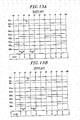
- Figs. 5A and 5B are diagrams illustrating a relationship between the output phase voltage Vu and the gate signals S1u to S6u in the four-step current commutation method.
- Fig. 5A illustrates commutation control in the case where the output phase current Iu is positive
- Fig. 5B illustrates commutation control in the case where the output phase current Iu is negative
- the state in which an input-side voltage is lower than an output-side voltage immediately prior to commutation control is referred to as reverse-biased, and the state in which an input-side voltage is higher than an output-side voltage immediately prior to commutation control is referred to as forward-biased.
- the state in which an input-side voltage is lower than an output-side voltage immediately prior to commutation control is referred to as forward-biased, and the state in which an input-side voltage is higher than an output-side voltage immediately prior to commutation control is referred to as reverse-biased.
- Fig. 7 is a diagram illustrating a relationship between the output phase voltage Vu, the gate signals S1u to S6u and the respective steps of the commutation control in the four-step voltage commutation method.
- the three-step current commutation method is a commutation method in which the input phase voltages outputted to the respective output phases at three steps are switched depending on the magnitude relationship between the input phase voltages Er, Es and Et and the polarity of the output phase current Io.
- the three-step current commutation method simultaneously performs two steps among four steps of the four-step current commutation method.
- the three-step current commutation method simultaneously performs a step of turning off one of the two reverse-biased unidirectional switches and a step of turning on the other reverse-biased unidirectional switch, among Steps 1 to 4 of the four-step current commutation method.
- Figs. 9A and 9B are diagrams corresponding to Figs. 5A and 5B and illustrating a relationship between the output phase voltage Vu, the gate signals S1u to S6u and the respective steps of the commutation control in the three-step current commutation method.
- the three-step voltage commutation method is a commutation method in which the input phase voltages outputted to the respective output phases at three steps are switched depending on the magnitude relationship between the input phase voltages Er, Es and Et and the polarity of the output phase current Io.
- the three-step voltage commutation method simultaneously performs two steps among four steps of the four-step voltage commutation method.
- the three-step voltage commutation method simultaneously performs a step of turning off the switch having a polarity opposite to that of the output phase current Io and a step of turning on the switch having a polarity opposite to that of the output phase current Io, among Steps 1 to 4 of the four-step voltage commutation method.
- Figs. 10A and 10B are diagrams corresponding to Figs. 5A and 5B and illustrating a relationship between the output phase voltage Vu, the gate signals S1u to S6u and the respective steps of the commutation control in the three-step voltage commutation method.
- the pseudo three-step current commutation method is a commutation method in which the input phase voltages outputted to the respective output phases at three steps are switched depending on the polarity of the output phase current Io.
- the pseudo three-step voltage commutation method simultaneously performs a step of turning off one of the two switches having the same polarity as that of the output phase current Io and a step of turning on the other switch, among Steps 1 to 4 of the four-step current commutation method.
- Figs. 11A and 11B are diagrams corresponding to Figs. 5A and 5B and illustrating a relationship between the output phase voltage Vu, the gate signals S1u to S6u and the respective steps of the commutation control in the three-step current commutation method.
- the three-step voltage/current commutation method is a commutation method in which the input phase voltages outputted to the respective output phases at three steps are switched depending on the magnitude relationship between the input phase voltages Er, Es and Et and the polarity of the output phase current Io.
- Steps 1 to 3 of the three-step voltage/current commutation method are, e.g., combinations of some of Steps 1 to 3 of the three-step current commutation method and some of Steps 1 to 3 of the three-step voltage commutation method.
- Figs. 12A and 12B are diagrams corresponding to Figs. 5A and 5B and illustrating a relationship between the output phase voltage Vu, the gate signals S1u to S6u and the respective steps of the commutation control in the three-step voltage/current commutation method.
- the two-step current commutation method is a commutation method in which the input phase voltages outputted to the respective output phases at two steps are switched depending on the polarity of the output phase current Io.
- the two-step current commutation method turns on the unidirectional switch having the same polarity as that of the output phase current Io among the bidirectional switches S serving as switching destinations (Step 1). Thereafter, the two-step current commutation method turns off the unidirectional switch having the same polarity as that of the output phase current Io among the bidirectional switches S serving as switching sources (Step 2).
- Figs. 13A and 13B are diagrams corresponding to Figs. 5A and 5B and illustrating a relationship between the output phase voltage Vu, the gate signals S1u to S6u and the respective steps of the commutation control in the two-step current commutation method.
- the first two-step voltage commutation method is a voltage commutation method in which the input phase voltages outputted to the respective output phases at two steps are switched depending on the magnitude relationship between the input phase voltages Er, Es and Et.
- the first two-step voltage commutation method turns off the unidirectional switch Soi serving as a switching source and turns on the unidirectional switch Sio serving as a switching destination.
- the first two-step voltage commutation method turns off the unidirectional switch Sio serving as a switching source and turns on the unidirectional switch Soi serving as a switching destination.
- Fig. 14 is a diagram corresponding to Fig. 7 and illustrating a relationship between the output phase voltage Vu, the gate signals S1u to S6u and the respective steps of the commutation control in the first two-step voltage commutation method.
- the second two-step voltage commutation method is a voltage commutation method in which the input phase voltages outputted to the respective output phases at two steps are switched depending on the magnitude relationship between the inter-phase voltages of the input phases.
- the second two-step voltage commutation method is a commutation method in which commutation at a minimum inter-phase voltage of the input phases is banned.
- Figs. 15A and 15B are diagrams corresponding to Fig. 7 and illustrating a relationship between the output phase voltage Vu, the gate signals S1u to S6u and the respective steps of the commutation control in the second two-step voltage commutation method.
- Fig. 15A illustrates a case where Ep-Em>Em-En
- Fig. 15B illustrates a case where Ep-Em ⁇ Em-En.
- the third two-step voltage commutation method is a voltage commutation method in which the input phase voltages outputted to the respective output phases at two steps are switched depending on the magnitude relationship between the inter-phase voltages of the input phases.
- Figs. 16A and 16B are diagrams corresponding to Fig. 7 and illustrating a relationship between the output phase voltage Vu, the gate signals S1u to S6u and the respective steps of the commutation control in the third two-step voltage commutation method.
- Fig. 16A illustrates a case where Ep-Em>Em-En
- Fig. 16B illustrates a case where Ep-Em ⁇ Em-En.
- the one-step current commutation method is a commutation method in which the input phase voltages outputted to the respective output phases at every step are switched depending on the magnitude relationship between the input phase voltages Er, Es and Et and the polarity of the output phase current Io.
- the one-step current commutation method is, e.g., a commutation method which sequentially turns on the forward-biased unidirectional switches having the same polarity as that of the output phase current Io or sequentially turns off the reverse-biased unidirectional switches having the same polarity as that of the output phase current Io.
- Figs. 17A and 17B are diagrams corresponding to Figs. 5A and 5B and illustrating a relationship between the output phase voltage Vu, the gate signals S1u to S6u and the respective steps of the commutation control in the one-step current commutation method.
- the pseudo one-step current commutation method is a commutation method in which the input phase voltages outputted to the respective output phases at every step are switched depending on the polarity of the output phase current Io.
- the pseudo one-step current commutation method is, e.g., a commutation method which switches the unidirectional switch having the same polarity as that of the output phase current Io.
- Figs. 18A and 18B are diagrams corresponding to Figs. 5A and 5B and illustrating a relationship between the output phase voltage Vu, the gate signals S1u to S6u and the respective steps of the commutation control in the pseudo one-step current commutation method.
- Fig. 19 is a diagram illustrating one example of a combination of commutation patterns.
- a commutation method conforming to the state of the input phase voltages Er, Es and Et and the state of the output phase currents Iu, Iv and Iw is selected from a commutation method A, a commutation method B, a commutation method C and a commutation method D.
- Commutation control is performed pursuant to the commutation pattern of the selected commutation method.
- the commutation methods A to D are selected from two or more kinds of commutation methods.
- the commutation pattern of the commutation method A (one example of a first commutation pattern) is a commutation pattern of a commutation method selected in the case where there is a possibility of confusing the magnitude relationship between the input phase voltages Er, Es and Et (hereinafter often referred to as an input voltage rank).
- the commutation pattern of the commutation method B (one example of a second commutation pattern) is a commutation pattern of a commutation method selected in the case where there is a possibility of confusing the polarity of the output phase currents Iu, Iv and Iw (hereinafter often referred to as an output current polarity).
- the commutation pattern of the commutation method C (one example of a third commutation pattern) is a commutation pattern of a commutation method selected in the case where there is a possibility of confusing the input voltage rank and the output current polarity.
- the commutation pattern of the commutation method D is a commutation pattern of a commutation method selected in the case where the selection condition of any of the commutation methods A, B and C is not satisfied.
- control unit 20 selects the commutation methods A to D so that the sum of the values obtained by weighting the characteristic values of the respective commutation methods A to D based on the selection ratios of the respective commutation methods A to D becomes equal to or smaller than the characteristic value of the commutation method Z.
- the characteristic value of some of the commutation methods A to D is regarded as zero and is negligible.
- the commutation method and the commutation pattern are different in name from each other but are intended to specify the same one. That is to say, the characteristic value of the commutation method is the characteristic value of the commutation pattern.
- the selection of the commutation method is the selection of the commutation pattern.
- the commutation method Z is, for example, a commutation method selected as a comparison target and is, for example, one of the commutation methods set as the commutation methods A to D.
- Examples of the characteristic value of the commutation method include a value corresponding to the commutation failure time, a value corresponding to the time required in commutation control (the commutation completion time to be described later), the power loss generated in the bidirectional switch S, etc.
- the value corresponding to the commutation failure time examples include the time of short circuit between the input phases generated by the error of determination of the input voltage rank and the open time of the output phases generated by the error of determination of the output current polarity.
- the dependency X short on the input voltage rank which is one example of the value corresponding to the time of short circuit between the input phases generated by the error of determination of the input voltage rank.
- the dependency X open on the output current polarity which is one example of the value corresponding to the open time of the output phases generated by the error of determination of the output current polarity.
- Fig. 20 is a diagram illustrating a relationship between the dependency X short of the respective commutation methods on the input voltage rank and the dependency X open of the respective commutation methods on the output current polarity. As illustrated in Fig. 20 , the dependency X short and the dependency X open vary depending on the commutation methods.
- the dependency X short on the input voltage rank indicates the degree of influence on the power conversion accuracy in the case where the commutation failure is generated by the error of determination of the input voltage rank.
- the dependency X short may be found by, e.g., the calculation of the following mathematical formula (1).
- the ratio of the time T short of short circuit between the output phases to the carrier period Tc of a PWM signal is the dependency X short on the input voltage rank.
- X short T short T c
- the commutation methods selected in the case where the input phase voltages Er, Es and Et are in such a state that there is a possibility of erroneously determining the input voltage rank are the commutation methods A and C.
- the commutation methods B and D are negligible. That is to say, only the dependency X shortA of the commutation method A and the dependency X shortC of the commutation method C affect the dependency X short .
- the dependency X shortABCD in the case where commutation control is performed by selecting the commutation methods A to D may be found by the calculation of the following mathematical formula (2).
- Selection ratios K A to K D are selection ratios of the commutation methods A to D. The sum of the selection ratios K A to K D is 1.
- X shortABCD K A X shortA + K C X shortC K A + K B + K C + K D
- the dependency X shortABCD is the sum of the value obtained by weighting the selection ratio K A to the dependency X shortA of the commutation method A and the value obtained by weighting the selection ratio K C to the dependency X shortC of the commutation method C.
- the dependency X shortABCD becomes smaller, the power conversion accuracy grows higher.
- the dependency X open on the output current polarity indicates, for example, the degree of influence on the power conversion accuracy in the case where the commutation failure is generated by the error of determination of the output current polarity.
- the dependency X open may be found by, e.g., the calculation of the following mathematical formula (4).
- the ratio of the open time T open of the input phases to the carrier period Tc of a PWM signal is the dependency X open on the output current polarity.
- X open T open T c
- the commutation methods selected in the case where the output phase currents Iu, Iv and Iw are in such a state that there is a possibility of erroneously determining the output current polarity are the commutation methods B and C.
- the commutation methods A and D are negligible. That is to say, only the dependency X openB of the commutation method B and the dependency X openC of the commutation method C affect the dependency X open .
- the dependency X openABCD in the case where commutation control is performed by selecting the commutation methods A to D may be found by the calculation of the following mathematical formula (5).
- Selection ratios K A to K D are selection ratios of the commutation methods A to D. The sum of the selection ratios K A to K D is 1.
- X openABCD K A X openB + K C X openC K A + K B + K C + K D
- the dependency X openABCD is the sum of the value obtained by weighting the selection ratio K B to the dependency X oppenB of the commutation method B and the value obtained by weighting the selection ratio K C to the dependency X openC of the commutation method C.
- the dependency X openABCD becomes smaller, the power conversion accuracy grows higher.
- the control unit 20 may select the commutation methods A to D so that the dependency X shortABCD satisfies the foregoing mathematical formula (3) and the dependency X openABCD satisfies the foregoing mathematical formula (6). By doing so, it is possible to reduce the commutation failure attributable to the error of determination of the input voltage rank and the commutation failure attributable to the error of determination of the output current polarity. This makes it possible to further increase the power conversion accuracy.
- control unit 20 selects the commutation methods A to D so that the sum of the value obtained by weighting the dependency X shortB of the commutation method B based on the selection ratio K B and the value obtained by weighting the dependency X shortC of the commutation method C based on the selection ratio K C becomes equal to or smaller than the dependency X shortZ of the commutation method Z.
- This makes it possible to reduce the degree of influence on the power conversion accuracy in the case where commutation failure is generated by the error of determination of the input phase voltages Ep, Em and En.
- control unit 20 selects the commutation methods A to D so that the sum of the value obtained by weighting the dependency X openA of the commutation method A based on the selection ratio K A and the value obtained by weighting the dependency X openC of the commutation method C based on the selection ratio K C becomes equal to or smaller than the dependency X openZ of the commutation method Z.
- This makes it possible to reduce the degree of influence on the power conversion accuracy in the case where commutation failure is generated by the error of determination of the polarity of the output phase currents Iu, Iv and Iw.
- the commutation method D is a commutation method selected in a region where commutation failure is not generated, commutation failure is not generated by the commutation method D selected in such a region. For that reason, the commutation method D may be any commutation method. From the viewpoint of a minimum pulse, it is preferred that the commutation method D is a commutation method in which the time required in commutation control of the commutation method (hereinafter referred to as a commutation completion time) is short.
- Fig. 21 is a diagram illustrating a relationship between the commutation completion times of the respective commutation methods. As illustrated in Fig. 21 , the commutation completion time varies depending on the commutation methods.
- the selection ratio of the commutation method i is a selection ratio Ki.
- the selection ratio K A of the commutation method A is 30%
- the selection ratio K B of the commutation method B is 20%
- the selection ratio K C of the commutation method C is 6%
- the selection ratio K D of the commutation method D is 44%.
- the forgoing mathematical formula (7) can be satisfied by, for example, using the one-step current commutation method as the commutation methods A, C and D and using the two-step voltage commutation method as the commutation method B.
- the commutation methods A to D are selected so that the sum T cABCD of the values obtained by weighting the commutation completion times T ci of the respective commutation methods A to D based on the selection ratios K i becomes equal to or smaller than the commutation completion time T cZ of the commutation method Z. This makes it possible to suppress reduction of the power conversion accuracy attributable to a minimum pulse.
- Fig. 22 is a diagram illustrating simulation results in the case where commutation control is performed by a combination of the commutation methods A to D selected so as to satisfy the foregoing mathematical formula (7) and in the case where commutation control is performed by the four-step current commutation method.
- the output phase currents Iu, Iv and Iw are indicated on the vertical axis, and the time is indicated on the horizontal axis.
- the selection ratio K A is 27%
- the selection ratio K B is 7%
- the selection ratio K C is 3%
- the selection ratio K D is 63%.
- the four-step current commutation method is used as the commutation method Z.
- the combinations of the commutation methods A to D are, for example, the following combinations (a) to (d)
- all of the foregoing mathematical formulae (3), (6) and (7) are satisfied.
- the abbreviations of the commutation methods are indicated.
- the relationship between the full names and the abbreviations of the commutation methods are shown in Fig. 20 .
- the selection ratio K A is 27%
- the selection ratio K B is 7%
- the selection ratio K C is 3%
- the selection ratio K D is 63%.
- the second two-step voltage commutation method is used as the commutation method Z.
- the combinations of the commutation methods A to D are, for example, the following combinations (e) and (f), all of the foregoing mathematical formulae (3), (6) and (7) are satisfied.
- the commutation methods A to D are selected so as to satisfy all of the foregoing mathematical formulae (3), (6) and (7) and to satisfy at least one of X shortABC ⁇ X shortZ , X openABCD ⁇ X openZ and T cABCD ⁇ T cZ . This makes it possible to reliably suppress reduction of the power conversion accuracy.
- the commutation method Z is a commutation method capable of obtaining a desired result, for example, in the case where the commutation method Z is independently used in commutation control regardless of the state of the input phase voltages Er, Es and Et and the state of the output phase currents Iu, Iv and Iw.
- the commutation method Z is a commutation method capable of, when used alone, performing power conversion without causing failure of the power converter unit 10.
- the commutation method Z is a commutation method capable of, when used alone, obtaining a rated power conversion characteristic.
- a combination of the commutation methods A to D is selected so as to satisfy at least one of the foregoing mathematical formulae (3) and (6).
- a combination of the commutation methods A to D is selected so as to satisfy the foregoing mathematical formula (7). This makes it possible to suppress reduction of the power conversion accuracy attributable to commutation failure and reduction of the power conversion accuracy attributable to a minimum pulse.
- Examples of the power loss generated in the bidirectional switch S include a switching loss of the bidirectional switch S and a conduction loss of the bidirectional switch S.
- the switching loss increases.
- the unidirectional switches Sio and Soi are FETs
- the conduction loss increases if the time period during which only one of the unidirectional switches Sio and Soi is turned on becomes longer.
- control unit 20 may select a combination of the commutation methods A to D so as to satisfy at least one of the foregoing mathematical formulae (3) and (6) and the foregoing mathematical formulae (7) and (8). By doing so, it is possible to suppress reduction of the power conversion accuracy attributable to commutation failure and reduction of the power conversion accuracy attributable to a minimum pulse. Furthermore, it is possible to suppress an increase of the power loss.
- the commutation methods A to D may be selected in advance so as to satisfy one of the foregoing mathematical formulae (3), (6), (7) and (8).
- a combination of the commutation methods A to D may be set in advance in the control unit 20.
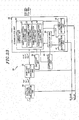
- Fig. 23 is a diagram illustrating a configuration example of the control unit 20.
- the control unit 20 includes a voltage command calculation unit (e.g., a voltage command calculator) 30, a PWM duty ratio calculation unit (e.g., a PWM duty ratio calculator) 31, a commutation unit (e.g., a commutator) 32, a switching unit (e.g., a switcher) 33 and a determination unit (e.g., a determinator) 34.
- a voltage command calculation unit e.g., a voltage command calculator
- PWM duty ratio calculation unit e.g., a PWM duty ratio calculator
- commutation unit e.g., a commutator
- switching unit e.g., a switcher
- a determination unit e.g., a determinator
- the control unit 20 includes a microcomputer, which includes a CPU (Central Processing Unit), a ROM (Read Only Memory), a RAM (Random Access Memory), an input/output port and the like, and various kinds of circuits.
- a CPU Central Processing Unit
- ROM Read Only Memory
- RAM Random Access Memory
- the CPU of the microcomputer functions as the voltage command calculation unit 30, the PWM duty ratio calculation unit 31, the commutation unit 32, the switching unit 33 and the determination unit 34.
- At least one or all of the voltage command calculation unit 30, the PWM duty ratio calculation unit 31, the commutation unit 32, the switching unit 33 and the determination unit 34 may be configured by hardware such as an ASIC (Application Specific Integrated Circuit), an FPGA(Field Programmable Gate Array) or the like.
- ASIC Application Specific Integrated Circuit
- FPGA Field Programmable Gate Array
- the voltage command calculation unit 30 generates and outputs voltage commands Vu * , Vv * and Vw * of the respective output phases based on the frequency commands f * and the output phase currents Iu, Iv and Iw.
- the frequency commands f * are commands of the frequencies of the output phase voltages Vu, Vv and Vw.
- the PWM duty ratio calculation unit 31 generates PWM voltage commands Vu1 * , Vv1 * and Vw1 * based on the voltage commands Vu * , Vv * and Vw * and the input phase voltages Er, Es and Et.
- the technique of generating the PWM voltage commands Vu1 * , Vv1 * and Vw1 * is well-known in the art.
- the techniques disclosed in Japanese Patent Application Publication Nos. 2008-048550 and 2012-239265 may be used as the technique of generating the PWM voltage commands Vu1 * , Vv1 * and Vw1 * .
- the PWM duty ratio calculation unit 31 processes the input phase voltages Ep, Em and En in the order of the magnitude of the input phase voltages Er, Es and Et.
- the PWM duty ratio calculation unit 31 converts the voltage commands Vu * , Vv * and Vw * to pulse width modulation signals corresponding to the respective voltage values of the input phase voltages Ep, Em and En and outputs the pulse width modulation signals as the PWM voltage commands Vu1 * , Vv1 * and Vw1 * .
- the commutation unit 32 executes commutation control by which the input phases connected to the output phases are switched by the bidirectional switch S. For example, the commutation unit 32 selects one of the commutation methods A to D based on the polarity of each of the output phase currents Iu, Iv and Iw and the magnitude relationship between the input phase voltages Er, Es and Et.
- the commutation unit 32 generates gate signals S1u to S6u, S1v to S6v and S1w to S6w from the PWM voltage commands Vu1 * , Vv1 * and Vw1 * so that commutation is performed in the order pursuant to the commutation pattern of the selected commutation method.
- the commutation unit 32 includes a voltage determination unit (e.g., a voltage determinator) 41, a current determination unit (e.g., a current determinator) 42, a commutation control unit (e.g., a commutation controller) 43 and a selection unit (e.g., a selector) 44.
- a voltage determination unit e.g., a voltage determinator
- a current determination unit e.g., a current determinator
- a commutation control unit e.g., a commutation controller
- a selection unit e.g., a selector
- the voltage determination unit 41 determines the input voltage rank and notifies the determination result to the commutation control unit 43. As illustrated in Fig. 24 , the voltage determination unit 41 determines whether the inter-phase voltage of the input phases (e.g., the voltage between the R-phase and the S-phase) falls within a predetermined range RA.
- Fig. 24 is a diagram illustrating a relationship between the input phase voltages Er, Es and Et and the predetermined range RA.
- the voltage determination unit 41 may determine, based on the phase ⁇ i of the input phase voltage Vi, whether the inter-phase voltage of the input phases falls within the predetermined range RA.
- the current determination unit 42 determines the output current polarity and notifies the determination result to the commutation control unit 43. As illustrated in Fig. 25 , the current determination unit 42 determines whether the output phase current Io falls within a predetermined range RB including zero. Fig. 25 is a diagram illustrating a relationship between the output phase current Io and the predetermined range RB. The current determination unit 42 may determine, based on the phase ⁇ o of the output phase current Io, whether the output phase current Io falls within the predetermined range RB.
- the commutation control unit 43 includes, e.g., a first to a fourth commutation control units (e.g., a first to a fourth commutation controllers) 51 to 54.
- the first commutation control unit 51 generates a gate signal Sg pursuant to the commutation pattern of commutation method A.
- the second commutation control unit 52 generates a gate signal Sg pursuant to the commutation pattern of commutation method B.
- the third commutation control unit 53 generates a gate signal Sg pursuant to the commutation pattern of commutation method C.
- the fourth commutation control unit 54 generates a gate signal Sg pursuant to the commutation pattern of commutation method D.
- the selection unit 44 selects one of the first to fourth commutation control units 51 to 54, based on the determination result of the voltage determination unit 41 and the determination result of the current determination unit 42, and causes the selected commutation control unit to execute commutation control.
- the selection unit 44 selects the first commutation control unit 51.
- the selection unit 44 selects the second commutation control unit 52.
- the selection unit 44 selects the third commutation control unit 53. As a still further example, if the inter-phase voltage of the input phases falls outside the predetermined range RA and if the output phase current Io falls outside the predetermined range RB, the selection unit 44 selects the fourth commutation control unit 54.
- the switching unit 33 switches a first mode in which commutation control is performed pursuant to the commutation pattern selected by the selection unit 44 as described above and a second mode in which commutation control is performed pursuant to a predetermined commutation pattern.
- the commutation control unit 43 generates a gate signal Sg using the commutation control unit selected by the selection unit 44 from the first to fourth commutation control units 51 to 54.
- the commutation control unit 43 In the case where the second mode is set by the switching unit 33, the commutation control unit 43 generates a gate signal Sg pursuant to the commutation pattern of the predetermined commutation method (e.g., the second two-step voltage commutation method).
- the gate signal Sg is generated by, e.g., the first commutation control unit 51 among the first to fourth commutation control units 51 to 54.
- the determination unit 34 determines the commutation methods used in the first to fourth commutation control units 51 to 54, based on the selection ratios of the first to fourth commutation control units 51 to 54.
- the determination unit 34 sets the determined commutation methods in the first to fourth commutation control units 51 to 54.
- the determination unit 34 selects the commutation methods A to D from the aforementioned commutation methods, based on the selection ratios K i of the commutation methods i, so as to suppress at least one of the reduction of the power conversion accuracy and the power loss.
- the determination unit 34 sets the selected commutation methods in the first to fourth commutation control units 51 to 54.
- the determination unit 34 selects the commutation methods A to D, which satisfy one or more of the foregoing mathematical formulae (3), (6), (7) and (8), from the aforementioned commutation methods.
- the determination unit 34 sets the selected commutation methods in the first to fourth commutation control units 51 to 54.
- the determination unit 34 may store a table in which the combinations of the commutation methods A to D corresponding to the kinds of the AC power source 2 and the kinds of the load 3 are set. In this case, the determination unit 34 acquires, from the table, the combinations of the commutation methods A to D corresponding to the kinds of the AC power source 2 and the kinds of the load 3 designated by an installation personnel or the like through an input unit (not illustrated) of the matrix converter 1. The determination unit 34 sets the acquired combinations in the first to fourth commutation control units 51 to 54.
- the determination unit 34 sets the information of determined commutation pattern tables in the first to fourth commutation control units 51 to 54.
- the first to fourth commutation control units 51 to 54 may store a plurality of commutation pattern tables, and the determination unit 34 may notify the information indicating the numbers of the commutation methods to the first to fourth commutation control units 51 to 54.
- the first to fourth commutation control units 51 to 54 may generate gate signals Sg based on the commutation pattern tables of the commutation methods corresponding to the numbers of the commutation methods notified from the determination unit 34.
- Fig. 23 there is illustrated an example where the commutation control unit 43 includes the first to fourth commutation control units 51 to 54.
- all the necessary combinations of the commutation patterns of the commutation methods may be stored as a table.
- the commutation control unit 43 selects the commutation method according to the output current polarity or the input voltage rank, from the combinations of the commutation methods A to D determined by the determination unit 34, and generates a gate signal Sg pursuant to the commutation pattern of the selected commutation method.
- the determination unit 34 determines the commutation methods A to D based on the characteristic values of the commutation methods and the selection ratios of the selection unit 44. This makes it possible to suitably select the commutation methods A to D depending on the AC power source 2 or the load 3 connected to the matrix converter 1. For that reason, even when the AC power source 2 or the load 3 is changed, it is possible to suppress the reduction of the power conversion accuracy or the power loss.
- Fig. 26 is a flowchart illustrating one example of a flow of the control process performed by the control unit 20.
- the control unit 20 repeatedly performs the control process, which is illustrated in Fig. 26 , at a predetermined cycle.
- the control unit 20 selects one of the commutation methods A to D based on the state of the input phase voltage Vi and the state of the output phase current Io (Step S10). For example, the control unit 20 selects one of the commutation methods A to D depending on whether the output phase current Io falls within a predetermined range RA and whether a difference between two input phase voltages Vi falls within a predetermined range RB.
- control unit 20 Based on at least one of the polarity of the output phase current Io and the magnitude relationship between the input phase voltages Er, Es and Et, the control unit 20 performs commutation control pursuant to the commutation pattern of the commutation method selected at Step S10 (Step S11).
- the control unit 20 updates the combinations of the commutation methods A to D based on the selection ratios and the characteristic values of the commutation methods A to D (Step S12). For example, the control unit 20 determines the commutation methods A to D so that the sum of the values obtained by weighting the characteristic values of the commutation methods A to D based on the selection ratios of the commutation methods selected by the selection unit 44 becomes equal to or smaller than the characteristic value of the commutation method Z. The control unit 20 stores the characteristic value of the commutation method Z as a target value of a characteristic value in an internal memory. The control unit 20 sets the determined commutation methods A to D in the first to fourth commutation control units 51 to 54.
- the combination of the commutation methods used in the commutation control is a combination of four commutation methods A to D.
- the combination of the commutation methods used in the commutation control may be a combination of two or three commutation methods or may be a combination of five or more commutation methods.
- the commutation unit 32 includes the first to fourth commutation control units 51 to 54.
Landscapes
- Engineering & Computer Science (AREA)
- Power Engineering (AREA)
- Physics & Mathematics (AREA)
- Electromagnetism (AREA)
- General Physics & Mathematics (AREA)
- Radar, Positioning & Navigation (AREA)
- Automation & Control Theory (AREA)
- Ac-Ac Conversion (AREA)
Applications Claiming Priority (1)
| Application Number | Priority Date | Filing Date | Title |
|---|---|---|---|
| JP2014170941A JP2016046957A (ja) | 2014-08-25 | 2014-08-25 | マトリクスコンバータ、マトリクスコンバータの制御装置およびマトリクスコンバータの制御方法 |
Publications (2)
| Publication Number | Publication Date |
|---|---|
| EP2991216A2 true EP2991216A2 (de) | 2016-03-02 |
| EP2991216A3 EP2991216A3 (de) | 2016-08-31 |
Family
ID=54007565
Family Applications (1)
| Application Number | Title | Priority Date | Filing Date |
|---|---|---|---|
| EP15182142.8A Withdrawn EP2991216A3 (de) | 2014-08-25 | 2015-08-24 | Matrixwandler, matrixwandlersteuerungsvorrichtung sowie matrixwandlersteuerungsverfahren |
Country Status (5)
| Country | Link |
|---|---|
| US (1) | US20160054751A1 (de) |
| EP (1) | EP2991216A3 (de) |
| JP (1) | JP2016046957A (de) |
| KR (1) | KR20160024796A (de) |
| CN (1) | CN105391308A (de) |
Cited By (1)
| Publication number | Priority date | Publication date | Assignee | Title |
|---|---|---|---|---|
| TWI892295B (zh) * | 2023-11-08 | 2025-08-01 | 群光電能科技股份有限公司 | 相電源路徑切換電路 |
Families Citing this family (2)
| Publication number | Priority date | Publication date | Assignee | Title |
|---|---|---|---|---|
| JP7249236B2 (ja) * | 2019-08-02 | 2023-03-30 | 株式会社東芝 | 電子回路および無線電力伝送装置 |
| JP7489039B2 (ja) * | 2020-05-28 | 2024-05-23 | Mywayプラス株式会社 | 電力変換装置の制御装置 |
Citations (3)
| Publication number | Priority date | Publication date | Assignee | Title |
|---|---|---|---|---|
| JP2008048550A (ja) | 2006-08-18 | 2008-02-28 | Yaskawa Electric Corp | マトリクスコンバータ |
| JP2010246174A (ja) | 2009-04-01 | 2010-10-28 | Meidensha Corp | 交流−交流直接変換装置および交流−交流直接変換装置の転流制御方法 |
| JP2012239265A (ja) | 2011-05-10 | 2012-12-06 | Yaskawa Electric Corp | マトリクスコンバータ |
Family Cites Families (9)
| Publication number | Priority date | Publication date | Assignee | Title |
|---|---|---|---|---|
| US5594636A (en) * | 1994-06-29 | 1997-01-14 | Northrop Grumman Corporation | Matrix converter circuit and commutating method |
| DE19639773A1 (de) * | 1996-09-27 | 1998-04-02 | Abb Patent Gmbh | Dreiphasiger Matrix-Stromrichter und Verfahren zum Betrieb |
| DE10057783A1 (de) * | 2000-11-22 | 2002-06-06 | Siemens Ag | Verfahren zur Steuerung eines Matrixumrichters |
| WO2006118026A1 (ja) * | 2005-04-27 | 2006-11-09 | Kabushiki Kaisha Yaskawa Denki | 電力変換装置と電力変換方法 |
| JP4862477B2 (ja) * | 2006-05-10 | 2012-01-25 | 株式会社明電舎 | 交流−交流直接変換装置の入出力デューティ制御方法 |
| JP4957304B2 (ja) * | 2007-03-14 | 2012-06-20 | 株式会社明電舎 | 交流−交流直接変換装置の空間ベクトル変調方法 |
| EP1976105B1 (de) * | 2007-03-30 | 2011-09-21 | Alstom Technology Ltd | Steuersequenz für einen Aktivgenerator |
| JP4687824B2 (ja) * | 2009-06-26 | 2011-05-25 | 株式会社富士通ゼネラル | 3相整流器 |
| CN101599704B (zh) * | 2009-07-07 | 2011-04-20 | 华中科技大学 | 一种减小矩阵变换器窄脉冲现象的空间矢量调制方法 |
-
2014
- 2014-08-25 JP JP2014170941A patent/JP2016046957A/ja active Pending
-
2015
- 2015-08-24 CN CN201510524513.7A patent/CN105391308A/zh active Pending
- 2015-08-24 KR KR1020150118673A patent/KR20160024796A/ko not_active Ceased
- 2015-08-24 US US14/834,338 patent/US20160054751A1/en not_active Abandoned
- 2015-08-24 EP EP15182142.8A patent/EP2991216A3/de not_active Withdrawn
Patent Citations (3)
| Publication number | Priority date | Publication date | Assignee | Title |
|---|---|---|---|---|
| JP2008048550A (ja) | 2006-08-18 | 2008-02-28 | Yaskawa Electric Corp | マトリクスコンバータ |
| JP2010246174A (ja) | 2009-04-01 | 2010-10-28 | Meidensha Corp | 交流−交流直接変換装置および交流−交流直接変換装置の転流制御方法 |
| JP2012239265A (ja) | 2011-05-10 | 2012-12-06 | Yaskawa Electric Corp | マトリクスコンバータ |
Cited By (1)
| Publication number | Priority date | Publication date | Assignee | Title |
|---|---|---|---|---|
| TWI892295B (zh) * | 2023-11-08 | 2025-08-01 | 群光電能科技股份有限公司 | 相電源路徑切換電路 |
Also Published As
| Publication number | Publication date |
|---|---|
| EP2991216A3 (de) | 2016-08-31 |
| CN105391308A (zh) | 2016-03-09 |
| US20160054751A1 (en) | 2016-02-25 |
| JP2016046957A (ja) | 2016-04-04 |
| KR20160024796A (ko) | 2016-03-07 |
Similar Documents
| Publication | Publication Date | Title |
|---|---|---|
| US9906168B2 (en) | Power converting apparatus, control device, and method for controlling power converting apparatus | |
| EP2876799A1 (de) | Matrixumrichter und Verfahren zum Kompensieren von Ausgangsspannungsfehlern | |
| US9130481B2 (en) | Power converting appartatus | |
| EP3068029A1 (de) | Umrichtersystem | |
| EP4586490A1 (de) | Mehrstufiger wechselrichter | |
| EP4586489A1 (de) | Mehrstufiger wechselrichter | |
| US11005404B2 (en) | Motor driving apparatus | |
| US20160056706A1 (en) | Matrix converter, matrix converter control device and matrix converter control method | |
| CN105981280B (zh) | 电力变换装置 | |
| EP2854277A2 (de) | Matrixwandler | |
| EP3771086A1 (de) | Leistungswandlervorrichtung und drehmaschinenantriebssystem | |
| CN104638934A (zh) | 矩阵变换器及输出电压误差的补偿方法 | |
| EP3171504A1 (de) | Diskoninuierliche pwm für 3-punkt npc umrichter | |
| EP2991216A2 (de) | Matrixwandler, matrixwandlersteuerungsvorrichtung sowie matrixwandlersteuerungsverfahren | |
| US9520805B2 (en) | Control method and control system of three level inverter | |
| Gulbudak et al. | Model predictive control of dual-output nine-switch inverter with output filter | |
| EP3591827A1 (de) | Stromversorgungssteuerungsvorrichtung, stromumwandlungssystem und stromversorgungssteuerungsverfahren | |
| EP2863532A2 (de) | Matrixwandler | |
| EP2854279A2 (de) | Matrixwandler | |
| EP3503373A1 (de) | Matrixumrichter mit stromsteuerungsbetriebsart | |
| JP5287013B2 (ja) | 交流−交流直接変換装置および交流−交流直接変換装置の転流制御方法 | |
| CN104518675A (zh) | 矩阵变换器 | |
| EP3591828B1 (de) | Stromversorgungsteuerungsvorrichtung, stromwandlungssystem und stromversorgungsteuerungsverfahren | |
| RU2772317C1 (ru) | Инверторная система и способ управления инверторной системой | |
| JPH0888977A (ja) | インバータ装置 |
Legal Events
| Date | Code | Title | Description |
|---|---|---|---|
| PUAI | Public reference made under article 153(3) epc to a published international application that has entered the european phase |
Free format text: ORIGINAL CODE: 0009012 |
|
| AK | Designated contracting states |
Kind code of ref document: A2 Designated state(s): AL AT BE BG CH CY CZ DE DK EE ES FI FR GB GR HR HU IE IS IT LI LT LU LV MC MK MT NL NO PL PT RO RS SE SI SK SM TR |
|
| AX | Request for extension of the european patent |
Extension state: BA ME |
|
| PUAL | Search report despatched |
Free format text: ORIGINAL CODE: 0009013 |
|
| AK | Designated contracting states |
Kind code of ref document: A3 Designated state(s): AL AT BE BG CH CY CZ DE DK EE ES FI FR GB GR HR HU IE IS IT LI LT LU LV MC MK MT NL NO PL PT RO RS SE SI SK SM TR |
|
| AX | Request for extension of the european patent |
Extension state: BA ME |
|
| RIC1 | Information provided on ipc code assigned before grant |
Ipc: H02M 5/293 20060101AFI20160725BHEP Ipc: H02M 5/297 20060101ALI20160725BHEP Ipc: G05F 5/00 20060101ALI20160725BHEP |
|
| STAA | Information on the status of an ep patent application or granted ep patent |
Free format text: STATUS: THE APPLICATION IS DEEMED TO BE WITHDRAWN |
|
| 18D | Application deemed to be withdrawn |
Effective date: 20170301 |