EP2990173A1 - Kraftfahrzeugbauteil und verfahren zur herstellung eines kraftfahrzeugbauteils - Google Patents
Kraftfahrzeugbauteil und verfahren zur herstellung eines kraftfahrzeugbauteils Download PDFInfo
- Publication number
- EP2990173A1 EP2990173A1 EP15182440.6A EP15182440A EP2990173A1 EP 2990173 A1 EP2990173 A1 EP 2990173A1 EP 15182440 A EP15182440 A EP 15182440A EP 2990173 A1 EP2990173 A1 EP 2990173A1
- Authority
- EP
- European Patent Office
- Prior art keywords
- motor vehicle
- functional element
- vehicle component
- fastening element
- parts
- Prior art date
- Legal status (The legal status is an assumption and is not a legal conclusion. Google has not performed a legal analysis and makes no representation as to the accuracy of the status listed.)
- Granted
Links
- 238000004519 manufacturing process Methods 0.000 title claims abstract description 21
- 238000000034 method Methods 0.000 title description 6
- 239000000463 material Substances 0.000 claims abstract description 98
- 238000001514 detection method Methods 0.000 claims abstract description 42
- 238000000071 blow moulding Methods 0.000 claims description 15
- 238000001746 injection moulding Methods 0.000 claims description 12
- XEEYBQQBJWHFJM-UHFFFAOYSA-N Iron Chemical compound [Fe] XEEYBQQBJWHFJM-UHFFFAOYSA-N 0.000 claims description 10
- PXHVJJICTQNCMI-UHFFFAOYSA-N Nickel Chemical compound [Ni] PXHVJJICTQNCMI-UHFFFAOYSA-N 0.000 claims description 8
- 229910052751 metal Inorganic materials 0.000 claims description 8
- 239000002184 metal Substances 0.000 claims description 8
- 239000002245 particle Substances 0.000 claims description 7
- 230000003014 reinforcing effect Effects 0.000 claims description 7
- 239000012783 reinforcing fiber Substances 0.000 claims description 7
- 230000002950 deficient Effects 0.000 claims description 6
- 229910052742 iron Inorganic materials 0.000 claims description 5
- RYGMFSIKBFXOCR-UHFFFAOYSA-N Copper Chemical compound [Cu] RYGMFSIKBFXOCR-UHFFFAOYSA-N 0.000 claims description 4
- 229910052782 aluminium Inorganic materials 0.000 claims description 4
- XAGFODPZIPBFFR-UHFFFAOYSA-N aluminium Chemical compound [Al] XAGFODPZIPBFFR-UHFFFAOYSA-N 0.000 claims description 4
- 229910017052 cobalt Inorganic materials 0.000 claims description 4
- 239000010941 cobalt Substances 0.000 claims description 4
- GUTLYIVDDKVIGB-UHFFFAOYSA-N cobalt atom Chemical compound [Co] GUTLYIVDDKVIGB-UHFFFAOYSA-N 0.000 claims description 4
- 229910052802 copper Inorganic materials 0.000 claims description 4
- 239000010949 copper Substances 0.000 claims description 4
- 150000002739 metals Chemical class 0.000 claims description 4
- 229910052759 nickel Inorganic materials 0.000 claims description 4
- VYZAMTAEIAYCRO-UHFFFAOYSA-N Chromium Chemical compound [Cr] VYZAMTAEIAYCRO-UHFFFAOYSA-N 0.000 claims description 3
- 229910052804 chromium Inorganic materials 0.000 claims description 3
- 239000011651 chromium Substances 0.000 claims description 3
- 238000003466 welding Methods 0.000 claims description 3
- 239000002861 polymer material Substances 0.000 claims 2
- 239000004744 fabric Substances 0.000 claims 1
- 238000005304 joining Methods 0.000 claims 1
- -1 polytetrafluoroethylene Polymers 0.000 description 6
- 239000004952 Polyamide Substances 0.000 description 4
- 238000002347 injection Methods 0.000 description 4
- 239000007924 injection Substances 0.000 description 4
- 229920002647 polyamide Polymers 0.000 description 4
- 238000000926 separation method Methods 0.000 description 4
- VYPSYNLAJGMNEJ-UHFFFAOYSA-N Silicium dioxide Chemical compound O=[Si]=O VYPSYNLAJGMNEJ-UHFFFAOYSA-N 0.000 description 3
- 238000004064 recycling Methods 0.000 description 3
- 229930040373 Paraformaldehyde Natural products 0.000 description 2
- 239000004813 Perfluoroalkoxy alkane Substances 0.000 description 2
- 239000004696 Poly ether ether ketone Substances 0.000 description 2
- 239000004693 Polybenzimidazole Substances 0.000 description 2
- 239000004697 Polyetherimide Substances 0.000 description 2
- 239000004698 Polyethylene Substances 0.000 description 2
- 239000004954 Polyphthalamide Substances 0.000 description 2
- 239000004743 Polypropylene Substances 0.000 description 2
- 229920010524 Syndiotactic polystyrene Polymers 0.000 description 2
- XLOMVQKBTHCTTD-UHFFFAOYSA-N Zinc monoxide Chemical compound [Zn]=O XLOMVQKBTHCTTD-UHFFFAOYSA-N 0.000 description 2
- 239000004676 acrylonitrile butadiene styrene Substances 0.000 description 2
- 239000000853 adhesive Substances 0.000 description 2
- 230000001070 adhesive effect Effects 0.000 description 2
- 239000000203 mixture Substances 0.000 description 2
- 229920011301 perfluoro alkoxyl alkane Polymers 0.000 description 2
- 229920003229 poly(methyl methacrylate) Polymers 0.000 description 2
- 229920002492 poly(sulfone) Polymers 0.000 description 2
- 229920002480 polybenzimidazole Polymers 0.000 description 2
- 229920001707 polybutylene terephthalate Polymers 0.000 description 2
- 229920002530 polyetherether ketone Polymers 0.000 description 2
- 229920001601 polyetherimide Polymers 0.000 description 2
- 229920000573 polyethylene Polymers 0.000 description 2
- 229920000139 polyethylene terephthalate Polymers 0.000 description 2
- 239000005020 polyethylene terephthalate Substances 0.000 description 2
- 239000004926 polymethyl methacrylate Substances 0.000 description 2
- 229920006324 polyoxymethylene Polymers 0.000 description 2
- 229920001955 polyphenylene ether Polymers 0.000 description 2
- 229920000069 polyphenylene sulfide Polymers 0.000 description 2
- 229920012287 polyphenylene sulfone Polymers 0.000 description 2
- 229920006375 polyphtalamide Polymers 0.000 description 2
- 229920001155 polypropylene Polymers 0.000 description 2
- 229920001343 polytetrafluoroethylene Polymers 0.000 description 2
- 239000004810 polytetrafluoroethylene Substances 0.000 description 2
- YCGKJPVUGMBDDS-UHFFFAOYSA-N 3-(6-azabicyclo[3.1.1]hepta-1(7),2,4-triene-6-carbonyl)benzamide Chemical compound NC(=O)C1=CC=CC(C(=O)N2C=3C=C2C=CC=3)=C1 YCGKJPVUGMBDDS-UHFFFAOYSA-N 0.000 description 1
- OKTJSMMVPCPJKN-UHFFFAOYSA-N Carbon Chemical compound [C] OKTJSMMVPCPJKN-UHFFFAOYSA-N 0.000 description 1
- 239000005909 Kieselgur Substances 0.000 description 1
- 229910000990 Ni alloy Inorganic materials 0.000 description 1
- 229920008285 Poly(ether ketone) PEK Polymers 0.000 description 1
- 229920012266 Poly(ether sulfone) PES Polymers 0.000 description 1
- 239000004793 Polystyrene Substances 0.000 description 1
- 229920002472 Starch Polymers 0.000 description 1
- 239000011324 bead Substances 0.000 description 1
- 239000006229 carbon black Substances 0.000 description 1
- BIJOYKCOMBZXAE-UHFFFAOYSA-N chromium iron nickel Chemical compound [Cr].[Fe].[Ni] BIJOYKCOMBZXAE-UHFFFAOYSA-N 0.000 description 1
- 230000008602 contraction Effects 0.000 description 1
- 238000001816 cooling Methods 0.000 description 1
- 238000005538 encapsulation Methods 0.000 description 1
- 235000013312 flour Nutrition 0.000 description 1
- 239000011521 glass Substances 0.000 description 1
- 239000003365 glass fiber Substances 0.000 description 1
- 239000010439 graphite Substances 0.000 description 1
- 229910002804 graphite Inorganic materials 0.000 description 1
- 239000012535 impurity Substances 0.000 description 1
- 229920002285 poly(styrene-co-acrylonitrile) Polymers 0.000 description 1
- 229920002312 polyamide-imide Polymers 0.000 description 1
- 239000004417 polycarbonate Substances 0.000 description 1
- 229920000515 polycarbonate Polymers 0.000 description 1
- 229920006393 polyether sulfone Polymers 0.000 description 1
- 239000004800 polyvinyl chloride Substances 0.000 description 1
- 239000010453 quartz Substances 0.000 description 1
- 238000010079 rubber tapping Methods 0.000 description 1
- 239000004576 sand Substances 0.000 description 1
- 239000008107 starch Substances 0.000 description 1
- 235000019698 starch Nutrition 0.000 description 1
- 229920000638 styrene acrylonitrile Polymers 0.000 description 1
- 239000000454 talc Substances 0.000 description 1
- 229910052623 talc Inorganic materials 0.000 description 1
- 235000012222 talc Nutrition 0.000 description 1
- 239000002023 wood Substances 0.000 description 1
- 239000011787 zinc oxide Substances 0.000 description 1
Images

Classifications
-
- B—PERFORMING OPERATIONS; TRANSPORTING
- B62—LAND VEHICLES FOR TRAVELLING OTHERWISE THAN ON RAILS
- B62D—MOTOR VEHICLES; TRAILERS
- B62D29/00—Superstructures, understructures, or sub-units thereof, characterised by the material thereof
- B62D29/001—Superstructures, understructures, or sub-units thereof, characterised by the material thereof characterised by combining metal and synthetic material
-
- B—PERFORMING OPERATIONS; TRANSPORTING
- B29—WORKING OF PLASTICS; WORKING OF SUBSTANCES IN A PLASTIC STATE IN GENERAL
- B29B—PREPARATION OR PRETREATMENT OF THE MATERIAL TO BE SHAPED; MAKING GRANULES OR PREFORMS; RECOVERY OF PLASTICS OR OTHER CONSTITUENTS OF WASTE MATERIAL CONTAINING PLASTICS
- B29B17/00—Recovery of plastics or other constituents of waste material containing plastics
- B29B17/02—Separating plastics from other materials
-
- B—PERFORMING OPERATIONS; TRANSPORTING
- B60—VEHICLES IN GENERAL
- B60R—VEHICLES, VEHICLE FITTINGS, OR VEHICLE PARTS, NOT OTHERWISE PROVIDED FOR
- B60R13/00—Elements for body-finishing, identifying, or decorating; Arrangements or adaptations for advertising purposes
- B60R13/04—External Ornamental or guard strips; Ornamental inscriptive devices thereon
-
- B—PERFORMING OPERATIONS; TRANSPORTING
- B62—LAND VEHICLES FOR TRAVELLING OTHERWISE THAN ON RAILS
- B62D—MOTOR VEHICLES; TRAILERS
- B62D29/00—Superstructures, understructures, or sub-units thereof, characterised by the material thereof
- B62D29/04—Superstructures, understructures, or sub-units thereof, characterised by the material thereof predominantly of synthetic material
-
- B—PERFORMING OPERATIONS; TRANSPORTING
- B62—LAND VEHICLES FOR TRAVELLING OTHERWISE THAN ON RAILS
- B62D—MOTOR VEHICLES; TRAILERS
- B62D29/00—Superstructures, understructures, or sub-units thereof, characterised by the material thereof
- B62D29/04—Superstructures, understructures, or sub-units thereof, characterised by the material thereof predominantly of synthetic material
- B62D29/048—Connections therefor, e.g. joints
-
- B—PERFORMING OPERATIONS; TRANSPORTING
- B62—LAND VEHICLES FOR TRAVELLING OTHERWISE THAN ON RAILS
- B62D—MOTOR VEHICLES; TRAILERS
- B62D35/00—Vehicle bodies characterised by streamlining
- B62D35/007—Rear spoilers
-
- B—PERFORMING OPERATIONS; TRANSPORTING
- B29—WORKING OF PLASTICS; WORKING OF SUBSTANCES IN A PLASTIC STATE IN GENERAL
- B29B—PREPARATION OR PRETREATMENT OF THE MATERIAL TO BE SHAPED; MAKING GRANULES OR PREFORMS; RECOVERY OF PLASTICS OR OTHER CONSTITUENTS OF WASTE MATERIAL CONTAINING PLASTICS
- B29B17/00—Recovery of plastics or other constituents of waste material containing plastics
- B29B17/02—Separating plastics from other materials
- B29B2017/0203—Separating plastics from plastics
-
- B—PERFORMING OPERATIONS; TRANSPORTING
- B29—WORKING OF PLASTICS; WORKING OF SUBSTANCES IN A PLASTIC STATE IN GENERAL
- B29B—PREPARATION OR PRETREATMENT OF THE MATERIAL TO BE SHAPED; MAKING GRANULES OR PREFORMS; RECOVERY OF PLASTICS OR OTHER CONSTITUENTS OF WASTE MATERIAL CONTAINING PLASTICS
- B29B17/00—Recovery of plastics or other constituents of waste material containing plastics
- B29B17/02—Separating plastics from other materials
- B29B2017/0213—Specific separating techniques
- B29B2017/0268—Separation of metals
-
- B—PERFORMING OPERATIONS; TRANSPORTING
- B60—VEHICLES IN GENERAL
- B60R—VEHICLES, VEHICLE FITTINGS, OR VEHICLE PARTS, NOT OTHERWISE PROVIDED FOR
- B60R13/00—Elements for body-finishing, identifying, or decorating; Arrangements or adaptations for advertising purposes
- B60R13/02—Internal Trim mouldings ; Internal Ledges; Wall liners for passenger compartments; Roof liners
- B60R2013/0293—Connection or positioning of adjacent panels
-
- Y—GENERAL TAGGING OF NEW TECHNOLOGICAL DEVELOPMENTS; GENERAL TAGGING OF CROSS-SECTIONAL TECHNOLOGIES SPANNING OVER SEVERAL SECTIONS OF THE IPC; TECHNICAL SUBJECTS COVERED BY FORMER USPC CROSS-REFERENCE ART COLLECTIONS [XRACs] AND DIGESTS
- Y02—TECHNOLOGIES OR APPLICATIONS FOR MITIGATION OR ADAPTATION AGAINST CLIMATE CHANGE
- Y02T—CLIMATE CHANGE MITIGATION TECHNOLOGIES RELATED TO TRANSPORTATION
- Y02T10/00—Road transport of goods or passengers
- Y02T10/80—Technologies aiming to reduce greenhouse gasses emissions common to all road transportation technologies
- Y02T10/82—Elements for improving aerodynamics
-
- Y—GENERAL TAGGING OF NEW TECHNOLOGICAL DEVELOPMENTS; GENERAL TAGGING OF CROSS-SECTIONAL TECHNOLOGIES SPANNING OVER SEVERAL SECTIONS OF THE IPC; TECHNICAL SUBJECTS COVERED BY FORMER USPC CROSS-REFERENCE ART COLLECTIONS [XRACs] AND DIGESTS
- Y02—TECHNOLOGIES OR APPLICATIONS FOR MITIGATION OR ADAPTATION AGAINST CLIMATE CHANGE
- Y02W—CLIMATE CHANGE MITIGATION TECHNOLOGIES RELATED TO WASTEWATER TREATMENT OR WASTE MANAGEMENT
- Y02W30/00—Technologies for solid waste management
- Y02W30/50—Reuse, recycling or recovery technologies
- Y02W30/62—Plastics recycling; Rubber recycling
Definitions
- the present invention relates to a motor vehicle component and a method for producing a motor vehicle component.
- the second polymeric material of the fastening element generally has to have higher mechanical strengths than the first polymeric material of the functional element, so that a material which is alien to the first polymeric material and / or reinforced must be used for the second polymeric material.
- a material which is alien to the first polymeric material and / or reinforced must be used for the second polymeric material.
- when used as a return material in the manufacturing process of the motor vehicle component or the functional element of the first polymeric material may not be contaminated with the material of the second polymeric material, otherwise the quality of the motor vehicle component or the functional element is restricted to unacceptable.
- the motor vehicle component In the recycling of motor vehicle components or their use as return material, the motor vehicle component is initially mechanically crushed while the fastener and the functional element separated again, so that the fastener or parts of the fastener between the functional element or the parts of the functional element are and each other must be separated.
- the invention therefore has the object of specifying a motor vehicle component and a method for producing a motor vehicle component with a functional element made of a first polymeric material and with at least one connected to the functional element fastener of a second polymeric material, compared to the prior art reliably and cost again can be separated into functional element and fastener.
- a motor vehicle component having a functional element made of a first polymeric material and having at least one fastening element connected to the functional element made of a second polymeric material whose second polymeric material comprises metallic detection elements which detect the fastening element and / or parts of the Allow fastener.
- the motor vehicle component according to the invention with a functional element of a first polymeric material and with at least one connected to the functional element fastener of a second polymeric material, wherein the second polymeric material comprises metallic detection elements that allow detection of the fastener and / or parts of the fastener allowed it eg to detect by means of a simple metal detector, the fastener or parts of the fastener and then reliably separate the fastener or parts of the fastener of the functional element or of the parts of the functional element, and thus the two polymeric materials.
- Such metal detectors are already provided in part during the production of functional elements in a blow molding or injection molding process on the corresponding production facilities, these alone serve to detect entrained impurities in the first polymeric material used to the extruder or injection molding plant from damage protect.
- the targeted addition of metallic detection elements to the second polymeric material of the fastener then makes it possible to use these existing metal detectors for the reliable separation of the fastener or parts of the fastener of the functional element or parts of the functional element.
- the functional element may preferably be a blow molded or injection molded functional element.
- the fastener form and / or force and / or be integrally connected to the functional element.
- the fastening element can be or are connected to the functional element in particular by means of an adhesive connection, latching connection, welded connection, screw connection, clamping connection, press connection, and / or form-locking connection.
- the functional element is a blow-molded or injection-molded functional element, wherein the, preferably separately manufactured, fastener is positively and / or positively and / or materially connected in the blow molding or injection molding of the functional element with the functional element.
- the second polymeric material may comprise reinforcing fibers and / or reinforcing particles.
- reinforcing fibers and / or reinforcing particles may comprise chalk, sand, diatomaceous earth, glass fibers or glass beads, zinc oxide, quartz, wood flour, starch, graphite, carbon black and / or talcum.
- the same polymeric material for the first polymeric material and the second polymeric material may be used, wherein the first polymeric material and the second polymeric material differ from each other by the addition of reinforcing fibers and / or reinforcing particles.
- the second polymeric material may preferably comprise the reinforcing fibers and / or the reinforcing particles.
- the fastening element may be formed by a screw receptacle, or a screw or a latching element or a welding element.
- a screw receptacle may in particular be a screw dome or a plug nut.
- a welding element is preferably formed by a second polymeric material, which has a better weldability compared to the first polymeric material of the functional element.
- the motor vehicle component may preferably be an air guide element, in particular a spoiler, or may be a trim part or a trim strip.
- the invention is particularly suitable for blow molded automotive components, such as air guide elements, since in blow molding usually a relatively high number of bad parts generated and at the same time a high proportion of return material for the production of the motor vehicle component or the functional element is used.
- the metallic detection elements are preferably plate-shaped, spherical or needle-shaped. Furthermore, mixed forms of the aforementioned designs are conceivable.
- the metallic detection elements may preferably comprise aluminum and / or copper and / or nickel and / or cobalt and / or chromium and / or iron and / or oxides of the aforementioned metals.
- the provision of the functional element can be carried out by a blow molding step in a blow molding tool or by an injection molding step in an injection molding tool.
- the connection of the fastening element takes place here by a material and / or force and / or positive connection during the blow molding or during the injection molding step.
- a control step for the detection of defective components can be provided, wherein in the presence of a defective component in a step a) the fastener is separated from the functional element to the functional element or parts of the functional element and / or the fastener or parts of the fastener be used as return material, wherein in a step b) in the return material of the functional element, a non-separated fastener or non-separated parts of the fastener by means of detecting the metallic detection elements detection device detected and in the presence of a fastener or parts of the fastener in the return material of the functional element of step a) is repeated until no fastener or no parts of the fastener in the return material of the functional element is more or are available.
- a control step for detecting incorrectly manufactured components may be provided, wherein in the presence of a defective component in a step a) the fastening element is separated from the functional element to the functional element or parts of the functional element and / or the fastener or parts the fastener to use as a return material, wherein in a step b) in the return material of the functional element, a non-separated fastener or non-separated parts of the fastener by means of detecting the metallic detection elements detecting device detected and in the presence of a fastener or parts of the Fastening element in the return material of the functional element of step a) and step b) are repeated until no fastener (4) or no parts of the fastener (4) in the return material of Fu tion element (2) is or is more.
- Polysulfone (PSU), poly (ether sulfone) (PES), polyetherimide (PEI), poly (phenylene sulfide) (PES) have been used for the second polymeric material of the fastening element as preferred materials both for the motor vehicle component according to the invention and for the method according to the invention for producing a motor vehicle component.
- PPS polyphenylene sulfone
- PEEK polyetheretherketone
- PEK polyetherketone
- PAI polyamideimide
- PMI poly-m-phenyleneisophthalamide
- PPA polyphthalamide
- PBI polybenzimidazole
- PTFE polytetrafluoroethylene
- PFA perfluoroalkoxyalkane
- POM Polyoxymethylene
- PA polyamide
- PA polyethylene terephthalate
- PBT polybutylene terephthalate
- PMMA polymethyl methacrylate
- PS syndiotactic polystyrene
- SAN Polyphenylene ether
- Both for the motor vehicle component according to the invention and for the inventive method for producing a motor vehicle component have for the first polymeric material of the functional element polyvinyl chloride (PVC), polyethylene (PE), polypropylene (PP), acrylonitrile-butadiene-styrene (ABS) or mixtures of the aforementioned materials proved.
- PVC polyvinyl chloride
- PE polyethylene
- PP polypropylene
- ABS acrylonitrile-butadiene-styrene
- metallic detection elements which are plate, ball or needle-shaped have proven advantageous. Furthermore, mixed forms of the aforementioned designs are also conceivable.
- the metallic detection elements preferably comprise aluminum and / or copper and / or nickel and / or cobalt and / or iron and / or oxides of the aforementioned metals.
- the second polymeric material may comprise at least 0.1 weight percent, preferably at least 0.5 weight percent, more preferably at least 1 weight percent, more preferably at least 5 weight percent metallic detection elements.
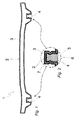
- the Fig. 1 shows a cross section through an inventive motor vehicle component 1, namely an air guide element in the form of a spoiler.
- the motor vehicle component 1 has a functional element 2 made of a first polymeric material 3 and at least one fastening element 4 made of a second polymeric material 5 connected to the functional element 2.
- the functional element 2 assumes in this motor vehicle component 1 the function of the air line and thereby influences, in addition to the design, the aerodynamics of the motor vehicle, to which the motor vehicle component 1 is attached.
- the fastening element 4 is used for attachment to the body of the motor vehicle and / or the attachment of further components of the vehicle and / or the attachment of further attachments to the motor vehicle component. 1
- the functional element 2 is in this embodiment a blow molded functional element 2, ie the provision of the functional element 2 is by a blow molding step done in a blow mold.
- the bonding of the fastening element 4 to the functional element 2 by a material and / or force and / or positive connection takes place during the blow molding step.
- the fastening element 4 for this purpose has an undercut 7 in the form of a circumferential annular groove, around which the functional element 2 has been placed in its manufacture in the blow mold. Due to the thermal contraction during cooling of the functional element 2 after the blow molding step, the fastening element 4 is not only positively, but also positively connected to the functional element 2. Depending on the compatibility of the first polymeric material with the second polymeric material, the fastening element 4 can also connect materially to the functional element 2.
- the second polymeric material 5 of the fastening element 4 comprises reinforcing fibers and / or reinforcing particles.
- the second polymeric material 5 comprises metallic detection elements 6, which enables detection of the fastening element 4 and / or of parts of the fastening element 4.
- the fastening element 4 or parts of the fastening element 4 can be detected by means of a simple metal detector and then the fastening element 4 or parts of the fastening element 4 of the functional element 2 or parts of the functional element 2, and thus the two polymeric materials 3 and 5, separated.
- the fastening element 4 is formed by a screw receptacle which can receive, for example, a self-tapping screw.
- the second polymeric material 5 comprises polyamide (PA) and the first polymeric material 3 comprises acrylonitrile-butadiene-styrene (ABS).
- the second polymeric material 5 comprises metallic detection elements 6 in the range of 3 weight percent to 10 weight percent, wherein the metallic detection elements consist of an iron or iron-chromium nickel alloy.
- the method for producing the motor vehicle component 1 also has a control step for detecting faulty components 1, wherein in the presence of a defective component 1 in a step a) the fastening element 4 is separated from the functional element 2 to the functional element 2 or parts of the functional element 2 and / or to use the fastener 4 or parts of the fastener 4 as return material, wherein in a step b) in the return material of the functional element 2, a non-separated fastener 4 or non-separated parts of the fastener 4 by means of one, the metallic detection elements 6 detecting, detection device detected and in the presence of a fastener 4 or parts of the fastener 4 in the return material of the functional element 2, the step a), and preferably also the step b) is repeated until no fastener 4 or no Parts of the fastener 4 in the return material of the functional element 2 is more present or are.
- Fig. 3 is a partial view of a motor vehicle component according to the invention, namely an injection molded air guide element shown.
- the motor vehicle component 1 has a functional element 2 made of a first polymeric material 3 and at least one fastening element 4 made of a second polymeric material 5 connected to the functional element 2.
- the fastening element 4 is in Fig. 3 once in the state connected to the functional element 2 and in the unconnected state.
- the Fig. 4 shows the fastener 4 in enlarged and rotated by 180 ° view to recognize a circumferential annular groove, which forms an undercut 7 in the fastener 4.
- the second polymeric material 5 of the fastening element 4 comprises metallic detection elements 6, which enable a detection of the fastening element 4 and / or of parts of the fastening element 4.
- the in Fig. 3 shown motor vehicle component 1 to an injection molded air guide element, so that the functional element 2 is an injection molded functional element 2.
- the fastening element 4 connected to the functional element 2 is in this case positively and / or non-positively and / or materially connected to the functional element 2.
- the second polymeric material 5 comprises reinforcing fibers and / or reinforcing particles, wherein the fastening element 4 forms a screw receptacle.
- the Fig. 5 shows a further partial view of the motor vehicle component according to the invention Fig. 4 , in which case the two fastening elements 4 are connected to the functional element 2 by means of an adhesive.
- the metallic detection elements 6 may be plate-shaped, spherical or needle-shaped and may be aluminum and / or copper and / or nickel and / or cobalt and / or chromium and / or iron and / or oxides of the aforementioned Metals include.
Landscapes
- Engineering & Computer Science (AREA)
- Mechanical Engineering (AREA)
- Chemical & Material Sciences (AREA)
- Combustion & Propulsion (AREA)
- Transportation (AREA)
- Architecture (AREA)
- Structural Engineering (AREA)
- Environmental & Geological Engineering (AREA)
- Injection Moulding Of Plastics Or The Like (AREA)
Abstract
Description
- Die vorliegende Erfindung betrifft ein Kraftfahrzeugbauteil und ein Verfahren zur Herstellung eines Kraftfahrzeugbauteils.
- Aus dem Stand der Technik bekannte Kraftfahrzeugbauteile mit einem Funktionselement aus einem ersten polymeren Werkstoff und mit wenigstens einem mit dem Funktionselement verbundenen Befestigungselement aus einem zweiten polymeren Werkstoff, weisen im Hinblick auf das Recycling und/oder die Möglichkeit der Nutzung als Rücklaufmaterial im Herstellverfahren des Kraftfahrzeugbauteils den Nachteil auf, dass die sortenreine Trennung der beiden polymeren Werkstoffe oft nur manuell mit einer entsprechend hohen Fehlerhäufigkeit oder mit kostenintensivem apparativem Aufwand gewährleistet werden kann.
- Der zweite polymere Werkstoff des Befestigungselementes muss aufgrund seiner Funktion in der Regel höhere mechanische Festigkeiten als der erste polymere Werkstoff des Funktionselements aufweisen, so dass für den zweiten polymeren Werkstoff ein zu dem ersten polymeren Werkstoff artfremder und/oder verstärkter Werkstoff eingesetzt werden muss. Insbesondere bei der Nutzung als Rücklaufmaterial im Herstellungsverfahren des Kraftfahrzeugbauteils bzw. des Funktionselementes darf der erste polymere Werkstoff dann nicht mit dem Material des zweiten polymeren Werkstoffes verunreinigt werden, da ansonsten die Qualität des Kraftfahrzeugbauteils bzw. des Funktionselementes eingeschränkt bis unakzeptabel wird.
- Bei dem Recycling von Kraftfahrzeugbauteilen oder deren Nutzung als Rücklaufmaterial wird das Kraftfahrzeugbauteil zunächst in der Regel mechanisch zerkleinert und dabei das Befestigungselement und das Funktionselement wieder voneinander getrennt, so dass sich das Befestigungselement oder Teile des Befestigungselementes zwischen dem Funktionselement oder den Teilen des Funktionselementes befinden und voneinander separiert werden müssen.
- Die Erfindung stellt sich daher die Aufgabe ein Kraftfahrzeugbauteil und ein Verfahren zur Herstellung eines Kraftfahrzeugbauteils mit einem Funktionselement aus einem ersten polymeren Werkstoff und mit wenigstens einem mit dem Funktionselement verbundenen Befestigungselement aus einem zweiten polymeren Werkstoff anzugeben, das gegenüber dem Stand der Technik zuverlässig und kostengünstig wieder in Funktionselement und Befestigungselement separiert werden kann.
- Erfindungsgemäß wird diese Aufgabe durch ein Kraftfahrzeugbauteil mit einem Funktionselement aus einem ersten polymeren Werkstoff und mit wenigstens einem mit dem Funktionselement verbundenen Befestigungselement aus einem zweiten polymeren Werkstoff gelöst, dessen zweiter polymerer Werkstoff metallische Detektionselemente umfasst, die eine Detektion des Befestigungselementes und/oder von Teilen des Befestigungselementes ermöglichen.
- Das erfindungsgemäße Kraftfahrzeugbauteil mit einem Funktionselement aus einem ersten polymeren Werkstoff und mit wenigstens einem mit dem Funktionselement verbundenen Befestigungselement aus einem zweiten polymeren Werkstoff, wobei der zweite polymere Werkstoff metallische Detektionselemente umfasst, die eine Detektion des Befestigungselementes und/oder von Teilen des Befestigungselementes ermöglichen, erlaubt es z.B. mittels eines einfachen Metalldetektors das Befestigungselement oder Teile des Befestigungselementes zu detektieren und dann das Befestigungselement oder Teile des Befestigungselementes von dem Funktionselement oder von den Teilen des Funktionselementes, und somit die beiden polymeren Werkstoffe, zuverlässig zu separieren. Derartige Metalldetektoren sind zum Teil bereits bei der Herstellung von Funktionselementen in einem Blasform- oder Spritzgussverfahren an den entsprechenden Herstellanlagen vorgesehen, wobei diese hier allein der Detektion von eingeschleppten Verunreinigungen in dem eingesetzten ersten polymeren Werkstoff dienen, um die Extruder- oder Spritzgussanlage vor einer Beschädigung zu schützen. Das gezielte Beifügen von metallischen Detektionselementen zu dem zweiten polymeren Werkstoff des Befestigungselementes ermöglicht es dann diese bereits vorhandenen Metalldetektoren auch für die zuverlässige Separierung des Befestigungselementes oder von Teilen des Befestigungselementes von dem Funktionselement oder von Teilen des Funktionselementes zu nutzen.
- Das Funktionselement kann bevorzugt ein blasgeformtes oder spritzgegossenes Funktionselement sein. Weiterhin kann das Befestigungselement form- und/oder kraft- und/oder stoffschlüssig mit dem Funktionselement verbunden sein. Das Befestigungselement kann insbesondere mittels einer Klebeverbindung, Rastverbindung, Schweißverbindung, Schraubverbindung, Klemmverbindung, Pressverbindung, und/oder Formschlussverbindung mit dem Funktionselement verbunden sein oder werden.
- Bevorzugt ist das Funktionselement ein blasgeformtes oder spritzgegossenes Funktionselement, wobei das, vorzugsweise separat hergestellte, Befestigungselement form- und/oder kraft- und/oder stoffschlüssig bei dem Blasformen oder bei dem Spritzgießen des Funktionselements mit dem Funktionselement verbunden wird.
- Bevorzugt kann der zweite polymere Werkstoff Verstärkungsfasern und/oder Verstärkungspartikel umfassen. Insbesondere Kreide, Sand, Kieselgur, Glasfasern oder Glaskugeln, Zinkoxid, Quarz, Holzmehl, Stärke, Graphit, Ruße und/oder Talkum eignen sich als Verstärkungsfasern und/oder Verstärkungspartikel.
- Im Rahmen der Erfindung kann das gleiche polymere Material für den ersten polymeren Werkstoff und den zweiten polymeren Werkstoff eingesetzt werden, wobei sich der erste polymere Werkstoff und der zweite polymere Werkstoff durch den Zusatz von Verstärkungsfasern und/oder Verstärkungspartikeln voneinander unterscheiden. Auch hierbei kann bevorzugt der zweite polymere Werkstoff die Verstärkungsfasern und/oder die Verstärkungspartikel umfassen.
- Das Befestigungselement kann durch eine Schraubenaufnahme, oder eine Schraube oder eine Rastelement oder ein Verschweißungselement gebildet sein. Eine Schraubaufnahme kann insbesondere ein Schraubdom oder eine Steckmutter sein. Ein Verschweißungselement ist bevorzugt durch einen zweiten polymeren Werkstoff gebildet, der gegenüber dem ersten polymeren Werkstoff des Funktionselementes eine bessere Schweißbarkeit aufweist.
- Das Kraftfahrzeugbauteil kann bevorzugt ein Luftleitelement, insbesondere ein Spoiler, oder kann ein Verkleidungsteil oder eine Zierleiste sein. Die Erfindung eignet sich insbesondere für blasgeformte Kraftfahrzeugbauteile, wie beispielsweise Luftleitelemente, da bei der Blasformfertigung in der Regel eine vergleichsweise hohe Anzahl von Schlechtteilen erzeugt und gleichzeitig ein hoher Anteil von Rücklaufmaterial für die Herstellung des Kraftfahrzeugbauteils bzw. des Funktionselementes verwendet wird.
- Die metallischen Detektionselemente sind bevorzugt platten-, kugel- oder nadelförmig ausgebildet. Ferner sind Mischformen der vorgenannten Gestaltungen denkbar. Die metallischen Detektionselemente können bevorzugt Aluminium und/oder Kupfer und/oder Nickel und/oder Kobalt und/oder Chrom und/oder Eisen und/oder Oxide der vorgenannten Metalle umfassen.
- Ein erfindungsgemäßes Verfahren zur Herstellung eines Kraftfahrzeugbauteils, umfasst die folgenden Schritte:
- Bereitstellen eines Funktionselementes aus einem ersten polymeren Werkstoff,
- Verbinden eines Befestigungselementes aus einem zweiten polymeren Werkstoff mit dem Funktionselement,
- Das Bereitstellen des Funktionselementes kann durch einen Blasformungsschritt in einem Blasformwerkzeug oder kann durch einen Spritzgussschritt in einem Spritzgusswerkzeug erfolgen. Bevorzugt erfolgt das Verbinden des Befestigungselementes hierbei durch ein stoff- und/oder kraft- und/oder formschlüssiges Verbinden während des Blasformschrittes oder während des Spritzgussschrittes.
- In dem Verfahren kann ein Kontrollschritt zur Erkennung von fehlerhaft hergestellten Bauteilen vorgesehen sein, wobei bei Vorliegen eines fehlerhaften Bauteiles in einem Schritt a) das Befestigungselement von dem Funktionselement separiert wird, um das Funktionselement oder Teile des Funktionselementes und/oder das Befestigungselement oder Teile des Befestigungselementes als Rücklaufmaterial nutzen zu können, wobei in einem Schritt b) in dem Rücklaufmaterial des Funktionselementes ein nicht-separiertes Befestigungselement oder nicht-separierte Teile des Befestigungselementes mittels einer, die metallischen Detektionselemente erfassenden, Detektionsvorrichtung erkannt und bei Vorhandensein eines Befestigungselementes oder von Teilen des Befestigungselementes in dem Rücklaufmaterial des Funktionselementes der Schritt a) wiederholt wird, bis kein Befestigungselement oder keine Teile des Befestigungselementes in dem Rücklaufmaterial des Funktionselementes mehr vorhanden ist oder sind.
- Weiter bevorzugt kann in dem Verfahren ein Kontrollschritt zur Erkennung von fehlerhaft hergestellten Bauteilen vorgesehen sein, wobei bei Vorliegen eines fehlerhaften Bauteiles in einem Schritt a) das Befestigungselement von dem Funktionselement separiert wird, um das Funktionselement oder Teile des Funktionselementes und/oder das Befestigungselement oder Teile des Befestigungselementes als Rücklaufmaterial nutzen zu können, wobei in einem Schritt b) in dem Rücklaufmaterial des Funktionselementes ein nicht-separiertes Befestigungselement oder nicht-separierte Teile des Befestigungselementes mittels einer, die metallischen Detektionselemente erfassenden, Detektionsvorrichtung erkannt und bei Vorhandensein eines Befestigungselementes oder von Teilen des Befestigungselementes in dem Rücklaufmaterial des Funktionselementes der Schritt a) und der Schritt b) wiederholt werden, bis kein Befestigungselement (4) oder keine Teile des Befestigungselementes (4) in dem Rücklaufmaterial des Funktionselementes (2) mehr vorhanden ist oder sind.
- Sowohl für das erfindungsgemäße Kraftfahrzeugbauteil als auch für das erfindungsgemäße Verfahren zur Herstellung eines Kraftfahrzeugbauteils haben sich für den zweiten polymeren Werkstoff des Befestigungselements als bevorzugte Materialien Polysulfon (PSU), Poly(ethersulfone) (PES), Polyetherimide (PEI), Poly(phenylensulfid) (PPS), Polyphenylensulfon (PPSU), Polyetheretherketon (PEEK), Polyetherketone (PEK), Polyamidimid (PAI), Poly-m-phenylenisophthalamid (PMI), Polyphthalamide (PPA), Polybenzimidazole (PBI), Polytetrafluorethylen (PTFE), Perfluoralkoxylalkan (PFA), Polyoxymethylen (POM), Polyamid (PA), Polyethylenterephthalat (PET), Polybutylenterephtalat (PBT), Polymethylmethacrylat (PMMA), Polystyrol (PS), Syndiotaktisches Polystyrol (sPS), Polycarbonat (PC), Styrol-Acrylnitril-Copolymer (SAN), Polyphenylenether (PPE) oder Mischungen der vorgenannten Materialen erwiesen.
- Sowohl für das erfindungsgemäße Kraftfahrzeugbauteil als auch für das erfindungsgemäße Verfahren zur Herstellung eines Kraftfahrzeugbauteils haben sich für den ersten polymeren Werkstoff des Funktionselementes Polyvinylchlorid (PVC), Polyethylen (PE), Polypropylen (PP), Acrylnitril-Butadien-Styrol (ABS) oder Mischungen der vorgenannten Materialien erwiesen.
- Sowohl für das erfindungsgemäße Kraftfahrzeugbauteil als auch für das erfindungsgemäße Verfahren zur Herstellung eines Kraftfahrzeugbauteils haben sich metallische Detektionselemente als vorteilhaft erwiesen die platten-, kugel- oder nadelförmig ausgebildet sind. Ferner sind auch Mischformen der vorgenannten Gestaltungen denkbar. Die metallischen Detektionselemente umfassen bevorzugt Aluminium und/oder Kupfer und/oder Nickel und/oder Kobalt und/oder Eisen und/oder Oxide der vorgenannten Metalle. Der zweite polymere Werkstoff kann wenigstens 0,1 Gewichtsprozent, bevorzugt wenigstens 0,5 Gewichtsprozent, weiter bevorzugt wenigstens 1 Gewichtsprozent, weiter bevorzugt wenigstens 5 Gewichtsprozent metallische Detektionselemente umfassen.
- Im Folgenden wird die Erfindung anhand lediglich Ausführungsbeispiele darstellender Zeichnungen erläutert. Es zeigen schematisch:
-
Fig. 1 einen Querschnitt durch ein erfindungsgemäßes Kraftfahrzeugbauteil, -
Fig. 2 eine Detaildarstellung des Kraftfahrzeugbauteils ausFig. 1 , -
Fig. 3 eine Teilansicht eines erfindungsgemäßen Kraftfahrzeugbauteils, -
Fig. 4 eine Detaildarstellung des Befestigungselementes ausFig. 3 , -
Fig. 5 eine weitere Teilansicht eines erfindungsgemäßen Kraftfahrzeugbauteils. - In den Figuren werden gleiche oder funktionsgleiche Elemente mit den gleichen Bezugszeichen versehen.
- Die
Fig. 1 zeigt einen Querschnitt durch ein erfindungsgemäßes Kraftfahrzeugbauteil 1, nämlich ein Luftleitelement in Gestalt eines Spoilers. Das Kraftfahrzeugbauteil 1 weist ein Funktionselement 2 aus einem ersten polymeren Werkstoff 3 und wenigstens ein mit dem Funktionselement 2 verbundenes Befestigungselement 4 aus einem zweiten polymeren Werkstoff 5 auf. Das Funktionselement 2 übernimmt bei diesem Kraftfahrzeugbauteil 1 die Funktion der Luftleitung und beeinflusst dadurch, neben dem Design, die Aerodynamik des Kraftfahrzeuges, an welchem das Kraftfahrzeugbauteil 1 befestigt ist. Das Befestigungselement 4 dient der Befestigung an der Karosserie des Kraftfahrzeuges und / oder der Befestigung von weiteren Bauteilen des Fahrzeuges und/oder der Befestigung weiterer Anbauteile an das Kraftfahrzeugbauteil 1. - Das Funktionselement 2 ist in diesem Ausführungsbeispiel ein blasgeformtes Funktionselement 2, d.h. die Bereitstellung des Funktionselements 2 ist durch einen Blasformungsschritt in einem Blasformwerkzeug erfolgt. Hierbei ist das Verbinden des Befestigungselementes 4 mit dem Funktionselement 2 durch ein stoff- und/oder kraft- und/oder formschlüssiges Verbinden während des Blasformschrittes erfolgt. Wie in
Fig. 2 im Detail vergrößert dargestellt weist das Befestigungselement 4 hierzu einen Hinterschnitt 7 in Gestalt einer umlaufenden Ringnut auf, um den sich das Funktionselement 2 bei dessen Herstellung im Blasformwerkzeug gelegt hat. Aufgrund der Wärmekontraktion beim Abkühlen des Funktionselementes 2 nach dem Blasformschritt ist das Befestigungselement 4 nicht nur formschlüssig, sondern auch kraftschlüssig mit dem Funktionselement 2 verbunden. Je nach Verträglichkeit des ersten polymeren Werkstoffes mit dem zweiten polymeren Werkstoff kann sich das Befestigungselement 4 auch stoffschlüssig mit dem Funktionselement 2 verbinden. - Im Fall des Recyclings oder bei der gewünschten Nutzung des Funktionselementes 2 und/oder des Befestigungselementes 4 als Rücklaufmaterial muss eine Separierung von Befestigungselement 4 und Funktionselement 2 erfolgen, da der zweite polymere Werkstoff 5 des Befestigungselementes 4 Verstärkungsfasern und/oder Verstärkungspartikel umfasst. Zur Erreichung einer zuverlässigen und kostengünstigen Separation von Funktionselement 2 und Befestigungselement 4 umfasst der zweite polymere Werkstoff 5 metallische Detektionselemente 6, die eine Detektion des Befestigungselementes 4 und/oder von Teilen des Befestigungselementes 4 ermöglicht. Beispielsweise kann mittels eines einfachen Metalldetektors das Befestigungselement 4 oder Teile des Befestigungselementes 4 detektiert und dann das Befestigungselement 4 oder Teile des Befestigungselementes 4 von dem Funktionselement 2 oder Teilen des Funktionselementes 2, und somit die beiden polymeren Werkstoffe 3 und 5, separiert werden. Das Befestigungselement 4 ist durch eine Schraubenaufnahme gebildet, die beispielsweise eine selbstschneidende Schraube aufnehmen kann. Der zweite polymere Werkstoff 5 umfasst Polyamid (PA) und der erste polymere Werkstoff 3 umfasst Acrylnitril-Butadien-Styrol (ABS). Der zweite polymere Werkstoff 5 umfasst metallische Detektionselemente 6 im Bereich von 3 Gewichtsprozent bis 10 Gewichtsprozent, wobei die metallischen Detektionselemente aus einer Eisen oder Eisen-ChromNickellegierung bestehen.
- Ein Verfahren zur Herstellung eines in
Fig. 1 dargestellten Kraftfahrzeugbauteils umfasst die folgenden Schritte: - Bereitstellen eines Funktionselementes 2 aus einem ersten polymeren Werkstoff 3,
- Verbinden eines Befestigungselementes 4 aus einem zweiten polymeren Werkstoff 5 mit dem Funktionselement 2,
- Das Verfahren zur Herstellung des Kraftfahrzeugbauteils 1 weist zudem einen Kontrollschritt zur Erkennung von fehlerhaft hergestellten Bauteilen 1 auf, wobei bei Vorliegen eines fehlerhaften Bauteiles 1 in einem Schritt a) das Befestigungselement 4 von dem Funktionselement 2 separiert wird, um das Funktionselement 2 oder Teile des Funktionselementes 2 und/oder das Befestigungselement 4 oder Teile des Befestigungselementes 4 als Rücklaufmaterial nutzen zu können, wobei in einem Schritt b) in dem Rücklaufmaterial des Funktionselementes 2 ein nicht-separiertes Befestigungselement 4 oder nicht-separierte Teile des Befestigungselementes 4 mittels einer, die metallischen Detektionselemente 6 erfassenden, Detektionsvorrichtung erkannt und bei Vorhandensein eines Befestigungselementes 4 oder von Teilen des Befestigungselementes 4 in dem Rücklaufmaterial des Funktionselementes 2 der Schritt a), und vorzugsweise auch der Schritt b), wiederholt wird, bis kein Befestigungselement 4 oder keine Teile des Befestigungselementes 4 in dem Rücklaufmaterial des Funktionselementes 2 mehr vorhanden ist oder sind.
- In
Fig. 3 ist eine Teilansicht eines erfindungsgemäßen Kraftfahrzeugbauteils, nämlich eines spritzgegossenen Luftleitelementes, dargestellt. Das Kraftfahrzeugbauteil 1 weist ein Funktionselement 2 aus einem ersten polymeren Werkstoff 3 und wenigstens ein mit dem Funktionselement 2 verbundenes Befestigungselement 4 aus einem zweiten polymeren Werkstoff 5 auf. Das Befestigungselement 4 ist inFig. 3 einmal im mit dem Funktionselement 2 verbunden Zustand und im unverbundenen Zustand dargestellt. DieFig. 4 zeigt das Befestigungselement 4 in vergrößerter und um 180° gedrehter Darstellung dar, um eine umlaufende Ringnut zu erkennen, welche einen Hinterschnitt 7 in dem Befestigungselement 4 bildet. - Der zweite polymere Werkstoff 5 des Befestigungselementes 4 umfasst metallische Detektionselemente 6, die eine Detektion des Befestigungselementes 4 und/oder von Teilen des Befestigungselementes 4 ermöglichen. Wie vorstehend beschrieben handelt es sich bei dem in
Fig. 3 gezeigten Kraftfahrzeugbauteil 1 um ein spritzgegossenes Luftleitelement, so dass das Funktionselement 2 ein spritzgegossenes Funktionselement 2 ist. Das mit dem Funktionselement 2 verbundene Befestigungselement 4 ist hierbei form- und/oder kraft- und/oder stoffschlüssig mit dem Funktionselement 2 verbunden. Der zweite polymere Werkstoff 5 umfasst Verstärkungsfasern und/oder Verstärkungspartikel, wobei das Befestigungselement 4 eine Schraubenaufnahme bildet. - Ein Verfahren zur Herstellung eines in
Fig. 3 dargestellten Kraftfahrzeugbauteils umfasst die folgenden Schritte: - Bereitstellen eines Funktionselementes 2 aus einem ersten polymeren Werkstoff 3,
- Verbinden eines Befestigungselementes 4 aus einem zweiten polymeren Werkstoff 5 mit dem Funktionselement 2,
- Die
Fig. 5 zeigt eine weitere Teilansicht des erfindungsgemäßen Kraftfahrzeugbauteils ausFig. 4 , wobei hier die beiden Befestigungselemente 4 mit dem Funktionselement 2 mittels eines Klebstoffes miteinander verbunden sind. - In allen vorstehend beschriebenen Ausführungsbeispielen und Verfahren können die metallischen Detektionselemente 6 platten-, kugel- oder nadelförmig ausgebildet sein und können Aluminium und/oder Kupfer und/oder Nickel und/oder Kobalt und/oder Chrom und/oder Eisen und/oder Oxide der vorgenannten Metalle umfassen.
Claims (12)
- Kraftfahrzeugbauteil (1) mit- einem Funktionselement (2) aus einem ersten polymeren Werkstoff (3) und mit- wenigstens einem mit dem Funktionselement (2) verbundenen Befestigungselement (4) aus einem zweiten polymeren Werkstoff (5),dadurch gekennzeichnet, dass
der zweite polymere Werkstoff (5) metallische Detektionselemente (6) umfasst, die eine Detektion des Befestigungselementes (4) und/oder von Teilen des Befestigungselementes (4) ermöglichen. - Kraftfahrzeugbauteil (1) nach Anspruch 1, dadurch gekennzeichnet, dass das Funktionselement (2) ein blasgeformtes oder spritzgegossenes Funktionselement (2) ist.
- Kraftfahrzeugbauteil nach Anspruch 1 oder 2, dadurch gekennzeichnet, dass das Befestigungselement (4) form- und/oder kraft- und/oder stoffschlüssig verbunden ist.
- Kraftfahrzeugbauteil (1) nach einem der vorstehenden Ansprüche, dadurch gekennzeichnet, dass der zweite polymere Werkstoff (5) Verstärkungsfasern und/oder Verstärkungspartikel umfasst.
- Kraftfahrzeugbauteil (1) nach einem der vorstehenden Ansprüche, dadurch gekennzeichnet, dass das Befestigungselement (4) durch eine Schraubenaufnahme oder eine Schraube oder ein Rastelement oder ein Verschweißungselement gebildet ist.
- Kraftfahrzeugbauteil (1) nach einem der vorstehenden Ansprüche, dadurch gekennzeichnet, dass das Kraftfahrzeugbauteil (1) ein Luftleitelement, ein Verkleidungsteil oder eine Zierleiste ist.
- Kraftfahrzeugbauteil (1) nach einem der vorstehenden Ansprüche, dadurch gekennzeichnet, dass die metallischen Detektionselemente (6) platten-, kugel- oder nadelförmig ausgebildet sind.
- Kraftfahrzeugbauteil (1) nach einem der vorstehenden Ansprüche, dadurch gekennzeichnet, dass die metallischen Detektionselemente (6) Aluminium und/oder Kupfer und/oder Nickel und/oder Kobalt und/oder Chrom und/oder Eisen und/oder Oxide der vorgenannten Metalle umfassen.
- Verfahren zur Herstellung eines Kraftfahrzeugbauteils (1), umfassend die folgenden Schritte:- Bereitstellen eines Funktionselementes (2) aus einem ersten polymeren Werkstoff (3),- Verbinden eines Befestigungselementes (4) aus einem zweiten polymeren Werkstoff (5) mit dem Funktionselement (2),dadurch gekennzeichnet, dass
der zweite polymere Werkstoff (5) metallische Detektionselemente (6) umfasst, die eine Detektion des Befestigungselementes (4) und/oder von Teilen des Befestigungselementes (4) ermöglichen. - Verfahren zur Herstellung eines Kraftfahrzeugbauteils (1) nach Anspruch 9, dadurch gekennzeichnet, dass das Bereitstellen des Funktionselementes (2) durch einen Blasformungsschritt in einem Blasformwerkzeug oder einen Spritzgussschritt in einem Spritzgusswerkzeug erfolgt und, dass das Verbinden des Befestigungselementes (4) durch ein stoff- und/oder kraft- und/oder formschlüssiges Verbinden während des Blasformschrittes oder des Spritzgussschrittes erfolgt.
- Verfahren zur Herstellung eines Kraftfahrzeugbauteils (1) nach Anspruch 9 oder 10, dadurch gekennzeichnet, dass ein Kontrollschritt zur Erkennung von fehlerhaft hergestellten Bauteilen (1) vorgesehen ist, wobei bei Vorliegen eines fehlerhaften Bauteiles (1) in einem Schritt a) das Befestigungselement (4) von dem Funktionselement (2) separiert wird, um das Funktionselement (2) oder Teile des Funktionselementes (2) und/oder das Befestigungselement (4) oder Teile des Befestigungselementes (4) als Rücklaufmaterial nutzen zu können, wobei in einem Schritt b) in dem Rücklaufmaterial des Funktionselementes (2) ein nicht-separiertes Befestigungselement (4) oder nicht-separierte Teile des Befestigungselementes (4) mittels einer, die metallischen Detektionselemente (6) erfassenden, Detektionsvorrichtung erkannt und bei Vorhandensein eines Befestigungselementes (4) oder von Teilen des Befestigungselementes (4) in dem Rücklaufmaterial des Funktionselementes (2) der Schritt a) wiederholt wird, bis kein Befestigungselement (4) oder keine Teile des Befestigungselementes (4) in dem Rücklaufmaterial des Funktionselementes (2) mehr vorhanden ist oder sind.
- Verfahren zur Herstellung eines Kraftfahrzeugbauteils (1) nach Anspruch 11, dadurch gekennzeichnet, dass auch der Schritt b) wiederholt wird, bis kein Befestigungselement (4) oder Teilen des Befestigungselementes (4) in dem Rücklaufmaterial des Funktionselementes (2) mehr vorhanden ist oder sind.
Applications Claiming Priority (1)
| Application Number | Priority Date | Filing Date | Title |
|---|---|---|---|
| DE102014112520.7A DE102014112520A1 (de) | 2014-09-01 | 2014-09-01 | Kraftfahrzeugbauteil und Verfahren zur Herstellung eines Kraftfahrzeugbauteils |
Publications (2)
| Publication Number | Publication Date |
|---|---|
| EP2990173A1 true EP2990173A1 (de) | 2016-03-02 |
| EP2990173B1 EP2990173B1 (de) | 2018-02-21 |
Family
ID=54010925
Family Applications (1)
| Application Number | Title | Priority Date | Filing Date |
|---|---|---|---|
| EP15182440.6A Not-in-force EP2990173B1 (de) | 2014-09-01 | 2015-08-26 | Kraftfahrzeugbauteil und verfahren zur herstellung eines kraftfahrzeugbauteils |
Country Status (2)
| Country | Link |
|---|---|
| EP (1) | EP2990173B1 (de) |
| DE (1) | DE102014112520A1 (de) |
Cited By (2)
| Publication number | Priority date | Publication date | Assignee | Title |
|---|---|---|---|---|
| DE102016119374A1 (de) | 2016-10-12 | 2018-04-12 | Dr. Ing. H.C. F. Porsche Aktiengesellschaft | Kraftfahrzeug-Heckspoiler-Anordnung |
| US10889049B2 (en) * | 2016-07-04 | 2021-01-12 | Aplix | Thermoformed part comprising a detachable part and a process for manufacturing such a part |
Citations (3)
| Publication number | Priority date | Publication date | Assignee | Title |
|---|---|---|---|---|
| DE4004640A1 (de) * | 1990-02-15 | 1991-08-22 | Kautex Werke Gmbh | Blasgeformtes anbauteil aus kunststoff |
| US20040035756A1 (en) * | 2002-08-06 | 2004-02-26 | Mankosa Michael J. | Plastic material having enhanced magnetic susceptibility, method of making and method of separating |
| DE102011016941A1 (de) * | 2011-04-13 | 2012-10-18 | Daimler Ag | Kraftfahrzeugbauteil mit Trägerelement und umspritztem oder angespritztem Kunststoff-Funktionselement und Herstellungsverfahren |
Family Cites Families (6)
| Publication number | Priority date | Publication date | Assignee | Title |
|---|---|---|---|---|
| DE4142384A1 (de) * | 1991-12-20 | 1993-06-24 | Bayerische Motoren Werke Ag | Kunststoffbauteil fuer kraftfahrzeuge |
| DE4212425A1 (de) * | 1992-04-14 | 1993-10-28 | Bayer Ag | Verfahren zur Auftrennung von Metall-Kunststoff-Verbünden |
| DE10135847A1 (de) * | 2001-07-23 | 2003-02-06 | Bayerische Motoren Werke Ag | Verfahren zum Einbringen mindestens eines Inserts |
| DE102006031534A1 (de) * | 2006-07-07 | 2008-01-10 | Fachhochschule Münster | Verfahren zur Identifizierung von Kunststoffen |
| DE102011116046B4 (de) * | 2011-10-17 | 2017-08-03 | Johnson Controls Autobatterie Gmbh & Co. Kgaa | Recycling von Produkten sowie Recyclinganlage |
| DE202012005795U1 (de) * | 2012-06-14 | 2012-07-09 | Automotive Lighting Reutlingen Gmbh | Beleuchtungseinrichtung eines Kraftfahrzeugs |
-
2014
- 2014-09-01 DE DE102014112520.7A patent/DE102014112520A1/de not_active Withdrawn
-
2015
- 2015-08-26 EP EP15182440.6A patent/EP2990173B1/de not_active Not-in-force
Patent Citations (3)
| Publication number | Priority date | Publication date | Assignee | Title |
|---|---|---|---|---|
| DE4004640A1 (de) * | 1990-02-15 | 1991-08-22 | Kautex Werke Gmbh | Blasgeformtes anbauteil aus kunststoff |
| US20040035756A1 (en) * | 2002-08-06 | 2004-02-26 | Mankosa Michael J. | Plastic material having enhanced magnetic susceptibility, method of making and method of separating |
| DE102011016941A1 (de) * | 2011-04-13 | 2012-10-18 | Daimler Ag | Kraftfahrzeugbauteil mit Trägerelement und umspritztem oder angespritztem Kunststoff-Funktionselement und Herstellungsverfahren |
Cited By (4)
| Publication number | Priority date | Publication date | Assignee | Title |
|---|---|---|---|---|
| US10889049B2 (en) * | 2016-07-04 | 2021-01-12 | Aplix | Thermoformed part comprising a detachable part and a process for manufacturing such a part |
| DE102016119374A1 (de) | 2016-10-12 | 2018-04-12 | Dr. Ing. H.C. F. Porsche Aktiengesellschaft | Kraftfahrzeug-Heckspoiler-Anordnung |
| US10173737B2 (en) | 2016-10-12 | 2019-01-08 | Dr. Ing. H.C. F. Porsche Aktiengesellschaft | Motor vehicle rear spoiler arrangement |
| DE102016119374B4 (de) * | 2016-10-12 | 2025-06-26 | Dr. Ing. H.C. F. Porsche Aktiengesellschaft | Kraftfahrzeug-Heckspoiler-Anordnung |
Also Published As
| Publication number | Publication date |
|---|---|
| DE102014112520A1 (de) | 2016-03-03 |
| EP2990173B1 (de) | 2018-02-21 |
Similar Documents
| Publication | Publication Date | Title |
|---|---|---|
| DE202015104322U1 (de) | Kotflügel für ein Fahrzeug, bestehend aus einem Karosserieteil und einem flexiblen Dichtungsabschnitt | |
| WO2015039809A1 (de) | VERFAHREN ZUM HERSTELLEN EINER MAGNETEINHEIT FÜR EINE SENSOREINRICHTUNG ZUM ERFASSEN EINER EINEN ROTATIONSZUSTAND EINER LENKWELLE EINES KRAFTFAHRZEUGS CHARAKTERISIERENDEN MESSGRÖßE, MAGNETEINHEIT, SENSOREINRICHTUNG UND KRAFTFAHRZEUG | |
| DE112007000376T5 (de) | Verfahren zum Befestigen eines Zubehörteils an einem Kraftstofftank aus Kunststoff | |
| EP2990173B1 (de) | Kraftfahrzeugbauteil und verfahren zur herstellung eines kraftfahrzeugbauteils | |
| EP4067048A1 (de) | Verfahren zur herstellung einer anordnung für den transport von medien und anordnung | |
| DE102010028592A1 (de) | Tülle sowie Verfahren zur Herstellung einer solchen Tülle | |
| EP3388143B1 (de) | Verfahren zum herstellen einer elastomer-membran | |
| EP3489531A1 (de) | System zum verbinden eines ersten bauteils mit einem zweiten bauteil | |
| DE102021121846A1 (de) | Verfahren zur Montage eines Anschlusselementes | |
| DE102018128311A1 (de) | System zum Verbinden eines ersten Bauteils mit einem zweiten Bauteil | |
| EP3505781A1 (de) | System zum verbinden eines ersten bauteils mit einem zweiten bauteil | |
| EP4269510B1 (de) | Magneisierbare tinte für die funktionalisierung von oberflächen | |
| EP2774745A1 (de) | Verfahren zum Fügen faserverstärkter thermoplastischer Kunststoffteile | |
| DE102020100651A1 (de) | Verfahren zur Herstellung eines Bauteils, insbesondere eines Fahrzeugbauteils | |
| EP3375670B1 (de) | Elektronikmodulsystem für ein kraftfahrzeug | |
| WO2014095276A1 (de) | Verfahren zur herstellung eines dichtungselements | |
| EP3554799A1 (de) | Kunststoffformteil für eine formteilanordnung, entsprechende formteilanordnung sowie verfahren zum herstellen einer formteilanordnung | |
| DE102020126924A1 (de) | Spritzgegossenes Außenverkleidungsteil eines Kraftfahrzeugs und Verkleidungsanordnung | |
| DE102017119831A1 (de) | Verfahren zur Verbindung mindestens zweier Bauteile | |
| DE102007040893A1 (de) | Herstellung von Kunststoff-Formteilen durch Umformung | |
| EP4275960B1 (de) | Verfahren zur fehlerfreien montage eines elektronischen bauteils | |
| EP3505780A1 (de) | System zum verbinden eines ersten bauteils mit einem zweiten bauteil | |
| EP3330134B1 (de) | Verfahren zur herstellung von wenigstens zwei varianten eines verkleidungsteils für ein kraftfahrzeug | |
| WO2015144555A1 (de) | Rastelement, aufnahmeelement, rastsystem, verfahren zum herstellen eines rastsystems und laserdurchstrahlschweissverfahren | |
| EP4276420B1 (de) | Verfahren zur fehlerfreien montage eines elektronischen bauteils |
Legal Events
| Date | Code | Title | Description |
|---|---|---|---|
| PUAI | Public reference made under article 153(3) epc to a published international application that has entered the european phase |
Free format text: ORIGINAL CODE: 0009012 |
|
| AK | Designated contracting states |
Kind code of ref document: A1 Designated state(s): AL AT BE BG CH CY CZ DE DK EE ES FI FR GB GR HR HU IE IS IT LI LT LU LV MC MK MT NL NO PL PT RO RS SE SI SK SM TR |
|
| AX | Request for extension of the european patent |
Extension state: BA ME |
|
| TPAC | Observations filed by third parties |
Free format text: ORIGINAL CODE: EPIDOSNTIPA |
|
| 17P | Request for examination filed |
Effective date: 20160321 |
|
| RBV | Designated contracting states (corrected) |
Designated state(s): AL AT BE BG CH CY CZ DE DK EE ES FI FR GB GR HR HU IE IS IT LI LT LU LV MC MK MT NL NO PL PT RO RS SE SI SK SM TR |
|
| 17Q | First examination report despatched |
Effective date: 20160524 |
|
| TPAC | Observations filed by third parties |
Free format text: ORIGINAL CODE: EPIDOSNTIPA |
|
| GRAP | Despatch of communication of intention to grant a patent |
Free format text: ORIGINAL CODE: EPIDOSNIGR1 |
|
| INTG | Intention to grant announced |
Effective date: 20170830 |
|
| GRAS | Grant fee paid |
Free format text: ORIGINAL CODE: EPIDOSNIGR3 |
|
| GRAA | (expected) grant |
Free format text: ORIGINAL CODE: 0009210 |
|
| AK | Designated contracting states |
Kind code of ref document: B1 Designated state(s): AL AT BE BG CH CY CZ DE DK EE ES FI FR GB GR HR HU IE IS IT LI LT LU LV MC MK MT NL NO PL PT RO RS SE SI SK SM TR |
|
| REG | Reference to a national code |
Ref country code: GB Ref legal event code: FG4D Free format text: NOT ENGLISH |
|
| REG | Reference to a national code |
Ref country code: CH Ref legal event code: EP |
|
| REG | Reference to a national code |
Ref country code: DE Ref legal event code: R096 Ref document number: 502015003132 Country of ref document: DE Ref country code: AT Ref legal event code: REF Ref document number: 971216 Country of ref document: AT Kind code of ref document: T Effective date: 20180315 |
|
| REG | Reference to a national code |
Ref country code: IE Ref legal event code: FG4D Free format text: LANGUAGE OF EP DOCUMENT: GERMAN |
|
| REG | Reference to a national code |
Ref country code: NL Ref legal event code: MP Effective date: 20180221 |
|
| REG | Reference to a national code |
Ref country code: LT Ref legal event code: MG4D |
|
| PG25 | Lapsed in a contracting state [announced via postgrant information from national office to epo] |
Ref country code: HR Free format text: LAPSE BECAUSE OF FAILURE TO SUBMIT A TRANSLATION OF THE DESCRIPTION OR TO PAY THE FEE WITHIN THE PRESCRIBED TIME-LIMIT Effective date: 20180221 Ref country code: NL Free format text: LAPSE BECAUSE OF FAILURE TO SUBMIT A TRANSLATION OF THE DESCRIPTION OR TO PAY THE FEE WITHIN THE PRESCRIBED TIME-LIMIT Effective date: 20180221 Ref country code: LT Free format text: LAPSE BECAUSE OF FAILURE TO SUBMIT A TRANSLATION OF THE DESCRIPTION OR TO PAY THE FEE WITHIN THE PRESCRIBED TIME-LIMIT Effective date: 20180221 Ref country code: NO Free format text: LAPSE BECAUSE OF FAILURE TO SUBMIT A TRANSLATION OF THE DESCRIPTION OR TO PAY THE FEE WITHIN THE PRESCRIBED TIME-LIMIT Effective date: 20180521 Ref country code: FI Free format text: LAPSE BECAUSE OF FAILURE TO SUBMIT A TRANSLATION OF THE DESCRIPTION OR TO PAY THE FEE WITHIN THE PRESCRIBED TIME-LIMIT Effective date: 20180221 Ref country code: ES Free format text: LAPSE BECAUSE OF FAILURE TO SUBMIT A TRANSLATION OF THE DESCRIPTION OR TO PAY THE FEE WITHIN THE PRESCRIBED TIME-LIMIT Effective date: 20180221 Ref country code: CY Free format text: LAPSE BECAUSE OF FAILURE TO SUBMIT A TRANSLATION OF THE DESCRIPTION OR TO PAY THE FEE WITHIN THE PRESCRIBED TIME-LIMIT Effective date: 20180221 |
|
| REG | Reference to a national code |
Ref country code: FR Ref legal event code: PLFP Year of fee payment: 4 |
|
| PG25 | Lapsed in a contracting state [announced via postgrant information from national office to epo] |
Ref country code: SE Free format text: LAPSE BECAUSE OF FAILURE TO SUBMIT A TRANSLATION OF THE DESCRIPTION OR TO PAY THE FEE WITHIN THE PRESCRIBED TIME-LIMIT Effective date: 20180221 Ref country code: LV Free format text: LAPSE BECAUSE OF FAILURE TO SUBMIT A TRANSLATION OF THE DESCRIPTION OR TO PAY THE FEE WITHIN THE PRESCRIBED TIME-LIMIT Effective date: 20180221 Ref country code: RS Free format text: LAPSE BECAUSE OF FAILURE TO SUBMIT A TRANSLATION OF THE DESCRIPTION OR TO PAY THE FEE WITHIN THE PRESCRIBED TIME-LIMIT Effective date: 20180221 Ref country code: GR Free format text: LAPSE BECAUSE OF FAILURE TO SUBMIT A TRANSLATION OF THE DESCRIPTION OR TO PAY THE FEE WITHIN THE PRESCRIBED TIME-LIMIT Effective date: 20180522 Ref country code: BG Free format text: LAPSE BECAUSE OF FAILURE TO SUBMIT A TRANSLATION OF THE DESCRIPTION OR TO PAY THE FEE WITHIN THE PRESCRIBED TIME-LIMIT Effective date: 20180521 |
|
| PG25 | Lapsed in a contracting state [announced via postgrant information from national office to epo] |
Ref country code: MT Free format text: LAPSE BECAUSE OF FAILURE TO SUBMIT A TRANSLATION OF THE DESCRIPTION OR TO PAY THE FEE WITHIN THE PRESCRIBED TIME-LIMIT Effective date: 20180221 |
|
| PG25 | Lapsed in a contracting state [announced via postgrant information from national office to epo] |
Ref country code: AL Free format text: LAPSE BECAUSE OF FAILURE TO SUBMIT A TRANSLATION OF THE DESCRIPTION OR TO PAY THE FEE WITHIN THE PRESCRIBED TIME-LIMIT Effective date: 20180221 Ref country code: IT Free format text: LAPSE BECAUSE OF FAILURE TO SUBMIT A TRANSLATION OF THE DESCRIPTION OR TO PAY THE FEE WITHIN THE PRESCRIBED TIME-LIMIT Effective date: 20180221 Ref country code: EE Free format text: LAPSE BECAUSE OF FAILURE TO SUBMIT A TRANSLATION OF THE DESCRIPTION OR TO PAY THE FEE WITHIN THE PRESCRIBED TIME-LIMIT Effective date: 20180221 Ref country code: RO Free format text: LAPSE BECAUSE OF FAILURE TO SUBMIT A TRANSLATION OF THE DESCRIPTION OR TO PAY THE FEE WITHIN THE PRESCRIBED TIME-LIMIT Effective date: 20180221 Ref country code: PL Free format text: LAPSE BECAUSE OF FAILURE TO SUBMIT A TRANSLATION OF THE DESCRIPTION OR TO PAY THE FEE WITHIN THE PRESCRIBED TIME-LIMIT Effective date: 20180221 |
|
| REG | Reference to a national code |
Ref country code: DE Ref legal event code: R097 Ref document number: 502015003132 Country of ref document: DE |
|
| PG25 | Lapsed in a contracting state [announced via postgrant information from national office to epo] |
Ref country code: SK Free format text: LAPSE BECAUSE OF FAILURE TO SUBMIT A TRANSLATION OF THE DESCRIPTION OR TO PAY THE FEE WITHIN THE PRESCRIBED TIME-LIMIT Effective date: 20180221 Ref country code: CZ Free format text: LAPSE BECAUSE OF FAILURE TO SUBMIT A TRANSLATION OF THE DESCRIPTION OR TO PAY THE FEE WITHIN THE PRESCRIBED TIME-LIMIT Effective date: 20180221 Ref country code: SM Free format text: LAPSE BECAUSE OF FAILURE TO SUBMIT A TRANSLATION OF THE DESCRIPTION OR TO PAY THE FEE WITHIN THE PRESCRIBED TIME-LIMIT Effective date: 20180221 Ref country code: DK Free format text: LAPSE BECAUSE OF FAILURE TO SUBMIT A TRANSLATION OF THE DESCRIPTION OR TO PAY THE FEE WITHIN THE PRESCRIBED TIME-LIMIT Effective date: 20180221 |
|
| PLBE | No opposition filed within time limit |
Free format text: ORIGINAL CODE: 0009261 |
|
| STAA | Information on the status of an ep patent application or granted ep patent |
Free format text: STATUS: NO OPPOSITION FILED WITHIN TIME LIMIT |
|
| 26N | No opposition filed |
Effective date: 20181122 |
|
| PG25 | Lapsed in a contracting state [announced via postgrant information from national office to epo] |
Ref country code: SI Free format text: LAPSE BECAUSE OF FAILURE TO SUBMIT A TRANSLATION OF THE DESCRIPTION OR TO PAY THE FEE WITHIN THE PRESCRIBED TIME-LIMIT Effective date: 20180221 |
|
| PG25 | Lapsed in a contracting state [announced via postgrant information from national office to epo] |
Ref country code: MC Free format text: LAPSE BECAUSE OF FAILURE TO SUBMIT A TRANSLATION OF THE DESCRIPTION OR TO PAY THE FEE WITHIN THE PRESCRIBED TIME-LIMIT Effective date: 20180221 |
|
| REG | Reference to a national code |
Ref country code: CH Ref legal event code: PL |
|
| PG25 | Lapsed in a contracting state [announced via postgrant information from national office to epo] |
Ref country code: CH Free format text: LAPSE BECAUSE OF NON-PAYMENT OF DUE FEES Effective date: 20180831 Ref country code: LI Free format text: LAPSE BECAUSE OF NON-PAYMENT OF DUE FEES Effective date: 20180831 Ref country code: LU Free format text: LAPSE BECAUSE OF NON-PAYMENT OF DUE FEES Effective date: 20180826 |
|
| REG | Reference to a national code |
Ref country code: BE Ref legal event code: MM Effective date: 20180831 |
|
| PG25 | Lapsed in a contracting state [announced via postgrant information from national office to epo] |
Ref country code: BE Free format text: LAPSE BECAUSE OF NON-PAYMENT OF DUE FEES Effective date: 20180831 |
|
| PGFP | Annual fee paid to national office [announced via postgrant information from national office to epo] |
Ref country code: FR Payment date: 20190725 Year of fee payment: 5 Ref country code: DE Payment date: 20190831 Year of fee payment: 5 |
|
| PG25 | Lapsed in a contracting state [announced via postgrant information from national office to epo] |
Ref country code: TR Free format text: LAPSE BECAUSE OF FAILURE TO SUBMIT A TRANSLATION OF THE DESCRIPTION OR TO PAY THE FEE WITHIN THE PRESCRIBED TIME-LIMIT Effective date: 20180221 |
|
| GBPC | Gb: european patent ceased through non-payment of renewal fee |
Effective date: 20190826 |
|
| PG25 | Lapsed in a contracting state [announced via postgrant information from national office to epo] |
Ref country code: PT Free format text: LAPSE BECAUSE OF FAILURE TO SUBMIT A TRANSLATION OF THE DESCRIPTION OR TO PAY THE FEE WITHIN THE PRESCRIBED TIME-LIMIT Effective date: 20180221 |
|
| PG25 | Lapsed in a contracting state [announced via postgrant information from national office to epo] |
Ref country code: IE Free format text: LAPSE BECAUSE OF NON-PAYMENT OF DUE FEES Effective date: 20180826 Ref country code: MK Free format text: LAPSE BECAUSE OF NON-PAYMENT OF DUE FEES Effective date: 20180221 Ref country code: HU Free format text: LAPSE BECAUSE OF FAILURE TO SUBMIT A TRANSLATION OF THE DESCRIPTION OR TO PAY THE FEE WITHIN THE PRESCRIBED TIME-LIMIT; INVALID AB INITIO Effective date: 20150826 |
|
| PG25 | Lapsed in a contracting state [announced via postgrant information from national office to epo] |
Ref country code: IS Free format text: LAPSE BECAUSE OF FAILURE TO SUBMIT A TRANSLATION OF THE DESCRIPTION OR TO PAY THE FEE WITHIN THE PRESCRIBED TIME-LIMIT Effective date: 20180621 |
|
| PG25 | Lapsed in a contracting state [announced via postgrant information from national office to epo] |
Ref country code: GB Free format text: LAPSE BECAUSE OF NON-PAYMENT OF DUE FEES Effective date: 20190826 |
|
| REG | Reference to a national code |
Ref country code: DE Ref legal event code: R119 Ref document number: 502015003132 Country of ref document: DE |
|
| PG25 | Lapsed in a contracting state [announced via postgrant information from national office to epo] |
Ref country code: FR Free format text: LAPSE BECAUSE OF NON-PAYMENT OF DUE FEES Effective date: 20200831 Ref country code: DE Free format text: LAPSE BECAUSE OF NON-PAYMENT OF DUE FEES Effective date: 20210302 |
|
| REG | Reference to a national code |
Ref country code: AT Ref legal event code: MM01 Ref document number: 971216 Country of ref document: AT Kind code of ref document: T Effective date: 20200826 |
|
| PG25 | Lapsed in a contracting state [announced via postgrant information from national office to epo] |
Ref country code: AT Free format text: LAPSE BECAUSE OF NON-PAYMENT OF DUE FEES Effective date: 20200826 |