EP2983276B2 - Dynamoelektrische Maschine mit einer Isolationsüberwachung - Google Patents
Dynamoelektrische Maschine mit einer Isolationsüberwachung Download PDFInfo
- Publication number
- EP2983276B2 EP2983276B2 EP14179653.2A EP14179653A EP2983276B2 EP 2983276 B2 EP2983276 B2 EP 2983276B2 EP 14179653 A EP14179653 A EP 14179653A EP 2983276 B2 EP2983276 B2 EP 2983276B2
- Authority
- EP
- European Patent Office
- Prior art keywords
- insulation
- winding
- electric machine
- dynamo
- monitoring
- Prior art date
- Legal status (The legal status is an assumption and is not a legal conclusion. Google has not performed a legal analysis and makes no representation as to the accuracy of the status listed.)
- Active
Links
Images


Classifications
-
- G—PHYSICS
- G01—MEASURING; TESTING
- G01R—MEASURING ELECTRIC VARIABLES; MEASURING MAGNETIC VARIABLES
- G01R31/00—Arrangements for testing electric properties; Arrangements for locating electric faults; Arrangements for electrical testing characterised by what is being tested not provided for elsewhere
- G01R31/34—Testing dynamo-electric machines
-
- G—PHYSICS
- G01—MEASURING; TESTING
- G01R—MEASURING ELECTRIC VARIABLES; MEASURING MAGNETIC VARIABLES
- G01R31/00—Arrangements for testing electric properties; Arrangements for locating electric faults; Arrangements for electrical testing characterised by what is being tested not provided for elsewhere
- G01R31/12—Testing dielectric strength or breakdown voltage ; Testing or monitoring effectiveness or level of insulation, e.g. of a cable or of an apparatus, for example using partial discharge measurements; Electrostatic testing
-
- H—ELECTRICITY
- H02—GENERATION; CONVERSION OR DISTRIBUTION OF ELECTRIC POWER
- H02K—DYNAMO-ELECTRIC MACHINES
- H02K11/00—Structural association of dynamo-electric machines with electric components or with devices for shielding, monitoring or protection
- H02K11/20—Structural association of dynamo-electric machines with electric components or with devices for shielding, monitoring or protection for measuring, monitoring, testing, protecting or switching
-
- H—ELECTRICITY
- H02—GENERATION; CONVERSION OR DISTRIBUTION OF ELECTRIC POWER
- H02K—DYNAMO-ELECTRIC MACHINES
- H02K3/00—Details of windings
- H02K3/32—Windings characterised by the shape, form or construction of the insulation
- H02K3/38—Windings characterised by the shape, form or construction of the insulation around winding heads, equalising connectors, or connections thereto
-
- H—ELECTRICITY
- H02—GENERATION; CONVERSION OR DISTRIBUTION OF ELECTRIC POWER
- H02K—DYNAMO-ELECTRIC MACHINES
- H02K2213/00—Specific aspects, not otherwise provided for and not covered by codes H02K2201/00 - H02K2211/00
- H02K2213/06—Machines characterised by the presence of fail safe, back up, redundant or other similar emergency arrangements
Definitions
- the invention relates to an air-cooled dynamoelectric machine, in particular a draft-ventilated rotary machine with a stator, which has axially layered sheets, the laminated core having grooves with an essentially axial course, these grooves in the area of the air gap of the dynamoelectric rotary machine are arranged and a winding system which is positioned in the slots and forms end windings on the end face of the stator is monitored.
- winding heads of air-cooled dynamoelectric machines that extend axially on the end faces of a stator are arranged in the area of air flows and are therefore exposed to a particle flow that is located within this air flow.
- the winding head is exposed to a corresponding bombardment of air particles and dust particles, which lead to abrasion of the insulation of the winding head and can thus impair the operation of the dynamoelectric machine.
- JP 55122450 discloses a sensor system mounted on the insulation layer of an electrical machine to locate an insulation breakdown.
- the publication WO 2014/114673 A2 discloses an insulation monitoring system that is designed to detect a winding short-circuit as a result of increased temperature at an early stage.
- the object of the invention is to monitor the insulation of the winding system, in particular the winding head of a dynamoelectric machine.
- the object is achieved by an air-cooled dynamoelectric machine according to the features of claim 1. Furthermore, this object is achieved by a method according to claim 5.
- the monitoring system therefore reports itself before the failure of the insulation, that is to say the insulation system, at critical points which are exposed to a particle stream due to the air cooling.
- the insulation on the winding head of the dynamoelectric machine is monitored before the machine fails and corresponding losses are suffered.
- the winding system of the dynamoelectric machine in the slots can of course also be monitored in the manner according to the invention.
- Such means are advantageously provided in insulation layers at particularly sensitive areas of the end winding, at which, for example, the cooling air flow first encounters elements of the dynamo-electric machine or where an internal distribution of the cooling air flow increases to a particle flow to certain parts of the winding system, in this case the winding end leads.
- the entire winding head does not necessarily have to be provided with the means for monitoring, that is to say the monitoring elements, but depending on the machine design, only certain points on the winding head or certain surface areas on the winding head need to be monitored, which turn out to be particularly critical due to the machine design, since they do so Particle stream are exposed to increased.
- the means for monitoring are designed as an optical waveguide arrangement, in which one or more conductors are provided on the winding head within the insulation system and are likewise exposed to the particle flow of the air flow.
- the insulation of the optical waveguide is therefore also subject to abrasion and is inevitably also stressed by the particle stream, i.e. interrupted or severed in extreme cases.
- optical waveguides can likewise be laid in a meandering manner in the desired monitoring area of the end winding.
- This change in the worst-case severing of the optical waveguide, is then recorded by measurement and can be an indication of an increased Insulation stress or wear of the insulation of the winding head can be evaluated.
- this system is embedded in the insulation of the winding head by a plurality of optical waveguides lying radially one above the other, starting from the winding head.
- This provides a tiered safety concept for insulation monitoring, which contains corresponding tiered messages that allow time management of the continued operation of the electrical machine.
- the first stage responds after about two years, the second stage after another two years, and that it can then be assumed with a linear projection and under similar operating conditions that, for example, the three shifts provided now the insulation of the winding head is at risk and maintenance and revision of the insulation of the winding head of the dynamoelectric machine must take place.
- a layer thickness measurement of the electrical insulation of the winding system is therefore carried out, in particular at particularly exposed locations on the end winding.
- Monitoring the insulation status of the winding head of the dynamoelectric machine can thus be used to set up a traffic light status, warning tones or other optical and / or acoustic signals.
- the fiber optic cables are routed outside the motor housing so that they can be checked for continuity by service staff, for example.
- a light measuring device is used to check the insulation resistance on the winding head.
- a corresponding measurement signal is given to the optical waveguide at predetermined time intervals via a control module, which can be positioned, for example, in the converter or directly on the electrical machine.
- the return signal is then used to store corresponding measured values or messages, for example in a memory, which can be called up at any time.
- the measurement data are forwarded to a control center, classified and evaluated.
- These messages of the insulation resistance, in particular on the winding head, can be wired or wireless to all higher-level system controls, for example for multiple units or mining trucks, e.g. are transmitted by radio in order to provide the driver and / or a control center with messages about the state of the insulation system and thus of the drive system.
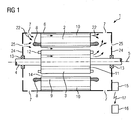
- FIG. 1 shows a basic longitudinal section of a dynamoelectric rotary ventilated machine 1, which has a stator 2 and a rotor 3, the rotor 3 being rotatably connected to a shaft 4 and being rotatably supported about an axis 5.
- the shaft 4 is in principle held on both sides of the active parts, ie the stator 2 and the rotor 3, by a bearing 13, the bearing 13 being positioned by a bearing plate 24.
- the bearing plate 24 is in turn held in a housing 6, the outer walls of which, in this special case, extend axially parallel.
- the stator 2 has axially layered laminations, the laminated core having grooves 9 with an essentially axial course, these grooves 9 being arranged in the region of the air gap 14 of the dynamoelectric rotary machine 1.
- the stator 2 has a winding system in these slots 9, which forms 2 winding heads 8 on the end faces of the laminated core of the stator.
- the stator 2 has cooling channels 10 which run parallel to the axis and which, viewed in the circumferential direction, are arranged in a uniformly distributed manner.
- the cooling channels 10 are preferably round or rounded, but can also have other geometric cross-sectional shapes, such as star-shaped, triangular, etc.
- the rotor 3 is designed as a short-circuit rotor, a short-circuit cage is located on the end faces of the rotor 3 facing the air gap 14, which forms 3 short-circuit rings 12 on the end faces of the rotor.
- a short-circuit cage of the rotor 3 and the shaft 4 Between the short-circuit cage of the rotor 3 and the shaft 4, one or more axially extending cooling channels 11 are arranged in the circumferential direction, which can also be provided in the stator 2.
- the housing 6 and / or the end shield 24 have openings 7 and 25, respectively, through which a - preferably forced - air exchange with the surroundings takes place. These openings 7 and 25 can be covered by filter mats or the like in order to provide a pre-filtering of the cooling air.
- the air flows are guaranteed by one or more fans. There is self-cooling and / or external cooling.
- FIG. 1 shows an example of a cooling air flow 22, as it penetrates into the dynamoelectric rotary machine 1, extends over the axially extending cooling channels 10, 11 and the air gap 14 and, like the heated cooling air flow, again through openings 7 and 25, the housing 6 or the rotary dynamoelectric machine 1 leaves.
- an exemplary cooling air flow is only in the upper half of this Figure 1 shown.
- the particles carried by the cooling air also reach comparatively high speeds and particularly impact on the winding head 8, particularly on the insulation of the winding head 8. This leads, in particular in the case e.g. dusty operating environment leads to premature wear of the insulation of the winding head 8. Due to the different phases of the winding system, which cross and / or overlap in the winding head 8, this leads to failure of the dynamoelectric machine 1.
- a monitoring element 20 that is to say means for monitoring, is now provided in the winding head 8 or directly on the winding head 8, at least one wire and / or at least one optical waveguide, which is likewise subjected to the abrasion process.
- the wire or the optical waveguide is attacked by the particles, the ohmic resistance or the light falling through the optical waveguide is changed accordingly, which, as part of a check, indicates as a clear indication that the insulation properties of the insulation on the winding overhang 8 are declining.
- such wires or optical waveguides can be attached to the winding head 8 in a specially provided additional layer 19, which lead to a notification of the loss of insulation due to the physical conditions described.
- the wires and / or optical fibers are arranged in one or more layers in the additional layer 19, which is attached directly to the winding head 8 on the insulation of the winding head, preferably glued or held by a bandage.
- a corresponding measurement signal is given to the wire or optical waveguide at predetermined time intervals via a control module 15, which can be positioned, for example, in the converter or directly on the electrical machine 1.
- Corresponding measured values or messages are then stored with the return signal, for example in a memory in or on the control module 15, which can be called up there at any time.
- the measurement data are forwarded to a control center 16, for example by radio 17, classified and evaluated.
- These messages of the insulation resistance, in particular on the winding head 8 can be transmitted to all superordinate system controls, for example in the case of multiple units or mining trucks, in order to provide the driver and / or a control center 16 with messages about the state of his drive system, in particular the insulation system.
- FIG 2 shows, by way of example, an arrangement of such an additional layer 19 on the side of the winding head 8 facing the air gap 14. This is particularly important if an additional fan blade 18 should be attached to the short-circuit ring 12, in particular for radial cooling air guidance and thus an increased impact of the Particles of the cooling air flow at the location of the winding head 8 marked there. The insulation of the winding overhang 8 is thus now monitored by the additional layer 19 or wires and optical waveguides embedded in the insulation material there.
- FIG 3 shows a different entry / course of the cooling air 22 in another guiding form. Also there, due to the increased abrasion on the top of the winding head 8, this area of the winding head 8 is monitored selectively or in terms of area.
- FIG 4 shows in a further arrangement with axial flow the layer of the winding head 8 to be protected, which can also be done by an additional layer 19 with wires and optical fibers or by wires and optical fibers already embedded in the winding head 8.
- FIG 5 shows in a more detailed representation the structure of such an additional layer 19, which contains a plurality of individual wires 20 or optical waveguides, and which specifically according to the embodiment according to FIG 2 is attached to the winding head 8.
- FIG 7 are taken, for example, where a drive of a mining truck is shown.
- this motor essentially corresponds to that in FIG. 1 , only that certain air ducts are specially designed and a cooling air flow 22 is optionally also conducted via a terminal box of the motor, not shown.
- FIG 8 shows a further area of application of such a dynamoelectric machine 1 FIG. 1 when driving a locomotive, the dynamo-electric machine 1 driving a pinion 30 and thus a large wheel 32 via the shaft 4.
- the drive is connected via a torque arm 27 to a bogie, not shown.
- the large wheel 32 is rotatably connected to a wheelset shaft 28, which in turn is rotatably connected to the wheels of a locomotive (shown in dashed lines). Both the wheelset shaft 28 and the shaft 4 are mounted separately via the bearing 29 and bearing 13.
- the large wheel 32 runs in a gear housing 31, in which the means for lubricating the large wheel 32 are also provided.
- FIG. 9 indicates based on FIG 2 in a further representation the arrangement of the wires or optical fibers embedded in the insulation of the winding head 8.
- the wires or optical waveguides are arranged as far as possible on the surface of the insulation of the winding head 8 in order to be able to determine the abrasion and thus the reduction in the insulation as early as possible.
Landscapes
- Engineering & Computer Science (AREA)
- Power Engineering (AREA)
- Physics & Mathematics (AREA)
- General Physics & Mathematics (AREA)
- Microelectronics & Electronic Packaging (AREA)
Description
- Dynamoelektrische Maschine mit einer Isolationsüberwachung Die Erfindung betrifft eine luftgekühlte dynamoelektrische Maschine, insbesondere eine durchzugsbelüftete rotatorische Maschine mit einem Stator, der axialgeschichtete Bleche aufweist, wobei das Blechpaket Nuten aufweist mit einem im wesentlichen axialen Verlauf, wobei diese Nuten im Bereich des Luftspaltes der dynamoelektrischen rotatorischen Maschine angeordnet sind und wobei ein Wicklungssystem, das in den Nuten positioniert ist und an der Stirnseite des Stators Wickelköpfe ausbildet, überwacht wird.
- Insbesondere Wickelköpfe luftgekühlter dynamoelektrischer Maschinen, die sich an den Stirnseiten eines Stators axial erstrecken, sind im Bereich von Luftströmungen angeordnet und damit einem Partikelstrom ausgesetzt, der sich innerhalb dieses Luftstromes befindet. Dabei wird insbesondere der Wickelkopf einem dementsprechenden Bombardement von Luftpartikeln und Staubpartikeln ausgesetzt, die zu Abrasionen der Isolation des Wickelkopfes führen und damit den Betrieb der dynamoelektrische Maschine beeinträchtigen können.
- Die Druckschrift
JP 55122450 - Die Druckschrift
WO 2014/114673 A2 offenbart eine Isolationsüberwachung, die einen Wicklungskurzschluss in Folge von erhöhter Temperatur frühzeitig detektieren soll. - Ausgehend davon liegt der Erfindung die Aufgabe zugrunde, die Isolation des Wicklungssystems, insbesondere des Wickelkopfes einer dynamoelektrischen Maschine zu überwachen.
- Die Lösung der gestellten Aufgabe gelingt durch eine luftgekühlte dynamoelektrische Maschine gemäß den Merkmalen des Anspruchs 1. Ferner wird diese Aufgabe durch ein Verfahren nach Anspruch 5 gelöst.
- Somit meldet sich das Überwachungssystem bereits vor dem Ausfall der Isolation, also des Isolationssystems an neuralgischen Punkten, die aufgrund der Luftkühlung einem Partikelstrom ausgesetzt ist. Somit wird also insbesondere die Isolation am Wickelkopf der dynamoelektrischen Maschine überwacht, bevor die Maschine ausfällt und dementsprechende Einbußen zu erleiden sind.
- Auf die erfindungsgemäße Art und Weise kann selbstverständlich auch das Wicklungssystem der dynamoelektrischen Maschine in den Nuten überwacht werden.
- Vorteilhafterweise werden derartige Mittel in Isolationsschichten an besonders neuralgischen Stellen des Wickelkopfes vorgesehen, an denen beispielsweise der Kühlluftstrom zuerst auf Elemente der dynamoelektrischen Maschine trifft oder auch bei der eine interne Verteilung des Kühlluftstromes verstärkt zu einen Partikelstrom auf gewisse Teile des Wicklungssystem, in diesem Fall des Wicklungskopfes führt.
- Somit muss nicht zwangsläufig der gesamte Wickelkopf mit den Mitteln zur Überwachung, also den Überwachungselementen versehen sein, sondern je nach Maschinendesign sind nur gewisse Punkte am Wickelkopf oder gewisse Flächenbereiche am Wickelkopf zu überwachen, die sich aufgrund des Maschinendesigns als besonders kritisch herausstellen, da sie dem Partikelstrom verstärkt ausgesetzt sind.
- Erfindungsgemäß werden die Mittel zur Überwachung als Lichtwellenleiteranordnung ausgeführt, bei der ein oder mehrere Leiter innerhalb des Isolationssystems am Wickelkopf vorgesehen werden, die ebenso dem Partikelstrom der Luftströmung ausgesetzt sind. Die Isolation des Lichtwellenleiters ist damit ebenso der Abrasion ausgesetzt und wird dabei zwangsläufig durch den Partikelstrom ebenso beansprucht, d.h. im Extremfall unterbrochen bzw. durchtrennt.
- Damit verändert sich der Brechungsindex der Lichtwellenleiter.
- Dabei ist sowohl ein serielles als auch paralleles Verlegen dieser Lichtwellenleiter möglich.
- Ebenso können diese Lichtwellenleiter in dem angestrebten Überwachungsgebiet des Wickelkopfes mäanderförmig verlegt sein.
- Diese Veränderung, im worst-case Durchtrennung des Lichtwellenleiters wird dann messtechnisch erfasst und kann als Indiz einer erhöhten Isolationsbeanspruchung bzw. -Abnutzung der Isolation des Wickelkopfes gewertet werden.
- In einer weiteren Ausführungsform wird dieses System durch mehrere, ausgehend vom Wickelkopf, radial übereinander liegende Lichtwellenleiter in der Isolation des Wickelkopfes eingebettet. Damit liegt ein gestuftes Sicherheitskonzept der Isolationsüberwachung vor, die dementsprechende abgestufte Meldungen beinhaltet, die ein Zeitmanagement des weiteren Betriebs der elektrischen Maschine gestatten.
- Beispielsweise lässt sich somit bei einem gestuften Konzept erkennen, dass nach ca. zwei Jahren die erste Stufe anspricht, nach weiteren zwei Jahren die zweite Stufe und dass dann mit einer linearen Hochrechnung und bei ähnlichen Betriebsbedingungen davon auszugehen ist, dass beispielsweise dann bei vorgesehenen drei Schichten nunmehr die Isolation des Wickelkopfes gefährdet ist und eine Wartung und Überarbeitung der Isolation des Wickelkopfes der dynamoelektrischen Maschine stattfinden muss.
- Auf die erfindungswesentliche Art und Weise wird also eine Schichtdickenmessung der elektrischen Isolation des Wicklungssystems, insbesondere an besonders exponierten Stellen des Wickelkopfs vorgenommen.
- Bzgl. der Überwachung des Isolationszustandes des Wickelkopfes der dynamoelektrischen Maschine lässt sich somit ein Ampelstatus, Warntöne oder andere optische und/oder akustische Signale einrichten.
- Die Überwachung kann auf mehrere Art und Weise von statten gehen. Zum einen werden die Lichtwellenleiter außerhalb des Motorgehäuses geführt um dort beispielsweise von Servicemitarbeitern auf Durchgang geprüft zu werden. Bei der Lichtwellenleiteranordnung wird für die Überprüfung des Isolationswiderstandes am Wickelkopf ein Lichtmessgerät eingesetzt.
- In einer weiteren, automatisierten Vorgehensweise dieser Überwachung wird über ein Steuermodul, das beispielsweise im Umrichter oder direkt an der elektrischen Maschine positioniert sein kann, in vorgegebenen Zeitabständen ein dementsprechendes Messsignal auf den Lichtwellenleiter gegeben. Mit dem Rücksignal werden dann dementsprechende Messwerte bzw. Meldungen beispielsweise in einem Speicher hinterlegt, die jederzeit abrufbar sind.
- Die Messdaten werden in einer weiteren Ausführungsform an eine Leitstelle weitergegeben, klassifiziert und ausgewertet.
- Diese Meldungen des Isolationswiderstandes, insbesondere am Wickelkopf können an sämtliche übergeordneten Systemsteuerungen beispielsweise bei Triebzügen oder Mining-Trucks leitungsgebunden oder wireless z.B. per Funk übermittelt werden, um so beispielsweise für den Fahrer und/oder einer Leitstelle Meldungen über den Zustand des Isolationssystems und damit des Antriebssystems bereitzustellen.
- Die Erfindung sowie weitere beispielhafte Ausgestaltungen sind im dargestellten Ausführungsbeispiel prinzipiell zu entnehmen, darin zeigen:
- FIG 1
- einen Längsschnitt einer durchzugsbelüfteten dynamoelektrischen rotatorischen Maschine,
- FIG 2 bis 4
- Anordnung der Mittel zur Überwachung am Wickelkopf,
- FIG 5 und 6
- Anordnungen der Drähte bzw. Lichtwellenleiter in einer Zwischenschicht,
- FIG 7
- Antrieb eines Mining-Trucks, der spezielle Luftführungen aufweist,
- FIG 8
- Antrieb einer Lok,
- FIG 9
- Anordnung der Mittel zur Überwachung im Wickelkopf.
-
FIG 1 zeigt in einem prinzipiellen Längsschnitt eine dynamoelektrische rotatorische durchzugsbelüftete Maschine 1, die einen Stator 2 und einen Rotor 3 aufweist, wobei der Rotor 3 mit einer Welle 4 drehfest verbunden ist und um eine Achse 5 drehbar gelagert ist. - Die Welle 4 wird dabei prinzipiell auf beiden Seiten der Aktivteile, also des Stators 2 und des Rotors 3 von einem Lager 13 gehalten, wobei das Lager 13 durch ein Lagerschild 24 jeweils positioniert ist. Das Lagerschild 24 wiederum ist in einem Gehäuse 6 gehalten, dessen Außenwandungen sich in diesem speziellen Fall achsparallel erstrecken.
- Der Stator 2 weist axial geschichtete Bleche auf, wobei das Blechpaket Nuten 9 aufweist, mit einem im wesentlichen axialen Verlauf, wobei diese Nuten 9 im Bereich des Luftspaltes 14 der dynamoelektrischen rotatorischen Maschine 1 angeordnet sind. Der Stator 2 weist ein Wicklungssystem in diesen Nuten 9 auf, das an den Stirnseiten des Blechpakets des Stators 2 Wickelköpfe 8 ausbildet.
- Im Betrieb der dynamoelektrischen rotatorischen Maschine 1 tritt aufgrund der elektromagnetischen Wechselwirkung des Wicklungssystems mit dem Rotor 3 eine Drehung (bei motorischem Betrieb), oder eine Energieerzeugung (bei generatorischem Betrieb), der dynamoelektrischen rotatorischen Maschine 1 ein.
- Der Stator 2 weist achsparallel verlaufende Kühlkanäle 10 auf, die in Umfangsrichtung betrachtet gleichmäßig verteilt angeordnet sind. Die Kühlkanäle 10 sind vorzugsweise rund oder rundlich ausgestaltet, können aber auch andere geometrische Querschnittsformen, wie sternförmig, dreieckförmig etc. aufweisen.
- Der Rotor 3 ist als Kurzschlussläufer ausgebildet, wobei sich an den Stirnseiten des Rotors 3 dem Luftspalt 14 zugewandt ein Kurzschlusskäfig befindet, der an den Stirnseiten des Rotors 3 Kurzschlussringe 12 ausbildet. Zwischen dem Kurzschlusskäfig des Rotors 3 und der Welle 4 sind im Umfangsrichtung verteilt einer oder mehrere axial verlaufende Kühlkanäle 11 angeordnet, die auch im Stator 2 vorgesehen werden können. Das Gehäuse 6 und/oder das Lagerschild 24 weisen Öffnungen 7 bzw. 25 auf, durch die ein - vorzugsweise erzwungener - Luftaustausch mit der Umgebung stattfindet. Diese Öffnungen 7 bzw. 25 können durch Filtermatten oder dergleichen abgedeckt sein, um eine Vorfilterung der Kühlluft zu schaffen.
- Die Luftströmungen werden dabei von einem oder mehreren Lüfter gewährleistet. Es liegt eine Selbst- und/oder Fremdkühlung vor.
-
FIG 1 zeigt beispielhaft einen Kühlluftstrom 22, wie er in die dynamoelektrische rotatorische Maschine 1 eindringt, sich über die axial verlaufenden Kühlkanäle 10, 11 und den Luftspalt 14 erstreckt und wie der erwärmte Kühlluftstrom wieder durch Öffnung 7 und 25 das Gehäuse 6 bzw. die rotatorische dynamoelektrische Maschine 1 verlässt. Aus Übersichtlichkeitsgründen ist ein beispielhafter Kühlluftstromverlauf nur in der oberen Hälfte dieserFigur 1 dargestellt. - Mit dem in die Maschine 1 eintretenden Kühlluftstrom werden Partikel mit eingeführt, die je nach Geschwindigkeit des Kühlluftstroms 22 mehr oder weniger intensiv insbesondere auf den Wickelkopf 8 prallen. Aufgrund der vergleichsweise geringen Wärmekapazität von Luft ist, um eine dementsprechende Kühlwirkung der dynamoelektrischen Maschine 1 zu erhalten, ein ausreichender Volumendurchsatz durch die Maschine zu gewährleisten.
- Aufgrund des angestrebten Volumendurchsatzes und der damit verbundenen hohen Geschwindigkeit des von außen zugeführten Kühlluftstromes erreichen auch die durch die Kühlluft mitgeführten Partikel vergleichsweise hohe Geschwindigkeiten und prallen insbesondere auf den Wickelkopf 8 besonders auf die Isolierung des Wickelkopfes 8. Dies führt, insbesondere bei dementsprechender z.B. staubhaltiger Betriebsumgebung zu einem vorschnellen Verschleiß der Isolierung des Wickelkopfes 8. Aufgrund der unterschiedlichen Phasen des Wicklungssystems, die sich im Wickelkopf 8 überkreuzen und/oder überlappen führt dies zu einem Ausfall der dynamoelektrischen Maschine 1.
- In vorteilhafter Weise wird nunmehr in dem Wickelkopf 8 oder unmittelbar an dem Wickelkopf 8 ein Überwachungselement 20, also Mittel zur Überwachung vorgesehen, zumindest ein Draht und/oder zumindest ein Lichtwellenleiter verlegt, der ebenfalls dem Abrasionsprozess unterworfen ist. Sobald nunmehr der Draht oder der Lichtwellenleiter von den Partikeln angegriffen wird, wird dementsprechend der ohmsche Widerstand respektive das durch den Lichtwellenleiter fallende Licht verändert, was im Rahmen einer Überprüfung als eindeutiges Indiz auf die anstehende nachlassende Isolationseigenschaften der Isolation am Wickelkopf 8 hinweist.
- Als alternative Ausführungsform können derartige Drähte bzw. Lichtwellenleiter in einer eigens vorzusehenden Zusatzschicht 19 am Wickelkopf 8 angebracht werden, die aufgrund der beschriebenen physikalischen Gegebenheiten zu einer Meldung des Isolationsverlustes führen. Die Drähte und/oder Lichtwellenleiter sind in einer oder mehreren Lagen in der Zusatzschicht 19 angeordnet, die unmittelbar am Wickelkopf 8 auf der Isolation des Wickelkopfes befestigt, vorzugsweise geklebt oder durch Bandage gehalten wird.
- Bei einer im Wesentlichen automatisierten Überwachung wird über ein Steuermodul 15, das beispielsweise im Umrichter oder direkt an der elektrischen Maschine 1 positioniert sein kann, in vorgegebenen Zeitabständen ein dementsprechendes Messsignal auf den Draht- bzw. Lichtwellenleiter gegeben. Mit dem Rücksignal werden dann dementsprechende Messwerte bzw. Meldungen beispielsweise in einem Speicher im oder am Steuermodul 15 hinterlegt, die dort jederzeit abrufbar sind.
- Die Messdaten werden in einer weiteren Ausführungsform an eine Leitstelle 16 beispielsweise per Funk 17 weitergegeben, klassifiziert und ausgewertet.
- Diese Meldungen des Isolationswiderstandes, insbesondere am Wickelkopf 8 können an sämtliche übergeordneten Systemsteuerungen beispielsweise bei Triebzügen oder Mining-Trucks übermittelt werden, um so insbesondere für den Fahrer und/oder einer Leitstelle 16 Meldungen über den Zustand seines Antriebssystems, insbesondere des Isolationssystems bereitzustellen.
- Damit ist eine nahezu permanente Zustandsüberwachung der Isolation des Wickelkopfes 8 möglich und eine zeitige Fehlererkennung gegeben. Damit lassen sich isolationsbedingte Ausfälle von dynamoelektrischen Maschinen 1 bei sämtlichen Anwendungsfällen derartiger Maschinen vermeiden.
-
FIG 2 zeigt beispielhaft eine Anordnung einer derartigen Zusatzschicht 19 an der dem Luftspalt 14 zugewandten Seite des Wickelkopfes 8. Dies ist insbesondere dann von Bedeutung, falls am Kurzschlussring 12 ein zusätzlicher Lüfterflügel 18 angebracht sein sollte, der insbesondere für eine radiale Kühlluftführung und damit ein verstärktes Aufprallen der Partikel des Kühlluftstromes an der dort markierten Stelle des Wickelkopfes 8 führt. Damit wird nunmehr durch die Zusatzschicht 19 oder dort in das Isolationsmaterial eingelassene Drähte und Lichtwellenleiter die Isolierung des Wickelkopfes 8 überwacht. -
FIG 3 zeigt in einer anderen Führungsform einen anderen Eintritt/Verlauf der Kühlluft 22. Auch dort wird aufgrund der erhöhten Abrasion auf der Oberseite des Wickelkopfes 8 dieser Bereich des Wickelkopfes 8 punktuell oder flächenmäßig überwacht. -
FIG 4 zeigt in einer weiteren Anordnung bei axialem Anströmen die zu schützende Schicht des Wickelkopfes 8, was ebenfalls durch eine Zusatzschicht 19 mit Drähten und Lichtwellenleitern oder auch durch bereits in den Wickelkopf 8 eingelassene Drähte und Lichtwellenleiter erfolgen kann. -
FIG 5 zeigt in einer detaillierteren Darstellung den Aufbau einer derartigen Zusatzschicht 19, die mehrere Einzeldrähte 20 oder Lichtwellenleiter enthält und die speziell gemäß der Ausführung nachFIG 2 am Wickelkopf 8 angebracht ist. - Um kaskadenförmige Meldungen zu erhalten, die die unterschiedlichen Abrasionszustände des Wickelkopfes 8 wiedergeben, können entweder mehrere Einzelschichten oder mehrere in einer Schicht hintereinander geschalteten Lagen von Drähten oder Lichtwellenleitern angeordnet sind. Die prinzipielle Darstellung dieser gemäß
FIG 5 und FIG 6 dargestellten Anordnungen lässt sich auch auf die Darstellung gemäßFIG 3 und FIG 4 übertragen. - Die Anwendung eines derartigen Überwachungselements der Isolation beispielsweise durch Abrasion kann auch
FIG 7 entnommen werden, wo beispielsweise ein Antrieb eines Mining-Trucks dargestellt ist. Im Prinzip entspricht dieser Motor im Wesentlichen dem inFIG 1 , nur dass gewisse Luftführungskanäle speziell ausgebildet sind und ein Kühlluftstrom 22 gegebenenfalls auch über einen nicht näher dargestellten Klemmenkasten des Motors geführt wird. -
FIG 8 zeigt ein weiteres Einsatzgebiet einer derartigen dynamoelektrischen Maschine 1 nachFIG 1 bei einem Antrieb einer Lok, wobei die dynamoelektrische Maschine 1 über die Welle 4 ein Ritzel 30 und damit ein Großrad 32 antreibt. Der Antrieb ist dabei über eine Drehmomentenstütze 27 mit einem nicht näherdargestellten Drehgestell verbunden. Das Großrad 32 ist drehfest mit einer Radsatzwelle 28 verbunden, die wiederum mit den Rädern einer Lok (gestrichelt dargestellt) drehfest verbunden ist. Sowohl die Radsatzwelle 28 als auch die Welle 4 sind separat über Tatzlager 29 bzw. Lager 13 gelagert. Das Großrad 32 läuft in einem Getriebegehäuse 31, in dem auch die Mittel zur Schmierung des Großrades 32 vorgesehen sind. - Aus Übersichtlichkeitsgründen ist der Lokantrieb nur prinzipiell dargestellt, ebenso wie dort auch auf die Darstellung der einzelnen Kühlluftströme verzichtet wurde.
-
FIG 9 zeigt in Anlehnung anFIG 2 in einer weiteren Darstellung die Anordnung der Drähte oder Lichtwellenleiter in der Isolation des Wickelkopfes 8 eingebettet. Dort sind die Drähte oder Lichtwellenleiter möglichst an der Oberfläche der Isolation des Wickelkopfes 8 angeordnet, um möglichst frühzeitig die Abrasion und damit die Reduzierung der Isolation feststellen zu können. - Für die Überwachung der Isolation des Wickelkopfes 8 gelten im Übrigen sinngemäß die für die oben genannten Ausführungsformen getroffenen Aussagen u.a. betreffend die Anordnungen und die Messmethodik. Ebenso kann das stufenweise Überwachungskonzept, die Überprüfung der Isolation und die Anwendung bei Miningtrucks und Bahnantrieben gemäß der obigen Ausführungen bei der Anordnung nach
FIG 9 umgesetzt werden. - Grundsätzlich sind die Merkmale der oben beschriebenen Ausführungen auch miteinander kombinierbar.
Claims (6)
- Luftgekühlte dynamoelektrische Maschine (1), insbesondere durchzugsbelüftete dynamoelektrische Maschine (1), mit einem Stator (2), mit einem Wicklungssystem, das an den Stirnseiten des Stators (2) Wickelköpfe (8) ausbildet, wobei zumindest der Wickelkopf (8) in seiner Isolationsschicht zumindest ein Überwachungselement (20) zur Überwachung der Isolationsstärke des Wickelkopfes (8) aufweist, wobei das Überwachungselement (20) zumindest eine Lichtwellenleiteranordnung aufweist.
- Luftgekühlte dynamoelektrische Maschine (1) nach Anspruch 1, dadurch gekennzeichnet, dass das Überwachungselement (20) zumindest an der Stelle des Wickelkopfes (8) vorgesehen ist, die einem Kühlluftstrom (22) ausgesetzt ist.
- Luftgekühlte dynamoelektrische Maschine (1) nach Anspruch 1 oder 2, dadurch gekennzeichnet, dass das Überwachungselement (20) zumindest eine Drahtanordnung aufweist.
- Luftgekühlte dynamoelektrische Maschine (1) nach einem der vorhergehenden Ansprüche, dadurch gekennzeichnet, dass über das Überwachungselement (20) eine Zustandserkennung des Isolationswiderstandes am Wickelkopf (8) stattfindet.
- Verfahren zur Überprüfung des Isolationszustandes eines Wicklungskopfes (8) einer luftgekühlten dynamoelektrischen Maschine (1) insbesondere durchzugsbelüfteten dynamoelektrischen Maschine (1) mit einem Stator (2), mit einem Wicklungssystem, das an den Stirnseiten des Stators (2) Wickelköpfe (8) ausbildet, wobei zumindest der Wickelkopf (8) in seiner Isolationsschicht mindestens ein Überwachungselement (20) zur Überwachung der Isolationsstarkedes Wickelkopfes (8) aufweist, wobei das Überwachungselement (20) zumindest eine Lichtwellenleiteranordnung aufweist, nach einem der vorhergehenden Ansprüche durch folgende Schritte:- in vorgebbaren Zeitabständen werden Signale in das Überwachungselement (20) geschickt,- Aufnahme der Rücksignale aus dem Überwachungselement (20),- Auswertung der Rücksignale derart, dass Rückschlüsse auf den Isolationszustand des Wickelkopfes (8) vorgenommen werden.
- Verfahren zur Überprüfung des Isolationswiderstandes nach Anspruch 5, dadurch gekennzeichnet, dass über die Aufnahme der Rücksignale eine Klassifizierung des Isolationszustands des Wicklungskopfes (8) stattfindet.
Priority Applications (3)
| Application Number | Priority Date | Filing Date | Title |
|---|---|---|---|
| EP14179653.2A EP2983276B2 (de) | 2014-08-04 | 2014-08-04 | Dynamoelektrische Maschine mit einer Isolationsüberwachung |
| CN201510482793.XA CN105337460B (zh) | 2014-08-04 | 2015-08-03 | 具有绝缘监控的机电机器 |
| US14/816,806 US9784793B2 (en) | 2014-08-04 | 2015-08-03 | Dynamo-electric machine with insulation monitoring |
Applications Claiming Priority (1)
| Application Number | Priority Date | Filing Date | Title |
|---|---|---|---|
| EP14179653.2A EP2983276B2 (de) | 2014-08-04 | 2014-08-04 | Dynamoelektrische Maschine mit einer Isolationsüberwachung |
Publications (3)
| Publication Number | Publication Date |
|---|---|
| EP2983276A1 EP2983276A1 (de) | 2016-02-10 |
| EP2983276B1 EP2983276B1 (de) | 2017-04-26 |
| EP2983276B2 true EP2983276B2 (de) | 2020-01-29 |
Family
ID=51260754
Family Applications (1)
| Application Number | Title | Priority Date | Filing Date |
|---|---|---|---|
| EP14179653.2A Active EP2983276B2 (de) | 2014-08-04 | 2014-08-04 | Dynamoelektrische Maschine mit einer Isolationsüberwachung |
Country Status (3)
| Country | Link |
|---|---|
| US (1) | US9784793B2 (de) |
| EP (1) | EP2983276B2 (de) |
| CN (1) | CN105337460B (de) |
Families Citing this family (7)
| Publication number | Priority date | Publication date | Assignee | Title |
|---|---|---|---|---|
| JP6874588B2 (ja) * | 2017-08-10 | 2021-05-19 | トヨタ自動車株式会社 | 回転電機ステータ |
| EP3490115A1 (de) | 2017-11-28 | 2019-05-29 | Siemens Aktiengesellschaft | Integrierter klemmenkasten einer rotatorischen dynamoelektrischen maschine |
| US20190363598A1 (en) * | 2018-05-25 | 2019-11-28 | GM Global Technology Operations LLC | Apparatus for cooling an electric motor and method of making the same |
| DE102020216230A1 (de) * | 2020-12-18 | 2022-06-23 | Zf Friedrichshafen Ag | Elektrische Maschine zum Antrieb eines Kraftfahrzeugs |
| JP2022106469A (ja) * | 2021-01-07 | 2022-07-20 | トヨタ自動車株式会社 | モータ制御装置 |
| CN118243326B (zh) * | 2024-05-21 | 2024-07-16 | 中国航空工业集团公司沈阳空气动力研究所 | 一种具备轴绝缘自监测功能的风洞驱动系统 |
| FR3164578A1 (fr) * | 2024-07-12 | 2026-01-16 | Safran Electrical & Power | Dispositif et procédé de protection contre un défaut dans un moteur électrique |
Citations (8)
| Publication number | Priority date | Publication date | Assignee | Title |
|---|---|---|---|---|
| DD205540A1 (de) † | 1982-03-30 | 1983-12-28 | Elektromasch Forsch Entw | Anordnung zur lebensdauerueberwachung der wicklungsisolation insbesondere fuer elektrische maschinen |
| JPH02184204A (ja) † | 1989-01-05 | 1990-07-18 | Toshiba Corp | 車両用リニアモータのコイルカバー |
| KR20040075187A (ko) † | 2003-02-20 | 2004-08-27 | 한국전기연구원 | 함침 절연 고압 회전기의 권선 단말에 설치 가능한 운전중부분방전 측정센서 |
| EP1503218A1 (de) † | 2002-04-26 | 2005-02-02 | Kabushiki Kaisha Toshiba | Verfahren zur diagnose der verschlechterung einer spule und system zur diagnose der verschlechterung einer spule |
| US20070194631A1 (en) † | 2005-03-15 | 2007-08-23 | Mitsubishi Electric Corporation | Steel wheel-type linear motor |
| EP2479583A2 (de) † | 2011-01-19 | 2012-07-25 | Hitachi, Ltd. | Verfahren zur Prüfung von Teilentladung einer umrichtergesteuerten drehenden elektrischen Maschine |
| EP2549245A1 (de) † | 2011-07-20 | 2013-01-23 | Siemens Aktiengesellschaft | Verfahren und Vorrichtung zur Überwachung von Wickelkopfschwingungen eines Generators |
| DE102011082358A1 (de) † | 2011-09-08 | 2013-03-14 | Siemens Aktiengesellschaft | Überwachungseinrichtung für elektrische Betriebsmittel |
Family Cites Families (7)
| Publication number | Priority date | Publication date | Assignee | Title |
|---|---|---|---|---|
| JPS55122450A (en) | 1979-03-16 | 1980-09-20 | Hitachi Ltd | Device for detecting deterioration in insulation of stator coil of rotary electric machine |
| DE3543927A1 (de) * | 1985-12-12 | 1987-06-19 | Kraftwerk Union Ag | Verfahren zur teilentladungserfassung und abreissfunkenmessung bei dynamoelektrischen hochspannungsmaschinen sowie einrichtung zu seiner durchfuehrung |
| US4940933A (en) * | 1989-04-13 | 1990-07-10 | Westinghouse Electric Corp. | Fiber optic arc monitor |
| US6218757B1 (en) * | 1998-11-30 | 2001-04-17 | General Electric Canada Inc | Minimizing shaft currents in dynamoelectric machines |
| CN1172424C (zh) * | 1999-03-24 | 2004-10-20 | 国际壳牌研究有限公司 | 监测电机中温度的系统 |
| JP5433392B2 (ja) * | 2009-12-16 | 2014-03-05 | 日立オートモティブシステムズ株式会社 | 電動車両用回転電機、駆動制御装置および絶縁診断方法 |
| DE102013201294A1 (de) | 2013-01-28 | 2014-08-14 | Siemens Aktiengesellschaft | Erkennung eines Wicklungszustands einer elektrischen Maschine |
-
2014
- 2014-08-04 EP EP14179653.2A patent/EP2983276B2/de active Active
-
2015
- 2015-08-03 US US14/816,806 patent/US9784793B2/en active Active
- 2015-08-03 CN CN201510482793.XA patent/CN105337460B/zh active Active
Patent Citations (8)
| Publication number | Priority date | Publication date | Assignee | Title |
|---|---|---|---|---|
| DD205540A1 (de) † | 1982-03-30 | 1983-12-28 | Elektromasch Forsch Entw | Anordnung zur lebensdauerueberwachung der wicklungsisolation insbesondere fuer elektrische maschinen |
| JPH02184204A (ja) † | 1989-01-05 | 1990-07-18 | Toshiba Corp | 車両用リニアモータのコイルカバー |
| EP1503218A1 (de) † | 2002-04-26 | 2005-02-02 | Kabushiki Kaisha Toshiba | Verfahren zur diagnose der verschlechterung einer spule und system zur diagnose der verschlechterung einer spule |
| KR20040075187A (ko) † | 2003-02-20 | 2004-08-27 | 한국전기연구원 | 함침 절연 고압 회전기의 권선 단말에 설치 가능한 운전중부분방전 측정센서 |
| US20070194631A1 (en) † | 2005-03-15 | 2007-08-23 | Mitsubishi Electric Corporation | Steel wheel-type linear motor |
| EP2479583A2 (de) † | 2011-01-19 | 2012-07-25 | Hitachi, Ltd. | Verfahren zur Prüfung von Teilentladung einer umrichtergesteuerten drehenden elektrischen Maschine |
| EP2549245A1 (de) † | 2011-07-20 | 2013-01-23 | Siemens Aktiengesellschaft | Verfahren und Vorrichtung zur Überwachung von Wickelkopfschwingungen eines Generators |
| DE102011082358A1 (de) † | 2011-09-08 | 2013-03-14 | Siemens Aktiengesellschaft | Überwachungseinrichtung für elektrische Betriebsmittel |
Non-Patent Citations (1)
| Title |
|---|
| G.C. STONE: "Advancements during the Past Quarter Century on On-line Monitoring of Motor and Generator Winding Insulation", IEEE TRANSACTIONS ON DIELECTRICS AND ELECTRICAL INSULATION, vol. 9, no. 5, October 2002 (2002-10-01) † |
Also Published As
| Publication number | Publication date |
|---|---|
| CN105337460A (zh) | 2016-02-17 |
| US9784793B2 (en) | 2017-10-10 |
| EP2983276B1 (de) | 2017-04-26 |
| EP2983276A1 (de) | 2016-02-10 |
| US20160033579A1 (en) | 2016-02-04 |
| CN105337460B (zh) | 2019-10-29 |
Similar Documents
| Publication | Publication Date | Title |
|---|---|---|
| EP2983276B1 (de) | Dynamoelektrische Maschine mit einer Isolationsüberwachung | |
| EP2104975A1 (de) | Pm-läufer mit radialen kühlschlitzen und entsprechendes herstellungsverfahren | |
| DE102019111729A1 (de) | Vorrichtung zum kühlen eines elektromotors und verfahren zur herstellung desselben | |
| DE102014018223A1 (de) | Elektrische Maschine, insbesondere Asynchronmaschine | |
| EP2422431B1 (de) | Elektrische maschine mit einem rotor und einem stator und einer vorrichtung zum überwachen des luftspalts zwischen rotor und stator | |
| EP2263010B1 (de) | Vakuumpumpe | |
| EP3611828A1 (de) | Dynamoelektrische rotatorische maschine mit einer luftspaltkapselung | |
| EP2065690B1 (de) | Dynamoelektrische Maschine mit einem Temperaturerfassungsmesssystem | |
| EP2860852A1 (de) | Einrichtung zum Ablenken von zumindest einem Teil eines axial in einem zwischen einem Rotor und einem Stator einer rotierenden elektrischen Maschine angeordneten Zwischenraum strömenden Kühlfluids | |
| WO2019206876A1 (de) | Elektrische maschine und hybridelektrisches luftfahrzeug | |
| WO2012175160A2 (de) | Elektrische maschine mit einer einrichtung zum überwachen der rotorgeometrie | |
| WO2017050445A1 (de) | Turbomaschine mit magnetlagerung | |
| WO2019034680A1 (de) | Direktantrieb für saumwickler in der metallbearbeitung | |
| DE102019007870A1 (de) | Elektrische Maschine | |
| DE102020105915A1 (de) | Axialflussmotor sowie fahrerloses Transportfahrzeug | |
| EP2281335B1 (de) | Generatoreinrichtung mit überwachung von strompfaden | |
| DE102018208686A1 (de) | Elektrische Maschine und hybrid-elektrisches Luftfahrzeug | |
| DE102010003246A1 (de) | Transversalflussmaschine | |
| EP2647104B1 (de) | Ständerwicklung mit mehreren phasenwicklungen | |
| DE102011108591A1 (de) | Überwachungsvorrichtung für eine doppelgespeiste Asynchronmaschine | |
| DE102017000821A1 (de) | Elektrische Antriebseinheit mit intelligenter Wartungsbedarfsüberwachung | |
| EP3032714A1 (de) | Dynamoelektrische Maschine mit einem Meldesystem zur Kurzschlusserkennung im Wicklungssystem | |
| EP3180837A1 (de) | Rotorballen für eine rotierende elektrische maschine | |
| EP4462653A1 (de) | Digitalisierte dynamoelektrische maschine mit wechselrichtermodulen | |
| DE102007053755A1 (de) | Verfahren und Einrichtung zur Überwachung einer Läufertemperatur einer permanent erregten elektrischen Maschine |
Legal Events
| Date | Code | Title | Description |
|---|---|---|---|
| PUAI | Public reference made under article 153(3) epc to a published international application that has entered the european phase |
Free format text: ORIGINAL CODE: 0009012 |
|
| AK | Designated contracting states |
Kind code of ref document: A1 Designated state(s): AL AT BE BG CH CY CZ DE DK EE ES FI FR GB GR HR HU IE IS IT LI LT LU LV MC MK MT NL NO PL PT RO RS SE SI SK SM TR |
|
| AX | Request for extension of the european patent |
Extension state: BA ME |
|
| 17P | Request for examination filed |
Effective date: 20160520 |
|
| RBV | Designated contracting states (corrected) |
Designated state(s): AL AT BE BG CH CY CZ DE DK EE ES FI FR GB GR HR HU IE IS IT LI LT LU LV MC MK MT NL NO PL PT RO RS SE SI SK SM TR |
|
| REG | Reference to a national code |
Ref country code: DE Ref legal event code: R079 Ref document number: 502014003530 Country of ref document: DE Free format text: PREVIOUS MAIN CLASS: H02K0003380000 Ipc: G01R0031340000 |
|
| RIC1 | Information provided on ipc code assigned before grant |
Ipc: G01R 31/34 20060101AFI20161007BHEP Ipc: H02K 3/38 20060101ALI20161007BHEP Ipc: H02K 11/20 20160101ALI20161007BHEP Ipc: G01R 31/12 20060101ALI20161007BHEP |
|
| GRAP | Despatch of communication of intention to grant a patent |
Free format text: ORIGINAL CODE: EPIDOSNIGR1 |
|
| INTG | Intention to grant announced |
Effective date: 20161121 |
|
| GRAS | Grant fee paid |
Free format text: ORIGINAL CODE: EPIDOSNIGR3 |
|
| GRAA | (expected) grant |
Free format text: ORIGINAL CODE: 0009210 |
|
| AK | Designated contracting states |
Kind code of ref document: B1 Designated state(s): AL AT BE BG CH CY CZ DE DK EE ES FI FR GB GR HR HU IE IS IT LI LT LU LV MC MK MT NL NO PL PT RO RS SE SI SK SM TR |
|
| REG | Reference to a national code |
Ref country code: GB Ref legal event code: FG4D Free format text: NOT ENGLISH |
|
| REG | Reference to a national code |
Ref country code: CH Ref legal event code: EP |
|
| REG | Reference to a national code |
Ref country code: AT Ref legal event code: REF Ref document number: 888340 Country of ref document: AT Kind code of ref document: T Effective date: 20170515 |
|
| REG | Reference to a national code |
Ref country code: IE Ref legal event code: FG4D Free format text: LANGUAGE OF EP DOCUMENT: GERMAN |
|
| REG | Reference to a national code |
Ref country code: CH Ref legal event code: NV Representative=s name: SIEMENS SCHWEIZ AG, CH |
|
| REG | Reference to a national code |
Ref country code: DE Ref legal event code: R096 Ref document number: 502014003530 Country of ref document: DE |
|
| RAP2 | Party data changed (patent owner data changed or rights of a patent transferred) |
Owner name: SIEMENS AKTIENGESELLSCHAFT |
|
| REG | Reference to a national code |
Ref country code: NL Ref legal event code: MP Effective date: 20170426 |
|
| REG | Reference to a national code |
Ref country code: LT Ref legal event code: MG4D |
|
| PG25 | Lapsed in a contracting state [announced via postgrant information from national office to epo] |
Ref country code: NL Free format text: LAPSE BECAUSE OF FAILURE TO SUBMIT A TRANSLATION OF THE DESCRIPTION OR TO PAY THE FEE WITHIN THE PRESCRIBED TIME-LIMIT Effective date: 20170426 |
|
| REG | Reference to a national code |
Ref country code: CH Ref legal event code: PCOW Free format text: NEW ADDRESS: WERNER-VON-SIEMENS-STRASSE 1, 80333 MUENCHEN (DE) |
|
| PG25 | Lapsed in a contracting state [announced via postgrant information from national office to epo] |
Ref country code: FI Free format text: LAPSE BECAUSE OF FAILURE TO SUBMIT A TRANSLATION OF THE DESCRIPTION OR TO PAY THE FEE WITHIN THE PRESCRIBED TIME-LIMIT Effective date: 20170426 Ref country code: LT Free format text: LAPSE BECAUSE OF FAILURE TO SUBMIT A TRANSLATION OF THE DESCRIPTION OR TO PAY THE FEE WITHIN THE PRESCRIBED TIME-LIMIT Effective date: 20170426 Ref country code: GR Free format text: LAPSE BECAUSE OF FAILURE TO SUBMIT A TRANSLATION OF THE DESCRIPTION OR TO PAY THE FEE WITHIN THE PRESCRIBED TIME-LIMIT Effective date: 20170727 Ref country code: ES Free format text: LAPSE BECAUSE OF FAILURE TO SUBMIT A TRANSLATION OF THE DESCRIPTION OR TO PAY THE FEE WITHIN THE PRESCRIBED TIME-LIMIT Effective date: 20170426 Ref country code: NO Free format text: LAPSE BECAUSE OF FAILURE TO SUBMIT A TRANSLATION OF THE DESCRIPTION OR TO PAY THE FEE WITHIN THE PRESCRIBED TIME-LIMIT Effective date: 20170726 Ref country code: HR Free format text: LAPSE BECAUSE OF FAILURE TO SUBMIT A TRANSLATION OF THE DESCRIPTION OR TO PAY THE FEE WITHIN THE PRESCRIBED TIME-LIMIT Effective date: 20170426 |
|
| PG25 | Lapsed in a contracting state [announced via postgrant information from national office to epo] |
Ref country code: SE Free format text: LAPSE BECAUSE OF FAILURE TO SUBMIT A TRANSLATION OF THE DESCRIPTION OR TO PAY THE FEE WITHIN THE PRESCRIBED TIME-LIMIT Effective date: 20170426 Ref country code: BG Free format text: LAPSE BECAUSE OF FAILURE TO SUBMIT A TRANSLATION OF THE DESCRIPTION OR TO PAY THE FEE WITHIN THE PRESCRIBED TIME-LIMIT Effective date: 20170726 Ref country code: IS Free format text: LAPSE BECAUSE OF FAILURE TO SUBMIT A TRANSLATION OF THE DESCRIPTION OR TO PAY THE FEE WITHIN THE PRESCRIBED TIME-LIMIT Effective date: 20170826 Ref country code: RS Free format text: LAPSE BECAUSE OF FAILURE TO SUBMIT A TRANSLATION OF THE DESCRIPTION OR TO PAY THE FEE WITHIN THE PRESCRIBED TIME-LIMIT Effective date: 20170426 Ref country code: LV Free format text: LAPSE BECAUSE OF FAILURE TO SUBMIT A TRANSLATION OF THE DESCRIPTION OR TO PAY THE FEE WITHIN THE PRESCRIBED TIME-LIMIT Effective date: 20170426 Ref country code: PL Free format text: LAPSE BECAUSE OF FAILURE TO SUBMIT A TRANSLATION OF THE DESCRIPTION OR TO PAY THE FEE WITHIN THE PRESCRIBED TIME-LIMIT Effective date: 20170426 |
|
| REG | Reference to a national code |
Ref country code: DE Ref legal event code: R026 Ref document number: 502014003530 Country of ref document: DE |
|
| PLBI | Opposition filed |
Free format text: ORIGINAL CODE: 0009260 |
|
| PG25 | Lapsed in a contracting state [announced via postgrant information from national office to epo] |
Ref country code: EE Free format text: LAPSE BECAUSE OF FAILURE TO SUBMIT A TRANSLATION OF THE DESCRIPTION OR TO PAY THE FEE WITHIN THE PRESCRIBED TIME-LIMIT Effective date: 20170426 Ref country code: SK Free format text: LAPSE BECAUSE OF FAILURE TO SUBMIT A TRANSLATION OF THE DESCRIPTION OR TO PAY THE FEE WITHIN THE PRESCRIBED TIME-LIMIT Effective date: 20170426 Ref country code: RO Free format text: LAPSE BECAUSE OF FAILURE TO SUBMIT A TRANSLATION OF THE DESCRIPTION OR TO PAY THE FEE WITHIN THE PRESCRIBED TIME-LIMIT Effective date: 20170426 Ref country code: DK Free format text: LAPSE BECAUSE OF FAILURE TO SUBMIT A TRANSLATION OF THE DESCRIPTION OR TO PAY THE FEE WITHIN THE PRESCRIBED TIME-LIMIT Effective date: 20170426 |
|
| PLAX | Notice of opposition and request to file observation + time limit sent |
Free format text: ORIGINAL CODE: EPIDOSNOBS2 |
|
| 26 | Opposition filed |
Opponent name: SEW-EURODRIVE GMBH & CO. KG Effective date: 20180117 |
|
| PG25 | Lapsed in a contracting state [announced via postgrant information from national office to epo] |
Ref country code: SM Free format text: LAPSE BECAUSE OF FAILURE TO SUBMIT A TRANSLATION OF THE DESCRIPTION OR TO PAY THE FEE WITHIN THE PRESCRIBED TIME-LIMIT Effective date: 20170426 Ref country code: IT Free format text: LAPSE BECAUSE OF FAILURE TO SUBMIT A TRANSLATION OF THE DESCRIPTION OR TO PAY THE FEE WITHIN THE PRESCRIBED TIME-LIMIT Effective date: 20170426 |
|
| PG25 | Lapsed in a contracting state [announced via postgrant information from national office to epo] |
Ref country code: MC Free format text: LAPSE BECAUSE OF FAILURE TO SUBMIT A TRANSLATION OF THE DESCRIPTION OR TO PAY THE FEE WITHIN THE PRESCRIBED TIME-LIMIT Effective date: 20170426 |
|
| REG | Reference to a national code |
Ref country code: FR Ref legal event code: ST Effective date: 20180430 |
|
| REG | Reference to a national code |
Ref country code: IE Ref legal event code: MM4A |
|
| PG25 | Lapsed in a contracting state [announced via postgrant information from national office to epo] |
Ref country code: SI Free format text: LAPSE BECAUSE OF FAILURE TO SUBMIT A TRANSLATION OF THE DESCRIPTION OR TO PAY THE FEE WITHIN THE PRESCRIBED TIME-LIMIT Effective date: 20170426 |
|
| PLBB | Reply of patent proprietor to notice(s) of opposition received |
Free format text: ORIGINAL CODE: EPIDOSNOBS3 |
|
| REG | Reference to a national code |
Ref country code: BE Ref legal event code: MM Effective date: 20170831 |
|
| PG25 | Lapsed in a contracting state [announced via postgrant information from national office to epo] |
Ref country code: LU Free format text: LAPSE BECAUSE OF NON-PAYMENT OF DUE FEES Effective date: 20170804 |
|
| PG25 | Lapsed in a contracting state [announced via postgrant information from national office to epo] |
Ref country code: IE Free format text: LAPSE BECAUSE OF NON-PAYMENT OF DUE FEES Effective date: 20170804 |
|
| PG25 | Lapsed in a contracting state [announced via postgrant information from national office to epo] |
Ref country code: BE Free format text: LAPSE BECAUSE OF NON-PAYMENT OF DUE FEES Effective date: 20170831 Ref country code: FR Free format text: LAPSE BECAUSE OF NON-PAYMENT OF DUE FEES Effective date: 20170831 |
|
| PG25 | Lapsed in a contracting state [announced via postgrant information from national office to epo] |
Ref country code: MT Free format text: LAPSE BECAUSE OF FAILURE TO SUBMIT A TRANSLATION OF THE DESCRIPTION OR TO PAY THE FEE WITHIN THE PRESCRIBED TIME-LIMIT Effective date: 20170426 |
|
| GBPC | Gb: european patent ceased through non-payment of renewal fee |
Effective date: 20180804 |
|
| PG25 | Lapsed in a contracting state [announced via postgrant information from national office to epo] |
Ref country code: HU Free format text: LAPSE BECAUSE OF FAILURE TO SUBMIT A TRANSLATION OF THE DESCRIPTION OR TO PAY THE FEE WITHIN THE PRESCRIBED TIME-LIMIT; INVALID AB INITIO Effective date: 20140804 |
|
| PG25 | Lapsed in a contracting state [announced via postgrant information from national office to epo] |
Ref country code: CY Free format text: LAPSE BECAUSE OF FAILURE TO SUBMIT A TRANSLATION OF THE DESCRIPTION OR TO PAY THE FEE WITHIN THE PRESCRIBED TIME-LIMIT Effective date: 20170426 Ref country code: GB Free format text: LAPSE BECAUSE OF NON-PAYMENT OF DUE FEES Effective date: 20180804 |
|
| PG25 | Lapsed in a contracting state [announced via postgrant information from national office to epo] |
Ref country code: MK Free format text: LAPSE BECAUSE OF FAILURE TO SUBMIT A TRANSLATION OF THE DESCRIPTION OR TO PAY THE FEE WITHIN THE PRESCRIBED TIME-LIMIT Effective date: 20170426 |
|
| PUAH | Patent maintained in amended form |
Free format text: ORIGINAL CODE: 0009272 |
|
| STAA | Information on the status of an ep patent application or granted ep patent |
Free format text: STATUS: PATENT MAINTAINED AS AMENDED |
|
| REG | Reference to a national code |
Ref country code: CH Ref legal event code: AELC |
|
| 27A | Patent maintained in amended form |
Effective date: 20200129 |
|
| AK | Designated contracting states |
Kind code of ref document: B2 Designated state(s): AL AT BE BG CH CY CZ DE DK EE ES FI FR GB GR HR HU IE IS IT LI LT LU LV MC MK MT NL NO PL PT RO RS SE SI SK SM TR |
|
| REG | Reference to a national code |
Ref country code: DE Ref legal event code: R102 Ref document number: 502014003530 Country of ref document: DE |
|
| PG25 | Lapsed in a contracting state [announced via postgrant information from national office to epo] |
Ref country code: TR Free format text: LAPSE BECAUSE OF FAILURE TO SUBMIT A TRANSLATION OF THE DESCRIPTION OR TO PAY THE FEE WITHIN THE PRESCRIBED TIME-LIMIT Effective date: 20170426 |
|
| PG25 | Lapsed in a contracting state [announced via postgrant information from national office to epo] |
Ref country code: PT Free format text: LAPSE BECAUSE OF FAILURE TO SUBMIT A TRANSLATION OF THE DESCRIPTION OR TO PAY THE FEE WITHIN THE PRESCRIBED TIME-LIMIT Effective date: 20170426 |
|
| PG25 | Lapsed in a contracting state [announced via postgrant information from national office to epo] |
Ref country code: AL Free format text: LAPSE BECAUSE OF FAILURE TO SUBMIT A TRANSLATION OF THE DESCRIPTION OR TO PAY THE FEE WITHIN THE PRESCRIBED TIME-LIMIT Effective date: 20170426 |
|
| REG | Reference to a national code |
Ref country code: DE Ref legal event code: R081 Ref document number: 502014003530 Country of ref document: DE Owner name: INNOMOTICS GMBH, DE Free format text: FORMER OWNER: SIEMENS AKTIENGESELLSCHAFT, 80333 MUENCHEN, DE |
|
| REG | Reference to a national code |
Ref country code: DE Ref legal event code: R081 Ref document number: 502014003530 Country of ref document: DE Owner name: INNOMOTICS GMBH, DE Free format text: FORMER OWNER: INNOMOTICS GMBH, 90441 NUERNBERG, DE |
|
| PGFP | Annual fee paid to national office [announced via postgrant information from national office to epo] |
Ref country code: DE Payment date: 20250827 Year of fee payment: 12 |
|
| REG | Reference to a national code |
Ref country code: AT Ref legal event code: PC Ref document number: 888340 Country of ref document: AT Kind code of ref document: T Owner name: INNOMOTICS GMBH, DE Effective date: 20250909 |
|
| PGFP | Annual fee paid to national office [announced via postgrant information from national office to epo] |
Ref country code: AT Payment date: 20250821 Year of fee payment: 12 |
|
| PGFP | Annual fee paid to national office [announced via postgrant information from national office to epo] |
Ref country code: CH Payment date: 20250901 Year of fee payment: 12 |
|
| PGFP | Annual fee paid to national office [announced via postgrant information from national office to epo] |
Ref country code: CZ Payment date: 20250725 Year of fee payment: 12 |
|
| REG | Reference to a national code |
Ref country code: CH Ref legal event code: R18 Free format text: ST27 STATUS EVENT CODE: U-0-0-R10-R18 (AS PROVIDED BY THE NATIONAL OFFICE) Effective date: 20260501 |