EP2979893B2 - Optically variable security element - Google Patents
Optically variable security element Download PDFInfo
- Publication number
- EP2979893B2 EP2979893B2 EP15002084.0A EP15002084A EP2979893B2 EP 2979893 B2 EP2979893 B2 EP 2979893B2 EP 15002084 A EP15002084 A EP 15002084A EP 2979893 B2 EP2979893 B2 EP 2979893B2
- Authority
- EP
- European Patent Office
- Prior art keywords
- pixel elements
- tiling
- tiles
- security element
- image information
- Prior art date
- Legal status (The legal status is an assumption and is not a legal conclusion. Google has not performed a legal analysis and makes no representation as to the accuracy of the status listed.)
- Active
Links
Images


Classifications
-
- B—PERFORMING OPERATIONS; TRANSPORTING
- B42—BOOKBINDING; ALBUMS; FILES; SPECIAL PRINTED MATTER
- B42D—BOOKS; BOOK COVERS; LOOSE LEAVES; PRINTED MATTER CHARACTERISED BY IDENTIFICATION OR SECURITY FEATURES; PRINTED MATTER OF SPECIAL FORMAT OR STYLE NOT OTHERWISE PROVIDED FOR; DEVICES FOR USE THEREWITH AND NOT OTHERWISE PROVIDED FOR; MOVABLE-STRIP WRITING OR READING APPARATUS
- B42D25/00—Information-bearing cards or sheet-like structures characterised by identification or security features; Manufacture thereof
- B42D25/30—Identification or security features, e.g. for preventing forgery
- B42D25/328—Diffraction gratings; Holograms
-
- B—PERFORMING OPERATIONS; TRANSPORTING
- B42—BOOKBINDING; ALBUMS; FILES; SPECIAL PRINTED MATTER
- B42D—BOOKS; BOOK COVERS; LOOSE LEAVES; PRINTED MATTER CHARACTERISED BY IDENTIFICATION OR SECURITY FEATURES; PRINTED MATTER OF SPECIAL FORMAT OR STYLE NOT OTHERWISE PROVIDED FOR; DEVICES FOR USE THEREWITH AND NOT OTHERWISE PROVIDED FOR; MOVABLE-STRIP WRITING OR READING APPARATUS
- B42D25/00—Information-bearing cards or sheet-like structures characterised by identification or security features; Manufacture thereof
- B42D25/30—Identification or security features, e.g. for preventing forgery
-
- B—PERFORMING OPERATIONS; TRANSPORTING
- B42—BOOKBINDING; ALBUMS; FILES; SPECIAL PRINTED MATTER
- B42D—BOOKS; BOOK COVERS; LOOSE LEAVES; PRINTED MATTER CHARACTERISED BY IDENTIFICATION OR SECURITY FEATURES; PRINTED MATTER OF SPECIAL FORMAT OR STYLE NOT OTHERWISE PROVIDED FOR; DEVICES FOR USE THEREWITH AND NOT OTHERWISE PROVIDED FOR; MOVABLE-STRIP WRITING OR READING APPARATUS
- B42D25/00—Information-bearing cards or sheet-like structures characterised by identification or security features; Manufacture thereof
- B42D25/30—Identification or security features, e.g. for preventing forgery
- B42D25/324—Reliefs
Definitions
- the invention relates to an optically variable security element for protecting security papers, value documents and other data carriers, with a motif area that shows different image information from different viewing directions.
- Data storage media such as valuables or identification documents, but also other valuable items, such as branded goods, are often provided with security elements for security purposes. These elements allow the authenticity of the data storage media to be verified and also serve as protection against unauthorized reproduction.
- Security elements with viewing-angle-dependent effects play a special role in authenticity assurance, as these cannot be reproduced even with the most modern copying machines.
- These security elements are equipped with optically variable elements that convey a different image impression to the viewer at different viewing angles, for example, displaying a different color or brightness impression and/or a different graphic motif depending on the viewing angle.
- the motif area of the security element is usually divided into a plurality of square or circular pixels or a plurality of rectangular stripes.
- the pixels or stripes are divided into several groups, with each group of pixels or stripes generating the image information for a specific viewing direction.
- the invention is based on the object of specifying an optically variable security element of the type mentioned above with particularly high levels of forgery protection.
- Ticking is understood to mean a seamless and overlap-free covering of the plane by uniform partial areas (hereinafter referred to as tiles). While the actual ticking of the plane as such extends to infinity by definition, for the invention only a finite sub-area of the plane, namely the sub-area formed by the motif area, is of interest. In this sub-area, the pixel elements of the motif area correspond to the tiles of the ticking. Just as the tiles cover the plane seamlessly and without overlap, the pixel elements also cover the motif area seamlessly and without overlap. Since the pixel elements within the motif area represent the tiles of the ticking, the terms pixel element and tile are often used synonymously in this description.
- all tiles in the tiling can have the same shape, or there is a finite set of different tile templates (hereafter called prototiles) that determine the shape of the tiles appearing in the tiling.
- Each pixel element has a maximum dimension below 500 ⁇ m and preferably between 5 ⁇ m and 500 ⁇ m.
- each tile of the tiling is congruent to an element of a set of distinct prototiles, with the cardinality of the prototile set being advantageously less than or equal to 6 and, in particular, 1, 2, 3, or 4.
- the cardinality of the prototile set is 1, so that each tile of the tiling is congruent to exactly one prototile.
- Such a tiling is called a monohedral tiling.
- the tiling is periodic, i.e., the symmetry group of the tiling contains two linearly independent shifts.
- a mapping that maps the tiling onto itself is referred to as the symmetry of the tiling.
- the set of all such symmetries forms a group, which is referred to as the symmetry group of the tiling.
- the symmetry group of the tiling contains at least one rotational symmetry of order 3 or 6. In the other aspects of the invention, in advantageous embodiments, the symmetry group of the tiling contains at least one rotational symmetry of order 2, 3, 4 or 6.
- the tiling is aperiodic and in particular represents a Penrose tiling.
- Aperiodic tilings can be constructed from one or more prototiles.
- edges Those edge points of the tiles where at least three tiles touch are referred to as nodes, as in graph theory, and the edge areas between the nodes are referred to as edges.
- the edges are each composed of two or more straight line segments, each forming an angle.
- the edges can also be curved and described, for example, by second-degree Bezier curves, B-splines, or NURBS (Non-Uniform Rational B-splines).
- the edge of at least one prototile represents a natural motif, namely a plant, an animal, a human, or a mythical creature.
- the edge of at least one prototile advantageously represents a natural motif, in particular a plant, an animal, a human, or a mythical creature.
- the motif area contains a naked-eye image motif whose outline corresponds to the outline of a prototile.
- the naked-eye image motif expediently has dimensions of more than 5 mm, in particular more than 10 mm.
- the size ratio of the image motif to the corresponding prototile is preferably 10 or more, in particular 20 or more, or even 50 or more.
- the pixel elements of the groups generating image information are suitably covered with diffractive structures, holographic structures, subwavelength gratings, printed structures, color-shifting thin-film elements, color-producing nanoparticles, polarizing elements, refractive structures such as micromirrors, microlenses or microfresnel lenses, or other functional layers.
- the structures can, for example, have Gaussian or sinusoidal profiles or be formed by rectangular gratings, cones, triangular gratings or subwavelength gratings.
- At least some of the pixel elements can additionally be covered with further functional layers, in particular with electrical or magnetic functional layers, which can generate an additional, machine-verifiable coding in the security element.
- the pixel elements can also be covered with multiple structures simultaneously, for example, to create mixed colors. It is also not necessary for all pixel elements to be covered with the same type of structure.
- a first group of pixel elements can be covered with holographic structures, while another group is covered with micromirrors or printed structures.
- a group of pixel elements does not generate any image information, so that these pixel elements act like cutouts in the subject area.
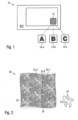
- FIG. 1 shows a schematic representation of a banknote 10 provided with a security element according to the invention in the form of an adhesively bonded transfer element 12.
- the transfer element 12 represents an alternating image that presents the viewer with different image information 14A, 14B, and 14C from three different viewing directions.
- the image information for illustration is formed by holographic letters "A”, “B”, and “C”, respectively.
- the viewer perceives the letter “A” when viewed diagonally from the left, the letter “B” when viewed vertically from above, and the letter “C” when viewed diagonally from the right.
- the appearance of the security element alternates between the three image information items 14A, 14B, and 14C.
- a changing image can also contain only two or more than three pieces of image information, or the security element can have a moving image, a pump image, a morphed image, or a stereo image instead of a changing image.
- the subject area typically consists of several groups of pixel elements, each of which generates the image information for one of the different viewing directions.
- the pixel elements are conventionally designed in the form of squares, circles, or parallel stripes, as explained in more detail above.
- the special feature of the present invention consists in a special design and arrangement of the pixel elements, the realization of which places the highest technological demands and therefore significantly increases the forgery security of the security element.
- Fig. 2 A schematic view of the motif area 20 of the security element 12.
- the motif area consists of three groups of congruent pixel elements 22-A, 22-B, and 22-C, which are indicated in the figure by different hatching.
- the pixel elements 22-A, 22-B, and 22-C form the tiles of a tiling and, despite their complex shape and congruence, cover the motif area 20 seamlessly and without overlap.
- the pixel elements all have the same shape, namely the shape of a lizard, which is shown as prototile 24 next to the section of the motif area 20.
- the tiles 22 of the tiling are all congruent with the prototile 24 and result from it by translation and rotation.
- the size of the tiles in the example is 100 ⁇ m (maximum dimension of the lizard shape, here from the left front to the right rear foot), but can generally range between 5 ⁇ m and 500 ⁇ m.
- the lizard shape of the tiles is not resolvable to the human eye without aids, while at the upper end of the range, it is visually perceptible as an irregular lizard shape.
- the pixel elements or tiles 22 are each covered with holographic structures, namely the pixel elements or tiles 22-A with first holographic structures (wide hatching), which, when illuminated vertically, reconstruct the letter "A" diagonally to the left in the first viewing direction, the pixel elements or tiles 22-B with second holographic structures (medium hatching), which, when illuminated vertically, reconstruct the letter "B" vertically upwards in the second viewing direction, and the pixel elements or tiles 22-C with third holographic structures (narrow hatching), which, when illuminated vertically, reconstruct the letter "C" diagonally to the right in the third viewing direction.
- the tiling shown is a periodic tiling, i.e. a tiling whose symmetry group contains two linearly independent displacements.
- the displacement vectors 26 of the two linearly independent displacements are in Fig. 2 for illustration purposes.
- the symmetry group of the tiling contains rotational symmetries of order 3, as can be seen particularly in the representation of the Fig. 3 which shows an arbitrarily selected tile 22-A and, in dashed lines, the adjacent tiles 22-B, 22-C.
- the edge points of tile 22-A represent the nodes 60, 62 of the tile outline
- the border areas 64 between the nodes 60, 62 represent the edges of the tile outline.
- Every second node 60 is the intersection point of the rotation axis of a rotational symmetry of order 3.
- the nodes 60, 62 of the lizard tiles lie on the vertices of a regular hexagon 66.
- the edges of the hexagon 66 were replaced by non-straight edges 64 composed of several straight segments.
- symmetry group of the tilings does not contain any mirror symmetry.
- the pixel elements can also be covered with other structures that generate image information, as described above.
- a group of pixel elements 32-A in a subject area 30 can also be unoccupied and generate no image information. While the pixel elements 32-B and 32-C each generate image information, for example, an alternating image, the unoccupied areas 32-A within the subject area 30 act like recesses with a complex outline shape.
- the shape of the tiles 22 can also accommodate a macroscopically existing outline of a view 44 of the motif area 42.
- the motif area 42 of a security element 40 can show a holographic view 44 of a lizard, which is designed, for example, as a three-dimensional true color hologram.
- the individual color pixels of the true color hologram are formed by the tiles 46-A, 46-B and 46-C of the tiling of the motif area.
- the tiling already described in Fig. 2 described tiling with three groups of pixel elements 46-A, 46-B, 46-C is used, all of which are formed in lizard shape congruent with the prototile 24 and the outline of the holographic view 44.
- the maximum dimension of the view 44 is, for example, 5 mm, while the corresponding maximum dimension of the tiles 46 is only 100 ⁇ m, so that the size ratio of the view 44 and the corresponding prototile 24 in the exemplary embodiment is 50.
- the correspondence of the microscopic information formed by the outline shape of the tiles 46 and the macroscopic information formed by the outline shape of the view 44 can be used as an additional authenticity feature.
- FIG. 6 An embodiment with two different prototiles 50-A, 50-B is described with reference to Fig. 6 illustrated.
- the Fig. 6(a) The prototile 50-A shown is a rhombus with interior angles of 72° and 108°, and the prototile 50-B is a rhombus with interior angles of 36° and 144°.
- These prototiles can be used to create a so-called Penrose tiling 54 of a motif area 52, which, as shown in Fig. 6(b) shown, consists of pixel elements or tiles 56-A and 56-B.
- the tiles 56-A are all congruent to the prototile 50-A, and the tiles 56-B are all congruent to the prototile 50-B.
- the special feature of these Penrose tilings is that they allow a gapless and overlap-free, yet aperiodic covering of the plane.
- the pixel elements or tiles 56-A, 56-B are each covered with holographic structures for different viewing directions, resulting in an overall tilted image with two views.
- Aperiodic tiling and Penrose tiling can also be formed from more than two prototiles, which can be used accordingly for alternating images with more than two views.
- the Penrose tiling implemented in a security element can be used as an additional authenticity mark.
- a uniquely defined Penrose tiling can be generated from the serial number of a banknote or security document and used to create the motif area of the associated security element.
- the serial number can be read, the corresponding Penrose tiling can be generated, and checked for congruence with the tiling implemented on the security element.
- the invention has been explained primarily with reference to interchangeable images, it is not in any way limited to interchangeable images or the aforementioned variants. Rather, the invention can be applied to all optically variable security elements in which a motif area displays different image information from different viewing directions.
- the invention is also not limited to the transfer elements used for illustration on banknotes; it can also be used, for example, with security threads, wide security strips, or cover foils arranged over a window area or a continuous opening in a document.
Landscapes
- Credit Cards Or The Like (AREA)
- Holo Graphy (AREA)
Description
Die Erfindung betrifft ein optisch variables Sicherheitselement zur Absicherung von Sicherheitspapieren, Wertdokumenten und anderen Datenträgern, mit einem Motivbereich, der aus unterschiedlichen Betrachtungsrichtungen unterschiedliche Bildinformationen zeigt.The invention relates to an optically variable security element for protecting security papers, value documents and other data carriers, with a motif area that shows different image information from different viewing directions.
Datenträger, wie Wert- oder Ausweisdokumente, aber auch andere Wertgegenstände, wie etwa Markenartikel, werden zur Absicherung oft mit Sicherheitselementen versehen, die eine Überprüfung der Echtheit des Datenträgers gestatten und die zugleich als Schutz vor unerlaubter Reproduktion dienen.Data storage media, such as valuables or identification documents, but also other valuable items, such as branded goods, are often provided with security elements for security purposes. These elements allow the authenticity of the data storage media to be verified and also serve as protection against unauthorized reproduction.
Bespiele von konventionellen Sicherheitselementen sind in
Eine besondere Rolle bei der Echtheitsabsicherung spielen Sicherheitselemente mit betrachtungswinkelabhängigen Effekten, da diese selbst mit modernsten Kopiergeräten nicht reproduziert werden können. Die Sicherheitselemente werden dabei mit optisch variablen Elementen ausgestattet, die dem Betrachter unter unterschiedlichen Betrachtungswinkeln einen unterschiedlichen Bildeindruck vermitteln und beispielsweise je nach Betrachtungswinkel einen anderen Farb- oder Helligkeitseindruck und/oder ein anderes graphisches Motiv zeigen.Security elements with viewing-angle-dependent effects play a special role in authenticity assurance, as these cannot be reproduced even with the most modern copying machines. These security elements are equipped with optically variable elements that convey a different image impression to the viewer at different viewing angles, for example, displaying a different color or brightness impression and/or a different graphic motif depending on the viewing angle.
Um zu erreichen, dass ein optisch variables Sicherheitselement aus unterschiedlichen Betrachtungsrichtungen unterschiedliche Bildinformationen zeigt, wird der Motivbereich des Sicherheitselements herkömmlich in der Regel in eine Vielzahl von quadratischen oder kreisförmigen Pixeln oder in eine Vielzahl rechteckiger Streifen zerlegt. Die Pixel bzw. Streifen sind in mehrere Gruppen unterteilt wobei jede Gruppe von Pixeln oder Streifen die Bildinformation für eine bestimmte Betrachtungsrichtung erzeugt. Ausgehend davon liegt der Erfindung die Aufgabe zugrunde, ein optisch variables Sicherheitselement der eingangs genannten Art mit besonders hoher Fälschungssicherheit anzugeben.To ensure that an optically variable security element displays different image information from different viewing directions, the motif area of the security element is usually divided into a plurality of square or circular pixels or a plurality of rectangular stripes. The pixels or stripes are divided into several groups, with each group of pixels or stripes generating the image information for a specific viewing direction. Based on this, the invention is based on the object of specifying an optically variable security element of the type mentioned above with particularly high levels of forgery protection.
Diese Aufgabe wird durch die Merkmale der unabhängigen Ansprüche gelöst. Weiterbildungen der Erfindung sind Gegenstand der Unteransprüche.This object is achieved by the features of the independent claims. Further developments of the invention are the subject of the subclaims.
Die Erfindung enthält vier Erfindungsaspekte, Anspruch 1 bis Anspruch 4. In allen vier Erfindungsaspekten ist bei einem gattungsgemäßen optisch variablen Sicherheitselement vorgesehen, dass
- der Motivbereich des Sicherheitselements aus zwei oder mehr Gruppen jeweils kongruenter Pixelelemente besteht, von denen zumindest zwei Gruppen eine Bildinformation in unterschiedlichen Betrachtungsrichtungen erzeugen,
- die Pixelelemente die Kacheln einer Parkettierung der Ebene bilden und den Motivbereich lückenlos und überlappungsfrei überdecken,
- die Pixelelemente eine komplexe Umrissform aufweisen, die weder dreieckig, quadratisch, hexagonal noch kreisförmig ist, und dass
- die Pixelelemente eine maximale Abmessung von 500 µm oder weniger aufweisen.
- the motif area of the security element consists of two or more groups of congruent pixel elements, of which at least two groups generate image information in different viewing directions,
- the pixel elements form the tiles of a tiling of the layer and cover the motif area without gaps and overlaps,
- the pixel elements have a complex outline shape that is neither triangular, square, hexagonal nor circular, and that
- the pixel elements have a maximum dimension of 500 µm or less.
Als Parkettierung wird dabei eine lückenlose und überlappungsfreie Überdeckung der Ebene durch gleichförmige Teilflächen (nachfolgend Kacheln genannt) verstanden. Während sich die eigentliche Parkettierung der Ebene als solche definitionsgemäß ins Unendliche erstreckt, ist für die Erfindung jeweils nur ein endlicher Teilbereich der Ebene, nämlich der durch den Motivbereich gebildete Teilbereich von Bedeutung. In diesem Teilbereich stimmen die Pixelelemente des Motivbereichs mit den Kacheln der Parkettierung überein. Ebenso wie die Kacheln die Ebene lückenlos und überlappungsfrei überdecken, überdecken daher auch die Pixelelemente den Motivbereich lückenlos und überlappungsfrei. Da die Pixelelemente innerhalb des Motivbereichs die Kacheln der Parkettierung darstellen, werden die Begriffe Pixelelement und Kachel im Rahmen dieser Beschreibung oft synonym gebraucht.Ticking is understood to mean a seamless and overlap-free covering of the plane by uniform partial areas (hereinafter referred to as tiles). While the actual ticking of the plane as such extends to infinity by definition, for the invention only a finite sub-area of the plane, namely the sub-area formed by the motif area, is of interest. In this sub-area, the pixel elements of the motif area correspond to the tiles of the ticking. Just as the tiles cover the plane seamlessly and without overlap, the pixel elements also cover the motif area seamlessly and without overlap. Since the pixel elements within the motif area represent the tiles of the ticking, the terms pixel element and tile are often used synonymously in this description.
Wie weiter unten genauer erläutert, können alle Kacheln der Parkettierung dieselbe Form aufweisen oder es gibt eine endliche Menge verschiedener Kachelvorlagen (nachfolgend Protokacheln genannt), die die Form der in der Parkettierung auftretenden Kacheln festlegt.As explained in more detail below, all tiles in the tiling can have the same shape, or there is a finite set of different tile templates (hereafter called prototiles) that determine the shape of the tiles appearing in the tiling.
Jedes Pixelelement (Kachel) weist eine maximale Abmessung auf, die unterhalb von 500 µm liegt und vorzugsweise zwischen 5 µm und 500 µm liegt.Each pixel element (tile) has a maximum dimension below 500 µm and preferably between 5 µm and 500 µm.
Mit Vorteil ist jede Kachel der Parkettierung kongruent zu einem Element einer Menge von unterschiedlichen Protokacheln, wobei die Mächtigkeit der Protokachelmenge mit Vorteil kleiner gleich 6 ist und insbesondere 1, 2, 3 oder 4 beträgt. In besonders vorteilhaften Gestaltungen ist die Mächtigkeit der Protokachelmenge gleich 1, so dass jede Kachel der Parkettierung kongruent zu genau einer Protokachel ist. Eine solche Parkettierung wird als monohedrale Parkettierung bezeichnet.Advantageously, each tile of the tiling is congruent to an element of a set of distinct prototiles, with the cardinality of the prototile set being advantageously less than or equal to 6 and, in particular, 1, 2, 3, or 4. In particularly advantageous designs, the cardinality of the prototile set is 1, so that each tile of the tiling is congruent to exactly one prototile. Such a tiling is called a monohedral tiling.
Außer im zweiten Erfindungsaspekt (Anspruch 2) ist in einer vorteilhaften Erfindungsvariante die Parkettierung periodisch, das heißt, die Symmetriegruppe der Parkettierung enthält zwei linear unabhängige Verschiebungen. Dabei wird, wie üblich, eine Abbildung, die die Parkettierung auf sich selbst abbildet, als Symmetrie der Parkettierung bezeichnet. Die Menge aller solcher Symmetrien bildet eine Gruppe, die als Symmetriegruppe der Parkettierung bezeichnet wird.Except for the second aspect of the invention (claim 2), in an advantageous variant of the invention, the tiling is periodic, i.e., the symmetry group of the tiling contains two linearly independent shifts. As is customary, a mapping that maps the tiling onto itself is referred to as the symmetry of the tiling. The set of all such symmetries forms a group, which is referred to as the symmetry group of the tiling.
In dem ersten Erfindungsaspekt (Anspruch 1) enthält die Symmetriegruppe der Parkettierung zumindest eine Drehsymmetrie der Ordnung 3 oder 6. In den anderen Erfindungsaspekten enthält in vorteilhaften Gestaltungen die Symmetriegruppe der Parkettierung zumindest eine Drehsymmetrie der Ordnung 2, 3, 4 oder 6.In the first aspect of the invention (claim 1), the symmetry group of the tiling contains at least one rotational symmetry of order 3 or 6. In the other aspects of the invention, in advantageous embodiments, the symmetry group of the tiling contains at least one rotational symmetry of order 2, 3, 4 or 6.
In dem zweiten Erfindungsaspekt (Anspruch 2) ist die Parkettierung aperiodisch und stellt insbesondere eine Penrose-Parkettierung dar. Aperiodische Parkettierungen können aus einer oder mehreren Protokacheln aufgebaut sein.In the second aspect of the invention (claim 2), the tiling is aperiodic and in particular represents a Penrose tiling. Aperiodic tilings can be constructed from one or more prototiles.
Diejenigen Randpunkte der Kacheln, an denen sich mindestens drei Kacheln berühren, werden wie in der Graphentheorie als Knoten bezeichnet, die Randbereiche zwischen den Knoten als Kanten. Mit Vorteil weisen die Kacheln der Parkettierung, insbesondere die Kacheln einer monohedralen Parkettierung keine geraden Kanten auf. Das bedeutet, dass keine der Kanten der einzigen Protokachel (monohedralen Parkettierung) oder aller Protokacheln gerade ist. Auf diese Weise lässt sich die vollständige Überdeckung der Ebene mit einer komplexen Umrissformen der einzelnen Kacheln und damit einer großen Gestaltungsfreiheit für den Designer verbinden. In dem dritten Erfindungsaspekt (Anspruch 3) sind die Kanten jeweils aus zwei oder mehr, jeweils einen Winkel bildenden Geradenstücken zusammengesetzt. In den anderen Erfindungsaspekten können die Kanten auch gekrümmt sein und beispielsweise durch Bezierkurven zweiten Grades, B-Splines oder NURBS (Non-Uniform Rational B-Splines) beschrieben werden.Those edge points of the tiles where at least three tiles touch are referred to as nodes, as in graph theory, and the edge areas between the nodes are referred to as edges. The tiles of the tiling, particularly the tiles of a monohedral tiling, advantageously have no straight edges. This means that none of the edges of the single prototile (monohedral tiling) or of all prototiles is straight. In this way, complete coverage of the plane can be combined with a complex outline shape of the individual tiles, thus providing the designer with considerable design freedom. In the third aspect of the invention (claim 3), the edges are each composed of two or more straight line segments, each forming an angle. In the other aspects of the invention, the edges can also be curved and described, for example, by second-degree Bezier curves, B-splines, or NURBS (Non-Uniform Rational B-splines).
In dem vierten Erfindungsaspekt (Anspruch 4) stellt der Rand zumindest einer Protokachel ein Naturmotiv, nämlich eine Pflanze, ein Tier, einen Menschen oder ein Fabelwesen dar. In den anderen Erfindungsaspekten stellt vorteilhaft der Rand zumindest einer Protokachel ein Naturmotiv, insbesondere eine Pflanze, ein Tier, einen Menschen oder ein Fabelwesen dar. Solche Gestaltungen haben den Vorteil, dass sie meist auf den ersten Blick erkannt und wiedererkannt werden können. Im Bereich der Kunst wurden solche Parkettierungen mit wiedererkennbaren Kachelmotiven insbesondere von dem niederländischen Künstler und Grafiker M.C. Escher in zahlreichen Arbeiten aufgegriffen.In the fourth aspect of the invention (claim 4), the edge of at least one prototile represents a natural motif, namely a plant, an animal, a human, or a mythical creature. In the other aspects of the invention, the edge of at least one prototile advantageously represents a natural motif, in particular a plant, an animal, a human, or a mythical creature. Such designs have the advantage that they can usually be recognized and identified at first glance. In the field of art, such tiling with recognizable tile motifs has been used in numerous works, particularly by the Dutch artist and graphic designer M.C. Escher.
In dem vierten Erfindungsaspekt (Anspruch 4) enthält der Motivbereich ein mit bloßem Auge sichtbares Bildmotiv, dessen Umrissform der Umrissform einer Protokachel entspricht. Das mit bloßem Auge sichtbare Bildmotiv weist dabei zweckmäßig eine Abmessung von mehr als 5 mm, insbesondere von mehr als 10 mm auf. Das Größenverhältnis von Bildmotiv und der entsprechenden Protokachel beträgt vorzugsweise 10 oder mehr, insbesondere 20 oder mehr oder sogar 50 oder mehr.In the fourth aspect of the invention (claim 4), the motif area contains a naked-eye image motif whose outline corresponds to the outline of a prototile. The naked-eye image motif expediently has dimensions of more than 5 mm, in particular more than 10 mm. The size ratio of the image motif to the corresponding prototile is preferably 10 or more, in particular 20 or more, or even 50 or more.
Die Pixelelemente der eine Bildinformation erzeugenden Gruppen sind zweckmäßig mit diffraktiven Strukturen, holographischen Strukturen, Subwellenlängengittern, gedruckten Strukturen, farbkippenden Dünnschichtelementen, farbgebenden Nanopartikeln, polarisierenden Elementen, refraktiven Strukturen wie Mikrospiegeln, Mikrolinsen oder Mikrofresnellinsen, oder anderen Funktionsschichten belegt.The pixel elements of the groups generating image information are suitably covered with diffractive structures, holographic structures, subwavelength gratings, printed structures, color-shifting thin-film elements, color-producing nanoparticles, polarizing elements, refractive structures such as micromirrors, microlenses or microfresnel lenses, or other functional layers.
Die Strukturen können beispielsweise gauß- oder sinusförmige Profilierungen aufweisen oder durch Rechteckgitter, Zapfen, Dreiecksgitter oder Subwellenlängengitter gebildet sein.The structures can, for example, have Gaussian or sinusoidal profiles or be formed by rectangular gratings, cones, triangular gratings or subwavelength gratings.
Zumindest ein Teil der Pixelelemente kann zusätzlich mit weiteren Funktionsschichten, insbesondere mit elektrischen oder magnetischen Funktionsschichten belegt sein, die eine zusätzliche, maschinell prüfbare Codierung in dem Sicherheitselement erzeugen können.At least some of the pixel elements can additionally be covered with further functional layers, in particular with electrical or magnetic functional layers, which can generate an additional, machine-verifiable coding in the security element.
Die Pixelelemente können auch gleichzeitig mit mehreren Strukturen, beispielsweise zur Erzeugung von Mischfarben belegt sein. Es ist auch nicht erforderlich, dass alle Pixelelemente mit gleichartigen Strukturen belegt sind. Beispielsweise kann eine erste Gruppe von Pixelelementen mit holographischen Strukturen belegt sein, während eine andere Gruppe mit Mikrospiegeln oder gedruckten Strukturen belegt ist.The pixel elements can also be covered with multiple structures simultaneously, for example, to create mixed colors. It is also not necessary for all pixel elements to be covered with the same type of structure. For example, a first group of pixel elements can be covered with holographic structures, while another group is covered with micromirrors or printed structures.
Es kann auch vorgesehen sein, dass eine Gruppe von Pixelelemente keine Bildinformation erzeugt, so dass diese Pixelelemente wie Aussparungen im Motivbereich wirken.It can also be provided that a group of pixel elements does not generate any image information, so that these pixel elements act like cutouts in the subject area.
Weitere Ausführungsbeispiele sowie Vorteile der Erfindung werden nachfolgend anhand der Figuren erläutert, bei deren Darstellung auf eine maßstabs- und proportionsgetreue Wiedergabe verzichtet wurde, um die Anschaulichkeit zu erhöhen.Further embodiments and advantages of the invention are explained below with reference to the figures, in which a true-to-scale and true-to-proportion reproduction has been omitted in order to increase clarity.
Es zeigen:
- Fig. 1
- eine schematische Darstellung einer Banknote mit einem erfindungsgemäßen Sicherheitselement,
- Fig. 2
- schematisch eine Aufsicht auf den Motivbereich des Sicherheitselements der
Fig. 1 , - Fig. 3
- zur Erläuterung der Kacheleigenschaften eine Kachel des Motivbereichs der
Fig. 2 und gestrichelt zusätzlich die angrenzenden Kacheln, - Fig. 4
- schematisch eine Aufsicht auf den Motivbereich eines Sicherheitselements nach einem anderen Ausführungsbeispiel der Erfindung,
- Fig. 5
- schematisch eine Aufsicht auf den Motivbereich eines Sicherheitselements nach einem weiteren Ausführungsbeispiel der Erfindung, und
- Fig. 6
- in (a) zwei Protokacheln einer Penrose-Parkettierung und in (b) schematisch eine Aufsicht auf den Motivbereich eines erfindungsgemäß Sicherheitselements mit einer Penrose-Parkettierung unter Verwendung der in Protokacheln von (a).
- Fig. 1
- a schematic representation of a banknote with a security element according to the invention,
- Fig. 2
- schematic view of the motif area of the security element of the
Fig. 1 , - Fig. 3
- To explain the tile properties, a tile of the motif area of the
Fig. 2 and dashed additionally the adjacent tiles, - Fig. 4
- schematically shows a plan view of the motif area of a security element according to another embodiment of the invention,
- Fig. 5
- schematically a plan view of the motif area of a security element according to a further embodiment the invention, and
- Fig. 6
- in (a) two prototiles of a Penrose tiling and in (b) schematically a plan view of the motif area of a security element according to the invention with a Penrose tiling using the prototiles of (a).
Die Erfindung wird nun am Beispiel von Sicherheitselementen für Banknoten und andere Wertdokumente erläutert.
Im gezeigten Ausführungsbeispiel sind die Bildinformationen zur Illustration durch holographische Buchstaben "A", "B", bzw. "C" gebildet, wobei der Betrachter bei Betrachtung schräg von links den Buchstaben "A", bei Betrachtung senkrecht von oben den Buchstaben "B" und bei Betrachtung schräg von rechts den Buchstaben "C" wahrnimmt. Durch Kippen der Banknote wechselt das Erscheinungsbild des Sicherheitselements zwischen den drei Bildinformationen 14A, 14B, 14C hin und her. Es versteht sich, dass in der Praxis anstelle der hier zur Illustration gezeigten Buchstaben in der Regel komplexere Motive, beispielsweise geometrische Muster, Portraits, architektonische, technische oder Naturmotive verwendet werden. Auch kann ein Wechselbild nur zwei oder mehr als drei Bildinformationen enthalten oder das Sicherheitselement kann anstelle eines Wechselbilds ein Bewegungsbild, ein Pumpbild, ein Morphbild oder ein Stereobild aufweisen.In the illustrated embodiment, the image information for illustration is formed by holographic letters "A", "B", and "C", respectively. The viewer perceives the letter "A" when viewed diagonally from the left, the letter "B" when viewed vertically from above, and the letter "C" when viewed diagonally from the right. By tilting the banknote, the appearance of the security element alternates between the three image information items 14A, 14B, and 14C. It is understood that in practice, more complex motifs, such as geometric patterns, portraits, architectural, technical, or natural motifs, are generally used instead of the letters shown here for illustration. A changing image can also contain only two or more than three pieces of image information, or the security element can have a moving image, a pump image, a morphed image, or a stereo image instead of a changing image.
Bei solchen Bildern mit unterschiedlichen Bildinformationen für unterschiedliche Betrachtungsrichtungen besteht der Motivbereich in der Regel aus mehreren Gruppen von Pixelelementen, die jeweils die Bildinformation für eine der unterschiedlichen Betrachtungsrichtungen erzeugen. Die Pixelelemente sind dabei herkömmlich in Form von Quadraten, Kreisen oder parallelen Streifen ausgeführt, wie oben genauer erläutert.In such images with different image information for different viewing directions, the subject area typically consists of several groups of pixel elements, each of which generates the image information for one of the different viewing directions. The pixel elements are conventionally designed in the form of squares, circles, or parallel stripes, as explained in more detail above.
Die Besonderheit der vorliegenden Erfindung besteht nun in einer besonderen Ausgestaltung und Anordnung der Pixelelemente, deren Realisierung höchste technologische Anforderungen stellt und daher die Fälschungssicherheit des Sicherheitselements deutlich erhöht.The special feature of the present invention consists in a special design and arrangement of the pixel elements, the realization of which places the highest technological demands and therefore significantly increases the forgery security of the security element.
Als Ausführungsbeispiel zeigt
Wie aus
Die Größe der Kacheln liegt im Ausführungsbeispiel bei 100 µm (maximale Abmessung der Eidechsenform, hier vom linken vorderen zum rechten hinteren Fuß), kann aber allgemein zwischen 5 µm und 500 µm liegen. Im unteren Teil des angegebenen Bereichs ist die Eidechsenform der Kacheln für das menschliche Auge ohne Hilfsmittel nicht auflösbar, während sie am oberen Bereichsende als unregelmäßige Echsenform visuell wahrnehmbar ist.The size of the tiles in the example is 100 µm (maximum dimension of the lizard shape, here from the left front to the right rear foot), but can generally range between 5 µm and 500 µm. In the lower part of the specified range, the lizard shape of the tiles is not resolvable to the human eye without aids, while at the upper end of the range, it is visually perceptible as an irregular lizard shape.
Die Pixelelemente bzw. Kacheln 22 sind im Ausführungsbeispiel jeweils mit holographischen Strukturen belegt, und zwar die Pixelelemente bzw. Kacheln 22-A mit ersten holographischen Strukturen (weite Schraffur), die bei senkrechter Beleuchtung den Buchstaben "A" in die erste Betrachtungsrichtung schräg nach links rekonstruieren, die Pixelelemente bzw. Kacheln 22-B mit zweiten holographischen Strukturen (mittelweite Schraffur), die bei senkrechter Beleuchtung den Buchstaben "B" in die zweite Betrachtungsrichtung senkrecht nach oben rekonstruieren, und die Pixelelemente bzw. Kacheln 22-C mit dritten holographischen Strukturen (enge Schraffur), die bei senkrechter Beleuchtung den Buchstaben "C" in die dritte Betrachtungsrichtung schräg nach rechts rekonstruieren.In the exemplary embodiment, the pixel elements or
Bei Betrachtung der Banknote 10 mit bloßem Auge ist die besondere Parkettierung des Motivbereichs 20 nicht erkennbar, vielmehr wirken die Elemente der Gruppe von Pixelelementen 22-A, 22-B und 22-C jeweils zusammen, um jeweils das holographische Bild der Buchstaben "A", "B" oder "C" in die jeweilige Betrachtungsrichtung zu rekonstruieren. Erst bei Betrachtung mit einer Lupe oder einem Mikroskop wird die Echsen-Parkettierung des Motivbereichs 20 sichtbar und dient so als nur mit Hilfsmitteln erkennbares Echtheitsmerkmal höherer Stufe.When viewing
Bei der in
Die Randpunkte der Kachel 22-A (und jeder anderen Kachel), an denen sich mindestens drei Kacheln berühren, stellen die Knoten 60, 62 des Kachelumrisses dar, die Randbereiche 64 zwischen den Knoten 60, 62 die Kanten des Kachelumrisses. Jeder zweite Knoten 60 (volle Punkte in
Charakteristisch für die erfindungsgemäßen Parkettierungen ist zudem, dass die Symmetriegruppe der Parkettierungen keine Spiegelsymmetrie enthält.Another characteristic of the tilings according to the invention is that the symmetry group of the tilings does not contain any mirror symmetry.
Anstelle von holographischen Strukturen können die Pixelelemente auch mit anderen, eine Bildinformation erzeugenden Strukturen belegt sein, wie oben bereits beschrieben. Wie in
Mit Bezug auf
Die maximale Abmessung der Ansicht 44 beträgt beispielsweise 5 mm, die entsprechende maximale Abmessung der Kacheln 46 dagegen nur 100 µm, so dass das Größenverhältnis der Ansicht 44 und der entsprechenden Protokachel 24 im Ausführungsbeispiel gleich 50 ist. Die Entsprechung der durch die Umrissform der Kacheln 46 gebildeten mikroskopischen Information und der durch die Umrissform der Ansicht 44 gebildeten makroskopischen Information kann als zusätzliches Echtheitsmerkmal verwendet werden.The maximum dimension of the
Während bei den bisher beschriebenen Ausführungsbeispielen jeweils genau eine Protokachel existiert, zu der jede Kachel der Parkettierung kongruent ist, kann es auch mehrere unterschiedliche Protokacheln geben. Ein Ausführungsbeispiel mit zwei unterschiedlichen Protokacheln 50-A, 50-B ist mit Bezug auf
Im Ausführungsbeispiel sind die Pixelelemente bzw. Kacheln 56-A, 56-B jeweils mit holographischen Strukturen für unterschiedliche Betrachtungsrichtungen belegt, so dass insgesamt ein Kippbild mit zwei Ansichten entsteht. Aperiodische Parkettierungen und Penrose-Parkettierungen könne auch aus mehr als zwei Protokacheln gebildet werden, die entsprechend für Wechselbilder mit mehr als zwei Ansichten eingesetzt werden können.In the exemplary embodiment, the pixel elements or tiles 56-A, 56-B are each covered with holographic structures for different viewing directions, resulting in an overall tilted image with two views. Aperiodic tiling and Penrose tiling can also be formed from more than two prototiles, which can be used accordingly for alternating images with more than two views.
Da die Protokacheln einer Penrose-Parkettierung, wie etwa die Protokacheln 50-A, 50-B die Erzeugung einer unendlichen Anzahl verschiedener Penrose-Parkettierungen erlauben, kann die in einem Sicherheitselement konkret verwirklichte Penrose-Parkettierung als zusätzliches Echtheitskennzeichen eingesetzt werden. Beispielsweise kann mit einem geeigneten Algorithmus aus einer Seriennummer einer Banknote oder eines Wertdokuments eine eindeutig bestimmte Penrose-Parkettierung generiert und zur Erzeugung des Motivbereichs des zugeordneten Sicherheitselements verwendet werden. Bei der Echtheitsprüfung kann die Seriennummer ausgelesen, die zugehörige Penrose-Parkettierung generiert, und auf Deckungsgleichheit mit der auf dem Sicherheitselement verwirklichten Parkettierung geprüft werden.Since the prototiles of a Penrose tiling, such as prototiles 50-A and 50-B, allow the generation of an infinite number of different Penrose tilings, the Penrose tiling implemented in a security element can be used as an additional authenticity mark. For example, using a suitable algorithm, a uniquely defined Penrose tiling can be generated from the serial number of a banknote or security document and used to create the motif area of the associated security element. During the authentication process, the serial number can be read, the corresponding Penrose tiling can be generated, and checked for congruence with the tiling implemented on the security element.
Obwohl die Erfindung vorwiegend mit Bezug auf Wechselbilder erläutert wurde, ist sie nicht in irgendeiner Weise auf Wechselbilder oder die genannten Varianten beschränkt. Vielmehr kann die Erfindung bei allen optisch variablen Sicherheitselementen Anwendung finden, bei denen ein Motivbereich aus unterschiedlichen Betrachtungsrichtungen unterschiedliche Bildinformationen zeigt. Die Erfindung ist auch nicht auf die zur Illustration verwendeten Transferelemente bei Banknoten beschränkt, sondern kann beispielsweise auch bei Sicherheitsfäden, breiten Sicherheitsstreifen, oder Abdeckfolien eingesetzt werden, die über einem Fensterbereich oder einer durchgehenden Öffnung eines Dokuments angeordnet sind.Although the invention has been explained primarily with reference to interchangeable images, it is not in any way limited to interchangeable images or the aforementioned variants. Rather, the invention can be applied to all optically variable security elements in which a motif area displays different image information from different viewing directions. The invention is also not limited to the transfer elements used for illustration on banknotes; it can also be used, for example, with security threads, wide security strips, or cover foils arranged over a window area or a continuous opening in a document.
- 1010
- BanknoteBanknote
- 1212
- TransferelementTransfer element
- 14-A, 14-B, 14-C14-A, 14-B, 14-C
- BildinformationenImage information
- 2020
- MotivbereichMotif area
- 22, 22-A, 22-B, 22-C22, 22-A, 22-B, 22-C
- Pixelelemente, KachelnPixel elements, tiles
- 2424
- ProtokachelProtocol tile
- 2626
- VerschiebungsvektorenDisplacement vectors
- 3030
- MotivbereichMotif area
- 32-A, 32-B, 32-C32-A, 32-B, 32-C
- Pixelelemente, KachelnPixel elements, tiles
- 4040
- SicherheitselementSecurity element
- 4242
- MotivbereichMotif area
- 4444
- holographische Ansicht einer Echseholographic view of a lizard
- 46, 46-A, 46-B, 46-C46, 46-A, 46-B, 46-C
- Pixelelemente, KachelnPixel elements, tiles
- 50-A, 50-B50-A, 50-B
- ProtokachelnPrototiles
- 5252
- MotivbereichMotif area
- 5454
- Penrose-ParkettierungPenrose tiling
- 56-A, 56-B56-A, 56-B
- Pixelelemente, KachelnPixel elements, tiles
- 60,6260.62
- Knotennode
- 6464
- KantenEdge
- 6666
- regelmäßiges Sechseckregular hexagon
Claims (10)
- An optically variable security element (12) for securing security papers, value documents and other data carriers, having a motif region (20) that, from different viewing directions, shows different pieces of image information (14-A, 14-B, 14-C):- the motif region (20) consisting of two or more groups of, in each case, congruent pixel elements (22-A, 22-B, 22-C), of which at least two groups (22-A, 22-B, 22-C) produce a piece of image information (14-A, 14-B, 14-C) in different viewing directions,- the pixel elements (22-A, 22-B, 22-C) forming the tiles of a tiling of the plane and covering the motif region (20) with no gaps or overlaps,- the pixel elements (22-A, 22-B, 22-C) comprising a complex contour shape that is neither triangular, quadratic, hexagonal nor circular,- the pixel elements (22-A, 22-B, 22-C) having a maximum dimension of 500 µm or less, and- the symmetry group of the tiling includes at least one rotational symmetry of the order 3 or 6.
- An optically variable security element (12) for securing security papers, value documents and other data carriers, having a motif region (20) that, from different viewing directions, shows different pieces of image information (14-A, 14-B, 14-C):- the motif region (20) consisting of two or more groups of, in each case, congruent pixel elements (22-A, 22-B, 22-C), of which at least two groups (22-A, 22-B, 22-C) produce a piece of image information (14-A, 14-B, 14-C) in different viewing directions,- the pixel elements (22-A, 22-B, 22-C) forming the tiles of a tiling of the plane and covering the motif region (20) with no gaps or overlaps,- the pixel elements (22-A, 22-B, 22-C) comprising a complex contour shape that is neither triangular, quadratic, hexagonal nor circular,- the pixel elements (22-A, 22-B, 22-C) having a maximum dimension of 500 µm or less, and- the tiling is aperiodic, especially constitutes a Penrose tiling.
- An optically variable security element (12) for securing security papers, value documents and other data carriers, having a motif region (20) that, from different viewing directions, shows different pieces of image information (14-A, 14-B, 14-C):- the motif region (20) consisting of two or more groups of, in each case, congruent pixel elements (22-A, 22-B, 22-C), of which at least two groups (22-A, 22-B, 22-C) produce a piece of image information (14-A, 14-B, 14-C) in different viewing directions,- the pixel elements (22-A, 22-B, 22-C) forming the tiles of a tiling of the plane and covering the motif region (20) with no gaps or overlaps,- the pixel elements (22-A, 22-B, 22-C) comprising a complex contour shape that is neither triangular, quadratic, hexagonal nor circular,- the pixel elements (22-A, 22-B, 22-C) having a maximum dimension of 500 µm or less, and- the tiles (22-A, 22-B, 22-C) of the tiling comprise no straight edges, but rather the edges are each composed of two or more straight-line pieces that each form an angle, wherein those boundary points of the tiles where at least three tiles touch are called nodes, and the boundary areas between the nodes are called edges.
- An optically variable security element (12) for securing security papers, value documents and other data carriers, having a motif region (20) that, from different viewing directions, shows different pieces of image information (14-A, 14-B, 14-C):- the motif region (20) consisting of two or more groups of, in each case, congruent pixel elements (22-A, 22-B, 22-C), of which at least two groups (22-A, 22-B, 22-C) produce a piece of image information (14-A, 14-B, 14-C) in different viewing directions,- the pixel elements (22-A, 22-B, 22-C) forming the tiles of a tiling of the plane and covering the motif region (20) with no gaps or overlaps,- the pixel elements (22-A, 22-B, 22-C) comprising a complex contour shape that is neither triangular, quadratic, hexagonal nor circular,- the pixel elements (22-A, 22-B, 22-C) having a maximum dimension of 500 µm or less,- each tile (56-A, 56-B) in the tiling is congruent to an element of a set of different prototiles (50-A, 50-B), and- the motif region (20) includes an image motif that is visible with the naked eye and whose contour shape corresponds to the contour shape of a prototile, the size ratio of the image motif and the corresponding prototile preferably being 10 or more, especially 20 or more or even 50 or more, and wherein the border of at least one prototile constitutes a natural motif, namely a plant, an animal, a person or a mythical creature.
- The security element according to at least one of claims 1, 3 or 4, characterized in that the tiling is periodic, such that the symmetry group of the tiling includes two linearly independent displacements.
- The security element according to at least one of claims 1, 3, 4 or 5, characterized in that the symmetry group of the tiling includes no mirror symmetry.
- The security element according to at least one of claims 1 to 3, 5 or 6, characterized in that the border of at least one prototile constitutes a natural motif, especially a plant, an animal, a person or a mythical creature.
- The security element according to at least one of claims 1 to 7, characterized in that the pixel elements (22-A, 22-B, 22-C) of the groups that produce a piece of image information are covered with diffractive patterns, holographic patterns, subwavelength gratings, refractive patterns such as mi-cromirrors, microlenses or micro-Fresnel lenses, printed patterns, color-shifting thin-film elements, chromophoric nanoparticles or polarizing elements.
- The security element according to at least one of claims 1 to 8, characterized in that a group of pixel elements produces no piece of image information.
- A data carrier having a security element according to at least one of claims 1 to 9.
Applications Claiming Priority (1)
| Application Number | Priority Date | Filing Date | Title |
|---|---|---|---|
| DE102014011296.9A DE102014011296A1 (en) | 2014-07-30 | 2014-07-30 | Optically variable security element |
Publications (3)
| Publication Number | Publication Date |
|---|---|
| EP2979893A1 EP2979893A1 (en) | 2016-02-03 |
| EP2979893B1 EP2979893B1 (en) | 2019-01-02 |
| EP2979893B2 true EP2979893B2 (en) | 2025-03-26 |
Family
ID=53672981
Family Applications (1)
| Application Number | Title | Priority Date | Filing Date |
|---|---|---|---|
| EP15002084.0A Active EP2979893B2 (en) | 2014-07-30 | 2015-07-14 | Optically variable security element |
Country Status (2)
| Country | Link |
|---|---|
| EP (1) | EP2979893B2 (en) |
| DE (1) | DE102014011296A1 (en) |
Families Citing this family (4)
| Publication number | Priority date | Publication date | Assignee | Title |
|---|---|---|---|---|
| WO2020078664A1 (en) * | 2018-09-24 | 2020-04-23 | Ovd Kinegram Ag | Optically variable element, security document, method for producing an optically variable element, method for producing a security document |
| US20220388326A1 (en) * | 2019-09-30 | 2022-12-08 | Zhongchao Special Security Technology Co., Ltd | Optical anti-counterfeiting element and anti-counterfeiting product |
| CN117324753B (en) * | 2023-10-18 | 2024-04-02 | 广东工业大学 | Processing method of laser-induced silver-doped graphene communication device and communication device |
| CN119993344B (en) * | 2025-01-20 | 2025-10-14 | 哈尔滨工业大学 | A design method for infrared characteristic simulation materials |
Family Cites Families (4)
| Publication number | Priority date | Publication date | Assignee | Title |
|---|---|---|---|---|
| US20050179955A1 (en) * | 2004-02-18 | 2005-08-18 | Shovgenyuk Mikhail V. | Graphic element for protecting banknotes, securities and documents and method for producing said graphic element |
| EP2730426B1 (en) * | 2004-10-15 | 2018-03-07 | YOSHIDA, Kenji | Printing unit |
| DE102006029850A1 (en) * | 2006-06-27 | 2008-01-03 | Giesecke & Devrient Gmbh | security element |
| KR20150093779A (en) * | 2012-12-07 | 2015-08-18 | 시크파 홀딩 에스에이 | Non-periodic tiling document security element |
-
2014
- 2014-07-30 DE DE102014011296.9A patent/DE102014011296A1/en not_active Withdrawn
-
2015
- 2015-07-14 EP EP15002084.0A patent/EP2979893B2/en active Active
Also Published As
| Publication number | Publication date |
|---|---|
| EP2979893B1 (en) | 2019-01-02 |
| EP2979893A1 (en) | 2016-02-03 |
| DE102014011296A1 (en) | 2016-02-04 |
Similar Documents
| Publication | Publication Date | Title |
|---|---|---|
| DE102004016596B4 (en) | Security element in the form of a multilayer film body and method for producing a security element | |
| EP2040934B2 (en) | Security element | |
| EP1562758B2 (en) | Optically variable element and the use thereof | |
| EP3980274B1 (en) | Method for producing an optically variable security element | |
| EP2385902B1 (en) | Security element and security paper | |
| EP2727742B1 (en) | Security element with lenticular image | |
| WO2015078572A1 (en) | Security element comprising magnetically alignable magnetic pigments and a second motif, and method for producing same | |
| DE202015009515U1 (en) | Optically variable security element | |
| DE102010050031A1 (en) | Security element and method for producing a security element | |
| WO2003095657A2 (en) | Optically variable element | |
| EP2979893B2 (en) | Optically variable security element | |
| EP2760677A1 (en) | Security element having an optically variable structure of micromirrors | |
| DE102018005697A1 (en) | Security element with lenticular image | |
| EP2782765B1 (en) | Security device | |
| EP3793841B1 (en) | Optically variable security element having reflective area | |
| EP2886363B1 (en) | Security element for security documents | |
| EP3498488B1 (en) | Manufacturing method of a security element with an optical variable structure | |
| EP3648983B1 (en) | Optically variable security arrangement | |
| EP3615349B1 (en) | Method for producing a security element | |
| EP4379434B1 (en) | Grid structure image for representing a multi-colour diffraction image | |
| DE102018004088A1 (en) | Security element with micro-reflectors | |
| EP4013624B1 (en) | Optically variable security element | |
| DE102017006507A1 (en) | structural element | |
| AT526897A2 (en) | Micro-optical device for producing a magnified image | |
| EP3332278B1 (en) | Security element |
Legal Events
| Date | Code | Title | Description |
|---|---|---|---|
| PUAI | Public reference made under article 153(3) epc to a published international application that has entered the european phase |
Free format text: ORIGINAL CODE: 0009012 |
|
| AK | Designated contracting states |
Kind code of ref document: A1 Designated state(s): AL AT BE BG CH CY CZ DE DK EE ES FI FR GB GR HR HU IE IS IT LI LT LU LV MC MK MT NL NO PL PT RO RS SE SI SK SM TR |
|
| AX | Request for extension of the european patent |
Extension state: BA ME |
|
| 17P | Request for examination filed |
Effective date: 20160803 |
|
| RBV | Designated contracting states (corrected) |
Designated state(s): AL AT BE BG CH CY CZ DE DK EE ES FI FR GB GR HR HU IE IS IT LI LT LU LV MC MK MT NL NO PL PT RO RS SE SI SK SM TR |
|
| RAP1 | Party data changed (applicant data changed or rights of an application transferred) |
Owner name: GIESECKE+DEVRIENT CURRENCY TECHNOLOGY GMBH |
|
| GRAP | Despatch of communication of intention to grant a patent |
Free format text: ORIGINAL CODE: EPIDOSNIGR1 |
|
| STAA | Information on the status of an ep patent application or granted ep patent |
Free format text: STATUS: GRANT OF PATENT IS INTENDED |
|
| INTG | Intention to grant announced |
Effective date: 20180615 |
|
| GRAJ | Information related to disapproval of communication of intention to grant by the applicant or resumption of examination proceedings by the epo deleted |
Free format text: ORIGINAL CODE: EPIDOSDIGR1 |
|
| STAA | Information on the status of an ep patent application or granted ep patent |
Free format text: STATUS: REQUEST FOR EXAMINATION WAS MADE |
|
| INTC | Intention to grant announced (deleted) | ||
| GRAR | Information related to intention to grant a patent recorded |
Free format text: ORIGINAL CODE: EPIDOSNIGR71 |
|
| GRAS | Grant fee paid |
Free format text: ORIGINAL CODE: EPIDOSNIGR3 |
|
| STAA | Information on the status of an ep patent application or granted ep patent |
Free format text: STATUS: GRANT OF PATENT IS INTENDED |
|
| GRAA | (expected) grant |
Free format text: ORIGINAL CODE: 0009210 |
|
| STAA | Information on the status of an ep patent application or granted ep patent |
Free format text: STATUS: THE PATENT HAS BEEN GRANTED |
|
| INTG | Intention to grant announced |
Effective date: 20181121 |
|
| AK | Designated contracting states |
Kind code of ref document: B1 Designated state(s): AL AT BE BG CH CY CZ DE DK EE ES FI FR GB GR HR HU IE IS IT LI LT LU LV MC MK MT NL NO PL PT RO RS SE SI SK SM TR |
|
| REG | Reference to a national code |
Ref country code: GB Ref legal event code: FG4D Free format text: NOT ENGLISH |
|
| REG | Reference to a national code |
Ref country code: CH Ref legal event code: EP Ref country code: AT Ref legal event code: REF Ref document number: 1083871 Country of ref document: AT Kind code of ref document: T Effective date: 20190115 |
|
| REG | Reference to a national code |
Ref country code: DE Ref legal event code: R096 Ref document number: 502015007483 Country of ref document: DE |
|
| REG | Reference to a national code |
Ref country code: IE Ref legal event code: FG4D Free format text: LANGUAGE OF EP DOCUMENT: GERMAN |
|
| REG | Reference to a national code |
Ref country code: CH Ref legal event code: NV Representative=s name: RENTSCH PARTNER AG, CH |
|
| REG | Reference to a national code |
Ref country code: NL Ref legal event code: MP Effective date: 20190102 |
|
| REG | Reference to a national code |
Ref country code: LT Ref legal event code: MG4D |
|
| PG25 | Lapsed in a contracting state [announced via postgrant information from national office to epo] |
Ref country code: NL Free format text: LAPSE BECAUSE OF FAILURE TO SUBMIT A TRANSLATION OF THE DESCRIPTION OR TO PAY THE FEE WITHIN THE PRESCRIBED TIME-LIMIT Effective date: 20190102 |
|
| PG25 | Lapsed in a contracting state [announced via postgrant information from national office to epo] |
Ref country code: PL Free format text: LAPSE BECAUSE OF FAILURE TO SUBMIT A TRANSLATION OF THE DESCRIPTION OR TO PAY THE FEE WITHIN THE PRESCRIBED TIME-LIMIT Effective date: 20190102 Ref country code: LT Free format text: LAPSE BECAUSE OF FAILURE TO SUBMIT A TRANSLATION OF THE DESCRIPTION OR TO PAY THE FEE WITHIN THE PRESCRIBED TIME-LIMIT Effective date: 20190102 Ref country code: ES Free format text: LAPSE BECAUSE OF FAILURE TO SUBMIT A TRANSLATION OF THE DESCRIPTION OR TO PAY THE FEE WITHIN THE PRESCRIBED TIME-LIMIT Effective date: 20190102 Ref country code: FI Free format text: LAPSE BECAUSE OF FAILURE TO SUBMIT A TRANSLATION OF THE DESCRIPTION OR TO PAY THE FEE WITHIN THE PRESCRIBED TIME-LIMIT Effective date: 20190102 Ref country code: SE Free format text: LAPSE BECAUSE OF FAILURE TO SUBMIT A TRANSLATION OF THE DESCRIPTION OR TO PAY THE FEE WITHIN THE PRESCRIBED TIME-LIMIT Effective date: 20190102 Ref country code: PT Free format text: LAPSE BECAUSE OF FAILURE TO SUBMIT A TRANSLATION OF THE DESCRIPTION OR TO PAY THE FEE WITHIN THE PRESCRIBED TIME-LIMIT Effective date: 20190502 Ref country code: NO Free format text: LAPSE BECAUSE OF FAILURE TO SUBMIT A TRANSLATION OF THE DESCRIPTION OR TO PAY THE FEE WITHIN THE PRESCRIBED TIME-LIMIT Effective date: 20190402 |
|
| PG25 | Lapsed in a contracting state [announced via postgrant information from national office to epo] |
Ref country code: LV Free format text: LAPSE BECAUSE OF FAILURE TO SUBMIT A TRANSLATION OF THE DESCRIPTION OR TO PAY THE FEE WITHIN THE PRESCRIBED TIME-LIMIT Effective date: 20190102 Ref country code: IS Free format text: LAPSE BECAUSE OF FAILURE TO SUBMIT A TRANSLATION OF THE DESCRIPTION OR TO PAY THE FEE WITHIN THE PRESCRIBED TIME-LIMIT Effective date: 20190502 Ref country code: GR Free format text: LAPSE BECAUSE OF FAILURE TO SUBMIT A TRANSLATION OF THE DESCRIPTION OR TO PAY THE FEE WITHIN THE PRESCRIBED TIME-LIMIT Effective date: 20190403 Ref country code: HR Free format text: LAPSE BECAUSE OF FAILURE TO SUBMIT A TRANSLATION OF THE DESCRIPTION OR TO PAY THE FEE WITHIN THE PRESCRIBED TIME-LIMIT Effective date: 20190102 Ref country code: RS Free format text: LAPSE BECAUSE OF FAILURE TO SUBMIT A TRANSLATION OF THE DESCRIPTION OR TO PAY THE FEE WITHIN THE PRESCRIBED TIME-LIMIT Effective date: 20190102 Ref country code: BG Free format text: LAPSE BECAUSE OF FAILURE TO SUBMIT A TRANSLATION OF THE DESCRIPTION OR TO PAY THE FEE WITHIN THE PRESCRIBED TIME-LIMIT Effective date: 20190402 |
|
| REG | Reference to a national code |
Ref country code: DE Ref legal event code: R026 Ref document number: 502015007483 Country of ref document: DE |
|
| PLBI | Opposition filed |
Free format text: ORIGINAL CODE: 0009260 |
|
| PLAX | Notice of opposition and request to file observation + time limit sent |
Free format text: ORIGINAL CODE: EPIDOSNOBS2 |
|
| PG25 | Lapsed in a contracting state [announced via postgrant information from national office to epo] |
Ref country code: AL Free format text: LAPSE BECAUSE OF FAILURE TO SUBMIT A TRANSLATION OF THE DESCRIPTION OR TO PAY THE FEE WITHIN THE PRESCRIBED TIME-LIMIT Effective date: 20190102 Ref country code: CZ Free format text: LAPSE BECAUSE OF FAILURE TO SUBMIT A TRANSLATION OF THE DESCRIPTION OR TO PAY THE FEE WITHIN THE PRESCRIBED TIME-LIMIT Effective date: 20190102 Ref country code: RO Free format text: LAPSE BECAUSE OF FAILURE TO SUBMIT A TRANSLATION OF THE DESCRIPTION OR TO PAY THE FEE WITHIN THE PRESCRIBED TIME-LIMIT Effective date: 20190102 Ref country code: SK Free format text: LAPSE BECAUSE OF FAILURE TO SUBMIT A TRANSLATION OF THE DESCRIPTION OR TO PAY THE FEE WITHIN THE PRESCRIBED TIME-LIMIT Effective date: 20190102 Ref country code: EE Free format text: LAPSE BECAUSE OF FAILURE TO SUBMIT A TRANSLATION OF THE DESCRIPTION OR TO PAY THE FEE WITHIN THE PRESCRIBED TIME-LIMIT Effective date: 20190102 Ref country code: DK Free format text: LAPSE BECAUSE OF FAILURE TO SUBMIT A TRANSLATION OF THE DESCRIPTION OR TO PAY THE FEE WITHIN THE PRESCRIBED TIME-LIMIT Effective date: 20190102 |
|
| 26 | Opposition filed |
Opponent name: LEONHARD KURZ STIFTUNG & CO. KG Effective date: 20191002 |
|
| PG25 | Lapsed in a contracting state [announced via postgrant information from national office to epo] |
Ref country code: SM Free format text: LAPSE BECAUSE OF FAILURE TO SUBMIT A TRANSLATION OF THE DESCRIPTION OR TO PAY THE FEE WITHIN THE PRESCRIBED TIME-LIMIT Effective date: 20190102 |
|
| PLBB | Reply of patent proprietor to notice(s) of opposition received |
Free format text: ORIGINAL CODE: EPIDOSNOBS3 |
|
| PG25 | Lapsed in a contracting state [announced via postgrant information from national office to epo] |
Ref country code: MC Free format text: LAPSE BECAUSE OF FAILURE TO SUBMIT A TRANSLATION OF THE DESCRIPTION OR TO PAY THE FEE WITHIN THE PRESCRIBED TIME-LIMIT Effective date: 20190102 Ref country code: SI Free format text: LAPSE BECAUSE OF FAILURE TO SUBMIT A TRANSLATION OF THE DESCRIPTION OR TO PAY THE FEE WITHIN THE PRESCRIBED TIME-LIMIT Effective date: 20190102 |
|
| PG25 | Lapsed in a contracting state [announced via postgrant information from national office to epo] |
Ref country code: TR Free format text: LAPSE BECAUSE OF FAILURE TO SUBMIT A TRANSLATION OF THE DESCRIPTION OR TO PAY THE FEE WITHIN THE PRESCRIBED TIME-LIMIT Effective date: 20190102 |
|
| REG | Reference to a national code |
Ref country code: BE Ref legal event code: MM Effective date: 20190731 |
|
| PG25 | Lapsed in a contracting state [announced via postgrant information from national office to epo] |
Ref country code: BE Free format text: LAPSE BECAUSE OF NON-PAYMENT OF DUE FEES Effective date: 20190731 Ref country code: LU Free format text: LAPSE BECAUSE OF NON-PAYMENT OF DUE FEES Effective date: 20190714 |
|
| PG25 | Lapsed in a contracting state [announced via postgrant information from national office to epo] |
Ref country code: IE Free format text: LAPSE BECAUSE OF NON-PAYMENT OF DUE FEES Effective date: 20190714 |
|
| PG25 | Lapsed in a contracting state [announced via postgrant information from national office to epo] |
Ref country code: CY Free format text: LAPSE BECAUSE OF FAILURE TO SUBMIT A TRANSLATION OF THE DESCRIPTION OR TO PAY THE FEE WITHIN THE PRESCRIBED TIME-LIMIT Effective date: 20190102 |
|
| PG25 | Lapsed in a contracting state [announced via postgrant information from national office to epo] |
Ref country code: HU Free format text: LAPSE BECAUSE OF FAILURE TO SUBMIT A TRANSLATION OF THE DESCRIPTION OR TO PAY THE FEE WITHIN THE PRESCRIBED TIME-LIMIT; INVALID AB INITIO Effective date: 20150714 Ref country code: MT Free format text: LAPSE BECAUSE OF FAILURE TO SUBMIT A TRANSLATION OF THE DESCRIPTION OR TO PAY THE FEE WITHIN THE PRESCRIBED TIME-LIMIT Effective date: 20190102 |
|
| APBM | Appeal reference recorded |
Free format text: ORIGINAL CODE: EPIDOSNREFNO |
|
| APBP | Date of receipt of notice of appeal recorded |
Free format text: ORIGINAL CODE: EPIDOSNNOA2O |
|
| APAH | Appeal reference modified |
Free format text: ORIGINAL CODE: EPIDOSCREFNO |
|
| APBQ | Date of receipt of statement of grounds of appeal recorded |
Free format text: ORIGINAL CODE: EPIDOSNNOA3O |
|
| PG25 | Lapsed in a contracting state [announced via postgrant information from national office to epo] |
Ref country code: MK Free format text: LAPSE BECAUSE OF FAILURE TO SUBMIT A TRANSLATION OF THE DESCRIPTION OR TO PAY THE FEE WITHIN THE PRESCRIBED TIME-LIMIT Effective date: 20190102 |
|
| RAP4 | Party data changed (patent owner data changed or rights of a patent transferred) |
Owner name: GIESECKE+DEVRIENT CURRENCY TECHNOLOGY GMBH |
|
| P01 | Opt-out of the competence of the unified patent court (upc) registered |
Effective date: 20230520 |
|
| APBU | Appeal procedure closed |
Free format text: ORIGINAL CODE: EPIDOSNNOA9O |
|
| REG | Reference to a national code |
Ref country code: CH Ref legal event code: PK Free format text: TITEL |
|
| PUAH | Patent maintained in amended form |
Free format text: ORIGINAL CODE: 0009272 |
|
| STAA | Information on the status of an ep patent application or granted ep patent |
Free format text: STATUS: PATENT MAINTAINED AS AMENDED |
|
| 27A | Patent maintained in amended form |
Effective date: 20250326 |
|
| AK | Designated contracting states |
Kind code of ref document: B2 Designated state(s): AL AT BE BG CH CY CZ DE DK EE ES FI FR GB GR HR HU IE IS IT LI LT LU LV MC MK MT NL NO PL PT RO RS SE SI SK SM TR |
|
| REG | Reference to a national code |
Ref country code: DE Ref legal event code: R102 Ref document number: 502015007483 Country of ref document: DE |
|
| PGFP | Annual fee paid to national office [announced via postgrant information from national office to epo] |
Ref country code: DE Payment date: 20250722 Year of fee payment: 11 |
|
| PGFP | Annual fee paid to national office [announced via postgrant information from national office to epo] |
Ref country code: IT Payment date: 20250731 Year of fee payment: 11 |
|
| PGFP | Annual fee paid to national office [announced via postgrant information from national office to epo] |
Ref country code: GB Payment date: 20250724 Year of fee payment: 11 |
|
| PGFP | Annual fee paid to national office [announced via postgrant information from national office to epo] |
Ref country code: FR Payment date: 20250723 Year of fee payment: 11 Ref country code: AT Payment date: 20250721 Year of fee payment: 11 |
|
| PGFP | Annual fee paid to national office [announced via postgrant information from national office to epo] |
Ref country code: CH Payment date: 20250801 Year of fee payment: 11 |