EP2975019A1 - Ruthenium-katalysierte hydroaminomethylierung - Google Patents
Ruthenium-katalysierte hydroaminomethylierung Download PDFInfo
- Publication number
- EP2975019A1 EP2975019A1 EP15174717.7A EP15174717A EP2975019A1 EP 2975019 A1 EP2975019 A1 EP 2975019A1 EP 15174717 A EP15174717 A EP 15174717A EP 2975019 A1 EP2975019 A1 EP 2975019A1
- Authority
- EP
- European Patent Office
- Prior art keywords
- alkyl
- aryl
- cycloalkyl
- heterocycloalkyl
- heteroaryl
- Prior art date
- Legal status (The legal status is an assumption and is not a legal conclusion. Google has not performed a legal analysis and makes no representation as to the accuracy of the status listed.)
- Withdrawn
Links
- 238000005930 hydroaminomethylation reaction Methods 0.000 title claims abstract description 19
- 229910052707 ruthenium Inorganic materials 0.000 title claims description 14
- KJTLSVCANCCWHF-UHFFFAOYSA-N Ruthenium Chemical compound [Ru] KJTLSVCANCCWHF-UHFFFAOYSA-N 0.000 title claims description 13
- QGZKDVFQNNGYKY-UHFFFAOYSA-N Ammonia Chemical compound N QGZKDVFQNNGYKY-UHFFFAOYSA-N 0.000 claims abstract description 112
- 229910021529 ammonia Inorganic materials 0.000 claims abstract description 47
- 238000000034 method Methods 0.000 claims abstract description 46
- 239000003446 ligand Substances 0.000 claims abstract description 41
- 150000001875 compounds Chemical class 0.000 claims abstract description 22
- OAICVXFJPJFONN-UHFFFAOYSA-N Phosphorus Chemical compound [P] OAICVXFJPJFONN-UHFFFAOYSA-N 0.000 claims abstract description 12
- 229910052698 phosphorus Inorganic materials 0.000 claims abstract description 10
- 239000011574 phosphorus Substances 0.000 claims abstract description 10
- 239000012327 Ruthenium complex Substances 0.000 claims abstract description 8
- 230000003197 catalytic effect Effects 0.000 claims abstract description 5
- 125000000217 alkyl group Chemical group 0.000 claims description 32
- 125000001072 heteroaryl group Chemical group 0.000 claims description 26
- 238000006243 chemical reaction Methods 0.000 claims description 24
- 239000011541 reaction mixture Substances 0.000 claims description 24
- 239000002904 solvent Substances 0.000 claims description 20
- 125000003118 aryl group Chemical group 0.000 claims description 19
- 125000000753 cycloalkyl group Chemical group 0.000 claims description 19
- 150000001336 alkenes Chemical class 0.000 claims description 17
- 125000004404 heteroalkyl group Chemical group 0.000 claims description 17
- 125000000592 heterocycloalkyl group Chemical group 0.000 claims description 17
- -1 iso propylphosphino Chemical group 0.000 claims description 17
- 150000001412 amines Chemical class 0.000 claims description 15
- 125000004400 (C1-C12) alkyl group Chemical group 0.000 claims description 14
- 125000006652 (C3-C12) cycloalkyl group Chemical group 0.000 claims description 14
- 125000006707 (C3-C12) heterocycloalkyl group Chemical group 0.000 claims description 14
- 239000000203 mixture Substances 0.000 claims description 14
- 239000003054 catalyst Substances 0.000 claims description 12
- FPTMGYQPQDMGER-UHFFFAOYSA-N dicyclohexyl-[1-(2-methoxyphenyl)imidazol-2-yl]phosphane Chemical compound COC1=CC=CC=C1N1C(P(C2CCCCC2)C2CCCCC2)=NC=C1 FPTMGYQPQDMGER-UHFFFAOYSA-N 0.000 claims description 12
- 239000001257 hydrogen Substances 0.000 claims description 10
- 229910052739 hydrogen Inorganic materials 0.000 claims description 10
- 125000001997 phenyl group Chemical group [H]C1=C([H])C([H])=C(*)C([H])=C1[H] 0.000 claims description 10
- CEPOTFSAVUWFIP-UHFFFAOYSA-N dicyclohexyl-(1-methylbenzimidazol-2-yl)phosphane Chemical compound N=1C2=CC=CC=C2N(C)C=1P(C1CCCCC1)C1CCCCC1 CEPOTFSAVUWFIP-UHFFFAOYSA-N 0.000 claims description 9
- JUZAKZRALSJLOV-UHFFFAOYSA-N dicyclohexyl-[1-(2-methoxyphenyl)pyrrol-2-yl]phosphane Chemical compound COC1=CC=CC=C1N1C(P(C2CCCCC2)C2CCCCC2)=CC=C1 JUZAKZRALSJLOV-UHFFFAOYSA-N 0.000 claims description 9
- DISKSPSHGAEIIX-UHFFFAOYSA-N [1-(2-methoxyphenyl)imidazol-2-yl]-diphenylphosphane Chemical compound COC1=CC=CC=C1N1C(P(C=2C=CC=CC=2)C=2C=CC=CC=2)=NC=C1 DISKSPSHGAEIIX-UHFFFAOYSA-N 0.000 claims description 7
- XIRBBICJTSTQEI-UHFFFAOYSA-N dicyclohexyl-(1-methylimidazol-2-yl)phosphane Chemical compound CN1C=CN=C1P(C1CCCCC1)C1CCCCC1 XIRBBICJTSTQEI-UHFFFAOYSA-N 0.000 claims description 7
- OWEOFTUQYBTDCT-UHFFFAOYSA-N dicyclohexyl-(1-phenylimidazol-2-yl)phosphane Chemical compound C1CCCCC1P(C=1N(C=CN=1)C=1C=CC=CC=1)C1CCCCC1 OWEOFTUQYBTDCT-UHFFFAOYSA-N 0.000 claims description 7
- RVFZOTGUPNHVRA-UHFFFAOYSA-N dicyclohexyl-(1-phenylpyrrol-2-yl)phosphane Chemical compound C1CCCCC1P(C=1N(C=CC=1)C=1C=CC=CC=1)C1CCCCC1 RVFZOTGUPNHVRA-UHFFFAOYSA-N 0.000 claims description 7
- ZRVANNJGPCSNAH-UHFFFAOYSA-N dicyclohexyl-[1-(2,4,6-trimethylphenyl)imidazol-2-yl]phosphane Chemical compound CC1=CC(C)=CC(C)=C1N1C(P(C2CCCCC2)C2CCCCC2)=NC=C1 ZRVANNJGPCSNAH-UHFFFAOYSA-N 0.000 claims description 7
- 125000001449 isopropyl group Chemical group [H]C([H])([H])C([H])(*)C([H])([H])[H] 0.000 claims description 7
- 125000000113 cyclohexyl group Chemical group [H]C1([H])C([H])([H])C([H])([H])C([H])(*)C([H])([H])C1([H])[H] 0.000 claims description 6
- 150000001298 alcohols Chemical class 0.000 claims description 4
- 150000001299 aldehydes Chemical class 0.000 claims description 4
- 150000002148 esters Chemical class 0.000 claims description 4
- 238000011065 in-situ storage Methods 0.000 claims description 4
- 150000001408 amides Chemical class 0.000 claims description 3
- 150000002170 ethers Chemical class 0.000 claims description 3
- 150000004820 halides Chemical class 0.000 claims description 3
- 150000001735 carboxylic acids Chemical class 0.000 claims description 2
- 150000001925 cycloalkenes Chemical class 0.000 claims description 2
- 150000002118 epoxides Chemical class 0.000 claims description 2
- 150000002576 ketones Chemical class 0.000 claims description 2
- 150000004291 polyenes Chemical class 0.000 claims description 2
- 239000002243 precursor Substances 0.000 claims description 2
- 150000003839 salts Chemical class 0.000 claims description 2
- 150000003673 urethanes Chemical class 0.000 claims description 2
- 125000004435 hydrogen atom Chemical class [H]* 0.000 claims 2
- 125000002887 hydroxy group Chemical group [H]O* 0.000 claims 2
- VMDTXBZDEOAFQF-UHFFFAOYSA-N formaldehyde;ruthenium Chemical class [Ru].O=C VMDTXBZDEOAFQF-UHFFFAOYSA-N 0.000 claims 1
- YXFVVABEGXRONW-UHFFFAOYSA-N Toluene Chemical compound CC1=CC=CC=C1 YXFVVABEGXRONW-UHFFFAOYSA-N 0.000 description 59
- OKKJLVBELUTLKV-UHFFFAOYSA-N Methanol Chemical compound OC OKKJLVBELUTLKV-UHFFFAOYSA-N 0.000 description 54
- WYURNTSHIVDZCO-UHFFFAOYSA-N Tetrahydrofuran Chemical compound C1CCOC1 WYURNTSHIVDZCO-UHFFFAOYSA-N 0.000 description 34
- 239000007789 gas Substances 0.000 description 27
- KWKAKUADMBZCLK-UHFFFAOYSA-N 1-octene Chemical compound CCCCCCC=C KWKAKUADMBZCLK-UHFFFAOYSA-N 0.000 description 24
- 230000015572 biosynthetic process Effects 0.000 description 18
- 238000003786 synthesis reaction Methods 0.000 description 17
- YLQBMQCUIZJEEH-UHFFFAOYSA-N tetrahydrofuran Natural products C=1C=COC=1 YLQBMQCUIZJEEH-UHFFFAOYSA-N 0.000 description 17
- TVMXDCGIABBOFY-UHFFFAOYSA-N n-Octanol Natural products CCCCCCCC TVMXDCGIABBOFY-UHFFFAOYSA-N 0.000 description 14
- LFQSCWFLJHTTHZ-UHFFFAOYSA-N Ethanol Chemical compound CCO LFQSCWFLJHTTHZ-UHFFFAOYSA-N 0.000 description 13
- 150000003141 primary amines Chemical class 0.000 description 13
- 150000003512 tertiary amines Chemical class 0.000 description 13
- WEVYAHXRMPXWCK-UHFFFAOYSA-N Acetonitrile Chemical compound CC#N WEVYAHXRMPXWCK-UHFFFAOYSA-N 0.000 description 12
- 150000003335 secondary amines Chemical class 0.000 description 12
- 238000004817 gas chromatography Methods 0.000 description 10
- VHUUQVKOLVNVRT-UHFFFAOYSA-N Ammonium hydroxide Chemical compound [NH4+].[OH-] VHUUQVKOLVNVRT-UHFFFAOYSA-N 0.000 description 9
- UFHFLCQGNIYNRP-UHFFFAOYSA-N Hydrogen Chemical compound [H][H] UFHFLCQGNIYNRP-UHFFFAOYSA-N 0.000 description 8
- 239000000047 product Substances 0.000 description 7
- NHTMVDHEPJAVLT-UHFFFAOYSA-N Isooctane Chemical compound CC(C)CC(C)(C)C NHTMVDHEPJAVLT-UHFFFAOYSA-N 0.000 description 6
- KFZMGEQAYNKOFK-UHFFFAOYSA-N Isopropanol Chemical compound CC(C)O KFZMGEQAYNKOFK-UHFFFAOYSA-N 0.000 description 6
- NQZFAUXPNWSLBI-UHFFFAOYSA-N carbon monoxide;ruthenium Chemical group [Ru].[Ru].[Ru].[O+]#[C-].[O+]#[C-].[O+]#[C-].[O+]#[C-].[O+]#[C-].[O+]#[C-].[O+]#[C-].[O+]#[C-].[O+]#[C-].[O+]#[C-].[O+]#[C-].[O+]#[C-] NQZFAUXPNWSLBI-UHFFFAOYSA-N 0.000 description 6
- XLYOFNOQVPJJNP-UHFFFAOYSA-N water Substances O XLYOFNOQVPJJNP-UHFFFAOYSA-N 0.000 description 6
- 125000004356 hydroxy functional group Chemical group O* 0.000 description 5
- 238000004519 manufacturing process Methods 0.000 description 5
- 150000003254 radicals Chemical class 0.000 description 5
- LIKMAJRDDDTEIG-UHFFFAOYSA-N 1-hexene Chemical compound CCCCC=C LIKMAJRDDDTEIG-UHFFFAOYSA-N 0.000 description 4
- SECXISVLQFMRJM-UHFFFAOYSA-N N-Methylpyrrolidone Chemical compound CN1CCCC1=O SECXISVLQFMRJM-UHFFFAOYSA-N 0.000 description 4
- 125000004432 carbon atom Chemical group C* 0.000 description 4
- JVSWJIKNEAIKJW-UHFFFAOYSA-N dimethyl-hexane Natural products CCCCCC(C)C JVSWJIKNEAIKJW-UHFFFAOYSA-N 0.000 description 4
- 229910052757 nitrogen Inorganic materials 0.000 description 4
- 229910052760 oxygen Inorganic materials 0.000 description 4
- 239000000758 substrate Substances 0.000 description 4
- RTZKZFJDLAIYFH-UHFFFAOYSA-N Diethyl ether Chemical compound CCOCC RTZKZFJDLAIYFH-UHFFFAOYSA-N 0.000 description 3
- 239000004202 carbamide Substances 0.000 description 3
- 125000001495 ethyl group Chemical group [H]C([H])([H])C([H])([H])* 0.000 description 3
- 125000005842 heteroatom Chemical group 0.000 description 3
- BHEPBYXIRTUNPN-UHFFFAOYSA-N hydridophosphorus(.) (triplet) Chemical compound [PH] BHEPBYXIRTUNPN-UHFFFAOYSA-N 0.000 description 3
- 229960004592 isopropanol Drugs 0.000 description 3
- 125000002496 methyl group Chemical group [H]C([H])([H])* 0.000 description 3
- VLKZOEOYAKHREP-UHFFFAOYSA-N n-Hexane Chemical compound CCCCCC VLKZOEOYAKHREP-UHFFFAOYSA-N 0.000 description 3
- 229910000069 nitrogen hydride Inorganic materials 0.000 description 3
- JRZJOMJEPLMPRA-UHFFFAOYSA-N olefin Natural products CCCCCCCC=C JRZJOMJEPLMPRA-UHFFFAOYSA-N 0.000 description 3
- 238000002360 preparation method Methods 0.000 description 3
- HJWLCRVIBGQPNF-UHFFFAOYSA-N prop-2-enylbenzene Chemical compound C=CCC1=CC=CC=C1 HJWLCRVIBGQPNF-UHFFFAOYSA-N 0.000 description 3
- 125000001436 propyl group Chemical group [H]C([*])([H])C([H])([H])C([H])([H])[H] 0.000 description 3
- 229910052717 sulfur Inorganic materials 0.000 description 3
- 125000000999 tert-butyl group Chemical group [H]C([H])([H])C(*)(C([H])([H])[H])C([H])([H])[H] 0.000 description 3
- XSQUKJJJFZCRTK-UHFFFAOYSA-N urea group Chemical group NC(=O)N XSQUKJJJFZCRTK-UHFFFAOYSA-N 0.000 description 3
- RYHBNJHYFVUHQT-UHFFFAOYSA-N 1,4-Dioxane Chemical compound C1COCCO1 RYHBNJHYFVUHQT-UHFFFAOYSA-N 0.000 description 2
- FCEHBMOGCRZNNI-UHFFFAOYSA-N 1-benzothiophene Chemical compound C1=CC=C2SC=CC2=C1 FCEHBMOGCRZNNI-UHFFFAOYSA-N 0.000 description 2
- AFFLGGQVNFXPEV-UHFFFAOYSA-N 1-decene Chemical compound CCCCCCCCC=C AFFLGGQVNFXPEV-UHFFFAOYSA-N 0.000 description 2
- KDCGOANMDULRCW-UHFFFAOYSA-N 7H-purine Chemical compound N1=CNC2=NC=NC2=C1 KDCGOANMDULRCW-UHFFFAOYSA-N 0.000 description 2
- NLXLAEXVIDQMFP-UHFFFAOYSA-N Ammonia chloride Chemical compound [NH4+].[Cl-] NLXLAEXVIDQMFP-UHFFFAOYSA-N 0.000 description 2
- XKRFYHLGVUSROY-UHFFFAOYSA-N Argon Chemical compound [Ar] XKRFYHLGVUSROY-UHFFFAOYSA-N 0.000 description 2
- IJGRMHOSHXDMSA-UHFFFAOYSA-N Atomic nitrogen Chemical compound N#N IJGRMHOSHXDMSA-UHFFFAOYSA-N 0.000 description 2
- SIKJAQJRHWYJAI-UHFFFAOYSA-N Indole Chemical compound C1=CC=C2NC=CC2=C1 SIKJAQJRHWYJAI-UHFFFAOYSA-N 0.000 description 2
- LRHPLDYGYMQRHN-UHFFFAOYSA-N N-Butanol Chemical compound CCCCO LRHPLDYGYMQRHN-UHFFFAOYSA-N 0.000 description 2
- 238000005481 NMR spectroscopy Methods 0.000 description 2
- XYFCBTPGUUZFHI-UHFFFAOYSA-N Phosphine Chemical compound P XYFCBTPGUUZFHI-UHFFFAOYSA-N 0.000 description 2
- SMWDFEZZVXVKRB-UHFFFAOYSA-N Quinoline Chemical compound N1=CC=CC2=CC=CC=C21 SMWDFEZZVXVKRB-UHFFFAOYSA-N 0.000 description 2
- SVJSBNBLAFACJB-UHFFFAOYSA-N [1-(2-methoxyphenyl)imidazol-2-yl]-di(propan-2-yl)phosphane Chemical compound COC1=CC=CC=C1N1C(P(C(C)C)C(C)C)=NC=C1 SVJSBNBLAFACJB-UHFFFAOYSA-N 0.000 description 2
- DZBUGLKDJFMEHC-UHFFFAOYSA-N acridine Chemical compound C1=CC=CC2=CC3=CC=CC=C3N=C21 DZBUGLKDJFMEHC-UHFFFAOYSA-N 0.000 description 2
- 239000006227 byproduct Substances 0.000 description 2
- 229910052799 carbon Inorganic materials 0.000 description 2
- HGCIXCUEYOPUTN-UHFFFAOYSA-N cyclohexene Chemical compound C1CCC=CC1 HGCIXCUEYOPUTN-UHFFFAOYSA-N 0.000 description 2
- 238000007037 hydroformylation reaction Methods 0.000 description 2
- 150000002431 hydrogen Chemical class 0.000 description 2
- AWJUIBRHMBBTKR-UHFFFAOYSA-N isoquinoline Chemical compound C1=NC=CC2=CC=CC=C21 AWJUIBRHMBBTKR-UHFFFAOYSA-N 0.000 description 2
- 229910052751 metal Inorganic materials 0.000 description 2
- 239000002184 metal Substances 0.000 description 2
- YWAKXRMUMFPDSH-UHFFFAOYSA-N pentene Chemical compound CCCC=C YWAKXRMUMFPDSH-UHFFFAOYSA-N 0.000 description 2
- 229930015698 phenylpropene Natural products 0.000 description 2
- RUOJZAUFBMNUDX-UHFFFAOYSA-N propylene carbonate Chemical compound CC1COC(=O)O1 RUOJZAUFBMNUDX-UHFFFAOYSA-N 0.000 description 2
- XSCHRSMBECNVNS-UHFFFAOYSA-N quinoxaline Chemical compound N1=CC=NC2=CC=CC=C21 XSCHRSMBECNVNS-UHFFFAOYSA-N 0.000 description 2
- 229910052703 rhodium Inorganic materials 0.000 description 2
- 239000010948 rhodium Substances 0.000 description 2
- MHOVAHRLVXNVSD-UHFFFAOYSA-N rhodium atom Chemical compound [Rh] MHOVAHRLVXNVSD-UHFFFAOYSA-N 0.000 description 2
- 239000000243 solution Substances 0.000 description 2
- 239000007858 starting material Substances 0.000 description 2
- 239000000126 substance Substances 0.000 description 2
- 125000004209 (C1-C8) alkyl group Chemical group 0.000 description 1
- 0 *[n]1c(P(*)*=C)nc(C*#C)c1 Chemical compound *[n]1c(P(*)*=C)nc(C*#C)c1 0.000 description 1
- BCMCBBGGLRIHSE-UHFFFAOYSA-N 1,3-benzoxazole Chemical compound C1=CC=C2OC=NC2=C1 BCMCBBGGLRIHSE-UHFFFAOYSA-N 0.000 description 1
- UFXRSQDZZKCBBQ-UHFFFAOYSA-N 1-(2-methoxyphenyl)imidazole Chemical compound COC1=CC=CC=C1N1C=NC=C1 UFXRSQDZZKCBBQ-UHFFFAOYSA-N 0.000 description 1
- HYZJCKYKOHLVJF-UHFFFAOYSA-N 1H-benzimidazole Chemical compound C1=CC=C2NC=NC2=C1 HYZJCKYKOHLVJF-UHFFFAOYSA-N 0.000 description 1
- BAXOFTOLAUCFNW-UHFFFAOYSA-N 1H-indazole Chemical compound C1=CC=C2C=NNC2=C1 BAXOFTOLAUCFNW-UHFFFAOYSA-N 0.000 description 1
- UXGVMFHEKMGWMA-UHFFFAOYSA-N 2-benzofuran Chemical compound C1=CC=CC2=COC=C21 UXGVMFHEKMGWMA-UHFFFAOYSA-N 0.000 description 1
- LYTMVABTDYMBQK-UHFFFAOYSA-N 2-benzothiophene Chemical compound C1=CC=CC2=CSC=C21 LYTMVABTDYMBQK-UHFFFAOYSA-N 0.000 description 1
- VHMICKWLTGFITH-UHFFFAOYSA-N 2H-isoindole Chemical compound C1=CC=CC2=CNC=C21 VHMICKWLTGFITH-UHFFFAOYSA-N 0.000 description 1
- PKXHXOTZMFCXSH-UHFFFAOYSA-N 3,3-dimethylbut-1-ene Chemical compound CC(C)(C)C=C PKXHXOTZMFCXSH-UHFFFAOYSA-N 0.000 description 1
- ZCYVEMRRCGMTRW-UHFFFAOYSA-N 7553-56-2 Chemical compound [I] ZCYVEMRRCGMTRW-UHFFFAOYSA-N 0.000 description 1
- 239000004215 Carbon black (E152) Substances 0.000 description 1
- 238000005684 Liebig rearrangement reaction Methods 0.000 description 1
- 238000004639 Schlenk technique Methods 0.000 description 1
- 239000013543 active substance Substances 0.000 description 1
- 239000003905 agrochemical Substances 0.000 description 1
- 230000001476 alcoholic effect Effects 0.000 description 1
- XYLMUPLGERFSHI-UHFFFAOYSA-N alpha-Methylstyrene Chemical compound CC(=C)C1=CC=CC=C1 XYLMUPLGERFSHI-UHFFFAOYSA-N 0.000 description 1
- 238000005576 amination reaction Methods 0.000 description 1
- 235000019270 ammonium chloride Nutrition 0.000 description 1
- 125000005428 anthryl group Chemical group [H]C1=C([H])C([H])=C2C([H])=C3C(*)=C([H])C([H])=C([H])C3=C([H])C2=C1[H] 0.000 description 1
- 229940058344 antitrematodals organophosphorous compound Drugs 0.000 description 1
- 239000000010 aprotic solvent Substances 0.000 description 1
- 239000007864 aqueous solution Substances 0.000 description 1
- 229910052786 argon Inorganic materials 0.000 description 1
- 150000001491 aromatic compounds Chemical class 0.000 description 1
- 150000005840 aryl radicals Chemical class 0.000 description 1
- QVGXLLKOCUKJST-UHFFFAOYSA-N atomic oxygen Chemical compound [O] QVGXLLKOCUKJST-UHFFFAOYSA-N 0.000 description 1
- RFRXIWQYSOIBDI-UHFFFAOYSA-N benzarone Chemical compound CCC=1OC2=CC=CC=C2C=1C(=O)C1=CC=C(O)C=C1 RFRXIWQYSOIBDI-UHFFFAOYSA-N 0.000 description 1
- 230000002051 biphasic effect Effects 0.000 description 1
- CODNYICXDISAEA-UHFFFAOYSA-N bromine monochloride Chemical compound BrCl CODNYICXDISAEA-UHFFFAOYSA-N 0.000 description 1
- 150000001728 carbonyl compounds Chemical class 0.000 description 1
- 150000001733 carboxylic acid esters Chemical class 0.000 description 1
- 238000006555 catalytic reaction Methods 0.000 description 1
- AKJFBIZAEPTXIL-UHFFFAOYSA-N chloro(dicyclohexyl)phosphane Chemical compound C1CCCCC1P(Cl)C1CCCCC1 AKJFBIZAEPTXIL-UHFFFAOYSA-N 0.000 description 1
- 238000004587 chromatography analysis Methods 0.000 description 1
- WCZVZNOTHYJIEI-UHFFFAOYSA-N cinnoline Chemical compound N1=NC=CC2=CC=CC=C21 WCZVZNOTHYJIEI-UHFFFAOYSA-N 0.000 description 1
- 150000001868 cobalt Chemical class 0.000 description 1
- 238000001816 cooling Methods 0.000 description 1
- 230000007423 decrease Effects 0.000 description 1
- 239000002274 desiccant Substances 0.000 description 1
- 239000000975 dye Substances 0.000 description 1
- 230000000694 effects Effects 0.000 description 1
- 238000000921 elemental analysis Methods 0.000 description 1
- 150000002081 enamines Chemical class 0.000 description 1
- 238000002474 experimental method Methods 0.000 description 1
- 239000012847 fine chemical Substances 0.000 description 1
- 125000001153 fluoro group Chemical group F* 0.000 description 1
- 125000000524 functional group Chemical group 0.000 description 1
- 229940083124 ganglion-blocking antiadrenergic secondary and tertiary amines Drugs 0.000 description 1
- 125000005843 halogen group Chemical group 0.000 description 1
- 125000000623 heterocyclic group Chemical class 0.000 description 1
- 238000007172 homogeneous catalysis Methods 0.000 description 1
- 229930195733 hydrocarbon Natural products 0.000 description 1
- 150000002430 hydrocarbons Chemical class 0.000 description 1
- 238000005984 hydrogenation reaction Methods 0.000 description 1
- 150000002466 imines Chemical class 0.000 description 1
- PZOUSPYUWWUPPK-UHFFFAOYSA-N indole Natural products CC1=CC=CC2=C1C=CN2 PZOUSPYUWWUPPK-UHFFFAOYSA-N 0.000 description 1
- RKJUIXBNRJVNHR-UHFFFAOYSA-N indolenine Natural products C1=CC=C2CC=NC2=C1 RKJUIXBNRJVNHR-UHFFFAOYSA-N 0.000 description 1
- 238000002354 inductively-coupled plasma atomic emission spectroscopy Methods 0.000 description 1
- 239000011261 inert gas Substances 0.000 description 1
- 229910052740 iodine Inorganic materials 0.000 description 1
- 239000011630 iodine Substances 0.000 description 1
- 238000006317 isomerization reaction Methods 0.000 description 1
- 239000003041 laboratory chemical Substances 0.000 description 1
- 239000010410 layer Substances 0.000 description 1
- 238000004949 mass spectrometry Methods 0.000 description 1
- 125000004108 n-butyl group Chemical group [H]C([H])([H])C([H])([H])C([H])([H])C([H])([H])* 0.000 description 1
- 125000001280 n-hexyl group Chemical group C(CCCCC)* 0.000 description 1
- 125000000740 n-pentyl group Chemical group [H]C([H])([H])C([H])([H])C([H])([H])C([H])([H])C([H])([H])* 0.000 description 1
- 125000001624 naphthyl group Chemical group 0.000 description 1
- 125000002560 nitrile group Chemical group 0.000 description 1
- 239000012044 organic layer Substances 0.000 description 1
- 239000012074 organic phase Substances 0.000 description 1
- 239000003960 organic solvent Substances 0.000 description 1
- 125000002524 organometallic group Chemical group 0.000 description 1
- 150000002903 organophosphorus compounds Chemical class 0.000 description 1
- 230000003647 oxidation Effects 0.000 description 1
- 238000007254 oxidation reaction Methods 0.000 description 1
- 239000001301 oxygen Substances 0.000 description 1
- 229910000073 phosphorus hydride Inorganic materials 0.000 description 1
- 125000006239 protecting group Chemical group 0.000 description 1
- 238000000746 purification Methods 0.000 description 1
- JWVCLYRUEFBMGU-UHFFFAOYSA-N quinazoline Chemical compound N1=CN=CC2=CC=CC=C21 JWVCLYRUEFBMGU-UHFFFAOYSA-N 0.000 description 1
- 238000010992 reflux Methods 0.000 description 1
- 150000003304 ruthenium compounds Chemical class 0.000 description 1
- 239000007787 solid Substances 0.000 description 1
- 239000012265 solid product Substances 0.000 description 1
- 238000001228 spectrum Methods 0.000 description 1
- 238000001308 synthesis method Methods 0.000 description 1
- 238000010189 synthetic method Methods 0.000 description 1
- RIOQSEWOXXDEQQ-UHFFFAOYSA-N triphenylphosphine Chemical class C1=CC=CC=C1P(C=1C=CC=CC=1)C1=CC=CC=C1 RIOQSEWOXXDEQQ-UHFFFAOYSA-N 0.000 description 1
Classifications
-
- C—CHEMISTRY; METALLURGY
- C07—ORGANIC CHEMISTRY
- C07C—ACYCLIC OR CARBOCYCLIC COMPOUNDS
- C07C209/00—Preparation of compounds containing amino groups bound to a carbon skeleton
- C07C209/60—Preparation of compounds containing amino groups bound to a carbon skeleton by condensation or addition reactions, e.g. Mannich reaction, addition of ammonia or amines to alkenes or to alkynes or addition of compounds containing an active hydrogen atom to Schiff's bases, quinone imines, or aziranes
-
- B—PERFORMING OPERATIONS; TRANSPORTING
- B01—PHYSICAL OR CHEMICAL PROCESSES OR APPARATUS IN GENERAL
- B01J—CHEMICAL OR PHYSICAL PROCESSES, e.g. CATALYSIS OR COLLOID CHEMISTRY; THEIR RELEVANT APPARATUS
- B01J31/00—Catalysts comprising hydrides, coordination complexes or organic compounds
- B01J31/16—Catalysts comprising hydrides, coordination complexes or organic compounds containing coordination complexes
- B01J31/24—Phosphines, i.e. phosphorus bonded to only carbon atoms, or to both carbon and hydrogen atoms, including e.g. sp2-hybridised phosphorus compounds such as phosphabenzene, phosphole or anionic phospholide ligands
- B01J31/2404—Cyclic ligands, including e.g. non-condensed polycyclic ligands, the phosphine-P atom being a ring member or a substituent on the ring
- B01J31/2419—Cyclic ligands, including e.g. non-condensed polycyclic ligands, the phosphine-P atom being a ring member or a substituent on the ring comprising P as ring member
-
- C—CHEMISTRY; METALLURGY
- C07—ORGANIC CHEMISTRY
- C07B—GENERAL METHODS OF ORGANIC CHEMISTRY; APPARATUS THEREFOR
- C07B43/00—Formation or introduction of functional groups containing nitrogen
- C07B43/04—Formation or introduction of functional groups containing nitrogen of amino groups
-
- C—CHEMISTRY; METALLURGY
- C07—ORGANIC CHEMISTRY
- C07C—ACYCLIC OR CARBOCYCLIC COMPOUNDS
- C07C213/00—Preparation of compounds containing amino and hydroxy, amino and etherified hydroxy or amino and esterified hydroxy groups bound to the same carbon skeleton
- C07C213/02—Preparation of compounds containing amino and hydroxy, amino and etherified hydroxy or amino and esterified hydroxy groups bound to the same carbon skeleton by reactions involving the formation of amino groups from compounds containing hydroxy groups or etherified or esterified hydroxy groups
-
- C—CHEMISTRY; METALLURGY
- C07—ORGANIC CHEMISTRY
- C07C—ACYCLIC OR CARBOCYCLIC COMPOUNDS
- C07C227/00—Preparation of compounds containing amino and carboxyl groups bound to the same carbon skeleton
- C07C227/04—Formation of amino groups in compounds containing carboxyl groups
- C07C227/10—Formation of amino groups in compounds containing carboxyl groups with simultaneously increasing the number of carbon atoms in the carbon skeleton
-
- C—CHEMISTRY; METALLURGY
- C07—ORGANIC CHEMISTRY
- C07C—ACYCLIC OR CARBOCYCLIC COMPOUNDS
- C07C253/00—Preparation of carboxylic acid nitriles
- C07C253/30—Preparation of carboxylic acid nitriles by reactions not involving the formation of cyano groups
-
- C—CHEMISTRY; METALLURGY
- C07—ORGANIC CHEMISTRY
- C07F—ACYCLIC, CARBOCYCLIC OR HETEROCYCLIC COMPOUNDS CONTAINING ELEMENTS OTHER THAN CARBON, HYDROGEN, HALOGEN, OXYGEN, NITROGEN, SULFUR, SELENIUM OR TELLURIUM
- C07F9/00—Compounds containing elements of Groups 5 or 15 of the Periodic Table
- C07F9/02—Phosphorus compounds
- C07F9/547—Heterocyclic compounds, e.g. containing phosphorus as a ring hetero atom
- C07F9/553—Heterocyclic compounds, e.g. containing phosphorus as a ring hetero atom having one nitrogen atom as the only ring hetero atom
- C07F9/572—Five-membered rings
-
- C—CHEMISTRY; METALLURGY
- C07—ORGANIC CHEMISTRY
- C07F—ACYCLIC, CARBOCYCLIC OR HETEROCYCLIC COMPOUNDS CONTAINING ELEMENTS OTHER THAN CARBON, HYDROGEN, HALOGEN, OXYGEN, NITROGEN, SULFUR, SELENIUM OR TELLURIUM
- C07F9/00—Compounds containing elements of Groups 5 or 15 of the Periodic Table
- C07F9/02—Phosphorus compounds
- C07F9/547—Heterocyclic compounds, e.g. containing phosphorus as a ring hetero atom
- C07F9/645—Heterocyclic compounds, e.g. containing phosphorus as a ring hetero atom having two nitrogen atoms as the only ring hetero atoms
- C07F9/6503—Five-membered rings
- C07F9/6506—Five-membered rings having the nitrogen atoms in positions 1 and 3
-
- C—CHEMISTRY; METALLURGY
- C07—ORGANIC CHEMISTRY
- C07F—ACYCLIC, CARBOCYCLIC OR HETEROCYCLIC COMPOUNDS CONTAINING ELEMENTS OTHER THAN CARBON, HYDROGEN, HALOGEN, OXYGEN, NITROGEN, SULFUR, SELENIUM OR TELLURIUM
- C07F9/00—Compounds containing elements of Groups 5 or 15 of the Periodic Table
- C07F9/02—Phosphorus compounds
- C07F9/547—Heterocyclic compounds, e.g. containing phosphorus as a ring hetero atom
- C07F9/645—Heterocyclic compounds, e.g. containing phosphorus as a ring hetero atom having two nitrogen atoms as the only ring hetero atoms
- C07F9/6503—Five-membered rings
- C07F9/6506—Five-membered rings having the nitrogen atoms in positions 1 and 3
- C07F9/65068—Five-membered rings having the nitrogen atoms in positions 1 and 3 condensed with carbocyclic rings or carbocyclic ring systems
-
- B—PERFORMING OPERATIONS; TRANSPORTING
- B01—PHYSICAL OR CHEMICAL PROCESSES OR APPARATUS IN GENERAL
- B01J—CHEMICAL OR PHYSICAL PROCESSES, e.g. CATALYSIS OR COLLOID CHEMISTRY; THEIR RELEVANT APPARATUS
- B01J2231/00—Catalytic reactions performed with catalysts classified in B01J31/00
- B01J2231/30—Addition reactions at carbon centres, i.e. to either C-C or C-X multiple bonds
- B01J2231/32—Addition reactions to C=C or C-C triple bonds
- B01J2231/321—Hydroformylation, metalformylation, carbonylation or hydroaminomethylation
-
- B—PERFORMING OPERATIONS; TRANSPORTING
- B01—PHYSICAL OR CHEMICAL PROCESSES OR APPARATUS IN GENERAL
- B01J—CHEMICAL OR PHYSICAL PROCESSES, e.g. CATALYSIS OR COLLOID CHEMISTRY; THEIR RELEVANT APPARATUS
- B01J2231/00—Catalytic reactions performed with catalysts classified in B01J31/00
- B01J2231/60—Reduction reactions, e.g. hydrogenation
- B01J2231/64—Reductions in general of organic substrates, e.g. hydride reductions or hydrogenations
- B01J2231/641—Hydrogenation of organic substrates, i.e. H2 or H-transfer hydrogenations, e.g. Fischer-Tropsch processes
-
- B—PERFORMING OPERATIONS; TRANSPORTING
- B01—PHYSICAL OR CHEMICAL PROCESSES OR APPARATUS IN GENERAL
- B01J—CHEMICAL OR PHYSICAL PROCESSES, e.g. CATALYSIS OR COLLOID CHEMISTRY; THEIR RELEVANT APPARATUS
- B01J2531/00—Additional information regarding catalytic systems classified in B01J31/00
- B01J2531/80—Complexes comprising metals of Group VIII as the central metal
- B01J2531/82—Metals of the platinum group
- B01J2531/821—Ruthenium
-
- B—PERFORMING OPERATIONS; TRANSPORTING
- B01—PHYSICAL OR CHEMICAL PROCESSES OR APPARATUS IN GENERAL
- B01J—CHEMICAL OR PHYSICAL PROCESSES, e.g. CATALYSIS OR COLLOID CHEMISTRY; THEIR RELEVANT APPARATUS
- B01J2540/00—Compositional aspects of coordination complexes or ligands in catalyst systems
- B01J2540/40—Non-coordinating groups comprising nitrogen
-
- C—CHEMISTRY; METALLURGY
- C07—ORGANIC CHEMISTRY
- C07C—ACYCLIC OR CARBOCYCLIC COMPOUNDS
- C07C2601/00—Systems containing only non-condensed rings
- C07C2601/12—Systems containing only non-condensed rings with a six-membered ring
- C07C2601/14—The ring being saturated
Definitions
- the present invention relates to a process for the hydroaminomethylation of compounds which contain at least one double bond, mixtures resulting from such a process and the use of the ligand used in the above process in reactions of ammonia or an ammonia source with compounds containing at least one double bond.
- Amines are produced in a few million tons per year and find e.g. as a pharmacologically and biologically active substances, as dyes, agrochemicals or as fine chemicals industrial use.
- the available synthetic methods are often associated with considerable disadvantages.
- the starting materials for the amine synthesis very expensive or in the reaction is a large amount of by-products or to carry out the reaction protecting groups must be introduced and removed again.
- the phosphorus-containing ligands can be prepared according to the skilled person known synthesis method, as described, for. For example, according to methods such as those in Chemistry of Organophosphorous Compounds, Ed. FR Hartley, Serial Ed. S. Patai, Vol. 1, John Whiley, 1990 or in " Phosphorous (III) Ligands in Homogeneous Catalysis - Design and Synthesis "by Paul CJ Kamer and Piet WNM van Leeuwen, John Wiley and Sons, 2012 as well as references contained therein are described manufacture.
- JF Knifton obtained mixtures of primary and secondary amines ( JF Knifton, Catal. Today 1997, 36, 305-310 ) and the bimetallic rhodium / iridium-catalyzed hydroaminometalation of lower aliphatic olefins with ammonia using a biphasic system and a water-soluble trisulfonated triphenylphosphine ligand yielded primarily primary amines with 90% chemoselectivity, see: (a) Zimmermann, J. Herwig, M.
- This process should start directly from ammonia or an ammonia source.
- the object has been achieved by a hydroaminomethylation process in which compounds which contain at least one double bond are reacted with ammonia or an ammonia source with addition of H 2 and CO, a ligand-ruthenium complex being used as catalyst. Surprisingly, this process is efficient and also has a high regioselectivity.
- Alkyl is a non-branched or branched aliphatic radical, aryl for aromatic (hydrocarbon) radicals, preferably having up to 14 carbon atoms, for. As phenyl (C 6 H 5 -), naphthyl (C 10 H 7 -), anthryl (C 14 H 9 -), preferably phenyl. Cycloalkyl is saturated cyclic hydrocarbons containing exclusively carbon atoms in the ring, heteroalkyl is a non-branched or branched aliphatic radical containing one to four, preferably one or two heteroatoms selected from the group consisting of N, O, S and substituted N may contain.
- Heteroaryl represents an aryl radical in which one to four, preferably one or two, carbon atoms can be replaced by heteroatoms selected from the group consisting of N, O, S and substituted N, where the heteroaryl radical can also be part of a larger condensed ring structure.
- Heterocycloalkyl is saturated cyclic hydrocarbons which may contain one to four, preferably one or two, heteroatoms selected from the group consisting of N, O, S and substituted N.
- Heteroaryl radical which may be part of a fused ring structure, is preferably understood to mean systems in which fused five- or six-membered rings are formed, for example benzofuran, isobenzofuran, indole, isoindole, benzothiophene, benzo (c) thiophene, benzimidazole, purine, indazole, benzoxazole , Quinoline, isoquinoline, quinoxaline, quinazoline, cinnoline, acridine.
- the abovementioned substituted N can be monosubstituted; the alkyl, heteroalkyl, cycloalkyl, heterocycloalkyl, aryl and heteroaryl groups can be monosubstituted or polysubstituted, particularly preferably monosubstituted, disubstituted or trisubstituted by radicals selected from the group consisting of Hydrogen, (C 1 -C 14 ) -alkyl, (C 1 -C 14 ) -heteroalkyl, (C 4 -C 14 ) -aryl, (C 4 -C 14 ) -aryl (C 1 -C 14 ) - Alkyl, (C 3 -C 14 ) -heteroaryl, (C 3 -C 14 ) -heteroaryl (C 1 -C 14 ) -alkyl, (C 3 -C 12 ) -cycloalkyl, (C 3 -C 12 ) - Cy
- R a and R b are selected from: hydrogen, (C 1 -C 12 ) -alkyl, (C 1 -C 12 ) -heteroalkyl, (C 4 -C 14 ) -aryl, (C 4 -C 14 ) -aryl (C 1 -C 12 ) -alkyl, (C 4 -C 14 ) -aryl-O- (C 1 -C 12 ) -alkyl, (C 3 -C 14 ) -heteroaryl, (C 3 -C 14 ) -heteroaryl- ( C 1 -C 12 ) -alkyl, (C 3 -C 12 ) -cycloalkyl,
- Alkyl group preferably has 1-12, especially 1 to 6 carbon atoms.
- Alkyl groups include methyl, ethyl, propyl, iso -propyl, 1-butyl, tert -butyl, 1-pentyl, 1-hexyl.
- R b is selected from: alkyl, phenyl, (C 4 -C 14 ) aryl-O- (C 1 -C 12 ) alkyl and alkyl-substituted phenyl.
- R a is hydrogen
- the ligand has the general formula (1) or (2).
- R ' is selected from: cyclohexyl, iso-propyl, phenyl. In one embodiment, R "is selected from: cyclohexyl, iso-propyl, phenyl. Preferably, R 'and / or R "- independently of one another - are selected from cyclohexyl, iso -propyl and phenyl.
- R 'and R " are the same radical
- the ligand is 2- (dicyclohexylphosphino) -1- (2-methoxyphenyl) -1H-imidazole (L1).
- ruthenium is used as the metal catalyst in the present process.
- the ruthenium catalyst is formed in situ starting from a precomplex, ruthenium-containing salts and complexes being used as the ruthenium source
- Preform can be used which form Rutheniumcarbonylhydrid complexes, preferably Ru (0) carbonyl compounds, Ru (II) - and Ru (III) halides.
- the ruthenium compounds can exist in different oxidation states, which react with synthesis gas and P-containing ligands to give corresponding active ruthenium (hydrido) (carbonyl) complexes.
- a particularly preferred precursor for use in the hydroaminomethylation process of the present invention is tri-butenedio dodecacarbonyl [Ru 3 (CO) 12 ] and Ru (methylallyl) 2 (COD), especially tri-ruthenium dodecacarbonyl [Ru 3 (CO) 12 ].
- the ruthenium-containing precomplex is used in amounts of 0.001 to 10 mol% with respect to the compound which contains at least one double bond. Particularly preferred amounts are 0.05 to 5 mol% and especially 0.1 to 1 mol% precomplex with respect to the compound containing at least one double bond.
- the ligand is used in a ratio of ligand: ruthenium of between 1: 1 to 4: 1, preferably between 1: 1 and 2: 1.
- the target reaction preferably proceeds at temperatures of 60 to 180 ° C; more preferably at 80 to 160 ° C, and in some embodiments of the process at 100 to 140 ° C.
- solvents are used for the catalyst.
- the solvents used are generally polar inert organic solvents and / or water. Examples include dipolar aprotic solvents, aliphatic ethers, amides, aromatic compounds, alcohols and esters, ethers and mixtures thereof.
- the solvent is, for example, N-methyl-2-pyrrolidone (NMP), methanol, ethanol, iso -propanol, toluene, tetrahydrofuran (THF), acetonitrile and propylene carbonate (PC), or mixtures thereof, for example a mixture of an alcohol with an aromatic.
- a THF / toluene mixture used in the process as the solvent alcohols, for example methanol, ethanol, i so-propanol or butanol, acetonitrile, water, toluene, THF, and mixtures of these solvents.
- alcohols for example methanol, ethanol, i so-propanol or butanol, acetonitrile, water, toluene, THF, and mixtures of these solvents.
- less than 10% by mass, preferably less than 5% by mass, more preferably less than 2% by mass, based in each case on the entire reaction mixture, and in particular no solvent is used in the process.
- Hydroaminomethylation uses ammonia or an ammonia source.
- ammonia source in the context of the present invention means all compounds which can release ammonia under suitable conditions.
- An example of an ammonia source is urea.
- ammonia is used in the process.
- ammonia or ammonia source may be employed in the process "in bulk” or as a mixture with a solvent. All solvents which have already been described above as solvents for the catalyst are suitable. Preferably, the ammonia is used as an aqueous solution or "in substance".
- those compounds which contain at least one double bond are used for the reaction which contain one or more ethylenically unsaturated double bonds, such as ⁇ -alkenes, internal linear and internal branched alkenes, cycloalkenes, aromatic olefins and polyenes.
- ethylenically unsaturated double bonds such as ⁇ -alkenes, internal linear and internal branched alkenes, cycloalkenes, aromatic olefins and polyenes.
- Functionalized alkenes can also be reacted in the hydroaminomethylation process described here.
- unsaturated alcohols, ethers, amines, esters, carboxylic acids, amides, urethanes, halides, aldehydes, ketones and epoxides may be mentioned here as substrates.
- carboxylic esters which contain at least one double bond.
- a variant of the method according to the invention is preferably characterized in that the yield of tertiary amines above 50% by mass, preferably above 60% by mass, more preferably above 70% by mass and in particular above 80% by mass based on the product of the reaction.
- a selectivity ( n / iso ) of greater than 70:30, in particular greater than 80:20 is achieved.
- the present invention also relates to mixtures which have been obtained by one of the methods described above.
- the present invention further provides the use of an organic phosphorus ligand from the group formed by 2- (dicyclohexylphosphino) -1- (2-methoxyphenyl) -1H-imidazole, 2- (Dicyclohexylphosphino) -1-methyl-1H-imidazole, 2- (Dicyclohexylphosphino) -1-phenyl-1H-imidazole, 2- (Di iso propylphosphino) -1- (2-methoxyphenyl) -1H-imidazole, 2- (diphenylphosphino) -1- (2-methoxyphenyl) -1H-imidazole, 2- (Dicyclohexylphosphino) -1-mesityl-1H-imidazole, 2- (Dicyclohexylphosphino) -1-phenyl-1H-pyrrole, 2- (dicyclohexylphosphino) -1- (2
- the preferably used 2-phosphino-substituted heterocyclic ligands can, for example according to Zhang, H .; Cai, Q .; Ma, DJ Org. Chem. 2005, 70 (13), 5164-5173 or Schulz, T .; Torborg, C .; Schaefner, B .; Huang, J .; Zapf, A .; Kadyrov, R .; Börner, A .; Beller, M. Angew. Chem. Int. Ed. 2009, 48, 918-921 getting produced.
- L1 was synthesized from 1- (2-methoxyphenyl) -1H-imidazole (2.35 g, 13.5 mmol) and dicyclohexylchlorophosphine (3.43 g, 1.8 mmol). A colorless solid was obtained (3.40 g, 68% yield).
- Example 1 (Table 1) : A 100-mL autoclave is filled with Ru 3 (CO) 12 (6.4 mg, 0.1 mol%), the ligand L1 (12.2 mg, 0.33 mol%), Toluene (10 mL), 1-octene (3.1 mL, 2.2 g, 20 mmol) and NH 3 (7 N in MeOH, 10 mL, 70 mmol). Synthesis gas (10 bar CO / 50 bar H 2 ) is pressed on. The reaction mixture is heated to 130 ° C and stirred for 20 hours at this temperature. Thereafter, the autoclave is cooled and gas is released. After addition of the internal standard ( i so-octane), the reaction mixture is analyzed by gas chromatography.
- Example 2 (Table 1) : A 100-mL autoclave is filled with Ru 3 (CO) 12 (6.4 mg, 0.1 mol%), the ligand L1 (12.2 mg, 0.33 mol%), Methanol (10 mL), toluene (10 mL), 1-octene (3.1 mL, 2.2 g, 20 mmol) and NH 3 (7 N in MeOH, 2 mL, 14 mmol). Synthesis gas (10 bar CO / 50 bar H 2 ) is pressed on. The reaction mixture is heated to 130 ° C and 20 hours at this Temperature stirred. Thereafter, the autoclave is cooled and gas is released. After addition of the internal standard ( i so-octane), the reaction mixture is analyzed by gas chromatography.
- Example 3 (Table 1) : A 100-mL autoclave is filled with Ru 3 (CO) 12 (6.4 mg, 0.1 mol%), the ligand L1 (12.2 mg, 0.33 mol%), 1-octene (3.1 mL, 2.2 g, 20 mmol) and NH 3 (0.5 N in dioxane, 20 mL, 10 mmol). Synthesis gas (10 bar CO / 50 bar H 2 ) is pressed on. The reaction mixture is heated to 130 ° C and stirred for 20 hours at this temperature. Thereafter, the autoclave is cooled and gas is released. After addition of the internal standard ( i so-octane), the reaction mixture is analyzed by gas chromatography.
- Example 4 (Table 1) : A 100-mL autoclave is filled with Ru 3 (CO) 12 (6.4 mg, 0.1 mol%), the ligand L1 (12.2 mg, 0.33 mol%), Methanol (10 mL), toluene (10 mL), 1-octene (3.1 mL, 2.2 g, 20 mmol) and urea (1.32 g, 20 mmol). Synthesis gas (10 bar CO / 50 bar H 2 ) is pressed on. The reaction mixture is heated to 130 ° C and stirred for 20 hours at this temperature. Thereafter, the autoclave is cooled and gas is released. After addition of the internal standard ( i so-octane), the reaction mixture is analyzed by gas chromatography.
- Primary and secondary amines are formed only to a total of 2%.
- Example 5 (Table 1) : A 100-mL autoclave is filled with Ru 3 (CO) 12 (6.4 mg, 0.1 mol%), the ligand L1 (12.2 mg, 0.33 mol%), Methanol (10 mL), toluene (10 mL), 1-octene (3.1 mL, 2.2 g, 20 mmol) and aqueous ammonia (NH 3 28-30 mass% in H 2 O, 1 mL, ⁇ 16 mmol). Synthesis gas (10 bar CO / 50 bar H 2 ) is pressed on. The reaction mixture is heated to 130 ° C and stirred for 20 hours at this temperature. Thereafter, the autoclave is cooled and gas is released. After addition of the internal standard ( i so-octane), the reaction mixture is analyzed by gas chromatography.
- Ru 3 (CO) 12 6.4 mg, 0.1 mol%)
- the ligand L1 (12.2 mg, 0.33 mol%)
- Methanol 10 mL
- toluene 10
- Example 6 (Table 1) : A 100-mL autoclave is filled with Ru 3 (CO) 12 (12.8 mg, 0.2 mol%), the ligand L1 (24.8 mg, 0.66 mol%), Methanol (10 mL), toluene (10 mL), 1-octene (1.6 mL, 1.1 g, 10 mmol) and aqueous ammonia (NH 3 28-30 mass% in H 2 O, 1 mL, ⁇ 16 mmol). Synthesis gas (10 bar CO / 50 bar H 2 ) is pressed on. The reaction mixture is heated to 130 ° C and stirred for 20 hours at this temperature. Thereafter, the autoclave is cooled and gas is released. After addition of the internal standard ( iso- octane), the reaction mixture is analyzed by gas chromatography.
- Ru 3 (CO) 12 (12.8 mg, 0.2 mol%)
- the ligand L1 (24.8 mg, 0.66 mol%)
- Methanol 10 mL
- toluene 10
- Example 7 (Table 1) : A 100-mL autoclave is filled with Ru 3 (CO) 12 (12.8 mg, 0.2 mol%), the ligand L1 (24.8 mg, 0.66 mol%), Methanol (10 mL), toluene (10 mL), 1-octene (1.6 mL, 1.1 g, 10 mmol) and NH 3 (0.5 g, ⁇ 29 mmol). Synthesis gas (10 bar CO / 50 bar H 2 ) is pressed on. The reaction mixture is heated to 130 ° C and stirred for 20 hours at this temperature. Thereafter, the autoclave is cooled and gas is released. After addition of the internal standard ( iso- octane), the reaction mixture is analyzed by gas chromatography.
- Ru 3 (CO) 12 (12.8 mg, 0.2 mol%)
- the ligand L1 (24.8 mg, 0.66 mol%)
- Methanol 10 mL
- toluene 10 mL
- 1-octene 1.6 mL,
- Table 3 Variation of pressure and temperature Yield [%] Ex. CO: H 2 [bar] / temperature octenes octane prim. & sec. amines tert.
Landscapes
- Chemical & Material Sciences (AREA)
- Organic Chemistry (AREA)
- Chemical Kinetics & Catalysis (AREA)
- Health & Medical Sciences (AREA)
- Life Sciences & Earth Sciences (AREA)
- Biochemistry (AREA)
- General Health & Medical Sciences (AREA)
- Molecular Biology (AREA)
- Inorganic Chemistry (AREA)
- Engineering & Computer Science (AREA)
- Materials Engineering (AREA)
- Organic Low-Molecular-Weight Compounds And Preparation Thereof (AREA)
Abstract
Description
- Die vorliegende Erfindung betrifft ein Verfahren zur Hydroaminomethylierung von Verbindungen, welche mindestens eine Doppelbindung enthalten, aus einem solchen Verfahren resultierende Gemische sowie die Verwendung des in den obigen Verfahren eingesetzen Liganden bei Umsetzungen von Ammoniak oder einer Ammoniakquelle mit Verbindungen, welche mindestens eine Doppelbindung enthalten.
- Amine werden in einigen Millionen Tonnen pro Jahr produziert und finden z.B. als pharmakologisch und biologisch aktive Substanzen, als Farbstoffe, Agrochemikalien oder als Feinchemikalien industrielle Verwendung. Die zur Verfügung stehenden Synthesemethoden sind jedoch oft mit erheblichen Nachteilen verbunden. So sind z.B. die Ausgangssubstanzen für die Aminsynthese sehr teuer oder bei der Reaktion fällt eine große Menge an Nebenprodukten an oder zur Durchführung der Reaktion müssen Schutzgruppen eingeführt und wieder entfernt werden. Aus ökonomischen wie auch aus ökologischen Gründen besteht daher ein dringendes Bedürfnis, einfach umzusetzende Verfahren zur selektiven Herstellung aliphatischer Amine ausgehend von kostengünstigen Ausgangsmaterialien bereitzustellen.
- Insbesondere die Synthese von Aminen aus an sich gut verfügbaren Olefinen ist von besonderem Interesse. Hier stellt die so genannte Hydroaminomethylierung eine umweltfreundliche Herstellung von Aminen dar. Seit der Entdeckung dieser Reaktion durch W. Reppe (Reppe, W.; Vetter, H. Liebigs Ann. Chem. 1953, 582, 133-163), wurde die Hydroaminomethylierungsreaktion weiter erforscht. Eine von L. F. Tietze (Chem. Rev. 1996, 96, 115-136) und G. H. Posner (Chem. Rev. 1986, 86, 831-844) beschriebene "Domino-Reaktion" umfasst die Hydroformylierung des Olefins zum Aldehyd, danach Aminierung des Aldehyds zum Enamin oder Imin sowie die anschließende Hydrierung des Zwischenprodukts:

- Die Herstellung von tertiären Aminen durch Hydroaminomethylierung von Olefinen mit mindestens einem primären oder sekundären Aminen unter Zuführung von H2 und CO unter katalytischen Bedingungen in Gegenwart eines Ruthenium-Komplexes und eines organischen Phosphorliganden wird in "Efficient and regioselective Ruthenium-catalyzed hydroaminomethylation of olefins" von Lipeng Wu, Ivana Fleischer, Ralf Jackstell, Matthias Beller, J. Am. Chem. Soc. 2013, 135, 10, 3989-3996 beschrieben.
- Die phosphorhaltigen Liganden lassen sich gemäß dem Fachmann bekannten Syntheseverfahren, wie sie z. B. nach Methoden wie sie in Chemistry of Organophosphorous Compounds, Ed. F. R. Hartley, Serial Ed. S. Patai, Vol. 1, John Whiley, 1990 oder in "Phosphorous(III)Ligands in Homogeneous Catalysis - Design and Synthesis" von Paul C.J. Kamer und Piet W.N.M. van Leeuwen; John Wiley and Sons, 2012 sowie darin enthaltene Literaturhinweise beschrieben sind, herstellen.
- Die Herstellung von tertiären Aminen durch Hydroaminomethylierung von Olefinen in Gegenwart eines Ruthenium-Komplexes ohne Ligandenzusatz wird in "Phosphine- and hydrogenfree highly regioselective Ruthenium-catalyzed hydroaminomethylation of olefins" von Samet Gülak, Lipeng Wu, Qiang Liu, Robert Franke, Ralf Jackstell, Matthias Beller, Angew. Chem. Int. Ed. 2014, 513, 7320-7323 beschrieben.
- Von weitaus größerem Interesse ist jedoch die Synthese von Aminen direkt ausgehend von Ammoniak oder einer Ammoniakquelle, da diese gut verfügbar und kostengünstiger als die entsprechenden Amine sind.
- Die meisten industriellen Prozesse, bei denen Ammoniak zum Einsatz kommt, erfordern allerdings drastische Reaktionsbedingungen wie hohe Temperatur, Druck und benötigen eine sehr spezielle und kostenintensive Ausstattung für den Einsatz von gasförmigem Ammoniak unter diesen Bedingungen.
- Um Ammoniak unter milderen Bedingungen umsetzen zu können, wurden verschiedene katalytische Umsetzungen entwickelt, welche organometallische Komplexe nutzen. Der Einsatz von Ammoniak als Stickstoffquelle erweist sich in den Punkten Katalysatoraktivität, Chemo- und Regioselektivität jedoch als schwierig. Insbesondere aufgrund der wachsenden sterischen Hinderung (in der Reihe Ammoniak < primäres Amin < sekundäres Amin) liefern typische Hydroformylierungskatalysatoren bei der Umsetzung mit Ammoniak - in Abhängigkeit vom jeweiligen Substrat - stets ein Gemisch von primären, sekundären und tertiären Aminen.
- So erhielt J. F. Knifton bei einer Phosphin-Ligand-Cobalt-katalysierten Hydroaminomethylierung von 1-Hexen mit Ammoniak Mischungen von primären und sekundären Aminen (J.F. Knifton, Catal. Today 1997, 36, 305-310) und die bimetallische Rhodium/Iridium-katalysierte Hydroaminometallierung von niedrigen aliphatischen Olefinen mit Ammoniak unter Einsatz eines zweiphasigen Systems und eines wasserlöslichen trisulfoniertem Triphenylphosphion-Liganden lieferte mit 90 %-iger Chemoselektivität hauptsächlich primäre Amine siehe hierzu: (a) B. Zimmermann, J. Herwig, M. Beller, Angew. Chem. Int. Ed. 1999, 38, 2372-2375; b) H. Klein, R. Jackstell, M. Kant, A. Martin, M. Beller, Chem. Eng. Technol. 2007, 30, 721-725).
- Jenseits von Rhodium- und Cobalt-Komplexen wurde die Eignung anderer Metallkatalysatorsysteme in Hydroaminomethylierungsreaktionen, insbesondere in Gegenwart von Ammoniak oder einer Ammoniakquelle, wenig untersucht.
- Aufgabe der vorliegenden Erfindung war es daher, ein Verfahren zur Hydroaminomethylierung von leicht zugänglichen Olefinen (Alkenen) zur Verfügung zu stellen, das insbesondere die oben genannten Nachteile vermeiden kann. Dieses Verfahren sollte direkt von Ammoniak oder einer Ammoniakquelle ausgehen.
- Die Aufgabe wurde gelöst durch ein Hydroaminomethylierungs-Verfahren, in welchem Verbindungen, welche mindestens eine Doppelbindung enthalten, mit Ammoniak oder einer Ammoniakquelle unter Zuführung von H2 und CO umgesetzt werden, wobei ein Ligand-Ruthenium-Komplex als Katalysator eingesetzt wird. Überraschend ist dieses Verfahren effizient und weist zudem eine hohe Regioselektivität auf.
- Gegenstand der vorliegenden Erfindung ist ein Verfahren zur Hydroaminomethylierung von Verbindungen, welche mindestens eine Doppelbindung enthalten, dadurch gekennzeichnet, dass wenigstens eine Verbindung, welche mindestens eine Doppelbindung enthält, mit Ammoniak oder einer Ammoniakquelle unter Zuführung von H2 und CO in Gegenwart eines katalytischen Systems aus einem Ruthenium-Komplex und mindestens einem Liganden umgesetzt wird, wobei der Ligand einen organischen Phosphor-Liganden einer der allgemeinen Formeln (1) bis (8) darstellt:


R' und R" gleich oder verschieden sind und für einen Rest stehen, der ausgewählt ist aus der Gruppe bestehend aus: - (C1-C12)-Alkyl, (C1-C12)-Heteroalkyl, (C4-C14)-Aryl, (C4-C14)-Aryl-(C1-C12)-Alkyl, (C4-C14)-Aryl-O-(C1-C12)-Alkyl, (C3-C14)-Heteroaryl, (C3-C14)-Heteroaryl-(C1-C12)-Alkyl, (C3-C12)-Cycloalkyl, (C3-C12)-Cycloalkyl-(C1-C12)-Alkyl, (C3-C12)-Heterocycloalkyl, (C3-C12)-Heterocycloalkyl-(C1-C12)-Alkyl, O-(C1-C12)-Alkyl, O-(C1-C12)-Heteroalkyl, O-(C4-C14)-Aryl, O-(C4-C14)-Aryl-(C1-C14)-Alkyl, O-(C3-C14)-Heteroaryl, O-(C3-C14)-Heteroaryl-(C1-C14)-Alkyl, O-(C3-C12)-Cycloalkyl, O-(C3-C12)-Cycloalkyl-(C1-C12)-Alkyl, O-(C3-C12)-Heterocycloalkyl, O-(C3-C12)-Heterocycloalkyl-(C1-C12)-Alkyl,
wobei die genannten Alkyl-, Heteroalkyl-, Cycloalkyl-, Heterocycloalkyl-, Aryl- und Heteroarylgruppen optional ein oder mehrfach substituiert sind und - Ra und Rb ausgewählt sind aus: Wasserstoff, Hydroxy, (C1-C12)-Alkyl, (C1-C12)-Heteroalkyl, (C4-C14)-Aryl, (C4-C14)-Aryl-(C1-C12)-Alkyl, (C4-C14)-Aryl-O-(C1-C12)-Alkyl, (C3-C14)-Heteroaryl, (C3-C14)-Heteroaryl-(C1-C12)-Alkyl, (C3-C12)-Cycloalkyl, (C3-C12)-Cycloalkyl-(C1-C12)-Alkyl, (C3-C12)-Heterocycloalkyl, (C3-C12)-Heterocycloalkyl-(C1-C12)-Alkyl, O-(C1-C12)-Alkyl, O-(C1-C12)-Heteroalkyl, O-(C4-C14)-Aryl, O-(C4-C14)-Aryl-(C1-C14)-Alkyl, O-(C3-C14)-Heteroaryl, O-(C3-C14)-Heteroaryl-(C1-C14)-Alkyl, O-(C3-C12)-Cycloalkyl, O-(C3-C12)-Cycloalkyl-(C1-C12)-Alkyl, O-(C3-C12)-Heterocycloalkyl, O-(C3-C12)-Heterocycloalkyl-(C1-C12)-Alkyl,
wobei die genannten Alkyl-, Heteroalkyl-, Cycloalkyl-, Heterocycloalkyl-, Aryl- und Heteroarylgruppen optional ein oder mehrfach substituiert sind und
und wobei Ra auch zur Bildung eines größeren kondensierten Ringes befähigt ist. - Alkyl steht für einen nicht verzweigten oder verzweigten aliphatischen Rest, Aryl für aromatische (Kohlenwasserstoff-)Reste, vorzugsweise mit bis zu 14 C-Atomen, z. B. Phenyl- (C6H5-), Naphthyl- (C10H7-), Anthryl- (C14H9-), vorzugsweise Phenyl. Cycloalkyl steht für gesättigte cyclische Kohlenwasserstoffe, die ausschließlich Kohlenstoff-Atome im Ring enthalten, Heteroalkyl für einen nicht verzweigten oder verzweigten aliphatischen Rest, der ein bis vier, bevorzugt ein oder zwei Heteroatome ausgewählt aus der Gruppe bestehend aus N, O, S und substituiertem N enthalten kann. Heteroaryl steht für einen Arylrest, in dem ein bis vier, bevorzugt ein oder zwei, Kohlenstoffatome durch Heteroatome ausgewählt aus der Gruppe bestehend aus N, O, S und substituiertem N ersetzt sein können, wobei der Heteroarylrest auch Teil einer größeren kondensierten Ringstruktur sein kann. Heterocycloalkyl steht für gesättigte cyclische Kohlenwasserstoffe, die ein bis vier, bevorzugt ein oder zwei, Heteroatome ausgewählt aus der Gruppe bestehend aus N, O, S und substituiertem N enthalten kann. Unter Heteroarylrest, der Teil einer kondensierten Ringstruktur sein kann, werden bevorzugt Systeme verstanden, in denen kondensierte Fünf- oder Sechsringe gebildet werden, z.B. Benzofuran, Isobenzofuran, Indol, Isoindol, Benzothiophen, Benzo(c)thiophen, Benzimidazol, Purin, Indazol, Benzoxazol, Chinolin, Isochinolin, Chinoxalin, Chinazolin, Cinnolin, Acridin.
- Die genannten substituierten N können einfach substituiert sein, die Alkyl-, Heteroalkyl-, Cycloalkyl-, Heterocycloalkyl-, Aryl- und Heteroarylgruppen können ein oder mehrfach, besonders bevorzugt ein-, zwei- oder dreifach substituiert sein durch Reste ausgewählt aus der Gruppe bestehend aus Wasserstoff, (C1-C14)-Alkyl, (C1-C14)-Heteroalkyl, (C4-C14)-Aryl, (C4-C14)-Aryl-(C1-C14)-Alkyl, (C3-C14)-Heteroaryl, (C3-C14)-Heteroaryl-(C1-C14)-Alkyl, (C3-C12)-Cycloalkyl, (C3-C12)-Cycloalkyl-(C1-C14)-Alkyl, (C3-C12)-Heterocycloalkyl, (C3-C12)-Heterocycloalkyl-(C1-C14)-Alkyl, CF3, Halogen (Fluor, Chlor, Brom, lod), (C1-C10)-Haloalkyl, Hydroxy, (C1-C14)-Alkoxy, (C4-C14)-Aryloxy, O-(C1-C14)-Alkyl-(C4-C14)-Aryl, (C3-C14)-Heteroaryloxy, N((C1-C14)-Alkyl)2, N((C4-C14)-Aryl)2, N((C1-C14)-Alkyl)((C4-C14)-Aryl), wobei Alkyl, Aryl, Cycloalkyl, Heteroalkyl, Heteroaryl und Heterocycloalkyl die vorgenannten Bedeutungen haben.
- In einer Variante des Verfahrens sind R' und R" ausgewählt aus: ggf. substituierten (C4-C14)-Aryl-Rest, einen ggf. substituierten unverzweigten oder verzweigten aliphatischen Kohlenwasserstoffrest oder einem ggf. substituierten Cycloalkylrest, und Ra und Rb sind ausgewählt aus: Wasserstoff, (C1-C12)-Alkyl, (C1-C12)-Heteroalkyl, (C4-C14)-Aryl, (C4-C14)-Aryl-(C1-C12)-Alkyl, (C4-C14)-Aryl-O-(C1-C12)-Alkyl, (C3-C14)-Heteroaryl, (C3-C14)-Heteroaryl-(C1-C12)-Alkyl, (C3-C12)-Cycloalkyl, (C3-C12)-Cycloalkyl-(C1-C12)-Alkyl, (C3-C12)-Heterocycloalkyl, (C3-C12)-Heterocycloalkyl-(C1-C12)-Alkyl, wobei die genannten Alkyl-, Heteroalkyl-, Cycloalkyl-, Heterocycloalkyl-, Aryl- und Heteroarylgruppen optional ein oder mehrfach substituiert sind und wobei Ra auch zur Bildung eines größeren kondensierten Ringes befähigt ist.
- In einer anderen Variante des Verfahrens sind R' und R" ausgewählt aus: (C1-C8)-Alkyl, vorzugsweise Methyl, Ethyl, Propyl, iso-Propyl und tert-Butyl, (C4-C14)-Aryl-O-(C1-C8)-Alkyl, Aryl, vorzugsweise Phenyl, Cyclohexyl und Ra und Rb sind ausgewählt aus: Wasserstoff, (C1-C12)-Alkyl, (C1-C12)-Heteroalkyl, (C4-C14)-Aryl, (C4-C14)-Aryl-(C1-C12)-Alkyl, (C4-C14)-Aryl-O-(C1-C12)-Alkyl, (C3-C14)-Heteroaryl, (C3-C14)-Heteroaryl-(C1-C12)-Alkyl, wobei die genannten Alkyl-, Heteroalkyl-, Cycloalkyl-, Heterocycloalkyl-, Aryl- und Heteroarylgruppen optional ein oder mehrfach substituiert sind und wobei Ra auch zur Bildung eines größeren kondensierten Ringes befähigt ist.
- In einer anderen Variante des Verfahrens sind R' und R" ausgewählt aus: C1 bis C8-Alkyl (insbesondere Methyl, Ethyl, Propyl, iso-Propyl und tert-Butyl), Phenyl, Cyclohexyl.
- Eine Alkylgruppe hat bevorzugt 1-12, insbesondere 1 bis 6 Kohlenstoffatome. Alkylgruppen sind z.B. Methyl, Ethyl, Propyl, iso-Propyl, 1-Butyl, tert-Butyl, 1-Pentyl, 1-Hexyl.
- In einer Ausführungsform ist Rb ausgewählt aus: Alkyl, Phenyl, (C4-C14)-Aryl-O-(C1-C12)-Alkyl und Alkyl-substituiertes Phenyl.
- In einer Ausführungsform ist Ra gleich Wasserstoff.
- Bevorzugt weist der Ligand die allgemeine Formel (1) oder (2) auf.
- In einer Ausführungsform ist R' ausgewählt aus: Cyclohexyl, iso-Propyl, Phenyl.
In einer Ausführungsform ist R" ausgewählt aus: Cyclohexyl, iso-Propyl, Phenyl.
Bevorzugt ist R' und/oder R" - unabhängig voneinander - ausgewählt aus Cyclohexyl, iso-Propyl und Phenyl. - In einer Ausführungsform stehen R' und R" für den gleichen Rest
- Besonders bevorzugt ist der Ligand ausgewählt ist aus der Gruppe bestehend aus:
- 2-(Dicyclohexylphosphino)-1-(2-methoxyphenyl)-1H-imidazol (L1),
- 2-(Dicyclohexylphosphino)-1-methyl-1 H-imidazol (L2),
- 2-(Dicyclohexylphosphino)-1-phenyl-1H-imidazol (L3),
- 2-(Diisopropylphosphino)-1-(2-methoxyphenyl)-1H-imidazol (L4),
- 2-(Diphenylphosphino)-1-(2-methoxyphenyl)-1 H-imidazol (L5),
- 2-(Dicyclohexylphosphino)-1-mesityl-1 H-imidazol (L6),
- 2-(Dicyclohexylphosphino)-1-phenyl-1 H-pyrrol (L7),
- 2-(Dicyclohexylphosphino)-1-(2-methoxyphenyl)-1H-pyrrol (L8) und
- 2-(Dicyclohexylphosphino)-1-methyl-1 H-benzo[d]imidazol (L9).
- Insbesondere wird in dem Verfahren der Ligand 2-(Dicyclohexylphosphino)-1-(2-methoxyphenyl)-1 H-imidazol (L1) eingesetzt.
- Erfindungsgemäß wird im vorliegenden Verfahren Ruthenium als Metallkatalysator eingesetzt.
- In einer Variante des Verfahrens wird der Ruthenium-Katalysator in situ ausgehend von einem Vorkomplex gebildet, wobei als Rutheniumquelle Ruthenium-enthaltende Salze und Komplexe als Vorstufe verwendet werden, die Rutheniumcarbonylhydrid-Komplexe bilden, vorzugsweise Ru(0)-carbonylverbindungen, Ru(II)- und Ru(III)-halogenide.
- Die Rutheniumverbindungen können in unterschiedlichen Oxidationsstufen vorliegen, die mit Synthesegas und P-enthaltenden Liganden zu entsprechenden aktiven Ruthenium-(hydrido)(carbonyl)-Komplexen reagieren.
- Eine besonders bevorzugte Vorstufe zur Verwendung im erfindungsgemäßen Hydroaminomethylierungsverfahren sind Trirutheniumdodecacarbonyl [Ru3(CO)12] und Ru(methylallyl)2(COD), insbesondere Trirutheniumdodecacarbonyl [Ru3(CO)12].
- In einer Variante des Verfahrens wird der Ruthenium-haltige Vorkomplex in Mengen von 0,001 bis 10 mol-% in Bezug auf die Verbindung, welche mindestens eine Doppelbindung enthält, eingesetzt. Besonders bevorzugte Mengen liegen bei 0,05 bis 5 mol-% und insbesondere bei 0,1 bis 1 mol-% Vorkomplex in Bezug auf die Verbindung, welche mindestens eine Doppelbindung enthält.
- In einer Variante des Verfahrens wird der Ligand in einem Verhältnis Ligand:Ruthenium zwischen 1:1 bis 4:1, vorzugsweise zwischen 1:1 und 2:1 eingesetzt.
- Die Zielreaktion läuft vorzugsweise bei Temperaturen von 60 bis 180 °C ab; besonders bevorzugt bei 80 bis 160 °C, und bei einigen Ausführungsformen des Verfahrens bei 100 bis 140°C.
- Im erfindungsgemäßen Verfahren werden Lösungsmittel für den Katalysator eingesetzt. Als Lösungsmittel werden im Allgemeinen polare inerte organische Lösungsmittel oder/und Wasser verwendet. Beispielhaft genannt werden dipolar aprotische Lösungsmittel, aliphatische Ether, Amide, aromatische Verbindungen, Alkohole und Ester, Ether sowie deren Gemische. In bevorzugten Ausführungsformen handelt es sich bei dem Lösungsmittel um beispielsweise N-Methyl-2-pyrrolidon (NMP), Methanol, Ethanol, iso-Propanol, Toluol, Tetrahydrofuran (THF), Acetonitril und Propylencarbonat (PC) oder Gemische derselben, beispielsweise um eine Mischung eines Alkohols mit einem Aromaten. Vorzugsweise werden in dem Verfahren als Lösungsmittel, Alkohole, beispielsweise Methanol, Ethanol, iso-Propanol oder Butanol, Acetonitril, Wasser, Toluol, THF, sowie Mischungen dieser Lösungsmittel, insbesondere ein THF/Toluol-Gemisch eingesetzt.
- In einer anderen Ausführungsform wird weniger als 10 Massen-%, bevorzugt weniger als 5 Massen-%, besonders bevorzugt weniger als 2 Massen-%, jeweils bezogen auf das gesamte Reaktionsgemisch, und insbesondere kein Lösungsmittel in dem Verfahren eingesetzt.
- In der Hydroaminomethylierung wird Ammoniak oder eine Ammoniakquelle eingesetzt. Unter dem Begriff Ammoniakquelle werden im Rahmen der vorliegenden Erfindung alle Verbindungen verstanden, welche unter geeigneten Bedingungen Ammoniak freisetzen können. Ein Beispiel für eine Ammoniakquelle ist Harnstoff. Vorzugsweise wird in dem Verfahren jedoch Ammoniak eingesetzt.
- Der Ammoniak oder die Ammoniakquelle kann in dem Verfahren "in Substanz" oder als Gemisch mit einem Lösungsmittel eingesetzt werden. Geeignet sind alle Lösungsmittel, die bereits oben als Lösungsmittel für den Katalysator beschrieben sind. Bevorzugt wird der Ammoniak als wässrige Lösung oder "in Substanz" eingesetzt.
- Bevorzugter Gegenstand der vorliegenden Erfindung ist ein Verfahren zur Hydroaminomethylierung von Verbindungen, welche mindestens eine Doppelbindung enthalten, dadurch gekennzeichnet, dass wenigstens eine Verbindung, welche mindestens eine Doppelbindung enthält, mit Ammoniak unter Zuführung von H2 und CO in Gegenwart eines katalytischen Systems aus einem Ruthenium-Komplex und einem phosphorhaltigen Liganden umgesetzt wird, wobei
- Ammoniak als wässriger Ammoniak eingesetzt wird und/oder
- die Temperatur bei 80 bis 160 °C, insbesondere bei 100 bis 140 °C liegt und/oder,
- der Synthesegasdruck bei 10 bis 150 bar, insbesondere bei 20 bis 100 bar und insbesondere bei 30 bis 80 bar liegt,
- im Synthesegas das Verhältnis von CO : H2 kleiner ist als 1:1, insbesondere kleiner ist als 1:2, und dabei vorzugsweise größer ist als 1:10, insbesondere größer ist als 1:6 und/oder
- weniger als 10 Massen.-% Lösungsmittel, bezogen auf das gesamte Reaktionsgemisch, enthalten sind und insbesondere kein Lösungsmittel enthalten ist,
- der Ruthenium-Komplex in situ, vorzugsweise aus [Ru3(CO)12] gebildet wird wobei mit Vorzug 0,05 bis 1,0 mol%, bevorzugt 0,1 bis 0,5 mol% [Ru3(CO)12] in Bezug auf das eingesetzte Olefin eingesetzt werden und/oder
- der Ligand ausgewählt ist aus
- 2-(Dicyclohexylphosphino)-1-(2-methoxyphenyl)-1H-imidazol (L1),
- 2-(Dicyclohexylphosphino)-1-methyl-1 H-imidazol (L2),
- 2-(Dicyclohexylphosphino)-1-phenyl-1 H-imidazol (L3),
- 2-(Diisopropylphosphino)-1-(2-methoxyphenyl)-1H-imidazol (L4),
- 2-(Diphenylphosphino)-1-(2-methoxyphenyl)-1 H-imidazol (L5),
- 2-(Dicyclohexylphosphino)-1-mesityl-1 H-imidazol (L6),
- 2-(Dicyclohexylphosphino)-1-phenyl-1 H-pyrrol (L7),
- 2-(Dicyclohexylphosphino)-1-(2-methoxyphenyl)-1 H-pyrrol (L8),
- 2-(Dicyclohexylphosphino)-1-methyl-1 H-benzo[d]imidazol (L9)
- In einer Variante des Verfahrens werden solche Verbindungen, welche mindestens eine Doppelbindung enthalten, zur Umsetzung verwendet, die eine oder mehrere ethylenisch ungesättigte Doppelbindungen enthalten, wie α-Alkene, interne lineare und interne verzweigte Alkene, Cycloalkene, aromatische Olefine und Polyene. In dem hier beschriebenen Hydroaminomethylierungs-Verfahren können auch funktionalisierte Alkene umgesetzt werden. Ohne Anspruch auf Vollständigkeit seien hier als Substrate ungesättigte Alkohole, Ether, Amine, Ester, Carbonsäuren, Amide, Urethane, Halogenide, Aldehyde, Ketone und Epoxide genannt. Besonders bevorzugt sind Carbonsäureester, welche mindestens eine Doppelbindung enthalten.
- Eine Variante des erfindungsgemäßen Verfahrens zeichnet sich vorzugsweise dadurch aus, dass die Ausbeute an tertiären Aminen oberhalb von 50 Massen-%, vorzugsweise oberhalb von 60 Massen-%, weiter bevorzugt oberhalb von 70 Massen-% und insbesondere oberhalb von 80 Massen-%, bezogen auf das Produkt der Reaktion liegt.
Mit Vorzug wird eine Selektivität (n/iso) von größer 70:30, insbesondere von größer 80:20 erreicht. - Gegenstand der vorliegenden Erfindung sind zudem Gemische, welche durch ein der oben beschriebenen Verfahren erhalten wurden.
- Weiterer Gegenstand der vorliegenden Erfindung ist die Verwendung eines organischen Phosphor-Liganden einer der allgemeinen Formeln (1) bis (8)


R' und R" gleich oder verschieden sind und für einen Rest stehen, der ausgewählt ist aus der Gruppe bestehend aus: - (C1-C12)-Alkyl, (C1-C12)-Heteroalkyl, (C4-C14)-Aryl, (C4-C14)-Aryl-(C1-C12)-Alkyl, (C4-C14)-Aryl-O-(C1-C12)-Alkyl, (C3-C14)-Heteroaryl, (C3-C14)-Heteroaryl-(C1-C12)-Alkyl, (C3-C12)-Cycloalkyl, (C3-C12)-Cycloalkyl-(C1-C12)-Alkyl, (C3-C12)-Heterocycloalkyl, (C3-C12)-Heterocycloalkyl-(C1-C12)-Alkyl, O-(C1-C12)-Alkyl, O-(C1-C12)-Heteroalkyl, O-(C4-C14)-Aryl, O-(C4-C14)-Aryl-(C1-C14)-Alkyl, O-(C3-C14)-Heteroaryl, O-(C3-C14)-Heteroaryl-(C1-C14)-Alkyl, O-(C3-C12)-Cycloalkyl, O-(C3-C12)-Cycloalkyl-(C1-C12)-Alkyl, O-(C3-C12)-Heterocycloalkyl, O-(C3-C12)-Heterocycloalkyl-(C1-C12)-Alkyl,
wobei die genannten Alkyl-, Heteroalkyl-, Cycloalkyl-, Heterocycloalkyl-, Aryl- und Heteroarylgruppen optional ein oder mehrfach substituiert sind und - Ra und Rb ausgewählt sind aus: Wasserstoff, Hydroxy, (C1-C12)-Alkyl, (C1-C12)-Heteroalkyl, (C4-C14)-Aryl, (C4-C14)-Aryl-(C1-C12)-Alkyl, (C4-C14)-Aryl-O-(C1-C12)-Alkyl, (C3-C14)-Heteroaryl, (C3-C14)-Heteroaryl-(C1-C12)-Alkyl, (C3-C12)-Cycloalkyl, (C3-C12)-Cycloalkyl-(C1-C12)-Alkyl, (C3-C12)-Heterocycloalkyl, (C3-C12)-Heterocycloalkyl-(C1-C12)-Alkyl, O-(C1-C12)-Alkyl, O-(C1-C12)-Heteroalkyl, O-(C4-C14)-Aryl,O-(C4-C14)-Aryl-(C1-C14)-Alkyl, O-(C3-C14)-Heteroaryl, O-(C3-C14)-Heteroaryl-(C1-C14)-Alkyl, O-(C3-C12)-Cycloalkyl, O-(C3-C12)-Cycloalkyl-(C1-C12)-Alkyl, O-(C3-C12)-Heterocycloalkyl, O-(C3-C12)-Heterocycloalkyl-(C1-C12)-Alkyl,
wobei die genannten Alkyl-, Heteroalkyl-, Cycloalkyl-, Heterocycloalkyl-, Aryl- und Heteroarylgruppen optional ein oder mehrfach substituiert sind und
und wobei Ra auch zur Bildung eines größeren kondensierten Ringes befähigt ist, - Gegenstand der vorliegenden Erfindung ist zudem die Verwendung eines organischen Phosphorliganden aus der Gruppe, die gebildet wird durch
2-(Dicyclohexylphosphino)-1-(2-methoxyphenyl)-1H-imidazol,
2-(Dicyclohexylphosphino)-1-methyl-1H-imidazol,
2-(Dicyclohexylphosphino)-1-phenyl-1H-imidazol,
2-(Diisopropylphosphino)-1-(2-methoxyphenyl)-1H-imidazol,
2-(Diphenylphosphino)-1-(2-methoxyphenyl)-1H-imidazol,
2-(Dicyclohexylphosphino)-1-mesityl-1H-imidazol,
2-(Dicyclohexylphosphino)-1-phenyl-1H-pyrrol,
2-(Dicyclohexylphosphino)-1-(2-methoxyphenyl)-1H-pyrrol und
2-(Dicyclohexylphosphino)-1-methyl-1H-benzo[d]imidazol
bei der Umsetzung von Ammoniak oder einer Ammoniakquelle mit Verbindungen, welche mindestens eine Doppelbindung enthalten. - Alle nachfolgenden Präparationen wurden mit Standard-Schlenk-Technik unter Schutzgas durchgeführt. Die Lösungsmittel wurden vor Gebrauch über geeigneten Trocknungsmitteln getrocknet oder zumindest entgast, um den Sauerstoff zu entfernen (Purification of Laboratory Chemicals, W. L. F. Armarego (Autor), Christina Chai (Autor), Butterworth Heinemann (Elsevier), 6. Auflage, Oxford 2009).
Alle präparativen Arbeiten erfolgten in ausgeheizten Gefäßen. Die Charakterisierung der Produkte erfolgte mittels NMR-Spektroskopie. Chemische Verschiebungen (δ) werden in ppm angegeben. Die Referenzierung der 31P-NMR-Signale erfolgte gemäß: SR31P = SR1H * (BF31P / BF1H) = SR1H * 0,4048. (Robin K. Harris, Edwin D. Becker, Sonia M. Cabral de Menezes, Robin Goodfellow, and Pierre Granger, Pure Appl. Chem. 2001, 73, 1795-1818; Robin K. Harris, Edwin D. Becker, Sonia M. Cabral de Menezes, Pierre Granger, Roy E. Hoffman and Kurt W. Zilm, Pure Appl. Chem. 2008, 80, 59-84).
Die Aufnahme von Kernresonanzspektren erfolgte an Bruker Avance 300 bzw. Bruker Avance 400, die gaschromatografische Analyse an Agilent GC 7890A, die Elementaranalyse an Leco TruSpec CHNS und Varian ICP-OES 715, und die ESI-TOF Massenspektrometrie an Thermo Electron Finnigan MAT 95-XP und Agilent 6890 N/5973 Geräten - Die bevorzugt verwendeten 2-Phosphino-substituierten heterocyclischen Liganden können z.B. gemäß Zhang, H.; Cai, Q.; Ma, D. J. Org. Chem. 2005, 70 (13), 5164-5173 oder Schulz, T.; Torborg, C.; Schäffner, B.; Huang, J.; Zapf, A.; Kadyrov, R.; Börner, A.; Beller, M. Angew. Chem. Int. Ed. 2009, 48, 918-921 hergestellt werden.
- Ein entsprechend substituiertes -1H-Imidazol (13,5 mmol) wird unter Rückfluss in THF unter Argon gelöst und auf -30°C gekühlt. n-BuLi (1,6 M in Hexan, 8,4 ml, 13 mmol) wird zugesetzt und das Reaktionsgemisch wird bei -30°C 30 Minuten lang gerührt. Danach wird eine Lösung des entsprechenden Dialkylchlorphosphin (14,8 mmol in 10 ml THF) langsam mittels Tropftrichter zugegeben (bei -30°C), auf Raumtemperatur erwärmt, weiter erwärmt auf ca. 50°C und für 60 Minuten gerührt. Nach Kühlung in einem Eisbad wird eine entgaste wässrige Ammoniumchloridlösung zugegeben, kurzzeitig gerührt und die organische Phase wird abgetrennt. Die wässrige Schicht wird mit Toluol (2 x 20 ml) extrahiert und die kombinierten organischen Schichten werden bei 45°C unter Vakuum eingeengt. Das Produkt wird aus Diethylether umkristallisiert und ergibt ein farbloses festes Produkt.
-
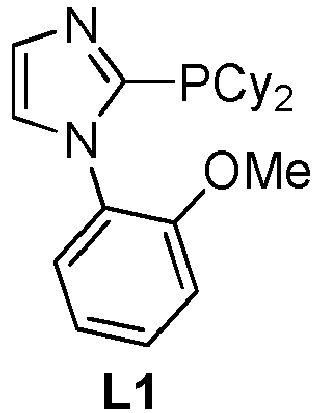
- Entsprechend der obigen allgemeinen Vorschrift wurde L1 aus 1-(2-Methoxyphenyl)-1 H-imidazol (2,35 g, 13,5 mmol) and Dicyclohexylchlorphosphin (3,43 g, 1,8 mmol) synthetisiert. Es wurde ein farbloser Feststoff erhalten (3,40 g, 68% Ausbeute).
- Mit dem Liganden L1 wurde eine Ruthenium-katalysierte Hydroaminomethylierung von 1-Octen mit Ammoniak nach folgendem Reaktionsschema durchgeführt:

Versuchsbedingungen, Ausbeuten und Selektivitäten sind der Tabelle 1 zu entnehmen. - (n/iso) = das Verhältnis von linearem (n) zum verzweigten (iso) Produkt, iso ist die Summe aller verzweigten Alkylketten
Tabelle 1: Variation der Ammoniakquelle Ausbeute [%] Bsp. Bedingungen Octene Octan prim. & sek. Amine tert. Amine (n/iso) 1 NH3(7 N in MeOH, 10 mL, 70 mmol) 15 9 4 61 (90:10) 2 NH3(7 N in MeOH, 2 mL, 14 mmol) 9 9 3 65 (88:12) 3 NH3(0,5 N in Dioxan, 20 mL, 10 mmol) 7 10 3 66 (89:11) 4 Harnstoff (1,32 g, 20 mmol) 6 7 2 51 (80:20) 5 NH3 (28-30 w% in H2O, 1 mL, ≈ 16 mmol) 10 8 1 63 (87:13) 6 NH3(28-30 w% in H2O, 1 mL, ≈ 16 mmol) 8 9 2 71 (87:13) 7 NH3 (0,5g, ≈ 29 mmol) 9 9 2 72 (88:12) - Beispiel 1 (Tabelle 1): Ein 100-mL Autoklav wird befüllt mit Ru3(CO)12 (6,4 mg; 0,1 mol%), dem Liganden L1 (12,2 mg; 0,33 mol%), Toluol (10 mL), 1-Octen (3,1 mL; 2,2 g; 20 mmol) und NH3 (7 N in MeOH, 10 mL, 70 mmol). Synthesegas (10 bar CO / 50 bar H2) wird aufgepresst. Die Reaktionsmischung wird auf 130 °C erwärmt und 20 Stunden bei dieser Temperatur gerührt. Danach wird der Autoklav abgekühlt und Gas abgelassen. Nach der Zugabe des internen Standards (iso-Octan) wird die Reaktionsmischung gaschromatographisch analysiert.
- Das tertiäre Amin wird mit einer hohen Ausbeute (61 %) und hoher linearer Selektivität (n:iso = 90:10) gebildet. Primäre und sekundäre Amine werden nur zu insgesamt 4 % gebildet.
- Beispiel 2 (Tabelle 1): Ein 100-mL Autoklav wird befüllt mit Ru3(CO)12 (6,4 mg; 0,1 mol%), dem Liganden L1 (12,2 mg; 0,33 mol%), Methanol (10 mL), Toluol (10 mL), 1-Octen (3,1 mL; 2,2 g; 20 mmol) und NH3 (7 N in MeOH, 2 mL, 14 mmol). Synthesegas (10 bar CO / 50 bar H2) wird aufgepresst. Die Reaktionsmischung wird auf 130 °C erwärmt und 20 Stunden bei dieser Temperatur gerührt. Danach wird der Autoklav abgekühlt und Gas abgelassen. Nach der Zugabe des internen Standards (iso-Octan) wird die Reaktionsmischung gaschromatographisch analysiert.
- Das tertiäre Amin wird mit einer hohen Ausbeute (65 %) und hoher linearer Selektivität (n:iso = 88:12) gebildet. Primäre und sekundäre Amine werden nur zu insgesamt 3 % gebildet.
- Beispiel 3 (Tabelle 1): Ein 100-mL Autoklav wird befüllt mit Ru3(CO)12 (6,4 mg; 0,1 mol%), dem Liganden L1 (12,2 mg; 0,33 mol%), 1-Octen (3,1 mL; 2,2 g; 20 mmol) und NH3 (0,5 N in Dioxan, 20 mL, 10 mmol). Synthesegas (10 bar CO / 50 bar H2) wird aufgepresst. Die Reaktionsmischung wird auf 130 °C erwärmt und 20 Stunden bei dieser Temperatur gerührt. Danach wird der Autoklav abgekühlt und Gas abgelassen. Nach der Zugabe des internen Standards (iso-Octan) wird die Reaktionsmischung gaschromatographisch analysiert.
- Das tertiäre Amin wird mit einer hohen Ausbeute (66 %) und hoher linearer Selektivität (n:iso = 89:11) gebildet. Primäre und sekundäre Amine werden nur zu insgesamt 3 % gebildet.
- Mit den Beispielen 1 bis 3 kann gezeigt werden, dass das Verfahren sehr effizient und selektiv in der Hydroaminomethylierung ist.
- Beispiel 4 (Tabelle 1): Ein 100-mL Autoklav wird befüllt mit Ru3(CO)12 (6,4 mg; 0,1 mol%), dem Liganden L1 (12,2 mg; 0,33 mol%), Methanol (10 mL), Toluol (10 mL), 1-Octen (3,1 mL; 2,2 g; 20 mmol) und Harnstoff (1,32 g, 20 mmol). Synthesegas (10 bar CO / 50 bar H2) wird aufgepresst. Die Reaktionsmischung wird auf 130 °C erwärmt und 20 Stunden bei dieser Temperatur gerührt. Danach wird der Autoklav abgekühlt und Gas abgelassen. Nach der Zugabe des internen Standards (iso-Octan) wird die Reaktionsmischung gaschromatographisch analysiert.
- Das tertiäre Amin wird mit einer im Vergleich zu den übrigen Beispielen der Tabelle 1 geringeren Ausbeute (51 %) und niedrigerer linearer Selektivität (n:iso = 80:20) gebildet. Primäre und sekundäre Amine werden nur zu insgesamt 2 % gebildet.
- Beispiel 5 (Tabelle 1): Ein 100-mL Autoklav wird befüllt mit Ru3(CO)12 (6,4 mg; 0,1 mol%), dem Liganden L1 (12,2 mg; 0,33 mol%), Methanol (10 mL), Toluol (10 mL), 1-Octen (3,1 mL; 2,2 g; 20 mmol) und wässrigem Ammoniak (NH3 28-30 Massen% in H2O, 1 mL, ≈ 16 mmol). Synthesegas (10 bar CO / 50 bar H2) wird aufgepresst. Die Reaktionsmischung wird auf 130 °C erwärmt und 20 Stunden bei dieser Temperatur gerührt. Danach wird der Autoklav abgekühlt und Gas abgelassen. Nach der Zugabe des internen Standards (iso-Octan) wird die Reaktionsmischung gaschromatographisch analysiert.
- Das tertiäre Amin wird mit einer hohen Ausbeute (63 %) und hoher linearer Selektivität (n:iso = 87:13) gebildet. Primäre und sekundäre Amine werden nur zu insgesamt 1 % gebildet.
- Beispiel 6 (Tabelle 1): Ein 100-mL Autoklav wird befüllt mit Ru3(CO)12 (12,8 mg; 0,2 mol%), dem Liganden L1 (24,8 mg; 0,66 mol%), Methanol (10 mL), Toluol (10 mL), 1-Octen (1,6 mL; 1,1 g; 10 mmol) und wässrigem Ammoniak (NH3 28-30 Massen% in H2O, 1 mL, ≈ 16 mmol). Synthesegas (10 bar CO / 50 bar H2) wird aufgepresst. Die Reaktionsmischung wird auf 130 °C erwärmt und 20 Stunden bei dieser Temperatur gerührt. Danach wird der Autoklav abgekühlt und Gas abgelassen. Nach der Zugabe des internen Standards (iso-Octan) wird die Reaktionsmischung gaschromatographisch analysiert.
- Das tertiäre Amin wird mit einer hohen Ausbeute (71 %) und hoher linearer Selektivität (n:iso = 87:13) gebildet. Primäre und sekundäre Amine werden nur zu insgesamt 2 % gebildet.
- Bei Einsatz von wässrigem Ammoniak wird eine hohe Ausbeute an tertiären Aminen, jedoch eine geringfügig niedrigere lineare Selektivität im Vergleich zu den Beispielen 1 bis 3 beobachtet (Beispiele 5 und 6). Eine Steigerung der Ausbeute ist durch Erhöhung der Katalysator-Menge möglich (vgl. Beispiel 6).
- Beispiel 7 (Tabelle 1): Ein 100-mL Autoklav wird befüllt mit Ru3(CO)12 (12,8 mg; 0,2 mol%), dem Liganden L1 (24,8 mg; 0,66 mol%), Methanol (10 mL), Toluol (10 mL), 1-Octen (1,6 mL; 1,1 g; 10 mmol) und NH3 (0.5 g, ≈ 29 mmol). Synthesegas (10 bar CO / 50 bar H2) wird aufgepresst. Die Reaktionsmischung wird auf 130 °C erwärmt und 20 Stunden bei dieser Temperatur gerührt. Danach wird der Autoklav abgekühlt und Gas abgelassen. Nach der Zugabe des internen Standards (iso-Octan) wird die Reaktionsmischung gaschromatographisch analysiert.
- Das tertiäre Amin wird mit einer hohen Ausbeute (71 %) und hoher linearer Selektivität (n:iso = 87:13) gebildet. Primäre und sekundäre Amine werden nur zu insgesamt 2 % gebildet. Dieses Ergebnis ist vergleichbar mit dem Ergebnis, welches unter Einsatz von wässrigem Ammoniak erzielt wurde.
- Aus Kostengründen und aufgrund der verbesserten Handhabung wurden die nachfolgenden Experimente deshalb mit wässrigem Ammoniak durchgeführt.
- Nachfolgend wurde der Einfluss des Lösungsmittels untersucht.
- Für sämtliche Beispiele 8 bis 17 gelten folgende Angaben:
- Ein 100-mL Autoklav wird befüllt mit Ru3(CO)12 (12,8 mg; 0,2 mol%), dem Liganden L1 (24,8 mg; 0,66 mol%), 20 mL Lösungsmittel wie in der Tabelle 2 angegeben, 1-Octen (1,6 mL; 1,1 g; 10 mmol) und wässrigem Ammoniak NH3 (28-30 w% in H2O, 1 mL, ≈ 16 mmol). Synthesegas (10 bar CO / 50 bar H2) wird aufgepresst. Die Reaktionsmischung wird auf 130 °C erwärmt und 20 Stunden bei dieser Temperatur gerührt. Danach wird der Autoklav abgekühlt und Gas abgelassen. Nach der Zugabe des internen Standards (iso-Octan) wird die Reaktionsmischung gaschromatographisch analysiert.
- Die eingesetzten Lösungsmittel und erzielten Ausbeuten und Selektivitäten finden sich in der Tabelle 2.
Tabelle 2: Variation des Lösungsmittels Ausbeute [%] Bsp. Lösungsmittel Octene Octan prim. & sek. Amine tert. Amine (n/iso) 8 Toluol:Methanol 8 9 2 71 (87:13) 9 Toluol 5 9 0 62 (90:10) 10 Methanol 7 8 0 62 (82:18) 11 iso-Propanol 9 9 5 60 (90:10) 12 Ethanol 14 8 1 56 (85:15) 13 Acetonitril 20 6 0 54 (89:11) 14 Tetrahydrofuran (THF) 4 7 8 74 (89:11) 15 THF:Toluol 3 7 4 80 (90:10) 16 THF:Methanol 13 7 0 77 (88:12) 17 THF:iso-Propanol 7 9 8 72 (90:10) - Verglichen mit der 1:1 Mischung von Toluol und Methanol (Tabelle 2, Beispiel 8), ergaben Toluol und Methanol allein geringere Ausbeuten am sekundären Amin, wobei bei Toluol als Lösungsmittel die lineare Selektivität mit 90:10 höher war als bei Methanol 82:18. Andere alkoholische Lösungsmittel wie iso-Propanol und Ethanol ergaben geringere Ausbeuten, aber bessere Regioselektivitäten als bei Einsatz von Methanol als Lösungsmittel (Tabelle 2, Beispiele 11 und 12). Bei Einsatz von Acetonitril wurde die Bildung großer Mengen von isomerisierten Octenen beobachtet (Tabelle 2, Beispiel 13). Höhere Ausbeuten und eine gute Regioselektivität konnte mit THF erreicht werden (Tabelle 2, Beispiel 14). Beste Ergebnisse bei der Ausbeute und der Regioselektivität wurden mit einem 1:1 Gemisch von THF und Toluol erhalten (Tabelle 2, Beispiele 15 - 17).
- Des Weiteren wurde der Einfluss von Druck und Temperatur untersucht.
- Für sämtliche Beispiele 18-25 gelten folgende Angaben:
- Ein 100-mL Autoklav wird befüllt mit Ru3(CO)12 (12,8 mg; 0,2 mol%), dem Liganden L1 (24,8 mg; 0,66 mol%), THF (10 mL), Toluol (10 mL), 1-Octen (1,6 mL; 1,1 g; 10 mmol) und wässrigem Ammoniak NH3 (28-30 w% in H2O, 1 mL, ≈ 16 mmol). Synthesegas (10 bar CO / 50 bar H2) wird aufgepresst. Die Reaktionsmischung wird auf 130 °C bzw. 120°C erwärmt und 20 Stunden bei dieser Temperatur gerührt. Danach wird der Autoklav abgekühlt und Gas abgelassen. Nach der Zugabe des internen Standards (iso-Octan) wird die Reaktionsmischung gaschromatographisch analysiert.
- Die einzelnen Drücke und Temperaturen, sowie die erzielten Ausbeuten und Selektivitäten finden sich in der Tabelle 3.
Tabelle 3: Variation von Druck und Temperatur Ausbeute [%] Bsp. CO:H2 [bar] / Temperatur Octene Octan prim. & sek. Amine tert. Amine (n/iso) 18 10:50 / 130 °C 3 3 4 80 (90:10) 19 7:35 / 130 °C 3 3 10 76 (91:9) 20 5:25 / 130 °C 8 8 22 58 (93:7) 21 20:40 / 130 °C 10 10 3 77 (89:11) 22 10:40 / 130 °C 4 4 5 79 (90:10) 23 10:30 / 130 °C 7 7 4 72 (92:8) 24 10:50 / 120 °C 4 4 6 79 (90:10) 25 10:40 / 120 °C 5 5 4 79 (90:10) - Bei niedrigeren Drücken wurden verstärkt primäre und sekundäre Amine gebildet (Tabelle 3, Beispiele 18 - 20). Höhere Konzentrationen an CO führten zu mehr internen Alkenen als Nebenprodukt, vermutlich da die Reduktionsfähigkeit von Ruthenium reduziert wird (Tabelle 3, Beispiele 21 und 22). Die Reduzierung des Partialdruckes von Wasserstoff führte zu geringeren Aminausbeuten (Tabelle 3, Beispiel 23). Die Temperatur konnte auf 120 °C gesenkt werden, ohne die Reaktion maßgeblich zu beeinflussen (Tabelle 3, Beispiele 24 und 25).
- Die Eignung des Verfahrens für andere Verbindungen, welche mindestens eine Doppelbindung enthalten, wurde an folgendem System untersucht:

- Für sämtliche Beispiele 26 bis 38 gelten folgende Angaben:
- Ein 100-mL Autoklav wird befüllt mit Ru3(CO)12 (12,8 mg; 0,2 mol%), dem Liganden L1 (24,8 mg; 0,66 mol%), THF (10 mL), Toluol (10 mL), 10 mmol der jeweiligen Verbindung, welche mindestens eine Doppelbindung enthält, wie angegeben im nachfolgenden Schema, und wässrigem Ammoniak NH3 (28-30 w% in H2O, 1 mL, ≈ 16 mmol). Synthesegas (10 bar CO / 40 bar H2) wird aufgepresst. Die Reaktionsmischung wird auf 120 °C erwärmt und 20 Stunden bei dieser Temperatur gerührt. Danach wird der Autoklav abgekühlt und Gas abgelassen. Nach der Zugabe des internen Standards (iso-Octan) wird die Reaktionsmischung gaschromatographisch analysiert.
- Die Ergebnisse aus der Substratvariation sind nachfolgend dargestellt.
- Im Vergleich zu der Umsetzung von 1-Octen läuft die Umsetzung der kürzerkettigeren Alkene 1-Penten und 1-Hexen zu den Produkten 28 und 29 in vergleichbaren Ausbeuten, aber mit leicht verbesserter Regioselektivität ab (n:iso = 92:8). In Übereinstimmung hiermit sinkt die Regioselektivität bei Einsatz von 1-Decen zu 87:13 ab (30). Die Produkte der Reaktionen von Allylcyclohexen (31) und Allylbenzen (32) wurden ebenfalls in guten Ausbeuten erhalten, aufgrund der Isomerisierung der Doppelbindung wurde bei Umsetzung des Allylbenzens (32) jedoch eine geringere Regioselektivität beobachtet. Eine gute Ausbeute und gute Regioselektivität wurde bei der Reaktion von 3,3-Dimethylbut-1-en erreicht (33). Die Umsetzung von cyclischen Alkenen wie Cyclohexen musste bei einer höheren Temperatur durchgeführt werden (160°C) um eine Ausbeute von 47% zu erreichen (34). Auch für die Umsetzung von α-Methylstyren war eine erhöhte Temperatur notwendig (35). Gute Resultate konnten auch für funktionalisierte Alkene erreicht werden. Beispielsweise konnte das Hydroxyl-substituierte Produkt 36 mit einer Ausbeute von 76 % und einer hohen Regioselektivität von 99:1 hergestellt werden (36). Ester- und Nitrilgruppen wurden unter den gewählten Reaktionsbedingungen ebenfalls toleriert, die Umsetzungen lieferten die entsprechenden tertiären Amine mit einer Regioselektivität von 90:10 bzw. 83:17.


- Somit konnte gezeigt werden, dass das beanspruchte Verfahren auf eine Vielzahl von Substrate angewendet und verschiedenste funktionelle Gruppen toleriert werden. Wie die Versuchsergebnisse zeigen, wird die gestellte Aufgabe durch das erfindungsgemäße Verfahren gelöst.
- Es ist somit erstmalig gelungen, tertiäre Amine durch ein Hydroaminomethylierungsverfahren in Gegenwart von Ruthenium-Katalysatoren in guten bis sehr guten Ausbeuten herzustellen. Dieses Verfahren sollte direkt von Ammoniak oder einer Ammoniakquelle ausgehen.
Claims (10)
- Verfahren zur Hydroaminomethylierung von Verbindungen, welche mindestens eine Doppelbindung enthalten, dadurch gekennzeichnet, dass wenigstens eine Verbindung, welche mindestens eine Doppelbindung enthält, mit Ammoniak oder einer Ammoniakquelle unter Zuführung von H2 und CO in Gegenwart eines katalytischen Systems aus einem Ruthenium-Komplex und mindestens einem Liganden umgesetzt wird, wobei der Ligand einen organischen Phosphor-Liganden einer der allgemeinen Formeln (1) bis (8) darstellt:


R' und R" gleich oder verschieden sind und für einen Rest stehen, der ausgewählt ist aus der Gruppe bestehend aus:
(C1-C12)-Alkyl, (C1-C12)-Heteroalkyl, (C4-C14)-Aryl, (C4-C14)-Aryl-(C1-C12)-Alkyl, (C4-C14)-Aryl-O-(C1-C12)-Alkyl, (C3-C14)-Heteroaryl, (C3-C14)-Heteroaryl-(C1-C12)-Alkyl, (C3-C12)-Cycloalkyl, (C3-C12)-Cycloalkyl-(C1-C12)-Alkyl, (C3-C12)-Heterocycloalkyl, (C3-C12)-Heterocycloalkyl-(C1-C12)-Alkyl, O-(C1-C12)-Alkyl, O-(C1-C12)-Heteroalkyl, O-(C4-C14)-Aryl, O-(C4-C14)-Aryl-(C1-C14)-Alkyl, O-(C3-C14)-Heteroaryl, O-(C3-C14)-Heteroaryl-(C1-C14)-Alkyl, O-(C3-C12)-Cycloalkyl, O-(C3-C12)-Cycloalkyl-(C1-C12)-Alkyl, O-(C3-C12)-Heterocycloalkyl, O-(C3-C12)-Heterocycloalkyl-(C1-C12)-Alkyl,
wobei die genannten Alkyl-, Heteroalkyl-, Cycloalkyl-, Heterocycloalkyl-, Aryl- und Heteroarylgruppen optional ein oder mehrfach substituiert sind und
Ra und Rb ausgewählt sind aus: Wasserstoff, Hydroxy, (C1-C12)-Alkyl, (C1-C12)-Heteroalkyl, (C4-C14)-Aryl, (C4-C14)-Aryl-(C1-C12)-Alkyl, (C4-C14)-Aryl-O-(C1-C12)-Alkyl, (C3-C14)-Heteroaryl, (C3-C14)-Heteroaryl-(C1-C12)-Alkyl, (C3-C12)-Cycloalkyl, (C3-C12)-Cycloalkyl-(C1-C12)-Alkyl, (C3-C12)-Heterocycloalkyl, (C3-C12)-Heterocycloalkyl-(C1-C12)-Alkyl, O-(C1-C12)-Alkyl, O-(C1-C12)-Heteroalkyl, O-(C4-C14)-Aryl, O-(C4-C14)-Aryl-(C1-C14)-Alkyl, O-(C3-C14)-Heteroaryl, O-(C3-C14)-Heteroaryl-(C1-C14)-Alkyl, O-(C3-C12)-Cycloalkyl, O-(C3-C12)-Cycloalkyl-(C1-C12)-Alkyl, O-(C3-C12)-Heterocycloalkyl, O-(C3-C12)-Heterocycloalkyl-(C1-C12)-Alkyl,
wobei die genannten Alkyl-, Heteroalkyl-, Cycloalkyl-, Heterocycloalkyl-, Aryl- und Heteroarylgruppen optional ein oder mehrfach substituiert sind und
und wobei Ra auch zur Bildung eines größeren kondensierten Ringes befähigt ist. - Verfahren gemäß Anspruch 1, dadurch gekennzeichnet, dass der Ligand die allgemeine Formel (1) oder (2) aufweist.
- Verfahren gemäß Anspruch 1 oder 2, dadurch gekennzeichnet, dass R' und/oder R" unabhängig voneinander ausgewählt ist aus Cyclohexyl, iso-Propyl und Phenyl.
- Verfahren gemäß einem der Ansprüche 1 oder 2, dadurch gekennzeichnet, dass der Ligand ausgewählt ist aus der Gruppe bestehend aus:2-(Dicyclohexylphosphino)-1-(2-methoxyphenyl)-1H-imidazol (L1),2-(Dicyclohexylphosphino)-1-methyl-1 H-imidazol (L2),2-(Dicyclohexylphosphino)-1-phenyl-1 H-imidazol (L3),2-(Diisopropylphosphino)-1-(2-methoxyphenyl)-1H-imidazol (L4),2-(Diphenylphosphino)-1-(2-methoxyphenyl)-1 H-imidazol (L5),2-(Dicyclohexylphosphino)-1-mesityl-1 H-imidazol (L6),2-(Dicyclohexylphosphino)-1-phenyl-1 H-pyrrol (L7),2-(Dicyclohexylphosphino)-1-(2-methoxyphenyl)-1H-pyrrol (L8),2-(Dicyclohexylphosphino)-1-methyl-1 H-benzo[d]imidazol (L9).
- Verfahren gemäß einem der Ansprüche 1 bis 4, dadurch gekennzeichnet, dass der Ruthenium-Katalysator in situ ausgehend von einem Vorkomplex gebildet wird, wobei als Rutheniumquelle Ruthenium-enthaltende Salze und Komplexe als Vorstufe verwendet werden, die Rutheniumcarbonylhydrid-Komplexe bilden.
- Verfahren gemäß einem der Ansprüche 1 bis 5, dadurch gekennzeichnet, dass die Verbindung, welche mindestens eine Doppelbindung enthält, ausgewählt ist aus α-Alkenen, internen lineare Alkenen, interne verzweigten Alkenen, Cycloalkenen, aromatischen Olefinen, Polyenen, ungesättigten Alkoholen, ungesättigten Ethern, ungesättigten Aminen, ungesättigten Estern, ungesättigten Carbonsäuren, ungesättigten Amiden, ungesättigten Urethanen, ungesättigten Halogeniden, ungesättigten Aldehyden, ungesättigten Ketonen und ungesättigten Epoxiden sowie Mischungen aus diesen.
- Verfahren gemäß einem der Ansprüche 1 bis 6, dadurch gekennzeichnet, dass in dem Verfahren weniger als 10 Massen-%, vorzugsweise weniger als 2 Massen-% und insbesondere kein Lösungsmittel eingesetzt wird, wobei die Massen-% auf das ganze Reaktionsgemisch bezogen sind.
- Gemische erhältlich durch ein Verfahren nach einem der Ansprüche 1 bis 7.
- Verwendung eines organischen Phosphor-Liganden einer der allgemeinen Formeln (1) bis (8)


R' und R" gleich oder verschieden sind und für einen Rest stehen, der ausgewählt ist aus der Gruppe bestehend aus:
(C1-C12)-Alkyl, (C1-C12)-Heteroalkyl, (C4-C14)-Aryl, (C4-C14)-Aryl-(C1-C12)-Alkyl, (C4-C14)-Aryl-O-(C1-C12)-Alkyl, (C3-C14)-Heteroaryl, (C3-C14)-Heteroaryl-(C1-C12)-Alkyl, (C3-C12)-Cycloalkyl, (C3-C12)-Cycloalkyl-(C1-C12)-Alkyl, (C3-C12)-Heterocycloalkyl, (C3-C12)-Heterocycloalkyl-(C1-C12)-Alkyl, O-(C1-C2)-Alkyl, O-(C1-C12)-Heteroalkyl, O-(C4-C14)-Aryl, O-(C4-C14)-Aryl-(C1-C14)-Alkyl, O-(C3-C14)-Heteroaryl, O-(C3-C14)-Heteroaryl-(C1-C14)-Alkyl, O-(C3-C12)-Cycloalkyl, O-(C3-C12)-Cycloalkyl-(C1-C12)-Alkyl, O-(C3-C12)-Heterocycloalkyl, O-(C3-C12)-Heterocycloalkyl-(C1-C12)-Alkyl,
wobei die genannten Alkyl-, Heteroalkyl-, Cycloalkyl-, Heterocycloalkyl-, Aryl- und Heteroarylgruppen optional ein oder mehrfach substituiert sind und
Ra und Rb ausgewählt sind aus: Wasserstoff, Hydroxy, (C1-C12)-Alkyl, (C1-C12)-Heteroalkyl, (C4-C14)-Aryl, (C4-C14)-Aryl-(C1-C12)-Alkyl, (C4-C14)-Aryl-O-(C1-C12)-Alkyl, (C3-C14)-Heteroaryl, (C3-C14)-Heteroaryl-(C1-C12)-Alkyl, (C3-C12)-Cycloalkyl, (C3-C12)-Cycloalkyl-(C1-C12)-Alkyl, (C3-C12)-Heterocycloalkyl, (C3-C12)-Heterocycloalkyl-(C1-C12)-Alkyl, O-(C1-C12)-Alkyl, O-(C1-C12)-Heteroalkyl, O-(C4-C14)-Aryl, O-(C4-C14)-Aryl-(C1-C14)-Alkyl, O-(C3-C14)-Heteroaryl, O-(C3-C14)-Heteroaryl-(C1-C14)-Alkyl, O-(C3-C12)-Cycloalkyl, O-(C3-C12)-Cycloalkyl-(C1-C12)-Alkyl, O-(C3-C12)-Heterocycloalkyl, O-(C3-C12)-Heterocycloalkyl-(C1-C12)-Alkyl,
wobei die genannten Alkyl-, Heteroalkyl-, Cycloalkyl-, Heterocycloalkyl-, Aryl- und Heteroarylgruppen optional ein oder mehrfach substituiert sind und
und wobei Ra auch zur Bildung eines größeren kondensierten Ringes befähigt ist,
bei der Umsetzung von Ammoniak oder einer Ammoniakquelle mit Verbindungen, welche mindestens eine Doppelbindung enthalten. - Verwendung eines organischen Phosphorliganden aus der Gruppe, die gebildet wird durch
2-(Dicyclohexylphosphino)-1-(2-methoxyphenyl)-1H-imidazol,
2-(Dicyclohexylphosphino)-1-methyl-1 H-imidazol,
2-(Dicyclohexylphosphino)-1-phenyl-1 H-imidazol,
2-(Diisopropylphosphino)-1-(2-methoxyphenyl)-1H-imidazol,
2-(Diphenylphosphino)-1-(2-methoxyphenyl)-1H-imidazol,
2-(Dicyclohexylphosphino)-1-mesityl-1H-imidazol,
2-(Dicyclohexylphosphino)-1-phenyl-1H-pyrrol,
2-(Dicyclohexylphosphino)-1-(2-methoxyphenyl)-1H-pyrrol und
2-(Dicyclohexylphosphino)-1-methyl-1 H-benzo[d]imidazol
bei der Umsetzung von Ammoniak oder einer Ammoniakquelle mit Verbindungen, welche mindestens eine Doppelbindung enthalten.
Applications Claiming Priority (1)
| Application Number | Priority Date | Filing Date | Title |
|---|---|---|---|
| DE102014214030.7A DE102014214030A1 (de) | 2014-07-18 | 2014-07-18 | Ruthenium-katalysierte Hydroaminomethylierung |
Publications (1)
| Publication Number | Publication Date |
|---|---|
| EP2975019A1 true EP2975019A1 (de) | 2016-01-20 |
Family
ID=53773194
Family Applications (1)
| Application Number | Title | Priority Date | Filing Date |
|---|---|---|---|
| EP15174717.7A Withdrawn EP2975019A1 (de) | 2014-07-18 | 2015-07-01 | Ruthenium-katalysierte hydroaminomethylierung |
Country Status (2)
| Country | Link |
|---|---|
| EP (1) | EP2975019A1 (de) |
| DE (1) | DE102014214030A1 (de) |
Cited By (2)
| Publication number | Priority date | Publication date | Assignee | Title |
|---|---|---|---|---|
| CN114524730A (zh) * | 2020-11-23 | 2022-05-24 | 赢创运营有限公司 | 使用膦配体的Ru催化连锁加氢甲酰化/氢化/酯化 |
| WO2023115292A1 (en) * | 2021-12-21 | 2023-06-29 | Rhodia Operations | Process for preparing tertiary amines |
Citations (1)
| Publication number | Priority date | Publication date | Assignee | Title |
|---|---|---|---|---|
| WO2005077884A2 (en) * | 2004-02-10 | 2005-08-25 | Union Carbide Chemicals & Plastics Technology Corporation | Hydroaminomethylation of olefins |
-
2014
- 2014-07-18 DE DE102014214030.7A patent/DE102014214030A1/de not_active Withdrawn
-
2015
- 2015-07-01 EP EP15174717.7A patent/EP2975019A1/de not_active Withdrawn
Patent Citations (1)
| Publication number | Priority date | Publication date | Assignee | Title |
|---|---|---|---|---|
| WO2005077884A2 (en) * | 2004-02-10 | 2005-08-25 | Union Carbide Chemicals & Plastics Technology Corporation | Hydroaminomethylation of olefins |
Non-Patent Citations (18)
| Title |
|---|
| "Chemistry of Organophosphorous Compounds", vol. 1, 1990, JOHN WHILEY |
| B. ZIMMERMANN; J. HERWIG; M. BELLER, ANGEW. CHEM. INT. ED., vol. 38, 1999, pages 2372 - 2375 |
| BUI THE KHAI ET AL: "Cyclization of .alpha.,.omega. aliphatic diamines and conversion of primary amines to symmetrical tertiary amines by a homogeneous ruthenium catalyst", THE JOURNAL OF ORGANIC CHEMISTRY, vol. 46, no. 8, 1 April 1981 (1981-04-01), US, pages 1759 - 1760, XP055228612, ISSN: 0022-3263, DOI: 10.1021/jo00321a056 * |
| G. H. POSNER, CHEM. REV., vol. 86, 1986, pages 831 - 844 |
| H. KLEIN; R. JACKSTELL; M. KANT; A. MARTIN; M. BELLER, CHEM. ENG. TECHNOL., vol. 30, 2007, pages 721 - 725 |
| J.F. KNIFTON, CATAL. TODAY, vol. 36, 1997, pages 305 - 310 |
| LIPENG WU ET AL: "Efficient and Regioselective Ruthenium-catalyzed Hydro-aminomethylation of Olefins", JOURNAL OF THE AMERICAN CHEMICAL SOCIETY, vol. 135, no. 10, 18 February 2013 (2013-02-18), pages 3989 - 3996, XP055103813, ISSN: 0002-7863, DOI: 10.1021/ja312271c * |
| REPPE, W.; VETTER, H., LIEBIGS ANN. CHEM., vol. 582, 1953, pages 133 - 163 |
| ROBIN K. HARRIS; EDWIN D. BECKER; SONIA M. CABRAL DE MENEZES; PIERRE GRANGER; ROY E. HOFFMAN; KURT W. ZILM, PURE APPL. CHEM., vol. 80, 2008, pages 59 - 84 |
| ROBIN K. HARRIS; EDWIN D. BECKER; SONIA M. CABRAL DE MENEZES; ROBIN GOODFELLOW; PIERRE GRANGER, PURE APPL. CHEM., vol. 73, 2001, pages 1795 - 1818 |
| RYOHEI YAMAGUCHI ET AL: "Selective Synthesis of Secondary and Tertiary Amines by Cp*Iridium-Catalyzed Multialkylation of Ammonium Salts with Alcohols", ORGANIC LETTERS, vol. 10, no. 2, 1 January 2008 (2008-01-01), US, pages 181 - 184, XP055228565, ISSN: 1523-7060, DOI: 10.1021/ol702522k * |
| SCHULZ, T.; TORBORG, C.; SCHÄFFNER, B.; HUANG, J.; ZAPF, A.; KADYROV, R.; BÖRNER, A.; BELLER, M., ANGEW. CHEM. INT. ED., vol. 48, 2009, pages 918 - 921 |
| VON L. F. TIETZE, CHEM. REV., vol. 96, 1996, pages 115 - 136 |
| VON LIPENG WU; IVANA FLEISCHER; RALF JACKSTELL; MATTHIAS BELLER: "Efficient and regioselective Ruthenium-catalyzed hydroaminomethylation of olefins", J. AM. CHEM. SOC., vol. 135, no. 10, 2013, pages 3989 - 3996 |
| VON PAUL C.J. KAMER; PIET W.N.M. VAN LEEUWEN: "Phosphorous(III)Ligands in Homogeneous Catalysis - Design and Synthesis", 2012, JOHN WILEY AND SONS |
| VON SAMET GÜLAK; LIPENG WU; QIANG LIU; ROBERT FRANKE; RALF JACKSTELL; MATTHIAS BELLER: "Phosphine- and hydrogenfree highly regioselective Ruthenium-catalyzed hydroaminomethylation of olefins", ANGEW. CHEM. INT. ED., vol. 513, 2014, pages 7320 - 7323, XP055228517, DOI: doi:10.1002/anie.201402368 |
| W. L. F. ARMAREGO; CHRISTINA CHAI: "Purification of Laboratory Chemicals", 2009, ELSEVIER |
| ZHANG, H.; CAI, Q.; MA, D., J. ORG. CHEM., vol. 70, no. 13, 2005, pages 5164 - 5173 |
Cited By (4)
| Publication number | Priority date | Publication date | Assignee | Title |
|---|---|---|---|---|
| CN114524730A (zh) * | 2020-11-23 | 2022-05-24 | 赢创运营有限公司 | 使用膦配体的Ru催化连锁加氢甲酰化/氢化/酯化 |
| EP4001255A1 (de) * | 2020-11-23 | 2022-05-25 | Evonik Operations GmbH | Ru-katalysierte domino hydroformylierung/hydrierung/veresterung unter einsatz von phosphin-liganden |
| US11773049B2 (en) | 2020-11-23 | 2023-10-03 | Evonik Operations Gmbh | Ru-catalyzed domino hydroformylation/hydrogenation/esterification using phosphine ligands |
| WO2023115292A1 (en) * | 2021-12-21 | 2023-06-29 | Rhodia Operations | Process for preparing tertiary amines |
Also Published As
| Publication number | Publication date |
|---|---|
| DE102014214030A1 (de) | 2016-01-21 |
Similar Documents
| Publication | Publication Date | Title |
|---|---|---|
| EP2091958B1 (de) | Bisphosphitliganden für die übergangsmetallkatalysierte hydroformylierung | |
| EP1677911B1 (de) | Stabilisierung von hydroformylierungskatalysatoren auf basis von phosphoramiditliganden | |
| EP3374366B1 (de) | Bis-phosphite mit 2,4-dimethylphenyl-einheiten und ihre verwendung als liganden in der hydroformylierung | |
| EP2947088B1 (de) | Verfahren zur katalytischen herstellung von aldehyden aus olefinen unter einsatz von monophosphit-gemischen | |
| DE102010041821A1 (de) | Einsatz von Supported Ionic Liquid Phase (SILP) Katalysatorsystemen in der Hydroformylierung von olefinhaltigen Gemischen zu Aldehydgemischen mit hohem Anteil von in 2-Stellung unverzweigten Aldehyden | |
| EP2947091B1 (de) | Gemische von monophosphitligand und deren verwendung zur katalyse einer hydroformylierungsreaktion | |
| EP2838872B1 (de) | Verfahren zur herstellung von verzweigten alkoholen | |
| DE102010043558A1 (de) | Verfahren zur Hydroformylierung von ungesättigten Verbindungen | |
| EP3763723B1 (de) | Bisphosphite mit einem geschlossenen und einem offenen flügelbaustein | |
| DE2931883C2 (de) | Verfahren zur Carbonylierung von olefinischen Verbindungen | |
| EP3994117B1 (de) | Hydrierung von estern zu alkoholen in gegenwart eines ru-pnn-komplexes | |
| DE102011003595B4 (de) | Herstellung von in ihrer Hauptkette linearen primären Diaminen für Polyamidsynthesen | |
| EP3112373B1 (de) | Neuer vierzähniger phosphor-ligand mit hostanox o3 leitstruktur | |
| EP0924182B1 (de) | Verfahren zur Herstellung von Aldehyden | |
| EP2975019A1 (de) | Ruthenium-katalysierte hydroaminomethylierung | |
| WO2015018845A1 (de) | Verfahren zur synthese von gesättigten carbonsäureestern | |
| EP2951143B1 (de) | Verfahren zur carbonylierung von olefinen | |
| EP3318570B1 (de) | Phosphorigsäure-p,p'-[5,5',6,6'-tetramethyl-3,3'-bis(1-methylethyl)[1,1'-biphenyl]-2,2'-diyl] p,p,p',p'-tetrakis(2,4-dimethylphenyl)-ester in der hydroformylierung | |
| EP1161437B1 (de) | Phosphabenzolverbindungen und ihre verwendung als liganden für hydroformylierungskatalysatoren | |
| DE2018054C3 (de) | Verfahren zur Herstellung von Octadienol | |
| EP4074722A1 (de) | Diphosphite mit einem offenen, 3-methylierten flügelbaustein | |
| EP2951188B1 (de) | Phosphor-liganden und verfahren zur selektiven ruthenium-katalysierten hydroaminomethylierung von olefinen | |
| WO2015011132A2 (de) | Phosphoramiditderivate in der hydroformylierung von ungesättigten verbindungen | |
| DE102013201668B4 (de) | Verfahren zur selektiven Ruthenium-katalysierten Hydroaminomethylierung von Olefinen | |
| DE102012016959A1 (de) | Verfahren zur Herstellung von Ameisensäure durch Umsetzung von Kohlendioxid mit Wasserstoff |
Legal Events
| Date | Code | Title | Description |
|---|---|---|---|
| PUAI | Public reference made under article 153(3) epc to a published international application that has entered the european phase |
Free format text: ORIGINAL CODE: 0009012 |
|
| 17P | Request for examination filed |
Effective date: 20150701 |
|
| AK | Designated contracting states |
Kind code of ref document: A1 Designated state(s): AL AT BE BG CH CY CZ DE DK EE ES FI FR GB GR HR HU IE IS IT LI LT LU LV MC MK MT NL NO PL PT RO RS SE SI SK SM TR |
|
| AX | Request for extension of the european patent |
Extension state: BA ME |
|
| STAA | Information on the status of an ep patent application or granted ep patent |
Free format text: STATUS: EXAMINATION IS IN PROGRESS |
|
| 17Q | First examination report despatched |
Effective date: 20170315 |
|
| RAP1 | Party data changed (applicant data changed or rights of an application transferred) |
Owner name: EVONIK OPERATIONS GMBH |
|
| STAA | Information on the status of an ep patent application or granted ep patent |
Free format text: STATUS: THE APPLICATION IS DEEMED TO BE WITHDRAWN |
|
| 18D | Application deemed to be withdrawn |
Effective date: 20200201 |