EP2970456B1 - Methods and compositions for delivering mrna coded antibodies - Google Patents
Methods and compositions for delivering mrna coded antibodies Download PDFInfo
- Publication number
- EP2970456B1 EP2970456B1 EP14717945.1A EP14717945A EP2970456B1 EP 2970456 B1 EP2970456 B1 EP 2970456B1 EP 14717945 A EP14717945 A EP 14717945A EP 2970456 B1 EP2970456 B1 EP 2970456B1
- Authority
- EP
- European Patent Office
- Prior art keywords
- mrna
- antibody
- uracil
- encoding
- lipid
- Prior art date
- Legal status (The legal status is an assumption and is not a legal conclusion. Google has not performed a legal analysis and makes no representation as to the accuracy of the status listed.)
- Active
Links
Images


Classifications
-
- C—CHEMISTRY; METALLURGY
- C07—ORGANIC CHEMISTRY
- C07K—PEPTIDES
- C07K16/00—Immunoglobulins [IG], e.g. monoclonal or polyclonal antibodies
- C07K16/18—Immunoglobulins [IG], e.g. monoclonal or polyclonal antibodies against material from animals or humans
- C07K16/24—Immunoglobulins [IG], e.g. monoclonal or polyclonal antibodies against material from animals or humans against cytokines, lymphokines or interferons
-
- A—HUMAN NECESSITIES
- A61—MEDICAL OR VETERINARY SCIENCE; HYGIENE
- A61K—PREPARATIONS FOR MEDICAL, DENTAL OR TOILETRY PURPOSES
- A61K47/00—Medicinal preparations characterised by the non-active ingredients used, e.g. carriers or inert additives; Targeting or modifying agents chemically bound to the active ingredient
- A61K47/50—Medicinal preparations characterised by the non-active ingredients used, e.g. carriers or inert additives; Targeting or modifying agents chemically bound to the active ingredient the non-active ingredient being chemically bound to the active ingredient, e.g. polymer-drug conjugates
- A61K47/69—Medicinal preparations characterised by the non-active ingredients used, e.g. carriers or inert additives; Targeting or modifying agents chemically bound to the active ingredient the non-active ingredient being chemically bound to the active ingredient, e.g. polymer-drug conjugates the conjugate being characterised by physical or galenical forms, e.g. emulsion, particle, inclusion complex, stent or kit
- A61K47/6905—Medicinal preparations characterised by the non-active ingredients used, e.g. carriers or inert additives; Targeting or modifying agents chemically bound to the active ingredient the non-active ingredient being chemically bound to the active ingredient, e.g. polymer-drug conjugates the conjugate being characterised by physical or galenical forms, e.g. emulsion, particle, inclusion complex, stent or kit the form being a colloid or an emulsion
- A61K47/6911—Medicinal preparations characterised by the non-active ingredients used, e.g. carriers or inert additives; Targeting or modifying agents chemically bound to the active ingredient the non-active ingredient being chemically bound to the active ingredient, e.g. polymer-drug conjugates the conjugate being characterised by physical or galenical forms, e.g. emulsion, particle, inclusion complex, stent or kit the form being a colloid or an emulsion the form being a liposome
-
- A—HUMAN NECESSITIES
- A61—MEDICAL OR VETERINARY SCIENCE; HYGIENE
- A61K—PREPARATIONS FOR MEDICAL, DENTAL OR TOILETRY PURPOSES
- A61K9/00—Medicinal preparations characterised by special physical form
- A61K9/0012—Galenical forms characterised by the site of application
- A61K9/0019—Injectable compositions; Intramuscular, intravenous, arterial, subcutaneous administration; Compositions to be administered through the skin in an invasive manner
-
- A—HUMAN NECESSITIES
- A61—MEDICAL OR VETERINARY SCIENCE; HYGIENE
- A61K—PREPARATIONS FOR MEDICAL, DENTAL OR TOILETRY PURPOSES
- A61K9/00—Medicinal preparations characterised by special physical form
- A61K9/10—Dispersions; Emulsions
- A61K9/127—Synthetic bilayered vehicles, e.g. liposomes or liposomes with cholesterol as the only non-phosphatidyl surfactant
-
- A—HUMAN NECESSITIES
- A61—MEDICAL OR VETERINARY SCIENCE; HYGIENE
- A61K—PREPARATIONS FOR MEDICAL, DENTAL OR TOILETRY PURPOSES
- A61K9/00—Medicinal preparations characterised by special physical form
- A61K9/10—Dispersions; Emulsions
- A61K9/127—Synthetic bilayered vehicles, e.g. liposomes or liposomes with cholesterol as the only non-phosphatidyl surfactant
- A61K9/1271—Non-conventional liposomes, e.g. PEGylated liposomes or liposomes coated or grafted with polymers
-
- A—HUMAN NECESSITIES
- A61—MEDICAL OR VETERINARY SCIENCE; HYGIENE
- A61K—PREPARATIONS FOR MEDICAL, DENTAL OR TOILETRY PURPOSES
- A61K9/00—Medicinal preparations characterised by special physical form
- A61K9/10—Dispersions; Emulsions
- A61K9/127—Synthetic bilayered vehicles, e.g. liposomes or liposomes with cholesterol as the only non-phosphatidyl surfactant
- A61K9/1271—Non-conventional liposomes, e.g. PEGylated liposomes or liposomes coated or grafted with polymers
- A61K9/1272—Non-conventional liposomes, e.g. PEGylated liposomes or liposomes coated or grafted with polymers comprising non-phosphatidyl surfactants as bilayer-forming substances, e.g. cationic lipids or non-phosphatidyl liposomes coated or grafted with polymers
-
- A—HUMAN NECESSITIES
- A61—MEDICAL OR VETERINARY SCIENCE; HYGIENE
- A61P—SPECIFIC THERAPEUTIC ACTIVITY OF CHEMICAL COMPOUNDS OR MEDICINAL PREPARATIONS
- A61P35/00—Antineoplastic agents
-
- A—HUMAN NECESSITIES
- A61—MEDICAL OR VETERINARY SCIENCE; HYGIENE
- A61P—SPECIFIC THERAPEUTIC ACTIVITY OF CHEMICAL COMPOUNDS OR MEDICINAL PREPARATIONS
- A61P37/00—Drugs for immunological or allergic disorders
- A61P37/02—Immunomodulators
- A61P37/04—Immunostimulants
-
- A—HUMAN NECESSITIES
- A61—MEDICAL OR VETERINARY SCIENCE; HYGIENE
- A61P—SPECIFIC THERAPEUTIC ACTIVITY OF CHEMICAL COMPOUNDS OR MEDICINAL PREPARATIONS
- A61P37/00—Drugs for immunological or allergic disorders
- A61P37/02—Immunomodulators
- A61P37/06—Immunosuppressants, e.g. drugs for graft rejection
-
- A—HUMAN NECESSITIES
- A61—MEDICAL OR VETERINARY SCIENCE; HYGIENE
- A61P—SPECIFIC THERAPEUTIC ACTIVITY OF CHEMICAL COMPOUNDS OR MEDICINAL PREPARATIONS
- A61P9/00—Drugs for disorders of the cardiovascular system
-
- C—CHEMISTRY; METALLURGY
- C07—ORGANIC CHEMISTRY
- C07K—PEPTIDES
- C07K16/00—Immunoglobulins [IG], e.g. monoclonal or polyclonal antibodies
- C07K16/18—Immunoglobulins [IG], e.g. monoclonal or polyclonal antibodies against material from animals or humans
- C07K16/22—Immunoglobulins [IG], e.g. monoclonal or polyclonal antibodies against material from animals or humans against growth factors ; against growth regulators
-
- C—CHEMISTRY; METALLURGY
- C12—BIOCHEMISTRY; BEER; SPIRITS; WINE; VINEGAR; MICROBIOLOGY; ENZYMOLOGY; MUTATION OR GENETIC ENGINEERING
- C12N—MICROORGANISMS OR ENZYMES; COMPOSITIONS THEREOF; PROPAGATING, PRESERVING, OR MAINTAINING MICROORGANISMS; MUTATION OR GENETIC ENGINEERING; CULTURE MEDIA
- C12N15/00—Mutation or genetic engineering; DNA or RNA concerning genetic engineering, vectors, e.g. plasmids, or their isolation, preparation or purification; Use of hosts therefor
- C12N15/09—Recombinant DNA-technology
- C12N15/87—Introduction of foreign genetic material using processes not otherwise provided for, e.g. co-transformation
- C12N15/88—Introduction of foreign genetic material using processes not otherwise provided for, e.g. co-transformation using microencapsulation, e.g. using amphiphile liposome vesicle
-
- A—HUMAN NECESSITIES
- A61—MEDICAL OR VETERINARY SCIENCE; HYGIENE
- A61K—PREPARATIONS FOR MEDICAL, DENTAL OR TOILETRY PURPOSES
- A61K39/00—Medicinal preparations containing antigens or antibodies
- A61K2039/505—Medicinal preparations containing antigens or antibodies comprising antibodies
-
- C—CHEMISTRY; METALLURGY
- C07—ORGANIC CHEMISTRY
- C07K—PEPTIDES
- C07K2317/00—Immunoglobulins specific features
- C07K2317/10—Immunoglobulins specific features characterized by their source of isolation or production
- C07K2317/14—Specific host cells or culture conditions, e.g. components, pH or temperature
Definitions
- Antibodies are known to have powerful therapeutic effects and are currently used for the treatment of a range of diseases including cancer, autoimmune diseases, cardiovascular disease, and transplant rejection.
- therapeutic antibodies are produced by recombinant technology, formulated and then administered to patients in need of antibody therapy.
- antibody production and formulation is highly expensive.
- many antibodies only have a very short half-life in vivo and therefore, may not reach their target antigen or target tissue before being degraded.
- antibody therapy often requires high doses and frequent administration.
- Gene therapy and genetic vaccination provide alternative approaches for delivery of large amounts of antibodies in vivo.
- DNA is degraded slowly in the bloodstream. Formation of anti-DNA antibodies may occur ( Gilkeson et al., J. Clin. Invest. 1995, 95: 1398-1402 ).
- the possible persistence of (foreign) DNA in the organism can thus lead to a hyperactivation of the immune system, which was known to result in splenomegaly in mice ( Montheith et al., Anticancer Drug Res. 1997, 12(5): 421-432 ).
- DNA integration can cause mutations in the host genome by interrupting an intact gene.
- WO 2012/170930 teaches that mRNA encoding a secreted protein can be loaded in lipid nanoparticles and delivered to target cells in vivo. Target cells then act as a depot source for production of soluble, secreted protein into the circulatory system at therapeutic levels.
- WO 2008/083949 teaches that a single mRNA, which encodes for the heavy chain and the light chain of an antibody, can be introduced in the naked form or as a complex with suitable carriers (e.g. liposomes) into an organism.
- US 2012/237975 describes transfection of Chinese Hamster Ovary (CHO) and Human Embryonic Kidney (HEK) cells with RNA using RNAiMax complexes (see paragraph [0208]).
- RNAiMax is a lipofectamineTM, which is a transfection agent used to increase the transfection efficiency of RNA into in vitro cell cultures by lipofection and consists of a cationic liposome formulation ( Mamoru Nakanishi et al., Pharmaceutics Vol. 5, No. 3: 411-420, 2013 ).
- Stanley T. Crooke Chooke (Chapter 9.1: Liposomal Formulations for Nucleic Acid Delivery, Antisense Drug Technology, 2008, ISBN: 978-0-8493-8796-8 ) discusses liposomal encapsulation of siRNA for use in antisense therapy. Pisani et al. (Neutral Liposomes and DNA Transfection, Non-Viral Gene Therapy, Prof.
- the present invention provides a composition for safer and more effective delivery of antibodies in vivo based on messenger RNA (mRNA) delivery technology.
- mRNA messenger RNA
- the present invention is, in part, based on the surprising discovery that production of fully assembled multi-chain antibodies can be accomplished in vivo by delivering exogenous mRNAs encoding a heavy chain and a light chain of the antibody, even when the heavy chain and light chain are delivered by separate mRNAs.
- mRNA messenger RNA
- the present inventors have successfully demonstrated that multi-chain therapeutic antibodies can be delivered by mRNAs and produced by the patient's body itself, which makes it possible to eliminate the highly expensive recombinant antibody manufacturing process.
- the antibodies produced from the mRNAs are surprisingly long lasting and can achieve systemic distribution efficiently.
- the transient nature of mRNAs can also minimize the safety concern typically associated with foreign nucleic acids.
- the present invention provides a safer, cheaper and more effective antibody delivery approach for therapeutic uses.
- the invention relates to a composition
- a composition comprising a first mRNA encoding the heavy chain of an antibody and a second mRNA encoding the light chain of the antibody at a molar ratio ranging from 2:1 to 1:2 for use in therapy in a patient
- the first mRNA and the second mRNA (i) each comprise a 5' cap structure, a 3' poly-A tail, a 5' untranslated region and a 3' untranslated region and (ii) are encapsulated within liposomes comprising a cationic lipid, a neutral lipid, a cholesterol-based lipid, and a PEG-modified lipid and having a size no greater than 150 nm
- the first mRNA encoding the heavy chain and the second mRNA encoding the light chain are encapsulated in the same liposome
- the antibody is a tetramer and each tetramer is composed of two identical pairs of polypeptide chains, each pair having one light chain of approximately
- a heavy chain or light chain encoding mRNA comprises a sequence encoding a signal peptide.
- a heavy chain or light chain encoding mRNA comprises a sequence encoding a human growth hormone (hGH) signal peptide (e.g, SEQ ID NO: 9 or SEQ ID NO: 10).
- hGH human growth hormone
- the sequence encoding a signal peptide sequence is linked, directly or indirectly, to the heavy chain or light chain encoding mRNA sequence at the N-terminus.
- the first mRNA encoding the heavy chain and the second mRNA encoding the light chain are present at a molar ratio ranging from 2:1 to 1:2. In some embodiments, the first mRNA encoding the heavy chain and the second mRNA encoding the light chain are present at a molar ratio of 1:1.
- the liposomes comprise one or more of cationic lipid, neutral lipid, cholesterol-based lipid, and PEG-modified lipid. In some embodiments, the liposomes comprise cationic lipid, neutral lipid, cholesterol-based lipid, and PEG-modified lipid.
- the liposomes have a size no greater than about 150 nm (e.g., no greater than about 125 nm, 100 nm, 75 nm, or 50 nm). In some embodiments, the liposomes have a size no greater than about 125 nm. In some embodiments, the liposomes have a size no greater than about 100 nm. In some embodiments, the liposomes have a size no greater than about 75 nm. In some embodiments, the liposomes have a size no greater than about 50 nm.
- the liposomes have a size ranging from about 150 - 10 nm (e.g., ranging from about 125 - 10 nm, 100 - 10 nm, 75 - 10 nm, or 50 - 10 nm). In some embodiments, the liposomes have a size ranging from about 150 - 100 nm (e.g., ranging from about 125 - 100 nm). In some embodiments, the liposomes have a size ranging from about 100 - 10 nm (e.g., ranging from about 90 - 10 nm, 80 - 10 nm, 70 - 10 nm, 60 - 10 nm, or 50 - 10 nm).
- the mRNAs are modified to enhance stability. In some embodiments, the mRNAs are modified to include a modified nucleotide.
- the mRNAs are administered intravenously.
- the systemic expression of the antibody is detectable at least about 6 hours, 12 hours, 24 hours, 36 hours, 48 hours, 60 hours, 72 hours, 96 hours, 120 hours, 144 hours, 156 hours, 168 hours, or 180 hours post-administration (e.g., post single administration). In some embodiments, the systemic expression of the antibody is detectable at least about 1 day, 2 days, 3 days, 4 days, 5 days, 6 days, 7 days, 8 days, 9 days, 10 days, 11 days, 12 days, 13 days, 14 days, 15 days, 20 days, 22 days, 25 days, or 30 days post-administration (e.g., post single administration).
- the systemic expression of the antibody is detectable at least about 0.5 weeks, 1 week, 1.5 weeks, 2 weeks, 2.5 weeks, 3 weeks, 3.5 weeks, 4 weeks, 4.5 weeks, 5 weeks, 5.5 weeks, 6 weeks, 6.5 weeks, 7 weeks, 7.5 weeks, or 8 weeks post-administration (e.g., post single administration). In some embodiments, the systemic expression of the antibody is detectable at least about 1 month, 2 months, 3 months, or 4 months post-administration (e.g., post single administration).
- the antibody is an IgG.
- the antibody is selected from the group consisting of anti-CCL2, anti-lysyl oxidase-like-2 (LOXL2), anti-Fit-1, anti-TNF- ⁇ , anti-Interleukin-2R ⁇ receptor (CD25), anti-TGFp, anti-B-cell activating factor, anti-alpha-4 integrin, anti-BAGE, anti- ⁇ -catenin/m, anti-Bcr-abl, anti-C5, anti-CA125, anti-CAMEL, anti-CAP-1, anti-CASP-8, anti-CD4, anti-CD19, anti-CD20, anti-CD22, anti-CD25, anti-CDC27/m, anti-CD30, anti-CD33, anti-CD52, anti-CD56, anti-CD80, anti-CDK4/m, anti-CEA, anti-CT, anti-CTL4, anti-Cyp-B, anti-DAM, anti-EGFR, anti-ErbB3, anti-ELF2M, anti-EMMPRIN,
- the present invention also provides exemplary mRNAs encoding a heavy chain and a light chain of specific antibodies such as, for example, an anti-CCL2 antibody, and compositions containing the same.
- the present invention provides an mRNA encoding a heavy chain of an anti-CCL2 antibody having a sequence at least 50%, 55%, 60%, 65%, 70%, 75%, 80%, 85%, 90%, 95%, 96%, 97%, 98%, or 99% identical to SEQ ID NO:1 or SEQ ID NO:2, as described herein.
- the present invention provides an mRNA encoding a heavy chain of an anti-CCL2 antibody having a sequence of SEQ ID NO:1 or SEQ ID NO:2, as described herein.
- the present invention provides an mRNA encoding a light chain of an anti-CCL2 antibody having a sequence at least 50%, 55%, 60%, 65%, 70%, 75%, 80%, 85%, 90%, 95%, 96%, 97%, 98%, or 99% identical to SEQ ID NO:3 or SEQ ID NO:4, as described herein.
- the present invention provides an mRNA encoding a light chain of an anti-CCL2 antibody having a sequence of SEQ ID NO:3 or SEQ ID NO:4, as described herein.
- amino acid in its broadest sense, refers to any compound and/or substance that can be incorporated into a polypeptide chain.
- an amino acid has the general structure H2N-C(H)(R)-COOH.
- an amino acid is a naturally occurring amino acid.
- an amino acid is a synthetic amino acid; in some embodiments, an amino acid is a d-amino acid; in some embodiments, an amino acid is an 1-amino acid.
- Standard amino acid refers to any of the twenty standard 1-amino acids commonly found in naturally occurring peptides.
- Nonstandard amino acid refers to any amino acid, other than the standard amino acids, regardless of whether it is prepared synthetically or obtained from a natural source.
- synthetic amino acid encompasses chemically modified amino acids, including but not limited to salts, amino acid derivatives (such as amides), and/or substitutions.
- Amino acids, including carboxy- and/or amino-terminal amino acids in peptides can be modified by methylation, amidation, acetylation, protecting groups, and/or substitution with other chemical groups that can change the peptide's circulating half-life without adversely affecting their activity. Amino acids may participate in a disulfide bond.
- Amino acids may comprise one or posttranslational modifications, such as association with one or more chemical entities (e.g., methyl groups, acetate groups, acetyl groups, phosphate groups, formyl moieties, isoprenoid groups, sulfate groups, polyethylene glycol moieties, lipid moieties, carbohydrate moieties, biotin moieties, etc .) .
- chemical entities e.g., methyl groups, acetate groups, acetyl groups, phosphate groups, formyl moieties, isoprenoid groups, sulfate groups, polyethylene glycol moieties, lipid moieties, carbohydrate moieties, biotin moieties, etc .
- amino acid is used interchangeably with "amino acid residue,” and may refer to a free amino acid and/or to an amino acid residue of a peptide. It will be apparent from the context in which the term is used whether it refers to a free amino acid or a
- animal refers to any member of the animal kingdom. In some embodiments, “animal” refers to humans, at any stage of development. In some embodiments, “animal” refers to non-human animals, at any stage of development. In certain embodiments, the non-human animal is a mammal (e.g., a rodent, a mouse, a rat, a rabbit, a monkey, a dog, a cat, a sheep, cattle, a primate, and/or a pig). In some embodiments, animals include, but are not limited to, mammals, birds, reptiles, amphibians, fish, insects, and/or worms. In some embodiments, an animal may be a transgenic animal, genetically-engineered animal, and/or a clone.
- Antibody refers to an intact “antibody”, which is an immunoglobulin that binds specifically to a particular antigen.
- An antibody may be a member of any immunoglobulin class, including any of the human classes: IgG, IgM, IgA, IgE, and IgD.
- a typical immunoglobulin (antibody) structural unit as understood in the art, is known to comprise a tetramer. Each tetramer is composed of two identical pairs of polypeptide chains, each pair having one "light” (approximately 25 kD) and one "heavy” chain (approximately 50-70 kD).
- each chain defines a variable region of about 100 to 110 or more amino acids primarily responsible for antigen recognition.
- the terms "variable light chain”(VL) and “variable heavy chain” (VH) refer to these light and heavy chains respectively.
- Each variable region is further subdivided into hypervariable (HV) and framework (FR) regions.
- the hypervariable regions comprise three areas of hypervariability sequence called complementarity determining regions (CDR 1, CDR 2 and CDR 3), separated by four framework regions (FR1, FR2, FR2, and FR4) which form a beta-sheet structure and serve as a scaffold to hold the HV regions in position.
- each heavy and light chain defines a constant region consisting of one domain for the light chain (CL) and three for the heavy chain (CH1, CH2 and CH3).
- the terms "intact antibody” or “fully assembled antibody” are used in reference to an antibody to mean that it contains two heavy chains and two light chains, optionally associated by disulfide bonds as occurs with naturally-produced antibodies.
- an "antibody fragment” includes a portion of an intact antibody, such as, for example, the antigen-binding or variable region of an antibody. Examples of antibody fragments include Fab, Fab', F(ab')2, and Fv fragments; and multi specific antibodies formed from antibody fragments.
- antibody fragments include isolated fragments, "Fv” fragments, consisting of the variable regions of the heavy and light chains.
- Bioavailability generally refers to the percentage of the administered dose that reaches the blood stream of a subject.
- biologically active refers to a characteristic of any agent that has activity in a biological system, and particularly in an organism. For instance, an agent that, when administered to an organism, has a biological effect on that organism, is considered to be biologically active.
- expression of a nucleic acid sequence refers to translation of an mRNA into a polypeptide (e.g., heavy chain or light chain of antibody), assemble multiple polypeptides (e.g., heavy chain or light chain of antibody) into an intact protein (e.g., antibody) and/or post-translational modification of a polypeptide or fully assembled protein (e.g., antibody).
- polypeptide e.g., heavy chain or light chain of antibody
- assemble multiple polypeptides e.g., heavy chain or light chain of antibody
- an intact protein e.g., antibody
- post-translational modification of a polypeptide or fully assembled protein e.g., antibody
- a "functional" biological molecule is a biological molecule in a form in which it exhibits a property and/or activity by which it is characterized.
- GC content is the fraction or percentage of total nucleobase residues in a nucleic acid sequence that are guanine residues, cytosine residues, or analogs thereof. For example, a 100 nt sequence that contains exactly 30 cytosines, exactly 30 guanines, exactly one cytosine analog, and exactly one guanine analog has a GC richness of 62%.
- Half-life As used herein, the term "half-life" is the time required for a quantity such as protein concentration or activity to fall to half of its value as measured at the beginning of a time period.
- the terms “improve,” “increase” or “reduce,” or grammatical equivalents, indicate values that are relative to a baseline measurement, such as a measurement in the same individual prior to initiation of the treatment described herein, or a measurement in a control subject (or multiple control subject) in the absence of the treatment described herein.
- a “control subject” is a subject afflicted with the same form of disease as the subject being treated, who is about the same age as the subject being treated.
- in vitro refers to events that occur in an artificial environment, e.g., in a test tube or reaction vessel, in cell culture, etc., rather than within a multi-cellular organism.
- in vivo refers to events that occur within a multi-cellular organism, such as a human and a non-human animal. In the context of cell-based systems, the term may be used to refer to events that occur within a living cell (as opposed to, for example, in vitro systems).
- Isolated refers to a substance and/or entity that has been (1) separated from at least some of the components with which it was associated when initially produced (whether in nature and/or in an experimental setting), and/or (2) produced, prepared, and/or manufactured by the hand of man. Isolated substances and/or entities may be separated from about 10%, about 20%, about 30%, about 40%, about 50%, about 60%, about 70%, about 80%, about 90%, about 91%, about 92%, about 93%, about 94%, about 95%, about 96%, about 97%, about 98%, about 99%, or more than about 99% of the other components with which they were initially associated.
- isolated agents are about 80%, about 85%, about 90%, about 91%, about 92%, about 93%, about 94%, about 95%, about 96%, about 97%, about 98%, about 99%, or more than about 99% pure.
- a substance is "pure” if it is substantially free of other components.
- calculation of percent purity of isolated substances and/or entities should not include excipients (e.g., buffer, solvent, water, etc .).
- Linker refers to, in a fusion protein, an amino acid sequence other than that appearing at a particular position in the natural protein and is generally designed to be flexible or to interpose a structure, such as an ⁇ -helix, between two protein moieties.
- a linker is also referred to as a spacer.
- a linker or a spacer typically does not have biological function on its own.
- Local distribution or delivery As used herein, the terms “local distribution,” “local delivery,” or grammatical equivalent, refer to tissue specific delivery or distribution. Typically, local distribution or delivery requires a protein (e.g., antibody) encoded by mRNAs be translated and expressed intracellularly or with limited secretion that avoids entering the patient's circulation system.
- a protein e.g., antibody
- messenger RNA As used herein, the term “messenger RNA (mRNA)” refers to a polynucleotide that encodes at least one polypeptide. mRNA may contain one or more coding and non-coding regions.
- nucleic acid refers to any compound and/or substance that is or can be incorporated into a polynucleotide chain.
- a nucleic acid is a compound and/or substance that is or can be incorporated into a polynucleotide chain via a phosphodiester linkage.
- Nucleic acid refers to individual nucleic acid residues ( e.g., nucleotides and/or nucleosides).
- Nucleic acid refers to a polynucleotide chain comprising individual nucleic acid residues.
- Nucleic acid encompasses RNA as well as single and/or double-stranded DNA and/or cDNA.
- nucleic acid encompasses RNA as well as single and/or double-stranded DNA and/or cDNA.
- DNA nucleic acid
- RNA nucleic acid analogs, i.e., analogs having other than a phosphodiester backbone.
- Peptide nucleic acids have peptide bonds instead of phosphodiester bonds in the backbone.
- nucleotide sequence encoding an amino acid sequence includes all nucleotide sequences that are degenerate versions of each other and/or encode the same amino acid sequence. Nucleotide sequences that encode proteins and/or RNA may include introns.
- Nucleic acids can be purified from natural sources, produced using recombinant expression systems and optionally purified, chemically synthesized, etc. Where appropriate, e.g., in the case of chemically synthesized molecules, nucleic acids can comprise nucleoside analogs such as analogs having chemically modified bases or sugars, backbone modifications, etc. A nucleic acid sequence is presented in the 5' to 3' direction unless otherwise indicated.
- a nucleic acid is or comprises natural nucleosides (e.g.
- nucleoside analogs e.g., 2-aminoadenosine, 2-thiothymidine, inosine, pyrrolo-pyrimidine, 3-methyl adenosine, 5-methylcytidine, C-5 propynyl-cytidine, C-5 propynyl-uridine, 2-aminoadenosine, C5-bromouridine, C5-fluorouridine, C5-iodouridine, C5-propynyl-uridine, C5-propynyl-cytidine, C5-methylcytidine, 2-aminoadenosine, 7-deazaadenosine, 7-deazaguanosine, 8-oxoadenosine
- nucleoside analogs e.g., 2-aminoadenosine, 2-thiothymidine, inosine, pyrrolo-pyrimidine, 3-methyl adenosine, 5-methylcytidine
- nucleic acids e.g. , polynucleotides and residues, including nucleotides and/or nucleosides
- nucleic acids e.g. , polynucleotides and residues, including nucleotides and/or nucleosides
- a patient refers to any organism to which a provided composition may be administered, e.g ., for experimental, diagnostic, prophylactic, cosmetic, and/or therapeutic purposes.
- Typical patients include animals (e.g ., mammals such as mice, rats, rabbits, non-human primates, and/or humans).
- a patient is a human.
- pharmaceutically acceptable refers to substances that, within the scope of sound medical judgment, are suitable for use in contact with the tissues of human beings and animals without excessive toxicity, irritation, allergic response, or other problem or complication, commensurate with a reasonable benefit/risk ratio.
- systemic distribution or delivery As used herein, the terms “systemic distribution,” “systemic delivery,” or grammatical equivalent, refer to a delivery or distribution mechanism or approach that affect the entire body or an entire organism. Typically, systemic distribution or delivery is accomplished via body's circulation system, e.g., blood stream. Compared to the definition of "local distribution or delivery.”
- subject refers to a human or any non-human animal (e.g., mouse, rat, rabbit, dog, cat, cattle, swine, sheep, horse or primate).
- a human includes pre- and post-natal forms.
- a subject is a human being.
- a subject can be a patient, which refers to a human presenting to a medical provider for diagnosis or treatment of a disease.
- the term "subject” is used herein interchangeably with “individual” or "patient.”
- a subject can be afflicted with or is susceptible to a disease or disorder but may or may not display symptoms of the disease or disorder.
- the term “substantially” refers to the qualitative condition of exhibiting total or near-total extent or degree of a characteristic or property of interest.
- One of ordinary skill in the biological arts will understand that biological and chemical phenomena rarely, if ever, go to completion and/or proceed to completeness or achieve or avoid an absolute result.
- the term “substantially” is therefore used herein to capture the potential lack of completeness inherent in many biological and chemical phenomena.
- Target tissues refers to any tissue that is affected by a disease to be treated.
- target tissues include those tissues that display disease-associated pathology, symptom, or feature.
- therapeutically effective amount of a therapeutic agent means an amount that is sufficient, when administered to a subject suffering from or susceptible to a disease, disorder, and/or condition, to treat, diagnose, prevent, and/or delay the onset of the symptom(s) of the disease, disorder, and/or condition. It will be appreciated by those of ordinary skill in the art that a therapeutically effective amount is typically administered via a dosing regimen comprising at least one unit dose.
- Treating refers to any method used to partially or completely alleviate, ameliorate, relieve, inhibit, prevent, delay onset of, reduce severity of and/or reduce incidence of one or more symptoms or features of a particular disease, disorder, and/or condition. Treatment may be administered to a subject who does not exhibit signs of a disease and/or exhibits only early signs of the disease for the purpose of decreasing the risk of developing pathology associated with the disease.
- the present invention provides a composition for delivering antibodies in vivo based on mRNA delivery technology.
- the invention provides a composition comprising a first mRNA encoding the heavy chain of an antibody and a second mRNA encoding the light chain of the antibody at a molar ratio ranging from 2:1 to 1:2, for use in treating a patient with a disease or disorder in need of delivery of said antibody, wherein the first mRNA and the second mRNA are encapsulated within liposomes comprising a cationic lipid, a neutral lipid, a cholesterol-based lipid, and a PEG-modified lipid and having a size no greater than 150 nm, wherein the first mRNA encoding the heavy chain and the second mRNA encoding the light chain are encapsulated in the same liposome, wherein the antibody is a tetramer and each tetramer is composed of two identical pairs of polypeptide chains, each pair having one light chain of approximately 25 kD and one heavy chain
- the present invention is used to deliver antibodies.
- An intact "antibody” is an immunoglobulin that binds specifically to a particular antigen.
- An antibody may be a member of any immunoglobulin class, including any of the human classes: IgG, IgM, IgE, IgA, and IgD.
- An intact antibody is a tetramer. Each tetramer is composed of two identical pairs of polypeptide chains, each pair having one "light” (approximately 25 kD) and one "heavy" chain (approximately 50-70 kD). The N-terminus of each chain defines a variable region of about 100 to 110 or more amino acids primarily responsible for antigen recognition.
- Each variable region can be further subdivided into hypervariable (HV) and framework (FR) regions.
- the hypervariable regions comprise three areas of hypervariability sequence called complementarity determining regions (CDR 1, CDR 2 and CDR 3), separated by four framework regions (FR1, FR2, FR2, and FR4) which form a beta-sheet structure and serve as a scaffold to hold the HV regions in position.
- C-terminus of each heavy and light chain defines a constant region consisting of one domain for the light chain (CL) and three for the heavy chain (CH1, CH2 and CH3).
- a light chain of immunoglobulins can be further differentiated into the isotypes kappa and lamda.
- intact antibody or “fully assembled antibody” are used in reference to an antibody that contains two heavy chains and two light chains, optionally associated by disulfide bonds as occurs with naturally-produced antibodies.
- an "antibody fragment” includes a portion of an intact antibody, such as, for example, the antigen-binding region of an antibody.
- antibody fragments include Fab, Fab', F(ab')2, and Fv fragments; and multi specific antibodies formed from antibody fragments.
- antibody fragments include isolated fragments, "Fv" fragments, consisting of the variable regions of the heavy and light chains.
- An antibody fragment contains a sufficient sequence of the parent antibody of which it is a fragment that it binds to the same antigen as does the parent antibody; a fragment binds to the antigen with a comparable affinity to that of the parent antibody and/or competes with the parent antibody for binding to the antigen.
- antigen binding fragments of an antibody include, but are not limited to, Fab fragment, Fab' fragment, F(ab') 2 fragment, and Fv fragment.
- Exemplary antibodies include, but are not limited to, anti-chemokine (C-C motif) ligand 2 (CCL2), , anti-lysyl oxidase-like-2 (LOXL2), anti-Fit-1, anti-TNF- ⁇ , anti-Interleukin-2R ⁇ receptor (CD25), anti-TGFp, anti-B-cell activating factor, anti-alpha-4 integrin, anti-BAGE, anti- ⁇ -catenin/m, anti-Bcr-abl, anti-C5, anti-CA125, anti-CAMEL, anti-CAP-1, anti-CASP-8, anti-CD4, anti-CD19, anti-CD20, anti-CD22, anti-CD25, anti-CDC27/m, anti-CD30, anti-CD33, anti-CD52, anti-CD56, anti-CD80, anti-CDK4/m, anti-CEA, anti-CT, anti-CTL4, anti-Cyp-B, anti-DAM, anti-EGFR, anti-ErbB3,
- antibodies may be produced in a cell or living organism through exogenous mRNA translation inside the cell and living organism.
- production of fully assembled multi-chain antibodies can be accomplished in a cell or living organism by delivering exogenous mRNAs encoding a heavy chain and a light chain of the antibody. Specifically, a tetramer containing two heavy chains and two light chains is produced.
- heavy chain encompasses all types of naturally-occurring heavy chains of different classes of immunoglobulins, including but not limited to, IgM ( ⁇ ), IgD ( ⁇ ), IgG ( ⁇ ), IgA ( ⁇ ), and IgE ( ⁇ ), and biologically active variants thereof.
- a heavy chain according to the present invention contains the N-terminal variable region responsible for antigen recognition, typically including CDR 1, CDR 2 and CDR 3, separated by four framework regions (FR1, FR2, FR2, and FR4).
- the N-terminal variable region contains about 100 to 110 or more amino acids.
- a heavy chain according to the present invention contains one or more of constant domains (e.g., C H 1, C H 2, and/or C H 3).
- an mRNA encoding a heavy chain of an antibody is of or greater than 0.3 kb, 0.5 kb, 0.75 kb, 1.0 kb, 1.25 kb, 1.5 kb, 1.75 kb, 2.0 kb, 2.5 kb, 3.0 kb, 3.5 kb, 4.0 kb in length.
- a light chain encompasses all types of naturally-occurring light chains of different classes of immunoglobulins, including but not limited to ⁇ or ⁇ isotypes, and biologically active variants thereof.
- a light chain according to the present invention comprises an N-terminal variable domain (V L ).
- a light chain according to the present invention contains a C-terminal constant domain (C L ).
- an mRNA encoding a light chain of an antibody is of or greater than 0.1 kb, 0.2 kb, 0.3 kb, 0.4 kb, 0.5 kb, 0.6 kb, 0.7 kb, 0.8 kb, 0.9 kb, 1.0 kb, 1.25 kb, 1.5 kb, 1.75 kb, 2.0 kb, 2.5 kb, or 3.0 kb in length.
- a tetrameric antibody containing two heavy chains and two light chains encoded by mRNAs, each bonded together by a disulfide bridge.
- a heavy chain and light chain of an antibody are encoded and delivered by separate mRNAs.
- the heavy chain encoding mRNA (also referred to as the first mRNA) and the light chain encoding mRNA (also referred to as the second mRNA) are delivered at a molar ratio ranging from 2:1 to 1:2.
- the heavy chain encoding mRNA (also referred to as the first mRNA) and the light chain encoding mRNA are delivered at a molar ratio of 2:1 or 1:1.
- the heavy chain encoding mRNA (also referred to as the first mRNA) and the light chain encoding mRNA (also referred to as the second mRNA) are delivered at a ratio of approximately 1:1 (i.e., equal molar). In some embodiments, the heavy chain encoding mRNA (also referred to as the first mRNA) and the light chain encoding mRNA (also referred to as the second mRNA) are delivered at a ratio other than 1:1 (equal molar).
- the heavy chain encoding mRNA (also referred to as the first mRNA) and the light chain encoding mRNA (also referred to as the second mRNA) are delivered at a ratio greater than 1 (e.g., ranging from 2:1 to 1:1).
- the heavy chain encoding mRNA (also referred to as the first mRNA) and the light chain encoding mRNA (also referred to as the second mRNA) are delivered at a ratio less than 1 (e.g., ranging from 1:1 to 1:2).
- an mRNA encoding a heavy chain and/or light chain incorporates a nucleotide sequence encoding a signal peptide.
- signal peptide refers to a peptide present at a newly synthesized protein that can target the protein towards the secretory pathway. Typically, the signal peptide is cleaved after translocation into the endoplasmic reticulum following translation of the mRNA. Signal peptide is also referred to as signal sequence, leader sequence or leader peptide. Typically, a signal peptide is a short (e.g., 5-30, 5-25, 5-20, 5-15, or 5-10 amino acids long) peptide.
- a signal peptide may be present at the N-terminus of a newly synthesized protein.
- the incorporation of a signal peptide encoding sequence on a heavy chain and/or light chain encoding mRNA may facilitate the secretion and/or production of the antibody produced from the mRNA in vivo.
- a suitable signal peptide for the present invention can be a heterogeneous sequence derived from various eukaryotic and prokaryotic proteins, in particular secreted proteins.
- a suitable signal peptide is a leucine-rich sequence, as described in Yamamoto Y et al. (1989), Biochemistry, 28:2728-2732 .
- a suitable signal peptide may be derived from a human growth hormone (hGH), serum albumin preproprotein, Ig kappa light chain precursor, Azurocidin preproprotein, cystatin-S precursor, trypsinogen 2 precursor, potassium channel blocker, alpha conotoxin lp1.3, alpha conotoxin, alfa-galactosidase, cellulose, aspartic proteinase nepenthesin-1, acid chitinase, K28 prepro-toxin, killer toxin zygocin precursor, and Cholera toxin.
- Exemplary signal peptide sequences are described in Kober, et al., Biotechnol. Bioeng., 110: 1164-73, 2012 .
- a heavy chain and/or light chain encoding mRNA may incorporate a sequence encoding a signal peptide derived from human growth hormone (hGH), or a fragment thereof.
- hGH human growth hormone
- a non-limiting nucleotide sequence encoding a hGH signal peptide is show below.
- an mRNA according to the present invention may incorporate a signal peptide encoding sequence having at least 50%, 55%, 60%, 65%, 70%, 75%, 80%, 85%, 90%, 95%, 96%, 97%, 98%, 99% or more identity to SEQ ID NO:9 or SEQ ID NO:10.
- mRNAs according to the present invention may be synthesized according to any of a variety of known methods.
- mRNAs according to the present invention may be synthesized via in vitro transcription (IVT).
- IVT in vitro transcription
- IVT is typically performed with a linear or circular DNA template containing a promoter, a pool of ribonucleotide triphosphates, a buffer system that may include DTT and magnesium ions, and an appropriate RNA polymerase (e.g., T3, T7 or SP6 RNA polymerase), DNAse I, pyrophosphatase, and/or RNAse inhibitor.
- RNA polymerase e.g., T3, T7 or SP6 RNA polymerase
- a DNA template is transcribed in vitro.
- a suitable DNA template typically has a promoter, for example a T3, T7 or SP6 promoter, for in vitro transcription, followed by desired nucleotide sequence for desired antibody encoding (e.g., heavy chain or light chain encoding) mRNA and a termination signal.
- Desired antibody encoding (e.g., heavy chain or light chain encoding) mRNA sequence according to the invention may be determined and incorporated into a DNA template using standard methods. For example, starting from a desired amino acid sequence (e.g., a desired heavy chain or light chain sequence), a virtual reverse translation is carried out based on the degenerated genetic code. Optimization algorithms may then be used for selection of suitable codons. Typically, the G/C content can be optimized to achieve the highest possible G/C content on one hand, taking into the best possible account the frequency of the tRNAs according to codon usage on the other hand. The optimized RNA sequence can be established and displayed, for example, with the aid of an appropriate display device and compared with the original (wild-type) sequence. A secondary structure can also be analyzed to calculate stabilizing and destabilizing properties or, respectively, regions of the RNA.
- a desired amino acid sequence e.g., a desired heavy chain or light chain sequence
- optimization algorithms may then be used for selection of suitable codons.
- mRNA according to the present invention may be synthesized as unmodified or modified mRNA.
- mRNAs are modified to enhance stability.
- Modifications of mRNA can include, for example, modifications of the nucleotides of the RNA.
- a modified mRNA according to the invention can thus include, for example, backbone modifications, sugar modifications or base modifications.
- antibody encoding mRNAs may be synthesized from naturally occurring nucleotides and/or nucleotide analogues (modified nucleotides) including, but not limited to, purines (adenine (A), guanine (G)) or pyrimidines (thymine (T), cytosine (C), uracil (U)), and as modified nucleotides analogues or derivatives of purines and pyrimidines, such as e.g.
- nucleotide analogues modified nucleotides
- purines adenine (A), guanine (G)
- pyrimidines thymine (T), cytosine (C), uracil (U)
- modified nucleotides analogues or derivatives of purines and pyrimidines, such as e.g.
- antibody encoding mRNAs may contain RNA backbone modifications.
- a backbone modification is a modification in which the phosphates of the backbone of the nucleotides contained in the RNA are modified chemically.
- Exemplary backbone modifications typically include, but are not limited to, modifications from the group consisting of methylphosphonates, methylphosphoramidates, phosphoramidates, phosphorothioates (e.g. cytidine 5'-O-(1-thiophosphate)), boranophosphates, positively charged guanidinium groups etc., which means by replacing the phosphodiester linkage by other anionic, cationic or neutral groups.
- antibody encoding mRNAs may contain sugar modifications.
- a typical sugar modification is a chemical modification of the sugar of the nucleotides it contains including, but not limited to, sugar modifications chosen from the group consisting of 2'-deoxy-2'-fluoro-oligoribonucleotide
- antibody encoding mRNAs may contain modifications of the bases of the nucleotides (base modifications).
- base modifications A modified nucleotide which contains a base modification is also called a base-modified nucleotide.
- base-modified nucleotides include, but are not limited to, 2-amino-6-chloropurine riboside 5'-triphosphate, 2-aminoadenosine 5'-triphosphate, 2-thiocytidine 5'-triphosphate, 2-thiouridine 5'-triphosphate, 4-thiouridine 5'-triphosphate, 5-aminoallylcytidine 5'-triphosphate, 5-aminoallyluridine 5'-triphosphate, 5-bromocytidine 5'-triphosphate, 5-bromouridine 5'-triphosphate, 5-iodocytidine 5'-triphosphate, 5-iodouridine 5'-triphosphate, 5-methylcytidine 5'-triphosphate, 5-methyluridine 5'-triphosphate, 6-azacytidine 5'-triphosphate, 6-azauridine 5'-triphosphate, 6-chloropurine riboside 5'-triphosphate, 7-deazaadenosine 5
- mRNA synthesis includes the addition of a "cap” on the N-terminal (5') end, and a “tail” on the C-terminal (3') end.
- the presence of the cap is important in providing resistance to nucleases found in most eukaryotic cells.
- the presence of a "tail” serves to protect the mRNA from exonuclease degradation.
- Antibody encoding mRNAs include a 5' cap structure.
- a 5' cap is typically added as follows: first, an RNA terminal phosphatase removes one of the terminal phosphate groups from the 5' nucleotide, leaving two terminal phosphates; guanosine triphosphate (GTP) is then added to the terminal phosphates via a guanylyl transferase, producing a 5'5'5 triphosphate linkage; and the 7-nitrogen of guanine is then methylated by a methyltransferase.
- GTP guanosine triphosphate
- cap structures include, but are not limited to, m7G(5')ppp (5'(A,G(5')ppp(5')A and G(5')ppp(5')G.
- Antibody encoding mRNAs include a 3' poly(A) tail structure.
- a poly-A tail on the 3' terminus of mRNA typically includes about 10 to 300 adenosine nucleotides (e.g., about 10 to 200 adenosine nucleotides, about 10 to 175 adenosine nucleotides, about 10 to 150 adenosine nucleotides, about about 10 to 125 adenosine nucleotides, 10 to 100 adenosine nucleotides, about 10 to 75 adenosine nucleotides, about 20 to 70 adenosine nucleotides, or about 20 to 60 adenosine nucleotides).
- adenosine nucleotides e.g., about 10 to 200 adenosine nucleotides, about 10 to 175 adenosine nucleotides, about 10 to 150 adenosine
- antibody encoding mRNAs include a 3' poly(C) tail structure.
- a suitable poly-C tail on the 3' terminus of mRNA typically include about 10 to 200 cytosine nucleotides (e.g., about 10 to 150 cytosine nucleotides, about 10 to 100 cytosine nucleotides, about 20 to 70 cytosine nucleotides, about 20 to 60 cytosine nucleotides, or about 10 to 40 cytosine nucleotides).
- the poly-C tail may be added to the poly-A tail or may substitute the poly-A tail.
- Antibody encoding mRNAs include a 5' and 3' untranslated region.
- a 5' untranslated region includes one or more elements that affect an mRNA's stability or translation, for example, an iron responsive element.
- a 5' untranslated region may be between about 50 and 500 nucleotides in length (e.g., about 50 and 400 nucleotides in length, about 50 and 300 nucleotides in length, about 50 and 200 nucleotides in length, or about 50 and 100 nucleotides in length).
- a 5' region of antibody encoding mRNAs includes a sequence encoding a signal peptide, such as those described herein.
- a signal peptide derived from human growth hormone (hGH) e.g. SEQ ID NO:9 is incorporated in the 5' region.
- hGH human growth hormone
- a signal peptide encoding sequence e.g., hGH signal peptide encoding sequence such as SEQ ID NO:9 is linked, directly or indirectly, to the heavy chain or light chain encoding sequence at the N-terminus.
- mRNAs encoding the heavy chain and light chain of an anti-CCL2 antibody are described in Example 1.
- the heavy chain encoding mRNA without and with the 5' and 3' UTR sequences are shown below as SEQ ID NO:1 and SEQ ID NO:2, respectively.
- the light chain encoding mRNA without and with the 5' and 3' UTR sequences are shown below as SEQ ID NO:3 and SEQ ID NO:4, respectively.
- Heavy chain anti-CCL2 (HC- ⁇ CCL2) mRNA without 5' and 3' UTR (SEQ ID NO:1):
- Heavy chain anti-CCL2 (HC- ⁇ CCL2) mRNA with 5' and 3' UTR (SEQ ID NO:2):
- Light chain anti-CCL2 (LC- ⁇ CCL2 ) mRNA with 5' and 3' UTR (SEQ ID NO:4): (The 5' and 3' UTR sequences are underlined)
- the present invention also provides mRNAs encoding a heavy chain and light chain of an anti-CCL2 antibody substantially identical or similar to the sequences described herein.
- an mRNA encoding the heavy chain of an anti-CCL2 antibody has a nucleotide sequence at least 50%, 55%, 60%, 65%, 70%, 75%, 80%, 85%, 90%, 91%, 92%, 93%, 94%, 95%, 96%, 97%, 98%, 99% or more identical to SEQ ID NO:1 or SEQ ID NO:2 as described herein.
- an mRNA encoding the heavy chain of an anti-CCL2 antibody has a nucleotide sequence encoding an amino acid sequence at least 50%, 55%, 60%, 65%, 70%, 75%, 80%, 85%, 90%, 91%, 92%, 93%, 94%, 95%, 96%, 97%, 98%, 99% or more identical or homologous to SEQ ID NO:1 as described herein.
- an mRNA encoding the light chain of an anti-CCL2 antibody has a nucleotide sequence at least 50%, 55%, 60%, 65%, 70%, 75%, 80%, 85%, 90%, 91%, 92%, 93%, 94%, 95%, 96%, 97%, 98%, 99% or more identical to SEQ ID NO:3 or SEQ ID NO:4 as described herein.
- an mRNA encoding the light chain of an anti-CCL2 antibody has a nucleotide sequence encoding an amino acid sequence at least 50%, 55%, 60%, 65%, 70%, 75%, 80%, 85%, 90%, 91%, 92%, 93%, 94%, 95%, 96%, 97%, 98%, 99% or more identical or homologous to SEQ ID NO:3 as described herein.
- mRNA provided herein contains one or more modified nucleotides such as those described herein.
- an mRNA encoding the heavy chain or light chain of an anti-CCL2 antibody may contain at least 10%, at least 20%, at least 30%, at least 40%, at least 50%, at least 60%, at least 70%, at least 75%, at least 80%, at least 85%, at least 90%, or at least 95% of modified nucleotides of all modifiable nucleotides of the sequence.
- Heavy chain anti-VEGF HC- ⁇ VEGF mRNA without 5' and 3' UTR (SEQ ID NO:5):
- Heavy chain anti-VEGF HC- ⁇ VEGF mRNA with 5' and 3' UTR (SEQ ID NO:6):
- HC- ⁇ VEGF Light chain anti-VEGF mRNA without 5' and 3' UTR
- HC- ⁇ VEGF Light chain anti-VEGF mRNA with 5' and 3' UTR (SEQ ID NO:8):
- the present invention also provides mRNAs encoding a heavy chain and light chain of an anti-VEGF antibody substantially identical or similar to the sequences described herein.
- an mRNA encoding the heavy chain of an anti- VEGF antibody has a nucleotide sequence at least 50%, 55%, 60%, 65%, 70%, 75%, 80%, 85%, 90%, 91%, 92%, 93%, 94%, 95%, 96%, 97%, 98%, 99% or more identical to SEQ ID NO:5 or SEQ ID NO:6 as described herein.
- an mRNA encoding the heavy chain of an anti- VEGF antibody has a nucleotide sequence encoding an amino acid sequence at least 50%, 55%, 60%, 65%, 70%, 75%, 80%, 85%, 90%, 91%, 92%, 93%, 94%, 95%, 96%, 97%, 98%, 99% or more identical or homologous to SEQ ID NO:5 as described herein.
- an mRNA encoding the light chain of an anti-VEGF antibody has a nucleotide sequence at least 50%, 55%, 60%, 65%, 70%, 75%, 80%, 85%, 90%, 91%, 92%, 93%, 94%, 95%, 96%, 97%, 98%, 99% or more identical to SEQ ID NO:7 or SEQ ID NO:8 as described herein.
- an mRNA encoding the light chain of an anti- VEGF antibody has a nucleotide sequence encoding an amino acid sequence at least 50%, 55%, 60%, 65%, 70%, 75%, 80%, 85%, 90%, 91%, 92%, 93%, 94%, 95%, 96%, 97%, 98%, 99% or more identical or homologous to SEQ ID NO:7 as described herein.
- mRNA provided herein contains one or more modified nucleotides such as those described herein.
- an mRNA encoding the heavy chain or light chain of an anti-VEGF antibody may contain at least 10%, at least 20%, at least 30%, at least 40%, at least 50%, at least 60%, at least 70%, at least 75%, at least 80%, at least 85%, at least 90%, or at least 95% of modified nucleotides of all modifiable nucleotides of the sequence.
- identity refers to the overall relatedness between polymeric molecules, e.g., between nucleic acid molecules (e.g., DNA molecules and/or RNA molecules) and/or between polypeptide molecules. Calculation of the percent identity of two nucleic acid sequences, for example, can be performed by aligning the two sequences for optimal comparison purposes (e.g., gaps can be introduced in one or both of a first and a second nucleic acid sequences for optimal alignment and non-identical sequences can be disregarded for comparison purposes).
- the length of a sequence aligned for comparison purposes is at least 30%, at least 40%, at least 50%, at least 60%, at least 70%, at least 80%, at least 90%, at least 95%, or substantially 100% of the length of the reference sequence.
- the nucleotides at corresponding nucleotide positions are then compared. When a position in the first sequence is occupied by the same nucleotide as the corresponding position in the second sequence, then the molecules are identical at that position.
- the percent identity between the two sequences is a function of the number of identical positions shared by the sequences, taking into account the number of gaps, and the length of each gap, which needs to be introduced for optimal alignment of the two sequences.
- the comparison of sequences and determination of percent identity between two sequences can be accomplished using a mathematical algorithm.
- the percent identity between two nucleotide sequences can be determined using the algorithm of Meyers and Miller (CABIOS, 1989, 4: 11-17 ), which has been incorporated into the ALIGN program (version 2.0) using a PAM120 weight residue table, a gap length penalty of 12 and a gap penalty of 4.
- the percent identity between two nucleotide sequences can, alternatively, be determined using the GAP program in the GCG software package using an NWSgapdna.CMP matrix.
- mRNAs encoding a heavy chain and a light chain of an antibody may be delivered via a single liposomal delivery vehicle.
- liposomal delivery vehicles are usually characterized as microscopic vesicles having an interior aqua space sequestered from an outer medium by a membrane of one or more bilayers.
- Bilayer membranes of liposomes are typically formed by amphiphilic molecules, such as lipids of synthetic or natural origin that comprise spatially separated hydrophilic and hydrophobic domains ( Lasic, Trends Biotechnol., 16: 307-321, 1998 ).
- Bilayer membranes of the liposomes can also be formed by amphophilic polymers and surfactants (e.g., polymerosomes, niosomes, etc.).
- a liposomal delivery vehicle serves to transport a desired mRNA to a target cell or tissue.
- the process of incorporation of a desired mRNA into a liposome is often referred to as "loading". Exemplary methods are described in Lasic, et al., FEBS Lett., 312: 255-258, 1992 .
- the liposome-incorporated nucleic acids may be completely or partially located in the interior space of the liposome, within the bilayer membrane of the liposome, or associated with the exterior surface of the liposome membrane.
- the incorporation of a nucleic acid into liposomes is also referred to herein as "encapsulation" wherein the nucleic acid is entirely contained within the interior space of the liposome.
- a suitable delivery vehicle is capable of enhancing the stability of the mRNA contained therein and/or facilitate the delivery of mRNA to the target cell or tissue.
- a suitable liposomal delivery vehicle is formulated as a lipid nanoparticle.
- lipid nanoparticle refers to a delivery vehicle comprising a cationic lipid, a non-cationic lipid, a cholesterol-based lipid, and a PEG-modified lipid).
- the lipid nanoparticles may be prepared by including multi-component lipid mixtures of varying ratios employing the cationic, non-cationic, cholesterol-based and PEG-modified lipids..
- a suitable liposomal delivery vehicle contains a cationic lipid.
- cationic lipid refers to any of a number of lipid species that have a net positive charge at a selected pH, such as physiological pH.
- Particularly suitable cationic lipids for use in the compositions and methods of the invention include those described in international patent publications WO 2010/053572 (and particularly, CI 2-200 described at paragraph [00225]) and WO 2012/170930 .
- the compositions of the invention employ a lipid nanoparticles comprising an ionizable cationic lipid described in U.S.
- the cationic lipid N-[1-(2,3-dioleyloxy)propyl]-N,N,N-trimethylammonium chloride or "DOTMA” is used.
- DOTMA can be formulated alone or can be combined with the neutral lipid, dioleoylphosphatidyl-ethanolamine or "DOPE” or other cationic or non-cationic lipids into a liposomal transfer vehicle or a lipid nanoparticle, and such liposomes can be used to enhance the delivery of nucleic acids into target cells.
- Suitable cationic lipids include, for example, 5-carboxyspermylglycinedioctadecylamide or "DOGS,” 2,3-dioleyloxy-N-[2(spermine-carboxamido)ethyl]-N,N-dimethyl-l-propanaminium or "DOSPA" ( Behr et al. Proc. Nat.'l Acad. Sci. 86, 6982 (1989 ); U.S. Pat. No. 5,171,678 ; U.S. Pat. No.
- Contemplated cationic lipids also include 1,2-distearyloxy-N,N-dimethyl-3-aminopropane or "DSDMA", 1,2-dioleyloxy-N,N-dimethyl-3-aminopropane or "DODMA", 1 ,2-dilinoleyloxy-N,N-dimethyl-3-aminopropane or "DLinDMA", 1,2-dilinolenyloxy-N,N-dimethyl-3-aminopropane or "DLenDMA", N-dioleyl-N,N-dimethylammonium chloride or "DODAC", N,N-distearyl-N,N-dimethylarnrnonium bromide or "DDAB", N,N-distearyl-N,N-dimethylarnrnonium bromide or "DDAB", N,N-distearyl-N,N-dimethylarnrnonium bromide or "
- one or more of the cationic lipids present in such a composition comprise at least one of an imidazole, dialkylamino, or guanidinium moiety.
- one or more of the cationic lipids present in such a composition are chosen from XTC (2,2-Dilinoleyl-4-dimethylaminoethyl-[1,3]-dioxolane), MC3 (((6Z,9Z,28Z,31Z)-heptatriaconta-6,9,28,31-tetraen-19-yl 4-(dimethylamino)butanoate), ALNY-100 ((3aR,5s,6aS)-N,N-dimethyl-2,2-di((9Z,12Z)-octadeca-9,12-dienyl)tetrahydro-3aH-cyclopenta[d] [1 ,3]dioxol-5-amine)), NC98-5 (4,7,13-tris(3-oxo-3-(undecylamino)propyl)-N1,N16-diundecy1-4,7,10
- Provisional Patent Application No. 61/617,468 ) or HGT5001 (cis or trans) Provisional Patent Application No. 61/617,468 ), aminoalcohol lipidoids such as those disclosed in WO2010/053572 , DOTAP (1,2-dioleyl-3-trimethylammonium propane), DOTMA (1,2-di-O-octadecenyl-3-trimethylammonium propane), DLinDMA ( Heyes, J.; Palmer, L.; Bremner, K.; MacLachlan, I. "Cationic lipid saturation influences intracellular delivery of encapsulated nucleic acids" J. Contr. Rel.
- a cationic lipid present in such a composition is a cationic lipid described in WO 2013063468 and in U.S. provisional application serial number 61/894,299 , entitled “Lipid Formulations for Delivery of Messernger RNA” filed on October 22, 2013.
- a cationic lipid comprises a compound of formula I-c1-a: or a pharmaceutically acceptable salt thereof, wherein:
- each R 2 independently is hydrogen, methyl or ethyl. In some embodiments, each R 2 independently is hydrogen or methyl. In some embodiments, each R 2 is hydrogen.
- each q independently is 3 to 6. In some embodiments, each q independently is 3 to 5. In some embodiments, each q is 4.
- each R' independently is hydrogen, methyl or ethyl. In some embodiments, each R' independently is hydrogen or methyl. In some embodiments, each R' independently is hydrogen.
- each R L independently is C 8-12 alkyl. In some embodiments, each R L independently is n -C 8-12 alkyl. In some embodiments, each R L independently is C 9-11 alkyl. In some embodiments, each R L independently is n -C 9-11 alkyl. In some embodiments, each R L independently is C 10 alkyl. In some embodiments, each R L independently is n -C 10 alkyl.
- each R 2 independently is hydrogen or methyl; each q independently is 3 to 5; each R' independently is hydrogen or methyl; and each R L independently is C 8-12 alkyl.
- each R 2 is hydrogen; each q independently is 3 to 5; each R' is hydrogen; and each R L independently is C 8-12 alkyl.
- each R 2 is hydrogen; each q is 4; each R' is hydrogen; and each R L independently is C 8-12 alkyl.
- a cationic lipid comprises a compound of formula I-g: or a pharmaceutically acceptable salt thereof, wherein each R L independently is C 8-12 alkyl. In some embodiments, each R L independently is n -C 8-12 alkyl. In some embodiments, each R L independently is C 9-11 alkyl. In some embodiments, each R L independently is n -C 9-11 alkyl. In some embodiments, each R L independently is C 10 alkyl. In some embodiments, each R L is n -C 10 alkyl.
- compositions include a cationic lipid cKK-E12, or (3,6-bis(4-(bis(2-hydroxydodecyl)amino)butyl)piperazine-2,5-dione). Structure of cKK-E12 is shown below:
- a suitable liposomal delivery vehicle contains a non-cationic lipids.
- a non-cationic lipid is a neutral lipid, i.e., a lipid that does not carry a net charge in the conditions under which the composition is formulated and/or administered.
- Such exemplary non-cationic or neutral lipids can be chosen from DSPC (1,2-distearoyl-sn-glycero-3-phosphocholine), DPPC (1,2-dipalmitoyl-sn-glycero-3-phosphocholine), DOPE (1,2-dioleyl-sn-glycero-3-phosphoethanolamine), DPPE (1,2-dipalmitoyl-sn-glycero-3-phosphoethanolamine), DMPE (1,2-dimyristoyl-sn-glycero-3-phosphoethanolamine), DOPG (1,2-dioleoyl-sn-glycero-3-phospho-(1'-rac-glycerol)), and cholesterol.
- DSPC 1,2-distearoyl-sn-glycero-3-phosphocholine
- DPPC 1,2-dipalmitoyl-sn-glycero-3-phosphocholine
- DOPE 1,2-dioleyl-sn-glycero
- Suitable cholesterol-based cationic lipids include, for example, DC-Choi (N,N-dimethyl-N-ethylcarboxamidocholesterol), 1,4-bis(3-N-oleylamino-propyl)piperazine ( Gao, et al. Biochem. Biophys. Res. Comm. 179, 280 (1991 ); Wolf et al. BioTechniques 23, 139 (1997 ); U.S. Pat. No. 5,744,335 ), or ICE.
- DC-Choi N,N-dimethyl-N-ethylcarboxamidocholesterol
- 1,4-bis(3-N-oleylamino-propyl)piperazine Gao, et al. Biochem. Biophys. Res. Comm. 179, 280 (1991 ); Wolf et al. BioTechniques 23, 139 (1997 ); U.S. Pat. No. 5,744,335
- ICE ICE
- suitable lipid nanoparticles comprising one or more cleavable lipids, such as, for example, one or more cationic lipids or compounds that comprise a cleavable disulfide (S-S) functional group (e.g., HGT4001, HGT4002, HGT4003, HGT4004 and HGT4005), as further described in U.S. Provisional Application No: 61/494,745 .
- S-S cleavable disulfide
- LIPOFECTIN DOTMA:DOPE
- LIPOFECTA INE DOSPA:DOPE
- LIPOFECTAMINE2000 LIPOFECTAMINE2000.
- FUGENE FUGENE
- TRANSFECTAM DOGS
- EFFECTENE EFFECTENE
- the cationic lipid may comprise a molar ratio of about 1% to about 90%, about 2% to about 70%, about 5% to about 50%, about 10% to about 40% of the total lipid present in the transfer vehicle, or preferably about 20% to about 70% of the total lipid present in the transfer vehicle.
- PEG-modified phospholipids and derivatized lipids such as derivatized cerarmides (PEG-CER), including N-Octanoyl-Sphingosine-1-[Succinyl(Methoxy Polyethylene Glycol)-2000] (C8 PEG-2000 ceramide) is in combination with other lipids together which comprise the liposomal transfer vehicle.
- Contemplated PEG-modified lipids include, but is not limited to, a polyethylene glycol chain of up to 5 kDa in length covalently attached to a lipid with alkyl chain(s) of C6-C20 length.
- Such components may prevent complex aggregation and may also provide a means for increasing circulation lifetime and increasing the delivery of the lipid-nucleic acid composition to the target cell, ( Klibanov et al. (1990) FEBS Letters, 268 (1): 235-237 ), or they may be selected to rapidly exchange out of the formulation in vivo (see U.S. Pat. No. 5,885,613 ).
- Particularly useful exchangeable lipids are PEG-ceramides having shorter acyl chains (e.g., C14 or C18).
- the PEG-modified phospholipid and derivitized lipids of the present invention may comprise a molar ratio from about 0% to about 20%, about 0.5% to about 20%, about 1% to about 15%, about 4% to about 10%, or about 2% of the total lipid present in the liposomal transfer vehicle.
- non-cationic lipid refers to any neutral, zwitterionic or anionic lipid.
- anionic lipid refers to any of a number of lipid species that carry a net negative charge at a selected H, such as physiological pH.
- Non-cationic lipids include, but are not limited to, distearoylphosphatidylcholine (DSPC), dioleoylphosphatidylcholine (DOPC), dipalmitoylphosphatidylcholine (DPPC), dioleoylphosphatidylglycerol (DOPG), dipalmitoylphosphatidylglycerol (DPPG), dioleoylphosphatidylethanolamine (DOPE), palmitoyloleoylphosphatidylcholine (POPC), palmitoyloleoyl-phosphatidylethanolamine (POPE), dioleoyl-phosphatidylethanolamine 4-(N-maleimidomethyl)-cyclohexane-1-carboxylate (DOPE-mal), dipalmitoyl phosphatidyl ethanolamine (DPPE), dimyristoylphosphoethanolamine (DMPE), distearoyl-phosphatidylethanolamine (DSPE),
- non-cationic lipids may be used alone, but are preferably used in combination with other excipients, for example, cationic lipids.
- the non-cationic lipid may comprise a molar ratio of 5% to about 90%, or preferably about 10 % to about 70% of the total lipid present in the transfer vehicle.
- a suitable liposomal transfer vehicle is prepared by combining multiple lipid and/or polymer components.
- a liposomal transfer vehicle may be prepared using C 12-200, DOPE, chol, DMG-PEG2K at a molar ratio of 40:30:25:5, or DODAP, DOPE, cholesterol, DMG-PEG2K at a molar ratio of 18:56:20:6, or HGT5000, DOPE, chol, DMG-PEG2K at a molar ratio of 40:20:35:5, or HGT5001, DOPE, chol, DMG-PEG2K at a molar ratio of 40:20:35:5.
- cationic lipids non-cationic lipids and PEG-modified lipids which comprise the lipid nanoparticle, as well as the relative molar ratio of such lipids to each other, is based upon the characteristics of the selected lipid(s), the nature of the intended target cells, the characteristics of the mRNA to be delivered. Additional considerations include, for example, the saturation of the alkyl chain, as well as the size, charge, pH, pKa, fusogenicity and toxicity of the selected lipid(s). Thus the molar ratios may be adjusted accordingly.
- the percentage of cationic lipid in the lipid nanoparticle may be greater than 10%, greater than 20%, greater than 30%, greater than 40%, greater than 50%, greater than 60%, or greater than 70%.
- the percentage of non-cationic lipid in the lipid nanoparticle may be greater than 5%, greater than 10%, greater than 20%, greater than 30%, or greater than 40%.
- the percentage of cholesterol in the lipid nanoparticle may be greater than 10%, greater than 20%, greater than 30%, or greater than 40%.
- the percentage of PEG-modified lipid in the lipid nanoparticle may be greater than 1%, greater than 2%, greater than 5%, greater than 10%, or greater than 20%.
- suitable lipid nanoparticles of the invention comprise at least one of the following cationic lipids: C12-200, DLin-KC2-DMA, DODAP, HGT4003, ICE, HGT5000, or HGT5001.
- suitable liposomal transfer vehicle comprises cholesterol and/or a PEG-modified lipid.
- suitable transfer vehicles comprises DMG-PEG2K.
- suitable liposomal transfer vehicle comprises one of the following lipid combinations: C12-200, DOPE, cholesterol, DMG-PEG2K; DODAP, DOPE, cholesterol, DMG-PEG2K; HGT5000, DOPE, cholesterol, DMG-PEG2K; HGT5001, DOPE, cholesterol, DMG-PEG2K; XTC, DSPC, cholesterol, PEG-DMG; MC3, DSPC, cholesterol, PEG-DMG; and ALNY-100, DSPC, cholesterol, PEG-DSG.
- the liposomal transfer vehicles for use in the compositions of the invention can be prepared by various techniques which are presently known in the art.
- Multilamellar vesicles may be prepared conventional techniques, for example, by depositing a selected lipid on the inside wall of a suitable container or vessel by dissolving the lipid in an appropriate solvent, and then evaporating the solvent to leave a thin film on the inside of the vessel or by spray drying. An aqueous phase may then added to the vessel with a vortexing motion which results in the formation of MLVs.
- Uni-lamellar vesicles (ULV) can then be formed by homogenization, sonication or extrusion of the multi-lamellar vesicles.
- unilamellar vesicles can be formed by detergent removal techniques.
- compositions of the present invention comprise a liposomal transfer vehicle wherein the mRNA is associated on both the surface of the liposomal transfer vehicle and encapsulated within the same liposomal transfer vehicle.
- cationic liposomal transfer vehicles may associate with the mRNA through electrostatic interactions.
- Suitable liposomal delivery vehicles according to the present invention may be made in various sizes. Selection of an appropriate size may take into consideration the site of the target cell or tissue and to some extent the application for which the liposome is being made. In some embodiments, an appropriate size of liposomal delivery vehicles is selected to facilitate systemic distribution of antibody encoded by the mRNA. In some embodiments, it may be desirable to limit transfection of the mRNA to certain cells or tissues.
- a liposomal transfer vehicle may be sized such that its dimensions are smaller than the fenestrations of the endothelial layer lining hepatic sinusoids in the liver; accordingly the liposomal transfer vehicle can readily penetrate such endothelial fenestrations to reach the target hepatocytes.
- a liposomal transfer vehicle may be sized such that the dimensions of the liposome are of a sufficient diameter to limit or expressly avoid distribution into certain cells or tissues.
- a liposomal transfer vehicle may be sized such that its dimensions are larger than the fenestrations of the endothelial layer lining hepatic sinusoids to thereby limit distribution of the liposomal transfer vehicle to hepatocytes.
- a suitable liposomal delivery vehicle has a size no greater than about 150 nm (e.g., no greater than about 125 nm, 100 nm, 75 nm, or 50 nm). In some embodiments, a suitable liposomal delivery vehicle has a size ranging from about 150 - 10 nm (e.g., ranging from about 125 - 10 nm, 100 - 10 nm, 75 - 10 nm, or 50 - 10 nm). In some embodiments, a suitable liposomal delivery vehicle has a size ranging from about 150 - 100 nm (e.g., ranging from about 125 - 100 nm).
- a suitable liposomal delivery vehicle has a size ranging from about 100 - 10 nm (e.g., ranging from about 90 - 10 nm, 80 - 10 nm, 70 - 10 nm, 60 - 10 nm, or 50 - 10 nm).
- the size of the liposomal vesicles may be determined by quasi-electric light scattering (QELS) as described in Bloomfield, Ann. Rev. Biophys. Bioeng., 10:421-150 (1981 ). Average liposome diameter may be reduced by sonication of formed liposomes. Intermittent sonication cycles may be alternated with QELS assessment to guide efficient liposome synthesis.
- QELS quasi-electric light scattering
- antibody encoding mRNAs i.e., heavy chain and light chain encoding mRNAs
- liposomal delivery vehicles i.e., heavy chain and light chain encoding mRNAs
- a desired antibody encoded by mRNAs is expressed systemically in the subject. This can be achieved by secreting fully assembled antibodies from a cell or tissue in which the antibody is initially expressed into the circulation system of the subjectCompositions of the invention containing antibody encoding mRNAs and lipososmal vehicles distribute into the cells of the liver to facilitate the delivery and the subsequent expression of the mRNA comprised therein by the cells of the liver (e.g., hepatocytes).
- the targeted hepatocytes may function as a biological "reservoir” or “depot” capable of producing, and excreting a fully assembled desired antibody, resulting in systemic distribution of the antibody.
- Cells other than hepatocytes can serve as a depot location for protein production.
- sustained production and secretion of fully assembled antibodies from the reservoir or depot cells results in effective systemic distribution.
- systemic expression of a desired antibody encoded mRNAs in the patient serum (i.e., blood) is detectable for more than 1 hour, more than 4 hours, more than 6 hours, more than 12 hours, more than 18 hours, more than 24 hours, more than 30 hours, more than 36 hours, more than 42 hours, more than 48 hours, more than 54 hours, more than 60 hours, more than 66 hours, more than 72 hours, more than 96 hours, more than 120 hours, more than 144 hours, more than 168 hours, more than 2 weeks, more than 3 weeks, more than 1 month or more than 2 months after administration.
- the serum concentration of the antibody encoded by mRNAs reaches a peak level about 6 hours, 12 hours, 18 hours, 24 hours, 30 hours, 36 hours, 42 hours, 48 hours, 54 hours, 60 hours, 66 hours, 72 hours, 78 hours, 84 hours, 90 hours, or 96 hours after administration.
- sustained circulation of the desired antibody encoded by mRNAs are observed.
- the systemic expression of the antibody encoded by mRNAs in the patient serum i.e., blood
- mRNAs encoding heavy chain and light chain of an antibody may be delivered to target cells or tissues for intracellular expression or local distribution of the antibody. Typically, local distribution results when a fully assembled antibody is produced and secreted from a target cell to the surrounding extracellular fluid without entering the circulation system, such as blood stream.
- target cell or “target tissue” refers to a cell or tissue to which antibody encoding mRNA(s) is to be directed or targeted. For example, where it is desired to deliver an mRNA to a hepatocyte, the hepatocyte represents the target cell.
- Antibody encoding mRNAs may be delivered to a variety of target cells or tissues including, but not limited to, hepatocytes, epithelial cells, hematopoietic cells, epithelial cells, endothelial cells, lung cells, bone cells, stem cells, mesenchymal cells, neural cells (e.g., meninges, astrocytes, motor neurons, cells of the dorsal root ganglia and anterior horn motor neurons), photoreceptor cells (e.g., rods and cones), retinal pigmented epithelial cells, secretory cells, cardiac cells, adipocytes, vascular smooth muscle cells, cardiomyocytes, skeletal muscle cells, beta cells, pituitary cells, synovial lining cells, ovarian cells, testicular cells, fibroblasts, B cells, T cells, reticulocytes, leukocytes, granulocytes and tumor cells.
- target cells or tissues including, but not limited to, hepatocytes, epit
- Delivery of mRNAs to target cells and tissues may be accomplished by both passive and active targeting means.
- passive targeting exploits the natural distributions patterns of a transfer vehicle in vivo without relying upon the use of additional excipients or means to enhance recognition of the transfer vehicle by target cells.
- transfer vehicles which are subject to phagocytosis by the cells of the reticulo-endothelial system are likely to accumulate in the liver or spleen, and accordingly may provide means to passively direct the delivery of the compositions to such target cells.
- delivery of mRNAs to target cells and tissues may be accomplished by active targeting, which involves the use of additional excipients, referred to herein as "targeting ligands" that may be bound (either covalently or non-covalently) to the transfer vehicle to encourage localization of such transfer vehicle at certain target cells or target tissues.
- targeting may be mediated by the inclusion of one or more endogenous targeting ligands (e.g., apolipoprotein E) in or on the transfer vehicle to encourage distribution to the target cells or tissues.
- endogenous targeting ligands e.g., apolipoprotein E
- the composition can comprise a ligand capable of enhancing affinity of the composition to the target cell.
- Targeting ligands may be linked to the outer bilayer of the lipid particle during formulation or post-formulation.
- compositions which comprise one or more ligands (e.g., peptides, aptamers, oligonucleotides, a vitamin or other molecules) that are capable of enhancing the affinity of the compositions and their nucleic acid contents for the target cells or tissues.
- ligands e.g., peptides, aptamers, oligonucleotides, a vitamin or other molecules
- Suitable ligands may optionally be bound or linked to the surface of the transfer vehicle.
- the targeting ligand may span the surface of a transfer vehicle or be encapsulated within the transfer vehicle.
- Suitable ligands and are selected based upon their physical, chemical or biological properties (e.g., selective affinity and/or recognition of target cell surface markers or features) Cell-specific target sites and their corresponding targeting ligand can vary widely. Suitable targeting ligands are selected such that the unique characteristics of a target cell are exploited, thus allowing the composition to discriminate between target and non-target cells.
- compositions may include surface markers (e.g., apolipoprotein-B or apolipoprotein-E) that selectively enhance recognition of, or affinity to hepatocytes (e.g., by receptor-mediated recognition of and binding to such surface markers).
- surface markers e.g., apolipoprotein-B or apolipoprotein-E
- galactose as a targeting ligand would be expected to direct the compositions to parenchymal hepatocytes
- mannose containing sugar residues as a targeting ligand would be expected to direct the compositions to liver endothelial cells (e.g., mannose containing sugar residues that may bind preferentially to the asialoglycoprotein receptor or mannose receptor present in hepatocytes).
- targeting ligands that have been conjugated to moieties present in the transfer vehicle (e.g., a lipid nanoparticle) may facilitate recognition and uptake of the compositions in target cells and tissues.
- suitable targeting ligands include one or more peptides, proteins, aptamers, vitamins and oligonucleotides.
- the term “subject” refers to any animal (e.g., a mammal), including, but not limited to, humans, non-human primates, rodents, and the like, to which the mRNAs and compositions of the present invention are administered.
- the terms “subject” and “patient” are used interchangeably herein in reference to a human subject.
- antibody encoding mRNAs e.g., heavy chain and light chain encoding mRNAs
- delivery vehicles can be formulated in combination with one or more additional nucleic acids, carriers, targeting ligands or stabilizing reagents, or in pharmacological compositions where it is mixed with suitable excipients.
- Antibody encoding mRNAs and compositions containing the same may be administered and dosed in accordance with current medical practice, taking into account the clinical condition of the subject, the site and method of administration, the scheduling of administration, the subject's age, sex, body weight and other factors relevant to clinicians of ordinary skill in the art.
- the "effective amount" for the purposes herein may be determined by such relevant considerations as are known to those of ordinary skill in experimental clinical research, pharmacological, clinical and medical arts.
- the amount administered is effective to achieve at least some stabilization, improvement or elimination of symptoms and other indicators as are selected as appropriate measures of disease progress, regression or improvement by those of skill in the art.
- a suitable amount and dosing regimen is one that causes at least transient antibody production.
- the compositions are formulated such that they are suitable for extended-release of the mRNA contained therein.
- extended-release compositions may be conveniently administered to a subject at extended dosing intervals.
- the compositions are administered to a subject twice day, daily or every other day.
- the compositions are administered to a subject twice a week, once a week, every ten days, every two weeks, every three weeks, or more preferably every four weeks, once a month, every six weeks, every eight weeks, every other month, every three months, every four months, every six months, every eight months, every nine months or annually.
- compositions and liposomal vehicles which are formulated for depot administration to either deliver or release a mRNA over extended periods of time.
- the extended-release means employed are combined with modifications made to the mRNA to enhance stability.
- lyophilized pharmaceutical compositions comprising one or more of the liposomal nanoparticles disclosed herein and related methods for the use of such lyophilized compositions as disclosed for example, in United States Provisional Application No. 61/494,882, filed June 8, 2011 .
- lyophilized pharmaceutical compositions according to the invention may be reconstituted prior to administration or can be reconstituted in vivo.
- a lyophilized pharmaceutical composition can be formulated in an appropriate dosage form (e.g., an intradermal dosage form such as a disk, rod or membrane) and administered such that the dosage form is rehydrated over time in vivo by the individual's bodily fluids.
- Antibody encoding mRNAs may be used to produce antibodies in vitro.
- cells may be transfected by antibody encoding mRNAs (e.g., heavy chain and light chain encoding mRNAs) and cultured under cell culture conditions that allow the production of the antibody by the cells.
- the antibody is expressed intracellularly.
- the antibody is secreted by the cells such that the antibody may be harvested from the supernatant.
- Mammalian cells may be used.
- mammalian cells include BALB/c mouse myeloma line (NSO/1, ECACC No: 85110503); human retinoblasts (PER.C6, CruCell, Leiden, The Netherlands); monkey kidney CV1 line transformed by SV40 (COS-7, ATCC CRL 1651); human embryonic kidney line (HEK293 or 293 cells subcloned for growth in suspension culture, Graham et al., J.
- human fibrosarcoma cell line e.g., HT1080
- baby hamster kidney cells BHK21, ATCC CCL 10
- Chinese hamster ovary cells +/-DHFR CHO, Urlaub and Chasin, Proc. Natl. Acad. Sci. USA, 77:4216, 1980
- mouse sertoli cells TM4, Mather, Biol.
- monkey kidney cells (CV1 ATCC CCL 70); African green monkey kidney cells (VERO-76, ATCC CRL-1 587); human cervical carcinoma cells (HeLa, ATCC CCL 2); canine kidney cells (MDCK, ATCC CCL 34); buffalo rat liver cells (BRL 3A, ATCC CRL 1442); human lung cells (W138, ATCC CCL 75); human liver cells (Hep G2, HB 8065); mouse mammary tumor (MMT 060562, ATCC CCL51); TRI cells ( Mather et al., Annals N.Y. Acad. Sci., 383:44-68, 1982 ); MRC 5 cells; FS4 cells; and a human hepatoma line (Hep G2).
- Standard cell culture media and conditions may be used to cultivate transfected cells and produce desired antibodies encoded by mRNAs.
- Heavy chain anti-chemokine (C-C motif) ligand 2 (HC- ⁇ CCL2, SEQ ID NO: 1) and light chain anti-CCL2 (LC- ⁇ CCL2, SEQ ID NO: 2) were synthesized by in vitro transcription from a plasmid DNA template encoding the gene, which was followed by the addition of a 5' cap structure (Cap1) according to known methods ( see Fechter, P.; Brownlee, G.G. "Recognition of mRNA cap structures by viral and cellular proteins" J. Gen. Virology 2005, 86, 1239-1249 ) and a 3' poly(A) tail of approximately 200 nucleotides in length as determined by gel electrophoresis.
- Cap1 5' cap structure
- the sequences for HC- ⁇ CCL2 and LC- ⁇ CCL2 were as shown below, and 5' and 3' untranslated regions present in each mRNA product are represented as X and Y, respectively, and defined below:
- Heavy chain anti-CCL2 (HC- ⁇ CCL2) mRNA:
- the lipid formulations used for transfection in the examples herein consisted of one or more lipids or a multi-component lipid mixture of varying ratios employing one or more cationic lipids, helper lipids and PEGylated lipids designed to encapsulate various nucleic acid-based materials.
- Cationic lipids can include (but not exclusively) DOTAP (1,2-dioleyl-3-trimethylammonium propane), DODAP (1,2-dioleyl-3-dimethylammonium propane), DOTMA (1,2-di-O-octadecenyl-3-trimethylammonium propane), DLinDMA ( see Heyes, J.; Palmer, L.; Bremner, K.; MacLachlan, I. "Cationic lipid saturation influences intracellular delivery of encapsulated nucleic acids" J. Contr. Rel. 2005, 107, 276-287 ), DLin-KC2-DMA ( see Semple, S.C. et al.
- Helper lipids can include (but not exclusively) DSPC (1,2-distearoyl-sn-glycero-3-phosphocholine), DPPC (1,2-dipalmitoyl-sn-glycero-3-phosphocholine), DOPE (1,2-dioleyl-sn-glycero-3-phosphoethanolamine), DPPE (1,2-dipalmitoyl-sn-glycero-3-phosphoethanolamine), DMPE (1,2-dimyristoyl-sn-glycero-3-phosphoethanolamine), DOPG (2-dioleoyl- sn -glycero-3-phospho-(1'- rac -glycerol)), cholesterol, etc.
- the PEGylated lipids can include (but not exclusively) a poly(ethylene) glycol chain of up to 5 kDa in length covalently attached to a lipid with alkyl chain(s) of C 6 -C 20 length.
- F96 MaxiSorp Nunc-Immuno Plates were coated with 100 ⁇ l of 1 ⁇ g/ml of goat anti mouse IgG1 (Invitrogen A10538) in sodium carbonate buffer, pH 9.6 and incubated 1hr at 37°C. After washing 3x with wash buffer (1xPBS, 0.05% Tween 20), the wells were blocked with 320 ⁇ l blocking buffer (1xPBS, 0.05% Tween 20, 2% BSA) for 1hr at 37°C. Serial dilutions of monoclonal IgG standards were prepared in blocking buffer in the range from 250-0 ng/ml. Serial dilutions of the samples were prepared in blocking buffer to be in the range of the standard curve (1:100 to 1:10,000).
- conditioned medium from transfected 293T cells or electroporated HCL2 cells were fractionated by SDS-PAGE and transferred to a polyvinylidene difluoride membrane using a transfer apparatus according to the manufacturer's instructions (Invitrogen). After incubation with 5% non-fat dry milk in TBST (10mM Tris, pH 8.0, 150mM NaCl, 0.5% Tween 20) for 1hr, the membrane was washed three times with PBST and incubated with goat anti mouse IgG1 (Invitrogen A10538) for 1hr at RT.
- TBST 10mM Tris, pH 8.0, 150mM NaCl, 0.5% Tween 20
- Membranes were washed three times in PBST and incubated with 1:5000 dilution of horseradish peroxidase conjugated anti-mouse secondary antibody (Promega W4021) for 1hr at RT. Blots were washed in PBST three more times and developed with the ECL system (Amersham Bioscience) according to manufacturer's instructions.
- HC- ⁇ CCL2 and LC- ⁇ CCL2 mRNA were produced as described above in Example 1. Subsequently, in accordance with Example 2A and B, HC- ⁇ CCL2 and LC- ⁇ CCL2 mRNA was transfected into either HCL1 (i.e., human cell line 1) cells or HCL2 cells in various rations (wt:wt) according to known methods.
- HCL1 i.e., human cell line 1
- HCL2 cells in various rations (wt:wt) according to known methods.
- HCL1 cells and HCL2 cells are demonstrated in Figures 1 and 2 , respectively.
- Various mixtures of ⁇ -CCL2 (chemokine (C-C motif) ligand 2) heavy chain and light chain mRNA constructs were mixed (wt:wt) and transfected into either HCL1 cells ( Figure 1 ) or HCL2 cells ( Figure 2 ).
- Cell supernatants were harvested at select time points post-transfection and analyzed for the presence of anti-mouse IgG using ELISA-based methods as described above in Example 3A .
- varying the ratio of heavy chain to light chain produced a significant difference in protein production as determined via ELISA. While a 1:1 (wt:wt) mixture of heavy chain:light chain ⁇ -CCL2 mRNA provided strong signal in HCL2 cells, a 4:1 (wt:wt) ratio provided higher protein production in HCL1 cells. While there were differences among the varying ratios, strong protein production was observed for all ratios tested. Further, in both cases, 48 hr post-transfection (Day 2, or D2) gave the strongest signal of desired protein in this example.
- ⁇ -CCL2 heavy chain and light chain mRNA constructs (HC- ⁇ CCL2:LC- ⁇ CCL2 mRNA, 1:1 (wt:wt)) were encapsulated in cationic lipid nanoparticles as described in Example 2A and delivered to mice as a single bolus, intravenous injection.
- liver and spleen of each mouse was harvested, apportioned into three parts, and stored in either 10% neutral buffered formalin or snap-frozen and stored at -80°C for analysis.
- F96 MaxiSorp Nunc-Immuno Plate were coated with 100ml of 1mg/ml of MCP-1 recombinant rabbit purified monoclonal antibody in carbonate buffer, pH 9.6 and incubated 1hr at 37°C. After washing 3x with wash buffer (1xPBS, 0.05% Tween 20), the wells were blocked with 320 ml blocking buffer (1xPBS, 0.05% Tween 20, 2% BSA) for 1hr at 37°C. Approximately 100ng/ml MCP-1 human or mouse recombinant protein was added to each well and incubated for 1hr at 37°C.
- Serum levels of treated mice were monitored at select time points post-administration (6 hr, 24 hr, 48 hr, 72 hr).
- the levels of fully formed ⁇ -human CCL2 antibody present in mouse serum were quantified using ELISA-based methods (see Figure 4 ).
- a significant increase in the desired, exogenous ⁇ -CCL2 mRNA derived antibody can be observed within six hours post-administration with a peak after 24 hours.
- production of fully processed ⁇ -VEGF antibody was accomplished in vivo via delivery of exogenous messenger RNA.
- HC- ⁇ VEGF and LC- ⁇ VEGF are as shown below, and 5' and 3' untranslated regions present in each mRNA product are represented as X and Y, respectively, and defined below:
- Heavy chain anti-VEGF (HC- ⁇ VEGF) mRNA Heavy chain anti-VEGF (HC- ⁇ VEGF) mRNA:
- LC- ⁇ VEGF Light chain anti-VEGF
- ⁇ -VEGF heavy chain and light chain mRNA constructs (HC- ⁇ -VEGF:LC- ⁇ -VEGF mRNA, 1:1 (wt:wt)) were encapsulated in cationic lipid nanoparticles as described below:
- HC- ⁇ -VEGF and LC- ⁇ -VEGF mRNA loaded lipid nanoparticles were delivered to wild type mice either by a single intravenous tail vein injection or subcutaneous injection at a dosage of 1.0 mg/kg and the production of anti-VEGF antibody was monitored over time in serum via ELISA.
- mice Male CD-1 mice of approximately 6-8 weeks of age at the beginning of each experiment were used. Samples of encapsulated HC- ⁇ -VEGF mRNA and LC- ⁇ -VEGF mRNA (1:1 wt:wt) were introduced by a single bolus tail-vein injection of an equivalent total dose of 1.0 mg/kg (-30 micrograms). Mice were sacrificed and perfused with saline at the designated time points (0.50 hour, 3 hours, six hours, 12 hours, 24 hours, 48 hours, 72 hours, 96 hours, 1 week, 2 weeks, 3 weeks post-administration.
- F96 MaxiSorp Nunc-Immuno Plate were coated with 100 microliters of 0.50 microgram/mL/well of recombinant human VEGF protein(Invitrogen #PHC9391) in coating buffer (50mM NaHCO 3 , pH9.6). After washing 3x with wash buffer, wells were blocked using a blocking buffer (1X DPBS, 2% BSA, 0.05% Tween-20) for one hour at 37°C.
- mice Upon further washing as described above, mouse serum collected from injected mice were added to each well and rabbit anti-human IgG Fc HRP (Pierce #PA-28587) conjugated secondary antibody was used at 1:10,000 dilution and incubated at 37°C for 1hr. After washing 3x with wash buffer TMB EIA substrate reagent was prepared according to manufactures instructions. After 10 min incubation at 37°C, the reaction was stopped by adding 2N H2SO4 and the plate read at 450nm.
- FIG. 5 depicts exemplary results illustrating ⁇ -VEGF antibody detected in serum of wild type mice after single dose of HC- ⁇ -VEGF mRNA and LC- ⁇ -VEGF mRNA loaded nanoparticles.
- a significant increase in the desired, exogenous ⁇ -VEGF mRNA derived antibody can be observed within six hours post-administration with a peak after 24 hours and continued out to 2 weeks after a single dose of ⁇ -VEGF mRNA.
- Figure 6 depicts the same exemplary results as Figure 5 , but plotted by specific mouse number.
- Figure 7 shows a comparison of the levels of ⁇ -VEGF antibody present in the serum of mice injected either intravenously or subcutaneously after 24 hours.
- This example provides further confirmation that mRNA based therapy can be used for effective in vivo antibody production.
Landscapes
- Health & Medical Sciences (AREA)
- Chemical & Material Sciences (AREA)
- Life Sciences & Earth Sciences (AREA)
- General Health & Medical Sciences (AREA)
- Medicinal Chemistry (AREA)
- Organic Chemistry (AREA)
- Pharmacology & Pharmacy (AREA)
- Animal Behavior & Ethology (AREA)
- Public Health (AREA)
- Veterinary Medicine (AREA)
- Genetics & Genomics (AREA)
- Engineering & Computer Science (AREA)
- Bioinformatics & Cheminformatics (AREA)
- Immunology (AREA)
- Epidemiology (AREA)
- Biophysics (AREA)
- Molecular Biology (AREA)
- Dispersion Chemistry (AREA)
- Biochemistry (AREA)
- Proteomics, Peptides & Aminoacids (AREA)
- General Engineering & Computer Science (AREA)
- Biomedical Technology (AREA)
- Biotechnology (AREA)
- Wood Science & Technology (AREA)
- Zoology (AREA)
- General Chemical & Material Sciences (AREA)
- Chemical Kinetics & Catalysis (AREA)
- Nuclear Medicine, Radiotherapy & Molecular Imaging (AREA)
- Dermatology (AREA)
- Microbiology (AREA)
- Physics & Mathematics (AREA)
- Plant Pathology (AREA)
- Transplantation (AREA)
- Cardiology (AREA)
- Heart & Thoracic Surgery (AREA)
- Medicines Containing Antibodies Or Antigens For Use As Internal Diagnostic Agents (AREA)
- Peptides Or Proteins (AREA)
- Medicines That Contain Protein Lipid Enzymes And Other Medicines (AREA)
- Medicinal Preparation (AREA)
- Pharmaceuticals Containing Other Organic And Inorganic Compounds (AREA)
Description
- Antibodies are known to have powerful therapeutic effects and are currently used for the treatment of a range of diseases including cancer, autoimmune diseases, cardiovascular disease, and transplant rejection. Traditionally, therapeutic antibodies are produced by recombinant technology, formulated and then administered to patients in need of antibody therapy. However, antibody production and formulation is highly expensive. In addition, many antibodies only have a very short half-life in vivo and therefore, may not reach their target antigen or target tissue before being degraded. To achieve desired efficacy, antibody therapy often requires high doses and frequent administration.
- Gene therapy and genetic vaccination, also known as DNA vaccination, provide alternative approaches for delivery of large amounts of antibodies in vivo. However, the use of DNA as an agent in gene therapy and genetic vaccination may cause some safety concerns. For example, DNA is degraded slowly in the bloodstream. Formation of anti-DNA antibodies may occur (Gilkeson et al., J. Clin. Invest. 1995, 95: 1398-1402). The possible persistence of (foreign) DNA in the organism can thus lead to a hyperactivation of the immune system, which was known to result in splenomegaly in mice (Montheith et al., Anticancer Drug Res. 1997, 12(5): 421-432). Furthermore, DNA integration can cause mutations in the host genome by interrupting an intact gene.
-
WO 2012/170930 teaches that mRNA encoding a secreted protein can be loaded in lipid nanoparticles and delivered to target cells in vivo. Target cells then act as a depot source for production of soluble, secreted protein into the circulatory system at therapeutic levels.WO 2008/083949 teaches that a single mRNA, which encodes for the heavy chain and the light chain of an antibody, can be introduced in the naked form or as a complex with suitable carriers (e.g. liposomes) into an organism.US 2012/237975 describes transfection of Chinese Hamster Ovary (CHO) and Human Embryonic Kidney (HEK) cells with RNA using RNAiMax complexes (see paragraph [0208]). RNAiMax is a lipofectamine™, which is a transfection agent used to increase the transfection efficiency of RNA into in vitro cell cultures by lipofection and consists of a cationic liposome formulation (Mamoru Nakanishi et al., Pharmaceutics Vol. 5, No. 3: 411-420, 2013). Stanley T. Crooke (Chapter 9.1: Liposomal Formulations for Nucleic Acid Delivery, Antisense Drug Technology, 2008, ISBN: 978-0-8493-8796-8) discusses liposomal encapsulation of siRNA for use in antisense therapy. Pisani et al. (Neutral Liposomes and DNA Transfection, Non-Viral Gene Therapy, Prof. Xubo Yuan (Ed.), 2011, ISBN: 978-953-307-538-9) discusses liposomal encapsulation of DNA for in vitro transfection of mouse fibroblast cell lines, for use in gene therapy. Martinon et al. (Eur J Immunol. 1993 Jul;23(7):1719-22) discusses liposomal encapsulation of mRNA for use in RNA vaccines. Geall et al. (Proc Natl Acad Sci USA. 2012 Sep 4;109(36):14604-9) discusses liposomal encapsulation of self-amplifying RNA for use in RNA vaccines. Philippot et al. (Biochimica et Biophysica Acta - Biomembranes Volume 734, Issue 2, 12 October 1983, Pages 137-143) discusses encapsulation of mRNA into very large liposomes (1000nm). Love et al. (Proc Natl Acad Sci USA. 2010 Feb 2;107(5):1864-9) discusses liposomal encapsulation of siRNA for use in RNA interference therapy. - The present invention provides a composition for safer and more effective delivery of antibodies in vivo based on messenger RNA (mRNA) delivery technology. The present invention is, in part, based on the surprising discovery that production of fully assembled multi-chain antibodies can be accomplished in vivo by delivering exogenous mRNAs encoding a heavy chain and a light chain of the antibody, even when the heavy chain and light chain are delivered by separate mRNAs. As illustrated by non-limiting examples described in the Examples section below, when heavy chain and light chain encoding mRNA constructs, encapsulated in liposomes, were injected intravenously into mice, significant amounts of desired mRNA encoded antibody can be detected in mouse serum within six hours post-injection with a peak after 72 or 96 hours. The systemic expression of the antibody persisted even after three weeks post-injection. Thus, the present inventors have successfully demonstrated that multi-chain therapeutic antibodies can be delivered by mRNAs and produced by the patient's body itself, which makes it possible to eliminate the highly expensive recombinant antibody manufacturing process. In addition, contrary to the transient and vulnerable nature of mRNAs, the antibodies produced from the mRNAs are surprisingly long lasting and can achieve systemic distribution efficiently. The transient nature of mRNAs can also minimize the safety concern typically associated with foreign nucleic acids. Thus, the present invention provides a safer, cheaper and more effective antibody delivery approach for therapeutic uses.
- The invention relates to a composition comprising a first mRNA encoding the heavy chain of an antibody and a second mRNA encoding the light chain of the antibody at a molar ratio ranging from 2:1 to 1:2 for use in therapy in a patient, wherein the first mRNA and the second mRNA (i) each comprise a 5' cap structure, a 3' poly-A tail, a 5' untranslated region and a 3' untranslated region and (ii) are encapsulated within liposomes comprising a cationic lipid, a neutral lipid, a cholesterol-based lipid, and a PEG-modified lipid and having a size no greater than 150 nm, wherein the first mRNA encoding the heavy chain and the second mRNA encoding the light chain are encapsulated in the same liposome, wherein the antibody is a tetramer and each tetramer is composed of two identical pairs of polypeptide chains, each pair having one light chain of approximately 25 kD and one heavy chain of approximately 50-70 kD and wherein the composition is administered intravenously to the patient and the antibody is expressed systemically in the patient.
- In some embodiments, a heavy chain or light chain encoding mRNA comprises a sequence encoding a signal peptide. In some embodiments, a heavy chain or light chain encoding mRNA comprises a sequence encoding a human growth hormone (hGH) signal peptide (e.g, SEQ ID NO: 9 or SEQ ID NO: 10). In some embodiments, the sequence encoding a signal peptide sequence (e.g., SEQ ID NO:9 or SEQ ID NO:10) is linked, directly or indirectly, to the heavy chain or light chain encoding mRNA sequence at the N-terminus.
- In some embodiments, the first mRNA encoding the heavy chain and the second mRNA encoding the light chain are present at a molar ratio ranging from 2:1 to 1:2. In some embodiments, the first mRNA encoding the heavy chain and the second mRNA encoding the light chain are present at a molar ratio of 1:1.
- In some embodiments, the liposomes comprise one or more of cationic lipid, neutral lipid, cholesterol-based lipid, and PEG-modified lipid. In some embodiments, the liposomes comprise cationic lipid, neutral lipid, cholesterol-based lipid, and PEG-modified lipid.
- In some embodiments, the liposomes have a size no greater than about 150 nm (e.g., no greater than about 125 nm, 100 nm, 75 nm, or 50 nm). In some embodiments, the liposomes have a size no greater than about 125 nm. In some embodiments, the liposomes have a size no greater than about 100 nm. In some embodiments, the liposomes have a size no greater than about 75 nm. In some embodiments, the liposomes have a size no greater than about 50 nm.
- In some embodiments, the liposomes have a size ranging from about 150 - 10 nm (e.g., ranging from about 125 - 10 nm, 100 - 10 nm, 75 - 10 nm, or 50 - 10 nm). In some embodiments, the liposomes have a size ranging from about 150 - 100 nm (e.g., ranging from about 125 - 100 nm). In some embodiments, the liposomes have a size ranging from about 100 - 10 nm (e.g., ranging from about 90 - 10 nm, 80 - 10 nm, 70 - 10 nm, 60 - 10 nm, or 50 - 10 nm).
- In some embodiments, the mRNAs are modified to enhance stability. In some embodiments, the mRNAs are modified to include a modified nucleotide.
- In some embodiments, the mRNAs are administered intravenously.
- In some embodiments, the systemic expression of the antibody is detectable at least about 6 hours, 12 hours, 24 hours, 36 hours, 48 hours, 60 hours, 72 hours, 96 hours, 120 hours, 144 hours, 156 hours, 168 hours, or 180 hours post-administration (e.g., post single administration). In some embodiments, the systemic expression of the antibody is detectable at least about 1 day, 2 days, 3 days, 4 days, 5 days, 6 days, 7 days, 8 days, 9 days, 10 days, 11 days, 12 days, 13 days, 14 days, 15 days, 20 days, 22 days, 25 days, or 30 days post-administration (e.g., post single administration). In some embodiments, the systemic expression of the antibody is detectable at least about 0.5 weeks, 1 week, 1.5 weeks, 2 weeks, 2.5 weeks, 3 weeks, 3.5 weeks, 4 weeks, 4.5 weeks, 5 weeks, 5.5 weeks, 6 weeks, 6.5 weeks, 7 weeks, 7.5 weeks, or 8 weeks post-administration (e.g., post single administration). In some embodiments, the systemic expression of the antibody is detectable at least about 1 month, 2 months, 3 months, or 4 months post-administration (e.g., post single administration).
- In some embodiments, the antibody is an IgG.
- In some embodiments, the antibody is selected from the group consisting of anti-CCL2, anti-lysyl oxidase-like-2 (LOXL2), anti-Fit-1, anti-TNF-α, anti-Interleukin-2Rα receptor (CD25), anti-TGFp, anti-B-cell activating factor, anti-alpha-4 integrin, anti-BAGE, anti-β-catenin/m, anti-Bcr-abl, anti-C5, anti-CA125, anti-CAMEL, anti-CAP-1, anti-CASP-8, anti-CD4, anti-CD19, anti-CD20, anti-CD22, anti-CD25, anti-CDC27/m, anti-CD30, anti-CD33, anti-CD52, anti-CD56, anti-CD80, anti-CDK4/m, anti-CEA, anti-CT, anti-CTL4, anti-Cyp-B, anti-DAM, anti-EGFR, anti-ErbB3, anti-ELF2M, anti-EMMPRIN, anti-EpCam, anti-ETV6-AML1, anti-HER2, anti-G250, anti-GAGE, anti-GnT-V, anti-Gp100, anti-HAGE, anti-HER-2/neu, anti-HLA-A*0201-R170I, anti-IGF-lR, anti-IL-2R, anti-IL-5, anti-MClR, anti-myosin/m, anti-MUC1, anti-MUM-1, -2, -3, anti-proteinase-3, anti-p190 minor bcr-abl, anti-Pml/RARα, anti-PRAMS, anti-PSA, anti-PSM, anti-PSMA, anti-RAGE, anti-RANKL, anti-RUl or RU2, anti-SAGE, anti-SART-1 or anti-SART-3, anti-survivin, anti-TEL/AML1, anti-TPI/m, anti-TRP-1, anti-TRP-2, anti-TRP-2/INT2, and anti-VEGF or anti-VEGF receptor.
- Among other things, the present invention also provides exemplary mRNAs encoding a heavy chain and a light chain of specific antibodies such as, for example, an anti-CCL2 antibody, and compositions containing the same. In certain embodiments, the present invention provides an mRNA encoding a heavy chain of an anti-CCL2 antibody having a sequence at least 50%, 55%, 60%, 65%, 70%, 75%, 80%, 85%, 90%, 95%, 96%, 97%, 98%, or 99% identical to SEQ ID NO:1 or SEQ ID NO:2, as described herein. In certain specific embodiments, the present invention provides an mRNA encoding a heavy chain of an anti-CCL2 antibody having a sequence of SEQ ID NO:1 or SEQ ID NO:2, as described herein. In certain embodiments, the present invention provides an mRNA encoding a light chain of an anti-CCL2 antibody having a sequence at least 50%, 55%, 60%, 65%, 70%, 75%, 80%, 85%, 90%, 95%, 96%, 97%, 98%, or 99% identical to SEQ ID NO:3 or SEQ ID NO:4, as described herein. In certain specific embodiments, the present invention provides an mRNA encoding a light chain of an anti-CCL2 antibody having a sequence of SEQ ID NO:3 or SEQ ID NO:4, as described herein.
- As used in this application, the terms "about" and "approximately" are used as equivalents. Any numerals used in this application with or without about/approximately are meant to cover any normal fluctuations appreciated by one of ordinary skill in the relevant art.
- Other features, objects, and advantages of the present invention are apparent in the detailed description that follows. It should be understood, however, that the detailed description, while indicating embodiments of the present invention, is given by way of illustration only, not limitation.
- The following figures are for illustration purposes only and not for limitation.
-
Figure 1 shows an exemplary bar graph of IgG protein levels, as determined by ELISA, observed after treating HCL1 cells with mRNA using provided methods. -
Figure 2 shows an exemplary bar graph of IgG protein levels, as determined by ELISA, observed after treating cells with mRNA using provided methods. -
Figure 3 depicts the results of a western blot examining protein levels resulting from introduction of mRNA, according to provided methods, in HCL1 cells after 24 and 48 hours. -
Figure 4 shows an exemplary bar graph of CCL2 antibody levels as determined via ELISA in the serum of mice exposed to mRNA according to provided methods for 6, 24, 48, or 72 hours. -
Figure 5 shows an exemplary bar graph of α-VEGF antibody levels as determined via ELISA in the serum of mice after single dose of α-VEGF mRNA. -
Figure 6 shows an exemplary bar graph of α-VEGF antibody levels as determined via ELISA in the serum of individually identified mice after single dose of α-VEGF mRNA. -
Figure 7 shows an exemplary bar graph of in vivo production of an anti-human VEGF antibody inwild type mice 24 hours after dosing with α-VEGF mRNA loaded cKK-E12 lipid nanoparticles (LNP). Mice were dosed via either tail vein injection or subcutaneous (SC) injection. - In order for the present invention to be more readily understood, certain terms are first defined below. Additional definitions for the following terms and other terms are set forth throughout the specification.
- Amino acid: As used herein, term "amino acid," in its broadest sense, refers to any compound and/or substance that can be incorporated into a polypeptide chain. In some embodiments, an amino acid has the general structure H2N-C(H)(R)-COOH. In some embodiments, an amino acid is a naturally occurring amino acid. In some embodiments, an amino acid is a synthetic amino acid; in some embodiments, an amino acid is a d-amino acid; in some embodiments, an amino acid is an 1-amino acid. "Standard amino acid" refers to any of the twenty standard 1-amino acids commonly found in naturally occurring peptides. "Nonstandard amino acid" refers to any amino acid, other than the standard amino acids, regardless of whether it is prepared synthetically or obtained from a natural source. As used herein, "synthetic amino acid" encompasses chemically modified amino acids, including but not limited to salts, amino acid derivatives (such as amides), and/or substitutions. Amino acids, including carboxy- and/or amino-terminal amino acids in peptides, can be modified by methylation, amidation, acetylation, protecting groups, and/or substitution with other chemical groups that can change the peptide's circulating half-life without adversely affecting their activity. Amino acids may participate in a disulfide bond. Amino acids may comprise one or posttranslational modifications, such as association with one or more chemical entities (e.g., methyl groups, acetate groups, acetyl groups, phosphate groups, formyl moieties, isoprenoid groups, sulfate groups, polyethylene glycol moieties, lipid moieties, carbohydrate moieties, biotin moieties, etc.). The term "amino acid" is used interchangeably with "amino acid residue," and may refer to a free amino acid and/or to an amino acid residue of a peptide. It will be apparent from the context in which the term is used whether it refers to a free amino acid or a residue of a peptide.
- Animal: As used herein, the term "animal" refers to any member of the animal kingdom. In some embodiments, "animal" refers to humans, at any stage of development. In some embodiments, "animal" refers to non-human animals, at any stage of development. In certain embodiments, the non-human animal is a mammal (e.g., a rodent, a mouse, a rat, a rabbit, a monkey, a dog, a cat, a sheep, cattle, a primate, and/or a pig). In some embodiments, animals include, but are not limited to, mammals, birds, reptiles, amphibians, fish, insects, and/or worms. In some embodiments, an animal may be a transgenic animal, genetically-engineered animal, and/or a clone.
- Antibody: As used herein, the term "antibody" refers to an intact "antibody", which is an immunoglobulin that binds specifically to a particular antigen. An antibody may be a member of any immunoglobulin class, including any of the human classes: IgG, IgM, IgA, IgE, and IgD. A typical immunoglobulin (antibody) structural unit as understood in the art, is known to comprise a tetramer. Each tetramer is composed of two identical pairs of polypeptide chains, each pair having one "light" (approximately 25 kD) and one "heavy" chain (approximately 50-70 kD). The N-terminus of each chain defines a variable region of about 100 to 110 or more amino acids primarily responsible for antigen recognition. The terms "variable light chain"(VL) and "variable heavy chain" (VH) refer to these light and heavy chains respectively. Each variable region is further subdivided into hypervariable (HV) and framework (FR) regions. The hypervariable regions comprise three areas of hypervariability sequence called complementarity determining regions (
CDR 1, CDR 2 and CDR 3), separated by four framework regions (FR1, FR2, FR2, and FR4) which form a beta-sheet structure and serve as a scaffold to hold the HV regions in position. The C-terminus of each heavy and light chain defines a constant region consisting of one domain for the light chain (CL) and three for the heavy chain (CH1, CH2 and CH3). The terms "intact antibody" or "fully assembled antibody" are used in reference to an antibody to mean that it contains two heavy chains and two light chains, optionally associated by disulfide bonds as occurs with naturally-produced antibodies. As used herein, an "antibody fragment" includes a portion of an intact antibody, such as, for example, the antigen-binding or variable region of an antibody. Examples of antibody fragments include Fab, Fab', F(ab')2, and Fv fragments; and multi specific antibodies formed from antibody fragments. For example, antibody fragments include isolated fragments, "Fv" fragments, consisting of the variable regions of the heavy and light chains. - Approximately or about: As used herein, the term "approximately" or "about," as applied to one or more values of interest, refers to a value that is similar to a stated reference value. In certain embodiments, the term "approximately" or "about" refers to a range of values that fall within 25%, 20%, 19%, 18%, 17%, 16%, 15%, 14%, 13%, 12%, 11%, 10%, 9%, 8%, 7%, 6%, 5%, 4%, 3%, 2%, 1%, or less in either direction (greater than or less than) of the stated reference value unless otherwise stated or otherwise evident from the context (except where such number would exceed 100% of a possible value).
- Bioavailability: As used herein, the term "bioavailability" generally refers to the percentage of the administered dose that reaches the blood stream of a subject.
- Biologically active: As used herein, the phrase "biologically active" refers to a characteristic of any agent that has activity in a biological system, and particularly in an organism. For instance, an agent that, when administered to an organism, has a biological effect on that organism, is considered to be biologically active.
- Expression: As used herein, "expression" of a nucleic acid sequence refers to translation of an mRNA into a polypeptide (e.g., heavy chain or light chain of antibody), assemble multiple polypeptides (e.g., heavy chain or light chain of antibody) into an intact protein (e.g., antibody) and/or post-translational modification of a polypeptide or fully assembled protein (e.g., antibody). In this application, the terms "expression" and "production," and grammatical equivalent, are used inter-changeably.
- Functional: As used herein, a "functional" biological molecule is a biological molecule in a form in which it exhibits a property and/or activity by which it is characterized.
- GC content: As used herein, the "GC content" is the fraction or percentage of total nucleobase residues in a nucleic acid sequence that are guanine residues, cytosine residues, or analogs thereof. For example, a 100 nt sequence that contains exactly 30 cytosines, exactly 30 guanines, exactly one cytosine analog, and exactly one guanine analog has a GC richness of 62%.
- Half-life: As used herein, the term "half-life" is the time required for a quantity such as protein concentration or activity to fall to half of its value as measured at the beginning of a time period.
- Improve, increase, or reduce: As used herein, the terms "improve," "increase" or "reduce," or grammatical equivalents, indicate values that are relative to a baseline measurement, such as a measurement in the same individual prior to initiation of the treatment described herein, or a measurement in a control subject (or multiple control subject) in the absence of the treatment described herein. A "control subject" is a subject afflicted with the same form of disease as the subject being treated, who is about the same age as the subject being treated.
- In Vitro: As used herein, the term "in vitro" refers to events that occur in an artificial environment, e.g., in a test tube or reaction vessel, in cell culture, etc., rather than within a multi-cellular organism.
- In Vivo: As used herein, the term "in vivo" refers to events that occur within a multi-cellular organism, such as a human and a non-human animal. In the context of cell-based systems, the term may be used to refer to events that occur within a living cell (as opposed to, for example, in vitro systems).
- Isolated: As used herein, the term "isolated" refers to a substance and/or entity that has been (1) separated from at least some of the components with which it was associated when initially produced (whether in nature and/or in an experimental setting), and/or (2) produced, prepared, and/or manufactured by the hand of man. Isolated substances and/or entities may be separated from about 10%, about 20%, about 30%, about 40%, about 50%, about 60%, about 70%, about 80%, about 90%, about 91%, about 92%, about 93%, about 94%, about 95%, about 96%, about 97%, about 98%, about 99%, or more than about 99% of the other components with which they were initially associated. In some embodiments, isolated agents are about 80%, about 85%, about 90%, about 91%, about 92%, about 93%, about 94%, about 95%, about 96%, about 97%, about 98%, about 99%, or more than about 99% pure. As used herein, a substance is "pure" if it is substantially free of other components. As used herein, calculation of percent purity of isolated substances and/or entities should not include excipients (e.g., buffer, solvent, water, etc.).
- Linker: As used herein, the term "linker" refers to, in a fusion protein, an amino acid sequence other than that appearing at a particular position in the natural protein and is generally designed to be flexible or to interpose a structure, such as an α-helix, between two protein moieties. A linker is also referred to as a spacer. A linker or a spacer typically does not have biological function on its own.
- Local distribution or delivery: As used herein, the terms "local distribution," "local delivery," or grammatical equivalent, refer to tissue specific delivery or distribution. Typically, local distribution or delivery requires a protein (e.g., antibody) encoded by mRNAs be translated and expressed intracellularly or with limited secretion that avoids entering the patient's circulation system.
- messenger RNA (mRNA): As used herein, the term "messenger RNA (mRNA)" refers to a polynucleotide that encodes at least one polypeptide. mRNA may contain one or more coding and non-coding regions.
- Nucleic acid: As used herein, the term "nucleic acid," in its broadest sense, refers to any compound and/or substance that is or can be incorporated into a polynucleotide chain. In some embodiments, a nucleic acid is a compound and/or substance that is or can be incorporated into a polynucleotide chain via a phosphodiester linkage. "Nucleic acid" refers to individual nucleic acid residues (e.g., nucleotides and/or nucleosides). "Nucleic acid" refers to a polynucleotide chain comprising individual nucleic acid residues. "Nucleic acid" encompasses RNA as well as single and/or double-stranded DNA and/or cDNA. Furthermore, the terms "nucleic acid," "DNA," "RNA," and/or similar terms include nucleic acid analogs, i.e., analogs having other than a phosphodiester backbone. "Peptide nucleic acids" have peptide bonds instead of phosphodiester bonds in the backbone. The term "nucleotide sequence encoding an amino acid sequence" includes all nucleotide sequences that are degenerate versions of each other and/or encode the same amino acid sequence. Nucleotide sequences that encode proteins and/or RNA may include introns. Nucleic acids can be purified from natural sources, produced using recombinant expression systems and optionally purified, chemically synthesized, etc. Where appropriate, e.g., in the case of chemically synthesized molecules, nucleic acids can comprise nucleoside analogs such as analogs having chemically modified bases or sugars, backbone modifications, etc. A nucleic acid sequence is presented in the 5' to 3' direction unless otherwise indicated. In some embodiments, a nucleic acid is or comprises natural nucleosides (e.g., adenosine, thymidine, guanosine, cytidine, uridine, deoxyadenosine, deoxythymidine, deoxyguanosine, and deoxycytidine); nucleoside analogs (e.g., 2-aminoadenosine, 2-thiothymidine, inosine, pyrrolo-pyrimidine, 3-methyl adenosine, 5-methylcytidine, C-5 propynyl-cytidine, C-5 propynyl-uridine, 2-aminoadenosine, C5-bromouridine, C5-fluorouridine, C5-iodouridine, C5-propynyl-uridine, C5-propynyl-cytidine, C5-methylcytidine, 2-aminoadenosine, 7-deazaadenosine, 7-deazaguanosine, 8-oxoadenosine, 8-oxoguanosine, O(6)-methylguanine, and 2-thiocytidine); chemically modified bases; biologically modified bases (e.g., methylated bases); intercalated bases; modified sugars (e.g., 2'-fluororibose, ribose, 2'-deoxyribose, arabinose, and hexose); and/or modified phosphate groups (e.g., phosphorothioates and 5'-N-phosphoramidite linkages). In some embodiments, the present invention is specifically directed to "unmodified nucleic acids," meaning nucleic acids (e.g., polynucleotides and residues, including nucleotides and/or nucleosides) that have not been chemically modified in order to facilitate or achieve delivery.
- Patient: As used herein, the term "patient" or "subject" refers to any organism to which a provided composition may be administered, e.g., for experimental, diagnostic, prophylactic, cosmetic, and/or therapeutic purposes. Typical patients include animals (e.g., mammals such as mice, rats, rabbits, non-human primates, and/or humans). In some embodiments, a patient is a human.
- Pharmaceutically acceptable: The term "pharmaceutically acceptable" as used herein, refers to substances that, within the scope of sound medical judgment, are suitable for use in contact with the tissues of human beings and animals without excessive toxicity, irritation, allergic response, or other problem or complication, commensurate with a reasonable benefit/risk ratio.
- Systemic distribution or delivery: As used herein, the terms "systemic distribution," "systemic delivery," or grammatical equivalent, refer to a delivery or distribution mechanism or approach that affect the entire body or an entire organism. Typically, systemic distribution or delivery is accomplished via body's circulation system, e.g., blood stream. Compared to the definition of "local distribution or delivery."
- Subject: As used herein, the term "subject" refers to a human or any non-human animal (e.g., mouse, rat, rabbit, dog, cat, cattle, swine, sheep, horse or primate). A human includes pre- and post-natal forms. In many embodiments, a subject is a human being. A subject can be a patient, which refers to a human presenting to a medical provider for diagnosis or treatment of a disease. The term "subject" is used herein interchangeably with "individual" or "patient." A subject can be afflicted with or is susceptible to a disease or disorder but may or may not display symptoms of the disease or disorder.
- Substantially: As used herein, the term "substantially" refers to the qualitative condition of exhibiting total or near-total extent or degree of a characteristic or property of interest. One of ordinary skill in the biological arts will understand that biological and chemical phenomena rarely, if ever, go to completion and/or proceed to completeness or achieve or avoid an absolute result. The term "substantially" is therefore used herein to capture the potential lack of completeness inherent in many biological and chemical phenomena.
- Target tissues: As used herein , the term "target tissues" refers to any tissue that is affected by a disease to be treated. In some embodiments, target tissues include those tissues that display disease-associated pathology, symptom, or feature.
- Therapeutically effective amount: As used herein, the term "therapeutically effective amount" of a therapeutic agent means an amount that is sufficient, when administered to a subject suffering from or susceptible to a disease, disorder, and/or condition, to treat, diagnose, prevent, and/or delay the onset of the symptom(s) of the disease, disorder, and/or condition. It will be appreciated by those of ordinary skill in the art that a therapeutically effective amount is typically administered via a dosing regimen comprising at least one unit dose.
- Treating: As used herein, the term "treat," "treatment," or "treating" refers to any method used to partially or completely alleviate, ameliorate, relieve, inhibit, prevent, delay onset of, reduce severity of and/or reduce incidence of one or more symptoms or features of a particular disease, disorder, and/or condition. Treatment may be administered to a subject who does not exhibit signs of a disease and/or exhibits only early signs of the disease for the purpose of decreasing the risk of developing pathology associated with the disease.
- The present invention provides a composition for delivering antibodies in vivo based on mRNA delivery technology. In particular, the invention provides a composition comprising a first mRNA encoding the heavy chain of an antibody and a second mRNA encoding the light chain of the antibody at a molar ratio ranging from 2:1 to 1:2, for use in treating a patient with a disease or disorder in need of delivery of said antibody, wherein the first mRNA and the second mRNA are encapsulated within liposomes comprising a cationic lipid, a neutral lipid, a cholesterol-based lipid, and a PEG-modified lipid and having a size no greater than 150 nm, wherein the first mRNA encoding the heavy chain and the second mRNA encoding the light chain are encapsulated in the same liposome, wherein the antibody is a tetramer and each tetramer is composed of two identical pairs of polypeptide chains, each pair having one light chain of approximately 25 kD and one heavy chain of approximately 50-70 kD, and wherein the composition is administered intravenously or subcutaneously to the patient. mRNA encoded antibodies may be expressed locally (e.g., in a tissue specific manner) or systematically in the subject.
- Various aspects of the invention are described in detail in the following sections.
- The present invention is used to deliver antibodies. An intact "antibody" is an immunoglobulin that binds specifically to a particular antigen. An antibody may be a member of any immunoglobulin class, including any of the human classes: IgG, IgM, IgE, IgA, and IgD. An intact antibody is a tetramer. Each tetramer is composed of two identical pairs of polypeptide chains, each pair having one "light" (approximately 25 kD) and one "heavy" chain (approximately 50-70 kD). The N-terminus of each chain defines a variable region of about 100 to 110 or more amino acids primarily responsible for antigen recognition. The terms "variable light chain" (VL) and "variable heavy chain" (VH) refer to these corresponding regions on the light and heavy chain respectively. Each variable region can be further subdivided into hypervariable (HV) and framework (FR) regions. The hypervariable regions comprise three areas of hypervariability sequence called complementarity determining regions (
CDR 1, CDR 2 and CDR 3), separated by four framework regions (FR1, FR2, FR2, and FR4) which form a beta-sheet structure and serve as a scaffold to hold the HV regions in position. The C-terminus of each heavy and light chain defines a constant region consisting of one domain for the light chain (CL) and three for the heavy chain (CH1, CH2 and CH3). A light chain of immunoglobulins can be further differentiated into the isotypes kappa and lamda. - The terms "intact antibody" or "fully assembled antibody" are used in reference to an antibody that contains two heavy chains and two light chains, optionally associated by disulfide bonds as occurs with naturally-produced antibodies.
- As used herein, an "antibody fragment" includes a portion of an intact antibody, such as, for example, the antigen-binding region of an antibody. Examples of antibody fragments include Fab, Fab', F(ab')2, and Fv fragments; and multi specific antibodies formed from antibody fragments. For example, antibody fragments include isolated fragments, "Fv" fragments, consisting of the variable regions of the heavy and light chains. An antibody fragment contains a sufficient sequence of the parent antibody of which it is a fragment that it binds to the same antigen as does the parent antibody; a fragment binds to the antigen with a comparable affinity to that of the parent antibody and/or competes with the parent antibody for binding to the antigen. Examples of antigen binding fragments of an antibody include, but are not limited to, Fab fragment, Fab' fragment, F(ab')2 fragment, and Fv fragment.
- Exemplary antibodies include, but are not limited to, anti-chemokine (C-C motif) ligand 2 (CCL2), , anti-lysyl oxidase-like-2 (LOXL2), anti-Fit-1, anti-TNF-α, anti-Interleukin-2Rα receptor (CD25), anti-TGFp, anti-B-cell activating factor, anti-alpha-4 integrin, anti-BAGE, anti-β-catenin/m, anti-Bcr-abl, anti-C5, anti-CA125, anti-CAMEL, anti-CAP-1, anti-CASP-8, anti-CD4, anti-CD19, anti-CD20, anti-CD22, anti-CD25, anti-CDC27/m, anti-CD30, anti-CD33, anti-CD52, anti-CD56, anti-CD80, anti-CDK4/m, anti-CEA, anti-CT, anti-CTL4, anti-Cyp-B, anti-DAM, anti-EGFR, anti-ErbB3, anti-ELF2M, anti-EMMPRIN, anti-EpCam, anti-ETV6-AML1, anti-HER2, anti-G250, anti-GAGE, anti-GnT-V, anti-Gp100, anti-HAGE, anti-HER-2/neu, anti-HLA-A*0201-R170I, anti-IGF-lR, anti-IL-2R, anti-IL-5, anti-MClR, anti-myosin/m, anti-MUC1, anti-MUM-1, -2, -3, anti-proteinase-3, anti-p190 minor bcr-abl, anti-Pm1/RARα, anti-PRAMS, anti-PSA, anti-PSM, anti-PSMA, anti-RAGE, anti-RANKL, anti-RUl or RU2, anti-SAGE, anti-SART-1 or anti-SART-3, anti-survivin, anti-TEL/AML1, anti-TPI/m, anti-TRP-1, anti-TRP-2, anti-TRP-2/INT2, and anti-VEGF or anti-VEGF receptor.
- According to the present invention, antibodies may be produced in a cell or living organism through exogenous mRNA translation inside the cell and living organism. In particular, according to the present invention, production of fully assembled multi-chain antibodies can be accomplished in a cell or living organism by delivering exogenous mRNAs encoding a heavy chain and a light chain of the antibody. Specifically, a tetramer containing two heavy chains and two light chains is produced.
- As used herein, the term "heavy chain" encompasses all types of naturally-occurring heavy chains of different classes of immunoglobulins, including but not limited to, IgM (µ), IgD (δ), IgG (γ), IgA (α), and IgE (ε), and biologically active variants thereof. Typically, a heavy chain according to the present invention contains the N-terminal variable region responsible for antigen recognition, typically including
CDR 1, CDR 2 and CDR 3, separated by four framework regions (FR1, FR2, FR2, and FR4). Typically, the N-terminal variable region contains about 100 to 110 or more amino acids. In some embodiments, a heavy chain according to the present invention contains one or more of constant domains (e.g.,C H1, CH2, and/or CH3). In some embodiments, an mRNA encoding a heavy chain of an antibody is of or greater than 0.3 kb, 0.5 kb, 0.75 kb, 1.0 kb, 1.25 kb, 1.5 kb, 1.75 kb, 2.0 kb, 2.5 kb, 3.0 kb, 3.5 kb, 4.0 kb in length. - As used herein, the term "light chain" encompasses all types of naturally-occurring light chains of different classes of immunoglobulins, including but not limited to κ or λ isotypes, and biologically active variants thereof. Typically, a light chain according to the present invention comprises an N-terminal variable domain (VL). In some embodiments, a light chain according to the present invention contains a C-terminal constant domain (CL). In some embodiments, an mRNA encoding a light chain of an antibody is of or greater than 0.1 kb, 0.2 kb, 0.3 kb, 0.4 kb, 0.5 kb, 0.6 kb, 0.7 kb, 0.8 kb, 0.9 kb, 1.0 kb, 1.25 kb, 1.5 kb, 1.75 kb, 2.0 kb, 2.5 kb, or 3.0 kb in length.
- Typically, a tetrameric antibody containing two heavy chains and two light chains encoded by mRNAs, each bonded together by a disulfide bridge.
- According to the present invention, a heavy chain and light chain of an antibody are encoded and delivered by separate mRNAs. The heavy chain encoding mRNA (also referred to as the first mRNA) and the light chain encoding mRNA (also referred to as the second mRNA) are delivered at a molar ratio ranging from 2:1 to 1:2. In some embodiments, the heavy chain encoding mRNA (also referred to as the first mRNA) and the light chain encoding mRNA (also referred to as the second mRNA) are delivered at a molar ratio of 2:1 or 1:1. In some embodiments, the heavy chain encoding mRNA (also referred to as the first mRNA) and the light chain encoding mRNA (also referred to as the second mRNA) are delivered at a ratio of approximately 1:1 (i.e., equal molar). In some embodiments, the heavy chain encoding mRNA (also referred to as the first mRNA) and the light chain encoding mRNA (also referred to as the second mRNA) are delivered at a ratio other than 1:1 (equal molar). For example, the heavy chain encoding mRNA (also referred to as the first mRNA) and the light chain encoding mRNA (also referred to as the second mRNA) are delivered at a ratio greater than 1 (e.g., ranging from 2:1 to 1:1). Alternatively, the heavy chain encoding mRNA (also referred to as the first mRNA) and the light chain encoding mRNA (also referred to as the second mRNA) are delivered at a ratio less than 1 (e.g., ranging from 1:1 to 1:2).
- An mRNA encoding a heavy chain and/or light chain incorporates a nucleotide sequence encoding a signal peptide. As used herein, the term "signal peptide" refers to a peptide present at a newly synthesized protein that can target the protein towards the secretory pathway. Typically, the signal peptide is cleaved after translocation into the endoplasmic reticulum following translation of the mRNA. Signal peptide is also referred to as signal sequence, leader sequence or leader peptide. Typically, a signal peptide is a short (e.g., 5-30, 5-25, 5-20, 5-15, or 5-10 amino acids long) peptide. A signal peptide may be present at the N-terminus of a newly synthesized protein. Without wishing to be bound by any particular theory, the incorporation of a signal peptide encoding sequence on a heavy chain and/or light chain encoding mRNA may facilitate the secretion and/or production of the antibody produced from the mRNA in vivo.
- A suitable signal peptide for the present invention can be a heterogeneous sequence derived from various eukaryotic and prokaryotic proteins, in particular secreted proteins. In some embodiments, a suitable signal peptide is a leucine-rich sequence, as described in Yamamoto Y et al. (1989), Biochemistry, 28:2728-2732. A suitable signal peptide may be derived from a human growth hormone (hGH), serum albumin preproprotein, Ig kappa light chain precursor, Azurocidin preproprotein, cystatin-S precursor, trypsinogen 2 precursor, potassium channel blocker, alpha conotoxin lp1.3, alpha conotoxin, alfa-galactosidase, cellulose, aspartic proteinase nepenthesin-1, acid chitinase, K28 prepro-toxin, killer toxin zygocin precursor, and Cholera toxin. Exemplary signal peptide sequences are described in Kober, et al., Biotechnol. Bioeng., 110: 1164-73, 2012.
- In some embodiments, a heavy chain and/or light chain encoding mRNA may incorporate a sequence encoding a signal peptide derived from human growth hormone (hGH), or a fragment thereof. A non-limiting nucleotide sequence encoding a hGH signal peptide is show below.
- 5' human growth hormone (hGH) sequence (SEQ ID NO:9):

- Alternative 5' human growth hormone (hGH) sequence (SEQ ID NO:10):

- In some embodiments, an mRNA according to the present invention may incorporate a signal peptide encoding sequence having at least 50%, 55%, 60%, 65%, 70%, 75%, 80%, 85%, 90%, 95%, 96%, 97%, 98%, 99% or more identity to SEQ ID NO:9 or SEQ ID NO:10.
- mRNAs according to the present invention may be synthesized according to any of a variety of known methods. For example, mRNAs according to the present invention may be synthesized via in vitro transcription (IVT). Briefly, IVT is typically performed with a linear or circular DNA template containing a promoter, a pool of ribonucleotide triphosphates, a buffer system that may include DTT and magnesium ions, and an appropriate RNA polymerase (e.g., T3, T7 or SP6 RNA polymerase), DNAse I, pyrophosphatase, and/or RNAse inhibitor. The exact conditions will vary according to the specific application.
- In some embodiments, for the preparation of antibody-coding mRNA according to the invention, a DNA template is transcribed in vitro. A suitable DNA template typically has a promoter, for example a T3, T7 or SP6 promoter, for in vitro transcription, followed by desired nucleotide sequence for desired antibody encoding (e.g., heavy chain or light chain encoding) mRNA and a termination signal.
- Desired antibody encoding (e.g., heavy chain or light chain encoding) mRNA sequence according to the invention may be determined and incorporated into a DNA template using standard methods. For example, starting from a desired amino acid sequence (e.g., a desired heavy chain or light chain sequence), a virtual reverse translation is carried out based on the degenerated genetic code. Optimization algorithms may then be used for selection of suitable codons. Typically, the G/C content can be optimized to achieve the highest possible G/C content on one hand, taking into the best possible account the frequency of the tRNAs according to codon usage on the other hand. The optimized RNA sequence can be established and displayed, for example, with the aid of an appropriate display device and compared with the original (wild-type) sequence. A secondary structure can also be analyzed to calculate stabilizing and destabilizing properties or, respectively, regions of the RNA.
- mRNA according to the present invention may be synthesized as unmodified or modified mRNA. Typically, mRNAs are modified to enhance stability. Modifications of mRNA can include, for example, modifications of the nucleotides of the RNA. A modified mRNA according to the invention can thus include, for example, backbone modifications, sugar modifications or base modifications. In some embodiments, antibody encoding mRNAs (e.g., heavy chain and light chain encoding mRNAs) may be synthesized from naturally occurring nucleotides and/or nucleotide analogues (modified nucleotides) including, but not limited to, purines (adenine (A), guanine (G)) or pyrimidines (thymine (T), cytosine (C), uracil (U)), and as modified nucleotides analogues or derivatives of purines and pyrimidines, such as e.g. 1-methyl-adenine, 2-methyl-adenine, 2-methylthio-N-6-isopentenyl-adenine, N6-methyl-adenine, N6-isopentenyl-adenine, 2-thio-cytosine, 3-methyl-cytosine, 4-acetyl-cytosine, 5-methyl-cytosine, 2,6-diaminopurine, 1-methyl-guanine, 2-methyl-guanine, 2,2-dimethyl-guanine, 7-methyl-guanine, inosine, 1-methyl-inosine, pseudouracil (5-uracil), dihydro-uracil, 2-thio-uracil, 4-thio-uracil, 5-carboxymethylaminomethyl-2-thio-uracil, 5-(carboxyhydroxymethyl)-uracil, 5-fluoro-uracil, 5-bromo-uracil, 5-carboxymethylaminomethyl-uracil, 5-methyl-2-thio-uracil, 5-methyl-uracil, N-uracil-5-oxyacetic acid methyl ester, 5-methylaminomethyl-uracil, 5-methoxyaminomethyl-2-thio-uracil, 5'-methoxycarbonylmethyl-uracil, 5-methoxy-uracil, uracil-5-oxyacetic acid methyl ester, uracil-5-oxyacetic acid (v), 1-methyl-pseudouracil, queosine, β-D-mannosyl-queosine, wybutoxosine, and phosphoramidates, phosphorothioates, peptide nucleotides, methylphosphonates, 7-deazaguanosine, 5-methylcytosine and inosine. The preparation of such analogues is known to a person skilled in the art e.g. from the
U.S. Pat. No. 4,373,071 ,U.S. Pat. No. 4,401,796 ,U.S. Pat. No. 4,415,732 ,U.S. Pat. No. 4,458,066 ,U.S. Pat. No. 4,500,707 ,U.S. Pat. No. 4,668,777 ,U.S. Pat. No. 4,973,679 ,U.S. Pat. No. 5,047,524 ,U.S. Pat. No. 5,132,418 ,U.S. Pat. No. 5,153,319 ,U.S. Pat. Nos. 5,262,530 and5,700,642 , the disclosure of which is included here in its full scope by reference. - In some embodiments, antibody encoding mRNAs (e.g., heavy chain and light chain encoding mRNAs) may contain RNA backbone modifications. Typically, a backbone modification is a modification in which the phosphates of the backbone of the nucleotides contained in the RNA are modified chemically. Exemplary backbone modifications typically include, but are not limited to, modifications from the group consisting of methylphosphonates, methylphosphoramidates, phosphoramidates, phosphorothioates (e.g. cytidine 5'-O-(1-thiophosphate)), boranophosphates, positively charged guanidinium groups etc., which means by replacing the phosphodiester linkage by other anionic, cationic or neutral groups.
- In some embodiments, antibody encoding mRNAs (e.g., heavy chain and light chain encoding mRNAs) may contain sugar modifications. A typical sugar modification is a chemical modification of the sugar of the nucleotides it contains including, but not limited to, sugar modifications chosen from the group consisting of 2'-deoxy-2'-fluoro-oligoribonucleotide
- (2'-fluoro-2'-deoxycytidine 5'-triphosphate, 2'-fluoro-2'-deoxyuridine 5'-triphosphate), 2'-deoxy-2'-deamine-oligoribonucleotide (2'-amino-2'-deoxycytidine 5'-triphosphate, 2'-amino-2'-deoxyuridine 5'-triphosphate), 2'-O-alkyloligoribonucleotide, 2'-deoxy-2'-C-alkyloligoribonucleotide (2'-O-methylcytidine 5'-triphosphate, 2'-methyluridine 5'-triphosphate), 2'-C-alkyloligoribonucleotide, and isomers thereof (2'-aracytidine 5'-triphosphate, 2'-arauridine 5'-triphosphate), or azidotriphosphates (2'-azido-2'-deoxycytidine 5'-triphosphate, 2'-azido-2'-deoxyuridine 5'-triphosphate).
- In some embodiments, antibody encoding mRNAs (e.g., heavy chain and light chain encoding mRNAs) may contain modifications of the bases of the nucleotides (base modifications). A modified nucleotide which contains a base modification is also called a base-modified nucleotide. Examples of such base-modified nucleotides include, but are not limited to, 2-amino-6-chloropurine riboside 5'-triphosphate, 2-aminoadenosine 5'-triphosphate, 2-thiocytidine 5'-triphosphate, 2-thiouridine 5'-triphosphate, 4-thiouridine 5'-triphosphate, 5-aminoallylcytidine 5'-triphosphate, 5-aminoallyluridine 5'-triphosphate, 5-bromocytidine 5'-triphosphate, 5-bromouridine 5'-triphosphate, 5-iodocytidine 5'-triphosphate, 5-iodouridine 5'-triphosphate, 5-methylcytidine 5'-triphosphate, 5-methyluridine 5'-triphosphate, 6-azacytidine 5'-triphosphate, 6-azauridine 5'-triphosphate, 6-chloropurine riboside 5'-triphosphate, 7-deazaadenosine 5'-triphosphate, 7-deazaguanosine 5'-triphosphate, 8-azaadenosine 5'-triphosphate, 8-azidoadenosine 5'-triphosphate, benzimidazole riboside 5'-triphosphate, N1-methyladenosine 5'-triphosphate, N1-methylguanosine 5'-triphosphate, N6-methyladenosine 5'-triphosphate, O6-methylguanosine 5'-triphosphate, pseudouridine 5'-triphosphate, puromycin 5'-triphosphate or xanthosine 5'-triphosphate.
- Typically, mRNA synthesis includes the addition of a "cap" on the N-terminal (5') end, and a "tail" on the C-terminal (3') end. The presence of the cap is important in providing resistance to nucleases found in most eukaryotic cells. The presence of a "tail" serves to protect the mRNA from exonuclease degradation.
- Antibody encoding mRNAs (e.g., heavy chain and light chain encoding mRNAs) include a 5' cap structure. A 5' cap is typically added as follows: first, an RNA terminal phosphatase removes one of the terminal phosphate groups from the 5' nucleotide, leaving two terminal phosphates; guanosine triphosphate (GTP) is then added to the terminal phosphates via a guanylyl transferase, producing a 5'5'5 triphosphate linkage; and the 7-nitrogen of guanine is then methylated by a methyltransferase. Examples of cap structures include, but are not limited to, m7G(5')ppp (5'(A,G(5')ppp(5')A and G(5')ppp(5')G.
- Antibody encoding mRNAs (e.g., heavy chain and light chain encoding mRNAs) include a 3' poly(A) tail structure. A poly-A tail on the 3' terminus of mRNA typically includes about 10 to 300 adenosine nucleotides (e.g., about 10 to 200 adenosine nucleotides, about 10 to 175 adenosine nucleotides, about 10 to 150 adenosine nucleotides, about about 10 to 125 adenosine nucleotides, 10 to 100 adenosine nucleotides, about 10 to 75 adenosine nucleotides, about 20 to 70 adenosine nucleotides, or about 20 to 60 adenosine nucleotides). In some embodiments, antibody encoding mRNAs (e.g., heavy chain and light chain encoding mRNAs) include a 3' poly(C) tail structure. A suitable poly-C tail on the 3' terminus of mRNA typically include about 10 to 200 cytosine nucleotides (e.g., about 10 to 150 cytosine nucleotides, about 10 to 100 cytosine nucleotides, about 20 to 70 cytosine nucleotides, about 20 to 60 cytosine nucleotides, or about 10 to 40 cytosine nucleotides). The poly-C tail may be added to the poly-A tail or may substitute the poly-A tail.
- Antibody encoding mRNAs (e.g., heavy chain and light chain encoding mRNAs) include a 5' and 3' untranslated region. In some embodiments, a 5' untranslated region includes one or more elements that affect an mRNA's stability or translation, for example, an iron responsive element. In some embodiments, a 5' untranslated region may be between about 50 and 500 nucleotides in length (e.g., about 50 and 400 nucleotides in length, about 50 and 300 nucleotides in length, about 50 and 200 nucleotides in length, or about 50 and 100 nucleotides in length).
- A 5' region of antibody encoding mRNAs (e.g., heavy chain and light chain encoding mRNAs) includes a sequence encoding a signal peptide, such as those described herein. In particular embodiments, a signal peptide derived from human growth hormone (hGH) (e.g. SEQ ID NO:9) is incorporated in the 5' region. Typically, a signal peptide encoding sequence (e.g., hGH signal peptide encoding sequence such as SEQ ID NO:9) is linked, directly or indirectly, to the heavy chain or light chain encoding sequence at the N-terminus.
- As a non-limiting example, mRNAs encoding the heavy chain and light chain of an anti-CCL2 antibody are described in Example 1. The heavy chain encoding mRNA without and with the 5' and 3' UTR sequences are shown below as SEQ ID NO:1 and SEQ ID NO:2, respectively. The light chain encoding mRNA without and with the 5' and 3' UTR sequences are shown below as SEQ ID NO:3 and SEQ ID NO:4, respectively.
- Heavy chain anti-CCL2 (HC-αCCL2) mRNA without 5' and 3' UTR (SEQ ID NO:1):

- Heavy chain anti-CCL2 (HC-αCCL2) mRNA with 5' and 3' UTR (SEQ ID NO:2):
- (The 5' and 3' UTR sequences are underlined)


- Light chain anti-CCL2 (LC-α7CL2) mRNA without 5' and 3' UTR (SEQ ID NO:3):

- Light chain anti-CCL2 (LC-αCCL2) mRNA with 5' and 3' UTR (SEQ ID NO:4): (The 5' and 3' UTR sequences are underlined)

- Among other things, the present invention also provides mRNAs encoding a heavy chain and light chain of an anti-CCL2 antibody substantially identical or similar to the sequences described herein. In some embodiments, an mRNA encoding the heavy chain of an anti-CCL2 antibody has a nucleotide sequence at least 50%, 55%, 60%, 65%, 70%, 75%, 80%, 85%, 90%, 91%, 92%, 93%, 94%, 95%, 96%, 97%, 98%, 99% or more identical to SEQ ID NO:1 or SEQ ID NO:2 as described herein. In some embodiments, an mRNA encoding the heavy chain of an anti-CCL2 antibody has a nucleotide sequence encoding an amino acid sequence at least 50%, 55%, 60%, 65%, 70%, 75%, 80%, 85%, 90%, 91%, 92%, 93%, 94%, 95%, 96%, 97%, 98%, 99% or more identical or homologous to SEQ ID NO:1 as described herein. In some embodiments, an mRNA encoding the light chain of an anti-CCL2 antibody has a nucleotide sequence at least 50%, 55%, 60%, 65%, 70%, 75%, 80%, 85%, 90%, 91%, 92%, 93%, 94%, 95%, 96%, 97%, 98%, 99% or more identical to SEQ ID NO:3 or SEQ ID NO:4 as described herein. In some embodiments, an mRNA encoding the light chain of an anti-CCL2 antibody has a nucleotide sequence encoding an amino acid sequence at least 50%, 55%, 60%, 65%, 70%, 75%, 80%, 85%, 90%, 91%, 92%, 93%, 94%, 95%, 96%, 97%, 98%, 99% or more identical or homologous to SEQ ID NO:3 as described herein.
- In some embodiments, mRNA provided herein contains one or more modified nucleotides such as those described herein. In some embodiments, an mRNA encoding the heavy chain or light chain of an anti-CCL2 antibody may contain at least 10%, at least 20%, at least 30%, at least 40%, at least 50%, at least 60%, at least 70%, at least 75%, at least 80%, at least 85%, at least 90%, or at least 95% of modified nucleotides of all modifiable nucleotides of the sequence.
- Heavy chain anti-VEGF (HC-αVEGF) mRNA without 5' and 3' UTR (SEQ ID NO:5):

- (The 5' and 3' UTR sequences are underlined, signal peptide sequences are italicized and bolded)

- Light chain anti-VEGF (HC-αVEGF) mRNA without 5' and 3' UTR (SEQ ID NO:7):


- (The 5' and 3' UTR sequences are underlined, signal peptide sequences are italicized and bolded)

- Among other things, the present invention also provides mRNAs encoding a heavy chain and light chain of an anti-VEGF antibody substantially identical or similar to the sequences described herein. In some embodiments, an mRNA encoding the heavy chain of an anti- VEGF antibody has a nucleotide sequence at least 50%, 55%, 60%, 65%, 70%, 75%, 80%, 85%, 90%, 91%, 92%, 93%, 94%, 95%, 96%, 97%, 98%, 99% or more identical to SEQ ID NO:5 or SEQ ID NO:6 as described herein. In some embodiments, an mRNA encoding the heavy chain of an anti- VEGF antibody has a nucleotide sequence encoding an amino acid sequence at least 50%, 55%, 60%, 65%, 70%, 75%, 80%, 85%, 90%, 91%, 92%, 93%, 94%, 95%, 96%, 97%, 98%, 99% or more identical or homologous to SEQ ID NO:5 as described herein. In some embodiments, an mRNA encoding the light chain of an anti-VEGF antibody has a nucleotide sequence at least 50%, 55%, 60%, 65%, 70%, 75%, 80%, 85%, 90%, 91%, 92%, 93%, 94%, 95%, 96%, 97%, 98%, 99% or more identical to SEQ ID NO:7 or SEQ ID NO:8 as described herein. In some embodiments, an mRNA encoding the light chain of an anti- VEGF antibody has a nucleotide sequence encoding an amino acid sequence at least 50%, 55%, 60%, 65%, 70%, 75%, 80%, 85%, 90%, 91%, 92%, 93%, 94%, 95%, 96%, 97%, 98%, 99% or more identical or homologous to SEQ ID NO:7 as described herein.
- In some embodiments, mRNA provided herein contains one or more modified nucleotides such as those described herein. In some embodiments, an mRNA encoding the heavy chain or light chain of an anti-VEGF antibody may contain at least 10%, at least 20%, at least 30%, at least 40%, at least 50%, at least 60%, at least 70%, at least 75%, at least 80%, at least 85%, at least 90%, or at least 95% of modified nucleotides of all modifiable nucleotides of the sequence.
- As used herein, the term "identity" refers to the overall relatedness between polymeric molecules, e.g., between nucleic acid molecules (e.g., DNA molecules and/or RNA molecules) and/or between polypeptide molecules. Calculation of the percent identity of two nucleic acid sequences, for example, can be performed by aligning the two sequences for optimal comparison purposes (e.g., gaps can be introduced in one or both of a first and a second nucleic acid sequences for optimal alignment and non-identical sequences can be disregarded for comparison purposes). In certain embodiments, the length of a sequence aligned for comparison purposes is at least 30%, at least 40%, at least 50%, at least 60%, at least 70%, at least 80%, at least 90%, at least 95%, or substantially 100% of the length of the reference sequence. The nucleotides at corresponding nucleotide positions are then compared. When a position in the first sequence is occupied by the same nucleotide as the corresponding position in the second sequence, then the molecules are identical at that position. The percent identity between the two sequences is a function of the number of identical positions shared by the sequences, taking into account the number of gaps, and the length of each gap, which needs to be introduced for optimal alignment of the two sequences. The comparison of sequences and determination of percent identity between two sequences can be accomplished using a mathematical algorithm. For example, the percent identity between two nucleotide sequences can be determined using the algorithm of Meyers and Miller (CABIOS, 1989, 4: 11-17), which has been incorporated into the ALIGN program (version 2.0) using a PAM120 weight residue table, a gap length penalty of 12 and a gap penalty of 4. The percent identity between two nucleotide sequences can, alternatively, be determined using the GAP program in the GCG software package using an NWSgapdna.CMP matrix.
- mRNAs encoding a heavy chain and a light chain of an antibody may be delivered via a single liposomal delivery vehicle.
- As used herein, liposomal delivery vehicles are usually characterized as microscopic vesicles having an interior aqua space sequestered from an outer medium by a membrane of one or more bilayers. Bilayer membranes of liposomes are typically formed by amphiphilic molecules, such as lipids of synthetic or natural origin that comprise spatially separated hydrophilic and hydrophobic domains (Lasic, Trends Biotechnol., 16: 307-321, 1998). Bilayer membranes of the liposomes can also be formed by amphophilic polymers and surfactants (e.g., polymerosomes, niosomes, etc.). In the context of the present invention, a liposomal delivery vehicle serves to transport a desired mRNA to a target cell or tissue. The process of incorporation of a desired mRNA into a liposome is often referred to as "loading". Exemplary methods are described in Lasic, et al., FEBS Lett., 312: 255-258, 1992. The liposome-incorporated nucleic acids may be completely or partially located in the interior space of the liposome, within the bilayer membrane of the liposome, or associated with the exterior surface of the liposome membrane. The incorporation of a nucleic acid into liposomes is also referred to herein as "encapsulation" wherein the nucleic acid is entirely contained within the interior space of the liposome. The purpose of incorporating a mRNA into a transfer vehicle, such as a liposome, is often to protect the nucleic acid from an environment which may contain enzymes or chemicals that degrade nucleic acids and/or systems or receptors that cause the rapid excretion of the nucleic acids. Accordingly, in some embodiments, a suitable delivery vehicle is capable of enhancing the stability of the mRNA contained therein and/or facilitate the delivery of mRNA to the target cell or tissue.
- A suitable liposomal delivery vehicle is formulated as a lipid nanoparticle. As used herein, the phrase "lipid nanoparticle" refers to a delivery vehicle comprising a cationic lipid, a non-cationic lipid, a cholesterol-based lipid, and a PEG-modified lipid). The lipid nanoparticles may be prepared by including multi-component lipid mixtures of varying ratios employing the cationic, non-cationic, cholesterol-based and PEG-modified lipids..
- In some embodiments, a suitable liposomal delivery vehicle contains a cationic lipid. As used herein, the phrase "cationic lipid" refers to any of a number of lipid species that have a net positive charge at a selected pH, such as physiological pH. Several cationic lipids have been described in the literature, many of which are commercially available. Particularly suitable cationic lipids for use in the compositions and methods of the invention include those described in international patent publications
WO 2010/053572 (and particularly, CI 2-200 described at paragraph [00225]) andWO 2012/170930 . In certain embodiments, the compositions of the invention employ a lipid nanoparticles comprising an ionizable cationic lipid described inU.S. provisional patent application 61/617,468, filed March 29, 2012 - In some embodiments, the cationic lipid N-[1-(2,3-dioleyloxy)propyl]-N,N,N-trimethylammonium chloride or "DOTMA" is used. (Feigner et al. (Proc. Nat'l Acad. Sci. 84, 7413 (1987);
U.S. Pat. No. 4,897,355 ). DOTMA can be formulated alone or can be combined with the neutral lipid, dioleoylphosphatidyl-ethanolamine or "DOPE" or other cationic or non-cationic lipids into a liposomal transfer vehicle or a lipid nanoparticle, and such liposomes can be used to enhance the delivery of nucleic acids into target cells. Other suitable cationic lipids include, for example, 5-carboxyspermylglycinedioctadecylamide or "DOGS," 2,3-dioleyloxy-N-[2(spermine-carboxamido)ethyl]-N,N-dimethyl-l-propanaminium or "DOSPA" (Behr et al. Proc. Nat.'l Acad. Sci. 86, 6982 (1989);U.S. Pat. No. 5,171,678 ;U.S. Pat. No. 5,334,761 ),1,2-Dioleoyl-3-Dimethylammonium-Propane or "DODAP", 1,2-Dioleoyl-3-Trimethylammonium-Propane or "DOTAP". Contemplated cationic lipids also include 1,2-distearyloxy-N,N-dimethyl-3-aminopropane or "DSDMA", 1,2-dioleyloxy-N,N-dimethyl-3-aminopropane or "DODMA", 1 ,2-dilinoleyloxy-N,N-dimethyl-3-aminopropane or "DLinDMA", 1,2-dilinolenyloxy-N,N-dimethyl-3-aminopropane or "DLenDMA", N-dioleyl-N,N-dimethylammonium chloride or "DODAC", N,N-distearyl-N,N-dimethylarnrnonium bromide or "DDAB", N-(1,2-dimyristyloxyprop-3-yl)-N,N-dimethyl-N-hydroxyethyl ammonium bromide or "DMRIE", 3-dimethylamino-2-(cholest-5-en-3-beta-oxybutan-4-oxy)-1-(cis,cis-9,12-octadecadienoxy)propane or "CLinDMA", 2-[5'-(cholest-5-en-3-beta-oxy)-3'-oxapentoxy)-3-dimethy 1-1-(cis,cis-9',1-2'-octadecadienoxy)propane or "CpLinDMA", N,N-dimethyl-3,4-dioleyloxybenzylamine or "DMOBA", 1 ,2-N,N'-dioleylcarbamyl-3-dimethylaminopropane or "DOcarbDAP", 2,3-Dilinoleoyloxy-N,N-dimethylpropylamine or "DLinDAP", 1,2-N,N'-Dilinoleylcarbamyl-3-dimethylaminopropane or "DLincarbDAP", 1,2-Dilinoleoylcarbamyl-3-dimethylaminopropane or "DLinCDAP", 2,2-dilinoleyl-4-dimethylaminomethyl-[1,3]-dioxolane or "DLin- -DMA", 2,2-dilinoleyl-4-dimethylaminoethyl-[1,3]-dioxolane or "DLin-K-XTC2-DMA", and 2-(2,2-di((9Z,12Z)-octadeca-9,12-dien- 1-yl)-1,3-dioxolan-4-yl)-N,N-dimethylethanamine (DLin-KC2-DMA)) (See,WO 2010/042877 ; Semple et al., Nature Biotech. 28: 172-176 (2010)), or mixtures thereof. (Heyes, J., et al., J Controlled Release 107: 276-287 (2005); Morrissey, DV., et al., Nat. Biotechnol. 23(8): 1003-1007 (2005);PCT Publication WO2005/121348A1 ). - In some embodiments, one or more of the cationic lipids present in such a composition comprise at least one of an imidazole, dialkylamino, or guanidinium moiety.
- In some embodiments, one or more of the cationic lipids present in such a composition are chosen from XTC (2,2-Dilinoleyl-4-dimethylaminoethyl-[1,3]-dioxolane), MC3 (((6Z,9Z,28Z,31Z)-heptatriaconta-6,9,28,31-tetraen-19-yl 4-(dimethylamino)butanoate), ALNY-100 ((3aR,5s,6aS)-N,N-dimethyl-2,2-di((9Z,12Z)-octadeca-9,12-dienyl)tetrahydro-3aH-cyclopenta[d] [1 ,3]dioxol-5-amine)), NC98-5 (4,7,13-tris(3-oxo-3-(undecylamino)propyl)-N1,N16-diundecy1-4,7,10,13-tetraazahexadecane-1,16-diamide), DODAP (1,2-dioleyl-3-dimethylammonium propane), HGT4003 (
WO 2012/170889 ), ICE (WO 2011/068810 ), HGT5000 (U.S. Provisional Patent Application No. 61/617,468 61/617,468 WO2010/053572 , DOTAP (1,2-dioleyl-3-trimethylammonium propane), DOTMA (1,2-di-O-octadecenyl-3-trimethylammonium propane), DLinDMA (Heyes, J.; Palmer, L.; Bremner, K.; MacLachlan, I. "Cationic lipid saturation influences intracellular delivery of encapsulated nucleic acids" J. Contr. Rel. 2005, 107, 276-287), DLin-KC2-DMA (Semple, S.C. et al. "Rational Design of Cationic Lipids for siRNA Delivery" Nature Biotech. 2010, 28, 172-176), C12-200 (Love, K.T. et al. "Lipid-like materials for low-dose in vivo gene silencing" PNAS 2010, 107, 1864-1869). - In some embodiments, a cationic lipid present in such a composition is a cationic lipid described in
WO 2013063468 and inU.S. provisional application serial number 61/894,299 
- each R2 independently is hydrogen or C1-3 alkyl;
- each q independently is 2 to 6;
- each R' independently is hydrogen or C1-3 alkyl;
- and each RL independently is C8-12 alkyl.
- In some embodiments, each R2 independently is hydrogen, methyl or ethyl. In some embodiments, each R2 independently is hydrogen or methyl. In some embodiments, each R2 is hydrogen.
- In some embodiments, each q independently is 3 to 6. In some embodiments, each q independently is 3 to 5. In some embodiments, each q is 4.
- In some embodiments, each R' independently is hydrogen, methyl or ethyl. In some embodiments, each R' independently is hydrogen or methyl. In some embodiments, each R' independently is hydrogen.
- In some embodiments, each RL independently is C8-12 alkyl. In some embodiments, each RL independently is n-C8-12 alkyl. In some embodiments, each RL independently is C9-11 alkyl. In some embodiments, each RL independently is n-C9-11 alkyl. In some embodiments, each RL independently is C10 alkyl. In some embodiments, each RL independently is n-C10 alkyl.
- In some embodiments, each R2 independently is hydrogen or methyl; each q independently is 3 to 5; each R' independently is hydrogen or methyl; and each RL independently is C8-12 alkyl.
- In some embodiments, each R2 is hydrogen; each q independently is 3 to 5; each R' is hydrogen; and each RL independently is C8-12 alkyl.
- In some embodiments, each R2 is hydrogen; each q is 4; each R' is hydrogen; and each RL independently is C8-12 alkyl.
- In some embodiments, a cationic lipid comprises a compound of formula I-g:

- In particular embodiments, provided compositions include a cationic lipid cKK-E12, or (3,6-bis(4-(bis(2-hydroxydodecyl)amino)butyl)piperazine-2,5-dione). Structure of cKK-E12 is shown below:

- In some embodiments, a suitable liposomal delivery vehicle contains a non-cationic lipids. In some embodiments, a non-cationic lipid is a neutral lipid, i.e., a lipid that does not carry a net charge in the conditions under which the composition is formulated and/or administered. Such exemplary non-cationic or neutral lipids can be chosen from DSPC (1,2-distearoyl-sn-glycero-3-phosphocholine), DPPC (1,2-dipalmitoyl-sn-glycero-3-phosphocholine), DOPE (1,2-dioleyl-sn-glycero-3-phosphoethanolamine), DPPE (1,2-dipalmitoyl-sn-glycero-3-phosphoethanolamine), DMPE (1,2-dimyristoyl-sn-glycero-3-phosphoethanolamine), DOPG (1,2-dioleoyl-sn-glycero-3-phospho-(1'-rac-glycerol)), and cholesterol.
- Suitable cholesterol-based cationic lipids include, for example, DC-Choi (N,N-dimethyl-N-ethylcarboxamidocholesterol), 1,4-bis(3-N-oleylamino-propyl)piperazine (Gao, et al. Biochem. Biophys. Res. Comm. 179, 280 (1991); Wolf et al. BioTechniques 23, 139 (1997);
U.S. Pat. No. 5,744,335 ), or ICE. - In other embodiments, suitable lipid nanoparticles comprising one or more cleavable lipids, such as, for example, one or more cationic lipids or compounds that comprise a cleavable disulfide (S-S) functional group (e.g., HGT4001, HGT4002, HGT4003, HGT4004 and HGT4005), as further described in
U.S. Provisional Application No: 61/494,745 - In addition, several reagents are commercially available to enhance transfection efficacy. Suitable examples include LIPOFECTIN (DOTMA:DOPE) (Invitrogen, Carlsbad, Calif.), LIPOFECTA INE (DOSPA:DOPE) (Invitrogen), LIPOFECTAMINE2000. (Invitrogen), FUGENE, TRANSFECTAM (DOGS), and EFFECTENE.
- In some embodiments, the cationic lipid may comprise a molar ratio of about 1% to about 90%, about 2% to about 70%, about 5% to about 50%, about 10% to about 40% of the total lipid present in the transfer vehicle, or preferably about 20% to about 70% of the total lipid present in the transfer vehicle.
- The use of polyethylene glycol (PEG)-modified phospholipids and derivatized lipids such as derivatized cerarmides (PEG-CER), including N-Octanoyl-Sphingosine-1-[Succinyl(Methoxy Polyethylene Glycol)-2000] (C8 PEG-2000 ceramide) is in combination with other lipids together which comprise the liposomal transfer vehicle. Contemplated PEG-modified lipids include, but is not limited to, a polyethylene glycol chain of up to 5 kDa in length covalently attached to a lipid with alkyl chain(s) of C6-C20 length. The addition of such components may prevent complex aggregation and may also provide a means for increasing circulation lifetime and increasing the delivery of the lipid-nucleic acid composition to the target cell, (Klibanov et al. (1990) FEBS Letters, 268 (1): 235-237), or they may be selected to rapidly exchange out of the formulation in vivo (see
U.S. Pat. No. 5,885,613 ). - Particularly useful exchangeable lipids are PEG-ceramides having shorter acyl chains (e.g., C14 or C18). The PEG-modified phospholipid and derivitized lipids of the present invention may comprise a molar ratio from about 0% to about 20%, about 0.5% to about 20%, about 1% to about 15%, about 4% to about 10%, or about 2% of the total lipid present in the liposomal transfer vehicle.
- As used herein, the phrase "non-cationic lipid" refers to any neutral, zwitterionic or anionic lipid. As used herein, the phrase "anionic lipid" refers to any of a number of lipid species that carry a net negative charge at a selected H, such as physiological pH. Non-cationic lipids include, but are not limited to, distearoylphosphatidylcholine (DSPC), dioleoylphosphatidylcholine (DOPC), dipalmitoylphosphatidylcholine (DPPC), dioleoylphosphatidylglycerol (DOPG), dipalmitoylphosphatidylglycerol (DPPG), dioleoylphosphatidylethanolamine (DOPE), palmitoyloleoylphosphatidylcholine (POPC), palmitoyloleoyl-phosphatidylethanolamine (POPE), dioleoyl-phosphatidylethanolamine 4-(N-maleimidomethyl)-cyclohexane-1-carboxylate (DOPE-mal), dipalmitoyl phosphatidyl ethanolamine (DPPE), dimyristoylphosphoethanolamine (DMPE), distearoyl-phosphatidylethanolamine (DSPE), 16-O-monomethyl PE, 16-O-dimethyl PE, 18-1-trans PE, 1-stearoyl-2-oleoyl-phosphatidyethanolamine (SOPE), cholesterol, or a mixture thereof. Such non-cationic lipids may be used alone, but are preferably used in combination with other excipients, for example, cationic lipids. When used in combination with a cationic lipid, the non-cationic lipid may comprise a molar ratio of 5% to about 90%, or preferably about 10 % to about 70% of the total lipid present in the transfer vehicle.
- In particular embodiments, a suitable liposomal transfer vehicle is prepared by combining multiple lipid and/or polymer components. For example, a liposomal transfer vehicle may be prepared using C 12-200, DOPE, chol, DMG-PEG2K at a molar ratio of 40:30:25:5, or DODAP, DOPE, cholesterol, DMG-PEG2K at a molar ratio of 18:56:20:6, or HGT5000, DOPE, chol, DMG-PEG2K at a molar ratio of 40:20:35:5, or HGT5001, DOPE, chol, DMG-PEG2K at a molar ratio of 40:20:35:5. The selection of cationic lipids, non-cationic lipids and PEG-modified lipids which comprise the lipid nanoparticle, as well as the relative molar ratio of such lipids to each other, is based upon the characteristics of the selected lipid(s), the nature of the intended target cells, the characteristics of the mRNA to be delivered. Additional considerations include, for example, the saturation of the alkyl chain, as well as the size, charge, pH, pKa, fusogenicity and toxicity of the selected lipid(s). Thus the molar ratios may be adjusted accordingly. For example, in embodiments, the percentage of cationic lipid in the lipid nanoparticle may be greater than 10%, greater than 20%, greater than 30%, greater than 40%, greater than 50%, greater than 60%, or greater than 70%. The percentage of non-cationic lipid in the lipid nanoparticle may be greater than 5%, greater than 10%, greater than 20%, greater than 30%, or greater than 40%. The percentage of cholesterol in the lipid nanoparticle may be greater than 10%, greater than 20%, greater than 30%, or greater than 40%. The percentage of PEG-modified lipid in the lipid nanoparticle may be greater than 1%, greater than 2%, greater than 5%, greater than 10%, or greater than 20%.
- In certain embodiments, suitable lipid nanoparticles of the invention comprise at least one of the following cationic lipids: C12-200, DLin-KC2-DMA, DODAP, HGT4003, ICE, HGT5000, or HGT5001. In some embodiments, suitable liposomal transfer vehicle comprises cholesterol and/or a PEG-modified lipid. In some embodiments, suitable transfer vehicles comprises DMG-PEG2K. In some embodiments, suitable liposomal transfer vehicle comprises one of the following lipid combinations: C12-200, DOPE, cholesterol, DMG-PEG2K; DODAP, DOPE, cholesterol, DMG-PEG2K; HGT5000, DOPE, cholesterol, DMG-PEG2K; HGT5001, DOPE, cholesterol, DMG-PEG2K; XTC, DSPC, cholesterol, PEG-DMG; MC3, DSPC, cholesterol, PEG-DMG; and ALNY-100, DSPC, cholesterol, PEG-DSG.
- The liposomal transfer vehicles for use in the compositions of the invention can be prepared by various techniques which are presently known in the art. Multilamellar vesicles (MLV) may be prepared conventional techniques, for example, by depositing a selected lipid on the inside wall of a suitable container or vessel by dissolving the lipid in an appropriate solvent, and then evaporating the solvent to leave a thin film on the inside of the vessel or by spray drying. An aqueous phase may then added to the vessel with a vortexing motion which results in the formation of MLVs. Uni-lamellar vesicles (ULV) can then be formed by homogenization, sonication or extrusion of the multi-lamellar vesicles. In addition, unilamellar vesicles can be formed by detergent removal techniques.
- In certain embodiments of this invention, the compositions of the present invention comprise a liposomal transfer vehicle wherein the mRNA is associated on both the surface of the liposomal transfer vehicle and encapsulated within the same liposomal transfer vehicle. For example, during preparation of the compositions of the present invention, cationic liposomal transfer vehicles may associate with the mRNA through electrostatic interactions.
- Suitable liposomal delivery vehicles according to the present invention may be made in various sizes. Selection of an appropriate size may take into consideration the site of the target cell or tissue and to some extent the application for which the liposome is being made. In some embodiments, an appropriate size of liposomal delivery vehicles is selected to facilitate systemic distribution of antibody encoded by the mRNA. In some embodiments, it may be desirable to limit transfection of the mRNA to certain cells or tissues. For example, to target hepatocytes a liposomal transfer vehicle may be sized such that its dimensions are smaller than the fenestrations of the endothelial layer lining hepatic sinusoids in the liver; accordingly the liposomal transfer vehicle can readily penetrate such endothelial fenestrations to reach the target hepatocytes. Alternatively, a liposomal transfer vehicle may be sized such that the dimensions of the liposome are of a sufficient diameter to limit or expressly avoid distribution into certain cells or tissues. For example, a liposomal transfer vehicle may be sized such that its dimensions are larger than the fenestrations of the endothelial layer lining hepatic sinusoids to thereby limit distribution of the liposomal transfer vehicle to hepatocytes.
- In some embodiments, a suitable liposomal delivery vehicle has a size no greater than about 150 nm (e.g., no greater than about 125 nm, 100 nm, 75 nm, or 50 nm). In some embodiments, a suitable liposomal delivery vehicle has a size ranging from about 150 - 10 nm (e.g., ranging from about 125 - 10 nm, 100 - 10 nm, 75 - 10 nm, or 50 - 10 nm). In some embodiments, a suitable liposomal delivery vehicle has a size ranging from about 150 - 100 nm (e.g., ranging from about 125 - 100 nm). In some embodiments, a suitable liposomal delivery vehicle has a size ranging from about 100 - 10 nm (e.g., ranging from about 90 - 10 nm, 80 - 10 nm, 70 - 10 nm, 60 - 10 nm, or 50 - 10 nm).
- A variety of alternative methods known in the art are available for sizing of a population of liposomal transfer vehicles. One such sizing method is described in
U.S. Pat. No. 4,737,323 . Sonicating a liposome suspension either by bath or probe sonication produces a progressive size reduction down to small ULV less than about 0.05 microns in diameter. Homogenization is another method that relies on shearing energy to fragment large liposomes into smaller ones. In a typical homogenization procedure, MLV are recirculated through a standard emulsion homogenizer until selected liposome sizes, typically between about 0.1 and 0.5 microns, are observed. The size of the liposomal vesicles may be determined by quasi-electric light scattering (QELS) as described in Bloomfield, Ann. Rev. Biophys. Bioeng., 10:421-150 (1981). Average liposome diameter may be reduced by sonication of formed liposomes. Intermittent sonication cycles may be alternated with QELS assessment to guide efficient liposome synthesis. - According to the present invention, antibody encoding mRNAs (i.e., heavy chain and light chain encoding mRNAs) are delivered via liposomal delivery vehicles to a subject in need of delivery, such that a fully assembled desired antibody is expressed in vivo.
- A desired antibody encoded by mRNAs is expressed systemically in the subject. This can be achieved by secreting fully assembled antibodies from a cell or tissue in which the antibody is initially expressed into the circulation system of the subjectCompositions of the invention containing antibody encoding mRNAs and lipososmal vehicles distribute into the cells of the liver to facilitate the delivery and the subsequent expression of the mRNA comprised therein by the cells of the liver (e.g., hepatocytes). The targeted hepatocytes may function as a biological "reservoir" or "depot" capable of producing, and excreting a fully assembled desired antibody, resulting in systemic distribution of the antibody. Cells other than hepatocytes (e.g., lung, spleen, heart, ocular, or cells of the central nervous system) can serve as a depot location for protein production. Typically, sustained production and secretion of fully assembled antibodies from the reservoir or depot cells results in effective systemic distribution.
- In some embodiments, systemic expression of a desired antibody encoded mRNAs in the patient serum (i.e., blood) is detectable for more than 1 hour, more than 4 hours, more than 6 hours, more than 12 hours, more than 18 hours, more than 24 hours, more than 30 hours, more than 36 hours, more than 42 hours, more than 48 hours, more than 54 hours, more than 60 hours, more than 66 hours, more than 72 hours, more than 96 hours, more than 120 hours, more than 144 hours, more than 168 hours, more than 2 weeks, more than 3 weeks, more than 1 month or more than 2 months after administration. In some embodiments, the serum concentration of the antibody encoded by mRNAs reaches a peak level about 6 hours, 12 hours, 18 hours, 24 hours, 30 hours, 36 hours, 42 hours, 48 hours, 54 hours, 60 hours, 66 hours, 72 hours, 78 hours, 84 hours, 90 hours, or 96 hours after administration. In some embodiments, sustained circulation of the desired antibody encoded by mRNAs are observed. For example, the systemic expression of the antibody encoded by mRNAs in the patient serum (i.e., blood) may be detected for more than 1 day, 2 days, 3 days, 4 days, 5 days, 1 week, 2 weeks, 3 weeks, 1 month, 2 months or more after administration.
- mRNAs encoding heavy chain and light chain of an antibody may be delivered to target cells or tissues for intracellular expression or local distribution of the antibody. Typically, local distribution results when a fully assembled antibody is produced and secreted from a target cell to the surrounding extracellular fluid without entering the circulation system, such as blood stream. As used herein, the term "target cell" or "target tissue" refers to a cell or tissue to which antibody encoding mRNA(s) is to be directed or targeted. For example, where it is desired to deliver an mRNA to a hepatocyte, the hepatocyte represents the target cell. Antibody encoding mRNAs (e.g., heavy chain and light chain encoding mRNAs) described herein may be delivered to a variety of target cells or tissues including, but not limited to, hepatocytes, epithelial cells, hematopoietic cells, epithelial cells, endothelial cells, lung cells, bone cells, stem cells, mesenchymal cells, neural cells (e.g., meninges, astrocytes, motor neurons, cells of the dorsal root ganglia and anterior horn motor neurons), photoreceptor cells (e.g., rods and cones), retinal pigmented epithelial cells, secretory cells, cardiac cells, adipocytes, vascular smooth muscle cells, cardiomyocytes, skeletal muscle cells, beta cells, pituitary cells, synovial lining cells, ovarian cells, testicular cells, fibroblasts, B cells, T cells, reticulocytes, leukocytes, granulocytes and tumor cells.
- Delivery of mRNAs to target cells and tissues may be accomplished by both passive and active targeting means. The phenomenon of passive targeting exploits the natural distributions patterns of a transfer vehicle in vivo without relying upon the use of additional excipients or means to enhance recognition of the transfer vehicle by target cells. For example, transfer vehicles which are subject to phagocytosis by the cells of the reticulo-endothelial system are likely to accumulate in the liver or spleen, and accordingly may provide means to passively direct the delivery of the compositions to such target cells.
- Alternatively, delivery of mRNAs to target cells and tissues may be accomplished by active targeting, which involves the use of additional excipients, referred to herein as "targeting ligands" that may be bound (either covalently or non-covalently) to the transfer vehicle to encourage localization of such transfer vehicle at certain target cells or target tissues. For example, targeting may be mediated by the inclusion of one or more endogenous targeting ligands (e.g., apolipoprotein E) in or on the transfer vehicle to encourage distribution to the target cells or tissues. Recognition of the targeting ligand by the target tissues actively facilitates tissue distribution and cellular uptake of the transfer vehicle and/or its contents in the target cells and tissues (e.g., the inclusion of an apolipoprotein-E targeting ligand in or on the transfer vehicle encourages recognition and binding of the transfer vehicle to endogenous low density lipoprotein receptors expressed by hepatocytes). As provided herein, the composition can comprise a ligand capable of enhancing affinity of the composition to the target cell. Targeting ligands may be linked to the outer bilayer of the lipid particle during formulation or post-formulation. These methods are well known in the art. In addition, some lipid particle formulations may employ fusogenic polymers such as PEAA, Hemagglutinin, other lipopeptides (see
U.S. Patent Application Ser. Nos. 08/835,281 , and60/083,294 - As used herein, the term "subject" refers to any animal (e.g., a mammal), including, but not limited to, humans, non-human primates, rodents, and the like, to which the mRNAs and compositions of the present invention are administered. Typically, the terms "subject" and "patient" are used interchangeably herein in reference to a human subject.
- To facilitate expression of antibodies in vivo, antibody encoding mRNAs (e.g., heavy chain and light chain encoding mRNAs) and delivery vehicles can be formulated in combination with one or more additional nucleic acids, carriers, targeting ligands or stabilizing reagents, or in pharmacological compositions where it is mixed with suitable excipients. Techniques for formulation and administration of drugs may be found in "Remington's Pharmaceutical Sciences," Mack Publishing Co., Easton, Pa., latest edition.
- Antibody encoding mRNAs and compositions containing the same may be administered and dosed in accordance with current medical practice, taking into account the clinical condition of the subject, the site and method of administration, the scheduling of administration, the subject's age, sex, body weight and other factors relevant to clinicians of ordinary skill in the art. The "effective amount" for the purposes herein may be determined by such relevant considerations as are known to those of ordinary skill in experimental clinical research, pharmacological, clinical and medical arts. In some embodiments, the amount administered is effective to achieve at least some stabilization, improvement or elimination of symptoms and other indicators as are selected as appropriate measures of disease progress, regression or improvement by those of skill in the art. For example, a suitable amount and dosing regimen is one that causes at least transient antibody production.
- In one embodiment, the compositions are formulated such that they are suitable for extended-release of the mRNA contained therein. Such extended-release compositions may be conveniently administered to a subject at extended dosing intervals. For example, in one embodiment, the compositions are administered to a subject twice day, daily or every other day. In a preferred embodiment, the compositions are administered to a subject twice a week, once a week, every ten days, every two weeks, every three weeks, or more preferably every four weeks, once a month, every six weeks, every eight weeks, every other month, every three months, every four months, every six months, every eight months, every nine months or annually. Also contemplated are compositions and liposomal vehicles which are formulated for depot administration to either deliver or release a mRNA over extended periods of time. Preferably, the extended-release means employed are combined with modifications made to the mRNA to enhance stability.
- Also contemplated herein are lyophilized pharmaceutical compositions comprising one or more of the liposomal nanoparticles disclosed herein and related methods for the use of such lyophilized compositions as disclosed for example, in United States Provisional Application No.
61/494,882, filed June 8, 2011 - Antibody encoding mRNAs (e.g., heavy chain and light chain encoding mRNAs) may be used to produce antibodies in vitro. For example, cells may be transfected by antibody encoding mRNAs (e.g., heavy chain and light chain encoding mRNAs) and cultured under cell culture conditions that allow the production of the antibody by the cells. Alternatively, the antibody is expressed intracellularly. Alternatively, the antibody is secreted by the cells such that the antibody may be harvested from the supernatant.
- Mammalian cells may be used. Non-limiting examples of mammalian cells include BALB/c mouse myeloma line (NSO/1, ECACC No: 85110503); human retinoblasts (PER.C6, CruCell, Leiden, The Netherlands); monkey kidney CV1 line transformed by SV40 (COS-7, ATCC CRL 1651); human embryonic kidney line (HEK293 or 293 cells subcloned for growth in suspension culture, Graham et al., J. Gen Virol., 36:59,1977); human fibrosarcoma cell line (e.g., HT1080); baby hamster kidney cells (BHK21, ATCC CCL 10); Chinese hamster ovary cells +/-DHFR (CHO, Urlaub and Chasin, Proc. Natl. Acad. Sci. USA, 77:4216, 1980); mouse sertoli cells (TM4, Mather, Biol. Reprod., 23:243-251, 1980); monkey kidney cells (CV1 ATCC CCL 70); African green monkey kidney cells (VERO-76, ATCC CRL-1 587); human cervical carcinoma cells (HeLa, ATCC CCL 2); canine kidney cells (MDCK, ATCC CCL 34); buffalo rat liver cells (BRL 3A, ATCC CRL 1442); human lung cells (W138, ATCC CCL 75); human liver cells (Hep G2, HB 8065); mouse mammary tumor (MMT 060562, ATCC CCL51); TRI cells (Mather et al., Annals N.Y. Acad. Sci., 383:44-68, 1982); MRC 5 cells; FS4 cells; and a human hepatoma line (Hep G2).
- Standard cell culture media and conditions may be used to cultivate transfected cells and produce desired antibodies encoded by mRNAs.
- Heavy chain anti-chemokine (C-C motif) ligand 2 (HC-αCCL2, SEQ ID NO: 1) and light chain anti-CCL2 (LC-αCCL2, SEQ ID NO: 2) were synthesized by in vitro transcription from a plasmid DNA template encoding the gene, which was followed by the addition of a 5' cap structure (Cap1) according to known methods (see Fechter, P.; Brownlee, G.G. "Recognition of mRNA cap structures by viral and cellular proteins" J. Gen. Virology 2005, 86, 1239-1249) and a 3' poly(A) tail of approximately 200 nucleotides in length as determined by gel electrophoresis. The sequences for HC-αCCL2 and LC-αCCL2 were as shown below, and 5' and 3' untranslated regions present in each mRNA product are represented as X and Y, respectively, and defined below:
- Heavy chain anti-CCL2 (HC-αCCL2) mRNA:
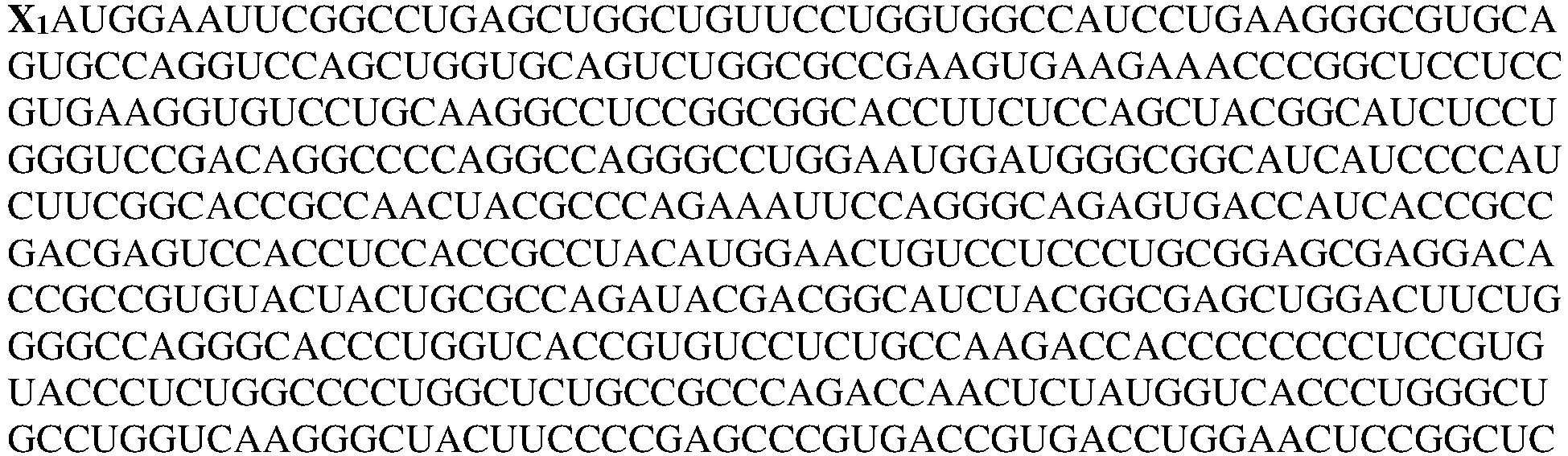


- Light chain anti-CCL2 (LC-αCCL2) mRNA:
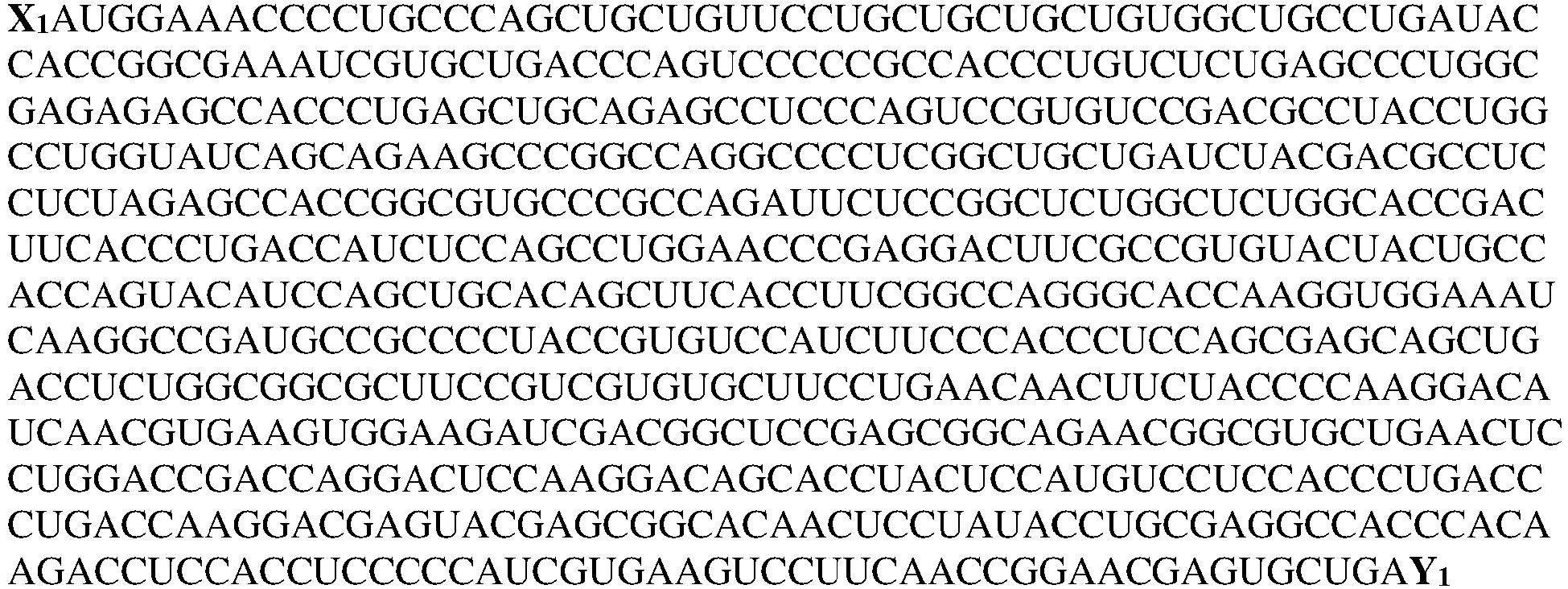
- 5' and 3' UTR Sequences:


- The lipid formulations used for transfection in the examples herein consisted of one or more lipids or a multi-component lipid mixture of varying ratios employing one or more cationic lipids, helper lipids and PEGylated lipids designed to encapsulate various nucleic acid-based materials. Cationic lipids can include (but not exclusively) DOTAP (1,2-dioleyl-3-trimethylammonium propane), DODAP (1,2-dioleyl-3-dimethylammonium propane), DOTMA (1,2-di-O-octadecenyl-3-trimethylammonium propane), DLinDMA (see Heyes, J.; Palmer, L.; Bremner, K.; MacLachlan, I. "Cationic lipid saturation influences intracellular delivery of encapsulated nucleic acids" J. Contr. Rel. 2005, 107, 276-287), DLin-KC2-DMA (see Semple, S.C. et al. "Rational Design of Cationic Lipids for siRNA Delivery" Nature Biotech. 2010, 28, 172-176), C12-200 (Love, K.T. et al. "Lipid-like materials for low-dose in vivo gene silencing" PNAS 2010, 107, 1864-1869), HGT4003, ICE, dialkylamino-based, imidazole-based, guanidinium-based, etc. Helper lipids can include (but not exclusively) DSPC (1,2-distearoyl-sn-glycero-3-phosphocholine), DPPC (1,2-dipalmitoyl-sn-glycero-3-phosphocholine), DOPE (1,2-dioleyl-sn-glycero-3-phosphoethanolamine), DPPE (1,2-dipalmitoyl-sn-glycero-3-phosphoethanolamine), DMPE (1,2-dimyristoyl-sn-glycero-3-phosphoethanolamine), DOPG (2-dioleoyl-sn-glycero-3-phospho-(1'-rac-glycerol)), cholesterol, etc. The PEGylated lipids can include (but not exclusively) a poly(ethylene) glycol chain of up to 5 kDa in length covalently attached to a lipid with alkyl chain(s) of C6-C20 length.
- In these experiments, aliquots of 50 mg/mL ethanolic solutions of C12-200, DOPE, cholesterol and DMG-PEG2K were mixed and diluted with ethanol to 3 mL final volume. Separately, an aqueous buffered solution (10 mM citrate/150 mM NaCl, pH 4.5) of HC-αCCL2 mRNA and LC-αCCL2 mRNA (1:1 wt:wt) mRNA was prepared by addition of 500 microgram of each construct from a 1 mg/mL stock. The lipid solution was injected rapidly into the aqueous mRNA solution and shaken to yield a final suspension in 20% ethanol. The resulting nanoparticle suspension was filtered, diafiltrated with 1x PBS (pH 7.4), concentrated and stored at 2-8°C. Final concentration = 1.35 mg/mL αCCL2 mRNA (encapsulated). Zave = 89.2 nm (Dv(50) = 64.0 nm; Dv(90) = 115 nm).
- In this example, F96 MaxiSorp Nunc-Immuno Plates were coated with 100µl of 1µg/ml of goat anti mouse IgG1 (Invitrogen A10538) in sodium carbonate buffer, pH 9.6 and incubated 1hr at 37°C. After washing 3x with wash buffer (1xPBS, 0.05% Tween 20), the wells were blocked with 320 µl blocking buffer (1xPBS, 0.05% Tween 20, 2% BSA) for 1hr at 37°C. Serial dilutions of monoclonal IgG standards were prepared in blocking buffer in the range from 250-0 ng/ml. Serial dilutions of the samples were prepared in blocking buffer to be in the range of the standard curve (1:100 to 1:10,000). Both samples and standards were incubated 1hr at 37°C. After washing 3x with wash buffer, goat anti mouse IgG Fc HRP conjugated secondary antibody (Pierce 31439) was used at 1:40,000 dilution and incubated at 37°C for 1hr. After washing 3x with wash buffer TMB EIA substrate reagent was prepared according to manufactures instructions. After 15 min incubation at 37°C, the reaction was stopped by adding 2N H2SO4 and the plate read at 450nm.
- In this example, conditioned medium from transfected 293T cells or electroporated HCL2 cells were fractionated by SDS-PAGE and transferred to a polyvinylidene difluoride membrane using a transfer apparatus according to the manufacturer's instructions (Invitrogen). After incubation with 5% non-fat dry milk in TBST (10mM Tris, pH 8.0, 150mM NaCl, 0.5% Tween 20) for 1hr, the membrane was washed three times with PBST and incubated with goat anti mouse IgG1 (Invitrogen A10538) for 1hr at RT. Membranes were washed three times in PBST and incubated with 1:5000 dilution of horseradish peroxidase conjugated anti-mouse secondary antibody (Promega W4021) for 1hr at RT. Blots were washed in PBST three more times and developed with the ECL system (Amersham Bioscience) according to manufacturer's instructions.
- Both HC-αCCL2 and LC-αCCL2 mRNA were produced as described above in Example 1. Subsequently, in accordance with Example 2A and B, HC-αCCL2 and LC-αCCL2 mRNA was transfected into either HCL1 (i.e., human cell line 1) cells or HCL2 cells in various rations (wt:wt) according to known methods.
- The results of these studies in HCL1 cells and HCL2 cells are demonstrated in
Figures 1 and2 , respectively. Various mixtures of α-CCL2 (chemokine (C-C motif) ligand 2) heavy chain and light chain mRNA constructs were mixed (wt:wt) and transfected into either HCL1 cells (Figure 1 ) or HCL2 cells (Figure 2 ). Cell supernatants were harvested at select time points post-transfection and analyzed for the presence of anti-mouse IgG using ELISA-based methods as described above in Example 3A. - As shown in
figures 1 and2 , varying the ratio of heavy chain to light chain (wt:wt) produced a significant difference in protein production as determined via ELISA. While a 1:1 (wt:wt) mixture of heavy chain:light chain α-CCL2 mRNA provided strong signal in HCL2 cells, a 4:1 (wt:wt) ratio provided higher protein production in HCL1 cells. While there were differences among the varying ratios, strong protein production was observed for all ratios tested. Further, in both cases, 48 hr post-transfection (Day 2, or D2) gave the strongest signal of desired protein in this example. - To further confirm the presence of the exogenous mRNA-derived antibody, immunoblot (Western) techniques were employed for additional characterization (see
Figure 3 ) of HCL1-derived samples. Heavy chain and light chain fragments were successfully detected in the supernatant of mRNA transfected HCL1 cells using western blot methods as described in example 3B. Samples were analyzed 24 and 48 hours post-transfection of various mixtures of α-CCL2 heavy chain and light chain mRNA constructs (wt:wt). Band intensities observed were reflective of the mRNA ratios employed in each example. - In this example, production of fully processed antibody was accomplished in vivo via delivery of exogenous messenger RNA, specifically, α-CCL2 heavy chain and light chain mRNA constructs (HC-αCCL2:LC-αCCL2 mRNA, 1:1 (wt:wt)) were encapsulated in cationic lipid nanoparticles as described in Example 2A and delivered to mice as a single bolus, intravenous injection.
- Briefly, male CD-1 mice of approximately 6-8 weeks of age at the beginning of each experiment were used. Samples of encapsulated HC-αCCL2 mRNA and LC-αCCL2 mRNA (1:1 wt:wt) were introduced by a single bolus tail-vein injection of an equivalent total dose of 30 micrograms. Mice were sacrificed and perfused with saline at the designated time points.
- The liver and spleen of each mouse was harvested, apportioned into three parts, and stored in either 10% neutral buffered formalin or snap-frozen and stored at -80°C for analysis.
- All animals were euthanized by CO2 asphyxiation at given time points post dose administration followed by thoracotomy and terminal cardiac blood collection. Whole blood (maximal obtainable volume) was collected via cardiac puncture on euthanized animals into serum separator tubes, allowed to clot at room temperature for at least 30 minutes, centrifuged at 22°C ± 5°C at 9300 g for 10 minutes, and the serum was extracted. For interim blood collections, approximately 40-50µL of whole blood was collected via facial vein puncture or tail snip. Samples collected from non-treatment animals were used as baseline levels for comparison to study animals.
- For ELISA analysis of αCCL2 antibody production, F96 MaxiSorp Nunc-Immuno Plate were coated with 100ml of 1mg/ml of MCP-1 recombinant rabbit purified monoclonal antibody in carbonate buffer, pH 9.6 and incubated 1hr at 37°C. After washing 3x with wash buffer (1xPBS, 0.05% Tween 20), the wells were blocked with 320 ml blocking buffer (1xPBS, 0.05% Tween 20, 2% BSA) for 1hr at 37°C. Approximately 100ng/ml MCP-1 human or mouse recombinant protein was added to each well and incubated for 1hr at 37°C. After washing 3x with wash buffer, serial dilutions of the samples (1:5 to 1:200) were added and incubated for 1hr at 37°C. After washing 3x with wash buffer, goat anti-mouse IgG Fc HRP conjugated secondary antibody was used at 1:40,000 dilution and incubated at 37°C for 1hr. After washing 3x with wash buffer TMB EIA substrate reagent was prepared according to manufactures instructions. After 15 min incubation at 37°C, the reaction was stopped by adding 2N H2SO4 and the plate read at 450nm.
- Serum levels of treated mice were monitored at select time points post-administration (6 hr, 24 hr, 48 hr, 72 hr). The levels of fully formed α-human CCL2 antibody present in mouse serum were quantified using ELISA-based methods (see
Figure 4 ). A significant increase in the desired, exogenous α-CCL2 mRNA derived antibody can be observed within six hours post-administration with a peak after 24 hours. - In this example, production of fully processed α-VEGF antibody was accomplished in vivo via delivery of exogenous messenger RNA.
- The sequences for HC-αVEGF and LC-αVEGF are as shown below, and 5' and 3' untranslated regions present in each mRNA product are represented as X and Y, respectively, and defined below:
- Heavy chain anti-VEGF (HC-αVEGF) mRNA:


- Light chain anti-VEGF (LC-αVEGF) mRNA:

- 5' and 3' UTR Sequences:
- X1 (5' UTR Sequence) =

- Y1 (3' UTR Sequence) =

- α-VEGF heavy chain and light chain mRNA constructs (HC-α-VEGF:LC-α-VEGF mRNA, 1:1 (wt:wt)) were encapsulated in cationic lipid nanoparticles as described below:
- In these experiments, aliquots of 50 mg/mL ethanolic solutions of cKK-E12, DOPE, cholesterol and DMG-PEG2K were mixed and diluted with ethanol to 3 mL final volume. Separately, an aqueous buffered solution (10 mM citrate/150 mM NaCl, pH 4.5) of HC-αCVEGF mRNA and LC-αVEGF mRNA (1:1 wt:wt) mRNA was prepared by addition of 500 microgram of each construct from a 1 mg/mL stock. The lipid solution was injected rapidly into the aqueous mRNA solution and shaken to yield a final suspension in 20% ethanol. The resulting nanoparticle suspension was filtered, diafiltrated with 1x PBS (pH 7.4), concentrated and stored at 2-8°C. Final concentration = 0.20 mg/mL αVEGF mRNA (encapsulated). Zave = 81.0 nm (PDI = 0.16).
- HC-α-VEGF and LC-α-VEGF mRNA loaded lipid nanoparticles were delivered to wild type mice either by a single intravenous tail vein injection or subcutaneous injection at a dosage of 1.0 mg/kg and the production of anti-VEGF antibody was monitored over time in serum via ELISA.
- Briefly, male CD-1 mice of approximately 6-8 weeks of age at the beginning of each experiment were used. Samples of encapsulated HC-α-VEGF mRNA and LC-α-VEGF mRNA (1:1 wt:wt) were introduced by a single bolus tail-vein injection of an equivalent total dose of 1.0 mg/kg (-30 micrograms). Mice were sacrificed and perfused with saline at the designated time points (0.50 hour, 3 hours, six hours, 12 hours, 24 hours, 48 hours, 72 hours, 96 hours, 1 week, 2 weeks, 3 weeks post-administration.
- All animals were euthanized by CO2 asphyxiation at given time points post dose administration followed by thoracotomy and terminal cardiac blood collection. Whole blood (maximal obtainable volume) was collected via cardiac puncture on euthanized animals into serum separator tubes, allowed to clot at room temperature for at least 30 minutes, centrifuged at 22°C ± 5°C at 9300 g for 10 minutes, and the serum was extracted. For interim blood collections, approximately 40-50µL of whole blood was collected via facial vein puncture or tail snip. Samples collected from non-treatment animals were used as baseline levels for comparison to study animals
- For ELISA analysis of α-VEGF antibody production, F96 MaxiSorp Nunc-Immuno Plate were coated with 100 microliters of 0.50 microgram/mL/well of recombinant human VEGF protein(Invitrogen #PHC9391) in coating buffer (50mM NaHCO3, pH9.6). After washing 3x with wash buffer, wells were blocked using a blocking buffer (1X DPBS, 2% BSA, 0.05% Tween-20) for one hour at 37°C. Upon further washing as described above, mouse serum collected from injected mice were added to each well and rabbit anti-human IgG Fc HRP (Pierce #PA-28587) conjugated secondary antibody was used at 1:10,000 dilution and incubated at 37°C for 1hr. After washing 3x with wash buffer TMB EIA substrate reagent was prepared according to manufactures instructions. After 10 min incubation at 37°C, the reaction was stopped by adding 2N H2SO4 and the plate read at 450nm. Serum levels of treated mice were monitored at select time points post-administration (e.g., 0.5 hr, 3 hr, 6 hr, 12 hr, 24 hr, 48 hr, 72 hr, 96 hr, 8 days and 15 days).
Figure 5 depicts exemplary results illustrating α-VEGF antibody detected in serum of wild type mice after single dose of HC-α-VEGF mRNA and LC-α-VEGF mRNA loaded nanoparticles. A significant increase in the desired, exogenous α-VEGF mRNA derived antibody can be observed within six hours post-administration with a peak after 24 hours and continued out to 2 weeks after a single dose of α-VEGF mRNA.Figure 6 depicts the same exemplary results asFigure 5 , but plotted by specific mouse number.Figure 7 shows a comparison of the levels of α-VEGF antibody present in the serum of mice injected either intravenously or subcutaneously after 24 hours. - This example provides further confirmation that mRNA based therapy can be used for effective in vivo antibody production.
Claims (8)
- A composition comprising a first mRNA encoding the heavy chain of an antibody and a second mRNA encoding the light chain of the antibody at a molar ratio ranging from 2:1 to 1:2 for use in therapy in a patient, wherein the first mRNA and the second mRNA (i) each comprise a 5' cap structure, a 3' poly-A tail, a 5' untranslated region and a 3' untranslated region and (ii) are encapsulated within liposomes comprising a cationic lipid, a neutral lipid, a cholesterol-based lipid, and a PEG-modified lipid and having a size no greater than 150 nm, wherein the first mRNA encoding the heavy chain and the second mRNA encoding the light chain are encapsulated in the same liposome, wherein the antibody is a tetramer and each tetramer is composed of two identical pairs of polypeptide chains, each pair having one light chain of approximately 25 kD and one heavy chain of approximately 50-70 kD, and wherein the composition is administered intravenously to the patient and the antibody is distributed systemically in the patient.
- The composition for use according to claim 1, wherein the first mRNA and the second mRNA are at a molar ratio of 1:1.
- The composition for use according to any one of the preceding claims, wherein the liposomes have a size no greater than about 100 nm or 75 nm.
- The composition for use according to any one of the preceding claims, wherein the liposomes have a size ranging from 10 nm - 100 nm.
- The composition for use according to any one of the preceding claims, wherein the mRNAs are (i) modified to enhance stability, wherein the mRNAs are modified to include nucleoside analogs, chemically or biologically modified bases, intercalated bases, modified phosphate groups and/or modified sugars, or (ii) chemically unmodified.
- The composition for use according to any one of the preceding claims, wherein the mRNAs are synthesized from (i) naturally occurring nucleotides adenine (A), guanine (G), thymine (T), cytosine (C), and uracil (D), or modified nucleotide analogues selected from the group consisting of 1-methyladenine, 2-methyl-adenine, 2-methylthio-N-6-isopentenyl-adenine, N-6-methyl-adenine, N-6-isopentenyl-adenine, 2-thio-cytosine, 3-methyl-cytosine, 4-acetyl-cytosine, 5-methyl-cytosine, 2,6-diaminopurine, 1-methyl-guanine, 2-methyl-guanine, 2,2-dimethyl-guanine, 7-methylguanine, inosine, 1-methyl-inosine, pseudouracil (5-uracil), dihydro-uracil, 2-thio-uracil, 4-thiouracil, 5-carboxymethylaminomethyl-2-thio- uracil, 5-(carboxyhydroxymethyl)-uracil, 5-fluorouracil, 5-bromo-uracil, 5-carboxymethylaminomethyl-uracil, 5-methyl-2-thio-uracil, 5-methyluracil, N-uracil-5-oxyacetic acid methyl ester, 5-methylaminomethyl-uracil, 5-methoxyaminomethyl-2-thio-uracil, 5-methoxycarbonylmethyl-uracil, 5-methoxy-uracil, uracil-5-oxyacetic acid methyl ester, uracil-5-oxyacetic acid (v), 1-methyl-pseudouracil, queosine,β-D-mannosyl-queosine, wybutoxosine, and phosphoramidates, phosphorothioates, peptide nucleotides, methylphosphonates, 7-deazaguanosine, 5-methylcytosine and inosine.
- The composition for use according to any one of the preceding claims, wherein the antibody is an IgG.
- The composition for use according to any one of the preceding claims, wherein the antibody is selected from the group consisting of anti-CCL2, anti-lysyl oxidase-like-2 (LOXL2), anti-Flt-1, anti-TNF-α, anti-Interleukin-2Rα receptor (CD25), anti-TGFp, anti-B-cell activating factor, anti-alpha-4 integrin, anti-BAGE, anti-β-catenin/m, anti-Bcr-abl, anti-C5, anti-CA125, anti-CAMEL, anti-CAP-1, anti-CASP-8, anti-CD4, anti-CD19, anti-CD20, anti-CD22, anti-CD25, anti-CDC27/m, anti-CD 30, anti-CD33, anti-CD52, anti-CD56, anti-CD80, anti-CDK4/m, anti-CEA, anti-CT, anti-CTL4, anti-Cyp-B, anti-DAM, anti-EGFR, anti-ErbB3, anti-ELF2M, anti-EMMPRIN, anti-EpCam, anti-ETV6-AML1, anti-HER2, anti-G250, anti-GAGE, anti-GnT-V, anti-Gp100, anti-HAGE, anti-HER-2/neu, anti-HLA-A*0201-R170I, anti-IGF-lR, anti-IL-2R, anti-IL-5, anti-MC1R, anti-myosin/m, anti-MUC1, anti-MUM-1, -2, -3, anti-proteinase-3, anti-p190 minor bcr-abl, anti-Pml/RARα, anti-PRAMS, anti-PSA, anti-PSM, anti-PSMA, anti-RAGE, anti-RANKL, anti-RUl or RU2, anti-SAGE, anti-SART-1 or anti-SART-3, anti-survivin, anti-TEL/AML1, anti-TPI/m, anti-TRP-1, anti-TRP-2, anti-TRP-2/INT2, anti-VEGF, and anti-VEGF receptor.
Priority Applications (6)
| Application Number | Priority Date | Filing Date | Title |
|---|---|---|---|
| RS20210906A RS62565B1 (en) | 2013-03-14 | 2014-03-14 | Methods and compositions for delivering mrna coded antibodies |
| SM20210430T SMT202100430T1 (en) | 2013-03-14 | 2014-03-14 | Methods and compositions for delivering mrna coded antibodies |
| PL14717945T PL2970456T3 (en) | 2013-03-14 | 2014-03-14 | Methods and compositions for delivering mrna coded antibodies |
| HRP20211119TT HRP20211119T1 (en) | 2013-03-14 | 2014-03-14 | Methods and compositions for delivering mrna coded antibodies |
| EP21170989.4A EP3932947A1 (en) | 2013-03-14 | 2014-03-14 | Methods and compositions for delivering mrna coded antibodies |
| SI201431860T SI2970456T1 (en) | 2013-03-14 | 2014-03-14 | Methods and compositions for delivering MRNA-encoded antibodies |
Applications Claiming Priority (3)
| Application Number | Priority Date | Filing Date | Title |
|---|---|---|---|
| US201361784903P | 2013-03-14 | 2013-03-14 | |
| US201361920165P | 2013-12-23 | 2013-12-23 | |
| PCT/US2014/027717 WO2014152774A1 (en) | 2013-03-14 | 2014-03-14 | Methods and compositions for delivering mrna coded antibodies |
Related Child Applications (1)
| Application Number | Title | Priority Date | Filing Date |
|---|---|---|---|
| EP21170989.4A Division EP3932947A1 (en) | 2013-03-14 | 2014-03-14 | Methods and compositions for delivering mrna coded antibodies |
Publications (2)
| Publication Number | Publication Date |
|---|---|
| EP2970456A1 EP2970456A1 (en) | 2016-01-20 |
| EP2970456B1 true EP2970456B1 (en) | 2021-05-19 |
Family
ID=50489425
Family Applications (2)
| Application Number | Title | Priority Date | Filing Date |
|---|---|---|---|
| EP14717945.1A Active EP2970456B1 (en) | 2013-03-14 | 2014-03-14 | Methods and compositions for delivering mrna coded antibodies |
| EP21170989.4A Pending EP3932947A1 (en) | 2013-03-14 | 2014-03-14 | Methods and compositions for delivering mrna coded antibodies |
Family Applications After (1)
| Application Number | Title | Priority Date | Filing Date |
|---|---|---|---|
| EP21170989.4A Pending EP3932947A1 (en) | 2013-03-14 | 2014-03-14 | Methods and compositions for delivering mrna coded antibodies |
Country Status (21)
| Country | Link |
|---|---|
| US (4) | US10087247B2 (en) |
| EP (2) | EP2970456B1 (en) |
| JP (4) | JP6399560B2 (en) |
| CN (1) | CN105209490A (en) |
| AU (4) | AU2014239184B2 (en) |
| BR (1) | BR112015022855A2 (en) |
| CA (1) | CA2903880A1 (en) |
| CY (1) | CY1124670T1 (en) |
| DK (1) | DK2970456T3 (en) |
| EA (1) | EA201591293A1 (en) |
| ES (1) | ES2882110T3 (en) |
| HR (1) | HRP20211119T1 (en) |
| HU (1) | HUE055044T2 (en) |
| LT (1) | LT2970456T (en) |
| MX (1) | MX2015011947A (en) |
| PL (1) | PL2970456T3 (en) |
| PT (1) | PT2970456T (en) |
| RS (1) | RS62565B1 (en) |
| SI (1) | SI2970456T1 (en) |
| SM (1) | SMT202100430T1 (en) |
| WO (1) | WO2014152774A1 (en) |
Families Citing this family (101)
| Publication number | Priority date | Publication date | Assignee | Title |
|---|---|---|---|---|
| DE102007001370A1 (en) | 2007-01-09 | 2008-07-10 | Curevac Gmbh | RNA-encoded antibodies |
| PL3338765T3 (en) | 2009-12-01 | 2019-06-28 | Translate Bio, Inc. | Steroid derivative for the delivery of mrna in human genetic diseases |
| US9238716B2 (en) | 2011-03-28 | 2016-01-19 | Massachusetts Institute Of Technology | Conjugated lipomers and uses thereof |
| PT2717893T (en) | 2011-06-08 | 2019-08-20 | Translate Bio Inc | Lipid nanoparticle compositions and methods for mrna delivery |
| DK3336082T3 (en) | 2011-06-08 | 2020-04-27 | Translate Bio Inc | SPLITLY LIPIDS |
| KR20150000461A (en) | 2011-10-27 | 2015-01-02 | 메사추세츠 인스티튜트 오브 테크놀로지 | Amino acid derivatives functionalized on the n-terminal capable of forming drug incapsulating microspheres |
| WO2013185067A1 (en) | 2012-06-08 | 2013-12-12 | Shire Human Genetic Therapies, Inc. | Nuclease resistant polynucleotides and uses thereof |
| ES2981185T3 (en) | 2013-03-14 | 2024-10-07 | Translate Bio Inc | Methods for purifying messenger RNA |
| ES2882110T3 (en) * | 2013-03-14 | 2021-12-01 | Translate Bio Inc | Methods and Compositions for Delivering mRNA-Encoded Antibodies |
| EP2968586B1 (en) | 2013-03-14 | 2018-07-25 | Translate Bio, Inc. | Cftr mrna compositions and related methods and uses |
| WO2015014376A1 (en) * | 2013-07-31 | 2015-02-05 | Biontech Ag | Diagnosis and therapy of cancer involving cancer stem cells |
| WO2015048744A2 (en) | 2013-09-30 | 2015-04-02 | Moderna Therapeutics, Inc. | Polynucleotides encoding immune modulating polypeptides |
| KR20160067219A (en) | 2013-10-03 | 2016-06-13 | 모더나 세라퓨틱스, 인코포레이티드 | Polynucleotides encoding low density lipoprotein receptor |
| WO2015061467A1 (en) | 2013-10-22 | 2015-04-30 | Shire Human Genetic Therapies, Inc. | Lipid formulations for delivery of messenger rna |
| MX2016005239A (en) | 2013-10-22 | 2016-08-12 | Shire Human Genetic Therapies | TREATMENT WITH MESSENGER RIBONUCLEIC ACID FOR PHENYLKETONURIA. |
| US11224642B2 (en) | 2013-10-22 | 2022-01-18 | Translate Bio, Inc. | MRNA therapy for argininosuccinate synthetase deficiency |
| EP3092250A4 (en) | 2014-01-08 | 2017-05-24 | Moderna Therapeutics, Inc. | Polynucleotides for the in vivo production of antibodies |
| PT3122878T (en) * | 2014-03-24 | 2019-02-01 | Translate Bio Inc | Mrna therapy for the treatment of ocular diseases |
| DK3134131T3 (en) | 2014-04-23 | 2022-02-07 | Modernatx Inc | Nucleic acid vaccines |
| JP6571679B2 (en) | 2014-04-25 | 2019-09-04 | トランスレイト バイオ, インコーポレイテッド | Method for purifying messenger RNA |
| MA40871A (en) * | 2014-10-29 | 2017-09-05 | Novartis Ag | DIRECT EXPRESSION OF ANTIBODIES |
| MA56412A (en) * | 2014-12-05 | 2022-05-04 | Translate Bio Inc | MESSENGER RNA THERAPY FOR THE TREATMENT OF JOINT DISEASES |
| WO2016149508A1 (en) | 2015-03-19 | 2016-09-22 | Shire Human Genetic Therapies, Inc. | Mrna therapy for pompe disease |
| DK3294885T3 (en) | 2015-05-08 | 2020-08-10 | Curevac Real Estate Gmbh | METHOD OF PREPARING RNA |
| PL4108769T3 (en) | 2015-05-29 | 2024-02-05 | CureVac Manufacturing GmbH | A method for producing and purifying rna, comprising at least one step of tangential flow filtration |
| ES2949540T3 (en) * | 2015-06-19 | 2023-09-29 | Massachusetts Inst Technology | Alkenyl substituted 2,5-piperazinediones and their use in compositions for delivering an agent to a subject or a cell |
| US11364292B2 (en) | 2015-07-21 | 2022-06-21 | Modernatx, Inc. | CHIKV RNA vaccines |
| MA42502A (en) | 2015-07-21 | 2018-05-30 | Modernatx Inc | VACCINES AGAINST INFECTIOUS DISEASE |
| WO2017019935A1 (en) * | 2015-07-30 | 2017-02-02 | Modernatx, Inc. | Multimeric mrna |
| WO2017070601A1 (en) | 2015-10-22 | 2017-04-27 | Modernatx, Inc. | Nucleic acid vaccines for varicella zoster virus (vzv) |
| MD3718565T2 (en) * | 2015-10-22 | 2022-09-30 | Modernatx Inc | Respiratory virus vaccines |
| TN2018000154A1 (en) * | 2015-10-22 | 2019-10-04 | Modernatx Inc | Respiratory syncytial virus vaccine |
| EP3364950A4 (en) | 2015-10-22 | 2019-10-23 | ModernaTX, Inc. | VACCINES AGAINST TROPICAL DISEASES |
| EP3365009A4 (en) * | 2015-10-22 | 2019-07-03 | ModernaTX, Inc. | VACCINE AGAINST HERPES SIMPLEX VIRUS |
| AU2016342376A1 (en) * | 2015-10-22 | 2018-06-07 | Modernatx, Inc. | Sexually transmitted disease vaccines |
| EP3364981A4 (en) * | 2015-10-22 | 2019-08-07 | ModernaTX, Inc. | VACCINE AGAINST THE CYTOMEGALOVIRUS HUMAN |
| AU2016342048B2 (en) * | 2015-10-22 | 2022-09-08 | Modernatx, Inc. | Broad spectrum influenza virus vaccine |
| CA3007955A1 (en) | 2015-12-10 | 2017-06-15 | Modernatx, Inc. | Lipid nanoparticles for delivery of therapeutic agents |
| EP3405579A1 (en) | 2016-01-22 | 2018-11-28 | Modernatx, Inc. | Messenger ribonucleic acids for the production of intracellular binding polypeptides and methods of use thereof |
| US20190167811A1 (en) | 2016-04-13 | 2019-06-06 | Modernatx, Inc. | Lipid compositions and their uses for intratumoral polynucleotide delivery |
| JP7088911B2 (en) | 2016-05-18 | 2022-06-21 | モデルナティエックス インコーポレイテッド | Polynucleotide encoding relaxin |
| DK3458083T5 (en) | 2016-05-18 | 2024-10-21 | Modernatx Inc | POLYNUCLEOTIDES ENCODING INTERLEUKIN-12 (IL12) AND USES THEREOF |
| AU2017345766A1 (en) | 2016-10-21 | 2019-05-16 | Modernatx, Inc. | Human cytomegalovirus vaccine |
| EP3551193A4 (en) | 2016-12-08 | 2020-08-19 | Modernatx, Inc. | NUCLEIC ACID VACCINES AGAINST RESPIRATORY VIRUS |
| WO2018151816A1 (en) | 2017-02-16 | 2018-08-23 | Modernatx, Inc. | High potency immunogenic compositions |
| CA3054321A1 (en) | 2017-02-27 | 2018-08-30 | Translate Bio, Inc. | Methods for purification of messenger rna |
| AU2018224326B2 (en) | 2017-02-27 | 2024-01-04 | Translate Bio, Inc. | Novel codon-optimized CFTR mRNA |
| ES2925083T3 (en) | 2017-02-27 | 2022-10-13 | Translate Bio Inc | Messenger RNA purification methods |
| WO2018170245A1 (en) | 2017-03-15 | 2018-09-20 | Modernatx, Inc. | Broad spectrum influenza virus vaccine |
| MA47787A (en) | 2017-03-15 | 2020-01-22 | Modernatx Inc | RESPIRATORY SYNCYTIAL VIRUS VACCINE |
| WO2018170347A1 (en) | 2017-03-17 | 2018-09-20 | Modernatx, Inc. | Zoonotic disease rna vaccines |
| MX2019013752A (en) | 2017-05-16 | 2020-07-20 | Translate Bio Inc | Treatment of cystic fibrosis by delivery of codon-optimized mrna encoding cftr. |
| ES2952779T3 (en) | 2017-05-18 | 2023-11-06 | Modernatx Inc | Modified messenger RNA comprising functional RNA elements |
| US20200131498A1 (en) | 2017-06-14 | 2020-04-30 | Modernatx, Inc. | Polynucleotides encoding methylmalonyl-coa mutase |
| US10653767B2 (en) | 2017-09-14 | 2020-05-19 | Modernatx, Inc. | Zika virus MRNA vaccines |
| WO2019148101A1 (en) | 2018-01-29 | 2019-08-01 | Modernatx, Inc. | Rsv rna vaccines |
| MA53123A (en) | 2018-07-13 | 2021-05-19 | Genmab As | TROGOCYTOSIS MEDIATION THERAPY USING CD38 ANTIBODIES |
| BR112020026432A2 (en) | 2018-07-13 | 2021-03-23 | Genmab A/S | antibody variant, isolated nucleic acid, expression vector, nucleic acid, combination of nucleic acids, dispensing vehicle, recombinant host cell, methods for producing an antibody variant, to increase at least one effector function of a parental antibody and to treat a disease, antibody, composition, pharmaceutical composition, and, antibody variant for use |
| CN118421617A (en) | 2018-08-24 | 2024-08-02 | 川斯勒佰尔公司 | Method for purifying messenger RNA |
| US12151029B2 (en) | 2018-09-19 | 2024-11-26 | Modernatx, Inc. | PEG lipids and uses thereof |
| AU2019345067A1 (en) | 2018-09-19 | 2021-04-08 | Modernatx, Inc. | High-purity peg lipids and uses thereof |
| CN113166783B (en) | 2018-10-09 | 2024-10-11 | 不列颠哥伦比亚大学 | Compositions and systems comprising organic solvent-free and detergent-free transfection-active vesicles and methods related thereto |
| EP3877538A1 (en) | 2018-11-08 | 2021-09-15 | Translate Bio, Inc. | Methods and compositions for messenger rna purification |
| EP3883592A1 (en) | 2018-11-21 | 2021-09-29 | Translate Bio, Inc. | Treatment of cystic fibrosis by delivery of nebulized mrna encoding cftr |
| US11351242B1 (en) | 2019-02-12 | 2022-06-07 | Modernatx, Inc. | HMPV/hPIV3 mRNA vaccine composition |
| WO2020190750A1 (en) | 2019-03-15 | 2020-09-24 | Modernatx, Inc. | Hiv rna vaccines |
| EP4027982A1 (en) * | 2019-09-11 | 2022-07-20 | ModernaTX, Inc. | Lnp-formulated mrna therapeutics and use thereof for treating human subjects |
| WO2021055609A1 (en) | 2019-09-20 | 2021-03-25 | Translate Bio, Inc. | Mrna encoding engineered cftr |
| JP2023511633A (en) | 2020-01-28 | 2023-03-20 | モデルナティエックス インコーポレイテッド | coronavirus RNA vaccine |
| AU2021215938A1 (en) | 2020-02-07 | 2022-09-01 | Modernatx, Inc. | Sars-cov-2 mrna domain vaccines |
| WO2021222304A1 (en) | 2020-04-27 | 2021-11-04 | Modernatx, Inc. | Sars-cov-2 rna vaccines |
| WO2021159130A2 (en) | 2020-05-15 | 2021-08-12 | Modernatx, Inc. | Coronavirus rna vaccines and methods of use |
| CN111658782A (en) * | 2020-06-10 | 2020-09-15 | 深圳近邻生物科技有限公司 | mRNA vaccine delivery vector and preparation method thereof, and mRNA vaccine and preparation method thereof |
| US11406703B2 (en) | 2020-08-25 | 2022-08-09 | Modernatx, Inc. | Human cytomegalovirus vaccine |
| WO2022067010A1 (en) | 2020-09-25 | 2022-03-31 | Modernatx, Inc. | Multi-proline-substituted coronavirus spike protein vaccines |
| KR20230118715A (en) | 2020-10-14 | 2023-08-11 | 조지 메이슨 리서치 파운데이션 인코포레이티드 | Ionizable lipids and methods of making and using the same |
| US11771652B2 (en) | 2020-11-06 | 2023-10-03 | Sanofi | Lipid nanoparticles for delivering mRNA vaccines |
| JP2024504614A (en) * | 2021-01-14 | 2024-02-01 | トランスレイト バイオ, インコーポレイテッド | Methods and compositions for delivering mRNA-encoded antibodies |
| US11524023B2 (en) | 2021-02-19 | 2022-12-13 | Modernatx, Inc. | Lipid nanoparticle compositions and methods of formulating the same |
| US20240299531A1 (en) | 2021-03-15 | 2024-09-12 | Moderna TX, Inc | Therapeutic use of sars-cov-2 mrna domain vaccines |
| CN113289762A (en) * | 2021-05-07 | 2021-08-24 | 扬州三源机械有限公司 | Recoverable garbage sorting device for garbage disposal station based on green environmental protection |
| EP4392140A1 (en) | 2021-08-24 | 2024-07-03 | BioNTech SE | In vitro transcription technologies |
| IL309505A (en) | 2021-09-03 | 2024-02-01 | CureVac SE | Lipid nanoparticles for nucleic acid delivery |
| US20230109496A1 (en) | 2021-09-06 | 2023-04-06 | Genmab B.V. | Antibodies capable of binding to cd27, variants thereof and uses thereof |
| AR127298A1 (en) | 2021-10-08 | 2024-01-10 | Genmab As | ANTIBODIES THAT BIND CD30 AND CD3 |
| EP4419081A1 (en) | 2021-10-22 | 2024-08-28 | Sail Biomedicines, Inc. | Mrna vaccine composition |
| US20250027108A1 (en) | 2021-10-29 | 2025-01-23 | CureVac SE | Improved circular rna for expressing therapeutic proteins |
| WO2023092069A1 (en) | 2021-11-18 | 2023-05-25 | Modernatx, Inc. | Sars-cov-2 mrna domain vaccines and methods of use |
| KR20240107356A (en) | 2021-11-23 | 2024-07-09 | 세일 바이오메디슨스, 인크. | Bacteria-derived lipid compositions and uses thereof |
| US20250099614A1 (en) | 2022-01-28 | 2025-03-27 | CureVac SE | Nucleic acid encoded transcription factor inhibitors |
| JP2025513493A (en) * | 2022-04-19 | 2025-04-24 | ホン ジャン, | DNA THERAPEUTICS ENCODING ANTIBODIES OR ANTIGEN-BINDING FRAGMENTS |
| CA3248209A1 (en) | 2022-05-25 | 2023-11-30 | CureVac SE | Nucleic acid based vaccine encoding an escherichia coli fimh antigenic polypeptide |
| WO2024015890A1 (en) | 2022-07-13 | 2024-01-18 | Modernatx, Inc. | Norovirus mrna vaccines |
| WO2024083345A1 (en) | 2022-10-21 | 2024-04-25 | BioNTech SE | Methods and uses associated with liquid compositions |
| EP4608442A1 (en) | 2022-10-28 | 2025-09-03 | GlaxoSmithKline Biologicals S.A. | Nucleic acid based vaccine |
| KR20250153793A (en) | 2023-01-27 | 2025-10-27 | 세일 바이오메디슨스, 인크. | Modified lipid composition and use thereof |
| JP2026509258A (en) | 2023-03-08 | 2026-03-17 | キュアバック エスイー | Novel lipid nanoparticle formulations for nucleic acid delivery |
| WO2024220712A2 (en) | 2023-04-19 | 2024-10-24 | Sail Biomedicines, Inc. | Vaccine compositions |
| WO2024230934A1 (en) | 2023-05-11 | 2024-11-14 | CureVac SE | Therapeutic nucleic acid for the treatment of ophthalmic diseases |
| US12410258B2 (en) | 2023-05-12 | 2025-09-09 | Ganmab A/S | Antibodies capable of binding to OX40, variants thereof and uses thereof |
| WO2025003280A1 (en) | 2023-06-30 | 2025-01-02 | Genmab A/S | Antibodies binding to fibroblast activation protein alpha and death receptor 4 |
Citations (15)
| Publication number | Priority date | Publication date | Assignee | Title |
|---|---|---|---|---|
| WO2003048306A2 (en) | 2001-11-16 | 2003-06-12 | Idec Pharmaceuticals Corporation | Polycistronic expression of antibodies |
| WO2006017325A2 (en) | 2004-07-13 | 2006-02-16 | Cell Genesys, Inc. | Aav vector compositions and methods for enhanced expression of immunoglobulins the same |
| WO2008083949A2 (en) * | 2007-01-09 | 2008-07-17 | Curevac Gmbh | Rna-coded antibody |
| WO2009086558A1 (en) | 2008-01-02 | 2009-07-09 | Tekmira Pharmaceuticals Corporation | Improved compositions and methods for the delivery of nucleic acids |
| WO2010054406A1 (en) | 2008-11-10 | 2010-05-14 | Alnylam Pharmaceuticals, Inc. | Novel lipids and compositions for the delivery of therapeutics |
| WO2011068810A1 (en) | 2009-12-01 | 2011-06-09 | Shire Human Genetic Therapies | Delivery of mrna for the augmentation of proteins and enzymes in human genetic diseases |
| WO2012006377A2 (en) | 2010-07-06 | 2012-01-12 | Novartis Ag | Delivery of rna to trigger multiple immune pathways |
| WO2012006378A1 (en) | 2010-07-06 | 2012-01-12 | Novartis Ag | Liposomes with lipids having an advantageous pka- value for rna delivery |
| WO2012045082A2 (en) | 2010-10-01 | 2012-04-05 | Jason Schrum | Engineered nucleic acids and methods of use thereof |
| WO2012170889A1 (en) | 2011-06-08 | 2012-12-13 | Shire Human Genetic Therapies, Inc. | Cleavable lipids |
| WO2012170930A1 (en) * | 2011-06-08 | 2012-12-13 | Shire Human Genetic Therapies, Inc | Lipid nanoparticle compositions and methods for mrna delivery |
| WO2013151666A2 (en) | 2012-04-02 | 2013-10-10 | modeRNA Therapeutics | Modified polynucleotides for the production of biologics and proteins associated with human disease |
| WO2013185069A1 (en) | 2012-06-08 | 2013-12-12 | Shire Human Genetic Therapies, Inc. | Pulmonary delivery of mrna to non-lung target cells |
| WO2014152774A1 (en) | 2013-03-14 | 2014-09-25 | Shire Human Genetic Therapies, Inc. | Methods and compositions for delivering mrna coded antibodies |
| WO2015061461A1 (en) | 2013-10-22 | 2015-04-30 | Shire Human Genetic Therapies, Inc. | Cns delivery of mrna and uses thereof |
Family Cites Families (130)
| Publication number | Priority date | Publication date | Assignee | Title |
|---|---|---|---|---|
| US4500707A (en) | 1980-02-29 | 1985-02-19 | University Patents, Inc. | Nucleosides useful in the preparation of polynucleotides |
| US4458066A (en) | 1980-02-29 | 1984-07-03 | University Patents, Inc. | Process for preparing polynucleotides |
| US5132418A (en) | 1980-02-29 | 1992-07-21 | University Patents, Inc. | Process for preparing polynucleotides |
| US4668777A (en) | 1981-03-27 | 1987-05-26 | University Patents, Inc. | Phosphoramidite nucleoside compounds |
| US4415732A (en) | 1981-03-27 | 1983-11-15 | University Patents, Inc. | Phosphoramidite compounds and processes |
| US4973679A (en) | 1981-03-27 | 1990-11-27 | University Patents, Inc. | Process for oligonucleo tide synthesis using phosphormidite intermediates |
| US4401796A (en) | 1981-04-30 | 1983-08-30 | City Of Hope Research Institute | Solid-phase synthesis of polynucleotides |
| US4373071A (en) | 1981-04-30 | 1983-02-08 | City Of Hope Research Institute | Solid-phase synthesis of polynucleotides |
| US4897355A (en) | 1985-01-07 | 1990-01-30 | Syntex (U.S.A.) Inc. | N[ω,(ω-1)-dialkyloxy]- and N-[ω,(ω-1)-dialkenyloxy]-alk-1-yl-N,N,N-tetrasubstituted ammonium lipids and uses therefor |
| US4737323A (en) | 1986-02-13 | 1988-04-12 | Liposome Technology, Inc. | Liposome extrusion method |
| US5153319A (en) | 1986-03-31 | 1992-10-06 | University Patents, Inc. | Process for preparing polynucleotides |
| US5262530A (en) | 1988-12-21 | 1993-11-16 | Applied Biosystems, Inc. | Automated system for polynucleotide synthesis and purification |
| US5047524A (en) | 1988-12-21 | 1991-09-10 | Applied Biosystems, Inc. | Automated system for polynucleotide synthesis and purification |
| FR2645866B1 (en) | 1989-04-17 | 1991-07-05 | Centre Nat Rech Scient | NEW LIPOPOLYAMINES, THEIR PREPARATION AND THEIR USE |
| US5334761A (en) | 1992-08-28 | 1994-08-02 | Life Technologies, Inc. | Cationic lipids |
| US5885613A (en) | 1994-09-30 | 1999-03-23 | The University Of British Columbia | Bilayer stabilizing components and their use in forming programmable fusogenic liposomes |
| US5700642A (en) | 1995-05-22 | 1997-12-23 | Sri International | Oligonucleotide sizing using immobilized cleavable primers |
| US5705385A (en) | 1995-06-07 | 1998-01-06 | Inex Pharmaceuticals Corporation | Lipid-nucleic acid particles prepared via a hydrophobic lipid-nucleic acid complex intermediate and use for gene transfer |
| US7422902B1 (en) | 1995-06-07 | 2008-09-09 | The University Of British Columbia | Lipid-nucleic acid particles prepared via a hydrophobic lipid-nucleic acid complex intermediate and use for gene transfer |
| US5981501A (en) | 1995-06-07 | 1999-11-09 | Inex Pharmaceuticals Corp. | Methods for encapsulating plasmids in lipid bilayers |
| CA2222328C (en) | 1995-06-07 | 2012-01-10 | Inex Pharmaceuticals Corporation | Lipid-nucleic acid particles prepared via a hydrophobic lipid-nucleic acid complex intermediate and use for gene transfer |
| US5744335A (en) | 1995-09-19 | 1998-04-28 | Mirus Corporation | Process of transfecting a cell with a polynucleotide mixed with an amphipathic compound and a DNA-binding protein |
| IL140110A0 (en) * | 2000-12-05 | 2002-02-10 | Applied Research Systems | Improvement of homogeneity and secretion of recombinant proteins in mammalian systems |
| DE10162480A1 (en) | 2001-12-19 | 2003-08-07 | Ingmar Hoerr | The application of mRNA for use as a therapeutic agent against tumor diseases |
| EP1519714B1 (en) | 2002-06-28 | 2010-10-20 | Protiva Biotherapeutics Inc. | Method and apparatus for producing liposomes |
| CN1882693B (en) | 2003-09-15 | 2012-08-15 | 普洛体维生物治疗公司 | Polyethylene glycol modified lipid compound and its application |
| US20070265220A1 (en) | 2004-03-15 | 2007-11-15 | City Of Hope | Methods and compositions for the specific inhibition of gene expression by double-stranded RNA |
| WO2005120152A2 (en) | 2004-06-07 | 2005-12-22 | Protiva Biotherapeutics, Inc. | Cationic lipids and methods of use |
| ATE536418T1 (en) | 2004-06-07 | 2011-12-15 | Protiva Biotherapeutics Inc | LIPID ENCAPSULATED INTERFERENCE RNA |
| DE102004042546A1 (en) | 2004-09-02 | 2006-03-09 | Curevac Gmbh | Combination therapy for immune stimulation |
| WO2007051303A1 (en) | 2005-11-02 | 2007-05-10 | Protiva Biotherapeutics, Inc. | MODIFIED siRNA MOLECULES AND USES THEREOF |
| FR2904144A1 (en) | 2006-07-19 | 2008-01-25 | St Microelectronics Rousset | METHOD FOR MANUFACTURING A SEMICONDUCTOR WAFER COMPRISING AN INTEGRATED OPTICAL FILTER |
| US20080145413A1 (en) * | 2006-12-19 | 2008-06-19 | Steffen Panzner | Lipids and lipid assemblies comprising transfection enhancer elements |
| WO2009030254A1 (en) | 2007-09-04 | 2009-03-12 | Curevac Gmbh | Complexes of rna and cationic peptides for transfection and for immunostimulation |
| WO2009046739A1 (en) | 2007-10-09 | 2009-04-16 | Curevac Gmbh | Composition for treating prostate cancer (pca) |
| CN102006890A (en) | 2007-12-04 | 2011-04-06 | 阿尔尼拉姆医药品有限公司 | Targeting lipids |
| JP5697988B2 (en) | 2007-12-27 | 2015-04-08 | プロチバ バイオセラピューティクス インコーポレイティッド | Method for silencing polo-like kinase expression using interfering RNA |
| US20110097720A1 (en) | 2008-01-02 | 2011-04-28 | Alnylam Pharmaceuticals, Inc. | Screening method for selected amino lipid-containing compositions |
| EP3604533A1 (en) | 2008-04-11 | 2020-02-05 | Arbutus Biopharma Corporation | Site-specific delivery of nucleic acids by combining targeting ligands with endosomolytic components |
| NZ588583A (en) | 2008-04-15 | 2012-08-31 | Protiva Biotherapeutics Inc | Novel lipid formulations for nucleic acid delivery |
| WO2010037408A1 (en) | 2008-09-30 | 2010-04-08 | Curevac Gmbh | Composition comprising a complexed (m)rna and a naked mrna for providing or enhancing an immunostimulatory response in a mammal and uses thereof |
| JP5777519B2 (en) | 2008-10-09 | 2015-09-09 | テクミラ ファーマシューティカルズ コーポレイション | Improved aminolipid and nucleic acid delivery methods |
| MX2011004859A (en) | 2008-11-07 | 2011-08-03 | Massachusetts Inst Technology | Aminoalcohol lipidoids and uses thereof. |
| WO2010083615A1 (en) | 2009-01-26 | 2010-07-29 | Protiva Biotherapeutics, Inc. | Compositions and methods for silencing apolipoprotein c-iii expression |
| SG176553A1 (en) | 2009-05-05 | 2012-01-30 | Muthiah Manoharan | Lipid compositions |
| TR201811076T4 (en) | 2009-06-10 | 2018-08-27 | Arbutus Biopharma Corp | Improved lipid formulation. |
| US9051567B2 (en) | 2009-06-15 | 2015-06-09 | Tekmira Pharmaceuticals Corporation | Methods for increasing efficacy of lipid formulated siRNA |
| US8236943B2 (en) | 2009-07-01 | 2012-08-07 | Protiva Biotherapeutics, Inc. | Compositions and methods for silencing apolipoprotein B |
| US8569256B2 (en) | 2009-07-01 | 2013-10-29 | Protiva Biotherapeutics, Inc. | Cationic lipids and methods for the delivery of therapeutic agents |
| WO2011011447A1 (en) | 2009-07-20 | 2011-01-27 | Protiva Biotherapeutics, Inc. | Compositions and methods for silencing ebola virus gene expression |
| WO2011069529A1 (en) | 2009-12-09 | 2011-06-16 | Curevac Gmbh | Mannose-containing solution for lyophilization, transfection and/or injection of nucleic acids |
| EP3494963A1 (en) | 2009-12-18 | 2019-06-12 | The University of British Columbia | Methods and compositions for delivery of nucleic acids |
| US20130123338A1 (en) | 2010-05-12 | 2013-05-16 | Protiva Biotherapeutics, Inc. | Novel cationic lipids and methods of use thereof |
| WO2012000104A1 (en) | 2010-06-30 | 2012-01-05 | Protiva Biotherapeutics, Inc. | Non-liposomal systems for nucleic acid delivery |
| US20130323269A1 (en) | 2010-07-30 | 2013-12-05 | Muthiah Manoharan | Methods and compositions for delivery of active agents |
| CA2807552A1 (en) | 2010-08-06 | 2012-02-09 | Moderna Therapeutics, Inc. | Engineered nucleic acids and methods of use thereof |
| US8853377B2 (en) | 2010-11-30 | 2014-10-07 | Shire Human Genetic Therapies, Inc. | mRNA for use in treatment of human genetic diseases |
| WO2012116715A1 (en) | 2011-03-02 | 2012-09-07 | Curevac Gmbh | Vaccination in newborns and infants |
| WO2012113413A1 (en) | 2011-02-21 | 2012-08-30 | Curevac Gmbh | Vaccine composition comprising complexed immunostimulatory nucleic acids and antigens packaged with disulfide-linked polyethyleneglycol/peptide conjugates |
| JP2014511687A (en) | 2011-03-31 | 2014-05-19 | モデルナ セラピューティクス インコーポレイテッド | Engineered nucleic acid delivery and formulation |
| CN103687957A (en) | 2011-05-17 | 2014-03-26 | 现代治疗公司 | Engineered nucleic acids and methods for their use in non-human vertebrates |
| US9464124B2 (en) | 2011-09-12 | 2016-10-11 | Moderna Therapeutics, Inc. | Engineered nucleic acids and methods of use thereof |
| WO2013039861A2 (en) | 2011-09-12 | 2013-03-21 | modeRNA Therapeutics | Engineered nucleic acids and methods of use thereof |
| WO2013039857A1 (en) | 2011-09-12 | 2013-03-21 | modeRNA Therapeutics | Engineered nucleic acids and methods of use thereof |
| EP2763701B1 (en) | 2011-10-03 | 2018-12-19 | Moderna Therapeutics, Inc. | Modified nucleosides, nucleotides, and nucleic acids, and uses thereof |
| KR20150000461A (en) | 2011-10-27 | 2015-01-02 | 메사추세츠 인스티튜트 오브 테크놀로지 | Amino acid derivatives functionalized on the n-terminal capable of forming drug incapsulating microspheres |
| EP2791159A4 (en) | 2011-12-14 | 2015-10-14 | Moderna Therapeutics Inc | MODIFIED NUCLEIC ACIDS, AND SHORT-TERM CARE USES THEREOF |
| WO2013130161A1 (en) | 2011-12-14 | 2013-09-06 | modeRNA Therapeutics | Methods of responding to a biothreat |
| JP2015501844A (en) | 2011-12-16 | 2015-01-19 | モデルナ セラピューティクス インコーポレイテッドModerna Therapeutics,Inc. | Modified nucleosides, nucleotides and nucleic acid compositions |
| CN104968354A (en) | 2011-12-21 | 2015-10-07 | 现代治疗公司 | Methods of increasing the viability or longevity of an organ or organ explant |
| WO2013101690A1 (en) | 2011-12-29 | 2013-07-04 | modeRNA Therapeutics | Modified mrnas encoding cell-penetrating polypeptides |
| WO2013120499A1 (en) | 2012-02-15 | 2013-08-22 | Curevac Gmbh | Nucleic acid comprising or coding for a histone stem-loop and a poly (a) sequence or a polyadenylation signal for increasing the expression of an encoded pathogenic antigen |
| WO2013120497A1 (en) | 2012-02-15 | 2013-08-22 | Curevac Gmbh | Nucleic acid comprising or coding for a histone stem-loop and a poly(a) sequence or a polyadenylation signal for increasing the expression of an encoded therapeutic protein |
| DK2817287T3 (en) | 2012-02-24 | 2019-01-02 | Arbutus Biopharma Corp | TRIALKYL CATIONIC LIPID AND METHODS FOR USING IT |
| US9283287B2 (en) | 2012-04-02 | 2016-03-15 | Moderna Therapeutics, Inc. | Modified polynucleotides for the production of nuclear proteins |
| US20140275229A1 (en) | 2012-04-02 | 2014-09-18 | Moderna Therapeutics, Inc. | Modified polynucleotides encoding udp glucuronosyltransferase 1 family, polypeptide a1 |
| US9254311B2 (en) | 2012-04-02 | 2016-02-09 | Moderna Therapeutics, Inc. | Modified polynucleotides for the production of proteins |
| US9572897B2 (en) | 2012-04-02 | 2017-02-21 | Modernatx, Inc. | Modified polynucleotides for the production of cytoplasmic and cytoskeletal proteins |
| WO2013151663A1 (en) | 2012-04-02 | 2013-10-10 | modeRNA Therapeutics | Modified polynucleotides for the production of membrane proteins |
| US20150050354A1 (en) | 2012-04-02 | 2015-02-19 | Moderna Therapeutics, Inc. | Modified polynucleotides for the treatment of otic diseases and conditions |
| ES2921623T3 (en) | 2012-11-26 | 2022-08-30 | Modernatx Inc | terminally modified RNA |
| US9636301B2 (en) | 2012-12-04 | 2017-05-02 | Arbutus Biopharma Corporation | In vitro release assay for liposome encapsulated vincristine |
| EP2929035A1 (en) | 2012-12-07 | 2015-10-14 | Shire Human Genetic Therapies, Inc. | Lipidic nanoparticles for mrna delivering |
| US20150315541A1 (en) | 2012-12-13 | 2015-11-05 | Moderna Therapeutics, Inc. | Modified polynucleotides for altering cell phenotype |
| EP2931319B1 (en) | 2012-12-13 | 2019-08-21 | ModernaTX, Inc. | Modified nucleic acid molecules and uses thereof |
| JP2016504050A (en) | 2013-01-17 | 2016-02-12 | モデルナ セラピューティクス インコーポレイテッドModerna Therapeutics,Inc. | Signal sensor polynucleotide for modification of cell phenotype |
| WO2014158795A1 (en) | 2013-03-12 | 2014-10-02 | Moderna Therapeutics, Inc. | Diagnosis and treatment of fibrosis |
| US20160024181A1 (en) | 2013-03-13 | 2016-01-28 | Moderna Therapeutics, Inc. | Long-lived polynucleotide molecules |
| US10258698B2 (en) | 2013-03-14 | 2019-04-16 | Modernatx, Inc. | Formulation and delivery of modified nucleoside, nucleotide, and nucleic acid compositions |
| US10077439B2 (en) | 2013-03-15 | 2018-09-18 | Modernatx, Inc. | Removal of DNA fragments in mRNA production process |
| EP2971161B1 (en) | 2013-03-15 | 2018-12-26 | ModernaTX, Inc. | Ribonucleic acid purification |
| WO2014144711A1 (en) | 2013-03-15 | 2014-09-18 | Moderna Therapeutics, Inc. | Analysis of mrna heterogeneity and stability |
| EP2983804A4 (en) | 2013-03-15 | 2017-03-01 | Moderna Therapeutics, Inc. | Ion exchange purification of mrna |
| EP2971033B8 (en) | 2013-03-15 | 2019-07-10 | ModernaTX, Inc. | Manufacturing methods for production of rna transcripts |
| US8980864B2 (en) | 2013-03-15 | 2015-03-17 | Moderna Therapeutics, Inc. | Compositions and methods of altering cholesterol levels |
| WO2014144039A1 (en) | 2013-03-15 | 2014-09-18 | Moderna Therapeutics, Inc. | Characterization of mrna molecules |
| HUE056760T2 (en) | 2013-07-11 | 2022-03-28 | Modernatx Inc | Compositions comprising synthetic polynucleotides encoding crispr related proteins and synthetic sgrnas and methods of use |
| WO2015011633A1 (en) | 2013-07-23 | 2015-01-29 | Protiva Biotherapeutics, Inc. | Compositions and methods for delivering messenger rna |
| US20160194625A1 (en) | 2013-09-03 | 2016-07-07 | Moderna Therapeutics, Inc. | Chimeric polynucleotides |
| WO2015034925A1 (en) | 2013-09-03 | 2015-03-12 | Moderna Therapeutics, Inc. | Circular polynucleotides |
| WO2015048744A2 (en) | 2013-09-30 | 2015-04-02 | Moderna Therapeutics, Inc. | Polynucleotides encoding immune modulating polypeptides |
| WO2015051169A2 (en) | 2013-10-02 | 2015-04-09 | Moderna Therapeutics, Inc. | Polynucleotide molecules and uses thereof |
| WO2015051173A2 (en) | 2013-10-02 | 2015-04-09 | Moderna Therapeutics, Inc | Polynucleotide molecules and uses thereof |
| US20160243221A1 (en) | 2013-10-18 | 2016-08-25 | Moderna Therapeutics, Inc. | Compositions and methods for tolerizing cellular systems |
| WO2015085318A2 (en) | 2013-12-06 | 2015-06-11 | Moderna Therapeutics, Inc. | Targeted adaptive vaccines |
| US20150167017A1 (en) | 2013-12-13 | 2015-06-18 | Moderna Therapeutics, Inc. | Alternative nucleic acid molecules and uses thereof |
| CN111304231A (en) | 2013-12-30 | 2020-06-19 | 库瑞瓦格股份公司 | artificial nucleic acid molecules |
| US20170002060A1 (en) | 2014-01-08 | 2017-01-05 | Moderna Therapeutics, Inc. | Polynucleotides for the in vivo production of antibodies |
| ES2754239T3 (en) | 2014-03-12 | 2020-04-16 | Curevac Ag | Combination of vaccination and OX40 agonists |
| DK3134131T3 (en) | 2014-04-23 | 2022-02-07 | Modernatx Inc | Nucleic acid vaccines |
| US10837039B2 (en) | 2014-06-10 | 2020-11-17 | Curevac Real Estate Gmbh | Methods and means for enhancing RNA production |
| WO2015196128A2 (en) | 2014-06-19 | 2015-12-23 | Moderna Therapeutics, Inc. | Alternative nucleic acid molecules and uses thereof |
| WO2015196118A1 (en) | 2014-06-19 | 2015-12-23 | Moderna Therapeutics, Inc. | Alternative nucleic acid molecules and uses thereof |
| KR20170075742A (en) | 2014-10-02 | 2017-07-03 | 프로티바 바이오쎄라퓨틱스, 인코포레이티드 | Compositions and methods for silencing hepatitis b virus gene expression |
| WO2016071857A1 (en) | 2014-11-07 | 2016-05-12 | Protiva Biotherapeutics, Inc. | Compositions and methods for silencing ebola virus expression |
| EP3218508A4 (en) | 2014-11-10 | 2018-04-18 | Modernatx, Inc. | Multiparametric nucleic acid optimization |
| WO2016077125A1 (en) | 2014-11-10 | 2016-05-19 | Moderna Therapeutics, Inc. | Alternative nucleic acid molecules containing reduced uracil content and uses thereof |
| WO2016118724A1 (en) | 2015-01-21 | 2016-07-28 | Moderna Therapeutics, Inc. | Lipid nanoparticle compositions |
| EP3247398A4 (en) | 2015-01-23 | 2018-09-26 | Moderna Therapeutics, Inc. | Lipid nanoparticle compositions |
| CA2979998A1 (en) | 2015-03-20 | 2016-09-29 | Protiva Biotherapeutics, Inc. | Compositions and methods for treating hypertriglyceridemia |
| WO2016164762A1 (en) | 2015-04-08 | 2016-10-13 | Moderna Therapeutics, Inc. | Polynucleotides encoding low density lipoprotein receptor egf-a and intracellular domain mutants and methods of using the same |
| WO2016183366A2 (en) | 2015-05-12 | 2016-11-17 | Protiva Biotherapeutics, Inc. | Compositions and methods for silencing expression of hepatitis d virus rna |
| WO2016197133A1 (en) | 2015-06-04 | 2016-12-08 | Protiva Biotherapeutics, Inc. | Delivering crispr therapeutics with lipid nanoparticles |
| US20180245074A1 (en) | 2015-06-04 | 2018-08-30 | Protiva Biotherapeutics, Inc. | Treating hepatitis b virus infection using crispr |
| EP3307305A4 (en) | 2015-06-10 | 2019-05-22 | Modernatx, Inc. | Targeted adaptive vaccines |
| HK1248278A1 (en) | 2015-07-29 | 2018-10-12 | Arbutus Biopharma Corporation | Compositions and methods for silencing hepatitis b virus gene expression |
| WO2017049286A1 (en) | 2015-09-17 | 2017-03-23 | Moderna Therapeutics, Inc. | Polynucleotides containing a morpholino linker |
| SI3350333T1 (en) | 2015-09-17 | 2022-04-29 | ModernaTX,Inc. | Polynucleotides containing a stabilizing tail region |
| WO2017049074A1 (en) | 2015-09-18 | 2017-03-23 | Moderna Therapeutics, Inc. | Polynucleotide formulations for use in the treatment of renal diseases |
| USD787703S1 (en) | 2016-04-26 | 2017-05-23 | Curevac Ag | Inlay for a culture plate |
-
2014
- 2014-03-14 ES ES14717945T patent/ES2882110T3/en active Active
- 2014-03-14 CA CA2903880A patent/CA2903880A1/en active Pending
- 2014-03-14 EP EP14717945.1A patent/EP2970456B1/en active Active
- 2014-03-14 SI SI201431860T patent/SI2970456T1/en unknown
- 2014-03-14 PL PL14717945T patent/PL2970456T3/en unknown
- 2014-03-14 RS RS20210906A patent/RS62565B1/en unknown
- 2014-03-14 CN CN201480010113.8A patent/CN105209490A/en active Pending
- 2014-03-14 MX MX2015011947A patent/MX2015011947A/en unknown
- 2014-03-14 WO PCT/US2014/027717 patent/WO2014152774A1/en not_active Ceased
- 2014-03-14 US US14/775,835 patent/US10087247B2/en active Active
- 2014-03-14 DK DK14717945.1T patent/DK2970456T3/en active
- 2014-03-14 SM SM20210430T patent/SMT202100430T1/en unknown
- 2014-03-14 BR BR112015022855A patent/BR112015022855A2/en not_active IP Right Cessation
- 2014-03-14 EP EP21170989.4A patent/EP3932947A1/en active Pending
- 2014-03-14 PT PT147179451T patent/PT2970456T/en unknown
- 2014-03-14 AU AU2014239184A patent/AU2014239184B2/en active Active
- 2014-03-14 EA EA201591293A patent/EA201591293A1/en unknown
- 2014-03-14 HU HUE14717945A patent/HUE055044T2/en unknown
- 2014-03-14 JP JP2016502526A patent/JP6399560B2/en active Active
- 2014-03-14 LT LTEP14717945.1T patent/LT2970456T/en unknown
- 2014-03-14 HR HRP20211119TT patent/HRP20211119T1/en unknown
-
2018
- 2018-05-07 JP JP2018089393A patent/JP7058547B2/en active Active
- 2018-09-12 US US16/129,412 patent/US10584165B2/en active Active
-
2019
- 2019-02-06 AU AU2019200803A patent/AU2019200803B2/en active Active
-
2020
- 2020-01-24 US US16/752,327 patent/US10899830B2/en active Active
- 2020-12-18 US US17/126,833 patent/US12552858B2/en active Active
-
2021
- 2021-01-18 JP JP2021005561A patent/JP7256831B2/en active Active
- 2021-04-22 AU AU2021202453A patent/AU2021202453B2/en active Active
- 2021-07-28 CY CY20211100680T patent/CY1124670T1/en unknown
-
2023
- 2023-03-31 JP JP2023057800A patent/JP7607694B2/en active Active
- 2023-08-30 AU AU2023222869A patent/AU2023222869A1/en active Pending
Patent Citations (16)
| Publication number | Priority date | Publication date | Assignee | Title |
|---|---|---|---|---|
| WO2003048306A2 (en) | 2001-11-16 | 2003-06-12 | Idec Pharmaceuticals Corporation | Polycistronic expression of antibodies |
| WO2006017325A2 (en) | 2004-07-13 | 2006-02-16 | Cell Genesys, Inc. | Aav vector compositions and methods for enhanced expression of immunoglobulins the same |
| WO2008083949A2 (en) * | 2007-01-09 | 2008-07-17 | Curevac Gmbh | Rna-coded antibody |
| WO2009086558A1 (en) | 2008-01-02 | 2009-07-09 | Tekmira Pharmaceuticals Corporation | Improved compositions and methods for the delivery of nucleic acids |
| WO2010054406A1 (en) | 2008-11-10 | 2010-05-14 | Alnylam Pharmaceuticals, Inc. | Novel lipids and compositions for the delivery of therapeutics |
| WO2011068810A1 (en) | 2009-12-01 | 2011-06-09 | Shire Human Genetic Therapies | Delivery of mrna for the augmentation of proteins and enzymes in human genetic diseases |
| WO2012006377A2 (en) | 2010-07-06 | 2012-01-12 | Novartis Ag | Delivery of rna to trigger multiple immune pathways |
| WO2012006378A1 (en) | 2010-07-06 | 2012-01-12 | Novartis Ag | Liposomes with lipids having an advantageous pka- value for rna delivery |
| WO2012045082A2 (en) | 2010-10-01 | 2012-04-05 | Jason Schrum | Engineered nucleic acids and methods of use thereof |
| US20120237975A1 (en) * | 2010-10-01 | 2012-09-20 | Jason Schrum | Engineered nucleic acids and methods of use thereof |
| WO2012170889A1 (en) | 2011-06-08 | 2012-12-13 | Shire Human Genetic Therapies, Inc. | Cleavable lipids |
| WO2012170930A1 (en) * | 2011-06-08 | 2012-12-13 | Shire Human Genetic Therapies, Inc | Lipid nanoparticle compositions and methods for mrna delivery |
| WO2013151666A2 (en) | 2012-04-02 | 2013-10-10 | modeRNA Therapeutics | Modified polynucleotides for the production of biologics and proteins associated with human disease |
| WO2013185069A1 (en) | 2012-06-08 | 2013-12-12 | Shire Human Genetic Therapies, Inc. | Pulmonary delivery of mrna to non-lung target cells |
| WO2014152774A1 (en) | 2013-03-14 | 2014-09-25 | Shire Human Genetic Therapies, Inc. | Methods and compositions for delivering mrna coded antibodies |
| WO2015061461A1 (en) | 2013-10-22 | 2015-04-30 | Shire Human Genetic Therapies, Inc. | Cns delivery of mrna and uses thereof |
Non-Patent Citations (73)
| Title |
|---|
| "Endoplasmic Reticulum Stress in Health and Disease", 1 January 2012, SPRINGER NETHERLANDS, ISBN: 978-94-007-4351-9, article HEALY SANDRA JM, VERFAILLIE TOM, JÄGER RICHARD, AGOSTINIS PATRIZIA, SAMALI AFSHIN: "Biology of the Endoplasmic Reticulum", pages: 3 - 22, XP093303505, DOI: 10.1007/978-94-007-4351-9_1 |
| "LIPOFECTAMINE 2000 AND LIPOFECTAMINE RNAIMAX TRANSFECTION REAGENTS", INVITROGEN, 2013, XP055899181 |
| "Non-Viral Gene Therapy", 7 November 2011, INTECH , ISBN: 978-953-30-7538-9, article MICHELA PISANI, GIOVANNA MOBBILI, PAOLO BRUNI: "Neutral Liposomes and DNA Transfection", XP055771048, DOI: 10.5772/21283 |
| "Non-Viral Gene Therapy", 7 November 2011, INTECH, ISBN: 978-953-30-7538-9, article MICHELA PISANI ET AL: "Neutral Liposomes and DNA Transfection", XP055771046, DOI: 10.5772/21283 * |
| "Therapeutic antibody engineering", 1 January 2012, pages: 197 - 199, XP055898605 |
| AKINC ET AL.: "The Onpattro story and the clinical translation of nanomedicines containing nucleic acid-based drugs", NAT NANOTECHNOL., vol. 14, no. 12, 2019, pages 1084 - 1087, XP036953174, DOI: 10.1038/s41565-019-0591-y |
| ANDREW J GEALL ET AL: "Nonviral delivery of self-amplifying RNA vaccines", PROCEEDINGS OF THE NATIONAL ACADEMY OF SCIENCES OF THE UNITED STATES OF AMERICA, NATIONAL ACADEMY OF SCIENCES, US, vol. 109, no. 36, 4 September 2012 (2012-09-04), pages 14604 - 14609, XP002683929, ISSN: 0027-8424, [retrieved on 20120820], DOI: 10.1073/PNAS.1209367109 * |
| ANDREW J. GEALL, AYUSH VERMA, GILLIS R. OTTEN, CHRISTINE A. SHAW, ARMIN HEKELE, KAUSTUV BANERJEE, YEN CU, CLAYTON W. BEARD, LUIS A: "Nonviral delivery of self-amplifying RNA vaccines.", PROCEEDINGS OF THE NATIONAL ACADEMY OF SCIENCES, NATIONAL ACADEMY OF SCIENCES, vol. 109, no. 36, 4 September 2012 (2012-09-04), pages 14604 - 14609, XP002683929, ISSN: 0027-8424, DOI: 10.1073/PNAS.1209367109 |
| BAKKER ET AL.: "Therapeutic Antibody Gene Transfer: An Active Approach to Passive Immunity", MOL THER., vol. 10, no. 3, 2004, pages 411 - 6, XP004660582, DOI: 10.1016/j.ymthe.2004.06.865 |
| BALLOW MARK: "Primary immunodeficiency disorders: Antibody deficiency", JOURNAL OF ALLERGY AND CLINICAL IMMUNOLOGY, ELSEVIER, AMSTERDAM, NL, vol. 109, no. 4, 1 April 2002 (2002-04-01), AMSTERDAM, NL , pages 581 - 591, XP093303501, ISSN: 0091-6749, DOI: 10.1067/mai.2002.122466 |
| CARRASCO ET AL.: "Ionization and structural properties of mRNA lipid nanoparticles influence expression in intramuscular and intravascular administration", COMMUN BIOL., vol. 4, no. 1, 2021, pages 956, XP055899421 |
| CHARLES A JANEWAY, PAUL TRAVERS, MARK WALPORT AND MARK J SHLOMCHIK: "The structure of a typical antibody molecule", IMMUNOBIOLOGY, GARLAND SCIENCE, NEW YORK, 1 January 2001 (2001-01-01), New York , pages 95, XP055484660, ISBN: 978-0-8153-3642-6, [retrieved on 20180615] |
| CROOKE STANLEY T: "ANTISENSE DRUG TECHNOLOGY:PRINCIPLES, STRATEGIES, AND APPLICATIONS, 2ND ED.", 1 January 2007, CRC PRESS , US , ISBN: 978-0-8493-8796-8, article MACLACHLAN I.: "Liposomal formulations for nucleic acid delivery", pages: 237 - 270, XP002584305 |
| DORAI ET AL.: "Correlation of heavy and light chain mRNA copy numbers to antibody productivity in mouse myeloma production cell lines", HYBRIDOMA, vol. 25, no. 1, 2006, pages 1 - 9, XP008116842, DOI: 10.1089/hyb.2006.25.1 |
| DUWURI ET AL.: "Molecular and Clinical Activity of CDX-3379, an Anti-ErbB3 Monoclonal Antibody, in Head and Neck Squamous Cell Carcinoma Patients", CLIN CANCER RES, vol. 25, no. 19, 2019, pages 5752 - 5758, XP055899544 |
| FANG J, ET AL: "Stable antibody expression at therapeutic levels using the 2A peptide.", NATURE BIOTECHNOLOGY, NATURE PUBLISHING GROUP US, NEW YORK, vol. 23, no. 5, 17 April 2005 (2005-04-17), New York, pages 584 - 590, XP002369310, ISSN: 1087-0156, DOI: 10.1038/nbt1087 |
| FANLEI HU, WENWEI SHAO & XIAOYAN QIU: "Functions and Clinical Relevance of Liver-Derived Immunoglobulins", NON B CELL-DERIVED IMMUNOGLOBULINS, 6 July 2024 (2024-07-06), pages 91 - 99, DOI: 10.1007/978-981-97-0511-5_7 |
| GASS, J.N. JIANG, H.Y. WEK, R.C. BREWER, J.W.: "The unfolded protein response of B-lymphocytes: PERK-independent development of antibody-secreting cells", MOLECULAR IMMUNOLOGY, PERGAMON, GB, vol. 45, no. 4, 31 October 2007 (2007-10-31), GB , pages 1035 - 1043, XP022322730, ISSN: 0161-5890, DOI: 10.1016/j.molimm.2007.07.029 |
| GEALL ET AL.: "Nonviral delivery of self-amplifying RNA vaccines", PNAS, vol. 109, no. 36, 2012, pages 14604 - 14609, XP002683929 |
| GOLAY ET AL.: "Lessons for the clinic from rituximab pharmacokinetics and pharmacodynamics", MABS, vol. 5, no. 6, 2013, pages 826 - 37, XP055899418 |
| HAN ET AL.: "Population pharmacokinetics of bevacizumab in cancer patients with external validation", CANCER CHEMOTHER PHARMACOL, vol. 78, 2016, pages 341 - 351, XP036017051, DOI: 10.1007/s00280-016-3079-6 |
| HANDBOOK OF PHARMACEUTICAL BIOTECHNOLOGY |
| HILLMEN ET AL.: "The Complement Inhibitor Eculizumab in Paroxysmal Nocturnal Hemoglobinuria", N ENGL J MED., vol. 355, 2006, pages 1233 - 1243, XP002482088, DOI: 10.1056/NEJMoa061648 |
| JAYARAMAN ET AL.: "Maximizing the Potency of siRNA Lipid Nanoparticles for Hepatic Gene Silencing In Vivo", ANGEW. CHEM. INT. ED., vol. 51, 2012, pages 8529 - 8533, XP055063645, DOI: 10.1002/anie.201203263 |
| JI, C. KAPLOWITZ, N.: "ER stress: Can the liver cope?", JOURNAL OF HEPATOLOGY, ELSEVIER, AMSTERDAM, NL, vol. 45, no. 2, 1 August 2006 (2006-08-01), AMSTERDAM, NL , pages 321 - 333, XP005554454, ISSN: 0168-8278 |
| JIANG ET AL.: "Gene therapy using adenovirus-mediated full-length anti- HER-2 antibody for HER-2 overexpression cancers", CLIN CANCER RES., vol. 12, 2006, pages 6179 - 85, XP055167239, DOI: 10.1158/1078-0432.CCR-06-0746 |
| K. T. LOVE ET AL: "Lipid-like materials for low-dose, in vivo gene silencing", PROCEEDINGS OF THE NATIONAL ACADEMY OF SCIENCES, vol. 107, no. 5, 2 February 2010 (2010-02-02), pages 1864 - 1869, XP055077922, ISSN: 0027-8424, DOI: 10.1073/pnas.0910603106 * |
| K. T. LOVE, K. P. MAHON, C. G. LEVINS, K. A. WHITEHEAD, W. QUERBES, J. R. DORKIN, J. QIN, W. CANTLEY, L. L. QIN, T. RACIE, M. FRAN: "Lipid-like materials for low-dose, in vivo gene silencing", PROCEEDINGS OF THE NATIONAL ACADEMY OF SCIENCES, NATIONAL ACADEMY OF SCIENCES, vol. 107, no. 5, 2 February 2010 (2010-02-02), pages 1864 - 1869, XP055077922, ISSN: 00278424, DOI: 10.1073/pnas.0910603106 |
| KARIKÓ KATALIN ET AL: "Incorporation of pseudouridine into mRNA yields superior nonimmunogenic vector with increased translational capacity and biological stability.", MOLECULAR THERAPY, NATURE PUBLISHING GROUP, GB, vol. 16, no. 11, 1 November 2008 (2008-11-01), GB , pages 1833 - 1840, XP002598556, ISSN: 1525-0024, DOI: 10.1038/mt.2008.200 |
| KIRK SEMRA J, CLIFF JACQUELINE M, THOMAS J ALERO, WARD THERESA H: "Biogenesis of secretory organelles during B cell differentiation", JOURNAL OF LEUKOCYTE BIOLOGY, SOCIETY FOR LEUKOCYTE BIOLOGY, US, vol. 87, no. 2, 4 November 2009 (2009-11-04), US , pages 245 - 255, XP093303506, ISSN: 0741-5400, DOI: 10.1189/jlb.1208774 |
| KULKARNI ET AL.: "Lipid Nanoparticles Enabling Gene Therapies: From Concepts to Clinical Utility", NUCLEIC ACID THER., vol. 28, no. 3, 2018, pages 146 - 157, XP055551908, DOI: 10.1089/nat.2018.0721 |
| LEE CHRISTINA J ET AL: "A Clone Screening Method Using mRNA Levels to Determine Specific Productivity and Product Quality for Monoclonal Antibodies", BIOTECHNOLOGY AND BIOENGINEERING, JOHN WILEY, HOBOKEN, USA, vol. 102, no. 4, 1 January 2009 (2009-01-01), Hoboken, USA, pages 1107 - 1118, XP002525684, ISSN: 0006-3592, DOI: 10.1002/BIT.22126 |
| LEE ET AL.: "BiP and immunoglobulin light chain cooperate to control the folding of heavy chain and ensure the fidelity of immunoglobulin assembly", MOL BIOL CELL, vol. 10, no. 7, 1999, pages 2209 - 19, XP008123368 |
| LIEN VAN HOECKE, ROOSE KENNY: "How mRNA therapeutics are entering the monoclonal antibody field", JOURNAL OF TRANSLATIONAL MEDICINE, vol. 17, no. 1, XP055611427, DOI: 10.1186/s12967-019-1804-8 |
| LIN ET AL.: "Preclinical Pharmacokinetics, Interspecies Scaling, and Tissue Distribution of a Humanized Monoclonal Antibody against Vascular Endothelial Growth Factor", THE JOURNAL OF PHARMACOLOGY AND EXPERIMENTAL THERAPEUTICS, vol. 288, no. 1, 1998, pages 371 - 8, XP055899542 |
| LOBO ED ET AL.: "Antibody pharmacokinetics and pharmacodynamics", J PHARM SCI., vol. 93, no. 11, November 2004 (2004-11-01), pages 2645 - 68, XP002403674, DOI: 10.1002/jps.20178 |
| LUTTERBUESE ET AL.: "Exchanging human Fcgamma1 with murine Fcgamma2a highly potentiates anti-tumor activity of anti-EpCAM antibody adecatumumab in a syngeneic mouse lung metastasis model", CANCER IMMUNOL IMMUNOTHER, vol. 56, no. 4, 2007, pages 459 - 68, XP002428113, DOI: 10.1007/s00262-006-0218-7 |
| MACLACHLAN: "Liposomal Formulations for Nucleic Acid Delivery", ANTISENSE DRUG TECHNOLOGY, 2007, pages 237 - 270, XP055591157, ISBN: 0-8493-8796-5, DOI: 10.1201/9780849387951.ch9 |
| MAMORU NAKANISHI ET AL: "New Transfection Agents Based on Liposomes Containing Biosurfactant MEL-A", PHARMACEUTICS, vol. 5, no. 3, 16 August 2013 (2013-08-16), pages 411 - 420, XP055435942, DOI: 10.3390/pharmaceutics5030411 * |
| MARTINON F ET AL: "INDUCTION OF VIRUS-SPECIFIC CYTOTOXIC T LYMPHOCYTES IN VIVO BY LIPOSOME-ENTRAPPED MRNA", EUROPEAN JOURNAL OF IMMUNOLOGY, WILEY VCH, WEINHEIM, vol. 23, 1 January 1993 (1993-01-01), pages 1719 - 1722, XP000618955, ISSN: 0014-2980, DOI: 10.1002/EJI.1830230749 * |
| MARTINON F., ET AL.: "INDUCTION OF VIRUS-SPECIFIC CYTOTOXIC T LYMPHOCYTES IN VIVO BY LIPOSOME-ENTRAPPED MRNA.", EUROPEAN JOURNAL OF IMMUNOLOGY, WILEY-VCH, HOBOKEN, USA, vol. 23., 1 January 1993 (1993-01-01), Hoboken, USA, pages 1719 - 1722., XP000618955, ISSN: 0014-2980, DOI: 10.1002/eji.1830230749 |
| MOORE KRISTIN A., HOLLIEN JULIE: "The Unfolded Protein Response in Secretory Cell Function", ANNUAL REVIEW OF GENETICS., ANNUAL REVIEWS INC., PALO ALTO, CA, US, vol. 46, no. 1, 15 December 2012 (2012-12-15), US , pages 165 - 183, XP093303508, ISSN: 0066-4197, DOI: 10.1146/annurev-genet-110711-155644 |
| MORI ET AL.: "Potent antitumor effects of bevacizumab in a microenvironment-dependent human lymphoma mouse mode l", BLOOD CANCER JOURNAL, vol. 2, 2012, pages e67, XP055899736 |
| MORITZ THRAN ET AL: "mRNA mediates passive vaccination against infectious agents, toxins, and tumors", EMBO MOLECULAR MEDICINE (ONLINE), vol. 9, no. 10, 9 August 2017 (2017-08-09), DE, pages 1434 - 1447, XP055505303, ISSN: 1757-4684, DOI: 10.15252/emmm.201707678 * |
| NISHIMIYA DAISUKE: "Proteins improving recombinant antibody production in mammalian cells", APPLIED MICROBIOLOGY AND BIOTECHNOLOGY, SPRINGER BERLIN HEIDELBERG, BERLIN/HEIDELBERG, vol. 98, no. 3, 11 December 2013 (2013-12-11), Berlin/Heidelberg, pages 1031 - 1042, XP035328534, ISSN: 0175-7598, DOI: 10.1007/s00253-013-5427-3 |
| NORBERT PARDI, ANTHONY J. SECRETO, XIAOCHUAN SHAN, FOTINI DEBONERA, JOSHUA GLOVER, YANJIE YI, HIROMI MURAMATSU, HOUPING NI, BARBAR: "Administration of nucleoside-modified mRNA encoding broadly neutralizing antibody protects humanized mice from HIV-1 challenge", NATURE COMMUNICATIONS, vol. 8, pages 14630, XP055557652, DOI: 10.1038/ncomms14630 |
| OLLILA, J. VIHINEN, M.: "B cells", INTERNATIONAL JOURNAL OF BIOCHEMISTRY AND CELL BIOLOGY, ELSEVIER, AMSTERDAM, NL, vol. 37, no. 3, 1 March 2005 (2005-03-01), AMSTERDAM, NL, pages 518 - 523, XP004691893, ISSN: 1357-2725, DOI: 10.1016/j.biocel.2004.09.007 |
| PASCOLO S: "Vaccination with messenger RNA", METHODS IN MOLECULAR MEDICINE, HUMANA PRESS, 1 January 2006 (2006-01-01), pages 23 - 40, XP009117840, ISSN: 1543-1894 |
| PASCOLO STEVE: "Messenger RNA-based vaccines.", EXPERT OPINION ON BIOLOGICAL THERAPY, INFORMA HEALTHCARE, UK, vol. 4, no. 8, 1 August 2004 (2004-08-01), UK , pages 1285 - 1294, XP002764729, ISSN: 1744-7682 |
| PASCOLO STEVE: "Vaccination with messenger RNA (mRNA)", HANDBOOK OF EXPERIMENTAL PHARMACOLOGY., SPRINGER VERLAG, BERLIN, DE, no. 183, 1 January 2008 (2008-01-01), BERLIN, DE , pages 221 - 235, XP001538300, ISSN: 0171-2004, DOI: 10.1007/978-3-540-72167-3_11 |
| PASCOLO: "Vaccination with messenger RNA (mRNA", HANDBOOK OF EXP. 2008 PHARMACOLOGY, vol. 183, pages 221 - 235, XP001538300, DOI: 10.1007/978-3-540-72167-3_11 |
| PHILIPPOT J ET AL: "A very mild method allowing the encapsulation of very high amounts of macromolecules into very large (1000 nm) unilamellar liposomes", BIOCHIMICA ET BIOPHYSICA ACTA (BBA) - BIOMEMBRANES, ELSEVIER, AMSTERDAM, NL, vol. 734, no. 2, 12 October 1983 (1983-10-12), pages 137 - 143, XP023509291, ISSN: 0005-2736, [retrieved on 19831012], DOI: 10.1016/0005-2736(83)90111-6 * |
| PHILIPPOT, J. ; MUTAFTSCHIEV, S. ; LIAUTARD, J.P.: "A very mild method allowing the encapsulation of very high amounts of macromolecules into very large (1000 nm) unilamellar liposomes", BIOCHIMICA ET BIOPHYSICA ACTA, ELSEVIER, AMSTERDAM, NL, vol. 734, no. 2, 12 October 1983 (1983-10-12), AMSTERDAM, NL , pages 137 - 143, XP023359953, ISSN: 0005-2736, DOI: 10.1016/0005-2736(83)90111-6 |
| PROBST ET AL.: "Spontaneous cellular uptake of exogenous messenger RNA in vivo is nucleic acid-specific, saturable and ion dependent", GENE THER, vol. 14, no. 15, 2007, pages 1175 - 80, XP002679377, DOI: 10.1038/SJ.GT.3302964 |
| PROF. XUBO YUAN: "Non-Viral Gene Therapy", 7 November 2011, ISBN: 978-953-307-538-9, article MICHELA PISANI, GIOVANNA MOBBILI AND PAOLO BRUNI: "Neutral Liposomes and DNA Transfection, Non-Viral Gene Therapy", DOI: http://www.intechopen.com/books/non-viral-gene-therapy/neutral-liposomes-and-dna-transfection * |
| RAZPOTNIK ET AL.: "Targeting Malignant Brain Tumors with Antibodies", FRONT IMMUNOL, vol. 8, 2017, pages 1181, XP055899394 |
| ROY JEFFERIS: "Isotype and glycoform selection for antibody therapeutics", ARCHIVES OF BIOCHEMISTRY AND BIOPHYSICS, vol. 526, no. 2, 1 October 2012 (2012-10-01), US , pages 159 - 166, XP055292895, ISSN: 0003-9861, DOI: 10.1016/j.abb.2012.03.021 |
| RYBAKOVA ET AL.: "mRNA Delivery for Therapeutic Anti-HER2 Antibody Expression In Viv o", MOLECULAR THERAPY, vol. 27, no. 8, August 2019 (2019-08-01), XP055832159, DOI: 10.1016/j.ymthe.2019.05.012 |
| SANDHU ET AL.: "A first-in-human, first-in-class, phase I study of carlumab (CNTO 888), a human monoclonal antibody against CC-chemokine ligand 2 in patients with solid tumors", CANCER CHEMOTHER PHARMACOL, vol. 71, no. 4, 2013, pages 1041 - 50, XP035339880, DOI: 10.1007/s00280-013-2099-8 |
| SCHLAKE ET AL.: "Developing mRNA-vaccine technologies", RNA BIOL., vol. 9, no. 11, 2012, pages 1319 - 30, XP055561756, DOI: 10.4161/rna.22269 |
| SCHLAKE ET AL.: "mRNA as novel technology for passive immunotherapy", CELL MOL LIFE SCI., vol. 76, 2018, pages 301 - 328, XP036679412, DOI: 10.1007/s00018-018-2935-4 |
| SCHLAKE ET AL.: "mRNA: A Novel Avenue to Antibody Therapy?", MOL THER., vol. 27, no. 4, 2019, pages 773 - 784, XP055831379, DOI: 10.1016/j.ymthe.2019.03.002 |
| SCHLATTER ET AL.: "On the optimal ratio of heavy to light chain genes for efficient recombinant antibody production by CHO cells", BIOTECHNOL PROG., vol. 21, no. 1, 2005, pages 122 - 33, XP008123445, DOI: 10.1021/BP049780W |
| SCHLICH ET AL.: "Cytosolic delivery of nucleic acids: The case of ionizable lipid nanoparticles", BIOENG TRANSL MED., vol. 6, no. 2, 2021, pages e10213, XP055899429 |
| SEMPLE ET AL.: "Efficient encapsulation of antisense oligonucleotides in lipid vesicles using ionizable aminolipids: formation of novel small multilamellar vesicle structures", BIOCHIM BIOPHYS ACTA, vol. 1510, no. 1-2, 2001, pages 152 - 66, XP004248775, DOI: 10.1016/S0005-2736(00)00343-6 |
| STANLEY T. CROOKE: "Antisense Drug Technology", 1 January 2008, TAYLOR AND FRANCIS GROUP, Boca Raton, ISBN: 0-8493-8796-5, article IAN MACLACHLAN: "Liposomal Formulatioons for Nucleic Acid Delivery", pages: 237 - 270, XP093133162, DOI: 10.1201/9780849387951 * |
| THRAN ET AL.: "mRNA mediates passive vaccination against infectious agents, toxins, and tumors", EMBO MOLECULAR MEDICINE, 9 August 2017 (2017-08-09), XP055505303 |
| TJELLE TE ET AL.: "Monoclonal antibodies produced by muscle after plasmid injection and electroporation", MOL THER., vol. 9, no. 3, March 2004 (2004-03-01), pages 328 - 36, XP055415724, DOI: 10.1016/j.ymthe.2003.12.007 |
| TZABAN ET AL.: "The recycling and transcytotic pathways for IgG transport by FcRn are distinct and display an inherent polarity", J. CELL BIOL., vol. 185, no. 4, 2009, pages 673 - 684, XP055899167 |
| WANG YUHUA; SU HSING-HAO; YANG YANG; HU YUNXIA; ZHANG LU; BLANCAFORT PILAR; HUANG LEAF: "Systemic delivery of modified mRNA encoding herpes simplex virus 1 thymidine kinase for targeted cancer gene therapy.", MOLECULAR THERAPY, NATURE PUBLISHING GROUP, GB, vol. 21, no. 2, 1 February 2013 (2013-02-01), GB , pages 358 - 367, XP009170717, ISSN: 1525-0024, DOI: 10.1038/mt.2012.250 |
| WU H. -Y, RUSSELL M W: "Antibody-secreting cell responses in the mouse liver", IMMUNOLOGY, vol. 77, 1 November 1992 (1992-11-01), pages 443 - 448, XP093303498 |
| XU L ET AL.: "Drug delivery trends in clinical trials and translational medicine: challenges and opportunities in the delivery of nucleic acid-based therapeutics", J PHARM SCI., vol. 100, no. 1, January 2011 (2011-01-01), pages 38 - 52, XP055483026, DOI: 10.1002/jps.22243 |
| YUANSHENG YANG; MARIATI; STEVEN C.L. HO; MIRANDA G.S. YAP: "Mutated polyadenylation signals for controlling expression levels of multiple genes in mammalian cells", BIOTECHNOLOGY AND BIOENGINEERING, JOHN WILEY, HOBOKEN, USA, vol. 102, no. 4, 29 September 2008 (2008-09-29), Hoboken, USA, pages 1152 - 1160, XP071052752, ISSN: 0006-3592, DOI: 10.1002/bit.22152 |
Also Published As
Similar Documents
| Publication | Publication Date | Title |
|---|---|---|
| US12552858B2 (en) | Methods and compositions for delivering mRNA coded antibodies | |
| US20220354968A1 (en) | Mrna therapy for the treatment of ocular diseases | |
| US10864267B2 (en) | Messenger RNA therapy for treatment of articular disease | |
| US20150376144A1 (en) | Stereochemically enriched compositions for delivery of nucleic acids | |
| EP3876914A2 (en) | Messenger rna therapy for treatment of ocular diseases | |
| HK40064900A (en) | Methods and compositions for delivering mrna coded antibodies |
Legal Events
| Date | Code | Title | Description |
|---|---|---|---|
| PUAI | Public reference made under article 153(3) epc to a published international application that has entered the european phase |
Free format text: ORIGINAL CODE: 0009012 |
|
| 17P | Request for examination filed |
Effective date: 20150907 |
|
| AK | Designated contracting states |
Kind code of ref document: A1 Designated state(s): AL AT BE BG CH CY CZ DE DK EE ES FI FR GB GR HR HU IE IS IT LI LT LU LV MC MK MT NL NO PL PT RO RS SE SI SK SM TR |
|
| AX | Request for extension of the european patent |
Extension state: BA ME |
|
| RAP1 | Party data changed (applicant data changed or rights of an application transferred) |
Owner name: SHIRE HUMAN GENETIC THERAPIES, INC. |
|
| RAP1 | Party data changed (applicant data changed or rights of an application transferred) |
Owner name: TRANSLATE BIO, INC. |
|
| TPAC | Observations filed by third parties |
Free format text: ORIGINAL CODE: EPIDOSNTIPA |
|
| STAA | Information on the status of an ep patent application or granted ep patent |
Free format text: STATUS: EXAMINATION IS IN PROGRESS |
|
| 17Q | First examination report despatched |
Effective date: 20180320 |
|
| RAP1 | Party data changed (applicant data changed or rights of an application transferred) |
Owner name: TRANSLATE BIO, INC. |
|
| TPAC | Observations filed by third parties |
Free format text: ORIGINAL CODE: EPIDOSNTIPA |
|
| RIC1 | Information provided on ipc code assigned before grant |
Ipc: C12N 15/88 20060101ALI20190712BHEP Ipc: C07K 16/24 20060101ALI20190712BHEP Ipc: C07K 16/22 20060101AFI20190712BHEP |
|
| TPAC | Observations filed by third parties |
Free format text: ORIGINAL CODE: EPIDOSNTIPA |
|
| GRAP | Despatch of communication of intention to grant a patent |
Free format text: ORIGINAL CODE: EPIDOSNIGR1 |
|
| STAA | Information on the status of an ep patent application or granted ep patent |
Free format text: STATUS: GRANT OF PATENT IS INTENDED |
|
| INTG | Intention to grant announced |
Effective date: 20210309 |
|
| GRAS | Grant fee paid |
Free format text: ORIGINAL CODE: EPIDOSNIGR3 |
|
| GRAA | (expected) grant |
Free format text: ORIGINAL CODE: 0009210 |
|
| STAA | Information on the status of an ep patent application or granted ep patent |
Free format text: STATUS: THE PATENT HAS BEEN GRANTED |
|
| AK | Designated contracting states |
Kind code of ref document: B1 Designated state(s): AL AT BE BG CH CY CZ DE DK EE ES FI FR GB GR HR HU IE IS IT LI LT LU LV MC MK MT NL NO PL PT RO RS SE SI SK SM TR |
|
| REG | Reference to a national code |
Ref country code: GB Ref legal event code: FG4D |
|
| REG | Reference to a national code |
Ref country code: CH Ref legal event code: EP |
|
| REG | Reference to a national code |
Ref country code: DE Ref legal event code: R096 Ref document number: 602014077520 Country of ref document: DE |
|
| REG | Reference to a national code |
Ref country code: AT Ref legal event code: REF Ref document number: 1393886 Country of ref document: AT Kind code of ref document: T Effective date: 20210615 |
|
| REG | Reference to a national code |
Ref country code: IE Ref legal event code: FG4D |
|
| REG | Reference to a national code |
Ref country code: FI Ref legal event code: FGE |
|
| REG | Reference to a national code |
Ref country code: DK Ref legal event code: T3 Effective date: 20210702 |
|
| REG | Reference to a national code |
Ref country code: HR Ref legal event code: TUEP Ref document number: P20211119T Country of ref document: HR Ref country code: SE Ref legal event code: TRGR |
|
| REG | Reference to a national code |
Ref country code: NL Ref legal event code: FP |
|
| REG | Reference to a national code |
Ref country code: RO Ref legal event code: EPE |
|
| REG | Reference to a national code |
Ref country code: PT Ref legal event code: SC4A Ref document number: 2970456 Country of ref document: PT Date of ref document: 20210806 Kind code of ref document: T Free format text: AVAILABILITY OF NATIONAL TRANSLATION Effective date: 20210728 |
|
| REG | Reference to a national code |
Ref country code: SK Ref legal event code: T3 Ref document number: E 37738 Country of ref document: SK |
|
| REG | Reference to a national code |
Ref country code: GR Ref legal event code: EP Ref document number: 20210402015 Country of ref document: GR Effective date: 20210915 |
|
| REG | Reference to a national code |
Ref country code: NO Ref legal event code: T2 Effective date: 20210519 |
|
| REG | Reference to a national code |
Ref country code: EE Ref legal event code: FG4A Ref document number: E021272 Country of ref document: EE Effective date: 20210813 |
|
| REG | Reference to a national code |
Ref country code: HU Ref legal event code: AG4A Ref document number: E055044 Country of ref document: HU |
|
| REG | Reference to a national code |
Ref country code: ES Ref legal event code: FG2A Ref document number: 2882110 Country of ref document: ES Kind code of ref document: T3 Effective date: 20211201 |
|
| REG | Reference to a national code |
Ref country code: HR Ref legal event code: T1PR Ref document number: P20211119 Country of ref document: HR |
|
| REG | Reference to a national code |
Ref country code: AT Ref legal event code: UEP Ref document number: 1393886 Country of ref document: AT Kind code of ref document: T Effective date: 20210519 |
|
| REG | Reference to a national code |
Ref country code: DE Ref legal event code: R026 Ref document number: 602014077520 Country of ref document: DE |
|
| PLBI | Opposition filed |
Free format text: ORIGINAL CODE: 0009260 |
|
| PLAX | Notice of opposition and request to file observation + time limit sent |
Free format text: ORIGINAL CODE: EPIDOSNOBS2 |
|
| REG | Reference to a national code |
Ref country code: FI Ref legal event code: MDE Opponent name: EIP LIMITED Ref country code: FI Ref legal event code: MDE Opponent name: GLAXOSMITHKLINE BIOLOGICALS SA Ref country code: FI Ref legal event code: MDE Opponent name: WITHERS & ROGERS LLP Ref country code: FI Ref legal event code: MDE Opponent name: STRAWMAN LIMITED |
|
| 26 | Opposition filed |
Opponent name: EIP LIMITED Effective date: 20220221 Opponent name: STRAWMAN LIMITED Effective date: 20220218 Opponent name: WITHERS & ROGERS LLP Effective date: 20220218 Opponent name: GLAXOSMITHKLINE BIOLOGICALS SA Effective date: 20220218 |
|
| REG | Reference to a national code |
Ref country code: HR Ref legal event code: ODRP Ref document number: P20211119 Country of ref document: HR Payment date: 20220308 Year of fee payment: 9 |
|
| RAP4 | Party data changed (patent owner data changed or rights of a patent transferred) |
Owner name: TRANSLATE BIO, INC. |
|
| PLAF | Information modified related to communication of a notice of opposition and request to file observations + time limit |
Free format text: ORIGINAL CODE: EPIDOSCOBS2 |
|
| PLBB | Reply of patent proprietor to notice(s) of opposition received |
Free format text: ORIGINAL CODE: EPIDOSNOBS3 |
|
| PLBP | Opposition withdrawn |
Free format text: ORIGINAL CODE: 0009264 |
|
| REG | Reference to a national code |
Ref country code: FI Ref legal event code: MDE Opponent name: EIP LIMITED Ref country code: FI Ref legal event code: MDE Opponent name: STRAWMAN LIMITED Ref country code: FI Ref legal event code: MDE Opponent name: WITHERS & ROGERS LLP Ref country code: FI Ref legal event code: MDE Opponent name: GLAXOSMITHKLINE BIOLOGICALS SA |
|
| REG | Reference to a national code |
Ref country code: HR Ref legal event code: ODRP Ref document number: P20211119 Country of ref document: HR Payment date: 20230201 Year of fee payment: 10 |
|
| P01 | Opt-out of the competence of the unified patent court (upc) registered |
Effective date: 20230424 |
|
| PLAB | Opposition data, opponent's data or that of the opponent's representative modified |
Free format text: ORIGINAL CODE: 0009299OPPO |
|
| REG | Reference to a national code |
Ref country code: FI Ref legal event code: FGE |
|
| REG | Reference to a national code |
Ref country code: HR Ref legal event code: ODRP Ref document number: P20211119 Country of ref document: HR Payment date: 20240131 Year of fee payment: 11 |
|
| PGRI | Patent reinstated in contracting state [announced from national office to epo] |
Ref country code: AL Effective date: 20210708 |
|
| REG | Reference to a national code |
Ref country code: HR Ref legal event code: ODRP Ref document number: P20211119 Country of ref document: HR Payment date: 20250124 Year of fee payment: 12 |
|
| PGFP | Annual fee paid to national office [announced via postgrant information from national office to epo] |
Ref country code: AL Payment date: 20250312 Year of fee payment: 12 |
|
| PLAB | Opposition data, opponent's data or that of the opponent's representative modified |
Free format text: ORIGINAL CODE: 0009299OPPO |
|
| R26 | Opposition filed (corrected) |
Opponent name: STRAWMAN LIMITED Effective date: 20220218 |
|
| PGFP | Annual fee paid to national office [announced via postgrant information from national office to epo] |
Ref country code: ES Payment date: 20250411 Year of fee payment: 12 |
|
| PGFP | Annual fee paid to national office [announced via postgrant information from national office to epo] |
Ref country code: CH Payment date: 20250401 Year of fee payment: 12 |
|
| PGFP | Annual fee paid to national office [announced via postgrant information from national office to epo] |
Ref country code: FI Payment date: 20251230 Year of fee payment: 13 |
|
| PGFP | Annual fee paid to national office [announced via postgrant information from national office to epo] |
Ref country code: FR Payment date: 20251231 Year of fee payment: 13 |
|
| PGFP | Annual fee paid to national office [announced via postgrant information from national office to epo] |
Ref country code: NL Payment date: 20260106 Year of fee payment: 13 |
|
| PGFP | Annual fee paid to national office [announced via postgrant information from national office to epo] |
Ref country code: LU Payment date: 20260227 Year of fee payment: 13 |
|
| REG | Reference to a national code |
Ref country code: HR Ref legal event code: ODRP Ref document number: P20211119 Country of ref document: HR Payment date: 20260121 Year of fee payment: 13 |
|
| REG | Reference to a national code |
Ref country code: CH Ref legal event code: U11 Free format text: ST27 STATUS EVENT CODE: U-0-0-U10-U11 (AS PROVIDED BY THE NATIONAL OFFICE) Effective date: 20260401 |
|
| PGFP | Annual fee paid to national office [announced via postgrant information from national office to epo] |
Ref country code: SM Payment date: 20260225 Year of fee payment: 13 |
|
| PGFP | Annual fee paid to national office [announced via postgrant information from national office to epo] |
Ref country code: SE Payment date: 20260105 Year of fee payment: 13 |
|
| PGFP | Annual fee paid to national office [announced via postgrant information from national office to epo] |
Ref country code: LT Payment date: 20260121 Year of fee payment: 13 Ref country code: GB Payment date: 20260106 Year of fee payment: 13 |
|
| PGFP | Annual fee paid to national office [announced via postgrant information from national office to epo] |
Ref country code: MC Payment date: 20260226 Year of fee payment: 13 |
|
| PGFP | Annual fee paid to national office [announced via postgrant information from national office to epo] |
Ref country code: NO Payment date: 20260310 Year of fee payment: 13 Ref country code: DK Payment date: 20260313 Year of fee payment: 13 Ref country code: IE Payment date: 20260102 Year of fee payment: 13 Ref country code: DE Payment date: 20260102 Year of fee payment: 13 |
|
| PGFP | Annual fee paid to national office [announced via postgrant information from national office to epo] |
Ref country code: HR Payment date: 20260121 Year of fee payment: 13 Ref country code: AT Payment date: 20260225 Year of fee payment: 13 |
|
| PGFP | Annual fee paid to national office [announced via postgrant information from national office to epo] |
Ref country code: RO Payment date: 20260213 Year of fee payment: 13 Ref country code: BE Payment date: 20260105 Year of fee payment: 13 Ref country code: IT Payment date: 20260220 Year of fee payment: 13 |
|
| PGFP | Annual fee paid to national office [announced via postgrant information from national office to epo] |
Ref country code: HU Payment date: 20260213 Year of fee payment: 13 |
|
| PGFP | Annual fee paid to national office [announced via postgrant information from national office to epo] |
Ref country code: RS Payment date: 20260219 Year of fee payment: 13 |
|
| PGFP | Annual fee paid to national office [announced via postgrant information from national office to epo] |
Ref country code: IS Payment date: 20260309 Year of fee payment: 13 |
|
| PGFP | Annual fee paid to national office [announced via postgrant information from national office to epo] |
Ref country code: TR Payment date: 20260312 Year of fee payment: 13 |
|
| PGFP | Annual fee paid to national office [announced via postgrant information from national office to epo] |
Ref country code: PT Payment date: 20260311 Year of fee payment: 13 Ref country code: CZ Payment date: 20260223 Year of fee payment: 13 |
|
| PGFP | Annual fee paid to national office [announced via postgrant information from national office to epo] |
Ref country code: GR Payment date: 20260211 Year of fee payment: 13 Ref country code: PL Payment date: 20260115 Year of fee payment: 13 Ref country code: CY Payment date: 20260205 Year of fee payment: 13 Ref country code: MT Payment date: 20260325 Year of fee payment: 13 |
|
| PGFP | Annual fee paid to national office [announced via postgrant information from national office to epo] |
Ref country code: SK Payment date: 20260212 Year of fee payment: 13 Ref country code: EE Payment date: 20260213 Year of fee payment: 13 Ref country code: LV Payment date: 20260120 Year of fee payment: 13 |
|
| PGFP | Annual fee paid to national office [announced via postgrant information from national office to epo] |
Ref country code: SI Payment date: 20260126 Year of fee payment: 13 |
|
| PGFP | Annual fee paid to national office [announced via postgrant information from national office to epo] |
Ref country code: BG Payment date: 20260122 Year of fee payment: 13 |
|
| PGFP | Annual fee paid to national office [announced via postgrant information from national office to epo] |
Ref country code: MK Payment date: 20260202 Year of fee payment: 13 |