EP2968549B2 - Zellkulturverfahren - Google Patents
Zellkulturverfahren Download PDFInfo
- Publication number
- EP2968549B2 EP2968549B2 EP14769180.2A EP14769180A EP2968549B2 EP 2968549 B2 EP2968549 B2 EP 2968549B2 EP 14769180 A EP14769180 A EP 14769180A EP 2968549 B2 EP2968549 B2 EP 2968549B2
- Authority
- EP
- European Patent Office
- Prior art keywords
- dmso
- glycans
- level
- cell
- high mannose
- Prior art date
- Legal status (The legal status is an assumption and is not a legal conclusion. Google has not performed a legal analysis and makes no representation as to the accuracy of the status listed.)
- Active
Links
Images




Classifications
-
- C—CHEMISTRY; METALLURGY
- C12—BIOCHEMISTRY; BEER; SPIRITS; WINE; VINEGAR; MICROBIOLOGY; ENZYMOLOGY; MUTATION OR GENETIC ENGINEERING
- C12P—FERMENTATION OR ENZYME-USING PROCESSES TO SYNTHESISE A DESIRED CHEMICAL COMPOUND OR COMPOSITION OR TO SEPARATE OPTICAL ISOMERS FROM A RACEMIC MIXTURE
- C12P21/00—Preparation of peptides or proteins
- C12P21/005—Glycopeptides, glycoproteins
-
- C—CHEMISTRY; METALLURGY
- C12—BIOCHEMISTRY; BEER; SPIRITS; WINE; VINEGAR; MICROBIOLOGY; ENZYMOLOGY; MUTATION OR GENETIC ENGINEERING
- C12N—MICROORGANISMS OR ENZYMES; COMPOSITIONS THEREOF; PROPAGATING, PRESERVING, OR MAINTAINING MICROORGANISMS; MUTATION OR GENETIC ENGINEERING; CULTURE MEDIA
- C12N5/00—Undifferentiated human, animal or plant cells, e.g. cell lines; Tissues; Cultivation or maintenance thereof; Culture media therefor
- C12N5/06—Animal cells or tissues; Human cells or tissues
- C12N5/0602—Vertebrate cells
- C12N5/0681—Cells of the genital tract; Non-germinal cells from gonads
- C12N5/0682—Cells of the female genital tract, e.g. endometrium; Non-germinal cells from ovaries, e.g. ovarian follicle cells
-
- C—CHEMISTRY; METALLURGY
- C12—BIOCHEMISTRY; BEER; SPIRITS; WINE; VINEGAR; MICROBIOLOGY; ENZYMOLOGY; MUTATION OR GENETIC ENGINEERING
- C12N—MICROORGANISMS OR ENZYMES; COMPOSITIONS THEREOF; PROPAGATING, PRESERVING, OR MAINTAINING MICROORGANISMS; MUTATION OR GENETIC ENGINEERING; CULTURE MEDIA
- C12N2500/00—Specific components of cell culture medium
- C12N2500/30—Organic components
- C12N2500/34—Sugars
-
- C—CHEMISTRY; METALLURGY
- C12—BIOCHEMISTRY; BEER; SPIRITS; WINE; VINEGAR; MICROBIOLOGY; ENZYMOLOGY; MUTATION OR GENETIC ENGINEERING
- C12N—MICROORGANISMS OR ENZYMES; COMPOSITIONS THEREOF; PROPAGATING, PRESERVING, OR MAINTAINING MICROORGANISMS; MUTATION OR GENETIC ENGINEERING; CULTURE MEDIA
- C12N2500/00—Specific components of cell culture medium
- C12N2500/60—Buffer, e.g. pH regulation, osmotic pressure
- C12N2500/62—DMSO
-
- C—CHEMISTRY; METALLURGY
- C12—BIOCHEMISTRY; BEER; SPIRITS; WINE; VINEGAR; MICROBIOLOGY; ENZYMOLOGY; MUTATION OR GENETIC ENGINEERING
- C12N—MICROORGANISMS OR ENZYMES; COMPOSITIONS THEREOF; PROPAGATING, PRESERVING, OR MAINTAINING MICROORGANISMS; MUTATION OR GENETIC ENGINEERING; CULTURE MEDIA
- C12N2510/00—Genetically modified cells
- C12N2510/02—Cells for production
Definitions
- the invention relates generally to cell culture methods.
- WO2011/061275A1 describes a method of producing glycoproteins in a medium comprising DMSO.
- Therapeutic polypeptides are an important class of therapeutic biotechnology products, and therapeutic antibodies (including murine, chimeric, humanized and human antibodies and fragments thereof) account for the majority of therapeutic biologic products.
- the invention provides a method of producing a recombinant protein preparation, the method comprising:
- the disclosure features a method of producing a recombinant protein preparation having a target value of one or more of high mannose glycans and fucosylated glycans, the method comprising: (a) providing a cell genetically engineered to express a recombinant protein; (b) culturing the cell in a culture medium comprising (e.g., supplemented with) DMSO under conditions in which the cell expresses the recombinant protein; and (c) harvesting (e.g., purifying or isolating from the cell and/or culture medium) a preparation of the recombinant protein produced by the cell, wherein the preparation has the target value of the one or more of high mannose glycans and fucosylated glycans.
- a culture medium comprising (e.g., supplemented with) DMSO under conditions in which the cell expresses the recombinant protein
- harvesting e.g., purifying or isolating from the
- the culture medium comprises DMSO for a time and in an amount effective to modify (e.g., increase or decrease) one or more of the high mannose glycans and fucosylated glycans of the recombinant protein.
- the culture medium comprises about 0.5 to about 5% DMSO such as about 0.5% to about 1% DMSO, about 1% to about 1.5% DMSO, about 0.5% to about 1.5% DMSO, about 0.6% to about 1.4% DMSO, about 0.7% to about 1.3% DMSO, about 0.8% to about 1.2% DMSO, about 0.9% to about 1.1% DMSO, about 1% to about 2% DMSO, about 2% to about 3% DMSO, about 3% to about 4% DMSO, about 4% to about 5% DMSO, about 2.5% to about 5% DMSO, about 1% to about 5% DMSO, about 2% to about 5% DMSO, or about 3% to about 5% DMSO.
- 5% DMSO such as about 0.5% to about 1% DMSO, about 1% to about 1.5% DMSO, about 0.5% to about 1.5% DMSO, about 0.6% to about 1.4% DMSO, about 0.7% to about 1.3% DMSO, about 0.8% to about 1.2%
- the culture medium comprises 0.5%, 0.6%, 0.7%, 0.8%, 0.9%, 1%, 1.1%, 1.2%, 1.3%, 1.4%, 1.5%, 1.6%, 1.7%, 1.8%, 1.9%, 2%, 2.1%, 2.2%, 2.3%, 2.4%, 2.5%, 2.6%, 2.7%, 2.8%, 2.9%, 3%, 3.1%, 3.2%, 3.3%, 3.4%, 3.5%, 3.6%, 3.7%, 3.8%, 3.9%, 4%, 4.1%, 4.2%, 4.3%, 4.4%. 4.5%, 4.6%, 4.7%, 4.8%, 4.9%, or 5% DMSO.
- the target value is a level of one or more of high mannose glycans and fucosylated glycans in a reference therapeutic product. In some instances, the target value is a level of one or more of high mannose glycans and fucosylated glycans in a reference therapeutic antibody product. In some instances, the target value is a predetermined pharmaceutical product specification or a quality control criterion for a pharmaceutical preparation, e.g., a Certificate of Analysis (CofA), a Certificate of Testing (CofT), or a Master Batch Record. In some instances, the product specification is a product description in an FDA label, a Physician's Insert, a USP monograph, or an EP monograph.
- the reference therapeutic product is selected from the group consisting of: abciximab, adalimumab, alemtuzumab, basiliximab, bevacizumab, certolizumab, cetuximab, daclizumab, eculizumab, efalizumab, gemtuzumab, ibritumomab, infliximab, muromonab-CD3, natalizumab, omalizumab, palivizumab; panitumumab, ranibizumab, rituximab, tositumomab, and trastuzumab.
- the target value is 0.1% to 20% high mannose glycans, e.g., 0.1%, about 0.5%, about 1%, about 2%, about 3%, about 4%, about 5%, about 6%, about 7%, about 8%, about 9%, about 10%, about 11%, about 12%, about 13%, about 14%, about 15%, about 16%, about 17%, about 18%, about 19%, 20%, high mannose glycans.
- High mannose glycans can be, e.g., HM3, HM4, HM5, HM6, HM7, HM8, HM9, or combinations thereof.
- the target value of the high mannose glycans is higher than a corresponding level in a preparation produced by culturing the cell in the medium not comprising DMSO.
- the target value is higher than the corresponding level by at least 20%, 30%, 40%, 50%, 60%, 70%, 80%, 90%, 100%, 150%, 200%, 250%, 300%, 350%, 400%, 450%, 500%, or more, of the corresponding level.
- the method further comprises evaluating the level of one or more of high mannose glycans and fucosylated glycans in the recombinant protein preparation. In some instances, the method further comprises recording the level in a print or computer-readable medium, e.g., in a test report, Material Safety Data Sheet (MSDS), batch record, Certificate of Testing (CofT) or Certificate of Analysis (CofA).
- MSDS Material Safety Data Sheet
- CofT Certificate of Testing
- CofA Certificate of Analysis
- the disclosure features a method of producing a recombinant protein preparation, the method comprising: (a) providing a target value of one or more of high mannose glycans and fucosylated glycans; (b) providing a cell genetically engineered to express a recombinant protein; (c) culturing the cell in a culture medium comprising (e.g., supplemented with) DMSO under conditions in which the cell expresses the recombinant protein; (d) harvesting a preparation of the recombinant protein produced by the cell; and (e) processing (e.g., one or more of formulating, filling into a container, labeling, packaging) the preparation into a drug product if the preparation meets the target value of the one or more of high mannose glycans and fucosylated glycans.
- processing e.g., one or more of formulating, filling into a container, labeling, packaging
- the culture medium comprises DMSO for a time and in an amount effective to modify (e.g., increase or decrease) one or more of the high mannose glycans and fucosylated glycans of the recombinant protein.
- the method further comprises evaluating the level of one or more of high mannose glycans and fucosylated glycans in the recombinant protein preparation. In some instances, the method further comprises recording the level in a print or computer-readable medium, e.g., in a test report, Material Safety Data Sheet (MSDS), batch record, or Certificate of Testing (CofT) or Certificate of Analysis (CofA).
- MSDS Material Safety Data Sheet
- CofT Certificate of Testing
- CofA Certificate of Analysis
- the culture medium comprises about 0.5 to about 5% DMSO such as about 0.5% to about 1% DMSO, about 1% to about 1.5% DMSO, about 0.5% to about 1.5% DMSO, about 0.6% to about 1.4% DMSO, about 0.7% to about 1.3% DMSO, about 0.8% to about 1.2% DMSO, about 0.9% to about 1.1% DMSO, about 1% to about 2% DMSO, about 2% to about 3% DMSO, about 3% to about 4% DMSO, about 4% to about 5% DMSO, about 2.5% to about 5% DMSO, about 1% to about 5% DMSO, about 2% to about 5% DMSO, or about 3% to about 5% DMSO.
- 5% DMSO such as about 0.5% to about 1% DMSO, about 1% to about 1.5% DMSO, about 0.5% to about 1.5% DMSO, about 0.6% to about 1.4% DMSO, about 0.7% to about 1.3% DMSO, about 0.8% to about 1.2%
- the culture medium comprises 0.5%, 0.6%, 0.7%, 0.8%, 0.9%, 1%, 1.1%, 1.2%, 1.3%, 1.4%, 1.5%, 1.6%, 1.7%, 1.8%, 1.9%, 2%, 2.1%, 2.2%, 2.3%, 2.4%, 2.5%, 2.6%, 2.7%, 2.8%, 2.9%, 3%, 3.1%, 3.2%, 3.3%, 3.4%, 3.5%, 3.6%, 3.7%, 3.8%, 3.9%, 4%, 4.1%, 4.2%, 4.3%, 4.4%. 4.5%, 4.6%, 4.7%, 4.8%, 4.9%, or 5% DMSO..
- the target value is a level of one or more of high mannose glycans and fucosylated glycans in a reference therapeutic product. In some instances, the target value is a level of one or more of high mannose glycans and fucosylated glycans in a reference therapeutic antibody product. In some instances, the target value is a predetermined pharmaceutical product specification or a quality control criterion for a pharmaceutical preparation, e.g., a Certificate of Analysis (CofA), a Certificate of Testing (CofT), or a Master Batch Record. In some instances, the product specification is a product description in an FDA label, a Physician's Insert, a USP monograph, or an EP monograph.
- the reference therapeutic product is selected from the group consisting of: abciximab, adalimumab, alemtuzumab, basiliximab, bevacizumab, certolizumab, cetuximab, daclizumab, eculizumab, efalizumab, gemtuzumab, ibritumomab, infliximab, muromonab-CD3, natalizumab, omalizumab, palivizumab; panitumumab, ranibizumab, rituximab, tositumomab, and trastuzumab.
- the target value is 0.1% to 20% high mannose glycans, e.g., 0.1%, about 0.5%, about 1%, about 2%, about 3%, about 4%, about 5%, about 6%, about 7%, about 8%, about 9%, about 10%, about 11%, about 12%, about 13%, about 14%, about 15%, about 16%, about 17%, about 18%, about 19%, 20%, high mannose glycans.
- High mannose glycans can be, e.g., HM3, HM4, HM5, HM6, HM7, HM8, HM9, or combinations thereof.
- the target value of the high mannose glycans is higher than a corresponding level in a preparation produced by culturing the cell in the medium not comprising DMSO.
- the target value is higher than the corresponding level by at least 20%, 30%, 40%, 50%, 60%, 70%, 80%, 90%, 100%, 150%, 200%, 250%, 300%, 350%, 400%, 450%, 500%, or more, of the corresponding level.
- the disclosure features a method of increasing a level of one or more of high mannose glycans, sialylated glycans, and 3,3,1,0,0 glycans in a recombinant protein preparation, the method comprising: (a) providing a cell genetically engineered to express a recombinant protein; (b) culturing the cell in a culture medium comprising (e.g., supplemented with) DMSO under conditions in which the cell expresses the recombinant protein; and (c) harvesting a preparation of the recombinant protein produced by the cell, wherein the preparation has an increased level of one or more of high mannose glycans, sialylated glycans, and 3,3,1,0,0 glycans relative to a corresponding level in a preparation of the recombinant protein produced by culturing the cell in the medium not comprising DMSO.
- the culture medium comprises DMSO for a time and in an amount effective to increase one or more of the high mannose glycans, sialylated glycans, and 3,3,1,0,0 glycans of the recombinant protein.
- the method further comprises processing, (e.g., one or more of formulating, filling into a container, labeling, packaging) the preparation into a drug product if the preparation meets a target value of one or more of high mannose glycans, sialylated glycans, and 3,3,1,0,0 glycans.
- the culture medium comprises about 0.5 to about 5% DMSO such as about 0.5% to about 1% DMSO, about 1% to about 1.5% DMSO, about 0.5% to about 1.5% DMSO, about 0.6% to about 1.4% DMSO, about 0.7% to about 1.3% DMSO, about 0.8% to about 1.2% DMSO, about 0.9% to about 1.1% DMSO, about 1% to about 2% DMSO, about 2% to about 3% DMSO, about 3% to about 4% DMSO, about 4% to about 5% DMSO, about 2.5% to about 5% DMSO, about 1% to about 5% DMSO, about 2% to about 5% DMSO, or about 3% to about 5% DMSO.
- 5% DMSO such as about 0.5% to about 1% DMSO, about 1% to about 1.5% DMSO, about 0.5% to about 1.5% DMSO, about 0.6% to about 1.4% DMSO, about 0.7% to about 1.3% DMSO, about 0.8% to about 1.2%
- the culture medium comprises 0.5%, 0.6%, 0.7%, 0.8%, 0.9%, 1%, 1.1%, 1.2%, 1.3%, 1.4%, 1.5%, 1.6%, 1.7%, 1.8%, 1.9%, 2%, 2.1%, 2.2%, 2.3%, 2.4%, 2.5%, 2.6%, 2.7%, 2.8%, 2.9%, 3%, 3.1%, 3.2%, 3.3%, 3.4%, 3.5%, 3.6%, 3.7%, 3.8%, 3.9%, 4%, 4.1%, 4.2%, 4.3%, 4.4%. 4.5%, 4.6%, 4.7%, 4.8%, 4.9%, or 5% DMSO..
- the method further comprises measuring a level of the one or more of high mannose glycans, sialylated glycans, and 3,3,1,0,0 glycans in the recombinant protein preparation. In some instances, the method further comprises recording the level in a print or computer-readable medium, e.g., in a test report, Material Safety Data Sheet (MSDS), batch record, Certificate of Testing (CofT) or Certificate of Analysis (CofA).
- MSDS Material Safety Data Sheet
- CofT Certificate of Testing
- CofA Certificate of Analysis
- the increased level of the one or more of high mannose glycans, sialylated glycans, and 3,3,1,0,0 glycans is higher than the corresponding level by at least about 10%, 20%, 30%, 40%, 50%, 60%, 70%, 80%, 90%, 100%, 150%, 200%, 250%, 300%, 350%, 400%, 450%, 500%, or more, of the corresponding level.
- the increased level is 0.1% to 20% high mannose glycans, e.g., 0.1%, about 0.5%, about 1%, about 2%, about 3%, about 4%, about 5%, about 6%, about 7%, about 8%, about 9%, about 10%, about 11%, about 12%, about 13%, about 14%, about 15%, about 16%, about 17%, about 18%, about 19%, 20% high mannose glycans.
- High mannose glycans can be, e.g., HM3, HM4, HM5, HM6, HM7, HM8, HM9, or combinations thereof.
- the disclosure features a method of decreasing a level of one or more of high mannose glycans, sialylated glycans, and 3,3,1,0,0 glycans in a recombinant protein preparation, the method comprising: (a) providing a cell genetically engineered to express a recombinant protein; (b) culturing the cell in a culture medium comprising a reduced level of DMSO under conditions in which the cell expresses the recombinant protein; and (c) harvesting a preparation of the recombinant protein produced by the cell, wherein the preparation has a decreased level of one or more of high mannose glycans, sialylated glycans, and 3,3,1,0,0 glycans relative to a corresponding level in a preparation of the recombinant protein produced by culturing the cell in the medium not comprising the reduced level of DMSO.
- the culture medium comprises the reduced level of DMSO for a time and in an amount effective to decrease a level of one or more of the high mannose glycans, sialylated glycans, and 3,3,1,0,0 glycans of the recombinant protein.
- the method further comprises processing, (e.g., one or more of formulating, filling into a container, labeling, packaging) the preparation into a drug product if the preparation meets a target value of one or more of high mannose glycans, sialylated glycans, and 3,3,1,0,0 glycans.
- the medium comprises about 0.5 to 5% DMSO such as about 5%, 4.9%, 4.8%, 4.7%, 4.6%, 4.5%, 4.4%, 4.3%, 4.2%, 4.1%, 4%, 3.9%, 3.8%, 3.7%, 3.6%, 3.5%, 3.4%, 3.3%, 3.2%, 3.1%, 3%, 2.9%, 2.8%, 2.7%, 2.6%, 2.5%, 2.4%, 2.3%, 2.2%, 2.1%, 2%, 1.9%, 1.8%, 1.7%, 1.6%, 1.5%, 1.4%, 1.3%, 1.2%, 1.1%, 1%, 0.9%, 0.8%, 0.7%, 0.6%, 0.5% DMSO.
- the method further comprises measuring a level of the one or more of high mannose glycans, sialylated glycans, and 3,3,1,0,0 glycans in the recombinant protein preparation. In some instances, the method further comprises recording the level in a print or computer-readable medium, e.g., in a test report, Material Safety Data Sheet (MSDS), batch record, Certificate of Testing (CofT) or Certificate of Analysis (CofA).
- MSDS Material Safety Data Sheet
- CofT Certificate of Testing
- CofA Certificate of Analysis
- the decreased level of the one or more of high mannose glycans, sialylated glycans, and 3,3,1,0,0 glycans is lower than the corresponding level by at least about 10%, 20%, 30%, 40%, 50%, 60%, 70%, 80%, 90%, 95%, or 100%, of the corresponding level.
- the decreased level is one or more of: (a) less than about 20% high mannose glycans; (b) less than about 90% fucosylated glycans; and (c) less than about 90% sialylated glycans.
- High mannose glycans can be, e.g., HM3, HM4, HM5, HM6, HM7, HM8, HM9, or combinations thereof.
- the disclosure features a method of decreasing a level of one or more fucosylated glycans in a recombinant protein preparation, the method comprising: (a) providing a cell genetically engineered to express a recombinant protein; (b) culturing the cell in a culture medium comprising (e.g., supplemented with) DMSO under conditions in which the cell expresses the recombinant protein; and (c) harvesting a preparation of the recombinant protein produced by the cell, wherein the preparation has a decreased level of one or more fucosylated glycans relative to a corresponding level in a preparation of the recombinant protein produced by culturing the cell in the medium not comprising DMSO.
- the culture medium comprises DMSO for a time and in an amount effective to decrease the level of one or more fucosylated glycans of the recombinant protein.
- the method further comprises processing, (e.g., one or more of formulating, filling into a container, labeling, packaging) the preparation into a drug product if the preparation meets a target value of one or more fucosylated glycans.
- the culture medium comprises about 0.5 to about 5% DMSO such as about 0.5% to about 1% DMSO, about 1% to about 1.5% DMSO, about 0.5% to about 1.5% DMSO, about 0.6% to about 1.4% DMSO, about 0.7% to about 1.3% DMSO, about 0.8% to about 1.2% DMSO, about 0.9% to about 1.1% DMSO, about 1% to about 2% DMSO, about 2% to about 3% DMSO, about 3% to about 4% DMSO, about 4% to about 5% DMSO, about 2.5% to about 5% DMSO, about 1% to about 5% DMSO, about 2% to about 5% DMSO, or about 3% to about 5% DMSO.
- 5% DMSO such as about 0.5% to about 1% DMSO, about 1% to about 1.5% DMSO, about 0.5% to about 1.5% DMSO, about 0.6% to about 1.4% DMSO, about 0.7% to about 1.3% DMSO, about 0.8% to about 1.2%
- the culture medium comprises 0.5%, 0.6%, 0.7%, 0.8%, 0.9%, 1%, 1.1%, 1.2%, 1.3%, 1.4%, 1.5%, 1.6%, 1.7%, 1.8%, 1.9%, 2%, 2.1%, 2.2%, 2.3%, 2.4%, 2.5%, 2.6%, 2.7%, 2.8%, 2.9%, 3%, 3.1%, 3.2%, 3.3%, 3.4%, 3.5%, 3.6%, 3.7%, 3.8%, 3.9%, 4%, 4.1%, 4.2%, 4.3%, 4.4%. 4.5%, 4.6%, 4.7%, 4.8%, 4.9%, or 5% DMSO..
- the method further comprises measuring a level of fucosylated glycans in the recombinant protein preparation. In some instances, the method further comprises recording the level in a print or computer-readable medium, e.g., in a test report, Material Safety Data Sheet (MSDS), batch record, Certificate of Testing (CofT) or Certificate of Analysis (CofA).
- MSDS Material Safety Data Sheet
- CofT Certificate of Testing
- CofA Certificate of Analysis
- the decreased level of the fucosylated glycans is lower than the corresponding level by at least about 10%, 20%, 30%, 40%, 50%, 60%, 70%, 80%, 90%, 95%, or 100%, of the corresponding level. In some instances, the decreased level is less than about 100% fucosylated glycans. In some instances, the one or more fucosylated glycans comprise G0F glycans.
- the disclosure features a method of increasing a level of one or more fucosylated glycans in a recombinant protein preparation, the method comprising: (a) providing a cell genetically engineered to express a recombinant protein; (b) culturing the cell in a culture medium comprising a reduced level of DMSO under conditions in which the cell expresses the recombinant protein; and (c) harvesting a preparation of the recombinant protein produced by the cell, wherein the preparation has an increased level of one or more fucosylated glycans relative to a corresponding level in a preparation of the recombinant protein produced by culturing the cell in the medium not comprising the reduced level of DMSO.
- the culture medium comprises a reduced level of DMSO for a time and in an amount effective to increase the level of one or more fucosylated glycans of the recombinant protein.
- the method further comprises processing, (e.g., one or more of formulating, filling into a container, labeling, packaging) the preparation into a drug product if the preparation meets a target value of one or more fucosylated glycans.
- the medium comprises about 0.5 to about 5% DMSO
- the method further comprises measuring a level of fucosylated glycans in the recombinant protein preparation. In some instances, the method further comprises recording the level in a print or computer-readable medium, e.g., in a test report, Material Safety Data Sheet (MSDS), batch record, Certificate of Testing (CofT) or Certificate of Analysis (CofA).
- MSDS Material Safety Data Sheet
- CofT Certificate of Testing
- CofA Certificate of Analysis
- the increased level of the fucosylated glycans is higher than the corresponding level by at least about 10%, 20%, 30%, 40%, 50%, 60%, 70%, 80%, 90%, 100%, 150%, 200%, 250%, 300%, 350%, 400%, 450%, 500%, or more, of the corresponding level.
- the increased level is at least about 70% to 100% fucosylated glycans, e.g., at least about 70%, about 75%, about 80%, about 85%, about 90%, about 95%, or about 100% fucosylated glycans.
- the one or more fucosylated glycans comprise G0F glycans.
- the culturing step comprises a first stage and a second stage.
- the first stage comprises culturing the cell in a first culture medium comprising a first level of DMSO
- the second stage comprises culturing the cell in a second culture medium comprising a second level of DMSO.
- the first culture medium comprises a reduced level of DMSO relative to the second culture medium
- the second culture medium comprises an elevated level of DMSO relative to the first culture medium.
- the first culture medium comprises an elevated level of DMSO (e.g., about 1% to about 5% DMSO)
- the second culture medium comprises a reduced level of (e.g., does not comprise) DMSO.
- the first stage comprises culturing the cell in the first culture medium for about 1 to about 8 days, e.g., 1-7, 1-6, 1-5 days.
- the second stage comprises culturing the cell in the second culture medium for about 1 to about 12 days, e.g., 1-10, 1-9, 1-8, 1-7, 1-6 days.
- the first stage is a growth stage.
- the second stage is a production stage.
- the culture medium further comprises one or more of lysine, cysteine, ammonium, manganese, copper, cobalt, putrescine, a peptone, glucose, galactose, glucosamine, glutamine, a lipid (e.g., cholesterol), and dextran sulfate.
- the cell is a mammalian cell.
- the mammalian cell is a CHO (e.g., CHO-K1, DG44, CHO-DXB11, CHOK1SV, CHO-S) Vero, BHK, HeLa, COS, MDCK, or HEK-293 cell.
- the cell is a CHO cell.
- the recombinant protein is a recombinant therapeutic product. In some instances, the recombinant protein is a recombinant therapeutic antibody product. In the method of the invention, the recombinant protein is a therapeutic antibody.
- the recombinant protein is abciximab, adalimumab, alemtuzumab, basiliximab, bevacizumab, certolizumab, cetuximab, daclizumab, eculizumab, efalizumab, gemtuzumab, ibritumomab, infliximab, muromonab-CD3, natalizumab, omalizumab, palivizumab; panitumumab, ranibizumab, rituximab, tositumomab, and trastuzumab.
- the disclosure features a preparation of a recombinant protein produced using a method described herein.
- the disclosure features a method of producing a recombinant therapeutic antibody preparation (e.g., abciximab, adalimumab, alemtuzumab, basiliximab, bevacizumab, certolizumab, cetuximab, daclizumab, eculizumab, efalizumab, gemtuzumab, ibritumomab, infliximab, muromonab-CD3, natalizumab, omalizumab, palivizumab, panitumumab, ranibizumab, rituximab, tositumomab, or trastuzumab), the method comprising: (a) providing a target value (e.g., a predetermined pharmaceutical product specification or a quality control criterion for a pharmaceutical preparation, e.g., a Certificate of Analysis (CofA), a Certificate of Testing (CofA),
- preparations of polypeptides e.g., antibodies
- glycans e.g., high mannose glycans, fucosylated glycans, and/or sialylated glycans
- DMSO dimethylsulfoxide
- culturing the cells in medium comprising DMSO does not affect cell growth, cell viability, or titer.
- the present disclosure encompasses preparations of polypeptides (e.g., antibodies) having targeted levels of glycans (e.g., high mannose glycans, fucosylated glycans, and/or sialylated glycans), methods of making such polypeptides (e.g., antibodies), and methods of using such polypeptides (e.g., antibodies).
- polypeptides e.g., antibodies
- targeted levels of glycans e.g., high mannose glycans, fucosylated glycans, and/or sialylated glycans
- methods of making such polypeptides e.g., antibodies
- methods of using such polypeptides e.g., antibodies.
- purified refers to a nucleic acid sequence (e.g., a polynucleotide) or an amino acid sequence (e.g., a polypeptide) that is substantially free of other components.
- a purified polynucleotide or purified polypeptide is removed or separated from other components present in its natural environment.
- an isolated polypeptide is one that is separated from other components of a cell in which it was produced (e.g., the endoplasmic reticulum or cytoplasmic proteins and RNA).
- An isolated polynucleotide is one that is separated from other nuclear components (e.g., histones) and/or from upstream or downstream nucleic acid sequences.
- An isolated nucleic acid sequence or amino acid sequence can be at least 60% free, or at least 75% free, or at least 90% free, or at least 95% free from other components present in natural environment of the indicated nucleic acid sequence or amino acid sequence.
- polynucleotide refers to an oligonucleotide, nucleotide, or polynucleotide, and fragments or portions thereof, and to DNA and RNA of genomic or synthetic origin, which may be single- or double- stranded, and represent the sense or anti-sense strand.
- polypeptide refers to an oligopeptide, peptide, polypeptide, or protein sequence, and fragments or portions thereof, and to naturally occurring or synthetic molecules.
- amino acid sequence and like terms, such as “polypeptide” or “protein”, are not meant to limit the indicated amino acid sequence to the complete, native amino acid sequence associated with the recited protein molecule.
- pharmaceutically effective amount refers to an amount (e.g., dose) effective in treating a patient, having a disorder or condition described herein. It is also to be understood herein that a “pharmaceutically effective amount” may be interpreted as an amount giving a desired therapeutic effect, either taken in one dose or in any dosage or route, taken alone or in combination with other therapeutic agents.
- treatment refers to administering a therapy in an amount, manner, and/or mode effective to improve a condition, symptom, or parameter associated with a disorder or condition or to prevent or reduce progression of a disorder or condition, to a degree detectable to one skilled in the art.
- An effective amount, manner, or mode can vary depending on the subject and may be tailored to the subject.
- an antibody refers to a polypeptide that includes at least one immunoglobulin variable region, e.g., an amino acid sequence that provides an immunoglobulin variable domain or immunoglobulin variable domain sequence.
- an antibody can include a heavy (H) chain variable region (abbreviated herein as VH), and a light (L) chain variable region (abbreviated herein as VL).
- VH heavy chain variable region
- L light chain variable region
- an antibody includes two heavy (H) chain variable regions and two light (L) chain variable regions.
- antibody encompasses antigen-binding fragments of antibodies (e.g., single chain antibodies, Fab, F(ab') 2 , Fd, Fv, and dAb fragments) as well as complete antibodies, e.g., intact immunoglobulins of types IgA, IgG, IgE, IgD, IgM (as well as subtypes thereof).
- the light chains of the immunoglobulin can be of types kappa or lambda.
- an antibody includes an Fc region.
- an antibody is a therapeutic antibody.
- Fc region refers to a dimer of two "Fc polypeptides", each "Fc polypeptide” comprising the constant region of an antibody excluding the first constant region immunoglobulin domain.
- an "Fc region” includes two Fc polypeptides linked by one or more disulfide bonds, chemical linkers, or peptide linkers.
- Fc polypeptide refers to the last two constant region immunoglobulin domains of IgA, IgD, and IgG, and the last three constant region immunoglobulin domains of IgE and IgM, and may also include part or all of the flexible hinge N-terminal to these domains.
- Fc polypeptide comprises immunoglobulin domains Cgamma2 (C ⁇ 2) and Cgamma3 (C ⁇ 3) and the lower part of the hinge between Cgamma1 (C ⁇ 1) and C ⁇ 2.
- the human IgG heavy chain Fc polypeptide is usually defined to comprise residues starting at T223 or C226 or P230, to its carboxyl-terminus, wherein the numbering is according to the EU index as in Kabat et al. (1991, NIH Publication 91-3242, National Technical Information Services, Springfield, VA).
- Fc polypeptide comprises immunoglobulin domains Calpha2 (C ⁇ 2) and Calpha3 (C ⁇ 3) and the lower part of the hinge between Calpha1 (C ⁇ 1) and C ⁇ 2.
- An Fc region can be synthetic, recombinant, or generated from natural sources such as IVIG.
- a "glycan” is a sugar.
- Glycans can be monomers or polymers of sugar residues, but typically contain at least three sugars, and can be linear or branched.
- a glycan may include natural sugar residues (e.g., glucose, N-acetylglucosamine, N-acetyl neuraminic acid, galactose, mannose, fucose, hexose, arabinose, ribose, xylose, etc.) and/or modified sugars (e.g., 2'-fluororibose, 2'-deoxyribose, phosphomannose, 6'-sulfo N-acetylglucosamine, etc).
- natural sugar residues e.g., glucose, N-acetylglucosamine, N-acetyl neuraminic acid, galactose, mannose, fucose, hexose, arabinose, ribo
- glycocan includes homo and heteropolymers of sugar residues.
- glycan also encompasses a glycan component of a glycoconjugate (e.g., of a glycoprotein, glycolipid, proteoglycan, etc.).
- a glycoconjugate e.g., of a glycoprotein, glycolipid, proteoglycan, etc.
- free glycans including glycans that have been cleaved or otherwise released from a glycoconjugate.
- a "high mannose glycan” refers to a glycan that includes at least 3 mannose sugar residues and that terminates in a mannose on a non-reducing end of the glycan. In some instances, a "high mannose glycan” includes at least 4, 5, 6, 7, 8, 9, 10, 11, or 12 mannose sugar residues.
- sialylated glycan refers to a glycan that includes at least 1 sialic acid. In some instances, a sialylated glycan includes at least 1, 2, 3, or 4 sialic acids.
- a sialylated glycan is a monosialylated glycan (e.g., a branched glycan monosialylated on an ⁇ 1-3 arm of the branched glycan (e.g., with a NeuAc- ⁇ 2,6-Gal terminal linkage)), and/or a disialylated glycan (e.g., a branched glycan sialylated on both an ⁇ 1-3 arm and an ⁇ 1-6 arm of the branched glycan).
- a monosialylated glycan e.g., a branched glycan monosialylated on an ⁇ 1-3 arm of the branched glycan (e.g., with a NeuAc- ⁇ 2,6-Gal terminal linkage)
- a disialylated glycan e.g., a branched glycan sialylated on
- glycoprotein preparation refers to a set of individual glycoprotein molecules, each of which comprises a polypeptide having a particular amino acid sequence (which amino acid sequence includes at least one glycosylation site) and at least one glycan covalently attached to the at least one glycosylation site.
- Individual molecules of a particular glycoprotein within a glycoprotein preparation typically have identical amino acid sequences but may differ in the occupancy of the at least one glycosylation sites and/or in the identity of the glycans linked to the at least one of the glycosylation sites. That is, a glycoprotein preparation may contain only a single glycoform of a particular glycoprotein, but more typically contains a plurality of glycoforms. Different preparations of the same glycoprotein may differ in the identity of glycoforms present (e.g., a glycoform that is present in one preparation may be absent from another) and/or in the relative amounts of different glycoforms.
- glycoform is used herein to refer to a particular form of a glycoprotein. That is, when a glycoprotein includes a particular polypeptide that has the potential to be linked to different glycans or sets of glycans, then each different version of the glycoprotein (i.e., where the polypeptide is linked to a particular glycan or set of glycans) is referred to as a "glycoform".
- Reference glycoprotein refers to a glycoprotein having substantially the same amino acid sequence as (e.g., having about 95-100% identical amino acids of) a glycoprotein described herein, e.g., a glycoprotein to which it is compared.
- a reference glycoprotein is a therapeutic glycoprotein described herein, e.g., an FDA approved therapeutic glycoprotein.
- an "N-glycosylation site of an Fc region” refers to an amino acid residue within an Fc region to which a glycan is N-linked.
- Target value refers to a predetermined level of one or more particular glycans, such as high mannose glycans, fucosylated glycans, and/or sialylated glycans.
- a target value is an absolute value. In some instances, a target value is a relative value.
- a target value is a level of one or more particular glycans, such as high mannose glycans (e.g., HM3, HM4, HM5, HM6, HM7, HM8, HM9, or combinations), fucosylated glycans (e.g., G0F, G1F, G2F, or combinations), and/or sialylated glycans (e.g., monosialylated, disialylated, or combinations), in a reference glycoprotein product or described in a specification or master batch record for a pharmaceutical product.
- glycans such as high mannose glycans (e.g., HM3, HM4, HM5, HM6, HM7, HM8, HM9, or combinations), fucosylated glycans (e.g., G0F, G1F, G2F, or combinations), and/or sialylated glycans (e.g., monosialy
- a target value refers to an absolute level of (e.g., number of moles of) one or more glycans (e.g., high mannose glycans (e.g., one or more species of high mannose glycans), fucosylated glycans (e.g., one or more species of fucosylated glycans), and/or sialylated glycans (e.g., one or more species of sialylated glycans) in a glycoprotein preparation.
- glycans e.g., high mannose glycans (e.g., one or more species of high mannose glycans), fucosylated glycans (e.g., one or more species of fucosylated glycans), and/or sialylated glycans (e.g., one or more species of sialylated glycans) in a glycoprotein preparation.
- a target value refers to a level of one or more glycans (e.g., high mannose glycans (e.g., one or more species of high mannose glycans), fucosylated glycans (e.g., one or more species of fucosylated glycans), and/or sialylated glycans (e.g., one or more species of sialylated glycans) in a glycoprotein preparation relative to total level of glycans in the glycoprotein preparation.
- glycans e.g., high mannose glycans (e.g., one or more species of high mannose glycans), fucosylated glycans (e.g., one or more species of fucosylated glycans), and/or sialylated glycans (e.g., one or more species of sialylated glycans) in a glycoprotein preparation relative to
- a target value is expressed as a "percent", which refers to the number of moles of one or more glycans (e.g., Fc glycans) relative to total moles of glycans (e.g., Fc glycans) in a glycoprotein preparation. In some instances, “percent” refers to the number of moles of one or more PNGase F-released Fc glycans relative to total moles of PNGase F-released Fc glycans detected.
- any host cell that can be used to express a polypeptide of interest can be used in the methods described herein.
- the cell is a CHO cell.
- the cells can be genetically engineered to contain a recombinant nucleic acid sequence, e.g., a gene, that encodes a polypeptide of interest (e.g., an antibody).
- useful cells can express a recombinant polypeptide.
- Recombinant expression of a gene encoding a polypeptide can include construction of an expression vector containing a polynucleotide that encodes the polypeptide.
- a vector for the production of the polypeptide can be produced by recombinant DNA technology using techniques known in the art.
- Known methods can be used to construct expression vectors containing polypeptide coding sequences and appropriate transcriptional and translational control signals. These methods include, for example, in vitro recombinant DNA techniques, synthetic techniques, and in vivo genetic recombination.
- An expression vector can be transferred to a host cell by conventional techniques, and the transfected cells can then be cultured by conventional techniques, modified in accordance with the present disclosure, to produce a recombinant polypeptide.
- a variety of host expression vector systems can be used (see, e.g., U.S. Pat. No. 5,807,715 ).
- Such host-expression systems e.g., genetically engineered host expression systems
- polypeptides e.g., antibodies
- Such host expression systems include, but are not limited to, yeast (e.g., Saccharomyces and Pichia ) transformed with recombinant yeast expression vectors containing polypeptide coding sequences; insect cell systems infected with recombinant virus expression vectors (e.g., baculovirus) containing polypeptide coding sequences; plant cell systems infected with recombinant virus expression vectors (e.g., cauliflower mosaic virus, CaMV; tobacco mosaic virus, TMV) or transformed with recombinant plasmid expression vectors (e.g., Ti plasmid) containing polypeptide coding sequences; or mammalian cell systems (e.g., COS, CHO, BHK, 293, NS0, and 3T3 cells) harboring recombinant expression constructs containing promoters derived from the genome of mammalian cells (e.g., metallothionein promoter) or from mammalian viruses (e.g., the aden
- viral-based expression systems can be utilized (see, e.g., Logan et al., 1984, Proc. Natl. Acad. Sci. USA 8:355-359 ).
- the efficiency of expression can be enhanced by the inclusion of appropriate transcription enhancer elements, transcription terminators, etc. (see, e.g., Bittner et al., 1987, Methods in Enzymol. 153:516-544 ).
- a host cell strain can be chosen that modulates the expression of the inserted sequences, or modifies and processes the gene product in the specific fashion desired.
- Different host cells have characteristic and specific mechanisms for the post-translational processing and modification of proteins and gene products.
- Appropriate cell lines or host systems can be chosen to ensure the correct modification and processing of the polypeptide (e.g., antibody) expressed.
- Such cells include, for example, established mammalian cell lines and insect cell lines, animal cells, fungal cells, and yeast cells.
- Mammalian host cells include, but are not limited to, CHO, Vero, BHK, HeLa, COS, MDCK, HEK-293, NIH-3T3, W138, BT483, Hs578T, HTB2, BT20, T47D, NS0 (a murine myeloma cell line that does not endogenously produce any immunoglobulin chains), CRL7O3O, HsS78Bst cells, PER.C6, SP2/0-Ag14, and hybridoma cells.
- Additional, nonlimiting examples of animal or mammalian host cells include Chinese hamster ovary cells (CHO), such as CHO-K1 (ATCC CCL-61), DG44 ( Chasin et al., 1986, Som.
- CHO-K1 Tet-On cell line (Clontech), CHO designated ECACC 85050302 (CAMR, Salisbury, Wiltshire, UK), CHO clone 13 (GEIMG, Genova, IT), CHO clone B (GEIMG, Genova, IT), CHO-K1/SF designated ECACC 93061607 (CAMR, Salisbury, Wiltshire, UK), RR-CHOK1 designated ECACC 92052129 (CAMR, Salisbury, Wiltshire, UK), CHOKlsv ( Edmonds et al., Mol. Biotech.
- CHO-S Pichler et al., Biotechnol. Bioeng. 108:386-94 (2011 )
- dihydrofolate reductase negative CHO cells CHO/-DHFR, Urlaub and Chasin, 1980, Proc. Natl. Acad. Sci. USA, 77:4216
- dp12.CHO cells U.S. Pat. No. 5,721,121
- monkey kidney CV1 cells transformed by SV40 COS cells, COS-7, ATCC CRL-1651
- human embryonic kidney cells e.g., 293 cells, or 293 cells subcloned for growth in suspension culture, Graham et al., 1977, J. Gen.
- human cervical carcinoma cells HELA, ATCC CCL-2
- canine kidney cells MDCK, ATCC CCL-34
- human lung cells W138, ATCC CCL-75
- human hepatoma cells HEP-G2, HB 8065
- mouse mammary tumor cells MMT 060562, ATCC CCL-51
- buffalo rat liver cells BRL 3A, ATCC CRL-1442
- TR1 cells Mather, 1982, Ann. NY Acad. Sci., 383:44-68 ); MCR 5 cells; and FS4 cells.
- host cells can be engineered to stably express a polypeptide (e.g., antibody).
- Host cells can be transformed with DNA controlled by appropriate expression control elements known in the art, including promoter, enhancer, sequences, transcription terminators, polyadenylation sites, and selectable markers. Methods commonly known in the art of recombinant DNA technology can be used to select a desired recombinant clone.
- a cell is genetically engineered to increase level of expression of an endogenous polypeptide, e.g., by increasing transcription of a gene encoding the polypeptide and/or increasing mRNA stability.
- transcription of a gene encoding a polypeptide is increased by: altering the regulatory sequence of the endogenous gene, e.g., in a somatic cell, e.g., by the addition of a positive regulatory element, such as an enhancer or a DNA-binding site for a transcriptional activator; the deletion of a negative regulatory element, such as a DNA-binding site for a transcriptional repressor; and/or replacement of the endogenous regulatory sequence, or elements therein, with that of another gene, thereby allowing the coding region of the gene to be transcribed more efficiently.
- a positive regulatory element such as an enhancer or a DNA-binding site for a transcriptional activator
- a negative regulatory element such as a DNA-binding site for a transcriptional repressor
- a polypeptide described herein e.g., an antibody described herein
- it can be purified by any method known in the art for purification, for example, by chromatography (e.g., ion exchange, affinity, and sizing column chromatography), centrifugation, differential solubility, or by any other standard technique for the purification of proteins.
- chromatography e.g., ion exchange, affinity, and sizing column chromatography
- centrifugation e.g., centrifugation, differential solubility
- differential solubility e.g., differential solubility
- an antibody can be isolated and purified by appropriately selecting and combining affinity columns such as Protein A column with chromatography columns, filtration, ultra filtration, salting-out and dialysis procedures (see Antibodies: A Laboratory Manual, Ed Harlow, David Lane, Cold Spring Harbor Laboratory, 1988 ).
- a polypeptide e.g., an antibody
- heterologous polypeptide sequences to facilitate purification.
- Polypeptides having desired sugar chains can be separated with a lectin column by methods known in the art (see, e.g., WO 02/30954 ).
- polypeptides e.g., antibodies
- target levels of glycans e.g., high mannose glycans, fucosylated glycans and/or sialylated glycans
- glycans e.g., high mannose glycans, fucosylated glycans and/or sialylated glycans
- DMSO e.g., a particular, effective level of DMSO (e.g., during one or more stages of culture).
- cells genetically engineered to express a polypeptide are cultured (e.g., at one or more stages of culture) in a medium that includes DMSO, e.g., an elevated level of DMSO, to decrease levels of G0F glycans and/or fucosylated glycans in a preparation of the polypeptide expressed by the cells.
- a level of G0F glycans and/or fucosylated glycans is decreased relative to the corresponding level(s) in a preparation of the polypeptide produced using the same medium that does not include DMSO, e.g., an elevated level of DMSO.
- the decreased level of G0F glycans and/or fucosylated glycans is lower than the corresponding level(s) by at least about 10%, 20%, 30%, 40%, 50%, 60%, 70%, 80%, 90%, 95%, or 100%, of the corresponding level.
- cells genetically engineered to express a polypeptide are cultured (e.g., at one or more stages of culture) in a medium that includes DMSO, e.g., an elevated level of DMSO, to increase levels of high mannose glycans, afucosylated glycans, and/or sialylated glycans in a preparation of the polypeptide expressed by the cells.
- DMSO e.g., an elevated level of DMSO
- a level of high mannose glycans, afucosylated glycans, and/or sialylated glycans is increased relative to the corresponding level(s) in a preparation of the polypeptide produced using the same medium that does not include DMSO, e.g., an elevated level of DMSO.
- the increased level of high mannose glycans, afucosylated glycans, and/or sialylated glycans is higher than the corresponding level(s) by at least about 10%, 20%, 30%, 40%, 50%, 60%, 70%, 80%, 90%, 100%, 150%, 200%, 250%, 300%, 350%, 400%, 450%, 500%, or more, of the corresponding level.
- cells genetically engineered to express a polypeptide are cultured (e.g., at one or more stages of culture) in a medium that includes a reduced level of DMSO, to increase levels of G0F glycans and/or fucosylated glycans in a preparation of the polypeptide expressed by the cells.
- a level of G0F glycans and/or fucosylated glycans is increased relative to the corresponding level(s) in a preparation of the polypeptide produced using the same medium that does not include a reduced level of DMSO.
- the increased level of G0F glycans and/or fucosylated glycans is higher than the corresponding level(s) by at least about 10%, 20%, 30%, 40%, 50%, 60%, 70%, 80%, 90%, 100%, 150%, 200%, 250%, 300%, 350%, 400%, 450%, 500%, or more, of the corresponding level.
- an “elevated level of DMSO” means a higher concentration of DMSO than is present in a standard medium, a starting medium, a medium used at one or more stages of culture, and/or in a medium in which a polypeptide is produced. In some instances, DMSO is not present in a standard and/or starting medium, a medium used at one or more other stages of culture, and/or in a medium in which a polypeptide is produced, and an “elevated level" is any amount of DMSO.
- a medium can include an elevated level of DMSO initially (i.e., at the start of a culture), and/or medium can be supplemented with DMSO to achieve an elevated level of DMSO at a particular time or times (e.g., at one or more stages) during culturing.
- an elevated level of DMSO is an increase of at least about 10%, 20%, 30%, 40%, 50%, 60%, 70%, 80%, 90%, 100%, 150%, 200%, 250%, 300%, 350%, 400%, 450%, 500%, 550%, 600%, 650%, 700%, 750%, 800%, 850%, 900%, 950%, 1000% or more, relative to a level of DMSO in a standard medium, a starting medium, a medium during one or more stages of culture, and/or in a medium in which a polypeptide is produced.
- an elevated level of DMSO is an increase in level (v/v) of DMSO of at least about 0.1%, 0.2%, 0.3%, 0.4%, 0.5%, 0.6%, 0.7%, 0.8%, 0.9%, 1%, 1.1%, 1.2%, 1.3%, 1.4%, 1.5%, 1.6%, 1.7%, 1.8%, 1.9%, 2%, 2.1%, 2.2%, 2.3%, 2.4%, 2.5%, 2.6%, 2.7%, 2.8%, 2.9%, 3%, 3.1%, 3.2%, 3.3%, 3.4%, 3.5%, 3.6%, 3.7%, 3.8%, 3.9%, 4%, 4.1%, 4.2%, 4.3%, 4.4%, 4.5%, 4.6%, 4.7%, 4.8%, 4.9%, 5%, or more (v/v) DMSO, relative to a level (v/v) of DMSO in a standard medium, a starting medium, a medium during one or more stages of culture, and/or in a medium in which a polypeptide is produced.
- an elevated level of DMSO is about 0.1%, 0.2%, 0.3%, 0.4%, 0.5%, 0.6%, 0.7%, 0.8%, 0.9%, 1%, 1.1%, 1.2%, 1.3%, 1.4%, 1.5%, 1.6%, 1.7%, 1.8%, 1.9%, 2%, 2.1%, 2.2%, 2.3%, 2.4%, 2.5%, 2.6%, 2.7%, 2.8%, 2.9%, 3%, 3.1%, 3.2%, 3.3%, 3.4%, 3.5%, 3.6%, 3.7%, 3.8%, 3.9%, 4%, 4.1%, 4.2%, 4.3%, 4.4%, 4.5%, 4.6%, 4.7%, 4.8%, 4.9%, 5%, or higher (v/v) DMSO.
- an elevated level of DMSO is about 0.1% to 5% DMSO, about 0.1% to about 2% DMSO, about 0.1% to about 1% DMSO, about 0.5% to about 1% DMSO, about 1% to about 1.5% DMSO, about 0.5% to about 1.5% DMSO, about 0.6% to about 1.4% DMSO, about 0.7% to about 1.3% DMSO, about 0.8% to about 1.2% DMSO, about 0.9% to about 1.1% DMSO, about 1% to about 2% DMSO, about 2% to about 3% DMSO, about 3% to about 4% DMSO, about 4% to about 5% DMSO, about 0.1% to about 2.5% DMSO, about 2.5% to about 5% DMSO, about 0.1% to about 2% DMSO, about 0.1% to about 3% DMSO, about 0.1% to about 4% DMSO, about 1% to about 5% DMSO, about 2% to about 5% 5% DMSO, or about 3% to about 5% DMSO.
- a "reduced level of DMSO” means a lower concentration of DMSO than is present in a standard medium, a starting medium, a medium used at one or more stages of culture, and/or in a medium in which a polypeptide is produced.
- a medium can include a reduced level of DMSO initially (i.e., at the start of a culture), a medium can be diluted at a particular time or times (e.g., at one or more stages) during culturing to reduce the level of DMSO, and/or a medium can be replaced with a medium having a reduced level of DMSO at a particular time or times (e.g., at one or more stages) during culturing.
- a reduced level of DMSO is 0% (v/v) DMSO or no detectable level of DMSO in a medium.
- a reduced level of DMSO is a decrease of at least about 10%, 20%, 30%, 40%, 50%, 60%, 70%, 80%, 90%, or 100%, relative to a level of DMSO in a standard medium, a starting medium, a medium during one or more stages of culture, and/or in a medium in which a polypeptide is produced.
- a reduced level of DMSO is a decrease in level (v/v) of DMSO of at least about 0.1%, 0.2%, 0.3%, 0.4%, 0.5%, 0.6%, 0.7%, 0.8%, 0.9%, 1%, 1.1%, 1.2%, 1.3%, 1.4%, 1.5%, 1.6%, 1.7%, 1.8%, 1.9%, 2%, 2.1%, 2.2%, 2.3%, 2.4%, 2.5%, 2.6%, 2.7%, 2.8%, 2.9%, 3%, 3.1%, 3.2%, 3.3%, 3.4%, 3.5%, 3.6%, 3.7%, 3.8%, 3.9%, 4%, 4.1%, 4.2%, 4.3%, 4.4%, 4.5%, 4.6%, 4.7%, 4.8%, 4.9%, 5%, or more, (v/v) DMSO, relative to a level (v/v) of DMSO in a standard medium, a starting medium, a medium during one or more stages of culture, and/or in a medium in which a polypeptide is produced.
- a reduced level of DMSO is less than about 5%, 4.9%, 4.8%, 4.7%, 4.6%, 4.5%, 4.4%, 4.3%, 4.2%, 4.1%, 4%, 3.9%, 3.8%, 3.7%, 3.6%, 3.5%, 3.4%, 3.3%, 3.2%, 3.1%, 3%, 2.9%, 2.8%, 2.7%, 2.6%, 2.5%, 2.4%, 2.3%, 2.2%, 2.1%, 2%, 1.9%, 1.8%, 1.7%, 1.6%, 1.5%, 1.4%, 1.3%, 1.2%, 1.1%, 1%, 0.9%, 0.8%, 0.7%, 0.6%, 0.5%, 0.4%, 0.3%, 0.2%, or 0.1%; or is 0% (v/v) DMSO.
- Cells can be cultured in a variety of cell culture media known in the art, which are modified according to the disclosure to include DMSO as described herein.
- Cell culture medium is understood by those of skill in the art to refer to a nutrient solution in which cells, such as animal or mammalian cells, are grown.
- a cell culture medium generally includes one or more of the following components: an energy source (e.g., a carbohydrate such as glucose); amino acids; vitamins; lipids or free fatty acids; and trace elements, e.g., inorganic compounds or naturally occurring elements in the micromolar range.
- an energy source e.g., a carbohydrate such as glucose
- amino acids e.g., amino acids
- vitamins e.g., lipids or free fatty acids
- trace elements e.g., inorganic compounds or naturally occurring elements in the micromolar range.
- Cell culture medium can also contain additional components, such as hormones and other growth factors (e.g., insulin, transferrin, epidermal growth factor, serum, and the like); salts (e.g., calcium, magnesium and phosphate); buffers (e.g., HEPES); nucleosides and bases (e.g., adenosine, thymidine, hypoxanthine); antibiotics (e.g., gentamycin); and cell protective agents (e.g., a Pluronic polyol (Pluronic F68)).
- hormones and other growth factors e.g., insulin, transferrin, epidermal growth factor, serum, and the like
- salts e.g., calcium, magnesium and phosphate
- buffers e.g., HEPES
- nucleosides and bases e.g., adenosine, thymidine, hypoxanthine
- antibiotics e.g., gentamycin
- cell protective agents
- a cell culture medium in addition to an elevated or reduced level of DMSO, includes lysine, cysteine, ammonium, manganese, copper, cobalt, putrescine, a peptone, glucose, galactose, galactosamine, glucosamine, glutamine, a lipid (e.g., cholesterol), and/or dextran sulfate.
- a culture medium can include about 0.1 g/L to about 30 g/L lysine (e.g., about 1 g/L to about 10 g/L lysine, about 2 g/L to about 8 g/L lysine, about 3 g/L to about 7 g/L lysine, about 4 g/L to about 6 g/L lysine, about 1 g/L lysine, about 2 g/L lysine, about 3 g/L lysine, about 4 g/L lysine, about 5 g/L lysine, about 6 g/L lysine, about 7 g/L lysine, about 8 g/L lysine, about 9 g/L lysine, or about 10 g/L lysine, or more); about 0.1 g/L to about 1 g/L cysteine; about 1 mM to about 50 mM ammonium (e.g.,
- Media that has been prepared or commercially available can be modified according to the present disclosure for utilization in the methods described herein.
- Nonlimiting examples of such media include Minimal Essential Medium (MEM, Sigma, St. Louis, Mo.); Ham's F10 Medium (Sigma); Dulbecco's Modified Eagles Medium (DMEM, Sigma); RPM 1-1640 Medium (Sigma); HyClone cell culture medium (HyClone, Logan, Utah); Power CHO2 (Lonza Inc., Allendale, NJ); and chemically-defined (CD) media, which are formulated for particular cell types, e.g., CD-CHO Medium (Invitrogen, Carlsbad, Calif.).
- Culture medium suitable for particular cells being cultured can be determined by a person of ordinary skill in the art without undue experimentation, and such medium can be altered according to the disclosure.
- Cell culture conditions suitable for cellular production of polypeptides described herein (e.g., antibodies) are those that are known in the art, such as conditions for batch, continuous, or fed-batch culturing of cells.
- pH of cell culture medium is generally maintained at about 6.8 to about 7.2.
- cells are cultured in one or more stages, and cells can be cultured in medium having an elevated or reduced level of DMSO in one or more stages.
- a culture method can include a first stage (e.g., using a medium having a reduced level of DMSO) and a second stage (e.g., using a medium having an elevated level of DMSO).
- a culture method can include a first stage (e.g., using a medium having an elevated level of DMSO) and a second stage (e.g., using a medium having a reduced level of DMSO).
- a culture method includes more than two stages, e.g., 3, 4, 5, 6, or more stages, and any stage can include medium having an elevated level of DMSO or a reduced level of DMSO.
- the length of culture is not limiting.
- a culture method can be 5, 6, 7, 8, 9, 10, 11, 12, 13, 14, 15, 16, 17, 18, 19, 20, or more days.
- a culture method includes at least two stages.
- a first stage can include culturing cells in medium having a reduced level of DMSO (e.g., for about 1, 2, 3, 4, 5, 6, 7, 8, 9, 10, or more days), and a second stage can include culturing cells in medium having an elevated level of DMSO (e.g., for about 1, 2, 3, 4, 5, 6, 7, 8, 9, 10, or more days).
- a reduced level of DMSO e.g., for about 1, 2, 3, 4, 5, 6, 7, 8, 9, 10, or more days
- an elevated level of DMSO e.g., for about 1, 2, 3, 4, 5, 6, 7, 8, 9, 10, or more days
- cells are cultured in an initial medium having a reduced level of DMSO for 5 days, and medium having an elevated of DMSO is added to the culture of cells on day 6.
- a first stage of culture is a growth stage.
- a cell culture undergoes a period of exponential cell growth (the log phase) where cells are generally rapidly dividing.
- cells are cultured under such conditions such that cell growth is maximized.
- the growth cycle and conditions for maximizing growth of host cells can be determined for a particular host cell by a person of ordinary skill in the art without undue experimentation.
- cells are maintained in a growth stage for a period of between 1 and 10 days.
- cells are cultured in a medium having a reduced level of DMSO or an elevated level of DMSO for all or part of a growth stage.
- a second stage of culture is a production stage.
- cell growth has plateaued or is maintained at a near constant level.
- logarithmic cell growth has ended and polypeptide production is increased.
- a medium can generally be supplemented to support continued polypeptide production and to achieve a desired polypeptide product.
- cells are maintained in a production stage for a period of between 1 and 10 days.
- cells are cultured in a medium having a reduced level of DMSO or an elevated level of DMSO for all or part of a production stage.
- cell culture methods are classified as batch culture, continuous culture, and fed-batch culture. Any of these culture methods can be used to grow cells that produce polypeptides (e.g., antibodies) having targeted levels of glycans (e.g., high mannose glycans, fucosylated glycans, and/or sialylated glycans).
- polypeptides e.g., antibodies
- glycans e.g., high mannose glycans, fucosylated glycans, and/or sialylated glycans.
- the medium comprises an elevated level or a reduced level of DMSO at an initial stage of cell culture.
- polypeptides e.g., antibodies
- targeted levels of glycans e.g., high mannose glycans, fucosylated glycans, and/or sialylated glycans
- glycans e.g., high mannose glycans, fucosylated glycans, and/or sialylated glycans
- the culture medium comprises about 0.5 to about 5% DMSO such as about 0.5% to about 1% DMSO, about 1% to about 1.5% DMSO, about 0.5% to about 1.5% DMSO, about 0.6% to about 1.4% DMSO, about 0.7% to about 1.3% DMSO, about 0.8% to about 1.2% DMSO, about 0.9% to about 1.1% DMSO, about 1% to about 2% DMSO, about 2% to about 3% DMSO, about 3% to about 4% DMSO, about 4% to about 5% DMSO, about 2.5% to about 5% DMSO, about 1% to about 5% DMSO, about 2% to about 5% DMSO, or about 3% to about 5% DMSO.
- 5% DMSO such as about 0.5% to about 1% DMSO, about 1% to about 1.5% DMSO, about 0.5% to about 1.5% DMSO, about 0.6% to about 1.4% DMSO, about 0.7% to about 1.3% DMSO, about 0.8% to about 1.2%
- the culture medium comprises 0.5%, 0.6%, 0.7%, 0.8%, 0.9%, 1%, 1.1%, 1.2%, 1.3%, 1.4%, 1.5%, 1.6%, 1.7%, 1.8%, 1.9%, 2%, 2.1%, 2.2%, 2.3%, 2.4%, 2.5%, 2.6%, 2.7%, 2.8%, 2.9%, 3%, 3.1%, 3.2%, 3.3%, 3.4%, 3.5%, 3.6%, 3.7%, 3.8%, 3.9%, 4%, 4.1%, 4.2%, 4.3%, 4.4%. 4.5%, 4.6%, 4.7%, 4.8%, 4.9%, or 5% DMSO.
- polypeptides e.g., antibodies
- targeted levels of glycans e.g., high mannose glycans, fucosylated glycans, and/or sialylated glycans
- glycans e.g., high mannose glycans, fucosylated glycans, and/or sialylated glycans
- DMSO reduced level of DMSO
- Cells are cultured in a medium having about 0.5 to 5% DMSO, such as about 5%, 4.9%, 4.8%, 4.7%, 4.6%, 4.5%, 4.4%, 4.3%, 4.2%, 4.1%, 4%, 3.9%, 3.8%, 3.7%, 3.6%, 3.5%, 3.4%, 3.3%, 3.2%, 3.1%, 3%, 2.9%, 2.8%, 2.7%, 2.6%, 2.5%, 2.4%, 2.3%, 2.2%, 2.1%, 2%, 1.9%, 1.8%, 1.7%, 1.6%, 1.5%, 1.4%, 1.3%, 1.2%, 1.1%, 1%, 0.9%, 0.8%, 0.7%, 0.6%, 0.5% (v/v) DMSO.
- DMSO a medium having about 0.5 to 5% DMSO, such as about 5%, 4.9%, 4.8%, 4.7%, 4.6%, 4.5%, 4.4%, 4.3%, 4.2%, 4.1%, 4%, 3.9%, 3.8%, 3.7%, 3.6%, 3.5%, 3.4%, 3.3%, 3.2%, 3.1%, 3%,
- Continuous culture is a culture method in which a medium is added and discharged continuously during culture.
- This continuous method includes perfusion culture.
- level of DMSO in the medium can be adjusted at one or more stages of culture to result in an elevated level or a reduced level of DMSO.
- culture medium used at a first stage of culture does not include an elevated level or a reduced level of DMSO, but at a particular time point during continuous culture (such as during all or part of a growth stage and/or a production stage), medium added during culture is elevated or reduced in the level of DMSO.
- polypeptides e.g., antibodies
- targeted levels of glycans e.g., high mannose glycans, fucosylated glycans, and/or sialylated glycans
- glycans e.g., high mannose glycans, fucosylated glycans, and/or sialylated glycans
- DMSO e.g., during one or more stages of continuous culture.
- Cells are cultured, during one or more stages of continuous culture, in a medium having about 0.5 to about 5% DMSO such as about 0.5% to about 1% DMSO, about 1% to about 1.5% DMSO, about 0.5% to about 1.5% DMSO, about 0.6% to about 1.4% DMSO, about 0.7% to about 1.3% DMSO, about 0.8% to about 1.2% DMSO, about 0.9% to about 1.1% DMSO, about 1% to about 2% DMSO, about 2% to about 3% DMSO, about 3% to about 4% DMSO, about 4% to about 5% DMSO, about 2.5% to about 5% DMSO, about 1% to about 5% DMSO, about 2% to about 5% DMSO, or about 3% to about 5% DMSO.
- a medium having about 0.5 to about 5% DMSO such as about 0.5% to about 1% DMSO, about 1% to about 1.5% DMSO, about 0.5% to about 1.5% DMSO, about 0.6% to about
- the culture medium comprises 0.5%, 0.6%, 0.7%, 0.8%, 0.9%, 1%, 1.1%, 1.2%, 1.3%, 1.4%, 1.5%, 1.6%, 1.7%, 1.8%, 1.9%, 2%, 2.1%, 2.2%, 2.3%, 2.4%, 2.5%, 2.6%, 2.7%, 2.8%, 2.9%, 3%, 3.1%, 3.2%, 3.3%, 3.4%, 3.5%, 3.6%, 3.7%, 3.8%, 3.9%, 4%, 4.1%, 4.2%, 4.3%, 4.4%. 4.5%, 4.6%, 4.7%, 4.8%, 4.9%, or 5% DMSO.
- cells are cultured, during one or more stages of continuous culture, in a medium having a reduced level of DMSO. In some instances, cells are cultured, during one or more stages of continuous culture, in a medium having about 0.5 to 5% DMSO, such as about 5%, 4.9%, 4.8%, 4.7%, 4.6%, 4.5%, 4.4%, 4.3%, 4.2%, 4.1%, 4%, 3.9%, 3.8%, 3.7%, 3.6%, 3.5%, 3.4%, 3.3%, 3.2%, 3.1%, 3%, 2.9%, 2.8%, 2.7%, 2.6%, 2.5%, 2.4%, 2.3%, 2.2%, 2.1%, 2%, 1.9%, 1.8%, 1.7%, 1.6%, 1.5%, 1.4%, 1.3%, 1.2%, 1.1%, 1%, 0.9%, 0.8%, 0.7%, 0.6%, 0.5% (v/v) DMSO.
- Fed-batch culture is a method between batch culture and continuous culture.
- a cell culture is fed or supplemented continuously or sequentially during culture, but unlike continuous culture, discharge of culture solution is not carried out during culture.
- glycans e.g., high mannose glycans, fucosylated glycans, and/or sialylated glycans
- medium added during one or more stages of culture can have an elevated level or a reduced level of DMSO.
- polypeptides e.g., antibodies
- targeted levels of glycans e.g., high mannose glycans, fucosylated glycans, and/or sialylated glycans
- medium at one or more stages
- glycans e.g., high mannose glycans, fucosylated glycans, and/or sialylated glycans
- DMSO in the culture medium is achieved (e.g., by adding or supplementing with DMSO, e.g., at one or more stages).
- a level of DMSO of about 0.5 to about 5% DMSO such as about 0.5% to about 1% DMSO, about 1% to about 1.5% DMSO, about 0.5% to about 1.5% DMSO, about 0.6% to about 1.4% DMSO, about 0.7% to about 1.3% DMSO, about 0.8% to about 1.2% DMSO, about 0.9% to about 1.1% DMSO, about 1% to about 2% DMSO, about 2% to about 3% DMSO, about 3% to about 4% DMSO, about 4% to about 5% DMSO, about 2.5% to about 5% DMSO, about 1% to about 5% DMSO, about 2% to about 5% DMSO, or about 3% to about 5% DMSO, is achieved.
- polypeptides e.g., antibodies
- targeted levels of glycans e.g., high mannose glycans, fucosylated glycans, and/or sialylated glycans
- medium at one or more stages
- glycans e.g., high mannose glycans, fucosylated glycans, and/or sialylated glycans
- about 0.5 to 5% DMSO such as about 5%, 4.9%, 4.8%, 4.7%, 4.6%, 4.5%, 4.4%, 4.3%, 4.2%, 4.1%, 4%, 3.9%, 3.8%, 3.7%, 3.6%, 3.5%, 3.4%, 3.3%, 3.2%, 3.1%, 3%, 2.9%, 2.8%, 2.7%, 2.6%, 2.5%, 2.4%, 2.3%, 2.2%, 2.1%, 2%, 1.9%, 1.8%, 1.7%, 1.6%, 1.5%, 1.4%, 1.3%, 1.2%, 1.1%, 1%, 0.9%, 0.8%, 0.7%, 0.6%, 0.5% (v/v) DMSO in the culture medium is achieved (at one or more stages).
- cell culture can be carried out under conditions for large or small scale production of polypeptides (e.g., antibodies), using culture vessels and/or culture apparatuses that are conventionally employed for animal or mammalian cell culture.
- tissue culture dishes, T-flasks, shaker flasks, and spinner flasks can be used on a laboratory scale.
- a fluidized bed bioreactor, a hollow fiber bioreactor, a roller bottle culture, or a stirred tank bioreactor system can be used (e.g., as described in U.S. Pat. Nos. 7,541,164 and 7,332,303 ).
- levels of one or more glycans e.g., high mannose glycans, fucosylated glycans, and/or sialylated glycans
- a preparation of polypeptides e.g., antibodies
- adjustment e.g., increasing or decreasing the amount of DMSO in the culture
- possibly termination of the culture in order, for example, to achieve a target level of polypeptides (e.g., antibodies) having targeted levels of glycans (e.g., high mannose glycans, fucosylated glycans, and/or sialylated glycans).
- Described herein are therapeutic preparations of polypeptides (e.g., glycoproteins), and methods of making and using such preparations.
- Glycoproteins include, for example, any of a variety of hematologic agents (including, for instance, erythropoietin, blood-clotting factors, etc.), interferons, colony stimulating factors, antibodies, enzymes, and hormones.
- hematologic agents including, for instance, erythropoietin, blood-clotting factors, etc.
- interferons including, for instance, erythropoietin, blood-clotting factors, etc.
- colony stimulating factors antibodies, enzymes, and hormones.
- the identity of a particular glycoprotein is not intended to limit the present disclosure, and a therapeutic preparation described herein can include any glycoprotein of interest, e.g., a glycoprotein having an Fc region.
- a glycoprotein described herein can include a target-binding domain that binds to a target of interest (e.g., binds to an antigen).
- a glycoprotein such as an antibody, can bind to a transmembrane polypeptide (e.g., receptor) or ligand (e.g., a growth factor).
- Exemplary molecular targets (e.g., antigens) for glycoproteins described herein include CD proteins such as CD2, CD3, CD4, CD8, CD11, CD19, CD20, CD22, CD25, CD33, CD34, CD40, CD52; members of the ErbB receptor family such as the EGF receptor (EGFR, HER1, ErbB1), HER2 (ErbB2), HER3 (ErbB3) or HER4 (ErbB4) receptor; macrophage receptors such as CRIg; tumor necrosis factors such as TNF ⁇ or TRAIL/Apo-2; cell adhesion molecules such as LFA-1, Mac1, p150,95, VLA-4, ICAM-1, VCAM and ⁇ v ⁇ 3 integrin including either ⁇ or ⁇ subunits thereof (e.g., anti-CD11a, anti-CD 18 or anti-CD11b antibodies); growth factors and receptors such as EGF, FGFR (e.g., FGFR3) and VEGF, EGF, FG
- therapeutic polypeptide e.g., glycoprotein
- glycans e.g., high mannose glycans, fucosylated glycans, and/or sialylated glycans
- the targeted levels are the levels of glycans (e.g., high mannose glycans, fucosylated glycans, and/or sialylated glycans) in a reference polypeptide product (e.g., glycoprotein product).
- Nonlimiting, exemplary reference glycoprotein products can include abciximab (ReoPro ® , Roche), adalimumab (Humira ® , Bristol-Myers Squibb), alemtuzumab (Campath ® , Gen-zyme/Bayer), basiliximab (Simulect ® , Novartis), belimumab (Benlysta ® , GlaxoSmithKline), bevacizumab (Avastin ® , Roche), canakinumab (Ilaris ® , Novartis), certolizumab (CIMZIA ® , UCB, Brussels, Belgium), cetuximab (Erbitux ® , Merck-Serono), daclizumab (Zenapax ® , Hoffmann-La Roche), denosumab (Prolia ® , Amgen; Xgeva ® , Amgen), eculizumab (Soliris
- a level of one or more glycans e.g., high mannose glycans, fucosylated glycans, and/or sialylated glycans
- a level of one or more glycans in a reference polypeptide product is determined by analyzing one or more preparations (e.g., one or more lots) of the reference polypeptide.
- a level of one or more glycans in a reference polypeptide product is a range of the one or more glycans in two or more preparations of the reference polypeptide (e.g., two or more lots of the reference polypeptide product).
- a level of one or more glycans is a range (e.g., spanning a lowest level of the one or more glycans to a highest level of the one or more glycans) in two or more lots of the reference polypeptide product.
- N-linked oligosaccharide chains are added to a protein in the lumen of the endoplasmic reticulum (see Molecular Biology of the Cell, Garland Publishing, Inc. (Alberts et al., 1994 )).
- an initial oligosaccharide typically 14-sugar
- an asparagine residue contained within the target consensus sequence of Asn-X-Ser/Thr, where X may be any amino acid except proline.
- the structure of this initial oligosaccharide is common to most eukaryotes, and contains 3 glucose, 9 mannose, and 2 N-acetylglucosamine residues.
- This initial oligosaccharide chain can be trimmed by specific glycosidase enzymes in the endoplasmic reticulum, resulting in a short, branched core oligosaccharide composed of two N-acetylglucosamine and three mannose residues.
- N-glycans can be subdivided into three distinct groups called “high mannose type”, “hybrid type”, and “complex type”, with a common pentasaccharide core (Man (alpha1,6)-(Man(alpha1,3))-Man(beta1,4)-GlcpNAc(beta 1,4)-GlcpNAc(beta 1,N)-Asn) occurring in all three groups.
- the glycoprotein After initial processing in the endoplasmic reticulum, the glycoprotein is transported to the Golgi where further processing may take place. If the glycan is transferred to the Golgi before it is completely trimmed to the core pentasaccharide structure, it results in a "high-mannose glycan".
- one or more monosaccharides units of N-acetylglucosamine may be added to core mannose subunits to form a "complex glycan".
- Galactose may be added to N-acetylglucosamine subunits, and sialic acid subunits may be added to galactose subunits, resulting in chains that terminate with any of a sialic acid, a galactose or an N-acetylglucosamine residue.
- a fucose residue may be added to an N-acetylglucosamine residue of the core oligosaccharide.
- Each of these additions is catalyzed by specific glycosyl transferases, known in the art.
- Sialic acids are a family of 9-carbon monosaccharides with heterocyclic ring structures. They bear a negative charge via a carboxylic acid group attached to the ring as well as other chemical decorations including N-acetyl and N-glycolyl groups.
- the two main types of sialyl residues found in glycoproteins produced in mammalian expression systems are N-acetylneuraminic acid (NeuAc) and N-glycolylneuraminic acid (NeuGc). These usually occur as terminal structures attached to galactose (Gal) residues at the non-reducing termini of both N- and O-linked glycans.
- the glycosidic linkage configurations for these sialyl groups can be either ⁇ 2,3 or ⁇ 2,6.
- Hybrid glycans comprise characteristics of both high-mannose and complex glycans.
- one branch of a hybrid glycan may comprise primarily or exclusively mannose residues, while another branch may comprise N-acetylglucosamine, sialic acid, and/or galactose sugars.
- Antibodies are glycosylated at conserved, N-linked glycosylation sites in the Fc regions of immunoglobulin heavy chains.
- each heavy chain of an IgG antibody has a single N-linked glycosylation site at Asn297 of the CH2 domain (see Jefferis, Nature Reviews 8:226-234 (2009 )).
- IgA antibodies have N-linked glycosylation sites within the CH2 and CH3 domains
- IgE antibodies have N-linked glycosylation sites within the CH3 domain
- IgM antibodies have N-linked glycosylation sites within the CH1, CH2, CH3, and CH4 domains (see Arnold et al., J. Biol. Chem.
- Each antibody isotype has a distinct variety of N-linked carbohydrate structures in the constant regions.
- IgG has a single N-linked biantennary carbohydrate at Asn297 of the CH2 domain in each Fc polypeptide of the Fc region, which also contains the binding sites for C1q and Fc ⁇ R (see Jefferis et al., Immunol. Rev. 163:59-76 (1998 ); and Wright et al., Trends Biotech 15:26-32 (1997 )).
- the core oligosaccharide normally consists of GlcNAc 2 Man 3 GlcNAc, with differing numbers of outer residues.
- Variation among individual IgG can occur via attachment of galactose and/or galactose-sialic acid at one or both terminal GlcNAc or via attachment of a third GlcNAc arm (bisecting GlcNAc), and/or attachment of fucose.
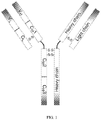
- an IgG antibody consists of two identical light polypeptide chains and two identical heavy polypeptide chains linked together by disulphide bonds.
- the first domain located at the amino terminus of each chain is variable in amino acid sequence, providing antibody binding specificities found in each individual antibody. These are known as variable heavy (VH) and variable light (VL) regions.
- the other domains of each chain are relatively invariant in amino acid sequence and are known as constant heavy (CH) and constant light (CL) regions.
- the light chain includes one variable region (VL) and one constant region (CL).
- An IgG heavy chain includes a variable region (VH), a first constant region (CH1), a hinge region, a second constant region (CH2), and a third constant region (CH3).
- VH variable region
- CH1 first constant region
- CH2 second constant region
- CH3 third constant region
- IgE and IgM antibodies the heavy chain includes an additional constant region (CH4).
- Antibodies described herein can include, for example, monoclonal antibodies, polyclonal antibodies (e.g., IVIG), multispecific antibodies, human antibodies, humanized antibodies, camelized antibodies, chimeric antibodies, single-chain Fvs (scFv), disulfide-linked Fvs (sdFv), and anti-idiotypic (anti-Id) antibodies, and antigen-binding fragments of any of the above.
- Antibodies can be of any type (e.g., IgG, IgE, IgM, IgD, IgA and IgY), class (e.g., IgG1, IgG2, IgG3, IgG4, IgA1 and IgA2) or subclass.
- Fc fragment refers to one or more fragments of an Fc region that retains an Fc function and/or activity described herein, such as binding to an Fc receptor.
- fragments include fragments that include an N-linked glycosylation site of an Fc region (e.g., an Asn297 of an IgG heavy chain or homologous sites of other antibody isotypes), such as a CH2 domain.
- antigen binding fragment of an antibody, as used herein, refers to one or more fragments of an antibody that retain the ability to specifically bind to an antigen.
- binding fragments encompassed within the term "antigen binding fragment" of an antibody include a Fab fragment, a F(ab') 2 fragment, a Fd fragment, a Fv fragment, a scFv fragment, a dAb fragment ( Ward et al., (1989) Nature 341:544-546 ), and an isolated complementarity determining region (CDR).
- Fab fragment a fragment of Fab
- F(ab') 2 fragment a Fd fragment
- Fv fragment fragment
- a scFv fragment a dAb fragment
- CDR isolated complementarity determining region
- Reference glycoproteins described herein e.g., reference antibodies
- fragments thereof can be produced by any method known in the art for synthesizing glycoproteins (e.g., antibodies) (see, e.g., Harlow et al., Antibodies: A Laboratory Manual, (Cold Spring Harbor Laboratory Press, 2nd ed. 1988 ); Brinkman et al., 1995, J. Immunol. Methods 182:41-50 ; WO 92/22324 ; WO 98/46645 ).
- Chimeric antibodies can be produced using methods described in, e.g., Morrison, 1985, Science 229:1202 , and humanized antibodies by methods described in, e.g., U.S. Pat. No. 6,180,370 .
- Additional reference antibodies described herein are bispecific antibodies and multivalent antibodies, as described in, e.g., Segal et al., J. Immunol. Methods 248:1-6 (2001 ); and Tutt et al., J. Immunol. 147: 60 (1991 ).
- glycoproteins or Fc regions or Fc fragments containing one or more N-glycosylation sites thereof
- heterologous moieties include, but are not limited to, peptides, polypeptides, proteins, fusion proteins, nucleic acid molecules, small molecules, mimetic agents, synthetic drugs, inorganic molecules, and organic molecules.
- a glycoprotein conjugate is a fusion protein that comprises a peptide, polypeptide, protein scaffold, scFv, dsFv, diabody, Tandab, or an antibody mimetic fused to an Fc region, such as a glycosylated Fc region.
- a fusion protein can include a linker region connecting an Fc region to a heterologous moiety (see, e.g., Hallewell et al. (1989), J. Biol. Chem. 264, 5260-5268 ; Alfthan et al. (1995), Protein Eng. 8, 725-731 ; Robinson & Sauer (1996)).
- a glycoprotein conjugate includes an Fc region (or an Fc fragment containing one or more N-glycosylations site thereof) conjugated to a heterologous polypeptide of at least 10, at least 20, at least 30, at least 40, at least 50, at least 60, at least 70, at least 80, at least 90 or at least 100 amino acids.
- a glycoprotein conjugate includes an Fc region (or an Fc fragment containing one or more N-glycosylation sites thereof) conjugated to one or more marker sequences, such as a peptide to facilitate purification.
- a particular marker amino acid sequence is a hexa-histidine peptide, such as the tag provided in a pQE vector (QIAGEN, Inc., 9259 Eton Avenue, Chatsworth, Calif., 91311).
- peptide tags useful for purification include, but are not limited to, the hemagglutinin "HA” tag, which corresponds to an epitope derived from the influenza hemagglutinin protein ( Wilson et al., 1984, Cell 37:767 ) and the "Flag" tag.
- a glycoprotein conjugate includes an Fc region (or Fc fragment containing one or more N-glycosylation sites thereof) conjugated to a diagnostic or detectable agent.
- Fc region or Fc fragment containing one or more N-glycosylation sites thereof conjugated to a diagnostic or detectable agent.
- Such fusion proteins can be useful for monitoring or prognosing development or progression of disease or disorder as part of a clinical testing procedure, such as determining efficacy of a particular therapy.
- Such diagnosis and detection can be accomplished by coupling a glycoprotein to detectable substances including, but not limited to, various enzymes, such as but not limited to horseradish peroxidase, alkaline phosphatase, beta-galactosidase, or acetylcholinesterase; prosthetic groups, such as, but not limited to, strepta-vidin/biotin and avidin/biotin; fluorescent materials, such as, but not limited to, umbelliferone, fluorescein, fluorescein isothiocynate, rhodamine, dichlorotriazinylamine fluorescein, dansyl chloride or phycoerythrin; luminescent materials, such as, but not limited to, luminol; bioluminescent materials, such as but not limited to, luciferase, luciferin, and aequorin; radioactive materials, such as but not limited to iodine ( 131 I, 125 I, 123 I), carbon
- glycans of glycoproteins are analyzed by any available suitable method.
- glycan structure and composition as described herein are analyzed, for example, by one or more, enzymatic, chromatographic, mass spectrometry (MS), chromatographic followed by MS, electrophoretic methods, electrophoretic methods followed by MS, nuclear magnetic resonance (NMR) methods, and combinations thereof.
- exemplary enzymatic methods include contacting a glycoprotein preparation with one or more enzymes under conditions and for a time sufficient to release one or more glycan(s) (e.g., one or more exposed glycan(s)).
- the one or more enzymes include(s) PNGase F.
- Exemplary chromatographic methods include, but are not limited to, Strong Anion Exchange chromatography using Pulsed Amperometric Detection (SAX-PAD), liquid chromatography (LC), high performance liquid chromatography (HPLC), ultra performance liquid chromatography (UPLC), thin layer chromatography (TLC), amide column chromatography, and combinations thereof.
- Exemplary mass spectrometry (MS) include, but are not limited to, tandem MS, LC-MS, LC-MS/MS, matrix assisted laser desorption ionisation mass spectrometry (MALDI-MS), Fourier transform mass spectrometry (FTMS), ion mobility separation with mass spectrometry (IMS-MS), electron transfer dissociation (ETD-MS), and combinations thereof.
- Exemplary electrophoretic methods include, but are not limited to, capillary electrophoresis (CE), CE-MS, gel electrophoresis, agarose gel electrophoresis, acrylamide gel electrophoresis, SDS-polyacrylamide gel electrophoresis (SDS-PAGE) followed by Western blotting using antibodies that recognize specific glycan structures, and combinations thereof.
- CE capillary electrophoresis
- CE-MS gel electrophoresis
- agarose gel electrophoresis agarose gel electrophoresis
- acrylamide gel electrophoresis acrylamide gel electrophoresis
- SDS-PAGE SDS-polyacrylamide gel electrophoresis
- Exemplary nuclear magnetic resonance include, but are not limited to, one-dimensional NMR (1D-NMR), two-dimensional NMR (2D-NMR), correlation spectroscopy magnetic-angle spinning NMR (COSY-NMR), total correlated spectroscopy NMR (TOCSY-NMR), heteronuclear single-quantum coherence NMR (HSQC-NMR), heteronuclear multiple quantum coherence (HMQC-NMR), rotational nuclear overhauser effect spectroscopy NMR (ROESY-NMR), nuclear overhauser effect spectroscopy (NOESY-NMR), and combinations thereof.
- glycans are analyzed in accordance with the present disclosure using one or more available methods (to give but a few examples, see Anumula, Anal. Biochem., 350(1):1, 2006 ; Klein et al., Anal. Biochem., 179:162, 1989 ; and/or Townsend, R.R. Carbohydrate Analysis" High Performance Liquid Chromatography and Capillary Electrophoresis., Ed. Z.
- glycans are characterized using one or more of chromatographic methods, electrophoretic methods, nuclear magnetic resonance methods, and combinations thereof. In some instances, glycans are analyzed by labeling with a fluorescent dye and measuring levels of fluorescence.
- methods for evaluating one or more target protein specific parameters can be performed by one or more of the methods listed in Table 1.
- Table 1 Exemplary methods of evaluating parameters: Method(s) Relevant literature Parameter C18 UPLC Mass Spec.* Chen and Flynn, Anal.
- Glycan(s) e.g., N-linked glycan, exposed N-linked glycan, glycan detection, glycan identification, and characterization; site specific glycation; glycoform detection (e.g., parameters 1-7); percent glycosylation; and/or aglycosyl
- site specific glycation e.g., parameters 1-7
- percent glycosylation e.g., parameters 1-7
- percent glycosylation e.g., percent glycosylation
- aglycosyl Chen and Flynn, J. Am. Soc. Mass Spectrom., 20:1821-1833 (2009 ) Bioanalyzer (reducing/non-reducing)* Forrer et al., Anal.
- Glycan e.g., N-linked glycan, exposed N-linked glycan
- LC-MS reducing/non-reducing/alkylated
- Glycan e.g., N-linked glycan, exposed N-linked glycan
- Methods include removal (e.g., enzymatic, chemical, and physical) of glycans Goetze et al., Glycobiol., 21:949-959 (2011 ) Xie et al., mAbs, 2: 379-394 (2010 ) Anion-exchange chromatography Ahn et al., J. Chrom.
- the literature recited may pertain to one or more of the methods for determining a parameter described herein.
- a glycoprotein described herein can be incorporated (e.g., formulated) into a pharmaceutical composition.
- a pharmaceutical composition is useful as an alternative and/or improved composition for the prevention and/or treatment of one or more diseases relative to a corresponding reference glycoprotein.
- Pharmaceutical compositions comprising a glycoprotein can be formulated by methods known to those skilled in the art.
- the pharmaceutical composition can be administered parenterally in the form of an injectable formulation comprising a sterile solution or suspension in water or another pharmaceutically acceptable liquid.
- the pharmaceutical composition can be formulated by suitably combining the glycoprotein with pharmaceutically acceptable vehicles or media, such as sterile water and physiological saline, vegetable oil, emulsifier, suspension agent, surfactant, stabilizer, flavoring excipient, diluent, vehicle, preservative, binder, followed by mixing in a unit dose form required for generally accepted pharmaceutical practices.
- pharmaceutically acceptable vehicles or media such as sterile water and physiological saline, vegetable oil, emulsifier, suspension agent, surfactant, stabilizer, flavoring excipient, diluent, vehicle, preservative, binder.
- a sterile composition for injection can be formulated in accordance with conventional pharmaceutical practices using distilled water for injection as a vehicle.
- physiological saline or an isotonic solution containing glucose and other supplements such as D-sorbitol, D-mannose, D-mannitol, and sodium chloride may be used as an aqueous solution for injection, optionally in combination with a suitable solubilizing agent, for example, alcohol such as ethanol and polyalcohol such as propylene glycol or polyethylene glycol, and a nonionic surfactant such as polysorbate 80 TM , HCO-50 and the like.
- Nonlimiting examples of oily liquid include sesame oil and soybean oil, and it may be combined with benzyl benzoate or benzyl alcohol as a solubilizing agent.
- Other items that may be included are a buffer such as a phosphate buffer, or sodium acetate buffer, a soothing agent such as procaine hydrochloride, a stabilizer such as benzyl alcohol or phenol, and an antioxidant.
- a formulated injection can be packaged in a suitable ampule.
- a level of one or more glycans described herein can be compared to a predetermined level (e.g., a corresponding level in a reference standard), e.g., to make a decision regarding the composition of the polypeptide preparation, e.g., a decision to classify, select, accept or discard, release or withhold, process into a drug product, ship, move to a different location, formulate, label, package, release into commerce, or sell or offer for sale the polypeptide, e.g., a recombinant antibody.
- the decision can be to accept, modify or reject a production parameter or parameters used to make the polypeptide, e.g., an antibody.
- reference standards include a control level (e.g., a polypeptide produced by a different method) or a range or value in a product specification (e.g., an FDA label or Physician's Insert) or quality criterion for a pharmaceutical preparation containing the polypeptide preparation.
- a control level e.g., a polypeptide produced by a different method
- a product specification e.g., an FDA label or Physician's Insert
- methods include taking action (e.g., physical action) in response to the methods disclosed herein.
- action e.g., physical action
- a polypeptide preparation is classified, selected, accepted or discarded, released or withheld, processed into a drug product, shipped, moved to a different location, formulated, labeled, packaged, released into commerce, or sold or offered for sale, depending on whether the preselected or target value is met.
- processing may include formulating (e.g., combining with pharmaceutical excipients), packaging (e.g., in a syringe or vial), labeling, or shipping at least a portion of the polypeptide preparation.
- processing includes formulating (e.g., combining with pharmaceutical excipients), packaging (e.g., in a syringe or vial), and labeling at least a portion of the preparation as a drug product described herein.
- processing can include directing and/or contracting another party to process as described herein.
- a biological activity of a polypeptide preparation is assessed.
- Biological activity of the preparation can be analyzed by any known method.
- a binding activity of a polypeptide is assessed (e.g., binding to a receptor).
- a therapeutic activity of a polypeptide is assessed (e.g., an activity of a polypeptide in decreasing severity or symptom of a disease or condition, or in delaying appearance of a symptom of a disease or condition).
- a pharmacologic activity of a polypeptide is assessed (e.g., bioavailability, pharmacokinetics, pharmacodynamics).
- polypeptide e.g., antibody
- potential adverse activity or toxicity e.g., propensity to cause hypertension, allergic reactions, thrombotic events, seizures, or other adverse events
- immunogenicity of a polypeptide preparation is assessed, e.g., by determining whether the preparation elicits an antibody response in a subject.
- Route of administration can be parenteral, for example, administration by injection, transnasal administration, transpulmonary administration, or transcutaneous administration.
- Administration can be systemic or local by intravenous injection, intramuscular injection, intraperitoneal injection, subcutaneous injection.
- a suitable means of administration can be selected based on the age and condition of the patient.
- a single dose of the pharmaceutical composition containing a modified glycoprotein can be selected from a range of 0.001 to 1000 mg/kg of body weight.
- a dose can be selected in the range of 0.001 to 100000 mg/body weight, but the present disclosure is not limited to such ranges.
- the dose and method of administration varies depending on the weight, age, condition, and the like of the patient, and can be suitably selected as needed by those skilled in the art.
- the disclosure is further illustrated by the following example.
- the example is provided for illustrative purposes only. It is not to be construed as limiting the scope or content of the disclosure in any way.
- DMSO DMSO-linked immunosorbent assay for human monocyte glycogen
- CHO cells were grown initially in base media (Power CHO2, Catalog # BE15-771, Lonza Inc., Allendale, NJ) containing soy hydrolysate, Lonza Power Feed A and additional supplements.
- base media Power CHO2, Catalog # BE15-771, Lonza Inc., Allendale, NJ
- the cells were fed with Lonza Power Feed A and soy hydrolysate.
- the cells were fed with Lonza Power Feed A medium and additional supplements with 2.5% DMSO (final concentration) or without DMSO.
- Cells were fed 2 g/L glucose when the glucose concentration dropped below 2 g/L.
- Cells were harvested on Days 10, 12, or 14, and the antibodies produced were evaluated for titer and glycan composition.
- DMSO may be acting, at least in part, by altering the conversion of 3,3,1,0,0 to G0F by GnTII. Further, as shown in Figure 2A , the presence of DMSO had a temporal effect on G0F levels, which declined over days 10, 12, and 14.
- DMSO increased the total level of high mannose glycans compared to no DMSO. Further, DMSO led to increased levels of high mannose 6, high mannose 3, and high mannose 5 glycans (see Figure 3B ).
- DMSO also affected the level of fucosylated glycans, resulting in a decreased level of fucosylated glycans ( Figure 4A ), with an increase in afucosylated glycans ( Figure 4B ). Further, DMSO resulted in an increase in sialylated glycans ( Figure 5A ), with a specific increase in the level of 3,5,1,1,0 sialylated glycan ( Figure 5B ; structure shown in Figure 6 ).
- This Example demonstrates that culturing cells in DMSO can be used to produce polypeptides, expressed by the cells, having particular levels of glycans.
Landscapes
- Life Sciences & Earth Sciences (AREA)
- Health & Medical Sciences (AREA)
- Organic Chemistry (AREA)
- Chemical & Material Sciences (AREA)
- Engineering & Computer Science (AREA)
- Zoology (AREA)
- Wood Science & Technology (AREA)
- Biotechnology (AREA)
- Genetics & Genomics (AREA)
- Bioinformatics & Cheminformatics (AREA)
- General Health & Medical Sciences (AREA)
- Microbiology (AREA)
- Biochemistry (AREA)
- General Engineering & Computer Science (AREA)
- Biomedical Technology (AREA)
- Molecular Biology (AREA)
- Chemical Kinetics & Catalysis (AREA)
- General Chemical & Material Sciences (AREA)
- Reproductive Health (AREA)
- Cell Biology (AREA)
- Preparation Of Compounds By Using Micro-Organisms (AREA)
- Micro-Organisms Or Cultivation Processes Thereof (AREA)
Claims (10)
- Verfahren zum Produzieren eines Präparats eines rekombinanten Proteins, das Verfahren umfassend:(a) Bereitstellen einer Chinesischer-Hamster-Ovarien(CHO)-Zelle, die genetisch verändert wird, um ein rekombinantes Protein zu exprimieren, das ein therapeutischer Antikörper ist;(b) Kultivieren der Zelle in einem Kulturmedium, umfassend 0,5 % bis 5 % DMSO, und optional ferner umfassend eines oder mehrere von Glucosamin, Lysin, Ammonium, Kupfer, Putrescin, Glucose, einem Wachstumsfaktor, einem Vitamin, einem Lipid und einem Pepton unter Bedingungen, in denen die Zelle das rekombinante Protein exprimiert; und(c) Ernten eines Präparats des rekombinanten Proteins, das durch die Zelle produziert wird, die einen Zielwert, bezogen auf die Gesamtglycane, von hoch-mannosehaltigen Glycanen erfüllt, wobei(i) der Zielwert von hoch-mannosehaltigen Glycanen ein Niveau von mindestens 20 % höher als ein Niveau an hoch-mannosehaltigen Glycanen, bezogen auf die Gesamtglycane, in einem Präparat des rekombinanten Proteins, das durch Kultivieren der Zelle in dem Medium, nicht umfassend DMSO, produziert wird; und/oder(ii) der Zielwert von hoch-mannosehaltigen Glycanen 0,1 % bis 20 % hochmannosehaltige Glycane ist; und optional,(d) Bewerten des Niveaus der hoch-mannosehaltigen Glycane in dem Präparat des rekombinanten Proteins; und/oder(e) Formulieren des Präparats in ein Arzneimittelprodukt.
- Verfahren nach Anspruch 1, wobei der Zielwert ein Niveau an hoch-mannosehaltigen Glycanen in einem referenztherapeutischen Antikörperprodukt ist.
- Verfahren nach Anspruch 2, wobei das referenztherapeutische Produkt aus der Gruppe ausgewählt ist, bestehend aus: Adalimumab, Abciximab, Alemtuzumab, Basiliximab, Bevacizumab, Certolizumab, Cetuximab, Daclizumab, Eculizumab, Efalizumab, Gemtuzumab, Ibritumomab, Infliximab, Muromonab-CD3, Natalizumab, Omalizumab, Palivizumab; Panitumumab, Ranibizumab, Rituximab, Tositumomab und Trastuzumab.
- Verfahren nach Anspruch 1, ferner umfassend:(a) Bereitstellen eines Zielwerts, bezogen auf die Gesamtglycane, von hoch-mannosehaltigen Glycanen; und(b) Formulieren des Präparats in ein Arzneimittelprodukt, falls das Präparat den Zielwert der hoch-mannosehaltigen Glycane erfüllt, wobei(i) der Zielwert von hoch-mannosehaltigen Glycanen ein Niveau von mindestens 20 % höher als ein Niveau an hoch-mannosehaltigen Glycanen, bezogen auf die Gesamtglycane, in einem Präparat des rekombinanten Proteins ist, das durch Kultivieren der Zelle in dem Medium, nicht umfassend DMSO, produziert wird; und/oder(ii) der Zielwert hoch-mannosehaltiger Glycane 0,1 % bis 20 % hoch-mannosehaltiger Glycane beträgt.
- Verfahren nach Anspruch 4, ferner umfassend das Bewerten des Niveaus der hoch-mannosehaltigen Glycane in dem Präparat des rekombinanten Proteins.
- Verfahren nach einem der Ansprüche 1 bis 5, wobei der Kultivierungsschritt eine erste Stufe und eine zweite Stufe umfasst, wobei die erste Stufe das Kultivieren der Zelle in dem Kulturmedium umfasst, umfassend ein erstes DMSO-Niveau, und die zweite Stufe das Kultivieren der Zelle in dem Kulturmedium umfasst, umfassend ein zweites DMSO-Niveau; und optional wobei(i) das zweite Niveau bezogen auf das erste Niveau erhöht wird;(ii) das erste DMSO-Niveau kein DMSO ist und das zweite DMSO-Niveau 1 % bis 5 % DMSO ist;(iii) die erste Stufe das Kultivieren der Zelle in dem ersten DMSO-Niveau für 1 bis 8 Tage umfasst;(iv) die zweite Stufe das Kultivieren der Zelle in dem zweiten DMSO-Niveau für 1 bis 12 Tage umfasst; und/oder(v) die zweite Stufe ein Zugeben von DMSO zu dem Kulturmedium umfasst.
- Verfahren nach einem der Ansprüche 1 bis 6, wobei die Zelle eine CHO-K1 - Zelle oder eine CHO-DG44-Zelle ist.
- Verfahren nach einem der Ansprüche 1 bis 7, wobei das Kulturmedium 0,5 % bis 1,5 % DMSO umfasst.
- Verfahren nach einem der Ansprüche 1 bis 8, wobei das rekombinante Protein aus der Gruppe ausgewählt ist, bestehend aus: Adalimumab, Abciximab, Alemtuzumab, Basiliximab, Bevacizumab, Certolizumab, Cetuximab, Daclizumab, Eculizumab, Efalizumab, Gemtuzumab, Ibritumomab, Infliximab, Muromonab-CD3, Natalizumab, Omalizumab, Palivizumab, Panitumumab, Ranibizumab, Rituximab, Tositumomab und Trastuzumab.
- Verfahren nach einem der Ansprüche 1 bis 9, ferner umfassend ein Protokollieren des bewerteten Niveaus von hoch-mannosehaltigen Glycosen in einem Chargenprotokoll für das Präparat.
Applications Claiming Priority (2)
| Application Number | Priority Date | Filing Date | Title |
|---|---|---|---|
| US13/829,292 US8956830B2 (en) | 2013-03-14 | 2013-03-14 | Methods of cell culture |
| PCT/US2014/023892 WO2014150655A1 (en) | 2013-03-14 | 2014-03-12 | Methods of cell culture |
Publications (4)
| Publication Number | Publication Date |
|---|---|
| EP2968549A1 EP2968549A1 (de) | 2016-01-20 |
| EP2968549A4 EP2968549A4 (de) | 2016-08-17 |
| EP2968549B1 EP2968549B1 (de) | 2019-05-08 |
| EP2968549B2 true EP2968549B2 (de) | 2022-11-23 |
Family
ID=51528764
Family Applications (1)
| Application Number | Title | Priority Date | Filing Date |
|---|---|---|---|
| EP14769180.2A Active EP2968549B2 (de) | 2013-03-14 | 2014-03-12 | Zellkulturverfahren |
Country Status (5)
| Country | Link |
|---|---|
| US (3) | US8956830B2 (de) |
| EP (1) | EP2968549B2 (de) |
| CN (1) | CN105073134A (de) |
| ES (1) | ES2732679T3 (de) |
| WO (1) | WO2014150655A1 (de) |
Families Citing this family (27)
| Publication number | Priority date | Publication date | Assignee | Title |
|---|---|---|---|---|
| PT2137655E (pt) * | 2007-04-16 | 2012-09-14 | Momenta Pharmaceuticals Inc | Produtos de glicoproteína definidos e métodos relacionados |
| US9062106B2 (en) | 2011-04-27 | 2015-06-23 | Abbvie Inc. | Methods for controlling the galactosylation profile of recombinantly-expressed proteins |
| CN103717729B (zh) | 2011-07-08 | 2017-11-21 | 动量制药公司 | 细胞培养方法 |
| US9150645B2 (en) | 2012-04-20 | 2015-10-06 | Abbvie, Inc. | Cell culture methods to reduce acidic species |
| US9505833B2 (en) | 2012-04-20 | 2016-11-29 | Abbvie Inc. | Human antibodies that bind human TNF-alpha and methods of preparing the same |
| US9067990B2 (en) | 2013-03-14 | 2015-06-30 | Abbvie, Inc. | Protein purification using displacement chromatography |
| US9181572B2 (en) | 2012-04-20 | 2015-11-10 | Abbvie, Inc. | Methods to modulate lysine variant distribution |
| US9512214B2 (en) | 2012-09-02 | 2016-12-06 | Abbvie, Inc. | Methods to control protein heterogeneity |
| US9017687B1 (en) | 2013-10-18 | 2015-04-28 | Abbvie, Inc. | Low acidic species compositions and methods for producing and using the same using displacement chromatography |
| US9499614B2 (en) | 2013-03-14 | 2016-11-22 | Abbvie Inc. | Methods for modulating protein glycosylation profiles of recombinant protein therapeutics using monosaccharides and oligosaccharides |
| US9217168B2 (en) * | 2013-03-14 | 2015-12-22 | Momenta Pharmaceuticals, Inc. | Methods of cell culture |
| US8956830B2 (en) | 2013-03-14 | 2015-02-17 | Momenta Pharmaceuticals, Inc. | Methods of cell culture |
| US9677105B2 (en) * | 2013-03-14 | 2017-06-13 | Momenta Pharmaceuticals, Inc. | Methods of cell culture |
| JP2016513478A (ja) * | 2013-03-15 | 2016-05-16 | ジェネンテック, インコーポレイテッド | 細胞培養培地及び抗体を産生する方法 |
| EP3052640A2 (de) | 2013-10-04 | 2016-08-10 | AbbVie Inc. | Verwendung von metallionen zur modulation von proteinglykosylierungsprofilen rekombinanter proteine |
| US9181337B2 (en) | 2013-10-18 | 2015-11-10 | Abbvie, Inc. | Modulated lysine variant species compositions and methods for producing and using the same |
| US9085618B2 (en) | 2013-10-18 | 2015-07-21 | Abbvie, Inc. | Low acidic species compositions and methods for producing and using the same |
| US20150139988A1 (en) | 2013-11-15 | 2015-05-21 | Abbvie, Inc. | Glycoengineered binding protein compositions |
| MA41685A (fr) * | 2014-10-17 | 2017-08-22 | Biogen Ma Inc | Supplémentation en cuivre pour la régulation de la glycosylation dans un procédé de culture cellulaire de mammifère |
| AU2015355087C1 (en) | 2014-12-01 | 2025-10-30 | Amgen Inc. | Process for manipulating the level of glycan content of a glycoprotein |
| EP3072957B1 (de) * | 2015-03-23 | 2019-07-10 | Lonza Ltd | Verfahren zur steuerung der proteinglycosylierung |
| EP4462121A3 (de) * | 2015-09-11 | 2025-01-22 | Alexion Pharmaceuticals, Inc. | Rekombinantes glykosyliertes eculizumab und eculizumabvarianten |
| IL321253A (en) * | 2018-05-01 | 2025-08-01 | Amgen Inc | Antibodies with a modulated glycan profile |
| MY190623A (en) | 2019-12-06 | 2022-04-27 | Regeneron Pharma | Anti-vegf protein compositions and methods for producing the same |
| CN115803009A (zh) | 2020-05-08 | 2023-03-14 | 瑞泽恩制药公司 | 用于治疗眼病和癌症的vegf阱和微阱及方法 |
| EP4284914A4 (de) * | 2021-02-01 | 2025-10-08 | Dr Reddys Laboratories Ltd | Zellkulturverfahren |
| CN114990049B (zh) * | 2022-04-26 | 2024-01-16 | 鼎康(武汉)生物医药有限公司 | 一种同时调节细胞表达产物的糖型和电荷异质性的方法 |
Citations (2)
| Publication number | Priority date | Publication date | Assignee | Title |
|---|---|---|---|---|
| WO2008128227A1 (en) † | 2007-04-16 | 2008-10-23 | Momenta Pharmaceuticals, Inc. | Defined glycoprotein products and related methods |
| WO2011061275A1 (en) † | 2009-11-20 | 2011-05-26 | Lek Pharmaceuticals D.D. | Production of glycoproteins with low n-glycolylneuraminic acid (neu5gc) content |
Family Cites Families (51)
| Publication number | Priority date | Publication date | Assignee | Title |
|---|---|---|---|---|
| USRE30985E (en) | 1978-01-01 | 1982-06-29 | Serum-free cell culture media | |
| US5807715A (en) | 1984-08-27 | 1998-09-15 | The Board Of Trustees Of The Leland Stanford Junior University | Methods and transformed mammalian lymphocyte cells for producing functional antigen-binding protein including chimeric immunoglobulin |
| DE3801236A1 (de) | 1988-01-18 | 1989-07-27 | Boehringer Mannheim Gmbh | Pentosansulfat-medium |
| US5530101A (en) | 1988-12-28 | 1996-06-25 | Protein Design Labs, Inc. | Humanized immunoglobulins |
| US5122469A (en) | 1990-10-03 | 1992-06-16 | Genentech, Inc. | Method for culturing Chinese hamster ovary cells to improve production of recombinant proteins |
| AU2238292A (en) | 1991-06-14 | 1993-01-12 | Xoma Corporation | Microbially-produced antibody fragments and their conjugates |
| US5426699A (en) | 1993-10-25 | 1995-06-20 | Antec Corporation | Method and apparatus for digitizing a scrambled analog video signal |
| EP0666312A1 (de) | 1994-02-08 | 1995-08-09 | Wolfgang A. Renner | Verfahren zur Förderung des Wachstums von Säugetierzellen |
| US5721121A (en) | 1995-06-06 | 1998-02-24 | Genentech, Inc. | Mammalian cell culture process for producing a tumor necrosis factor receptor immunoglobulin chimeric protein |
| SI0970126T1 (en) | 1997-04-14 | 2001-08-31 | Micromet Ag | Novel method for the production of antihuman antigen receptors and uses thereof |
| US5804420A (en) | 1997-04-18 | 1998-09-08 | Bayer Corporation | Preparation of recombinant Factor VIII in a protein free medium |
| US6673575B1 (en) | 1997-12-03 | 2004-01-06 | Roche Diagnostics Gmbh | Method for preparing polypeptides with appropriate glycosilation |
| US6528286B1 (en) | 1998-05-29 | 2003-03-04 | Genentech, Inc. | Mammalian cell culture process for producing glycoproteins |
| EP1171615B1 (de) | 1999-04-26 | 2006-12-13 | Genentech, Inc. | Zellenzuchtverfahren für glycoproteine |
| EP1333032A4 (de) | 2000-10-06 | 2005-03-16 | Kyowa Hakko Kogyo Kk | Verfahren zur aufreinigung von antikörpern |
| CA2492267C (en) | 2002-07-15 | 2013-09-10 | Immunex Corporation | Methods and media for controlling sialylation of proteins produced by mammalian cells |
| CA2511520A1 (en) | 2002-12-23 | 2004-07-15 | Bristol-Myers Squibb Company | Mammalian cell culture processes for protein production |
| TWI328614B (en) | 2002-12-23 | 2010-08-11 | Bristol Myers Squibb Co | Product quality enhancement in mammalian cell culture processes for protein production |
| MXPA06003028A (es) | 2003-09-18 | 2006-06-23 | Raven Biotechnologies Inc | Medios de cultivo de celulas. |
| ES2370417T3 (es) | 2005-06-03 | 2011-12-15 | Ares Trading S.A. | Producción de una proteína de unión a il-18 recombinante. |
| WO2007028106A2 (en) * | 2005-08-31 | 2007-03-08 | Centocor, Inc. | Host cell lines for production of antibody constant region with enhanced effector function |
| EP2924113B1 (de) | 2007-03-02 | 2019-04-10 | Wyeth LLC | Verwendung von kupfer und glutamat in zellkulturen zur herstellung von polypeptiden |
| US8216851B2 (en) | 2007-04-16 | 2012-07-10 | Momenta Pharmaceuticals, Inc. | Characterization of N-glycan mixtures by nuclear magnetic resonance |
| US8304250B2 (en) | 2007-04-16 | 2012-11-06 | Momenta Pharmaceuticals, Inc. | Multi-dimensional chromatographic methods for separating N-glycans |
| WO2008128228A1 (en) | 2007-04-16 | 2008-10-23 | Momenta Pharmaceuticals, Inc. | Methods related to cell surface glycosylation |
| WO2008128222A1 (en) | 2007-04-16 | 2008-10-23 | Momenta Pharmaceuticals, Inc. | Analysis of phosphorylated glycans, glycopeptides or glycoproteins by imac |
| WO2008128221A1 (en) | 2007-04-16 | 2008-10-23 | Momenta Pharmaceuticals, Inc. | Ms methods to evaluate glycans |
| WO2008128230A1 (en) | 2007-04-16 | 2008-10-23 | Momenta Pharmaceuticals, Inc. | Reference glycoprotein products and related methods |
| WO2008130924A2 (en) | 2007-04-16 | 2008-10-30 | Momenta Pharmaceuticals, Inc. | Isotopically-labeled glycans |
| ES2626080T3 (es) | 2007-04-16 | 2017-07-21 | Momenta Pharmaceuticals, Inc. | Caracterización de N-glicanos utilizando exoglicosidasas |
| WO2008128220A1 (en) | 2007-04-16 | 2008-10-23 | Momenta Pharmaceuticals, Inc. | Proteolytic release of glycans |
| US20120264927A1 (en) | 2007-04-16 | 2012-10-18 | Ian Christopher Parsons | Methods for labeling glycans |
| WO2008128219A1 (en) | 2007-04-16 | 2008-10-23 | Momenta Pharmaceuticals, Inc. | Comparative analysis of protein conformations by using 2d noesy nmr spectra |
| US20100221823A1 (en) | 2007-06-11 | 2010-09-02 | Amgen Inc. | Method for culturing mammalian cells to improve recombinant protein production |
| WO2009027041A1 (en) | 2007-08-31 | 2009-03-05 | F. Hoffmann-La Roche Ag | Glycosylation profile analysis |
| CA2975228C (en) | 2008-05-02 | 2020-07-21 | Seattle Genetics, Inc. | Methods and compositions for making antibodies and antibody derivatives with reduced core fucosylation |
| EP2358760B1 (de) | 2008-12-19 | 2015-02-18 | Momenta Pharmaceuticals, Inc. | Kennzeichnung o-vernetzter glycane |
| RU2526250C2 (ru) | 2008-12-19 | 2014-08-20 | Момента Фармасьютикалз, Инк. | Способы, относящиеся к модифицированным гликанам |
| AU2009338190C1 (en) | 2009-01-22 | 2014-07-17 | Momenta Pharmaceuticals, Inc. | Galactose-alpha-1, 3-galactose-containing N-glycans in glycoprotein products derived from CHO cells |
| WO2010138502A2 (en) | 2009-05-26 | 2010-12-02 | Momenta Pharmaceuticals, Inc. | Production of glycoproteins |
| AU2010256455A1 (en) * | 2009-06-05 | 2012-01-19 | Momenta Pharmaceuticals, Inc. | Methods of modulating fucosylation of glycoproteins |
| EP2507627A2 (de) | 2009-12-04 | 2012-10-10 | Momenta Pharmaceuticals, Inc. | Antennäre fucosylierung bei glykoproteinen aus cho-zellen |
| WO2011119115A1 (en) | 2010-03-25 | 2011-09-29 | Agency For Science, Technology And Research | Method of producing recombinant proteins with mannose- terminated n-glycans |
| EP2556163B1 (de) | 2010-04-07 | 2016-08-10 | Momenta Pharmaceuticals, Inc. | Verfahren zur quantifizierung von "high mannose"-glycoformen |
| EP2591094B1 (de) | 2010-07-08 | 2018-09-05 | Baxalta GmbH | Verfahren zur herstellung von rekombinantem adamts13 in einer zellkultur |
| US20120164137A1 (en) | 2010-10-20 | 2012-06-28 | Morphotek, Inc. | Anti-folate receptor alpha antibody glycoforms |
| WO2012125553A2 (en) | 2011-03-12 | 2012-09-20 | Momenta Pharmaceuticals, Inc. | N-acetylhexosamine-containing n-glycans in glycoprotein products |
| CN103717729B (zh) | 2011-07-08 | 2017-11-21 | 动量制药公司 | 细胞培养方法 |
| US9677105B2 (en) * | 2013-03-14 | 2017-06-13 | Momenta Pharmaceuticals, Inc. | Methods of cell culture |
| US9217168B2 (en) * | 2013-03-14 | 2015-12-22 | Momenta Pharmaceuticals, Inc. | Methods of cell culture |
| US8956830B2 (en) | 2013-03-14 | 2015-02-17 | Momenta Pharmaceuticals, Inc. | Methods of cell culture |
-
2013
- 2013-03-14 US US13/829,292 patent/US8956830B2/en active Active
-
2014
- 2014-03-12 EP EP14769180.2A patent/EP2968549B2/de active Active
- 2014-03-12 WO PCT/US2014/023892 patent/WO2014150655A1/en not_active Ceased
- 2014-03-12 CN CN201480009232.1A patent/CN105073134A/zh active Pending
- 2014-03-12 ES ES14769180T patent/ES2732679T3/es active Active
- 2014-12-31 US US14/587,340 patent/US9487810B2/en active Active
-
2016
- 2016-10-05 US US15/285,707 patent/US9926583B2/en active Active
Patent Citations (2)
| Publication number | Priority date | Publication date | Assignee | Title |
|---|---|---|---|---|
| WO2008128227A1 (en) † | 2007-04-16 | 2008-10-23 | Momenta Pharmaceuticals, Inc. | Defined glycoprotein products and related methods |
| WO2011061275A1 (en) † | 2009-11-20 | 2011-05-26 | Lek Pharmaceuticals D.D. | Production of glycoproteins with low n-glycolylneuraminic acid (neu5gc) content |
Non-Patent Citations (3)
| Title |
|---|
| J. RODRIGUEZ ET AL.: "Enhanced production of monomeric interferon-[beta] by CHO cells through the control of culture conditions", BIOTECHNOL. PROG., 2005, pages 22 - 30 † |
| JIANXIN YE ET AL.: "High-level protein expression in scalable CHO transient transfection.", BIOTECHNOLOGY AND BIOENGINEERING, 2009, pages 542 - 551 † |
| RICARDO GOUVEIA ET AL.: "Production and N-glycosylation of recombinant human cell adhesion molecule L1 from insect cells using the stable expression system. Effect of dimethyl sulfoxide", JOURNAL OF BIOTECHNOLOGY, 2010, pages 130 - 138 † |
Also Published As
| Publication number | Publication date |
|---|---|
| US9487810B2 (en) | 2016-11-08 |
| CN105073134A (zh) | 2015-11-18 |
| US8956830B2 (en) | 2015-02-17 |
| US20170211114A1 (en) | 2017-07-27 |
| US9926583B2 (en) | 2018-03-27 |
| EP2968549A4 (de) | 2016-08-17 |
| US20150240281A1 (en) | 2015-08-27 |
| EP2968549A1 (de) | 2016-01-20 |
| ES2732679T3 (es) | 2019-11-25 |
| WO2014150655A1 (en) | 2014-09-25 |
| US20140273057A1 (en) | 2014-09-18 |
| EP2968549B1 (de) | 2019-05-08 |
Similar Documents
| Publication | Publication Date | Title |
|---|---|---|
| US9926583B2 (en) | Methods of cell culture | |
| US10144944B2 (en) | Methods of cell culture | |
| US9677105B2 (en) | Methods of cell culture | |
| US20240167069A1 (en) | Sialylated Glycoproteins | |
| US20140271622A1 (en) | Methods of cell culture | |
| EP2877589B1 (de) | Glykoproteine mit entzündungshemmenden eigenschaften | |
| HK40036310A (en) | Sialylated glycoproteins | |
| HK1221655B (en) | Sialylated glycoproteins |
Legal Events
| Date | Code | Title | Description |
|---|---|---|---|
| PUAI | Public reference made under article 153(3) epc to a published international application that has entered the european phase |
Free format text: ORIGINAL CODE: 0009012 |
|
| 17P | Request for examination filed |
Effective date: 20150730 |
|
| AK | Designated contracting states |
Kind code of ref document: A1 Designated state(s): AL AT BE BG CH CY CZ DE DK EE ES FI FR GB GR HR HU IE IS IT LI LT LU LV MC MK MT NL NO PL PT RO RS SE SI SK SM TR |
|
| AX | Request for extension of the european patent |
Extension state: BA ME |
|
| A4 | Supplementary search report drawn up and despatched |
Effective date: 20160719 |
|
| RIC1 | Information provided on ipc code assigned before grant |
Ipc: C12P 21/00 20060101ALI20160713BHEP Ipc: A61K 39/395 20060101AFI20160713BHEP |
|
| STAA | Information on the status of an ep patent application or granted ep patent |
Free format text: STATUS: EXAMINATION IS IN PROGRESS |
|
| 17Q | First examination report despatched |
Effective date: 20170706 |
|
| REG | Reference to a national code |
Ref country code: DE Ref legal event code: R079 Ref document number: 602014046394 Country of ref document: DE Free format text: PREVIOUS MAIN CLASS: A61K0039395000 Ipc: C12P0021020000 |
|
| RIC1 | Information provided on ipc code assigned before grant |
Ipc: C12P 21/02 20060101AFI20180219BHEP Ipc: C12N 15/63 20060101ALI20180219BHEP Ipc: G01N 33/68 20060101ALI20180219BHEP Ipc: C07K 16/00 20060101ALI20180219BHEP |
|
| RAP1 | Party data changed (applicant data changed or rights of an application transferred) |
Owner name: MOMENTA PHARMACEUTICALS, INC. |
|
| GRAP | Despatch of communication of intention to grant a patent |
Free format text: ORIGINAL CODE: EPIDOSNIGR1 |
|
| STAA | Information on the status of an ep patent application or granted ep patent |
Free format text: STATUS: GRANT OF PATENT IS INTENDED |
|
| INTG | Intention to grant announced |
Effective date: 20180515 |
|
| GRAJ | Information related to disapproval of communication of intention to grant by the applicant or resumption of examination proceedings by the epo deleted |
Free format text: ORIGINAL CODE: EPIDOSDIGR1 |
|
| STAA | Information on the status of an ep patent application or granted ep patent |
Free format text: STATUS: EXAMINATION IS IN PROGRESS |
|
| GRAP | Despatch of communication of intention to grant a patent |
Free format text: ORIGINAL CODE: EPIDOSNIGR1 |
|
| INTC | Intention to grant announced (deleted) | ||
| STAA | Information on the status of an ep patent application or granted ep patent |
Free format text: STATUS: GRANT OF PATENT IS INTENDED |
|
| INTG | Intention to grant announced |
Effective date: 20181025 |
|
| GRAS | Grant fee paid |
Free format text: ORIGINAL CODE: EPIDOSNIGR3 |
|
| GRAA | (expected) grant |
Free format text: ORIGINAL CODE: 0009210 |
|
| STAA | Information on the status of an ep patent application or granted ep patent |
Free format text: STATUS: THE PATENT HAS BEEN GRANTED |
|
| AK | Designated contracting states |
Kind code of ref document: B1 Designated state(s): AL AT BE BG CH CY CZ DE DK EE ES FI FR GB GR HR HU IE IS IT LI LT LU LV MC MK MT NL NO PL PT RO RS SE SI SK SM TR |
|
| AX | Request for extension of the european patent |
Extension state: BA ME |
|
| REG | Reference to a national code |
Ref country code: GB Ref legal event code: FG4D |
|
| REG | Reference to a national code |
Ref country code: CH Ref legal event code: EP Ref country code: AT Ref legal event code: REF Ref document number: 1130192 Country of ref document: AT Kind code of ref document: T Effective date: 20190515 |
|
| REG | Reference to a national code |
Ref country code: IE Ref legal event code: FG4D |
|
| REG | Reference to a national code |
Ref country code: DE Ref legal event code: R096 Ref document number: 602014046394 Country of ref document: DE |
|
| REG | Reference to a national code |
Ref country code: NL Ref legal event code: FP |
|
| REG | Reference to a national code |
Ref country code: LT Ref legal event code: MG4D |
|
| PG25 | Lapsed in a contracting state [announced via postgrant information from national office to epo] |
Ref country code: PT Free format text: LAPSE BECAUSE OF FAILURE TO SUBMIT A TRANSLATION OF THE DESCRIPTION OR TO PAY THE FEE WITHIN THE PRESCRIBED TIME-LIMIT Effective date: 20190908 Ref country code: AL Free format text: LAPSE BECAUSE OF FAILURE TO SUBMIT A TRANSLATION OF THE DESCRIPTION OR TO PAY THE FEE WITHIN THE PRESCRIBED TIME-LIMIT Effective date: 20190508 Ref country code: SE Free format text: LAPSE BECAUSE OF FAILURE TO SUBMIT A TRANSLATION OF THE DESCRIPTION OR TO PAY THE FEE WITHIN THE PRESCRIBED TIME-LIMIT Effective date: 20190508 Ref country code: HR Free format text: LAPSE BECAUSE OF FAILURE TO SUBMIT A TRANSLATION OF THE DESCRIPTION OR TO PAY THE FEE WITHIN THE PRESCRIBED TIME-LIMIT Effective date: 20190508 Ref country code: LT Free format text: LAPSE BECAUSE OF FAILURE TO SUBMIT A TRANSLATION OF THE DESCRIPTION OR TO PAY THE FEE WITHIN THE PRESCRIBED TIME-LIMIT Effective date: 20190508 Ref country code: FI Free format text: LAPSE BECAUSE OF FAILURE TO SUBMIT A TRANSLATION OF THE DESCRIPTION OR TO PAY THE FEE WITHIN THE PRESCRIBED TIME-LIMIT Effective date: 20190508 Ref country code: NO Free format text: LAPSE BECAUSE OF FAILURE TO SUBMIT A TRANSLATION OF THE DESCRIPTION OR TO PAY THE FEE WITHIN THE PRESCRIBED TIME-LIMIT Effective date: 20190808 |
|
| REG | Reference to a national code |
Ref country code: ES Ref legal event code: FG2A Ref document number: 2732679 Country of ref document: ES Kind code of ref document: T3 Effective date: 20191125 |
|
| PG25 | Lapsed in a contracting state [announced via postgrant information from national office to epo] |
Ref country code: RS Free format text: LAPSE BECAUSE OF FAILURE TO SUBMIT A TRANSLATION OF THE DESCRIPTION OR TO PAY THE FEE WITHIN THE PRESCRIBED TIME-LIMIT Effective date: 20190508 Ref country code: BG Free format text: LAPSE BECAUSE OF FAILURE TO SUBMIT A TRANSLATION OF THE DESCRIPTION OR TO PAY THE FEE WITHIN THE PRESCRIBED TIME-LIMIT Effective date: 20190808 Ref country code: GR Free format text: LAPSE BECAUSE OF FAILURE TO SUBMIT A TRANSLATION OF THE DESCRIPTION OR TO PAY THE FEE WITHIN THE PRESCRIBED TIME-LIMIT Effective date: 20190809 Ref country code: LV Free format text: LAPSE BECAUSE OF FAILURE TO SUBMIT A TRANSLATION OF THE DESCRIPTION OR TO PAY THE FEE WITHIN THE PRESCRIBED TIME-LIMIT Effective date: 20190508 |
|
| REG | Reference to a national code |
Ref country code: AT Ref legal event code: MK05 Ref document number: 1130192 Country of ref document: AT Kind code of ref document: T Effective date: 20190508 |
|
| PG25 | Lapsed in a contracting state [announced via postgrant information from national office to epo] |
Ref country code: DK Free format text: LAPSE BECAUSE OF FAILURE TO SUBMIT A TRANSLATION OF THE DESCRIPTION OR TO PAY THE FEE WITHIN THE PRESCRIBED TIME-LIMIT Effective date: 20190508 Ref country code: RO Free format text: LAPSE BECAUSE OF FAILURE TO SUBMIT A TRANSLATION OF THE DESCRIPTION OR TO PAY THE FEE WITHIN THE PRESCRIBED TIME-LIMIT Effective date: 20190508 Ref country code: SK Free format text: LAPSE BECAUSE OF FAILURE TO SUBMIT A TRANSLATION OF THE DESCRIPTION OR TO PAY THE FEE WITHIN THE PRESCRIBED TIME-LIMIT Effective date: 20190508 Ref country code: CZ Free format text: LAPSE BECAUSE OF FAILURE TO SUBMIT A TRANSLATION OF THE DESCRIPTION OR TO PAY THE FEE WITHIN THE PRESCRIBED TIME-LIMIT Effective date: 20190508 Ref country code: AT Free format text: LAPSE BECAUSE OF FAILURE TO SUBMIT A TRANSLATION OF THE DESCRIPTION OR TO PAY THE FEE WITHIN THE PRESCRIBED TIME-LIMIT Effective date: 20190508 Ref country code: EE Free format text: LAPSE BECAUSE OF FAILURE TO SUBMIT A TRANSLATION OF THE DESCRIPTION OR TO PAY THE FEE WITHIN THE PRESCRIBED TIME-LIMIT Effective date: 20190508 |
|
| REG | Reference to a national code |
Ref country code: DE Ref legal event code: R026 Ref document number: 602014046394 Country of ref document: DE |
|
| PLBI | Opposition filed |
Free format text: ORIGINAL CODE: 0009260 |
|
| PLAX | Notice of opposition and request to file observation + time limit sent |
Free format text: ORIGINAL CODE: EPIDOSNOBS2 |
|
| PG25 | Lapsed in a contracting state [announced via postgrant information from national office to epo] |
Ref country code: IT Free format text: LAPSE BECAUSE OF FAILURE TO SUBMIT A TRANSLATION OF THE DESCRIPTION OR TO PAY THE FEE WITHIN THE PRESCRIBED TIME-LIMIT Effective date: 20190508 Ref country code: SM Free format text: LAPSE BECAUSE OF FAILURE TO SUBMIT A TRANSLATION OF THE DESCRIPTION OR TO PAY THE FEE WITHIN THE PRESCRIBED TIME-LIMIT Effective date: 20190508 |
|
| 26 | Opposition filed |
Opponent name: BAYER INTELLECTUAL PROPERTY GMBH Effective date: 20200131 Opponent name: REGENERON PHARMACEUTICALS, INC. Effective date: 20200131 |
|
| PG25 | Lapsed in a contracting state [announced via postgrant information from national office to epo] |
Ref country code: TR Free format text: LAPSE BECAUSE OF FAILURE TO SUBMIT A TRANSLATION OF THE DESCRIPTION OR TO PAY THE FEE WITHIN THE PRESCRIBED TIME-LIMIT Effective date: 20190508 |
|
| PG25 | Lapsed in a contracting state [announced via postgrant information from national office to epo] |
Ref country code: PL Free format text: LAPSE BECAUSE OF FAILURE TO SUBMIT A TRANSLATION OF THE DESCRIPTION OR TO PAY THE FEE WITHIN THE PRESCRIBED TIME-LIMIT Effective date: 20190508 |
|
| PG25 | Lapsed in a contracting state [announced via postgrant information from national office to epo] |
Ref country code: SI Free format text: LAPSE BECAUSE OF FAILURE TO SUBMIT A TRANSLATION OF THE DESCRIPTION OR TO PAY THE FEE WITHIN THE PRESCRIBED TIME-LIMIT Effective date: 20190508 |
|
| PGFP | Annual fee paid to national office [announced via postgrant information from national office to epo] |
Ref country code: FR Payment date: 20200325 Year of fee payment: 7 |
|
| PLBB | Reply of patent proprietor to notice(s) of opposition received |
Free format text: ORIGINAL CODE: EPIDOSNOBS3 |
|
| PG25 | Lapsed in a contracting state [announced via postgrant information from national office to epo] |
Ref country code: MC Free format text: LAPSE BECAUSE OF FAILURE TO SUBMIT A TRANSLATION OF THE DESCRIPTION OR TO PAY THE FEE WITHIN THE PRESCRIBED TIME-LIMIT Effective date: 20190508 |
|
| REG | Reference to a national code |
Ref country code: CH Ref legal event code: PL |
|
| REG | Reference to a national code |
Ref country code: BE Ref legal event code: MM Effective date: 20200331 |
|
| PG25 | Lapsed in a contracting state [announced via postgrant information from national office to epo] |
Ref country code: LU Free format text: LAPSE BECAUSE OF NON-PAYMENT OF DUE FEES Effective date: 20200312 |
|
| PG25 | Lapsed in a contracting state [announced via postgrant information from national office to epo] |
Ref country code: CH Free format text: LAPSE BECAUSE OF NON-PAYMENT OF DUE FEES Effective date: 20200331 Ref country code: LI Free format text: LAPSE BECAUSE OF NON-PAYMENT OF DUE FEES Effective date: 20200331 Ref country code: IE Free format text: LAPSE BECAUSE OF NON-PAYMENT OF DUE FEES Effective date: 20200312 |
|
| PG25 | Lapsed in a contracting state [announced via postgrant information from national office to epo] |
Ref country code: BE Free format text: LAPSE BECAUSE OF NON-PAYMENT OF DUE FEES Effective date: 20200331 |
|
| PG25 | Lapsed in a contracting state [announced via postgrant information from national office to epo] |
Ref country code: FR Free format text: LAPSE BECAUSE OF NON-PAYMENT OF DUE FEES Effective date: 20210331 |
|
| APBM | Appeal reference recorded |
Free format text: ORIGINAL CODE: EPIDOSNREFNO |
|
| APBP | Date of receipt of notice of appeal recorded |
Free format text: ORIGINAL CODE: EPIDOSNNOA2O |
|
| APAH | Appeal reference modified |
Free format text: ORIGINAL CODE: EPIDOSCREFNO |
|
| PG25 | Lapsed in a contracting state [announced via postgrant information from national office to epo] |
Ref country code: MT Free format text: LAPSE BECAUSE OF FAILURE TO SUBMIT A TRANSLATION OF THE DESCRIPTION OR TO PAY THE FEE WITHIN THE PRESCRIBED TIME-LIMIT Effective date: 20190508 Ref country code: CY Free format text: LAPSE BECAUSE OF FAILURE TO SUBMIT A TRANSLATION OF THE DESCRIPTION OR TO PAY THE FEE WITHIN THE PRESCRIBED TIME-LIMIT Effective date: 20190508 |
|
| APBU | Appeal procedure closed |
Free format text: ORIGINAL CODE: EPIDOSNNOA9O |
|
| PG25 | Lapsed in a contracting state [announced via postgrant information from national office to epo] |
Ref country code: MK Free format text: LAPSE BECAUSE OF FAILURE TO SUBMIT A TRANSLATION OF THE DESCRIPTION OR TO PAY THE FEE WITHIN THE PRESCRIBED TIME-LIMIT Effective date: 20190508 |
|
| PGFP | Annual fee paid to national office [announced via postgrant information from national office to epo] |
Ref country code: ES Payment date: 20220406 Year of fee payment: 9 |
|
| PUAH | Patent maintained in amended form |
Free format text: ORIGINAL CODE: 0009272 |
|
| STAA | Information on the status of an ep patent application or granted ep patent |
Free format text: STATUS: PATENT MAINTAINED AS AMENDED |
|
| 27A | Patent maintained in amended form |
Effective date: 20221123 |
|
| AK | Designated contracting states |
Kind code of ref document: B2 Designated state(s): AL AT BE BG CH CY CZ DE DK EE ES FI FR GB GR HR HU IE IS IT LI LT LU LV MC MK MT NL NO PL PT RO RS SE SI SK SM TR |
|
| REG | Reference to a national code |
Ref country code: DE Ref legal event code: R102 Ref document number: 602014046394 Country of ref document: DE |
|
| REG | Reference to a national code |
Ref country code: DE Ref legal event code: R082 Ref document number: 602014046394 Country of ref document: DE Representative=s name: MATHYS & SQUIRE EUROPE PATENTANWAELTE PARTNERS, DE |
|
| REG | Reference to a national code |
Ref country code: NL Ref legal event code: MP Effective date: 20190508 |
|
| PGFP | Annual fee paid to national office [announced via postgrant information from national office to epo] |
Ref country code: NL Payment date: 20230215 Year of fee payment: 10 |
|
| PG25 | Lapsed in a contracting state [announced via postgrant information from national office to epo] |
Ref country code: ES Free format text: LAPSE BECAUSE OF FAILURE TO SUBMIT A TRANSLATION OF THE DESCRIPTION OR TO PAY THE FEE WITHIN THE PRESCRIBED TIME-LIMIT Effective date: 20221123 |
|
| PG25 | Lapsed in a contracting state [announced via postgrant information from national office to epo] |
Ref country code: NL Free format text: LAPSE BECAUSE OF FAILURE TO SUBMIT A TRANSLATION OF THE DESCRIPTION OR TO PAY THE FEE WITHIN THE PRESCRIBED TIME-LIMIT Effective date: 20190508 |
|
| PGFP | Annual fee paid to national office [announced via postgrant information from national office to epo] |
Ref country code: DE Payment date: 20250507 Year of fee payment: 12 |
|
| PGFP | Annual fee paid to national office [announced via postgrant information from national office to epo] |
Ref country code: GB Payment date: 20250501 Year of fee payment: 12 |
|
| PGFP | Annual fee paid to national office [announced via postgrant information from national office to epo] |
Ref country code: IS Payment date: 20250514 Year of fee payment: 12 |