EP2968443B1 - Hepcidin analogues and uses thereof - Google Patents
Hepcidin analogues and uses thereof Download PDFInfo
- Publication number
- EP2968443B1 EP2968443B1 EP14763104.8A EP14763104A EP2968443B1 EP 2968443 B1 EP2968443 B1 EP 2968443B1 EP 14763104 A EP14763104 A EP 14763104A EP 2968443 B1 EP2968443 B1 EP 2968443B1
- Authority
- EP
- European Patent Office
- Prior art keywords
- peptide
- absent
- lys
- seq
- formula
- Prior art date
- Legal status (The legal status is an assumption and is not a legal conclusion. Google has not performed a legal analysis and makes no representation as to the accuracy of the status listed.)
- Active
Links
Images


Classifications
-
- C—CHEMISTRY; METALLURGY
- C07—ORGANIC CHEMISTRY
- C07K—PEPTIDES
- C07K14/00—Peptides having more than 20 amino acids; Gastrins; Somatostatins; Melanotropins; Derivatives thereof
- C07K14/435—Peptides having more than 20 amino acids; Gastrins; Somatostatins; Melanotropins; Derivatives thereof from animals; from humans
- C07K14/575—Hormones
-
- A—HUMAN NECESSITIES
- A61—MEDICAL OR VETERINARY SCIENCE; HYGIENE
- A61P—SPECIFIC THERAPEUTIC ACTIVITY OF CHEMICAL COMPOUNDS OR MEDICINAL PREPARATIONS
- A61P3/00—Drugs for disorders of the metabolism
-
- A—HUMAN NECESSITIES
- A61—MEDICAL OR VETERINARY SCIENCE; HYGIENE
- A61P—SPECIFIC THERAPEUTIC ACTIVITY OF CHEMICAL COMPOUNDS OR MEDICINAL PREPARATIONS
- A61P3/00—Drugs for disorders of the metabolism
- A61P3/12—Drugs for disorders of the metabolism for electrolyte homeostasis
-
- A—HUMAN NECESSITIES
- A61—MEDICAL OR VETERINARY SCIENCE; HYGIENE
- A61K—PREPARATIONS FOR MEDICAL, DENTAL OR TOILETRY PURPOSES
- A61K38/00—Medicinal preparations containing peptides
Definitions
- the present invention relates, inter alia, to certain hepcidin peptide analogues, including peptides and dimers thereof, as well as compositions comprising the peptides and peptide dimers, and to the use of the peptides and peptide dimers in the treatment and/or prevention of a variety of diseases, conditions or disorders, including treatment and/or prevention of iron overload diseases including hereditary hemochromatosis, iron-loading anemias, and other conditions and disorders described herein.
- Hepcidin (also referred to as LEAP-1), a peptide hormone produced by the liver, is a regulator of iron homeostasis in humans and other mammals. Hepcidin acts by binding to its receptor, the iron export channel ferroportin, causing its internalization and degradation. Human hepcidin is a 25-amino acid peptide (Hep25). See Krause et al. (2000) FEBS Lett 480:147-150 , and Park et al. (2001) J Biol Chem 276:7806-7810 . The structure of the bioactive 25-amino acid form of hepcidin is a simple hairpin with 8 cysteines that form 4 disulfide bonds as described by Jordan et al.
- HH hereditary hemochromatosis
- Fetherosis is a genetic iron overload disease that is mainly caused by hepcidin deficiency, or in some cases by hepcidin resistance. This allows excessive absorption of iron from the diet and development of iron overload.
- Clinical manifestations of HH may include liver disease (e.g., hepatic cirrhosis and hepatocellular carcinoma), diabetes, and heart failure.
- liver disease e.g., hepatic cirrhosis and hepatocellular carcinoma
- diabetes e.g., chronic myethelial cirrhosis and hepatocellular carcinoma
- heart failure Currently, the only treatment for HH is regular phlebotomy, which is very burdensome for the patients.
- Iron-loading anemias are hereditary anemias with ineffective erythropoiesis such as ⁇ -thalassemia, which are accompanied by severe iron overload. Complications from iron overload are the main cause of morbidity and mortality for these patients. Hepcidin deficiency is the main cause of iron overload in non-transfused patients, and contributes to iron overload in transfused patients. The current treatment for iron overload in these patients is iron chelation which is very burdensome, sometimes ineffective, and accompanied by frequent side effects.
- Hepcidin has a number of limitations which restrict its use as a drug, including a difficult synthesis process due in part to aggregation and precipitation of the protein during folding, which in turn leads to high cost of goods. What are needed in the art are compounds having hepcidin activity and also possessing other beneficial physical properties such as improved solubility, stability, and/or potency , so that hepcidin-like biologics might be produced affordably, and used to treat hepcidin-related diseases and disorders such as, e.g., those described herein.
- the present invention addresses such needs, providing novel peptide analogues, and dimers thereof, having hepcidin activity and also having other beneficial properties making the peptides of the present invention suitable alternatives to hepcidin.
- the present invention generally relates to peptides exhibiting hepcidin activity and methods of using the same.
- the invention provides peptides, which may be isolated and/or purified, comprising, consisting essentially of, or consisting of, the following structural formula I: R 1 -X-Y-R 2 (I) (SEQ ID NO:12) or a pharmaceutically acceptable salt or solvate thereof, wherein
- the compound of formula (I) comprises two or more cysteine residues, wherein at least two of said cysteine residues are linked via a disulfide bond.
- peptides which may be isolated and/or purified, comprising, consisting essentially of, or consisting of the following structural formula I': R 1 '-X'-Y'-R 2 ' (I') (SEQ ID NO:21) or a pharmaceutically acceptable salt or solvate thereof, wherein
- X' is a peptide sequence having the formula la' X1-X2-X3-X4-X5-X6-X7-X8-X9-X10 (Ia') (SEQ ID NO:13) wherein
- Y' is a peptide having the formula IIa' Y1-Y2-Y3-Y4-Y5-Y6-Y7-Y8-Y9-Y10-Y11-Y12-Y13-Y14-Y15 (IIa') (SEQ ID NO:16) wherein
- the compound of formula I' may comprise an R 1 ' moiety that is hydrogen, isovaleric acid, isobutyric acid, or acetyl.
- the compound of formula I' may comprise an X' peptide of formula la' as described herein, wherein
- the compound of formula I' may comprise an X' peptide of formula Ib': X1-Thr-His-X4-X5-X6-X7-X8-Phe-X10 (Ib') wherein
- the compound of formula I' may comprise an X' peptide of formula Ic': X1-Thr-His-X4-X5-Cys-Ile-X8-Phe-X10 (Ic') wherein
- the compound of formula I' may comprise a Y' peptide of formula IIb'.
- the compound of formula I' may comprise a Y' peptide of formula IIc'.
- the compound of formula I' may comprise a Y' peptide of formula IId': Cys-Y3-Y4-Arg-Y6-Y7-Y8-Cys-Y10-Y11-Y12-Y13-Y14-Y15 (IId') wherein
- the compound of formula I' may comprise a Y' peptide of formula IIe': Val-Cys-Y3-His-Arg-Y6-Y7-Y8-Cys-Tyr-Arg-Y12-Y13-Y14-Y15 (IIe') wherein
- peptides which may be isolated and/or purified, comprising, consisting essentially of, or consisting of the following structural formula I": R 1 "-X"-Y"-R 2 " (I”) (SEQ ID NO:27) or a pharmaceutically acceptable salt or solvate thereof, wherein
- the compound of formula I" may be PEGylated on R 1 ", X", or Y".
- the compound of formula I" may comprise two or more cysteine residues, at least two of said cysteine residues being linked via a disulfide bond.
- the compound of formula I" may comprise an R 1 " that is hydrogen, isovaleric acid, iso-butyric acid or acetyl.
- the compound of formula I" may comprise an X" peptide according to formula Ia", disclosed herein, wherein
- the compound of formula I may comprise an X" peptide of formula Ib": X1-Thr-His-X4-X5-X6-X7-X8-Phe-X10 (Ib") wherein
- the compound of formula I may comprise an X" peptide of formula Ic": X1-Thr-His-X4-X5-Cys-Ile-X8-Phe-X10(Ic") wherein
- the compound of formula I may comprise a Y" peptide of formula IIa": Y1-Y2-Y3-Y4-Y5-Y6-Y7-Y8-Cys-Y10 (IIa”) (SEQ ID NO:25) wherein
- the compound of formula I may comprise a Y" peptide of formula IIb": Y1-Y2-Y3-Ser-Lys-Gly-Trp-Y8-Cys-Y10 (IIb") wherein
- dimers e.g., homodimers, of any of the peptides of the present invention as well as of the peptides disclosed herein..
- the peptides or dimers of the present invention exhibit hepcidin activity. In some embodiments, the peptides or dimers bind ferroportin, e.g., human ferroportin.
- the present invention provides methods of binding a ferroportin or inducing ferroportin internalization and degradation which comprise contacting the ferroportin with at least one peptide, dimer or composition as disclosed herein.
- the present invention provides compositions comprising at least one peptide or dimer as disclosed herein.
- medicaments comprising at least one peptide or dimer as disclosed herein for the treatment of diseases of iron metabolism, such as iron overload diseases.
- the peptide or pharmaceutically acceptable salt or solvate thereof for use in treating a disease of iron metabolism in a subject, such as a mammalian subject, e.g., a human subject, comprising administering at least one peptide, dimer or composition as disclosed herein to the subject.
- the peptide or dimer is administered in a therapeutically effective amount.
- the disease of iron metabolism is an iron overload disease.
- the present invention provides a pharmaceutical composition
- a pharmaceutical composition comprising a peptide analogue (e.g., a peptide or dimer of the present invention), or pharmaceutically acceptable salt or solvate thereof, as described herein, in combination with one or more peptide analogue (e.g., a peptide of the present invention or dimer as disclosed herein) or pharmaceutically acceptable salt or solvate thereof, as described herein together with a pharmaceutically acceptable carrier, excipient or vehicle.
- a device comprising at least one peptide analogue (e.g., a peptide or dimer of the present invention), or pharmaceutically acceptable salt or solvate thereof for delivery of the peptide analogue to a subject.
- peptide analogue e.g., a peptide or dimer of the present invention
- kits comprising at least one peptide, dimer, or composition as disclosed herein packaged together with a reagent, a device, instructional material, or a combination thereof.
- complexes which comprise at least one peptide or dimer as disclosed herein bound to a ferroportin, e.g., a human ferroportin, or an antibody, such as an antibody which specifically binds a peptide as disclosed herein, Hep25, or a combination thereof.
- a ferroportin e.g., a human ferroportin
- an antibody such as an antibody which specifically binds a peptide as disclosed herein, Hep25, or a combination thereof.
- patient may be used interchangeably and refer to either a human or a non-human animal. These terms include mammals such as humans, primates, livestock animals (e.g., bovines, porcines), companion animals (e.g., canines, felines) and rodents (e.g., mice and rats).
- livestock animals e.g., bovines, porcines
- companion animals e.g., canines, felines
- rodents e.g., mice and rats.
- formula (I) is used herein interchangeably with the term formula I (i.e., without the parentheses).
- formula (I'), is used herein interchangeably with the term formula I' (i.e., without the parentheses).
- formula (I") is used herein interchangeably with the term formula I" (i.e., without the parentheses).
- sequence identity refers to the extent that sequences are identical on a nucleotide-by-nucleotide basis or an amino acid-by-amino acid basis over a window of comparison.
- a "percentage of sequence identity” may be calculated by comparing two optimally aligned sequences over the window of comparison, determining the number of positions at which the identical nucleic acid base (e.g., A, T, C, G, I) or the identical amino acid residue (e.g., Ala, Pro, Ser, Thr, Gly, Val, Leu, Ile, Phe, Tyr, Trp, Lys, Arg, His, Asp, Glu, Asn, Gln, Cys and Met) occurs in both sequences to yield the number of matched positions, dividing the number of matched positions by the total number of positions in the window of comparison (i.e., the window size), and multiplying the result by 100 to yield the percentage of sequence identity.
- the identical nucleic acid base e.g., A, T, C, G, I
- the identical amino acid residue e.g., Ala, Pro, Ser, Thr, Gly, Val, Leu, Ile, Phe, Tyr, Trp, Lys
- sequence similarity or sequence identity between sequences can be performed as follows.
- the sequences can be aligned for optimal comparison purposes (e.g., gaps can be introduced in one or both of a first and a second amino acid or nucleic acid sequence for optimal alignment and non-homologous sequences can be disregarded for comparison purposes).
- the length of a reference sequence aligned for comparison purposes is at least 30%, preferably at least 40%, more preferably at least 50%, 60%, and even more preferably at least 70%, 80%, 90%, 100% of the length of the reference sequence.
- amino acid residues or nucleotides at corresponding amino acid positions or nucleotide positions are then compared. When a position in the first sequence is occupied by the same amino acid residue or nucleotide as the corresponding position in the second sequence, then the molecules are identical at that position.
- the percent identity between the two sequences is a function of the number of identical positions shared by the sequences, taking into account the number of gaps, and the length of each gap, which need to be introduced for optimal alignment of the two sequences.
- the comparison of sequences and determination of percent identity between two sequences can be accomplished using a mathematical algorithm.
- the percent identity between two amino acid sequences is determined using the Needleman and Wunsch, (1970, J. Mol. Biol. 48: 444-453 ) algorithm which has been incorporated into the GAP program in the GCG software package, using either a Blossum 62 matrix or a PAM250 matrix, and a gap weight of 16, 14, 12, 10, 8, 6, or 4 and a length weight of 1, 2, 3, 4, 5, or 6.
- the percent identity between two nucleotide sequences is determined using the GAP program in the GCG software package, using an NWSgapdna.CMP matrix and a gap weight of 40, 50, 60, 70, or 80 and a length weight of 1, 2, 3, 4, 5, or 6.
- Another exemplary set of parameters includes a Blossum 62 scoring matrix with a gap penalty of 12, a gap extend penalty of 4, and a frameshift gap penalty of 5.
- the percent identity between two amino acid or nucleotide sequences can also be determined using the algorithm of E. Meyers and W. Miller (1989, Cabios, 4: 11-17 ) which has been incorporated into the ALIGN program (version 2.0), using a PAM120 weight residue table, a gap length penalty of 12 and a gap penalty of 4.
- the peptide sequences described herein can be used as a "query sequence" to perform a search against public databases to, for example, identify other family members or related sequences.
- Such searches can be performed using the NBLAST and XBLAST programs (version 2.0) of Altschul, et al., (1990, J. Mol. Biol, 215: 403-10 ).
- Gapped BLAST can be utilized as described in Altschul et al. (Nucleic Acids Res. 25:3389-3402, 1997 ).
- the default parameters of the respective programs e.g., XBLAST and NBLAST can be used.
- the term "pharmaceutically acceptable salt” is intended to indicate a salt which is not harmful to a patient or subject to which the salt in question is administered. It may suitably be a salt chosen, e.g., among acid addition salts and basic salts. Examples of acid addition salts include chloride salts, citrate salts and acetate salts.
- Examples of basic salts include salts where the cation is selected among alkali metal cations, such as sodium or potassium ions, alkaline earth metal cations, such as calcium or magnesium ions, as well as substituted ammonium ions, such as ions of the type N(R1)(R2)(R3)(R4)+, where R1, R2, R3 and R4 independently will typically designate hydrogen, optionally substituted C1-6-alkyl or optionally substituted C2-6-alkenyl.
- Examples of relevant C1-6-alkyl groups include methyl, ethyl, 1-propyl and 2-propyl groups.
- Examples of C2-6-alkenyl groups of possible relevance include ethenyl, 1-propenyl and 2-propenyl.
- compositions to be used in the invention suitable for parenteral administration may comprise sterile aqueous solutions and/or suspensions of the pharmaceutically active ingredients preferably made isotonic with the blood of the recipient, generally using sodium chloride, glycerin, glucose, mannitol, sorbitol, and the like.
- Organic acids suitable for forming pharmaceutically acceptable acid addition salts include, by way of example and not limitation, acetic acid, trifluoroacetic acid, propionic acid, hexanoic acid, cyclopentanepropionic acid, glycolic acid, oxalic acid, pyruvic acid, lactic acid, malonic acid, succinic acid, malic acid, maleic acid, fumaric acid, tartaric acid, citric acid, palmitic acid, benzoic acid, 3-(4-hydroxybenzoyl) benzoic acid, cinnamic acid, mandelic acid, alkylsulfonic acids (e.g., methanesulfonic acid, ethanesulfonic acid, 1,2-ethane-disulfonic acid, 2-hydroxyethanesulfonic acid, etc.), arylsulfonic acids (e.g., benzenesulfonic acid, 4-chlorobenzenesulfonic acid, 2-naphthalenes
- solvate in the context of the present invention refers to a complex of defined stoichiometry formed between a solute ( in casu, a peptide analogue or pharmaceutically acceptable salt thereof according to the invention) and a solvent.
- the solvent in this connection may, for example, be water, ethanol or another pharmaceutically acceptable, typically small-molecular organic species, such as, but not limited to, acetic acid or lactic acid.
- a solvate is normally referred to as a hydrate.
- agonist refers to a substance (ligand) that causes internalization of the ferroportin protein.
- a "disease of iron metabolism” includes diseases where aberrant iron metabolism directly causes the disease, or where iron blood levels are dysregulated causing disease, or where iron dysregulation is a consequence of another disease, or where diseases can be treated by modulating iron levels, and the like. More specifically, a disease of iron metabolism according to this disclosure includes iron overload diseases, iron deficiency disorders, disorders of iron biodistribution, other disorders of iron metabolism and other disorders potentially related to iron metabolism, etc.
- Diseases of iron metabolism include hemochromatosis, HFE mutation hemochromatosis, ferroportin mutation hemochromatosis, transferrin receptor 2 mutation hemochromatosis, hemojuvelin mutation hemochromatosis, hepcidin mutation hemochromatosis, juvenile hemochromatosis, neonatal hemochromatosis, hepcidin deficiency, transfusional iron overload, thalassemia, thalassemia intermedia, alpha thalassemia, sideroblastic anemia, porphyria, porphyria cutanea tarda, African iron overload, hyperferritinemia, ceruloplasmin deficiency, atransferrinemia, congenital dyserythropoietic anemia, anemia of chronic disease, anemia of inflammation, anemia of infection, hypochromic microcytic anemia, iron- deficiency anemia, iron-refractory iron deficiency anemia, anemia of chronic kidney disease, erythropoietin resistance, iron
- the disease and disorders are related to iron overload diseases such as iron hemochromatosis, HFE mutation hemochromatosis, ferroportin mutation hemochromatosis, transferrin receptor 2 mutation hemochromatosis, hemojuvelin mutation hemochromatosis, hepcidin mutation hemochromatosis, juvenile hemochromatosis, neonatal hemochromatosis, hepcidin deficiency, transfusional iron overload, thalassemia, thalassemia intermedia, alpha thalassemia.
- iron hemochromatosis HFE mutation hemochromatosis, ferroportin mutation hemochromatosis, transferrin receptor 2 mutation hemochromatosis, hemojuvelin mutation hemochromatosis, hepcidin mutation hemochromatosis, juvenile hemochromatosis, neonatal hemochromatosis, hepcidin deficiency
- transfusional iron overload thalassemia, thalassemia intermedia, alpha thalassemia.
- the peptides of the invention are used to treat diseases and disorders that are not typically identified as being iron related.
- diseases and disorders that are not typically identified as being iron related.
- hepcidin is highly expressed in the murine pancreas suggesting that diabetes (Type I or Type II), insulin resistance, glucose intolerance and other disorders may be ameliorated by treating underlying iron metabolism disorders.
- diabetes Type I or Type II
- insulin resistance insulin resistance
- glucose intolerance glucose intolerance
- other disorders may be ameliorated by treating underlying iron metabolism disorders. See Ilyin, G. et al. (2003) FEBS Lett. 542 22-26 , which is herein incorporated by reference.
- peptides of the invention may be used to treat these diseases and conditions.
- the diseases of iron metabolism are iron overload diseases, which include hereditary hemochromatosis, iron-loading anemias, alcoholic liver diseases and chronic hepatitis C.
- the terms "protein”, “polypeptide” and “peptide” are used interchangeably to refer to two or more amino acids linked together. Except where indicated otherwise, e.g., for the abbreviations for the uncommon or unnatural amino acids set forth herein, the three-letter and one-letter abbreviations, as used in the art, are used herein to represent amino acid residues. Except when preceded with "D-", the amino acid is an L-amino acid. Groups or strings of amino acid abbreviations are used to represent peptides. Except when specifically indicated, peptides are indicated with the N- terminus on the left and the sequence is written from the N-terminus to the C- terminus.
- peptide analogue in the context of the present invention refers to a molecule in which a first peptide moiety is attached (i.e. coupled or linked), either directly or via a linking (i.e. bridging or spacing) chemical moiety, to a second peptide moiety, by means of covalent chemical bonding.
- a peptide analogue is a peptide described herein comprising an X peptide sequence and a Y peptide sequence.
- a peptide analogue is a peptide described herein comprising an X' peptide sequence and a Y' peptide sequence.
- a peptide analogue is a peptide described herein comprising an X" peptide sequence and a Y" peptide sequence. In certain embodiments, a peptide analogue is a peptide described herein comprising an X peptide sequence and/or a Y peptide sequence conjugated to an additional chemical moiety. In certain embodiments, a peptide analogue is a peptide described herein comprising an X' peptide sequence and/or a Y' peptide sequence conjugated to an additional chemical moiety.
- a peptide analogue is a peptide described herein comprising an X" peptide sequence and/or a Y" peptide sequence conjugated to an additional chemical moiety.
- the peptides of the present invention described herein are peptide analogues.
- Peptide analogues also include any of the peptide dimers described herein.
- Peptides and peptide dimers of the present invention may also be referred to herein as compounds or peptide analogues.
- substitution denotes that one or more amino acids are replaced by another, biologically similar residue. Examples include substitution of amino acid residues with similar characteristics, e.g., small amino acids, acidic amino acids, polar amino acids, basic amino acids, hydrophobic amino acids and aromatic amino acids. See, for example, the table below.
- one or more Met residues are substituted with norleucine (Nle) which is a bioisostere for Met, but which, as opposed to Met, is not readily oxidized.
- Another example of a conservative substitution with a residue normally not found in endogenous, mammalian peptides and proteins is the conservative substitution of Arg or Lys with, for example, ornithine, canavanine, aminoethylcysteine or another basic amino acid.
- one or more cysteines of a peptide analogue of the invention may be substituted with another residue, such as a serine.
- conservative substitutions of amino acids are grouped by physicochemical properties. I: neutral, hydrophilic, II: acids and amides, III: basic, IV: hydrophobic, V: aromatic, bulky amino acids.
- I II III IV V A N H M F S D R L Y T E K I W P Q V G C
- the present invention provides peptides which are useful in the study and treatment of diseases of iron metabolism.
- amino acids are referred to by their full name (e.g. alanine, arginine, etc.), they are designated by their conventional three-letter or single-letter abbreviations (e.g. Ala or A for alanine, Arg or R for arginine, etc.).
- sarcosine, ornithine, etc. frequently employed three- or four-character codes are employed for residues thereof, including, Sar or Sarc (sarcosine, i.e.
- N-methylglycine N-methylglycine
- Aib a-aminoisobutyric acid
- Dab 2,4-diaminobutanoic acid
- Dapa 2,3-diaminopropanoic acid
- ⁇ -Glu ⁇ -glutamic acid
- Gaba ⁇ -aminobutanoic acid
- ⁇ -Pro pyrrolidine-3-carboxylic acid
- 8Ado 8-amino-3,6-dioxaoctanoic acid
- Abu 4-amino butyric acid
- bhPro ⁇ -homoproline
- bhPhe ⁇ -homophenylalanine
- Dpa ⁇ , ⁇ diphenylalanine
- Ida Iminodiacetic acid
- sequences disclosed herein are shown proceeding from left to right, with the left end of the sequence being the N-terminus of the peptide and the right end of the sequence being the C-terminus of the peptide.
- sequences disclosed herein are sequences incorporating a "Hy-" moiety at the amino terminus (N-terminus) of the sequence, and either an "-OH” moiety or an "-NH 2 " moiety at the carboxy terminus (C-terminus) of the sequence.
- a C-terminal "-OH" moiety may be substituted for a C-terminal "-NH 2 " moiety, and vice-versa.
- R 1 , R 1 ', or R 1 " can in all sequences be substituted with isovaleric acids or equivalent.
- an acidic compound such as, e.g., isovaleric acid, isobutyric acid, valeric acid, and the like, the presence of such a conjugation is referenced in the acid form.
- the present application references such a conjugation as isovaleric acid- DTHFPCIKFCK (SEQ ID NO:215).
- the D-isomeric form of an amino acid is indicated in the conventional manner by the prefix "D" before the conventional three-letter code (e.g., DAsp or D-Asp; DPhe or D-Phe).
- the invention provides peptides, which may be isolated and/or purified, comprising, consisting essentially of, or consisting of, the following structural formula: R 1 -X-Y-R 2 (I) (SEQ ID NO:12) or a pharmaceutically acceptable salt or solvate thereof, wherein
- the compound or peptide of formula (I) comprises two or more cysteine residues, wherein at least two of said cysteine residues are linked via a disulfide bond.
- X may be a peptide sequence according to formula (Ia), described herein, wherein
- X may be a peptide sequence according to formula (Ia), described herein, wherein
- X may be a peptide sequence having the formula (Ib) X1-Thr-His-X4-X5-X6-X7-X8-Phe-X10 (Ib) (SEQ ID NO:2) wherein
- X may be a peptide sequence according to formula (Ib), as described herein, wherein
- X is a peptide sequence having the formula (Ic) X1-Thr-His-X4-X5-Cys-Ile-X8-Phe-X10 (Ic) (SEQ ID NO:3) wherein
- X is a peptide sequence having the formula (Id) X1-Thr-His-Phe-X5-Cys-Ile-X8-Phe-X10 (Id) (SEQ ID NO:4) wherein
- Y may be a peptide sequence having the formula IIb Y1-Y2-Y3-Y4-Y5-Y6-Y7-Y8-Cys-Y10 (IIb) (SEQ ID NO:6) wherein
- Y may be a peptide sequence according to formula (IIb), as described herein, wherein
- Y may be a peptide sequence having the formula (IIc) Y1-Y2-Y3-Ser-Lys-Gly-Trp-Y8-Cys-Y10 (IIc) (SEQ ID NO:7) wherein
- Y may be a peptide sequence having the formula (IId) Y1-Cys-Y3-Y4-Arg-Y6-Y7-Y8-Cys-Y10-Y11-Y12-Y13-Y14-Y15 (IId) (SEQ ID NO:8) wherein
- Y may be a peptide sequence having the formula (IIe) Val-Cys-Y3-His-Arg-Y6-Y7-Y8-Cys-Tyr-Arg-Y12-Y13-Y14-Y15 (IIe) (SEQ ID NO:9) wherein
- Y may be a peptide sequence having the formula (IIf) Y1-Pro-Y3-Ser-Y5-Y6-Y7-Y8-Cys-Y10 (IIf) (SEQ ID NO:10) wherein
- Y may be a peptide sequence having the formula (IIg) Y1-Pro-Y3-Ser-Y5-Y6-Y7-Y8-Cys-Y10 (IIg) (SEQ ID NO:11) wherein
- Some peptides of formula (I) comprise at least three, at least four, at least five, at least six, at least seven, at least eight, at least nine, at least ten, at least eleven, at least twelve, at least thirteen, at least fourteen or at least fifteen Y residues in Y.
- Y1 to Y3 are present and Y4 to Y15 are absent.
- Y1 to Y11 are present and Y12 to Y15 are absent.
- Y1 to Y10 are present and Y11 to Y15 are absent.
- Y8 and Y15 are absent.
- Y3 and Y15 are absent
- Y3, Y14 and Y15 are absent.
- peptides Y1, Y5, Y7, Y12, Y13, Y14 and Y15 are absent.
- Y1, Y5, and Y7 are absent. In some embodiments, Y8 is absent. In some peptides, Y3 is absent. In some peptides,Y1, Y5, Y7, and Y11-Y15 are absent. In some peptides, Y8 and Y11-Y15 are absent. In some peptides, Y3 and Y11-Y15 are absent.
- the present invention provides a compound of formula (I), wherein the compound comprises any one of the X / Y peptide sequence formula combinations presented in Table 1 below.
- Table 1 Illustrative combinations of X and Y peptides of a compound of Formula (I) Formula I combinations Combination Number X Peptide Sequence Formula Y Peptide Sequence Formula 1 Ia IIa 2 Ia IIb 3 Ia IIc 4 Ia IId 5 Ia IIe 6 Ia IIf 7 Ia IIg 8 Ib IIa 9 Ib IIb 10 Ib IIc 11 Ib IId 12 Ib IIe 13 Ib IIf 14 Ib IIg 15 Ic IIa 16 Ic IIb 17 Ic IIc 18 Ic IId 19 Ic IIe 20 Ic IIf 21 Ic IIg 22 Id IIa 23 Id IIb 24 Id IIc 25 Id IId 26 Id IIe 27 Id IIf 28 Id IIg
- peptides which may be isolated and/or purified, comprising, consisting essentially of, or consisting of, the following structural formula: R 1 '-X'-Y'-R 2 ' (I') (SEQ ID NO:21) or a pharmaceutically acceptable salt or solvate thereof, wherein
- R 1 ' may be hydrogen, isovaleric acid, isobutyric acid or acetyl.
- X' is a peptide sequence according to formula (Ia'), wherein
- X' is a peptide sequence having the formula (Ib') X1-Thr-His-X4-X5-X6-X7-X8-Phe-X10 (Ib') (SEQ ID NO:14) wherein
- X' is a peptide sequence having the formula (Ic') X1-Thr-His-X4-X5-Cys-Ile-X8-Phe-X10 (Ic') (SEQ ID NO:15) wherein
- X' is a peptide sequence having the formula (Id') X1-Thr-His-Phe-X5-Cys-Ile-X8-Phe-X10 (Id') (SEQ ID NO:4) wherein
- Y' is a peptide sequence having the formula (IIb') Y1-Y2-Y3-Y4-Y5-Y6-Y7-Y8-Cys-Y10 (IIb') (SEQ ID NO:17) wherein
- Y' is a peptide sequence having the formula (IIc') Y1-Y2-Y3-Ser-Lys-Gly-Trp-Y8-Cys-Y10 (IIc') (SEQ ID NO:18) wherein
- Y' is a peptide sequence having the formula (IId') Y1-Cys-Y3-Y4-Arg-Y6-Y7-Y8-Cys-Y10-Y11-Y12-Y13-Y14-Y15 (IId') (SEQ ID NO:19) wherein
- Y' is a peptide sequence having the formula (IIe') Val-Cys-Y3-His-Arg-Y6-Y7-Y8-Cys-Tyr-Arg-Y12-Y13-Y14-Y15 (IIe') (SEQ ID NO:20) wherein
- Y' is a peptide sequence having the formula (IIf') Y1-Pro-Y3-Ser-Y5-Y6-Y7-Y8-Cys-Y10 (IIf') (SEQ ID NO:10) wherein
- Y' is a peptide sequence having the formula (IIg') Y1-Pro-Y3-Ser-Y5-Y6-Y7-Y8-Cys-Y10 (IIg') (SEQ ID NO: 11) wherein
- Some peptides of formula I' comprise at least three, at least four, at least five, at least six, at least seven, at least eight, at least nine, at least ten, at least eleven, at least twelve, at least thirteen, at least fourteen or at least fifteen Y residues in Y'.
- Y1 to Y3 are present and Y4 to Y15 are absent.
- Y1 to Y11 are present and Y12 to Y15 are absent.
- Y1 to Y10 are present and Y11 to Y15 are absent.
- Y8 and Y15 are absent.
- Y3 and Y15 are absent
- Y3, Y14 and Y15 are absent.
- Y5 is absent.
- Y1, Y5, Y7, Y12, Y13, Y14 and Y15 are absent.
- a compound of formula (I') wherein the compound comprises any one of the X' / Y' peptide sequence formula combinations presented in Table 2 below.
- Table 2 Illustrative combinations of X' and Y' peptides of a compound of Formula (I') Formula I'combinations Combination Number X' Peptide Sequence Formula Y' Peptide Sequence Formula 1 Ia' IIa' 2 Ia' IIb' 3 Ia' IIc' 4 Ia' IId' 5 Ia' IIe' 6 Ia' IIf' 7 Ia' IIg' 8 Ib' IIa' 9 Ib' IIb' 10 Ib' IIc' 11 Ib' IId' 12 Ib' IIe' 13 Ib' IIf' 14 Ib' IIg' 15 Ic' IIa' 16 Ic' IIb' 17 Ic' IIc' 18 Ic' IId' 19 Ic' IIe' 20 Ic' IIf' 21 Ic' IIg' 22 Id' IIa
- peptides which may be isolated and/or purified, comprising, consisting essentially of, or consisting of, the following structural formula: R 1 "-X"-Y"-R 2 " (I”) (SEQ ID NO:27) or a pharmaceutically acceptable salt or solvate thereof, wherein
- Y" may be absent.
- R 1 " may be hydrogen, isovaleric acid, isobutyric acid or acetyl.
- X" is a peptide sequence according to formula (Ia), wherein
- X is a peptide sequence having the formula X1-Thr-His-X4-X5-X6-X7-X8-Phe-X10 (Ib") (SEQ ID NO:23) wherein
- X is a peptide sequence having the formula (Ic") X1-Thr-His-X4-X5-Cys-Ile-X8-Phe-X10 (Ic”) (SEQ ID NO:24) wherein
- X is a peptide sequence having the formula (Id") X1-Thr-His-Phe-X5-Cys-Ile-X8-Phe-X10 (Id") (SEQ ID NO:4) wherein
- Y is a peptide having the formula (IIa") Y1-Y2-Y3-Y4-Y5-Y6-Y7-Y8-Cys-Y10 (IIa”) (SEQ ID NO:25) wherein
- Y" is a peptide sequence according to formula (IIa”) (SEQ ID NO:25) wherein
- Y" is a peptide sequence according to formula (IIa”) (SEQ ID NO:25) wherein
- Y" is a peptide sequence according to formula (IIa”) (SEQ ID NO:25) wherein
- Y is a peptide sequence having the formula Y1-Y2-Y3-Ser-Lys-Gly-Trp-Y8-Cys-Y10 (IIb”) (SEQ ID NO:26) wherein
- the peptide of formula (I") may comprise at least three, at least four, at least five, at least six, at least seven, at least eight, at least nine, or at least ten Y residues in Y".
- Y1 to Y3 are present and Y4 to Y10 are absent.
- Y5 is absent.
- Y1, Y5, and Y7 are absent.
- Y8 is absent.
- Y3 is absent.
- formula (I) comprises (a) la, Ib, Ic, or Id and, optionally, (b) IIa, IIb, IIc, IId, IIe, IIf, or IIg, as described herein.
- formula (I') may comprise (a) la', Ib', Ic', or Id' and, optionally, (b) IIa', IIb', IIc', IId', IIe', IIf', or IIg', as described herein. It is further disclosed herein that formula (I") may comprise (i) Ia", Ib", Ic", or Id" and, optionally, (ii) IIa" or IIb', as described herein.
- formula (I) may comprise (a) la, Ib, Ic, or Id and, optionally, (b) IIa, IIb, IIc, IId, IIe, IIf, or IIg, as described herein.
- formula (I') comprises (a) la', Ib', Ic', or Id' and, optionally, (b) IIa', IIb', IIc', IId', IIe', IIf', or IIg', as described herein.
- In formula (I") may comprise (i) Ia", Ib", Ic", or Id” and, optionally, (ii) IIa" or IIb', as described herein.
- formula (I) comprises (a) la, Ib, Ic, or Id and, optionally, (b) IIa, IIb, IIc, IId, IIe, IIf, or IIg, as described herein.
- formula (I') may comprise (a) la', Ib', Ic', or Id' and, optionally, (b) IIa', IIb', IIc', IId', IIe', IIf', or IIg', as described herein. It is further disclosed herein that, formula (I") may comprise (i) Ia", Ib", Ic", or Id" and, optionally, (ii) IIa" or IIb', as described herein.
- formula (I) comprises (a) la, Ib, Ic, or Id and, optionally, (b) IIa, IIb, IIc, IId, IIe, IIf, or IIg, as described herein.
- formula (I') may comprise (a) la', Ib', Ic', or Id' and, optionally, (b) IIa', IIb', IIc', IId', IIe', IIf', or IIg', as described herein
- formula (I") may comprise (i) Ia", Ib", Ic", or Id" and, optionally, (ii) IIa" or IIb', as described herein.
- formula (I) comprises (a) la, Ib, Ic, or Id and, optionally, (b) IIa, IIb, IIc, IId, IIe, IIf, or IIg, as described herein.
- formula (I') may comprise (a) la', Ib', Ic', or Id' and, optionally, (b) IIa', IIb', IIc', IId', IIe', IIf', or IIg', as described herein. It is further disclosed herein that formula (I") may comprise (i) Ia", Ib", Ic", or Id" and, optionally, (ii) IIa" or IIb', as described herein.
- formula (I) comprises (a)Ia, Ib, Ic, or Id and, optionally, (b) IIa, IIb, IIc, IId, IIe, IIf, or IIg, as described herein.
- formula (I') may comprise (a) la', Ib', Ic', or Id' and, optionally, (b) IIa', IIb', IIc', IId', IIe', IIf', or IIg', as described herein. It is further disclosed herein that formula (I") may comprise (i) Ia", Ib", Ic", or Id" and, optionally, (ii) IIa" or IIb', as described herein.
- the present invention provides a compound of formula (I), as described herein, comprising an X peptide sequence, according to the present disclosure, wherein X8 is Ile.
- formula (I) comprises (a) Ic, or Id and, optionally, (b) IIa or IIg, as described herein.
- formula (I') may comprise (a) la', Ib', Ic', or Id' and, optionally, (b) IIa', IIb', IIc', IId', IIe', IIf', or IIg', as described herein
- formula (I") may comprise (i) la", Ib", Ic", or Id” and, optionally, (ii) IIa" or IIb', as described herein.
- the present invention provides a compound of formula (I), as described herein, comprising an X' peptide sequence, according to the present disclosure, wherein X8 is Lys.
- formula (I) comprises (a) Ic, or Id and, optionally, (b) IIa, or IIg, as described herein.
- formula (I') may comprise (a) la', Ib', Ic', or Id' and, optionally, (b) IIa', IIb', IIc', IId', IIe', IIf', or IIg', as described herein. It is further disclosed herein that formula (I") may comprise (i) Ia", Ib", Ic", or Id" and, optionally, (ii) IIa" or IIb', as described herein.
- the present invention provides a compound of formula (I), as described herein, comprising an X, peptide sequence, according to the present disclosure, wherein X6 is Cys and X7 is Ile.
- formula (I) comprises (a) Ic or Id and, optionally, (b) IIa or IIg, as described herein.
- formula (I') may comprise (a) la', Ib', Ic', or Id' and, optionally, (b) IIa', IIb', IIc', IId', IIe', IIf', or IIg', as described herein.
- formula (I") may comprise (i) Ia", Ib", Ic", or Id" and, optionally, (ii) IIa" or IIb', as described herein.
- the present invention provides a compound of formula (I), as described herein comprising an X peptide sequence, according to the present disclosure, wherein X6 is Cys and X8 is Ile.
- formula (I) comprises (a), Ic or Id and, optionally, (b) IIa , or IIg, as described herein.
- formula (I') may comprise (a) la', Ib', Ic', or Id' and, optionally, (b) IIa', IIb', IIc', IId', IIe', IIf', or IIg', as described herein. It is further disclosed herein that, formula (I") may comprise (i) Ia", Ib", Ic", or Id" and, optionally, (ii) IIa" or IIb', as described herein.
- the present invention provides a compound of formula (I), as described herein, each respectively comprising an X, peptide sequence, according to the present disclosure, wherein X6 is Cys, X7 is Ile, and X8 is Ile.
- compounds of formula (I') or (I") as described herein each respectively comprising an X' or X" peptide, according to the present disclosure, wherein X6 is Cys, X7 is Ile, and X8 is Ile
- formula (I) comprises (a), Ic or Id and, optionally, (b) IIa or IIg, as described herein.
- formula (I') may comprise (a) la', Ib', Ic', or Id' and, optionally, (b) IIa', IIb', IIc', IId', IIc', IIf', or IIg', as described herein.
- formula (I") may comprise (i) la", Ib", Ic", or Id” and, optionally, (ii) IIa" or IIb', as described herein.
- formula (I) comprises (a) la, Ib, Ic, or Id and, optionally, (b) IIa, IIb, IIc, IId, IIe, IIf, or IIg, as described herein.
- formula (I') may comprise (a) la', Ib', Ic', or Id' and, optionally, (b) IIa', IIb', IIc', IId', IIe', IIf', or IIg', as described herein. It is further disclosed herein that formula (I") may comprise (i) Ia", Ib", Ic", or Id" and, optionally, (ii) IIa" or IIb', as described herein.
- formula (I) may comprise (a) la, Ib, Ic, or Id and, optionally, (b) IIa, IIb, IIc, IId, IIe, IIf, or IIg, as described herein.
- formula (I') comprises (a) la', Ib', Ic', or Id' and, optionally, (b) IIa', IIb', IIc', IId', IIe', IIf', or IIg', as described herein.
- formula (I") may comprise (i) Ia", Ib", Ic", or Id" and, optionally, (ii) IIa" or IIb', as described herein.
- formula (I) may comprise (a) la, Ib, Ic, or Id and, optionally, (b) IIa, IIb, IIc, IId, IIe, IIf, or IIg, as described herein.
- formula (I') may comprise (a) la', Ib', Ic', or Id' and, optionally, (b) IIa', IIb', IIc', IId', IIe', IIf', or IIg', as described herein. It is further disclosed herein that formula (I") may comprise (i) la", Ib", Ic", or Id" and, optionally, (ii) IIa" or IIb', as described herein.
- formula (I) may comprise (a) la, Ib, Ic, or Id and, optionally, (b) IIa, IIb, IIc, IId, IIe, IIf, or IIg, as described herein.
- formula (I') may comprise (a) la', Ib', Ic', or Id' and, optionally, (b) IIa', IIb', IIc', IId', IIe', IIf', or IIg', as described herein. It is further disclosed herein that formula (I") may comprise (i) Ia", Ib", Ic", or Id" and, optionally, (ii) IIa" or IIb', as described herein.
- the present invention provides a compound of formula (I), as described herein, each respectively comprising an X, peptide sequence, according to the present disclosure, wherein X6 is Cys, X7 is Ile, and X8 is Lys.
- compounds of formula (I') or (I") as described herein, each respectively comprising an X' or X" peptide, according to the present disclosure, wherein X6 is Cys, X7 is Ile and X8 is Lys.
- formula (I) comprises (a) Ic, or Id and, optionally, (b) IIa or IIg, as described herein.
- formula (I') comprises (a) la', Ib', Ic', or Id' and, optionally, (b) IIa', IIb', IIc', IId', IIe', IIf', or IIg', as described herein. It is further disclosed herein that formula (I") comprises (i) la", Ib", Ic", or Id” and, optionally, (ii) IIa" or IIb', as described herein.
- formula (I) may comprise (a) la, Ib, Ic, or Id and, optionally, (b) IIa, IIb, IIc, IId, IIe, IIf, or IIg, as described herein.
- formula (I') may comprise (a) la', Ib', Ic', or Id' and, optionally, (b) IIa', IIb', IIc', IId', IIe', IIf', or IIg', as described herein. It is further disclosed herein that formula (I") may comprise (i) Ia", Ib", Ic", or Id" and, optionally, (ii) IIa" or IIb', as described herein.
- formula (I) may comprise (a) la, Ib, Ic, or Id and, optionally, (b) IIa, IIb, IIc, IId, IIe, IIf, or IIg, as described herein.
- formula (I') may comprise (a) Ia', Ib', Ic', or Id' and, optionally, (b) IIa', IIb', IIc', IId', IIe', IIf', or IIg', as described herein. It is further disclosed herein that formula (I") may comprise (i) la", Ib", Ic", or Id" and, optionally, (ii) IIa" or IIb', as described herein.
- formula (I) may comprise (a) la, Ib, Ic, or Id and, optionally, (b) IIa, IIb, IIc, IId, IIe, IIf, or IIg, as described herein.
- formula (I') may comprise (a) la', Ib', Ic', or Id' and, optionally, (b) IIa', IIb', IIc', IId', IIe', IIf', or IIg', as described herein. It is further disclosed herein that formula (I") may comprise (i) la", Ib", Ic", or Id" and, optionally, (ii) IIa" or IIb', as described herein.
- formula (I) may comprise (a) la, Ib, Ic, or Id and, optionally, (b) IIa, IIb, IIc, IId, IIe, IIf, or IIg, as described herein.
- formula (I') may comprise (a) la', Ib', Ic', or Id' and, optionally, (b) IIa', IIb', IIc', IId', IIe', IIf', or IIg', as described herein. It is further disclosed herein that formula (I") may comprise (i) la", Ib", Ic", or Id" and, optionally, (ii) IIa" or IIb', as described herein.
- formula (I) comprises (a) la, Ib, Ic, or Id and, optionally, (b) IIa, IIb, IIc, IId, IIe, IIf, or IIg, as described herein.
- formula (I') comprises (a) la', Ib', Ic', or Id' and, optionally, (b) IIa', IIb', IIc', IId', IIe', IIf', or IIg', as described herein. It is further disclosed herein that formula (I") may comprise (i) la", Ib", Ic", or Id" and, optionally, (ii) IIa" or IIb', as described herein.
- formula (I) may comprise (a) la, Ib, Ic, or Id and, optionally, (b) IIa, IIb, IIc, IId, IIe, IIf, or IIg, as described herein.
- formula (I') may comprise (a) la', Ib', Ic', or Id' and, optionally, (b) IIa', IIb', IIc', IId', IIe', IIf', or IIg', as described herein. It is further disclosed herein that formula (I") may comprise (i) la", Ib", Ic", or Id" and, optionally, (ii) IIa" or IIb', as described herein.
- formula (I) may comprise (a) la, Ib, Ic, or Id and, optionally, (b) IIa, IIb, IIc, IId, IIe, IIf, or IIg, as described herein.
- formula (I') may comprise (a) la', Ib', Ic', or Id' and, optionally, (b) IIa', IIb', IIc', IId', IIe', IIf', or IIg', as described herein. It is further disclosed herein that formula (I") may comprise (i) la", Ib", Ic", or Id" and, optionally, (ii) IIa" or IIb', as described herein.
- formula (I) may comprise (a) la, Ib, Ic, or Id and, optionally, (b) IIa, IIb, IIc, IId, IIe, IIf, or IIg, as described herein.
- formula (I') may comprise (a) la', Ib', Ic', or Id' and, optionally, (b) IIa', IIb', IIc', IId', IIe', IIf', or IIg', as described herein. It is further disclosed herein that formula (I") may comprise (i) la", Ib", Ic", or Id" and, optionally, (ii) IIa" or IIb', as described herein.
- formula (I) comprises (a) la, Ib, Ic, or Id and, optionally, (b) IIa, IIb, IIc, IId, IIe, IIf, or IIg, as described herein.
- formula (I') may comprise (a) la', Ib', Ic', or Id' and, optionally, (b) IIa', IIb', IIc', IId', IIe', IIf', or IIg', as described herein. It is further disclosed herein that formula (I") may comprise (i) la", Ib", Ic", or Id" and, optionally, (ii) IIa" or IIb', as described herein.
- formula (I) may comprise (a) la, Ib, Ic, or Id and, optionally, (b) IIa, IIb, IIc, IId, IIe, IIf, or IIg, as described hereinIt is further disclosed herein that formula (I') may comprise (a) la', Ib', Ic', or Id' and, optionally, (b) IIa' , IIb', IIc', IId', IIe', IIf', or IIg', as described herein. It is further disclosed herein that formula (I") may comprise (i) Ia", Ib", Ic", or Id" and, optionally, (ii) IIa" or IIb', as described herein.
- formula (I), (I'), or (I") each respectively comprising an X, X', or X" peptide sequence, according to the present disclosure, wherein XI is Asp or IDA, X6 is Cys, X7 is Ile, Leu, or Val, and X8 is Lys. It is further disclosed herein that formula (I) may comprise (a) la, Ib, Ic, or Id and, optionally, (b) IIa, IIb, IIc, IId, IIe, IIf, or IIg, as described herein.
- formula (I') may comprise (a) la', Ib', Ic', or Id' and, optionally, (b) IIa', IIb', IIc', IId', IIe', IIf', or IIg', as described herein. It is further disclosed herein that formula (I") may comprise (i) Ia", Ib", Ic", or Id" and, optionally, (ii) IIa" or IIb', as described herein.
- formula (I) may comprise (a) la, Ib, Ic, or Id and, optionally, (b) IIa, IIb, IIc, IId, IIe, IIf, or IIg, as described herein.
- formula (I') may comprise (a) la', Ib', Ic', or Id' and, optionally, (b) IIa', IIb', IIc', IId', IIe', IIf', or IIg', as described herein. It is further disclosed herein that formula (I") may comprise (i) Ia", Ib", Ic", or Id" and, optionally, (ii) IIa" or IIb', as described herein.
- formula (I) may comprise (a) la, Ib, Ic, or Id and, optionally, (b) IIa, IIb, IIc, IId, IIe, IIf, or IIg, as described herein.
- formula (I') may comprise (a) la', Ib', Ic', or Id' and, optionally, (b) IIa', IIb', IIc', IId', IIe', IIf', or IIg', as described herein.
- formula (I") comprises (i) Ia", Ib", Ic", or Id" and, optionally, (ii) IIa" or IIb', as described herein.
- formula (I) may comprise (a) la, Ib, Ic, or Id and, optionally, (b) IIa, IIb, IIc, IId, IIe, IIf, or IIg, as described herein.
- formula (I') may comprise (a) la', Ib', Ic', or Id' and, optionally, (b) IIa', IIb', IIc', IId', IIe', IIf', or IIg', as described herein. It is further disclosed herein that formula (I") may comprise (i) la", Ib", Ic", or Id" and, optionally, (ii) IIa" or IIb', as described herein.
- formula (I) may comprise (a) la, Ib, Ic, or Id and, optionally, (b) IIa, IIb, IIc, IId, IIe, IIf, or IIg, as described herein.
- formula (I') may comprise (a) la', Ib', Ic', or Id' and, optionally, (b) IIa', IIb', IIc', IId', IIe', IIf', or IIg', as described herein. It is further disclosed herein that formula (I") may comprise (i) la", Ib", Ic", or Id" and, optionally, (ii) IIa" or IIb', as described herein.
- formula (I) may comprise (a) la, Ib, Ic, or Id and, optionally, (b) IIa, IIb, IIc, IId, IIe, IIf, or IIg, as described herein.
- formula (I') may comprise (a) la', Ib', Ic', or Id' and, optionally, (b) IIa', IIb', IIc', IId', IIe', IIf', or IIg', as described herein. It is further disclosed herein that formula (I")may comprise (i) Ia", Ib", Ic", or Id" and, optionally, (ii) IIa" or IIb', as described herein.
- the present invention provides a compound of formula (I), as described herein, comprising an X, peptide sequence, according to the present disclosure, wherein X2 is Thr, X6 is Cys, X7 is Ile and X8 is Lys.
- formula (I) comprises (a), Ic or Id and, optionally, (b) IIa or IIg, as described herein.
- formula (I') may comprise (a) la', Ib', Ic', or Id' and, optionally, (b) IIa', IIb', IIc', IId', IIe', IIf', or IIg', as described herein. It is further disclosed herein that formula (I") may comprise (i) la", Ib", Ic", or Id" and, optionally, (ii) IIa" or IIb', as described herein.
- the present invention provides a compound of formula (I), as described herein, comprising an X peptide sequence, according to the present disclosure, wherein X3 is His, X6 is Cys, X7 is Ile, and X8 is Lys.
- formula (I) comprises (a) Ic or Id and, optionally, (b) II, or IIg, as described herein.
- formula (I') may comprise (a) la', Ib', Ic', or Id' and, optionally, (b) IIa', IIb', IIc', IId', IIe', IIf', or IIg', as described herein. It is further disclosed herein that formula (I") may comprise (i) la", Ib", Ic", or Id" and, optionally, (ii) IIa" or IIb', as described herein.
- the present invention provides a compound of formula (I), as described herein, comprising an X peptide sequence, according to the present disclosure, wherein X4 is Phe, X6 is Cys, X7 Ile, and X8 is Lys.
- formula (I) comprises (a) Ic or Id and, optionally, (b) IIa or IIg, as described herein.
- formula (I') may comprise (a) Ia', Ib', Ic', or Id' and, optionally, (b) IIa', IIb', IIc', IId', IIe', IIf', or IIg', as described herein. It is further disclosed herein that formula (I") may comprise (i) Ia", Ib", Ic", or Id" and, optionally, (ii) IIa" or IIb', as described herein.
- the present invention provides a compound of formula (I), as described herein, each respectively comprising an X, X', or X" peptide sequence, according to the present disclosure, wherein X5 is Pro, X6 is Cys, X7 Ile, and X8 is Lys.
- formula (I) comprises (a) Ic, or Id and, optionally, (b) IIa or IIg, as described herein.
- formula (I') may comprisee (a) la', Ib', Ic', or Id' and, optionally, (b) IIa', IIb', IIc', IId', IIe', IIf', or IIg', as described herein. It is further disclosed herein that formula (I") may comprise (i) Ia", Ib", Ic", or Id" and, optionally, (ii) IIa" or IIb', as described herein.
- formula (I) comprises (a) Ic or Id and, optionally, (b) IIa or IIg, as described herein.
- formula (I') may comprise (a) la', Ib', Ic', or Id' and, optionally, (b) IIa', IIb', IIc', IId', IIe', IIf', or IIg', as described herein.
- formula (I") may comprise (i) Ia", Ib", Ic", or Id” and, optionally, (ii) IIa” or IIb', as described herein.
- the present invention provides a compound of formula (I), as described herein, each respectively comprising an Xpeptide sequence, according to the present disclosure, wherein X5 is Pro, X6 is Cys, X7 is Ile, X8 is Lys, and X9 is Phe.
- formula (I) comprises (a) Ic or Id and, optionally, (b) IIa or IIg, as described herein.
- formula (I') comprises (a) Ia', Ib', Ic', or Id' and, optionally, (b) IIa', IIb', IIc', IId', IIe', IIf', or IIg', as described herein.
- formula (I") may comprise (i) Ia", Ib", Ic", or Id" and, optionally, (ii) IIa" or IIb', as described herein.
- the present invention provides a compound of formula (I), as described herein, each respectively comprising an X, peptide sequence, according to the present disclosure, wherein X4 is Phe, X5 is Pro, X6 is Cys, X7 is Ile, X8 is Lys, and X9 is Phe.
- formula (I) comprises (a) Ic or Id and, optionally, (b) IIa or IIg, as described herein.
- formula (I') comprises (a) Ia', Ib', Ic', or Id' and, optionally, (b) IIa', IIb', IIc', IId', IIe', IIf', or IIg', as described herein.
- formula (I") comprises (i) la", Ib", Ic", or Id” and, optionally, (ii) IIa" or IIb', as described herein.
- the present invention provides a compound of formula (I), as described herein, comprising an X peptide sequence, according to the present disclosure, wherein X3 is His, X4 is Phe, X5 is Pro, X6 is Cys, X7 is Ile, X8 is Lys, and X9 is Phe.
- formula (I) comprises (a), Ic or Id and, optionally, (b) IIa or IIg, as described herein.
- formula (I') comprises (a) la', Ib', Ic', or Id' and, optionally, (b) IIa', IIb', IIc', IId', IIe', IIf', or IIg', as described herein.
- formula (I") comprises (i) la", Ib", Ic", or Id” and, optionally, (ii) IIa" or IIb', as described herein.
- the present invention provides a compound of formula (I), as described herein, comprising an X peptide sequence, according to the present disclosure, wherein X2 is Thr, X3 is His, X4 is Phe, X5 is Pro, X6 is Cys, X7 is Ile, X8 is Lys, and X9 is Phe.
- formula (I) comprises (a) Ic or Id and, optionally, (b) IIa or IIg, as described herein.
- formula (I') comprises (a) la', Ib', Ic', or Id' and, optionally, (b) IIa', IIb', IIc', IId', IIe', IIf', or IIg', as described herein. It is further disclosed herein formula (I") comprises (i) Ia", Ib", Ic", or Id" and, optionally, (ii) IIa" or IIb', as described herein.
- the present invention provides a compound of formula (I), as described herein, each respectively comprising an X, peptide sequence, according to the present disclosure, wherein XI is Asp or IDA, X2 is Thr, X3 is His, X4 is Phe, X5 is Pro, X6 is Cys, X7 is Ile, X8 is Lys, and X9 is Phe.
- formula (I) comprises (a) Ic or Id and, optionally, (b) IIa, or IIg, as described herein.
- formula (I') may comprise (a) la', Ib', Ic', or Id' and, optionally, (b) IIa', IIb', IIc', IId', IIe', IIf', or IIg', as described herein. It is further disclosed herein that formula (I") may comprise (i) Ia", Ib", Ic", or Id" and, optionally, (ii) IIa" or IIb', as described herein.
- formula (I), (I'), or (I") each respectively comprising an X, X', or X" peptide sequence, according to the present disclosure, wherein X1 is Asp or IDA, X2 is Thr, X3 is His, X4 is Phe, X5 is Pro, X6 is Cys, X7 is Ile, Leu, or Val, X8 is Lys, and X9 is Phe.
- formula (I) may comprise (a) la, Ib, Ic, or Id and, optionally, (b) IIa, IIb, IIc, IId, IIe, IIf, or IIg, as described herein.
- formula (I') may comprise (a) Ia', Ib', Ic', or Id' and, optionally, (b) IIa', IIb', IIc', IId', IIe', IIf', or IIg', as described herein. It is further disclosed herein that formula (I") may comprise (i) Ia", Ib", Ic", or Id" and, optionally, (ii) IIa" or IIb', as described herein.
- the present invention provides a compound of formula (I), as described herein, comprising an X, peptide sequence, according to the present disclosure, wherein X1 is Asp, X2 is Thr, X3 is His, X4 is Phe, X5 is Pro X6 is Cys, X7 is Ile, X8 is Lys, and X9 is Phe.
- formula (I) comprises (a) Ic or Id and, optionally, (b) IIa or IIg, as described herein.
- formula (I') may comprise (a) la', Ib', Ic', or Id' and, optionally, (b) IIa', IIb', IIc', IId', IIe', IIf', or IIg', as described herein. It is further disclosed herein that formula (I") may comprise (i) la", Ib", Ic", or Id" and, optionally, (ii) IIa" or IIb', as described herein.
- the present invention provides a compound of formula (I), as described herein, comprising an X peptide sequence, according to the present disclosure, wherein X1 is IDA, X2 is Thr, X3 is His, X4 is Phe, X5 is Pro, X6 is Cys, X7 is Ile, X8 is Lys, and X9 is Phe.
- formula (I) comprises (a) Ic, or Id and, optionally, (b) IIa, or IIg, as described herein.
- formula (I') may comprise (a) la', Ib', Ic', or Id' and, optionally, (b) IIa', IIb', IIc', IId', IIe', IIf', or IIg', as described herein. It is further disclosed herein that formula (I") may comprise (i) la", Ib", Ic", or Id" and, optionally, (ii) IIa" or IIb', as described herein.
- a compound of formula (I), (I'), or (I") each respectively comprising an X, X', or X" peptide sequence, according to the present disclosure, wherein X1 is Asp or IDA, X2 is Thr, X3 is His, X4 is Phe, X5 is Pro, X6 is Cys, X7 is Ile, Leu, or Val, X8 is Lys, and X9 is Phe; wherein said peptide further comprises an R 1 that is isovaleric acid.
- formula (I) may comprise (a) la, Ib, Ic, or Id and, optionally, (b) IIa, IIb, IIc, IId, IIe, IIf, or IIg, as described herein.
- formula (I') may comprise (a) la', Ib', Ic', or Id' and, optionally, (b) IIa', IIb', IIe', IId', IIe', IIf', or IIg', as described hereinIt
- formula (I" may comprise (i) Ia", Ib", Ic", or Id" and, optionally, (ii) IIa" or IIb', as described herein.
- a compound of formula (I), (I'), or (I") as described herein, each respectively comprising an X, X', or X" peptide sequence, according to the present disclosure, wherein X1 is Asp, X2 is Thr, X3 is His, X4 is Phe, X5 is Pro, X6 is Cys, X7 is Ile, Leu, or Val, and X8 is Lys; wherein said peptide further comprises an R 1 that is isovaleric acid.
- formula (I) may comprise (a) la, Ib, Ic, or Id and, optionally, (b) IIa, IIb, IIc, IId, IIe, IIf, or IIg, as described herein.
- formula (I') may comprise (a) la', Ib', Ic', or Id' and, optionally, (b) IIa', IIb', IIc', IId', IIe', IIf', or IIg', as described herein.
- formula (I" may comprise (i) Ia", Ib", Ic", or Id” and, optionally, (ii) IIa" or IIb', as described herein.
- a compound of formula (I), (I'), or (I") each respectively comprising an X, X', or X" peptide sequence, according to the present disclosure, wherein X1 is Asp, X2 is Thr, X3 is His, X4 is Phe, X5 is Pro, X6 is Cys, X7 is Ile, Leu, or Val, X8 is Lys, and X9 is Phe; wherein said peptide further comprises an R group that is isovaleric acid.
- formula (I) may comprise (a) la, Ib, Ic, or Id and, optionally, (b) IIa, IIb, IIc, IId, IIe, IIf, or IIg, as described herein.
- formula (I') may comprise (a) la', Ib', Ic', or Id' and, optionally, (b) IIa', IIb', IIc', IId', IIe', IIf', or IIg', as described herein.
- formula (I" may comprise (i) la", Ib", Ic", or Id” and, optionally, (ii) IIa" or IIb', as described herein.
- a compound of formula (I), (I'), or (I") as described herein, each respectively comprising an X, X', or X" peptide sequence, according to the present disclosure, wherein X1 is Asp, X2 is Thr, X3 is His, X4 is Phe, X5 is Pro, X6 is Cys, X7 is Ile, X8 is Lys, and X9 is Phe; wherein said peptide further comprises an R group that is isovaleric acid.
- formula (I) may comprise (a) Ia, Ib, Ic, or Id and, optionally, (b) IIa, IIb, IIc, IId, IIe, IIf, or IIg, as described herein.
- formula (I') may comprise (a) la', Ib', Ic', or Id' and, optionally, (b) IIa', IIb', IIc', IId', IIe', IIf', or IIg', as described herein.
- formula (I" may comprise (i) Ia", Ib", Ic", or Id" and, optionally, (ii) IIa" or IIb', as described herein.
- the present invention provides a compound of formula (I), as described herein, wherein the compound comprises a peptide sequence that is 85% or higher (e.g., 85%, 90%, 91%, 92%, 93%, 94%, 95%, 96%, 97%, 98%, 99%, or 99.5%) homologous to an amino acid sequence set forth in any one of Tables 5-15.
- formula (I) comprises (a), Ic, or Id and, optionally, (b) IIa, or IIg, as described herein.
- formula (I') may comprise (a) la', Ib', Ic', or Id' and, optionally, (b) IIa', IIb', IIc', IId', IIe', IIf', or IIg', as described herein. It is further disclosed herein that formula (I") may comprise (i) la", Ib", Ic", or Id" and, optionally, (ii) IIa" or IIb', as described herein.
- a peptide or a peptide dimer of the present invention comprises any one of the compounds shown in any one of Tables 5-15.
- a peptide or a peptide dimer of the present invention comprises any one of the amino acid sequences provided as SEQ ID NOS: 1-334 and 338-375, or as shown in any one of Tables 5-15
- a peptide or a peptide dimer of the present invention comprises an amino acid sequence set forth in any one of Tables 5-15.
- a peptide or a peptide dimer of the present invention has a structure shown in any one of Tables 5-15, e.g., Tables 7 or 12-15.
- a peptide or a peptide dimer of the present invention comprises an amino acid sequence set forth in any one of Tables 5-15, e.g., Tables 7 or 12-15.
- a peptide of the present invention comprises an amino acid sequence having at least about 85% identical or at least about 90%, 95%, 97%, 98%, 99% identical to any amino acid sequence set forth in any one of Tables 5-15, e.g., Tables 7 or 12-15, or any one of SEQ ID NOS: 1-334 and 338-375.
- a peptide or a peptide dimer of the present invention comprises an amino acid sequence having at least about 85% identical or at least about 90%, 95%, 97%, 98%, 99% identical to any amino acid sequence set forth in Table 7 or any one of Tables 5-15.
- a peptide or peptide dimer comprising a peptide sequence shown in one of the accompanying Tables or sequence listing may have certain minor alterations to one or more amino acid residues of the peptide sequence, as compared to the native amino acid, yet still be considered to comprises the peptide sequence shown in the Tables or sequence listing.
- one or more side chains of one or more amino acid residues present in the peptide or peptide dimer may be slightly altered due to the attachment of a linker or dimerization via cysteine residues, or an N-terminal or C-terminal amino acid may be amidated.
- a peptide or a peptide dimer of the present invention exhibits hepcidin activity. In some embodiments, a peptide or a peptide dimer of the present invention exhibits at least about 50%, 60%, 70%, 80%, 90%, 95%, 97%, 98%, 99%, greater than 99%, greater than 100%, greater than 110%, greater than 120%, greater than 150%, greater than 200% greater than 500%, or greater than 1000% of the activity of a reference hepcidin, (e.g., any one of the hepcidin reference compounds provided in Table 4). In some embodiments, the activity is an in vitro or an in vivo activity as described herein.
- a peptide or a peptide dimer of the present invention exhibits at least about 50%, 60%, 70%, 80%, 90%, 95%, 97%, 98%, 99%, or greater than 99% of the in vitro activity for inducing the degradation of human ferroportin protein as that of a reference hepcidin, (e.g., any one of the hepcidin reference compounds provided in Table 4), wherein the activity is measured according to the methods described herein (e.g., according to Example 2).
- a reference hepcidin e.g., any one of the hepcidin reference compounds provided in Table 4
- a peptide or a peptide dimer of the present invention exhibits at least about 50%, 60%, 70%, 80%, 90%, 95%, 97%, 98%, 99%, or greater than 99% of the in vivo activity for inducing the reduction of free plasma iron in an individual as does a reference hepcidin, (e.g., any one of the hepcidin reference compounds provided in Table 4), wherein the activity is measured according to the methods described herein (e.g., according to Example 8).
- a reference hepcidin e.g., any one of the hepcidin reference compounds provided in Table 4
- a peptide or a peptide dimer of the present invention exhibits increased hepcidin activity as compared to a hepcidin reference peptide, (e.g., any one of the hepcidin reference compounds provided in Table 4).
- a peptide or a peptide dimer of the present invention exhibits 1.5, 2, 3, 4, 5, 6, 7, 8, 9, 10, 11, 12, 13, 14, 15, 16, 17, 18, 19, 20, 30, 40, 50, 60, 70, 80, 90, 100, 120, 140, 160, 180, or 200-fold greater or at least about 10%, 20%, 30%, 40%, 50%, 60%, 70%, 80%, 90%, 100%, 200%, 300%, 400%, 500% , 700%, or 1000% greater activity than a reference hepcidin, (e.g., any one of the hepcidin reference compounds provided in Table 4).
- a reference hepcidin e.g., any one of the hepcidin reference compounds provided in Table 4
- a peptide or a peptide dimer of the present invention exhibits at least about 50%, 60%, 70%, 80%, 90%, 95%, 97%, 98%, 99%, or greater than 99% of the activity exhibited by a hepcidin reference compound.
- the activity is an in vitro or an in vivo activity, e.g., an in vivo or an in vitro activity described herein.
- a peptide or a peptide dimer of the present invention exhibits 1.5, 2, 3, 4, 5, 6, 7, 8, 9, 10, 11, 12, 13, 14, 15, 16, 17, 18, 19, 20, 30, 40, 50, 60, 70, 80, 90, 100, 120, 140, 160, 180, or 200-fold greater or at least about 10%, 20%, 30%, 40%, 50%, 60%, 70%, 80%, 90%, 100%, 200%, 300%, 400%, 500%, 700%, or 1000% greater activity than a reference hepcidin, (e.g., any one of the hepcidin reference compounds provided in Table 4), wherein the activity is an in vitro activity for inducing the degradation of ferropontin, e.g., as measured according to Example 2; or wherein the activity is an in vivo activity for reducing free plasma iron, e.g., as measured according to Example 8.
- a reference hepcidin e.g., any one of the hepcidin reference compounds provided in Table 4
- a peptide or a peptide dimer of the present invention binds ferroportin, e.g., human ferroportin. In some embodiments, a peptide or a peptide dimer of the present invention exhibits at least about 50%, 60%, 70%, 80%, 90%, 95%, 97%, 98%, 99%, or greater than 99% of the ferroportin binding ability that is exhibited by a reference hepcidin (e.g., any one of the hepcidin reference compounds provided in Table 4).
- a reference hepcidin e.g., any one of the hepcidin reference compounds provided in Table 4
- a peptide or a peptide dimer of the present invention has a lower IC 50 (i.e., higher binding affinity) for binding to ferroportin, (e.g., human ferroportin) compared to a reference hepcidin, (e.g., any one of the hepcidin reference compounds provided in Table 4).
- ferroportin e.g., human ferroportin
- hepcidin e.g., any one of the hepcidin reference compounds provided in Table 4
- the peptide of the present invention has an IC 50 in a ferroportin competitive binding assay which is at least about 10%, 20%, 30%, 40%, 50%, 60%, 70%, 80%, 90%, 100%, 200%, 300%, 400%, 500% , 700%, or 1000% lower than a reference hepcidin, (e.g., any one of the hepcidin reference compounds provided in Table 4).
- a reference hepcidin e.g., any one of the hepcidin reference compounds provided in Table 4
- the present invention provides a compound of formula I, as described herein, wherein the peptide exhibits increased stability (e.g., as measured by half-life, rate of protein degradation) as compared to a reference hepcidin, (e.g., any one of the hepcidin reference compounds provided in Table 4).
- a reference hepcidin e.g., any one of the hepcidin reference compounds provided in Table 4.
- the present invention provides a dimer of such a compound, and in certain embodiments the dimer is a homodimer.
- the stability of a peptide or a peptide dimer of the present inveniton is increased at least about 1.5, 2, 3, 4, 5, 6, 7, 8, 9, 10, 11, 12, 13, 14, 15, 16, 17, 18, 19, 20, 30, 40, 50, 60, 70, 80, 90, 100, 120, 140, 160, 180, or 200-fold greater or at least about 10%, 20%, 30%, 40%, 50%, 60%, 70%, 80%, 90%, 100%, 200%, 300%, 400%, or 500% greater than a reference hepcidin, (e.g., any one of the hepcidin reference compounds provided in Table 4).
- the stability is a stability that is described herein.
- the stability is a plasma stability, e.g., as optionally measured according to the method described in Example 7.
- the present invention provides a compound of formula I, as described herein, wherein the peptide exhibits a longer half-life than a reference hepcidin, (e.g., any one of the hepcidin reference compounds provided in Table 4).
- a reference hepcidin e.g., any one of the hepcidin reference compounds provided in Table 4.
- the present invention provides a dimer of such a compound, and in certain embodiments the dimer is a homodimer.
- a peptide or a peptide dimer of the present invention has a half-life under a given set of conditions (e.g., temperature, pH) of at least about 5 minutes, at least about 10 minutes, at least about 20 minutes, at least about 30 minutes, at least about 45 minutes, at least about 1 hour, at least about 2 hour, at least about 3 hours, at least about 4 hours, at least about 5 hours, at least about 6 hours, at least about 12 hours, at least about 18 hours, at least about 1 day, at least about 2 days, at least about 4 days, at least about 7 days, at least about 10 days, at least about two weeks, at least about three weeks, at least about 1 month, at least about 2 months, at least about 3 months, or more, or any intervening half-life or range in between, about 5 minutes, about 10 minutes, about 20 minutes, about 30 minutes, about 45 minutes, about 1 hour, about 2 hour, about 3 hours, about 4 hours, about 5 hours, about 6 hours, about 12 hours, about 18 hours, about 1 day,
- the half life of a peptide or a peptide dimer of the present invention is extended due to its conjugation to one or more lipophilic substituent, e.g., any of the lipophilic substituents disclosed herein. In some embodiments, the half life of a peptide or a peptide dimer of the present invention is extended due to its conjugation to one or more polymeric moieties, e.g., any of the polymeric moieties disclosed herein.
- the temperature is about 25 °C, about 4 °C, or about 37 °C
- the pH is a physiological pH, or a pH about 7.4.
- the half-life is measured in vitro using any suitable method known in the art, e.g., in some embodiments, the stability of a peptide or a peptide dimer of the present invention is determined by incubating the peptide or the peptide dimer with prewarmed human serum (Sigma) at 37 ° C. Samples are taken at various time points, typically up to 24 hours, and the stability of the sample is analyzed by separating the peptide or peptide dimer from the serum proteins and then analyzing for the presence of the peptide or peptide dimer of interest using LC-MS.
- prewarmed human serum Sigma
- the stability of the peptide is measured in vivo using any suitable method known in the art, e.g., in some embodiments, the stability of a peptide or a peptide dimer is determined in vivo by administering the peptide or peptide dimer to a subject such as a human or any mammal (e.g., mouse) and then samples are taken from the subject via blood draw at various time points, typically up to 24 hours. Samples are then analyzed as described above in regard to the in vitro method of measuring half-life. In some embodiments, in vivo stability of a peptide or a peptide dimer of the present invention is determined via the method disclosed in Example 7.
- the present invention provides a compound of formula I, as described herein, or a dimer thereof, wherein the peptide or the dimer exhibits improved solubility or improved aggregation characteristics as compared to a reference hepcidin, (e.g., any one of the hepcidin reference compounds provided in Table 4). Solubility may be determined via any suitable method known in the art.
- suitable methods known in the art for determining solubility include incubating peptides in various buffers (Acetate pH4.0, Acetate pH5.0, Phos/Citrate pH5.0, Phos Citrate pH6.0, Phos pH 6.0, Phos pH 7.0, Phos pH7.5, Strong PBS pH 7.5, Tris pH7.5, Tris pH 8.0, Glycine pH 9.0, Water, Acetic acid (pH 5.0 and other known in the art) and testing for aggregation or solubility using standard techniques. These include, but are not limited to, visual precipitation, dynamic light scattering, Circular Dichroism and fluorescent dyes to measure surface hydrophobicity, and detect aggregation or fibrillation, for example.
- improved solubility means the peptide is more soluble in a given liquid than is a reference hepcidin (e.g., any one of the hepcidin reference compounds provided in Table 4).
- the present invention provides a compound of formula I, as described herein, or a dimer thereof, wherein the peptide or the dimer exhibits less degradation (i.e., more degradation stability), e.g., greater than or about 10% less, greater than or about 20% less, greater than or about 30% less, greater than or about 40 less, or greater than or about 50% less than a reference hepcidin (e.g., any one of the hepcidin reference compounds provided in Table 4).
- degradation stability is determined via any suitable method known in the art.
- suitable methods known in the art for determining degradation stability include the method described in Hawe et al J Pharm Sci, VOL. 101, NO. 3, 2012, p 895-913 , incorporated herein in its entirety. Such methods are in some embodiments used to select potent sequences with enhanced shelf lifes.
- the present invention provides compositions and medicaments comprising at least one peptide as disclosed herein.
- the present invention provides at least one peptide as disclosed herein for use in the treatment of diseases of iron metabolism, such as iron overload diseases.
- the present invention provides at least one peptide as disclosed herein for use in the treatment of diabetes (Type I or Type II), or insulin resistance.
- at least one peptide or composition for use in treating a disease of iron metabolism in a subject such as a mammalian subject, and preferably a human subject, comprising administeringat least one peptide, or composition as disclosed herein to the subject.
- the peptide, or the composition is administered in a therapeutically effective amount.
- the peptide, or composition is administered in a therapeutically effective amount.
- the peptide of this invention is synthetically manufactured. In other embodiments, the peptide of this invention is recombinantly manufactured.
- a device comprising at least one peptide, peptide analogue, or peptide dimer of the present invention, or pharmaceutically acceptable salt or solvate thereof for delivery of the peptide analogue or the peptide dimer to a subject.
- the present invention provides methods of binding a ferroportin or inducing ferroportin internalization and degradation which comprises contacting the ferroportin with at least one peptide, or composition as disclosed herein.
- kits comprising at least one peptide, peptide analogue, peptide dimer, or composition as disclosed herein packaged together with a reagent, a device, instructional material, or a combination thereof.
- complexes which comprise at least one peptide or peptide dimer as disclosed herein bound to a ferroportin, preferably a human ferroportin, or an antibody, such as an antibody which specifically binds a peptide or a peptide dimer as disclosed herein, Hep25, or a combination thereof.
- the compound has a measurement (e.g., an EC50) of less than 500 nM within the Fpn internalization assay.
- a measurement e.g., an EC50
- the function of the peptide is dependent on the tertiary structure of the peptide and the binding surface presented. It is then possible to make minor changes of the sequence that do not affect the fold or are not on the binding surface and maintain function.
- the compound of the invention is a peptide or peptidomimetic compound, or a dimer thereof having 85% or higher (e.g., 85%, 90%, 91%, 92%, 93%, 94%, 95%, 96%, 97%, 98%, 99%, or 99.5%) identity or homology to an amino acid sequence of any compound of formula I, that exhibits an activity, or lessens a symptom of a disease or indication for which hepcidin is involved.
- 85% or higher e.g., 85%, 90%, 91%, 92%, 93%, 94%, 95%, 96%, 97%, 98%, 99%, or 99.5%
- the peptide, peptide analogue, or dimer thereof of the invention may comprise functional fragments or variants thereof that have at most 10, 9, 8, 7, 6, 5, 4, 3, 2, or 1 amino acid substitutions compared to one or more of the specific sequences recited below.
- the peptides and the peptide dimers of the present invention may be produced using methods known in the art including chemical synthesis, biosynthesis or in vitro synthesis using recombinant DNA methods, and solid phase synthesis. See e.g. Kelly & Winkler (1990) Genetic Engineering Principles and Methods, vol. 12, J. K. Setlow ed., Plenum Press, NY, pp. 1-19 ; Merrifield (1964) J Amer Chem Soc 85:2149 ; Houghten (1985) PNAS USA 82:5131-5135 ; and Stewart & Young (1984) Solid Phase Peptide Synthesis, 2ed. Pierce, Rockford, IL , which are herein incorporated by reference.
- the peptides of the present invention may be purified using protein purification techniques known in the art such as reverse phase highperformance liquid chromatography (HPLC), ion-exchange or immunoaffinity chromatography, filtration or size exclusion, or electrophoresis. See Olsnes, S. and A. Pihl (1973) Biochem. 12(16):3121-3126 ; and Scopes (1982) Protein Purification, Springer-Verlag, NY , which are herein incorporated by reference.
- the peptides of the present invention may be made by recombinant DNA techniques known in the art.
- polynucleotides that encode the polypeptides of the present invention are contemplated herein.
- the polynucleotides are isolated.
- isolated polynucleotides refers to polynucleotides that are in an environment different from that in which the polynucleotide naturally occurs.
- peptides of the present invention bind ferroportin, preferably human ferroportin.
- Preferred peptides of the present invention specifically bind human ferroportin.
- "specifically binds" refers to a specific binding agent's preferential interaction with a given ligand over other agents in a sample.
- a specific binding agent that specifically binds a given ligand binds the given ligand, under suitable conditions, in an amount or a degree that is observable over that of any nonspecific interaction with other components in the sample.
- suitable conditions are those that allow interaction between a given specific binding agent and a given ligand. These conditions include pH, temperature, concentration, solvent, time of incubation, and the like, and may differ among given specific binding agent and ligand pairs, but may be readily determined by those skilled in the art.
- a compound having "hepcidin activity” means that the compound has the ability to lower plasma iron concentrations in subjects (e.g. mice or humans), when administered thereto (e.g. parenterally injected or orally administered), in a dose-dependent and time-dependent manner. See e.g. as demonstrated in Rivera et al. (2005), Blood 106:2196-9 .
- the peptides of the present invention lower the plasma iron concentration in a subject by at least about 1.2, 1.5, 2, 3, 4, 5, 6, 7, 8, 9, or 10-fold, or at least about 5%, 10%, 20%, 25%, 30%, 40%, 50%, 60%, 70%, 80%, 90%, or about 99%.
- the peptides of the present invention have in vitro activity as assayed by the ability to cause the internalization and degradation of ferroportin in a ferroportin-expressing cell line as taught in Nemeth et al. (2006) Blood 107:328-33 .
- In vitro activity may be measured by the dose-dependent loss of fluorescence of cells engineered to display ferroportin fused to green fluorescent protein as in Nemeth et al. (2006) Blood 107:328-33 . Aliquots of cells are incubated for 24 hours with graded concentrations of a reference preparation of Hep25 or a mini-hepcidin.
- the EC50 values are provided as the concentration of a given compound (e.g.
- a peptide of the present invention has an EC50 in an in vitro activity assay (e.g., as described in Nemeth et al.
- a peptide analogue or biotherapeutic composition has an EC 50 value of about InM or less.
- the in vitro activity of compounds may be measured by their ability to internalize cellular ferroportin, which is determined by immunohistochemistry or flow cytometry using antibodies which recognizes extracellular epitopes of ferroportin.
- the in vitro activity of compounds may be measured by their dose- dependent ability to inhibit the efflux of iron from ferroportin-expressing cells that are preloaded with radioisotopes or stable isotopes of iron, as in Nemeth et al. (2006) Blood 107:328-33 .
- the side chains of one or more amino acid residues (e.g. Lys residues) in a compound of the invention may be further conjugated (i.e. covalently attached) to a lipophilic substituent.
- the lipophilic substituent may be covalently bonded to an atom in the amino acid side chain, or alternatively may be conjugated to the amino acid side chain via one or more spacers.
- the amino acid(s) in question may be part of the peptide moiety X, or a part of the peptide moiety Y.
- the lipophilic substituent binds to albumin in the blood stream, thereby shielding the peptide analogue of the invention from enzymatic degradation, and thus enhancing its half-life.
- the spacer when present, may provide spacing between the peptide analogue and the lipophilic substituent.
- the lipophilic substituent may comprise a hydrocarbon chain having from 4 to 30 C atoms, for example at least 8 or 12 C atoms, and preferably 24 C atoms or fewer, or 20 C atoms or fewer.
- the hydrocarbon chain may be linear or branched and may be saturated or unsaturated.
- the hydrocarbon chain is substituted with a moiety which forms part of the attachment to the amino acid side chain or the spacer, for example an acyl group, a sulfonyl group, an N atom, an O atom or an S atom.
- the hydrocarbon chain is substituted with an acyl group, and accordingly the hydrocarbon chain may form part of an alkanoyl group, for example palmitoyl, caproyl, lauroyl, myristoyl or stearoyl.
- a lipophilic substituent may be conjugated to any amino acid side chain in a compound of the invention.
- the amino acid side chain includes a carboxy, hydroxyl, thiol, amide or amine group, for forming an ester, a sulphonyl ester, a thioester, an amide or a sulphonamide with the spacer or lipophilic substituent.
- the lipophilic substituent may be conjugated to Asn, Asp, Glu, Gln, His, Lys, Arg, Ser, Thr, Tyr, Trp, Cys or Dbu, Dpr or Orn.
- the lipophilic substituent is conjugated to Lys.
- An amino acid shown as Lys in any of the formulae provided herein may be replaced by, e.g., Dbu, Dpr or Orn where a lipophilic substituent is added.
- the side-chains of one or more amino acid residues in the compound of the invention may be conjugated to a polymeric moiety, for example, in order to increase solubility and/or half-life in vivo (e.g. in plasma) and/or bioavailability.
- a polymeric moiety for example, in order to increase solubility and/or half-life in vivo (e.g. in plasma) and/or bioavailability.
- Such modifications are also known to reduce clearance (e.g. renal clearance) of therapeutic proteins and peptides.
- Polyethylene glycol or “PEG” is a polyether compound of general formula H-(O-CH2-CH2)n-OH.
- PEGs are also known as polyethylene oxides (PEOs) or polyoxyethylenes (POEs), depending on their molecular weight PEO, PEE, or POG, as used herein, refers to an oligomer or polymer of ethylene oxide.
- PEOs polyethylene oxides
- POEs polyoxyethylenes
- the three names are chemically synonymous, but PEG has tended to refer to oligomers and polymers with a molecular mass below 20,000 g/mol, PEO to polymers with a molecular mass above 20,000 g/mol, and POE to a polymer of any molecular mass.
- PEG and PEO are liquids or low-melting solids, depending on their molecular weights. Throughout this disclosure, the 3 names are used indistinguishably.
- PEGs are prepared by polymerization of ethylene oxide and are commercially available over a wide range of molecular weights from 300 g/mol to 10,000,000 g/mol. While PEG and PEO with different molecular weights find use in different applications, and have different physical properties (e.g. viscosity) due to chain length effects, their chemical properties are nearly identical.
- the polymeric moiety is preferably water-soluble (amphiphilic or hydrophilic), non-toxic, and pharmaceutically inert.
- Suitable polymeric moieties include polyethylene glycols (PEG), homo- or copolymers of PEG, a monomethyl-substituted polymer of PEG (mPEG), or polyoxyethylene glycerol (POG).
- PEG polyethylene glycols
- mPEG monomethyl-substituted polymer of PEG
- POG polyoxyethylene glycerol
- peptides that are prepared for purpose of half life extension, for example, monoactivated, alkoxy-terminated polyalkylene oxides (POA's) such as mono-methoxyterminated polyethyelene glycols (mPEG's); bis activated polyethylene oxides (glycols) or other PEG derivatives are also contemplated.
- POA's monoactivated, alkoxy-terminated polyalkylene oxides
- mPEG's mono-methoxyterminated polyethyelene glycols
- Glycols bis activated polyethylene oxides
- Suitable polymers will vary substantially by weights ranging from about 70 to about 40,000 or from about 200 to about 40,000 are usually selected for the purposes of the present invention. Molecular weights from 200 to 2,000 are preferred and 200 to 500 are particularly preferred.
- PEG polyethylene glycol
- the most common initiator is a monofunctional methyl ether PEG, or methoxypoly(ethylene glycol), abbreviated mPEG.
- lower-molecular-weight PEGs are also available as pure oligomers, referred to as monodisperse, uniform, or discrete. These are used in certain embodiments of the present invention.
- PEGylation is the act of covalently coupling a PEG structure to the peptide of the invention, which is then referred to as a "PEGylated peptide".
- the X moiety of formula I, the Y moiety of formula I, the R 1 moiety of formula I, the R 2 moiety of formula I, or any combination thereof is PEGylated.
- the X' moiety of formula I', the Y' moiety of formula I', the R 1, moiety of formula I', the R 2, moiety of formula I', or any combination thereof is PEGylated.
- the X" moiety of formula I", the Y” moiety of formula I", the R 1,, moiety of formula I", the R 2,, moiety of formula I'', or any combination thereof, is PEGylated.
- one or more side chains of an amino acid in the peptide of formula I, formula I', or formula I" is PEGylated.
- the PEG of the PEGylated side chain is a PEG with a molecular weight from about 200 to about 40,000 Da .
- a spacer of a peptide of formula I, formula I', or formula I" is PEGylated.
- the PEG of a PEGylated spacer is PEG3, PEG4, PEG5, PEG6, PEG7, PEG8, PEG9, PEG10, or PEG11. In certain embodiments, the PEG of a PEGylated spacer is PEG3 or PEG8..
- polymeric moieties include poly-amino acids such as poly-lysine, poly-aspartic acid and poly-glutamic acid (see for example Gombotz, et al. (1995), Bioconjugate Chem., vol. 6: 332-351 ; Hudecz, et al. (1992), Bioconjugate Chem., vol. 3, 49-57 and Tsukada, et al. (1984), J. Natl. Cancer Inst., vol. 73, : 721-729 .
- the polymeric moiety may be straight-chain or branched. In some embodiments, it has a molecular weight of 500-40,000 Da, for example 500-10,000 Da, 1000-5000 Da, 10,000-20,000 Da, or 20,000-40,000 Da.
- a compound of the invention may comprise two or more such polymeric moieties, in which case the total molecular weight of all such moieties will generally fall within the ranges provided above.
- the polymeric moiety may be coupled (by covalent linkage) to an amino, carboxyl or thiol group of an amino acid side chain.
- Preferred examples are the thiol group of Cys residues and the epsilon amino group of Lys residues, and the carboxyl groups of Asp and Glu residues may also be involved.
- a PEG moiety bearing a methoxy group can be coupled to a Cys thiol group by a maleimido linkage using reagents commercially available from Nektar Therapeutics AL. See also WO 2008/101017 , and the references cited above, for details of suitable chemistry.
- a maleimide-functionalised PEG may also be conjugated to the side-chain sulfhydryl group of a Cys residue.
- disulfide bond oxidation can occur within a single step or is a two step process.
- the trityl protecting group is often employed during assembly, allowing deprotection during cleavage, followed by solution oxidation.
- a second disulfide bond is required one has the option of native or selective oxidation.
- Acm and Trityl is used as the protecting groups for cysteine. Cleavage results in the removal of one protecting pair of cysteine allowing oxidation of this pair.
- the second oxidative deprotection step of the cysteine protected Acm group is then performed.
- the trityl protecting group is used for all cysteines, allowing for natural folding of the peptide.
- dimer refers to compounds in which two peptide chains are linked, either identical (homo-dimer) or non-identical (hetero-dimer) through a linking moiety.
- a cysteine dimer is then two peptides chains linked through the amino acid cysteine disulfide bond.
- the peptides as disclosed herein may be active in a dimer conformation or a hetero-dimer conformation, in particular when free cysteine residues are present in the peptide. In certain embodiments, this occurs either as a synthesized dimer or, in particular, when a free cysteine monomer peptide is present and under oxidizing conditions, dimerizes. In some embodiments, the dimer is a homodimer. The dimer may be a heterodimer.
- a peptide analogue as disclosed herein may be a peptide dimer comprising a peptide of the invention.
- the peptide dimers may comprise a peptide of formula I, a peptide of formula I', or a peptide of formula I".
- the peptide dimers may comprise two peptides of formula I, two peptides of formula I', or two peptides of formula I".
- the peptide dimers may be homodimers.
- the peptide dimer may comprise a peptide of formula I, X has the formula la, Ib, Ic, or Id.
- Y has the formula IIa, IIb, IIc, IId, IIe, IIf, or IIg.
- X' has the formula Ia', Ib', Ic', or Id'.
- Y' has the formula IIa', IIb', IIc', IId', IIe', IIf', or IIg'.
- the peptide dimer comprises a peptide of formula I
- X" has the formula Ia", Ib", Ic", or Id".
- the peptide dimer comprises a peptide of formula I"
- Y has the formula IIa" or IIb".
- the dimer may be between two X groups of formula I, two X' groups of formula I', or two X" groups of formula I", e.g., the two peptides of the dimer are linked through two X groups of formula I, two X' groups of formula I', or two X" groups of formula I".
- the dimer may comprise two X groups of formula I, two X' groups of formula I', or two X" groups of formula I". I
- the two X groups, X' groups, or X" groups in the dimers may comprise the same amino acid residues.
- the two X groups, X' groups, or X" groups in the dimers may comprise different amino acid residues (i.e., each amino acid in each of the two X, X' or X" groups is independently selected).
- the dimer may be between two Y groups of formula I, two Y groups of formula I', or two Y" groups of formula I", e.g., the two peptides of the dimer are linked through two Y groups of formula I, two Y' groups of formula I', or two Y" groups of formula I".
- the dimer may comprises two Y groups of formula I, two Y groups of formula I', or two Y" groups of formula I".
- the two Y groups, Y' groups, or Y" groups in the dimer may comprise the same amino acid residues.
- the two Y groups, Y' groups or Y" groups in the dimer may comprise different amino acid residues (i.e., each amino acid in each of the Y, Y' or Y" groups is independently selected).
- a dimer may be between an X group of formula I and a Y group of formula I (e.g., the two peptides of the dimer are linked through an X group of formula I and a Y group of formula I), an X' group of formula I' and a Y' group of formula I (e.g., the two peptides of the dimer are linked through an X' group of formula I' and a Y' group of formula I'), or an X" group of formula I" and a Y" group of formula I" (e.g., the two peptides of the dimer are linked through an X" group of formula I" and a Y" group of formula I").
- a peptide dimer as disclosed herein may comprise a peptide comprising: a peptide sequence set forth in any one of Tables 5-15 or SEQ ID NOs: 1-334 and 338-375; or a peptide sequence having at least 85%, at least 90%, at least 91%, at least 92%, at least 93%, at least 94%, at least 95%, at least 96%, at least 97%, at least 98%, or at least 99% identity to a peptide sequence set forth in any one of Tables 5-15 or SEQ ID NOs: 1-334 and 338-375.
- a peptide dimer as disclosed herein may be a homodimer comprising two peptides, each comprising: a peptide sequence set forth in any one of Tables 5-15 or SEQ ID NOs: 1-334 and 338-375; or a peptide sequence having at least 85%, at least 90%, at least 91%, at least 92%, at least 93%, at least 94%, at least 95%, at least 96%, at least 97%, at least 98%, or at least 99% identity to a peptide sequence set forth in any one of Tables 5-15 or SEQ ID NOs: 1-334 and 338-375.
- a peptide dimer as disclosed herein may comprise a compound set forth in any one of Tables 5-15.
- a peptide dimer as disclosed herein may be a homodimer comprising two peptides, each comprising a compound set forth in any one of Tables 5-15.
- the peptide dimers may comprise two peptides dimerized via a disulfide linkage between a cysteine residue present in one of the peptides and a cysteine residue present in the second peptide, i.e., an intermolecular disulfide bond between these cysteine residues.
- the peptide dimers may comprise two peptides dimerized by covalent attachment of each peptide to a common linking moeity, i.e., a linker.
- a linker i.e., a linker.
- linkers suitable for dimerizing two peptides are known in the art and commercially available, including, e.g., diethylene glycol (DIG), iminodiacetic acid (IDA), ⁇ -Ala-IDA, PEG13, and PEG25.
- DIG diethylene glycol
- IDA iminodiacetic acid
- ⁇ -Ala-IDA ⁇ -Ala-IDA
- PEG13 ⁇ -Ala-IDA
- PEG25 PEG25
- Peptide dimers may include any of the linking moieties shown below or have any of the structures shown below.
- Peptide dimers may be dimerized via both a linking moiety and a disulphide bond between a cysteine residue in one peptide and a cysteine residue
- the linking moiety may comprise the formula: -NH-R 20 -NH-, wherein R 20 is a lower (C 1-20 ) alkyl.
- the linking moiety may comprise the formula: -CO-(CH 2 )n-(X-(CH 2 )m)o-X-(CH 2 )pCO-, wherein n is 1-3, m is 1-3, p is 1-3, o is 0-24, and X is O or NH In one variant n, m and p are each 2, o is 1-25, X is O.
- the linking moiety may comprise the formula: -NH-(CH 2 ) ⁇ -[O-(CH 2 ) ⁇ ] ⁇ -O ⁇ -(CH 2 ) ⁇ -Y-, wherein ⁇ , ⁇ and ⁇ are each integers whose values are independently selected from 1 to 6, ⁇ is 0 or 1, ⁇ is an integer selected from 0 to 10, and y is selected from NH or CO, provided that ⁇ is 2 when ⁇ is greater than 1.
- the linker may be attached to the N-terminal amino acid of one or both peptides of the dimer, the linker may be attached to the C-terminal amino acid of one or both peptides of the dimer, or the linker may be attached to an internal amino acid of one or both peptides of the dimer.
- the linker may be attached to lysine residues in each of the peptides of the dimer.
- the linker may be not attached to the N-terminal amino acid of one or both peptides of the dimer.
- One or both peptides present in a dimer may comprise an amino acid residue that is conjugated (i.e., covalently attached) to a lipophilic substituent, including any of those described herein.
- One or both peptides present in a dimer may comprise an amino acid residue that is conjugated to a polymeric moiety, including any of those described herein.
- One or both of the peptides present in the peptide dimers may be conjugated to an acidic compound, e.g., isovaleric acid, isobutyric acid, valeric acid, or the like.
- a linking moiety present in a dimer may be conjugated (i.e., covalently attached) to a lipophilic substituent, including any of those described herein.
- a linking moiety present in a dimer may be conjugated to a polymeric moiety, including any of those described herein.
- IA linking moiety present in a peptide dimer may be conjugated to an acidic compound, e.g., isovaleric acid, isobutyric acid, valeric acid, or the like.
- a peptide analogue of the invention i.e., one or more peptide analogues of the
- a pharmaceutical composition also encompasses inclusion of a pharmaceutically acceptable salt or solvate of a peptide analogue.
- the invention also provides a pharmaceutical composition comprising a peptide analogue, or a pharmaceutically acceptable salt or solvate thereof, according to the invention.
- the invention provides a pharmaceutical composition comprising a peptide dimer, or a pharmaceutically acceptable salt or solvate thereof, according to the invention.
- the pharmaceutical compositions further comprise one or more pharmaceutically acceptable carrier, ecxcipient, or vehicle.
- the invention also provides a pharmaceutical composition comprising a peptide analogue, or a pharmaceutically acceptable salt or solvate thereof, for treating a variety of conditions, diseases, or disorders as disclosed herein elsewhere (see, e.g., therapeutic uses, supra).
- the invention provides a pharmaceutical composition comprising a peptide dimer, or a pharmaceutically acceptable salt or solvate thereof, for treating a variety of conditions, diseases, or disorders as disclosed herein elsewhere (see, e.g., therapeutic uses, supra).
- the peptide analogues of the present invention may be formulated as pharmaceutical compositions which are suited for administration with or without storage, and which typically comprise a therapeutically effective amount of at least one peptide analogue of the invention, together with a pharmaceutically acceptable carrier, excipient or vehicle.
- pharmaceutically acceptable carrier includes any of the standard pharmaceutical carriers.
- Pharmaceutically acceptable carriers for therapeutic use are well known in the pharmaceutical art and are described, for example, in " Remington's Pharmaceutical Sciences", 17th edition, Alfonso R. Gennaro (Ed.), Mark Publishing Company, Easton, PA, USA, 1985 .
- sterile saline and phosphate-buffered saline at slightly acidic or physiological pH may be used.
- Suitable pH-buffering agents may, e.g., be phosphate, citrate, acetate, tris(hydroxymethyl)aminomethane (TRIS), N-tris(hydroxymethyl)methyl-3-aminopropanesulfonic acid (TAPS), ammonium bicarbonate, diethanolamine, histidine, arginine, lysine or acetate (e.g. as sodium acetate), or mixtures thereof.
- TIS tris(hydroxymethyl)aminomethane
- TAPS N-tris(hydroxymethyl)methyl-3-aminopropanesulfonic acid
- ammonium bicarbonate diethanolamine
- histidine histidine
- arginine arginine
- lysine or acetate e.g. as sodium acetate
- the term further encompasses any carrier agents listed in the US Pharmacopeia for use in animals, including humans.
- a pharmaceutical composition of the invention may be in unit dosage form.
- the composition is divided into unit doses containing appropriate quantities of the active component or components.
- the unit dosage form may be presented as a packaged preparation, the package containing discrete quantities of the preparation, for example, packaged tablets, capsules or powders in vials or ampoules.
- the unit dosage form may also be, e.g., a capsule, cachet or tablet in itself, or it may be an appropriate number of any of these packaged forms.
- a unit dosage form may also be provided in single-dose injectable form, for example in the form of a pen device containing a liquid-phase (typically aqueous) composition.
- Compositions may be formulated for any suitable route and means of administration.
- Pharmaceutically acceptable carriers or diluents include those used in formulations suitable for e.g. oral, intravitreal, rectal, vaginal, nasal, topical, enteral or parenteral (including subcutaneous (SC), intramuscular (IM), intravenous (IV), intradermal and transdermal) administration or administration by inhalation.
- SC subcutaneous
- IM intramuscular
- IV intravenous
- transdermal transdermal
- the formulations may conveniently be presented in unit dosage form and may be prepared by any of the methods well known in the art of pharmaceutical formulation.
- Subcutaneous or transdermal modes of administration may be particularly suitable for the peptide analogues of the invention.
- Formulations for oral administration may rely on the co-administration of adjuvants (e.g. resorcinols and/or nonionic surfactants such as polyoxyethylene oleyl ether and n-hexadecylpoly ethylene ether) to artificially increase the permeability of the intestinal walls, and/or the co-administration of enzymatic inhibitors (e.g. pancreatic trypsin inhibitors, diisopropylfluorophosphate (DFF) or trasylol) to inhibit enzymatic degradation.
- adjuvants e.g. resorcinols and/or nonionic surfactants such as polyoxyethylene oleyl ether and n-hexadecylpoly ethylene ether
- enzymatic inhibitors e.g. pancreatic trypsin inhibitors, diisopropylfluorophosphate (DFF) or trasylol
- the active constituent compound of a solid-type dosage form for oral administration can be mixed with at least one additive, such as sucrose, lactose, cellulose, mannitol, trehalose, raffinose, maltitol, dextran, starches, agar, alginates, chitins, chitosans, pectins, gum tragacanth, gum arabic, gelatin, collagen, casein, albumin, synthetic or semisynthetic polymer, or glyceride.
- at least one additive such as sucrose, lactose, cellulose, mannitol, trehalose, raffinose, maltitol, dextran, starches, agar, alginates, chitins, chitosans, pectins, gum tragacanth, gum arabic, gelatin, collagen, casein, albumin, synthetic or semisynthetic polymer, or glyceride.
- These dosage forms can also contain other type(s) of additives, e.g., inactive diluting agent, lubricant such as magnesium stearate, paraben, preserving agent such as sorbic acid, ascorbic acid, alpha-tocopherol, antioxidants such as cysteine, disintegrators, binders, thickeners, buffering agents, pH adjusting agents, sweetening agents, flavoring agents or perfuming agents.
- additives e.g., inactive diluting agent, lubricant such as magnesium stearate, paraben, preserving agent such as sorbic acid, ascorbic acid, alpha-tocopherol, antioxidants such as cysteine, disintegrators, binders, thickeners, buffering agents, pH adjusting agents, sweetening agents, flavoring agents or perfuming agents.
- a typical dosage of a peptide analogue, e.g., a peptide of the invention, as employed in the context of the present invention may be in the range from about 0.0001 to about 100 mg/kg body weight per day, such as from about 0.0005 to about 50 mg/kg body weight per day, such as from about 0.001 to about 10 mg/kg body weight per day, e.g. from about 0.01 to about 1 mg/kg body weight per day, administered in one or more doses, such as from one to three doses.
- the exact dosage employed will depend, inter alia, on: the nature and severity of the disease or disorder to be treated; the sex, age, body weight and general condition of the subject to be treated; possible other, concomitant, disease or disorder that is undergoing or is to undergo treatment; as well as other factors that will be known to a medical practitioner of skill in the art.
- a peptide analogue e.g., a peptide of the invention may be administered continuously (e.g. by intravenous administration or another continuous drug administration method), or may be administered to a subject at intervals, typically at regular time intervals, depending on the desired dosage and the pharmaceutical composition selected by the skilled practitioner for the particular subject.
- Regular administration dosing intervals include, e.g., once daily, twice daily, once every two, three, four, five or six days, once or twice weekly, once or twice monthly, and the like.
- Such regular peptide analogue or peptide, administration regimens of the invention may, in certain circumstances such as, e.g., during chronic long-term administration, be advantageously interrupted for a period of time so that the medicated subject reduces the level of or stops taking the medication, often referred to as taking a "drug holiday.”
- Drug holidays are useful for, e.g., maintaining or regaining sensitivity to a drug especially during long-term chronic treatment, or to reduce unwanted side-effects of long-term chronic treatment of the subject with the drug.
- the timing of a drug holiday depends on the timing of the regular dosing regimen and the purpose for taking the drug holiday (e.g., to regain drug sensitivity and/or to reduce unwanted side effects of continuous, long- term administration).
- the drug holiday may be a reduction in the dosage of the drug (e.g. to below the therapeutically effective amount for a certain interval of time).
- administration of the drug is stopped for a certain interval of time before administration is started again using the same or a different dosing regimen (e.g. at a lower or higher dose and/or frequency of administration).
- a drug holiday of the invention may thus be selected from a wide range of time-periods and dosage regimens.
- An exemplary drug holiday is two or more days, one or more weeks, or one or more months, up to about 24 months of drug holiday.
- a regular daily dosing regimen with a peptide, a peptide analogue, or a dimer of the invention may, for example, be interrupted by a drug holiday of a week, or two weeks, or four weeks, after which time the preceding, regular dosage regimen (e.g. a daily or a weekly dosing regimen) is resumed.
- regular dosage regimen e.g. a daily or a weekly dosing regimen
- a variety of other drug holiday regimens are envisioned to be useful for administering the peptides, the dimers, and the peptide analogues of the invention.
- the peptide analogue or peptide may be delivered via an administration regime which comprises two or more administration phases separated by respective drug holiday phases.
- the peptide analogue, or peptide is administered to the recipient subject in a therapeutically effective amount according to a pre-determined administration pattern.
- the administration pattern may comprise continuous administration of the drug to the recipient subject over the duration of the administration phase.
- the administration pattern may comprise administration of a plurality of doses of the peptide analogue to the recipient subject, wherein said doses are spaced by dosing intervals.
- a dosing pattern may comprise at least two doses per administration phase, at least five doses per administration phase, at least 10 doses per administration phase, at least 20 doses per administration phase, at least 30 doses per administration phase, or more.
- Said dosing intervals may be regular dosing intervals, which may be as set out above, including once daily, twice daily, once every two, three, four, five or six days, once or twice weekly, once or twice monthly, or a regular and even less frequent dosing interval, depending on the particular dosage formulation, bioavailability, and pharmacokinetic profile of the peptide analogue the peptide, or the peptide dimer of the present invention.
- An administration phase may have a duration of at least two days, at least a week, at least 2 weeks, at least 4 weeks, at least a month, at least 2 months, at least 3 months, at least 6 months, or more.
- the duration of the following drug holiday phase is longer than the dosing interval used in that administration pattern.
- the duration of the drug holiday phase may be greater than the mean interval between doses over the course of the administration phase.
- the duration of the drug holiday may be longer than the longest interval between consecutive doses during the administration phase.
- the duration of the drug holiday phase may be at least twice that of the relevant dosing interval (or mean thereof), at least 3 times, at least 4 times, at least 5 times, at least 10 times, or at least 20 times that of the relevant dosing interval or mean thereof.
- a drug holiday phase may have a duration of at least two days, at least a week, at least 2 weeks, at least 4 weeks, at least a month, at least 2 months, at least 3 months, at least 6 months, or more, depending on the administration pattern during the previous administration phase.
- An administration regime comprises at least 2 administration phases. Consecutive administration phases are separated by respective drug holiday phases. Thus the administration regime may comprise at least 3, at least 4, at least 5, at least 10, at least 15, at least 20, at least 25, or at least 30 administration phases, or more, each separated by respective drug holiday phases.
- Consecutive administration phases may utilise the same administration pattern, although this may not always be desirable or necessary. However, if other drugs or active agents are administered in combination with a peptide analogue, a peptide or a peptide dimer of the invention, then typically the same combination of drugs or active agents is given in consecutive administration phases.
- the recipient subject is human.
- a device comprising one or more peptides, peptide analogues, peptide dimersor pharmaceutically acceptable salts or solvates thereof of the invention, for delivery of the compound of the present invention to a subject.
- one or more peptide analogues, peptides, dimers, or pharmaceutically acceptable salts or solvates thereof can be administered to a patient in accordance with the present invention via a variety of delivery methods including intravenous, subcutaneous, intramuscular, or intraperitoneal injection; oral administration, transdermally, by pulmonary or transmucosal administration, by implant or osmotic pump, by cartridge or micro pump, or by other means appreciated by the skilled artisan, as well-known in the art.
- kits comprising one or more peptide analogues or pharmaceutically acceptable salts or solvates thereof of the invention.
- a kit comprising one or more peptide dimer of as disclosed herein, or pharmaceutically acceptable salts or solvates thereof, the kit may comprise one or more pharmaceutical compositions comprising one or more peptide analogues or pharmaceutically acceptable salts or solvates thereof.
- the kit further may comprise packaging or instructions for use.
- the kit may compriseone or more pharmaceutical compositions comprising one or more peptide dimer as disclosed herein, or pharmaceutically acceptable salts or solvates thereof.
- the kit further may comprise packaging or instructions for use.
- a peptide analogue of the invention e.g., the compounds listed in any one of Tables 5-15, for example compounds 1, 2, 3, 4, 5, 6, 7, 8, 9, 10, 11, 12, 13, 14, 15, 16, 17, 18, 19, 20, 21, 22, 23, 24, 25, 26, 27, 28, 29, 30, 31, 32, 33, 34, 35, 36, 37, 38, 39, 40, 41, 42, 43, 44, 45, 46, 47, 48, 49, 50, 51, 52, 53, 54, 55, 56, 57, 58, 59, 60, 65, 66, 67, 68, 69, 70, 71, 73, 74, 75, 76, 78, 79, 80, 81, 82, 83, 84, 85, 86, 87, 88, 89, 90, 91, 92, 93, 94, 95, 96, 97, 98, 99, 100, 101, 102, 103, 105, 106, 107, 108, 109, 110
- a peptide analogue or a peptide dimer of the invention may have some benefit if administered in combination with an iron chelator, such as Deferoxamine and Deferasirox (ExjadeTM)
- C( ) refers to a cysteine residue involved in a particular disulfide bridge.
- the sequence for Hepcidin is written as follows: Hy-DTHFPIC(1)IFC(2)C(3)GC(2)C(4)HRSKC(3)GMC(4)C(1)KT-OH (SEQ ID NO:335); and the sequence for other peptides may also optionally be written in the same manner.
- reagents and solvents employed in the following were available commercially in standard laboratory reagent or analytical grade, and were used without further purification.
- Illustrative compounds of the invention were chemically synthesized using optimized 9-fluorenylmethoxy carbonyl (Fmoc) solid phase peptide synthesis protocols.
- Fmoc 9-fluorenylmethoxy carbonyl
- rink-amide resin was used, although wang and trityl resins were also used to produce C-terminal acids.
- the side chain protecting groups were as follows: Glu, Thr and Tyr: O-tButyl; Trp and Lys: t-Boc (t-butyloxycarbonyl); Arg: N-gamma-2,2,4,6,7-pentamethyldihydrobenzofuran-5-sulfonyl; His, Gln, Asn, Cys: Trityl.
- Acm acetamidomethyl
- HBTU O-(Benzotriazol-1-yl)-N,N,N',N'-tetramethyluroniumhexafluorophosphate
- DIPEA diisopropylethylamine
- DMF dimethylformamide
- HATU O-(7-azabenzotriazol-1-yl)-1,1,3,3,-tetramethyluronium hexafluorophosphate
- Fmoc protecting group removal was achieved by treatment with a DMF, piperidine (2:1) solution.
- RP-HPLC reverse-phase high performance liquid chromatography
- Analysis was performed using a C18 column (3 ⁇ m, 50 x 2mm) with a flow rate of 1 mL/min.
- Purification of the linear peptides was achieved using preparative RP-HPLC with a C18 column (5 ⁇ m, 250 x 21.2 mm) with a flow rate of 20 mL/min. Separation was achieved using linear gradients of buffer B in A (Buffer A: Aqueous 0.05% TFA; Buffer B: 0.043% TFA, 90% acetonitrile in water).
- the designed peptides were tested in vitro for induction of degradation of the human ferroportin protein.
- the cDNA encoding the human ferroportin (SLC40A1) was cloned from a cDNA clone from Origene (NM_014585).
- the DNA encoding the ferroportin was amplified by PCR using primers also encoding terminal restriction sites for subcloning, but without the termination codon.
- the ferroportin receptor was subcloned into a mammalian GFP expression vector containing a neomycin (G418) resistance marker in such that the reading frame of the ferroportin was fused in frame with the GFP protein.
- G4108 neomycin
- the fidelity of the DNA encoding the protein was confirmed by DNA sequencing.
- HEK293 cells were used for transfection of the ferroportin-GFP receptor expression plasmid.
- the cells were grown according to standard protocol in growth medium and transfected with the plasmids using Lipofectamine (manufacturer's protocol, Invitrogen).
- the cells stably expressing ferroportin-GFP were selected using G418 in the growth medium (in that only cells that have taken up and incorporated the cDNA expression plasmid survive) and sorted several times on a Cytomation MoFloTM cell sorter to obtain the GFP-positive cells (488nm/530 nm).
- the cells were propagated and frozen in aliquots.
- the cells were incubated in 96 well plates in standard media, without phenol red. Compound was added to desired final concentration for at least 18 hours in the incubator. Following incubation, the remaining GFP-fluorescence was determined either by whole cell GFP fluorescence (Envision plate reader, 485 / 535 filter pair), or by Beckman Coulter QuantaTM flow cytometer (express as Geometric mean of fluorescence intensity at 485nm/525nm). Compound was added to desired final concentration for at least 18 hours but no more than 24 hours in the incubator.
- Reference compounds included native Hepcidin, Mini-Hepcidin, and R1 -Mini-Hepcidin, which is an analog of mini-hepcidin.
- the "RI” in RI-Mini-Hepcidin refers to Retro Inverse.
- a retro inverse peptide is a peptide with a reversed sequence in all D amino acids.
- Hy-Glu-Thr-His-NH2 becomes Hy-DHis-DThr-Dglu-NH2.
- the EC50 of these reference compounds for ferroportin degradation was determined according to the activity assay described above. These peptides served as control standards for many of the subsequence studies.
- Table 4 Reference compounds Name SEQ Sequence SEQ ID No. EC50 (nM) Hepcidin 335 169 Mini-Hepcidin 1-9 Hy-DTHFPICIF-NH 2 336 712 RI-Mini Hepcidin 337 > 10 ⁇ M
- the protein levels and cellular distribution of ferroportin in hepatocytes and macrophages treated with the peptide may be assayed using Western blotting, immunohistochemistry and ferroportin antibodies known in the art.
- Figure 1 shows a comparison of the dose response curves for Compound 1, as compared to Hepcidin, and the Mini-Hepcidin control. These data clearly demonstrate that Compound 1 has similar in-vitro potency as Hepcidin.
- parentheticals e.g., (_) represent side chain conjugations and brackets, e.g., [_], represent unnatural amino acid substitutions.
- brackets e.g., [_] represent unnatural amino acid substitutions.
- compounds comprising an N-terminal PEG11 moiety e.g., compounds 89, 108, and 109
- the following was used in their synthesis:
- Serum stability experiments were undertaken to complement the in vivo results and assist in the design of potent, stable Ferroportin agonists. In order to predict the stability in humans, ex vivo stability studies were initially performed in human serum.
- Retro Inverse mini Hepcidin was used as a reference peptide. Although RI mini-Hep has a very low potency in vitro it is highly active in vivo as reported by Presza et al. J Clin Invest. 2011 .
- Iron content in plasma/serum is measured for iron content using a colorimetric assay on the Cobas c 111 according to instructions from the manufacturer of the assay (assay: IRON2: ACN 661).
- IP dosing of compound 2 resulted in a decrease in serum iron level that was comparable to that observed after injection of the positive control Retro Inverse mini Hepcidin (RI-Mini-Hepcidin).
- RI-Mini-Hepcidin Retro Inverse mini Hepcidin
- the decrease induced by RI-Mini-Hepcidin and compound 2 was in neither case significant, which was probably due to a large intergroup variance in the measurements.
- the primary goal of this experiment was to validate, in a mouse model, the activity of several peptides that were shown to be active in rat. Serum iron levels were assessed as in Example 8 two hours after peptide or vehicle administration. As shown in Figure 4 , at these doses, a significant reduction in serum iron was observed in compound-treated animals as compared to the vehicle control. Furthermore, the max-dose responses of the compounds of the invention were very similar to the max-dose response achieved with Hepcidin.
- Mice were administered test compounds at two separate dosages (300 nmol/kg or 1000 nmol/kg), via subcutaneous injection.
- Serum iron levels were assessed as in Example 8 two hours after peptide or vehicle injection.
- these peptides induced similar iron reductions as did native hepcidin in vivo.
- PK/PD pharmacokinetic/ pharmacodynamic
- Selected peptide dimers of the present invention were tested for in vitro activity, as described in Example 2.
- EC50 values were also determined for the peptide dimers having the sequences shown in Table 10.
- the activity of peptide dimers dimerized only through a disulphide linkage between the two peptide monomers was compared to the activity of peptide dimers of the same monomers dimerized through both the disulphide linkage and also a DIG linking moiety.
- the activity of peptide dimers dimerized through a DIG linking moiety coupled to the N-terminus of the monomers, the C-terminus of the monomers, or different internal lysine residues was examined. The results of these experiments are provided in Table 13.
- EC 50 values were determined for peptide dimers comprising different linking moieties, and as compared to linkage via a disulphide bridge between the two peptide monomers, including the peptide dimers shown in Table 14. Where a particular linking moiety is not indicated, the peptide dimer was dimerized via a disulphide bridge between cysteine residues present in each of the peptide monomers of the peptide dimer. The results of this experiment are shown in Table 14, and various linker types are shown as schematics in Figure 7 . Table 14. Dimerization using various linkers at different positions Cmpd. No.
- EC 50 values were determined for peptide dimers dimerized via a glycol linker attached to the ⁇ N of lysine residues within the peptide chains, as compared to the peptide monomers. As shown in Table 15, the peptide dimers had lower EC 50 s than their corresponding peptide monomers. In this case, the disulphide bond exists intramolecularly within each peptide (e.g., cmpd # 2 and cmpd# 3) moiety before dimerization through using DIG through acylation of the N ⁇ of lysine. Table 15. Dimerization through a glycol linker attached to the ⁇ N of lysine within the peptide chain Cmpd No.
Landscapes
- Health & Medical Sciences (AREA)
- Chemical & Material Sciences (AREA)
- Life Sciences & Earth Sciences (AREA)
- Organic Chemistry (AREA)
- Medicinal Chemistry (AREA)
- General Health & Medical Sciences (AREA)
- Proteomics, Peptides & Aminoacids (AREA)
- Gastroenterology & Hepatology (AREA)
- Molecular Biology (AREA)
- Genetics & Genomics (AREA)
- Biophysics (AREA)
- Biochemistry (AREA)
- Endocrinology (AREA)
- Zoology (AREA)
- Toxicology (AREA)
- Pharmacology & Pharmacy (AREA)
- Animal Behavior & Ethology (AREA)
- Engineering & Computer Science (AREA)
- Public Health (AREA)
- Veterinary Medicine (AREA)
- Bioinformatics & Cheminformatics (AREA)
- Hematology (AREA)
- Chemical Kinetics & Catalysis (AREA)
- Diabetes (AREA)
- General Chemical & Material Sciences (AREA)
- Nuclear Medicine, Radiotherapy & Molecular Imaging (AREA)
- Obesity (AREA)
- Peptides Or Proteins (AREA)
- Medicines That Contain Protein Lipid Enzymes And Other Medicines (AREA)
- Epidemiology (AREA)
- Immunology (AREA)
- Pharmaceuticals Containing Other Organic And Inorganic Compounds (AREA)
- Acyclic And Carbocyclic Compounds In Medicinal Compositions (AREA)
- Preparation Of Compounds By Using Micro-Organisms (AREA)
- Saccharide Compounds (AREA)
- Pyrane Compounds (AREA)
Description
- The Sequence Listing associated with this application is provided in text format in lieu of a paper copy, and is hereby incorporated by reference into the specification. The name of the text file containing the Sequence Listing is PRTH_001_01WO_ST25.txt. The text file is 126 KB, was created on March 17, 2014, and is being submitted electronically via EFS-Web.
- The present invention relates, inter alia, to certain hepcidin peptide analogues, including peptides and dimers thereof, as well as compositions comprising the peptides and peptide dimers, and to the use of the peptides and peptide dimers in the treatment and/or prevention of a variety of diseases, conditions or disorders, including treatment and/or prevention of iron overload diseases including hereditary hemochromatosis, iron-loading anemias, and other conditions and disorders described herein.
- Hepcidin (also referred to as LEAP-1), a peptide hormone produced by the liver, is a regulator of iron homeostasis in humans and other mammals. Hepcidin acts by binding to its receptor, the iron export channel ferroportin, causing its internalization and degradation. Human hepcidin is a 25-amino acid peptide (Hep25). See Krause et al. (2000) FEBS Lett 480:147-150, and Park et al. (2001) J Biol Chem 276:7806-7810. The structure of the bioactive 25-amino acid form of hepcidin is a simple hairpin with 8 cysteines that form 4 disulfide bonds as described by Jordan et al. J Biol Chem 284:24155-67. The N terminal region is required for iron-regulatory function, and deletion of 5 N-terminal amino acid residues results in a loss of iron-regulatory function. See Nemeth et al. (2006) Blood 107:328-33.
- Abnormal hepcidin activity is associated with iron overload diseases, including hereditary hemochromatosis (HH) and iron-loading anemias. Hereditary hemochromatosis is a genetic iron overload disease that is mainly caused by hepcidin deficiency, or in some cases by hepcidin resistance. This allows excessive absorption of iron from the diet and development of iron overload. Clinical manifestations of HH may include liver disease (e.g., hepatic cirrhosis and hepatocellular carcinoma), diabetes, and heart failure. Currently, the only treatment for HH is regular phlebotomy, which is very burdensome for the patients. Iron-loading anemias are hereditary anemias with ineffective erythropoiesis such as β-thalassemia, which are accompanied by severe iron overload. Complications from iron overload are the main cause of morbidity and mortality for these patients. Hepcidin deficiency is the main cause of iron overload in non-transfused patients, and contributes to iron overload in transfused patients. The current treatment for iron overload in these patients is iron chelation which is very burdensome, sometimes ineffective, and accompanied by frequent side effects.
- Hepcidin has a number of limitations which restrict its use as a drug, including a difficult synthesis process due in part to aggregation and precipitation of the protein during folding, which in turn leads to high cost of goods. What are needed in the art are compounds having hepcidin activity and also possessing other beneficial physical properties such as improved solubility, stability, and/or potency , so that hepcidin-like biologics might be produced affordably, and used to treat hepcidin-related diseases and disorders such as, e.g., those described herein.
- The present invention addresses such needs, providing novel peptide analogues, and dimers thereof, having hepcidin activity and also having other beneficial properties making the peptides of the present invention suitable alternatives to hepcidin.
- The present invention generally relates to peptides exhibiting hepcidin activity and methods of using the same.
- The invention provides peptides, which may be isolated and/or purified, comprising, consisting essentially of, or consisting of, the following structural formula I:
R1-X-Y-R2 (I) (SEQ ID NO:12)
or a pharmaceutically acceptable salt or solvate thereof, wherein - R1 is hydrogen, an C1-C6 alkyl, C6-C12 aryl, C6-C12 aryl C1-C6 alkyl, C1-C20 alkanoyl (e.g. methyl, acetyl, formyl, benzoyl or trifluoroacetyl, isovaleric acid, isobutyric acid, octanoic acid, lauric acid and hexadecanoic acid, γ-Glu-hexadecanoic acid) or pGlu,
- R2 is -NH2 or -OH;
- X is a peptide sequence having the formula (Ic)
- X1 is Asp, Ida, or absent;
- X4 is Phe, Dpa;
- X5 is Pro;
- X8 is Ile, Lys, Arg Phe, Glu, or Gln , or Dapa;
- X10 is absent;
- and
- Y is absent or Y is a peptide having the formula (IIa)
- Y1 is Gly, Glu, Lys, Ser or absent;
- Y2 is Pro, Ala, Cys, Gly or absent;
- Y3 is Arg, Lys, Pro, Gly, His, Ala, Trp or absent;
- Y4 is Ser, Ala, or absent;
- Y5 is Lys, Arg, or absent;
- Y6 is Gly, Ser, Lys, Ile, Arg, Ala, Pro, Val or absent;
- Y7 is Trp, Val or absent;
- Y8 is Val, Thr, Tyr, Ala, Glu, Lys, Asp, or absent;
- Y9 is Cys, Tyr or absent;
- Y10 is Met, Lys, Arg, Tyr or absent;
- Y11 is Arg, Met, Cys, Lys or absent;
- Y12 is Arg, Lys, Ala or absent;
- Y13 is Arg, Cys, Lys, Val or absent;
- Y14 is Arg, Lys, Pro, Cys, Thr or absent; and
- Y15 is Thr, Arg or absent;
- wherein the peptide of formula (I) comprises two or more cysteine residues; optionally
- wherein the peptide is conjugated to one or more additional chemical moieties; and
- wherein the peptide or pharmaceutically acceptable salt or solvate thereof has hepcidin activity.
- In some embodiments, the compound of formula (I) comprises two or more cysteine residues, wherein at least two of said cysteine residues are linked via a disulfide bond.
- Further disclosed herein are peptides, which may be isolated and/or purified, comprising, consisting essentially of, or consisting of the following structural formula I':
R1'-X'-Y'-R2' (I') (SEQ ID NO:21)
or a pharmaceutically acceptable salt or solvate thereof,
wherein - R1' is hydrogen, an C1-C6 alkyl, C6-C12 aryl, C6-C12 aryl C1-C6 alkyl, C1-C20 alkanoyl (e.g. methyl, acetyl, formyl, benzoyl or trifluoroacetyl, isovaleric acid, isobutyric acid, octanoic acid, lauric acid and hexadecanoic acid, γ-Glu-hexadecanoic acid) or pGlu, appended to the N-terminus, and including PEGylated versions (e.g. PEG3 to PEG11), alone or as spacers of any of the foregoing;
- R2' is -NH2 or -OH;
- X' is a peptide sequence having the formula la'
X1-X2-X3-X4-X5-X6-X7-X8-X9-X10 (Ia') (SEQ ID NO:13)
wherein - X1 is Asp, Glu, Ala, Gly, Thr, Ida, pGlu, bhAsp, D-Asp, Tyr, Leu or absent;
- X2 is Thr, Ala, Aib, D-Thr, Arg or absent;
- X3 is His, Ala, D-His or Lys;
- X4 is Phe, Ala, Dpa, bhPhe or D-Phe;
- X5 is Pro, Glu, Ser, Gly, Arg, Lys, Val, Ala, D-Pro, bhPro, Sarc, Abu or absent;
- X6 is Ile, Cys, Arg, Leu, Lys, His, Glu, D-Ile, D-Arg , D-Cys, Val, Ser or Ala;
- X7 is Cys, Ile, Ala, Leu, Val, Ser, Phe, Dapa, D-Ile or D-Cys;
- X8 is Ile, Lys, Arg, Ala, Gln, Phe, Glu, Asp, Tyr, Ser, Leu, Val, D-Ile, D-Lys, D-Arg, or Dapa;
- X9 is Phe, Ala, Ile, Tyr, Lys, Arg, bhPhe or D-Phe; and
- XI0 is Lys, Phe or absent;
- and provided that if Y' is absent, X7 is Ile;
- Y' is a peptide having the formula IIa'
Y1-Y2-Y3-Y4-Y5-Y6-Y7-Y8-Y9-Y10-Y11-Y12-Y13-Y14-Y15 (IIa') (SEQ ID NO:16)
wherein - Y1 is Gly, Cys, Ala, Phe, Pro, Glu, Lys, D-Pro, Val, Ser or absent;
- Y2 is Pro, Ala, Cys, Gly or absent;
- Y3 is Arg, Lys, Pro, Gly, His, Ala, Trp or absent;
- Y4 is Ser, Arg, Gly, Trp, Ala, His, Tyr or absent;
- Y5 is Lys, Met, Arg, Ala or absent;
- Y6 is Gly, Ser, Lys, Ile, Ala, Pro, Val or absent;
- Y7 is Trp, Lys, Gly, Ala, Ile, Val or absent;
- Y8 is Val, Thr, Gly, Cys, Met, Tyr, Ala, Glu, Lys, Asp, Arg or absent;
- Y9 is Cys, Tyr or absent;
- Y10 is Met, Lys, Arg, Tyr or absent;
- Y11 is Arg, Met, Cys, Lys or absent;
- Y12 is Arg, Lys, Ala or absent;
- Y13 is Arg, Cys, Lys, Val or absent;
- Y14 is Arg, Lys, Pro, Cys, Thr or absent; and
- Y15 is Thr, Arg or absent;
- wherein said compound of formula I' is optionally PEGylated on R1', X', or Y'; and
- wherein when said compound of formula I' comprises two or more cysteine residues, at least two of said cysteine residues being linked via a disulfide bond.
- The compound of formula I' may comprise an R1' moiety that is hydrogen, isovaleric acid, isobutyric acid, or acetyl.
- The compound of formula I' may comprise an X' peptide of formula la' as described herein, wherein
- X1 is Asp, Ala, Ida, pGlu, bhAsp, Leu, D-Asp or absent;
- X2 is Thr, Ala, or D-Thr;
- X3 is His, Lys, D-His or Lys;
- X4 is Phe, Ala, Dpa or D-Phe;
- X5 is Pro, Gly, Arg, Lys, Ala, D-Pro or bhPro;
- X6 is Ile, Cys, Arg, Lys, D-Ile or D-Cys;
- X7 is Cys, Ile, Leu, Val, Phe, D-Ile or D-Cys;
- X8 is Ile, Arg, Phe, Gln, Lys, Glu, Val, Leu or D-Ile;
- X9 is Phe or bhPhe; and
- XI0 is Lys, Phe or absent.
- The compound of formula I' may comprise an X' peptide of formula Ib':
X1-Thr-His-X4-X5-X6-X7-X8-Phe-X10 (Ib')
wherein - X1 is Asp, Ida, pGlu, bhAsp or absent;
- X4 is Phe or Dpa;
- X5 is Pro or bhPro;
- X6 is Ile, Cys or Arg;
- X7 is Cys, Ile, Leu or Val;
- X8 is Ile Lys, Glu, Phe, Gln or Arg; and
- XI0 is Lys or absent.
- The compound of formula I' may comprise an X' peptide of formula Ic':
X1-Thr-His-X4-X5-Cys-Ile-X8-Phe-X10 (Ic')
wherein - X1 is Asp, Ida, pGlu, bhAsp or absent;
- X4 is Phe or Dpa;
- X5 is Pro or bhPro;
- X8 is Ile Lys, Glu, Phe, Gln or Arg; and
- XI0 is Lys or absent.
- The compound of formula I' may comprise a Y' peptide of formula IIb'.
Y1-Y2-Y3-Y4-Y5-Y6-Y7-Y8-Cys-Y10 (IIb')
wherein - Y1 is Gly, Ala, Lys, Pro or D-Pro;
- Y2 is Pro, Ala or Gly;
- Y3 is Arg, Ala, Lys or Trp;
- Y4 is Ser, Gly or Ala;
- Y5 is Lys, Met, Arg or Ala;
- Y6 is Gly, Arg or Ala;
- Y7 is Trp or Ala;
- Y8 is Val, Thr, Ala or Glu; and
- Y10 is Met, Lys or absent.
- The compound of formula I' may comprise a Y' peptide of formula IIc'.
Y1-Y2-Y3-Ser-Lys-Gly-Trp-Y8-Cys-Y10 (IIc')
wherein - Y1 is Gly, Pro or D-Pro;
- Y2 is Pro or Gly;
- Y3 is Arg or Lys;
- Y8 is Val or Thr; and
- Y10 is Met, Lys or absent.
- The compound of formula I' may comprise a Y' peptide of formula IId':
Cys-Y3-Y4-Arg-Y6-Y7-Y8-Cys-Y10-Y11-Y12-Y13-Y14-Y15 (IId')
wherein - Y1 is Val or Ala or absent;
- Y3 is Gly, Pro or absent;
- Y4 is His, Trp or Tyr; Y6 is Ser, Gly or Pro;
- Y7 is Ile, Gly or Lys;
- Y8 is Gly, Met or absent;
- Y10 is Tyr or Cys;
- Y11 is Arg, Lys, Met or Ala;
- Y12 is Arg or Ala;
- Y13 is Cys or Val or absent;
- Y14 is Cys, Lys, Pro, Arg, Thr or absent; and
- Y15 is Arg, Thr or absent.
- The compound of formula I' may comprise a Y' peptide of formula IIe':
Val-Cys-Y3-His-Arg-Y6-Y7-Y8-Cys-Tyr-Arg-Y12-Y13-Y14-Y15 (IIe')
wherein - Y3 is Gly or absent;
- Y6 is Ser or Pro;
- Y7 is Ile or Lys;
- Y8 is Gly or absent;
- Y12 is Arg or Ala;
- Y13 is Cys or Val or absent;
- Y14 is Cys, Arg, Thr or absent; and
- Y15 is Arg or absent.
- Further disclosed herein are peptides, which may be isolated and/or purified, comprising, consisting essentially of, or consisting of the following structural formula I":
R1"-X"-Y"-R2" (I") (SEQ ID NO:27)
or a pharmaceutically acceptable salt or solvate thereof, wherein - R1" is hydrogen, an C1-C6 alkyl, C6-C12 aryl, C6-C12 aryl C1-C6 alkyl, C1-C20 alkanoyl (e.g. methyl, acetyl, formyl, benzoyl or trifluoroacetyl, isovaleric acid, isobutyric acid, octanoic acid, lauric acid and hexadecanoic acid, γ-Glu-hexadecanoic acid) or pGlu, appended to the N-terminus, and including PEGylated versions (e.g. PEG3 to PEG11), alone or as spacers of any of the foregoing;
- R2" is -NH2 or -OH;
- X" is a peptide sequence having the formula Ia"
- X1 is Asp, Glu, Ala, Gly, Thr, Ida, pGlu, bhAsp, D-Asp, Tyr, Leu or absent;
- X2 is Thr, Ala, Aib, D-Thr, Arg or absent;
- X3 is His, Ala, D-His or Lys;
- X4 is Phe, Ala, Dpa, bhPhe or D-Phe;
- X5 is Pro, Glu, Ser, Gly, Arg, Lys, Val, Ala, D-Pro, bhPro, Sarc, Abu or absent;
- X6 is Ile, Cys, Arg, Leu, Lys, His, Glu, D-Ile, D-Arg, D-Cys, Val, Ser or Ala;
- X7 is Cys, Ile, Ala, Leu, Val, Ser, Phe, Dapa, D-Ile or D-Cys;
- X8 is Ile, Lys, Arg, Ala, Gln, Phe, Glu, Asp, Tyr, Ser, Leu, Val, D-Ile, D-Lys, D-Arg, or Dapa;
- X9 is Phe, Ala, Ile, Tyr, Lys, Arg, bhPhe or D-Phe; and
- XI0 is Lys, Phe or absent;
- and provided that if Y" is absent, X7 is Ile.
- The compound of formula I" may be PEGylated on R1", X", or Y".
- The compound of formula I" may comprise two or more cysteine residues, at least two of said cysteine residues being linked via a disulfide bond.
- The compound of formula I" may comprise an R1" that is hydrogen, isovaleric acid, iso-butyric acid or acetyl.
- The compound of formula I" may comprise an X" peptide according to formula Ia", disclosed herein,
wherein - X1 is Asp, Ala, Ida, pGlu, bhAsp, Leu, D-Asp or absent;
- X2 is Thr, Ala, or D-Thr;
- X3 is His, Lys, D-His or Lys;
- X4 is Phe, Ala, or Dpa;
- X5 is Pro, Gly, Arg, Lys, Ala, D-Pro or bhPro;
- X6 is Ile, Cys, Arg, Lys, D-Ile or D-Cys;
- X7 is Cys, Ile, Leu, Val, Phe, D-Ile or D-Cys;
- X8 is Ile, Arg, Phe, Gln, Lys, Glu, Val, Leu or D-Ile;
- X9 is Phe or bhPhe; and
- XI0 is Lys or absent.
- The compound of formula I" may comprise an X" peptide of formula Ib":
X1-Thr-His-X4-X5-X6-X7-X8-Phe-X10 (Ib")
wherein - X1 is Asp, Ida, pGlu, bhAsp or absent;
- X4 is Phe or Dpa;
- X5 is Pro or bhPro;
- X6 is Ile, Cys or Arg;
- X7 is Cys, Ile, Leu or Val;
- X8 is Ile, Lys, Glu, Phe, Gln or Arg; and
- XI0 is Lys, Phe or absent.
- The compound of formula I" may comprise an X" peptide of formula Ic":
X1-Thr-His-X4-X5-Cys-Ile-X8-Phe-X10(Ic")
wherein - X1 is Asp, Ida, pGlu, bhAsp or absent;
- X4 is Phe or Dpa;
- X5 is Pro or bhPro;
- X8 is Ile, Lys, Glu, Phe, Gln or Arg; and
- XI0 is Lys or absent.
- The compound of formula I" may comprise a Y" peptide of formula IIa":
Y1-Y2-Y3-Y4-Y5-Y6-Y7-Y8-Cys-Y10 (IIa") (SEQ ID NO:25)
wherein - Y1 is Gly, Ala, Lys, Pro or D-Pro;
- Y2 is Pro, Ala or Gly;
- Y3 is Arg, Ala, Lys or Trp;
- Y4 is Ser, Gly or Ala;
- Y5 is Lys, Met, Arg or Ala;
- Y6 is Gly, Arg or Ala;
- Y7 is Trp, Ala or absent;
- Y8 is Val, Thr, Lys, Ala, Glu or absent; and
- Y10 is Met, Lys or absent.
- The compound of formula I" may comprise a Y" peptide of formula IIb":
Y1-Y2-Y3-Ser-Lys-Gly-Trp-Y8-Cys-Y10 (IIb")
wherein - Y1 is Gly, Pro or D-Pro;
- Y2 is Pro, Gly;
- Y3 is Arg, Lys;
- Y8 is Val or Thr; and
- Y10 is Met, Lys or absent.
- Further disclosed herein are dimers, e.g., homodimers, of any of the peptides of the present invention as well as of the peptides disclosed herein..
- In some embodiments, the peptides or dimers of the present invention exhibit hepcidin activity. In some embodiments, the peptides or dimers bind ferroportin, e.g., human ferroportin.
- In some embodiments, the present invention provides methods of binding a ferroportin or inducing ferroportin internalization and degradation which comprise contacting the ferroportin with at least one peptide, dimer or composition as disclosed herein.
- In some embodiments, the present invention provides compositions comprising at least one peptide or dimer as disclosed herein.
- Further disclosed herein is a method of manufacturing medicaments comprising at least one peptide or dimer as disclosed herein for the treatment of diseases of iron metabolism, such as iron overload diseases.
- Also provided is the peptide or pharmaceutically acceptable salt or solvate thereof for use in treating a disease of iron metabolism in a subject, such as a mammalian subject, e.g., a human subject, comprising administering at least one peptide, dimer or composition as disclosed herein to the subject. In some embodiments, the peptide or dimer is administered in a therapeutically effective amount. In some embodiments, the disease of iron metabolism is an iron overload disease.
- It is further disclosed herein a method of manufacturing a peptide or peptide dimer of the present invention synthetically. It is further disclosed herein a method of manufacturing a peptide or peptide dimer of the present invention recombinantly.
- In some embodiments, the present invention provides a pharmaceutical composition comprising a peptide analogue (e.g., a peptide or dimer of the present invention), or pharmaceutically acceptable salt or solvate thereof, as described herein, in combination with one or more peptide analogue (e.g., a peptide of the present invention or dimer as disclosed herein) or pharmaceutically acceptable salt or solvate thereof, as described herein together with a pharmaceutically acceptable carrier, excipient or vehicle.
- It is further disclosed herein a process for manufacturing a compound or a pharmaceutical composition as disclosed herein.
- It is further disclosed herein a device comprising at least one peptide analogue (e.g., a peptide or dimer of the present invention), or pharmaceutically acceptable salt or solvate thereof for delivery of the peptide analogue to a subject.
- Further disclosed herein are kits comprising at least one peptide, dimer, or composition as disclosed herein packaged together with a reagent, a device, instructional material, or a combination thereof.
- It is further disclosed herein are complexes which comprise at least one peptide or dimer as disclosed herein bound to a ferroportin, e.g., a human ferroportin, or an antibody, such as an antibody which specifically binds a peptide as disclosed herein, Hep25, or a combination thereof.
- Both the foregoing general description and the following detailed description are exemplary and explanatory only and are intended to provide further explanation of the invention as claimed. The accompanying drawings are included to provide a further understanding of the invention and are incorporated in and constitute part of this specification, illustrate several embodiments of the invention, and together with the description serve to explain the principles of the invention.
-
-
Figure 1 shows the results of an in vitro activity assay measuring the induction of degradation of the human ferroportin protein. Presented are dose response curves for Compound No. 1 as compared to Hepcidin and the Mini-Hepcidin control. -
Figure 2 shows time dependent changes in serum iron following animal exposure to vehicle, Compound No. 2 and reference compound RI Mini-Hepcidin. The responses are normalized to the initial (t=0) levels. -
Figure 3 shows relative decrease of serum iron relative to vehicle control measured with Compound No. 2 as well as the reference compound RI-Mini-Hepcidin attimepoints -
Figure 4 shows the in vivo serum iron reducing abilities of selected peptides of the present invention and Hepcidin. -
Figure 5 shows a dose response of the in vivo serum iron reducing abilities of selected peptides of the present invention and Hepcidin. -
Figure 6 shows the PK/PD effects for the in vivo serum iron reducing abilities of selected peptides of the present invention and Hepcidin. For Hepcidin and the 300 nmol/kg treatment withcompound # 181, only one timepoint was taken at t=120 min. The Hepcidin response is not clearly visible on this graph, as it overlapped with theCmpd # 181 1000 nmol/kg plot at the t-120 min point. The single data point forcompound # 181 300 nmol/kg is located directly above the Hepcidin point. -
Figure 7 shows selected examples of linkers that were used to dimerize the peptides. - Unless otherwise defined herein, scientific and technical terms used in this application shall have the meanings that are commonly understood by those of ordinary skill in the art. Generally, nomenclature used in connection with, and techniques of, chemistry, molecular biology, cell and cancer biology, immunology, microbiology, pharmacology, and protein and nucleic acid chemistry, described herein, are those well-known and commonly used in the art.
- Each embodiment of the invention described herein may be taken alone or in combination with one or more other embodiments of the invention.
- Throughout this specification, the word "comprise" or variations such as "comprises" or "comprising" will be understood to imply the inclusion of a stated integer (or components) or group of integers (or components), but not the exclusion of any other integer (or components) or group of integers (or components).
- The singular forms "a," "an," and "the" include the plurals unless the context clearly dictates otherwise.
- The term "including" is used to mean "including but not limited to." "Including" and "including but not limited to" are used interchangeably.
- The terms "patient," "subject," and "individual" may be used interchangeably and refer to either a human or a non-human animal. These terms include mammals such as humans, primates, livestock animals (e.g., bovines, porcines), companion animals (e.g., canines, felines) and rodents (e.g., mice and rats).
- The term formula (I), is used herein interchangeably with the term formula I (i.e., without the parentheses). The term formula (I'), is used herein interchangeably with the term formula I' (i.e., without the parentheses). The term formula (I"), is used herein interchangeably with the term formula I" (i.e., without the parentheses).
- The recitations "sequence identity", "percent identity", "percent homology", or, for example, comprising a "
sequence 50% identical to," as used herein, refer to the extent that sequences are identical on a nucleotide-by-nucleotide basis or an amino acid-by-amino acid basis over a window of comparison. Thus, a "percentage of sequence identity" may be calculated by comparing two optimally aligned sequences over the window of comparison, determining the number of positions at which the identical nucleic acid base (e.g., A, T, C, G, I) or the identical amino acid residue (e.g., Ala, Pro, Ser, Thr, Gly, Val, Leu, Ile, Phe, Tyr, Trp, Lys, Arg, His, Asp, Glu, Asn, Gln, Cys and Met) occurs in both sequences to yield the number of matched positions, dividing the number of matched positions by the total number of positions in the window of comparison (i.e., the window size), and multiplying the result by 100 to yield the percentage of sequence identity. - Calculations of sequence similarity or sequence identity between sequences (the terms are used interchangeably herein) can be performed as follows. To determine the percent identity of two amino acid sequences, or of two nucleic acid sequences, the sequences can be aligned for optimal comparison purposes (e.g., gaps can be introduced in one or both of a first and a second amino acid or nucleic acid sequence for optimal alignment and non-homologous sequences can be disregarded for comparison purposes). In certain embodiments, the length of a reference sequence aligned for comparison purposes is at least 30%, preferably at least 40%, more preferably at least 50%, 60%, and even more preferably at least 70%, 80%, 90%, 100% of the length of the reference sequence. The amino acid residues or nucleotides at corresponding amino acid positions or nucleotide positions are then compared. When a position in the first sequence is occupied by the same amino acid residue or nucleotide as the corresponding position in the second sequence, then the molecules are identical at that position.
- The percent identity between the two sequences is a function of the number of identical positions shared by the sequences, taking into account the number of gaps, and the length of each gap, which need to be introduced for optimal alignment of the two sequences.
- The comparison of sequences and determination of percent identity between two sequences can be accomplished using a mathematical algorithm. In some embodiments, the percent identity between two amino acid sequences is determined using the Needleman and Wunsch, (1970, J. Mol. Biol. 48: 444-453) algorithm which has been incorporated into the GAP program in the GCG software package, using either a Blossum 62 matrix or a PAM250 matrix, and a gap weight of 16, 14, 12, 10, 8, 6, or 4 and a length weight of 1, 2, 3, 4, 5, or 6. In yet another preferred embodiment, the percent identity between two nucleotide sequences is determined using the GAP program in the GCG software package, using an NWSgapdna.CMP matrix and a gap weight of 40, 50, 60, 70, or 80 and a length weight of 1, 2, 3, 4, 5, or 6. Another exemplary set of parameters includes a Blossum 62 scoring matrix with a gap penalty of 12, a gap extend penalty of 4, and a frameshift gap penalty of 5. The percent identity between two amino acid or nucleotide sequences can also be determined using the algorithm of E. Meyers and W. Miller (1989, Cabios, 4: 11-17) which has been incorporated into the ALIGN program (version 2.0), using a PAM120 weight residue table, a gap length penalty of 12 and a gap penalty of 4.
- The peptide sequences described herein can be used as a "query sequence" to perform a search against public databases to, for example, identify other family members or related sequences. Such searches can be performed using the NBLAST and XBLAST programs (version 2.0) of Altschul, et al., (1990, J. Mol. Biol, 215: 403-10). BLAST nucleotide searches can be performed with the NBLAST program, score = 100, wordlength = 12 to obtain nucleotide sequences homologous to nucleic acid molecules of the invention. BLAST protein searches can be performed with the XBLAST program, score = 50, wordlength = 3 to obtain amino acid sequences homologous to protein molecules of the invention. To obtain gapped alignments for comparison purposes, Gapped BLAST can be utilized as described in Altschul et al. (Nucleic Acids Res. 25:3389-3402, 1997). When utilizing BLAST and Gapped BLAST programs, the default parameters of the respective programs (e.g., XBLAST and NBLAST) can be used.
- As used herein, the term "pharmaceutically acceptable salt" is intended to indicate a salt which is not harmful to a patient or subject to which the salt in question is administered. It may suitably be a salt chosen, e.g., among acid addition salts and basic salts. Examples of acid addition salts include chloride salts, citrate salts and acetate salts. Examples of basic salts include salts where the cation is selected among alkali metal cations, such as sodium or potassium ions, alkaline earth metal cations, such as calcium or magnesium ions, as well as substituted ammonium ions, such as ions of the type N(R1)(R2)(R3)(R4)+, where R1, R2, R3 and R4 independently will typically designate hydrogen, optionally substituted C1-6-alkyl or optionally substituted C2-6-alkenyl. Examples of relevant C1-6-alkyl groups include methyl, ethyl, 1-propyl and 2-propyl groups. Examples of C2-6-alkenyl groups of possible relevance include ethenyl, 1-propenyl and 2-propenyl. Other examples of pharmaceutically acceptable salts are described in "Remington's Pharmaceutical Sciences", 17th edition, Alfonso R. Gennaro (Ed.), Mark Publishing Company, Easton, PA, USA, 1985 (and more recent editions thereof), in the "Encyclopaedia of Pharmaceutical Technology", 3rd edition, James Swarbrick (Ed.), Informa Healthcare USA (Inc.), NY, USA, 2007, and in J. Pharm. Sci. 66: 2 (1977). Also, for a review on suitable salts, see Handbook of Pharmaceutical Salts: Properties, Selection, and Use by Stahl and Wermuth (Wiley-VCH, 2002). Other suitable base salts are formed from bases which form non-toxic salts. Representative examples include the aluminum, arginine, benzathine, calcium, choline, diethylamine, diolamine, glycine, lysine, magnesium, meglumine, olamine, potassium, sodium, tromethamine, and zinc salts. Hemisalts of acids and bases may also be formed, e.g., hemisulphate and hemicalcium salts. Compositions to be used in the invention suitable for parenteral administration may comprise sterile aqueous solutions and/or suspensions of the pharmaceutically active ingredients preferably made isotonic with the blood of the recipient, generally using sodium chloride, glycerin, glucose, mannitol, sorbitol, and the like. Organic acids suitable for forming pharmaceutically acceptable acid addition salts include, by way of example and not limitation, acetic acid, trifluoroacetic acid, propionic acid, hexanoic acid, cyclopentanepropionic acid, glycolic acid, oxalic acid, pyruvic acid, lactic acid, malonic acid, succinic acid, malic acid, maleic acid, fumaric acid, tartaric acid, citric acid, palmitic acid, benzoic acid, 3-(4-hydroxybenzoyl) benzoic acid, cinnamic acid, mandelic acid, alkylsulfonic acids (e.g., methanesulfonic acid, ethanesulfonic acid, 1,2-ethane-disulfonic acid, 2-hydroxyethanesulfonic acid, etc.), arylsulfonic acids (e.g., benzenesulfonic acid, 4-chlorobenzenesulfonic acid, 2-naphthalenesulfonic acid, 4-toluenesulfonic acid, camphorsulfonic acid, etc.), 4-methylbicyclo(2.2.2)-oct-2-ene-1-carboxylic acid, glucoheptonic acid, 3-phenylpropionic acid, trimethylacetic acid, tertiary butylacetic acid, lauryl sulfuric acid, gluconic acid, glutamic acid, hydroxynaphthoic acid, salicylic acid, stearic acid, muconic acid, and the like.
- The term "solvate" in the context of the present invention refers to a complex of defined stoichiometry formed between a solute (in casu, a peptide analogue or pharmaceutically acceptable salt thereof according to the invention) and a solvent. The solvent in this connection may, for example, be water, ethanol or another pharmaceutically acceptable, typically small-molecular organic species, such as, but not limited to, acetic acid or lactic acid. When the solvent in question is water, such a solvate is normally referred to as a hydrate.
- The term "agonist" as employed in the context of the invention refers to a substance (ligand) that causes internalization of the ferroportin protein.
- As used herein, a "disease of iron metabolism" includes diseases where aberrant iron metabolism directly causes the disease, or where iron blood levels are dysregulated causing disease, or where iron dysregulation is a consequence of another disease, or where diseases can be treated by modulating iron levels, and the like. More specifically, a disease of iron metabolism according to this disclosure includes iron overload diseases, iron deficiency disorders, disorders of iron biodistribution, other disorders of iron metabolism and other disorders potentially related to iron metabolism, etc. Diseases of iron metabolism include hemochromatosis, HFE mutation hemochromatosis, ferroportin mutation hemochromatosis,
transferrin receptor 2 mutation hemochromatosis, hemojuvelin mutation hemochromatosis, hepcidin mutation hemochromatosis, juvenile hemochromatosis, neonatal hemochromatosis, hepcidin deficiency, transfusional iron overload, thalassemia, thalassemia intermedia, alpha thalassemia, sideroblastic anemia, porphyria, porphyria cutanea tarda, African iron overload, hyperferritinemia, ceruloplasmin deficiency, atransferrinemia, congenital dyserythropoietic anemia, anemia of chronic disease, anemia of inflammation, anemia of infection, hypochromic microcytic anemia, iron- deficiency anemia, iron-refractory iron deficiency anemia, anemia of chronic kidney disease, erythropoietin resistance, iron deficiency of obesity, other anemias, benign or malignant tumors that overproduce hepcidin or induce its overproduction, conditions with hepcidin excess, Friedreich ataxia, gracile syndrome, Hallervorden-Spatz disease, Wilson's disease, pulmonary hemosiderosis, hepatocellular carcinoma, cancer, hepatitis, cirrhosis of liver, pica, chronic renal failure, insulin resistance, diabetes, atherosclerosis, neurodegenerative disorders, multiple sclerosis, Parkinson's disease, Huntington's disease, and Alzheimer's disease. - In some embodiments, the disease and disorders are related to iron overload diseases such as iron hemochromatosis, HFE mutation hemochromatosis, ferroportin mutation hemochromatosis,
transferrin receptor 2 mutation hemochromatosis, hemojuvelin mutation hemochromatosis, hepcidin mutation hemochromatosis, juvenile hemochromatosis, neonatal hemochromatosis, hepcidin deficiency, transfusional iron overload, thalassemia, thalassemia intermedia, alpha thalassemia. - In some embodiments, the peptides of the invention are used to treat diseases and disorders that are not typically identified as being iron related. For example, hepcidin is highly expressed in the murine pancreas suggesting that diabetes (Type I or Type II), insulin resistance, glucose intolerance and other disorders may be ameliorated by treating underlying iron metabolism disorders. See Ilyin, G. et al. (2003) FEBS Lett. 542 22-26, which is herein incorporated by reference. As such, peptides of the invention may be used to treat these diseases and conditions. Those skilled in the art are readily able to determine whether a given disease can be treated with a peptide according to the present invention using methods known in the art, including the assays of
WO 2004092405 , which is herein incorporated by reference, and assays which monitor hepcidin, hemojuvelin, or iron levels and expression, which are known in the art such as those described inU.S. Patent No. 7,534,764 , which is herein incorporated by reference. - In certain embodiments of the present invention, the diseases of iron metabolism are iron overload diseases, which include hereditary hemochromatosis, iron-loading anemias, alcoholic liver diseases and chronic hepatitis C.
- As used herein, the terms "protein", "polypeptide" and "peptide" are used interchangeably to refer to two or more amino acids linked together. Except where indicated otherwise, e.g., for the abbreviations for the uncommon or unnatural amino acids set forth herein, the three-letter and one-letter abbreviations, as used in the art, are used herein to represent amino acid residues. Except when preceded with "D-", the amino acid is an L-amino acid. Groups or strings of amino acid abbreviations are used to represent peptides. Except when specifically indicated, peptides are indicated with the N- terminus on the left and the sequence is written from the N-terminus to the C- terminus.
- The term "peptide analogue" in the context of the present invention refers to a molecule in which a first peptide moiety is attached (i.e. coupled or linked), either directly or via a linking (i.e. bridging or spacing) chemical moiety, to a second peptide moiety, by means of covalent chemical bonding. In certain embodiments, a peptide analogue is a peptide described herein comprising an X peptide sequence and a Y peptide sequence. In certain embodiments, a peptide analogue is a peptide described herein comprising an X' peptide sequence and a Y' peptide sequence. In certain embodiments, a peptide analogue is a peptide described herein comprising an X" peptide sequence and a Y" peptide sequence. In certain embodiments, a peptide analogue is a peptide described herein comprising an X peptide sequence and/or a Y peptide sequence conjugated to an additional chemical moiety. In certain embodiments, a peptide analogue is a peptide described herein comprising an X' peptide sequence and/or a Y' peptide sequence conjugated to an additional chemical moiety. In certain embodiments, a peptide analogue is a peptide described herein comprising an X" peptide sequence and/or a Y" peptide sequence conjugated to an additional chemical moiety. The peptides of the present invention described herein are peptide analogues. Peptide analogues also include any of the peptide dimers described herein.
- Peptides and peptide dimers of the present invention may also be referred to herein as compounds or peptide analogues.
- The term "conservative substitution" as used herein denotes that one or more amino acids are replaced by another, biologically similar residue. Examples include substitution of amino acid residues with similar characteristics, e.g., small amino acids, acidic amino acids, polar amino acids, basic amino acids, hydrophobic amino acids and aromatic amino acids. See, for example, the table below. In some embodiments of the invention, one or more Met residues are substituted with norleucine (Nle) which is a bioisostere for Met, but which, as opposed to Met, is not readily oxidized. Another example of a conservative substitution with a residue normally not found in endogenous, mammalian peptides and proteins is the conservative substitution of Arg or Lys with, for example, ornithine, canavanine, aminoethylcysteine or another basic amino acid. In some embodiments, one or more cysteines of a peptide analogue of the invention may be substituted with another residue, such as a serine. For further information concerning phenotypically silent substitutions in peptides and proteins, see, for example, Bowie et.al. Science 247, 1306-1310, 1990. In the scheme below, conservative substitutions of amino acids are grouped by physicochemical properties. I: neutral, hydrophilic, II: acids and amides, III: basic, IV: hydrophobic, V: aromatic, bulky amino acids.
I II III IV V A N H M F S D R L Y T E K I W P Q V G C - In the scheme below, conservative substitutions of amino acids are grouped by physicochemical properties. VI: neutral or hydrophobic, VII: acidic, VIII: basic, IX: polar, X: aromatic.
VI VII VIII IX X A E H M F L D R S Y I K T W P C G N V Q - In certain embodiments, the present invention provides peptides which are useful in the study and treatment of diseases of iron metabolism.
- Throughout the present specification, unless naturally occurring amino acids are referred to by their full name (e.g. alanine, arginine, etc.), they are designated by their conventional three-letter or single-letter abbreviations (e.g. Ala or A for alanine, Arg or R for arginine, etc.). In the case of less common or non-naturally occurring amino acids, unless they are referred to by their full name (e.g. sarcosine, ornithine, etc.), frequently employed three- or four-character codes are employed for residues thereof, including, Sar or Sarc (sarcosine, i.e. N-methylglycine), Aib (a-aminoisobutyric acid), Dab (2,4-diaminobutanoic acid), Dapa (2,3-diaminopropanoic acid), γ-Glu (γ-glutamic acid), Gaba (γ-aminobutanoic acid), β-Pro (pyrrolidine-3-carboxylic acid), and 8Ado (8-amino-3,6-dioxaoctanoic acid), Abu (4-amino butyric acid), bhPro (β-homoproline), bhPhe (β-homophenylalanine) and Dpa (β,β diphenylalanine), and Ida (Iminodiacetic acid).
- As is clear to the skilled artisan, the peptide sequences disclosed herein are shown proceeding from left to right, with the left end of the sequence being the N-terminus of the peptide and the right end of the sequence being the C-terminus of the peptide. Among sequences disclosed herein are sequences incorporating a "Hy-" moiety at the amino terminus (N-terminus) of the sequence, and either an "-OH" moiety or an "-NH2" moiety at the carboxy terminus (C-terminus) of the sequence. In such cases, and unless otherwise indicated, a "Hy-" moiety at the N-terminus of the sequence in question indicates a hydrogen atom [e.g., R1, R1', or R1" = hydrogen (Hy-) in formula I, I', or I", respectively, corresponding to the presence of a free primary or secondary amino group at the N-terminus], while an "-OH" or an "-NH2" moiety at the C-terminus of the sequence indicates a hydroxy group [e.g., R2, R2', or R2" = OH in formula I, I', or I", respectively, corresponding to the presence of a carboxy (COOH) group at the C-terminus] or an amino group [e.g., R2, R2', or R2" = NH2 in formula I, I', or I", respectively, corresponding to the presence of an amido (CONH2) group at the C-terminus], respectively. In each sequence of the invention, a C-terminal "-OH" moiety may be substituted for a C-terminal "-NH2" moiety, and vice-versa. Furthermore, R1, R1', or R1" can in all sequences be substituted with isovaleric acids or equivalent. In some embodiments, wherein a peptide of the present invention is conjugated to an acidic compound such as, e.g., isovaleric acid, isobutyric acid, valeric acid, and the like, the presence of such a conjugation is referenced in the acid form. So, for example, but not to be limited in any way, instead of indicating a conjugation of isovaleric acid to a peptide DTHFPCIKFCK (SEQ ID NO:215) by referencing isovaleroyl (e.g., isovaleroyl-DTHFPCIKFCK [SEQ ID NO:215]), in some embodiments, the present application references such a conjugation as isovaleric acid- DTHFPCIKFCK (SEQ ID NO:215). Unless otherwise indicated, reference is made to the L-isomeric forms of the amino acids in question. Where appropriate, the D-isomeric form of an amino acid is indicated in the conventional manner by the prefix "D" before the conventional three-letter code (e.g., DAsp or D-Asp; DPhe or D-Phe).
- The invention provides peptides, which may be isolated and/or purified, comprising, consisting essentially of, or consisting of, the following structural formula:
R1-X-Y-R2 (I) (SEQ ID NO:12)
or a pharmaceutically acceptable salt or solvate thereof, wherein - R1 is hydrogen, an C1-C6 alkyl, C6-C12 aryl, C6-C12 aryl C1-C6 alkyl, C1-C20 alkanoyl (e.g., methyl, acetyl, formyl, benzoyl or trifluoroacetyl, isovaleric acid, isobutyric acid, octanoic acid, lauric acid and hexadecanoic acid, γ-Glu-hexadecanoic acid) or pGlu, appended to the N-terminus, and including PEGylated versions (e.g., PEG3 to PEG11), alone or as spacers of any of the foregoing;
- R2 is -NH2 or -OH;
- X1 is Asp, Glu, Ala, Gly, Thr, Ida, pGlu, bhAsp, D-Asp, Tyr, Leu or absent;
- X2 is Thr, Ala, Aib, D-Thr, Arg or absent;
- X3 is His, Lys, Ala, or D-His;
- X4 is Phe, Ala, Dpa, bhPhe, or D-Phe;
- X5 is Pro, Glu, Ser, Gly, Arg, Lys, Val, Ala, D-Pro, bhPro, Sarc, Abu or absent;
- X6 is Ile, Cys, Arg, Leu, Lys, His, Glu, D-Ile, D-Arg, D-Cys, Val, Ser or Ala;
- X7 is Cys, Ile, Ala, Leu, Val, Ser, Phe, Dapa, D-Ile or D-Cys;
- X8 is Ile, Lys, Arg, Ala, Gln, Phe, Glu, Asp, Tyr, Ser, Leu, Val, D-Ile, D-Lys, D-Arg, or Dapa;
- X9 is Phe, Ala, Ile, Tyr, Lys, Arg, bhPhe or D-Phe; and
- XI0 is Lys, Phe or absent;
- Y is absent or Y is a peptide having the formula (IIa)
- Y1 is Gly, Glu, Lys, Ser or absent;
- Y2 is Pro, Ala, Cys, Gly or absent;
- Y3 is Arg, Lys, Ala, or absent;
- Y4 is Ser, Ala, or absent;
- Y5 is Lys, Arg, or absent;
- Y6 is Gly, Ser, Lys, Ile, Arg, Ala, Pro, Val or absent;
- Y7 is Trp, Val or absent;
- Y8 is Val, Thr, Tyr, Ala, Glu, Lys, Asp, or absent;
- Y9 is Cys, Tyr or absent;
- Y10 is Met, Lys, Arg, Tyr or absent;
- Y11 is Arg, Met, Cys, Lys or absent;
- Y12 is Arg, Lys, Ala or absent;
- Y13 is Arg, Cys, Lys, Val or absent;
- Y14 is Arg, Lys, Pro, Cys, Thr or absent; and
- Y15 is Thr, Arg or absent;
- In some embodiments, the compound or peptide of formula (I) comprises two or more cysteine residues, wherein at least two of said cysteine residues are linked via a disulfide bond.
- It is further disclosed herein that X may be a peptide sequence according to formula (Ia), described herein,
wherein - X1 is Asp, Glu, Ala, Gly, Thr, Ida, pGlu, bhAsp, D-Asp, Tyr, Leu or absent;
- X2 is Thr, Ala, Aib, D-Thr, Arg or absent;
- X3 is His, Lys, Ala, or D-His;
- X4 is Phe, Ala, Dpa, or bhPhe;
- X5 is Pro, Glu, Ser, Gly, Arg, Lys, Val, Ala, D-Pro, bhPro, Sarc, Abu or absent;
- X6 is Ile, Cys, Arg, Leu, Lys, His, Glu, D-Ile, D-Arg, D-Cys, Val, Ser or Ala;
- X7 is Cys, Ile, Ala, Leu, Val, Ser, Phe, Dapa, D-Ile or D-Cys;
- X8 is Ile, Lys, Arg, Ala, Gln, Phe, Glu, Asp, Tyr, Ser, Leu, Val, D-Ile, D-Lys, D-Arg, or Dapa;
- X9 is Phe, Ala, Ile, Tyr, Lys, Arg, bhPhe or D-Phe; and
- XI0 is Lys, Phe or absent.
- It is further disclosed herein that X may be a peptide sequence according to formula (Ia), described herein, wherein
- X1 is Asp, Ala, Ida, pGlu, bhAsp, Leu, D-Asp or absent;
- X2 is Thr, Ala, or D-Thr;
- X3 is His, Lys, or D-His;
- X4 is Phe, Ala, or Dpa;
- X5 is Pro, Gly, Arg, Lys, Ala, D-Pro or bhPro;
- X6 is Ile, Cys, Arg, Lys, D-Ile or D-Cys;
- X7 is Cys, Ile, Leu, Val, Phe, D-Ile or D-Cys;
- X8 is Ile, Arg, Phe, Gln, Lys, Glu, Val, Leu or D-Ile;
- X9 is Phe or bhPhe; and
- X10 is Lys, Phe or absent.
- It is further disclosed herein that, X may be a peptide sequence having the formula (Ib)
X1-Thr-His-X4-X5-X6-X7-X8-Phe-X10 (Ib) (SEQ ID NO:2)
wherein - X1 is Asp, Ida, pGlu, bhAsp or absent;
- X4 is Phe or Dpa;
- X5 is Pro or bhPro;
- X6 is Ile, Cys or Arg;
- X7 is Cys, Ile, Leu or Val;
- X8 is Ile, Lys, Glu, Phe, Gln or Arg; and
- X10 is Lys, Phe or absent;
- It is further disclosed herein that, X may be a peptide sequence according to formula (Ib), as described herein, wherein
- X1 is Asp, Glu, Ida, pGlu, bhAsp or absent;
- X4 is Phe or Dpa;
- X5 is Pro or bhPro;
- X6 is Ile, Cys or Arg;
- X7 is Cys, Ile, Leu or Val;
- X8 is Ile, Lys, Glu, Phe, Gln or Arg; and
- XI0 is Lys or absent.
- X is a peptide sequence having the formula (Ic)
X1-Thr-His-X4-X5-Cys-Ile-X8-Phe-X10 (Ic) (SEQ ID NO:3)
wherein - X1 is Asp, Ida, or absent;
- X4 is: Phe or Dpa;
- X5 is Pro;
- X8 is Ile Lys, Glu, Phe, Gln or Arg; and
- XI0 is Lys or absent.
- In some embodiments, X is a peptide sequence having the formula (Id)
X1-Thr-His-Phe-X5-Cys-Ile-X8-Phe-X10 (Id) (SEQ ID NO:4)
wherein - X1 is Asp, or Ida;
- X5 is Pro;
- X8 is Ile, Lys or Phe; and
- X10 is absent.
- It is further disclosed herein that Y may be a peptide sequence having the formula IIb
Y1-Y2-Y3-Y4-Y5-Y6-Y7-Y8-Cys-Y10 (IIb) (SEQ ID NO:6)
wherein - Y1 is Gly, Ala, Lys, Pro or D-Pro;
- Y2 is Pro, Ala or Gly;
- Y3 is Arg, Ala, Lys or Trp;
- Y4 is Ser, Gly or Ala;
- Y5 is Lys, Met, Arg or Ala;
- Y6 is Gly, Arg or Ala;
- Y7 is Trp, Ala or absent;
- Y8 is Val, Thr, Lys, Ala, Glu or absent; and
- Y10 is Met, Lys or absent.
- It is further disclosed herein that Y may be a peptide sequence according to formula (IIb), as described herein,
wherein - Y1 is Gly, Ala, Lys, Pro or D-Pro;
- Y2 is Pro, Ala or Gly;
- Y3 is Arg, Ala, Lys or Trp;
- Y4 is Ser, Gly or Ala;
- Y5 is Lys, Met, Arg or Ala;
- Y6 is Gly, Arg or Ala;
- Y7 is Trp or Ala;
- Y8 is Val, Thr, Ala, or Glu; and
- Y10 is Met, Lys or absent.
- It is further disclosed herein that Y may be a peptide sequence having the formula (IIc)
Y1-Y2-Y3-Ser-Lys-Gly-Trp-Y8-Cys-Y10 (IIc) (SEQ ID NO:7)
wherein - Y1 is Gly, Pro or D-Pro;
- Y2 is Pro or Gly;
- Y3 is Arg or Lys;
- Y8 is Val or Thr; and
- Y10 is Met, Lys or absent.
- It is further disclosed herein that, Y may be a peptide sequence having the formula (IId)
Y1-Cys-Y3-Y4-Arg-Y6-Y7-Y8-Cys-Y10-Y11-Y12-Y13-Y14-Y15 (IId) (SEQ ID NO:8)
wherein - Y1 is Val, Ala or absent;
- Y3 is Gly, Pro or absent;
- Y4 is His, Trp or Tyr;
- Y6 is Ser, Gly or Pro;
- Y7 is Ile, Gly or Lys;
- Y8 is Gly, Met or absent;
- Y10 is Tyr or Cys;
- Y11 is Arg, Lys, Met or Ala;
- Y12 is Arg or Ala;
- Y13 is Cys or Val or absent;
- Y14 is Cys, Lys, Pro, Arg, Thr or absent; and
- Y15 is Arg, Thr or absent.
- It is further disclosed herein that, Y may be a peptide sequence having the formula (IIe)
Val-Cys-Y3-His-Arg-Y6-Y7-Y8-Cys-Tyr-Arg-Y12-Y13-Y14-Y15 (IIe) (SEQ ID NO:9)
wherein - Y3 is Gly or absent;
- Y6 is Ser or Pro;
- Y7 is Ile or Lys;
- Y8 is Gly or absent;
- Y12 is Arg or Ala;
- Y13 is Cys, Val or absent;
- Y14 is Cys, Arg, Thr or absent; and
- Y15 is Arg or absent.
- It is further disclosed herein that Y may be a peptide sequence having the formula (IIf)
Y1-Pro-Y3-Ser-Y5-Y6-Y7-Y8-Cys-Y10 (IIf) (SEQ ID NO:10)
wherein - Y1 is Gly, Glu, Val, or Lys;
- Y3 is Arg or Lys;
- Y5 is Arg or Lys;
- Y6 is Gly, Ser, Lys, Ile or Arg;
- Y7 is Trp or absent;
- Y8 is Val, Thr, Asp, Glu or absent; and
- Y10 is Lys or absent.
- It is further disclosed herein that Y may be a peptide sequence having the formula (IIg)
Y1-Pro-Y3-Ser-Y5-Y6-Y7-Y8-Cys-Y10 (IIg) (SEQ ID NO:11)
wherein - Y1 is Glu or Lys;
- Y3 is Arg or Lys;
- Y5 is Arg or Lys;
- Y6 is Gly, Ser, Lys, Ile or Arg;
- Y7 is Trp or absent;
- Y8 is Val or absent; and
- Y10 is Lys or absent.
- Some peptides of formula (I) comprise at least three, at least four, at least five, at least six, at least seven, at least eight, at least nine, at least ten, at least eleven, at least twelve, at least thirteen, at least fourteen or at least fifteen Y residues in Y.
- In some peptides, Y1 to Y3 are present and Y4 to Y15 are absent.
- In some peptides, Y1 to Y11 are present and Y12 to Y15 are absent.
- In some peptides, Y1 to Y10 are present and Y11 to Y15 are absent.
- In some peptides, Y8 and Y15 are absent.
- In some peptides, Y3 and Y15 are absent
- In some peptides, Y3, Y14 and Y15 are absent.
- In some peptidesY5, is absent.
- In some peptides Y1, Y5, Y7, Y12, Y13, Y14 and Y15 are absent.
- In some peptides Y1, Y5, and Y7 are absent. In some embodiments, Y8 is absent. In some peptides, Y3 is absent. In some peptides,Y1, Y5, Y7, and Y11-Y15 are absent. In some peptides, Y8 and Y11-Y15 are absent. In some peptides, Y3 and Y11-Y15 are absent.
- In some peptides, the present invention provides a compound of formula (I), wherein the compound comprises any one of the X / Y peptide sequence formula combinations presented in Table 1 below.
Table 1: Illustrative combinations of X and Y peptides of a compound of Formula (I) Formula I combinations Combination Number X Peptide Sequence Formula Y Peptide Sequence Formula 1 Ia IIa 2 Ia IIb 3 Ia IIc 4 Ia IId 5 Ia IIe 6 Ia IIf 7 Ia IIg 8 Ib IIa 9 Ib IIb 10 Ib IIc 11 Ib IId 12 Ib IIe 13 Ib IIf 14 Ib IIg 15 Ic IIa 16 Ic IIb 17 Ic IIc 18 Ic IId 19 Ic IIe 20 Ic IIf 21 Ic IIg 22 Id IIa 23 Id IIb 24 Id IIc 25 Id IId 26 Id IIe 27 Id IIf 28 Id IIg - Further disclosed herein are peptides, which may be isolated and/or purified, comprising, consisting essentially of, or consisting of, the following structural formula:
R1'-X'-Y'-R2' (I') (SEQ ID NO:21)
or a pharmaceutically acceptable salt or solvate thereof, wherein - R1' is hydrogen, an C1-C6 alkyl, C6-C12 aryl, C6-C12 aryl C1-C6 alkyl, C1-C20 alkanoyl (e.g., methyl, acetyl, formyl, benzoyl or trifluoroacetyl, isovaleric acid, isobutyric acid, octanoic acid, lauric acid and hexadecanoic acid, γ-Glu-hexadecanoic acid) or pGlu, appended to the N-terminus, and including PEGylated versions (e.g., PEG3 to PEG11), alone or as spacers of any of the foregoing;
- R2' is -NH2 or -OH;
- X' is a peptide sequence having the formula (Ia')
- X1 is Asp, Glu, Ala, Gly, Thr, Ida, pGlu, bhAsp, D-Asp, Tyr, Leu or absent;
- X2 is Thr, Ala, Aib, D-Thr, Arg or absent;
- X3 is His, Lys, Ala, or D-His;
- X4 is Phe, Ala, Dpa, bhPhe or D-Phe;
- X5 is Pro, Glu, Ser, Gly, Arg, Lys, Val, Ala, D-Pro, bhPro, Sarc, Abu or absent;
- X6 is Ile, Cys, Arg, Leu, Lys, His, Glu, D-Ile, D-Arg , D-Cys, Val, Ser or Ala;
- X7 is Cys, Ile, Ala, Leu, Val, Ser, Phe, Dapa, D-Ile or D-Cys;
- X8 is Ile, Lys, Arg, Ala, Gln, Phe, Glu, Asp, Tyr, Ser, Leu, Val, D-Ile, D-Lys, D-Arg or Dapa;
- X9 is Phe, Ala, Ile, Tyr, Lys, Arg, bhPhe or D-Phe; and
- XI0 is Lys, Phe or absent;
- and provided that if Y' is absent, X7 is Ile; and
- Y' is a peptide having the formula (IIa')
- Y1 is Gly, Cys, Ala, Phe, Pro, Glu, Lys, D-Pro, Val, Ser or absent;
- Y2 is Pro, Ala, Cys, Gly or absent;
- Y3 is Arg, Lys, Pro, Gly, His, Ala, Trp or absent;
- Y4 is Ser, Arg, Gly, Trp, Ala, His, Tyr or absent;
- Y5 is Lys, Met, Arg, Ala or absent;
- Y6 is Gly, Ser, Lys, Ile, Arg, Ala, Pro, Val or absent;
- Y7 is Trp, Lys, Gly, Ala Ile, Val or absent;
- Y8 is Val, Thr, Gly, Cys, Met, Tyr, Ala, Glu, Lys, Asp, Arg or absent;
- Y9 is Cys, Tyr or absent;
- Y10 is Met, Lys, Arg, Tyr or absent;
- Y11 is Arg, Met, Cys, Lys or absent;
- Y12 is Arg, Lys, Ala or absent;
- Y13 is Arg, Cys, Lys, Val or absent;
- Y14 is Arg, Lys, Pro, Cys, Thr or absent; and
- Y15 is Thr, Arg or absent;
- R1' may be hydrogen, isovaleric acid, isobutyric acid or acetyl.
- In some peptide compounds of formula (I'), X' is a peptide sequence according to formula (Ia'), wherein
- X1 is Asp, Ala, Ida, pGlu, bhAsp, Leu, D-Asp or absent;
- X2 is Thr, Ala, or D-Thr;
- X3 is His, Lys, D-His or Lys;
- X4 is Phe, Ala, Dpa or D-Phe;
- X5 is Pro, Gly, Arg, Lys, Ala, D-Pro or bhPro;
- X6 is Ile, Cys, Arg, Lys, D-Ile or D-Cys;
- X7 is Cys, Ile, Leu, Val, Phe, D-Ile or D-Cys;
- X8 is Ile, Arg, Phe, Gln, Lys, Glu, Val, Leu or D-Ile;
- X9 is Phe or bhPhe; and
- X10 is Lys, Phe or absent.
- In some peptide compounds of formula I', X' is a peptide sequence having the formula (Ib')
X1-Thr-His-X4-X5-X6-X7-X8-Phe-X10 (Ib') (SEQ ID NO:14)
wherein - X1 is Asp, Ida, pGlu, bhAsp or absent;
- X4 is Phe or Dpa;
- X5 is Pro or bhPro;
- X6 is Ile, Cys or Arg;
- X7 is Cys, Ile, Leu or Val;
- X8 is Ile Lys, Glu, Phe, Gln or Arg; and
- XI0 is Lys or absent.
- In somepeptide compounds of formula I', X' is a peptide sequence having the formula (Ic')
X1-Thr-His-X4-X5-Cys-Ile-X8-Phe-X10 (Ic') (SEQ ID NO:15)
wherein - X1 is Asp, Ida, pGlu, bhAsp or absent;
- X4 is: Phe or Dpa;
- X5 is Pro or bhPro;
- X8 is Ile Lys, Glu, Phe, Gln or Arg; and
- XI0 is Lys or absent.
- In somepeptide compounds of formula I', X' is a peptide sequence having the formula (Id')
X1-Thr-His-Phe-X5-Cys-Ile-X8-Phe-X10 (Id') (SEQ ID NO:4)
wherein - X1 is Asp, Glu, or Ida;
- X4 is: Phe;
- X5 is Pro or bhPro;
- X8 is Ile, Lys, or Phe; and
- X10 is absent.
- In some peptide compounds of formula I', Y' is a peptide sequence having the formula (IIb')
Y1-Y2-Y3-Y4-Y5-Y6-Y7-Y8-Cys-Y10 (IIb') (SEQ ID NO:17)
wherein - Y1 is Gly, Ala, Lys, Pro or D-Pro;
- Y2 is Pro, Ala or Gly;
- Y3 is Arg, Ala, Lys or Trp;
- Y4 is Ser, Gly or Ala;
- Y5 is Lys, Met, Arg or Ala;
- Y6 is Gly, Arg or Ala;
- Y7 is Trp or Ala;
- Y8 is Val, Thr, Ala or Glu; and
- Y10 is Met, Lys or absent.
- In some peptide compounds of formula I', Y' is a peptide sequence having the formula (IIc')
Y1-Y2-Y3-Ser-Lys-Gly-Trp-Y8-Cys-Y10 (IIc') (SEQ ID NO:18)
wherein - Y1 is Gly, Pro or D-Pro;
- Y2 is Pro or Gly;
- Y3 is Arg or Lys;
- Y8 is Val or Thr; and
- Y10 is Met, Lys or absent.
- In some peptide compounds of formula I', Y' is a peptide sequence having the formula (IId')
Y1-Cys-Y3-Y4-Arg-Y6-Y7-Y8-Cys-Y10-Y11-Y12-Y13-Y14-Y15 (IId') (SEQ ID NO:19)
wherein - Y1 is Val or Ala or absent;
- Y3 is Gly, Pro or absent;
- Y4 is His, Trp or Tyr;
- Y6 is Ser, Gly or Pro;
- Y7 is Ile, Gly or Lys;
- Y8 is Gly, Met or absent;
- Y10 is Tyr or Cys;
- Y11 is Arg, Lys, Met or Ala;
- Y12 is Arg or Ala;
- Y13 is Cys or Val or absent;
- Y14 is Cys, Lys, Pro, Arg, Thr or absent; and
- Y15 is Arg, Thr or absent.
- In some peptide compounds of formula I', Y' is a peptide sequence having the formula (IIe')
Val-Cys-Y3-His-Arg-Y6-Y7-Y8-Cys-Tyr-Arg-Y12-Y13-Y14-Y15 (IIe') (SEQ ID NO:20)
wherein - Y3 is Gly or absent;
- Y6 is Ser or Pro;
- Y7 is Ile or Lys;
- Y8 is Gly or absent;
- Y12 is Arg or Ala;
- Y13 is Cys, Val or absent;
- Y14 is Cys, Arg, Thr or absent; and
- Y15 is Arg or absent.
- In some peptide compounds of formula I', Y' is a peptide sequence having the formula (IIf')
Y1-Pro-Y3-Ser-Y5-Y6-Y7-Y8-Cys-Y10 (IIf') (SEQ ID NO:10)
wherein - Y1 is Gly, Glu, Val, or Lys;
- Y3 is Arg or Lys;
- Y5 is Arg or Lys;
- Y6 is Gly, Ser, Lys, Ile or Arg;
- Y7 is Trp or absent;
- Y8 is Val, Thr, Asp, Glu or absent; and
- Y10 is Lys or absent.
- In some peptide compounds of formula I', Y' is a peptide sequence having the formula (IIg')
Y1-Pro-Y3-Ser-Y5-Y6-Y7-Y8-Cys-Y10 (IIg') (SEQ ID NO: 11)
wherein - Y1 is Glu or Lys;
- Y3 is Arg or Lys;
- Y5 is Arg or Lys;
- Y6 is Gly, Ser, Lys, Ile or Arg;
- Y7 is Trp or absent;
- Y8 is Val or absent; and
- Y10 is Lys or absent.
- Some peptides of formula I' comprise at least three, at least four, at least five, at least six, at least seven, at least eight, at least nine, at least ten, at least eleven, at least twelve, at least thirteen, at least fourteen or at least fifteen Y residues in Y'.
- In some peptides, Y1 to Y3 are present and Y4 to Y15 are absent.
- In some peptides, Y1 to Y11 are present and Y12 to Y15 are absent.
- In some peptides, Y1 to Y10 are present and Y11 to Y15 are absent.
- In some peptides, Y8 and Y15 are absent.
- In some peptides, Y3 and Y15 are absent
- In some peptides, Y3, Y14 and Y15 are absent.
- In some peptides, Y5 is absent.
- In some peptides, Y1, Y5, Y7, Y12, Y13, Y14 and Y15 are absent.
- It is further disclosed herein, a compound of formula (I'), wherein the compound comprises any one of the X' / Y' peptide sequence formula combinations presented in Table 2 below.
Table 2: Illustrative combinations of X' and Y' peptides of a compound of Formula (I') Formula I'combinations Combination Number X' Peptide Sequence Formula Y' Peptide Sequence Formula 1 Ia' IIa' 2 Ia' IIb' 3 Ia' IIc' 4 Ia' IId' 5 Ia' IIe' 6 Ia' IIf' 7 Ia' IIg' 8 Ib' IIa' 9 Ib' IIb' 10 Ib' IIc' 11 Ib' IId' 12 Ib' IIe' 13 Ib' IIf' 14 Ib' IIg' 15 Ic' IIa' 16 Ic' IIb' 17 Ic' IIc' 18 Ic' IId' 19 Ic' IIe' 20 Ic' IIf' 21 Ic' IIg' 22 Id' IIa' 23 Id' IIb' 24 Id' IIc' 25 Id' IId' 26 Id' IIe' 27 Id' IIf' 28 Id' IIg' - Further disclosed herein are peptides, which may be isolated and/or purified, comprising, consisting essentially of, or consisting of, the following structural formula:
R1"-X"-Y"-R2" (I") (SEQ ID NO:27)
or a pharmaceutically acceptable salt or solvate thereof, wherein - R1" is hydrogen, an C1-C6 alkyl, C6-C12 aryl, C6-C12 aryl C1-C6 alkyl, C1-C20 alkanoyl (e.g., methyl, acetyl, formyl, benzoyl or trifluoroacetyl, isovaleric acid, isobutyric acid, octanoic acid, lauric acid and hexadecanoic acid, γ-Glu-hexadecanoic acid) or pGlu, appended to the N-terminus, and including PEGylated versions (e.g., PEG3 to PEG11), alone or as spacers of any of the foregoing;
- R2" is -NH2 or -OH;
- X" is a peptide sequence having the formula (Ia")
- X1 is Asp, Glu, Ala, Gly, Thr, Ida, pGlu, bhAsp, D-Asp, Tyr, Leu or absent;
- X2 is Thr, Ala, Aib, D-Thr, Arg or absent;
- X3 is His, Lys, Ala, D-His or Lys;
- X4 is Phe, Ala, Dpa, bhPhe or D-Phe;
- X5 is Pro, Glu, Ser, Gly, Arg, Lys, Val, Ala, D-Pro, bhPro, Sarc, Abu or absent;
- X6 is Ile, Cys, Arg, Leu, Lys, His, Glu, D-Ile, D-Arg, D-Cys, Val, Ser or Ala;
- X7 is Cys, Ile, Ala, Leu, Val, Ser, Phe, Dapa, D-Ile or D-Cys;
- X8 is Ile, Lys, Arg, Ala, Gln, Phe, Glu, Asp, Tyr, Ser, Leu, Val, D-Ile, D-Lys, D-Arg, or Dapa;
- X9 is Phe, Ala, Ile, Tyr, Lys, Arg, bhPhe or D-Phe; and
- XI0 is Lys, Phe or absent;
- and provided that if Y" is absent, X7 is Ile;
- Y" may be absent.
- R1" may be hydrogen, isovaleric acid, isobutyric acid or acetyl.
- In some compounds of formula (I"), X" is a peptide sequence according to formula (Ia"), wherein
- X1 is Asp, Ala, Ida, pGlu, bhAsp, Leu, D-Asp or absent;
- X2 is Thr, Ala, or D-Thr;
- X3 is His, Lys, or D-His;
- X4 is Phe, Ala, or Dpa;
- X5 is Pro, Gly, Arg, Lys, Ala, D-Pro or bhPro;
- X6 is Ile, Cys, Arg, Lys, D-Ile or D-Cys;
- X7 is Cys, Ile, Leu, Val, Phe, D-Ile or D-Cys;
- X8 is Ile, Arg, Phe, Gln, Lys, Glu, Val, Leu or D-Ile;
- X9 is Phe or bhPhe; and
- X10 is Lys or absent.
- (Ib") In some compounds of formula (I"), X" is a peptide sequence having the formula
X1-Thr-His-X4-X5-X6-X7-X8-Phe-X10 (Ib") (SEQ ID NO:23)
wherein - X1 is Asp, Ida, pGlu, bhAsp or absent;
- X4 is Phe or Dpa;
- X5 is Pro or bhPro;
- X6 is Ile, Cys or Arg;
- X7 is Cys, Ile, Leu or Val;
- X8 is Ile, Lys, Glu, Phe, Gln or Arg; and
- X10 is Lys, Phe or absent.
- In some compounds of formula (I"), X" is a peptide sequence having the formula (Ic")
X1-Thr-His-X4-X5-Cys-Ile-X8-Phe-X10 (Ic") (SEQ ID NO:24)
wherein - X1 is Asp, Ida, pGlu, bhAsp or absent;
- X4 is Phe or Dpa;
- X5 is Pro or bhPro;
- X8 is Ile, Lys, Glu, Phe, Gln or Arg; and
- XI0 is Lys or absent.
- In some compounds of formula (I"), X" is a peptide sequence having the formula (Id")
X1-Thr-His-Phe-X5-Cys-Ile-X8-Phe-X10 (Id") (SEQ ID NO:4)
wherein - X1 is Asp, Glu or Ida;
- X4 is Phe;
- X5 is Pro or bhPro;
- X8 is Ile, Lys, or Phe; and
- X10 is absent.
- In some compounds of formula (I"), Y" is a peptide having the formula (IIa")
Y1-Y2-Y3-Y4-Y5-Y6-Y7-Y8-Cys-Y10 (IIa") (SEQ ID NO:25)
wherein - Y1 is Gly, Ala, Lys, Pro or D-Pro;
- Y2 is Pro, Ala or Gly;
- Y3 is Arg, Ala, Lys or Trp;
- Y4 is Ser, Gly or Ala;
- Y5 is Lys, Met, Arg or Ala;
- Y6 is Gly, Arg or Ala;
- Y7 is Trp Ala or absent;
- Y8 is Val, Thr, Lys, Ala, Glu or absent; and
- Y10 is Met, Lys or absent.
- In some compounds of formula (I"), Y" is a peptide sequence according to formula (IIa") (SEQ ID NO:25)
wherein - Y1 is Gly, Glu, Val, or Lys
- Y2 is Pro;
- Y3 is Arg or Lys;
- Y4 is Ser;
- Y5 is Arg or Lys;
- Y6 is Gly, Ser, Lys, Ile or Arg;
- Y7 is Trp or absent;
- Y8 is Val, Thr, Asp, Glu or absent;
- Y10 is Lys or absent.
- In some compounds of formula (I"), Y" is a peptide sequence according to formula (IIa") (SEQ ID NO:25)
wherein - Y1 is Glu or Lys;
- Y2 is Pro;
- Y3 is Arg or Lys;
- Y4 is Ser;
- Y5 is Arg or Lys;
- Y6 is Gly, Ser, Lys, Ile or Arg;
- Y7 is Trp or absent;
- Y8 is Val or absent;
- Y10 is Lys or absent.
- In some compounds of formula (I"), Y" is a peptide sequence according to formula (IIa") (SEQ ID NO:25)
wherein - Y1 is Gly, Pro or D-Pro;
- Y2 is Pro or Gly;
- Y3 is Arg or Lys;
- Y4 is Ser;
- Y5 is Lys;
- Y6 is Gly;
- Y7 is Trp;
- Y8 is Val or Thr; and
- Y10 is Met, Lys or absent.
- (IIb") In some compounds of formula (I"), Y" is a peptide sequence having the formula
Y1-Y2-Y3-Ser-Lys-Gly-Trp-Y8-Cys-Y10 (IIb") (SEQ ID NO:26)
wherein - Y1 is Gly, Pro or D-Pro;
- Y2 is Pro or Gly;
- Y3 is Arg or Lys;
- Y8 is Val or Thr; and
- Y10 is Met, Lys or absent.
- It is further disclosed herein a compound of formula (I"), wherein the compound comprises any one of the X" / Y" peptide sequence formula combinations presented in Table 3 below.
Table 3: Illustrative combinations of X" and Y" peptides of a compound of Formula (I") Formula I" combinations Combination Number X" Peptide Sequence Formula Y" Peptide Sequence Formula 1 Ia" IIa" 2 Ia" IIb" 3 Ib" IIa" 4 Ib" IIb" 5 Ic" IIa" 6 Ic" IIb" 7 Id" IIa" 8 Id" IIb" - The peptide of formula (I") may comprise at least three, at least four, at least five, at least six, at least seven, at least eight, at least nine, or at least ten Y residues in Y". In some peptides, Y1 to Y3 are present and Y4 to Y10 are absent. In some peptides, Y5 is absent. In some peptides, Y1, Y5, and Y7 are absent. In some peptides, Y8 is absent. In some peptides, Y3 is absent.
- Further disclosed herein is a compound of formula (I), (I'), or (I"), as described herein, each respectively comprising an X, X', or X" peptide sequence, according to the present disclosure, wherein X7 is Leu. In particular embodiments, formula (I) comprises (a) la, Ib, Ic, or Id and, optionally, (b) IIa, IIb, IIc, IId, IIe, IIf, or IIg, as described herein. It is further disclosed herein that formula (I') may comprise (a) la', Ib', Ic', or Id' and, optionally, (b) IIa', IIb', IIc', IId', IIe', IIf', or IIg', as described herein. It is further disclosed herein that formula (I") may comprise (i) Ia", Ib", Ic", or Id" and, optionally, (ii) IIa" or IIb', as described herein.
- Further disclosed herein is a compound of formula (I), as described herein, comprising an X peptide sequence, according to the present disclosure, wherein X7 is Val. It is further disclosed herein that formula (I) may comprise (a) la, Ib, Ic, or Id and, optionally, (b) IIa, IIb, IIc, IId, IIe, IIf, or IIg, as described herein. It is further disclosed herein that formula (I') comprises (a) la', Ib', Ic', or Id' and, optionally, (b) IIa', IIb', IIc', IId', IIe', IIf', or IIg', as described herein. It is further disclosed herein that In formula (I") may comprise (i) Ia", Ib", Ic", or Id" and, optionally, (ii) IIa" or IIb', as described herein.
- It is disclosed herein a compound of formula (I), (I'), or (I"), as described herein, each respectively comprising an X, X', or X" peptide sequence, according to the present disclosure, wherein X6 is Cys. In particular embodiments, formula (I) comprises (a) la, Ib, Ic, or Id and, optionally, (b) IIa, IIb, IIc, IId, IIe, IIf, or IIg, as described herein. It is further disclosed herein that formula (I') may comprise (a) la', Ib', Ic', or Id' and, optionally, (b) IIa', IIb', IIc', IId', IIe', IIf', or IIg', as described herein. It is further disclosed herein that, formula (I") may comprise (i) Ia", Ib", Ic", or Id" and, optionally, (ii) IIa" or IIb', as described herein.
- It is further disclosed herein a compound of formula (I), (I'), or (I"), as described herein, each respectively comprising an X, X', or X" peptide sequence, according to the present disclosure, wherein X7 is Cys. In particular embodiments, formula (I) comprises (a) la, Ib, Ic, or Id and, optionally, (b) IIa, IIb, IIc, IId, IIe, IIf, or IIg, as described herein. It is further disclosed herein that formula (I') may comprise (a) la', Ib', Ic', or Id' and, optionally, (b) IIa', IIb', IIc', IId', IIe', IIf', or IIg', as described herein It is further disclosed herein that formula (I") may comprise (i) Ia", Ib", Ic", or Id" and, optionally, (ii) IIa" or IIb', as described herein.
- It is further disclosed herein a compound of formula (I), (I'), or (I"), as described herein, each respectively comprising an X, X', or X" peptide sequence, according to the present disclosure, wherein X6 is Ile. It is further disclosed herein that formula (I) comprises (a) la, Ib, Ic, or Id and, optionally, (b) IIa, IIb, IIc, IId, IIe, IIf, or IIg, as described herein. It is further disclosed herein that formula (I') may comprise (a) la', Ib', Ic', or Id' and, optionally, (b) IIa', IIb', IIc', IId', IIe', IIf', or IIg', as described herein. It is further disclosed herein that formula (I") may comprise (i) Ia", Ib", Ic", or Id" and, optionally, (ii) IIa" or IIb', as described herein.
- It is disclosed herein a compound of formula (I), (I'), or (I"), as described herein, each respectively comprising an X, X', or X" peptide sequence, according to the present disclosure, wherein X7 is Ile.. In particular embodiments, formula (I) comprises (a)Ia, Ib, Ic, or Id and, optionally, (b) IIa, IIb, IIc, IId, IIe, IIf, or IIg, as described herein. It is further disclosed herein that formula (I') may comprise (a) la', Ib', Ic', or Id' and, optionally, (b) IIa', IIb', IIc', IId', IIe', IIf', or IIg', as described herein. It is further disclosed herein that formula (I") may comprise (i) Ia", Ib", Ic", or Id" and, optionally, (ii) IIa" or IIb', as described herein.
- In some embodiments, the present invention provides a compound of formula (I), as described herein, comprising an X peptide sequence, according to the present disclosure, wherein X8 is Ile. Further disclosed herein are compounds of formula (I') or (I"), as described herein each respectively comprising an X' or X" peptide, according to the present disclosure, wherein X8 is Ile. In particular embodiments, formula (I) comprises (a) Ic, or Id and, optionally, (b) IIa or IIg, as described herein. It is further disclosed herein that formula (I') may comprise (a) la', Ib', Ic', or Id' and, optionally, (b) IIa', IIb', IIc', IId', IIe', IIf', or IIg', as described herein It is further disclosed herein that formula (I") may comprise (i) la", Ib", Ic", or Id" and, optionally, (ii) IIa" or IIb', as described herein.
- In some embodiments, the present invention provides a compound of formula (I), as described herein, comprising an X' peptide sequence, according to the present disclosure, wherein X8 is Lys. Further disclosed herein are compounds of formula (I') or (I"), as described herein each respectively comprising an X' or X" peptide, according to the present disclosure, wherein X8 is Lys. In particular embodiments, formula (I) comprises (a) Ic, or Id and, optionally, (b) IIa, or IIg, as described herein. It is further disclosed herein that, formula (I') may comprise (a) la', Ib', Ic', or Id' and, optionally, (b) IIa', IIb', IIc', IId', IIe', IIf', or IIg', as described herein. It is further disclosed herein that formula (I") may comprise (i) Ia", Ib", Ic", or Id" and, optionally, (ii) IIa" or IIb', as described herein.
- The present invention provides a compound of formula (I), as described herein, comprising an X, peptide sequence, according to the present disclosure, wherein X6 is Cys and X7 is Ile. Further disclosed herein are compounds of formula (I') or (I"), as described herein, each respectively comprising an X' or X" peptide, according to the present disclosure, wherein X6 is Cys and X7 is Ile. In particular embodiments, formula (I) comprises (a) Ic or Id and, optionally, (b) IIa or IIg, as described herein. It is further disclosed herein that formula (I') may comprise (a) la', Ib', Ic', or Id' and, optionally, (b) IIa', IIb', IIc', IId', IIe', IIf', or IIg', as described herein. In particular embodiments, formula (I") may comprise (i) Ia", Ib", Ic", or Id" and, optionally, (ii) IIa" or IIb', as described herein.
- In some embodiments, the present invention provides a compound of formula (I), as described herein comprising an X peptide sequence, according to the present disclosure, wherein X6 is Cys and X8 is Ile. Further disclosed herein are compounds of formula (I') or (I"), as described herein, each respectively comprising an X' or X" peptide, according to the present disclosure, wherein X6 is Cys and X8 is Ile. In particular embodiments, formula (I) comprises (a), Ic or Id and, optionally, (b) IIa , or IIg, as described herein. It is further disclosed herein that in, formula (I') may comprise (a) la', Ib', Ic', or Id' and, optionally, (b) IIa', IIb', IIc', IId', IIe', IIf', or IIg', as described herein. It is further disclosed herein that, formula (I") may comprise (i) Ia", Ib", Ic", or Id" and, optionally, (ii) IIa" or IIb', as described herein.
- In some embodiments, the present invention provides a compound of formula (I), as described herein, each respectively comprising an X, peptide sequence, according to the present disclosure, wherein X6 is Cys, X7 is Ile, and X8 is Ile. Further disclosed herein are compounds of formula (I') or (I"). as described herein each respectively comprising an X' or X" peptide, according to the present disclosure, wherein X6 is Cys, X7 is Ile, and X8 is Ile
- In particular embodiments, formula (I) comprises (a), Ic or Id and, optionally, (b) IIa or IIg, as described herein. It is further disclosed herein that formula (I') may comprise (a) la', Ib', Ic', or Id' and, optionally, (b) IIa', IIb', IIc', IId', IIc', IIf', or IIg', as described herein. It is further disclosed herein that formula (I") may comprise (i) la", Ib", Ic", or Id" and, optionally, (ii) IIa" or IIb', as described herein.
- Further disclosed herein is a compound of formula (I), (I'), or (I"), as described herein, each respectively comprising an X, X', or X" peptide sequence, according to the present disclosure, wherein X6 is Ile and X7 is Cys. It is further disclosed herein that formula (I) comprises (a) la, Ib, Ic, or Id and, optionally, (b) IIa, IIb, IIc, IId, IIe, IIf, or IIg, as described herein. It is further disclosed herein that formula (I') may comprise (a) la', Ib', Ic', or Id' and, optionally, (b) IIa', IIb', IIc', IId', IIe', IIf', or IIg', as described herein. It is further disclosed herein that formula (I") may comprise (i) Ia", Ib", Ic", or Id" and, optionally, (ii) IIa" or IIb', as described herein.
- Further disclosed herein is a compound of formula (I), (I'), or (I"), as described herein, each respectively comprising an X, X', or X" peptide sequence, according to the present disclosure, wherein X7 is Cys and X8 is Ile. It is further disclosed herein that formula (I) may comprise (a) la, Ib, Ic, or Id and, optionally, (b) IIa, IIb, IIc, IId, IIe, IIf, or IIg, as described herein. In particular embodiments, formula (I') comprises (a) la', Ib', Ic', or Id' and, optionally, (b) IIa', IIb', IIc', IId', IIe', IIf', or IIg', as described herein. In particular embodiments, formula (I") may comprise (i) Ia", Ib", Ic", or Id" and, optionally, (ii) IIa" or IIb', as described herein.
- It is further disclosed herein a compound of formula (I), (I'), or (I"), as described herein, each respectively comprising an X, X', or X" peptide sequence, according to the present disclosure, wherein X6 is Ile, X7 is Cys, and X8 is Ile. It is further disclosed herein that formula (I) may comprise (a) la, Ib, Ic, or Id and, optionally, (b) IIa, IIb, IIc, IId, IIe, IIf, or IIg, as described herein. It is further disclosed herein that formula (I') may comprise (a) la', Ib', Ic', or Id' and, optionally, (b) IIa', IIb', IIc', IId', IIe', IIf', or IIg', as described herein. It is further disclosed herein that formula (I") may comprise (i) la", Ib", Ic", or Id" and, optionally, (ii) IIa" or IIb', as described herein.
- It is further disclosed herein, a compound of formula (I), (I'), or (I"), as described herein, each respectively comprising an X, X', or X" peptide sequence, according to the present disclosure, wherein X6 is Cys and X8 is Lys. It is further disclosed herein that formula (I) may comprise (a) la, Ib, Ic, or Id and, optionally, (b) IIa, IIb, IIc, IId, IIe, IIf, or IIg, as described herein. It is further disclosed herein that formula (I') may comprise (a) la', Ib', Ic', or Id' and, optionally, (b) IIa', IIb', IIc', IId', IIe', IIf', or IIg', as described herein. It is further disclosed herein that formula (I") may comprise (i) Ia", Ib", Ic", or Id" and, optionally, (ii) IIa" or IIb', as described herein.
- In some embodiments, the present invention provides a compound of formula (I), as described herein, each respectively comprising an X, peptide sequence, according to the present disclosure, wherein X6 is Cys, X7 is Ile, and X8 is Lys. Further disclosed herein are compounds of formula (I') or (I"), as described herein, each respectively comprising an X' or X" peptide, according to the present disclosure, wherein X6 is Cys, X7 is Ile and X8 is Lys. In particular embodiments, formula (I) comprises (a) Ic, or Id and, optionally, (b) IIa or IIg, as described herein. It is further disclosed herein that formula (I') comprises (a) la', Ib', Ic', or Id' and, optionally, (b) IIa', IIb', IIc', IId', IIe', IIf', or IIg', as described herein. It is further disclosed herein that formula (I") comprises (i) la", Ib", Ic", or Id" and, optionally, (ii) IIa" or IIb', as described herein.
- It is further disclosed herein, a compound of formula (I), (I'), or (I"), as described herein, each respectively comprising an X, X', or X" peptide sequence, according to the present disclosure, wherein X6 is Cys, and X7 is Leu. It is further disclosed herein that formula (I) may comprise (a) la, Ib, Ic, or Id and, optionally, (b) IIa, IIb, IIc, IId, IIe, IIf, or IIg, as described herein. It is further disclosed herein that formula (I') may comprise (a) la', Ib', Ic', or Id' and, optionally, (b) IIa', IIb', IIc', IId', IIe', IIf', or IIg', as described herein. It is further disclosed herein that formula (I") may comprise (i) Ia", Ib", Ic", or Id" and, optionally, (ii) IIa" or IIb', as described herein.
- It further disclosed herein a compound of formula (I), (I'), or (I"), as described herein, each respectively comprising an X, X', or X" peptide sequence, according to the present disclosure, wherein X6 is Cys, and X7 is Val. It is further disclosed herein that formula (I) may comprise (a) la, Ib, Ic, or Id and, optionally, (b) IIa, IIb, IIc, IId, IIe, IIf, or IIg, as described herein. It is further disclosed herein that formula (I') may comprise (a) Ia', Ib', Ic', or Id' and, optionally, (b) IIa', IIb', IIc', IId', IIe', IIf', or IIg', as described herein. It is further disclosed herein that formula (I") may comprise (i) la", Ib", Ic", or Id" and, optionally, (ii) IIa" or IIb', as described herein.
- It is further dislosed herein a compound of formula (I), (I'), or (I"), as described herein, each respectively comprising an X, X', or X" peptide sequence, according to the present disclosure, wherein X7 is Ile and X8 is Lys. It is further disclosed herein that formula (I) may comprise (a) la, Ib, Ic, or Id and, optionally, (b) IIa, IIb, IIc, IId, IIe, IIf, or IIg, as described herein. It is further disclosed herein that formula (I') may comprise (a) la', Ib', Ic', or Id' and, optionally, (b) IIa', IIb', IIc', IId', IIe', IIf', or IIg', as described herein. It is further disclosed herein that formula (I") may comprise (i) la", Ib", Ic", or Id" and, optionally, (ii) IIa" or IIb', as described herein.
- It is further disclosed herein a compound of formula (I), (I'), or (I"), as described herein, each respectively comprising an X, X', or X" peptide sequence, according to the present disclosure, wherein X7 is Leu and X8 is Lys. It is further disclosed herein that formula (I) may comprise (a) la, Ib, Ic, or Id and, optionally, (b) IIa, IIb, IIc, IId, IIe, IIf, or IIg, as described herein. It is further disclosed herein that formula (I') may comprise (a) la', Ib', Ic', or Id' and, optionally, (b) IIa', IIb', IIc', IId', IIe', IIf', or IIg', as described herein. It is further disclosed herein that formula (I") may comprise (i) la", Ib", Ic", or Id" and, optionally, (ii) IIa" or IIb', as described herein.
- It is further disclosed herein a compound of formula (I), (I'), or (I"), as described herein, each respectively comprising an X, X', or X" peptide sequence, according to the present disclosure, wherein X7 is Val and X8 is Lys. It is further disclosed that formula (I) comprises (a) la, Ib, Ic, or Id and, optionally, (b) IIa, IIb, IIc, IId, IIe, IIf, or IIg, as described herein. It is further disclosed herein that formula (I') comprises (a) la', Ib', Ic', or Id' and, optionally, (b) IIa', IIb', IIc', IId', IIe', IIf', or IIg', as described herein. It is further disclosed herein that formula (I") may comprise (i) la", Ib", Ic", or Id" and, optionally, (ii) IIa" or IIb', as described herein.
- It is further disclosed herein a compound of formula (I), (I'), or (I"), as described herein, each respectively comprising an X, X', or X" peptide sequence, according to the present disclosure, wherein X6 is Cys, X7 is Leu and X8 is Lys. It is further disclosed herein that formula (I) may comprise (a) la, Ib, Ic, or Id and, optionally, (b) IIa, IIb, IIc, IId, IIe, IIf, or IIg, as described herein. It is further disclosed herein that formula (I') may comprise (a) la', Ib', Ic', or Id' and, optionally, (b) IIa', IIb', IIc', IId', IIe', IIf', or IIg', as described herein. It is further disclosed herein that formula (I") may comprise (i) la", Ib", Ic", or Id" and, optionally, (ii) IIa" or IIb', as described herein.
- It is further disclosed herein a compound of formula (I), (I'), or (I"), as described herein, each respectively comprising an X, X', or X" peptide sequence, according to the present disclosure, wherein X6 is Cys, X7 is Val, and X8 is Lys. It is further disclosed herein that formula (I) may comprise (a) la, Ib, Ic, or Id and, optionally, (b) IIa, IIb, IIc, IId, IIe, IIf, or IIg, as described herein. It is further disclosed herein that formula (I') may comprise (a) la', Ib', Ic', or Id' and, optionally, (b) IIa', IIb', IIc', IId', IIe', IIf', or IIg', as described herein. It is further disclosed herein that formula (I") may comprise (i) la", Ib", Ic", or Id" and, optionally, (ii) IIa" or IIb', as described herein.
- It is further disclosed herein a compound of formula (I), (I'), or (I"), as described herein, each respectively comprising an X, X', or X" peptide sequence, according to the present disclosure, wherein X6 is Cys, and X7 is Ile, Leu, or Val. It is further disclosed herein that formula (I) may comprise (a) la, Ib, Ic, or Id and, optionally, (b) IIa, IIb, IIc, IId, IIe, IIf, or IIg, as described herein. It is further disclosed herein that formula (I') may comprise (a) la', Ib', Ic', or Id' and, optionally, (b) IIa', IIb', IIc', IId', IIe', IIf', or IIg', as described herein. It is further disclosed herein that formula (I") may comprise (i) la", Ib", Ic", or Id" and, optionally, (ii) IIa" or IIb', as described herein.
- It is further disclosed herein a compound of formula (I), (I'), or (I"), as described herein, each respectively comprising an X, X', or X" peptide sequence, according to the present disclosure, wherein X6 is Cys, X7 is Ile, Leu, or Val, and X8 is Lys. In particular embodiments, formula (I) comprises (a) la, Ib, Ic, or Id and, optionally, (b) IIa, IIb, IIc, IId, IIe, IIf, or IIg, as described herein. It is further disclosed herein that formula (I') may comprise (a) la', Ib', Ic', or Id' and, optionally, (b) IIa', IIb', IIc', IId', IIe', IIf', or IIg', as described herein. It is further disclosed herein that formula (I") may comprise (i) la", Ib", Ic", or Id" and, optionally, (ii) IIa" or IIb', as described herein.
- It is further disclosed herein a compound of formula (I), (I'), or (I"), as described herein, each respectively comprising an X, X', or X" peptide sequence, according to the present disclosure, wherein XI is Asp or IDA, X6 is Cys, X7 is Ile, Leu, or Val, and X8 is Lys. It is further disclose herein that formula (I) may comprise (a) la, Ib, Ic, or Id and, optionally, (b) IIa, IIb, IIc, IId, IIe, IIf, or IIg, as described hereinIt is further disclosed herein that formula (I') may comprise (a) la', Ib', Ic', or Id' and, optionally, (b) IIa' , IIb', IIc', IId', IIe', IIf', or IIg', as described herein. It is further disclosed herein that formula (I") may comprise (i) Ia", Ib", Ic", or Id" and, optionally, (ii) IIa" or IIb', as described herein.
- It is further disclosed herein a compound of formula (I), (I'), or (I"), as described herein, each respectively comprising an X, X', or X" peptide sequence, according to the present disclosure, wherein XI is Asp or IDA, X6 is Cys, X7 is Ile, Leu, or Val, and X8 is Lys. It is further disclosed herein that formula (I) may comprise (a) la, Ib, Ic, or Id and, optionally, (b) IIa, IIb, IIc, IId, IIe, IIf, or IIg, as described herein. It is further disclosed herein that formula (I') may comprise (a) la', Ib', Ic', or Id' and, optionally, (b) IIa', IIb', IIc', IId', IIe', IIf', or IIg', as described herein. It is further disclosed herein that formula (I") may comprise (i) Ia", Ib", Ic", or Id" and, optionally, (ii) IIa" or IIb', as described herein.
- It is further disclosed herein a compound of formula (I), (I'), or (I"), as described herein, each respectively comprising an X, X', or X" peptide sequence, according to the present disclosure, wherein X2 is Thr, X6 is Cys, X7 is Ile, Leu, or Val, and X8 is Lys. It is further disclosed herein that formula (I) may comprise (a) la, Ib, Ic, or Id and, optionally, (b) IIa, IIb, IIc, IId, IIe, IIf, or IIg, as described herein. It is further disclose herein that formula (I') may comprise (a) la', Ib', Ic', or Id' and, optionally, (b) IIa', IIb', IIc', IId', IIe', IIf', or IIg', as described herein. It is further disclosed herein that formula (I") may comprise (i) Ia", Ib", Ic", or Id" and, optionally, (ii) IIa" or IIb', as described herein.
- It is further disclosed herein a compound of formula (I), (I'), or (I"), as described herein, each respectively comprising an X, X', or X" peptide sequence, according to the present disclosure, wherein X3 is His, X6 is Cys, X7 is Ile, Leu, or Val, and X8 is Lys. It is further disclose herein that formula (I) may comprise (a) la, Ib, Ic, or Id and, optionally, (b) IIa, IIb, IIc, IId, IIe, IIf, or IIg, as described herein. It is further disclosed herein that formula (I') may comprise (a) la', Ib', Ic', or Id' and, optionally, (b) IIa', IIb', IIc', IId', IIe', IIf', or IIg', as described herein. In particular embodiments, formula (I") comprises (i) Ia", Ib", Ic", or Id" and, optionally, (ii) IIa" or IIb', as described herein.
- It is further disclose herein a compound of formula (I), (I'), or (I"), as described herein, each respectively comprising an X, X', or X" peptide sequence, according to the present disclosure, wherein X4 is Phe, X6 is Cys, X7 is Ile, Leu, or Val, and X8 is Lys. It is further disclose herein that formula (I) may comprise (a) la, Ib, Ic, or Id and, optionally, (b) IIa, IIb, IIc, IId, IIe, IIf, or IIg, as described herein. It is further disclosed herein that formula (I') may comprise (a) la', Ib', Ic', or Id' and, optionally, (b) IIa', IIb', IIc', IId', IIe', IIf', or IIg', as described herein. It is further disclosed herein that formula (I") may comprise (i) la", Ib", Ic", or Id" and, optionally, (ii) IIa" or IIb', as described herein.
- It is further disclosed herein a compound of formula (I), (I'), or (I"), as described herein, each respectively comprising an X, X', or X" peptide sequence, according to the present disclosure, wherein X5 is Pro, X6 is Cys, X7 is Ile, Leu, or Val, and X8 is Lys. It is further disclosed herein that formula (I) may comprise (a) la, Ib, Ic, or Id and, optionally, (b) IIa, IIb, IIc, IId, IIe, IIf, or IIg, as described herein. It is further disclosed herein that formula (I') ,may comprise (a) la', Ib', Ic', or Id' and, optionally, (b) IIa', IIb', IIc', IId', IIe', IIf', or IIg', as described herein. It is further disclosed herein that formula (I") may comprise (i) la", Ib", Ic", or Id" and, optionally, (ii) IIa" or IIb', as described herein.
- It is further disclosed herein a compound of formula (I), (I'), or (I"), as described herein, each respectively comprising an X, X', or X" peptide sequence, according to the present disclosure, wherein X6 is Cys, X7 is Ile, Leu, or Val, X8 is Lys, and X9 is Phe It is further disclosed herein that formula (I) may comprise (a) la, Ib, Ic, or Id and, optionally, (b) IIa, IIb, IIc, IId, IIe, IIf, or IIg, as described herein. It is further disclosed herein that formula (I') may comprise (a) la', Ib', Ic', or Id' and, optionally, (b) IIa', IIb', IIc', IId', IIe', IIf', or IIg', as described herein. It is further disclosed herein that formula (I")may comprise (i) Ia", Ib", Ic", or Id" and, optionally, (ii) IIa" or IIb', as described herein.
- The present invention provides a compound of formula (I), as described herein, comprising an X, peptide sequence, according to the present disclosure, wherein X2 is Thr, X6 is Cys, X7 is Ile and X8 is Lys. Further disclosed herein are compounds of formula(I') or (I"), as described herein, each respectively comprising an X' or X" peptide, according to the present disclosure, wherein X2 is Thr, X6 is Cys, X7 is Ile and X8 is Lys. In particular embodiments, formula (I) comprises (a), Ic or Id and, optionally, (b) IIa or IIg, as described herein. It is further disclosed herein that formula (I') may comprise (a) la', Ib', Ic', or Id' and, optionally, (b) IIa', IIb', IIc', IId', IIe', IIf', or IIg', as described herein. It is further disclosed herein that formula (I") may comprise (i) la", Ib", Ic", or Id" and, optionally, (ii) IIa" or IIb', as described herein.
- The present invention provides a compound of formula (I), as described herein, comprising an X peptide sequence, according to the present disclosure, wherein X3 is His, X6 is Cys, X7 is Ile, and X8 is Lys. Further disclosed herein are compounds of formula (I') or (I"), as described herein, each respectively comprising an X' or X" peptide, according to the present disclosure, wherein X3 is His, X6 is Cys, X7 is Ile and X8 is Lys. In particular embodiments, formula (I) comprises (a) Ic or Id and, optionally, (b) II, or IIg, as described herein. It is further disclosed herein that formula (I') may comprise (a) la', Ib', Ic', or Id' and, optionally, (b) IIa', IIb', IIc', IId', IIe', IIf', or IIg', as described herein. It is further disclosed herein that formula (I") may comprise (i) la", Ib", Ic", or Id" and, optionally, (ii) IIa" or IIb', as described herein.
- In some embodiments, the present invention provides a compound of formula (I), as described herein, comprising an X peptide sequence, according to the present disclosure, wherein X4 is Phe, X6 is Cys, X7 Ile, and X8 is Lys. Further disclosed herein are compounds of formula (I') or (I"), as described herein, each respectively comprising an X' or X" peptide, according to the present disclosure, wherein X4 is Phe, X6 is Cys, X7 is Ile and X8 is Lys. In particular embodiments, formula (I) comprises (a) Ic or Id and, optionally, (b) IIa or IIg, as described herein. It is further disclosed herein that formula (I') may comprise (a) Ia', Ib', Ic', or Id' and, optionally, (b) IIa', IIb', IIc', IId', IIe', IIf', or IIg', as described herein. It is further disclosed herein that formula (I") may comprise (i) Ia", Ib", Ic", or Id" and, optionally, (ii) IIa" or IIb', as described herein.
- In some embodiments, the present invention provides a compound of formula (I), as described herein, each respectively comprising an X, X', or X" peptide sequence, according to the present disclosure, wherein X5 is Pro, X6 is Cys, X7 Ile, and X8 is Lys. Further disclosed herein are compounds of formula (I') or (I"), as described herein, each respectively comprising an X' or X" peptide, according to the present disclosure, wherein X4 is Phe, X6 is Cys, X7 is Ile, and X8 is Lys. In particular embodiments, formula (I) comprises (a) Ic, or Id and, optionally, (b) IIa or IIg, as described herein. It it further disclosed herein that formula (I') may comprisee (a) la', Ib', Ic', or Id' and, optionally, (b) IIa', IIb', IIc', IId', IIe', IIf', or IIg', as described herein. It is further disclosed herein that formula (I") may comprise (i) Ia", Ib", Ic", or Id" and, optionally, (ii) IIa" or IIb', as described herein.
- In some embodiments, the present invention provides a compound of formula (I), as described herein, comprising an X peptide sequence, according to the present disclosure, wherein X6 is Cys, X7 is Ile, X8 is Lys, and X9 is Phe. In particular embodiments, formula (I) comprises (a) Ic or Id and, optionally, (b) IIa or IIg, as described herein. It is further disclosed that formula (I') may comprise (a) la', Ib', Ic', or Id' and, optionally, (b) IIa', IIb', IIc', IId', IIe', IIf', or IIg', as described herein. It is further disclosed herein that formula (I") may comprise (i) Ia", Ib", Ic", or Id" and, optionally, (ii) IIa" or IIb', as described herein.
- In some embodiments, the present invention provides a compound of formula (I), as described herein, each respectively comprising an Xpeptide sequence, according to the present disclosure, wherein X5 is Pro, X6 is Cys, X7 is Ile, X8 is Lys, and X9 is Phe. Further disclosed herein are compounds of formula (I') or (I"), as described herein, each respectively comprising an X' or X" peptide, according to the present disclosure, wherein X5 is Pro, X6 is Cys, X7 is Ile, X8 is Lys, and X9 is Phe. In particular embodiments, formula (I) comprises (a) Ic or Id and, optionally, (b) IIa or IIg, as described herein. It is further disclosed herein, formula (I') comprises (a) Ia', Ib', Ic', or Id' and, optionally, (b) IIa', IIb', IIc', IId', IIe', IIf', or IIg', as described herein. It is further disclosed herein that formula (I") may comprise (i) Ia", Ib", Ic", or Id" and, optionally, (ii) IIa" or IIb', as described herein.
- In some embodiments, the present invention provides a compound of formula (I), as described herein, each respectively comprising an X, peptide sequence, according to the present disclosure, wherein X4 is Phe, X5 is Pro, X6 is Cys, X7 is Ile, X8 is Lys, and X9 is Phe. Further disclosed herein are compounds of formula (I') or (I"), as described herein, each respectively comprising an X' or X" peptide, according to the present disclosure, wherein X4 is Phe, X5 is Pro, X6 is Cys, X7 is Ile, X8 is Lys, and X9 is Phe. It is further disclosed herein that formula (I) comprises (a) Ic or Id and, optionally, (b) IIa or IIg, as described herein. It is further disclosed herein that formula (I') comprises (a) Ia', Ib', Ic', or Id' and, optionally, (b) IIa', IIb', IIc', IId', IIe', IIf', or IIg', as described herein. It is further disclosed herein that, formula (I") comprises (i) la", Ib", Ic", or Id" and, optionally, (ii) IIa" or IIb', as described herein.
- In some embodiments, the present invention provides a compound of formula (I), as described herein, comprising an X peptide sequence, according to the present disclosure, wherein X3 is His, X4 is Phe, X5 is Pro, X6 is Cys, X7 is Ile, X8 is Lys, and X9 is Phe. Further disclosed herein are compounds of formula(I') or (I"), as described herein, each respectively comprising an X' or X" peptide, according to the present disclosure, wherein X3 is His, X4 is Phe, X5 is Pro, X6 is Cys, X7 is Ile, X8 is Lys, and X9 is Phe. In particular embodiments, formula (I) comprises (a), Ic or Id and, optionally, (b) IIa or IIg, as described herein. It is further disclosed herein that formula (I') comprises (a) la', Ib', Ic', or Id' and, optionally, (b) IIa', IIb', IIc', IId', IIe', IIf', or IIg', as described herein. It is further disclosed herein that formula (I") comprises (i) la", Ib", Ic", or Id" and, optionally, (ii) IIa" or IIb', as described herein.
- In some embodiments, the present invention provides a compound of formula (I), as described herein, comprising an X peptide sequence, according to the present disclosure, wherein X2 is Thr, X3 is His, X4 is Phe, X5 is Pro, X6 is Cys, X7 is Ile, X8 is Lys, and X9 is Phe. Further disclosed herein are compounds of formula (I') or (I"), as described herein, each respectively comprising an X' or X" peptide, according to the present disclosure, wherein X2 is Thr, X3 is His, X4 is Phe, X5 is Pro, X6 is Cys, X7 is Ile, X8 is Lys, and X9 is Phe. In particular embodiments, formula (I) comprises (a) Ic or Id and, optionally, (b) IIa or IIg, as described herein. It is further disclosed herein formula (I') comprises (a) la', Ib', Ic', or Id' and, optionally, (b) IIa', IIb', IIc', IId', IIe', IIf', or IIg', as described herein. It is further disclosed herein formula (I") comprises (i) Ia", Ib", Ic", or Id" and, optionally, (ii) IIa" or IIb', as described herein.
- In some embodiments, the present invention provides a compound of formula (I), as described herein, each respectively comprising an X, peptide sequence, according to the present disclosure, wherein XI is Asp or IDA, X2 is Thr, X3 is His, X4 is Phe, X5 is Pro, X6 is Cys, X7 is Ile, X8 is Lys, and X9 is Phe. Further disclosed herein are compounds of formula (I') or (I"), as described herein, each respectively comprising an X' or X" peptide, according to the present disclosure, wherein XI is Asp, X2 is Thr, X3 is His, X4 is Phe, X5 is Pro, X6 is Cys, X7 is Ile, X8 is Lys, and X9 is Phe. In particular embodiments, formula (I) comprises (a) Ic or Id and, optionally, (b) IIa, or IIg, as described herein. It is further disclosed herein that formula (I') may comprise (a) la', Ib', Ic', or Id' and, optionally, (b) IIa', IIb', IIc', IId', IIe', IIf', or IIg', as described herein. It is further disclosed herein that formula (I") may comprise (i) Ia", Ib", Ic", or Id" and, optionally, (ii) IIa" or IIb', as described herein.
- It is further disclosed herein a compound of formula (I), (I'), or (I"), as described herein, each respectively comprising an X, X', or X" peptide sequence, according to the present disclosure, wherein X1 is Asp or IDA, X2 is Thr, X3 is His, X4 is Phe, X5 is Pro, X6 is Cys, X7 is Ile, Leu, or Val, X8 is Lys, and X9 is Phe. It is further disclosed herein that formula (I) may comprise (a) la, Ib, Ic, or Id and, optionally, (b) IIa, IIb, IIc, IId, IIe, IIf, or IIg, as described herein. It is further disclosed herein that formula (I') may comprise (a) Ia', Ib', Ic', or Id' and, optionally, (b) IIa', IIb', IIc', IId', IIe', IIf', or IIg', as described herein. It is further disclosed herein that formula (I") may comprise (i) Ia", Ib", Ic", or Id" and, optionally, (ii) IIa" or IIb', as described herein.
- In some embodiments, the present invention provides a compound of formula (I), as described herein, comprising an X, peptide sequence, according to the present disclosure, wherein X1 is Asp, X2 is Thr, X3 is His, X4 is Phe, X5 is Pro X6 is Cys, X7 is Ile, X8 is Lys, and X9 is Phe. Further disclosed herein are compounds of formula (I') or (I"), as described herein, each respectively comprising an X' or X" peptide, according to the present disclosure, wherein X1 is Asp, X2 is Thr, X3 is His, X4 is Phe, X5 is Pro, X6 is Cys, X7 is Ile, X8 is Lys, and X9 is Phe. In particular embodiments, formula (I) comprises (a) Ic or Id and, optionally, (b) IIa or IIg, as described herein. It is further disclosed herein that formula (I') may comprise (a) la', Ib', Ic', or Id' and, optionally, (b) IIa', IIb', IIc', IId', IIe', IIf', or IIg', as described herein. It is further disclosed herein that formula (I") may comprise (i) la", Ib", Ic", or Id" and, optionally, (ii) IIa" or IIb', as described herein.
- In some embodiments, the present invention provides a compound of formula (I), as described herein, comprising an X peptide sequence, according to the present disclosure, wherein X1 is IDA, X2 is Thr, X3 is His, X4 is Phe, X5 is Pro, X6 is Cys, X7 is Ile, X8 is Lys, and X9 is Phe. Further disclosed herein are compounds of formula (I') or (I"), as described herein, each respectively comprising an X' or X" peptide, according to the present disclosure, wherein X1 is IDA, X2 is Thr, X3 is His, X4 is Phe, X5 is Pro, X6 is Cys, X7 is Ile, X8 is Lys, and X9 is Phe. In particular embodiments, formula (I) comprises (a) Ic, or Id and, optionally, (b) IIa, or IIg, as described herein. It is further disclosed herein that formula (I') may comprise (a) la', Ib', Ic', or Id' and, optionally, (b) IIa', IIb', IIc', IId', IIe', IIf', or IIg', as described herein. It is further disclosed herein that formula (I") may comprise (i) la", Ib", Ic", or Id" and, optionally, (ii) IIa" or IIb', as described herein.
- It is further disclosed herein a compound of formula (I), (I'), or (I"), as described herein, wherein the compound comprises an R1 that is isovaleric acid.
- It is further disclosed herein a compound of formula (I), (I'), or (I"), as described herein, each respectively comprising an X, X', or X" peptide sequence, according to the present disclosure, wherein X1 is Asp or IDA, X2 is Thr, X3 is His, X4 is Phe, X5 is Pro, X6 is Cys, X7 is Ile, Leu, or Val, X8 is Lys, and X9 is Phe; wherein said peptide further comprises an R1 that is isovaleric acid. It is further disclosed herein that formula (I) may comprise (a) la, Ib, Ic, or Id and, optionally, (b) IIa, IIb, IIc, IId, IIe, IIf, or IIg, as described herein. It is further disclosed herein that formula (I') may comprise (a) la', Ib', Ic', or Id' and, optionally, (b) IIa', IIb', IIe', IId', IIe', IIf', or IIg', as described hereinIt is further disclosed herein that formula (I") may comprise (i) Ia", Ib", Ic", or Id" and, optionally, (ii) IIa" or IIb', as described herein.
- It is further disclosed herein a compound of formula (I), (I'), or (I"), as described herein, each respectively comprising an X, X', or X" peptide sequence, according to the present disclosure, wherein X1 is Asp, X2 is Thr, X3 is His, X4 is Phe, X5 is Pro, X6 is Cys, X7 is Ile, Leu, or Val, and X8 is Lys; wherein said peptide further comprises an R1 that is isovaleric acid. It is further disclosed herein that formula (I) may comprise (a) la, Ib, Ic, or Id and, optionally, (b) IIa, IIb, IIc, IId, IIe, IIf, or IIg, as described herein. It is further disclosed herein that formula (I') may comprise (a) la', Ib', Ic', or Id' and, optionally, (b) IIa', IIb', IIc', IId', IIe', IIf', or IIg', as described herein. It is further disclosed herein that formula (I") may comprise (i) Ia", Ib", Ic", or Id" and, optionally, (ii) IIa" or IIb', as described herein.
- It is further disclosed herein a compound of formula (I), (I'), or (I"), as described herein, each respectively comprising an X, X', or X" peptide sequence, according to the present disclosure, wherein X1 is Asp, X2 is Thr, X3 is His, X4 is Phe, X5 is Pro, X6 is Cys, X7 is Ile, Leu, or Val, X8 is Lys, and X9 is Phe; wherein said peptide further comprises an R group that is isovaleric acid. It is further disclosed herein that formula (I) may comprise (a) la, Ib, Ic, or Id and, optionally, (b) IIa, IIb, IIc, IId, IIe, IIf, or IIg, as described herein. It is further disclosed herein that formula (I') may comprise (a) la', Ib', Ic', or Id' and, optionally, (b) IIa', IIb', IIc', IId', IIe', IIf', or IIg', as described herein. It is further disclosed herein that formula (I") may comprise (i) la", Ib", Ic", or Id" and, optionally, (ii) IIa" or IIb', as described herein.
- It is further disclosed herein a compound of formula (I), (I'), or (I"), as described herein, each respectively comprising an X, X', or X" peptide sequence, according to the present disclosure, wherein X1 is Asp, X2 is Thr, X3 is His, X4 is Phe, X5 is Pro, X6 is Cys, X7 is Ile, X8 is Lys, and X9 is Phe; wherein said peptide further comprises an R group that is isovaleric acid. It is further disclosed herein that formula (I) may comprise (a) Ia, Ib, Ic, or Id and, optionally, (b) IIa, IIb, IIc, IId, IIe, IIf, or IIg, as described herein. It is further disclosed herein that formula (I') may comprise (a) la', Ib', Ic', or Id' and, optionally, (b) IIa', IIb', IIc', IId', IIe', IIf', or IIg', as described herein. It is further disclosed herein that, formula (I") may comprise (i) Ia", Ib", Ic", or Id" and, optionally, (ii) IIa" or IIb', as described herein.
- In some embodiments, the present invention provides a compound of formula (I), as described herein, wherein the compound comprises a peptide sequence that is 85% or higher (e.g., 85%, 90%, 91%, 92%, 93%, 94%, 95%, 96%, 97%, 98%, 99%, or 99.5%) homologous to an amino acid sequence set forth in any one of Tables 5-15. In particular embodiments, formula (I) comprises (a), Ic, or Id and, optionally, (b) IIa, or IIg, as described herein. It is further disclosed herein that formula (I') may comprise (a) la', Ib', Ic', or Id' and, optionally, (b) IIa', IIb', IIc', IId', IIe', IIf', or IIg', as described herein. It is further disclosed herein that formula (I") may comprise (i) la", Ib", Ic", or Id" and, optionally, (ii) IIa" or IIb', as described herein.
- In certain embodiments, a peptide or a peptide dimer of the present invention comprises any one of the compounds shown in any one of Tables 5-15.
- In certain embodiments, a peptide or a peptide dimer of the present invention comprises any one of the amino acid sequences provided as SEQ ID NOS: 1-334 and 338-375, or as shown in any one of Tables 5-15
- In certain embodiments, a peptide or a peptide dimer of the present invention comprises an amino acid sequence set forth in any one of Tables 5-15.
- In certain embodiments, a peptide or a peptide dimer of the present invention has a structure shown in any one of Tables 5-15, e.g., Tables 7 or 12-15. In one certain embodiment, a peptide or a peptide dimer of the present invention comprises an amino acid sequence set forth in any one of Tables 5-15, e.g., Tables 7 or 12-15. In some embodiments, a peptide of the present invention comprises an amino acid sequence having at least about 85% identical or at least about 90%, 95%, 97%, 98%, 99% identical to any amino acid sequence set forth in any one of Tables 5-15, e.g., Tables 7 or 12-15, or any one of SEQ ID NOS: 1-334 and 338-375. In one certain embodiment, a peptide or a peptide dimer of the present invention comprises an amino acid sequence having at least about 85% identical or at least about 90%, 95%, 97%, 98%, 99% identical to any amino acid sequence set forth in Table 7 or any one of Tables 5-15.
- It is understood that in the context of the invention, a peptide or peptide dimer comprising a peptide sequence shown in one of the accompanying Tables or sequence listing may have certain minor alterations to one or more amino acid residues of the peptide sequence, as compared to the native amino acid, yet still be considered to comprises the peptide sequence shown in the Tables or sequence listing. For example, one or more side chains of one or more amino acid residues present in the peptide or peptide dimer may be slightly altered due to the attachment of a linker or dimerization via cysteine residues, or an N-terminal or C-terminal amino acid may be amidated.
- In some embodiments, a peptide or a peptide dimer of the present invention exhibits hepcidin activity. In some embodiments, a peptide or a peptide dimer of the present invention exhibits at least about 50%, 60%, 70%, 80%, 90%, 95%, 97%, 98%, 99%, greater than 99%, greater than 100%, greater than 110%, greater than 120%, greater than 150%, greater than 200% greater than 500%, or greater than 1000% of the activity of a reference hepcidin, (e.g., any one of the hepcidin reference compounds provided in Table 4). In some embodiments, the activity is an in vitro or an in vivo activity as described herein.
- In some embodiments, a peptide or a peptide dimer of the present invention exhibits at least about 50%, 60%, 70%, 80%, 90%, 95%, 97%, 98%, 99%, or greater than 99% of the in vitro activity for inducing the degradation of human ferroportin protein as that of a reference hepcidin, (e.g., any one of the hepcidin reference compounds provided in Table 4), wherein the activity is measured according to the methods described herein (e.g., according to Example 2).
- In some embodiments, a peptide or a peptide dimer of the present invention exhibits at least about 50%, 60%, 70%, 80%, 90%, 95%, 97%, 98%, 99%, or greater than 99% of the in vivo activity for inducing the reduction of free plasma iron in an individual as does a reference hepcidin, (e.g., any one of the hepcidin reference compounds provided in Table 4), wherein the activity is measured according to the methods described herein (e.g., according to Example 8).
- In some embodiments, a peptide or a peptide dimer of the present invention exhibits increased hepcidin activity as compared to a hepcidin reference peptide, (e.g., any one of the hepcidin reference compounds provided in Table 4). In certain embodiments, a peptide or a peptide dimer of the present invention exhibits 1.5, 2, 3, 4, 5, 6, 7, 8, 9, 10, 11, 12, 13, 14, 15, 16, 17, 18, 19, 20, 30, 40, 50, 60, 70, 80, 90, 100, 120, 140, 160, 180, or 200-fold greater or at least about 10%, 20%, 30%, 40%, 50%, 60%, 70%, 80%, 90%, 100%, 200%, 300%, 400%, 500% , 700%, or 1000% greater activity than a reference hepcidin, (e.g., any one of the hepcidin reference compounds provided in Table 4). In some embodiments, a peptide or a peptide dimer of the present invention exhibits at least about 50%, 60%, 70%, 80%, 90%, 95%, 97%, 98%, 99%, or greater than 99% of the activity exhibited by a hepcidin reference compound. In some embodiments, the activity is an in vitro or an in vivo activity, e.g., an in vivo or an in vitro activity described herein. In certain embodiments, a peptide or a peptide dimer of the present invention exhibits 1.5, 2, 3, 4, 5, 6, 7, 8, 9, 10, 11, 12, 13, 14, 15, 16, 17, 18, 19, 20, 30, 40, 50, 60, 70, 80, 90, 100, 120, 140, 160, 180, or 200-fold greater or at least about 10%, 20%, 30%, 40%, 50%, 60%, 70%, 80%, 90%, 100%, 200%, 300%, 400%, 500%, 700%, or 1000% greater activity than a reference hepcidin, (e.g., any one of the hepcidin reference compounds provided in Table 4), wherein the activity is an in vitro activity for inducing the degradation of ferropontin, e.g., as measured according to Example 2; or wherein the activity is an in vivo activity for reducing free plasma iron, e.g., as measured according to Example 8.
- In some embodiments, a peptide or a peptide dimer of the present invention binds ferroportin, e.g., human ferroportin. In some embodiments, a peptide or a peptide dimer of the present invention exhibits at least about 50%, 60%, 70%, 80%, 90%, 95%, 97%, 98%, 99%, or greater than 99% of the ferroportin binding ability that is exhibited by a reference hepcidin (e.g., any one of the hepcidin reference compounds provided in Table 4). In some embodiments, a peptide or a peptide dimer of the present invention has a lower IC50 (i.e., higher binding affinity) for binding to ferroportin, (e.g., human ferroportin) compared to a reference hepcidin, (e.g., any one of the hepcidin reference compounds provided in Table 4). In some embodiments, the peptide of the present invention has an IC50 in a ferroportin competitive binding assay which is at least about 10%, 20%, 30%, 40%, 50%, 60%, 70%, 80%, 90%, 100%, 200%, 300%, 400%, 500% , 700%, or 1000% lower than a reference hepcidin, (e.g., any one of the hepcidin reference compounds provided in Table 4).
- In some embodiments, the present invention provides a compound of formula I, as described herein, wherein the peptide exhibits increased stability (e.g., as measured by half-life, rate of protein degradation) as compared to a reference hepcidin, (e.g., any one of the hepcidin reference compounds provided in Table 4). In some embodiments, the present invention provides a dimer of such a compound, and in certain embodiments the dimer is a homodimer. In certain embodiments, the stability of a peptide or a peptide dimer of the present inveniton is increased at least about 1.5, 2, 3, 4, 5, 6, 7, 8, 9, 10, 11, 12, 13, 14, 15, 16, 17, 18, 19, 20, 30, 40, 50, 60, 70, 80, 90, 100, 120, 140, 160, 180, or 200-fold greater or at least about 10%, 20%, 30%, 40%, 50%, 60%, 70%, 80%, 90%, 100%, 200%, 300%, 400%, or 500% greater than a reference hepcidin, (e.g., any one of the hepcidin reference compounds provided in Table 4). In some embodiments, the stability is a stability that is described herein. In some embodiments, the stability is a plasma stability, e.g., as optionally measured according to the method described in Example 7.
- In particular embodiments, the present invention provides a compound of formula I, as described herein, wherein the peptide exhibits a longer half-life than a reference hepcidin, (e.g., any one of the hepcidin reference compounds provided in Table 4). In some embodiments, the present invention provides a dimer of such a compound, and in certain embodiments the dimer is a homodimer. In particular embodiments, a peptide or a peptide dimer of the present invention has a half-life under a given set of conditions (e.g., temperature, pH) of at least about 5 minutes, at least about 10 minutes, at least about 20 minutes, at least about 30 minutes, at least about 45 minutes, at least about 1 hour, at least about 2 hour, at least about 3 hours, at least about 4 hours, at least about 5 hours, at least about 6 hours, at least about 12 hours, at least about 18 hours, at least about 1 day, at least about 2 days, at least about 4 days, at least about 7 days, at least about 10 days, at least about two weeks, at least about three weeks, at least about 1 month, at least about 2 months, at least about 3 months, or more, or any intervening half-life or range in between, about 5 minutes, about 10 minutes, about 20 minutes, about 30 minutes, about 45 minutes, about 1 hour, about 2 hour, about 3 hours, about 4 hours, about 5 hours, about 6 hours, about 12 hours, about 18 hours, about 1 day, about 2 days, about 4 days, about 7 days, about 10 days, about two weeks, about three weeks, about 1 month, about 2 months, about 3 months, or more, or any intervening half-life or range in between. In some embodiments, the half life of a peptide or a peptide dimer of the present invention is extended due to its conjugation to one or more lipophilic substituent, e.g., any of the lipophilic substituents disclosed herein. In some embodiments, the half life of a peptide or a peptide dimer of the present invention is extended due to its conjugation to one or more polymeric moieties, e.g., any of the polymeric moieties disclosed herein. In certain embodiments, the temperature is about 25 °C, about 4 °C, or about 37 °C, and the pH is a physiological pH, or a pH about 7.4.
- In some embodiments, the half-life is measured in vitro using any suitable method known in the art, e.g., in some embodiments, the stability of a peptide or a peptide dimer of the present invention is determined by incubating the peptide or the peptide dimer with prewarmed human serum (Sigma) at 37 ° C. Samples are taken at various time points, typically up to 24 hours, and the stability of the sample is analyzed by separating the peptide or peptide dimer from the serum proteins and then analyzing for the presence of the peptide or peptide dimer of interest using LC-MS.
- In some embodiments, the stability of the peptide is measured in vivo using any suitable method known in the art, e.g., in some embodiments, the stability of a peptide or a peptide dimer is determined in vivo by administering the peptide or peptide dimer to a subject such as a human or any mammal (e.g., mouse) and then samples are taken from the subject via blood draw at various time points, typically up to 24 hours. Samples are then analyzed as described above in regard to the in vitro method of measuring half-life. In some embodiments, in vivo stability of a peptide or a peptide dimer of the present invention is determined via the method disclosed in Example 7.
- In some embodiments, the present invention provides a compound of formula I, as described herein, or a dimer thereof, wherein the peptide or the dimer exhibits improved solubility or improved aggregation characteristics as compared to a reference hepcidin, (e.g., any one of the hepcidin reference compounds provided in Table 4). Solubility may be determined via any suitable method known in the art. In some embodiments, suitable methods known in the art for determining solubility include incubating peptides in various buffers (Acetate pH4.0, Acetate pH5.0, Phos/Citrate pH5.0, Phos Citrate pH6.0, Phos pH 6.0, Phos pH 7.0, Phos pH7.5, Strong PBS pH 7.5, Tris pH7.5, Tris pH 8.0, Glycine pH 9.0, Water, Acetic acid (pH 5.0 and other known in the art) and testing for aggregation or solubility using standard techniques. These include, but are not limited to, visual precipitation, dynamic light scattering, Circular Dichroism and fluorescent dyes to measure surface hydrophobicity, and detect aggregation or fibrillation, for example. In some embodiments, improved solubility means the peptide is more soluble in a given liquid than is a reference hepcidin (e.g., any one of the hepcidin reference compounds provided in Table 4).
- In some embodiments, the present invention provides a compound of formula I, as described herein, or a dimer thereof, wherein the peptide or the dimer exhibits less degradation (i.e., more degradation stability), e.g., greater than or about 10% less, greater than or about 20% less, greater than or about 30% less, greater than or about 40 less, or greater than or about 50% less than a reference hepcidin (e.g., any one of the hepcidin reference compounds provided in Table 4). In some embodiments, degradation stability is determined via any suitable method known in the art. In some embodiments, suitable methods known in the art for determining degradation stability include the method described in Hawe et al J Pharm Sci, VOL. 101, NO. 3, 2012, p 895-913, incorporated herein in its entirety. Such methods are in some embodiments used to select potent sequences with enhanced shelf lifes.
- In some embodiments, the present invention provides compositions and medicaments comprising at least one peptide as disclosed herein. , The present invention provides at least one peptide as disclosed herein for use in the treatment of diseases of iron metabolism, such as iron overload diseases. In some embodiments, the present invention provides at least one peptide as disclosed herein for use in the treatment of diabetes (Type I or Type II), or insulin resistance. Also provided are at least one peptide or composition for use in treating a disease of iron metabolism in a subject, such as a mammalian subject, and preferably a human subject, comprising administeringat least one peptide, or composition as disclosed herein to the subject. In some embodiments, the peptide, or the composition is administered in a therapeutically effective amount. Also provided is at least one peptide or composition for use in treating diabetes (Type I or Type II), or insulin resistance, in a subject, such as a mammalian subject, and preferably a human subject, comprising administering at least one peptide, or composition as disclosed herein to the subject. In some embodiments, the peptide, or composition is administered in a therapeutically effective amount.
- In some embodiments, the peptide of this invention is synthetically manufactured. In other embodiments, the peptide of this invention is recombinantly manufactured.
- It is further disclosed herein a process for manufacturing a compound, peptide, peptide analogue, peptide dimer, or pharmaceutical composition as disclosed herein.
- It is further disclosed herein a device comprising at least one peptide, peptide analogue, or peptide dimer of the present invention, or pharmaceutically acceptable salt or solvate thereof for delivery of the peptide analogue or the peptide dimer to a subject.
- In some embodiments, the present invention provides methods of binding a ferroportin or inducing ferroportin internalization and degradation which comprises contacting the ferroportin with at least one peptide, or composition as disclosed herein.
- Further disclose herein are kits comprising at least one peptide, peptide analogue, peptide dimer, or composition as disclosed herein packaged together with a reagent, a device, instructional material, or a combination thereof.
- Further disclosed herein are complexes which comprise at least one peptide or peptide dimer as disclosed herein bound to a ferroportin, preferably a human ferroportin, or an antibody, such as an antibody which specifically binds a peptide or a peptide dimer as disclosed herein, Hep25, or a combination thereof.
- In some embodiments, the compound has a measurement (e.g., an EC50) of less than 500 nM within the Fpn internalization assay. As a skilled person will realize, the function of the peptide is dependent on the tertiary structure of the peptide and the binding surface presented. It is then possible to make minor changes of the sequence that do not affect the fold or are not on the binding surface and maintain function. In other embodiments, the compound of the invention is a peptide or peptidomimetic compound, or a dimer thereof having 85% or higher (e.g., 85%, 90%, 91%, 92%, 93%, 94%, 95%, 96%, 97%, 98%, 99%, or 99.5%) identity or homology to an amino acid sequence of any compound of formula I, that exhibits an activity, or lessens a symptom of a disease or indication for which hepcidin is involved.
- In some embodiments, the peptide, peptide analogue, or dimer thereof of the invention may comprise functional fragments or variants thereof that have at most 10, 9, 8, 7, 6, 5, 4, 3, 2, or 1 amino acid substitutions compared to one or more of the specific sequences recited below.
- In addition to the methods disclosed herein in Example 1, the peptides and the peptide dimers of the present invention may be produced using methods known in the art including chemical synthesis, biosynthesis or in vitro synthesis using recombinant DNA methods, and solid phase synthesis. See e.g. Kelly & Winkler (1990) Genetic Engineering Principles and Methods, vol. 12, J. K. Setlow ed., Plenum Press, NY, pp. 1-19; Merrifield (1964) J Amer Chem Soc 85:2149; Houghten (1985) PNAS USA 82:5131-5135; and Stewart & Young (1984) Solid Phase Peptide Synthesis, 2ed. Pierce, Rockford, IL, which are herein incorporated by reference. The peptides of the present invention may be purified using protein purification techniques known in the art such as reverse phase highperformance liquid chromatography (HPLC), ion-exchange or immunoaffinity chromatography, filtration or size exclusion, or electrophoresis. See Olsnes, S. and A. Pihl (1973) Biochem. 12(16):3121-3126; and Scopes (1982) Protein Purification, Springer-Verlag, NY, which are herein incorporated by reference. Alternatively, the peptides of the present invention may be made by recombinant DNA techniques known in the art. Thus, polynucleotides that encode the polypeptides of the present invention are contemplated herein. In preferred embodiments, the polynucleotides are isolated. As used herein "isolated polynucleotides" refers to polynucleotides that are in an environment different from that in which the polynucleotide naturally occurs.
- In certain embodiments, peptides of the present invention bind ferroportin, preferably human ferroportin. Preferred peptides of the present invention specifically bind human ferroportin. As used herein, "specifically binds" refers to a specific binding agent's preferential interaction with a given ligand over other agents in a sample. For example, a specific binding agent that specifically binds a given ligand, binds the given ligand, under suitable conditions, in an amount or a degree that is observable over that of any nonspecific interaction with other components in the sample. Suitable conditions are those that allow interaction between a given specific binding agent and a given ligand. These conditions include pH, temperature, concentration, solvent, time of incubation, and the like, and may differ among given specific binding agent and ligand pairs, but may be readily determined by those skilled in the art.
- The peptides of the present invention that mimic the hepcidin activity of Hep25, the bioactive human 25-amino acid form, are herein referred to as "mini-hepcidins". As used herein, in certain embodiments, a compound having "hepcidin activity" means that the compound has the ability to lower plasma iron concentrations in subjects (e.g. mice or humans), when administered thereto (e.g. parenterally injected or orally administered), in a dose-dependent and time-dependent manner. See e.g. as demonstrated in Rivera et al. (2005), Blood 106:2196-9. In some embodiments, the peptides of the present invention lower the plasma iron concentration in a subject by at least about 1.2, 1.5, 2, 3, 4, 5, 6, 7, 8, 9, or 10-fold, or at least about 5%, 10%, 20%, 25%, 30%, 40%, 50%, 60%, 70%, 80%, 90%, or about 99%.
- In some embodiments, the peptides of the present invention have in vitro activity as assayed by the ability to cause the internalization and degradation of ferroportin in a ferroportin-expressing cell line as taught in Nemeth et al. (2006) Blood 107:328-33. In vitro activity may be measured by the dose-dependent loss of fluorescence of cells engineered to display ferroportin fused to green fluorescent protein as in Nemeth et al. (2006) Blood 107:328-33. Aliquots of cells are incubated for 24 hours with graded concentrations of a reference preparation of Hep25 or a mini-hepcidin. As provided herein, the EC50 values are provided as the concentration of a given compound (e.g. peptide) that elicits 50% of the maximal loss of fluorescence generated by the reference Hep25 preparation. EC50 of Hep25 preparations in this assay range from 5 to 15 nM and preferred mini-hepcidins have EC50 values in in vitro activity assays of about 1,000 nM or less. In certain embodiments, a peptide of the present invention has an EC50 in an in vitro activity assay (e.g., as described in Nemeth et al. (2006) Blood 107:328-33 or Example 2 herein) of less than about any one of 0.01, 0.05, 0.1, 0.2, 0.3, 0.4, 0.5, 0.6, 0.7, 0.8, 0.9, 1, 2, 3, 4, 5, 6, 7, 8, 9, 10, 11, 12, 13, 14, 15, 16, 17, 18, 19, 20, 25, 30, 40, 50, 60, 70, 80, 90, 100, 200 or 500 nM. In some embodiments, a peptide analogue or biotherapeutic composition has an EC50 value of about InM or less.
- Other methods known in the art for calculating the hepcidin activity and in vitro activity of peptides according to the present invention may be used. For example, the in vitro activity of compounds may be measured by their ability to internalize cellular ferroportin, which is determined by immunohistochemistry or flow cytometry using antibodies which recognizes extracellular epitopes of ferroportin. Alternatively, the in vitro activity of compounds may be measured by their dose- dependent ability to inhibit the efflux of iron from ferroportin-expressing cells that are preloaded with radioisotopes or stable isotopes of iron, as in Nemeth et al. (2006) Blood 107:328-33.
- The skilled person will be well aware of suitable techniques for preparing the compounds employed in the context of the invention. For examples of suitable chemistry, see, e.g.,
WO98/08871 WO00/55184 WO00/55119 - The side chains of one or more amino acid residues (e.g. Lys residues) in a compound of the invention may be further conjugated (i.e. covalently attached) to a lipophilic substituent. The lipophilic substituent may be covalently bonded to an atom in the amino acid side chain, or alternatively may be conjugated to the amino acid side chain via one or more spacers. The amino acid(s) in question may be part of the peptide moiety X, or a part of the peptide moiety Y.
- Without wishing to be bound by any particular theory, it is believed that the lipophilic substituent binds to albumin in the blood stream, thereby shielding the peptide analogue of the invention from enzymatic degradation, and thus enhancing its half-life. The spacer, when present, may provide spacing between the peptide analogue and the lipophilic substituent.
- In certain embodiments, the lipophilic substituent may comprise a hydrocarbon chain having from 4 to 30 C atoms, for example at least 8 or 12 C atoms, and preferably 24 C atoms or fewer, or 20 C atoms or fewer. The hydrocarbon chain may be linear or branched and may be saturated or unsaturated. In certain embodiments, the hydrocarbon chain is substituted with a moiety which forms part of the attachment to the amino acid side chain or the spacer, for example an acyl group, a sulfonyl group, an N atom, an O atom or an S atom. In some embodiments, the hydrocarbon chain is substituted with an acyl group, and accordingly the hydrocarbon chain may form part of an alkanoyl group, for example palmitoyl, caproyl, lauroyl, myristoyl or stearoyl.
- A lipophilic substituent may be conjugated to any amino acid side chain in a compound of the invention. In certain embodiment, the amino acid side chain includes a carboxy, hydroxyl, thiol, amide or amine group, for forming an ester, a sulphonyl ester, a thioester, an amide or a sulphonamide with the spacer or lipophilic substituent. For example, the lipophilic substituent may be conjugated to Asn, Asp, Glu, Gln, His, Lys, Arg, Ser, Thr, Tyr, Trp, Cys or Dbu, Dpr or Orn. In certain embodiments, the lipophilic substituent is conjugated to Lys. An amino acid shown as Lys in any of the formulae provided herein may be replaced by, e.g., Dbu, Dpr or Orn where a lipophilic substituent is added.
- In further embodiments of the present invention, alternatively or additionally, the side-chains of one or more amino acid residues in the compound of the invention may be conjugated to a polymeric moiety, for example, in order to increase solubility and/or half-life in vivo (e.g. in plasma) and/or bioavailability. Such modifications are also known to reduce clearance (e.g. renal clearance) of therapeutic proteins and peptides.
- As used herein, "Polyethylene glycol" or "PEG" is a polyether compound of general formula H-(O-CH2-CH2)n-OH. PEGs are also known as polyethylene oxides (PEOs) or polyoxyethylenes (POEs), depending on their molecular weight PEO, PEE, or POG, as used herein, refers to an oligomer or polymer of ethylene oxide. The three names are chemically synonymous, but PEG has tended to refer to oligomers and polymers with a molecular mass below 20,000 g/mol, PEO to polymers with a molecular mass above 20,000 g/mol, and POE to a polymer of any molecular mass. PEG and PEO are liquids or low-melting solids, depending on their molecular weights. Throughout this disclosure, the 3 names are used indistinguishably. PEGs are prepared by polymerization of ethylene oxide and are commercially available over a wide range of molecular weights from 300 g/mol to 10,000,000 g/mol. While PEG and PEO with different molecular weights find use in different applications, and have different physical properties (e.g. viscosity) due to chain length effects, their chemical properties are nearly identical. The polymeric moiety is preferably water-soluble (amphiphilic or hydrophilic), non-toxic, and pharmaceutically inert. Suitable polymeric moieties include polyethylene glycols (PEG), homo- or copolymers of PEG, a monomethyl-substituted polymer of PEG (mPEG), or polyoxyethylene glycerol (POG). See, for example, Int. J. Hematology 68:1 (1998); Bioconjugate Chem. 6:150 (1995); and Crit. Rev. Therap. Drug Carrier Sys. 9:249 (1992). Also encompassed are peptides that are prepared for purpose of half life extension, for example, monoactivated, alkoxy-terminated polyalkylene oxides (POA's) such as mono-methoxyterminated polyethyelene glycols (mPEG's); bis activated polyethylene oxides (glycols) or other PEG derivatives are also contemplated. Suitable polymers will vary substantially by weights ranging from about 70 to about 40,000 or from about 200 to about 40,000 are usually selected for the purposes of the present invention. Molecular weights from 200 to 2,000 are preferred and 200 to 500 are particularly preferred. There are different forms of PEG are also available, depending on the initiator used for the polymerization process - the most common initiator is a monofunctional methyl ether PEG, or methoxypoly(ethylene glycol), abbreviated mPEG.
- As used herein, lower-molecular-weight PEGs are also available as pure oligomers, referred to as monodisperse, uniform, or discrete. These are used in certain embodiments of the present invention.
- PEGs are also available with different geometries: Branched PEGs have three to ten PEG chains emanating from a central core group; Star PEGs have 10 to 100 PEG chains emanating from a central core group; Comb PEGs have multiple PEG chains normally grafted onto a polymer backbone. PEGs can also be linear. The numbers that are often included in the names of PEGs indicate their average molecular weights (e.g. a PEG with n = 9 would have an average molecular weight of approximately 400 daltons, and would be labeled PEG 400.
- As used herein, "PEGylation" is the act of covalently coupling a PEG structure to the peptide of the invention, which is then referred to as a "PEGylated peptide". In some embodiments, the X moiety of formula I, the Y moiety of formula I, the R1 moiety of formula I, the R2 moiety of formula I, or any combination thereof, is PEGylated. In some embodiments, the X' moiety of formula I', the Y' moiety of formula I', the R1, moiety of formula I', the R2, moiety of formula I', or any combination thereof, is PEGylated. In some embodiments, the X" moiety of formula I", the Y" moiety of formula I", the R1,, moiety of formula I", the R2,, moiety of formula I'', or any combination thereof, is PEGylated. In some embodiments, one or more side chains of an amino acid in the peptide of formula I, formula I', or formula I" is PEGylated. In certain embodiments, the PEG of the PEGylated side chain is a PEG with a molecular weight from about 200 to about 40,000 Da . In some embodiments, a spacer of a peptide of formula I, formula I', or formula I" is PEGylated. In certain embodiments, the PEG of a PEGylated spacer is PEG3, PEG4, PEG5, PEG6, PEG7, PEG8, PEG9, PEG10, or PEG11. In certain embodiments, the PEG of a PEGylated spacer is PEG3 or PEG8..
- Other suitable polymeric moieties include poly-amino acids such as poly-lysine, poly-aspartic acid and poly-glutamic acid (see for example Gombotz, et al. (1995), Bioconjugate Chem., vol. 6: 332-351; Hudecz, et al. (1992), Bioconjugate Chem., vol. 3, 49-57 and Tsukada, et al. (1984), J. Natl. Cancer Inst., vol. 73, : 721-729. The polymeric moiety may be straight-chain or branched. In some embodiments, it has a molecular weight of 500-40,000 Da, for example 500-10,000 Da, 1000-5000 Da, 10,000-20,000 Da, or 20,000-40,000 Da.
- In some embodiments, a compound of the invention may comprise two or more such polymeric moieties, in which case the total molecular weight of all such moieties will generally fall within the ranges provided above.
- In some embodiments, the polymeric moiety may be coupled (by covalent linkage) to an amino, carboxyl or thiol group of an amino acid side chain. Preferred examples are the thiol group of Cys residues and the epsilon amino group of Lys residues, and the carboxyl groups of Asp and Glu residues may also be involved.
- The skilled worker will be well aware of suitable techniques which can be used to perform the coupling reaction. For example, a PEG moiety bearing a methoxy group can be coupled to a Cys thiol group by a maleimido linkage using reagents commercially available from Nektar Therapeutics AL. See also
WO 2008/101017 , and the references cited above, for details of suitable chemistry. A maleimide-functionalised PEG may also be conjugated to the side-chain sulfhydryl group of a Cys residue. - As used herein, disulfide bond oxidation can occur within a single step or is a two step process. As used herein, for a single oxidation step the trityl protecting group is often employed during assembly, allowing deprotection during cleavage, followed by solution oxidation. When a second disulfide bond is required one has the option of native or selective oxidation. For selective oxidation requiring orthogonal protecting groups Acm and Trityl is used as the protecting groups for cysteine. Cleavage results in the removal of one protecting pair of cysteine allowing oxidation of this pair. The second oxidative deprotection step of the cysteine protected Acm group is then performed. For native oxidation the trityl protecting group is used for all cysteines, allowing for natural folding of the peptide.
- A skilled worker will be well aware of suitable techniques which can be used to perform the oxidation step.
- The term "dimer," as in a peptide dimer, refers to compounds in which two peptide chains are linked, either identical (homo-dimer) or non-identical (hetero-dimer) through a linking moiety. A cysteine dimer is then two peptides chains linked through the amino acid cysteine disulfide bond.
- It is further disclosed herein that the peptides as disclosed herein may be active in a dimer conformation or a hetero-dimer conformation, in particular when free cysteine residues are present in the peptide. In certain embodiments, this occurs either as a synthesized dimer or, in particular, when a free cysteine monomer peptide is present and under oxidizing conditions, dimerizes. In some embodiments, the dimer is a homodimer. The dimer may be a heterodimer.
- It is further disclosed herein that a peptide analogue as disclosed herein may be a peptide dimer comprising a peptide of the invention. The peptide dimers may comprise a peptide of formula I, a peptide of formula I', or a peptide of formula I". The peptide dimers may comprise two peptides of formula I, two peptides of formula I', or two peptides of formula I". The peptide dimers may be homodimers. The peptide dimer may comprise a peptide of formula I, X has the formula la, Ib, Ic, or Id. In variants wherein the peptide dimer comprises a peptide of formula I, Y has the formula IIa, IIb, IIc, IId, IIe, IIf, or IIg. In variants wherein the peptide dimer comprises a peptide of formula I', X' has the formula Ia', Ib', Ic', or Id'. In variants wherein the peptide dimer comprises a peptide of formula I', Y' has the formula IIa', IIb', IIc', IId', IIe', IIf', or IIg'. In variants wherein the peptide dimer comprises a peptide of formula I", X" has the formula Ia", Ib", Ic", or Id". In variants wherein the peptide dimer comprises a peptide of formula I", Y" has the formula IIa" or IIb".
- The dimer may be between two X groups of formula I, two X' groups of formula I', or two X" groups of formula I", e.g., the two peptides of the dimer are linked through two X groups of formula I, two X' groups of formula I', or two X" groups of formula I". The dimer may comprise two X groups of formula I, two X' groups of formula I', or two X" groups of formula I". I The two X groups, X' groups, or X" groups in the dimers may comprise the same amino acid residues. The two X groups, X' groups, or X" groups in the dimers may comprise different amino acid residues (i.e., each amino acid in each of the two X, X' or X" groups is independently selected). The dimer may be between two Y groups of formula I, two Y groups of formula I', or two Y" groups of formula I", e.g., the two peptides of the dimer are linked through two Y groups of formula I, two Y' groups of formula I', or two Y" groups of formula I". The dimer may comprises two Y groups of formula I, two Y groups of formula I', or two Y" groups of formula I". The two Y groups, Y' groups, or Y" groups in the dimer may comprise the same amino acid residues. The two Y groups, Y' groups or Y" groups in the dimer may comprise different amino acid residues (i.e., each amino acid in each of the Y, Y' or Y" groups is independently selected). A dimer may be between an X group of formula I and a Y group of formula I (e.g., the two peptides of the dimer are linked through an X group of formula I and a Y group of formula I), an X' group of formula I' and a Y' group of formula I (e.g., the two peptides of the dimer are linked through an X' group of formula I' and a Y' group of formula I'), or an X" group of formula I" and a Y" group of formula I" (e.g., the two peptides of the dimer are linked through an X" group of formula I" and a Y" group of formula I").
- A peptide dimer as disclosed herein may comprise a peptide comprising: a peptide sequence set forth in any one of Tables 5-15 or SEQ ID NOs: 1-334 and 338-375; or a peptide sequence having at least 85%, at least 90%, at least 91%, at least 92%, at least 93%, at least 94%, at least 95%, at least 96%, at least 97%, at least 98%, or at least 99% identity to a peptide sequence set forth in any one of Tables 5-15 or SEQ ID NOs: 1-334 and 338-375. A peptide dimer as disclosed herein may be a homodimer comprising two peptides, each comprising: a peptide sequence set forth in any one of Tables 5-15 or SEQ ID NOs: 1-334 and 338-375; or a peptide sequence having at least 85%, at least 90%, at least 91%, at least 92%, at least 93%, at least 94%, at least 95%, at least 96%, at least 97%, at least 98%, or at least 99% identity to a peptide sequence set forth in any one of Tables 5-15 or SEQ ID NOs: 1-334 and 338-375. A peptide dimer as disclosed herein may comprise a compound set forth in any one of Tables 5-15. A peptide dimer as disclosed herein may be a homodimer comprising two peptides, each comprising a compound set forth in any one of Tables 5-15.
- The peptide dimers may comprise two peptides dimerized via a disulfide linkage between a cysteine residue present in one of the peptides and a cysteine residue present in the second peptide, i.e., an intermolecular disulfide bond between these cysteine residues.
- The peptide dimers may comprise two peptides dimerized by covalent attachment of each peptide to a common linking moeity, i.e., a linker. A variety of linkers suitable for dimerizing two peptides are known in the art and commercially available, including, e.g., diethylene glycol (DIG), iminodiacetic acid (IDA), β-Ala-IDA, PEG13, and PEG25. Peptide dimers may include any of the linking moieties shown below or have any of the structures shown below. Peptide dimers may be dimerized via both a linking moiety and a disulphide bond between a cysteine residue in one peptide and a cysteine residue in the other peptide of the dimer.


- The linking moiety may comprise the formula: -NH-R20-NH-, wherein R20 is a lower (C1-20) alkyl. The linking moiety may comprise the formula: -CO-(CH2)n-(X-(CH2)m)o-X-(CH2)pCO-, wherein n is 1-3, m is 1-3, p is 1-3, o is 0-24, and X is O or NH In one variant n, m and p are each 2, o is 1-25, X is O.
- The linking moiety may comprise the formula: -NH-(CH2)α-[O-(CH2)β]γ-Oδ-(CH2)ε-Y-, wherein α, β and ε are each integers whose values are independently selected from 1 to 6, δ is 0 or 1, γ is an integer selected from 0 to 10, and y is selected from NH or CO, provided that β is 2 when γ is greater than 1.
- The linker may be attached to the N-terminal amino acid of one or both peptides of the dimer, the linker may be attached to the C-terminal amino acid of one or both peptides of the dimer, or the linker may be attached to an internal amino acid of one or both peptides of the dimer. The linkermay be attached to lysine residues in each of the peptides of the dimer. The linker may be not attached to the N-terminal amino acid of one or both peptides of the dimer.
- One or both peptides present in a dimer may comprise an amino acid residue that is conjugated (i.e., covalently attached) to a lipophilic substituent, including any of those described herein. One or both peptides present in a dimer may comprise an amino acid residue that is conjugated to a polymeric moiety, including any of those described herein. One or both of the peptides present in the peptide dimers may be conjugated to an acidic compound, e.g., isovaleric acid, isobutyric acid, valeric acid, or the like.
- A linking moiety present in a dimer may be conjugated (i.e., covalently attached) to a lipophilic substituent, including any of those described herein. A linking moiety present in a dimer may be conjugated to a polymeric moiety, including any of those described herein. IA linking moiety present in a peptide dimer may be conjugated to an acidic compound, e.g., isovaleric acid, isobutyric acid, valeric acid, or the like.
- It is to be understood that the inclusion of a peptide analogue of the invention (i.e., one or more peptide analogues of the) in a pharmaceutical composition also encompasses inclusion of a pharmaceutically acceptable salt or solvate of a peptide analogue.
- The invention also provides a pharmaceutical composition comprising a peptide analogue, or a pharmaceutically acceptable salt or solvate thereof, according to the invention. In particular embodiments, the invention provides a pharmaceutical composition comprising a peptide dimer, or a pharmaceutically acceptable salt or solvate thereof, according to the invention. In particular embodiments, the pharmaceutical compositions further comprise one or more pharmaceutically acceptable carrier, ecxcipient, or vehicle.
- The invention also provides a pharmaceutical composition comprising a peptide analogue, or a pharmaceutically acceptable salt or solvate thereof, for treating a variety of conditions, diseases, or disorders as disclosed herein elsewhere (see, e.g., therapeutic uses, supra). In particular embodiments, the invention provides a pharmaceutical composition comprising a peptide dimer, or a pharmaceutically acceptable salt or solvate thereof, for treating a variety of conditions, diseases, or disorders as disclosed herein elsewhere (see, e.g., therapeutic uses, supra).
- The peptide analogues of the present invention may be formulated as pharmaceutical compositions which are suited for administration with or without storage, and which typically comprise a therapeutically effective amount of at least one peptide analogue of the invention, together with a pharmaceutically acceptable carrier, excipient or vehicle.
- The term "pharmaceutically acceptable carrier" includes any of the standard pharmaceutical carriers. Pharmaceutically acceptable carriers for therapeutic use are well known in the pharmaceutical art and are described, for example, in "Remington's Pharmaceutical Sciences", 17th edition, Alfonso R. Gennaro (Ed.), Mark Publishing Company, Easton, PA, USA, 1985. For example, sterile saline and phosphate-buffered saline at slightly acidic or physiological pH may be used. Suitable pH-buffering agents may, e.g., be phosphate, citrate, acetate, tris(hydroxymethyl)aminomethane (TRIS), N-tris(hydroxymethyl)methyl-3-aminopropanesulfonic acid (TAPS), ammonium bicarbonate, diethanolamine, histidine, arginine, lysine or acetate (e.g. as sodium acetate), or mixtures thereof. The term further encompasses any carrier agents listed in the US Pharmacopeia for use in animals, including humans.
- A pharmaceutical composition of the invention may be in unit dosage form. In such form, the composition is divided into unit doses containing appropriate quantities of the active component or components. The unit dosage form may be presented as a packaged preparation, the package containing discrete quantities of the preparation, for example, packaged tablets, capsules or powders in vials or ampoules. The unit dosage form may also be, e.g., a capsule, cachet or tablet in itself, or it may be an appropriate number of any of these packaged forms. A unit dosage form may also be provided in single-dose injectable form, for example in the form of a pen device containing a liquid-phase (typically aqueous) composition. Compositions may be formulated for any suitable route and means of administration. Pharmaceutically acceptable carriers or diluents include those used in formulations suitable for e.g. oral, intravitreal, rectal, vaginal, nasal, topical, enteral or parenteral (including subcutaneous (SC), intramuscular (IM), intravenous (IV), intradermal and transdermal) administration or administration by inhalation. The formulations may conveniently be presented in unit dosage form and may be prepared by any of the methods well known in the art of pharmaceutical formulation.
- Subcutaneous or transdermal modes of administration may be particularly suitable for the peptide analogues of the invention.
- Further embodiments of the invention relate to devices, dosage forms and packages used to deliver the pharmaceutical formulations of the present invention. Thus, at least one peptide analogue or specified portion or variant in either the stable or preserved formulations or solutions described herein, can be administered to a patient in accordance with the present invention via a variety of delivery methods, including SC or IM injection; transdermal, pulmonary, transmucosal, implant, osmotic pump, cartridge, micro pump, or other means appreciated by the skilled artisan as well-known in the art.
- Still further embodiments of the invention relate to oral formulations and oral administration. Formulations for oral administration may rely on the co-administration of adjuvants (e.g. resorcinols and/or nonionic surfactants such as polyoxyethylene oleyl ether and n-hexadecylpoly ethylene ether) to artificially increase the permeability of the intestinal walls, and/or the co-administration of enzymatic inhibitors (e.g. pancreatic trypsin inhibitors, diisopropylfluorophosphate (DFF) or trasylol) to inhibit enzymatic degradation. The active constituent compound of a solid-type dosage form for oral administration can be mixed with at least one additive, such as sucrose, lactose, cellulose, mannitol, trehalose, raffinose, maltitol, dextran, starches, agar, alginates, chitins, chitosans, pectins, gum tragacanth, gum arabic, gelatin, collagen, casein, albumin, synthetic or semisynthetic polymer, or glyceride. These dosage forms can also contain other type(s) of additives, e.g., inactive diluting agent, lubricant such as magnesium stearate, paraben, preserving agent such as sorbic acid, ascorbic acid, alpha-tocopherol, antioxidants such as cysteine, disintegrators, binders, thickeners, buffering agents, pH adjusting agents, sweetening agents, flavoring agents or perfuming agents.
- A typical dosage of a peptide analogue, e.g., a peptide of the invention, as employed in the context of the present invention may be in the range from about 0.0001 to about 100 mg/kg body weight per day, such as from about 0.0005 to about 50 mg/kg body weight per day, such as from about 0.001 to about 10 mg/kg body weight per day, e.g. from about 0.01 to about 1 mg/kg body weight per day, administered in one or more doses, such as from one to three doses. As already indicated to some extent above, the exact dosage employed will depend, inter alia, on: the nature and severity of the disease or disorder to be treated; the sex, age, body weight and general condition of the subject to be treated; possible other, concomitant, disease or disorder that is undergoing or is to undergo treatment; as well as other factors that will be known to a medical practitioner of skill in the art.
- A peptide analogue, e.g., a peptide of the invention may be administered continuously (e.g. by intravenous administration or another continuous drug administration method), or may be administered to a subject at intervals, typically at regular time intervals, depending on the desired dosage and the pharmaceutical composition selected by the skilled practitioner for the particular subject. Regular administration dosing intervals include, e.g., once daily, twice daily, once every two, three, four, five or six days, once or twice weekly, once or twice monthly, and the like.
- Such regular peptide analogue or peptide, administration regimens of the invention may, in certain circumstances such as, e.g., during chronic long-term administration, be advantageously interrupted for a period of time so that the medicated subject reduces the level of or stops taking the medication, often referred to as taking a "drug holiday." Drug holidays are useful for, e.g., maintaining or regaining sensitivity to a drug especially during long-term chronic treatment, or to reduce unwanted side-effects of long-term chronic treatment of the subject with the drug. The timing of a drug holiday depends on the timing of the regular dosing regimen and the purpose for taking the drug holiday (e.g., to regain drug sensitivity and/or to reduce unwanted side effects of continuous, long- term administration). In some embodiments, the drug holiday may be a reduction in the dosage of the drug (e.g. to below the therapeutically effective amount for a certain interval of time). In other embodiments, administration of the drug is stopped for a certain interval of time before administration is started again using the same or a different dosing regimen (e.g. at a lower or higher dose and/or frequency of administration). A drug holiday of the invention may thus be selected from a wide range of time-periods and dosage regimens. An exemplary drug holiday is two or more days, one or more weeks, or one or more months, up to about 24 months of drug holiday. So, for example, a regular daily dosing regimen with a peptide, a peptide analogue, or a dimer of the invention may, for example, be interrupted by a drug holiday of a week, or two weeks, or four weeks, after which time the preceding, regular dosage regimen (e.g. a daily or a weekly dosing regimen) is resumed. A variety of other drug holiday regimens are envisioned to be useful for administering the peptides, the dimers, and the peptide analogues of the invention.
- Thus, the peptide analogue or peptide may be delivered via an administration regime which comprises two or more administration phases separated by respective drug holiday phases.
- During each administration phase, the peptide analogue, or peptide, is administered to the recipient subject in a therapeutically effective amount according to a pre-determined administration pattern. The administration pattern may comprise continuous administration of the drug to the recipient subject over the duration of the administration phase. Alternatively, the administration pattern may comprise administration of a plurality of doses of the peptide analogue to the recipient subject, wherein said doses are spaced by dosing intervals.
- A dosing pattern may comprise at least two doses per administration phase, at least five doses per administration phase, at least 10 doses per administration phase, at least 20 doses per administration phase, at least 30 doses per administration phase, or more.
- Said dosing intervals may be regular dosing intervals, which may be as set out above, including once daily, twice daily, once every two, three, four, five or six days, once or twice weekly, once or twice monthly, or a regular and even less frequent dosing interval, depending on the particular dosage formulation, bioavailability, and pharmacokinetic profile of the peptide analogue the peptide, or the peptide dimer of the present invention.
- An administration phase may have a duration of at least two days, at least a week, at least 2 weeks, at least 4 weeks, at least a month, at least 2 months, at least 3 months, at least 6 months, or more.
- Where an administration pattern comprises a plurality of doses, the duration of the following drug holiday phase is longer than the dosing interval used in that administration pattern. Where the dosing interval is irregular, the duration of the drug holiday phase may be greater than the mean interval between doses over the course of the administration phase. Alternatively the duration of the drug holiday may be longer than the longest interval between consecutive doses during the administration phase.
- The duration of the drug holiday phase may be at least twice that of the relevant dosing interval (or mean thereof), at least 3 times, at least 4 times, at least 5 times, at least 10 times, or at least 20 times that of the relevant dosing interval or mean thereof.
- Within these constraints, a drug holiday phase may have a duration of at least two days, at least a week, at least 2 weeks, at least 4 weeks, at least a month, at least 2 months, at least 3 months, at least 6 months, or more, depending on the administration pattern during the previous administration phase.
- An administration regime comprises at least 2 administration phases. Consecutive administration phases are separated by respective drug holiday phases. Thus the administration regime may comprise at least 3, at least 4, at least 5, at least 10, at least 15, at least 20, at least 25, or at least 30 administration phases, or more, each separated by respective drug holiday phases.
- Consecutive administration phases may utilise the same administration pattern, although this may not always be desirable or necessary. However, if other drugs or active agents are administered in combination with a peptide analogue, a peptide or a peptide dimer of the invention, then typically the same combination of drugs or active agents is given in consecutive administration phases. In certain embodiments, the recipient subject is human.
- Further disclosed herein is a device comprising one or more peptides, peptide analogues, peptide dimersor pharmaceutically acceptable salts or solvates thereof of the invention, for delivery of the compound of the present invention to a subject. Thus, one or more peptide analogues, peptides, dimers, or pharmaceutically acceptable salts or solvates thereof can be administered to a patient in accordance with the present invention via a variety of delivery methods including intravenous, subcutaneous, intramuscular, or intraperitoneal injection; oral administration, transdermally, by pulmonary or transmucosal administration, by implant or osmotic pump, by cartridge or micro pump, or by other means appreciated by the skilled artisan, as well-known in the art.
- Further disclosed herein is a kit comprising one or more peptide analogues or pharmaceutically acceptable salts or solvates thereof of the invention. Further disclosed herein is a kit comprising one or more peptide dimer of as disclosed herein, or pharmaceutically acceptable salts or solvates thereof, the kit may comprise one or more pharmaceutical compositions comprising one or more peptide analogues or pharmaceutically acceptable salts or solvates thereof. The kit further may comprise packaging or instructions for use. In other embodiments, the kit may compriseone or more pharmaceutical compositions comprising one or more peptide dimer as disclosed herein, or pharmaceutically acceptable salts or solvates thereof. The kit further may comprise packaging or instructions for use.
- As noted above, it will be understood that reference in the following to a peptide analogue of the invention (e.g., the compounds listed in any one of Tables 5-15, for example compounds 1, 2, 3, 4, 5, 6, 7, 8, 9, 10, 11, 12, 13, 14, 15, 16, 17, 18, 19, 20, 21, 22, 23, 24, 25, 26, 27, 28, 29, 30, 31, 32, 33, 34, 35, 36, 37, 38, 39, 40, 41, 42, 43, 44, 45, 46, 47, 48, 49, 50, 51, 52, 53, 54, 55, 56, 57, 58, 59, 60, 65, 66, 67, 68, 69, 70, 71, 73, 74, 75, 76, 78, 79, 80, 81, 82, 83, 84, 85, 86, 87, 88, 89, 90, 91, 92, 93, 94, 95, 96, 97, 98, 99, 100, 101, 102, 103, 105, 106, 107, 108, 109, 110, 111, 112, 113, 114, 115, 117, 118, 119, 120, 121, 122, 123, 124, 125, 126, 127, 128, 129, 130, 131, 132, 133, 134, 135, 136, 137, 139, 140, 141, 142, 143, 144, 145, 146, 147, 148, 149, 150, 151, 152, 153, 154, 155, 156, 157, 158, 159, 160, 161, 162, 163, 164, 165, 166, 167, 168, 169, 170, 171, 172, 173, 176, 177, 178, 179, 180, 181, 182, 183, 184, 185, 186, 187, 188, 189, 190, 191, 192, 193, 194, 195, 196, 197, 198, 199, 200, 201, 202, 203, 204, 205, 206, 207, 208, 209, 210, 211, 212, 213, 214, 215, 216, 217, 218, 219, 220, 221, 222, 223, 224, 225, 226, 227, 228, 229, 230, 231, 232, 233, 234, 235, 236, 237, 238, 239, 240, 241, 242, 243, 244, 245, 246, 247, 248, 249, 250, 251, 252, 253, 254, 255, 256, 257, 258, 259, 260, 261, 262, 263, 264, 265, 266, 267, 268, 269, 270, 271, 272, 273, 274, 275, 276, 277, 278, 279, 280, 281, 282, 283, 284, 285, 286, 287, 288, 289, 290, 291, 293, 297, 298, 299, 300, 301, 302, 303, 304, 305, 306, 307, 308, 309, 310, 355, 356, 357, 358, 359, 360, 361 or dimers thereof, e.g., any one of the peptide dimers disclosed in Tables 12-15, for example compounds 311-353 also extends to a pharmaceutically acceptable salt or solvate thereof, as well as to a composition comprising more than one different peptide, peptide analogue, or peptide dimer of the invention.
- In certain embodiments, a peptide analogue or a peptide dimer of the invention may have some benefit if administered in combination with an iron chelator, such as Deferoxamine and Deferasirox (Exjade™)
- The following examples demonstrate certain specific embodiments of the present invention. The following examples were carried out using standard techniques that are well known and routine to those of skill in the art, except where otherwise described in detail. It is to be understood that these examples are for illustrative purposes only and do not purport to be wholly definitive as to conditions or scope of the invention. As such, they should not be construed in any way as limiting the scope of the present invention.
-
- DCM:
- dichloromethane
- DMF:
- N,N-dimethylformamide
- NMP
- N-methylpyrolidone
- HBTU:
- O-(Benzotriazol-1-yl)-N,N,N',N'-tetramethyluronium hexafluorophosphate
- HATU:
- 2-(7-aza-1H-benzotriazole-1-yl)-1,1,3,3-tetramethyluronium hexafluorophosphate
- DCC:
- Dicyclohexylcarbodiimide
- NHS:
- N-hydoxysuccinimide
- DIPEA:
- diisopropylethylamine
- EtOH:
- ethanol
- Et2O:
- diethyl ether
- Hy:
- hydrogen
- TFA:
- trifluoroacetic acid
- TIS:
- triisopropylsilane
- ACN:
- acetonitrile
- HPLC:
- high performance liquid chromatography
- ESI-MS:
- electron spray ionization mass spectrometry
- PBS:
- phosphate-buffered saline
- Boc:
- t-butoxycarbonyl
- Fmoc:
- Fluorenylmethyloxycarbonyl
- Acm:
- acetamidomethyl
- IVA:
- Isovaleric acid (or Isovaleryl)
- K():
- In the peptide sequences provided herein, wherein a compound or chemical group is presented in parentheses directly after a Lysine residue, it is to be understood that the compound or chemical group in the parentheses is a side chain conjugated to the Lysine residue. So, e.g., but not to be limited in any way, K(PEG8) indicates that a PEG8 moiety is conjugated to a side chain of this Lysine. For a few non-limiting examples of such a conjugated Lysines, please see, e.g., compounds 54 and 90.
- Palm:
- Indicates conjugation of a palmitic acid (palmitoyl).
- As used herein "C( )" refers to a cysteine residue involved in a particular disulfide bridge. For example, in Hepcidin, there are four disulfide bridges: the first between the two C(1) residues; the second between the two C(2) residues; the third between the two C(3) residues; and the fourth between the two C(4) residues. Accordingly, in some embodiments, the sequence for Hepcidin is written as follows:
Hy-DTHFPIC(1)IFC(2)C(3)GC(2)C(4)HRSKC(3)GMC(4)C(1)KT-OH (SEQ ID NO:335); and the sequence for other peptides may also optionally be written in the same manner. - The following examples are provided to illustrate certain embodiments of the invention and are not intended to limit the scope of the invention.
- Unless otherwise specified, reagents and solvents employed in the following were available commercially in standard laboratory reagent or analytical grade, and were used without further purification.
- Illustrative compounds of the invention (e.g., Compound No. 2) were chemically synthesized using optimized 9-fluorenylmethoxy carbonyl (Fmoc) solid phase peptide synthesis protocols. For C-terminal amides, rink-amide resin was used, although wang and trityl resins were also used to produce C-terminal acids. The side chain protecting groups were as follows: Glu, Thr and Tyr: O-tButyl; Trp and Lys: t-Boc (t-butyloxycarbonyl); Arg: N-gamma-2,2,4,6,7-pentamethyldihydrobenzofuran-5-sulfonyl; His, Gln, Asn, Cys: Trityl. For selective disulfide bridge formation, Acm (acetamidomethyl) was also used as a Cys protecting group. For coupling, a four to ten-fold excess of a solution containing Fmoc amino acid, HBTU and DIPEA (1:1:1.1) in DMF was added to swelled resin [HBTU: O-(Benzotriazol-1-yl)-N,N,N',N'-tetramethyluroniumhexafluorophosphate; DIPEA: diisopropylethylamine; DMF: dimethylformamide]. HATU (O-(7-azabenzotriazol-1-yl)-1,1,3,3,-tetramethyluronium hexafluorophosphate) was used instead of HBTU to improve coupling efficiency in difficult regions. Fmoc protecting group removal was achieved by treatment with a DMF, piperidine (2:1) solution.
- Side chain deprotection and cleavage of the peptides of the invention (e.g., Compound No. 2) was achieved by stirring dry resin in a solution containing trifluoroacetic acid, water, ethanedithiol and tri-isopropylsilane (90:5:2.5:2.5) for 2 to 4 hours. Following TFA removal, peptide was precipitated using ice-cold diethyl ether. The solution was centrifuged and the ether was decanted, followed by a second diethyl ether wash. The peptide was dissolved in an acetonitrile, water solution (1:1) containing 0.1% TFA (trifluoroacetic acid) and the resulting solution was filtered. The linear peptide quality was assessed using electrospray ionisation mass spectrometry (ESI-MS).
- Purification of the peptides of the invention (e.g., Compound No. 2) was achieved using reverse-phase high performance liquid chromatography (RP-HPLC). Analysis was performed using a C18 column (3µm, 50 x 2mm) with a flow rate of 1 mL/min. Purification of the linear peptides was achieved using preparative RP-HPLC with a C18 column (5µm, 250 x 21.2 mm) with a flow rate of 20 mL/min. Separation was achieved using linear gradients of buffer B in A (Buffer A: Aqueous 0.05% TFA; Buffer B: 0.043% TFA, 90% acetonitrile in water).
-
- Method A (Single disulfide oxidation). Oxidation of the unprotected peptides of the invention (e.g., Compound No. 2) was achieved by adding drop-wise iodine in MeOH (1 mg per 1 mL) to the peptide in a solution (ACN: H2O, 7: 3, 0.5% TFA). After stirring for 2 min, ascorbic acid portion wise was added until the solution was clear and the sample was immediately loaded onto the HPLC for purification.
- Method B (Selective oxidation of two disulfides). When more than one disulfide was present (e.g., Compound 30), selective oxidation was often performed. Oxidation of the free cysteines was achieved at pH 7.6 NH4CO3 solution at 1mg /10 mL of peptide. After 24 h stirring and prior to purification the solution was acidified to pH 3 with TFA followed by lyophilization. The resulting single oxidized peptides (with ACM protected cysteines) were then oxidized / selective deprotection using iodine solution. The peptide (1 mg per 2 mL) was dissolved in MeOH/H2O, 80:20 iodine dissolved in the reaction solvent was added to the reaction (final concentration: 5 mg/mL) at room temperature. The solution was stirred for 7 minutes before ascorbic acid was added portion wise until the solution is clear. The solution was then loaded directly onto the HPLC.
- Method C (Native oxidation). When more than one disulfide was present and when not performing selective oxidations, native oxidation was performed (e.g., this method was used for Compound 19). Native oxidation was achieved with 100 mM NH4CO3 (pH7.4) solution in the presence of oxidized and reduced glutathione (peptide/GSH/GSSG, 1:100:10 molar ratio) of (peptide: GSSG: GSH, 1:10, 100). After 24 h stirring and prior to RP-HPLC purification the solution was acidified to pH 3 with TFA followed by lyophilization.
- Procedure of Cysteine oxidation to produce dimers. Oxidation of the unprotected peptides of the invention (e.g., Compound No. 1) was achieved by adding drop-wise iodine in MeOH (1 mg per 1 mL) to the peptide in a solution (ACN: H2O, 7: 3, 0.5% TFA). After stirring for 2 min, ascorbic acid portion wise was added until the solution was clear and the sample was immediately loaded onto the HPLC for purification.
- Procedure for Dimerization. Glyxoylic acid, IDA, or Fmoc-β-Ala-IDA was preactivated as the N-hydoxysuccinimide ester by treating the acid (1 equiv) with 2.2 eq of both N-hydoxysuccinimide (NHS) and dicyclohexyl carbodiimide (DCC) in NMP (N-methyl pyrolidone) at a 0.1 M final concentration. For the PEG13 and PEG25 linkers, these chemical entities were purchased pre-formed as the activated succinimide ester. The activated ester ∼ 0.4 eq was added slowly to the peptide in NMP (1mg/mL) portionwise. The solution was left stirring for 10 min before 2-3 additional aliquots of the linker ∼0.05 eq were slowly added. The solution was left stirring for a further 3 h before the solvent was removed under vaccuo and the residue was purified by reverse phase HPLC. An additional step of stirring the peptide in 20% piperidine in DMF (2 x 10 min) before an additional reverse phase HPLC purification was performed.
- One of skill in the art will appreciate that standard methods of peptide synthesis may be used to generate the compounds of the invention.
- The designed peptides were tested in vitro for induction of degradation of the human ferroportin protein.
- The cDNA encoding the human ferroportin (SLC40A1) was cloned from a cDNA clone from Origene (NM_014585). The DNA encoding the ferroportin was amplified by PCR using primers also encoding terminal restriction sites for subcloning, but without the termination codon. The ferroportin receptor was subcloned into a mammalian GFP expression vector containing a neomycin (G418) resistance marker in such that the reading frame of the ferroportin was fused in frame with the GFP protein. The fidelity of the DNA encoding the protein was confirmed by DNA sequencing. HEK293 cells were used for transfection of the ferroportin-GFP receptor expression plasmid. The cells were grown according to standard protocol in growth medium and transfected with the plasmids using Lipofectamine (manufacturer's protocol, Invitrogen). The cells stably expressing ferroportin-GFP were selected using G418 in the growth medium (in that only cells that have taken up and incorporated the cDNA expression plasmid survive) and sorted several times on a Cytomation MoFlo™ cell sorter to obtain the GFP-positive cells (488nm/530 nm). The cells were propagated and frozen in aliquots.
- To determine compound activity on the human ferroportin, the cells were incubated in 96 well plates in standard media, without phenol red. Compound was added to desired final concentration for at least 18 hours in the incubator. Following incubation, the remaining GFP-fluorescence was determined either by whole cell GFP fluorescence (Envision plate reader, 485 / 535 filter pair), or by Beckman Coulter Quanta™ flow cytometer (express as Geometric mean of fluorescence intensity at 485nm/525nm). Compound was added to desired final concentration for at least 18 hours but no more than 24 hours in the incubator.
- Reference compounds included native Hepcidin, Mini-Hepcidin, and R1 -Mini-Hepcidin, which is an analog of mini-hepcidin. The "RI" in RI-Mini-Hepcidin refers to Retro Inverse. A retro inverse peptide is a peptide with a reversed sequence in all D amino acids. An example is that Hy-Glu-Thr-His-NH2 becomes Hy-DHis-DThr-Dglu-NH2. The EC50 of these reference compounds for ferroportin degradation was determined according to the activity assay described above. These peptides served as control standards for many of the subsequence studies.
Table 4: Reference compounds Name SEQ Sequence SEQ ID No. EC50 (nM) Hepcidin 
335 169 Mini-Hepcidin 1-9 Hy-DTHFPICIF-NH2 336 712 RI-Mini Hepcidin 
337 > 10 µM - To determine whether a given peptide modifies the internalization and degradation of endogenous ferroportin, the protein levels and cellular distribution of ferroportin in hepatocytes and macrophages treated with the peptide may be assayed using Western blotting, immunohistochemistry and ferroportin antibodies known in the art.
- Previous studies indicate that the N-terminal segment of Hep25 is important for its hepcidin activity and is likely to form the interface with ferroportin. Furthermore, it was thought that Cys in the 7th position is critical for activity. Disulfide bonds can act by structural, catalytic or by functional means. It is postulated that Hepcidin binds to Ferroportin through a disulphide linkage which subsequently internalizes the receptor. A closer inspection of hepcidin reveled that there are 4 disulfides present and that, any one of these cysteine might be responsible for binding to ferroportin. As such, the free thiol of ferroportin possesses a "functional, allosteric bond" equivalent. In order to more thoroughly understand the structure activity relationship with respect to the position of the cysteines within Hepcidin, we performed a cysteine scan up to the 15th residue of a mini-hepcidin peptide and we analyzed the peptides for their ability to exhibit hepcidin activity. Peptides were synthesized using the methods described in Example 1, and their potency for ferroportin degradation was tested as described in Example 2. Results of this study are shown in Table 5, with potency indicated by EC50 values.
Table 5. Cysteine replacement scan of Mini-Hepcidin derivatives Compound Number SEQ ID No. Sequence EC50 (nM) (n>3) 269 292 DTHFPIAIFAAGI C I-NH2 Not active 270 293 DTHFPIAIFAAI C I-NH2 Not active 271 294 DTHFPIAIFAI C I-NH2 Not active 272 295 DTHFPIAIFI C I-NH2 Not active 273 296 DTHFPIAII C I-NH2 Not active 274 297 DTHFPIAI C I-NH2 Not active 275 298 DTHFPII C I-NH2 Not active Mini-Hepcidin 1-9 336 Hy-DTHFPI C IF-NH2 712 nM 1 28 DTHFP C IIF-NH2 133 nM 276 299 DTHI C IAIF-NH2 Not active 277 300 DTH C PIAIF-NH2 Not active Inactive = Not active at 30 µM and / or lowest dose. - Altering the position of the cysteine ablated activity for most of the peptides that were tested; however these data surprisingly demonstrated that
Compound 1 is active despite having a Cysteine at the 6th position.Figure 1 shows a comparison of the dose response curves forCompound 1, as compared to Hepcidin, and the Mini-Hepcidin control. These data clearly demonstrate thatCompound 1 has similar in-vitro potency as Hepcidin. - To validate the results from Example 3, an Ala scan was performed on
Compound 1. Peptides were synthesized as described in Example 1, and they were tested for activity as described in Example 2. The results of this study are shown in Table 6. By comparing this result with known structure activity relationships with hepcidin and other mini-hepcidin analogs, we have increased potency. Moreover, these data clearly demonstrate the importance of several residues for activity. Conversly, these date also identify a number of residues that can be modified without ablating activity.Table 6: Alanine scan of Compound 1Compoud Number SEQ ID No. Sequence EC50(nM) (n>3) 1 28 DTHFPCIIF-NH2 133 nM 278 301 DTHFPCII A -NH2 >1 µM 51 78 DTHFPCI A F-NH2 382 nM 279 302 DTHFPC A IF-NH2 >1 µM 280 303 DTHF A CIIF-NH2 >1 µM 282 305 DTH A PCIIF-NH2 Not active 283 306 DT A FPCIIF-NH2 739 nM 52 79 D A HFPCIIF-NH2 388 nM 284 307 A THFPCIIF-NH2 >1 µM 281 304 
Not active - Based in part on the structure activity relationships (SAR) determined from the results of the experiments described in Examples 3 and 4, a variety of Hepcidin-like peptides of the present invention were synthesized using the method described in Example 1, and in vitro activity was tested as described in Example 2. Reference compounds (shown in Table 4) included native Hepcidin, Mini-Hepcidin, and R1-Mini-Hepcidin. EC50 values of the peptides are shown in summary Table 7.
Table 7. In vitro activity of Hepcidin analog peptides No. SEQ ID No. Sequence Potency EC50(nM) 1 28 Hy-DTHFPCIIF-NH2 133 2 29 Isovaleric acid-DTHFPICIFGPRSKGWVC-NH2 5 3 30 Isovaleric acid-DTHFPCIIFGPRSRGWVCK-NH2 15 4 31 Isovaleric acid-DTHFPCIIFGPRSKGWVC-NH2 19 5 32 [Ida]-TH-[Dpa]-[bhPro]-ICIFGPRSKGWVCM-NH2 17 6 33 Isovaleric acid-DTHFPCIFFGPRSKGWVCK-NH2 23 7 34 Isovaleric acid-DTHFPCIIFGPRSKGWTCK-NH2 24 8 35 [Ida]-TH-[Dpa]-[bh-Pro]-CIIFGPRSRGWVCK-NH2 29 9 36 Isovaleric acid-DTHFPCIKFGPRSKGWVCK-NH2 32 10 37 Isovaleric acid-DTHFPCIQFGPRSKGWVCK-NH2 35 11 38 Isovaleric acid-DTHFPCIIFGPRSKGWVCK-NH2 9 12 39 Hy-DTHFPIC1IFVC2GHRSIC2YRRC1R-NH2 77 13 40 
63 14 41 Hy-DTHFPIC1IFVC2HRSKGC2YRAC1-NH2 69 15 42 Isovaleric acid-DTHFPCIEFGPRSKGWVCK-NH2 79 16 43 Hy-DTHFPICIFGPRAKGWVCM-NH2 88 17 44 
93 18 45 Hy-DTHFPICIFGPRSKGWVCM-NH2 125 19 46 Hy-DTHFPIC1IFVC2HRSKGC2YRRC1R-NH2 140 20 47 Hy-DTHFPICIFGPRSRGWVCK-NH2 101 21 48 Hy-DTHFPCIIFGPRSKGWVCM-NH2 46 22 49 Hy-DTHFPICIFAPRSKGWVCM-NH2 9430 23 50 Hy-DTHFPICIFGPRSKGWVCM-OH 131 24 51 Hy-DTHFPCIQF-NH2 138 25 52 Hy-DTHFPICIFVC2GHRSKGC2YRRCR-NH2 144 26 53 Hy-DTHFAICIFGPRSKGWVCM-NH2 147 27 54 Hy-DTHFPICIFGPHRSKGWVCM-NH2 149 28 55 Hy-DTHFPICIFGPRAKGWVCM-NH2 88 29 56 Hy-DTHFPACIFGPRSKGWVCM-NH2 157 30 57 Hy-DTHFPC1IIFVC2HRPKGC2YRRVC1R-NH2 173 31 58 Hy-DTHFPICIFGPRSKAWVCM-NH2 175 32 59 Hy-DTHFPIC1IFVC2GHRGKGC2YRRC1R-NH2 182 33 60 Hy-ATHFPICIFGPRSKGWVCM-NH2 184 34 61 Hy-DTHFPICIFGPASKGWVCM-NH2 206 35 62 Hy-DTHFPIC1IFVC2HRSKGC2YARC1-NH2 214 36 63 Ac-DTHFPICIFGPRSKGWVCM-NH2 239 37 64 Hy-DTHFPICIFGPRSAGWVCM-NH2 239 38 65 Hy-DTHAPICIFGPRSKGWVCM-NH2 254 39 66 Hy-DTHFPIC1IFVC2HRSKGC2YRRC1-NH2 256 40 67 pGlu-THFPIC1IFVC2HRSKGC2YRRC1R-NH2 260 41 68 Ac-DTHFPICIFKPRSKGWVCM-NH2 262 42 69 Hy-DTHFPIC1IFVC2GHRSKGC2YMRC1KT-NH2 265 43 70 Hy-DAHFPICIFGPRSKGWVCM-NH2 265 44 71 Hy-DTHFPIC1IFVC2YRGIC2YRRC1R-NH2 269 45 72 Ac-DTHFPICIFGPRSKGWVCM-NH2 272 46 73 Hy-[bhAsp]-THFPICIFGPRSKGWVC-NH2 274 47 74 Hy-DTHFPICIFGPRSKGWACM-NH2 313 48 75 
331 49 76 Hy-DTHFPCIRF-NH2 334 50 77 Isovaleric acid-THFPCIIFGPRSKGWVCM-NH2 345 51 78 Hy-DTHFPCIAF-NH2 382 52 79 Hy-DAHFPCIIF-NH2 388 53 80 Hy-DTHFPIC1IFVC2HRPKGC2YRRC1P-NH2 393 54 81 Ac-DTHFPICIFKPRS-K(PEG8)-GWVCM-NH2 479 55 82 Hy-DTHFPCIIFK-NH2 419 56 83 Hy-DTHFPCIFF-NH2 441 57 84 Hy-DTHFPICIFGPRSK-K(PEG8)-WVCM-NH2 462 58 85 Ac-DTHFPICIFGPRSKKWVCM-NH2 472 59 86 Hy-DTHFPIC1IFC2PWGMC2C1K-NH2 495 60 87 Hy-DTAFPICIFGPRSKGWVCM-NH2 498 65 88 Hy-DTHFPIC1IFVC2YRGIC1YMRC2KT-NH2 763 66 89 Hy-DTHFPICIFGPRSKGAVCM-NH2 520 67 90 Hy-DTHFPICIAGPRSKGWVCM-NH2 2466 68 91 Hy-DTHFPICAFGPRSKGWVCM-NH2 >10 µM 69 92 Hy-DTHFPIAIFGPRSKGWVAM-NH2 Inactive 70 93 Hy-DTHFPCRRFGPRSKGWVC-NH2 Inactive 71 94 
N/A 73 96 Hy-DTIVPC1IIFVC2HRSKGC2YWAVC1-NH2 2640 74 97 
356 75 98 Hy-DTHFPC1IIFVC2HRSKGC2YWAVC1FW-NH2 Not Tested 76 99 Ac-DTHFPICIF-K(PEG8)-PRSKGWVCM-NH2 610 78 101 Hy-DTH-[Dpa]-PCIIFGPRSRGWVCK-NH2 > 1 µM 79 102 Hy-DTHF-[bh-Pro]-CIIFGPRSRGWVCK-NH2 > 1 µM 80 103 Hy-DTHFPCIIFGPRSRGWRCK-NH2 > 1 µM 81 104 Hy-DTHFPCIRFGPRSRGWVCK-NH2 > 1 µM 82 105 Hy-DTHFPCIRFGPRSRGWRCK-NH2 > 1 µM 83 106 Hy-DTHFPCIIFGPRSRGWVCK-NH2 > 1 µM 84 107 Hy-DTHFPCIIFGPRSRGVCK-NH2 > 1 µM 85 108 Hy-DTHFPCIYFGPRSKGWVCK-NH2 705 86 109 Hy-DTHFPCIIFGPRSKGWVCK-NH2 > 1 µM 87 110 Hy-DTHFPCIIFGPRARGWVCK-NH2 > 1 µM 88 111 Octanoic acid-DTHFPCIIFGPRSRGWVCK-NH2 > 1 µM 89 112 Palm-PEG11-DTHFPCIIFGPRSRGWVCK-NH2 > 1 µM 90 113 Ac-DTHFPICIF-K(2K PEG)-PRSKGWVCK-NH2 107 91 114 Hy-DTHFPCIIFGPRSKGWKCK-NH2 Not Tested 92 115 Hy-DTHFPCIKFGPRSKGWKCK-NH2 Not Tested 93 116 Isovaleric acid-DTHFPCLIFGPRSKGWVCK-NH2 19 94 117 Isovaleric acid-DTHFPCVIFGPRSKGWVCK-NH2 41 95 118 Isovaleric acid-DTHFPCSIFGPRSKGWVCK-NH2 78 96 119 Isovaleric acid-DTHFPCQIFGPRSKGWVCK-NH2 157 97 120 Hy-THFPCIIFGPRSKGWVCK-NH2 Inactive 98 121 Isovaleric acid-THFPCIIFGPRSKGWVCK-NH2 Inactive 99 122 Hy-HFPCIIFGPRSKGWVCK-NH2 Inactive 100 123 Isovaleric acid-HFPCIIFGPRSKGWVCK-NH2 Inactive 101 124 Hy-DTHFPCISFGPRSKGWVCK-NH2 > 1 µM 102 125 Hy-DTHFPCIKFGPRSKGWVCK-NH2 > 1 µM 103 126 Hy-EDTHFPCIIFGPRSKGWVCK-NH2 > 1 µM 105 128 Isovaleric acid-DTHFPCIIFEPRSKGWVCK-NH2 10 106 129 Isovaleric acid-DTHFPCIIFSPRSKGWVCK-NH2 44 107 130 Isovaleric acid-DTHFSCIIFGPRSKGWVCK-NH2 50 108 131 
> 1 µM 109 132 
> 1 µM 110 133 [Ida]-THFPCIIFGPRSRGWVCK-NH2 > 300 nM 111 134 Isovaleric acid-DTHFPCIIFGPKSKGWVCK-NH2 12 112 135 Isovaleric acid-DTHFPCIKFGPKSKGWVCK-NH2 15 113 136 Isovaleric acid-DTHFPCIIFGPRSKGWCK-NH2 15 114 137 Isovaleric acid-DTHFPCIIFGPRSKGVC-NH2 18 115 138 Isovaleric acid-DTHFPCIIFGPRSKGCK-NH2 21 117 140 
65 118 141 
17 119 142 
151 120 143 
15 121 144 Isovaleric acid-DTHFPCIKFGPRSKGWECK-NH2 14 122 145 Isovaleric acid-DTHFGCIIFGPRSKGWVCK-NH2 57 123 146 Hy-DTHFGCIIFGPRSKGWVCK-NH2 Inactive 124 147 Isovaleric acid-DTHFRCIIFGPRSKGWVCK-NH2 106 125 148 Hy-DTHFRCIIFGPRSKGWVCK-NH2 Inactive 126 149 
31 127 150 Hy-DTHF-[Sarc]-CIIFGPRSKGWVCK-NH2 Inactive 128 151 
264 129 152 Hy-DTHF-[β-Ala]-CIIFGPRSKGWVCK-NH2 Inactive 130 153 Isovaleric acid-DTHFKCIIFGPRSKGWVCK-NH2 150 131 154 Hy-DTHFKCIIFGPRSKGWVCK-NH2 Inactive 132 155 Hy-THFPCIIFGPRSKGWVCM-NH2 >1 µM 133 156 Hy-HFPCIIFGPRSKGWVCM-NH2 >1 µM 134 157 Isovaleric acid-HFPCIIFGPRSKGWVCM-NH2 >1 µM 135 158 Hy-DTHFPCISFGPRSKGWVCM-NH2 545 136 159 Hy-DTHFPCIKFGPRSKGWVCM-NH2 669 137 160 Hy-EDTHFPCIIFGPRSKGWVCM-NH2 873 139 162 Hy-DTHFPCIIFEPRSKGWVCM-NH2 N/A 140 163 Isovaleric acid-DTHFKCIEFGPRSKGWVCK-NH2 >1 µM 141 164 Isovaleric acid-DTHFPCIIFGPRSKGWACK-NHx 11 142 165 Isovaleric acid-DTHFPCIIFEPRSKGWVCK-NH2 9 143 166 
24 144 167 
15 145 168 Isovaleric acid-DTHFPCIIFGPRSKGWVCKK-NH2 9 146 169 Isovaleric acid-DTAFPCIIFGPRSKGWVCK-NH2 24 147 170 Isovaleric acid-DTKFPCIIFGPRSKGWVCK-NH2 20 148 171 
2.2 149 172 
9 150 173 
7 151 174 
13 152 175 
16 153 176 
18 154 177 Isovaleric acid-DTHFPCIKFGPRSKGWTCK-NH2 18 155 178 Isovaleric acid-DTHFPCIEFGPRSKGWTCK-NH2 38 156 179 
Not Tested 157 180 
18 158 181 
16 159 182 
17 160 183 Ac-DTHFPCIKFGPRSKGWVCK-NH2 464 161 184 
666 162 185 Isobutyric acid-DTHFPCIKFGPRSKGWVCK-NH2 41 163 186 Valeric acid-DTHFPCIKFGPRSKGWVCK-NH2 64 164 187 Hy-VDTHFPCIKFGPRSKGWVCK-NH2 146 165 188 Hy-LDTHFPCIKFGPRSKGWVCK-NH2 107 166 189 Hexanoic acid-DTHFPCIKFGPRSKGWVCK-NH2 36 167 190 
99 168 191 
30 169 192 Heptanoic acid-DTHFPCIKFGPRSKGWVCK-NH2 91 170 193 Octanoic acid-DTHFPCIKFGPRSKGWVCK-NH2 183 171 194 Isovaleric acid-DTHFPCIIFGPRSKGWKCK-NH2 48 172 195 Isovaleric acid-DTHFPCIIFGPRSKGWECK-NH2 15 173 196 Isovaleric acid-DTHFPCRRFGPRSKGWVCK-NH2 Not Tested 176 199 
6 177 200 
6 178 201 
3 179 202 
4 180 203 
9 181 204 Isovaleric acid-DTHFPCIKFEPRSKGWVCK-NH2 15 182 205 Isovaleric acid-DTHFPCIKFEPRSKGWTCK-NH2 13 183 206 Isovaleric acid-DTHFPCIKFEPRSKGWCK-NH2 17 184 207 Isovaleric acid-DTHFPCIKFEPRSKGCK-NH2 23 185 208 Isovaleric acid-DTHFPCIFEPRSKGCK-NH2 54 186 209 Isovaleric acid-DTHFPCIFEPRSKGWCK-NH2 12 187 210 Isovaleric acid-DTHFPCIKFGPRSKCK-NH2 21 188 211 Isovaleric acid-DTHFPCIKFGPRSCK-NH2 30 189 212 Isovaleric acid-DTHFPCIKFGPRCK-NH2 36 190 213 Isovaleric acid-DTHFPCIKFGPCK-NH2 55 191 214 Isovaleric acid-DTHFPCIKFGCK-NH2 97 192 215 Isovaleric acid-DTHFPCIKFCK-NH2 48 193 216 Isovaleric acid-DTHFPCIKFC-NH2 80 194 217 
4 195 218 
9 196 219 
2 197 220 
1 198 221 
7 199 222 
7 200 223 
6 201 224 
4 202 225 
3 203 226 
4 204 227 Hy-DTHFPCI-K(IVA)-FGPRSKGWVCK-NH2 >300 nM 205 228 Hy-DTHFPCIKF-K(IVA)-PRSKGWVCK-NH2 >300 nM 206 229 Hy-DTHFPCIKFGP-K(IVA)-SKGWVCK-NH2 624 207 230 Hy-DTHFPCIKFGPRS-K(IVA)-GWVCK-NH2 318 208 231 Hy-DTHFPCIKFGPRSKGWVC-K(IVA)-NH2 109 209 232 
342 210 233 
457 211 234 
>300 nM 212 235 
>300 nM 213 236 Hy-DTHFPCIKFGPRSKGWVC-K(PEG3-IVA)-NH2 233 214 237 Isovaleric acid-DTHFPCIKFEPRSKKWVCK-NH2 15 215 238 Hy-DTHFPCIKFGPRSKGWVCK-NH2 >1 µM 216 239 Palm-DTHFPCIKFGPRSKGWVCK-NH2 >1 µM 217 240 Palm-PEG3-DTHFPCIKFGPRSKGWVCK-NH2 >1 µM 218 241 
10 219 242 
9 220 243 
5 221 244 
4 222 245 
4 223 246 
5 224 247 
4 225 248 
17 226 249 
14 227 250 
10 228 251 
7 229 252 
13 230 253 
10 231 254 
11 232 255 Isovaleric acid-DTHFPCIKFGPRSKGWVCK-NH2 Not Tested 233 256 Isovaleric acid-AAHFPCIKFGPRSKGWVCK-NH2 320 234 257 Isovaleric acid-ATHFPCIKFGPRSKGWVCK-NH2 60 235 258 Isovaleric acid-DAHFPCIKFGPRSKGWVCK-NH2 203 236 259 Isovaleric acid-DTHAPCIKFGPRSKGWVCK-NH2 >500 nM 237 260 Isovaleric acid-DTHFPCIKAGPRSKGWVCK-NH2 50 238 261 Isovaleric acid-DTHFPCIKFEPRSKGWVCK-OH 47 239 262 Isovaleric acid-DTHFPCIKFEPRSKGWECK-OH 101 240 263 Isovaleric acid-DTHFPCIIFEPRSKGWEC-OH 139 241 264 
6 242 265 
8 243 266 Isovaleric acid-DTHAPCIKFEPRSKGWECK-NH2 Inactive 244 267 Ida-THFPCIKFEPRSK-K(isoGlu-Palm)CK-NH2 25 245 268 
131 246 269 
480 247 270 
7 248 271 
10 249 272 
22 250 273 
30 251 274 
21 252 275 
37 253 276 
29 254 277 
20 255 278 [Ida]-THFPCIKFEPRSKGWVC-K(lauric acid)-NH2 52 256 279 
116 257 280 
129 258 281 
191 259 282 
355 260 283 [Ida]-THFPCIKFEPRSKGWVC-K(Ac)-NH2 502 261 284 
>300 nM 262 285 
77 263 286 Isovaleric acid-DTHFPCIKFEPHSKGCK-NH2 62 264 287 Isovaleric acid-DTHFPCIHFEPHSKGC-NH2 118 265 288 
6 266 289 Isovaleric acid-DTHFPCIKFEPREKEC-NH2 183 267 290 Isovaleric acid-DTAFPCIKFEPRSKEC-NH2 >1 µM 268 291 Isovaleric acid-DTHFPCIKFECK-NH2 107 269 292 Hy-DTHFPIAIFAAGICI-NH2 Inactive 270 293 Hy-DTHFPIAIFAAICI-NH2 Inactive 271 294 Hy-DTHFPIAIFAICI-NH2 Inactive 272 295 Hy-DTHFPIAIFICI-NH2 Inactive 273 296 Hy-DTHFPIAIICI-NH2 Inactive 274 297 Hy-DTHFPIAICI-NH2 Inactive 275 298 Hy-DTHFPIICI-NH2 Inactive 276 299 Hy-DTHICIAIF-NH2 Inactive 277 300 Hy-DTHCPIAIF-NH2 Inactive 278 301 Hy-DTHFPCIIA-NH2 >1 µM 279 302 Hy-DTHFPCAIF-NH2 >1 µM 280 303 Hy-DTHFACIIF-NH2 >1 µM 281 304 Hy-DTHF-(D)--Ala-CIIF-NH2 Inactive 282 305 Hy-DTHAPCIIF-NH2 Inactive 283 306 Hy-DTAFPCIIF-NH2 739 nM 284 307 Hy-ATHFPCIIF-NH2 >1 µM 285 308 [Ida]-THF-[bh-Pro]-CIIF-NH2 >1 µM 287 310 Hy-DTHFPCIEF-NH2 >1 µM 288 311 Isovaleric acid-DTHFPCIIF-NH2 16 nM 289 312 Isovaleric acid-DTHFPAIIF-NH2 Inactive 290 313 Isovaleric acid-DTHFPSIIF-NH2 Inactive 291 314 Isovaleric acid-DTHFPCIKF-NH2 7nM 293 316 Hy-DTHFPCIF-NH2 52% at 1 µM 297 320 Hy-DTHFPCIKFF-NH2 64% at 1µM 298 321 Hy-YTHFPCIIF-NH2 Not Tested 299 322 Hy-LTHFPCIIF-NH2 64% at 1 µM 300 323 Hy-ETHFPCIIF-NH2 77% at 1 µM 301 324 Hy-DRHFPCIIF-NH2 Not Tested 302 325 Hy-DTKFPCIIF-NH2 60% at 1µM 303 326 Hy-DTHFECIIF-NH2 Not Tested 304 327 Hy-DTHFPCIIK-NH2 55% at 1 µM 305 328 Hy-DTHFPCIIR-NH2 62% at 1 µM 306 329 Hy-DTHFPCIEF-NH2 Not Tested 307 330 Hy-DTHFPCIVF-NH2 75% at 1 µM 308 331 Hy-DTHFPCILF-NH2 89% at 1 µM 309 332 Hy-DTHFPCILK-NH2 55% at 1 µM 310 333 Hy-DTHFPCIEK-NH2 0% at 1 µM 355 369 Isovaleric acid-DTHFPCIKFEPRSKECK-NH2 48 356 370 Isovaleric acid-DTHFPCIKFEPHSKECK-NH2 181 357 371 Isovaleric acid-DTHFPCIKKEPHSKECK-NH2 >1 µM 358 372 Isovaleric acid-DTHFPCIKF-K(isoglu-Palm)-PHSKECK-NH2 6 359 373 Isovaleric acid-DTHFPCIKFEPRECK-NH2 64 360 374 Isovaleric acid-DTHFPCIKFEPHECK-NH2 138 361 375 Isovaleric acid-DTHFPCIKFEPRCK-NH2 29 Inactive = Not active at 30 µM and / or lowest dose.
For Table 7, parentheticals, e.g., (_), represent side chain conjugations and brackets, e.g., [_], represent unnatural amino acid substitutions. -

- To further understand Hepcidin's structure activity relationship, an alanine scan was performed on Compound 18, which is a Hepcidin analogue of the present invention that comprises a cysteine in the 7 position. Peptides were synthesized as described in Example 1 and tested for activity as described in Example 2; results are shown in Table 8 herein.
Table 8. Alanine scan of Coupound 18 Number No. 18 45 DTHFPICIFGPRSKGWVCM-NH2 125 47 74 DTHFPICIFGPRSKGW A CM-NH2 313 66 89 DTHFPICIFGPRSKG A VCM-NH2 520 31 58 DTHFPICIFGPRSK A WVCM-NH2 175 37 64 DTHFPICIFGPRS A GWVCM-NH2 239 16 43 DTHFPICIFGPR A KGWVCM-NH2 88 34 61 DTHFPICIFGP A SKGWVCM-NH2 206 354 334 DTHFPICIFG A RSKGWVCM- NH 2153 22 49 DTHFPICIF A PRSKGWVCM-NH2 9430 67 90 DTHFPICI A GPRSKGWVCM-NH2 2466 68 91 DTHFPIC A FGPRSKGWVCM-NH2 >10 µM 69 92 DTHFPI A IFGPRSKGWVAM-NH2 Inactive 29 56 DTHFP A CIFGPRSKGWVCM-NH2 157 26 53 DTHF A ICIFGPRSKGWVCM-NH2 147 38 65 DTH A PICIFGPRSKGWVCM-NH2 254 60 87 DT A FPICIFGPRSKGWVCM-NH2 498 43 70 D A HFPICIFGPRSKGWVCM-NH2 265 33 60 A THFPICIFGPRSKGWVCM- NH 2184 Inactive = Not active at 30 µM and/ or lowest dose - As was the case with the alanine scan of compound 1 (cysteine in position 6) this scan identified residues within compound 18 (cysteine in position 7) that are important for activity, as well as several residues that appear to be less important for activity and thus may modified without ablating activity.
- Serum stability experiments were undertaken to complement the in vivo results and assist in the design of potent, stable Ferroportin agonists. In order to predict the stability in humans, ex vivo stability studies were initially performed in human serum.
- Key peptides (10 µM) were incubated with pre-warmed human serum (Sigma) at 37 degrees C. Samples were taken at various time points up to 24 hours. The samples were separated from serum proteins and analysed for the presence of the peptide of interest using LC-MS. The amount of intact peptide in each sample was calculated using the analyte peak area in relation to the zero time point. Table 9 shows the results of this study.
Table 9. Stability of key compounds in human serum Compound No. t1/2 (h) Hepcidin 2.76 Mini Hepcidin 1-9 0.10 1 0.18 18 2.32 46 2.10 2 1.99 47 ∼40 8 0.51 3 0.51 - To investigate whether the hepcidin mimetic Compound No. 2 was effective in decreasing free Fe2+ in serum, Retro Inverse mini Hepcidin was used as a reference peptide. Although RI mini-Hep has a very low potency in vitro it is highly active in vivo as reported by Presza et al. J Clin Invest. 2011.
- At
Day 1, the animals were monitored for free Fe2+ in serum. In order to reach a homogenous serum level, Fe2+ was analyzed and a homogenous cohort of 7 or 8 animals randomized to each treatment group. AtDay 2, an acute experiment where the animals were subjected to i.p. dosing of test compound and subsequent tail vein blood samples. Prior to dosing, the animals were put under a heating lamp for 3-5 minutes. Blood samples were drawn from the tail vein from all animals in order to determine serum iron levels prior to vehicle or compound dosing. Animals were dosed i.p. with 1 ml of test substance in vehicle or just vehicle and blood samples of 250 µl was drawn from each animal at t=0, 60, 120, 240, 360 min and 24 hours in the study of the reference compound. The dose response study performed with Retro Inverse (RI) mini-Hepcidin (Reference compound), and the efficacy study performed with Compound No. 2 were performed as two separate experiments. - Analysis of Fe2+ from
Day Table 10. Chemicals and equipment used in this example Drug Name Cmpd. No. SEQ ID No. MW (g/mol) Peptide Content Caculated % Peptide Content Determined % Purity % Solvent Isovaleric acid-DTHFPICIF GPRSKGW VC- NH 22 29 2144.52 86.2 86.2 90 Na-Acetate buffer RI-Hepcidin1-9 337 1091.3 82.7 82.7 94.2 Strong PBS - Initially, all peptides were solubilized in acidic H2O in pH=2.5 and to a concentration of 3 mg/ml API. Compounds were thereafter either dissolved in Na-Acetate buffer (50 mM Acetic Acid, 125 mM NaCl, pH 5.0) or strong PBS, (25 mM sodium phosphate, 125 mM NaCl, pH 7.4).
- Male Sprague-Dawley rats weighing 200-250 g were used in the study. They were housed in groups for n=2 in a light-, temperature- and humidity-controlled room (12-hour light: 12-hour dark cycle, lights on/off at 0600/1800 hour; 23 degrees Celcius; 50% relative humidity). Humane endpoints were applied, according to OECD's 'Guidelines for Endpoints in Animal Study Proposals." The animals were monitored daily. In case of significantly affected condition (based on signs such as weight loss > 30% (obese animals); abnormal posture; rough hair coat; exudate around eyes and/or nose; skin lesions; abnormal breathing; difficulty with ambulation; abnormal food or water intake; or self mutilation), or other conditions causing significant pain or distress, the animals were euthanized immediately.
- Iron content in plasma/serum is measured for iron content using a colorimetric assay on the Cobas c 111 according to instructions from the manufacturer of the assay (assay: IRON2: ACN 661).
- The data obtained from the cobas Iron2 analysis are presented as mean values +/-SEM.
- As shown in
Figures 2 and3 , IP dosing ofcompound 2 resulted in a decrease in serum iron level that was comparable to that observed after injection of the positive control Retro Inverse mini Hepcidin (RI-Mini-Hepcidin). The decrease induced by RI-Mini-Hepcidin andcompound 2 was in neither case significant, which was probably due to a large intergroup variance in the measurements. - Selected peptides of the present invention were tested for in vivo activity, as described in Example 8, with the following changes. Instead of rats, mice (C57-BL6) were tested. Peptides or vehicle controls were administered to the mice (n=8/group) with the compounds of the present invention dosed at 3000 nmol / kg, and a hepcidin control administered via subcutaneous injection at 1000 nmol/kg. The primary goal of this experiment was to validate, in a mouse model, the activity of several peptides that were shown to be active in rat. Serum iron levels were assessed as in Example 8 two hours after peptide or vehicle administration. As shown in
Figure 4 , at these doses, a significant reduction in serum iron was observed in compound-treated animals as compared to the vehicle control. Furthermore, the max-dose responses of the compounds of the invention were very similar to the max-dose response achieved with Hepcidin. - A similar experiment was performed with lower doses to assess the dose response of these compounds for inducing serum iron reduction. Methods were as described above in this Example, except for the following parameters: n = 4 mice / group, however n = 8 for the vehicle, as two groups were pooled. Mice were administered test compounds at two separate dosages (300 nmol/kg or 1000 nmol/kg), via subcutaneous injection. Serum iron levels were assessed as in Example 8 two hours after peptide or vehicle injection. As shown in
Figure 5 , these peptides induced similar iron reductions as did native hepcidin in vivo. Moreover, it was clear that several of the compounds were able to induce maximum effects at dosages as low as 300 nmol/kg. - Other peptides were tested similarly, either in rats as described in Example 8, or in mice as described above in the present Example, and the results of these tests are presented in Table 11, herein, in the column having the heading "in vivo activity." In this table, dosing is indicated in the sub-headings listed in the first row of the "in vivo activity" column; in vivo activity data is reported as a "yes" or "no" determination, with yes indicating that in vivo activity for serum iron reduction was observed, and with "no" indicating that no such activity was observed. The route of peptide administration was via subcutaneous injection, unless otherwise indicated as having been via intraperitoneal injection (this is noted on the table by "i.p." in parentheses following the "yes" or "no" determination).
- The peptides were also tested for other pharmacokinetic/ pharmacodynamic (PK/PD) parameters using methods commonly know by the skilled artisan. The results of these tests are also indicated on Table 11. These parameters included determinations regarding stability (hours stable in plasma from the indicated human or rat subject), half-life in mice, and in vitro activity (EC50), tested as described in Example 2. One example of such a study is presented in
Figure 6 , wherein the PK/PD properties of two compounds of the present invention (#153 and #181) were compared with hepcidin to determine their PK/PD effects in C57BL6 mice. Each of these compounds produced a rapid decrease in serum iron, which was transient in the case ofCmpd # 181, and sustained in the case ofCmpd # 153. - These data, in addition to the data presented herein in Table 11, demonstrated the activity and beneficial PK/PD properties of the peptides of the present invention, a plurality of which show similar or improved PK/PD profiles as compared to hepcidin.
Table 11: Peptide activities in vivo Cmpd No Sequence Stability Mouse T1/2 (min) In Vitro Activity EC50 (nM) In Vivo Activity (s.c) Rat Human 300 nmol/ kg 1000 nmol/kg Hepcidin 
Var 2.76 34 Yes Yes 2 
0.15 1.99 17.4 5 Yes Yes 3 
0.08 0.43 15 No (i.p.) No (i.p.) 105 
0.68 2.22 36.9 10 Yes Yes 9 
0.14 0.57 22.5 32 Yes Yes 10 
0.12 35 - Minor 15 
0.15 79 - Minor 115 
21 - No 150 
0.42 1.35 31.6 7 Yes 153 
0.41 3.36 18 Yes Yes 176 
1.62 15 6 Yes 184 
2.12 8.16 36.9 16 Yes Yes 181 
15 Yes Unless otherwise stated all compounds were injected s.c. Note Compound 2 was injected I.P. - Selected peptide dimers of the present invention were tested for in vitro activity, as described in Example 2.
- The EC50 and % activity at 1 µM were determined for the peptide monomers and peptide dimers shown in Table 12. These peptide dimers were dimerized via a single disulphide linkage between a cysteine residue present in each peptide monomer. The results of these experiements are shown in Table 12.
Table 12. In vitro activity of peptides dimerized through a single disulphide linkage between cysteine residues Cmpd # Sequence EC50 (nM) (n=3) % Activity at 1 uM) Cmpd # Sequence EC50 (nM) (n=3) % Activity At 1 uM 1 Hy-D1HFPCIIF-NH2 (SEQ ID NO:28) 133 92 311 (Hy-DTHFPCIIF-NH2)2 (SEQ ID NO:338) 35 96 293 Hy-DTHFPCIF-NH2 (SEQ ID NO:316) >1 µM 52 312 (Hy-DTHFPCI_F-NH2)2 (SEQ ID NO:339) >300 nM 51 297 Hy-DTHFPCIKFF-NH2 (SEQ ID NO:320) >300 nM 64 314 (Hy-DTHFPCIKFF-NH2)2 (SEQ ID NO:341) 130 100 299 Hy-LTHFPCIIF-NH2 (SEQ ID NO:322) >300 nM 64 315 (Hy-LTHFPCIIF-NH2)2 (SEQ ID NO:342) 35 97 300 Hy-ETHFPCIIF-NH2 (SEQ ID NO:323) >300 nM 77 316 (Hy-ETHFPCIIF-NH2)2 (SEQ ID NO:343) 63 100 302 Hy-DTKFPCIIF-NH2 (SEQ ID NO:325) >1 µM 60 317 (Hy-DTKFPCIIF-NH2)2 (SEQ ID NO:344) 137 87 304 Hy-DTHFPCIIK-NH2 (SEQ ID NO:327) >1 µM 55 318 (Hy-DTHFPCIIK-NH2)2 (SEQ ID NO:345) >300 nM 49 305 Hy-DTHFPCIIR-NH2 (SEQ ID NO:328) >1 µM 62 319 (Hy-DTHFPCIIR-NH2)2 (SEQ ID NO:346) 268 79 307 Hy-DTHFPCIVF-NHz (SEQ ID NO:330) >300 nM 75 320 (Hy-DTHFPCIVF-NH2)2 (SEQ ID NO:347) 50 93 308 Hy-DTHFPCILF-NH2 (SEQ ID NO:331) >300 nM 89 321 (Hy-DTHFPCILF-NH2)2 (SEQ ID NO:348) 83 94 309 Hy-DTHFPCILK-NH2 (SEQ ID NO:332) >300 nM 55 322 (Hy-DTHFPCILK-NH2)2 (SEQ ID NO:349) >300 nM 47 310 Hy-DTHFPCIEK-NH2 (SEQ ID NO:333) >1 µM 0 323 (Hy-DTHFPCIEK-NH2)2 (SEQ ID NO:350) >1 µM 0 288 
16 100 325 
4 100 291 
7 100 326 
3 100 - EC50 values were also determined for the peptide dimers having the sequences shown in Table 10. The activity of peptide dimers dimerized only through a disulphide linkage between the two peptide monomers was compared to the activity of peptide dimers of the same monomers dimerized through both the disulphide linkage and also a DIG linking moiety. In addition, the activity of peptide dimers dimerized through a DIG linking moiety coupled to the N-terminus of the monomers, the C-terminus of the monomers, or different internal lysine residues was examined. The results of these experiments are provided in Table 13.
Table 13. Dimer Position explored (DIG as the representative linker explored) Cmpd No. Sequence EC50 (nM) 327 (SEQ ID NO:353) (DTHFPCIKF-NH2)2 (n>3) 193 
328 (SEQ ID NO:354) DIG-(DTHFPCIKF-NH2)2 DIG through N -terminus >1000 
329 (SEQ ID NO:355) (Isovaleric acid-DTKFPCIRF-NH2)2 9 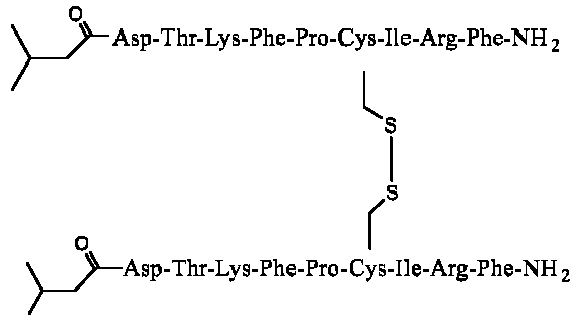
340 (SEQ ID NO:356) (Isovaleric acid-DTKFPCIRF-NH2)2 DIG through K3 212 
326 (SEQ ID NO:357) (Isovaleric acid-DTHFPCIKF-NH2)2 3 
342 (SEQ ID NO:358) (Isovaleric acid-DTHFPCIKF-NH2)2 DIG through K8 10 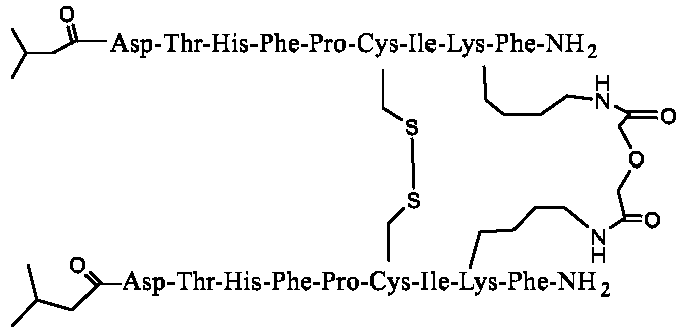
343 (SEQ ID NO:359) (Isovaleric acid-DTHFPCIRK-NH2)2 11 
344 (SEQ ID NO:360) (Isovaleric acid-DTHFPCIRK-NH2)2 DIG through K9 45 
345 (SEQ ID NO:361) (Isovaleric acid-DTHFPCIKFK-NH2)2 8 
346 (SEQ ID NO:362) (Isovaleric acid-DTHFPCIKFK-NH2)2 DIG through K10 15 
EC50 values were determined for peptide dimers comprising different linking moieties, and as compared to linkage via a disulphide bridge between the two peptide monomers, - EC50 values were determined for peptide dimers comprising different linking moieties, and as compared to linkage via a disulphide bridge between the two peptide monomers, including the peptide dimers shown in Table 14. Where a particular linking moiety is not indicated, the peptide dimer was dimerized via a disulphide bridge between cysteine residues present in each of the peptide monomers of the peptide dimer. The results of this experiment are shown in Table 14, and various linker types are shown as schematics in
Figure 7 .Table 14. Dimerization using various linkers at different positions Cmpd. No. Sequence Log dilutions EC50 (nM) (n>3) 327 (Hy-DTHFPCIKF-NH2)2 (SEQ ID NO:353) 193 348 (Hy-DTHFPCIKF-NH2)2-[IDA-(P-Ala)] (SEQ ID NO:363) 18 326 (Isovaleric acid-DTHFPCIKF-NH2)2 (SEQ ID NO:357) 6 349 (Isovaleric acid-DTHFPCIKF-NH2)2-[IDA-(β-Ala)-Palm] (SEQ ID NO:364) 5 345 (Isovaleric acid-DTHFPCIKFK-NH2)2 (SEQ ID NO:361) 8 346 (Isovaleric acid-DTHFPCIKFK-NH2)2-[DIG] DIG through K10 (SEQ ID NO:362) 15 327 (Hy-DTHFPCIKF-NH2)2 (SEQ ID NO:353) 193 351 [PEG25]-(DTHFPCIKF-NH2)2 (SEQ ID NO:366) >1000 In Table 14, brackets indicate linker and any linker conjugates (if present), e.g., [linker]. - EC50 values were determined for peptide dimers dimerized via a glycol linker attached to the εN of lysine residues within the peptide chains, as compared to the peptide monomers. As shown in Table 15, the peptide dimers had lower EC50s than their corresponding peptide monomers. In this case, the disulphide bond exists intramolecularly within each peptide (e.g.,
cmpd # 2 and cmpd# 3) moiety before dimerization through using DIG through acylation of the Nε of lysine.Table 15. Dimerization through a glycol linker attached to the εN of lysine within the peptide chain Cmpd No. Sequene Log dilutions EC50 (nM) (n>3) 3 Isovaleric acid-DTHFPCIIFGPRSRGWVCK-NH2 (SEQ ID NO:30) 15 352 (Isovaleric acid-DTHFPCIIFGPRSRGWVCK-NH2)2- [DIG] (SEQ ID NO:367) 5 2 Isovaleric acid-DTHFPICIFGPRSKGWVC-NH2 (SEQ ID NO:29) 4.1 353 (Isovaleric acid-DTHFPICIFGPRSKGWVC-NH2)2-[DIG] (SEQ ID NO:368) 2.2 -
- <110> Protagonist Therapeutics, Inc.
- <120> HEPCIDIN ANALOGUES AND USES THEROF
- <130> PRTH-001/01
WO 321085-2001 - <150>
US 61/800,048
<151> 2013-03-15 - <150>
US 61/800,284
<151> 2013-03-15 - <160> 375
- <170> PatentIn version 3.5
- <210> 1
<211> 10
<212> PRT
<213> Artificial Sequence - <220>
<223> Hepcidin peptide analogue motif - <220>
<221> MISC_FEATURE
<222> (1)..(1)
<223> Xaa = Asp, Glu, Ala, Gly Thr, Tyr, Leu, D-Asp, Iminodiacetic acid, pyroglutamic acid, beta-homoaspartic acid or absent - <220>
<221> MISC_FEATURE
<222> (2)..(2)
<223> Xaa = Thr, Ala, Arg, D-Thr, alpha-aminoisobutyric acid or absent - <220>
<221> MISC_FEATURE
<222> (3)..(3)
<223> Xaa = His, Lys, Ala or D-His - <220>
<221> MISC_FEATURE
<222> (4)..(4)
<223> Xaa = Phe, Ala, D-Phe, beta-beta-diphenylalanine or beta-homophenylalanine - <220>
<221> MISC_FEATURE
<222> (5)..(5)
<223> Xaa = Pro, Glu, Ser, Gly, Arg, Lys, Val, Ala, D-Pro, beta-homoproline, 4-aminobutyric acid, sarcosine or absent - <220>
<221> MISC_FEATURE
<222> (6)..(6)
<223> Xaa = Ile, Cys, Arg, Leu, Lys, His, Glu, D-Ile, D-Arg, D-Cys, Val, Ser or Ala - <220>
<221> MISC_FEATURE
<222> (7)..(7)
<223> Xaa = Cys, Ile, Ala, Leu, Val, Ser, Phe, D-Ile, D-Cys or (2,3-diaminopropanoic acid) - <220>
<221> MISC_FEATURE
<222> (8)..(8)
<223> Xaa = Ile, Lys, Arg, Ala, Gln, Phe, Glu, Asp, Tyr, Ser, Leu, Val, D-Ile, D-Lys, D-Arg or (2,3-diaminopropanoic acid) - <220>
<221> MISC_FEATURE
<222> (9)..(9)
<223> Xaa = Phe, Ala, Ile, Tyr, Lys, Arg, beta-homoproline or D-Phe - <220>
<221> MISC_FEATURE
<222> (10)..(10)
<223> Xaa = Lys, Phe or absent - <400> 1

- <210> 2
<211> 10
<212> PRT
<213> Artificial Sequence - <220>
<223> Hepcidine peptide analogue motif - <220>
<221> MISC_FEATURE
<222> (1)..(1)
<223> Xaa = Asp, Glu, iminodiacetic acid, pyroglutamic acid, beta-homoaspartic acid or absent - <220>
<221> MISC_FEATURE
<222> (4)..(4)
<223> Xaa = Phe or (beta,beta diphenylalanine) - <220>
<221> MISC_FEATURE
<222> (5)..(5)
<223> Xaa = Pro or beta-homoproline - <220>
<221> MISC_FEATURE
<222> (6)..(6)
<223> Xaa = Ile, Cys or Arg - <220>
<221> MISC_FEATURE
<222> (7)..(7)
<223> Xaa = Cys , Ile, Leu or Val - <220>
<221> MISC_FEATURE
<222> (8)..(8)
<223> Xaa = Ile, Lys, Glu, Phe, Gln or Arg - <220>
<221> MISC_FEATURE
<222> (10)..(10)
<223> Xaa = Lys, Phe or absent - <400> 2

- <210> 3
<211> 10
<212> PRT
<213> Artificial Sequence - <220>
<223> Hepcidin peptide analogue motif - <220>
<221> MISC_FEATURE
<222> (1)..(1)
<223> Xaa = Asp, Glu, Iminodiacetic acid, pyroglutamic acid, beta-homoaspartic acid or absent - <220>
<221> MISC_FEATURE
<222> (4)..(4)
<223> Xaa = Phe or (beta,beta diphenylalanine) - <220>
<221> MISC_FEATURE
<222> (5)..(5)
<223> Xaa = Pro or beta-homoproline - <220>
<221> MISC_FEATURE
<222> (8)..(8)
<223> Xaa = Ile, Lys, Glu, Phe, Gln or Arg - <220>
<221> MISC_FEATURE
<222> (10)..(10)
<223> Xaa = Lys or absent - <400> 3

- <210> 4
<211> 10
<212> PRT
<213> Artificial Sequence - <220>
<223> Hepcidin peptide analogue motif - <220>
<221> MISC_FEATURE
<222> (1)..(1)
<223> Xaa = Asp, Glu or Iminodiacetic acid - <220>
<221> MISC_FEATURE
<222> (5)..(5)
<223> Xaa = Pro or beta-homoproline - <220>
<221> MISC_FEATURE
<222> (8)..(8)
<223> Xaa = Ile Lys or Phe - <220>
<221> MISC_FEATURE
<222> (10)..(10)
<223> Xaa = absent - <400> 4

- <210> 5
<211> 15
<212> PRT
<213> Artificial Sequence - <220>
<223> Hepcidin peptide analogue motif - <220>
<221> MISC_FEATURE
<222> (1)..(1)
<223> Xaa = Gly, Cys, Ala, Phe, Pro, Glu, Lys, D-Pro, Val, Ser or absent - <220>
<221> MISC_FEATURE
<222> (2)..(2)
<223> Xaa = Pro, Ala, Cys, Gly or absent - <220>
<221> MISC_FEATURE
<222> (3)..(3)
<223> Xaa = Arg, Lys, Pro, Gly, His, Ala, Trp or absent - <220>
<221> MISC_FEATURE
<222> (4)..(4)
<223> Xaa = Ser, Arg, Gly, Trp, Ala, His, Tyr or absent - <220>
<221> MISC_FEATURE
<222> (5)..(5)
<223> Xaa = Lys, Met, Arg, Ala or absent - <220>
<221> MISC_FEATURE
<222> (6)..(6)
<223> Xaa = Gly, Ser, Lys, Ile, Arg, Ala, Pro, Val or absent - <220>
<221> MISC_FEATURE
<222> (7)..(7)
<223> Xaa = Trp, Lys, Gly, Ala Ile, Val or absent - <220>
<221> MISC_FEATURE
<222> (8)..(8)
<223> Xaa = Val, Thr, Gly, Cys, Met, Tyr, Ala, Glu, Lys, Asp, Arg or absent - <220>
<221> MISC_FEATURE
<222> (9)..(9)
<223> Xaa = Cys, Tyr or absent - <220>
<221> MISC_FEATURE
<222> (10)..(10)
<223> Xaa = Met, Lys, Arg, Tyr or absent - <220>
<221> MISC_FEATURE
<222> (11)..(11)
<223> Xaa = Arg, Met, Cys, Lys or absent - <220>
<221> MISC_FEATURE
<222> (12)..(12)
<223> Xaa = Arg, Lys, Ala or absent - <220>
<221> MISC_FEATURE
<222> (13)..(13)
<223> Xaa = Arg, Cys, Lys, Val or absent - <220>
<221> MISC_FEATURE
<222> (14)..(14)
<223> Xaa = Arg, Lys, Pro, Cys, Thr or absent - <220>
<221> MISC_FEATURE
<222> (15)..(15)
<223> Xaa = Thr, Arg or absent - <400> 5

- <210> 6
<211> 10
<212> PRT
<213> Artificial Sequence - <220>
<223> Hepcidin peptide analogue motif - <220>
<221> MISC_FEATURE
<222> (1)..(1)
<223> Xaa = Gly, Ala, Lys, Pro or D-Pro - <220>
<221> MISC_FEATURE
<222> (2)..(2)
<223> Xaa = Pro, Ala or Gly - <220>
<221> MISC_FEATURE
<222> (3)..(3)
<223> Xaa = Arg, Ala, Lys or Trp - <220>
<221> MISC_FEATURE
<222> (4)..(4)
<223> Xaa = Ser, Gly or Ala - <220>
<221> MISC_FEATURE
<222> (5)..(5)
<223> Xaa = Lys, Met, Arg or Ala - <220>
<221> MISC_FEATURE
<222> (6)..(6)
<223> Xaa = Gly, Arg or Ala - <220>
<221> MISC_FEATURE
<222> (7)..(7)
<223> Xaa = Trp, Ala or absent - <220>
<221> MISC_FEATURE
<222> (8)..(8)
<223> Xaa = Val, Thr, Lys, Ala, Glu or absent - <220>
<221> MISC_FEATURE
<222> (10)..(10)
<223> Xaa = Met, Lys or absent - <400> 6

- <210> 7
<211> 10
<212> PRT
<213> Artificial Sequence - <220>
<223> Hepcidin peptide analogue motif - <220>
<221> MISC_FEATURE
<222> (1)..(1)
<223> Xaa = Gly, Pro or D-Pro - <220>
<221> MISC_FEATURE
<222> (2)..(2)
<223> Xaa = Pro or Gly - <220>
<221> MISC_FEATURE
<222> (3)..(3)
<223> Xaa = Arg or Lys - <220>
<221> MISC_FEATURE
<222> (8)..(8)
<223> Xaa = Val or Thr - <220>
<221> MISC_FEATURE
<222> (10)..(10)
<223> Xaa = Met, Lys or absent - <400> 7

- <210> 8
<211> 15
<212> PRT
<213> Artificial Sequence - <220>
<223> Hepcidin peptide analogue motif - <220>
<221> MISC_FEATURE
<222> (1)..(1)
<223> Xaa = Val, Ala or absent - <220>
<221> MISC_FEATURE
<222> (3)..(3)
<223> Xaa = Gly, Pro or absent - <220>
<221> MISC_FEATURE
<222> (4)..(4)
<223> Xaa = His, Trp or Tyr - <220>
<221> MISC_FEATURE
<222> (6)..(6)
<223> Xaa = Ser, Gly or Pro - <220>
<221> MISC_FEATURE
<222> (7)..(7)
<223> Xaa = Ile, Gly or Lys - <220>
<221> MISC_FEATURE
<222> (8)..(8)
<223> Xaa = Gly, Met or absent - <220>
<221> MISC_FEATURE
<222> (10)..(10)
<223> Xaa = Tyr or Cys - <220>
<221> MISC_FEATURE
<222> (11)..(11)
<223> Xaa = Arg, Lys, Met or Ala - <220>
<221> MISC_FEATURE
<222> (12)..(12)
<223> Xaa = Arg or Ala - <220>
<221> MISC_FEATURE
<222> (13)..(13)
<223> Xaa = Cys or Val or absent - <220>
<221> MISC_FEATURE
<222> (14)..(14)
<223> Xaa = Cys, Lys, Pro, Arg, Thr or absent - <220>
<221> MISC_FEATURE
<222> (15)..(15)
<223> Xaa = Arg, Thr or absent - <400> 8

- <210> 9
<211> 15
<212> PRT
<213> Artificial Sequence - <220>
<223> Hepcidin peptide analogue motif - <220>
<221> MISC_FEATURE
<222> (3)..(3)
<223> Xaa = Gly or absent - <220>
<221> MISC_FEATURE
<222> (6)..(6)
<223> Xaa = Ser or Pro; - <220>
<221> MISC_FEATURE
<222> (7)..(7)
<223> Xaa = Ile or Lys - <220>
<221> MISC_FEATURE
<222> (8)..(8)
<223> Xaa = Gly or absent - <220>
<221> MISC_FEATURE
<222> (12)..(12)
<223> Xaa = Arg or Ala - <220>
<221> MISC_FEATURE
<222> (13)..(13)
<223> Xaa = Cys or Val or absent - <220>
<221> MISC_FEATURE
<222> (14)..(14)
<223> Xaa = Cys, Arg, Thr or absent - <220>
<221> MISC_FEATURE
<222> (15)..(15)
<223> Xaa = Arg or absent - <400> 9

- <210> 10
<211> 10
<212> PRT
<213> Artificial Sequence - <220>
<223> Hepcidin peptide analogue motif - <220>
<221> MISC_FEATURE
<222> (1)..(1)
<223> Xaa = Gly, Glu, Val or Lys - <220>
<221> MISC_FEATURE
<222> (3)..(3)
<223> Xaa = Arg or Lys - <220>
<221> MISC_FEATURE
<222> (5)..(5)
<223> Xaa = Arg or Lys - <220>
<221> MISC_FEATURE
<222> (6)..(6)
<223> Xaa = Gly, Ser, Lys, Ile or Arg - <220>
<221> MISC_FEATURE
<222> (7)..(7)
<223> Xaa = Trp or absent - <220>
<221> MISC_FEATURE
<222> (8)..(8)
<223> Xaa = Val, Thr, Asp, Glu or absent - <220>
<221> MISC_FEATURE
<222> (10)..(10)
<223> Xaa = Lys or absent - <400> 10

- <210> 11
<211> 10
<212> PRT
<213> Artificial Sequence - <220>
<223> Hepcidin peptide analogue motif - <220>
<221> MISC_FEATURE
<222> (1)..(1)
<223> Xaa = Glu or Lys - <220>
<221> MISC_FEATURE
<222> (3)..(3)
<223> Xaa = Arg or Lys - <220>
<221> MISC_FEATURE
<222> (5)..(5)
<223> Xaa = Arg or Lys - <220>
<221> MISC_FEATURE
<222> (6)..(6)
<223> Xaa = Gly, Ser, Lys, Ile or Arg - <220>
<221> MISC_FEATURE
<222> (7)..(7)
<223> Xaa = Trp or absent - <220>
<221> MISC_FEATURE
<222> (8)..(8)
<223> Xaa = Val, or absent - <220>
<221> MISC_FEATURE
<222> (10)..(10)
<223> Xaa = Lys or absent - <400> 11

- <210> 12
<211> 25
<212> PRT
<213> Artificial Sequence - <220>
<223> Hepcidin peptide analogue motif - <220>
<221> MISC_FEATURE
<222> (1)..(1)
<223> Xaa = Asp, Glu, Ala, Gly Thr, Tyr, Leu, D-Asp, Iminodiacetic acid, pyroglutamic acid, beta-homoaspartic acid or absent - <220>
<221> MISC_FEATURE
<222> (2)..(2)
<223> Xaa = Thr, Ala, Arg, D-Thr, alpha-aminoisobutyric acid or absent - <220>
<221> MISC_FEATURE
<222> (3)..(3)
<223> Xaa = His, Lys, Ala or D-His - <220>
<221> MISC_FEATURE
<222> (4)..(4)
<223> Xaa = Phe, Ala, D-Phe, beta-beta-diphenylalanine or beta-homophenylalanine - <220>
<221> MISC_FEATURE
<222> (5)..(5)
<223> Xaa = Pro, Glu, Ser, Gly, Arg, Lys, Val, Ala, D-Pro, beta-homoproline, 4-aminobutyric acid, sarcosine or absent - <220>
<221> MISC_FEATURE
<222> (6)..(6)
<223> Xaa = Ile, Cys, Arg, Leu, Lys, His, Glu, D-Ile, D-Arg, D-Cys, Val, Ser or Ala - <220>
<221> MISC_FEATURE
<222> (7)..(7)
<223> Xaa = Cys, Ile, Ala, Leu, Val, Ser, Phe, D-Ile, D-Cys or (2,3-diaminopropanoic acid) - <220>
<221> MISC_FEATURE
<222> (8)..(8)
<223> Xaa = Ile, Lys, Arg, Ala, Gln, Phe, Glu, Asp, Tyr, Ser, Leu, Val, D-Ile, D-Lys, D-Arg or (2,3-diaminopropanoic acid) - <220>
<221> MISC_FEATURE
<222> (9)..(9)
<223> Xaa = Phe, Ala, Ile, Tyr, Lys, Arg, beta-homoproline or D-Phe - <220>
<221> MISC_FEATURE
<222> (10)..(10)
<223> Xaa = Lys, Phe or absent - <220>
<221> MISC_FEATURE
<222> (11)..(11)
<223> Xaa = Gly, Cys, Ala, Phe, Pro, Glu, Lys, D-Pro, Val, Ser or absent - <220>
<221> MISC_FEATURE
<222> (12)..(12)
<223> Xaa = Pro, Ala, Cys, Gly or absent - <220>
<221> MISC_FEATURE
<222> (13)..(13)
<223> Xaa = Arg, Lys, Pro, Gly, His, Ala, Trp or absent - <220>
<221> MISC_FEATURE
<222> (14)..(14)
<223> Xaa = Ser, Arg, Gly, Trp, Ala, His, Tyr or absent - <220>
<221> MISC_FEATURE
<222> (15)..(15)
<223> Xaa = Lys, Met, Arg, Ala or absent - <220>
<221> MISC_FEATURE
<222> (16)..(16)
<223> Xaa = Gly, Ser, Lys, Ile, Arg, Ala, Pro, Val or absent - <220>
<221> MISC_FEATURE
<222> (17)..(17)
<223> Xaa = Trp, Lys, Gly, Ala Ile, Val or absent - <220>
<221> MISC_FEATURE
<222> (18)..(18)
<223> Xaa = Val, Thr, Gly, Cys, Met, Tyr, Ala, Glu, Lys, Asp, Arg or absent - <220>
<221> MISC_FEATURE
<222> (19)..(19)
<223> Xaa = Cys, Tyr or absent - <220>
<221> MISC_FEATURE
<222> (20)..(20)
<223> Xaa = Met, Lys, Arg, Tyr or absent - <220>
<221> MISC_FEATURE
<222> (21)..(21)
<223> Xaa = Arg, Met, Cys, Lys or absent - <220>
<221> MISC_FEATURE
<222> (22)..(22)
<223> Xaa = Arg, Lys, Ala or absent - <220>
<221> MISC_FEATURE
<222> (23)..(23)
<223> Xaa = Arg, Cys, Lys, Val or absent - <220>
<221> MISC_FEATURE
<222> (24)..(24)
<223> Xaa = Arg, Lys, Pro, Cys, Thr or absent - <220>
<221> MISC_FEATURE
<222> (25)..(25)
<223> Xaa = Thr, Arg or absent - <400> 12

- <210> 13
<211> 10
<212> PRT
<213> Artificial Sequence - <220>
<223> Hepcidin peptide analogue motif - <220>
<221> MISC_FEATURE
<222> (1)..(1)
<223> Xaa = Asp, Glu, Ala, Gly Thr, Tyr, Leu, D-Asp, Iminodiacetic acid, pyroglutamic acid, beta-homoaspartic acid or absent - <220>
<221> MISC_FEATURE
<222> (2)..(2)
<223> Xaa = Thr, Ala, Arg, D-Thr, alpha-aminoisobutyric acid or absent - <220>
<221> MISC_FEATURE
<222> (3)..(3)
<223> Xaa = His, Lys, Ala or D-His - <220>
<221> MISC_FEATURE
<222> (4)..(4)
<223> Xaa = Phe, Ala, D-Phe, beta-beta-diphenylalanine or beta-homophenylalanine - <220>
<221> MISC_FEATURE
<222> (5)..(5)
<223> Xaa = Pro, Glu, Ser, Gly, Arg, Lys, Val, Ala, D-Pro, beta-homoproline, 4-aminobutyric acid, sarcosine or absent - <220>
<221> MISC_FEATURE
<222> (6)..(6)
<223> Xaa = Ile, Cys, Arg, Leu, Lys, His, Glu, D-Ile, D-Arg, D-Cys, Val, Ser or Ala - <220>
<221> MISC_FEATURE
<222> (7)..(7)
<223> Xaa = Cys, Ile, Ala, Leu, Val, Ser, Phe, D-Ile, D-Cys or (2,3-diaminopropanoic acid) - <220>
<221> MISC_FEATURE
<222> (8)..(8)
<223> Xaa = Ile, Lys, Arg, Ala, Gln, Phe, Glu, Asp, Tyr, Ser, Leu, Val, D-Ile, D-Lys, D-Arg or (2,3-diaminopropanoic acid) - <220>
<221> MISC_FEATURE
<222> (9)..(9)
<223> Xaa = Phe, Ala, Ile, Tyr, Lys, Arg, beta-homoproline or D-Phe - <220>
<221> MISC_FEATURE
<222> (10)..(10)
<223> Xaa = Lys, Phe or absent - <400> 13

- <210> 14
<211> 10
<212> PRT
<213> Artificial Sequence - <220>
<223> Hepcidine peptide analogue motif - <220>
<221> MISC_FEATURE
<222> (1)..(1)
<223> Xaa = Asp, iminodiacetic acid, pyroglutamic acid, beta-homoaspartic acid or absent - <220>
<221> MISC_FEATURE
<222> (4)..(4)
<223> Xaa = Phe or (beta,beta diphenylalanine) - <220>
<221> MISC_FEATURE
<222> (5)..(5)
<223> Xaa = Pro or beta-homoproline - <220>
<221> MISC_FEATURE
<222> (6)..(6)
<223> Xaa = Ile, Cys or Arg - <220>
<221> MISC_FEATURE
<222> (7)..(7)
<223> Xaa = Cys , Ile. Leu or Val - <220>
<221> MISC_FEATURE
<222> (8)..(8)
<223> Xaa = Ile, Lys, Glu, Phe, Gln or Arg - <220>
<221> MISC_FEATURE
<222> (10)..(10)
<223> Xaa = Lys or absent - <400> 14

- <210> 15
<211> 10
<212> PRT
<213> Artificial Sequence - <220>
<223> Hepcidin peptide analogue motif - <220>
<221> MISC_FEATURE
<222> (1)..(1)
<223> Xaa = Asp, Iminodiacetic acid, pyroglutamic acid, beta-homoaspartic acid or absent - <220>
<221> MISC_FEATURE
<222> (4)..(4)
<223> Xaa = Phe or (beta,beta diphenylalanine) - <220>
<221> MISC_FEATURE
<222> (5)..(5)
<223> Xaa = Pro or beta-homoproline - <220>
<221> MISC_FEATURE
<222> (8)..(8)
<223> Xaa = Ile, Lys, Glu, Phe, Gln or Arg - <220>
<221> MISC_FEATURE
<222> (10)..(10)
<223> Xaa = Lys or absent - <400> 15

- <210> 16
<211> 15
<212> PRT
<213> Artificial Sequence - <220>
<223> Hepcidin peptide analogue motif - <220>
<221> MISC_FEATURE
<222> (1)..(1)
<223> Xaa = Gly, Cys, Ala, Phe, Pro, Glu, Lys, D-Pro, Val, Ser or absent - <220>
<221> MISC_FEATURE
<222> (2)..(2)
<223> Xaa = Pro, Ala, Cys, Gly or absent - <220>
<221> MISC_FEATURE
<222> (3)..(3)
<223> Xaa = Arg, Lys, Pro, Gly, His, Ala, Trp or absent - <220>
<221> MISC_FEATURE
<222> (4)..(4)
<223> Xaa = Ser, Arg, Gly, Trp, Ala, His, Tyr or absent - <220>
<221> MISC_FEATURE
<222> (5)..(5)
<223> Xaa = Lys, Met, Arg, Ala or absent - <220>
<221> MISC_FEATURE
<222> (6)..(6)
<223> Xaa = Gly, Ser, Lys, Ile, Arg, Ala, Pro, Val or absent - <220>
<221> MISC_FEATURE
<222> (7)..(7)
<223> Xaa = Trp, Lys, Gly, Ala Ile, Val or absent - <220>
<221> MISC_FEATURE
<222> (8)..(8)
<223> Xaa = Val, Thr, Gly, Cys, Met, Tyr, Ala, Glu, Lys, Asp, Arg or absent - <220>
<221> MISC_FEATURE
<222> (9)..(9)
<223> Xaa = Cys, Tyr or absent - <220>
<221> MISC_FEATURE
<222> (10) .. (10)
<223> Xaa = Met, Lys, Arg, Tyr or absent - <220>
<221> MISC_FEATURE
<222> (11) .. (11)
<223> Xaa = Arg, Met, Cys, Lys or absent - <220>
<221> MISC_FEATURE
<222> (12) .. (12)
<223> Xaa = Arg, Lys, Ala or absent - <220>
<221> MISC_FEATURE
<222> (13) .. (13)
<223> Xaa = Arg, Cys, Lys, Val or absent - <220>
<221> MISC_FEATURE
<222> (14) .. (14)
<223> Xaa = Arg, Lys, Pro, Cys, Thr or absent - <220>
<221> MISC_FEATURE
<222> (15) .. (15)
<223> Xaa = Thr, Arg or absent - <400> 16

- <210> 17
<211> 10
<212> PRT
<213> Artificial Sequence - <220>
<223> Hepcidin peptide analogue motif - <220>
<221> MISC_FEATURE
<222> (1) .. (1)
<223> Xaa = Gly, Ala, Lys, Pro or D-Pro - <220>
<221> MISC_FEATURE
<222> (2) .. (2)
<223> Xaa = Pro, Ala or Gly - <220>
<221> MISC_FEATURE
<222> (3) .. (3)
<223> Xaa = Arg, Ala, Lys or Trp - <220>
<221> MISC_FEATURE
<222> (4) .. (4)
<223> Xaa = Ser, Gly or Ala - <220>
<221> MISC_FEATURE
<222> (5) .. (5)
<223> Xaa = Lys, Met, Arg or Ala - <220>
<221> MISC_FEATURE
<222> (6) .. (6)
<223> Xaa = Gly, Arg or Ala - <220>
<221> MISC_FEATURE
<222> (7) .. (7)
<223> Xaa = Trp or Ala - <220>
<221> MISC_FEATURE
<222> (8) .. (8)
<223> Xaa = Val, Thr, Lys, Ala or Glu - <220>
<221> MISC_FEATURE
<222> (10) .. (10)
<223> Xaa = Met, Lys or absent - <400> 17

- <210> 18
<211> 10
<212> PRT
<213> Artificial Sequence - <220>
<223> Hepcidin peptide analogue motif - <220>
<221> MISC_FEATURE
<222> (1) .. (1)
<223> Xaa = Gly, Pro or D-Pro - <220>
<221> MISC_FEATURE
<222> (2) .. (2)
<223> Xaa = Pro or Gly - <220>
<221> MISC_FEATURE
<222> (3) .. (3)
<223> Xaa = Arg or Lys - <220>
<221> MISC_FEATURE
<222> (8) .. (8)
<223> Xaa = Val or Thr - <220>
<221> MISC_FEATURE
<222> (10) .. (10)
<223> Xaa = Met, Lys or absent - <400> 18

- <210> 19
<211> 15
<212> PRT
<213> Artificial Sequence - <220>
<223> Hepcidin peptide analogue motif - <220>
<221> MISC_FEATURE
<222> (1) .. (1)
<223> Xaa = Val, Ala or absent - <220>
<221> MISC_FEATURE
<222> (3) .. (3)
<223> Xaa = Gly, Pro or absent - <220>
<221> MISC_FEATURE
<222> (4) .. (4)
<223> Xaa = His, Trp or Tyr - <220>
<221> MISC_FEATURE
<222> (6) .. (6)
<223> Xaa = Ser, Gly or Pro - <220>
<221> MISC_FEATURE
<222> (7) .. (7)
<223> Xaa = Ile, Gly or Lys - <220>
<221> MISC_FEATURE
<222> (8) .. (8)
<223> Xaa = Gly, Met or absent - <220>
<221> MISC_FEATURE
<222> (10) .. (10)
<223> Xaa = Tyr or Cys - <220>
<221> MISC_FEATURE
<222> (11) .. (11)
<223> Xaa = Arg, Lys, Met or Ala - <220>
<221> MISC_FEATURE
<222> (12) .. (12)
<223> Xaa = Arg or Ala - <220>
<221> MISC_FEATURE
<222> (13) .. (13)
<223> Xaa = Cys or Val or absent - <220>
<221> MISC_FEATURE
<222> (14) .. (14)
<223> Xaa = Cys, Lys, Pro, Arg, Thr or absent - <220>
<221> MISC_FEATURE
<222> (15) .. (15)
<223> Xaa = Arg, Thr or absent - <400> 19

- <210> 20
<211> 15
<212> PRT
<213> Artificial Sequence - <220>
<223> Hepcidin peptide analogue motif - <220>
<221> MISC_FEATURE
<222> (3) .. (3)
<223> Xaa = Gly or absent - <220>
<221> MISC_FEATURE
<222> (6) .. (6)
<223> Xaa = Ser or Pro; - <220>
<221> MISC_FEATURE
<222> (7) .. (7)
<223> Xaa = Ile or Lys - <220>
<221> MISC_FEATURE
<222> (8) .. (8)
<223> Xaa = Gly or absent - <220>
<221> MISC_FEATURE
<222> (12) .. (12)
<223> Xaa = Arg or Ala - <220>
<221> MISC_FEATURE
<222> (13) .. (13)
<223> Xaa = Cys or Val or absent - <220>
<221> MISC_FEATURE
<222> (14) .. (14)
<223> Xaa = Cys, Arg, Thr or absent - <220>
<221> MISC_FEATURE
<222> (15) .. (15)
<223> Xaa = Arg or absent - <400> 20

- <210> 21
<211> 25
<212> PRT
<213> Artificial Sequence - <220>
<223> Hepcidin peptide analogue motif - <220>
<221> MISC_FEATURE
<222> (1) .. (1)
<223> Xaa = Asp, Glu, Ala, Gly Thr, Tyr, Leu, D-Asp, Iminodiacetic acid, pyroglutamic acid, beta-homoaspartic acid or absent - <220>
<221> MISC_FEATURE
<222> (2) .. (2)
<223> Xaa = Thr, Ala, Arg, D-Thr, alpha-aminoisobutyric acid or absent - <220>
<221> MISC_FEATURE
<222> (3) .. (3)
<223> Xaa = His, Lys, Ala or D-His - <220>
<221> MISC_FEATURE
<222> (4) .. (4)
<223> Xaa = Phe, Ala, D-Phe, beta-beta-diphenylalanine or beta-homophenylalanine - <220>
<221> MISC_FEATURE
<222> (5) .. (5)
<223> Xaa = Pro, Glu, Ser, Gly, Arg, Lys, Val, Ala, D-Pro, beta-homoproline, 4-aminobutyric acid, sarcosine or absent - <220>
<221> MISC_FEATURE
<222> (6) .. (6)
<223> Xaa = Ile, Cys, Arg, Leu, Lys, His, Glu, D-Ile, D-Arg, D-Cys, Val, Ser or Ala - <220>
<221> MISC_FEATURE
<222> (7) .. (7)
<223> Xaa = Cys, Ile, Ala, Leu, Val, Ser, Phe, D-Ile, D-Cys or (2,3-diaminopropanoic acid) - <220>
<221> MISC_FEATURE
<222> (8) .. (8)
<223> Xaa = Ile, Lys, Arg, Ala, Gln, Phe, Glu, Asp, Tyr, Ser, Leu, Val, D-Ile, D-Lys, D-Arg or (2,3-diaminopropanoic acid) - <220>
<221> MISC_FEATURE
<222> (9) .. (9)
<223> Xaa = Phe, Ala, Ile, Tyr, Lys, Arg, beta-homoproline or D-Phe - <220>
<221> MISC_FEATURE
<222> (10) .. (10)
<223> Xaa = Lys, Phe or absent - <220>
<221> MISC_FEATURE
<222> (11) .. (11)
<223> Xaa = Gly, Cys, Ala, Phe, Pro, Glu, Lys, D-Pro, Val, Ser or absent - <220>
<221> MISC_FEATURE
<222> (12) .. (12)
<223> Xaa = Pro, Ala, Cys, Gly or absent - <220>
<221> MISC_FEATURE
<222> (13) .. (13)
<223> Xaa = Arg, Lys, Pro, Gly, His, Ala, Trp or absent - <220>
<221> MISC_FEATURE
<222> (14) .. (14)
<223> Xaa = Ser, Arg, Gly, Trp, Ala, His, Tyr or absent - <220>
<221> MISC_FEATURE
<222> (15) .. (15)
<223> Xaa = Lys, Met, Arg, Ala or absent - <220>
<221> MISC_FEATURE
<222> (16) .. (16)
<223> Xaa = Gly, Ser, Lys, Ile, Arg, Ala, Pro, Val or absent - <220>
<221> MISC_FEATURE
<222> (17) .. (17)
<223> Xaa = Trp, Lys, Gly, Ala Ile, Val or absent - <220>
<221> MISC_FEATURE
<222> (18) .. (18)
<223> Xaa = Val, Thr, Gly, Cys, Met, Tyr, Ala, Glu, Lys, Asp, Arg or absent - <220>
<221> MISC_FEATURE
<222> (19) .. (19)
<223> Xaa = Cys, Tyr or absent - <220>
<221> MISC_FEATURE
<222> (20) .. (20)
<223> Xaa = Met, Lys, Arg, Tyr or absent - <220>
<221> MISC_FEATURE
<222> (21) .. (21)
<223> Xaa = Arg, Met, Cys, Lys or absent - <220>
<221> MISC_FEATURE
<222> (22) .. (22)
<223> Xaa = Arg, Lys, Ala or absent - <220>
<221> MISC_FEATURE
<222> (23) .. (23)
<223> Xaa = Arg, Cys, Lys, Val or absent - <220>
<221> MISC_FEATURE
<222> (24) .. (24)
<223> Xaa = Arg, Lys, Pro, Cys, Thr or absent - <220>
<221> MISC_FEATURE
<222> (25) .. (25)
<223> Xaa = Thr, Arg or absent - <400> 21

- <210> 22
<211> 10
<212> PRT
<213> Artificial Sequence - <220>
<223> Hepcidin peptide analogue motif - <220>
<221> MISC_FEATURE
<222> (1) .. (1)
<223> Xaa = Asp, Glu, Ala, Gly Thr, Tyr, Leu, D-Asp, Iminodiacetic acid, pyroglutamic acid, beta-homoaspartic acid or absent - <220>
<221> MISC_FEATURE
<222> (2) .. (2)
<223> Xaa = Thr, Ala, Arg, D-Thr, alpha-aminoisobutyric acid or absent - <220>
<221> MISC_FEATURE
<222> (3) .. (3)
<223> Xaa = His, Lys, Ala or D-His - <220>
<221> MISC_FEATURE
<222> (4) .. (4)
<223> Xaa = Phe, Ala, D-Phe, beta-beta-diphenylalanine or beta-homophenylalanine - <220>
<221> MISC_FEATURE
<222> (5) .. (5)
<223> Xaa = Pro, Glu, Ser, Gly, Arg, Lys, Val, Ala, D-Pro, beta-homoproline, 4-aminobutyric acid, sarcosine or absent - <220>
<221> MISC_FEATURE
<222> (6) .. (6)
<223> Xaa = Ile, Cys, Arg, Leu, Lys, His, Glu, D-Ile, D-Arg, D-Cys, Val, Ser or Ala - <220>
<221> MISC_FEATURE
<222> (7) .. (7)
<223> Xaa = Cys, Ile, Ala, Leu, Val, Ser, Phe, D-Ile, D-Cys or (2,3-diaminopropanoic acid) - <220>
<221> MISC_FEATURE
<222> (8) .. (8)
<223> Xaa = Ile, Lys, Arg, Ala, Gln, Phe, Glu, Asp, Tyr, Ser, Leu, Val, D-Ile, D-Lys, D-Arg or (2,3-diaminopropanoic acid) - <220>
<221> MISC_FEATURE
<222> (9) .. (9)
<223> Xaa = Phe, Ala, Ile, Tyr, Lys, Arg, beta-homoproline or D-Phe - <220>
<221> MISC_FEATURE
<222> (10) .. (10)
<223> Xaa = Lys, Phe or absent - <400> 22

- <210> 23
<211> 10
<212> PRT
<213> Artificial Sequence - <220>
<223> Hepcidine peptide analogue motif - <220>
<221> MISC_FEATURE
<222> (1) .. (1)
<223> Xaa = Asp, iminodiacetic acid, pyroglutamic acid, beta-homoaspartic acid or absent - <220>
<221> MISC_FEATURE
<222> (4) .. (4)
<223> Xaa = Phe or (beta,beta diphenylalanine) - <220>
<221> MISC_FEATURE
<222> (5) .. (5)
<223> Xaa = Pro or beta-homoproline - <220>
<221> MISC_FEATURE
<222> (6) .. (6)
<223> Xaa = Ile, Cys or Arg - <220>
<221> MISC_FEATURE
<222> (7) .. (7)
<223> Xaa = Cys , Ile, Leu or Val - <220>
<221> MISC_FEATURE
<222> (8) .. (8)
<223> Xaa = Ile, Lys, Glu, Phe, Gln or Arg - <220>
<221> MISC_FEATURE
<222> (10) .. (10)
<223> Xaa = Lys, Phe or absent - <400> 23

- <210> 24
<211> 10
<212> PRT
<213> Artificial Sequence - <220>
<223> Hepcidin peptide analogue motif - <220>
<221> MISC_FEATURE
<222> (1) .. (1)
<223> Xaa = Asp, Iminodiacetic acid, pyroglutamic acid, beta-homoaspartic acid or absent - <220>
<221> MISC_FEATURE
<222> (4) .. (4)
<223> Xaa = Phe or (beta,beta diphenylalanine) - <220>
<221> MISC_FEATURE
<222> (5) .. (5)
<223> Xaa = Pro or beta-homoproline - <220>
<221> MISC_FEATURE
<222> (8) .. (8)
<223> Xaa = Ile, Lys, Glu, Phe, Gln or Arg - <220>
<221> MISC_FEATURE
<222> (10) .. (10)
<223> Xaa = Lys or absent - <400> 24

- <210> 25
<211> 10
<212> PRT
<213> Artificial Sequence - <220>
<223> Hepcidin peptide analogue motif - <220>
<221> MISC_FEATURE
<222> (1) .. (1)
<223> Xaa = Gly, Ala, Pro, Lys or D-Pro - <220>
<221> MISC_FEATURE
<222> (2) .. (2)
<223> Xaa = Pro, Ala or Gly - <220>
<221> MISC_FEATURE
<222> (3) .. (3)
<223> Xaa = Arg, Lys, Ala or Trp - <220>
<221> MISC_FEATURE
<222> (4) .. (4)
<223> Xaa = Ser, Gly or Ala - <220>
<221> MISC_FEATURE
<222> (5) .. (5)
<223> Xaa = Lys, Met, Arg or Ala - <220>
<221> MISC_FEATURE
<222> (6) .. (6)
<223> Xaa = Gly, Arg or Ala - <220>
<221> MISC_FEATURE
<222> (7) .. (7)
<223> Xaa = Trp, Ala or absent - <220>
<221> MISC_FEATURE
<222> (8) .. (8)
<223> Xaa = Val, Thr, Ala, Glu, Lys or absent - <220>
<221> MISC_FEATURE
<222> (10) .. (10)
<223> Xaa = Met, Lys or absent - <400> 25

- <210> 26
<211> 10
<212> PRT
<213> Artificial Sequence - <220>
<223> Hepcidin peptide analogue motif - <220>
<221> MISC_FEATURE
<222> (1) .. (1)
<223> Xaa = Gly, Pro or D-Pro - <220>
<221> MISC_FEATURE
<222> (2) .. (2)
<223> Xaa = Pro or Gly - <220>
<221> MISC_FEATURE
<222> (3) .. (3)
<223> Xaa = Arg or Lys - <220>
<221> MISC_FEATURE
<222> (8) .. (8)
<223> Xaa = Val or Thr - <220>
<221> MISC_FEATURE
<222> (10) .. (10)
<223> Xaa = Met, Lys or absent - <400> 26

- <210> 27
<211> 20
<212> PRT
<213> Artificial Sequence - <220>
<223> Hepcidin peptide analogue motif - <220>
<221> MISC_FEATURE
<222> (1) .. (1)
<223> Xaa = Asp, Glu, Ala, Gly Thr, Tyr, Leu, D-Asp, Iminodiacetic acid, pyroglutamic acid, beta-homoaspartic acid or absent - <220>
<221> MISC_FEATURE
<222> (2) .. (2)
<223> Xaa = Thr, Ala, Arg, D-Thr, alpha-aminoisobutyric acid or absent - <220>
<221> MISC_FEATURE
<222> (3) .. (3)
<223> Xaa = His, Lys, Ala or D-His - <220>
<221> MISC_FEATURE
<222> (4) .. (4)
<223> Xaa = Phe, Ala, D-Phe, beta-beta-diphenylalanine or beta-homophenylalanine - <220>
<221> MISC_FEATURE
<222> (5) .. (5)
<223> Xaa = Pro, Glu, Ser, Gly, Arg, Lys, Val, Ala, D-Pro, beta-homoproline, 4-aminobutyric acid, sarcosine or absent - <220>
<221> MISC_FEATURE
<222> (6) .. (6)
<223> Xaa = Ile, Cys, Arg, Leu, Lys, His, Glu, D-Ile, D-Arg, D-Cys, Val, Ser or Ala - <220>
<221> MISC_FEATURE
<222> (7) .. (7)
<223> Xaa = Cys, Ile, Ala, Leu, Val, Ser, Phe, D-Ile, D-Cys or (2,3-diaminopropanoic acid) - <220>
<221> MISC_FEATURE
<222> (8) .. (8)
<223> Xaa = Ile, Lys, Arg, Ala, Gln, Phe, Glu, Asp, Tyr, Ser, Leu, Val, D-Ile, D-Lys, D-Arg or (2,3-diaminopropanoic acid) - <220>
<221> MISC_FEATURE
<222> (9) .. (9)
<223> Xaa = Phe, Ala, Ile, Tyr, Lys, Arg, beta-homoproline or D-Phe - <220>
<221> MISC_FEATURE
<222> (10) .. (10)
<223> Xaa = Lys, Phe or absent - <220>
<221> MISC_FEATURE
<222> (11) .. (11)
<223> Xaa = Gly, Ala, Pro, Lys or D-Pro - <220>
<221> MISC_FEATURE
<222> (12) .. (12)
<223> Xaa = Pro, Ala or Gly - <220>
<221> MISC_FEATURE
<222> (13) .. (13)
<223> Xaa = Arg, Lys, Ala or Trp - <220>
<221> MISC_FEATURE
<222> (14) .. (14)
<223> Xaa = Ser, Gly or Ala - <220>
<221> MISC_FEATURE
<222> (15) .. (15)
<223> Xaa = Lys, Met, Arg or Ala - <220>
<221> MISC_FEATURE
<222> (16) .. (16)
<223> Xaa = Gly, Arg or Ala - <220>
<221> MISC_FEATURE
<222> (17) .. (17)
<223> Xaa = Trp, Ala or absent - <220>
<221> MISC_FEATURE
<222> (18) .. (18)
<223> Xaa = Val, Thr, Ala, Glu, Lys or absent - <220>
<221> MISC_FEATURE
<222> (20) .. (20)
<223> Xaa = Met, Lys or absent - <400> 27

- <210> 28
<211> 9
<212> PRT
<213> Artificial Sequence - <220>
<223> Hepcidin peptide analogue - <400> 28

- <210> 29
<211> 18
<212> PRT
<213> Artificial Sequence - <220>
<223> Hepcidin peptide analogue - <400> 29

- <210> 30
<211> 19
<212> PRT
<213> Artificial Sequence - <220>
<223> Hepcidin peptide analogue - <400> 30

- <210> 31
<211> 18
<212> PRT
<213> Artificial Sequence - <220>
<223> Hepcidin peptide analogue - <400> 31

- <210> 32
<211> 19
<212> PRT
<213> Artificial Sequence - <220>
<223> Hepcidin peptide analogue - <220>
<221> MOD_RES
<222> (1) .. (1)
<223> Xaa is iminodiacetic acid - <220>
<221> MOD_RES
<222> (4) .. (4)
<223> Xaa is beta,beta diphenylalanine - <220>
<221> MOD_RES
<222> (5) .. (5)
<223> Xaa is beta-homoproline - <400> 32

- <210> 33
<211> 19
<212> PRT
<213> Artificial Sequence - <220>
<223> Hepcidin peptide analogue - <400> 33

- <210> 34
<211> 19
<212> PRT
<213> Artificial Sequence - <220>
<223> Hepcidin peptide analogue - <400> 34

- <210> 35
<211> 19
<212> PRT
<213> Artificial Sequence - <220>
<223> Hepcidin peptide analogue - <220>
<221> MOD_RES
<222> (1) .. (1) - <220>
<221> MOD_RES
<222> (4) .. (4)
<223> Xaa is beta,beta diphenylalanine - <220>
<221> MOD_RES
<222> (5) .. (5)
<223> Xaa is beta-homoproline - <400> 35

- <210> 36
<211> 19
<212> PRT
<213> Artificial Sequence - <220>
<223> Hepcidin peptide analogue - <400> 36

- <210> 37
<211> 19
<212> PRT
<213> Artificial Sequence - <220>
<223> Hepcidin peptide analogue - <400> 37

- <210> 38
<211> 19
<212> PRT
<213> Artificial Sequence - <220>
<223> Hepcidin peptide analogue - <400> 38

- <210> 39
<211> 22
<212> PRT
<213> Artificial Sequence - <220>
<223> Hepcidin peptide analogue - <400> 39

- <210> 40
<211> 23
<212> PRT
<213> Artificial Sequence - <220>
<223> Hepcidin peptide analogue - <400> 40

- <210> 41
<211> 21
<212> PRT
<213> Artificial Sequence - <220>
<223> Hepcidin peptide analogue - <400> 41

- <210> 42
<211> 19
<212> PRT
<213> Artificial Sequence - <220>
<223> Hepcidin peptide analogue - <400> 42

- <210> 43
<211> 19
<212> PRT
<213> Artificial Sequence - <220>
<223> Hepcidin peptide analogue - <400> 43

- <210> 44
<211> 23
<212> PRT
<213> Artificial Sequence - <220>
<223> Hepcidin peptide analogue - <400> 44

- <210> 45
<211> 19
<212> PRT
<213> Artificial Sequence - <220>
<223> Hepcidin peptide analogue - <400> 45

- <210> 46
<211> 22
<212> PRT
<213> Artificial Sequence - <220>
<223> Hepcidin peptide analogue - <400> 46

- <210> 47
<211> 19
<212> PRT
<213> Artificial Sequence - <220>
<223> Hepcidin peptide analogue - <400> 47

- <210> 48
<211> 19
<212> PRT
<213> Artificial Sequence - <220>
<223> Hepcidin peptide analogue - <400> 48

- <210> 49
<211> 19
<212> PRT
<213> Artificial Sequence - <220>
<223> Hepcidin peptide analogue - <400> 49

- <210> 50
<211> 20
<212> PRT
<213> Artificial Sequence - <220>
<223> Hepcidin peptide analogue - <400> 50

- <210> 51
<211> 9
<212> PRT
<213> Artificial Sequence - <220>
<223> Hepcidin peptide analogue - <400> 51

- <210> 52
<211> 23
<212> PRT
<213> Artificial Sequence - <220>
<223> Hepcidin peptide analogue - <400> 52

- <210> 53
<211> 19
<212> PRT
<213> Artificial Sequence - <220>
<223> Hepcidin peptide analogue - <400> 53

- <210> 54
<211> 20
<212> PRT
<213> Artificial Sequence - <220>
<223> Hepcidin peptide analogue - <400> 54

- <210> 55
<211> 19
<212> PRT
<213> Artificial Sequence - <220>
<223> Hepcidin peptide analogue - <400> 55


- <210> 56
<211> 19
<212> PRT
<213> Artificial Sequence - <220>
<223> Hepcidin peptide analogue - <400> 56

- <210> 57
<211> 23
<212> PRT
<213> Artificial Sequence - <220>
<223> Hepcidin peptide analogue - <400> 57

- <210> 58
<211> 19
<212> PRT
<213> Artificial Sequence - <220>
<223> Hepcidin peptide analogue - <400> 58

- <210> 59
<211> 23
<212> PRT
<213> Artificial Sequence - <220>
<223> Hepcidin peptide analogue - <400> 59

- <210> 60
<211> 19
<212> PRT
<213> Artificial Sequence - <220>
<223> Hepcidin peptide analogue - <400> 60

- <210> 61
<211> 19
<212> PRT
<213> Artificial Sequence - <220>
<223> Hepcidin peptide analogue - <400> 61

- <210> 62
<211> 21
<212> PRT
<213> Artificial Sequence - <220>
<223> Hepcidin peptide analogue - <400> 62


- <210> 63
<211> 19
<212> PRT
<213> Artificial Sequence - <220>
<223> Hepcidin peptide analogue - <400> 63

- <210> 64
<211> 19
<212> PRT
<213> Artificial Sequence - <220>
<223> Hepcidin peptide analogue - <400> 64

- <210> 65
<211> 19
<212> PRT
<213> Artificial Sequence - <220>
<223> Hepcidin peptide analogue - <400> 65

- <210> 66
<211> 21
<212> PRT
<213> Artificial Sequence - <220>
<223> Hepcidin peptide analogue - <400> 66

- <210> 67
<211> 22
<212> PRT
<213> Artificial Sequence - <220>
<223> Hepcidin peptide analogue - <220>
<221> MOD_RES
<222> (1) .. (1)
<223> Xaa is pyroglutamic acid - <400> 67

- <210> 68
<211> 19
<212> PRT
<213> Artificial Sequence - <220>
<223> Hepcidin peptide analogue - <400> 68

- <210> 69
<211> 24
<212> PRT
<213> Artificial Sequence - <220>
<223> Hepcidin peptide analogue - <400> 69

- <210> 70
<211> 19
<212> PRT
<213> Artificial Sequence - <220>
<223> Hepcidin peptide analogue - <400> 70

- <210> 71
<211> 21
<212> PRT
<213> Artificial Sequence - <220>
<223> Hepcidin peptide analogue - <400> 71

- <210> 72
<211> 19
<212> PRT
<213> Artificial Sequence - <220>
<223> Hepcidin peptide analogue - <400> 72

- <210> 73
<211> 18
<212> PRT
<213> Artificial Sequence - <220>
<223> Hepcidin peptide analogue - <220>
<221> MOD_RES
<222> (1) .. (1)
<223> Xaa is beta-homoaspartic acid - <400> 73

- <210> 74
<211> 19
<212> PRT
<213> Artificial Sequence - <220>
<223> Hepcidin peptide analogue - <400> 74

- <210> 75
<211> 19
<212> PRT
<213> Artificial Sequence - <220>
<223> Hepcidin peptide analogue - <220>
<221> MOD_RES
<222> (1) .. (1)
<223> Xaa is iminodiacetic acid - <220>
<221> MOD_RES
<222> (4) .. (4)
<223> Xaa is beta,beta diphenylalanine - <220>
<221> MOD_RES
<222> (5) .. (5)
<223> Xaa is beta-homoproline - <220>
<221> MOD_RES
<222> (9) .. (9)
<223> Xaa is beta homophenylalanine - <400> 75

- <210> 76
<211> 9
<212> PRT
<213> Artificial Sequence - <220>
<223> Hepcidin peptide analogue - <400> 76

- <210> 77
<211> 18
<212> PRT
<213> Artificial Sequence - <220>
<223> Hepcidin peptide analogue - <400> 77

- <210> 78
<211> 9
<212> PRT
<213> Artificial Sequence - <220>
<223> Hepcidin peptide analogue - <400> 78

- <210> 79
<211> 9
<212> PRT
<213> Artificial Sequence - <220>
<223> Hepcidin peptide analogue - <400> 79

- <210> 80
<211> 22
<212> PRT
<213> Artificial Sequence - <220>
<223> Hepcidin peptide analogue - <400> 80

- <210> 81
<211> 19
<212> PRT
<213> Artificial Sequence - <220>
<223> Hepcidin peptide analogue - <400> 81

- <210> 82
<211> 10
<212> PRT
<213> Artificial Sequence - <220>
<223> Hepcidin peptide analogue - <400> 82

- <210> 83
<211> 9
<212> PRT
<213> Artificial Sequence - <220>
<223> Hepcidin peptide analogue - <400> 83

- <210> 84
<211> 19
<212> PRT
<213> Artificial Sequence - <220>
<223> Hepcidin peptide analogue - <400> 84

- <210> 85
<211> 19
<212> PRT
<213> Artificial Sequence - <220>
<223> Hepcidin peptide analogue - <400> 85

- <210> 86
<211> 17
<212> PRT
<213> Artificial Sequence - <220>
<223> Hepcidin peptide analogue - <400> 86

- <210> 87
<211> 19
<212> PRT
<213> Artificial Sequence - <220>
<223> Hepcidin peptide analogue - <400> 87

- <210> 88
<211> 22
<212> PRT
<213> Artificial Sequence - <220>
<223> Hepcidin peptide analogue - <400> 88

- <210> 89
<211> 19
<212> PRT
<213> Artificial Sequence - <220>
<223> Hepcidin peptide analogue - <400> 89

- <210> 90
<211> 19
<212> PRT
<213> Artificial Sequence - <220>
<223> Hepcidin peptide analogue - <400> 90

- <210> 91
<211> 19
<212> PRT
<213> Artificial Sequence - <220>
<223> Hepcidin peptide analogue - <400> 91

- <210> 92
<211> 19
<212> PRT
<213> Artificial Sequence - <220>
<223> Hepcidin peptide analogue - <400> 92

- <210> 93
<211> 18
<212> PRT
<213> Artificial Sequence - <220>
<223> Hepcidin peptide analogue - <400> 93

- <210> 94
<211> 18
<212> PRT
<213> Artificial Sequence - <220>
<223> Hepcidin peptide analogue - <220>
<221> MOD_RES
<222> (1) .. (1)
<223> Xaa is iminodiacetic acid - <220>
<221> MOD_RES
<222> (5) .. (5)
<223> Xaa is beta-homoproline - <220>
<221> MOD_RES
<222> (9) .. (9)
<223> Xaa is beta-homophenylalanine - <400> 94

- <210> 95
- <400> 95
000 - <210> 96
<211> 22
<212> PRT
<213> Artificial Sequence - <220>
<223> Hepcidin peptide analogue - <400> 96


- <210> 97
<211> 23
<212> PRT
<213> Artificial Sequence - <220>
<223> Hepcidin peptide analogue - <400> 97

- <210> 98
<211> 24
<212> PRT
<213> Artificial Sequence - <220>
<223> Hepcidin peptide analogue - <400> 98

- <210> 99
<211> 19
<212> PRT
<213> Artificial Sequence - <220>
<223> Hepcidin peptide analogue - <400> 99

- <210> 100
- <400> 100
000 - <210> 101
<211> 19
<212> PRT
<213> Artificial Sequence - <220>
<223> Hepcidin peptide analogue - <220>
<221> MOD_RES
<222> (4) .. (4)
<223> Xaa is beta,beta diphenylalanine - <400> 101

- <210> 102
<211> 19
<212> PRT
<213> Artificial Sequence - <220>
<223> Hepcidin peptide analogue - <220>
<221> MOD_RES
<222> (5) .. (5)
<223> Xaa is beta-homoproline - <400> 102

- <210> 103
<211> 19
<212> PRT
<213> Artificial Sequence - <220>
<223> Hepcidin peptide analogue - <400> 103

- <210> 104
<211> 19
<212> PRT
<213> Artificial Sequence - <220>
<223> Hepcidin peptide analogue - <400> 104

- <210> 105
<211> 19
<212> PRT
<213> Artificial Sequence - <220>
<223> Hepcidin peptide analogue - <400> 105

- <210> 106
<211> 19
<212> PRT
<213> Artificial Sequence - <220>
<223> Hepcidin peptide analogue - <400> 106

- <210> 107
<211> 18
<212> PRT
<213> Artificial Sequence - <220>
<223> Hepcidin peptide analogue - <400> 107

- <210> 108
<211> 19
<212> PRT
<213> Artificial Sequence - <220>
<223> Hepcidin peptide analogue - <400> 108

- <210> 109
<211> 19
<212> PRT
<213> Artificial Sequence - <220>
<223> Hepcidin peptide analogue - <400> 109

- <210> 110
<211> 19
<212> PRT
<213> Artificial Sequence - <220>
<223> Hepcidin peptide analogue - <400> 110

- <210> 111
<211> 19
<212> PRT
<213> Artificial Sequence - <220>
<223> Hepcidin peptide analogue - <400> 111

- <210> 112
<211> 19
<212> PRT
<213> Artificial Sequence - <220>
<223> Hepcidin peptide analogue - <400> 112

- <210> 113
<211> 19
<212> PRT
<213> Artificial Sequence - <220>
<223> Hepcidin peptide analogue - <400> 113

- <210> 114
<211> 19
<212> PRT
<213> Artificial Sequence - <220>
<223> Hepcidin peptide analogue - <400> 114

- <210> 115
<211> 19
<212> PRT
<213> Artificial Sequence - <220>
<223> Hepcidin peptide analogue - <400> 115

- <210> 116
<211> 19
<212> PRT
<213> Artificial Sequence - <220>
<223> Hepcidin peptide analogue - <400> 116

- <210> 117
<211> 19
<212> PRT
<213> Artificial Sequence - <220>
<223> Hepcidin peptide analogue - <400> 117

- <210> 118
<211> 19
<212> PRT
<213> Artificial Sequence - <220>
<223> Hepcidin peptide analogue - <400> 118

- <210> 119
<211> 19
<212> PRT
<213> Artificial Sequence - <220>
<223> Hepcidin peptide analogue - <400> 119

- <210> 120
<211> 18
<212> PRT
<213> Artificial Sequence - <220>
<223> Hepcidin peptide analogue - <400> 120

- <210> 121
<211> 18
<212> PRT
<213> Artificial Sequence - <220>
<223> Hepcidin peptide analogue - <400> 121

- <210> 122
<211> 17
<212> PRT
<213> Artificial Sequence - <220>
<223> Hepcidin peptide analogue - <400> 122

- <210> 123
<211> 17
<212> PRT
<213> Artificial Sequence - <220>
<223> Hepcidin peptide analogue - <400> 123

- <210> 124
<211> 19
<212> PRT
<213> Artificial Sequence - <220>
<223> Hepcidin peptide analogue - <400> 124

- <210> 125
<211> 19
<212> PRT
<213> Artificial Sequence - <220>
<223> Hepcidin peptide analogue - <400> 125

- <210> 126
<211> 20
<212> PRT
<213> Artificial Sequence - <220>
<223> Hepcidin peptide analogue - <400> 126

- <210> 127
- <400> 127
000 - <210> 128
<211> 19
<212> PRT
<213> Artificial Sequence - <220>
<223> Hepcidin peptide analogue - <400> 128

- <210> 129
<211> 19
<212> PRT
<213> Artificial Sequence - <220>
<223> Hepcidin peptide analogue - <400> 129

- <210> 130
<211> 19
<212> PRT
<213> Artificial Sequence - <220>
<223> Hepcidin peptide analogue - <400> 130

- <210> 131
<211> 19
<212> PRT
<213> Artificial Sequence - <220>
<223> Hepcidin peptide analogue - <400> 131

- <210> 132
<211> 19
<212> PRT
<213> Artificial Sequence - <220>
<223> Hepcidin peptide analogue - <400> 132

- <210> 133
<211> 19
<212> PRT
<213> Artificial Sequence - <220>
<223> Hepcidin peptide analogue - <220>
<221> MOD_RES
<222> (1) .. (1)
<223> Xaa is iminodiacetic acid - <400> 133

- <210> 134
<211> 19
<212> PRT
<213> Artificial Sequence - <220>
<223> Hepcidin peptide analogue - <400> 134

- <210> 135
<211> 19
<212> PRT
<213> Artificial Sequence - <220>
<223> Hepcidin peptide analogue - <400> 135


- <210> 136
<211> 18
<212> PRT
<213> Artificial Sequence - <220>
<223> Hepcidin peptide analogue - <400> 136

- <210> 137
<211> 17
<212> PRT
<213> Artificial Sequence - <220>
<223> Hepcidin peptide analogue - <400> 137

- <210> 138
<211> 17
<212> PRT
<213> Artificial Sequence - <220>
<223> Hepcidin peptide analogue - <400> 138

- <210> 139
- <400> 139
000 - <210> 140
<211> 19
<212> PRT
<213> Artificial Sequence - <220>
<223> Hepcidin peptide analogue - <220>
<221> MOD_RES
<222> (7) .. (7)
<223> Xaa is 2,3 diaminopropanoic acid - <400> 140

- <210> 141
<211> 19
<212> PRT
<213> Artificial Sequence - <220>
<223> Hepcidin peptide analogue - <220>
<221> MOD_RES
<222> (8) .. (8)
<223> Xaa is 2,3 diaminopropanoic acid - <400> 141

- <210> 142
<211> 19
<212> PRT
<213> Artificial Sequence - <220>
<223> Hepcidin peptide analogue - <220>
<221> MOD_RES
<222> (7) .. (7)
<223> Xaa is 2,3 diaminopropanoic acid - <400> 142

- <210> 143
<211> 19
<212> PRT
<213> Artificial Sequence - <220>
<223> Hepcidin peptide analogue - <220>
<221> MOD_RES
<222> (8) .. (8)
<223> Xaa is 2,3 diaminopropanoic acid - <400> 143

- <210> 144
<211> 19
<212> PRT
<213> Artificial Sequence - <220>
<223> Hepcidin peptide analogue - <400> 144

- <210> 145
<211> 19
<212> PRT
<213> Artificial Sequence - <220>
<223> Hepcidin peptide analogue - <400> 145


- <210> 146
<211> 19
<212> PRT
<213> Artificial Sequence - <220>
<223> Hepcidin peptide analogue - <400> 146

- <210> 147
<211> 19
<212> PRT
<213> Artificial Sequence - <220>
<223> Hepcidin peptide analogue - <400> 147

- <210> 148
<211> 19
<212> PRT
<213> Artificial Sequence - <220>
<223> Hepcidin peptide analogue - <400> 148

- <210> 149
<211> 19
<212> PRT
<213> Artificial Sequence - <220>
<223> Hepcidin peptide analogue - <220>
<221> MOD_RES
<222> (5) .. (5)
<223> Xaa is sarcosine - <400> 149

- <210> 150
<211> 19
<212> PRT
<213> Artificial Sequence - <220>
<223> Hepcidin peptide analogue - <220>
<221> MOD_RES
<222> (5) .. (5)
<223> Xaa is sarcosine - <400> 150

- <210> 151
<211> 19
<212> PRT
<213> Artificial Sequence - <220>
<223> Hepcidin peptide analogue - <220>
<221> MOD_RES
<222> (5) .. (5)
<223> Xaa is beta-alanine - <400> 151


- <210> 152
<211> 19
<212> PRT
<213> Artificial Sequence - <220>
<223> Hepcidin peptide analogue - <220>
<221> MOD_RES
<222> (5) .. (5)
<223> Xaa is beta-alanine - <400> 152

- <210> 153
<211> 19
<212> PRT
<213> Artificial Sequence - <220>
<223> Hepcidin peptide analogue - <400> 153

- <210> 154
<211> 19
<212> PRT
<213> Artificial Sequence - <220>
<223> Hepcidin peptide analogue - <400> 154


- <210> 155
<211> 18
<212> PRT
<213> Artificial Sequence - <220>
<223> Hepcidin peptide analogue - <400> 155

- <210> 156
<211> 17
<212> PRT
<213> Artificial Sequence - <220>
<223> Hepcidin peptide analogue - <400> 156

- <210> 157
<211> 17
<212> PRT
<213> Artificial Sequence - <220>
<223> Hepcidin peptide analogue - <400> 157

- <210> 158
<211> 19
<212> PRT
<213> Artificial Sequence - <220>
<223> Hepcidin peptide analogue - <400> 158

- <210> 159
<211> 19
<212> PRT
<213> Artificial Sequence - <220>
<223> Hepcidin peptide analogue - <400> 159

- <210> 160
<211> 20
<212> PRT
<213> Artificial Sequence - <220>
<223> Hepcidin peptide analogue - <400> 160

- <210> 161
- <400> 161
000 - <210> 162
<211> 19
<212> PRT
<213> Artificial Sequence - <220>
<223> Hepcidin peptide analogue - <400> 162

- <210> 163
<211> 19
<212> PRT
<213> Artificial Sequence - <220>
<223> Hepcidin peptide analogue - <400> 163

- <210> 164
<211> 19
<212> PRT
<213> Artificial Sequence - <220>
<223> Hepcidin peptide analogue - <400> 164

- <210> 165
<211> 19
<212> PRT
<213> Artificial Sequence - <220>
<223> Hepcidin peptide analogue - <400> 165

- <210> 166
<211> 22
<212> PRT
<213> Artificial Sequence - <220>
<223> Hepcidin peptide analogue - <400> 166

- <210> 167
<211> 22
<212> PRT
<213> Artificial Sequence - <220>
<223> Hepcidin peptide analogue - <400> 167

- <210> 168
<211> 20
<212> PRT
<213> Artificial Sequence - <220>
<223> Hepcidin peptide analogue - <400> 168

- <210> 169
<211> 19
<212> PRT
<213> Artificial Sequence - <220>
<223> Hepcidin peptide analogue - <400> 169

- <210> 170
<211> 19
<212> PRT
<213> Artificial Sequence - <220>
<223> Hepcidin peptide analogue - <400> 170

- <210> 171
<211> 23
<212> PRT
<213> Artificial Sequence - <220>
<223> Hepcidin peptide analogue - <400> 171

- <210> 172
<211> 19
<212> PRT
<213> Artificial Sequence - <220>
<223> Hepcidin peptide analogue - <400> 172

- <210> 173
<211> 19
<212> PRT
<213> Artificial Sequence - <220>
<223> Hepcidin peptide analogue - <400> 173

- <210> 174
<211> 19
<212> PRT
<213> Artificial Sequence - <220>
<223> Hepcidin peptide analogue - <400> 174

- <210> 175
<211> 19
<212> PRT
<213> Artificial Sequence - <220>
<223> Hepcidin peptide analogue - <400> 175

- <210> 176
<211> 19
<212> PRT
<213> Artificial Sequence - <220>
<223> Hepcidin peptide analogue - <400> 176

- <210> 177
<211> 19
<212> PRT
<213> Artificial Sequence - <220>
<223> Hepcidin peptide analogue - <400> 177

- <210> 178
<211> 19
<212> PRT
<213> Artificial Sequence - <220>
<223> Hepcidin peptide analogue - <400> 178

- <210> 179
<211> 18
<212> PRT
<213> Artificial Sequence - <220>
<223> Hepcidin peptide analogue - <400> 179

- <210> 180
<211> 19
<212> PRT
<213> Artificial Sequence - <220>
<223> Hepcidin peptide analogue - <400> 180

- <210> 181
<211> 19
<212> PRT
<213> Artificial Sequence - <220>
<223> Hepcidin peptide analogue - <400> 181

- <210> 182
<211> 19
<212> PRT
<213> Artificial Sequence - <220>
<223> Hepcidin peptide analogue - <400> 182

- <210> 183
<211> 19
<212> PRT
<213> Artificial Sequence - <220>
<223> Hepcidin peptide analogue - <400> 183

- <210> 184
<211> 19
<212> PRT
<213> Artificial Sequence - <220>
<223> Hepcidin peptide analogue - <400> 184

- <210> 185
<211> 19
<212> PRT
<213> Artificial Sequence - <220>
<223> Hepcidin peptide analogue - <400> 185

- <210> 186
<211> 19
<212> PRT
<213> Artificial Sequence - <220>
<223> Hepcidin peptide analogue - <400> 186

- <210> 187
<211> 20
<212> PRT
<213> Artificial Sequence - <220>
<223> Hepcidin peptide analogue - <400> 187

- <210> 188
<211> 20
<212> PRT
<213> Artificial Sequence - <220>
<223> Hepcidin peptide analogue - <400> 188

- <210> 189
<211> 19
<212> PRT
<213> Artificial Sequence - <220>
<223> Hepcidin peptide analogue - <400> 189

- <210> 190
<211> 19
<212> PRT
<213> Artificial Sequence - <220>
<223> Hepcidin peptide analogue - <400> 190

- <210> 191
<211> 19
<212> PRT
<213> Artificial Sequence - <220>
<223> Hepcidin peptide analogue - <400> 191

- <210> 192
<211> 19
<212> PRT
<213> Artificial Sequence - <220>
<223> Hepcidin peptide analogue - <400> 192

- <210> 193
<211> 19
<212> PRT
<213> Artificial Sequence - <220>
<223> Hepcidin peptide analogue - <400> 193

- <210> 194
<211> 19
<212> PRT
<213> Artificial Sequence - <220>
<223> Hepcidin peptide analogue - <400> 194

- <210> 195
<211> 19
<212> PRT
<213> Artificial Sequence - <220>
<223> Hepcidin peptide analogue - <400> 195

- <210> 196
<211> 19
<212> PRT
<213> Artificial Sequence - <220>
<223> Hepcidin peptide analogue - <400> 196

- <210> 197
- <400> 197
000 - <210> 198
- <400> 198
000 - <210> 199
<211> 18
<212> PRT
<213> Artificial Sequence - <220>
<223> Hepcidin peptide analogue - <400> 199

- <210> 200
<211> 18
<212> PRT
<213> Artificial Sequence - <220>
<223> Hepcidin peptide analogue - <400> 200

- <210> 201
<211> 19
<212> PRT
<213> Artificial Sequence - <220>
<223> Hepcidin peptide analogue - <400> 201

- <210> 202
<211> 19
<212> PRT
<213> Artificial Sequence - <220>
<223> Hepcidin peptide analogue - <400> 202

- <210> 203
<211> 19
<212> PRT
<213> Artificial Sequence - <220>
<223> Hepcidin peptide analogue - <400> 203

- <210> 204
<211> 19
<212> PRT
<213> Artificial Sequence - <220>
<223> Hepcidin peptide analogue - <400> 204

- <210> 205
<211> 19
<212> PRT
<213> Artificial Sequence - <220>
<223> Hepcidin peptide analogue - <400> 205

- <210> 206
<211> 18
<212> PRT
<213> Artificial Sequence - <220>
<223> Hepcidin peptide analogue - <400> 206

- <210> 207
<211> 17
<212> PRT
<213> Artificial Sequence - <220>
<223> Hepcidin peptide analogue - <400> 207

- <210> 208
<211> 16
<212> PRT
<213> Artificial Sequence - <220>
<223> Hepcidin peptide analogue - <400> 208

- <210> 209
<211> 17
<212> PRT
<213> Artificial Sequence - <220>
<223> Hepcidin peptide analogue - <400> 209


- <210> 210
<211> 16
<212> PRT
<213> Artificial Sequence - <220>
<223> Hepcidin peptide analogue - <400> 210

- <210> 211
<211> 15
<212> PRT
<213> Artificial Sequence - <220>
<223> Hepcidin peptide analogue - <400> 211

- <210> 212
<211> 14
<212> PRT
<213> Artificial Sequence - <220>
<223> Hepcidin peptide analogue - <400> 212

- <210> 213
<211> 13
<212> PRT
<213> Artificial Sequence - <220>
<223> Hepcidin peptide analogue - <400> 213

- <210> 214
<211> 12
<212> PRT
<213> Artificial Sequence - <220>
<223> Hepcidin peptide analogue - <400> 214

- <210> 215
<211> 11
<212> PRT
<213> Artificial Sequence - <220>
<223> Hepcidin peptide analogue - <400> 215

- <210> 216
<211> 10
<212> PRT
<213> Artificial Sequence - <220>
<223> Hepcidin peptide analogue - <400> 216

- <210> 217
<211> 19
<212> PRT
<213> Artificial Sequence - <220>
<223> Hepcidin peptide analogue - <400> 217

- <210> 218
<211> 20
<212> PRT
<213> Artificial Sequence - <220>
<223> Hepcidin peptide analogue - <400> 218

- <210> 219
<211> 20
<212> PRT
<213> Artificial Sequence - <220>
<223> Hepcidin peptide analogue - <400> 219

- <210> 220
<211> 20
<212> PRT
<213> Artificial Sequence - <220>
<223> Hepcidin peptide analogue - <400> 220

- <210> 221
<211> 20
<212> PRT
<213> Artificial Sequence - <220>
<223> Hepcidin peptide analogue - <400> 221


- <210> 222
<211> 19
<212> PRT
<213> Artificial Sequence - <220>
<223> Hepcidin peptide analogue - <400> 222

- <210> 223
<211> 19
<212> PRT
<213> Artificial Sequence - <220>
<223> Hepcidin peptide analogue - <400> 223

- <210> 224
<211> 19
<212> PRT
<213> Artificial Sequence - <220>
<223> Hepcidin peptide analogue - <400> 224

- <210> 225
<211> 19
<212> PRT
<213> Artificial Sequence - <220>
<223> Hepcidin peptide analogue - <400> 225

- <210> 226
<211> 19
<212> PRT
<213> Artificial Sequence - <220>
<223> Hepcidin peptide analogue - <400> 226

- <210> 227
<211> 19
<212> PRT
<213> Artificial Sequence - <220>
<223> Hepcidin peptide analogue - <400> 227

- <210> 228
<211> 19
<212> PRT
<213> Artificial Sequence - <220>
<223> Hepcidin peptide analogue - <400> 228


- <210> 229
<211> 19
<212> PRT
<213> Artificial Sequence - <220>
<223> Hepcidin peptide analogue - <400> 229

- <210> 230
<211> 19
<212> PRT
<213> Artificial Sequence - <220>
<223> Hepcidin peptide analogue - <400> 230

- <210> 231
<211> 19
<212> PRT
<213> Artificial Sequence - <220>
<223> Hepcidin peptide analogue - <400> 231

- <210> 232
<211> 19
<212> PRT
<213> Artificial Sequence - <220>
<223> Hepcidin peptide analogue - <400> 232

- <210> 233
<211> 19
<212> PRT
<213> Artificial Sequence - <220>
<223> Hepcidin peptide analogue - <400> 233

- <210> 234
<211> 19
<212> PRT
<213> Artificial Sequence - <220>
<223> Hepcidin peptide analogue - <400> 234

- <210> 235
<211> 19
<212> PRT
<213> Artificial Sequence - <220>
<223> Hepcidin peptide analogue - <400> 235


- <210> 236
<211> 19
<212> PRT
<213> Artificial Sequence - <220>
<223> Hepcidin peptide analogue - <400> 236

- <210> 237
<211> 19
<212> PRT
<213> Artificial Sequence - <220>
<223> Hepcidin peptide analogue - <400> 237

- <210> 238
<211> 19
<212> PRT
<213> Artificial Sequence - <220>
<223> Hepcidin peptide analogue - <400> 238

- <210> 239
<211> 19
<212> PRT
<213> Artificial Sequence - <220>
<223> Hepcidin peptide analogue - <400> 239

- <210> 240
<211> 19
<212> PRT
<213> Artificial Sequence - <220>
<223> Hepcidin peptide analogue - <400> 240

- <210> 241
<211> 17
<212> PRT
<213> Artificial Sequence - <220>
<223> Hepcidin peptide analogue - <400> 241

- <210> 242
<211> 17
<212> PRT
<213> Artificial Sequence - <220>
<223> Hepcidin peptide analogue - <400> 242


- <210> 243
<211> 17
<212> PRT
<213> Artificial Sequence - <220>
<223> Hepcidin peptide analogue - <400> 243

- <210> 244
<211> 17
<212> PRT
<213> Artificial Sequence - <220>
<223> Hepcidin peptide analogue - <400> 244

- <210> 245
<211> 17
<212> PRT
<213> Artificial Sequence - <220>
<223> Hepcidin peptide analogue - <400> 245

- <210> 246
<211> 17
<212> PRT
<213> Artificial Sequence - <220>
<223> Hepcidin peptide analogue - <400> 246

- <210> 247
<211> 18
<212> PRT
<213> Artificial Sequence - <220>
<223> Hepcidin peptide analogue - <400> 247

- <210> 248
<211> 17
<212> PRT
<213> Artificial Sequence - <220>
<223> Hepcidin peptide analogue - <400> 248

- <210> 249
<211> 17
<212> PRT
<213> Artificial Sequence - <220>
<223> Hepcidin peptide analogue - <400> 249


- <210> 250
<211> 17
<212> PRT
<213> Artificial Sequence - <220>
<223> Hepcidin peptide analogue - <400> 250

- <210> 251
<211> 17
<212> PRT
<213> Artificial Sequence - <220>
<223> Hepcidin peptide analogue - <400> 251

- <210> 252
<211> 17
<212> PRT
<213> Artificial Sequence - <220>
<223> Hepcidin peptide analogue - <400> 252

- <210> 253
<211> 18
<212> PRT
<213> Artificial Sequence - <220>
<223> Hepcidin peptide analogue - <400> 253

- <210> 254
<211> 18
<212> PRT
<213> Artificial Sequence - <220>
<223> Hepcidin peptide analogue - <400> 254

- <210> 255
<211> 19
<212> PRT
<213> Artificial Sequence - <220>
<223> Hepcidin peptide analogue - <400> 255

- <210> 256
<211> 19
<212> PRT
<213> Artificial Sequence - <220>
<223> Hepcidin peptide analogue - <400> 256


- <210> 257
<211> 19
<212> PRT
<213> Artificial Sequence - <220>
<223> Hepcidin peptide analogue - <400> 257

- <210> 258
<211> 19
<212> PRT
<213> Artificial Sequence - <220>
<223> Hepcidin peptide analogue - <400> 258

- <210> 259
<211> 19
<212> PRT
<213> Artificial Sequence - <220>
<223> Hepcidin peptide analogue - <400> 259

- <210> 260
<211> 19
<212> PRT
<213> Artificial Sequence - <220>
<223> Hepcidin peptide analogue - <400> 260

- <210> 261
<211> 19
<212> PRT
<213> Artificial Sequence - <220>
<223> Hepcidin peptide analogue - <400> 261

- <210> 262
<211> 19
<212> PRT
<213> Artificial Sequence - <220>
<223> Hepcidin peptide analogue - <400> 262

- <210> 263
<211> 18
<212> PRT
<213> Artificial Sequence - <220>
<223> Hepcidin peptide analogue - <400> 263


- <210> 264
<211> 19
<212> PRT
<213> Artificial Sequence - <220>
<223> Hepcidin peptide analogue - <400> 264

- <210> 265
<211> 19
<212> PRT
<213> Artificial Sequence - <220>
<223> Hepcidin peptide analogue - <400> 265

- <210> 266
<211> 19
<212> PRT
<213> Artificial Sequence - <220>
<223> Hepcidin peptide analogue - <400> 266

- <210> 267
<211> 17
<212> PRT
<213> Artificial Sequence - <220>
<223> Hepcidin peptide analogue - <220>
<221> MOD_RES
<222> (1)..(1)
<223> Xaa is iminodiacetic acid - <400> 267

- <210> 268
<211> 18
<212> PRT
<213> Artificial Sequence - <220>
<223> Hepcidin peptide analogue - <400> 268

- <210> 269
<211> 19
<212> PRT
<213> Artificial Sequence - <220>
<223> Hepcidin peptide analogue - <400> 269

- <210> 270
<211> 18
<212> PRT
<213> Artificial Sequence - <220>
<223> Hepcidin peptide analogue - <400> 270

- <210> 271
<211> 18
<212> PRT
<213> Artificial Sequence - <220>
<223> Hepcidin peptide analogue - <400> 271

- <210> 272
<211> 18
<212> PRT
<213> Artificial Sequence - <220>
<223> Hepcidin peptide analogue - <400> 272

- <210> 273
<211> 18
<212> PRT
<213> Artificial Sequence - <220>
<223> Hepcidin peptide analogue - <400> 273

- <210> 274
<211> 18
<212> PRT
<213> Artificial Sequence - <220>
<223> Hepcidin peptide analogue - <400> 274

- <210> 275
<211> 18
<212> PRT
<213> Artificial Sequence - <220>
<223> Hepcidin peptide analogue - <400> 275

- <210> 276
<211> 18
<212> PRT
<213> Artificial Sequence - <220>
<223> Hepcidin peptide analogue - <400> 276

- <210> 277
<211> 19
<212> PRT
<213> Artificial Sequence - <220>
<223> Hepcidin peptide analogue - <220>
<221> MOD_RES
<222> (1)..(1)
<223> Xaa is iminodiacetic acid - <400> 277

- <210> 278
<211> 19
<212> PRT
<213> Artificial Sequence - <220>
<223> Hepcidin peptide analogue - <220>
<221> MOD_RES
<222> (1)..(1)
<223> Xaa is iminodiacetic acid - <400> 278

- <210> 279
<211> 19
<212> PRT
<213> Artificial Sequence - <220>
<223> Hepcidin peptide analogue - <220>
<221> MOD_RES
<222> (1)..(1)
<223> Xaa is iminodiacetic acid - <400> 279

- <210> 280
<211> 19
<212> PRT
<213> Artificial Sequence - <220>
<223> Hepcidin peptide analogue - <220>
<221> MOD_RES
<222> (1)..(1)
<223> Xaa is iminodiacetic acid - <400> 280

- <210> 281
<211> 19
<212> PRT
<213> Artificial Sequence - <220>
<223> Hepcidin peptide analogue - <220>
<221> MOD_RES
<222> (1)..(1)
<223> Xaa is iminodiacetic acid - <400> 281

- <210> 282
<211> 19
<212> PRT
<213> Artificial Sequence - <220>
<223> Hepcidin peptide analogue - <220>
<221> MOD_RES
<222> (1)..(1)
<223> Xaa is iminodiacetic acid - <400> 282

- <210> 283
<211> 19
<212> PRT
<213> Artificial Sequence - <220>
<223> Hepcidin peptide analogue - <220>
<221> MOD_RES
<222> (1)..(1)
<223> Xaa is iminodiacetic acid - <400> 283

- <210> 284
<211> 17
<212> PRT
<213> Artificial Sequence - <220>
<223> Hepcidin peptide analogue - <400> 284

- <210> 285
<211> 17
<212> PRT
<213> Artificial Sequence - <220>
<223> Hepcidin peptide analogue - <400> 285

- <210> 286
<211> 17
<212> PRT
<213> Artificial Sequence - <220>
<223> Hepcidin peptide analogue - <400> 286

- <210> 287
<211> 16
<212> PRT
<213> Artificial Sequence - <220>
<223> Hepcidin peptide analogue - <400> 287

- <210> 288
<211> 17
<212> PRT
<213> Artificial Sequence - <220>
<223> Hepcidin peptide analogue - <400> 288

- <210> 289
<211> 16
<212> PRT
<213> Artificial Sequence - <220>
<223> Hepcidin peptide analogue - <400> 289

- <210> 290
<211> 16
<212> PRT
<213> Artificial Sequence - <220>
<223> Hepcidin peptide analogue - <400> 290

- <210> 291
<211> 12
<212> PRT
<213> Artificial Sequence - <220>
<223> Hepcidin peptide analogue - <400> 291

- <210> 292
<211> 15
<212> PRT
<213> Artificial Sequence - <220>
<223> Hepcidin peptide analogue - <400> 292

- <210> 293
<211> 14
<212> PRT
<213> Artificial Sequence - <220>
<223> Hepcidin peptide analogue - <400> 293

- <210> 294
<211> 13
<212> PRT
<213> Artificial Sequence - <220>
<223> Hepcidin peptide analogue - <400> 294

- <210> 295
<211> 12
<212> PRT
<213> Artificial Sequence - <220>
<223> Hepcidin peptide analogue - <400> 295

- <210> 296
<211> 11
<212> PRT
<213> Artificial Sequence - <220>
<223> Hepcidin peptide analogue - <400> 296

- <210> 297
<211> 10
<212> PRT
<213> Artificial Sequence - <220>
<223> Hepcidin peptide analogue - <400> 297

- <210> 298
<211> 9
<212> PRT
<213> Artificial Sequence - <220>
<223> Hepcidin peptide analogue - <400> 298

- <210> 299
<211> 9
<212> PRT
<213> Artificial Sequence - <220>
<223> Hepcidin peptide analogue - <400> 299

- <210> 300
<211> 9
<212> PRT
<213> Artificial Sequence - <220>
<223> Hepcidin peptide analogue - <400> 300

- <210> 301
<211> 9
<212> PRT
<213> Artificial Sequence - <220>
<223> Hepcidin peptide analogue - <400> 301

- <210> 302
<211> 9
<212> PRT
<213> Artificial Sequence - <220>
<223> Hepcidin peptide analogue - <400> 302

- <210> 303
<211> 9
<212> PRT
<213> Artificial Sequence - <220>
<223> Hepcidin peptide analogue - <400> 303

- <210> 304
<211> 9
<212> PRT
<213> Artificial Sequence - <220>
<223> Hepcidin peptide analogue - <400> 304

- <210> 305
<211> 9
<212> PRT
<213> Artificial Sequence - <220>
<223> Hepcidin peptide analogue - <400> 305

- <210> 306
<211> 9
<212> PRT
<213> Artificial Sequence - <220>
<223> Hepcidin peptide analogue - <400> 306

- <210> 307
<211> 9
<212> PRT
<213> Artificial Sequence - <220>
<223> Hepcidin peptide analogue - <400> 307

- <210> 308
<211> 9
<212> PRT
<213> Artificial Sequence - <220>
<223> Hepcidin peptide analogue - <220>
<221> MOD_RES
<222> (1)..(1)
<223> Xaa is iminodiacetic acid - <220>
<221> MOD_RES
<222> (5)..(5)
<223> Xaa is beta-homoproline - <400> 308

- <210> 309
- <400> 309
000 - <210> 310
<211> 9
<212> PRT
<213> Artificial Sequence - <220>
<223> Hepcidin peptide analogue - <400> 310

- <210> 311
<211> 9
<212> PRT
<213> Artificial Sequence - <220>
<223> Hepcidin peptide analogue - <400> 311

- <210> 312
<211> 9
<212> PRT
<213> Artificial Sequence - <220>
<223> Hepcidin peptide analogue - <400> 312

- <210> 313
<211> 9
<212> PRT
<213> Artificial Sequence - <220>
<223> Hepcidin peptide analogue - <400> 313

- <210> 314
<211> 9
<212> PRT
<213> Artificial Sequence - <220>
<223> Hepcidin peptide analogue - <400> 314

- <210> 315
- <400> 315
000 - <210> 316
<211> 8
<212> PRT
<213> Artificial Sequence - <220>
<223> Hepcidin peptide analogue - <400> 316

- <210> 317
- <400> 317
000 - <210> 318
- <400> 318
000 - <210> 319
- <400> 319
000 - <210> 320
<211> 10
<212> PRT
<213> Artificial Sequence - <220>
<223> Hepcidin peptide analogue - <400> 320

- <210> 321
<211> 9
<212> PRT
<213> Artificial Sequence - <220>
<223> Hepcidin peptide analogue - <400> 321

- <210> 322
<211> 9
<212> PRT
<213> Artificial Sequence - <220>
<223> Hepcidin peptide analogue - <400> 322

- <210> 323
<211> 9
<212> PRT
<213> Artificial Sequence - <220>
<223> Hepcidin peptide analogue - <400> 323

- <210> 324
<211> 9
<212> PRT
<213> Artificial Sequence - <220>
<223> Hepcidin peptide analogue - <400> 324

- <210> 325
<211> 9
<212> PRT
<213> Artificial Sequence - <220>
<223> Hepcidin peptide analogue - <400> 325

- <210> 326
<211> 9
<212> PRT
<213> Artificial Sequence - <220>
<223> Hepcidin peptide analogue - <400> 326

- <210> 327
<211> 9
<212> PRT
<213> Artificial Sequence - <220>
<223> Hepcidin peptide analogue - <400> 327


- <210> 328
<211> 9
<212> PRT
<213> Artificial Sequence - <220>
<223> Hepcidin peptide analogue - <400> 328

- <210> 329
<211> 9
<212> PRT
<213> Artificial Sequence - <220>
<223> Hepcidin peptide analogue - <400> 329

- <210> 330
<211> 9
<212> PRT
<213> Artificial Sequence - <220>
<223> Hepcidin peptide analogue - <400> 330

- <210> 331
<211> 9
<212> PRT
<213> Artificial Sequence - <220>
<223> Hepcidin peptide analogue - <400> 331

- <210> 332
<211> 9
<212> PRT
<213> Artificial Sequence - <220>
<223> Hepcidin peptide analogue - <400> 332

- <210> 333
<211> 9
<212> PRT
<213> Artificial Sequence - <220>
<223> Hepcidin peptide analogue - <400> 333

- <210> 334
<211> 19
<212> PRT
<213> Artificial Sequence - <220>
<223> Hepcidine peptide analogue - <400> 334

- <210> 335
<211> 25
<212> PRT
<213> Homo sapiens - <400> 335

- <210> 336
<211> 9
<212> PRT
<213> Homo sapiens - <400> 336

- <210> 337
<211> 9
<212> PRT
<213> Artificial Sequence - <220>
<223> Retro inverse of mini-hepcidin peptide - <220>
<221> MISC_FEATURE
<222> (1)..(9)
<223> All amino acids are the D stereo isoform - <400> 337

- <210> 338
<211> 9
<212> PRT
<213> Artificial Sequence - <220>
<223> Dimerized peptide through sing disulphide linkage between cysteine - <220>
<221> DISULFID
<222> (6)..(6)
<223> dimer linked through disulphide linkage - <400> 338

- <210> 339
<211> 8
<212> PRT
<213> Artificial Sequence - <220>
<223> Dimerized peptide through sing disulphide linkage between cysteine - <220>
<221> DISULFID
<222> (6)..(6) - <400> 339


- <210> 340
- <400> 340
000 - <210> 341
<211> 10
<212> PRT
<213> Artificial Sequence - <220>
<223> Dimerized peptide through sing disulphide linkage between cysteine - <220>
<221> DISULFID
<222> (6)..(6) - <400> 341

- <210> 342
<211> 9
<212> PRT
<213> Artificial Sequence - <220>
<223> Dimerized peptide through sing disulphide linkage between cysteine - <220>
<221> DISULFID
<222> (6)..(6) - <400> 342

- <210> 343
<211> 9
<212> PRT
<213> Artificial Sequence - <220>
<223> Dimerized peptide through sing disulphide linkage between cysteine - <220>
<221> DISULFID
<222> (6)..(6) - <400> 343

- <210> 344
<211> 9
<212> PRT
<213> Artificial Sequence - <220>
<223> Dimerized peptide through sing disulphide linkage between cysteine - <220>
<221> DISULFID
<222> (6)..(6) - <400> 344

- <210> 345
<211> 9
<212> PRT
<213> Artificial Sequence - <220>
<223> Dimerized peptide through sing disulphide linkage between cysteine - <220>
<221> DISULFID
<222> (6)..(6) - <400> 345

- <210> 346
<211> 9
<212> PRT
<213> Artificial Sequence - <220>
<223> Dimerized peptide through sing disulphide linkage between cysteine - <220>
<221> DISULFID
<222> (6)..(6) - <400> 346

- <210> 347
<211> 9
<212> PRT
<213> Artificial Sequence - <220>
<223> Dimerized peptide through sing disulphide linkage between cysteine - <220>
<221> DISULFID
<222> (6)..(6) - <400> 347

- <210> 348
<211> 9
<212> PRT
<213> Artificial Sequence - <220>
<223> Dimerized peptide through sing disulphide linkage between cysteine - <220>
<221> DISULFID
<222> (6)..(6) - <400> 348

- <210> 349
<211> 9
<212> PRT
<213> Artificial Sequence - <220>
<223> Dimerized peptide through sing disulphide linkage between cysteine - <220>
<221> DISULFID
<222> (6)..(6) - <400> 349

- <210> 350
<211> 9
<212> PRT
<213> Artificial Sequence - <220>
<223> Dimerized peptide through sing disulphide linkage between cysteine - <220>
<221> DISULFID
<222> (6)..(6) - <400> 350

- <210> 351
<211> 9
<212> PRT
<213> Artificial Sequence - <220>
<223> Dimerized peptide through sing disulphide linkage between cysteine - <220>
<221> DISULFID
<222> (6) .. (6) - <400> 351

- <210> 352
<211> 9
<212> PRT
<213> Artificial Sequence - <220>
<223> Dimerized peptide through sing disulphide linkage between cysteine - <220>
<221> DISULFID
<222> (6) .. (6) - <400> 352

- <210> 353
<211> 9
<212> PRT
<213> Artificial Sequence - <220>
<223> Dimerized peptide through sing disulphide linkage between cysteine - <220>
<221> DISULFID
<222> (6) .. (6) - <400> 353

- <210> 354
<211> 9
<212> PRT
<213> Artificial Sequence - <220>
<223> Hepcidin dimerized peptide - <220>
<221> MISC_FEATURE
<222> (1) .. (1)
<223> Diethylene glycol linkage between Asp residues - <220>
<221> DISULFID
<222> (6) .. (6)
<223> Disulphide linkage between Cys residues - <400> 354

- <210> 355
<211> 9
<212> PRT
<213> Artificial Sequence - <220>
<223> Hepcidin dimerized peptide - <220>
<221> DISULFID
<222> (6) .. (6)
<223> disulphide linkage between Cys residues - <400> 355

- <210> 356
<211> 9
<212> PRT
<213> Artificial Sequence - <220>
<223> Hepcidin dimerized peptide - <220>
<221> MISC_FEATURE
<222> (3) .. (3)
<223> Diethylene glycol linkage - <220>
<221> DISULFID
<222> (6) .. (6) - <400> 356

- <210> 357
<211> 9
<212> PRT
<213> Artificial Sequence - <220>
<223> Hepcidin dimerized peptide - <220>
<221> DISULFID
<222> (6) .. (6) - <400> 357

- <210> 358
<211> 9
<212> PRT
<213> Artificial Sequence - <220>
<223> Hepcidin dimerized peptide - <220>
<221> DISULFID
<222> (6) .. (6) - <220>
<221> MISC_FEATURE
<222> (8) .. (8)
<223> Diethylene glycol linkage - <400> 358

- <210> 359
<211> 9
<212> PRT
<213> Artificial Sequence - <220>
<223> Hepcidin dimerized peptide - <220>
<221> DISULFID
<222> (6) .. (6) - <400> 359

- <210> 360
<211> 9
<212> PRT
<213> Artificial Sequence - <220>
<223> Hepcidin dimerized peptide - <220>
<221> DISULFID
<222> (6) .. (6) - <220>
<221> MISC_FEATURE
<222> (9) .. (9)
<223> diethylene glycol linkage - <400> 360

- <210> 361
<211> 10
<212> PRT
<213> Artificial Sequence - <220>
<223> Hepcidin dimerized peptide - <220>
<221> DISULFID
<222> (6) .. (6) - <400> 361

- <210> 362
<211> 10
<212> PRT
<213> Artificial Sequence - <220>
<223> Hepcidin dimerized peptide - <220>
<221> DISULFID
<222> (6) .. (6) - <220>
<221> MISC_FEATURE
<222> (10) .. (10)
<223> diethylene glycol linkage - <400> 362

- <210> 363
<211> 9
<212> PRT
<213> Artificial Sequence - <220>
<223> Hepcidin dimerized peptide - <400> 363

- <210> 364
<211> 9
<212> PRT
<213> Artificial Sequence - <220>
<223> Hepcidin dimerized peptide - <400> 364

- <210> 365
<211> 10
<212> PRT
<213> Artificial Sequence - <220>
<223> Hepcidin dimerized peptide - <400> 365

- <210> 366
<211> 9
<212> PRT
<213> Artificial Sequence - <220>
<223> Hepcidin dimerized peptide - <400> 366

- <210> 367
<211> 19
<212> PRT
<213> Artificial Sequence - <220>
<223> Hepcidin dimerized peptide - <400> 367

- <210> 368
<211> 18
<212> PRT
<213> Artificial Sequence - <220>
<223> Hepcidin dimerized peptide - <400> 368

- <210> 369
<211> 17
<212> PRT
<213> Artificial Sequence - <220>
<223> Hepciding analogue peptide - <400> 369

- <210> 370
<211> 17
<212> PRT
<213> Artificial Sequence - <220>
<223> Hepcidin analogue peptide - <400> 370

- <210> 371
<211> 17
<212> PRT
<213> Artificial Sequence - <220>
<223> Hepcidin analogue pepide - <400> 371

- <210> 372
<211> 17
<212> PRT
<213> Artificial Sequence - <220>
<223> Hepcidin analogue peptide - <400> 372

- <210> 373
<211> 15
<212> PRT
<213> Artificial Sequence - <220>
<223> Hepcidin analogue peptide - <400> 373

- <210> 374
<211> 15
<212> PRT
<213> Artificial Sequence - <220>
<223> Hepcidin analogue peptide - <400> 374

- <210> 375
<211> 14
<212> PRT
<213> Artificial Sequence - <220>
<223> Hepcidin analogue peptide - <400> 375

wherein
wherein
X1-X2-X3-X4-X5-X6-X7-X8-X9-X10 (Ia) (SEQ ID NO:1)
wherein
wherein
wherein
wherein
Claims (20)
- A peptide having the following structural formula I
R1-X-Y-R2 (I) (SEQ ID NO:12)
or a pharmaceutically acceptable salt or solvate thereof, wherein:R1 is hydrogen, a C1-C6 alkyl, a C6-C12 aryl, a C6-C12 aryl C1-C6 alkyl, a C1-C20 alkanoyl or pGlu;R2 is -NH2 or -OH;X is a peptide sequence having the formula (Ic)X1-Thr-His-X4-X5-Cys-Ile-X8-Phe-X10 (Ic) (SEQ ID NO:3)
wherein:X1 is Asp, Ida, or absent;X4 is Phe or Dpa;X5 is Pro;X8 is Ile, Lys, Glu, Phe, Gln, or Arg; andX10 is Lys or absent;andY is absent or Y is a peptide sequence having the formula (IIa)Y1-Y2-Y3-Y4-Y5-Y6-Y7-Y8-Y9-Y10-Y11-Y12-Y13-Y14-Y15 (IIa) (SEQ ID NO:5)
whereinY1 is Gly, Glu, Lys, Ser, or absent;Y2 is Pro, Ala, Cys, Gly, or absent;Y3 is Arg, Lys, Ala, or absent;Y4 is Ser, Ala, or absent;Y5 is Lys, Arg, or absent;Y6 is Gly, Ser, Lys, Ile, Arg, Ala, Pro, Val, or absent;Y7 is Trp, Val, or absent;Y8 is Val, Thr, Tyr, Ala, Glu, Lys, Asp, or absent;Y9 is Cys, Tyr, or absent;Y10 is Met, Lys, Arg, Tyr, or absent;Y11 is Arg, Met, Cys, Lys, or absent;Y12 is Arg, Lys, Ala, or absent;Y13 is Arg, Cys, Lys, Val, or absent;Y14 is Arg, Lys, Pro, Cys, Thr, or absent; andY15 is Thr, Arg, or absent,- wherein the peptide of formula (I) comprises two or more cysteine residues; optionally wherein the peptide is conjugated to one or more additional chemical moieties; and wherein the peptide or pharmaceutically acceptable salt or solvate thereof has hepcidin activity. - The peptide or pharmaceutically acceptable salt or solvate thereof according to claim 1, wherein the peptide comprises two cysteine residues linked via a disulfide bond.
- The peptide or pharmaceutically acceptable salt or solvate thereof according to claim 1 or claim 2, wherein R1 is hydrogen, isovaleric acid, isobutyric acid or acetyl.
- The peptide or pharmaceutically acceptable salt or solvate thereof according to any one of claims 1-3, wherein the peptide is conjugated to one or more additional chemical moieties, optionally wherein the one or more additional chemical moieties are lipophilic substituents and/or polymeric moieties.
- The peptide or pharmaceutically acceptable salt or solvate thereof according to any one of claims 1-4, wherein
X is a peptide sequence having the formula (Id)
X1-Thr-His-Phe-X5-Cys-Ile-X8-Phe-X10 (Id) (SEQ ID NO:4)
whereinX1 is Asp or Ida;X5 is Pro;X8 is Ile, Lys, or Phe; andX10 is absent. - The peptide or pharmaceutically acceptable salt or solvate thereof of any one of claims 1-5, wherein
Y is a peptide sequence having the formula (IIg) Y1-Pro-Y3-Ser-Y5-Y6-Y7-Y8-Cys-Y10 (IIg) (SEQ ID NO:11)
wherein:Y1 is Glu or Lys;Y3 is Arg or Lys;Y5 is Arg or Lys;Y6 is Gly, Ser, Lys, Ile or Arg;Y7 is Trp or absent;Y8 is Val or absent; andY10 is Lys or absent. - The peptide or pharmaceutically acceptable salt or solvate thereof according to claim 1, wherein:
X1 is Asp or IDA, X4 is Phe, or X8 is Lys. - The peptide or pharmaceutically acceptable salt or solvate thereof according to claim 1, wherein:
X1 is Asp or IDA, X4 is Phe, and X8 is Lys. - The peptide or pharmaceutically acceptable salt or solvate thereof according to claim 1, wherein the peptide comprises a sequence set forth in any of SEQ ID NOs: 204-207, 210-226, 237, 241-255, 261-265, 270-276, 286, 288, 289, 369, 370 or 372-375.
- The peptide or pharmaceutically acceptable salt or solvate thereof according to claim 1, wherein the peptide comprises one of the following sequences or structures:Isovaleric acid-DTHFPCIIFGPRSKGWVCK-NH2 (SEQ ID NO:38);Isovaleric acid-DTHFPCIIFEPRSKGWVCK-NH2 (SEQ ID NO: 128)Isovaleric acid-DTHFPCIIFGPRSKGWACK-NH2 (SEQ ID NO:164);Isovaleric acid-DTHFPCIIFEPRSKGWVCK-NH2 (SEQ ID NO:165);Isovaleric acid-DTHFPCIIFGPRSKGWVCKK-NH2 (SEQ ID NO:168);Isovaleric acid-DTHFPCI-K(PEG8)-FGPRSKGWVCK-NH2 (SEQ ID NO:172);Isovaleric acid-DTHFPCIKF-K(PEG8)-PRSKGWVCK-NH2 (SEQ ID NO:173);Isovaleric acid-DTHFPCIIFGPRSRGWVC-K(PEG8)-NH2(SEQ ID NO:201);Isovaleric acid-DTHFPCIIFGPRSRGWVC-K(PEG4)-NH2 (SEQ ID NO:202;;Isovaleric acid-DTHFPCIIFGPRSRGWVC-K(PEG2)-NH2 (SEQ ID NO:203;;Isovaleric acid-DTHFPCI-K(Palm)-FGPRSKGWVCK-NH2 (SEQ ID NO: 183);Isobutyric acid-DTHFPCIKFGPRSKGWVCK-NH2 (SEQ ID NO: 185);Cyclohexanoic acid-DTHFPCIKFGPRSKGWVCK-NH2 (SEQ ID NO: 191);Isovaleric acid-DTHFPCIKF-K(Palm)-PRSKGWVCK-NH2 (SEQ ID NO:217);Isovaleric acid-DTHFPCIKFGP-K(Palm)-SKGWVCK-NH2 (SEQ ID NO:219);Isovaleric acid-DTHFPCIKFGPRS-K(Palm)-GWVCK-NH2 (SEQ ID NO:220);Isovaleric acid-DTHFPCIKFGPRSKGWVC-K(Palm)-NH2 (SEQ ID NO:221);Isovaleric acid-DTHFPCI-K(PEG3-Palm)-FGPRSKGWVCK-NH2 (SEQ ID NO:222);Isovaleric acid-DTHFPCIKF-K(PEG3-Palm)-PRSKGWVCK-NH2 (SEQ ID NO:223);Isovaleric acid-DTHFPCIKFGP-K(PEG3-Palm)-SKGWVCK-NH2 (SEQ ID NO:224);Isovaleric acid-DTHFPCIKFGPRS-K(PEG3-Palm)-GWVCK-NH2 (SEQ ID NO:225);Isovaleric acid-DTHFPCIKFGPRSKGWVC-K(PEG3-Palm)-NH2 (SEQ ID NO:226);Isovaleric acid-DTHFPCIKFGPRSKGWVC-K(PEG8)-NH2 (SEQ ID NO:176);Isovaleric acid-DTHFPCI-K(isoGlu-Palm)-FEPRSKGCK-NH2 (SEQ ID NO:241);Isovaleric acid-DTHFPCIKF-K(isoGlu-Palm)-PRSKGCK-NH2 (SEQ ID NO:242);Isovaleric acid-DTHFPCIKFEP-K(isoGlu-Palm)-SKGCK-NH2 (SEQ ID NO:243);Isovaleric acid-DTHFPCIKFEPK(isoGlu-Palm)-SKGWECK-NH2 (SEQ ID NO:265);Isovaleric acid-DTHFPCIKFEPRS-K(isoGlu-Palm)-GCK-NH2 (SEQ ID NO:244);Isovaleric acid-DTHFPCIKFEPRSK-K(isoGlu-Palm)-CK-NH2 (SEQ ID NO:245);Isovaleric acid-DTHFPCIKFEPRSKGCK-K(isoGlu-Palm)-NH2 (SEQ ID NO:246);Isovaleric acid-DTHFPCI-K(Dapa-Palm)-FEPRSKGCK-NH2 (SEQ ID NO:248);Isovaleric acid-DTHFPCIKF-K(Dapa-Palm)-PRSKGCK-NH2 (SEQ ID NO:249);Isovaleric acid-DTHFPCIKFEP-K(Dapa-Palm)-SKGCK-NH2 (SEQ ID NO:250);Isovaleric acid-DTHFPCIKFEPRS-K(Dapa-Palm)-GCK-NH2 (SEQ ID NO:251);Isovaleric acid-DTHFPCIKFEPRSK-K(Dapa-Palm)-CK-NH2 (SEQ ID NO:252);Isovaleric acid-DTHFPCIKFEPRSKGC-K(Dapa-Palm)-K-NH2 (SEQ ID NO:253);Isovaleric acid-DTHFPCIKFEPRSKGCK-K(Dapa-Palm)-NH2 (SEQ ID NO:254);DTHFPCIIFGPRSKGWVCK;DTHFPCIIFEPRSKGWVCK;DTHFPCIIFGPRSKGW ACK;DTHFPCIIFGPRSKGWVCKK;DTHFPCIKFGPRSKGWVCK;DTHFPCIKFGPRSKGWVCK;DTHFPCIKFKPRSKGWVCK;DTHFPCIIFGPRSRGWVCK;DTHFPCIKFGPKSKGWVCK;DTHFPCIKFEPRSKGCK;DTHFPCIKFEPKSKGWECK;DTHFPCIKFEPRSKKCK;DTHFPCIKFEPRSKGCKK;DTHFPCIKFKPRSKGCK; orDTHFPCIKFEPKSKGCK.
- The peptide or pharmaceutically acceptable salt or solvate thereof of claim 1, wherein the peptide comprises the following sequence:DTHFPCIKFEPRSKGCK,DTHFPCIKFKPRSKGCK, orDTHFPCIKFGPRSKGWVCK.
- The peptide or pharmaceutically acceptable salt or solvate thereof of claim 1, wherein the peptide comprises the following structure:
Isovaleric acid-DTHFPCI-K(isoGlu-Palm)-FEPRSKGCK-NH2 (SEQ ID NO:241) and wherein there is a disulfide bond between the two Cys residues. - The peptide or pharmaceutically acceptable salt or solvate thereof of claim 1, wherein the peptide comprises the following structure:
Isovaleric acid-DTHFPCIKF-K(isoGlu-Palm)-PRSKGCK-NH2 (SEQ ID NO:242) and wherein there is a disulfide bond between the two Cys residues. - The peptide or pharmaceutically acceptable salt or solvate thereof of claim 1, wherein the peptide comprises the following structure:
Cyclohexanoic acid-DTHFPCIKFGPRSKGWVCK-NH2 (SEQ ID NO: 191) and wherein there is a disulfide bond between the two Cys residues. - The peptide or pharmaceutically acceptable salt or solvate thereof according to claim 1, wherein,Y1 is Gly, Glu, Ser, or absent;Y2 is Pro, Cys, or absent;Y3 is Arg, Lys, Ala, or absent;Y4 is Ser, Ala, or absent;Y5 is Lys, Arg, or absent;Y6 is Gly, or absent;Y7 is Trp, Val, or absent;Y8 is Val, Thr, Ala, Glu, Lys, Asp, or absent;Y9 is Cys or absent;Y10 is Lys or absent;Y11 is absent;Y12 is absent;Y13 is absent;Y14 is absent; andY15 is absent.
- A pharmaceutical composition comprising the peptide or pharmaceutically acceptable salt or solvate thereof according to any one of claims 1-15 and a pharmaceutically acceptable carrier or excipient.
- A method of binding ferroportin or inducing ferroportin internalization and degradation in vitro, comprising contacting the ferroportin with the peptide or pharmaceutically acceptable salt or solvate thereof according to any one of claims 1-15 or the composition according to claim 16.
- The peptide or pharmaceutically acceptable salt or solvate thereof according to any one of claims 1-15 or the composition according to claim 16 for use in the treatment of a disease of iron metabolism in a subject in need thereof, wherein the disease of iron metabolism is optionally selected from hemochromatosis, hereditary hemochromatosis, HFE mutation hemochromatosis, ferroportin mutation hemochromatosis, transferrin receptor 2 mutation hemochromatosis, hemojuvelin mutation hemochromatosis, hepcidin mutation hemochromatosis, juvenile hemochromatosis, neonatal hemochromatosis, hepcidin deficiency, an iron overload disease, transfusional iron overload, thalassemia, thalassemia intermedia, alpha thalassemia, β-thalassemia, sideroblastic anemia, porphyria, porphyria cutanea tarda, African iron overload, hyperferritinemia, ceruloplasmin deficiency, atransferrinemia, congenital dyserythropoietic anemia, anemia of chronic disease, anemia of inflammation, anemia of infection, hypochromic microcytic anemia, iron-deficiency anemia, iron-refractory iron deficiency anemia, anemia of chronic kidney disease, erythropoietin resistance, iron deficiency of obesity, other anemias, benign or malignant tumors that overproduce hepcidin or induce its overproduction, conditions with hepcidin excess, Friedreich ataxia, gracile syndrome, Hallervorden-Spatz disease, Wilson's disease, pulmonary hemosiderosis, hepatocellular carcinoma, cancer, hepatitis, cirrhosis of liver, pica, chronic renal failure, insulin resistance, diabetes, atherosclerosis, neurodegenerative disorders, multiple sclerosis, Parkinson's disease, Huntington's disease, and Alzheimer's disease.
- The peptide or pharmaceutically acceptable salt or solvate thereof or composition for use according to claim 18, wherein the disease of iron metabolism is an iron overload disease, optionally selected from hereditary hemochromatosis, iron hemochromatosis, HFE mutation hemochromatosis, ferroportin mutation hemochromatosis, transferrin receptor 2 mutation hemochromatosis, hemojuvelin mutation hemochromatosis, hepcidin mutation hemochromatosis, juvenile hemochromatosis, neonatal hemochromatosis, hepcidin deficiency, transfusional iron overload, thalassemia, thalassemia intermedia, alpha thalassemia, and β-thalassemia.
- The peptide or pharmaceutically acceptable salt or solvate thereof or composition for use according to claim 19, wherein the disease of iron metabolism is a thalassemia, optionally alpha thalassemia or β-thalassemia.
Priority Applications (5)
| Application Number | Priority Date | Filing Date | Title |
|---|---|---|---|
| PL14763104T PL2968443T3 (en) | 2013-03-15 | 2014-03-17 | Hepcidin analogues and uses thereof |
| EP21199316.7A EP4091624A1 (en) | 2013-03-15 | 2014-03-17 | Hepcidin analogues and uses thereof |
| SI201431924T SI2968443T1 (en) | 2013-03-15 | 2014-03-17 | Hepcidin analogues and uses thereof |
| RS20211476A RS62633B1 (en) | 2013-03-15 | 2014-03-17 | Hepcidin analogues and uses thereof |
| HRP20211911TT HRP20211911T1 (en) | 2013-03-15 | 2014-03-17 | Hepcidin analogues and uses therof |
Applications Claiming Priority (3)
| Application Number | Priority Date | Filing Date | Title |
|---|---|---|---|
| US201361800284P | 2013-03-15 | 2013-03-15 | |
| US201361800048P | 2013-03-15 | 2013-03-15 | |
| PCT/US2014/030352 WO2014145561A2 (en) | 2013-03-15 | 2014-03-17 | Hepcidin analogues and uses therof |
Related Child Applications (1)
| Application Number | Title | Priority Date | Filing Date |
|---|---|---|---|
| EP21199316.7A Division EP4091624A1 (en) | 2013-03-15 | 2014-03-17 | Hepcidin analogues and uses thereof |
Publications (3)
| Publication Number | Publication Date |
|---|---|
| EP2968443A2 EP2968443A2 (en) | 2016-01-20 |
| EP2968443A4 EP2968443A4 (en) | 2016-10-26 |
| EP2968443B1 true EP2968443B1 (en) | 2021-09-29 |
Family
ID=51538499
Family Applications (2)
| Application Number | Title | Priority Date | Filing Date |
|---|---|---|---|
| EP21199316.7A Pending EP4091624A1 (en) | 2013-03-15 | 2014-03-17 | Hepcidin analogues and uses thereof |
| EP14763104.8A Active EP2968443B1 (en) | 2013-03-15 | 2014-03-17 | Hepcidin analogues and uses thereof |
Family Applications Before (1)
| Application Number | Title | Priority Date | Filing Date |
|---|---|---|---|
| EP21199316.7A Pending EP4091624A1 (en) | 2013-03-15 | 2014-03-17 | Hepcidin analogues and uses thereof |
Country Status (20)
| Country | Link |
|---|---|
| US (8) | US9822157B2 (en) |
| EP (2) | EP4091624A1 (en) |
| JP (2) | JP6525471B2 (en) |
| KR (1) | KR102236829B1 (en) |
| CN (1) | CN105451755B (en) |
| AU (2) | AU2014232954B2 (en) |
| CA (1) | CA2906830C (en) |
| DK (1) | DK2968443T3 (en) |
| ES (1) | ES2901704T3 (en) |
| HR (1) | HRP20211911T1 (en) |
| HU (1) | HUE057168T2 (en) |
| IL (1) | IL241043B (en) |
| LT (1) | LT2968443T (en) |
| NZ (1) | NZ712029A (en) |
| PL (1) | PL2968443T3 (en) |
| PT (1) | PT2968443T (en) |
| RS (1) | RS62633B1 (en) |
| SG (2) | SG11201507226YA (en) |
| SI (1) | SI2968443T1 (en) |
| WO (1) | WO2014145561A2 (en) |
Families Citing this family (37)
| Publication number | Priority date | Publication date | Assignee | Title |
|---|---|---|---|---|
| BR112014013697A2 (en) | 2011-12-09 | 2020-11-03 | The Regents Of The University Of California | modified minihepidine peptides and methods of use thereof |
| KR102236829B1 (en) | 2013-03-15 | 2021-04-07 | 프로타고니스트 테라퓨틱스, 인코포레이티드 | Hepcidin analogues and uses therof |
| AU2015243990A1 (en) | 2014-04-07 | 2016-11-10 | La Jolla Pharmaceutical Company | Hepcidin mimetic peptides and uses thereof |
| AU2015258863B2 (en) | 2014-05-16 | 2019-10-24 | Protagonist Therapeutics, Inc. | Alpha4beta7 integrin thioether peptide antagonists |
| WO2015200916A2 (en) * | 2014-06-27 | 2015-12-30 | Protagonist Therapeutics, Inc. | Hepcidin and mini-hepcidin analogues and uses therof |
| AU2015289642B2 (en) | 2014-07-17 | 2021-02-25 | Protagonist Therapeutics, Inc. | Oral peptide inhibitors of interleukin-23 receptor and their use to treat inflammatory bowel diseases |
| EP3201217A4 (en) | 2014-10-01 | 2018-07-18 | Protagonist Therapeutics Inc. | Novel cyclic monomer and dimer peptides having integrin antagonist activity |
| WO2016054411A1 (en) | 2014-10-01 | 2016-04-07 | Protagonist Therapeutics, Inc. | NOVEL α4β7 PEPTIDE MONOMER AND DIMER ANTAGONISTS |
| US10787490B2 (en) | 2015-07-15 | 2020-09-29 | Protaganist Therapeutics, Inc. | Peptide inhibitors of interleukin-23 receptor and their use to treat inflammatory diseases |
| WO2017117411A1 (en) * | 2015-12-30 | 2017-07-06 | Protagonist Therapeutics, Inc. | Analogues of hepcidin mimetics with improved in vivo half lives |
| EP3432906A4 (en) | 2016-03-23 | 2020-04-01 | Protagonist Therapeutics, Inc. | Methods for synthesizing alpha4beta7 peptide antagonists |
| WO2018128828A1 (en) | 2016-12-23 | 2018-07-12 | Bayer Healthcare Llc | Novel hepcidin mimetics and uses thereof |
| SG11201906001RA (en) * | 2017-01-18 | 2019-08-27 | La Jolla Pharma Co | Compositions and methods for treating iron overload |
| US10278957B2 (en) | 2017-09-11 | 2019-05-07 | Protagonist Therapeutics, Inc. | Opioid agonist peptides and uses thereof |
| EP3749345A4 (en) | 2018-02-08 | 2022-04-06 | Protagonist Therapeutics, Inc. | CONJUGATED HEPCIDIN MIMETICS |
| TW202019948A (en) | 2018-07-12 | 2020-06-01 | 美商領導醫療有限公司 | Peptide inhibitor of interleukin-23 receptor and its use for treating inflammatory diseases |
| US11286243B2 (en) | 2018-12-13 | 2022-03-29 | Global Blood Therapeutics, Inc. | Ferroportin inhibitors and methods of use |
| US20220105121A1 (en) * | 2019-02-08 | 2022-04-07 | Clear Creek Bio, Inc. | Compositions and methods for inhibiting inosine monophosphate dehydrogenase |
| WO2020163411A1 (en) * | 2019-02-08 | 2020-08-13 | Clear Creek Bio, Inc. | Compositions and methods for inhibiting inosine monophosphate dehydrogenase |
| MX2022000397A (en) | 2019-07-10 | 2022-04-25 | Protagonist Therapeutics Inc | Peptide inhibitors of interleukin-23 receptor and their use to treat inflammatory diseases. |
| EP4025592B1 (en) | 2019-09-03 | 2025-10-29 | Protagonist Therapeutics, Inc. | Conjugated hepcidin mimetics for use in treating of polycythemia vera |
| KR20220141808A (en) | 2020-01-15 | 2022-10-20 | 얀센 바이오테크 인코포레이티드 | Peptide inhibitors of interleukin-23 receptors and their use for treating inflammatory diseases |
| CN118063554A (en) | 2020-01-15 | 2024-05-24 | 詹森生物科技公司 | Peptide inhibitors of interleukin-23 receptor and their use for the treatment of inflammatory diseases |
| KR102521421B1 (en) * | 2020-01-22 | 2023-04-14 | 연세대학교 산학협력단 | Heterochiral peptide-complex and composition for measuring nuclear magnetic resonance spectroscopy residual dipolar coupling containing self-assembled intermediates of Heterochiral peptide-complex |
| CA3181577A1 (en) | 2020-04-28 | 2021-11-04 | Global Blood Therapeutics, Inc. | Thieno pyrimidines as ferroportin inhibitors |
| PE20230845A1 (en) | 2020-04-28 | 2023-05-23 | Global Blood Therapeutics Inc | CYCLOALKYLATED PYRIMIDINES AS INHIBITORS OF FERROPORTIN |
| US20230226074A1 (en) | 2020-04-28 | 2023-07-20 | Global Blood Therapeutics, Inc. | Methods of use for pyrimidines as ferroportin inhibitors |
| CN111560051B (en) * | 2020-05-26 | 2022-11-25 | 大连工业大学 | Shrimp-derived nonapeptide with iron absorption promoting activity and application thereof |
| KR20230053615A (en) * | 2020-07-28 | 2023-04-21 | 프로타고니스트 테라퓨틱스, 인코포레이티드 | Conjugated hepcidin mimetics |
| KR20230110570A (en) | 2020-11-20 | 2023-07-24 | 얀센 파마슈티카 엔.브이. | Compositions of Peptide Inhibitors of the Interleukin-23 Receptor |
| WO2022212696A1 (en) * | 2021-04-01 | 2022-10-06 | Protagonist Therapeutics, Inc. | Conjugated hepcidin mimetics |
| WO2022266060A1 (en) | 2021-06-14 | 2022-12-22 | Protagonist Therapeutics, Inc. | Hepcidin mimetics for treatment of hereditary hemochromatosis |
| TW202330013A (en) | 2021-07-14 | 2023-08-01 | 美商健生生物科技公司 | Lipidated peptide inhibitors of interleukin-23 receptor |
| EP4472995A4 (en) * | 2022-02-02 | 2025-11-19 | Protagonist Therapeutics Inc | CONJUGATED HEPCIDIN MIMETICS |
| US20250170216A1 (en) * | 2022-02-02 | 2025-05-29 | Protagonist Therapeutics, Inc. | Conjugated hepcidin mimetics |
| US12011489B2 (en) | 2022-03-30 | 2024-06-18 | Christopher Key | Compositions and methods for treating inflammatory disease |
| WO2025207760A1 (en) | 2024-03-27 | 2025-10-02 | Protagonist Therapeutics, Inc. | Formulations of a hepcidin peptide analogue |
Family Cites Families (161)
| Publication number | Priority date | Publication date | Assignee | Title |
|---|---|---|---|---|
| US4684620A (en) | 1984-09-04 | 1987-08-04 | Gibson-Stephens Neuropharmaceuticals, Inc. | Cyclic polypeptides having mu-receptor specificity |
| US4724229A (en) | 1986-09-30 | 1988-02-09 | Smithkline Beckman Corporation | Arg-arg-arg-vasopressin antagonists |
| JPH02306947A (en) | 1989-05-01 | 1990-12-20 | Monsanto Co | Preparation of chiral bata-amino acid |
| US5192746A (en) | 1990-07-09 | 1993-03-09 | Tanabe Seiyaku Co., Ltd. | Cyclic cell adhesion modulation compounds |
| CA2106314A1 (en) | 1991-04-05 | 1992-10-06 | John P. Burnier | Platelet aggregation inhibitors having high specification for gpiibiiia |
| US5569741A (en) | 1992-07-27 | 1996-10-29 | Biomeasure, Inc. | Cyclic octapeptide neuromedin B receptor antagonists |
| EP0644772B1 (en) | 1992-11-12 | 2003-04-02 | Societe De Conseils De Recherches Et D'applications Scientifiques S.A.S. | Opioid peptides |
| US5293050A (en) | 1993-03-25 | 1994-03-08 | International Business Machines Corporation | Semiconductor quantum dot light emitting/detecting devices |
| AU673731B2 (en) | 1993-06-03 | 1996-11-21 | Banyu Pharmaceutical Co., Ltd. | Novel endothelin antagonistic peptide |
| GB9516994D0 (en) | 1995-08-18 | 1995-10-18 | Iaf Biochem Int | Solution synthesis of peripheral acting analgestic opioid tetrapeptides |
| US6037324A (en) | 1996-01-04 | 2000-03-14 | Leukosite, Inc. | Inhibitors of MAdCAM-1-mediated interactions and methods of use therefor |
| US5990084A (en) | 1996-04-19 | 1999-11-23 | Novo Nordisk A/S | Compounds with growth hormone releasing properties |
| GB9613112D0 (en) | 1996-06-21 | 1996-08-28 | Zeneca Ltd | Chemical compounds |
| US7122623B2 (en) | 1996-07-12 | 2006-10-17 | Adherex Technologies, Inc. | Compounds and methods for modulating cell adhesion |
| JP3149958B2 (en) | 1996-08-30 | 2001-03-26 | ノボ ノルディスク アクティーゼルスカブ | GLP-1 derivative |
| US5942492A (en) | 1996-11-12 | 1999-08-24 | Angstrom Pharmaceuticals, Inc. | Cyclic peptides that bind to urokinase-type plasminogen activator receptor |
| US5993811A (en) | 1997-02-03 | 1999-11-30 | Biology Associates, Llc | Method and compositions for preventing and treating the systemic inflammatory response syndrome including sepsis |
| JP2001509493A (en) | 1997-07-11 | 2001-07-24 | インナーダイン, インコーポレイテッド | Methods and systems for preparation and sealing of radiation delivery structures |
| US6818617B1 (en) | 1997-08-15 | 2004-11-16 | Temple University- Of The Commonwealth System Of Higher Education | EC-3, an inhibitor of α4β1 and α4β7 integrins |
| US6271252B1 (en) | 1997-11-24 | 2001-08-07 | Merck & Co., Inc. | Cyclic amino acid derivatives as cell adhesion inhibitors |
| US8038984B2 (en) | 1998-06-20 | 2011-10-18 | Washington University | Membrane-permeant peptide complexes for treatment of sepsis |
| EP1100473A2 (en) | 1998-07-28 | 2001-05-23 | InnerDyne, Inc. | Absorbable brachytherapy and chemotherapy delivery devices and methods |
| EP1105427A2 (en) | 1998-08-17 | 2001-06-13 | Abgenix, Inc. | Generation of modified molecules with increased serum half-lives |
| US6087334A (en) | 1998-08-21 | 2000-07-11 | Amylin Pharmaceuticals, Inc. | Anti-diabetic peptides |
| AUPP616498A0 (en) | 1998-09-25 | 1998-10-15 | University Of Queensland, The | Synthesis of cyclic peptides |
| AUPP616598A0 (en) | 1998-09-25 | 1998-10-15 | University Of Queensland, The | Auxiliary for amide bond formation |
| AUPP660698A0 (en) | 1998-10-21 | 1998-11-12 | University Of Queensland, The | A method of protein engineering |
| US6451987B1 (en) | 1999-03-15 | 2002-09-17 | Novo Nordisk A/S | Ion exchange chromatography of proteins and peptides |
| HUP0200297A3 (en) | 1999-03-17 | 2002-09-30 | Novo Nordisk As | Method for acylating peptides and the glutaminic acid derivatives as acylating agents |
| EE200100528A (en) | 1999-04-12 | 2003-02-17 | Aventis Pharma Limited | Substituted bicyclic heteroaryl compound, pharmaceutical composition containing it and their therapeutic use |
| AU2001262089A1 (en) | 2000-03-14 | 2001-09-24 | Novartis Ag | Alpha4beta1 and alpha4beta7 integrin inhibitors |
| US20110131679A2 (en) | 2000-04-19 | 2011-06-02 | Thomas La Rosa | Rice Nucleic Acid Molecules and Other Molecules Associated with Plants and Uses Thereof for Plant Improvement |
| KR20030068205A (en) | 2001-01-09 | 2003-08-19 | 메르크 파텐트 게엠베하 | Combination therapy using receptor tyrosine kinase inhibitors and angiogenesis inhibitors |
| DE10107707A1 (en) | 2001-02-19 | 2002-08-29 | Wilex Biotechnology Gmbh | Antagonists for alpha¶4¶beta¶7¶ integrin |
| EP1451211A2 (en) | 2001-03-30 | 2004-09-01 | University of Copenhagen | Compositions and methods for modulating guanylyl cyclase signaling receptor (gc-c) activity and for treating meniere's disease |
| US20040142325A1 (en) | 2001-09-14 | 2004-07-22 | Liat Mintz | Methods and systems for annotating biomolecular sequences |
| AUPS039702A0 (en) | 2002-02-08 | 2002-03-07 | University Of Queensland, The | Common protein surface shapes and uses therefor |
| US20030166138A1 (en) | 2002-02-21 | 2003-09-04 | Todd Kinsella | Cyclic peptides and analogs useful to treat allergies |
| CA2484941A1 (en) | 2002-07-24 | 2004-02-05 | Intercell Ag | Antigens encoded by alternative reading frame from pathogenic viruses |
| US20040176293A1 (en) | 2002-12-18 | 2004-09-09 | Wyeth | Methods for screening, treating and diagnosing inflammatory bowel disease and compositions thereof |
| WO2004058804A1 (en) | 2002-12-24 | 2004-07-15 | Walter And Eliza Hall Institute Of Medical Research | Peptides and therapeutic uses thereof |
| US20070166711A1 (en) | 2003-04-15 | 2007-07-19 | Samuels Mark E | Juvenile hemochromatosis gene (hfe2a), expression products and uses thereof |
| WO2005044839A2 (en) | 2003-11-05 | 2005-05-19 | Dana-Farber Cancer Institute, Inc. | Stabilized alpha helical peptides and uses thereof |
| WO2005064345A2 (en) * | 2003-12-19 | 2005-07-14 | Applera Corporation | Methods and systems for protein and peptide evidence assembly |
| MX370489B (en) | 2004-01-09 | 2019-12-16 | Pfizer | ANTIBODIES TO MAdCAM. |
| US8536140B2 (en) | 2004-03-12 | 2013-09-17 | Mti Meta Tech Inc. | Methods for treating inflammatory bowel disease |
| NZ551934A (en) | 2004-06-24 | 2009-09-25 | Inst Medical W & E Hall | Conjugates comprising a targeting moiety and a peptide that mimics the apoptosis-inducing BH3-only proteins |
| NZ554331A (en) | 2004-09-23 | 2009-04-30 | Univ Melbourne | Antigenic complex for the diagnosis and treatment of porphyromonas gingivalis infection |
| WO2006062685A2 (en) | 2004-11-11 | 2006-06-15 | Affymax, Inc. | Novel peptides that bind to the erythropoietin receptor |
| JP2008521840A (en) | 2004-11-30 | 2008-06-26 | ガストロテック・ファルマ・アクティーゼルスカブ | Growth hormone secretagogue receptor 1A ligand |
| NZ555926A (en) | 2004-12-20 | 2008-11-28 | Antibodyshop As | Determination of neutrophil gelatinase-associated lipocalin (NGAL) as a diagnostic marker for renal disorders |
| US20100183617A1 (en) | 2005-02-23 | 2010-07-22 | University Of Virginia Patent Foundation | Compositions and methods for regulating sas1r |
| US7534764B2 (en) | 2005-06-29 | 2009-05-19 | The Regents Of The University Of California | Competitive regulation of hepcidin mRNA by soluble and cell-associated hemojuvelin |
| WO2007038619A2 (en) | 2005-09-27 | 2007-04-05 | Amunix, Inc. | Proteinaceous pharmaceuticals and uses thereof |
| US8076306B2 (en) | 2006-04-12 | 2011-12-13 | Isis Pharmaceuticals, Inc. | Compositions and their uses directed to hepcidin |
| BRPI0713098A2 (en) | 2006-05-22 | 2012-10-16 | Clinical Genomics Pty Ltd | method for determining the anatomical origin of an individual's large intestine-derived cell or cell population, detection method for determining the anatomical origin of an individual's large intestine-derived cell or cell population, detection system, legible storage medium by computer, nucleic acid arrangement, use of an arrangement, method for determining the onset or predisposition for the onset of a cellular abnormality or a condition distinguished by a cellular abnormality in the large intestine, diagnostic kit for assaying biological samples |
| GB0610395D0 (en) | 2006-05-25 | 2006-07-05 | Ge Healthcare Ltd | Novel imaging agents |
| WO2007147019A2 (en) | 2006-06-13 | 2007-12-21 | Zymogenetics, Inc. | Il-17 and il-23 antagonists and methods of using the same |
| US20080019913A1 (en) | 2006-07-07 | 2008-01-24 | University Of Arizona Office Of Technology Transfer | Enkepahlin analogs with improved bioavailability |
| WO2008045252A2 (en) | 2006-10-04 | 2008-04-17 | The Board Of Trustees Of The Leland Stanford Junior University | Engineered integrin binding peptides |
| US7713937B2 (en) | 2006-11-10 | 2010-05-11 | Cara Therapeutics, Inc. | Synthetic peptide amides and dimeric forms thereof |
| US9193790B2 (en) | 2006-12-07 | 2015-11-24 | The United States Of America, As Represented By The Secretary, Department Of Health And Human Services | Use of antagonists of the interaction between HIV GP120 and A4B7 integrin |
| AR065083A1 (en) | 2007-02-02 | 2009-05-13 | Amgen Inc | HEPCIDINE, HEPCIDINE ANTAGONISTS AND METHODS OF USE |
| MX2009008241A (en) | 2007-02-15 | 2009-10-08 | Univ Indiana Res & Tech Corp | Glucagon/glp-1 receptor co-agonists. |
| DK2426144T3 (en) | 2007-02-23 | 2019-01-07 | Merck Sharp & Dohme | Manipulated Anti-IL-23P19 Antibodies |
| US20080260820A1 (en) | 2007-04-19 | 2008-10-23 | Gilles Borrelly | Oral dosage formulations of protease-resistant polypeptides |
| ES2465223T3 (en) | 2007-04-27 | 2014-06-05 | Zymogenetics, Inc. | IL-17A, IL-17F and IL-23P19 antagonists and use procedures |
| US8313950B2 (en) * | 2007-05-21 | 2012-11-20 | The Ohio State University Research Foundation | Hepcidins as biomarkers for impending lupus nephritis flare |
| US20090131317A1 (en) | 2007-06-22 | 2009-05-21 | Affymax, Inc. | Compounds and peptides that bind the trail receptor |
| JP2011501941A (en) | 2007-07-06 | 2011-01-20 | バロリゼイション エイチエスジェイ, ソシエテ アン コマンディテ | IL-23 receptor antagonists and uses thereof |
| CN101358201A (en) | 2007-07-31 | 2009-02-04 | 钱忠明 | Recombinant human hepcidin adenovirus, its preparation method and application |
| CN101307085B (en) | 2007-08-01 | 2012-06-13 | 香港理工大学深圳研究院 | SiRNA and recombination lentivirus from preventing hepcidin from regulating protein and uses thereof |
| CA2707840A1 (en) | 2007-08-20 | 2009-02-26 | Allozyne, Inc. | Amino acid substituted molecules |
| GR1006896B (en) * | 2007-08-24 | 2010-07-20 | Ελληνικο Ινστιτουτο Παστερ, | A process for producing a peptide hormone. |
| WO2009039185A1 (en) | 2007-09-17 | 2009-03-26 | The Trustees Of Columbia University In The City Of New York | Uses of immunologically modified scaffold for tissue prevascularization and cell transplantation |
| WO2009045536A2 (en) | 2007-10-05 | 2009-04-09 | The University Of North Carolina At Chapel Hill | Receptor targeted oligonucleotides |
| WO2010062663A1 (en) | 2008-11-03 | 2010-06-03 | Schering Corporation | Inflammatory bowel disease biomarkers and related methods of treatment |
| WO2010065815A2 (en) * | 2008-12-05 | 2010-06-10 | The Regents Of The University Of California | Mini-hepcidin peptides and methods of using thereof |
| DE102009007381A1 (en) | 2009-01-29 | 2010-08-05 | Amp-Therapeutics Gmbh & Co. Kg | Antibiotic peptides |
| US8999935B2 (en) | 2009-02-11 | 2015-04-07 | New York University | Treatment of osteoporosis in peri- and post-menopausal women with hepcidin |
| CN102459311B (en) | 2009-04-08 | 2015-08-19 | 武田药品工业株式会社 | Neuromedin u derivative |
| TWI578992B (en) * | 2009-04-30 | 2017-04-21 | 諾克森製藥股份有限公司 | Hepcidin binding nucleic acids |
| US20110142889A1 (en) | 2009-12-16 | 2011-06-16 | Nod Pharmaceuticals, Inc. | Compositions and methods for oral drug delivery |
| WO2011091357A1 (en) | 2010-01-25 | 2011-07-28 | Cornell University | Aromatic-cationic peptides and uses of same |
| US10416172B2 (en) | 2010-03-31 | 2019-09-17 | Medical Diagnostic Laboratories, Llc | Recombinant soluble truncated IL-23 receptor (IL-23R) capable of inhibiting IL-23R-mediated cell signaling |
| JP2011231085A (en) | 2010-04-30 | 2011-11-17 | Osaka Prefecture Univ | Cyclic peptide |
| US20130236977A1 (en) * | 2010-05-24 | 2013-09-12 | Children's Medical Center Corporation | Compositions and methods for plasma peptide analysis |
| IT1406051B1 (en) | 2010-08-05 | 2014-02-06 | D M G Italia S R L | USE OF HMGB1 AS A BIOLOGICAL MARKER OF HUMAN INTESTINAL INFLAMMATION, A NON-INVASIVE METHOD FOR ITS DETECTION IN FECAL SAMPLES AND RELATIVE KIT. |
| HRP20192207T1 (en) | 2010-08-11 | 2020-02-21 | Ironwood Pharmaceuticals, Inc. | Stable formulations of linaclotide |
| EP2444101A1 (en) | 2010-10-21 | 2012-04-25 | Universitätsklinikum Freiburg | Selective targeting of the CD40L/Mac-1 interaction by small peptide inhibitors and its use for the treatment of inflammation and atherogenesis |
| EP2668199B1 (en) | 2011-01-27 | 2017-09-06 | Ramot at Tel Aviv University, Ltd. | Glycogen synthase kinase-3 inhibitors |
| US8946150B2 (en) | 2011-06-14 | 2015-02-03 | Medical Diagnostic Laboratories, LLC. | Polypeptides that bound to IL-23 receptor and inhibit binding of IL-23 and cell signaling thereof |
| CN103764159A (en) | 2011-06-14 | 2014-04-30 | 康肽德生物医药技术有限公司 | Aromatic-cationic peptides and uses thereof |
| US9605027B2 (en) | 2011-06-14 | 2017-03-28 | Medical Diagnostic Laboratories, Llc | Polypeptides that bound to IL-23 receptor and inhibit binding of IL-23 and cell signaling thereof |
| US9169292B2 (en) | 2011-06-14 | 2015-10-27 | Medical Diagnostic Laboratories, Llc | Polypeptides that bound to IL-23 receptor and inhibit binding of IL-23 and cell signaling thereof |
| BR112014013697A2 (en) | 2011-12-09 | 2020-11-03 | The Regents Of The University Of California | modified minihepidine peptides and methods of use thereof |
| EP2850095B1 (en) | 2012-05-17 | 2019-10-09 | RA Pharmaceuticals, Inc. | Peptide and peptidomimetic inhibitors |
| WO2013177432A1 (en) | 2012-05-23 | 2013-11-28 | The University Of Chicago | Methods of treating obesity |
| US9024044B2 (en) | 2012-06-14 | 2015-05-05 | Ajinomoto Co., Inc. | Heteroarylcarboxylic acid ester derivative |
| US9273093B2 (en) | 2012-10-11 | 2016-03-01 | Protagonist Therapeutics, Inc. | α4β7 peptide dimer antagonists |
| CA2901436A1 (en) | 2013-02-15 | 2014-08-21 | Srx Cardio, Llc | Proprotein convertase subtilisin/kexin type 9 (pcsk9) allosteric binding ligands to modulate serum low density lipoprotein (ldl) levels |
| KR102236829B1 (en) | 2013-03-15 | 2021-04-07 | 프로타고니스트 테라퓨틱스, 인코포레이티드 | Hepcidin analogues and uses therof |
| US20140294902A1 (en) | 2013-04-02 | 2014-10-02 | Protagonist Therapeutics, Inc. | Novel a4b7 peptide antagonists |
| US20140294901A1 (en) | 2013-04-02 | 2014-10-02 | Protagonist Therapeutics, Inc. | Novel a4b7 peptide dimer antagonists |
| AU2014300713B2 (en) | 2013-06-24 | 2019-02-14 | Canbas Co., Ltd. | Peptides and peptidomimetics in combination uses and treatments for cancer patient subpopulations |
| CA2916492A1 (en) | 2013-06-27 | 2014-12-31 | Stealth Biotherapeutics Corp | Peptide therapeutics and methods for using same |
| AU2014331812B2 (en) | 2013-10-09 | 2019-01-17 | Bausch Health Ireland Limited | Agonists of guanylate cyclase useful for downregulation of pro-inflammatory cytokines |
| WO2015112700A1 (en) | 2014-01-22 | 2015-07-30 | Wisconsin Alumni Research Foundation | Alpha/beta-peptide mimics of z-domain peptides |
| AU2015243990A1 (en) | 2014-04-07 | 2016-11-10 | La Jolla Pharmaceutical Company | Hepcidin mimetic peptides and uses thereof |
| AU2015258863B2 (en) | 2014-05-16 | 2019-10-24 | Protagonist Therapeutics, Inc. | Alpha4beta7 integrin thioether peptide antagonists |
| WO2015183963A2 (en) | 2014-05-28 | 2015-12-03 | Stealth Peptides International, Inc. | Therapeutic compositions including redox-active parabenzoquinones and uses thereof |
| WO2015200916A2 (en) | 2014-06-27 | 2015-12-30 | Protagonist Therapeutics, Inc. | Hepcidin and mini-hepcidin analogues and uses therof |
| WO2016004093A2 (en) | 2014-07-01 | 2016-01-07 | Stealth Biotherapeutics Corp | Therapeutic compositions including galectin-3 inhibitors and uses thereof |
| AU2015289642B2 (en) | 2014-07-17 | 2021-02-25 | Protagonist Therapeutics, Inc. | Oral peptide inhibitors of interleukin-23 receptor and their use to treat inflammatory bowel diseases |
| EP3201217A4 (en) | 2014-10-01 | 2018-07-18 | Protagonist Therapeutics Inc. | Novel cyclic monomer and dimer peptides having integrin antagonist activity |
| WO2016054411A1 (en) | 2014-10-01 | 2016-04-07 | Protagonist Therapeutics, Inc. | NOVEL α4β7 PEPTIDE MONOMER AND DIMER ANTAGONISTS |
| WO2016109363A1 (en) | 2014-12-29 | 2016-07-07 | The Regents Of The University Of California | S-Alkylated Hepcidin Peptides and Methods of Making and Using Thereof |
| US20160199437A1 (en) | 2015-01-08 | 2016-07-14 | D. Travis Wilson | Therapeutic compositions including iron chelators and uses thereof |
| WO2016115168A1 (en) | 2015-01-12 | 2016-07-21 | Synthorx, Inc. | Incorporation of unnatural nucleotides and methods thereof |
| US20160228491A1 (en) | 2015-02-09 | 2016-08-11 | Stealth Biotherapeutics Corp | Therapeutic compositions including phenazine-3-one and phenothiazine-3-one derivatives and uses thereof |
| WO2016195663A1 (en) | 2015-06-02 | 2016-12-08 | Stealth Peptides International, Inc. | Therapeutic compositions including bpm 31510, variants and analogues thereof, and uses thereof |
| WO2016200364A1 (en) | 2015-06-08 | 2016-12-15 | Stealth Peptides International, Inc. | THERAPEUTIC COMPOSITIONS INCLUDING SkQ COMPOUNDS AND USES THEREOF |
| US10787490B2 (en) | 2015-07-15 | 2020-09-29 | Protaganist Therapeutics, Inc. | Peptide inhibitors of interleukin-23 receptor and their use to treat inflammatory diseases |
| UA123772C2 (en) | 2015-07-15 | 2021-06-02 | Протагоніст Терепьютікс, Інк. | INTERLEUKIN-23 RECEPTOR PETTIDE INHIBITOR AND METHOD OF TREATMENT OF INFLAMMATORY INTESTINAL DISEASE (IBD) |
| SG10202005377VA (en) | 2015-10-23 | 2020-07-29 | Vifor Int Ag | Novel ferroportin inhibitors |
| WO2017117411A1 (en) | 2015-12-30 | 2017-07-06 | Protagonist Therapeutics, Inc. | Analogues of hepcidin mimetics with improved in vivo half lives |
| EP3432906A4 (en) | 2016-03-23 | 2020-04-01 | Protagonist Therapeutics, Inc. | Methods for synthesizing alpha4beta7 peptide antagonists |
| WO2018022917A1 (en) | 2016-07-27 | 2018-02-01 | Protagonist Therapeutics, Inc. | Disulfide-rich peptide libraries and methods of use thereof |
| WO2018022937A1 (en) | 2016-07-27 | 2018-02-01 | Protagonist Therapeutics, Inc. | Peptide inhibitors of interleukin-23 and their use to treat inflammatory diseases |
| AU2017324446A1 (en) | 2016-09-06 | 2019-03-28 | La Jolla Pharmceutical Company | Methods of treating iron overload |
| WO2018089693A2 (en) | 2016-11-09 | 2018-05-17 | Protagonist Therapeutics, Inc. | Methods for determining and monitoring gastrointestinal inflammation |
| EP3551642B1 (en) | 2016-12-06 | 2025-02-26 | Universiteit van Amsterdam | Multicyclic peptides and methods for their preparation |
| WO2018128828A1 (en) | 2016-12-23 | 2018-07-12 | Bayer Healthcare Llc | Novel hepcidin mimetics and uses thereof |
| EP3570864B1 (en) | 2017-01-18 | 2026-02-18 | Protagonist Therapeutics, Inc. | Peptide inhibitors of interleukin-23 receptor and their use to treat inflammatory diseases |
| US10278957B2 (en) | 2017-09-11 | 2019-05-07 | Protagonist Therapeutics, Inc. | Opioid agonist peptides and uses thereof |
| EP3749345A4 (en) | 2018-02-08 | 2022-04-06 | Protagonist Therapeutics, Inc. | CONJUGATED HEPCIDIN MIMETICS |
| US12171764B2 (en) | 2018-06-20 | 2024-12-24 | Biora Therapeutics, Inc. | Treatment of a disease of the gastrointestinal tract with a JAK or other kinase inhibitor |
| IL321719A (en) | 2018-06-21 | 2025-08-01 | Merck Sharp ַ& Dohme Llc | PCSK9 antagonist compounds |
| TW202019948A (en) | 2018-07-12 | 2020-06-01 | 美商領導醫療有限公司 | Peptide inhibitor of interleukin-23 receptor and its use for treating inflammatory diseases |
| CA3135024A1 (en) | 2019-03-28 | 2020-10-01 | Protagonist Therapeutics, Inc. | Methods for synthesizing .beta.-homoamino acids |
| MX2022000397A (en) | 2019-07-10 | 2022-04-25 | Protagonist Therapeutics Inc | Peptide inhibitors of interleukin-23 receptor and their use to treat inflammatory diseases. |
| TW202116793A (en) | 2019-07-10 | 2021-05-01 | 美商領導醫療有限公司 | Peptide inhibitors of interleukin-23 receptor and their use to treat inflammatory diseases |
| EP4025592B1 (en) | 2019-09-03 | 2025-10-29 | Protagonist Therapeutics, Inc. | Conjugated hepcidin mimetics for use in treating of polycythemia vera |
| KR20220125268A (en) | 2020-01-10 | 2022-09-14 | 프로타고니스트 테라퓨틱스, 인코포레이티드 | Method of treatment of inflammatory bowel disease using α4β7 integrin antagonists |
| CN118063554A (en) | 2020-01-15 | 2024-05-24 | 詹森生物科技公司 | Peptide inhibitors of interleukin-23 receptor and their use for the treatment of inflammatory diseases |
| KR20220141808A (en) | 2020-01-15 | 2022-10-20 | 얀센 바이오테크 인코포레이티드 | Peptide inhibitors of interleukin-23 receptors and their use for treating inflammatory diseases |
| US20230129095A1 (en) | 2020-01-15 | 2023-04-27 | Protagonist Therapeutics, Inc. | Peptide inhibitors of interleukin-23 receptor and their use to treat inflammatory diseases |
| KR20230053615A (en) | 2020-07-28 | 2023-04-21 | 프로타고니스트 테라퓨틱스, 인코포레이티드 | Conjugated hepcidin mimetics |
| KR20230110570A (en) | 2020-11-20 | 2023-07-24 | 얀센 파마슈티카 엔.브이. | Compositions of Peptide Inhibitors of the Interleukin-23 Receptor |
| WO2022212696A1 (en) | 2021-04-01 | 2022-10-06 | Protagonist Therapeutics, Inc. | Conjugated hepcidin mimetics |
| US20240226225A1 (en) | 2021-04-01 | 2024-07-11 | Protagonist Therapeutics, Inc. | Conjugated hepcidin mimetics |
| WO2022212700A2 (en) | 2021-04-01 | 2022-10-06 | Protagonist Therapeutics, Inc. | Conjugated hepcidin mimetics |
| WO2022266060A1 (en) | 2021-06-14 | 2022-12-22 | Protagonist Therapeutics, Inc. | Hepcidin mimetics for treatment of hereditary hemochromatosis |
| TW202330013A (en) | 2021-07-14 | 2023-08-01 | 美商健生生物科技公司 | Lipidated peptide inhibitors of interleukin-23 receptor |
| AU2022310354A1 (en) | 2021-07-14 | 2024-02-29 | Janssen Biotech, Inc. | Peptide inhibitors of interleukin-23 receptor |
| EP4370532A4 (en) | 2021-07-14 | 2025-09-03 | Janssen Biotech Inc | BICYCLIC PEPTIDE INHIBITORS OF THE INTERLEUKIN-23 RECEPTOR |
| EP4376887A4 (en) | 2021-07-30 | 2025-09-24 | Janssen Biotech Inc | MATERIALS AND METHODS FOR THE PREPARATION OR USE OF IL-23R BINDING PROTEINS |
| US20250170216A1 (en) | 2022-02-02 | 2025-05-29 | Protagonist Therapeutics, Inc. | Conjugated hepcidin mimetics |
| EP4472995A4 (en) | 2022-02-02 | 2025-11-19 | Protagonist Therapeutics Inc | CONJUGATED HEPCIDIN MIMETICS |
| US20250360187A1 (en) | 2022-06-07 | 2025-11-27 | Protagonist Therapeutics, Inc. | Hepcidin mimetics for treatment of sickle cell disease |
| WO2024011188A1 (en) | 2022-07-07 | 2024-01-11 | Protagonist Therapeutics, Inc. | Combination therapy for treatment of iron overload diseases |
-
2014
- 2014-03-17 KR KR1020157028714A patent/KR102236829B1/en active Active
- 2014-03-17 WO PCT/US2014/030352 patent/WO2014145561A2/en not_active Ceased
- 2014-03-17 ES ES14763104T patent/ES2901704T3/en active Active
- 2014-03-17 SI SI201431924T patent/SI2968443T1/en unknown
- 2014-03-17 LT LTEPPCT/US2014/030352T patent/LT2968443T/en unknown
- 2014-03-17 NZ NZ712029A patent/NZ712029A/en unknown
- 2014-03-17 SG SG11201507226YA patent/SG11201507226YA/en unknown
- 2014-03-17 HU HUE14763104A patent/HUE057168T2/en unknown
- 2014-03-17 DK DK14763104.8T patent/DK2968443T3/en active
- 2014-03-17 EP EP21199316.7A patent/EP4091624A1/en active Pending
- 2014-03-17 HR HRP20211911TT patent/HRP20211911T1/en unknown
- 2014-03-17 PT PT147631048T patent/PT2968443T/en unknown
- 2014-03-17 CA CA2906830A patent/CA2906830C/en active Active
- 2014-03-17 US US14/775,469 patent/US9822157B2/en active Active
- 2014-03-17 EP EP14763104.8A patent/EP2968443B1/en active Active
- 2014-03-17 JP JP2016503378A patent/JP6525471B2/en active Active
- 2014-03-17 SG SG10201707622XA patent/SG10201707622XA/en unknown
- 2014-03-17 CN CN201480024873.4A patent/CN105451755B/en active Active
- 2014-03-17 PL PL14763104T patent/PL2968443T3/en unknown
- 2014-03-17 RS RS20211476A patent/RS62633B1/en unknown
- 2014-03-17 AU AU2014232954A patent/AU2014232954B2/en active Active
-
2015
- 2015-09-02 IL IL241043A patent/IL241043B/en active IP Right Grant
-
2017
- 2017-09-29 US US15/720,333 patent/US20180100004A1/en not_active Abandoned
- 2017-11-30 US US15/828,214 patent/US10030061B2/en active Active
-
2018
- 2018-05-18 JP JP2018096211A patent/JP6722227B2/en active Active
- 2018-07-17 US US16/037,982 patent/US10442846B2/en active Active
- 2018-11-05 AU AU2018260800A patent/AU2018260800B2/en active Active
-
2019
- 2019-02-28 US US16/289,451 patent/US10501515B2/en active Active
-
2020
- 2020-11-16 US US17/099,308 patent/US11807674B2/en active Active
-
2023
- 2023-09-28 US US18/477,490 patent/US12269856B2/en active Active
-
2025
- 2025-03-04 US US19/069,557 patent/US20250340608A1/en active Pending
Also Published As
Similar Documents
| Publication | Publication Date | Title |
|---|---|---|
| US12269856B2 (en) | Hepcidin analogues and uses thereof | |
| WO2022026633A1 (en) | Conjugated hepcidin mimetics | |
| EP3749345A1 (en) | Conjugated hepcidin mimetics | |
| EP4025592A1 (en) | Conjugated hepcidin mimetics | |
| WO2015200916A2 (en) | Hepcidin and mini-hepcidin analogues and uses therof | |
| WO2017117411A1 (en) | Analogues of hepcidin mimetics with improved in vivo half lives | |
| WO2022212698A1 (en) | Conjugated hepcidin mimetics | |
| HK40084564A (en) | Hepcidin analogues and uses thereof | |
| HK1220112B (en) | Hepcidin analogues and uses therof | |
| NZ751741B2 (en) | Hepcidin analogues and uses therof |
Legal Events
| Date | Code | Title | Description |
|---|---|---|---|
| REG | Reference to a national code |
Ref country code: HR Ref legal event code: TUEP Ref document number: P20211911T Country of ref document: HR |
|
| PUAI | Public reference made under article 153(3) epc to a published international application that has entered the european phase |
Free format text: ORIGINAL CODE: 0009012 |
|
| 17P | Request for examination filed |
Effective date: 20151009 |
|
| AK | Designated contracting states |
Kind code of ref document: A2 Designated state(s): AL AT BE BG CH CY CZ DE DK EE ES FI FR GB GR HR HU IE IS IT LI LT LU LV MC MK MT NL NO PL PT RO RS SE SI SK SM TR |
|
| AX | Request for extension of the european patent |
Extension state: BA ME |
|
| RIC1 | Information provided on ipc code assigned before grant |
Ipc: A61K 38/10 20060101AFI20160915BHEP Ipc: A61K 38/08 20060101ALI20160915BHEP Ipc: C07K 17/00 20060101ALI20160915BHEP Ipc: A61K 38/04 20060101ALI20160915BHEP Ipc: C07K 5/00 20060101ALI20160915BHEP Ipc: C07K 16/00 20060101ALI20160915BHEP Ipc: C07K 7/00 20060101ALI20160915BHEP |
|
| A4 | Supplementary search report drawn up and despatched |
Effective date: 20160923 |
|
| REG | Reference to a national code |
Ref country code: HK Ref legal event code: DE Ref document number: 1220112 Country of ref document: HK |
|
| STAA | Information on the status of an ep patent application or granted ep patent |
Free format text: STATUS: EXAMINATION IS IN PROGRESS |
|
| 17Q | First examination report despatched |
Effective date: 20180327 |
|
| GRAP | Despatch of communication of intention to grant a patent |
Free format text: ORIGINAL CODE: EPIDOSNIGR1 |
|
| RIC1 | Information provided on ipc code assigned before grant |
Ipc: C07K 14/575 20060101AFI20191211BHEP Ipc: A61K 38/00 20060101ALI20191211BHEP |
|
| STAA | Information on the status of an ep patent application or granted ep patent |
Free format text: STATUS: GRANT OF PATENT IS INTENDED |
|
| INTG | Intention to grant announced |
Effective date: 20200116 |
|
| RIN1 | Information on inventor provided before grant (corrected) |
Inventor name: TOFTENG SHELTON, ANNE PERNILLE Inventor name: FOG, JACOB ULRIK Inventor name: VINK, SIMONE Inventor name: BOURNE, GREGORY THOMAS Inventor name: MADALA, PRAVEEN Inventor name: FREDERICK, BRIAN T. Inventor name: SMYTHE, MARK LESLIE |
|
| GRAJ | Information related to disapproval of communication of intention to grant by the applicant or resumption of examination proceedings by the epo deleted |
Free format text: ORIGINAL CODE: EPIDOSDIGR1 |
|
| STAA | Information on the status of an ep patent application or granted ep patent |
Free format text: STATUS: EXAMINATION IS IN PROGRESS |
|
| GRAP | Despatch of communication of intention to grant a patent |
Free format text: ORIGINAL CODE: EPIDOSNIGR1 |
|
| STAA | Information on the status of an ep patent application or granted ep patent |
Free format text: STATUS: GRANT OF PATENT IS INTENDED |
|
| INTC | Intention to grant announced (deleted) | ||
| RAP1 | Party data changed (applicant data changed or rights of an application transferred) |
Owner name: PROTAGONIST THERAPEUTICS INC. |
|
| INTG | Intention to grant announced |
Effective date: 20200518 |
|
| GRAJ | Information related to disapproval of communication of intention to grant by the applicant or resumption of examination proceedings by the epo deleted |
Free format text: ORIGINAL CODE: EPIDOSDIGR1 |
|
| STAA | Information on the status of an ep patent application or granted ep patent |
Free format text: STATUS: EXAMINATION IS IN PROGRESS |
|
| INTC | Intention to grant announced (deleted) | ||
| GRAP | Despatch of communication of intention to grant a patent |
Free format text: ORIGINAL CODE: EPIDOSNIGR1 |
|
| STAA | Information on the status of an ep patent application or granted ep patent |
Free format text: STATUS: GRANT OF PATENT IS INTENDED |
|
| INTG | Intention to grant announced |
Effective date: 20201103 |
|
| REG | Reference to a national code |
Ref country code: DE Ref legal event code: R079 Ref document number: 602014080383 Country of ref document: DE Free format text: PREVIOUS MAIN CLASS: A61K0038100000 Ipc: A61P0003000000 |
|
| GRAJ | Information related to disapproval of communication of intention to grant by the applicant or resumption of examination proceedings by the epo deleted |
Free format text: ORIGINAL CODE: EPIDOSDIGR1 |
|
| STAA | Information on the status of an ep patent application or granted ep patent |
Free format text: STATUS: EXAMINATION IS IN PROGRESS |
|
| INTC | Intention to grant announced (deleted) | ||
| RIC1 | Information provided on ipc code assigned before grant |
Ipc: A61K 38/00 20060101ALI20210311BHEP Ipc: C07K 14/575 20060101ALI20210311BHEP Ipc: A61P 3/12 20060101ALI20210311BHEP Ipc: A61P 3/00 20060101AFI20210311BHEP |
|
| GRAP | Despatch of communication of intention to grant a patent |
Free format text: ORIGINAL CODE: EPIDOSNIGR1 |
|
| STAA | Information on the status of an ep patent application or granted ep patent |
Free format text: STATUS: GRANT OF PATENT IS INTENDED |
|
| RAP3 | Party data changed (applicant data changed or rights of an application transferred) |
Owner name: PROTAGONIST THERAPEUTICS, INC. |
|
| INTG | Intention to grant announced |
Effective date: 20210419 |
|
| GRAS | Grant fee paid |
Free format text: ORIGINAL CODE: EPIDOSNIGR3 |
|
| GRAA | (expected) grant |
Free format text: ORIGINAL CODE: 0009210 |
|
| STAA | Information on the status of an ep patent application or granted ep patent |
Free format text: STATUS: THE PATENT HAS BEEN GRANTED |
|
| AK | Designated contracting states |
Kind code of ref document: B1 Designated state(s): AL AT BE BG CH CY CZ DE DK EE ES FI FR GB GR HR HU IE IS IT LI LT LU LV MC MK MT NL NO PL PT RO RS SE SI SK SM TR |
|
| REG | Reference to a national code |
Ref country code: GB Ref legal event code: FG4D |
|
| REG | Reference to a national code |
Ref country code: DE Ref legal event code: R096 Ref document number: 602014080383 Country of ref document: DE |
|
| REG | Reference to a national code |
Ref country code: CH Ref legal event code: EP Ref country code: AT Ref legal event code: REF Ref document number: 1433683 Country of ref document: AT Kind code of ref document: T Effective date: 20211015 |
|
| REG | Reference to a national code |
Ref country code: IE Ref legal event code: FG4D |
|
| REG | Reference to a national code |
Ref country code: FI Ref legal event code: FGE |
|
| REG | Reference to a national code |
Ref country code: DK Ref legal event code: T3 Effective date: 20211130 |
|
| REG | Reference to a national code |
Ref country code: SE Ref legal event code: TRGR |
|
| REG | Reference to a national code |
Ref country code: PT Ref legal event code: SC4A Ref document number: 2968443 Country of ref document: PT Date of ref document: 20211228 Kind code of ref document: T Free format text: AVAILABILITY OF NATIONAL TRANSLATION Effective date: 20211221 |
|
| REG | Reference to a national code |
Ref country code: NL Ref legal event code: FP |
|
| REG | Reference to a national code |
Ref country code: EE Ref legal event code: FG4A Ref document number: E021630 Country of ref document: EE Effective date: 20211201 |
|
| PG25 | Lapsed in a contracting state [announced via postgrant information from national office to epo] |
Ref country code: NO Free format text: LAPSE BECAUSE OF FAILURE TO SUBMIT A TRANSLATION OF THE DESCRIPTION OR TO PAY THE FEE WITHIN THE PRESCRIBED TIME-LIMIT Effective date: 20211229 |
|
| REG | Reference to a national code |
Ref country code: GR Ref legal event code: EP Ref document number: 20210403270 Country of ref document: GR Effective date: 20220113 |
|
| REG | Reference to a national code |
Ref country code: SK Ref legal event code: T3 Ref document number: E 38827 Country of ref document: SK |
|
| PG25 | Lapsed in a contracting state [announced via postgrant information from national office to epo] |
Ref country code: LV Free format text: LAPSE BECAUSE OF FAILURE TO SUBMIT A TRANSLATION OF THE DESCRIPTION OR TO PAY THE FEE WITHIN THE PRESCRIBED TIME-LIMIT Effective date: 20210929 |
|
| REG | Reference to a national code |
Ref country code: HR Ref legal event code: T1PR Ref document number: P20211911 Country of ref document: HR |
|
| REG | Reference to a national code |
Ref country code: ES Ref legal event code: FG2A Ref document number: 2901704 Country of ref document: ES Kind code of ref document: T3 Effective date: 20220323 |
|
| REG | Reference to a national code |
Ref country code: HU Ref legal event code: AG4A Ref document number: E057168 Country of ref document: HU |
|
| REG | Reference to a national code |
Ref country code: HR Ref legal event code: ODRP Ref document number: P20211911 Country of ref document: HR Payment date: 20220412 Year of fee payment: 9 |
|
| PG25 | Lapsed in a contracting state [announced via postgrant information from national office to epo] |
Ref country code: IS Free format text: LAPSE BECAUSE OF FAILURE TO SUBMIT A TRANSLATION OF THE DESCRIPTION OR TO PAY THE FEE WITHIN THE PRESCRIBED TIME-LIMIT Effective date: 20220129 Ref country code: AL Free format text: LAPSE BECAUSE OF FAILURE TO SUBMIT A TRANSLATION OF THE DESCRIPTION OR TO PAY THE FEE WITHIN THE PRESCRIBED TIME-LIMIT Effective date: 20210929 |
|
| REG | Reference to a national code |
Ref country code: DE Ref legal event code: R097 Ref document number: 602014080383 Country of ref document: DE |
|
| PLBE | No opposition filed within time limit |
Free format text: ORIGINAL CODE: 0009261 |
|
| STAA | Information on the status of an ep patent application or granted ep patent |
Free format text: STATUS: NO OPPOSITION FILED WITHIN TIME LIMIT |
|
| 26N | No opposition filed |
Effective date: 20220630 |
|
| REG | Reference to a national code |
Ref country code: AT Ref legal event code: UEP Ref document number: 1433683 Country of ref document: AT Kind code of ref document: T Effective date: 20210929 |
|
| REG | Reference to a national code |
Ref country code: HR Ref legal event code: ODRP Ref document number: P20211911 Country of ref document: HR Payment date: 20230309 Year of fee payment: 10 |
|
| P01 | Opt-out of the competence of the unified patent court (upc) registered |
Effective date: 20230508 |
|
| REG | Reference to a national code |
Ref country code: HR Ref legal event code: ODRP Ref document number: P20211911 Country of ref document: HR Payment date: 20240306 Year of fee payment: 11 |
|
| PG25 | Lapsed in a contracting state [announced via postgrant information from national office to epo] |
Ref country code: SM Free format text: LAPSE BECAUSE OF FAILURE TO SUBMIT A TRANSLATION OF THE DESCRIPTION OR TO PAY THE FEE WITHIN THE PRESCRIBED TIME-LIMIT Effective date: 20210929 Ref country code: CY Free format text: LAPSE BECAUSE OF FAILURE TO SUBMIT A TRANSLATION OF THE DESCRIPTION OR TO PAY THE FEE WITHIN THE PRESCRIBED TIME-LIMIT Effective date: 20210929 |
|
| PGFP | Annual fee paid to national office [announced via postgrant information from national office to epo] |
Ref country code: SI Payment date: 20240229 Year of fee payment: 11 |
|
| PG25 | Lapsed in a contracting state [announced via postgrant information from national office to epo] |
Ref country code: MT Free format text: LAPSE BECAUSE OF FAILURE TO SUBMIT A TRANSLATION OF THE DESCRIPTION OR TO PAY THE FEE WITHIN THE PRESCRIBED TIME-LIMIT Effective date: 20210929 |
|
| REG | Reference to a national code |
Ref country code: HR Ref legal event code: ODRP Ref document number: P20211911 Country of ref document: HR Payment date: 20250307 Year of fee payment: 12 |
|
| PGFP | Annual fee paid to national office [announced via postgrant information from national office to epo] |
Ref country code: HU Payment date: 20250306 Year of fee payment: 12 |
|
| PGFP | Annual fee paid to national office [announced via postgrant information from national office to epo] |
Ref country code: ES Payment date: 20250401 Year of fee payment: 12 |
|
| PGFP | Annual fee paid to national office [announced via postgrant information from national office to epo] |
Ref country code: CH Payment date: 20250401 Year of fee payment: 12 |
|
| PGFP | Annual fee paid to national office [announced via postgrant information from national office to epo] |
Ref country code: NL Payment date: 20260219 Year of fee payment: 13 Ref country code: LU Payment date: 20260219 Year of fee payment: 13 |
|
| REG | Reference to a national code |
Ref country code: HR Ref legal event code: ODRP Ref document number: P20211911 Country of ref document: HR Payment date: 20260225 Year of fee payment: 13 |
|
| REG | Reference to a national code |
Ref country code: CH Ref legal event code: U11 Free format text: ST27 STATUS EVENT CODE: U-0-0-U10-U11 (AS PROVIDED BY THE NATIONAL OFFICE) Effective date: 20260401 |
|
| PGFP | Annual fee paid to national office [announced via postgrant information from national office to epo] |
Ref country code: SE Payment date: 20260219 Year of fee payment: 13 |
|
| PGFP | Annual fee paid to national office [announced via postgrant information from national office to epo] |
Ref country code: LT Payment date: 20260219 Year of fee payment: 13 Ref country code: GB Payment date: 20260219 Year of fee payment: 13 |
|
| PGFP | Annual fee paid to national office [announced via postgrant information from national office to epo] |
Ref country code: MC Payment date: 20260225 Year of fee payment: 13 |
|
| PGFP | Annual fee paid to national office [announced via postgrant information from national office to epo] |
Ref country code: DE Payment date: 20260219 Year of fee payment: 13 Ref country code: DK Payment date: 20260219 Year of fee payment: 13 Ref country code: IE Payment date: 20260223 Year of fee payment: 13 |
|
| PGFP | Annual fee paid to national office [announced via postgrant information from national office to epo] |
Ref country code: AT Payment date: 20260223 Year of fee payment: 13 Ref country code: HR Payment date: 20260225 Year of fee payment: 13 |
|
| PGFP | Annual fee paid to national office [announced via postgrant information from national office to epo] |
Ref country code: RO Payment date: 20260316 Year of fee payment: 13 Ref country code: FI Payment date: 20260219 Year of fee payment: 13 Ref country code: IT Payment date: 20260224 Year of fee payment: 13 Ref country code: BE Payment date: 20260219 Year of fee payment: 13 |
|
| PGFP | Annual fee paid to national office [announced via postgrant information from national office to epo] |
Ref country code: RS Payment date: 20260312 Year of fee payment: 13 |
|
| PGFP | Annual fee paid to national office [announced via postgrant information from national office to epo] |
Ref country code: FR Payment date: 20260219 Year of fee payment: 13 |
|
| PGFP | Annual fee paid to national office [announced via postgrant information from national office to epo] |
Ref country code: TR Payment date: 20260224 Year of fee payment: 13 |
|
| PGFP | Annual fee paid to national office [announced via postgrant information from national office to epo] |
Ref country code: CZ Payment date: 20260302 Year of fee payment: 13 Ref country code: PT Payment date: 20260220 Year of fee payment: 13 |
|
| PGFP | Annual fee paid to national office [announced via postgrant information from national office to epo] |
Ref country code: GR Payment date: 20260224 Year of fee payment: 13 Ref country code: PL Payment date: 20260224 Year of fee payment: 13 |
|
| PGFP | Annual fee paid to national office [announced via postgrant information from national office to epo] |
Ref country code: EE Payment date: 20260226 Year of fee payment: 13 Ref country code: SK Payment date: 20260226 Year of fee payment: 13 |
|
| PGFP | Annual fee paid to national office [announced via postgrant information from national office to epo] |
Ref country code: BG Payment date: 20260225 Year of fee payment: 13 |
|
| PGFP | Annual fee paid to national office [announced via postgrant information from national office to epo] |
Ref country code: MK Payment date: 20260223 Year of fee payment: 13 |