EP2966930B1 - Mesh-Netzwerk - Google Patents
Mesh-Netzwerk Download PDFInfo
- Publication number
- EP2966930B1 EP2966930B1 EP14290199.0A EP14290199A EP2966930B1 EP 2966930 B1 EP2966930 B1 EP 2966930B1 EP 14290199 A EP14290199 A EP 14290199A EP 2966930 B1 EP2966930 B1 EP 2966930B1
- Authority
- EP
- European Patent Office
- Prior art keywords
- node
- nodes
- proximate
- movement
- information
- Prior art date
- Legal status (The legal status is an assumption and is not a legal conclusion. Google has not performed a legal analysis and makes no representation as to the accuracy of the status listed.)
- Active
Links
Images


Classifications
-
- H—ELECTRICITY
- H04—ELECTRIC COMMUNICATION TECHNIQUE
- H04W—WIRELESS COMMUNICATION NETWORKS
- H04W84/00—Network topologies
- H04W84/18—Self-organising networks, e.g. ad-hoc networks or sensor networks
Definitions
- Present invention concerns a mesh network. More specifically, present invention concerns improved setup and control of a node in a mesh network.
- a mesh network comprises a plurality of nodes.
- the nodes are adapted for wireless communication and each node has a physical range in which another node must lie so that the first node may communicate wirelessly with it.
- the physical range may be determined by distance alone, additional influences may comprise objects between the first and second nodes, power allocated to a communication unit or other parameters.
- the mesh network is self organising in that the single nodes exchange information so that every node has knowledge at least about a local section of the mesh network.
- a message can be delivered from any first node to any second node in the network by passing the message over a series of nodes wherein each forwarding node is reachable from the previous and the next node. This way, any node inside the network can communicate with any other node in the network.
- Such a network is also known as an ad hoc network and may for instance be set up between mobile phones, mobile computers or cell phones.
- One of the nodes may also be connected to another network like the Internet and be adapted to forward information between the two networks. That way, all the nodes in the first network may be able to access the node on the other network by means of routing messages over said node.
- each node For setting up a mesh network, each node must determine a set of proximate nodes, that is, nodes that may be communicated with directly. Additional information about the proximate node may also be required, such as a physical location, a distance, an available bandwidth or a set of nodes proximate to that node. This may help to determine over which proximate node a message should be delivered towards a destination.
- control messages are usually exchanged between the nodes.
- Some of the nodes may be mobile and the set of proximate nodes may change frequently so that the control messages must be exchanged frequently to keep the mesh network organised. This may require considerable energy for the wireless interface of a node, which may reduce battery lifetime of a mobile node.
- US 2008/008137 A1 proposes to devide a number of mobile nodes into distinct groups according to the direction of movement of the individual node.
- the invention solves the given object by a method, a computer program product, a node and a mesh network with the features of the independent claims.
- Dependent claims give preferred embodiments.
- a method for controlling a first node in a mesh network comprises steps of establishing, by the first node, a set of proximate nodes in the mesh network, wherein between the first node and a proximate node direct communication is possible, and collecting, by the first node, movement information of one of said nodes.
- establishing the set is done on the basis of said movement information.
- the movement information may comprise a "I am moving" and/or "I am motionless" message.
- the set of proximate nodes is more likely to change than when it stands still.
- the exchange of information that is required for establishing the set of proximate nodes may be done in a less intensive way when no movement occurs so that less energy may be required, especially for sending and receiving information wirelessly.
- the saved energy may contribute to longer battery lifetime or improved performance, especially when the first node is comprised by a mobile device.
- the movement information concerns the first node. It may be easy for the first node to determine if it is moving, for instance by making use of a corresponding sensor or signal. When the first node is moving, the likelihood that one or more proximate nodes will be removed from the set or will be newly accepted to the set is high. If the first node is standing still, the probability of a proximate node going in a state where direct communication with the first node is impossible - that is, a previously proximate node getting non-proximate - is only half as high than when the first node is moving.
- the movement information concerns one of the proximate nodes in the set.
- special effort may be invested to determine if the proximate node remains in the set or not.
- Movement of the proximate node may also imply that routing parameters for delivering messages in the mesh network are changed, for instance because the proximate node's set of proximate nodes changes. The change of routing information may also be accounted for by the first node.
- establishing the set of proximate nodes may be done less frequently.
- Establishing the set of proximate nodes may comprise periodically emitting a beacon or information frame, emitting a neighbour discovery request and listening for responses from proximate nodes, acknowledging a corresponding a discovery request from a proximate node or more complex routing or topology discovery requests.
- energy for wireless transmitting and receiving may be saved. Changes in the mesh network that affect the first node or one of its proximate nodes may still be propagated quickly as the set of proximate nodes is established more often if the movement information corresponds to a movement of one of the nodes.
- the movement information concerning the first node may be broadcast for reception by proximate nodes. This may require a change of the protocol that is used for communication between the first node and its proximate nodes. Proximate nodes that are aware of the improved protocol may make use of the movement information as described above. Other nodes may simply ignore the additional information.
- the movement information is transmitted when the movement status changes.
- the new movement status may be transmitted every time the node starts or stops. This may help propagating the new movement status of the first node when the information is most relevant.
- the first node is adapted to forward a message between nodes that are proximate to it.
- the mesh network may support communication between nodes by means of one or a series of relaying nodes.
- a computer program product comprises code means for carrying out the method described above when the computer program product is run on a control unit or stored on a computer readable medium.
- a node for participating in a mesh network comprises communication means for directly communicating with proximate nodes and a control unit that is adapted to carry out the method described above.
- a node may especially be comprised by a mobile unit such as a smartphone, a personal communication device, a mobile computer or a node that is installed on board of a motor vehicle.
- the node may also be immobile, in which case evaluation of received movement information may still help updating routing information faster.
- the node is adapted to be installed aboard a vehicle and the node further comprises an interface for receiving a movement signal concerning the vehicle.
- the movement signal may for instance comprise a position signal of a navigation system such as a GPS receiver.
- the signal may also comprise a speed signal of the vehicle.
- the signal may simply indicate that an engine for propelling the motor vehicle is on, in which case movement of the vehicle may be assumed with a certain probability.
- the node may comprise a motion sensor.
- the motion sensor may for instance comprise an inertial sensor or an acceleration sensor.
- Such a sensor may be advantageously implemented in micromechanics and integrated into the node.
- a mesh network comprises at least one node as described above. It is preferred that the mesh network comprises two or even more such nodes, while an arbitrary number of nodes according to the state of the art may also be comprised.
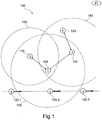
- Fig. 1 shows a mesh network 100.
- the mesh network 100 requires at least two nodes to work; however, by way of a non limiting example, a first node 105, a second node 110, a third node 115, a fourth node 120 and a fifth node 125 are given in the given exemplary embodiment.
- the fifth node 125 travels along an example trajectory 130.
- the fifth node 125 is illustrated as 125.1 at a first point in time, 125.2 at a second point in time and 125.3 at a third point in time.
- Each node 105 - 125 is associated a set of proximate nodes that contains such nodes 105 - 125 that can be communicated with directly. It is preferred that communication between the nodes 105 - 125 is done wirelessly. Whether or not a node 105 - 125 is proximate to any other node 105 - 125 is therefore dependent on a number of factors, one of which is related to the physical distance between the nodes 105 - 125. Other factors such as an object in the area of the two nodes 105 - 125, the shape and size of an antenna used for wireless communication, an amount of energy available for operating the wireless subsystem or other factors may apply.
- a first set 135 comprises nodes 105 - 125 that are proximate to the first node 105.
- the first set 135 comprises nodes 110, 115 and 125.2, that is, the node 125 is only in the first set 135 at the second point in time.
- the fifth node 125.2 is part of the set 135.
- a second set 140 comprises nodes 105-125 that are proximate to the second node 110, in the displayed example the first node 105 and the fourth node 120.
- a third set 145 comprises nodes 105-125 proximate to the third node 115, which is only the first node 105 in present example.
- the first node 105 may directly communicate with the second node 110, the third node 115 or the fifth node 125.2. If a message is to be passed from the first node 105 to the fourth node 120, the message must be relayed over the second node 110. Relaying it over the third node 115 is not possible as the third node 115 has no way of passing the message received from the first node 105 further up to the fourth node 120.
- the possibility of passing a message from the fifth node 125 to any of the other nodes 105 - 120 or vice versa is dependent on the position of the fifth node 125 and therefore on time.
- the fifth node 125.2 may exchange a message with the first node 105 only at the second point in time, thereby potentially establishing connectivity between the fifth node 125.2 and any of the other nodes 105 - 120.
- the fifth node 125 may be proximate to another node 105 - 125, possibly independent of its movement.
- the mesh network 100 will have to be reconfigured frequently to account for changing message routes. The more the nodes 105 - 125 are moving, the more reconfiguration may be necessary.
- a set 135 - 145 of proximate nodes 105 - 125 takes into consideration a movement information concerning any of the nodes 105 - 125. For instance, if the first node 105 determines the set 135 of nodes 105 - 125 that are proximate to it, it may be aware that the fifth node 125 is moving and thus be prone to leave the first set 135 soon. Routing to a node 105 - 125 that is not proximate should therefore better not be routed over the fifth node 125.
- the third node 115 may therefore used for relaying or routing messages.
- Establishing the first set 135 may be done more thorough or more frequently when said movement information hints at a movement of the first node 105 and/or one of the proximate nodes 110, 115 and 125.
- Fig. 2 shows a node 105 - 125 for the mesh network 100 of Fig. 1 .
- the node 105 - 125 comprises a control unit 205 that is adapted for carrying out discovery of proximate nodes 105 - 125 and message transmission/reception, as well as a wireless communication means 210 which is preferred to also comprise an antenna 215.
- the control unit 205 is connected to an interface 220 for receiving a movement signal.
- a sensor 225 connected to the interface 220 may for instance comprise an acceleration sensor, a movement sensor, a position sensor or any other sensor that provides a signal on the basis of which movement of the node 105 - 125 may be determined.
- the node 105 - 125 is comprised by a superordinate structure 230 like a device or vehicle.
- the sensor 225 may be part of the structure 230 rather than of the node 105 - 125.
- the sensor 225 may provide a speed signal representing a moving speed of the vehicle 230. It may alternatively provide an RPM signal of a combustion engine for propelling the vehicle 230 wherein the RPM signal, possibly in combination with information on a selected gear in a gearbox, may be indicative of a vehicle 230 speed.
- the senor 225 may provide a logical signal on the basis of which the binary information of a movement or lack of movement of the structure 230 can be determined with a predetermined probability.
- the signal may for instance represent a running state of the engine.
- the engine signal may be taken for a movement signal on the interface 220.
- a battery 235 for powering the node 105 - 125 may be part of the node 105 - 125 or part of the structure 230. Keeping a current of electrical energy from the battery 235 low may be important, especially if the structure 230 is self contained like a personal device or an embedded system.
- the device 230 may for instance be carried by a soldier and communication over the mesh network 100 may be critical. In a civilian application the personal device 230 may be carried for instance by a general internet user and battery life may still be an issue.
- Fig. 3 shows a flow chart of a method 300, the method 300 being especially adapted to be carried out on the control unit 205 of the node 105 - 125 of Fig. 2 .
- method 300 is described as running on the first node 105 in Fig. 1 .
- the wireless communication means 210 is controlled to provide information on nodes 110 - 125 that can be communicated with directly, that is, from node 105 - 125 to node 105 - 125 instead of over one or more other nodes 105 - 125.
- gathering such information may comprise a scan of the environment, that is, passively listening for wireless signals from other nodes 110 - 125.
- discovery of the nodes 110 - 125 may be actively requested, that is, a request for response may be broadcast out to any node 105 - 125 that can receive it. Responses from other nodes 110 - 125 may be received and evaluated accordingly.
- step 305 may also comprise time controlled emission of a beacon signal.
- a beacon signal generally does not oblige a receiving node 105 - 125 to respond. Said signal may comprise information on the first node 105 that may help adjusting communication parameters for improved communication.
- Step 305 may yield moving information on proximate nodes 205 - 225.
- the first set 135 of proximate nodes 110 - 125 is established in a step 310. In this, movement information on nodes 205 - 225 may be accounted for.
- the moving status of the first node 105 may be determined. As described above with reference to Fig. 2 , this may for instance be done on the basis of a signal on the interface 220.
- a step 320 it may be determined if any of the nodes 105 - 125 is moving. Depending on what information is present, the moving status of only the first node 105 (based on information from step 315), the moving status of one of the proximate nodes 105 - 125 in the first set 135 (on the basis of information collected in one of steps 305 or 310) may be used or it may be determined if any one of the known nodes 105 - 125 is moving.
- a time delay can be set to a small value in a step 330.
- the delay value may be set to a high value in a step 325.
- method 300 may branch back to step 305 and start over.
- a parameter that is related to an effort used for establishing the first set 135 of proximate nodes 105 - 125 will be set to a high value in step 330 and a low value in step 325, assuming that an increased effort may yield improved performance.
- steps 305, 310 and 320 - 325 will be carried out more or less often, depending on whether it was found if a node 105 - 125 is moving or not. These steps implement the discovery process that was mentioned earlier.
- the wireless interface 210 is less often and/or less intensely active if none of the nodes 105 - 125 is moving than if at least one of the nodes 105 - 125 is known to be moving. Thus, energy for operating the wireless interface 210 may be saved if no movement of the nodes 105 - 125 takes place.
- method 300 may comprise more activity that is related to the movement of the first node 105.
- step 315 in which the moving status of the first node 105 was determined, it may be determined in a step 335 whether or not the moving status of the first node 105 has changed. If it has changed, that is, if the first node 105 was previously moving and does not move now or vice versa, the new moving status may be transmitted via the wireless communication means 210 in a step 340. Thus, a notification to all proximate nodes 110 - 125 may be sent out to permit them to react on the changed status.
- movement status of the first node 105 When movement status of the first node 105 has not changed, movement status of the first node 105 may still be broadcast periodically. Intervals between the periodical missions may be adjusted according to the moving status. Should the first node 105 be found to be moving in a step 345, a delay may be set to a small value in a step 350. In the negative, if it is found that the first node 105 is standing still in step 345, the delay may be set to a larger value in a step 355. In both cases, transmission or broadcasting of the moving status in step 340 is performed, and then, after waiting in a step 360 the delay that was set in one of steps 350 or 355, this portion of method 300 may branch back to step 315.
Landscapes
- Engineering & Computer Science (AREA)
- Computer Networks & Wireless Communication (AREA)
- Signal Processing (AREA)
- Mobile Radio Communication Systems (AREA)
Claims (13)
- Verfahren (300) zum Steuern eines ersten Knotens (105), der in einem Mesh-Netzwerk (100) aus mehreren Knoten enthalten ist, wobei das Verfahren (300) die Schritte umfasst:
Sammeln (305) von Informationen über Knoten (110, 115, 120, 125), mit denen direkt kommuniziert werden kann, durch den ersten Knoten (105);- Feststellen (310) eines Satzes (135) von benachbarten Knoten (110, 115, 125.2) in dem Mesh-Netzwerk (100) durch den ersten Knoten (105) basierend auf den gesammelten Informationen;- wobei zwischen dem ersten Knoten (105) und einem benachbarten Knoten (110, 115, 125.2) eine direkte Kommunikation möglich ist;- Sammeln (305) von Bewegungsinformationen bezüglich einer Bewegung eines der benachbarten Knoten (110, 115, 125.2) durch den ersten Knoten (105),- Bestimmen (315) eines Bewegungsstatus des ersten Knotens (105) durch den ersten Knoten (105);- Bestimmen (320) durch den ersten Knoten (105), ob sich einer der Knoten (105, 110, 115, 125.2) bewegt;- Einstellen (325, 330) einer Zeitverzögerung durch den ersten Knoten (105), basierend auf der Bestimmung (320) der Bewegung eines der Knoten (105, 110, 115, 125.2);- Warten durch den ersten Knoten die eingestellte Zeitverzögerung, Zurückspringen zum Schritt des Sammelns (305) und erneutes Ausführen aller vorherigen Verfahrensschritte (305, 310, 315, 320, 325, 330) durch den ersten Knoten (105). - Verfahren (300) nach Anspruch 1, wobei die Zeitverzögerung auf einen hohen Wert eingestellt (325) wird, wenn die Bestimmung (320) keine Bewegung der Knoten (105, 110, 115, 125.2) anzeigt, wobei die Zeitverzögerung auf einen kleinen Wert eingestellt wird (330), wenn die Bestimmung (320) eine Bewegung von mindestens einem der Knoten (105, 110, 115, 125.2) anzeigt und wobei ein kleiner Wert der Zeitverzögerung kleiner ist als ein hoher Wert der Zeitverzögerung.
- Verfahren (300) nach Anspruch 1 oder 2, wobei das Sammeln (305) von Informationen über Knoten (110, 115, 120, 125) das Scannen der Umgebung durch den ersten Knoten und das passive Hören auf drahtlose Signale von anderen Knoten (110, 115, 120, 125) umfasst.
- Verfahren (300) nach einem der vorhergehenden Ansprüche, wobei das Sammeln (305) von Informationen über Knoten (110, 115, 120, 125) das aktive Anfordern einer Antwort von den anderen Knoten (110, 115, 120, 125) durch den ersten Knoten (105) umfasst.
- Verfahren (300) nach einem der vorhergehenden Ansprüche, wobei das Sammeln (305) von Informationen über Knoten (110, 115, 120, 125) ein zeitgesteuertes Aussenden eines Beacon-Signals umfasst.
- Verfahren (300) nach einem der vorhergehenden Ansprüche, wobei die den ersten Knoten (105) betreffenden Bewegungsinformationen vom ersten Knoten zum Empfang durch benachbarte Knoten (110, 115, 125.2) ausgestrahlt werden.
- Verfahren (300) nach Anspruch 6, wobei die Bewegungsinformationen übertragen (340) werden, wenn sich der Bewegungsstatus ändert.
- Verfahren (300) nach einem der vorhergehenden Ansprüche, wobei der erste Knoten (105) eine Nachricht zwischen Knoten (110, 115, 125.2) weiterleitet, die benachbart zu ihm sind.
- Computerprogrammprodukt, umfassend Codemittel zum Ausführen eines Verfahrens (300) nach einem der vorhergehenden Ansprüche, wenn das Computerprogrammprodukt auf einer Steuereinheit (205) eines Knotens (105 - 125) ausgeführt wird.
- Knoten (105, 125) zur Teilnahme an einem Mesh-Netzwerk (100), wobei der Knoten Folgendes umfasst- Kommunikationsmittel (210) zum direkten Kommunizieren mit benachbarten Knoten (110, 115, 125.2);- eine Steuereinheit (205), die angepasst ist, um ein Computerprogramm nach Anspruch 9 auszuführen.
- Knoten (105, 125) nach Anspruch 10, wobei der Knoten (105, 125) angepasst ist, um an Bord eines Fahrzeugs (230) installiert zu werden, wobei der Knoten ferner eine Schnittstelle (220) zum Empfangen eines Bewegungssignals bezüglich des Fahrzeugs (230) umfasst.
- Knoten nach Anspruch 10 oder 11, ferner umfassend einen Bewegungssensor (225).
- Mesh-Netzwerk (100) aus mehreren Knoten (105, 110, 115, 120, 125), wobei das Mesh-Netzwerk (100) mindestens einen Knoten (105, 125) nach einem der Ansprüche 10 bis 12 umfasst.
Priority Applications (1)
| Application Number | Priority Date | Filing Date | Title |
|---|---|---|---|
| EP14290199.0A EP2966930B1 (de) | 2014-07-09 | 2014-07-09 | Mesh-Netzwerk |
Applications Claiming Priority (1)
| Application Number | Priority Date | Filing Date | Title |
|---|---|---|---|
| EP14290199.0A EP2966930B1 (de) | 2014-07-09 | 2014-07-09 | Mesh-Netzwerk |
Publications (2)
| Publication Number | Publication Date |
|---|---|
| EP2966930A1 EP2966930A1 (de) | 2016-01-13 |
| EP2966930B1 true EP2966930B1 (de) | 2021-09-29 |
Family
ID=51225448
Family Applications (1)
| Application Number | Title | Priority Date | Filing Date |
|---|---|---|---|
| EP14290199.0A Active EP2966930B1 (de) | 2014-07-09 | 2014-07-09 | Mesh-Netzwerk |
Country Status (1)
| Country | Link |
|---|---|
| EP (1) | EP2966930B1 (de) |
Family Cites Families (4)
| Publication number | Priority date | Publication date | Assignee | Title |
|---|---|---|---|---|
| US8260896B2 (en) * | 2007-02-02 | 2012-09-04 | Mwa Intelligence, Inc. | Monitoring business machines using a mesh network on field nodes |
| US7948931B2 (en) * | 2004-03-01 | 2011-05-24 | The Charles Stark Draper Laboratory, Inc. | MANET routing based on best estimate of expected position |
| US20080008137A1 (en) * | 2006-07-05 | 2008-01-10 | Motorola, Inc. | Method and system of communication among a plurality of mobile nodes |
| WO2011145027A1 (en) * | 2010-05-21 | 2011-11-24 | Koninklijke Philips Electronics N.V. | Method and device for forwarding data packets |
-
2014
- 2014-07-09 EP EP14290199.0A patent/EP2966930B1/de active Active
Also Published As
| Publication number | Publication date |
|---|---|
| EP2966930A1 (de) | 2016-01-13 |
Similar Documents
| Publication | Publication Date | Title |
|---|---|---|
| CN108600942B (zh) | 一种无人机自组网的路由方法 | |
| US20210165406A1 (en) | Management of deployed drones | |
| KR101408202B1 (ko) | 통신 방법들 및 장치들 | |
| EP1642424B1 (de) | Ad-hoc kommunikationssystem | |
| US8428629B2 (en) | Methods and apparatus for determining a communications mode and/or using a determined communications mode | |
| Zheng et al. | A novel airborne greedy geographic routing protocol for flying ad hoc networks | |
| KR101336194B1 (ko) | 정보를 전달하기 위한 방법들 및 장치들 | |
| CN106465042B (zh) | 操作用户设备的方法、操作无线通信网络的方法、服务器 | |
| Xing et al. | Resource allocation schemes for D2D communication used in VANETs | |
| JP2010288276A (ja) | 通信ネットワークにおいてデータを頒布する方法および装置 | |
| JP2018082403A (ja) | 無線中継装置、プログラム、無線通信システム及び無線通信方法 | |
| JP2006180139A (ja) | 制御装置、移動端末及び通信制御方法 | |
| EP4664941A1 (de) | Betriebsverfahren und vorrichtung zur gemeinsamen nutzung und übertragung von informationen im zusammenhang mit v2x-dienst über einen server und eine rsu-vorrichtung | |
| Pal et al. | Design and implementation of a routing protocol for VANET to improve the QoS of the network | |
| KR20240128514A (ko) | V2x 메시지 송수신에 관련된 메시지 교환 서버의 동작 방법 및 장치 | |
| JP6526059B2 (ja) | 自動車アドホックネットワークとセルラネットワークとの間でゲートウェイとして動作するクラスタヘッド装置 | |
| WO2018220443A1 (en) | System and method for low power data routing | |
| Farooq et al. | AMVR: A multicast routing protocol for autonomous military vehicles communication in VANET | |
| Huang et al. | Energy-aware group LBS using D2D offloading and M2M-based mobile proxy handoff mechanisms over the mobile converged networks | |
| EP2966930A1 (de) | Mesh-Netzwerk | |
| JP4828645B2 (ja) | 車車間通信システムおよび車車間通信方法 | |
| US11147006B2 (en) | Automotive wireless mesh communication | |
| WO2020145026A1 (ja) | 無線通信システム | |
| Agrawal et al. | UAV‐SHUTTLE‐MMM: UAV‐shuttle‐enabled mobility management model in sparsely deployed flying ad hoc networks | |
| US20210166566A1 (en) | Vehicle platooning |
Legal Events
| Date | Code | Title | Description |
|---|---|---|---|
| PUAI | Public reference made under article 153(3) epc to a published international application that has entered the european phase |
Free format text: ORIGINAL CODE: 0009012 |
|
| AK | Designated contracting states |
Kind code of ref document: A1 Designated state(s): AL AT BE BG CH CY CZ DE DK EE ES FI FR GB GR HR HU IE IS IT LI LT LU LV MC MK MT NL NO PL PT RO RS SE SI SK SM TR |
|
| AX | Request for extension of the european patent |
Extension state: BA ME |
|
| 17P | Request for examination filed |
Effective date: 20160421 |
|
| RBV | Designated contracting states (corrected) |
Designated state(s): AL AT BE BG CH CY CZ DE DK EE ES FI FR GB GR HR HU IE IS IT LI LT LU LV MC MK MT NL NO PL PT RO RS SE SI SK SM TR |
|
| STAA | Information on the status of an ep patent application or granted ep patent |
Free format text: STATUS: EXAMINATION IS IN PROGRESS |
|
| 17Q | First examination report despatched |
Effective date: 20200622 |
|
| GRAP | Despatch of communication of intention to grant a patent |
Free format text: ORIGINAL CODE: EPIDOSNIGR1 |
|
| STAA | Information on the status of an ep patent application or granted ep patent |
Free format text: STATUS: GRANT OF PATENT IS INTENDED |
|
| INTG | Intention to grant announced |
Effective date: 20210421 |
|
| RIN1 | Information on inventor provided before grant (corrected) |
Inventor name: ATTIMONT, LUC Inventor name: PEGUET, STEVE |
|
| GRAS | Grant fee paid |
Free format text: ORIGINAL CODE: EPIDOSNIGR3 |
|
| GRAA | (expected) grant |
Free format text: ORIGINAL CODE: 0009210 |
|
| STAA | Information on the status of an ep patent application or granted ep patent |
Free format text: STATUS: THE PATENT HAS BEEN GRANTED |
|
| RAP1 | Party data changed (applicant data changed or rights of an application transferred) |
Owner name: BULL SAS |
|
| RAP3 | Party data changed (applicant data changed or rights of an application transferred) |
Owner name: BULL SAS |
|
| AK | Designated contracting states |
Kind code of ref document: B1 Designated state(s): AL AT BE BG CH CY CZ DE DK EE ES FI FR GB GR HR HU IE IS IT LI LT LU LV MC MK MT NL NO PL PT RO RS SE SI SK SM TR |
|
| REG | Reference to a national code |
Ref country code: GB Ref legal event code: FG4D |
|
| REG | Reference to a national code |
Ref country code: CH Ref legal event code: EP Ref country code: AT Ref legal event code: REF Ref document number: 1435376 Country of ref document: AT Kind code of ref document: T Effective date: 20211015 |
|
| REG | Reference to a national code |
Ref country code: DE Ref legal event code: R096 Ref document number: 602014080352 Country of ref document: DE |
|
| REG | Reference to a national code |
Ref country code: IE Ref legal event code: FG4D |
|
| REG | Reference to a national code |
Ref country code: LT Ref legal event code: MG9D |
|
| PG25 | Lapsed in a contracting state [announced via postgrant information from national office to epo] |
Ref country code: FI Free format text: LAPSE BECAUSE OF FAILURE TO SUBMIT A TRANSLATION OF THE DESCRIPTION OR TO PAY THE FEE WITHIN THE PRESCRIBED TIME-LIMIT Effective date: 20210929 Ref country code: NO Free format text: LAPSE BECAUSE OF FAILURE TO SUBMIT A TRANSLATION OF THE DESCRIPTION OR TO PAY THE FEE WITHIN THE PRESCRIBED TIME-LIMIT Effective date: 20211229 Ref country code: LT Free format text: LAPSE BECAUSE OF FAILURE TO SUBMIT A TRANSLATION OF THE DESCRIPTION OR TO PAY THE FEE WITHIN THE PRESCRIBED TIME-LIMIT Effective date: 20210929 Ref country code: BG Free format text: LAPSE BECAUSE OF FAILURE TO SUBMIT A TRANSLATION OF THE DESCRIPTION OR TO PAY THE FEE WITHIN THE PRESCRIBED TIME-LIMIT Effective date: 20211229 Ref country code: HR Free format text: LAPSE BECAUSE OF FAILURE TO SUBMIT A TRANSLATION OF THE DESCRIPTION OR TO PAY THE FEE WITHIN THE PRESCRIBED TIME-LIMIT Effective date: 20210929 Ref country code: RS Free format text: LAPSE BECAUSE OF FAILURE TO SUBMIT A TRANSLATION OF THE DESCRIPTION OR TO PAY THE FEE WITHIN THE PRESCRIBED TIME-LIMIT Effective date: 20210929 Ref country code: SE Free format text: LAPSE BECAUSE OF FAILURE TO SUBMIT A TRANSLATION OF THE DESCRIPTION OR TO PAY THE FEE WITHIN THE PRESCRIBED TIME-LIMIT Effective date: 20210929 |
|
| REG | Reference to a national code |
Ref country code: NL Ref legal event code: MP Effective date: 20210929 |
|
| REG | Reference to a national code |
Ref country code: AT Ref legal event code: MK05 Ref document number: 1435376 Country of ref document: AT Kind code of ref document: T Effective date: 20210929 |
|
| PG25 | Lapsed in a contracting state [announced via postgrant information from national office to epo] |
Ref country code: LV Free format text: LAPSE BECAUSE OF FAILURE TO SUBMIT A TRANSLATION OF THE DESCRIPTION OR TO PAY THE FEE WITHIN THE PRESCRIBED TIME-LIMIT Effective date: 20210929 Ref country code: GR Free format text: LAPSE BECAUSE OF FAILURE TO SUBMIT A TRANSLATION OF THE DESCRIPTION OR TO PAY THE FEE WITHIN THE PRESCRIBED TIME-LIMIT Effective date: 20211230 |
|
| PG25 | Lapsed in a contracting state [announced via postgrant information from national office to epo] |
Ref country code: AT Free format text: LAPSE BECAUSE OF FAILURE TO SUBMIT A TRANSLATION OF THE DESCRIPTION OR TO PAY THE FEE WITHIN THE PRESCRIBED TIME-LIMIT Effective date: 20210929 |
|
| PG25 | Lapsed in a contracting state [announced via postgrant information from national office to epo] |
Ref country code: IS Free format text: LAPSE BECAUSE OF FAILURE TO SUBMIT A TRANSLATION OF THE DESCRIPTION OR TO PAY THE FEE WITHIN THE PRESCRIBED TIME-LIMIT Effective date: 20220129 Ref country code: SK Free format text: LAPSE BECAUSE OF FAILURE TO SUBMIT A TRANSLATION OF THE DESCRIPTION OR TO PAY THE FEE WITHIN THE PRESCRIBED TIME-LIMIT Effective date: 20210929 Ref country code: RO Free format text: LAPSE BECAUSE OF FAILURE TO SUBMIT A TRANSLATION OF THE DESCRIPTION OR TO PAY THE FEE WITHIN THE PRESCRIBED TIME-LIMIT Effective date: 20210929 Ref country code: PT Free format text: LAPSE BECAUSE OF FAILURE TO SUBMIT A TRANSLATION OF THE DESCRIPTION OR TO PAY THE FEE WITHIN THE PRESCRIBED TIME-LIMIT Effective date: 20220131 Ref country code: PL Free format text: LAPSE BECAUSE OF FAILURE TO SUBMIT A TRANSLATION OF THE DESCRIPTION OR TO PAY THE FEE WITHIN THE PRESCRIBED TIME-LIMIT Effective date: 20210929 Ref country code: NL Free format text: LAPSE BECAUSE OF FAILURE TO SUBMIT A TRANSLATION OF THE DESCRIPTION OR TO PAY THE FEE WITHIN THE PRESCRIBED TIME-LIMIT Effective date: 20210929 Ref country code: ES Free format text: LAPSE BECAUSE OF FAILURE TO SUBMIT A TRANSLATION OF THE DESCRIPTION OR TO PAY THE FEE WITHIN THE PRESCRIBED TIME-LIMIT Effective date: 20210929 Ref country code: EE Free format text: LAPSE BECAUSE OF FAILURE TO SUBMIT A TRANSLATION OF THE DESCRIPTION OR TO PAY THE FEE WITHIN THE PRESCRIBED TIME-LIMIT Effective date: 20210929 Ref country code: CZ Free format text: LAPSE BECAUSE OF FAILURE TO SUBMIT A TRANSLATION OF THE DESCRIPTION OR TO PAY THE FEE WITHIN THE PRESCRIBED TIME-LIMIT Effective date: 20210929 Ref country code: AL Free format text: LAPSE BECAUSE OF FAILURE TO SUBMIT A TRANSLATION OF THE DESCRIPTION OR TO PAY THE FEE WITHIN THE PRESCRIBED TIME-LIMIT Effective date: 20210929 |
|
| REG | Reference to a national code |
Ref country code: DE Ref legal event code: R097 Ref document number: 602014080352 Country of ref document: DE |
|
| PG25 | Lapsed in a contracting state [announced via postgrant information from national office to epo] |
Ref country code: DK Free format text: LAPSE BECAUSE OF FAILURE TO SUBMIT A TRANSLATION OF THE DESCRIPTION OR TO PAY THE FEE WITHIN THE PRESCRIBED TIME-LIMIT Effective date: 20210929 |
|
| PLBE | No opposition filed within time limit |
Free format text: ORIGINAL CODE: 0009261 |
|
| STAA | Information on the status of an ep patent application or granted ep patent |
Free format text: STATUS: NO OPPOSITION FILED WITHIN TIME LIMIT |
|
| 26N | No opposition filed |
Effective date: 20220630 |
|
| PG25 | Lapsed in a contracting state [announced via postgrant information from national office to epo] |
Ref country code: SI Free format text: LAPSE BECAUSE OF FAILURE TO SUBMIT A TRANSLATION OF THE DESCRIPTION OR TO PAY THE FEE WITHIN THE PRESCRIBED TIME-LIMIT Effective date: 20210929 |
|
| PG25 | Lapsed in a contracting state [announced via postgrant information from national office to epo] |
Ref country code: IT Free format text: LAPSE BECAUSE OF FAILURE TO SUBMIT A TRANSLATION OF THE DESCRIPTION OR TO PAY THE FEE WITHIN THE PRESCRIBED TIME-LIMIT Effective date: 20210929 |
|
| PG25 | Lapsed in a contracting state [announced via postgrant information from national office to epo] |
Ref country code: MC Free format text: LAPSE BECAUSE OF FAILURE TO SUBMIT A TRANSLATION OF THE DESCRIPTION OR TO PAY THE FEE WITHIN THE PRESCRIBED TIME-LIMIT Effective date: 20210929 |
|
| REG | Reference to a national code |
Ref country code: CH Ref legal event code: PL |
|
| REG | Reference to a national code |
Ref country code: BE Ref legal event code: MM Effective date: 20220731 |
|
| PG25 | Lapsed in a contracting state [announced via postgrant information from national office to epo] |
Ref country code: LU Free format text: LAPSE BECAUSE OF NON-PAYMENT OF DUE FEES Effective date: 20220709 Ref country code: LI Free format text: LAPSE BECAUSE OF NON-PAYMENT OF DUE FEES Effective date: 20220731 Ref country code: CH Free format text: LAPSE BECAUSE OF NON-PAYMENT OF DUE FEES Effective date: 20220731 |
|
| PG25 | Lapsed in a contracting state [announced via postgrant information from national office to epo] |
Ref country code: BE Free format text: LAPSE BECAUSE OF NON-PAYMENT OF DUE FEES Effective date: 20220731 |
|
| P01 | Opt-out of the competence of the unified patent court (upc) registered |
Effective date: 20230330 |
|
| PG25 | Lapsed in a contracting state [announced via postgrant information from national office to epo] |
Ref country code: IE Free format text: LAPSE BECAUSE OF NON-PAYMENT OF DUE FEES Effective date: 20220709 |
|
| REG | Reference to a national code |
Ref country code: DE Ref legal event code: R081 Ref document number: 602014080352 Country of ref document: DE Owner name: ATOS FRANCE, FR Free format text: FORMER OWNER: BULL SAS, LES CLAYES-SOUS-BOIS, FR |
|
| REG | Reference to a national code |
Ref country code: GB Ref legal event code: 732E Free format text: REGISTERED BETWEEN 20231221 AND 20231222 |
|
| PG25 | Lapsed in a contracting state [announced via postgrant information from national office to epo] |
Ref country code: HU Free format text: LAPSE BECAUSE OF FAILURE TO SUBMIT A TRANSLATION OF THE DESCRIPTION OR TO PAY THE FEE WITHIN THE PRESCRIBED TIME-LIMIT; INVALID AB INITIO Effective date: 20140709 |
|
| PG25 | Lapsed in a contracting state [announced via postgrant information from national office to epo] |
Ref country code: SM Free format text: LAPSE BECAUSE OF FAILURE TO SUBMIT A TRANSLATION OF THE DESCRIPTION OR TO PAY THE FEE WITHIN THE PRESCRIBED TIME-LIMIT Effective date: 20210929 Ref country code: MK Free format text: LAPSE BECAUSE OF FAILURE TO SUBMIT A TRANSLATION OF THE DESCRIPTION OR TO PAY THE FEE WITHIN THE PRESCRIBED TIME-LIMIT Effective date: 20210929 Ref country code: CY Free format text: LAPSE BECAUSE OF FAILURE TO SUBMIT A TRANSLATION OF THE DESCRIPTION OR TO PAY THE FEE WITHIN THE PRESCRIBED TIME-LIMIT Effective date: 20210929 |
|
| PG25 | Lapsed in a contracting state [announced via postgrant information from national office to epo] |
Ref country code: MT Free format text: LAPSE BECAUSE OF FAILURE TO SUBMIT A TRANSLATION OF THE DESCRIPTION OR TO PAY THE FEE WITHIN THE PRESCRIBED TIME-LIMIT Effective date: 20210929 |
|
| PGFP | Annual fee paid to national office [announced via postgrant information from national office to epo] |
Ref country code: DE Payment date: 20250722 Year of fee payment: 12 |
|
| PGFP | Annual fee paid to national office [announced via postgrant information from national office to epo] |
Ref country code: GB Payment date: 20250724 Year of fee payment: 12 |
|
| PGFP | Annual fee paid to national office [announced via postgrant information from national office to epo] |
Ref country code: FR Payment date: 20250723 Year of fee payment: 12 |
|
| PG25 | Lapsed in a contracting state [announced via postgrant information from national office to epo] |
Ref country code: TR Free format text: LAPSE BECAUSE OF FAILURE TO SUBMIT A TRANSLATION OF THE DESCRIPTION OR TO PAY THE FEE WITHIN THE PRESCRIBED TIME-LIMIT Effective date: 20210929 |