EP2962997B1 - Water treatment system - Google Patents
Water treatment system Download PDFInfo
- Publication number
- EP2962997B1 EP2962997B1 EP14779478.8A EP14779478A EP2962997B1 EP 2962997 B1 EP2962997 B1 EP 2962997B1 EP 14779478 A EP14779478 A EP 14779478A EP 2962997 B1 EP2962997 B1 EP 2962997B1
- Authority
- EP
- European Patent Office
- Prior art keywords
- water
- unit
- ions
- desalination
- ion
- Prior art date
- Legal status (The legal status is an assumption and is not a legal conclusion. Google has not performed a legal analysis and makes no representation as to the accuracy of the status listed.)
- Not-in-force
Links
- XLYOFNOQVPJJNP-UHFFFAOYSA-N water Substances O XLYOFNOQVPJJNP-UHFFFAOYSA-N 0.000 title claims description 171
- 150000002500 ions Chemical class 0.000 claims description 116
- 238000010612 desalination reaction Methods 0.000 claims description 93
- 150000001768 cations Chemical class 0.000 claims description 48
- 230000008021 deposition Effects 0.000 claims description 44
- 238000001816 cooling Methods 0.000 claims description 19
- 239000007788 liquid Substances 0.000 claims description 18
- 239000003014 ion exchange membrane Substances 0.000 claims description 17
- 239000007787 solid Substances 0.000 claims description 14
- 238000000926 separation method Methods 0.000 claims description 13
- 239000012466 permeate Substances 0.000 claims description 11
- 238000004064 recycling Methods 0.000 claims description 11
- 230000018044 dehydration Effects 0.000 claims description 10
- 238000006297 dehydration reaction Methods 0.000 claims description 10
- 239000006228 supernatant Substances 0.000 claims description 10
- 125000000020 sulfo group Chemical group O=S(=O)([*])O[H] 0.000 claims description 8
- 238000011144 upstream manufacturing Methods 0.000 claims description 8
- 238000010979 pH adjustment Methods 0.000 claims description 7
- 239000002861 polymer material Substances 0.000 claims description 4
- 150000008044 alkali metal hydroxides Chemical class 0.000 claims description 2
- 239000012141 concentrate Substances 0.000 claims description 2
- 238000000151 deposition Methods 0.000 claims 4
- 230000001376 precipitating effect Effects 0.000 claims 1
- VYPSYNLAJGMNEJ-UHFFFAOYSA-N silicon dioxide Inorganic materials O=[Si]=O VYPSYNLAJGMNEJ-UHFFFAOYSA-N 0.000 description 37
- 239000012528 membrane Substances 0.000 description 36
- 238000005341 cation exchange Methods 0.000 description 22
- VTYYLEPIZMXCLO-UHFFFAOYSA-L Calcium carbonate Chemical compound [Ca+2].[O-]C([O-])=O VTYYLEPIZMXCLO-UHFFFAOYSA-L 0.000 description 19
- 239000000377 silicon dioxide Substances 0.000 description 19
- 238000001223 reverse osmosis Methods 0.000 description 13
- 229910000019 calcium carbonate Inorganic materials 0.000 description 9
- 239000003990 capacitor Substances 0.000 description 9
- 150000001450 anions Chemical class 0.000 description 8
- -1 Na+ Chemical class 0.000 description 7
- 239000003011 anion exchange membrane Substances 0.000 description 5
- 238000000909 electrodialysis Methods 0.000 description 5
- 238000001556 precipitation Methods 0.000 description 5
- 229910052784 alkaline earth metal Inorganic materials 0.000 description 4
- 125000000524 functional group Chemical group 0.000 description 4
- 239000002351 wastewater Substances 0.000 description 4
- 239000003513 alkali Substances 0.000 description 3
- 125000003178 carboxy group Chemical group [H]OC(*)=O 0.000 description 3
- 238000009833 condensation Methods 0.000 description 3
- 230000005494 condensation Effects 0.000 description 3
- 229910001385 heavy metal Inorganic materials 0.000 description 3
- 239000010842 industrial wastewater Substances 0.000 description 3
- 150000001455 metallic ions Chemical class 0.000 description 3
- 150000003839 salts Chemical class 0.000 description 3
- 239000000126 substance Substances 0.000 description 3
- BVKZGUZCCUSVTD-UHFFFAOYSA-M Bicarbonate Chemical compound OC([O-])=O BVKZGUZCCUSVTD-UHFFFAOYSA-M 0.000 description 2
- LSNNMFCWUKXFEE-UHFFFAOYSA-M Bisulfite Chemical compound OS([O-])=O LSNNMFCWUKXFEE-UHFFFAOYSA-M 0.000 description 2
- CDBYLPFSWZWCQE-UHFFFAOYSA-L Sodium Carbonate Chemical compound [Na+].[Na+].[O-]C([O-])=O CDBYLPFSWZWCQE-UHFFFAOYSA-L 0.000 description 2
- QAOWNCQODCNURD-UHFFFAOYSA-N Sulfuric acid Chemical compound OS(O)(=O)=O QAOWNCQODCNURD-UHFFFAOYSA-N 0.000 description 2
- 229910052925 anhydrite Inorganic materials 0.000 description 2
- OSGAYBCDTDRGGQ-UHFFFAOYSA-L calcium sulfate Chemical compound [Ca+2].[O-]S([O-])(=O)=O OSGAYBCDTDRGGQ-UHFFFAOYSA-L 0.000 description 2
- 239000003795 chemical substances by application Substances 0.000 description 2
- 230000003247 decreasing effect Effects 0.000 description 2
- 238000006477 desulfuration reaction Methods 0.000 description 2
- 230000023556 desulfurization Effects 0.000 description 2
- 239000008235 industrial water Substances 0.000 description 2
- 239000002245 particle Substances 0.000 description 2
- 239000002244 precipitate Substances 0.000 description 2
- 238000000746 purification Methods 0.000 description 2
- NWUYHJFMYQTDRP-UHFFFAOYSA-N 1,2-bis(ethenyl)benzene;1-ethenyl-2-ethylbenzene;styrene Chemical compound C=CC1=CC=CC=C1.CCC1=CC=CC=C1C=C.C=CC1=CC=CC=C1C=C NWUYHJFMYQTDRP-UHFFFAOYSA-N 0.000 description 1
- 229920003934 Aciplex® Polymers 0.000 description 1
- 101000756759 Homo sapiens MHC class II regulatory factor RFX1 Proteins 0.000 description 1
- 102100022819 MHC class II regulatory factor RFX1 Human genes 0.000 description 1
- 229910006069 SO3H Inorganic materials 0.000 description 1
- FAPWRFPIFSIZLT-UHFFFAOYSA-M Sodium chloride Chemical compound [Na+].[Cl-] FAPWRFPIFSIZLT-UHFFFAOYSA-M 0.000 description 1
- 230000002378 acidificating effect Effects 0.000 description 1
- 229910052783 alkali metal Inorganic materials 0.000 description 1
- 229910001413 alkali metal ion Inorganic materials 0.000 description 1
- 150000001340 alkali metals Chemical class 0.000 description 1
- 229910000147 aluminium phosphate Inorganic materials 0.000 description 1
- 238000005349 anion exchange Methods 0.000 description 1
- 239000007864 aqueous solution Substances 0.000 description 1
- AXCZMVOFGPJBDE-UHFFFAOYSA-L calcium dihydroxide Chemical compound [OH-].[OH-].[Ca+2] AXCZMVOFGPJBDE-UHFFFAOYSA-L 0.000 description 1
- 239000000920 calcium hydroxide Substances 0.000 description 1
- 229910001861 calcium hydroxide Inorganic materials 0.000 description 1
- BVKZGUZCCUSVTD-UHFFFAOYSA-N carbonic acid Chemical compound OC(O)=O BVKZGUZCCUSVTD-UHFFFAOYSA-N 0.000 description 1
- 238000004891 communication Methods 0.000 description 1
- 229920001577 copolymer Polymers 0.000 description 1
- 238000000354 decomposition reaction Methods 0.000 description 1
- 238000002242 deionisation method Methods 0.000 description 1
- 238000003795 desorption Methods 0.000 description 1
- 230000000694 effects Effects 0.000 description 1
- 238000005516 engineering process Methods 0.000 description 1
- 239000012530 fluid Substances 0.000 description 1
- 239000013505 freshwater Substances 0.000 description 1
- JEGUKCSWCFPDGT-UHFFFAOYSA-N h2o hydrate Chemical compound O.O JEGUKCSWCFPDGT-UHFFFAOYSA-N 0.000 description 1
- XLYOFNOQVPJJNP-UHFFFAOYSA-M hydroxide Chemical compound [OH-] XLYOFNOQVPJJNP-UHFFFAOYSA-M 0.000 description 1
- 230000000977 initiatory effect Effects 0.000 description 1
- 229910052500 inorganic mineral Inorganic materials 0.000 description 1
- 239000003456 ion exchange resin Substances 0.000 description 1
- 229920003303 ion-exchange polymer Polymers 0.000 description 1
- 125000003010 ionic group Chemical group 0.000 description 1
- 229910021645 metal ion Inorganic materials 0.000 description 1
- 238000000034 method Methods 0.000 description 1
- 239000011707 mineral Substances 0.000 description 1
- 238000006386 neutralization reaction Methods 0.000 description 1
- NBIIXXVUZAFLBC-UHFFFAOYSA-N phosphoric acid Substances OP(O)(O)=O NBIIXXVUZAFLBC-UHFFFAOYSA-N 0.000 description 1
- 239000011148 porous material Substances 0.000 description 1
- 229910052700 potassium Inorganic materials 0.000 description 1
- 230000002265 prevention Effects 0.000 description 1
- 239000013535 sea water Substances 0.000 description 1
- 239000010865 sewage Substances 0.000 description 1
- 239000010802 sludge Substances 0.000 description 1
- 229910052708 sodium Inorganic materials 0.000 description 1
- 229910000029 sodium carbonate Inorganic materials 0.000 description 1
- XZPVPNZTYPUODG-UHFFFAOYSA-M sodium;chloride;dihydrate Chemical compound O.O.[Na+].[Cl-] XZPVPNZTYPUODG-UHFFFAOYSA-M 0.000 description 1
- 239000011343 solid material Substances 0.000 description 1
- 239000000243 solution Substances 0.000 description 1
- 238000001179 sorption measurement Methods 0.000 description 1
- 125000006850 spacer group Chemical group 0.000 description 1
- 230000001131 transforming effect Effects 0.000 description 1
Images


Classifications
-
- C—CHEMISTRY; METALLURGY
- C02—TREATMENT OF WATER, WASTE WATER, SEWAGE, OR SLUDGE
- C02F—TREATMENT OF WATER, WASTE WATER, SEWAGE, OR SLUDGE
- C02F1/00—Treatment of water, waste water, or sewage
- C02F1/46—Treatment of water, waste water, or sewage by electrochemical methods
- C02F1/469—Treatment of water, waste water, or sewage by electrochemical methods by electrochemical separation, e.g. by electro-osmosis, electrodialysis, electrophoresis
- C02F1/4691—Capacitive deionisation
-
- C—CHEMISTRY; METALLURGY
- C02—TREATMENT OF WATER, WASTE WATER, SEWAGE, OR SLUDGE
- C02F—TREATMENT OF WATER, WASTE WATER, SEWAGE, OR SLUDGE
- C02F1/00—Treatment of water, waste water, or sewage
- C02F1/46—Treatment of water, waste water, or sewage by electrochemical methods
- C02F1/469—Treatment of water, waste water, or sewage by electrochemical methods by electrochemical separation, e.g. by electro-osmosis, electrodialysis, electrophoresis
- C02F1/4693—Treatment of water, waste water, or sewage by electrochemical methods by electrochemical separation, e.g. by electro-osmosis, electrodialysis, electrophoresis electrodialysis
-
- B—PERFORMING OPERATIONS; TRANSPORTING
- B01—PHYSICAL OR CHEMICAL PROCESSES OR APPARATUS IN GENERAL
- B01D—SEPARATION
- B01D61/00—Processes of separation using semi-permeable membranes, e.g. dialysis, osmosis or ultrafiltration; Apparatus, accessories or auxiliary operations specially adapted therefor
- B01D61/42—Electrodialysis; Electro-osmosis ; Electro-ultrafiltration; Membrane capacitive deionization
- B01D61/44—Ion-selective electrodialysis
- B01D61/46—Apparatus therefor
- B01D61/48—Apparatus therefor having one or more compartments filled with ion-exchange material, e.g. electrodeionisation
- B01D61/485—Specific features relating to the ion-exchange material
-
- B—PERFORMING OPERATIONS; TRANSPORTING
- B01—PHYSICAL OR CHEMICAL PROCESSES OR APPARATUS IN GENERAL
- B01D—SEPARATION
- B01D61/00—Processes of separation using semi-permeable membranes, e.g. dialysis, osmosis or ultrafiltration; Apparatus, accessories or auxiliary operations specially adapted therefor
- B01D61/42—Electrodialysis; Electro-osmosis ; Electro-ultrafiltration; Membrane capacitive deionization
- B01D61/44—Ion-selective electrodialysis
- B01D61/46—Apparatus therefor
- B01D61/50—Stacks of the plate-and-frame type
-
- B—PERFORMING OPERATIONS; TRANSPORTING
- B01—PHYSICAL OR CHEMICAL PROCESSES OR APPARATUS IN GENERAL
- B01D—SEPARATION
- B01D61/00—Processes of separation using semi-permeable membranes, e.g. dialysis, osmosis or ultrafiltration; Apparatus, accessories or auxiliary operations specially adapted therefor
- B01D61/42—Electrodialysis; Electro-osmosis ; Electro-ultrafiltration; Membrane capacitive deionization
- B01D61/44—Ion-selective electrodialysis
- B01D61/52—Accessories; Auxiliary operation
-
- C—CHEMISTRY; METALLURGY
- C02—TREATMENT OF WATER, WASTE WATER, SEWAGE, OR SLUDGE
- C02F—TREATMENT OF WATER, WASTE WATER, SEWAGE, OR SLUDGE
- C02F1/00—Treatment of water, waste water, or sewage
- C02F1/46—Treatment of water, waste water, or sewage by electrochemical methods
- C02F1/4604—Treatment of water, waste water, or sewage by electrochemical methods for desalination of seawater or brackish water
-
- C—CHEMISTRY; METALLURGY
- C02—TREATMENT OF WATER, WASTE WATER, SEWAGE, OR SLUDGE
- C02F—TREATMENT OF WATER, WASTE WATER, SEWAGE, OR SLUDGE
- C02F1/00—Treatment of water, waste water, or sewage
- C02F1/66—Treatment of water, waste water, or sewage by neutralisation; pH adjustment
-
- C—CHEMISTRY; METALLURGY
- C02—TREATMENT OF WATER, WASTE WATER, SEWAGE, OR SLUDGE
- C02F—TREATMENT OF WATER, WASTE WATER, SEWAGE, OR SLUDGE
- C02F5/00—Softening water; Preventing scale; Adding scale preventatives or scale removers to water, e.g. adding sequestering agents
- C02F5/02—Softening water by precipitation of the hardness
- C02F5/06—Softening water by precipitation of the hardness using calcium compounds
-
- B—PERFORMING OPERATIONS; TRANSPORTING
- B01—PHYSICAL OR CHEMICAL PROCESSES OR APPARATUS IN GENERAL
- B01D—SEPARATION
- B01D2313/00—Details relating to membrane modules or apparatus
- B01D2313/34—Energy carriers
- B01D2313/345—Electrodes
-
- C—CHEMISTRY; METALLURGY
- C02—TREATMENT OF WATER, WASTE WATER, SEWAGE, OR SLUDGE
- C02F—TREATMENT OF WATER, WASTE WATER, SEWAGE, OR SLUDGE
- C02F2201/00—Apparatus for treatment of water, waste water or sewage
- C02F2201/46—Apparatus for electrochemical processes
-
- C—CHEMISTRY; METALLURGY
- C02—TREATMENT OF WATER, WASTE WATER, SEWAGE, OR SLUDGE
- C02F—TREATMENT OF WATER, WASTE WATER, SEWAGE, OR SLUDGE
- C02F2209/00—Controlling or monitoring parameters in water treatment
- C02F2209/06—Controlling or monitoring parameters in water treatment pH
-
- Y—GENERAL TAGGING OF NEW TECHNOLOGICAL DEVELOPMENTS; GENERAL TAGGING OF CROSS-SECTIONAL TECHNOLOGIES SPANNING OVER SEVERAL SECTIONS OF THE IPC; TECHNICAL SUBJECTS COVERED BY FORMER USPC CROSS-REFERENCE ART COLLECTIONS [XRACs] AND DIGESTS
- Y02—TECHNOLOGIES OR APPLICATIONS FOR MITIGATION OR ADAPTATION AGAINST CLIMATE CHANGE
- Y02A—TECHNOLOGIES FOR ADAPTATION TO CLIMATE CHANGE
- Y02A20/00—Water conservation; Efficient water supply; Efficient water use
- Y02A20/124—Water desalination
Definitions
- the present invention relates to a water treatment system used to carry out a desalination treatment.
- a purification treatment such as the removal of heavy metal components or suspended particles or the decomposition and removal of organic substances is carried out on industrial wastewater from plants.
- treated water that has been subjected to a purification treatment is recycled as industrial water.
- a desalination treatment for removing ion components contained in wastewater is carried out.
- PTL 1 discloses a desalination device in which a liquid passing-type capacitor, which carries out the removal and collection (recycling) of ion components in water to be treated using an electrostatic force, and a reverse osmosis membrane device installed downstream of the liquid passing-type capacitor are combined together.
- ions contained in water monovalent cations such as Na + , K + , and NH 4+ or monovalent anions such as Cl - and F - are ions having a high solubility in water.
- divalent metallic ions such as Ca 2+ and Mg 2+
- divalent anions such as SO 4 2- and CO 3 2-
- silica ion are components constituting a scale. Since a salt or silica to which an ion of the component constituting a scale is bonded has a low solubility in water, the salt or silica is likely to be precipitated as a scale.
- PTL 2 discloses a polarized electrode flow-through capacitor for deionizing water, the flow-through capacitor comprising at least two porous capacitor electrodes having a surface area for electrostatic adsorption and desorption of ions, a flow channel for the passage of an ion-containing fluid, said flow channel in ionic communication with said at least two porous electrodes, and at least one ionic group held within the pore volume of each of said porous electrodes.
- PTL 3 discloses a system for removing ionic species from a desalination unit, the system comprising a desalination unit and a precipitation unit.
- the desalination unit comprises a stack of supercapacitor desalination cells, said supercapacitor desalination cells comprising a first electrode, a second electrode and a spacer provided therebetween, wherein the first electrode and the second electrode may additionally include an ion exchange membrane.
- An ordinary liquid passing-type capacity as described in PTL 1 has a low selectivity in terms of the valence of an ion to be removed. Therefore, not only ions serving as the scale components (scale component ions) but also components that are not easily precipitated as a scale, for example, Na + and Cl - are inevitably removed at the same time.
- water containing a relatively large amount of the scale component ions is treated using the desalination device of PTL 1
- water containing a high concentration of the scale component ions since the scale component ions are not sufficiently removed is drained from the liquid passing-type capacitor.
- An object of the present invention is to provide a water treatment system capable of increasing the removal ratio of the scale component ions.
- the present invention provides a water treatment system including a desalination unit including a pair of facing electrodes being charged to mutually reverse polarities, an interelectrode flow path being located between the electrodes and allowing water containing ions to circulate through, and ion-exchange membranes being disposed on the interelectrode flow path sides of the respective electrodes and permeating the ions toward the electrodes and carrying out a desalination treatment of desalinating the water by adsorbing the ions to the electrodes and a recycling treatment of desorbing the ions from the electrodes, in which one of the ion-exchange membranes is made of a polymer material having a sulfo group and selectively permeates divalent cations contained in water containing the ions toward the electrode, wherein a separation unit including a deposition unit that precipitates the divalent cations in water containing the ions in a solid form and deposits the divalent cations and a dehydration unit that separates the solid from
- a cation-exchange membrane for selectively permeating divalent cations is installed on the surface of the electrode in the desalination unit.
- the expression "selectively permeating” mentioned herein means that the permeation rate of divalent cations is higher than the permeation rates of other ions.
- divalent cations contained in water which is a treatment subject, permeate the cation-exchange membrane and are adsorbed to the electrode, but other ions such as monovalent cations do not easily permeate the cation-exchange membrane and thus are not easily adsorbed to the electrode and permeate the desalination unit.
- the water treatment system of the present invention when used, it is possible to suppress the generation of a problem caused by the precipitation of scales. In addition, it is possible to decrease the content of the scale component ions contained in water after the treatment without increasing the device capacity. As a result, it is possible to improve the water collection rate of the water treatment system and to reduce the power consumption.
- an ion concentrating unit that receives treated water that has been subjected to a desalination treatment and concentrates the ions in the treatment is installed downstream of the desalination unit.
- the ion concentrating unit includes at least one of a desalination device, a cooling tower, and a boiler.
- the concentration of divalent cations in the treated water is significantly reduced using the water treatment system of the present invention. Even in a case in which this treated water is treated or used in the ion concentrating unit in which ions are concentrated in a system, it is possible to suppress the generation of scales in the ion concentrating unit.
- a pH adjustment unit 30 that injects an alkali metal hydroxide into the treated water so as to adjust the pH of the water is preferably installed downstream of the desalination unit and upstream of the ion concentrating unit.
- ion-form silica or non-ionized silica remains in water in which the scale component ions have been treated in the desalination unit. These are also scale components.
- the dissolved state of silica varies depending on the pH and silica is significantly dissolved in water as ion-form silica at a pH of 9 or higher.
- the pH of the treated water is appropriately adjusted in the pH adjustment unit installed downstream of the desalination unit and a state in which silica is dissolved in the treated water is formed. Therefore, it is possible to reliably suppress the generation of the scales of silica in the ion concentrating unit.
- a separation unit including a deposition unit that precipitates the divalent cations in water containing the ions in a solid form and deposits the divalent cations and a dehydration unit that separates the solid from water containing the solid discharged from the deposition unit is installed upstream of the desalination unit, and a supernatant liquid discharged from the deposition unit is sent to the desalination unit so as to be desalination-treated.
- the scale components configured to include divalent cations in treatment subject water has a solubility that is similar to or higher than the saturation solubility, it is possible to reduce the concentration of the scale component ions that are to flow into the desalination unit by employing the above-described constitution. Therefore, it is possible to prevent the generation of scales in the ion concentrating unit.
- the water treatment system of the present invention is capable of decreasing only the concentration of divalent cations contained in, particularly, water after the treatment without increasing the size of the device. For example, even in a case in which a device for concentrating ions is installed downstream, it is possible to suppress the generation of scales in the device.
- Water to be treated contains alkali metal ions such as Na + and K + , alkali earth metal ions such as Ca 2+ and Ba 2+ , cations such as Mg 2+ , and anions such as F - , Cl - , Br - , I - , NO 3 - , SO 4 2- , HSO 4 - , SO 3 2- , HSO 3 - , CO 3 2- , HCO 3 - , PO 4 3- , HS - , and S 2- . Meanwhile, the above-listed ions are simply examples and the ions are not limited thereto.
- alkali earth metal ions Ca 2+ , Sr 2+ , and Ba 2+
- a divalent metal ion of Mg 2+ sulfuric acid-based ions (SO 4 - , HSO 4 - , SO 3 2- , and HSO 3 - ), carbonic acid-based ions (CO 3 2- and HCO 3 - ), a phosphoric acid ion (PO 4 3- ), sulfide ions (HS - and S 2- ) and F - are ions constituting a scale (scale component ions).
- scales are generated. The time taken for the scales to be generated from the time that the saturation concentration becomes excessive varies depending on the conditions such as the ion concentration and pH.
- Water being treated using a water treatment system according to the present embodiment is effective in a case in which the ratio (the concentration of divalent ions/the concentration of all ions) of the concentration of divalent ions to the concentration of all ions or the ratio (the concentration of divalent ions/the concentration of monovalent ions) of the concentration of divalent ions to the concentration of monovalent ions is high.
- water to be treated there is water in which the scale component constituted by containing divalent ions is near the saturation solubility or higher than the saturation solubility (for example, blowdown water from a cooling tower, mine wastewater, and desulfurization wastewater) or water in which the scale component constituted by containing divalent ions is near the saturation solubility or lower than the saturation solubility (industrial wastewater, industrial wastewater-treated water, sewage-treated water, river water, and brine water).
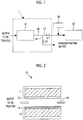
- FIG. 1 is a schematic view of the water treatment system of the present embodiment.
- a water treatment system 1 includes a desalination unit 10.
- a discharge path 16 is provided downstream of the desalination unit 10.
- the discharge path 16 is branched into a treated water discharge path 17 and a concentrated water discharge path 18 in the middle of the route.
- Valves V1 and V2 are respectively installed for the treated water discharge path 17 and the concentrated water discharge path 18.
- Fig. 2 is a schematic view of the desalination unit.
- the desalination unit 10 includes a pair of facing porous electrodes 11 and 13 and an interelectrode flow path 15 allowing the water to be treated to circulate between the electrodes.
- An anion-exchange member 12 is installed on the interelectrode flow path-side surface of the electrode 11 and a cation-exchange member 14 is installed on the interelectrode flow path-side surface of the electrode 13.
- the cation-exchange membrane 14 in the present embodiment is an ion-exchange membrane having a higher removal ratio of divalent cations than the removal ratios of other ions. That is, the cation-exchange membrane 14 is an ion-exchange membrane selectively permeating divalent cations (alkali earth metal ions such as Mg 2+ ).
- divalent cations alkali earth metal ions such as Mg 2+
- Ca 2+ and Mg 2+ are ions that are likely to be precipitated particularly as a scale and thus, as the cation-exchange membrane 14, an ion-exchange membrane selectively permeating Ca 2+ or Mg 2+ and both may be used.
- the cation-exchange membrane 14 is made of a polymer material having a sulfo group (-SO 3 H).
- the sulfo group is a functional group having a large permselectivity coefficient of divalent cations with respect to monovalent cations.
- the polymer material is, for example, a styrene-divinyl benzene copolymer.
- the cation-exchange membrane 14 preferably does not have a functional group having a smaller permselectivity coefficient than the sulfo group, for example, a carboxyl group (-COOH), a phosphonic group (-PO(OH) 2 ), or a dicarboxylic acid imide group (-N(COOH) 2 ), but these functional groups may be included as long as the amount thereof is smaller than the amount of the sulfo group.
- a functional group having a smaller permselectivity coefficient than the sulfo group for example, a carboxyl group (-COOH), a phosphonic group (-PO(OH) 2 ), or a dicarboxylic acid imide group (-N(COOH) 2 ), but these functional groups may be included as long as the amount thereof is smaller than the amount of the sulfo group.
- a cation-exchange membrane in which the sulfo group with respect to all of the functional groups (the total of the sulfo group, the carboxyl group, the phosphonic group, and the dicarboxylic acid imide group) is 50% or more, preferably 90% or more, and more preferably 99% or more is used.
- NEOSEPTA CMX, CL-25T, CH-45T, C66-5T manufactured by ASTOM Corporation
- SELEMION CMV manufactured by AGC Engineering Co., Ltd.
- ACIPLEX CK-1, DK-1, K-101 manufactured by Asahi Kasei Chemicals Corporation or the like can be used.
- the removal ratio of divalent cations by the cation-exchange membrane 14 is 95% or more and preferably 98% or more and the removal ratios of other cations are equal to or lower than the removal ratio of the divalent cations.
- the removal ratio of Na + by the cation-exchange membrane 14 is preferably 80% or less.
- the type of the cation-exchange membrane 14 is selected and the device design and the water treatment conditions are set so as to achieve the above-described removal ratio.
- Fig. 3 is a graph illustrating an example of the removal ratios of a variety of ions through the electrodialysis of the ion-exchange membrane (sources: Yuki Toyota, "Development of Control System of Mineral Ions in Deep Sea-Water", thesis (2002) of Kochi University of Technology, URL:www.kochitech.ac.jp/library/ron/2002/g5/M/1055019.pdf ).
- Fig. 3 is the results of electrodialysis using 10 pairs of a strongly acidic cation-exchange membrane having a membrane area of 1.72 dm 2 /membrane and a strongly basic anion-exchange membrane.
- Fig. 3 is the results of electrodialysis using 10 pairs of a strongly acidic cation-exchange membrane having a membrane area of 1.72 dm 2 /membrane and a strongly basic anion-exchange membrane.
- the removal ratios of Ca 2+ and Mg 2+ of 95% or more are achieved after six minutes from the initiation of the electrodialysis, but the removal ratio of monovalent ions is 95% or less and the removal ratio of Na + is 80% or less.
- the device design and the treatment conditions are set according to the following guidelines.
- Equation (1) in order to increase the removal ratio of divalent cations, at least any one of an increase in the area A 0 of the ion-exchange membrane, an increase in the current density i, an increase in the number n of the ion-exchange membranes, an increase in the current efficiency ⁇ , and a decrease in the amount Q of the treated water may be carried out.
- the current density i has a correlation with the voltage applied to an electrode in the desalination unit 10 and it is possible to increase the current density i by increasing the applied voltage.
- Equation 2 EF C in i ⁇ n A 0
- Equation (2) it can be understood that, in order to shorten the treatment time 1/Q and obtain a predetermined removal ratio (that is, in a case in which the removal ratio E is constant), at least one parameter of the area A 0 of the ion-exchange membrane, the current density i, the number n of the ion-exchange membranes, and the current efficiency ⁇ may be increased.
- the current density i has a correlation with the applied voltage of the desalination unit 10 and thus the applied voltage is increased in order to increase the current density i.
- the device capacity such as the area A 0 of the cation-exchange membrane 14 and the number n of the cation-exchange membranes 14 or the water treatment conditions such as the applied voltage and the amount of the treated water Q are appropriately set so that the above-described removal ratio of divalent cations can be achieved within the predetermined time.
- an anion-exchange membrane 12 may not have selectivity for the difference in the valences of ions.
- the water to be treated having the above-described properties flows into the desalination unit 10.
- the following desalination step and recycling step are carried out.
- the water to be treated containing ions passes through the positively-charged interelectrode flow path 15 between the electrodes 11 and 13.
- anions in the water to be treated permeate the anion-exchange membrane 12 and are adsorbed to the electrode 11.
- divalent cations such as Ca 2+ and Mg 2+ in the water to be treated permeate the cation-exchange membrane 14 and are adsorbed to the electrode 13.
- Some of monovalent cations (the amount corresponding to the permeation rate of monovalent cations) permeate the cation-exchange membrane 14 and are adsorbed to the electrode 13, but some of monovalent cations fail to permeate the cation-exchange membrane 14 and pass through the interelectrode flow path 15.
- Divalent cations are removed from the water to be treated through the desalination step and the concentration of divalent cations in the treated water is reduced.
- the water to be treated that has passed through the interelectrode flow path 15 is discharged from the desalination unit 10 as treated water, passes through the treated water discharge path 17, is discharged outside the system of a desalination treatment device, and is collected.
- the concentration of divalent cations contained in the treated water is reduced compared with the concentration of divalent cations in the water to be treated.
- the desalination step is carried out for a predetermined time, voltage is applied to the respective electrodes 11 and 13 so that the electrode 11 is negatively charged and the electrode 13 is positively charged. That is, the electrodes fall into the "reverse" electrically conductive states.
- the valve V1 is closed and the valve V2 is opened. As a result, the recycling step begins.
- ions adsorbed in the desalination step are desorbed from the electrodes 11 and 13 and return to the interelectrode flow path 15.
- the cations and the anions that have returned to the interelectrode flow path 15 are not capable of permeating the anion-exchange membrane 12 and the cation-exchange membrane 14 and are thus accumulated in the interelectrode flow path 15.
- water having a low ion concentration such as clean water (fresh water) is supplied from a system not illustrated in Figs. 1 and 2 and the divalent ions released into the interelectrode flow path 15 are discharged from the desalination unit 10.
- Water discharged from the desalination unit 10 passes through the concentrated water discharge path 18 as concentrated water and is discharged outside the system of the desalination treatment device 1.
- the desalination step and the recycling step are alternately carried out at intervals of a predetermined time.
- the desalination step and the recycling step are carried out respectively for 1 minute to 60 minutes and preferably for 1 minute to 10 minutes.
- an ion concentrating unit 20 is installed on the downstream side of the desalination unit 10 in the treated water discharge path 17.
- the ion concentrating unit 20 is a device for further concentrating ions in the treated water discharged from the desalination unit 10.
- Examples of the ion concentrating unit 20 include a desalination device, a boiler, and a cooling tower.
- the desalination device examples include a reverse osmosis membrane device, an electrodialysis device (ED), an electrode deionization device (EDI), and an ion-exchange resin device. Additionally, it is also possible to install an ion-exchange membrane that has the same constitution as the desalination unit 10 but does not have ion selectivity. These desalination devices remove ions (monovalent cations, anions, and the like) remaining in the treated water of the desalination unit 10. In order to increase the removal ratio of ions, a constitution in which a plurality of desalination devices is connected to each other in series may be employed.
- an evaporator or a crystallizer may be installed downstream of the concentrating unit side of the reverse osmosis membrane device. Water is evaporated from concentrated water in the evaporator or the crystallizer, ions contained in concentrated water are precipitated in a solid form, and are collected in a solid form.
- a pH adjustment unit 30 is preferably further installed in the treated water discharge path 17.
- ion-form silica or non-ionized solid-form silica is contained in the water to be treated.
- the ion-form silica has a low removal ratio in the desalination unit and thus permeates the water treatment system 1.
- the non-ionized silica also permeates the water treatment system 1.
- ion-form silica or solid-form silica is contained in the treated water that has been treated in the water treatment system 1.
- the solubility of silica present in water varies depending on pH and silica is significantly dissolved in water as ion-form silica at a pH of 9 or higher.
- the pH adjustment unit 30 injects an alkali agent into water so that the pH (measured using a pH meter not illustrated in Fig. 1 ) of the treated water passing through the treated water discharge path 17 reaches 9 or higher.
- the alkali agent refers to an aqueous solution of a hydroxide of an alkali metal such as Na or K.
- the cooling tower In a case in which the cooling tower is installed as the ion concentrating unit 20, heat is exchanged between the cooling tower and high-temperature exhaust gas discharged from the treated water of the water treatment system 1, a boiler, and the like. Some of water turns into vapor due to this heat exchange and ions in the treated water in the cooling tower are concentrated. Some of the concentrated water is discharged from the cooling tower as blow water.
- the boiler or the cooling tower is installed as the ion concentrating unit 20
- a constitution in which the boiler or the cooling tower is combined with the desalination device and treated water from the desalination device is sent to the boiler or the cooling tower may be employed.
- the boiler or the cooling tower is combined with the reverse osmosis membrane device, it is possible to employ a constitution in which water (water from which ions are removed) discharged from the evaporator and the crystallizer installed downstream of the concentrating unit side of the reverse osmosis membrane device is sent to the cooling tower or the boiler.
- the water treatment system 1 of the present embodiment since the water treatment system 1 of the present embodiment generates water having a reduced concentration of divalent cations, it is also possible to use the water as laundry water and the like in which the presence of alkaline-earth metallic ions causes a problem.
- Fig. 4 is a schematic view illustrating the constitution for separating and collecting Ca in a solid form from concentrated water of the desalination unit in the water treatment system of the first embodiment.
- the concentrated water discharge path 18 of the water treatment system 1 is connected to a separation unit 100.
- the separation unit 100 includes a deposition unit 101 and a dehydration unit 102.
- Fig. 4 illustrates an example in which CaCO 3 is collected from concentrated water mainly containing Ca 2+ and CO 3 2- as the scale component ions.
- the separation unit 100 in Fig. 4 includes a first deposition device 101a and a second deposition device 101b as the deposition unit 101.
- the concentrated water discharge path 18 is connected to the first deposition device 101a and supplies concentrated water from the desalination unit 10 to the first deposition device 101a.
- Ca(OH) 2 is injected into the first deposition device 101a for the adjustment of the pH.
- CaCO 3 is oversaturated, CaCO 3 is precipitated and is deposited on the bottom portion of the first deposition device 101a. Heavy metals contained in the concentrated water are also deposited on the bottom portion of the first deposition device 101a.
- the first deposition device 101a is connected to the second deposition device 101b.
- a supernatant liquid containing Ca 2+ is sent to the second deposition device 101b from the first deposition device 101a.
- Na 2 CO 3 is injected into the second deposition device 101b, Ca 2+ is precipitated in a CaCO 3 form, and is deposited on the bottom portion.
- the supernatant liquid in the second deposition device 101b contains the scale component ions that cannot be separated in the first deposition device 101a and the second deposition device 101b.
- the supernatant liquid in the second deposition device 101b is discharged from the second deposition device 101b and is circulated to the upstream side of the desalination unit 10.
- the bottom portions of the first deposition device 101a and the second deposition device 101b are connected to the dehydration unit 102. Water containing deposits is discharged from the bottom portions of the first deposition device 101a and the second deposition device 101b and is sent to the dehydration unit 102.
- the dehydration unit 102 separates water and solid materials and collects sludge containing CaCO 3 . Water separated in the dehydration unit 102 is circulated to the first deposition device 101a.
- Fig. 5 is a schematic view illustrating the constitution in which a separation unit is installed upstream of the desalination unit 10 as a third embodiment of the present invention.
- Fig. 5 illustrates an example of a case in which the scale component ions in the water to be treated are mainly Ca 2+ and CO 3 2- .
- the same reference signs are given to the same constitutions as those in Fig. 4 .
- a separation unit 200 in the third embodiment includes the deposition unit 101 and the dehydration unit 102.
- the supernatant liquid in the second deposition device 101b is sent to the desalination unit 10.
- the constitution of the separation unit 200 except for what has been described above is the same as in the second embodiment.
- the main scale component ions of the water to be treated are combinations other than Ca 2+ and CO 3 2- as well, similar to the second embodiment, as long as the separation unit is provided, it is possible to reduce the concentrations of the scale component ions other than Ca 2+ and CO 3 2- and collect the scale component ions in a solid form. However, the solubility of CaSO 4 in water is low. In a case in which the separation unit mainly collects CaSO 4 , the second deposition device becomes unnecessary and a constitution in which the supernatant liquid in the first deposition device is circulated to the desalination unit may be employed.
- Which constitution is employed between the second embodiment and the third embodiment is appropriately selected depending on the properties of the concentrated water and the properties of the water to be treated.
- the desalination treatment in the desalination unit 10 is not sufficient and the concentration of the scale component ions in the treated water becomes high.
- it is effective to reduce the concentration of Ca 2+ flowing into the desalination unit 10 as the concentration of the third embodiment for the prevention of the precipitation of scales.
Landscapes
- Chemical & Material Sciences (AREA)
- Water Supply & Treatment (AREA)
- Engineering & Computer Science (AREA)
- Chemical Kinetics & Catalysis (AREA)
- Life Sciences & Earth Sciences (AREA)
- Health & Medical Sciences (AREA)
- Hydrology & Water Resources (AREA)
- Environmental & Geological Engineering (AREA)
- Organic Chemistry (AREA)
- Urology & Nephrology (AREA)
- General Chemical & Material Sciences (AREA)
- Electrochemistry (AREA)
- Analytical Chemistry (AREA)
- Molecular Biology (AREA)
- Water Treatment By Electricity Or Magnetism (AREA)
- Separation Using Semi-Permeable Membranes (AREA)
Priority Applications (1)
| Application Number | Priority Date | Filing Date | Title |
|---|---|---|---|
| PL14779478T PL2962997T3 (pl) | 2013-04-01 | 2014-04-01 | System uzdatniania wody |
Applications Claiming Priority (2)
| Application Number | Priority Date | Filing Date | Title |
|---|---|---|---|
| JP2013076161 | 2013-04-01 | ||
| PCT/JP2014/059671 WO2014163094A1 (ja) | 2013-04-01 | 2014-04-01 | 水処理システム |
Publications (3)
| Publication Number | Publication Date |
|---|---|
| EP2962997A1 EP2962997A1 (en) | 2016-01-06 |
| EP2962997A4 EP2962997A4 (en) | 2016-04-27 |
| EP2962997B1 true EP2962997B1 (en) | 2018-07-11 |
Family
ID=51658389
Family Applications (1)
| Application Number | Title | Priority Date | Filing Date |
|---|---|---|---|
| EP14779478.8A Not-in-force EP2962997B1 (en) | 2013-04-01 | 2014-04-01 | Water treatment system |
Country Status (4)
| Country | Link |
|---|---|
| US (1) | US20160068413A1 (pl) |
| EP (1) | EP2962997B1 (pl) |
| PL (1) | PL2962997T3 (pl) |
| WO (1) | WO2014163094A1 (pl) |
Families Citing this family (8)
| Publication number | Priority date | Publication date | Assignee | Title |
|---|---|---|---|---|
| JP6189422B2 (ja) * | 2013-04-18 | 2017-08-30 | 三菱重工業株式会社 | 水処理システム |
| JP6432255B2 (ja) * | 2014-06-05 | 2018-12-05 | Toto株式会社 | 小便器 |
| JP6425188B2 (ja) * | 2014-06-05 | 2018-11-21 | Toto株式会社 | 小便器 |
| US11597661B2 (en) * | 2018-11-13 | 2023-03-07 | Robert Bosch Gmbh | Intercalation-based materials and processes for softening water |
| US12540085B2 (en) | 2019-12-13 | 2026-02-03 | Mitsubishi Electric Corporation | Water-using apparatus |
| JP7237104B2 (ja) * | 2019-12-13 | 2023-03-10 | 三菱電機株式会社 | 水使用装置 |
| TWI739524B (zh) * | 2020-07-22 | 2021-09-11 | 財團法人工業技術研究院 | 水處理裝置及水處理方法 |
| GB2631586B (en) * | 2024-06-06 | 2025-10-01 | Fdi Tech Ltd | Water treatment apparatus |
Family Cites Families (12)
| Publication number | Priority date | Publication date | Assignee | Title |
|---|---|---|---|---|
| JP2887105B2 (ja) * | 1996-04-24 | 1999-04-26 | 幸子 林 | 飲料水および塩の製造方法および製造装置 |
| US6056878A (en) * | 1998-08-03 | 2000-05-02 | E-Cell Corporation | Method and apparatus for reducing scaling in electrodeionization systems and for improving efficiency thereof |
| JP4135802B2 (ja) * | 1999-09-27 | 2008-08-20 | オルガノ株式会社 | 脱塩装置 |
| JP4121224B2 (ja) * | 1999-11-08 | 2008-07-23 | オルガノ株式会社 | 循環水処理方法及び装置 |
| US7813106B2 (en) * | 2006-12-19 | 2010-10-12 | General Electric Company | High current efficiency supercapacitor desalination devices and methods of making the same |
| BRPI0922167A2 (pt) * | 2008-12-17 | 2019-09-24 | Tennant Co | aparelho para aplicar carga elétrica através de um líquido, método para aplicar carga elétrica através de um líquido, e, meio antimicrobiano |
| US8864911B2 (en) * | 2009-03-26 | 2014-10-21 | General Electric Company | Method for removing ionic species from desalination unit |
| EP2689438B1 (en) * | 2011-03-23 | 2022-11-16 | Mespilus Inc. | Polarized electrode for flow-through capacitive deionization |
| JP2012232233A (ja) * | 2011-04-28 | 2012-11-29 | Kobelco Eco-Solutions Co Ltd | 通液型キャパシタ、およびそれを備えた脱塩処理システム |
| CN102863055A (zh) * | 2011-07-08 | 2013-01-09 | 通用电气公司 | 脱盐系统和方法 |
| WO2014020758A1 (ja) * | 2012-08-03 | 2014-02-06 | 三菱重工メカトロシステムズ株式会社 | 脱塩処理装置及び脱塩処理装置の運転方法 |
| JP6150232B2 (ja) * | 2012-09-13 | 2017-06-21 | 株式会社クラレ | 通液型コンデンサ、その製造方法、及びそれを有する脱塩装置 |
-
2014
- 2014-04-01 US US14/781,152 patent/US20160068413A1/en not_active Abandoned
- 2014-04-01 EP EP14779478.8A patent/EP2962997B1/en not_active Not-in-force
- 2014-04-01 PL PL14779478T patent/PL2962997T3/pl unknown
- 2014-04-01 WO PCT/JP2014/059671 patent/WO2014163094A1/ja not_active Ceased
Non-Patent Citations (1)
| Title |
|---|
| None * |
Also Published As
| Publication number | Publication date |
|---|---|
| PL2962997T3 (pl) | 2018-12-31 |
| WO2014163094A1 (ja) | 2014-10-09 |
| US20160068413A1 (en) | 2016-03-10 |
| EP2962997A1 (en) | 2016-01-06 |
| EP2962997A4 (en) | 2016-04-27 |
Similar Documents
| Publication | Publication Date | Title |
|---|---|---|
| EP2962997B1 (en) | Water treatment system | |
| Grzegorzek et al. | Removal of fluoride from multicomponent water solutions with the use of monovalent selective ion-exchange membranes | |
| JP3174036U (ja) | 低エネルギーの電気脱イオン装置 | |
| Zhang et al. | Fracsis: Ion fractionation and metathesis by a NF-ED integrated system to improve water recovery | |
| CN101878187B (zh) | 用于水处理的系统和方法 | |
| Abou-Shady et al. | Effect of pH on separation of Pb (II) and NO3− from aqueous solutions using electrodialysis | |
| US7981268B2 (en) | Deionization and desalination using electrostatic ion pumping | |
| EP1925596A1 (en) | Electrodialyzer, waste water treatment method, and fluorine treatment system | |
| CN105417635B (zh) | 用于净化流体的装置和通过其净化流体的方法 | |
| Bond et al. | Zero liquid discharge desalination of brackish water with an innovative form of electrodialysis: electrodialysis metathesis | |
| Haddad et al. | Eco-efficient treatment of ion exchange spent brine via electrodialysis to recover NaCl and minimize waste disposal | |
| WO2014052025A1 (en) | A system and method for the treatment of hydraulic fracturing backflow water | |
| JP5968524B2 (ja) | 水処理方法及び水処理システム | |
| JP2014533605A (ja) | 脱塩システム及びその方法 | |
| Min et al. | Influence of linear flow velocity and ion concentration on limiting current density during electrodialysis | |
| WO2014170981A1 (ja) | 水処理システム | |
| KR101137042B1 (ko) | 축전 탈 이온화 장치, 이를 이용한 축전 탈 이온화 방법 및이를 이용한 담수화 장치, 폐수 처리 장치 | |
| Acevedo-Morantes et al. | Electrolytic removal of nitrate and potassium from wheat leachate using a four compartment electrolytic cell |
Legal Events
| Date | Code | Title | Description |
|---|---|---|---|
| PUAI | Public reference made under article 153(3) epc to a published international application that has entered the european phase |
Free format text: ORIGINAL CODE: 0009012 |
|
| 17P | Request for examination filed |
Effective date: 20150928 |
|
| AK | Designated contracting states |
Kind code of ref document: A1 Designated state(s): AL AT BE BG CH CY CZ DE DK EE ES FI FR GB GR HR HU IE IS IT LI LT LU LV MC MK MT NL NO PL PT RO RS SE SI SK SM TR |
|
| AX | Request for extension of the european patent |
Extension state: BA ME |
|
| A4 | Supplementary search report drawn up and despatched |
Effective date: 20160330 |
|
| RIC1 | Information provided on ipc code assigned before grant |
Ipc: B01D 61/50 20060101ALI20160322BHEP Ipc: B01D 61/46 20060101ALI20160322BHEP Ipc: B01D 61/52 20060101ALI20160322BHEP Ipc: C02F 5/00 20060101ALI20160322BHEP Ipc: C02F 5/06 20060101ALI20160322BHEP Ipc: C02F 1/469 20060101AFI20160322BHEP |
|
| DAX | Request for extension of the european patent (deleted) | ||
| GRAP | Despatch of communication of intention to grant a patent |
Free format text: ORIGINAL CODE: EPIDOSNIGR1 |
|
| STAA | Information on the status of an ep patent application or granted ep patent |
Free format text: STATUS: GRANT OF PATENT IS INTENDED |
|
| INTG | Intention to grant announced |
Effective date: 20180123 |
|
| GRAS | Grant fee paid |
Free format text: ORIGINAL CODE: EPIDOSNIGR3 |
|
| GRAA | (expected) grant |
Free format text: ORIGINAL CODE: 0009210 |
|
| STAA | Information on the status of an ep patent application or granted ep patent |
Free format text: STATUS: THE PATENT HAS BEEN GRANTED |
|
| AK | Designated contracting states |
Kind code of ref document: B1 Designated state(s): AL AT BE BG CH CY CZ DE DK EE ES FI FR GB GR HR HU IE IS IT LI LT LU LV MC MK MT NL NO PL PT RO RS SE SI SK SM TR |
|
| REG | Reference to a national code |
Ref country code: GB Ref legal event code: FG4D |
|
| REG | Reference to a national code |
Ref country code: CH Ref legal event code: EP |
|
| REG | Reference to a national code |
Ref country code: AT Ref legal event code: REF Ref document number: 1016688 Country of ref document: AT Kind code of ref document: T Effective date: 20180715 |
|
| REG | Reference to a national code |
Ref country code: IE Ref legal event code: FG4D |
|
| RAP2 | Party data changed (patent owner data changed or rights of a patent transferred) |
Owner name: MITSUBISHI HEAVY INDUSTRIES ENGINEERING, LTD. |
|
| REG | Reference to a national code |
Ref country code: DE Ref legal event code: R096 Ref document number: 602014028362 Country of ref document: DE |
|
| REG | Reference to a national code |
Ref country code: DE Ref legal event code: R082 Ref document number: 602014028362 Country of ref document: DE Representative=s name: HENKEL & PARTNER MBB PATENTANWALTSKANZLEI, REC, DE Ref country code: DE Ref legal event code: R082 Ref document number: 602014028362 Country of ref document: DE Representative=s name: PATENTANWAELTE HENKEL, BREUER & PARTNER MBB, DE |
|
| REG | Reference to a national code |
Ref country code: DE Ref legal event code: R082 Ref document number: 602014028362 Country of ref document: DE Representative=s name: HENKEL & PARTNER MBB PATENTANWALTSKANZLEI, REC, DE Ref country code: DE Ref legal event code: R082 Ref document number: 602014028362 Country of ref document: DE Representative=s name: PATENTANWAELTE HENKEL, BREUER & PARTNER MBB, DE |
|
| REG | Reference to a national code |
Ref country code: NL Ref legal event code: MP Effective date: 20180711 |
|
| REG | Reference to a national code |
Ref country code: LT Ref legal event code: MG4D |
|
| REG | Reference to a national code |
Ref country code: AT Ref legal event code: MK05 Ref document number: 1016688 Country of ref document: AT Kind code of ref document: T Effective date: 20180711 |
|
| PG25 | Lapsed in a contracting state [announced via postgrant information from national office to epo] |
Ref country code: NL Free format text: LAPSE BECAUSE OF FAILURE TO SUBMIT A TRANSLATION OF THE DESCRIPTION OR TO PAY THE FEE WITHIN THE PRESCRIBED TIME-LIMIT Effective date: 20180711 |
|
| PG25 | Lapsed in a contracting state [announced via postgrant information from national office to epo] |
Ref country code: BG Free format text: LAPSE BECAUSE OF FAILURE TO SUBMIT A TRANSLATION OF THE DESCRIPTION OR TO PAY THE FEE WITHIN THE PRESCRIBED TIME-LIMIT Effective date: 20181011 Ref country code: LT Free format text: LAPSE BECAUSE OF FAILURE TO SUBMIT A TRANSLATION OF THE DESCRIPTION OR TO PAY THE FEE WITHIN THE PRESCRIBED TIME-LIMIT Effective date: 20180711 Ref country code: AT Free format text: LAPSE BECAUSE OF FAILURE TO SUBMIT A TRANSLATION OF THE DESCRIPTION OR TO PAY THE FEE WITHIN THE PRESCRIBED TIME-LIMIT Effective date: 20180711 Ref country code: SE Free format text: LAPSE BECAUSE OF FAILURE TO SUBMIT A TRANSLATION OF THE DESCRIPTION OR TO PAY THE FEE WITHIN THE PRESCRIBED TIME-LIMIT Effective date: 20180711 Ref country code: IS Free format text: LAPSE BECAUSE OF FAILURE TO SUBMIT A TRANSLATION OF THE DESCRIPTION OR TO PAY THE FEE WITHIN THE PRESCRIBED TIME-LIMIT Effective date: 20181111 Ref country code: FI Free format text: LAPSE BECAUSE OF FAILURE TO SUBMIT A TRANSLATION OF THE DESCRIPTION OR TO PAY THE FEE WITHIN THE PRESCRIBED TIME-LIMIT Effective date: 20180711 Ref country code: NO Free format text: LAPSE BECAUSE OF FAILURE TO SUBMIT A TRANSLATION OF THE DESCRIPTION OR TO PAY THE FEE WITHIN THE PRESCRIBED TIME-LIMIT Effective date: 20181011 Ref country code: RS Free format text: LAPSE BECAUSE OF FAILURE TO SUBMIT A TRANSLATION OF THE DESCRIPTION OR TO PAY THE FEE WITHIN THE PRESCRIBED TIME-LIMIT Effective date: 20180711 Ref country code: GR Free format text: LAPSE BECAUSE OF FAILURE TO SUBMIT A TRANSLATION OF THE DESCRIPTION OR TO PAY THE FEE WITHIN THE PRESCRIBED TIME-LIMIT Effective date: 20181012 |
|
| PG25 | Lapsed in a contracting state [announced via postgrant information from national office to epo] |
Ref country code: ES Free format text: LAPSE BECAUSE OF FAILURE TO SUBMIT A TRANSLATION OF THE DESCRIPTION OR TO PAY THE FEE WITHIN THE PRESCRIBED TIME-LIMIT Effective date: 20180711 Ref country code: HR Free format text: LAPSE BECAUSE OF FAILURE TO SUBMIT A TRANSLATION OF THE DESCRIPTION OR TO PAY THE FEE WITHIN THE PRESCRIBED TIME-LIMIT Effective date: 20180711 Ref country code: LV Free format text: LAPSE BECAUSE OF FAILURE TO SUBMIT A TRANSLATION OF THE DESCRIPTION OR TO PAY THE FEE WITHIN THE PRESCRIBED TIME-LIMIT Effective date: 20180711 Ref country code: AL Free format text: LAPSE BECAUSE OF FAILURE TO SUBMIT A TRANSLATION OF THE DESCRIPTION OR TO PAY THE FEE WITHIN THE PRESCRIBED TIME-LIMIT Effective date: 20180711 |
|
| REG | Reference to a national code |
Ref country code: DE Ref legal event code: R097 Ref document number: 602014028362 Country of ref document: DE |
|
| PG25 | Lapsed in a contracting state [announced via postgrant information from national office to epo] |
Ref country code: EE Free format text: LAPSE BECAUSE OF FAILURE TO SUBMIT A TRANSLATION OF THE DESCRIPTION OR TO PAY THE FEE WITHIN THE PRESCRIBED TIME-LIMIT Effective date: 20180711 Ref country code: IT Free format text: LAPSE BECAUSE OF FAILURE TO SUBMIT A TRANSLATION OF THE DESCRIPTION OR TO PAY THE FEE WITHIN THE PRESCRIBED TIME-LIMIT Effective date: 20180711 Ref country code: CZ Free format text: LAPSE BECAUSE OF FAILURE TO SUBMIT A TRANSLATION OF THE DESCRIPTION OR TO PAY THE FEE WITHIN THE PRESCRIBED TIME-LIMIT Effective date: 20180711 Ref country code: RO Free format text: LAPSE BECAUSE OF FAILURE TO SUBMIT A TRANSLATION OF THE DESCRIPTION OR TO PAY THE FEE WITHIN THE PRESCRIBED TIME-LIMIT Effective date: 20180711 |
|
| PGFP | Annual fee paid to national office [announced via postgrant information from national office to epo] |
Ref country code: PL Payment date: 20190326 Year of fee payment: 6 |
|
| PLBE | No opposition filed within time limit |
Free format text: ORIGINAL CODE: 0009261 |
|
| STAA | Information on the status of an ep patent application or granted ep patent |
Free format text: STATUS: NO OPPOSITION FILED WITHIN TIME LIMIT |
|
| PG25 | Lapsed in a contracting state [announced via postgrant information from national office to epo] |
Ref country code: SK Free format text: LAPSE BECAUSE OF FAILURE TO SUBMIT A TRANSLATION OF THE DESCRIPTION OR TO PAY THE FEE WITHIN THE PRESCRIBED TIME-LIMIT Effective date: 20180711 Ref country code: SM Free format text: LAPSE BECAUSE OF FAILURE TO SUBMIT A TRANSLATION OF THE DESCRIPTION OR TO PAY THE FEE WITHIN THE PRESCRIBED TIME-LIMIT Effective date: 20180711 Ref country code: DK Free format text: LAPSE BECAUSE OF FAILURE TO SUBMIT A TRANSLATION OF THE DESCRIPTION OR TO PAY THE FEE WITHIN THE PRESCRIBED TIME-LIMIT Effective date: 20180711 |
|
| 26N | No opposition filed |
Effective date: 20190412 |
|
| PGFP | Annual fee paid to national office [announced via postgrant information from national office to epo] |
Ref country code: DE Payment date: 20190417 Year of fee payment: 6 |
|
| PG25 | Lapsed in a contracting state [announced via postgrant information from national office to epo] |
Ref country code: SI Free format text: LAPSE BECAUSE OF FAILURE TO SUBMIT A TRANSLATION OF THE DESCRIPTION OR TO PAY THE FEE WITHIN THE PRESCRIBED TIME-LIMIT Effective date: 20180711 |
|
| REG | Reference to a national code |
Ref country code: CH Ref legal event code: PL |
|
| REG | Reference to a national code |
Ref country code: BE Ref legal event code: MM Effective date: 20190430 |
|
| GBPC | Gb: european patent ceased through non-payment of renewal fee |
Effective date: 20190401 |
|
| PG25 | Lapsed in a contracting state [announced via postgrant information from national office to epo] |
Ref country code: MC Free format text: LAPSE BECAUSE OF FAILURE TO SUBMIT A TRANSLATION OF THE DESCRIPTION OR TO PAY THE FEE WITHIN THE PRESCRIBED TIME-LIMIT Effective date: 20180711 Ref country code: LU Free format text: LAPSE BECAUSE OF NON-PAYMENT OF DUE FEES Effective date: 20190401 |
|
| PG25 | Lapsed in a contracting state [announced via postgrant information from national office to epo] |
Ref country code: LI Free format text: LAPSE BECAUSE OF NON-PAYMENT OF DUE FEES Effective date: 20190430 Ref country code: CH Free format text: LAPSE BECAUSE OF NON-PAYMENT OF DUE FEES Effective date: 20190430 Ref country code: GB Free format text: LAPSE BECAUSE OF NON-PAYMENT OF DUE FEES Effective date: 20190401 |
|
| PG25 | Lapsed in a contracting state [announced via postgrant information from national office to epo] |
Ref country code: BE Free format text: LAPSE BECAUSE OF NON-PAYMENT OF DUE FEES Effective date: 20190430 Ref country code: FR Free format text: LAPSE BECAUSE OF NON-PAYMENT OF DUE FEES Effective date: 20190430 |
|
| PG25 | Lapsed in a contracting state [announced via postgrant information from national office to epo] |
Ref country code: TR Free format text: LAPSE BECAUSE OF FAILURE TO SUBMIT A TRANSLATION OF THE DESCRIPTION OR TO PAY THE FEE WITHIN THE PRESCRIBED TIME-LIMIT Effective date: 20180711 |
|
| PG25 | Lapsed in a contracting state [announced via postgrant information from national office to epo] |
Ref country code: IE Free format text: LAPSE BECAUSE OF NON-PAYMENT OF DUE FEES Effective date: 20190401 |
|
| PG25 | Lapsed in a contracting state [announced via postgrant information from national office to epo] |
Ref country code: PT Free format text: LAPSE BECAUSE OF FAILURE TO SUBMIT A TRANSLATION OF THE DESCRIPTION OR TO PAY THE FEE WITHIN THE PRESCRIBED TIME-LIMIT Effective date: 20181111 |
|
| REG | Reference to a national code |
Ref country code: DE Ref legal event code: R119 Ref document number: 602014028362 Country of ref document: DE |
|
| PG25 | Lapsed in a contracting state [announced via postgrant information from national office to epo] |
Ref country code: DE Free format text: LAPSE BECAUSE OF NON-PAYMENT OF DUE FEES Effective date: 20201103 |
|
| PG25 | Lapsed in a contracting state [announced via postgrant information from national office to epo] |
Ref country code: CY Free format text: LAPSE BECAUSE OF FAILURE TO SUBMIT A TRANSLATION OF THE DESCRIPTION OR TO PAY THE FEE WITHIN THE PRESCRIBED TIME-LIMIT Effective date: 20180711 |
|
| PG25 | Lapsed in a contracting state [announced via postgrant information from national office to epo] |
Ref country code: HU Free format text: LAPSE BECAUSE OF FAILURE TO SUBMIT A TRANSLATION OF THE DESCRIPTION OR TO PAY THE FEE WITHIN THE PRESCRIBED TIME-LIMIT; INVALID AB INITIO Effective date: 20140401 Ref country code: MT Free format text: LAPSE BECAUSE OF FAILURE TO SUBMIT A TRANSLATION OF THE DESCRIPTION OR TO PAY THE FEE WITHIN THE PRESCRIBED TIME-LIMIT Effective date: 20180711 |
|
| PG25 | Lapsed in a contracting state [announced via postgrant information from national office to epo] |
Ref country code: MK Free format text: LAPSE BECAUSE OF FAILURE TO SUBMIT A TRANSLATION OF THE DESCRIPTION OR TO PAY THE FEE WITHIN THE PRESCRIBED TIME-LIMIT Effective date: 20180711 |
|
| PG25 | Lapsed in a contracting state [announced via postgrant information from national office to epo] |
Ref country code: PL Free format text: LAPSE BECAUSE OF NON-PAYMENT OF DUE FEES Effective date: 20200401 |