EP2962829B1 - Method for manufacturing foamable injection molding and injection device therefor - Google Patents
Method for manufacturing foamable injection molding and injection device therefor Download PDFInfo
- Publication number
- EP2962829B1 EP2962829B1 EP14756937.0A EP14756937A EP2962829B1 EP 2962829 B1 EP2962829 B1 EP 2962829B1 EP 14756937 A EP14756937 A EP 14756937A EP 2962829 B1 EP2962829 B1 EP 2962829B1
- Authority
- EP
- European Patent Office
- Prior art keywords
- injection
- screw
- heating cylinder
- foaming gas
- molten resin
- Prior art date
- Legal status (The legal status is an assumption and is not a legal conclusion. Google has not performed a legal analysis and makes no representation as to the accuracy of the status listed.)
- Active
Links
Images
Classifications
-
- B—PERFORMING OPERATIONS; TRANSPORTING
- B29—WORKING OF PLASTICS; WORKING OF SUBSTANCES IN A PLASTIC STATE IN GENERAL
- B29C—SHAPING OR JOINING OF PLASTICS; SHAPING OF MATERIAL IN A PLASTIC STATE, NOT OTHERWISE PROVIDED FOR; AFTER-TREATMENT OF THE SHAPED PRODUCTS, e.g. REPAIRING
- B29C44/00—Shaping by internal pressure generated in the material, e.g. swelling or foaming ; Producing porous or cellular expanded plastics articles
- B29C44/34—Auxiliary operations
- B29C44/3442—Mixing, kneading or conveying the foamable material
- B29C44/3446—Feeding the blowing agent
-
- B—PERFORMING OPERATIONS; TRANSPORTING
- B29—WORKING OF PLASTICS; WORKING OF SUBSTANCES IN A PLASTIC STATE IN GENERAL
- B29C—SHAPING OR JOINING OF PLASTICS; SHAPING OF MATERIAL IN A PLASTIC STATE, NOT OTHERWISE PROVIDED FOR; AFTER-TREATMENT OF THE SHAPED PRODUCTS, e.g. REPAIRING
- B29C44/00—Shaping by internal pressure generated in the material, e.g. swelling or foaming ; Producing porous or cellular expanded plastics articles
- B29C44/34—Auxiliary operations
- B29C44/36—Feeding the material to be shaped
- B29C44/38—Feeding the material to be shaped into a closed space, i.e. to make articles of definite length
- B29C44/42—Feeding the material to be shaped into a closed space, i.e. to make articles of definite length using pressure difference, e.g. by injection or by vacuum
- B29C44/421—Feeding the material to be shaped into a closed space, i.e. to make articles of definite length using pressure difference, e.g. by injection or by vacuum by plastizising the material into a shot cavity and injecting using a plunger
-
- B—PERFORMING OPERATIONS; TRANSPORTING
- B29—WORKING OF PLASTICS; WORKING OF SUBSTANCES IN A PLASTIC STATE IN GENERAL
- B29C—SHAPING OR JOINING OF PLASTICS; SHAPING OF MATERIAL IN A PLASTIC STATE, NOT OTHERWISE PROVIDED FOR; AFTER-TREATMENT OF THE SHAPED PRODUCTS, e.g. REPAIRING
- B29C45/00—Injection moulding, i.e. forcing the required volume of moulding material through a nozzle into a closed mould; Apparatus therefor
- B29C45/0053—Injection moulding, i.e. forcing the required volume of moulding material through a nozzle into a closed mould; Apparatus therefor combined with a final operation, e.g. shaping
- B29C45/0055—Shaping
-
- B—PERFORMING OPERATIONS; TRANSPORTING
- B29—WORKING OF PLASTICS; WORKING OF SUBSTANCES IN A PLASTIC STATE IN GENERAL
- B29C—SHAPING OR JOINING OF PLASTICS; SHAPING OF MATERIAL IN A PLASTIC STATE, NOT OTHERWISE PROVIDED FOR; AFTER-TREATMENT OF THE SHAPED PRODUCTS, e.g. REPAIRING
- B29C45/00—Injection moulding, i.e. forcing the required volume of moulding material through a nozzle into a closed mould; Apparatus therefor
- B29C45/02—Transfer moulding, i.e. transferring the required volume of moulding material by a plunger from a "shot" cavity into a mould cavity
-
- B—PERFORMING OPERATIONS; TRANSPORTING
- B29—WORKING OF PLASTICS; WORKING OF SUBSTANCES IN A PLASTIC STATE IN GENERAL
- B29C—SHAPING OR JOINING OF PLASTICS; SHAPING OF MATERIAL IN A PLASTIC STATE, NOT OTHERWISE PROVIDED FOR; AFTER-TREATMENT OF THE SHAPED PRODUCTS, e.g. REPAIRING
- B29C45/00—Injection moulding, i.e. forcing the required volume of moulding material through a nozzle into a closed mould; Apparatus therefor
- B29C45/17—Component parts, details or accessories; Auxiliary operations
- B29C45/1701—Component parts, details or accessories; Auxiliary operations using a particular environment during moulding, e.g. moisture-free or dust-free
-
- B—PERFORMING OPERATIONS; TRANSPORTING
- B29—WORKING OF PLASTICS; WORKING OF SUBSTANCES IN A PLASTIC STATE IN GENERAL
- B29C—SHAPING OR JOINING OF PLASTICS; SHAPING OF MATERIAL IN A PLASTIC STATE, NOT OTHERWISE PROVIDED FOR; AFTER-TREATMENT OF THE SHAPED PRODUCTS, e.g. REPAIRING
- B29C45/00—Injection moulding, i.e. forcing the required volume of moulding material through a nozzle into a closed mould; Apparatus therefor
- B29C45/17—Component parts, details or accessories; Auxiliary operations
- B29C45/1703—Introducing an auxiliary fluid into the mould
-
- B—PERFORMING OPERATIONS; TRANSPORTING
- B29—WORKING OF PLASTICS; WORKING OF SUBSTANCES IN A PLASTIC STATE IN GENERAL
- B29C—SHAPING OR JOINING OF PLASTICS; SHAPING OF MATERIAL IN A PLASTIC STATE, NOT OTHERWISE PROVIDED FOR; AFTER-TREATMENT OF THE SHAPED PRODUCTS, e.g. REPAIRING
- B29C45/00—Injection moulding, i.e. forcing the required volume of moulding material through a nozzle into a closed mould; Apparatus therefor
- B29C45/17—Component parts, details or accessories; Auxiliary operations
- B29C45/46—Means for plasticising or homogenising the moulding material or forcing it into the mould
- B29C45/47—Means for plasticising or homogenising the moulding material or forcing it into the mould using screws
- B29C45/50—Axially movable screw
-
- B—PERFORMING OPERATIONS; TRANSPORTING
- B29—WORKING OF PLASTICS; WORKING OF SUBSTANCES IN A PLASTIC STATE IN GENERAL
- B29C—SHAPING OR JOINING OF PLASTICS; SHAPING OF MATERIAL IN A PLASTIC STATE, NOT OTHERWISE PROVIDED FOR; AFTER-TREATMENT OF THE SHAPED PRODUCTS, e.g. REPAIRING
- B29C45/00—Injection moulding, i.e. forcing the required volume of moulding material through a nozzle into a closed mould; Apparatus therefor
- B29C45/17—Component parts, details or accessories; Auxiliary operations
- B29C45/46—Means for plasticising or homogenising the moulding material or forcing it into the mould
- B29C45/47—Means for plasticising or homogenising the moulding material or forcing it into the mould using screws
- B29C45/50—Axially movable screw
- B29C45/5092—Intrusion moulding, i.e. the screw rotates during injection
-
- B—PERFORMING OPERATIONS; TRANSPORTING
- B29—WORKING OF PLASTICS; WORKING OF SUBSTANCES IN A PLASTIC STATE IN GENERAL
- B29C—SHAPING OR JOINING OF PLASTICS; SHAPING OF MATERIAL IN A PLASTIC STATE, NOT OTHERWISE PROVIDED FOR; AFTER-TREATMENT OF THE SHAPED PRODUCTS, e.g. REPAIRING
- B29C45/00—Injection moulding, i.e. forcing the required volume of moulding material through a nozzle into a closed mould; Apparatus therefor
- B29C45/17—Component parts, details or accessories; Auxiliary operations
- B29C45/46—Means for plasticising or homogenising the moulding material or forcing it into the mould
- B29C45/53—Means for plasticising or homogenising the moulding material or forcing it into the mould using injection ram or piston
- B29C45/54—Means for plasticising or homogenising the moulding material or forcing it into the mould using injection ram or piston and plasticising screw
-
- B—PERFORMING OPERATIONS; TRANSPORTING
- B29—WORKING OF PLASTICS; WORKING OF SUBSTANCES IN A PLASTIC STATE IN GENERAL
- B29C—SHAPING OR JOINING OF PLASTICS; SHAPING OF MATERIAL IN A PLASTIC STATE, NOT OTHERWISE PROVIDED FOR; AFTER-TREATMENT OF THE SHAPED PRODUCTS, e.g. REPAIRING
- B29C45/00—Injection moulding, i.e. forcing the required volume of moulding material through a nozzle into a closed mould; Apparatus therefor
- B29C45/17—Component parts, details or accessories; Auxiliary operations
- B29C45/1701—Component parts, details or accessories; Auxiliary operations using a particular environment during moulding, e.g. moisture-free or dust-free
- B29C2045/1702—Component parts, details or accessories; Auxiliary operations using a particular environment during moulding, e.g. moisture-free or dust-free dissolving or absorbing a fluid in the plastic material
-
- B—PERFORMING OPERATIONS; TRANSPORTING
- B29—WORKING OF PLASTICS; WORKING OF SUBSTANCES IN A PLASTIC STATE IN GENERAL
- B29C—SHAPING OR JOINING OF PLASTICS; SHAPING OF MATERIAL IN A PLASTIC STATE, NOT OTHERWISE PROVIDED FOR; AFTER-TREATMENT OF THE SHAPED PRODUCTS, e.g. REPAIRING
- B29C45/00—Injection moulding, i.e. forcing the required volume of moulding material through a nozzle into a closed mould; Apparatus therefor
- B29C45/17—Component parts, details or accessories; Auxiliary operations
- B29C45/46—Means for plasticising or homogenising the moulding material or forcing it into the mould
- B29C45/53—Means for plasticising or homogenising the moulding material or forcing it into the mould using injection ram or piston
-
- B—PERFORMING OPERATIONS; TRANSPORTING
- B29—WORKING OF PLASTICS; WORKING OF SUBSTANCES IN A PLASTIC STATE IN GENERAL
- B29K—INDEXING SCHEME ASSOCIATED WITH SUBCLASSES B29B, B29C OR B29D, RELATING TO MOULDING MATERIALS OR TO MATERIALS FOR MOULDS, REINFORCEMENTS, FILLERS OR PREFORMED PARTS, e.g. INSERTS
- B29K2067/00—Use of polyesters or derivatives thereof, as moulding material
- B29K2067/003—PET, i.e. poylethylene terephthalate
-
- B—PERFORMING OPERATIONS; TRANSPORTING
- B29—WORKING OF PLASTICS; WORKING OF SUBSTANCES IN A PLASTIC STATE IN GENERAL
- B29K—INDEXING SCHEME ASSOCIATED WITH SUBCLASSES B29B, B29C OR B29D, RELATING TO MOULDING MATERIALS OR TO MATERIALS FOR MOULDS, REINFORCEMENTS, FILLERS OR PREFORMED PARTS, e.g. INSERTS
- B29K2105/00—Condition, form or state of moulded material or of the material to be shaped
- B29K2105/04—Condition, form or state of moulded material or of the material to be shaped cellular or porous
-
- B—PERFORMING OPERATIONS; TRANSPORTING
- B29—WORKING OF PLASTICS; WORKING OF SUBSTANCES IN A PLASTIC STATE IN GENERAL
- B29K—INDEXING SCHEME ASSOCIATED WITH SUBCLASSES B29B, B29C OR B29D, RELATING TO MOULDING MATERIALS OR TO MATERIALS FOR MOULDS, REINFORCEMENTS, FILLERS OR PREFORMED PARTS, e.g. INSERTS
- B29K2995/00—Properties of moulding materials, reinforcements, fillers, preformed parts or moulds
- B29K2995/0018—Properties of moulding materials, reinforcements, fillers, preformed parts or moulds having particular optical properties, e.g. fluorescent or phosphorescent
-
- B—PERFORMING OPERATIONS; TRANSPORTING
- B29—WORKING OF PLASTICS; WORKING OF SUBSTANCES IN A PLASTIC STATE IN GENERAL
- B29L—INDEXING SCHEME ASSOCIATED WITH SUBCLASS B29C, RELATING TO PARTICULAR ARTICLES
- B29L2031/00—Other particular articles
- B29L2031/712—Containers; Packaging elements or accessories, Packages
- B29L2031/7158—Bottles
Definitions
- the present invention relates to a method for producing foamable injection molded product such as a preform that is obtained by dissolving a foaming gas such as an inert gas in a thermoplastic resin, followed by injection molding, as well as to an injection apparatus for producing such foamable injection molded product.
- a synthetic resin bottle obtained by a process in which a preform with a bottomed cylindrical shape (an injection molding) is formed by injection molding by using a thermoplastic resin such as polyethylene terephthalate, and this preform is molded by biaxial stretch blow molding or the like has been generally used in a wide range of fields as a container that accommodates contents such as various beverages.
- thermoplastic resin in order to allow contents that are easily changed in quality by light to be accommodated, known is a technology of imparting light-shielding properties by compounding a colorant such as a pigment with the thermoplastic resin.
- a foaming gas such as an inert gas is dissolved in a resin and generation of foams is suppressed at the time of injection molding of a preform to obtain a preform in a non-foamed state, and this preform is foamed by a heating and blowing process in biaxial stretch blow molding, whereby the preform is molded into a bottle shape that has a large amount of small cells being distributed therein.
- Patent Document 2 a technology utilizing a 2-stage pre-plasticizing injection apparatus that comprises a plasticizing unit and an injection unit has been proposed (see Patent Document 2).
- a molten resin in which a foaming gas such as an inert gas is dissolved in the plasticizing unit is injected into an injection mold by means of a reciprocally-moving plunger that is provided in an injection unit.
- This apparatus is provided with an accumulator in which the molten resin is accumulated through a conduit prior to the injection.
- an object of the present invention is to provide a method for producing a foamable injection molding that is capable of, in injection molding of a foamable injection molded product such as a preform, increasing the time of plasticizing a raw material resin and prolonging the time of injecting a foaming gas to a plasticized molten resin, thereby improving plasticizing of a raw material resin and impregnation of a foaming gas in a molten resin, as well as to an injection apparatus for producing such a foamable injection molded product.
- the method for producing a foamable injection molded product according to the present invention is a method using an injection apparatus comprising a plasticizing unit that plasticizes a raw material resin and an injection unit that injects a plasticized molten resin, and the plasticizing unit is provided with a heating cylinder having a foaming gas injection valve and a screw provided inside the heating cylinder, the method comprises:
- the injection apparatus comprises a plasticizing unit that plasticizes a raw material resin and an injection unit that injects a plasticized molten resin
- the plasticizing unit is provided with a heating cylinder having a foaming gas injection valve, a screw provided inside the heating cylinder, a screw driving part, a screw advancing mechanism, and a back pressure control part, characterized in that the rotation, the advance and retreat movements of the screw, and the resin pressure at the time of plasticizing are controlled by the screw driving part, the screw advancing mechanism, and the back pressure control part such that a raw material resin is plasticized by means of the screw inside the heating cylinder of the plasticizing unit and a foaming gas injected from a foaming gas injection valve is dissolved in the plasticized molten resin, and the screw retreats according as the molten resin accumulates in the front end side of the heating cylinder by the screw that is rotating, the screw advances with rotating to cause the molten resin which has been accumulated in the front end side of the heating cylinder to be transferred
- the present invention in producing a foamable injection molded product by injecting molding a thermoplastic resin in which a foaming gas is dissolved, the time of plasticizing a raw material resin and the time of injecting a foaming gas to a plasticized molten resin in the molding cycle are increased, plasticizing performance and impregnation of a foaming gas are improved, leading to an increase in productivity.
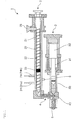
- An injection apparatus 1 shown in FIG. 1 has a plasticizing unit 2 for plasticizing a raw material resin that has been fed and an injection unit 3 for injecting a plasticized molten resin.
- a heating cylinder 20 that is provided in the plasticizing unit 2 and a heat-retaining cylinder 30 that is provided in the injection unit 3 are arranged in parallel to each other, and the front end sides of these cylinders are connected through a connection part 4 having a rotary valve 40 in its inside.
- a nozzle 5 to be attached to a mold is connected through the connection part 4.
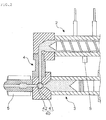
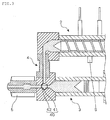
- the rotary valve 40 is provided with a cross head 41 that has a passage with a T-shaped cross section and a hollow part that has a circular cross section and is formed around the intersection of the passage, and a valve 42 that is rotatably attached to the inside of the hollow part formed in the cross head 41 and has a passage having a T-shaped cross section.
- a screw 21 having a helical wing part 22 is arranged within the heating cylinder 20 that is provided in the plasticizing unit 2.
- a screw driving part, a screw advancing mechanism and a back pressure control part all are not shown, the rotation, the advance and retreat movements of the screw 21 in the heating cylinder 20 and the resin pressure at the time of plasticizing can be controlled.
- a hopper 25 for feeding a pelletized raw material resin to the heating cylinder 20 is provided.
- the raw material resin that has been fed to the heating cylinder 20 from the hopper 25 is sent to the front end side of the screw 21 by the screw 21 that rotates within the heating cylinder 20. At the same time, while being sheared, the raw material resin is molten by shear heat and heat of the heater provided in the heating cylinder 20, and is plasticized. The raw material resin that is plasticized in this way is sent to the front end side of the heating cylinder 20 while being kneaded by the rotation of the screw 21.
- foaming gas injection valves 24a and 24b for injecting a foaming gas which is to be dissolved in the plasticized molten resin are provided.
- the foaming gas an inert gas such as a carbon dioxide gas or a nitrogen gas can be used.
- a check valve 23 that opens in a direction in which the molten resin that has been fed from the hopper 25 and plasticized is sent to the front end side of the heating cylinder 20 and does not open in the opposite direction, is provided at the screw 21. Then, a foaming gas is dissolved in the plasticized molten resin that has been sent to the front end side of the heating cylinder 20 by the rotation of the screw 21 and has passed the check valve 23 .
- the advance and retreat movements of the screw 21 are controlled such that according as the molten resin that has been plasticized and in which a foaming gas has been dissolved accumulates in the front end side of the heating cylinder 20, the screw 21 retreats in such a manner that it is pushed back by the resin pressure, and then the screw 21 advances when a prescribed amount of the plasticized molten resin is accumulated in the front end side of the heating cylinder 20.
- the resin pressure of the molten resin at a constant level or at a level that is equal to or higher than the constant level by controlling the retreating of the screw 21 by a back pressure control part of the plasticizing unit 2
- foaming of the impregnating inert gas can be suppressed.
- the plasticizing unit 2 transfers the plasticized molten resin in which a foaming gas is dissolved to the injection unit 3 by advancing the screw 21 that has retreated to a prescribed position due to accumulation in the front end side of the heating cylinder 20 of the molten resin in which a foaming gas is dissolved.
- the stroke length for which the screw 21 advances and retreats can be appropriately set in accordance with the amount of the molten resin to be sent to the injection unit 3, i.e. the dimension of an injection molding such as a preform and the number of cavities in a mold.
- the position of a foaming gas injection valve 24 provided on the heating cylinder 20 can be set in accordance with the stroke length for which the screw 21 advances and retreats such that, even when the screw 21 reaches the position where the screw 21 most retreats (hereinafter referred to as the "retreat limit"), the foaming gas injection valve 24 is positioned rearer than the front end of the screw 21.
- the number of the foaming gas injection valve 24 provided on the heating cylinder 20 may be one. In the example shown in FIG. 1 , plural (two) foaming gas injection valves 24a and 24b are provided along the direction of the advance and retreat of the screw 21.
- the foaming gas injection valve 24 is switched such that a foaming gas is injected from the foaming gas injection valve 24 that is positioned rearer than the front end of the screw 21.
- the foaming gas injection valve 24a provided nearer to the front end side of the heating cylinder 20 is positioned on the front end side relative to the front end side of the screw 21.
- injection of a foaming gas from the foaming gas injection valve 24a may be stopped, and the foaming gas injection valve 24 may be switched such that a foaming gas is injected from the foaming gas injection valve 24b that is positioned on the rear end side relative to the front end of the screw 21.
- the position of the check valve 23 provided on the screw 21 can be set such that, even when the screw 21 reaches the position where the screw 21 most advances (hereinafter referred to as the "advance limit"), the check valve 23 can be positioned on the rear end side of the heating cylinder 20 on which the foaming gas injection valve 24 is provided.
- the valves may be positioned on the front end side of the heating cylinder 20 on which the foaming gas injection valve 24 is provided. In such a case, the foaming gas injection valve 24 may be switched such that injection of an inert gas from the foaming gas injection valve 24 stops.
- the check valve 23 is provided on the screw 21.
- This check valve 23 is provided primarily with an aim of preventing the molten resin in which a foaming gas that has been injected to the heating cylinder 20 is dissolved from flowing out to the rear end side of the heating cylinder 20.
- a transfer process is conducted by allowing the screw 21 to advance while rotating.
- an internal pressure (thrust Pm) of the molten resin to be sent to the front end side of the heating cylinder 20 is generated by the rotation of the screw. Therefore, by designing and setting the conditions of the screw 21 such that the thrust Pm becomes larger than the transfer pressure (Pt), there will be no need to provide, on the front end of the screw 21, a check valve or the like that prevents back-rush of the raw material resin.
- the helical wing part 22 that plasticizes the raw material resin can be formed long enough to reach the front end of the screw 21. Accordingly, plasticizing of the raw material resin and kneading of an inert foaming gas and a molten resin can be improved.
- a plunger rod 31 as an injection member is arranged inside the heat-retaining cylinder 30 provided in the injection unit 3.
- a plunger driving part (not shown), the advance and retreat movements of the plunger 32 in the heat-retaining cylinder 30 are controlled.
- the raw material resin is plasticized, and the plasticized molten resin in which a foaming gas is dissolved.
- a molten resin is then transferred to the injection unit 3, and is accumulated in the heat-retaining cylinder 30 of the injection unit 3.
- the plunger rod 31 is pushed back and retreats by the resin pressure of the molten resin accumulated in the heat-retaining cylinder 30.
- the stroke length for which the plunger 32 advances and retreats the molten resin to be injected is weighed.
- the plunger 32 retreats while keeping the resin pressure of the molten resin accumulated in the heat-retaining cylinder 30 to be a constant level or be at a level that is equal to or higher than the constant level.
- the advance and retreat movements thereof are controlled such that it advances when a prescribed amount of the molten resin is accumulated in the heat-retaining cylinder 30.
- the plunger 32 retreats and advances, whereby the molten resin accumulated in the heat-retaining cylinder 30 is weighed, and then a prescribed amount of the molten resin is injected from a nozzle part 5.
- a pelletized raw material resin that has been fed from the hopper 25 to the heating cylinder 20 is plasticized.
- the rotary valve 40 is switched as shown in FIG. 3 , and a raw material resin that has been fed from the hopper 25 is plasticized as mentioned above.
- the screw 21 that rotates in the heating cylinder 20 plasticizes the raw material resin.
- the screw 21 is pushed back and retreats by the resin pressure of the molten resin accumulated in the front end side of the heating cylinder 20 while sending the raw material resin in which a foaming gas is dissolved to the front end side of the heating cylinder 20.
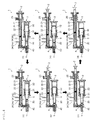
- FIG. 4(a) shows the state where the rotating screw 21 starts to advance in the initial stage of the plasticizing process.
- the screw 21 retreats until it reaches a predetermined stroke or until a predetermined period of time lapses.
- the molten resin that is plasticized and in which a foaming gas is dissolved in the plasticizing unit 2 is transferred to the injection unit 3.
- the rotary valve 40 is switched as shown in FIG. 2 .
- the screw 21 advances while rotating. After that, if necessary, the screw 21 may continue to rotate at the advance limit. As a result, a prescribed amount of the molten resin that is plasticized and in which a foaming gas is dissolved is transferred to the injection unit 3.
- FIG. 4(d) shows a state in which the screw 21 starts to advance while rotating in the initial stage of the transfer process.
- a molten resin accumulated in the front end side of the heating cylinder 20 is transferred to the injection unit 3.
- the screw 21 (see FIG. 4(c) ) that has retreated until it reaches a prescribed stroke or until a prescribed period of time is lapsed in the plasticization process, after the completion of the plasticization process and before the shifting to transfer process, depending on the cycle, stops rotation, and keeps the resin pressure of the molten resin accumulated in the front end side of the heating cylinder 20 at a constant level or at a level that is equal to or higher than the constant level, and advances together with the re-start of the rotation of the screw 21 after the lapse of a prescribed period of time.
- the resin pressure of the resin accumulated in the front end side of the heating cylinder 20 may be kept at a constant level or at a level that is equal to or higher than the constant level, and when the screw 21 retreats until it reaches a prescribed stroke or until a prescribed period of time lapses, the transfer process may start, thereby to allow the screw 21 to advance without stopping the rotation of the screw 21.
- the screw 21 advances to start the transfer process.
- the resin pressure of the molten resin accumulated in the front end side of the heating cylinder 20 can be kept at a constant level during a period of time from the completion of the plasticization process to the shifting of the transfer process.
- the molten resin that has been transferred to the injection unit 3 is accumulated in the heat-retaining cylinder 30 while pushing the plunger rod 31 back to allow it to retreat by the resin pressure (see FIG. 4(e) and FIG. 4(f) ), and is weighed in a prescribed amount in accordance with the stroke length of the plunger rod 31.
- the rotary valve 40 is switched as shown in FIG. 3 , whereafter the above-mentioned the plasticization processes shown in FIG. 4(a) to FIG. 4(c) in sequence re-start.
- the timing when the plasticization process re-starts by switching the rotary valve 40 it may be conducted simultaneously with the time when screw 21 reaches the advance limit or after the screw 21 rotates for a certain period of time at the advance limit or before the screw 21 reaches the advance limit.
- the screw 21 keeps on rotating.
- FIG. 4(a) shows the state where the plunger 32 starts to advance in the initial stage of the injection process.
- a prescribed amount of the molten resin that has been weighed in the heat-retaining cylinder 30 is injected from the nozzle 5.
- the processes mentioned above are repeated to produce a foamable injection molded product.
- the timing when a foaming gas starts to be injected to the molten resin that has been kneaded and plasticized by means of the rotating screw 21 can be controlled as follows.
- the best timing is appropriately selected from (1) to (4) mentioned above.
- the best timing of starting injection can be selected from (1) or (2) taking into consideration the relation with other various conditions.
- the time of starting injection can be selected from (3) or (4).
- Parameters such as the injection pressure, the injection amount or the like of a foaming gas are appropriately set and controlled in advance taking into consideration the optimization of the injection molding.
- timing of starting injection of a foaming gas is controlled in accordance with (1) to (4) mentioned above
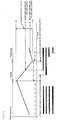
- the relationship between the injection period, the position of the screw 21, the rotation speed of the screw 21 and the resin pressure of the molten resin accumulated in the front end side of the heating cylinder 20, timing of starting injection of a foaming gas, is controlled in accordance with (1) to (4) mentioned above is shown in FIG. 5 .
- FIG. 5 One example of the above-mentioned timing of starting injection of a foaming gas to the plasticized molten resin; i.e. (1), (2), (3) and (4); is shown in FIG. 5 .
- injection period of a foaming gas is shown as a double line and a portion with no double line indicates a period during which injection is stopped.
- the amount of movement of the position of the screw 21 is indicated by a solid line, and the position where the screw 21 most retreats and plasticization is completed (retreat limit) is indicated as Lba and the position where the screw 21 is most advanced (advance limit) is indicated as Lad. Further, a variation in resin pressure of the molten resin accumulated in the front end side of the heating cylinder 20 is indicated by a long dashed short dashed line.
- a foaming gas can be injected to the molten resin in the state being kneaded by the screw 21 that is rotating.
- the screw 21 that has advanced to the advance limit or a position that is immediately before the advance limit in the transfer process starts to retreat while rotating.
- injection of a foaming gas stops. In other words, during a period of time from the start of injection in (1) to (4) mentioned above to the completion of the plasticizing process, a necessary amount of a foaming gas is injected.
- a foaming gas can be injected after the start of the transfer, i.e. immediately after the start of the rotation of the screw. Whereby, for the period of time from the start of the rotation of the screw to the termination of the rotation of the screw, a longer gas injection time can be ensured. As a result, an increase in amount of injected gas can be possible, whereby a gas can be injected uniformly and evenly during the plasticizing process.
- the present invention was explained with reference to preferred embodiments.
- the present invention is not restricted to the above-mentioned embodiments.
- the present invention can be applied to a technology of producing a foamable injection molded product in which a foaming gas such as an inert gas is dissolved in a thermoplastic resin and fine foams are formed at the time of injecting molding an injection molding such as a preform. It is needless to say that various modifications are possible within the scope of the present invention.
- a technology in which a foamable injection molded product is molded by biaxial stretch blow molding in order to mass-produce a synthetic resin-made foamed bottle in which foams are distributed on the bottle wall was given.
- the present invention is not limited to such a technical field, and can be applied to various technical fields as a technology of producing a foamable injection molded product in which a foaming gas such as an inert gas is dissolved.
- the present invention can be applied to various technical fields as a technology of producing a foamable injection molded product in which a foaming gas such as an inert gas is dissolved.
Landscapes
- Engineering & Computer Science (AREA)
- Manufacturing & Machinery (AREA)
- Mechanical Engineering (AREA)
- Injection Moulding Of Plastics Or The Like (AREA)
- Molding Of Porous Articles (AREA)
Description
- The present invention relates to a method for producing foamable injection molded product such as a preform that is obtained by dissolving a foaming gas such as an inert gas in a thermoplastic resin, followed by injection molding, as well as to an injection apparatus for producing such foamable injection molded product.
- Conventionally, a synthetic resin bottle obtained by a process in which a preform with a bottomed cylindrical shape (an injection molding) is formed by injection molding by using a thermoplastic resin such as polyethylene terephthalate, and this preform is molded by biaxial stretch blow molding or the like has been generally used in a wide range of fields as a container that accommodates contents such as various beverages.
- In such a synthetic resin bottle, in order to allow contents that are easily changed in quality by light to be accommodated, known is a technology of imparting light-shielding properties by compounding a colorant such as a pigment with the thermoplastic resin.
- However, in recent years, used bottles are collected and recycled as a recycled resin in various applications. Under such circumstances, there is a problem that application of recycled resins is restricted in the case where a colorant is mixed into the resins. Therefore, as a technology of imparting light-shielding properties by distributing foams on the bottle wall without compounding a colorant, proposed is a technology in which a foaming gas such as an inert gas is dissolved in a thermoplastic resin to allow fine cells to be generated when a preform is produced by injection molding, and then, this preform is foamed by a heating and blowing process in biaxial stretch blow molding, whereby the preform is molded into a prescribed bottle shape.
- On the other hand, one of the applicants of the present application previously proposed a technology of further improving light-shielding properties and suppressing deterioration in appearance that is caused by presence of foams (see Patent Document 1).
- In such a technology, a foaming gas such as an inert gas is dissolved in a resin and generation of foams is suppressed at the time of injection molding of a preform to obtain a preform in a non-foamed state, and this preform is foamed by a heating and blowing process in biaxial stretch blow molding, whereby the preform is molded into a bottle shape that has a large amount of small cells being distributed therein.
- On the other hand, as a method for injection molding the above-mentioned foamable injection molded product, a technology utilizing a 2-stage pre-plasticizing injection apparatus that comprises a plasticizing unit and an injection unit has been proposed (see Patent Document 2). In this technology, a molten resin in which a foaming gas such as an inert gas is dissolved in the plasticizing unit is injected into an injection mold by means of a reciprocally-moving plunger that is provided in an injection unit. This apparatus is provided with an accumulator in which the molten resin is accumulated through a conduit prior to the injection.
-
- Patent Document 1:
JP-A-2008-94495 - Patent Document 2: Japan Patent No.
4460074 EP 1 475 208 A2 - When a synthetic resin-made foamed bottle disclosed in
Patent Document 1 or the like is mass-produced, in production of an injection molded product such as a preform that is obtained by using a large amount of a resin with a short molding cycle, use of a 2-stage pre-plasticizing injection apparatus disclosed inPatent Document 2 mentioned above is possible. - However, in injection molding of a foamable injection molded product such as a preform in which a foaming gas such as an inert gas is dissolved is subjected to injection molding, it is required to allow a foaming gas to be dissolved homogenously in a molten resin during a plasticizing process (i.e. a resin-melting process). Therefore, the resin pressure of a molten resin is required to be set higher than that in normal injection molding, and the plasticizing time is required to be prolonged. Accordingly, it is desired that the screw rotation of an extrusion unit and gas injection time during the molding cycle be increased in order to improve plasticization capacity and gas dissolved, thereby to improve productivity.
- Under such circumstances, in 2-stage pre-plasticizing injection molding of a foamable injection molded product in which a foaming gas such as an inert gas is dissolved in an injection molded product such as a preform, the inventors have made intensive studies in respect of increasing the plasticizing time of a raw material resin and a gas injection time during the molding cycle, thereby to improve plasticization capacity and gas dissolving. As a result, the inventors have completed the present invention.
- That is, an object of the present invention is to provide a method for producing a foamable injection molding that is capable of, in injection molding of a foamable injection molded product such as a preform, increasing the time of plasticizing a raw material resin and prolonging the time of injecting a foaming gas to a plasticized molten resin, thereby improving plasticizing of a raw material resin and impregnation of a foaming gas in a molten resin, as well as to an injection apparatus for producing such a foamable injection molded product.
- The method for producing a foamable injection molded product according to the present invention is a method using an injection apparatus comprising a plasticizing unit that plasticizes a raw material resin and an injection unit that injects a plasticized molten resin, and the plasticizing unit is provided with a heating cylinder having a foaming gas injection valve and a screw provided inside the heating cylinder,
the method comprises: - a plasticizing process wherein the raw material resin is plasticized by means of the screw provided inside the heating cylinder of the plasticizing unit, the foaming gas injected from the foaming gas injection valve is dissolved in the plasticized molten resin, and the screw retreats according as the molten resin accumulates in the front end side of the heating cylinder by the screw that is rotating, and
- a transfer process wherein the screw that has been retracted to a predetermined position is caused to advance while rotating, and the molten resin which has been accumulated in the front end side of the heating cylinder is transferred to the injection unit,
- wherein, when the transfer process is completed, the plasticizing process re-starts without stopping the rotation of the screw and an injection process in which the molten resin is injected from the injection unit is conducted, and
- when the injection process is completed, the plasticizing process is completed and the transfer process re-starts.
- Further, the injection apparatus according to the present invention comprises a plasticizing unit that plasticizes a raw material resin and an injection unit that injects a plasticized molten resin, wherein the plasticizing unit is provided with a heating cylinder having a foaming gas injection valve, a screw provided inside the heating cylinder, a screw driving part, a screw advancing mechanism, and a back pressure control part, characterized in that
the rotation, the advance and retreat movements of the screw, and the resin pressure at the time of plasticizing are controlled by the screw driving part, the screw advancing mechanism, and the back pressure control part such that
a raw material resin is plasticized by means of the screw inside the heating cylinder of the plasticizing unit and a foaming gas injected from a foaming gas injection valve is dissolved in the plasticized molten resin, and the screw retreats according as the molten resin accumulates in the front end side of the heating cylinder by the screw that is rotating,
the screw advances with rotating to cause the molten resin which has been accumulated in the front end side of the heating cylinder to be transferred to the injection unit. - According to the present invention, in producing a foamable injection molded product by injecting molding a thermoplastic resin in which a foaming gas is dissolved, the time of plasticizing a raw material resin and the time of injecting a foaming gas to a plasticized molten resin in the molding cycle are increased, plasticizing performance and impregnation of a foaming gas are improved, leading to an increase in productivity.
-
-
FIG. 1 is an explanatory view showing an outline of an injection apparatus according to an embodiment of the invention; -
FIG. 2 is an explanatory view showing one example of a rotary valve in an injection apparatus according to an embodiment of the invention; -
FIG. 3 is an explanatory view showing one example of a rotary valve in an injection apparatus according to an embodiment of the invention; -
FIG. 4 is a process drawing showing an outline of a method for producing foamable injection molded product according to an embodiment of the invention; and -
FIG. 5 is a correlation diagram showing one example of the relationship between the injection time of a foaming gas, the position of a screw, the rotational speed of a screw and the resin pressure of a molten resin accumulated on the front end side of a heating cylinder of a plasticizing unit. - Hereinbelow, an explanation will be made on a preferred embodiment of the invention with reference to the drawings.
- An
injection apparatus 1 shown inFIG. 1 has a plasticizingunit 2 for plasticizing a raw material resin that has been fed and aninjection unit 3 for injecting a plasticized molten resin. - In the
injection apparatus 1 shown inFIG. 1 , aheating cylinder 20 that is provided in the plasticizingunit 2 and a heat-retainingcylinder 30 that is provided in theinjection unit 3 are arranged in parallel to each other, and the front end sides of these cylinders are connected through aconnection part 4 having arotary valve 40 in its inside. To the front end side of the heat-retainingcylinder 30 provided in theinjection unit 3, anozzle 5 to be attached to a mold (not shown) is connected through theconnection part 4. - As shown in
FIG. 2 andFIG. 3 , therotary valve 40 is provided with across head 41 that has a passage with a T-shaped cross section and a hollow part that has a circular cross section and is formed around the intersection of the passage, and avalve 42 that is rotatably attached to the inside of the hollow part formed in thecross head 41 and has a passage having a T-shaped cross section. - Further, as shown in
FIG. 2 , by switching therotary valve 40 to close thenozzle part 5 and to connect the plasticizingunit 2 and theinjection unit 3, a molten resin that has been plasticized in the plasticizingunit 2 can be transferred to theinjection unit 3. On the other hand, as shown inFIG. 3 , by switching therotary valve 40 to close the plasticizingunit 2 and to connect theinjection unit 3 and thenozzle part 5, a molten resin that has been transferred to theinjection unit 3 can be injected from thenozzle part 5. - Within the
heating cylinder 20 that is provided in the plasticizingunit 2, ascrew 21 having ahelical wing part 22 is arranged. By a screw driving part, a screw advancing mechanism and a back pressure control part (all are not shown), the rotation, the advance and retreat movements of thescrew 21 in theheating cylinder 20 and the resin pressure at the time of plasticizing can be controlled. - On the rear end side of the
heating cylinder 20, ahopper 25 for feeding a pelletized raw material resin to theheating cylinder 20 is provided. - The raw material resin that has been fed to the
heating cylinder 20 from thehopper 25 is sent to the front end side of thescrew 21 by thescrew 21 that rotates within theheating cylinder 20. At the same time, while being sheared, the raw material resin is molten by shear heat and heat of the heater provided in theheating cylinder 20, and is plasticized. The raw material resin that is plasticized in this way is sent to the front end side of theheating cylinder 20 while being kneaded by the rotation of thescrew 21. - Further, in the
heating cylinder 20, foaminggas injection valves - Also, a
check valve 23, that opens in a direction in which the molten resin that has been fed from thehopper 25 and plasticized is sent to the front end side of theheating cylinder 20 and does not open in the opposite direction, is provided at thescrew 21. Then, a foaming gas is dissolved in the plasticized molten resin that has been sent to the front end side of theheating cylinder 20 by the rotation of thescrew 21 and has passed thecheck valve 23 . - Then, by the
check valve 23 provided at thescrew 21, flowing out of the foaming gas that has been injected to theheating cylinder 20 to the rear end side of theheating cylinder 20 is prevented, and as a result, lowering in resin pressure of the molten resin to be sent to the front end side of theheating cylinder 20 is avoided, whereby foaming of a foaming gas which is dissolved in the molten resin caused by reduction in pressure in theheating cylinder 20 is suppressed. - Further, the advance and retreat movements of the
screw 21 are controlled such that according as the molten resin that has been plasticized and in which a foaming gas has been dissolved accumulates in the front end side of theheating cylinder 20, thescrew 21 retreats in such a manner that it is pushed back by the resin pressure, and then thescrew 21 advances when a prescribed amount of the plasticized molten resin is accumulated in the front end side of theheating cylinder 20. At this time, by keeping the resin pressure of the molten resin at a constant level or at a level that is equal to or higher than the constant level by controlling the retreating of thescrew 21 by a back pressure control part of the plasticizingunit 2, foaming of the impregnating inert gas can be suppressed. - As mentioned above, the
plasticizing unit 2 transfers the plasticized molten resin in which a foaming gas is dissolved to theinjection unit 3 by advancing thescrew 21 that has retreated to a prescribed position due to accumulation in the front end side of theheating cylinder 20 of the molten resin in which a foaming gas is dissolved. At this time, the stroke length for which thescrew 21 advances and retreats can be appropriately set in accordance with the amount of the molten resin to be sent to theinjection unit 3, i.e. the dimension of an injection molding such as a preform and the number of cavities in a mold. - The position of a foaming
gas injection valve 24 provided on theheating cylinder 20 can be set in accordance with the stroke length for which thescrew 21 advances and retreats such that, even when thescrew 21 reaches the position where thescrew 21 most retreats (hereinafter referred to as the "retreat limit"), the foaminggas injection valve 24 is positioned rearer than the front end of thescrew 21. The number of the foaminggas injection valve 24 provided on theheating cylinder 20 may be one. In the example shown inFIG. 1 , plural (two) foaminggas injection valves screw 21. When plural foaminggas injection valves 24 are provided, in accordance with the position of thescrew 21 that advances and retreats within theheating cylinder 20, the foaminggas injection valve 24 is switched such that a foaming gas is injected from the foaminggas injection valve 24 that is positioned rearer than the front end of thescrew 21. - For example, in the examples shown in
FIG. 4(a) and FIG. 4(b) , in the process during which thescrew 21 retreats, among the two foaminggas injection valves gas injection valve 24a provided nearer to the front end side of theheating cylinder 20 is positioned on the front end side relative to the front end side of thescrew 21. In such a case, injection of a foaming gas from the foaminggas injection valve 24a may be stopped, and the foaminggas injection valve 24 may be switched such that a foaming gas is injected from the foaminggas injection valve 24b that is positioned on the rear end side relative to the front end of thescrew 21. - The position of the
check valve 23 provided on thescrew 21 can be set such that, even when thescrew 21 reaches the position where thescrew 21 most advances (hereinafter referred to as the "advance limit"), thecheck valve 23 can be positioned on the rear end side of theheating cylinder 20 on which the foaminggas injection valve 24 is provided. Whenplural check valves 23 are provided, the valves may be positioned on the front end side of theheating cylinder 20 on which the foaminggas injection valve 24 is provided. In such a case, the foaminggas injection valve 24 may be switched such that injection of an inert gas from the foaminggas injection valve 24 stops. - In this embodiment, the
check valve 23 is provided on thescrew 21. Thischeck valve 23 is provided primarily with an aim of preventing the molten resin in which a foaming gas that has been injected to theheating cylinder 20 is dissolved from flowing out to the rear end side of theheating cylinder 20. In this embodiment, a transfer process is conducted by allowing thescrew 21 to advance while rotating. During the period of time for which the transfer process is conducted by thescrew 21, an internal pressure (thrust Pm) of the molten resin to be sent to the front end side of theheating cylinder 20 is generated by the rotation of the screw. Therefore, by designing and setting the conditions of thescrew 21 such that the thrust Pm becomes larger than the transfer pressure (Pt), there will be no need to provide, on the front end of thescrew 21, a check valve or the like that prevents back-rush of the raw material resin. - As mentioned above, on the front end of the
screw 21 of the present invention, no check valve is provided. Therefore, thehelical wing part 22 that plasticizes the raw material resin can be formed long enough to reach the front end of thescrew 21. Accordingly, plasticizing of the raw material resin and kneading of an inert foaming gas and a molten resin can be improved. - Inside the heat-retaining
cylinder 30 provided in theinjection unit 3, aplunger rod 31 as an injection member is arranged. By a plunger driving part (not shown), the advance and retreat movements of theplunger 32 in the heat-retainingcylinder 30 are controlled. - In the
plasticizing unit 2, the raw material resin is plasticized, and the plasticized molten resin in which a foaming gas is dissolved. Such a molten resin is then transferred to theinjection unit 3, and is accumulated in the heat-retainingcylinder 30 of theinjection unit 3. According as the molten resin accumulates in the heat-retainingcylinder 30, theplunger rod 31 is pushed back and retreats by the resin pressure of the molten resin accumulated in the heat-retainingcylinder 30. At this time, by appropriately adjusting the stroke length for which theplunger 32 advances and retreats, the molten resin to be injected is weighed. In order to prevent foaming of a foaming gas which is dissolved in the molten resin, theplunger 32 retreats while keeping the resin pressure of the molten resin accumulated in the heat-retainingcylinder 30 to be a constant level or be at a level that is equal to or higher than the constant level. On the other hand, as for theplunger 32, the advance and retreat movements thereof are controlled such that it advances when a prescribed amount of the molten resin is accumulated in the heat-retainingcylinder 30. - As mentioned above, in the
injection unit 3, theplunger 32 retreats and advances, whereby the molten resin accumulated in the heat-retainingcylinder 30 is weighed, and then a prescribed amount of the molten resin is injected from anozzle part 5. - In this embodiment, by passing through a plasticizing process, a transfer process and an injection process explained below using the above-mentioned
injection apparatus 1, a foamable injection molded product is produced. - First, in the
plasticizing unit 2, a pelletized raw material resin that has been fed from thehopper 25 to theheating cylinder 20 is plasticized. - In this embodiment, by injecting a foaming gas from the foaming
gas injection valve 24, a foaming gas is dissolved in the plasticized molten resin. The timing of injecting a foaming gas will be stated later. - In this plasticizing process, the
rotary valve 40 is switched as shown inFIG. 3 , and a raw material resin that has been fed from thehopper 25 is plasticized as mentioned above. As shown inFIG. 4(a) to FIG. 4(c) in sequence, thescrew 21 that rotates in theheating cylinder 20 plasticizes the raw material resin. Thescrew 21 is pushed back and retreats by the resin pressure of the molten resin accumulated in the front end side of theheating cylinder 20 while sending the raw material resin in which a foaming gas is dissolved to the front end side of theheating cylinder 20. -
FIG. 4(a) shows the state where therotating screw 21 starts to advance in the initial stage of the plasticizing process. As shown inFIG. 4(b) and FIG. 4(c) in sequence, as the molten resin is accumulated in the front end side of theheating cylinder 20, thescrew 21 retreats until it reaches a predetermined stroke or until a predetermined period of time lapses. - In the transfer process that is conducted subsequent to the plasticizing process, the molten resin that is plasticized and in which a foaming gas is dissolved in the
plasticizing unit 2 is transferred to theinjection unit 3. Prior to this transfer, therotary valve 40 is switched as shown inFIG. 2 . When a predetermined amount of a molten resin is accumulated in the front end side of thescrew 21 that has retreated in the plasticizing process, as shown inFIG. 4(d) to FIG. 4(e) in sequence, thescrew 21 advances while rotating. After that, if necessary, thescrew 21 may continue to rotate at the advance limit. As a result, a prescribed amount of the molten resin that is plasticized and in which a foaming gas is dissolved is transferred to theinjection unit 3. -
FIG. 4(d) shows a state in which thescrew 21 starts to advance while rotating in the initial stage of the transfer process. As shown inFIG. 4(e) and FIG. 4(f) in sequence, a molten resin accumulated in the front end side of theheating cylinder 20 is transferred to theinjection unit 3. - At this time, the screw 21 (see
FIG. 4(c) ) that has retreated until it reaches a prescribed stroke or until a prescribed period of time is lapsed in the plasticization process, after the completion of the plasticization process and before the shifting to transfer process, depending on the cycle, stops rotation, and keeps the resin pressure of the molten resin accumulated in the front end side of theheating cylinder 20 at a constant level or at a level that is equal to or higher than the constant level, and advances together with the re-start of the rotation of thescrew 21 after the lapse of a prescribed period of time. In the later stage of the plasticization process, the resin pressure of the resin accumulated in the front end side of theheating cylinder 20 may be kept at a constant level or at a level that is equal to or higher than the constant level, and when thescrew 21 retreats until it reaches a prescribed stroke or until a prescribed period of time lapses, the transfer process may start, thereby to allow thescrew 21 to advance without stopping the rotation of thescrew 21. - Then, after the
screw 21 has retreated to a prescribed position with the rotation thereof being controlled, thescrew 21 advances to start the transfer process. By doing so, the resin pressure of the molten resin accumulated in the front end side of theheating cylinder 20 can be kept at a constant level during a period of time from the completion of the plasticization process to the shifting of the transfer process. - The molten resin that has been transferred to the
injection unit 3 is accumulated in the heat-retainingcylinder 30 while pushing theplunger rod 31 back to allow it to retreat by the resin pressure (seeFIG. 4(e) and FIG. 4(f) ), and is weighed in a prescribed amount in accordance with the stroke length of theplunger rod 31. When theplunger 32 retreats to a prescribed position and the transfer process is completed (seeFIG. 4(f) ), therotary valve 40 is switched as shown inFIG. 3 , whereafter the above-mentioned the plasticization processes shown inFIG. 4(a) to FIG. 4(c) in sequence re-start. - As for the timing when the plasticization process re-starts by switching the
rotary valve 40, it may be conducted simultaneously with the time whenscrew 21 reaches the advance limit or after thescrew 21 rotates for a certain period of time at the advance limit or before thescrew 21 reaches the advance limit. When shifting from the transfer process to the plasticizing process, in order to prevent lowering in pressure of the molten resin between the front end of thescrew 21 and the connection part, thescrew 21 keeps on rotating. - As mentioned above, by allowing the
screw 21 to keep on rotating, the plasticizing performance is improved, and the resin pressure of the molten resin in thescrew 21 is stabilized. - When the
rotary valve 40 is switched as shown inFIG. 3 after the completion of the transfer process, the injection process is conducted in parallel with the plasticization process that has re-started. - In the injection process, as shown in
FIG. 4(a) to FIG. 4(c) in sequence, due to the advancement of theplunger rod 31 of theinjection unit 3, a prescribed amount of the molten resin that has been weighed is injected from thenozzle part 5, and by a mold not shown, a foamable injection molded product having a prescribed shape is molded. - Here,
FIG. 4(a) shows the state where theplunger 32 starts to advance in the initial stage of the injection process. As shown inFIG. 4(b) and FIG. 4(c) in sequence, a prescribed amount of the molten resin that has been weighed in the heat-retainingcylinder 30 is injected from thenozzle 5. - When the injection process is completed, the plasticizing process is completed (see
FIG. 4(c) ) and the transfer process re-starts (seeFIG. 4(d) ). These processes are repeated. - In this embodiment, the processes mentioned above are repeated to produce a foamable injection molded product. The timing when a foaming gas starts to be injected to the molten resin that has been kneaded and plasticized by means of the
rotating screw 21 can be controlled as follows. -
- (1) Injection of a foaming gas starts simultaneously with the start of the transfer process or after the lapse of a predetermined period of time after the start of the transfer process.
- (2) Injection of a foaming gas starts after the start of the transfer process and the
screw 21 that advances in theheating cylinder 20 reaches a predetermined position. - (3) Injection of a foaming gas starts after the completion of the transfer process and after the lapse of a prescribed period of time after the plasticization process starts.
- (4) Injection of a foaming gas starts after the completion of the transfer process and after the
screw 21 that advances in theheating cylinder 20 reaches a prescribed position after the start of the plasticization process. - As for the timing of starting injection of a foaming gas, the best timing is appropriately selected from (1) to (4) mentioned above. For example, If the injection period of a foaming gas is prolonged, the best timing of starting injection can be selected from (1) or (2) taking into consideration the relation with other various conditions. Further, if the injection period of a foaming gas is shortened, the time of starting injection can be selected from (3) or (4).
- Parameters such as the injection pressure, the injection amount or the like of a foaming gas are appropriately set and controlled in advance taking into consideration the optimization of the injection molding.
- In the case where timing of starting injection of a foaming gas is controlled in accordance with (1) to (4) mentioned above, the relationship between the injection period, the position of the
screw 21, the rotation speed of thescrew 21 and the resin pressure of the molten resin accumulated in the front end side of theheating cylinder 20, timing of starting injection of a foaming gas, is controlled in accordance with (1) to (4) mentioned above is shown inFIG. 5 . - One example of the above-mentioned timing of starting injection of a foaming gas to the plasticized molten resin; i.e. (1), (2), (3) and (4); is shown in
FIG. 5 . InFIG. 5 , injection period of a foaming gas is shown as a double line and a portion with no double line indicates a period during which injection is stopped. - The amount of movement of the position of the
screw 21 is indicated by a solid line, and the position where thescrew 21 most retreats and plasticization is completed (retreat limit) is indicated as Lba and the position where thescrew 21 is most advanced (advance limit) is indicated as Lad. Further, a variation in resin pressure of the molten resin accumulated in the front end side of theheating cylinder 20 is indicated by a long dashed short dashed line. - By controlling the time of starting injection of a foaming gas and the injection period of a foaming gas in the above-mentioned way, a foaming gas can be injected to the molten resin in the state being kneaded by the
screw 21 that is rotating. When shifting from the transfer process to the plasticizing process, thescrew 21 that has advanced to the advance limit or a position that is immediately before the advance limit in the transfer process starts to retreat while rotating. Before the completion of the plasticizing process, injection of a foaming gas stops. In other words, during a period of time from the start of injection in (1) to (4) mentioned above to the completion of the plasticizing process, a necessary amount of a foaming gas is injected. - Accordingly, after injection of a foaming gas stops, kneading of the molten resin in which a foaming gas is dissolved by the
screw 21 that is rotating continues, whereby impregnation of a foaming gas in the molten resin is conducted homogenously. As a result, a necessary amount of a gas can be injected to the plasticized molten resin without affecting adversely the plasticizing time of the raw material resin in the molding cycle, whereby improvement of plasticizing performance and impregnation of a foaming gas can be realized, thus leading to improvement in productivity. - By allowing the time of starting injecting a foaming gas to the plasticized molten resin to be (1) or (2) mentioned above, a foaming gas can be injected after the start of the transfer, i.e. immediately after the start of the rotation of the screw. Whereby, for the period of time from the start of the rotation of the screw to the termination of the rotation of the screw, a longer gas injection time can be ensured. As a result, an increase in amount of injected gas can be possible, whereby a gas can be injected uniformly and evenly during the plasticizing process. On the other hand, by allowing the time of starting injection of a foaming gas to be (3) or (4) mentioned above, after the transfer process is completed, a gas is injected when the screw monotonically retreats, so the resin pressure is relatively stabilized, and hence the amount of an injected gas can be controlled easily with a high accuracy.
- When a foaming gas is injected from the foaming
gas injection valve 24 to theheating cylinder 20, following pressures are appropriately adjusted such that the resin pressure (Pm) of the molten resin before passing thecheck valve 23 becomes larger than the sum of the injection pressure (P2) of a foaming gas and the transfer pressure (P3) of the molten resin that is sent to the front end side of theheating cylinder 20 after passing the check valve 23 (Pm>P2 + P3). As a result, a disadvantage that, when the plasticized molten resin is sent to the front end side of theheating cylinder 20 by means of therotating screw 21, thecheck valve 23 is closed and hence the molten resin cannot pass thecheck valve 23 can be avoided. - Then, in order to avoid the disadvantage mentioned above, it is preferred that, by means of a resin pressure sensor S that is attached on the same circumference as that on which the injection
gas injection valve 24 is attached, the total of P2 and P3 (P2 + P3) be detected, and when the P2 + P3 becomes equal to or larger than the predetermined value of the resin pressure, the injection pressure of a foaming gas P2 be lowered or the operation of theinjection apparatus 1 be controlled to stop it. - In the present invention, that was explained above with reference to the embodiments, the following processes (A) to (D) are repeated to produce a foamable injection molded product:
- (A) a plasticizing process wherein the raw material resin is plasticized by means of the
screw 21 provided inside theheating cylinder 20 of theplasticizing unit 2, the foaming gas injected from the foaminggas injection valve 24 is dissolved in the plasticized molten resin, and thescrew 21 retreats according as the molten resin accumulates in the front end side of theheating cylinder 20 by thescrew 21 that is rotating; - (B) a transfer process wherein the
screw 21 that has retreated to a predetermined position is caused to advance while rotating, and the molten resin which has been accumulated in the front end side of theheating cylinder 20 is transferred to theinjection unit 3; - (C) when the transfer process is completed, the plasticizing process re-starts without stopping the rotation of the
screw 21 and an injection process in which the molten resin is injected from theinjection unit 3 is conducted; - (D) when the injection molding process is completed, the plasticizing process is completed and the transfer process re-starts.
- By repeating the processes A to D above, a foamable injection molded product is produced.
- By producing a foamable injection-molded product as mentioned above, in the transfer process, in particular, when transferring the plasticized molten resin in which a foaming gas is dissolved and that is accumulated in the front end side of the
heating cylinder 20 to theinjection unit 3, it becomes possible to allow thescrew 21 to advance while rotating, i.e., to continue the melting process of the raw material resin without stopping, whereby the molding cycle is prevented from being deteriorated. The raw material resin can be sufficiently plasticized and kneaded. Further, by appropriately adjusting the rotation speed and the advancing speed of thescrew 21, a back pressure is applied to the molten resin in which the foaming gas is dissolved, whereby foaming of the foaming gas can be suppressed. As a result, a foamable injection molded product in which plasticization of the raw material resin and dissolution of a foaming gas are improved can be produced. - Accordingly, when a synthetic resin-made foamed bottle mentioned above in which foams are distributed on the bottle wall is mass-produced, by dissolving an inert gas such as a cabon dioxide gas or a nitrogen gas a a foaming gas in a thermoplastic resin such as polyethylene terephthalate by applying the present invention, thereby to produce a preform by injection molding, plasticizing of raw material resins in the molding cycle and impregnation of a preform with a foaming gas can be improved. By subjecting the preform to biaxial stretch blow molding, a synthetic resin-made foamed bottle in which fine cells are uniformly distributed can be mass-produced in a high yield.
- Hereinabove, the present invention was explained with reference to preferred embodiments. However, the present invention is not restricted to the above-mentioned embodiments. For example, as mentioned above, the present invention can be applied to a technology of producing a foamable injection molded product in which a foaming gas such as an inert gas is dissolved in a thermoplastic resin and fine foams are formed at the time of injecting molding an injection molding such as a preform. It is needless to say that various modifications are possible within the scope of the present invention.
- As an example of application of the present invention, a technology in which a foamable injection molded product is molded by biaxial stretch blow molding in order to mass-produce a synthetic resin-made foamed bottle in which foams are distributed on the bottle wall was given. The present invention is not limited to such a technical field, and can be applied to various technical fields as a technology of producing a foamable injection molded product in which a foaming gas such as an inert gas is dissolved.
- As mentioned above, the present invention can be applied to various technical fields as a technology of producing a foamable injection molded product in which a foaming gas such as an inert gas is dissolved.
-
- 1.
- Injection apparatus
- 2.
- Plasticizing unit
- 20.
- Heating cylinder
- 21.
- Screw
- 23.
- Check valve
- 24.
- Foaming gas injection valve
- 3.
- Injection unit
Claims (13)
- A method for producing foamable injection molded product using an injection apparatus (1), wherein
the injection apparatus comprises:a plasticizing unit (2) that plasticizes a raw material resin,an injection unit (3) that injects a plasticized molten resin, anda connection part (4) having a rotary valve (40) in its inside;wherein the plasticizing unit is provided with a heating cylinder (20) having a foaming gas injection valve (24), a hopper (25), for feeding the pelletized raw material resin to the heating cylinder, provided on the rear end side of the heating cylinder, and a screw (21) arranged inside the heating cylinder,the injection unit is provided with a heat-retaining cylinder (30) that a nozzle part (5) to be attached to a mold is connected to the front end side thereof through the connection part, andthe front end sides of the heating cylinder and the heat-retaining cylinder that are arranged in parallel to each other are connected through the connection part,the method comprises:a plasticizing process wherein the raw material resin is plasticized by means of the screw provided inside the heating cylinder of the plasticizing unit, the foaming gas injected from the foaming gas injection valve is dissolved in the plasticized molten resin,
characterized in that the screw retreats according as the molten resin accumulates in the front end side of the heating cylinder by the screw that is rotating,a transfer process wherein the nozzle part is closed and the plasticizing unit and the injection unit are connected by switching the rotatory valve, the screw that has retreated to a predetermined position is caused to advance while rotating, and the molten resin which has been accumulated in the front end side of the heating cylinder is transferred to the injection unit; andan injection process, wherein the plasticizing unit is closed and the injection unit and the nozzle part are connected by switching the rotatory valve, the molten resin is injected from the injection unit;wherein, when the transfer process is completed, the plasticizing process re-starts without stopping the rotation of the screw and the injection process is conducted, andwhen the injection process is completed, the plasticizing process is completed and the transfer process re-starts. - The method for producing a foamable injection molded product according to claim 1, wherein, after allowing the screw to advance while rotating, the screw is further rotated, whereby the molten resin is transferred to the injection unit.
- The method for producing a foamable injection molded product according to claim 1 or 2, wherein the foaming gas is injected to the molten resin which has been plasticized by means of the screw that is rotating.
- The method for producing a foamable injection molded product according to any one of claims 1 to 3, wherein, simultaneously with the start of the transfer process or after the lapse of a predetermined period of time from the start of the transfer process, the injection of a foaming gas starts.
- The method for producing a foamable injection molded product according to any one of claims 1 to 3, wherein, after the start of the transfer process and after the screw that advances in the heating cylinder reaches a predetermined position, the injection of a foaming gas starts.
- The method for producing a foamable injection molded product according to any one of claims 1 to 3, wherein, after the completion of the transfer process and after the lapse of a predetermined period of time from the start of the plasticizing process, the injection of a foaming gas starts.
- The method for producing a foamable injection molded product according to any one of claims 1 to 3, wherein, after the completion of the transfer process and after the screw that advances inside the heating cylinder from the start of the plasticization process reaches a predetermined position, the injection of a foaming gas starts.
- The method for producing a foamable injection molded product according to any one of claims 1 to 7, wherein the injection of a foaming gas stops before the completion of the plasticization process.
- The method for producing a foamable injection molded product according to any one of claims 1 to 8, wherein the screw is provided with a check valve (23), and the molten resin which has been sent to the front end side of the heating cylinder by the rotation of the screw and has passed through the check valve is dissolved in the foaming gas.
- An injection apparatus comprising:a plasticizing unit (2) that plasticizes a raw material resin,an injection unit (3) that injects a plasticized molten resin, anda connection part (4) having a rotary valve (40) in its inside;wherein the plasticizing unit is provided with a heating cylinder (20) having a foaming gas injection valve (24), a hopper (25), for feeding the pelletized raw material resin to the heating cylinder, provided on the rear end side of the heating cylinder, a screw (21) provided inside the heating cylinder, a screw driving part, a screw advancing mechanism, and a back pressure control part,the injection unit is provided with a heat-retaining cylinder (30) that a nozzle part (5) to be attached to a mold is connected to the front end side thereof through the connection part,the front end sides of the heating cylinder and the heat-retaining cylinder that are arranged in parallel to each other are connected through the connection part,by switching the rotatory valve to close the nozzle part and to connect the plasticizing unit and the injection unit, the molten resin that has been plasticized in the plasticizing unit can be transferred to the injection unit,by switching the rotatory valve to close the plasticizing unit and to connect the injection unit and the nozzle part, the molten resin that has been transferred to the injection unit can be injected from the nozzle part, andthe rotation, the advance and retreat movements of the screw, and the resin pressure at the time of plasticizing are controlled by the screw driving part, the screw advancing mechanism, and the back pressure control part such thata raw material resin is plasticized by means of the screw inside the heating cylinder of the plasticizing unit and a foaming gas injected from the foaming gas injection valve is dissolved in the plasticized molten resin, andafter the screw retreats to a prescribed position according as the molten resin accumulates in the front end side of the heating cylinder by the screw that is rotating,the screw advances with rotating to cause the molten resin which has been accumulated in the front end side of the heating cylinder to be transferred to the injection unit.
- The injection apparatus according to claim 10, wherein the foaming gas injection valve provided on the heating cylinder is allowed to be switchable such that the injection of a foaming gas is conducted from the foaming gas injection valve provided on the rear end side relative to the front end side of the screw.
- The injection apparatus according to claim 10 or 11, wherein a plurality of the foaming gas injection valves are provided.
- The injection apparatus according to any one of claims 10 to 12, wherein a check valve positioned at a position rearer than the foaming gas injection valve and opens in a direction in which the molten resin is sent to the front end side of the heating cylinder and does not open in a direction opposite to the above is provided on the screw.
Applications Claiming Priority (2)
| Application Number | Priority Date | Filing Date | Title |
|---|---|---|---|
| JP2013036044A JP6080611B2 (en) | 2013-02-26 | 2013-02-26 | Method for producing foamable injection-molded body and injection device therefor |
| PCT/JP2014/000876 WO2014132598A1 (en) | 2013-02-26 | 2014-02-20 | Method for manufacturing foamable injection molding and injection device therefor |
Publications (3)
| Publication Number | Publication Date |
|---|---|
| EP2962829A1 EP2962829A1 (en) | 2016-01-06 |
| EP2962829A4 EP2962829A4 (en) | 2016-10-26 |
| EP2962829B1 true EP2962829B1 (en) | 2020-08-12 |
Family
ID=51427877
Family Applications (1)
| Application Number | Title | Priority Date | Filing Date |
|---|---|---|---|
| EP14756937.0A Active EP2962829B1 (en) | 2013-02-26 | 2014-02-20 | Method for manufacturing foamable injection molding and injection device therefor |
Country Status (5)
| Country | Link |
|---|---|
| US (2) | US10160144B2 (en) |
| EP (1) | EP2962829B1 (en) |
| JP (1) | JP6080611B2 (en) |
| CN (1) | CN105073373A (en) |
| WO (1) | WO2014132598A1 (en) |
Families Citing this family (11)
| Publication number | Priority date | Publication date | Assignee | Title |
|---|---|---|---|---|
| JP5799031B2 (en) * | 2013-01-16 | 2015-10-21 | 日精樹脂工業株式会社 | Two-component injection machine |
| JP5802689B2 (en) * | 2013-01-16 | 2015-10-28 | 日精樹脂工業株式会社 | Two-component injection machine |
| WO2017145680A1 (en) * | 2016-02-22 | 2017-08-31 | 株式会社 日本製鋼所 | Injection device provided with flow path switching block |
| US11806908B2 (en) | 2017-06-05 | 2023-11-07 | Otrajet Inc. | Extruding system and method of extruding |
| CN112805132A (en) * | 2018-09-21 | 2021-05-14 | 耐克创新有限合伙公司 | Molding system and method |
| FR3089767B1 (en) * | 2018-12-18 | 2020-11-27 | Dior Christian Parfums | COSMETIC PRODUCT APPLICATION DEVICE AND MANUFACTURING PROCESS OF SUCH A COSMETIC PRODUCT APPLICATION DEVICE |
| JP7238533B2 (en) * | 2019-03-27 | 2023-03-14 | セイコーエプソン株式会社 | Material supply device, injection molding device and three-dimensional modeling device |
| JP7036391B2 (en) * | 2019-10-15 | 2022-03-15 | オトラジェット インコーポレイテッド. | Extrusion system and extrusion method |
| US12053912B2 (en) * | 2020-07-13 | 2024-08-06 | King Steel Machinery Co., Ltd. | Extruding system and method of extruding a mixture of a polymeric material and a blowing agent |
| AT524784B1 (en) * | 2021-04-07 | 2022-09-15 | Engel Austria Gmbh | Plasticizing unit for a shaping machine and method for operating one |
| IT202100028796A1 (en) * | 2021-11-12 | 2023-05-12 | Sipa Progettazione Automaz | INJECTION EQUIPMENT FOR PRODUCING HOLLOW ARTICLES OF PLASTIC, PARTICULARLY BOTTLE PREFORMS |
Family Cites Families (19)
| Publication number | Priority date | Publication date | Assignee | Title |
|---|---|---|---|---|
| JPS4818365B1 (en) | 1969-01-28 | 1973-06-05 | ||
| JPS4818365U (en) | 1971-07-14 | 1973-03-01 | ||
| JPS50144066U (en) * | 1974-05-21 | 1975-11-28 | ||
| US4211523A (en) | 1978-11-29 | 1980-07-08 | Hoover Universal, Inc. | Gas-flow control apparatus for equipment for producing foamed plastic |
| JPS60220724A (en) * | 1984-04-17 | 1985-11-05 | Nissei Plastics Ind Co | Preplasticizing apparatus |
| JPS63260416A (en) * | 1986-04-15 | 1988-10-27 | Japan Styrene Paper Co Ltd | Manufacture of foam molded body |
| JP4144916B2 (en) * | 1996-04-04 | 2008-09-03 | 三井化学株式会社 | Thermoplastic resin foam injection molded body and method for producing the same |
| US5997781A (en) * | 1996-04-04 | 1999-12-07 | Mitsui Chemicals, Inc. | Injection-expansion molded, thermoplastic resin product and production process thereof |
| DE69805957T2 (en) | 1997-01-16 | 2003-01-02 | Trexel, Inc. | INJECTION MOLDING OF MICRO-CELLED MATERIAL |
| US6884823B1 (en) | 1997-01-16 | 2005-04-26 | Trexel, Inc. | Injection molding of polymeric material |
| JP2001269963A (en) * | 2000-03-24 | 2001-10-02 | Meiki Co Ltd | Injection equipment |
| DE10055022A1 (en) | 2000-11-07 | 2002-05-16 | Atecs Mannesmann Ag | Microcellular foam component molding process involves mixing plasticized polymer and blowing agent, storing for a period in a dwell chamber and injecting into a tool |
| US7144532B2 (en) | 2002-10-28 | 2006-12-05 | Trexel, Inc. | Blowing agent introduction systems and methods |
| TWI251532B (en) | 2003-11-14 | 2006-03-21 | Sumitomo Heavy Industries | Injection device and method of heating injection device |
| CN2668374Y (en) | 2003-12-12 | 2005-01-05 | 南海市佳明机器有限公司 | Injection mechanism for injection plastic foaming-shaping machine |
| DE102005033731A1 (en) | 2005-06-23 | 2006-12-28 | Vereinigung zur Förderung des Instituts für Kunststoffverarbeitung in Industrie und Handwerk an der Rhein.-Westf. Technischen Hochschule Aachen eV | Plasticizing machine for manufacturing foamed e.g. molded part, has dosing unit with one chamber including driven fluid inlet, and another chamber including pressurized sluice devices for supplying material to dosing unit |
| TW200829409A (en) * | 2006-08-23 | 2008-07-16 | Sulzer Chemtech Ag | A method for the manufacture of a moulding composition |
| JP5414162B2 (en) | 2006-09-12 | 2014-02-12 | 東洋製罐株式会社 | Light-shielding plastic container |
| CN101554762B (en) | 2009-05-06 | 2012-05-09 | 联塑(杭州)机械有限公司 | Method and apparatus for injection molding of foamed plastic |
-
2013
- 2013-02-26 JP JP2013036044A patent/JP6080611B2/en active Active
-
2014
- 2014-02-20 WO PCT/JP2014/000876 patent/WO2014132598A1/en not_active Ceased
- 2014-02-20 CN CN201480010146.2A patent/CN105073373A/en active Pending
- 2014-02-20 US US14/768,819 patent/US10160144B2/en active Active
- 2014-02-20 EP EP14756937.0A patent/EP2962829B1/en active Active
-
2018
- 2018-11-14 US US16/190,398 patent/US10543627B2/en active Active
Non-Patent Citations (1)
| Title |
|---|
| None * |
Also Published As
| Publication number | Publication date |
|---|---|
| EP2962829A1 (en) | 2016-01-06 |
| CN105073373A (en) | 2015-11-18 |
| US10543627B2 (en) | 2020-01-28 |
| US10160144B2 (en) | 2018-12-25 |
| US20190077059A1 (en) | 2019-03-14 |
| EP2962829A4 (en) | 2016-10-26 |
| WO2014132598A1 (en) | 2014-09-04 |
| JP2014162144A (en) | 2014-09-08 |
| JP6080611B2 (en) | 2017-02-15 |
| US20160001474A1 (en) | 2016-01-07 |
Similar Documents
| Publication | Publication Date | Title |
|---|---|---|
| US10543627B2 (en) | Method for manufacturing foamable injection molding and injection device therefor | |
| US10315347B2 (en) | Injection molding apparatus with spherical rotor | |
| EP2110223B1 (en) | Injection apparatus | |
| CN102189650A (en) | Conical screw injection machine | |
| JP5846998B2 (en) | Plasticizing device, injection device, injection molding device, extruder, and method for producing molded product | |
| KR101372775B1 (en) | Resin multilayer injection molding method | |
| CN101554771B (en) | Device for preparing polymer | |
| GB2474123A (en) | Injection moulding method | |
| JPH0752185A (en) | Molding method and molding apparatus for long-fiber composite material | |
| US20130112782A1 (en) | Injection assembly | |
| CN201456324U (en) | Injection extruding device with storage tank | |
| EP3912792B1 (en) | Injection method and injection apparatus for molten resin, and injection stretch blow molding machine using injection apparatus | |
| CN201922563U (en) | Integrated machine with extrusion and ejection molding | |
| JP2007230087A (en) | Injection foam molding apparatus and injection foam molding method | |
| JP4893220B2 (en) | Resin multilayer injection molding method and resin multilayer injection molding apparatus | |
| CN202079740U (en) | Conical screw injection machine | |
| CN101767417A (en) | Plasticization and injection separated type nested injection machine | |
| EP4610018A1 (en) | Screw head, injection device, and injection stretch blow molding machine using the same | |
| CN105751475A (en) | Hollow single screw extruder with vibrating mandrel | |
| US20250276479A1 (en) | Screw head, injection device, and injection stretch blow molding machine using the same | |
| JPH0650176Y2 (en) | Injection device | |
| HK40056923A (en) | Injection method and injection apparatus for molten resin, and injection stretch blow molding machine using injection apparatus | |
| JP2004291348A (en) | Injection molding machine | |
| JP2004291354A (en) | Sandwich injection molding machine |
Legal Events
| Date | Code | Title | Description |
|---|---|---|---|
| PUAI | Public reference made under article 153(3) epc to a published international application that has entered the european phase |
Free format text: ORIGINAL CODE: 0009012 |
|
| 17P | Request for examination filed |
Effective date: 20150817 |
|
| AK | Designated contracting states |
Kind code of ref document: A1 Designated state(s): AL AT BE BG CH CY CZ DE DK EE ES FI FR GB GR HR HU IE IS IT LI LT LU LV MC MK MT NL NO PL PT RO RS SE SI SK SM TR |
|
| AX | Request for extension of the european patent |
Extension state: BA ME |
|
| DAX | Request for extension of the european patent (deleted) | ||
| A4 | Supplementary search report drawn up and despatched |
Effective date: 20160922 |
|
| RIC1 | Information provided on ipc code assigned before grant |
Ipc: B29L 31/00 20060101ALN20160916BHEP Ipc: B29C 44/42 20060101ALI20160916BHEP Ipc: B29C 45/00 20060101AFI20160916BHEP Ipc: B29C 44/34 20060101ALI20160916BHEP Ipc: B29K 67/00 20060101ALN20160916BHEP Ipc: B29C 45/54 20060101ALI20160916BHEP Ipc: B29K 105/04 20060101ALN20160916BHEP Ipc: B29C 45/17 20060101ALI20160916BHEP Ipc: B29C 45/50 20060101ALN20160916BHEP |
|
| STAA | Information on the status of an ep patent application or granted ep patent |
Free format text: STATUS: EXAMINATION IS IN PROGRESS |
|
| 17Q | First examination report despatched |
Effective date: 20190924 |
|
| GRAP | Despatch of communication of intention to grant a patent |
Free format text: ORIGINAL CODE: EPIDOSNIGR1 |
|
| STAA | Information on the status of an ep patent application or granted ep patent |
Free format text: STATUS: GRANT OF PATENT IS INTENDED |
|
| INTG | Intention to grant announced |
Effective date: 20200211 |
|
| GRAJ | Information related to disapproval of communication of intention to grant by the applicant or resumption of examination proceedings by the epo deleted |
Free format text: ORIGINAL CODE: EPIDOSDIGR1 |
|
| STAA | Information on the status of an ep patent application or granted ep patent |
Free format text: STATUS: EXAMINATION IS IN PROGRESS |
|
| GRAR | Information related to intention to grant a patent recorded |
Free format text: ORIGINAL CODE: EPIDOSNIGR71 |
|
| GRAS | Grant fee paid |
Free format text: ORIGINAL CODE: EPIDOSNIGR3 |
|
| STAA | Information on the status of an ep patent application or granted ep patent |
Free format text: STATUS: GRANT OF PATENT IS INTENDED |
|
| GRAA | (expected) grant |
Free format text: ORIGINAL CODE: 0009210 |
|
| STAA | Information on the status of an ep patent application or granted ep patent |
Free format text: STATUS: THE PATENT HAS BEEN GRANTED |
|
| INTC | Intention to grant announced (deleted) | ||
| RAP1 | Party data changed (applicant data changed or rights of an application transferred) |
Owner name: TOYO SEIKAN GROUP HOLDINGS, LTD. Owner name: SHIBAURA MACHINE ENGINEERING CO., LTD. |
|
| INTG | Intention to grant announced |
Effective date: 20200701 |
|
| AK | Designated contracting states |
Kind code of ref document: B1 Designated state(s): AL AT BE BG CH CY CZ DE DK EE ES FI FR GB GR HR HU IE IS IT LI LT LU LV MC MK MT NL NO PL PT RO RS SE SI SK SM TR |
|
| REG | Reference to a national code |
Ref country code: CH Ref legal event code: EP |
|
| REG | Reference to a national code |
Ref country code: IE Ref legal event code: FG4D |
|
| REG | Reference to a national code |
Ref country code: DE Ref legal event code: R096 Ref document number: 602014068891 Country of ref document: DE |
|
| REG | Reference to a national code |
Ref country code: AT Ref legal event code: REF Ref document number: 1301120 Country of ref document: AT Kind code of ref document: T Effective date: 20200915 |
|
| REG | Reference to a national code |
Ref country code: LT Ref legal event code: MG4D |
|
| REG | Reference to a national code |
Ref country code: NL Ref legal event code: MP Effective date: 20200812 |
|
| PG25 | Lapsed in a contracting state [announced via postgrant information from national office to epo] |
Ref country code: BG Free format text: LAPSE BECAUSE OF FAILURE TO SUBMIT A TRANSLATION OF THE DESCRIPTION OR TO PAY THE FEE WITHIN THE PRESCRIBED TIME-LIMIT Effective date: 20201112 Ref country code: LT Free format text: LAPSE BECAUSE OF FAILURE TO SUBMIT A TRANSLATION OF THE DESCRIPTION OR TO PAY THE FEE WITHIN THE PRESCRIBED TIME-LIMIT Effective date: 20200812 Ref country code: GR Free format text: LAPSE BECAUSE OF FAILURE TO SUBMIT A TRANSLATION OF THE DESCRIPTION OR TO PAY THE FEE WITHIN THE PRESCRIBED TIME-LIMIT Effective date: 20201113 Ref country code: NO Free format text: LAPSE BECAUSE OF FAILURE TO SUBMIT A TRANSLATION OF THE DESCRIPTION OR TO PAY THE FEE WITHIN THE PRESCRIBED TIME-LIMIT Effective date: 20201112 Ref country code: SE Free format text: LAPSE BECAUSE OF FAILURE TO SUBMIT A TRANSLATION OF THE DESCRIPTION OR TO PAY THE FEE WITHIN THE PRESCRIBED TIME-LIMIT Effective date: 20200812 Ref country code: HR Free format text: LAPSE BECAUSE OF FAILURE TO SUBMIT A TRANSLATION OF THE DESCRIPTION OR TO PAY THE FEE WITHIN THE PRESCRIBED TIME-LIMIT Effective date: 20200812 Ref country code: FI Free format text: LAPSE BECAUSE OF FAILURE TO SUBMIT A TRANSLATION OF THE DESCRIPTION OR TO PAY THE FEE WITHIN THE PRESCRIBED TIME-LIMIT Effective date: 20200812 |
|
| REG | Reference to a national code |
Ref country code: AT Ref legal event code: MK05 Ref document number: 1301120 Country of ref document: AT Kind code of ref document: T Effective date: 20200812 |
|
| PG25 | Lapsed in a contracting state [announced via postgrant information from national office to epo] |
Ref country code: IS Free format text: LAPSE BECAUSE OF FAILURE TO SUBMIT A TRANSLATION OF THE DESCRIPTION OR TO PAY THE FEE WITHIN THE PRESCRIBED TIME-LIMIT Effective date: 20201212 Ref country code: RS Free format text: LAPSE BECAUSE OF FAILURE TO SUBMIT A TRANSLATION OF THE DESCRIPTION OR TO PAY THE FEE WITHIN THE PRESCRIBED TIME-LIMIT Effective date: 20200812 Ref country code: LV Free format text: LAPSE BECAUSE OF FAILURE TO SUBMIT A TRANSLATION OF THE DESCRIPTION OR TO PAY THE FEE WITHIN THE PRESCRIBED TIME-LIMIT Effective date: 20200812 Ref country code: NL Free format text: LAPSE BECAUSE OF FAILURE TO SUBMIT A TRANSLATION OF THE DESCRIPTION OR TO PAY THE FEE WITHIN THE PRESCRIBED TIME-LIMIT Effective date: 20200812 Ref country code: PL Free format text: LAPSE BECAUSE OF FAILURE TO SUBMIT A TRANSLATION OF THE DESCRIPTION OR TO PAY THE FEE WITHIN THE PRESCRIBED TIME-LIMIT Effective date: 20200812 |
|
| PG25 | Lapsed in a contracting state [announced via postgrant information from national office to epo] |
Ref country code: SM Free format text: LAPSE BECAUSE OF FAILURE TO SUBMIT A TRANSLATION OF THE DESCRIPTION OR TO PAY THE FEE WITHIN THE PRESCRIBED TIME-LIMIT Effective date: 20200812 Ref country code: RO Free format text: LAPSE BECAUSE OF FAILURE TO SUBMIT A TRANSLATION OF THE DESCRIPTION OR TO PAY THE FEE WITHIN THE PRESCRIBED TIME-LIMIT Effective date: 20200812 Ref country code: EE Free format text: LAPSE BECAUSE OF FAILURE TO SUBMIT A TRANSLATION OF THE DESCRIPTION OR TO PAY THE FEE WITHIN THE PRESCRIBED TIME-LIMIT Effective date: 20200812 Ref country code: CZ Free format text: LAPSE BECAUSE OF FAILURE TO SUBMIT A TRANSLATION OF THE DESCRIPTION OR TO PAY THE FEE WITHIN THE PRESCRIBED TIME-LIMIT Effective date: 20200812 Ref country code: DK Free format text: LAPSE BECAUSE OF FAILURE TO SUBMIT A TRANSLATION OF THE DESCRIPTION OR TO PAY THE FEE WITHIN THE PRESCRIBED TIME-LIMIT Effective date: 20200812 |
|
| REG | Reference to a national code |
Ref country code: DE Ref legal event code: R097 Ref document number: 602014068891 Country of ref document: DE |
|
| PG25 | Lapsed in a contracting state [announced via postgrant information from national office to epo] |
Ref country code: AL Free format text: LAPSE BECAUSE OF FAILURE TO SUBMIT A TRANSLATION OF THE DESCRIPTION OR TO PAY THE FEE WITHIN THE PRESCRIBED TIME-LIMIT Effective date: 20200812 Ref country code: AT Free format text: LAPSE BECAUSE OF FAILURE TO SUBMIT A TRANSLATION OF THE DESCRIPTION OR TO PAY THE FEE WITHIN THE PRESCRIBED TIME-LIMIT Effective date: 20200812 Ref country code: ES Free format text: LAPSE BECAUSE OF FAILURE TO SUBMIT A TRANSLATION OF THE DESCRIPTION OR TO PAY THE FEE WITHIN THE PRESCRIBED TIME-LIMIT Effective date: 20200812 |
|
| PLBE | No opposition filed within time limit |
Free format text: ORIGINAL CODE: 0009261 |
|
| STAA | Information on the status of an ep patent application or granted ep patent |
Free format text: STATUS: NO OPPOSITION FILED WITHIN TIME LIMIT |
|
| PG25 | Lapsed in a contracting state [announced via postgrant information from national office to epo] |
Ref country code: SK Free format text: LAPSE BECAUSE OF FAILURE TO SUBMIT A TRANSLATION OF THE DESCRIPTION OR TO PAY THE FEE WITHIN THE PRESCRIBED TIME-LIMIT Effective date: 20200812 |
|
| 26N | No opposition filed |
Effective date: 20210514 |
|
| PG25 | Lapsed in a contracting state [announced via postgrant information from national office to epo] |
Ref country code: SI Free format text: LAPSE BECAUSE OF FAILURE TO SUBMIT A TRANSLATION OF THE DESCRIPTION OR TO PAY THE FEE WITHIN THE PRESCRIBED TIME-LIMIT Effective date: 20200812 |
|
| PG25 | Lapsed in a contracting state [announced via postgrant information from national office to epo] |
Ref country code: MC Free format text: LAPSE BECAUSE OF FAILURE TO SUBMIT A TRANSLATION OF THE DESCRIPTION OR TO PAY THE FEE WITHIN THE PRESCRIBED TIME-LIMIT Effective date: 20200812 |
|
| REG | Reference to a national code |
Ref country code: BE Ref legal event code: MM Effective date: 20210228 |
|
| PG25 | Lapsed in a contracting state [announced via postgrant information from national office to epo] |
Ref country code: CH Free format text: LAPSE BECAUSE OF NON-PAYMENT OF DUE FEES Effective date: 20210228 Ref country code: LI Free format text: LAPSE BECAUSE OF NON-PAYMENT OF DUE FEES Effective date: 20210228 Ref country code: LU Free format text: LAPSE BECAUSE OF NON-PAYMENT OF DUE FEES Effective date: 20210220 |
|
| PG25 | Lapsed in a contracting state [announced via postgrant information from national office to epo] |
Ref country code: IE Free format text: LAPSE BECAUSE OF NON-PAYMENT OF DUE FEES Effective date: 20210220 |
|
| PG25 | Lapsed in a contracting state [announced via postgrant information from national office to epo] |
Ref country code: BE Free format text: LAPSE BECAUSE OF NON-PAYMENT OF DUE FEES Effective date: 20210228 |
|
| PG25 | Lapsed in a contracting state [announced via postgrant information from national office to epo] |
Ref country code: PT Free format text: LAPSE BECAUSE OF FAILURE TO SUBMIT A TRANSLATION OF THE DESCRIPTION OR TO PAY THE FEE WITHIN THE PRESCRIBED TIME-LIMIT Effective date: 20201214 |
|
| PG25 | Lapsed in a contracting state [announced via postgrant information from national office to epo] |
Ref country code: HU Free format text: LAPSE BECAUSE OF FAILURE TO SUBMIT A TRANSLATION OF THE DESCRIPTION OR TO PAY THE FEE WITHIN THE PRESCRIBED TIME-LIMIT; INVALID AB INITIO Effective date: 20140220 |
|
| PG25 | Lapsed in a contracting state [announced via postgrant information from national office to epo] |
Ref country code: CY Free format text: LAPSE BECAUSE OF FAILURE TO SUBMIT A TRANSLATION OF THE DESCRIPTION OR TO PAY THE FEE WITHIN THE PRESCRIBED TIME-LIMIT Effective date: 20200812 |
|
| PG25 | Lapsed in a contracting state [announced via postgrant information from national office to epo] |
Ref country code: MK Free format text: LAPSE BECAUSE OF FAILURE TO SUBMIT A TRANSLATION OF THE DESCRIPTION OR TO PAY THE FEE WITHIN THE PRESCRIBED TIME-LIMIT Effective date: 20200812 |
|
| PG25 | Lapsed in a contracting state [announced via postgrant information from national office to epo] |
Ref country code: MT Free format text: LAPSE BECAUSE OF FAILURE TO SUBMIT A TRANSLATION OF THE DESCRIPTION OR TO PAY THE FEE WITHIN THE PRESCRIBED TIME-LIMIT Effective date: 20200812 |
|
| PGFP | Annual fee paid to national office [announced via postgrant information from national office to epo] |
Ref country code: DE Payment date: 20250218 Year of fee payment: 12 |
|
| PGFP | Annual fee paid to national office [announced via postgrant information from national office to epo] |
Ref country code: FR Payment date: 20250221 Year of fee payment: 12 |
|
| PGFP | Annual fee paid to national office [announced via postgrant information from national office to epo] |
Ref country code: IT Payment date: 20250221 Year of fee payment: 12 Ref country code: GB Payment date: 20250219 Year of fee payment: 12 |
|
| PG25 | Lapsed in a contracting state [announced via postgrant information from national office to epo] |
Ref country code: TR Free format text: LAPSE BECAUSE OF FAILURE TO SUBMIT A TRANSLATION OF THE DESCRIPTION OR TO PAY THE FEE WITHIN THE PRESCRIBED TIME-LIMIT Effective date: 20200812 |