EP2947813B1 - Vorrichtung zur bereitstellung eines entschlüsselungsdienstes, verarbeitungsvorrichtung, sicherheitsbewertungsvorrichtung, programm und aufzeichnungsmedium - Google Patents
Vorrichtung zur bereitstellung eines entschlüsselungsdienstes, verarbeitungsvorrichtung, sicherheitsbewertungsvorrichtung, programm und aufzeichnungsmedium Download PDFInfo
- Publication number
- EP2947813B1 EP2947813B1 EP14741137.5A EP14741137A EP2947813B1 EP 2947813 B1 EP2947813 B1 EP 2947813B1 EP 14741137 A EP14741137 A EP 14741137A EP 2947813 B1 EP2947813 B1 EP 2947813B1
- Authority
- EP
- European Patent Office
- Prior art keywords
- semigroup
- decryption
- ciphertext
- polynomial
- result
- Prior art date
- Legal status (The legal status is an assumption and is not a legal conclusion. Google has not performed a legal analysis and makes no representation as to the accuracy of the status listed.)
- Active
Links
Images




Classifications
-
- H—ELECTRICITY
- H04—ELECTRIC COMMUNICATION TECHNIQUE
- H04L—TRANSMISSION OF DIGITAL INFORMATION, e.g. TELEGRAPHIC COMMUNICATION
- H04L9/00—Cryptographic mechanisms or cryptographic arrangements for secret or secure communications; Network security protocols
- H04L9/30—Public key, i.e. encryption algorithm being computationally infeasible to invert or user's encryption keys not requiring secrecy
- H04L9/3006—Public key, i.e. encryption algorithm being computationally infeasible to invert or user's encryption keys not requiring secrecy underlying computational problems or public-key parameters
- H04L9/3013—Public key, i.e. encryption algorithm being computationally infeasible to invert or user's encryption keys not requiring secrecy underlying computational problems or public-key parameters involving the discrete logarithm problem, e.g. ElGamal or Diffie-Hellman systems
Definitions
- the present invention relates to an information security technique, particularly to a key management technique for limiting authorized persons who can decrypt and use encrypted information.
- Non-Patent Literature 1 To decrypt information encrypted by a currently common technique, a method is adopted by which a key used in cryptographic algorithms is used to directly compute plaintext from ciphertext (see Non-Patent Literature 1, for example).
- a method is considered by which the key is held in the inside of a reliable server device and the server device provides a decryption service in response to a request from an authorized person.
- a method is referred to as a cloud-managed key cryptographic scheme.
- This method does not directly pass a key used in cryptographic algorithms to users, and therefore is expected to be able to stop the users from using encrypted data by stopping a decryption service.
- Patent Literature 1 relates to an information provisioning system.
- G ⁇ , H ⁇ are finite abelian groups
- the element of the group H ⁇ is obtained by encrypting a plaintext m ⁇ with a first encryption key y( ⁇ ,1) in accordance with a first encryption scheme ENC ⁇ ,1
- the element of the group G ⁇ is obtained by encrypting the plaintext m ⁇ with a second encryption key y( ⁇ ( ⁇ ),2) in accordance
- the mediation apparatus outputs first input information ⁇ ⁇ ,1 and second input information ⁇ ⁇ ,2 that correspond to the respective first ciphertexts C ⁇ ,1 of information providing apparatus ⁇ and are elements of the group H ⁇ .
- the respective information providing apparatus ⁇ use the first input information ⁇ ⁇ ,1 to correctly compute f( ⁇ ⁇ ,1 ) with a probability greater than a certain probability and sets an obtained result of the computation as first output information z ⁇ ,1 , and use the second input information ⁇ ⁇ ,2 to correctly compute f( ⁇ ⁇ ,2 ) with a probability greater than a certain probability and sets an obtained result of the computation as second output information z ⁇ ,2 .
- Non-Patent Literature 3 describes a method for designing public key cryptosystems based on general non-commutative rings and for deriving ElGamal-like cryptosystems.
- a function f(x) is calculated with a calculating apparatus that makes a correct calculation with a low probability.
- G and H are cyclic groups
- f is a function that maps an element x of the group H into the group G
- X 1 and X 2 are random variables whose values are elements of the group G
- x 1 is a realized value of the random variable X 1
- x 2 is a realized value of the random variable X 2
- a first randomizable sampler is capable of calculating f(x) b x 1 and designates the calculation result as u.
- a second randomizable sampler is capable of calculating f(x) a x 2 and designates the calculation result as v.
- the present invention addresses this issue with the object of providing a technique for improving the safety of a cloud-managed key cryptographic scheme.
- a private key is held which conforms to an ElGamal encryption system on a semigroup, calculation of an order of an element of the semigroup being computationally difficult, information corresponding to ciphertext conforming to the ElGamal encryption system is input, a private key s is used to decrypt the information corresponding to the ciphertext in conformance to the ElGamal encryption system, and information corresponding to a result of decrypting the ciphertext is obtained and output.
- the use of the present invention makes it possible to keep a user from acquiring the capability of decrypting the encryption through repeated use of a decryption service, and to improve the safety of a cloud-managed key cryptographic scheme.
- each embodiment uses a semigroup (for example, a commutative semigroup or a finite commutative semigroup) H, calculation of an order of an element of the semigroup H being computationally difficult, and uses a decryption service for which ElGamal encryption on the semigroup H is adopted as an encryption system. The reason why the decryption service is safe will be described below.
- a semigroup for example, a commutative semigroup or a finite commutative semigroup
- the ElGamal encryption on the semigroup H will next be described.
- r ⁇ Z q is a random number decided in the course of encryption
- Z q is a residue class group by q
- q is an order (positive integer, for example, a prime number) of the semigroup H
- ⁇ H indicates that ⁇ is an element of the semigroup H
- " ⁇ " indicates an operation defined in the semigroup H.
- a decryption service providing device with the ElGamal encryption safely holds the private key s, and each time a user inputs ciphertext (c 1 , c 2 ), the decryption service providing device decrypts the ciphertext (c 1 , c 2 ) and outputs a decryption result m'.
- the decryption service providing device may identify the user by an authentication means, determine whether to provide a decryption service to the user using an authentication database that contains users who are duly allowed to receive the decryption service, and then output the decryption result.
- An arbitrary polynomial-time probabilistic algorithm A which is an attacker, can compute an order of an element g of the semigroup H using B by a method below.
- k is a security parameter of a positive integer.
- a probability that the greatest common divisor of r 1 , r 2 , ..., r 3k is not 1 can be evaluated using the Riemann zeta function, and can be proven to be smaller than or equal to O(2 -k ) at most (the proof is described in, for example, the following literature: Go Yamamoto, Tetsutaro Kobayashi, "Self-correcting for homomorphism," Applied Number Theory, SCIS2010). Therefore, the greatest common divisor of ⁇ 1 , ⁇ 2 , ..., ⁇ 3k is the order n of the element g.
- Another example is an elliptic curve on the above ring R. Although a normal elliptic curve is configured on a field, if its operation rule is formally applied to the ring R, the associative law holds true as in the elliptic curve, and a semigroup is configured.
- H When it is used as H, a random element extracted from H becomes an invertible element with a very high probability.
- a semigroup, calculation of an order of an element of the semigroup being difficult is, for example, a semigroup, calculation of an order of an element of the semigroup to solve a factorization problem being difficult.
- a fact that a certain computation or problem is "difficult" means that its computation result or solution cannot be obtained within polynomial-time. That is, a “semigroup, calculation of an order of an element of the semigroup being computationally difficult” means, for example, a semigroup the order of the element of which cannot be calculated within the polynomial-time.
- the "semigroup, calculation of an order of an element of the semigroup being computationally difficult” may be a semigroup that has an inverse element or may be a semigroup that does not have an inverse element.
- the present embodiment uses the semigroup (commutative semigroup) H, calculation of the order of the element g of the semigroup H being computationally difficult, and provides a decryption service in which the ElGamal encryption on the semigroup H is adopted as an encryption system.
- “information corresponding to ciphertext conforming to the ElGamal encryption system” is ciphertext conforming to the ElGamal encryption system
- "information corresponding to a ciphertext decryption result” is a ciphertext decryption result.
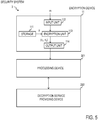
- a security system 1 of the present embodiment includes an encryption device 11, a processing device 12, and a decryption service providing device 13.
- the encryption device 11 is configured to be able to provide information to the processing device 12 through a network, a portable recording medium, or the like.
- the processing device 12 and the decryption service providing device 13 are configured to be able to exchange information with each other through a network, a portable recording medium, or the like.
- plaintext m ⁇ H is first input to the input unit 112 of the encryption device 11 and sent to the encryption unit 113 (step S101).
- the output unit 114 outputs the ciphertext (c 1 , c 2 ) (step S103).
- the decryption request information including the ciphertext (c 1 , c 2 ) is input to the input unit 132 of the decryption service providing device 13, and the ciphertext (c 1 , c 2 ) is sent to the decryption unit 133 (step S106).
- the output unit 134 outputs response information including the decryption result m' (step S108).
- the response information is input to the processing device 12 and sent to the processing unit 122 (step S109).
- the present embodiment uses the decryption service providing device 13 that adopts the ElGamal encryption on the semigroup H, calculation of the order of the element g of the semigroup H being considered to be computationally difficult, and provides a decryption service.
- a fact that it is difficult for a user to obtain a private key even if the user repeatedly uses a decryption operation service can be proven, and a fact that the private key is not leaked in principle is guaranteed.
- it is considered that the decryption capability cannot be acquired without obtaining the private key. Therefore, when control is performed to give permission for the decryption operation service to the user and then revoke the permission, it can be said that the user cannot decrypt an encrypted document after the revocation of the use of the service, whichever behavior the user is assumed to do.
- a security system 2 of the present embodiment includes the encryption device 11, the processing device 12, the decryption service providing device 13, a setting device 24, and a safety evaluation device 25.
- the setting device 24 is configured to be able to provide information to the encryption device 11 and the decryption service providing device 13 through a network, a portable recording medium, or the like.
- the setting device 24 and the safety evaluation device 25 are configured to be able to exchange information with each other through a network, a portable recording medium, or the like.
- the setting device 24 and the safety evaluation device 25 are special devices that are configured by reading predetermined programs to general-purpose or dedicated computers.
- the safety evaluation device 25 includes a storage 251, an input unit 252, a determination unit 253, an evaluation unit 254, and an output unit 255.
- the safety evaluation device 25 performs each processing under control of a controller (not illustrated). Data obtained by each unit is stored in respective temporary memories (not illustrated) and read to each unit as necessary.
- information required to determine whether it is computationally difficult or easy to calculate an order of the element g of the semigroup H is stored in the storage 251 of the safety evaluation device 25.
- An example of such information includes: for example, a semigroup, calculation of the order of the element of the semigroup being considered to be difficult, and a list of the elements; a semigroup, calculation of the order of the element of the semigroup being considered to be easy, and a list of the elements; or an algorithm for determining the difficulty or easiness of the calculation, or the like.
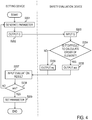
- the setting device 24 in the parameter setting processing, the setting device 24 generates system parameters including the semigroup (for example, a commutative semigroup or finite commutative semigroup) H and its element g (step S201), and outputs information that identifies the generated semigroup H and the element g (step S202).
- the semigroup for example, a commutative semigroup or finite commutative semigroup
- the information that identifies the semigroup H and the element g is input to the input unit 252 of the safety evaluation device 25, and sent to the determination unit 253 (step S203).
- the determination unit 253 determines whether it is difficult or easy to calculate an order of the element g of the semigroup H using the information stored in the storage 251. For example, when a semigroup, calculation of the order of the element of the semigroup being considered to be difficult, and a list of the elements are stored in the storage 251, the determination unit 253 determines whether the element g of the semigroup H that is a determination target is included in the list, and determines that it is difficult to calculate the order of the element g of the semigroup H if the element g is included.
- the determination unit 253 determines whether the element g of the semigroup H that is a determination target is included in the list, and determines that it is easy to calculate the order of the element g of the semigroup H if the element g is included.
- the determination unit 253 uses the algorithm to determine whether it is difficult to calculate the order of the element g of the semigroup H that is the determination target, or it is easy to calculate the order of the element g of the semigroup H that is the determination target.
- step S204 if a discrete logarithm problem in the semigroup H can be solved using a number field sieve, a function field sieve, or the like within predetermined processing time, it is determined that it is easy to calculate the order of the element g of the semigroup H (step S204).
- a determination result output from the determination unit 253 is input to the evaluation unit 254, and the evaluation unit 254 evaluates the safety of the decryption service providing device 13 based on the determination result. That is, when the determination unit 253 determines that it is difficult to calculate the order of the element or does not determine that it is easy to calculate the order of the element, the evaluation unit 254 outputs an evaluation result indicating that the safety of the decryption service providing device 13 is high (acc) (step S205).
- the evaluation unit 254 outputs an evaluation result indicating that the safety of the decryption service providing device 13 is low (rej) (step S206).
- the evaluation result output from the evaluation unit 254 is input to the setting device 24 (step S207).
- the setting device 24 determines whether the evaluation result indicates that the safety is high (step S208). When the evaluation result indicates that the safety is low (rej), the flow returns to step S201. When the evaluation result indicates that the safety is high (acc), the setting device 24 outputs system parameters including the semigroup H and its element g, and sets them in the encryption device 11 and the decryption service providing device 13 (step S209).
- a security system 3 of the third embodiment includes, for example, the above encryption device 11, a processing device 321 that does not hold a private key, and a decryption service providing device 332 that holds the private key conforming to the above ElGamal encryption system.
- the processing device 321 requests the decryption service providing device 332 to provide a ciphertext decryption capability, and decrypts the ciphertext using the decryption capability provided from the decryption service providing device 332.
- the processing device 321 and the decryption service providing device 332 are configured to be able to exchange information with each other.
- the processing device 321 and the decryption service providing device 332 can exchange information with each other through a transmission line, a network, a portable recording medium, or the like.
- the processing device 321 of the third embodiment includes, for example, an integer selector 2102, an input information providing unit 2104, a first computation unit 2105, a first exponentiation computation unit 2106, a first list storage 2107, a second computation unit 2108, a second exponentiation computation unit 2109, a second list storage 2110, a determination unit 2111, a final output unit 2112, and a controller 2113.
- An example of the processing device 321 is a device such as a card reader/writer device or a mobile telephone with the computation and storage functions, a known or dedicated computer with a central processing unit (CPU) or random-access memory (RAM) to which a special program is read, or the like.
- the decryption service providing device 332 of the third embodiment includes, for example, a first output information computation unit 2201 (decryption unit), a second output information computation unit 2202 (decryption unit), a key storage 2204 (storage), a controller 2205, an input unit 3132, and an output unit 3134.
- An example of the decryption service providing device 332 is a tamper-resistant module such as an IC card or an IC chip, a device such as a mobile telephone with the computation and storage functions, a known or dedicated computer with a CPU or RAM to which a special program is read, or the like.
- the integer selector 2102 of the processing device 321 first selects integers a, b, a', and b' (step S2101).
- a and b are relatively prime natural numbers.
- a and b are randomly selected.
- At least part of the information for the integers a and b is sent to the input information providing unit 2104, the first exponentiation computation unit 2106, and the second exponentiation computation unit 2109.
- the information for the integers a, b, a', and b' is sent to the final output unit 2112.
- the input information providing unit 2104 generates and outputs first input information ⁇ 1 and second input information ⁇ 2 (information corresponding to the ciphertext x), which are elements of the semigroup H respectively corresponding to the input ciphertext x conforming to the above ElGamal encryption system (step S2103).
- the first input information ⁇ 1 and the second input information ⁇ 2 are information that disturbs a relationship with the ciphertext x, respectively. This enables the processing device 321 to hide the ciphertext x from the decryption service providing device 332.
- the first input information ⁇ 1 is input to the input unit 3132 of the decryption service providing device 332 ( Fig. 7 ), and then input to the first output information computation unit 2201.
- the second input information ⁇ 2 is input to the input unit 3132, and then input to the second output information computation unit 2202 (step S2200).
- the first output information computation unit 2201 uses the first input information ⁇ 1 and the private key s stored in the key storage 2204, correctly computes f( ⁇ 1 ) with a larger probability than a certain probability, and regards an obtained calculation result as first output information z 1 . That is, the first output information computation unit 2201 is capable of correctly computing f( ⁇ 1 ) using the first input information ⁇ 1 and the private key s stored in the key storage 2204 and recognizes the obtained calculation result as the first output result z 1 (step S2201).
- the computation result in the first output information computation unit 2201 may be f( ⁇ 1 ) or may not be f( ⁇ 1 ), and the computation result in the second output information computation unit 2202 may be f( ⁇ 2 ) or may not be f( ⁇ 2 ).
- the "capability of computing” means a capability of performing a computation with a probability larger than or equal to a non-negligible probability.
- the "non-negligible probability” is a probability larger than or equal to 1/F(k) where a polynomial that is a weakly monotonic function for a security parameter k is a polynomial F(k).
- the first output information z 1 is input to the first computation unit 2105 of the processing device 321 ( Fig. 6 ), and the second output information z 2 is input to the second computation unit 2108.
- the first output information z 1 and the second output information z 2 correspond to the decryption capability given from the decryption service providing device 332 to the processing device 321 (step S2104).
- the computation result u is sent to the first exponentiation computation unit 2106 (step S2105).
- a pair of the computation result u and u' computed based on the computation result (u, u') is stored in the first list storage 2107 (step S2106).
- the computation result v is sent to the second exponentiation computation unit 2109 (step S2108).
- a pair of the computation result v and v' computed based on the computation result (v, v') is stored in the second list storage 2110 (step S2109).
- the output (u b' v a' ) 1/d is a decryption result f(x) of the ciphertext x with a high probability (for the reason, see, for example, Reference Literature 1 and Reference Literature 2).
- the above processing may be repeated several times and the most frequent value of the values obtained in step S2115 may be a decryption result.
- the final output unit 2112 may output (u b' v a' ) 1/d when d ⁇ 0.
- the order of the semigroup H is q, which is the same as the order of the Z q .
- the order of the semigroup H may be larger or smaller than q.
- the semigroup H may not be commutative, depending on the encryption system.
- a computer that executes this type of program first stores the program recorded on a portable recording medium or the program transferred from the server computer in its storage, for example.
- the computer reads the program stored in its storage and executes processing in accordance with the read program.
- the computer may read the program directly from the portable recording medium and execute processing in accordance with the program, or the computer may execute processing in accordance with the program each time the computer receives the program transferred from the server computer.
- the above-described processing may be executed by a so-called application service provider (ASP) service, in which the processing functions are implemented just by giving program execution instructions and obtaining the results without transferring the program from the server computer to the computer.
- ASP application service provider
- each apparatus is implemented by executing the predetermined program on the computer, but at least part of these processing functions may be implemented by dedicated or general-purpose hardware.
Landscapes
- Engineering & Computer Science (AREA)
- Computing Systems (AREA)
- Theoretical Computer Science (AREA)
- Computer Security & Cryptography (AREA)
- Computer Networks & Wireless Communication (AREA)
- Signal Processing (AREA)
- Storage Device Security (AREA)
Claims (10)
- Vorrichtung zum Bereitstellen eines Entschlüsselungsdienstes (13, 332), Folgendes umfassend:eine Speicherung (131, 2204), welche einen privaten Schlüssel s hält, welcher einem ElGamal-Verschlüsselungssystem auf einer Halbgruppe H entspricht;eine Eingabeeinheit (132, 3132), welche eine Eingabe von Informationen empfängt, welche einem Schlüsseltext (c1, c2) = (m·yr, gr) ∈ H2 entsprechen, welcher dem ElGamal-Verschlüsselungssystem entspricht, wobei y = g-s ein öffentlicher Schlüssel ist, g ein invertierbares Element der Halbgruppe H ist, m Klartext ist und r eine Zufallszahl ist;eine Entschlüsselungseinheit (133, 2201, 2202), welche die Informationen entschlüsselt, welche dem Schlüsseltext (c1, c2) in Entsprechung des ElGamal-Verschlüsselungssystems unter Verwendung des privaten Schlüssels s entsprechen, und Informationen erhält, welche einem Ergebnis c1·c2 s eines Entschlüsselns des Schlüsseltexts (c1, c2) entsprechen; undeine Ausgabeeinheit (134, 3134), welche Informationen ausgibt, welche dem Entschlüsselungsergebnis c1·c2 s entsprechen,dadurch gekennzeichnet, dass eine Ordnung des Elements g der Halbgruppe H nicht innerhalb einer Polynomialzeit berechnet werden kann, die Halbgruppe H ein Einheitselement aufweist und die Halbgruppe H aus rationalen Punkten auf einer elliptischen Kurve auf einem Restklassenring mit N als einen Modulus besteht, wobei N innerhalb einer Polynomialzeit nicht in Primfaktoren faktorisiert werden kann.
- Vorrichtung zum Bereitstellen eines Entschlüsselungsdienstes nach Anspruch 1, wobei
G und H die Halbgruppe H sind, f(x) eine Entschlüsselungsfunktion zum Ermitteln eines Elements der Halbgruppe G durch Entschlüsseln des Schlüsseltexts x = (c1, c2) ∈ H2 mit dem spezifischen privaten Schlüssel s in Entsprechung mit dem ElGamal-Verschlüsselungssystem ist, X1 und x2 Wahrscheinlichkeitsvariablen mit Werten in der Halbgruppe G sind, x1 eine Realisierung der Wahrscheinlichkeitsvariable X1 ist, x2 eine Realisierung der Wahrscheinlichkeitsvariable X2 ist und Informationen, welche dem Schlüsseltext entsprechen, erste Eingabeinformationen τ1 und zweite Eingabeinformationen τ2 sind, welche Elemente der Halbgruppe H sind,
die Entschlüsselungseinheit
korrekt in der Lage ist, f(τ1) unter Verwendung der ersten Eingabeinformationen τ1 zu berechnen, und ein erhaltenes Berechnungsergebnis als erste Ausgabeinformationen z1 betrachtet und
korrekt in der Lage ist, f(τ2) unter Verwendung der zweiten Eingabeinformationen τ2 zu berechnen, und ein erhaltenes Berechnungsergebnis als zweite Ausgabeinformationen z2 betrachtet und
Informationen, die dem Entschlüsselungsergebnis entsprechen, die ersten Ausgabeinformationen z1 und die zweiten Ausgabeinformationen z2 umfassen. - Verarbeitungsvorrichtung (321), bei welcher G und H eine Halbgruppe H sind, f(x) eine Entschlüsselungsfunktion zum Ermitteln eines Elements der Halbgruppe G durch Entschlüsseln eines Schlüsseltexts x = (c1, c2) = (m·yr, gr) ∈ H2 mit einem spezifischen privaten Schlüssel s in Entsprechung mit einem ElGamal-Verschlüsselungssystem ist, y = g-s ein öffentlicher Schlüssel ist, g ein invertierbares Element der Halbgruppe H ist, m Klartext ist und r eine Zufallszahl ist, X1 und X2 Wahrscheinlichkeitsvariablen mit Werten in der Halbgruppe G sind, x1 eine Realisierung der Wahrscheinlichkeitsvariable X1 ist, x2 eine Realisierung der Wahrscheinlichkeitsvariable X2 ist, a, b, a' und b' ganze Zahlen sind, d ≠ 0 und d = a'a + b'b, die Verarbeitungsvorrichtung Folgendes umfassend:eine erste Berechnungseinheit (2106), welche ein Berechnungsergebnis u = f(x)bx1 erzeugt;eine zweite Berechnungseinheit (2108), welche ein Berechnungsergebnis v = f(x)ax2 erzeugt; undeine abschließende Ausgabeeinheit (2112), welche (ub'va')1/d ausgibt, wenn die Berechnungsergebnisse u und v ua = vb erfüllen,dadurch gekennzeichnet, dass eine Ordnung der Elemente g der Halbgruppe H nicht innerhalb einer Polynomialzeit berechnet werden kann, die Halbgruppe H ein Einheitselement aufweist und die Halbgruppe H aus rationalen Punkten auf einer elliptischen Kurve auf einem Restklassenring mit N als einen Modulus besteht, wobei N innerhalb einer Polynomialzeit nicht in Primfaktoren faktorisiert werden kann.
- Sicherheitsbewertungsvorrichtung (25), Folgendes umfassend:eine Bestimmungseinheit (253), welche bestimmt, ob es möglich ist oder nicht, eine Ordnung eines Elements g einer Halbgruppe H innerhalb einer Polynomialzeit zu berechnen, wobei die Halbgruppe H für eine Vorrichtung zum Bereitstellen eines Entschlüsselungsdienstes verwendet wird, welche einen privaten Schlüssel s hält, welcher einem ElGamal-Verschlüsselungssystem auf der Halbgruppe H entspricht, eine Eingabe von Informationen empfängt, welche einem Schlüsseltext (c1, c2) = (m·yr, gr) ∈ H2 entsprechen, welcher dem ElGamal-Verschlüsselungssystem entspricht, wobei y = g-s ein öffentlicher Schlüssel ist, m Klartext ist und r eine Zufallszahl ist, und Informationen ausgibt, welche einem Ergebnis c1·c2 s des Entschlüsselns des Schlüsseltexts (c1, c2) entsprechen, das durch Entschlüsseln der Informationen erhalten wurde, welche dem Schlüsseltext (c1, c2) in Entsprechung mit dem ElGamal-Verschlüsselungssystem unter Verwendung des privaten Schlüssels s entsprechen; undeine Bewertungseinheit (254), welche eine Sicherheit der Vorrichtung zum Bereitstellen eines Entschlüsselungsdienstes auf der Grundlage eines Bestimmungsergebnisses in der Bestimmungseinheit bewertet,dadurch gekennzeichnet, dass:die Halbgruppe H ein Einheitselement aufweist und die Halbgruppe H aus rationalen Punkten auf einer elliptischen Kurve auf einem Restklassenring mit N als einen Modulus besteht, wobei N innerhalb einer Polynomialzeit nicht in Primfaktoren faktorisiert werden kann,die Bewertungseinheit (254) ein Bewertungsergebnis ausgibt, welches angibt, dass die Sicherheit der Vorrichtung zum Bereitstellen eines Entschlüsselungsdienstes hoch ist, wenn die Bestimmungseinheit (253) bestimmt, dass es unmöglich ist, die Ordnung des Elements g innerhalb der Polynomialzeit zu berechnen, oder nicht bestimmt, dass es möglich ist, die Ordnung des Elements g innerhalb der Polynomialzeit zu berechnen, unddie Bewertungseinheit (254) ein Bewertungsergebnis ausgibt, welches angibt, dass die Sicherheit der Vorrichtung zum Bereitstellen eines Entschlüsselungsdienstes gering ist, wenn die Bestimmungseinheit (253) nicht bestimmt, dass es unmöglich ist, die Ordnung des Elements g innerhalb der Polynomialzeit zu berechnen, oder bestimmt, dass es möglich ist, die Ordnung des Elements g innerhalb der Polynomialzeit zu berechnen.
- Verfahren zum Bereitstellen eines Entschlüsselungsdienstes, Folgendes umfassend:einen Eingabeschritt des Empfangens einer Eingabe von Informationen, welche einem Schlüsseltext (c1, c2) = (m·yr, gr) ∈ H2 entsprechen, welcher einem ElGamal-Verschlüsselungssystem auf einer Halbgruppe H entspricht, wobei y = g-s ein öffentlicher Schlüssel ist, g ein invertierbares Element der Halbgruppe H ist, m Klartext ist und r eine Zufallszahl ist;einen Entschlüsselungsschritt des Entschlüsselns von Informationen, welche dem Schlüsseltext (c1, c2) in Entsprechung des ElGamal-Verschlüsselungssystems unter Verwendung eines privaten Schlüssels s entsprechen, welcher dem ElGamal-Verschlüsselungssystem entspricht, und des Erhaltens von Informationen, welche einem Ergebnis c1·c2 s eines Entschlüsselns des Schlüsseltexts (c1, c2) entsprechen; undeinen Ausgabeschritt des Ausgebens der Informationen, welche dem Entschlüsselungsergebnis c1·c2 s entsprechen,dadurch gekennzeichnet, dass eine Ordnung des Elements g der Halbgruppe H nicht innerhalb einer Polynomialzeit berechnet werden kann, die Halbgruppe H ein Einheitselement aufweist und die Halbgruppe H aus rationalen Punkten auf einer elliptischen Kurve auf einem Restklassenring mit N als einen Modulus besteht, wobei N innerhalb einer Polynomialzeit nicht in Primfaktoren faktorisiert werden kann.
- Verfahren zum Bereitstellen eines Entschlüsselungsdienstes nach Anspruch 5, wobei
G und H die Halbgruppe H sind, f(x) eine Entschlüsselungsfunktion zum Ermitteln eines Elements c1·c2 s der Halbgruppe G durch Entschlüsseln des Schlüsseltexts x = (c1, c2) ∈ H2 mit dem spezifischen privaten Schlüssel s in Entsprechung mit dem ElGamal-Verschlüsselungssystem ist, X1 und X2 Wahrscheinlichkeitsvariablen mit Werten in der Halbgruppe G sind, x1 eine Realisierung der Wahrscheinlichkeitsvariable X1 ist, x2 eine Realisierung der Wahrscheinlichkeitsvariable X2 ist und Informationen, welche dem Schlüsseltext entsprechen, erste Eingabeinformationen τ1 und zweite Eingabeinformationen τ2 sind, welche Elemente der Halbgruppe H sind,
der Entschlüsselungsschritt
korrekt in der Lage ist, f(τ1) unter Verwendung der ersten Eingabeinformationen τ1 zu berechnen, und ein erhaltenes Berechnungsergebnis als erste Ausgabeinformationen z1 betrachtet und
korrekt in der Lage ist, f(τ2) unter Verwendung der zweiten Eingabeinformationen τ2 zu berechnen, und ein erhaltenes Berechnungsergebnis als zweite Ausgabeinformationen z2 betrachtet und
Informationen, die dem Entschlüsselungsergebnis entsprechen, die ersten Ausgabeinformationen z1 und die zweiten Ausgabeinformationen z2 umfassen. - Verarbeitungsverfahren, bei welchem G und H eine Halbgruppe H sind, f(x) eine Entschlüsselungsfunktion zum Ermitteln eines Elements c1·c2 s der Halbgruppe G durch Entschlüsseln eines Schlüsseltexts x = (c1, c2) = (m·yr, gr) ∈ H2 mit einem spezifischen privaten Schlüssel s in Entsprechung mit einem ElGamal-Verschlüsselungssystem ist, y = g-s ein öffentlicher Schlüssel ist, g ein invertierbares Element der Halbgruppe H ist, m Klartext ist und r eine Zufallszahl ist, X1 und X2 Wahrscheinlichkeitsvariablen mit Werten in der Halbgruppe G sind, x1 eine Realisierung der Wahrscheinlichkeitsvariable X1 ist, x2 eine Realisierung der Wahrscheinlichkeitsvariable X2 ist, a, b, a' und b' ganze Zahlen sind, d ≠ 0 und d = a'a + b'b, das Verarbeitungsverfahren Folgendes umfassend:einen ersten Berechnungsschritt des Erzeugens eines Berechnungsergebnisses u = f(x)bx1;einen zweiten Berechnungsschritt des Erzeugens eines Berechnungsergebnisses v = f(x)ax2; undeinen abschließenden Ausgabeschritt des Ausgebens von (ub'va')1/d, wenn die Berechnungsergebnisse u und v ua = vb erfüllen,dadurch gekennzeichnet, dass eine Ordnung des Elements g der Halbgruppe H nicht innerhalb einer Polynomialzeit berechnet werden kann, die Halbgruppe H ein Einheitselement aufweist und die Halbgruppe H aus rationalen Punkten auf einer elliptischen Kurve auf einem Restklassenring mit N als einen Modulus besteht, wobei N innerhalb einer Polynomialzeit nicht in Primfaktoren faktorisiert werden kann.
- Sicherheitsbewertungsverfahren, Folgendes umfassend:einen Bestimmungsschritt des Bestimmens, ob es möglich ist oder nicht, eine Ordnung eines Elements g einer Halbgruppe H innerhalb einer Polynomialzeit zu berechnen, wobei die Halbgruppe H für ein Verfahren zum Bereitstellen eines Entschlüsselungsdienstes verwendet wird, welches einen privaten Schlüssel s hält, welcher einem ElGamal-Verschlüsselungssystem auf der Halbgruppe H entspricht, eine Eingabe eines Schlüsseltexts (c1, c2) = (m·yr, gr) ∈ H2 empfängt, welcher dem ElGamal-Verschlüsselungssystem entspricht, wobei y = g-s ein öffentlicher Schlüssel ist, m Klartext ist und r eine Zufallszahl ist, und ein Ergebnis c1·c2 s des Entschlüsselns des Schlüsseltexts (c1, c2) unter Verwendung des privaten Schlüssels s in Entsprechung mit dem ElGamal-Verschlüsselungssystem ausgibt; undeinen Bewertungsschritt des Bewertens einer Sicherheit des Verfahrens zum Bereitstellen eines Entschlüsselungsdienstes auf der Grundlage eines Bestimmungsergebnisses in dem Bestimmungsschritt,dadurch gekennzeichnet, dass:die Halbgruppe H ein Einheitselement aufweist und die Halbgruppe H aus rationalen Punkten auf einer elliptischen Kurve auf einem Restklassenring mit N als einen Modulus besteht, wobei N innerhalb einer Polynomialzeit nicht in Primfaktoren faktorisiert werden kann,der Bewertungsschritt ein Bewertungsergebnis ausgibt, welches angibt, dass die Sicherheit der Vorrichtung zum Bereitstellen eines Entschlüsselungsdienstes hoch ist, wenn der Bestimmungsschritt bestimmt, dass es unmöglich ist, die Ordnung des Elements g innerhalb der Polynomialzeit zu berechnen, oder nicht bestimmt, dass es möglich ist, die Ordnung des Elements g innerhalb der Polynomialzeit zu berechnen, undder Bewertungsschritt ein Bewertungsergebnis ausgibt, welches angibt, dass die Sicherheit der Vorrichtung zum Bereitstellen eines Entschlüsselungsdienstes gering ist, wenn der Bestimmungsschritt nicht bestimmt, dass es unmöglich ist, die Ordnung des Elements g innerhalb der Polynomialzeit zu berechnen, oder bestimmt, dass es möglich ist, die Ordnung des Elements g innerhalb der Polynomialzeit zu berechnen.
- Computerprogramm, welches, wenn es auf einem Computer läuft, eingerichtet ist, um alle Schritte des Verfahrens nach einem der Ansprüche 5 bis 8 durchzuführen.
- Computerlesbares Aufzeichnungsmedium, welches ein Computerprogramm speichert, welches, wenn es auf einem Computer läuft, eingerichtet ist, um alle Schritte des Verfahrens nach einem der Ansprüche 5 bis 8 durchzuführen.
Applications Claiming Priority (2)
| Application Number | Priority Date | Filing Date | Title |
|---|---|---|---|
| JP2013005282 | 2013-01-16 | ||
| PCT/JP2014/050574 WO2014112523A1 (ja) | 2013-01-16 | 2014-01-15 | 復号サービス提供装置、処理装置、安全性評価装置、プログラム、および記録媒体 |
Publications (3)
| Publication Number | Publication Date |
|---|---|
| EP2947813A1 EP2947813A1 (de) | 2015-11-25 |
| EP2947813A4 EP2947813A4 (de) | 2016-11-09 |
| EP2947813B1 true EP2947813B1 (de) | 2020-06-24 |
Family
ID=51209612
Family Applications (1)
| Application Number | Title | Priority Date | Filing Date |
|---|---|---|---|
| EP14741137.5A Active EP2947813B1 (de) | 2013-01-16 | 2014-01-15 | Vorrichtung zur bereitstellung eines entschlüsselungsdienstes, verarbeitungsvorrichtung, sicherheitsbewertungsvorrichtung, programm und aufzeichnungsmedium |
Country Status (5)
| Country | Link |
|---|---|
| US (1) | US9735963B2 (de) |
| EP (1) | EP2947813B1 (de) |
| JP (1) | JP6006809B2 (de) |
| CN (1) | CN104919753B (de) |
| WO (1) | WO2014112523A1 (de) |
Families Citing this family (6)
| Publication number | Priority date | Publication date | Assignee | Title |
|---|---|---|---|---|
| CN103221988B (zh) * | 2010-10-26 | 2016-08-03 | 日本电信电话株式会社 | 代理计算系统、计算装置、能力提供装置、代理计算方法、能力提供方法 |
| US9842086B2 (en) | 2013-07-18 | 2017-12-12 | Nippon Telegraph And Telephone Corporation | Calculation device, calculation method, and program |
| JP2018146766A (ja) * | 2017-03-06 | 2018-09-20 | キヤノン株式会社 | スカラー倍演算装置、スカラー倍演算方法及びプログラム |
| CN112436938B (zh) * | 2020-12-04 | 2022-12-13 | 矩阵元技术(深圳)有限公司 | 数字签名的生成方法、装置和服务器 |
| CN114329518B (zh) * | 2021-12-10 | 2024-08-06 | 奇安信科技集团股份有限公司 | 软件密码模块账号的加密和解密方法及装置 |
| CN116545763A (zh) * | 2023-06-26 | 2023-08-04 | 北京联讯星烨科技有限公司 | 一种内外网数据的安全交互方法及系统 |
Citations (2)
| Publication number | Priority date | Publication date | Assignee | Title |
|---|---|---|---|---|
| FR2877453A1 (fr) * | 2004-11-04 | 2006-05-05 | France Telecom | Procede de delegation securisee de calcul d'une application bilineaire |
| EP2525341A1 (de) * | 2010-01-12 | 2012-11-21 | Nippon Telegraph And Telephone Corporation | Repräsentatives berechnungssystem, verfahren dafür sowie abfragevorrichtung, programm und aufzeichnungsmedium |
Family Cites Families (17)
| Publication number | Priority date | Publication date | Assignee | Title |
|---|---|---|---|---|
| JPH10301491A (ja) | 1997-04-28 | 1998-11-13 | Ibm Japan Ltd | 暗号通信方法とシステム |
| US7266847B2 (en) * | 2003-09-25 | 2007-09-04 | Voltage Security, Inc. | Secure message system with remote decryption service |
| CN101079701B (zh) * | 2006-05-22 | 2011-02-02 | 北京华大信安科技有限公司 | 高安全性的椭圆曲线加解密方法和装置 |
| KR101399357B1 (ko) * | 2007-05-17 | 2014-05-26 | 삼성전자주식회사 | 컨텐츠 사용을 위한 소프트웨어의 설치 방법 및 장치 |
| CN101626364A (zh) * | 2008-07-08 | 2010-01-13 | 赵运磊 | 一类可基于口令、抗秘密数据泄露的认证和密钥交换方法 |
| CN101645870B (zh) * | 2008-08-07 | 2013-04-17 | 赵运磊 | 一类高效、公平的密钥交换方法 |
| JP2009193024A (ja) * | 2008-02-18 | 2009-08-27 | Toshiba Corp | 復号化処理装置、暗号処理システム、復号化処理方法およびプログラム |
| EP2301188B1 (de) * | 2008-06-16 | 2019-04-10 | Orange | Verfahren zum authentifizieren einer entität durch einen verifizierer |
| CN101677270A (zh) * | 2008-09-19 | 2010-03-24 | 电子科技大学 | 基于多变量二次方程的可证明安全的密钥流生成器 |
| CN101714919B (zh) * | 2009-10-29 | 2012-05-30 | 电子科技大学 | 基于rsa算法的前向安全数字签名算法 |
| CN101860796B (zh) * | 2010-05-14 | 2012-10-24 | 南京邮电大学 | 一种抗同谋攻击的网络组播信息加密方法 |
| CN101917410B (zh) * | 2010-07-26 | 2013-03-13 | 中国科学院计算技术研究所 | 一种用于授权系统的信息流单向性验证方法 |
| CN103221988B (zh) | 2010-10-26 | 2016-08-03 | 日本电信电话株式会社 | 代理计算系统、计算装置、能力提供装置、代理计算方法、能力提供方法 |
| JP5506704B2 (ja) | 2011-01-20 | 2014-05-28 | 日本電信電話株式会社 | 復号システム、鍵装置、復号方法、及びプログラム |
| JP5596612B2 (ja) | 2011-04-12 | 2014-09-24 | 日本電信電話株式会社 | 復号制御システム、および復号制御方法 |
| JP5562284B2 (ja) | 2011-04-12 | 2014-07-30 | 日本電信電話株式会社 | 再暗号化システム、再暗号化装置、能力提供装置、再暗号化方法、能力提供方法、及びプログラム |
| JP5596616B2 (ja) | 2011-05-12 | 2014-09-24 | 日本電信電話株式会社 | 情報提供システム、仲介装置、仲介方法、情報提供方法、及びプログラム |
-
2014
- 2014-01-15 JP JP2014557480A patent/JP6006809B2/ja active Active
- 2014-01-15 US US14/760,636 patent/US9735963B2/en active Active
- 2014-01-15 CN CN201480005006.6A patent/CN104919753B/zh active Active
- 2014-01-15 EP EP14741137.5A patent/EP2947813B1/de active Active
- 2014-01-15 WO PCT/JP2014/050574 patent/WO2014112523A1/ja not_active Ceased
Patent Citations (2)
| Publication number | Priority date | Publication date | Assignee | Title |
|---|---|---|---|---|
| FR2877453A1 (fr) * | 2004-11-04 | 2006-05-05 | France Telecom | Procede de delegation securisee de calcul d'une application bilineaire |
| EP2525341A1 (de) * | 2010-01-12 | 2012-11-21 | Nippon Telegraph And Telephone Corporation | Repräsentatives berechnungssystem, verfahren dafür sowie abfragevorrichtung, programm und aufzeichnungsmedium |
Non-Patent Citations (7)
| Title |
|---|
| "ECCV 2016 conference", vol. 2292, 1 January 2002, SPRINGER INTERNATIONAL PUBLISHING, Cham, ISBN: 978-3-642-33485-6, ISSN: 0302-9743, article MARCOS KIWI ET AL: "Exact and Approximate Testing/Correcting of Algebraic Functions: A Survey", pages: 30 - 83, XP055290782, 032548, DOI: 10.1007/3-540-45878-6_2 * |
| AMITABH SAXENA ET AL: "A New Cryptosystem Based On Hidden Order Groups", INTERNATIONAL ASSOCIATION FOR CRYPTOLOGIC RESEARCH,, vol. 20070305:200052, 5 March 2007 (2007-03-05), pages 1 - 36, XP061002073 * |
| CHAE HOON LIM ET AL: "A key recovery attack on discrete log-based schemes using a prime order subgroup", 17 August 1997, ADVANCES IN CRYPTOLOGY - CRYPTO '97. SANTA BARBARA, AUG. 17 - 21, 1997; [PROCEEDINGS OF THE ANNUAL INTERNATIONAL CRYPTOLOGY CONFERENCE (CRYPTO)], BERLIN, SPRINGER, DE, PAGE(S) 249 - 263, ISBN: 978-3-540-63384-6, XP047025228 * |
| GO YAMAMOTO ET AL: "Ango Module ni Taisuru Jiko Teiseiki [Self-Correctors for Cryptographic modules]", 2011 NEN SYMPOSIUM ON CRYPTOGRAPHY AND INFORMATION SECURITY; THE 2011 SYMPOSIUM ON CRYPTOGRAPHY AND INFORMATION SECURITY; KOKURA, JAPAN; 25-28/01/, IEICE, JP, 25 January 2011 (2011-01-25), pages 1 - 8, XP008172389 * |
| GO YAMAMOTO ET AL: "Jun Dokei Shazo ni Taisuru Jiko Teisei ni Tsuite [On self-correctors for homomorphic functions]", 2010 NEN SYMPOSIUM ON CRYPTOGRAPHY AND INFORMATION SECURITY; THE 2010 SYMPOSIUM ON CRYPTOGRAPHY AND INFORMATION SECURITY, TAKAMATSU, JAPAN; JAN. 19-22, IEICE, JP, 19 January 2010 (2010-01-19), pages 1 - 6, XP008172377 * |
| HUANG HUAWEI ET AL: "Generalized ElGamal Public Key Cryptosystem Based on a New Diffie-Hellman Problem", 30 October 2008, MEDICAL IMAGE COMPUTING AND COMPUTER-ASSISTED INTERVENTION - MICCAI 2015 : 18TH INTERNATIONAL CONFERENCE, MUNICH, GERMANY, OCTOBER 5-9, 2015; PROCEEDINGS; [LECTURE NOTES IN COMPUTER SCIENCE; LECT.NOTES COMPUTER], SPRINGER INTERNATIONAL PUBLISHING, CH, ISBN: 978-3-319-24946-9, ISSN: 0302-9743, XP047394193 * |
| WANDI WEI ET AL: "CRYPTOGRAPHIC PRIMITIVES BASED ON GROUPS OF HIDDEN ORDER", 1 January 2004 (2004-01-01), pages 147 - 155, XP055516218, Retrieved from the Internet <URL:http://www.sav.sk/journals/uploads/0131144318WEI.ps> * |
Also Published As
| Publication number | Publication date |
|---|---|
| CN104919753B (zh) | 2018-06-05 |
| US20150358162A1 (en) | 2015-12-10 |
| EP2947813A1 (de) | 2015-11-25 |
| US9735963B2 (en) | 2017-08-15 |
| JP6006809B2 (ja) | 2016-10-12 |
| WO2014112523A1 (ja) | 2014-07-24 |
| JPWO2014112523A1 (ja) | 2017-01-19 |
| EP2947813A4 (de) | 2016-11-09 |
| CN104919753A (zh) | 2015-09-16 |
Similar Documents
| Publication | Publication Date | Title |
|---|---|---|
| Liu et al. | Efficient and privacy-preserving outsourced calculation of rational numbers | |
| Ateniese et al. | Provably-secure time-bound hierarchical key assignment schemes | |
| JP6763378B2 (ja) | 暗号情報作成装置、暗号情報作成方法、暗号情報作成プログラム、及び、照合システム | |
| EP3959839A1 (de) | Verfahren und systeme zur beurteilung der datenschutzbewahrung von maschinenlernmodellen | |
| WO2022076038A1 (en) | Updatable private set intersection | |
| El Makkaoui et al. | Challenges of using homomorphic encryption to secure cloud computing | |
| US9735963B2 (en) | Decryption service providing device, processing device, safety evaluation device, program, and recording medium | |
| KR20190143196A (ko) | 양자 난수열 기반의 암호 장치 | |
| EP3001401A1 (de) | Decodierungsvorrichtung, vorrichtung zur bereitstellung von decodierungskapazitäten, verfahren dafür und programm | |
| Hwang et al. | Balancing security and privacy in genomic range queries | |
| Raghunandan et al. | Comparative analysis of encryption and decryption techniques using mersenne prime numbers and phony modulus to avoid factorization attack of RSA | |
| JP5972181B2 (ja) | 改ざん検知装置、改ざん検知方法、およびプログラム | |
| Huang et al. | Block-Level Message-Locked Encryption with Polynomial Commitment for IoT Data. | |
| Abo-Alian et al. | Auditing-as-a-service for cloud storage | |
| Jain et al. | Confidentiality enhanced security model for cloud environment | |
| CN118842594A (zh) | 批量验证密文的方法和计算设备 | |
| CN115001741B (zh) | 一种数据加密方法及相关组件 | |
| JP2012237881A (ja) | 情報提供システム、仲介装置、情報提供装置、仲介方法、情報提供方法、及びプログラム | |
| CN116415265A (zh) | 加密、加密签名处理、解密方法及相关设备 | |
| CN116781374B (zh) | 一种数据的删除方法、装置、设备及存储介质 | |
| JP5860420B2 (ja) | 安全性評価装置、およびプログラム | |
| Rosly et al. | Cryptographic computation using Elgamal algorithm in 32-bit computing system | |
| JP5964759B2 (ja) | 計算システム | |
| Patel et al. | Fully dynamic password protected secret sharing: Simplifying ppss operation and maintenance | |
| Kumar et al. | Secured data storage and auditing of data integrity over dynamic data in cloud |
Legal Events
| Date | Code | Title | Description |
|---|---|---|---|
| PUAI | Public reference made under article 153(3) epc to a published international application that has entered the european phase |
Free format text: ORIGINAL CODE: 0009012 |
|
| 17P | Request for examination filed |
Effective date: 20150713 |
|
| AK | Designated contracting states |
Kind code of ref document: A1 Designated state(s): AL AT BE BG CH CY CZ DE DK EE ES FI FR GB GR HR HU IE IS IT LI LT LU LV MC MK MT NL NO PL PT RO RS SE SI SK SM TR |
|
| AX | Request for extension of the european patent |
Extension state: BA ME |
|
| DAX | Request for extension of the european patent (deleted) | ||
| A4 | Supplementary search report drawn up and despatched |
Effective date: 20161012 |
|
| RIC1 | Information provided on ipc code assigned before grant |
Ipc: H04L 9/30 20060101AFI20161006BHEP Ipc: G09C 1/00 20060101ALI20161006BHEP |
|
| STAA | Information on the status of an ep patent application or granted ep patent |
Free format text: STATUS: EXAMINATION IS IN PROGRESS |
|
| 17Q | First examination report despatched |
Effective date: 20170728 |
|
| GRAP | Despatch of communication of intention to grant a patent |
Free format text: ORIGINAL CODE: EPIDOSNIGR1 |
|
| STAA | Information on the status of an ep patent application or granted ep patent |
Free format text: STATUS: GRANT OF PATENT IS INTENDED |
|
| INTG | Intention to grant announced |
Effective date: 20200131 |
|
| GRAS | Grant fee paid |
Free format text: ORIGINAL CODE: EPIDOSNIGR3 |
|
| GRAA | (expected) grant |
Free format text: ORIGINAL CODE: 0009210 |
|
| STAA | Information on the status of an ep patent application or granted ep patent |
Free format text: STATUS: THE PATENT HAS BEEN GRANTED |
|
| AK | Designated contracting states |
Kind code of ref document: B1 Designated state(s): AL AT BE BG CH CY CZ DE DK EE ES FI FR GB GR HR HU IE IS IT LI LT LU LV MC MK MT NL NO PL PT RO RS SE SI SK SM TR |
|
| REG | Reference to a national code |
Ref country code: GB Ref legal event code: FG4D |
|
| RIN1 | Information on inventor provided before grant (corrected) |
Inventor name: FUJI, HITOSHI Inventor name: YOSHIDA, REO Inventor name: YAMAMOTO, GO Inventor name: KOBAYASHI, TETSUTARO Inventor name: YAMAMOTO, TOMOHIDE |
|
| REG | Reference to a national code |
Ref country code: CH Ref legal event code: EP |
|
| REG | Reference to a national code |
Ref country code: AT Ref legal event code: REF Ref document number: 1284987 Country of ref document: AT Kind code of ref document: T Effective date: 20200715 |
|
| REG | Reference to a national code |
Ref country code: DE Ref legal event code: R096 Ref document number: 602014066984 Country of ref document: DE |
|
| REG | Reference to a national code |
Ref country code: IE Ref legal event code: FG4D |
|
| PG25 | Lapsed in a contracting state [announced via postgrant information from national office to epo] |
Ref country code: GR Free format text: LAPSE BECAUSE OF FAILURE TO SUBMIT A TRANSLATION OF THE DESCRIPTION OR TO PAY THE FEE WITHIN THE PRESCRIBED TIME-LIMIT Effective date: 20200925 Ref country code: NO Free format text: LAPSE BECAUSE OF FAILURE TO SUBMIT A TRANSLATION OF THE DESCRIPTION OR TO PAY THE FEE WITHIN THE PRESCRIBED TIME-LIMIT Effective date: 20200924 Ref country code: LT Free format text: LAPSE BECAUSE OF FAILURE TO SUBMIT A TRANSLATION OF THE DESCRIPTION OR TO PAY THE FEE WITHIN THE PRESCRIBED TIME-LIMIT Effective date: 20200624 Ref country code: SE Free format text: LAPSE BECAUSE OF FAILURE TO SUBMIT A TRANSLATION OF THE DESCRIPTION OR TO PAY THE FEE WITHIN THE PRESCRIBED TIME-LIMIT Effective date: 20200624 Ref country code: FI Free format text: LAPSE BECAUSE OF FAILURE TO SUBMIT A TRANSLATION OF THE DESCRIPTION OR TO PAY THE FEE WITHIN THE PRESCRIBED TIME-LIMIT Effective date: 20200624 |
|
| REG | Reference to a national code |
Ref country code: LT Ref legal event code: MG4D |
|
| PG25 | Lapsed in a contracting state [announced via postgrant information from national office to epo] |
Ref country code: LV Free format text: LAPSE BECAUSE OF FAILURE TO SUBMIT A TRANSLATION OF THE DESCRIPTION OR TO PAY THE FEE WITHIN THE PRESCRIBED TIME-LIMIT Effective date: 20200624 Ref country code: HR Free format text: LAPSE BECAUSE OF FAILURE TO SUBMIT A TRANSLATION OF THE DESCRIPTION OR TO PAY THE FEE WITHIN THE PRESCRIBED TIME-LIMIT Effective date: 20200624 Ref country code: RS Free format text: LAPSE BECAUSE OF FAILURE TO SUBMIT A TRANSLATION OF THE DESCRIPTION OR TO PAY THE FEE WITHIN THE PRESCRIBED TIME-LIMIT Effective date: 20200624 Ref country code: BG Free format text: LAPSE BECAUSE OF FAILURE TO SUBMIT A TRANSLATION OF THE DESCRIPTION OR TO PAY THE FEE WITHIN THE PRESCRIBED TIME-LIMIT Effective date: 20200924 |
|
| REG | Reference to a national code |
Ref country code: NL Ref legal event code: MP Effective date: 20200624 |
|
| REG | Reference to a national code |
Ref country code: AT Ref legal event code: MK05 Ref document number: 1284987 Country of ref document: AT Kind code of ref document: T Effective date: 20200624 |
|
| PG25 | Lapsed in a contracting state [announced via postgrant information from national office to epo] |
Ref country code: NL Free format text: LAPSE BECAUSE OF FAILURE TO SUBMIT A TRANSLATION OF THE DESCRIPTION OR TO PAY THE FEE WITHIN THE PRESCRIBED TIME-LIMIT Effective date: 20200624 Ref country code: AL Free format text: LAPSE BECAUSE OF FAILURE TO SUBMIT A TRANSLATION OF THE DESCRIPTION OR TO PAY THE FEE WITHIN THE PRESCRIBED TIME-LIMIT Effective date: 20200624 |
|
| PG25 | Lapsed in a contracting state [announced via postgrant information from national office to epo] |
Ref country code: PT Free format text: LAPSE BECAUSE OF FAILURE TO SUBMIT A TRANSLATION OF THE DESCRIPTION OR TO PAY THE FEE WITHIN THE PRESCRIBED TIME-LIMIT Effective date: 20201026 Ref country code: CZ Free format text: LAPSE BECAUSE OF FAILURE TO SUBMIT A TRANSLATION OF THE DESCRIPTION OR TO PAY THE FEE WITHIN THE PRESCRIBED TIME-LIMIT Effective date: 20200624 Ref country code: IT Free format text: LAPSE BECAUSE OF FAILURE TO SUBMIT A TRANSLATION OF THE DESCRIPTION OR TO PAY THE FEE WITHIN THE PRESCRIBED TIME-LIMIT Effective date: 20200624 Ref country code: RO Free format text: LAPSE BECAUSE OF FAILURE TO SUBMIT A TRANSLATION OF THE DESCRIPTION OR TO PAY THE FEE WITHIN THE PRESCRIBED TIME-LIMIT Effective date: 20200624 Ref country code: SM Free format text: LAPSE BECAUSE OF FAILURE TO SUBMIT A TRANSLATION OF THE DESCRIPTION OR TO PAY THE FEE WITHIN THE PRESCRIBED TIME-LIMIT Effective date: 20200624 Ref country code: EE Free format text: LAPSE BECAUSE OF FAILURE TO SUBMIT A TRANSLATION OF THE DESCRIPTION OR TO PAY THE FEE WITHIN THE PRESCRIBED TIME-LIMIT Effective date: 20200624 Ref country code: ES Free format text: LAPSE BECAUSE OF FAILURE TO SUBMIT A TRANSLATION OF THE DESCRIPTION OR TO PAY THE FEE WITHIN THE PRESCRIBED TIME-LIMIT Effective date: 20200624 Ref country code: AT Free format text: LAPSE BECAUSE OF FAILURE TO SUBMIT A TRANSLATION OF THE DESCRIPTION OR TO PAY THE FEE WITHIN THE PRESCRIBED TIME-LIMIT Effective date: 20200624 |
|
| PG25 | Lapsed in a contracting state [announced via postgrant information from national office to epo] |
Ref country code: IS Free format text: LAPSE BECAUSE OF FAILURE TO SUBMIT A TRANSLATION OF THE DESCRIPTION OR TO PAY THE FEE WITHIN THE PRESCRIBED TIME-LIMIT Effective date: 20201024 Ref country code: PL Free format text: LAPSE BECAUSE OF FAILURE TO SUBMIT A TRANSLATION OF THE DESCRIPTION OR TO PAY THE FEE WITHIN THE PRESCRIBED TIME-LIMIT Effective date: 20200624 Ref country code: SK Free format text: LAPSE BECAUSE OF FAILURE TO SUBMIT A TRANSLATION OF THE DESCRIPTION OR TO PAY THE FEE WITHIN THE PRESCRIBED TIME-LIMIT Effective date: 20200624 |
|
| REG | Reference to a national code |
Ref country code: DE Ref legal event code: R097 Ref document number: 602014066984 Country of ref document: DE |
|
| PG25 | Lapsed in a contracting state [announced via postgrant information from national office to epo] |
Ref country code: DK Free format text: LAPSE BECAUSE OF FAILURE TO SUBMIT A TRANSLATION OF THE DESCRIPTION OR TO PAY THE FEE WITHIN THE PRESCRIBED TIME-LIMIT Effective date: 20200624 |
|
| PLBE | No opposition filed within time limit |
Free format text: ORIGINAL CODE: 0009261 |
|
| STAA | Information on the status of an ep patent application or granted ep patent |
Free format text: STATUS: NO OPPOSITION FILED WITHIN TIME LIMIT |
|
| 26N | No opposition filed |
Effective date: 20210325 |
|
| PG25 | Lapsed in a contracting state [announced via postgrant information from national office to epo] |
Ref country code: SI Free format text: LAPSE BECAUSE OF FAILURE TO SUBMIT A TRANSLATION OF THE DESCRIPTION OR TO PAY THE FEE WITHIN THE PRESCRIBED TIME-LIMIT Effective date: 20200624 Ref country code: MC Free format text: LAPSE BECAUSE OF FAILURE TO SUBMIT A TRANSLATION OF THE DESCRIPTION OR TO PAY THE FEE WITHIN THE PRESCRIBED TIME-LIMIT Effective date: 20200624 |
|
| REG | Reference to a national code |
Ref country code: CH Ref legal event code: PL |
|
| PG25 | Lapsed in a contracting state [announced via postgrant information from national office to epo] |
Ref country code: LU Free format text: LAPSE BECAUSE OF NON-PAYMENT OF DUE FEES Effective date: 20210115 |
|
| REG | Reference to a national code |
Ref country code: BE Ref legal event code: MM Effective date: 20210131 |
|
| PG25 | Lapsed in a contracting state [announced via postgrant information from national office to epo] |
Ref country code: LI Free format text: LAPSE BECAUSE OF NON-PAYMENT OF DUE FEES Effective date: 20210131 Ref country code: CH Free format text: LAPSE BECAUSE OF NON-PAYMENT OF DUE FEES Effective date: 20210131 |
|
| PG25 | Lapsed in a contracting state [announced via postgrant information from national office to epo] |
Ref country code: IE Free format text: LAPSE BECAUSE OF NON-PAYMENT OF DUE FEES Effective date: 20210115 |
|
| PG25 | Lapsed in a contracting state [announced via postgrant information from national office to epo] |
Ref country code: BE Free format text: LAPSE BECAUSE OF NON-PAYMENT OF DUE FEES Effective date: 20210131 |
|
| PG25 | Lapsed in a contracting state [announced via postgrant information from national office to epo] |
Ref country code: HU Free format text: LAPSE BECAUSE OF FAILURE TO SUBMIT A TRANSLATION OF THE DESCRIPTION OR TO PAY THE FEE WITHIN THE PRESCRIBED TIME-LIMIT; INVALID AB INITIO Effective date: 20140115 |
|
| PG25 | Lapsed in a contracting state [announced via postgrant information from national office to epo] |
Ref country code: CY Free format text: LAPSE BECAUSE OF FAILURE TO SUBMIT A TRANSLATION OF THE DESCRIPTION OR TO PAY THE FEE WITHIN THE PRESCRIBED TIME-LIMIT Effective date: 20200624 |
|
| PG25 | Lapsed in a contracting state [announced via postgrant information from national office to epo] |
Ref country code: MK Free format text: LAPSE BECAUSE OF FAILURE TO SUBMIT A TRANSLATION OF THE DESCRIPTION OR TO PAY THE FEE WITHIN THE PRESCRIBED TIME-LIMIT Effective date: 20200624 |
|
| PG25 | Lapsed in a contracting state [announced via postgrant information from national office to epo] |
Ref country code: MT Free format text: LAPSE BECAUSE OF FAILURE TO SUBMIT A TRANSLATION OF THE DESCRIPTION OR TO PAY THE FEE WITHIN THE PRESCRIBED TIME-LIMIT Effective date: 20200624 |
|
| PG25 | Lapsed in a contracting state [announced via postgrant information from national office to epo] |
Ref country code: TR Free format text: LAPSE BECAUSE OF FAILURE TO SUBMIT A TRANSLATION OF THE DESCRIPTION OR TO PAY THE FEE WITHIN THE PRESCRIBED TIME-LIMIT Effective date: 20200624 |
|
| REG | Reference to a national code |
Ref country code: DE Ref legal event code: R081 Ref document number: 602014066984 Country of ref document: DE Owner name: NTT, INC., JP Free format text: FORMER OWNER: NIPPON TELEGRAPH AND TELEPHONE CORPORATION, TOKYO, JP Ref country code: DE Ref legal event code: R082 Ref document number: 602014066984 Country of ref document: DE Representative=s name: DENNEMEYER & ASSOCIATES RECHTSANWALTSGESELLSCH, DE |
|
| PGFP | Annual fee paid to national office [announced via postgrant information from national office to epo] |
Ref country code: GB Payment date: 20260123 Year of fee payment: 13 |
|
| PGFP | Annual fee paid to national office [announced via postgrant information from national office to epo] |
Ref country code: DE Payment date: 20260121 Year of fee payment: 13 |
|
| PGFP | Annual fee paid to national office [announced via postgrant information from national office to epo] |
Ref country code: FR Payment date: 20260123 Year of fee payment: 13 |