EP2947085A1 - Oxazolidone compound, preparing method and application thereof - Google Patents
Oxazolidone compound, preparing method and application thereof Download PDFInfo
- Publication number
- EP2947085A1 EP2947085A1 EP13872046.1A EP13872046A EP2947085A1 EP 2947085 A1 EP2947085 A1 EP 2947085A1 EP 13872046 A EP13872046 A EP 13872046A EP 2947085 A1 EP2947085 A1 EP 2947085A1
- Authority
- EP
- European Patent Office
- Prior art keywords
- compound
- substituted
- heterocyclic group
- room temperature
- alkyl
- Prior art date
- Legal status (The legal status is an assumption and is not a legal conclusion. Google has not performed a legal analysis and makes no representation as to the accuracy of the status listed.)
- Granted
Links
- 0 CO[C@](CCN1c(cc2OC[C@@]3[C@](C*)O4)ccc2N3C4=O)CC1=O Chemical compound CO[C@](CCN1c(cc2OC[C@@]3[C@](C*)O4)ccc2N3C4=O)CC1=O 0.000 description 4
- WCCOJARXUDWFGY-HOCLYGCPSA-N CC1(C)OB(c(cc2)cc(OC[C@H]3[C@H](CNC(c([s]4)ccc4Cl)=O)O4)c2N3C4=O)OC1(C)C Chemical compound CC1(C)OB(c(cc2)cc(OC[C@H]3[C@H](CNC(c([s]4)ccc4Cl)=O)O4)c2N3C4=O)OC1(C)C WCCOJARXUDWFGY-HOCLYGCPSA-N 0.000 description 1
- BPCAFPDGEPUBNU-RDJZCZTQSA-N N#Cc(cc1OC[C@H]2[C@H](CN(C(c3c4cccc3)=O)C4=O)O3)ccc1N2C3=O Chemical compound N#Cc(cc1OC[C@H]2[C@H](CN(C(c3c4cccc3)=O)C4=O)O3)ccc1N2C3=O BPCAFPDGEPUBNU-RDJZCZTQSA-N 0.000 description 1
- PTAKFJNHQHKANN-YPMHNXCESA-N NC[C@@H]([C@@H](COc1c2)N3c1ccc2N(CCOC1)C1=O)OC3=O Chemical compound NC[C@@H]([C@@H](COc1c2)N3c1ccc2N(CCOC1)C1=O)OC3=O PTAKFJNHQHKANN-YPMHNXCESA-N 0.000 description 1
- XTDUKQGBGVIMCD-WPRPVWTQSA-N NC[C@@H]([C@H]1N2c(ccc(Br)c3)c3OC1)OC2=O Chemical compound NC[C@@H]([C@H]1N2c(ccc(Br)c3)c3OC1)OC2=O XTDUKQGBGVIMCD-WPRPVWTQSA-N 0.000 description 1
- QSIQWKDCAKZIDE-RDJZCZTQSA-N O=C(C(Nc(nc1)ccc1Cl)=O)NC[C@@H]([C@H]1N2c(ccc(N(CCOC3)C3=O)c3)c3OC1)OC2=O Chemical compound O=C(C(Nc(nc1)ccc1Cl)=O)NC[C@@H]([C@H]1N2c(ccc(N(CCOC3)C3=O)c3)c3OC1)OC2=O QSIQWKDCAKZIDE-RDJZCZTQSA-N 0.000 description 1
- VCCZBPRISWIBNC-ZFWWWQNUSA-N O=C(c([s]1)cc(Cl)c1Cl)NC[C@@H]([C@H](COc1c2)N3c1ccc2N(CCOC1)C1=O)OC3=O Chemical compound O=C(c([s]1)cc(Cl)c1Cl)NC[C@@H]([C@H](COc1c2)N3c1ccc2N(CCOC1)C1=O)OC3=O VCCZBPRISWIBNC-ZFWWWQNUSA-N 0.000 description 1
- HTKOZRNQXKRHSZ-JQWIXIFHSA-N O=C(c([s]1)ccc1Cl)NC[C@@H]([C@H](COc1c2)N3c1ccc2Br)OC3=O Chemical compound O=C(c([s]1)ccc1Cl)NC[C@@H]([C@H](COc1c2)N3c1ccc2Br)OC3=O HTKOZRNQXKRHSZ-JQWIXIFHSA-N 0.000 description 1
- FAHBXTXHOUMNTM-ZFWWWQNUSA-N O=C(c([s]1)ccc1Cl)NC[C@@H]([C@H]1N2c(ccc(N(CCOC3)C3=O)c3)c3OC1)OC2=O Chemical compound O=C(c([s]1)ccc1Cl)NC[C@@H]([C@H]1N2c(ccc(N(CCOC3)C3=O)c3)c3OC1)OC2=O FAHBXTXHOUMNTM-ZFWWWQNUSA-N 0.000 description 1
- IWGCYNRVBGLVJI-WPGHFRTFSA-N O=C(c([s]1)ccc1Cl)NC[C@@H]([C@H]1N2c(ccc(N(CC[C@H](C3)F)C3=O)c3)c3OC1)OC2=O Chemical compound O=C(c([s]1)ccc1Cl)NC[C@@H]([C@H]1N2c(ccc(N(CC[C@H](C3)F)C3=O)c3)c3OC1)OC2=O IWGCYNRVBGLVJI-WPGHFRTFSA-N 0.000 description 1
- VZBDNOAPUHGUFY-HKUYNNGSSA-N O=C(c1cc(c(Cl)ccc2)c2[s]1)NC[C@@H]([C@H](COc1c2)N3c1ccc2N(CCOC1)C1=O)OC3=O Chemical compound O=C(c1cc(c(Cl)ccc2)c2[s]1)NC[C@@H]([C@H](COc1c2)N3c1ccc2N(CCOC1)C1=O)OC3=O VZBDNOAPUHGUFY-HKUYNNGSSA-N 0.000 description 1
- KVPBNLPMOYZNFW-HKUYNNGSSA-N O=C(c1cc(cccc2Cl)c2[s]1)NC[C@@H]([C@H]1N2c(ccc(N(CCOC3)C3=O)c3)c3OC1)OC2=O Chemical compound O=C(c1cc(cccc2Cl)c2[s]1)NC[C@@H]([C@H]1N2c(ccc(N(CCOC3)C3=O)c3)c3OC1)OC2=O KVPBNLPMOYZNFW-HKUYNNGSSA-N 0.000 description 1
- KMEWLEOBMDFSMM-HOCLYGCPSA-N [O-][NH+](C[C@@H]([C@H]1N2c(ccc(N(CCCC3)C3=O)c3)c3OC1)OC2=O)c([s]1)ccc1Cl Chemical compound [O-][NH+](C[C@@H]([C@H]1N2c(ccc(N(CCCC3)C3=O)c3)c3OC1)OC2=O)c([s]1)ccc1Cl KMEWLEOBMDFSMM-HOCLYGCPSA-N 0.000 description 1
- UEZFMCDKDDLEER-HKUYNNGSSA-N [O-][NH+](C[C@@H]([C@H]1N2c(ccc(N(CCOC3)C3=O)c3)c3OC1)OC2=O)c1cc(cccc2Cl)c2[s]1 Chemical compound [O-][NH+](C[C@@H]([C@H]1N2c(ccc(N(CCOC3)C3=O)c3)c3OC1)OC2=O)c1cc(cccc2Cl)c2[s]1 UEZFMCDKDDLEER-HKUYNNGSSA-N 0.000 description 1
Images

Classifications
-
- C—CHEMISTRY; METALLURGY
- C07—ORGANIC CHEMISTRY
- C07D—HETEROCYCLIC COMPOUNDS
- C07D498/00—Heterocyclic compounds containing in the condensed system at least one hetero ring having nitrogen and oxygen atoms as the only ring hetero atoms
- C07D498/02—Heterocyclic compounds containing in the condensed system at least one hetero ring having nitrogen and oxygen atoms as the only ring hetero atoms in which the condensed system contains two hetero rings
- C07D498/04—Ortho-condensed systems
-
- A—HUMAN NECESSITIES
- A61—MEDICAL OR VETERINARY SCIENCE; HYGIENE
- A61P—SPECIFIC THERAPEUTIC ACTIVITY OF CHEMICAL COMPOUNDS OR MEDICINAL PREPARATIONS
- A61P43/00—Drugs for specific purposes, not provided for in groups A61P1/00-A61P41/00
-
- A—HUMAN NECESSITIES
- A61—MEDICAL OR VETERINARY SCIENCE; HYGIENE
- A61P—SPECIFIC THERAPEUTIC ACTIVITY OF CHEMICAL COMPOUNDS OR MEDICINAL PREPARATIONS
- A61P7/00—Drugs for disorders of the blood or the extracellular fluid
- A61P7/02—Antithrombotic agents; Anticoagulants; Platelet aggregation inhibitors
-
- C—CHEMISTRY; METALLURGY
- C07—ORGANIC CHEMISTRY
- C07D—HETEROCYCLIC COMPOUNDS
- C07D519/00—Heterocyclic compounds containing more than one system of two or more relevant hetero rings condensed among themselves or condensed with a common carbocyclic ring system not provided for in groups C07D453/00 or C07D455/00
-
- Y—GENERAL TAGGING OF NEW TECHNOLOGICAL DEVELOPMENTS; GENERAL TAGGING OF CROSS-SECTIONAL TECHNOLOGIES SPANNING OVER SEVERAL SECTIONS OF THE IPC; TECHNICAL SUBJECTS COVERED BY FORMER USPC CROSS-REFERENCE ART COLLECTIONS [XRACs] AND DIGESTS
- Y02—TECHNOLOGIES OR APPLICATIONS FOR MITIGATION OR ADAPTATION AGAINST CLIMATE CHANGE
- Y02P—CLIMATE CHANGE MITIGATION TECHNOLOGIES IN THE PRODUCTION OR PROCESSING OF GOODS
- Y02P20/00—Technologies relating to chemical industry
- Y02P20/50—Improvements relating to the production of bulk chemicals
- Y02P20/55—Design of synthesis routes, e.g. reducing the use of auxiliary or protecting groups
Definitions
- the present invention relates to the field of pharmaceutical compounds, and more particularly, relates to a novel oxazolidone compound, an enantiomer, diastereoisomer and raceme thereof as well as their mixtures, and a pharmaceutically acceptable salt thereof, a preparation method thereof, and use thereof as a bioactive substance in medicines.
- thrombotic diseases still remain to be the leading cause of death in developed countries [ J.Med.Chem.2007, 50, 5339 ].
- Thrombosis formed in the arterial circulation system can cause acute myocardial infarction or ischemic stroke, and deep venous thrombosis formed in the venous circulation system can cause diseases such as chronic lower limb pain and pulmonary embolism. It is estimated that 100,000 people die of deep venous thrombosis and pulmonary embolism each year merely in the United States [ J. Med. Chem. 2010, 53, 5339 ].
- antithrombotic drugs are divided into antiplatelet drugs, anticlotting drugs and fibrinolytic drugs.
- anticlotting drugs are the main contents of antithrombosis treatment, which drugs are mainly thrombin inhibitors and vitamin K antagonists.
- thromboin inhibitors represented by heparin and low molecular weight heparin have disadvantages such as ineffective oral administration, non-selective inhibition and high bleeding risk.
- vitamin K antagonists represented by warfarin can be taken orally. They also have the disadvantages such as small treatment index, high bleeding risk, and etc.
- Activated serine protease factor Xa plays a central role in the coagulation cascade system by catalyzing the conversion of prothrombin to thrombin.
- Thrombin has multiple coagulation functions, which include converting fibrinogen to fibrin, activating platelets, activating other coagulation factors, amplifying the function of FXa, and so on. Inhibition of FXa does not affect the activity of the existing thrombin, which can reduce the risk of bleeding, improve safety, and thus better than the direct thrombin inhibitor.
- FXa inhibitors have become an important area for the research and development of new anticoagulant (thrombus) drugs, wherein their representative drugs, rivaroxaban and apixaban, have been sold on market, while some other drugs are in the stage of clinical research [ Drugs,2011,7(12),1503 ; Current Topics in Medicinal Chemistry, 2010, 10, 257-269 ; Nature Reviews,2011,10,61 ].
- the inventors Upon extensive research, the inventors has synthesized a series of compounds, and by using FXa enzyme inhibition activity screening, metabolic screening, anticoagulant activity experiment and other experiments, found for the first time that the compounds represented by the following general formula (I) have potent activity against FXa, excellent pharmacokinetic and physiochemical properties, which are particularly suitable to be used as anticoagulant agents for the treatment of thrombus-related diseases.
- the inventors completed the present invention on such basis.
- An objective of the present invention is to provide a novel oxazolidone compound represented by the following general formula (I), an enantiomer, diastereoisomer and raceme thereof as well as their mixtures, and a pharmaceutically acceptable salt thereof; wherein,
- Table 1 Representative compounds of the present invention.
- Compound 1 Compound 2) (Compound 3) (Compound 4) (Compound 5) (Compound 6) (Compound 7) (Compound 8) (Compound 9) (Compound 10) (Compound 11) (Compound 12) (Compound 13) (Compound 14) (Compound 15) (Compound 16) (Compound 17) (Compound 18) (Compound 19) (Compound 20) (Compound 21) (Compound 22) (Compound 23) (Compound 24) (Compound 25) (Compound 26) (Compound 27) (Compound 28) (Compound 29) (Compound 30) (Compound 31) (Compound 32) (Compound 33) (Compound 34) (Compound 35) (Compound 36) (Compound 37) (Compound 38) (Compound 39) (Compound 40)
- Another objective of the present invention is to provide a preparation method of the compound of the general formula (I);
- the compounds of the present invention can be prepared according to the following method.
- the conditions of the method e.g. reactants, solvents, acids, bases, the amount of the compounds used, the reaction temperature, the time needed for the reaction, etc. are not limited to the following illustrations.
- the compounds of the invention can also be conveniently prepared by combining the various synthetic methods described in the present specification or known by those skilled in the art. Such combinations can be readily carried out by those skilled in the art to which the present invention belongs.
- R 2 , R 3 are defined as above.
- R 3 is defined as above.
- R 2 and R 3 are defined as above.
- R 5 is defined as above.
- Another objective of the present invention is to provide a pharmaceutical composition comprising one or more of the compound represented by general formula (I) as the main active ingredient.
- Still another objective of the present invention is to provide use of the compound represented by general formula (I) or a pharmaceutical composition comprising the compound represented by general formula (I) as the main active ingredient in the manufacture of a medicine for the treatment of diseases related to the FXa target, in particular vascular embolic disease.
- the compound represented by general formula (I) according to the present invention contains at least two chiral centers, and it has enantiomers and diastereoisomers.
- two enantiomers can be obtained by regular chiral separation or asymmetric synthesis.
- the separation can be achieved by approaches such as fractional recrystallization or chromatographic separation.
- the compound of general formula (I) according to the present invention includes any one of such isomers or a mixture thereof.
- antithrombotic drugs When the compound of general formula (I) according to the present invention is used for preparing antithrombotic (anticoagulant) drugs, they can either be used alone, or can be mixed with pharmaceutically acceptable auxiliary materials (for example, excipients, diluents, etc.) to formulate tablet, capsule, granules, or syrup, etc. for oral administration.
- pharmaceutically acceptable auxiliary materials for example, excipients, diluents, etc.
- step (c) of Example 31 column chromatography was used to separate another configuration of compound (3R,3aS)-3-((t-butyldimethylsiloxy)methyl)-7-((S)-4-(t-butyldiphenylsiloxy)-2-oxopiperidin-1-yl)-3a,4-dihydrobenzo[b]oxazolo[3,4-d][1,4]oxazin-1 (3H)-one. Then preparation following the method as described in Example 31 (d-i) afforded compound 31.
- FXa cuts the Arg carboxyl end in the substrate N-Z-D-Arg-Gly-Arg-pDA in vitro and releases p -nitrophenylamine which has specific absorption at 405nm wavelength.
- the amount of the substrate generated is determined at 405nm to evaluate the activity of the compound to inhibit the human recombinant FXa in vitro.
- Human plasma coagulation factor Xa was purchased from Calbiochem; the substrate N-Z-D-Arg-Gly-Arg-pDA was purchased from chromogenic.
- the subject compound, enzyme and the reaction buffer were mixed and preincubated at 37°C for 10 mins.
- the substrate was added.
- the absorption at 405 nm wavelength was measured continuously over 20 mins.
- a blank control group without enzyme, 100% inhibition rate
- a negative control group replacement the subject compound with DMSO, 0% inhibition rate
- the reaction system was 100 ⁇ l (50 ⁇ l of Tris buffer, 10 ⁇ l of compound, 20 ⁇ l (0.027U/ml) of enzyme, 20 ⁇ l (300 ⁇ M) of substrate). Each concentration of each sample was assayed in triplicate. The experiment was carried out for 2 times independently.
- the subject compound was each dissolved in DMSO to give a 10mM stock solution, which was then diluted to various concentrations with reaction buffer when use.
- the positive control group was rivaroxaban (Brand name: Xarelto, approved for sale in Canada and the European Union on September 16 th and October 1 st of 2008.) Table 2, Inhibitory activity data of part of the compounds of the present invention on FXa Compound IC 50 (nM) 1 2.25 ⁇ 0.01 2 6.68 ⁇ 0.79 17 12.22 ⁇ 10.52 33 14.97 ⁇ 1.60 34 19.27 ⁇ 3.39 35 19.56 ⁇ 16.93 36 12.16 ⁇ 4.08 rivaroxaban 19.71 ⁇ 0.7
- the subject compound was prepared with 5%DMSO/5% Twain 80/90% saline into solution for administration.
- Rivaroxaban intragastric administration group was prepared with 5%DMSO/5% Twain -80/90% saline, which produced a suspension, and the intravenous administration group was prepared with 10%DMSO/10% Twain -80/80% PEG400 (50%).
- the rats were fasted for 12 hrs before experiment, free water-drinking, and were all fed 2h after administration. Blood sampling time and sample treatment:
- venous blood was taken from the posterior venous plexus of rats to heparinized tubes, centrifuged at 11000 rpm for 5 mins to separate the plasma, which was then frozen at -20°C in a refrigerator.
- the experiment used PRECIL C2000-1 immunomagnetic single channel semi-automated blood coagulation analyzer to measure blood coagulation time.
- Test method To the rabbit sodium citrate anticoagulant plasma (3.8% sodium citrate, 1:9 mixture) were added various concentrations of the compounds to be tested. PT reagents (PRECIL, Beijing) were used to measure the prothrombin activation time. The compound concentration that prolonged the PT time by 1 time, when compared with the blank control, was recorded as PT2, thereby evaluating the anticoagulant activity of the compounds.
- Test method To the rabbit sodium citrate anticoagulant plasma (3.8% sodium citrate, 1:9 mixture) were added various concentrations of the compounds to be tested. APTT reagents (PRECIL, Beijing) were used to measure the prothrombin activation time. The compound concentration that prolonged the APTT time by 1 time, when compared with the blank control, was recorded as APTT2, thereby evaluating the anticoagulant activity of the compounds.
- Test method To the rabbit sodium citrate anticoagulant plasma (3.8% sodium citrate, 1:9 mixture) were added various concentrations of the compounds to be tested. TT reagents (PRECIL, Beijing) were used. The anticoagulant activity of the compounds was evaluated in comparison with the control group.
- Rabbit sodium citrate anticoagulant plasma (3.8% sodium citrate plasma, 1:9 mixture) was purchased from Guangzhou Ruite Bio company; PRECIL C2000-1 immunomagnetic single channel semi-automated blood coagulation analyzer and PRECIL blood coagulation 3-item reagents were purchased from Beijing PRECIL instrument company.
- the experiment had drug groups and a blank control group (using the same concentration of DMSO in stead of the subject compound; the plasma concentration of DMSO ⁇ 0.1%, reaction time recorded as normal coagulation time). Each concentration of each sample was assayed in 3-6 duplicate wells, and the experiment was independently carried out for 2-3 times.
- Table 5 In vitro anticoagulant activity data Compound PT 2 ( ⁇ M) APT 2 ( ⁇ M) TT 1 0.184 0.141 No compound affected TT at 10 ⁇ M. 2 1.06 0.932 rivaroxaban 0.399 0.315
- Table 5 shows that the compounds of the present invention have very strong anticoagulant activity. They all significantly prolonged the PT time and APTT time of rabbit sodium citrate anticoagulant plasma. Furthermore, the anticoagulant activity of Compound 1 is superior to rivaroxaban. Additionally, the compounds of the present invention do not affect the activity of thrombin, and thus it is possible to reduce the risk of hemorrhage.
- mice Male SD rats were randomly divided into 9 groups, which were solvent PEG400/anhydrous ethanol/water [40%/10%/50%] (5 ml/kg), rivaroxaban 2mg/kg, 3 mg/kg, 6 mg/kg, 10 mg/kg, and Compound 1 2mg/kg, 3 mg/kg, 6 mg/kg, and 10 mg/kg, respectively.
- the rats were fasted for 12h, then weighted, and treated by intragastric administration. After 45min, the rats were anesthetized with chloral hydrate (350mg/kg), immobilized, and the left common carotid artery was exposed by surgery. The artery and the surrounding tissue were separated by plastic wrap. Electrical stimulation was started 1h after intragastric administration.
- the stimulation electrode of the BT87-4 tester for experimental in vivo thrombus formation was placed at the end of the blood vessels proximal to the heart. 3mA current was used for a 2min of stimulation.
- the instrument started the timer automatically when the stimulation began.
- the stimulation switch was turned off when the stimulation ended.
- the stimulation electrode was removed, and a thermostat probe was placed at the end of the artery on the stimulation site, which end is distal to the heart. At the time of 600 seconds, the pointer of the thermostat panel was slowly moved to the position of 0.
- the time from the start of simulation to the alarm of the instrument was recorded as the time of blood vessel blockage (or the time of thrombus formation). If a drug has antithrombosis effect, the time of thrombus formation (time of blood vessel blockage) will be prolonged.
- IBM SPSS Statistics 20 software was used for the t test of the experimental data. The experimental results are shown in Figure 1 .
- the ED50s of Compound 1 of the present invention and rivaroxaban for prolonging the thrombus formation time were 2.97 mg/kg and 4.53 mg/kg, respectively. This experiment indicates that the antithrombotic activity of the compounds of the present invention is significantly superior to that of the positive control, rivaroxaban.
- the activity of Compound 1 is 1.53 times of that of rivaroxaban, indicating that the compounds of the present invention can be an excellent anticoagulant agent for the treatment of thrombus-related diseases.
Landscapes
- Chemical & Material Sciences (AREA)
- Organic Chemistry (AREA)
- Health & Medical Sciences (AREA)
- General Health & Medical Sciences (AREA)
- Veterinary Medicine (AREA)
- Public Health (AREA)
- Medicinal Chemistry (AREA)
- Animal Behavior & Ethology (AREA)
- Life Sciences & Earth Sciences (AREA)
- Pharmacology & Pharmacy (AREA)
- Bioinformatics & Cheminformatics (AREA)
- Engineering & Computer Science (AREA)
- Nuclear Medicine, Radiotherapy & Molecular Imaging (AREA)
- General Chemical & Material Sciences (AREA)
- Chemical Kinetics & Catalysis (AREA)
- Hematology (AREA)
- Diabetes (AREA)
- Pharmaceuticals Containing Other Organic And Inorganic Compounds (AREA)
- Epidemiology (AREA)
- Nitrogen And Oxygen Or Sulfur-Condensed Heterocyclic Ring Systems (AREA)
- Catalysts (AREA)
- Low-Molecular Organic Synthesis Reactions Using Catalysts (AREA)
- Nutrition Science (AREA)
- Physiology (AREA)
- Heterocyclic Carbon Compounds Containing A Hetero Ring Having Nitrogen And Oxygen As The Only Ring Hetero Atoms (AREA)
Abstract
Description
- The present invention relates to the field of pharmaceutical compounds, and more particularly, relates to a novel oxazolidone compound, an enantiomer, diastereoisomer and raceme thereof as well as their mixtures, and a pharmaceutically acceptable salt thereof, a preparation method thereof, and use thereof as a bioactive substance in medicines.
- In spite of the anticoagulant drugs such as warfarin, heparin, aspirin and clopidogrel, thrombotic diseases still remain to be the leading cause of death in developed countries [J.Med.Chem.2007, 50, 5339]. Thrombosis formed in the arterial circulation system can cause acute myocardial infarction or ischemic stroke, and deep venous thrombosis formed in the venous circulation system can cause diseases such as chronic lower limb pain and pulmonary embolism. It is estimated that 100,000 people die of deep venous thrombosis and pulmonary embolism each year merely in the United States [J. Med. Chem. 2010, 53, 5339].
- The existing antithrombotic drugs are divided into antiplatelet drugs, anticlotting drugs and fibrinolytic drugs. Among them, anticlotting drugs are the main contents of antithrombosis treatment, which drugs are mainly thrombin inhibitors and vitamin K antagonists. Thrombin inhibitors represented by heparin and low molecular weight heparin have disadvantages such as ineffective oral administration, non-selective inhibition and high bleeding risk. Although vitamin K antagonists represented by warfarin can be taken orally. They also have the disadvantages such as small treatment index, high bleeding risk, and etc.
- Activated serine protease factor Xa (FXa) plays a central role in the coagulation cascade system by catalyzing the conversion of prothrombin to thrombin. Thrombin has multiple coagulation functions, which include converting fibrinogen to fibrin, activating platelets, activating other coagulation factors, amplifying the function of FXa, and so on. Inhibition of FXa does not affect the activity of the existing thrombin, which can reduce the risk of bleeding, improve safety, and thus better than the direct thrombin inhibitor. Therefore, FXa inhibitors have become an important area for the research and development of new anticoagulant (thrombus) drugs, wherein their representative drugs, rivaroxaban and apixaban, have been sold on market, while some other drugs are in the stage of clinical research [Drugs,2011,7(12),1503; Current Topics in Medicinal Chemistry, 2010, 10, 257-269; Nature Reviews,2011,10,61].
- Upon extensive research, the inventors has synthesized a series of compounds, and by using FXa enzyme inhibition activity screening, metabolic screening, anticoagulant activity experiment and other experiments, found for the first time that the compounds represented by the following general formula (I) have potent activity against FXa, excellent pharmacokinetic and physiochemical properties, which are particularly suitable to be used as anticoagulant agents for the treatment of thrombus-related diseases. The inventors completed the present invention on such basis.
- An objective of the present invention is to provide a novel oxazolidone compound represented by the following general formula (I), an enantiomer, diastereoisomer and raceme thereof as well as their mixtures, and a pharmaceutically acceptable salt thereof;

- R1 is -CH2NHCOR2, -CH2CH2NHCOR2, -CONHR2, -CONHCH2R2, -CH2NHCONHR2 or -CH2NHCOCONHR2; preferably, -CH2NHCOR2, -CONHR2, -CH2NHCONHR2 or -CH2NHCOCONHR2;
- R2 is substituted or unsubstituted C1-C6 alkyl, substituted or unsubstituted -(CH2)n-X-CmH2m+1, substituted or unsubstituted phenyl, substituted or unsubstituted 5- or 6- membered heterocyclic group, or substituted or unsubstituted benzo 5- or 6- membered heterocyclic group ;
- in said substituted or unsubstituted -(CH2)n-X-CmH2m+1, X is NH, O or S, and n and m are each an integer and n+m<6;
- in the circumstance of substituted C1-C6 alkyl or substituted -(CH2)n-X-CmH2m+1, the substituent of C1-C6 alkyl or -(CH2)n-X-CmH2m+1 is a radical selected from the group consisting of: halogen, cyano, nitro, amino, aminomethyl, C1-C8 alkoxy, C3-C7 cycloalkyl or aminoformyl;
- in the circumstance of substituted phenyl, the substituent of phenyl is a radical selected from the group consisting of: halogen, -NO2, -CHO, -CF3, -CONR4R5, -COR4, -NHR5, -NHCOR4, -OR5, -SO2R4, -SO2NHR5 or C1-C3 alkyl; said R4 is C1-C3 alkyl, R5 is H or C1-C3 alkyl;
- said 5- or 6- membered heterocyclic group or benzo 5- or 6- membered heterocyclic group contains at least one heteroatom selected from N, O or S;
- in the circumstance of substituted 5- or 6- membered heterocyclic group or substituted benzo 5- or 6- membered heterocyclic group, the substituent of 5- or 6- membered heterocyclic group or benzo 5- or 6- membered heterocyclic group is a radical selected from the group consisting of: halogen, -NO2, -CHO, -CF3, -CONR4R5, -COR4, -NHR5, -NHCOR4, -OR5, -SO2R4, -SO2NHR5, C1-C3 alkyl; said R4 is C1-C3 alkyl, R5 is H or C1-C3 alkyl;
- preferably, R2 is substituted or unsubstituted -(CH2)n-X-CmH2m+1, substituted or unsubstituted phenyl, substituted or unsubstituted 5- or 6- membered heterocyclic group, or substituted or unsubstituted benzo 5- or 6- membered heterocyclic group;
- in the circumstance of substituted -(CH2)n-X-CmH2m+1, the substituent of -(CH2)n-X-CmH2m+1 is halogen;
- in the circumstance of substituted phenyl, the substituent of phenyl is a radical selected from the group consisting of: halogen, -OR5; said R5 is H or C1-C3 alkyl;
- said 5- or 6- membered heterocyclic group or benzo 5- or 6- membered heterocyclic group contains at least one heteroatom selected from N, O or S;
- in the circumstance of substituted 5- or 6- membered heterocyclic group or substituted benzo 5- or 6- membered heterocyclic group, the substituent of 5- or 6- membered heterocyclic group or benzo 5- or 6- membered heterocyclic group is halogen or -OR5; said R5 is H or C1-C3 alkyl;
- more preferably, R2 is


- R3 is substituted or unsubstituted C1∼C3 amido, substituted or unsubstituted phenyl or substituted or unsubstituted 5- or 6- membered aromatic or non-aromatic heterocyclic group ;
- in the circumstance of substituted C1∼C3 amido, the H on N of said C1∼C3 amido can be substituted with C1∼C3 alkyl;
- in the circumstance of substituted phenyl, the substituent of phenyl is a radical selected from the group consisting of: F, Cl, Br, CN, -NO2, -CF3, -CONR4R5, -COR4, -NHR5, -NHCOR4, -OR5, -SO2R4, -SO2NHR5 or C1-C3 alkyl; said R4 is C1-C3 alkyl, R5 is H or C1-C3 alkyl;
- said 5- or 6- membered aromatic heterocyclic group contains at least one heteroatom selected from N, O or S, and in the circumstance of substituted 5- or 6- membered aromatic heterocyclic group, the substituent of 5- or 6- membered aromatic heterocyclic group is a radical selected from the group consisting of: F, Cl, Br, CN, -NO2, -CF3, -CONR4R5, -COR4, -NHR5, -NHCOR4, -OR5, -SO2R4, -SO2NHR5 or C1-C3 alkyl; said R4 is C1-C3 alkyl, R5 is H or C1-C3 alkyl;
- said 5- or 6- membered non-aromatic heterocyclic group contains at least one heteroatom selected from N, O or S, and said heterocyclic group can further form a spiroring with another 3- to 6- membered heterocyclic group; and in the circumstance of substituted 5- or 6-membered non-aromatic heterocyclic group, the substituent of 5- or 6- membered non-aromatic heterocyclic group is a radical selected from the group consisting of: oxo, F, Cl, Br, C1-C3 alkyl, CN, -NO2, -CF3, -CONR4R5, -COR4, -COPh, -NHR5, =NH, -NHCOR4, -OR5, -CH2Ph, -SO2R4, -SO2Ph, -SO2NHR5; said R4 is C1-C3 alkyl, R5 is H or C1-C3 alkyl;
- preferably, R3 is N-methylacetamido, substituted or unsubstituted phenyl or substituted or unsubstituted 5- or 6- membered non-aromatic heterocyclic group;
- in the circumstance of substituted phenyl, the substituent of phenyl is a radical selected from the group consisting of: -SO2R4, -SO2NHR5; said R4 is C1-C3 alkyl, preferably methyl, R5 is H or C1-C3 alkyl, preferably, H;
- said 5- or 6- membered non-aromatic heterocyclic group contains at least one heteroatom selected from N, O or S, and said heterocyclic group can further form a spiroring with another 5 to 6- membered heterocyclic group; and in the circumstance of substituted 5- or 6- membered non-aromatic heterocyclic group, the substituent of 5- or 6- membered non-aromatic heterocyclic group is a radical selected from the group consisting of: oxo, F, Cl, Br, C1-C3 alkyl, -COR4, =NH, -OR5, -CH2Ph, -SO2R4, -SO2Ph; said R4 is C1-C3 alkyl, R5 is H or C1-C3 alkyl;
- more preferably, R3 is


- Further, the representative compounds of the present invention are shown in Table 1.
Table 1 Representative compounds of the present invention. 

(Compound 1) (Compound 2) 

(Compound 3) (Compound 4) 

(Compound 5) (Compound 6) 

(Compound 7) (Compound 8) 
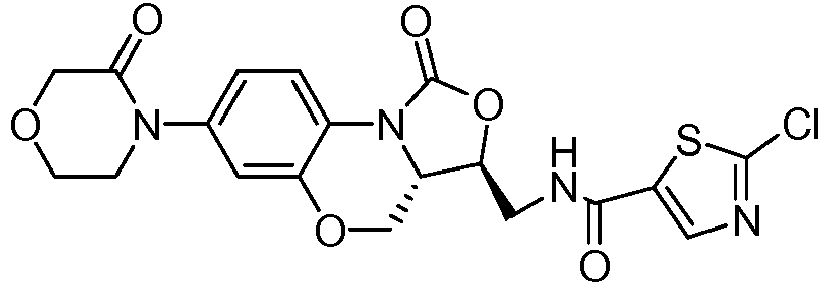
(Compound 9) (Compound 10) 

(Compound 11) (Compound 12) 

(Compound 13) (Compound 14) 
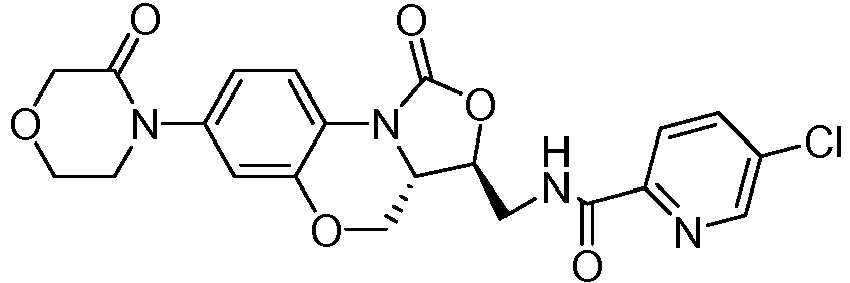
(Compound 15) (Compound 16) 

(Compound 17) (Compound 18) 

(Compound 19) (Compound 20) 

(Compound 21) (Compound 22) 

(Compound 23) (Compound 24) 

(Compound 25) (Compound 26) 

(Compound 27) (Compound 28) 

(Compound 29) (Compound 30) 

(Compound 31) (Compound 32) 

(Compound 33) (Compound 34) 

(Compound 35) (Compound 36) 

(Compound 37) (Compound 38) 

(Compound 39) (Compound 40) - In the compounds described above, an enantiomer, diastereoisomer and raceme thereof as well as their mixtures, and a pharmaceutically acceptable salt thereof, the configuration of the chiral carbon atom in the compound is R or S.
- Another objective of the present invention is to provide a preparation method of the compound of the general formula (I);
- The preparation method of the novel oxazolidone compound of the general formula (I) according to the invention will now be described below, although these specific methods do not limit the scope of the invention.
- The compounds of the present invention can be prepared according to the following method. However, the conditions of the method, e.g. reactants, solvents, acids, bases, the amount of the compounds used, the reaction temperature, the time needed for the reaction, etc. are not limited to the following illustrations. Optionally, the compounds of the invention can also be conveniently prepared by combining the various synthetic methods described in the present specification or known by those skilled in the art. Such combinations can be readily carried out by those skilled in the art to which the present invention belongs.
-

- R2, R3 are defined as above.
- a, Compound A [Journal of Medicinal Chemistry, 54(21), 7493-7502; 2011] and compound R3H react, with the catalysation by a palladium-containing catalyst, in the presence of a phosphine-containing ligand, in a polar aprotic solvent under alkaline condition, under the protection of inert gas at a temperature from room temperature to 120°C for 2-48 hours, to give compound I-1. The palladium-containing catalyst can be palladium acetate [Pd(OAc)2], tris(dibenzylideneacetone)dipalladium (0) [Pd2(dba)3], bis(dibenzylideneacetone)palladium (0) [Pd(dba)2]. The phosphine-containing ligand can be 4,5-bis(diphenylphosphino)-9,9-dimethyl xanthene [Xantphos], (±)-2,2'-bis(diphenylphosphino)-1,1'-binaphthalene [BINAP] or 1,1'-bis (diphenylphosphino) ferrocene [dppf]. The alkali used for said alkaline condition can be: cesium carbonate (Cs2CO3), sodium tert-butoxide (NaOtBu), potassium phosphate (K3PO4), potassium carbonate (K2CO3). The polar aprotic solvent can be: 1,4-dioxane, toluene, dimethylformamide (DMF) . The inert gas can be nitrogen or argon.
- b, Compound I-1 reacts, in the presence of a fluorine-containing reagent, in a polar aprotic solvent, at room temperature for 1-3 hours, to remove the protecting group t-butyldimethylsilyl (TBS), thereby giving compound 1-2. The fluorine-containing reagent can be tetrabutylammonium fluoride (nBu4NF). The polar aprotic solvent is tetrahydrofuran or dimethoxyethane.
- c, Compound 1-2 and methylsulfonyl chloride (MsCl) react, in the presence of an organic base, in a polar aprotic solvent, at a temperature from -10°C to room temperature for 1-3 hours, to give the corresponding compound 1-3. The organic base can be triethylamine or pyridine. The polar aprotic solvent can be tetrahydrofuran or dichloromethane.
- d, Compound 1-3 and phthalimide potassium react, in a polar aprotic solvent, at a temperature from room temperature to 100°C for 1-24 hours, to give the corresponding compound 1-4. The polar aprotic solvent can be: N,N-dimethylformamide, acetonitrile.
- e, Compound 1-4 and methylamine alcohol solution react in a polar solvent at a temperature from room temperature to 80°C for 1-12 hours, to give the corresponding compound 1-5. The polar solvent is: methanol or ethanol.
- f, Compound 1-5 and R2 substituted acyl chloride, in the presence of an organic base, in a polar aprotic solvent, at a temperature from -10°C to room temperature for 1-3 hours, to give the corresponding compound. The organic base can be triethylamine or pyridine. The polar aprotic solvent can be tetrahydrofuran or dichloromethane.
- g, Compound 1-5 and R2 substituted carboxylic acid or amino oxalic acid substituted with R2 at its N position react, in the presence of a condensation agent and an organic base, in a polar solvent, at room temperature for 1-6 hours, to give the corresponding compound. The condensation agent can be 2-(7-azabenzotriazol)-N,N,N',N'-tetramethyluronium hexafluorophosphate (HATU), 1-hydroxybenzotriazole (HOBT). The organic base can be triethylamine, diisopropylethylamine. The polar solvent can be dichloromethane.
- h, Compound 1-5 and R2 substituted isocyanate react, in a solvent at a temperature from room temperature to 110°C for 3-24 hours, to give the corresponding compound. The solvent can be toluene or dichloromethane.
- Compounds 23-29 are prepared according to Scheme II.

- a, Compound A and compound benzyl 3-oxopiperazin-1-carboxylate react, with the catalysation by a palladium-containing catalyst, in the presence of a phosphine-containing ligand, in a polar aprotic solvent under alkaline condition, under the protection of inert gas at a temperature from room temperature to 120 °C for 2-48 hours, to give compound II-1. The palladium-containing catalyst can be palladium acetate, tris(dibenzylideneacetone)dipalladium (0), bis(dibenzylideneacetone)palladium (0) . The phosphine-containing ligand can be 4,5-bis(diphenylphosphino)-9,9-dimethyl xanthene , (±)-2,2'-bis(diphenylphosphino)-1,1'-binaphthalene or 1,1'-bis (diphenylphosphino) ferrocene. The alkali used for said alkaline condition can be: cesium carbonate, sodium tert-butoxide, potassium phosphate, potassium carbonate. The polar aprotic solvent can be: 1,4-dioxane, toluene, dimethylformamide. The inert gas can be nitrogen or argon.
- b, Compound II-1 reacts, in the presence of a fluorine-containing reagent, in a polar aprotic solvent, at room temperature for 1-3 hours, to remove the protecting group t-butyldimethylsilyl, thereby giving compound II-2. The fluorine-containing reagent can be tetrabutylammonium fluoride. The polar aprotic solvent is tetrahydrofuran or dimethoxyethane.
- c, Compound II-2 and methylsulfonyl chloride react, in the presence of an organic base, in a polar aprotic solvent, at a temperature from -10°C to room temperature for 1-3 hours, to give the corresponding compound II-3. The organic base can be triethylamine or pyridine. The polar aprotic solvent can be tetrahydrofuran or dichloromethane.
- d, Compound II-3 and phthalimide potassium react, in a polar aprotic solvent, at a temperature from room temperature to 100°C for 1-24 hours, to give the corresponding compound II-4. The polar aprotic solvent can be: N,N-dimethylformamide, acetonitrile.
- e, Compound II-4 and methylamine alcohol solution react in a polar solvent at a temperature from room temperature to 80°C for 1-12 hours, to give the corresponding compound II-5. The polar solvent is: methanol or ethanol.
- f, Compound II-5 and 2-chlorothiophene-5-formyl chloride react, in the presence of an organic base, in a polar aprotic solvent, at a temperature from -10°C to room temperature for 1-3 hours, to give compound II-6. The organic base can be triethylamine or pyridine. The polar aprotic solvent can be tetrahydrofuran or dichloromethane.
- g, Compound II-6 reacts with a deprotecting agent, in a polar aprotic solvent, at a temperature from -10°C to room temperature for 1-6 hours, to give compound 23. The deprotecting agent is dimethyl sulfide and boron trifluoride etherate solution. The polar aprotic solvent is dichloromethane.
- h, Compound 23 and an aldehyde react, in the presence of a reducing agent, in a polar protic solvent, at a temperature from 0°C to room temperature for 3-10h, to give compounds 24, 25. The polar protic solvent is methanol. The reducing agent can be sodium triacetoxyborohydride or sodium cyanoborohydride.
- i, Compound 23 reacts with sulfonyl chloride, alkyl acyl chloride, and benzyl bromide, in the presence of an organic base, in a polar aprotic solvent, at a temperature from -10°C to room temperature for 1-3 hours, to give the corresponding compounds 26-29. The organic base can be triethylamine or diisopropylethylamine. The polar aprotic solvent can be tetrahydrofuran or dichloromethane.
- Compound 30 is prepared according to Scheme III.

- a, Compound A and compound acetamide react, with the catalysation by a palladium-containing catalyst, in the presence of a phosphine-containing ligand, in a polar aprotic solvent under alkaline condition, under the protection of inert gas at a temperature from room temperature to 120 °C for 2-48 hours, to give compound III-1. The palladium-containing catalyst can be palladium acetate , tris(dibenzylideneacetone)dipalladium (0), bis(dibenzylideneacetone)palladium (0) . The phosphine-containing ligand can be 4,5-bis(diphenylphosphino)-9,9-dimethyl xanthene , (±)-2,2'-bis(diphenylphosphino)-1,1'-binaphthalene or 1,1'-bis (diphenylphosphino) ferrocene. The alkali used for said alkaline condition can be: cesium carbonate, sodium tert-butoxide, potassium phosphate, potassium carbonate. The polar aprotic solvent can be: 1,4-dioxane, toluene, dimethylformamide. The inert gas can be nitrogen or argon.
- b, Compound III-1 reacts with a methylating agent in a polar aprotic solvent under alkaline condition and cooling on a ice-salt bath for 1-6 hours, to give compound III-2. The methylating agent can be iodomethane or dimethyl sulfate; said alkali can be sodium hydride, potassium tert-butoxide or sodium tert-butoxide. The polar aprotic solvent can be tetrahydrofuran or N,N-dimethylformamide.
- c, Compound III-2 reacts, in the presence of a fluorine-containing reagent, in a polar aprotic solvent, at room temperature for 1-3 hours, to remove the protecting group t-butyldimethylsilyl, thereby giving compound III-3. The fluorine-containing reagent can be tetrabutylammonium fluoride. The polar aprotic solvent is tetrahydrofuran or dichloromethane.
- d, Compound III-3 and methylsulfonyl chloride react, in the presence of an organic base, in a polar aprotic solvent, at a temperature from -10°C to room temperature for 1-3 hours to give the corresponding compound III-4. The organic base can be triethylamine or pyridine. The polar aprotic solvent can be tetrahydrofuran or dichloromethane.
- e, Compound III-4 and phthalimide potassium react, in a polar aprotic solvent, at a temperature from room temperature to 100°C for 1-24 hours, to give the corresponding compound III-5. The polar aprotic solvent can be: N,N-dimethylformamide or acetonitrile.
- f, Compound III-5 and methylamine alcohol solution react in a polar solvent at a temperature from room temperature to 80°C for 1-12 hours, to give the corresponding compound III-6. The polar solvent is: methanol or ethanol.
- g, Compound III-6 and 2-chlorothiophene-5-formyl chloride react, in the presence of an organic base, in a polar aprotic solvent, at a temperature from -10°C to room temperature for 1-3 hours, to give compound 30. The organic base can be triethylamine or pyridine. The polar aprotic solvent can be tetrahydrofuran or dichloromethane.
- Compounds 31-34 are prepared according to Scheme IV.

- a, Compound A and (±) 4-(t-butyldiphenylsiloxy) piperidin-2-one react, with the catalysation by a palladium-containing catalyst, in the presence of a phosphine-containing ligand, in a polar aprotic solvent under alkaline condition, under the protection of inert gas at a temperature from room temperature to 120 °C for 2-48 hours, to give compound IV-1 upon column chromatography. The palladium-containing catalyst can be palladium acetate, tris(dibenzylideneacetone)dipalladium (0), bis(dibenzylideneacetone)palladium (0) . The phosphine-containing ligand can be 4,5-bis(diphenylphosphino)-9,9-dimethyl xanthene , (±)-2,2'-bis(diphenylphosphino)-1,1'-binaphthalene or 1,1'-bis (diphenylphosphino) ferrocene. The alkali used for said alkaline condition can be: cesium carbonate, sodium tert-butoxide, potassium phosphate, potassium carbonate. The polar aprotic solvent can be: 1,4-dioxane, toluene, dimethylformamide. The inert gas can be nitrogen or argon.
- b, Compound IV-1 reacts with a selective deprotecting agent in a polar aprotic solvent at a temperature from 0°C to room temperature for 24-48 hours, to give compound IV-2. The selective deprotecting agent is a solution of boron trichloride in dichloromethane. The polar aprotic solvent is tetrahydrofuran.
- c, Compound IV-2 and methylsulfonyl chloride react in the presence of an organic base, in a polar aprotic solvent, at a temperature from -10°C to room temperature for 1-3 hours, to give the corresponding compound IV-3. The organic base can be triethylamine or pyridine. The polar aprotic solvent can be tetrahydrofuran or dichloromethane.
- d, Compound IV-3 and phthalimide potassium react, in a polar aprotic solvent, at a temperature from room temperature to 100°C for 1-24 hours, to give the corresponding compound IV-4. The polar aprotic solvent can be: N,N-dimethylformamide, acetonitrile.
- e, Compound IV-4 and methylamine alcohol solution react in a polar solvent at a temperature from room temperature to 80°C for 1-12 hours to give the corresponding compound IV-5. The polar solvent is: methanol or ethanol.
- f, Compound IV-5 and 2-chlorothiophene-5-formyl chloride react, in the presence of an organic base, in a polar aprotic solvent, at a temperature from -10°C to room temperature for 1-3 hours, to give compound IV-6. The organic base can be triethylamine or pyridine. The polar aprotic solvent can be tetrahydrofuran or dichloromethane.
- g, Compound IV-6 reacts, in the presence of a fluorine-containing reagent, in a polar aprotic solvent, at room temperature for 1-3 hours, to remove the protecting group t-butyldiphenylsilyl, thereby giving compound 31. The fluorine-containing reagent can be tetrabutylammonium fluoride. The polar aprotic solvent is tetrahydrofuran or dichloromethane.
- h, Compound 31 reacts with a fluorinating agent in a polar aprotic solvent under the protection of inert gas at a temperature from -10°C to room temperature for 1-3 hours, to give compound 33. The fluorinating agent is diethylaminosulphur trifluoride (DAST); the polar aprotic solvent can be tetrahydrofuran or dichloromethane; the inert gas can be nitrogen or argon.
- * The preparation method of compound 32 is the same with that of compound 31; the preparation method of compound 34 is the same with that of compound 33.
-

- R3 is defined as above.
- a, Compound B [Journal of Medicinal Chemistry, 54(21), 7493-7502; 2011] and 2-chlorothiophene-5-formyl chloride react, in the presence of an organic base, in a polar aprotic solvent, at a temperature from -10°C to room temperature for 1-3 hours, to give compound V-1. The organic base is triethylamine or pyridine. The polar aprotic solvent can be tetrahydrofuran or dichloromethane.
- b, Compound V-1 and bis(pinacolato)diboron react, with the catalysation by a palladium-containing catalyst, in the presence of a phosphine-containing ligand, in a polar solvent under alkaline condition, under the protection of inert gas at a temperature from room temperature to 110 °C for 0.5-48 hours, to give compound V-2; the palladium-containing catalyst is Pd(PPh3)4, Pd(dppf)Cl2, Pd(dppf)Cl2 · CH2Cl2, or Pd(dba)2; the phosphine-containing ligand is 2-(di-tert-butylphosphino)biphenyl; the alkali used for said alkaline condition is: potassium acetate, sodium acetate, potassium tert-butoxide or sodium tert-butoxide ; the polar solvent is dimethyl sulfoxide, N,N-dimethylformamide, 1,4-dioxane, tetrahydrofuran or toluene; the inert gas is nitrogen or argon.
- c, Compound V-2 and the bromide R3Br react, with the catalysation by a palladium-containing catalyst, in a polar solvent under alkaline condition, under the protection of inert gas at a temperature from room temperature to 120 °C for 2-24 hours, to give the corresponding compounds 35 and 36; The palladium-containing catalyst is Pd(PPh3)4, Pd(dppf)Cl2, or Pd(dppf)Cl2 · CH2Cl2; the alkali used for said alkaline condition is: cesium carbonate, potassium carbonate or potassium fluoride; the polar solvent is: 1,4-dioxane, tetrahydrofuran, water, ethylene glycol dimethyl ether, ethanol, N,N-dimethylformamide or toluene, or a mixture thereof; the inert gas is nitrogen or argon.
-

- R2 and R3 are defined as above.
- a, Compound A and compound R3H react, with the catalysation by a palladium-containing catalyst, in the presence of a phosphine-containing ligand, in a polar aprotic solvent under alkaline condition, under the protection of inert gas at a temperature from room temperature to 120 °C for 2-48 hours, to give compound VI-1. The palladium-containing catalyst can be palladium acetate, tris(dibenzylideneacetone)dipalladium (0), bis(dibenzylideneacetone)palladium (0) . The phosphine-containing ligand can be 4,5-bis(diphenylphosphino)-9,9-dimethyl xanthene , (±)-2,2'-bis(diphenylphosphino)-1,1'-binaphthalene or 1,1'-bis (diphenylphosphino) ferrocene. The alkali used for said alkaline condition can be: cesium carbonate, sodium tert-butoxide, potassium phosphate, potassium carbonate. The polar aprotic solvent can be: 1,4-dioxane, toluene, N,N-dimethylformamide; the inert gas can be nitrogen or argon.
- b, Compound VI-1 reacts, in the presence of a fluorine-containing reagent, in a polar aprotic solvent, at room temperature for 1-3 hours, to remove the protecting group t-butyldimethylsilyl, thereby giving compound VI-2. The fluorine-containing reagent can be tetrabutylammonium fluoride. The polar aprotic solvent is tetrahydrofuran or dimethoxyethane.
- c, Compound VI-2 reacts with an oxidizing agent in a polar aprotic solvent at a temperature from 0°C to room temperature for 1-6 hours, to give the corresponding compound VI-3. The oxidizing agent is (1,1,1-triacetyloxy)-1,1-dihydro-1,2-benziodoxol-3(1H)-one (DMP) ; the polar solvent can be dichloromethane or dimethyl sulfoxide.
- d, Compound VI-3 reacts with an oxidizing agent in a polar aprotic solvent and a buffer solution at room temperature for 1-24 hours to give the corresponding compound VI-4. The polar aprotic solvent can be dichloromethane or dimethyl sulfoxide; the buffer solution is sodium dihydrogen phosphate buffer solution; the oxidizing agent can be sodium hypochlorite, hydrogen peroxide or a mixture thereof.
- e, Compound VI-4 and a R2 substituted amine react, in the presence of a condensation agent and an organic base, in a polar aprotic solvent, at room temperature for 1-6 hours, to give the corresponding compounds 37 and 38. The condensation agent can be HATU, HOBT. The organic base can be triethylamine, diisopropylethylamine. The polar aprotic solvent can be dichloromethane.
-

- R5 is defined as above.
- a, Compound A [Journal of Medicinal Chemistry, 54(21), 7493-7502; 2011] and compound potassium ferrocyanide(II) trihydrate [KFe(CN)6·3H2O] react, with the catalysation by a palladium-containing catalyst, in a polar aprotic solvent under alkaline condition, under the protection of inert gas at a temperature from room temperature to 150°C for 0.5-12 hours, to give compound VII-1. The palladium-containing catalyst can be palladium acetate [Pd(OAc)2]. The alkali used for said alkaline condition can be: cesium carbonate (Cs2CO3), sodium tert-butoxide (NaOtBu), potassium phosphate (K3PO4), potassium carbonate (K2CO3), sodium carbonate (Na2CO3). The polar aprotic solvent can be: N-methylpyrrolidone (NMP), 1,4-dioxane, toluene, dimethylformamide (DMF). The inert gas can be nitrogen or argon.
- b, Compound VII-1 reacts, in the presence of a fluorine-containing reagent, in a polar aprotic solvent, at room temperature for 1-3 hours, to remove the protecting group t-butyldimethylsilyl (TBS), thereby giving compound VII-2. The fluorine-containing reagent can be tetrabutylammonium fluoride (nBu4NF). The polar aprotic solvent is tetrahydrofuran or dimethoxyethane.
- c, Compound VII-2 and methylsulfonyl chloride (MsCl) react, in the presence of an organic base, in a polar aprotic solvent, at a temperature from -10°C to room temperature for 1-3 hours, to give the corresponding compound VII-3. The organic base can be triethylamine or pyridine. The polar aprotic solvent can be tetrahydrofuran or dichloromethane.
- d, Compound VII-3 and phthalimide potassium react, in a polar aprotic solvent, at a temperature from room temperature to 100°C for 1-24 hours, to give the corresponding compound VII-4. The polar aprotic solvent can be: N,N-dimethylformamide, acetonitrile.
- e, Compound VII-4 and methylamine alcohol solution react in a polar solvent at a temperature from room temperature to 80°C for 1-12 hours, to give the corresponding compound VII-5. The polar solvent is: methanol or ethanol.
- f, Compound VII-5 and a R2 substituted acyl chloride react, in the presence of an organic base, in a polar aprotic solvent, at a temperature from -10°C to room temperature for 1-3 hours, to give the corresponding compound VII-6. The organic base can be triethylamine or pyridine. The polar aprotic solvent can be tetrahydrofuran or dichloromethane.
- g, Compound VII-6 in an alcohol solvent was bubbled with hydrogen chloride gas at 0°C for 2-6h, and then stirred at room temperature for 2-6h. After compound VII-6 reacts completely, the solvent and the residual acid are removed by evaporation. The resulting mixture and 2-aminooxy-N-R5-ethylamine react under reflux in a polar protic solvent for 10-24h, to give the corresponding compound 39. The alcohol solvent can be methanol, ethanol; the polar protic solvent can be methanol, ethanol, acetic acid.
-
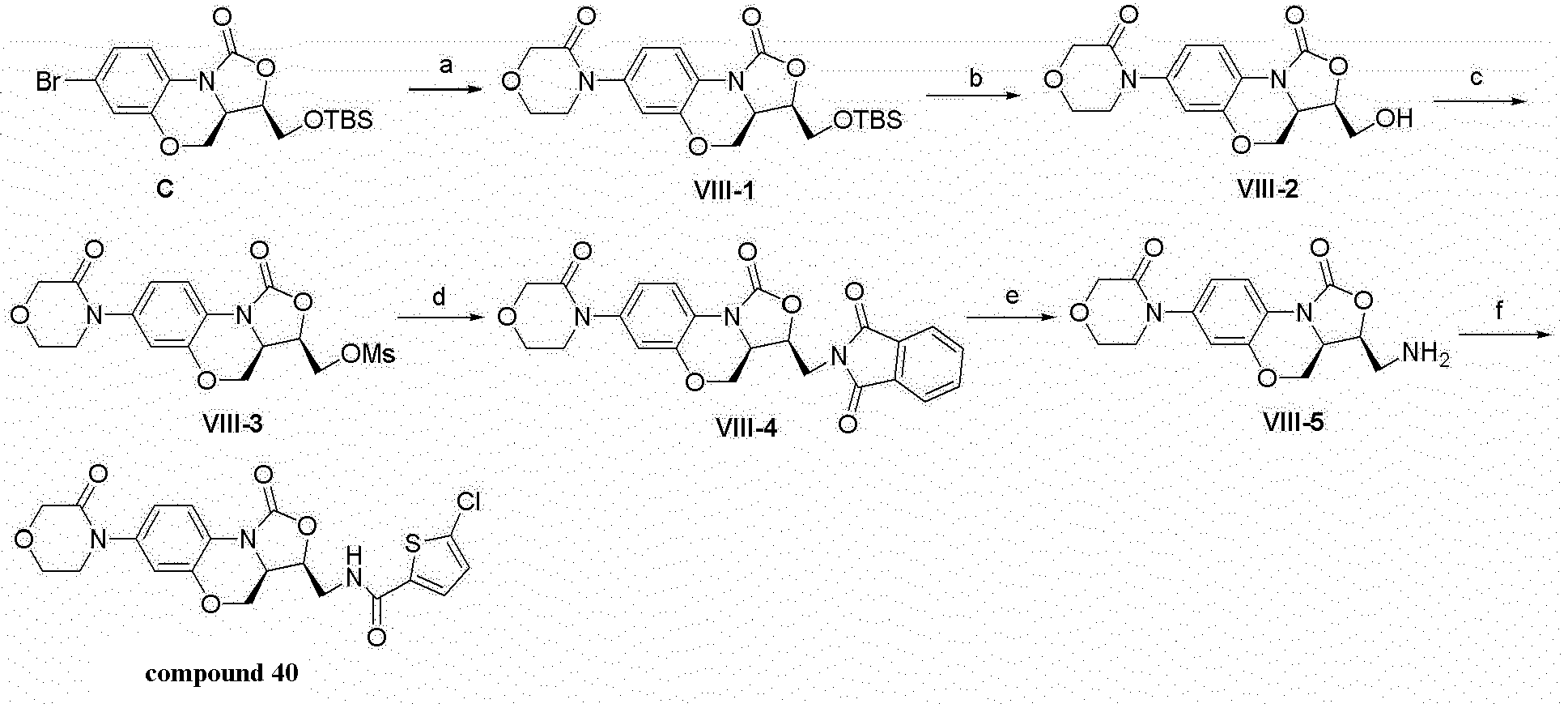
- a, Compound A [Journal of Medicinal Chemistry, 54(21), 7493-7502; 2011] and morpholone react, with the catalysation by a palladium-containing catalyst, in the presence of a phosphine-containing ligand, in a polar aprotic solvent under alkaline condition, under the protection of inert gas at a temperature from room temperature to 120 °C for 2-48 hours, to give compound VIII-1. The palladium-containing catalyst can be palladium acetate [Pd(OAc)2], tris(dibenzylideneacetone)dipalladium (0)[Pd2(dba)3], bis(dibenzylideneacetone)palladium (0) [Pd(dba)2]. The phosphine-containing ligand can be 4,5-bis(diphenylphosphino)-9,9-dimethyl xanthene [Xantphos], (±)-2,2'-bis(diphenylphosphino)-1,1'-binaphthalene [BINAP] or 1,1'-bis (diphenylphosphino) ferrocene [dppf]. The alkali used for said alkaline condition can be: cesium carbonate (Cs2CO3), sodium tert-butoxide (NaOtBu), potassium phosphate (K3PO4), potassium carbonate (K2CO3). The polar aprotic solvent can be: 1,4-dioxane, toluene, dimethylformamide (DMF). The inert gas can be nitrogen or argon.
- b, Compound VIII-1 reacts, in the presence of a fluorine-containing reagent, in a polar aprotic solvent, at room temperature for 1-3 hours, to remove the protecting group t-butyldimethylsilyl (TBS), thereby giving compound VIII-2. The fluorine-containing reagent can be tetrabutylammonium fluoride (nBu4NF). The polar aprotic solvent is tetrahydrofuran or dimethoxyethane.
- c, Compound VIII-2 and methylsulfonyl chloride (MsCl) react, in the presence of an organic base, in a polar aprotic solvent, at a temperature from -10°C to room temperature for 1-3 hours to give the corresponding compound VIII-3. The organic base can be triethylamine or pyridine. The polar aprotic solvent can be tetrahydrofuran or dichloromethane.
- d, Compound VIII-3 and phthalimide potassium react, in a polar aprotic solvent, at a temperature from room temperature to 100°C for 1-24 hours, to give the corresponding compound VIII-4. The polar aprotic solvent can be: N,N-dimethylformamide, acetonitrile.
- e, Compound VIII-4 and methylamine alcohol solution react in a polar solvent at a temperature from room temperature to 80°C for 1-12 hours, to give the corresponding compound VIII-5. The polar solvent is: methanol or ethanol.
- f, Compound VIII-5 and 2-chlorothiophene-5-formyl chloride react, in the presence of an organic base, in a polar aprotic solvent, at a temperature from -10°C to room temperature for 1-3 hours, to give the corresponding compound 40. The organic base can be triethylamine or pyridine. The polar aprotic solvent can be tetrahydrofuran or dichloromethane.
- Another objective of the present invention is to provide a pharmaceutical composition comprising one or more of the compound represented by general formula (I) as the main active ingredient.
- Still another objective of the present invention is to provide use of the compound represented by general formula (I) or a pharmaceutical composition comprising the compound represented by general formula (I) as the main active ingredient in the manufacture of a medicine for the treatment of diseases related to the FXa target, in particular vascular embolic disease.
- The compound represented by general formula (I) according to the present invention contains at least two chiral centers, and it has enantiomers and diastereoisomers. For enantiomers, two enantiomers can be obtained by regular chiral separation or asymmetric synthesis. For diastereoisomers, the separation can be achieved by approaches such as fractional recrystallization or chromatographic separation. The compound of general formula (I) according to the present invention includes any one of such isomers or a mixture thereof.
- When the compound of general formula (I) according to the present invention is used for preparing antithrombotic (anticoagulant) drugs, they can either be used alone, or can be mixed with pharmaceutically acceptable auxiliary materials (for example, excipients, diluents, etc.) to formulate tablet, capsule, granules, or syrup, etc. for oral administration.
-
-
Figure 1 depicts the effect of various dosages of the compound of the present invention on the time of thrombogenesis. -
Figure 2 depicts the effect of various dosages of the positive control rivaroxaban on the time of thrombogenesis. - The present invention will now be further illustrated with reference to the following examples. However, it should be understood that these examples are to illustrate the present invention, but not to limit the present invention in any way. In all the examples, 1H-NMR was recorded by Varian Mercury 300 NMR spectrometer, and chemical shift is shown in δ (ppm); silica gel was used for separation, and it was all 200-300 mesh unless stated otherwise. All the proportions of the elution fluid are volume ratio.
-

- Compound A

anhydrous 1,4-dioxane, to which were added morpholone (1.83g, 18.12mmol) and cesium carbonate (9.84g,30.19mmol) under the protection of argon. Pd2(dba)3 (0.55g,0.604mmol) and 4,5-bis(diphenylphosphino)-9,9-dimethyl xanthene (Xantphos) (0.489g,0.845mmol) were added and reacted under reflux and the protection of argon for 3h. TLC (PE/EA=10/1) was employed to monitor the reaction. After the reactants reacted completely, the reaction was stopped, filtered under reduced pressure, and 1,4-dioxane was evaporated. Column chromatography (PE/EA=3/1, 2/1, 1/1) afforded off-white solid 3.216g, yield 61.4%. - 1H NMR (300 MHz, DMSO-d6) δ 7.78 (d, J = 8.6 Hz, 1H), 7.06-6.98 (m, 2H), 4.55 (d, J = 7.4 Hz, 2H), 4.17 (s, 2H),3.95 (ddd, J = 17.0, 16.6, 6.1 Hz, 6H),3.68 (dd, J = 5.9, 4.3 Hz, 2H), 0.88-0.83 (m, 9H), 0.08 (d, J = 0.5 Hz, 6H).MS(EI) m/z :(M+,434).
-

- Compound (3R,3aS)-3-((t-butyldimethylsiloxy)methyl)-7-(3-oxomorpholin-4-yl)-3a,4-dihydrobenzo[b]oxazolo[3,4-d][1,4]oxazin-1(3H)-one (3.6g, 8.295mmol) prepared as above in (a) was dissolved in 50ml of THF, cooled to 0°C, to which was slowly added tetra-n-butylammonium fluoride (1M,10ml). The resulting mixture was raised to room temperature and reacted for 2 h. TLC (DCM/MeOH=10/1) was employed to monitor the reaction. After the reaction completed, THF was evaporated. The resulting mixture was washed with ethyl acetate/n-hexane=1/1 under stirring, filtered under reduced pressure, and dried to afford 1.88g of white solid , yield 70.86%.
- 1H NMR (400 MHz, DMSO-d6) δ 7.91-7.75 (d, J = 8.7 Hz, 1H), 7.09-7.04 (d, J = 2.3 Hz, 1H), 7.03-6.96 (dd, J = 8.7, 2.4 Hz, 1H), 5.37-5.28 (t, J = 5.7 Hz, 1H), 4.59-4.49 (m, 1H), 4.48-4.41 (q, J = 4.3 Hz, 1H), 4.25-4.12 (s, 2H), 4.07-3.99 (dd, J = 4.7, 1.7 Hz, 2H),3.98-3.91 (m, 2H),3.83-3.62 (m, 4H). MS(EI) m/z :(M+,320).
-

- Compound (3R,3aS)-3-(hydroxymethyl)-7-(3-oxomorpholin-4-yl)-3a,4-dihydrobenzo[b] oxazolo[3,4-d][1,4]oxazin-1 (3H)-one (4g, 12.5mmol) prepared as above in (b) was dissolved in 50ml of DMF, cooled on ice-salt bath to 0°C. And then 3.5ml of TEA was added, and methylsulfonyl chloride (1.72g, 15mmol) was added slowly in dropwise. After completion of the dropwise addition, the ice-salt bath was removed. The reaction mixture was agitated at room temperature for 3h. TLC (DCM/MeOH=10/1) was employed to monitor the reaction. After the reaction completed, water (80ml) was added for dilution. There was white solid precipated, which was filtered and dried. The filtrate was extracted with EA (50ml×3). The organic phase was combined, and washed sequentially with water (30ml) and saturated NaCl (30ml) solution, dried over anhydrous sodium sulfate, filtered, and the solvent was evaporated, to afford totally 3.92g of white solid, yield: 78.6%.
- 1H NMR (400 MHz, DMSO-d6) δ 7.84 (d, J = 8.7 Hz, 1H), 7.07 (d, J = 2.3 Hz, 1H), 7.03 (dd, J = 8.7, 2.3 Hz, 1H), 4.78 (s, 1H), 4.67-4.53 (m,3H), 4.18 (s, 2H), 4.07 (d, J = 6.2 Hz, 2H),3.98-3.93 (m, 2H),3.72-3.66 (m, 2H),3.29 (s,3H). MS(EI) m/z :(M+,398).
-

- Compound ((3R,3aS)-1-oxo-7-(3-oxomorpholin-4-yl)-1,3,3a,4-tetrahydrobenzo[b]oxazolo [3,4-d][1,4]oxazin-3-yl)methylmethanesulfonate (3.91g, 9.81mmol) prepared as above in (c) was dissolved in 50ml of DMF. Phthalimide potassium (2.72g, 14.72mmol) was added and the mixture was allowed to react at 80°C for 2h. TLC (DCM/MeOH=10/1) was employed to monitor the reaction. After the reaction completed, water (80ml) was added for dilution. There was white solid precipated, which was filtered and dried. The filtrate was extracted with EA (50ml×3). The organic phase was combined, and washed sequentially with water (30ml) and saturated NaCl (30ml) solution, dried over anhydrous sodium sulfate, filtered, and the solvent was evaporated to afford totally 3.71g of white solid, yield: 84.2%.
- 1H NMR (400 MHz, CDCl3) δ 8.01 (d, J = 8.7 Hz, 1H), 7.91 (dd, J = 5.4,3.1 Hz, 2H), 7.79 (dd, J = 5.5,3.0 Hz, 2H), 6.99 (d, J = 2.4 Hz, 1H), 6.95 (dd, J = 8.7, 2.4 Hz, 1H), 4.65 (dd, J = 12.1, 6.5 Hz, 1H), 4.47 (dd, J = 10.6,3.1 Hz, 1H), 4.33 (s, 2H), 4.23 (dd, J = 14.3, 6.8 Hz, 1H), 4.11-3.99 (m, 4H),3.88 (t, J = 10.3 Hz, 1H),3.74-3.69 (m, 2H). MS(EI) m/z :(M+,449).
-

- Compound 2-(((3S,3aS)-1-oxo-7-(3-oxomorpholin-4-yl)-1,3,3a,4-tetrahydrobenzo[b] oxazolo[3,4-d][1,4]oxazin-3-yl)methyl)isoindolin-1,3-dione (3.71g, 8.263mmol) prepared as above in (d) was partly dissolved in 50ml of ethanol. 60ml of methylamine alcohol solution was added and the mixture was allowed to react under reflux at 78°C for 3h. TLC (DCM/MeOH=10/1) was employed to monitor the reaction. After the reaction completed, the solvent was evaporated, and the remainder was directly subjected to the next step of reaction.
-
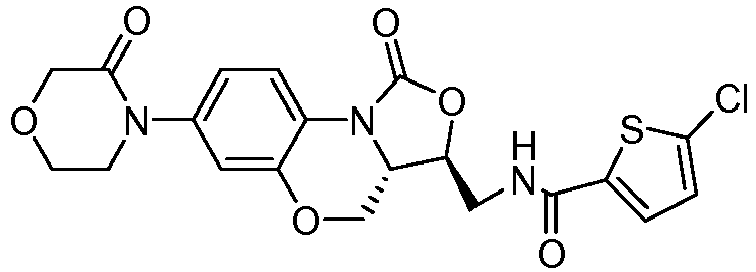
- The crude compound (3S,3aS)-3-aminomethyl-7-(3-oxomorpholin-4-yl)-3a,4 -dihydrobenzo[b]oxazolo[3,4-d][1,4]oxazin-1 (3H)-one, which was prepared as above in (e) and was not purified, was dissolved in 20ml of DMF, cooled on ice-salt bath to 0°C. TEA (2.3ml, 16.51mmol) was added, and 5-chlorothiophene-2-formyl chloride (1.79g, 9.91mmol) was added slowly in dropwise. Then the cooling bath was removed, and the mixture was allowed to react at room temperature for 3h. TLC (DCM/MeOH=10/1) was employed to monitor the reaction. After the reaction completed, the mixture was diluted with water (40ml) and extracted with EA (30ml×4). The organic phase was combined and washed with water and saturated saline solution for two times, respectively, dried over anhydrous sodium sulfate, filtered, and the solvent was evaporated. Column chromatography (DCM/MeOH=50/1) afforded 2.75g of white solid, yield: 71.9% (two steps together).
- 1H NMR (400 MHz, DMSO-d6) δ 9.00 (t, J = 5.8 Hz, 1H), 7.85 (d, J = 8.7 Hz, 1H), 7.71 (d, J = 4.1 Hz, 1H), 7.21 (d, J = 4.0 Hz, 1H), 7.05 (d, J = 2.3 Hz, 1H), 7.01 (dd, J = 8.7, 2.3 Hz, 1H), 4.63-4.52 (m, 2H), 4.18 (s, 2H), 4.10-4.01 (m, 2H),3.97-3.92 (m, 2H),3.73 (t, J = 5.5 Hz, 2H),3.71-3.66 (m, 2H).MS(ESI) m/z :[(M+23)+,486.3].
-

- Using compound A (the same as in Example 1) (2g, 4.83mmol), piperidin-2-one (0.717g, 7.25mmol), cesium carbonate (3.935g, 0.012mol), Pd2(dba)3(0.31g,0.338mmol), and Xantphos(0.28g,0.483mmol) as starting materials, preparation following the method as described in Example 1(a) afforded white solid 1.016g, yield: 48.6%.
- 1H NMR (400 MHz, CDCl3) δ 8.00 (dd, J = 7.5, 1.6 Hz, 1H), 6.88 (dd, J = 7.9, 1.9 Hz, 2H), 4.45 (dd, J = 10.5,3.2 Hz, 1H), 4.27 (td, J = 5.6, 4.0 Hz, 1H), 4.10 (ddd, J = 9.8, 6.5,3.2 Hz, 1H),3.97-3.84 (m,3H),3.59 (d, J = 6.0 Hz, 2H), 2.55 (t, J = 5.8 Hz, 2H), 1.99-1.87 (m, 4H), 0.89 (d, J = 2.9 Hz, 9H), 0.11 (d, J = 2.6 Hz, 6H). MS(EI) m/z :(M+,432).
-

- Using compound (3R,3aS)-3-(((t-butyldimethylsilyl) oxy)methyl)-7-(2-oxopiperidin-1-yl)-3a,4-dihydrobenzo[b]oxazolo[3,4-d][1,4]oxazin-1 (3H)-one (1.016g, 2.352mmol), and tetra-n-butylammonium fluoride (1M,4.7ml) as starting materials, preparation following the method as described in Example 1(b) afforded 0.642g white solid, yield 85.8%.
- 1H NMR (300 MHz, DMSO-d6) δ 7.81 (d, J = 8.4 Hz, 1H), 6.89 (d, J = 7.7 Hz, 2H), 5.31 (s, 1H), 4.63 - 4.36 (m, 2H), 4.03 (s, 2H),3.71 (d, J = 12.3 Hz, 2H),3.55 (s, 2H), 2.36 (s, 2H), 1.82 (s, 4H).MS(EI) m/z :(M+,318).
-

- Using compound (3R,3aS)-3-(hydroxymethyl)-7-(2-oxopiperidin-1-yl)-3a,4 -dihydrobenzo[b]oxazolo[3,4-d][1,4]oxazin-1 (3H)-one (0.642g, 2.02mmol), methylsulfonyl chloride (0.347g,3.03mmol), TEA (0.408g, 4.04mmol) as starting materials, preparation following the method as described in Example 1(c) afforded white solid 0.774g, yield: 96.8%.
- 1H NMR (400 MHz, DMSO-d6) δ 7.81 (d, J = 8.8 Hz, 1H), 6.97-6.84 (m, 2H), 4.78 (d, J = 2.2 Hz, 1H), 4.66-4.55 (m,3H), 4.06 (d, J = 5.9 Hz, 2H),3.55 (t, J = 5.5 Hz, 2H),3.28 (s,3H), 2.36 (t, J = 6.2 Hz, 2H), 1.82 (d, J = 3.1 Hz, 4H).MS(EI) m/z :(M+,396).
-

- Using compound ((3R,3aS)-1-oxo-7-(2-oxopiperidin-1-yl)-1,3,3a,4-tetrahydrobenzo[b] oxazolo[3,4-d][1,4]oxazin-3-yl)methylmethanesulfonate (0.774g, 1.95mmol), phthalimide potassium (0.542g, 2.93mmol) as starting materials, preparation following the method as described in Example 1(d) afforded white solid 0.693g, yield: 79.3%.
- 1H NMR (400 MHz, DMSO-d6) δ 7.95-7.84 (m, 4H), 7.77 (d, J = 8.6 Hz, 1H), 6.91-6.85 (m, 2H), 4.75-4.67 (m, 1H), 4.63 (dd, J = 10.4,3.0 Hz, 1H), 4.17 (td, J = 6.9,3.5 Hz, 1H), 4.13-3.99 (m,3H),3.54 (t, J = 5.3 Hz, 2H), 2.36 (t, J = 6.1 Hz, 2H), 1.82 (d, J = 3.1 Hz, 4H).MS(EI) m/z :(M+,447).
-

- Using 2-(((3S,3aS)-1-oxo-7-(2-oxopiperidin-1-yl)-1,3,3a,4-tetrahydrobenzo[b]oxazolo [3,4-d][1,4]oxazin-3-yl)methyl)isoindolin-1,3-dione (0.693g, 1.55mmol) and 28ml of methylamine alcohol solution as starting materials, preparation following the method as described in Example 1(e) afforded a crude product, which was directly subjected to the next step of reaction without purification.
-

- Using the crude (3S,3aS)-3-aminomethyl-7-(2-oxopiperidin-1-yl)-3a,4-dihydrobenzo[b]oxazolo[3,4-d][1,4]oxazin-1(3H)-one, 5-chlorothiophene-2-formyl chloride (0.337g, 1.86mmol), and TEA (0.313g,3.10mmol) as starting materials, preparation following the method as described in Example 1(f) afforded white compound 0.518g, yield of the two steps: 72.3%.
- 1H NMR (400 MHz, CDCl3) δ 7.98 (d, J = 9.3 Hz, 1H), 7.34 (d, J = 4.0 Hz, 1H), 6.90 (d, J = 4.0 Hz, 1H), 6.87 (dt, J = 4.5, 2.3 Hz,3H), 4.54-4.41 (m, 2H),3.96 (ddd, J = 10.1, 7.0,3.1 Hz, 1H),3.90-3.70 (m,3H),3.59 (s, 2H), 2.55 (d, J = 6.3 Hz, 2H), 1.97-1.89 (m, 4H). MS(EI) m/z :(M+,461).
-

- Using compound (3S,3aS)-3-aminomethyl-7-(3-oxomorpholin-4-yl)-3a,4-dihydrobenzo[b]oxazolo[3,4-d][1,4]oxazin-1(3H)-one (the product of step (e) in Example 1) (80mg, 0.251mmol) and 3,6-dichlorobenzo[b]thiophene-2-formyl chloride (99.9mg, 0.376mmol) as starting materials, preparation following the method as described in Example 1(f) afforded yellow solid 25mg, yield: 28.2%.
- 1H NMR (300 MHz, DMSO-d6) δ 8.98-8.85 (t, J = 5.9 Hz, 1H), 8.44-8.29 (s, 1H), 7.99-7.89 (d, J = 8.8 Hz, 1H), 7.89-7.72 (d, J = 8.6 Hz, 1H), 7.75-7.57 (d, J = 8.7 Hz, 1H), 7.11-6.95 (m, 2H), 4.78-4.67 (d, J = 5.5 Hz, 1H), 4.67-4.46 (d, J = 8.6 Hz, 1H), 4.29-4.15 (s, 2H), 4.15-4.02 (m, 2H), 4.02-3.92 (t, J = 5.0 Hz, 2H),3.90-3.76 (m, 2H),3.76-3.64 (t, J = 5.0 Hz, 2H).MS(EI) m/z :(M+,547).
-

- Using compound (3S,3aS)-3-aminomethyl-7-(3-oxomorpholin-4-yl)-3a,4-dihydrobenzo [b]oxazolo[3,4-d][1,4]oxazin-1 (3H)-one (the product of step (e) in Example 1) (40mg, 0.125mmol) and 4-chlorobenzo[b]thiophene-2-formyl chloride (60mg, 0.26mmol) as starting materials, preparation following the method as described in Example 1(f) afforded white solid 20mg, yield: 31 %.
- 1H NMR (300 MHz, DMSO-d6) δ 9.47-9.29 (s, 1H), 8.40-8.19 (s, 1H), 8.13-7.98 (d, J= 8.0 Hz, 1H), 7.96-7.80 (d, J= 8.7 Hz, 1H), 7.61-7.53 (m, 1H), 7.55-7.42 (m, 1H), 7.11-7.06 (d, J = 2.0 Hz, 1H), 7.06-6.99 (dd, J = 8.8, 2.2 Hz, 1H), 4.73-4.54 (dd, J = 16.6, 7.9 Hz, 2H), 4.22-4.16 (s, 2H), 4.12-4.06 (dd, J= 7.3, 2.1 Hz, 1H), 4.01-3.93 (t, J= 5.0 Hz, 2H),3.88-3.77 (t, J = 5.7 Hz, 2H),3.74-3.61 (t, J = 5.2 Hz, 2H),3.21-3.16 (dd, J= 5.2, 1.1 Hz, 1H).MS(ESI) m/z :[(M+1)+,514].
-

- Using compound (3S,3aS)-3-aminomethyl-7-(3-oxomorpholin-4-yl)-3a,4-dihydrobenzo[b]oxazolo[3,4-d][1,4]oxazin-1(3H)-one (the product of step (e) in Example 1) (56.8mg, 0.178mmol) and 5-chlorobenzo[b]thiophene-2-formyl chloride (61.7mg, 0.267mmol) as starting materials, preparation following the method as described in Example 1(f) afforded white solid 25mg, yield: 21.8%.
- 1H NMR (300 MHz, DMSO-d6) δ 9.31-9.16 (t, J = 5.7 Hz, 1H), 8.13-8.03 (m,3H), 7.90-7.77 (d, J = 8.7 Hz, 1H), 7.54-7.43 (dd, J = 8.7, 2.1 Hz, 1H), 7.09-7.02 (d, J = 2.3 Hz, 1H), 7.02-6.94 (dd, J = 8.7, 2.3 Hz, 1H), 4.66-4.59 (q, J = 5.9 Hz, 1H), 4.59-4.48 (dd, J = 9.4, 2.2 Hz, 1H), 4.19-4.13 (s, 2H), 4.13-4.00 (m, 2H),3.97-3.88 (dd, J = 6.0, 4.1 Hz, 2H),3.81-3.72 (t, J = 5.6 Hz, 2H),3.70-3.61 (dd, J = 6.1,4.2 Hz, 2H).MS(ESI) m/z :[(M+1)+,514].
-

- Using compound (3S,3aS)-3-aminomethyl-7-(3-oxomorpholin-4-yl)-3a,4-dihydrobenzo [b]oxazolo[3,4-d][1,4]oxazin-1 (3H)-one (the product of step (e) in Example 1) (40mg, 0.178mmol) and 7-chlorobenzo[b]thiophene-2-formyl chloride (61.7mg, 0.267mmol) as starting materials, preparation following the method as described in Example 1(f) afforded white solid 30mg, yield: 46.55%.
- 1H NMR (400 MHz, DMSO-d6) δ 9.37-9.23 (t, J = 5.9 Hz, 1H), 8.32 -8.18 (s, 1H), 8.05-7.92 (d, J = 8.0 Hz, 1H), 7.92-7.78 (d, J = 8.7 Hz, 1H), 7.66-7.57 (d, J = 7.6 Hz, 1H), 7.55-7.41 (t, J = 7.8 Hz, 1H), 7.08-7.05 (d, J = 2.3 Hz, 1H), 7.03 -6.99 (dd, J = 8.8, 2.4 Hz, 1H), 4.77-4.61 (m, 1H), 4.62-4.54 (dd, J = 10.0, 2.7 Hz, 1H), 4.29-4.15 (s, 2H),3.76-3.59 (m, 2H), 4.14-4.00 (m, 2H), 4.00-3.87 (dd, J = 5.8, 4.0 Hz, 2H),3.88-3.73 (m, 2H).MS(EI) m/z :(M+,513).
-

- Using compound (3S,3aS)-3-aminomethyl-7-(3-oxomorpholin-4-yl)-3a,4-dihydrobenzo[b]oxazolo[3,4-d][1,4]oxazin-1(3H)-one (the product of step (e) in Example 1) (40mg, 0.178mmol) and 6-chlorobenzo[b]thiophene-2-formyl chloride (61.7mg, 0.267mmol) as starting materials, preparation following the method as described in Example 1(f) afforded white solid 35mg, yield: 54.31%.
- 1H NMR (300 MHz, DMSO-d6) δ 8.98-8.85 (t, J = 5.9 Hz, 1H), 8.44-8.29 (s, 1H), 7.99-7.89 (d, J = 8.8 Hz, 1H), 7.89-7.72 (d, J = 8.6 Hz, 1H), 7.75-7.57 (d, J = 8.7 Hz, 1H), 7.11-6.95 (m, 2H), 4.78-4.67 (d, J = 5.5 Hz, 1H), 4.67-4.46 (d, J = 8.6 Hz, 1H), 4.29-4.15 (s, 2H), 4.15-4.02 (m, 2H), 4.02-3.92 (t, J = 5.0 Hz, 2H),3.90-3.76 (m, 2H),3.76-3.64 (t, J = 5.0 Hz, 2H).MS(EI) m/z :(M+,513).
-

- Using compound (3S,3aS)-3-aminomethyl-7-(3-oxomorpholin-4-yl)-3a,4-dihydrobenzo[b]oxazolo[3,4-d][1,4]oxazin-1(3H)-one (the product of step (e) in Example 1) (40mg, 0.178mmol) and 2,2-dichloro acetyl chloride (27.6mg, 0.188mmol) as starting materials, preparation following the method as described in Example 1(f) afforded white solid 20mg, yield: 37%.
- 1H NMR (400 MHz, DMSO-d6) δ 9.07-8.94 (t, J = 5.8 Hz, 1H), 7.94-7.72 (d, J = 8.6 Hz, 1H), 7.07-7.04 (d, J = 2.3 Hz, 1H), 7.04-6.99 (dd, J = 8.7, 2.3 Hz, 1H), 6.55-6.50 (s, 1H), 4.59-4.53 (m, 2H), 4.24-4.10 (s, 2H), 4.07-3.98 (q, J = 8.4, 7.0 Hz, 2H),3.97-3.88 (t, J = 5.1 Hz, 2H),3.71-3.68 (d, J = 5.1 Hz, 2H),3.68-3.64 (m, 2H).MS(EI) m/z :(M+,429).
-

- Using compound (3S,3aS)-3-aminomethyl-7-(3-oxomorpholin-4-yl)-3a,4-dihydrobenzo[b]oxazolo[3,4-d][1,4]oxazin-1(3H)-one (the product of step (e) in Example 1) (80mg, 0.251mmol) and 4,5-dichlorothiophene-2-formyl chloride (81mg, 0.301mmol) as starting materials, preparation following the method as described in Example 1(f) afforded white solid 50mg, yield: 40%.
- 1H NMR (400 MHz, DMSO-d6) δ 9.18-9.04 (t, J = 5.9 Hz, 1H), 7.95-7.89 (s, 1H), 7.89-7.81 (d, J = 8.7 Hz, 1H), 7.08-7.04 (d, J = 2.2 Hz, 1H), 7.07-6.99 (m, 1H),4.71-4.46 (t, J = 7.7 Hz, 2H), 4.22-4.12 (s, 2H), 4.10-4.00 (m, 2H), 4.00-3.90 (t, J= 5.0 Hz, 2H),3.87-3.71 (t, J= 5.7 Hz, 2H),3.71-3.63 (t, J= 5.3 Hz, 2H).MS(ESI) m/z :[(M-1)+,496].
-

- Using compound (3S,3aS)-3-aminomethyl-7-(3-oxomorpholin-4-yl)-3a,4-dihydrobenzo[b]oxazolo[3,4-d][1,4]oxazin-1(3H)-one (the product of step (e) in Example 1) (80mg, 0.251mmol) and 2-chlorothiazolyl-5-formyl chloride (55mg, 0.301mmol) as starting materials, preparation following the method as described in Example 1(f) afforded light yellow solid 60mg, yield: 51.5%.
- 1H NMR (400 MHz, DMSO-d6) δ 9.31-9.11 (t, J = 6.0 Hz, 1H), 8.41-8.33 (s, 1H), 7.94-7.77 (d, J= 8.7 Hz, 1H), 7.08-7.04 (d, J= 2.3 Hz, 1H), 7.04-6.99 (dd, J= 8.7, 2.4 Hz, 1H), 4.73-4.46 (m, 2H), 4.23-4.13 (s, 2H), 4.10-4.01 (m, 2H), 4.00-3.87 (dd, J = 5.9, 4.0 Hz, 2H),3.85-3.72 (t, J= 5.5 Hz, 2H),3.72-3.60 (dd, J= 6.0, 4.3 Hz, 2H).MS(EI) m/z :(M+,464).
-

- 2, 4- piperidinedione (300mg, 2.65mmol) was suspended in 25ml of toluene. Ethylene glycol (329mg, 5.3mmol) and p-toluenesulfonic acid monohydrate (100mg, 0.53mmol) were added, and water was removed from the resulting mixture by reflux at 110°C. TLC (DCM/MeOH=10/1) was employed to monitor the reaction. After the reaction completed, aqueous solution of sodium bicarbonate was added, and the resulting mixture was extracted with EA (30ml×4). The organic phase was combined, washed with water and saturated saline solution for two times respectively, dried over anhydrous sodium sulfate, filtered, and the solvent was evaporated. Column chromatography (DCM/MeOH=50/1) afforded white solid 220mg, yield: 52.8%.
- 1H NMR (300 MHz, CDCl3) δ 6.88-6.57 (s, 1H), 4.07-3.79 (dt, J = 6.4,3.1 Hz, 4H),3.46-3.25 (t, J = 6.2 Hz, 2H), 2.67-2.52 (s, 2H), 1.96-1.81 (t, J = 6.1 Hz, 2H). MS(ESI) m/z :[(M+23)+,180.2].
-

- Using 1,4-dioxy-8-azaspiro[4.5]heptan-7-one (0.46g, 2.899mmol), compound A (the same as compound A in Example 1) (1.00g, 2.415mmol), Pd2(dba)3(0.15g,0.169mmol), Xantphos(0.14g,0.242mmol), and cesium carbonate (1.96g, 6.038mmol) as starting materials, dioxane as solvent, preparation following the method as described in Example 1(a) afforded golden solid 0.43g, yield 36.3%.
- 1H NMR (300 MHz, CDCl3) δ 8.05-7.98 (m, 1H), 6.92-6.89 (d, J = 1.5 Hz, 1H), 6.90-6.86 (m, 1H), 4.49-4.41 (m, 1H), 4.31-4.23 (q, J = 5.4 Hz, 1H), 4.15-4.07 (m, 1H), 4.07-3.98 (q, J = 5.3 Hz, 4H),3.95-3.90 (m, 2H),3.90-3.83 (m, 2H),3.72-3.64 (t, J = 6.1 Hz, 2H), 2.80-2.76 (s, 2H), 2.14-2.07 (t, J = 6.2 Hz, 2H), 0.94-0.85 (d, J = 1.3 Hz, 9H), 0.13-0.06 (m, 6H).MS(ESI) m/z :[(M+1)+,491.4].
-

- Using compound (3R,3aS)-3-((t-butyldimethylsiloxy)methyl)-7-(7-oxo-1,4-dioxy-8-azaspiro[4.5]heptan-8-yl)-3a,4-dihydrobenzo[b]oxazolo[3,4-d][1,4]oxazin-1 (3H)-one(0.43g,0.876mmol), and TBAF(0.46g,1.753mmol) as starting materials, DCM as solvent, preparation following the method as described in Example 1(b) afforded white solid 0.31g, yield 94.0%.
- 1H NMR (400 MHz, CDCl3) δ 8.08-7.97 (m, 1H), 6.91-6.90 (s, 1H), 6.90-6.87 (m, 1H), 4.50-4.42 (dd, J = 10.6,3.2 Hz, 1H), 4.38-4.27 (dt, J = 7.0, 4.3 Hz, 1H), 4.16-4.07 (m, 1H), 2.14-2.06 (m, 2H), 4.08-3.97 (tdd, J = 7.0,3.9, 1.9 Hz, 4H),3.97-3.91 (m, 1H),3.90-3.85 (m, 1H),3.85-3.79 (m, 1H),3.71-3.65 (m, 2H), 2.81-2.73 (t, J = 1.0 Hz, 2H), 1.01-0.94 (t, J = 7.4 Hz, 1H). MS(ESI) m/z :[(M+1)+,377.3].
-

- Using compound (3R,3aS)-3-(hydroxymethyl)-7-(7-oxo-1,4-dioxy-8-azaspiro [4.5]heptan-8-yl)-3a,4-dihydrobenzo[b]oxazolo[3,4-d][1,4]oxazin-1 (3H)-one (0.31g, 0.824mmol), MsCl (0.14g,1.235mmol), and Et3N (0.17g,1.648mmol) as starting materials, DCM as solvent, preparation following the method as described in Example 1(c) afforded white solid 0.31g, yield: 82.8%.
- 1H NMR (400 MHz, CDCl3) δ 8.04-7.96 (d, J = 9.2 Hz, 2H), 6.96-6.87 (m, 4H), 4.58-4.47 (m, 8H), 4.14-4.08 (m, 1H), 4.09-3.98 (m, 7H),3.97-3.86 (t, J = 10.3 Hz, 2H),3.72-3.63 (t, J = 6.3 Hz, 4H),3.17-3.11 (s, 6H), 2.81-2.76 (s, 4H), 2.16-2.06 (t, J = 6.2 Hz, 4H).MS(ESI) m/z :[(M+23)+,477.3].
-

- Using compound ((3R,3aS)-1-oxo-7-(7-oxo-1,4-dioxy-8-azaspiro[4.5]heptan-8-yl)-1,3,3a,4-tetrahydrobenzo[b]oxazolo[3,4-d][1,4]oxazin-3-yl)methylmethanesulfonate (0.31g, 0.682mmol), and phthalimide potassium (0.19g, 1.023mmol) as starting materials, DMF as solvent, preparation following the method as described in Example 1(d) afforded white solid 0.22g, yield 63.8%.
- 1H NMR (400 MHz, CDCl3) δ 8.03-7.94 (m, 1H), 7.94-7.86 (m,2H), 7.83-7.73 (dd, J = 5.4,3.0 Hz, 2H), 6.93-6.89 (s, 1H), 6.89-6.86 (s, 1H), 4.70-4.59 (q, J = 6.3 Hz, 1H), 4.51-4.41 (dt, J = 10.8, 2.5 Hz, 1H), 4.28-4.17 (m, 1H), 4.11-4.06 (s, 1H), 4.05-3.96 (m, 4H),3.93-3.82 (t, J = 10.3 Hz, 1H),3.82-3.74 (t, J = 6.9 Hz, 1H),3.70-3.64 (t, J = 6.2 Hz, 2H), 2.79-2.75 (s, 2H), 2.14-2.06 (t, J = 6.2 Hz, 2H).MS(EI) m/z : (M+,505).
-

- Using compound 2-(((3S,3aS)-1-oxo-7-(7-oxo-1,4-dioxy-8-azaspiro[4.5]heptan-8-yl)-1,3,3a,4-tetrahydrobenzo[b]oxazolo[3,4-d][1,4]oxazin-3-yl)methyl) isoindolin-1,3-dione (0.21g, 0.415mmol),and methylamine alcohol (0.03g, 0.830mmol) as starting materials, ethanol as solvent, preparation following the method as described in Example 1(e) afforded white solid 0.12g, yield 76.9%.
-

- Compound (3S,3aS)-3-(aminomethyl)-7-(7-oxo-1,4-dioxy-8-azaspiro[4.5]heptan-8-yl) -3a,4-dihydrobenzo[b]oxazolo[3,4-d][1,4]oxazin-1(3H)-one (0.12g, 0.320mmol) was dissolved in a mixed solvent of DCM (10ml) and DMF (2ml). 5-chlorothiophene-2-carboxylic acid (0.08g, 0.480mmol) and Et3N (0.10g, 0.960mmol) were added, and HATU (0.22g, 0.576mmol) were added under ice bath. The resulting mixture was agitated at room temperature for 3h. TLC (DCM/MeOH=10/1) was employed to monitor the reaction. After the reaction completed, 20ml of water was added, and the mixture was extracted with EA (20ml×3). The organic phase was combined, washed with water and saturated saline solution for two times respectively, dried over anhydrous sodium sulfate, filtered, and the solvent was evaporated. Column chromatography (DCM/MeOH=50/1) afforded white solid 0.11g, yield 66.2%.
- 1H NMR (400 MHz, DMSO-d6) δ 9.06-8.97 (t, J = 5.8 Hz, 1H), 7.88-7.80 (m, 1H), 7.74-7.68 (d, J = 4.0 Hz, 1H), 7.24-7.19 (d, J = 3.9 Hz, 1H), 6.91-6.85 (h, J = 2.3 Hz, 2H), 4.64-4.57 (q, J = 5.5 Hz, 1H), 4.56-4.51 (m, 1H), 4.11-4.00 (m, 2H),3.98-3.92 (m, 4H),3.75-3.70 (t, J = 5.7 Hz, 2H),3.63-3.56 (t, J = 6.3 Hz, 2H), 2.64-2.62 (s, 2H), 2.09-2.01 (t, J = 6.3 Hz, 2H). MS(ESI) m/z :[(M+23)+,542.4].
-

- (R)4-cyano-3-hydroxy butyric acid ethyl ester (1.5g, 9.54mmol) was dissolved in iodomethane(20ml). Silver oxide solid (3.3g, 14.32mmol) was added, and the reaction mixture was agitated at room temperature overnight. TLC (PE/EA=2/1) was employed to monitor the reaction. After the reaction completed, the silver oxide solid was removed by filtration, and the solvent was evaporated. Column chromatography (PE/EA=10/1) afforded colorless transparent liquid 1.0g, yield 63.1 %.
- 1H NMR (400 MHz, CDCl3) δ 4.22-4.11 (q, J = 7.1 Hz, 1H), 4.00-3.86 (tt, J = 6.3, 5.4 Hz, 0H),3.49-3.40 (s, 2H), 2.80-2.54 (m, 2H), 1.34-1.23 (t, J = 7.2 Hz, 2H).MS(ESI) m/z :[(M+1)+, 172.2].
-

- (R) 4-cyano-3-methoxyl butyric acid ethyl ester (1.0g, 5.84mmol) was dissolved in methanol (20ml). PtO2·3H2O (0.16g,0.584mmol) was added and the resulting mixture was allowed to react under hydrogen pressure (50psi) for 20h. TLC (DCM/MeOH=10/1) was employed to monitor the reaction. After the reaction completed, the reaction mixture was filtered and dried by spinning. Column chromatography (DCM/MeOH=50/1) afforded colorless transparent liquid 0.5g, yield 66.3%.
- 1H NMR (400 MHz, CDCl3) δ 7.26-7.15 (s, 1H),3.69-3.60 (m, 1H),3.46-3.36 (m, 1H),3.35-3.30 (s,3H),3.24-3.13 (dddd, J = 11.9, 6.7, 5.2, 2.3 Hz, 1H), 2.61-2.33 (m, 2H), 1.98-1.77 (m, 2H).MS(ESI) m/z :[(M+23)+, 152.2].
-

- Using compound (R)-4-methoxylpiperidin-2-one (0.98g, 7.62mmol), compound A (the same as in Example 1) (2.63g, 6.35mmol), Pd2(dba)3 (0.29g,0.318mmol), Xantphos (0.29g,0.508mmol), and cesium carbonate (4.14g, 12.7mmol) as starting materials, dioxane as solvent, preparation following the method as described in Example 1 (a) afforded golden oily liquid 1.5g, yield 51.1%.
- 1H NMR (400 MHz, CDCl3) δ 8.12-7.96 (d, J = 8.4 Hz, 1H), 6.97- 679 (m, 2H), 4.51-4.40 (dd, J = 10.5,3.1 Hz, 1H), 4.34-4.21 (q, J = 5.0, 4.3 Hz, 1H), 4.21-4.07 (ddd, J = 9.8, 6.5,3.2 Hz, 1H), 4.00-3.68 (m, 5H),3.65-3.47 (dd, J = 12.1, 6.0 Hz, 1H),3.45-3.33 (s,3H), 2.89-2.54 (m, 2H), 2.33-1.92 (m, 2H), 1.02-0.82 (s, 9H), 0.21-0.05 (s,6H).MS(ESI) m/z :[(M+1)+, 463.5].
-

- Using compound (3R,3aS)-3-((t-butyldimethylsiloxy)methyl)-7-((R)-4-methoxyl-2-oxopiperidin-1-yl)-3a,4-dihydrobenzo[b]oxazolo[3,4-d][1,4]oxazin-1(3H)-one(1.5g,3.24mmol), and TBAF(1.27g,4.86mmol) as starting materials, DCM as solvent, preparation following the method as described in Example 1 (b) afforded white solid 0.85g, yield 75.0%.
- 1H NMR (400 MHz, CDCl3) δ 8.10-7.87 (d, J = 8.5 Hz, 1H), 6.99-6.77 (m, 2H), 4.52-4.39 (dd, J = 10.6,3.2 Hz, 1H), 4.32-4.21 (dd, J = 7.9,3.5 Hz, 1H), 4.15-4.04 (m, 1H),3.96-3.68 (m,5H),3.58-3.45 (dt, J = 11.8, 5.4 Hz, 1H),3.46-3.34 (s,3H),3.00-2.95 (t, J = 6.3 Hz, 1H), 2.80-2.61 (m, 2H), 2.15-2.01 (m, 2H).MS(ESI) m/z :[(M+1)+,349.4].
-
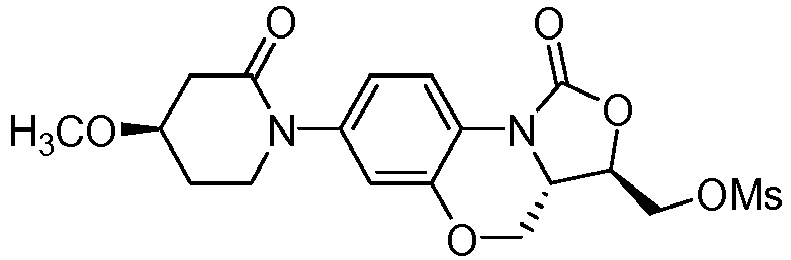
- Using compound (3R,3aS)-3-(hydroxymethyl)-7-((R)-4-methoxyl-2-oxopiperidin-1-yl) -3a,4-dihydrobenzo[b]oxazolo[3,4-d][1,4]oxazin-1 (3H)-one (0.85g, 2.440mmol), MsCl (0.42g,3.660mmol), and Et3N (4.93g,4.880mmol) as starting materials, DCM as solvent, preparation following the method as described in Example 1(c) afforded white solid 0.89g, yield 85%.
- 1H NMR (400 MHz, CDCl3) δ 8.03-7.96 (d, J = 9.2 Hz, 1H), 6.94-6.89 (m, 2H), 4.59-4.44 (m,3H), 4.05-3.98 (m, 1H),3.94-3.86 (m, 1H),3.84-3.75 (tq, J = 8.5, 4.8, 4.0 Hz, 2H),3.56-3.47 (dt, J = 11.8, 5.6 Hz, 1H),3.44-3.40 (s,3H),3.17-3.12 (s,3H), 2.83-2.62 (m, 2H), 2.17-2.03 (m, 1H). MS(ESI) m/z :[(M+1)+,427.4],
-

- Using compound (3R,3aS)-7-((R)-4-methoxyl-2-oxopiperidin-1-yl)-1-oxo-1,3,3a,4-tetrahydrobenzo[b]oxazolo[3,4-d][1,4]oxazin-3-yl)methyl-methanesulfonate (0.89g, 2.087mmol), and phthalimide potassium (0.58g, 3.130mmol) as starting materials, DMF as solvent, preparation following the method as described in Example 1 (d) afforded white solid 0.79g, yield 80%.
- 1H NMR (400 MHz, CDCl3) δ 8.00-7.95 (d, J = 8.2 Hz, 1H), 7.94-7.90 (dd, J = 5.5,3.0 Hz, 2H), 7.82-7.78 (dd, J = 5.4,3.1 Hz, 2H), 6.93-6.87 (m, 2H), 4.69-4.63 (q, J = 6.6 Hz, 1H), 4.51-4.45 (dd, J = 10.6,3.1 Hz, 1H), 4.28-4.21 (m, 1H), 4.11-4.03 (m,3H),3.93-3.86 (t, J = 10.3 Hz, 1H),3.83-3.74 (dt, J = 12.2, 4.3 Hz, 2H),3.55-3.47 (dt, J = 11.8, 5.7 Hz, 1H),3.44-3.39 (s,3H), 2.83-2.62 (m, 2H), 2.16-2.02 (m, 2H). MS(ESI) m/z :[(M+1)+,478.2],
-

- Using compound 2-(((3S,3aS)-7-((R)-4-methoxyl-2-oxopiperidin-1-yl)-1-oxo-1,3,3a,4-tetrahydrobenzo[b]oxazolo[3,4-d][1,4]oxazin-3-yl)methyl)-isoindolin-1,3-dione (0.79g, 1.655mmol), and methylamine alcohol (0.15g, 4.963mmol) as starting materials, ethanol as solvent, preparation following the method as described in Example 1 (e) afforded white solid 0.45g, yield 78.0%.
- 1H NMR (400 MHz, CDCl3) δ 4.54-4.48 (dd, J = 10.5,3.1 Hz, 1H), 4.34-4.27 (q, J = 5.8, 5.0 Hz, 1H), 4.10-4.02 (ddd, J = 10.0, 6.9,3.1 Hz, 1H),3.96-3.87 (t, J = 10.3 Hz, 1H),3.85-3.74 (ddt, J = 12.3, 8.5, 4.2 Hz, 2H),3.22-3.06 (qd, J = 13.7, 5.0 Hz, 2H), 2.83-2.61 (m, 2H), 2.19-2.01 (m, 2H). MS(ESI) m/z :[(M+1)+,348.4],
-

- Using compound (3S,3aS)-3-(aminomethyl)-7-((R)-4-methoxyl-2-oxopiperidin-1-yl)-3,3a,4-dihydrobenzo[b]oxazolo[3,4-d][1,4]oxazin-1 (3H)-one (0.45g, 1.295mmol), 5-chlorothiophene-2-carboxylic acid (0.32g, 1.943mmol), HATU (0.98g, 2.590mmol), and Et3N (0.39g,3.885mmol) as starting materials, DCM as solvent, preparation following the method as described in Example 11 (g) afforded white solid 0.43g, yield 67.8%.
- 1H NMR (400 MHz, CDCl3) δ 8.03-7.87 (d, J = 9.3 Hz, 1H), 7.63-7.50 (t, J = 6.1 Hz, 1H), 7.44-7.36 (d, J = 4.1 Hz, 1H), 6.97-6.78 (m,3H), 4.51-4.30 (m, 2H), 4.05-3.89 (ddd, J = 10.2, 7.2,3.1 Hz, 1H),3.84-3.66 (m, 5H),3.57-3.45 (dt, J = 11.8, 5.5 Hz, 1H),3.44-3.38 (s,3H), 2.89-2.53 (m, 2H), 2.23-1.95 (m, 2H).MS(ESI) m/z :[(M+1)+,492.4],
-

- Using compound (S) 4-cyano-3-methoxyl butyric acid ethyl ester as starting materials, preparation following the method as described in Example 12 afforded compound 5-chloro-N-(((3S,3aS)-7-((S)-4-methoxyl-2-oxopiperidin-1-yl)-1-oxo-1,3,3a,4-tetrahydrobenzo[ b]oxazolo[3,4-d][1,4]oxazin-3-yl)methyl)-thiophene-2-carboxamide.
- 1H NMR (400 MHz, CDCl3) δ 8.22-7.86 (d, J = 8.8 Hz, 1H), 7.58-7.45 (s, 1H), 7.44-7.35 (s, 1H), 7.00-6.68 (m,3H), 4.50-4.35 (t, J = 11.8 Hz, 2H), 4.04-3.94 (s, 1H),3.88-3.69 (m, 5H),3.46-3.38 (s,3H), 2.88-2.56 (m, 2H), 2.23-2.09 (d, J = 6.7 Hz, 2H). MS(ESI) m/z :[(M+1)+,492.4].
-

- Using compound A (the same as compound A in Example 1) (0.53g, 1.276mmol), oxazol-2-one (0.20g, 2.297mmol),Pd2(dba)3(0.06g,0.0638mmol), Xantphos(0.06g,0.1021mmol), and cesium carbonate (0.83g, 2.552mmol) as starting materials, dioxane as solvent, preparation following the method as described in Example 1(a) afforded pale yellow solid 0.41g, yield 80.8%.
- 1H NMR (400 MHz, CDCl3) δ 8.03-7.90 (d, J = 8.9 Hz, 1H), 7.47-7.34 (d, J = 2.5 Hz, 1H), 7.12-6.91 (dd, J = 8.9, 2.6 Hz, 1H), 4.55-4.40 (m,3H), 4.38-4.28 (ddd, J = 6.5, 5.6, 4.0 Hz, 1H), 4.15-4.08 (ddd, J = 9.9, 6.5,3.2 Hz, 1H), 4.09-3.99 (m, 2H),3.99-3.88 (m,3H), 1.02-0.83 (s, 9H), 0.29-0.02 (d, J = 2.8 Hz, 6H). MS(EI) m/z :(M+,420).
-

- Using compound (3R,3aS)-3-((t-butyldimethylsiloxy)methyl)-7-(2-oxooxazol-3-yl) -3a,4-dihydrobenzo[b]oxazolo[3,4-d][1,4]oxazin-1(3H)-one(0.38g,0.904mmol), and TBAF(0.47g,1.807mmol) as starting materials, THF as solvent, preparation following the method as described in Example 1(b) afforded white solid 0.29g, yield 99.9%.
- 1H NMR (500 MHz, DMSO-d6) δ7.89-7.72 (d, J = 8.9 Hz, 1H), 7.37-7.22 (d, J = 2.5 Hz, 1H), 7.19-7.08 (dd, J = 9.0, 2.5 Hz, 1H), 5.38-5.25 (s, 1H), 4.61-4.50 (m, 1H), 4.50-4.35 (m,3H), 4.15-3.93 (m, 4H),3.85-3.59 (m, 2H). MS(EI) m/z :(M+,306).
-

- Using compound (3R,3aS)-3-(hydroxymethyl)-7-(2-oxooxazol-3-yl)-3a,4-dihydrobenzo [b]oxazolo[3,4-d][1,4]oxazin-1 (3H)-one (0.29g, 0.947mmol), MsCl (0.16g,1.420mmol), and Et3N (0.19g,1.894mmol) as starting materials, preparation following the method as described in Example 1(c) afforded white solid 0.36g, yield: 98.9%.
- 1H NMR (400 MHz, DMSO-d6) δ 7.88-7.76 (d, J = 8.9 Hz, 1H), 7.37-7.28 (d, J = 2.5 Hz, 1H), 7.22-7.10 (dd, J = 8.9, 2.6 Hz, 1H), 4.88-4.71 (d, J = 2.8 Hz, 1H), 4.69-4.52 (m,3H), 4.52-4.36 (t, J = 8.0 Hz, 2H),4.17-3.96 (m, 4H),3.39-3.33 (s,3H). MS(EI) m/z :(M+,384).
-

- Using compound ((3R,3aS)-1-oxo-7-(2-oxooxazol-3-yl)-1,3,3a,4-tetrahydrobenzo [b]oxazolo[3,4-d][1,4]oxazin-3-yl)methylmethanesulfonate (0.36g, 0.947mmol), phthalimide potassium (0.26g, 185.22mmol) as starting materials, DMF as solvent, preparation following the method as described in Example 1(d) afforded white solid 0.26g, yield 63.8%.
- 1H NMR (400 MHz, DMSO-d6) δ8.05-7.85 (m, 4H), 7.83-7.73 (d, J = 9.0 Hz, 1H), 7.35-7.24 (s, 1H), 7.20-7.08 (d, J = 8.8 Hz, 1H), 4.79-4.59 (m, 2H), 4.51-4.36 (t, J = 7.9 Hz, 2H), 4.24-3.92 (m, 6H). MS(EI) m/z : (M+,435).
-

- Using compound 2-(((3S,3aS)-1-oxo-7-(2-oxooxazol-3-yl)-1,3,3a,4-tetrahydrobenzo [b]oxazolo[3,4-d][1,4]oxazin-3-yl)methyl) isoindolin-1,3-dione (0.26g, 0.586mmol), and methylamine alcohol (0.15g, 4.686mmol) as starting materials, ethanol as solvent, preparation following the method as described in Example 1(e) afforded a crude product, which was directly subjected to the next step of reaction without purification.
-

- Using compound (3S,3aS)-3-(aminomethyl)-7-(2-oxooxazol-3-yl)-3a,4-dihydrobenzo [b]oxazolo[3,4-d][1,4]oxazin-1 (3H)-one, 5-chlorothiophene-2-carboxylic acid (0.12g, 0.737mmol), HATU (0.38g, 0.982mmol), and Et3N (0.15g, 1.473mmol) as starting materials, DCM(10ml) and DMF(2ml) as a mixed solvent, preparation following the method as described in Example 11 (g) afforded white solid 0.17g, yield 76.9%.
- 1H NMR (400 MHz, DMSO-d6) δ9.21-8.83 (t, J = 5.8 Hz, 1H), 7.95-7.78 (d, J = 8.9 Hz, 1H), 7.77-7.63 (d, J = 4.2 Hz, 1H), 7.31-7.26 (d, J = 2.5 Hz, 1H), 7.24-7.20 (d, J = 4.1 Hz, 1H), 7.18-7.11 (dd, J = 8.9, 2.6 Hz, 1H), 4.65-4.51 (m, 2H), 4.48-4.37 (t, J = 8.0 Hz, 2H), 4.13-3.96 (m, 4H),3.78-3.68 (d, J = 5.7 Hz, 2H). MS(EI) m/z :(M+,449).
-

- Using compound 2-((2-chloroethyl) thio) acetic acid (58mg, 0.377mmol), compound (3S,3aS)-3-aminomethyl-7-(3-oxomorpholin-4-yl)-3a,4-dihydrobenzo[b]oxazolo[3,4-d][1,4]oxa zin-1 (3H)-one (the product of step (e) in Example 1) (80mg, 0.251mmol), TEA (76.2mg, 0.753mmol), and HATU(171mg, 0.452mmol) as starting materials, preparation following the method as described in Example 11 (g) afforded white solid 70mg, yield 61.3%.
- 1H NMR (400 MHz, DMSO-d6) δ 8.56-8.46 (t, J = 6.0 Hz, 1H), 7.90-7.82 (d, J = 8.8 Hz, 1H), 7.09-7.04 (s, 1H), 7.04-6.98 (d, J = 8.3 Hz, 1H), 4.61-4.47 (m, 2H), 4.23-4.13 (s, 2H), 4.08-3.97 (m, 2H),3.97-3.90 (t, J = 5.1 Hz, 2H),3.82-3.72 (t, J = 7.5 Hz, 2H),3.71-3.64 (t, J = 5.1 Hz, 2H),3.64-3.52 (qd, J = 10.3, 7.2, 5.3 Hz, 2H),3.27-3.19 (s, 2H), 2.97-2.86 (t, J = 7.5 Hz, 2H).MS(EI) m/z :(M+,455).
-

- Using compound (3S,3aS)-3-aminomethyl-7-(3-oxomorpholin-4-yl)-3a,4-dihydrobenzo[b]oxazolo[3,4-d][1,4]oxa zin-1 (3H)-one (60mg, 0.188mmol) (the product of step (e) in Example 1), 5-chloropyridin-2-carboxylic acid (36mg, 0.225mmol), HATU (107mg, 0.282mmol), and TEA (38mg, 0.376mmol) as starting materials, preparation following the method as described in Example 11 (g) afforded white solid compound 74mg, yield: 85.85%.
- 1H NMR (300 MHz, DMSO-d6) δ 9.20 (s, 1H), 8.75 (s, 1H), 8.16 (d, J = 9.1 Hz, 1H), 8.08 (d, J = 8.4 Hz, 1H), 7.85 (d, J = 8.7 Hz, 1H), 7.09-6.99 (m, 2H), 4.66 (d, J = 5.4 Hz, 1H), 4.52 (d, J = 10.2 Hz, 1H), 4.19 (s,3H), 4.05 (t, J = 9.9 Hz, 1H),3.95 (d, J = 4.6 Hz, 2H),3.79 (s, 2H),3.70 (s, 2H).MS(EI) m/z :(M+,458).
-

- Using compound (3S,3aS)-3-aminomethyl-7-(3-oxomorpholin-4-yl)-3a,4-dihydrobenzo[b]oxazolo[3,4-d][1,4]oxa zin-1 (3H)-one (the product of step (e) in Example 1) (60mg, 0.188mmol), p-chlorobenzoic acid (35mg, 0.225mmol), HATU (107mg, 0.282mmol), and TEA (38mg, 0.376mmol) as starting materials, preparation following the method as described in Example 11 (g) afforded white solid compound 72mg, yield: 83.68%.
- 1H NMR (300 MHz, DMSO-d6) δ 8.97 (t, J = 5.7 Hz, 1H), 7.87 (dd, J = 13.0, 8.6 Hz,3H), 7.56 (d, J = 8.6 Hz, 2H), 7.11-6.96 (m, 2H), 4.67-4.52 (m, 2H), 4.17 (s, 2H), 4.08 (dt, J = 19.5, 6.2 Hz, 2H),3.98-3.91 (m, 2H),3.76 (t, J = 5.5 Hz, 2H),3.72-3.64 (m, 2H).MS(ESI) m/z :[(M+23)+,480.1].
-

- Compound methyl 2-(5-chlorothiophene-2-amino)-2-oxalate (108mg, 0.492mmol) was dissolved in 10ml DCM. 5ml solution of KOH (42mg, 0.738mmol) in methanol was added and stirred at temperature for 2h. The reaction mixture was acidized by 1N hydrochloric acid, extracted with EA (15ml×3), dried over anhydrous sodium sulfate, and dried by spinning to afford white solid 82mg, yield 81.2%.
- 1H NMR (400 MHz, DMSO-d6) δ 12.29 (s, 1H), 6.94 (d, J = 4.2 Hz, 1H), 6.84 (d, J = 4.2 Hz, 1H). MS(EI) m/z :[M+,205].
-

- Using compound (3S,3aS)-3-aminomethyl-7-(3-oxomorpholin-4-yl)-3a,4-dihydrobenzo[b]oxazolo[3,4-d][1,4]oxa zin-1 (3H)-one (the product of step (e) in Example 1) (60mg, 0.188mmol), 2-(5-chloro-thiophene-2-amino)-2-oxalic acid (47mg, 0.225mmol), HATU(107mg, 0.282mmol), and TEA (38mg, 0.376mmol) as starting materials, DCM as solvent, preparation following the method as described in Example 11 (g) afforded white solid 71mg, yield 74.54%.
- 1H NMR (300 MHz, DMSO-d6) δ 12.35 (s, 1H), 9.41 (t, J = 6.2 Hz, 1H), 7.84 (d, J = 8.7 Hz, 1H), 7.05 (d, J = 2.3 Hz, 1H), 7.01 (dd, J = 8.7, 2.3 Hz, 1H), 6.95 (d, J = 4.2 Hz, 1H), 6.90 (d, J = 4.2 Hz, 1H), 4.63-4.52 (m, 2H), 4.18 (s, 2H), 4.16-4.11 (m, 1H), 4.03 (t, J = 10.2 Hz, 1H),3.99-3.89 (m, 2H),3.75-3.64 (m, 4H). MS(EI) m/z :(M+,506).
-

- Using compound (3S,3aS)-3-aminomethyl-7-(3-oxomorpholin-4-yl)-3a,4-dihydrobenzo[b]oxazolo[3,4-d][1,4]oxa zin-1 (3H)-one (the product of step (e) in Example 1) (60mg, 0.188mmol), 2-(5-chloropyridin-2-amino)-2-oxalic acid (45mg, 0.225mmol), HATU(107mg, 0.282mmol), and TEA (38mg, 0.376mmol) as starting materials, DCM as solvent, preparation following the method as described in Example 11 (g) afforded white solid 76mg, yield 80.59%.
- 1H NMR (300 MHz, DMSO-d6) δ 10.37 (s, 1H), 9.46 (t, J = 6.1 Hz, 1H), 8.53-8.44 (m, 1H), 8.14-7.98 (m, 2H), 7.86 (dd, J = 6.0, 4.3 Hz, 1H), 7.12-6.97 (m, 2H), 4.67-4.54 (m, 2H), 4.22-4.11 (m,3H), 4.10-3.99 (m, 2H),3.96 (dd, J = 5.9, 4.2 Hz, 2H),3.71 (dd, J = 11.2, 7.5 Hz, 4H).MS(ESI) m/z :[(M-1)+,499.9].
-

- Using compound (3S,3aS)-3-aminomethyl-7-(3-oxomorpholin-4-yl)-3a,4-dihydrobenzo[b]oxazolo[3,4-d][1,4]oxa zin-1(3H)-one (the product of step (e) in Example 1) (60mg, 0.188mmol), 2-(4-chlorobenzylamino)-2-oxalic acid (45mg, 0.225mmol), HATU(107mg, 0.282mmol), and TEA (38mg, 0.376mmol) as starting materials, DCM as solvent, preparation following the method as described in Example 11 (g) afforded white solid 68mg, yield 72.26%.
- 1H NMR (300 MHz, DMSO-d6) δ 10.88 (s, 1H), 9.34 (s, 1H), 7.93-7.83 (m,3H), 7.44 (d, J = 8.7 Hz, 2H), 7.10-7.00 (m, 2H), 4.60 (dd, J = 14.2, 8.4 Hz, 2H), 4.19 (s,3H), 4.11-3.91 (m,3H),3.70 (t, J = 5.1 Hz, 4H).MS(ESI) m/z :[(M+1)+,501.2],
-

- Compound (3S,3aS)-3-aminomethyl-7-(3-oxomorpholin-4-yl)-3a,4-dihydrobenzo[b]oxazolo[3,4-d][1,4]oxa zin-1 (3H)-one (the product of step (e) in Example 1) (98mg, 0.307mmol) was dissolved in 10ml DCM. TEA (46mg, 0.45mmol) was added and the reaction mixture was flushed with Ar. 2-chloro-5-thienylisocyanate (58.8mg, 0.368mmol) was added on ice bath, and the resulting mixture was agitated at room temperature overnight. TLC (DCM/MeOH=10/1) was employed to monitor the reaction. After the reaction completed, low boiling point solvent was evaporated under reduced pressure. Column chromatography (DCM/MeOH=100/1) afforded 87mg white solid, yield: 59.2%.
- 1H NMR (400 MHz, DMSO-d6) δ 9.83 (s, 1H), 7.85 (d, J = 8.7 Hz, 1H), 7.08-6.99 (m, 2H), 6.81-6.73 (m, 2H), 6.25 (d, J = 4.1 Hz, 1H), 4.54 (dd, J = 12.1, 6.2 Hz, 2H), 4.17 (s, 2H), 4.08-3.98 (m, 2H),3.97-3.91 (m, 2H),3.72-3.65 (m, 2H),3.58 (t, J = 5.4 Hz, 2H).MS(ESI) m/z :[(M+23)+,501.3].
-

- Using compound (3S,3aS)-3-aminomethyl-7-(3-oxomorpholin-4-yl)-3a,4-dihydrobenzo[b]oxazolo[3,4-d][1,4]oxa zin-1 (3H)-one (the product of step (e) in Example 1) (60mg, 0.188mmol), p-chlorophenylisocyanate (35mg, 0.225mmol), and TEA (28mg, 0.282mmol) as starting materials, DCM as solvent, preparation following the method as described in Example 21 afforded white compound 75mg, yield 84.4%.
- 1H NMR (300 MHz, DMSO-d6) δ 8.75 (s, 1H), 7.84 (d, J = 8.6 Hz, 1H), 7.44-7.37 (m, 2H), 7.29-7.21 (m, 2H), 7.06-6.96 (m, 2H), 6.58 (s, 1H), 4.55 (d, J = 7.2 Hz, 2H), 4.16 (s, 2H), 4.06-3.98 (m, 2H),3.96-3.89 (m, 2H),3.70-3.62 (m, 2H),3.57 (s, 2H). MS(ESI) m/z :[(M+23)+,495.3].
-

- Using compound A (the same as in Example 1) (2g, 4.83mmol), 3-oxopiperazin carboxylic acid benzyl ester (1.7g, 7.25mmol), cesium carbonate (3.935g, 0.012mol), Pd2(dba)3(0.31g,0.338mmol), and Xantphos(0.28g,0.483mmol) as starting materials, preparation following the method as described in Example 1 (a) afforded white solid 1.049g, yield: 38.2%.
- 1H NMR (400 MHz, CDCl3) δ 8.03 (d, J = 8.7 Hz, 1H), 7.41-7.32 (m, 5H), 6.94 - 6.86 (m, 2H), 5.19 (s, 2H), 4.46 (dd, J = 10.5,3.2 Hz, 1H), 4.32 (s, 2H), 4.28 (dd, J = 11.2, 4.8 Hz, 1H), 4.11 (s, 1H),3.91 (dd, J = 8.2,3.0 Hz,3H),3.88 - 3.82 (m, 2H),3.71 (s, 2H), 0.89 (s,9H), 0.11 (d, J = 2.6 Hz, 6H). MS(EI) m/z :(M+,567).
-

- Using compound 4-((3R,3aS)-3-((t-butyldimethylsilyl) oxy)methyl)-1-oxo-1,3,3a,4-tetrahydrobenzo[b]oxazolo[3,4-d][1,4]oxazin-7-yl)-3-oxopiperazin -1-carboxylic acid benzyl ester (1.049g, 1.85mmol), tetra-n-butylammonium fluoride (1M,3.7ml) as starting materials, preparation following the method as described in Example 1 (b) afforded 0.81g white solid , yield 96.68%.
- 1H NMR (400 MHz, CDCl3) δ 8.03 (d, J = 8.7 Hz, 1H), 7.42-7.30 (m, 5H), 6.92 (d, J = 2.2 Hz, 1H), 6.88 (dd, J = 8.7, 2.3 Hz, 1H), 5.19 (s, 2H), 4.47 (dd, J = 10.6,3.2 Hz, 1H), 4.34-4.28 (m,3H), 4.14 (ddd, J = 10.1, 7.0,3.2 Hz, 1H),3.95 (dd, J = 12.3,4.3 Hz, 1H),3.85 (ddd, J = 16.2, 13.6, 7.2 Hz, 4H),3.71 (s, 2H). MS(EI) m/z :(M+,453).
- 4-((3R,3aS)-3-((methylsulfonyloxy)methyl)-1-oxo-1,3,3 a,4-tetrahydrobenzo[b]oxazolo[3,4-d][ 1,4]oxazin-7-yl)-3-oxopiperazin-1-carboxylic acid benzyl ester

- Using compound 4-((3R,3aS)-3-(hydroxymethyl)-1-oxo-1,3,3a,4-tetrahydrobenzo[b]oxazolo[3,4-d][1,4]oxazin-7 -yl)-3-oxopiperazin-1-carboxylic acid benzyl ester (0.946g, 2.088mmol),methylsulfonyl chloride (0.359g,3.13mmol), and TEA (0.422g, 4.18mmol) as starting materials, preparation following the method as described in Example 1 (c) afforded white solid 0.916g, yield: 82.52%.
- 1H NMR (400 MHz, CDCl3) δ 8.03 (d, J = 8.8 Hz, 1H), 7.42-7.30 (m, 5H), 6.91 (d, J = 2.2 Hz, 1H), 6.87 (dd, J = 8.8, 2.2 Hz, 1H), 5.19 (s, 2H), 4.47 (dd, J = 10.6,3.2 Hz, 1H), 4.34-4.28 (m,3H), 4.14 (ddd, J = 10.1, 7.0,3.2 Hz, 1H),3.95 (dd, J = 12.3,4.3 Hz, 1H),3.90 (ddd, J = 16.2, 13.6, 7.2 Hz, 4H),3.73 (s, 2H),3.28 (s,3H). MS(EI) m/z :(M+,531).
-

- Using compound 4-((3R,3aS)-3-((methylsulfonyloxy)methyl)-1-oxo-1,3,3a,4-tetrahydrobenzo[b]oxazolo[3,4-d][ 1,4]oxazin-7-yl)-3-oxopiperazin-1-carboxylic acid benzyl ester (0.916g, 1.725mmol), and phthalimide potassium (0.479g, 2.558mmol) as starting materials, preparation following the method as described in Example 1 (d) afforded white solid 0.794g, yield: 79.1%.
- 1H NMR (400 MHz, CDCl3) δ 8.00 (d, J = 8.6 Hz, 1H), 7.90 (dd, J = 5.3,3.1 Hz, 2H), 7.78 (dd, J = 5.5,3.1 Hz, 2H), 7.42-7.32 (m, 5H), 6.95-6.86 (m, 2H), 5.18 (s, 2H), 4.64 (dd, J = 12.2, 6.6 Hz, 1H), 4.47 (dd, J = 10.6,3.1 Hz, 1H), 4.31 (s, 2H), 4.23 (dd, J = 14.3, 6.8 Hz, 1H), 4.06 (ddd, J = 11.7, 8.7, 4.3 Hz, 2H),3.92-3.81 (m,3H),3.70 (s,2H). MS(EI) m/z :(M+,582).
-

- Using compound 4-((3S,3aS)-3-((1,3-dioxo-isoindolin-2-yl)methyl)-1-oxo-1,3,3a,4-tetrahydrobenzo[b]oxazolo[3, 4-d][1,4]oxazin-7-yl)-3-oxopiperazin-1-carboxylic acid benzyl ester (0.729g, 1.25mmol), and 21ml of methylamine alcohol solution as starting materials, preparation following the method as described in Example 1 (e) afforded a crude product, which was directly subjected to the next step of reaction without purification.
-

- Using the crude 4-((3S,3aS)-3-(aminomethyl)-1-oxo-1,3,3a,4-tetrahydrobenzo[b]oxazolo[3,4-d][1,4]oxazin-7-yl )-3-oxopiperazin-1-carboxylic acid benzyl ester prepared above, 5-chlorothiophene-2-formyl chloride (0.2g, 1.1mmol), and TEA (0.186g, 1.84mmol) as starting materials, preparation following the method as described in Example 1 (f) afforded white compound 0.44g, two step yield: 58.9%.
- 1H NMR (400 MHz, CDCl3)δ 7.99 (d, J = 8.7 Hz, 1H), 7.40-7.32 (m, 6H), 6.92 - 6.85 (m,3H), 6.77 (s, 1H), 5.18 (s, 2H), 4.53 (dd, J = 10.5,3.1 Hz, 1H), 4.50-4.42 (m, 1H), 4.31 (s, 2H), 4.02-3.93 (m, 1H),3.90-3.78 (m, 5H),3.70 (s, 2H). MS(ESI) m/z :(M+,597).
-

- Compound 4-((3S,3aS)-3-((5-chlorothiophene-2-formamido)methyl)-1-oxo-1,3,3a,4-tetrahydrobenzo[b]oxa zolo[3,4-d][1,4]oxazin-7-yl)-3-oxopiperazin-1-carboxylic acid benzyl ester (0.86g, 1.45mmol) was dissolved in 20ml DCM and cooled on ice bath. 6.5ml of dimethyl sulfide was added, and boron trifluoride etherate solution (1.84ml, 14.47mmol) was added dropwise. TLC (DCM/MeOH=10/1) was employed to monitor the reaction. After the reaction completed, the layers were separated by adding water (20ml) and the aqueous phase was extracted with DCM (10ml×3). The organic phase was combined, dried over anhydrous sodium sulfate, filtered under reduced pressure, and the solvent was evaporated. Column chromatography (DCM/MeOH=30/1) afforded 0.55g white solid, yield 82.6%.
- 1H NMR (400 MHz, DMSO-d6) δ 9.00 (t, J = 5.7 Hz, 1H), 7.83 (d, J = 8.4 Hz, 1H), 7.71 (d, J = 4.1 Hz, 1H), 7.21 (d, J = 4.1 Hz, 1H), 6.99-6.91 (m, 2H), 5.76 (s, 1H), 4.65-4.50 (m, 2H), 4.13-3.98 (m, 2H),3.72 (t, J = 5.5 Hz, 2H),3.55 (t, J = 5.7 Hz, 2H),3.37 (s, 2H),3.00 (t, J = 5.4 Hz, 2H). MS(ESI) m/z :[(M+1)+,463.3],
-

- Compound 22 (78mg, 0.168mmol) was dissolved in 10ml of methanol. 37% aqueous solution of formaldehyde (21mg, 0.253mmol) and sodium triacetoxyborohydride (0.143g, 0.674mmol) were added. TLC (DCM/MeOH=10/1) was employed to monitor the reaction. After the reaction completed, 105ml of water was added, and the resulting mixture was extracted with EA (10ml×3). The organic phase was combined, dried over anhydrous sodium sulfate, and the solvent was evaporated. Column chromatography (DCM/MeOH=30/1) afforded 56g white solid, yield 69.8%.
- 1H NMR (400 MHz, CDCl3)δ 7.99 (d, J = 8.6 Hz, 1H), 7.34 (d, J = 4.0 Hz, 1H), 6.90 (dd, J = 6.2, 4.0 Hz,3H), 6.79 (t, J = 6.1 Hz, 1H), 4.49 (ddd, J = 16.7, 10.4, 4.5 Hz, 2H), 4.04-3.94 (m, 1H),3.92-3.74 (m,3H),3.69 (s, 2H),3.31 (s, 2H), 2.84 (s, 2H), 2.44 (s,3H) MS(EI) m/z :(M+,476).
-

- Using compound 22 (40mg, 0.086mmol), acetaldehyde (5.7mg, 0.13mmo), and sodium triacetoxyborohydride (74mg, 0.35mmol), preparation following the method as described in Example 24 afforded 26mg of white solid, yield 62.3%.
- 1H NMR (300 MHz, CDCl3)δ 7.97 (d, J = 8.8 Hz, 1H), 7.36 (d, J = 3.4 Hz, 1H), 7.17 (s, 1H), 6.90 (d, J = 6.4 Hz,3H), 4.45 (dd, J = 13.7, 8.2 Hz, 2H),3.97 (s, 1H),3.88-3.72 (m,3H),3.66 (s, 2H),3.30 (s, 2H), 2.81 (s, 2H), 2.53 (d, J = 7.1 Hz, 2H), 1.14 (t, J = 6.9 Hz,3H). MS(EI) m/z :(M+,490).
-

- Compound 22 (40mg, 0.086mmol) was dissolved in 5ml of DMF and cooled on ice bath. TEA (16.7mg, 0.156mmol) was added and benzenesulfonyl chloride (18.3mg, 0.104mmol) was addeded slowly in dropwise. The ice bath was removed and the mixture was allowed to react for 3h. TLC(DCM/MeOH=10/1) was employed to monitor the reaction. After the reaction completed, 10ml of water was added, and the mixture was extracted with EA (8ml×3). The organic phase was combined, dried over anhydrous sodium sulfate, and the solvent was evaporated. Column chromatography (DCM/MeOH=50/1) afforded white solid 30mg, yield: 57.6%.
- 1H NMR (300 MHz, DMSO-d6) δ 8.98 (s, 1H), 7.77 (dd, J = 27.8, 19.6 Hz, 7H), 7.19 (s, 1H), 6.80 (s, 2H), 4.53 (s, 2H), 4.02 (s, 2H),3.73 (s, 5H),3.60 (s,3H). MS(EI) m/z :(M+,490).
-

- Compound 22 (40mg, 0.086mmol) was dissolved in 5ml of DMF and cooled on ice bath. TEA (16.7mg, 0.156mmol) was added, and methylsulfonyl chloride (11.9mg, 0.104mmol) was added slowly in dropwise. Preparation following the method as described in Example 26 afforded white solid 40mg, yield: 85.6%.
- 1H NMR (400 MHz, DMSO-d6) δ 9.00 (t, J = 5.9 Hz, 1H), 7.86 (d, J = 8.7 Hz, 1H), 7.71 (d, J = 4.1 Hz, 1H), 7.21 (d, J = 4.1 Hz, 1H), 7.02 (d, J = 2.3 Hz, 1H), 6.98 (dd, J = 8.7, 2.3 Hz, 1H), 4.58 (dd, J = 15.7, 7.0 Hz, 2H), 4.13-4.01 (m, 2H),3.93 (s, 2H),3.73 (q, J = 4.9 Hz, 4H),3.57-3.51 (m, 2H),3.05 (s,3H). MS(EI) m/z :(M+,540).
-

- Compound 22 (40mg, 0.086mmol) was dissolved in 5ml of DMF. TEA (16.7mg, 0.156mmol) and acetyl chloride (18.3mg, 0.104mmol) were added. Preparation following the method as described in Example 26 afforded white solid 27mg, yield: 62%.
- 1H NMR (400 MHz, CDCl3) δ 7.99 (t, J = 9.2 Hz, 1H), 7.35 (d, J = 3.8 Hz, 1H), 7.04-6.82 (m, 4H), 4.59-4.44 (m, 2H), 4.34 (d, J = 38.9 Hz, 2H), 4.03-3.92 (m, 2H),3.85 (d, J = 10.5 Hz, 4H),3.71 (dd, J = 20.5, 15.1 Hz, 2H), 2.16 (s,3H). MS(EI) m/z :(M+,504).
-

- Compound 22 (30mg, 0.065mmol) was dissolved in 5ml of DMF. TEA (13mg, 0.13mmol) and benzyl bromide (11.1mg, 0.065mmol) were added. Preparation following the method as described in Example 26 afforded white solid 28mg, yield: 78%.
- 1H NMR (400 MHz, CDCl3) δ 7.97 (d, J = 8.4 Hz, 1H), 7.34 (t, J = 4.2 Hz, 5H), 7.32-7.27 (m, 1H), 7.04 (t, J = 5.9 Hz, 1H), 6.94-6.83 (m,3H), 4.45 (ddd, J = 17.0, 10.9, 4.3 Hz, 2H), 4.00-3.91 (m, 1H),3.86-3.69 (m,3H),3.63 (d, J = 8.7 Hz, 4H),3.31 (s, 2H), 2.80 (t, J = 5.3 Hz, 2H). MS(EI) m/z :(M+,552).
-
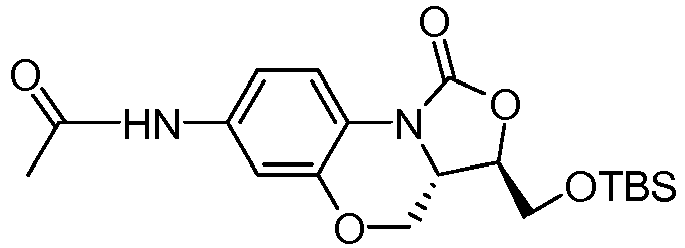
- Using compound A (the same as in Example 1) (1g, 2.42mmol), acetamide (0.214g,3.62mmol), cesium carbonate (1.967g, 6.04mmol), Pd2(dba)3 (0.155g,0.169mmol), and Xantphos (0.14g,0.242mmol) as starting materials, preparation following the method as described in Example 1 (a) afforded white solid 0.687g, yield: 72.56%.
- 1H NMR (400 MHz, CDCl3) δ 7.88 (d, J = 8.7 Hz, 1H), 7.42 (d, J = 2.3 Hz, 1H), 7.24 (s, 1H), 6.88 (dd, J = 8.8, 2.3 Hz, 1H), 4.44 (dd, J = 10.5,3.2 Hz, 1H), 4.27 (td, J = 6.0, 4.1 Hz, 1H), 4.09 (ddd, J = 9.8, 6.5,3.1 Hz, 1H),3.98-3.83 (m,3H), 2.16 (s,3H), 0.89 (d, J = 2.9 Hz, 9H), 0.10 (d, J = 2.6 Hz, 6H).MS(EI) m/z :(M+,392).
-

- Compound N-((3R,3aS)-3-(((t-butyldimethylsilyl) oxy)methyl)-1-oxo-1,3,3a,4-tetrahydrobenzo[b]oxazolo[3,4-d][1,4]oxazin-7-yl)-acetamide (0.685g, 1.747mmol) was dissolved in 20ml of THF and cooled on ice-salt bath. 60% NaH (0.14g, 3.495mmol) was added. The ice bath was removed, and the reaction mixture was stirred at room temperature for 30min, and then cooled on ice-salt bath. Iodomethane (0.496g, 3.495mmol) was added slowly in dropwise. The ice bath was removed, and the reaction mixture was stirred at room temperature for 3h. TLC (PE/EA=1/1) was employed to monitor the reaction. After the reaction completed, the reaction was quenched by adding 10ml of water and then extracted with EA (10ml×3). The organic phase was combined, dried over anhydrous sodium sulfate, and the solvent was evaporated. Column chromatography (PE/EA=3/1) afforded white solid 0.618g, yield: 87.11%.
- 1H NMR (400 MHz, CDCl3) δ 8.02 (d, J = 8.5 Hz, 1H), 6.84 (dd, J = 8.6, 2.3 Hz, 1H), 6.79 (d, J = 2.1 Hz, 1H), 4.49 (dd, J = 10.5,3.2 Hz, 1H), 4.30 (dd, J = 10.1, 5.8 Hz, 1H), 4.13 (ddd, J = 9.8, 6.5,3.3 Hz, 1H),3.98-3.85 (m,3H),3.22 (s,3H), 1.89 (s,3H), 0.90 (s, 9H), 0.11 (d, J = 2.3 Hz, 6H).MS(EI) m/z :(M+,406).
-

- Using N-((3R,3aS)-3-(((t-butyldimethylsilyl) oxy)methyl)-1-oxo-1,3,3a,4-tetrahydrobenzo[b]oxazolo[3,4-d][1,4]oxazin-7-yl)-N-methylaceta mide (0.617g, 1.52mmol), and TBAF(1M, 2ml) as starting materials, preparation following the method as described in Example 1 (b) afforded white solid 0.384g, yield: 86.53%.
- 1H NMR (300 MHz, DMSO-d6) δ 7.87 (d, J = 8.5 Hz, 1H), 7.05-6.91 (m, 2H), 5.32 (t, J = 5.7 Hz, 1H), 4.62-4.50 (m, 1H), 4.45 (d, J = 4.8 Hz, 1H), 4.05 (d, J = 5.9 Hz, 2H),3.82-3.62 (m, 2H),3.10 (s,3H), 1.77 (s,3H). MS(EI) m/z :(M+,292).
-

- Using compound N-((3R,3aS)-3-(hydroxymethyl)-1-oxo-1,3,3a,4-tetrahydrobenzo[b]oxazolo[3,4-d][1,4]oxazin-7 -yl)-N-methylacetamide(0.384g,1.315mmol), methylsulfonyl chloride (0.181g, 1.578mmol), and TEA(0.266g, 2.63mmol) as starting materials, preparation following the method as described in Example 1 (c) afforded white solid 0.45g, yield 92.48%.
- 1H NMR (300 MHz, CDCl3) δ 8.01 (d, J = 8.6 Hz, 1H), 6.90-6.81 (m, 2H), 4.61-4.53 (m, 4H), 4.16 (s, 1H),3.95 (t, J = 10.3 Hz, 1H),3.23 (s,3H),3.15 (s,3H), 1.90 (s,3H).MS(EI) m/z :(M+,370).
-

- Using compound methyl ((3R,3aS)-7-(N-methylacetamide)-1-oxo-1,3,3a,4-tetrahydrobenzo[b]oxazolo[3,4-d][1,4]oxazin -3-yl) methanesulfonate (0.45g, 1.216mmol), and phthalimide potassium (0.338g, 1.824mmol) as starting materials, preparation following the method as described in Example 1 (d) afforded white solid 0.4g, yield: 78.13%.
- 1H NMR (300 MHz, DMSO-d6) δ 7.91 (ddd, J = 17.8, 10.0, 7.3 Hz, 5H), 7.09-6.91 (m, 2H), 4.70 (dd, J = 18.5, 8.4 Hz, 2H), 4.21 (s, 1H), 4.09 (dd, J = 18.0, 7.4 Hz,3H),3.11 (s,3H), 1.79 (s,3H).MS(EI) m/z :(M+,421).
-

- Using compound N-((3S,3aS)-3-((1,3-dioxo-isoindolin-2-yl)methyl)-1-oxo-1,3,3a,4-tetrahydrobenzo[b]oxazolo[3 ,4-d][1,4]oxazin-7-yl)-N-methylacetamide (0.4g, 0.95mmol), and 10ml of methylamine alcohol solution as starting materials, preparation following the method as described in Example 1 (e) afforded a crude product, which was directly subjected to the next step of reaction.
-

- Using the crude N-((3S,3aS)-3-(aminomethyl)-1-oxo-1,3,3a,4-tetrahydrobenzo[b]oxazolo[3,4-d][1,4]oxazin-7-y l)-N-methylacetamide prepared above and 5-chlorothiophene-2-formyl chloride (0.206g, 1.14mmol) as starting materials, preparation following the method as described in Example 1 (f) afforded compound 0.316g, yield: 76.33% (two steps together).
- 1H NMR (300 MHz, DMSO-d6) δ 7.91 (ddd, J = 17.8, 10.0, 7.3 Hz, 5H), 7.09-6.91 (m, 2H), 4.70 (dd, J = 18.5, 8.4 Hz, 2H), 4.21 (s, 1H), 4.09 (dd, J = 18.0, 7.4 Hz,3H),3.11 (s,3H), 1.79 (s,3H).MS(EI) m/z :(M+,435).
-

- 2,4-piperidinedione (1.0g, 8.84mmol) was dissolved in MeOH. NaBH4 (0.5g, 13.26mmol) was added at 0°C, stirred at 0°C for 30min, and the reaction mixture was then placed at room temperature and stirred for 1h. TLC (DCM/MeOH) was employed to monitor the reaction. After the reaction completed, it was quenched by adding water and dried by spinning. Column chromatography afforded white solid powder 0.8g, yield 80.0%.
- 1H NMR (400 MHz, DMSO-d6) δ 7.52-7.28 (s, 1H), 5.06-4.78 (d, J = 3.5 Hz, 1H), 4.03-3.78 (dp, J = 7.2,3.9,3.3 Hz, 1H),3.28-3.14 (m, 1H),3.09-2.91 (dtt, J = 7.4, 5.2, 2.2 Hz, 1H), 2.42-2.25 (dd, J = 17.1,4.7 Hz, 1H), 2.13-1.93 (dd, J = 17.1, 6.1 Hz, 1H), 1.83-1.66 (ddt, J = 12.7, 7.9,3.6 Hz, 1H), 1.69-1.47 (dt, J = 13.2, 6.4 Hz, 1H).MS(ESI) m/z :[(M+1)+,117.1],
-

- (±) 4-hydroxypiperidin-2-one (0.80g, 6.94mmol) was dissolved in DMF. DMAP (0.085g, 0.694mmol) and imidazole (0.92g, 13.88mmol) were added. After the resulting mixture was stirred evenly, the solution of TBDPS-Cl (2.3g, 8.33mmol) in THF was added and stirred at room temperature overnight. After the reaction completed, the reaction mixture was dried by spinning. Column chromatography afforded colorless oily liquid 0.65g, yield 60%.
- 1H NMR (300 MHz, CDCl3) δ 7.70-7.49 (m, 4H), 7.53-7.30 (m, 6H), 4.24-4.09 (dt, J = 8.9,3.0 Hz, 1H),3.62-3.49 (dt, J = 13.0, 6.7 Hz, 1H),3.20-3.08 (dtd, J = 11.7, 5.6, 2.3 Hz, 1H), 2.51-2.35 (d, J = 4.8 Hz, 2H),1.83-1.69(m,2H), 1.17-1.00 (s,9H).MS(ESI) m/z :[(M+1)+,158.3]
-

- Using compound A (the same as in Example 1) (0.91g, 2.21mmol), (±) 4-(t-butyldiphenylsiloxy) piperidin-2-one (0.65g, 1.84mmol), cesium carbonate (1.50g, 4.60mmol), Pd2(dba)3 (0.12g,0.129mmol), and Xantphos(0.106g,0.184mmol) as starting materials, 1,4-dioxane as solvent, preparation following the method as described in Example 1 (a) afforded golden solid 0.78g, yield 61.4%.
- 1H NMR (300 MHz, CDCl3) δ 8.05-7.99 (m, 1H), 7.72-7.63 (ddt, J = 8.1, 6.3, 1.7 Hz, 4H), 7.49-7.35 (m, 6H), 6.92-6.89 (m, 1H), 6.89-6.86 (t, J = 1.8 Hz, 1H),3.48-3.37 (m, 1H), 0.92-0.89 (m, 9H), 0.16-0.06 (m, 6H), 4.51-4.39 (ddd, J = 10.3,3.1, 1.4 Hz, 1H), 4.33-4.20 (m, 2H), 4.17-4.05 (ddt, J = 8.1, 5.1, 1.5 Hz, 1H),3.94-3.90 (dd, J = 4.7, 1.7 Hz, 2H),3.87-3.81 (m, 1H), 2.67-2.54 (d, J = 4.6 Hz, 2H), 1.97-1.85 (m, 2H), 1.12-1.06 (d, J = 1.6 Hz, 9H).MS(ESI) m/z :[(M+1)+,687.4],
-

- Compound (3R,3aS)-3-((t-butyldimethylsiloxy)methyl)-7-((R)-4-(t-butyldiphenylsiloxy)-2-oxopiperidin-1-yl)-3a,4-dihydrobenzo[b]oxazolo[3,4-d][1,4]oxazin-1(3H)-one (0.78g, 1.135mmol) was dissolved in THF. A solution of BCl3 in dichloromethane (1M, 6.81ml, 6.81mmol) was added, stirred at room temperature for 24h, and dried by spinning. Column chromatography afforded pale yellow solid 0.56g, yield 86.0%.
- 1H NMR (300 MHz, CDCl3) δ 8.06-8.00 (d, J = 8.3 Hz, 1H), 7.73-7.60 (ddd, J = 8.0, 4.9, 1.7 Hz, 4H), 7.50-7.35 (ddd, J = 12.5, 8.4, 6.6 Hz, 6H), 6.91-6.84 (m, 2H), 4.51-4.44 (dd, J = 10.5,3.1 Hz, 1H), 4.37-4.30 (dt, J = 8.1,4.0 Hz, 1H), 4.30-4.23 (m, 1H), 4.19-4.09 (ddd, J = 10.1, 6.8,3.1 Hz, 1H), 4.00-3.93 (m, 1H),3.93-3.88 (m, 1H),3.88-3.81 (m, 2H),3.47-3.37 (dt, J = 11.1, 5.1 Hz, 1H), 2.67-2.56 (d, J = 4.7 Hz, 2H), 1.95-1.87 (q, J = 5.7, 5.2 Hz, 2H), 1.13-0.98 (s, 9H). MS(ESI) m/z :[(M+1)+,573.2],
-

- Using compound (3R,3aS)-7-((R)-4-(t-butyldiphenylsiloxy)-2-oxopiperidin-1-yl)-3-(hydroxymethyl)-3a,4-dihydr obenzo[b]oxazolo[3,4-d][1,4]oxazin-1(3H)-one (0.56g, 1.002mmol), MsCl (0.14g,1.203mmol), and Et3N (0.20g,2.004mmol) as starting materials, DCM as solvent, preparation following the method as described in Example 1 (c) afforded white solid 0.61g, yield 96.2%.
- 1H NMR (300 MHz, CDCl3) δ 8.13-7.85 (d, J = 9.3 Hz, 1H), 7.79-7.58 (ddd, J = 7.9, 5.0, 1.7 Hz, 4H), 7.55-7.31 (dq, J = 8.3, 6.6 Hz, 6H), 7.02-6.78 (m, 2H), 4.69-4.44 (m,4H), 4.34-4.19 (s, 1H), 4.13-4.01 (s, 1H),3.97-3.84 (m, 2H),3.49-3.35 (m, 1H),3.18-3.05 (s,3H), 2.71-2.55 (d, J = 4.8 Hz,2H), 2.11-1.84 (d, J = 5.3 Hz, 2H), 1.20-0.98 (s, 9H).MS(ESI) m/z :[(M+1)+, 651.4].
-

- Using compound ((3R,3aS)-7-((R)-4-(t-butyldiphenylsiloxy)-2-oxopiperidin-1-yl)-1-oxo-1,3,3a,4-tetrahydrobenz o[b]oxazolo[3,4-d][1,4]oxazin-3-yl)methyl-methanesulfonate (0.61g, 1.342mmol), and phthalimide potassium (0.37g, 2.013mmol) as starting materials, DMF as solvent, preparation following the method as described in Example 1 (d) afforded white solid 0.38g, yield 58.7%.
- 1H NMR (400 MHz, CDCl3) δ 8.00-7.93 (m, 1H), 7.93-7.84 (m, 2H), 7.81-7.73 (dd, J = 5.5,3.0 Hz, 2H), 7.71-7.63 (tt, J = 6.6, 1.5 Hz, 4H), 7.55-7.35 (m, 6H), 6.89-6.87 (m, 1H), 6.87-6.85 (s, 1H), 4.69-4.59 (td, J = 6.6, 5.1 Hz, 1H), 4.51-4.42 (dd, J = 10.6,3.1 Hz, 1H), 4.29-4.24 (dt, J = 5.8, 2.6 Hz, 1H), 4.24-4.18 (t, J = 7.1 Hz, 1H), 2.67-2.52 (d, J = 4.4 Hz, 2H), 1.13-1.02 (s, 9H), 1.94-1.83 (m, 2H), 4.11-3.99 (m, 2H),3.94-3.77 (m, 2H),3.45-3.36 (dt, J = 12.1, 5.2 Hz, 1H).MS(ESI) m/z :[(M+1)+, 702.5].
-

- Using compound 2-(((3S,3aS)-7-((R)-4-(t-butyldiphenylsiloxy)-2-oxopiperidin-1-yl)-1-oxo-1,3,3a,4-tetrahydrobe nzo[b]oxazolo[3,4-d][1,4]oxazin-3-yl)methyl)-isoindolin-1,3-dione (0.38g, 0.541mmol), and methylamine alcohol solution (0.034g, 1.083mmol) as starting materials, ethanol as solvent, preparation following the method as described in Example 1 (e) afforded white solid 0.24g, yield 77.7%.
-

- Using compound (3S,3aS)-3-(aminomethyl)-7-((R)-4-(t-butyldiphenylsiloxy)-2-oxopiperidin-1-yl)-3,3a,4-dihydr obenzo[b]oxazolo[3,4-d][1,4]oxazin-1 (3H)-one (0.24g, 0.420mmol), 5-chlorothiophene-2-carboxylic acid (0.10g, 0.630mmol), HATU (0.32g, 0.840mmol), and Et3N (0.13g, 1.260mmol) as starting materials, DCM as solvent, preparation following the method as described in Example 11 (g) afforded white solid 0.36g, yield 70.6%.
- 1H NMR (400 MHz, CDCl3) δ 8.07-7.90 (d, J = 8.2 Hz, 1H), 7.76-7.61(ddd, J = 7.8, 6.1, 1.6 Hz, 4H), 7.49-7.44(d, J = 2.4 Hz, 1H), 7.44-7.34 (m, 5H), 7.16-7.06 (s, 1H), 6.88-6.84 (m,3H), 4.51-4.40 (m, 2H), 4.30-4.24 (s, 1H), 4.0-3.93 (s, 1H),3.90-3.80 (m, 2H),3.80-3.68 (s, 2H),3.46-3.37 (d, J = 11.2 Hz, 1H), 2.62-2.57 (d, J = 4.3 Hz, 2H), 1.94-1.88 (s,2H), 1.11-1.06 (s, 9H). MS(ESI) m/z :[(M+1)+, 716.3].
-

- Compound N-(((3S,3aS)-7-((R)-4-(t-butyldiphenylsiloxy)-2-oxopiperidin-1-yl)-1-oxo-1,3,3a,4-tetrahydrob enzo[b]oxazolo[3,4-d][1,4]oxazin-3-yl)methyl)-5-chlorothiophene-2-carboxamide (0.36g, 0.502mmol) was dissolved in THF. TBAF (1M/L,0.50ml) was added and stirred at room temperature for 2h. After the reaction compeleted, the resulting mixture was washed with water, extracted with EA (20ml×4), dried over anhydrous sodium sulfate, and dried by spinning. Column chromatography afforded white solid 0.13g, yield 56.2%.
- 1H NMR (300 MHz, DMSO-d6) δ 9.11-8.92 (d, J = 5.8 Hz, 1H), 7.86-7.77 (d, J = 8.8 Hz, 1H), 7.74-7.69 (d, J = 4.1 Hz, 1H), 7.26-7.19 (d, J = 4.0 Hz, 1H), 6.93-6.88 (s, 2H), 5.09-5.05 (d, J = 3.9 Hz, 1H), 4.64-4.56 (d, J = 7.2 Hz, 2H), 4.57-4.51 (d, J = 10.8 Hz, 2H), 4.16-4.05 (d, J = 6.1 Hz,3H), 4.04-3.98 (s, 1H),3.76-3.68 (d, J = 6.1 Hz, 2H),3.68-3.60 (s, 1H),3.55-3.42 (t, J = 6.0 Hz, 1H), 2.66-2.54 (m, 1H), 2.34-2.20 (dd, J = 17.0, 6.0 Hz, 1H), 2.08-1.90 (d, J = 8.9 Hz, 2H).MS(ESI) m/z :[(M+23)+, 500.4].
-

- The starting materials were the same with that of Example 31. In step (c) of Example 31, column chromatography was used to separate another configuration of compound (3R,3aS)-3-((t-butyldimethylsiloxy)methyl)-7-((S)-4-(t-butyldiphenylsiloxy)-2-oxopiperidin-1-yl)-3a,4-dihydrobenzo[b]oxazolo[3,4-d][1,4]oxazin-1 (3H)-one. Then preparation following the method as described in Example 31 (d-i) afforded compound 31.
- 1H NMR (300 MHz, DMSO-d6) δ 9.05-8.93 (t, J = 5.9 Hz, 1H), 7.87-7.77 (d, J = 9.0 Hz, 1H), 7.77 -7.67 (d, J = 4.1 Hz, 1H), 7.25-7.17 (d, J = 4.0 Hz, 1H), 6.92 - 6.83 (m, 2H), 5.12 - 5.01 (d, J = 3.6 Hz, 1H), 4.64 - 4.55 (dd, J = 14.5, 7.4 Hz, 2H),3.21 - 3.10 (m, 1H), 4.13 - 3.97 (t, J = 6.2 Hz,3H),3.81 - 3.67 (m, 1H),3.55 - 3.40 (dd, J = 11.5, 5.4 Hz, 1H), 2.64 - 2.54 (m, 1H), 2.36 - 2.19 (dd, J = 17.0, 6.0 Hz, 1H), 2.08 - 1.92 (s, 1H). MS(EI) m/z :[M+, 477].
-

- Compound 31 (50mg, 0.105mmol) was dissolved in DCM and cooled on ice bath. A solution of DAST in DCM (34mg, 0.210mmol) was added under the protection of Ar and stirred at room temperature for 2h. After the reaction completed, the resulting mixture was dried by spinning. Column chromatography afforded white solid 43mg, yield 85.0%.
- 1H NMR (400 MHz, DMSO-d6) δ 9.08-8.88 (t, J = 5.7 Hz, 1H), 7.91-7.78 (d, J = 8.6 Hz, 1H), 7.75-7.66 (d, J = 3.9 Hz, 1H), 7.25-7.18 (d, J = 3.9 Hz, 1H), 6.96-6.78 (m, 1H), 5.29-5.08 (s, 0H), 4.63-4.42 (m, 2H), 4.12-3.95 (t, J = 7.2 Hz, 2H),3.80-3.66 (t, J = 5.6 Hz,3H),3.60-3.44 (m, 1H), 2.91-2.74 (m, 1H), 2.67-2.53 (m, 1H), 2.20-2.09 (d, J = 6.4 Hz, 1H), 2.05-1.91 (t, J = 7.1 Hz, 1H). MS(ESI) m/z :[(M-1)+, 477.8].
-

- Compound 32 (50mg, 0.105mmol) was dissolved in DCM and cooled on ice bath. A solution of DAST in DCM (34mg, 0.210mmol) was added under the protection of Ar and stirred at room temperature for 2h. After the reaction completed, the resulting mixture was dried by spinning. Column chromatography afforded white solid 40mg, yield 79.1 %.
- 1H NMR (400 MHz, DMSO-d6) δ 9.08-8.88 (t, J = 5.7 Hz, 1H), 7.91-7.78 (d, J = 8.6 Hz, 1H), 7.75-7.66 (d, J = 3.9 Hz, 1H), 7.25-7.18 (d, J = 3.9 Hz, 1H), 6.96-6.78 (m, 1H), 5.29 - 5.08 (s, 0H), 4.63 - 4.42 (m, 2H), 4.12 - 3.95 (t, J = 7.2 Hz, 2H),3.80-3.66 (t, J = 5.6 Hz,3H),3.60-3.44 (m, 1H), 2.91-2.74 (m, 1H), 2.67-2.53 (m, 1H), 2.20-2.09 (d, J = 6.4 Hz, 1H), 2.05-1.91 (t, J = 7.1 Hz, 1H). MS(ESI) m/z :[(M-1)+, 477.9].
-

- Using compound B

- 1H NMR (400 MHz, DMSO-d6) δ 8.99 (t, J = 5.8 Hz, 1H), 7.81 (d, J = 8.7 Hz, 1H), 7.71 (d, J = 4.1 Hz, 1H), 7.24-7.14 (m,3H), 4.64-4.51 (m, 2H), 4.13-4.01 (m, 2H),3.71 (dd, J = 8.2,3.7 Hz, 2H). MS(EI) m/z :(M+,444).
-

- Compound N-(((3S,3aS)-7-bromo-1-oxo-1,3,3a,4-tetrahydrobenzo[b]oxazolo[3,4-d][1,4]oxazin-3-yl)methy l)thiophene-2-carboxamide (153mg, 0.345mmol) was dissolved in 20ml of DMSO. Bis(pinacolato)diboron (132mg, 0.517mmol) and potassium acetate (102mg, 1.035mmol) were added. Under protection of Ar, Pd2 (dppf) CH2Cl2 (29mg, 0.034mmol) was added and the mixture was allowed to react at 80°C for 1h. TLC (PE/EA=1/1) was employed to monitor the reaction. After the reaction completed, the resulting mixture was diluted by adding EA (50ml), and then washed with water and saturated saline solution, filtered under reduced pressure, and dried by spinning. Column chromatography (PE/EA=2/1) afforded off-white solid 64mg, yield: 37.8%.
- 1H NMR (400 MHz, CDCl3) δ 7.99 (d, J = 8.1 Hz, 1H), 7.44-7.36 (m, 2H), 7.30 (d, J = 4.0 Hz, 1H), 6.91 (d, J = 4.0 Hz, 1H), 6.46 (t, J = 6.2 Hz, 1H), 4.55 (dd, J = 10.5,3.0 Hz, 1H), 4.51-4.44 (m, 1H), 4.05-3.98 (m, 1H),3.94 (ddd, J = 14.8, 6.4,3.1 Hz, 1H),3.88 (dd, J = 16.9, 6.6 Hz, 1H),3.79 (dt, J = 14.9, 6.2 Hz, 1H), 1.32 (s, 12H). MS(EI) m/z :(M+,490).
-
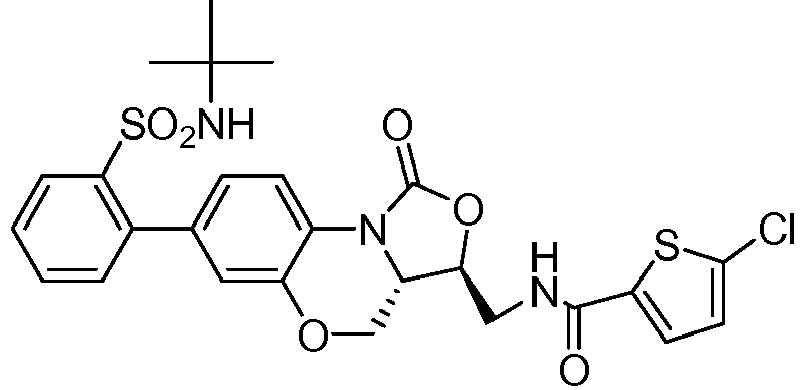
- Compound 5-chloro-N-(((3S,3aS)-1-oxo-7-(4,4,5,5-tetramethyl-1,3, 2-dioxaborolan-2-yl)-1,3,3a,4-tetrahydrobenzo[b]oxazolo[3,4-d][1,4]oxazin-3-yl)methyl)thioph ene-2-carboxamide (60mg, 0.122mmol) and N-t-butyl-o-bromobenzenesulfonamide (43mg, 0.147mmol) were dissolved in a mixed solvent of dioxane (5ml) and water (0.5ml). Cesium carbonate (80mg, 0.245mmol) was added, and tetrakis (triphenylphosphine) palladium (15mg, 0.012mmol) was added under the protection of Ar. The resulting mixture was allowed to react under agitation at 80°C overnight. TLC (PE/EA=1/1) was employed to monitor the reaction. After the reaction completed, the mixture was filtered under reduced pressure, and the solvent was evaporated. Column chromatography (PE/EA=2/1) afforded off-white solid 25mg, yield: 35.2%.
- 1H NMR (300 MHz, CDCl3) δ 8.15 (d, J = 6.6 Hz, 1H), 8.06 (d, J = 8.3 Hz, 1H), 7.72-7.67 (m, 1H), 7.48 (dd, J = 7.6,3.2 Hz,3H), 7.35 (d, J = 4.0 Hz, 1H), 7.15-7.06 (m, 2H), 6.93 (d, J = 4.0 Hz, 1H), 6.59 (s, 1H), 4.59 (dd, J = 10.4, 2.9 Hz, 1H), 4.56-4.48 (m, 1H), 4.12-4.02 (m, 1H), 4.01-3.78 (m,3H), 1.05 (s, 9H). MS(EI) m/z :(M+,575).
-
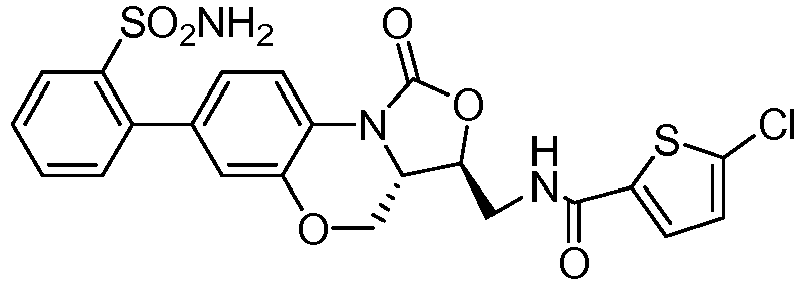
- Compound 5-chloro-N-(((3S,3aS)-1-oxo-7-(2-t-butylaminosulfonylphenyl)-1,3,3a,4-tetrahydrobenzo[b]oxa zolo[3,4-d][1,4]oxazin-3-yl)methyl)thiophene-2-carboxamide (124mg, 0.215mmol) was dissolved in 2ml of TFA. The resulting mixture was heated to 40°Cand agitated for 2h. TLC (PE/EA=1/1) was employed to monitor the reaction. After the reaction completed, TFA was evaporated, and the remainder was diluted by 20ml of EA, washed with 8ml of water and 8ml of saturated saline solution for one time each, dried over anhydrous sodium sulfate, and the solvent was evaporated. Column chromatography (PE/EA=2/1) afforded 91mg of white solid, yield: 81.22%.
- 1H NMR (300 MHz, DMSO-d6) δ 9.03 (t, J = 5.5 Hz, 1H), 8.01 (d, J = 7.6 Hz, 1H), 7.87 (d, J = 8.6 Hz, 1H), 7.73 (d, J = 4.1 Hz, 1H), 7.64-7.52 (m, 2H), 7.30 (d, J = 7.3 Hz, 1H), 7.27-7.18 (m,3H), 7.00 (d, J = 7.5 Hz, 2H), 4.60 (dd, J = 16.6, 6.9 Hz, 2H), 4.20-4.01 (m, 2H),3.75 (d, J = 5.0 Hz, 2H). MS(EI) m/z :(M+,519).
- Example 36, Preparation of 5-chloro-N-(((3S,3aS)-7-(2-(methylsulfonyl) phenyl)-1-oxo-1,3,3a,4-tetrahydrobenzo[b]oxazolo[3,4-d][1,4]oxazin-3-yl)methyl)thiophen e-2-carboxamide(compound 36)


- Using compound 5-chloro-N-(((3S,3aS)-1-oxo-7-(4,4,5,5-tetramethyl-1,3, 2-dioxaborolan-2-yl)-1,3,3a,4-tetrahydrobenzo[b]oxazolo[3,4-d][1,4]oxazin-3-yl)methyl)thioph ene-2-carboxamide (the product of step (b) in Example 35) (50mg, 0.102mmol), o-methylsulfonylbromobenzene (29mg, 0.122mmol), tetrakis (triphenylphosphine) palladium (12mg, 0.010mmol), and cesium carbonate (66mg, 0.204mmol) as starting materials, preparation following the method as described in Example 35 (c) afforded off-white solid 19mg, yield: 35.2%.
- 1H-NMR (400 MHz, DMSO-d6) δ 9.01 (t, J = 5.8 Hz, 1H), 8.08 (dd, J = 7.9, 1.2 Hz, 1H), 7.93 (d, J = 8.2 Hz, 1H), 7.80-7.70 (m, 2H), 7.70-7.63 (m, 1H), 7.39 (dd, J = 7.5, 1.2 Hz, 1H), 7.22 (d, J = 4.0 Hz, 1H), 7.07-6.99 (m, 2H), 4.67-4.54 (m, 2H), 4.19-4.06 (m, 2H),3.73 (d, J = 5.6 Hz, 2H), 2.86 (s,3H).MS(EI) m/z :(M+,518).
-
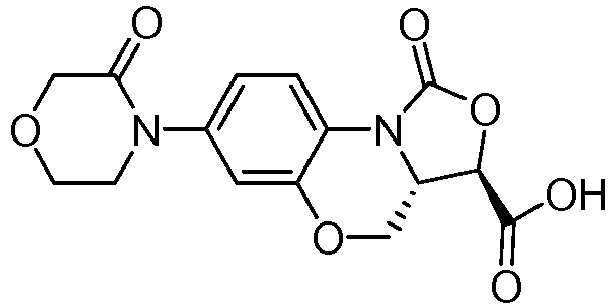
- Compound (3R,3aS)-3-(hydroxymethyl)-7-(3-oxomorpholin-4-yl)-3a,4-dihydrobenzo[b]oxazolo[3,4-d][1,4 ]oxazin-1(3H)-one (the product of step (b) in Example 1) (0.38g, 1.188mmol) was dissolved in 15ml of DMSO and cooled on ice bath, to which was added DMP (0.856g, 2.019mmol). The resulting mixture was stirred at room temperature for 1h. TLC (DCM/MeOH=10/1) was employed to monitor the reaction. After the reaction completed, it was quenched by adding 10ml of aqueous saturated solution of sodium thiosulfate, diluted by 10ml of water, and extracted with DCM (10ml×3). The organic phase was combined, and washed with a saturated solution of sodium bicarbonate and a saturated solution of sodium chloride, respectively, and then it was dried over anhydrous sodium sulfate, and the solvent was evaporated. The resulting crude product was directly subjected to the next step of reaction.
- The crude product prepared above was dissolved in 10ml of acetonitrile. NaH2PO4 (37mg, 0.309mmol, dissolved in 0.15ml of water), sodium chlorite (0.151g, 1.664mmol, dissolved in 0.3ml of water), and hydrogen peroxide (0.15ml) were added, and stirred at room temperature overnight. TLC (DCM/MeOH=5/1) was employed to monitor the reaction. After the reaction completed, the pH value was adjusted to 10 with 10% aqueous solution of NaOH. The reaction mixture was wash with EA (10ml×3). The pH value of the aqueous phase was adjusted to 3 with 1M aqueous solution of hydrochloric acid. The mixture was then extracted with EA (15ml×5), dried over anhydrous sodium sulfate, and the solvent was evaporated to afford white solid 173mg, two-step yield: 43.6%.
- 1H NMR (300 MHz, DMSO-d6) δ 7.82 (d, J = 8.6 Hz, 1H), 7.09-7.00 (m, 2H), 5.02 (d, J = 6.9 Hz, 1H), 4.57 (dd, J = 10.6,3.3 Hz, 1H), 4.36 (ddd, J = 10.1, 6.9,3.3 Hz, 1H), 4.18 (s, 2H), 4.12 (t, J = 10.3 Hz, 1H),3.95 (dd, J = 6.2,3.9 Hz, 2H),3.73-3.66 (m, 2H).MS(EI) m/z :(M+,334).
-

- Using compound (3R,3aS)-1-oxo-7-(3-oxomorpholin-4-yl)-1,3,3a,4-tetrahydrobenzo[b]oxazolo[3,4-d][1,4]oxazi n-3-carboxylic acid (90mg, 0.269mmol), 5-chlorothiophene-2-amine hydrochloride (55mg, 0.323mmol), HATU (154mg, 0.404mmol), and TEA (95.3mg, 0.943mmol) as starting materials, preparation following the method as described in Example 11 (g) afforded white solid 73mg, yield: 60.34%.
- 1H NMR (300 MHz, DMSO-d6) δ 11.97 (s, 1H), 7.87 (d, J = 8.6 Hz, 1H), 7.10 (d, J = 2.1 Hz, 1H), 7.06 (dd, J = 8.6, 2.3 Hz, 1H), 6.95 (d, J = 4.2 Hz, 1H), 6.77 (d, J = 4.2 Hz, 1H), 5.15 (d, J = 6.9 Hz, 1H), 4.64 (dd, J = 10.6,3.2 Hz, 1H), 4.49-4.34 (m, 1H), 4.30-4.13 (m,3H), 4.04-3.91 (m, 2H),3.80-3.65 (m, 2H). MS(EI) m/z :(M+,449).
-

- Using compound (3R,3aS)-1-oxo-7-(3-oxomorpholin-4-yl)-1,3,3a,4-tetrahydrobenzo[b]oxazolo[3,4-d][1,4]oxazi n-3-carboxylic acid (the product of step (b) in Example 36) (90mg, 0.24mmol), 5-chloropyridine-2-amine (37mg, 0.287mmol), HATU (137mg, 0.36mmol), and TEA (48.4mg, 0.48mmol) as starting materials, preparation following the method as described in Example 11 (g) afforded white solid 56mg, yield: 52.65%.
- 1H NMR (3400 MHz, CDCl3) δ 8.86 (s, 1H), 8.31 (d, J = 2.2 Hz, 1H), 8.18 (d, J = 8.9 Hz, 1H), 8.04 (d, J = 8.7 Hz, 1H), 7.73 (dd, J = 8.8, 2.5 Hz, 1H), 7.06-6.97 (m, 2H), 4.81-4.72 (m, 2H), 4.40 4.29 (m,3H), 4.06-3.96 (m,3H),3.77-3.71 (m, 2H). MS(EI) m/z :(M+,444).
-
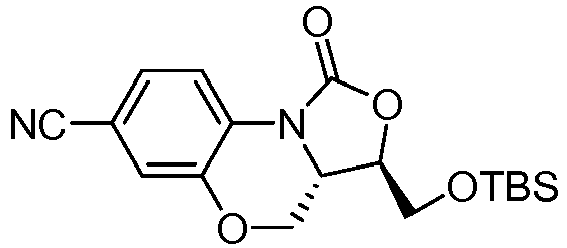
- Compound A (1g, 2.42mmol) was dissolved in 20ml of anhydrous NMP. Sodium carbonate (0.256g, 2.42mmol) was added. Under the protection of argon, Pd(OAc)2(54mg, 0.242mmol) and KFe(CN)6·3H2O (0.816g, 1.93mmol) were added, and the mixture was allowed to react at 140°C for 1.5h. TLC(PE/EA=10/1) was employed to monitor the reaction. The reaction liquid was cooled to room temperature. 20ml of water was added, and the resulting mixture was extracted with EA (15ml×3). The organic phase was combined and dried over anhydrous sodium sulfate. The solvent was removed by evaporation to give a crude product, which through column chromatography(PE/EA=8/1) afforded white solid 0.271g, yield 31.2%.
- 1H NMR (400 MHz, CDCl3) δ8.18 (d, J = 8.5 Hz, 1H), 7.32 (dd, J = 8.5, 1.8 Hz, 1H), 7.27 (d, J = 1.6 Hz, 1H), 4.55 (dd, J = 10.6,3.3 Hz, 1H), 4.35 (ddd, J = 7.0, 5.5,3.9 Hz, 1H), 4.19 (ddd, J = 10.2, 7.0,3.3 Hz, 1H), 4.02-3.89 (m,3H), 0.92 (s, 9H), 0.14 (d, J = 2.1 Hz, 6H). MS(EI) m/z :(M+,360).
-

- Using compound (3R,3aS)-3-((t-butyldimethylsiloxy)methyl)-1-oxo-l,3,3a,4-tetrahydrobenzo[b]oxazolo[3,4-d][1 ,4]oxazin-7-carbonitrile (0.538g, 1.494mmol), tetra-n-butylammonium fluoride (1M, 2.99ml) as starting materials, preparation following the method as described in Example 1(b) afforded 0.24g white solid , yield 65.3%.
- 1H NMR (400 MHz, DMSO-d6)δ8.06 (d, J = 8.5 Hz, 1H), 7.52 (d, J = 1.8 Hz, 1H), 7.46 (dd, J = 8.5, 1.9 Hz, 1H), 5.34 (t, J = 5.7 Hz, 1H), 4.66-4.56 (m, 1H), 4.50 (dd, J = 9.4, 4.0 Hz, 1H), 4.14-4.07 (m, 2H),3.73 (dddd, J = 12.4, 10.1, 5.7,3.9 Hz, 2H). MS(EI) m/z :(M+,246).
-

- Using compound (3R,3aS)-3-(hydroxymethyl)-1-oxo-1,3,3a,4-tetrahydrobenzo[b]oxazolo[3,4-d][1,4]oxazin-7-ca rbonitrile (0.255g, 0.98mmol), methylsulfonyl chloride (0.168g, 1.46mmol), and TEA (0.197g, 1.95mmol) as starting materials, preparation following the method as described in Example 1(c) afforded white solid 0.314g, yield: 93.5%.
- 1H NMR (400 MHz, DMSO-d6)δ8.05 (d, J = 8.5 Hz, 1H), 7.54 (d, J = 1.6 Hz, 1H), 7.48 (dd, J = 8.5, 1.8 Hz, 1H), 4.82 (s, 1H), 4.70-4.55 (m,3H), 4.17-4.09 (m, 2H),3.29 (s,3H). MS(EI) m/z :(M+,324).
-

- Using compound ((3R,3aS)-7-cyano-1-oxo-1,3,3a,4-tetrahydrobenzo[b]oxazolo[3,4-d][1,4]oxazin-3-yl)methylme thanesulfonate (0.31g, 0.957mmol) and phthalimide potassium (0.266g, 1.435mmol) as starting materials, preparation following the method as described in Example 1(d) afforded white solid 0.286g, yield: 79.71%.
- 1H NMR (400 MHz, DMSO-d6) δ8.04 (d, J = 8.5 Hz, 1H), 7.91 (dt, J = 6.6,3.5 Hz, 2H), 7.87 (dt, J = 5.1,3.5 Hz, 2H), 7.51 (d, J = 1.8 Hz, 1H), 7.45 (dd, J = 8.5, 1.9 Hz, 1H), 4.78-4.68 (m, 2H), 4.28-4.22 (m, 1H), 4.15-4.08 (m,3H). MS(EI) m/z :(M+,375).
-

- Using (3S,3aS)-3-((1,3-dioxoisoindolin-2-yl)methyl)-1-oxo-1,3,3a,4-tetrahydrobenzo[b]oxazolo[3,4-d ][1,4]oxazin-7-carbonitrile (0.286g, 0.763mmol) and 1ml of methylamine alcohol solution as starting materials, preparation following the method as described in Example 1(e) afforded a crude product, which was directly subjected to the next step of reaction without purification.
-
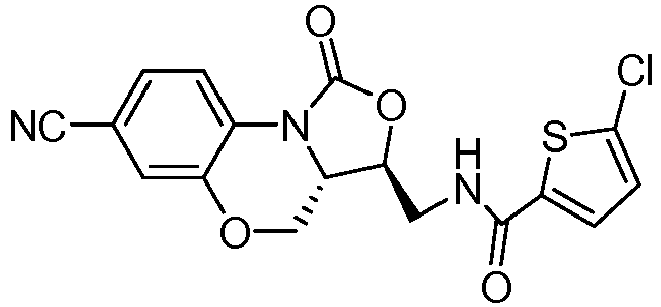
- Using the crude (3S,3aS)-3-(aminomethyl)-1-oxo-1,3,3a,4-tetrahydrobenzo[b]oxazolo[3,4-d][1,4]oxazin-7-carb onitrile, 5-chlorothiophene-2-formyl chloride (0.166g, 0.915mmol), and TEA (0.154g, 1.525mmol) as starting materials, preparation following the method as described in Example 1(f) afforded white compound 0.225g, two-step yield: 75.68%.
- 1H NMR (400 MHz, DMSO-d6)δ9.01 (t, J = 5.8 Hz, 1H), 8.07 (d, J = 8.5 Hz, 1H), 7.71 (d, J = 4.1 Hz, 1H), 7.52 (d, J = 1.8 Hz, 1H), 7.46 (dd, J = 8.5, 1.9 Hz, 1H), 7.21 (d, J = 4.1 Hz, 1H), 4.62 (t, J = 7.0 Hz, 2H), 4.18-4.07 (m, 2H),3.73 (t, J = 6.1 Hz, 2H). MS(ESI) m/z :[(M+35)+,423.9].
-

- Compound 5-chloro-N-(((3S,3aS)-7-cyano-1-oxo-1,3,3a,4-tetrahydrobenzo[b]oxazolo[3,4-d][1,4]oxazin-3-yl)methyl)thiophene-2-carboxamide (85mg, 0.218mmol) was dissolved in 7ml of anhydrous methanol and cooled to 0°C. The reaction mixture was bubbled with hydrogen chloride gas for 2h and then gradually raised to room temperature, stirring until the starting materials completely disappeared. The solvent was evaporated under reduced pressure. The residue was dissolved in 8ml of glacial acetic acid, to which was added 2-(aminooxy)-N-methylethylamine (98mg, 1.09mmol). The resulting mixture was refluxed at 120°C for 16h. After the reaction completed, the solvent was evaporated. Column chromatography (DCM/MeOH=80/1, 50/1, 30/1) afforded white solid 13mg, yield: 12.88%.
- 1H NMR (400 MHz, CDCl3) δ 8.01 (d, J = 8.4 Hz, 1H), 7.45 (d, J = 4.0 Hz, 1H), 7.36 (t, J = 4.8 Hz, 1H), 7.04 (d, J = 8.5 Hz, 1H), 7.00 (d, J = 1.5 Hz, 1H), 6.88 (d, J = 4.0 Hz, 1H), 4.50 (dd, J = 10.4, 2.5 Hz, 2H), 4.11 (t, J = 4.5 Hz, 2H),3.98 (dd, J = 12.2, 5.3 Hz, 1H),3.84-3.70 (m,3H),3.45 (t, J = 4.5 Hz, 2H), 2.78 (s,3H). MS(EI) m/z : (M+,462) .
-

-
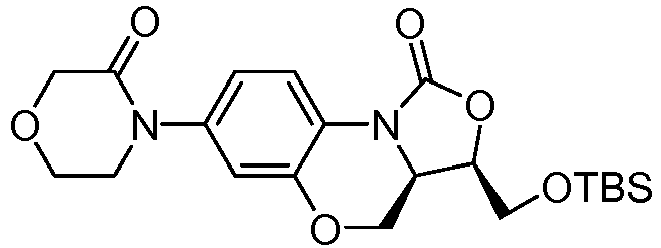
- Using compound C

- 1H NMR (300 MHz, DMSO-d6) δ 7.88 (d, J = 8.5 Hz, 1H), 7.09-6.92 (m, 2H), 4.65 (d, J = 7.6 Hz, 2H), 4.21 (s, 2H),3.99 (ddd, J = 16.0, 15.6, 5.9 Hz, 6H),3.77 (dd, J = 5.9, 4.3 Hz, 2H), 0.88-0.83 (m, 9H), 0.08 (d, J = 0.5 Hz, 6H).MS(EI) m/z :(M+,434).
-

- Using compound (3R,3aR)-3-((t-butyldimethylsiloxy)methyl)-7-(3-oxomorpholin-4-yl)-3a,4-dihydrobenzo[b]oxa zolo[3,4-d][1,4]oxazin-1(3H)-one (0.597g, 1.38mmol) prepared above in (a), and tetra-n-butylammonium fluoride (1M,2.8ml) as starting materials, preparation following the method as described in Example 1 (b) afforded 0.283g of white solid , yield 64.3%.
- 1H NMR (400 MHz, DMSO-d6) δ 7.90 (d, J = 8.7 Hz, 1H), 7.05 (d, J = 2.3 Hz, 1H), 6.96 (dd, J = 8.7, 2.3 Hz, 1H), 5.33 (t, J = 5.7 Hz, 1H), 4.50 (m, 1H), 4.51 (q, J = 4.5 Hz, 1H), 4.27 (s, 2H), 4.10 (dd, J = 4.5, 1.7 Hz, 2H),3.98 (m, 2H),3.88-3.62 (m, 4H). MS(EI) m/z :(M+,320).
-

- Using compound (3R,3aR)-3-(hydroxymethyl)-7-(3-oxomorpholin-4-yl)-3a,4-dihydrobenzo[b]oxazolo[3,4-d][1,4 ]oxazin-1(3H)-one (3g, 9.375mmol) prepared above in (b), methylsulfonyl chloride (1.288g, 11.25mmol), and TEA (2.6ml) as starting materials, preparation following the method as described in Example 1 (c) afforded white solid 2.98g, yield: 79.79%.
- 1H NMR (400 MHz, DMSO-d6) δ 7.91 (d, J = 8.1 Hz, 1H), 7.13 (d, J = 2.3 Hz, 1H), 7.03 (dd, J = 8.1, 2.3 Hz, 1H), 4.88 (s, 1H), 4.69 (m,3H), 4.25 (s, 2H), 4.17 (d, J = 5.2 Hz, 2H),3.96 (m, 2H),3.77 (m, 2H),3.29 (s,3H). MS(EI) m/z :(M+,398).
-

- Using compound ((3R,3aR)-1-oxo-7-(3-oxomorpholin-4-yl)-1,3,3a,4-tetrahydrobenzo[b]oxazolo[3,4-d][1,4]oxazi n-3-yl)methylmethanesulfonate (2.98g, 7.48mmol) prepared above in (a) and phthalimide potassium (2.08g, 11.22mmol) as starting materials, preparation following the method as described in Example 1 (d) afforded white solid 2.76g, yield: 82.1 %.
- 1H NMR (400 MHz, CDCl3) δ 8.11 (d, J = 8.7 Hz, 1H), 7.91 (dd, J = 5.5,3.0 Hz, 2H), 7.79 (dd, J = 5.5,3.0 Hz, 2H), 7.09 (d, J = 2.4 Hz, 1H), 6.99 (dd, J = 8.7, 2.4 Hz, 1H), 4.68 (dd, J = 11.7, 6.8 Hz, 1H), 4.50 (dd, J = 10.6,3.1 Hz, 1H), 4.38 (s, 2H), 4.23 (dd, J = 14.3, 6.8 Hz, 1H) 4.11-3.99 (m, 4H),3.88 (t, J = 10.3 Hz, 1H),3.74-3.69 (m, 2H). MS(EI) m/z :(M+,449).
-

- Using compound 2-(((3S,3aR)-1-oxo-7-(3-oxomorpholin-4-yl)-1,3,3a,4-tetrahydrobenzo[b]oxazolo[3,4-d][1,4]ox azin-3-yl)methyl)isoindolin-1,3-dione (2.76g, 6.15mmol) prepared above in (d) and 50ml of methylamine alcohol solution as starting materials, preparation following the method as described in Example 1 (e) afforded a crude product, which was directly subjected to the next step of reaction.
-

- Using the crude compound (3S,3aR)-3-aminomethyl-7-(3-oxomorpholin-4-yl)-3a,4-dihydrobenzo[b]oxazolo[3,4-d][1,4]ox azin-1 (3H)-one prepared above in (e) without purification, TEA(1.7ml, 12.29mmol), and 5-chlorothiophene-2-formyl chloride (1.335g, 7.376mmol) as starting materials, preparation following the method as described in Example 1 (f) afforded white solid 2.02g, yield: 70.8% (two steps together).
- 1H NMR (400 MHz, DMSO-d6) δ 9.00 (t, J = 5.7 Hz, 1H), 7.95 (d, J = 8.7 Hz, 1H), 7.69 (d, J = 4.1 Hz, 1H), 7.19 (d, J = 4.0 Hz, 1H), 7.15 (d, J = 2.3 Hz, 1H), 7.11 (dd, J = 8.7, 2.3 Hz, 1H), 4.66-4.57 (m, 2H), 4.21 (s, 2H), 4.08 (m, 2H),3.97-3.92 (m, 2H),3.73 (t, J = 5.5 Hz, 2H),3.71-3.66 (m, 2H).MS(ESI) m/z :[(M+23)+,486.3].
- Experimental principle and method: FXa cuts the Arg carboxyl end in the substrate N-Z-D-Arg-Gly-Arg-pDA in vitro and releases p-nitrophenylamine which has specific absorption at 405nm wavelength. The amount of the substrate generated is determined at 405nm to evaluate the activity of the compound to inhibit the human recombinant FXa in vitro.
- Human plasma coagulation factor Xa was purchased from Calbiochem; the substrate N-Z-D-Arg-Gly-Arg-pDA was purchased from chromogenic. The subject compound, enzyme and the reaction buffer were mixed and preincubated at 37°C for 10 mins. The substrate was added. The absorption at 405 nm wavelength was measured continuously over 20 mins. At the same time, a blank control group (without enzyme, 100% inhibition rate) and a negative control group (replace the subject compound with DMSO, 0% inhibition rate) were set up. The reaction system was 100µl (50µl of Tris buffer, 10µl of compound, 20µl (0.027U/ml) of enzyme, 20µl (300µM) of substrate). Each concentration of each sample was assayed in triplicate. The experiment was carried out for 2 times independently.
- The subject compound was each dissolved in DMSO to give a 10mM stock solution, which was then diluted to various concentrations with reaction buffer when use. The positive control group was rivaroxaban (Brand name: Xarelto, approved for sale in Canada and the European Union on September 16th and October 1st of 2008.)
Table 2, Inhibitory activity data of part of the compounds of the present invention on FXa Compound IC50 (nM) 1 2.25±0.01 2 6.68±0.79 17 12.22±10.52 33 14.97±1.60 34 19.27±3.39 35 19.56±16.93 36 12.16±4.08 rivaroxaban 19.71±0.7 - It can be seen from the data of Table 2 that the compounds of the present invention have excellent biological activity. For example, Compounds 1, 2, 17, 33, 34, 35, and 36 have potent in vitro inhibitory activity on FXa; particularly, the FXa inhibitory activity of
compounds - Healthy male SD rats, body weight 200-220 g, randomly divided into 6 groups with each group 3-4 rats, were administered with the subject compound via intragastric administration and intravenous injection, respectively. The specific regimes are shown in the following Table 3:
Table 3. Administration regime of the in vivo pharmacokinetic assay in rats. Group Compound Administration Route Dosage (mg/kg) Administration volume (ml/kg) 1 1 intragastric administration 10 10 2 1 intravenous injection 3.0 5.0 3 2 intragastric administration 9.0 10 4 2 intravenous injection 4.5 5.0 5 rivaroxaban intragastric administration 10 10 6 rivaroxaban intravenous injection 3.0 5.0 - The subject compound was prepared with 5%DMSO/5% Twain 80/90% saline into solution for administration. Rivaroxaban intragastric administration group was prepared with 5%DMSO/5% Twain -80/90% saline, which produced a suspension, and the intravenous administration group was prepared with 10%DMSO/10% Twain -80/80% PEG400 (50%).
- The rats were fasted for 12 hrs before experiment, free water-drinking, and were all fed 2h after administration. Blood sampling time and sample treatment:
- intragastric administration: 0.25, 0.5, 1.0, 2.0, 3.0, 4.0, 6.0, 8.0, and 24 h after administration;
- intravenous administration: 5 min, 0.25, 0.5, 1.0, 2.0, 4.0, 6.0, 8.0, and 24 h after administration.
- At the time points defined above, 0.3 ml of venous blood was taken from the posterior venous plexus of rats to heparinized tubes, centrifuged at 11000 rpm for 5 mins to separate the plasma, which was then frozen at -20°C in a refrigerator.
Table 4, Pharmacokinetic data in rats Compound 1 Compound 2rivaroxaban Oral administration (10mg/Kg) Intravenous injection (3mg/Kg) Oral administration (9mg/Kg) Intravenous injection (4.5mg/Kg) Oral administration (10mg/Kg) Intravenous injection (3mg/Kg) Tmax (h) 0.75 0.67 0.56 Cmax (ng/mL) 11901 6927 440 AUC0-t (ngh/mL) 32529 15324 26119 31057 1608 10548 AUC0-∞ (ngh/mL) 33044 15339 28527 33562 2242 10575 MRT(h) 2.23 1.03 3.40 3.04 7.01 0.88 T1/2 (h) 1.33 1.00 2.10 1.95 4.64 0.98 CLz (L/h/Kg) 0.201 0.137 0.285 Vss (L/Kg) 0.201 0.406 0.250 F(%) 63.7 42.0 4.6 - Excellent metabolic property is a key parameter for druggability of a compound. The pharmacokinetic experiments demonstrate that the compounds of the present invention have ideal pharmacokinetic characteristics, and their oral bioavailability is far more superior to that of the control drug, rivaroxaban.
- The experiment used PRECIL C2000-1 immunomagnetic single channel semi-automated blood coagulation analyzer to measure blood coagulation time.
- Principle: An excessive amount of tissue thromboplastin (infusion of preparations such as human brain, rabbit brain, placenta, and lung tissue) and calcium ion are added to the plasma to be tested, thereby converting prothrombin into thrombin, and the latter converts fibrinogen into fibrin. The time needed for plasma coagulation is observed as prothrombin time. This experiment is the most commonly used screening test for the evaluation of an extrinsic coagulation system.
- Test method: To the rabbit sodium citrate anticoagulant plasma (3.8% sodium citrate, 1:9 mixture) were added various concentrations of the compounds to be tested. PT reagents (PRECIL, Beijing) were used to measure the prothrombin activation time. The compound concentration that prolonged the PT time by 1 time, when compared with the blank control, was recorded as PT2, thereby evaluating the anticoagulant activity of the compounds.
- Principle: At 37°C,using Kaolin to activate factors □ and □; using cephalin (partial thromboplastin) to replace
platelet factor 3; and in the presence of Ca2+, the time needed for the coagulation of plasma which lacks of platelet is observed as activated partial thromboplastin time. This experiment is a screening test which is sensitive and commonly used for the endogenous blood coagulation system. - Test method: To the rabbit sodium citrate anticoagulant plasma (3.8% sodium citrate, 1:9 mixture) were added various concentrations of the compounds to be tested. APTT reagents (PRECIL, Beijing) were used to measure the prothrombin activation time. The compound concentration that prolonged the APTT time by 1 time, when compared with the blank control, was recorded as APTT2, thereby evaluating the anticoagulant activity of the compounds.
- Principle: At 37°C, a "standard" thrombin solution is added to plasma, and the time needed for the coagulation of plasma is evaluated. This parameter reflects the activity of thrombin.
- Test method: To the rabbit sodium citrate anticoagulant plasma (3.8% sodium citrate, 1:9 mixture) were added various concentrations of the compounds to be tested. TT reagents (PRECIL, Beijing) were used. The anticoagulant activity of the compounds was evaluated in comparison with the control group.
- Rabbit sodium citrate anticoagulant plasma (3.8% sodium citrate plasma, 1:9 mixture) was purchased from Guangzhou Ruite Bio company; PRECIL C2000-1 immunomagnetic single channel semi-automated blood coagulation analyzer and PRECIL blood coagulation 3-item reagents were purchased from Beijing PRECIL instrument company. The experiment had drug groups and a blank control group (using the same concentration of DMSO in stead of the subject compound; the plasma concentration of DMSO < 0.1%, reaction time recorded as normal coagulation time). Each concentration of each sample was assayed in 3-6 duplicate wells, and the experiment was independently carried out for 2-3 times.
Table 5, In vitro anticoagulant activity data Compound PT2 (µM) APT2 (µM) TT 1 0.184 0.141 No compound affected TT at 10 µM. 2 1.06 0.932 rivaroxaban 0.399 0.315 - The data in Table 5 shows that the compounds of the present invention have very strong anticoagulant activity. They all significantly prolonged the PT time and APTT time of rabbit sodium citrate anticoagulant plasma. Furthermore, the anticoagulant activity of
Compound 1 is superior to rivaroxaban. Additionally, the compounds of the present invention do not affect the activity of thrombin, and thus it is possible to reduce the risk of hemorrhage. - Male SD rats were randomly divided into 9 groups, which were solvent PEG400/anhydrous ethanol/water [40%/10%/50%] (5 ml/kg), rivaroxaban 2mg/kg, 3 mg/kg, 6 mg/kg, 10 mg/kg, and
Compound 1 2mg/kg, 3 mg/kg, 6 mg/kg, and 10 mg/kg, respectively. The rats were fasted for 12h, then weighted, and treated by intragastric administration. After 45min, the rats were anesthetized with chloral hydrate (350mg/kg), immobilized, and the left common carotid artery was exposed by surgery. The artery and the surrounding tissue were separated by plastic wrap. Electrical stimulation was started 1h after intragastric administration. - The stimulation electrode of the BT87-4 tester for experimental in vivo thrombus formation was placed at the end of the blood vessels proximal to the heart. 3mA current was used for a 2min of stimulation. The instrument started the timer automatically when the stimulation began. The stimulation switch was turned off when the stimulation ended. The stimulation electrode was removed, and a thermostat probe was placed at the end of the artery on the stimulation site, which end is distal to the heart. At the time of 600 seconds, the pointer of the thermostat panel was slowly moved to the position of 0. The time from the start of simulation to the alarm of the instrument was recorded as the time of blood vessel blockage (or the time of thrombus formation). If a drug has antithrombosis effect, the time of thrombus formation (time of blood vessel blockage) will be prolonged. IBM SPSS Statistics 20 software was used for the t test of the experimental data. The experimental results are shown in
Figure 1 . - From
Figure 1 and Figure 2 , it can be seen that the two compounds both had remarkable and dose-dependent effect of prolonging the time of thrombus formation. The effect ofCompound 1 is stronger than that of the positive control rivaroxaban. - The ED50s of
Compound 1 of the present invention and rivaroxaban for prolonging the thrombus formation time were 2.97 mg/kg and 4.53 mg/kg, respectively. This experiment indicates that the antithrombotic activity of the compounds of the present invention is significantly superior to that of the positive control, rivaroxaban. The activity ofCompound 1 is 1.53 times of that of rivaroxaban, indicating that the compounds of the present invention can be an excellent anticoagulant agent for the treatment of thrombus-related diseases.
Claims (10)
- An oxazolidone compound represented by the following general formula (I), an enantiomer, diastereoisomer and raceme thereof as well as their mixtures, and a pharmaceutically acceptable salt thereof;
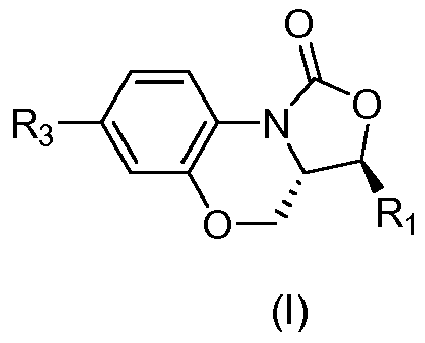 R1 is -CH2NHCOR2, -CH2CH2NHCOR2, -CONHR2, -CONHCH2R2, -CH2NHCONHR2 or -CH2NHCOCONHR2;R2 is substituted or unsubstituted C1-C6 alkyl, substituted or unsubstituted -(CH2)n-X-CmH2m+1, substituted or unsubstituted phenyl, substituted or unsubstituted 5- or 6-membered heterocyclic group, or substituted or unsubstituted benzo 5- or 6- membered heterocyclic group ;in said substituted or unsubstituted -(CH2)n-X-CmH2m+1, X is NH, O or S, and n and m are each an integer and n+m<6;in the circumstance of substituted C1-C6 alkyl or substituted -(CH2)n-X-CmH2m+1, the substituent of C1-C6 alkyl or -(CH2)n-X-CmH2m+1 is a radical selected from the group consisting of: halogen, cyano, nitro, amino, aminomethyl, C1-C8 alkoxy, C3-C7 cycloalkyl or aminoformyl;in the circumstance of substituted phenyl, the substituent of phenyl is a radical selected from the group consisting of: halogen, -NO2, -CHO, -CF3, -CONR4R5, -COR4, -NHR5, -NHCOR4, -OR5, -SO2R4, -SO2NHR5 or C1-C3 alkyl; said R4 is C1-C3 alkyl, R5 is H or C1-C3 alkyl;said 5- or 6- membered heterocyclic group or benzo 5- or 6- membered heterocyclic group contains at least one heteroatom selected from N, O or S;in the circumstance of substituted 5- or 6- membered heterocyclic group or substituted benzo 5- or 6- membered heterocyclic group, the substituent of 5- or 6- membered heterocyclic group or benzo 5- or 6- membered heterocyclic group is a radical selected from the group consisting of: halogen, -NO2, -CHO, -CF3, -CONR4R5, -COR4, -NHR5,-NHCOR4, -OR5, -SO2R4, -SO2NHR5, C1-C3 alkyl; said R4 is C1-C3 alkyl, R5 is H or C1-C3 alkyl;R3 is substituted or unsubstituted C1∼C3 amido, substituted or unsubstituted phenyl or substituted or unsubstituted 5- or 6- membered aromatic or non-aromatic heterocyclic group ;in the circumstance of substituted C1∼C3 amido, the H on N of said C1∼C3 amido is substituted with C1∼C3 alkyl;in the circumstance of substituted phenyl, the substituent of phenyl is a radical selected from the group consisting of: F, Cl, Br, CN, -NO2, -CF3, -CONR4R5, -COR4, -NHR5,-NHCOR4, -OR5, -SO2R4, -SO2NHR5 or C1-C3 alkyl; said R4 is C1-C3 alkyl, R5 is H or C1-C3 alkyl;said 5- or 6- membered aromatic heterocyclic group contains at least one heteroatom selected from N, O or S, and in the circumstance of substituted 5- or 6- membered aromatic heterocyclic group, the substituent of 5- or 6- membered aromatic heterocyclic group is a radical selected from the group consisting of: F, Cl, Br, CN, -NO2, -CF3, -CONR4R5, -COR4, -NHR5,-NHCOR4, -OR5, -SO2R4, -SO2NHR5 or C1-C3 alkyl; said R4 is C1-C3 alkyl, R5 is H or C1-C3 alkyl;said 5- or 6- membered non-aromatic heterocyclic group contains at least one heteroatom selected from N, O or S, and said heterocyclic group can further form a spiroring with another 3 to 6- membered heterocyclic group; and in the circumstance of substituted 5- or 6- membered non-aromatic heterocyclic group, the substituent of 5- or 6- membered non-aromatic heterocyclic group is a radical selected from the group consisting of: oxo, F, Cl, Br, C1-C3 alkyl, CN, -NO2, -CF3, -CONR4R5, -COR4, -COPh, -NHR5,=NH, -NHCOR4, -OR5, -CH2Ph, -SO2R4, -SO2Ph, -SO2NHR5; said R4 is C1-C3 alkyl, R5 is H or C1-C3 alkyl.
 - The compound according to claim 1, an enantiomer, diastereoisomer and raceme thereof as well as their mixtures, and a pharmaceutically acceptable salt thereof, wherein,
said R1 is -CH2NHCOR2, -CONHR2, -CH2NHCONHR2 or -CH2NHCOCONHR2;
said R2 is substituted or unsubstituted -(CH2)n-X-CmH2m+1, substituted or unsubstituted phenyl, substituted or unsubstituted 5- or 6- membered heterocyclic group, or substituted or unsubstituted benzo 5- or 6- membered heterocyclic group;
in said substituted or unsubstituted -(CH2)n-X-CmH2m+1, X is NH, O or S, and n and m are each an integer and n+m<6;
in the circumstance of substituted -(CH2)n-X-CmH2m+1, the substituent of -(CH2)n-X-CmH2m+1 is halogen;
in the circumstance of substituted phenyl, the substituent of phenyl is a radical selected from the group consisting of: halogen, -OR5; said R5 is H or C1-C3 alkyl;
said 5- or 6- membered heterocyclic group or benzo 5- or 6- membered heterocyclic group contains at least one heteroatom selected from N, O or S;
in the circumstance of substituted 5- or 6- membered heterocyclic group or substituted benzo 5- or 6- membered heterocyclic group, the substituent of 5- or 6- membered heterocyclic group or benzo 5- or 6- membered heterocyclic group is halogen or -OR5; said R5 is H or C1-C3 alkyl;
said R3 is N-methylacetamido, substituted or unsubstituted phenyl or substituted or unsubstituted 5- or 6- membered non-aromatic heterocyclic group;
in the circumstance of substituted phenyl, the substituent of phenyl is a radical selected from the group consisting of: -SO2R4, -SO2NHR5; said R4 is C1-C3 alkyl, preferably methyl, R5 is H or C1-C3 alkyl, preferably, H;
said 5- or 6- membered non-aromatic heterocyclic group contains at least one heteroatom selected from N, O or S, and said heterocyclic group can further form a spiroring with another 5 to 6- membered heterocyclic group; and in the circumstance of substituted 5- or 6- membered non-aromatic heterocyclic group, the substituent of 5- or 6- membered non-aromatic heterocyclic group is a radical selected from the group consisting of: oxo, F, Cl, Br, C1-C3 alkyl, -COR4, =NH, -OR5, -CH2Ph, -SO2R4, -SO2Ph; said R4 is C1-C3 alkyl, R5 is H or C1-C3 alkyl. - The compound according to claim 1, an enantiomer, diastereoisomer and raceme thereof as well as their mixtures, and a pharmaceutically acceptable salt thereof, wherein,
said R1is -CH2NHCOR2, -CONHR2, -CH2NHCONHR2 or -CH2NHCOCONHR2;
said R2 is


- The compound according to claim 1, an enantiomer, diastereoisomer and raceme thereof as well as their mixtures, and a pharmaceutically acceptable salt thereof, wherein,
said compound is the following compound:

Compound 1 Compound 2 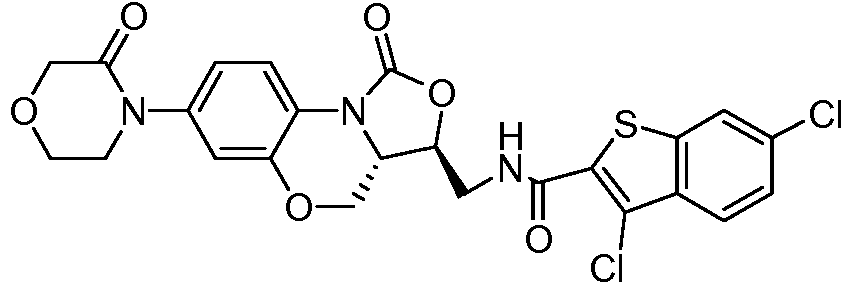
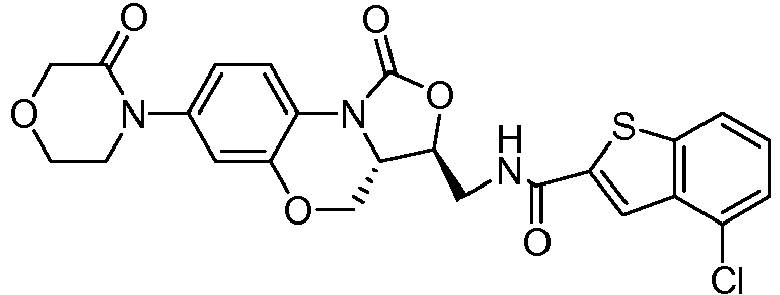
Compound 3 Compound 4 

Compound 5 Compound 6 

Compound 7 Compound 8 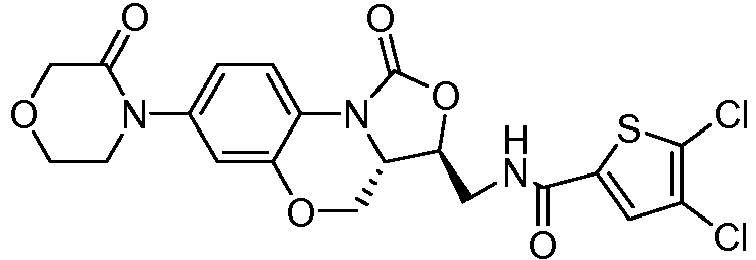

Compound 9 Compound 10 

Compound 11 Compound 12 

Compound 13 Compound 14 
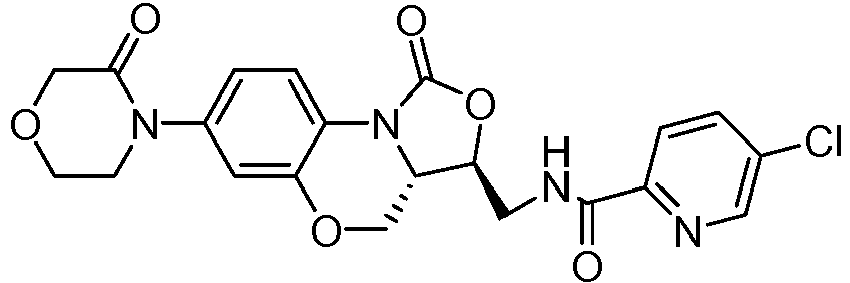
Compound 15 Compound 16 

Compound 17 Compound 18 

Compound 19 Compound 20 

Compound 21 Compound 22 

Compound 23 Compound 24 

Compound 25 Compound 26 

Compound 27 Compound 28 

Compound 29 Compound 30 

Compound 31 Compound 32 

Compound 33 Compound 34 

Compound 35 Compound 36 

Compound 37 Compound 38 

Compound 39 Compound 40. - A method for preparing the compound represented by the general formula (I),

wherein, the method is selected from one of the following methods:Method 1
Route 1 a, compound A [Journal of Medicinal Chemistry, 54(21), 7493-7502; 2011] and compound R3H react, with the catalysation by a palladium-containing catalyst, in the presence of a phosphine-containing ligand, in a polar aprotic solvent under alkaline condition, under the protection of inert gas at a temperature from room temperature to 120°C for 2-48 hours, to give compound I-1;b, compound I-1 reacts, in the presence of a fluorine-containing reagent, in a polar aprotic solvent, at room temperature for 1-3 hours, to remove the protecting group t-butyldimethylsilyl (TBS), thereby giving compound I-2;c, compound 1-2 and methylsulfonyl chloride (MsCl) react, in the presence of an organic base, in a polar aprotic solvent, at a temperature from -10°C to room temperature for 1-3 hours, to give the corresponding compound 1-3;d, compound 1-3 and phthalimide potassium react, in a polar aprotic solvent, at a temperature from room temperature to 100°C for 1-24 hours, to give the corresponding compound I-4;e, compound 1-4 and methylamine alcohol solution react in a polar solvent at a temperature from room temperature to 80°C for 1-12 hours, to give the corresponding compound 1-5;f, compound 1-5 and R2 substituted acyl chloride, in the presence of an organic base, in a polar aprotic solvent, at a temperature from -10°C to room temperature for 1-3 hours, to give the corresponding compound;g, compound 1-5 and R2 substituted carboxylic acid or amino oxalic acid substituted with R2 at its N position react, in the presence of a condensation agent and an organic base, in a polar solvent, at room temperature for 1-6 hours, to give the corresponding compound;h, compound 1-5 and R2 substituted isocyanate react, in a solvent at a temperature from room temperature to 110°C for 3-24 hours, to give the corresponding product;Method 2
Route 5 a, compound B and 2-chlorothiophene-5-formyl chloride react, in the presence of an organic base, in a polar aprotic solvent, at a temperature from -10°C to room temperature for 1-3 hours, to give compound V-1;b, compound V-1 and bis(pinacolato)diboron react, with the catalysation by a palladium-containing catalyst, in the presence of a phosphine-containing ligand, in a polar solvent under alkaline condition, under the protection of inert gas at a temperature from room temperature to 110 °C for 0.5-48 hours, to give compound V-2;c, compound V-2 and the bromide R3Br react, with the catalysation by a palladium-containing catalyst, in a polar solvent under alkaline condition, under the protection of inert gas at a temperature from room temperature to 120 °C for 2-24 hours, to give the corresponding compound;Method 3
Route 6 a, compound A and compound R3H react, with the catalysation by a palladium-containing catalyst, in the presence of a phosphine-containing ligand, in a polar aprotic solvent under alkaline condition, under the protection of inert gas at a temperature from room temperature to 120 °C for 2-48 hours, to give compound VI-1;b, compound VI-1 reacts, in the presence of a fluorine-containing reagent, in a polar aprotic solvent, at room temperature for 1-3 hours, to remove the protecting group t-butyldimethylsilyl, thereby giving compound VI-2;c, compound VI-2 reacts with an oxidizing agent in a polar aprotic solvent at a temperature from 0°C to room temperature for 1-6 hours, to give the corresponding compound VI-3;d, compound VI-3 reacts with an oxidizing agent in a polar aprotic solvent and a buffer solution at room temperature for 1-24 hours to give the corresponding compound VI-4;e, compound VI-4 and a R2 substituted amine react, in the presence of a condensation agent and an organic base, in a polar aprotic solvent, at room temperature for 1-6 hours, to give the corresponding compound;Method 4
Route 7 a, compound A and compound potassium ferrocyanide(II) trihydrate [KFe(CN)6·3H2O] react, with the catalysation by a palladium-containing catalyst, in a polar aprotic solvent under alkaline condition, under the protection of inert gas at a temperature from room temperature to 150°C for 0.5-12 hours, to give compound VII-1;b, compound VII-1 reacts, in the presence of a fluorine-containing reagent, in a polar aprotic solvent, at room temperature for 1-3 hours, to remove the protecting group t-butyldimethylsilyl (TBS), thereby giving compound VII-2;c, compound VII-2 and methylsulfonyl chloride (MsCl) react, in the presence of an organic base, in a polar aprotic solvent, at a temperature from -10°C to room temperature for 1-3 hours, to give the corresponding compound VII-3;d, compound VII-3 and phthalimide potassium react, in a polar aprotic solvent, at a temperature from room temperature to 100°C for 1-24 hours, to give the corresponding compound VII-4;e, compound VII-4 and methylamine alcohol solution react in a polar solvent at a temperature from room temperature to 80°C for 1-12 hours, to give the corresponding compound VII-5;f, compound VII-5 and a R2 substituted acyl chloride react, in the presence of an organic base, in a polar aprotic solvent, at a temperature from -10°C to room temperature for 1-3 hours, to give the corresponding compound VII-6;g, compound VII-6 in an alcohol solvent was bubbled with hydrogen chloride gas at 0°C for 2-6h, and then stirred at room temperature for 2-6h; after compound VII-6 reacts completely, the solvent and the residual acid are removed by evaporation; the resulting mixture and 2-aminooxy-N-R5-ethylamine react under reflux in a polar protic solvent for 10-24h, to give the corresponding compound.
 - A pharmaceutical composition, which comprises one or more of the compound according to any one of claims 1 to 4, an enantiomer, diastereoisomer and raceme thereof as well as their mixtures, and a pharmaceutically acceptable salt thereof, as the main active ingredient, and one or more of pharmaceutically acceptable auxiliary materials.
- The pharmaceutical composition according to claim 6, wherein the pharmaceutical composition is formulated into tablet, capsule, granules, or syrup for oral administration.
- Use of the compound according to any one of claims 1 to 4 in the manufacture of a medicine for the treatment of diseases related to the FXa target.
- Use of the pharmaceutical composition according to claim 6 or claim 7 in the manufacture of a medicine for the treatment of diseases related to the FXa target.
- The use according to claim 8 or claim 9, wherein said diseases related to the FXa target are vascular embolic diseases.
Applications Claiming Priority (2)
| Application Number | Priority Date | Filing Date | Title |
|---|---|---|---|
| CN201310020040.8A CN103936763B (en) | 2013-01-18 | 2013-01-18 | Oxazolidinone compounds and its production and use |
| PCT/CN2013/090833 WO2014110971A1 (en) | 2013-01-18 | 2013-12-30 | Oxazolidone compound, preparing method and application thereof |
Publications (3)
| Publication Number | Publication Date |
|---|---|
| EP2947085A1 true EP2947085A1 (en) | 2015-11-25 |
| EP2947085A4 EP2947085A4 (en) | 2016-06-22 |
| EP2947085B1 EP2947085B1 (en) | 2017-09-13 |
Family
ID=51184670
Family Applications (1)
| Application Number | Title | Priority Date | Filing Date |
|---|---|---|---|
| EP13872046.1A Not-in-force EP2947085B1 (en) | 2013-01-18 | 2013-12-30 | Oxazolidone compounds, method for preparing and application thereof |
Country Status (8)
| Country | Link |
|---|---|
| US (1) | US9382265B2 (en) |
| EP (1) | EP2947085B1 (en) |
| JP (1) | JP6242915B2 (en) |
| KR (1) | KR101756570B1 (en) |
| CN (1) | CN103936763B (en) |
| AU (1) | AU2013373885B2 (en) |
| CA (1) | CA2898550C (en) |
| WO (1) | WO2014110971A1 (en) |
Cited By (1)
| Publication number | Priority date | Publication date | Assignee | Title |
|---|---|---|---|---|
| US10106557B2 (en) | 2014-09-26 | 2018-10-23 | North China Pharmaceutical New Drug R&D Co., Ltd. | Preparation method for benzoxazoleoxazine ketone compound and intermediate and crystal form thereof |
Families Citing this family (16)
| Publication number | Priority date | Publication date | Assignee | Title |
|---|---|---|---|---|
| WO2015043364A1 (en) * | 2013-09-29 | 2015-04-02 | 华北制药集团新药研究开发有限责任公司 | Benzoxazoleoxazine ketone compound as blood coagulation factor xa inhibitor |
| WO2015110024A1 (en) * | 2014-01-24 | 2015-07-30 | Sunshine Lake Pharma Co., Ltd. | Oxazolidinone compounds and their uses in pharmaceuticals |
| WO2015176677A1 (en) * | 2014-05-22 | 2015-11-26 | Sunshine Lake Pharma Co., Ltd. | Crystalline forms and amorphism of oxazolidinone compound |
| WO2015188787A1 (en) * | 2014-06-14 | 2015-12-17 | Sunshine Lake Pharma Co., Ltd. | Method for preparing oxazolidinone compound and intermediates thereof |
| CN104610260B (en) * | 2015-02-14 | 2016-03-30 | 佛山市赛维斯医药科技有限公司 | FXa inhibitor, the preparation method and its usage of one class amide containing and nitrogen heterocyclic structure |
| CN104610258B (en) * | 2015-02-14 | 2016-03-30 | 佛山市赛维斯医药科技有限公司 | FXa inhibitor, the preparation method and its usage of one class amide containing and methoxy benzene structure |
| CN104672236B (en) * | 2015-02-14 | 2016-03-30 | 佛山市赛维斯医药科技有限公司 | One class contains FXa inhibitor of bisamide base and halogeno-benzene structure and uses thereof |
| CN106478658A (en) * | 2015-08-25 | 2017-03-08 | 华北制药集团新药研究开发有限责任公司 | Crystal formation D of benzoxazoles oxazines ketone compounds WA1-089 and preparation method thereof |
| CN106478661A (en) * | 2015-08-25 | 2017-03-08 | 华北制药集团新药研究开发有限责任公司 | Crystal formation E of benzoxazoles oxazines ketone compounds WA1-089 and preparation method thereof |
| CN105348275A (en) * | 2015-12-10 | 2016-02-24 | 中国药科大学 | Oxazolidinone compound and synthetic method and medical application of oxazolidinone compound |
| CN108069983A (en) * | 2016-11-10 | 2018-05-25 | 浙江普洛得邦制药有限公司 | Crystal form of Yi Zhong oxazolidinone compounds and its preparation method and application |
| CN108395442A (en) * | 2017-02-07 | 2018-08-14 | 浙江普洛得邦制药有限公司 | The crystal form VII and its preparation method and application of Yi Zhong oxazolidinone compounds |
| CN108727406B (en) | 2017-03-28 | 2021-12-07 | 北京协和制药二厂 | Nitrogen heterocyclic ring substituted benzoxazine oxazolidinone compound and preparation method and application thereof |
| CN109111465B (en) * | 2017-06-22 | 2021-01-12 | 中国科学院上海药物研究所 | Thiazolidone spiropyrimidine trione compound and preparation method and application thereof |
| CN108912142B (en) * | 2018-08-08 | 2021-06-18 | 延边大学 | Pyrrolobenzoxazinone compound and its injection and use in antithrombotic |
| CN114685529A (en) * | 2020-12-29 | 2022-07-01 | 中国科学院上海药物研究所 | Amorphous substance of oxazolidinone compound and preparation method and application thereof |
Family Cites Families (6)
| Publication number | Priority date | Publication date | Assignee | Title |
|---|---|---|---|---|
| DE19805117A1 (en) * | 1998-02-09 | 1999-08-12 | Bayer Ag | New oxazolidinones with azole-containing tricycles |
| DE10129725A1 (en) * | 2001-06-20 | 2003-01-02 | Bayer Ag | Combination therapy of substituted oxazolidinones |
| TWI396686B (en) * | 2004-05-21 | 2013-05-21 | Takeda Pharmaceutical | Cyclic guanamine derivatives, as well as their products and usage |
| EP2374456B1 (en) * | 2008-12-19 | 2016-08-03 | Daiichi Sankyo Company, Limited | Edoxaban dosage regime |
| CN102260277B (en) * | 2010-05-24 | 2013-07-24 | 中国科学院上海药物研究所 | Novel benzoxazine oxazolidinone compound and preparation method and application thereof |
| CN102464658B (en) * | 2010-11-03 | 2014-04-16 | 天津药物研究院 | Oxazolidinone derivative and preparation method and application thereof |
-
2013
- 2013-01-18 CN CN201310020040.8A patent/CN103936763B/en active Active
- 2013-12-30 AU AU2013373885A patent/AU2013373885B2/en not_active Ceased
- 2013-12-30 US US14/761,843 patent/US9382265B2/en active Active
- 2013-12-30 JP JP2015552988A patent/JP6242915B2/en not_active Expired - Fee Related
- 2013-12-30 KR KR1020157021881A patent/KR101756570B1/en not_active Expired - Fee Related
- 2013-12-30 WO PCT/CN2013/090833 patent/WO2014110971A1/en not_active Ceased
- 2013-12-30 CA CA2898550A patent/CA2898550C/en active Active
- 2013-12-30 EP EP13872046.1A patent/EP2947085B1/en not_active Not-in-force
Cited By (1)
| Publication number | Priority date | Publication date | Assignee | Title |
|---|---|---|---|---|
| US10106557B2 (en) | 2014-09-26 | 2018-10-23 | North China Pharmaceutical New Drug R&D Co., Ltd. | Preparation method for benzoxazoleoxazine ketone compound and intermediate and crystal form thereof |
Also Published As
| Publication number | Publication date |
|---|---|
| US9382265B2 (en) | 2016-07-05 |
| JP6242915B2 (en) | 2017-12-06 |
| EP2947085A4 (en) | 2016-06-22 |
| CA2898550C (en) | 2016-08-02 |
| CA2898550A1 (en) | 2014-07-24 |
| WO2014110971A1 (en) | 2014-07-24 |
| KR20150105466A (en) | 2015-09-16 |
| US20150361091A1 (en) | 2015-12-17 |
| CN103936763A (en) | 2014-07-23 |
| AU2013373885B2 (en) | 2016-07-14 |
| EP2947085B1 (en) | 2017-09-13 |
| AU2013373885A1 (en) | 2015-08-27 |
| JP2016513076A (en) | 2016-05-12 |
| CN103936763B (en) | 2017-10-31 |
| KR101756570B1 (en) | 2017-07-10 |
Similar Documents
| Publication | Publication Date | Title |
|---|---|---|
| EP2947085B1 (en) | Oxazolidone compounds, method for preparing and application thereof | |
| CN104540835B (en) | The imidazo thiadiazoles derivative as proteinase activated receptors 4 (PAR4) inhibitor for treating platelet aggregation | |
| KR102494647B1 (en) | Bicyclic Heteroaryl Substituted Compounds | |
| US10174020B2 (en) | Pyridone or pyrimidone derivative, preparation method therefor and application thereof | |
| RU2756273C2 (en) | Polymorphic modifications of n-[(3-fluoro-4-methoxypyridine-2-yl)methyl]-3-(methoxymethyl)-1-({ 4-[(2-oxopyridine-1-yl)methyl]phenyl} methyl)pyrazole-4-carboxamide and their salts | |
| KR20250117700A (en) | Novel oxo-pyridine compounds, methods for preparing the same, and uses thereof | |
| KR101047211B1 (en) | Novel Cycloalkane Carboxamides as Factor XA Inhibitors | |
| BR112021013105A2 (en) | 15-PGDH INHIBITOR | |
| TW201722918A (en) | Substituted tetrahydroisoquinoline compound as a factor XIA inhibitor | |
| KR102492715B1 (en) | Monocyclic Heteroaryl Substituted Compounds | |
| PT1776359E (en) | Piperidine derivatives as renin inhibitors | |
| CN114591212B (en) | Human plasma kallikrein inhibitor | |
| WO2015043364A1 (en) | Benzoxazoleoxazine ketone compound as blood coagulation factor xa inhibitor | |
| KR102468661B1 (en) | Tricyclic Heteroaryl-Substituted Quinoline and Azaquinoline Compounds as PAR4 Inhibitors | |
| CN101223167B (en) | Novel heteroaryl fused cyclic amines | |
| CN105218564A (en) | San Huan oxazolidinone compounds and its production and use | |
| US7601838B2 (en) | 2-Alkyl/aryl sulphonyl-1,2,3,4-tetrahydro-9H-pyrido (3,4-b) indole-3-carboxylic acid esters/amides useful as antithrombotic agents | |
| CN110343089A (en) | Benzimidazole derivative and pharmaceutical use thereof | |
| CN110759901A (en) | Tetrahydroisoquinoline derivatives and preparation method and use thereof | |
| CN111303146A (en) | 3-cyanopyridine compound, pharmaceutical composition containing same, preparation method and use thereof | |
| CN116829547A (en) | Factor XIIa inhibitors | |
| HK40088831A (en) | Polymorphs of n-[(3-fluoro-4-methoxypyridin-2-yl)methyl]-3-(methoxymethyl)-1-({4-[2-oxopyridin-1-yl)methyl]phenyl}methyl)pyrazole-4-carboxamide as kallikrein inhibitors | |
| CN105753855A (en) | Pyrrolylamide-containing oxazolidinone compounds and application thereof | |
| JPS5912663B2 (en) | Method for producing N↑g-substituted-N↑2-naphthalenesulfonylargininamides or acid addition salts thereof |
Legal Events
| Date | Code | Title | Description |
|---|---|---|---|
| PUAI | Public reference made under article 153(3) epc to a published international application that has entered the european phase |
Free format text: ORIGINAL CODE: 0009012 |
|
| 17P | Request for examination filed |
Effective date: 20150805 |
|
| AK | Designated contracting states |
Kind code of ref document: A1 Designated state(s): AL AT BE BG CH CY CZ DE DK EE ES FI FR GB GR HR HU IE IS IT LI LT LU LV MC MK MT NL NO PL PT RO RS SE SI SK SM TR |
|
| AX | Request for extension of the european patent |
Extension state: BA ME |
|
| DAX | Request for extension of the european patent (deleted) | ||
| A4 | Supplementary search report drawn up and despatched |
Effective date: 20160525 |
|
| RIC1 | Information provided on ipc code assigned before grant |
Ipc: A61K 31/5383 20060101ALI20160519BHEP Ipc: C07D 519/00 20060101ALI20160519BHEP Ipc: C07D 498/04 20060101AFI20160519BHEP Ipc: A61P 7/02 20060101ALI20160519BHEP |
|
| REG | Reference to a national code |
Ref country code: DE Ref legal event code: R079 Ref document number: 602013026736 Country of ref document: DE Free format text: PREVIOUS MAIN CLASS: C07D0498060000 Ipc: C07D0498040000 |
|
| GRAP | Despatch of communication of intention to grant a patent |
Free format text: ORIGINAL CODE: EPIDOSNIGR1 |
|
| RIC1 | Information provided on ipc code assigned before grant |
Ipc: A61K 31/5383 20060101ALI20170307BHEP Ipc: C07D 519/00 20060101ALI20170307BHEP Ipc: C07D 498/04 20060101AFI20170307BHEP Ipc: A61P 7/02 20060101ALI20170307BHEP |
|
| INTG | Intention to grant announced |
Effective date: 20170330 |
|
| GRAS | Grant fee paid |
Free format text: ORIGINAL CODE: EPIDOSNIGR3 |
|
| GRAA | (expected) grant |
Free format text: ORIGINAL CODE: 0009210 |
|
| AK | Designated contracting states |
Kind code of ref document: B1 Designated state(s): AL AT BE BG CH CY CZ DE DK EE ES FI FR GB GR HR HU IE IS IT LI LT LU LV MC MK MT NL NO PL PT RO RS SE SI SK SM TR |
|
| REG | Reference to a national code |
Ref country code: GB Ref legal event code: FG4D |
|
| REG | Reference to a national code |
Ref country code: CH Ref legal event code: EP |
|
| REG | Reference to a national code |
Ref country code: IE Ref legal event code: FG4D |
|
| REG | Reference to a national code |
Ref country code: AT Ref legal event code: REF Ref document number: 928014 Country of ref document: AT Kind code of ref document: T Effective date: 20171015 |
|
| REG | Reference to a national code |
Ref country code: DE Ref legal event code: R096 Ref document number: 602013026736 Country of ref document: DE |
|
| REG | Reference to a national code |
Ref country code: FR Ref legal event code: PLFP Year of fee payment: 5 |
|
| REG | Reference to a national code |
Ref country code: NL Ref legal event code: MP Effective date: 20170913 |
|
| REG | Reference to a national code |
Ref country code: LT Ref legal event code: MG4D |
|
| PG25 | Lapsed in a contracting state [announced via postgrant information from national office to epo] |
Ref country code: SE Free format text: LAPSE BECAUSE OF FAILURE TO SUBMIT A TRANSLATION OF THE DESCRIPTION OR TO PAY THE FEE WITHIN THE PRESCRIBED TIME-LIMIT Effective date: 20170913 Ref country code: FI Free format text: LAPSE BECAUSE OF FAILURE TO SUBMIT A TRANSLATION OF THE DESCRIPTION OR TO PAY THE FEE WITHIN THE PRESCRIBED TIME-LIMIT Effective date: 20170913 Ref country code: NO Free format text: LAPSE BECAUSE OF FAILURE TO SUBMIT A TRANSLATION OF THE DESCRIPTION OR TO PAY THE FEE WITHIN THE PRESCRIBED TIME-LIMIT Effective date: 20171213 Ref country code: LT Free format text: LAPSE BECAUSE OF FAILURE TO SUBMIT A TRANSLATION OF THE DESCRIPTION OR TO PAY THE FEE WITHIN THE PRESCRIBED TIME-LIMIT Effective date: 20170913 Ref country code: HR Free format text: LAPSE BECAUSE OF FAILURE TO SUBMIT A TRANSLATION OF THE DESCRIPTION OR TO PAY THE FEE WITHIN THE PRESCRIBED TIME-LIMIT Effective date: 20170913 |
|
| REG | Reference to a national code |
Ref country code: AT Ref legal event code: MK05 Ref document number: 928014 Country of ref document: AT Kind code of ref document: T Effective date: 20170913 |
|
| PG25 | Lapsed in a contracting state [announced via postgrant information from national office to epo] |
Ref country code: LV Free format text: LAPSE BECAUSE OF FAILURE TO SUBMIT A TRANSLATION OF THE DESCRIPTION OR TO PAY THE FEE WITHIN THE PRESCRIBED TIME-LIMIT Effective date: 20170913 Ref country code: RS Free format text: LAPSE BECAUSE OF FAILURE TO SUBMIT A TRANSLATION OF THE DESCRIPTION OR TO PAY THE FEE WITHIN THE PRESCRIBED TIME-LIMIT Effective date: 20170913 Ref country code: BG Free format text: LAPSE BECAUSE OF FAILURE TO SUBMIT A TRANSLATION OF THE DESCRIPTION OR TO PAY THE FEE WITHIN THE PRESCRIBED TIME-LIMIT Effective date: 20171213 Ref country code: ES Free format text: LAPSE BECAUSE OF FAILURE TO SUBMIT A TRANSLATION OF THE DESCRIPTION OR TO PAY THE FEE WITHIN THE PRESCRIBED TIME-LIMIT Effective date: 20170913 Ref country code: GR Free format text: LAPSE BECAUSE OF FAILURE TO SUBMIT A TRANSLATION OF THE DESCRIPTION OR TO PAY THE FEE WITHIN THE PRESCRIBED TIME-LIMIT Effective date: 20171214 |
|
| PG25 | Lapsed in a contracting state [announced via postgrant information from national office to epo] |
Ref country code: NL Free format text: LAPSE BECAUSE OF FAILURE TO SUBMIT A TRANSLATION OF THE DESCRIPTION OR TO PAY THE FEE WITHIN THE PRESCRIBED TIME-LIMIT Effective date: 20170913 |
|
| PG25 | Lapsed in a contracting state [announced via postgrant information from national office to epo] |
Ref country code: PL Free format text: LAPSE BECAUSE OF FAILURE TO SUBMIT A TRANSLATION OF THE DESCRIPTION OR TO PAY THE FEE WITHIN THE PRESCRIBED TIME-LIMIT Effective date: 20170913 Ref country code: CZ Free format text: LAPSE BECAUSE OF FAILURE TO SUBMIT A TRANSLATION OF THE DESCRIPTION OR TO PAY THE FEE WITHIN THE PRESCRIBED TIME-LIMIT Effective date: 20170913 Ref country code: RO Free format text: LAPSE BECAUSE OF FAILURE TO SUBMIT A TRANSLATION OF THE DESCRIPTION OR TO PAY THE FEE WITHIN THE PRESCRIBED TIME-LIMIT Effective date: 20170913 |
|
| PG25 | Lapsed in a contracting state [announced via postgrant information from national office to epo] |
Ref country code: IS Free format text: LAPSE BECAUSE OF FAILURE TO SUBMIT A TRANSLATION OF THE DESCRIPTION OR TO PAY THE FEE WITHIN THE PRESCRIBED TIME-LIMIT Effective date: 20180113 Ref country code: SM Free format text: LAPSE BECAUSE OF FAILURE TO SUBMIT A TRANSLATION OF THE DESCRIPTION OR TO PAY THE FEE WITHIN THE PRESCRIBED TIME-LIMIT Effective date: 20170913 Ref country code: AT Free format text: LAPSE BECAUSE OF FAILURE TO SUBMIT A TRANSLATION OF THE DESCRIPTION OR TO PAY THE FEE WITHIN THE PRESCRIBED TIME-LIMIT Effective date: 20170913 Ref country code: SK Free format text: LAPSE BECAUSE OF FAILURE TO SUBMIT A TRANSLATION OF THE DESCRIPTION OR TO PAY THE FEE WITHIN THE PRESCRIBED TIME-LIMIT Effective date: 20170913 Ref country code: EE Free format text: LAPSE BECAUSE OF FAILURE TO SUBMIT A TRANSLATION OF THE DESCRIPTION OR TO PAY THE FEE WITHIN THE PRESCRIBED TIME-LIMIT Effective date: 20170913 |
|
| REG | Reference to a national code |
Ref country code: DE Ref legal event code: R097 Ref document number: 602013026736 Country of ref document: DE |
|
| PLBE | No opposition filed within time limit |
Free format text: ORIGINAL CODE: 0009261 |
|
| STAA | Information on the status of an ep patent application or granted ep patent |
Free format text: STATUS: NO OPPOSITION FILED WITHIN TIME LIMIT |
|
| PG25 | Lapsed in a contracting state [announced via postgrant information from national office to epo] |
Ref country code: DK Free format text: LAPSE BECAUSE OF FAILURE TO SUBMIT A TRANSLATION OF THE DESCRIPTION OR TO PAY THE FEE WITHIN THE PRESCRIBED TIME-LIMIT Effective date: 20170913 |
|
| REG | Reference to a national code |
Ref country code: CH Ref legal event code: PL |
|
| 26N | No opposition filed |
Effective date: 20180614 |
|
| PG25 | Lapsed in a contracting state [announced via postgrant information from national office to epo] |
Ref country code: MT Free format text: LAPSE BECAUSE OF NON-PAYMENT OF DUE FEES Effective date: 20171230 Ref country code: LU Free format text: LAPSE BECAUSE OF NON-PAYMENT OF DUE FEES Effective date: 20171230 |
|
| REG | Reference to a national code |
Ref country code: IE Ref legal event code: MM4A |
|
| REG | Reference to a national code |
Ref country code: BE Ref legal event code: MM Effective date: 20171231 |
|
| PG25 | Lapsed in a contracting state [announced via postgrant information from national office to epo] |
Ref country code: IE Free format text: LAPSE BECAUSE OF NON-PAYMENT OF DUE FEES Effective date: 20171230 |
|
| PG25 | Lapsed in a contracting state [announced via postgrant information from national office to epo] |
Ref country code: SI Free format text: LAPSE BECAUSE OF FAILURE TO SUBMIT A TRANSLATION OF THE DESCRIPTION OR TO PAY THE FEE WITHIN THE PRESCRIBED TIME-LIMIT Effective date: 20170913 Ref country code: BE Free format text: LAPSE BECAUSE OF NON-PAYMENT OF DUE FEES Effective date: 20171231 Ref country code: LI Free format text: LAPSE BECAUSE OF NON-PAYMENT OF DUE FEES Effective date: 20171231 Ref country code: CH Free format text: LAPSE BECAUSE OF NON-PAYMENT OF DUE FEES Effective date: 20171231 |
|
| PG25 | Lapsed in a contracting state [announced via postgrant information from national office to epo] |
Ref country code: HU Free format text: LAPSE BECAUSE OF FAILURE TO SUBMIT A TRANSLATION OF THE DESCRIPTION OR TO PAY THE FEE WITHIN THE PRESCRIBED TIME-LIMIT; INVALID AB INITIO Effective date: 20131230 Ref country code: MC Free format text: LAPSE BECAUSE OF FAILURE TO SUBMIT A TRANSLATION OF THE DESCRIPTION OR TO PAY THE FEE WITHIN THE PRESCRIBED TIME-LIMIT Effective date: 20170913 |
|
| PG25 | Lapsed in a contracting state [announced via postgrant information from national office to epo] |
Ref country code: CY Free format text: LAPSE BECAUSE OF FAILURE TO SUBMIT A TRANSLATION OF THE DESCRIPTION OR TO PAY THE FEE WITHIN THE PRESCRIBED TIME-LIMIT Effective date: 20170913 |
|
| PG25 | Lapsed in a contracting state [announced via postgrant information from national office to epo] |
Ref country code: MK Free format text: LAPSE BECAUSE OF FAILURE TO SUBMIT A TRANSLATION OF THE DESCRIPTION OR TO PAY THE FEE WITHIN THE PRESCRIBED TIME-LIMIT Effective date: 20170913 |
|
| REG | Reference to a national code |
Ref country code: DE Ref legal event code: R081 Ref document number: 602013026736 Country of ref document: DE Owner name: SHANGHAI INSTITUTE OF MATERIA MEDICA, CHINESE , CN Free format text: FORMER OWNERS: SHANGHAI INSTITUTE OF MATERIA MEDICA, CHINESE ACADEMY OF SCIENCES, SHANGHAI, CN; ZHE JIANG JUTAI PHARMACEUTICAL CO., LTD, QUZHOU, ZHEJIANG, CN |
|
| REG | Reference to a national code |
Ref country code: GB Ref legal event code: 732E Free format text: REGISTERED BETWEEN 20200220 AND 20200226 |
|
| PG25 | Lapsed in a contracting state [announced via postgrant information from national office to epo] |
Ref country code: TR Free format text: LAPSE BECAUSE OF FAILURE TO SUBMIT A TRANSLATION OF THE DESCRIPTION OR TO PAY THE FEE WITHIN THE PRESCRIBED TIME-LIMIT Effective date: 20170913 |
|
| PG25 | Lapsed in a contracting state [announced via postgrant information from national office to epo] |
Ref country code: PT Free format text: LAPSE BECAUSE OF FAILURE TO SUBMIT A TRANSLATION OF THE DESCRIPTION OR TO PAY THE FEE WITHIN THE PRESCRIBED TIME-LIMIT Effective date: 20170913 |
|
| PG25 | Lapsed in a contracting state [announced via postgrant information from national office to epo] |
Ref country code: AL Free format text: LAPSE BECAUSE OF FAILURE TO SUBMIT A TRANSLATION OF THE DESCRIPTION OR TO PAY THE FEE WITHIN THE PRESCRIBED TIME-LIMIT Effective date: 20170913 |
|
| P01 | Opt-out of the competence of the unified patent court (upc) registered |
Effective date: 20230517 |
|
| PGFP | Annual fee paid to national office [announced via postgrant information from national office to epo] |
Ref country code: GB Payment date: 20231220 Year of fee payment: 11 |
|
| PGFP | Annual fee paid to national office [announced via postgrant information from national office to epo] |
Ref country code: IT Payment date: 20231228 Year of fee payment: 11 Ref country code: FR Payment date: 20231221 Year of fee payment: 11 Ref country code: DE Payment date: 20231214 Year of fee payment: 11 |
|
| REG | Reference to a national code |
Ref country code: DE Ref legal event code: R119 Ref document number: 602013026736 Country of ref document: DE |
|
| GBPC | Gb: european patent ceased through non-payment of renewal fee |
Effective date: 20241230 |
|
| PG25 | Lapsed in a contracting state [announced via postgrant information from national office to epo] |
Ref country code: DE Free format text: LAPSE BECAUSE OF NON-PAYMENT OF DUE FEES Effective date: 20250701 |
|
| PG25 | Lapsed in a contracting state [announced via postgrant information from national office to epo] |
Ref country code: IT Free format text: LAPSE BECAUSE OF NON-PAYMENT OF DUE FEES Effective date: 20241230 |
|
| PG25 | Lapsed in a contracting state [announced via postgrant information from national office to epo] |
Ref country code: GB Free format text: LAPSE BECAUSE OF NON-PAYMENT OF DUE FEES Effective date: 20241230 |
|
| PG25 | Lapsed in a contracting state [announced via postgrant information from national office to epo] |
Ref country code: FR Free format text: LAPSE BECAUSE OF NON-PAYMENT OF DUE FEES Effective date: 20241231 |