EP2944666B1 - Resorbierbare phenolpolymere - Google Patents
Resorbierbare phenolpolymere Download PDFInfo
- Publication number
- EP2944666B1 EP2944666B1 EP14198131.6A EP14198131A EP2944666B1 EP 2944666 B1 EP2944666 B1 EP 2944666B1 EP 14198131 A EP14198131 A EP 14198131A EP 2944666 B1 EP2944666 B1 EP 2944666B1
- Authority
- EP
- European Patent Office
- Prior art keywords
- dte
- polymer
- polymers
- suc
- group
- Prior art date
- Legal status (The legal status is an assumption and is not a legal conclusion. Google has not performed a legal analysis and makes no representation as to the accuracy of the status listed.)
- Active
Links
- UHOVQNZJYSORNB-UHFFFAOYSA-N c1ccccc1 Chemical compound c1ccccc1 UHOVQNZJYSORNB-UHFFFAOYSA-N 0.000 description 3
- IHPHPGLJYCDONF-UHFFFAOYSA-N CCCNC(C)=O Chemical compound CCCNC(C)=O IHPHPGLJYCDONF-UHFFFAOYSA-N 0.000 description 1
- 0 CCOCC(C(C)C1O)OC(*)C1NC(C)(C)C Chemical compound CCOCC(C(C)C1O)OC(*)C1NC(C)(C)C 0.000 description 1
- OBSLWIKITOYASJ-UHFFFAOYSA-N CNC(C1O)C(O)OC(CO)C1O Chemical compound CNC(C1O)C(O)OC(CO)C1O OBSLWIKITOYASJ-UHFFFAOYSA-N 0.000 description 1
- KIHOFAGVAMNMHH-UHFFFAOYSA-N CNC(CO)(CO)CO Chemical compound CNC(CO)(CO)CO KIHOFAGVAMNMHH-UHFFFAOYSA-N 0.000 description 1
- FJKROLUGYXJWQN-UHFFFAOYSA-N OC(c(cc1)ccc1O)=O Chemical compound OC(c(cc1)ccc1O)=O FJKROLUGYXJWQN-UHFFFAOYSA-N 0.000 description 1
Images



Classifications
-
- C—CHEMISTRY; METALLURGY
- C08—ORGANIC MACROMOLECULAR COMPOUNDS; THEIR PREPARATION OR CHEMICAL WORKING-UP; COMPOSITIONS BASED THEREON
- C08G—MACROMOLECULAR COMPOUNDS OBTAINED OTHERWISE THAN BY REACTIONS ONLY INVOLVING UNSATURATED CARBON-TO-CARBON BONDS
- C08G69/00—Macromolecular compounds obtained by reactions forming a carboxylic amide link in the main chain of the macromolecule
- C08G69/48—Polymers modified by chemical after-treatment
-
- C—CHEMISTRY; METALLURGY
- C07—ORGANIC CHEMISTRY
- C07C—ACYCLIC OR CARBOCYCLIC COMPOUNDS
- C07C235/00—Carboxylic acid amides, the carbon skeleton of the acid part being further substituted by oxygen atoms
- C07C235/02—Carboxylic acid amides, the carbon skeleton of the acid part being further substituted by oxygen atoms having carbon atoms of carboxamide groups bound to acyclic carbon atoms and singly-bound oxygen atoms bound to the same carbon skeleton
- C07C235/32—Carboxylic acid amides, the carbon skeleton of the acid part being further substituted by oxygen atoms having carbon atoms of carboxamide groups bound to acyclic carbon atoms and singly-bound oxygen atoms bound to the same carbon skeleton the carbon skeleton containing six-membered aromatic rings
- C07C235/34—Carboxylic acid amides, the carbon skeleton of the acid part being further substituted by oxygen atoms having carbon atoms of carboxamide groups bound to acyclic carbon atoms and singly-bound oxygen atoms bound to the same carbon skeleton the carbon skeleton containing six-membered aromatic rings having the nitrogen atoms of the carboxamide groups bound to hydrogen atoms or to acyclic carbon atoms
-
- C—CHEMISTRY; METALLURGY
- C07—ORGANIC CHEMISTRY
- C07C—ACYCLIC OR CARBOCYCLIC COMPOUNDS
- C07C235/00—Carboxylic acid amides, the carbon skeleton of the acid part being further substituted by oxygen atoms
- C07C235/42—Carboxylic acid amides, the carbon skeleton of the acid part being further substituted by oxygen atoms having carbon atoms of carboxamide groups bound to carbon atoms of six-membered aromatic rings and singly-bound oxygen atoms bound to the same carbon skeleton
- C07C235/44—Carboxylic acid amides, the carbon skeleton of the acid part being further substituted by oxygen atoms having carbon atoms of carboxamide groups bound to carbon atoms of six-membered aromatic rings and singly-bound oxygen atoms bound to the same carbon skeleton with carbon atoms of carboxamide groups and singly-bound oxygen atoms bound to carbon atoms of the same non-condensed six-membered aromatic ring
- C07C235/52—Carboxylic acid amides, the carbon skeleton of the acid part being further substituted by oxygen atoms having carbon atoms of carboxamide groups bound to carbon atoms of six-membered aromatic rings and singly-bound oxygen atoms bound to the same carbon skeleton with carbon atoms of carboxamide groups and singly-bound oxygen atoms bound to carbon atoms of the same non-condensed six-membered aromatic ring having the nitrogen atom of at least one of the carboxamide groups bound to an acyclic carbon atom of a hydrocarbon radical substituted by carboxyl groups
-
- C—CHEMISTRY; METALLURGY
- C08—ORGANIC MACROMOLECULAR COMPOUNDS; THEIR PREPARATION OR CHEMICAL WORKING-UP; COMPOSITIONS BASED THEREON
- C08G—MACROMOLECULAR COMPOUNDS OBTAINED OTHERWISE THAN BY REACTIONS ONLY INVOLVING UNSATURATED CARBON-TO-CARBON BONDS
- C08G63/00—Macromolecular compounds obtained by reactions forming a carboxylic ester link in the main chain of the macromolecule
- C08G63/68—Polyesters containing atoms other than carbon, hydrogen and oxygen
- C08G63/685—Polyesters containing atoms other than carbon, hydrogen and oxygen containing nitrogen
- C08G63/6854—Polyesters containing atoms other than carbon, hydrogen and oxygen containing nitrogen derived from polycarboxylic acids and polyhydroxy compounds
- C08G63/6856—Dicarboxylic acids and dihydroxy compounds
-
- C—CHEMISTRY; METALLURGY
- C08—ORGANIC MACROMOLECULAR COMPOUNDS; THEIR PREPARATION OR CHEMICAL WORKING-UP; COMPOSITIONS BASED THEREON
- C08G—MACROMOLECULAR COMPOUNDS OBTAINED OTHERWISE THAN BY REACTIONS ONLY INVOLVING UNSATURATED CARBON-TO-CARBON BONDS
- C08G64/00—Macromolecular compounds obtained by reactions forming a carbonic ester link in the main chain of the macromolecule
- C08G64/04—Aromatic polycarbonates
- C08G64/06—Aromatic polycarbonates not containing aliphatic unsaturation
- C08G64/08—Aromatic polycarbonates not containing aliphatic unsaturation containing atoms other than carbon, hydrogen or oxygen
- C08G64/12—Aromatic polycarbonates not containing aliphatic unsaturation containing atoms other than carbon, hydrogen or oxygen containing nitrogen
-
- C—CHEMISTRY; METALLURGY
- C08—ORGANIC MACROMOLECULAR COMPOUNDS; THEIR PREPARATION OR CHEMICAL WORKING-UP; COMPOSITIONS BASED THEREON
- C08G—MACROMOLECULAR COMPOUNDS OBTAINED OTHERWISE THAN BY REACTIONS ONLY INVOLVING UNSATURATED CARBON-TO-CARBON BONDS
- C08G73/00—Macromolecular compounds obtained by reactions forming a linkage containing nitrogen with or without oxygen or carbon in the main chain of the macromolecule, not provided for in groups C08G12/00 - C08G71/00
- C08G73/02—Polyamines
- C08G73/028—Polyamidoamines
Definitions
- Polymers with specialized properties for medical device coatings are described. These polymers are hydrolytically degradable and resorb within one year. These polymers are derived from monomer units which are relatively water soluble and it is this property that improves the polymers' resorption ability to within 1year once hydrolytic degradation occurs. The polymers, nonetheless, still provide appropriately robust mechanical properties to function as medical device coatings.
- the polymers of the invention are based on modifications of the tyrosine-derived family of polyarylates.
- Diphenols particularly those derived from tyrosine, are monomeric starting materials for biocompatible polycarbonates, polyiminocarbonates, polyarylates, polyurethanes, and the like.
- U.S. patent Nos. 5,099,060 , 5,198,507 , and 5,670,602 disclose amino acid-derived diphenol compounds useful in the preparation of polyarylates, polycarbonates and polyiminocarbonates.
- the polymers for example those described in U.S. Patent Nos. 4,980,449 , 5,216,115 , 5,658,995 , 6,048,521 , and 6,120,491 , and U.S. patent application publication No.
- 2004/0254334 are useful as degradable polymers in general, and are particularly useful as tissue-compatible bioerodible materials for medical uses.
- the suitability of these polymers for this end use application is at least in part the result of their derivation from diphenols derived from the naturally-occurring amino acid L-tyrosine.
- US 2004/254334 is concerned with designing and optimising co-polymeric materials as specialty polymers for use in various applications. This document particularly describes the synthesis of polyarylate copolymers and their use as cell growth substrates.
- US 4 980 449 describes polyiminocarbonates having a molecular weight average above 62,300 daltons and methods of manufacturing the same. Basso et al (2000) Tetrahedron: Asymmetry 11(8): 1789-96 describes the preparation of D-phenylglycine and D-4-hydroxyphenylglycine methyl esters using penicillin G acylase.
- the polycarbonates in particular are strong, water-insoluble materials most suitable for use as structural implants.
- the L-tyrosine derived polyarylates described in U.S. Pat. No. 5,216,115 , and the poly(alkylene oxide) block copolymers with these polyarylates disclosed in U.S. Pat. No. 5,658,995 feature protected carboxylic acid groups, and these polymers are limited in application because of their slow rate of degradation and significant hydrophobicity.
- the '491 patent describes polymers formed from a similar series of diphenol monomeric units but which contain repeating units of the same general diphenol monomers with both protected and unprotected carboxylic acid side chains.
- the '491 patent teaches that "the incorporation of pendent carboxylic acid groups within the polymer bulk has a dramatic and previously unrecognized accelerating effect on the rate of polymer backbone degradation and resorption both in vitro and in vivo .”
- the present inventors have surprisingly found that incorporating some fraction of diphenol monomers with pendant carboxylic acid groups into the polymer does not accelerate overall resorption, because the monomers with protected carboxylic acid groups remain too hydrophobic for resorption on desirable time scales.
- a polymer incorporating 10% pendant carboxylic acid side chain will degrade (by backbone cleavage) at a faster rate than one containing no pendant carboxylic acid side chains, and some resorption will occur, but this resorption is due to the water solubility of the diphenol monomers containing the pendant carboxylic acid groups. Once this monomer is resorbed, the remaining polymer, albeit one of smaller chain length, contains the protected carboxylic acid side chain monomers which are hydrophobic and resorb at a very slow rate.
- Incorporating a high fraction of pendant carboxylic acid side chain monomer e.g., 50% of the diphenol monomer content of the polymer
- a high fraction of pendant carboxylic acid side chain monomer e.g. 50% of the diphenol monomer content of the polymer
- the preferred protected monomers in the '491 patent are actually the most hydrophobic and therefore the slowest to resorb, i.e. the ethyl, butyl, hexyl, and octyl esters.
- Biodegradable and resorbable polymers are primarily used to deliver drugs for a finite period of time or to serve some other temporary purpose, such as to provide a biocompatible surface, enhanced tissue growth, or extra strength during implantation. Polymers that do not completely resorb leave remnants that can cause anything from minor inflammation and pain to excess scarring, and in the case of cardiovascular implants, such remnants can cause thrombosis and possibly patient death.
- the invention provides polymers with specialized properties, making them particularly suitable for coatings on implanted medical devices, for forming films for use with medical devices, and other uses requiring the short- or defined-term presence of a polymer matrix.
- the polymers of the invention are hydrolytically degradable and are resorbed by the body within one year. These polymers are derived from monomer units which are relatively water-soluble and it is this property that improves the polymers' resorption time to within 1 year once hydrolytic degradation begins. The polymers nonetheless exhibit sufficiently robust mechanical properties to function as medical device coatings.
- the polymers of the invention are based on modifications of the tyrosine-derived family of polyarylates.
- the need for polymers that resorb within one year (or such lesser times as may be desired), while retaining useful properties (e.g ., at least 1 week of drug elution, biocompatibility, and spray coating capability), is met by the present invention. It has now been found that it is possible to effect better resorption by increasing the water solubility of one or more of the component parts of the diphenol or diacid monomer units of the polymer. Thus, the present invention makes it possible to modulate the rate of resorption without compromising the drug release rate or other physical properties optimized for the end use application, by components having increased water solubility and/or or increased hydrolysis rates in vivo. Certain polymers of the invention can, for example, release a drug over at least a 5 day period.
- the present invention also makes it possible to create resorbable polymers with pendant carboxylic acid groups, which modulates the hydrophilicity of the polymer as well as the time over which the polymer properties remain intact.
- This provides a wide variety of drug release capabilities, so that the polymer can be adapted for hydrophobic and hydrophilic drugs.
- This is a significant improvement over conventional medical polymers such as poly(lactic acid), poly(glycolic acid), polycaprolactone, and the phenolic polyarylates and polycarbonates exemplified in U.S. Patent No. 6,120,491 .
- This invention allows independent optimization of the useful properties of the polymers, and significantly improves upon the versatility and utility of the phenolic polymer systems known in the art, particularly phenolic polycarbonates, polyarylates, and poly(iminocarbonates), and poly(alkylene oxide) copolymers thereof.
- the polymers of the present invention have many uses and may be formed into a variety of products, including but not limited to implantable medical devices with desired lifetimes of less than one year (e.g., adhesion barriers and surgical meshes to aid wound healing), incorporation into implantable medical devices, and combination with a quantity of a biologically or pharmaceutically active compound sufficient for effective site- specific or systemic drug delivery. See, for example, Gutowska et al., J Biomater. Res., 29, 811-21 (1995 ) and Hoffman, J Controlled Release, 6, 297-305 (1987 ).
- a biologically or pharmaceutically active compound may be physically admixed with, embedded in or dispersed in a polymer of the invention, or the polymer may be applied as an overcoating of another polymer-containing drug layer, where such overcoating delays or slows drug release.
- the polymer is in the form of a sheet or a coating applied to an implantable medical device, such as a hernia repair mesh, a stent, or a barrier layer for the prevention of surgical adhesions (see, e.g., Urry et al., Mat. Res. Soc. Symp. Proc., 292, 253- 64 (1993 ).
- Another instance of the present disclosure provides a method for site-specific or systemic drug delivery, by implanting in the body of a patient in need thereof an implantable drug delivery device containing a therapeutically effective amount of a biologically or pharmaceutically active compound, in a matrix of (or coated with) a polymer of the present invention.
- the disclosure also provides a method for preventing the formation of adhesions between injured or surgically repaired tissues, by inserting as a barrier between the injured tissues a sheet or coating comprising a polymer of the present invention.
- DTE refers to the diphenol monomer desaminotyrosyl-tyrosine ethyl ester
- DTBn is the diphenol monomer desaminotyrosyl-tyrosine benzyl ester
- DT is the diphenol monomer desaminotyrosyl-tyrosine with a free carboxylic acid.
- Other diphenol monomers can be named using a similar system.
- P22 is a polymer produced by condensation of DTE and succinic acid.
- P22-10, P22-15, P22-20, etc. represent polymers produced by condensation of a mixture of DTE and the indicated percentage of DT (i.e., 10, 15 and 20% DT) with succinic acid. See U.S. patent application publication No. 2004/0254334 for further explanation and examples of the nomenclature of these phenolic polymers.
- diphenol monmer units having structure wherein m is 0, 1, or 2; n is 0 to 4, and Y is selected from the group consisting of C 1 -C 18 alkylamino, -NHCH 2 CO 2 R', -NH(CH 2 ) q OR', -NH(CH 2 CH 2 O) p R', - NH(CH 2 CH 2 CH 2 O) p R', and where q is 0 to 4, p is 1 to 5000, and R' is selected from the group consisting of H, C 1 -C 8 alkyl, C 2 -C 8 alkenyl, C 8 -C 14 alkylaryl, benzyl, and substituted benzyl.
- alkyl and alkenyl refer to branched- or straight-chain alkyl and alkenyl groups.
- aryl refers to phenyl and naphthyl groups which may be substituted or unsubstituted with halogen, methoxy, alkyl, and the like.
- alkylaryl does not refer to aryl groups having alkyl substituents; it refers to alkyl groups having an aryl substituent.
- Substituted benzyl refers to benzyl groups substituted with one or more halogens, methoxy groups, nitro groups, alkyl groups, and the like.
- Substituted benzyl groups known in the art to be suitable for use as protecting groups for ethers and esters are included, including but not limited to 4- methoxybenzyl, 2-methoxybenzyl, 2,4-dimethoxybenzyl, and 2-nitrobenzyl groups.
- diphenol monomer units having structure wherein n is 0 to 4; and Y is selected from the group consisting of C 1 -C 18 alkylamino, -NHCH 2 CO 2 R', -NH(CH 2 ) q OR', -NH(CH 2 CH 2 CH 2 O) p R', and where q is 0 to 4, p is 1-5000 and R' is selected from the group consisting of H, C 1 -C 8 alkyl, C 2 -C 8 alkenyl, C 8 -C 14 alkylaryl, benzyl, and substituted benzyl.
- diphenol monomer units having structure wherein m is 0, 1, or 2; and R' is selected from the group consisting of H, C 1 -C 18 alkyl, C 2 -C 18 alkenyl, C 8 -C 18 alkylaryl, benzyl, and substituted benzyl.
- the invention provides polymers comprising monomer units having formula formula or
- X is selected from the group consisting of C 1 -C 18 alkylene, C 1 -C 18 alkenylene, divalent C 6 -C 10 arylene, divalent C 7 -C 18 alkylaryl, CH 2 OCH 2 , CH 2 O(CH 2 CH 2 O) S CH 2 , (CH 2 ) r CO 2 (CH 2 CH 2 CH 2 O) s CO(CH 2 ) r , and (CH 2 ) r CO 2 (CH 2 CH 2 O) s CO(CH 2 ) r , where r is 2 to 4 and s is 1 to 5000.
- Y is preferably NHCH 2 CO 2 R'.
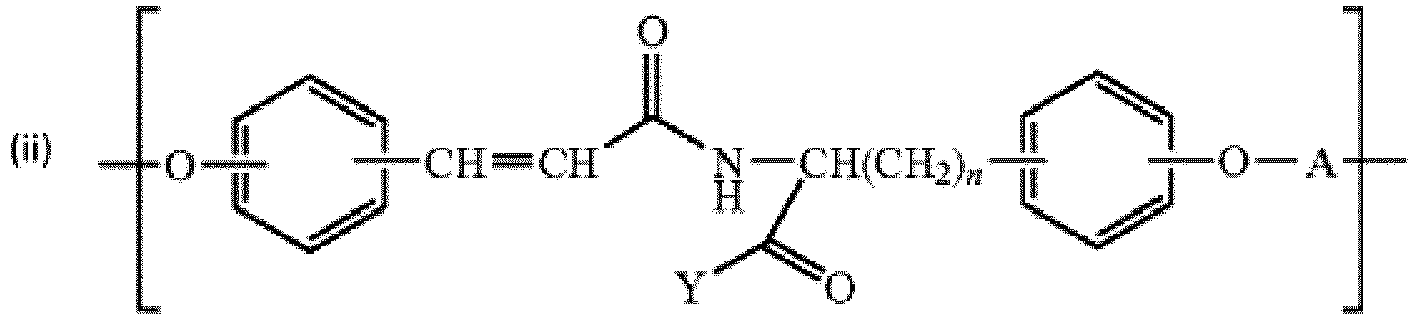
- the polymers of the invention as described above further comprising monomer units independently having formula or formula wherein m, n, and A are as defined in claim 1, and Y is OH or 0-benzyl.
- A is -CO-X-CO-, and between 0.1% and 99.9% of the X moieties are (CH 2 ) r CO 2 (CH 2 CH 2 O) s CO(CH 2 ) r and/or (CH 2 ) r CO 2 (CH 2 CH 2 CH 2 O) s CO(CH 2 ) r .
- the range is preferably from 1% to 99%, more preferably from 10% to 80%.
- Most preferably, from 20% to 50% of the X moieties are (CH 2 ) r CO 2 (CH 2 CH 2 O) s CO(CH 2 ) r and/or (CH 2 ) r CO 2 (CH 2 CH 2 CH 2 O) s CO(CH 2 ) r .
- between 1% and 50% of the monomer units have formula or formula wherein Y is OH or O-benzyl.
- the range is more preferably from 5% to 40%, and most preferably from 10% to 30%.
- Polymers of the present invention may be formed by reaction of the diphenol monomer units of the invention with a diacid or with phosgene, thereby forming polyarylates and polycarbonates respectively.
- a schematic diagram of the reaction of the diphenol monomer DTE with a diacid is shown in Scheme 1 below.
- the compounds of the invention are those where the "starting" moieties designated as positions 1-4 below are replaced by one or more moieties that are more hydrophilic or more water-soluble, as illustrated in Tables 1 and 2 below.
- the polymers of the invention thus have at least one of any one of positions 1-4 changed, but can also have 2 positions, 3 positions or all four positions changed. Any permutation of changes to the 4 positions is contemplated, provided that at least one change is made and that at least one change to a moiety make it more soluble than its corresponding starting moiety.
- the change may introduce a better leaving group than ethanol.
- at least one moiety at one of the positions is more water soluble than its starting moiety; at position 3 the moiety may also be a better leaving group than ethanol, or otherwise be more sensitive to hydrolysis under the conditions of use.
- amides can be more sensitive to hydrolysis in vivo than ethyl esters, due to the action of proteases.
- the starting moieties are as follows: position 1, tyrosine (T); position 2, desaminotyrosine (D), position 3, ethyl ester (E); position 4, succinate (S or succinate). It is convenient to name the polymer families according to the four positions so that the "starting polymer” with no changes of moieties is DTES or DTE succinate (note this is distinct from DTE, when DTE refers to the diphenol monomeric unit). Either single letters or moiety names are used. Hence examples of polymer families include BTE glutarate, DTM glutarate, DTM succinate and the like. The single letters for each moiety as used herein are shown in Tables 1 and 2. In Table 1, the bold T is used as a shorthand to represent the remainder of the molecule.
- the polymers of the present invention preferably have from 0.1 to 99.9 % diphenol monomer DT or from 0.1 to 99.9 % PEG diacid to promote the degradation process.
- the use of either or both methods, i.e. incorporation of DT and/or a PEG diacid (see examples in table below), is within the scope of the invention, and can be used with any of the polymer families of the invention.
- the polymers of the present invention having pendent carboxylic acid groups may be prepared by the palladium-catalyzed hydrogenolysis of corresponding polymers having pendant benzyl carboxylate groups as describe in the '491 patent. Any other method that allows for the selective deprotection of a pendant carboxylate group is suitable for use in the preparation of the carboxylate-containing polymers of the present invention.
- the polymers of the present invention can find application in areas where both solid materials and solvent-soluble materials are commonly employed. Such application include polymeric scaffolds in tissue engineering applications and medical implant applications, including the use of the polycarbonates and polyarylates of the present invention to form shaped articles such as vascular grafts and stents, drug eluting stents, bone plates, sutures, implantable sensors, barriers for surgical adhesion prevention, implantable drug delivery devices, scaffolds for tissue regeneration, and other therapeutic agent articles that decompose harmlessly within a known period of time.
- Controlled drug delivery systems may be prepared, in which a biologically or pharmaceutically active agent is physically embedded or dispersed within a polymeric matrix or physically admixed with a polycarbonate or polyarylate of the present invention, or it could be covalently attached to the pendant carboxylic acid.
- biologically or pharmaceutically active compounds suitable for use with the present invention include non-steroidal anti-inflammatories such as naproxen, ketoprofen, ibuprofen, anesthetics such as licodaine, bupivacaine, and mepivacaine; paclitaxel, 5-flurouracil; antimicrobials such as triclosan, chlorhexidine, rifampin, minocycline; keflex; acyclovir, cephradine, malphalen, procaine, ephedrine, adriamycin, daunomycin, plumbagin, atropine, quinine, digoxin, quinidine, biologically active peptides, chlorin e6, cephradine, cephalothin, cis-hydroxy-L-proline, melphalan, penicillin V, aspirin, nicotinic acid, chemodeoxycholic acid, chlorambucil, and the like.
- the compounds are covalently bonded to the polycarbonate or polyarylate copolymer by methods well understood by those of ordinary skill in the art.
- Drug delivery compounds may also be formed by physically blending the biologically or pharmaceutically active compound to be delivered with the polymers of the present invention having pendent carboxylic acid groups, using conventional techniques well-known to those of ordinary skill in the art.
- Biologically active compounds for purposes of the present invention, are additionally defined as including cell attachment mediators, biologically active ligands and the like.
- MW profile For monitoring MW decrease as a function of time, polymer films, or meshes coated with polymer, with approximate dimensions 1 x 1 x .01 cm, were incubated with 0.01 M PBS or 0.01 M PBS with Tween20 (50 to 100 mL) at 37°C without shaking. At each time point, polymer samples were dissolved in 5 mL of DMF containing 0.1 % TFA. The solutions were filtered through 0.45 ⁇ TeflonTM syringe-mountable filters and transferred to analysis vials for analysis by gel permeation chromatography (GPC).
- GPC gel permeation chromatography
- Mass loss profile For mass loss analysis, films or meshes coated with polymer were incubated with 0.01 M PBS or 0.01M PBS with Tween20 (50 to 100 mL) at 37°C. The buffer in the vials was changed at periodic intervals and analyzed for soluble degrading components. At each time point, 1-2 mL buffer from three small vials was filtered through 0.45 ⁇ TeflonTM syringe-mountable filters and transferred to analysis vials for analysis by reversed phase HPLC. Alternately, the devices were washed, dried and weighed (final weight) and the mass loss determined by subtracting the final weight from the original weight.
- Figure 1 shows molecular weight (MW) retention as a function of time for various members of the DTE succinate family with DT content ranging from 10 - 25% of the diphenol content. Very little difference in the degradation times (backbone cleavage) is evident.
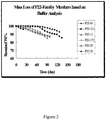
- Figure 2 shows the mass loss of various members of the DTE succinate family with DT ranging from 10 - 25% of the diphenol content. The mass loss slows as function of time because the DT is gone.
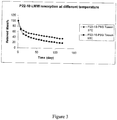
- Figure 3 shows the mass loss of 10%DT/DTE succinate at 37°C and 50°C. Mass loss slows down (curve evens out) as all DT is expended from the polymer..
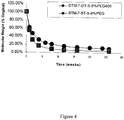
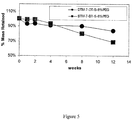
- Figures 4-8 show the rate of degradation of various polymers of the invention, as measured by the decrease in molecular weight over time.
- the table below shows the average molecular weight (MW) and composition of residual fragments of polymers within the DT-DTE succinate family of polymers at various times during in vitro incubation.
- the residual fragments are analyzed by liquid chromatography-mass spectrometry and relative quantities of peaks for each compound are reported. "No" indicates that the compound corresponding to that peak was not detectable.
- the relative total mass is found by the sum of the peak areas for a given compound. From this it is evident that the DT-containing fragments peaks 1 and 4 represent very little of the remaining mass. Peak 8 also contains DT but with twice the amount of DTE-succinate. DTE-suc is DTE-succinate.
Landscapes
- Chemical & Material Sciences (AREA)
- Organic Chemistry (AREA)
- Health & Medical Sciences (AREA)
- Chemical Kinetics & Catalysis (AREA)
- Medicinal Chemistry (AREA)
- Polymers & Plastics (AREA)
- General Chemical & Material Sciences (AREA)
- Polyesters Or Polycarbonates (AREA)
- Materials For Medical Uses (AREA)
- Organic Low-Molecular-Weight Compounds And Preparation Thereof (AREA)
- Polyethers (AREA)
- Saccharide Compounds (AREA)
- Other Resins Obtained By Reactions Not Involving Carbon-To-Carbon Unsaturated Bonds (AREA)
Claims (7)
- Polymer, umfassend Monomereinheiten mit der folgenden Formel:



- Polymer nach Anspruch 1, wobei zwischen 0,1 % und 99,9 % der X-Molekülteile (CH2)rCO2(CH2CH2O)SCO(CH2)r oder (CH2)rCO2(CH2CH2CH2O)SCO(CH2)r sind.
- Polymer nach Anspruch 2, wobei der Bereich von 20 % bis 50 % ist.
- Polymer nach Anspruch 1, ferner umfassend Monomereinheiten, die unabhängig folgende Formel aufweisen:


- Polymer nach Anspruch 4, wobei zwischen 1 % und 50 % der Monomereinheiten folgende Formel aufweisen:


- Polymer nach Anspruch 1, wobei das Polymer im Wesentlichen aus Monomereinheiten mit der Formel (i) besteht.
- Polymer nach Anspruch 1, wobei das Polymer Monomereinheiten mit der Formel (i) umfasst und wobei Y NHCH2CO2R' ist.
Applications Claiming Priority (4)
| Application Number | Priority Date | Filing Date | Title |
|---|---|---|---|
| US73398805P | 2005-11-03 | 2005-11-03 | |
| EP14150076.9A EP2733158B1 (de) | 2005-11-03 | 2006-11-03 | Resorbierbare phenolpolymere |
| EP06827442A EP1949000A4 (de) | 2005-11-03 | 2006-11-03 | Resorbierbare phenolische polymere |
| PCT/US2006/042944 WO2007056134A2 (en) | 2005-11-03 | 2006-11-03 | Resorbable phenolic polymers |
Related Parent Applications (3)
| Application Number | Title | Priority Date | Filing Date |
|---|---|---|---|
| EP14150076.9A Division EP2733158B1 (de) | 2005-11-03 | 2006-11-03 | Resorbierbare phenolpolymere |
| EP14150076.9A Division-Into EP2733158B1 (de) | 2005-11-03 | 2006-11-03 | Resorbierbare phenolpolymere |
| EP06827442A Division EP1949000A4 (de) | 2005-11-03 | 2006-11-03 | Resorbierbare phenolische polymere |
Publications (2)
| Publication Number | Publication Date |
|---|---|
| EP2944666A1 EP2944666A1 (de) | 2015-11-18 |
| EP2944666B1 true EP2944666B1 (de) | 2019-03-06 |
Family
ID=38023828
Family Applications (3)
| Application Number | Title | Priority Date | Filing Date |
|---|---|---|---|
| EP14198131.6A Active EP2944666B1 (de) | 2005-11-03 | 2006-11-03 | Resorbierbare phenolpolymere |
| EP06827442A Withdrawn EP1949000A4 (de) | 2005-11-03 | 2006-11-03 | Resorbierbare phenolische polymere |
| EP14150076.9A Active EP2733158B1 (de) | 2005-11-03 | 2006-11-03 | Resorbierbare phenolpolymere |
Family Applications After (2)
| Application Number | Title | Priority Date | Filing Date |
|---|---|---|---|
| EP06827442A Withdrawn EP1949000A4 (de) | 2005-11-03 | 2006-11-03 | Resorbierbare phenolische polymere |
| EP14150076.9A Active EP2733158B1 (de) | 2005-11-03 | 2006-11-03 | Resorbierbare phenolpolymere |
Country Status (7)
| Country | Link |
|---|---|
| US (3) | US8153837B2 (de) |
| EP (3) | EP2944666B1 (de) |
| JP (2) | JP5339913B2 (de) |
| AU (1) | AU2006311893B2 (de) |
| CA (1) | CA2628232C (de) |
| ES (2) | ES2718681T3 (de) |
| WO (1) | WO2007056134A2 (de) |
Families Citing this family (22)
| Publication number | Priority date | Publication date | Assignee | Title |
|---|---|---|---|---|
| EP2944666B1 (de) * | 2005-11-03 | 2019-03-06 | Tyrx, Inc. | Resorbierbare phenolpolymere |
| US8315700B2 (en) * | 2006-02-08 | 2012-11-20 | Tyrx, Inc. | Preventing biofilm formation on implantable medical devices |
| MX2008010126A (es) | 2006-02-08 | 2010-02-22 | Tyrx Pharma Inc | Protesis de malla temporalmente rigidizadas. |
| US8591531B2 (en) * | 2006-02-08 | 2013-11-26 | Tyrx, Inc. | Mesh pouches for implantable medical devices |
| US9023114B2 (en) | 2006-11-06 | 2015-05-05 | Tyrx, Inc. | Resorbable pouches for implantable medical devices |
| JP2010508915A (ja) * | 2006-11-06 | 2010-03-25 | タイレックス・ファーマ・インコーポレイテッド | 埋込型医療機器のためのメッシュパウチ |
| CA2682190C (en) | 2007-03-29 | 2015-01-27 | Medtronic, Inc. | Biodegradable, polymer coverings for breast implants |
| CA2691443C (en) | 2007-06-21 | 2015-10-27 | Medtronic, Inc. | Phenyl ester side chains to increase polymer resorptivity |
| EP2346537B1 (de) | 2008-09-22 | 2016-11-09 | Tyrx, Inc. | Lineare polyesteramide aus aminophenolestern |
| US9078712B2 (en) | 2009-04-15 | 2015-07-14 | Warsaw Orthopedic, Inc. | Preformed drug-eluting device to be affixed to an anterior spinal plate |
| US9839628B2 (en) | 2009-06-01 | 2017-12-12 | Tyrx, Inc. | Compositions and methods for preventing sternal wound infections |
| EP2459638B1 (de) * | 2009-07-31 | 2017-09-27 | Rutgers, The State University of New Jersey | Monomere und daraus hergestellte phasengetrennte biokompatible polymerzusammensetzungen zur verwendung in der medizin |
| US9605112B2 (en) | 2009-10-11 | 2017-03-28 | Rutgers, The State University Of New Jersey | Biocompatible polymers for medical devices |
| AU2011293344B2 (en) | 2010-08-25 | 2015-07-30 | Medtronic, Inc. | Novel medical device coatings |
| CA2816343C (en) | 2010-11-12 | 2017-01-17 | Medtronic, Inc. | Anchorage devices comprising an active pharmaceutical ingredient |
| WO2012129516A1 (en) | 2011-03-24 | 2012-09-27 | C. R. Bard, Inc. | Fixation and protection of an implanted medical device |
| US11472918B2 (en) | 2012-02-03 | 2022-10-18 | Rutgers, The State University Of New Jersey | Polymeric biomaterials derived from phenolic monomers and their medical uses |
| EP2809702B1 (de) | 2012-02-03 | 2017-12-20 | Rutgers, The State University of New Jersey | Polymere biomaterialien aus phenolischen monomeren und deren medizinische verwendungen |
| WO2014137454A1 (en) | 2013-03-07 | 2014-09-12 | Tyrx, Inc. | Methods and compositions to inhibit the assemblage of microbial cells irreversibly associated with surfaces of medical devices |
| WO2015069305A1 (en) | 2013-11-08 | 2015-05-14 | Tyrx, Inc. | Antimicrobial compositions and methods for preventing infection in surgical incision sites |
| US10774030B2 (en) | 2014-12-23 | 2020-09-15 | Rutgers, The State University Of New Jersey | Polymeric biomaterials derived from phenolic monomers and their medical uses |
| AU2015370426B2 (en) | 2014-12-23 | 2019-09-12 | Rutgers, The State University Of New Jersey | Biocompatible iodinated diphenol monomers and polymers |
Family Cites Families (13)
| Publication number | Priority date | Publication date | Assignee | Title |
|---|---|---|---|---|
| US4980449A (en) | 1988-07-14 | 1990-12-25 | Rutgers, The State University | Polyiminocarbonate synthesis |
| US5198507A (en) | 1990-06-12 | 1993-03-30 | Rutgers, The State University Of New Jersey | Synthesis of amino acid-derived bioerodible polymers |
| US5216115A (en) | 1990-06-12 | 1993-06-01 | Rutgers, The State University Of New Jersey | Polyarylate containing derivatives of the natural amino acid L-tyrosine |
| US5587507A (en) | 1995-03-31 | 1996-12-24 | Rutgers, The State University | Synthesis of tyrosine derived diphenol monomers |
| US5099060A (en) | 1990-06-12 | 1992-03-24 | Rutgers, The State University Of New Jersey | Synthesis of amino acid-derived bioerodible polymers |
| JP3946250B2 (ja) * | 1995-03-31 | 2007-07-18 | ラトガーズ,ザ・ステート・ユニバーシィティ | チロシン誘導ジフェノールモノマの改良合成 |
| US5658995A (en) | 1995-11-27 | 1997-08-19 | Rutgers, The State University | Copolymers of tyrosine-based polycarbonate and poly(alkylene oxide) |
| US6048521A (en) | 1997-11-07 | 2000-04-11 | Rutgers, The State University | Copolymers of tyrosine-based polyarlates and poly(alkylene oxides) |
| US6120491A (en) * | 1997-11-07 | 2000-09-19 | The State University Rutgers | Biodegradable, anionic polymers derived from the amino acid L-tyrosine |
| AU761458B2 (en) | 1998-04-13 | 2003-06-05 | Rutgers, The State University | The construction of copolymer libraries |
| AU2003234231A1 (en) | 2002-04-24 | 2003-11-10 | Rutgers | New polyarylates for drug delivery and tissue engineering |
| US20060115449A1 (en) * | 2004-11-30 | 2006-06-01 | Advanced Cardiovascular Systems, Inc. | Bioabsorbable, biobeneficial, tyrosine-based polymers for use in drug eluting stent coatings |
| EP2944666B1 (de) * | 2005-11-03 | 2019-03-06 | Tyrx, Inc. | Resorbierbare phenolpolymere |
-
2006
- 2006-11-03 EP EP14198131.6A patent/EP2944666B1/de active Active
- 2006-11-03 AU AU2006311893A patent/AU2006311893B2/en active Active
- 2006-11-03 EP EP06827442A patent/EP1949000A4/de not_active Withdrawn
- 2006-11-03 US US12/279,539 patent/US8153837B2/en active Active
- 2006-11-03 CA CA2628232A patent/CA2628232C/en active Active
- 2006-11-03 WO PCT/US2006/042944 patent/WO2007056134A2/en not_active Ceased
- 2006-11-03 JP JP2008539055A patent/JP5339913B2/ja active Active
- 2006-11-03 ES ES14198131T patent/ES2718681T3/es active Active
- 2006-11-03 EP EP14150076.9A patent/EP2733158B1/de active Active
- 2006-11-03 ES ES14150076.9T patent/ES2692073T3/es active Active
-
2012
- 2012-03-07 US US13/414,090 patent/US8471054B2/en active Active
-
2013
- 2013-04-22 US US13/867,225 patent/US8927659B2/en active Active
- 2013-05-15 JP JP2013103307A patent/JP2013189449A/ja active Pending
Non-Patent Citations (1)
| Title |
|---|
| None * |
Also Published As
| Publication number | Publication date |
|---|---|
| US8927659B2 (en) | 2015-01-06 |
| EP2944666A1 (de) | 2015-11-18 |
| WO2007056134A2 (en) | 2007-05-18 |
| US8153837B2 (en) | 2012-04-10 |
| ES2718681T3 (es) | 2019-07-03 |
| US8471054B2 (en) | 2013-06-25 |
| WO2007056134A3 (en) | 2009-04-23 |
| US20090088548A1 (en) | 2009-04-02 |
| JP2009514873A (ja) | 2009-04-09 |
| ES2692073T3 (es) | 2018-11-30 |
| AU2006311893B2 (en) | 2012-01-12 |
| JP5339913B2 (ja) | 2013-11-13 |
| EP1949000A2 (de) | 2008-07-30 |
| JP2013189449A (ja) | 2013-09-26 |
| US20130231444A1 (en) | 2013-09-05 |
| EP2733158A1 (de) | 2014-05-21 |
| US20120165495A1 (en) | 2012-06-28 |
| CA2628232C (en) | 2014-02-25 |
| EP2733158B1 (de) | 2018-09-19 |
| AU2006311893A1 (en) | 2007-05-18 |
| CA2628232A1 (en) | 2007-05-18 |
| EP1949000A4 (de) | 2010-08-04 |
Similar Documents
| Publication | Publication Date | Title |
|---|---|---|
| US8927659B2 (en) | Resorbable phenolic polymers | |
| AU729552B2 (en) | Monomers derived from hydroxy acids and polymers prepared therefrom | |
| AU730549B2 (en) | Biodegradable, anionic polymers derived from the amino acid L-tyrosine | |
| US6852308B2 (en) | Radio-opaque polymeric biomaterials | |
| AU722764B2 (en) | Copolymers of tyrosine-based polycarbonate and poly(alkylene oxide) | |
| US8415449B2 (en) | Bioresorbable polymers synthesized from monomer analogs of natural metabolites | |
| US20110275782A1 (en) | Bioresorbable polymers synthesized from monomer analogs of natural metabolites | |
| WO1999051221A1 (en) | Hydrolytically unstable biocompatible polymer | |
| AU2012202056B2 (en) | Resorbable phenolic polymers |
Legal Events
| Date | Code | Title | Description |
|---|---|---|---|
| PUAI | Public reference made under article 153(3) epc to a published international application that has entered the european phase |
Free format text: ORIGINAL CODE: 0009012 |
|
| AC | Divisional application: reference to earlier application |
Ref document number: 1949000 Country of ref document: EP Kind code of ref document: P Ref document number: 2733158 Country of ref document: EP Kind code of ref document: P |
|
| AK | Designated contracting states |
Kind code of ref document: A1 Designated state(s): AT BE BG CH CY CZ DE DK EE ES FI FR GB GR HU IE IS IT LI LT LU LV MC NL PL PT RO SE SI SK TR |
|
| 17P | Request for examination filed |
Effective date: 20151221 |
|
| RBV | Designated contracting states (corrected) |
Designated state(s): AT BE BG CH CY CZ DE DK EE ES FI FR GB GR HU IE IS IT LI LT LU LV MC NL PL PT RO SE SI SK TR |
|
| STAA | Information on the status of an ep patent application or granted ep patent |
Free format text: STATUS: EXAMINATION IS IN PROGRESS |
|
| 17Q | First examination report despatched |
Effective date: 20171218 |
|
| GRAP | Despatch of communication of intention to grant a patent |
Free format text: ORIGINAL CODE: EPIDOSNIGR1 |
|
| STAA | Information on the status of an ep patent application or granted ep patent |
Free format text: STATUS: GRANT OF PATENT IS INTENDED |
|
| INTG | Intention to grant announced |
Effective date: 20181002 |
|
| GRAS | Grant fee paid |
Free format text: ORIGINAL CODE: EPIDOSNIGR3 |
|
| GRAA | (expected) grant |
Free format text: ORIGINAL CODE: 0009210 |
|
| STAA | Information on the status of an ep patent application or granted ep patent |
Free format text: STATUS: THE PATENT HAS BEEN GRANTED |
|
| AC | Divisional application: reference to earlier application |
Ref document number: 1949000 Country of ref document: EP Kind code of ref document: P Ref document number: 2733158 Country of ref document: EP Kind code of ref document: P |
|
| AK | Designated contracting states |
Kind code of ref document: B1 Designated state(s): AT BE BG CH CY CZ DE DK EE ES FI FR GB GR HU IE IS IT LI LT LU LV MC NL PL PT RO SE SI SK TR |
|
| REG | Reference to a national code |
Ref country code: GB Ref legal event code: FG4D |
|
| REG | Reference to a national code |
Ref country code: CH Ref legal event code: EP Ref country code: AT Ref legal event code: REF Ref document number: 1104454 Country of ref document: AT Kind code of ref document: T Effective date: 20190315 |
|
| REG | Reference to a national code |
Ref country code: DE Ref legal event code: R096 Ref document number: 602006057581 Country of ref document: DE |
|
| REG | Reference to a national code |
Ref country code: IE Ref legal event code: FG4D |
|
| REG | Reference to a national code |
Ref country code: NL Ref legal event code: FP |
|
| REG | Reference to a national code |
Ref country code: ES Ref legal event code: FG2A Ref document number: 2718681 Country of ref document: ES Kind code of ref document: T3 Effective date: 20190703 |
|
| REG | Reference to a national code |
Ref country code: LT Ref legal event code: MG4D |
|
| PG25 | Lapsed in a contracting state [announced via postgrant information from national office to epo] |
Ref country code: LT Free format text: LAPSE BECAUSE OF FAILURE TO SUBMIT A TRANSLATION OF THE DESCRIPTION OR TO PAY THE FEE WITHIN THE PRESCRIBED TIME-LIMIT Effective date: 20190306 Ref country code: FI Free format text: LAPSE BECAUSE OF FAILURE TO SUBMIT A TRANSLATION OF THE DESCRIPTION OR TO PAY THE FEE WITHIN THE PRESCRIBED TIME-LIMIT Effective date: 20190306 Ref country code: SE Free format text: LAPSE BECAUSE OF FAILURE TO SUBMIT A TRANSLATION OF THE DESCRIPTION OR TO PAY THE FEE WITHIN THE PRESCRIBED TIME-LIMIT Effective date: 20190306 |
|
| PG25 | Lapsed in a contracting state [announced via postgrant information from national office to epo] |
Ref country code: GR Free format text: LAPSE BECAUSE OF FAILURE TO SUBMIT A TRANSLATION OF THE DESCRIPTION OR TO PAY THE FEE WITHIN THE PRESCRIBED TIME-LIMIT Effective date: 20190607 Ref country code: BG Free format text: LAPSE BECAUSE OF FAILURE TO SUBMIT A TRANSLATION OF THE DESCRIPTION OR TO PAY THE FEE WITHIN THE PRESCRIBED TIME-LIMIT Effective date: 20190606 Ref country code: LV Free format text: LAPSE BECAUSE OF FAILURE TO SUBMIT A TRANSLATION OF THE DESCRIPTION OR TO PAY THE FEE WITHIN THE PRESCRIBED TIME-LIMIT Effective date: 20190306 |
|
| REG | Reference to a national code |
Ref country code: AT Ref legal event code: MK05 Ref document number: 1104454 Country of ref document: AT Kind code of ref document: T Effective date: 20190306 |
|
| PG25 | Lapsed in a contracting state [announced via postgrant information from national office to epo] |
Ref country code: PT Free format text: LAPSE BECAUSE OF FAILURE TO SUBMIT A TRANSLATION OF THE DESCRIPTION OR TO PAY THE FEE WITHIN THE PRESCRIBED TIME-LIMIT Effective date: 20190706 Ref country code: EE Free format text: LAPSE BECAUSE OF FAILURE TO SUBMIT A TRANSLATION OF THE DESCRIPTION OR TO PAY THE FEE WITHIN THE PRESCRIBED TIME-LIMIT Effective date: 20190306 Ref country code: RO Free format text: LAPSE BECAUSE OF FAILURE TO SUBMIT A TRANSLATION OF THE DESCRIPTION OR TO PAY THE FEE WITHIN THE PRESCRIBED TIME-LIMIT Effective date: 20190306 Ref country code: SK Free format text: LAPSE BECAUSE OF FAILURE TO SUBMIT A TRANSLATION OF THE DESCRIPTION OR TO PAY THE FEE WITHIN THE PRESCRIBED TIME-LIMIT Effective date: 20190306 Ref country code: CZ Free format text: LAPSE BECAUSE OF FAILURE TO SUBMIT A TRANSLATION OF THE DESCRIPTION OR TO PAY THE FEE WITHIN THE PRESCRIBED TIME-LIMIT Effective date: 20190306 |
|
| PG25 | Lapsed in a contracting state [announced via postgrant information from national office to epo] |
Ref country code: PL Free format text: LAPSE BECAUSE OF FAILURE TO SUBMIT A TRANSLATION OF THE DESCRIPTION OR TO PAY THE FEE WITHIN THE PRESCRIBED TIME-LIMIT Effective date: 20190306 |
|
| REG | Reference to a national code |
Ref country code: DE Ref legal event code: R097 Ref document number: 602006057581 Country of ref document: DE |
|
| PG25 | Lapsed in a contracting state [announced via postgrant information from national office to epo] |
Ref country code: IS Free format text: LAPSE BECAUSE OF FAILURE TO SUBMIT A TRANSLATION OF THE DESCRIPTION OR TO PAY THE FEE WITHIN THE PRESCRIBED TIME-LIMIT Effective date: 20190706 Ref country code: AT Free format text: LAPSE BECAUSE OF FAILURE TO SUBMIT A TRANSLATION OF THE DESCRIPTION OR TO PAY THE FEE WITHIN THE PRESCRIBED TIME-LIMIT Effective date: 20190306 |
|
| PLBE | No opposition filed within time limit |
Free format text: ORIGINAL CODE: 0009261 |
|
| STAA | Information on the status of an ep patent application or granted ep patent |
Free format text: STATUS: NO OPPOSITION FILED WITHIN TIME LIMIT |
|
| PG25 | Lapsed in a contracting state [announced via postgrant information from national office to epo] |
Ref country code: DK Free format text: LAPSE BECAUSE OF FAILURE TO SUBMIT A TRANSLATION OF THE DESCRIPTION OR TO PAY THE FEE WITHIN THE PRESCRIBED TIME-LIMIT Effective date: 20190306 |
|
| 26N | No opposition filed |
Effective date: 20191209 |
|
| PG25 | Lapsed in a contracting state [announced via postgrant information from national office to epo] |
Ref country code: SI Free format text: LAPSE BECAUSE OF FAILURE TO SUBMIT A TRANSLATION OF THE DESCRIPTION OR TO PAY THE FEE WITHIN THE PRESCRIBED TIME-LIMIT Effective date: 20190306 |
|
| PG25 | Lapsed in a contracting state [announced via postgrant information from national office to epo] |
Ref country code: TR Free format text: LAPSE BECAUSE OF FAILURE TO SUBMIT A TRANSLATION OF THE DESCRIPTION OR TO PAY THE FEE WITHIN THE PRESCRIBED TIME-LIMIT Effective date: 20190306 |
|
| REG | Reference to a national code |
Ref country code: CH Ref legal event code: PL |
|
| PG25 | Lapsed in a contracting state [announced via postgrant information from national office to epo] |
Ref country code: LU Free format text: LAPSE BECAUSE OF NON-PAYMENT OF DUE FEES Effective date: 20191103 Ref country code: CH Free format text: LAPSE BECAUSE OF NON-PAYMENT OF DUE FEES Effective date: 20191130 Ref country code: MC Free format text: LAPSE BECAUSE OF FAILURE TO SUBMIT A TRANSLATION OF THE DESCRIPTION OR TO PAY THE FEE WITHIN THE PRESCRIBED TIME-LIMIT Effective date: 20190306 Ref country code: LI Free format text: LAPSE BECAUSE OF NON-PAYMENT OF DUE FEES Effective date: 20191130 |
|
| PG25 | Lapsed in a contracting state [announced via postgrant information from national office to epo] |
Ref country code: IE Free format text: LAPSE BECAUSE OF NON-PAYMENT OF DUE FEES Effective date: 20191103 |
|
| PG25 | Lapsed in a contracting state [announced via postgrant information from national office to epo] |
Ref country code: CY Free format text: LAPSE BECAUSE OF FAILURE TO SUBMIT A TRANSLATION OF THE DESCRIPTION OR TO PAY THE FEE WITHIN THE PRESCRIBED TIME-LIMIT Effective date: 20190306 |
|
| PG25 | Lapsed in a contracting state [announced via postgrant information from national office to epo] |
Ref country code: HU Free format text: LAPSE BECAUSE OF FAILURE TO SUBMIT A TRANSLATION OF THE DESCRIPTION OR TO PAY THE FEE WITHIN THE PRESCRIBED TIME-LIMIT; INVALID AB INITIO Effective date: 20061103 |
|
| PGFP | Annual fee paid to national office [announced via postgrant information from national office to epo] |
Ref country code: NL Payment date: 20251022 Year of fee payment: 20 |
|
| PGFP | Annual fee paid to national office [announced via postgrant information from national office to epo] |
Ref country code: DE Payment date: 20251022 Year of fee payment: 20 |
|
| PGFP | Annual fee paid to national office [announced via postgrant information from national office to epo] |
Ref country code: GB Payment date: 20251022 Year of fee payment: 20 |
|
| PGFP | Annual fee paid to national office [announced via postgrant information from national office to epo] |
Ref country code: IT Payment date: 20251022 Year of fee payment: 20 |
|
| PGFP | Annual fee paid to national office [announced via postgrant information from national office to epo] |
Ref country code: FR Payment date: 20251022 Year of fee payment: 20 |
|
| PGFP | Annual fee paid to national office [announced via postgrant information from national office to epo] |
Ref country code: BE Payment date: 20251022 Year of fee payment: 20 |
|
| PGFP | Annual fee paid to national office [announced via postgrant information from national office to epo] |
Ref country code: ES Payment date: 20251201 Year of fee payment: 20 |