EP2940116B1 - Detergent - Google Patents
Detergent Download PDFInfo
- Publication number
- EP2940116B1 EP2940116B1 EP14166717.0A EP14166717A EP2940116B1 EP 2940116 B1 EP2940116 B1 EP 2940116B1 EP 14166717 A EP14166717 A EP 14166717A EP 2940116 B1 EP2940116 B1 EP 2940116B1
- Authority
- EP
- European Patent Office
- Prior art keywords
- composition according
- composition
- surfactant
- cleaning
- alkyl
- Prior art date
- Legal status (The legal status is an assumption and is not a legal conclusion. Google has not performed a legal analysis and makes no representation as to the accuracy of the status listed.)
- Active
Links
- 0 CCC(C)*(C)C[C@@]1(C)*C=C*(*)C1 Chemical compound CCC(C)*(C)C[C@@]1(C)*C=C*(*)C1 0.000 description 2
- NJJDQVKGCFRVMK-CQSZACIVSA-N CCC[N](C)(C)C[C@@]1(C)N(C)CC[N](C)(C)C1 Chemical compound CCC[N](C)(C)C[C@@]1(C)N(C)CC[N](C)(C)C1 NJJDQVKGCFRVMK-CQSZACIVSA-N 0.000 description 1
- HCPZZYSDNYPDPV-UHFFFAOYSA-N C[N](C)(CC[N]1(C)CC[N](C)(C)C2)CC12[Mn] Chemical compound C[N](C)(CC[N]1(C)CC[N](C)(C)C2)CC12[Mn] HCPZZYSDNYPDPV-UHFFFAOYSA-N 0.000 description 1
Classifications
-
- C—CHEMISTRY; METALLURGY
- C11—ANIMAL OR VEGETABLE OILS, FATS, FATTY SUBSTANCES OR WAXES; FATTY ACIDS THEREFROM; DETERGENTS; CANDLES
- C11D—DETERGENT COMPOSITIONS; USE OF SINGLE SUBSTANCES AS DETERGENTS; SOAP OR SOAP-MAKING; RESIN SOAPS; RECOVERY OF GLYCEROL
- C11D3/00—Other compounding ingredients of detergent compositions covered in group C11D1/00
- C11D3/16—Organic compounds
- C11D3/26—Organic compounds containing nitrogen
- C11D3/30—Amines; Substituted amines ; Quaternized amines
-
- C—CHEMISTRY; METALLURGY
- C11—ANIMAL OR VEGETABLE OILS, FATS, FATTY SUBSTANCES OR WAXES; FATTY ACIDS THEREFROM; DETERGENTS; CANDLES
- C11D—DETERGENT COMPOSITIONS; USE OF SINGLE SUBSTANCES AS DETERGENTS; SOAP OR SOAP-MAKING; RESIN SOAPS; RECOVERY OF GLYCEROL
- C11D1/00—Detergent compositions based essentially on surface-active compounds; Use of these compounds as a detergent
- C11D1/02—Anionic compounds
- C11D1/12—Sulfonic acids or sulfuric acid esters; Salts thereof
- C11D1/14—Sulfonic acids or sulfuric acid esters; Salts thereof derived from aliphatic hydrocarbons or mono-alcohols
- C11D1/143—Sulfonic acid esters
-
- C—CHEMISTRY; METALLURGY
- C11—ANIMAL OR VEGETABLE OILS, FATS, FATTY SUBSTANCES OR WAXES; FATTY ACIDS THEREFROM; DETERGENTS; CANDLES
- C11D—DETERGENT COMPOSITIONS; USE OF SINGLE SUBSTANCES AS DETERGENTS; SOAP OR SOAP-MAKING; RESIN SOAPS; RECOVERY OF GLYCEROL
- C11D1/00—Detergent compositions based essentially on surface-active compounds; Use of these compounds as a detergent
- C11D1/02—Anionic compounds
- C11D1/12—Sulfonic acids or sulfuric acid esters; Salts thereof
- C11D1/14—Sulfonic acids or sulfuric acid esters; Salts thereof derived from aliphatic hydrocarbons or mono-alcohols
- C11D1/146—Sulfuric acid esters
-
- C—CHEMISTRY; METALLURGY
- C11—ANIMAL OR VEGETABLE OILS, FATS, FATTY SUBSTANCES OR WAXES; FATTY ACIDS THEREFROM; DETERGENTS; CANDLES
- C11D—DETERGENT COMPOSITIONS; USE OF SINGLE SUBSTANCES AS DETERGENTS; SOAP OR SOAP-MAKING; RESIN SOAPS; RECOVERY OF GLYCEROL
- C11D1/00—Detergent compositions based essentially on surface-active compounds; Use of these compounds as a detergent
- C11D1/02—Anionic compounds
- C11D1/12—Sulfonic acids or sulfuric acid esters; Salts thereof
- C11D1/22—Sulfonic acids or sulfuric acid esters; Salts thereof derived from aromatic compounds
-
- C—CHEMISTRY; METALLURGY
- C11—ANIMAL OR VEGETABLE OILS, FATS, FATTY SUBSTANCES OR WAXES; FATTY ACIDS THEREFROM; DETERGENTS; CANDLES
- C11D—DETERGENT COMPOSITIONS; USE OF SINGLE SUBSTANCES AS DETERGENTS; SOAP OR SOAP-MAKING; RESIN SOAPS; RECOVERY OF GLYCEROL
- C11D1/00—Detergent compositions based essentially on surface-active compounds; Use of these compounds as a detergent
- C11D1/02—Anionic compounds
- C11D1/12—Sulfonic acids or sulfuric acid esters; Salts thereof
- C11D1/29—Sulfates of polyoxyalkylene ethers
-
- C—CHEMISTRY; METALLURGY
- C11—ANIMAL OR VEGETABLE OILS, FATS, FATTY SUBSTANCES OR WAXES; FATTY ACIDS THEREFROM; DETERGENTS; CANDLES
- C11D—DETERGENT COMPOSITIONS; USE OF SINGLE SUBSTANCES AS DETERGENTS; SOAP OR SOAP-MAKING; RESIN SOAPS; RECOVERY OF GLYCEROL
- C11D3/00—Other compounding ingredients of detergent compositions covered in group C11D1/00
- C11D3/0005—Other compounding ingredients characterised by their effect
- C11D3/0026—Low foaming or foam regulating compositions
-
- C—CHEMISTRY; METALLURGY
- C11—ANIMAL OR VEGETABLE OILS, FATS, FATTY SUBSTANCES OR WAXES; FATTY ACIDS THEREFROM; DETERGENTS; CANDLES
- C11D—DETERGENT COMPOSITIONS; USE OF SINGLE SUBSTANCES AS DETERGENTS; SOAP OR SOAP-MAKING; RESIN SOAPS; RECOVERY OF GLYCEROL
- C11D3/00—Other compounding ingredients of detergent compositions covered in group C11D1/00
- C11D3/16—Organic compounds
- C11D3/26—Organic compounds containing nitrogen
- C11D3/33—Amino carboxylic acids
-
- C—CHEMISTRY; METALLURGY
- C11—ANIMAL OR VEGETABLE OILS, FATS, FATTY SUBSTANCES OR WAXES; FATTY ACIDS THEREFROM; DETERGENTS; CANDLES
- C11D—DETERGENT COMPOSITIONS; USE OF SINGLE SUBSTANCES AS DETERGENTS; SOAP OR SOAP-MAKING; RESIN SOAPS; RECOVERY OF GLYCEROL
- C11D3/00—Other compounding ingredients of detergent compositions covered in group C11D1/00
- C11D3/16—Organic compounds
- C11D3/37—Polymers
- C11D3/3703—Macromolecular compounds obtained otherwise than by reactions only involving carbon-to-carbon unsaturated bonds
- C11D3/3707—Polyethers, e.g. polyalkyleneoxides
-
- C—CHEMISTRY; METALLURGY
- C11—ANIMAL OR VEGETABLE OILS, FATS, FATTY SUBSTANCES OR WAXES; FATTY ACIDS THEREFROM; DETERGENTS; CANDLES
- C11D—DETERGENT COMPOSITIONS; USE OF SINGLE SUBSTANCES AS DETERGENTS; SOAP OR SOAP-MAKING; RESIN SOAPS; RECOVERY OF GLYCEROL
- C11D3/00—Other compounding ingredients of detergent compositions covered in group C11D1/00
- C11D3/16—Organic compounds
- C11D3/37—Polymers
- C11D3/3703—Macromolecular compounds obtained otherwise than by reactions only involving carbon-to-carbon unsaturated bonds
- C11D3/3723—Polyamines or polyalkyleneimines
-
- C—CHEMISTRY; METALLURGY
- C11—ANIMAL OR VEGETABLE OILS, FATS, FATTY SUBSTANCES OR WAXES; FATTY ACIDS THEREFROM; DETERGENTS; CANDLES
- C11D—DETERGENT COMPOSITIONS; USE OF SINGLE SUBSTANCES AS DETERGENTS; SOAP OR SOAP-MAKING; RESIN SOAPS; RECOVERY OF GLYCEROL
- C11D3/00—Other compounding ingredients of detergent compositions covered in group C11D1/00
- C11D3/16—Organic compounds
- C11D3/38—Products with no well-defined composition, e.g. natural products
- C11D3/386—Preparations containing enzymes, e.g. protease or amylase
Definitions
- the present invention is in the field of detergents.
- it relates to an automatic dishwashing detergent composition, more in particular to an automatic dishwashing detergent composition comprising a cleaning amine.
- the composition provides good cooked-, baked- and burnt-on soil removal.
- Cooked-, baked- and burnt-on soils are amongst the most severe types of soils to remove from surfaces. Traditionally, the removal of cooked-, baked- and burnt-on soils from cookware and tableware requires soaking the soiled object prior to mechanical action. Consequently, the automatic dishwashing process alone does not provide a satisfactory removal of cooked-, baked- and burnt-on soils.
- the objective of the present invention is to provide an automatic dishwashing detergent composition capable to provide tough food removal, including cooked-, baked- and burnt-on soils.
- WO 01/76729 (Huntsman Petrochemical Corp.) relates to defoamer composition comprising anionic surfactant and one or more multi-functional polyetheramines as foam suppressants.
- US 5,468,423 (The Clorox Co.) relates to hard surface cleaner comprising N,N-dimethylethylenediamine, cocoamido betaine and laurylsulfate for improved residue removal.
- an automatic dishwashing detergent composition as defined in claim 1.
- the composition comprises a cleaning surfactant and a cleaning amine.
- the surfactant is selected from the group consisting of an anionic surfactant, a zwitterionic surfactant, an amphoteric surfactant, and mixtures thereof.
- the only surfactants used in automatic dishwashing compositions are low foaming non-ionic surfactants. These surfactants help with sheeting of the water and contribute to the lack of filming and/or spotting that it is then reflected in better shine of the washed items.
- the present invention requires the presence of different types of surfactants for a different benefit. In the course of this work, it has been found out that the cleaning surfactants act synergistically in combination with the cleaning amines to provide though food soil removal.
- cleaning surfactant is herein understood a surfactant that contributes to cleaning in the composition of the invention, as opposite to only prevent filming and spotting.
- cleaning amine is herein meant a molecule, having the formula depicted herein below, comprising amine functionalities that helps cleaning as part of a cleaning composition.
- cleaning amine herein encompasses a single cleaning amine and a mixture thereof.
- the amine can be subjected to protonation depending on the pH of the cleaning medium in which it is used.
- the use of quaternized amines is envisaged in the present invention although it is not preferred.
- Amines sometimes are used as solvents in detergent compositions.
- the amines play an active role in the cleaning of tough food soils.
- Preferred cleaning surfactants for use herein are anionic surfactants, in particular anionic surfactant selected from the group consisting of sulfonate, sulfate, carboxylate and mixtures thereof, have been found to provide very good tough food cleaning removal.
- the cleaning amines for use herein comprises a cyclic amine of the following formula: wherein the radicals R 1 , R 2 , R 3 , R 4 and R 5 are independently selected from NH2, -H, linear or branched alkyl or alkenyl having from 1 to 10 carbon atoms and n is from 0 to 3 and wherein at least one of the radicals is NH2.
- compositions of the invention can comprise a phosphate builder but are preferably free of phosphate.
- the composition of the invention further comprises an aminocarboxylic builder.
- the compositions of the present invention can comprise a non-ionic surfactant.
- compositions free of non-ionic surfactants i.e. comprising less than 1%, more preferably less than 0.5% and especially less than 1% of non-ionic surfactant, have been found to provide not only good cleaning but also good shine.
- a method of removing cooked-on, baked-on and burnt-on soils from cookware/tableware in automatic dishwashing using the composition of the invention.
- an automatic dishwashing detergent composition as defined in claim 1.
- the composition provides good removal of tough food soils (cooked-on, baked-on, burnt-on soils).
- a method of automatic dishwashing using the composition of the invention and the use of the composition to provide cooked-on, baked-on, burnt-on soil removal.
- the detergent composition comprises from 0.1% to 20%, preferably from about 0.5% to about 15% more preferably from about 1% to about 10% by weight of the composition of a cleaning surfactant.
- the preferred cleaning surfactant for use herein is an anionic surfactant.
- LAS C11-C18 alkyl benzene sulphonate
- Alkyl alkoxylated surfactant, in particular alkyl alkoxylated surfactant are also preferred for use herein.
- Anionic surfactants include, but are not limited to, those surface-active compounds that contain an organic hydrophobic group containing generally 8 to 22 carbon atoms or generally 8 to 18 carbon atoms in their molecular structure and at least one water-solubilizing group preferably selected from sulfonate, sulfate, and carboxylate so as to form a water-soluble compound.
- the hydrophobic group will comprise a C8-C22 alkyl, or acyl group.
- Such surfactants are employed in the form of water-soluble salts and the salt-forming cation usually is selected from sodium, potassium, ammonium, magnesium and mono-, di- or tri-C2-C3 alkanolammonium, with the sodium, cation being the usual one chosen.
- Suitable sulfate surfactants for use herein include water-soluble salts of C8-C18 alkyl or hydroxyalkyl, sulfate and/or ether sulfate.
- Suitable counterions include alkali metal cation or ammonium or substituted ammonium, but preferably sodium.
- the sulfate surfactants may be selected from C8-C18 primary, branched chain and random alkyl sulfates (AS); C8-C18 secondary (2,3) alkyl sulfates; C8-C18 alkyl alkoxy sulfates (AExS) wherein preferably x is from 1-30 in which the alkoxy group could be selected from ethoxy, propoxy, butoxy or even higher alkoxy groups and mixtures thereof.
- Alkyl sulfates and alkyl alkoxy sulfates are commercially available with a variety of chain lengths, ethoxylation and branching degrees.
- Commercially available sulfates include, those based on Neodol alcohols ex the Shell company, Lial - Isalchem and Safol ex the Sasol company, natural alcohols ex The Procter & Gamble Chemicals company.
- Suitable sulphonate surfactants for use herein include water-soluble salts of C8-C18 alkyl or hydroxyalkyl sulphonates; C11-C18 alkyl benzene sulphonates (LAS), modified alkylbenzene sulphonate (MLAS) as discussed in WO 99/05243 , WO 99/05242 , WO 99/05244 , WO 99/05082 , WO 99/05084 , WO 99/05241 , WO 99/07656 , WO 00/23549 , and WO 00/23548 ; methyl ester sulphonate (MES); and alpha-olefin sulphonate (AOS).
- LAS C11-C18 alkyl benzene sulphonates
- MLAS modified alkylbenzene sulphonate
- MES methyl ester sulphonate
- AOS alpha-olefin sul
- paraffin sulphonates may be monosulphonates and/or disulphonates, obtained by sulphonating paraffins of 10 to 20 carbon atoms.
- the sulfonate surfactant also include the alkyl glyceryl sulphonate surfactants.
- LAS C10-C15 alkyl benzene sulfonates
- Suitable carboxylate surfactant for use herein includes alkyl carboxylate and alkyl ether carboxylate.
- Preferred alkyl carboxylate includes fatty acids and mixtures thereof.
- fatty acids for example, oleic acid, rapeseed acid and mixtures thereof.
- alkyl ether carboxylate for use herein has been found to be carboxylate with a saturated, linear or branched chain of about 8 carbon atoms or equal to greater than 16 carbon atoms. Furthermore a low degree of ethoxylation is preferred. These carboxylates are good for cleaning and show low sudsing that favours automatic dishwashing cleaning.
- Preferred amine oxides are alkyl dimethyl amine oxide or alkyl amido propyl dimethyl amine oxide, more preferably alkyl dimethyl amine oxide and especially coco dimethyl amino oxide.
- Amine oxide may have a linear or mid-branched alkyl moiety.
- Typical linear amine oxides include water-soluble amine oxides containing one R1 C8-18 alkyl moiety and 2 R2 and R3 moieties selected from the group consisting of C1-3 alkyl groups and C1-3 hydroxyalkyl groups.
- amine oxide is characterized by the formula R1 - N(R2)(R3) O wherein R1 is a C8-18 alkyl and R2 and R3 are selected from the group consisting of methyl, ethyl, propyl, isopropyl, 2-hydroxethyl, 2-hydroxypropyl and 3-hydroxypropyl.
- the linear amine oxide surfactants in particular may include linear C10-C18 alkyl dimethyl amine oxides and linear C8-C12 alkoxy ethyl dihydroxy ethyl amine oxides.
- Preferred amine oxides include linear C10, linear C10-C12, and linear C12-C14 alkyl dimethyl amine oxides.
- mid-branched means that the amine oxide has one alkyl moiety having n1 carbon atoms with one alkyl branch on the alkyl moiety having n2 carbon atoms.
- the alkyl branch is located on the ⁇ carbon from the nitrogen on the alkyl moiety.
- This type of branching for the amine oxide is also known in the art as an internal amine oxide.
- the total sum of n1 and n2 is from 10 to 24 carbon atoms, preferably from 12 to 20, and more preferably from 10 to 16.
- the number of carbon atoms for the one alkyl moiety (n1) should be approximately the same number of carbon atoms as the one alkyl branch (n2) such that the one alkyl moiety and the one alkyl branch are symmetric.
- symmetric means that
- the amine oxide further comprises two moieties, independently selected from a C1-3 alkyl, a C1-3 hydroxyalkyl group, or a polyethylene oxide group containing an average of from about 1 to about 3 ethylene oxide groups.
- the two moieties are selected from a C1-3 alkyl, more preferably both are selected as a C1 alkyl.
- surfactants include betaines, such as alkyl betaines, alkylamidobetaine, amidazoliniumbetaine, sulfobetaine (INCI Sultaines) as well as the Phosphobetaine and preferably meets formula I: R1-[CO-X(CH2)n]x-N+(R2)(R3)-(CH2)m-[CH(OH)-CH2]y-Y- (I) wherein
- Preferred betaines are the alkyl betaines of the formula (Ia), the alkyl amido propyl betaine of the formula (Ib), the Sulfo betaines of the formula (Ic) and the Amido sulfobetaine of the formula (Id); R1-N+(CH3)2-CH2COO- (Ia) R1-CO-NH(CH2)3-N+(CH3)2-CH2COO- (Ib) R1-N+(CH3)2-CH2CH(OH)CH2SO3- (Ic) R1-CO-NH-(CH2)3-N+(CH3)2-CH2CH(OH)CH2SO3- (Id) in which R11 as the same meaning as in formula I.
- betaines and sulfobetaine are the following [designated in accordance with INCI]: Almondamidopropyl of betaines, Apricotam idopropyl betaines, Avocadamidopropyl of betaines, Babassuamidopropyl of betaines, Behenam idopropyl betaines, Behenyl of betaines, betaines, Canolam idopropyl betaines, Capryl/Capram idopropyl betaines, Carnitine, Cetyl of betaines, Cocamidoethyl of betaines, Cocam idopropyl betaines, Cocam idopropyl Hydroxysultaine, Coco betaines, Coco Hydroxysultaine, Coco/Oleam idopropyl betaines, Coco Sultaine, Decyl of betaines, Dihydroxyethyl Oleyl Glycinate, Dihydroxyethyl
- a preferred betaine is, for example, Cocoamidopropylbetain.
- composition described herein includes from 0.1% to 20%, from 0.1% to 10%, preferably, from 0.2% to 5%, and more preferably, from 0.5% to 4%, by weight of the composition, of a cleaning amine.
- the cleaning amine for use herein comprises a cyclic amine conforming to the following formula:
- Rs can be independently selected from NH2, H and linear, branched alkyl or alkenyl from 1 to 10 carbon atoms.
- Rs includes R1-R5. At least one of the “Rs” needs to be NH2.
- the remaining “Rs” can be independently selected from NH2, H and linear, branched alkyl or alkenyl from 1 to 10 carbon atoms.
- n is from 0 to 3, preferably 1.
- the amine of the invention is a cyclic amine with at least two primary amine functionalities. It has been found that in terms of grease cleaning better performance is obtained when the primary amines are in positions 1,3. It has also been found advantageous in terms of grease cleaning amines in which one of the substituents is -CH3 and the rest are H.
- cleaning amine herein encompasses a single cleaning amine and a mixture thereof.
- a “cleaning amine” herein means a molecule comprising amine functionalities that helps cleaning as part of a cleaning composition.
- the amine can be subjected to protonation depending on the pH of the cleaning medium in which it is used.
- the composition of the invention can comprise a non-ionic surfactant or a non-ionic surfactant system, more preferably the non-ionic surfactant or a non-ionic surfactant system has a phase inversion temperature, as measured at a concentration of 1% in distilled water, between 40 and 70°C, preferably between 45 and 65°C.
- a non-ionic surfactant system is meant herein a mixture of two or more non-ionic surfactants.
- Preferred for use herein are non-ionic surfactant systems. They seem to have improved cleaning and finishing properties and better stability in product than single non-ionic surfactants.
- Phase inversion temperature is the temperature below which a surfactant, or a mixture thereof, partitions preferentially into the water phase as oil-swollen micelles and above which it partitions preferentially into the oil phase as water swollen inverted micelles. Phase inversion temperature can be determined visually by identifying at which temperature cloudiness occurs.
- phase inversion temperature of a non-ionic surfactant or system can be determined as follows: a solution containing 1% of the corresponding surfactant or mixture by weight of the solution in distilled water is prepared. The solution is stirred gently before phase inversion temperature analysis to ensure that the process occurs in chemical equilibrium. The phase inversion temperature is taken in a thermostable bath by immersing the solutions in 75 mm sealed glass test tube. To ensure the absence of leakage, the test tube is weighed before and after phase inversion temperature measurement. The temperature is gradually increased at a rate of less than 1°C per minute, until the temperature reaches a few degrees below the pre-estimated phase inversion temperature. Phase inversion temperature is determined visually at the first sign of turbidity.
- Suitable nonionic surfactants include: i) ethoxylated non-ionic surfactants prepared by the reaction of a monohydroxy alkanol or alkyphenol with 6 to 20 carbon atoms with preferably at least 12 moles particularly preferred at least 16 moles, and still more preferred at least 20 moles of ethylene oxide per mole of alcohol or alkylphenol; ii) alcohol alkoxylated surfactants having a from 6 to 20 carbon atoms and at least one ethoxy and propoxy group. Preferred for use herein are mixtures of surfactants i) and ii).
- the surfactant of formula I at least about 10 carbon atoms in the terminal epoxide unit [CH2CH(OH)R2].
- Suitable surfactants of formula I are Olin Corporation's POLY-TERGENT® SLF-18B nonionic surfactants, as described, for example, in WO 94/22800, published October 13, 1994 by Olin Corporation.
- Non-ionic surfactants may be present in amounts from 0 to 10% by weight, preferably from 0.1% to 10%, and most preferably from 0.25% to 6% by weight of the total composition.
- composition of the invention is preferably phosphate free.
- Preferred non-phosphate builders include aminocarboxylic builders such as MGDA (methyl-glycine-diacetic acid), GLDA (glutamic-N,N- diacetic acid), iminodisuccinic acid (IDS), carboxymethyl inulin and salts and derivatives thereof.
- composition can comprise carbonate and/or citrate.
- composition is free of silicates.
- Preferably builders are present in an amount of up to 70%, more preferably up to 45%, even more preferably up to 40%, and especially up to 35% by weight of the composition.
- the composition contains 20% by weight of the composition or less of phosphate builders, more preferably 10% by weight of the composition or less, most preferably they are substantially free of phosphate builders.
- Suds suppressors can be an alkyl phosphate ester suds suppressor, a silicone suds suppressor, or combinations thereof. Suds suppressor technology and other defoaming agents useful herein are documented in " Defoaming, Theory and Industrial Applications,” Ed., P.R. Garrett, Marcel Dekker, N.Y., 1973 . Suds suppressors are preferably included in the automatic dishwashing detergent composition.
- the suds suppressor is included in the composition at a level of from about 0.0001% to about 10%, in another embodiment from about 0.001% to about 5%, from about 0.01% to about 1.5%, from about 0.01% to about 0.5%, by weight of the composition. Silicone based suds suppressor are quite suited for the compositions of the invention.
- Silicone suds suppressor technology and other defoaming agents useful herein are extensively documented in " Defoaming, Theory and Industrial Applications", Ed., P.R. Garrett, Marcel Dekker, N.Y., 1973, ISBN 0-8247-8770-6 , See especially the chapters entitled “ Foam control in Detergent Products” (Ferch et al) and “ Surfactant Antifoams” (Blease et al). See also U.S. Patents 3,933,672 and 4,136,045 .
- the silicone based suds suppressors is polydimethylsiloxanes having trimethylsilyl, or alternate end blocking units may be used as the silicone.
- a suds suppressor comprising 12% silicone/silica, 18% stearyl alcohol and 70% starch in granular form.
- a suitable commercial source of the silicone active compounds is Dow Corning Corp.
- Silicone based suds suppressors are useful in that the silica works well to suppress the foam generated by the high foaming non-ionic surfactant.
- Other silicone based suds suppressor comprises solid silica, in another embodiment, a silicone fluid, in another embodiment a silicone resin, in another embodiment, silica.
- the silicone based suds suppressor can be in the form of a granule, in another embodiment, a liquid.
- the silicone based suds suppressor can comprise dimethylpolysiloxane, a hydrophilic polysiloxane compound having polyethylenoxy-propylenoxy group in the side chain, and a micro-powdery silica.
- a phosphate ester suds suppressor may also be used. Suitable alkyl phosphate esters contain from 16-20 carbon atoms. Such phosphate ester suds suppressors may be monostearyl acid phosphate or monooleyl acid phosphate or salts thereof, in one embodiment alkali metal salts.
- Suitable suds suppressors are calcium precipitating fatty acid soaps.
- fatty acid based soaps are not entirely free of such problems and the formulator will generally choose to minimize the content of potentially depositing antifoams in the instant composition.
- the polymer if present, is used in any suitable amount from about 0.1% to about 30%, preferably from 0.5% to about 20%, more preferably from 1% to 10% by weight of the composition.
- Sulfonated/carboxylated polymers are particularly suitable for the composition of the invention.
- Suitable sulfonated/carboxylated polymers described herein may have a weight average molecular weight of less than or equal to about 100,000 Da, or less than or equal to about 75,000 Da, or less than or equal to about 50,000 Da, or from about 3,000 Da to about 50,000, preferably from about 5,000 Da to about 45,000 Da.
- the sulfonated/carboxylated polymers may comprise (a) at least one structural unit derived from at least one carboxylic acid monomer having the general formula (I): wherein R1 to R4 are independently hydrogen, methyl, carboxylic acid group or CH2COOH and wherein the carboxylic acid groups can be neutralized; (b) optionally, one or more structural units derived from at least one nonionic monomer having the general formula (II): wherein R5 is hydrogen, C1 to C6 alkyl, or C1 to C6 hydroxyalkyl, and X is either aromatic (with R5 being hydrogen or methyl when X is aromatic) or X is of the general formula (III): wherein R6 is (independently of R5) hydrogen, C1 to C6 alkyl, or C1 to C6 hydroxyalkyl, and Y is O or N; and at least one structural unit derived from at least one sulfonic acid monomer having the general formula (IV): wherein R7
- Preferred carboxylic acid monomers include one or more of the following: acrylic acid, maleic acid, itaconic acid, methacrylic acid, or ethoxylate esters of acrylic acids, acrylic and methacrylic acids being more preferred.
- Preferred sulfonated monomers include one or more of the following: sodium (meth) allyl sulfonate, vinyl sulfonate, sodium phenyl (meth) allyl ether sulfonate, or 2-acrylamido-methyl propane sulfonic acid.
- Preferred non-ionic monomers include one or more of the following: methyl (meth) acrylate, ethyl (meth) acrylate, t-butyl (meth) acrylate, methyl (meth) acrylamide, ethyl (meth) acrylamide, t-butyl (meth) acrylamide, styrene, or ⁇ -methyl styrene.
- the polymer comprises the following levels of monomers: from about 40 to about 90%, preferably from about 60 to about 90% by weight of the polymer of one or more carboxylic acid monomer; from about 5 to about 50%, preferably from about 10 to about 40% by weight of the polymer of one or more sulfonic acid monomer; and optionally from about 1% to about 30%, preferably from about 2 to about 20% by weight of the polymer of one or more non-ionic monomer.
- An especially preferred polymer comprises about 70% to about 80% by weight of the polymer of at least one carboxylic acid monomer and from about 20% to about 30% by weight of the polymer of at least one sulfonic acid monomer.
- the carboxylic acid is preferably (meth)acrylic acid.
- the sulfonic acid monomer is preferably one of the following: 2-acrylamido methyl-1-propanesulfonic acid, 2-methacrylamido-2-methyl-1-propanesulfonic acid, 3-methacrylamido-2-hydroxypropanesulfonic acid, allysulfonic acid, methallysulfonic acid, allyloxybenzenesulfonic acid, methallyloxybenzensulfonic acid, 2-hydroxy-3-(2-propenyloxy)propanesulfonic acid, 2-methyl-2-propene-1-sulfonic acid, styrene sulfonic acid, vinylsulfonic acid, 3-sulfopropyl acrylate, 3-sulfopropyl methacrylate, sulfomethylacrylamid, sulfomethylmethacrylamide, and water soluble salts thereof.
- Preferred commercial available polymers include: Alcosperse 240, Aquatreat AR 540 and Aquatreat MPS supplied by Alco Chemical; Acumer 3100, Acumer 2000, Acusol 587G and Acusol 588G supplied by Rohm & Haas; Goodrich K-798, K-775 and K-797 supplied by BF Goodrich; and ACP 1042 supplied by ISP technologies Inc. Particularly preferred polymers are Acusol 587G and Acusol 588G supplied by Rohm & Haas.
- all or some of the carboxylic or sulfonic acid groups can be present in neutralized form, i.e. the acidic hydrogen atom of the carboxylic and/or sulfonic acid group in some or all acid groups can be replaced with metal ions, preferably alkali metal ions and in particular with sodium ions.
- suitable organic polymer for use herein includes a polymer comprising an acrylic acid backbone and alkoxylated side chains, said polymer having a molecular weight of from about 2,000 to about 20,000, and said polymer having from about 20 wt% to about 50 wt% of an alkylene oxide.
- the polymer should have a molecular weight of from about 2,000 to about 20,000, or from about 3,000 to about 15,000, or from about 5,000 to about 13,000.
- the alkylene oxide (AO) component of the polymer is generally propylene oxide (PO) or ethylene oxide (EO) and generally comprises from about 20 wt% to about 50 wt%, or from about 30 wt% to about 45 wt%, or from about 30 wt% to about 40 wt% of the polymer.
- the alkoxylated side chains of the water soluble polymers may comprise from about 10 to about 55 AO units, or from about 20 to about 50 AO units, or from about 25 to 50 AO units.
- the polymers, preferably water soluble may be configured as random, block, graft, or other known configurations. Methods for forming alkoxylated acrylic acid polymers are disclosed in U.S. Patent No. 3,880,765 .
- suitable polymers for use herein include homopolymers and copolymers of polycarboxylic acids and their partially or completely neutralized salts, monomeric polycarboxylic acids and hydroxycarboxylic acids and their salts.
- Preferred salts of the abovementioned compounds are the ammonium and/or alkali metal salts, i.e. the lithium, sodium, and potassium salts, and particularly preferred salts are the sodium salts.
- Suitable polycarboxylic acids are acyclic, alicyclic, heterocyclic and aromatic carboxylic acids, in which case they contain at least two carboxyl groups which are in each case separated from one another by, preferably, no more than two carbon atoms.
- Polycarboxylates which comprise two carboxyl groups include, for example, water-soluble salts of, malonic acid, (ethyl enedioxy) diacetic acid, maleic acid, diglycolic acid, tartaric acid, tartronic acid and fumaric acid.
- Polycarboxylates which contain three carboxyl groups include, for example, water-soluble citrate.
- a suitable hydroxycarboxylic acid is, for example, citric acid.
- Another suitable polycarboxylic acid is the homopolymer of acrylic acid.
- Other suitable builders are disclosed in WO 95/01416 , to the contents of which express reference is hereby made.
- PES polyaspartic acid
- Inorganic and organic bleaches are suitable cleaning actives for use herein.
- Bleach is present is at a level of from about 1 to about 20%, preferably from about 5 to about 15% by weight of composition.
- Inorganic bleaches include perhydrate salts such as perborate, percarbonate, perphosphate, persulfate and persilicate salts.
- the inorganic perhydrate salts are normally the alkali metal salts.
- the inorganic perhydrate salt may be included as the crystalline solid without additional protection. Alternatively, the salt can be coated.
- Alkali metal percarbonates, particularly sodium percarbonate are preferred perhydrates for use herein.
- the percarbonate is most preferably incorporated into the products in a coated form which provides in-product stability.
- a suitable coating material providing in product stability comprises mixed salt of a water-soluble alkali metal sulfate and carbonate. Such coatings together with coating processes have previously been described in GB- 1,466,799 .
- the weight ratio of the mixed salt coating material to percarbonate lies in the range from 1: 200 to 1: 4, more preferably from 1: 99 to 19, and most preferably from 1: 49 to 1: 19.
- the mixed salt is of sodium sulfate and sodium carbonate which has the general formula Na2SO4.n.Na2CO3 wherein n is from 0. 1 to 3, preferably n is from 0.3 to 1.0 and most preferably n is from 0.2 to 0.5.
- Another suitable coating material providing in product stability comprises sodium silicate of SiO2: Na2O ratio from 1.8: 1 to 3.0: 1, preferably L8:1 to 2.4:1, and/or sodium metasilicate, preferably applied at a level of from 2% to 10%, (normally from 3% to 5%) Of SiO2 by weight of the inorganic perhydrate salt.
- Magnesium silicate can also be included in the coating. Coatings that contain silicate and borate salts or boric acids or other inorganics are also suitable.
- Bleach activators are typically organic peracid precursors that enhance the bleaching action in the course of cleaning at temperatures of 60° C and below.
- Bleach activators suitable for use herein include compounds which, under perhydrolysis conditions, give aliphatic peroxoycarboxylic acids having preferably from 1 to 12 carbon atoms, in particular from 2 to 10 carbon atoms, and/or optionally substituted perbenzoic acid. Suitable substances bear O-acyl and/or N-acyl groups of the number of carbon atoms specified and/or optionally substituted benzoyl groups.
- polyacylated alkylenediamines in particular tetraacetylethylenediamine (TAED), acylated triazine derivatives, in particular 1,5-diacetyl-2,4-dioxohexahydro-1,3,5-triazine (DADHT), acylated glycolurils, in particular tetraacetylglycoluril (TAGU), N-acylimides, in particular N-nonanoylsuccinimide (NOSI), acylated phenolsulfonates, in particular n-nonanoyl- or isononanoyloxybenzenesulfonate (n- or iso-NOBS), decanoyloxybenzoic acid (DOBA), carboxylic anhydrides, in particular phthalic anhydride, acylated polyhydric alcohols, in particular triacetin, ethylene glycol diacetate and 2,5-diacetoxy-2,5-diacet
- composition herein contains a bleach catalyst, preferably a metal containing bleach catalyst. More preferably the metal containing bleach catalyst is a transition metal containing bleach catalyst, especially a manganese or cobalt-containing bleach catalyst.
- Bleach catalysts preferred for use herein include the manganese triazacyclononane and related complexes ( US-A-4246612 , US-A-5227084 ); Co, Cu, Mn and Fe bispyridylamine and related complexes ( US-A-5114611 ); and pentamine acetate cobalt(III) and related complexes( US-A-4810410 ).
- a complete description of bleach catalysts suitable for use herein can be found in WO 99/06521 , pages 34, line 26 to page 40, line 16.
- the most preferred cobalt catalyst useful herein has the formula [Co(NH3)5Cl] Yy., and especially [Co(NH3)5Cl]Cl2.
- M examples include pryidine and SCN
- examples of B include ethylenediamine, bipyridine, acetate, phenthroline, biimidazole, and tropolone
- examples of T include terpyridine, acylhydrazones of salicylaldehyde, and diethylenetriamine
- cobalt catalysts are readily prepared by known procedures, such as taught for example in U.S. Patent 4,810,410, to Diakun et al, issued March 7,1989 , and J. Chem. Ed. (1989), 66 (12), 1043-45 ; The Synthesis and Characterization of Inorganic Compounds, W.L. Jolly (Prentice-Hall; 1970), pp. 461-3 .
- Manganese bleach catalysts are preferred for use in the composition of the invention. These catalysts in combination with the alkyl ether sulfate provide the best results in terms of removal of bleachable stains.
- Especially preferred catalyst for use here is a dinuclear manganese-complex having the general formula: wherein Mn is manganese which can individually be in the III or IV oxidation state; each x represents a coordinating or bridging species selected from the group consisting of H2O, O22-, O2-, OH-, HO2-, SH-, S2-, >SO, Cl-, N3-, SCN-, RCOO-, NH2- and NR3, with R being H, alkyl or aryl, (optionally substituted); L is a ligand which is an organic molecule containing a number of nitrogen atoms which coordinates via all or some of its nitrogen atoms to the manganese centres; z denotes the charge of the complex and is an integer which can be positive or negative; Y is
- Preferred manganese-complexes are those wherein x is either CH3COO- or O2 or mixtures thereof, most preferably wherein the manganese is in the IV oxidation state and x is O2-.
- Preferred ligands are those which coordinate via three nitrogen atoms to one of the manganese centres, preferably being of a macrocyclic nature. Particularly preferred ligands are:
- the type of counter-ion Y for charge neutrality is not critical for the activity of the complex and can be selected from, for example, any of the following counter-ions: chloride; sulfate; nitrate; methylsulfate; surfanctant anions, such as the long-chain alkylsulfates, alkylsulphonates, alkylbenzenesulphonates, tosylate, trifluoromethylsulphonate, perchlorate (ClO4-), BPh4-, and PF6-' though some counter-ions are more preferred than others for reasons of product property and safety.
- the preferred manganese complexes useable in the present invention are: (I) [(Me-TACN)MnIV( ⁇ -0)3MnIV(Me-TACN)]2+(PF6-)2 (II) [(Me-MeTACN)MnIV( ⁇ -0)3MnIV(Me-MeTACN)]2+(PF6-)2 (III) [(Me-TACN)MnIII( ⁇ -0)( ⁇ -OAc)2MnIII(Me-TACN)]2+(PF6-)2 (IV) [(Me-MeTACN)MnIII( ⁇ -0)( ⁇ -OAc)2MnIII(Me-MeTACN)]2+(PF6-)2 which hereinafter may also be abbreviated as: (I) [MnIV2( ⁇ -0)3(Me-TACN)2] (PF6)2 (II) [MnIV2( ⁇ -0)3(Me-)2
- the composition of the invention preferably comprises a bleach catalyst. Preferably in a level of from about 0.001 to about 10%, preferably from about 0.05 to about 2% by weight of the total composition.
- the relatedness between two amino acid sequences is described by the parameter "identity".
- the alignment of two amino acid sequences is determined by using the Needle program from the EMBOSS package (http://emboss.org) version 2.8.0.
- the Needle program implements the global alignment algorithm described in Needleman, S. B. and Wunsch, C. D. (1970) J. Mol. Biol. 48, 443-453 .
- the substitution matrix used is BLOSUM62, gap opening penalty is 10, and gap extension penalty is 0.5.
- invention sequence The degree of identity between an amino acid sequence of and enzyme used herein
- foreign sequence is calculated as the number of exact matches in an alignment of the two sequences, divided by the length of the "invention sequence” or the length of the "foreign sequence", whichever is the shortest. The result is expressed in percent identity.
- An exact match occurs when the "invention sequence” and the “foreign sequence” have identical amino acid residues in the same positions of the overlap.
- the length of a sequence is the number of amino acid residues in the sequence.
- Amylases for use herein are alkaline amylases possessing at least 90%, preferably 95%, more preferably 98%, even more preferably 99% and especially 100% identity, with those derived from Bacillus sp. NCIB 12289, NCIB 12512, NCIB 12513, DSM 9375 ( US 7,153,818 ) DSM 12368, DSMZ no. 12649, KSM AP1378 ( WO 97/00324 ), KSM K36 or KSM K38 ( EP 1 ,022,334 ).
- Preferred low temperature amylases include:
- Preferred commercially available amylases for use herein are TERMAMYL®, DURAMYL®, STAINZYME®, STAINZYME PLUS®, STAINZYME ULTRA® and NATALASE® (Novozymes A/S) and POWERASE® (DuPont).
- the variant protease for use herein is a protease with variations versus a protease that has at least 70%, preferably at least 90%, more preferably at least 95%, even more preferably at least 99% and especially 100% identity with the amino acid sequence of SEQ ID NO:1 from EP 2 100 949
- Said variant protease comprises substitutions in one or more of the following positions: 9, 15, 32, 33, 48-54, 58-62, 66, 68, 94-107, 116, 123-133, 150, 152-156, 158-161, 164, 169, 175-186, 197, 198, 203-216, 239 as compared with the protease in SEQ ID NO:1 from EP 2 100 949 (i.e.
- said protease has substitutions in one or more of the following positions: 60, 74, 85, 94, 97-102, 105, 116, 123-128, 150, 152, 160, 183, 203, 211, 212, 213, 214, 216 and 239. More preferably, the protease comprises mutations in one or more, even more preferably in three or more of the following positions, 9, 15, 74, 85, 99, 116, 126, 127, 128, 160, 212 and 239.
- variants with mutations in each of positions 116, 126, 127 and 128 are especially preferred.
- composition of the invention Particularly suitable for use in the composition of the invention has been found to be a protease comprising the following specific mutations versus the enzyme of SEQ ID NO:1 from EP 2 100 949
- composition of the invention Especially preferred for use in the composition of the invention has been found to be a protease comprising the mutations G116V + S126L + P127Q and S128A.
- Preferred commercially available protease enzymes include those sold under the trade names Alcalase®, Savinase®, Primase®, Durazym®, Polarzyme®, Kannase®, Liquanase®, Ovozyme®, Neutrase®, Everlase®, Blaze® and Esperase® by Novozymes A/S (Denmark), those sold under the tradename Maxatase®, Maxacal®, Maxapem®, Properase®, Purafect®, Purafect Prime®, Purafect Ox®, FN3®, FN4®, Excellase®, Ultimase® and Purafect OXP® by Genencor International, and those sold under the tradename Opticlean® and Optimase® by Solvay Enzymes.
- the composition of the invention is a unit-dose product.
- Products in unit dose form include tablets, capsules, sachets, pouches, injection moulded compartments, etc.
- Preferred for use herein are tablets and unit dose form wrapped with a water-soluble film (including wrapped tablets, capsules, sachets, pouches) and injection moulded containers.
- the unit dose form of the invention is preferably a water-soluble multi-compartment pack.
- Preferred packs comprise at least two side-by-side compartments superposed (i.e., placed above) onto another compartment, especially preferred are pouches.
- This disposition contributes to the compactness, robustness and strength of the pack, additionally, it minimise the amount of water-soluble material required. It only requires three pieces of material to form three compartments.
- the robustness of the pack allows also for the use of very thin films without compromising the physical integrity of the pack.
- the pack is also very easy to use because the compartments do not need to be folded to be used in machine dispensers of fix geometry.
- At least two of the compartments of the pack contain two different compositions.
- different compositions herein is meant compositions that differ in at least one ingredient.
- At least one of the compartments contains a solid composition, preferably in powder form and another compartment a liquid composition
- the compositions are preferably in a solid to liquid weight ratio of from about 20:1 to about 1:20, more preferably from about 18:1 to about 2:1 and even more preferably from about 15:1 to about 5:1.
- This kind of pack is very versatile because it can accommodate compositions having a broad spectrum of values of solid: liquid ratio.
- Particularly preferred have been found to be pouches having a high solid:liquid ratio because many of the detergent ingredients are most suitable for use in solid form, preferably in powder form.
- the ratio solid:liquid defined herein refers to the relationship between the weight of all the solid compositions and the weight of all the liquid compositions in the pack.
- solid:liquid weight ratio is from about 2:1 to about 18:1, more preferably from about 5:1 to about 15:1. These weight ratios are suitable in cases in which most of the ingredients of the detergent are in liquid form.
- the two side-by-side compartments contain liquid compositions, which can be the same but preferably are different and another compartment contains a solid composition, preferably in powder form, more preferably a densified powder.
- the solid composition contributes to the strength and robustness of the pack.
- the unit dose form products herein have a square or rectangular base and a height of from about 1 to about 5 cm, more preferably from about 1 to about 4 cm.
- the weight of the solid composition is from about 5 to about 20 grams, more preferably from about 10 to about 15 grams and the weight of the liquid compositions is from about 0.5 to about 4 grams, more preferably from about 0.8 to about 3 grams.
- At least two of the films which form different compartments have different solubility, under the same conditions, releasing the content of the compositions which they partially or totally envelope at different times.
- Controlled release of the ingredients of a multi-compartment pouch can be achieved by modifying the thickness of the film and/or the solubility of the film material.
- the solubility of the film material can be delayed by for example cross-linking the film as described in WO 02/102,955 at pages 17 and 18.
- Other water-soluble films designed for rinse release are described in US 4,765,916 and US 4,972,017 .
- Waxy coating (see WO 95/29982 ) of films can help with rinse release. pH controlled release means are described in WO 04/111178 , in particular amino-acetylated polysaccharide having selective degree of acetylation.
- the removal of baked-on and burnt-on soil in a dishwasher using three different detergent compositions was evaluated.
- the first composition (Composition A) represents a typical auto dishwashing detergent composition.
- the second composition (Composition B) further comprises an anionic surfactant (LAS).
- the third composition (Composition C), within the scope of the invention, in addition to the anionic surfactant (LAS) comprises a cyclic amine (methylcyclohexane-1,3-diamine).
- LAS methylcyclohexane-1,3-diamine
- the auto dishwashing detergent compositions showed in Table 1, expressed in g of active material added per wash, were used to assess baked-on, burnt-on soil removal from a stainless steel slide in a dishwasher.
- Table 1 Ingredients Composition A Composition B Composition C Sodium Carbonate 7.11 7.11 7.11 LAS (alkyl benzene sulphonate) - 4.00 4.00 Sodium Sulfate 2.80 2.80 2.80 MGDA 2.20 2.20 2.20 Methylcyclohexane-1,3-diamine - - 2.20 Sulphonated polymer 2.00 2.00 2.00 2.00 Sodium Percarbonate 1.41 1.41 1.41 Nonionic surfactant 1.23 1.23 1.23 TAED 0.32 0.32 0.32 Suds suppressor - 0.25 0.25 HEDP 0.10 0.10 0.10 BTA 0.01 0.01 0.01 0.01 Protease 0.010 0.010 0.010 Amylase 0.003 0.003 0.003 Bleach catalyst 0.003 0.003 Miscellaneous 1.45 1.45
- burnt-on soil 6g of corn oil, 6g of peanut oil and 6g of sunflower oil were added into a glass beaker and continually stirred. While stirring, 2.5g of powdered albumin were added gradually. This mixture was allowed to stir for 1 hour.
- the soiled slides were laid on a metal baking tray and placed in a preheated oven at 160°C and baked for 2 hours. After this time elapsed the slides were removed from the oven and allowed to cool down and finally the post-baked weight of all slides were taken and recorded.
Landscapes
- Chemical & Material Sciences (AREA)
- Life Sciences & Earth Sciences (AREA)
- Engineering & Computer Science (AREA)
- Chemical Kinetics & Catalysis (AREA)
- Oil, Petroleum & Natural Gas (AREA)
- Wood Science & Technology (AREA)
- Organic Chemistry (AREA)
- Detergent Compositions (AREA)
- Enzymes And Modification Thereof (AREA)
- Organic Low-Molecular-Weight Compounds And Preparation Thereof (AREA)
- Cosmetics (AREA)
Description
- The present invention is in the field of detergents. In particular, it relates to an automatic dishwashing detergent composition, more in particular to an automatic dishwashing detergent composition comprising a cleaning amine. The composition provides good cooked-, baked- and burnt-on soil removal.
- Cooked-, baked- and burnt-on soils are amongst the most severe types of soils to remove from surfaces. Traditionally, the removal of cooked-, baked- and burnt-on soils from cookware and tableware requires soaking the soiled object prior to mechanical action. Apparently, the automatic dishwashing process alone does not provide a satisfactory removal of cooked-, baked- and burnt-on soils.
- The removal of good cooked-, baked- and burnt-on soil is even more challenging when using a phosphate free detergent.
- The objective of the present invention is to provide an automatic dishwashing detergent composition capable to provide tough food removal, including cooked-, baked- and burnt-on soils.
WO 01/76729 -
US 5,468,423 (The Clorox Co.) relates to hard surface cleaner comprising N,N-dimethylethylenediamine, cocoamido betaine and laurylsulfate for improved residue removal. - According to a first aspect of the invention, there is provided an automatic dishwashing detergent composition as defined in claim 1. The composition comprises a cleaning surfactant and a cleaning amine. The surfactant is selected from the group consisting of an anionic surfactant, a zwitterionic surfactant, an amphoteric surfactant, and mixtures thereof.
Traditionally, the only surfactants used in automatic dishwashing compositions are low foaming non-ionic surfactants. These surfactants help with sheeting of the water and contribute to the lack of filming and/or spotting that it is then reflected in better shine of the washed items. The present invention requires the presence of different types of surfactants for a different benefit. In the course of this work, it has been found out that the cleaning surfactants act synergistically in combination with the cleaning amines to provide though food soil removal. - By "cleaning surfactant" is herein understood a surfactant that contributes to cleaning in the composition of the invention, as opposite to only prevent filming and spotting.
- By "cleaning amine" is herein meant a molecule, having the formula depicted herein below, comprising amine functionalities that helps cleaning as part of a cleaning composition.
- The term "cleaning amine" herein encompasses a single cleaning amine and a mixture thereof.
- The amine can be subjected to protonation depending on the pH of the cleaning medium in which it is used. The use of quaternized amines is envisaged in the present invention although it is not preferred.
- Amines sometimes are used as solvents in detergent compositions. In the present invention the amines play an active role in the cleaning of tough food soils.
- Preferred cleaning surfactants for use herein are anionic surfactants, in particular anionic surfactant selected from the group consisting of sulfonate, sulfate, carboxylate and mixtures thereof, have been found to provide very good tough food cleaning removal.
- The cleaning amines for use herein comprises a cyclic amine of the following formula:

- The compositions of the invention can comprise a phosphate builder but are preferably free of phosphate. Preferably, the composition of the invention further comprises an aminocarboxylic builder.
The compositions of the present invention can comprise a non-ionic surfactant. However, compositions free of non-ionic surfactants, i.e. comprising less than 1%, more preferably less than 0.5% and especially less than 1% of non-ionic surfactant, have been found to provide not only good cleaning but also good shine.
There is also provided a method of removing cooked-on, baked-on and burnt-on soils from cookware/tableware in automatic dishwashing, using the composition of the invention. - According to a first aspect of the invention, there is provided an automatic dishwashing detergent composition as defined in claim 1. The composition provides good removal of tough food soils (cooked-on, baked-on, burnt-on soils). There is also provided a method of automatic dishwashing using the composition of the invention and the use of the composition to provide cooked-on, baked-on, burnt-on soil removal.
- The detergent composition comprises from 0.1% to 20%, preferably from about 0.5% to about 15% more preferably from about 1% to about 10% by weight of the composition of a cleaning surfactant. The preferred cleaning surfactant for use herein is an anionic surfactant. LAS (C11-C18 alkyl benzene sulphonate) being specially preferred for use herein. Alkyl alkoxylated surfactant, in particular alkyl alkoxylated surfactant are also preferred for use herein.
- Anionic surfactants include, but are not limited to, those surface-active compounds that contain an organic hydrophobic group containing generally 8 to 22 carbon atoms or generally 8 to 18 carbon atoms in their molecular structure and at least one water-solubilizing group preferably selected from sulfonate, sulfate, and carboxylate so as to form a water-soluble compound. Usually, the hydrophobic group will comprise a C8-C22 alkyl, or acyl group. Such surfactants are employed in the form of water-soluble salts and the salt-forming cation usually is selected from sodium, potassium, ammonium, magnesium and mono-, di- or tri-C2-C3 alkanolammonium, with the sodium, cation being the usual one chosen.
- Suitable sulfate surfactants for use herein include water-soluble salts of C8-C18 alkyl or hydroxyalkyl, sulfate and/or ether sulfate. Suitable counterions include alkali metal cation or ammonium or substituted ammonium, but preferably sodium.
- The sulfate surfactants may be selected from C8-C18 primary, branched chain and random alkyl sulfates (AS); C8-C18 secondary (2,3) alkyl sulfates; C8-C18 alkyl alkoxy sulfates (AExS) wherein preferably x is from 1-30 in which the alkoxy group could be selected from ethoxy, propoxy, butoxy or even higher alkoxy groups and mixtures thereof.
- Alkyl sulfates and alkyl alkoxy sulfates are commercially available with a variety of chain lengths, ethoxylation and branching degrees. Commercially available sulfates include, those based on Neodol alcohols ex the Shell company, Lial - Isalchem and Safol ex the Sasol company, natural alcohols ex The Procter & Gamble Chemicals company.
- Suitable sulphonate surfactants for use herein include water-soluble salts of C8-C18 alkyl or hydroxyalkyl sulphonates; C11-C18 alkyl benzene sulphonates (LAS), modified alkylbenzene sulphonate (MLAS) as discussed in
WO 99/05243 WO 99/05242 WO 99/05244 WO 99/05082 WO 99/05084 WO 99/05241 WO 99/07656 WO 00/23549 WO 00/23548 - Especially preferred for use herein are C10-C15 alkyl benzene sulfonates (LAS)
- Suitable carboxylate surfactant for use herein includes alkyl carboxylate and alkyl ether carboxylate.
- Preferred alkyl carboxylate includes fatty acids and mixtures thereof. For example, oleic acid, rapeseed acid and mixtures thereof.
- Especially suitable alkyl ether carboxylate for use herein has been found to be carboxylate with a saturated, linear or branched chain of about 8 carbon atoms or equal to greater than 16 carbon atoms. Furthermore a low degree of ethoxylation is preferred. These carboxylates are good for cleaning and show low sudsing that favours automatic dishwashing cleaning.
- Preferred amine oxides are alkyl dimethyl amine oxide or alkyl amido propyl dimethyl amine oxide, more preferably alkyl dimethyl amine oxide and especially coco dimethyl amino oxide. Amine oxide may have a linear or mid-branched alkyl moiety. Typical linear amine oxides include water-soluble amine oxides containing one R1 C8-18 alkyl moiety and 2 R2 and R3 moieties selected from the group consisting of C1-3 alkyl groups and C1-3 hydroxyalkyl groups. Preferably amine oxide is characterized by the formula R1 - N(R2)(R3) O wherein R1 is a C8-18 alkyl and R2 and R3 are selected from the group consisting of methyl, ethyl, propyl, isopropyl, 2-hydroxethyl, 2-hydroxypropyl and 3-hydroxypropyl. The linear amine oxide surfactants in particular may include linear C10-C18 alkyl dimethyl amine oxides and linear C8-C12 alkoxy ethyl dihydroxy ethyl amine oxides. Preferred amine oxides include linear C10, linear C10-C12, and linear C12-C14 alkyl dimethyl amine oxides. As used herein "mid-branched" means that the amine oxide has one alkyl moiety having n1 carbon atoms with one alkyl branch on the alkyl moiety having n2 carbon atoms. The alkyl branch is located on the α carbon from the nitrogen on the alkyl moiety. This type of branching for the amine oxide is also known in the art as an internal amine oxide. The total sum of n1 and n2 is from 10 to 24 carbon atoms, preferably from 12 to 20, and more preferably from 10 to 16. The number of carbon atoms for the one alkyl moiety (n1) should be approximately the same number of carbon atoms as the one alkyl branch (n2) such that the one alkyl moiety and the one alkyl branch are symmetric. As used herein "symmetric" means that |n1 - n2| is less than or equal to 5, preferably 4, most preferably from 0 to 4 carbon atoms in at least 50 wt%, more preferably at least 75 wt% to 100 wt% of the mid-branched amine oxides for use herein.
- The amine oxide further comprises two moieties, independently selected from a C1-3 alkyl, a C1-3 hydroxyalkyl group, or a polyethylene oxide group containing an average of from about 1 to about 3 ethylene oxide groups. Preferably the two moieties are selected from a C1-3 alkyl, more preferably both are selected as a C1 alkyl.
- Other suitable surfactants include betaines, such as alkyl betaines, alkylamidobetaine, amidazoliniumbetaine, sulfobetaine (INCI Sultaines) as well as the Phosphobetaine and preferably meets formula I:
R1-[CO-X(CH2)n]x-N+(R2)(R3)-(CH2)m-[CH(OH)-CH2]y-Y- (I)
wherein - R1 is a saturated or unsaturated C6-22 alkyl residue, preferably C8-18 alkyl residue, in particular a saturated C10-16 alkyl residue, for example a saturated C12-14 alkyl residue;
- X is NH, NR4 with C1-4 Alkyl residue R4, O or S,
- n a number from 1 to 10, preferably 2 to 5, in particular 3,
- x 0 or 1, preferably 1,
- R2, R3 are independently a C1-4 alkyl residue, potentially hydroxy substituted such as a hydroxyethyl, preferably a methyl.
- m a number from 1 to 4, in particular 1, 2 or 3,
- y 0 or 1 and
- Y is COO, SO3, OPO(OR5)O or P(O)(OR5)O, whereby R5 is a hydrogen atom H or a C1-4 alkyl residue.
- Preferred betaines are the alkyl betaines of the formula (Ia), the alkyl amido propyl betaine of the formula (Ib), the Sulfo betaines of the formula (Ic) and the Amido sulfobetaine of the formula (Id);
R1-N+(CH3)2-CH2COO- (Ia)
R1-CO-NH(CH2)3-N+(CH3)2-CH2COO- (Ib)
R1-N+(CH3)2-CH2CH(OH)CH2SO3- (Ic)
R1-CO-NH-(CH2)3-N+(CH3)2-CH2CH(OH)CH2SO3- (Id) in which R11 as the same meaning as in formula I. Particularly preferred betaines are the Carbobetaine [wherein Y-=COO-], in particular the Carbobetaine of the formula (Ia) and (Ib), more preferred are the Alkylamidobetaine of the formula (Ib). - Examples of suitable betaines and sulfobetaine are the following [designated in accordance with INCI]: Almondamidopropyl of betaines, Apricotam idopropyl betaines, Avocadamidopropyl of betaines, Babassuamidopropyl of betaines, Behenam idopropyl betaines, Behenyl of betaines, betaines, Canolam idopropyl betaines, Capryl/Capram idopropyl betaines, Carnitine, Cetyl of betaines, Cocamidoethyl of betaines, Cocam idopropyl betaines, Cocam idopropyl Hydroxysultaine, Coco betaines, Coco Hydroxysultaine, Coco/Oleam idopropyl betaines, Coco Sultaine, Decyl of betaines, Dihydroxyethyl Oleyl Glycinate, Dihydroxyethyl Soy Glycinate, Dihydroxyethyl Stearyl Glycinate, Dihydroxyethyl Tallow Glycinate, Dimethicone Propyl of PG-betaines, Erucam idopropyl Hydroxysultaine, Hydrogenated Tallow of betaines, Isostearam idopropyl betaines, Lauram idopropyl betaines, Lauryl of betaines, Lauryl Hydroxysultaine, Lauryl Sultaine, Milkam idopropyl betaines, Minkamidopropyl of betaines, Myristam idopropyl betaines, Myristyl of betaines, Oleam idopropyl betaines, Oleam idopropyl Hydroxysultaine, Oleyl of betaines, Olivamidopropyl of betaines, Palmam idopropyl betaines, Palm itam idopropyl betaines, Palmitoyl Carnitine, Palm Kernelam idopropyl betaines, Polytetrafluoroethylene Acetoxypropyl of betaines, Ricinoleam idopropyl betaines, Sesam idopropyl betaines, Soyam idopropyl betaines, Stearam idopropyl betaines, Stearyl of betaines, Tallowam idopropyl betaines, Tallowam idopropyl Hydroxysultaine, Tallow of betaines, Tallow Dihydroxyethyl of betaines, Undecylenam idopropyl betaines and Wheat Germam idopropyl betaines.
- A preferred betaine is, for example, Cocoamidopropylbetain.
- The composition described herein includes from 0.1% to 20%, from 0.1% to 10%, preferably, from 0.2% to 5%, and more preferably, from 0.5% to 4%, by weight of the composition, of a cleaning amine.
- The cleaning amine for use herein comprises a cyclic amine conforming to the following formula:

- The substituents "Rs" can be independently selected from NH2, H and linear, branched alkyl or alkenyl from 1 to 10 carbon atoms. For the purpose of this invention "Rs" includes R1-R5. At least one of the "Rs" needs to be NH2. The remaining "Rs" can be independently selected from NH2, H and linear, branched alkyl or alkenyl from 1 to 10 carbon atoms. n is from 0 to 3, preferably 1.
- The amine of the invention is a cyclic amine with at least two primary amine functionalities. It has been found that in terms of grease cleaning better performance is obtained when the primary amines are in positions 1,3. It has also been found advantageous in terms of grease cleaning amines in which one of the substituents is -CH3 and the rest are H.
- The term "cleaning amine" herein encompasses a single cleaning amine and a mixture thereof. A "cleaning amine" herein means a molecule comprising amine functionalities that helps cleaning as part of a cleaning composition.
- The amine can be subjected to protonation depending on the pH of the cleaning medium in which it is used.
- The composition of the invention can comprise a non-ionic surfactant or a non-ionic surfactant system, more preferably the non-ionic surfactant or a non-ionic surfactant system has a phase inversion temperature, as measured at a concentration of 1% in distilled water, between 40 and 70°C, preferably between 45 and 65°C. By a "non-ionic surfactant system" is meant herein a mixture of two or more non-ionic surfactants. Preferred for use herein are non-ionic surfactant systems. They seem to have improved cleaning and finishing properties and better stability in product than single non-ionic surfactants.
- Phase inversion temperature is the temperature below which a surfactant, or a mixture thereof, partitions preferentially into the water phase as oil-swollen micelles and above which it partitions preferentially into the oil phase as water swollen inverted micelles. Phase inversion temperature can be determined visually by identifying at which temperature cloudiness occurs.
- The phase inversion temperature of a non-ionic surfactant or system can be determined as follows: a solution containing 1% of the corresponding surfactant or mixture by weight of the solution in distilled water is prepared. The solution is stirred gently before phase inversion temperature analysis to ensure that the process occurs in chemical equilibrium. The phase inversion temperature is taken in a thermostable bath by immersing the solutions in 75 mm sealed glass test tube. To ensure the absence of leakage, the test tube is weighed before and after phase inversion temperature measurement. The temperature is gradually increased at a rate of less than 1°C per minute, until the temperature reaches a few degrees below the pre-estimated phase inversion temperature. Phase inversion temperature is determined visually at the first sign of turbidity.
- Suitable nonionic surfactants include: i) ethoxylated non-ionic surfactants prepared by the reaction of a monohydroxy alkanol or alkyphenol with 6 to 20 carbon atoms with preferably at least 12 moles particularly preferred at least 16 moles, and still more preferred at least 20 moles of ethylene oxide per mole of alcohol or alkylphenol; ii) alcohol alkoxylated surfactants having a from 6 to 20 carbon atoms and at least one ethoxy and propoxy group. Preferred for use herein are mixtures of surfactants i) and ii).
- Another suitable non-ionic surfactants are epoxy-capped poly(oxyalkylated) alcohols represented by the formula:
R1O[CH2CH(CH3)O]x[CH2CH2O]y[CH2CH(OH)R2] (I)
wherein R1 is a linear or branched, aliphatic hydrocarbon radical having from 4 to 18 carbon atoms; R2 is a linear or branched aliphatic hydrocarbon radical having from 2 to 26 carbon atoms; x is an integer having an average value of from 0.5 to 1.5, more preferably about 1; and y is an integer having a value of at least 15, more preferably at least 20. - Preferably, the surfactant of formula I, at least about 10 carbon atoms in the terminal epoxide unit [CH2CH(OH)R2]. Suitable surfactants of formula I, according to the present invention, are Olin Corporation's POLY-TERGENT® SLF-18B nonionic surfactants, as described, for example, in
WO 94/22800, published October 13, 1994 - Non-ionic surfactants may be present in amounts from 0 to 10% by weight, preferably from 0.1% to 10%, and most preferably from 0.25% to 6% by weight of the total composition.
- The composition of the invention is preferably phosphate free. Preferred non-phosphate builders include aminocarboxylic builders such as MGDA (methyl-glycine-diacetic acid), GLDA (glutamic-N,N- diacetic acid), iminodisuccinic acid (IDS), carboxymethyl inulin and salts and derivatives thereof.
- In addition to the aminocarboxylic builders the composition can comprise carbonate and/or citrate. Preferably the composition is free of silicates.
- Preferably builders are present in an amount of up to 70%, more preferably up to 45%, even more preferably up to 40%, and especially up to 35% by weight of the composition. In preferred embodiments the composition contains 20% by weight of the composition or less of phosphate builders, more preferably 10% by weight of the composition or less, most preferably they are substantially free of phosphate builders.
- Suds suppressors can be an alkyl phosphate ester suds suppressor, a silicone suds suppressor, or combinations thereof. Suds suppressor technology and other defoaming agents useful herein are documented in "Defoaming, Theory and Industrial Applications," Ed., P.R. Garrett, Marcel Dekker, N.Y., 1973. Suds suppressors are preferably included in the automatic dishwashing detergent composition. The suds suppressor is included in the composition at a level of from about 0.0001% to about 10%, in another embodiment from about 0.001% to about 5%, from about 0.01% to about 1.5%, from about 0.01% to about 0.5%, by weight of the composition.
Silicone based suds suppressor are quite suited for the compositions of the invention. Silicone suds suppressor technology and other defoaming agents useful herein are extensively documented in "Defoaming, Theory and Industrial Applications", Ed., P.R. Garrett, Marcel Dekker, N.Y., 1973, ISBN 0-8247-8770-6, See especially the chapters entitled "Foam control in Detergent Products" (Ferch et al) and "Surfactant Antifoams" (Blease et al). See alsoU.S. Patents 3,933,672 and4,136,045 . In one embodiment, the silicone based suds suppressors is polydimethylsiloxanes having trimethylsilyl, or alternate end blocking units may be used as the silicone. These may be compounded with silica and/or with surface-active nonsilicon components, as illustrated by a suds suppressor comprising 12% silicone/silica, 18% stearyl alcohol and 70% starch in granular form. A suitable commercial source of the silicone active compounds is Dow Corning Corp. Silicone based suds suppressors are useful in that the silica works well to suppress the foam generated by the high foaming non-ionic surfactant.
Other silicone based suds suppressor comprises solid silica, in another embodiment, a silicone fluid, in another embodiment a silicone resin, in another embodiment, silica. The silicone based suds suppressor can be in the form of a granule, in another embodiment, a liquid. - The silicone based suds suppressor can comprise dimethylpolysiloxane, a hydrophilic polysiloxane compound having polyethylenoxy-propylenoxy group in the side chain, and a micro-powdery silica.
- A phosphate ester suds suppressor may also be used. Suitable alkyl phosphate esters contain from 16-20 carbon atoms. Such phosphate ester suds suppressors may be monostearyl acid phosphate or monooleyl acid phosphate or salts thereof, in one embodiment alkali metal salts.
- Other suitable suds suppressors are calcium precipitating fatty acid soaps. However, it has been found to avoid the use of simple calcium-precipitating soaps as antifoams in the present composition as they tend to deposit on dishware. Indeed, fatty acid based soaps are not entirely free of such problems and the formulator will generally choose to minimize the content of potentially depositing antifoams in the instant composition.
- The polymer, if present, is used in any suitable amount from about 0.1% to about 30%, preferably from 0.5% to about 20%, more preferably from 1% to 10% by weight of the composition. Sulfonated/carboxylated polymers are particularly suitable for the composition of the invention.
- Suitable sulfonated/carboxylated polymers described herein may have a weight average molecular weight of less than or equal to about 100,000 Da, or less than or equal to about 75,000 Da, or less than or equal to about 50,000 Da, or from about 3,000 Da to about 50,000, preferably from about 5,000 Da to about 45,000 Da.
- As noted herein, the sulfonated/carboxylated polymers may comprise (a) at least one structural unit derived from at least one carboxylic acid monomer having the general formula (I):

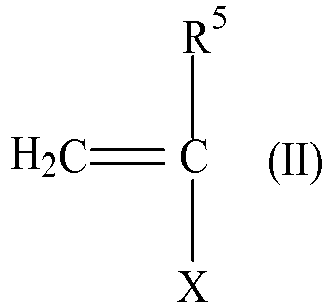


least one sp2 bond, A is O, N, P, S or an amido or ester linkage, B is a mono- or polycyclic aromatic group or an aliphatic group, each t is independently 0 or 1, and M+ is a cation. In one aspect, R7 is a C2 to C6 alkene. In another aspect, R7 is ethene, butene or propene. - Preferred carboxylic acid monomers include one or more of the following: acrylic acid, maleic acid, itaconic acid, methacrylic acid, or ethoxylate esters of acrylic acids, acrylic and methacrylic acids being more preferred. Preferred sulfonated monomers include one or more of the following: sodium (meth) allyl sulfonate, vinyl sulfonate, sodium phenyl (meth) allyl ether sulfonate, or 2-acrylamido-methyl propane sulfonic acid. Preferred non-ionic monomers include one or more of the following: methyl (meth) acrylate, ethyl (meth) acrylate, t-butyl (meth) acrylate, methyl (meth) acrylamide, ethyl (meth) acrylamide, t-butyl (meth) acrylamide, styrene, or α-methyl styrene.
- Preferably, the polymer comprises the following levels of monomers: from about 40 to about 90%, preferably from about 60 to about 90% by weight of the polymer of one or more carboxylic acid monomer; from about 5 to about 50%, preferably from about 10 to about 40% by weight of the polymer of one or more sulfonic acid monomer; and optionally from about 1% to about 30%, preferably from about 2 to about 20% by weight of the polymer of one or more non-ionic monomer. An especially preferred polymer comprises about 70% to about 80% by weight of the polymer of at least one carboxylic acid monomer and from about 20% to about 30% by weight of the polymer of at least one sulfonic acid monomer.
- The carboxylic acid is preferably (meth)acrylic acid. The sulfonic acid monomer is preferably one of the following: 2-acrylamido methyl-1-propanesulfonic acid, 2-methacrylamido-2-methyl-1-propanesulfonic acid, 3-methacrylamido-2-hydroxypropanesulfonic acid, allysulfonic acid, methallysulfonic acid, allyloxybenzenesulfonic acid, methallyloxybenzensulfonic acid, 2-hydroxy-3-(2-propenyloxy)propanesulfonic acid, 2-methyl-2-propene-1-sulfonic acid, styrene sulfonic acid, vinylsulfonic acid, 3-sulfopropyl acrylate, 3-sulfopropyl methacrylate, sulfomethylacrylamid, sulfomethylmethacrylamide, and water soluble salts thereof. The unsaturated sulfonic acid monomer is most preferably 2-acrylamido-2-propanesulfonic acid (AMPS).
- Preferred commercial available polymers include: Alcosperse 240, Aquatreat AR 540 and Aquatreat MPS supplied by Alco Chemical; Acumer 3100, Acumer 2000, Acusol 587G and Acusol 588G supplied by Rohm & Haas; Goodrich K-798, K-775 and K-797 supplied by BF Goodrich; and ACP 1042 supplied by ISP technologies Inc. Particularly preferred polymers are Acusol 587G and Acusol 588G supplied by Rohm & Haas.
- In the polymers, all or some of the carboxylic or sulfonic acid groups can be present in neutralized form, i.e. the acidic hydrogen atom of the carboxylic and/or sulfonic acid group in some or all acid groups can be replaced with metal ions, preferably alkali metal ions and in particular with sodium ions.
- Other suitable organic polymer for use herein includes a polymer comprising an acrylic acid backbone and alkoxylated side chains, said polymer having a molecular weight of from about 2,000 to about 20,000, and said polymer having from about 20 wt% to about 50 wt% of an alkylene oxide. The polymer should have a molecular weight of from about 2,000 to about 20,000, or from about 3,000 to about 15,000, or from about 5,000 to about 13,000. The alkylene oxide (AO) component of the polymer is generally propylene oxide (PO) or ethylene oxide (EO) and generally comprises from about 20 wt% to about 50 wt%, or from about 30 wt% to about 45 wt%, or from about 30 wt% to about 40 wt% of the polymer. The alkoxylated side chains of the water soluble polymers may comprise from about 10 to about 55 AO units, or from about 20 to about 50 AO units, or from about 25 to 50 AO units. The polymers, preferably water soluble, may be configured as random, block, graft, or other known configurations. Methods for forming alkoxylated acrylic acid polymers are disclosed in
U.S. Patent No. 3,880,765 . - Other suitable polymers for use herein include homopolymers and copolymers of polycarboxylic acids and their partially or completely neutralized salts, monomeric polycarboxylic acids and hydroxycarboxylic acids and their salts. Preferred salts of the abovementioned compounds are the ammonium and/or alkali metal salts, i.e. the lithium, sodium, and potassium salts, and particularly preferred salts are the sodium salts.
- Suitable polycarboxylic acids are acyclic, alicyclic, heterocyclic and aromatic carboxylic acids, in which case they contain at least two carboxyl groups which are in each case separated from one another by, preferably, no more than two carbon atoms. Polycarboxylates which comprise two carboxyl groups include, for example, water-soluble salts of, malonic acid, (ethyl enedioxy) diacetic acid, maleic acid, diglycolic acid, tartaric acid, tartronic acid and fumaric acid. Polycarboxylates which contain three carboxyl groups include, for example, water-soluble citrate. Correspondingly, a suitable hydroxycarboxylic acid is, for example, citric acid. Another suitable polycarboxylic acid is the homopolymer of acrylic acid. Other suitable builders are disclosed in
WO 95/01416 - Other suitable organic polymer for use herein includes polyaspartic acid (PAS) derivatives as described in
WO 2009/095645 A1 . - Inorganic and organic bleaches are suitable cleaning actives for use herein. Bleach is present is at a level of from about 1 to about 20%, preferably from about 5 to about 15% by weight of composition. Inorganic bleaches include perhydrate salts such as perborate, percarbonate, perphosphate, persulfate and persilicate salts. The inorganic perhydrate salts are normally the alkali metal salts. The inorganic perhydrate salt may be included as the crystalline solid without additional protection. Alternatively, the salt can be coated.
- Alkali metal percarbonates, particularly sodium percarbonate are preferred perhydrates for use herein. The percarbonate is most preferably incorporated into the products in a coated form which provides in-product stability. A suitable coating material providing in product stability comprises mixed salt of a water-soluble alkali metal sulfate and carbonate. Such coatings together with coating processes have previously been described in
GB- 1,466,799 - Another suitable coating material providing in product stability, comprises sodium silicate of SiO2: Na2O ratio from 1.8: 1 to 3.0: 1, preferably L8:1 to 2.4:1, and/or sodium metasilicate, preferably applied at a level of from 2% to 10%, (normally from 3% to 5%) Of SiO2 by weight of the inorganic perhydrate salt. Magnesium silicate can also be included in the coating. Coatings that contain silicate and borate salts or boric acids or other inorganics are also suitable.
- Other coatings which contain waxes, oils, fatty soaps can also be used advantageously within the present invention.
- Bleach activators are typically organic peracid precursors that enhance the bleaching action in the course of cleaning at temperatures of 60° C and below. Bleach activators suitable for use herein include compounds which, under perhydrolysis conditions, give aliphatic peroxoycarboxylic acids having preferably from 1 to 12 carbon atoms, in particular from 2 to 10 carbon atoms, and/or optionally substituted perbenzoic acid. Suitable substances bear O-acyl and/or N-acyl groups of the number of carbon atoms specified and/or optionally substituted benzoyl groups. Preference is given to polyacylated alkylenediamines, in particular tetraacetylethylenediamine (TAED), acylated triazine derivatives, in particular 1,5-diacetyl-2,4-dioxohexahydro-1,3,5-triazine (DADHT), acylated glycolurils, in particular tetraacetylglycoluril (TAGU), N-acylimides, in particular N-nonanoylsuccinimide (NOSI), acylated phenolsulfonates, in particular n-nonanoyl- or isononanoyloxybenzenesulfonate (n- or iso-NOBS), decanoyloxybenzoic acid (DOBA), carboxylic anhydrides, in particular phthalic anhydride, acylated polyhydric alcohols, in particular triacetin, ethylene glycol diacetate and 2,5-diacetoxy-2,5-dihydrofuran and also triethylacetyl citrate (TEAC). The composition of the invention preferably comprises a bleach activator. Preferably in a level of from about 0.01 to about 10%, preferably from about 0.1 to about 5% and more preferably from about 1 to about 4% by weight of the total composition.
- The composition herein contains a bleach catalyst, preferably a metal containing bleach catalyst. More preferably the metal containing bleach catalyst is a transition metal containing bleach catalyst, especially a manganese or cobalt-containing bleach catalyst.
- Bleach catalysts preferred for use herein include the manganese triazacyclononane and related complexes (
US-A-4246612 ,US-A-5227084 ); Co, Cu, Mn and Fe bispyridylamine and related complexes (US-A-5114611 ); and pentamine acetate cobalt(III) and related complexes(US-A-4810410 ). A complete description of bleach catalysts suitable for use herein can be found inWO 99/06521 - Suitable catalysts for use herein include cobalt (III) catalysts having the formula:
Co[(NH3)nMmBbTtQqPp] Yy
wherein cobalt is in the +3 oxidation state; n is an interger from 0 to 5 (preferably 4 or 5; most preferably 5); M represents a monodentate ligand; m is an integer from 0 to 5 (preferably 1 or 2; most preferably 1); B represents a bidentate ligand; b is an integer from 0 to 2; T represents a tridentate ligand; t is 0 or 1; Q is a tetradentae ligand; q is 0 or 1; P is a pentadentate ligand; p is 0 or 1; and n + m + 2b + 3t + 4q + 5p = 6; Y is one or more appropriately selected counteranions present in a number y, where y is an integer from 1 to 3 (preferably 2 to 3; most preferably 2 when Y is a -1 charged anion), to obtain a charge-balanced salt, preferred Y are selected from the group consisting of chloride, nitrate, nitrite, sulfate, citrate, acetate, carbonate, and combinations thereof; and wherein further at least one of the coordination sites attached to the cobalt is labile under automatic dishwashing use conditions and the remaining coordination sites stabilize the cobalt under automatic dishwashing conditions such that the reduction potential for cobalt (III) to cobalt (II) under alkaline conditions is less than about 0.4 volts (preferably less than about 0.2 volts) versus a normal hydrogen electrode. - Preferred cobalt catalysts have the formula:
[Co(NH3)n(M)m] Yy
wherein n is an interger from 3 to 5 (preferably 4 or 5; most preferably 5); M is a labile coordinating moiety, preferably selected from the group consisting of chlorine, bromine, hydroxide, water, and (when m is greater than 1) combinations thereof; m is an integer from 1 to 3 (preferably 1 or 2; most preferably 1); m+n = 6; and Y is an appropriately selected counteranion present in a number y, which is an integer from 1 to 3 (preferably 2 to 3; most preferably 2 when Y is a -1 charged anion), to obtain a charge-balanced salt. - The most preferred cobalt catalyst useful herein has the formula [Co(NH3)5Cl] Yy., and especially [Co(NH3)5Cl]Cl2.
- Suitable M, B, T, Q and P ligands for use herein are known, such as those ligands described in
U.S. Patent 4,810,410, to Diakun et al, issued March 7,1989 . In addition, examples of M include pryidine and SCN; examples of B include ethylenediamine, bipyridine, acetate, phenthroline, biimidazole, and tropolone; examples of T include terpyridine, acylhydrazones of salicylaldehyde, and diethylenetriamine; examples of Q include triethylenetetramine, N(CH2CH2NH2)3, Schiff bases (for example HOCH2CH2C=NCH2CH2N=CCH2CH2OH); and examples of P include polyimidazoles and HOCH2CH2C=NCH2CH2NH-CH2CH2N=CCH2CH2OH. - These cobalt catalysts are readily prepared by known procedures, such as taught for example in
U.S. Patent 4,810,410, to Diakun et al, issued March 7,1989 , and J. Chem. Ed. (1989), 66 (12), 1043-45; The Synthesis and Characterization of Inorganic Compounds, W.L. Jolly (Prentice-Hall; 1970), pp. 461-3. - Manganese bleach catalysts are preferred for use in the composition of the invention. These catalysts in combination with the alkyl ether sulfate provide the best results in terms of removal of bleachable stains. Especially preferred catalyst for use here is a dinuclear manganese-complex having the general formula:

- Preferred manganese-complexes are those wherein x is either CH3COO- or O2 or mixtures thereof, most preferably wherein the manganese is in the IV oxidation state and x is O2-. Preferred ligands are those which coordinate via three nitrogen atoms to one of the manganese centres, preferably being of a macrocyclic nature. Particularly preferred ligands are:
- (1) 1,4,7-trimethyl-1,4,7-triazacyclononane, (Me-TACN); and
- (2) 1,2,4,7-tetramethyl-1,4,7-triazacyclononane, (Me-Me TACN).
- The type of counter-ion Y for charge neutrality is not critical for the activity of the complex and can be selected from, for example, any of the following counter-ions: chloride; sulfate; nitrate; methylsulfate; surfanctant anions, such as the long-chain alkylsulfates, alkylsulphonates, alkylbenzenesulphonates, tosylate, trifluoromethylsulphonate, perchlorate (ClO4-), BPh4-, and PF6-' though some counter-ions are more preferred than others for reasons of product property and safety.
- Consequently, the preferred manganese complexes useable in the present invention are:
(I) [(Me-TACN)MnIV(µ-0)3MnIV(Me-TACN)]2+(PF6-)2
(II) [(Me-MeTACN)MnIV(µ-0)3MnIV(Me-MeTACN)]2+(PF6-)2
(III) [(Me-TACN)MnIII(µ-0)(µ-OAc)2MnIII(Me-TACN)]2+(PF6-)2
(IV) [(Me-MeTACN)MnIII(µ-0)(µ-OAc)2MnIII(Me-MeTACN)]2+(PF6-)2
which hereinafter may also be abbreviated as:
(I) [MnIV2(µ-0)3(Me-TACN)2] (PF6)2
(II) [MnIV2(µ-0)3(Me-MeTACN)2] (PF6)2
(III) [MnIII2(µ-0)(µ-OAc)2(Me-TACN)2] (PF6)2
(IV) [MnIII2(µ-0)(µ-OAc)2(Me-TACN)2](PF6)2
- The structure of I is given below:

- The structure of II is given below:

- It is of note that the manganese complexes are also disclosed in
EP-A-0458397 andEP-A-0458398 as unusually effective bleach and oxidation catalysts. In the further description of this invention they will also be simply referred to as the "catalyst". - The composition of the invention preferably comprises a bleach catalyst. Preferably in a level of from about 0.001 to about 10%, preferably from about 0.05 to about 2% by weight of the total composition.
- In describing enzyme variants herein, the following nomenclature is used for ease of reference: Original amino acid(s):position(s): substituted amino acid(s).
- According to this nomenclature, for instance the substitution of glutamic acid for glycine in position 195 is shown as G195E. A deletion of glycine in the same position is shown as G195*, and insertion of an additional amino acid residue such as lysine is shown as G195GK. Where a specific enzyme contains a "deletion" in comparison with other enzyme and an insertion is made in such a position this is indicated as *36D for insertion of an aspartic acid in position 36. Multiple mutations are separated by pluses, i.e.: S99G+V102N, representing mutations in positions 99 and 102 substituting serine and valine for glycine and asparagine, respectively. Where the amino acid in a position (e.g. 102) may be substituted by another amino acid selected from a group of amino acids, e.g. the group consisting of N and I, this will be indicated by V102N/I.
- In all cases, the accepted IUPAC single letter or triple letter amino acid abbreviation is employed.
- The numbering used in this patent is numbering versus the specific protease (PB92) listed as SEQ ID No:1. An alternative numbering scheme is the so-called BPN' numbering scheme which is commonly used in the art. For convenience the numbering schemes are compared below in Table 1:
Table 1 - Protease Mutation numbering PB92 numbering of this patent (numbering versus SEQ ID NO:1 of EP 2 100 949 )Equivalent BPN' numbering G116V + S126L + P127Q + S128A G118V + S128L + P129Q + S130A G116V + S126N + P127S + S128A + S160D G118V + S128N + P129S + S130A + S166D G116V + S126L + P127Q + S128A + S160D G118V + S128L + P129Q + S130A + S166D G116V + S126V + P127E + S128K G118V + S128V + P129E + S130K G116V + S126V + P127M + S160D G118V + S128V + P129M + S166D S128T S130T G116V + S126F + P127L + S128T G118V + S128F + P129L + S130T G116V + S126L + P127N + S128V G118V + S128L + P129N + S130V G116V + S126F + P127Q G118V + S128F + P129Q G116V + S126V + P127E + S128K + S160D G118V + S128V + P129E + S130K + S166D G116V + S126R + P127S + S128P G118V + S128R + P129S + S130P S126R + P127Q + S128D S126R + P129Q + S130D S126C + P127R + S128D S128LC + P129R + S130D S126C + P127R + S128G S128LC + P129R + S130G - The relatedness between two amino acid sequences is described by the parameter "identity". For purposes of the present invention, the alignment of two amino acid sequences is determined by using the Needle program from the EMBOSS package (http://emboss.org) version 2.8.0. The Needle program implements the global alignment algorithm described in Needleman, S. B. and Wunsch, C. D. (1970) J. Mol. Biol. 48, 443-453. The substitution matrix used is BLOSUM62, gap opening penalty is 10, and gap extension penalty is 0.5.
- The degree of identity between an amino acid sequence of and enzyme used herein ("invention sequence") and a different amino acid sequence ("foreign sequence") is calculated as the number of exact matches in an alignment of the two sequences, divided by the length of the "invention sequence" or the length of the "foreign sequence", whichever is the shortest. The result is expressed in percent identity. An exact match occurs when the "invention sequence" and the "foreign sequence" have identical amino acid residues in the same positions of the overlap. The length of a sequence is the number of amino acid residues in the sequence.
- Amylases for use herein, including chemically or genetically modified mutants (variants), are alkaline amylases possessing at least 90%, preferably 95%, more preferably 98%, even more preferably 99% and especially 100% identity, with those derived from Bacillus sp. NCIB 12289, NCIB 12512, NCIB 12513, DSM 9375 (
US 7,153,818 ) DSM 12368, DSMZ no. 12649, KSM AP1378 (WO 97/00324 EP 1 ,022,334 ). Preferred low temperature amylases include: - (a) the variants described in
US 5,856,164 andWO99/23211 WO 96/23873 WO00/60060 WO 06/002643 EP 2 100 949 : 9, 26, 30, 33, 82, 37, 106, 118, 128, 133, 149, 150, 160, 178, 182, 186, 193, 195, 202, 203, 214, 231, 256, 257, 258, 269, 270, 272, 283, 295, 296, 298, 299, 303, 304, 305, 311, 314, 315, 318, 319, 320, 323, 339, 345, 361, 378, 383, 419, 421, 437, 441, 444, 445, 446, 447, 450, 458, 461, 471, 482, 484 that also preferably contain the deletions of D183* and G184*. - (b) variants exhibiting at least 90% identity with the wild-type enzyme from Bacillus SP722 (SEQ ID No. 4 in
WO06/002643 WO 00/60060 - (c) variants exhibiting at least 95% identity with SEQ ID NO:4 of
EP 2 100 949 , the wild-type enzyme from Bacillus sp.707, especially those comprising one or more of the following mutations M202, M208, S255, R172, and/or M261. Preferably said amylase comprises one or more of M202L, M202V, M202S, M202T, M202I, M202Q, M202W, S255N and/or R172Q. Particularly preferred are those comprising the M202L or M202T mutations. - Preferred commercially available amylases for use herein are TERMAMYL®, DURAMYL®, STAINZYME®, STAINZYME PLUS®, STAINZYME ULTRA® and NATALASE® (Novozymes A/S) and POWERASE® (DuPont).
- The variant protease for use herein is a protease with variations versus a protease that has at least 70%, preferably at least 90%, more preferably at least 95%, even more preferably at least 99% and especially 100% identity with the amino acid sequence of SEQ ID NO:1 from
EP 2 100 949 Said variant protease comprises substitutions in one or more of the following positions: 9, 15, 32, 33, 48-54, 58-62, 66, 68, 94-107, 116, 123-133, 150, 152-156, 158-161, 164, 169, 175-186, 197, 198, 203-216, 239 as compared with the protease in SEQ ID NO:1 fromEP 2 100 949 (i.e. the amino acids at the specified position, not the BPN' numbering scheme). Preferably, said protease has substitutions in one or more of the following positions: 60, 74, 85, 94, 97-102, 105, 116, 123-128, 150, 152, 160, 183, 203, 211, 212, 213, 214, 216 and 239. More preferably, the protease comprises mutations in one or more, even more preferably in three or more of the following positions, 9, 15, 74, 85, 99, 116, 126, 127, 128, 160, 212 and 239. - Especially preferred are variants with mutations in each of positions 116, 126, 127 and 128.
- Particularly suitable for use in the composition of the invention has been found to be a protease comprising the following specific mutations versus the enzyme of SEQ ID NO:1 from
EP 2 100 949 - (i) G116V + S126L + P127Q + S128A
- (ii) G116V + S126N + P127S + S128A + S160D
- (iii) G116V + S126L + P127Q + S128A + S160D
- (iv) G116V + S126V + P127E + S128K
- (v) G116V + S126V + P127M + S160D
- (vi) S128T
- (vii) G116V + S126F + P127L + S128T
- (viii) G116V + S126L + P127N + S128V
- (ix) G116V + S126F + P127Q
- (x) G116V + S126V + P127E + S128K +S160D
- (xi) G116V + S126R+P127S + S128P
- (xii) S126R + P127Q + S128D
- (xiii) S126C + P127R + S128D; or
- (xiv) S126C + P127R + S128G
- (xv) S99G + VI02N
- (xvi) N74D + N85S + S101A + V102I
- (xvii) V66A + N85S + S99G + V102N
- (xviii) S9R + A15T + V66A+ Q239R
- (xix) S9R + A15T + G59E + V66A + A96S + S97G + Q239R;
- (xx) S9R + A15T + V66A+ N212D + Q239R
- (xxi) S9R + A15T + V68A + N212D + Q239R
- Especially preferred for use in the composition of the invention has been found to be a protease comprising the mutations G116V + S126L + P127Q and S128A.
- Preferred commercially available protease enzymes include those sold under the trade names Alcalase®, Savinase®, Primase®, Durazym®, Polarzyme®, Kannase®, Liquanase®, Ovozyme®, Neutrase®, Everlase®, Blaze® and Esperase® by Novozymes A/S (Denmark), those sold under the tradename Maxatase®, Maxacal®, Maxapem®, Properase®, Purafect®, Purafect Prime®, Purafect Ox®, FN3®, FN4®, Excellase®, Ultimase® and Purafect OXP® by Genencor International, and those sold under the tradename Opticlean® and Optimase® by Solvay Enzymes.
- Preferably the composition of the invention is a unit-dose product. Products in unit dose form include tablets, capsules, sachets, pouches, injection moulded compartments, etc. Preferred for use herein are tablets and unit dose form wrapped with a water-soluble film (including wrapped tablets, capsules, sachets, pouches) and injection moulded containers. The unit dose form of the invention is preferably a water-soluble multi-compartment pack.
- Preferred packs comprise at least two side-by-side compartments superposed (i.e., placed above) onto another compartment, especially preferred are pouches. This disposition contributes to the compactness, robustness and strength of the pack, additionally, it minimise the amount of water-soluble material required. It only requires three pieces of material to form three compartments. The robustness of the pack allows also for the use of very thin films without compromising the physical integrity of the pack. The pack is also very easy to use because the compartments do not need to be folded to be used in machine dispensers of fix geometry. At least two of the compartments of the pack contain two different compositions. By "different compositions" herein is meant compositions that differ in at least one ingredient.
- Preferably, at least one of the compartments contains a solid composition, preferably in powder form and another compartment a liquid composition, the compositions are preferably in a solid to liquid weight ratio of from about 20:1 to about 1:20, more preferably from about 18:1 to about 2:1 and even more preferably from about 15:1 to about 5:1. This kind of pack is very versatile because it can accommodate compositions having a broad spectrum of values of solid: liquid ratio. Particularly preferred have been found to be pouches having a high solid:liquid ratio because many of the detergent ingredients are most suitable for use in solid form, preferably in powder form. The ratio solid:liquid defined herein refers to the relationship between the weight of all the solid compositions and the weight of all the liquid compositions in the pack.
- Preferably solid:liquid weight ratio is from about 2:1 to about 18:1, more preferably from about 5:1 to about 15:1. These weight ratios are suitable in cases in which most of the ingredients of the detergent are in liquid form.
- Preferably the two side-by-side compartments contain liquid compositions, which can be the same but preferably are different and another compartment contains a solid composition, preferably in powder form, more preferably a densified powder. The solid composition contributes to the strength and robustness of the pack.
- For dispenser fit reasons, especially in an automatic dishwasher, the unit dose form products herein have a square or rectangular base and a height of from about 1 to about 5 cm, more preferably from about 1 to about 4 cm. Preferably the weight of the solid composition is from about 5 to about 20 grams, more preferably from about 10 to about 15 grams and the weight of the liquid compositions is from about 0.5 to about 4 grams, more preferably from about 0.8 to about 3 grams.
- In preferred embodiments, at least two of the films which form different compartments have different solubility, under the same conditions, releasing the content of the compositions which they partially or totally envelope at different times.
- Controlled release of the ingredients of a multi-compartment pouch can be achieved by modifying the thickness of the film and/or the solubility of the film material. The solubility of the film material can be delayed by for example cross-linking the film as described in
WO 02/102,955 US 4,765,916 andUS 4,972,017 . Waxy coating (seeWO 95/29982 WO 04/111178 - Other means of obtaining delayed release by multi-compartment pouches with different compartments, where the compartments are made of films having different solubility are taught in
WO 02/08380 - The removal of baked-on and burnt-on soil in a dishwasher using three different detergent compositions was evaluated. The first composition (Composition A) represents a typical auto dishwashing detergent composition. The second composition (Composition B) further comprises an anionic surfactant (LAS). The third composition (Composition C), within the scope of the invention, in addition to the anionic surfactant (LAS) comprises a cyclic amine (methylcyclohexane-1,3-diamine). As it can be seen from the results below (Table 1), the composition according to the invention provides considerably greater burnt-on, baked-on soil removal than the compositions outside the scope of the invention.
- The auto dishwashing detergent compositions showed in Table 1, expressed in g of active material added per wash, were used to assess baked-on, burnt-on soil removal from a stainless steel slide in a dishwasher.
Table 1 Ingredients Composition A Composition B Composition C Sodium Carbonate 7.11 7.11 7.11 LAS (alkyl benzene sulphonate) - 4.00 4.00 Sodium Sulfate 2.80 2.80 2.80 MGDA 2.20 2.20 2.20 Methylcyclohexane-1,3-diamine - - 2.20 Sulphonated polymer 2.00 2.00 2.00 Sodium Percarbonate 1.41 1.41 1.41 Nonionic surfactant 1.23 1.23 1.23 TAED 0.32 0.32 0.32 Suds suppressor - 0.25 0.25 HEDP 0.10 0.10 0.10 BTA 0.01 0.01 0.01 Protease 0.010 0.010 0.010 Amylase 0.003 0.003 0.003 Bleach catalyst 0.003 0.003 0.003 Miscellaneous 1.45 1.45 1.45 Cleaning index vs. Composition A 100 192 280 Delta SRI vs. Composition A - +24.1 +47.1 - To prepare the baked-on, burnt-on soil 6g of corn oil, 6g of peanut oil and 6g of sunflower oil were added into a glass beaker and continually stirred. While stirring, 2.5g of powdered albumin were added gradually. This mixture was allowed to stir for 1 hour.
- Each clean stainless steel slide was identified and its individual weight recorded. Then the soil was applied onto the slide, using a mini sponge roller to cover it across its length, leaving about 1-2cm from the top of the slide clean. The amount of soil added to each slide was about 0.065g (±0.0025g).
- Once soil was applied, the soiled slides were laid on a metal baking tray and placed in a preheated oven at 160°C and baked for 2 hours. After this time elapsed the slides were removed from the oven and allowed to cool down and finally the post-baked weight of all slides were taken and recorded.
- Six slides were placed in the bottom rack of a Miele 1022 dishwasher, three on each side of the dishwasher, clipping them into the rack prongs when necessary. The selected wash temperature was 50°C using city water with water hardness of 1.37 mmol/L (8 USgpg). Each composition was run at least twice and no additional soil was added into the wash. At the end of the wash the slides were allowed to dry overnight and then weighed. Results are expressed gravimetrically as a % of soil removed from known weight of soil on slide, taking composition A as reference.
Claims (11)
- An automatic dishwashing detergent composition comprising:a) from 0.1% to 20% by weight of a cleaning surfactant selected from the group consisting of an anionic surfactant, a zwitterionic surfactant, an amphoteric surfactant, and mixtures thereof; andb) from 0.1% to 20% by weight of a cleaning amine, wherein the cleaning amine comprises a cyclic amine of the following formula:

- A composition according to claim 1, wherein said cleaning surfactant comprises an anionic surfactant selected from the group consisting of sulfonate, sulfate, carboxylate and mixtures thereof.
- A composition according to the preceding claim wherein n is 1.
- A composition according to any of claims 1 or 3 wherein R2 is NH2.
- A composition according to any preceding claim further comprising a builder, preferably an aminocarboxylic builder.
- A composition according to any preceding claim wherein the composition is free of non-ionic surfactant.
- A composition according to any of the proceeding claims further comprising a suds suppressor.
- A composition according to any of the proceeding claims further comprising alkaline amylases possessing at least 90%, preferably 95%, more preferably 98%, even more preferably 99% and especially 100% identity, with those derived from Bacillus sp. NCIB 12289, NCIB 12512, NCIB 12513, DSM 9375 (US 7,153,818) DSM 12368, DSMZ no. 12649, KSM AP1378 (WO 97/00324), KSM K36 or KSM K38 (EP 1 022 334).
- A composition according to any of the proceeding claims further comprising a protease with variations versus a protease that has at least 70%, preferably at least 90%, more preferably at least 95%, even more preferably at least 99% and especially 100% identity with the amino acid sequence of SEQ ID NO:1 from EP 2 100 949 said variant protease comprises substitutions in one or more of the following positions: 9, 15, 32, 33, 48-54, 58-62, 66, 68, 94-107, 116, 123-133, 150, 152-156, 158-161, 164, 169, 175-186, 197, 198, 203-216, 239 as compared with the protease in SEQ ID NO:1 (i.e. the amino acids at the specified position, not the BPN' numbering scheme).
- A method of removing cooked-on, baked-on and burnt-on soils from cookware/tableware by subjecting the cookware/tableware to a composition according to any of the preceding claims in an automatic dishwashing machine.
- Use of a composition according to any of claims 1 to 9 for the removal of cooked-on, baked-on and burnt-on soils from cookware/tableware in automatic dishwashing.
Priority Applications (10)
| Application Number | Priority Date | Filing Date | Title |
|---|---|---|---|
| EP14166717.0A EP2940116B1 (en) | 2014-04-30 | 2014-04-30 | Detergent |
| PCT/US2015/026576 WO2015167837A1 (en) | 2014-04-30 | 2015-04-20 | Detergent composition |
| JP2016563779A JP2017514940A (en) | 2014-04-30 | 2015-04-20 | Detergent composition |
| AU2015253646A AU2015253646A1 (en) | 2014-04-30 | 2015-04-20 | Detergent composition |
| CA2956672A CA2956672C (en) | 2014-04-30 | 2015-04-20 | Detergent composition comprising a cleaning amine |
| ARP150101298A AR100232A1 (en) | 2014-04-30 | 2015-04-29 | DETERGENT |
| US14/700,303 US10190078B2 (en) | 2014-04-30 | 2015-04-30 | Detergent |
| AU2017276195A AU2017276195A1 (en) | 2014-04-30 | 2017-12-12 | Detergent composition |
| JP2018193613A JP2019023311A (en) | 2014-04-30 | 2018-10-12 | Detergent composition |
| JP2020065974A JP6966589B2 (en) | 2014-04-30 | 2020-04-01 | Detergent composition |
Applications Claiming Priority (1)
| Application Number | Priority Date | Filing Date | Title |
|---|---|---|---|
| EP14166717.0A EP2940116B1 (en) | 2014-04-30 | 2014-04-30 | Detergent |
Publications (2)
| Publication Number | Publication Date |
|---|---|
| EP2940116A1 EP2940116A1 (en) | 2015-11-04 |
| EP2940116B1 true EP2940116B1 (en) | 2018-10-17 |
Family
ID=50555123
Family Applications (1)
| Application Number | Title | Priority Date | Filing Date |
|---|---|---|---|
| EP14166717.0A Active EP2940116B1 (en) | 2014-04-30 | 2014-04-30 | Detergent |
Country Status (7)
| Country | Link |
|---|---|
| US (1) | US10190078B2 (en) |
| EP (1) | EP2940116B1 (en) |
| JP (3) | JP2017514940A (en) |
| AR (1) | AR100232A1 (en) |
| AU (2) | AU2015253646A1 (en) |
| CA (1) | CA2956672C (en) |
| WO (1) | WO2015167837A1 (en) |
Families Citing this family (16)
| Publication number | Priority date | Publication date | Assignee | Title |
|---|---|---|---|---|
| EP2940116B1 (en) * | 2014-04-30 | 2018-10-17 | The Procter and Gamble Company | Detergent |
| BR112017005841A2 (en) * | 2014-09-25 | 2018-01-30 | Basf Se | etheramine mixture, process for producing an etheramine mixture, and use of an etheramine mixture. |
| JP6396583B2 (en) | 2014-09-25 | 2018-09-26 | ザ プロクター アンド ギャンブル カンパニー | Cleaning composition containing polyetheramine |
| ES2704090T3 (en) * | 2015-07-16 | 2019-03-14 | Procter & Gamble | Liquid detergent composition |
| ES2718380T3 (en) * | 2015-10-29 | 2019-07-01 | Procter & Gamble | Liquid detergent composition |
| EP3170886B1 (en) * | 2015-11-20 | 2019-01-02 | The Procter and Gamble Company | Cleaning product |
| US20170275566A1 (en) * | 2016-03-24 | 2017-09-28 | The Procter & Gamble Company | Compositions containing an etheramine |
| US20170275565A1 (en) | 2016-03-24 | 2017-09-28 | The Procter & Gamble Company | Compositions containing an etheramine |
| EP3257925B1 (en) * | 2016-06-17 | 2019-10-16 | The Procter and Gamble Company | Liquid detergent composition |
| EP3279301A1 (en) * | 2016-08-04 | 2018-02-07 | The Procter & Gamble Company | Water-soluble unit dose article comprising a cleaning amine |
| EP3279305B1 (en) * | 2016-08-04 | 2020-03-25 | The Procter & Gamble Company | Water-soluble unit dose article comprising a cyclic diamine |
| EP3312265A1 (en) * | 2016-10-18 | 2018-04-25 | The Procter and Gamble Company | Detergent composition |
| EP3456807A1 (en) * | 2017-09-13 | 2019-03-20 | The Procter & Gamble Company | Cleaning composition |
| EP3530723B1 (en) * | 2018-02-21 | 2023-03-29 | The Procter & Gamble Company | Automatic dishwashing composition |
| CN118995325A (en) | 2020-01-29 | 2024-11-22 | 宝洁公司 | Cleaning composition |
| EP4001388A1 (en) * | 2020-11-17 | 2022-05-25 | The Procter & Gamble Company | Automatic dishwashing method with amphiphilic graft polymer in the rinse |
Citations (7)
| Publication number | Priority date | Publication date | Assignee | Title |
|---|---|---|---|---|
| WO1995026397A1 (en) | 1994-03-29 | 1995-10-05 | Novo Nordisk A/S | Alkaline bacillus amylase |
| WO1999027058A1 (en) | 1997-11-21 | 1999-06-03 | The Procter & Gamble Company | Detergent compositions comprising polymeric suds enhancers and their use |
| WO2000012451A1 (en) | 1998-09-02 | 2000-03-09 | The Procter & Gamble Company | Improved processes for making surfactants via adsorptive separation and products thereof |
| WO2000043475A2 (en) | 1999-01-20 | 2000-07-27 | The Procter & Gamble Company | Dishwashing compositions comprising modified alkylbenzene sulfonates |
| US6362147B1 (en) | 1997-08-29 | 2002-03-26 | The Procter & Gamble Company | Thickened liquid dishwashing detergent compositions containing organic diamines |
| WO2009007941A2 (en) | 2007-07-11 | 2009-01-15 | The Procter & Gamble Company | Liquid detergent composition |
| WO2014030097A2 (en) | 2012-08-24 | 2014-02-27 | Basf Se | Solid dishwashing detergent with improved protease performance |
Family Cites Families (72)
| Publication number | Priority date | Publication date | Assignee | Title |
|---|---|---|---|---|
| GB1407997A (en) | 1972-08-01 | 1975-10-01 | Procter & Gamble | Controlled sudsing detergent compositions |
| FR2226460B1 (en) | 1973-04-20 | 1976-12-17 | Interox | |
| US3880765A (en) | 1973-11-12 | 1975-04-29 | Nalco Chemical Co | Waterflood process using alkoxylated low molecular weight acrylic acid polymers as scale inhibitors |
| US4136045A (en) | 1976-10-12 | 1979-01-23 | The Procter & Gamble Company | Detergent compositions containing ethoxylated nonionic surfactants and silicone containing suds suppressing agents |
| GB2048606B (en) | 1979-02-28 | 1983-03-16 | Barr & Stroud Ltd | Optical scanning system |
| GB8629837D0 (en) | 1986-12-13 | 1987-01-21 | Interox Chemicals Ltd | Bleach activation |
| US4765916A (en) | 1987-03-24 | 1988-08-23 | The Clorox Company | Polymer film composition for rinse release of wash additives |
| US4972017A (en) | 1987-03-24 | 1990-11-20 | The Clorox Company | Rinse soluble polymer film composition for wash additives |
| GB8908416D0 (en) | 1989-04-13 | 1989-06-01 | Unilever Plc | Bleach activation |
| DE69125310T2 (en) | 1990-05-21 | 1997-07-03 | Unilever Nv | Bleach activation |
| GB9108136D0 (en) | 1991-04-17 | 1991-06-05 | Unilever Plc | Concentrated detergent powder compositions |
| US5468423A (en) * | 1992-02-07 | 1995-11-21 | The Clorox Company | Reduced residue hard surface cleaner |
| US5576281A (en) | 1993-04-05 | 1996-11-19 | Olin Corporation | Biogradable low foaming surfactants as a rinse aid for autodish applications |
| WO1995001416A1 (en) | 1993-07-01 | 1995-01-12 | The Procter & Gamble Company | Machine dishwashing composition containing oxygen bleach and paraffin oil and benzotriazole compound silver tarnishing inhibitors |
| JP2905913B2 (en) * | 1994-04-22 | 1999-06-14 | 花王株式会社 | Cleaning method of magnetic head |
| US5453216A (en) | 1994-04-28 | 1995-09-26 | Creative Products Resource, Inc. | Delayed-release encapsulated warewashing composition and process of use |
| DE4428004A1 (en) | 1994-08-08 | 1996-02-15 | Basf Ag | Process for the production of amines |
| AR000862A1 (en) | 1995-02-03 | 1997-08-06 | Novozymes As | VARIANTS OF A MOTHER-AMYLASE, A METHOD TO PRODUCE THE SAME, A DNA STRUCTURE AND A VECTOR OF EXPRESSION, A CELL TRANSFORMED BY SUCH A DNA STRUCTURE AND VECTOR, A DETERGENT ADDITIVE, DETERGENT COMPOSITION, A COMPOSITION FOR AND A COMPOSITION FOR THE ELIMINATION OF |
| JP3025627B2 (en) | 1995-06-14 | 2000-03-27 | 花王株式会社 | Liquefied alkaline α-amylase gene |
| US6069122A (en) * | 1997-06-16 | 2000-05-30 | The Procter & Gamble Company | Dishwashing detergent compositions containing organic diamines for improved grease cleaning, sudsing, low temperature stability and dissolution |
| US5827813A (en) * | 1997-02-28 | 1998-10-27 | Procter & Gamble Company | Detergent compositions having color care agents |
| PH11998001775B1 (en) | 1997-07-21 | 2004-02-11 | Procter & Gamble | Improved alkyl aryl sulfonate surfactants |
| AU8124498A (en) | 1997-07-21 | 1999-02-16 | Procter & Gamble Company, The | Cleaning products comprising improved alkylarylsulfonate surfactants prepared via vinylidene olefins and processes for preparation thereof |
| ID26172A (en) | 1997-07-21 | 2000-11-30 | Procter & Gamble | THE PROCESS OF THE MAKING OF ALKYLBENZENASULFONATE SURFACTANTS AND ITS PRODUCTS |
| ZA986445B (en) | 1997-07-21 | 1999-01-21 | Procter & Gamble | Processes for making alkylbenzenesulfonate surfactants from alcohols and products thereof |
| JP2001511473A (en) | 1997-07-21 | 2001-08-14 | ザ、プロクター、エンド、ギャンブル、カンパニー | Detergent composition comprising a mixture of surfactants with broken crystallinity |
| WO1999005242A1 (en) | 1997-07-21 | 1999-02-04 | The Procter & Gamble Company | Improved alkylbenzenesulfonate surfactants |
| GB2327947A (en) | 1997-08-02 | 1999-02-10 | Procter & Gamble | Detergent tablet |
| ES2236930T3 (en) | 1997-08-08 | 2005-07-16 | THE PROCTER & GAMBLE COMPANY | IMPROVED PROCESSES FOR MANUFACTURING TENSIANS BY ADSORTIVE SEPARATION. |
| EP2386568B1 (en) | 1997-10-30 | 2014-08-06 | Novozymes A/S | Alpha-amylase mutants |
| CA2220312C (en) * | 1997-11-10 | 1999-11-09 | Murugesu Nandhakumaran | Radio receiver and rebroadcaster |
| AU1532199A (en) * | 1997-11-21 | 1999-06-15 | Procter & Gamble Company, The | Liquid detergent compositions comprising polymeric suds enhancers |
| EP1123370A1 (en) | 1998-10-20 | 2001-08-16 | The Procter & Gamble Company | Laundry detergents comprising modified alkylbenzene sulfonates |
| ES2260941T3 (en) | 1998-10-20 | 2006-11-01 | THE PROCTER & GAMBLE COMPANY | DETERGENTS FOR CLOTHING UNDERSTANDING ALQUILBENCENO MODULATED SULFONATES. |
| US6403355B1 (en) | 1998-12-21 | 2002-06-11 | Kao Corporation | Amylases |
| US6774099B1 (en) * | 1999-01-20 | 2004-08-10 | The Procter & Gamble Company | Dishwashing detergent compositions containing mixtures or crystallinity-disrupted surfactants |
| ES2532606T3 (en) | 1999-03-31 | 2015-03-30 | Novozymes A/S | Polypeptides with alkaline alpha-amylase activity and nucleic acids encoding them |
| US6710023B1 (en) * | 1999-04-19 | 2004-03-23 | Procter & Gamble Company | Dishwashing detergent compositions containing organic polyamines |
| US6593287B1 (en) * | 1999-12-08 | 2003-07-15 | The Procter & Gamble Company | Compositions including ether-capped poly(oxyalkylated) alcohol surfactants |
| WO2002008371A2 (en) * | 2000-02-17 | 2002-01-31 | The Procter & Gamble Company | Cleaning composition |
| WO2002008370A2 (en) * | 2000-07-19 | 2002-01-31 | The Procter & Gamble Company | Cleaning composition |
| AU2001253179A1 (en) * | 2000-04-06 | 2001-10-23 | Huntsman Petrochemical Corporation | Defoamer compositions and uses therefor |
| GB2365018A (en) | 2000-07-24 | 2002-02-13 | Procter & Gamble | Water soluble pouches |
| HUP0300840A2 (en) | 2000-07-28 | 2003-07-28 | Henkel Kommanditgesellschaft Auf Aktien | Novel, amylolytic enzyme ectracted from bacillus sp. a 7-7 (dsm 12368) and washing and cleaning agents containing this novel amylolytic enzyme |
| GB0114847D0 (en) | 2001-06-18 | 2001-08-08 | Unilever Plc | Water soluble package and liquid contents thereof |
| ATE387487T1 (en) | 2003-05-23 | 2008-03-15 | Procter & Gamble | DETERGENT COMPOSITION FOR USE IN A TEXTILE WASHER OR DISHWASHER |
| EP1518922A1 (en) * | 2003-09-26 | 2005-03-30 | Unilever N.V. | Machine dishwashing formulations |
| JP4444610B2 (en) * | 2003-09-26 | 2010-03-31 | ライオン株式会社 | Liquid detergent in bag-like containers |
| JP2005171173A (en) * | 2003-12-15 | 2005-06-30 | Kao Corp | Liquid detergent composition |
| EP3620523A3 (en) | 2004-07-05 | 2020-08-19 | Novozymes A/S | Alpha-amylase variants with altered properties |
| JP2007016131A (en) * | 2005-07-07 | 2007-01-25 | Kao Corp | Hard surface cleaner |
| DE102006028750A1 (en) | 2006-06-20 | 2007-12-27 | Henkel Kgaa | cleaning process |
| BRPI0906749A2 (en) | 2008-01-28 | 2015-07-07 | Reckitt Benckiser Nv | Composition |
| EP2100947A1 (en) | 2008-03-14 | 2009-09-16 | The Procter and Gamble Company | Automatic dishwashing detergent composition |
| CN102027038B (en) | 2008-05-14 | 2013-07-24 | 巴斯夫欧洲公司 | Use of cyclohexanediol mixtures in the preparation of polymers |
| CN102066457B (en) | 2008-06-16 | 2013-04-17 | 巴斯夫欧洲公司 | Use of C11 diols or mixtures of C11 diols in the production of polymers |
| CN102105503B (en) | 2008-07-23 | 2014-03-19 | 巴斯夫欧洲公司 | Use of 2-isopropyl-2-alkyl-1,3-propanediol for the preparation of polymers |
| US20110144259A1 (en) | 2008-08-26 | 2011-06-16 | Basf Se | Use of 1,1-dimethylol cycloalkanes or 1,1-dimethylol cycloalkenes for the production of polymers |
| EP2331601B1 (en) | 2008-09-04 | 2014-02-12 | Basf Se | Use of substituted 2-aryl-2-alkyl-1,3-propanediol or substituted 2-cyclohexyl-2-alkyl-1,3-propanediol for the preparation of polymers. |
| EP2280058A1 (en) * | 2009-07-30 | 2011-02-02 | Unilever N.V. | Hard surface cleaning composition |
| MX345654B (en) * | 2009-09-14 | 2017-02-08 | The Procter & Gamble Company * | Compact fluid laundry detergent composition. |
| WO2011067200A1 (en) | 2009-12-03 | 2011-06-09 | Basf Se | Catalyst and method for producing an amine |
| CN102639231B (en) | 2009-12-03 | 2014-12-10 | 巴斯夫欧洲公司 | Catalyst and method for producing an amine |
| BR112013010709A2 (en) * | 2010-11-02 | 2019-09-24 | Nagoya Industrial Science Res Institute | trans-2-decenoic acid derivative and pharmaceutical agent containing the same |
| JP5700523B2 (en) * | 2011-01-06 | 2015-04-15 | 花王株式会社 | Dishwashing composition for hand washing |
| US20130150276A1 (en) * | 2011-12-09 | 2013-06-13 | The Procter & Gamble Company | Method of providing fast drying and/or delivering shine on hard surfaces |
| EP2978831B1 (en) * | 2013-03-28 | 2020-12-02 | The Procter and Gamble Company | Cleaning compositions containing a polyetheramine, a soil release polymer, and a carboxymethylcellulose |
| JP6517187B2 (en) * | 2013-03-28 | 2019-05-22 | ビーエーエスエフ ソシエタス・ヨーロピアBasf Se | Polyetheramine Based on 1,3-Dialcohol |
| EP2842936A1 (en) * | 2013-08-26 | 2015-03-04 | Basf Se | Etheramines based on alkoxylated glycerine or trimethylolpropane. |
| MX2016002496A (en) * | 2013-08-26 | 2016-05-31 | Procter & Gamble | Cleaning compositions containing a polyetheramine. |
| EP2940116B1 (en) * | 2014-04-30 | 2018-10-17 | The Procter and Gamble Company | Detergent |
| EP2940117B1 (en) * | 2014-04-30 | 2020-08-19 | The Procter and Gamble Company | Cleaning composition containing a polyetheramine |
-
2014
- 2014-04-30 EP EP14166717.0A patent/EP2940116B1/en active Active
-
2015
- 2015-04-20 JP JP2016563779A patent/JP2017514940A/en active Pending
- 2015-04-20 WO PCT/US2015/026576 patent/WO2015167837A1/en not_active Ceased
- 2015-04-20 CA CA2956672A patent/CA2956672C/en active Active
- 2015-04-20 AU AU2015253646A patent/AU2015253646A1/en not_active Abandoned
- 2015-04-29 AR ARP150101298A patent/AR100232A1/en unknown
- 2015-04-30 US US14/700,303 patent/US10190078B2/en active Active
-
2017
- 2017-12-12 AU AU2017276195A patent/AU2017276195A1/en not_active Abandoned
-
2018
- 2018-10-12 JP JP2018193613A patent/JP2019023311A/en active Pending
-
2020
- 2020-04-01 JP JP2020065974A patent/JP6966589B2/en active Active
Patent Citations (7)
| Publication number | Priority date | Publication date | Assignee | Title |
|---|---|---|---|---|
| WO1995026397A1 (en) | 1994-03-29 | 1995-10-05 | Novo Nordisk A/S | Alkaline bacillus amylase |
| US6362147B1 (en) | 1997-08-29 | 2002-03-26 | The Procter & Gamble Company | Thickened liquid dishwashing detergent compositions containing organic diamines |
| WO1999027058A1 (en) | 1997-11-21 | 1999-06-03 | The Procter & Gamble Company | Detergent compositions comprising polymeric suds enhancers and their use |
| WO2000012451A1 (en) | 1998-09-02 | 2000-03-09 | The Procter & Gamble Company | Improved processes for making surfactants via adsorptive separation and products thereof |
| WO2000043475A2 (en) | 1999-01-20 | 2000-07-27 | The Procter & Gamble Company | Dishwashing compositions comprising modified alkylbenzene sulfonates |
| WO2009007941A2 (en) | 2007-07-11 | 2009-01-15 | The Procter & Gamble Company | Liquid detergent composition |
| WO2014030097A2 (en) | 2012-08-24 | 2014-02-27 | Basf Se | Solid dishwashing detergent with improved protease performance |
Also Published As
| Publication number | Publication date |
|---|---|
| CA2956672C (en) | 2019-06-11 |
| JP2017514940A (en) | 2017-06-08 |
| JP2019023311A (en) | 2019-02-14 |
| JP2020105529A (en) | 2020-07-09 |
| JP6966589B2 (en) | 2021-11-17 |
| AR100232A1 (en) | 2016-09-21 |
| EP2940116A1 (en) | 2015-11-04 |
| CA2956672A1 (en) | 2015-11-05 |
| AU2017276195A1 (en) | 2018-01-18 |
| WO2015167837A1 (en) | 2015-11-05 |
| AU2015253646A1 (en) | 2016-10-27 |
| US20150315523A1 (en) | 2015-11-05 |
| US10190078B2 (en) | 2019-01-29 |
Similar Documents
| Publication | Publication Date | Title |
|---|---|---|
| US10190078B2 (en) | Detergent | |
| CA2895425C (en) | Dishwashing composition | |
| ES2399311T5 (en) | Detergent composition | |
| JP7733426B2 (en) | Detergent composition comprising a detersive surfactant and a graft polymer | |
| EP2700704B1 (en) | Dishwashing method | |
| EP2700703B1 (en) | Dishwashing method | |
| WO2018044637A1 (en) | Automatic dishwashing cleaning composition | |
| WO2017176500A1 (en) | Dishwashing cleaning composition | |
| EP3467085A1 (en) | Dishwashing cleaning composition | |
| EP1051470A1 (en) | Method for softening soil on hard surfaces | |
| CA2940622A1 (en) | Dishwashing composition | |
| CA2940624A1 (en) | Dishwashing composition | |
| WO2016126579A1 (en) | New use of sulfonated polymers | |
| WO2018236810A1 (en) | Automatic dishwashing cleaning composition | |
| EP3467086B1 (en) | Dishwashing cleaning composition | |
| WO2016126567A1 (en) | New use of sulfonated polymers | |
| CA3191340A1 (en) | Automatic dishwashing cleaning composition | |
| WO2018236839A1 (en) | Automatic dishwashing cleaning composition |
Legal Events
| Date | Code | Title | Description |
|---|---|---|---|
| PUAI | Public reference made under article 153(3) epc to a published international application that has entered the european phase |
Free format text: ORIGINAL CODE: 0009012 |
|
| AK | Designated contracting states |
Kind code of ref document: A1 Designated state(s): AL AT BE BG CH CY CZ DE DK EE ES FI FR GB GR HR HU IE IS IT LI LT LU LV MC MK MT NL NO PL PT RO RS SE SI SK SM TR |
|
| AX | Request for extension of the european patent |
Extension state: BA ME |
|
| 17P | Request for examination filed |
Effective date: 20160504 |
|
| RBV | Designated contracting states (corrected) |
Designated state(s): AL AT BE BG CH CY CZ DE DK EE ES FI FR GB GR HR HU IE IS IT LI LT LU LV MC MK MT NL NO PL PT RO RS SE SI SK SM TR |
|
| STAA | Information on the status of an ep patent application or granted ep patent |
Free format text: STATUS: REQUEST FOR EXAMINATION WAS MADE |
|
| R17P | Request for examination filed (corrected) |
Effective date: 20160504 |
|
| STAA | Information on the status of an ep patent application or granted ep patent |
Free format text: STATUS: EXAMINATION IS IN PROGRESS |
|
| 17Q | First examination report despatched |
Effective date: 20171030 |
|
| GRAP | Despatch of communication of intention to grant a patent |
Free format text: ORIGINAL CODE: EPIDOSNIGR1 |
|
| STAA | Information on the status of an ep patent application or granted ep patent |
Free format text: STATUS: GRANT OF PATENT IS INTENDED |
|
| INTG | Intention to grant announced |
Effective date: 20180514 |
|
| GRAS | Grant fee paid |
Free format text: ORIGINAL CODE: EPIDOSNIGR3 |
|
| GRAA | (expected) grant |
Free format text: ORIGINAL CODE: 0009210 |
|
| STAA | Information on the status of an ep patent application or granted ep patent |
Free format text: STATUS: THE PATENT HAS BEEN GRANTED |
|
| AK | Designated contracting states |
Kind code of ref document: B1 Designated state(s): AL AT BE BG CH CY CZ DE DK EE ES FI FR GB GR HR HU IE IS IT LI LT LU LV MC MK MT NL NO PL PT RO RS SE SI SK SM TR |
|
| REG | Reference to a national code |
Ref country code: GB Ref legal event code: FG4D |
|
| REG | Reference to a national code |
Ref country code: CH Ref legal event code: EP |
|
| REG | Reference to a national code |
Ref country code: IE Ref legal event code: FG4D |
|
| REG | Reference to a national code |
Ref country code: DE Ref legal event code: R096 Ref document number: 602014034131 Country of ref document: DE Ref country code: AT Ref legal event code: REF Ref document number: 1054039 Country of ref document: AT Kind code of ref document: T Effective date: 20181115 |
|
| REG | Reference to a national code |
Ref country code: NL Ref legal event code: MP Effective date: 20181017 |
|
| REG | Reference to a national code |
Ref country code: LT Ref legal event code: MG4D |
|
| REG | Reference to a national code |
Ref country code: AT Ref legal event code: MK05 Ref document number: 1054039 Country of ref document: AT Kind code of ref document: T Effective date: 20181017 |
|
| PG25 | Lapsed in a contracting state [announced via postgrant information from national office to epo] |
Ref country code: NL Free format text: LAPSE BECAUSE OF FAILURE TO SUBMIT A TRANSLATION OF THE DESCRIPTION OR TO PAY THE FEE WITHIN THE PRESCRIBED TIME-LIMIT Effective date: 20181017 |
|
| PG25 | Lapsed in a contracting state [announced via postgrant information from national office to epo] |
Ref country code: BG Free format text: LAPSE BECAUSE OF FAILURE TO SUBMIT A TRANSLATION OF THE DESCRIPTION OR TO PAY THE FEE WITHIN THE PRESCRIBED TIME-LIMIT Effective date: 20190117 Ref country code: PL Free format text: LAPSE BECAUSE OF FAILURE TO SUBMIT A TRANSLATION OF THE DESCRIPTION OR TO PAY THE FEE WITHIN THE PRESCRIBED TIME-LIMIT Effective date: 20181017 Ref country code: HR Free format text: LAPSE BECAUSE OF FAILURE TO SUBMIT A TRANSLATION OF THE DESCRIPTION OR TO PAY THE FEE WITHIN THE PRESCRIBED TIME-LIMIT Effective date: 20181017 Ref country code: IS Free format text: LAPSE BECAUSE OF FAILURE TO SUBMIT A TRANSLATION OF THE DESCRIPTION OR TO PAY THE FEE WITHIN THE PRESCRIBED TIME-LIMIT Effective date: 20190217 Ref country code: NO Free format text: LAPSE BECAUSE OF FAILURE TO SUBMIT A TRANSLATION OF THE DESCRIPTION OR TO PAY THE FEE WITHIN THE PRESCRIBED TIME-LIMIT Effective date: 20190117 Ref country code: ES Free format text: LAPSE BECAUSE OF FAILURE TO SUBMIT A TRANSLATION OF THE DESCRIPTION OR TO PAY THE FEE WITHIN THE PRESCRIBED TIME-LIMIT Effective date: 20181017 Ref country code: LT Free format text: LAPSE BECAUSE OF FAILURE TO SUBMIT A TRANSLATION OF THE DESCRIPTION OR TO PAY THE FEE WITHIN THE PRESCRIBED TIME-LIMIT Effective date: 20181017 Ref country code: LV Free format text: LAPSE BECAUSE OF FAILURE TO SUBMIT A TRANSLATION OF THE DESCRIPTION OR TO PAY THE FEE WITHIN THE PRESCRIBED TIME-LIMIT Effective date: 20181017 Ref country code: AT Free format text: LAPSE BECAUSE OF FAILURE TO SUBMIT A TRANSLATION OF THE DESCRIPTION OR TO PAY THE FEE WITHIN THE PRESCRIBED TIME-LIMIT Effective date: 20181017 Ref country code: FI Free format text: LAPSE BECAUSE OF FAILURE TO SUBMIT A TRANSLATION OF THE DESCRIPTION OR TO PAY THE FEE WITHIN THE PRESCRIBED TIME-LIMIT Effective date: 20181017 |
|
| PG25 | Lapsed in a contracting state [announced via postgrant information from national office to epo] |
Ref country code: AL Free format text: LAPSE BECAUSE OF FAILURE TO SUBMIT A TRANSLATION OF THE DESCRIPTION OR TO PAY THE FEE WITHIN THE PRESCRIBED TIME-LIMIT Effective date: 20181017 Ref country code: RS Free format text: LAPSE BECAUSE OF FAILURE TO SUBMIT A TRANSLATION OF THE DESCRIPTION OR TO PAY THE FEE WITHIN THE PRESCRIBED TIME-LIMIT Effective date: 20181017 Ref country code: SE Free format text: LAPSE BECAUSE OF FAILURE TO SUBMIT A TRANSLATION OF THE DESCRIPTION OR TO PAY THE FEE WITHIN THE PRESCRIBED TIME-LIMIT Effective date: 20181017 Ref country code: GR Free format text: LAPSE BECAUSE OF FAILURE TO SUBMIT A TRANSLATION OF THE DESCRIPTION OR TO PAY THE FEE WITHIN THE PRESCRIBED TIME-LIMIT Effective date: 20190118 Ref country code: PT Free format text: LAPSE BECAUSE OF FAILURE TO SUBMIT A TRANSLATION OF THE DESCRIPTION OR TO PAY THE FEE WITHIN THE PRESCRIBED TIME-LIMIT Effective date: 20190217 |
|
| REG | Reference to a national code |
Ref country code: DE Ref legal event code: R026 Ref document number: 602014034131 Country of ref document: DE |
|
| PLBI | Opposition filed |
Free format text: ORIGINAL CODE: 0009260 |
|
| PLAX | Notice of opposition and request to file observation + time limit sent |
Free format text: ORIGINAL CODE: EPIDOSNOBS2 |
|
| PG25 | Lapsed in a contracting state [announced via postgrant information from national office to epo] |
Ref country code: IT Free format text: LAPSE BECAUSE OF FAILURE TO SUBMIT A TRANSLATION OF THE DESCRIPTION OR TO PAY THE FEE WITHIN THE PRESCRIBED TIME-LIMIT Effective date: 20181017 Ref country code: DK Free format text: LAPSE BECAUSE OF FAILURE TO SUBMIT A TRANSLATION OF THE DESCRIPTION OR TO PAY THE FEE WITHIN THE PRESCRIBED TIME-LIMIT Effective date: 20181017 Ref country code: CZ Free format text: LAPSE BECAUSE OF FAILURE TO SUBMIT A TRANSLATION OF THE DESCRIPTION OR TO PAY THE FEE WITHIN THE PRESCRIBED TIME-LIMIT Effective date: 20181017 |
|
| 26 | Opposition filed |
Opponent name: HENKEL AG & CO. KGAA Effective date: 20190717 |
|
| PG25 | Lapsed in a contracting state [announced via postgrant information from national office to epo] |
Ref country code: RO Free format text: LAPSE BECAUSE OF FAILURE TO SUBMIT A TRANSLATION OF THE DESCRIPTION OR TO PAY THE FEE WITHIN THE PRESCRIBED TIME-LIMIT Effective date: 20181017 Ref country code: SK Free format text: LAPSE BECAUSE OF FAILURE TO SUBMIT A TRANSLATION OF THE DESCRIPTION OR TO PAY THE FEE WITHIN THE PRESCRIBED TIME-LIMIT Effective date: 20181017 Ref country code: EE Free format text: LAPSE BECAUSE OF FAILURE TO SUBMIT A TRANSLATION OF THE DESCRIPTION OR TO PAY THE FEE WITHIN THE PRESCRIBED TIME-LIMIT Effective date: 20181017 Ref country code: SM Free format text: LAPSE BECAUSE OF FAILURE TO SUBMIT A TRANSLATION OF THE DESCRIPTION OR TO PAY THE FEE WITHIN THE PRESCRIBED TIME-LIMIT Effective date: 20181017 |
|
| PG25 | Lapsed in a contracting state [announced via postgrant information from national office to epo] |
Ref country code: SI Free format text: LAPSE BECAUSE OF FAILURE TO SUBMIT A TRANSLATION OF THE DESCRIPTION OR TO PAY THE FEE WITHIN THE PRESCRIBED TIME-LIMIT Effective date: 20181017 |
|
| REG | Reference to a national code |
Ref country code: DE Ref legal event code: R119 Ref document number: 602014034131 Country of ref document: DE |
|
| REG | Reference to a national code |
Ref country code: CH Ref legal event code: PL |
|
| PLBB | Reply of patent proprietor to notice(s) of opposition received |
Free format text: ORIGINAL CODE: EPIDOSNOBS3 |
|
| REG | Reference to a national code |
Ref country code: BE Ref legal event code: MM Effective date: 20190430 |
|
| PG25 | Lapsed in a contracting state [announced via postgrant information from national office to epo] |
Ref country code: LU Free format text: LAPSE BECAUSE OF NON-PAYMENT OF DUE FEES Effective date: 20190430 Ref country code: MC Free format text: LAPSE BECAUSE OF FAILURE TO SUBMIT A TRANSLATION OF THE DESCRIPTION OR TO PAY THE FEE WITHIN THE PRESCRIBED TIME-LIMIT Effective date: 20181017 |
|
| PG25 | Lapsed in a contracting state [announced via postgrant information from national office to epo] |
Ref country code: CH Free format text: LAPSE BECAUSE OF NON-PAYMENT OF DUE FEES Effective date: 20190430 Ref country code: LI Free format text: LAPSE BECAUSE OF NON-PAYMENT OF DUE FEES Effective date: 20190430 Ref country code: DE Free format text: LAPSE BECAUSE OF NON-PAYMENT OF DUE FEES Effective date: 20191101 |
|
| PG25 | Lapsed in a contracting state [announced via postgrant information from national office to epo] |
Ref country code: BE Free format text: LAPSE BECAUSE OF NON-PAYMENT OF DUE FEES Effective date: 20190430 Ref country code: FR Free format text: LAPSE BECAUSE OF NON-PAYMENT OF DUE FEES Effective date: 20190430 |
|
| PG25 | Lapsed in a contracting state [announced via postgrant information from national office to epo] |
Ref country code: TR Free format text: LAPSE BECAUSE OF FAILURE TO SUBMIT A TRANSLATION OF THE DESCRIPTION OR TO PAY THE FEE WITHIN THE PRESCRIBED TIME-LIMIT Effective date: 20181017 |
|
| PG25 | Lapsed in a contracting state [announced via postgrant information from national office to epo] |
Ref country code: IE Free format text: LAPSE BECAUSE OF NON-PAYMENT OF DUE FEES Effective date: 20190430 |
|
| REG | Reference to a national code |
Ref country code: DE Ref legal event code: R100 Ref document number: 602014034131 Country of ref document: DE |
|
| PLCK | Communication despatched that opposition was rejected |
Free format text: ORIGINAL CODE: EPIDOSNREJ1 |
|
| PLBN | Opposition rejected |
Free format text: ORIGINAL CODE: 0009273 |
|
| STAA | Information on the status of an ep patent application or granted ep patent |
Free format text: STATUS: OPPOSITION REJECTED |
|
| 27O | Opposition rejected |
Effective date: 20201020 |
|
| PG25 | Lapsed in a contracting state [announced via postgrant information from national office to epo] |
Ref country code: CY Free format text: LAPSE BECAUSE OF FAILURE TO SUBMIT A TRANSLATION OF THE DESCRIPTION OR TO PAY THE FEE WITHIN THE PRESCRIBED TIME-LIMIT Effective date: 20181017 |
|
| PG25 | Lapsed in a contracting state [announced via postgrant information from national office to epo] |
Ref country code: MT Free format text: LAPSE BECAUSE OF FAILURE TO SUBMIT A TRANSLATION OF THE DESCRIPTION OR TO PAY THE FEE WITHIN THE PRESCRIBED TIME-LIMIT Effective date: 20181017 Ref country code: HU Free format text: LAPSE BECAUSE OF FAILURE TO SUBMIT A TRANSLATION OF THE DESCRIPTION OR TO PAY THE FEE WITHIN THE PRESCRIBED TIME-LIMIT; INVALID AB INITIO Effective date: 20140430 |
|
| PG25 | Lapsed in a contracting state [announced via postgrant information from national office to epo] |
Ref country code: MK Free format text: LAPSE BECAUSE OF FAILURE TO SUBMIT A TRANSLATION OF THE DESCRIPTION OR TO PAY THE FEE WITHIN THE PRESCRIBED TIME-LIMIT Effective date: 20181017 |
|
| P01 | Opt-out of the competence of the unified patent court (upc) registered |
Effective date: 20230429 |
|
| PGFP | Annual fee paid to national office [announced via postgrant information from national office to epo] |
Ref country code: GB Payment date: 20260312 Year of fee payment: 13 |