EP2935640B1 - Austenitic twip stainless steel, its production and use. - Google Patents
Austenitic twip stainless steel, its production and use. Download PDFInfo
- Publication number
- EP2935640B1 EP2935640B1 EP13852342.8A EP13852342A EP2935640B1 EP 2935640 B1 EP2935640 B1 EP 2935640B1 EP 13852342 A EP13852342 A EP 13852342A EP 2935640 B1 EP2935640 B1 EP 2935640B1
- Authority
- EP
- European Patent Office
- Prior art keywords
- stainless steel
- deformation
- austenitic stainless
- comprised
- weight
- Prior art date
- Legal status (The legal status is an assumption and is not a legal conclusion. Google has not performed a legal analysis and makes no representation as to the accuracy of the status listed.)
- Active
Links
Images
Classifications
-
- C—CHEMISTRY; METALLURGY
- C22—METALLURGY; FERROUS OR NON-FERROUS ALLOYS; TREATMENT OF ALLOYS OR NON-FERROUS METALS
- C22C—ALLOYS
- C22C38/00—Ferrous alloys, e.g. steel alloys
- C22C38/18—Ferrous alloys, e.g. steel alloys containing chromium
- C22C38/40—Ferrous alloys, e.g. steel alloys containing chromium with nickel
- C22C38/58—Ferrous alloys, e.g. steel alloys containing chromium with nickel with more than 1.5% by weight of manganese
-
- C—CHEMISTRY; METALLURGY
- C21—METALLURGY OF IRON
- C21D—MODIFYING THE PHYSICAL STRUCTURE OF FERROUS METALS; GENERAL DEVICES FOR HEAT TREATMENT OF FERROUS OR NON-FERROUS METALS OR ALLOYS; MAKING METAL MALLEABLE, e.g. BY DECARBURISATION OR TEMPERING
- C21D6/00—Heat treatment of ferrous alloys
- C21D6/004—Heat treatment of ferrous alloys containing Cr and Ni
-
- C—CHEMISTRY; METALLURGY
- C21—METALLURGY OF IRON
- C21D—MODIFYING THE PHYSICAL STRUCTURE OF FERROUS METALS; GENERAL DEVICES FOR HEAT TREATMENT OF FERROUS OR NON-FERROUS METALS OR ALLOYS; MAKING METAL MALLEABLE, e.g. BY DECARBURISATION OR TEMPERING
- C21D6/00—Heat treatment of ferrous alloys
- C21D6/005—Heat treatment of ferrous alloys containing Mn
-
- C—CHEMISTRY; METALLURGY
- C21—METALLURGY OF IRON
- C21D—MODIFYING THE PHYSICAL STRUCTURE OF FERROUS METALS; GENERAL DEVICES FOR HEAT TREATMENT OF FERROUS OR NON-FERROUS METALS OR ALLOYS; MAKING METAL MALLEABLE, e.g. BY DECARBURISATION OR TEMPERING
- C21D6/00—Heat treatment of ferrous alloys
- C21D6/007—Heat treatment of ferrous alloys containing Co
-
- C—CHEMISTRY; METALLURGY
- C21—METALLURGY OF IRON
- C21D—MODIFYING THE PHYSICAL STRUCTURE OF FERROUS METALS; GENERAL DEVICES FOR HEAT TREATMENT OF FERROUS OR NON-FERROUS METALS OR ALLOYS; MAKING METAL MALLEABLE, e.g. BY DECARBURISATION OR TEMPERING
- C21D6/00—Heat treatment of ferrous alloys
- C21D6/008—Heat treatment of ferrous alloys containing Si
-
- C—CHEMISTRY; METALLURGY
- C21—METALLURGY OF IRON
- C21D—MODIFYING THE PHYSICAL STRUCTURE OF FERROUS METALS; GENERAL DEVICES FOR HEAT TREATMENT OF FERROUS OR NON-FERROUS METALS OR ALLOYS; MAKING METAL MALLEABLE, e.g. BY DECARBURISATION OR TEMPERING
- C21D8/00—Modifying the physical properties of ferrous metals or ferrous alloys by deformation combined with, or followed by, heat treatment
-
- C—CHEMISTRY; METALLURGY
- C22—METALLURGY; FERROUS OR NON-FERROUS ALLOYS; TREATMENT OF ALLOYS OR NON-FERROUS METALS
- C22C—ALLOYS
- C22C38/00—Ferrous alloys, e.g. steel alloys
- C22C38/001—Ferrous alloys, e.g. steel alloys containing N
-
- C—CHEMISTRY; METALLURGY
- C22—METALLURGY; FERROUS OR NON-FERROUS ALLOYS; TREATMENT OF ALLOYS OR NON-FERROUS METALS
- C22C—ALLOYS
- C22C38/00—Ferrous alloys, e.g. steel alloys
- C22C38/02—Ferrous alloys, e.g. steel alloys containing silicon
-
- C—CHEMISTRY; METALLURGY
- C22—METALLURGY; FERROUS OR NON-FERROUS ALLOYS; TREATMENT OF ALLOYS OR NON-FERROUS METALS
- C22C—ALLOYS
- C22C38/00—Ferrous alloys, e.g. steel alloys
- C22C38/06—Ferrous alloys, e.g. steel alloys containing aluminium
-
- C—CHEMISTRY; METALLURGY
- C22—METALLURGY; FERROUS OR NON-FERROUS ALLOYS; TREATMENT OF ALLOYS OR NON-FERROUS METALS
- C22C—ALLOYS
- C22C38/00—Ferrous alloys, e.g. steel alloys
- C22C38/18—Ferrous alloys, e.g. steel alloys containing chromium
- C22C38/38—Ferrous alloys, e.g. steel alloys containing chromium with more than 1.5% by weight of manganese
-
- C—CHEMISTRY; METALLURGY
- C22—METALLURGY; FERROUS OR NON-FERROUS ALLOYS; TREATMENT OF ALLOYS OR NON-FERROUS METALS
- C22C—ALLOYS
- C22C38/00—Ferrous alloys, e.g. steel alloys
- C22C38/18—Ferrous alloys, e.g. steel alloys containing chromium
- C22C38/40—Ferrous alloys, e.g. steel alloys containing chromium with nickel
- C22C38/42—Ferrous alloys, e.g. steel alloys containing chromium with nickel with copper
-
- C—CHEMISTRY; METALLURGY
- C22—METALLURGY; FERROUS OR NON-FERROUS ALLOYS; TREATMENT OF ALLOYS OR NON-FERROUS METALS
- C22C—ALLOYS
- C22C38/00—Ferrous alloys, e.g. steel alloys
- C22C38/18—Ferrous alloys, e.g. steel alloys containing chromium
- C22C38/40—Ferrous alloys, e.g. steel alloys containing chromium with nickel
- C22C38/44—Ferrous alloys, e.g. steel alloys containing chromium with nickel with molybdenum or tungsten
-
- C—CHEMISTRY; METALLURGY
- C22—METALLURGY; FERROUS OR NON-FERROUS ALLOYS; TREATMENT OF ALLOYS OR NON-FERROUS METALS
- C22C—ALLOYS
- C22C38/00—Ferrous alloys, e.g. steel alloys
- C22C38/18—Ferrous alloys, e.g. steel alloys containing chromium
- C22C38/40—Ferrous alloys, e.g. steel alloys containing chromium with nickel
- C22C38/46—Ferrous alloys, e.g. steel alloys containing chromium with nickel with vanadium
-
- C—CHEMISTRY; METALLURGY
- C22—METALLURGY; FERROUS OR NON-FERROUS ALLOYS; TREATMENT OF ALLOYS OR NON-FERROUS METALS
- C22C—ALLOYS
- C22C38/00—Ferrous alloys, e.g. steel alloys
- C22C38/18—Ferrous alloys, e.g. steel alloys containing chromium
- C22C38/40—Ferrous alloys, e.g. steel alloys containing chromium with nickel
- C22C38/48—Ferrous alloys, e.g. steel alloys containing chromium with nickel with niobium or tantalum
-
- C—CHEMISTRY; METALLURGY
- C22—METALLURGY; FERROUS OR NON-FERROUS ALLOYS; TREATMENT OF ALLOYS OR NON-FERROUS METALS
- C22C—ALLOYS
- C22C38/00—Ferrous alloys, e.g. steel alloys
- C22C38/18—Ferrous alloys, e.g. steel alloys containing chromium
- C22C38/40—Ferrous alloys, e.g. steel alloys containing chromium with nickel
- C22C38/50—Ferrous alloys, e.g. steel alloys containing chromium with nickel with titanium or zirconium
-
- C—CHEMISTRY; METALLURGY
- C22—METALLURGY; FERROUS OR NON-FERROUS ALLOYS; TREATMENT OF ALLOYS OR NON-FERROUS METALS
- C22C—ALLOYS
- C22C38/00—Ferrous alloys, e.g. steel alloys
- C22C38/18—Ferrous alloys, e.g. steel alloys containing chromium
- C22C38/40—Ferrous alloys, e.g. steel alloys containing chromium with nickel
- C22C38/52—Ferrous alloys, e.g. steel alloys containing chromium with nickel with cobalt
-
- C—CHEMISTRY; METALLURGY
- C22—METALLURGY; FERROUS OR NON-FERROUS ALLOYS; TREATMENT OF ALLOYS OR NON-FERROUS METALS
- C22C—ALLOYS
- C22C38/00—Ferrous alloys, e.g. steel alloys
- C22C38/18—Ferrous alloys, e.g. steel alloys containing chromium
- C22C38/40—Ferrous alloys, e.g. steel alloys containing chromium with nickel
- C22C38/54—Ferrous alloys, e.g. steel alloys containing chromium with nickel with boron
Definitions
- the present invention relates to the field of the austenitic stainless steels.
- the subject of the invention is an austenitic stainless steel with a specific chemical composition providing, among other things, a Cr content ⁇ 11% (by weight) and a manufacturing process determining a microstructure and a deformation mode so as to give to the product high mechanical properties in terms of mechanical resistance (UTS ultimate tensile strength : 700-1800Mpa), in particular ductility (A80 > 80%) and high resistance to corrosion.
- the specific energy absorption measured as area below the tension-deformation curve, is very high and in the order of 0.5-0.8 J/mm3.
- the austenitic steels can be schematically separated into two large families: stainless austenitic steels (AISI200 and AISI300 series type) and steels with high content of Mn (Mn>11% by weight).
- the austenitic steels with high Mn content are steels wherein the stabilization of the austenitic structure is obtained by means of suitable additions of Mn and C.
- the TWIP austenitic steels with high Mn, Fe-22Mn-0.6C or Fe-22Mn-3Al-3Si type constitute an independent family of steels in the field of the high resistant steels as they have definitely peculiar mechanical properties (UTS 700-1000Mpa) and they are characterized above all by very high ductility (A80>60%) and work hardening.
- These steels have an austenitic structure with face-centered cubic lattice (FCC), together with a low energy of the stacking fault (SFE) promoting the activation of the deformation mechanisms by twinning (twinning induced mechanically).
- TWIP with high Mn A limit of this typology of steels (TWIP with high Mn) is the poor resistance to corrosion thereof; for the application in the automotive field and more in general in all fields wherein the steel is exposed to a not protected and potentially corrosive environment, there is the need for protecting the steel by means of coating such as galvanizing.
- the problems of the zinc layer adhesion make the electrogalvanising process(EG) the most suitable one for the TWIP steels with high Mn.
- a process for the industrial implementation of a high-resistant stainless steel (UTS > 700MPa), with high ductility (A80>80%), which at the same time is suitable for applications in corrosive environments, is not yet known to the state of art. Therefore, in different industrial fields, there is the need for having available a stainless steel able to offer an optimum compromise between cost of manufacturing cycle and mechanical properties, resistance to corrosion and high formability together with a good surface quality.
- the TWIP austenitic steels with high Mn apart from the poor resistance to corrosion and the difficulties linked to the galvanizing process, have additional criticalities linked to the manufacturing cycle, with high manufacturing costs, which strongly hinder the industrialization thereof, and therefore the application in fields such as the automotive one. Substantially, the most critical aspects are the following ones;
- Prior art document US 2010/047105 describes an austenitic stainless steel composition including relatively low Ni and Mo levels, and exhibiting corrosion resistance, resistance to elevated temperature deformation, and formability properties comparable to certain alloys including higher Ni and Mo levels.
- the austenitic stainless steel includes, in weight percentages, up to 0.20 C, 2.0-9.0 Mn, up to 2.0 Si, 15.0-23.0 Cr, 1.0-9.5 Ni, up to 3.0 Mo, up to 3.0 Cu, 0.05-0.35 N, (7.5(% C)) ⁇ (%Nb+%Ti+%V+%Ta+%Zr) ⁇ 1.5, Fe, and incidental impurities.
- the steel according to the present invention which provides a stainless austenitic steel with a set of functional properties, in particular related to the ductility, forming ability and resistance to corrosion, significatively improved with respect to the austenitic steels of the current state of art (steels of TWIP type with high Mn and austenitic stainless steels).
- the behaviour in hot and cold rolling of the invention steel is similar to the one reported for the conventional stainless steels of AISI304 type and considerably better than the one of the TWIP steels with high Mn. This allows being able to obtain thin thicknesses without the necessity of a double cold rolling and recrystallization annealing.
- the steel according to the present invention is characterized by a specific chemical composition and a manufacturing process determining a microstructure in the finished product that allow to obtain products with high mechanical features in terms of ultimate tensile strength (UTS: 700-1000Mpa) and ductility in particular (A80>60%).
- the steel of the present invention can be manufactured in different format type such as, for example, coils, bars, tubes and it allows meeting effectively all application requests in all fields of the mechanical and manufacturing industry, wherein the requirements of high resistance to corrosion, excellent mechanical features, disposition to deep drawing and low costs are particularly important.
- the chemical composition of the steel subject of the present invention was defined based upon a wide series of laboratory tests with the implementation of experimental casts.
- the produced alloys then were transformed into products by means of rolling and annealing.
- the object of the present invention is an austenitic stainless steel with high twinning induced plasticity (TWIP steel) and high mechanical and formability properties defined by: Rp0.2 comprised between 250 and 650 MPa; UTS comprised between 700 and 1200 MPa; A80 comprised between 60 and 100%, characterized in that it has a chemical composition, expressed in percentage by weight, comprising the following elements: C 0.01-0.50; N 0.11-0.50; Mn 6-12; Ni 0.01-6.0; Cu 0.01-6.0; Si 0.001-0.5; Al 0.001-2.0; Cr 11-20; Nb 0.001-0.5; Mo 0.01-2.0; Co 0.01-2.0; and optionally at least one of Ti 0.001-0.5 or V 0.001-0.5; and optionally at least one of the following elements with the following percentage by weight: W 0.001-0.5; Hf 0.001-0.5; Re 0.001-0.5; Ta 0.001-0.5, Si 0.01-0.3; the remaining portion being Fe and unavoidable impur
- an embodiment of the invention steel further comprises the following elements with the following % by weight: S+Se+Te ⁇ 0.5 and/or P+Sn+Sb+As ⁇ 0.2.
- An additional object of the invention is an austenitic stainless steel as according to anyone of the previous claims, wherein the following elements have the following % by weight: C 0.01-0.15; N 0.11-0.30; Mn 7-10; Cr 16-18; Cu 0.01-3.0; Ni 1.0-5.0; Al 0.01-1.5; Nb 0.02-0.3; Co 0.05-0.03; Mo 0.05-1.5.
- the following elements have the following % by weight: C+N 0.15-0.5; Cu+Ni 3.0-5.0; Mo+Co 0.05-3.0; Nb+V+Ti 0.05-1.0.
- the austenitic stainless steel of the invention after a deformation by 30% at room temperature, has a martensite volumetric fraction ( ⁇ + ⁇ ') lower than 5% and which, during a cold deformation, forms twins in quantities, expressed in terms of volumetric fraction, comprised between 2 to 20%.
- the composition range thereof is 6-12%.
- the upper and lower limits of the composition range are 0.01 and 6.0%, respectively.
- Cr is the key element to obtain a high resistance to corrosion.
- the composition range thereof is 11-20%, which gives a resistance to corrosion much higher than the TWIP austenitic steels of the state of art.
- Al (aluminium) has the double function of increasing the energy of stacking fault and preventing the formation of martensite ⁇ .
- Silicium tends to lower the value of stacking fault energy and it tends to promote the formation of martensite ⁇ and ⁇ '.
- the group of elements constituted by Niobium, Titanium, Cobalt, Tantalium, Hafnium, Molybdenium, Tungstenum and Rhenium plays a double metallurgic effect.
- the first effect is constituted by the improvement of the mechanical resistance and the corrosion resistance of the steel.
- the second effect consists in the effective hindering action of the cross-slip mechanism of the (partial) dissociated dislocations. This takes place by means of increasing the resistance to recombination of the partial dislocations representing the needed condition so that the cross-slip takes place.
- the metallurgic effect of these elements has then a fundamental importance as the cross-slip mechanism is the main antagonist of the nucleation of the deformation induced twins (mechanical twins).
- the quantities in weight percentage to be used of this group of elements are singularly comprised between 0.01-2%wt for Co and Mo; 0.001-0.5% wt for Nb, Ti and V; whereas at last for Ta, Hf, W and Re the quantities are comprised between 0.001 and 0.5% wt.
- An additional object of the invention is a process for the production of the austenitic stainless steel as above described, characterized in that it comprises the following procedures:
- the cooling at room temperature is performed with a rate in the range of 1°C/s-100°C/s.
- the cycle for manufacturing the steel according to the invention has an important role in obtaining the above-enlisted properties.
- two cases are to be distinguished:
- the product is obtained directly by the process of hot rolling the slabs (ingots, billets) obtained by the continuous casting processes.
- the product for example belt, bar, wire rod, etc.
- After hot rolling and cooling in case can be annealed at high temperature or directly applied as partially re-crystallized.
- the starting material of the cold cycle is constituted by the hot deformed product under conditions of hot rolling annealed or raw product.
- the optimum conditions of the cold manufacturing cycle can be defined as follows:
- An additional object of the invention is the use of the austenitic stainless steel as described above for manufacturing automobile components with complex geometry, for the energy absorption, for structural reinforcements and/or for applications by deep drawing wherein a high resistance to corrosion is requested.
- PREN is the acronym of Pitting Resistance Equivalent Number and it is an index for the synthetic evaluation of the localized resistance to corrosion.
- Table 3 shows the mechanical properties relevant to the steel of table 2.
- Table 3 Example Yield Rp0.2 (Mpa) Tensile strength UTS (MPa) A80(%) 1.1 (inv.) 360 850 90 1.2(inv.) 370 810 84 1.3 (comparative) 345 710 45
- the steels of the examples 1.1 and 1.2 show mechanical properties according to those of the present invention.
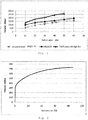
- Figure 1 shows the comparison, in terms of hardening during cold deformation, of the steel related to the example 1.1 with the two reference steels AISI304 and TWIP steel with high Mn (TWIP-HIGH Mn).
- the microstructure of the steel of example 1.1. after a deformation by 30% at room temperature has a martensite ( ⁇ + ⁇ ') percentage lower than 1%.
- the percentage of twins assessed by means of optical microscope, resulted to be 10%.
- the steel of the example 1.3 instead, has a poor TWIP effect during deformation (the fraction of twins present after the deformation by 30% is lower than 1%).
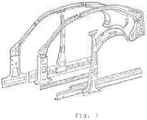
- FIG. 3 shows the pillars of an automobile which can be obtained with the steels according to the examples 1.1 and 1.2.
- the pillars are the body portions whereupon the roof is supported and which have great importance for the structural strength of the body high portion.
- Table 7 shows the mechanical features related to the steel of table 6.
- Table 7 Example Yield Rp0.2 (Mpa) Tensile strength UTS (MPa) A80 (%) 2.1 (inv.) 320 780 88 2.2 (comparative) 410 860 52
- the mechanical properties of the steel 2.1 are excellent.
- the sample 2.1 deformed by 30% at room temperature, has a percentage of twins higher than 8% and total lack of martensite ( ⁇ + ⁇ ').
- the chemical composition 2.2 shows a poor ductility.
- FIG. 2 shows the diagram tension-deformation at room temperature of the steel related to the example 2.1.
- the annealing at low temperature determined a partial recrystallization and a very fine grain size (about 1 ⁇ m). This allows obtaining a higher yielding stress value even if a high residual ductility is still kept.
- the product related to the example 3.2 has mechanical features significantly higher than those of any stainless steel of the previous state of art.
- the properties of the steel of the example 3.3 are significantly lower due to the precipitation of carbides during the annealing cycle.
- the microstructure of the example 3.3 after deformation by 30% at room temperature, is characterized by a percentage of martensite ( ⁇ + ⁇ ') of 8%.
- the fraction of twins assessed by optical microscope, resulted to be lower than 1%.
- the low fraction of twins produced during the deformation explains the low work hardening of the material and then the poor obtained ductility.
- Table 15 shows the mechanical properties related to the examples of table 14.
- Table 15 Example Yield Rp0.2 (Mpa) Tensile strength UTS (MPa) A80(%) 4.1 (inv.) 420 910 70 4.2 (comparative) 360 820 45
- the microstructure of the example 4.1 is characterized by a volumetric fraction of twins higher than 8% at a 30% deformation. Upon observing with the optical microscope the microstructure of the steel related to the example 4.2, deformed by 30%, the presence of twins was not revealed.
- the product obtained in the example 4.1 according to the invention underlined a high mechanical resistance together with a good resistance to corrosion and ductility. Such functional property makes this product more suitable than the comparative steel 4.2 for implementing automobile components.
Landscapes
- Chemical & Material Sciences (AREA)
- Engineering & Computer Science (AREA)
- Materials Engineering (AREA)
- Mechanical Engineering (AREA)
- Metallurgy (AREA)
- Organic Chemistry (AREA)
- Thermal Sciences (AREA)
- Crystallography & Structural Chemistry (AREA)
- Physics & Mathematics (AREA)
- Heat Treatment Of Sheet Steel (AREA)
- Manufacture Of Alloys Or Alloy Compounds (AREA)
- Chemical Treatment Of Metals (AREA)
- Arc Welding In General (AREA)
- Heat Treatment Of Steel (AREA)
Description
- The present invention relates to the field of the austenitic stainless steels.
- The subject of the invention is an austenitic stainless steel with a specific chemical composition providing, among other things, a Cr content ≥ 11% (by weight) and a manufacturing process determining a microstructure and a deformation mode so as to give to the product high mechanical properties in terms of mechanical resistance (UTS ultimate tensile strength : 700-1800Mpa), in particular ductility (A80 > 80%) and high resistance to corrosion. The specific energy absorption, measured as area below the tension-deformation curve, is very high and in the order of 0.5-0.8 J/mm3. Such features make the steel according to the invention particularly suitable to the application in several fields such as automotive, the one of the components for domestic appliances and for structural uses.
- As it is known, in the current state of art the austenitic steels can be schematically separated into two large families: stainless austenitic steels (AISI200 and AISI300 series type) and steels with high content of Mn (Mn>11% by weight).
- The austenitic steels with high Mn content (Hadfield type and TWIP steels) are steels wherein the stabilization of the austenitic structure is obtained by means of suitable additions of Mn and C. The TWIP austenitic steels with high Mn, Fe-22Mn-0.6C or Fe-22Mn-3Al-3Si type, constitute an independent family of steels in the field of the high resistant steels as they have definitely peculiar mechanical properties (UTS 700-1000Mpa) and they are characterized above all by very high ductility (A80>60%) and work hardening. These steels have an austenitic structure with face-centered cubic lattice (FCC), together with a low energy of the stacking fault (SFE) promoting the activation of the deformation mechanisms by twinning (twinning induced mechanically).
- In the last decade the TWIP steels have been object of an intense research activity as they are considered extremely interesting for the applications wherein high performances in terms of ductility, capability of hardening and energy absorption during deformation are requested (
WO99/01585 EP0889144 ). - A limit of this typology of steels (TWIP with high Mn) is the poor resistance to corrosion thereof; for the application in the automotive field and more in general in all fields wherein the steel is exposed to a not protected and potentially corrosive environment, there is the need for protecting the steel by means of coating such as galvanizing. The problems of the zinc layer adhesion make the electrogalvanising process(EG) the most suitable one for the TWIP steels with high Mn.
- In the state of art (
WO2006/025412 ,US2012/0000580A ) there are some proposals trying to obtain corrosion-resistant TWIP steels obtained by adding about 12% of Cr to the composition of the TWIP steel with high Mn. These variants have a chemical composition of the Fe-25Mn-12Cr-0.25C-0.3N type and
they have not high level of resistance to corrosion and are not suitable to relatively corrosive environments. - A process for the industrial implementation of a high-resistant stainless steel (UTS > 700MPa), with high ductility (A80>80%), which at the same time is suitable for applications in corrosive environments, is not yet known to the state of art. Therefore, in different industrial fields, there is the need for having available a stainless steel able to offer an optimum compromise between cost of manufacturing cycle and mechanical properties, resistance to corrosion and high formability together with a good surface quality.
- The TWIP austenitic steels with high Mn, apart from the poor resistance to corrosion and the difficulties linked to the galvanizing process, have additional criticalities linked to the manufacturing cycle, with high manufacturing costs, which strongly hinder the industrialization thereof, and therefore the application in fields such as the automotive one. Substantially, the most critical aspects are the following ones;
- ferro-alloy cost;
- hydrogen embrittlement (RFSR-CT-2005-00030,
WO2012/07715A2 - high resistance to hot and cold deformation;
- environmental problems in steel works linked to the high Mn content.
- Prior art document
US 2010/047105 describes an austenitic stainless steel composition including relatively low Ni and Mo levels, and exhibiting corrosion resistance, resistance to elevated temperature deformation, and formability properties comparable to certain alloys including higher Ni and Mo levels. In particular, the austenitic stainless steel includes, in weight percentages, up to 0.20 C, 2.0-9.0 Mn, up to 2.0 Si, 15.0-23.0 Cr, 1.0-9.5 Ni, up to 3.0 Mo, up to 3.0 Cu, 0.05-0.35 N, (7.5(% C))≤(%Nb+%Ti+%V+%Ta+%Zr)≤1.5, Fe, and incidental impurities. - The above reported criticalities related to the TWIP austenitic steels are overcome by the steel according to the present invention which provides a stainless austenitic steel with a set of functional properties, in particular related to the ductility, forming ability and resistance to corrosion, significatively improved with respect to the austenitic steels of the current state of art (steels of TWIP type with high Mn and austenitic stainless steels).
- The behaviour in hot and cold rolling of the invention steel is similar to the one reported for the conventional stainless steels of AISI304 type and considerably better than the one of the TWIP steels with high Mn. This allows being able to obtain thin thicknesses without the necessity of a double cold rolling and recrystallization annealing.
- The steel according to the present invention is characterized by a specific chemical composition and a manufacturing process determining a microstructure in the finished product that allow to obtain products with high mechanical features in terms of ultimate tensile strength (UTS: 700-1000Mpa) and ductility in particular (A80>60%).
- The steel of the present invention can be manufactured in different format type such as, for example, coils, bars, tubes and it allows meeting effectively all application requests in all fields of the mechanical and manufacturing industry, wherein the requirements of high resistance to corrosion, excellent mechanical features, disposition to deep drawing and low costs are particularly important.
- The chemical composition of the steel subject of the present invention was defined based upon a wide series of laboratory tests with the implementation of experimental casts. The produced alloys then were
transformed into products by means of rolling and annealing. - The characterization of the microstructure and the mechanical properties of the produced samples allowed defining the composition intervals for single alloy elements or for combinations of alloy elements, independently the one from the other ones, therefor the products with the functional features claimed in the present invention and enlisted herebelow were obtained.
- Therefore the object of the present invention is an austenitic stainless steel with high twinning induced plasticity (TWIP steel) and high mechanical and formability properties defined by: Rp0.2 comprised between 250 and 650 MPa; UTS comprised between 700 and 1200 MPa; A80 comprised between 60 and 100%, characterized in that it has a chemical composition, expressed in percentage by weight, comprising the following elements: C 0.01-0.50; N 0.11-0.50; Mn 6-12; Ni 0.01-6.0; Cu 0.01-6.0; Si 0.001-0.5; Al 0.001-2.0; Cr 11-20; Nb 0.001-0.5; Mo 0.01-2.0; Co 0.01-2.0; and optionally at least one of Ti 0.001-0.5 or V 0.001-0.5; and optionally at least one of the following elements with the following percentage by weight: W 0.001-0.5; Hf 0.001-0.5; Re 0.001-0.5; Ta 0.001-0.5, Si 0.01-0.3; the remaining portion being Fe and unavoidable impurities. Hereinafter, even if not indicated, percentages are meant as % by weight.
- The presence of additional elements, such as Ta+Hf+W+Re, can be useful to further increase the mechanical resistance and the product's corrosion resistance.
- In order to obtain a better workability it is preferable that S+Se+Te<0.5 are present. To reduce casting defects it is preferable that P+Sn+Sb+As<0.2. Therefore an embodiment of the invention steel further comprises the following elements with the following % by weight: S+Se+Te<0.5 and/or P+Sn+Sb+As<0.2.
- An additional object of the invention is an austenitic stainless steel as according to anyone of the previous claims, wherein the following elements have the following % by weight: C 0.01-0.15; N 0.11-0.30; Mn 7-10; Cr 16-18; Cu 0.01-3.0; Ni 1.0-5.0; Al 0.01-1.5; Nb 0.02-0.3; Co 0.05-0.03; Mo 0.05-1.5.
- Preferably the following elements have the following % by weight: C+N 0.15-0.5; Cu+Ni 3.0-5.0; Mo+Co 0.05-3.0; Nb+V+Ti 0.05-1.0.
- The austenitic stainless steel of the invention after a deformation by 30% at room temperature, has a martensite volumetric fraction (ε + α') lower than 5% and which, during a cold deformation, forms twins in quantities, expressed in terms of volumetric fraction, comprised between 2 to 20%.
- The microstructural examination of the samples produced according to the invention allowed to argue that the metallurgic mechanism, the basis of the excellent mechanical properties, is constituted by the TWIP (Twinning Induced Plasticity) behaviour of the steel. During deformation, inside the crystalline grains, twins nucleate induced by deformation (mechanical twins). Such behaviour which, by entity and character, was never observed in the stainless steel (Cr > 10 %), determines an evolution of the microstructure during deformation process completely new with respect to the state of art of the stainless steels.
- Carbon and nitrogen contribute in stabilizing the austenite and they are decisive to obtain the wished mechanical features and to prevent the formation of martensitic phases during deformation. The sum thereof varies in the range of 0.12-1.00%. Manganese plays a determining role in the stabilization of the austenitic phase. The composition range thereof is 6-12%. Ni and Cu allow stabilizing the austenitic phase. For both elements the upper and lower limits of the composition range are 0.01 and 6.0%, respectively. Cr is the key element to obtain a high resistance to corrosion. The composition range thereof is 11-20%, which gives a resistance to corrosion much higher than the TWIP austenitic steels of the state of art. Al (aluminium) has the double function of increasing the energy of stacking fault and preventing the formation of martensite ε. Silicium tends to lower the value of stacking fault energy and it tends to promote the formation of martensite ε and α'.
- The group of elements constituted by Niobium, Titanium, Cobalt, Tantalium, Hafnium, Molybdenium, Tungstenum and Rhenium plays a double metallurgic effect. The first effect is constituted by the improvement of the mechanical resistance and the corrosion resistance of the steel. The second effect consists in the effective hindering action of the cross-slip mechanism of the (partial) dissociated dislocations. This takes place by means of increasing the resistance to recombination of the partial dislocations representing the needed condition so that the cross-slip takes place. The metallurgic effect of these elements has then a fundamental importance as the cross-slip mechanism is the main antagonist of the nucleation of the deformation induced twins (mechanical twins). The quantities in weight percentage to be used of this group of elements are singularly comprised between 0.01-2%wt for Co and Mo; 0.001-0.5% wt for Nb, Ti and V; whereas at last for Ta, Hf, W and Re the quantities are comprised between 0.001 and 0.5% wt.
- An additional object of the invention is a process for the production of the austenitic stainless steel as above described, characterized in that it comprises the following procedures:
- hot deformation of the steel under condition of product obtained by continuous casting or by ingot; or
- cold deformation with reduction ratio higher than 30% of the steel under condition of annealed hot rolled product or hot rolled not annealed product,
- Preferably the cooling at room temperature is performed with a rate in the range of 1°C/s-100°C/s.
- The cycle for manufacturing the steel according to the invention has an important role in obtaining the above-enlisted properties. In particular two cases are to be distinguished:
- 1) product obtained by means of hot deformation;
- 2) product obtained by means of cold deformation.
- In the first case the product is obtained directly by the process of hot rolling the slabs (ingots, billets) obtained by the continuous casting processes. The product (for example belt, bar, wire rod, etc.), after hot rolling and cooling, in case can be annealed at high temperature or directly applied as partially re-crystallized.
- Hereinafter the optimum annealing conditions are reported, wherein the thermal treatment can be schematized in three phases:
- i) Heating stage until maximum temperature (0.01-50°C) ;
- ii) Soaking at maximum temperature (800-1200°C for a time comprised between 10-3600s);
- iii) Cooling down to room temperature (cooling rate 1-100°C/s).
- In case of cold rolled products the starting material of the cold cycle is constituted by the hot deformed product under conditions of hot rolling annealed or raw product. The optimum conditions of the cold manufacturing cycle can be defined as follows:
- i) Reduction ratio of the cold rolling process higher than 30%;
- ii) Heating until maximum temperature (10-50°C/s) ;
- iii) Soaking at maximum temperature (800-1200°C for a time higher than 10s);
- iv) Cooling down to room temperature (cooling rate 1-100°C/s).
- An additional object of the invention is the use of the austenitic stainless steel as described above for manufacturing automobile components with complex geometry, for the energy absorption, for structural reinforcements and/or for applications by deep drawing wherein a high resistance to corrosion is requested.
- A description of embodiments of the invention will be now provided with the help of the figures and of the examples, with the purpose of making to understand objects, features and advantages thereof, not to be meant with limitative purpose.
-
Figure 1 shows the comparison, in terms of strain hardening during the cold deformation, of the steel according to the invention (INOX-IP) in the state of cold rolled and annealed strip with two reference steels AISI304 and TWIP steel with high Mn (TWIP-HIGH Mn). -
Figure 2 shows the deformation curve (%) depending upon the tension in MPa at room temperature relevant to a test piece taken from a cold rolled and annealed strip. -
Figure 3 shows the components supporting the automobile body roof (pillars) which can be manufactured with the steel of the present invention. - In the examples, PREN is the acronym of Pitting Resistance Equivalent Number and it is an index for the synthetic evaluation of the localized resistance to corrosion.
- Three different 1.0-thick cold strip samples were obtained from cold rolling of slabs produced by a continuous casting plant. The hot strips were cold rolled (50% reduction) and subjected to final recrystallization annealing according to the modes shown in Table 1.
Table 1 Heating rate (°C/s) Furnace temperature (°C) Soaking time (s) Cooling rate (°C/s) 20 1000 90 50 - The chemical compositions of the considered steels are reported in the following table.
Table 2 Example C N Mn Ni Cu Si Al Cr Nb Mo Co 1.1 (inv.) 0.05 0.2 9.5 2 2 0.2 1.5 18 0.09 0.2 0.6 1.2 (inv.) 0.1 0.2 9 1 4 0.25 0.001 18 0.1 1.5 0.5 1.3 (comparative) 0.04 0.10 9 2 4 0.25 0.001 18 - - - - Table 3 shows the mechanical properties relevant to the steel of table 2.
Table 3 Example Yield Rp0.2 (Mpa) Tensile strength UTS (MPa) A80(%) 1.1 (inv.) 360 850 90 1.2(inv.) 370 810 84 1.3 (comparative) 345 710 45 - The steels of the examples 1.1 and 1.2 show mechanical properties according to those of the present invention. The samples 1.1 and 1.2, deformed by 30% at room temperature, have both a percentage of twins higher than 8% and almost total lack of martensite (ε+α').
Figure 1 shows the comparison, in terms of hardening during cold deformation, of the steel related to the example 1.1 with the two reference steels AISI304 and TWIP steel with high Mn (TWIP-HIGH Mn). - The microstructure of the steel of example 1.1. after a deformation by 30% at room temperature has a martensite (ε+α') percentage lower than 1%. The percentage of twins, assessed by means of optical microscope, resulted to be 10%. The steel of the example 1.3, instead, has a poor TWIP effect during deformation (the fraction of twins present after the deformation by 30% is lower than 1%).
- The corrosionistic properties of the subject examples are shown in the following table 4.
Table 4 Example PREN EP (mV) Critical Crevice Temperature (°C) Co 1.1 (inv.) 22 300-500 10-15 1.2 (inv.) 26 300-500 15-20 1.3 (comparative) 20 400-500 5-15 - The products related to the examples 1.1 and 1.2 can be used for manufacturing automobile components requiring a good resistance to corrosion and a high mechanical resistance together with an excellent capability of energy absorption, such as the structural elements of automobiles.
Figure 3 shows the pillars of an automobile which can be obtained with the steels according to the examples 1.1 and 1.2. The pillars are the body portions whereupon the roof is supported and which have great importance for the structural strength of the body high portion. - Two 10.0 mm-thick wire rods were obtained from hot rolling of billets produced by a continuous casting plant. The conditions of final recrystallization annealing of the wire rods are shown in the following table.
Table 5 Furnace temperature (°C) Soaking time (s) Cooling rate (°C/s) 1000 120 50 - The chemical composition of the subject wire rods is shown in the following table.
Table 6 Example C N Mn Ni Cu Si Al Cr Nb Mo Co Ti 2.1 (inv.) 0.12 0.13 7 3 2 0.25 1.5 18 0.3 0.2 0.5 0.1 2.2 (comparative) 0.25 0.35 9.5 2 0 0.2 1.5 10.5 - - - - - Table 7 shows the mechanical features related to the steel of table 6.
Table 7 Example Yield Rp0.2 (Mpa) Tensile strength UTS (MPa) A80 (%) 2.1 (inv.) 320 780 88 2.2 (comparative) 410 860 52 - The mechanical properties of the steel 2.1 are excellent. In fact, the sample 2.1, deformed by 30% at room temperature, has a percentage of twins higher than 8% and total lack of martensite (ε+α'). On the contrary the chemical composition 2.2 shows a poor ductility.
- The microstructure of the steel 2.2, deformed by 30% at room temperature, in fact, has a percentage of twins lower than 1%. The low fraction of twins produced during the deformation explains the low work hardening of the material and then the poor obtained ductility.
Figure 2 shows the diagram tension-deformation at room temperature of the steel related to the example 2.1. - The corrosionistic properties of the steels at issue are shown in the following table.
Table 8 Example PREN EP (mV) Critical Crevice Temperature (°C) Co 2.1 (inv.) 22 400-600 10-15 2.2 (comparative) 16 100-200 <5 - Three samples of the same hot rolled strip with thickness of 2.0 mm were subjected to three different recrystallization annealing cycles shown in the following table with the purpose of verifying the effect of the annealing cycle on the final microstructure and on the mechanical properties.
Table 9 Example Heating speed (°C) Furnace temperature (°C) Keeping time (s) Cooling speed (°C/s) 3.1 (inv.) 30 800 90 50 3.2 (inv.) 20 1100 60 50 3.3 (comparative) 0.01 700 36000 0.1 - The chemical composition of the exemplified samples is shown in the following table 10.
Table 10 C N Mn Ni Cu Si Al Cr Nb Mo Co Ti V Ta 0.1 0.25 8.5 2 1 0.2 0.1 17 0.05 1.0 0.05 0.08 0.1 0.1 - The following table shows the mechanical properties related to the 3 examined samples.
Table 11 Example Yield Rp0.2 (Mpa) Tensile strength UTS (MPa) A80 (%) 3.1 (inv.) 580 910 50 3.2 (inv.) 320 780 92 3.3 (comparative) 380 680 39 - In case of the example 3.1 the annealing at low temperature determined a partial recrystallization and a very fine grain size (about 1 µm). This allows obtaining a higher yielding stress value even if a high residual ductility is still kept.
- The product related to the example 3.2 has mechanical features significantly higher than those of any stainless steel of the previous state of art. The properties of the steel of the example 3.3, instead, are significantly lower due to the precipitation of carbides during the annealing cycle. The microstructure of the example 3.3, after deformation by 30% at room temperature, is characterized by a percentage of martensite (ε+α') of 8%. The fraction of twins, assessed by optical microscope, resulted to be lower than 1%. The low fraction of twins produced during the deformation explains the low work hardening of the material and then the poor obtained ductility.
- The corrosionistic properties of the herein exemplified steels are shown in the following table.
Table 12 Example PREN EP (mV) Critical Crevice Temperature (°C) 3.1, 3.2 (inv.) 21 200-400 5-10 1.3 (comparative) 21 100 <5 - In the steel of the comparative example 3.3 the not suitable process conditions determined mechanical and corrosionistic properties not appropriate for the application in the automotive field.
- Two 1.5 mm-thick strip samples of a steel according to the invention were obtained from hot rolling and subsequent cold rolling (50% reduction rate) and final annealing. The annealing conditions are shown in table 13.
Table 13 Heating rate (°C) Furnace temperature (°C/s) Soaking time (s) Cooling rate (°C/s) 150 35 90 50 - The chemical composition of the subject samples are shown in the following table.
Table 14 Example C N Mn Ni Cu Si Al Cr Mo Co Nb Ta W 4.1 (inv.) 0.1 0.15 6.5 2 3 0.2 1.0 18 2 0.2 0.1 0.07 0.1 4.2 (comparative) 0.1 0.09 8 4 2 1.0 1.5 18 - - - - - - Table 15 shows the mechanical properties related to the examples of table 14.
Table 15 Example Yield Rp0.2 (Mpa) Tensile strength UTS (MPa) A80(%) 4.1 (inv.) 420 910 70 4.2 (comparative) 360 820 45 - The microstructure of the example 4.1 is characterized by a volumetric fraction of twins higher than 8% at a 30% deformation. Upon observing with the optical microscope the microstructure of the steel related to the example 4.2, deformed by 30%, the presence of twins was not revealed.
- The corrosionistic properties of the steel considered in the present example are shown in table 16.
Table 16 Example PREN Ep (mV) Crevice Critical Temperature (°C) 4.1 (inv.) 27 400-600 20-30 4.2 (comp.) 19 300-400 10-15 - The product obtained in the example 4.1 according to the invention underlined a high mechanical resistance together with a good resistance to corrosion and ductility. Such functional property makes this product more suitable than the comparative steel 4.2 for implementing automobile components.
Claims (8)
- An austenitic stainless steel with high plasticity induced by twinning (TWIP steel) and high mechanical properties and formability defined by:
Rp0.2 comprised between 250 and 650 MPa, Rm comprised between 700 and 1200 MPa, A80 comprised between 60 and 100%, - The austenitic stainless steel according to anyone of the previous claims comprising the following elements with the following percentage by weight: S+Se+Te<0.5 and/or P+Sn+Sb+As<0.2.
- The austenitic stainless steel according to anyone of the previous claims, wherein the following elements have the following percentage by weight: C 0.01-0.15; N 0.11-0.30; Mn 7-10; Cr 16-18; Cu 0.01-3.0; Ni 1.0-5.0; Al 0.01-1.5; Nb 0.02-0.3; Co 0.05-0.03; Mo 0.05-1.5.
- The austenitic stainless steel according to anyone of the previous claims, wherein the following elements have the following percentage by weight: C+N 0.15-0.5; Cu+Ni 3.0-5.0; Mo+Co 0.05-3.0; Nb+V+Ti 0.05-1.0.
- The austenitic stainless steel according to anyone of the previous claims, characterized in that, after a deformation of 30% at room temperature, it has a martensite volumetric fraction (ε + α') lower than 5% and which, during a cold deformation, forms twins in quantities, expressed in terms of volumetric fraction, comprised between 2 to 20%.
- A process for producing the austenitic stainless steel according to claims 1 to 5, characterized in that it comprises the following procedures:- hot deformation of the steel under condition of product obtained by continuous casting or by ingot; or- cold deformation with reduction rate higher than 30% of the steel product under condition of annealed hot rolled product or hot rolling raw product,the above-mentioned hot deformation or the above-mentioned cold deformation being followed by a possible recrystallization annealing, at a temperature in the range of 800-1200°C for a time comprised in the range of 10-600s, and by cooling at room temperature.
- The process according to claim 6, wherein the cooling at room temperature is performed with a speed in the range of 1°C/s-100°C/s.
- The use of the austenitic stainless steel according to claim 1 to 5 for manufacturing automobile components with complex geometry, for the energy absorption, for structural reinforcements and/or for applications by deep moulding wherein a high resistance to corrosion is requested.
Applications Claiming Priority (2)
| Application Number | Priority Date | Filing Date | Title |
|---|---|---|---|
| IT000647A ITRM20120647A1 (en) | 2012-12-19 | 2012-12-19 | AUSTENITIC STAINLESS STEEL WITH HIGH PLASTICITY INDUCED BY GEMINATION, PROCEDURE FOR ITS PRODUCTION, AND ITS USE IN THE MECHANICAL INDUSTRY. |
| PCT/IB2013/061101 WO2014097184A2 (en) | 2012-12-19 | 2013-12-18 | Austenitic stainless steel with high twinning induced plasticity, process for the production thereof and use thereof in the mechanical industry |
Publications (2)
| Publication Number | Publication Date |
|---|---|
| EP2935640A2 EP2935640A2 (en) | 2015-10-28 |
| EP2935640B1 true EP2935640B1 (en) | 2017-11-22 |
Family
ID=47722395
Family Applications (1)
| Application Number | Title | Priority Date | Filing Date |
|---|---|---|---|
| EP13852342.8A Active EP2935640B1 (en) | 2012-12-19 | 2013-12-18 | Austenitic twip stainless steel, its production and use. |
Country Status (6)
| Country | Link |
|---|---|
| US (1) | US10066280B2 (en) |
| EP (1) | EP2935640B1 (en) |
| CN (1) | CN105121688B (en) |
| BR (1) | BR112015014690A2 (en) |
| IT (1) | ITRM20120647A1 (en) |
| WO (1) | WO2014097184A2 (en) |
Families Citing this family (19)
| Publication number | Priority date | Publication date | Assignee | Title |
|---|---|---|---|---|
| EP3095889A1 (en) | 2015-05-22 | 2016-11-23 | Outokumpu Oyj | Method for manufacturing a component made of austenitic steel |
| TR201808389T4 (en) | 2015-07-16 | 2018-07-23 | Outokumpu Oy | Method for the production of austenitic twip or trip / twip steel component. |
| EP3173504A1 (en) | 2015-11-09 | 2017-05-31 | Outokumpu Oyj | Method for manufacturing an austenitic steel component and use of the component |
| US20170137921A1 (en) * | 2015-11-18 | 2017-05-18 | Yuanji Zhu | Systems and Methods for Producing Hardwearing And IMPACT-RESISTANT ALLOY STEEL |
| PL3441494T3 (en) * | 2016-03-23 | 2022-01-17 | Nippon Steel Stainless Steel Corporation | STAINLESS STAINLESS STEEL STAINLESS STEEL SHEET FOR EXCELLENT HEAT RESISTANCE AND WORKABILITY ELEMENT, TURBOCHARGER ELEMENT AND MANUFACTURING STAINLESS STAINLESS STAINLESS STEEL STAINLESS STEEL SHEET |
| CN105970115A (en) * | 2016-05-31 | 2016-09-28 | 上海大学兴化特种不锈钢研究院 | Economical high-performance copper-containing free-cutting austenitic stainless steel alloy material |
| KR101903174B1 (en) * | 2016-12-13 | 2018-10-01 | 주식회사 포스코 | Low alloy steel sheet with excellent strength and ductility |
| CN106834963B (en) * | 2016-12-16 | 2018-08-24 | 安徽宝恒新材料科技有限公司 | A kind of anti-bacteria stainless steel and preparation method thereof |
| RU2647058C1 (en) * | 2017-03-20 | 2018-03-13 | Юлия Алексеевна Щепочкина | Steel |
| CN107686926A (en) * | 2017-08-25 | 2018-02-13 | 苏州双金实业有限公司 | A kind of novel austenite stainless steel |
| CN110157973B (en) * | 2019-07-04 | 2021-07-20 | 广西大学 | A kind of high-strength corrosion-resistant stainless steel plate for automobile and preparation method thereof |
| CN110241364B (en) * | 2019-07-19 | 2021-03-26 | 东北大学 | High-strength plastic nano/submicron crystal cold-rolled 304 stainless steel strip and preparation method thereof |
| CN112662931B (en) * | 2019-10-15 | 2022-07-12 | 中国石油化工股份有限公司 | Method for simultaneously improving strength and plasticity of austenitic steel and product thereof |
| CN110791710A (en) * | 2019-11-12 | 2020-02-14 | 江阴康瑞成型技术科技有限公司 | Environmentally friendly and energy-saving austenitic cold heading stainless steel wire and its production process |
| CN111876670B (en) * | 2020-06-30 | 2021-11-09 | 九牧厨卫股份有限公司 | High-hardness scratch-resistant stainless steel, stainless steel water tank and preparation method thereof |
| CN112281083A (en) * | 2020-10-30 | 2021-01-29 | 上海材料研究所 | High-strength heat-resistant alloy steel having high thermal expansion characteristics and method for manufacturing same |
| CN114807741B (en) * | 2021-09-02 | 2023-09-22 | 中国科学院金属研究所 | A method to improve the performance of austenitic stainless steel based on carbide precipitation |
| CN117265419B (en) | 2022-06-15 | 2025-10-17 | 宝山钢铁股份有限公司 | High-formability, easy-phosphating and high-manganese cold-rolled steel sheet with strength of 1000-1600MPa and manufacturing method thereof |
| MA58221B1 (en) * | 2022-10-21 | 2024-07-31 | Ocp Sa | Abrasion and corrosion resistant duplex stainless steel manufactured by molten casting |
Family Cites Families (15)
| Publication number | Priority date | Publication date | Assignee | Title |
|---|---|---|---|---|
| EP0694626A1 (en) * | 1994-07-26 | 1996-01-31 | Acerinox S.A. | Austenitic stainless steel with low nickel content |
| DE19727759C2 (en) | 1997-07-01 | 2000-05-18 | Max Planck Inst Eisenforschung | Use of a lightweight steel |
| JP2001527156A (en) * | 1997-12-23 | 2001-12-25 | アレゲニー・ラドラム・コーポレーション | Austenitic stainless steel containing columbium |
| FR2780735B1 (en) * | 1998-07-02 | 2001-06-22 | Usinor | AUSTENITIC STAINLESS STEEL WITH LOW NICKEL CONTENT AND CORROSION RESISTANT |
| KR20070048273A (en) | 2004-09-01 | 2007-05-08 | 주식회사 아도반테스토 | Logic Verification Method, Logic Module Data, Device Data and Logic Verification Device |
| JP4606113B2 (en) * | 2004-10-15 | 2011-01-05 | 日新製鋼株式会社 | Austenitic stainless steel with high proportional limit stress and manufacturing method |
| JP5165236B2 (en) * | 2006-12-27 | 2013-03-21 | 新日鐵住金ステンレス株式会社 | Stainless steel plate for structural members with excellent shock absorption characteristics |
| DK2245202T3 (en) * | 2007-12-20 | 2011-12-19 | Ati Properties Inc | Low nickel Austenitic stainless steel containing stabilizing elements |
| US8337749B2 (en) * | 2007-12-20 | 2012-12-25 | Ati Properties, Inc. | Lean austenitic stainless steel |
| DE102008056844A1 (en) * | 2008-11-12 | 2010-06-02 | Voestalpine Stahl Gmbh | Manganese steel strip and method of making the same |
| JP5444561B2 (en) * | 2009-02-27 | 2014-03-19 | 日本冶金工業株式会社 | High Mn austenitic stainless steel and metal parts for clothing |
| DE102009003598A1 (en) * | 2009-03-10 | 2010-09-16 | Max-Planck-Institut Für Eisenforschung GmbH | Corrosion-resistant austenitic steel |
| FI125442B (en) * | 2010-05-06 | 2015-10-15 | Outokumpu Oy | Low nickel austenitic stainless steel and use of steel |
| GB2482112A (en) | 2010-07-14 | 2012-01-25 | Extas Global Ltd | Distributed data storage and recovery |
| CN102690938B (en) * | 2012-06-20 | 2014-04-02 | 中北大学 | Pilot scale production method of low-carbon Fe-Mn-Al-Si series TWIP (Twining Induced Plasticity) steel |
-
2012
- 2012-12-19 IT IT000647A patent/ITRM20120647A1/en unknown
-
2013
- 2013-12-18 CN CN201380072342.8A patent/CN105121688B/en not_active Expired - Fee Related
- 2013-12-18 EP EP13852342.8A patent/EP2935640B1/en active Active
- 2013-12-18 BR BR112015014690A patent/BR112015014690A2/en not_active Application Discontinuation
- 2013-12-18 WO PCT/IB2013/061101 patent/WO2014097184A2/en not_active Ceased
- 2013-12-18 US US14/652,877 patent/US10066280B2/en active Active
Also Published As
| Publication number | Publication date |
|---|---|
| ITRM20120647A1 (en) | 2014-06-20 |
| EP2935640A2 (en) | 2015-10-28 |
| CN105121688A (en) | 2015-12-02 |
| US10066280B2 (en) | 2018-09-04 |
| CN105121688B (en) | 2019-02-12 |
| BR112015014690A2 (en) | 2017-07-11 |
| WO2014097184A9 (en) | 2015-04-30 |
| WO2014097184A3 (en) | 2014-10-30 |
| WO2014097184A4 (en) | 2014-12-18 |
| WO2014097184A2 (en) | 2014-06-26 |
| US20150329947A1 (en) | 2015-11-19 |
Similar Documents
| Publication | Publication Date | Title |
|---|---|---|
| US10066280B2 (en) | Austenitic TWIP stainless steel, its production and use | |
| KR101735991B1 (en) | Austenitic stainless steel | |
| US8048239B2 (en) | Ferritic stainless steel sheet superior in shapeability and method of production of the same | |
| JP5393459B2 (en) | High manganese type high strength steel plate with excellent impact characteristics | |
| CA2802129C (en) | High-strength, cold-formable steel and flat steel product made from such steel | |
| KR101602088B1 (en) | Heat-resistant cold rolled ferritic stainless steel sheet, hot rolled ferritic stainless steel sheet for cold rolling raw material, and methods for producing same | |
| EP2649214B1 (en) | Process for manufacturing high manganese content steel with high mechanical resistance and formability, and steel so obtainable | |
| JP6851269B2 (en) | Manufacturing method of ferritic stainless steel sheets, ferritic stainless steel members for steel pipes and exhaust system parts, and ferritic stainless steel sheets | |
| CN109072387B (en) | Ultra-high strength and high ductility steel sheet with excellent yield ratio and method for producing the same | |
| CN102392189A (en) | High-Cr ferrite stainless steel and manufacturing method thereof | |
| TW202144596A (en) | A steel wire, a method for manufacturing the same, and method for manufacturing a spring or medical wire products | |
| KR20190085025A (en) | Hot stamping steel plate | |
| KR101374825B1 (en) | Fe-Mn-C BASED TWIP STEEL WITH SUPERIOR MECHANICAL PROPERTIES AT CRYOGENIC CONDITION, AND METHOD TO MANUFACTURE THE SAME | |
| EP2527481B1 (en) | Quenched steel sheet having excellent hot press formability, and method for manufacturing same | |
| JP5189959B2 (en) | High strength cold-rolled steel sheet with excellent elongation and stretch flangeability | |
| EP4431631A1 (en) | Austenitic stainless steel and manufacturing method therefor | |
| US20060225820A1 (en) | Ferritic stainless steel sheet excellent in formability and method for production thereof | |
| KR20120126961A (en) | Material having high strength and toughness and method for forming tower flange using the same | |
| KR20240119113A (en) | Austenitic stainless steel and method for manufacturing austenitic stainless steel | |
| JPH0713252B2 (en) | Method for producing high strength austenitic stainless steel with excellent seawater resistance | |
| EP4397781A1 (en) | Hot-rolled ferritic stainless steel sheet having excellent formability and method for manufacturing same | |
| WO2018002426A1 (en) | Martensitic stainless steel and method for the manufacture | |
| KR20250004286A (en) | Hot rolled steel and its manufacturing method | |
| WO2019226197A1 (en) | Impact resistant high strength steel |
Legal Events
| Date | Code | Title | Description |
|---|---|---|---|
| PUAI | Public reference made under article 153(3) epc to a published international application that has entered the european phase |
Free format text: ORIGINAL CODE: 0009012 |
|
| 17P | Request for examination filed |
Effective date: 20150715 |
|
| AK | Designated contracting states |
Kind code of ref document: A2 Designated state(s): AL AT BE BG CH CY CZ DE DK EE ES FI FR GB GR HR HU IE IS IT LI LT LU LV MC MK MT NL NO PL PT RO RS SE SI SK SM TR |
|
| AX | Request for extension of the european patent |
Extension state: BA ME |
|
| DAX | Request for extension of the european patent (deleted) | ||
| 17Q | First examination report despatched |
Effective date: 20160614 |
|
| GRAP | Despatch of communication of intention to grant a patent |
Free format text: ORIGINAL CODE: EPIDOSNIGR1 |
|
| INTG | Intention to grant announced |
Effective date: 20170209 |
|
| GRAS | Grant fee paid |
Free format text: ORIGINAL CODE: EPIDOSNIGR3 |
|
| GRAJ | Information related to disapproval of communication of intention to grant by the applicant or resumption of examination proceedings by the epo deleted |
Free format text: ORIGINAL CODE: EPIDOSDIGR1 |
|
| GRAL | Information related to payment of fee for publishing/printing deleted |
Free format text: ORIGINAL CODE: EPIDOSDIGR3 |
|
| INTC | Intention to grant announced (deleted) | ||
| GRAJ | Information related to disapproval of communication of intention to grant by the applicant or resumption of examination proceedings by the epo deleted |
Free format text: ORIGINAL CODE: EPIDOSDIGR1 |
|
| GRAP | Despatch of communication of intention to grant a patent |
Free format text: ORIGINAL CODE: EPIDOSNIGR1 |
|
| GRAP | Despatch of communication of intention to grant a patent |
Free format text: ORIGINAL CODE: EPIDOSNIGR1 |
|
| INTG | Intention to grant announced |
Effective date: 20170915 |
|
| GRAA | (expected) grant |
Free format text: ORIGINAL CODE: 0009210 |
|
| AK | Designated contracting states |
Kind code of ref document: B1 Designated state(s): AL AT BE BG CH CY CZ DE DK EE ES FI FR GB GR HR HU IE IS IT LI LT LU LV MC MK MT NL NO PL PT RO RS SE SI SK SM TR |
|
| REG | Reference to a national code |
Ref country code: GB Ref legal event code: FG4D |
|
| REG | Reference to a national code |
Ref country code: CH Ref legal event code: EP |
|
| REG | Reference to a national code |
Ref country code: IE Ref legal event code: FG4D |
|
| REG | Reference to a national code |
Ref country code: AT Ref legal event code: REF Ref document number: 948469 Country of ref document: AT Kind code of ref document: T Effective date: 20171215 |
|
| REG | Reference to a national code |
Ref country code: DE Ref legal event code: R096 Ref document number: 602013029952 Country of ref document: DE |
|
| REG | Reference to a national code |
Ref country code: FR Ref legal event code: PLFP Year of fee payment: 5 |
|
| REG | Reference to a national code |
Ref country code: DE Ref legal event code: R081 Ref document number: 602013029952 Country of ref document: DE Owner name: RINA CONSULTING - CENTRO SVILUPPO MATERIALI S., IT Free format text: FORMER OWNER: CENTRO SVILUPPO MATERIALI S.P.A., ROM/ROMA, IT |
|
| REG | Reference to a national code |
Ref country code: BE Ref legal event code: HC Owner name: RINA CONSULTING - CENTRO SVILUPPO MATERIALI S.P.A. Free format text: DETAILS ASSIGNMENT: CHANGE OF OWNER(S), CHANGEMENT DE NOM DU PROPRIETAIRE; FORMER OWNER NAME: CENTRO SVILUPPO MATERIALI S.P.A. Effective date: 20180301 |
|
| RAP2 | Party data changed (patent owner data changed or rights of a patent transferred) |
Owner name: RINA CONSULTING - CENTRO SVILUPPO MATERIALI S.P.A. |
|
| REG | Reference to a national code |
Ref country code: NL Ref legal event code: MP Effective date: 20171122 |
|
| REG | Reference to a national code |
Ref country code: LT Ref legal event code: MG4D |
|
| REG | Reference to a national code |
Ref country code: AT Ref legal event code: MK05 Ref document number: 948469 Country of ref document: AT Kind code of ref document: T Effective date: 20171122 |
|
| PG25 | Lapsed in a contracting state [announced via postgrant information from national office to epo] |
Ref country code: NL Free format text: LAPSE BECAUSE OF FAILURE TO SUBMIT A TRANSLATION OF THE DESCRIPTION OR TO PAY THE FEE WITHIN THE PRESCRIBED TIME-LIMIT Effective date: 20171122 Ref country code: ES Free format text: LAPSE BECAUSE OF FAILURE TO SUBMIT A TRANSLATION OF THE DESCRIPTION OR TO PAY THE FEE WITHIN THE PRESCRIBED TIME-LIMIT Effective date: 20171122 Ref country code: LT Free format text: LAPSE BECAUSE OF FAILURE TO SUBMIT A TRANSLATION OF THE DESCRIPTION OR TO PAY THE FEE WITHIN THE PRESCRIBED TIME-LIMIT Effective date: 20171122 Ref country code: FI Free format text: LAPSE BECAUSE OF FAILURE TO SUBMIT A TRANSLATION OF THE DESCRIPTION OR TO PAY THE FEE WITHIN THE PRESCRIBED TIME-LIMIT Effective date: 20171122 Ref country code: SE Free format text: LAPSE BECAUSE OF FAILURE TO SUBMIT A TRANSLATION OF THE DESCRIPTION OR TO PAY THE FEE WITHIN THE PRESCRIBED TIME-LIMIT Effective date: 20171122 Ref country code: NO Free format text: LAPSE BECAUSE OF FAILURE TO SUBMIT A TRANSLATION OF THE DESCRIPTION OR TO PAY THE FEE WITHIN THE PRESCRIBED TIME-LIMIT Effective date: 20180222 |
|
| PG25 | Lapsed in a contracting state [announced via postgrant information from national office to epo] |
Ref country code: HR Free format text: LAPSE BECAUSE OF FAILURE TO SUBMIT A TRANSLATION OF THE DESCRIPTION OR TO PAY THE FEE WITHIN THE PRESCRIBED TIME-LIMIT Effective date: 20171122 Ref country code: LV Free format text: LAPSE BECAUSE OF FAILURE TO SUBMIT A TRANSLATION OF THE DESCRIPTION OR TO PAY THE FEE WITHIN THE PRESCRIBED TIME-LIMIT Effective date: 20171122 Ref country code: AT Free format text: LAPSE BECAUSE OF FAILURE TO SUBMIT A TRANSLATION OF THE DESCRIPTION OR TO PAY THE FEE WITHIN THE PRESCRIBED TIME-LIMIT Effective date: 20171122 Ref country code: GR Free format text: LAPSE BECAUSE OF FAILURE TO SUBMIT A TRANSLATION OF THE DESCRIPTION OR TO PAY THE FEE WITHIN THE PRESCRIBED TIME-LIMIT Effective date: 20180223 Ref country code: RS Free format text: LAPSE BECAUSE OF FAILURE TO SUBMIT A TRANSLATION OF THE DESCRIPTION OR TO PAY THE FEE WITHIN THE PRESCRIBED TIME-LIMIT Effective date: 20171122 Ref country code: BG Free format text: LAPSE BECAUSE OF FAILURE TO SUBMIT A TRANSLATION OF THE DESCRIPTION OR TO PAY THE FEE WITHIN THE PRESCRIBED TIME-LIMIT Effective date: 20180222 |
|
| PG25 | Lapsed in a contracting state [announced via postgrant information from national office to epo] |
Ref country code: SK Free format text: LAPSE BECAUSE OF FAILURE TO SUBMIT A TRANSLATION OF THE DESCRIPTION OR TO PAY THE FEE WITHIN THE PRESCRIBED TIME-LIMIT Effective date: 20171122 Ref country code: DK Free format text: LAPSE BECAUSE OF FAILURE TO SUBMIT A TRANSLATION OF THE DESCRIPTION OR TO PAY THE FEE WITHIN THE PRESCRIBED TIME-LIMIT Effective date: 20171122 Ref country code: CY Free format text: LAPSE BECAUSE OF FAILURE TO SUBMIT A TRANSLATION OF THE DESCRIPTION OR TO PAY THE FEE WITHIN THE PRESCRIBED TIME-LIMIT Effective date: 20171122 Ref country code: EE Free format text: LAPSE BECAUSE OF FAILURE TO SUBMIT A TRANSLATION OF THE DESCRIPTION OR TO PAY THE FEE WITHIN THE PRESCRIBED TIME-LIMIT Effective date: 20171122 Ref country code: CZ Free format text: LAPSE BECAUSE OF FAILURE TO SUBMIT A TRANSLATION OF THE DESCRIPTION OR TO PAY THE FEE WITHIN THE PRESCRIBED TIME-LIMIT Effective date: 20171122 |
|
| REG | Reference to a national code |
Ref country code: CH Ref legal event code: PL |
|
| REG | Reference to a national code |
Ref country code: DE Ref legal event code: R097 Ref document number: 602013029952 Country of ref document: DE |
|
| PG25 | Lapsed in a contracting state [announced via postgrant information from national office to epo] |
Ref country code: PL Free format text: LAPSE BECAUSE OF FAILURE TO SUBMIT A TRANSLATION OF THE DESCRIPTION OR TO PAY THE FEE WITHIN THE PRESCRIBED TIME-LIMIT Effective date: 20171122 Ref country code: SM Free format text: LAPSE BECAUSE OF FAILURE TO SUBMIT A TRANSLATION OF THE DESCRIPTION OR TO PAY THE FEE WITHIN THE PRESCRIBED TIME-LIMIT Effective date: 20171122 Ref country code: RO Free format text: LAPSE BECAUSE OF FAILURE TO SUBMIT A TRANSLATION OF THE DESCRIPTION OR TO PAY THE FEE WITHIN THE PRESCRIBED TIME-LIMIT Effective date: 20171122 |
|
| REG | Reference to a national code |
Ref country code: IE Ref legal event code: MM4A |
|
| PG25 | Lapsed in a contracting state [announced via postgrant information from national office to epo] |
Ref country code: LU Free format text: LAPSE BECAUSE OF NON-PAYMENT OF DUE FEES Effective date: 20171218 Ref country code: MT Free format text: LAPSE BECAUSE OF NON-PAYMENT OF DUE FEES Effective date: 20171218 |
|
| PLBE | No opposition filed within time limit |
Free format text: ORIGINAL CODE: 0009261 |
|
| STAA | Information on the status of an ep patent application or granted ep patent |
Free format text: STATUS: NO OPPOSITION FILED WITHIN TIME LIMIT |
|
| 26N | No opposition filed |
Effective date: 20180823 |
|
| PG25 | Lapsed in a contracting state [announced via postgrant information from national office to epo] |
Ref country code: IE Free format text: LAPSE BECAUSE OF NON-PAYMENT OF DUE FEES Effective date: 20171218 |
|
| PG25 | Lapsed in a contracting state [announced via postgrant information from national office to epo] |
Ref country code: CH Free format text: LAPSE BECAUSE OF NON-PAYMENT OF DUE FEES Effective date: 20171231 Ref country code: SI Free format text: LAPSE BECAUSE OF FAILURE TO SUBMIT A TRANSLATION OF THE DESCRIPTION OR TO PAY THE FEE WITHIN THE PRESCRIBED TIME-LIMIT Effective date: 20171122 Ref country code: LI Free format text: LAPSE BECAUSE OF NON-PAYMENT OF DUE FEES Effective date: 20171231 |
|
| PG25 | Lapsed in a contracting state [announced via postgrant information from national office to epo] |
Ref country code: HU Free format text: LAPSE BECAUSE OF FAILURE TO SUBMIT A TRANSLATION OF THE DESCRIPTION OR TO PAY THE FEE WITHIN THE PRESCRIBED TIME-LIMIT; INVALID AB INITIO Effective date: 20131218 Ref country code: MC Free format text: LAPSE BECAUSE OF FAILURE TO SUBMIT A TRANSLATION OF THE DESCRIPTION OR TO PAY THE FEE WITHIN THE PRESCRIBED TIME-LIMIT Effective date: 20171122 |
|
| PG25 | Lapsed in a contracting state [announced via postgrant information from national office to epo] |
Ref country code: MK Free format text: LAPSE BECAUSE OF FAILURE TO SUBMIT A TRANSLATION OF THE DESCRIPTION OR TO PAY THE FEE WITHIN THE PRESCRIBED TIME-LIMIT Effective date: 20171122 |
|
| PGFP | Annual fee paid to national office [announced via postgrant information from national office to epo] |
Ref country code: BE Payment date: 20191219 Year of fee payment: 7 |
|
| PG25 | Lapsed in a contracting state [announced via postgrant information from national office to epo] |
Ref country code: TR Free format text: LAPSE BECAUSE OF FAILURE TO SUBMIT A TRANSLATION OF THE DESCRIPTION OR TO PAY THE FEE WITHIN THE PRESCRIBED TIME-LIMIT Effective date: 20171122 |
|
| PGFP | Annual fee paid to national office [announced via postgrant information from national office to epo] |
Ref country code: GB Payment date: 20191220 Year of fee payment: 7 |
|
| PG25 | Lapsed in a contracting state [announced via postgrant information from national office to epo] |
Ref country code: PT Free format text: LAPSE BECAUSE OF FAILURE TO SUBMIT A TRANSLATION OF THE DESCRIPTION OR TO PAY THE FEE WITHIN THE PRESCRIBED TIME-LIMIT Effective date: 20171122 |
|
| PG25 | Lapsed in a contracting state [announced via postgrant information from national office to epo] |
Ref country code: IS Free format text: LAPSE BECAUSE OF FAILURE TO SUBMIT A TRANSLATION OF THE DESCRIPTION OR TO PAY THE FEE WITHIN THE PRESCRIBED TIME-LIMIT Effective date: 20180322 Ref country code: AL Free format text: LAPSE BECAUSE OF FAILURE TO SUBMIT A TRANSLATION OF THE DESCRIPTION OR TO PAY THE FEE WITHIN THE PRESCRIBED TIME-LIMIT Effective date: 20171122 |
|
| PGFP | Annual fee paid to national office [announced via postgrant information from national office to epo] |
Ref country code: DE Payment date: 20201211 Year of fee payment: 8 |
|
| GBPC | Gb: european patent ceased through non-payment of renewal fee |
Effective date: 20201218 |
|
| REG | Reference to a national code |
Ref country code: BE Ref legal event code: MM Effective date: 20201231 |
|
| PG25 | Lapsed in a contracting state [announced via postgrant information from national office to epo] |
Ref country code: GB Free format text: LAPSE BECAUSE OF NON-PAYMENT OF DUE FEES Effective date: 20201218 |
|
| PGFP | Annual fee paid to national office [announced via postgrant information from national office to epo] |
Ref country code: FR Payment date: 20211224 Year of fee payment: 9 |
|
| REG | Reference to a national code |
Ref country code: DE Ref legal event code: R119 Ref document number: 602013029952 Country of ref document: DE |
|
| PG25 | Lapsed in a contracting state [announced via postgrant information from national office to epo] |
Ref country code: BE Free format text: LAPSE BECAUSE OF NON-PAYMENT OF DUE FEES Effective date: 20201231 |
|
| PG25 | Lapsed in a contracting state [announced via postgrant information from national office to epo] |
Ref country code: DE Free format text: LAPSE BECAUSE OF NON-PAYMENT OF DUE FEES Effective date: 20220701 |
|
| PG25 | Lapsed in a contracting state [announced via postgrant information from national office to epo] |
Ref country code: FR Free format text: LAPSE BECAUSE OF NON-PAYMENT OF DUE FEES Effective date: 20221231 |
|
| PGFP | Annual fee paid to national office [announced via postgrant information from national office to epo] |
Ref country code: IT Payment date: 20251024 Year of fee payment: 13 |