EP2931863B1 - Die primärwaschkraft verbessernde polymere wirkstoffe - Google Patents
Die primärwaschkraft verbessernde polymere wirkstoffe Download PDFInfo
- Publication number
- EP2931863B1 EP2931863B1 EP13802059.9A EP13802059A EP2931863B1 EP 2931863 B1 EP2931863 B1 EP 2931863B1 EP 13802059 A EP13802059 A EP 13802059A EP 2931863 B1 EP2931863 B1 EP 2931863B1
- Authority
- EP
- European Patent Office
- Prior art keywords
- acid
- polymer
- weight
- atoms
- mol
- Prior art date
- Legal status (The legal status is an assumption and is not a legal conclusion. Google has not performed a legal analysis and makes no representation as to the accuracy of the status listed.)
- Not-in-force
Links
Classifications
-
- C—CHEMISTRY; METALLURGY
- C11—ANIMAL OR VEGETABLE OILS, FATS, FATTY SUBSTANCES OR WAXES; FATTY ACIDS THEREFROM; DETERGENTS; CANDLES
- C11D—DETERGENT COMPOSITIONS; USE OF SINGLE SUBSTANCES AS DETERGENTS; SOAP OR SOAP-MAKING; RESIN SOAPS; RECOVERY OF GLYCEROL
- C11D3/00—Other compounding ingredients of detergent compositions covered in group C11D1/00
- C11D3/16—Organic compounds
- C11D3/37—Polymers
- C11D3/3746—Macromolecular compounds obtained by reactions only involving carbon-to-carbon unsaturated bonds
- C11D3/3769—(Co)polymerised monomers containing nitrogen, e.g. carbonamides, nitriles or amines
- C11D3/3776—Heterocyclic compounds, e.g. lactam
-
- C—CHEMISTRY; METALLURGY
- C08—ORGANIC MACROMOLECULAR COMPOUNDS; THEIR PREPARATION OR CHEMICAL WORKING-UP; COMPOSITIONS BASED THEREON
- C08F—MACROMOLECULAR COMPOUNDS OBTAINED BY REACTIONS ONLY INVOLVING CARBON-TO-CARBON UNSATURATED BONDS
- C08F226/00—Copolymers of compounds having one or more unsaturated aliphatic radicals, each having only one carbon-to-carbon double bond, and at least one being terminated by a single or double bond to nitrogen or by a heterocyclic ring containing nitrogen
- C08F226/06—Copolymers of compounds having one or more unsaturated aliphatic radicals, each having only one carbon-to-carbon double bond, and at least one being terminated by a single or double bond to nitrogen or by a heterocyclic ring containing nitrogen by a heterocyclic ring containing nitrogen
- C08F226/10—N-Vinyl-pyrrolidone
-
- C—CHEMISTRY; METALLURGY
- C11—ANIMAL OR VEGETABLE OILS, FATS, FATTY SUBSTANCES OR WAXES; FATTY ACIDS THEREFROM; DETERGENTS; CANDLES
- C11D—DETERGENT COMPOSITIONS; USE OF SINGLE SUBSTANCES AS DETERGENTS; SOAP OR SOAP-MAKING; RESIN SOAPS; RECOVERY OF GLYCEROL
- C11D3/00—Other compounding ingredients of detergent compositions covered in group C11D1/00
- C11D3/16—Organic compounds
- C11D3/26—Organic compounds containing nitrogen
- C11D3/28—Heterocyclic compounds containing nitrogen in the ring
-
- C—CHEMISTRY; METALLURGY
- C11—ANIMAL OR VEGETABLE OILS, FATS, FATTY SUBSTANCES OR WAXES; FATTY ACIDS THEREFROM; DETERGENTS; CANDLES
- C11D—DETERGENT COMPOSITIONS; USE OF SINGLE SUBSTANCES AS DETERGENTS; SOAP OR SOAP-MAKING; RESIN SOAPS; RECOVERY OF GLYCEROL
- C11D3/00—Other compounding ingredients of detergent compositions covered in group C11D1/00
- C11D3/16—Organic compounds
- C11D3/37—Polymers
- C11D3/3746—Macromolecular compounds obtained by reactions only involving carbon-to-carbon unsaturated bonds
- C11D3/3769—(Co)polymerised monomers containing nitrogen, e.g. carbonamides, nitriles or amines
Definitions
- the present invention relates to the use of certain polymers to enhance the primary detergency of laundry detergents or cleaners when washing textiles or cleaning hard surfaces against, in particular, stain- or enzyme-sensitive stains, and detergents and cleaners containing such polymers.
- Detergents contain in addition to the indispensable for the washing process ingredients such as surfactants and builder materials usually further ingredients that can be summarized by the term washing aids and include as different drug groups such as foam regulators, grayness inhibitors, bleach, bleach activators and dye transfer inhibitors.
- Such excipients also include substances whose presence enhances the detergency of surfactants, without them usually having to exhibit a pronounced surfactant behavior itself. The same applies mutatis mutandis to cleaners for hard surfaces. Such substances are often referred to as Waschkraftverschreibr.
- poly (N-vinylpyrrolidone) in detergents is known.
- the international patent application describes WO 2011/001173 A1 Liquid detergent containing 0.01 to 5 wt .-% cellulase and 0.01 to 5 wt .-% of poly (N-vinylpyrrolidone) and / or its salt having an average molecular weight of 20,000 g / mol to 60000 g / mol ,
- cross-linked polymers of 10 to 50 wt .-% of N-vinylcaprolactam and 50 to 90 wt .-% N-vinylpyrrolidone known that in the presence of 0.5 to 7 wt .-% of a crosslinker, which also generated in situ 1- Vinyl 3 (E) -ethylidene-pyrrolidone can be prepared.
- Such crosslinked polymers are suitable as described there for filtering out polyphenols from beer.
- N-vinylcaprolactam homopolymers and copolymers with minor amounts of other monomers such as N-vinylpyrrolidone is disclosed in the European patent application EP 0 181 204 A2 known. From the European patent application EP 0 181 205 A2 It is known that to achieve the soil-release effect, such polymers can also be applied as sheathing materials to fibers, in particular of polyester.
- the international patent application WO 2004/014326 A1 describes anionic surfactant-containing shampoos containing amino- and hydroxy-containing silicone derivatives and water-soluble cationic polymers of average molecular weight from 100,000 g / mol to 2,000,000 g / mol and charge densities of from 0.6 to 4 meq / g, of which N-vinylpyrrolidone / alkylaminoacrylate / N-vinylcaprolactam copolymers, which are used there because of their conditioning effect.
- the invention relates to the use of by the copolymerization of N-vinylpyrrolidone with ethylenically unsaturated compounds having amide functionality available polymers having a - described in more detail below - ag aggregation parameter X with X ag> 1 mN / m, preferably> 2.5 mN / m and in particular in the range of 3 mN / m to 5 mN / m, to enhance the Primärwaschkraft of detergents or cleaning agents when washing textiles or when cleaning hard surfaces against particular pale or enzyme-sensitive stains.
- the polymeric active ingredient is selected from the copolymers obtainable by free-radical copolymerization of the first monomer N-vinylpyrrolidone with a second monomer which is mono- or polyethylenically unsaturated and bears an amide function.
- Said second monomer is preferably selected from the group comprising acrylamide, methacrylamide, N-alkylacrylamide, N-alkylmethacrylamide, N, N-dialkylacrylamide and N, N-dialkylmethacrylamide, in which the alkyl groups have 1 to 10 C atoms, in particular 1 to 4 C atoms, as well as mixtures of at least 2 of these compounds. Particularly preferred is N, N-dimethylacrylamide.
- the polymers used according to the invention have N-vinylpyrrolidone and the ethylenically unsaturated monomer with amide function preferably in a weight ratio in the range from 99: 1 to 50:50, in particular from 98: 2 to 55:45 and particularly preferably from 95: 5 to 80:20 ,
- the proportion of the monomer vinylpyrrolidone is 50 wt .-% to 99 wt .-%, in particular 80 wt .-% to 99 wt .-%, and / or the proportion of the ethylenically unsaturated monomer having amide function is from 1% by weight to 50% by weight, in particular from 1% by weight to 20% by weight.
- the polymeric active ingredient preferably has an average molecular weight (here and below in the case of average molecular weight data: number average) in the range from 1000 g / mol to 500 000 g / mol, in particular from 1100 g / mol to 150 000 g / mol.
- the polymer exhibits interactions with anionic surfactants such as in particular linear alkylbenzenesulfonate, which may be due to the formation of a surfactant-polymer aggregate.
- anionic surfactants such as in particular linear alkylbenzenesulfonate
- the effect can be detected by measuring the surface or interfacial tension wherein the surface or interfacial tension is increased by the presence of the polymer. This increase may be due to the formation of a detergent-active aggregate in the solution and therefore less surfactant at the interface.
- the surface tension ⁇ of an aqueous solution of 0.12 g / l of linear C 10-13 -alkylbenzenesulfonate, as it is available, for example, under the trade names Disponil® LDBS 55 or Marlon® A360, in Ab- and 0.2 g / l of the polymer was measured and the value in the absence of the polymer was subtracted from the value in the presence of the polymer: X ag ⁇ 1 surfactant + polymer - ⁇ 2 surfactant
- the measurement of the surface tension by means of the Du-Noüy ring method for example using a TE3 ring / plate tensiometer Lauda (Lauda-Königshofen) are made.
- a ring of, for example, metal which is attached to a Torsionskraftmesser so immersed in the surfactant-polymer solution that the ring is below the surface of the solution.
- the ring is then slowly pulled out of the solution and the force exerted on the measuring ring just before the liquid film breaks off is measured with the torsional force meter.
- the surface tension can be calculated knowing the diameter of the ring and the pull-off force.
- the measurements are carried out in each case at 25 ° C with adjustment of the measurement solutions to pH 8.5. If the polymer interacts with the surfactant, aggregation parameters X ag > 1 mN / m, preferably X ag > 2.5 mN / m and in particular in the range from 3 mN / m to 5 mN / m occur.
- Another object of the invention is a method for removing in particular bleach or enzyme-sensitive soiling of textiles or hard surfaces, wherein a detergent or cleaning agent and a copolymerization of N-vinylpyrrolidone with ethylenically unsaturated compounds having an amide function selected from the group comprising acrylamide, methacrylamide, N-alkylacrylamide, N-alkylmethacrylamide, N, N-dialkylacrylamide and N, N-dialkylmethacrylamide, in which the alkyl groups have 1 to 10 C atoms, in particular 1 to 4 C atoms, and mixtures of At least 2 of these compounds available polymer having an aggregation parameter X ag with X ag > 1 mN / m are used.
- This method can be carried out manually or mechanically, for example by means of a household washing machine or dishwasher. It is possible to apply the particular liquid agent and the active ingredient simultaneously or sequentially. The simultaneous application can be carried out particularly advantageously by the use of an agent which contains the active ingredient.
- Bleach- or enzyme-sensitive soiling is understood to mean those which are usually at least partially removable from bleaches or with the aid of enzymes.
- the active compounds used in the invention can be prepared in a simple way by free-radical polymerization of the ethylenically unsaturated monomers.
- the polymerization can be conducted as random or block copolymerization.
- the use according to the invention can be carried out in the context of a washing or cleaning process by adding the active ingredient to a washing or cleaning agent-containing liquor or preferably introducing the active ingredient as a constituent of a washing or cleaning agent into the liquor, wherein the concentration of active ingredient in the liquor is preferably in the range of 0.01 g / l to 0.5 g / l, in particular from 0.02 g / l to 0.2 g / l.
- a further subject of the invention is therefore a washing or cleaning agent which comprises a copolymerization of N-vinylpyrrolidone with ethylenically unsaturated compounds which have an amide function selected from the group comprising acrylamide, methacrylamide, N-alkylacrylamide, N-alkylmethacrylamide, N, N-dialkylacrylamide and N, N-dialkylmethacrylamide in which the alkyl groups have 1 to 10 C atoms, in particular 1 to 4 C atoms, and mixtures of at least 2 of these compounds obtainable polymer, in particular an aggregation parameter X ag with X ag > 1 mN / m, preferably> 2.5 mN / m and especially in the range of 3 mN / m to 5 mN / m, and synthetic anionic surfactant of the sulfate and / or sulfonate type.
- an amide function selected from the group comprising acrylamide, me
- Detergents or cleaning agents which contain or are used together with an active substance to be used according to the invention or are used in the process according to the invention may contain all customary other constituents of such agents which do not interact in an undesired manner with the active ingredient essential to the invention.
- an active ingredient as defined above in amounts of from 0.1 wt .-% to 10 wt .-%, in particular 0.5 wt .-% to 2 wt .-% incorporated in detergents or cleaning agents.
- An agent containing or used together with an active ingredient to be used or used in the method of the invention may preferably contain peroxygen bleaching agents, especially in amounts ranging from 5% to 70% by weight, and optionally Bleach activator, especially in amounts ranging from 2 wt .-% to 10 wt .-%, included.
- the bleaches in question are preferably the peroxygen compounds generally used in detergents, such as percarboxylic acids, for example dodecanedioic acid or phthaloylaminoperoxicaproic acid, hydrogen peroxide, alkali metal perborate, which may be present as tetra- or monohydrate, percarbonate, perpyrophosphate and persilicate, which are generally used as alkali metal salts, in particular as sodium salts.
- percarboxylic acids for example dodecanedioic acid or phthaloylaminoperoxicaproic acid
- hydrogen peroxide alkali metal perborate
- percarbonate percarbonate
- perpyrophosphate and persilicate which are generally used as alkali metal salts, in particular as sodium salts.
- Such bleaching agents are in detergents containing an active ingredient according to the invention, preferably in amounts of up to 25 wt .-%, in particular up to 15 wt .-% and particularly preferably from 5 wt .-% to 15 wt .-%, each based on total agent, present, in particular percarbonate is used.
- the optionally present component of the bleach activators comprises the commonly used N- or O-acyl compounds, for example polyacylated alkylenediamines, in particular tetraacetylethylenediamine, acylated glycolurils, in particular tetraacetylglycoluril, N-acylated hydantoins, hydrazides, triazoles, urazoles, diketopiperazines, sulphurylamides and cyanurates, and also carboxylic anhydrides , in particular phthalic anhydride, carboxylic acid esters, in particular sodium isononanoyl-phenolsulfonate, and acylated sugar derivatives, in particular pentaacetylglucose, as well as cationic nitrile derivatives such as trimethylammoniumacetonitrile salts.
- N- or O-acyl compounds for example polyacylated alkylenediamines, in particular tetraacetyl
- the bleach activators may have been coated and / or granulated in a known manner with coating substances in order to avoid the interaction with the per compounds, granulated tetraacetylethylenediamine having mean particle sizes of from 0.01 mm to 0.8 mm, granulated 1, with the aid of carboxymethylcellulose. 5-diacetyl-2,4-dioxohexahydro-1,3,5-triazine, and / or in particulate form, trialkylammonium acetonitrile is particularly preferred.
- Such bleach activators are preferably contained in detergents in amounts of up to 8% by weight, in particular from 2% by weight to 6% by weight, based in each case on the total agent.
- an agent according to the invention or used in the context of the invention comprises synthetic anionic surfactant of the sulfate and / or sulfonate type, in particular alkylbenzenesulfonate, fatty alkylsulfate, fatty alkyl ether sulfate, alkyl and / or dialkyl sulfosuccinate, sulfo fatty acid esters and / or sulfo fatty acid salts, in particular in an amount Range from 2% to 25% by weight.
- synthetic anionic surfactant of the sulfate and / or sulfonate type in particular alkylbenzenesulfonate, fatty alkylsulfate, fatty alkyl ether sulfate, alkyl and / or dialkyl sulfosuccinate, sulfo fatty acid esters and / or sulfo fatty acid salts, in particular in an amount Range from 2% to 25% by
- the anionic surfactant is preferably selected from the alkylbenzenesulfonates, the alkyl or alkenyl sulfates and / or the alkyl or alkenyl ether sulfates in which the alkyl or alkenyl group has 8 to 22, in particular 12 to 18, carbon atoms. These are usually not individual substances, but cuts or mixtures. Of these, preference is given to those whose content of compounds having longer-chain radicals in the range from 16 to 18 carbon atoms is more than 20% by weight.
- Another embodiment of such agents comprises the presence of nonionic surfactant selected from fatty alkyl polyglycosides, fatty alkyl polyalkoxylates, especially ethoxylates and / or propoxylates, fatty acid polyhydroxyamides and / or ethoxylation and / or propoxylation products of fatty alkylamines, vicinal diols, fatty acid alkyl esters and / or fatty acid amides, and the like Mixtures, in particular in an amount in the range of 2% by weight to 25% by weight.
- nonionic surfactant selected from fatty alkyl polyglycosides, fatty alkyl polyalkoxylates, especially ethoxylates and / or propoxylates, fatty acid polyhydroxyamides and / or ethoxylation and / or propoxylation products of fatty alkylamines, vicinal diols, fatty acid alkyl esters and / or fatty acid amides, and the like
- Suitable nonionic surfactants include the alkoxylates, in particular the ethoxylates and / or propoxylates of saturated or mono- to polyunsaturated linear or branched-chain alcohols having 10 to 22 C atoms, preferably 12 to 18 C atoms.
- the degree of alkoxylation of the alcohols is generally between 1 and 20, preferably between 3 and 10. They can be prepared in a known manner by reacting the corresponding alcohols with the corresponding alkylene oxides.
- Particularly suitable are the derivatives of fatty alcohols, although their branched-chain isomers, in particular so-called oxo alcohols, can be used for the preparation of usable alkoxylates.
- alkoxylates in particular the ethoxylates, primary alcohols with linear, in particular dodecyl, tetradecyl, hexadecyl or octadecyl radicals and mixtures thereof.
- suitable alkoxylation products of alkylamines, vicinal diols and carboxamides, which correspond to the said alcohols with respect to the alkyl part usable.
- the ethylene oxide and / or propylene oxide insertion products of fatty acid alkyl esters and Fettklarepolyhydroxyamide into consideration.
- alkylpolyglycosides which are suitable for incorporation in the compositions according to the invention are compounds of the general formula (G) n -OR 12 , in which R 12 is an alkyl or alkenyl radical having 8 to 22 C atoms, G is a glycose unit and n is a number between 1 and 10 mean.
- the glycoside component (G) n are oligomers or polymers of naturally occurring aldose or ketose monomers, in particular glucose, mannose, fructose, galactose, talose, gulose, altrose, allose, idose, ribose, arabinose, Include xylose and lyxose.
- the oligomers consisting of such glycosidically linked monomers are characterized not only by the nature of the sugars contained in them by their number, the so-called Oligomermaschinesgrad.
- the degree of oligomerization n assumes as the value to be determined analytically generally broken numerical values; it is between 1 and 10, with the glycosides preferably used below a value of 1.5, in particular between 1.2 and 1.4.
- Preferred monomer building block is glucose because of its good availability.
- Nonionic surfactant is present in compositions which contain an active ingredient used according to the invention or are used in the context of the use according to the invention, preferably in amounts of from 1% by weight to 30% by weight, in particular from 1% by weight to 25% by weight. With amounts in the upper part of this range being more likely to be found in liquid detergents and particulate detergents preferably containing lower amounts of up to 5% by weight.
- the agents may instead or additionally contain further surfactants, preferably synthetic anionic surfactants of the sulfate or sulfonate type, which include, for example, the alkylbenzenesulfonates already mentioned, in amounts of preferably not more than 20% by weight, in particular from 0.1% by weight to 18 wt .-%, each based on the total agent included.
- Suitable synthetic anionic surfactants which are particularly suitable for use in such compositions are the alkyl and / or alkenyl sulfates having 8 to 22 C atoms which carry an alkali, ammonium or alkyl or hydroxyalkyl-substituted ammonium ion as counter cation.
- alkyl and alkenyl sulfates can be prepared in a known manner by reaction of the corresponding alcohol component with a conventional sulfating reagent, in particular sulfur trioxide or chlorosulfonic acid, and subsequent neutralization with alkali metal, ammonium or alkyl or hydroxyalkyl-substituted ammonium bases.
- Sulfur-type surfactants which can be used also include the sulfated alkoxylation products of the alcohols mentioned, known as ether sulfates.
- Such ether sulfates preferably contain from 2 to 30, in particular from 4 to 10, ethylene glycol groups per molecule.
- Suitable anionic surfactants of the sulfonate type include the ⁇ -sulfoesters obtainable by reaction of fatty acid esters with sulfur trioxide and subsequent neutralization, in particular those of fatty acids having 8 to 22 C atoms, preferably 12 to 18 C atoms, and linear alcohols having 1 to 6 carbon atoms, preferably 1 to 4 carbon atoms, derivative sulfonation, as well as the formal saponification resulting from these sulfo fatty acids.
- Preferred anionic surfactants are also the salts of sulfosuccinic acid esters, which are also referred to as alkylsulfosuccinates or dialkylsulfosuccinates, and which are monoesters or diesters of sulfosuccinic acid with alcohols, preferably fatty alcohols and in particular ethoxylated fatty alcohols.
- Preferred sulfosuccinates contain C 8 to C 18 fatty alcohol residues or mixtures of these.
- Particularly preferred sulfosuccinates contain an ethoxylated fatty alcohol radical, which in itself is a nonionic surfactant.
- Sulfosuccinates whose fatty alcohol residues are derived from ethoxylated fatty alcohols with a narrow homolog distribution, are again particularly preferred.
- soaps suitable being saturated fatty acid soaps, such as the salts of lauric acid, myristic acid, palmitic acid or stearic acid, and soaps derived from natural fatty acid mixtures, for example coconut, palm kernel or tallow fatty acids.
- those soap mixtures are preferred which contain from 50% to 100% by weight of saturated C 12 -C 18 fatty acid soaps and up to 50% by weight of oleic acid soap are composed.
- soap is included in amounts of from 0.1% to 5% by weight.
- higher amounts of soap can be contained, usually up to 20 wt .-%.
- compositions may also contain betaines and / or cationic surfactants, which, if present, are preferably used in amounts of from 0.5% by weight to 7% by weight.
- the composition contains water-soluble and / or water-insoluble builder, in particular selected from alkali metal aluminosilicate, crystalline alkali metal silicate with modulus above 1, monomeric polycarboxylate, polymeric polycarboxylate and mixtures thereof, in particular in amounts ranging from 2.5 wt .-% to 60 wt .-%.
- water-soluble and / or water-insoluble builder in particular selected from alkali metal aluminosilicate, crystalline alkali metal silicate with modulus above 1, monomeric polycarboxylate, polymeric polycarboxylate and mixtures thereof, in particular in amounts ranging from 2.5 wt .-% to 60 wt .-%.
- the agent preferably contains from 20% to 55% by weight of water-soluble and / or water-insoluble, organic and / or inorganic builders.
- the water-soluble organic builder substances include, in particular, those from the class of polycarboxylic acids, in particular citric acid and sugar acids, as well as the polymeric (poly) carboxylic acids, in particular the polycarboxylates obtainable by oxidation of polysaccharides, polymeric acrylic acids, methacrylic acids, maleic acids and mixed polymers thereof, which also small amounts of polymerizable substances without carboxylic acid functionality may contain polymerized.
- the relative molecular mass of the homopolymers of unsaturated carboxylic acids is generally between 5000 g / mol and 200,000 g / mol, of the copolymers between 2000 g / mol and 200,000 g / mol, preferably 50,000 g / mol to 120,000 g / mol, based on the free acid ,
- a particularly preferred acrylic acid-maleic acid copolymer has a molecular weight of 50,000 g / mol to 100,000 g / mol.
- Suitable, although less preferred, compounds of this class are copolymers of acrylic or methacrylic acid with vinyl ethers, such as vinylmethyl ethers, vinyl esters, ethylene, propylene and styrene, in which the acid content is at least 50% by weight.
- vinyl ethers such as vinylmethyl ethers, vinyl esters, ethylene, propylene and styrene
- the acid content is at least 50% by weight.
- Terpolymers which contain two carboxylic acids and / or salts thereof as monomers and also vinyl alcohol and / or a vinyl alcohol derivative or a carbohydrate as the third monomer may also be used as water-soluble organic builder substances.
- the first acidic monomer or its salt is derived from a monoethylenically unsaturated C 3 -C 8 -carboxylic acid and preferably from a C 3 -C 4 -monocarboxylic acid, in particular from (meth) acrylic acid.
- the second acidic monomer or its salt may be a derivative of a C 4 -C 8 dicarboxylic acid, with maleic acid being particularly preferred.
- the third monomeric unit is formed in this case of vinyl alcohol and / or preferably an esterified vinyl alcohol.
- Preferred terpolymers contain from 60% by weight to 95% by weight, in particular from 70% by weight to 90% by weight, of (meth) acrylic acid and / or (meth) acrylate, particularly preferably acrylic acid and / or acrylate, and maleic acid and / or maleate as well 5 wt .-% to 40 wt .-%, preferably 10 wt .-% to 30 wt .-% of vinyl alcohol and / or vinyl acetate.
- the second acidic monomer or its salt may also be a derivative of an allylsulfonic acid which is in the 2-position with an alkyl radical, preferably with a C 1 -C 4 -alkyl radical, or an aromatic radical which is preferably derived from benzene or benzene derivatives , is substituted.
- Preferred terpolymers contain from 40% by weight to 60% by weight, in particular from 45 to 55% by weight, of (meth) acrylic acid and / or (meth) acrylate, particularly preferably acrylic acid and / or acrylate, 10% by weight to 30 wt .-%, preferably 15 wt .-% to 25 wt .-% methallylsulfonic acid and / or Methallylsulfonat and as the third monomer 15 wt .-% to 40 wt .-%, preferably 20 wt .-% to 40 wt. % of a carbohydrate.
- This carbohydrate may be, for example, a mono-, di-, oligo- or polysaccharide, mono-, di- or oligosaccharides being preferred, sucrose being particularly preferred.
- the use of the third monomer presumably incorporates predetermined breaking points in the polymer which are responsible for the good biodegradability of the polymer.
- These terpolymers generally have a molecular weight between 1000 g / mol and 200000 g / mol, preferably between 2000 g / mol and 50,000 g / mol and in particular between 3000 g / mol and 10,000 g / mol.
- polycarboxylic acids can be used, in particular for the preparation of liquid agents, in the form of aqueous solutions, preferably in the form of 30 to 50 percent by weight aqueous solutions.
- All the polycarboxylic acids mentioned are generally used in the form of their water-soluble salts, in particular their alkali metal salts.
- Such organic builder substances are preferably present in amounts of up to 40% by weight, in particular up to 25% by weight and particularly preferably from 1% by weight to 5% by weight. Quantities close to the stated upper limit are preferably used in pasty or liquid, in particular hydrous, agents.
- Crystalline or amorphous alkali metal aluminosilicates in amounts of up to 50% by weight, preferably not more than 40% by weight, and in liquid agents, in particular from 1% by weight to 5% by weight, are particularly suitable as water-insoluble, water-dispersible inorganic builder materials.
- the detergent-grade crystalline aluminosilicates especially zeolite NaA and optionally NaX, are preferred. Amounts near the above upper limit are preferably used in solid, particulate agents.
- suitable aluminosilicates have no particles with a particle size greater than 30 .mu.m and preferably consist of at least 80% by weight of particles having a size of less than 10 .mu.m.
- Suitable substitutes or partial substitutes for said aluminosilicate are crystalline alkali silicates which are present alone or in a mixture with amorphous silicates can.
- the alkali metal silicates useful as builders in the compositions preferably have a molar ratio of alkali metal oxide to SiO 2 below 0.95, in particular from 1: 1.1 to 1:12, and may be present in amorphous or crystalline form.
- Preferred alkali metal silicates are the sodium silicates, in particular the amorphous sodium silicates, with a molar ratio of Na 2 O: SiO 2 of 1: 2 to 1: 2.8.
- Such amorphous alkali silicates are commercially available, for example, under the name Portil®. Those with a molar ratio of Na 2 O: SiO 2 of 1: 1.9 to 1: 2.8 are preferably added in the course of the production as a solid and not in the form of a solution.
- the crystalline silicates which may be present alone or in admixture with amorphous silicates, are crystalline layer silicates with the general formula Na 2 Si x O 2x + 1 ⁇ are used yH 2 O, in which x, the so-called module, a number from 1.9 to 4 and y is a number from 0 to 20 and preferred values for x are 2, 3 or 4.
- Crystalline layered silicates which fall under this general formula are described, for example, in the European patent application EP 0 164 514 described.
- Preferred crystalline phyllosilicates are those in which x in the abovementioned general formula assumes the values 2 or 3.
- both ⁇ - and ⁇ -sodium disilicates are preferred.
- amorphous alkali metal silicates practically anhydrous crystalline alkali silicates of the above general formula in which x is a number from 1.9 to 2.1, can be used in agents which contain an active ingredient to be used according to the invention.
- a crystalline sodium layer silicate with a modulus of 2 to 3 is used, as can be prepared from sand and soda. Crystalline sodium silicates with a modulus in the range from 1.9 to 3.5 are used in a further preferred embodiment of detergents containing an active ingredient used according to the invention.
- alkali metal silicates are preferably 1 wt .-% to 50 wt .-% and in particular 5 wt .-% to 35 wt .-%, based on anhydrous active substance. If alkali metal aluminosilicate, in particular zeolite, is present as an additional builder substance, the content of alkali silicate is preferably 1% by weight to 15% by weight and in particular 2% by weight to 8% by weight, based on anhydrous active substance.
- the weight ratio of aluminosilicate to silicate, in each case based on anhydrous active substances, is then preferably 4: 1 to 10: 1. In agents containing both amorphous and crystalline alkali metal silicates, the weight ratio of amorphous alkali metal silicate to crystalline alkali metal silicate is preferably 1: 2 to 2: 1 and especially 1: 1 to 2: 1.
- water-soluble or water-insoluble inorganic substances may be contained in the agents containing an active ingredient to be used according to the present invention, used together with it or used in methods of the invention. Suitable in this context are the alkali metal carbonates, alkali metal bicarbonates and alkali metal sulfates and mixtures thereof. Such additional inorganic material may be present in amounts up to 70% by weight.
- the agents may contain other ingredients customary in detergents or cleaners.
- these optional ingredients include, in particular, enzymes, enzyme stabilizers, complexing agents for heavy metals, for example aminopolycarboxylic acids, aminohydroxypolycarboxylic acids, polyphosphonic acids and / or aminopolyphosphonic acids, foam inhibitors, for example organopolysiloxanes or paraffins, solvents and optical brighteners, for example stilbene disulfonic acid derivatives.
- agents which contain an active substance used according to the invention up to 1% by weight, in particular 0.01% by weight to 0.5% by weight, of optical brighteners, in particular compounds from the class of the substituted 4,4 ' -Bis (2,4,6-tri-amino-s-triazinyl) -stilbene-2,2'-disulphonic acids, up to 5% by weight, in particular from 0.1% by weight to 2% by weight
- optical brighteners in particular compounds from the class of the substituted 4,4 ' -Bis (2,4,6-tri-amino-s-triazinyl) -stilbene-2,2'-disulphonic acids
- up to 5% by weight in particular from 0.1% by weight to 2% by weight
- Complexing agents for heavy metals, in particular aminoalkylenephosphonic acids and their salts and up to 2% by weight, in particular from 0.1% by weight to 1% by weight, of foam inhibitors, the weight proportions in each case referring to the total agent.
- Solvents which can be used in particular for liquid agents are, in addition to water, preferably those which are water-miscible. These include the lower alcohols, for example, ethanol, propanol, isopropanol, and the isomeric butanols, glycerol, lower glycols, such as ethylene and propylene glycol, and the derivable from said classes of compounds ether.
- the active compounds used in the invention are usually dissolved or in suspended form.
- the preferably present enzymes are in particular selected from the group comprising protease, amylase, lipase, cellulase, hemicellulase, oxidase, peroxidase, pectinase and mixtures thereof.
- proteases derived from microorganisms such as bacteria or fungi, come into question. It can be obtained in a known manner by fermentation processes from suitable microorganisms.
- Proteases are commercially available, for example, under the names BLAP®, Savinase®, Esperase®, Maxatase®, Optimase®, Alcalase®, Durazym® or Maxapem®.
- the lipase which can be used can be obtained, for example, from Humicola lanuginosa, from Bacillus species, from Pseudomonas species, from Fusarium species, from Rhizopus species or from Aspergillus species.
- Suitable lipases are commercially available, for example, under the names Lipolase®, Lipozym®, Lipomax®, Lipex®, Amano® lipase, Toyo-Jozo® lipase, Meito® lipase and Diosynth® lipase.
- Suitable amylases are commercially available, for example, under the names Maxamyl®, Termamyl®, Duramyl® and Purafect® OxAm.
- the usable cellulase may be a recoverable from bacteria or fungi enzyme, which has a pH optimum, preferably in the weakly acidic to slightly alkaline range of 6 to 9.5.
- Such cellulases are commercially available under the names Celluzyme®, Carezyme® and Ecostone®.
- Suitable pectinases are, for example, under the names Gamanase®, Pektinex AR®, X-Pect® or Pectaway® from Novozymes, under the name Rohapect UF®, Rohapect TPL®, Rohapect PTE100®, Rohapect MPE®, Rohapect MA plus HC, Rohapect DA12L ®, Rohapect 10L®, Rohapect B1L® from AB Enzymes and available under the name Pyrolase® from Diversa Corp., San Diego, CA, USA.
- enzyme stabilizers include amino alcohols, for example mono-, di-, triethanol- and -propanolamine and mixtures thereof, lower carboxylic acids, boric acid, alkali metal borates, boric acid-carboxylic acid combinations, boric acid esters, boronic acid derivatives, calcium salts, for example Ca-formic acid combination, magnesium salts, and / or sulfur-containing reducing agents.
- Suitable foam inhibitors include long-chain soaps, especially behenic soap, fatty acid amides, paraffins, waxes, microcrystalline waxes, organopolysiloxanes and mixtures thereof, which moreover can contain microfine, optionally silanated or otherwise hydrophobicized silica.
- foam inhibitors are preferably bound to granular, water-soluble carrier substances.
- polyester-active soil release polymers which can be used in addition to the active compounds of the invention include copolyesters of dicarboxylic acids, for example adipic acid, phthalic acid or terephthalic acid, diols, for example ethylene glycol or propylene glycol, and polydiols, for example polyethylene glycol or polypropylene glycol.
- dicarboxylic acids for example adipic acid, phthalic acid or terephthalic acid
- diols for example ethylene glycol or propylene glycol
- polydiols for example polyethylene glycol or polypropylene glycol.
- Preferred soil release polymers include those compounds which are formally accessible by esterification of two monomeric moieties, wherein the first monomer is a dicarboxylic acid HOOC-Ph-COOH and the second monomer is a diol HO- (CHR 11 -) a OH, also known as polymeric Diol H- (O- (CHR 11 -) a ) b OH may be present.
- Ph is an o-, m- or p-phenylene radical which can carry 1 to 4 substituents selected from alkyl radicals having 1 to 22 C atoms, sulfonic acid groups, carboxyl groups and mixtures thereof
- R 11 denotes hydrogen
- a is a number from 2 to 6
- b is a number from 1 to 300.
- the molar ratio of monomer diol units to polymer diol units is preferably 100: 1 to 1: 100, in particular 10: 1 to 1:10.
- the degree of polymerization b is preferably in the range from 4 to 200, in particular from 12 to 140.
- the molecular weight or the average molecular weight or the maximum of the molecular weight distribution of preferred soil release polymers is in the range from 250 g / mol to 100,000 g / mol. in particular from 500 g / mol to 50,000 g / mol.
- the acid underlying the radical Ph is preferably selected from terephthalic acid, isophthalic acid, phthalic acid, trimellitic acid, mellitic acid, the isomers of sulfophthalic acid, sulfoisophthalic acid and sulfoterephthalic acid and mixtures thereof. If their acid groups are not part of the ester bonds in the polymer, they are preferably in salt form, in particular as alkali or ammonium salt. Among these, the sodium and potassium salts are particularly preferable.
- the monomer HOOC-Ph-COOH small proportions, in particular not more than 10 mol% based on the proportion of Ph having the meaning given above, of other acids having at least two carboxyl groups, be included in the soil release-capable polyester.
- these include, for example, alkylene and alkenylene dicarboxylic acids such as malonic acid, succinic acid, fumaric acid, maleic acid, glutaric acid, adipic acid, pimelic acid, suberic acid, azelaic acid and sebacic acid.
- the preferred diols HO- (CHR 11 -) a OH include those in which R 11 is hydrogen and a is a number from 2 to 6, and those in which a is 2 and R 11 is hydrogen and the alkyl radicals 1 to 10, in particular 1 to 3 C-atoms is selected.
- R 11 is hydrogen and a is a number from 2 to 6
- R 11 is hydrogen and the alkyl radicals 1 to 10, in particular 1 to 3 C-atoms is selected.
- those of the formula HO-CH 2 -CHR 11 -OH in which R 11 has the abovementioned meaning are particularly preferred.
- diol components are ethylene glycol, 1,2-propylene glycol, 1,3-propylene glycol, 1,4-butanediol, 1,5-pentanediol, 1,6-hexanediol, 1,8-octanediol, 1,2-decanediol, 1, 2-dodecanediol and neopentyl glycol.
- Particularly preferred among the polymeric diols is polyethylene glycol having an average molecular weight in the range from 1000 g / mol to 6000 g / mol.
- these polyesters composed as described above may also be end-capped, alkyl groups having from 1 to 22 carbon atoms and esters of monocarboxylic acids being suitable as end groups.
- the ester groups bound by end groups alkyl, alkenyl and Arylmonocarbonklaren with 5 to 32 carbon atoms, in particular 5 to 18 carbon atoms, based.
- valeric acid caproic acid, enanthic acid, caprylic acid, pelargonic acid, capric acid, undecanoic acid, undecenoic acid, lauric acid, lauroleinic acid, tridecanoic acid, myristic acid, myristoleic acid, pentadecanoic acid, palmitic acid, stearic acid, petroselinic acid, petroselaidic acid, oleic acid, linoleic acid, linolaidic acid, linolenic acid, levostearic acid, arachidic acid , Gadoleic acid, arachidonic acid, behenic acid, erucic acid, brassidic acid, clupanodonic acid, lignoceric acid, cerotic acid, melissic acid, benzoic acid, which may carry 1 to 5 substituents having a total of up to 25 carbon atoms, in particular 1 to 12 carbon atoms, for example tert-butyl
- the hydroxymonocarboxylic acids may in turn be linked to one another via their hydroxyl group and their carboxyl group and thus be present several times in an end group.
- the number of hydroxymonocarboxylic acid units per end group is in the range from 1 to 50, in particular from 1 to 10.
- the soil release polymers are preferably water-soluble, the term "water-soluble” being understood to mean a solubility of at least 0.01 g, preferably at least 0.1 g, of the polymer per liter of water at room temperature and pH 8.
- preferred polymers have a solubility of at least 1 g per liter, in particular at least 10 g per liter, under these conditions.
- compositions according to the invention presents no difficulties and can be carried out in a known manner, for example by spray-drying or granulation, enzymes and possibly other thermally sensitive ingredients such as, for example, bleaching agents optionally being added separately later.
- a process comprising an extrusion step is preferred.
- compositions according to the invention in tablet form, which may be monophasic or multiphase, monochromatic or multicolor and in particular consist of one or more layers, in particular two layers
- the procedure is preferably such that all constituents - if appropriate one per layer - in one Mixer mixed together and the mixture by means of conventional tablet presses, such as eccentric or rotary presses, with compression forces in the range of about 50 to 100 kN, preferably compressed at 60 to 70 kN.
- a tablet produced in this way has a weight of 10 g to 50 g, in particular 15 g up to 40 g.
- the spatial form of the tablets is arbitrary and can be round, oval or angular, with intermediate forms are also possible. Corners and edges are advantageously rounded. Round tablets preferably have a diameter of 30 mm to 40 mm.
- the size of rectangular or cuboid-shaped tablets, which are introduced predominantly via the metering device, for example the dishwasher, is dependent on the geometry and the volume of this metering device.
- Exemplary preferred embodiments have a base area of (20 to 30 mm) x (34 to 40 mm), in particular of 26x36 mm or 24x38 mm.
- Liquid or pasty compositions according to the invention in the form of customary solvents, in particular water, containing solutions are usually prepared by simply mixing the ingredients, which can be added in bulk or as a solution in an automatic mixer.
- an agent which is incorporated into the active ingredient to be used according to the invention is liquid and contains 1% by weight to 15% by weight, in particular 2% by weight to 10% by weight, of nonionic surfactant, 2% by weight. % to 30% by weight, in particular 5% by weight to 20% by weight of synthetic anionic surfactant, up to 15% by weight, in particular 2% by weight to 12.5% by weight of soap, 0, 5 wt .-% to 5 wt .-%, in particular 1 wt .-% to 4 wt .-% organic builder, in particular polycarboxylate such as citrate, up to 1.5 wt .-%, in particular 0.1 wt .-% to 1 wt .-% complexing agent for heavy metals, such as phosphonate, and in addition to optionally contained enzyme, enzyme stabilizer, color and / or perfume, water and / or water-miscible solvent.
- an agent in which the active ingredient to be used according to the invention is incorporated is particulate and contains up to 25% by weight, in particular from 5% by weight to 20% by weight, of bleaching agent, in particular alkali percarbonate, up to 15% by weight .-%, in particular 1 wt .-% to 10 wt .-% bleach activator, 20 wt .-% to 55 wt .-% inorganic builder, up to 10 wt .-%, in particular 2 wt .-% to 8 wt.
- bleaching agent in particular alkali percarbonate
- alkali percarbonate up to 15% by weight .-%, in particular 1 wt .-% to 10 wt .-% bleach activator, 20 wt .-% to 55 wt .-% inorganic builder, up to 10 wt .-%, in particular 2 wt .-% to 8 wt.
- % water-soluble organic builder 10% to 25% by weight synthetic anionic surfactant, 1% to 5% by weight nonionic surfactant and up to 25% by weight, in particular 0.1% by weight to 25 wt .-% of inorganic salts, in particular alkali carbonate and / or bicarbonate.
- Example 2 Determination of the Aggregation Parameter X ag via the Static Surface Tension
- the surface tension ⁇ of an aqueous solution of 0.2 g / L linear alkyl benzene sulphonate (LAS; Disponil® LDBS 55) adjusted to pH 8.5 was measured using a Lauda TE3 ring / plate tensiometer. The measurement was repeated with otherwise identical solutions but additionally containing 0.12 g / l of each polymer to be examined.
- the aggregation parameter X ag was determined by subtracting the measurement of the system without polymer from that of the system with polymer.
- X ag ⁇ 1 surfactant + polymer - ⁇ 2 surfactant
- Example 1 The polymer E1 prepared in Example 1 was tested.
- the aggregation parameter specified in the following table 1 was determined: Table 1: Aggregation parameters of the surfactant-polymer systems system X ag LAS + E1 3.4
- Table 3 Detergent compositions (in% by weight) A B C D e F G H C9-13-Alkylbenzenesulfonate, Na salt 9 10 6 7 5 15 15 9 C12-18 fatty alcohol with 7 EO 8th 9 6 7 5 6 11 10 C12-14 fatty alcohol sulfate with 2EO - - 8th 7 10 2 2 5 C12-18 fatty acid, Na salt 4 3 3 3 4 2 4 7 citric acid 2 3 3 2 2 2 2 3 Sodium hydroxide, 50% 3 3 2 3 3 3 3 4 boric acid 1 1 1 1 1 1 1 1 1 1 1 1 1 1 1 1 1 1 1 1 Enzymes (amylase, protease, cellulase) + + + + + + + + + + + + + + + + + + + + + + + + + + + + + + + + + + + + + + + + + + + + + + + + + + + + + + + + + + + + + + + + + + + + + + + + + + + +
- Household washing machines (Miele® W 1514) were provided with 3.5 kg of clean accompanying laundry as well as cotton textiles and dirt ballast provided with standardized stains (A: chocolate milk / soot; B: blackberry juice; C: chocolate pudding; D: blueberry juice) loaded.
- 75 ml of the detergent C listed in Example 3 with the polymer E1 prepared in Example 1 were metered in and washed at 40.degree. After hanging drying and mangling of the test textiles, their whiteness was determined spectrophotometrically (Minolta® CR200-1).
- Table 4 shows the differences between the remission values for the otherwise identically composed detergent without polymer essential to the invention as mean values from 6 determinations and the errors in the 6-fold determination (HSD).
- the detergent with an active ingredient to be used according to the invention showed a significantly better primary washing performance than the otherwise equal composition which it lacked.
Landscapes
- Chemical & Material Sciences (AREA)
- Chemical Kinetics & Catalysis (AREA)
- Organic Chemistry (AREA)
- Life Sciences & Earth Sciences (AREA)
- Engineering & Computer Science (AREA)
- Oil, Petroleum & Natural Gas (AREA)
- Wood Science & Technology (AREA)
- Health & Medical Sciences (AREA)
- Medicinal Chemistry (AREA)
- Polymers & Plastics (AREA)
- Detergent Compositions (AREA)
Description
- Die vorliegende Erfindung betrifft die Verwendung bestimmter Polymere zur Verstärkung der Primärwaschkraft von Wasch- oder Reinigungsmitteln beim Waschen von Textilien oder Reinigen harter Oberflächen gegenüber insbesondere bleich- oder enzymsensitiven Anschmutzungen, und Wasch- und Reinigungsmittel, welche derartige Polymere enthalten.
- Waschmittel enthalten neben den für den Waschprozess unverzichtbaren Inhaltsstoffen wie Tensiden und Buildermaterialien in der Regel weitere Bestandteile, die man unter dem Begriff Waschhilfsstoffe zusammenfassen kann und die so unterschiedliche Wirkstoffgruppen wie Schaumregulatoren, Vergrauungsinhibitoren, Bleichmittel, Bleichaktivatoren und Farbübertragungsinhibitoren umfassen. Zu derartigen Hilfsstoffen gehören auch Substanzen, deren Anwesenheit die Waschkraft von Tensiden verstärkt, ohne dass sie in der Regel selbst ein ausgeprägtes tensidisches Verhalten aufzuweisen müssen. Gleiches gilt sinngemäß auch für Reinigungsmittel für harte Oberflächen. Derartige Substanzen werden oft als Waschkraftverstärker bezeichnet.
- Der Einsatz von Poly-(N-vinylpyrrolidon) in Waschmitteln ist bekannt. So beschreibt zum Beispiel die internationale Patentanmeldung
WO 2011/001173 A1 Flüssigwaschmittel, die 0,01 bis 5 Gew.-% Cellulase und 0,01 bis 5 Gew.-% Poly-(N-vinylpyrrolidon) und/oder dessen Salz mit einem mittleren Molekulargewicht von 20000 g/mol bis 60000 g/mol enthalten. - Aus der internationalen Patentanmeldung
WO 97/29139 A1 - Die soil-release-Wirkung von N-Vinylcaprolactam-Homopolymeren und -Copolymeren mit untergeordneten Mengen an anderen Monomeren wie beispielsweise N-Vinylpyrrolidon ist aus der europäischen Patentanmeldung
EP 0 181 204 A2 bekannt. Aus der europäischen PatentanmeldungEP 0 181 205 A2 ist bekannt, dass solche Polymere zum Erzielen des soil-release-Effekts auch als Umhüllungsmaterialien auf Fasern, insbesondere aus Polyester, aufgebracht werden können. - Aus der US-amerikanischen Patentanmeldung
US 2002/0177542 sind Waschmittel bekannt, die eine soil-relase-Effekt-aufweisende und gewebeweichmachende Menge an N-Vinylcaprolactam-Homopolymer mit einem K-Wert von mindestens 40 enthalten. - Die internationale Patentanmeldung
WO 2004/014326 A1 beschreibt aniontensidhaltige Haarwaschmittel, die Amino- und Hydroxygruppen aufweisende Silikonderivate und wasserlösliche kationische Polymere mit mittlerem Molekulargewicht von 100000 g/mol bis 2000000 g/mol und Ladungsdichten von 0,6 bis 4 meq/g enthalten, wobei unter diesen auch N-vinylpyrrolidon/Alkylaminoacrylat/N-Vinylcaprolactam-Copolymere genannt werden, und die dort wegen ihres konditionierenden Effekts eingesetzt werden. - Überraschenderweise wurde gefunden, dass bestimmte Copolymere des N-Vinylpyrrolidons, welche die Oberflächenspannung wässriger Aniontensid-Lösungen erhöhen, besonders gute die Primärwaschkraft verstärkende Eigenschaften haben.
- Gegenstand der Erfindung ist die Verwendung von durch Copolymerisation von N-Vinylpyrrolidon mit ethylenisch ungesättigten Verbindungen, die eine Amidfunktion aufweisen, erhältlichen Polymeren, die einen - unten näher beschriebenen - Aggregationsparameter Xag mit Xag > 1 mN/m, vorzugsweise > 2,5 mN/m und insbesondere im Bereich von 3 mN/m bis 5 mN/m aufweisen, zur Verstärkung der Primärwaschkraft von Wasch- oder Reinigungsmitteln beim Waschen von Textilien oder beim Reinigen harter Oberflächen gegenüber insbesondere bleich- oder enzymsensitiven Anschmutzungen.
- Der polymere Wirkstoff wird ausgewählt aus den durch radikalische Copolymerisation des ersten Monomers N-Vinylpyrrolidon mit einem zweiten Monomer, welches ein- oder mehrfach ethylenisch ungesättigt ist und eine Amidfunktion trägt, erhältlichen Copolymeren. Das genannte zweite Monomer wird vorzugsweise ausgewählt aus der Gruppe umfassend Acrylamid, Methacrylamid, N-Alkylacrylamid, N-Alkylmethacrylamid, N,N-Dialkylacrylamid und N,N-Dialkylmethacrylamid, in denen die Alkylgruppen 1 bis 10 C-Atome, insbesondere 1 bis 4 C-Atome aufweisen, sowie Mischungen aus mindestens 2 dieser Verbindungen. Besonders bevorzugt ist N,N-Dimethylacrylamid.
- Die erfindungsgemäß einzusetzenden Polymere oder Copolymere können gegebenenfalls, beispielsweise durch die Anwesenheit eines 2- oder mehrfach, insbesondere 2-fach ethylenisch ungesättigten Monomers bei der Polymerisation, vernetzt vorliegen. Zu den in Frage kommenden 2- oder mehrfach ethylenisch ungesättigten Monomeren (Vernetzungsmonomeren) gehören insbesondere Verbindungen der allgemeinen Formeln (I), (II), (III), (IV) oder (V)

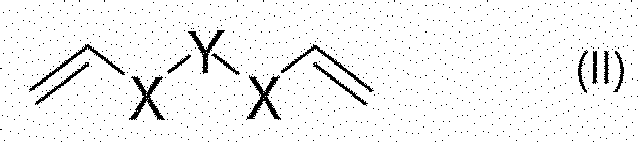


- in denen R für H oder einen C1-6-Alkylrest, insbesondere einen Methylrest,
- X für O oder NH,
- Y für Cyclohexyl, Phenyl, -(CR1R2)n- oder -(CR1R2-O)n-CR1R2-,
- R1 und R2 unabhängig voneinander für H oder einen C1-6-Alkylrest, insbesondere einen Methylrest, und
- n für eine Zahl von 1 bis 30, insbesondere 1 bis 3, stehen,
- sowie deren Mischungen. Besonders bevorzugt ist Ethylenglycoldimethacrylat. Das Molverhältnis von ethylenisch einfach ungesättigtem Monomer oder der Summe ethylenisch einfach ungesättigter Monomere zu Vernetzungsmonomer liegt vorzugsweise im Bereich von 100 zu 1 bis 20 zu 1, insbesondere 70 zu 1 bis 30 zu 1.
- Die erfindungsgemäß eingesetzten Polymere weisen N-Vinylpyrrolidon und das ethylenisch ungesättigte Monomer mit Amidfunktion vorzugsweise im Gewichtsverhältnis im Bereich von 99:1 bis 50:50, insbesondere von 98:2 bis 55:45 und besonders bevorzugt von 95:5 bis 80:20 auf. In bevorzugten Ausführungsformen der einzelnen Aspekte der Erfindung handelt es sich um ein Polymer, in dem der Anteil des Monomers Vinylpyrrolidon 50 Gew.-% bis 99 Gew.-%, insbesondere 80 Gew.-% bis 99 Gew.-% beträgt, und/oder der Anteil des ethylenisch ungesättigte Monomers mit Amidfunktion 1 Gew.-% bis 50 Gew.-%, insbesondere 1 Gew.-% bis 20 Gew.-% beträgt.
- Der polymere Wirkstoff weist vorzugsweise ein mittleres Molekulargewicht (hier und im folgenden bei mittleren Molekulargewichtsangaben: Zahlenmittel) im Bereich von 1000 g/mol bis 500000 g/mol, insbesondere von 1100 g/mol bis 150000 g/mol auf.
- Das Polymer zeigt Wechselwirkungen mit anionischen Tensiden wie insbesondere linearem Alkylbenzolsulfonat, die auf die Ausbildung eines Tensid-Polymer-Aggregats zurückzuführen sein können. Der Effekt kann über eine Messung der Oberflächen- oder Grenzflächenspannung nachgewiesen werden, wobei die Oberflächen- oder Grenzflächenspannung durch die Anwesenheit des Polymers erhöht wird. Diese Erhöhung kann darauf beruhen, dass sich ein reinigungsaktives Aggregat in der Lösung bildet und daher weniger Tensid an der Grenzfläche vorhanden ist.
- Zur Bestimmung des Aggregationsparameters Xag wird die Oberflächenspannung γ einer wässrigen Lösung von 0,12 g/l linearem C10-13-Alkylbenzolsulfonat, wie es zum Beispiel unter den Handelsnamen Disponil® LDBS 55 oder Marlon® A360 erhältlich ist, in Ab- und Anwesenheit von 0,2 g/l des Polymers gemessen und der Wert in Abwesenheit des Polymers von dem Wert in Anwesenheit des Polymers subtrahiert:

- Dabei kann die Messung der Oberflächenspannung mittels der Du-Noüy Ringmethode, beispielsweise unter Einsatz eines TE3-Ring/Platten Tensiometers der Firma Lauda (Lauda-Königshofen) vorgenommen werden. Hierzu wird ein Ring aus beispielsweise Metall, der an einem Torsionskraftmesser befestigt ist, so in die Tensid-Polymer-Lösung eingetaucht, dass sich der Ring unter der Oberfläche der Lösung befindet. Der Ring wird dann langsam aus der Lösung gezogen und die Kraft, die auf den Messring ausgeübt wird, kurz bevor der Flüssigkeitsfilm abreißt, wird mit dem Torsionskraftmesser gemessen. Die Oberflächenspannung kann bei Kenntnis des Durchmessers des Ringes und der Abreißkraft berechnet werden.
- Die Messungen werden jeweils bei 25°C unter Einstellung der Messlösungen auf pH 8,5 vorgenommen. Tritt das Polymer mit dem Tensid in Wechselwirkung, treten Aggregationsparameter Xag > 1 mN/m, vorzugsweise Xag > 2,5 mN/m und insbesondere im Bereich von 3 mN/m bis 5 mN/m auf.
- Ein weiterer Gegenstand der Erfindung ist ein Verfahren zum Entfernen von insbesondere bleich- oder enzymsensitiven Anschmutzungen von Textilien oder harten Oberflächen, bei dem ein Wasch- oder Reinigungsmittel und ein durch Copolymerisation von N-Vinylpyrrolidon mit ethylenisch ungesättigten Verbindungen, die eine Amidfunktion aufweisen, ausgewählt aus der Gruppe umfassend Acrylamid, Methacrylamid, N-Alkylacrylamid, N-Alkylmethacrylamid, N,N-Dialkylacrylamid und N,N-Dialkylmethacrylamid, in denen die Alkylgruppen 1 bis 10 C-Atome, insbesondere 1 bis 4 C-Atome aufweisen, sowie Mischungen aus mindestens 2 dieser Verbindungen erhältliches Polymer, dass einen Aggregationsparameter Xag mit Xag> 1 mN/m aufweist, zum Einsatz kommen. Dieses Verfahren kann manuell oder maschinell, zum Beispiel mit Hilfe einer Haushaltswaschmaschine oder Geschirrspülmaschine, ausgeführt werden. Dabei ist es möglich, das insbesondere flüssige Mittel und den Wirkstoff gleichzeitig oder nacheinander anzuwenden. Die gleichzeitige Anwendung lässt sich besonders vorteilhaft durch den Einsatz eines Mittels, welches den Wirkstoff enthält, durchführen. Unter bleich- oder enzymsensitiven Anschmutzungen werden solche verstanden, die üblicherweise von Bleichmitteln oder mit Hilfe von Enzymen zumindest anteilsweise entfernbar sind.
- Die erfindungsgemäß verwendeten Wirkstoffe sind auf einfachem Wege durch radikalische Polymerisation der ethylenisch ungesättigten Monomere herstellbar. Die Polymerisation kann als statistische oder Block-Copolymerisation geführt werden.
- Der Einsatz der erfindungsgemäß verwendeten Wirkstoffe führt zu einer signifikant besseren Ablösung von insbesondere bleich- oder enzymsensitiven Anschmutzungen auf harten Oberflächen und auf Textilien, auch solchen aus Baumwolle oder mit einem Anteil von Baumwolle, als dies bei Verwendung bisher für diesen Zweck bekannter Verbindungen der Fall ist. Alternativ können bei gleich bleibendem Schmutzablösevermögen bedeutende Mengen an Tensiden eingespart werden.
- Die erfindungsgemäße Verwendung kann im Rahmen eines Wasch- oder Reinigungsprozesses derart erfolgen, dass man den Wirkstoff einer wasch- oder reinigungsmittelhaltigen Flotte zusetzt oder vorzugsweise den Wirkstoff als Bestandteil eines Wasch- oder Reinigungsmittels in die Flotte einbringt, wobei die Konzentration an Wirkstoff in der Flotte vorzugsweise im Bereich von 0,01 g/l bis 0,5 g/l, insbesondere von 0,02 g/l bis 0,2 g/l liegt.
- Ein weiterer Gegenstand der Erfindung ist daher ein Wasch- oder Reinigungsmittel, enthaltend ein durch Copolymerisation von N-Vinylpyrrolidon mit ethylenisch ungesättigten Verbindungen, die eine Amidfunktion aufweisen, ausgewählt aus der Gruppe umfassend Acrylamid, Methacrylamid, N-Alkylacrylamid, N-Alkylmethacrylamid, N,N-Dialkylacrylamid und N,N-Dialkylmethacrylamid, in denen die Alkylgruppen 1 bis 10 C-Atome, insbesondere 1 bis 4 C-Atome aufweisen, sowie Mischungen aus mindestens 2 dieser Verbindungen erhältliches Polymer, das insbesondere einen Aggregationsparameter Xag mit Xag > 1 mN/m, vorzugsweise > 2,5 mN/m und insbesondere im Bereich von 3 mN/m bis 5 mN/m aufweist, und synthetisches Aniontensid vom Sulfat- und/oder Sulfonattyp. Wasch- oder Reinigungsmittel, die einen erfindungsgemäß zu verwendenden Wirkstoff enthalten oder mit diesem zusammen verwendet oder im erfindungsgemäßen Verfahren eingesetzt werden, können alle üblichen sonstigen Bestandteile derartiger Mittel enthalten, die nicht in unerwünschter Weise mit dem erfindungswesentlichen Wirkstoff wechselwirken. Vorzugsweise wird ein oben definierter Wirkstoff in Mengen von 0,1 Gew.-% bis 10 Gew.-%, insbesondere 0,5 Gew.-% bis 2 Gew.-% in Wasch- oder Reinigungsmittel eingearbeitet.
- Überraschenderweise wurde gefunden, dass derartige Wirkstoffe die Wirkung bestimmter anderer Wasch- und Reinigungsmittelinhaltsstoffe positiv beeinflussen und dass umgekehrt die Wirkung des Wirkstoffs durch bestimmte andere Inhaltsstoffe noch zusätzlich verstärkt wird. Diese Effekte treten insbesondere bei Bleichmitteln, bei enzymatischen Wirkstoffen, insbesondere Proteasen und Lipasen, bei wasserlöslichen anorganischen und/oder organischen Buildern, insbesondere auf Basis oxidierter Kohlenhydrate oder polymeren Polycarboxylaten und bei synthetischen Aniontensiden vom Sulfat- und Sulfonattyp, auf, weshalb der Einsatz mindestens eines der genannten weiteren Inhaltsstoffe zusammen mit erfindungsgemäß zu verwendendem Wirkstoff bevorzugt ist.
- Ein Mittel, welches einen erfindungsgemäß zu verwendenden Wirkstoff enthält oder mit diesem zusammen verwendet wird oder im erfindungsgemäßen Verfahren zum Einsatz kommt, kann vorzugsweise Bleichmittel auf Persauerstoffbasis, insbesondere in Mengen im Bereich von 5 Gew.-% bis 70 Gew.-%, sowie gegebenenfalls Bleichaktivator, insbesondere in Mengen im Bereich von 2 Gew.-% bis 10 Gew.-%, enthalten. Die in Betracht kommenden Bleichmittel sind vorzugsweise die in Waschmitteln in der Regel verwendeten Persauerstoffverbindungen wie Percarbonsäuren, beispielsweise Dodecandipersäure oder Phthaloylaminoperoxicapronsäure, Wasserstoffperoxid, Alkaliperborat, das als Tetra- oder Monohydrat vorliegen kann, Percarbonat, Perpyrophosphat und Persilikat, die in der Regel als Alkalisalze, insbesondere als Natriumsalze, vorliegen. Derartige Bleichmittel sind in Waschmitteln, welche einen erfindungsgemäß verwendeten Wirkstoff enthalten, vorzugsweise in Mengen bis zu 25 Gew.-%, insbesondere bis zu 15 Gew.-% und besonders bevorzugt von 5 Gew.-% bis 15 Gew.-%, jeweils bezogen auf gesamtes Mittel, vorhanden, wobei insbesondere Percarbonat zum Einsatz kommt. Die fakultativ vorhandene Komponente der Bleichaktivatoren umfasst die üblicherweise verwendeten N- oder O-Acylverbindungen, beispielsweise mehrfach acylierte Alkylendiamine, insbesondere Tetraacetylethylendiamin, acylierte Glykolurile, insbesondere Tetraacetylglykoluril, N-acylierte Hydantoine, Hydrazide, Triazole, Urazole, Diketopiperazine, Sulfurylamide und Cyanurate, außerdem Carbonsäureanhydride, insbesondere Phthalsäureanhydrid, Carbonsäureester, insbesondere Natrium-isononanoyl-phenolsulfonat, und acylierte Zuckerderivate, insbesondere Pentaacetylglukose, sowie kationische Nitrilderivate wie Trimethylammoniumacetonitril-Salze. Die Bleichaktivatoren können zur Vermeidung der Wechselwirkung mit den Perverbindungen bei der Lagerung in bekannter Weise mit Hüllsubstanzen überzogen und/oder granuliert worden sein, wobei mit Hilfe von Carboxymethylcellulose granuliertes Tetraacetylethylendiamin mit mittleren Korngrößen von 0,01 mm bis 0,8 mm, granuliertes 1,5-Diacetyl-2,4-dioxohexahydro-1,3,5-triazin, und/oder in Teilchenform konfektioniertes Trialkylammoniumacetonitril besonders bevorzugt ist. In Waschmitteln sind derartige Bleichaktivatoren vorzugsweise in Mengen bis zu 8 Gew.-%, insbesondere von 2 Gew.-% bis 6 Gew.-%, jeweils bezogen auf gesamtes Mittel, enthalten.
- In einer bevorzugten Ausführungsform enthält ein erfindungsgemäßes oder im Rahmen der erfindungsgemäßen Verwendung eingesetztes Mittel synthetisches Aniontensid vom Sulfat- und/oder Sulfonattyp, insbesondere Alkylbenzolsulfonat, Fettalkylsulfat, Fettalkylethersulfat, Alkyl- und/oder Dialkylsulfosuccinat, Sulfofettsäureester und/oder Sulfofettsäuredisalze, insbesondere in einer Menge im Bereich von 2 Gew.-% bis 25 Gew.-%. Bevorzugt wird das Aniontensid aus den Alkylbenzolsulfonaten, den Alkyl- oder Alkenylsulfaten und/oder den Alkyl- oder Alkenylethersulfaten ausgewählt, in denen die Alkyl- oder Alkenylgruppe 8 bis 22, insbesondere 12 bis 18 C-Atome besitzt. Bei diesen handelt es sich üblicherweise nicht um Einzelsubstanzen, sondern um Schnitte oder Mischungen. Darunter sind solche bevorzugt, deren Anteil an Verbindungen mit längerkettigen Resten im Bereich von 16 bis 18 C-Atomen über 20 Gew.-% beträgt.
- Eine weitere Ausführungsform derartiger Mittel umfasst die Anwesenheit von nichtionischem Tensid, ausgewählt aus Fettalkylpolyglykosiden, Fettalkylpolyalkoxylaten, insbesondere -ethoxylaten und/oder -propoxylaten, Fettsäurepolyhydroxyamiden und/oder Ethoxylierungs-und/oder Propoxylierungsprodukten von Fettalkylaminen, vicinalen Diolen, Fettsäurealkylestern und/oder Fettsäureamiden sowie deren Mischungen, insbesondere in einer Menge im Bereich von 2 Gew.-% bis 25 Gew.-%.
- Zu den in Frage kommenden nichtionischen Tensiden gehören die Alkoxylate, insbesondere die Ethoxylate und/oder Propoxylate von gesättigten oder ein- bis mehrfach ungesättigten linearen oder verzweigtkettigen Alkoholen mit 10 bis 22 C-Atomen, vorzugsweise 12 bis 18 C-Atomen. Der Alkoxylierungsgrad der Alkohole liegt dabei in der Regel zwischen 1 und 20, vorzugsweise zwischen 3 und 10. Sie können in bekannter Weise durch Umsetzung der entsprechenden Alkohole mit den entsprechenden Alkylenoxiden hergestellt werden. Geeignet sind insbesondere die Derivate der Fettalkohole, obwohl auch deren verzweigtkettige Isomere, insbesondere sogenannte Oxoalkohole, zur Herstellung verwendbarer Alkoxylate eingesetzt werden können. Brauchbar sind demgemäß die Alkoxylate, insbesondere die Ethoxylate, primärer Alkohole mit linearen, insbesondere Dodecyl-, Tetradecyl-, Hexadecyl- oder Octadecyl-Resten sowie deren Gemische. Außerdem sind entsprechende Alkoxylierungsprodukte von Alkylaminen, vicinalen Diolen und Carbonsäureamiden, die hinsichtlich des Alkylteils den genannten Alkoholen entsprechen, verwendbar. Darüberhinaus kommen die Ethylenoxid- und/oder Propylenoxid-Insertionsprodukte von Fettsäurealkylestern sowie Fettsäurepolyhydroxyamide in Betracht. Zur Einarbeitung in die erfindungsgemäßen Mittel geeignete sogenannte Alkylpolyglykoside sind Verbindungen der allgemeinen Formel (G)n-OR12, in der R12 einen Alkyl- oder Alkenylrest mit 8 bis 22 C-Atomen, G eine Glykoseeinheit und n eine Zahl zwischen 1 und 10 bedeuten. Bei der Glykosidkomponente (G)n handelt es sich um Oligo- oder Polymere aus natürlich vorkommenden Aldose- oder Ketose-Monomeren, zu denen insbesondere Glucose, Mannose, Fruktose, Galaktose, Talose, Gulose, Altrose, Allose, Idose, Ribose, Arabinose, Xylose und Lyxose gehören. Die aus derartigen glykosidisch verknüpften Monomeren bestehenden Oligomere werden außer durch die Art der in ihnen enthaltenen Zucker durch deren Anzahl, den sogenannten Oligomerisierungsgrad, charakterisiert. Der Oligomerisierungsgrad n nimmt als analytisch zu ermittelnde Größe im allgemeinen gebrochene Zahlenwerte an; er liegt bei Werten zwischen 1 und 10, bei den vorzugsweise eingesetzten Glykosiden unter einem Wert von 1,5, insbesondere zwischen 1,2 und 1,4. Bevorzugter Monomer-Baustein ist wegen der guten Verfügbarkeit Glucose. Der Alkyl- oder Alkenylteil R12 der Glykoside stammt bevorzugt ebenfalls aus leicht zugänglichen Derivaten nachwachsender Rohstoffe, insbesondere aus Fettalkoholen, obwohl auch deren verzweigtkettige Isomere, insbesondere sogenannte Oxoalkohole, zur Herstellung verwendbarer Glykoside eingesetzt werden können. Brauchbar sind demgemäß insbesondere die primären Alkohole mit linearen Octyl-, Decyl-, Dodecyl-, Tetradecyl-, Hexadecyl- oder Octadecylresten sowie deren Gemische. Besonders bevorzugte Alkylglykoside enthalten einen Kokosfettalkylrest, das heißt Mischungen mit im wesentlichen R12=Dodecyl und R12=Tetradecyl.
- Nichtionisches Tensid ist in Mitteln, welche einen erfindungsgemäß verwendeten Wirkstoff enthalten oder im Rahmen der erfindungsgemäßen Verwendung eingesetzt werden, vorzugsweise in Mengen von 1 Gew.-% bis 30 Gew.-%, insbesondere von 1 Gew.-% bis 25 Gew.-% enthalten, wobei Mengen im oberen Teil dieses Bereiches eher in flüssigen Waschmitteln anzutreffen sind und teilchenförmige Waschmittel vorzugsweise eher geringere Mengen von bis zu 5 Gew.-% enthalten.
- Die Mittel können stattdessen oder zusätzlich weitere Tenside, vorzugsweise synthetische Aniontenside des Sulfat- oder Sulfonat-Typs, zu denen beispielsweise die bereits genannten Alkylbenzolsulfonate gehören, in Mengen von vorzugsweise nicht über 20 Gew.-%, insbesondere von 0,1 Gew.% bis 18 Gew.-%, jeweils bezogen auf gesamtes Mittel, enthalten. Als für den Einsatz in derartigen Mitteln besonders geeignete synthetische Aniontenside sind die Alkyl- und/oder Alkenylsulfate mit 8 bis 22 C-Atomen, die ein Alkali-, Ammonium- oder Alkyl- oder Hydroxyalkyl-substituiertes Ammoniumion als Gegenkation tragen, zu nennen. Bevorzugt sind die Derivate der Fettalkohole mit insbesondere 12 bis 18 C-Atomen und deren verzweigtkettiger Analoga, der sogenannten Oxoalkohole. Die Alkyl- und Alkenylsulfate können in bekannter Weise durch Reaktion der entsprechenden Alkoholkomponente mit einem üblichen Sulfatierungsreagenz, insbesondere Schwefeltrioxid oder Chlorsulfonsäure, und anschließende Neutralisation mit Alkali-, Ammonium- oder Alkyl- oder Hydroxyalkyl-substituierten Ammoniumbasen hergestellt werden. Zu den einsetzbaren Tensiden vom Sulfat-Typ gehören auch die sulfatierten Alkoxylierungsprodukte der genannten Alkohole, sogenannte Ethersulfate. Vorzugsweise enthalten derartige Ethersulfate 2 bis 30, insbesondere 4 bis 10 Ethylenglykol-Gruppen pro Molekül. Zu den geeigneten Aniontensiden vom Sulfonat-Typ gehören die durch Umsetzung von Fettsäureestern mit Schwefeltrioxid und anschließender Neutralisation erhältlichen α-Sulfoester, insbesondere die sich von Fettsäuren mit 8 bis 22 C-Atomen, vorzugsweise 12 bis 18 C-Atomen, und linearen Alkoholen mit 1 bis 6 C-Atomen, vorzugsweise 1 bis 4 C-Atomen, ableitenden Sulfonierungsprodukte, sowie die durch formale Verseifung aus diesen hervorgehenden Sulfofettsäuren. Bevorzugte Aniontenside sind auch die Salze von Sulfobernsteinsäurestern, die auch als Alkylsulfosuccinate oder Dialkylsulfosuccinate bezeichnet werden, und die Monoester oder Diester der Sulfobernsteinsäure mit Alkoholen, vorzugsweise Fettalkoholen und insbesondere ethoxylierten Fettalkoholen darstellen. Bevorzugte Sulfosuccinate enthalten C8- bis C18-Fettalkoholreste oder Mischungen aus diesen. Insbesondere bevorzugte Sulfosuccinate enthalten einen ethoxylierten Fettalkoholrest, der für sich betrachtet ein nichtionisches Tenside darstellt. Dabei sind wiederum Sulfosuccinate, deren Fettalkohol-Reste sich von ethoxylierten Fettalkoholen mit eingeengter Homologenverteilung ableiten, besonders bevorzugt.
- Als weitere fakultative tensidische Inhaltsstoffe kommen Seifen in Betracht, wobei gesättigte Fettsäureseifen, wie die Salze der Laurinsäure, Myristinsäure, Palmitinsäure oder Stearinsäure, sowie aus natürlichen Fettsäuregemischen, zum Beispiel Kokos-, Palmkern- oder Talgfettsäuren, abgeleitete Seifen geeignet sind. Insbesondere sind solche Seifengemische bevorzugt, die zu 50 Gew.-% bis 100 Gew.-% aus gesättigten C12-C18-Fettsäureseifen und zu bis 50 Gew.-% aus Ölsäureseife zusammengesetzt sind. Vorzugsweise ist Seife in Mengen von 0,1 Gew.-% bis 5 Gew.-% enthalten. Insbesondere in flüssigen Mitteln, welche einen erfindungsgemäß verwendeten Wirkstoff enthalten, können jedoch auch höhere Seifenmengen von in der Regel bis zu 20 Gew.-% enthalten sein.
- Gewünschtenfalls können die Mittel auch Betaine und/oder kationische Tenside enthalten, die - falls vorhanden - vorzugsweise in Mengen von 0,5 Gew.-% bis 7 Gew.-% eingesetzt werden.
- In einer weiteren Ausführungsform enthält das Mittel wasserlöslichen und/oder wasserunlöslichen Builder, insbesondere ausgewählt aus Alkalialumosilikat, kristallinem Alkalisilikat mit Modul über 1, monomerem Polycarboxylat, polymerem Polycarboxylat und deren Mischungen, insbesondere in Mengen im Bereich von 2,5 Gew.-% bis 60 Gew.-%.
- Das Mittel enthält vorzugsweise 20 Gew.-% bis 55 Gew.-% wasserlöslichen und/oder wasserunlöslichen, organischen und/oder anorganischen Builder. Zu den wasserlöslichen organischen Buildersubstanzen gehören insbesondere solche aus der Klasse der Polycarbonsäuren, insbesondere Citronensäure und Zuckersäuren, sowie der polymeren (Poly-)carbonsäuren, insbesondere die durch Oxidation von Polysacchariden zugänglichen Polycarboxylate, polymere Acrylsäuren, Methacrylsäuren, Maleinsäuren und Mischpolymere aus diesen, die auch geringe Anteile polymerisierbarer Substanzen ohne Carbonsäurefunktionalität einpolymerisiert enthalten können. Die relative Molekülmasse der Homopolymeren ungesättiger Carbonsäuren liegt im allgemeinen zwischen 5000 g/mol und 200000 g/mol, die der Copolymeren zwischen 2000 g/mol und 200000 g/mol, vorzugsweise 50000 g/mol bis 120000 g/mol, bezogen auf freie Säure. Ein besonders bevorzugtes Acrylsäure-Maleinsäure-Copolymer weist eine relative Molekülmasse von 50000 g/mol bis 100000 g/mol auf. Geeignete, wenn auch weniger bevorzugte Verbindungen dieser Klasse sind Copolymere der Acrylsäure oder Methacrylsäure mit Vinylethern, wie Vinylmethylethern, Vinylester, Ethylen, Propylen und Styrol, in denen der Anteil der Säure mindestens 50 Gew.-% beträgt. Als wasserlösliche organische Buildersubstanzen können auch Terpolymere eingesetzt werden, die als Monomere zwei Carbonsäuren und/oder deren Salze sowie als drittes Monomer Vinylalkohol und/oder ein Vinylalkohol-Derivat oder ein Kohlenhydrat enthalten. Das erste saure Monomer oder dessen Salz leitet sich von einer monoethylenisch ungesättigten C3-C8-Carbonsäure und vorzugsweise von einer C3-C4-Monocarbonsäure, insbesondere von (Meth-)acrylsäure ab. Das zweite saure Monomer oder dessen Salz kann ein Derivat einer C4-C8-Dicarbonsäure sein, wobei Maleinsäure besonders bevorzugt ist. Die dritte monomere Einheit wird in diesem Fall von Vinylalkohol und/oder vorzugsweise einem veresterten Vinylalkohol gebildet. Insbesondere sind Vinylalkohol-Derivate bevorzugt, welche einen Ester aus kurzkettigen Carbonsäuren, beispielsweise von C1-C4-Carbonsäuren, mit Vinylalkohol darstellen. Bevorzugte Terpolymere enthalten dabei 60 Gew.-% bis 95 Gew.-%, insbesondere 70 Gew.-% bis 90 Gew.-% (Meth)acrylsäure und/oder (Meth)acrylat, besonders bevorzugt Acrylsäure und/oder Acrylat, und Maleinsäure und/oder Maleinat sowie 5 Gew.-% bis 40 Gew.-%, vorzugsweise 10 Gew.-% bis 30 Gew.-% Vinylalkohol und/oder Vinylacetat. Ganz besonders bevorzugt sind dabei Terpolymere, in denen das Gewichtsverhältnis (Meth)acrylsäure und/oder (Meth)acrylat zu Maleinsäure und/oder Maleat zwischen 1:1 und 4:1, vorzugsweise zwischen 2:1 und 3:1 und insbesondere 2:1 und 2,5:1 liegt. Dabei sind sowohl die Mengen als auch die Gewichtsverhältnisse auf die Säuren bezogen. Das zweite saure Monomer oder dessen Salz kann auch ein Derivat einer Allylsulfonsäure sein, die in 2-Stellung mit einem Alkylrest, vorzugsweise mit einem C1-C4-Alkylrest, oder einem aromatischen Rest, der sich vorzugsweise von Benzol oder Benzol-Derivaten ableitet, substituiert ist. Bevorzugte Terpolymere enthalten dabei 40 Gew.-% bis 60 Gew.-%, insbesondere 45 bis 55 Gew.-% (Meth)acrylsäure und/oder (Meth)acrylat, besonders bevorzugt Acrylsäure und/oder Acrylat, 10 Gew.-% bis 30 Gew.-%, vorzugsweise 15 Gew.-% bis 25 Gew.-% Methallylsulfonsäure und/oder Methallylsulfonat und als drittes Monomer 15 Gew.-% bis 40 Gew.-%, vorzugsweise 20 Gew.-% bis 40 Gew.-% eines Kohlenhydrats. Dieses Kohlenhydrat kann dabei beispielsweise ein Mono-, Di-, Oligo- oder Polysaccharid sein, wobei Mono-, Di- oder Oligosaccharide bevorzugt sind, besonders bevorzugt ist Saccharose. Durch den Einsatz des dritten Monomers werden vermutlich Sollbruchstellen in dem Polymer eingebaut, die für die gute biologische Abbaubarkeit des Polymers verantwortlich sind. Diese Terpolymere weisen im Allgemeinen eine relative Molekülmasse zwischen 1000 g/mol und 200000 g/mol, vorzugsweise zwischen 2000 g/mol und 50000 g/mol und insbesondere zwischen 3000 g/mol und 10000 g/mol auf. Sie können, insbesondere zur Herstellung flüssiger Mittel, in Form wässriger Lösungen, vorzugsweise in Form 30- bis 50-gewichtsprozentiger wässriger Lösungen eingesetzt werden. Alle genannten Polycarbonsäuren werden in der Regel in Form ihrer wasserlöslichen Salze, insbesondere ihre Alkalisalze, eingesetzt.
- Derartige organische Buildersubstanzen sind vorzugsweise in Mengen bis zu 40 Gew.-%, insbesondere bis zu 25 Gew.-% und besonders bevorzugt von 1 Gew.-% bis 5 Gew.-% enthalten. Mengen nahe der genannten Obergrenze werden vorzugsweise in pastenförmigen oder flüssigen, insbesondere wasserhaltigen, Mitteln eingesetzt.
- Als wasserunlösliche, wasserdispergierbare anorganische Buildermaterialien werden insbesondere kristalline oder amorphe Alkalialumosilikate, in Mengen von bis zu 50 Gew.-%, vorzugsweise nicht über 40 Gew.-% und in flüssigen Mitteln insbesondere von 1 Gew.-% bis 5 Gew.-%, eingesetzt. Unter diesen sind die kristallinen Alumosilikate in Waschmittelqualität, insbesondere Zeolith NaA und gegebenenfalls NaX, bevorzugt. Mengen nahe der genannten Obergrenze werden vorzugsweise in festen, teilchenförmigen Mitteln eingesetzt. Geeignete Alumosilikate weisen insbesondere keine Teilchen mit einer Korngröße über 30 µm auf und bestehen vorzugsweise zu wenigstens 80 Gew.-% aus Teilchen mit einer Größe unter 10 µm. Ihr Calciumbindevermögen, das nach den Angaben der deutschen Patentschrift
DE 24 12 837 bestimmt werden kann, liegt im Bereich von 100 bis 200 mg CaO pro Gramm. Geeignete Substitute oder Teilsubstitute für das genannte Alumosilikat sind kristalline Alkalisilikate, die allein oder im Gemisch mit amorphen Silikaten vorliegen können. Die in den Mitteln als Gerüststoffe brauchbaren Alkalisilikate weisen vorzugsweise ein molares Verhältnis von Alkalioxid zu SiO2 unter 0,95, insbesondere von 1:1,1 bis 1:12 auf und können amorph oder kristallin vorliegen. Bevorzugte Alkalisilikate sind die Natriumsilikate, insbesondere die amorphen Natriumsilikate, mit einem molaren Verhältnis Na2O:SiO2 von 1:2 bis 1:2,8. Derartige amorphe Alkalisilikate sind beispielsweise unter dem Namen Portil® im Handel erhältlich. Solche mit einem molaren Verhältnis Na2O:SiO2 von 1:1,9 bis 1:2,8 werden im Rahmen der Herstellung bevorzugt als Feststoff und nicht in Form einer Lösung zugegeben. Als kristalline Silikate, die allein oder im Gemisch mit amorphen Silikaten vorliegen können, werden vorzugsweise kristalline Schichtsilikate der allgemeinen Formel Na2SixO2x+1 · yH2O eingesetzt, in der x, das sogenannte Modul, eine Zahl von 1,9 bis 4 und y eine Zahl von 0 bis 20 ist und bevorzugte Werte für x 2, 3 oder 4 sind. Kristalline Schichtsilikate, die unter diese allgemeine Formel fallen, werden beispielsweise in der europäischen PatentanmeldungEP 0 164 514 beschrieben. Bevorzugte kristalline Schichtsilikate sind solche, bei denen x in der genannten allgemeinen Formel die Werte 2 oder 3 annimmt. Insbesondere sind sowohl ß- als auch δ-Natriumdisilikate (Na2Si2O5·yH2O) bevorzugt. Auch aus amorphen Alkalisilikaten hergestellte, praktisch wasserfreie kristalline Alkalisilikate der obengenannten allgemeinen Formel, in der x eine Zahl von 1,9 bis 2,1 bedeutet, können in Mitteln, welche einen erfindungsgemäß zu verwendenden Wirkstoff enthalten, eingesetzt werden. In einer weiteren bevorzugten Ausführungsform erfindungsgemäßer Mittel wird ein kristallines Natriumschichtsilikat mit einem Modul von 2 bis 3 eingesetzt, wie es aus Sand und Soda hergestellt werden kann. Kristalline Natriumsilikate mit einem Modul im Bereich von 1,9 bis 3,5, werden in einer weiteren bevorzugten Ausführungsform von Waschmitteln, welche einen erfindungsgemäß verwendeten Wirkstoff enthalten, eingesetzt. Deren Gehalt an Alkalisilikaten beträgt vorzugsweise 1 Gew.-% bis 50 Gew.-% und insbesondere 5 Gew.-% bis 35 Gew.-%, bezogen auf wasserfreie Aktivsubstanz. Falls als zusätzliche Buildersubstanz auch Alkalialumosilikat, insbesondere Zeolith, vorhanden ist, beträgt der Gehalt an Alkalisilikat vorzugsweise 1 Gew.-% bis 15 Gew.-% und insbesondere 2 Gew.-% bis 8 Gew.-%, bezogen auf wasserfreie Aktivsubstanz. Das Gewichtsverhältnis Alumosilikat zu Silikat, jeweils bezogen auf wasserfreie Aktivsubstanzen, beträgt dann vorzugsweise 4:1 bis 10:1. In Mitteln, die sowohl amorphe als auch kristalline Alkalisilikate enthalten, beträgt das Gewichtsverhältnis von amorphem Alkalisilikat zu kristallinem Alkalisilikat vorzugsweise 1:2 bis 2:1 und insbesondere 1:1 bis 2:1. - Zusätzlich zum genannten anorganischen Builder können weitere wasserlösliche oder wasserunlösliche anorganische Substanzen in den Mitteln, welche einen erfindungsgemäß zu verwendenden Wirkstoff enthalten, mit diesem zusammen verwendet oder in erfindungsgemäßen Verfahren eingesetzt werden, enthalten sein. Geeignet sind in diesem Zusammenhang die Alkalicarbonate, Alkalihydrogencarbonate und Alkalisulfate sowie deren Gemische. Derartiges zusätzliches anorganisches Material kann in Mengen bis zu 70 Gew.-% vorhanden sein.
- Zusätzlich können die Mittel weitere in Wasch- oder Reinigungsmitteln übliche Bestandteile enthalten. Zu diesen fakultativen Bestandteilen gehören insbesondere Enzyme, Enzymstabilisatoren, Komplexbildner für Schwermetalle, beispielsweise Aminopolycarbonsäuren, Aminohydroxypolycarbonsäuren, Polyphosphonsäuren und/oder Aminopolyphosphonsäuren, Schauminhibitoren, beispielsweise Organopolysiloxane oder Paraffine, Lösungsmittel und optische Aufheller, beispielsweise Stilbendisulfonsäurederivate. Vorzugsweise sind in Mitteln, welche einen erfindungsgemäß verwendeten Wirkstoff enthalten, bis zu 1 Gew.-%, insbesondere 0,01 Gew.-% bis 0,5 Gew.-% optische Aufheller, insbesondere Verbindungen aus der Klasse der substituierten 4,4'-Bis-(2,4,6-tri-amino-s-triazinyl)-stilben-2,2'-disulfonsäuren, bis zu 5 Gew.-%, insbesondere 0,1 Gew.-% bis 2 Gew.-% Komplexbildner für Schwermetalle, insbesondere Aminoalkylenphosphonsäuren und deren Salze und bis zu 2 Gew.-%, insbesondere 0,1 Gew.-% bis 1 Gew.-% Schauminhibitoren enthalten, wobei sich die genannten Gewichtsanteile jeweils auf gesamtes Mittel beziehen.
- Lösungsmittel, die insbesondere bei flüssigen Mitteln eingesetzt werden können, sind neben Wasser vorzugsweise solche, die wassermischbar sind. Zu diesen gehören die niederen Alkohole, beispielsweise Ethanol, Propanol, iso-Propanol, und die isomeren Butanole, Glycerin, niedere Glykole, beispielsweise Ethylen- und Propylenglykol, und die aus den genannten Verbindungsklassen ableitbaren Ether. In derartigen flüssigen Mitteln liegen die erfindungsgemäß verwendeten Wirkstoffe in der Regel gelöst oder in suspendierter Form vor.
- Die vorzugsweise anwesenden Enzyme werden insbesondere aus der Gruppe umfassend Protease, Amylase, Lipase, Cellulase, Hemicellulase, Oxidase, Peroxidase, Pektinase und Mischungen aus diesen ausgewählt. In erster Linie kommt aus Mikroorganismen, wie Bakterien oder Pilzen, gewonnene Protease in Frage. Sie kann in bekannter Weise durch Fermentationsprozesse aus geeigneten Mikroorganismen gewonnen werden. Proteasen sind im Handel beispielsweise unter den Namen BLAP®, Savinase®, Esperase®, Maxatase®, Optimase®, Alcalase®, Durazym® oder Maxapem® erhältlich. Die einsetzbare Lipase kann beispielsweise aus Humicola lanuginosa, aus Bacillus-Arten, aus Pseudomonas-Arten, aus Fusarium-Arten, aus Rhizopus-Arten oder aus Aspergillus-Arten gewonnen werden. Geeignete Lipasen sind beispielsweise unter den Namen Lipolase®, Lipozym®, Lipomax®, Lipex®, Amano®-Lipase, Toyo-Jozo®-Lipase, Meito®-Lipase und Diosynth®-Lipase im Handel erhältlich. Geeignete Amylasen sind beispielsweise unter den Namen Maxamyl®, Termamyl®, Duramyl® und Purafect® OxAm handelsüblich. Die einsetzbare Cellulase kann ein aus Bakterien oder Pilzen gewinnbares Enzym sein, welches ein pH-Optimum vorzugsweise im schwach sauren bis schwach alkalischen Bereich von 6 bis 9,5 aufweist. Derartige Cellulasen sind unter den Namen Celluzyme®, Carezyme® und Ecostone® handelsüblich. Geeignete Pektinasen sind beispielsweise unter den Namen Gamanase®, Pektinex AR®, X-Pect® oder Pectaway® von Novozymes, unter dem Namen Rohapect UF®, Rohapect TPL®, Rohapect PTE100®, Rohapect MPE®, Rohapect MA plus HC, Rohapect DA12L®, Rohapect 10L®, Rohapect B1L® von AB Enzymes und unter dem Namen Pyrolase® von Diversa Corp., San Diego, CA, USA erhältlich.
- Zu den gegebenenfalls, insbesondere in flüssigen Mitteln vorhandenen üblichen Enzymstabilisatoren gehören Aminoalkohole, beispielsweise Mono-, Di-, Triethanol- und -propanolamin und deren Mischungen, niedere Carbonsäuren, Borsäure, Alkaliborate, Borsäure-Carbonsäure-Kombinationen, Borsäureester, Boronsäurederivate, Calciumsalze, beispielsweise Ca-Ameisensäure-Kombination, Magnesiumsalze, und/oder schwefelhaltige Reduktionsmittel.
- Zu den geeigneten Schauminhibitoren gehören langkettige Seifen, insbesondere Behenseife, Fettsäureamide, Paraffine, Wachse, Mikrokristallinwachse, Organopolysiloxane und deren Gemische, die darüberhinaus mikrofeine, gegebenenfalls silanierte oder anderweitig hydrophobierte Kieselsäure enthalten können. Zum Einsatz in partikelförmigen Mitteln sind derartige Schauminhibitoren vorzugsweise an granulare, wasserlösliche Trägersubstanzen gebunden.
- Zu den bekanntlich polyesteraktiven schmutzablösevermögenden Polymeren, die zusätzlich zu den erfindungswesentlichen Wirkstoffen eingesetzt werden können, gehören Copolyester aus Dicarbonsäuren, beispielsweise Adipinsäure, Phthalsäure oder Terephthalsäure, Diolen, beispielsweise Ethylenglykol oder Propylenglykol, und Polydiolen, beispielsweise Polyethylenglykol oder Polypropylenglykol. Zu den bevorzugt eingesetzten schmutzablösevermögenden Polyestern gehören solche Verbindungen, die formal durch Veresterung zweier Monomerteile zugänglich sind, wobei das erste Monomer eine Dicarbonsäure HOOC-Ph-COOH und das zweite Monomer ein Diol HO-(CHR11-)aOH, das auch als polymeres Diol H-(O-(CHR11-)a)bOH vorliegen kann, ist. Darin bedeutet Ph einen o-, m- oder p-Phenylenrest, der 1 bis 4 Substituenten, ausgewählt aus Alkylresten mit 1 bis 22 C-Atomen, Sulfonsäuregruppen, Carboxylgruppen und deren Mischungen, tragen kann, R11 Wasserstoff, einen Alkylrest mit 1 bis 22 C-Atomen und deren Mischungen, a eine Zahl von 2 bis 6 und b eine Zahl von 1 bis 300. Vorzugsweise liegen in den aus diesen erhältlichen Polyestern sowohl Monomerdioleinheiten -O-(CHR11-)aO- als auch Polymerdioleinheiten -(O-(CHR11-)a)bO- vor. Das molare Verhältnis von Monomerdioleinheiten zu Polymerdioleinheiten beträgt vorzugsweise 100:1 bis 1:100, insbesondere 10:1 bis 1:10. In den Polymerdioleinheiten liegt der Polymerisationsgrad b vorzugsweise im Bereich von 4 bis 200, insbesondere von 12 bis 140. Das Molekulargewicht oder das mittlere Molekulargewicht oder das Maximum der Molekulargewichtsverteilung bevorzugter schmutzablösevermögender Polyester liegt im Bereich von 250 g/mol bis 100 000 g/mol, insbesondere von 500 g/mol bis 50 000 g/mol. Die dem Rest Ph zugrundeliegende Säure wird vorzugsweise aus Terephthalsäure, Isophthalsäure, Phthalsäure, Trimellithsäure, Mellithsäure, den Isomeren der Sulfophthalsäure, Sulfoisophthalsäure und Sulfoterephthalsäure sowie deren Gemischen ausgewählt. Sofern deren Säuregruppen nicht Teil der Esterbindungen im Polymer sind, liegen sie vorzugsweise in Salzform, insbesondere als Alkali- oder Ammoniumsalz vor. Unter diesen sind die Natrium- und Kaliumsalze besonders bevorzugt. Gewünschtenfalls können statt des Monomers HOOC-Ph-COOH geringe Anteile, insbesondere nicht mehr als 10 Mol-% bezogen auf den Anteil an Ph mit der oben gegebenen Bedeutung, anderer Säuren, die mindestens zwei Carboxylgruppen aufweisen, im schmutzablösevermögenden Polyester enthalten sein. Zu diesen gehören beispielsweise Alkylen- und Alkenylendicarbonsäuren wie Malonsäure, Bernsteinsäure, Fumarsäure, Maleinsäure, Glutarsäure, Adipinsäure, Pimelinsäure, Korksäure, Azelainsäure und Sebacinsäure. Zu den bevorzugten Diolen HO-(CHR11-)aOH gehören solche, in denen R11 Wasserstoff und a eine Zahl von 2 bis 6 ist, und solche, in denen a den Wert 2 aufweist und R11 unter Wasserstoff und den Alkylresten mit 1 bis 10, insbesondere 1 bis 3 C-Atomen ausgewählt wird. Unter den letztgenannten Diolen sind solche der Formel HO-CH2-CHR11-OH, in der R11 die obengenannte Bedeutung besitzt, besonders bevorzugt. Beispiele für Diolkomponenten sind Ethylenglykol, 1,2-Propylenglykol, 1,3-Propylenglykol, 1,4-Butandiol, 1,5-Pentandiol, 1,6-Hexandiol, 1,8-Octandiol, 1,2-Decandiol, 1,2-Dodecandiol und Neopentylglykol. Besonders bevorzugt unter den polymeren Diolen ist Polyethylenglykol mit einer mittleren Molmasse im Bereich von 1000 g/mol bis 6000 g/mol.
- Gewünschtenfalls können diese wie oben beschrieben zusammengesetzten Polyester auch endgruppenverschlossen sein, wobei als Endgruppen Alkylgruppen mit 1 bis 22 C-Atomen und Ester von Monocarbonsäuren in Frage kommen. Den über Esterbindungen gebundenen Endgruppen können Alkyl-, Alkenyl- und Arylmonocarbonsäuren mit 5 bis 32 C-Atomen, insbesondere 5 bis 18 C-Atomen, zugrundeliegen. Zu diesen gehören Valeriansäure, Capronsäure, Önanthsäure, Caprylsäure, Pelargonsäure, Caprinsäure, Undecansäure, Undecensäure, Laurinsäure, Lauroleinsäure, Tridecansäure, Myristinsäure, Myristoleinsäure, Pentadecansäure, Palmitinsäure, Stearinsäure, Petroselinsäure, Petroselaidinsäure, Ölsäure, Linolsäure, Linolaidinsäure, Linolensäure, Eläostearinsäure, Arachinsäure, Gadoleinsäure, Arachidonsäure, Behensäure, Erucasäure, Brassidinsäure, Clupanodonsäure, Lignocerinsäure, Cerotinsäure, Melissinsäure, Benzoesäure, die 1 bis 5 Substituenten mit insgesamt bis zu 25 C-Atomen, insbesondere 1 bis 12 C-Atomen tragen kann, beispielsweise tert.-Butylbenzoesäure. Den Endgruppen können auch Hydroxymonocarbonsäuren mit 5 bis 22 C-Atomen zugrundeliegen, zu denen beispielsweise Hydroxyvaleriansäure, Hydroxycapronsäure, Ricinolsäure, deren Hydrierungsprodukt Hydroxystearinsäure sowie o-, mund p-Hydroxybenzoesäure gehören. Die Hydroxymonocarbonsäuren können ihrerseits über ihre Hydroxylgruppe und ihre Carboxylgruppe miteinander verbunden sein und damit mehrfach in einer Endgruppe vorliegen. Vorzugsweise liegt die Anzahl der Hydroxymonocarbonsäureeinheiten pro Endgruppe, das heißt ihr Oligomerisierungsgrad, im Bereich von 1 bis 50, insbesondere von 1 bis 10. In einer bevorzugten Ausgestaltung der Erfindung werden Polymere aus Ethylenterephthalat und Polyethylenoxid-terephthalat, in denen die Polyethylenglykol-Einheiten Molgewichte von 750 g/mol bis 5000 g/mol aufweisen und das Molverhältnis von Ethylenterephthalat zu Polyethylenoxid-terephthalat 50:50 bis 90:10 beträgt, in Kombination mit einem erfindungswesentlichen Wirkstoff verwendet.
- Die schmutzablösevermögenden Polymere sind vorzugsweise wasserlöslich, wobei unter dem Begriff "wasserlöslich" eine Löslichkeit von mindestens 0,01 g, vorzugsweise mindestens 0,1 g des Polymers pro Liter Wasser bei Raumtemperatur und pH 8 verstanden werden soll. Bevorzugt eingesetzte Polymere weisen unter diesen Bedingungen jedoch eine Löslichkeit von mindestens 1 g pro Liter, insbesondere mindestens 10 g pro Liter auf.
- Die Herstellung erfindungsgemäßer fester Mittel bietet keine Schwierigkeiten und kann auf bekannte Weise, zum Beispiel durch Sprühtrocknen oder Granulation, erfolgen, wobei Enzyme und eventuelle weitere thermisch empfindliche Inhaltsstoffe wie zum Beispiel Bleichmittel gegebenenfalls später separat zugesetzt werden. Zur Herstellung erfindungsgemäßer Mittel mit erhöhtem Schüttgewicht, insbesondere im Bereich von 650 g/l bis 950 g/l, ist ein einen Extrusionsschritt aufweisendes Verfahren bevorzugt.
- Zur Herstellung von erfindungsgemäßen Mitteln in Tablettenform, die einphasig oder mehrphasig, einfarbig oder mehrfarbig und insbesondere aus einer Schicht oder aus mehreren, insbesondere aus zwei Schichten bestehen können, geht man vorzugsweise derart vor, dass man alle Bestandteile - gegebenenfalls je einer Schicht - in einem Mischer miteinander vermischt und das Gemisch mittels herkömmlicher Tablettenpressen, beispielsweise Exzenterpressen oder Rundläuferpressen, mit Presskräften im Bereich von etwa 50 bis 100 kN, vorzugsweise bei 60 bis 70 kN verpresst. Insbesondere bei mehrschichtigen Tabletten kann es von Vorteil sein, wenn mindestens eine Schicht vorverpresst wird. Dies wird vorzugsweise bei Presskräften zwischen 5 und 20 kN, insbesondere bei 10 bis 15 kN durchgeführt. Man erhält so problemlos bruchfeste und dennoch unter Anwendungsbedingungen ausreichend schnell lösliche Tabletten mit Bruch- und Biegefestigkeiten von normalerweise 100 bis 200 N, bevorzugt jedoch über 150 N. Vorzugsweise weist eine derart hergestellte Tablette ein Gewicht von 10 g bis 50 g, insbesondere von 15 g bis 40 g auf. Die Raumform der Tabletten ist beliebig und kann rund, oval oder eckig sein, wobei auch Zwischenformen möglich sind. Ecken und Kanten sind vorteilhafterweise abgerundet. Runde Tabletten weisen vorzugsweise einen Durchmesser von 30 mm bis 40 mm auf. Insbesondere die Größe von eckig oder quaderförmig gestalteten Tabletten, welche überwiegend über die Dosiervorrichtung beispielsweise der Geschirrspülmaschine eingebracht werden, ist abhängig von der Geometrie und dem Volumen dieser Dosiervorrichtung. Beispielhaft bevorzugte Ausführungsformen weisen eine Grundfläche von (20 bis 30 mm) x (34 bis 40 mm), insbesondere von 26x36 mm oder von 24x38 mm auf.
- Flüssige oder pastöse erfindungsgemäße Mittel in Form von übliche Lösungsmittel, insbesondere Wasser, enthaltenden Lösungen werden in der Regel durch einfaches Mischen der Inhaltsstoffe, die in Substanz oder als Lösung in einen automatischen Mischer gegeben werden können, hergestellt.
- In einer bevorzugten Ausführungsform ist ein Mittel, in das erfindungsgemäß zu verwendender Wirkstoff eingearbeitet wird, flüssig und enthält 1 Gew.-% bis 15 Gew.-%, insbesondere 2 Gew.-% bis 10 Gew.-% nichtionisches Tensid, 2 Gew.-% bis 30 Gew.-%, insbesondere 5 Gew.-% bis 20 Gew.-% synthetisches Aniontensid, bis zu 15 Gew.-%, insbesondere 2 Gew.-% bis 12,5 Gew.-% Seife, 0,5 Gew.-% bis 5 Gew.-%, insbesondere 1 Gew.-% bis 4 Gew.-% organischen Builder, insbesondere Polycarboxylat wie Citrat, bis zu 1,5 Gew.-%, insbesondere 0,1 Gew.-% bis 1 Gew.-% Komplexbildner für Schwermetalle, wie Phosphonat, und neben gegebenenfalls enthaltenem Enzym, Enzymstabilisator, Farb- und/oder Duftstoff Wasser und/oder wassermischbares Lösungsmittel.
- In einer weiteren bevorzugten Ausführungsform ist ein Mittel, in das erfindungsgemäß zu verwendender Wirkstoff eingearbeitet wird, teilchenförmig und enthält bis zu 25 Gew.-%, insbesondere 5 Gew.-% bis 20 Gew.-% Bleichmittel, insbesondere Alkalipercarbonat, bis zu 15 Gew.-%, insbesondere 1 Gew.-% bis 10 Gew.-% Bleichaktivator, 20 Gew.-% bis 55 Gew.-% anorganischen Builder, bis zu 10 Gew.-%, insbesondere 2 Gew.-% bis 8 Gew.-% wasserlöslichen organischen Builder, 10 Gew.-% bis 25 Gew.-% synthetisches Aniontensid, 1 Gew.-% bis 5 Gew.-% nichtionisches Tensid und bis zu 25 Gew.-%, insbesondere 0,1 Gew.-% bis 25 Gew.-% anorganische Salze, insbesondere Alkalicarbonat und/oder -hydrogencarbonat.
- 6,5 g N,N-Dimethylacrylamid (65,6 mmol), 65,9 g N-Vinylpyrrolidon (592,8 mmol) und 11,8 g Azobisisobutyronitril (AIBN) (72,1 mmol) wurden in 1330 ml Isopropanol gelöst. Die Lösung wurde mittels Durchleiten von Stickstoff von Sauerstoff befreit. Anschließend wurde für 2 Tage bei 65°C gerührt. Dann wurden weitere 11,8 g AIBN zugegeben und die Reaktionsmischung wurde erneut entgast. Es wurde für weitere 6 Tage bei 65°C gerührt. Dann wurde die Reaktion durch Zutritt von Sauerstoff gestoppt. Das Lösungsmittel wurde am Rotationsverdampfer abgezogen, das Reaktionsprodukt in 750 ml Wasser aufgenommen und durch Filtration von unlöslichen Bestandteilen befreit. Anschließend wurde das Copolymer durch Gefriertrocknung isoliert.
- Bei 25 °C wurde unter Verwendung eines TE3-Ring/Plattentensiometers von Lauda die Oberflächenspannung γ einer auf pH 8,5 eingestellten wässrigen Lösung von 0,2 g/l linearem Alkylbenzolsufonat (LAS; Disponil® LDBS 55) gemessen. Die Messung wurde mit ansonsten gleichen Lösungen, die aber zusätzlich 0,12 g/l des jeweils zu untersuchenden Polymers enthielten, wiederholt. Der Aggregationsparameter Xag wurde bestimmt, indem der Messwert des Systems ohne Polymer von dem des Systems mit Polymer subtrahiert wurde.

- Getestet wurde das in Beispiel 1 hergestellten Polymere E1. Es wurde der in der folgenden Tabelle 1 angegebene Aggregationsparameter ermittelt:
Tabelle 1: Aggregationsparameter des Tensid-Polymer Systeme System Xag LAS + E1 3,4 - Die Messung der Oberflächenspannung in Polymeranwesenheit und -abwesenheit wurde auch in einer Alkylbenzolsufonat-haltigen Waschmittelrahmenformulierung durchgeführt. Auch dort war die Wechselwirkung des Polymers klar erkennbar. Dies belegt, dass die Ausbildung des reinigungsaktiven Aggregats kein auf das isolierte Tensid-Polymer-System beschränktes Phänomen ist. Es handelt sich vielmehr um einen anwendungsrelevanten Effekt der in der Reinigungsanwendung eine verbesserte Leistung bewirkt.
-
Tabelle 3: Waschmittelzusammensetzungen (Angaben in Gew.-%) A B C D E F G H C9-13-Alkylbenzolsulfonat, Na-Salz 9 10 6 7 5 15 15 9 C12-18-Fettalkohol mit 7 EO 8 9 6 7 5 6 11 10 C12-14-Fettalkoholsulfat mit 2EO - - 8 7 10 2 2 5 C12-18-Fettsäure, Na-Salz 4 3 3 3 4 2 4 7 Zitronensäure 2 3 3 2 2 2 2 3 Natriumhydroxid, 50 % 3 3 2 3 3 3 3 4 Borsäure 1 1 1 1 1 1 1 1 Enzyme (Amylase, Protease, Cellulase) + + + + + + + + Parfüm 1 0,5 0,5 1 1 1 1 1 Propandiol - - - - - 5 5 - Ethanol 1,5 1,5 1,5 1,5 1,5 1,5 1,5 5 PVA/Maleinsäure-Copolymer 0,1 - 0,1 - - - - - Optischer Aufheller - 0,1 - 0,1 0,2 0,2 0,2 0,2 Trübungsmittel 0,2 - - - - - - - Phosphonsäure, Na-Salz 0,5 0,5 0,5 0,5 0,5 0,5 0,5 0,5 erfindungswesentliches Polymer 2 2 2 2 2 2 2 2 Wasser auf 100 - Haushaltswaschmaschinen (Miele® W 1514) wurden mit 3,5 kg sauberer Begleitwäsche sowie mit mit standardisierten Anschmutzungen (A: Schokoladenmilch/Ruß; B: Brombeersaft; C: Schokoladenpuddding; D: Heidelbeersaft) versehenen Testtextilien aus Baumwolle und Schmutzballast beladen. 75 ml des in Beispiel 3 aufgeführten Waschmittels C mit dem in Beispiel 1 hergestellten Polymer E1 wurden eindosiert und es wurde bei 40°C gewaschen. Nach hängender Trocknung und Mangeln der Testtextilien wurde deren Weißgrad spektralphotometrisch (Minolta® CR200-1) bestimmt. In der nachfolgenden Tabelle 4 sind die Differenzen der Remissionswerte zum ansonsten gleich zusammengesetzten Waschmittel ohne erfindungswesentliches Polymer als Mittelwerte aus 6 Bestimmungen sowie die Fehler bei der 6-fach Bestimmung (HSD) angegeben.
Tabelle 4: Waschergebnisse (Angaben in %) Polymer \ Anschmutzung E1 HSD A 5,5 2,6 B 4,9 3,4 C 2,7 1,8 D 2,8 1,0 - Das Waschmittel mit einem erfindungsgemäß zu verwendenden Wirkstoff zeigte eine deutlich bessere Primärwaschleistung als das ansonsten gleich zusammengesetzte Mittel, dem dieser fehlte.
Claims (10)
- Verwendung von durch Copolymerisation von N-Vinylpyrrolidon mit ethylenisch ungesättigten Verbindungen, die eine Amidfunktion aufweisen, erhältlichen Polymeren, die einen Aggregationsparameter Xag mit Xag > 1 mN/m aufweisen, zur Verstärkung der Primärwaschkraft von Wasch- oder Reinigungsmitteln beim Waschen von Textilien oder beim Reinigen harter Oberflächen gegenüber Anschmutzungen.
- Verwendung nach Anspruch 1, dadurch gekennzeichnet, dass das Polymer einen Aggregationsparameter Xag mit Xag > 2,5 mN/m, insbesondere Xag im Bereich von 3 mN/m bis 5 mN/m, aufweist.
- Verwendung nach Anspruch 1 oder 2, dadurch gekennzeichnet, dass das Polymer ausgewählt wird aus den durch Copolymerisation von N-Vinylpyrrolidon mit einem zweiten Monomer, ausgewählt aus der Gruppe umfassend Acrylamid, Methacrylamid, N-Alkylacrylamid, N-Alkylmethacrylamid, N,N-Dialkylacrylamid und N,N-Dialkylmethacrylamid, in denen die Alkylgruppen 1 bis 10 C-Atome, insbesondere 1 bis 4 C-Atome aufweisen, sowie Mischungen aus mindestens 2 dieser Verbindungen zugänglichen Polymeren.
- Verwendung nach einem der Ansprüche 1 bis 3, dadurch gekennzeichnet, dass das Polymer N-Vinylpyrrolidon und das ethylenisch ungesättigte Monomer mit Amidfunktion im Gewichtsverhältnis im Bereich von 99:1 bis 50:50, insbesondere von 98:2 bis 55:45 aufweist.
- Verwendung nach einem der Ansprüche 1 bis 4, dadurch gekennzeichnet, dass das Polymer ein mittleres Molekulargewicht in Bereich von 1000 g/mol bis 50000 g/mol, insbesondere von 1100 g/mol bis 150000 g/mol aufweist.
- Verwendung nach einem der Ansprüche 1 bis 5, dadurch gekennzeichnet, dass man das Polymer einer wasch- oder reinigungsmittelhaltigen Flotte zusetzt oder als Bestandteil eines Wasch- oder Reinigungsmittels in die Flotte einbringt.
- Verfahren zum Entfernen von insbesondere bleich- oder enzymsensitiven Anschmutzungen von Textilien oder harten Oberflächen, bei dem ein Wasch- oder Reinigungsmittel und ein durch Copolymerisation von N-Vinylpyrrolidon mit ethylenisch ungesättigten Verbindungen, die eine Amidfunktion aufweisen, ausgewählt aus der Gruppe umfassend Acrylamid, Methacrylamid, N-Alkylacrylamid, N-Alkylmethacrylamid, N,N-Dialkylacrylamid und N,N-Dialkylmethacrylamid, in denen die Alkylgruppen 1 bis 10 C-Atome, insbesondere 1 bis 4 C-Atome aufweisen, sowie Mischungen aus mindestens 2 dieser Verbindungen erhältliches Polymer, das einen Aggregationsparameter Xag mit Xag > 1 mN/m aufweist, zum Einsatz kommen.
- Verfahren nach Anspruch 7, dadurch gekennzeichnet, dass es manuell oder maschinell, insbesondere mit Hilfe einer Haushaltswaschmaschine oder Geschirrspülmaschine, ausgeführt wird.
- Wasch- oder Reinigungsmittel, enthaltend ein durch Copolymerisation von N-Vinylpyrrolidon mit ethylenisch ungesättigten Verbindungen, die eine Amidfunktion aufweisen, ausgewählt aus der Gruppe umfassend Acrylamid, Methacrylamid, N-Alkylacrylamid, N-Alkylmethacrylamid, N,N-Dialkylacrylamid und N,N-Dialkylmethacrylamid, in denen die Alkylgruppen 1 bis 10 C-Atome, insbesondere 1 bis 4 C-Atome aufweisen, sowie Mischungen aus mindestens 2 dieser Verbindungen erhältliches Polymer, das insbesondere einen Aggregationsparameter Xag mit Xag > 1 mN/m aufweist, und synthetisches Aniontensid vom Sulfat- und/oder Sulfonattyp.
- Mittel nach Anspruch 9, dadurch gekennzeichnet, dass es das Polymer in Mengen von 0,1 Gew.-% bis 10 Gew.-%, insbesondere 0,5 Gew.-% bis 2 Gew.-% enthält.
Priority Applications (1)
| Application Number | Priority Date | Filing Date | Title |
|---|---|---|---|
| PL13802059T PL2931863T3 (pl) | 2012-12-14 | 2013-12-10 | Polimerowe substancje czynne polepszające pierwotną zdolność piorącą |
Applications Claiming Priority (2)
| Application Number | Priority Date | Filing Date | Title |
|---|---|---|---|
| DE102012024442.8A DE102012024442A1 (de) | 2012-12-14 | 2012-12-14 | Die Primärwaschkraft verbessernde polymere Wirkstoffe |
| PCT/EP2013/076018 WO2014090769A1 (de) | 2012-12-14 | 2013-12-10 | Die primärwaschkraft verbessernde polymere wirkstoffe |
Publications (2)
| Publication Number | Publication Date |
|---|---|
| EP2931863A1 EP2931863A1 (de) | 2015-10-21 |
| EP2931863B1 true EP2931863B1 (de) | 2018-02-21 |
Family
ID=49725138
Family Applications (1)
| Application Number | Title | Priority Date | Filing Date |
|---|---|---|---|
| EP13802059.9A Not-in-force EP2931863B1 (de) | 2012-12-14 | 2013-12-10 | Die primärwaschkraft verbessernde polymere wirkstoffe |
Country Status (5)
| Country | Link |
|---|---|
| US (1) | US10316274B2 (de) |
| EP (1) | EP2931863B1 (de) |
| DE (1) | DE102012024442A1 (de) |
| PL (1) | PL2931863T3 (de) |
| WO (1) | WO2014090769A1 (de) |
Family Cites Families (31)
| Publication number | Priority date | Publication date | Assignee | Title |
|---|---|---|---|---|
| AT330930B (de) | 1973-04-13 | 1976-07-26 | Henkel & Cie Gmbh | Verfahren zur herstellung von festen, schuttfahigen wasch- oder reinigungsmitteln mit einem gehalt an calcium bindenden substanzen |
| DE3413571A1 (de) | 1984-04-11 | 1985-10-24 | Hoechst Ag, 6230 Frankfurt | Verwendung von kristallinen schichtfoermigen natriumsilikaten zur wasserenthaertung und verfahren zur wasserenthaertung |
| US4579681A (en) * | 1984-11-08 | 1986-04-01 | Gaf Corporation | Laundry detergent composition |
| US4614519A (en) | 1984-11-08 | 1986-09-30 | Gaf Corporation | Soil release agent for textiles |
| US5328972A (en) * | 1992-09-28 | 1994-07-12 | Rohm And Haas Company | Process for preparing low molecular weight polymers |
| DE4235798A1 (de) | 1992-10-23 | 1994-04-28 | Basf Ag | Verwendung von Vinylpyrrolidon- und Vinylimidazol-Copolymerisaten als Waschmitteladditiv, neue Polymerisate des Vinylpyrrolidons und des Vinylimidazols und Verfahren zu ihrer Herstellung |
| EP0631008B1 (de) * | 1993-05-24 | 1999-08-18 | Ciba SC Holding AG | Verfahren zum Waschen von Drucken oder Färbungen auf cellulosehaltigen Textilmaterialien |
| US5567786A (en) | 1996-02-06 | 1996-10-22 | Isp Investments Inc. | Polymerizable composition of vinylpyrrolidone and vinyl caprolactam |
| DE19836808A1 (de) * | 1998-08-14 | 2000-02-24 | Basf Ag | Verdickungsmittel für tensidhaltige Zusammensetzungen |
| US6903064B1 (en) * | 1999-05-26 | 2005-06-07 | Procter & Gamble Company | Detergent composition comprising polymeric suds volume and suds duration enhancers |
| US7939601B1 (en) * | 1999-05-26 | 2011-05-10 | Rhodia Inc. | Polymers, compositions and methods of use for foams, laundry detergents, shower rinses, and coagulants |
| CA2396886C (en) * | 2000-02-14 | 2010-01-05 | The Procter & Gamble Company | Stable, aqueous compositions for treating surfaces, especially fabrics |
| US20030104969A1 (en) * | 2000-05-11 | 2003-06-05 | Caswell Debra Sue | Laundry system having unitized dosing |
| US6586387B2 (en) | 2001-04-06 | 2003-07-01 | Isp Investments Inc. | Laundry detergent compositions containing a soil release polymer |
| US6746617B2 (en) * | 2001-09-10 | 2004-06-08 | Procter & Gamble Company | Fabric treatment composition and method |
| EP1443885B1 (de) * | 2001-11-02 | 2015-01-21 | The Procter & Gamble Company | Zusammensetzung enthaltend ein kationisches polymer und einen wasserunlöslichen feststoff |
| US20030216281A1 (en) * | 2002-05-17 | 2003-11-20 | The Clorox Company | Hard surface cleaning composition |
| JP4147067B2 (ja) | 2002-08-09 | 2008-09-10 | 花王株式会社 | 洗浄剤組成物 |
| DE10243661A1 (de) * | 2002-09-19 | 2004-04-01 | Clariant Gmbh | Flüssige Wasch-und Reinigungsmittel mit Konsistenz-gebenden Polymeren |
| AU2003284375A1 (en) * | 2002-11-04 | 2004-06-07 | The Procter And Gamble Company | Liquid laundry detergent |
| US20050026802A1 (en) * | 2003-08-01 | 2005-02-03 | Andrew Kilkenny | Disinfectant glass wipe |
| US20050155628A1 (en) * | 2004-01-16 | 2005-07-21 | Andrew Kilkenny | Cleaning composition for disposable cleaning head |
| US20090165228A1 (en) * | 2004-01-16 | 2009-07-02 | Andrew Kilkenny | Cleaning Composition for Disposable Cleaning Head |
| US20060052269A1 (en) * | 2004-09-01 | 2006-03-09 | Panandiker Rajan K | Premoistened disposable wipe |
| CA2682462A1 (en) * | 2007-04-02 | 2008-10-09 | The Procter & Gamble Company | Fabric care composition |
| US7709436B2 (en) * | 2007-05-09 | 2010-05-04 | The Dial Corporation | Low carbon footprint compositions for use in laundry applications |
| WO2010024469A1 (en) * | 2008-09-01 | 2010-03-04 | The Procter & Gamble Company | Hydrophobic group-containing copolymer and process for the production thereof |
| GB0911294D0 (en) | 2009-06-30 | 2009-08-12 | Reckitt Benckiser Nv | Composition |
| EP2272942B1 (de) * | 2009-07-08 | 2014-06-04 | The Procter and Gamble Company | Reinigungszusammensetzung für harte Oberflächen |
| US20120225025A1 (en) * | 2011-03-01 | 2012-09-06 | Basf Se | Dye transfer inhibiting polymers with improved storage stability and processability for laundry detergents and cleaners |
| US20130108959A1 (en) * | 2011-10-27 | 2013-05-02 | Stephan Bauer | Use of a composition comprising vinyl monomer-comprising polymer, solvent and at least one halogen-free biocide |
-
2012
- 2012-12-14 DE DE102012024442.8A patent/DE102012024442A1/de not_active Withdrawn
-
2013
- 2013-12-10 WO PCT/EP2013/076018 patent/WO2014090769A1/de not_active Ceased
- 2013-12-10 EP EP13802059.9A patent/EP2931863B1/de not_active Not-in-force
- 2013-12-10 PL PL13802059T patent/PL2931863T3/pl unknown
-
2015
- 2015-06-11 US US14/737,021 patent/US10316274B2/en not_active Expired - Fee Related
Also Published As
| Publication number | Publication date |
|---|---|
| EP2931863A1 (de) | 2015-10-21 |
| DE102012024442A1 (de) | 2014-06-18 |
| US20150275146A1 (en) | 2015-10-01 |
| PL2931863T3 (pl) | 2018-09-28 |
| WO2014090769A1 (de) | 2014-06-19 |
| US10316274B2 (en) | 2019-06-11 |
Similar Documents
| Publication | Publication Date | Title |
|---|---|---|
| EP3710504A1 (de) | Wasch- und reinigungsmittel mit polymerem wirkstoff | |
| EP3710496A1 (de) | Wasch- und reinigungsmittel mit polymerem wirkstoff | |
| EP3710570A1 (de) | Wasch- und reinigungsmittel mit polymerem wirkstoff | |
| DE102011089948A1 (de) | Die Primärwaschkraft verbessernde polyalkoxylierte Polyamine | |
| EP2753683A1 (de) | Die primärwaschkraft verbessernde polymere wirkstoffe | |
| EP2753650B1 (de) | Die primärwaschkraft verbessernde polymere wirkstoffe | |
| EP3280788B1 (de) | Wasch- und reinigungsmittel mit polymerem wirkstoff | |
| EP2931769B1 (de) | Die primärwaschkraft verbessernde polymere wirkstoffe | |
| EP2931858B1 (de) | Wasch- und reinigungsmittel mit polyalkoxyliertem polyamin und angepasstem niotensid | |
| EP3280789A1 (de) | Wasch- und reinigungsmittel mit polymerem wirkstoff | |
| EP3227421B1 (de) | Wasch- und reinigungsmittel mit polymerem wirkstoff | |
| EP2922943B1 (de) | Die primärwaschkraft verbessernde polyalkoxylierte polyamine | |
| EP3320073B1 (de) | Die primärwaschkraft verbessernde polymere wirkstoffe | |
| EP3227423B1 (de) | Wasch- und reinigungsmittel mit polymerem wirkstoff | |
| EP2922634A1 (de) | Die primärwaschkraft verbessernde sulfonatgruppenhaltige polymere wirkstoffe | |
| DE102012024442A1 (de) | Die Primärwaschkraft verbessernde polymere Wirkstoffe |
Legal Events
| Date | Code | Title | Description |
|---|---|---|---|
| PUAI | Public reference made under article 153(3) epc to a published international application that has entered the european phase |
Free format text: ORIGINAL CODE: 0009012 |
|
| 17P | Request for examination filed |
Effective date: 20150619 |
|
| AK | Designated contracting states |
Kind code of ref document: A1 Designated state(s): AL AT BE BG CH CY CZ DE DK EE ES FI FR GB GR HR HU IE IS IT LI LT LU LV MC MK MT NL NO PL PT RO RS SE SI SK SM TR |
|
| AX | Request for extension of the european patent |
Extension state: BA ME |
|
| DAX | Request for extension of the european patent (deleted) | ||
| GRAP | Despatch of communication of intention to grant a patent |
Free format text: ORIGINAL CODE: EPIDOSNIGR1 |
|
| RIC1 | Information provided on ipc code assigned before grant |
Ipc: C08F 226/10 20060101ALI20170913BHEP Ipc: C11D 3/37 20060101AFI20170913BHEP |
|
| INTG | Intention to grant announced |
Effective date: 20171011 |
|
| GRAS | Grant fee paid |
Free format text: ORIGINAL CODE: EPIDOSNIGR3 |
|
| GRAA | (expected) grant |
Free format text: ORIGINAL CODE: 0009210 |
|
| AK | Designated contracting states |
Kind code of ref document: B1 Designated state(s): AL AT BE BG CH CY CZ DE DK EE ES FI FR GB GR HR HU IE IS IT LI LT LU LV MC MK MT NL NO PL PT RO RS SE SI SK SM TR |
|
| REG | Reference to a national code |
Ref country code: GB Ref legal event code: FG4D Free format text: NOT ENGLISH |
|
| REG | Reference to a national code |
Ref country code: CH Ref legal event code: EP |
|
| REG | Reference to a national code |
Ref country code: AT Ref legal event code: REF Ref document number: 971740 Country of ref document: AT Kind code of ref document: T Effective date: 20180315 |
|
| REG | Reference to a national code |
Ref country code: IE Ref legal event code: FG4D Free format text: LANGUAGE OF EP DOCUMENT: GERMAN |
|
| REG | Reference to a national code |
Ref country code: DE Ref legal event code: R096 Ref document number: 502013009504 Country of ref document: DE |
|
| REG | Reference to a national code |
Ref country code: NL Ref legal event code: MP Effective date: 20180221 |
|
| REG | Reference to a national code |
Ref country code: LT Ref legal event code: MG4D |
|
| PG25 | Lapsed in a contracting state [announced via postgrant information from national office to epo] |
Ref country code: CY Free format text: LAPSE BECAUSE OF FAILURE TO SUBMIT A TRANSLATION OF THE DESCRIPTION OR TO PAY THE FEE WITHIN THE PRESCRIBED TIME-LIMIT Effective date: 20180221 Ref country code: LT Free format text: LAPSE BECAUSE OF FAILURE TO SUBMIT A TRANSLATION OF THE DESCRIPTION OR TO PAY THE FEE WITHIN THE PRESCRIBED TIME-LIMIT Effective date: 20180221 Ref country code: NO Free format text: LAPSE BECAUSE OF FAILURE TO SUBMIT A TRANSLATION OF THE DESCRIPTION OR TO PAY THE FEE WITHIN THE PRESCRIBED TIME-LIMIT Effective date: 20180521 Ref country code: FI Free format text: LAPSE BECAUSE OF FAILURE TO SUBMIT A TRANSLATION OF THE DESCRIPTION OR TO PAY THE FEE WITHIN THE PRESCRIBED TIME-LIMIT Effective date: 20180221 Ref country code: NL Free format text: LAPSE BECAUSE OF FAILURE TO SUBMIT A TRANSLATION OF THE DESCRIPTION OR TO PAY THE FEE WITHIN THE PRESCRIBED TIME-LIMIT Effective date: 20180221 Ref country code: ES Free format text: LAPSE BECAUSE OF FAILURE TO SUBMIT A TRANSLATION OF THE DESCRIPTION OR TO PAY THE FEE WITHIN THE PRESCRIBED TIME-LIMIT Effective date: 20180221 Ref country code: HR Free format text: LAPSE BECAUSE OF FAILURE TO SUBMIT A TRANSLATION OF THE DESCRIPTION OR TO PAY THE FEE WITHIN THE PRESCRIBED TIME-LIMIT Effective date: 20180221 |
|
| PG25 | Lapsed in a contracting state [announced via postgrant information from national office to epo] |
Ref country code: RS Free format text: LAPSE BECAUSE OF FAILURE TO SUBMIT A TRANSLATION OF THE DESCRIPTION OR TO PAY THE FEE WITHIN THE PRESCRIBED TIME-LIMIT Effective date: 20180221 Ref country code: LV Free format text: LAPSE BECAUSE OF FAILURE TO SUBMIT A TRANSLATION OF THE DESCRIPTION OR TO PAY THE FEE WITHIN THE PRESCRIBED TIME-LIMIT Effective date: 20180221 Ref country code: SE Free format text: LAPSE BECAUSE OF FAILURE TO SUBMIT A TRANSLATION OF THE DESCRIPTION OR TO PAY THE FEE WITHIN THE PRESCRIBED TIME-LIMIT Effective date: 20180221 Ref country code: GR Free format text: LAPSE BECAUSE OF FAILURE TO SUBMIT A TRANSLATION OF THE DESCRIPTION OR TO PAY THE FEE WITHIN THE PRESCRIBED TIME-LIMIT Effective date: 20180522 Ref country code: BG Free format text: LAPSE BECAUSE OF FAILURE TO SUBMIT A TRANSLATION OF THE DESCRIPTION OR TO PAY THE FEE WITHIN THE PRESCRIBED TIME-LIMIT Effective date: 20180521 |
|
| PG25 | Lapsed in a contracting state [announced via postgrant information from national office to epo] |
Ref country code: MT Free format text: LAPSE BECAUSE OF FAILURE TO SUBMIT A TRANSLATION OF THE DESCRIPTION OR TO PAY THE FEE WITHIN THE PRESCRIBED TIME-LIMIT Effective date: 20180221 |
|
| PG25 | Lapsed in a contracting state [announced via postgrant information from national office to epo] |
Ref country code: AL Free format text: LAPSE BECAUSE OF FAILURE TO SUBMIT A TRANSLATION OF THE DESCRIPTION OR TO PAY THE FEE WITHIN THE PRESCRIBED TIME-LIMIT Effective date: 20180221 Ref country code: EE Free format text: LAPSE BECAUSE OF FAILURE TO SUBMIT A TRANSLATION OF THE DESCRIPTION OR TO PAY THE FEE WITHIN THE PRESCRIBED TIME-LIMIT Effective date: 20180221 Ref country code: RO Free format text: LAPSE BECAUSE OF FAILURE TO SUBMIT A TRANSLATION OF THE DESCRIPTION OR TO PAY THE FEE WITHIN THE PRESCRIBED TIME-LIMIT Effective date: 20180221 |
|
| REG | Reference to a national code |
Ref country code: DE Ref legal event code: R097 Ref document number: 502013009504 Country of ref document: DE |
|
| PG25 | Lapsed in a contracting state [announced via postgrant information from national office to epo] |
Ref country code: SK Free format text: LAPSE BECAUSE OF FAILURE TO SUBMIT A TRANSLATION OF THE DESCRIPTION OR TO PAY THE FEE WITHIN THE PRESCRIBED TIME-LIMIT Effective date: 20180221 Ref country code: SM Free format text: LAPSE BECAUSE OF FAILURE TO SUBMIT A TRANSLATION OF THE DESCRIPTION OR TO PAY THE FEE WITHIN THE PRESCRIBED TIME-LIMIT Effective date: 20180221 Ref country code: CZ Free format text: LAPSE BECAUSE OF FAILURE TO SUBMIT A TRANSLATION OF THE DESCRIPTION OR TO PAY THE FEE WITHIN THE PRESCRIBED TIME-LIMIT Effective date: 20180221 Ref country code: DK Free format text: LAPSE BECAUSE OF FAILURE TO SUBMIT A TRANSLATION OF THE DESCRIPTION OR TO PAY THE FEE WITHIN THE PRESCRIBED TIME-LIMIT Effective date: 20180221 |
|
| PLBE | No opposition filed within time limit |
Free format text: ORIGINAL CODE: 0009261 |
|
| STAA | Information on the status of an ep patent application or granted ep patent |
Free format text: STATUS: NO OPPOSITION FILED WITHIN TIME LIMIT |
|
| 26N | No opposition filed |
Effective date: 20181122 |
|
| PG25 | Lapsed in a contracting state [announced via postgrant information from national office to epo] |
Ref country code: SI Free format text: LAPSE BECAUSE OF FAILURE TO SUBMIT A TRANSLATION OF THE DESCRIPTION OR TO PAY THE FEE WITHIN THE PRESCRIBED TIME-LIMIT Effective date: 20180221 |
|
| REG | Reference to a national code |
Ref country code: CH Ref legal event code: PL |
|
| PG25 | Lapsed in a contracting state [announced via postgrant information from national office to epo] |
Ref country code: LU Free format text: LAPSE BECAUSE OF NON-PAYMENT OF DUE FEES Effective date: 20181210 Ref country code: MC Free format text: LAPSE BECAUSE OF FAILURE TO SUBMIT A TRANSLATION OF THE DESCRIPTION OR TO PAY THE FEE WITHIN THE PRESCRIBED TIME-LIMIT Effective date: 20180221 |
|
| REG | Reference to a national code |
Ref country code: IE Ref legal event code: MM4A |
|
| REG | Reference to a national code |
Ref country code: BE Ref legal event code: MM Effective date: 20181231 |
|
| PG25 | Lapsed in a contracting state [announced via postgrant information from national office to epo] |
Ref country code: IE Free format text: LAPSE BECAUSE OF NON-PAYMENT OF DUE FEES Effective date: 20181210 |
|
| PG25 | Lapsed in a contracting state [announced via postgrant information from national office to epo] |
Ref country code: BE Free format text: LAPSE BECAUSE OF NON-PAYMENT OF DUE FEES Effective date: 20181231 |
|
| PG25 | Lapsed in a contracting state [announced via postgrant information from national office to epo] |
Ref country code: LI Free format text: LAPSE BECAUSE OF NON-PAYMENT OF DUE FEES Effective date: 20181231 Ref country code: CH Free format text: LAPSE BECAUSE OF NON-PAYMENT OF DUE FEES Effective date: 20181231 |
|
| REG | Reference to a national code |
Ref country code: AT Ref legal event code: MM01 Ref document number: 971740 Country of ref document: AT Kind code of ref document: T Effective date: 20181210 |
|
| PG25 | Lapsed in a contracting state [announced via postgrant information from national office to epo] |
Ref country code: TR Free format text: LAPSE BECAUSE OF FAILURE TO SUBMIT A TRANSLATION OF THE DESCRIPTION OR TO PAY THE FEE WITHIN THE PRESCRIBED TIME-LIMIT Effective date: 20180221 |
|
| PG25 | Lapsed in a contracting state [announced via postgrant information from national office to epo] |
Ref country code: AT Free format text: LAPSE BECAUSE OF NON-PAYMENT OF DUE FEES Effective date: 20181210 |
|
| PG25 | Lapsed in a contracting state [announced via postgrant information from national office to epo] |
Ref country code: PT Free format text: LAPSE BECAUSE OF FAILURE TO SUBMIT A TRANSLATION OF THE DESCRIPTION OR TO PAY THE FEE WITHIN THE PRESCRIBED TIME-LIMIT Effective date: 20180221 |
|
| PG25 | Lapsed in a contracting state [announced via postgrant information from national office to epo] |
Ref country code: MK Free format text: LAPSE BECAUSE OF NON-PAYMENT OF DUE FEES Effective date: 20180221 Ref country code: HU Free format text: LAPSE BECAUSE OF FAILURE TO SUBMIT A TRANSLATION OF THE DESCRIPTION OR TO PAY THE FEE WITHIN THE PRESCRIBED TIME-LIMIT; INVALID AB INITIO Effective date: 20131210 |
|
| PG25 | Lapsed in a contracting state [announced via postgrant information from national office to epo] |
Ref country code: IS Free format text: LAPSE BECAUSE OF FAILURE TO SUBMIT A TRANSLATION OF THE DESCRIPTION OR TO PAY THE FEE WITHIN THE PRESCRIBED TIME-LIMIT Effective date: 20180621 |
|
| PGFP | Annual fee paid to national office [announced via postgrant information from national office to epo] |
Ref country code: DE Payment date: 20211210 Year of fee payment: 9 Ref country code: FR Payment date: 20211224 Year of fee payment: 9 Ref country code: GB Payment date: 20211222 Year of fee payment: 9 |
|
| PGFP | Annual fee paid to national office [announced via postgrant information from national office to epo] |
Ref country code: PL Payment date: 20211203 Year of fee payment: 9 |
|
| PGFP | Annual fee paid to national office [announced via postgrant information from national office to epo] |
Ref country code: IT Payment date: 20211224 Year of fee payment: 9 |
|
| REG | Reference to a national code |
Ref country code: DE Ref legal event code: R119 Ref document number: 502013009504 Country of ref document: DE |
|
| GBPC | Gb: european patent ceased through non-payment of renewal fee |
Effective date: 20221210 |
|
| PG25 | Lapsed in a contracting state [announced via postgrant information from national office to epo] |
Ref country code: GB Free format text: LAPSE BECAUSE OF NON-PAYMENT OF DUE FEES Effective date: 20221210 Ref country code: DE Free format text: LAPSE BECAUSE OF NON-PAYMENT OF DUE FEES Effective date: 20230701 |
|
| PG25 | Lapsed in a contracting state [announced via postgrant information from national office to epo] |
Ref country code: FR Free format text: LAPSE BECAUSE OF NON-PAYMENT OF DUE FEES Effective date: 20221231 |
|
| PG25 | Lapsed in a contracting state [announced via postgrant information from national office to epo] |
Ref country code: IT Free format text: LAPSE BECAUSE OF NON-PAYMENT OF DUE FEES Effective date: 20221210 |
|
| PG25 | Lapsed in a contracting state [announced via postgrant information from national office to epo] |
Ref country code: PL Free format text: LAPSE BECAUSE OF NON-PAYMENT OF DUE FEES Effective date: 20221210 |