EP2931815B1 - Vernetzbare massen auf basis von organyloxysilanterminierten polymeren - Google Patents
Vernetzbare massen auf basis von organyloxysilanterminierten polymeren Download PDFInfo
- Publication number
- EP2931815B1 EP2931815B1 EP13799561.9A EP13799561A EP2931815B1 EP 2931815 B1 EP2931815 B1 EP 2931815B1 EP 13799561 A EP13799561 A EP 13799561A EP 2931815 B1 EP2931815 B1 EP 2931815B1
- Authority
- EP
- European Patent Office
- Prior art keywords
- formula
- weight
- parts
- radical
- different
- Prior art date
- Legal status (The legal status is an assumption and is not a legal conclusion. Google has not performed a legal analysis and makes no representation as to the accuracy of the status listed.)
- Not-in-force
Links
- 239000000203 mixture Substances 0.000 title claims description 82
- 229920000642 polymer Polymers 0.000 title claims description 14
- -1 polyoxypropylenes Polymers 0.000 claims description 88
- 150000001875 compounds Chemical class 0.000 claims description 37
- 229930195733 hydrocarbon Natural products 0.000 claims description 30
- 239000004215 Carbon black (E152) Substances 0.000 claims description 27
- 150000004756 silanes Chemical class 0.000 claims description 27
- 125000004432 carbon atom Chemical group C* 0.000 claims description 22
- 238000000034 method Methods 0.000 claims description 22
- IJGRMHOSHXDMSA-UHFFFAOYSA-N Atomic nitrogen Chemical compound N#N IJGRMHOSHXDMSA-UHFFFAOYSA-N 0.000 claims description 21
- 239000003054 catalyst Substances 0.000 claims description 21
- 239000000945 filler Substances 0.000 claims description 20
- 229920001451 polypropylene glycol Polymers 0.000 claims description 18
- 239000000758 substrate Substances 0.000 claims description 18
- 239000000654 additive Substances 0.000 claims description 16
- 238000004132 cross linking Methods 0.000 claims description 16
- 229920002050 silicone resin Polymers 0.000 claims description 15
- 125000004435 hydrogen atom Chemical group [H]* 0.000 claims description 14
- 229910052757 nitrogen Inorganic materials 0.000 claims description 11
- 229910052799 carbon Inorganic materials 0.000 claims description 9
- 150000003961 organosilicon compounds Chemical class 0.000 claims description 9
- NINIDFKCEFEMDL-UHFFFAOYSA-N Sulfur Chemical compound [S] NINIDFKCEFEMDL-UHFFFAOYSA-N 0.000 claims description 7
- 125000004429 atom Chemical group 0.000 claims description 7
- NKSJNEHGWDZZQF-UHFFFAOYSA-N ethenyl(trimethoxy)silane Chemical compound CO[Si](OC)(OC)C=C NKSJNEHGWDZZQF-UHFFFAOYSA-N 0.000 claims description 7
- 229910052760 oxygen Inorganic materials 0.000 claims description 7
- 239000001301 oxygen Substances 0.000 claims description 7
- OKTJSMMVPCPJKN-UHFFFAOYSA-N Carbon Chemical compound [C] OKTJSMMVPCPJKN-UHFFFAOYSA-N 0.000 claims description 6
- FWDBOZPQNFPOLF-UHFFFAOYSA-N ethenyl(triethoxy)silane Chemical compound CCO[Si](OCC)(OCC)C=C FWDBOZPQNFPOLF-UHFFFAOYSA-N 0.000 claims description 6
- 238000002156 mixing Methods 0.000 claims description 6
- 239000003960 organic solvent Substances 0.000 claims description 6
- QVGXLLKOCUKJST-UHFFFAOYSA-N atomic oxygen Chemical compound [O] QVGXLLKOCUKJST-UHFFFAOYSA-N 0.000 claims description 5
- 238000004519 manufacturing process Methods 0.000 claims description 5
- 238000000465 moulding Methods 0.000 claims description 5
- 125000001997 phenyl group Chemical group [H]C1=C([H])C([H])=C(*)C([H])=C1[H] 0.000 claims description 5
- 239000004014 plasticizer Substances 0.000 claims description 5
- 229910052717 sulfur Inorganic materials 0.000 claims description 5
- 239000011593 sulfur Substances 0.000 claims description 5
- OAICVXFJPJFONN-UHFFFAOYSA-N Phosphorus Chemical compound [P] OAICVXFJPJFONN-UHFFFAOYSA-N 0.000 claims description 4
- BOTDANWDWHJENH-UHFFFAOYSA-N Tetraethyl orthosilicate Chemical compound CCO[Si](OCC)(OCC)OCC BOTDANWDWHJENH-UHFFFAOYSA-N 0.000 claims description 4
- 239000012963 UV stabilizer Substances 0.000 claims description 4
- 239000003963 antioxidant agent Substances 0.000 claims description 4
- MBGQQKKTDDNCSG-UHFFFAOYSA-N ethenyl-diethoxy-methylsilane Chemical compound CCO[Si](C)(C=C)OCC MBGQQKKTDDNCSG-UHFFFAOYSA-N 0.000 claims description 4
- ZLNAFSPCNATQPQ-UHFFFAOYSA-N ethenyl-dimethoxy-methylsilane Chemical compound CO[Si](C)(OC)C=C ZLNAFSPCNATQPQ-UHFFFAOYSA-N 0.000 claims description 4
- 239000003063 flame retardant Substances 0.000 claims description 4
- 239000000417 fungicide Substances 0.000 claims description 4
- 239000000049 pigment Substances 0.000 claims description 4
- 239000004593 Epoxy Substances 0.000 claims description 3
- 239000003139 biocide Substances 0.000 claims description 3
- 125000002915 carbonyl group Chemical group [*:2]C([*:1])=O 0.000 claims description 3
- 238000000576 coating method Methods 0.000 claims description 3
- 229910052698 phosphorus Inorganic materials 0.000 claims description 3
- 239000011574 phosphorus Substances 0.000 claims description 3
- 238000007789 sealing Methods 0.000 claims description 2
- 239000002671 adjuvant Substances 0.000 claims 1
- 238000005266 casting Methods 0.000 claims 1
- 239000006254 rheological additive Substances 0.000 claims 1
- 150000003254 radicals Chemical class 0.000 description 57
- 239000000853 adhesive Substances 0.000 description 23
- 230000001070 adhesive effect Effects 0.000 description 23
- XLYOFNOQVPJJNP-UHFFFAOYSA-N water Substances O XLYOFNOQVPJJNP-UHFFFAOYSA-N 0.000 description 19
- 238000002360 preparation method Methods 0.000 description 15
- VYPSYNLAJGMNEJ-UHFFFAOYSA-N silicon dioxide Inorganic materials O=[Si]=O VYPSYNLAJGMNEJ-UHFFFAOYSA-N 0.000 description 15
- 238000003860 storage Methods 0.000 description 15
- VTYYLEPIZMXCLO-UHFFFAOYSA-L Calcium carbonate Chemical compound [Ca+2].[O-]C([O-])=O VTYYLEPIZMXCLO-UHFFFAOYSA-L 0.000 description 12
- 239000004698 Polyethylene Substances 0.000 description 12
- 238000009472 formulation Methods 0.000 description 12
- KZOWNALBTMILAP-JBMRGDGGSA-N ancitabine hydrochloride Chemical compound Cl.N=C1C=CN2[C@@H]3O[C@H](CO)[C@@H](O)[C@@H]3OC2=N1 KZOWNALBTMILAP-JBMRGDGGSA-N 0.000 description 11
- 229910052739 hydrogen Inorganic materials 0.000 description 11
- 239000001257 hydrogen Substances 0.000 description 11
- BLRPTPMANUNPDV-UHFFFAOYSA-N Silane Chemical compound [SiH4] BLRPTPMANUNPDV-UHFFFAOYSA-N 0.000 description 10
- 230000000052 comparative effect Effects 0.000 description 10
- 125000002496 methyl group Chemical group [H]C([H])([H])* 0.000 description 10
- 229910000077 silane Inorganic materials 0.000 description 10
- UFHFLCQGNIYNRP-UHFFFAOYSA-N Hydrogen Chemical compound [H][H] UFHFLCQGNIYNRP-UHFFFAOYSA-N 0.000 description 9
- 108010009736 Protein Hydrolysates Proteins 0.000 description 9
- 238000011835 investigation Methods 0.000 description 9
- BPSIOYPQMFLKFR-UHFFFAOYSA-N trimethoxy-[3-(oxiran-2-ylmethoxy)propyl]silane Chemical compound CO[Si](OC)(OC)CCCOCC1CO1 BPSIOYPQMFLKFR-UHFFFAOYSA-N 0.000 description 9
- 239000003795 chemical substances by application Substances 0.000 description 8
- 238000001723 curing Methods 0.000 description 8
- 238000012360 testing method Methods 0.000 description 8
- WCYWZMWISLQXQU-UHFFFAOYSA-N methyl Chemical compound [CH3] WCYWZMWISLQXQU-UHFFFAOYSA-N 0.000 description 7
- 229920004482 WACKER® Polymers 0.000 description 6
- 230000015572 biosynthetic process Effects 0.000 description 6
- 235000010216 calcium carbonate Nutrition 0.000 description 6
- 229910052751 metal Inorganic materials 0.000 description 6
- 239000002184 metal Substances 0.000 description 6
- MQWFLKHKWJMCEN-UHFFFAOYSA-N n'-[3-[dimethoxy(methyl)silyl]propyl]ethane-1,2-diamine Chemical compound CO[Si](C)(OC)CCCNCCN MQWFLKHKWJMCEN-UHFFFAOYSA-N 0.000 description 6
- 229910000019 calcium carbonate Inorganic materials 0.000 description 5
- OTARVPUIYXHRRB-UHFFFAOYSA-N diethoxy-methyl-[3-(oxiran-2-ylmethoxy)propyl]silane Chemical compound CCO[Si](C)(OCC)CCCOCC1CO1 OTARVPUIYXHRRB-UHFFFAOYSA-N 0.000 description 5
- 229910021485 fumed silica Inorganic materials 0.000 description 5
- 239000011521 glass Substances 0.000 description 5
- 239000000463 material Substances 0.000 description 5
- 229920002635 polyurethane Polymers 0.000 description 5
- 239000004814 polyurethane Substances 0.000 description 5
- 239000000523 sample Substances 0.000 description 5
- MXRIRQGCELJRSN-UHFFFAOYSA-N O.O.O.[Al] Chemical compound O.O.O.[Al] MXRIRQGCELJRSN-UHFFFAOYSA-N 0.000 description 4
- CIUQDSCDWFSTQR-UHFFFAOYSA-N [C]1=CC=CC=C1 Chemical compound [C]1=CC=CC=C1 CIUQDSCDWFSTQR-UHFFFAOYSA-N 0.000 description 4
- 239000002131 composite material Substances 0.000 description 4
- LYCAIKOWRPUZTN-UHFFFAOYSA-N ethylene glycol Natural products OCCO LYCAIKOWRPUZTN-UHFFFAOYSA-N 0.000 description 4
- 125000005843 halogen group Chemical group 0.000 description 4
- 150000002430 hydrocarbons Chemical class 0.000 description 4
- 239000007788 liquid Substances 0.000 description 4
- PHQOGHDTIVQXHL-UHFFFAOYSA-N n'-(3-trimethoxysilylpropyl)ethane-1,2-diamine Chemical compound CO[Si](OC)(OC)CCCNCCN PHQOGHDTIVQXHL-UHFFFAOYSA-N 0.000 description 4
- 125000005375 organosiloxane group Chemical group 0.000 description 4
- 229920003023 plastic Polymers 0.000 description 4
- 239000004033 plastic Substances 0.000 description 4
- 239000004417 polycarbonate Substances 0.000 description 4
- 239000000843 powder Substances 0.000 description 4
- 238000000518 rheometry Methods 0.000 description 4
- 239000000377 silicon dioxide Substances 0.000 description 4
- 125000003808 silyl group Chemical group [H][Si]([H])([H])[*] 0.000 description 4
- 239000000454 talc Substances 0.000 description 4
- 229910052623 talc Inorganic materials 0.000 description 4
- ZWEHNKRNPOVVGH-UHFFFAOYSA-N 2-Butanone Chemical compound CCC(C)=O ZWEHNKRNPOVVGH-UHFFFAOYSA-N 0.000 description 3
- QTBSBXVTEAMEQO-UHFFFAOYSA-N Acetic acid Chemical compound CC(O)=O QTBSBXVTEAMEQO-UHFFFAOYSA-N 0.000 description 3
- CSCPPACGZOOCGX-UHFFFAOYSA-N Acetone Chemical compound CC(C)=O CSCPPACGZOOCGX-UHFFFAOYSA-N 0.000 description 3
- RTZKZFJDLAIYFH-UHFFFAOYSA-N Diethyl ether Chemical compound CCOCC RTZKZFJDLAIYFH-UHFFFAOYSA-N 0.000 description 3
- LFQSCWFLJHTTHZ-UHFFFAOYSA-N Ethanol Chemical compound CCO LFQSCWFLJHTTHZ-UHFFFAOYSA-N 0.000 description 3
- XEKOWRVHYACXOJ-UHFFFAOYSA-N Ethyl acetate Chemical compound CCOC(C)=O XEKOWRVHYACXOJ-UHFFFAOYSA-N 0.000 description 3
- PEDCQBHIVMGVHV-UHFFFAOYSA-N Glycerine Chemical compound OCC(O)CO PEDCQBHIVMGVHV-UHFFFAOYSA-N 0.000 description 3
- OKKJLVBELUTLKV-UHFFFAOYSA-N Methanol Chemical compound OC OKKJLVBELUTLKV-UHFFFAOYSA-N 0.000 description 3
- 229920002367 Polyisobutene Polymers 0.000 description 3
- 235000021355 Stearic acid Nutrition 0.000 description 3
- ATJFFYVFTNAWJD-UHFFFAOYSA-N Tin Chemical compound [Sn] ATJFFYVFTNAWJD-UHFFFAOYSA-N 0.000 description 3
- YXFVVABEGXRONW-UHFFFAOYSA-N Toluene Chemical compound CC1=CC=CC=C1 YXFVVABEGXRONW-UHFFFAOYSA-N 0.000 description 3
- ZMANZCXQSJIPKH-UHFFFAOYSA-N Triethylamine Chemical compound CCN(CC)CC ZMANZCXQSJIPKH-UHFFFAOYSA-N 0.000 description 3
- 239000012298 atmosphere Substances 0.000 description 3
- 239000000919 ceramic Substances 0.000 description 3
- WHGNXNCOTZPEEK-UHFFFAOYSA-N dimethoxy-methyl-[3-(oxiran-2-ylmethoxy)propyl]silane Chemical compound CO[Si](C)(OC)CCCOCC1CO1 WHGNXNCOTZPEEK-UHFFFAOYSA-N 0.000 description 3
- 150000002148 esters Chemical class 0.000 description 3
- QUPDWYMUPZLYJZ-UHFFFAOYSA-N ethyl Chemical compound C[CH2] QUPDWYMUPZLYJZ-UHFFFAOYSA-N 0.000 description 3
- 125000001495 ethyl group Chemical group [H]C([H])([H])C([H])([H])* 0.000 description 3
- WGCNASOHLSPBMP-UHFFFAOYSA-N hydroxyacetaldehyde Natural products OCC=O WGCNASOHLSPBMP-UHFFFAOYSA-N 0.000 description 3
- VLKZOEOYAKHREP-UHFFFAOYSA-N n-Hexane Chemical compound CCCCCC VLKZOEOYAKHREP-UHFFFAOYSA-N 0.000 description 3
- QIQXTHQIDYTFRH-UHFFFAOYSA-N octadecanoic acid Chemical compound CCCCCCCCCCCCCCCCCC(O)=O QIQXTHQIDYTFRH-UHFFFAOYSA-N 0.000 description 3
- OQCDKBAXFALNLD-UHFFFAOYSA-N octadecanoic acid Natural products CCCCCCCC(C)CCCCCCCCC(O)=O OQCDKBAXFALNLD-UHFFFAOYSA-N 0.000 description 3
- 229920001296 polysiloxane Polymers 0.000 description 3
- 238000004382 potting Methods 0.000 description 3
- 229920005989 resin Polymers 0.000 description 3
- 239000011347 resin Substances 0.000 description 3
- 239000008117 stearic acid Substances 0.000 description 3
- GQHTUMJGOHRCHB-UHFFFAOYSA-N 2,3,4,6,7,8,9,10-octahydropyrimido[1,2-a]azepine Chemical compound C1CCCCN2CCCN=C21 GQHTUMJGOHRCHB-UHFFFAOYSA-N 0.000 description 2
- RGSFGYAAUTVSQA-UHFFFAOYSA-N Cyclopentane Chemical compound C1CCCC1 RGSFGYAAUTVSQA-UHFFFAOYSA-N 0.000 description 2
- MYMOFIZGZYHOMD-UHFFFAOYSA-N Dioxygen Chemical compound O=O MYMOFIZGZYHOMD-UHFFFAOYSA-N 0.000 description 2
- YNQLUTRBYVCPMQ-UHFFFAOYSA-N Ethylbenzene Chemical compound CCC1=CC=CC=C1 YNQLUTRBYVCPMQ-UHFFFAOYSA-N 0.000 description 2
- ZRALSGWEFCBTJO-UHFFFAOYSA-N Guanidine Chemical compound NC(N)=N ZRALSGWEFCBTJO-UHFFFAOYSA-N 0.000 description 2
- XEEYBQQBJWHFJM-UHFFFAOYSA-N Iron Chemical compound [Fe] XEEYBQQBJWHFJM-UHFFFAOYSA-N 0.000 description 2
- RRHGJUQNOFWUDK-UHFFFAOYSA-N Isoprene Chemical compound CC(=C)C=C RRHGJUQNOFWUDK-UHFFFAOYSA-N 0.000 description 2
- KFZMGEQAYNKOFK-UHFFFAOYSA-N Isopropanol Chemical compound CC(C)O KFZMGEQAYNKOFK-UHFFFAOYSA-N 0.000 description 2
- JLTDJTHDQAWBAV-UHFFFAOYSA-N N,N-dimethylaniline Chemical compound CN(C)C1=CC=CC=C1 JLTDJTHDQAWBAV-UHFFFAOYSA-N 0.000 description 2
- LRHPLDYGYMQRHN-UHFFFAOYSA-N N-Butanol Chemical compound CCCCO LRHPLDYGYMQRHN-UHFFFAOYSA-N 0.000 description 2
- IMNFDUFMRHMDMM-UHFFFAOYSA-N N-Heptane Chemical compound CCCCCCC IMNFDUFMRHMDMM-UHFFFAOYSA-N 0.000 description 2
- OFBQJSOFQDEBGM-UHFFFAOYSA-N Pentane Chemical compound CCCCC OFBQJSOFQDEBGM-UHFFFAOYSA-N 0.000 description 2
- NBIIXXVUZAFLBC-UHFFFAOYSA-N Phosphoric acid Chemical compound OP(O)(O)=O NBIIXXVUZAFLBC-UHFFFAOYSA-N 0.000 description 2
- 239000004952 Polyamide Substances 0.000 description 2
- 239000004793 Polystyrene Substances 0.000 description 2
- 229910004298 SiO 2 Inorganic materials 0.000 description 2
- 229910000831 Steel Inorganic materials 0.000 description 2
- QAOWNCQODCNURD-UHFFFAOYSA-N Sulfuric acid Chemical compound OS(O)(=O)=O QAOWNCQODCNURD-UHFFFAOYSA-N 0.000 description 2
- DKGAVHZHDRPRBM-UHFFFAOYSA-N Tert-Butanol Chemical compound CC(C)(C)O DKGAVHZHDRPRBM-UHFFFAOYSA-N 0.000 description 2
- RTAQQCXQSZGOHL-UHFFFAOYSA-N Titanium Chemical compound [Ti] RTAQQCXQSZGOHL-UHFFFAOYSA-N 0.000 description 2
- 150000007513 acids Chemical class 0.000 description 2
- 230000000996 additive effect Effects 0.000 description 2
- 239000002318 adhesion promoter Substances 0.000 description 2
- 239000013466 adhesive and sealant Substances 0.000 description 2
- 150000001298 alcohols Chemical class 0.000 description 2
- 125000003545 alkoxy group Chemical group 0.000 description 2
- 125000005370 alkoxysilyl group Chemical group 0.000 description 2
- WNROFYMDJYEPJX-UHFFFAOYSA-K aluminium hydroxide Chemical compound [OH-].[OH-].[OH-].[Al+3] WNROFYMDJYEPJX-UHFFFAOYSA-K 0.000 description 2
- TZCXTZWJZNENPQ-UHFFFAOYSA-L barium sulfate Chemical compound [Ba+2].[O-]S([O-])(=O)=O TZCXTZWJZNENPQ-UHFFFAOYSA-L 0.000 description 2
- 239000011324 bead Substances 0.000 description 2
- WPYMKLBDIGXBTP-UHFFFAOYSA-N benzoic acid Chemical compound OC(=O)C1=CC=CC=C1 WPYMKLBDIGXBTP-UHFFFAOYSA-N 0.000 description 2
- 229940049580 biozide Drugs 0.000 description 2
- 238000009835 boiling Methods 0.000 description 2
- 150000001721 carbon Chemical group 0.000 description 2
- MVPPADPHJFYWMZ-UHFFFAOYSA-N chlorobenzene Chemical compound ClC1=CC=CC=C1 MVPPADPHJFYWMZ-UHFFFAOYSA-N 0.000 description 2
- 229920001577 copolymer Polymers 0.000 description 2
- 125000000113 cyclohexyl group Chemical group [H]C1([H])C([H])([H])C([H])([H])C([H])(*)C([H])([H])C1([H])[H] 0.000 description 2
- 125000001511 cyclopentyl group Chemical group [H]C1([H])C([H])([H])C([H])([H])C([H])(*)C1([H])[H] 0.000 description 2
- UJTGYJODGVUOGO-UHFFFAOYSA-N diethoxy-methyl-propylsilane Chemical compound CCC[Si](C)(OCC)OCC UJTGYJODGVUOGO-UHFFFAOYSA-N 0.000 description 2
- SWSQBOPZIKWTGO-UHFFFAOYSA-N dimethylaminoamidine Natural products CN(C)C(N)=N SWSQBOPZIKWTGO-UHFFFAOYSA-N 0.000 description 2
- 238000011067 equilibration Methods 0.000 description 2
- 150000002170 ethers Chemical class 0.000 description 2
- 230000007717 exclusion Effects 0.000 description 2
- 150000002431 hydrogen Chemical class 0.000 description 2
- 230000002209 hydrophobic effect Effects 0.000 description 2
- 238000006459 hydrosilylation reaction Methods 0.000 description 2
- ZXEKIIBDNHEJCQ-UHFFFAOYSA-N isobutanol Chemical compound CC(C)CO ZXEKIIBDNHEJCQ-UHFFFAOYSA-N 0.000 description 2
- 125000000959 isobutyl group Chemical group [H]C([H])([H])C([H])(C([H])([H])[H])C([H])([H])* 0.000 description 2
- 125000001449 isopropyl group Chemical group [H]C([H])([H])C([H])(*)C([H])([H])[H] 0.000 description 2
- 150000002739 metals Chemical class 0.000 description 2
- DRRZZMBHJXLZRS-UHFFFAOYSA-N n-[3-[dimethoxy(methyl)silyl]propyl]cyclohexanamine Chemical compound CO[Si](C)(OC)CCCNC1CCCCC1 DRRZZMBHJXLZRS-UHFFFAOYSA-N 0.000 description 2
- 125000004123 n-propyl group Chemical group [H]C([H])([H])C([H])([H])C([H])([H])* 0.000 description 2
- 150000003021 phthalic acid derivatives Chemical class 0.000 description 2
- 229920002647 polyamide Polymers 0.000 description 2
- 229920000515 polycarbonate Polymers 0.000 description 2
- 229920000728 polyester Polymers 0.000 description 2
- 229920000570 polyether Polymers 0.000 description 2
- 229920002223 polystyrene Polymers 0.000 description 2
- 238000003825 pressing Methods 0.000 description 2
- 239000012763 reinforcing filler Substances 0.000 description 2
- 235000012239 silicon dioxide Nutrition 0.000 description 2
- 239000003707 silyl modified polymer Substances 0.000 description 2
- 229910001220 stainless steel Inorganic materials 0.000 description 2
- 239000010959 steel Substances 0.000 description 2
- 239000012974 tin catalyst Substances 0.000 description 2
- 150000003606 tin compounds Chemical class 0.000 description 2
- VXUYXOFXAQZZMF-UHFFFAOYSA-N titanium(IV) isopropoxide Chemical compound CC(C)O[Ti](OC(C)C)(OC(C)C)OC(C)C VXUYXOFXAQZZMF-UHFFFAOYSA-N 0.000 description 2
- NBXZNTLFQLUFES-UHFFFAOYSA-N triethoxy(propyl)silane Chemical compound CCC[Si](OCC)(OCC)OCC NBXZNTLFQLUFES-UHFFFAOYSA-N 0.000 description 2
- JXUKBNICSRJFAP-UHFFFAOYSA-N triethoxy-[3-(oxiran-2-ylmethoxy)propyl]silane Chemical compound CCO[Si](OCC)(OCC)CCCOCC1CO1 JXUKBNICSRJFAP-UHFFFAOYSA-N 0.000 description 2
- HQYALQRYBUJWDH-UHFFFAOYSA-N trimethoxy(propyl)silane Chemical compound CCC[Si](OC)(OC)OC HQYALQRYBUJWDH-UHFFFAOYSA-N 0.000 description 2
- UKRDPEFKFJNXQM-UHFFFAOYSA-N vinylsilane Chemical class [SiH3]C=C UKRDPEFKFJNXQM-UHFFFAOYSA-N 0.000 description 2
- 239000002023 wood Substances 0.000 description 2
- DAFHKNAQFPVRKR-UHFFFAOYSA-N (3-hydroxy-2,2,4-trimethylpentyl) 2-methylpropanoate Chemical compound CC(C)C(O)C(C)(C)COC(=O)C(C)C DAFHKNAQFPVRKR-UHFFFAOYSA-N 0.000 description 1
- POILWHVDKZOXJZ-ARJAWSKDSA-M (z)-4-oxopent-2-en-2-olate Chemical compound C\C([O-])=C\C(C)=O POILWHVDKZOXJZ-ARJAWSKDSA-M 0.000 description 1
- TYKCBTYOMAUNLH-MTOQALJVSA-J (z)-4-oxopent-2-en-2-olate;titanium(4+) Chemical compound [Ti+4].C\C([O-])=C\C(C)=O.C\C([O-])=C\C(C)=O.C\C([O-])=C\C(C)=O.C\C([O-])=C\C(C)=O TYKCBTYOMAUNLH-MTOQALJVSA-J 0.000 description 1
- ZBBLRPRYYSJUCZ-GRHBHMESSA-L (z)-but-2-enedioate;dibutyltin(2+) Chemical compound [O-]C(=O)\C=C/C([O-])=O.CCCC[Sn+2]CCCC ZBBLRPRYYSJUCZ-GRHBHMESSA-L 0.000 description 1
- ISNICOKBNZOJQG-UHFFFAOYSA-N 1,1,2,3,3-pentamethylguanidine Chemical compound CN=C(N(C)C)N(C)C ISNICOKBNZOJQG-UHFFFAOYSA-N 0.000 description 1
- NQOFYFRKWDXGJP-UHFFFAOYSA-N 1,1,2-trimethylguanidine Chemical compound CN=C(N)N(C)C NQOFYFRKWDXGJP-UHFFFAOYSA-N 0.000 description 1
- KYVBNYUBXIEUFW-UHFFFAOYSA-N 1,1,3,3-tetramethylguanidine Chemical compound CN(C)C(=N)N(C)C KYVBNYUBXIEUFW-UHFFFAOYSA-N 0.000 description 1
- OLAQBFHDYFMSAJ-UHFFFAOYSA-L 1,2-bis(7-methyloctyl)cyclohexane-1,2-dicarboxylate Chemical compound CC(C)CCCCCCC1(C([O-])=O)CCCCC1(CCCCCCC(C)C)C([O-])=O OLAQBFHDYFMSAJ-UHFFFAOYSA-L 0.000 description 1
- LINDOXZENKYESA-UHFFFAOYSA-N 1,2-dimethylguanidine Chemical compound CNC(N)=NC LINDOXZENKYESA-UHFFFAOYSA-N 0.000 description 1
- SGUVLZREKBPKCE-UHFFFAOYSA-N 1,5-diazabicyclo[4.3.0]-non-5-ene Chemical compound C1CCN=C2CCCN21 SGUVLZREKBPKCE-UHFFFAOYSA-N 0.000 description 1
- WHSRXQWMRZIJCU-UHFFFAOYSA-N 1-dimethoxysilylethylurea Chemical compound CO[SiH](OC)C(C)NC(N)=O WHSRXQWMRZIJCU-UHFFFAOYSA-N 0.000 description 1
- 125000006017 1-propenyl group Chemical group 0.000 description 1
- KESQFSZFUCZCEI-UHFFFAOYSA-N 2-(5-nitropyridin-2-yl)oxyethanol Chemical compound OCCOC1=CC=C([N+]([O-])=O)C=N1 KESQFSZFUCZCEI-UHFFFAOYSA-N 0.000 description 1
- LBLYYCQCTBFVLH-UHFFFAOYSA-N 2-Methylbenzenesulfonic acid Chemical compound CC1=CC=CC=C1S(O)(=O)=O LBLYYCQCTBFVLH-UHFFFAOYSA-N 0.000 description 1
- 125000004182 2-chlorophenyl group Chemical group [H]C1=C([H])C(Cl)=C(*)C([H])=C1[H] 0.000 description 1
- SLRMQYXOBQWXCR-UHFFFAOYSA-N 2154-56-5 Chemical compound [CH2]C1=CC=CC=C1 SLRMQYXOBQWXCR-UHFFFAOYSA-N 0.000 description 1
- ZYAASQNKCWTPKI-UHFFFAOYSA-N 3-[dimethoxy(methyl)silyl]propan-1-amine Chemical compound CO[Si](C)(OC)CCCN ZYAASQNKCWTPKI-UHFFFAOYSA-N 0.000 description 1
- 125000004179 3-chlorophenyl group Chemical group [H]C1=C([H])C(*)=C([H])C(Cl)=C1[H] 0.000 description 1
- LVNLBBGBASVLLI-UHFFFAOYSA-N 3-triethoxysilylpropylurea Chemical compound CCO[Si](OCC)(OCC)CCCNC(N)=O LVNLBBGBASVLLI-UHFFFAOYSA-N 0.000 description 1
- XDLMVUHYZWKMMD-UHFFFAOYSA-N 3-trimethoxysilylpropyl 2-methylprop-2-enoate Chemical compound CO[Si](OC)(OC)CCCOC(=O)C(C)=C XDLMVUHYZWKMMD-UHFFFAOYSA-N 0.000 description 1
- KBQVDAIIQCXKPI-UHFFFAOYSA-N 3-trimethoxysilylpropyl prop-2-enoate Chemical compound CO[Si](OC)(OC)CCCOC(=O)C=C KBQVDAIIQCXKPI-UHFFFAOYSA-N 0.000 description 1
- LVACOMKKELLCHJ-UHFFFAOYSA-N 3-trimethoxysilylpropylurea Chemical compound CO[Si](OC)(OC)CCCNC(N)=O LVACOMKKELLCHJ-UHFFFAOYSA-N 0.000 description 1
- SIXWIUJQBBANGK-UHFFFAOYSA-N 4-(4-fluorophenyl)-1h-pyrazol-5-amine Chemical compound N1N=CC(C=2C=CC(F)=CC=2)=C1N SIXWIUJQBBANGK-UHFFFAOYSA-N 0.000 description 1
- HVCNXQOWACZAFN-UHFFFAOYSA-N 4-ethylmorpholine Chemical compound CCN1CCOCC1 HVCNXQOWACZAFN-UHFFFAOYSA-N 0.000 description 1
- LLQHSBBZNDXTIV-UHFFFAOYSA-N 6-[5-[[4-[2-(2,3-dihydro-1H-inden-2-ylamino)pyrimidin-5-yl]piperazin-1-yl]methyl]-4,5-dihydro-1,2-oxazol-3-yl]-3H-1,3-benzoxazol-2-one Chemical compound C1C(CC2=CC=CC=C12)NC1=NC=C(C=N1)N1CCN(CC1)CC1CC(=NO1)C1=CC2=C(NC(O2)=O)C=C1 LLQHSBBZNDXTIV-UHFFFAOYSA-N 0.000 description 1
- 239000005995 Aluminium silicate Substances 0.000 description 1
- 229910052582 BN Inorganic materials 0.000 description 1
- 239000005711 Benzoic acid Substances 0.000 description 1
- PZNSFCLAULLKQX-UHFFFAOYSA-N Boron nitride Chemical compound N#B PZNSFCLAULLKQX-UHFFFAOYSA-N 0.000 description 1
- DKPFZGUDAPQIHT-UHFFFAOYSA-N Butyl acetate Natural products CCCCOC(C)=O DKPFZGUDAPQIHT-UHFFFAOYSA-N 0.000 description 1
- KXDHJXZQYSOELW-UHFFFAOYSA-M Carbamate Chemical compound NC([O-])=O KXDHJXZQYSOELW-UHFFFAOYSA-M 0.000 description 1
- XDTMQSROBMDMFD-UHFFFAOYSA-N Cyclohexane Chemical compound C1CCCCC1 XDTMQSROBMDMFD-UHFFFAOYSA-N 0.000 description 1
- MQIUGAXCHLFZKX-UHFFFAOYSA-N Di-n-octyl phthalate Natural products CCCCCCCCOC(=O)C1=CC=CC=C1C(=O)OCCCCCCCC MQIUGAXCHLFZKX-UHFFFAOYSA-N 0.000 description 1
- SNRUBQQJIBEYMU-UHFFFAOYSA-N Dodecane Natural products CCCCCCCCCCCC SNRUBQQJIBEYMU-UHFFFAOYSA-N 0.000 description 1
- 239000005909 Kieselgur Substances 0.000 description 1
- BZLVMXJERCGZMT-UHFFFAOYSA-N Methyl tert-butyl ether Chemical compound COC(C)(C)C BZLVMXJERCGZMT-UHFFFAOYSA-N 0.000 description 1
- 239000004839 Moisture curing adhesive Substances 0.000 description 1
- SVYKKECYCPFKGB-UHFFFAOYSA-N N,N-dimethylcyclohexylamine Chemical compound CN(C)C1CCCCC1 SVYKKECYCPFKGB-UHFFFAOYSA-N 0.000 description 1
- AFCARXCZXQIEQB-UHFFFAOYSA-N N-[3-oxo-3-(2,4,6,7-tetrahydrotriazolo[4,5-c]pyridin-5-yl)propyl]-2-[[3-(trifluoromethoxy)phenyl]methylamino]pyrimidine-5-carboxamide Chemical compound O=C(CCNC(=O)C=1C=NC(=NC=1)NCC1=CC(=CC=C1)OC(F)(F)F)N1CC2=C(CC1)NN=N2 AFCARXCZXQIEQB-UHFFFAOYSA-N 0.000 description 1
- CHJJGSNFBQVOTG-UHFFFAOYSA-N N-methyl-guanidine Natural products CNC(N)=N CHJJGSNFBQVOTG-UHFFFAOYSA-N 0.000 description 1
- GRYLNZFGIOXLOG-UHFFFAOYSA-N Nitric acid Chemical compound O[N+]([O-])=O GRYLNZFGIOXLOG-UHFFFAOYSA-N 0.000 description 1
- CTQNGGLPUBDAKN-UHFFFAOYSA-N O-Xylene Chemical compound CC1=CC=CC=C1C CTQNGGLPUBDAKN-UHFFFAOYSA-N 0.000 description 1
- 229920003171 Poly (ethylene oxide) Polymers 0.000 description 1
- 239000004721 Polyphenylene oxide Substances 0.000 description 1
- 239000004743 Polypropylene Substances 0.000 description 1
- 229910052581 Si3N4 Inorganic materials 0.000 description 1
- 229910004283 SiO 4 Inorganic materials 0.000 description 1
- XUIMIQQOPSSXEZ-UHFFFAOYSA-N Silicon Chemical group [Si] XUIMIQQOPSSXEZ-UHFFFAOYSA-N 0.000 description 1
- 239000004809 Teflon Substances 0.000 description 1
- 229920006362 Teflon® Polymers 0.000 description 1
- ISKQADXMHQSTHK-UHFFFAOYSA-N [4-(aminomethyl)phenyl]methanamine Chemical compound NCC1=CC=C(CN)C=C1 ISKQADXMHQSTHK-UHFFFAOYSA-N 0.000 description 1
- BFKVXNPJXXJUGQ-UHFFFAOYSA-N [CH2]CCCC Chemical compound [CH2]CCCC BFKVXNPJXXJUGQ-UHFFFAOYSA-N 0.000 description 1
- PQGAHNJECSVDEI-UHFFFAOYSA-N [CH2]CCCCC Chemical compound [CH2]CCCCC PQGAHNJECSVDEI-UHFFFAOYSA-N 0.000 description 1
- AQMHNCQZLQUNJI-UHFFFAOYSA-N [CH2]CCCCCC Chemical compound [CH2]CCCCCC AQMHNCQZLQUNJI-UHFFFAOYSA-N 0.000 description 1
- UKLDJPRMSDWDSL-UHFFFAOYSA-L [dibutyl(dodecanoyloxy)stannyl] dodecanoate Chemical compound CCCCCCCCCCCC(=O)O[Sn](CCCC)(CCCC)OC(=O)CCCCCCCCCCC UKLDJPRMSDWDSL-UHFFFAOYSA-L 0.000 description 1
- NBJODVYWAQLZOC-UHFFFAOYSA-L [dibutyl(octanoyloxy)stannyl] octanoate Chemical compound CCCCCCCC(=O)O[Sn](CCCC)(CCCC)OC(=O)CCCCCCC NBJODVYWAQLZOC-UHFFFAOYSA-L 0.000 description 1
- GXDZOSLIAABYHM-UHFFFAOYSA-N [diethoxy(methyl)silyl]methyl 2-methylprop-2-enoate Chemical compound CCO[Si](C)(OCC)COC(=O)C(C)=C GXDZOSLIAABYHM-UHFFFAOYSA-N 0.000 description 1
- SOQDVGQHVVOWLF-UHFFFAOYSA-N [diethoxy(methyl)silyl]methyl prop-2-enoate Chemical compound CCO[Si](C)(OCC)COC(=O)C=C SOQDVGQHVVOWLF-UHFFFAOYSA-N 0.000 description 1
- YBUIRAZOPRQNDE-UHFFFAOYSA-N [dimethoxy(methyl)silyl]methyl 2-methylprop-2-enoate Chemical compound CO[Si](C)(OC)COC(=O)C(C)=C YBUIRAZOPRQNDE-UHFFFAOYSA-N 0.000 description 1
- UIJDAGBZCJCLNO-UHFFFAOYSA-N [dimethoxy(methyl)silyl]methyl prop-2-enoate Chemical compound CO[Si](C)(OC)COC(=O)C=C UIJDAGBZCJCLNO-UHFFFAOYSA-N 0.000 description 1
- 239000006230 acetylene black Substances 0.000 description 1
- 239000002253 acid Substances 0.000 description 1
- 239000012790 adhesive layer Substances 0.000 description 1
- 239000001361 adipic acid Substances 0.000 description 1
- 235000011037 adipic acid Nutrition 0.000 description 1
- 150000001335 aliphatic alkanes Chemical class 0.000 description 1
- 150000001338 aliphatic hydrocarbons Chemical class 0.000 description 1
- 125000000217 alkyl group Chemical group 0.000 description 1
- CSDREXVUYHZDNP-UHFFFAOYSA-N alumanylidynesilicon Chemical compound [Al].[Si] CSDREXVUYHZDNP-UHFFFAOYSA-N 0.000 description 1
- 229910052782 aluminium Inorganic materials 0.000 description 1
- XAGFODPZIPBFFR-UHFFFAOYSA-N aluminium Chemical compound [Al] XAGFODPZIPBFFR-UHFFFAOYSA-N 0.000 description 1
- 229910000147 aluminium phosphate Inorganic materials 0.000 description 1
- 235000012211 aluminium silicate Nutrition 0.000 description 1
- 125000003277 amino group Chemical group 0.000 description 1
- 125000005428 anthryl group Chemical group [H]C1=C([H])C([H])=C2C([H])=C3C(*)=C([H])C([H])=C([H])C3=C([H])C2=C1[H] 0.000 description 1
- 125000003118 aryl group Chemical group 0.000 description 1
- 150000005840 aryl radicals Chemical class 0.000 description 1
- 239000010425 asbestos Substances 0.000 description 1
- 150000007514 bases Chemical class 0.000 description 1
- 235000010233 benzoic acid Nutrition 0.000 description 1
- 150000001558 benzoic acid derivatives Chemical class 0.000 description 1
- BJQHLKABXJIVAM-UHFFFAOYSA-N bis(2-ethylhexyl) phthalate Chemical compound CCCCC(CC)COC(=O)C1=CC=CC=C1C(=O)OCC(CC)CCCC BJQHLKABXJIVAM-UHFFFAOYSA-N 0.000 description 1
- ZFMQKOWCDKKBIF-UHFFFAOYSA-N bis(3,5-difluorophenyl)phosphane Chemical compound FC1=CC(F)=CC(PC=2C=C(F)C=C(F)C=2)=C1 ZFMQKOWCDKKBIF-UHFFFAOYSA-N 0.000 description 1
- YHWCPXVTRSHPNY-UHFFFAOYSA-N butan-1-olate;titanium(4+) Chemical compound [Ti+4].CCCC[O-].CCCC[O-].CCCC[O-].CCCC[O-] YHWCPXVTRSHPNY-UHFFFAOYSA-N 0.000 description 1
- 239000000378 calcium silicate Substances 0.000 description 1
- 229910052918 calcium silicate Inorganic materials 0.000 description 1
- OYACROKNLOSFPA-UHFFFAOYSA-N calcium;dioxido(oxo)silane Chemical compound [Ca+2].[O-][Si]([O-])=O OYACROKNLOSFPA-UHFFFAOYSA-N 0.000 description 1
- 239000006229 carbon black Substances 0.000 description 1
- 150000001735 carboxylic acids Chemical class 0.000 description 1
- 239000004359 castor oil Substances 0.000 description 1
- 238000006555 catalytic reaction Methods 0.000 description 1
- 238000006243 chemical reaction Methods 0.000 description 1
- 238000013005 condensation curing Methods 0.000 description 1
- 238000001816 cooling Methods 0.000 description 1
- 125000006165 cyclic alkyl group Chemical group 0.000 description 1
- 125000000582 cycloheptyl group Chemical group [H]C1([H])C([H])([H])C([H])([H])C([H])([H])C([H])(*)C([H])([H])C1([H])[H] 0.000 description 1
- 238000001514 detection method Methods 0.000 description 1
- JGFBRKRYDCGYKD-UHFFFAOYSA-N dibutyl(oxo)tin Chemical class CCCC[Sn](=O)CCCC JGFBRKRYDCGYKD-UHFFFAOYSA-N 0.000 description 1
- AYOHIQLKSOJJQH-UHFFFAOYSA-N dibutyltin Chemical compound CCCC[Sn]CCCC AYOHIQLKSOJJQH-UHFFFAOYSA-N 0.000 description 1
- 239000012975 dibutyltin dilaurate Substances 0.000 description 1
- 235000014113 dietary fatty acids Nutrition 0.000 description 1
- BGMKLPCJBFXZTQ-UHFFFAOYSA-N diethoxy(prop-2-enyl)silane Chemical compound CCO[SiH](CC=C)OCC BGMKLPCJBFXZTQ-UHFFFAOYSA-N 0.000 description 1
- ASGKDLGXPOIMTM-UHFFFAOYSA-N diethoxy-methyl-[2-(7-oxabicyclo[4.1.0]heptan-4-yl)ethyl]silane Chemical compound C1C(CC[Si](C)(OCC)OCC)CCC2OC21 ASGKDLGXPOIMTM-UHFFFAOYSA-N 0.000 description 1
- MNFGEHQPOWJJBH-UHFFFAOYSA-N diethoxy-methyl-phenylsilane Chemical compound CCO[Si](C)(OCC)C1=CC=CC=C1 MNFGEHQPOWJJBH-UHFFFAOYSA-N 0.000 description 1
- HAPKKYLOHNZLFM-UHFFFAOYSA-N dimethoxy(prop-2-enyl)silane Chemical compound CO[SiH](OC)CC=C HAPKKYLOHNZLFM-UHFFFAOYSA-N 0.000 description 1
- SLQTWNAJXFHMHM-UHFFFAOYSA-N dimethoxy-methyl-[2-(7-oxabicyclo[4.1.0]heptan-4-yl)ethyl]silane Chemical compound C1C(CC[Si](C)(OC)OC)CCC2OC21 SLQTWNAJXFHMHM-UHFFFAOYSA-N 0.000 description 1
- CVQVSVBUMVSJES-UHFFFAOYSA-N dimethoxy-methyl-phenylsilane Chemical compound CO[Si](C)(OC)C1=CC=CC=C1 CVQVSVBUMVSJES-UHFFFAOYSA-N 0.000 description 1
- FUXJJBJXVZIIMV-UHFFFAOYSA-N dioctyl cyclohexane-1,2-dicarboxylate Chemical compound CCCCCCCCOC(=O)C1CCCCC1C(=O)OCCCCCCCC FUXJJBJXVZIIMV-UHFFFAOYSA-N 0.000 description 1
- HGQSXVKHVMGQRG-UHFFFAOYSA-N dioctyltin Chemical class CCCCCCCC[Sn]CCCCCCCC HGQSXVKHVMGQRG-UHFFFAOYSA-N 0.000 description 1
- QQVHEQUEHCEAKS-UHFFFAOYSA-N diundecyl benzene-1,2-dicarboxylate Chemical compound CCCCCCCCCCCOC(=O)C1=CC=CC=C1C(=O)OCCCCCCCCCCC QQVHEQUEHCEAKS-UHFFFAOYSA-N 0.000 description 1
- 230000008030 elimination Effects 0.000 description 1
- 238000003379 elimination reaction Methods 0.000 description 1
- 238000005516 engineering process Methods 0.000 description 1
- 238000006266 etherification reaction Methods 0.000 description 1
- 238000002270 exclusion chromatography Methods 0.000 description 1
- 239000000194 fatty acid Substances 0.000 description 1
- 229930195729 fatty acid Natural products 0.000 description 1
- 150000004665 fatty acids Chemical class 0.000 description 1
- 239000000835 fiber Substances 0.000 description 1
- 239000012765 fibrous filler Substances 0.000 description 1
- 239000006232 furnace black Substances 0.000 description 1
- 150000002334 glycols Chemical class 0.000 description 1
- 150000002357 guanidines Chemical class 0.000 description 1
- 239000010440 gypsum Substances 0.000 description 1
- 229910052602 gypsum Inorganic materials 0.000 description 1
- 238000010438 heat treatment Methods 0.000 description 1
- DMEGYFMYUHOHGS-UHFFFAOYSA-N heptamethylene Natural products C1CCCCCC1 DMEGYFMYUHOHGS-UHFFFAOYSA-N 0.000 description 1
- WNLRTRBMVRJNCN-UHFFFAOYSA-N hexanedioic acid Natural products OC(=O)CCCCC(O)=O WNLRTRBMVRJNCN-UHFFFAOYSA-N 0.000 description 1
- FUZZWVXGSFPDMH-UHFFFAOYSA-N hexanoic acid Chemical compound CCCCCC(O)=O FUZZWVXGSFPDMH-UHFFFAOYSA-N 0.000 description 1
- 125000002887 hydroxy group Chemical group [H]O* 0.000 description 1
- 238000005470 impregnation Methods 0.000 description 1
- 238000002347 injection Methods 0.000 description 1
- 239000007924 injection Substances 0.000 description 1
- 229910052500 inorganic mineral Inorganic materials 0.000 description 1
- 229910052742 iron Inorganic materials 0.000 description 1
- 235000013980 iron oxide Nutrition 0.000 description 1
- 125000001972 isopentyl group Chemical group [H]C([H])([H])C([H])(C([H])([H])[H])C([H])([H])C([H])([H])* 0.000 description 1
- NLYAJNPCOHFWQQ-UHFFFAOYSA-N kaolin Chemical compound O.O.O=[Al]O[Si](=O)O[Si](=O)O[Al]=O NLYAJNPCOHFWQQ-UHFFFAOYSA-N 0.000 description 1
- 150000002576 ketones Chemical class 0.000 description 1
- 239000010410 layer Substances 0.000 description 1
- 239000004579 marble Substances 0.000 description 1
- 229910044991 metal oxide Inorganic materials 0.000 description 1
- 150000004706 metal oxides Chemical class 0.000 description 1
- 125000000956 methoxy group Chemical group [H]C([H])([H])O* 0.000 description 1
- BFXIKLCIZHOAAZ-UHFFFAOYSA-N methyltrimethoxysilane Chemical compound CO[Si](C)(OC)OC BFXIKLCIZHOAAZ-UHFFFAOYSA-N 0.000 description 1
- 239000004005 microsphere Substances 0.000 description 1
- 239000011707 mineral Substances 0.000 description 1
- 235000010755 mineral Nutrition 0.000 description 1
- CPGWZINPVVVFFG-UHFFFAOYSA-N n'-[3-[3-aminopropoxy(dimethoxy)silyl]propyl]ethane-1,2-diamine Chemical compound NCCCO[Si](OC)(OC)CCCNCCN CPGWZINPVVVFFG-UHFFFAOYSA-N 0.000 description 1
- 125000004108 n-butyl group Chemical group [H]C([H])([H])C([H])([H])C([H])([H])C([H])([H])* 0.000 description 1
- 125000003136 n-heptyl group Chemical group [H]C([H])([H])C([H])([H])C([H])([H])C([H])([H])C([H])([H])C([H])([H])C([H])([H])* 0.000 description 1
- 125000001280 n-hexyl group Chemical group C(CCCCC)* 0.000 description 1
- 125000000740 n-pentyl group Chemical group [H]C([H])([H])C([H])([H])C([H])([H])C([H])([H])C([H])([H])* 0.000 description 1
- 125000001624 naphthyl group Chemical group 0.000 description 1
- 125000001971 neopentyl group Chemical group [H]C([*])([H])C(C([H])([H])[H])(C([H])([H])[H])C([H])([H])[H] 0.000 description 1
- 229910017604 nitric acid Inorganic materials 0.000 description 1
- QJGQUHMNIGDVPM-UHFFFAOYSA-N nitrogen group Chemical group [N] QJGQUHMNIGDVPM-UHFFFAOYSA-N 0.000 description 1
- TVMXDCGIABBOFY-UHFFFAOYSA-N octane Chemical compound CCCCCCCC TVMXDCGIABBOFY-UHFFFAOYSA-N 0.000 description 1
- 229920000620 organic polymer Polymers 0.000 description 1
- 150000001282 organosilanes Chemical class 0.000 description 1
- 239000002245 particle Substances 0.000 description 1
- UKODFQOELJFMII-UHFFFAOYSA-N pentamethyldiethylenetriamine Chemical compound CN(C)CCN(C)CCN(C)C UKODFQOELJFMII-UHFFFAOYSA-N 0.000 description 1
- PARWUHTVGZSQPD-UHFFFAOYSA-N phenylsilane Chemical class [SiH3]C1=CC=CC=C1 PARWUHTVGZSQPD-UHFFFAOYSA-N 0.000 description 1
- 150000003014 phosphoric acid esters Chemical class 0.000 description 1
- 229920000058 polyacrylate Polymers 0.000 description 1
- 229920002239 polyacrylonitrile Polymers 0.000 description 1
- 229920002857 polybutadiene Polymers 0.000 description 1
- 229920000573 polyethylene Polymers 0.000 description 1
- 229920001228 polyisocyanate Polymers 0.000 description 1
- 239000005056 polyisocyanate Substances 0.000 description 1
- 229920001195 polyisoprene Polymers 0.000 description 1
- 229920000193 polymethacrylate Polymers 0.000 description 1
- 229920002503 polyoxyethylene-polyoxypropylene Polymers 0.000 description 1
- 229920001155 polypropylene Polymers 0.000 description 1
- 125000002924 primary amino group Chemical group [H]N([H])* 0.000 description 1
- BDERNNFJNOPAEC-UHFFFAOYSA-N propan-1-ol Chemical compound CCCO BDERNNFJNOPAEC-UHFFFAOYSA-N 0.000 description 1
- HKJYVRJHDIPMQB-UHFFFAOYSA-N propan-1-olate;titanium(4+) Chemical compound CCCO[Ti](OCCC)(OCCC)OCCC HKJYVRJHDIPMQB-UHFFFAOYSA-N 0.000 description 1
- 239000010453 quartz Substances 0.000 description 1
- 239000000376 reactant Substances 0.000 description 1
- 230000009257 reactivity Effects 0.000 description 1
- 229910052895 riebeckite Inorganic materials 0.000 description 1
- 150000003839 salts Chemical class 0.000 description 1
- 229920006395 saturated elastomer Polymers 0.000 description 1
- 239000000565 sealant Substances 0.000 description 1
- RMAQACBXLXPBSY-UHFFFAOYSA-N silicic acid Chemical compound O[Si](O)(O)O RMAQACBXLXPBSY-UHFFFAOYSA-N 0.000 description 1
- HBMJWWWQQXIZIP-UHFFFAOYSA-N silicon carbide Chemical compound [Si+]#[C-] HBMJWWWQQXIZIP-UHFFFAOYSA-N 0.000 description 1
- 229910010271 silicon carbide Inorganic materials 0.000 description 1
- HQVNEWCFYHHQES-UHFFFAOYSA-N silicon nitride Chemical compound N12[Si]34N5[Si]62N3[Si]51N64 HQVNEWCFYHHQES-UHFFFAOYSA-N 0.000 description 1
- 239000007787 solid Substances 0.000 description 1
- 239000003381 stabilizer Substances 0.000 description 1
- 239000010935 stainless steel Substances 0.000 description 1
- 238000003756 stirring Methods 0.000 description 1
- 239000000126 substance Substances 0.000 description 1
- 150000003459 sulfonic acid esters Chemical class 0.000 description 1
- 125000000999 tert-butyl group Chemical group [H]C([H])([H])C(*)(C([H])([H])[H])C([H])([H])[H] 0.000 description 1
- 125000001973 tert-pentyl group Chemical group [H]C([H])([H])C([H])([H])C(*)(C([H])([H])[H])C([H])([H])[H] 0.000 description 1
- LLZRNZOLAXHGLL-UHFFFAOYSA-J titanic acid Chemical class O[Ti](O)(O)O LLZRNZOLAXHGLL-UHFFFAOYSA-J 0.000 description 1
- 239000010936 titanium Substances 0.000 description 1
- 229910052719 titanium Inorganic materials 0.000 description 1
- 230000002110 toxicologic effect Effects 0.000 description 1
- 231100000027 toxicology Toxicity 0.000 description 1
- IMFACGCPASFAPR-UHFFFAOYSA-N tributylamine Chemical compound CCCCN(CCCC)CCCC IMFACGCPASFAPR-UHFFFAOYSA-N 0.000 description 1
- CPUDPFPXCZDNGI-UHFFFAOYSA-N triethoxy(methyl)silane Chemical compound CCO[Si](C)(OCC)OCC CPUDPFPXCZDNGI-UHFFFAOYSA-N 0.000 description 1
- JCVQKRGIASEUKR-UHFFFAOYSA-N triethoxy(phenyl)silane Chemical compound CCO[Si](OCC)(OCC)C1=CC=CC=C1 JCVQKRGIASEUKR-UHFFFAOYSA-N 0.000 description 1
- UDUKMRHNZZLJRB-UHFFFAOYSA-N triethoxy-[2-(7-oxabicyclo[4.1.0]heptan-4-yl)ethyl]silane Chemical compound C1C(CC[Si](OCC)(OCC)OCC)CCC2OC21 UDUKMRHNZZLJRB-UHFFFAOYSA-N 0.000 description 1
- UZIAQVMNAXPCJQ-UHFFFAOYSA-N triethoxysilylmethyl 2-methylprop-2-enoate Chemical compound CCO[Si](OCC)(OCC)COC(=O)C(C)=C UZIAQVMNAXPCJQ-UHFFFAOYSA-N 0.000 description 1
- WDUXKFKVDQRWJN-UHFFFAOYSA-N triethoxysilylmethyl prop-2-enoate Chemical compound CCO[Si](OCC)(OCC)COC(=O)C=C WDUXKFKVDQRWJN-UHFFFAOYSA-N 0.000 description 1
- IMNIMPAHZVJRPE-UHFFFAOYSA-N triethylenediamine Chemical compound C1CN2CCN1CC2 IMNIMPAHZVJRPE-UHFFFAOYSA-N 0.000 description 1
- ZNOCGWVLWPVKAO-UHFFFAOYSA-N trimethoxy(phenyl)silane Chemical compound CO[Si](OC)(OC)C1=CC=CC=C1 ZNOCGWVLWPVKAO-UHFFFAOYSA-N 0.000 description 1
- DQZNLOXENNXVAD-UHFFFAOYSA-N trimethoxy-[2-(7-oxabicyclo[4.1.0]heptan-4-yl)ethyl]silane Chemical compound C1C(CC[Si](OC)(OC)OC)CCC2OC21 DQZNLOXENNXVAD-UHFFFAOYSA-N 0.000 description 1
- UOKUUKOEIMCYAI-UHFFFAOYSA-N trimethoxysilylmethyl 2-methylprop-2-enoate Chemical compound CO[Si](OC)(OC)COC(=O)C(C)=C UOKUUKOEIMCYAI-UHFFFAOYSA-N 0.000 description 1
- JPPHEZSCZWYTOP-UHFFFAOYSA-N trimethoxysilylmethyl prop-2-enoate Chemical compound CO[Si](OC)(OC)COC(=O)C=C JPPHEZSCZWYTOP-UHFFFAOYSA-N 0.000 description 1
- UOTGHAMTHYCXIM-UHFFFAOYSA-N trimethoxysilylmethylurea Chemical compound CO[Si](OC)(OC)CNC(N)=O UOTGHAMTHYCXIM-UHFFFAOYSA-N 0.000 description 1
- 150000003672 ureas Chemical class 0.000 description 1
- JOYRKODLDBILNP-UHFFFAOYSA-N urethane group Chemical group NC(=O)OCC JOYRKODLDBILNP-UHFFFAOYSA-N 0.000 description 1
- 125000000391 vinyl group Chemical group [H]C([*])=C([H])[H] 0.000 description 1
- 229920002554 vinyl polymer Polymers 0.000 description 1
- 239000003643 water by type Substances 0.000 description 1
- 239000001993 wax Substances 0.000 description 1
- 239000008096 xylene Substances 0.000 description 1
- 239000010457 zeolite Substances 0.000 description 1
- 235000014692 zinc oxide Nutrition 0.000 description 1
- RNWHGQJWIACOKP-UHFFFAOYSA-N zinc;oxygen(2-) Chemical class [O-2].[Zn+2] RNWHGQJWIACOKP-UHFFFAOYSA-N 0.000 description 1
- GFQYVLUOOAAOGM-UHFFFAOYSA-N zirconium(iv) silicate Chemical compound [Zr+4].[O-][Si]([O-])([O-])[O-] GFQYVLUOOAAOGM-UHFFFAOYSA-N 0.000 description 1
Classifications
-
- C—CHEMISTRY; METALLURGY
- C08—ORGANIC MACROMOLECULAR COMPOUNDS; THEIR PREPARATION OR CHEMICAL WORKING-UP; COMPOSITIONS BASED THEREON
- C08G—MACROMOLECULAR COMPOUNDS OBTAINED OTHERWISE THAN BY REACTIONS ONLY INVOLVING UNSATURATED CARBON-TO-CARBON BONDS
- C08G77/00—Macromolecular compounds obtained by reactions forming a linkage containing silicon with or without sulfur, nitrogen, oxygen or carbon in the main chain of the macromolecule
- C08G77/04—Polysiloxanes
- C08G77/20—Polysiloxanes containing silicon bound to unsaturated aliphatic groups
-
- C—CHEMISTRY; METALLURGY
- C08—ORGANIC MACROMOLECULAR COMPOUNDS; THEIR PREPARATION OR CHEMICAL WORKING-UP; COMPOSITIONS BASED THEREON
- C08G—MACROMOLECULAR COMPOUNDS OBTAINED OTHERWISE THAN BY REACTIONS ONLY INVOLVING UNSATURATED CARBON-TO-CARBON BONDS
- C08G65/00—Macromolecular compounds obtained by reactions forming an ether link in the main chain of the macromolecule
- C08G65/02—Macromolecular compounds obtained by reactions forming an ether link in the main chain of the macromolecule from cyclic ethers by opening of the heterocyclic ring
- C08G65/32—Polymers modified by chemical after-treatment
- C08G65/329—Polymers modified by chemical after-treatment with organic compounds
- C08G65/336—Polymers modified by chemical after-treatment with organic compounds containing silicon
-
- C—CHEMISTRY; METALLURGY
- C08—ORGANIC MACROMOLECULAR COMPOUNDS; THEIR PREPARATION OR CHEMICAL WORKING-UP; COMPOSITIONS BASED THEREON
- C08G—MACROMOLECULAR COMPOUNDS OBTAINED OTHERWISE THAN BY REACTIONS ONLY INVOLVING UNSATURATED CARBON-TO-CARBON BONDS
- C08G77/00—Macromolecular compounds obtained by reactions forming a linkage containing silicon with or without sulfur, nitrogen, oxygen or carbon in the main chain of the macromolecule
- C08G77/04—Polysiloxanes
- C08G77/14—Polysiloxanes containing silicon bound to oxygen-containing groups
-
- C—CHEMISTRY; METALLURGY
- C08—ORGANIC MACROMOLECULAR COMPOUNDS; THEIR PREPARATION OR CHEMICAL WORKING-UP; COMPOSITIONS BASED THEREON
- C08G—MACROMOLECULAR COMPOUNDS OBTAINED OTHERWISE THAN BY REACTIONS ONLY INVOLVING UNSATURATED CARBON-TO-CARBON BONDS
- C08G77/00—Macromolecular compounds obtained by reactions forming a linkage containing silicon with or without sulfur, nitrogen, oxygen or carbon in the main chain of the macromolecule
- C08G77/04—Polysiloxanes
- C08G77/22—Polysiloxanes containing silicon bound to organic groups containing atoms other than carbon, hydrogen and oxygen
- C08G77/26—Polysiloxanes containing silicon bound to organic groups containing atoms other than carbon, hydrogen and oxygen nitrogen-containing groups
-
- C—CHEMISTRY; METALLURGY
- C08—ORGANIC MACROMOLECULAR COMPOUNDS; THEIR PREPARATION OR CHEMICAL WORKING-UP; COMPOSITIONS BASED THEREON
- C08G—MACROMOLECULAR COMPOUNDS OBTAINED OTHERWISE THAN BY REACTIONS ONLY INVOLVING UNSATURATED CARBON-TO-CARBON BONDS
- C08G77/00—Macromolecular compounds obtained by reactions forming a linkage containing silicon with or without sulfur, nitrogen, oxygen or carbon in the main chain of the macromolecule
- C08G77/60—Macromolecular compounds obtained by reactions forming a linkage containing silicon with or without sulfur, nitrogen, oxygen or carbon in the main chain of the macromolecule in which all the silicon atoms are connected by linkages other than oxygen atoms
-
- C—CHEMISTRY; METALLURGY
- C08—ORGANIC MACROMOLECULAR COMPOUNDS; THEIR PREPARATION OR CHEMICAL WORKING-UP; COMPOSITIONS BASED THEREON
- C08G—MACROMOLECULAR COMPOUNDS OBTAINED OTHERWISE THAN BY REACTIONS ONLY INVOLVING UNSATURATED CARBON-TO-CARBON BONDS
- C08G77/00—Macromolecular compounds obtained by reactions forming a linkage containing silicon with or without sulfur, nitrogen, oxygen or carbon in the main chain of the macromolecule
- C08G77/70—Siloxanes defined by use of the MDTQ nomenclature
-
- C—CHEMISTRY; METALLURGY
- C08—ORGANIC MACROMOLECULAR COMPOUNDS; THEIR PREPARATION OR CHEMICAL WORKING-UP; COMPOSITIONS BASED THEREON
- C08G—MACROMOLECULAR COMPOUNDS OBTAINED OTHERWISE THAN BY REACTIONS ONLY INVOLVING UNSATURATED CARBON-TO-CARBON BONDS
- C08G77/00—Macromolecular compounds obtained by reactions forming a linkage containing silicon with or without sulfur, nitrogen, oxygen or carbon in the main chain of the macromolecule
- C08G77/80—Siloxanes having aromatic substituents, e.g. phenyl side groups
-
- C—CHEMISTRY; METALLURGY
- C08—ORGANIC MACROMOLECULAR COMPOUNDS; THEIR PREPARATION OR CHEMICAL WORKING-UP; COMPOSITIONS BASED THEREON
- C08K—Use of inorganic or non-macromolecular organic substances as compounding ingredients
- C08K5/00—Use of organic ingredients
- C08K5/54—Silicon-containing compounds
-
- C—CHEMISTRY; METALLURGY
- C08—ORGANIC MACROMOLECULAR COMPOUNDS; THEIR PREPARATION OR CHEMICAL WORKING-UP; COMPOSITIONS BASED THEREON
- C08K—Use of inorganic or non-macromolecular organic substances as compounding ingredients
- C08K5/00—Use of organic ingredients
- C08K5/54—Silicon-containing compounds
- C08K5/541—Silicon-containing compounds containing oxygen
- C08K5/5415—Silicon-containing compounds containing oxygen containing at least one Si—O bond
-
- C—CHEMISTRY; METALLURGY
- C08—ORGANIC MACROMOLECULAR COMPOUNDS; THEIR PREPARATION OR CHEMICAL WORKING-UP; COMPOSITIONS BASED THEREON
- C08L—COMPOSITIONS OF MACROMOLECULAR COMPOUNDS
- C08L101/00—Compositions of unspecified macromolecular compounds
- C08L101/02—Compositions of unspecified macromolecular compounds characterised by the presence of specified groups, e.g. terminal or pendant functional groups
- C08L101/10—Compositions of unspecified macromolecular compounds characterised by the presence of specified groups, e.g. terminal or pendant functional groups containing hydrolysable silane groups
-
- C—CHEMISTRY; METALLURGY
- C08—ORGANIC MACROMOLECULAR COMPOUNDS; THEIR PREPARATION OR CHEMICAL WORKING-UP; COMPOSITIONS BASED THEREON
- C08L—COMPOSITIONS OF MACROMOLECULAR COMPOUNDS
- C08L71/00—Compositions of polyethers obtained by reactions forming an ether link in the main chain; Compositions of derivatives of such polymers
- C08L71/02—Polyalkylene oxides
-
- C—CHEMISTRY; METALLURGY
- C08—ORGANIC MACROMOLECULAR COMPOUNDS; THEIR PREPARATION OR CHEMICAL WORKING-UP; COMPOSITIONS BASED THEREON
- C08L—COMPOSITIONS OF MACROMOLECULAR COMPOUNDS
- C08L83/00—Compositions of macromolecular compounds obtained by reactions forming in the main chain of the macromolecule a linkage containing silicon with or without sulfur, nitrogen, oxygen or carbon only; Compositions of derivatives of such polymers
- C08L83/04—Polysiloxanes
-
- C—CHEMISTRY; METALLURGY
- C08—ORGANIC MACROMOLECULAR COMPOUNDS; THEIR PREPARATION OR CHEMICAL WORKING-UP; COMPOSITIONS BASED THEREON
- C08L—COMPOSITIONS OF MACROMOLECULAR COMPOUNDS
- C08L83/00—Compositions of macromolecular compounds obtained by reactions forming in the main chain of the macromolecule a linkage containing silicon with or without sulfur, nitrogen, oxygen or carbon only; Compositions of derivatives of such polymers
- C08L83/04—Polysiloxanes
- C08L83/06—Polysiloxanes containing silicon bound to oxygen-containing groups
-
- C—CHEMISTRY; METALLURGY
- C08—ORGANIC MACROMOLECULAR COMPOUNDS; THEIR PREPARATION OR CHEMICAL WORKING-UP; COMPOSITIONS BASED THEREON
- C08L—COMPOSITIONS OF MACROMOLECULAR COMPOUNDS
- C08L83/00—Compositions of macromolecular compounds obtained by reactions forming in the main chain of the macromolecule a linkage containing silicon with or without sulfur, nitrogen, oxygen or carbon only; Compositions of derivatives of such polymers
- C08L83/04—Polysiloxanes
- C08L83/08—Polysiloxanes containing silicon bound to organic groups containing atoms other than carbon, hydrogen and oxygen
-
- C—CHEMISTRY; METALLURGY
- C09—DYES; PAINTS; POLISHES; NATURAL RESINS; ADHESIVES; COMPOSITIONS NOT OTHERWISE PROVIDED FOR; APPLICATIONS OF MATERIALS NOT OTHERWISE PROVIDED FOR
- C09J—ADHESIVES; NON-MECHANICAL ASPECTS OF ADHESIVE PROCESSES IN GENERAL; ADHESIVE PROCESSES NOT PROVIDED FOR ELSEWHERE; USE OF MATERIALS AS ADHESIVES
- C09J183/00—Adhesives based on macromolecular compounds obtained by reactions forming in the main chain of the macromolecule a linkage containing silicon, with or without sulfur, nitrogen, oxygen, or carbon only; Adhesives based on derivatives of such polymers
-
- C—CHEMISTRY; METALLURGY
- C09—DYES; PAINTS; POLISHES; NATURAL RESINS; ADHESIVES; COMPOSITIONS NOT OTHERWISE PROVIDED FOR; APPLICATIONS OF MATERIALS NOT OTHERWISE PROVIDED FOR
- C09J—ADHESIVES; NON-MECHANICAL ASPECTS OF ADHESIVE PROCESSES IN GENERAL; ADHESIVE PROCESSES NOT PROVIDED FOR ELSEWHERE; USE OF MATERIALS AS ADHESIVES
- C09J183/00—Adhesives based on macromolecular compounds obtained by reactions forming in the main chain of the macromolecule a linkage containing silicon, with or without sulfur, nitrogen, oxygen, or carbon only; Adhesives based on derivatives of such polymers
- C09J183/04—Polysiloxanes
-
- C—CHEMISTRY; METALLURGY
- C09—DYES; PAINTS; POLISHES; NATURAL RESINS; ADHESIVES; COMPOSITIONS NOT OTHERWISE PROVIDED FOR; APPLICATIONS OF MATERIALS NOT OTHERWISE PROVIDED FOR
- C09J—ADHESIVES; NON-MECHANICAL ASPECTS OF ADHESIVE PROCESSES IN GENERAL; ADHESIVE PROCESSES NOT PROVIDED FOR ELSEWHERE; USE OF MATERIALS AS ADHESIVES
- C09J183/00—Adhesives based on macromolecular compounds obtained by reactions forming in the main chain of the macromolecule a linkage containing silicon, with or without sulfur, nitrogen, oxygen, or carbon only; Adhesives based on derivatives of such polymers
- C09J183/04—Polysiloxanes
- C09J183/06—Polysiloxanes containing silicon bound to oxygen-containing groups
-
- C—CHEMISTRY; METALLURGY
- C09—DYES; PAINTS; POLISHES; NATURAL RESINS; ADHESIVES; COMPOSITIONS NOT OTHERWISE PROVIDED FOR; APPLICATIONS OF MATERIALS NOT OTHERWISE PROVIDED FOR
- C09J—ADHESIVES; NON-MECHANICAL ASPECTS OF ADHESIVE PROCESSES IN GENERAL; ADHESIVE PROCESSES NOT PROVIDED FOR ELSEWHERE; USE OF MATERIALS AS ADHESIVES
- C09J183/00—Adhesives based on macromolecular compounds obtained by reactions forming in the main chain of the macromolecule a linkage containing silicon, with or without sulfur, nitrogen, oxygen, or carbon only; Adhesives based on derivatives of such polymers
- C09J183/04—Polysiloxanes
- C09J183/08—Polysiloxanes containing silicon bound to organic groups containing atoms other than carbon, hydrogen, and oxygen
-
- C—CHEMISTRY; METALLURGY
- C09—DYES; PAINTS; POLISHES; NATURAL RESINS; ADHESIVES; COMPOSITIONS NOT OTHERWISE PROVIDED FOR; APPLICATIONS OF MATERIALS NOT OTHERWISE PROVIDED FOR
- C09J—ADHESIVES; NON-MECHANICAL ASPECTS OF ADHESIVE PROCESSES IN GENERAL; ADHESIVE PROCESSES NOT PROVIDED FOR ELSEWHERE; USE OF MATERIALS AS ADHESIVES
- C09J5/00—Adhesive processes in general; Adhesive processes not provided for elsewhere, e.g. relating to primers
-
- C—CHEMISTRY; METALLURGY
- C09—DYES; PAINTS; POLISHES; NATURAL RESINS; ADHESIVES; COMPOSITIONS NOT OTHERWISE PROVIDED FOR; APPLICATIONS OF MATERIALS NOT OTHERWISE PROVIDED FOR
- C09J—ADHESIVES; NON-MECHANICAL ASPECTS OF ADHESIVE PROCESSES IN GENERAL; ADHESIVE PROCESSES NOT PROVIDED FOR ELSEWHERE; USE OF MATERIALS AS ADHESIVES
- C09J7/00—Adhesives in the form of films or foils
- C09J7/20—Adhesives in the form of films or foils characterised by their carriers
-
- C—CHEMISTRY; METALLURGY
- C08—ORGANIC MACROMOLECULAR COMPOUNDS; THEIR PREPARATION OR CHEMICAL WORKING-UP; COMPOSITIONS BASED THEREON
- C08G—MACROMOLECULAR COMPOUNDS OBTAINED OTHERWISE THAN BY REACTIONS ONLY INVOLVING UNSATURATED CARBON-TO-CARBON BONDS
- C08G77/00—Macromolecular compounds obtained by reactions forming a linkage containing silicon with or without sulfur, nitrogen, oxygen or carbon in the main chain of the macromolecule
- C08G77/04—Polysiloxanes
- C08G77/14—Polysiloxanes containing silicon bound to oxygen-containing groups
- C08G77/18—Polysiloxanes containing silicon bound to oxygen-containing groups to alkoxy or aryloxy groups
-
- C—CHEMISTRY; METALLURGY
- C09—DYES; PAINTS; POLISHES; NATURAL RESINS; ADHESIVES; COMPOSITIONS NOT OTHERWISE PROVIDED FOR; APPLICATIONS OF MATERIALS NOT OTHERWISE PROVIDED FOR
- C09J—ADHESIVES; NON-MECHANICAL ASPECTS OF ADHESIVE PROCESSES IN GENERAL; ADHESIVE PROCESSES NOT PROVIDED FOR ELSEWHERE; USE OF MATERIALS AS ADHESIVES
- C09J167/00—Adhesives based on polyesters obtained by reactions forming a carboxylic ester link in the main chain; Adhesives based on derivatives of such polymers
-
- C—CHEMISTRY; METALLURGY
- C09—DYES; PAINTS; POLISHES; NATURAL RESINS; ADHESIVES; COMPOSITIONS NOT OTHERWISE PROVIDED FOR; APPLICATIONS OF MATERIALS NOT OTHERWISE PROVIDED FOR
- C09J—ADHESIVES; NON-MECHANICAL ASPECTS OF ADHESIVE PROCESSES IN GENERAL; ADHESIVE PROCESSES NOT PROVIDED FOR ELSEWHERE; USE OF MATERIALS AS ADHESIVES
- C09J175/00—Adhesives based on polyureas or polyurethanes; Adhesives based on derivatives of such polymers
- C09J175/04—Polyurethanes
Definitions
- the invention relates to crosslinkable compositions of silane-crosslinking prepolymers, processes for their preparation and their use as adhesives and sealants, in particular for bonding substrates.
- adhesives based on alkoxysilane-crosslinking polymers in the cured state show very good mechanical properties, since they can be both tear-resistant and highly elastic.
- Another key advantage of silane-crosslinking systems over many other adhesive and sealant technologies e.g., over isocyanate-crosslinking systems
- is the toxicological safety of the prepolymers In many applications, one-component systems (1-component systems) are preferred which cure when exposed to atmospheric moisture.
- a disadvantage of many systems according to the prior art is in particular the low reactivity, which requires aggressive catalysis. The corresponding mixtures therefore typically contain significant amounts of toxicologically harmful tin catalysts.
- ⁇ -silane-terminated prepolymers of advantage over reactive alkoxysilyl groups which are connected by a methylene spacer to an adjacent urethane moiety.
- This class of compounds is highly reactive and requires neither tin catalysts nor strong acids or bases to achieve high cure rates on exposure to air.
- Commercially available ⁇ -silane-terminated prepolymers are GENIOSIL STP-E10 or -E30 from Wacker-Chemie AG.
- silane-crosslinking adhesives have the disadvantage of not having sufficiently good adhesion on all materials.
- the adhesion under moist conditions in particular the liability after a cold water storage.
- adhesion problems often also occur on substrates such as coated steels, stainless steels or anodized metals or even glass, on which a good or at least satisfactory adhesion can usually be achieved under dry conditions.
- the adhesion profile of tear-resistant adhesives can be improved by the addition of organofunctional silanes, wherein, inter alia, the combination of aminoalkyl- with glycidoxyalkyl-functional alkoxysilanes is described as a particularly advantageous combination of adhesion promoters, eg in US Pat EP 1 179 571 . EP 1 832 626 or EP 1 939 256 , As in WO 2007/131986 described, One can also influence other properties, such as the provision, by such silane combinations positive. The liability for cold water storage, however, can not be sufficiently improved in this way.
- the invention is based in particular on the discovery that the combination of aminoalkyl-functional and epoxy-functional silanes and / or siloxanes leads to an improvement in adhesion under the conditions of cold water storage, when a significant proportion of all the silicon units present in the combination have an amino or an amino group epoxy-functional unit and a SiC-bonded, optionally halogen-substituted alkyl radical.
- radicals R are alkyl radicals, such as the methyl, ethyl, n-propyl, iso-propyl, 1-n-butyl, 2-n-butyl, isobutyl, tert-butyl, n-pentyl, iso-pentyl, neo-pentyl, tert-pentyl; Hexyl radicals, such as the n-hexyl radical; Heptyl radicals, such as the n-heptyl radical; Octyl radicals such as the n-octyl radical, iso-octyl radicals and the 2,2,4-trimethylpentyl radical; Nonyl radicals, such as the n-nonyl radical; Decyl radicals, such as the n-decyl radical; Dodecyl radicals, such as the n-dodecyl radical; Octadecyl radicals, such as the n-o
- substituted radicals R are haloalkyl radicals and haloaryl radicals, such as the o-, m- and p-chlorophenyl radicals.
- the radicals R are preferably monovalent hydrocarbon radicals which are optionally substituted by halogen atoms having 1 to 6 carbon atoms, more preferably alkyl radicals having 1 or 2 carbon atoms, in particular the methyl radical.
- radicals R 1 are hydrogen, the radicals indicated for R and optionally substituted by nitrogen, phosphorus, oxygen, sulfur, carbon or carbonyl group bonded to the carbon atom, optionally substituted hydrocarbon radicals.
- Radical R 1 is preferably hydrogen atom and hydrocarbon radicals having 1 to 20 carbon atoms, in particular hydrogen atom.
- radical R 2 are hydrogen atom or the examples given for radical R.
- the radicals R 2 are preferably hydrogen atoms or alkyl radicals having 1 to 10 carbon atoms optionally substituted by halogen atoms, more preferably alkyl radicals having 1 to 4 carbon atoms, in particular the methyl and ethyl radical.
- radicals R ' are cyclohexyl, cyclopentyl, n- and iso-propyl, n-, iso- and t-butyl radicals, the various stereoisomers of the pentyl radical, hexyl radical or heptyl radical and the phenyl radical.
- the radical R ' is preferably a group -CH (COOR ") - CH 2 -COOR” or an optionally substituted hydrocarbon radical having 1 to 20 carbon atoms, more preferably a linear, branched or cyclic alkyl group having 1 to 20 carbon atoms or an optionally substituted with halogen atoms aryl group having 6 to 20 carbon atoms.
- radicals R are preferably alkyl groups having 1 to 10 carbon atoms, particularly preferably methyl, ethyl or propyl radicals.
- radical Y in formula (I) is polyurethane radicals and polyoxyalkylene radicals, in particular polyoxypropylene-containing polyurethane radicals or polyoxypropylene radicals.
- the compound of the formula (I) may have the groups attached in the manner described - [(CR 1 2 ) b -SiR a (OR 2 ) 3-a ] at any position in the polymer, such as chain and / or terminal, preferably chain and terminal, particularly preferably terminal.
- the polyurethane radicals Y are preferably prepared from linear or branched polyoxyalkylenes, in particular from polypropylene glycols, and di- or polyisocyanates.
- the radicals Y preferably have number-average molar masses M n of from 10,000 to 30,000 g / mol, particularly preferably from 11,000 to 20,000 g / mol.
- Y represents polyoxyalkylene radicals
- these are preferably linear or branched polyoxyalkylene radicals, more preferably polyoxypropylene radicals whose chain ends preferably have -OC (OO) -NH- to the group or groups - [(CR 1 2 ) b -SiR a (OR 2 ) 3-a ] are bonded, where all radicals and indices have one of the meanings mentioned above.
- the polyoxyalkylene radicals Y preferably have number-average molar masses M n of from 10,000 to 30,000 g / mol, particularly preferably from 11,000 to 22,000 g / mol.
- the number-average molar mass M n is by standard exclusion chromatography (SEC) against polystyrene standard, in THF, at 60 ° C, flow rate 1.2 ml / min and detection with RI (refractive index detector) on a column set Styragel HR3- HR4-HR5-HR5 from Waters Corp. USA with an injection volume of 100 ⁇ l determinable.
- SEC standard exclusion chromatography
- the end groups of the compounds of the formula (I) used according to the invention are particularly preferably those of the formula (VI).
- Component (A) is preferably silane-terminated polyoxyalkylenes, particularly preferably silane-terminated polyoxypropylenes, having terminal groups of the formula (VI) where R 1 is hydrogen, R is methyl, R 2 is methyl or ethyl, b is 1 or 3 and a is 0 or 1.
- the silane-terminated polyoxyalkylenes preferably have exclusively polyether units in addition to the end groups (VI).
- the polymers (A) according to the invention preferably have 2 or 3, more preferably 2, end groups of the formula (VI) per molecule.
- a major advantage of silane-terminated polyoxyalkylenes having end groups of the formula (VI) over silane-terminated polyoxyalkylenes with other end groups is their ease of preparation by reacting common, hydroxyl-terminated polyoxyalkylenes and silanes of the formula OCN- (CR 1 2 ) b -SiR a (OR 2 ) 3-a (VII) in which all radicals and indices have one of the abovementioned meanings.
- a largely complete termination of the existing chain ends succeeds, whereby the products resulting from this process significantly different from the products of other processes, such as a hydrosilylation of ⁇ , ⁇ -unsaturated polymers with SiH-functional silanes ,
- the silane-terminated polymers (A) are preferably those whose chain ends are at least 85%, more preferably at least 90%, in particular at least 95%, terminated with end groups of the formula (VI). Especially are preferred as compounds (A) linear polyoxypropylenes whose chains are at least 85%, more preferably at least 90%, in particular at least 95%, terminated with end groups of the formula (VI).
- the number-average molecular weights M n of the compounds of the formula (I) are preferably at least 10,000 g / mol, more preferably at least 11,000 g / mol, and preferably at most 30,000 g / mol, more preferably at most 24,000 g / mol, in particular at most 22,000 g / mol.
- the viscosity of the compounds (A) is preferably at least 0.2 Pas, preferably at least 1 Pas, more preferably at least 5 Pas, and preferably at most 700 Pas, preferably at most 100 Pas, each measured at 20 ° C.
- the component (A) used according to the invention may contain only one type of compound of the formula (I) as well as mixtures of different types of compounds of the formula (I).
- Component (A) may contain exclusively compounds of the formula (I) in which more than 90%, preferably more than 95%, particularly preferably more than 98%, of all the silyl groups bound to the radical Y are identical.
- component (A) it is also possible to use mixtures of different compounds of the formula (I) in which a total of at least 2 different types of silyl groups bonded to Y radicals are present, but all silyl groups bound to one Y radical in each case are identical.
- the compounds (A) used according to the invention are commercially available products or can be prepared by methods customary in chemistry.
- compositions (K) according to the invention preferably contain 0.2 to 20 parts by weight, more preferably 0.5 to 15 parts by weight, of component (B).
- Organosiloxanes (B) may consist of units of formula (II) or other units such as e.g. Diorganylsiloxy units, included. If component (B) is organosiloxane, these preferably consist exclusively of units of the formula (II).
- Component (B) is preferably silanes of the formula (II) and / or their partial hydrolysates.
- component (B) is a teihydrolysate of the silanes of the formula (II), those having an average molecular weight M n of ⁇ 2000 g / mol are preferred, and those of ⁇ 1000 g / mol are particularly preferred.
- the radicals R 3 are preferably hydrogen and optionally substituted with halogen atoms hydrocarbon radicals having 1 to 18 carbon atoms, more preferably hydrogen and hydrocarbon radicals having 1 to 10 carbon atoms, in particular methyl and ethyl radical.
- the radical R 4 is preferably a hydrocarbon radical having from 1 to 5 carbon atoms, especially the methyl radical.
- radicals D are radicals of the formulas H 2 N (CH 2 ) 3 -, H 2 N (CH 2 ) 2 NH (CH 2 ) 3 -, H 2 N (CH 2 ) 2 NH (CH 2 ) 2 NH ( CH 2 ) 3 -, H 3 CNH (CH 2 ) 3 -, C 2 H 5 NH (CH 2 ) 3 -, C 3 H 7 NH (CH 2 ) 3 -, C 4 H 9 NH (CH 2 ) 3 - C 5 H 11 NH (CH 2 ) 3 -, C 6 H 13 NH (CH 2 ) 3 -, C 7 H 15 NH (CH 2 ) 3 -, H 2 N (CH 2 ) 4 -, H 2 N- CH 2 -CH (CH 3 ) -CH 2 -, H 2 N (CH 2 ) 5 -, cyclo-C 5 H 9 NH (CH 2 ) 3 -, cyclo-C 6 H 11 NH (CH 2 ) 3 -
- radical D is the H 2 N (CH 2 ) 3 - or the H 2 N (CH 2 ) 2 NH (CH 2 ) 3 radical.
- Examples of the compounds used according to the invention containing units of the formula (II) are H 2 N (CH 2 ) 3 -Si (OCH 3 ) 3 , H 2 N (CH 2 ) 3 -Si (OC 2 H 5 ) 3 , H 2 N (CH 2 ) 3 -Si (OCH 3 ) 2 CH 3 , H 2 N (CH 2 ) 3 -Si (OC 2 H 5 ) 2 CH 3 , H 2 N (CH 2 ) 2 NH (CH 2 ) 3 -Si (OCH 3 ) 3 , H 2 N (CH 2 ) 2 NH (CH 2 ) 3 -Si (OC 2 H 5 ) 3 , H 2 N (CH 2 ) 2 NH (CH 2 ) 3 -Si (OC 2 H 5 ) 3 , H 2 N (CH 2 ) 2 NH (CH 2 ) 3 -Si (OCH 3 ) 2 CH 3 , H 2 N (CH 2 ) 2 NH (CH 2 )
- organosilicon compounds (B) used according to the invention can assume the function of an adhesion promoter as well as of a curing catalyst or curing cocatalyst in the compositions (K) according to the invention.
- organosilicon compounds (B) used according to the invention are commercially available products or can be prepared by processes customary in chemistry.
- compositions (K) according to the invention preferably contain 0.2 to 20 parts by weight, more preferably 0.5 to 10 parts by weight, of component (C).
- Organosiloxanes (C) may consist of units of formula (III) or other units such as e.g. Diorganylsiloxy units, included. If component (C) is organosiloxane, these are preferably composed exclusively of units of the formula (III).
- Component (C) is preferably silanes of the formula (III) and / or their partial hydrolysates.
- component (C) is partial hydrolyzates of the silanes of the formula (III), those having an average molecular weight M n of ⁇ 2000 g / mol are preferred and of ⁇ 1000 g / mol are particularly preferred.
- the radicals R 5 are preferably hydrogen atoms and optionally substituted by halogen atoms hydrocarbon radicals having 1 to 18 carbon atoms, more preferably hydrogen and hydrocarbon radicals having 1 to 10 carbon atoms, in particular the methyl and ethyl radical.
- the radical R 6 is preferably hydrocarbon radicals having 1 to 5 carbon atoms, in particular the methyl radical.
- the radical E is preferably radicals of the formulas particularly preferably radicals of the formula (VIII).
- Examples of the compounds used according to the invention containing units of the formula (III) are 2- (3,4-epoxycyclohexyl) ethyltrimethoxysilane, 2- (3,4-epoxycyclohexyl) ethyltriethoxysilane, 2- (3,4-epoxycyclohexyl) ethyl -methyldimethoxysilane, 2- (3,4-epoxycyclohexyl) ethylmethyldiethoxysilane, Glycidoxypropyl trimethoxysilane, glycidoxypropyl triethoxysilane, glycidoxypropyl methyldimethoxysilane or glycidoxypropyl methyldiethoxysilane and their partial hydrolyzates, wherein glycidoxypropyl trimethoxysilane, glycidoxypropyl triethoxysilane, glycidoxypropyl methyldimeth
- organosilicon compounds (C) used according to the invention are commercially available products or can be prepared by processes customary in chemistry.
- compositions of the invention (K) in addition to the components (A), (B) and (C) nor component (D) and / or component (E).
- compositions (K) according to the invention comprise component (D), these are amounts of preferably 0.2 to 20 parts by weight, more preferably 0.5 to 10 parts by weight, in each case based on 100 parts by weight of component (A).
- optionally used component (D) are tetraalkoxysilanes such as tetraethoxysilane, alkylalkoxysilanes such as methyltrimethoxysilane, methyltriethoxysilane, propyltrimethoxysilane, propyltriethoxysilane, propylmethyldimethoxysilane or propylmethyldiethoxysilane, n- or i-hexyltrimethoxysilane, n- or i-hexyltriethoxysilane, n- or i-hexylmethyldimethoxysilane, n- or i-hexylmethyl-diethoxysilane, or else the corresponding n- or i-octyl, n-decyl, n-dodecyl, n-tetradecyl or n-hexadecylalkoxysilanes, Phen
- Component (E) which may optionally be used according to the invention consists preferably of at least 90% by weight of units of the formula (IV). Particularly preferably, component (E) consists exclusively of units of the formula (IV).
- radicals R 7 are the examples given above for R.
- the radical R 7 is preferably monosubstituted, SiC-bonded aliphatic or aromatic hydrocarbon radicals having 1 to 18 carbon atoms which are optionally substituted by halogen atoms, more preferably the methyl or phenyl radical.
- component (E) at least 30%, preferably at least 50%, in particular at least 60%, of the units of the formula (IV) have a phenyl radical.
- radical R 8 are hydrogen atom or the examples given for radical R.
- Radical R 8 is preferably hydrogen or optionally halogen-substituted alkyl radicals having 1 to 10 carbon atoms, more preferably the methyl and ethyl radicals.
- component (E) are organopolysiloxane resins consisting essentially, preferably exclusively, of Q units of the formulas SiO 4/2 , Si (OR 8 ) O 3/2 , Si (OR 8 ) 2 O 2/2 and Si ( OR 8 ) 3 O 1/2 , T units of the formulas PhSiO 3/2 , PhSi (OR 8 ) O 2/2 and PhSi (OR 8 ) 2 O 1/2 , D units of the formulas Me 2 SiO 2 / 2 and Me 2 Si (OR 8) O 1/2 and M units of the formula Me 3 SiO 1/2 exist, where Me has the meaning given above for a methyl radical, Ph is a phenyl and R 8, in particular methyl radical, the resin per mole of T units preferably contains 0 to 2 moles of Q units, 0 to 2 moles of D units and 0 to 2 moles of M units.
- components (E) are organopolysiloxane resins consisting essentially, preferably exclusively, of T units of the formulas PhSiO 3/2 , PhSi (OR 8 ) O 2/2 and PhSi (OR 8 ) 2 O 1/2 , if appropriate T units of the formulas MeSiO 3/2 , MeSi (OR 8 ) O 2/2 and MeSi (OR 8 ) 2 O 1/2 and optionally D units of the formulas Me 2 SiO 2/2 and Me 2 Si (OR 8 ) O 1/2 , where Me is a methyl radical, Ph is a phenyl radical and R 8 has the abovementioned meaning, in particular methyl radical, with a molar ratio of phenylsilicone to methyl silicone units of preferably 0.5 to 5.0.
- the content of D units in these silicone resins is preferably less than 10% by weight.
- the silicone resins (E) have a number average molecular weight M n of preferably 400 to 400,000 g / mol, more preferably from 600 to 100,000 g / mol, in particular from 800 to 5,000 g / mol. They may be both solid and liquid at 23 ° C and 1000 hPa, with liquid silicone resins being preferred.
- the optionally used silicone resins (E) is commercially available products, for example to different SILRES ® grades from. Wacker Chemie AG, as SILRES ® IC 368, SILRES ® IC 678 or SILRES ® SY231 or can search in chemistry common methods are produced.
- compositions (K) according to the invention contain silicone resins (E), these are amounts of preferably 5 to 300 parts by weight, in particular 10 to 200 parts by weight, in each case based on 100 parts by weight of component (A).
- compositions (K) according to the invention contain silicone resins (E).
- compositions (K) according to the invention may contain other substances which are different from components (A) to (E), e.g. Fillers (F), catalysts (G), additives (H) and aggregates (I).
- Fillers (F) e.g. Fillers (F), catalysts (G), additives (H) and aggregates (I).
- the fillers (F) optionally used in the compositions (K) according to the invention may be any known fillers known to date.
- fillers (F) are non-reinforcing fillers, ie fillers having a BET surface area of preferably up to 50 m 2 / g, such as quartz, diatomaceous earth, calcium silicate, zirconium silicate, talc, kaolin, zeolites, metal oxide powder, such as aluminum, titanium -, iron or zinc oxides or their mixed oxides, Barium sulfate, calcium carbonate, gypsum, silicon nitride, silicon carbide, boron nitride, glass and plastic powders such as polyacrylonitrile powder; reinforcing fillers, ie fillers having a BET surface area greater than 50 m 2 / g, such as fumed silica, precipitated silica, precipitated chalk, carbon black, such as furnace and acetylene black, and large BET surface silicon-aluminum mixed oxides; Aluminiumtrihydroxid, hollow spherical fillers, such as ceramic microspheres, such as those available
- the optionally used fillers (F) are preferably calcium carbonate, talc, aluminum trihydroxide and silicic acid, with aluminum trihydroxide being particularly preferred.
- Preferred calcium carbonate types are ground or precipitated and optionally surface-treated with fatty acids such as stearic acid or its salts.
- the preferred silica is preferably fumed silica.
- Optionally used fillers (F) have a moisture content of preferably less than 1 wt .-%, particularly preferably less than 0.5 wt .-%.
- compositions (K) according to the invention contain fillers (F), these are amounts of preferably from 10 to 1000 parts by weight, more preferably from 50 to 500 parts by weight, in particular 80 to 300 parts by weight, in each case based on 100 parts by weight of component (A).
- the compositions (K) according to the invention preferably contain fillers (F).
- compositions (K) according to the invention contain this particular combination of different fillers (F), they preferably contain from 1 to 80 parts by weight, more preferably from 5 to 40 parts by weight, of silica, in particular fumed silica, and preferably from 10 to 500 parts by weight, more preferably from 50 to 300 Parts by weight, calcium carbonate, aluminum trihydroxide, talc or mixtures of these materials, each based on 100 parts by weight of component (A).
- the catalysts (G) optionally used in the compositions (K) according to the invention may be any known catalysts for silane condensation curing compositions which are different from component (B).
- metal-containing curing catalysts (G) are organic titanium and tin compounds, for example titanic acid esters, such as tetrabutyl titanate, tetrapropyl titanate, tetraisopropyl titanate and titanium tetraacetylacetonate; Tin compounds such as dibutyltin dilaurate, dibutyltin maleate, dibutyltin diacetate, dibutyltin dioctanoate, dibutyltin acetylacetonate, dibutyltin oxides, and corresponding dioctyltin compounds.
- titanic acid esters such as tetrabutyl titanate, tetrapropyl titanate, tetraisopropyl titanate and titanium tetraacetylacetonate
- Tin compounds such as dibutyltin dilaurate, dibutyltin maleate, dibutyltin diacetate, dibutyl
- metal-free curing catalysts (G) are basic compounds, such as triethylamine, tributylamine, 1,4-diazabicyclo [2,2,2] octane, 1,5-diazabicyclo [4.3.0] non-5-ene, 1,8- Diazabicyclo [5.4.0] undec-7-ene, N, N-bis (N, N-dimethyl-2-aminoethyl) methylamine, guanidine, N-alkylated guanidines such as dimethylguanidine, trimethylguanidine, tetramethylguanidine or pentamethylguanidine, N, N Dimethylcyclohexylamine, N, N-dimethylphenylamine and N-ethylmorpholine.
- basic compounds such as triethylamine, tributylamine, 1,4-diazabicyclo [2,2,2] octane, 1,5-diazabicyclo [4.3.0] non-5
- acidic compounds such as phosphoric acid and its esters, toluenesulfonic acid, sulfuric acid, nitric acid or organic carboxylic acids, e.g. Acetic acid and benzoic acid.
- compositions (K) according to the invention comprise catalysts (G), these are amounts of preferably 0.01 to 20 parts by weight, more preferably 0.05 to 5 parts by weight, in each case based on 100 parts by weight of component (A).
- the optionally used catalysts (G) are metal-containing curing catalysts, preferably tin-containing catalysts.
- This embodiment of the invention is particularly preferred when component (A) is wholly or at least partially, i. at least 90% by weight, preferably at least 95% by weight, of compounds of the formula (I) in which b is not equal to 1.
- catalysts (G) containing tin particularly preferably metal-containing catalysts (G), in particular all catalysts (G)
- component (A) is wholly or at least partly, ie at least 10% by weight, preferably at least 20% by weight, of compounds of formula (I) in which b is 1 and R 1 is hydrogen.
- This embodiment of the invention without metal and in particular without tin-containing catalysts is particularly preferred.
- the additives (H) optionally used in the compositions (K) according to the invention may be any desired additives known hitherto for silane-crosslinking systems.
- the additives (H) which may optionally be used according to the invention are preferably antioxidants, UV stabilizers, such as e.g. so-called HALS compounds, fungicides and pigments.
- compositions (K) according to the invention comprise additives (H), these are amounts of preferably 0.01 to 30 parts by weight, more preferably 0.1 to 10 parts by weight, in each case based on 100 parts by weight of component (A).
- the compositions of the invention (K) preferably contain additives (H).
- the additives optionally used according to the invention (I) are preferably plasticizers, rheology additives, flame retardants and organic solvents.
- plasticizers (I) are phthalic acid esters (eg dioctyl phthalate, diisooctyl phthalate and diundecyl phthalate), perhydrogenated phthalic acid esters (eg 1,2-cyclohexanedicarboxylic acid diisononyl ester and 1,2-cyclohexanedicarboxylic acid dioctyl ester) adipic acid ester (eg dioctyl adipate), benzoic acid esters, glycol esters, esters of saturated alkanediols (eg 2 , 2,4-trimethyl-1,3-pentanediol monoisobutyrate and 2,2,4-trimethyl-1,3-pentanediol diisobutyrate), phosphoric acid esters, sulfonic acid esters, polyesters, polyethers (eg., Polyethylenglycole and polypropylene glycols with Mol
- the rheology additives (I) are preferably polyamide waxes, hydrogenated castor oils or urea derivatives based on MDI.
- organic solvents (I) are such as ethers (eg diethyl ether, methyl t-butyl ether, ether derivatives of glycol, THF), esters (eg ethyl acetate, butyl acetate, glycol esters), hydrocarbons (eg pentane, cyclopentane, hexane, cyclohexane, heptane, Octane or else longer-chain branched and unbranched alkanes), ketones (for example acetone, methyl ethyl ketone), aromatics (for example toluene, xylene, ethylbenzene, chlorobenzene) or else alcohols (for example methanol, ethanol, glycol, propanol, isopropanol, glycerol, butanol, iso-butanol, t-butanol) with alcohols being preferred.
- ethers eg diethyl
- organic solvents (I) are added to the compositions (K) according to the invention.
- compositions (K) according to the invention contain one or more components (I), they are in each case amounts of preferably 0.5 to 200 parts by weight, more preferably 1 to 100 parts by weight, in particular 2 to 70 parts by weight, in each case based on 100 parts by weight of component (A).
- compositions (K) according to the invention preferably contain no further components apart from the components (A) to (I).
- the components used according to the invention may each be one type of such a component as well as a mixture of at least two types of a respective component.
- compositions (K) according to the invention are preferably formulations having viscosities of preferably 500 to 1,000,000 mPas, more preferably from 1,000 to 500,000 mPas, in particular from 1,000 to 20,000 mPas, in each case at 25 ° C.
- compositions according to the invention are characterized in that they have a tensile strength of at least 1 MPa after their complete curing, in each case measured according to DIN EN 53504.
- compositions according to the invention are characterized in that, after complete curing, they have a tensile shear strength of at least 5 MPa, more preferably of at least 8 MPa, in particular at least 10 MPa, each measured according to DIN EN 204.
- Another object of the present invention is a process for preparing the crosslinkable compositions of the invention by mixing the individual components in any order.
- This mixing can be carried out at room temperature and the pressure of the surrounding atmosphere, that is about 900 to 1100 hPa. If desired, however, this mixing may also be carried out at higher temperatures, e.g. at temperatures in the range of 30 to 130 ° C. Furthermore, it is possible to mix temporarily or constantly under reduced pressure, e.g. at 30 to 500 hPa absolute pressure to remove volatile compounds and / or air.
- the mixing according to the invention is preferably carried out with exclusion of moisture.
- the process according to the invention can be carried out continuously or batchwise.
- compositions (K) according to the invention are preferably one-component materials which can be stored under exclusion of water and which are crosslinkable at room temperature on the admission of water.
- the compositions (K) according to the invention can also be part of two-component crosslinking systems in which OH-containing compounds, such as water, are added in a second component.
- the usual water content of the air is sufficient.
- the crosslinking of the invention Bulk (K) is preferably carried out at room temperature. If desired, it may also be carried out at temperatures higher or lower than room temperature, for example at -5 ° to 15 ° C or at 30 ° to 50 ° C and / or concentrations exceeding that of the normal water content of the air.
- the crosslinking is carried out at a pressure of 100 to 1100 hPa, in particular at the pressure of the surrounding atmosphere, that is about 900 to 1100 hPa.
- Another object of the invention are moldings prepared by crosslinking of the compositions of the invention.
- the moldings according to the invention may be any shaped articles, such as seals, pressings, extruded profiles, coatings, impregnations, potting, lenses, prisms, polygonal structures, laminate or adhesive layers.
- Another object of the invention is a method for bonding or sealing of substrates in which the composition of the invention applied to the surface of at least one substrate, this surface is then brought into contact with the second substrate to be bonded and then allowed to crosslink.
- substrates which can be glued or sealed according to the invention are in particular wood but also plastics including PVC, concrete, mineral substrates, metals, glass, ceramics and painted surfaces. Both identical and different materials can be glued together.
- Another object of the invention is a process for the preparation of coatings or potting, in which the composition of the invention is applied to at least one substrate and then allowed to crosslink.
- Composite moldings are to be understood here as a uniform molded article made from a composite material which is composed of a crosslinking product of the compositions (K) according to the invention and at least one substrate in such a way that a firm, permanent connection exists between the two parts.
- compositions (K) according to the invention have the advantage that they also have a good adhesion profile under the conditions of a water storage.
- compositions (K) according to the invention have the advantage that they are easy to prepare.
- crosslinkable compositions (K) according to the invention have the advantage that they are distinguished by a very high storage stability and a high crosslinking rate.
- crosslinkable compositions (K) according to the invention have the advantage that they are easy to process.
- crosslinkable compositions (K) according to the invention have the advantage that they can be used to obtain adhesives having a high tear strength.
- the moisture-curing adhesives and sealants according to the invention have the advantage that they have a significantly improved adhesion profile after cold water storage.
- all viscosity data refer to a temperature of 25 ° C. Unless otherwise specified, the examples below are at a pressure of the surrounding atmosphere, ie at about 1000 hPa, and at room temperature, ie at about 23 ° C, or at a temperature resulting from combining the reactants at room temperature without additional heating or cooling, and performed at a relative humidity of about 50%. Furthermore, all parts and percentages are by weight unless otherwise specified.
- 4 g N are - (2-aminoethyl) -3-aminopropyl-methyldimethoxysilane homogenized and 4 g of 3-glycidoxypropyl-trimethoxysilane 1 minute mixing at 200 rev / min and 1 minute at 200 U / min in a partial vacuum (about 100 mbar) and stirred bubble-free.
- the mass thus obtained is filled in 310 ml PE cartridges and stored for 24 hours at 20 ° C before the investigation.
- the mass thus obtained is filled in 310 ml PE cartridges and stored for 24 hours at 20 ° C before the investigation.
- the mass thus obtained is filled in 310 ml PE cartridges and stored for 24 hours at 20 ° C before the investigation.
- the mass thus obtained is filled in 310 ml PE cartridges and stored for 24 hours at 20 ° C before the investigation.
- the mass thus obtained is filled in 310 ml PE cartridges and stored for 24 hours at 20 ° C before the investigation.
- the mass thus obtained is filled in 310 ml PE cartridges and stored for 24 hours at 20 ° C before the investigation.
- compositions obtained in Examples 1 to 3 and in Comparative Examples C1 to V3 were allowed to crosslink and to be used in terms of their skin formation, their mechanical properties and their adhesion profile after water storage. The results are shown in Table 1.
- the crosslinkable compositions obtained in the examples are applied to PE film in a 2 mm thick layer and stored under standard conditions (23 ° C. and 50% relative atmospheric humidity). During curing, the formation of a skin is tested every 5 min. For this purpose, a dry laboratory spatula is carefully placed on the surface of the sample and pulled upwards. If the sample sticks to the spatula, no skin has formed yet. If no sample sticks to the spatula, a skin has formed and the time is noted.
- compositions were each spread on milled Teflon plates with 2 mm depth and cured for 2 weeks at 23 ° C and 50% relative humidity.
- Shore A hardness is determined according to DIN 53505.
- Elongation at break is determined according to DIN 53504-S1.
- a peel test is performed in which the caterpillar is cut at one end with a sharp knife over a length of about 2 cm from the substrate. Subsequently, starting from this cut, the remainder of the bead is torn from the substrate and the nature of the resulting crack (cohesive and / or adhesive) is assessed.
- N- (2- aminoethyl) -3-aminopropyl-methyldimethoxysilane are mixed for 1 minute at 200 rpm.
- the mixture is homogenized for 2 minutes at 600 rpm and for 1 minute at 200 rpm at a pressure of 100 mbar and stirred without bubbles.
- the formulation is filled into 310 ml PE cartridges and stored for one day at 20 ° C prior to testing.
- the mass thus obtained is filled in 310 ml PE cartridges and stored for 24 hours at 20 ° C before the investigation.
- the mass thus obtained is filled in 310 ml PE cartridges and stored for 24 hours at 20 ° C before the investigation.
- the mass thus obtained is filled in 310 ml PE cartridges and stored for 24 hours at 20 ° C before the investigation.
- compositions obtained in Examples 5 and 6 as well as in Comparative Examples V4 and V5 were allowed to crosslink and examined with regard to their skin formation, and their tensile shear strength with and without water storage.
- the skin formation time was determined as described in Example 4. The results are shown in Table 2.
- the tensile shear strengths are determined as described in DIN EN 204.
- an application of the adhesive takes place on both beechwoods to be bonded, which are then stripped off with a 100 ⁇ m doctor blade. Subsequently, the two woods are joined over an area of 1 by 2 cm with a contact pressure of 5 kg. After pressing 24 hours, the woods are stored in the standard climate for the specified period.
- the tensile shear strength of the two bonded woods is measured directly after a 7-day storage under standard conditions.
- the tensile shear strength of the two bonded woods is measured after a 7-day storage at standard climate, a subsequent 4-day storage in 23 ° C warm water and subsequent equilibration under normal conditions for 2 hours.
- the tensile shear strength of the two bonded woods is measured after a 7-day storage at standard climate, a subsequent 6-hour storage in boiling water and subsequent equilibration under normal conditions for 2 hours.
- Table 2 Mass from example 5 6 V4 V5 HBZ [min] 69 64 58 66 storage conditions Tensile shear strength [MPa] D4-1 (standard climate) 10, 4 13.5 11.2 10.2 D4-3 (cold water test) 3.3 4.1 1.9 2.5 D4-5 (boiling water test) 3.4 4.5 3.1 3.0
Landscapes
- Chemical & Material Sciences (AREA)
- Organic Chemistry (AREA)
- Chemical Kinetics & Catalysis (AREA)
- Health & Medical Sciences (AREA)
- Medicinal Chemistry (AREA)
- Polymers & Plastics (AREA)
- General Chemical & Material Sciences (AREA)
- Compositions Of Macromolecular Compounds (AREA)
- Sealing Material Composition (AREA)
Description
- Die Erfindung betrifft vernetzbare Massen von silanvernetzenden Prepolymeren, Verfahren zu deren Herstellung und deren Verwendung als Kleb- und Dichtstoffe, insbesondere zum Verkleben von Substraten.
- Polymersysteme, die über reaktive Alkoxysilylgruppen verfügen, sind seit langem bekannt. Bei Kontakt mit Wasser bzw. Luftfeuchtigkeit sind diese alkoxysilanterminierten Polymere bereits bei Raumtemperatur in der Lage, unter Abspaltung der Alkoxygruppen miteinander zu kondensieren. Eine der wichtigsten Anwendungen von derartigen Materialien ist die Herstellung von Klebstoffen, insbesondere von elastischen Klebesystemen.
- So zeigen Klebstoffe auf Basis von alkoxysilanvernetzenden Polymeren im ausgehärteten Zustand sehr gute mechanische Eigenschaften, da sie sowohl reißfest als auch hochelastisch sein können. Ein weiterer entscheidender Vorteil silanvernetzender Systeme gegenüber zahlreichen anderen Kleb- und Dichtstofftechnologien (z.B. gegenüber isocyanatvernetzenden Systemen) ist die toxikologische Unbedenklichkeit der Prepolymere. Dabei werden in vielen Anwendungen einkomponentige Systeme (1K-Systeme) bevorzugt, die bei Kontakt mit Luftfeuchtigkeit aushärten. Nachteilig an vielen Systemen entsprechend des Standes der Technik ist insbesondere die geringe Reaktivität, was eine aggressive Katalyse erforderlich macht. Die entsprechenden Mischungen enthalten daher typischerweise erhebliche Mengen toxikologisch bedenklicher Zinnkatalysatoren.
- Hier ist der Einsatz von sogenannten α-silanterminierten Prepolymeren von Vorteil, die über reaktive Alkoxysilylgruppen verfügen, die durch einen Methylenspacer mit einer benachbarten Urethaneinheit verbunden sind. Diese Verbindungsklasse ist hochreaktiv und benötigt weder Zinnkatalysatoren noch starke Säuren oder Basen, um bei Luftkontakt hohe Aushärtgeschwindigkeiten zu erreichen. Kommerziell verfügbare α-silanterminierte Prepolymere sind GENIOSIL STP-E10 oder -E30 der Fa. Wacker-Chemie AG.
- Sämtliche silanvernetzenden Klebstoffe besitzen jedoch den Nachteil, nicht auf allen Materialien eine hinreichend gute Haftung aufzuweisen. Insbesondere ist die Haftung unter feuchten Bedingungen, insbesondere die Haftung nach einer Kaltwasserlagerung. Hier treten Haftungsprobleme oftmals auch bei Untergründen wie beschichteten Stählen, Edelstählen oder eloxierten Metallen oder sogar Glas auf, auf denen unter trockenen Bedingungen meist eine gute oder zumindest zufriedenstellende Haftung erreicht werden kann.
- Verstärkt treten diese Probleme bei Klebstoffen auf, die nach ihrer Aushärtung eine Reißfestigkeit gemessen nach DIN EN 14293 und/oder DIN EN 53504 von mindestens 1 MPa aufweisen. So stellen insbesondere diese reißfesten Klebstoffe für mechanisch entsprechend beanspruchte Klebenähte hohe Anforderungen an die Haftung, da sie beim Auftreten hoher Zugkräfte nicht nur nicht reißen sondern sich selbstverständlich auch nicht vom Untergrund ablösen dürfen.
- Zwar kann das Haftungsprofil von reißfesten Klebstoffen durch den Zusatz von organofunktionellen Silanen verbessert werden, wobei u.a. die Kombination von aminoalkyl- mit glycidoxyalkylfunktionellen Alkoxysilanen als besonders vorteilhafte Kombination von Haftvermittlern beschrieben wird, z.B. in
EP 1 179 571 ,EP 1 832 626 oderEP 1 939 256 . Wie inWO 2007/131986 beschrieben, kann man auch andere Eigenschaften, wie z.B. die Rückstellung, durch derartige Silankombinationen positiv beeinflussen. Die Haftung nach einer Kaltwasserlagerung hingegen kann auf diese Weise nicht hinreichend verbessert werden. - Gegenstand der Erfindung sind vernetzbare Massen (K) enthaltend
- (A) 100 Gewichtsteile Verbindungen der Formel
Y-[(CR1 2)b-SiRa(OR2)3-a]x (I),
wobei- Y
- einen x-wertigen, über Stickstoff, Sauerstoff, Schwefel oder Kohlenstoff gebundenen Polymerrest bedeutet,
- R
- gleich oder verschieden sein kann und einen einwertigen, gegebenenfalls substituierten, SiC-gebundenen Kohlenwasserstoffrest darstellt,
- R1
- gleich oder verschieden sein kann und Wasserstoffatom oder einen einwertigen, gegebenenfalls substituierten Kohlenwasserstoffrest darstellt, der über Stickstoff, Phosphor, Sauerstoff, Schwefel oder Carbonylgruppe an das Kohlenstoffatom angebunden sein kann,
- R2
- gleich oder verschieden sein kann und Wasserstoffatom oder einen einwertigen, gegebenenfalls substituierten Kohlenwasserstoffrest darstellt,
- x
- eine ganze Zahl von 1 bis 10, bevorzugt 1, 2 oder 3, besonders bevorzugt 1 oder 2, ist,
- a
- gleich oder verschieden sein kann und 0, 1 oder 2, bevorzugt 0 oder 1, ist und
- b
- gleich oder verschieden sein kann und eine ganze Zahl von 1 bis 10, bevorzugt 1, 3 oder 4, besonders bevorzugt 1 oder 3, insbesondere 1, ist,
- (B) 0,1 bis 30 Gewichtsteile Organosiliciumverbindungen enthaltend Einheiten der Formel
DSi(OR3)dR4 eO(3-d-e)/2 (II),
worin- D
- einen einwertigen, SiC-gebundenen Rest mit basischem Stickstoff bedeutet,
- R3
- gleich oder verschieden sein kann und Wasserstoffatom oder gegebenenfalls substituierte Kohlenwasserstoffreste bedeutet,
- R4
- gleich oder verschieden sein kann und einen unsubstituierten oder halogensubstituierten, SiC-gebundenen Alkylrest mit 1 bis 8 Kohlenstoffatomen bedeutet,
- d
- 0, 1, 2 oder 3, bevorzugt 1, 2 oder 3, besonders bevorzugt 2 oder 3, ist und
wobei die Summe aus d+e kleiner oder gleich 3 ist und pro Molekül mindestens ein Rest (OR3) anwesend ist, - (C) 0,1 bis 30 Gewichtsteile Organosiliciumverbindungen enthaltend Einheiten der Formel
ES i(OR5)gR6 hO(3-g-h)/2 (III),
worin- E
- gleich oder verschieden sein kann und einen einwertigen, SiC-gebundenen Rest mit einer Epoxyfunktion bedeutet,
- R5
- gleich oder verschieden sein kann und Wasserstoffatom oder gegebenenfalls substituierte Kohlenwasserstoffreste bedeutet,
- R6
- gleich oder verschieden sein kann und einen unsubstituierten oder halogensubstituierten, SiC-gebundenen Alkylrest mit 1 bis 8 Kohlenstoffatomen bedeutet,
- g
- 0, 1, 2 oder 3, bevorzugt 1, 2 oder 3, besonders bevorzugt 2 oder 3, ist und
- h
- 0, 1, 2 oder 3, bevorzugt 1 oder 0, ist,
mit der Maßgabe, dass mindestens 15 %, bevorzugt mindestens 25 %, besonders bevorzugt mindestens 35 %, insbesondere mindestens 45 %, aller Si-Atome in den Komponenten (B) und (C) zu Einheiten der Formeln (II) oder (III) gehören mit e oder h gleich 1,
und mindestens eine weitere Komponente, ausgewählt aus den Komponenten - (D) 0,1 bis 30 Gewichtsteile Alkoxysilane, die von Komponenten (B) und (C) verschieden sind, und
- (E) 1 bis 500 Gewichtsteile Siliconharze, die von Komponenten (B) und (C) verschieden sind, enthaltend Einheiten der Formel
R7 i(R8O)jSiO(4-i-j)/2 (IV),
wobei- R7
- gleich oder verschieden sein kann und Wasserstoffatom oder einen einwertigen, SiC-gebundenen, gegebenenfalls substituierten Kohlenwasserstoffrest bedeutet,
- R8
- gleich oder verschieden sein kann und Wasserstoffatom oder einen einwertigen, gegebenenfalls substituierten Kohlenwasserstoffrest bedeutet,
- i
- 0, 1, 2 oder 3 ist und
- j
- 0, 1, 2 oder 3, bevorzugt 0, 1 oder 2, ist,
- Der Erfindung liegt vor allem die Entdeckung zugrunde, dass die Kombination von aminoalkylfunktionellen und epoxyfunktionellen Silanen und/oder Siloxanen insbesondere dann unter den Bedingungen einer Kaltwasserlagerung zu einer Verbesserung der Haftung führt, wenn ein signifikanter Teil aller in der Kombination enthaltenen Siliciumeinheiten eine amino- oder eine epoxyfunktionelle Einheit und einen SiC-gebundenen, gegebenenfalls halogensubstituierten Alkylrest aufweist.
- Beispiele für Reste R sind Alkylreste, wie der Methyl-, Ethyl-, n-Propyl-, iso-Propyl-, 1-n-Butyl-, 2-n-Butyl-, iso-Butyl-, tert.-Butyl-, n-Pentyl-, iso-Pentyl-, neo-Pentyl-, tert.-Pentylrest; Hexylreste, wie der n-Hexylrest; Heptylreste, wie der n-Heptylrest; Octylreste, wie der n-Octylrest, iso-Octylreste und der 2,2,4-Trimethylpentylrest; Nonylreste, wie der n-Nonylrest; Decylreste, wie der n-Decylrest; Dodecylreste, wie der n-Dodecylrest; Octadecylreste, wie der n-Octadecylrest; Cycloalkylreste, wie der Cyclopentyl-, Cyclohexyl-, Cycloheptylrest und Methylcyclohexylreste; Alkenylreste, wie der Vinyl-, 1-Propenyl- und der 2-Propenylrest; Arylreste, wie der Phenyl-, Naphthyl-, Anthryl- und Phenanthrylrest; Alkarylreste, wie o-, m-, p-Tolylreste; Xylylreste und Ethylphenylreste; und Aralkylreste, wie der Benzylrest, der α- und der β-Phenylethylrest.
- Beispiele für substituierte Reste R sind Halogenalkylreste und Halogenarylreste, wie der o-, m- und p-Chlorphenylrest.
- Bevorzugt handelt es sich bei Rest R um gegebenenfalls mit Halogenatomen substituierte, einwertige Kohlenwasserstoffreste mit 1 bis 6 Kohlenstoffatomen, besonders bevorzugt um Alkylreste mit 1 oder 2 Kohlenstoffatomen, insbesondere um den Methylrest.
- Beispiele für Reste R1 sind Wasserstoffatom, die für R angegebenen Reste sowie über Stickstoff, Phosphor, Sauerstoff, Schwefel, Kohlenstoff oder Carbonylgruppe an das Kohlenstoffatom gebundene, gegebenenfalls substituierte Kohlenwasserstoffreste.
- Bevorzugt handelt es sich bei Rest R1 um Wasserstoffatom und Kohlenwasserstoffreste mit 1 bis 20 Kohlenstoffatomen, insbesondere um Wasserstoffatom.
- Beispiele für Rest R2 sind Wasserstoffatom oder die für Rest R angegebenen Beispiele.
- Bevorzugt handelt es sich bei Rest R2 um Wasserstoffatom oder gegebenenfalls mit Halogenatomen substituierte Alkylreste mit 1 bis 10 Kohlenstoffatomen, besonders bevorzugt um Alkylreste mit 1 bis 4 Kohlenstoffatomen, insbesondere um den Methyl- und Ethylrest.
- Bei Polymerrest Y handelt es sich bevorzugt um organische Polymerreste, die als Polymerkette Polyoxyalkylene, wie Polyoxyethylen, Polyoxypropylen, Polyoxybutylen, Polyoxytetramethylen, Polyoxyethylen-Polyoxypropylen-Copolymer und Polyoxypropylen-Polyoxybutylen-Copolymer; Kohlenwasserstoffpolymere, wie Polyisobutylen, Polyethylen oder Polypropylen und Copolymere von Polyisobutylen mit Isopren; Polyisoprene; Polyurethane; Polyester; Polyamide; Polyacrylate; Polymethacrylate; und Polycarbonate enthalten und die vorzugsweise über -O-C(=O)-NH-, -NH-C(=O)O-, -NH-C(=O)-NH-, -NR'-C(=O)-NH-, NH-C(=O)-NR'-, -NH-C(=O)-, -C(=O)-NH-, -C(=O)-O-, -O-C(=O)-, -O-C(=O)-O-, -S-C(=O)-NH-, -NH-C(=O)-S-, -C(=O)-S-, -S-C(=O)-, -S-C(=O)-S-, -C(=O)-, -S-, -O- und -NR'- an die Gruppe bzw. Gruppen - (CR1 2)b-SiRa(OR2)3-a] gebunden sind, wobei R' gleich oder verschieden sein kann und eine für R angegebene Bedeutung hat oder für eine Gruppe -CH(COOR")-CH2-COOR" steht, in der R" gleich oder verschieden sein kann und eine für R angegebene Bedeutung hat.
- Beispiele für Reste R' sind Cyclohexyl-, Cyclopentyl-, n- und iso-Propyl-, n-, iso- und t-Butylreste, die diversen Stereoisomere des Pentylrests, Hexylrests oder Heptylrests sowie der Phenylrest.
- Bei Rest R' handelt es sich vorzugsweise um eine Gruppe -CH(COOR")-CH2-COOR" oder einen gegebenenfalls substituierten Kohlenwasserstoffrest mit 1 bis 20 Kohlenstoffatomen, besonders bevorzugt um eine lineare, verzweigte oder cyclische Alkylgruppe mit 1 bis 20 Kohlenstoffatomen oder um eine gegebenenfalls mit Halogenatomen substituierte Arylgruppe mit 6 bis 20 Kohlenstoffatomen.
- Bei den Resten R" handelt es sich vorzugsweise um Alkylgruppen mit 1 bis 10 Kohlenstoffatomen, besonders bevorzugt um Methyl-, Ethyl- oder Propylreste.
- Besonders bevorzugt handelt es sich bei Rest Y in Formel (I) um Polyurethanreste und Polyoxyalkylenreste, insbesondere um polyoxypropylenhaltige Polyurethanreste oder Polyoxypropylenreste.
- Die Verbindung der Formel (I) kann dabei die auf die beschriebene Weise angebundenen Gruppen -[(CR1 2)b-SiRa(OR2)3-a] an beliebigen Stellen im Polymer aufweisen, wie etwa kettenständig und/oder endständig, bevorzugt kettenständig und endständig, besonders bevorzugt endständig.
- Sofern Y für Polyurethanreste steht, handelt es sich bevorzugt um solche, deren Kettenenden über -NH-C(=O)O-, -NH-C(=O)-NH-, -NR'-C(=O)-NH- oder -NH-C(=O)-NR'-, insbesondere über -O-C(=O)-NH- oder -NH-C(=O)-NR'-, an die Gruppe bzw. Gruppen -[(CR1 2)b-SiRa(OR2)3-a] gebunden sind, wobei sämtliche Reste und Indizes eine der o.g. Bedeutungen haben. Die Polyurethanreste Y sind dabei vorzugsweise aus linearen oder verzweigten Polyoxyalkylenen, insbesondere aus Polypropylenglycolen, und Di- oder Polyisocyanaten herstellbar. Die Reste Y weisen dabei vorzugsweise zahlenmittlere Molmassen Mn von 10 000 bis 30 000 g/mol, besonders bevorzugt von 11 000 bis 20 000 g/mol, auf. Geeignete Verfahren zur Herstellung entsprechender Verbindungen (A) sowie auch Beispiele für die Verbindungen (A) selbst sind unter anderen in
EP 1 093 482 B1 (Absätze [0014]-[0023], [0039]-[0055] sowie Beispiel 1 und Vergleichsbeispiel 1) undEP 1 641 854 B1 (Absätze [0014]-[0035], Beispiele 4 und 6 sowie die Vergleichsbeispiele 1 und 2) beschrieben, die zum Offenbarungsgehalt der vorliegenden Anmeldung zu zählen sind. - Sofern Y für Polyoxyalkylenreste steht, handelt es sich bevorzugt um lineare oder verzweigte Polyoxyalkylenreste, besonders bevorzugt um Polyoxypropylenreste, deren Kettenenden vorzugsweise über -O-C(=O)-NH- an die Gruppe bzw. Gruppen -[(CR1 2)b-SiRa(OR2)3-a] gebunden sind, wobei sämtliche Reste und Indizes eine der o.g. Bedeutungen haben. Die Polyoxyalkylenreste Y weisen vorzugsweise zahlenmittlere Molmassen Mn von 10 000 bis 30 000 g/mol, besonders bevorzugt von 11 000 bis 22 000 g/mol, auf. Geeignete Verfahren zur Herstellung der entsprechenden Verbindungen (A) sowie auch Beispiele für die Verbindungen (A) selbst sind in unter anderem in
EP 1 535 940 B1 (Absätze [0005]-[0025] sowie Beispiele 1-3 und Vergleichsbeispiel 1-4) undEP 1 896 523 B1 (Absätze [0008]-[0047]) beschrieben, die zum Offenbarungsgehalt der vorliegenden Anmeldung zu zählen sind. - Die zahlenmittlere Molmasse Mn ist dabei mittels Size Exclusion Chromatography (SEC) gegen Polystyrol-Standard, in THF, bei 60 °C, Flow Rate 1,2 ml/min und Detektion mit RI (Brechungsindex-Detektor) auf einem Säulenset Styragel HR3-HR4-HR5-HR5 von Waters Corp. USA mit einem Injektionsvolumen von 100 µl bestimmbar.
- Bei den Endgruppen der erfindungsgemäß eingesetzten Verbindungen der Formel (I) handelt es sich vorzugsweise um solche der allgemeinen Formeln
-NH-C(=O)-NR'-(CR1 2)b-SiRa(OR2)3-a (V)
oder
-O-C(=O)-NH-(CR1 2)b-SiRa(OR2)3-a (VI),
wobei die Reste und Indizes eine der oben dafür angegebenen Bedeutungen haben. - Bei den Endgruppen der erfindungsgemäß eingesetzten Verbindungen der Formel (I) handelt es sich besonders bevorzugt um solche der Formel (VI).
- Bevorzugt handelt es sich bei Komponente (A) um silanterminierte Polyoxyalkylene, besonders bevorzugt um silanterminierte Polyoxypropylene, mit Endgruppen der Formel (VI), wobei R1 für Wasserstoffatom, R für Methylrest, R2 für Methyl- oder Ethylrest, b für 1 oder 3 und a für 0 oder 1 steht. Die silanterminierten Polyoxyalkylene weisen dabei außer den Endgruppen (VI) vorzugsweise ausschließlich Polyethereinheiten auf. Vorzugsweise besitzen die erfindungsgemäßen Polymere (A) pro Molekül 2 oder 3, besonders bevorzugt 2, Endgruppen der Formel (VI).
- Ein großer Vorteil von silanterminierten Polyoxyalkylenen mit Endgruppen der Formel (VI) gegenüber von silanterminierten Polyoxyalkylenen mit anderen Endgruppen stellt ihre einfache Herstellbarkeit durch eine Umsetzung von gängigen, mit Hydroxylgruppen terminierten Polyoxyalkylenen und Silanen der Formel
OCN- (CR1 2)b-SiRa(OR2)3-a (VII)
dar, wobei alle Reste und Indizes eine der oben genannten Bedeutungen haben. Entscheidend ist dabei, dass durch diese Reaktion eine weitgehend vollständige Terminierung der vorhandenen Kettenenden gelingt, womit sich die aus diesem Verfahren resultierenden Produkte signifikant von den Produkten anderer Verfahren, wie z.B. einer Hydrosilylierung von α,ω-ungesättigten Polymeren mit SiH-funktionellen Silanen, unterscheidet. - Diese weitgehend vollständige Terminierung führt überraschenderweise zu deutlich besseren Eigenschaften, insbesondere zu deutlich besseren Reißfestigkeiten der die Polymere (A) enthaltenden ausgehärteten Massen (K) im Vergleich zu Polymeren, deren Endgruppen auf anderem Wege, z.B. über Hydrosilylierung, hergestellt worden sind.
- Bei den silanterminierten Polymeren (A) handelt es sich bevorzugt um solche, deren Kettenenden mindestens zu 85 %, besonders bevorzugt mindestens zu 90 %, insbesondere mindestens zu 95 %, mit Endgruppen der Formel (VI) terminiert sind. Insbesondere werden als Verbindungen (A) lineare Polyoxypropylene bevorzugt, deren Ketten mindestens zu 85 %, besonders bevorzugt mindestens zu 90 %, insbesondere mindestens zu 95 %, mit Endgruppen der Formel (VI) terminiert sind.
- Die zahlenmittleren Molekulargewichte Mn der Verbindungen der Formel (I) betragen vorzugsweise mindestens 10 000 g/mol, besonders bevorzugt mindestens 11 000 g/mol, und vorzugsweise höchstens 30 000 g/mol, besonders bevorzugt höchstens 24 000 g/mol, insbesondere höchstens 22 000 g/mol.
- Die Viskosität der Verbindungen (A) beträgt vorzugsweise mindestens 0,2 Pas, bevorzugt mindestens 1 Pas, besonders bevorzugt mindestens 5 Pas, und vorzugsweise höchstens 700 Pas, bevorzugt höchstens 100 Pas, jeweils gemessen bei 20 °C.
- Die erfindungsgemäß eingesetzte Komponente (A) können nur eine Art von Verbindung der Formel (I) enthalten wie auch Gemische unterschiedlicher Arten von Verbindungen der Formel (I). Dabei kann Komponente (A) ausschließlich Verbindungen der Formel (I) enthalten, in denen mehr als 90 %, bevorzugt mehr als 95 %, besonders bevorzugt mehr als 98 %, aller an den Rest Y gebundenen Silylgruppen identisch sind. Es kann dann aber auch eine Komponente (A) eingesetzt werden, die zumindest zum Teil aus Verbindungen der Formel (I) besteht, bei denen an einen Rest Y unterschiedliche Silylgruppen gebunden sind. Schließlich können als Komponente (A) auch Gemische verschiedener Verbindungen der Formel (I) eingesetzt werden, in denen insgesamt mindestens 2 unterschiedliche Arten von an Reste Y gebundene Silylgruppen vorhanden sind, wobei jedoch sämtliche an jeweils einen Rest Y gebundenen Silylgruppen identisch sind.
- Falls es sich bei Komponente (A) um verschiedene Arten von Verbindungen der Formel (I) handelt, sind Mischungen, die sowohl Verbindungen (A1) mit Endgruppen der Formel (V) oder (VI), bei denen b = 1 und R1 = H bedeutet und a = 0 oder 1 ist, enthalten, als auch Verbindungen (A2) mit Endgruppen der Formel (V) oder (VI), bei denen b = 3 und R1 = H bedeutet und a = 0 ist, bevorzugt und solche besonders bevorzugt, in denen das Gewichtsverhältnis von (A1) zu (A2) 0,1 bis 10, vorzugsweise 0,2 bis 5, beträgt.
- In einer bevorzugten Ausführungsform der Erfindung wird als Komponente (A) eine Mischung aus verschiedenen Verbindungen der Formel (I) eingesetzt, die mindestens eine Verbindung (A1) mit Endgruppen der Formel (VI), bei denen b = 1, R1 = H, a = 1 und R2 = CH3 ist, und mindestens eine Verbindung (A2) mit Endgruppen der Formel (VI), bei denen b = 3, R1 = H, a = 0 und R2 = CH3 ist, enthält, mit einem Gewichtsverhältnis von (A1) zu (A2) von bevorzugt 0,1 bis 10, besonders bevorzugt von 0,2 bis 5.
- Die erfindungsgemäß eingesetzten Verbindungen (A) sind handelsübliche Produkte oder können nach in der Chemie gängigen Verfahren hergestellt werden.
- Bezogen auf 100 Gewichtsteile der Komponente (A) enthalten die erfindungsgemäßen Massen (K) vorzugsweise 0,2 bis 20 Gewichtsteile, besonders bevorzugt 0,5 bis 15 Gewichtsteile, Komponente (B).
- Bei den erfindungsgemäß eingesetzten Organosiliciumverbindungen (B) kann es sich sowohl um Silane handeln, d.h. Verbindungen der Formel (II) mit d+e=3, als auch um Siloxane, d.h. Verbindungen enthaltend Einheiten der Formel (II) mit d+e≤2.
- Organosiloxane (B) können aus Einheiten der Formel (II) bestehen oder weitere Einheiten wie z.B. Diorganylsiloxy-Einheiten, enthalten. Falls es sich bei Komponente (B) um Organosiloxane handelt, bestehen diese vorzugsweise ausschließlich aus Einheiten der Formel (II).
- Bevorzugt handelt es sich bei Komponente (B) um Silane der Formel (II) und/oder deren Teilhydrolysate.
- Falls es sich bei Komponente (B) um Teihydrolysate der Silane der Formel (II) handelt, sind solche mit einer mittleren Molekulargewicht Mn von < 2000 g/mol bevorzugt und von < 1000 g/mol besonders bevorzugt.
- Beispiele für gegebenenfalls substituierte Kohlenwasserstoffreste R3 und R4 sind die für Rest R angegebenen Beispiele.
- Bei den Resten R3 handelt es sich vorzugsweise um Wasserstoffatom und gegebenenfalls mit Halogenatomen substituierte Kohlenwasserstoffreste mit 1 bis 18 Kohlenstoffatomen, besonders bevorzugt um Wasserstoffatom und Kohlenwasserstoffreste mit 1 bis 10 Kohlenstoffatomen, insbesondere um Methyl- und Ethylrest.
- Bei Rest R4 handelt es sich vorzugsweise um Kohlenwasserstoffreste mit 1 bis 5 Kohlenstoffatomen, insbesondere um den Methylrest.
- Beispiele für Reste D sind Reste der Formeln H2N(CH2)3-, H2N(CH2)2NH(CH2)3-, H2N(CH2)2NH(CH2)2NH(CH2)3-, H3CNH(CH2)3-, C2H5NH(CH2)3-, C3H7NH(CH2)3-, C4H9NH(CH2)3-, C5H11NH(CH2)3-, C6H13NH(CH2)3-, C7H15NH(CH2)3-, H2N(CH2)4-, H2N-CH2-CH(CH3)-CH2-, H2N(CH2)5-, cyclo-C5H9NH(CH2)3-, cyclo-C6H11NH(CH2)3-, Phenyl-NH(CH2)3-, (CH3)2N(CH2)3-, (C2H5)2N(CH2)3-, H2N(CH2)-, H2N(CH2)2NH(CH2)-, H2N(CH2)2NH(CH2)2NH(CH2)-, H3CNH(CH2)-, C2H5NH(CH2)-, C3H7NH(CH2)-, C4H9NH(CH2)-, C5H11NH(CH2)-, C6H13NH(CH2)-, C7H15NH(CH2)-, cyclo-C5H9NH(CH2)-, cyclo-C6H11NH(CH2)-, Phenyl-NH(CH2)-, (CH3)2N(CH2)-, (C2H5)2N(CH2)-, (CH3O)3Si(CH2)3NH(CH2)3-, (C2H5O)3Si(CH2)3NH(CH2)3-, (CH3O)2(CH3)Si(CH2)3NH(CH2)3- und (C2H5O)2(CH3)Si(CH2)3NH(CH2)3-.
- Bevorzugt handelt es sich bei Rest D um den H2N(CH2)3- oder den H2N(CH2)2NH(CH2)3-Rest.
- Beispiele für die erfindungsgemäß eingesetzten Verbindungen enthaltend Einheiten der Formel (II) sind H2N(CH2)3-Si(OCH3)3, H2N(CH2)3-Si(OC2H5)3, H2N(CH2)3-Si(OCH3)2CH3, H2N(CH2)3-Si(OC2H5)2CH3, H2N(CH2)2NH(CH2)3-Si(OCH3)3, H2N(CH2)2NH(CH2)3-Si(OC2H5)3, H2N(CH2)2NH(CH2)3-Si(OCH3)2CH3, H2N(CH2)2NH(CH2)3-Si(OC2H5)2CH3, H2N(CH2)2NH(CH2)3-Si(OH)3, H2N(CH2)2NH(CH2)3-Si(OH)2CH3, H2N(CH2)2NH(CH2)2NH(CH2)3-Si(OCH3)3, H2N(CH2)2NH(CH2)2NH(CH2)3-Si(OC2H5)3, cyclo-C6H11NH(CH2)3-Si(OCH3)3, cyclo-C6H11NH(CH2)3-Si(OC2H5)3, cyclo-C6H11NH(CH2)3-Si(OCH3)2CH3, cyclo-C6H11NH(CH2)3-Si(OC2H5)2CH3, cyclo-C6H11NH(CH2)3-Si(OH)3, cyclo-C6H11NH(CH2)3-Si(OH)2CH3, Phenyl-NH(CH2)3-Si(OCH3)3, Phenyl-NH(CH2)3-Si(OC2H5)3, Phenyl-NH(CH2)3-Si(OCH3)2CH3, Phenyl-NH(CH2)3-Si(OC2H5)2CH3, Phenyl-NH(CH2)3-Si(OH)3, Phenyl-NH(CH2)3-Si(OH)2CH3, HN((CH2)3-Si(OCH3)3)2, HN((CH2)3-Si(OC2H5)3)2HN((CH2)3-Si(OCH3)2CH3)2, HN((CH2)3-Si(OC2H5)2CH3)2, cyclo-C6H11NH(CH2)-Si(OCH3)3, cyclo-C6H11NH(CH2)-Si(OC2H5)3, cyclo-C6H11NH(CH2)-Si(OCH3)2CH3, cyclo-C6H11NH(CH2)-Si(OC2H5)2CH3, cyclo-C6H11NH(CH2)-Si(OH)3, cyclo-C6H11NH(CH2)-Si(OH)2CH3, Phenyl-NH(CH2)-Si(OCH3)3, Phenyl-NH(CH2)-Si(OC2H5)3, Phenyl-NH(CH2)-Si(OCH3)2CH3, Phenyl-NH(CH2)-Si(OC2H5)2CH3, Phenyl-NH(CH2)-Si(OH)3 und Phenyl-NH(CH2)-Si(OH)2CH3 sowie deren Teilhydrolysate, wobei H2N(CH2)2NH(CH2)3-Si(OCH3)3, H2N(CH2)2NH(CH2)3-Si(OC2H5)3, H2N(CH2)2NH(CH2)3-Si(OCH3)2CH3, H2N(CH2)2NH(CH2)3-Si(C2H5)2CH3 sowie jeweils deren Teilhydrolysate bevorzugt und H2N(CH2)2NH(CH2)3-Si(OCH3)2CH3, H2N(CH2)2NH(CH2)3-Si(C2H5)2CH3 sowie jeweils deren Teilhydrolysate besonders bevorzugt sind.
- Die erfindungsgemäß eingesetzten Organosiliciumverbindungen (B) können in den erfindungsgemäßen Massen (K) sowohl die Funktion eines Haftvermittlers wie auch die eines Härtungskatalysators oder Härtungscokatalysators übernehmen.
- Die erfindungsgemäß eingesetzten Organosiliciumverbindungen (B) sind handelsübliche Produkte bzw. nach in der Chemie gängigen Verfahren herstellbar.
- Bezogen auf 100 Gewichtsteile der Komponente (A) enthalten die erfindungsgemäßen Massen (K) vorzugsweise 0,2 bis 20 Gewichtsteile, besonders bevorzugt 0,5 bis 10 Gewichtsteile, Komponente (C).
- Bei den erfindungsgemäß gegebenenfalls eingesetzten Organosiliciumverbindungen (C) kann es sich sowohl um Silane handeln, d.h. Verbindungen der Formel (III) mit g+h=3, als auch um Siloxane, d.h. Verbindungen enthaltend Einheiten der Formel (III) mit g+h≤2.
- Organosiloxane (C) können aus Einheiten der Formel (III) bestehen oder weitere Einheiten wie z.B. Diorganylsiloxy-Einheiten, enthalten. Falls es sich bei Komponente (C) um Organosiloxane handelt, bestehen diese vorzugsweise ausschließlich aus Einheiten der Formel (III).
- Bevorzugt handelt es sich bei Komponente (C) um Silane der Formel (III) und/oder deren Teilhydrolysate.
- Falls es sich bei Komponente (C) um Teilhydrolysate der Silane der Formel (III) handelt, sind solche mit einer mittleren Molekulargewicht Mn von < 2000 g/mol bevorzugt und von < 1000 g/mol besonders bevorzugt.
- Beispiele für gegebenenfalls substituierte Kohlenwasserstoffreste R5 und R6 sind die für Rest R angegebenen Beispiele.
- Bei den Resten R5 handelt es sich vorzugsweise um Wasserstoffatom und gegebenenfalls mit Halogenatomen substituierte Kohlenwasserstoffreste mit 1 bis 18 Kohlenstoffatomen, besonders bevorzugt um Wasserstoffatom und Kohlenwasserstoffreste mit 1 bis 10 Kohlenstoffatomen, insbesondere um den Methyl- und Ethylrest.
- Bei Rest R6 handelt es sich vorzugsweise um Kohlenwasserstoffreste mit 1 bis 5 Kohlenstoffatomen, insbesondere um den Methylrest.
- Bei dem Rest E handelt es vorzugsweise um Reste der Formeln

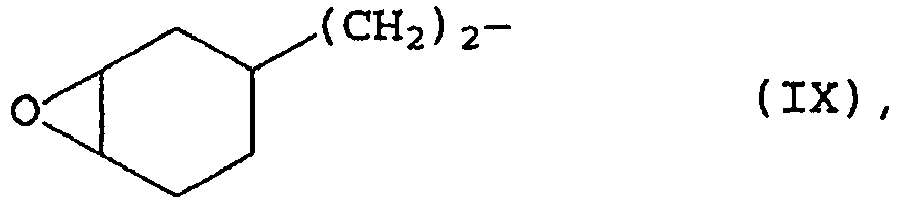
- Beispiele für die erfindungsgemäß eingesetzten Verbindungen enthaltend Einheiten der Formel (III) sind 2-(3,4-Epoxycyclohexyl)ethyl-trimethoxysilan, 2-(3,4-Epoxycyclohexyl)ethyl-triethoxysilan, 2-(3,4-Epoxycyclohexyl)ethyl-methyldimethoxysilan, 2-(3,4-Epoxycyclohexyl)ethylmethyldiethoxysilan, Glycidoxypropyl-trimethoxysilan, Glycidoxypropyl-triethoxysilan, Glycidoxypropyl-methyldimethoxysilan oder Glycidoxypropyl-methyldiethoxysilan sowie deren Teilhydrolysate, wobei Glycidoxypropyl-trimethoxysilan, Glycidoxypropyltriethoxysilan, Glycidoxypropyl-methyldimethoxysilan oder Glycidoxypropyl-methyldiethoxysilan sowie jeweils deren Teilhydrolysate bevorzugt und Glycidoxypropyl-methyldimethoxysilan oder Glycidoxypropyl-methyldiethoxysilan sowie jeweils deren Teilhydrolysate besonders bevorzugt sind.
- Die erfindungsgemäß eingesetzten Organosiliciumverbindungen (C) sind handelsübliche Produkte bzw. nach in der Chemie gängigen Verfahren herstellbar.
- Die Art der Komponenten (B) und (C) wird erfindungsgemäß mit der Maßgabe gewählt, dass mindestens 15 % aller Si-Atome in den Komponenten (B) und (C) zu Einheiten der Formeln (II) oder (III) gehören mit e oder h gleich 1. Dabei ist es unerheblich, ob Komponenten (B) enthaltend Einheiten der Formel (II) mit e=1 oder Komponenten (C) enthaltend Einheiten der Formel (III) mit h=1 oder aber beide eingesetzt werden, solange die oben genannte Maßgabe erfüllt ist.
- Die erfindungsgemäßen Massen (K) enthalten zusätzlich zu den Komponenten (A), (B) und (C) noch Komponente (D) und/oder Komponente (E).
- Sofern die erfindungsgemäßen Massen (K) Komponente (D) enthalten, handelt es sich um Mengen von vorzugsweise 0,2 bis 20 Gewichtsteile, besonders bevorzugt 0,5 bis 10 Gewichtsteile, jeweils bezogen auf 100 Gewichtsteile der Komponente (A).
- Beispiele für gegebenenfalls eingesetzte Komponente (D) sind Tetraalkoxysilane wie Tetraethoxysilan, Alkylalkoxysilane wie Methyltrimethoxysilan, Methyltriethoxysilan, Propyltrimethoxysilan, Propyltriethoxysilan, Propylmethyldimethoxysilan oder Propylmethyldiethoxysilan,
n- oder i-Hexyltrimethoxysilan, n- oder i-Hexyltriethoxysilan, n- oder i-Hexylmethyldimethoxysilan, n- oder i-Hexylmethyldiethoxysilan, oder auch die entsprechenden n- oder i-Octyl-, n-Decyl-, n-Dodecyl-, n-Tetradecyl- oder n-Hexadecylalkoxysilane,
Phenylsilane wie Phenyltrimethoxysilan, Phenyltriethoxysilan, Phenylmethyldimethoxysilan oder Phenylmethyldiethoxysilan,
Vinylsilane wie Vinyltrimethoxysilan, Vinyltriethoxysilan, Vinylmethyldimethoxysilan oder Vinylmethyldiethoxysilan,
carbamatfunktionelle Silane wie O-Methylcarbamatomethyl-methyldimethoxysilan, O-Methylcarbamatomethyl-trimethoxysilan, O-Ethylcarbamatomethyl-methyldiethoxysilan, O-Ethylcarbamatomethyl-triethoxysilan, 3-(O-Methylcarbamato)propyl-methyldimethoxysilan, 3-(O-Methylcarbamato)propyl-trimethoxysilan, 3-(O-Ethylcarbamato)propyl-methyldiethoxysilan oder 3-(O-Ethylcarbamato)propyl-triethoxysilan,
(meth-)acrylfunktionelle Silane wie 3-Methacryloxypropyl-trimethoxysilan, Methacryloxymethyl-trimethoxysilan, Methacryloxymethyl-methyldimethoxysilan, Methacryloxymethyl-triethoxysilan, Methacryloxymethyl-methyldiethoxysilan, 3-Acryloxypropyl-trimethoxysilan, Acryloxymethyl-trimethoxysilan, Acryloxymethylmethyldimethoxysilane, Acryloxymethyl-triethoxysilan oder Acryloxymethyl-methyldiethoxysilan,
und auch Silane mit anderen Funktionalitäten, außer Reste mit basischem Stickstoff und Epoxyreste, wie N-2-(3-Triethoxysilylpropyl)-maleinsäureanhydrid, N-(3-Trimethoxysilylpropyl)-harnstoff, N-(3-Triethoxysilylpropyl)-harnstoff, N-(Trimethoxysilylmethyl)-harnstoff, N-(Methyldimethoxysilylmethyl)-harnstoff, N-(3-Triethoxysilylmethyl)-harnstoff oder N-(3-Methyldiethoxysilylmethyl)harnstoff,
wobei Tetraethoxysilan und Vinylsilane wie Vinyltrimethoxysilan, Vinyltriethoxysilan, Vinylmethyldimethoxysilan oder Vinylmethyldiethoxysilan bevorzugt und Vinyltrimethoxysilan und Vinyltriethoxysilan besonders bevorzugt sind. - Erfindungsgemäß gegebenenfalls eingesetzte Komponente (E) besteht vorzugsweise zu mindestens 90 Gew.-% aus Einheiten der Formel (IV). Besonders bevorzugt besteht Komponente (E) ausschließlich aus Einheiten der Formel (IV).
- Beispiele für Reste R7 sind die oben für R angegebenen Beispiele.
- Bevorzugt handelt es sich bei Rest R7 um gegebenenfalls mit Halogenatomen substituierte, einwertige, SiC-gebundene aliphatische oder aromatische Kohlenwasserstoffreste mit 1 bis 18 Kohlenstoffatomen, besonders bevorzugt um den Methyl- oder Phenylrest.
- Vorzugsweise weisen in Komponente (E) mindestens 30 %, bevorzugt mindestens 50 %, insbesondere mindestens 60 %, der Einheiten der Formel (IV) einen Phenylrest auf.
- Beispiele für Rest R8 sind Wasserstoffatom oder die für Rest R angegebenen Beispiele.
- Bevorzugt handelt es sich bei Rest R8 um Wasserstoffatom oder gegebenenfalls mit Halogenatomen substituierte Alkylreste mit 1 bis 10 Kohlenstoffatomen, besonders bevorzugt um den Methyl- und Ethylrest.
- Beispiele für Komponente (E) sind Organopolysiloxanharze, die im Wesentlichen, vorzugsweise ausschließlich, aus Q-Einheiten der Formeln SiO4/2, Si(OR8)O3/2, Si(OR8)2O2/2 und Si(OR8)3O1/2, T-Einheiten der Formeln PhSiO3/2, PhSi(OR8)O2/2 und PhSi(OR8)2O1/2, D-Einheiten der Formeln Me2SiO2/2 und Me2Si(OR8)O1/2 sowie M-Einheiten der Formel Me3SiO1/2 bestehen, wobei Me für einen Methylrest, Ph für einen Phenylrest und R8 die oben angegebene Bedeutung hat, insbesondere Methylrest, wobei das Harz pro Mol T-Einheiten bevorzugt 0 bis 2 Mol Q-Einheiten, 0 bis 2 Mol D-Einheiten und 0 bis 2 Mol M-Einheiten enthält.
- Bevorzugte Beispiele für Komponenten (E) sind Organopolysiloxanharze, die im Wesentlichen, vorzugsweise ausschließlich, aus T-Einheiten der Formeln PhSiO3/2, PhSi(OR8)O2/2 und PhSi(OR8)2O1/2, gegebenenfalls T-Einheiten der Formeln MeSiO3/2, MeSi(OR8)O2/2 und MeSi(OR8)2O1/2 sowie gegebenenfalls D-Einheiten der Formeln Me2SiO2/2 und Me2Si(OR8)O1/2 bestehen, wobei Me für einen Methylrest, Ph für einen Phenylrest und R8 die oben angegebene Bedeutung hat, insbesondere Methylrest, mit einem molaren Verhältnis von Phenylsilicon- zu Methylsilicon-Einheiten von bevorzugt 0,5 bis 5,0. Der Gehalt an D-Einheiten in diesen Siliconharzen liegt vorzugsweise unter 10 Gew.-%.
- Vorzugsweise besitzen die Siliconharze (E) eine zahlenmittlere Molmasse Mn von bevorzugt 400 bis 400 000 g/mol, besonders bevorzugt von 600 bis 100 000 g/mol, insbesondere von 800 bis 5 000 g/mol. Sie können bei 23 °C und 1000 hPa sowohl fest als auch flüssig sein, wobei flüssige Siliconharze bevorzugt werden.
- Bei den gegebenenfalls eingesetzten Siliconharzen (E) handelt es sich um handelsübliche Produkte, z.B. um verschiedene SILRES®-Typen der Fa. Wacker Chemie AG, wie SILRES® IC 368, SILRES® IC 678 oder SILRES® SY231 bzw. können nach in der Chemie gängigen Methoden hergestellt werden.
- Falls die erfindungsgemäßen Massen (K) Siliconharze (E) enthalten, handelt es sich um Mengen von vorzugsweise 5 bis 300 Gewichtsteilen, insbesondere von 10 bis 200 Gewichtsteilen, jeweils bezogen auf 100 Gewichtsteile Komponente (A).
- In einer bevorzugten Aufführung der Erfindung enthalten die erfindungsgemäßen Massen (K) Siliconharze (E).
- Zusätzlich zu den Komponenten (A) bis (E) können die erfindungsgemäßen Massen (K) weitere Stoffe enthalten, die unterschiedlich sind zu Komponenten (A) bis (E), wie z.B. Füllstoffe (F), Katalysatoren (G), Additive (H) und Zuschlagstoffe (I).
- Bei den in den erfindungsgemäßen Massen (K) gegebenenfalls eingesetzten Füllstoffen (F) kann es sich um beliebige, bisher bekannte Füllstoffe handeln.
- Beispiele für Füllstoffe (F) sind nicht verstärkende Füllstoffe, also Füllstoffe mit einer BET-Oberfläche von vorzugsweise bis zu 50 m2/g, wie Quarz, Diatomeenerde, Calciumsilikat, Zirkoniumsilikat, Talkum, Kaolin, Zeolithe, Metalloxidpulver, wie Aluminium-, Titan-, Eisen- oder Zinkoxide bzw. deren Mischoxide, Bariumsulfat, Calciumcarbonat, Gips, Siliciumnitrid, Siliciumcarbid, Bornitrid, Glas- und Kunststoffpulver, wie Polyacrylnitrilpulver; verstärkende Füllstoffe, also Füllstoffe mit einer BET-Oberfläche von mehr als 50 m2/g, wie pyrogen hergestellte Kieselsäure, gefällte Kieselsäure, gefällte Kreide, Ruß, wie Furnace- und Acetylenruß und Silicium-Aluminium-Mischoxide großer BET-Oberfläche; Aluminiumtrihydroxid, hohlkugelförmiger Füllstoffe, wie keramische Mikrokugel, wie z.B. solche erhältlich unter der Handelsbezeichnung Zeeospheres™ bei der Fa. 3M Deutschland GmbH in D-Neuss, elastische Kunststoffkugeln, wie etwa solche erhältlich unter der Handelsbezeichnung EXPANCEL® bei der Fa. AKZO NOBEL, Expancel in Sundsvall, Schweden, oder Glaskugeln; faserförmige Füllstoffe, wie Asbest sowie Kunststofffasern. Die genannten Füllstoffe können hydrophobiert sein, beispielsweise durch die Behandlung mit Organosilanen bzw. -siloxanen oder mit Stearinsäure oder durch Veretherung von Hydroxylgruppen zu Alkoxygruppen.
- Bevorzugt handelt es sich bei den gegebenenfalls eingesetzten Füllstoffen (F) um Calciumcarbonat, Talkum, Aluminiumtrihydroxid sowie Kieselsäure, wobei Aluminiumtrihydroxid besonders bevorzugt wird. Bevorzugte Calciumcarbonat-Typen sind gemahlen oder gefällt und gegebenenfalls oberflächenbehandelt mit Fettsäuren wie Stearinsäure oder deren Salze. Bei der bevorzugten Kieselsäure handelt es sich bevorzugt um pyrogene Kieselsäure.
- Gegebenenfalls eingesetzte Füllstoffe (F) haben einen Feuchtigkeitsgehalt von bevorzugt unter 1 Gew.-%, besonders bevorzugt von unter 0,5 Gew.-%.
- Falls die erfindungsgemäßen Massen (K) Füllstoffe (F) enthalten, handelt es sich um Mengen von vorzugsweise 10 bis 1000 Gewichtsteilen, besonders bevorzugt 50 bis 500 Gewichtsteilen, insbesondere 80 bis 300 Gewichtsteilen, jeweils bezogen auf 100 Gewichtsteile Bestandteil (A). Die erfindungsgemäßen Massen (K) enthalten bevorzugt Füllstoffe (F).
- In einer besonderen Ausführung der Erfindung enthalten die erfindungsgemäßen Massen (K) als Füllstoffe (F) eine Kombination aus
- a) Kieselsäure, insbesondere pyrogene Kieselsäure, und
- b) Calciumcarbonat, Aluminiumtrihydroxid und/oder Talkum.
- Falls die erfindungsgemäßen Massen (K) diese besondere Kombination verschiedener Füllstoffe (F) enthalten, enthalten sie vorzugsweise 1 bis 80 Gewichtsteile, besonders bevorzugt 5 bis 40 Gewichtsteile, Kieselsäure, insbesondere pyrogene Kieselsäure, und vorzugsweise 10 bis 500 Gewichtsteile, besonders bevorzugt 50 bis 300 Gewichtsteile, Calciumcarbonat, Aluminiumtrihydroxid, Talkum oder Mischungen aus diesen Materialien, jeweils bezogen auf 100 Gewichtsteile Bestandteil (A).
- Bei den in den erfindungsgemäßen Massen (K) gegebenenfalls eingesetzten Katalysatoren (G) kann es sich um beliebige, bisher bekannte Katalysatoren für durch Silankondensation härtende Massen handeln, die unterschiedlich sind zu Komponente (B).
- Beispiele für metallhaltige Härtungskatalysatoren (G) sind organische Titan- und Zinnverbindungen, beispielsweise Titansäureester, wie Tetrabutyltitanat, Tetrapropyltitanat, Tetraisopropyltitanat und Titantetraacetylacetonat; Zinnverbindungen, wie Dibutylzinndilaurat, Dibutylzinnmaleat, Dibutylzinndiacetat, Dibutylzinndioctanoat, Dibutylzinnacetylacetonat, Dibutylzinnoxide, und entsprechende Dioctylzinnverbindungen.
- Beispiele für metallfreie Härtungskatalysatoren (G) sind basische Verbindungen, wie Triethylamin, Tributylamin, 1,4-Diazabicyclo[2,2,2]octan, 1,5-Diazabicyclo[4.3.0]non-5-en, 1,8-Diazabicyclo[5.4.0]undec-7-en, N,N-Bis-(N,N-dimethyl-2-aminoethyl)-methylamin, Guanidin, N-alkylierte Guanidine wie Dimethylguanidin, Trimethylguanidin, Tetramethylguanidin oder Pentamethylguanidin, N,N-Dimethylcyclohexylamin, N,N-Dimethylphenylamin und N-Ethylmorpholinin.
- Ebenfalls als Katalysator (G) können saure Verbindungen eingesetzt werden, wie Phosphorsäure und ihre Ester, Toluolsulfonsäure, Schwefelsäure, Salpetersäure oder auch organische Carbonsäuren, z.B. Essigsäure und Benzoesäure.
- Falls die erfindungsgemäßen Massen (K) Katalysatoren (G) enthalten, handelt es sich um Mengen von vorzugsweise 0,01 bis 20 Gewichtsteilen, besonders bevorzugt 0,05 bis 5 Gewichtsteilen, jeweils bezogen auf 100 Gewichtsteile Bestandteil (A).
- In einer Ausführung der Erfindung handelt es sich bei den gegebenenfalls eingesetzten Katalysatoren (G) um metallhaltige Härtungskatalysatoren, bevorzugt um zinnhaltige Katalysatoren. Diese Ausführungsform der Erfindung ist insbesondere dann bevorzugt, wenn die Komponente (A) ganz oder zumindest teilweise, d.h. zu mindestens 90 Gew.-%, vorzugsweise zu mindestens 95 Gew.-%, aus Verbindungen der Formel (I) besteht, in denen b ungleich 1 ist.
- Bei den erfindungsgemäßen Massen (K) kann vorzugsweise dann auf Zinn enthaltende Katalysatoren (G), besonders bevorzugt metallhaltige Katalysatoren (G), insbesondere auf sämtliche Katalysatoren (G), verzichtet werden, wenn die Komponente (A) ganz oder zumindest teilweise, d.h. zu mindestens 10 Gew.-%, vorzugsweise zu mindestens 20 Gew.-%, aus Verbindungen der Formel (I) besteht, in denen b gleich 1 ist und R1 die Bedeutung von Wasserstoffatom hat. Diese Ausführungsform der Erfindung ohne metall- und insbesondere ohne zinnhaltige Katalysatoren wird besonders bevorzugt.
- Bei den in den erfindungsgemäßen Massen (K) gegebenenfalls eingesetzten Additiven (H) kann es sich um beliebige, bisher bekannte für silanvernetzende Systeme typische Additive handeln.
- Bei den erfindungsgemäß gegebenenfalls eingesetzten Additiven (H) handelt es sich bevorzugt um Antioxidantien, UV-Stabilisatoren, wie z.B. sog. HALS-Verbindungen, Fungizide und Pigmente.
- Falls die erfindungsgemäßen Massen (K) Additive (H) enthalten, handelt es sich um Mengen von vorzugsweise 0,01 bis 30 Gewichtsteilen, besonders bevorzugt 0,1 bis 10 Gewichtsteilen, jeweils bezogen auf 100 Gewichtsteile Bestandteil (A). Die erfindungsgemäßen Massen (K) enthalten bevorzugt Additive (H).
- Bei den erfindungsgemäß gegebenenfalls eingesetzten Zuschlagsstoffen (I) handelt es sich bevorzugt um Weichmacher, Rheologieadditive, Flammschutzmittel und organische Lösungsmittel.
- Beispiele für Weichmacher (I) sind wie Phthalsäureester (z.B. Dioctylphthalat, Diisooctylphthalat und Diundecylphthalat), perhydrierte Phthalsäureester (z.B. 1,2-Cyclohexandicarbonsäurediisononylester und 1,2-Cyclohexandicarbonsäuredioctylester) Adipinsäureester (z.B. Dioctyladipat), Benzoesäureester, Glycolester, Ester gesättigter Alkandiole (z.B. 2,2,4-Trimethyl-1,3-pentandiolmonoisobutyrate und 2,2,4-Trimethyl-1,3-pentandioldiisobutyrate), Phosphorsäureester, Sulfonsäureester, Polyester, Polyether (z.B. Polyethylenglycole und Polypropylenglycole mit Molmassen von vorzugsweise 1000 bis 10 000 Dalton), Polystyrole, Polybutadiene, Polyisobutylene, paraffinische Kohlenwasserstoffe und hochmolekulare, verzweigte Kohlenwasserstoffe.
- Bei den Rheologieadditiven (I) handelt es sich bevorzugt um Polyamidwachse, hydrierte Rizinusöle oder Harnstoffderivate auf Basis von MDI.
- Beispiele für organische Lösungsmittel (I) sind wie Ether (z.B. Diethylether, Methyl-t-butylether, Etherderivate des Glycols, THF), Ester (z.B. Ethylacetat, Butylacetat, Glycolester), Kohlenwasserstoffe (z.B. Pentan, Cyclopentan, Hexan, Cyclohexan, Heptan, Octan oder auch längerkettige verzweigte und unverzweigte Alkane), Ketone (z.B. Aceton, Methylethylketon), Aromaten (z.B. Toluol, Xylol, Ethylbenzol, Chlorbenzol) oder auch Alkohole (z.B. Methanol, Ethanol, Glycol, Propanol, iso-Propanol, Glycerin, Butanol, iso-Butanol, t-Butanol) wobei Alkohole bevorzugt werden.
- Den erfindungsgemäßen Massen (K) werden vorzugsweise keine organischen Lösungsmitteln (I) zugesetzt.
- Falls die erfindungsgemäßen Massen (K) eine oder mehrere Komponenten (I) enthalten, handelt es sich jeweils um Mengen von bevorzugt 0,5 bis 200 Gewichtsteilen, besonders bevorzugt 1 bis 100 Gewichtsteilen, insbesondere 2 bis 70 Gewichtsteilen, jeweils bezogen auf 100 Gewichtsteile Komponente (A).
- Bei den erfindungsgemäßen Massen (K) handelt es sich vorzugsweise um solche enthaltend
- (A) 100 Gewichtsteile silanterminierte Polyoxyalkylene mit Endgruppen der Formel (VI) und einer mittleren Molmasse Mn von 10 000 bis 30 000 g/mol,
- (B) 0,2 bis 20 Gewichtsteile Silane der Formel (II) und/oder deren Teilhydrolysate,
- (C) 0,2 bis 20 Gewichtsteile Silane der Formel (III) und/oder deren Teilhydrolysate,
mit der Maßgabe, dass mindestens 15 %, bevorzugt mindestens 25 %, besonders bevorzugt mindestens 35 %, insbesondere mindestens 45 %, aller Si-Atome in den Komponenten (B) und (C) zu Einheiten der Formeln (II) oder (III) gehören mit e oder h gleich 1,
sowie mindestens eine weitere Komponente ausgewählt aus - (D) 0,2 bis 20 Gewichtsteile Alkoxysilane und
- (E) 1 bis 500 Gewichtsteilen Siliconharze,
sowie zusätzlich
gegebenenfalls - (F) Füllstoffe,
gegebenenfalls - (G) Katalysatoren,
gegebenenfalls - (H) Additive und
gegebenenfalls - (I) Zuschlagstoffe.
- Bei den erfindungsgemäßen Massen (K) handelt es sich bevorzugt um solche enthaltend
- (A) 100 Gewichtsteile lineare silanterminierte Polyoxypropylene, deren Kettenenden zu mindestens 85 % mit Endgruppen der Formel (VI) terminiert sind, und die eine mittlere Molmasse Mn von 10 000 bis 30 000 g/mol aufweisen,
- (B) 0,2 bis 20 Gewichtsteile Silane der Formel (II) und/oder deren Teilhydrolysate,
- (C) 0,2 bis 20 Gewichtsteile Silane der Formel (III) und/oder deren Teilhydrolysate,
mit der Maßgabe, dass mindestens 15 %, bevorzugt mindestens 25 %, besonders bevorzugt mindestens 35 %, insbesondere mindestens 45 %, aller Si-Atome in den Komponenten (B) und (C) zu Einheiten der Formeln (II) oder (III) gehören mit e oder h gleich 1,
sowie mindestens eine weitere Komponente ausgewählt aus - (D) 0,2 bis 20 Gewichtsteile Alkoxysilane und
- (E) 1 bis 500 Gewichtsteilen Siliconharze,
sowie zusätzlich
gegebenenfalls - (F) Füllstoffe,
gegebenenfalls - (G) Katalysatoren,
gegebenenfalls - (H) Additive und
gegebenenfalls - (I) Zuschlagstoffe.
- Bei den erfindungsgemäßen Massen (K) handelt es sich besonders bevorzugt um solche enthaltend
- (A) 100 Gewichtsteile lineare silanterminierte Polyoxypropylene, deren Kettenenden zu mindestens 85 % mit Endgruppen der Formel (VI) terminiert sind, und die eine mittlere Molmasse Mn von 11 000 bis 22 000 g/mol aufweisen,
- (B) 0,5 bis 15 Gewichtsteile Silane der Formel (II) und/oder deren Teilhydrolysate,
- (C) 0,5 bis 10 Gewichtsteile Silane der Formel (III) und/oder deren Teilhydrolysate,
mit der Maßgabe, dass mindestens 15 %, bevorzugt mindestens 25 %, besonders bevorzugt mindestens 35 %, insbesondere mindestens 45 %, aller Si-Atome in den Komponenten (B) und (C) zu Einheiten der Formeln (II) oder (III) gehören mit e oder h gleich 1,
sowie mindestens eine weitere Komponente ausgewählt aus - (D) 0,5 bis 10 Gewichtsteile Alkoxysilane und
- (E) 5 bis 200 Gewichtsteilen Siliconharze,
sowie zusätzlich
gegebenenfalls - (F) Füllstoffe,
gegebenenfalls - (G) Katalysatoren,
gegebenenfalls - (H) Antioxidantien, UV-Stabilisatoren, Fungizide, Biozide oder Pigmente und
gegebenenfalls - (I) Weichmacher, Rheologieadditive, Flammschutzmittel oder organische Lösungsmittel.
- Bei den erfindungsgemäßen Massen (K) handelt es sich insbesondere um solche enthaltend
- (A) 100 Gewichtsteile lineare silanterminierte Polyoxypropylene, deren Kettenenden zu mindestens 85 % mit Endgruppen der Formel (VI) terminiert sind, und die eine mittlere Molmasse Mn von 11 000 bis 22 000 g/mol aufweisen,
- (B) 0,5 bis 15 Gewichtsteile Silane der Formel (II) mit e=1 und/oder deren Teilhydrolysate,
- (C) 0,5 bis 10 Gewichtsteile Silane der Formel (III) mit h=0 und/oder deren Teilhydrolysate,
sowie mindestens eine weitere Komponente ausgewählt aus - (D) 0,5 bis 10 Gewichtsteile Alkoxysilane, ausgewählt aus der Gruppe bestehend aus Tetraethoxysilan, Vinyltrimethoxysilan, Vinyltriethoxysilan, Vinylmethyldimethoxysilan oder Vinylmethyldiethoxysilan, und
- (E) 5 bis 200 Gewichtsteilen Phenylgruppen enthaltende Siliconharze,
sowie zusätzlich
gegebenenfalls - (F) Füllstoffe,
gegebenenfalls - (G) Katalysatoren,
gegebenenfalls - (H) Antioxidantien, W-Stabilisatoren, Fungizide, Biozide oder Pigmente und
gegebenenfalls - (I) Weichmacher, Rheologieadditive, Flammschutzmittel oder organische Lösungsmittel.
- Die erfindungsgemäßen Massen (K) enthalten außer den Komponenten (A) bis (I) vorzugsweise keine weiteren Bestandteile.
- Bei den erfindungsgemäß eingesetzten Komponenten kann es sich jeweils um eine Art einer solchen Komponente wie auch um ein Gemisch aus mindestens zwei Arten einer jeweiligen Komponente handeln.
- Bei den erfindungsgemäßen Massen (K) handelt es sich bevorzugt um Formulierungen mit Viskositäten von bevorzugt 500 bis 1 000 000 mPas, besonders bevorzugt von 1 000 bis 500 000 mPas, insbesondere 1 000 bis 20 000 mPas, jeweils bei 25 °C.
- In einer bevorzugten Ausführung der Erfindung zeichnen sich die erfindungsgemäßen Massen dadurch aus, dass sie nach ihrer vollständigen Aushärtung eine Reißfestigkeit von mindestens 1 MPa aufweisen, jeweils gemessen nach DIN EN 53504.
- In einer weiteren bevorzugten Ausführung der Erfindung zeichnen sich die erfindungsgemäßen Massen dadurch aus, dass sie nach ihrer vollständigen Aushärtung eine Zugscherfestigkeit von mindestens 5 MPa, besonders bevorzugt von mindestens 8 MPa, insbesondere mindestens 10 MPa, aufweisen, jeweils gemessen nach DIN EN 204.
- Ein weiterer Gegenstand der vorliegenden Erfindung ist ein Verfahren zur Herstellung der erfindungsgemäßen vernetzbaren Massen durch Mischen der einzelnen Komponenten in beliebiger Reihenfolge.
- Dieses Vermischen kann bei Raumtemperatur und dem Druck der umgebenden Atmosphäre, also etwa 900 bis 1100 hPa, erfolgen. Falls erwünscht, kann dieses Vermischen aber auch bei höheren Temperaturen erfolgen, z.B. bei Temperaturen im Bereich von 30 bis 130 °C. Weiterhin ist es möglich, zeitweilig oder ständig unter vermindertem Druck zu mischen, wie z.B. bei 30 bis 500 hPa Absolutdruck, um flüchtige Verbindungen und/oder Luft zu entfernen.
- Das erfindungsgemäße Vermischen erfolgt bevorzugt unter Ausschluss von Feuchtigkeit.
- Das erfindungsgemäße verfahren kann kontinuierlich oder diskontinuierlich durchgeführt werden.
- Bei den erfindungsgemäßen Massen (K) handelt es sich bevorzugt um einkomponentige, unter Ausschluss von Wasser lagerfähige, bei Zutritt von Wasser bei Raumtemperatur vernetzbare Massen. Die erfindungsgemäßen Massen (K) können aber auch Teil von zweikomponentigen Vernetzungssystemen sein, bei denen in einer zweiten Komponente OH-haltige Verbindungen, wie Wasser, hinzugefügt werden.
- Für die Vernetzung der erfindungsgemäßen Massen (K) reicht der übliche Wassergehalt der Luft aus. Die Vernetzung der erfindungsgemäßen Massen (K) erfolgt vorzugsweise bei Raumtemperatur. Sie kann, falls erwünscht, auch bei höheren oder niedrigeren Temperaturen als Raumtemperatur, z.B. bei -5° bis 15 °C oder bei 30° bis 50 °C und/oder mittels des normalen Wassergehalts der Luft übersteigenden Konzentrationen von Wasser durchgeführt werden.
- Vorzugsweise wird die Vernetzung bei einem Druck von 100 bis 1100 hPa, insbesondere beim Druck der umgebenden Atmosphäre, also etwa 900 bis 1100 hPa, durchgeführt.
- Ein weiterer Gegenstand der Erfindung sind Formkörper hergestellt durch Vernetzung der erfindungsgemäßen Massen.
- Bei den erfindungsgemäßen Formkörpern kann es sich um beliebige Formkörper handeln, wie etwa Dichtungen, Pressartikel, extrudierte Profile, Beschichtungen, Imprägnierungen, Verguss, Linsen, Prismen, polygone Strukturen, Laminat- oder Klebschichten.
- Ein weiterer Gegenstand der Erfindung ist ein Verfahren zur Verklebung oder Abdichtung von Substraten, bei denen die erfindungsgemäße Masse auf die Oberfläche mindestens eines Substrates aufgebracht, diese Oberfläche dann mit dem zu verklebenden zweiten Substrat in Kontakt gebracht und anschließend vernetzen gelassen wird.
- Beispiele für Substrate, die erfindungsgemäß verklebt oder abgedichtet werden können, sind insbesondere Holz aber auch Kunststoffe inkl. PVC, Beton, mineralische Untergründe, Metalle, Glas, Keramik und lackierte Oberflächen. Dabei können sowohl gleiche als auch unterschiedliche Materialien miteinander verklebt werden.
- Ein weiterer Gegenstand der Erfindung ist ein Verfahren zur Herstellung von Beschichtungen oder Vergüssen, bei denen die erfindungsgemäße Masse auf mindestens ein Substrat aufgebracht und anschließend vernetzen gelassen wird.
- Beispiele hierfür sind Vergussmassen für LEDs oder sonstige elektronische Bauteile, die Herstellung von Formartikeln, Verbundmaterialien und Verbundformteilen. Unter Verbundformteilen soll hier ein einheitlicher Formartikel aus einem Verbundmaterial verstanden werden, der aus einem Vernetzungsprodukt der erfindungsgemäßen Massen (K) und mindestens einem Substrat so zusammengesetzt ist, dass zwischen den beiden Teilen eine feste, dauerhafte Verbindung besteht.
- Die erfindungsgemäßen Massen (K) haben den Vorteil, dass sie auch unter den Bedingungen einer Wasserlagerung ein gutes Haftungsprofil aufweisen.
- Die erfindungsgemäßen Massen (K) haben den Vorteil, dass sie leicht herzustellen sind.
- Die erfindungsgemäßen vernetzbaren Massen (K) haben den Vorteil, dass sie sich durch eine sehr hohe Lagerstabilität und eine hohe Vernetzungsgeschwindigkeit auszeichnen.
- Des Weiteren haben die erfindungsgemäßen vernetzbaren Massen (K) den Vorteil, dass sie leicht zu verarbeiten sind.
- Des Weiteren haben die erfindungsgemäßen vernetzbaren Massen (K) den Vorteil, dass daraus Klebstoffe mit hoher Reißfestigkeit erhalten werden können.
- Ferner haben die erfindungsgemäßen feuchtigkeitshärtenden Kleb- und Dichtstoffe den Vorteil, dass sie ein deutlich verbessertes Haftungsprofil nach Kaltwasserlagerung aufweisen.
- In den nachstehend beschriebenen Beispielen beziehen sich alle Viskositätsangaben auf eine Temperatur von 25 °C. Sofern nicht anders angegeben, werden die nachstehenden Beispiele bei einem Druck der umgebenden Atmosphäre, also etwa bei 1000 hPa, und bei Raumtemperatur, also bei etwa 23 °C, bzw. bei einer Temperatur, die sich beim Zusammengeben der Reaktanden bei Raumtemperatur ohne zusätzliche Heizung oder Kühlung einstellt, sowie bei einer relativen Luftfeuchtigkeit von etwa 50 % durchgeführt. Des Weiteren beziehen sich alle Angaben von Teilen und Prozentsätzen, soweit nichts anderes angegeben ist, auf das Gewicht.
- 98,8 g silanterminiertes Polypropylenglycol mit einer mittleren Molmasse Mn von 12000 g/mol und Endgruppen der Formel -O-C(=O)-NH-CH2-SiCH3(OCH3)2 (käuflich erhältlich unter der Bezeichnung GENIOSIL® STP-E10 bei der Wacker Chemie AG, D-München) werden in einem Laborplanetenmischer der Fa. PC-Laborsystem, ausgestattet mit zwei Balkenmischern, bei ca. 25 °C mit 98 g eines Polypropylenglycol mit einer mittleren Molmasse Mn von 2000 g/mol, 2,0 g HALS-Stabilisator (käuflich erhältlich unter der Bezeichnung TINUVIN® 123 bei der BASF AG, D-Ludwigshafen; CAS-NR: 129757-67-1) und 6 g Vinyltrimethoxysilan 2 Minuten bei 200 U/min homogenisiert. Danach werden 171,2 g eines mit Stearinsäure beschichteten Marmormehls mit einem mittleren Teilchendurchmesser (D50%) von ca. 2,0 µm (käuflich erhältlich unter der Bezeichung Omyabond 520 bei der Firma Omya, D-Köln) und 16 g einer hydrophoben pyrogenen Kieselsäure mit einer BET-Oberfläche von ca. 200 m2/g (käuflich erhältlich unter der Bezeichnung HDK® H18 bei der Wacker Chemie AG, D-München) eine Minute unter Rühren bei 600 U/min aufgeschlossen. Schließlich werden 4 g N-(2-Aminoethyl)-3-aminopropyl-methyldimethoxysilan und 4 g 3-Glycidoxypropyl-trimethoxysilan 1 Minute bei 200 U/min vermischt und 1 Minute bei 200 U/min im Teilvakuum (ca. 100 mbar) homogenisiert und blasenfrei gerührt.
- Die so erhaltene Masse wird in 310 ml PE-Kartuschen abgefüllt und 24 Stunden bei 20 °C vor der Untersuchung gelagert.
- Es wird ebenso vorgegangen wie in Beispiel 1 beschrieben. Allerdings werden statt 4 g 3-Glycidoxypropyl-trimethoxysilan und 4 g N-(2-Aminoethyl)-3-aminopropyl-methyldimethoxysilan jeweils 4 g von 3-Glycidoxypropyl-methyldiethoxysilan und N-(2-Aminoethyl)-3-aminopropyl-trimethoxysilan eingesetzt.
- Die so erhaltene Masse wird in 310 ml PE-Kartuschen abgefüllt und 24 Stunden bei 20 °C vor der Untersuchung gelagert.
- Es wird ebenso vorgegangen wie in Beispiel 1 beschrieben. Allerdings werden statt 4 g 3-Glycidoxypropyl-trimethoxysilan 4 g 3-Glycidoxypropyl-methyldiethoxysilan eingesetzt.
- Die so erhaltene Masse wird in 310 ml PE-Kartuschen abgefüllt und 24 Stunden bei 20 °C vor der Untersuchung gelagert.
- Es wird ebenso vorgegangen wie in Beispiel 1 beschrieben. Allerdings werden statt 4 g N-(2-Aminoethyl)-3-aminopropyl-methyldimethoxysilan 4 g N-(2-Aminoethyl)-3-aminopropyl-trimethoxysilan eingesetzt.
- Die so erhaltene Masse wird in 310 ml PE-Kartuschen abgefüllt und 24 Stunden bei 20 °C vor der Untersuchung gelagert.
- Es wird ebenso vorgegangen wie in Beispiel 1 beschrieben. Allerdings werden statt 4 g 3-Glycidoxypropyl-trimethoxysilan und 4 g N-(2-Aminoethyl)-3-aminopropyl-methyldimethoxysilan 8 g N-(2-Aminoethyl)-3-aminopropyl-methyldimethoxysilan eingesetzt.
- Die so erhaltene Masse wird in 310 ml PE-Kartuschen abgefüllt und 24 Stunden bei 20 °C vor der Untersuchung gelagert.
- Es wird ebenso vorgegangen wie in Beispiel 1 beschrieben. Allerdings werden statt 4 g 3-Glycidoxypropyl-trimethoxysilan und 4 g N-(2-Aminoethyl)-3-aminopropyl-methyldimethoxysilan 8 g N-(2-Aminoethyl)-3-aminopropyl-trimethoxysilan eingesetzt.
- Die so erhaltene Masse wird in 310 ml PE-Kartuschen abgefüllt und 24 Stunden bei 20 °C vor der Untersuchung gelagert.
- Die in den Beispielen 1 bis 3 sowie in den Vergleichsbeispielen V1 bis V3 erhaltenen Massen wurden vernetzen gelassen und hinsichtlich ihrer Hautbildung, ihrer mechanischen Eigenschaften und ihres Haftprofils nach Wasserlagerung untersucht. Die Ergebnisse finden sich in Tabelle 1.
- Zur Bestimmung der Hautbildungszeit werden die in den Beispielen erhaltenen vernetzbaren Massen in einer 2 mm dicken Schicht auf PE-Folie aufgetragen und bei Normklima (23 °C und 50 % relative Luftfeuchtigkeit) gelagert. Während des Aushärtens wird alle 5 min die Bildung einer Haut getestet. Dazu wird ein trockener Laborspatel vorsichtig auf die Oberfläche der Probe aufgesetzt und nach oben gezogen. Bleibt Probe am Spatel kleben, hat sich noch keine Haut gebildet. Bleibt keine Probe am Spatel mehr kleben, so hat sich eine Haut gebildet und die Zeit wird notiert.
- Die Massen wurden jeweils auf ausgefräste Teflonplatten mit 2 mm Tiefe ausgestrichen und 2 Wochen bei 23 °C und 50 % relativer Luftfeuchte gehärtet.
- Shore-A-Härte wird gemäß DIN 53505 bestimmt.
- Reißfestigkeit wird gemäß DIN 53504-S1 bestimmt.
- Reißdehnung wird gemäß DIN 53504-S1 bestimmt.
- Mit den Massen wurden jeweils Haftversuche auf den in Tabelle 1 angegebenen Substraten unter den folgenden Bedingungen durchgeführt:
- Eine 5-7 cm dicke Raupe wird auf dem Substrat aufgetragen und 14 Tage im Klimaschrank bei Raumtemperatur und einer relativen Luftfeuchtigkeit von 50 % gelagert. Anschließend wird die Probe für weitere 14 Tage bei Raumtemperatur unter Wasser gelagert.
- Nach der Lagerung wird ein Peel-Test durchgeführt, bei dem die Raupe an einem Ende mit einem scharfen Messer auf einer Länge von ca. 2 cm vom Substrat abgeschnitten wird. Anschließend wird, ausgehend von diesem Schnitt, der Rest der Raupe von dem Substrat abgerissen und die Art des entstehenden Risses (kohäsiv und/oder adhäsiv) beurteilt.
Tabelle 1 Masse aus Beispiel 1 2 3 V1 V2 V3 HBZ [min] 43 35 44 35 32 31 Shore-A-Härte 41 39 41 41 32 37 Reißfestigkeit [N/mm2] 1,4 1,4 1,4 1,3 1,7 1,6 Reißdehnung [%] 201 244 222 182 591 341 Haftung : AlMGSi1 + + + + - + AlMg eloxiert + + + - - Ø Edelstahl + + + + - - Stahl DC05 KTL beschichtet + + + + - - Glas + + + - - - Holz + + + + + + PVC Ø + - + - Polycarbonat Ø + + Ø - - Keramikfliese + + + - - - (+) gute Haftung / kohäsiver Riss beim Peel-Test
(Ø) Teilhaftung / kohäsiver und adhesiver Riss Peel-Test
(-) keine Haftung / adhesiver Riss beim Peel-Test - 133 g silanterminiertes Polypropylenglycol mit einer mittleren Molmasse Mn von 12000 g/mol und Endgruppen der Formel -O-C(=O)-NH-CH2-SiCH3(OCH3)2 (käuflich erhältlich unter der Bezeichnung GENIOSIL® STP-E10 bei der Wacker Chemie AG, D-München) werden in einem Laborplanetenmischer der Fa. PC-Laborsystem, ausgestattet mit zwei Balkenmischern, bei ca. 25 °C mit 247 g eines lösungsmittelfreien, flüssigen Phenylsiliconharzes, das aus phenylfunktionellen T-Einheiten (60-80 Gew.-%) und methylfunktionellen T-Einheiten (18-30 Gew.-%) und dimethylfunktionellen D-Einheiten (2-5 Gew.-%) zusammengesetzt ist, einen Gehalt an Methoxygruppen von 12-16 Gew.-% und eine mittlere Molmasse Mn von 800-1300 g/mol aufweist (käuflich erhältlich unter der Bezeichnung SILRES® IC 368 bei der Wacker Chemie AG, D-München), und 10,0 g 3-Glycidoxypropyl-trimethoxysilan für 2 Minuten bei 200 U/min homogenisiert. Danach werden 10,0 g N-(2-Aminoethyl)-3-aminopropyl-methyldimethoxysilan für 1 Minute bei 200 U/min eingemischt. Schließlich wird für 2 Minuten bei 600 U/min und für 1 Minute bei 200 U/min beim Druck von 100 mbar homogenisiert und blasenfrei gerührt.
- Die Formulierung wird in 310 ml PE-Kartuschen abgefüllt und einen Tag bei 20 °C vor der Untersuchung gelagert.
- Es wird ebenso vorgegangen wie in Beispiel 5 beschrieben. Allerdings werden nur 129 g silanterminiertes Polymer (GENIOSIL® STP-E10) und 241 g Phenylsiliconharz (SILRES® IC 368) eingesetzt. Dafür werden zusätzlich auch noch 10 g eines hydroxylgruppen-terminierten, flüssigen Poly-[N-(2-Aminoethyl)-3-aminopropyl]-methylsiloxans mit einer Viskosität von 2000-6000 mPas bei 25 °C (käuflich erhältlich unter der Bezeichnung GENIOSIL® GF95-Hydrolysat bei der Wacker Chemie AG, D-München) eingearbeitet.
- Die so erhaltene Masse wird in 310 ml PE-Kartuschen abgefüllt und 24 Stunden bei 20 °C vor der Untersuchung gelagert.
- Es wird ebenso vorgegangen wie in Beispiel 5 beschrieben. Allerdings werden statt 10 g N-(2-Aminoethyl)-3-aminopropyl-methyldimethoxysilan 10 g N-(2-Aminoethyl)-3-aminopropyl-trimethoxysilan eingesetzt.
- Die so erhaltene Masse wird in 310 ml PE-Kartuschen abgefüllt und 24 Stunden bei 20 °C vor der Untersuchung gelagert.
- Es wird ebenso vorgegangen wie in Beispiel 5 beschrieben. Allerdings werden statt 10 g 3-Glycidoxypropyl-trimethoxysilan und 10 g N-(2-Aminoethyl)-3-aminopropyl-methyldimethoxysilan 20 g N-(2-Aminoethyl)-3-aminopropyl-trimethoxysilan eingesetzt.
- Die so erhaltene Masse wird in 310 ml PE-Kartuschen abgefüllt und 24 Stunden bei 20 °C vor der Untersuchung gelagert.
- Die in den Beispielen 5 und 6 sowie in den Vergleichsbeispielen V4 und V5 erhaltenen Massen wurden vernetzen gelassen und hinsichtlich ihrer Hautbildung, und ihrer Zugscherfestigkeit mit und ohne Wasserlagerung untersucht. Die Hautbildungszeit wurde wie in Beispiel 4 beschrieben bestimmt. Die Ergebnisse finden sich in Tabelle 2.
- Die Bestimmung der Zugscherfestigkeiten erfolgt wie in der DIN EN 204 beschrieben. Hierbei erfolgt ein Auftrag des Klebstoffes auf beide zu verklebenden Buchenhölzer, welche dann mit einem 100 µm Rakel abgezogen werden. Anschließend erfolgt das Verbinden der beiden Hölzer über eine Fläche von 1 mal 2 cm mit einem Anpressdruck von 5 kg. Nach dem Anpressen von 24 Stunden werden die Hölzer im Normklima für den angegebenen Zeitraum gelagert. Bei der Bestimmung des D4-1-Wertes wird die Zugscherfestigkeit der beiden verklebten Hölzer direkt nach einer 7-tägigen Lagerung bei Normklima gemessen.
- Bei der Bestimmung des D4-3-Wertes wird die Zugscherfestigkeit der beiden verklebten Hölzer nach einer 7-tägigen Lagerung bei Normklima, einer anschließenden 4-tägigen Lagerung in 23 °C warmen Wasser und anschließender 2-stündiger Äquilibrierung unter Normklima gemessen.
- Bei der Bestimmung des D4-5-Wertes wird die Zugscherfestigkeit der beiden verklebten Hölzer nach einer 7-tägigen Lagerung bei Normklima, einer anschließenden 6-stündigen Lagerung in kochendem Wasser und anschließender 2-stündiger Äquilibrierung unter Normklima gemessen.
- Es werden die in Tabelle 2 angegebenen Werte erzielt:
Tabelle 2 Masse aus Beispiel 5 6 V4 V5 HBZ [min] 69 64 58 66 Lagerbedingungen Zugscherfestigkeit [MPa] D4-1 (Normklima) 10, 4 13,5 11,2 10,2 D4-3 (Kaltwassertest) 3,3 4,1 1,9 2,5 D4-5 (Kochwassertest) 3,4 4,5 3,1 3,0
Claims (10)
- Vernetzbare Massen (K) enthaltend(A) 100 Gewichtsteile Verbindungen der Formel
Y-[(CR1 2)b-SiRa(OR2)3-a]x (I),
wobeiY einen x-wertigen, über Stickstoff, Sauerstoff, Schwefel oder Kohlenstoff gebundenen Polymerrest bedeutet,R gleich oder verschieden sein kann und einen einwertigen, gegebenenfalls substituierten, SiC-gebundenen Kohlenwasserstoffrest darstellt,R1 gleich oder verschieden sein kann und Wasserstoffatom oder einen einwertigen, gegebenenfalls substituierten Kohlenwasserstoffrect darstellt, der über Stickstoff, Phosphor, Sauerstoff, Schwefel oder Carbonylgruppe an das Kohlenstoffatom angebunden sein kann,R2 gleich oder verschieden sein kann und Wasserstoffatom oder einen einwertigen, gegebenenfalls substituierten Kohlenwasserstoffrest darstellt,x eine ganze Zahl von 1 bis 10 ist,a gleich oder verschieden sein kann und 0, 1 oder 2 ist undb gleich oder verschieden sein kann und eine ganze Zahl von 1 bis 10 ist,(B) 0,1 bis 30 Gewichtsteile Organosiliciumverbindungen enthaltend Einheiten der Formel
DSi(OR3)aR4 eO(3-d-e)/2 (II),
worinD einen einwertigen, SiC-gebundenen Rest mit basischem Stickstoff bedeutet,R3 gleich oder verschieden sein kann und Wasserstoffatom oder gegebenenfalls substituierte Kohlenwasserstoffreste bedeutet,R4 gleich oder verschieden sein kann und einen unsubstituierten oder halogensubstituierten, SiC-gebundenen Alkylrest mit 1 bis 8 Kohlenstoffatomen bedeutet,d 0, 1, 2 oder 3 ist unde 0, 1, 2 oder 3 ist,wobei die Summe aus d+e kleiner oder gleich 3 ist und pro Molekül mindestens ein Rest (OR3) anwesend ist,(C) 0,1 bis 30 Gewichtsteile Organosiliciumverbindungen enthaltend Einheiten der Formel
ESi(OR5)gR6 hO(3-g-h)/2 (III),
worinE gleich oder verschieden sein kann und einen einwertigen, SiC-gebundenen Rest mit einer Epoxyfunktion bedeutet,R5 gleich oder verschieden sein kann und Wasserstoffatom oder gegebenenfalls substituierte Kohlenwasserstoffreste bedeutet,R6 gleich oder verschieden sein kann und einen unsubstituierten oder halogensubstituierten, SiC-gebundenen Alkylrest mit 1 bis 8 Kohlenstoffatomen bedeutet,g 0, 1, 2 oder 3 ist undh 0, 1, 2 oder 3 ist,wobei die Summe aus g+h kleiner oder gleich 3 ist und pro Molekül mindestens ein Rest (ORb) anwesend ist,
mit der Maßgabe, dass mindestens 15 % aller Si-Atome in den Komponenten (B) und (C) zu Einheiten der Formeln (II) oder (III) gehören mit e oder h gleich 1, wobei es unerheblich ist, ob Komponenten (B) enthaltend Einheiten der Formel (II) mit e=1 oder Komponenten (C) enthaltend Einheiten der Formel (III) mit h=1 oder aber beide eingesetzt werden, solange die oben genannte Maßgabe erfüllt ist,
und mindestens eine weitere Komponente, ausgewählt aus den Komponenten(D) 0,1 bis 30 Gewichtsteile Alkoxysilane, die von Komponenten (B) und (C) verschieden sind, und(E) 1 bis 500 Gewichtsteile Siliconharze, die von Komponenten (B) und (C) verschieden sind, enthaltend Einheiten der Formel
R7 1(R8O)jSiO(4-1-j)/2 (IV),
wobeiR7 gleich oder verschieden sein kann und Wasserstoffatom oder einen einwertigen, SiC-gebundenen, gegebenenfalls substituierten Kohlenwasserstoffrest bedeutet,R8 gleich oder verschieden sein kann und Wasserstoffatom oder einen einwertigen, gegebenenfalls substituierten Kohlenwasserstoffrest bedeutet,i 0, 1, 2 oder 3 ist undj 0, 1, 2 oder 3 ist,mit der Maßgabe, dass die Summe aus i+j kleiner oder gleich 3 ist und in mindestens 50 % der Einheiten der Formel (IV) i gleich 0 oder 1 ist. - Masse gemäß Anspruch 1, dadurch gekennzeichnet, dass es sich bei Komponente (B) um Silane der Formel (II) und/oder deren Teilhydrolysate handelt.
- Masse gemäß Anspruch 1 oder 2, dadurch gekennzeichnet, dass es sich bei Komponente (C) um Silane der Formel (III) und/oder deren Teilhydrolysate handelt.
- Masse gemäß einem oder mehreren der Ansprüche 1 bis 3, dadurch gekennzeichnet, dass es sich bei Komponente (A) um silanterminierte Polyoxyalkylene handelt.
- Masse gemäß einem oder mehreren der Ansprüche 1 bis 4, dadurch gekennzeichnet, dass es sich vorzugsweise um solche handelt enthaltend(A) 100 Gewichtsteile silanterminierte Polyoxyalkylene mit Endgruppen der Formel (VI) und einer mittleren Molmasse Mn von 10 000 bis 30 000 g/mol,(B) 0,2 bis 20 Gewichtsteile Silane der Formel (II) und/oder deren Teilhydrolysate,(C) 0,2 bis 20 Gewichtsteile Silane der Formel (III) und/oder deren Teilhydrolysate,
mit der Maßgabe, dass mindestens 15 % aller Si-Atome in den Komponenten (B) und (C) zu Einheiten der Formeln (II) oder (III) gehören mit e oder h gleich 1,
sowie mindestens eine weitere Komponente ausgewählt aus(D) 0,2 bis 20 Gewichtsteile Alkoxysilane und(E) 1 bis 500 Gewichtsteilen Siliconharze,
sowie zusätzlich
gegebenenfalls(F) Füllstoffe,
gegebenenfalls(G) Katalysatoren,
gegebenenfalls(H) Additive und
gegebenenfalls(I) Zuschlagstoffe. - Masse gemäß einem oder mehreren der Ansprüche 1 bis 5, dadurch gekennzeichnet, dass es sich vorzugsweise um solche handelt enthaltend(A) 100 Gewichtsteile lineare silanterminierte Polyoxypropylene, deren Kettenenden zu mindestens 85 % mit Endgruppen der Formel (VI) terminiert sind, und die eine mittlere Molmasse Mn von 11 000 bis 22 000 g/mol aufweisen,(B) 0,5 bis 15 Gewichtsteile Silane der Formel (II) mit e=1 und/oder deren Teilhydrolysate,(C) 0,5 bis 10 Gewichtsteile Silane der Formel (III) mit h=0 und/oder deren Teilhydrolysate,
sowie mindestens eine weitere Komponente ausgewählt aus(D) 0,5 bis 10 Gewichtsteile Alkoxysilane, ausgewählt aus der Gruppe bestehend aus Tetraethoxysilan, Vinyltrimethoxysilan, Vinyltriethoxysilan, Vinylmethyldimethoxysilan oder Vinylmethyldiethoxysilan, und(E) 5 bis 200 Gewichtsteilen Phenylgruppen enthaltende Siliconharze,
sowie zusätzlich
gegebenenfalls(F) Füllstoffe,
gegebenenfalls(G) Katalysatoren,
gegebenenfalls(H) Antioxidantien, UV-Stabilisatoren, Fungizide, Biozide oder Pigmente und
gegebenenfalls(I) Weichmacher, Rheologieadditive, Flammschutzmittel oder organische Lösungsmittel. - Verfahren zur Herstellung der vernetzbaren Massen gemäß einem oder mehreren der Ansprüche 1 bis 6 durch Mischen der einzelnen Komponenten in beliebiger Reihenfolge.
- Formkörper hergestellt durch Vernetzung der Massen gemäß einem oder mehreren der Ansprüche 1 bis 6 oder hergestellt gemäß Anspruch 7.
- Verfahren zur Verklebung oder Abdichtung von Substraten, bei denen die Massen gemäß einem oder mehreren der Ansprüche 1 bis 6 oder hergestellt gemäß Anspruch 7 auf die Oberfläche mindestens eines Substrates aufgebracht, diese Oberfläche dann mit dem zu verklebenden zweiten Substrat in Kontakt gebracht und anschließend vernetzen gelassen wird.
- Verfahren zur Herstellung von Beschichtungen oder Vergüssen, bei denen die Masse gemäß einem oder mehreren der Ansprüche 1 bis 6 oder hergestellt gemäß Anspruch 7 auf mindestens ein Substrat aufgebracht und anschließend vernetzen gelassen wird.
Applications Claiming Priority (2)
| Application Number | Priority Date | Filing Date | Title |
|---|---|---|---|
| DE102012223139.0A DE102012223139A1 (de) | 2012-12-13 | 2012-12-13 | Vernetzbare Massen auf Basis von organyloxysilanterminierten Polymeren |
| PCT/EP2013/075558 WO2014090659A1 (de) | 2012-12-13 | 2013-12-04 | Vernetzbare massen auf basis von organyloxysilanterminierten polymeren |
Publications (2)
| Publication Number | Publication Date |
|---|---|
| EP2931815A1 EP2931815A1 (de) | 2015-10-21 |
| EP2931815B1 true EP2931815B1 (de) | 2016-08-03 |
Family
ID=49713087
Family Applications (1)
| Application Number | Title | Priority Date | Filing Date |
|---|---|---|---|
| EP13799561.9A Not-in-force EP2931815B1 (de) | 2012-12-13 | 2013-12-04 | Vernetzbare massen auf basis von organyloxysilanterminierten polymeren |
Country Status (5)
| Country | Link |
|---|---|
| US (1) | US9334434B2 (de) |
| EP (1) | EP2931815B1 (de) |
| CN (1) | CN104812844B (de) |
| DE (1) | DE102012223139A1 (de) |
| WO (1) | WO2014090659A1 (de) |
Families Citing this family (12)
| Publication number | Priority date | Publication date | Assignee | Title |
|---|---|---|---|---|
| US10030122B2 (en) * | 2015-02-09 | 2018-07-24 | Wacker Chemical Corporation | Curable compositions |
| DE102015202278A1 (de) * | 2015-02-09 | 2016-08-11 | Wacker Chemie Ag | Wässrige Dispersionen von Organosiliciumverbindungen |
| DE102015112457A1 (de) * | 2015-07-30 | 2017-02-02 | Fischerwerke Gmbh & Co. Kg | Verwendung eines Ein-Komponentensystems zur Befestigung von Verankerungsmitteln |
| DE102016110272A1 (de) * | 2015-07-30 | 2017-02-02 | Fischerwerke Gmbh & Co. Kg | Verwendung eines Ein- oder Mehr-Komponentensystems zur Befestigung von Verankerungsmitteln |
| DE102016202196A1 (de) * | 2016-02-12 | 2017-08-17 | Wacker Chemie Ag | Vernetzbare Massen auf Basis von organyloxysilanterminierten Polymeren |
| CN111630018B (zh) * | 2018-01-19 | 2022-07-12 | 瓦克化学股份公司 | 用作使纤维水泥疏水化的添加剂的烷基硅树脂 |
| CN108641667A (zh) * | 2018-05-16 | 2018-10-12 | 广州锋凌新材料科技有限公司 | 一种单组分瓷砖美缝行业用硅烷改性聚醚胶粘剂 |
| EP3924428B1 (de) * | 2019-02-14 | 2022-08-17 | Wacker Chemie AG | Mehrkomponentige vernetzbare massen auf basis von organyloxysilanterminierten polymeren |
| DE102020128608A1 (de) * | 2020-10-30 | 2022-05-05 | Klebchemie M.G. Becker GmbH & Co KG | Thermobeschleunigte Klebstoffzusammensetzungen auf Basis silanterminierter Polymere |
| CN117795011A (zh) * | 2021-10-08 | 2024-03-29 | 瓦克化学股份公司 | 一种组合物 |
| WO2023178473A1 (en) * | 2022-03-21 | 2023-09-28 | Wacker Chemie Ag | A composition |
| WO2026131510A1 (en) * | 2024-12-20 | 2026-06-25 | Wacker Chemie Ag | Thermally conductive adhesive composition |
Family Cites Families (12)
| Publication number | Priority date | Publication date | Assignee | Title |
|---|---|---|---|---|
| US5703178A (en) * | 1995-11-30 | 1997-12-30 | Ameron International Corporation | Heat ablative coating composition |
| DE19908562A1 (de) | 1998-03-25 | 1999-10-07 | Henkel Kgaa | Polyurethan und polyurethanhaltige Zubereitung |
| US6569980B1 (en) | 1999-03-23 | 2003-05-27 | Kaneka Corporation | Curable resin compositions |
| DE10330288A1 (de) | 2003-07-04 | 2005-02-03 | Consortium für elektrochemische Industrie GmbH | Alkoxysilanterminierte Prepolymere |
| DE10355318A1 (de) | 2003-11-27 | 2005-06-23 | Wacker-Chemie Gmbh | Verfahren zur Herstellung von organyloxysilylterminierten Polymeren |
| WO2006070637A1 (ja) | 2004-12-28 | 2006-07-06 | Kaneka Corporation | 硬化性組成物 |
| DE102005029169A1 (de) | 2005-06-23 | 2006-12-28 | Wacker Chemie Ag | Kontinuierliche polymeranaloge Umsetzung von reaktiven Silanmonomeren mit funktionalisierten Polymeren |
| US8481668B2 (en) * | 2005-09-16 | 2013-07-09 | Momentive Performance Materials Inc. | Silane-containing adhesion promoter composition and sealants, adhesives and coatings containing same |
| JP5226314B2 (ja) * | 2005-09-30 | 2013-07-03 | 株式会社カネカ | 硬化性組成物 |
| DE102006022834A1 (de) | 2006-05-16 | 2007-11-22 | Wacker Chemie Ag | Verbesserung der elastischen Rückstellung bei alkoxysilanvernetzten Polymeren |
| WO2011089878A1 (ja) * | 2010-01-19 | 2011-07-28 | 株式会社カネカ | 硬化性組成物 |
| DE102012201734A1 (de) * | 2012-02-06 | 2013-08-08 | Wacker Chemie Ag | Massen auf Basis von organyloxysilanterminierten Polymeren |
-
2012
- 2012-12-13 DE DE102012223139.0A patent/DE102012223139A1/de not_active Withdrawn
-
2013
- 2013-12-04 EP EP13799561.9A patent/EP2931815B1/de not_active Not-in-force
- 2013-12-04 US US14/651,617 patent/US9334434B2/en not_active Expired - Fee Related
- 2013-12-04 CN CN201380061403.0A patent/CN104812844B/zh not_active Expired - Fee Related
- 2013-12-04 WO PCT/EP2013/075558 patent/WO2014090659A1/de not_active Ceased
Also Published As
| Publication number | Publication date |
|---|---|
| US9334434B2 (en) | 2016-05-10 |
| EP2931815A1 (de) | 2015-10-21 |
| CN104812844A (zh) | 2015-07-29 |
| DE102012223139A1 (de) | 2014-06-18 |
| CN104812844B (zh) | 2017-04-05 |
| WO2014090659A1 (de) | 2014-06-19 |
| US20150307757A1 (en) | 2015-10-29 |
Similar Documents
| Publication | Publication Date | Title |
|---|---|---|
| EP2831192B1 (de) | Vernetzbare massen auf basis von organyloxysilanterminierten polymeren | |
| EP2812387B1 (de) | Massen auf basis von organyloxysilanterminierten polymeren | |
| EP3371270B1 (de) | Vernetzbare massen auf basis von organyloxysilanterminierten polymeren | |
| EP2885339B1 (de) | Mehrkomponentige vernetzbare massen auf basis von organyloxy-silanterminierten polymeren | |
| EP2744842B1 (de) | Vernetzbare massen auf basis von organyloxysilanterminierten polymeren | |
| EP3131997B1 (de) | Vernetzbare massen auf basis von organyloxysilanterminierten polymeren | |
| EP3036266B1 (de) | Vernetzbare massen auf basis von organyloxysilanterminierten polymeren | |
| EP3149095B1 (de) | Vernetzbare massen auf basis von organyloxysilanterminierten polymeren | |
| DE102012223139A1 (de) | Vernetzbare Massen auf Basis von organyloxysilanterminierten Polymeren | |
| EP3143071B1 (de) | Vernetzbare massen auf basis von organyloxysilanterminierten polymeren | |
| DE102015201099A1 (de) | Vernetzbare Beschichtungsmassen auf Basis von organyloxysilanterminierten Polymeren | |
| DE102011006130B4 (de) | Vernetzbare Massen auf Basis von organyloxysilanterminierten Polymeren, Verfahren zur Herstellung und Verwendung als Kleb- und Dichtstoffe sowie aus den Massen erhältliche Formkörper | |
| DE102011006128A1 (de) | Vernetzbare Massen auf Basis von Organyloxysilanterminierten Polymeren | |
| EP3924428B1 (de) | Mehrkomponentige vernetzbare massen auf basis von organyloxysilanterminierten polymeren |
Legal Events
| Date | Code | Title | Description |
|---|---|---|---|
| PUAI | Public reference made under article 153(3) epc to a published international application that has entered the european phase |
Free format text: ORIGINAL CODE: 0009012 |
|
| 17P | Request for examination filed |
Effective date: 20150603 |
|
| AK | Designated contracting states |
Kind code of ref document: A1 Designated state(s): AL AT BE BG CH CY CZ DE DK EE ES FI FR GB GR HR HU IE IS IT LI LT LU LV MC MK MT NL NO PL PT RO RS SE SI SK SM TR |
|
| AX | Request for extension of the european patent |
Extension state: BA ME |
|
| 17Q | First examination report despatched |
Effective date: 20151015 |
|
| GRAP | Despatch of communication of intention to grant a patent |
Free format text: ORIGINAL CODE: EPIDOSNIGR1 |
|
| GRAP | Despatch of communication of intention to grant a patent |
Free format text: ORIGINAL CODE: EPIDOSNIGR1 |
|
| DAX | Request for extension of the european patent (deleted) | ||
| INTG | Intention to grant announced |
Effective date: 20160302 |
|
| INTG | Intention to grant announced |
Effective date: 20160310 |
|
| GRAS | Grant fee paid |
Free format text: ORIGINAL CODE: EPIDOSNIGR3 |
|
| GRAA | (expected) grant |
Free format text: ORIGINAL CODE: 0009210 |
|
| AK | Designated contracting states |
Kind code of ref document: B1 Designated state(s): AL AT BE BG CH CY CZ DE DK EE ES FI FR GB GR HR HU IE IS IT LI LT LU LV MC MK MT NL NO PL PT RO RS SE SI SK SM TR |
|
| REG | Reference to a national code |
Ref country code: GB Ref legal event code: FG4D Free format text: NOT ENGLISH |
|
| REG | Reference to a national code |
Ref country code: AT Ref legal event code: REF Ref document number: 817320 Country of ref document: AT Kind code of ref document: T Effective date: 20160815 Ref country code: CH Ref legal event code: EP |
|
| REG | Reference to a national code |
Ref country code: IE Ref legal event code: FG4D Free format text: LANGUAGE OF EP DOCUMENT: GERMAN |
|
| REG | Reference to a national code |
Ref country code: DE Ref legal event code: R096 Ref document number: 502013003969 Country of ref document: DE |
|
| REG | Reference to a national code |
Ref country code: NL Ref legal event code: FP |
|
| REG | Reference to a national code |
Ref country code: LT Ref legal event code: MG4D |
|
| REG | Reference to a national code |
Ref country code: FR Ref legal event code: PLFP Year of fee payment: 4 |
|
| PG25 | Lapsed in a contracting state [announced via postgrant information from national office to epo] |
Ref country code: HR Free format text: LAPSE BECAUSE OF FAILURE TO SUBMIT A TRANSLATION OF THE DESCRIPTION OR TO PAY THE FEE WITHIN THE PRESCRIBED TIME-LIMIT Effective date: 20160803 Ref country code: FI Free format text: LAPSE BECAUSE OF FAILURE TO SUBMIT A TRANSLATION OF THE DESCRIPTION OR TO PAY THE FEE WITHIN THE PRESCRIBED TIME-LIMIT Effective date: 20160803 Ref country code: NO Free format text: LAPSE BECAUSE OF FAILURE TO SUBMIT A TRANSLATION OF THE DESCRIPTION OR TO PAY THE FEE WITHIN THE PRESCRIBED TIME-LIMIT Effective date: 20161103 Ref country code: RS Free format text: LAPSE BECAUSE OF FAILURE TO SUBMIT A TRANSLATION OF THE DESCRIPTION OR TO PAY THE FEE WITHIN THE PRESCRIBED TIME-LIMIT Effective date: 20160803 Ref country code: IT Free format text: LAPSE BECAUSE OF FAILURE TO SUBMIT A TRANSLATION OF THE DESCRIPTION OR TO PAY THE FEE WITHIN THE PRESCRIBED TIME-LIMIT Effective date: 20160803 Ref country code: LT Free format text: LAPSE BECAUSE OF FAILURE TO SUBMIT A TRANSLATION OF THE DESCRIPTION OR TO PAY THE FEE WITHIN THE PRESCRIBED TIME-LIMIT Effective date: 20160803 Ref country code: IS Free format text: LAPSE BECAUSE OF FAILURE TO SUBMIT A TRANSLATION OF THE DESCRIPTION OR TO PAY THE FEE WITHIN THE PRESCRIBED TIME-LIMIT Effective date: 20161203 |
|
| PG25 | Lapsed in a contracting state [announced via postgrant information from national office to epo] |
Ref country code: PT Free format text: LAPSE BECAUSE OF FAILURE TO SUBMIT A TRANSLATION OF THE DESCRIPTION OR TO PAY THE FEE WITHIN THE PRESCRIBED TIME-LIMIT Effective date: 20161205 Ref country code: SE Free format text: LAPSE BECAUSE OF FAILURE TO SUBMIT A TRANSLATION OF THE DESCRIPTION OR TO PAY THE FEE WITHIN THE PRESCRIBED TIME-LIMIT Effective date: 20160803 Ref country code: ES Free format text: LAPSE BECAUSE OF FAILURE TO SUBMIT A TRANSLATION OF THE DESCRIPTION OR TO PAY THE FEE WITHIN THE PRESCRIBED TIME-LIMIT Effective date: 20160803 Ref country code: LV Free format text: LAPSE BECAUSE OF FAILURE TO SUBMIT A TRANSLATION OF THE DESCRIPTION OR TO PAY THE FEE WITHIN THE PRESCRIBED TIME-LIMIT Effective date: 20160803 Ref country code: PL Free format text: LAPSE BECAUSE OF FAILURE TO SUBMIT A TRANSLATION OF THE DESCRIPTION OR TO PAY THE FEE WITHIN THE PRESCRIBED TIME-LIMIT Effective date: 20160803 Ref country code: GR Free format text: LAPSE BECAUSE OF FAILURE TO SUBMIT A TRANSLATION OF THE DESCRIPTION OR TO PAY THE FEE WITHIN THE PRESCRIBED TIME-LIMIT Effective date: 20161104 |
|
| PG25 | Lapsed in a contracting state [announced via postgrant information from national office to epo] |
Ref country code: RO Free format text: LAPSE BECAUSE OF FAILURE TO SUBMIT A TRANSLATION OF THE DESCRIPTION OR TO PAY THE FEE WITHIN THE PRESCRIBED TIME-LIMIT Effective date: 20160803 Ref country code: EE Free format text: LAPSE BECAUSE OF FAILURE TO SUBMIT A TRANSLATION OF THE DESCRIPTION OR TO PAY THE FEE WITHIN THE PRESCRIBED TIME-LIMIT Effective date: 20160803 |
|
| REG | Reference to a national code |
Ref country code: DE Ref legal event code: R097 Ref document number: 502013003969 Country of ref document: DE |
|
| PG25 | Lapsed in a contracting state [announced via postgrant information from national office to epo] |
Ref country code: SK Free format text: LAPSE BECAUSE OF FAILURE TO SUBMIT A TRANSLATION OF THE DESCRIPTION OR TO PAY THE FEE WITHIN THE PRESCRIBED TIME-LIMIT Effective date: 20160803 Ref country code: BG Free format text: LAPSE BECAUSE OF FAILURE TO SUBMIT A TRANSLATION OF THE DESCRIPTION OR TO PAY THE FEE WITHIN THE PRESCRIBED TIME-LIMIT Effective date: 20161103 Ref country code: SM Free format text: LAPSE BECAUSE OF FAILURE TO SUBMIT A TRANSLATION OF THE DESCRIPTION OR TO PAY THE FEE WITHIN THE PRESCRIBED TIME-LIMIT Effective date: 20160803 Ref country code: DK Free format text: LAPSE BECAUSE OF FAILURE TO SUBMIT A TRANSLATION OF THE DESCRIPTION OR TO PAY THE FEE WITHIN THE PRESCRIBED TIME-LIMIT Effective date: 20160803 Ref country code: CZ Free format text: LAPSE BECAUSE OF FAILURE TO SUBMIT A TRANSLATION OF THE DESCRIPTION OR TO PAY THE FEE WITHIN THE PRESCRIBED TIME-LIMIT Effective date: 20160803 |
|
| PLBE | No opposition filed within time limit |
Free format text: ORIGINAL CODE: 0009261 |
|
| STAA | Information on the status of an ep patent application or granted ep patent |
Free format text: STATUS: NO OPPOSITION FILED WITHIN TIME LIMIT |
|
| 26N | No opposition filed |
Effective date: 20170504 |
|
| REG | Reference to a national code |
Ref country code: CH Ref legal event code: PL |
|
| PG25 | Lapsed in a contracting state [announced via postgrant information from national office to epo] |
Ref country code: SI Free format text: LAPSE BECAUSE OF FAILURE TO SUBMIT A TRANSLATION OF THE DESCRIPTION OR TO PAY THE FEE WITHIN THE PRESCRIBED TIME-LIMIT Effective date: 20160803 |
|
| PG25 | Lapsed in a contracting state [announced via postgrant information from national office to epo] |
Ref country code: MC Free format text: LAPSE BECAUSE OF FAILURE TO SUBMIT A TRANSLATION OF THE DESCRIPTION OR TO PAY THE FEE WITHIN THE PRESCRIBED TIME-LIMIT Effective date: 20160803 |
|
| REG | Reference to a national code |
Ref country code: IE Ref legal event code: MM4A |
|
| PG25 | Lapsed in a contracting state [announced via postgrant information from national office to epo] |
Ref country code: LU Free format text: LAPSE BECAUSE OF NON-PAYMENT OF DUE FEES Effective date: 20161204 Ref country code: LI Free format text: LAPSE BECAUSE OF NON-PAYMENT OF DUE FEES Effective date: 20161231 Ref country code: CH Free format text: LAPSE BECAUSE OF NON-PAYMENT OF DUE FEES Effective date: 20161231 |
|
| PG25 | Lapsed in a contracting state [announced via postgrant information from national office to epo] |
Ref country code: IE Free format text: LAPSE BECAUSE OF NON-PAYMENT OF DUE FEES Effective date: 20161204 |
|
| REG | Reference to a national code |
Ref country code: FR Ref legal event code: PLFP Year of fee payment: 5 |
|
| PG25 | Lapsed in a contracting state [announced via postgrant information from national office to epo] |
Ref country code: HU Free format text: LAPSE BECAUSE OF FAILURE TO SUBMIT A TRANSLATION OF THE DESCRIPTION OR TO PAY THE FEE WITHIN THE PRESCRIBED TIME-LIMIT; INVALID AB INITIO Effective date: 20131204 |
|
| PG25 | Lapsed in a contracting state [announced via postgrant information from national office to epo] |
Ref country code: MK Free format text: LAPSE BECAUSE OF FAILURE TO SUBMIT A TRANSLATION OF THE DESCRIPTION OR TO PAY THE FEE WITHIN THE PRESCRIBED TIME-LIMIT Effective date: 20160803 Ref country code: CY Free format text: LAPSE BECAUSE OF FAILURE TO SUBMIT A TRANSLATION OF THE DESCRIPTION OR TO PAY THE FEE WITHIN THE PRESCRIBED TIME-LIMIT Effective date: 20160803 |
|
| PG25 | Lapsed in a contracting state [announced via postgrant information from national office to epo] |
Ref country code: MT Free format text: LAPSE BECAUSE OF FAILURE TO SUBMIT A TRANSLATION OF THE DESCRIPTION OR TO PAY THE FEE WITHIN THE PRESCRIBED TIME-LIMIT Effective date: 20160803 |
|
| PG25 | Lapsed in a contracting state [announced via postgrant information from national office to epo] |
Ref country code: AL Free format text: LAPSE BECAUSE OF FAILURE TO SUBMIT A TRANSLATION OF THE DESCRIPTION OR TO PAY THE FEE WITHIN THE PRESCRIBED TIME-LIMIT Effective date: 20160803 Ref country code: TR Free format text: LAPSE BECAUSE OF FAILURE TO SUBMIT A TRANSLATION OF THE DESCRIPTION OR TO PAY THE FEE WITHIN THE PRESCRIBED TIME-LIMIT Effective date: 20160803 |
|
| PGFP | Annual fee paid to national office [announced via postgrant information from national office to epo] |
Ref country code: DE Payment date: 20191210 Year of fee payment: 7 Ref country code: NL Payment date: 20191219 Year of fee payment: 7 |
|
| REG | Reference to a national code |
Ref country code: AT Ref legal event code: MM01 Ref document number: 817320 Country of ref document: AT Kind code of ref document: T Effective date: 20181204 |
|
| PGFP | Annual fee paid to national office [announced via postgrant information from national office to epo] |
Ref country code: BE Payment date: 20191219 Year of fee payment: 7 Ref country code: FR Payment date: 20191220 Year of fee payment: 7 |
|
| PG25 | Lapsed in a contracting state [announced via postgrant information from national office to epo] |
Ref country code: AT Free format text: LAPSE BECAUSE OF NON-PAYMENT OF DUE FEES Effective date: 20181204 |
|
| PGFP | Annual fee paid to national office [announced via postgrant information from national office to epo] |
Ref country code: GB Payment date: 20191220 Year of fee payment: 7 |
|
| REG | Reference to a national code |
Ref country code: DE Ref legal event code: R119 Ref document number: 502013003969 Country of ref document: DE |
|
| REG | Reference to a national code |
Ref country code: NL Ref legal event code: MM Effective date: 20210101 |
|
| GBPC | Gb: european patent ceased through non-payment of renewal fee |
Effective date: 20201204 |
|
| REG | Reference to a national code |
Ref country code: BE Ref legal event code: MM Effective date: 20201231 |
|
| PG25 | Lapsed in a contracting state [announced via postgrant information from national office to epo] |
Ref country code: NL Free format text: LAPSE BECAUSE OF NON-PAYMENT OF DUE FEES Effective date: 20210101 |
|
| PG25 | Lapsed in a contracting state [announced via postgrant information from national office to epo] |
Ref country code: FR Free format text: LAPSE BECAUSE OF NON-PAYMENT OF DUE FEES Effective date: 20201231 |
|
| PG25 | Lapsed in a contracting state [announced via postgrant information from national office to epo] |
Ref country code: GB Free format text: LAPSE BECAUSE OF NON-PAYMENT OF DUE FEES Effective date: 20201204 Ref country code: DE Free format text: LAPSE BECAUSE OF NON-PAYMENT OF DUE FEES Effective date: 20210701 |
|
| PG25 | Lapsed in a contracting state [announced via postgrant information from national office to epo] |
Ref country code: BE Free format text: LAPSE BECAUSE OF NON-PAYMENT OF DUE FEES Effective date: 20201231 |