EP2928349B1 - Dispositif de cuisson comportant une surface de cuisson facile a nettoyer et resistant a la rayure - Google Patents
Dispositif de cuisson comportant une surface de cuisson facile a nettoyer et resistant a la rayure Download PDFInfo
- Publication number
- EP2928349B1 EP2928349B1 EP13795732.0A EP13795732A EP2928349B1 EP 2928349 B1 EP2928349 B1 EP 2928349B1 EP 13795732 A EP13795732 A EP 13795732A EP 2928349 B1 EP2928349 B1 EP 2928349B1
- Authority
- EP
- European Patent Office
- Prior art keywords
- cooking
- cooking device
- face
- holder
- metal
- Prior art date
- Legal status (The legal status is an assumption and is not a legal conclusion. Google has not performed a legal analysis and makes no representation as to the accuracy of the status listed.)
- Active
Links
- 238000010411 cooking Methods 0.000 title claims description 133
- 230000003670 easy-to-clean Effects 0.000 title description 5
- 238000006748 scratching Methods 0.000 title 1
- 230000002393 scratching effect Effects 0.000 title 1
- 150000003624 transition metals Chemical class 0.000 claims description 49
- 229910052723 transition metal Inorganic materials 0.000 claims description 48
- 229910052751 metal Inorganic materials 0.000 claims description 42
- 239000002184 metal Substances 0.000 claims description 42
- 238000000576 coating method Methods 0.000 claims description 37
- 239000002344 surface layer Substances 0.000 claims description 32
- 238000000034 method Methods 0.000 claims description 30
- 239000011248 coating agent Substances 0.000 claims description 28
- 229910001220 stainless steel Inorganic materials 0.000 claims description 26
- 239000010935 stainless steel Substances 0.000 claims description 24
- RTAQQCXQSZGOHL-UHFFFAOYSA-N Titanium Chemical compound [Ti] RTAQQCXQSZGOHL-UHFFFAOYSA-N 0.000 claims description 21
- 239000010936 titanium Substances 0.000 claims description 21
- 229910052719 titanium Inorganic materials 0.000 claims description 20
- 239000000758 substrate Substances 0.000 claims description 19
- XEEYBQQBJWHFJM-UHFFFAOYSA-N Iron Chemical compound [Fe] XEEYBQQBJWHFJM-UHFFFAOYSA-N 0.000 claims description 18
- 239000010410 layer Substances 0.000 claims description 15
- 239000000463 material Substances 0.000 claims description 11
- 238000009792 diffusion process Methods 0.000 claims description 10
- 238000006243 chemical reaction Methods 0.000 claims description 9
- 238000011282 treatment Methods 0.000 claims description 9
- 229910052742 iron Inorganic materials 0.000 claims description 8
- VYZAMTAEIAYCRO-UHFFFAOYSA-N Chromium Chemical compound [Cr] VYZAMTAEIAYCRO-UHFFFAOYSA-N 0.000 claims description 6
- QCWXUUIWCKQGHC-UHFFFAOYSA-N Zirconium Chemical compound [Zr] QCWXUUIWCKQGHC-UHFFFAOYSA-N 0.000 claims description 6
- 229910052804 chromium Inorganic materials 0.000 claims description 6
- 239000011651 chromium Substances 0.000 claims description 6
- 229910052758 niobium Inorganic materials 0.000 claims description 6
- 239000010955 niobium Substances 0.000 claims description 6
- GUCVJGMIXFAOAE-UHFFFAOYSA-N niobium atom Chemical compound [Nb] GUCVJGMIXFAOAE-UHFFFAOYSA-N 0.000 claims description 6
- 229910052720 vanadium Inorganic materials 0.000 claims description 6
- 229910052726 zirconium Inorganic materials 0.000 claims description 6
- 239000000919 ceramic Substances 0.000 claims description 5
- 238000000151 deposition Methods 0.000 claims description 4
- 230000008021 deposition Effects 0.000 claims description 4
- 238000001755 magnetron sputter deposition Methods 0.000 claims description 4
- 238000000623 plasma-assisted chemical vapour deposition Methods 0.000 claims description 4
- LEONUFNNVUYDNQ-UHFFFAOYSA-N vanadium atom Chemical compound [V] LEONUFNNVUYDNQ-UHFFFAOYSA-N 0.000 claims 2
- 238000005289 physical deposition Methods 0.000 claims 1
- 235000019589 hardness Nutrition 0.000 description 19
- 235000013305 food Nutrition 0.000 description 11
- 238000004140 cleaning Methods 0.000 description 10
- 239000000203 mixture Substances 0.000 description 9
- 229910052782 aluminium Inorganic materials 0.000 description 7
- ZOXJGFHDIHLPTG-UHFFFAOYSA-N Boron Chemical group [B] ZOXJGFHDIHLPTG-UHFFFAOYSA-N 0.000 description 6
- 229910052796 boron Inorganic materials 0.000 description 6
- 230000007704 transition Effects 0.000 description 6
- XAGFODPZIPBFFR-UHFFFAOYSA-N aluminium Chemical compound [Al] XAGFODPZIPBFFR-UHFFFAOYSA-N 0.000 description 5
- 238000005240 physical vapour deposition Methods 0.000 description 5
- 238000004544 sputter deposition Methods 0.000 description 4
- GPPXJZIENCGNKB-UHFFFAOYSA-N vanadium Chemical compound [V]#[V] GPPXJZIENCGNKB-UHFFFAOYSA-N 0.000 description 4
- 244000061456 Solanum tuberosum Species 0.000 description 3
- 235000002595 Solanum tuberosum Nutrition 0.000 description 3
- 239000012300 argon atmosphere Substances 0.000 description 3
- 229910000963 austenitic stainless steel Inorganic materials 0.000 description 3
- ZDVYABSQRRRIOJ-UHFFFAOYSA-N boron;iron Chemical compound [Fe]#B ZDVYABSQRRRIOJ-UHFFFAOYSA-N 0.000 description 3
- 239000007789 gas Substances 0.000 description 3
- 235000012015 potatoes Nutrition 0.000 description 3
- 239000000843 powder Substances 0.000 description 3
- -1 transition metal nitride Chemical class 0.000 description 3
- PXHVJJICTQNCMI-UHFFFAOYSA-N Nickel Chemical compound [Ni] PXHVJJICTQNCMI-UHFFFAOYSA-N 0.000 description 2
- 229910010060 TiBN Inorganic materials 0.000 description 2
- 230000001464 adherent effect Effects 0.000 description 2
- 150000001875 compounds Chemical class 0.000 description 2
- 230000008020 evaporation Effects 0.000 description 2
- 238000001704 evaporation Methods 0.000 description 2
- 239000010963 304 stainless steel Substances 0.000 description 1
- 241000251468 Actinopterygii Species 0.000 description 1
- 229920000945 Amylopectin Polymers 0.000 description 1
- 229910052580 B4C Inorganic materials 0.000 description 1
- OKTJSMMVPCPJKN-UHFFFAOYSA-N Carbon Chemical compound [C] OKTJSMMVPCPJKN-UHFFFAOYSA-N 0.000 description 1
- 229910000640 Fe alloy Inorganic materials 0.000 description 1
- WQZGKKKJIJFFOK-GASJEMHNSA-N Glucose Natural products OC[C@H]1OC(O)[C@H](O)[C@@H](O)[C@@H]1O WQZGKKKJIJFFOK-GASJEMHNSA-N 0.000 description 1
- OYHQOLUKZRVURQ-HZJYTTRNSA-N Linoleic acid Chemical compound CCCCC\C=C/C\C=C/CCCCCCCC(O)=O OYHQOLUKZRVURQ-HZJYTTRNSA-N 0.000 description 1
- 240000007594 Oryza sativa Species 0.000 description 1
- 235000007164 Oryza sativa Nutrition 0.000 description 1
- 108010058846 Ovalbumin Proteins 0.000 description 1
- 229910000589 SAE 304 stainless steel Inorganic materials 0.000 description 1
- 229910010038 TiAl Inorganic materials 0.000 description 1
- 229910010169 TiCr Inorganic materials 0.000 description 1
- 239000012190 activator Substances 0.000 description 1
- 229910045601 alloy Inorganic materials 0.000 description 1
- 239000000956 alloy Substances 0.000 description 1
- PNEYBMLMFCGWSK-UHFFFAOYSA-N aluminium oxide Inorganic materials [O-2].[O-2].[O-2].[Al+3].[Al+3] PNEYBMLMFCGWSK-UHFFFAOYSA-N 0.000 description 1
- RHZUVFJBSILHOK-UHFFFAOYSA-N anthracen-1-ylmethanolate Chemical compound C1=CC=C2C=C3C(C[O-])=CC=CC3=CC2=C1 RHZUVFJBSILHOK-UHFFFAOYSA-N 0.000 description 1
- 239000003830 anthracite Substances 0.000 description 1
- 239000007864 aqueous solution Substances 0.000 description 1
- 230000015572 biosynthetic process Effects 0.000 description 1
- UORVGPXVDQYIDP-UHFFFAOYSA-N borane Chemical class B UORVGPXVDQYIDP-UHFFFAOYSA-N 0.000 description 1
- 229910000085 borane Inorganic materials 0.000 description 1
- 229910021538 borax Inorganic materials 0.000 description 1
- INAHAJYZKVIDIZ-UHFFFAOYSA-N boron carbide Chemical compound B12B3B4C32B41 INAHAJYZKVIDIZ-UHFFFAOYSA-N 0.000 description 1
- 229910052799 carbon Inorganic materials 0.000 description 1
- 238000003763 carbonization Methods 0.000 description 1
- 239000005018 casein Substances 0.000 description 1
- BECPQYXYKAMYBN-UHFFFAOYSA-N casein, tech. Chemical compound NCCCCC(C(O)=O)N=C(O)C(CC(O)=O)N=C(O)C(CCC(O)=N)N=C(O)C(CC(C)C)N=C(O)C(CCC(O)=O)N=C(O)C(CC(O)=O)N=C(O)C(CCC(O)=O)N=C(O)C(C(C)O)N=C(O)C(CCC(O)=N)N=C(O)C(CCC(O)=N)N=C(O)C(CCC(O)=N)N=C(O)C(CCC(O)=O)N=C(O)C(CCC(O)=O)N=C(O)C(COP(O)(O)=O)N=C(O)C(CCC(O)=N)N=C(O)C(N)CC1=CC=CC=C1 BECPQYXYKAMYBN-UHFFFAOYSA-N 0.000 description 1
- 235000021240 caseins Nutrition 0.000 description 1
- 239000002131 composite material Substances 0.000 description 1
- 239000004020 conductor Substances 0.000 description 1
- 238000001816 cooling Methods 0.000 description 1
- 238000005260 corrosion Methods 0.000 description 1
- 230000007797 corrosion Effects 0.000 description 1
- 238000005520 cutting process Methods 0.000 description 1
- 239000003599 detergent Substances 0.000 description 1
- 238000005868 electrolysis reaction Methods 0.000 description 1
- 230000005294 ferromagnetic effect Effects 0.000 description 1
- 238000010304 firing Methods 0.000 description 1
- 239000008103 glucose Substances 0.000 description 1
- 239000008187 granular material Substances 0.000 description 1
- 238000010438 heat treatment Methods 0.000 description 1
- 238000001659 ion-beam spectroscopy Methods 0.000 description 1
- OYHQOLUKZRVURQ-IXWMQOLASA-N linoleic acid Natural products CCCCC\C=C/C\C=C\CCCCCCCC(O)=O OYHQOLUKZRVURQ-IXWMQOLASA-N 0.000 description 1
- 235000020778 linoleic acid Nutrition 0.000 description 1
- 239000007788 liquid Substances 0.000 description 1
- 238000004519 manufacturing process Methods 0.000 description 1
- 239000011159 matrix material Substances 0.000 description 1
- 229910001092 metal group alloy Inorganic materials 0.000 description 1
- 150000002739 metals Chemical class 0.000 description 1
- 235000013336 milk Nutrition 0.000 description 1
- 239000008267 milk Substances 0.000 description 1
- 210000004080 milk Anatomy 0.000 description 1
- 238000002156 mixing Methods 0.000 description 1
- 238000012986 modification Methods 0.000 description 1
- 230000004048 modification Effects 0.000 description 1
- 229910052759 nickel Inorganic materials 0.000 description 1
- 229910052757 nitrogen Inorganic materials 0.000 description 1
- 125000004433 nitrogen atom Chemical group N* 0.000 description 1
- 229940092253 ovalbumin Drugs 0.000 description 1
- 239000002245 particle Substances 0.000 description 1
- 230000000717 retained effect Effects 0.000 description 1
- 235000009566 rice Nutrition 0.000 description 1
- 150000003839 salts Chemical class 0.000 description 1
- 239000006120 scratch resistant coating Substances 0.000 description 1
- 238000005245 sintering Methods 0.000 description 1
- 239000004328 sodium tetraborate Substances 0.000 description 1
- 235000010339 sodium tetraborate Nutrition 0.000 description 1
- 239000007787 solid Substances 0.000 description 1
- 238000012876 topography Methods 0.000 description 1
- 239000002341 toxic gas Substances 0.000 description 1
- XLYOFNOQVPJJNP-UHFFFAOYSA-N water Substances O XLYOFNOQVPJJNP-UHFFFAOYSA-N 0.000 description 1
Images
Classifications
-
- A—HUMAN NECESSITIES
- A47—FURNITURE; DOMESTIC ARTICLES OR APPLIANCES; COFFEE MILLS; SPICE MILLS; SUCTION CLEANERS IN GENERAL
- A47J—KITCHEN EQUIPMENT; COFFEE MILLS; SPICE MILLS; APPARATUS FOR MAKING BEVERAGES
- A47J36/00—Parts, details or accessories of cooking-vessels
- A47J36/02—Selection of specific materials, e.g. heavy bottoms with copper inlay or with insulating inlay
- A47J36/025—Vessels with non-stick features, e.g. coatings
-
- A—HUMAN NECESSITIES
- A47—FURNITURE; DOMESTIC ARTICLES OR APPLIANCES; COFFEE MILLS; SPICE MILLS; SUCTION CLEANERS IN GENERAL
- A47J—KITCHEN EQUIPMENT; COFFEE MILLS; SPICE MILLS; APPARATUS FOR MAKING BEVERAGES
- A47J36/00—Parts, details or accessories of cooking-vessels
- A47J36/02—Selection of specific materials, e.g. heavy bottoms with copper inlay or with insulating inlay
-
- A—HUMAN NECESSITIES
- A47—FURNITURE; DOMESTIC ARTICLES OR APPLIANCES; COFFEE MILLS; SPICE MILLS; SUCTION CLEANERS IN GENERAL
- A47J—KITCHEN EQUIPMENT; COFFEE MILLS; SPICE MILLS; APPARATUS FOR MAKING BEVERAGES
- A47J36/00—Parts, details or accessories of cooking-vessels
- A47J36/02—Selection of specific materials, e.g. heavy bottoms with copper inlay or with insulating inlay
- A47J36/04—Selection of specific materials, e.g. heavy bottoms with copper inlay or with insulating inlay the materials being non-metallic
-
- C—CHEMISTRY; METALLURGY
- C23—COATING METALLIC MATERIAL; COATING MATERIAL WITH METALLIC MATERIAL; CHEMICAL SURFACE TREATMENT; DIFFUSION TREATMENT OF METALLIC MATERIAL; COATING BY VACUUM EVAPORATION, BY SPUTTERING, BY ION IMPLANTATION OR BY CHEMICAL VAPOUR DEPOSITION, IN GENERAL; INHIBITING CORROSION OF METALLIC MATERIAL OR INCRUSTATION IN GENERAL
- C23C—COATING METALLIC MATERIAL; COATING MATERIAL WITH METALLIC MATERIAL; SURFACE TREATMENT OF METALLIC MATERIAL BY DIFFUSION INTO THE SURFACE, BY CHEMICAL CONVERSION OR SUBSTITUTION; COATING BY VACUUM EVAPORATION, BY SPUTTERING, BY ION IMPLANTATION OR BY CHEMICAL VAPOUR DEPOSITION, IN GENERAL
- C23C14/00—Coating by vacuum evaporation, by sputtering or by ion implantation of the coating forming material
- C23C14/06—Coating by vacuum evaporation, by sputtering or by ion implantation of the coating forming material characterised by the coating material
- C23C14/067—Borides
-
- C—CHEMISTRY; METALLURGY
- C23—COATING METALLIC MATERIAL; COATING MATERIAL WITH METALLIC MATERIAL; CHEMICAL SURFACE TREATMENT; DIFFUSION TREATMENT OF METALLIC MATERIAL; COATING BY VACUUM EVAPORATION, BY SPUTTERING, BY ION IMPLANTATION OR BY CHEMICAL VAPOUR DEPOSITION, IN GENERAL; INHIBITING CORROSION OF METALLIC MATERIAL OR INCRUSTATION IN GENERAL
- C23C—COATING METALLIC MATERIAL; COATING MATERIAL WITH METALLIC MATERIAL; SURFACE TREATMENT OF METALLIC MATERIAL BY DIFFUSION INTO THE SURFACE, BY CHEMICAL CONVERSION OR SUBSTITUTION; COATING BY VACUUM EVAPORATION, BY SPUTTERING, BY ION IMPLANTATION OR BY CHEMICAL VAPOUR DEPOSITION, IN GENERAL
- C23C14/00—Coating by vacuum evaporation, by sputtering or by ion implantation of the coating forming material
- C23C14/22—Coating by vacuum evaporation, by sputtering or by ion implantation of the coating forming material characterised by the process of coating
- C23C14/34—Sputtering
- C23C14/35—Sputtering by application of a magnetic field, e.g. magnetron sputtering
-
- C—CHEMISTRY; METALLURGY
- C23—COATING METALLIC MATERIAL; COATING MATERIAL WITH METALLIC MATERIAL; CHEMICAL SURFACE TREATMENT; DIFFUSION TREATMENT OF METALLIC MATERIAL; COATING BY VACUUM EVAPORATION, BY SPUTTERING, BY ION IMPLANTATION OR BY CHEMICAL VAPOUR DEPOSITION, IN GENERAL; INHIBITING CORROSION OF METALLIC MATERIAL OR INCRUSTATION IN GENERAL
- C23C—COATING METALLIC MATERIAL; COATING MATERIAL WITH METALLIC MATERIAL; SURFACE TREATMENT OF METALLIC MATERIAL BY DIFFUSION INTO THE SURFACE, BY CHEMICAL CONVERSION OR SUBSTITUTION; COATING BY VACUUM EVAPORATION, BY SPUTTERING, BY ION IMPLANTATION OR BY CHEMICAL VAPOUR DEPOSITION, IN GENERAL
- C23C16/00—Chemical coating by decomposition of gaseous compounds, without leaving reaction products of surface material in the coating, i.e. chemical vapour deposition [CVD] processes
- C23C16/44—Chemical coating by decomposition of gaseous compounds, without leaving reaction products of surface material in the coating, i.e. chemical vapour deposition [CVD] processes characterised by the method of coating
- C23C16/50—Chemical coating by decomposition of gaseous compounds, without leaving reaction products of surface material in the coating, i.e. chemical vapour deposition [CVD] processes characterised by the method of coating using electric discharges
Definitions
- the present invention relates to the technical field of cooking surfaces used in cookware or in heated household appliances.
- the present invention relates more particularly to cooking devices comprising a cooking surface that can be exposed to sharp and / or hard tools, such as knives, forks or spatulas.
- transition metal nitride deposits improves the scratch resistance of the cooking surfaces, however these coatings exhibit strong adhesion of certain foods such as potatoes or fish with the cooking surface.
- a cooking device according to the preamble of claim 1 is known from the document DE 20 2006 002366 U .
- An object of the present invention is to provide a cooking device having a cooking surface to limit or avoid the adhesion of food during cooking, which is easy to clean.
- Another object of the present invention is to provide a cooking device having a cooking surface to limit or avoid the adhesion of food during cooking, which remains easy to clean despite many uses.
- Another object of the present invention is to provide a cooking device having a cooking surface to limit or avoid food sticking during cooking, which has improved scratch resistance to a surface.
- Another object of the present invention is to provide a cooking utensil or a cooking appliance comprising a cooking device of the aforementioned type.
- Another object of the present invention is to provide a method of obtaining a cooking device having a cooking surface to limit or avoid the adhesion of food during cooking, which is easy to clean.
- Another object of the present invention is to provide a method for obtaining a cooking device comprising a cooking surface to limit or avoid the adhesion of food during cooking, which remains easy to clean despite many uses.
- Another object of the present invention is to provide a method of obtaining a cooking device having a cooking surface to limit or avoid the adhesion of food during cooking, which has a resistance to cooking. improved stripe compared to a stainless steel cooking surface.
- a cooking device comprising a metal support carrying a ceramic cooking surface, the support having a hardness greater than or equal to 150 HV, because the support forms a substrate carrying a surface layer of transition metal boride forming the cooking surface, and that the surface layer is formed by a conversion layer of iron boride and / or titanium, depending on the material used for the support.
- the thickness of the surface layer is then between 10 and 300 microns.
- the surface layers of transition metal borides are known for their properties of high hardness, wear resistance and thermal stability. Tests have shown that surprisingly such superficial layers also have improved non-adhesion properties and ease of cleaning compared with stainless steel cooking.
- a cooking device comprising a metal support carrying a ceramic cooking surface, the support having a hardness of greater than or equal to 150 HV, because the support forms a substrate carrying a surface layer of boronitride of metal. transition forming the cooking surface.
- the hardness properties of the substrate also make it possible to improve the scratch resistance of the transition metal boride or boronitride surface layer.
- the surface layer is formed by a transition metal boride or boronitride coating.
- the thickness of the surface layer is between 2 and 10 ⁇ m, and preferably between 3 and 5 ⁇ m.
- the transition metal is selected from titanium, chromium, zirconium, vanadium, niobium and iron.
- the surface layer has a thickness of at least 2 ⁇ m, and preferably at least equal to 3 ⁇ m. This arrangement provides a satisfactory scratch resistance.
- the support is made of stainless steel, titanium or multilayer material having at least one outer face of stainless steel.
- a multimaterial metal support in particular a multilayer support and / or composite with a metal matrix, may be envisaged.
- the support has a face carrying the cooking surface and another face opposite to said face. If desired, the support can be obtained by stamping and / or cutting of a metal sheet.
- a culinary article comprising a cooking device comprising a metal support having an inner face and / or upper forming a cooking surface and another outer face and / or lower to be arranged on the side of a source of heat, wherein the cooking device is in accordance with at least one of the above-mentioned features.
- a cooking appliance comprising a cooking device comprising a metal support having an inner and / or upper surface forming a cooking surface and another outer and / or lower surface carried by said appliance, in which the cooking device is in accordance with at least one of the aforementioned features.
- the method consists in producing a transition metal boronitride coating on the face of the metal support.
- the transition metal is selected from titanium, chromium, zirconium, vanadium, niobium and iron.
- the coating is made by physical vapor deposition on the face of the metal support.
- the deposition is carried out by DC magnetron sputtering, preferably pulsed DC.
- the coating could in particular be made by cathodic arc evaporation on said face of the metal support.
- the coating is produced by plasma enhanced chemical vapor deposition on said face of the metal support.
- the metal support is made of stainless steel, titanium or multilayer material having at least one outer face of stainless steel.
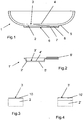
- Cooking devices 1; 1 'illustrated on the Figures 1 and 2 comprise a support 2; 2 'metal carrying a cooking surface 3; 3 'ceramic.
- the support 2; 2 ' may in particular have the final shape of a cooking receptacle or a cooking plate.
- the support 2; 2 ' is obtained from a metal plate and has a face 4; 4 'carrying the cooking surface 3; 3 'and another face 5; 5 'opposite to the face 4; 4 '.
- the cooking surface 3; 3 ' is concave and / or has a bottom surrounded by a side wall, the face 4; 4 'is an inner face of the support 2; 2 ', and the other face 5; 5 'is an outer face of the support 2; 2 '.
- the cooking device 1; 1 ' may in particular belong to a culinary article and / or a household cooking appliance.
- the cooking device 1 illustrated on the figure 1 belongs to a culinary article.
- the inner and / or outer face 4 forms the cooking surface 3 and the other outer and / or lower face 5 is intended to be disposed on the side of a heat source.
- a cooking utensil may in particular be a pan, a saucepan or a wok, the support 2 forming a tank.
- one or more handles may be attached to the cooking device 1 to form the cooking utensil.
- the other face 5 may, if desired, have a diffuser base 6 designed to rest on a firebox.
- the cooking device 1 comprises a heat diffusion wall 7, made of material a good heat conductor, for example made of aluminum, arranged between the other face 5 of the support 2 and a bottom wall 8, made for example of ferromagnetic stainless steel.
- the bottom wall 8 and the heat diffusion wall 7 can in particular be assembled by hot stamping with the support 2.
- the cooking device 1 'illustrated on the figure 2 may belong to a cooking appliance such as a raclette appliance.
- the support 2 'then forms a cup, the inner and / or upper face 4' forming the cooking surface 3 'and the other outer and / or lower surface 5' being carried by the appliance.
- a handle 9 ' can be fixed to the support 2', in particular by overmoulding or clipping.
- the handle 9 ' may in particular be made of plastic.
- An appliance with a cooking device 1 ' is not necessarily a raclette appliance having cups, but may also be an appliance comprising a cooking plate such as a plancha, or an electric cooker having a tank intended for browning food.
- the cooking device 1 ' may or may not be removable from the appliance.
- heating means may be integral with the support 2 '; the other side 5 'outside and / or lower is not necessarily disposed on the side of a heat source.
- the invention also relates to cooking utensils and household cooking appliances comprising such a cooking device 1; 1 '.
- the support 2; 2 'metal forms a substrate carrying a surface layer 10; 10 'of transition metal boride or boronitride forming the cooking surface 3; 3 '.
- transition metal boride is not limited to stoichiometric compositions having a boron atom for a transition metal atom, but includes transition metal diborides.
- the transition metal is preferably selected from titanium, chromium, zirconium, vanadium, niobium and iron. Borides of transition metals such as titanium, chromium, zirconium, vanadium, niobium are diborures.
- transition metal boronitride is not limited to stoichiometric compositions having a boron atom and a nitrogen atom for a transition metal atom, but includes especially boronings such as TiAlBN.
- the support 2; 2 'metal forms a substrate carrying a surface layer 10; 10 'of transition metal boride or transition metal boronitride forming the cooking surface 3; 3 '.
- the support 2; 2 'metal is advantageously made of stainless steel, titanium, or multilayer material having at least one outer face of stainless steel, for example a sandwich material stainless steel / aluminum / stainless steel.
- the thickness of the support 2; 2 'metal is advantageously between a few tenths of mm and a few mm.
- the surface layer 10 is formed by a transition metal boride or boronitride coating.
- the transition metal boride coating is deposited on a substrate formed by the support 2; 2 'metal.
- the surface layer 10 is formed by a transition metal boride or transition metal boronitride coating.
- the coating techniques may in particular apply to cooking devices 1; 1 'comprising materials having a limited temperature resistance, such as for example the heat diffusion wall 7 fixed to the support 2; the fixation of the handle 9 of the support 2 'will be carried out preferentially after the production of the surface layer 10.
- Transition metal boride coatings such as TiB 2 , CrB 2 , FeB, Fe 2 B, VB 2 , NbB 2 or ZrB 2 are known for their properties of high hardness, resistance to wear and corrosion and their thermal stability.
- transition metal borides such as TiB 2 , CrB 2 , FeB, Fe 2 B, VB 2 , NbB 2 or ZrB 2 .
- the coating can in particular be made by physical vapor deposition on the face 4; 4 'inner and / or upper support 2; 2 ', or by plasma enhanced chemical vapor deposition on the face 4; 4 'inner and / or upper support 2; 2 '.
- PVD physical vapor deposition
- pulsed or non-pulsed DC magnetron cathode sputtering seems to be the most appropriate method for obtaining such coatings because it allows for low-temperature (lower) deposits. at 200 ° C) on parts that may have relatively complex geometries without using toxic gas.
- the deposits obtained are dense and adherent to the substrate. In addition, the surface topography of the substrate is retained.
- Deposits of transition metal borides are obtained from a target having the same composition as that of the target coating, the target can be developed by sintering powder. After obtaining a high vacuum in the chamber, the film is produced by sputtering in a non-reactive condition under argon atmosphere of the target.
- the deposition rates obtained by this technique are of the order of a few ⁇ m / h.
- transition metal boride coatings such as radiofrequency cathodic sputtering, reactive medium sputtering with diborane use, or ion beam sputtering.
- radiofrequency cathodic sputtering reactive medium sputtering with diborane use
- ion beam sputtering ion beam sputtering
- the coating could also be achieved by cathodic arc evaporation on the face 4; 4 'inner and / or upper support 2; 2 '.
- Plasma-assisted chemical vapor deposition can also make it possible to obtain transition metal boride coatings at relatively low temperatures (of the order of 400 ° C.).
- the gases used are BCl 3 , TiCl 4 or Ti (BH 4 ) 4 . This process can thus make it possible to obtain stoichiometric deposits having properties close to those obtained by PVD.
- the tested deposits were developed by PVD technique, using pulsed DC magnetron sputtering.
- the substrate used is an austenitic stainless steel substrate (for example a 304 stainless steel).
- the target used has the same composition as the targeted coating and is for example obtained by sintering powder.
- the target is for example CrB 2 or TiB 2 .
- the surface layer 10 is developed by sputtering in a non-reactive condition under an argon atmosphere.
- the deposits may be obtained by copulverization of a metal target X and a target B 4 C.
- X designating a transition metal or a metal alloy of transition metals such as TiAl, TiCr, ZrNb. .
- the surface layer 10 then comprises traces of carbon.
- Transition metal boride coatings have a high hardness (> 2000 HV).
- a substrate having a minimum hardness of 150 HV must be used.
- a ferritic stainless steel ( ⁇ 160 HV), austenitic stainless steel ( ⁇ 210 HV) or titanium (> 160 HV) substrate can be used in the context of this invention.
- the substrate may comprise aluminum, but not as a support layer of the coating, the hardness of the aluminum (50 to 90 HV) being insufficient to obtain the desired properties. So the support 2; 2 'metal has a hardness greater than or equal to 150 HV.
- the scratch resistance is evaluated with a green Scotch Brite ® abrasive pad (loaded with alumina particles).
- a coating having a high hardness and a minimum coating thickness of 2.5 microns it is necessary to have a coating having a high hardness and a minimum coating thickness of 2.5 microns.
- a large coating thickness for example greater than 10 ⁇ m, is not necessary because the boride deposits are constrained and tend to crack.
- a coating of NbN or NbAlN of hardness on the order of 15 GPa has a hardness sufficient to ensure a scratch resistance.
- the hardness of transition metal diborides such as CrB 2 , TiB 2 , ZrB 2 is even greater. Deposits carried out on an austenitic stainless steel substrate made it possible to demonstrate the resistance of CrB 2 or TiB 2 coatings, according to the aforementioned test.
- the mixture of food compound is for example the following: 34 mg / ml of glucose, 14.5 mg / ml of amylopectin, 39 mg / ml of ovalbumin, 13.5 mg / ml of casein, 32.8 mg / ml mL of linoleic acid.
- the sample After baking for 20 minutes at 210 ° C and cooling for 2 minutes, the sample is immersed in a mixture of water and detergent for 5 minutes, then cleaned with a plynometer (abrade device). .
- the percentage of surface remaining covered by cooking residue makes it possible to evaluate the ease of cleaning of the cooking surface. A percentage of 0% therefore corresponds to a cooking surface having the greatest ease of cleaning.
- the CrB 2 coating provides a great ease of cleaning compared to a stainless steel cooking surface or with a coating NbN or NbAlN.
- the adhesion tests during cooking were carried out in a pan according to the following protocol: preheating the pan for 1 min 30 s with 20 ml of oil on a 40 mm gas fire over high heat, introduction of potatoes of variety Diced firm fleshed Charlotte, mixing potatoes every two minutes, estimating adhesion properties.
- the cooking device 1; 1 'having a coating according to the invention has cleaning properties significantly greater than those of a stainless steel cooking surface, and more scratch resistance improved compared to a stainless steel cooking surface.
- XBN-type transition metal boronitride deposits for example TiBN or TiAlBN
- Boronitrides make it possible to obtain a different color from stainless steel, for example dark gray or anthracite for TiBN.
- the surface layer 10; 10 ' is formed by a conversion layer of iron boride or titanium.
- the conversion layer is produced by boronization thermochemical diffusion treatment on a metal substrate formed by the support 2; 2 '.
- Such an embodiment appears well adapted to the support 2 'of the cooking device 1' before the fixing of the handle 9 ', but can also be envisaged for the support 2 of the cooking device 1 in the absence of a diffuser base 6 comprising a heat diffusion wall 7 of aluminum.
- Thermochemical diffusion treatments make it possible to enrich the surface of a boron part. These treatments are usually carried out between 800 and 1000 ° C. Homogeneous layers of strongly adherent borides are thus formed on the surface. Different methods can be used to perform such treatments.
- the source gases of boron are boron halides or boranes.
- liquid medium in the presence of molten salts with or without electrolysis, or in aqueous solution of borax.
- a solid medium by case-type cementation method, in which the pieces are placed in a cementum constituted by powder and granules based on boron carbide which is mixed with a fluoroborate acting as an activator.
- the temperature (of the order of 900 ° C.) and the treatment time depend on the thickness of the desired borured zone. Typically, the borured layer thicknesses vary between 10 and 300 ⁇ m. The hardnesses reached depend on the material used. One of the most common applications concerns ferrous alloys (especially stainless steels) whose hardness can reach 1600 to 2000 HV. It is also possible to perform such a boron thermochemical treatment on metals such as titanium (titanium boride layer formation up to 4000 HV) or nickel base alloys (up to 2800 HV).
- the method consists in producing a transition metal boride or boronitride coating on the face 4; 4 'of the support 2; 2 '.
- the method consists in producing a transition metal boride or transition metal boronitride coating on the face 4; 4 'of the support 2; 2 '.
- the method consists in producing an iron or titanium boride conversion layer by boron thermochemical diffusion treatment on the face 4; 4 'of the support 2; 2 '.
- the cooking surface 3; 3 'formed by a surface layer 10; 10 'boride or boronitride transition metal is supported by a sufficiently hard substrate to promote good scratch resistance of the surface cooking 3; 3 '.
- the thickness of the surface layer 10; 10 ' is preferably at least 2 ⁇ m, and can reach 300 ⁇ m for a conversion layer.
Landscapes
- Chemical & Material Sciences (AREA)
- Engineering & Computer Science (AREA)
- Food Science & Technology (AREA)
- Organic Chemistry (AREA)
- Mechanical Engineering (AREA)
- Metallurgy (AREA)
- Materials Engineering (AREA)
- Chemical Kinetics & Catalysis (AREA)
- Physics & Mathematics (AREA)
- Plasma & Fusion (AREA)
- General Chemical & Material Sciences (AREA)
- Cookers (AREA)
- Baking, Grill, Roasting (AREA)
Description
- La présente invention concerne le domaine technique des surfaces de cuisson utilisées dans les articles culinaires ou dans les appareils électroménagers chauffants.
- La présente invention concerne plus particulièrement les dispositifs de cuisson comportant une surface de cuisson susceptible d'être exposée à des outils tranchants et/ou durs, tels que notamment couteaux, fourchettes ou spatules.
- Il est connu de réaliser des dispositifs de cuisson comportant une surface de cuisson en acier inoxydable. Toutefois certains aliments adhèrent sur ces surfaces lors de la cuisson, et l'utilisation d'outils tranchants et/ou durs est susceptible de rayer ces surfaces.
- L'utilisation de dépôts de nitrure de métaux de transition permet d'améliorer la résistance à la rayure des surfaces de cuisson, toutefois ces revêtements présentent une adhésion forte de certains aliments tels que les pommes de terre ou les poissons avec la surface de cuisson.
- Un dispositif de cuisson selon le préambule de la revendication 1 est connu du document
DE 20 2006 002366 U . - Un objet de la présente invention est de proposer un dispositif de cuisson comportant une surface de cuisson permettant de limiter ou d'éviter l'adhésion des aliments au cours de la cuisson, qui soit facile à nettoyer.
- Un autre objet de la présente invention est de proposer un dispositif de cuisson comportant une surface de cuisson permettant de limiter ou d'éviter l'adhésion des aliments au cours de la cuisson, qui reste facile à nettoyer malgré de nombreuses utilisations.
- Un autre objet de la présente invention est de proposer un dispositif de cuisson comportant une surface de cuisson permettant de limiter ou d'éviter l'adhésion des aliments au cours de la cuisson, qui présente une résistance à la rayure améliorée par rapport à une surface de cuisson en acier inoxydable.
- Un autre objet de la présente invention est de proposer un article culinaire ou un appareil électroménager de cuisson comportant un dispositif de cuisson du type précité.
- Un autre objet de la présente invention est de proposer un procédé d'obtention d'un dispositif de cuisson comportant une surface de cuisson permettant de limiter ou d'éviter l'adhésion des aliments au cours de la cuisson, qui soit facile à nettoyer.
- Un autre objet de la présente invention est de proposer un procédé d'obtention d'un dispositif de cuisson comportant une surface de cuisson permettant de limiter ou d'éviter l'adhésion des aliments au cours de la cuisson, qui reste facile à nettoyer malgré de nombreuses utilisations.
- Un autre objet de la présente invention est de proposer un procédé d'obtention d'un dispositif de cuisson comportant une surface de cuisson permettant de limiter ou d'éviter l'adhésion des aliments au cours de la cuisson, qui présente une résistance à la rayure améliorée par rapport à une surface de cuisson en acier inoxydable.
- Ces objets sont atteints avec un dispositif de cuisson comprenant un support métallique portant une surface de cuisson céramique, le support présentant une dureté supérieure ou égale à 150 HV, du fait que le support forme un substrat portant une couche superficielle de borure de métal de transition formant la surface de cuisson, et que la couche superficielle est formée par une couche de conversion de borure de fer et/ou de titane, selon le matériau utilisé pour le support. De manière avantageuse, l'épaisseur de la couche superficielle est alors comprise entre 10 et 300 µm.
- Les couches superficielles de borures de métaux de transition sont connues pour leurs propriétés de grande dureté, de résistance à l'usure et leur stabilité thermique. Des essais ont montré que de manière surprenante de telles couches superficielles présentent également des propriétés de non adhésion des aliments et de facilité de nettoyage améliorées par rapport aux surfaces de cuisson en acier inoxydable.
- Ces objets sont atteints également avec un dispositif de cuisson comprenant un support métallique portant une surface de cuisson céramique, le support présentant une dureté supérieure ou égale à 150 HV, du fait que le support forme un substrat portant une couche superficielle de boronitrure de métal de transition formant la surface de cuisson.
- Les propriétés de dureté du substrat permettent également d'améliorer la résistance à la rayure de la couche superficielle de borure ou de boronitrure de métal de transition.
- Selon un mode de réalisation, la couche superficielle est formée par un revêtement de borure ou de boronitrure de métal de transition. De manière avantageuse, l'épaisseur de la couche superficielle est comprise entre 2 et 10 µm, et de préférence entre 3 et 5 µm.
- Avantageusement alors, le métal de transition est choisi parmi le titane, le chrome, le zirconium, le vanadium, le niobium, le fer.
- Avantageusement, la couche superficielle présente une épaisseur au moins égale à 2 µm, et de préférence au moins égale à 3 µm. Cette disposition permet d'obtenir une résistance à la rayure satisfaisante.
- Selon une forme de réalisation préférée, le support est réalisé en acier inoxydable, en titane ou en matériau multicouches comportant au moins une face externe en acier inoxydable. Si désiré, un support métallique multimatériaux, notamment un support multicouches et/ou composite à matrice métallique, peut être envisagé.
- Selon une forme de réalisation avantageuse, le support présente une face portant la surface de cuisson et une autre face opposée à ladite face. Si désiré, le support peut être obtenu par emboutissage et/ou découpe d'une tôle métallique.
- Ces objets sont atteints également avec un article culinaire comportant un dispositif de cuisson comprenant un support métallique présentant une face intérieure et/ou supérieure formant une surface de cuisson et une autre face extérieure et/ou inférieure destinée à être disposée du coté d'une source de chaleur, dans lequel le dispositif de cuisson est conforme à l'une au moins des caractéristiques précitées.
- Ces objets sont atteints également avec un appareil électroménager de cuisson comportant un dispositif de cuisson comprenant un support métallique présentant une face intérieure et/ou supérieure formant une surface de cuisson et une autre face extérieure et/ou inférieure portée par ledit appareil, dans lequel le dispositif de cuisson est conforme à l'une au moins des caractéristiques précitées.
- Ces objets sont atteints également avec un procédé d'obtention d'un dispositif de cuisson, comprenant les étapes suivantes :
- fourniture ou réalisation d'un support métallique présentant une dureté supérieure ou égale à 150 HV,
- réalisation d'une couche superficielle de borure de métal de transition sur une face du support métallique, pour former une surface de cuisson, consistant à réaliser une couche de conversion de borure de fer ou de titane par traitement de diffusion thermochimique de boruration sur ladite face du support métallique.
- Ces objets sont atteints également avec un procédé d'obtention d'un dispositif de cuisson, comprenant les étapes suivantes :
- fourniture ou réalisation d'un support métallique présentant une dureté supérieure ou égale à 150 HV,
- réalisation d'une couche superficielle de boronitrure de métal de transition sur une face du support métallique, pour former une surface de cuisson.
- Selon un mode de réalisation, le procédé consiste à réaliser un revêtement de boronitrure de métal de transition sur la face du support métallique.
- Avantageusement alors, le métal de transition est choisi parmi le titane, le chrome, le zirconium, le vanadium, le niobium, le fer.
- Selon une forme de réalisation, le revêtement est réalisé par dépôt physique en phase vapeur sur la face du support métallique.
- Alors, selon une forme de réalisation préférée permettant d'obtenir des dépôts denses adhérant au substrat, le dépôt est réalisé par pulvérisation cathodique magnétron à courant continu, de préférence à courant continu pulsé.
- En alternative, le revêtement pourrait notamment être réalisé par évaporation par arc cathodique sur ladite face du support métallique.
- Selon une autre forme de réalisation, le revêtement est réalisé par dépôt chimique en phase vapeur assistée plasma sur ladite face du support métallique.
- Avantageusement encore, le support métallique est réalisé en acier inoxydable, en titane ou en matériau multicouches comportant au moins une face externe en acier inoxydable.
- L'invention sera mieux comprise à l'étude de deux modes de réalisation, pris à titre nullement limitatif, illustrés dans les figures annexées, dans lesquelles :
- la
figure 1 est une vue schématique en élévation et en coupe d'un premier exemple de réalisation d'un dispositif de cuisson selon l'invention, - la
figure 2 est une vue schématique en élévation et en coupe d'un deuxième exemple de réalisation d'un dispositif de cuisson selon l'invention, - la
figure 3 est une vue schématique en coupe d'un premier mode de réalisation d'un dispositif de cuisson selon l'invention, - la
figure 4 est une vue schématique en coupe d'un deuxième mode de réalisation d'un dispositif de cuisson selon l'invention. - Les dispositifs de cuisson 1 ; 1' illustrés sur les
figures 1 et 2 comprennent un support 2 ; 2' métallique portant une surface de cuisson 3 ; 3' céramique. Le support 2 ; 2' peut notamment présenter la forme finale d'un réceptacle de cuisson ou d'une plaque de cuisson. - Plus particulièrement, le support 2 ; 2' est obtenu à partir d'une plaque métallique et présente une face 4 ; 4' portant la surface de cuisson 3 ; 3' et une autre face 5 ; 5' opposée à la face 4 ; 4'.
- Tel que représenté sur les
figures 1 et 2 , la surface de cuisson 3 ; 3' est concave et/ou présente un fond entouré par une paroi latérale, la face 4 ; 4' est une face intérieure du support 2 ; 2', et l'autre face 5 ; 5' est une face extérieure du support 2 ; 2'. - Le dispositif de cuisson 1 ; 1' peut notamment appartenir à un article culinaire et/ou à un appareil électroménager de cuisson.
- Le dispositif de cuisson 1 illustré sur la
figure 1 appartient à un article culinaire. La face 4 intérieure et/ou supérieure forme la surface de cuisson 3 et l'autre face 5 extérieure et/ou inférieure est destinée à être disposée du coté d'une source de chaleur. Un tel article culinaire peut notamment être une poêle, une casserole ou un wok, le support 2 formant une cuve. Si désiré une ou plusieurs poignées peuvent être fixées au dispositif de cuisson 1 pour former l'article culinaire. - L'autre face 5 peut présenter si désiré un fond diffuseur 6 prévu pour reposer sur un foyer de chauffe. Tel que représenté sur la
figure 1 , le dispositif de cuisson 1 comporte une paroi de diffusion de chaleur 7, réalisée en matériau bon conducteur de chaleur, par exemple en aluminium, agencée entre l'autre face 5 du support 2 et une paroi inférieure 8, réalisée par exemple en acier inoxydable ferromagnétique. La paroi inférieure 8 et la paroi de diffusion de chaleur 7 peuvent notamment être assemblées par frappe à chaud avec le support 2. - Le dispositif de cuisson 1' illustré sur la
figure 2 peut appartenir à un appareil électroménager de cuisson tel qu'un appareil à raclette. Le support 2' forme alors une coupelle, la face 4' intérieure et/ou supérieure formant la surface de cuisson 3' et l'autre face 5' extérieure et/ou inférieure étant portée par l'appareil. Une poignée 9' peut être fixée au support 2', notamment par surmoulage ou par clipsage. La poignée 9' peut notamment être réalisée en matière plastique. Un appareil électroménager comportant un dispositif de cuisson 1' n'est toutefois pas nécessairement un appareil à raclette comportant des coupelles, mais peut notamment aussi être un appareil comportant une plaque de cuisson tel qu'une plancha, ou encore un cuiseur électrique comportant une cuve prévue pour le rissolage des aliments. Le dispositif de cuisson 1' peut être amovible ou non de l'appareil. Si désiré des moyens de chauffe peuvent être solidaires du support 2' ; l'autre face 5' extérieure et/ou inférieure n'est pas nécessairement disposée du côté d'une source de chaleur. - L'invention concerne également les articles culinaires et les appareils électroménagers de cuisson comportant un tel dispositif de cuisson 1 ; 1'.
- Plus particulièrement selon l'invention, le support 2 ; 2' métallique forme un substrat portant une couche superficielle 10 ; 10' de borure ou de boronitrure de métal de transition formant la surface de cuisson 3 ; 3'.
- L'expression « borure de métal de transition » n'est pas limitée aux compositions stoechiométriques comportant un atome de bore pour un atome de métal de transition, mais inclut notamment les diborures de métaux de transition. Le métal de transition est de préférence choisi parmi le titane, le chrome, le zirconium, le vanadium, le niobium, le fer. Les borures des métaux de transition tels que le titane, le chrome, le zirconium, le vanadium, le niobium sont des diborures.
- L'expression « boronitrure de métal de transition » n'est pas limitée aux compositions stoechiométriques comportant un atome de bore et un atome d'azote pour un atome de métal de transition, mais inclut notamment des boronitures tel que le TiAlBN.
- En d'autres termes, le support 2 ; 2' métallique forme un substrat portant une couche superficielle 10 ; 10' de borure de métal de transition ou de boronitrure de métal de transition formant la surface de cuisson 3 ; 3'.
- Le support 2 ; 2' métallique est avantageusement réalisé en acier inoxydable, en titane, ou en matériau multicouches comportant au moins une face externe en acier inoxydable, par exemple un matériau sandwich acier inoxydable/aluminium/acier inoxydable.
- L'épaisseur du support 2 ; 2' métallique est avantageusement comprise entre quelques dizièmes de mm et quelques mm.
- Selon un premier mode de réalisation, la couche superficielle 10 est formée par un revêtement de borure ou de boronitrure de métal de transition. Le revêtement de borure de métal de transition est déposé sur un substrat formé par le support 2 ; 2' métallique.
- En d'autres termes, la couche superficielle 10 est formée par un revêtement de borure de métal de transition ou de boronitrure de métal de transition.
- Les techniques de revêtements peuvent notamment s'appliquer aux dispositifs de cuisson 1 ; 1' comportant des matériaux présentant une tenue en température limitée, tels que par exemple la paroi de diffusion de chaleur 7 fixée au support 2 ; la fixation de la poignée 9 du support 2' sera effectuée préférentiellement après la réalisation de la couche superficielle 10.
- Les revêtements de type borures de métaux de transition tel que TiB2, CrB2, FeB, Fe2B, VB2, NbB2 ou ZrB2 sont connus pour leurs propriétés de grande dureté, de résistance à l'usure et à la corrosion et leur stabilité thermique.
- Plusieurs procédés permettent d'obtenir des couches minces de borures de métaux de transition tels que TiB2, CrB2, FeB, Fe2B, VB2, NbB2 ou ZrB2. Le revêtement peut notamment être réalisé par dépôt physique en phase vapeur sur la face 4 ; 4' intérieure et/ou supérieure du support 2 ; 2', ou par dépôt chimique en phase vapeur assistée plasma sur la face 4 ; 4' intérieure et/ou supérieure du support 2 ; 2'.
- Parmi les techniques de dépôt physique en phase vapeur (PVD), la pulvérisation cathodique magnétron à courant continu, pulsé ou non pulsé, semble la méthode la plus appropriée pour obtenir de tels revêtements car elle permet d'effectuer des dépôts à basse température (inférieure à 200°C) sur des pièces pouvant présenter des géométries relativement complexes sans utiliser de gaz toxique. Les dépôts obtenus sont denses et adhérents au substrat. De plus, la topographie de surface du substrat est conservée.
- Les dépôts de borures de métaux de transition sont obtenus à partir d'une cible possédant la même composition que celle du revêtement visé, la cible pouvant être élaborée par frittage de poudre. Après obtention d'un vide poussé dans l'enceinte, le film est élaboré par pulvérisation en condition non-réactive sous atmosphère d'argon de la cible. Les vitesses de dépôt obtenues par cette technique sont de l'ordre de quelques µm/h.
- D'autres procédés pourraient être réalisés pour obtenir des revêtements de borures de métaux de transition, tels que la pulvérisation cathodique radiofréquence, la pulvérisation cathodique en milieu réactif avec utilisation de diborane, ou encore la pulvérisation par faisceau d'ions. Toutefois, les vitesses de dépôts obtenues par ces techniques sont plus faibles qu'avec la pulvérisation cathodique magnétron.
- Le revêtement pourrait aussi être réalisé par évaporation par arc cathodique sur la face 4 ; 4' intérieure et/ou supérieure du support 2 ; 2'.
- Les dépôts chimiques en phase vapeur assistée plasma peuvent également permettre l'obtention de revêtement de borure de métaux de transition à relativement basse température (de l'ordre de 400°C). Par exemple, pour une couche mince de TiB2, les gaz utilisés sont BCl3, TiCl4 ou Ti(BH4)4. Ce procédé peut permettre ainsi l'obtention de dépôts stoechiométriques possédant des propriétés proches de ceux obtenus par PVD.
- Les dépôts testés ont été élaborés par technique PVD, en utilisant une pulvérisation cathodique magnétron à courant continu pulsé. Le substrat utilisé est un substrat en acier inoxydable austénitique (par exemple un acier inoxydable 304). La cible utilisée possède la même composition que le revêtement visé et est par exemple obtenue par frittage de poudre. La cible est par exemple du CrB2 ou du TiB2. Après obtention d'un vide poussé dans l'enceinte, la couche superficielle 10 est élaborée par pulvérisation en condition non réactive sous atmosphère d'argon.
- A titre de variante, les dépôts peuvent être obtenus par copulvérisation d'une cible métallique X et d'une cible B4C. (X désignant un métal de transition ou un alliage métallique de métaux de transitions tels que TiAl, TiCr, ZrNb..). La couche superficielle 10 comporte alors des traces de carbone.
- Les revêtements de borure de métal de transition présentent une dureté élevée (> 2000 HV). Pour obtenir une résistance à la rayure satisfaisante, un substrat possédant une dureté minimale de 150 HV doit être utilisé. Ainsi, un substrat en acier inoxydable ferritique (≈ 160 HV), en acier inoxydable austénitique (≈ 210 HV) ou en titane (> 160 HV) peut être utilisé dans le cadre de cette invention. Le substrat peut comporter de l'aluminium, mais pas en tant que couche de support du revêtement, la dureté de l'aluminium (50 à 90 HV) étant insuffisante pour obtenir les propriétés souhaitées. Ainsi le support 2; 2' métallique présente une dureté supérieure ou égale à 150 HV.
- La résistance à la rayure est évaluée avec un tampon abrasif de type Scotch Brite ® vert (chargé avec des particules d'alumine).
- Pour obtenir un revêtement résistant totalement à la rayure selon le test précité, il est nécessaire d'avoir un revêtement présentant une dureté importante ainsi qu'une épaisseur minimale de revêtement de 2,5 µm. Une épaisseur importante de revêtement, par exemple supérieure à 10 µm, n'est pas nécessaire, car les dépôts de borures sont contraints et ont tendance à fissurer. Une épaisseur de revêtement comprise entre 3 et 5 µm, par exemple 4 µm, donne des résultats satisfaisants.
- Un revêtement de NbN ou de NbAlN de dureté de l'ordre de 15 GPa présente une dureté suffisante pour garantir une résistance à la rayure. La dureté des diborures de métaux de transition tels que CrB2, TiB2, ZrB2 est encore supérieure. Des dépôts réalisés sur un substrat en acier inoxydable austénitique ont permis de démontrer la résistance de revêtements de CrB2 ou de TiB2, selon le test précité.
- Les essais de facilité de nettoyage ont été effectués selon le protocole suivant : la surface à caractériser est recouverte d'un mélange de composé alimentaire présentant de fortes propriétés d'adhésion après carbonisation. Le mélange carbonisé est alors soumis à l'action d'un tampon abrasif.
- Le mélange de composé alimentaire est par exemple le suivant : 34 mg/mL de glucose, 14,5 mg/mL d'amylopectine, 39 mg/mL d'ovalbumine, 13,5 mg/mL de caséine, 32,8 mg/mL d'acide linoléique. Après une cuisson au four pendant 20 min à 210°C et un refroidissement pendant 2 min, l'échantillon est immergé dans un mélange d'eau et de détergent pendant 5 min, puis nettoyé au plynomètre (appareil à abraser les résidus de cuisson). Le pourcentage de surface restant recouvert par du résidu de cuisson permet d'évaluer la facilité de nettoyage de la surface de cuisson. Un pourcentage de 0% correspond donc à une surface de cuisson possédant la facilité de nettoyage la plus importante.
- Le tableau ci-dessous montre la facilité de nettoyage pour différents types de surface de cuisson 3 ; 3' : l'acier inoxydable, revêtements NbN, NbAlN (avec 59 % atomique d'Al), CrB2.
Matériau de la surface de cuisson % de la surface restant recouvert par le résidu de cuisson après nettoyage Ecart-type inox 80 10 NbN 91 5 NbAlN 59% Al 37,85 20 CrB2 3,5 5 - Il apparaît que le revêtement CrB2 permet d'obtenir une grande facilité de nettoyage par rapport à une surface de cuisson en acier inoxydable ou avec un revêtement NbN ou NbAlN.
- Un test similaire avec un autre mélange (lait + riz) a permis de confirmer ces résultats de facilité de nettoyage des revêtements de borures de métal de transition.
- Les essais d'adhésion pendant la cuisson ont été effectués dans une poêle selon le protocole suivant : préchauffage de la poêle pendant 1 min 30 s avec 20 ml d'huile sur foyer gaz 40 mm à feu vif, introduction de pommes de terre de variété Charlotte à chair ferme découpées en dés, mélange des pommes de terre toutes les deux minutes, estimation des propriétés d'adhésion.
- Les résultats obtenus sont les suivants : pour l'inox et le NbN, quelques résidus après cuisson et avant nettoyage (pas de différences significatives d'adhésion) ; pour le NBAlN, accroche moindre ; pour le CrB2 et le TiB2, aucun résidu après cuisson. De plus il a été remarqué que l'huile polymérisée s'enlève facilement sur le CrB2 et le TiB2.
- Le dispositif de cuisson 1 ; 1' comportant un revêtement selon l'invention présente des propriétés de facilité de nettoyage significativement supérieures à celles d'une surface de cuisson en acier inoxydable, et de plus une résistance à la rayure améliorée par rapport à une surface de cuisson en acier inoxydable.
- A titre de variante, des dépôts de boronitrures de métaux de transition de type XBN, par exemple TiBN ou TiAlBN, peuvent être obtenus par plusieurs voies, par exemple soit directement à partir d'une cible XBN, la couche superficielle 10 étant élaborée en pulvérisation en condition non réactive sous atmosphère d'argon, soit à partir d'une cible XB ou XB2, la couche superficielle 10 étant déposée sous condition réactive. Les boronitrures permettent d'obtenir une couleur différente de l'acier inoxydable, par exemple gris foncé ou anthracite pour le TiBN.
- Selon un deuxième mode de réalisation, la couche superficielle 10 ; 10' est formée par une couche de conversion de borure de fer ou de titane. La couche de conversion est réalisée par traitement de diffusion thermochimique de boruration sur un substrat métallique formé par le support 2 ; 2'. Une telle réalisation apparait bien adaptée au support 2' du dispositif de cuisson 1' avant la fixation de la poignée 9', mais peut également être envisagée pour le support 2 du dispositif de cuisson 1 en l'absence d'un fond diffuseur 6 comportant une paroi de diffusion de chaleur 7 en aluminium.
- Les traitements de diffusion thermochimiques tels que la boruration permettent d'enrichir la surface d'une pièce en bore. Ces traitements sont usuellement réalisés entre 800 et 1000°C. Des couches homogènes de borures fortement adhérentes sont ainsi formées en surface. Différents procédés peuvent être utilisés pour réaliser de tels traitements. En milieu gazeux, les gaz sources de bore sont des halogénures de bore ou des boranes. En milieu liquide, en présence de sels fondus avec ou sans électrolyse, ou en solution aqueuse de borax. En milieu solide, par méthode de type cémentation en caisse, dans laquelle les pièces sont placées dans un cément constitué par de la poudre et des granules à base de carbure de bore auquel est mélangé un fluoroborate jouant le rôle d'activateur. La température (de l'ordre de 900°C) et le temps de traitement dépendent de l'épaisseur de la zone borurée souhaitée. Typiquement, les épaisseurs de couches borurées varient entre 10 et 300 µm. Les duretés atteintes dépendent du matériau utilisé. L'une des applications les plus courantes concernent les alliages ferreux (et notamment les aciers inoxydables) dont la dureté peut atteindre de 1600 à 2000 HV. Il est également possible de réaliser un tel traitement thermochimique de boruration sur des métaux comme le titane (formation de couche de borure de titane pouvant atteindre les 4000 HV) ou d'alliages base nickel (jusqu'à 2800 HV).
- L'invention concerne également un procédé d'obtention d'un dispositif de cuisson 1, comprenant les étapes suivantes :
- fourniture ou réalisation d'un support 2 ; 2' métallique présentant une dureté supérieure ou égale à 150 HV,
- réalisation d'une couche superficielle 10 ; 10' de borure ou de boronitrure de métal de transition sur une face 4 ; 4' du support 2 ; 2' métallique, pour former une surface de cuisson 3 ; 3'.
- En d'autres termes, l'invention concerne également un procédé d'obtention d'un dispositif de cuisson 1 comprenant les étapes suivantes :
- fourniture ou réalisation d'un support 2 ; 2' métallique présentant une dureté supérieure ou égale à 150 HV,
- réalisation d'une couche superficielle 10 ; 10' de borure de métal de transition ou de boronitrure de métal de transition sur une face 4 ; 4' du support 2 ; 2' métallique, pour former une surface de cuisson 3 ; 3'.
- Selon le premier mode de réalisation, le procédé consiste à réaliser un revêtement de borure ou de boronitrure de métal de transition sur la face 4 ; 4' du support 2 ; 2'.
- En d'autres termes, selon le premier mode de réalisation, le procédé consiste à réaliser un revêtement de borure de métal de transition ou de boronitrure de métal de transition sur la face 4 ; 4' du support 2 ; 2'.
- Selon le deuxième mode de réalisation, le procédé consiste à réaliser une couche de conversion de borure de fer ou de titane par traitement de diffusion thermochimique de boruration sur la face 4 ; 4' du support 2 ; 2'.
- Ainsi la surface de cuisson 3 ; 3' formée par une couche superficielle 10 ; 10' de borure ou de boronitrure de métal de transition est portée par un substrat suffisamment dur pour favoriser une bonne résistance à la rayure de la surface de cuisson 3 ; 3'. L'épaisseur de la couche superficielle 10 ; 10' est de préférence au moins égale à 2 µm, et peut atteindre 300 µm pour une couche de conversion.
- La présente invention n'est nullement limitée aux exemples de réalisation décrits, mais englobe de nombreuses modifications dans le cadre des revendications.
Claims (17)
- Dispositif de cuisson (1 ; 1') comprenant un support (2; 2') métallique portant une surface de cuisson (3 ; 3') céramique, le support (2 ; 2') présentant une dureté supérieure ou égale à 150 HV, caractérisé en ce que le support (2 ; 2') forme un substrat portant une couche superficielle (10 ; 10') de borure de métal de transition formant la surface de cuisson (3 ; 3'), et en ce que la couche superficielle (10') est formée par une couche de conversion de borure de fer et/ou de titane.
- Dispositif de cuisson (1 ; 1') comprenant un support (2; 2') métallique portant une surface de cuisson (3 ; 3') céramique, le support (2 ; 2') présentant une dureté supérieure ou égale à 150 HV, caractérisé en ce que le support (2 ; 2') forme un substrat portant une couche superficielle (10 ; 10') de boronitrure de métal de transition formant la surface de cuisson (3 ; 3').
- Dispositif de cuisson (1 ; 1') selon la revendication 2, caractérisé en ce que la couche superficielle (10) est formée par un revêtement de boronitrure de métal de transition.
- Dispositif de cuisson (1 ; 1') selon l'une des revendications 2 ou 3, caractérisé en ce que le métal de transition est choisi parmi le titane, le chrome, le zirconium, le vanadium, le niobium, le fer.
- Dispositif de cuisson (1 ; 1') selon l'une des revendications 1 à 4, caractérisé en ce que la couche superficielle (10; 10') présente une épaisseur au moins égale à 2 µm, et de préférence au moins égale à 3 µm.
- Dispositif de cuisson (1 ; 1') selon l'une des revendications 1 à 5, caractérisé en ce que le support (2 ; 2') est réalisé en acier inoxydable, en titane, ou en matériau multicouches comportant au moins une face externe en acier inoxydable.
- Dispositif de cuisson (1 ; 1') selon l'une des revendications 1 à 6, caractérisé en ce que le support (2 ; 2') présente une face (4 ; 4') portant la surface de cuisson (3 ; 3') et une autre face (5 ; 5') opposée à la face (4 ; 4').
- Article culinaire comportant un dispositif de cuisson (1) comprenant un support (2) métallique présentant une face (4) intérieure et/ou supérieure formant une surface de cuisson (3) et une autre face (5) extérieure et/ou inférieure destinée à être disposée du coté d'une source de chaleur, caractérisé en ce que le dispositif de cuisson (1) est conforme à l'une des revendications 1 à 7.
- Appareil électroménager de cuisson comportant un dispositif de cuisson (1') comprenant un support (2') métallique présentant une face (4') intérieure et/ou supérieure formant une surface de cuisson (3') et une autre face (5') extérieure et/ou inférieure portée par ledit appareil, caractérisé en ce que le dispositif de cuisson (1') est conforme à l'une des revendications 1 à 7.
- Procédé d'obtention d'un dispositif de cuisson (1 ; 1'), comprenant les étapes suivantes :- fourniture ou réalisation d'un support (2 ; 2') métallique présentant une dureté supérieure ou égale à 150 HV,- réalisation d'une couche superficielle (10 ; 10') de borure de métal de transition sur une face (4 ; 4') du support (2 ; 2') métallique, pour former une surface de cuisson (3 ; 3'), consistant à réaliser une couche de conversion de borure de fer ou de titane par traitement de diffusion thermochimique de boruration sur ladite face (4 ; 4') du support (2 ; 2') métallique.
- Procédé d'obtention d'un dispositif de cuisson (1 ; 1'), comprenant les étapes suivantes :- fourniture ou réalisation d'un support (2 ; 2') métallique présentant une dureté supérieure ou égale à 150 HV,- réalisation d'une couche superficielle (10 ; 10') de boronitrure de métal de transition sur une face (4 ; 4') du support (2 ; 2') métallique, pour former une surface de cuisson (3 ; 3').
- Procédé d'obtention d'un dispositif de cuisson selon la revendication 11, caractérisé en ce qu'il consiste à réaliser un revêtement de boronitrure de métal de transition sur ladite face (4 ; 4') du support (2 ; 2') métallique.
- Procédé d'obtention d'un dispositif de cuisson selon l'une des revendications 11 ou 12, caractérisé en ce que le métal de transition est choisi parmi le titane, le chrome, le zirconium, le vanadium, le niobium, le fer.
- Procédé d'obtention d'un dispositif de cuisson selon l'une des revendications 11 à 13, caractérisé en ce que le revêtement est réalisé par dépôt physique en phase vapeur sur ladite face (4 ; 4') du support (2 ; 2') métallique.
- Procédé d'obtention d'un dispositif de cuisson selon la revendication 14, caractérisé en ce que le dépôt est réalisé par pulvérisation cathodique magnétron à courant continu, de préférence à courant continu pulsé.
- Procédé d'obtention d'un dispositif de cuisson selon l'une des revendications 11 à 13, caractérisé en ce que le revêtement est réalisé par dépôt chimique en phase vapeur assistée plasma sur ladite face (4 ; 4') du support (2 ; 2') métallique.
- Procédé d'obtention d'un dispositif de cuisson selon l'une des revendication 10 à 16, caractérisé en ce que le support (2 ; 2') métallique est réalisé en acier inoxydable ou en titane, ou en matériau multicouches comportant au moins une face externe en acier inoxydable.
Applications Claiming Priority (2)
| Application Number | Priority Date | Filing Date | Title |
|---|---|---|---|
| FR1261228A FR2998464B1 (fr) | 2012-11-26 | 2012-11-26 | Dispositif de cuisson comportant une surface de cuisson facile a nettoyer et resistant a la rayure |
| PCT/EP2013/074505 WO2014079981A1 (fr) | 2012-11-26 | 2013-11-22 | Dispositif de cuisson comportant une surface de cuisson facile a nettoyer et resistant a la rayure |
Publications (2)
| Publication Number | Publication Date |
|---|---|
| EP2928349A1 EP2928349A1 (fr) | 2015-10-14 |
| EP2928349B1 true EP2928349B1 (fr) | 2017-07-12 |
Family
ID=47902111
Family Applications (1)
| Application Number | Title | Priority Date | Filing Date |
|---|---|---|---|
| EP13795732.0A Active EP2928349B1 (fr) | 2012-11-26 | 2013-11-22 | Dispositif de cuisson comportant une surface de cuisson facile a nettoyer et resistant a la rayure |
Country Status (6)
| Country | Link |
|---|---|
| US (1) | US9895020B2 (fr) |
| EP (1) | EP2928349B1 (fr) |
| CN (1) | CN104936489B (fr) |
| CA (1) | CA2892446C (fr) |
| FR (1) | FR2998464B1 (fr) |
| WO (1) | WO2014079981A1 (fr) |
Families Citing this family (3)
| Publication number | Priority date | Publication date | Assignee | Title |
|---|---|---|---|---|
| CN107858679B (zh) * | 2017-09-18 | 2019-10-25 | 杭州利富豪机电设备有限公司 | 电压力锅保温罩陶化装置及陶化方法 |
| KR20240164336A (ko) * | 2023-05-11 | 2024-11-19 | 저지앙 코바흐 테크놀로지 컴퍼니., 리미티드. | 비점착식 금속 식기 및 비점착 조리 도구 |
| CN116752091B (zh) * | 2023-06-15 | 2026-04-21 | 上海应用技术大学 | 一种不粘锅的防粘涂层及其制备方法 |
Family Cites Families (19)
| Publication number | Priority date | Publication date | Assignee | Title |
|---|---|---|---|---|
| US4239536A (en) * | 1977-09-09 | 1980-12-16 | Sumitomo Electric Industries, Ltd. | Surface-coated sintered hard body |
| ZA781390B (en) * | 1978-03-09 | 1979-04-25 | De Beers Ind Diamond | The metal coating of abrasive particles |
| US4209877A (en) * | 1978-12-01 | 1980-07-01 | Colasent Julius R | Insulated supplemental handle housing cast iron utensil handle |
| JPS6014831A (ja) * | 1983-07-05 | 1985-01-25 | 株式会社東芝 | 調理具 |
| DE3942236A1 (de) * | 1989-12-21 | 1991-06-27 | Bosch Siemens Hausgeraete | Katalytisches ueberzugsmittel, verfahren zu seiner herstellung und mit dem ueberzugsmittel erhaeltliche koch-, back-, brat- oder grillgeraete oder teile |
| CA2065303A1 (fr) * | 1990-06-29 | 1991-12-30 | Niigata Engineering Co., Ltd. | Methode d'obtention d'une pellicule de nitrure de titane et recipient recouvert par cette pellicule |
| US5364522A (en) * | 1993-03-22 | 1994-11-15 | Liang Wang | Boride, carbide, nitride, oxynitride, and silicide infiltrated electrochemical ceramic films and coatings and the method of forming such |
| US6360423B1 (en) * | 1997-12-16 | 2002-03-26 | Clad Metals Llc | Stick resistant coating for cookware |
| CA2348950A1 (fr) | 1998-11-09 | 2000-05-18 | John William Toussant | Recipient alimentaire possedant une surface resistant aux coupures |
| US6458218B1 (en) * | 2001-01-16 | 2002-10-01 | Linamar Corporation | Deposition and thermal diffusion of borides and carbides of refractory metals |
| DE10222347C2 (de) * | 2002-05-21 | 2003-11-27 | Walter Ag | TiBN-Beschichtung für einen Schneideinsatz oder ein Schneidwerkzeug |
| US6906295B2 (en) | 2003-02-20 | 2005-06-14 | National Material L.P. | Foodware with multilayer stick resistant ceramic coating and method of making |
| ZA200606184B (en) * | 2004-01-15 | 2007-11-28 | Element Six Ltd | Coated abrasives |
| DE202006002366U1 (de) | 2006-02-15 | 2006-04-13 | Zwilling J. A. Henckels Aktiengesellschaft | Kochgeschirr, insbesondere Topf, Pfanne o.dgl. |
| DE102008009487B4 (de) * | 2008-02-15 | 2022-09-22 | Walter Ag | Strahlbehandelter Schneideinsatz und Verfahren |
| CN101333657B (zh) | 2008-07-28 | 2011-08-31 | 浙江苏泊尔股份有限公司 | 过渡金属氧化物在炊具内表面陶瓷涂层中的应用 |
| FR2934591B1 (fr) * | 2008-07-29 | 2011-02-11 | Seb Sa | Article comprenant un revetement ceramique et procede de fabrication d'un tel article mettant en oeuvre un laser. |
| WO2010050877A1 (fr) * | 2008-10-30 | 2010-05-06 | Sandvik Intellectual Property Ab | Outil à revêtement et son procédé de fabrication |
| US8021768B2 (en) | 2009-04-07 | 2011-09-20 | National Material, L.P. | Plain copper foodware and metal articles with durable and tarnish free multiplayer ceramic coating and method of making |
-
2012
- 2012-11-26 FR FR1261228A patent/FR2998464B1/fr not_active Expired - Fee Related
-
2013
- 2013-11-22 WO PCT/EP2013/074505 patent/WO2014079981A1/fr not_active Ceased
- 2013-11-22 CN CN201380061456.2A patent/CN104936489B/zh active Active
- 2013-11-22 CA CA2892446A patent/CA2892446C/fr active Active
- 2013-11-22 EP EP13795732.0A patent/EP2928349B1/fr active Active
- 2013-11-22 US US14/646,904 patent/US9895020B2/en active Active
Non-Patent Citations (1)
| Title |
|---|
| None * |
Also Published As
| Publication number | Publication date |
|---|---|
| US20150297025A1 (en) | 2015-10-22 |
| WO2014079981A1 (fr) | 2014-05-30 |
| CA2892446C (fr) | 2020-02-11 |
| CN104936489B (zh) | 2017-04-19 |
| CN104936489A (zh) | 2015-09-23 |
| CA2892446A1 (fr) | 2014-05-30 |
| FR2998464B1 (fr) | 2015-05-22 |
| EP2928349A1 (fr) | 2015-10-14 |
| US9895020B2 (en) | 2018-02-20 |
| FR2998464A1 (fr) | 2014-05-30 |
Similar Documents
| Publication | Publication Date | Title |
|---|---|---|
| EP2783022B1 (fr) | Surface de cuisson resistante au tachage et article culinaire ou appareil electromenager comportant une telle surface de cuisson | |
| EP1859070B1 (fr) | Surface de cuisson facile a nettoyer et ustensile de cuisine comportant une telle surface | |
| US6197438B1 (en) | Foodware with ceramic food contacting surface | |
| US7622197B2 (en) | Seasoned ferrous cookware | |
| US20100255340A1 (en) | Plain copper foodware and metal articles with durable and tarnish free multiplayer ceramic coating and method of making | |
| CA2892446C (fr) | Dispositif de cuisson comportant une surface de cuisson facile a nettoyer et resistant a la rayure | |
| EP2534276B1 (fr) | Surface de cuisson facile à nettoyer et article culinaire ou appareil electromenager comportant une telle surface de cuisson | |
| EP2512301A2 (fr) | Procede d'obtention d'un recipient de cuisson avec fond diffuseur et article culinaire ou appareil electrique de cuisson comportant un tel recipient de cuisson | |
| EP1983872B1 (fr) | Surface de cuisson facile a nettoyer et article electromenager comportant une telle surface | |
| EP1575403B1 (fr) | Surface de cuisson facile a nettoyer | |
| EP1662953B1 (fr) | Surface de cuisson facile a nettoyer et article electromenager comportant une telle surface | |
| EP2929079B1 (fr) | Semelle de fer a repasser presentant des proprietes de glisse et de resistance a l'abrasion ameliorees |
Legal Events
| Date | Code | Title | Description |
|---|---|---|---|
| PUAI | Public reference made under article 153(3) epc to a published international application that has entered the european phase |
Free format text: ORIGINAL CODE: 0009012 |
|
| 17P | Request for examination filed |
Effective date: 20150625 |
|
| AK | Designated contracting states |
Kind code of ref document: A1 Designated state(s): AL AT BE BG CH CY CZ DE DK EE ES FI FR GB GR HR HU IE IS IT LI LT LU LV MC MK MT NL NO PL PT RO RS SE SI SK SM TR |
|
| AX | Request for extension of the european patent |
Extension state: BA ME |
|
| DAX | Request for extension of the european patent (deleted) | ||
| GRAP | Despatch of communication of intention to grant a patent |
Free format text: ORIGINAL CODE: EPIDOSNIGR1 |
|
| INTG | Intention to grant announced |
Effective date: 20160913 |
|
| RAP1 | Party data changed (applicant data changed or rights of an application transferred) |
Owner name: SEB S.A. Owner name: CNRS - CENTRE NATIONAL DE LA RECHERCHE SCIENTIFIQU Owner name: UNIVERSITE DE LORRAINE |
|
| RIN1 | Information on inventor provided before grant (corrected) |
Inventor name: TUFFE, STEPHANE Inventor name: MEYER, MICKAEL Inventor name: PIERSON, JEAN-FRANCOIS Inventor name: ALLEMAND, SIMON |
|
| GRAJ | Information related to disapproval of communication of intention to grant by the applicant or resumption of examination proceedings by the epo deleted |
Free format text: ORIGINAL CODE: EPIDOSDIGR1 |
|
| GRAP | Despatch of communication of intention to grant a patent |
Free format text: ORIGINAL CODE: EPIDOSNIGR1 |
|
| INTC | Intention to grant announced (deleted) | ||
| INTG | Intention to grant announced |
Effective date: 20170202 |
|
| GRAS | Grant fee paid |
Free format text: ORIGINAL CODE: EPIDOSNIGR3 |
|
| GRAA | (expected) grant |
Free format text: ORIGINAL CODE: 0009210 |
|
| AK | Designated contracting states |
Kind code of ref document: B1 Designated state(s): AL AT BE BG CH CY CZ DE DK EE ES FI FR GB GR HR HU IE IS IT LI LT LU LV MC MK MT NL NO PL PT RO RS SE SI SK SM TR |
|
| REG | Reference to a national code |
Ref country code: GB Ref legal event code: FG4D Free format text: NOT ENGLISH |
|
| REG | Reference to a national code |
Ref country code: CH Ref legal event code: EP |
|
| REG | Reference to a national code |
Ref country code: AT Ref legal event code: REF Ref document number: 907537 Country of ref document: AT Kind code of ref document: T Effective date: 20170715 |
|
| REG | Reference to a national code |
Ref country code: IE Ref legal event code: FG4D Free format text: LANGUAGE OF EP DOCUMENT: FRENCH |
|
| REG | Reference to a national code |
Ref country code: DE Ref legal event code: R096 Ref document number: 602013023503 Country of ref document: DE |
|
| REG | Reference to a national code |
Ref country code: NL Ref legal event code: MP Effective date: 20170712 |
|
| REG | Reference to a national code |
Ref country code: LT Ref legal event code: MG4D |
|
| REG | Reference to a national code |
Ref country code: FR Ref legal event code: PLFP Year of fee payment: 5 |
|
| REG | Reference to a national code |
Ref country code: AT Ref legal event code: MK05 Ref document number: 907537 Country of ref document: AT Kind code of ref document: T Effective date: 20170712 |
|
| PG25 | Lapsed in a contracting state [announced via postgrant information from national office to epo] |
Ref country code: NL Free format text: LAPSE BECAUSE OF FAILURE TO SUBMIT A TRANSLATION OF THE DESCRIPTION OR TO PAY THE FEE WITHIN THE PRESCRIBED TIME-LIMIT Effective date: 20170712 Ref country code: AT Free format text: LAPSE BECAUSE OF FAILURE TO SUBMIT A TRANSLATION OF THE DESCRIPTION OR TO PAY THE FEE WITHIN THE PRESCRIBED TIME-LIMIT Effective date: 20170712 Ref country code: FI Free format text: LAPSE BECAUSE OF FAILURE TO SUBMIT A TRANSLATION OF THE DESCRIPTION OR TO PAY THE FEE WITHIN THE PRESCRIBED TIME-LIMIT Effective date: 20170712 Ref country code: NO Free format text: LAPSE BECAUSE OF FAILURE TO SUBMIT A TRANSLATION OF THE DESCRIPTION OR TO PAY THE FEE WITHIN THE PRESCRIBED TIME-LIMIT Effective date: 20171012 Ref country code: LT Free format text: LAPSE BECAUSE OF FAILURE TO SUBMIT A TRANSLATION OF THE DESCRIPTION OR TO PAY THE FEE WITHIN THE PRESCRIBED TIME-LIMIT Effective date: 20170712 Ref country code: HR Free format text: LAPSE BECAUSE OF FAILURE TO SUBMIT A TRANSLATION OF THE DESCRIPTION OR TO PAY THE FEE WITHIN THE PRESCRIBED TIME-LIMIT Effective date: 20170712 Ref country code: SE Free format text: LAPSE BECAUSE OF FAILURE TO SUBMIT A TRANSLATION OF THE DESCRIPTION OR TO PAY THE FEE WITHIN THE PRESCRIBED TIME-LIMIT Effective date: 20170712 |
|
| PG25 | Lapsed in a contracting state [announced via postgrant information from national office to epo] |
Ref country code: GR Free format text: LAPSE BECAUSE OF FAILURE TO SUBMIT A TRANSLATION OF THE DESCRIPTION OR TO PAY THE FEE WITHIN THE PRESCRIBED TIME-LIMIT Effective date: 20171013 Ref country code: IS Free format text: LAPSE BECAUSE OF FAILURE TO SUBMIT A TRANSLATION OF THE DESCRIPTION OR TO PAY THE FEE WITHIN THE PRESCRIBED TIME-LIMIT Effective date: 20171112 Ref country code: BG Free format text: LAPSE BECAUSE OF FAILURE TO SUBMIT A TRANSLATION OF THE DESCRIPTION OR TO PAY THE FEE WITHIN THE PRESCRIBED TIME-LIMIT Effective date: 20171012 Ref country code: LV Free format text: LAPSE BECAUSE OF FAILURE TO SUBMIT A TRANSLATION OF THE DESCRIPTION OR TO PAY THE FEE WITHIN THE PRESCRIBED TIME-LIMIT Effective date: 20170712 Ref country code: ES Free format text: LAPSE BECAUSE OF FAILURE TO SUBMIT A TRANSLATION OF THE DESCRIPTION OR TO PAY THE FEE WITHIN THE PRESCRIBED TIME-LIMIT Effective date: 20170712 Ref country code: RS Free format text: LAPSE BECAUSE OF FAILURE TO SUBMIT A TRANSLATION OF THE DESCRIPTION OR TO PAY THE FEE WITHIN THE PRESCRIBED TIME-LIMIT Effective date: 20170712 Ref country code: PL Free format text: LAPSE BECAUSE OF FAILURE TO SUBMIT A TRANSLATION OF THE DESCRIPTION OR TO PAY THE FEE WITHIN THE PRESCRIBED TIME-LIMIT Effective date: 20170712 |
|
| REG | Reference to a national code |
Ref country code: DE Ref legal event code: R097 Ref document number: 602013023503 Country of ref document: DE |
|
| PG25 | Lapsed in a contracting state [announced via postgrant information from national office to epo] |
Ref country code: RO Free format text: LAPSE BECAUSE OF FAILURE TO SUBMIT A TRANSLATION OF THE DESCRIPTION OR TO PAY THE FEE WITHIN THE PRESCRIBED TIME-LIMIT Effective date: 20170712 Ref country code: CZ Free format text: LAPSE BECAUSE OF FAILURE TO SUBMIT A TRANSLATION OF THE DESCRIPTION OR TO PAY THE FEE WITHIN THE PRESCRIBED TIME-LIMIT Effective date: 20170712 Ref country code: DK Free format text: LAPSE BECAUSE OF FAILURE TO SUBMIT A TRANSLATION OF THE DESCRIPTION OR TO PAY THE FEE WITHIN THE PRESCRIBED TIME-LIMIT Effective date: 20170712 |
|
| PLBE | No opposition filed within time limit |
Free format text: ORIGINAL CODE: 0009261 |
|
| STAA | Information on the status of an ep patent application or granted ep patent |
Free format text: STATUS: NO OPPOSITION FILED WITHIN TIME LIMIT |
|
| PG25 | Lapsed in a contracting state [announced via postgrant information from national office to epo] |
Ref country code: EE Free format text: LAPSE BECAUSE OF FAILURE TO SUBMIT A TRANSLATION OF THE DESCRIPTION OR TO PAY THE FEE WITHIN THE PRESCRIBED TIME-LIMIT Effective date: 20170712 Ref country code: SK Free format text: LAPSE BECAUSE OF FAILURE TO SUBMIT A TRANSLATION OF THE DESCRIPTION OR TO PAY THE FEE WITHIN THE PRESCRIBED TIME-LIMIT Effective date: 20170712 Ref country code: SM Free format text: LAPSE BECAUSE OF FAILURE TO SUBMIT A TRANSLATION OF THE DESCRIPTION OR TO PAY THE FEE WITHIN THE PRESCRIBED TIME-LIMIT Effective date: 20170712 |
|
| 26N | No opposition filed |
Effective date: 20180413 |
|
| PG25 | Lapsed in a contracting state [announced via postgrant information from national office to epo] |
Ref country code: MC Free format text: LAPSE BECAUSE OF FAILURE TO SUBMIT A TRANSLATION OF THE DESCRIPTION OR TO PAY THE FEE WITHIN THE PRESCRIBED TIME-LIMIT Effective date: 20170712 |
|
| PG25 | Lapsed in a contracting state [announced via postgrant information from national office to epo] |
Ref country code: LI Free format text: LAPSE BECAUSE OF NON-PAYMENT OF DUE FEES Effective date: 20171130 Ref country code: CH Free format text: LAPSE BECAUSE OF NON-PAYMENT OF DUE FEES Effective date: 20171130 |
|
| PG25 | Lapsed in a contracting state [announced via postgrant information from national office to epo] |
Ref country code: SI Free format text: LAPSE BECAUSE OF FAILURE TO SUBMIT A TRANSLATION OF THE DESCRIPTION OR TO PAY THE FEE WITHIN THE PRESCRIBED TIME-LIMIT Effective date: 20170712 Ref country code: LU Free format text: LAPSE BECAUSE OF NON-PAYMENT OF DUE FEES Effective date: 20171122 |
|
| REG | Reference to a national code |
Ref country code: BE Ref legal event code: MM Effective date: 20171130 |
|
| REG | Reference to a national code |
Ref country code: IE Ref legal event code: MM4A |
|
| PG25 | Lapsed in a contracting state [announced via postgrant information from national office to epo] |
Ref country code: MT Free format text: LAPSE BECAUSE OF FAILURE TO SUBMIT A TRANSLATION OF THE DESCRIPTION OR TO PAY THE FEE WITHIN THE PRESCRIBED TIME-LIMIT Effective date: 20170712 |
|
| PG25 | Lapsed in a contracting state [announced via postgrant information from national office to epo] |
Ref country code: IE Free format text: LAPSE BECAUSE OF NON-PAYMENT OF DUE FEES Effective date: 20171122 |
|
| PG25 | Lapsed in a contracting state [announced via postgrant information from national office to epo] |
Ref country code: BE Free format text: LAPSE BECAUSE OF NON-PAYMENT OF DUE FEES Effective date: 20171130 |
|
| PG25 | Lapsed in a contracting state [announced via postgrant information from national office to epo] |
Ref country code: HU Free format text: LAPSE BECAUSE OF FAILURE TO SUBMIT A TRANSLATION OF THE DESCRIPTION OR TO PAY THE FEE WITHIN THE PRESCRIBED TIME-LIMIT; INVALID AB INITIO Effective date: 20131122 |
|
| PG25 | Lapsed in a contracting state [announced via postgrant information from national office to epo] |
Ref country code: CY Free format text: LAPSE BECAUSE OF FAILURE TO SUBMIT A TRANSLATION OF THE DESCRIPTION OR TO PAY THE FEE WITHIN THE PRESCRIBED TIME-LIMIT Effective date: 20170712 |
|
| PG25 | Lapsed in a contracting state [announced via postgrant information from national office to epo] |
Ref country code: MK Free format text: LAPSE BECAUSE OF FAILURE TO SUBMIT A TRANSLATION OF THE DESCRIPTION OR TO PAY THE FEE WITHIN THE PRESCRIBED TIME-LIMIT Effective date: 20170712 |
|
| PG25 | Lapsed in a contracting state [announced via postgrant information from national office to epo] |
Ref country code: TR Free format text: LAPSE BECAUSE OF FAILURE TO SUBMIT A TRANSLATION OF THE DESCRIPTION OR TO PAY THE FEE WITHIN THE PRESCRIBED TIME-LIMIT Effective date: 20170712 |
|
| PGFP | Annual fee paid to national office [announced via postgrant information from national office to epo] |
Ref country code: GB Payment date: 20191122 Year of fee payment: 7 |
|
| PG25 | Lapsed in a contracting state [announced via postgrant information from national office to epo] |
Ref country code: PT Free format text: LAPSE BECAUSE OF FAILURE TO SUBMIT A TRANSLATION OF THE DESCRIPTION OR TO PAY THE FEE WITHIN THE PRESCRIBED TIME-LIMIT Effective date: 20170712 |
|
| PG25 | Lapsed in a contracting state [announced via postgrant information from national office to epo] |
Ref country code: AL Free format text: LAPSE BECAUSE OF FAILURE TO SUBMIT A TRANSLATION OF THE DESCRIPTION OR TO PAY THE FEE WITHIN THE PRESCRIBED TIME-LIMIT Effective date: 20170712 |
|
| GBPC | Gb: european patent ceased through non-payment of renewal fee |
Effective date: 20201122 |
|
| PG25 | Lapsed in a contracting state [announced via postgrant information from national office to epo] |
Ref country code: GB Free format text: LAPSE BECAUSE OF NON-PAYMENT OF DUE FEES Effective date: 20201122 |
|
| P01 | Opt-out of the competence of the unified patent court (upc) registered |
Effective date: 20230525 |
|
| PGFP | Annual fee paid to national office [announced via postgrant information from national office to epo] |
Ref country code: DE Payment date: 20241108 Year of fee payment: 12 |
|
| PGFP | Annual fee paid to national office [announced via postgrant information from national office to epo] |
Ref country code: FR Payment date: 20241120 Year of fee payment: 12 |
|
| PGFP | Annual fee paid to national office [announced via postgrant information from national office to epo] |
Ref country code: IT Payment date: 20241107 Year of fee payment: 12 |