EP2923931A1 - Vehicle - Google Patents
Vehicle Download PDFInfo
- Publication number
- EP2923931A1 EP2923931A1 EP13865581.6A EP13865581A EP2923931A1 EP 2923931 A1 EP2923931 A1 EP 2923931A1 EP 13865581 A EP13865581 A EP 13865581A EP 2923931 A1 EP2923931 A1 EP 2923931A1
- Authority
- EP
- European Patent Office
- Prior art keywords
- body frame
- vehicle
- cross portion
- axis
- link mechanism
- Prior art date
- Legal status (The legal status is an assumption and is not a legal conclusion. Google has not performed a legal analysis and makes no representation as to the accuracy of the status listed.)
- Granted
Links
Images






Classifications
-
- B—PERFORMING OPERATIONS; TRANSPORTING
- B62—LAND VEHICLES FOR TRAVELLING OTHERWISE THAN ON RAILS
- B62K—CYCLES; CYCLE FRAMES; CYCLE STEERING DEVICES; RIDER-OPERATED TERMINAL CONTROLS SPECIALLY ADAPTED FOR CYCLES; CYCLE AXLE SUSPENSIONS; CYCLE SIDECARS, FORECARS, OR THE LIKE
- B62K5/00—Cycles with handlebars, equipped with three or more main road wheels
- B62K5/10—Cycles with handlebars, equipped with three or more main road wheels with means for inwardly inclining the vehicle body on bends
-
- B—PERFORMING OPERATIONS; TRANSPORTING
- B62—LAND VEHICLES FOR TRAVELLING OTHERWISE THAN ON RAILS
- B62D—MOTOR VEHICLES; TRAILERS
- B62D9/00—Steering deflectable wheels not otherwise provided for
- B62D9/02—Steering deflectable wheels not otherwise provided for combined with means for inwardly inclining vehicle body on bends
-
- B—PERFORMING OPERATIONS; TRANSPORTING
- B62—LAND VEHICLES FOR TRAVELLING OTHERWISE THAN ON RAILS
- B62K—CYCLES; CYCLE FRAMES; CYCLE STEERING DEVICES; RIDER-OPERATED TERMINAL CONTROLS SPECIALLY ADAPTED FOR CYCLES; CYCLE AXLE SUSPENSIONS; CYCLE SIDECARS, FORECARS, OR THE LIKE
- B62K19/00—Cycle frames
- B62K19/30—Frame parts shaped to receive other cycle parts or accessories
- B62K19/38—Frame parts shaped to receive other cycle parts or accessories for attaching brake members
-
- B—PERFORMING OPERATIONS; TRANSPORTING
- B62—LAND VEHICLES FOR TRAVELLING OTHERWISE THAN ON RAILS
- B62K—CYCLES; CYCLE FRAMES; CYCLE STEERING DEVICES; RIDER-OPERATED TERMINAL CONTROLS SPECIALLY ADAPTED FOR CYCLES; CYCLE AXLE SUSPENSIONS; CYCLE SIDECARS, FORECARS, OR THE LIKE
- B62K25/00—Axle suspensions
- B62K25/04—Axle suspensions for mounting axles resiliently on cycle frame or fork
-
- B—PERFORMING OPERATIONS; TRANSPORTING
- B62—LAND VEHICLES FOR TRAVELLING OTHERWISE THAN ON RAILS
- B62K—CYCLES; CYCLE FRAMES; CYCLE STEERING DEVICES; RIDER-OPERATED TERMINAL CONTROLS SPECIALLY ADAPTED FOR CYCLES; CYCLE AXLE SUSPENSIONS; CYCLE SIDECARS, FORECARS, OR THE LIKE
- B62K5/00—Cycles with handlebars, equipped with three or more main road wheels
- B62K5/02—Tricycles
- B62K5/027—Motorcycles with three wheels
-
- B—PERFORMING OPERATIONS; TRANSPORTING
- B62—LAND VEHICLES FOR TRAVELLING OTHERWISE THAN ON RAILS
- B62K—CYCLES; CYCLE FRAMES; CYCLE STEERING DEVICES; RIDER-OPERATED TERMINAL CONTROLS SPECIALLY ADAPTED FOR CYCLES; CYCLE AXLE SUSPENSIONS; CYCLE SIDECARS, FORECARS, OR THE LIKE
- B62K5/00—Cycles with handlebars, equipped with three or more main road wheels
- B62K5/02—Tricycles
- B62K5/05—Tricycles characterised by a single rear wheel
-
- B—PERFORMING OPERATIONS; TRANSPORTING
- B62—LAND VEHICLES FOR TRAVELLING OTHERWISE THAN ON RAILS
- B62K—CYCLES; CYCLE FRAMES; CYCLE STEERING DEVICES; RIDER-OPERATED TERMINAL CONTROLS SPECIALLY ADAPTED FOR CYCLES; CYCLE AXLE SUSPENSIONS; CYCLE SIDECARS, FORECARS, OR THE LIKE
- B62K5/00—Cycles with handlebars, equipped with three or more main road wheels
- B62K5/08—Cycles with handlebars, equipped with three or more main road wheels with steering devices acting on two or more wheels
-
- B—PERFORMING OPERATIONS; TRANSPORTING
- B60—VEHICLES IN GENERAL
- B60G—VEHICLE SUSPENSION ARRANGEMENTS
- B60G2300/00—Indexing codes relating to the type of vehicle
- B60G2300/12—Cycles; Motorcycles
- B60G2300/122—Trikes
-
- B—PERFORMING OPERATIONS; TRANSPORTING
- B60—VEHICLES IN GENERAL
- B60G—VEHICLE SUSPENSION ARRANGEMENTS
- B60G2300/00—Indexing codes relating to the type of vehicle
- B60G2300/45—Rolling frame vehicles
-
- B—PERFORMING OPERATIONS; TRANSPORTING
- B62—LAND VEHICLES FOR TRAVELLING OTHERWISE THAN ON RAILS
- B62K—CYCLES; CYCLE FRAMES; CYCLE STEERING DEVICES; RIDER-OPERATED TERMINAL CONTROLS SPECIALLY ADAPTED FOR CYCLES; CYCLE AXLE SUSPENSIONS; CYCLE SIDECARS, FORECARS, OR THE LIKE
- B62K5/00—Cycles with handlebars, equipped with three or more main road wheels
- B62K2005/001—Suspension details for cycles with three or more main road wheels
Definitions
- the present invention relates to a vehicle that includes a body frame that can lean and two front wheels.
- Non-Patent Document 1 Vehicles including a body frame that can lean and two front wheels are known in Non-Patent Document 1, Patent Document 1 and the like.
- vehicle components such as a radiator, a headlamp and the like are disposed directly ahead of the link mechanism.
- the link mechanism is disposed not between the right front wheel and the left front wheel but above the right front wheel and the left front wheel. This configuration restricts the enlargement of a space defined in a left-to-right direction of the vehicle.
- Non-Patent Document 1 Catalogo pulpi ricambio, MP3 300 64102 ie LT Mod. ZAPM64102, Piaggio
- Patent Document 1 U.S. Design Patent No. 547,242
- Non-Patent Document 1 that includes the body frame that leans and the two front wheels, a front portion of the vehicle becomes large.
- the vehicle includes the two steerable front wheels, that is, the right front wheel and the left front wheel and the link mechanism that supports the right front wheel and the left front wheel so as to be displaced relative to the body frame in an up-and-down direction of the body frame.
- the link mechanism that supports the right front wheel and the left front wheel so as to be displaced relative to the body frame in an up-and-down direction of the body frame.
- Fig. 13 is a schematic view showing the body frame of the vehicle described in Non-Patent Document 1.
- the vehicle components like the body cover and the radiator are supported on the body frame 110 by a support member 100.
- This support member 100 includes an upper support member 101 that extends forwards from above the link mechanism 105 so as to avoid the interference with the link mechanism 105 and a lower support member 103 that extends forwards and downwards from the upper support member 101.
- the body cover is attached to the upper support member 101.
- the radiator is attached to the lower support member 103.
- the invention provides a vehicle including a body frame that leans and two front wheels that can restrict the enlargement of the vehicle even though vehicle components are mounted.
- a vehicle comprising:
- Non-Patent Document 1 or Patent Document 1 Conventionally proposed vehicles that include a body frame that leans and two front wheels as described in Non-Patent Document 1 or Patent Document 1 tend to have a large front portion. Then, those conventionally proposed vehicles that include the body frame that leans and the two front wheels as described in Non-Patent Document 1 or Patent Document 1 have been studied and analyzed in relation to a support construction of a vehicle component.
- the vehicle described in Non-Patent Document 1 or Patent Document 1 includes a cross portion of the link mechanism and the vehicle component. As seen from the direction of the middle axis, the cross portion always lies inward of a movable outer edge that is an outer edge of a locus formed by the cross portion when the cross portion is turned.
- a component support portion that supports the vehicle component is formed so as to move around outward of the movable outer edge of the cross portion as seen from the direction of the middle axis in order to avoid an interference of the vehicle component with the cross portion.
- the vehicle described in Non-Patent Document 1 or Patent Document 1 has an upper stay that extends from the body frame to the front of the link mechanism by moving around above the movable outer edge of the cross portion.
- the vehicle has a lower stay that extends from the body frame to the front of the link mechanism by moving around below the movable outer edge of the cross portion. It has been found out that the front portion of the vehicle is enlarged due to the upper stay and the lower stay being disposed above and below the movable outer edge of the cross portion.
- the inventors have reached the technical idea that the component support portion does not move around (detour) the movable outer edge of the cross portion in place of the conventional technical idea that the component support portion moves around (detours) the movable outer edge of the cross portion.
- This technical idea could first be found out through a detailed analysis of the turning of the cross member relative to the body frame.
- the movable outer edge of the cross portion is large. This is attributed to the fact that the shape of the cross portion is configured to be large enough to bear a load that is exerted on the front wheels. This limits the attempt to make the movable outer edge of the cross portion small.
- the cross portion is turnably supported on the body frame.
- the cross portion includes a front cross portion that lies ahead of a link support portion of the body frame. Because of this, the inventors have noticed that avoiding the interference with the front cross portion makes it difficult to enlarge the front portion of the vehicle even though the vehicle component is disposed at the front portion of the vehicle. Then, thinking the other way round, the inventors have reached the technical idea that the vehicle component is supported inward of the large movable outer edge of the cross portion, that is, the technical idea that the vehicle component does not move around the movable outer edge of the cross portion.
- a through portion can be formed easily inward of the movable outer edge of the cross portion by making use of the original large shape of the cross portion that has conventionally been considered as a demerit while devising the shape of the cross portion.
- the inventors have noticed that it is possible to restrict the enlargement of the movable outer edge of the cross portion even though the through portion is formed in the link mechanism. The present invention has been accomplished based on these knowledge obtained through the study and the analyses.
- the cross portion includes the front cross portion that lies ahead of the link support portion of the body frame.
- the link mechanism has the through portion that does not overlap the front cross portion when the cross portion turns relative to the body frame where is inward of the front movable outer edge that is the outer edge of the locus formed when the cross portion turns relative to the body frame as seen from the direction of the middle axis.
- the vehicle component is supported on the body frame via the component support portion that is disposed within the space defined by the through portion.
- the through portion may lie inward of the outer edge of the front cross portion that lies ahead of the link support portion as seen from the direction of the middle axis.
- the through portion is defined inward of the outer edge of the front cross portion, it is possible to restrict further the enlargement of the front movable outer edge of the front cross portion. Consequently, even though the vehicle component is mounted on the vehicle that includes the body frame that leans and the two front wheels, it is possible to restrict further the enlargement of the vehicle.
- the through portion may lie closer to the middle axis than a left end portion and a right end portion of the front cross portion that lies ahead of the link support portion.
- a size of the through portion as seen from the direction of the middle axis can be made smaller as the through portion is disposed closer to the middle axis. Because of this, according to the mode (3), even through the vehicle component is mounted on the vehicle that includes the body frame that leans and the two front wheels, it is possible to restrict further the enlargement of the vehicle.
- the middle axis may lie within the space defined by the through portion as seen from the direction of the middle axis.
- the middle axis neither moves nor turns with respect to the body frame even though the link mechanism operates. Because of this, according to the mode (4), the through portion can be defined to a required minimum size. Consequently, even though the vehicle component is mounted on the vehicle that includes the body frame that leans and the two front wheels, it is possible to restrict further the enlargement of the vehicle.
- the component support portion may be part of a turning support portion that supports the front cross portion on the link support portion so as to turn.
- the component support portion can be made up by using the portion that supports the front cross portion, a separate component support portion does not have to be provided, and the vehicle component can be supported with the simple configuration. Consequently, even though the vehicle component is mounted on the vehicle that includes the body frame that leans and the two front wheels, it is possible to restrict further the enlargement of the vehicle.
- the through portion may define an elongated hole that includes an arc that is centered at the middle axis of the front cross portion.
- the through portion defines an ellipse that includes the arc that is centered at the middle axis that constitutes the turning center of the cross portion relative to the body frame. This makes it possible to make the shape of the through portion small while avoiding the interference of the space that is defined by the through portion with the component support portion. Consequently, even though the vehicle component is mounted on the vehicle that includes the body frame that leans and the two front wheels, it is possible to restrict further the enlargement of the vehicle.
- the link mechanism may have a front upper cross portion that lies ahead of the link support portion and a front lower cross portion of which the middle axis lies below the upper cross portion and which lies ahead of the link support portion, and the through portion may have an upper through portion that is part of a lower edge of the front upper cross portion and a lower through portion that is part of an upper edge of the front lower cross portion.
- a gap defined between the front upper cross portion and the front lower cross portion is used to provide the component support portion. This enhances the utilization efficiency of the space at the front portion of the vehicle. Consequently, even though the vehicle component is mounted on the vehicle that includes the body frame that leans and the two front wheels, it is possible to restrict further the enlargement of the vehicle.
- the vehicle component may be supported at the link support portion of the body frame.
- the link mechanism supports the link mechanism that supports the right front wheel, the left front wheel, the right shock absorbing device and the left shock absorbing device and is highly rigid. Because of this, by supporting the vehicle component by making use of its high rigidity, the configuration that supports the vehicle component can be simplified. Consequently, even though the vehicle component is mounted on the vehicle that includes the body frame that leans and the two front wheels, it is possible to restrict further the enlargement of the vehicle.
- a plurality of through portions may be provided, and wherein a plurality of component support portions may be provided.
- the vehicle component can be supported at a plurality of locations to thereby be supported strongly and rigidly.
- the individual component support portions can be formed small so as to make it easy to avoid their interference with the link mechanism. Consequently, even though the vehicle component is mounted on the vehicle that includes the body frame that leans and the two front wheels, it is possible to restrict further the enlargement of the vehicle.
- the vehicle component when seen from the direction of the middle axis, may be supported on the body frame via a connecting portion that is not disposed in the space that is defined by the through portion but is disposed outward of the front movable outer edge.
- the supporting rigidity with which the vehicle component is supported is easily ensured by the component support portion and the connecting portion. Consequently, even though the vehicle component is mounted on the vehicle that includes the body frame that leans and the two front wheels, it is possible to restrict further the enlargement of the vehicle.
- the component support portion may be part of at least any one of the body frame, the vehicle component, and an attaching bracket with which the vehicle component is attached to the body frame.
- the component support portion can be made up by using any one of the other members. Consequently, even though the vehicle component is mounted on the vehicle that includes the body frame that leans and the two front wheels, it is possible to restrict further the enlargement of the vehicle.
- Non-Patent Document 1 is a Non-Patent Document 1.
- an arrow F in the drawings denotes a forward direction of the vehicle 1.
- An arrow R in the drawings denotes a rightward direction of the vehicle 1.
- An arrow U denotes an upward direction.
- a center in a width direction or a transverse center of the vehicle means a central position in the width direction of the vehicle as seen from the front.
- a transversely lateral direction of the vehicle means a leftward or rightward direction as seen from the transverse center of the vehicle.
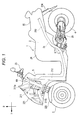
- Fig. 1 is a schematic overall side view of the vehicle 1.
- front, rear, left and right are referred to in indicating directions, they denote front, rear, left and right as seen from a rider who rides on the vehicle 1.
- the vehicle 1 includes a vehicle main body 2, front wheels 3 and a rear wheel 4.
- the vehicle main body 2 is made up mainly of a vehicle body frame 21, a body cover 22, a handlebar 23, a seat 24, and a power unit 25.
- the body frame 21 supports the power unit 25, the seat 24 and the like.
- the power unit 25 includes a power source such as an engine or an electric motor, a transmission and the like.
- a power source such as an engine or an electric motor, a transmission and the like.
- Fig. 1 the body frame 21 is shown by broken lines.
- the body frame 21 includes a headstock 211, a front frame 212 and a rear frame 213.
- the headstock 211 is disposed at a front portion of the vehicle.
- a link mechanism 5 is disposed on the periphery of the headstock 211.
- a steering shaft 60 is turnably inserted in the headstock 211.
- the steering shaft 60 extends in an up-and-down direction.
- a first penetrating portion 211a and a second penetrating portion 211b protrude from the headstock 211 to the front so as to penetrate the link mechanism 5.
- the handlebar 23 is mounted on an upper end of the steering shaft 60.
- the front frame 212 is inclined obliquely downward from a front end thereof to the rear.
- the rear frame 213 supports the seat 24 and a tail lamp.
- the body frame 21 is covered by the body cover 22.
- the body cover 22 includes a front cover 221, front fenders 223 and a rear fender 224.
- the front cover 221 lies ahead of the seat 24.
- the front cover 221 covers the headstock 211 and the link mechanism 5.
- the front fenders 223 are provided individually directly above the front wheels 3 that are a pair of left and right front wheels 3.
- the front fenders 223 are disposed directly below the front cover 221.
- the rear fender 224 is disposed directly above the rear wheel 4.
- the front wheels 3 are disposed further downwards than the headstock 211 and the link mechanism 5.
- the front wheels 3 are disposed directly below the front cover 221.
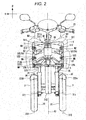
- Fig. 2 is an overall front view of the vehicle 1 with the body cover 22 removed.
- the vehicle 1 includes the handlebar 23, the steering shaft 60, the headstock 211, the pair of left and front wheels 3, and the link mechanism 5.
- the link mechanism 5 is disposed on the periphery of the headstock 211.
- the link mechanism 5 is connected to the pair of left and right front wheels 3, that is, a left front wheel 31 and a right front wheel 32. Additionally, the link mechanism 5 is turnably mounted on the headstock 211.
- the link mechanism 5 includes a cross portion 50 and a side portion 55.
- the cross portion 50 has a front cross portion 50A that lies ahead of the headstock 211 and a rear cross portion 50B that lies behind the headstock 211.
- An upper cross portion 51 has a front upper cross portion 51A that lies ahead of the headstock 211.
- a lower cross portion 52 has a front lower cross portion 52A that lies ahead of the headstock 211 and a rear lower cross portion 52B that lies behind the headstock 211.
- the front cross portion 50A has the front upper cross portion 51A and the front lower cross portion 52A.
- the rear cross portion 50B has a rear lower cross portion 52B.
- the side portion 55 includes a left side portion 53 and a right side portion 54.
- the front wheels 3 include the right front wheel 31 and the left front wheels 32 that can be steered.
- the left front wheel 31 is disposed further leftwards than a transverse center or middle portion of the vehicle.
- a first front fender 223a which is one of the front fenders 223, is disposed directly above the left front wheel 31.
- the right front wheel 32 is disposed further rightwards than the transverse middle portion of the vehicle.
- a second front fender 223b, which is the other of the front fenders 223, is disposed directly above the right front wheel 32.
- the right front wheel 32 is disposed so as to be symmetric with the left front wheel 31 with respect to the transverse middle portion of the vehicle.
- a "rightward direction RF of the vehicle body frame 21" denotes a rightward direction of directions that intersect an axial direction of the headstock 211 perpendicularly in a front view of the vehicle 1.
- an upward direction UF of the body frame21 denotes an upward direction of the body frame21 when the vehicle 1 rests upright.
- the upward direction of the body frame 21 coincides with an axial direction of the headstock 211 in the front view of the vehicle 1.
- the rightward direction RF of the vehicle body frame21 coincides with a rightward direction R in the horizontal direction.
- the left front wheel 31 is connected to a left shock absorber 33.
- the left front wheel 31 is connected to a lower portion of the left shock absorber 33.
- the left front wheel 31 can rotate about a rotational shaft 311.
- the rotational shaft 311 extends in a left-to-right direction of the body frame.
- the left front wheel 31 can turn about a turning axis 312.
- the vehicle 1 changes its traveling direction as a result of the left front wheel 31 turning about the turning axis 312.
- the right front wheel 32 is connected to a right shock absorber 34.
- the right front wheel 32 is connected to a lower portion of the right shock absorber 34.
- the right front wheel 32 can rotate about a rotational shaft 321.
- the rotational shaft 321 extends in the left-and-right direction of the body frame 21.
- the right front wheel 32 can turn about a turning axis 322.
- the vehicle 1 changes its traveling direction as a result of the right front wheel 32 turning about the turning axis 322.
- the left shock absorber 33 absorbs an impact exerted on the left front wheel 31.
- the left shock absorber 33 is disposed below the link mechanism 5 in relation to the up-and-down direction of the body frame 21.
- the left shock absorber 33 is provided between the left side portion 53 (refer to Fig. 3 ), which will be described later, and the left front wheel 31.
- the left shock absorber 33 extends along a left steering axis N1 that is parallel to axes of the steering shaft 60 and the headstock 211.
- the left shock absorber 33 is disposed on the left of the headstock 211 in relation to the left-and-right direction of the body frame 21.
- the left shock absorber 33 is disposed on the right of the left front wheel 31 in relation to the left-and-right direction of the body frame 21.
- the right shock absorber 34 absorbs an impact exerted on the right front wheel 32.
- the right shock absorber 34 is disposed below the link mechanism 5 in relation to the up-and-down direction of the body frame 21.
- the right shock absorber 34 is provided between the right side portion 54 (refer to Fig. 3 ), which will be described later, and the right front wheel 32.
- the right shock absorber 34 extends along a right steering axis N2 that is parallel to the axes of the steering shaft 60 and the headstock 211.
- the right shock absorber 34 is disposed on the right of the headstock 211 in relation to the left-and-right direction of the body frame 21.
- the right shock absorber 34 is disposed on the left of the right front wheel 32 in relation to the left-and-right direction of the body frame 21.
- the left side portion 53 is disposed on the left of the headstock 211 in relation to the left-and-right direction of the body frame 21.
- the right side portion 54 is disposed on the right of the headstock 211 in relation to the left-and-right direction of the body frame 21.
- the left side portion 53 and the right side portion 54 are a circular cylindrical member.
- the left side portion 53 and the right side portion 54 are connected to the left front wheel 31 and the right front wheel 32, respectively, at lower portions thereof.
- the left side portion 53 and the right side portion 54 extend in the up-and-down direction of the body frame 21 with the vehicle resting in the upright state.
- a first bracket 335 is provided at the lower portion of the left side portion 53, and the left shock absorber 33 is connected to the first bracket 335.
- the lower portion of the left side portion 53 supports the left shock absorber 33 so as to turn about the left steering axis N1.
- a second bracket 336 is provided at the lower portion of the right side portion 54, and the right shock absorber 34 is connected to the second bracket 336.
- the lower portion of the right side portion 54 supports the right shock absorber 34 so as to turn about the right steering axis N2.
- the upper cross portion 51 is a member that extends in the left-and-right direction of the body frame 21 as seen from the front of the vehicle.
- the upper cross portion 51 is provided further forwards to the front of the vehicle than the headstock 211.
- a first through hole 513 is provided in a middle portion of the upper cross portion 51 in the left-and-right direction of the body frame 21, and an upper left bearing 512 and an upper right bearing 512 are provided at both sides of the upper cross portion 51 in the left-and-right direction of the body frame 21.
- the first penetrating portion 211 a that extends from the headstock 211 is caused to penetrate through the first through hole 513.
- Fig. 3 is a right side view of the front portion of the vehicle.
- an upper middle bearing 511 is provided between the first penetrating portion 211 a and the first through hole 513.
- This allows the upper cross portion 51 to be supported so as to turn about an upper middle axis M1 relative to the headstock 211 by the first penetrating portion 211a and the upper middle bearing 511.
- the upper cross portion 51 turns about the upper middle axis M1 that constitutes the center of the upper middle bearing 511 relative to the headstock 211.
- the first through hole 513 includes the upper middle axis M1 of the upper cross portion 51.
- the upper cross portion 51 is connected to an upper portion of the left side portion 53 and an upper portion of the right side portion 54 via the upper left bearing 512 and the upper right bearing 512, respectively. This allows the upper cross portion 51 to turn about an upper left axis M2 and an upper right axis M3 relative to the left side portion 53 and the right side portion 54, respectively.
- the upper middle axis M1 that constitutes a turning center of the upper middle bearing 511, the upper left axis M2 that constitutes a turning center of the upper left bearing 512, and the upper right axis M3 that constitutes a turning center of the upper right bearing 512 are made to lie parallel to one another.
- the lower cross portion 52 is provided further downwards than the upper cross portion 51.
- the lower cross portion 52 extends in the left-and-right direction when seen from the front of the vehicle.
- a length of the lower cross portion 52 in the left-and-right direction is substantially equal to a length of the upper cross portion 51 in the left-and-right direction.
- the lower cross portion 52 is provided further downwards than the upper cross portion 51.
- a second through hole 523 is provided in a middle portion of the lower cross portion 52 in the left-and-right direction of the body frame 21, and a lower left bearing 522 is provided on the left of the second through hole 523, while a lower right bearing 522 is provided on the right of the second through hole 523.
- the second penetrating portion 211 b is caused to penetrate through the second through hole 523.
- a lower middle bearing 521 is provided between the second penetrating portion 211 b and the second through hole 523.
- the lower cross portion 52 turns about the lower middle axis M4 that constitutes the center of the lower middle bearing 521 relative to the headstock 211.
- the second through hole 523 includes the lower middle axis M4 of the lower cross portion 52.
- the lower middle axis M4 that constitutes a turning center of the lower middle bearing 521, a lower left axis M5 that constitutes a turning center of the lower left bearing 522, and a lower right axis M6 that constitutes a turning center of the lower right bearing 522 are made to lie parallel to one another. Additionally, the lower middle axis M4 is provided so as to be parallel to the upper middle axis M1. In addition, with the vehicle 1 resting in the upright state, a position of the lower left bearing 522in the left-and-right direction in relation to the body frame 21 is the same as a position of the upper left bearing 512 in the left-and-right direction in relation to the body frame 21.
- a position of the lower right bearing 522 in the left-and-right direction in relation to the body frame 21 is the same as a position of the upper right bearing 512 in the left-and-right direction in relation to the body frame 21.
- the lower cross portion 52 is connected to the lower portion of the left side portion 53 and the lower portion of the right side portion 54 via the lower left bearings 522 and the lower right bearings 522, respectively. This allows the lower cross portion 52 to turn about the left steering axis N1 and the right steering axis N2 relative to the left side portion 53 and the right side portion 54, respectively.
- the link mechanism 5 can be deformed within a plane that contains the upper cross portion 51, the lower cross portion 52, the left side portion 53 and the right side portion 54. It is noted that the link mechanism 5 is mounted on the headstock 211. Because of this, even though the steering shaft 60 turns as the handlebar 23 is steered, the link mechanism 5 does not turn relative to the body frame 21.
- a tie-rod 6 transfers the steering of the handlebar 23 to the left front wheel 31 and the right front wheel 32. By doing so, the left front wheel 31 and the right front wheel 32 can be steered by the handlebar 23.
- the tie-rod 6 is provided ahead of the headstock 211.
- the tie-rod 6 extends in the left-and-right direction.
- the tie-rod 6 is disposed below the lower cross portion 52 and above the left front wheel 31 and the right front wheel 32.
- the tie-rod 6 is connected to a lower portion of the steering shaft 60. When the steering shaft 60 is turned, the tie-rod 6 moves laterally to the left or right.
- the first bracket 335 is provided at the lower portion of the left side portion 53.
- the first bracket 335 is connected to the left shock absorber 33.
- the first bracket 335 is provided so as to turn relative to the left side portion 53.
- the tie-rod 6 is also provided on the first bracket 335 so as to turn relative to the left side portion 53.
- a turning shaft on which the first bracket 335 turns relative to the left side portion 53 and a turning shaft on which the first bracket 335 turns relative to the tie-rod 6 are parallel to the left steering axis N1 along which the left side portion 53 extends.
- the second bracket 336 is provided at the lower portion of the right side portion 54.
- the second bracket 336 is connected to the right shock absorber 34.
- the second bracket 336 is provided so as to turn relative to the right side portion 54.
- the tie-rod 6 is also provided on the second bracket 336 so as to turn relative to the right side portion 54.
- a turning axis on which the second bracket 336 turns relative to the right side portion 54 and a turning axis on which the second bracket 336 turns relative to the tie-rod 6 are parallel to the right steering axis N2 along which the right side portion 54 extends.
- the tie-rod 6 moves laterally to the left or right. Then, the first bracket 335 turns about the turning shaft on which the first bracket 335 turns relative to the left side portion 53 as the tie-rod 6 moves. This moves a connecting portion 52b where the first bracket 335 connects to the left shock absorber 33 in the left-and-right direction, and the left front wheel 31 turns about the turning axis 312.
- first bracket 335 transfers the steering of the handlebar 23 to the left front wheel 31.
- second bracket 336 transfers the steering of the handlebar 23 to the right front wheel 32.
- a headlamp 81 and a hydraulic unit 82 are provided in front of the link mechanism 5. Additionally, the front cover 221 and a windshield 222 are provided so as to cover the headlamp 81 and the hydraulic unit 82.
- the headlamp 81, the hydraulic unit 82, the front cover 221 and the windshield 222 may be called a vehicle component altogether.
- the hydraulic unit 82 is a unit that is used in an ABS (Anti-lock braking system).
- the hydraulic unit 82 includes a metallic casing, a flow path provided in the casing, a pump and solenoid valves.
- the hydraulic unit 82 controls a brake system, not shown, by switching paths through which brake fluid flows by the solenoid valves.
- the vehicle component is supported on the headstock 211 via an attaching bracket 7.
- the headlamp 81 and the hydraulic unit 82 will be taken as an example of a vehicle component, and a construction will be described in which the headlamp 81 and the hydraulic unit 82 are attached to the body frame 21.
- Fig. 4 is a perspective view of the attaching bracket 7.
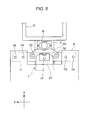
- Fig. 5 is a front view showing the attaching bracket 7, part of the headlamp 81, and the hydraulic unit 82.
- the attaching bracket 7 includes integrally a plate portion 71 and an extending portion 72 that extends obliquely from the plate portion 71. It is noted that the headlamp 81 and the hydraulic unit 82 overlap the link mechanism 5 at least partially when the vehicle is seen from the front thereof as shown in Figs. 2 and 5 .
- a first threaded hole 711 and a second threaded hole 712 are provided in the plate portion 71.
- a screw that is fixed to the first penetrating portion 211a extending from the headstock 211 is inserted through the first threaded hole 711.
- a screw that is fixed to the second penetrating portion 211b extending from the headstock 211 is inserted through the second threaded hole 712.
- the attaching bracket 7 is fixed to the headstock 211 by fixing the screws to the corresponding penetrating portions.
- a first stay 73 is formed at a lower portion on a side of the plate portion 71 that faces the front of the vehicle.
- a third threaded hole 731 is provided in a transverse middle portion of the first stay 73.
- a pair of fourth threaded holes 732 are provided outward of the third threaded hole 731.
- a pair fifth threaded holes 733 are provided outward of the pair of fourth threaded holes 732.
- a pair of sixth threaded holes 734 are provided outward of the pair of fifth threaded holes 733.
- a screw is screwed through the third threaded hole 731 in the first stay 73 to fix an attaching piece 821 of the hydraulic unit 82 in place. Screws are screwed through the fourth threaded holes 732 in the first stay 73 to fix an attaching piece 822 of the hydraulic unit 82 in place.
- the hydraulic unit 82 is fixed to the attaching bracket 7 by screwing the screws through the corresponding threaded holes.
- Screws are screwed through the fifth threaded holes 733 and the sixth threaded holes 734 in the first stay 73 to fix the headlamp 81 in place.
- the headlamp 81 is fixed to the attaching bracket 7 in this way.
- a second stay 74 and a third stay 75 are provided at a distal end of the extending portion 72.
- the windshield 222 is fixed to the second stay 74.
- the front cover 221 is fixed to the third stay 75.
- the vehicle component is supported on the body frame 21 via the attaching bracket 7 in the way described above.
- This attaching bracket 7 is fixed to the first penetrating portion 211 a and the second penetrating portion 211 b that protrude to the front from the headstock 211 to penetrate through the link mechanism 5.
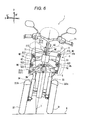
- Fig. 6 is an overall front view of the vehicle 1 in which the vehicle body is caused to lean at an angle T in the left-and-right direction with respect to the vertical direction from the state shown in Fig. 2 .
- the link mechanism 5 is actuated to operate, the vehicle 1 leans with respect to the vertical direction.
- the upper cross portion 51 and the lower cross portion 52 are translated in the left-and-right direction while the direction in which they extend is kept parallel to the road surface G.
- the upper cross portion 51 and the lower cross portion 52 turn about the upper left axis M2 and the lower left axis M5, respectively, relative to the left side portion 53.
- the upper cross portion 51 and the lower cross portion 52 turn about the upper right axis M3 and the lower right axis M6, respectively, relative to the right side portion 54.
- the upper cross portion 51, the lower cross portion 52, the left side portion 53 and the right side portion 54 form a rectangular shape, which is deformed when the vehicle is caused to lean. Then, as the vehicle is caused to lean further, the upper cross portion 51, the lower cross portion 52, the left side portion 53, and the right side portion 54 are deformed into a parallelogram.
- an area that includes the upper cross portion 51, the lower cross portion 52, the left side portion 53 and the right side portion 54 and that is defined inside the parallelogram that is formed by these four portions will be called an operating space of the link mechanism 5.
- the link mechanism 5 operates so that a left end of the upper cross portion 51 moves further leftwards than a left end of the lower cross portion 52.
- the link mechanism 5 operates in this way, the left shock absorber 33 and the right shock absorber 34 lean with respect to the vertical direction.
- the state of the vehicle 1 changes from the state shown in Fig. 2 to the state shown in Fig. 5 .
- the vehicle 1 according to this embodiment can be turned by causing the vehicle body to lean to the left or right while the vehicle 1 is running. Additionally, the directions of the left front wheel 31 and the right front wheel 32 can also be changed by operating the handlebar 23.
- the upper cross portion 51 of the link mechanism 5 lies ahead of the headstock 211 of the body frame 21.
- an area that is surrounded by an outer edge of a range where the upper cross portion 51 and the front lower cross portion 52A that lie ahead of the headstock 211 move relative to the body frame 21 when the vehicle is caused to lean at a largest-possible angle to the left or right is called a front movable outer edge V (refer to Figs. 2 , 3 and 6 ).
- the link mechanism 5 has a wall portion that makes up the first through hole 513 that functions as the through portion defining a space that does not overlap the upper cross portion 51 that lies ahead of the headstock 211 when the upper cross portion 51 turns relative to the body frame 21.
- the space defined by this first through hole 513 is provided within the front movable outer edge V as seen from the direction of the upper middle axis M1.
- the first penetrating portion 211a (an example of a component support portion) extends from the headstock 211 to the front into this space that is defined by the first through hole 513.
- the headlamp 81, the hydraulic unit 82, the front cover 221 and the like are fixed to the attaching bracket 7 that is fixed to the first penetrating portion 211a.
- the vehicle component is supported on the body frame 21 via the first penetrating portion 211a that is disposed within the space defined by the wall portion that makes up the first through hole 513 is defined.
- the link mechanism 5 has a wall portion that makes up the second through hole 523 which functions as the through portion defining a space that does not overlap the front lower cross portion 51 that lies ahead of the headstock 211 when the front lower cross portion 52A turns relative to the body frame 21.
- the space defined by this second through hole 523 is provided within the front movable outer edge V as seen from the direction of the lower middle axis M4.
- the second penetrating portion 211 b (an example of a component support portion) extends from the headstock 211 to the front into this space that is defined by the second through hole 523.
- the headlamp 81, the hydraulic unit 82, the front cover 221 and the like are fixed to the attaching bracket 7 that is fixed to the second penetrating portion 211 b.
- the vehicle component is supported on the body frame 21 via the second penetrating portion 211b that is disposed within the space defined by the wall portion that makes up the second through hole 523 is defined.
- the vehicle 1 according to the embodiment that has been described above includes:
- the link mechanism 5 includes:
- the upper cross portion 51 lies ahead of the headstock 211 of the body frame 21.
- the link mechanism 5 has the wall portion (an example of a through portion) that is provided in the front movable outer edge V relative to the body frame 21 of the front cross portion 50A (the upper cross portion 51 and the front lower cross portion 52A) that lies ahead of the body frame 21 as seen from the direction of the upper middle axis M1 and that makes up the first through hole 513 that defines the space that does not overlap the front cross portion 50A that lies ahead of the body frame 21 when the front cross portion 50A turns relative to the body frame 21.
- the vehicle components such as the headlamp 81, the hydraulic unit 82, the front cover 221 and the like are supported on the body frame 21 via the first penetrating portion 211 a (an example of a component support portion) that is disposed within the space defined by the wall portion that makes up the first through hole 513 is formed.
- the first penetrating portion 211 a an example of a component support portion
- the link mechanism 5 has the wall portion (an example of a through portion) that is provided in the front movable outer edge V relative to the body frame 21 of the front cross portion 50A that lies ahead of the body frame 21 as seen from the direction of the lower middle axis M4 and that makes up the second through hole 523 that defines the space that does not overlap the front cross portion 50A that lies ahead of the body frame 21 when the front cross portion 50A turns relative to the body frame 21.
- the vehicle components such as the headlamp 81, the hydraulic unit 82, the front cover 221 and the like are supported on the body frame 21 via the second penetrating portion 211b (an example of a component support portion) that is disposed within the space defined by the wall portion that defines the second through hole 523 is formed.
- the second penetrating portion 211b an example of a component support portion
- the inventors have studied the provision of a vehicle that can support a vehicle component that is disposed ahead of a link mechanism in an ensured fashion without enlarging a front portion of the vehicle.
- the inventors have studied a configuration that can make a support construction for supporting a vehicle component compact in size. It is preferable to support a vehicle component by a body frame in order to support the vehicle component highly rigidly. When attempting to dispose the vehicle component directly ahead of the link mechanism, the support construction for supporting the vehicle component needs to be disposed in a position where the support construction does not interfere with the link mechanism even though the link mechanism operates.
- the component support portion that supports the vehicle component is formed so as to move around the movable outer edge that is formed by the cross portion when the cross portion is turned through the possibly largest angle as seen from the direction of the middle axis in order to avoid its interference with the link mechanism.
- the vehicle of Patent Document 1 has the upper stay that extends from the body frame to the front of the link mechanism by moving around above the movable outer edge of the link mechanism and the lower stay that extends from the body frame to the front of the link mechanism by moving around below the movable outer edge.
- the space where to dispose the upper stay is ensured above the movable outer edge and the space where to dispose the lower stay is ensured below the movable outer edge, and therefore, the front portion of the vehicle is enlarged.
- the component support portion is formed so as to move around the movable outer edge of the link mechanism to thereby connect together the body frame that lies behind the link mechanism and the vehicle component that lies ahead of the link mechanism. Because of this, the component support portion is made of the highly rigid member, and the side of the component support portion itself becomes large.
- the inventor has paid attention to the configuration in which the upper cross portion 51 and the lower cross portion 52 of the link mechanism 5 are made of the members that are thick in the up-and-down direction of the body frame 21 because the upper cross portion 51 and the lower cross portion 52 bear the loads exerted on the front wheels 31, 32.
- the upper cross portion 51 and the lower cross portion 52 are longer in the up-and-down direction than in the front-and-rear direction of the body frame 21.
- the upper cross portion 51 and the lower cross portion 52 are made of the thick members, the space is provided between the upper cross portion 51 and the lower cross portion 52 so that the link mechanism 5 can operate even when the vehicle 1 leans relative to the road surface G.
- a recess portion, a hole portion or the like can be provided in the thick member, it is possible to define a space that does not overlap the upper cross portion 51 and the lower cross portion 52 even within the front movable outer edge V as seen from the direction of the middle axis by devising the shape of the upper cross portion 51.
- the inventor has noticed that in case a through portion that defines a space that the front cross portion 50A lying ahead of the headstock 211 does not overlap when the front cross portion 50A turns is provided in the cross portion 50 in the space defined between the upper cross portion 51 and the lower cross portion 52 or in a position that overlaps the upper cross portion 51 or the lower cross portion 52 as seen from the direction of the upper middle axis M1, the component support portion that supports the vehicle component can be provided in the space.
- the wall portion which makes up the first through hole 513 is provided in the upper cross portion 51 as the through portion, and the first penetrating portion 211 a as a component support portion is disposed in the space defined by the wall portion of the first through hole 513, whereby the vehicle component is support on the body frame 21 via the first penetrating portion 211 a.
- the wall portion which makes up the second through hole 523 is provided in the front lower cross portion 52A as the through portion, and the second penetrating portion 211b as a component support portion is disposed in the space defined by the wall portion of the second through hole 523, whereby the vehicle component is support on the body frame 21 via the second penetrating portion 211 b.
- the wall portion that makes up the first through hole 513 defines the space that does not overlap the upper cross portion 51, and therefore, the first penetrating portion 211a that is disposed within the space does not interfere with the upper cross portion 51 when the upper cross portion 51 turns. Additionally, the first penetrating portion 211a can be formed so as to connect together the body frame 21 and the vehicle component in a rectilinear fashion. This makes it possible to make the component support portion that supports the vehicle component more compact in size than in the configuration of the vehicle of Patent Document 1 in which the component support portion is provided so as to move around the outside of the movable outer edge.
- the rigidity required on the component support portion such as the first penetrating portion 211a can be made smaller than in the configuration of the vehicle of Patent Document 1 in which the vehicle component is supported in the position lying far from the vehicle body. This can make the component support portion itself smaller in size than the component support portion of the vehicle of Patent Document 1.
- the wall portion that makes up the second through hole 523 defines the space that does not overlap the front lower cross portion 52A, and therefore, the second penetrating portion 211 b that is disposed within the space does not interfere with the front lower cross portion 52A when the front lower cross portion 52A turns.
- the second penetrating portion 211 b can be formed so as to connect together the body frame 21 and the vehicle component in a rectilinear fashion. This makes it possible to make the component support portion that supports the vehicle component more compact in size than in the configuration of the vehicle of Patent Document 1 in which the component support portion is provided so as to move around the outside of the movable outer edge.
- the rigidity required on the component support portion such as the first penetrating portion 211 a can be made smaller than in the configuration of the vehicle of Patent Document 1 in which the vehicle component is supported in the position lying far from the vehicle body. This can make the component support portion itself smaller in size than the component support portion of the vehicle of Patent Document 1.
- the vehicle 1 which can support the vehicle component that is disposed in front of the link mechanism 5 in an ensured fashion without enlarging the front portion of the vehicle while avoiding the interference with the link mechanism 5.
- the wall portion that makes up the first through hole 513 lies inward of the outer edge of the upper cross portion 51 lying ahead of the headstock 211 as seen from the direction of the upper middle axis M1.
- the first through hole 513 and the upper cross portion 51 overlap each other as seen from the direction of the upper middle axis M1. This makes it easy to make compact the construction that supports the vehicle component including the component support portion that is disposed in the space defined by the wall portion that makes up the first through hole 513 as seen from the direction of the upper middle axis M1.
- the first penetrating portion 211a lies in the middle of the upper cross portion 51 in relation to the left-and-right direction of the body frame 21. Namely, the first penetrating portion 211a lies closer to the upper middle axis M1 than the left end portion and the right end portion of the upper cross portion 51 that lies ahead of the headstock 211.
- the upper middle axis M1 lies within the space defined by the wall portion that makes up the first through hole 513 as seen from the direction of the upper middle axis M1.
- the upper cross portion 51 turns about the upper middle axis M1.
- the first penetrating portion 211a extends from the headstock 211 to penetrate the upper cross portion 51, protruding therefrom to the front. Because of this, the wall portion of the first through hole 513 that defines the space within which the first penetrating portion 211 a is disposed can be made smaller as the first penetrating portion 211 a is disposed closer to the upper middle axis M1 as in this embodiment. Additionally, in the event that the upper middle axis M1 is positioned in the space that is defined by the wall portion of the first through hole 513, the first penetrating portion 211 a does not interfere with the upper cross portion 51.
- the first penetrating portion 211a is a portion where the attaching bracket 7 that supports the vehicle component is attached and a portion where the upper cross portion 51 is supported so as to turn.
- the first penetrating portion 211 a that is the component support portion is configured as part of a turning support portion that supports the upper cross portion 51 on the headstock 211 so as to turn relative thereto.
- the first penetrating portion 211 a and the upper middle bearing 511 that is fitted on the first penetrating portion 211a constitute the portion where the upper cross portion 51 is supported so as to turn.
- the first penetrating portion 211a and an inner ring of the upper middle bearing 511 that is fitted on the first penetrating portion 211 a constitute the portion where the attaching bracket 7 is attached.
- the vehicle that has the two front wheels 31, 32 and the link mechanism 5 has the turning support portion that supports the upper cross portion 51 constituting part of the link mechanism 5 so as to turn.
- the vehicle component can be mounted on the vehicle while being supported with the simple configuration because the component support portion that supports the vehicle component can be made up by using the turning support portion.
- the vehicle component is supported on the headstock 211 of the body frame 21.
- the headstock 211 that supports the link mechanism 5 is highly rigid. Since the vehicle component is supported on the headstock 211 that is highly rigid, the supporting rigidity of the vehicle component is high.
- the attaching bracket 7 that supports the vehicle component is supported on the headstock 211 via the first penetrating portion 211 a and the second penetrating portion 211 b.
- the supporting rigidity of the vehicle component becomes high.
- the two component support portions can each be formed smaller, and therefore, it is easy to avoid the interference of the component support portions with the cross portion. Further, forming each of the component support portions small makes it easy to avoid their interference with the link mechanism.
- the two component support portions are described as being disposed to be aligned with each other in the up-and-down direction of the body frame 21, the number of component support portions and the arrangement thereof are not limited to those described in the embodiment. Additionally, in this embodiment, while the single member (the attaching bracket 7) is described as being supported by the two component support portions, different members may be supported individually by the two component support portions.
- the hydraulic unit 82 is supported on the body frame 21 via the first penetrating portion 211a and the second penetrating portion 211b that extend to the front from the body frame 21 and the attaching bracket 7.
- the component support portion that supports the hydraulic unit 82 may be at least either of the vehicle components itself and the attaching bracket that attaches the vehicle component to the body frame 21.
- a configuration may be adopted in which a bolt is used as a component support portion while a nut is provided on the vehicle component and the body frame, whereby the vehicle component is supported on the body frame 21 by fastening the bolt and the nuts together.
- the component support portion may be made up of the plurality of components as in this embodiment or may be made up of a single component.
- the first penetrating portion 211a is described as penetrating the first through hole 513 that includes the turning axis of the upper cross portion 51 and the second penetrating portion 211 b penetrates the second through hole 523 that includes the turning axis of the front lower cross portion 52A.
- the invention is not limited to this example.
- Fig. 7 is a view showing an upper cross portion 151, a front lower cross portion 152, a left side portion 53, a right side portion 54 and a hydraulic unit 82 that results when they are seen from the direction of an upper middle axis M1, and a headstock 211 is omitted from illustration.
- a configuration may be adopted in which first penetrating portions penetrate positions on the first upper cross section 151 where turning axes of the upper cross portion 151 do not pass and second penetrating portions penetrate positions on the front lower cross portion 152A where turning axes of the front lower cross portion 152A do not pass.
- a through hole 514 is provided in the upper cross portion 151 individually between an upper middle bearing 511 and an upper right bearing 512 and between the upper middle bearing 511 and the an upper left bearing 512.
- the first penetrating portions 211a penetrate the through holes 514.
- the first through holes 514 are sized so as not to interfere with the first penetrating portions 211a even when a link mechanism 5 operates as the vehicle leans.
- Both the upper cross portion 151 and the front lower cross portion 152A are provided ahead of a headstock 211.
- a second through hole 524 is formed in the front lower cross portion 152A individually between a lower middle bearing 521 and a lower right bearing 522 and between the lower middle bearing 521 and a lower left bearing 522.
- the second penetrating portions 211b penetrate the second through holes 524.
- the second through holes 524 are sized so as not to interfere with the second penetrating portions 211 b even when the link mechanism 5 operates as the vehicle leans.
- the second penetrating portions 211b are caused to penetrate a front movable outer edge V of the link mechanism 5, so that the vehicle component such as the hydraulic unit 82 or the like can be supported ahead of the link mechanism 5 without enlarging a front portion of the vehicle.
- the link mechanism 5 has wall portions of the first through holes 514 that are provided in front movable outer edges V relative to the body frame 21 of the upper cross portion 151 and the front lower cross portion 152A that lie ahead of the body frame 21 as seen from the direction of the upper middle axis M1 and that define spaces that do not overlap the upper cross portion 151 that lies ahead of the body frame 21 when the upper cross portion 151 turns relative to the body frame 21.
- the link mechanism 5 has wall portions of the second through holes 524 that are provided in the front movable outer edges V relative to the body frame 21 of the upper cross portion 151 and the front lower cross portion 152A that lie ahead of the body frame 21 as seen from the direction of a lower middle axis M4 and that define spaces that do not overlap the front lower cross portion 152A that lies ahead of the headstock 211 when the front lower cross portion 152A turns relative to the body frame 21.
- the vehicle component is supported on the body frame 21 via the first penetrating portions 211 a that are disposed in the spaces that are defined by the wall portions of the first through holes 514 and the second penetrating portions 211 b that are disposed in the spaces that are defined by the wall portions of the second through holes 524.
- the first through holes 514 and the second through holes 524 are provided by using the upper cross portion 151 and the front lower cross portion 152 which are thick in the up-and-down direction of the body frame 21.
- the vehicle component is supported on the body frame 21 via the first penetrating portions 211a that are disposed in the spaces that are defined by the wall portions of the first through holes 514 and the second penetrating portions 211b that are disposed in the spaces that are defined by the wall portions of the second through holes 524.
- the through holes 514, 524 that define the spaces where the first penetrating portions 211 a and the second penetrating portions 211b are provided are provided in positions that lie nearer to the upper middle bearing 511 (or the lower middle bearing 521) than to the left side portion 53 and the right side portion 54 in relation to the left-and-right direction of the body frame 21 when seen from the front of the vehicle.
- the relative displacements between the upper cross portion 151 and the front lower cross portion 152A and between the first penetrating portions 211 a and the second penetrating portions 211 b are small when the link mechanism 5 operates.
- This enables the through holes 514, 524 that define the spaces where the first penetrating portions 211a and the second penetrating portions 211b are provided to be set to be small in size.
- the wall portions that define the first through holes 514 define elongated holes that include arcs that are centered at the upper middle axis M1 of the upper cross portion 151.
- the wall portions that define the second through holes 524 define elongated holes that include arcs that are centered at the lower middle axis M4 of the front lower cross portion 152A.
- the through holes 514, 524 are formed into the shapes described above, the through holes 514, 524 are prevented from being brought into interference with the first penetrating portions 211a and the second penetrating portions 211b, respectively, thus, making it possible to form the through holes 514, 524 small.
- Fig. 8 shows views depicting a second modified example of the invention.
- (a) in Fig. 8 is a side view showing a headstock 211, an upper cross portion 251, a lower cross portion 252, an attaching bracket 7, and a hydraulic unit 82 that is an example of a vehicle component of a vehicle according to the second modified example.
- (b) in Fig. 8 is a view that results from viewing (a) in Fig. 8 from the direction of an upper middle axis M1.
- (c) in Fig. 8 is a view in which the upper cross portion 251 and the lower cross portion 252 being taken out from (b) in Fig. 8 .
- both the upper cross portion 251 and the lower cross portion 252 are disposed ahead of the headstock 211.
- a relatively wide space is set between the upper cross portion 251 and the lower cross portion 252 in relation to an up-and-down direction of a body frame 21.
- a front movable outer edge V1 that is defined by the upper cross portion 251 and a front movable outer edge V2 that is defined by the lower cross portion 252 are independent of each other.
- a second through hole 521 that passes through a lower middle axis M4 is provided in the lower cross portion 252.
- a second penetrating portion 211 b is disposed in a space that is defined by a wall portion of the second through hole 521, and the second penetrating portion 211b supports the attaching bracket 7.
- This second penetrating portion 211 b is provided in the front movable outer edge V2 that is defined by the lower cross portion 252 as seen from the direction of the upper middle axis M1.
- a third through hole 515 is provided on each side of the upper middle axis M1 in the upper cross portion 251 in relation to a left-and-right direction of the body frame 21.
- a wall portion of each of the third through holes 515 makes up a through portion that defines a space that does not overlap the upper cross portion 251 when the upper cross portion 251 turns relative to the body frame 21.
- the wall portion defined by the third through hole 515 defines an elongated hole including an arc that is centered at the upper middle axis M1 as seen from the direction of the upper middle axis M1.
- These third through holes 515 are provided in the front movable outer edge V1 that is defined by the upper cross portion 251 as seen from the direction of the upper middle axis M1.
- Third penetrating portions 211c are disposed in the spaces defined by the wall portions of the third through holes 515. The third penetrating portions 211 c support the attaching bracket 7 on the headstock 211.
- the second through hole 523 and the third through holes 515 are provided by using the cross portions 251, 252 which are thick in the up-and-down direction of the body frame 21.
- the vehicle component is supported on the body frame 21 via the second penetrating portion 211 b that is disposed in the space that is defined by the wall portion of the second through hole 523 and the third penetrating portions 211 c that are disposed in the spaces that are defined by the wall portions of the third through holes 525.
- Fig. 9 shows views depicting a third modified example of the invention.
- (a) in Fig. 9 is a side view showing a headstock 211, an upper cross portion 351, a lower cross portion 352, an attaching bracket 7, and a hydraulic unit 82 that is an example of a vehicle component of a vehicle according to the third modified example.
- (b) in Fig. 9 is a view that results from viewing (a) in Fig. 9 from the direction of an upper middle axis M1.
- the upper cross portion 351 and the lower cross portion 352 are provided ahead of the headstock 211, and the lower cross portion 352 is provided behind the headstock 211.
- a first penetrating portion 211a is disposed in a space that is defined by a wall portion of a first through hole 513, and the attaching bracket 7 that supports the vehicle component is supported on the upper cross portion 351 via the first penetrating portion 211 a.
- the wall portion of the first through hole 513 is provided in a front movable outer edge V of the upper cross portion 351 as seen from the direction of an upper middle axis M1.
- the attaching bracket 7 where the vehicle component is supported is supported further on a body frame 21 via a connecting portion 211d that is not disposed in the space that is defined by the first through hole 513 but is disposed outward of the front movable outer edge V as seen from the direction of the upper middle axis M1.
- the connecting portion 211 d is spaced away downwards from the front movable outer edge V of the upper cross portion 351 to be provided in a position that lies away from the upper cross portion 351 as seen from the direction of the upper middle axis M1.
- the attaching bracket 7 is supported strongly and rigidly on the body frame 21 by the first penetrating portion 211a and the connecting portion 211d. Additionally, since the supporting rigidity is ensured by the first penetrating portion 211a that is provided in the front movable outer edge V as seen from the upper middle axis M1 to be disposed in the space that is defined by the first through hole 513, even though the connecting portion 211 d is provided which is disposed outward of the front movable outer edge V as seen from the direction of the upper middle axis M1, it is difficult to enlarge the supporting construction of the vehicle component.
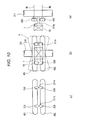
- Fig. 10 shows views depicting a fourth modified example of the invention.
- Fig. 10 is a side view showing a headstock 211, an upper cross portion 451, a lower cross portion 452, an attaching bracket 7, and a hydraulic unit 82 that is an example of a vehicle component of a vehicle according to the fourth modified example.
- Fig. 10 is a view that results from viewing (a) in Fig. 10 from the direction of an upper middle axis M1.
- (c) in Fig. 10 is a view in which the upper cross portion 451 and the lower cross portion 452 being taken out from (b) in Fig. 10 .
- both the upper cross portion 451 and the lower cross portion 452 are disposed ahead of the headstock 211.
- both the upper cross portion 451 and the lower cross portion 452 are provided ahead of the headstock 211.
- the upper cross portion 451 and the lower cross portion 452 are disposed near to each other in relation to a up-and-down direction of a body frame 21, and therefore, the upper cross portion 451 and the lower cross portion 452 form a front movable outer edge V that is defined by a continuous combination of movable outer edges that are defined individually by the upper and lower cross portions.
- Two through wall portions 516 are formed in a lower surface of the upper cross portion 451 so as to be depressed upwards in the up-and-down direction of the body frame 21.
- the two through wall portions 516 are provided individually at a left portion and a right portion of the lower surface of the upper cross portion 451 in relation to the left-and-right direction of the body frame 21. Spaces defined by the through wall portions 516 penetrate the upper cross portion 451 in the direction of the upper middle axis M1.
- Two through wall portions 526 are formed in an upper surface of the lower cross portion 452 so as to be depressed downwards in the up-and-down direction of the body frame 21.
- the two through wall portions 526 are provided individually at a left portion and a right portion of the lower surface of the lower cross portion 452 in relation to the left-and-right direction of the body frame 21. Spaces defined by the through wall portions 526 penetrate the lower cross portion 452 in the direction of a lower middle axis M4.
- the through wall portions 526 in the lower cross portion 452 are formed in the same positions as the positions of the through wall portions 516 in the upper cross portion 451 in relation to the left-and-right direction of the body frame 21 as seen from the direction of the lower middle axis M4.
- the through wall portions 516, 526 are provided in the front movable outer edge V that is defined by the upper cross portion 451 and the lower cross portion 452.
- the through wall portions 516, 526 define a space V3 that does not overlap the upper cross portion 451 and the lower cross portion 452 that lie in front of the headstock 211 when the upper cross portion 451 and the lower cross portion 452 turn relative to the body frame 21.
- the attaching bracket 7 that supports the hydraulic unit 82 is supported on the body frame 21 via fourth penetrating portions 211e that are disposed in the space V3 that is defined by the through wall portions 516, 526.
- the vehicle component is supported on the body frame 21 by the fourth penetrating portions 211e that are provided in the front movable outer edge V and are disposed in the space V3 that is defined by the through wall portions 516, 526 as seen from the direction of the upper middle axis M1, the supporting construction of the vehicle component is difficult to be enlarged.
- a link mechanism 5 has the upper cross portion 451 (an example of a front upper cross portion) that lies ahead of the headstock 211 and the lower cross portion 452 (an example of a front lower cross portion) of which the lower middle axis M4 lies below the upper cross portion 451 and which lies ahead of the headstock 211.
- the through wall portions 516, 526 have the through wall portions 516 (an example of an upper through portion) that is part of a lower edge of the upper cross portion 451 and the through wall portions 526 (an example of a lower through portion) that is part of an upper edge of the lower cross portion 452.
- Fig. 11 is a side sectional view including a link mechanism 5 of a vehicle 1 according to a fifth modified example of the invention.
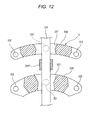
- Fig. 12 is a sectional view taken along the line IX-IX in Fig. 11 that results when Fig. 11 is seen from the direction of an upper middle axis M1.
- the link mechanism 5 includes an upper cross portion and a lower cross portion.
- the upper cross portion includes a front upper cross portion 51A and a rear upper cross portion 51 B.
- the lower cross portion includes a front lower portion 52A and a rear lower cross portion 52B.
- a front cross portion 50A that includes the front upper cross portion 51A and the front lower cross portion 52A lies ahead of a headstock 211.
- the front upper cross portion 51A and the front lower cross portion 52A form a front movable outer edge V that is formed by a continuous combination of movable outer edges that are defined by the front upper and lower cross portions.
- the first penetrating portion 211a and the second penetrating portion 211 b are described as penetrating individually the upper cross portion 51 and the lower cross portion 52.
- the invention is not limited thereto.
- a configuration may be adopted in which a fifth penetrating portion 211f penetrates a space defined between the front upper cross portion 51A and the front lower cross portion 52A.
- a configuration may be adopted in which the fifth penetrating portion 211f lies below the front upper cross portion 51A and above the front lower cross portion 52A.
- space forming portions 517, 527 are formed individually in the rear upper cross portion 51 B and the rear lower cross portion 52B.
- the space forming portions 517 are formed so as to stretch in a front-and-rear direction from the front upper cross portion 51A to the rear upper cross portion 51B.
- the space forming portions 527 are formed so as to stretch in the front-and-rear direction from the front lower cross portion 52A to the rear lower cross portion 52B.
- the space forming portions 517 restrict the front upper cross portion 51 A and the rear upper cross portion 51 B from moving relative to the headstock 211 when the link mechanism 5 operates.
- the space forming portions 527 restrict the front lower cross portion 52A and the rear lower cross portion 52B from moving relative to the headstock 211 when the link mechanism 5 operates.
- the space forming portions 517, 527 restrict the front upper cross portion 51A and the front lower cross portion 52A from moving when the link mechanism 5 operates to thereby form a space between the front upper cross portion 51 A and the front lower cross portion 52A.
- the space forming portions 517 are brought into contact with the headstock 211 to restrict the relative movement of the front upper cross portion 51A and the rear upper cross portion 51 B to the headstock 211.
- the space forming portions 527 are brought into contact with the headstock 211 to restrict the relative movement of the front lower cross portion 52A and the rear lower cross portion 52B to the headstock 211.
- the fifth through portion 211f is prevented from being brought into contact with the front upper cross portion 51A and the front lower cross portion 52A.
- the space forming portions 517, 527 form the space so that the front upper cross portion 51A and the front lower cross portion 52A are prevented from being brought into contact with the fifth penetrating portion 211.
- the space forming portions 517, 527 form a space that does not overlap the front cross portion 50A when the front cross portion 50A turns relative to the body frame 21 inward of a front movable outer edge V that constitutes an outer edge of a locus that is defined when the front cross portion 50A turns relative to the body frame 21 as seen from the direction of middle axes M1, M4.
- the vehicle component such as the hydraulic unit 82 is supported on the body frame 21 via the fifth penetrating portion 211f (an example of a component support portion) that is disposed within the space defined by the space forming portions 517, 527.
- the fifth penetrating portion 211f penetrates below a movable outer edge of the front upper cross portion 51A and above a movable outer edge of the front lower cross portion 52A as seen from the direction of the middle axes M1, M4.
- the fifth penetrating portion 211f penetrates a space that is defined by a locus that is defined by a lower edge of the front upper cross portion 51A when the front upper cross portion 51A turns relative to the body frame 21 and a locus that is defined by an upper edge of the front lower cross portion 52A when the front lower cross portion 52A turns relative to the body frame 21 as seen from the direction of the middle axes M1, M4.
- the fifth penetrating portion 211f penetrates the front movable outer edge V that is formed by a continuous combination of respective movable outer edges of the front upper cross portion 51A and the front lower cross portion 52A as seen from the direction of the middle axes M1, M4.
- This configuration also enables the vehicle component to be supported in front of the link mechanism 5 without enlarging a front portion of the vehicle by causing the fifth penetrating portion 211f to penetrate inside the front movable outer edge V relative to the body frame 21 of the front cross portion 50A.
- the space forming portions 517, 527 should form the space that does not overlap the front cross portion 50A when the front cross portion 50A turns relative to the body frame 21 inward of the front movable outer edge V that is defined by the front upper cross portion 51A and the front lower cross portion 52A, and hence, the invention is not limited to what is described in this modified example.
- the space forming portions 527 maybe provided in the lower cross portion that includes the front lower cross portion 52A and the rear lower cross portion 52B other than the front lower cross portion 52A and the rear lower cross portion 52B.
- the space forming portions may be provided on either the front cross portion or the lower cross portion and do not have to be provided on the other.
- the first through hole 513 and the second through hole 523 include the turning centers or axes that do not move even though the link mechanism 5 operates. It is preferable that the first penetrating portion 211 a and the second penetrating portion 211 b penetrate the first through hole 513 and the second through hole 523, respectively.
- the through holes 513, 523 do not move even though the link mechanism 5 operates, the through holes 513, 523 that are provided in the link mechanism 5 can be the smallest through holes that allow the penetration of the first penetrating portion 211a and the second penetrating portion 211b.
- parallel also includes two straight lines that do not intersect each other as members while they are inclined within the range of ⁇ 40 degrees.
- first straight lines that do not intersect each other as members while they are inclined within the range of ⁇ 40 degrees.
- first straight lines that do not intersect each other as members while they are inclined within the range of ⁇ 40 degrees.
- second straight lines that do not intersect each other as members while they are inclined within the range of ⁇ 40 degrees.
- first straight lines that do not intersect each other as members while they are inclined within the range of ⁇ 40 degrees.
- first straight lines also includes two straight lines that do not intersect each other as members while they are inclined within the range of ⁇ 40 degrees.
- first straight lines also includes a case where what follows the direction and the member is inclined relative thereto within the range of ⁇ 40 degrees.
- extend also includes a case where what extends is inclined relative to the direction within the range of ⁇ 40 degrees.
- the vehicle according to the invention is the vehicle that includes the body frame that can lean and the two front wheels.
- the number of rear wheels is not limited to one, and hence, may be two.
- the vehicle may include the body cover that covers the body frame.
- the vehicle may not include the body cover which covers the body frame.
- the power unit includes the power source.
- the power source is not limited to the engine and hence may be an electric motor.
- the right side portion 53, the left side portion 54 and the headstock 211 are provided in positions that are superposed one on another when the body frame 21 is seen from a side thereof.
- the headstock 211 may be provided in a different position from the positions where the right side portion 53 and the left side portion 54 are provided in relation to the front-and-rear direction.
- angles at which the right side portion 53 and the left side portion 54 are inclined relative to the up-and-down direction of the body frame 21 may differ from an angle at which the headstock 211 is inclined.
- the link support portion (the headstock) may be made up of a single part or a plurality of parts.
- the parts may be joined together through welding, bonding or the like.
- the parts may be joined together with fastening members such as bolts, rivets or the like.
- the upper cross portion may include an upper front cross portion that is made up of a single part, an upper rear cross portion that is made up of a single part, and a connecting member that is provided between the upper and lower cross portions and that is made up of a plurality of parts.
- the links support portion being made up of a plurality of parts, the parts may be joined together through welding, bonding or the like. Alternatively, the parts may be joined together with fastening members such as bolts, rivets or the like.
- the lower cross portion may include a lower front cross portion that is made up of a single part, a lower rear cross portion that is made up of a single part and a connecting member that is provided between the lower front and rear cross portions and that is made up of a plurality of parts.
- the links support portion being made up of a plurality of parts, the parts may be joined together through welding, bonding or the like. Alternatively, the parts may be joined together with fastening members such as bolts, rivets or the like.
- the right side portion and the left side portion may each be made up of a single part or a plurality of parts.
- the parts may be joined together through welding, bonding or the like.
- the parts may be joined together with fastening members such as bolts, rivets or the like.
- the right side portion and the left side portion may each include a portion that is disposed ahead of the upper cross portion or the lower cross portion in the front-and-rear direction of the vehicle body frame and a portion that is disposed behind the upper cross portion or the lower cross portion in the front-and-rear direction of the vehicle body frame.
- the upper cross portion or the lower cross portion may be disposed between the portions that are disposed at the front of the right side portion and the left side portion and the portions that are disposed at the rear of the right side portion and the left side portion.
- the body frame has the link support portion, the connecting member (the upper front and rear frame portions), the down frame (the upper and lower frame portions) and the under frame (the lower front and rear frame portions), and these constituent parts are connected together through welding.
- the body frame of the invention is not limited to the embodiment.
- the body frame should have the link support portion, the upper front and rear frame portions, the upper and lower frame portions and the lower front and rear frame portions.
- the body frame may be formed integrally wholly or partially through casting.
- the upper front and rear frame portions and the upper and lower frame portions may be made up of a single member or may be made up of separate members.
- an acute angle formed by the turning axis SA of the steering shaft and the up-and-down direction of the body frame coincides with an acute angle formed by the direction in which the right shock absorber and the left shock absorber extend or contract and the up-and-down direction of the body frame.
- the invention is not limited to the embodiment.
- the acute angle formed by the turning axis SA of the steering shaft and the up-and-down direction of the body frame may be smaller or larger than the acute angle formed by the direction in which the right shock absorber and the left shock absorber extend or contract and the up-and-down direction of the body frame.
- the turning axis of the steering shaft and the direction in which the right shock absorber and the left shock absorber extend or contact coincide with each other.
- the invention is not limited to the embodiment.
- the turning axis of the steering shaft and the direction in which the right shock absorber and the left shock absorber extend or contact may be spaced away from each other in the front-and-rear direction.
- the turning axis of the steering shaft and the direction in which the right shock absorber and the left shock absorber extend or contact may intersect each other.
- the right front wheel and the left front wheel are supported so that their upper ends can move further upwards than an upper end of the down frame of the body frame.
- the invention is not limited to the embodiments.
- the right front wheel and the left front wheel may be supported so that their upper ends can move upwards as high as or to a height that is lower than the upper end of the down frame of the body frame in the up-and-down direction of the body frame.
- the link mechanism may include further a cross portion in addition to the upper cross portion and the lower cross portion.
- the upper cross portion and the lower cross portion are so called only from their relative positional relationship in the up-and-down direction.
- the upper cross portion does not imply an uppermost cross portion in the link mechanism.
- the upper cross portion means a cross portion that lies above a cross portion that lies therebelow.
- the lower cross portion does not imply a lowermost cross portion in the link mechanism.
- the lower cross portion means a cross portion that lies below a cross portion that lies thereabove.
- the cross portion may be made up of two parts of a right cross portion and a left cross portion.
- the upper cross portion and the lower cross portion may each include a plurality of parts as long as they still make up the link function. Further, other cross portions may be provided between the upper cross portion and the lower cross portion.
- the link mechanism should include the upper cross portion and the lower cross portion.
- the vehicle components are described as including the headlamp 81, the hydraulic unit 82, the windshield 222, the front cover 221 and the like.
- the vehicle components are not limited thereto.
- the vehicle components can include a horn, turn signals, a radiator, a battery, an anti-theft device, a brake hose, a fastening device for the brake hose, body covers other than the windshield and the front cover, various meters, and the like.
- the shape of the attaching bracket 7 that attaches the vehicle component to the penetrating portions is not limited to the shape described in the embodiment. Additionally, the vehicle component may be fixed directly to the first penetrating portion 211a and the second penetrating portion 211 b or the third penetrating portions 211 c without interposing the attaching bracket therebetween.
- the vehicle component is described as being disposed as high as the link mechanism 5 in relation to the up-and-down direction of the body frame 21 and in front of the link mechanism 5.
- the invention is not limited thereto.
- a vehicle component that is disposed slightly higher or lower than the link mechanism and in front of the link mechanism 5 may be supported on the penetrating portions that penetrate the link mechanism 5.
- the penetrating portion is described as being the member that protrudes to the front from the headstock 211.
- the invention is not limited thereto.
- the penetrating portion may be provided so that the penetrating portion protrudes to the front from a member of the body frame 21 other than the headstock that lies behind the link mechanism 5 to penetrate the link mechanism 5.
- the invention may be such that the component support portion that supports the vehicle component is provided entirely in the space that is defined by the through portions. Additionally, part of the component support portion is provided in the through portion and the remaining of the component support portion may be provided not in the through portion but outward of the front movable outer edge of the front cross portion. At least part of the component support portion should be provided in the through portion.
Landscapes
- Engineering & Computer Science (AREA)
- Mechanical Engineering (AREA)
- Chemical & Material Sciences (AREA)
- Combustion & Propulsion (AREA)
- Transportation (AREA)
- Automatic Cycles, And Cycles In General (AREA)
- Vehicle Body Suspensions (AREA)
Abstract
Description
- The present invention relates to a vehicle that includes a body frame that can lean and two front wheels.
- Vehicles including a body frame that can lean and two front wheels are known in Non-Patent
Document 1,Patent Document 1 and the like. In the vehicle described in Non-PatentDocument 1 on which a link mechanism is mounted, vehicle components such as a radiator, a headlamp and the like are disposed directly ahead of the link mechanism. - In the vehicles described in Non-Patent
Document 1 andPatent Document 1, the link mechanism is disposed not between the right front wheel and the left front wheel but above the right front wheel and the left front wheel. This configuration restricts the enlargement of a space defined in a left-to-right direction of the vehicle. - [Non-Patent Document 1] Catalogo partidi ricambio, MP3 300 64102 ie LT Mod. ZAPM64102, Piaggio
- [Patent Document 1]
U.S. Design Patent No. 547,242 - In the vehicle described in Non-Patent
Document 1 that includes the body frame that leans and the two front wheels, a front portion of the vehicle becomes large. This is attributed to the fact that the vehicle includes the two steerable front wheels, that is, the right front wheel and the left front wheel and the link mechanism that supports the right front wheel and the left front wheel so as to be displaced relative to the body frame in an up-and-down direction of the body frame. With the body frame leaning with respect to a vertical direction, members that make up the link mechanism move largely, and the right front wheel and the left front wheel are displaced largely relative to the body frame. This increases the size of an external vehicle component that is provided at the front portion of the vehicle so as to avoid its interference with the link mechanism that moves largely and the right front wheel and the left front wheel that are displaced largely. Further, vehicle components such as a headlamp, turn signal lamps, a front cover, a radiator and the like are also disposed at the front portion of the vehicle. Because of these facts, in this type of vehicle, the front portion of the vehicle which is above the two front wheels tends to be enlarged. -
Fig. 13 is a schematic view showing the body frame of the vehicle described in Non-PatentDocument 1. In the configuration described in Non-PatentDocument 1, the vehicle components like the body cover and the radiator are supported on thebody frame 110 by asupport member 100. Thissupport member 100 includes anupper support member 101 that extends forwards from above thelink mechanism 105 so as to avoid the interference with thelink mechanism 105 and alower support member 103 that extends forwards and downwards from theupper support member 101. The body cover is attached to theupper support member 101. The radiator is attached to thelower support member 103. As a result of this configuration, in the vehicle described in Non-PatentDocument 1 that includes the body frame that leans and the two front wheels, the front portion of the vehicle becomes large. - Then, the invention provides a vehicle including a body frame that leans and two front wheels that can restrict the enlargement of the vehicle even though vehicle components are mounted.
- With a view to solving the problem, according to a mode (1) that the invention can take, there is provided a vehicle comprising:
- a body frame;
- a left front wheel and a right front wheel that are disposed laterally when seen from the front of the vehicle and that can be steered;
- a left shock absorbing device that supports the left front wheel at a lower portion thereof and that absorbs an upward displacement of the left front wheel in an up-and-down direction of the body frame;
- a right shock absorbing device that supports the right front wheel at a lower portion thereof and that absorbs an upward displacement of the right front wheel in the up-and-down direction of the body frame;
- a link mechanism including a right side portion that supports an upper portion of the right shock absorbing device so as to turn about a right steering axis that extends in the up-and-down direction of the body frame, a left side portion that supports an upper portion of the left shock absorbing device so as to turn about a left turning axis that is parallel to the right steering axis, and a cross portion that supports the right side portion at a right end portion thereof so as to turn about a right axis that extends in a front-and-rear direction of the body frame and supports the left side portion at a left end portion thereof so as to turn about a left axis that is parallel to the right axis and that is supported on a link support portion that is part of the body frame at a middle portion thereof so as to turn about a middle axis that is parallel to the right axis and the left axis, and
- a vehicle component that is disposed ahead of the body frame in relation to the front-and-rear direction of the body frame,
- wherein the cross portion includes a front cross portion that lies ahead of the link support portion of the body frame,
- the link mechanism has a through portion that defines a space that does not overlap the front cross portion when the cross portion turns relative to the body frame inward of a front movable outer edge that is an outer edge of a locus formed when the cross portion turns relative to the body frame as seen from the direction of the middle axis, and
- the vehicle component is supported on the body frame via a component support portion that is disposed within the space defined by the through portion.
- Conventionally proposed vehicles that include a body frame that leans and two front wheels as described in Non-Patent
Document 1 orPatent Document 1 tend to have a large front portion. Then, those conventionally proposed vehicles that include the body frame that leans and the two front wheels as described in Non-PatentDocument 1 orPatent Document 1 have been studied and analyzed in relation to a support construction of a vehicle component. The vehicle described in Non-PatentDocument 1 orPatent Document 1 includes a cross portion of the link mechanism and the vehicle component. As seen from the direction of the middle axis, the cross portion always lies inward of a movable outer edge that is an outer edge of a locus formed by the cross portion when the cross portion is turned. A component support portion that supports the vehicle component is formed so as to move around outward of the movable outer edge of the cross portion as seen from the direction of the middle axis in order to avoid an interference of the vehicle component with the cross portion. Specifically, the vehicle described inNon-Patent Document 1 orPatent Document 1 has an upper stay that extends from the body frame to the front of the link mechanism by moving around above the movable outer edge of the cross portion. Additionally, the vehicle has a lower stay that extends from the body frame to the front of the link mechanism by moving around below the movable outer edge of the cross portion. It has been found out that the front portion of the vehicle is enlarged due to the upper stay and the lower stay being disposed above and below the movable outer edge of the cross portion. Further, it has also been found out from the results of the analysis that a long distance defined between the vehicle component and the body frame lengthens the upper stay and the lower stay. In addition to this, the upper stay and the lower stay are enlarged in order to ensure the rigidity with which the vehicle component is supported. The increase in size of the upper stay and the lower stay enlarges the front portion of the vehicle. - As a result of the study and the analysis having been carried out, the inventors have reached the technical idea that the component support portion does not move around (detour) the movable outer edge of the cross portion in place of the conventional technical idea that the component support portion moves around (detours) the movable outer edge of the cross portion. This technical idea could first be found out through a detailed analysis of the turning of the cross member relative to the body frame. The movable outer edge of the cross portion is large. This is attributed to the fact that the shape of the cross portion is configured to be large enough to bear a load that is exerted on the front wheels. This limits the attempt to make the movable outer edge of the cross portion small. Additionally, the cross portion is turnably supported on the body frame. In addition, the cross portion includes a front cross portion that lies ahead of a link support portion of the body frame. Because of this, the inventors have noticed that avoiding the interference with the front cross portion makes it difficult to enlarge the front portion of the vehicle even though the vehicle component is disposed at the front portion of the vehicle. Then, thinking the other way round, the inventors have reached the technical idea that the vehicle component is supported inward of the large movable outer edge of the cross portion, that is, the technical idea that the vehicle component does not move around the movable outer edge of the cross portion. Additionally, the inventors have noticed that a through portion can be formed easily inward of the movable outer edge of the cross portion by making use of the original large shape of the cross portion that has conventionally been considered as a demerit while devising the shape of the cross portion. In addition, the inventors have noticed that it is possible to restrict the enlargement of the movable outer edge of the cross portion even though the through portion is formed in the link mechanism. The present invention has been accomplished based on these knowledge obtained through the study and the analyses.
- According to the mode (1) that the invention can take, the cross portion includes the front cross portion that lies ahead of the link support portion of the body frame. The link mechanism has the through portion that does not overlap the front cross portion when the cross portion turns relative to the body frame where is inward of the front movable outer edge that is the outer edge of the locus formed when the cross portion turns relative to the body frame as seen from the direction of the middle axis. The vehicle component is supported on the body frame via the component support portion that is disposed within the space defined by the through portion.
- Consequently, even though the vehicle component is mounted on the vehicle that includes the body frame that leans and the two front wheels, it is possible to restrict the enlargement of the vehicle.
- According to a mode (2) that the invention can take, in the vehicle, the through portion may lie inward of the outer edge of the front cross portion that lies ahead of the link support portion as seen from the direction of the middle axis.
- According to the mode (2), since the through portion is defined inward of the outer edge of the front cross portion, it is possible to restrict further the enlargement of the front movable outer edge of the front cross portion. Consequently, even though the vehicle component is mounted on the vehicle that includes the body frame that leans and the two front wheels, it is possible to restrict further the enlargement of the vehicle.
- According to a mode (3) that the invention can take, in the vehicle, the through portion may lie closer to the middle axis than a left end portion and a right end portion of the front cross portion that lies ahead of the link support portion.
- A size of the through portion as seen from the direction of the middle axis can be made smaller as the through portion is disposed closer to the middle axis. Because of this, according to the mode (3), even through the vehicle component is mounted on the vehicle that includes the body frame that leans and the two front wheels, it is possible to restrict further the enlargement of the vehicle.
- According to a mode (4) that the invention can take, in the vehicle, the middle axis may lie within the space defined by the through portion as seen from the direction of the middle axis.
- The middle axis neither moves nor turns with respect to the body frame even though the link mechanism operates. Because of this, according to the mode (4), the through portion can be defined to a required minimum size. Consequently, even though the vehicle component is mounted on the vehicle that includes the body frame that leans and the two front wheels, it is possible to restrict further the enlargement of the vehicle.
- According to a mode (5) that the invention can take, in the vehicle, the component support portion may be part of a turning support portion that supports the front cross portion on the link support portion so as to turn.
- According to the mode (5), since the component support portion can be made up by using the portion that supports the front cross portion, a separate component support portion does not have to be provided, and the vehicle component can be supported with the simple configuration. Consequently, even though the vehicle component is mounted on the vehicle that includes the body frame that leans and the two front wheels, it is possible to restrict further the enlargement of the vehicle.
- According to a mode (6) that the invention can take, in the vehicle, the through portion may define an elongated hole that includes an arc that is centered at the middle axis of the front cross portion.
- According to the mode (6), the through portion defines an ellipse that includes the arc that is centered at the middle axis that constitutes the turning center of the cross portion relative to the body frame. This makes it possible to make the shape of the through portion small while avoiding the interference of the space that is defined by the through portion with the component support portion. Consequently, even though the vehicle component is mounted on the vehicle that includes the body frame that leans and the two front wheels, it is possible to restrict further the enlargement of the vehicle.
- According to a mode (7) that the invention can take, in the vehicle, the link mechanism may have a front upper cross portion that lies ahead of the link support portion and a front lower cross portion of which the middle axis lies below the upper cross portion and which lies ahead of the link support portion, and the through portion may have an upper through portion that is part of a lower edge of the front upper cross portion and a lower through portion that is part of an upper edge of the front lower cross portion.
- According to the mode (7), a gap defined between the front upper cross portion and the front lower cross portion is used to provide the component support portion. This enhances the utilization efficiency of the space at the front portion of the vehicle. Consequently, even though the vehicle component is mounted on the vehicle that includes the body frame that leans and the two front wheels, it is possible to restrict further the enlargement of the vehicle.
- According to a mode (8) that the invention can take, in the vehicle, the vehicle component may be supported at the link support portion of the body frame.
- According to the mode (8), the link mechanism supports the link mechanism that supports the right front wheel, the left front wheel, the right shock absorbing device and the left shock absorbing device and is highly rigid. Because of this, by supporting the vehicle component by making use of its high rigidity, the configuration that supports the vehicle component can be simplified. Consequently, even though the vehicle component is mounted on the vehicle that includes the body frame that leans and the two front wheels, it is possible to restrict further the enlargement of the vehicle.
- According to a mode (9) that the invention can take, in the vehicle, a plurality of through portions may be provided, and wherein a plurality of component support portions may be provided.
- According to the mode (9), the vehicle component can be supported at a plurality of locations to thereby be supported strongly and rigidly. The individual component support portions can be formed small so as to make it easy to avoid their interference with the link mechanism. Consequently, even though the vehicle component is mounted on the vehicle that includes the body frame that leans and the two front wheels, it is possible to restrict further the enlargement of the vehicle.
- According to a mode (10) that the invention can take, in the vehicle, the vehicle component, when seen from the direction of the middle axis, may be supported on the body frame via a connecting portion that is not disposed in the space that is defined by the through portion but is disposed outward of the front movable outer edge.
- According to the mode (10), the supporting rigidity with which the vehicle component is supported is easily ensured by the component support portion and the connecting portion. Consequently, even though the vehicle component is mounted on the vehicle that includes the body frame that leans and the two front wheels, it is possible to restrict further the enlargement of the vehicle.
- According to a mode (11) that the invention can take, in the vehicle, the component support portion may be part of at least any one of the body frame, the vehicle component, and an attaching bracket with which the vehicle component is attached to the body frame.
- According to the mode (11), the component support portion can be made up by using any one of the other members. Consequently, even though the vehicle component is mounted on the vehicle that includes the body frame that leans and the two front wheels, it is possible to restrict further the enlargement of the vehicle.
-
- [
Fig. 1] Fig. 1 is a left side view of a vehicle according to an embodiment of the invention. - [
Fig. 2] Fig. 2 is an overall front view of the vehicle shown inFig. 1 with a body cover removed. - [
Fig. 3] Fig. 3 is a sectional view of a front portion of the vehicle shown inFig. 1 as seen from the right thereof. - [
Fig. 4] Fig. 4 is a perspective view of an attaching bracket. - [
Fig. 5] Fig. 5 is a front view showing the attaching bracket, a hydraulic unit and a headlamp. - [
Fig. 6] Fig. 6 is an overall front view showing a state in which the vehicle is caused to lean. - [
Fig. 7] Fig. 7 is a front view showing a link mechanism and a support member of a vehicle according to a first modified example of the invention. - [
Fig. 8] Fig. 8 shows a side sectional view that shows a link mechanism and a component support portion of a vehicle according to a second modified example of the invention. - [
Fig. 9] Fig. 9 shows views of a link mechanism and a component support portion of a vehicle according to a third modified example of the invention. - [
Fig. 10] Fig. 10 shows views of a link mechanism and a component support portion of a vehicle according to a fourth modified example of the invention. - [
Fig. 11] Fig. 11 is a view showing a link mechanism and a component support portion of a vehicle according to a fifth modified example of the invention. - [
Fig. 12] Fig. 12 . is a view showing the link mechanism and the component support portion of a vehicle according to the fifth modified example of the invention. - [
Fig. 13] Fig. 13 is a perspective view showing a body frame of a vehicle according to - Hereinafter, a
vehicle 1 that is one type of vehicle according to an embodiment of the invention will be described by reference to the drawings. In the drawings, like reference numerals are given to like or corresponding portions and the description thereof will not be made repeatedly. - In the following description, an arrow F in the drawings denotes a forward direction of the
vehicle 1. An arrow R in the drawings denotes a rightward direction of thevehicle 1. An arrow U denotes an upward direction. A center in a width direction or a transverse center of the vehicle means a central position in the width direction of the vehicle as seen from the front. A transversely lateral direction of the vehicle means a leftward or rightward direction as seen from the transverse center of the vehicle. -
Fig. 1 is a schematic overall side view of thevehicle 1. In the following description, when front, rear, left and right are referred to in indicating directions, they denote front, rear, left and right as seen from a rider who rides on thevehicle 1. - The
vehicle 1 includes a vehicle main body 2,front wheels 3 and arear wheel 4. The vehicle main body 2 is made up mainly of avehicle body frame 21, abody cover 22, ahandlebar 23, aseat 24, and apower unit 25. - The
body frame 21 supports thepower unit 25, theseat 24 and the like. Thepower unit 25 includes a power source such as an engine or an electric motor, a transmission and the like. InFig. 1 , thebody frame 21 is shown by broken lines. - The
body frame 21 includes aheadstock 211, afront frame 212 and arear frame 213. Theheadstock 211 is disposed at a front portion of the vehicle. Alink mechanism 5 is disposed on the periphery of theheadstock 211. - A steering
shaft 60 is turnably inserted in theheadstock 211. The steeringshaft 60 extends in an up-and-down direction. A first penetratingportion 211a and a second penetratingportion 211b protrude from theheadstock 211 to the front so as to penetrate thelink mechanism 5. - The
handlebar 23 is mounted on an upper end of the steeringshaft 60. Thefront frame 212 is inclined obliquely downward from a front end thereof to the rear. Therear frame 213 supports theseat 24 and a tail lamp. - The
body frame 21 is covered by thebody cover 22. The body cover 22 includes afront cover 221,front fenders 223 and arear fender 224. - The
front cover 221 lies ahead of theseat 24. Thefront cover 221 covers theheadstock 211 and thelink mechanism 5. - The
front fenders 223 are provided individually directly above thefront wheels 3 that are a pair of left and rightfront wheels 3. Thefront fenders 223 are disposed directly below thefront cover 221. Therear fender 224 is disposed directly above therear wheel 4. - The
front wheels 3 are disposed further downwards than theheadstock 211 and thelink mechanism 5. Thefront wheels 3 are disposed directly below thefront cover 221. -
Fig. 2 is an overall front view of thevehicle 1 with thebody cover 22 removed. Thevehicle 1 includes thehandlebar 23, the steeringshaft 60, theheadstock 211, the pair of left andfront wheels 3, and thelink mechanism 5. Thelink mechanism 5 is disposed on the periphery of theheadstock 211. Thelink mechanism 5 is connected to the pair of left and rightfront wheels 3, that is, aleft front wheel 31 and a rightfront wheel 32. Additionally, thelink mechanism 5 is turnably mounted on theheadstock 211. As shown inFigs. 2 ,3 , thelink mechanism 5 includes across portion 50 and aside portion 55. Thecross portion 50 has afront cross portion 50A that lies ahead of theheadstock 211 and arear cross portion 50B that lies behind theheadstock 211. Anupper cross portion 51 has a frontupper cross portion 51A that lies ahead of theheadstock 211. Alower cross portion 52 has a frontlower cross portion 52A that lies ahead of theheadstock 211 and a rearlower cross portion 52B that lies behind theheadstock 211. Thefront cross portion 50A has the frontupper cross portion 51A and the frontlower cross portion 52A. Therear cross portion 50B has a rearlower cross portion 52B. Theside portion 55 includes aleft side portion 53 and aright side portion 54. - The
front wheels 3 include theright front wheel 31 and the leftfront wheels 32 that can be steered. Theleft front wheel 31 is disposed further leftwards than a transverse center or middle portion of the vehicle. Afirst front fender 223a, which is one of thefront fenders 223, is disposed directly above theleft front wheel 31. Theright front wheel 32 is disposed further rightwards than the transverse middle portion of the vehicle. A secondfront fender 223b, which is the other of thefront fenders 223, is disposed directly above theright front wheel 32. Theright front wheel 32 is disposed so as to be symmetric with theleft front wheel 31 with respect to the transverse middle portion of the vehicle. - When referred to in this description, a "rightward direction RF of the
vehicle body frame 21" denotes a rightward direction of directions that intersect an axial direction of theheadstock 211 perpendicularly in a front view of thevehicle 1. Additionally, when referred to, an upward direction UF of the body frame21 denotes an upward direction of the body frame21 when thevehicle 1 rests upright. For example, the upward direction of thebody frame 21 coincides with an axial direction of theheadstock 211 in the front view of thevehicle 1. In such a state that thevehicle 1 rests in an upright state as shown inFig. 2 , the rightward direction RF of the vehicle body frame21 coincides with a rightward direction R in the horizontal direction. Because of this, only the rightward direction R in the horizontal direction is shown inFig. 2 . In such a state that thevehicle 1 leans relative to a road surface G as shown inFig. 6 , the rightward direction RF of thebody frame 21 does not coincide with the rightward direction R in the horizontal direction, and the upward direction UF of thebody frame 21 does not coincide with an upward direction U in the vertical direction. - The
left front wheel 31 is connected to aleft shock absorber 33. Theleft front wheel 31 is connected to a lower portion of theleft shock absorber 33. Theleft front wheel 31 can rotate about arotational shaft 311. Therotational shaft 311 extends in a left-to-right direction of the body frame. Theleft front wheel 31 can turn about a turningaxis 312. Thevehicle 1 changes its traveling direction as a result of theleft front wheel 31 turning about the turningaxis 312. - The
right front wheel 32 is connected to aright shock absorber 34. Theright front wheel 32 is connected to a lower portion of theright shock absorber 34. Theright front wheel 32 can rotate about arotational shaft 321. Therotational shaft 321 extends in the left-and-right direction of thebody frame 21. Theright front wheel 32 can turn about a turningaxis 322. Thevehicle 1 changes its traveling direction as a result of theright front wheel 32 turning about the turningaxis 322. - The
left shock absorber 33 absorbs an impact exerted on theleft front wheel 31. Theleft shock absorber 33 is disposed below thelink mechanism 5 in relation to the up-and-down direction of thebody frame 21. Theleft shock absorber 33 is provided between the left side portion 53 (refer toFig. 3 ), which will be described later, and theleft front wheel 31. Theleft shock absorber 33 extends along a left steering axis N1 that is parallel to axes of the steeringshaft 60 and theheadstock 211. Theleft shock absorber 33 is disposed on the left of theheadstock 211 in relation to the left-and-right direction of thebody frame 21. Theleft shock absorber 33 is disposed on the right of theleft front wheel 31 in relation to the left-and-right direction of thebody frame 21. - The
right shock absorber 34 absorbs an impact exerted on theright front wheel 32. Theright shock absorber 34 is disposed below thelink mechanism 5 in relation to the up-and-down direction of thebody frame 21. Theright shock absorber 34 is provided between the right side portion 54 (refer toFig. 3 ), which will be described later, and theright front wheel 32. Theright shock absorber 34 extends along a right steering axis N2 that is parallel to the axes of the steeringshaft 60 and theheadstock 211. Theright shock absorber 34 is disposed on the right of theheadstock 211 in relation to the left-and-right direction of thebody frame 21. Theright shock absorber 34 is disposed on the left of theright front wheel 32 in relation to the left-and-right direction of thebody frame 21. - The
left side portion 53 is disposed on the left of theheadstock 211 in relation to the left-and-right direction of thebody frame 21. Theright side portion 54 is disposed on the right of theheadstock 211 in relation to the left-and-right direction of thebody frame 21. Theleft side portion 53 and theright side portion 54 are a circular cylindrical member. Theleft side portion 53 and theright side portion 54 are connected to theleft front wheel 31 and theright front wheel 32, respectively, at lower portions thereof. - The
left side portion 53 and theright side portion 54 extend in the up-and-down direction of thebody frame 21 with the vehicle resting in the upright state. Afirst bracket 335 is provided at the lower portion of theleft side portion 53, and theleft shock absorber 33 is connected to thefirst bracket 335. The lower portion of theleft side portion 53 supports theleft shock absorber 33 so as to turn about the left steering axis N1. - A
second bracket 336 is provided at the lower portion of theright side portion 54, and theright shock absorber 34 is connected to thesecond bracket 336. The lower portion of theright side portion 54 supports theright shock absorber 34 so as to turn about the right steering axis N2. - The
upper cross portion 51 is a member that extends in the left-and-right direction of thebody frame 21 as seen from the front of the vehicle. Theupper cross portion 51 is provided further forwards to the front of the vehicle than theheadstock 211. A first throughhole 513 is provided in a middle portion of theupper cross portion 51 in the left-and-right direction of thebody frame 21, and an upper left bearing 512 and an upper right bearing 512 are provided at both sides of theupper cross portion 51 in the left-and-right direction of thebody frame 21. The first penetratingportion 211 a that extends from theheadstock 211 is caused to penetrate through the first throughhole 513. -
Fig. 3 is a right side view of the front portion of the vehicle. As shown inFig. 3 , an upper middle bearing 511 is provided between the first penetratingportion 211 a and the first throughhole 513. This allows theupper cross portion 51 to be supported so as to turn about an upper middle axis M1 relative to theheadstock 211 by the first penetratingportion 211a and the uppermiddle bearing 511. Theupper cross portion 51 turns about the upper middle axis M1 that constitutes the center of the upper middle bearing 511 relative to theheadstock 211. The first throughhole 513 includes the upper middle axis M1 of theupper cross portion 51. - The
upper cross portion 51 is connected to an upper portion of theleft side portion 53 and an upper portion of theright side portion 54 via the upperleft bearing 512 and the upper right bearing 512, respectively. This allows theupper cross portion 51 to turn about an upper left axis M2 and an upper right axis M3 relative to theleft side portion 53 and theright side portion 54, respectively. The upper middle axis M1 that constitutes a turning center of the uppermiddle bearing 511, the upper left axis M2 that constitutes a turning center of the upper left bearing 512, and the upper right axis M3 that constitutes a turning center of the upper right bearing 512 are made to lie parallel to one another. - Returning to
Fig. 2 , thelower cross portion 52 is provided further downwards than theupper cross portion 51. Thelower cross portion 52 extends in the left-and-right direction when seen from the front of the vehicle. A length of thelower cross portion 52 in the left-and-right direction is substantially equal to a length of theupper cross portion 51 in the left-and-right direction. Thelower cross portion 52 is provided further downwards than theupper cross portion 51. - A second through
hole 523 is provided in a middle portion of thelower cross portion 52 in the left-and-right direction of thebody frame 21, and a lowerleft bearing 522 is provided on the left of the second throughhole 523, while a lowerright bearing 522 is provided on the right of the second throughhole 523. The second penetratingportion 211 b is caused to penetrate through the second throughhole 523. - As shown in
Fig. 3 , a lowermiddle bearing 521 is provided between the second penetratingportion 211 b and the second throughhole 523. This allows thelower cross portion 52 to be supported so as to turn about a lower middle axis M4 relative to theheadstock 211 by the second penetratingportion 211 b and the lowermiddle bearing 521. Thelower cross portion 52 turns about the lower middle axis M4 that constitutes the center of the lowermiddle bearing 521 relative to theheadstock 211. The second throughhole 523 includes the lower middle axis M4 of thelower cross portion 52. - The lower middle axis M4 that constitutes a turning center of the lower
middle bearing 521, a lower left axis M5 that constitutes a turning center of the lowerleft bearing 522, and a lower right axis M6 that constitutes a turning center of the lowerright bearing 522 are made to lie parallel to one another. Additionally, the lower middle axis M4 is provided so as to be parallel to the upper middle axis M1. In addition, with thevehicle 1 resting in the upright state, a position of the lower left bearing 522in the left-and-right direction in relation to thebody frame 21 is the same as a position of the upper left bearing 512 in the left-and-right direction in relation to thebody frame 21. With thevehicle 1 resting in the upright state, a position of the lowerright bearing 522 in the left-and-right direction in relation to thebody frame 21 is the same as a position of the upper right bearing 512 in the left-and-right direction in relation to thebody frame 21. - The
lower cross portion 52 is connected to the lower portion of theleft side portion 53 and the lower portion of theright side portion 54 via the lowerleft bearings 522 and the lowerright bearings 522, respectively. This allows thelower cross portion 52 to turn about the left steering axis N1 and the right steering axis N2 relative to theleft side portion 53 and theright side portion 54, respectively. - Thus, by being configured in the way described above, the
link mechanism 5 can be deformed within a plane that contains theupper cross portion 51, thelower cross portion 52, theleft side portion 53 and theright side portion 54. It is noted that thelink mechanism 5 is mounted on theheadstock 211. Because of this, even though the steeringshaft 60 turns as thehandlebar 23 is steered, thelink mechanism 5 does not turn relative to thebody frame 21. - <Tie Rod>
- The description continues by reference to
Fig. 2 . A tie-rod 6 transfers the steering of thehandlebar 23 to theleft front wheel 31 and theright front wheel 32. By doing so, theleft front wheel 31 and theright front wheel 32 can be steered by thehandlebar 23. The tie-rod 6 is provided ahead of theheadstock 211. The tie-rod 6 extends in the left-and-right direction. The tie-rod 6 is disposed below thelower cross portion 52 and above theleft front wheel 31 and theright front wheel 32. The tie-rod 6 is connected to a lower portion of the steeringshaft 60. When the steeringshaft 60 is turned, the tie-rod 6 moves laterally to the left or right. - As shown in
Fig. 2 , thefirst bracket 335 is provided at the lower portion of theleft side portion 53. Thefirst bracket 335 is connected to theleft shock absorber 33. - The
first bracket 335 is provided so as to turn relative to theleft side portion 53. The tie-rod 6 is also provided on thefirst bracket 335 so as to turn relative to theleft side portion 53. A turning shaft on which thefirst bracket 335 turns relative to theleft side portion 53 and a turning shaft on which thefirst bracket 335 turns relative to the tie-rod 6 are parallel to the left steering axis N1 along which theleft side portion 53 extends. - The
second bracket 336 is provided at the lower portion of theright side portion 54. Thesecond bracket 336 is connected to theright shock absorber 34. Thesecond bracket 336 is provided so as to turn relative to theright side portion 54. The tie-rod 6 is also provided on thesecond bracket 336 so as to turn relative to theright side portion 54. A turning axis on which thesecond bracket 336 turns relative to theright side portion 54 and a turning axis on which thesecond bracket 336 turns relative to the tie-rod 6 are parallel to the right steering axis N2 along which theright side portion 54 extends. - When the steering
shaft 60 turns as a result of thehandlebar 23 being steered, the tie-rod 6 moves laterally to the left or right. Then, thefirst bracket 335 turns about the turning shaft on which thefirst bracket 335 turns relative to theleft side portion 53 as the tie-rod 6 moves. This moves a connecting portion 52b where thefirst bracket 335 connects to theleft shock absorber 33 in the left-and-right direction, and theleft front wheel 31 turns about the turningaxis 312. - In this way, the
first bracket 335 transfers the steering of thehandlebar 23 to theleft front wheel 31. Similarly, thesecond bracket 336 transfers the steering of thehandlebar 23 to theright front wheel 32. - <Configuration of Front Portion of Vehicle>
- As shown in
Fig. 3 , aheadlamp 81 and ahydraulic unit 82 are provided in front of thelink mechanism 5. Additionally, thefront cover 221 and awindshield 222 are provided so as to cover theheadlamp 81 and thehydraulic unit 82. In the following description, theheadlamp 81, thehydraulic unit 82, thefront cover 221 and thewindshield 222 may be called a vehicle component altogether. - It is noted that the
hydraulic unit 82 is a unit that is used in an ABS (Anti-lock braking system). Thehydraulic unit 82 includes a metallic casing, a flow path provided in the casing, a pump and solenoid valves. Thehydraulic unit 82 controls a brake system, not shown, by switching paths through which brake fluid flows by the solenoid valves. - The vehicle component is supported on the
headstock 211 via an attachingbracket 7. In the following description, theheadlamp 81 and thehydraulic unit 82 will be taken as an example of a vehicle component, and a construction will be described in which theheadlamp 81 and thehydraulic unit 82 are attached to thebody frame 21. -
Fig. 4 is a perspective view of the attachingbracket 7.Fig. 5 is a front view showing the attachingbracket 7, part of theheadlamp 81, and thehydraulic unit 82. As shown inFigs. 4 ,5 , the attachingbracket 7 includes integrally aplate portion 71 and an extendingportion 72 that extends obliquely from theplate portion 71. It is noted that theheadlamp 81 and thehydraulic unit 82 overlap thelink mechanism 5 at least partially when the vehicle is seen from the front thereof as shown inFigs. 2 and5 . - As shown in
Fig. 4 , a first threadedhole 711 and a second threadedhole 712 are provided in theplate portion 71. A screw that is fixed to the first penetratingportion 211a extending from theheadstock 211 is inserted through the first threadedhole 711. A screw that is fixed to the second penetratingportion 211b extending from theheadstock 211 is inserted through the second threadedhole 712. The attachingbracket 7 is fixed to theheadstock 211 by fixing the screws to the corresponding penetrating portions. - A
first stay 73 is formed at a lower portion on a side of theplate portion 71 that faces the front of the vehicle. A third threadedhole 731 is provided in a transverse middle portion of thefirst stay 73. A pair of fourth threadedholes 732 are provided outward of the third threadedhole 731. A pair fifth threadedholes 733 are provided outward of the pair of fourth threadedholes 732. A pair of sixth threadedholes 734 are provided outward of the pair of fifth threadedholes 733. - As shown in
Fig. 5 , a screw is screwed through the third threadedhole 731 in thefirst stay 73 to fix an attachingpiece 821 of thehydraulic unit 82 in place. Screws are screwed through the fourth threadedholes 732 in thefirst stay 73 to fix an attachingpiece 822 of thehydraulic unit 82 in place. Thehydraulic unit 82 is fixed to the attachingbracket 7 by screwing the screws through the corresponding threaded holes. - Screws are screwed through the fifth threaded
holes 733 and the sixth threadedholes 734 in thefirst stay 73 to fix theheadlamp 81 in place. Theheadlamp 81 is fixed to the attachingbracket 7 in this way. - As shown in
Fig. 4 , asecond stay 74 and athird stay 75 are provided at a distal end of the extendingportion 72. As shown inFig. 3 , thewindshield 222 is fixed to thesecond stay 74. Thefront cover 221 is fixed to thethird stay 75. - The vehicle component is supported on the
body frame 21 via the attachingbracket 7 in the way described above. This attachingbracket 7 is fixed to the first penetratingportion 211 a and the second penetratingportion 211 b that protrude to the front from theheadstock 211 to penetrate through thelink mechanism 5. -
Fig. 6 is an overall front view of thevehicle 1 in which the vehicle body is caused to lean at an angle T in the left-and-right direction with respect to the vertical direction from the state shown inFig. 2 . When thelink mechanism 5 is actuated to operate, thevehicle 1 leans with respect to the vertical direction. - As this occurs, the
upper cross portion 51 and thelower cross portion 52 are translated in the left-and-right direction while the direction in which they extend is kept parallel to the road surface G. Theupper cross portion 51 and thelower cross portion 52 turn about the upper left axis M2 and the lower left axis M5, respectively, relative to theleft side portion 53. Additionally, theupper cross portion 51 and thelower cross portion 52 turn about the upper right axis M3 and the lower right axis M6, respectively, relative to theright side portion 54. - When the vehicle is seen from the front thereof, with the vehicle resting in the upright state, the
upper cross portion 51, thelower cross portion 52, theleft side portion 53 and theright side portion 54 form a rectangular shape, which is deformed when the vehicle is caused to lean. Then, as the vehicle is caused to lean further, theupper cross portion 51, thelower cross portion 52, theleft side portion 53, and theright side portion 54 are deformed into a parallelogram. In the following description, when seen from a direction that is parallel to the upper middle axis M1 of theupper cross portion 51 and the lower middle axis M4 of thelower cross portion 52, an area that includes theupper cross portion 51, thelower cross portion 52, theleft side portion 53 and theright side portion 54 and that is defined inside the parallelogram that is formed by these four portions will be called an operating space of thelink mechanism 5. - In this embodiment, the
link mechanism 5 operates so that a left end of theupper cross portion 51 moves further leftwards than a left end of thelower cross portion 52. When thelink mechanism 5 operates in this way, theleft shock absorber 33 and theright shock absorber 34 lean with respect to the vertical direction. When thevehicle 1 leans to the left with respect to the vertical direction in the way described above, the state of thevehicle 1 changes from the state shown inFig. 2 to the state shown inFig. 5 . - The
vehicle 1 according to this embodiment can be turned by causing the vehicle body to lean to the left or right while thevehicle 1 is running. Additionally, the directions of theleft front wheel 31 and theright front wheel 32 can also be changed by operating thehandlebar 23. - As shown in
Fig. 3 , in this embodiment, theupper cross portion 51 of thelink mechanism 5 lies ahead of theheadstock 211 of thebody frame 21. Here, an area that is surrounded by an outer edge of a range where theupper cross portion 51 and the frontlower cross portion 52A that lie ahead of theheadstock 211 move relative to thebody frame 21 when the vehicle is caused to lean at a largest-possible angle to the left or right is called a front movable outer edge V (refer toFigs. 2 ,3 and6 ). - As shown in
Fig. 2 , thelink mechanism 5 has a wall portion that makes up the first throughhole 513 that functions as the through portion defining a space that does not overlap theupper cross portion 51 that lies ahead of theheadstock 211 when theupper cross portion 51 turns relative to thebody frame 21. The space defined by this first throughhole 513 is provided within the front movable outer edge V as seen from the direction of the upper middle axis M1. - The first penetrating
portion 211a (an example of a component support portion) extends from theheadstock 211 to the front into this space that is defined by the first throughhole 513. Theheadlamp 81, thehydraulic unit 82, thefront cover 221 and the like are fixed to the attachingbracket 7 that is fixed to the first penetratingportion 211a. Namely, the vehicle component is supported on thebody frame 21 via the first penetratingportion 211a that is disposed within the space defined by the wall portion that makes up the first throughhole 513 is defined. - Further, as shown in
Fig. 2 , thelink mechanism 5 has a wall portion that makes up the second throughhole 523 which functions as the through portion defining a space that does not overlap the frontlower cross portion 51 that lies ahead of theheadstock 211 when the frontlower cross portion 52A turns relative to thebody frame 21. The space defined by this second throughhole 523 is provided within the front movable outer edge V as seen from the direction of the lower middle axis M4. - The second penetrating
portion 211 b (an example of a component support portion) extends from theheadstock 211 to the front into this space that is defined by the second throughhole 523. Theheadlamp 81, thehydraulic unit 82, thefront cover 221 and the like are fixed to the attachingbracket 7 that is fixed to the second penetratingportion 211 b. Namely, the vehicle component is supported on thebody frame 21 via the second penetratingportion 211b that is disposed within the space defined by the wall portion that makes up the second throughhole 523 is defined. - The
vehicle 1 according to the embodiment that has been described above includes: - the
body frame 21; - the
left front wheel 31 and theright front wheel 32 that are disposed in the left and right direction as seen from the front of the vehicle and that can be steered; - the
left shock absorber 33 that supports theleft front wheel 31 at the lower portion thereof and that absorbs the upward displacement of theleft front wheel 31 in the up-and-down direction of thebody frame 1; - the
right shock absorber 34 that supports theright front wheel 32 at the lower portion thereof and that absorbs the upward displacement of theright front wheel 32 in the up-and-down direction of thebody frame 21; - the
link mechanism 5; and - the vehicle components such as the
headlamp 81, thehydraulic unit 82, thefront cover 221, thewindshield 222 and the like that are disposed ahead of thelink mechanism 5. - The
link mechanism 5 includes: - the
right side portion 54 that supports the upper portion of theright shock absorber 34 so as to turn about the right steering axis N2 that extends in the up-and-down direction of thebody frame 21; - the
left side portion 53 that supports the upper portion of theleft shock absorber 33 so as to turn about the left steering axis N1 that is parallel to the right steering axis N2; and - the plurality of cross portions (the
upper cross portion 51 and the lower cross portion 52) that support theright side portion 54 at the right end portions thereof so as to turn about the right axes (the upper right axis M3 and the lower right axis M6) that extend in the front-and-rear direction of thebody frame 21 and supports theleft side portion 53 at the left end portions thereof so as to turn about the left axes (the upper left axis M2 and the lower left axis M5) that are parallel to the right axes M3, M6 and that are supported on the headstock 211 (an example of a link support portion) that is part of thebody frame 21 at the middle portions thereof so as to turn about the middle axes M1, M4 that are parallel to the right axes M3, M6 and the left axes M2, M5. - The
upper cross portion 51 lies ahead of theheadstock 211 of thebody frame 21. Thelink mechanism 5 has the wall portion (an example of a through portion) that is provided in the front movable outer edge V relative to thebody frame 21 of thefront cross portion 50A (theupper cross portion 51 and the frontlower cross portion 52A) that lies ahead of thebody frame 21 as seen from the direction of the upper middle axis M1 and that makes up the first throughhole 513 that defines the space that does not overlap thefront cross portion 50A that lies ahead of thebody frame 21 when thefront cross portion 50A turns relative to thebody frame 21. - The vehicle components such as the
headlamp 81, thehydraulic unit 82, thefront cover 221 and the like are supported on thebody frame 21 via the first penetratingportion 211 a (an example of a component support portion) that is disposed within the space defined by the wall portion that makes up the first throughhole 513 is formed. - Additionally, the front
lower cross portion 52A that is at least part of thecross portion 50 lies ahead of theheadstock 211. Thelink mechanism 5 has the wall portion (an example of a through portion) that is provided in the front movable outer edge V relative to thebody frame 21 of thefront cross portion 50A that lies ahead of thebody frame 21 as seen from the direction of the lower middle axis M4 and that makes up the second throughhole 523 that defines the space that does not overlap thefront cross portion 50A that lies ahead of thebody frame 21 when thefront cross portion 50A turns relative to thebody frame 21. - The vehicle components such as the
headlamp 81, thehydraulic unit 82, thefront cover 221 and the like are supported on thebody frame 21 via the second penetratingportion 211b (an example of a component support portion) that is disposed within the space defined by the wall portion that defines the second throughhole 523 is formed. - The inventors have studied the provision of a vehicle that can support a vehicle component that is disposed ahead of a link mechanism in an ensured fashion without enlarging a front portion of the vehicle.
- Then, the inventors have studied a configuration that can make a support construction for supporting a vehicle component compact in size. It is preferable to support a vehicle component by a body frame in order to support the vehicle component highly rigidly. When attempting to dispose the vehicle component directly ahead of the link mechanism, the support construction for supporting the vehicle component needs to be disposed in a position where the support construction does not interfere with the link mechanism even though the link mechanism operates.
- In the vehicle described in
Patent Document 1, the component support portion that supports the vehicle component is formed so as to move around the movable outer edge that is formed by the cross portion when the cross portion is turned through the possibly largest angle as seen from the direction of the middle axis in order to avoid its interference with the link mechanism. Specifically, the vehicle ofPatent Document 1 has the upper stay that extends from the body frame to the front of the link mechanism by moving around above the movable outer edge of the link mechanism and the lower stay that extends from the body frame to the front of the link mechanism by moving around below the movable outer edge. The space where to dispose the upper stay is ensured above the movable outer edge and the space where to dispose the lower stay is ensured below the movable outer edge, and therefore, the front portion of the vehicle is enlarged. - Additionally, in the vehicle of
Patent Document 1, the component support portion is formed so as to move around the movable outer edge of the link mechanism to thereby connect together the body frame that lies behind the link mechanism and the vehicle component that lies ahead of the link mechanism. Because of this, the component support portion is made of the highly rigid member, and the side of the component support portion itself becomes large. - In the vehicle of
Patent Document 1, the front portion of the vehicle tends to be enlarged by those reasons. - Incidentally, the inventor has paid attention to the configuration in which the
upper cross portion 51 and thelower cross portion 52 of thelink mechanism 5 are made of the members that are thick in the up-and-down direction of thebody frame 21 because theupper cross portion 51 and thelower cross portion 52 bear the loads exerted on thefront wheels - As shown in
Fig. 3 , when their vertical sections taken along the axis of the steeringshaft 60 are seen from the left-and-right direction of thebody frame 21, theupper cross portion 51 and thelower cross portion 52 are longer in the up-and-down direction than in the front-and-rear direction of thebody frame 21. Additionally, as shown inFig. 3 , when their vertical sections taken along the left steering axis N1 are seen from the left-and-right direction of thebody frame 21, theupper cross portion 51 and thelower cross portion 52 are longer in the up-and-down direction than in the front-and-rear direction of thebody frame 21. In addition, when their vertical sections taken along the right steering axis N2 are seen from the left-and-right direction of thebody frame 21, theupper cross portion 51 and thelower cross portion 52 are longer in the up-and-down direction than in the front-and-rear direction of thebody frame 21. - In this way, since the
upper cross portion 51 and thelower cross portion 52 are made of the thick members, the space is provided between theupper cross portion 51 and thelower cross portion 52 so that thelink mechanism 5 can operate even when thevehicle 1 leans relative to the road surface G. In addition, since a recess portion, a hole portion or the like can be provided in the thick member, it is possible to define a space that does not overlap theupper cross portion 51 and thelower cross portion 52 even within the front movable outer edge V as seen from the direction of the middle axis by devising the shape of theupper cross portion 51. - Then, the inventor has noticed that in case a through portion that defines a space that the
front cross portion 50A lying ahead of theheadstock 211 does not overlap when thefront cross portion 50A turns is provided in thecross portion 50 in the space defined between theupper cross portion 51 and thelower cross portion 52 or in a position that overlaps theupper cross portion 51 or thelower cross portion 52 as seen from the direction of the upper middle axis M1, the component support portion that supports the vehicle component can be provided in the space. - In this embodiment, the wall portion which makes up the first through
hole 513 is provided in theupper cross portion 51 as the through portion, and the first penetratingportion 211 a as a component support portion is disposed in the space defined by the wall portion of the first throughhole 513, whereby the vehicle component is support on thebody frame 21 via the first penetratingportion 211 a. In this embodiment, the wall portion which makes up the second throughhole 523 is provided in the frontlower cross portion 52A as the through portion, and the second penetratingportion 211b as a component support portion is disposed in the space defined by the wall portion of the second throughhole 523, whereby the vehicle component is support on thebody frame 21 via the second penetratingportion 211 b. - The wall portion that makes up the first through
hole 513 defines the space that does not overlap theupper cross portion 51, and therefore, the first penetratingportion 211a that is disposed within the space does not interfere with theupper cross portion 51 when theupper cross portion 51 turns. Additionally, the first penetratingportion 211a can be formed so as to connect together thebody frame 21 and the vehicle component in a rectilinear fashion. This makes it possible to make the component support portion that supports the vehicle component more compact in size than in the configuration of the vehicle ofPatent Document 1 in which the component support portion is provided so as to move around the outside of the movable outer edge. Additionally, according to this embodiment, since the vehicle component can be supported in the position lying near thebody frame 21, the rigidity required on the component support portion such as the first penetratingportion 211a can be made smaller than in the configuration of the vehicle ofPatent Document 1 in which the vehicle component is supported in the position lying far from the vehicle body. This can make the component support portion itself smaller in size than the component support portion of the vehicle ofPatent Document 1. - Similarly, the wall portion that makes up the second through
hole 523 defines the space that does not overlap the frontlower cross portion 52A, and therefore, the second penetratingportion 211 b that is disposed within the space does not interfere with the frontlower cross portion 52A when the frontlower cross portion 52A turns. Additionally, the second penetratingportion 211 b can be formed so as to connect together thebody frame 21 and the vehicle component in a rectilinear fashion. This makes it possible to make the component support portion that supports the vehicle component more compact in size than in the configuration of the vehicle ofPatent Document 1 in which the component support portion is provided so as to move around the outside of the movable outer edge. Additionally, according to this embodiment, since the vehicle component can be supported in the position lying near thebody frame 21, the rigidity required on the component support portion such as the first penetratingportion 211 a can be made smaller than in the configuration of the vehicle ofPatent Document 1 in which the vehicle component is supported in the position lying far from the vehicle body. This can make the component support portion itself smaller in size than the component support portion of the vehicle ofPatent Document 1. - According to this embodiment, from these reasons, the
vehicle 1 is provided which can support the vehicle component that is disposed in front of thelink mechanism 5 in an ensured fashion without enlarging the front portion of the vehicle while avoiding the interference with thelink mechanism 5. - According to the
vehicle 1 of this embodiment, the wall portion that makes up the first throughhole 513 lies inward of the outer edge of theupper cross portion 51 lying ahead of theheadstock 211 as seen from the direction of the upper middle axis M1. - According to this embodiment, the first through
hole 513 and theupper cross portion 51 overlap each other as seen from the direction of the upper middle axis M1. This makes it easy to make compact the construction that supports the vehicle component including the component support portion that is disposed in the space defined by the wall portion that makes up the first throughhole 513 as seen from the direction of the upper middle axis M1. - According to the vehicle of this embodiment, the first penetrating
portion 211a lies in the middle of theupper cross portion 51 in relation to the left-and-right direction of thebody frame 21. Namely, the first penetratingportion 211a lies closer to the upper middle axis M1 than the left end portion and the right end portion of theupper cross portion 51 that lies ahead of theheadstock 211. - According to the vehicle of this embodiment, the upper middle axis M1 lies within the space defined by the wall portion that makes up the first through
hole 513 as seen from the direction of the upper middle axis M1. - The
upper cross portion 51 turns about the upper middle axis M1. The first penetratingportion 211a extends from theheadstock 211 to penetrate theupper cross portion 51, protruding therefrom to the front. Because of this, the wall portion of the first throughhole 513 that defines the space within which the first penetratingportion 211 a is disposed can be made smaller as the first penetratingportion 211 a is disposed closer to the upper middle axis M1 as in this embodiment. Additionally, in the event that the upper middle axis M1 is positioned in the space that is defined by the wall portion of the first throughhole 513, the first penetratingportion 211 a does not interfere with theupper cross portion 51. - According to the vehicle of the embodiment, the first penetrating
portion 211a is a portion where the attachingbracket 7 that supports the vehicle component is attached and a portion where theupper cross portion 51 is supported so as to turn. Namely, the first penetratingportion 211 a that is the component support portion is configured as part of a turning support portion that supports theupper cross portion 51 on theheadstock 211 so as to turn relative thereto. Specifically, in this embodiment, the first penetratingportion 211 a and the upper middle bearing 511 that is fitted on the first penetratingportion 211a constitute the portion where theupper cross portion 51 is supported so as to turn. The first penetratingportion 211a and an inner ring of the upper middle bearing 511 that is fitted on the first penetratingportion 211 a constitute the portion where the attachingbracket 7 is attached. - According to this embodiment, the vehicle that has the two
front wheels link mechanism 5 has the turning support portion that supports theupper cross portion 51 constituting part of thelink mechanism 5 so as to turn. The vehicle component can be mounted on the vehicle while being supported with the simple configuration because the component support portion that supports the vehicle component can be made up by using the turning support portion. - According to the vehicle of this embodiment, the vehicle component is supported on the
headstock 211 of thebody frame 21. - Impacts inputted into the
front wheels link mechanism 5. Due to this, theheadstock 211 that supports thelink mechanism 5 is highly rigid. Since the vehicle component is supported on theheadstock 211 that is highly rigid, the supporting rigidity of the vehicle component is high. - According to the vehicle of this embodiment, the attaching
bracket 7 that supports the vehicle component is supported on theheadstock 211 via the first penetratingportion 211 a and the second penetratingportion 211 b. - Namely, in this embodiment, there are provided the two through portions of the wall portion of the first through
hole 513 and the wall portion of the second throughhole 523 and the two component support portions of the first penetratingportion 211 a that is disposed in the space defined by the wall portion of the first throughhole 513 and the second penetratingportion 211b that is disposed in the space defined by the wall portion of the second throughhole 523. In this way, since the vehicle component is supported by the plurality of component support portions, the supporting rigidity of the vehicle component becomes high. Additionally, compared with the case where the vehicle component is supported by the single component support portion, the two component support portions can each be formed smaller, and therefore, it is easy to avoid the interference of the component support portions with the cross portion. Further, forming each of the component support portions small makes it easy to avoid their interference with the link mechanism. - In this embodiment, while the two component support portions are described as being disposed to be aligned with each other in the up-and-down direction of the
body frame 21, the number of component support portions and the arrangement thereof are not limited to those described in the embodiment. Additionally, in this embodiment, while the single member (the attaching bracket 7) is described as being supported by the two component support portions, different members may be supported individually by the two component support portions. - According to the vehicle of this embodiment, the
hydraulic unit 82 is supported on thebody frame 21 via the first penetratingportion 211a and the second penetratingportion 211b that extend to the front from thebody frame 21 and the attachingbracket 7. However, the invention is not limited to this example. The component support portion that supports thehydraulic unit 82 may be at least either of the vehicle components itself and the attaching bracket that attaches the vehicle component to thebody frame 21. - For example, a configuration may be adopted in which a bolt is used as a component support portion while a nut is provided on the vehicle component and the body frame, whereby the vehicle component is supported on the
body frame 21 by fastening the bolt and the nuts together. Additionally, the component support portion may be made up of the plurality of components as in this embodiment or may be made up of a single component. - While the invention has been described heretofore by the use of the embodiment thereof, the technical scope of the invention is not limited to the technical scope that is descriptively defined in the embodiment. It is obvious to those skilled in the art to which the invention pertains that various alterations or improvements can be made to the embodiment. Referring to
Figs. 7 to 12 , various embodiments of the invention will be described below. - In the embodiment described above, the first penetrating
portion 211a is described as penetrating the first throughhole 513 that includes the turning axis of theupper cross portion 51 and the second penetratingportion 211 b penetrates the second throughhole 523 that includes the turning axis of the frontlower cross portion 52A. However, the invention is not limited to this example. -
Fig. 7 is a view showing anupper cross portion 151, a front lower cross portion 152, aleft side portion 53, aright side portion 54 and ahydraulic unit 82 that results when they are seen from the direction of an upper middle axis M1, and aheadstock 211 is omitted from illustration. For example, as in a vehicle according to a modified example shown inFig. 7 , a configuration may be adopted in which first penetrating portions penetrate positions on the firstupper cross section 151 where turning axes of theupper cross portion 151 do not pass and second penetrating portions penetrate positions on the frontlower cross portion 152A where turning axes of the frontlower cross portion 152A do not pass. - Specifically, as shown in
Fig. 7 , a throughhole 514 is provided in theupper cross portion 151 individually between an uppermiddle bearing 511 and an upper right bearing 512 and between the uppermiddle bearing 511 and the an upperleft bearing 512. The first penetratingportions 211a penetrate the throughholes 514. The first throughholes 514 are sized so as not to interfere with the first penetratingportions 211a even when alink mechanism 5 operates as the vehicle leans. Both theupper cross portion 151 and the frontlower cross portion 152A are provided ahead of aheadstock 211. - As with the
upper cross portion 151, a second throughhole 524 is formed in the frontlower cross portion 152A individually between a lowermiddle bearing 521 and a lowerright bearing 522 and between the lowermiddle bearing 521 and a lowerleft bearing 522. The second penetratingportions 211b penetrate the second throughholes 524. The second throughholes 524 are sized so as not to interfere with the second penetratingportions 211 b even when thelink mechanism 5 operates as the vehicle leans. By adopting this configuration, the second penetratingportions 211b are caused to penetrate a front movable outer edge V of thelink mechanism 5, so that the vehicle component such as thehydraulic unit 82 or the like can be supported ahead of thelink mechanism 5 without enlarging a front portion of the vehicle. - Namely, the
link mechanism 5 has wall portions of the first throughholes 514 that are provided in front movable outer edges V relative to thebody frame 21 of theupper cross portion 151 and the frontlower cross portion 152A that lie ahead of thebody frame 21 as seen from the direction of the upper middle axis M1 and that define spaces that do not overlap theupper cross portion 151 that lies ahead of thebody frame 21 when theupper cross portion 151 turns relative to thebody frame 21. - Additionally, the
link mechanism 5 has wall portions of the second throughholes 524 that are provided in the front movable outer edges V relative to thebody frame 21 of theupper cross portion 151 and the frontlower cross portion 152A that lie ahead of thebody frame 21 as seen from the direction of a lower middle axis M4 and that define spaces that do not overlap the frontlower cross portion 152A that lies ahead of theheadstock 211 when the frontlower cross portion 152A turns relative to thebody frame 21. - The vehicle component is supported on the
body frame 21 via the first penetratingportions 211 a that are disposed in the spaces that are defined by the wall portions of the first throughholes 514 and the second penetratingportions 211 b that are disposed in the spaces that are defined by the wall portions of the second throughholes 524. - Also, in this construction, the first through
holes 514 and the second throughholes 524 are provided by using theupper cross portion 151 and the front lower cross portion 152 which are thick in the up-and-down direction of thebody frame 21. The vehicle component is supported on thebody frame 21 via the first penetratingportions 211a that are disposed in the spaces that are defined by the wall portions of the first throughholes 514 and the second penetratingportions 211b that are disposed in the spaces that are defined by the wall portions of the second throughholes 524. By adopting this configuration, it is possible to provide thevehicle 1 that can support the vehicle component that is disposed ahead of thelink mechanism 5 in an ensured fashion while avoiding the interference with thelink mechanism 5 without enlarging a front portion of the vehicle. - In this modified example, it is preferable that the through
holes portions 211 a and the second penetratingportions 211b are provided are provided in positions that lie nearer to the upper middle bearing 511 (or the lower middle bearing 521) than to theleft side portion 53 and theright side portion 54 in relation to the left-and-right direction of thebody frame 21 when seen from the front of the vehicle. In the event that the first penetratingportions 211 a and the second penetratingportions 211 b are disposed in the positions lying near to the upper middle axis M1 and the lower middle axis M4, respectively, the relative displacements between theupper cross portion 151 and the frontlower cross portion 152A and between the first penetratingportions 211 a and the second penetratingportions 211 b are small when thelink mechanism 5 operates. This enables the throughholes portions 211a and the second penetratingportions 211b are provided to be set to be small in size. In this way, even though the sizes of the throughholes upper cross portion 151 and the frontlower cross portion 152A with the first penetratingportions 211 a and the second penetratingportions 211b can be prevented by providing the throughholes - In the vehicle according this modified example, the wall portions that define the first through
holes 514 define elongated holes that include arcs that are centered at the upper middle axis M1 of theupper cross portion 151. The wall portions that define the second throughholes 524 define elongated holes that include arcs that are centered at the lower middle axis M4 of the frontlower cross portion 152A. When thelink mechanism 5 operates, theupper cross portion 151 turns about the lower middle axis M1 relative to thebody frame 21. The frontlower cross portion 152A turns about the lower middle axis M4 relative to thebody frame 21. Because of this, in the event that the throughholes holes portions 211a and the second penetratingportions 211b, respectively, thus, making it possible to form the throughholes -
Fig. 8 shows views depicting a second modified example of the invention. (a) inFig. 8 is a side view showing aheadstock 211, anupper cross portion 251, alower cross portion 252, an attachingbracket 7, and ahydraulic unit 82 that is an example of a vehicle component of a vehicle according to the second modified example. (b) inFig. 8 is a view that results from viewing (a) inFig. 8 from the direction of an upper middle axis M1. (c) inFig. 8 is a view in which theupper cross portion 251 and thelower cross portion 252 being taken out from (b) inFig. 8 . - In this modified example, as shown at (a) in
Fig. 8 , both theupper cross portion 251 and thelower cross portion 252 are disposed ahead of theheadstock 211. A relatively wide space is set between theupper cross portion 251 and thelower cross portion 252 in relation to an up-and-down direction of abody frame 21. A front movable outer edge V1 that is defined by theupper cross portion 251 and a front movable outer edge V2 that is defined by thelower cross portion 252 are independent of each other. - As shown at (c) in
Fig. 8 , as with the embodiment that has been described above, a second throughhole 521 that passes through a lower middle axis M4 is provided in thelower cross portion 252. A second penetratingportion 211 b is disposed in a space that is defined by a wall portion of the second throughhole 521, and the second penetratingportion 211b supports the attachingbracket 7. This second penetratingportion 211 b is provided in the front movable outer edge V2 that is defined by thelower cross portion 252 as seen from the direction of the upper middle axis M1. - Additionally, in this modified example, a third through
hole 515 is provided on each side of the upper middle axis M1 in theupper cross portion 251 in relation to a left-and-right direction of thebody frame 21. A wall portion of each of the third throughholes 515 makes up a through portion that defines a space that does not overlap theupper cross portion 251 when theupper cross portion 251 turns relative to thebody frame 21. The wall portion defined by the third throughhole 515 defines an elongated hole including an arc that is centered at the upper middle axis M1 as seen from the direction of the upper middle axis M1. These third throughholes 515 are provided in the front movable outer edge V1 that is defined by theupper cross portion 251 as seen from the direction of the upper middle axis M1. Third penetratingportions 211c are disposed in the spaces defined by the wall portions of the third throughholes 515. The thirdpenetrating portions 211 c support the attachingbracket 7 on theheadstock 211. - Also, in this construction, the second through
hole 523 and the third throughholes 515 are provided by using thecross portions body frame 21. The vehicle component is supported on thebody frame 21 via the second penetratingportion 211 b that is disposed in the space that is defined by the wall portion of the second throughhole 523 and the third penetratingportions 211 c that are disposed in the spaces that are defined by the wall portions of the third through holes 525. By adopting this configuration, it is possible to provide thevehicle 1 that can support the vehicle component that is disposed ahead of thelink mechanism 5 in an ensured fashion while avoiding the interference with thelink mechanism 5 without enlarging a front portion of the vehicle. -
Fig. 9 shows views depicting a third modified example of the invention. (a) inFig. 9 is a side view showing aheadstock 211, anupper cross portion 351, alower cross portion 352, an attachingbracket 7, and ahydraulic unit 82 that is an example of a vehicle component of a vehicle according to the third modified example. (b) inFig. 9 is a view that results from viewing (a) inFig. 9 from the direction of an upper middle axis M1. - In this modified example, as for the
upper cross portion 351 and thelower cross portion 352, theupper cross portion 351 is provided ahead of theheadstock 211, and thelower cross portion 352 is provided behind theheadstock 211. - As with the embodiment that has been described above, a first penetrating
portion 211a is disposed in a space that is defined by a wall portion of a first throughhole 513, and the attachingbracket 7 that supports the vehicle component is supported on theupper cross portion 351 via the first penetratingportion 211 a. The wall portion of the first throughhole 513 is provided in a front movable outer edge V of theupper cross portion 351 as seen from the direction of an upper middle axis M1. - In this modified example, the attaching
bracket 7 where the vehicle component is supported is supported further on abody frame 21 via a connectingportion 211d that is not disposed in the space that is defined by the first throughhole 513 but is disposed outward of the front movable outer edge V as seen from the direction of the upper middle axis M1. Namely, the connectingportion 211 d is spaced away downwards from the front movable outer edge V of theupper cross portion 351 to be provided in a position that lies away from theupper cross portion 351 as seen from the direction of the upper middle axis M1. - In this modified example, the attaching
bracket 7 is supported strongly and rigidly on thebody frame 21 by the first penetratingportion 211a and the connectingportion 211d. Additionally, since the supporting rigidity is ensured by the first penetratingportion 211a that is provided in the front movable outer edge V as seen from the upper middle axis M1 to be disposed in the space that is defined by the first throughhole 513, even though the connectingportion 211 d is provided which is disposed outward of the front movable outer edge V as seen from the direction of the upper middle axis M1, it is difficult to enlarge the supporting construction of the vehicle component. -
Fig. 10 shows views depicting a fourth modified example of the invention. (a) inFig. 10 is a side view showing aheadstock 211, anupper cross portion 451, alower cross portion 452, an attachingbracket 7, and ahydraulic unit 82 that is an example of a vehicle component of a vehicle according to the fourth modified example. (b) inFig. 10 is a view that results from viewing (a) inFig. 10 from the direction of an upper middle axis M1. (c) inFig. 10 is a view in which theupper cross portion 451 and thelower cross portion 452 being taken out from (b) inFig. 10 . - In this modified example, both the
upper cross portion 451 and thelower cross portion 452 are disposed ahead of theheadstock 211. - In this modified example, both the
upper cross portion 451 and thelower cross portion 452 are provided ahead of theheadstock 211. Theupper cross portion 451 and thelower cross portion 452 are disposed near to each other in relation to a up-and-down direction of abody frame 21, and therefore, theupper cross portion 451 and thelower cross portion 452 form a front movable outer edge V that is defined by a continuous combination of movable outer edges that are defined individually by the upper and lower cross portions. - Two through wall portions 516 (an example of a through portion) are formed in a lower surface of the
upper cross portion 451 so as to be depressed upwards in the up-and-down direction of thebody frame 21. The two throughwall portions 516 are provided individually at a left portion and a right portion of the lower surface of theupper cross portion 451 in relation to the left-and-right direction of thebody frame 21. Spaces defined by the throughwall portions 516 penetrate theupper cross portion 451 in the direction of the upper middle axis M1. - Two through wall portions 526 (an example of a through portion) are formed in an upper surface of the
lower cross portion 452 so as to be depressed downwards in the up-and-down direction of thebody frame 21. The two throughwall portions 526 are provided individually at a left portion and a right portion of the lower surface of thelower cross portion 452 in relation to the left-and-right direction of thebody frame 21. Spaces defined by the throughwall portions 526 penetrate thelower cross portion 452 in the direction of a lower middle axis M4. The throughwall portions 526 in thelower cross portion 452 are formed in the same positions as the positions of the throughwall portions 516 in theupper cross portion 451 in relation to the left-and-right direction of thebody frame 21 as seen from the direction of the lower middle axis M4. - As shown at (b) in
Fig. 10 , as seen from the direction of the upper middle axis M1, the throughwall portions upper cross portion 451 and thelower cross portion 452. The throughwall portions upper cross portion 451 and thelower cross portion 452 that lie in front of theheadstock 211 when theupper cross portion 451 and thelower cross portion 452 turn relative to thebody frame 21. - The attaching
bracket 7 that supports thehydraulic unit 82 is supported on thebody frame 21 via fourth penetratingportions 211e that are disposed in the space V3 that is defined by the throughwall portions - In this modified example, since the vehicle component is supported on the
body frame 21 by the fourth penetratingportions 211e that are provided in the front movable outer edge V and are disposed in the space V3 that is defined by the throughwall portions - According to the vehicle of this modified example, a
link mechanism 5 has the upper cross portion 451 (an example of a front upper cross portion) that lies ahead of theheadstock 211 and the lower cross portion 452 (an example of a front lower cross portion) of which the lower middle axis M4 lies below theupper cross portion 451 and which lies ahead of theheadstock 211. - The through
wall portions upper cross portion 451 and the through wall portions 526 (an example of a lower through portion) that is part of an upper edge of thelower cross portion 452. - According to the vehicle of this modified example, it is possible to provide the fourth penetrating
portions 211e by making use of the space between theupper cross portion 451 and thelower cross portion 452. This makes it difficult for the supporting construction of the vehicle component to be enlarged. -
Fig. 11 is a side sectional view including alink mechanism 5 of avehicle 1 according to a fifth modified example of the invention.Fig. 12 is a sectional view taken along the line IX-IX inFig. 11 that results whenFig. 11 is seen from the direction of an upper middle axis M1. - In this modified example, the
link mechanism 5 includes an upper cross portion and a lower cross portion. The upper cross portion includes a frontupper cross portion 51A and a rearupper cross portion 51 B. The lower cross portion includes a frontlower portion 52A and a rearlower cross portion 52B. Afront cross portion 50A that includes the frontupper cross portion 51A and the frontlower cross portion 52A lies ahead of aheadstock 211. The frontupper cross portion 51A and the frontlower cross portion 52A form a front movable outer edge V that is formed by a continuous combination of movable outer edges that are defined by the front upper and lower cross portions. - In the embodiment described above, the first penetrating
portion 211a and the second penetratingportion 211 b are described as penetrating individually theupper cross portion 51 and thelower cross portion 52. However, the invention is not limited thereto. For example, as shown inFig. 11 , a configuration may be adopted in which a fifth penetratingportion 211f penetrates a space defined between the frontupper cross portion 51A and the frontlower cross portion 52A. For example, as shown inFig. 11 , a configuration may be adopted in which the fifth penetratingportion 211f lies below the frontupper cross portion 51A and above the frontlower cross portion 52A. - As shown in
Fig. 12 ,space forming portions 517, 527 (an example of a through portion) are formed individually in the rearupper cross portion 51 B and the rearlower cross portion 52B. Although not shown, thespace forming portions 517 are formed so as to stretch in a front-and-rear direction from the frontupper cross portion 51A to the rearupper cross portion 51B. Thespace forming portions 527 are formed so as to stretch in the front-and-rear direction from the frontlower cross portion 52A to the rearlower cross portion 52B. Thespace forming portions 517 restrict the frontupper cross portion 51 A and the rearupper cross portion 51 B from moving relative to theheadstock 211 when thelink mechanism 5 operates. Thespace forming portions 527 restrict the frontlower cross portion 52A and the rearlower cross portion 52B from moving relative to theheadstock 211 when thelink mechanism 5 operates. Thespace forming portions upper cross portion 51A and the frontlower cross portion 52A from moving when thelink mechanism 5 operates to thereby form a space between the frontupper cross portion 51 A and the frontlower cross portion 52A. - When the
link mechanism 5 operates in a predetermined amount, thespace forming portions 517 are brought into contact with theheadstock 211 to restrict the relative movement of the frontupper cross portion 51A and the rearupper cross portion 51 B to theheadstock 211. Similarly, when thelink mechanism 5 operates in a predetermined amount, thespace forming portions 527 are brought into contact with theheadstock 211 to restrict the relative movement of the frontlower cross portion 52A and the rearlower cross portion 52B to theheadstock 211. By doing so, when thelink mechanism 5 is operated in a predetermined amount, the reduction in extent of the space between the frontupper cross portion 51A and the frontlower cross portion 52A is prevented, and the reduction in extent of the space between the rearupper cross portion 51 B and the rearlower cross portion 52B is prevented. By doing so, the fifth throughportion 211f is prevented from being brought into contact with the frontupper cross portion 51A and the frontlower cross portion 52A. In this way, thespace forming portions upper cross portion 51A and the frontlower cross portion 52A are prevented from being brought into contact with the fifth penetratingportion 211. - Namely, the
space forming portions front cross portion 50A when thefront cross portion 50A turns relative to thebody frame 21 inward of a front movable outer edge V that constitutes an outer edge of a locus that is defined when thefront cross portion 50A turns relative to thebody frame 21 as seen from the direction of middle axes M1, M4. The vehicle component such as thehydraulic unit 82 is supported on thebody frame 21 via the fifth penetratingportion 211f (an example of a component support portion) that is disposed within the space defined by thespace forming portions portion 211f penetrates below a movable outer edge of the frontupper cross portion 51A and above a movable outer edge of the frontlower cross portion 52A as seen from the direction of the middle axes M1, M4. The fifth penetratingportion 211f penetrates a space that is defined by a locus that is defined by a lower edge of the frontupper cross portion 51A when the frontupper cross portion 51A turns relative to thebody frame 21 and a locus that is defined by an upper edge of the frontlower cross portion 52A when the frontlower cross portion 52A turns relative to thebody frame 21 as seen from the direction of the middle axes M1, M4. The fifth penetratingportion 211f penetrates the front movable outer edge V that is formed by a continuous combination of respective movable outer edges of the frontupper cross portion 51A and the frontlower cross portion 52A as seen from the direction of the middle axes M1, M4. - This configuration also enables the vehicle component to be supported in front of the
link mechanism 5 without enlarging a front portion of the vehicle by causing the fifth penetratingportion 211f to penetrate inside the front movable outer edge V relative to thebody frame 21 of thefront cross portion 50A. - It is noted that the
space forming portions front cross portion 50A when thefront cross portion 50A turns relative to thebody frame 21 inward of the front movable outer edge V that is defined by the frontupper cross portion 51A and the frontlower cross portion 52A, and hence, the invention is not limited to what is described in this modified example. For example, thespace forming portions 527 maybe provided in the lower cross portion that includes the frontlower cross portion 52A and the rearlower cross portion 52B other than the frontlower cross portion 52A and the rearlower cross portion 52B. Alternatively, the space forming portions may be provided on either the front cross portion or the lower cross portion and do not have to be provided on the other. - However, as shown in
Figs. 11 and12 , when attempting to cause the fifth penetratingportion 211f to penetrate the space between the upper cross portion and the lower cross portion, a dimension in the up-and-down direction of thelink mechanism 5 tends to be increased so as to ensure the space. In contrast to this, in the embodiment shown inFigs. 1 to 6 , the first throughhole 513 and the second throughhole 523 include the turning centers or axes that do not move even though thelink mechanism 5 operates. It is preferable that the first penetratingportion 211 a and the second penetratingportion 211 b penetrate the first throughhole 513 and the second throughhole 523, respectively. Since the throughholes link mechanism 5 operates, the throughholes link mechanism 5 can be the smallest through holes that allow the penetration of the first penetratingportion 211a and the second penetratingportion 211b. - When referred to in this description, "parallel" also includes two straight lines that do not intersect each other as members while they are inclined within the range of ± 40 degrees. When used together with a "direction" and a "member" in the invention, "along" also includes a case where what follows the direction and the member is inclined relative thereto within the range of ± 40 degrees. When used together with a "direction" in the invention, "extend" also includes a case where what extends is inclined relative to the direction within the range of ±40 degrees.
- The vehicle according to the invention is the vehicle that includes the body frame that can lean and the two front wheels. The number of rear wheels is not limited to one, and hence, may be two. The vehicle may include the body cover that covers the body frame. The vehicle may not include the body cover which covers the body frame. The power unit includes the power source. The power source is not limited to the engine and hence may be an electric motor.
- In the embodiment and the modified examples described above, the
right side portion 53, theleft side portion 54 and the headstock 211 (the link support portion) are provided in positions that are superposed one on another when thebody frame 21 is seen from a side thereof. However, when thebody frame 21 is seen from the side thereof, theheadstock 211 may be provided in a different position from the positions where theright side portion 53 and theleft side portion 54 are provided in relation to the front-and-rear direction. Additionally, angles at which theright side portion 53 and theleft side portion 54 are inclined relative to the up-and-down direction of thebody frame 21 may differ from an angle at which theheadstock 211 is inclined. - The link support portion (the headstock) may be made up of a single part or a plurality of parts. In the case of the link support portion being made up of a plurality of parts, the parts may be joined together through welding, bonding or the like. Alternatively, the parts may be joined together with fastening members such as bolts, rivets or the like.
- The upper cross portion may include an upper front cross portion that is made up of a single part, an upper rear cross portion that is made up of a single part, and a connecting member that is provided between the upper and lower cross portions and that is made up of a plurality of parts. In the case of the link support portion being made up of a plurality of parts, the parts may be joined together through welding, bonding or the like. Alternatively, the parts may be joined together with fastening members such as bolts, rivets or the like.
- The lower cross portion may include a lower front cross portion that is made up of a single part, a lower rear cross portion that is made up of a single part and a connecting member that is provided between the lower front and rear cross portions and that is made up of a plurality of parts. In the case of the link support portion being made up of a plurality of parts, the parts may be joined together through welding, bonding or the like. Alternatively, the parts may be joined together with fastening members such as bolts, rivets or the like.
- The right side portion and the left side portion may each be made up of a single part or a plurality of parts. In the case of the link support portion being made up of a plurality of parts, the parts may be joined together through welding, bonding or the like. Alternatively, the parts may be joined together with fastening members such as bolts, rivets or the like. The right side portion and the left side portion may each include a portion that is disposed ahead of the upper cross portion or the lower cross portion in the front-and-rear direction of the vehicle body frame and a portion that is disposed behind the upper cross portion or the lower cross portion in the front-and-rear direction of the vehicle body frame. The upper cross portion or the lower cross portion may be disposed between the portions that are disposed at the front of the right side portion and the left side portion and the portions that are disposed at the rear of the right side portion and the left side portion.
- In this embodiment, the body frame has the link support portion, the connecting member (the upper front and rear frame portions), the down frame (the upper and lower frame portions) and the under frame (the lower front and rear frame portions), and these constituent parts are connected together through welding. However, the body frame of the invention is not limited to the embodiment. The body frame should have the link support portion, the upper front and rear frame portions, the upper and lower frame portions and the lower front and rear frame portions. For example, the body frame may be formed integrally wholly or partially through casting. Additionally, in the body frame, the upper front and rear frame portions and the upper and lower frame portions may be made up of a single member or may be made up of separate members.
- In this embodiment, an acute angle formed by the turning axis SA of the steering shaft and the up-and-down direction of the body frame coincides with an acute angle formed by the direction in which the right shock absorber and the left shock absorber extend or contract and the up-and-down direction of the body frame. However, the invention is not limited to the embodiment. For example, the acute angle formed by the turning axis SA of the steering shaft and the up-and-down direction of the body frame may be smaller or larger than the acute angle formed by the direction in which the right shock absorber and the left shock absorber extend or contract and the up-and-down direction of the body frame.
- In addition, in the embodiment, the turning axis of the steering shaft and the direction in which the right shock absorber and the left shock absorber extend or contact coincide with each other. However, the invention is not limited to the embodiment. In a side view of the vehicle resting in the upright state, the turning axis of the steering shaft and the direction in which the right shock absorber and the left shock absorber extend or contact may be spaced away from each other in the front-and-rear direction. Additionally, for example, the turning axis of the steering shaft and the direction in which the right shock absorber and the left shock absorber extend or contact may intersect each other.
- In this embodiment, the right front wheel and the left front wheel are supported so that their upper ends can move further upwards than an upper end of the down frame of the body frame. However, the invention is not limited to the embodiments. In this invention, the right front wheel and the left front wheel may be supported so that their upper ends can move upwards as high as or to a height that is lower than the upper end of the down frame of the body frame in the up-and-down direction of the body frame.
- In the invention, the link mechanism may include further a cross portion in addition to the upper cross portion and the lower cross portion. The upper cross portion and the lower cross portion are so called only from their relative positional relationship in the up-and-down direction. The upper cross portion does not imply an uppermost cross portion in the link mechanism. The upper cross portion means a cross portion that lies above a cross portion that lies therebelow. The lower cross portion does not imply a lowermost cross portion in the link mechanism. The lower cross portion means a cross portion that lies below a cross portion that lies thereabove. Additionally, the cross portion may be made up of two parts of a right cross portion and a left cross portion. In this way, the upper cross portion and the lower cross portion may each include a plurality of parts as long as they still make up the link function. Further, other cross portions may be provided between the upper cross portion and the lower cross portion. The link mechanism should include the upper cross portion and the lower cross portion.
- In the embodiment and the modified examples, the vehicle components are described as including the
headlamp 81, thehydraulic unit 82, thewindshield 222, thefront cover 221 and the like. However, the vehicle components are not limited thereto. For example, the vehicle components can include a horn, turn signals, a radiator, a battery, an anti-theft device, a brake hose, a fastening device for the brake hose, body covers other than the windshield and the front cover, various meters, and the like. - The shape of the attaching
bracket 7 that attaches the vehicle component to the penetrating portions is not limited to the shape described in the embodiment. Additionally, the vehicle component may be fixed directly to the first penetratingportion 211a and the second penetratingportion 211 b or the third penetratingportions 211 c without interposing the attaching bracket therebetween. - Additionally, in the embodiment, the vehicle component is described as being disposed as high as the
link mechanism 5 in relation to the up-and-down direction of thebody frame 21 and in front of thelink mechanism 5. However, the invention is not limited thereto. A vehicle component that is disposed slightly higher or lower than the link mechanism and in front of thelink mechanism 5 may be supported on the penetrating portions that penetrate thelink mechanism 5. - Further, in the embodiment and the modified examples, the penetrating portion is described as being the member that protrudes to the front from the
headstock 211. However, the invention is not limited thereto. For example, the penetrating portion may be provided so that the penetrating portion protrudes to the front from a member of thebody frame 21 other than the headstock that lies behind thelink mechanism 5 to penetrate thelink mechanism 5. - The invention may be such that the component support portion that supports the vehicle component is provided entirely in the space that is defined by the through portions. Additionally, part of the component support portion is provided in the through portion and the remaining of the component support portion may be provided not in the through portion but outward of the front movable outer edge of the front cross portion. At least part of the component support portion should be provided in the through portion.
- The invention can be embodied in many different forms. The disclosure herein should be regarded as providing the embodiments of the principle of the invention. Based on the understanding that the preferred embodiments that are described and/or illustrated herein are not intended to limit the invention thereto, several embodiments are described and illustrated herein.
- Several illustrated embodiments of the invention are described herein. The invention is not limited to the various preferred embodiments that are described herein. The invention can include every embodiment that includes equivalent elements, modifications, deletions, combinations (for example, combinations of the characteristics of the various embodiments), improvements and/or alterations that those skilled in the art to which the invention pertains can think of. Matters limited by claims should be construed widely based on terms that are used in the claims and should not be limited to the embodiments described in this description or the prosecution of this patent application. Those embodiments should be construed as non-exclusive. For example, in this disclosure, such terms as "preferable" and "good" are non-exclusive terms and mean that "it is preferable but does not limit the invention thereto" and "it is good but does not limit the invention thereto," respectively.
- This patent application is based on Japanese Patent Application No.
2012-278878 filed on December 21, 2012 2012-278879 filed on December 21, 2012 2013-138481 filed on July 1, 2013 -
- 1: vehicle
- 2: vehicle body
- 21: body frame
- 211: headstock
- 211 a: first penetrating portion
- 211 b: second penetrating portion
- 212: front frame
- 213: rear frame
- 22: body cover
- 221: front cover
- 222: windshield
- 223: front fender
- 224: rear fender
- 23: handlebar
- 24: seat
- 25: power unit
- 3: pair of left and right front wheels
- 31: left front wheel
- 32: right front wheel
- 335: first bracket
- 336: second bracket
- 33: left shock absorber
- 34: right shock absorber
- 4: rear wheel
- 5: link mechanism
- 51: upper cross portion
- 513: first through hole
- 52: lower cross portion
- 523: second through hole
- 53: left side portion
- 54: right side portion
- 6: tie-rod
- 60: steering shaft
- 7: attaching bracket
- 71: plate portion
- 711: first threaded hole
- 712: second threaded hole
- 72: extending portion
- 73: first stay
- 731: third threaded hole
- 732: fourth threaded hole
- 733: fifth threaded hole
- 734: sixth threaded hole
- 74: second stay
- 75: third stay
- 81: headlamp
- 82: hydraulic unit
Claims (11)
- A vehicle comprising:a body frame;a left front wheel and a right front wheel that are disposed laterally when seen from the front of the vehicle and that can be steered;a left shock absorbing device that supports the left front wheel at a lower portion thereof and that absorbs an upward displacement of the left front wheel in an up-and-down direction of the body frame;a right shock absorbing device that supports the right front wheel at a lower portion thereof and that absorbs an upward displacement of the right front wheel in the up-and-down direction of the body frame;a link mechanism including:a right side portion that supports an upper portion of the right shock absorbing device so as to turn about a right steering axis that extends in the up-and-down direction of the body frame;a left side portion that supports an upper portion of the left shock absorbing device so as to turn about a left turning axis that is parallel to the right steering axis anda cross portion that supports the right side portion at a right end portion thereof so as to turn about a right axis that extends in a front-and-rear direction of the body frame and supports the left side portion at a left end portion thereof so as to turn about a left axis that is parallel to the right axis and that is supported on a link support portion that is part of the body frame at a middle portion thereof so as to turn about a middle axis that is parallel to the right axis and the left axis anda vehicle component that is disposed ahead of the body frame in relation to the front-and-rear direction of the body frame,wherein the cross portion includes a front cross portion that lies ahead of the link support portion of the body frame,the link mechanism has a through portion that defines a space that does not overlap the front cross portion when the cross portion turns relative to the body frame inward of a front movable outer edge that is an outer edge of a locus formed when the cross portion turns relative to the body frame as seen from the direction of the middle axis, andthe vehicle component is supported on the body frame via a component support portion that is disposed within the space defined by the through portion.
- The vehicle according to Claim 1, wherein the through portion lies inward of the outer edge of the front cross portion that lies ahead of the link support portion as seen from the direction of the middle axis.
- The vehicle according to Claim 2, wherein the through portion lies closer to the middle axis than a left end portion and a right end portion of the front cross portion that lies ahead of the link support portion.
- The vehicle according to Claim 2 or 3, wherein the middle axis lies within the space defined by the through portion as seen from the direction of the middle axis.
- The vehicle according to any one of Claims 2 to 4, wherein the component support portion is part of a turning support portion that turnably supports the front cross portion on the link support portion.
- The vehicle according to Claim 2 or 3, wherein the through portion defines an elongated hole that includes an arc that is centered at the middle axis of the front cross portion.
- The vehicle according to Claim 1, wherein
the link mechanism has a front upper cross portion that lies ahead of the link support portion and a front lower cross portion of which the middle axis lies below the front upper cross portion and which lies ahead of the link support portion, and
the through portion has an upper through portion that is part of a lower edge of the front upper cross portion and a lower through portion that is part of an upper edge of the front lower cross portion. - The vehicle according to any one of Claims 1 to 7, wherein the vehicle component is supported at the link support portion of the body frame.
- The vehicle according to any one of Claims 1 to 8, wherein a plurality of through portions is provided, and a plurality of component support portions is provided.
- The vehicle according to any one of Claims 1 to 9, wherein the vehicle component is supported on the body frame via a connecting portion that is not disposed in the space that is defined by the through portion but is disposed outward of the front movable outer edge.
- The vehicle according to any one of Claims 1 to 10, wherein the component support portion is part of at least any one of the body frame, the vehicle component, and an attaching bracket with which the vehicle component is attached to the body frame.
Applications Claiming Priority (4)
| Application Number | Priority Date | Filing Date | Title |
|---|---|---|---|
| JP2012278878 | 2012-12-21 | ||
| JP2012278879 | 2012-12-21 | ||
| JP2013138481 | 2013-07-01 | ||
| PCT/JP2013/084341 WO2014098236A1 (en) | 2012-12-21 | 2013-12-20 | Vehicle |
Publications (3)
| Publication Number | Publication Date |
|---|---|
| EP2923931A1 true EP2923931A1 (en) | 2015-09-30 |
| EP2923931A4 EP2923931A4 (en) | 2016-01-13 |
| EP2923931B1 EP2923931B1 (en) | 2019-08-28 |
Family
ID=50978541
Family Applications (2)
| Application Number | Title | Priority Date | Filing Date |
|---|---|---|---|
| EP13865581.6A Active EP2923931B1 (en) | 2012-12-21 | 2013-12-20 | Vehicle |
| EP13863762.4A Active EP2923933B1 (en) | 2012-12-21 | 2013-12-20 | Vehicle |
Family Applications After (1)
| Application Number | Title | Priority Date | Filing Date |
|---|---|---|---|
| EP13863762.4A Active EP2923933B1 (en) | 2012-12-21 | 2013-12-20 | Vehicle |
Country Status (10)
| Country | Link |
|---|---|
| US (2) | US9434439B2 (en) |
| EP (2) | EP2923931B1 (en) |
| JP (1) | JPWO2014098236A1 (en) |
| CN (2) | CN104487332B (en) |
| AP (1) | AP2015008544A0 (en) |
| BR (1) | BR112015014908B1 (en) |
| ES (2) | ES2759322T3 (en) |
| MX (1) | MX352173B (en) |
| TW (2) | TWI530426B (en) |
| WO (2) | WO2014098236A1 (en) |
Cited By (2)
| Publication number | Priority date | Publication date | Assignee | Title |
|---|---|---|---|---|
| EP3002196A4 (en) * | 2013-07-01 | 2016-06-01 | Yamaha Motor Co Ltd | VEHICLE |
| EP3202651A4 (en) * | 2014-09-29 | 2018-01-03 | Yamaha Hatsudoki Kabushiki Kaisha | Vehicle |
Families Citing this family (26)
| Publication number | Priority date | Publication date | Assignee | Title |
|---|---|---|---|---|
| WO2014065385A1 (en) * | 2012-10-25 | 2014-05-01 | ヤマハ発動機株式会社 | Vehicle |
| US9340249B2 (en) * | 2012-12-19 | 2016-05-17 | Yamaha Hatsudoki Kabushiki Kaisha | Vehicle |
| MX2015017478A (en) * | 2013-07-01 | 2016-03-21 | Yamaha Motor Co Ltd | Vehicle. |
| US9821874B2 (en) * | 2013-07-01 | 2017-11-21 | Yamaha Hatsudoki Kabushiki Kaisha | Vehicle |
| JP6057939B2 (en) * | 2014-03-28 | 2017-01-11 | 本田技研工業株式会社 | Manufacturing method of body frame of saddle riding type vehicle |
| CN104554550B (en) * | 2014-11-03 | 2017-01-25 | 宁波宝驹动力科技有限公司 | Radial rotation rollover prevention mechanism for frame of tricycle |
| US10286970B2 (en) | 2015-09-30 | 2019-05-14 | Yamaha Hatsudoki Kabushiki Kaisha | Vehicle |
| JP6515197B2 (en) * | 2015-11-13 | 2019-05-15 | ヤマハ発動機株式会社 | Lean vehicle |
| JP6293857B2 (en) * | 2016-03-18 | 2018-03-14 | ヤマハ発動機株式会社 | Lean vehicle |
| JP2017170930A (en) * | 2016-03-18 | 2017-09-28 | ヤマハ発動機株式会社 | vehicle |
| JP2017170931A (en) * | 2016-03-18 | 2017-09-28 | ヤマハ発動機株式会社 | vehicle |
| WO2017208992A1 (en) * | 2016-05-30 | 2017-12-07 | ヤマハ発動機株式会社 | Vehicle |
| IT201600071697A1 (en) * | 2016-07-08 | 2018-01-08 | Piaggio & C Spa | Front axle of tilting motor vehicle and relative motor vehicle |
| USD819498S1 (en) * | 2017-01-03 | 2018-06-05 | Zhejiang Doohan Technology Co., Ltd. | Reverse trike vehicle |
| CN107054528B (en) * | 2017-02-15 | 2023-01-13 | 天津内燃机研究所(天津摩托车技术中心) | Front wheel rocker structure and front wheel swinging and tilting mechanism of double-front-wheel motorcycle |
| JP2018144697A (en) * | 2017-03-07 | 2018-09-20 | ヤマハ発動機株式会社 | vehicle |
| JP2018144698A (en) * | 2017-03-07 | 2018-09-20 | ヤマハ発動機株式会社 | vehicle |
| CN107031769B (en) * | 2017-03-22 | 2022-11-22 | 天津内燃机研究所(天津摩托车技术中心) | Front wheel rocker arm structure and front wheel swinging and inclining structure of double-front-wheel motorcycle |
| JP6547194B2 (en) * | 2017-03-29 | 2019-07-24 | 本田技研工業株式会社 | Swing lock operation part structure of saddle-ride type vehicle |
| JP6568895B2 (en) * | 2017-05-31 | 2019-08-28 | 本田技研工業株式会社 | Saddle-type small vehicle, and vehicle body frame rigidity adjusting device |
| USD849601S1 (en) * | 2017-10-06 | 2019-05-28 | Zhejiang Doohan Technology Co., Ltd. | Three-wheeled motorcycle |
| USD872656S1 (en) * | 2017-11-06 | 2020-01-14 | Quadro Vehicles S.A. | Motor scooter |
| IT201800020347A1 (en) * | 2018-12-20 | 2020-06-20 | Piaggio & C Spa | COMPACT SYSTEM FOR ABS INSTALLABLE ON A MOTORCYCLE AND MOTORCYCLE INCLUDING THIS SYSTEM |
| JP7545980B2 (en) | 2019-08-30 | 2024-09-05 | ヤマハ発動機株式会社 | Lean Vehicle |
| WO2021039991A1 (en) * | 2019-08-30 | 2021-03-04 | ヤマハ発動機株式会社 | Leaning vehicle |
| IT202100015341A1 (en) * | 2021-06-11 | 2022-12-11 | Piaggio & C Spa | ROLLING SADDLE VEHICLE WITH NON ROLLING FRONT FAIRING. |
Family Cites Families (37)
| Publication number | Priority date | Publication date | Assignee | Title |
|---|---|---|---|---|
| US2990215A (en) * | 1959-06-29 | 1961-06-27 | Checker Motors Corp | Tail gate mounting for automotive vehicles |
| US4088199A (en) | 1976-02-23 | 1978-05-09 | Wolfgang Trautwein | Stabilized three-wheeled vehicle |
| US4351410A (en) * | 1980-07-17 | 1982-09-28 | Townsend Engineering Company | Self-balancing wheeled vehicle |
| US4740004A (en) * | 1986-06-09 | 1988-04-26 | Mcmullen Wayne W | Three wheeled cycle with load carrying basket |
| JP4298810B2 (en) * | 1998-05-06 | 2009-07-22 | ヤマハ発動機株式会社 | Anti-lock brake device for scooter |
| JPH11334671A (en) * | 1998-05-28 | 1999-12-07 | Abanteku:Kk | Cart combined bicycle |
| EP1090832A1 (en) * | 1998-05-28 | 2001-04-11 | Avantec Corporation | Tricycle |
| JP2002337779A (en) * | 2001-05-21 | 2002-11-27 | Abanteku:Kk | Tricycle |
| ITMI20031108A1 (en) * | 2003-06-03 | 2004-12-04 | Piaggio & C Spa | THREE-WHEEL ROLLING VEHICLE WITH TWO STEERING FRONT WHEELS |
| US20060180372A1 (en) | 2003-08-22 | 2006-08-17 | Bombardier Recreational Products Inc. | Electronic stability system on a three-wheeled vehicle |
| JP4306442B2 (en) * | 2003-12-19 | 2009-08-05 | スズキ株式会社 | Motorcycle with anti-lock brake device |
| ITMI20040171A1 (en) * | 2004-02-04 | 2004-05-04 | Piaggio & C Spa | ANTI-ROLL DEVICE FOR VEHICLES |
| ITMI20040172A1 (en) * | 2004-02-04 | 2004-05-04 | Piaggio & C Spa | VEHICLE SUSPENSION STOPPING DEVICE |
| US20060254842A1 (en) * | 2004-02-06 | 2006-11-16 | Bombardier Recreational Products Inc. | Vehicle Braking System |
| ITMI20042340A1 (en) | 2004-12-06 | 2005-03-06 | Piaggio & C Spa | METHOD OF REPLACEMENT OF THE FRONT WHEELS OF A THREE-WHEEL VEHICLE |
| USD547242S1 (en) | 2006-03-02 | 2007-07-24 | Piaggio & C. S.P.A. | Motorcycle |
| ES2435478T3 (en) * | 2006-04-26 | 2013-12-19 | Vectrix International Limited | Vehicle with lockable tilt system |
| NL1032554C1 (en) | 2006-09-21 | 2008-03-25 | Johannes Diedericus Jac Couvee | Transport device, especially for children or luggage, includes coupling piece for mounting device on front fork of bicycle |
| WO2009050961A1 (en) * | 2007-10-18 | 2009-04-23 | Bosch Corporation | Brake liquid pressure controller |
| USD598328S1 (en) * | 2008-05-12 | 2009-08-18 | Piaggio & C. S.P.A. | Motorcycle |
| GB2461081B (en) * | 2008-06-19 | 2011-12-28 | Gibbs Tech Ltd | A three-wheeled amphibian with retractable wheels |
| ES2360658T3 (en) * | 2009-01-30 | 2011-06-08 | Yamaha Motor Europe N.V. | MOTORCYCLE THAT HAS A PARTICULAR PROVISION IN A BATTERY AND AN ABS UNIT. |
| US7909340B2 (en) * | 2009-02-03 | 2011-03-22 | Laddie Gene Henderson | Vehicle with improved integrated steering and suspension system |
| ES2357795T3 (en) * | 2009-02-04 | 2011-04-29 | Yamaha Motor Europe N.V. | MOTORCYCLE WHERE THE COMPONENT PARTS ARE PROVIDED IN A BETTER DISPOSITION. |
| JP5270394B2 (en) | 2009-02-10 | 2013-08-21 | 博司 守瀬 | Front wheel motorcycle tricycle |
| JP2010228551A (en) | 2009-03-26 | 2010-10-14 | Honda Motor Co Ltd | Saddle riding vehicle |
| US8123240B2 (en) * | 2009-07-10 | 2012-02-28 | Bombardier Recreational Products Inc. | Control system for leaning vehicle |
| JP5122537B2 (en) | 2009-08-20 | 2013-01-16 | ブリヂストンサイクル株式会社 | Front wheel steering device and tricycle |
| TW201117997A (en) | 2009-11-27 | 2011-06-01 | Kwang Yang Motor Co | Anti-turnover device for vehicle having two front wheels |
| CN102092435B (en) * | 2009-12-10 | 2014-11-05 | 光阳工业股份有限公司 | Anti-tipping device for vehicles with two front wheels |
| JP5528870B2 (en) | 2010-03-23 | 2014-06-25 | 本田技研工業株式会社 | Front two-wheel straddle-type vehicle |
| IT1401130B1 (en) | 2010-07-16 | 2013-07-12 | Piaggio & C Spa | MOTORCYCLE SUSPENSION SYSTEM |
| USD656435S1 (en) | 2010-10-18 | 2012-03-27 | Piaggio & C. S.P.A. | Motor scooter |
| JP2012192897A (en) * | 2011-03-18 | 2012-10-11 | Honda Motor Co Ltd | Front wheel suspension device of saddle-ride type vehicle |
| ITMI20111469A1 (en) * | 2011-08-01 | 2013-02-02 | Piaggio & C Spa | ADJUSTMENT SYSTEM FOR THE HEADLIGHTS OF A TILTING VEHICLE WITH A ROLLIO MECHANISM |
| CN202414056U (en) | 2012-01-14 | 2012-09-05 | 于金君 | Inverted motor tricycle capable of tilting tricycle body |
| WO2014065385A1 (en) * | 2012-10-25 | 2014-05-01 | ヤマハ発動機株式会社 | Vehicle |
-
2013
- 2013-12-20 CN CN201380038940.3A patent/CN104487332B/en active Active
- 2013-12-20 ES ES13865581T patent/ES2759322T3/en active Active
- 2013-12-20 US US14/653,383 patent/US9434439B2/en active Active
- 2013-12-20 ES ES13863762T patent/ES2704499T3/en active Active
- 2013-12-20 MX MX2015007765A patent/MX352173B/en active IP Right Grant
- 2013-12-20 EP EP13865581.6A patent/EP2923931B1/en active Active
- 2013-12-20 WO PCT/JP2013/084341 patent/WO2014098236A1/en not_active Ceased
- 2013-12-20 BR BR112015014908-1A patent/BR112015014908B1/en active IP Right Grant
- 2013-12-20 JP JP2014553230A patent/JPWO2014098236A1/en active Pending
- 2013-12-20 WO PCT/JP2013/084284 patent/WO2014098227A1/en not_active Ceased
- 2013-12-20 EP EP13863762.4A patent/EP2923933B1/en active Active
- 2013-12-20 US US14/653,369 patent/US9758207B2/en active Active
- 2013-12-20 TW TW102147693A patent/TWI530426B/en active
- 2013-12-20 TW TW102147690A patent/TWI530428B/en active
- 2013-12-20 CN CN201380038941.8A patent/CN104487331B/en active Active
- 2013-12-20 AP AP2015008544A patent/AP2015008544A0/en unknown
Cited By (3)
| Publication number | Priority date | Publication date | Assignee | Title |
|---|---|---|---|---|
| EP3002196A4 (en) * | 2013-07-01 | 2016-06-01 | Yamaha Motor Co Ltd | VEHICLE |
| US9428235B2 (en) | 2013-07-01 | 2016-08-30 | Yamaha Hatsudoki Kabushiki Kaisha | Vehicle |
| EP3202651A4 (en) * | 2014-09-29 | 2018-01-03 | Yamaha Hatsudoki Kabushiki Kaisha | Vehicle |
Also Published As
| Publication number | Publication date |
|---|---|
| TWI530426B (en) | 2016-04-21 |
| EP2923933A1 (en) | 2015-09-30 |
| CN104487332B (en) | 2018-02-16 |
| US9434439B2 (en) | 2016-09-06 |
| US9758207B2 (en) | 2017-09-12 |
| EP2923931B1 (en) | 2019-08-28 |
| TW201429788A (en) | 2014-08-01 |
| MX2015007765A (en) | 2015-09-04 |
| MX352173B (en) | 2017-11-13 |
| US20150307149A1 (en) | 2015-10-29 |
| TW201433491A (en) | 2014-09-01 |
| WO2014098236A1 (en) | 2014-06-26 |
| AP2015008544A0 (en) | 2015-06-30 |
| US20150344097A1 (en) | 2015-12-03 |
| JPWO2014098236A1 (en) | 2017-01-12 |
| ES2759322T3 (en) | 2020-05-08 |
| CN104487331B (en) | 2017-10-03 |
| ES2704499T3 (en) | 2019-03-18 |
| CN104487331A (en) | 2015-04-01 |
| CN104487332A (en) | 2015-04-01 |
| EP2923933A4 (en) | 2016-01-13 |
| TWI530428B (en) | 2016-04-21 |
| EP2923933B1 (en) | 2018-10-03 |
| BR112015014908A2 (en) | 2017-07-11 |
| BR112015014908B1 (en) | 2021-07-27 |
| WO2014098227A1 (en) | 2014-06-26 |
| EP2923931A4 (en) | 2016-01-13 |
Similar Documents
| Publication | Publication Date | Title |
|---|---|---|
| EP2923931B1 (en) | Vehicle | |
| EP2921391B1 (en) | Vehicle | |
| US9545967B2 (en) | Vehicle | |
| EP2899109B1 (en) | Vehicle | |
| EP3002199B1 (en) | Vehicle | |
| EP2905209B1 (en) | Vehicle | |
| EP3002198A1 (en) | Vehicle provided with leaning-capable vehicle-body frame and two front wheels | |
| EP3002201B1 (en) | Vehicle | |
| EP3002200A1 (en) | Vehicle provided with leaning-capable vehicle-body frame and two front wheels | |
| EP3202651A1 (en) | Vehicle | |
| JP2017114394A (en) | Saddle riding vehicle | |
| EP2921384B1 (en) | Vehicle | |
| OA17434A (en) | Vehicle. | |
| EP3006312B1 (en) | Vehicle | |
| OA17432A (en) | Vehicle. |
Legal Events
| Date | Code | Title | Description |
|---|---|---|---|
| PUAI | Public reference made under article 153(3) epc to a published international application that has entered the european phase |
Free format text: ORIGINAL CODE: 0009012 |
|
| 17P | Request for examination filed |
Effective date: 20150626 |
|
| AK | Designated contracting states |
Kind code of ref document: A1 Designated state(s): AL AT BE BG CH CY CZ DE DK EE ES FI FR GB GR HR HU IE IS IT LI LT LU LV MC MK MT NL NO PL PT RO RS SE SI SK SM TR |
|
| AX | Request for extension of the european patent |
Extension state: BA ME |
|
| RA4 | Supplementary search report drawn up and despatched (corrected) |
Effective date: 20151210 |
|
| RIC1 | Information provided on ipc code assigned before grant |
Ipc: B62K 5/05 20130101ALI20151204BHEP Ipc: B62K 5/027 20130101ALI20151204BHEP Ipc: B62K 5/10 20130101AFI20151204BHEP Ipc: B62K 5/08 20060101ALI20151204BHEP |
|
| 17Q | First examination report despatched |
Effective date: 20151218 |
|
| DAX | Request for extension of the european patent (deleted) | ||
| STAA | Information on the status of an ep patent application or granted ep patent |
Free format text: STATUS: EXAMINATION IS IN PROGRESS |
|
| GRAP | Despatch of communication of intention to grant a patent |
Free format text: ORIGINAL CODE: EPIDOSNIGR1 |
|
| STAA | Information on the status of an ep patent application or granted ep patent |
Free format text: STATUS: GRANT OF PATENT IS INTENDED |
|
| INTG | Intention to grant announced |
Effective date: 20181010 |
|
| GRAJ | Information related to disapproval of communication of intention to grant by the applicant or resumption of examination proceedings by the epo deleted |
Free format text: ORIGINAL CODE: EPIDOSDIGR1 |
|
| STAA | Information on the status of an ep patent application or granted ep patent |
Free format text: STATUS: EXAMINATION IS IN PROGRESS |
|
| INTC | Intention to grant announced (deleted) | ||
| GRAP | Despatch of communication of intention to grant a patent |
Free format text: ORIGINAL CODE: EPIDOSNIGR1 |
|
| STAA | Information on the status of an ep patent application or granted ep patent |
Free format text: STATUS: GRANT OF PATENT IS INTENDED |
|
| INTG | Intention to grant announced |
Effective date: 20190425 |
|
| RIN1 | Information on inventor provided before grant (corrected) |
Inventor name: HIRAYAMA, YOSUKE Inventor name: IIZUKA, TOSHIO |
|
| GRAS | Grant fee paid |
Free format text: ORIGINAL CODE: EPIDOSNIGR3 |
|
| GRAA | (expected) grant |
Free format text: ORIGINAL CODE: 0009210 |
|
| STAA | Information on the status of an ep patent application or granted ep patent |
Free format text: STATUS: THE PATENT HAS BEEN GRANTED |
|
| AK | Designated contracting states |
Kind code of ref document: B1 Designated state(s): AL AT BE BG CH CY CZ DE DK EE ES FI FR GB GR HR HU IE IS IT LI LT LU LV MC MK MT NL NO PL PT RO RS SE SI SK SM TR |
|
| REG | Reference to a national code |
Ref country code: GB Ref legal event code: FG4D |
|
| REG | Reference to a national code |
Ref country code: CH Ref legal event code: EP |
|
| REG | Reference to a national code |
Ref country code: AT Ref legal event code: REF Ref document number: 1172056 Country of ref document: AT Kind code of ref document: T Effective date: 20190915 |
|
| REG | Reference to a national code |
Ref country code: IE Ref legal event code: FG4D |
|
| REG | Reference to a national code |
Ref country code: DE Ref legal event code: R096 Ref document number: 602013059867 Country of ref document: DE |
|
| REG | Reference to a national code |
Ref country code: NL Ref legal event code: MP Effective date: 20190828 |
|
| REG | Reference to a national code |
Ref country code: LT Ref legal event code: MG4D |
|
| PG25 | Lapsed in a contracting state [announced via postgrant information from national office to epo] |
Ref country code: NO Free format text: LAPSE BECAUSE OF FAILURE TO SUBMIT A TRANSLATION OF THE DESCRIPTION OR TO PAY THE FEE WITHIN THE PRESCRIBED TIME-LIMIT Effective date: 20191128 Ref country code: BG Free format text: LAPSE BECAUSE OF FAILURE TO SUBMIT A TRANSLATION OF THE DESCRIPTION OR TO PAY THE FEE WITHIN THE PRESCRIBED TIME-LIMIT Effective date: 20191128 Ref country code: NL Free format text: LAPSE BECAUSE OF FAILURE TO SUBMIT A TRANSLATION OF THE DESCRIPTION OR TO PAY THE FEE WITHIN THE PRESCRIBED TIME-LIMIT Effective date: 20190828 Ref country code: PT Free format text: LAPSE BECAUSE OF FAILURE TO SUBMIT A TRANSLATION OF THE DESCRIPTION OR TO PAY THE FEE WITHIN THE PRESCRIBED TIME-LIMIT Effective date: 20191230 Ref country code: FI Free format text: LAPSE BECAUSE OF FAILURE TO SUBMIT A TRANSLATION OF THE DESCRIPTION OR TO PAY THE FEE WITHIN THE PRESCRIBED TIME-LIMIT Effective date: 20190828 Ref country code: LT Free format text: LAPSE BECAUSE OF FAILURE TO SUBMIT A TRANSLATION OF THE DESCRIPTION OR TO PAY THE FEE WITHIN THE PRESCRIBED TIME-LIMIT Effective date: 20190828 Ref country code: HR Free format text: LAPSE BECAUSE OF FAILURE TO SUBMIT A TRANSLATION OF THE DESCRIPTION OR TO PAY THE FEE WITHIN THE PRESCRIBED TIME-LIMIT Effective date: 20190828 Ref country code: SE Free format text: LAPSE BECAUSE OF FAILURE TO SUBMIT A TRANSLATION OF THE DESCRIPTION OR TO PAY THE FEE WITHIN THE PRESCRIBED TIME-LIMIT Effective date: 20190828 |
|
| PG25 | Lapsed in a contracting state [announced via postgrant information from national office to epo] |
Ref country code: AL Free format text: LAPSE BECAUSE OF FAILURE TO SUBMIT A TRANSLATION OF THE DESCRIPTION OR TO PAY THE FEE WITHIN THE PRESCRIBED TIME-LIMIT Effective date: 20190828 Ref country code: LV Free format text: LAPSE BECAUSE OF FAILURE TO SUBMIT A TRANSLATION OF THE DESCRIPTION OR TO PAY THE FEE WITHIN THE PRESCRIBED TIME-LIMIT Effective date: 20190828 Ref country code: IS Free format text: LAPSE BECAUSE OF FAILURE TO SUBMIT A TRANSLATION OF THE DESCRIPTION OR TO PAY THE FEE WITHIN THE PRESCRIBED TIME-LIMIT Effective date: 20191228 Ref country code: GR Free format text: LAPSE BECAUSE OF FAILURE TO SUBMIT A TRANSLATION OF THE DESCRIPTION OR TO PAY THE FEE WITHIN THE PRESCRIBED TIME-LIMIT Effective date: 20191129 Ref country code: RS Free format text: LAPSE BECAUSE OF FAILURE TO SUBMIT A TRANSLATION OF THE DESCRIPTION OR TO PAY THE FEE WITHIN THE PRESCRIBED TIME-LIMIT Effective date: 20190828 |
|
| REG | Reference to a national code |
Ref country code: AT Ref legal event code: MK05 Ref document number: 1172056 Country of ref document: AT Kind code of ref document: T Effective date: 20190828 |
|
| PG25 | Lapsed in a contracting state [announced via postgrant information from national office to epo] |
Ref country code: TR Free format text: LAPSE BECAUSE OF FAILURE TO SUBMIT A TRANSLATION OF THE DESCRIPTION OR TO PAY THE FEE WITHIN THE PRESCRIBED TIME-LIMIT Effective date: 20190828 |
|
| PG25 | Lapsed in a contracting state [announced via postgrant information from national office to epo] |
Ref country code: EE Free format text: LAPSE BECAUSE OF FAILURE TO SUBMIT A TRANSLATION OF THE DESCRIPTION OR TO PAY THE FEE WITHIN THE PRESCRIBED TIME-LIMIT Effective date: 20190828 Ref country code: DK Free format text: LAPSE BECAUSE OF FAILURE TO SUBMIT A TRANSLATION OF THE DESCRIPTION OR TO PAY THE FEE WITHIN THE PRESCRIBED TIME-LIMIT Effective date: 20190828 Ref country code: AT Free format text: LAPSE BECAUSE OF FAILURE TO SUBMIT A TRANSLATION OF THE DESCRIPTION OR TO PAY THE FEE WITHIN THE PRESCRIBED TIME-LIMIT Effective date: 20190828 Ref country code: PL Free format text: LAPSE BECAUSE OF FAILURE TO SUBMIT A TRANSLATION OF THE DESCRIPTION OR TO PAY THE FEE WITHIN THE PRESCRIBED TIME-LIMIT Effective date: 20190828 Ref country code: RO Free format text: LAPSE BECAUSE OF FAILURE TO SUBMIT A TRANSLATION OF THE DESCRIPTION OR TO PAY THE FEE WITHIN THE PRESCRIBED TIME-LIMIT Effective date: 20190828 |
|
| REG | Reference to a national code |
Ref country code: ES Ref legal event code: FG2A Ref document number: 2759322 Country of ref document: ES Kind code of ref document: T3 Effective date: 20200508 |
|
| PG25 | Lapsed in a contracting state [announced via postgrant information from national office to epo] |
Ref country code: CZ Free format text: LAPSE BECAUSE OF FAILURE TO SUBMIT A TRANSLATION OF THE DESCRIPTION OR TO PAY THE FEE WITHIN THE PRESCRIBED TIME-LIMIT Effective date: 20190828 Ref country code: SM Free format text: LAPSE BECAUSE OF FAILURE TO SUBMIT A TRANSLATION OF THE DESCRIPTION OR TO PAY THE FEE WITHIN THE PRESCRIBED TIME-LIMIT Effective date: 20190828 Ref country code: SK Free format text: LAPSE BECAUSE OF FAILURE TO SUBMIT A TRANSLATION OF THE DESCRIPTION OR TO PAY THE FEE WITHIN THE PRESCRIBED TIME-LIMIT Effective date: 20190828 Ref country code: IS Free format text: LAPSE BECAUSE OF FAILURE TO SUBMIT A TRANSLATION OF THE DESCRIPTION OR TO PAY THE FEE WITHIN THE PRESCRIBED TIME-LIMIT Effective date: 20200224 |
|
| REG | Reference to a national code |
Ref country code: DE Ref legal event code: R097 Ref document number: 602013059867 Country of ref document: DE |
|
| PLBE | No opposition filed within time limit |
Free format text: ORIGINAL CODE: 0009261 |
|
| STAA | Information on the status of an ep patent application or granted ep patent |
Free format text: STATUS: NO OPPOSITION FILED WITHIN TIME LIMIT |
|
| PG2D | Information on lapse in contracting state deleted |
Ref country code: IS |
|
| REG | Reference to a national code |
Ref country code: CH Ref legal event code: PL |
|
| 26N | No opposition filed |
Effective date: 20200603 |
|
| REG | Reference to a national code |
Ref country code: BE Ref legal event code: MM Effective date: 20191231 |
|
| PG25 | Lapsed in a contracting state [announced via postgrant information from national office to epo] |
Ref country code: SI Free format text: LAPSE BECAUSE OF FAILURE TO SUBMIT A TRANSLATION OF THE DESCRIPTION OR TO PAY THE FEE WITHIN THE PRESCRIBED TIME-LIMIT Effective date: 20190828 Ref country code: MC Free format text: LAPSE BECAUSE OF FAILURE TO SUBMIT A TRANSLATION OF THE DESCRIPTION OR TO PAY THE FEE WITHIN THE PRESCRIBED TIME-LIMIT Effective date: 20190828 |
|
| PG25 | Lapsed in a contracting state [announced via postgrant information from national office to epo] |
Ref country code: IE Free format text: LAPSE BECAUSE OF NON-PAYMENT OF DUE FEES Effective date: 20191220 Ref country code: LU Free format text: LAPSE BECAUSE OF NON-PAYMENT OF DUE FEES Effective date: 20191220 |
|
| PG25 | Lapsed in a contracting state [announced via postgrant information from national office to epo] |
Ref country code: CH Free format text: LAPSE BECAUSE OF NON-PAYMENT OF DUE FEES Effective date: 20191231 Ref country code: LI Free format text: LAPSE BECAUSE OF NON-PAYMENT OF DUE FEES Effective date: 20191231 Ref country code: BE Free format text: LAPSE BECAUSE OF NON-PAYMENT OF DUE FEES Effective date: 20191231 |
|
| PG25 | Lapsed in a contracting state [announced via postgrant information from national office to epo] |
Ref country code: CY Free format text: LAPSE BECAUSE OF FAILURE TO SUBMIT A TRANSLATION OF THE DESCRIPTION OR TO PAY THE FEE WITHIN THE PRESCRIBED TIME-LIMIT Effective date: 20190828 |
|
| PG25 | Lapsed in a contracting state [announced via postgrant information from national office to epo] |
Ref country code: HU Free format text: LAPSE BECAUSE OF FAILURE TO SUBMIT A TRANSLATION OF THE DESCRIPTION OR TO PAY THE FEE WITHIN THE PRESCRIBED TIME-LIMIT; INVALID AB INITIO Effective date: 20131220 Ref country code: MT Free format text: LAPSE BECAUSE OF FAILURE TO SUBMIT A TRANSLATION OF THE DESCRIPTION OR TO PAY THE FEE WITHIN THE PRESCRIBED TIME-LIMIT Effective date: 20190828 |
|
| PG25 | Lapsed in a contracting state [announced via postgrant information from national office to epo] |
Ref country code: MK Free format text: LAPSE BECAUSE OF FAILURE TO SUBMIT A TRANSLATION OF THE DESCRIPTION OR TO PAY THE FEE WITHIN THE PRESCRIBED TIME-LIMIT Effective date: 20190828 |
|
| P01 | Opt-out of the competence of the unified patent court (upc) registered |
Effective date: 20230527 |
|
| PGFP | Annual fee paid to national office [announced via postgrant information from national office to epo] |
Ref country code: DE Payment date: 20251211 Year of fee payment: 13 |
|
| PGFP | Annual fee paid to national office [announced via postgrant information from national office to epo] |
Ref country code: GB Payment date: 20251219 Year of fee payment: 13 |
|
| PGFP | Annual fee paid to national office [announced via postgrant information from national office to epo] |
Ref country code: IT Payment date: 20251223 Year of fee payment: 13 |
|
| PGFP | Annual fee paid to national office [announced via postgrant information from national office to epo] |
Ref country code: FR Payment date: 20251223 Year of fee payment: 13 |
|
| PGFP | Annual fee paid to national office [announced via postgrant information from national office to epo] |
Ref country code: ES Payment date: 20260130 Year of fee payment: 13 |