EP2923611A1 - Cushion - Google Patents
Cushion Download PDFInfo
- Publication number
- EP2923611A1 EP2923611A1 EP15158404.2A EP15158404A EP2923611A1 EP 2923611 A1 EP2923611 A1 EP 2923611A1 EP 15158404 A EP15158404 A EP 15158404A EP 2923611 A1 EP2923611 A1 EP 2923611A1
- Authority
- EP
- European Patent Office
- Prior art keywords
- cushion
- outer bag
- shape
- connecting members
- bag
- Prior art date
- Legal status (The legal status is an assumption and is not a legal conclusion. Google has not performed a legal analysis and makes no representation as to the accuracy of the status listed.)
- Withdrawn
Links
- 239000000463 material Substances 0.000 claims abstract description 33
- 230000009969 flowable effect Effects 0.000 claims description 13
- 238000009958 sewing Methods 0.000 claims description 5
- 239000010985 leather Substances 0.000 description 57
- 239000011324 bead Substances 0.000 description 35
- 239000004744 fabric Substances 0.000 description 13
- 229920005990 polystyrene resin Polymers 0.000 description 5
- 239000004793 Polystyrene Substances 0.000 description 3
- 210000000689 upper leg Anatomy 0.000 description 3
- 239000007787 solid Substances 0.000 description 2
- 241000219051 Fagopyrum Species 0.000 description 1
- 235000009419 Fagopyrum esculentum Nutrition 0.000 description 1
- 239000004698 Polyethylene Substances 0.000 description 1
- 229920005830 Polyurethane Foam Polymers 0.000 description 1
- 230000037237 body shape Effects 0.000 description 1
- 210000001217 buttock Anatomy 0.000 description 1
- 229920001971 elastomer Polymers 0.000 description 1
- 239000004794 expanded polystyrene Substances 0.000 description 1
- 239000012530 fluid Substances 0.000 description 1
- 239000006260 foam Substances 0.000 description 1
- 238000005187 foaming Methods 0.000 description 1
- 230000005484 gravity Effects 0.000 description 1
- 239000010903 husk Substances 0.000 description 1
- 238000009413 insulation Methods 0.000 description 1
- 230000001788 irregular Effects 0.000 description 1
- 239000004033 plastic Substances 0.000 description 1
- 229920003023 plastic Polymers 0.000 description 1
- -1 polyethylene Polymers 0.000 description 1
- 229920000573 polyethylene Polymers 0.000 description 1
- 239000011496 polyurethane foam Substances 0.000 description 1
- 229920005989 resin Polymers 0.000 description 1
- 239000011347 resin Substances 0.000 description 1
- 239000002023 wood Substances 0.000 description 1
Images









Classifications
-
- A—HUMAN NECESSITIES
- A47—FURNITURE; DOMESTIC ARTICLES OR APPLIANCES; COFFEE MILLS; SPICE MILLS; SUCTION CLEANERS IN GENERAL
- A47C—CHAIRS; SOFAS; BEDS
- A47C27/00—Spring, stuffed or fluid mattresses or cushions specially adapted for chairs, beds or sofas
- A47C27/08—Fluid mattresses
- A47C27/086—Fluid mattresses with fluid-like particles, e.g. filled with beads
-
- A—HUMAN NECESSITIES
- A47—FURNITURE; DOMESTIC ARTICLES OR APPLIANCES; COFFEE MILLS; SPICE MILLS; SUCTION CLEANERS IN GENERAL
- A47C—CHAIRS; SOFAS; BEDS
- A47C3/00—Chairs characterised by structural features; Chairs or stools with rotatable or vertically-adjustable seats
- A47C3/16—Chairs characterised by structural features; Chairs or stools with rotatable or vertically-adjustable seats of legless type, e.g. with seat directly resting on the floor; Hassocks; Pouffes
Definitions
- the invention relates generally to a cushion, and more specifically to a cushion including an outer bag having a closed-bag shape, and cushioning material with which the outer bag is filled.
- Cushions formed in a generally spherical shape have been used in, for example, living rooms, family recreational rooms, and guest rooms (refer to, for example, Japanese Patent Application Publication No. 2005-198856 ( JP 2005-198856 A )).
- the cushion is large enough so that an adult user can be seated thereon.
- the cushion is filled with expandable beads that gently support the body of a user who lounges on the cushion while giving the user a sense of comfort.
- the shape of the cushion is changed into a generally spherical shape with a flat bottom. The cushion gently conforms to and supports the body of a seated user without causing the body of the user to sink to a position so close to the floor that the user would feel the touch of the floor.
- the related art does not provide the cushion itself with a function of taking a variety of forms, so that the cushion in the related art can be used only in the same usage pattern.
- the invention provides a cushion that gently supports the body of a user while giving the user a sense of comfort, the cushion having a simple configuration that allows the cushion to take a variety of forms to be used in a variety of usage patterns.
- An aspect of the invention relates to a cushion including an outer bag having a closed-bag shape and cushioning material with which the outer bag is filled.
- the cushioning material is formed of flowable material that flows in a direction of gravitational force when the orientation of the cushion is changed.
- Connecting members are fitted respectively to multiple portions of the outer bag.
- the outer bag is configured such that a state where the portions, to which the connecting members are fitted, face each other is maintained by connecting at least one pair of the connecting members to each other.
- the outer bag is configured to be deformed into such a shape that the cushion, in which the cushioning material is accumulated after flowing in the direction of gravitational force, is kept in a self-standing state when the orientation of the cushion is changed or when the form of the cushion is changed by connecting at least one pair of the connecting members to each other.
- the form of the cushion can be changed variously by changing the combination of the connecting members to be connected to each other, which are selected from among the connecting members fitted respectively to the multiple portions of the outer bag.
- the cushion When the cushion is raised or leaned, the flowable material flows and the outer bag deforms to keep the cushion in a self-standing state.
- the cushion can be used in a variety of usage patterns including not only a usage pattern in which the cushion is laid on the floor but also a usage pattern in which the cushion stands upright.
- the form of the cushion can be changed into such a form that the cushion gently conforms to and supports the body of a user who applies a load onto the cushion in each of the usage patterns, by changing the combination of the connecting members to be connected to each other, which are selected from among the connecting members fitted respectively to the multiple portions of the outer bag.
- the form of the cushion which gently conforms to and supports the body of a user, can be changed into a variety of forms with a simple manner, that is, by changing the combination of the connecting members to be connected to each other, which are selected from among the connecting members fitted respectively to the multiple portions of the outer bag.
- the connecting members may be arranged along an outer edge of the bag shape of the outer bag, and fitted to outer edge portions of the outer bag.
- the form of the cushion can be changed into such a form that the outer edge portions of the outer bag face each other.
- the cushion can take a variety of forms that give the cushion an attractive appearance.
- the outer bag may have a polygonal bag shape, and the connecting members may be fitted respectively to corners of the polygonal outer bag.
- each corner of the outer bag can be made to face another corner thereof without allowing the corner to project outward.
- the cushion can take a variety of forms that give the cushion an attractive appearance.
- the outer bag may have a quadrangular bag shape.
- the outer bag may have at least one pair of corners that are adjacent to each other or in a diagonal relationship, and the corners may be made to face each other by connecting the connecting members fitted respectively to the corners of the outer bag.
- the cushion can take a variety of forms.
- the form of the cushion can be changed into the form of a beanbag shape by connecting two adjacent corners of the outer bag to each other and connecting the remaining two adjacent corners thereof to each other.
- the form of the cushion can be changed into the form of a tilting-table shape by disconnecting two adjacent corners of the outer bag from each other while maintaining the connection between the remaining two adjacent corners thereof.
- the cushion can take a variety of forms that give the cushion an attractive appearance.
- the outer bag may be formed by sewing sheets of two or more kinds together into a bag shape.
- the cushion when the form of the cushion is changed by connecting at least one pair of the connecting members to each other, it is possible to form a surface on which two kinds of sheets are both present.
- the cushion can take a greater variety of forms.
- a loop portion having a loop shape may be formed in the outer bag by connecting two of the connecting members to each other, and when the cushion is oriented such that the loop portion is raised upward, a connected portion of the loop portion, the connected portion being formed by connecting the connecting members to each other, may function as a seatback for a user seated on a region of a top face of the cushion, the region being surrounded by the loop portion.
- the cushion 1 according to the present embodiment is provided as furniture used in, for example, a living room, a family recreational room, or a guest room.
- the cushion 1 is configured to take a variety of forms, so that the cushion 1 can be used in a variety of usage patterns. Because the cushion 1 can take a variety of forms, the cushion 1 can variously change its appearance as furniture, and can change the manner of supporting a user who lounges thereon.
- the initial form of the cushion 1 is a thick square pad shape, 135 cm on a side, and the cushion 1 in the initial form is large enough so that an adult user can lie and relax thereon.
- Leather strings 4A to 4D are fitted respectively to the four corners of the cushion 1.
- the thickness of a portion of the cushion 1, which is near the region where the leather strings 4A, 4B are tied together, is increased, so that the cushion 1 takes the form of a tilting-table shape as a whole, as illustrated in FIG. 6 .
- the thickness of a portion of the cushion 1, which is near the region where the leather strings 4C, 4D are tied together, is also increased, so that the cushion 1 takes the form of a beanbag shape as a whole, as illustrated in FIG. 7 .
- the cushion 1 is configured to take a variety of forms as described above, the cushion 1 can be used in the following various usage patterns.
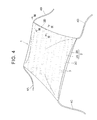
- the cushion 1 takes the initial form of a thick square pad shape illustrated in FIG. 4
- a user can lie on the widely-spread cushion 1 such that the whole body of the user lounges thereon, as illustrated in FIG. 3 .
- the cushion 1 takes the form of a tilting-table shape, for example, as illustrated in FIG. 6
- a user can lounge on the cushion 1 in such a posture that the user slightly sits up and leans back against the tilting face of the cushion 1, as illustrated in FIG. 2 .
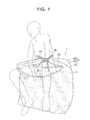
- the cushion 1 takes the form of a beanbag shape, for example, as illustrated in FIG. 7 , a user can be seated on the cushion 1 such that the back side of the body of the user leans against the cushion 1 to be supported by the cushion 1, as illustrated in FIG. 1 . At this time, the cushion 1 conforms to and supports the body of the seated user from below and from behind. Thus, the cushion 1 stably maintains the posture of the seated user.
- the cushion 1 includes an outer bag 2 having a square bag shape, great many expandable beads 3 with which the outer bag 2 is filled, and the leather strings 4A to 4D sewn respectively to the four corners of the outer bag 2.
- the outer bag 2 is formed by sewing a first sheet 2A and a second sheet 2B together into a bag shape.
- the first sheet 2A is made of cloth cut into a square shape
- the second sheet 2B is made of leather cut into a square shape.
- first sheet 2A and the second sheet 2B are placed back-to-back, and then the outer edges thereof are sewn together (at a seam line 2C) to form a square bag shape as a whole.
- first sheet 2A and the second sheet 2B are turned over so that the outer faces of the first and second sheets 2A, 2B face outward.
- the seam line 2C is hidden inside the outer bag 2 and thus not visible from the outside.
- the outer edges are connected to each other so as to be reopenable using a slide fastener 2D (see FIG. 9 ) instead of being sewn together.
- the opening formed by opening the slide fastener 2D functions as an opening through which the outer bag 2 is turned over so that the outer faces thereof face outward, and functions also as an opening through which the expandable beads 3 are supplied into or taken out of the outer bag 2.
- the leather strings 4A to 4D sewn respectively to the four corners of the outer bag 2 are interposed between the first sheet 2A and the second sheet 2B and sewn together with the first sheet 2A and the second sheet 2B at the seam line 2C.
- the expandable beads 3 are expanded polystyrene beads produced by finely foaming and then curing polystyrene resin (PS).
- PS polystyrene resin
- the expandable beads 3 are light and inexpensive. Further, the expandable beads 3 are easy to form or cut. Moreover, the expandable beads have a satisfactory heat insulation property, and also have a satisfactory impact absorbing property due to its sufficient elasticity. As the expandable beads 3 are supplied into the outer bag 2, the expandable beads 3 sink in the direction of gravitational force and accumulate within the outer bag 2. The expandable beads 3 press the outer bag 2 from the inside using its own weight and elasticity to fluff up the outer bag 2.
- the expandable beads 3 flow in the direction of gravitational force, so that the expandable beads 3 reach the four corners within the outer bag 2.
- the whole outer bag 2 is maintained in the form of a fluffed thick floor cushion (in the form of a thick zabuton).
- the first sheet 2A made of cloth and the second sheet 2B made of leather, which constitute the outer bag 2 are made of materials that are soft enough to be supplely deformed to change its form as the expandable beads 3 flow in the direction of gravitational force.
- the first sheet 2A and the second sheet 2B are made of materials having a high flexibility but having a relatively low stretching property.
- the cushion 1 receives the body of the user to gently conform to and support the body of the user while giving the user a sense of comfort, using the flowability and elasticity of the expandable beads 3.
- the cushion 1 when the cushion 1 is placed on the floor in the initial form of a square shape, as a user lies on the cushion 1, the outer bag 2 flexibly deforms and the expandable beads 3 smoothly flow inside the outer bag 2 so as to conform to the body shape of a user, as illustrated in FIG. 3 . As a result, the cushion 1 gently conforms to and supports the body of the user who lies on the cushion 1, while giving the user a sense of comfort.
- the cushion 1 is able to fulfill its function in the same manner regardless of whether the first sheet 2A made of cloth faces upward as illustrated in FIG. 4 and FIG. 8 to FIG. 11 or the second sheet 2B made of leather faces upward.
- the cushion 1 presents a warm appearance and gives a user a warm feel when the user uses the cushion 1.
- the cushion 1 presents a luxurious appearance and gives a user a relatively cool feel when the user uses the cushion 1.
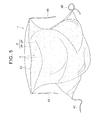
- the expandable beads 3 flow in the direction of gravitational force within the outer bag 2. Then, the expandable beads 3 accumulate in the outer bag 2 such that a generally lower half region of the outer bag 2 is fluffed up into a barrel shape. As the cushion 1 is raised, the expandable beads 3 accumulated within the outer bag 2, at positions near the lower face (lower face of the outer edge of the bag) that faces the floor, smoothly flow to conform to the shape of the floor. In this way, the lower face of the outer bag 2 is flexibly changed to conform to the shape of the floor. That is, when the floor is flat, the lower face of the outer bag 2 becomes flat, whereas when the floor has irregularities, the lower face of the outer bag 2 conforms to the irregularities.
- the cushion 1 when the cushion 1 is changed in orientation to be raised from the floor, the expandable beads 3 flow in the direction of gravitational force to lower the center of gravity of the cushion 1.
- the cushion 1 takes such a form that the lower portion thereof is heavier than the upper portion thereof, and the contact face of the cushion 1, which is in contact with the floor, is broadened.
- the cushion 1 takes the form that allows itself to be self-standing on the floor. In the state where the cushion 1 is placed on the floor as illustrated in FIG. 4 , FIG. 10 and FIG.
- the corners on one side of the outer bag 2 face each other, so that the one side of the outer bag 2 is changed into a loop (endless) shape (a loop portion 2E is formed).
- a portion of the first sheet 2A and a portion of the second sheet 2B which are near the corners that face each other, are folded down in an triangular shape toward the center such that the triangular portions of the first and second sheets 2A, 2B are respectively brought into surface contact with other portions of the first and second sheets 2A, 2B, which are adjacent to the triangular portions.
- the expandable beads 3 are prevented from flowing into the folded region of the outer bag 2, by the binding force with which the leather strings 4A, 4B are tied together, and the cushion 1 is maintained in a tilting-table shape.
- the cushion 1 can gently conform to and support the body of the user while giving the user a sense of comfort, using the flowability and elasticity of the expandable beads 3 in the cushion 1.
- the cushion 1 is able to fulfill its function in the same manner regardless of whether the first sheet 2A made of cloth faces upward as illustrated in FIG. 6 and FIG. 12 to FIG. 15 or the second sheet 2B made of leather faces upward.
- the cushion 1 presents a warm appearance and gives a user a warm feel when the user uses the cushion 1.
- the cushion 1 presents a luxurious appearance and gives the user a relatively cool feel when the user uses the cushion 1.
- the cushion 1 takes the form of a tilting-table shape as illustrated in FIG. 6 and FIG. 12 to FIG. 15 .
- the thickness of the portion of the cushion 1, which is near the region where the leather strings 4C, 4D are tied together is also increased.
- the cushion 1 takes the form of a beanbag shape as a whole, as illustrated in FIG. 7 and FIG. 16 to FIG. 18 .
- the manner of a change in the form of the outer bag 2 caused by tying the leather strings 4C, 4D together is the same as that caused by tying the leather strings 4A, 4B together.
- the cushion 1 that takes the form of a beanbag shape has a flat square seating face at such a height (height of approximately 65 cm from the floor) that an adult user can be easily seated on the seating face, when the cushion 1 is oriented such that the first sheet 2A faces upward as illustrated in FIG. 7 , or the second sheet 2B faces upward. Because the cushion 1 takes the form of a beanbag shape, the lower face that is in contact with the floor is also changed into a square flat face. Thus, the area in which the lower face of the cushion 1 is in contact with the floor is wide enough so that the cushion 1 is less likely to topple over either to the right or to the left. In this way, the cushion 1 is maintained in the form that allows the cushion 1 to be kept in a stable self-standing state.
- the cushion 1 when a user is seated on the cushion 1 that takes the form of a beanbag shape, the cushion 1 deforms to be pressed relatively straight in the direction of gravitational force. In this way, the cushion 1 supports the body of the user, who is seated on the cushion 1, to conform gently to the body of the user from below. Thus, the cushion 1 stably maintains the posture of the seated user. Specifically, when the cushion 1 takes the form of a beanbag shape and is oriented such that the first sheet 2A or the second sheet 2B faces upward, the boundary between the first sheet 2A and the second sheet 2B (the seam line 2C) is located in a middle portion of the cushion 1 in its height direction and extends along the entire outer periphery of the cushion 1.
- the actual (visible) length of the boundary (the seam line 2C) along the outer periphery of the cushion 1 in this state is approximately half the length of that when the cushion 1 is in the initial form of a square shape illustrated in FIG. 4 .
- the first sheet 2A and the second sheet 2B are placed on each other and sewn together.
- this region is configured to have a stretching property lower than that of the other regions formed only of the first sheet 2A or the second sheet 2B.
- the boundary (the seam line 2C) having such a property is located in the middle portion of the cushion 1 in its height direction and extends along the entire outer periphery of the cushion 1.
- the expandable beads 3 that flow within the cushion 1 easily accumulate in a lower half portion of the outer bag 2.
- the upper edge of the lower half portion coincides with the boundary (the seam line 2C).
- a solid base of the lower half portion is easily formed.
- the cushion 1 can stably support the user who is seated thereon.
- the cushion 1 is able to fulfill its function in the same manner regardless of whether the first sheet 2A made of cloth faces upward as illustrated in FIG. 7 or the second sheet 2B made of leather faces upward.
- the cushion 1 presents a warm appearance and gives a user a warm feel when the user uses the cushion 1.
- the cushion 1 presents a luxurious appearance and gives the user a relatively cool feel when the user uses the cushion 1.
- the cushion 1 takes the form of a beanbag shape as illustrated in FIG. 7
- the loop portion 2E of the outer bag 2 which is formed by tying the leather strings 4A, 4B (4C, 4D) together, is located on a seating face (upper face) on which a user is seated, as illustrated in FIG. 1 .
- the cushion 1 has a flat square seating face at such a height (height of approximately 65 cm from the floor) that an adult user can be easily seated on the seating face
- the loop shape of the loop portion 2E is widened downward to some extent.
- the loop portion 2E takes such a loop shape that the loop portion 2E conforms to and supports part of the body of the seated user from the thighs to the back.
- the connected portion of the loop portion 2E of the outer bag 2 at which the leather strings 4A, 4B (4C, 4D) are connected to each other, is brought into contact with the back of the seated user.
- the connected portion of the loop portion 2E of the outer bag 2 which has been brought into contact with the back of the seated user, is pushed backward by a force with which the user leans backward.
- the force by which the connected portion of the loop portion 2E is pushed backward is borne by a lower portion of the loop portion 2E (a portion of the top face 2F) that is in contact with the thighs of the seated user from below. That is, the force with which the seated user leans against the connected portion of the loop portion 2E is borne by the force with which the seated user places his/her weight on the lower portion of the loop portion 2E (the portion of the top face 2F) from the thighs, that is, borne by the tension of the loop portion 2E of the outer bag 2.
- the seated user who is seated on the cushion 1 is gently received from below by the cushion 1, and gently supported from behind by the flexible loop portion 2E of the outer bag 2.
- the seated user is supported stably and gently from below and from behind.
- the cushion 1 is able to fulfill its function in the same manner regardless of whether the first sheet 2A made of cloth faces forward as illustrated in FIG. 1 or the second sheet 2B made of leather faces forward.
- the cushion 1 presents a warm appearance and gives a user a warm feel when the user uses the cushion 1.
- the cushion 1 presents a luxurious appearance and gives the user a relatively cool feel when the user uses the cushion 1.
- the cushion 1 has the following configurations.
- the cushion 1 includes the outer bag 2 having a closed-bag shape, and the cushioning material (the expandable beads 3) with which the outer bag 2 is filled.
- the cushioning material (the expandable beads 3) is formed of flowable material (the expandable beads 3) that flows in the direction of gravitational force and accumulates in the outer bag 2 when the orientation of the cushion 1 is changed.
- Connecting members (the leather strings 4A to 4D) are fitted respectively to multiple portions of the outer bag 2.
- the outer bag 2 is configured to maintain a state where the portions, to which the connecting members (the leather strings 4A to 4D) are fitted, are made to face each other by connecting at least one pair of the connecting members (the leather strings 4A to 4D) to each other. Further, the outer bag 2 is configured to be deformed into such a shape that the cushion 1, in which the cushioning material (the expandable beads 3) flows in the direction of gravitational force and is accumulated, is kept in a self-standing state, when the orientation of the cushion 1 is changed or when the form of the cushion 1 is changed by connecting at least one pair of the connecting members (the leather strings 4A to 4D) to each other.
- the form of the cushion 1 can be changed variously by changing the combination of the connecting members to be connected to each other, which are selected from among the connecting members (the leather strings 4A to 4D) fitted respectively to the multiple portions of the outer bag 2.
- the connecting members the leather strings 4A to 4D
- the flowable material the expandable beads 3
- the outer bag 2 deforms to keep the cushion 1 in a self-standing state.
- the cushion 1 can be used in a variety of usage patterns including not only a usage pattern in which the cushion 1 is laid on the floor but also a usage pattern in which the cushion 1 stands upright.
- the form of the cushion 1 can be changed into such a form that the cushion 1 gently conforms to and supports the body of a user who applies a load onto the cushion 1 in each of the usage patterns, by changing the combination of the connecting members to be connected to each other, which are selected from among the connecting members (the leather strings 4A to 4D) fitted respectively to the multiple portions of the outer bag 2.
- the form of the cushion 1, which gently conforms to and supports the body of a user can be changed into a variety of forms with a simple manner, that is, by changing the combination of the connecting members to be connected to each other, which are selected from among the connecting members (the leather strings 4A to 4D) fitted respectively to the multiple portions of the outer bag 2.
- the connecting members are arranged along the outer edge of the bag shape of the outer bag 2, and are fitted to outer edge portions of the outer bag 2.
- the form of the cushion 1 can be changed into such a form that the outer edge portions of the outer bag 2 face each other.
- the cushion 1 can take a variety of forms that give the cushion 1 an attractive appearance.
- the outer bag 2 has a polygonal bag shape.
- the connecting members (the leather strings 4A to 4D) are fitted to the corners of the polygonal outer bag 2.
- each corner of the outer bag 2 can be made to face another corner thereof without allowing the corner to project outward.
- the cushion 1 can take a variety of forms that give the cushion 1 an attractive appearance.
- the outer bag 2 has a quadrangular bag shape.
- the form of the cushion 1 can be changed into such a form that a pair of the corners of the outer bag 2, which are adjacent to each other, face each other by connecting the corresponding two adjacent connecting members among the connecting members (the leather strings 4A to 4D) fitted respectively to the four corners of the outer bag 2.
- the cushion 1 can take a variety of forms.
- the form of the cushion 1 can be changed into the form of a beanbag shape by connecting two adjacent corners of the outer bag 2 to each other and connecting the remaining two adjacent corners thereof to each other.
- the form of the cushion 1 can be changed into the form of a tilting-table shape by disconnecting two adjacent corners of the outer bag 2 from each other while maintaining the connection between the remaining two adjacent corners thereof.
- the cushion 1 can take a variety of forms that give the cushion 1 an attractive appearance.
- the outer bag 2 is formed by sewing two kinds of sheets (the first sheet 2A made of cloth and the second sheet 2B made of leather) together into a bag shape.
- the form of the cushion 1 is changed by connecting at least one pair of the connecting members (leather strings 4A to 4D) together, it is possible to form a surface on which two kinds of sheets (the first sheet 2A made of cloth and the second sheet 2B made of leather) are both present.
- the cushion 1 can take a greater variety of forms.
- the loop portion 2E is formed in the outer bag 2 by connecting two of the connecting members (the leather strings 4A to 4D) to each other.
- the loop portion 2E is formed by connecting the two corners on one side of the outer bag 2 to each other into a loop shape.
- the cushion 1 is oriented such that the loop portion 2E is raised upward as illustrated in FIG. 1
- the connected portion of the loop portion 2E functions as a seatback for a seated user who is seated on the region of the top face 2F, which is surrounded by the loop portion 2E.
- the cushion 1 With the configuration for changing the form of the cushion 1 by connecting at least one pair of the connecting members (the leather strings 4A to 4D) to each other, it is possible to form the comfortable cushion 1 that can stably support the body of a user who is seated or lounges thereon.
- the loop portion 2E which is formed by connecting two of the connecting members (the leather strings 4A to 4D) to each other, can be used as a handle of the cushion 1. This makes it easier to carry the cushion 1. Connecting at least one pair of the connecting members (the leather strings 4A to 4D) to each other makes it possible to contract the cushion 1 in various directions. Thus, the cushion 1 can be stored in spaces in various shapes.
- the cushion having a thick square pad shape, 135 cm on a side is described as an example of the cushion according to the invention.
- the cushion according to the invention may have other sizes and shapes.
- the shape of the outer bag should not be limited.
- outer bags having various bag shapes such as a polygonal shape other than a square shape, a circular shape and an elliptical shape may be employed.
- outer bags having three-dimensional shapes such as a polyhedral shape, a spherical shape, a columnar shape and a conical shape may be employed.
- the great many expandable beads made of polystyrene resin are described as an example of the flowable material that forms the cushioning material in the invention.
- the flowable material may be great many small solid pieces made of other material.
- the flowable material may be great many beads made of foamed resin materials other than PS, such as polyurethane foam and polyethylene foam; wood or rubber broken up into great many very small chips; or buckwheat husks.
- the flowable material may be fluid such as gel, which flows in the direction of gravitational force and then accumulates in the outer bag as the orientation of the cushion is changed.
- the leather strings fitted respectively to the four corners of the outer bag are described as an example of the connecting members in the invention.
- the connecting members in the invention may be members other than the leather strings.
- the connecting members may be fitted to portions of the outer bag other than the four corners.
- the connecting members may be members having various connecting configurations.
- the connecting members may be strings other than leather strings, such as cloth strings and plastic strings; members other than strings, such as hook-and-loop fasteners and slide fasteners; or members that may be connected to each other by hooks.
- the positions of the outer bag, to which the connecting members are fitted may be positions other than the corners and edges of the outer bag. That is, the connecting members may be fitted to intermediate positions of the bag face.
- the connecting members When the outer bag has a polygonal shape and the connecting members are fitted respectively to the corners of the polygonal outer bag, it is not necessary that all the corners of the polygonal outer bag be provided with the connecting members. Further, it is not necessary that the connecting members that are connected to each other be the connecting members that are adjacent to each other. The connecting members that are in the diagonal relationship or the connecting members that are apart from each other with at least two other connecting members interposed therebetween may be connected to each other.
- the outer bag may be formed by sewing one kind of sheets or three or more kinds of sheets together into a bag shape.
- the front side and the back side of the outer bag may be respectively formed of different kinds of sheets, as illustrated in the above-described embodiment.
- the upper side and the lower side of the outer bag, or the right side and the left side of the outer bag may be respectively formed of different kinds of sheets.
- the outer bag may be formed by connecting together the sheets of different kinds arranged in an irregular pattern, or the outer bag may be formed by connecting together the sheets of different kinds in a manner formed by combining the above-described manners. That is, the outer bag may be formed of different kinds of sheets arranged in various manners.
- the outer bag As long as the outer bag has such a flexibility that the cushion is deformed to be kept in a self-standing state as the cushioning material flows in the direction of gravitational force and accumulates in the outer bag when the orientation of the cushion is changed or the form of the cushion is changed by connecting at least one pair of the connecting members to each other, the outer bag need not have a stretching property.
- the stretching property should be low enough so that excessive stretching of the outer bag, which would cause the body of a user seated on the cushion to sink to a position very close to the floor, does not occur.
- the great many expandable beads are directly packed in the outer bag.
- the great many expandable beads may be packed in an inner bag and the inner bag filled with the expandable beds may be placed in the outer bag.
- the flowable material may be packed in a plurality of inner bags, and the inner bags filled with the flowable material may be placed in the outer bag. In this way, the cushion may be formed so as to exert different cushioning performances that vary depending on the inner bags.
Landscapes
- Mattresses And Other Support Structures For Chairs And Beds (AREA)
Abstract
Description
- The invention relates generally to a cushion, and more specifically to a cushion including an outer bag having a closed-bag shape, and cushioning material with which the outer bag is filled.
- Cushions formed in a generally spherical shape have been used in, for example, living rooms, family recreational rooms, and guest rooms (refer to, for example, Japanese Patent Application Publication No.
2005-198856 JP 2005-198856 A - However, the related art does not provide the cushion itself with a function of taking a variety of forms, so that the cushion in the related art can be used only in the same usage pattern. The invention provides a cushion that gently supports the body of a user while giving the user a sense of comfort, the cushion having a simple configuration that allows the cushion to take a variety of forms to be used in a variety of usage patterns.
- An aspect of the invention relates to a cushion including an outer bag having a closed-bag shape and cushioning material with which the outer bag is filled. The cushioning material is formed of flowable material that flows in a direction of gravitational force when the orientation of the cushion is changed. Connecting members are fitted respectively to multiple portions of the outer bag. The outer bag is configured such that a state where the portions, to which the connecting members are fitted, face each other is maintained by connecting at least one pair of the connecting members to each other. The outer bag is configured to be deformed into such a shape that the cushion, in which the cushioning material is accumulated after flowing in the direction of gravitational force, is kept in a self-standing state when the orientation of the cushion is changed or when the form of the cushion is changed by connecting at least one pair of the connecting members to each other.
- With this configuration, the form of the cushion can be changed variously by changing the combination of the connecting members to be connected to each other, which are selected from among the connecting members fitted respectively to the multiple portions of the outer bag. When the cushion is raised or leaned, the flowable material flows and the outer bag deforms to keep the cushion in a self-standing state. Thus, the cushion can be used in a variety of usage patterns including not only a usage pattern in which the cushion is laid on the floor but also a usage pattern in which the cushion stands upright. The form of the cushion can be changed into such a form that the cushion gently conforms to and supports the body of a user who applies a load onto the cushion in each of the usage patterns, by changing the combination of the connecting members to be connected to each other, which are selected from among the connecting members fitted respectively to the multiple portions of the outer bag. As described above, the form of the cushion, which gently conforms to and supports the body of a user, can be changed into a variety of forms with a simple manner, that is, by changing the combination of the connecting members to be connected to each other, which are selected from among the connecting members fitted respectively to the multiple portions of the outer bag.
- In the cushion according to the above aspect, the connecting members may be arranged along an outer edge of the bag shape of the outer bag, and fitted to outer edge portions of the outer bag.
- With this configuration, the form of the cushion can be changed into such a form that the outer edge portions of the outer bag face each other. Thus, the cushion can take a variety of forms that give the cushion an attractive appearance.
- In the cushion according to the above aspect, the outer bag may have a polygonal bag shape, and the connecting members may be fitted respectively to corners of the polygonal outer bag.
- With this configuration, although the outer bag has a polygonal bag shape, each corner of the outer bag can be made to face another corner thereof without allowing the corner to project outward. Thus, the cushion can take a variety of forms that give the cushion an attractive appearance.
- In the cushion according to the above aspect, the outer bag may have a quadrangular bag shape. In this case, the outer bag may have at least one pair of corners that are adjacent to each other or in a diagonal relationship, and the corners may be made to face each other by connecting the connecting members fitted respectively to the corners of the outer bag.
- As described above, because the outer bag has a quadrangular bag shape, the cushion can take a variety of forms. For example, the form of the cushion can be changed into the form of a beanbag shape by connecting two adjacent corners of the outer bag to each other and connecting the remaining two adjacent corners thereof to each other. Alternatively, the form of the cushion can be changed into the form of a tilting-table shape by disconnecting two adjacent corners of the outer bag from each other while maintaining the connection between the remaining two adjacent corners thereof. Thus, the cushion can take a variety of forms that give the cushion an attractive appearance.
- In the cushion according to the above aspect, the outer bag may be formed by sewing sheets of two or more kinds together into a bag shape.
- With this configuration, when the form of the cushion is changed by connecting at least one pair of the connecting members to each other, it is possible to form a surface on which two kinds of sheets are both present. Thus, the cushion can take a greater variety of forms.
- In the cushion according to the above aspect, a loop portion having a loop shape may be formed in the outer bag by connecting two of the connecting members to each other, and when the cushion is oriented such that the loop portion is raised upward, a connected portion of the loop portion, the connected portion being formed by connecting the connecting members to each other, may function as a seatback for a user seated on a region of a top face of the cushion, the region being surrounded by the loop portion.
- With the configuration for changing the form of the cushion by connecting at least one pair of the connecting members to each other, it is possible to form the comfortable cushion that can stably support the body of a user who is seated or lounges thereon.
- Features, advantages, and technical and industrial significance of exemplary embodiments of the invention will be described below with reference to the accompanying drawings, in which like numerals denote like elements, and wherein:
-
FIG. 1 is a perspective view illustrating a usage pattern of a cushion according to a first embodiment of the invention; -
FIG. 2 is a perspective view illustrating another usage pattern of the cushion; -
FIG. 3 is a perspective view illustrating yet another usage pattern of the cushion; -
FIG. 4 is a perspective view illustrating the initial form of the cushion; -
FIG. 5 is a perspective view illustrating the state where the cushion is raised; -
FIG. 6 is a perspective view illustrating the state where the cushion takes the form of a tilting-table shape; -
FIG. 7 is a perspective view illustrating the state where the cushion takes the form of a beanbag shape; -
FIG. 8 is a sectional view taken along the line VIII-VIII inFIG. 4 ; -
FIG. 9 is a sectional view taken along the line IX-IX inFIG. 4 ; -
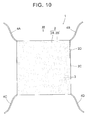
FIG. 10 is a schematic front view illustrating the initial form of the cushion; -
FIG. 11 is a schematic view of the cushion when viewed from the direction of an arrow XI inFIG. 10 ; -
FIG. 12 is a schematic front view illustrating the state where the cushion takes the form of a tilting-table shape; -
FIG. 13 is a schematic view of the cushion when viewed from the direction of an arrow XIII inFIG. 12 ; -
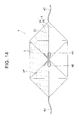
FIG. 14 is a schematic view of the cushion when viewed from the direction of an arrow XIV inFIG. 12 ; -
FIG. 15 is a schematic view of the cushion when viewed from the direction of an arrow XV inFIG. 12 ; -
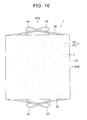
FIG. 16 is a schematic front view illustrating the state where the cushion takes the form of a beanbag shape; -
FIG. 17 is a schematic view of the cushion when viewed from the direction of an arrow XVII inFIG. 16 ; and -
FIG. 18 is a schematic view of the cushion when viewed from the direction of an arrow XVIII inFIG. 16 . - Hereinafter, example embodiments of the invention will be described with reference to the accompanying drawings.
- First, the configuration of a
cushion 1 according to a first embodiment of the invention will be described with reference toFIG. 1 to FIG. 18 . As illustrated inFIG. 1 to FIG. 3 , thecushion 1 according to the present embodiment is provided as furniture used in, for example, a living room, a family recreational room, or a guest room. Thecushion 1 is configured to take a variety of forms, so that thecushion 1 can be used in a variety of usage patterns. Because thecushion 1 can take a variety of forms, thecushion 1 can variously change its appearance as furniture, and can change the manner of supporting a user who lounges thereon. - Specifically, as illustrated in
FIG. 3 andFIG. 4 , the initial form of thecushion 1 is a thick square pad shape, 135 cm on a side, and thecushion 1 in the initial form is large enough so that an adult user can lie and relax thereon. Leather strings 4A to 4D are fitted respectively to the four corners of thecushion 1. When any two adjacent leather strings among the fourleather strings 4A to 4D, for example, the leather strings 4A, 4B, are tied together, the thickness of a portion of thecushion 1, which is near the region where the leather strings 4A, 4B are tied together, is increased, so that thecushion 1 takes the form of a tilting-table shape as a whole, as illustrated inFIG. 6 . In addition, when the remaining twoleather strings cushion 1, which is near the region where the leather strings 4C, 4D are tied together, is also increased, so that thecushion 1 takes the form of a beanbag shape as a whole, as illustrated inFIG. 7 . - Because the
cushion 1 is configured to take a variety of forms as described above, thecushion 1 can be used in the following various usage patterns. For example, when thecushion 1 takes the initial form of a thick square pad shape illustrated inFIG. 4 , a user can lie on the widely-spread cushion 1 such that the whole body of the user lounges thereon, as illustrated inFIG. 3 . When thecushion 1 takes the form of a tilting-table shape, for example, as illustrated inFIG. 6 , a user can lounge on thecushion 1 in such a posture that the user slightly sits up and leans back against the tilting face of thecushion 1, as illustrated inFIG. 2 . - When the
cushion 1 takes the form of a beanbag shape, for example, as illustrated inFIG. 7 , a user can be seated on thecushion 1 such that the back side of the body of the user leans against thecushion 1 to be supported by thecushion 1, as illustrated inFIG. 1 . At this time, thecushion 1 conforms to and supports the body of the seated user from below and from behind. Thus, thecushion 1 stably maintains the posture of the seated user. - Hereinafter, the concrete configuration of the
cushion 1 will be described in detail with reference toFIG. 4 to FIG. 18 . As illustrated inFIG. 4 andFIG. 8 , thecushion 1 includes anouter bag 2 having a square bag shape, great manyexpandable beads 3 with which theouter bag 2 is filled, and the leather strings 4A to 4D sewn respectively to the four corners of theouter bag 2. Theouter bag 2 is formed by sewing afirst sheet 2A and asecond sheet 2B together into a bag shape. Thefirst sheet 2A is made of cloth cut into a square shape, and thesecond sheet 2B is made of leather cut into a square shape. - Specifically, the
first sheet 2A and thesecond sheet 2B are placed back-to-back, and then the outer edges thereof are sewn together (at aseam line 2C) to form a square bag shape as a whole. After being sewn together as described above, thefirst sheet 2A and thesecond sheet 2B are turned over so that the outer faces of the first andsecond sheets seam line 2C is hidden inside theouter bag 2 and thus not visible from the outside. As illustrated inFIG. 4 , in a partial region of the outer edges of thefirst sheet 2A and thesecond sheet 2B placed on each other, the outer edges are connected to each other so as to be reopenable using aslide fastener 2D (seeFIG. 9 ) instead of being sewn together. - The opening formed by opening the
slide fastener 2D functions as an opening through which theouter bag 2 is turned over so that the outer faces thereof face outward, and functions also as an opening through which theexpandable beads 3 are supplied into or taken out of theouter bag 2. As illustrated inFIG. 8 , the leather strings 4A to 4D sewn respectively to the four corners of theouter bag 2 are interposed between thefirst sheet 2A and thesecond sheet 2B and sewn together with thefirst sheet 2A and thesecond sheet 2B at theseam line 2C. - The
expandable beads 3 are expanded polystyrene beads produced by finely foaming and then curing polystyrene resin (PS). Theexpandable beads 3 are light and inexpensive. Further, theexpandable beads 3 are easy to form or cut. Moreover, the expandable beads have a satisfactory heat insulation property, and also have a satisfactory impact absorbing property due to its sufficient elasticity. As theexpandable beads 3 are supplied into theouter bag 2, theexpandable beads 3 sink in the direction of gravitational force and accumulate within theouter bag 2. Theexpandable beads 3 press theouter bag 2 from the inside using its own weight and elasticity to fluff up theouter bag 2. - As illustrated in
FIG. 4 andFIG. 8 toFIG. 11 , when thecushion 1 is placed on a floor in the initial form of a square shape, theexpandable beads 3 flow in the direction of gravitational force, so that theexpandable beads 3 reach the four corners within theouter bag 2. As a result, the wholeouter bag 2 is maintained in the form of a fluffed thick floor cushion (in the form of a thick zabuton). Thefirst sheet 2A made of cloth and thesecond sheet 2B made of leather, which constitute theouter bag 2, are made of materials that are soft enough to be supplely deformed to change its form as theexpandable beads 3 flow in the direction of gravitational force. Thefirst sheet 2A and thesecond sheet 2B are made of materials having a high flexibility but having a relatively low stretching property. Thus, when a user is seated on thecushion 1, excessive stretching of the first andsecond sheets cushion 1 receives the body of the user to gently conform to and support the body of the user while giving the user a sense of comfort, using the flowability and elasticity of theexpandable beads 3. - Thus, when the
cushion 1 is placed on the floor in the initial form of a square shape, as a user lies on thecushion 1, theouter bag 2 flexibly deforms and theexpandable beads 3 smoothly flow inside theouter bag 2 so as to conform to the body shape of a user, as illustrated inFIG. 3 . As a result, thecushion 1 gently conforms to and supports the body of the user who lies on thecushion 1, while giving the user a sense of comfort. - The
cushion 1 is able to fulfill its function in the same manner regardless of whether thefirst sheet 2A made of cloth faces upward as illustrated inFIG. 4 andFIG. 8 toFIG. 11 or thesecond sheet 2B made of leather faces upward. When thefirst sheet 2A made of cloth faces upward, thecushion 1 presents a warm appearance and gives a user a warm feel when the user uses thecushion 1. On the other hand, when thesecond sheet 2B made of leather faces upward, thecushion 1 presents a luxurious appearance and gives a user a relatively cool feel when the user uses thecushion 1. - When the
cushion 1 is raised as illustrated inFIG. 5 , theexpandable beads 3 flow in the direction of gravitational force within theouter bag 2. Then, theexpandable beads 3 accumulate in theouter bag 2 such that a generally lower half region of theouter bag 2 is fluffed up into a barrel shape. As thecushion 1 is raised, theexpandable beads 3 accumulated within theouter bag 2, at positions near the lower face (lower face of the outer edge of the bag) that faces the floor, smoothly flow to conform to the shape of the floor. In this way, the lower face of theouter bag 2 is flexibly changed to conform to the shape of the floor. That is, when the floor is flat, the lower face of theouter bag 2 becomes flat, whereas when the floor has irregularities, the lower face of theouter bag 2 conforms to the irregularities. - With this configuration, when the
cushion 1 is changed in orientation to be raised from the floor, theexpandable beads 3 flow in the direction of gravitational force to lower the center of gravity of thecushion 1. Thus, thecushion 1 takes such a form that the lower portion thereof is heavier than the upper portion thereof, and the contact face of thecushion 1, which is in contact with the floor, is broadened. As a result, thecushion 1 takes the form that allows itself to be self-standing on the floor. In the state where thecushion 1 is placed on the floor as illustrated inFIG. 4 ,FIG. 10 andFIG. 11 , when any two adjacent leather strings among the fourleather strings 4A to 4D sewn to the four corners of thecushion 1, for example, the leather strings 4A, 4B are tied together, a region of theouter bag 2, where the leather strings 4A, 4B are tied together, is folded into a shape that forms a quadrangular side face as illustrated inFIG. 6 andFIG. 12 toFIG. 15 , and thus theexpandable beads 3 flow from the region toward the central region of theouter bag 2. As a result, theexpandable beads 3 are accumulated (collected) within in a fluffed region of theouter bag 2, which is formed by folding the above-described region. In this way, thecushion 1 takes the form of a tilting-table shape with the fluffed region. - Specifically, when the leather strings 4A, 4B are tied together, the corners on one side of the
outer bag 2 face each other, so that the one side of theouter bag 2 is changed into a loop (endless) shape (aloop portion 2E is formed). When the leather strings 4A, 4B are tied together, a portion of thefirst sheet 2A and a portion of thesecond sheet 2B, which are near the corners that face each other, are folded down in an triangular shape toward the center such that the triangular portions of the first andsecond sheets second sheets expandable beads 3, which are accumulated within these portions, toward the central region in theouter bag 2 is generated. The portions of theouter bag 2, which are folded into a triangular shape, are placed on the already-folded portion of theouter bag 2 to form a quadrangular side face as one side face of theouter bag 2. As a result, theouter bag 2 takes the form of a tilting-table shape. - As illustrated in
FIG. 2 , when a user lounges on thecushion 1 that takes the form of a tilting-table shape, theexpandable beads 3 are prevented from flowing into the folded region of theouter bag 2, by the binding force with which the leather strings 4A, 4B are tied together, and thecushion 1 is maintained in a tilting-table shape. Thus, when a user lounges on thecushion 1 that takes the form of a tilting-table shape, thecushion 1 can gently conform to and support the body of the user while giving the user a sense of comfort, using the flowability and elasticity of theexpandable beads 3 in thecushion 1. - The
cushion 1 is able to fulfill its function in the same manner regardless of whether thefirst sheet 2A made of cloth faces upward as illustrated inFIG. 6 andFIG. 12 toFIG. 15 or thesecond sheet 2B made of leather faces upward. When thefirst sheet 2A made of cloth faces upward, thecushion 1 presents a warm appearance and gives a user a warm feel when the user uses thecushion 1. On the other hand, when thesecond sheet 2B made of leather faces upward, thecushion 1 presents a luxurious appearance and gives the user a relatively cool feel when the user uses thecushion 1. - In the state where the two
leather strings cushion 1 are tied together and thus thecushion 1 takes the form of a tilting-table shape as illustrated inFIG. 6 andFIG. 12 toFIG. 15 , when the remaining twoleather strings cushion 1, which is near the region where the leather strings 4C, 4D are tied together, is also increased. As a result, thecushion 1 takes the form of a beanbag shape as a whole, as illustrated inFIG. 7 andFIG. 16 toFIG. 18 . The manner of a change in the form of theouter bag 2 caused by tying the leather strings 4C, 4D together is the same as that caused by tying the leather strings 4A, 4B together. - The
cushion 1 that takes the form of a beanbag shape has a flat square seating face at such a height (height of approximately 65 cm from the floor) that an adult user can be easily seated on the seating face, when thecushion 1 is oriented such that thefirst sheet 2A faces upward as illustrated inFIG. 7 , or thesecond sheet 2B faces upward. Because thecushion 1 takes the form of a beanbag shape, the lower face that is in contact with the floor is also changed into a square flat face. Thus, the area in which the lower face of thecushion 1 is in contact with the floor is wide enough so that thecushion 1 is less likely to topple over either to the right or to the left. In this way, thecushion 1 is maintained in the form that allows thecushion 1 to be kept in a stable self-standing state. - Thus, when a user is seated on the
cushion 1 that takes the form of a beanbag shape, thecushion 1 deforms to be pressed relatively straight in the direction of gravitational force. In this way, thecushion 1 supports the body of the user, who is seated on thecushion 1, to conform gently to the body of the user from below. Thus, thecushion 1 stably maintains the posture of the seated user. Specifically, when thecushion 1 takes the form of a beanbag shape and is oriented such that thefirst sheet 2A or thesecond sheet 2B faces upward, the boundary between thefirst sheet 2A and thesecond sheet 2B (theseam line 2C) is located in a middle portion of thecushion 1 in its height direction and extends along the entire outer periphery of thecushion 1. - When two of the four
leather strings 4A to 4D are tied together and the remaining two of the fourleather strings 4A to 4D are also tied together, two of the four corners of theouter bag 2 are folded to face each other and the remaining two of the four corners are also folded to face each other. Thus, the actual (visible) length of the boundary (theseam line 2C) along the outer periphery of thecushion 1 in this state is approximately half the length of that when thecushion 1 is in the initial form of a square shape illustrated inFIG. 4 . In a region where the boundary (theseam line 2C) is located, thefirst sheet 2A and thesecond sheet 2B are placed on each other and sewn together. Thus, this region is configured to have a stretching property lower than that of the other regions formed only of thefirst sheet 2A or thesecond sheet 2B. - As described above, the boundary (the
seam line 2C) having such a property is located in the middle portion of thecushion 1 in its height direction and extends along the entire outer periphery of thecushion 1. Thus, when a user is seated on thecushion 1, theexpandable beads 3 that flow within thecushion 1 easily accumulate in a lower half portion of theouter bag 2. The upper edge of the lower half portion coincides with the boundary (theseam line 2C). Thus, a solid base of the lower half portion is easily formed. As a result, thecushion 1 can stably support the user who is seated thereon. - The
cushion 1 is able to fulfill its function in the same manner regardless of whether thefirst sheet 2A made of cloth faces upward as illustrated inFIG. 7 or thesecond sheet 2B made of leather faces upward. When thefirst sheet 2A made of cloth faces upward, thecushion 1 presents a warm appearance and gives a user a warm feel when the user uses thecushion 1. On the other hand, when thesecond sheet 2B made of leather faces upward, thecushion 1 presents a luxurious appearance and gives the user a relatively cool feel when the user uses thecushion 1. - In the state where the
cushion 1 takes the form of a beanbag shape as illustrated inFIG. 7 , when the orientation of thecushion 1 is changed into an orientation at which one side face, where the leather strings 4A, 4B (4C, 4D) are tied together, faces upward, theloop portion 2E of theouter bag 2, which is formed by tying the leather strings 4A, 4B (4C, 4D) together, is located on a seating face (upper face) on which a user is seated, as illustrated inFIG. 1 . In this state, thecushion 1 has a flat square seating face at such a height (height of approximately 65 cm from the floor) that an adult user can be easily seated on the seating face - In this state, when a user is seated on the seating face (upper face) of the
cushion 1 such that the buttocks of the user are placed into theloop portion 2E of the outer bag 2 (on a region of a top face 2F, which is surrounded by theloop portion 2E), the seating face of thecushion 1, on which the user is seated, sinks downward. As a result, a connected portion of theloop portion 2E of theouter bag 2, at which the leather strings 4A, 4B (4C, 4D) are tied together, is brought into contact with the back of the user who is seated on thecushion 1. - Specifically, as the seating face of the
cushion 1 on which the user is seated sinks downward, the loop shape of theloop portion 2E is widened downward to some extent. When the seating face of thecushion 1 stops sinking, theloop portion 2E takes such a loop shape that theloop portion 2E conforms to and supports part of the body of the seated user from the thighs to the back. In this state, when the seated user leans backward, the connected portion of theloop portion 2E of theouter bag 2, at which the leather strings 4A, 4B (4C, 4D) are connected to each other, is brought into contact with the back of the seated user. The connected portion of theloop portion 2E of theouter bag 2, which has been brought into contact with the back of the seated user, is pushed backward by a force with which the user leans backward. - However, the force by which the connected portion of the
loop portion 2E is pushed backward is borne by a lower portion of theloop portion 2E (a portion of the top face 2F) that is in contact with the thighs of the seated user from below. That is, the force with which the seated user leans against the connected portion of theloop portion 2E is borne by the force with which the seated user places his/her weight on the lower portion of theloop portion 2E (the portion of the top face 2F) from the thighs, that is, borne by the tension of theloop portion 2E of theouter bag 2. Thus, the seated user who is seated on thecushion 1 is gently received from below by thecushion 1, and gently supported from behind by theflexible loop portion 2E of theouter bag 2. As a result, the seated user is supported stably and gently from below and from behind. - The
cushion 1 is able to fulfill its function in the same manner regardless of whether thefirst sheet 2A made of cloth faces forward as illustrated inFIG. 1 or thesecond sheet 2B made of leather faces forward. When thefirst sheet 2A made of cloth faces forward, thecushion 1 presents a warm appearance and gives a user a warm feel when the user uses thecushion 1. On the other hand, when thesecond sheet 2B made of leather faces forward, thecushion 1 presents a luxurious appearance and gives the user a relatively cool feel when the user uses thecushion 1. - To be brief, the
cushion 1 according to the present embodiment has the following configurations. Thecushion 1 includes theouter bag 2 having a closed-bag shape, and the cushioning material (the expandable beads 3) with which theouter bag 2 is filled. The cushioning material (the expandable beads 3) is formed of flowable material (the expandable beads 3) that flows in the direction of gravitational force and accumulates in theouter bag 2 when the orientation of thecushion 1 is changed. Connecting members (the leather strings 4A to 4D) are fitted respectively to multiple portions of theouter bag 2. Theouter bag 2 is configured to maintain a state where the portions, to which the connecting members (the leather strings 4A to 4D) are fitted, are made to face each other by connecting at least one pair of the connecting members (the leather strings 4A to 4D) to each other. Further, theouter bag 2 is configured to be deformed into such a shape that thecushion 1, in which the cushioning material (the expandable beads 3) flows in the direction of gravitational force and is accumulated, is kept in a self-standing state, when the orientation of thecushion 1 is changed or when the form of thecushion 1 is changed by connecting at least one pair of the connecting members (the leather strings 4A to 4D) to each other. - As described above, the form of the
cushion 1 can be changed variously by changing the combination of the connecting members to be connected to each other, which are selected from among the connecting members (the leather strings 4A to 4D) fitted respectively to the multiple portions of theouter bag 2. When thecushion 1 is raised or leaned, the flowable material (the expandable beads 3) flows and theouter bag 2 deforms to keep thecushion 1 in a self-standing state. Thus, thecushion 1 can be used in a variety of usage patterns including not only a usage pattern in which thecushion 1 is laid on the floor but also a usage pattern in which thecushion 1 stands upright. The form of thecushion 1 can be changed into such a form that thecushion 1 gently conforms to and supports the body of a user who applies a load onto thecushion 1 in each of the usage patterns, by changing the combination of the connecting members to be connected to each other, which are selected from among the connecting members (the leather strings 4A to 4D) fitted respectively to the multiple portions of theouter bag 2. As described above, the form of thecushion 1, which gently conforms to and supports the body of a user, can be changed into a variety of forms with a simple manner, that is, by changing the combination of the connecting members to be connected to each other, which are selected from among the connecting members (the leather strings 4A to 4D) fitted respectively to the multiple portions of theouter bag 2. - The connecting members (the leather strings 4A to 4D) are arranged along the outer edge of the bag shape of the
outer bag 2, and are fitted to outer edge portions of theouter bag 2. With this configuration, the form of thecushion 1 can be changed into such a form that the outer edge portions of theouter bag 2 face each other. Thus, thecushion 1 can take a variety of forms that give thecushion 1 an attractive appearance. - The
outer bag 2 has a polygonal bag shape. The connecting members (the leather strings 4A to 4D) are fitted to the corners of the polygonalouter bag 2. With this configuration, although theouter bag 2 has a polygonal bag shape, each corner of theouter bag 2 can be made to face another corner thereof without allowing the corner to project outward. Thus, thecushion 1 can take a variety of forms that give thecushion 1 an attractive appearance. - The
outer bag 2 has a quadrangular bag shape. The form of thecushion 1 can be changed into such a form that a pair of the corners of theouter bag 2, which are adjacent to each other, face each other by connecting the corresponding two adjacent connecting members among the connecting members (the leather strings 4A to 4D) fitted respectively to the four corners of theouter bag 2. As described above, because theouter bag 2 has a quadrangular bag shape, thecushion 1 can take a variety of forms. For example, the form of thecushion 1 can be changed into the form of a beanbag shape by connecting two adjacent corners of theouter bag 2 to each other and connecting the remaining two adjacent corners thereof to each other. Alternatively, the form of thecushion 1 can be changed into the form of a tilting-table shape by disconnecting two adjacent corners of theouter bag 2 from each other while maintaining the connection between the remaining two adjacent corners thereof. Thus, thecushion 1 can take a variety of forms that give thecushion 1 an attractive appearance. - The
outer bag 2 is formed by sewing two kinds of sheets (thefirst sheet 2A made of cloth and thesecond sheet 2B made of leather) together into a bag shape. With this configuration, when the form of thecushion 1 is changed by connecting at least one pair of the connecting members (leather strings 4A to 4D) together, it is possible to form a surface on which two kinds of sheets (thefirst sheet 2A made of cloth and thesecond sheet 2B made of leather) are both present. Thus, thecushion 1 can take a greater variety of forms. - The
loop portion 2E is formed in theouter bag 2 by connecting two of the connecting members (the leather strings 4A to 4D) to each other. Theloop portion 2E is formed by connecting the two corners on one side of theouter bag 2 to each other into a loop shape. When thecushion 1 is oriented such that theloop portion 2E is raised upward as illustrated inFIG. 1 , the connected portion of theloop portion 2E functions as a seatback for a seated user who is seated on the region of the top face 2F, which is surrounded by theloop portion 2E. With the configuration for changing the form of thecushion 1 by connecting at least one pair of the connecting members (the leather strings 4A to 4D) to each other, it is possible to form thecomfortable cushion 1 that can stably support the body of a user who is seated or lounges thereon. - The
loop portion 2E, which is formed by connecting two of the connecting members (the leather strings 4A to 4D) to each other, can be used as a handle of thecushion 1. This makes it easier to carry thecushion 1. Connecting at least one pair of the connecting members (the leather strings 4A to 4D) to each other makes it possible to contract thecushion 1 in various directions. Thus, thecushion 1 can be stored in spaces in various shapes. - While one example embodiment of the invention has been described above, the invention may be implemented in various other embodiments. For example, in the above-described embodiment, the cushion having a thick square pad shape, 135 cm on a side, is described as an example of the cushion according to the invention. However, the cushion according to the invention may have other sizes and shapes. Specifically, as long as the cushion includes an outer bag having a closed-bag shape and cushioning material with which the outer bag is filled, the shape of the outer bag should not be limited. For example, outer bags having various bag shapes such as a polygonal shape other than a square shape, a circular shape and an elliptical shape may be employed. Alternatively, outer bags having three-dimensional shapes such as a polyhedral shape, a spherical shape, a columnar shape and a conical shape may be employed.
- In the above-described embodiment, the great many expandable beads made of polystyrene resin (PS) are described as an example of the flowable material that forms the cushioning material in the invention. However, the flowable material may be great many small solid pieces made of other material. For example, the flowable material may be great many beads made of foamed resin materials other than PS, such as polyurethane foam and polyethylene foam; wood or rubber broken up into great many very small chips; or buckwheat husks. Further alternatively, the flowable material may be fluid such as gel, which flows in the direction of gravitational force and then accumulates in the outer bag as the orientation of the cushion is changed.
- In the above-described embodiment, the leather strings fitted respectively to the four corners of the outer bag are described as an example of the connecting members in the invention. However, the connecting members in the invention may be members other than the leather strings. Further, the connecting members may be fitted to portions of the outer bag other than the four corners. Specifically, the connecting members may be members having various connecting configurations. For example, the connecting members may be strings other than leather strings, such as cloth strings and plastic strings; members other than strings, such as hook-and-loop fasteners and slide fasteners; or members that may be connected to each other by hooks. The positions of the outer bag, to which the connecting members are fitted, may be positions other than the corners and edges of the outer bag. That is, the connecting members may be fitted to intermediate positions of the bag face.
- When the outer bag has a polygonal shape and the connecting members are fitted respectively to the corners of the polygonal outer bag, it is not necessary that all the corners of the polygonal outer bag be provided with the connecting members. Further, it is not necessary that the connecting members that are connected to each other be the connecting members that are adjacent to each other. The connecting members that are in the diagonal relationship or the connecting members that are apart from each other with at least two other connecting members interposed therebetween may be connected to each other.
- The outer bag may be formed by sewing one kind of sheets or three or more kinds of sheets together into a bag shape. When the outer bag is formed by combining at least two kinds of sheets, the front side and the back side of the outer bag may be respectively formed of different kinds of sheets, as illustrated in the above-described embodiment. Alternatively, the upper side and the lower side of the outer bag, or the right side and the left side of the outer bag may be respectively formed of different kinds of sheets. Further alternatively, the outer bag may be formed by connecting together the sheets of different kinds arranged in an irregular pattern, or the outer bag may be formed by connecting together the sheets of different kinds in a manner formed by combining the above-described manners. That is, the outer bag may be formed of different kinds of sheets arranged in various manners.
- As long as the outer bag has such a flexibility that the cushion is deformed to be kept in a self-standing state as the cushioning material flows in the direction of gravitational force and accumulates in the outer bag when the orientation of the cushion is changed or the form of the cushion is changed by connecting at least one pair of the connecting members to each other, the outer bag need not have a stretching property. When the outer bag has a stretching property, the stretching property should be low enough so that excessive stretching of the outer bag, which would cause the body of a user seated on the cushion to sink to a position very close to the floor, does not occur.
- In the above-described embodiment, the great many expandable beads (flowable material) are directly packed in the outer bag. Alternatively, the great many expandable beads (flowable material) may be packed in an inner bag and the inner bag filled with the expandable beds may be placed in the outer bag. Further alternatively, the flowable material may be packed in a plurality of inner bags, and the inner bags filled with the flowable material may be placed in the outer bag. In this way, the cushion may be formed so as to exert different cushioning performances that vary depending on the inner bags.
Claims (6)
- A cushion including an outer bag (2) having a closed-bag shape and cushioning material (3) with which the outer bag (2) is filled, characterized in that:the cushioning material (3) is formed of flowable material that flows in a direction of gravitational force when an orientation of the cushion (1) is changed;connecting members (4A, 4B) are fitted respectively to multiple portions of the outer bag (2);the outer bag (2) is configured such that a state where the portions, to which the connecting members (4A, 4B) are fitted, face each other is maintained by connecting at least one pair of the connecting members (4A, 4B) to each other; andthe outer bag (2) is configured to be deformed into such a shape that the cushion (1), in which the cushioning material (3) is accumulated after flowing in the direction of gravitational force, is kept in a self-standing state when the orientation of the cushion (1) is changed or when a form of the cushion (1) is changed by connecting at least one pair of the connecting members (4A, 4B) to each other.
- The cushion according to claim 1, wherein the connecting members (4A, 4B) are arranged along an outer edge of the bag shape of the outer bag (2), and are fitted to outer edge portions of the outer bag (2).
- The cushion according to claim 1 or 2, wherein:the outer bag (2) has a polygonal bag shape; andthe connecting members (4A, 4B) are fitted respectively to corners of the polygonal outer bag (2).
- The cushion according to claim 3, wherein:the outer bag (2) has a quadrangular bag shape; andthe outer bag (2) has at least one pair of corners that are adjacent to each other or in a diagonal relationship, and the corners are made to face each other by connecting the connecting members (4A, 4B) fitted respectively to the corners of the outer bag (2).
- The cushion according to any one of claims 1 to 4, wherein the outer bag (2) is formed by sewing sheets of two or more kinds together into a bag shape.
- The cushion according to any one of claims 1 to 5, wherein:a loop portion (2E) having a loop shape is formed in the outer bag (2) by connecting two of the connecting members (4A, 4B) to each other; andwhen the cushion (1) is oriented such that the loop portion (2E) is raised upward, a connected portion of the loop portion (2E), the connected portion being formed by connecting the connecting members (4A, 4B) to each other, functions as a seatback for a user seated on a region of a top face (2F) of the cushion (1), the region being surrounded by the loop portion (2E).
Applications Claiming Priority (1)
| Application Number | Priority Date | Filing Date | Title |
|---|---|---|---|
| JP2014063529A JP6164134B2 (en) | 2014-03-26 | 2014-03-26 | cushion |
Publications (1)
| Publication Number | Publication Date |
|---|---|
| EP2923611A1 true EP2923611A1 (en) | 2015-09-30 |
Family
ID=52633148
Family Applications (1)
| Application Number | Title | Priority Date | Filing Date |
|---|---|---|---|
| EP15158404.2A Withdrawn EP2923611A1 (en) | 2014-03-26 | 2015-03-10 | Cushion |
Country Status (2)
| Country | Link |
|---|---|
| EP (1) | EP2923611A1 (en) |
| JP (1) | JP6164134B2 (en) |
Cited By (1)
| Publication number | Priority date | Publication date | Assignee | Title |
|---|---|---|---|---|
| EP3158892A1 (en) * | 2015-10-23 | 2017-04-26 | Toyota Boshoku Kabushiki Kaisha | Bag body |
Citations (4)
| Publication number | Priority date | Publication date | Assignee | Title |
|---|---|---|---|---|
| US6045178A (en) * | 1998-10-30 | 2000-04-04 | Istari, Inc. | Outdoorsman's support or chair |
| JP3142106B2 (en) * | 1994-09-07 | 2001-03-07 | 斎藤 由美 | Adjustable buttocks with portable accessory case |
| GB2409809A (en) * | 2004-01-08 | 2005-07-13 | Tracie Herrtage | Hammock stuffed with polystyrene beans |
| JP2005198856A (en) | 2004-01-16 | 2005-07-28 | Ebisu Kasei Co Ltd | Cushion body |
Family Cites Families (13)
| Publication number | Priority date | Publication date | Assignee | Title |
|---|---|---|---|---|
| JPH0730779U (en) * | 1993-11-25 | 1995-06-13 | 株式会社アルメック | Zakkadan |
| US5557815A (en) * | 1995-04-10 | 1996-09-24 | Klear-Vu Corp. | Convertible pillow/chair pad |
| JP2001046184A (en) * | 1999-08-09 | 2001-02-20 | Teruko Terui | Cushion for lactation |
| JP3081336U (en) * | 2001-01-25 | 2001-11-02 | ヘリテイジ株式会社 | Futons, cushions, pillows, mattresses, cushions or stuffed toys |
| TW574282B (en) * | 2001-10-11 | 2004-02-01 | Sekisui Plastics | Cushion article and expanded resin granules for filling such cushion article |
| JP4135900B2 (en) * | 2003-02-06 | 2008-08-20 | アキレス株式会社 | Cushion material |
| JP3098988U (en) * | 2003-07-01 | 2004-03-18 | スルガ株式会社 | cushion |
| JP3100276U (en) * | 2003-09-05 | 2004-05-13 | マルイチセーリング株式会社 | Bead cushion sofa |
| JP2009219558A (en) * | 2008-03-13 | 2009-10-01 | Futaba Kikaku Kk | Cushion |
| JP2009225922A (en) * | 2008-03-21 | 2009-10-08 | Dai:Kk | Cushion body |
| JP3143655U (en) * | 2008-05-20 | 2008-07-31 | サカセ・アドテック株式会社 | Pet cushion |
| JP5733824B2 (en) * | 2010-06-02 | 2015-06-10 | 千里 大杉 | Baby bed |
| JP3168968U (en) * | 2011-04-23 | 2011-07-07 | 株式会社サンファミリー | Bead cushion |
-
2014
- 2014-03-26 JP JP2014063529A patent/JP6164134B2/en not_active Expired - Fee Related
-
2015
- 2015-03-10 EP EP15158404.2A patent/EP2923611A1/en not_active Withdrawn
Patent Citations (4)
| Publication number | Priority date | Publication date | Assignee | Title |
|---|---|---|---|---|
| JP3142106B2 (en) * | 1994-09-07 | 2001-03-07 | 斎藤 由美 | Adjustable buttocks with portable accessory case |
| US6045178A (en) * | 1998-10-30 | 2000-04-04 | Istari, Inc. | Outdoorsman's support or chair |
| GB2409809A (en) * | 2004-01-08 | 2005-07-13 | Tracie Herrtage | Hammock stuffed with polystyrene beans |
| JP2005198856A (en) | 2004-01-16 | 2005-07-28 | Ebisu Kasei Co Ltd | Cushion body |
Non-Patent Citations (1)
| Title |
|---|
| ANONYMOUS: "Vepsäläinen :: Fatboy Buggle-Up", 3 May 2013 (2013-05-03), pages 1 - 1, XP055119096, Retrieved from the Internet <URL:http://web.archive.org/web/20130503023654/http://www.vepsalainen.com/fi/tuotteet/lepotuolit/fatboy-buggle> [retrieved on 20140520] * |
Cited By (1)
| Publication number | Priority date | Publication date | Assignee | Title |
|---|---|---|---|---|
| EP3158892A1 (en) * | 2015-10-23 | 2017-04-26 | Toyota Boshoku Kabushiki Kaisha | Bag body |
Also Published As
| Publication number | Publication date |
|---|---|
| JP6164134B2 (en) | 2017-07-19 |
| JP2015181877A (en) | 2015-10-22 |
Similar Documents
| Publication | Publication Date | Title |
|---|---|---|
| US9332849B2 (en) | Collapsible chair having a removable seat pad | |
| US10085575B2 (en) | Folding two section pillow comprised of horseshoe and contour pillows | |
| US9326613B2 (en) | Upholstered seat with flexible pelvic support | |
| US8671484B1 (en) | Contoured support device for posing infants | |
| US6155647A (en) | Upholstered seat systems for leisure chairs | |
| US10694873B2 (en) | Inflatable travel sleep aid | |
| KR20220072584A (en) | functional mattress | |
| US20110254333A1 (en) | Folded cushion for back support | |
| JP2016043062A (en) | Seat cushion | |
| JP2009219558A (en) | Cushion | |
| WO2013020171A1 (en) | Seat | |
| KR20160002842U (en) | Beanbag sofa modules and the beanbag sofa assemblies using the same | |
| JP6164134B2 (en) | cushion | |
| JP3093532U (en) | Balloon chair | |
| CN211269554U (en) | Multifunctional sofa bed | |
| US11253089B2 (en) | Pillow apparatus and system | |
| JP2023060519A (en) | Multi-functional cushion | |
| JP3210804U (en) | Waist siege cushion | |
| KR200480575Y1 (en) | Bed mattress | |
| JP3233327U (en) | sofa | |
| AU2021106167A4 (en) | A floor cushion | |
| JP3239304U (en) | Combined backrest cushion unit | |
| JP2016059577A (en) | Seat tool and chair | |
| JP3182099U (en) | Chair | |
| JP7772440B1 (en) | Seating cushion |
Legal Events
| Date | Code | Title | Description |
|---|---|---|---|
| PUAI | Public reference made under article 153(3) epc to a published international application that has entered the european phase |
Free format text: ORIGINAL CODE: 0009012 |
|
| AK | Designated contracting states |
Kind code of ref document: A1 Designated state(s): AL AT BE BG CH CY CZ DE DK EE ES FI FR GB GR HR HU IE IS IT LI LT LU LV MC MK MT NL NO PL PT RO RS SE SI SK SM TR |
|
| AX | Request for extension of the european patent |
Extension state: BA ME |
|
| 17P | Request for examination filed |
Effective date: 20160329 |
|
| RBV | Designated contracting states (corrected) |
Designated state(s): AL AT BE BG CH CY CZ DE DK EE ES FI FR GB GR HR HU IE IS IT LI LT LU LV MC MK MT NL NO PL PT RO RS SE SI SK SM TR |
|
| STAA | Information on the status of an ep patent application or granted ep patent |
Free format text: STATUS: EXAMINATION IS IN PROGRESS |
|
| 17Q | First examination report despatched |
Effective date: 20190719 |
|
| GRAP | Despatch of communication of intention to grant a patent |
Free format text: ORIGINAL CODE: EPIDOSNIGR1 |
|
| STAA | Information on the status of an ep patent application or granted ep patent |
Free format text: STATUS: GRANT OF PATENT IS INTENDED |
|
| INTG | Intention to grant announced |
Effective date: 20210118 |
|
| RIN1 | Information on inventor provided before grant (corrected) |
Inventor name: SATO, MIYUKI Inventor name: OBA, YASUHITO |
|
| STAA | Information on the status of an ep patent application or granted ep patent |
Free format text: STATUS: THE APPLICATION IS DEEMED TO BE WITHDRAWN |
|
| 18D | Application deemed to be withdrawn |
Effective date: 20210529 |