EP2913301A1 - Rapidly dissolvable nanoparticles - Google Patents
Rapidly dissolvable nanoparticles Download PDFInfo
- Publication number
- EP2913301A1 EP2913301A1 EP14199146.3A EP14199146A EP2913301A1 EP 2913301 A1 EP2913301 A1 EP 2913301A1 EP 14199146 A EP14199146 A EP 14199146A EP 2913301 A1 EP2913301 A1 EP 2913301A1
- Authority
- EP
- European Patent Office
- Prior art keywords
- nanoparticles
- mol
- silica nanoparticles
- salt
- acid
- Prior art date
- Legal status (The legal status is an assumption and is not a legal conclusion. Google has not performed a legal analysis and makes no representation as to the accuracy of the status listed.)
- Granted
Links
Images

Classifications
-
- C—CHEMISTRY; METALLURGY
- C01—INORGANIC CHEMISTRY
- C01B—NON-METALLIC ELEMENTS; COMPOUNDS THEREOF; METALLOIDS OR COMPOUNDS THEREOF NOT COVERED BY SUBCLASS C01C
- C01B33/00—Silicon; Compounds thereof
- C01B33/113—Silicon oxides; Hydrates thereof
- C01B33/12—Silica; Hydrates thereof, e.g. lepidoic silicic acid
- C01B33/18—Preparation of finely divided silica neither in sol nor in gel form; After-treatment thereof
- C01B33/187—Preparation of finely divided silica neither in sol nor in gel form; After-treatment thereof by acidic treatment of silicates
-
- C—CHEMISTRY; METALLURGY
- C01—INORGANIC CHEMISTRY
- C01B—NON-METALLIC ELEMENTS; COMPOUNDS THEREOF; METALLOIDS OR COMPOUNDS THEREOF NOT COVERED BY SUBCLASS C01C
- C01B33/00—Silicon; Compounds thereof
- C01B33/113—Silicon oxides; Hydrates thereof
- C01B33/12—Silica; Hydrates thereof, e.g. lepidoic silicic acid
-
- C—CHEMISTRY; METALLURGY
- C01—INORGANIC CHEMISTRY
- C01B—NON-METALLIC ELEMENTS; COMPOUNDS THEREOF; METALLOIDS OR COMPOUNDS THEREOF NOT COVERED BY SUBCLASS C01C
- C01B33/00—Silicon; Compounds thereof
- C01B33/113—Silicon oxides; Hydrates thereof
- C01B33/12—Silica; Hydrates thereof, e.g. lepidoic silicic acid
- C01B33/126—Preparation of silica of undetermined type
- C01B33/128—Preparation of silica of undetermined type by acidic treatment of aqueous silicate solutions
-
- B—PERFORMING OPERATIONS; TRANSPORTING
- B01—PHYSICAL OR CHEMICAL PROCESSES OR APPARATUS IN GENERAL
- B01J—CHEMICAL OR PHYSICAL PROCESSES, e.g. CATALYSIS OR COLLOID CHEMISTRY; THEIR RELEVANT APPARATUS
- B01J21/00—Catalysts comprising the elements, oxides, or hydroxides of magnesium, boron, aluminium, carbon, silicon, titanium, zirconium, or hafnium
- B01J21/06—Silicon, titanium, zirconium or hafnium; Oxides or hydroxides thereof
- B01J21/08—Silica
-
- B—PERFORMING OPERATIONS; TRANSPORTING
- B01—PHYSICAL OR CHEMICAL PROCESSES OR APPARATUS IN GENERAL
- B01J—CHEMICAL OR PHYSICAL PROCESSES, e.g. CATALYSIS OR COLLOID CHEMISTRY; THEIR RELEVANT APPARATUS
- B01J35/00—Catalysts, in general, characterised by their form or physical properties
- B01J35/40—Catalysts, in general, characterised by their form or physical properties characterised by dimensions, e.g. grain size
-
- B—PERFORMING OPERATIONS; TRANSPORTING
- B01—PHYSICAL OR CHEMICAL PROCESSES OR APPARATUS IN GENERAL
- B01J—CHEMICAL OR PHYSICAL PROCESSES, e.g. CATALYSIS OR COLLOID CHEMISTRY; THEIR RELEVANT APPARATUS
- B01J35/00—Catalysts, in general, characterised by their form or physical properties
- B01J35/50—Catalysts, in general, characterised by their form or physical properties characterised by their shape or configuration
- B01J35/51—Spheres
-
- B—PERFORMING OPERATIONS; TRANSPORTING
- B01—PHYSICAL OR CHEMICAL PROCESSES OR APPARATUS IN GENERAL
- B01J—CHEMICAL OR PHYSICAL PROCESSES, e.g. CATALYSIS OR COLLOID CHEMISTRY; THEIR RELEVANT APPARATUS
- B01J37/00—Processes, in general, for preparing catalysts; Processes, in general, for activation of catalysts
- B01J37/02—Impregnation, coating or precipitation
- B01J37/03—Precipitation; Co-precipitation
- B01J37/031—Precipitation
- B01J37/033—Using Hydrolysis
-
- C—CHEMISTRY; METALLURGY
- C01—INORGANIC CHEMISTRY
- C01P—INDEXING SCHEME RELATING TO STRUCTURAL AND PHYSICAL ASPECTS OF SOLID INORGANIC COMPOUNDS
- C01P2004/00—Particle morphology
- C01P2004/30—Particle morphology extending in three dimensions
- C01P2004/32—Spheres
-
- C—CHEMISTRY; METALLURGY
- C01—INORGANIC CHEMISTRY
- C01P—INDEXING SCHEME RELATING TO STRUCTURAL AND PHYSICAL ASPECTS OF SOLID INORGANIC COMPOUNDS
- C01P2004/00—Particle morphology
- C01P2004/60—Particles characterised by their size
- C01P2004/62—Submicrometer sized, i.e. from 0.1-1 micrometer
-
- C—CHEMISTRY; METALLURGY
- C01—INORGANIC CHEMISTRY
- C01P—INDEXING SCHEME RELATING TO STRUCTURAL AND PHYSICAL ASPECTS OF SOLID INORGANIC COMPOUNDS
- C01P2004/00—Particle morphology
- C01P2004/60—Particles characterised by their size
- C01P2004/64—Nanometer sized, i.e. from 1-100 nanometer
-
- C—CHEMISTRY; METALLURGY
- C01—INORGANIC CHEMISTRY
- C01P—INDEXING SCHEME RELATING TO STRUCTURAL AND PHYSICAL ASPECTS OF SOLID INORGANIC COMPOUNDS
- C01P2006/00—Physical properties of inorganic compounds
- C01P2006/10—Solid density
-
- Y—GENERAL TAGGING OF NEW TECHNOLOGICAL DEVELOPMENTS; GENERAL TAGGING OF CROSS-SECTIONAL TECHNOLOGIES SPANNING OVER SEVERAL SECTIONS OF THE IPC; TECHNICAL SUBJECTS COVERED BY FORMER USPC CROSS-REFERENCE ART COLLECTIONS [XRACs] AND DIGESTS
- Y10—TECHNICAL SUBJECTS COVERED BY FORMER USPC
- Y10T—TECHNICAL SUBJECTS COVERED BY FORMER US CLASSIFICATION
- Y10T428/00—Stock material or miscellaneous articles
- Y10T428/29—Coated or structually defined flake, particle, cell, strand, strand portion, rod, filament, macroscopic fiber or mass thereof
- Y10T428/2982—Particulate matter [e.g., sphere, flake, etc.]
Definitions
- Nanoparticles particularly silica nanoparticles, have been proposed for a number of applications including as solid support materials in column chromatography, as polishing agents in the electronics industry, membrane technology, catalyst support, silica-polymer composites, and in diagnostic and drug delivery applications.
- Presently known silica nanoparticles are soluble only in corrosive solvents such as hydrofluoric acid or they are slow to dissolve in common solvents, for example, a solution of alkali in water. Accordingly, there is a need for nanoparticles that are uniform in size and/or rapidly soluble in common or safe solvents.
- the invention provides silica nanoparticles having high solubility or dissolution rate in common or safe solvents, particularly in aqueous alkaline solutions.
- the silica nanoparticles have low particle density and high internal surface area.
- the silica nanoparticles have a diameter of about 50 nm to about 1000 nm and a particle density of about 1.96 g/cm 3 or less.
- the invention further provides a method of preparing such silica nanoparticles, the method comprising (a) reacting an orthosilicate and an alcohol or a mixture of alcohols in an aqueous medium in the presence of a salt of a metal of Group Ia or Group IIa or in the presence of a metalloid compound, optionally in combination with ammonium hydroxide, (b) isolating the resulting nanoparticles, and (c) treating the nanoparticles from (b) with an acid.
- silica nanoparticles are highly soluble in alkalis, they are useful as removable templates for preparing membranes having controlled pore sizes and controlled spatial arrangement of pores.
- the present invention provides silica nanoparticles having a diameter of about 50 nm to about 1000 nm and a particle density of 1.96 g/cm 3 or less.
- the silica nanoparticles of the invention having a particle density of about 1.93 to about 1.96 g/cm 3 .
- the silica nanoparticles of the invention can have a particle size, e.g., diameter, of less than 1000 nm, in particular a particle size of from about 160 nm to about 630 nm.
- the nanoparticles have a particle size of about 160 nm, about 180 nm, about 200 nm, about 220 nm, about 240 nm, about 260 nm, about 280 nm, about 300 nm, about 320 nm, about 340 nm, about 360 nm, about 380 nm, about 400 nm, about 420 nm, about 440 nm, about 460 nm, about 480 nm, about 500 nm, about 520 nm, about 540 nm, about 560 nm, about 580 nm, about 600 nm, or about 620 nm.
- the silica nanoparticles can have any suitable shape.
- the nanoparticles of the invention are generally spherical.
- the silica nanoparticles of the invention have high solubility in alkaline solutions. Solubility can be expressed by the rate of dissolution.
- the silica nanoparticles have a rate of dissolution in 1N KOH solution of more than 10 nm/min, wherein the rate is measured by mixing 1-5 mg/mL silica nanoparticles in 1N aqueous KOH solution at 25°C and measuring the change in diameter of the nanoparticles as a function of time by the Dynamic Light Scattering method or measuring the turbidity decay as a function of time using a nephelometric turbidity meter.
- the silica nanoparticles have a rate of dissolution of about 30 nm/min or higher, and more preferably, from about 30 nm/min to about 300 nm/min.
- the present invention further provides a method of preparing silica nanoparticles, the method comprising: (a) reacting an orthosilicate and an alcohol or a mixture of alcohols in an aqueous medium in the presence of a salt of a metal of Group Ia or Group IIa, or in the presence of a metalloid compound, optionally in combination with ammonium hydroxide, (b) isolating the resulting nanoparticles, and (c) treating the nanoparticles from (b) with an acid.
- the orthosilicate used in the preparation of the nanoparticles is a tetraalkylorthosilicate.
- tetraalkylorthosilicates tetramethylorthosilicate, tetraethylorthosilicate, tetrapropylorthosilicate, tetrabutylorthosilicate, and tetrapentylorthosilicate.
- any suitable alcohol or mixture of alcohols can be used in the method according to the invention, for example, the alcohol or mixture of alcohols is selected from methanol, ethanol, propanol, butanol, and mixtures thereof.
- the salt of the metal used in the preparation of the nanoparticles of the invention can be selected from salts of lithium, sodium, potassium, cesium, magnesium, and calcium.
- the salt of the metal is selected from lithium acetate, sodium acetate, sodium metasilicate, sodium formate, potassium acetate, cesium acetate, magnesium acetate, and calcium acetate.
- the metalloid compound is a compound of boron, for example, boric acid or a boric acid ester such as alkyl borate.
- the alkyl borate can be a trialkyl borate such as trimethyl borate or triethyl borate.
- (a) is performed by mixing water, alcohol, the orthosilicate, and the salt of the metal or the metalloid compound.
- (a) can be performed by mixing about 2 to 25 mol/L of water, about 8 to about 16 mol/L of ethanol, about 0 to about 2 mol/L of methanol, about 0.1 to about 2 mol/L of ammonia, about 0.1 to about 0.4 mol/L of tetraalkylorthosilicate, and about 0.001 to about 0.01 mol/L of a salt of the metal or metalloid compound.
- (a) can be performed by adding an orthosilicate into a solution comprising the salt of the metal or the metalloid compound, water, and alcohol.
- (a) can be performed by adding about 0.1 to about 0.4 mol/L of tetraalkylorthosilicate into a solution including about 2 to 25 mol/L of water, about 8 to about 16 mol/L of ethanol, about 0 to about 2 mol/L of methanol, about 0.1 to about 2 mol/L of ammonia, and about 0.001 to about 0.01 mol/L of a salt of a metal or metalloid compound and mixing the resulting mixture.
- the mixing is carried out for a suitable period of time, e.g., from about 5 minutes to about 2 hours, or from about 30 minutes to about 1 hour.
- the mixing is carried out at a suitable temperature, e.g., from about 20 °C to about 50 °C or from about 25 °C to about 35 °C.
- the resulting nanoparticles are isolated by centrifugal separation followed by washing with an alcohol, preferably repeatedly.
- any suitable acid can be employed, preferably a mineral acid or an organic acid.
- mineral acids include hydrochloric acid, sulfuric acid, and nitric acid, preferably hydrochloric acid or sulfuric acid.
- organic acids include acetic acid, formic acid, trifluoroacetic acid, trichloroacetic acid, and p-toluenesulfonic acid, preferably formic acid.
- the nanoparticles isolated in (b) can be treated with a 1N to 2N mineral acid, e.g., 1N HCl, or 10 - 50 weight % organic acid in water, e.g., 50 % aqueous formic acid, for a period of about 0.5 hr to about 3 hr, preferably about 1 hr to 2 hr.
- the nanoparticles can be sonicated in an acid bath for the above period.
- the nanoparticles are isolated from the acid and washed with deionized water and dried under vacuum to obtain the silica nanoparticles of the invention.
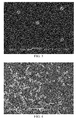
- Fig. 1 illustrates the increased surface area of the silica nanoparticles of the present invention relative to that of prior art silica particles.
- the enhanced solubility of the silica nanoparticles is due to the increased surface area created by the acid treatment on the silica nanoparticles formed by the reaction of the orthosilicate, alcohol, and ammonia in the presence of the metal salt or metalloid compound.
- the invention also provides nanoparticles prepared by the method described above.
- This example demonstrates the preparation of silica nanoparticles in accordance with an embodiment of the invention, where lithium acetate was used as the metal salt in (a).
- LiOAc. 2H 2 O lithium acetate dihydrate
- DI-H 2 O deionized water
- EtOH anhydrous ethanol
- 120 mL 28% w/w NH 3 in water were stirred for 30 min at 200 rpm using an overhead mixer with PTFE impellers.
- TEOS tetraethylorthosilicate
- Table 1 sets forth the reaction conditions and the particle diameter and shape
- Table 2 sets forth the % carbon before and after HCl treatment, the % metal content before and after HCl treatment, the density, and the dissolution rate before and after treatment with HCl. Table 1.
- This example demonstrates another preparation of nanoparticles in accordance with an embodiment of the invention, where lithium acetate was used as the salt in (a).
- This example demonstrates the preparation of another set of nanoparticles in accordance with an embodiment of the invention where sodium acetate was used as the salt in (a).
- the particles were sonicated with 1N HCl, washed with DI water, and dried under vacuum at 40 °C.
- the particles were characterized as in Example 1 and the results obtained are also set forth in Tables 1-2. SEM micrographs depicted in Fig. 6 showed that generally spherical particles.
- This example demonstrates the preparation of another set of nanoparticles in accordance with an embodiment of the invention where magnesium acetate was employed as the metal salt in (a).
- the particles were sonicated with 1N HCl, washed with DI water, and dried under vacuum at 40 °C.
- the particles were characterized as in Example 1 and the results obtained are also set forth in Tables 1-2.
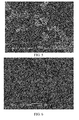
- SEM micrographs of the nanoparticles depicted in Fig. 5 show that the nanoparticles are non-spherical.
- This example demonstrates the preparation of another set of nanoparticles in accordance with an embodiment of the invention where calcium acetate was employed as the metal salt in (a).
- the particles were purified by centrifugation and re-suspension in EtOH three times.
- the particles were sonicated with 1N HCl, washed with DI water, and dried under vacuum at 40 °C.
- the particles were characterized as in Example 1 and the results obtained are also set forth in Tables 1-2.
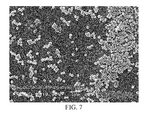
- An SEM of the nanoparticles is shown in Fig. 7 .
- This example demonstrates the preparation of nanoparticles where no salt of metal or metalloid was used.
- This example demonstrates the preparation of another set of nanoparticles where no salt of metal or metalloid was used.
- a suspension of either commercial particles in water or dissolvable nanoparticles in DMF was measured for weight fraction of particles.
- a small quantity (approximately 2 g) was placed into a vial, dried in an oven at 90 °C for 3 days, and the weight was measured before and after drying.
- a 25 mL specific gravity bottle was calibrated using water with a known density. The density of the suspensions was measured using the specific gravity bottle.
- pp is the density of the particle
- ⁇ is the density of the suspension as measured by the specific gravity bottle
- ⁇ s is the density of the solvent (1.0 g/cc for water and 0.944 g/cc for DMF)
- f p is the weight fraction of particle in the suspension as measured by the drying experiment.
- the diameter, the carbon content, and the dissolution rate of the commercial silica nanoparticles are set forth in Table 4.
- Properties of commercial silica nanoparticles Particles Diameter (DLS) nm % Carbon Dissolution Rate nm/min EM-3530K* 30 ⁇ 0.5 0.05 EM-5530K* 55 ⁇ 0.5 0.08 EM-7530K* 75 ⁇ 0.5 0.08
Landscapes
- Chemical & Material Sciences (AREA)
- Organic Chemistry (AREA)
- Inorganic Chemistry (AREA)
- Silicon Compounds (AREA)
Abstract
Description
- Nanoparticles, particularly silica nanoparticles, have been proposed for a number of applications including as solid support materials in column chromatography, as polishing agents in the electronics industry, membrane technology, catalyst support, silica-polymer composites, and in diagnostic and drug delivery applications. There is a desire for uniform or monodisperse nanoparticles. Further, for certain applications such as preparation of membranes having uniform pores and desired pore arrangement, where the nanoparticles may be used as templates during the preparation of the membranes, there is a desire that they be soluble in common or safe solvents. Presently known silica nanoparticles are soluble only in corrosive solvents such as hydrofluoric acid or they are slow to dissolve in common solvents, for example, a solution of alkali in water. Accordingly, there is a need for nanoparticles that are uniform in size and/or rapidly soluble in common or safe solvents.
- The invention provides silica nanoparticles having high solubility or dissolution rate in common or safe solvents, particularly in aqueous alkaline solutions. The silica nanoparticles have low particle density and high internal surface area. In embodiments, the silica nanoparticles have a diameter of about 50 nm to about 1000 nm and a particle density of about 1.96 g/cm3 or less.
- The invention further provides a method of preparing such silica nanoparticles, the method comprising (a) reacting an orthosilicate and an alcohol or a mixture of alcohols in an aqueous medium in the presence of a salt of a metal of Group Ia or Group IIa or in the presence of a metalloid compound, optionally in combination with ammonium hydroxide, (b) isolating the resulting nanoparticles, and (c) treating the nanoparticles from (b) with an acid.
- As the silica nanoparticles are highly soluble in alkalis, they are useful as removable templates for preparing membranes having controlled pore sizes and controlled spatial arrangement of pores.
-
-
Figure 1 compares the features of the silica nanoparticles of the present invention to the features of prior art silica nanoparticles. -
Figure 2 depicts an SEM micrograph of silica nanoparticles having an SEM diameter of 160 nm, in accordance with an embodiment of the invention where a lithium salt was employed in its preparation. -
Figure 3 depicts an SEM micrograph of the silica nanoparticles having an SEM diameter of 310 nm, in accordance with an embodiment of the invention where also a lithium salt was employed in its preparation. -
Figure 4 depicts an SEM micrograph of silica nanoparticles, having an SEM diameter of 540 nm, in accordance with an embodiment of the invention where a sodium salt was employed in its preparation. -
Figure 5 depicts an SEM micrograph of silica nanoparticles having an SEM diameter of 440 nm, in accordance with an embodiment of the invention where a calcium salt was employed in its preparation. -
Figure 6 depicts an SEM micrograph of silica nanoparticles having an SEM diameter of 270 nm, in accordance with an embodiment of the invention where a magnesium salt was employed in its preparation. -
Figure 7 depicts the SEM micrograph of silica nanoparticles, having an SEM diameter of 280 nm, in accordance with an embodiment of the invention where a boric acid was employed in its preparation. - In accordance with an embodiment, the present invention provides silica nanoparticles having a diameter of about 50 nm to about 1000 nm and a particle density of 1.96 g/cm3 or less.
- In an embodiment, the silica nanoparticles of the invention having a particle density of about 1.93 to about 1.96 g/cm3.
- The silica nanoparticles of the invention can have a particle size, e.g., diameter, of less than 1000 nm, in particular a particle size of from about 160 nm to about 630 nm. Thus, for example, the nanoparticles have a particle size of about 160 nm, about 180 nm, about 200 nm, about 220 nm, about 240 nm, about 260 nm, about 280 nm, about 300 nm, about 320 nm, about 340 nm, about 360 nm, about 380 nm, about 400 nm, about 420 nm, about 440 nm, about 460 nm, about 480 nm, about 500 nm, about 520 nm, about 540 nm, about 560 nm, about 580 nm, about 600 nm, or about 620 nm.
- The silica nanoparticles can have any suitable shape. In embodiments, the nanoparticles of the invention are generally spherical.
- The silica nanoparticles of the invention have high solubility in alkaline solutions. Solubility can be expressed by the rate of dissolution. In accordance with an embodiment, the silica nanoparticles have a rate of dissolution in 1N KOH solution of more than 10 nm/min, wherein the rate is measured by mixing 1-5 mg/mL silica nanoparticles in 1N aqueous KOH solution at 25°C and measuring the change in diameter of the nanoparticles as a function of time by the Dynamic Light Scattering method or measuring the turbidity decay as a function of time using a nephelometric turbidity meter. Preferably, the silica nanoparticles have a rate of dissolution of about 30 nm/min or higher, and more preferably, from about 30 nm/min to about 300 nm/min.
- The present invention further provides a method of preparing silica nanoparticles, the method comprising: (a) reacting an orthosilicate and an alcohol or a mixture of alcohols in an aqueous medium in the presence of a salt of a metal of Group Ia or Group IIa, or in the presence of a metalloid compound, optionally in combination with ammonium hydroxide, (b) isolating the resulting nanoparticles, and (c) treating the nanoparticles from (b) with an acid.
- In an embodiment, the orthosilicate used in the preparation of the nanoparticles is a tetraalkylorthosilicate. Examples of tetraalkylorthosilicates tetramethylorthosilicate, tetraethylorthosilicate, tetrapropylorthosilicate, tetrabutylorthosilicate, and tetrapentylorthosilicate.
- Any suitable alcohol or mixture of alcohols can be used in the method according to the invention, for example, the alcohol or mixture of alcohols is selected from methanol, ethanol, propanol, butanol, and mixtures thereof.
- The salt of the metal used in the preparation of the nanoparticles of the invention can be selected from salts of lithium, sodium, potassium, cesium, magnesium, and calcium. In an embodiment, the salt of the metal is selected from lithium acetate, sodium acetate, sodium metasilicate, sodium formate, potassium acetate, cesium acetate, magnesium acetate, and calcium acetate. In another embodiment, the metalloid compound is a compound of boron, for example, boric acid or a boric acid ester such as alkyl borate. The alkyl borate can be a trialkyl borate such as trimethyl borate or triethyl borate.
- In accordance with an embodiment, (a) is performed by mixing water, alcohol, the orthosilicate, and the salt of the metal or the metalloid compound. For example, in an embodiment, (a) can be performed by mixing about 2 to 25 mol/L of water, about 8 to about 16 mol/L of ethanol, about 0 to about 2 mol/L of methanol, about 0.1 to about 2 mol/L of ammonia, about 0.1 to about 0.4 mol/L of tetraalkylorthosilicate, and about 0.001 to about 0.01 mol/L of a salt of the metal or metalloid compound.
- Alternatively, (a) can be performed by adding an orthosilicate into a solution comprising the salt of the metal or the metalloid compound, water, and alcohol. For example, (a) can be performed by adding about 0.1 to about 0.4 mol/L of tetraalkylorthosilicate into a solution including about 2 to 25 mol/L of water, about 8 to about 16 mol/L of ethanol, about 0 to about 2 mol/L of methanol, about 0.1 to about 2 mol/L of ammonia, and about 0.001 to about 0.01 mol/L of a salt of a metal or metalloid compound and mixing the resulting mixture.
- In (a), the mixing is carried out for a suitable period of time, e.g., from about 5 minutes to about 2 hours, or from about 30 minutes to about 1 hour.
- In (a), the mixing is carried out at a suitable temperature, e.g., from about 20 °C to about 50 °C or from about 25 °C to about 35 °C.
- The resulting nanoparticles are isolated by centrifugal separation followed by washing with an alcohol, preferably repeatedly.
- In (c), any suitable acid can be employed, preferably a mineral acid or an organic acid. Examples of mineral acids include hydrochloric acid, sulfuric acid, and nitric acid, preferably hydrochloric acid or sulfuric acid. Examples of organic acids include acetic acid, formic acid, trifluoroacetic acid, trichloroacetic acid, and p-toluenesulfonic acid, preferably formic acid. The nanoparticles isolated in (b) can be treated with a 1N to 2N mineral acid, e.g., 1N HCl, or 10 - 50 weight % organic acid in water, e.g., 50 % aqueous formic acid, for a period of about 0.5 hr to about 3 hr, preferably about 1 hr to 2 hr. For example, the nanoparticles can be sonicated in an acid bath for the above period. Following the acid treatment, the nanoparticles are isolated from the acid and washed with deionized water and dried under vacuum to obtain the silica nanoparticles of the invention.
-
Fig. 1 illustrates the increased surface area of the silica nanoparticles of the present invention relative to that of prior art silica particles. Without wishing to be bound by any theory or mechanism, the enhanced solubility of the silica nanoparticles is due to the increased surface area created by the acid treatment on the silica nanoparticles formed by the reaction of the orthosilicate, alcohol, and ammonia in the presence of the metal salt or metalloid compound. - The invention also provides nanoparticles prepared by the method described above.
- The following examples further illustrate the invention but, of course, should not be construed as in any way limiting its scope.
- This example demonstrates the preparation of silica nanoparticles in accordance with an embodiment of the invention, where lithium acetate was used as the metal salt in (a).
- In a 6 L jacketed flask kept at 25 °C, 4.8 g lithium acetate dihydrate (LiOAc. 2H2O), 2480 mL deionized water (DI-H2O), 2.9 L anhydrous ethanol (EtOH), and 120 mL 28% w/w NH3 in water were stirred for 30 min at 200 rpm using an overhead mixer with PTFE impellers. A solution of 300 mL EtOH with 200 mL tetraethylorthosilicate (TEOS), which was prepared under dry conditions (< 10% relative humidity), was rapidly poured into the 6 L flask, and mixing was increased to 400 rpm and a dry air purge (< 1% relative humidity) was utilized for 5 min. Mixing was reduced to 200 rpm, the dry air purge was removed, the flask was sealed, and the reaction continued for a total of 1 h. The particles were purified by centrifugation and re-suspension in EtOH three times. The particles were sonicated with 1N HCl, washed with DI water, and dried under vacuum at 40 °C. The SEM micrograph depicted in
Fig. 2 show that the particles are generally spherical. Dynamic light scattering (DLS) showed a hydrodynamic diameter of 180 nm. Elemental analysis was performed on the particles before and after the HCl treatment. - For this example, as well as the following examples, Table 1 sets forth the reaction conditions and the particle diameter and shape, and Table 2 sets forth the % carbon before and after HCl treatment, the % metal content before and after HCl treatment, the density, and the dissolution rate before and after treatment with HCl.
Table 1. Reaction conditions and properties of nanoparticles Example [H2O] [NH3] [Salt] [TEOS] Diameter (DLS) nm Diameter (SEM) nm Shape 1 23.7 0.3 0.0078 0.15 180 160 Generally Spherical 2 23.07 0.9 0.0078 0.15 330 310 Generally Spherical 3 23.7 1 0.0078 0.15 560 540 Generally Spherical 4 23.5 0.5 0.0078 0.15 310 270 Generally Spherical 5 23.5 0.5 0.0078 0.15 310 270 Generally Spherical 6 23.9 1 0.0062 0.15 340 320 Generally Spherical 7 23.9 1 0.0078 0.15 340 350 Generally Spherical 8 23.9 1 0.0062 0.15 310 320 Generally Spherical 9 24 0.5 0.0062 0.15 310 260 Generally Spherical 10 23.9 1 0.0062 0.15 270 270 Generally Spherical 11 24 0.5 0.0046 0.15 Precipitated/Nonspherical 12 23.9 1 0.0062 0.15 630 440 Nonspherical 13 24 0.5 0.0046 0.15 Precipitated/Nonspherical 14 5 0.5 0.0062 0.2 290 280 Generally Spherical 15 20.7 0.5 0 0.15 180 190 Generally Spherical 16 23.9 1 0 0.15 240 225 Generally Spherical Table 2. Properties of nanoparticles Example % Carbon Before HCl % Carbon After HCl Metal % Metal Before HCl ppm Metal After HCl Density g/cc Dissolution Rate After HCl nm/min Dissolution Rate Before HCl nm/ min 1 4.3 0.43% Li 0.26 < 8 1.94 30 1-10 2 4.9 0.78% Li 0.31 < 8 1.93 40 1-10 3 3.4 0.64% Na 2.8 <16 1.96 30 1-10 4 3.2 Na 0.89 50 1-10 5 3.1 Na 0.92 50 1-10 6 2.7 K 1.9 120 1-10 7 2.2 0.76% K 2.3 <49 150 1-10 8 2.9 Cs 5.9 130 1-10 9 2.3 0.87% Cs 6.9 <49 60 1-10 10 4.1 Mg 0.11 180 1-10 11 4.2 Mg 0.03 12 3.4 Ca 0.87 260 1-10 13 3.4 Ca 0.86 14 3.9 B 0.53 200 1-10 15 3.5 10 1-10 16 3.8 0.83% 10 1-10 - This example demonstrates another preparation of nanoparticles in accordance with an embodiment of the invention, where lithium acetate was used as the salt in (a).
- In a 6 L jacketed flask kept at 25 °C, 4.8 g LiOAc.2H2O, 2240 mL DI-H2O, 2.9 L EtOH, and 360 mL 28% w/w NH3 in water were stirred for 30 min at 200 rpm using an overhead mixer with PTFE impellers. A solution of 300 mL EtOH with 200 mL TEOS prepared under dry conditions (< 10% relative humidity) was rapidly poured into the 6 L flask, and mixing was increased to 400 rpm and a dry air purge (< 1% relative humidity) was utilized for 5 min. Mixing was reduced to 200 rpm, the dry air purge was removed, the flask was sealed, and the reaction continued for a total of 1 h. The particles were purified by centrifugation and re-suspension in EtOH three times. SEM micrograph depicted in
Fig. 3 shows that the particles are generally spherical. The particles were sonicated with 1N HCl, washed with DI water, and dried under vacuum at 40 °C. The particles were characterized as in Example 1 and the results obtained are also set forth in Tables 1-2. - This example demonstrates the preparation of nanoparticles in accordance with an embodiment of the invention, where sodium metasilicate was used as the salt in (a).
- In a 6 L jacketed flask kept at 25 C, 10 g sodium metasilicate pentahydrate (Na2SiO3. 5H2O), 2280 mL DI-H2O, 1080 mL EtOH, 240 mL methanol (MeOH), and 400 mL 28% w/w NH3 in water were stirred for 30 min at 200 rpm using an overhead mixer with PTFE impellers. A solution of 1800 mL EtOH with 200 mL TEOS prepared under dry conditions (< 10% relative humidity) was rapidly poured into the 6 L flask, and mixing was increased to 500 rpm and a dry air purge (< 1% relative humidity) was utilized for 5 min. Mixing was reduced to 200 rpm, the dry air purge was removed, the flask was sealed, and the reaction continued for a total of 1 h. The particles were purified by centrifugation and re-suspension in EtOH three times. DLS showed a hydrodynamic diameter of 560 nm. SEM micrographs of the particles are depicted in
Fig. 4 , showing that the particles are generally spherical. The particles were sonicated with 1N HCl, sulfuric acid, or formic acid, washed with DI water, and dried under vacuum at 40 °C. The particles were characterized as in Example 1 and the results obtained on the HCl washed particles are also set forth in Tables 1-2. Sulfuric acid and formic acid treatments, followed by drying, produced particles having a carbon content <0.5 wt% and a sodium content of <23 ppm. The nanoparticles produced after treatment with HCl, sulfuric acid, and formic acid were rapidly dissolvable in aqueous alkaline solution. - This example demonstrates the preparation of another set of nanoparticles in accordance with an embodiment of the invention where sodium acetate was used as the salt in (a).
- In a 1 L Erlenmeyer flask at room temperature (23 °C), 0.64 g sodium acetate trihydrate (NaOAc.3H2O), 240 mL DI-H2O, 220 mL EtOH, and 20 mL 28% w/w NH3 in water were stirred for 30 min at 200 rpm using a magnetic stir bar. A solution of 100 mL EtOH with 20 mL TEOS prepared under dry conditions (< 10% relative humidity) was rapidly poured into the 1 L flask, the flask was sealed, and the reaction continued for a total of 1 h. The particles were purified by centrifugation and re-suspension in EtOH three times. The particles were sonicated with 1N HCl, washed with DI water, and dried under vacuum at 40 °C. The particles were characterized as in Example 1 and the results obtained are also set forth in Tables 1-2.
- This example demonstrates the preparation of yet another set of nanoparticles in accordance with an embodiment of the invention where sodium formate was employed as the metal salt in (a).
- In a 1 L Erlenmeyer flask at room temperature (23 °C), 0.32 g sodium formate (HCOONa), 240 mL DI-H2O, 220 mL EtOH, and 20 mL 28 % w/w NH3 in water were stirred for 30 min at 200 rpm using a magnetic stir bar. A solution of 100 mL EtOH with 20 mL TEOS prepared under dry conditions (< 10% relative humidity) was rapidly poured into the 1 L flask, the flask was sealed, and the reaction continued for a total of 1 h. The particles were purified by centrifugation and re-suspension in EtOH three times. The particles were sonicated with 1N HCl, washed with DI water, and dried under vacuum at 40 °C. The particles were characterized as in Example 1 and the results obtained are also set forth in Tables 1-2.
- This example demonstrates the preparation of nanoparticles in accordance with an embodiment of the invention where potassium acetate was employed as the metal salt in (a).
- In a 1 L Erlenmeyer flask at room temperature (23 °C), 0.37 g potassium acetate (KOAc), 230 mL DI-H2O, 210 mL EtOH, and 40 mL 28% w/w NH3 in water were stirred for 30 min at 200 rpm using a magnetic stir bar. A solution of 100 mL EtOH with 20 mL TEOS prepared under dry conditions (< 10% relative humidity) was rapidly poured into the 1 L flask, the flask was sealed, and the reaction continued for a total of 1 h. Particles were purified by centrifugation and re-suspension in EtOH three times. The particles were sonicated with 1N HCl, washed with DI water, and dried under vacuum at 40 °C. The particles were characterized as in Example 1 and the results obtained are also set forth in Tables 1-2.
- This example demonstrates the preparation of another set of nanoparticles in accordance with an embodiment of the invention where potassium acetate was employed as the metal salt in (a).
- In a 1 L Erlenmeyer flask at room temperature (23 °C), 0.46 g potassium acetate (KOAc), 230 mL DI-H2O, 210 mL EtOH, and 40 mL 28% w/w NH3 in water were stirred for 30 min at 200 rpm using a magnetic stir bar. A solution of 100 mL EtOH with 20 mL TEOS prepared under dry conditions (< 10% relative humidity) was rapidly poured into the 1 L flask, the flask was sealed, and the reaction continued for a total of 1 h. The particles were purified by centrifugation and re-suspension in EtOH three times. The particles were sonicated with 1N HCl, washed with DI water, and dried under vacuum at 40 °C. The particles were characterized as in Example 1 and the results obtained are also set forth in Tables 1-2.
- This example demonstrates the preparation of nanoparticles in accordance with an embodiment of the invention, where cesium acetate was employed as the metal salt in (a).
- In a 1 L Erlenmeyer flask at room temperature (23 °C), 0.72 g cesium acetate (CsOAc), 230 mL DI-H2O, 210 mL EtOH, and 40 mL 28% w/w NH3 in water were stirred for 30 min at 200 rpm using a magnetic stir bar. A solution of 100 mL EtOH with 20 mL TEOS prepared under dry conditions (< 10% relative humidity) was rapidly poured into the 1 L flask, the flask was sealed, and the reaction continued for a total of 1 h. The particles were purified by centrifugation and re-suspension in EtOH three times. The particles were sonicated with 1N HCl, washed with DI water, and dried under vacuum at 40 °C. The particles were characterized as in Example 1 and the results obtained are also set forth in Tables 1-2.
- This example demonstrates the preparation of another set of nanoparticles in accordance with an embodiment of the invention, where cesium acetate was employed as the metal salt in (a).
- In a 1 L Erlenmeyer flask at room temperature (23 °C), 0.72 g cesium acetate (CsOAc), 245 mL DI-H2O, 215 mL EtOH, and 20 mL 28% w/w NH3 in water were stirred for 30 min at 200 rpm using a magnetic stir bar. A solution of 100 mL EtOH with 20 mL TEOS prepared under dry conditions (< 10% relative humidity) was rapidly poured into the 1 L flask, the flask was sealed, and the reaction continued for a total of 1 h. Particles were purified by centrifugation and re-suspension in EtOH three times. The particles were sonicated with 1N HCl, washed with DI water, and dried under vacuum at 40 °C. The particles were characterized as in Example 1 and the results obtained are also set forth in Tables 1-2.
- This example demonstrates the preparation of nanoparticles in accordance with an embodiment of the invention where magnesium acetate was employed as the metal salt in (a).
- In a 1 L Erlenmeyer flask at room temperature (23 °C), 0.80 g magnesium acetate tetrahydrate (MgOAc.4H2O), 230 mL DI-H2O, 210 mL EtOH, and 40 mL 28% w/w NH3 in water were stirred for 30 min at 200 rpm using a magnetic stir bar. A solution of 100 mL EtOH with 20 mL TEOS prepared under dry conditions (< 10% relative humidity) was rapidly poured into the 1 L flask, the flask was sealed, and the reaction continued for a total of 1 h. The particles were purified by centrifugation and re-suspension in EtOH three times. The particles were sonicated with 1N HCl, washed with DI water, and dried under vacuum at 40 °C. The particles were characterized as in Example 1 and the results obtained are also set forth in Tables 1-2. SEM micrographs depicted in
Fig. 6 showed that generally spherical particles. - This example demonstrates the preparation of another set of nanoparticles in accordance with an embodiment of the invention where magnesium acetate was employed as the metal salt in (a).
- In a 1 L Erlenmeyer flask at room temperature (23 °C), 0.59 g magnesium acetate tetrahydrate (MgOAc.4H2O), 245 mL DI-H2O, 215 mL EtOH, and 20 mL 28% w/w NH3 in water were stirred for 30 min at 200 rpm using a magnetic stir bar. A solution of 100 mL EtOH with 20 mL TEOS prepared under dry conditions (< 10% relative humidity) was rapidly poured into the 1 L flask, the flask was sealed, and the reaction continued for a total of 1 h. The final reaction mixture contained precipitated particles. The particles were purified by washing with EtOH three times. The particles were sonicated with 1N HCl, washed with DI water, and dried under vacuum at 40 °C. The particles were characterized as in Example 1 and the results obtained are also set forth in Tables 1-2.
- This example demonstrates the preparation of nanoparticles in accordance with an embodiment of the invention where calcium acetate was employed as the metal salt in (a).
- In a 1 L Erlenmeyer flask at room temperature (23 °C), 0.66 g calcium acetate monohydrate (CaOAc.H2O), 230 mL DI-H2O, 210 mL EtOH, and 40 mL 28% w/w NH3 in water were stirred for 30 min at 200 rpm using a magnetic stir bar. A solution of 100 mL EtOH with 20 mL TEOS prepared under dry conditions (< 10% relative humidity) was rapidly poured into the 1 L flask, the flask was sealed, and the reaction continued for a total of 1 h. The particles were purified by centrifugation and re-suspension in EtOH three times. The particles were sonicated with 1N HCl, washed with DI water, and dried under vacuum at 40 °C. The particles were characterized as in Example 1 and the results obtained are also set forth in Tables 1-2. SEM micrographs of the nanoparticles depicted in
Fig. 5 show that the nanoparticles are non-spherical. - This example demonstrates the preparation of another set of nanoparticles in accordance with an embodiment of the invention where calcium acetate was employed as the metal salt in (a).
- In a 1 L Erlenmeyer flask at room temperature (23 °C), 0.49 g calcium acetate monohydrate (CaOAc.H2O), 245 mL DI-H2O, 215 mL EtOH, and 20 mL 28% w/w NH3 in water were stirred for 30 min at 200 rpm using a magnetic stir bar. A solution of 100 mL EtOH with 20 mL TEOS prepared under dry conditions (< 10 % relative humidity) was rapidly poured into the 1 L flask, the flask was sealed, and the reaction continued for a total of 1 h. The final reaction mixture contained precipitated particles. SEM of the nanoparticles showed that the nanoparticles are non-spherical and are highly aggregated. Particles were purified by washing with EtOH three times. The particles were sonicated with 1N HCl, washed with DI water, and dried under vacuum at 40 °C. The particles were characterized as in Example 1 and the results obtained are also set forth in Tables 1-2.
- This example demonstrates the preparation of nanoparticles in accordance with an embodiment of the invention where boric acid was employed as the metalloid compound in (a).
- In a 6 L jacketed flask kept at 25 °C, 2.3 g boric acid, 380 mL DI-H2O, 5 L EtOH, and 200 mL 28 % w/w NH3 in water were stirred for 30 min at 200 rpm using an overhead mixer with PTFE impellers. A solution of 150 mL EtOH with 270 mL TEOS prepared under dry conditions (< 10% relative humidity) was rapidly poured into the 6 L flask, and mixing was increased to 400 rpm and a dry air purge (< 1% relative humidity) was utilized for 5 min. Mixing was reduced to 200 rpm, the dry air purge was removed, the flask was sealed, and the reaction continued for a total of 1.5 h. The particles were purified by centrifugation and re-suspension in EtOH three times. The particles were sonicated with 1N HCl, washed with DI water, and dried under vacuum at 40 °C. The particles were characterized as in Example 1 and the results obtained are also set forth in Tables 1-2. An SEM of the nanoparticles is shown in
Fig. 7 . - This example demonstrates the preparation of nanoparticles where no salt of metal or metalloid was used.
- In a 1 L Erlenmeyer flask at room temperature (23 °C), 210 mL DI-H2O, 250 mL EtOH, and 20 mL 28% w/w NH3 in water were stirred for 30 min at 200 rpm using a magnetic stir bar. A solution of 100 mL EtOH with 20 mL TEOS prepared under dry conditions (< 10% relative humidity) was rapidly poured into the 1 L flask, the flask was sealed, and the reaction continued for a total of 1 h. The particles were purified by centrifugation and re-suspension in EtOH three times. The particles were sonicated with 1N HCl, washed with DI water, and dried under vacuum at 40 °C. The particles were characterized as in Example 1 and the results obtained are also set forth in Tables 1-2.
- This example demonstrates the preparation of another set of nanoparticles where no salt of metal or metalloid was used.
- In a 1 L Erlenmeyer flask at room temperature (23 °C), 230 mL DI-H2O, 210 mL EtOH, and 40 mL 28% w/w NH3 in water were stirred for 30 min at 200 rpm using a magnetic stir bar. A solution of 100 mL EtOH with 20 mL TEOS prepared under dry conditions (< 10% relative humidity) was rapidly poured into the 1 L flask, the flask was sealed, and the reaction continued for a total of 1 h. The particles were purified by centrifugation and re-suspension in EtOH three times. The particles were sonicated with 1N HCl, washed with DI water, and dried under vacuum at 40 °C. The particles were characterized as in Example 1 and the results obtained are also set forth in Tables 1-2. SEM showed that the particles are generally spherical.
- This example demonstrates the measurement of the density of the nanoparticles in accordance with the invention.
- A suspension of either commercial particles in water or dissolvable nanoparticles in DMF was measured for weight fraction of particles. A small quantity (approximately 2 g) was placed into a vial, dried in an oven at 90 °C for 3 days, and the weight was measured before and after drying. A 25 mL specific gravity bottle was calibrated using water with a known density. The density of the suspensions was measured using the specific gravity bottle. The density of the particles was determined using the following equation:

where pp is the density of the particle, ρ is the density of the suspension as measured by the specific gravity bottle, ρs is the density of the solvent (1.0 g/cc for water and 0.944 g/cc for DMF) and fp is the weight fraction of particle in the suspension as measured by the drying experiment. The results obtained are summarized in Table 3.Table 3. Density of Silica Nanoparticles Particles Solvent Solvent Density g/cm3 W/W Particles Density Suspension g/cm3 Particle Density g/cm3 EM-3530K* Water 1.0 0.306 1.20 2.24 EM-5530K* Water 1.0 0.305 1.20 2.25 EM-7530K* Water 1.0 0.302 1.20 2.27 570 nm Silica (Ex. 3) DMF 0.944 0.63 1.40 1.96 310 nm Silica (Ex. 2) DMF 0.944 0.55 1.31 1.93 160 nm Silica (Ex. 1) DMF 0.944 0.55 1.31 1.94 *commercial silica nanoparticles. - The diameter, the carbon content, and the dissolution rate of the commercial silica nanoparticles are set forth in Table 4.
Table 4. Properties of commercial silica nanoparticles Particles Diameter (DLS) nm % Carbon Dissolution Rate nm/min EM-3530K* 30 <0.5 0.05 EM-5530K* 55 <0.5 0.08 EM-7530K* 75 <0.5 0.08 - All references, including publications, patent applications, and patents, cited herein are hereby incorporated by reference to the same extent as if each reference were individually and specifically indicated to be incorporated by reference and were set forth in its entirety herein.
- The use of the terms "a" and "an" and "the" and "at least one" and similar referents in the context of describing the invention (especially in the context of the following claims) are to be construed to cover both the singular and the plural, unless otherwise indicated herein or clearly contradicted by context. The use of the term "at least one" followed by a list of one or more items (for example, "at least one of A and B") is to be construed to mean one item selected from the listed items (A or B) or any combination of two or more of the listed items (A and B), unless otherwise indicated herein or clearly contradicted by context. The terms "comprising," "having," "including," and "containing" are to be construed as open-ended terms (i.e., meaning "including, but not limited to,") unless otherwise noted. Recitation of ranges of values herein are merely intended to serve as a shorthand method of referring individually to each separate value falling within the range, unless otherwise indicated herein, and each separate value is incorporated into the specification as if it were individually recited herein. All methods described herein can be performed in any suitable order unless otherwise indicated herein or otherwise clearly contradicted by context. The use of any and all examples, or exemplary language (e.g., "such as") provided herein, is intended merely to better illuminate the invention and does not pose a limitation on the scope of the invention unless otherwise claimed. No language in the specification should be construed as indicating any non-claimed element as essential to the practice of the invention.
- Preferred embodiments of this invention are described herein, including the best mode known to the inventors for carrying out the invention. Variations of those preferred embodiments may become apparent to those of ordinary skill in the art upon reading the foregoing description. The inventors expect skilled artisans to employ such variations as appropriate, and the inventors intend for the invention to be practiced otherwise than as specifically described herein. Accordingly, this invention includes all modifications and equivalents of the subject matter recited in the claims appended hereto as permitted by applicable law. Moreover, any combination of the above-described elements in all possible variations thereof is encompassed by the invention unless otherwise indicated herein or otherwise clearly contradicted by context.
Claims (17)
- Silica nanoparticles having a diameter of about 50 nm to about 1000 nm and a particle density of about 1.96 g/cm3 or less.
- The silica nanoparticles of claim 1 having a rate of dissolution in 1N KOH solution of more than 10 nm/min, wherein the rate is measured by mixing 1-5 mg/mL silica nanoparticles in 1N aqueous KOH solution at 25°C and measuring the change in diameter as a function of time by the Dynamic Light Scattering method or measuring the turbidity decay as a function of time using a nephelometric turbidity meter.
- The silica nanoparticles of claim 1 or 2, having a particle density of about 1.93 to about 1.96 g/cm3.
- The silica nanoparticles of any one of claims 1 to 3, having a particle size of from about 160 nm to about 630 nm.
- The silica nanoparticles of any one of claims 1 to 4, which are generally spherical.
- The silica nanoparticles of any one of claims 1 to 5, having a rate of dissolution of about 30 nm/min or higher,
preferably the silica nanoparticles having a rate of dissolution of about 30 nm/min to about 300 nm/min. - A method of preparing silica nanoparticles having a diameter of about 50 nm to about 1000 nm and a particle density of about 1.96 g/cm3 or less, said method comprising:(a) reacting an orthosilicate and an alcohol or a mixture of alcohols in an aqueous medium in the presence of a salt of a metal of Group Ia or Group IIa or in the presence of a metalloid compound, optionally in combination with ammonium hydroxide,(b) isolating the resulting nanoparticles, and(c) treating the nanoparticles from (b) with an acid.
- The method of claim 7, wherein the orthosilicate is a tetraalkylorthosilicate, preferably wherein the orthosilicate is selected from tetramethylorthosilicate, tetraethylorthosilicate, tetrapropylorthosilicate, tetrabutylorthosilicate, and tetrapentylorthosilicate.
- The method of any one of claims 7 or 8, wherein the alcohol or mixture of alcohols is selected from methanol, ethanol, propanol, butanol, and mixtures thereof.
- The method of any one of claims 7 to 9, wherein the salt of the metal is selected from salts of lithium, sodium, potassium, cesium, magnesium, and calcium, preferably wherein the salt of the metal is selected from lithium acetate, sodium acetate, sodium metasilicate, sodium formate, potassium acetate, cesium acetate, magnesium acetate, and calcium acetate.
- The method of any one of claims 7 to 10, wherein the metalloid compound is a compound of boron,
preferably the compound of boron is boric acid or an alkyl borate,
more preferably the alkyl borate is trimethyl borate or triethyl borate. - The method of any one of claims 7 to 11, wherein (a) is performed by mixing water, alcohol, the orthosilicate, and the salt of the metal or the metalloid compound.
- The method of claim 12, comprising mixing about 2 to 25 mol/L of water, about 8 to about 16 mol/L of ethanol, about 0 to about 2 mol/L of methanol, about 0.1 to about 2 mol/L of ammonia, about 0.1 to about 0.4 mol/L of tetraalkylorthosilicate, and about 0.001 to about 0.01 mol/L of a salt of the metal or metalloid compound.
- The method of any one of claims 7 to 11, wherein (a) is performed by adding an orthosilicate into a solution comprising the salt of the metal or the metalloid compound, water, and alcohol,
preferably the method comprises adding about 0.1 to about 0.4 mol/L of tetraalkylorthosilicate into a solution including about 2 to 25 mol/L of water, about 8 to about 16 mol/L of ethanol, about 0 to about 2 mol/L of methanol, about 0.1 to about 2 mol/L of ammonia, and about 0.001 to about 0.01 mol/L of a salt of a metal or metalloid compound and mixing the resulting mixture,
preferably wherein the mixing is carried out for a period of from about 5 minutes to about 2 hours,
optionally wherein the mixing is carried out at a temperature of from about 20 °C to about 50 °C. - The method of any one of claims 7 to 14, wherein the resulting nanoparticles are isolated by centrifugal separation followed by washing with an alcohol.
- The method of any one of claims 7 to 15, wherein the acid is a mineral acid or organic acid,
preferably wherein the mineral acid is hydrochloric acid and the organic acid is formic acid. - The nanoparticles prepared by the method of any one of claims 7 to 16.
Applications Claiming Priority (1)
| Application Number | Priority Date | Filing Date | Title |
|---|---|---|---|
| US14/193,738 US9309126B2 (en) | 2014-02-28 | 2014-02-28 | Rapidly dissolvable nanoparticles |
Publications (2)
| Publication Number | Publication Date |
|---|---|
| EP2913301A1 true EP2913301A1 (en) | 2015-09-02 |
| EP2913301B1 EP2913301B1 (en) | 2020-08-26 |
Family
ID=52231901
Family Applications (1)
| Application Number | Title | Priority Date | Filing Date |
|---|---|---|---|
| EP14199146.3A Active EP2913301B1 (en) | 2014-02-28 | 2014-12-19 | Rapidly dissolvable nanoparticles |
Country Status (5)
| Country | Link |
|---|---|
| US (1) | US9309126B2 (en) |
| EP (1) | EP2913301B1 (en) |
| JP (1) | JP6014893B2 (en) |
| CN (1) | CN104876227B (en) |
| AU (1) | AU2014277811C1 (en) |
Families Citing this family (3)
| Publication number | Priority date | Publication date | Assignee | Title |
|---|---|---|---|---|
| US9561473B2 (en) | 2014-02-28 | 2017-02-07 | Pall Corporation | Charged hollow fiber membrane having hexagonal voids |
| US9737860B2 (en) | 2014-02-28 | 2017-08-22 | Pall Corporation | Hollow fiber membrane having hexagonal voids |
| CN112326383B (en) * | 2020-10-30 | 2023-03-24 | 山东省产品质量检验研究院 | Modified nano SiO2 water quality processor turbidity labeling substance and preparation method thereof |
Citations (1)
| Publication number | Priority date | Publication date | Assignee | Title |
|---|---|---|---|---|
| WO2010121064A2 (en) * | 2009-04-15 | 2010-10-21 | Cornell Research Foundation, Inc. | Improved fluorescent silica nanoparticles through silica densification |
Family Cites Families (52)
| Publication number | Priority date | Publication date | Assignee | Title |
|---|---|---|---|---|
| US2913419A (en) | 1956-04-18 | 1959-11-17 | Du Pont | Chemical process and composition |
| US2974108A (en) | 1957-01-14 | 1961-03-07 | Du Pont | Aluminosilicate aquasols and their preparation |
| US4188418A (en) | 1972-08-09 | 1980-02-12 | Lever Brothers Company | Separation process |
| US4289600A (en) | 1978-03-31 | 1981-09-15 | Hooker Chemicals & Plastics Corp. | Microporous membrane materials |
| DE2829045A1 (en) | 1978-07-01 | 1980-01-10 | Degussa | PRESERVED FELLING ACID |
| JPS58110414A (en) | 1981-12-23 | 1983-07-01 | Tokuyama Soda Co Ltd | Inorganic oxide and its manufacture |
| US5236683A (en) | 1987-01-20 | 1993-08-17 | Mizusawa Industrial Chemicals, Ltd. | Amorphous silica spherical particles |
| US5221497A (en) | 1988-03-16 | 1993-06-22 | Nissan Chemical Industries, Ltd. | Elongated-shaped silica sol and method for preparing the same |
| US4940571A (en) | 1988-04-01 | 1990-07-10 | Gte Laboratories Incorporated | Method of making large particle size, high purity dense silica |
| US5100581A (en) | 1990-02-22 | 1992-03-31 | Nissan Chemical Industries Ltd. | Method of preparing high-purity aqueous silica sol |
| US5024826A (en) | 1990-03-05 | 1991-06-18 | E. I. Du Pont De Nemours And Company | Silica particulate composition |
| US5102917A (en) | 1990-09-14 | 1992-04-07 | Cpc Engineering Corporation | Porous polysulfone media suitable for filtration |
| CA2509635C (en) | 1997-09-30 | 2007-11-20 | Nalco Chemical Company | Colloidal borosilicates and their use in the production of paper |
| CO5070714A1 (en) | 1998-03-06 | 2001-08-28 | Nalco Chemical Co | PROCESS FOR THE PREPARATION OF STABLE COLOIDAL SILICE |
| US6680013B1 (en) | 1999-04-15 | 2004-01-20 | Regents Of The University Of Minnesota | Synthesis of macroporous structures |
| PT1261550E (en) | 2000-03-03 | 2006-05-31 | Grace Gmbh & Co Kg | PARTICLES OF SILICA AMORFA UNDERSTANDING BORO |
| US6548264B1 (en) | 2000-05-17 | 2003-04-15 | University Of Florida | Coated nanoparticles |
| KR100575113B1 (en) | 2000-06-21 | 2006-05-03 | 가부시키가이샤 구라레 | Porous hollow fiber membranes and method of making the same |
| US6906109B2 (en) | 2000-09-01 | 2005-06-14 | Chemical Products Corp. | Method for controling uniformity of colloidal silica particle size |
| DE10048616A1 (en) | 2000-09-30 | 2002-04-11 | Degussa | Doped precipitated silica |
| US6929764B2 (en) | 2000-11-17 | 2005-08-16 | William Marsh Rice University | Polymers having ordered, monodisperse pores and their corresponding ordered, monodisperse colloids |
| DE10058258B4 (en) | 2000-11-23 | 2005-01-27 | Goedel, Werner Andreas | Porous membranes, their preparation and use |
| TWI276604B (en) | 2001-12-27 | 2007-03-21 | Tokuyama Corp | Silica composite oxide particles and method of producing the same |
| US7438875B2 (en) | 2003-10-16 | 2008-10-21 | Kimberly-Clark Worldwide, Inc. | Method for reducing odor using metal-modified silica particles |
| AU2003296868A1 (en) | 2003-12-31 | 2005-07-21 | Council Of Scientific And Industrial Research | A process for the preparation of free standing membranes |
| US20050234136A1 (en) | 2004-04-19 | 2005-10-20 | Holland Brian T | Colloidal compositions and methods of preparing same |
| JP5097878B2 (en) | 2004-12-24 | 2012-12-12 | 富士化学株式会社 | Method for producing porous silica |
| US20060283095A1 (en) | 2005-06-15 | 2006-12-21 | Planar Solutions, Llc | Fumed silica to colloidal silica conversion process |
| US8052788B2 (en) | 2005-08-10 | 2011-11-08 | Nalco Company | Method of producing silica sols with controllable broad size distribution and minimum particle size |
| EP1764116A1 (en) | 2005-09-16 | 2007-03-21 | Debiotech S.A. | Porous coating process using colloidal particles |
| KR101214060B1 (en) | 2005-09-26 | 2012-12-20 | 플레이너 솔루션즈 엘엘씨 | Ultrapure colloidal silica for use in chemical mechanical polishing applications |
| DE102006010831A1 (en) | 2006-03-07 | 2007-09-13 | Werner Andreas Goedel | Composite membrane, useful e.g. for filtration and as membrane reactor, comprises porous layer of hardened material and porous support structure, parts of which penetrate into the porous layer |
| DE102006036863B4 (en) | 2006-08-03 | 2008-10-16 | Technische Universität Chemnitz | Mechanically stable porous membrane, process for its preparation and its use |
| US8048394B2 (en) * | 2006-10-31 | 2011-11-01 | Kao Corporation | Mesoporous silica particles |
| US20080108497A1 (en) | 2006-11-08 | 2008-05-08 | Holland Brian T | Metal-rich siliceous compositions and methods of producing same |
| WO2009010945A2 (en) | 2007-07-13 | 2009-01-22 | University College Cork - National University Of Ireland, Cork | A method for synthesising microparticles |
| TWI457283B (en) | 2008-02-12 | 2014-10-21 | Nissan Chemical Ind Ltd | Silica colloidal particles and production method thereof, and organic solvent-dispersed silica sol, polimerizable compound-dispersed silica sol and dicarboxylic anhydride-dispersed silica sol thereof |
| JP5042110B2 (en) | 2008-04-22 | 2012-10-03 | サルナス、ペトロニス | Production of nanopores |
| US8163388B2 (en) | 2008-12-15 | 2012-04-24 | Kimberly-Clark Worldwide, Inc. | Compositions comprising metal-modified silica nanoparticles |
| US20100155325A1 (en) | 2008-12-24 | 2010-06-24 | General Electric Company | Particle-templated membranes, and related processes for their preparation |
| JP5339627B2 (en) | 2009-02-17 | 2013-11-13 | 国立大学法人 名古屋工業大学 | Nano hollow particles comprising low density silica shell and method for producing the same |
| EP2405999A2 (en) | 2009-03-13 | 2012-01-18 | President and Fellows of Harvard College | Systems and methods of templating using particles such as colloidal particles |
| KR101213714B1 (en) | 2009-05-27 | 2012-12-18 | 한국세라믹기술원 | Preparation method for mesoporous silica nanoparticles using transition metal salt |
| WO2011063356A2 (en) | 2009-11-22 | 2011-05-26 | Sirnaomics, Inc. | Rare earth-doped up-conversion nanoparticles for therapeutic and diagnostic applications |
| JP2011173779A (en) | 2010-01-26 | 2011-09-08 | Sakai Chem Ind Co Ltd | Silica particles, process for production of same, and resin composition containing same |
| US8845991B2 (en) | 2010-04-08 | 2014-09-30 | Ecolab Usa Inc. | Silica particle manufacturing process |
| US8932549B2 (en) | 2010-04-08 | 2015-01-13 | Ecolab Usa Inc. | Sulfur containing silica particle |
| WO2012058154A2 (en) | 2010-10-27 | 2012-05-03 | University Of Florida Research Foundation, Inc. | Porous polymer membrances, methods of making, and methods of use |
| EP2476724A1 (en) | 2011-01-17 | 2012-07-18 | ETH Zurich | Pourous polymer membranes |
| JP2015504452A (en) | 2011-12-06 | 2015-02-12 | エンパイア テクノロジー ディベロップメント エルエルシー | Phosphorus loading particles and methods of preparing and using them |
| WO2013130893A2 (en) | 2012-02-28 | 2013-09-06 | Massachusetts Institute Of Technology | Hierarchical porous membrane for emulsion separation |
| JP5974683B2 (en) | 2012-07-02 | 2016-08-23 | 堺化学工業株式会社 | Particle having void inside particle and method for producing the same |
-
2014
- 2014-02-28 US US14/193,738 patent/US9309126B2/en active Active
- 2014-12-19 AU AU2014277811A patent/AU2014277811C1/en active Active
- 2014-12-19 EP EP14199146.3A patent/EP2913301B1/en active Active
- 2014-12-22 JP JP2014258809A patent/JP6014893B2/en active Active
- 2014-12-30 CN CN201410858519.3A patent/CN104876227B/en active Active
Patent Citations (1)
| Publication number | Priority date | Publication date | Assignee | Title |
|---|---|---|---|---|
| WO2010121064A2 (en) * | 2009-04-15 | 2010-10-21 | Cornell Research Foundation, Inc. | Improved fluorescent silica nanoparticles through silica densification |
Non-Patent Citations (1)
| Title |
|---|
| STOBER W ET AL: "Controlled growth of monodisperse silica spheres in the micron size range", JOURNAL OF COLLOID AND INTERFACE SCIENCE, ACADEMIC PRESS, NEW YORK, NY, US, vol. 26, no. 1, 1 January 1968 (1968-01-01), pages 62 - 69, XP024189444, ISSN: 0021-9797, [retrieved on 19680101], DOI: 10.1016/0021-9797(68)90272-5 * |
Also Published As
| Publication number | Publication date |
|---|---|
| CN104876227B (en) | 2019-03-01 |
| JP2015164890A (en) | 2015-09-17 |
| EP2913301B1 (en) | 2020-08-26 |
| AU2014277811C1 (en) | 2016-12-15 |
| JP6014893B2 (en) | 2016-10-26 |
| US9309126B2 (en) | 2016-04-12 |
| AU2014277811A1 (en) | 2015-09-24 |
| AU2014277811B2 (en) | 2016-09-08 |
| US20150246818A1 (en) | 2015-09-03 |
| CN104876227A (en) | 2015-09-02 |
Similar Documents
| Publication | Publication Date | Title |
|---|---|---|
| Yang et al. | Monodisperse core-shell structured magnetic mesoporous aluminosilicate nanospheres with large dendritic mesochannels | |
| US12139411B2 (en) | Hydrolytic and calcination method for forming hollow silica particles | |
| Kurdyukov et al. | Template synthesis of monodisperse carbon nanodots | |
| CN103894194B (en) | A kind of room temperature removes the loaded catalyst of formaldehyde | |
| CN104248970B (en) | A kind of carried phospho-tungstic acid catalyst and its preparation method and application and the preparation method of Ketohexamethylene glycerol ketal | |
| Li et al. | Core–shell structured Gd 2 O 3: Ln@ m SiO 2 hollow nanospheres: synthesis, photoluminescence and drug release properties | |
| EP3447790A1 (en) | Silica-based composite fine particle dispersion and method for manufacturing same | |
| US9309126B2 (en) | Rapidly dissolvable nanoparticles | |
| JP5479502B2 (en) | Production of high purity suspension containing precipitated silica by electrodialysis | |
| CN106517216B (en) | Biodegradable mesoporous carbon silicon nanosphere and preparation method thereof | |
| Chen et al. | Dissolution from inside: a unique degradation behaviour of core–shell magnetic mesoporous silica nanoparticles and the effect of polyethyleneimine coating | |
| JP2016138310A5 (en) | ||
| TW201831229A (en) | Aerogel having surface modified with catechol-based compounds and preparation method thereof | |
| CN102091331A (en) | Carboxyl mesoporous silica nanoparticle carrier material and preparation method thereof | |
| Essien et al. | Sol-gel-derived porous silica: Economic synthesis and characterization. | |
| Murashkevich et al. | Synthesis and thermoanalytical study of SiO2–TiO2 composites modified with macrocyclic endoreceptors | |
| CN104870085B (en) | The preparation of silica alumina composition | |
| CN106622378A (en) | Spherical aluminium-containing mesoporous composite material, supported catalyst, preparation method and applications of spherical aluminium-containing mesoporous composite material and supported catalyst, and method used for preparing cyclohexanone glyceryl | |
| CN105688907B (en) | A kind of degradation of formaldehyde mesoporous catalyst and preparation method thereof | |
| EP2944609A1 (en) | Method for preparing superoxide-generating composition, and superoxide-generating composition prepared by method | |
| JP5505900B2 (en) | High concentration silica sol | |
| JP2017516641A (en) | Process for producing a catalyst having increased strength and reduced volume shrinkage | |
| Northcott et al. | Synthesis, characterization and evaluation of mesoporous silicates for adsorption of metal ions | |
| CN115304779A (en) | MIL-101 (Cr) and preparation method thereof | |
| CN110016157A (en) | A kind of resin balls and its preparation method and application |
Legal Events
| Date | Code | Title | Description |
|---|---|---|---|
| PUAI | Public reference made under article 153(3) epc to a published international application that has entered the european phase |
Free format text: ORIGINAL CODE: 0009012 |
|
| AK | Designated contracting states |
Kind code of ref document: A1 Designated state(s): AL AT BE BG CH CY CZ DE DK EE ES FI FR GB GR HR HU IE IS IT LI LT LU LV MC MK MT NL NO PL PT RO RS SE SI SK SM TR |
|
| AX | Request for extension of the european patent |
Extension state: BA ME |
|
| 17P | Request for examination filed |
Effective date: 20160225 |
|
| RBV | Designated contracting states (corrected) |
Designated state(s): AL AT BE BG CH CY CZ DE DK EE ES FI FR GB GR HR HU IE IS IT LI LT LU LV MC MK MT NL NO PL PT RO RS SE SI SK SM TR |
|
| STAA | Information on the status of an ep patent application or granted ep patent |
Free format text: STATUS: EXAMINATION IS IN PROGRESS |
|
| 17Q | First examination report despatched |
Effective date: 20190628 |
|
| GRAP | Despatch of communication of intention to grant a patent |
Free format text: ORIGINAL CODE: EPIDOSNIGR1 |
|
| STAA | Information on the status of an ep patent application or granted ep patent |
Free format text: STATUS: GRANT OF PATENT IS INTENDED |
|
| RIC1 | Information provided on ipc code assigned before grant |
Ipc: C01B 33/187 20060101ALI20200305BHEP Ipc: C01B 33/12 20060101AFI20200305BHEP |
|
| INTG | Intention to grant announced |
Effective date: 20200326 |
|
| GRAS | Grant fee paid |
Free format text: ORIGINAL CODE: EPIDOSNIGR3 |
|
| GRAA | (expected) grant |
Free format text: ORIGINAL CODE: 0009210 |
|
| STAA | Information on the status of an ep patent application or granted ep patent |
Free format text: STATUS: THE PATENT HAS BEEN GRANTED |
|
| AK | Designated contracting states |
Kind code of ref document: B1 Designated state(s): AL AT BE BG CH CY CZ DE DK EE ES FI FR GB GR HR HU IE IS IT LI LT LU LV MC MK MT NL NO PL PT RO RS SE SI SK SM TR |
|
| REG | Reference to a national code |
Ref country code: GB Ref legal event code: FG4D |
|
| REG | Reference to a national code |
Ref country code: CH Ref legal event code: EP |
|
| REG | Reference to a national code |
Ref country code: AT Ref legal event code: REF Ref document number: 1306192 Country of ref document: AT Kind code of ref document: T Effective date: 20200915 |
|
| REG | Reference to a national code |
Ref country code: IE Ref legal event code: FG4D |
|
| REG | Reference to a national code |
Ref country code: DE Ref legal event code: R096 Ref document number: 602014069354 Country of ref document: DE |
|
| REG | Reference to a national code |
Ref country code: SE Ref legal event code: TRGR |
|
| REG | Reference to a national code |
Ref country code: NL Ref legal event code: FP |
|
| REG | Reference to a national code |
Ref country code: LT Ref legal event code: MG4D |
|
| PG25 | Lapsed in a contracting state [announced via postgrant information from national office to epo] |
Ref country code: LT Free format text: LAPSE BECAUSE OF FAILURE TO SUBMIT A TRANSLATION OF THE DESCRIPTION OR TO PAY THE FEE WITHIN THE PRESCRIBED TIME-LIMIT Effective date: 20200826 Ref country code: BG Free format text: LAPSE BECAUSE OF FAILURE TO SUBMIT A TRANSLATION OF THE DESCRIPTION OR TO PAY THE FEE WITHIN THE PRESCRIBED TIME-LIMIT Effective date: 20201126 Ref country code: HR Free format text: LAPSE BECAUSE OF FAILURE TO SUBMIT A TRANSLATION OF THE DESCRIPTION OR TO PAY THE FEE WITHIN THE PRESCRIBED TIME-LIMIT Effective date: 20200826 Ref country code: GR Free format text: LAPSE BECAUSE OF FAILURE TO SUBMIT A TRANSLATION OF THE DESCRIPTION OR TO PAY THE FEE WITHIN THE PRESCRIBED TIME-LIMIT Effective date: 20201127 Ref country code: FI Free format text: LAPSE BECAUSE OF FAILURE TO SUBMIT A TRANSLATION OF THE DESCRIPTION OR TO PAY THE FEE WITHIN THE PRESCRIBED TIME-LIMIT Effective date: 20200826 Ref country code: NO Free format text: LAPSE BECAUSE OF FAILURE TO SUBMIT A TRANSLATION OF THE DESCRIPTION OR TO PAY THE FEE WITHIN THE PRESCRIBED TIME-LIMIT Effective date: 20201126 Ref country code: PT Free format text: LAPSE BECAUSE OF FAILURE TO SUBMIT A TRANSLATION OF THE DESCRIPTION OR TO PAY THE FEE WITHIN THE PRESCRIBED TIME-LIMIT Effective date: 20201228 |
|
| REG | Reference to a national code |
Ref country code: AT Ref legal event code: MK05 Ref document number: 1306192 Country of ref document: AT Kind code of ref document: T Effective date: 20200826 |
|
| PG25 | Lapsed in a contracting state [announced via postgrant information from national office to epo] |
Ref country code: IS Free format text: LAPSE BECAUSE OF FAILURE TO SUBMIT A TRANSLATION OF THE DESCRIPTION OR TO PAY THE FEE WITHIN THE PRESCRIBED TIME-LIMIT Effective date: 20201226 Ref country code: LV Free format text: LAPSE BECAUSE OF FAILURE TO SUBMIT A TRANSLATION OF THE DESCRIPTION OR TO PAY THE FEE WITHIN THE PRESCRIBED TIME-LIMIT Effective date: 20200826 Ref country code: RS Free format text: LAPSE BECAUSE OF FAILURE TO SUBMIT A TRANSLATION OF THE DESCRIPTION OR TO PAY THE FEE WITHIN THE PRESCRIBED TIME-LIMIT Effective date: 20200826 Ref country code: PL Free format text: LAPSE BECAUSE OF FAILURE TO SUBMIT A TRANSLATION OF THE DESCRIPTION OR TO PAY THE FEE WITHIN THE PRESCRIBED TIME-LIMIT Effective date: 20200826 |
|
| PG25 | Lapsed in a contracting state [announced via postgrant information from national office to epo] |
Ref country code: RO Free format text: LAPSE BECAUSE OF FAILURE TO SUBMIT A TRANSLATION OF THE DESCRIPTION OR TO PAY THE FEE WITHIN THE PRESCRIBED TIME-LIMIT Effective date: 20200826 Ref country code: SM Free format text: LAPSE BECAUSE OF FAILURE TO SUBMIT A TRANSLATION OF THE DESCRIPTION OR TO PAY THE FEE WITHIN THE PRESCRIBED TIME-LIMIT Effective date: 20200826 Ref country code: DK Free format text: LAPSE BECAUSE OF FAILURE TO SUBMIT A TRANSLATION OF THE DESCRIPTION OR TO PAY THE FEE WITHIN THE PRESCRIBED TIME-LIMIT Effective date: 20200826 Ref country code: CZ Free format text: LAPSE BECAUSE OF FAILURE TO SUBMIT A TRANSLATION OF THE DESCRIPTION OR TO PAY THE FEE WITHIN THE PRESCRIBED TIME-LIMIT Effective date: 20200826 Ref country code: EE Free format text: LAPSE BECAUSE OF FAILURE TO SUBMIT A TRANSLATION OF THE DESCRIPTION OR TO PAY THE FEE WITHIN THE PRESCRIBED TIME-LIMIT Effective date: 20200826 |
|
| REG | Reference to a national code |
Ref country code: DE Ref legal event code: R097 Ref document number: 602014069354 Country of ref document: DE |
|
| PG25 | Lapsed in a contracting state [announced via postgrant information from national office to epo] |
Ref country code: ES Free format text: LAPSE BECAUSE OF FAILURE TO SUBMIT A TRANSLATION OF THE DESCRIPTION OR TO PAY THE FEE WITHIN THE PRESCRIBED TIME-LIMIT Effective date: 20200826 Ref country code: AL Free format text: LAPSE BECAUSE OF FAILURE TO SUBMIT A TRANSLATION OF THE DESCRIPTION OR TO PAY THE FEE WITHIN THE PRESCRIBED TIME-LIMIT Effective date: 20200826 Ref country code: AT Free format text: LAPSE BECAUSE OF FAILURE TO SUBMIT A TRANSLATION OF THE DESCRIPTION OR TO PAY THE FEE WITHIN THE PRESCRIBED TIME-LIMIT Effective date: 20200826 |
|
| PG25 | Lapsed in a contracting state [announced via postgrant information from national office to epo] |
Ref country code: SK Free format text: LAPSE BECAUSE OF FAILURE TO SUBMIT A TRANSLATION OF THE DESCRIPTION OR TO PAY THE FEE WITHIN THE PRESCRIBED TIME-LIMIT Effective date: 20200826 |
|
| PLBE | No opposition filed within time limit |
Free format text: ORIGINAL CODE: 0009261 |
|
| STAA | Information on the status of an ep patent application or granted ep patent |
Free format text: STATUS: NO OPPOSITION FILED WITHIN TIME LIMIT |
|
| REG | Reference to a national code |
Ref country code: CH Ref legal event code: PL |
|
| 26N | No opposition filed |
Effective date: 20210527 |
|
| PG25 | Lapsed in a contracting state [announced via postgrant information from national office to epo] |
Ref country code: MC Free format text: LAPSE BECAUSE OF FAILURE TO SUBMIT A TRANSLATION OF THE DESCRIPTION OR TO PAY THE FEE WITHIN THE PRESCRIBED TIME-LIMIT Effective date: 20200826 Ref country code: SI Free format text: LAPSE BECAUSE OF FAILURE TO SUBMIT A TRANSLATION OF THE DESCRIPTION OR TO PAY THE FEE WITHIN THE PRESCRIBED TIME-LIMIT Effective date: 20200826 |
|
| PG25 | Lapsed in a contracting state [announced via postgrant information from national office to epo] |
Ref country code: IE Free format text: LAPSE BECAUSE OF NON-PAYMENT OF DUE FEES Effective date: 20201219 Ref country code: LU Free format text: LAPSE BECAUSE OF NON-PAYMENT OF DUE FEES Effective date: 20201219 |
|
| PG25 | Lapsed in a contracting state [announced via postgrant information from national office to epo] |
Ref country code: CH Free format text: LAPSE BECAUSE OF NON-PAYMENT OF DUE FEES Effective date: 20201231 Ref country code: LI Free format text: LAPSE BECAUSE OF NON-PAYMENT OF DUE FEES Effective date: 20201231 |
|
| PG25 | Lapsed in a contracting state [announced via postgrant information from national office to epo] |
Ref country code: TR Free format text: LAPSE BECAUSE OF FAILURE TO SUBMIT A TRANSLATION OF THE DESCRIPTION OR TO PAY THE FEE WITHIN THE PRESCRIBED TIME-LIMIT Effective date: 20200826 Ref country code: MT Free format text: LAPSE BECAUSE OF FAILURE TO SUBMIT A TRANSLATION OF THE DESCRIPTION OR TO PAY THE FEE WITHIN THE PRESCRIBED TIME-LIMIT Effective date: 20200826 Ref country code: CY Free format text: LAPSE BECAUSE OF FAILURE TO SUBMIT A TRANSLATION OF THE DESCRIPTION OR TO PAY THE FEE WITHIN THE PRESCRIBED TIME-LIMIT Effective date: 20200826 |
|
| PG25 | Lapsed in a contracting state [announced via postgrant information from national office to epo] |
Ref country code: MK Free format text: LAPSE BECAUSE OF FAILURE TO SUBMIT A TRANSLATION OF THE DESCRIPTION OR TO PAY THE FEE WITHIN THE PRESCRIBED TIME-LIMIT Effective date: 20200826 |
|
| P01 | Opt-out of the competence of the unified patent court (upc) registered |
Effective date: 20230530 |
|
| PGFP | Annual fee paid to national office [announced via postgrant information from national office to epo] |
Ref country code: GB Payment date: 20251223 Year of fee payment: 12 |
|
| PGFP | Annual fee paid to national office [announced via postgrant information from national office to epo] |
Ref country code: IT Payment date: 20251218 Year of fee payment: 12 |
|
| PGFP | Annual fee paid to national office [announced via postgrant information from national office to epo] |
Ref country code: FR Payment date: 20251230 Year of fee payment: 12 Ref country code: NL Payment date: 20251222 Year of fee payment: 12 |
|
| PGFP | Annual fee paid to national office [announced via postgrant information from national office to epo] |
Ref country code: SE Payment date: 20251222 Year of fee payment: 12 |
|
| PGFP | Annual fee paid to national office [announced via postgrant information from national office to epo] |
Ref country code: DE Payment date: 20251229 Year of fee payment: 12 |
|
| PGFP | Annual fee paid to national office [announced via postgrant information from national office to epo] |
Ref country code: BE Payment date: 20260109 Year of fee payment: 12 |