EP2902801A1 - Drahtlose sensorvorrichtung - Google Patents
Drahtlose sensorvorrichtung Download PDFInfo
- Publication number
- EP2902801A1 EP2902801A1 EP13842032.8A EP13842032A EP2902801A1 EP 2902801 A1 EP2902801 A1 EP 2902801A1 EP 13842032 A EP13842032 A EP 13842032A EP 2902801 A1 EP2902801 A1 EP 2902801A1
- Authority
- EP
- European Patent Office
- Prior art keywords
- transmission
- signal
- circuit
- antenna
- output terminal
- Prior art date
- Legal status (The legal status is an assumption and is not a legal conclusion. Google has not performed a legal analysis and makes no representation as to the accuracy of the status listed.)
- Withdrawn
Links
- 230000005540 biological transmission Effects 0.000 claims abstract description 205
- 238000001514 detection method Methods 0.000 claims abstract description 65
- 238000000034 method Methods 0.000 claims abstract description 22
- 230000035945 sensitivity Effects 0.000 abstract description 30
- 230000006866 deterioration Effects 0.000 abstract description 6
- 238000006243 chemical reaction Methods 0.000 description 7
- 230000007704 transition Effects 0.000 description 6
- 238000013459 approach Methods 0.000 description 5
- 238000010586 diagram Methods 0.000 description 5
- 230000010363 phase shift Effects 0.000 description 4
- 230000029058 respiratory gaseous exchange Effects 0.000 description 4
- 230000010355 oscillation Effects 0.000 description 2
- 230000002238 attenuated effect Effects 0.000 description 1
- 230000003247 decreasing effect Effects 0.000 description 1
- 230000003111 delayed effect Effects 0.000 description 1
- 230000000694 effects Effects 0.000 description 1
- 230000007274 generation of a signal involved in cell-cell signaling Effects 0.000 description 1
- 230000010287 polarization Effects 0.000 description 1
- 230000001902 propagating effect Effects 0.000 description 1
- 230000005855 radiation Effects 0.000 description 1
- 238000005070 sampling Methods 0.000 description 1
Images

Classifications
-
- H—ELECTRICITY
- H04—ELECTRIC COMMUNICATION TECHNIQUE
- H04W—WIRELESS COMMUNICATION NETWORKS
- H04W24/00—Supervisory, monitoring or testing arrangements
- H04W24/10—Scheduling measurement reports ; Arrangements for measurement reports
-
- G—PHYSICS
- G01—MEASURING; TESTING
- G01S—RADIO DIRECTION-FINDING; RADIO NAVIGATION; DETERMINING DISTANCE OR VELOCITY BY USE OF RADIO WAVES; LOCATING OR PRESENCE-DETECTING BY USE OF THE REFLECTION OR RERADIATION OF RADIO WAVES; ANALOGOUS ARRANGEMENTS USING OTHER WAVES
- G01S13/00—Systems using the reflection or reradiation of radio waves, e.g. radar systems; Analogous systems using reflection or reradiation of waves whose nature or wavelength is irrelevant or unspecified
- G01S13/02—Systems using reflection of radio waves, e.g. primary radar systems; Analogous systems
- G01S13/50—Systems of measurement based on relative movement of target
- G01S13/52—Discriminating between fixed and moving objects or between objects moving at different speeds
- G01S13/56—Discriminating between fixed and moving objects or between objects moving at different speeds for presence detection
-
- G—PHYSICS
- G01—MEASURING; TESTING
- G01S—RADIO DIRECTION-FINDING; RADIO NAVIGATION; DETERMINING DISTANCE OR VELOCITY BY USE OF RADIO WAVES; LOCATING OR PRESENCE-DETECTING BY USE OF THE REFLECTION OR RERADIATION OF RADIO WAVES; ANALOGOUS ARRANGEMENTS USING OTHER WAVES
- G01S7/00—Details of systems according to groups G01S13/00, G01S15/00, G01S17/00
- G01S7/02—Details of systems according to groups G01S13/00, G01S15/00, G01S17/00 of systems according to group G01S13/00
- G01S7/03—Details of HF subsystems specially adapted therefor, e.g. common to transmitter and receiver
-
- G—PHYSICS
- G01—MEASURING; TESTING
- G01S—RADIO DIRECTION-FINDING; RADIO NAVIGATION; DETERMINING DISTANCE OR VELOCITY BY USE OF RADIO WAVES; LOCATING OR PRESENCE-DETECTING BY USE OF THE REFLECTION OR RERADIATION OF RADIO WAVES; ANALOGOUS ARRANGEMENTS USING OTHER WAVES
- G01S7/00—Details of systems according to groups G01S13/00, G01S15/00, G01S17/00
- G01S7/02—Details of systems according to groups G01S13/00, G01S15/00, G01S17/00 of systems according to group G01S13/00
- G01S7/28—Details of pulse systems
-
- H—ELECTRICITY
- H04—ELECTRIC COMMUNICATION TECHNIQUE
- H04W—WIRELESS COMMUNICATION NETWORKS
- H04W4/00—Services specially adapted for wireless communication networks; Facilities therefor
- H04W4/70—Services for machine-to-machine communication [M2M] or machine type communication [MTC]
-
- H—ELECTRICITY
- H04—ELECTRIC COMMUNICATION TECHNIQUE
- H04W—WIRELESS COMMUNICATION NETWORKS
- H04W64/00—Locating users or terminals or network equipment for network management purposes, e.g. mobility management
- H04W64/006—Locating users or terminals or network equipment for network management purposes, e.g. mobility management with additional information processing, e.g. for direction or speed determination
Definitions
- the present invention relates to a wireless sensor device and in particular relates to a wireless sensor device capable of detecting a minute variation with high sensitivity.
- sensors which are each capable of detecting vital signs such as a heart rate and breathing in a non-contact manner and less stressful on a detection target.
- a wireless sensor device 900 includes a transmitting and receiving antenna ANT constructed by integrating first and second polarized antennas, the polarization planes of the radiation waves of which are orthogonal to each other, a first mixer circuit 914a that is connected to the first polarized antenna and into which a first reception signal received by the first polarized antenna is input, a second mixer circuit 914b that is connected to the second polarized antenna and into which a second reception signal received by the second polarized antenna is input, a signal generation circuit 911 that generates a pulse signal power-fed into the first and second polarized antennas and supplied to the first and second mixer circuits 914a and 914b, and a differential amplifier circuit 915.
- This differential amplifier circuit 915 differentially amplifies a mixed output into which the first mixer circuit 914a mixes the first reception signal and the pulse signal and a mixed output into which the second mixer circuit 914b mixes the second reception signal and the pulse signal.
- the RF oscillation circuit 911 generates the pulse signal to be power-fed into the transmitting and receiving antenna ANT, and a distributor 912 distributes and individually sends the pulse signal received from the RF oscillation circuit 911 to each of power feeding points 913a and 913b of the transmitting and receiving antenna ANT and sends, to each of the mixer circuits 914a and 914b, part of the pulse signal sent to each of the power feeding points 913a and 913b of this transmitting and receiving antenna ANT.
- the motion of the target object O is detected from a combined signal Vt of a transmission signal Vo and a reflected wave Vr. If being expressed using a mathematical expression, a relationship between the combined signal Vt and the transmission signal Vo and reflected wave Vr is expressed as the following (Expression 1).
- Vt 2 Vo 2 + Vr 2 - 2 ⁇ Vo ⁇ Vr ⁇ cos ⁇
- ⁇ is the change-in-phase angle (phase difference) of the reflected wave Vr with respect to the transmission signal Vo.
- Vt ⁇ ⁇ Vo 2 + Vr 2 - 2 ⁇ Vo ⁇ Vr ⁇ cos ⁇
- detection sensitivity varies remarkably based on a distance between the wireless sensor device and the detection target.
- a wireless sensor device includes an antenna configured to radiate a transmission signal and receive a reflected signal caused by the transmission signal reflected by a detection target, a transmission circuit including an output terminal, connected to the antenna, and configured to generate the transmission signal, a detector circuit in which part of the transmission signal and the reflected signal received by the antenna are input thereinto and detected while the transmission signal is transmitted from the transmission circuit, the detector circuit being connected to the output terminal of the transmission circuit, a signal processing circuit connected to the detector circuit and configured to process a signal output from the detector circuit, and a control circuit connected to the transmission circuit and configured to control the transmission circuit, wherein, between the antenna and the output terminal, a plurality of transmission lines whose line lengths are different from one another and switching means for switching between the plural transmission lines and connecting the antenna and the output terminal to each other are provided, and differences in line length between the plural transmission lines are less than one-fourth of a wavelength of the transmission signal.
- the plural transmission lines are two transmission lines and the line lengths of the two transmission lines are different from each other by one-eighth of the wavelength of the transmission signal.
- the plural transmission lines whose line lengths are different from one another and the switching means for switching between the plural transmission lines and connecting the antenna and the output terminal to each other are provided, and differences in line length between the plural transmission lines are set to less than one-fourth of the wavelength of the transmission signal.
- the phase difference of the reflected wave with respect to the transmission output approaches the null point where sensitivity is reduced and a detection output is reduced, it is possible to change the phase difference by selecting and switching between the transmission lines whose line lengths are different from each other and it is possible to detect a minute variation with high sensitivity by avoiding the deterioration of sensitivity for sensing the motion of the detection target.
- control circuit controls so as to switch between the plural transmission lines and performs switching by selecting a transmission line where a signal output from the signal processing circuit becomes a maximum, it is possible to detect the motion of the detection target in a state where the sensitivity is higher.
- the wireless sensor device 100 radiates a transmission signal toward a detection target and detects the reflected signal thereof, thereby sensing the detection target.
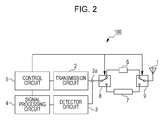
- Fig. 2 is a block diagram illustrating the configuration of the wireless sensor device 100.
- the wireless sensor device 100 includes an antenna 1, a transmission circuit 2 equipped with an output terminal 2a, a detector circuit 3, a signal processing circuit 4, a control circuit 5, a first transmission line 6, a second transmission line 7, a first switch 8, and a second switch 9.
- the wireless sensor device 100 includes a power supply circuit not illustrated, and electric power necessary for the operations of individual units in the wireless sensor device 100 is supplied thereto.
- the antenna 1 is connected to the second switch 9, and one end of each of the first transmission line 6 and the second transmission line 7 is connected to the second switch 9 serving as switching means so that it is possible to select and connect one of the first transmission line 6 and the second transmission line 7 to the antenna 1.
- the first switch 8 is connected to another end of each of the first transmission line 6 and the second transmission line 7, the first switch 8 serving as switching means for selecting and connecting one of the first transmission line 6 and the second transmission line 7 to the output terminal 2a of the transmission circuit 2, and the first switch 8 is connected to the output terminal 2a of the transmission circuit 2.
- the transmission circuit 2 performs a transmission operation for generating the transmission signal and outputting the transmission signal to the output terminal 2a.
- the detector circuit 3 is connected to the output terminal 2a of the transmission circuit 2. In addition, during the transmission operation of the transmission circuit 2, part of the transmission signal output from the output terminal 2a and the reflected signal received by the antenna 1 are input into the detector circuit 3 and part of the input transmission signal and the reflected signal received by the antenna 1 are detected.
- the signal processing circuit 4 is connected to the detector circuit 3, performs signal processing for a detection output signal output from the detector circuit 3, and outputs the result thereof to the control circuit 5.
- the control circuit 5 is connected to the transmission circuit 2, the signal processing circuit 4, the first switch 8, and the second switch 9.
- the control circuit 5 controls the operation state of the transmission circuit 2, acquires an output signal from the signal processing circuit 4, detects a body motion associated with the breathing of the detection target, the motion of a body surface associated with a heart rate thereof, and so forth, and performs determination of the presence or absence of detection and so forth.
- control circuit 5 outputs a control signal for controlling the first switch 8 and the second switch 9, selecting one of the first transmission line 6 and the second transmission line 7, and connecting the antenna 1 and the output terminal 2a to each other.
- the first transmission line 6 is a transmission line that has characteristic impedance roughly equal to the output impedance of the transmission circuit 2 and the impedance of the antenna 1 at the frequency of the transmission signal generated by the transmission circuit 2 and whose line length is Le.
- the second transmission line 7 is a transmission line that has characteristic impedance roughly equal to the output impedance of the transmission circuit 2 and the impedance of the antenna 1 at the frequency of the transmission signal generated by the transmission circuit 2 and whose line length is Le+ ⁇ /8 that is longer than the line length, Le, of the first transmission line 6 by one-eighth of the wavelength of the transmission signal if one wavelength of the transmission signal is ⁇ .
- the length of the transmission line is expressed using the wavelength or the phase shift angle of the transmission signal propagating through the transmission line.
- the above-mentioned wavelength of the transmission signal indicates a wavelength on the transmission line and one-eighth of the wavelength corresponds to a length where the phase shift delay of ⁇ /4 (rad) occurs in terms of a phase shift angle.
- the control circuit 5 controls the first switch 8 and the second switch 9 and selects the first transmission line 6, the transmission signal output from the output terminal 2a of the transmission circuit 2 is radiated from the antenna 1 through the first switch 8, the first transmission line 6, and the second switch 9.
- the transmission signal radiated from the antenna 1 is reflected by the detection target and received as the reflected signal by the antenna 1.
- the reflected signal received by the antenna 1 returns to the output terminal 2a through the second switch 9, the first transmission line 6, and the first switch 8, and part of the transmission signal and the reflected signal are input into the detector circuit 3 and detected.
- the length of a path from the output terminal 2a to the antenna is expressed by the line length, Le, of the first transmission line 6.
- a distance from the antenna 1 to the detection target is Lx
- the length, L1 of a path where the transmission signal is output from the output terminal 2a, part of the transmission signal radiated by the antenna 1 is reflected by the detection target, and that reflected signal is received by the antenna 1 and returns to the output terminal 2a is expressed as (Expression 5).
- the control circuit 5 controls the first switch 8 and the second switch 9 and selects the second transmission line 7
- the transmission signal output from the output terminal 2a of the transmission circuit 2 is radiated from the antenna 1 through the first switch 8, the second transmission line 7, and the second switch 9.
- the reflected signal received by the antenna 1 returns to the output terminal 2a through the second switch 9, the second transmission line 7, and the first switch 8, and part of the transmission signal and the reflected signal are input into the detector circuit 3 and detected.
- the length of a path from the output terminal 2a to the antenna is expressed by the line length, Le+ ⁇ /8, of the second transmission line 7.
- a difference, ⁇ L, between the length of the path in a case where the first transmission line 6 is selected and the length of the path in a case where the second transmission line 7 is selected becomes (Expression 7), based on (Expression 5) and (Expression 6).
- the length of the path in a case where the first transmission line 6 is selected and the length of the path in a case where the second transmission line 7 is selected are different from each other by a difference corresponding to one-fourth of the wavelength of the transmission signal. Therefore, in accordance with the amount of this difference between the lengths, in a case where the second transmission line 7 is selected, a length leading to the arrival of the reflected wave at the detector circuit 3 is lengthened by ⁇ /4 compared with a case where the first transmission line 6 is selected, and the phase of the reflected wave is delayed by ⁇ /2 (rad).
- the detection output detected by the detector circuit 3 is input into the signal processing circuit 4.
- the signal processing circuit 4 amplifies a change in amplitude of the detection signal and outputs, to the control circuit 5, Analog-to-Digital Convertion signal (AD conversion signal) where the amplified detection signal is converted from an analog signal to a digital signal.
- AD conversion signal Analog-to-Digital Convertion signal
- the control circuit 5 controls the signal processing circuit 4, acquires the AD conversion signal, detects a body motion associated with breathing, the motion of a body surface associated with a heart rate, and so forth, received from the detection target, and performs determination of the presence or absence of detection and so forth.
- the control circuit 5 determines that a distance to the detection target fluctuates and approaches the null point where an output is remarkably reduced, controls the first switch 8 and the second switch 9 so as to select a transmission line different from a currently selected transmission line, and controls so as to prevent sensitivity from being reduced.
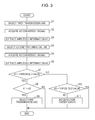
- Fig. 3 is a flowchart diagram illustrating the control operation of the wireless sensor device 100, and an operation is periodically repeated and performed using a timer function and so forth embedded in the control circuit 5.
- control circuit 5 controls the first switch 8 and the second switch 9 and selects the first transmission line 6.
- control circuit 5 controls the signal processing circuit 4 and acquires the AD conversion signal from the signal processing circuit 4.
- amplitude information corresponding to a change in amplitude of the detection signal caused by the motion of the detection target is extracted from the AD conversion signal, acquired in the procedure S2, and held as first amplitude information A1 indicating detection sensitivity at the time of selecting the first transmission line 6.
- control circuit 5 controls the first switch 8 and the second switch 9 and selects the second transmission line 7.
- control circuit 5 controls the signal processing circuit 4 and acquires the AD conversion signal from the signal processing circuit 4.
- amplitude information corresponding to a change in amplitude of the detection signal caused by the motion of the detection target is extracted from the AD conversion signal, acquired in the procedure S5, and held as second amplitude information A2 indicating detection sensitivity at the time of selecting the second transmission line 7.
- a procedure S7 comparison between the held first amplitude information A1 and a threshold value is performed, the threshold value being used for determining that a distance between the wireless sensor device 100 and the detection target approaches the null point and the sensitivity is reduced, and the control operation makes a transition to a procedure S8 in a case where the first amplitude information A1 is greater than the threshold value, and makes a transition to a procedure S10 in a case where the first amplitude information A1 is less than or equal to the threshold value.
- the control operation makes a transition to a procedure S9.
- the second amplitude information A2 is larger, since the second transmission line 7 is selected at this time point, the control processing is terminated without change. Since, in this case, the second amplitude information A2 at the time of selecting the second transmission line 7 is larger than the first amplitude information A1 while the first amplitude information A1 at the time of selecting the first transmission line 6 is greater than or equal to the threshold value, it is possible to detect the motion of the detection target with higher sensitivity.
- the control circuit 5 controls the first switch 8 and the second switch 9, selects the first transmission line 6, and terminates the control processing. Since, in this case, the first amplitude information A1 at the time of selecting the first transmission line 6 is greater than or equal to the threshold value and the second amplitude information A2 at the time of selecting the second transmission line 7 is less than or equal to the first amplitude information A1, the first transmission line is finally selected and it is possible to detect the motion of the detection target with high sensitivity.
- the control processing makes a transition to the procedure S10
- the procedure S10 comparison between the held second amplitude information A2 and a threshold value is performed, the threshold value being used for determining that a distance between the wireless sensor device 100 and the detection target approaches the null point and the sensitivity is reduced, and the second transmission line 7 is selected at this time point in a case where the second amplitude information A2 is greater than the threshold value. Therefore, the control processing is terminated without change.
- the control processing makes a transition to a procedure S11.
- the first transmission line 6 and the second transmission line 7 whose line lengths are different from each other and the first switch 8 and the second switch 9 that switch between the first transmission line 6 and the second transmission line 7 and connect the antenna 1 and the output terminal 2a to each other are provided between the antenna 1 and the output terminal 2a, and a difference in line length between the first transmission line 6 and the second transmission line 7 is set to less than one-fourth of the wavelength of the transmission signal.
- the phase difference of the reflected wave with respect to the transmission output approaches the null point where sensitivity is reduced, and the detection output is reduced, it is possible to change the phase difference by selecting and switching between the transmission lines whose line lengths are different from each other and it is possible to detect a minute variation with high sensitivity by avoiding the deterioration of sensitivity for sensing the motion of the detection target.
- a phase difference between the transmission signal output to the output terminal 2a of the transmission circuit 2 and the reflected signal, which is caused by the transmission signal reflected by the detection target and returns to the output terminal 2a, varies by ⁇ /2 (rad) by switching between the transmission lines, and it is possible to operate in a state in which sensitivity is good, by reliably avoiding the null point where sensitivity is remarkably reduced.
- control circuit 5 controls so as to switch between the plural transmission lines and performs switching by selecting a transmission line where a signal output from the signal processing circuit 4 becomes a maximum, it is possible to detect the motion of the detection target in a state where the sensitivity is higher.
- the wireless sensor device of an embodiment according to the present invention is specifically described as above, the present invention is not limited to the above-mentioned embodiment and may be variously altered and implemented without departing from the scope thereof.
- the present invention may be modified and implemented, for example, as follows, and these embodiments belong to the technical scope of the present invention.
Landscapes
- Engineering & Computer Science (AREA)
- Computer Networks & Wireless Communication (AREA)
- Radar, Positioning & Navigation (AREA)
- Remote Sensing (AREA)
- Physics & Mathematics (AREA)
- General Physics & Mathematics (AREA)
- Signal Processing (AREA)
- Radar Systems Or Details Thereof (AREA)
- Geophysics And Detection Of Objects (AREA)
Applications Claiming Priority (2)
| Application Number | Priority Date | Filing Date | Title |
|---|---|---|---|
| JP2012213344 | 2012-09-27 | ||
| PCT/JP2013/005578 WO2014050055A1 (ja) | 2012-09-27 | 2013-09-20 | 無線センサ装置 |
Publications (2)
| Publication Number | Publication Date |
|---|---|
| EP2902801A1 true EP2902801A1 (de) | 2015-08-05 |
| EP2902801A4 EP2902801A4 (de) | 2016-06-01 |
Family
ID=50387496
Family Applications (1)
| Application Number | Title | Priority Date | Filing Date |
|---|---|---|---|
| EP13842032.8A Withdrawn EP2902801A4 (de) | 2012-09-27 | 2013-09-20 | Drahtlose sensorvorrichtung |
Country Status (4)
| Country | Link |
|---|---|
| US (1) | US20150208270A1 (de) |
| EP (1) | EP2902801A4 (de) |
| JP (1) | JPWO2014050055A1 (de) |
| WO (1) | WO2014050055A1 (de) |
Families Citing this family (3)
| Publication number | Priority date | Publication date | Assignee | Title |
|---|---|---|---|---|
| JP6165870B2 (ja) * | 2013-09-02 | 2017-07-19 | アルプス電気株式会社 | 無線センサ装置 |
| JP2017227487A (ja) * | 2016-06-21 | 2017-12-28 | ソニー株式会社 | 信号処理装置、信号処理方法及び信号受信装置 |
| US12216191B2 (en) | 2019-04-01 | 2025-02-04 | Richwave Technology Corp. | Methods, circuits, and apparatus for motion detection, doppler shift detection, and positioning by self-envelope modulation |
Family Cites Families (6)
| Publication number | Priority date | Publication date | Assignee | Title |
|---|---|---|---|---|
| US3562642A (en) * | 1968-12-02 | 1971-02-09 | Richard Hochschild | Apparatus and method for measuring properties of materials by sensing signals responsive to both amplitude and phase changes in transmitted or reflected microwave energy |
| US4063250A (en) * | 1975-12-16 | 1977-12-13 | Electrospace Systems, Inc. | Beam and null switch step steerable antenna system |
| JPH10239426A (ja) * | 1997-02-27 | 1998-09-11 | Ikuo Arai | 物標変位検出装置 |
| JP2007170990A (ja) * | 2005-12-22 | 2007-07-05 | Yokogawa Denshikiki Co Ltd | 微小移動検出装置 |
| JP2008267839A (ja) * | 2007-04-16 | 2008-11-06 | Matsushita Electric Ind Co Ltd | レーダシステム |
| US8830114B2 (en) * | 2010-09-30 | 2014-09-09 | Toyota Jidosha Kabushiki Kaisha | Mobile object detecting apparatus |
-
2013
- 2013-09-20 WO PCT/JP2013/005578 patent/WO2014050055A1/ja not_active Ceased
- 2013-09-20 EP EP13842032.8A patent/EP2902801A4/de not_active Withdrawn
- 2013-09-20 JP JP2014538162A patent/JPWO2014050055A1/ja active Pending
-
2015
- 2015-03-26 US US14/669,128 patent/US20150208270A1/en not_active Abandoned
Also Published As
| Publication number | Publication date |
|---|---|
| EP2902801A4 (de) | 2016-06-01 |
| WO2014050055A1 (ja) | 2014-04-03 |
| US20150208270A1 (en) | 2015-07-23 |
| JPWO2014050055A1 (ja) | 2016-08-22 |
Similar Documents
| Publication | Publication Date | Title |
|---|---|---|
| US12436254B2 (en) | Systems and methods for object detection by radio frequency systems | |
| US10006797B2 (en) | Multi-system radar for measuring filling levels | |
| US11709243B2 (en) | Occupancy detection apparatus using multiple antenna motion sensing | |
| US10151825B2 (en) | Radar detection system | |
| EP2993485A1 (de) | Radarvorrichtung | |
| US10530413B2 (en) | Wireless signal transceiver device with dual-polarized antenna with at least two feed zones | |
| CN104009776A (zh) | 干扰消除装置及方法 | |
| JP2009168498A (ja) | 方向検出システム並びに方向検出装置 | |
| EP2902801A1 (de) | Drahtlose sensorvorrichtung | |
| US10379216B2 (en) | Positioning system | |
| US10833745B2 (en) | Wireless signal transceiver device with dual-polarized antenna with at least two feed zones | |
| KR100971772B1 (ko) | 신호원 탐지기 및 그 방법 | |
| KR100979284B1 (ko) | 레이더 송수신 시스템 | |
| US9134400B2 (en) | Comparator of mono-pulse radar and signal generation method thereof | |
| KR101093514B1 (ko) | 마이크로파 센서 | |
| KR20170113135A (ko) | 센서 모듈 | |
| KR20120070966A (ko) | 다중 안테나를 이용한 무선 채널 측정 장치 | |
| JP4967384B2 (ja) | レーダ装置 | |
| US20110109494A1 (en) | Radar apparatus | |
| US12442892B2 (en) | Radar device and position detection system | |
| US20240103124A1 (en) | Polarization-exploiting radar architectures | |
| JP2002006030A (ja) | 多点同時距離計測方法及び装置 | |
| JP2004286675A (ja) | センサ装置 | |
| KR20000013557A (ko) | 기지국 하나의 송신출력을 이용한 2개 안테나의 정재파비 측정장치 | |
| KR20180096674A (ko) | 신호 처리 또는 생성 장치, 그리고 조정의 결정 방법 |
Legal Events
| Date | Code | Title | Description |
|---|---|---|---|
| PUAI | Public reference made under article 153(3) epc to a published international application that has entered the european phase |
Free format text: ORIGINAL CODE: 0009012 |
|
| 17P | Request for examination filed |
Effective date: 20150323 |
|
| AK | Designated contracting states |
Kind code of ref document: A1 Designated state(s): AL AT BE BG CH CY CZ DE DK EE ES FI FR GB GR HR HU IE IS IT LI LT LU LV MC MK MT NL NO PL PT RO RS SE SI SK SM TR |
|
| AX | Request for extension of the european patent |
Extension state: BA ME |
|
| DAX | Request for extension of the european patent (deleted) | ||
| RA4 | Supplementary search report drawn up and despatched (corrected) |
Effective date: 20160502 |
|
| RIC1 | Information provided on ipc code assigned before grant |
Ipc: G01S 7/497 20060101ALN20160425BHEP Ipc: G01S 7/03 20060101ALI20160425BHEP Ipc: G01S 13/56 20060101AFI20160425BHEP Ipc: H04W 4/00 20090101ALN20160425BHEP |
|
| STAA | Information on the status of an ep patent application or granted ep patent |
Free format text: STATUS: THE APPLICATION HAS BEEN WITHDRAWN |
|
| 18W | Application withdrawn |
Effective date: 20160916 |