EP2902515B1 - High-plasticity free-cutting zinc alloy - Google Patents
High-plasticity free-cutting zinc alloy Download PDFInfo
- Publication number
- EP2902515B1 EP2902515B1 EP14833491.5A EP14833491A EP2902515B1 EP 2902515 B1 EP2902515 B1 EP 2902515B1 EP 14833491 A EP14833491 A EP 14833491A EP 2902515 B1 EP2902515 B1 EP 2902515B1
- Authority
- EP
- European Patent Office
- Prior art keywords
- alloy
- zinc alloy
- cutting
- manufactured
- free
- Prior art date
- Legal status (The legal status is an assumption and is not a legal conclusion. Google has not performed a legal analysis and makes no representation as to the accuracy of the status listed.)
- Active
Links
Images

Classifications
-
- C—CHEMISTRY; METALLURGY
- C22—METALLURGY; FERROUS OR NON-FERROUS ALLOYS; TREATMENT OF ALLOYS OR NON-FERROUS METALS
- C22C—ALLOYS
- C22C18/00—Alloys based on zinc
- C22C18/02—Alloys based on zinc with copper as the next major constituent
-
- C—CHEMISTRY; METALLURGY
- C22—METALLURGY; FERROUS OR NON-FERROUS ALLOYS; TREATMENT OF ALLOYS OR NON-FERROUS METALS
- C22C—ALLOYS
- C22C18/00—Alloys based on zinc
Definitions
- the present invention relates to the field of zinc alloys, in particular to a high-plasticity free-cutting zinc alloy.
- This alloy is mainly used in F connectors, pen manufacturing, socket connectors, locks and other fields.
- the machinability of metal is one of important performances of metal material.
- nonferrous metals used in F connectors, pen manufacturing, socket connectors, locks and other fields are required to have a certain machinability.
- By cutting machining nonferrous metal bars or sheets by means of instrument lathes, automatic lathes, numerically controlled lathes, etc. desired parts of various sizes and shapes may be obtained.
- the machinability of alloy significantly influences the cutting machining speed, surface smoothness, dimensional tolerance, etc.
- adding a certain number of free-cutting elements into the metal material may remarkably improve the productivity of manufactured products and reduce both the labor intensity and the labor cost.
- adding the free-cutting elements into the metal material reduces the resistance against cutting of the metal material and the free-cutting material plays a role of lubricating a cutter due to its own characteristics, it is easy to perform chip breaking and relieve the wear.
- the roughness of the surface of a workpiece is reduced, and both the service life and the production efficiency of the cutter are improved.
- Zn-Al alloys among the zinc alloys.
- Such alloys have high strength and hardness and good friction reduction performance.
- the Zn-Al alloys have the disadvantages of poor machinability, intercrystalline corrosion tendency, low dimensional stability, poor creep deformation resistance, poor corrosion resistance, etc., and are thus unable to meet the present requirements of those industries mentioned above on workability, high plasticity and other performances of material.
- Patent CN10182615B discloses a Bi-containing unleaded free-cutting deformable zinc alloy and preparation process thereof.
- This alloy comprises the following components by weight percentage: 8%-12% aluminum (Al), 0.6%-1.5% copper (Cu), 0.03%-0.1% magnesium (Mg), 0.1%-0.8% bismuth (Bi), and Bal are zinc (Zn) with less than or equal to 0.05% unavoidable impurities.
- Al aluminum
- Cu 0.6%-1.5%
- Mg 0.03%-0.1% magnesium
- Bi 0.1%-0.8% bismuth
- Bal are zinc (Zn) with less than or equal to 0.05% unavoidable impurities.
- this alloy has good machinability, but there are no specific data as evidence.
- the machinability of this alloy is still unable to meet the requirements of the modern machining industry.
- Patent CN101851713B discloses a free-cutting and high-strength zinc alloy, comprises the following components in percentage of weight: 1%-25% Al, 0.5%-3.5% Cu, 0.005%-0.3% Mg, 0.01%-0.1% Mn, and 0.005%-0.15% Bi and/or 0.01%-0.1% Sb and less than or equal to 0.05% impurities, and Bal is Zn, where the total weight percentage of the components is 100%. Optionally, it may be added in B 0.005%-0.2%. Also as one of Zn-Al matrix deformable zinc alloys, this alloy has high strength due to a high content of Al. Although in the specification it was recorded that the tensile strength may be as high as above 400MPa and the machinability reaches about 80% in comparison to the common lead-containing brass and still does not exceed 90%, there are no records about ductility.
- CN102162047 discloses a high plasticity free-cutting zinc alloy that comprises Cu, Bi and Ti. This Zn alloy is free from Mn.
- CN101906555 discloses a creep-resistant rolled zinc alloy comprising the following components in percentage of weight: 0.5-3.0% Cu, 0.01-2% Mn, 0.5-0.3% Ti, and Bal is Zn with a total amount less than 0.05% impurity.
- the zinc alloy comprises the following components in percentage of weight: 2-7% Cu, 0.1-1.2% Bi, 0.1-0.4% Mn, 0.01-0.3% Ti, and the remainder component being Zn having less than or equal to 0.01% unavoidable impurities.
- the zinc alloy comprises the following components in percentage of weight: 2-7% Cu, 0.1-1.2% Bi, 0.1-0.4% Mn and 0.01-0.3% Zr, and the remainder component being Zn having less than or equal to 0.01% unavoidable impurities.
- the zinc alloy comprises the following components in percentage of weight: 2-7% Cu, 0.1-1.2% Bi, 0.1-0.4% Mn, 0.01-0.3% Ti, 0.01-0.3% Zr, and the remainder component being Zn having less than or equal to 0.01% unavoidable impurities.
- the zinc alloy further comprises 0.001 to 0.5% rare earth metal.
- the zinc alloy further comprises 0.01 to 0.3% Cr.
- the zinc alloy further comprises 0.01 to 0.3% Ni.
- An example method for preparing the free-cutting zinc alloy of the invention is as follows: adding in Ti, Zr, Cr, V, Nb, Ni and Co in form of intermediate alloys of Zn-Ti, Zn-Zr, Zn-Cr, Zn-V, Zn-Nb, Zn-Ni and Zn-Co during the casting, where the content of these components is 10% of the intermediate alloys; adding Mn in form of an intermediate alloy of Zn-Mn, where the content of Mn is 30%; adding Cu in form of an intermediate alloy of Zn-Cu, where the content of Cu is 60%-70% and Bal Cu in the alloy of Zn-Cu, where the content of Cu is 60%-70% and Bal Cu in the alloy is supplemented by pure Cu in terms of content percentage; and, adding Bi and Zn in form of pure metal according to the content of the alloy components.
- this alloy is cast by a line frequency furnace, an intermediate frequency furnace or a reverberatory furnace by means of continuous casting or die casting to obtain a billet; then, the desired bars, tubes or profile billets are obtained by means of hot extrusion, where the temperature for hot extrusion is 180°C to 380°C; and finally, bars, wires and profile products of various specifications are obtained by cold drawing, where these products are used in fields such as automatic lathes, drill presses, instrument lathes and other manufactured products.
- the addition of Cu increases the content of a second phase, thereby playing roles of hardening and strengthening. If the addition amount of Cu is less than 1.0%, the effects of hardening and strengthening cannot be achieved; and, if the addition amount of Cu is more than 10%, the plasticity becomes poorer and cold/hot machining becomes difficult. Cu mainly exists in the Zn matrix in form of high-hardness intermetallic compounds.
- Bi is distributed in the grain boundary of the zinc alloy in free form, thereby playing a role of chip breaking during high-speed cutting. If the content of Bi is too low, the effect of chip breaking cannot be achieved well; and, if the content of Bi is too high, it is likely to result in embrittlement of material and reduce the plasticity of alloy. Therefore, the content of Bi is to be controlled within a range from 0.1% to 3.0%.
- the Ti and Zr in the alloy play a role of refining the grains, enhancing the strength and preventing the segregation.
- the zinc alloy has phases in an as-cast structure comprising, a matrix phase Zn and phases distributed in the matrix phase Zn including a plurality of nearly-spherical Zn-Cu compounds, a plurality of herringbone intermetallic compounds, and free spherical Bi particles, wherein the herringbone intermetallic compounds are mainly Zn-Mn-Cu-Ti compound and/or Zn-Mn-Cu-Zr compound with the remainder being Zn-Cu-Ti compound and/or Zn-Cu-Zr compound. Whether the herringbone intermetallic compounds are one or both of the Zn-Cu-Ti-Mn compound and the Zn-Cu-Zr-Mn compound depends on the addition of one or both of Ti and Zr into the alloy. Zn-Cu-Ti and Zn-Cu-Zr have the similar situation.
- the size of the nearly-spherical Zn-Cu compound is above 10 ⁇ m.
- the free spherical Bi particles are distributed on the grain boundary of the matrix phase Zn and the size thereof is less than 10 ⁇ m.
- the herringbone shape in the present invention refers to a shape like a herringbone, a nonlinear strip shape with non-uniform lateral size and lateral protrusions, specifically referring to the accompanying drawings.
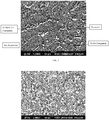
- the free spherical Bi particles are distributed on the grain boundary of the matrix phase Zn and the size thereof is less than 10 ⁇ m (referring to Fig. 1 ), thereby achieving the effect of quick chip breaking.
- this alloy of the present invention is plastically manufactured, for example by extrusion, bulky intermetallic compound crystals fracture, and the alloy structure is refined and thus shows higher plasticity (referring to Fig. 2 ).
- the free-cutting zinc alloy provided by the present invention further has high-hardness fine Zn-Cu-Ti-(Mn) or other intermetallic compound as-cast structures.
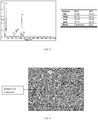
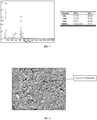
- the determination by energy spectrum analysis refers to Figs. 3, 4 , 5, 6 , 7 and 8 .
- the inventor(s) has found from studies that the presence of these intermetallic compounds may improve not only the strength and plasticity of the alloy but also the machinability of the alloy and may make the alloy show better machinability than the addition of bismuth only. Particularly in the case of the presence of a proper amount of intermetallic compounds formed of Ti and/or Zr with Zn, Cu and Mn, the machinability is remarkably improved.
- This alloy is cast by a line frequency furnace, an intermediate frequency furnace or a reverberatory furnace by means of continuous casting or die casting to obtain a billet; then, the desired bars, tubes or profile billets are obtained by means of hot extrusion, where the temperature for hot extrusion is 180°C to 380°C; and finally, bars, wires and profile products of various specifications are obtained by cold drawing.
- the performance test datas of the embodiments refer to Table 1.
- ZL201010205423.9 are cast according to the methods disclosed in the respective patents.
- the alloys of two above stated comparing examples and the alloy of the comparing example C3604 are manufactured according to the same method as in this embodiment and respectively tested in terms of the related performance data.
- a master alloy billet with a diameter of 170 mm is obtained by semi-continuous casting and manufactured by hot extrusion to a bar billet at 380°C, and the bar billet is manufactured by joint drawing to a bar of a desired diameter.
- the finished bar product is manufactured into a part by drilling it by a cam-type automatic lathe.
- the cuttings are fragile and the machining efficiency may reach 90% of that of C3604 lead-containing brass (the machining efficiency refers to the ratio of the number of parts of a same shape and size cut by a same cutter under same cutting parameters. For example, assuming that, for C3604 copper alloy, 100 parts are manufactured within 1min, and for zinc alloy, 90 parts are manufactured within 1min, the machining efficiency is 90%; similarly hereinafter).
- the surfaces of the parts may be manufactured by nickeling, chroming, tinning, etc.
- the alloy is smelted by induction heating and manufactured by die casting to obtain an alloy ingot; the alloy ingot is manufactured into a bar billet by extrusion at 240°C; the bar billet is manufactured to a zinc alloy bar by a crawler-type broaching machine; and, after polished and straightened, the zinc alloy bar is manufactured into an electronic product in a numerically controlled lathe.
- the machining efficiency by using the numerically controlled lathe may reach 85% of that of C3604 lead-containing brass bars.
- the surfaces of the parts may be manufactured by nickeling, chroming, tinning, etc.
- the alloy is smelted by induction heating and manufactured by die casting to obtain a master alloy ingot; the alloy ingot is manufactured into an alloy bar billet by extrusion at 180°C; the alloy bar billet is manufactured into a size of a finished product by multi-die drawing machine; and then, the alloy bar billet is diameter-reduced, straightened and polished to obtain a finished product by joint drawing.
- the machining efficiency may reach 80% of that of the C3604 lead-containing brass of the same specification.
- a master alloy ingot billet is obtained by continuous casting and then manufactured into a profile of 42 mm*15 mm by extrusion at 240°C.
- the profile is manufactured by a special drill press, with a depth of pores ⁇ 3 mm in diameter being 20 mm. More than 20 pores may be continuously drilled without cooling to obtain a finished padlock body part.
- the machining efficiency may reach 90% of that of C3604 lead-containing brass bars.
- the surfaces of the body part may be manufactured by nickeling, chroming, tinning, etc.
- a master alloy ingot billet is obtained by continuous casting and then manufactured by extrusion at 300°C.
- the master alloy ingot billet is manufactured into a bar of a desired diameter by joint drawing. After discharged, the bar is manufactured by a special drill press, with a depth of pores ⁇ 9.8 mm in diameter being 20 mm. More than 20 pores may be continuously drilled to obtain a finished metal pen part. The machining efficiency may reach 85% of that of C3604 lead-containing brass bars.
- a master alloy ingot billet is obtained by continuous casting and then manufactured into a bar billet of a proper specification by extrusion at 320°C.
- the bar billet is manufactured into a bar of a desired diameter by joint drawing.
- the bar After discharged, the bar is manufactured by a special drill press, with a depth of pores ⁇ 3 mm in diameter being 35 mm. More than 20 pores may be continuously drilled to obtain a finished metal pen part. The machining efficiency may reach 85% of that of C3604 lead-containing brass bars.
- a master alloy ingot billet is obtained by continuous casting and then manufactured into a bar ⁇ 25 mm in diameter by extrusion at 320°C; and the bar is manufactured into a bar in a desired diameter by joint drawing.
- the bar After discharged, the bar is manufactured by a special drill press, with a depth of pores ⁇ 2.8 mm in diameter being 25 mm. More than 20 pores may be continuously drilled. The machining efficiency may reach 85% of that of C3604 lead-containing brass bars.
- a master alloy ingot billet is obtained by continuous casting and then manufactured into a bar ⁇ 12 mm in diameter by extrusion at 340°C; and the bar is manufactured into a bar in a desired diameter by joint drawing.
- the bar After discharged, the bar is manufactured by a cam lathe. More than 200 parts may be continuously produced without cooling to obtain a finished metal pen part. The machining efficiency may reach 90% of that of C3604 lead-containing brass bars.
- a master alloy ingot billet is obtained by continuous casting and then manufactured into a wire 10 mm in diameter by peeling, diameter reducing and stretching.
- the wire After discharged, the wire is manufactured by a special drill press, with a depth of pores ⁇ 5 mm in diameter being 30 mm. More than 20 pores may be continuously drilled to obtain a finished part. The machining efficiency may reach 80% of that of C3604 lead-containing brass bars.
Landscapes
- Chemical & Material Sciences (AREA)
- Engineering & Computer Science (AREA)
- Materials Engineering (AREA)
- Mechanical Engineering (AREA)
- Metallurgy (AREA)
- Organic Chemistry (AREA)
- Adornments (AREA)
- Extrusion Of Metal (AREA)
- Conductive Materials (AREA)
- Contacts (AREA)
Description
- The present invention relates to the field of zinc alloys, in particular to a high-plasticity free-cutting zinc alloy. This alloy is mainly used in F connectors, pen manufacturing, socket connectors, locks and other fields.
- The machinability of metal is one of important performances of metal material. For example, nonferrous metals used in F connectors, pen manufacturing, socket connectors, locks and other fields are required to have a certain machinability. By cutting machining nonferrous metal bars or sheets by means of instrument lathes, automatic lathes, numerically controlled lathes, etc., desired parts of various sizes and shapes may be obtained. The machinability of alloy significantly influences the cutting machining speed, surface smoothness, dimensional tolerance, etc.
- In the modern manufacturing industry, adding a certain number of free-cutting elements into the metal material, which may be manufactured by cutting at a high cutting speed and a large cutting depth, may remarkably improve the productivity of manufactured products and reduce both the labor intensity and the labor cost. Meanwhile, as the addition of the free-cutting elements into the metal material reduces the resistance against cutting of the metal material and the free-cutting material plays a role of lubricating a cutter due to its own characteristics, it is easy to perform chip breaking and relieve the wear. Thus, the roughness of the surface of a workpiece is reduced, and both the service life and the production efficiency of the cutter are improved. However, with the constant development of mechanical cutting towards the characteristics of automation, high speed and preciseness, higher requirements on the machinability of the metal material are proposed, and the material is required to have a certain strength, hardness, plasticity, etc., thus to meet the requirements of comprehensive requirements of the existing F connectors, pen manufacturing, socket connectors, locks and other parts on material.
- At present, zinc alloys have been researched as an important aspect of a new generation of novel green, environmentally friendly and workable alloys for replacing copper alloys and aluminum alloys, and most attention has been paid to Zn-Al alloys among the zinc alloys. Such alloys have high strength and hardness and good friction reduction performance. However, the Zn-Al alloys have the disadvantages of poor machinability, intercrystalline corrosion tendency, low dimensional stability, poor creep deformation resistance, poor corrosion resistance, etc., and are thus unable to meet the present requirements of those industries mentioned above on workability, high plasticity and other performances of material.
- Patent
CN10182615B (Patent No.ZL201010147727.4 - Patent
CN101851713B (Patent No.ZL201010205423.9 -
CN102162047 discloses a high plasticity free-cutting zinc alloy that comprises Cu, Bi and Ti. This Zn alloy is free from Mn. -
CN101906555 discloses a creep-resistant rolled zinc alloy comprising the following components in percentage of weight: 0.5-3.0% Cu, 0.01-2% Mn, 0.5-0.3% Ti, and Bal is Zn with a total amount less than 0.05% impurity. - Considering that the existing Zn-Al matrix alloys have poor machinability and are unable to satisfy industries having high requirements on machinability, such as pen shells in the pen manufacturing industry, connector shells in the electronic industry, F connectors, locks and other industries, it is urgent to develop a zinc alloy having good machinability, certain plasticity and strength and excellent comprehensive performance.
- It is an object of the present invention to provide a free-cutting zinc alloy with excellent machinability, high plasticity and improved workability with respect to the existing free-cutting products.
- For achieving the above stated object,
a high-plasticity free-cutting zinc alloy as defined by claim 1 is provided. - As a first preferred embodiment, the zinc alloy comprises the following components in percentage of weight: 2-7% Cu, 0.1-1.2% Bi, 0.1-0.4% Mn, 0.01-0.3% Ti, and the remainder component being Zn having less than or equal to 0.01% unavoidable impurities.
- As a second preferred embodiment, the zinc alloy comprises the following components in percentage of weight: 2-7% Cu, 0.1-1.2% Bi, 0.1-0.4% Mn and 0.01-0.3% Zr, and the remainder component being Zn having less than or equal to 0.01% unavoidable impurities.
- As a third preferred embodiment, the zinc alloy comprises the following components in percentage of weight: 2-7% Cu, 0.1-1.2% Bi, 0.1-0.4% Mn, 0.01-0.3% Ti, 0.01-0.3% Zr, and the remainder component being Zn having less than or equal to 0.01% unavoidable impurities.
- Preferably, the zinc alloy further comprises 0.001 to 0.5% rare earth metal.
- Preferably, the zinc alloy further comprises 0.01 to 0.3% Cr.
- Preferably, the zinc alloy further comprises 0.01 to 0.3% Ni.
- The content of components herein is in percentage of weight, unless otherwise stated.
- An example method for preparing the free-cutting zinc alloy of the invention is as follows: adding in Ti, Zr, Cr, V, Nb, Ni and Co in form of intermediate alloys of Zn-Ti, Zn-Zr, Zn-Cr, Zn-V, Zn-Nb, Zn-Ni and Zn-Co during the casting, where the content of these components is 10% of the intermediate alloys; adding Mn in form of an intermediate alloy of Zn-Mn, where the content of Mn is 30%; adding Cu in form of an intermediate alloy of Zn-Cu, where the content of Cu is 60%-70% and Bal Cu in the alloy of Zn-Cu, where the content of Cu is 60%-70% and Bal Cu in the alloy is supplemented by pure Cu in terms of content percentage; and, adding Bi and Zn in form of pure metal according to the content of the alloy components. The casting process of the alloy is described as below: this alloy is cast by a line frequency furnace, an intermediate frequency furnace or a reverberatory furnace by means of continuous casting or die casting to obtain a billet; then, the desired bars, tubes or profile billets are obtained by means of hot extrusion, where the temperature for hot extrusion is 180°C to 380°C; and finally, bars, wires and profile products of various specifications are obtained by cold drawing, where these products are used in fields such as automatic lathes, drill presses, instrument lathes and other manufactured products.
- In the new alloy provided by the present invention, the addition of Cu increases the content of a second phase, thereby playing roles of hardening and strengthening. If the addition amount of Cu is less than 1.0%, the effects of hardening and strengthening cannot be achieved; and, if the addition amount of Cu is more than 10%, the plasticity becomes poorer and cold/hot machining becomes difficult. Cu mainly exists in the Zn matrix in form of high-hardness intermetallic compounds.
- Bi is distributed in the grain boundary of the zinc alloy in free form, thereby playing a role of chip breaking during high-speed cutting. If the content of Bi is too low, the effect of chip breaking cannot be achieved well; and, if the content of Bi is too high, it is likely to result in embrittlement of material and reduce the plasticity of alloy. Therefore, the content of Bi is to be controlled within a range from 0.1% to 3.0%.
- The Ti and Zr in the alloy play a role of refining the grains, enhancing the strength and preventing the segregation.
- Cr, Ni, V, Nb and Co exist in the Zn matrix in form of a small amount of second phase intermetallic compounds, thereby achieving the strengthening effect. B, As, P and rare earth metal play a role of purifying the grain boundary and exhausting gas.
- The zinc alloy has phases in an as-cast structure comprising, a matrix phase Zn and phases distributed in the matrix phase Zn including a plurality of nearly-spherical Zn-Cu compounds, a plurality of herringbone intermetallic compounds, and free spherical Bi particles, wherein the herringbone intermetallic compounds are mainly Zn-Mn-Cu-Ti compound and/or Zn-Mn-Cu-Zr compound with the remainder being Zn-Cu-Ti compound and/or Zn-Cu-Zr compound. Whether the herringbone intermetallic compounds are one or both of the Zn-Cu-Ti-Mn compound and the Zn-Cu-Zr-Mn compound depends on the addition of one or both of Ti and Zr into the alloy. Zn-Cu-Ti and Zn-Cu-Zr have the similar situation.
- The size of the nearly-spherical Zn-Cu compound is above 10 µm.
- The free spherical Bi particles are distributed on the grain boundary of the matrix phase Zn and the size thereof is less than 10 µm.
- When at least one of Cr, V, Nb, Ni and Co is added into the alloy, these components form compounds with Mn, Zn and Cu and exist on the Zn grain boundary of HCP in a herringbone shape.
- The herringbone shape in the present invention refers to a shape like a herringbone, a nonlinear strip shape with non-uniform lateral size and lateral protrusions, specifically referring to the accompanying drawings.
- The free spherical Bi particles are distributed on the grain boundary of the matrix phase Zn and the size thereof is less than 10 µm (referring to
Fig. 1 ), thereby achieving the effect of quick chip breaking. - After this alloy of the present invention is plastically manufactured, for example by extrusion, bulky intermetallic compound crystals fracture, and the alloy structure is refined and thus shows higher plasticity (referring to
Fig. 2 ). - As described above, in addition to Bi distributed in free form, the free-cutting zinc alloy provided by the present invention further has high-hardness fine Zn-Cu-Ti-(Mn) or other intermetallic compound as-cast structures. The determination by energy spectrum analysis refers to
Figs. 3, 4 ,5, 6 ,7 and 8 . The inventor(s) has found from studies that the presence of these intermetallic compounds may improve not only the strength and plasticity of the alloy but also the machinability of the alloy and may make the alloy show better machinability than the addition of bismuth only. Particularly in the case of the presence of a proper amount of intermetallic compounds formed of Ti and/or Zr with Zn, Cu and Mn, the machinability is remarkably improved. Further, Ti provides for better effects than Zr. The results of test on the machinability of the alloy show that these intermetallic compounds have certain cooperation with Bi in improving the machinability of the alloy. In conclusion, the presence of these intermetallic compounds may provide the alloy with quite excellent comprehensive performances, with good overall mechanical performance and high cutting efficiency. The tests show that, compared with C3604, the alloy may have machinability of above 80%, plasticity of above 15%, tensile strength of 330-485MPa, and hardness of HV85-120. - Compared with the prior art, in the present invention,
- (1) the cutting efficiency may reach above 80% of that of lead-containing brass, dry machining, turning and other machining processes may be achieved without cooling or lubricating conditions, and the alloy is suitable for manufacturing by instrument lathes, automatic lathes and numerically controlled lathes.
- (2) in addition to excellent machinability, the alloy also has high ductility which may reach above 15%.
- (3) The alloy may be used, as a substitute of some lead-containing brass alloy bars, mainly used in F connectors, pen manufacturing, socket connectors, locks and other manufactured workpieces.
-
-
Fig. 1 is a typical as-cast structure of a high-plasticity free-cutting zinc alloy, comprising a matrix phase (Zn), a plurality of nearly-spherical Zn-Cu compounds, a plurality of herringbone intermetallic compounds, and free spherical Bi particles; -
Fig. 2 is a structure crushed after plastic machining; -
Fig. 3 is an energy spectrum of a Zn-Cu-Mn-Ti quaternary intermetallic compound; -
Fig. 4 is the shape of a Zn-Cu-Mn-Ti quaternary intermetallic compound; -
Fig. 5 is an energy spectrum of a Zn-Cu binary alloy; -
Fig. 6 is the shape of a Zn-Cu binary alloy; -
Fig. 7 is an energy spectrum of a Zn-Cu-Ti ternary alloy; and -
Fig. 8 is the shape of a Zn-Cu-Ti ternary alloy. - To enable a further understanding of the innovative and technological content of the invention herein, refer to the detailed description of the invention and the accompanying drawings below:
This alloy is cast by a line frequency furnace, an intermediate frequency furnace or a reverberatory furnace by means of continuous casting or die casting to obtain a billet; then, the desired bars, tubes or profile billets are obtained by means of hot extrusion, where the temperature for hot extrusion is 180°C to 380°C; and finally, bars, wires and profile products of various specifications are obtained by cold drawing. The performance test datas of the embodiments refer to Table 1. The alloys of comparing examplesCN10182615B (Patent No.ZL201010147727.4 CN101851713B (Patent No.ZL201010205423.9 - Production process: a master alloy billet with a diameter of 170 mm is obtained by semi-continuous casting and manufactured by hot extrusion to a bar billet at 380°C, and the bar billet is manufactured by joint drawing to a bar of a desired diameter.
- The finished bar product is manufactured into a part by drilling it by a cam-type automatic lathe. The cuttings are fragile and the machining efficiency may reach 90% of that of C3604 lead-containing brass (the machining efficiency refers to the ratio of the number of parts of a same shape and size cut by a same cutter under same cutting parameters. For example, assuming that, for C3604 copper alloy, 100 parts are manufactured within 1min, and for zinc alloy, 90 parts are manufactured within 1min, the machining efficiency is 90%; similarly hereinafter). The surfaces of the parts may be manufactured by nickeling, chroming, tinning, etc.
- Production process: the alloy is smelted by induction heating and manufactured by die casting to obtain an alloy ingot; the alloy ingot is manufactured into a bar billet by extrusion at 240°C; the bar billet is manufactured to a zinc alloy bar by a crawler-type broaching machine; and, after polished and straightened, the zinc alloy bar is manufactured into an electronic product in a numerically controlled lathe. For parts of a same specification, the machining efficiency by using the numerically controlled lathe may reach 85% of that of C3604 lead-containing brass bars. The surfaces of the parts may be manufactured by nickeling, chroming, tinning, etc.
- Production process: the alloy is smelted by induction heating and manufactured by die casting to obtain a master alloy ingot; the alloy ingot is manufactured into an alloy bar billet by extrusion at 180°C; the alloy bar billet is manufactured into a size of a finished product by multi-die drawing machine; and then, the alloy bar billet is diameter-reduced, straightened and polished to obtain a finished product by joint drawing. By dry machining using a cam type automatic lathe, the machining efficiency may reach 80% of that of the C3604 lead-containing brass of the same specification.
- Production process: a master alloy ingot billet is obtained by continuous casting and then manufactured into a profile of 42 mm*15 mm by extrusion at 240°C.
- After discharged, the profile is manufactured by a special drill press, with a depth of pores Ø3 mm in diameter being 20 mm. More than 20 pores may be continuously drilled without cooling to obtain a finished padlock body part. The machining efficiency may reach 90% of that of C3604 lead-containing brass bars.
- The surfaces of the body part may be manufactured by nickeling, chroming, tinning, etc.
- Production process: a master alloy ingot billet is obtained by continuous casting and then manufactured by extrusion at 300°C.
- The master alloy ingot billet is manufactured into a bar of a desired diameter by joint drawing. After discharged, the bar is manufactured by a special drill press, with a depth of pores Ø9.8 mm in diameter being 20 mm. More than 20 pores may be continuously drilled to obtain a finished metal pen part. The machining efficiency may reach 85% of that of C3604 lead-containing brass bars.
- Production process: a master alloy ingot billet is obtained by continuous casting and then manufactured into a bar billet of a proper specification by extrusion at 320°C.
- The bar billet is manufactured into a bar of a desired diameter by joint drawing.
- After discharged, the bar is manufactured by a special drill press, with a depth of pores Ø3 mm in diameter being 35 mm. More than 20 pores may be continuously drilled to obtain a finished metal pen part. The machining efficiency may reach 85% of that of C3604 lead-containing brass bars.
- Production process: a master alloy ingot billet is obtained by continuous casting and then manufactured into a bar Ø25 mm in diameter by extrusion at 320°C; and the bar is manufactured into a bar in a desired diameter by joint drawing.
- After discharged, the bar is manufactured by a special drill press, with a depth of pores Ø2.8 mm in diameter being 25 mm. More than 20 pores may be continuously drilled. The machining efficiency may reach 85% of that of C3604 lead-containing brass bars.
- Production process: a master alloy ingot billet is obtained by continuous casting and then manufactured into a bar Ø12 mm in diameter by extrusion at 340°C; and the bar is manufactured into a bar in a desired diameter by joint drawing.
- After discharged, the bar is manufactured by a cam lathe. More than 200 parts may be continuously produced without cooling to obtain a finished metal pen part. The machining efficiency may reach 90% of that of C3604 lead-containing brass bars.
- Production process: a master alloy ingot billet is obtained by continuous casting and then manufactured into a
wire 10 mm in diameter by peeling, diameter reducing and stretching. - After discharged, the wire is manufactured by a special drill press, with a depth of pores Ø5 mm in diameter being 30 mm. More than 20 pores may be continuously drilled to obtain a finished part. The machining efficiency may reach 80% of that of C3604 lead-containing brass bars.


Claims (7)
- A high-plasticity free-cutting zinc alloy, which consists of the following components in percentage of weight:(a) 1-10% Cu,(b) 0.1-3.0% Bi,(c) 0.01-1.5% Mn,(d) (i) 0.001-1% Ti, or (ii) 0.01-0.3% Zr, or (iii) 0.001-1% Ti and 0.01-0.3% Zr,(e) optionally component X,(f) optionally component Y, and(g) a remainder component being Zn having less than or equal to 0.01% unavoidable impurities,in which component X amounts to 0-1.0% and consists of least one element selected from Cr, V, Nb, Ni and Co; and component Y amounts to 0-1.0% and consists of at least one element selected from B, As, P and a rare earth metal.
- The high-plasticity free-cutting zinc alloy according to claim 1, characterized in that the zinc alloy comprises the following components in percentage of weight: 2-7% Cu, 0.1-1.2% Bi, 0.1-0.4% Mn, 0.01-0.3% Ti, and the remainder component being Zn having less than or equal to 0.01% unavoidable impurities.
- The high-plasticity free-cutting zinc alloy according to claim 1, characterized in that the zinc alloy comprises the following components in percentage of weight: 2-7% Cu, 0.1-1.2% Bi, 0.1-0.4% Mn and 0.01-0.3% Zr, and the remainder component being Zn having less than or equal to 0.01% unavoidable impurities.
- The high-plasticity free-cutting zinc alloy according to claim 1, characterized in that the zinc alloy comprises the following components in percentage of weight: 2-7% Cu, 0.1-1.2% Bi, 0.1-0.4% Mn, 0.01-0.3% Ti, 0.01-0.3% Zr, and the remainder component being Zn having less than or equal to 0.01% unavoidable impurities.
- The high-plasticity free-cutting zinc alloy according to any one of claims 2, 3 and 4, characterized in that the zinc alloy further comprises 0.001 to 0.5% rare earth metal.
- The high-plasticity free-cutting zinc alloy according to any one of claims 2, 3 and 4, characterized in that the zinc alloy further comprises 0.01 to 0.3% Cr.
- The high-plasticity free-cutting zinc alloy according to any one of claims 2, 3 and 4, characterized in that the zinc alloy further comprises 0.01 to 0.3% Ni.
Applications Claiming Priority (2)
| Application Number | Priority Date | Filing Date | Title |
|---|---|---|---|
| CN201310606071.1A CN103627930B (en) | 2013-11-25 | 2013-11-25 | A kind of high-ductility Cutting free zinc alloy |
| PCT/CN2014/000097 WO2015074317A1 (en) | 2013-11-25 | 2014-01-26 | High-plasticity free-cutting zinc alloy |
Publications (3)
| Publication Number | Publication Date |
|---|---|
| EP2902515A1 EP2902515A1 (en) | 2015-08-05 |
| EP2902515A4 EP2902515A4 (en) | 2016-08-03 |
| EP2902515B1 true EP2902515B1 (en) | 2018-09-26 |
Family
ID=50209375
Family Applications (1)
| Application Number | Title | Priority Date | Filing Date |
|---|---|---|---|
| EP14833491.5A Active EP2902515B1 (en) | 2013-11-25 | 2014-01-26 | High-plasticity free-cutting zinc alloy |
Country Status (5)
| Country | Link |
|---|---|
| US (1) | US9803264B2 (en) |
| EP (1) | EP2902515B1 (en) |
| CN (1) | CN103627930B (en) |
| TW (1) | TWI529249B (en) |
| WO (1) | WO2015074317A1 (en) |
Families Citing this family (8)
| Publication number | Priority date | Publication date | Assignee | Title |
|---|---|---|---|---|
| CN104911401A (en) * | 2014-03-15 | 2015-09-16 | 紫旭盛业(昆山)金属科技有限公司 | Die zinc |
| CN104294086B (en) * | 2014-11-10 | 2016-09-14 | 华玉叶 | A kind of high ormolu and preparation method thereof |
| CN104630560B (en) * | 2015-02-09 | 2016-09-14 | 宁波博威合金材料股份有限公司 | A kind of deformation zinc alloy with high-ductility and its preparation method and application |
| JP6829179B2 (en) * | 2017-11-15 | 2021-02-10 | Jx金属株式会社 | Corrosion resistant CuZn alloy |
| CN108411158B (en) * | 2018-03-05 | 2019-10-15 | 中国科学院宁波工业技术研究院慈溪生物医学工程研究所 | A kind of biodegradable Zn-Mg-Zr alloy material, preparation method and application |
| CN108796414A (en) * | 2018-07-11 | 2018-11-13 | 济南大学 | A kind of hot-dip aluminum zinc magnesium alloy and preparation method thereof of zirconium containing equivalent, titanium elements |
| CN112522540A (en) * | 2020-12-01 | 2021-03-19 | 江苏同生特钢制造有限公司 | Zinc alloy casting and preparation method thereof |
| CN115029584B (en) * | 2022-04-28 | 2023-02-03 | 东北大学 | A kind of biodegradable medical zinc alloy and its preparation method and application |
Family Cites Families (10)
| Publication number | Priority date | Publication date | Assignee | Title |
|---|---|---|---|---|
| US2317179A (en) * | 1940-09-18 | 1943-04-20 | John R Daesen | Zinc alloy |
| JPH0768607B2 (en) * | 1986-11-21 | 1995-07-26 | 日鉱亜鉛株式会社 | Method of forming dark copper colored plating on steel |
| JPH06228686A (en) * | 1993-01-29 | 1994-08-16 | Nisso Kinzoku Kagaku Kk | Zinc base alloy wire and production of zinc alloy wire |
| JP5376604B2 (en) * | 2008-05-07 | 2013-12-25 | 独立行政法人科学技術振興機構 | Lead-free brass alloy powder, lead-free brass alloy extruded material, and manufacturing method thereof |
| CN101812615B (en) | 2010-04-15 | 2012-02-01 | 中南大学 | A bismuth-containing lead-free free-cutting deformable zinc alloy and its preparation process |
| CN101851713B (en) | 2010-06-22 | 2012-03-07 | 绍兴市天龙锡材有限公司 | Easy-cutting high strength zinc alloy |
| CN101906555B (en) * | 2010-08-05 | 2012-06-06 | 中南大学 | Mn-containing creep-resisting rolled zinc alloy belt material and preparation method thereof |
| CN102011029B (en) * | 2010-12-08 | 2014-06-04 | 宁波博威合金材料股份有限公司 | Zinc alloy for zipper tooth belt and preparation method of zipper tooth belt |
| CN102162047B (en) * | 2011-03-24 | 2012-08-29 | 宁波博威合金材料股份有限公司 | Easy-cutting zinc-copper-base wrought zinc alloy and preparation method thereof |
| CN102634748B (en) * | 2012-05-11 | 2014-04-23 | 绍兴市天龙锡材有限公司 | Zinc alloy lead-free metal spraying material |
-
2013
- 2013-11-25 CN CN201310606071.1A patent/CN103627930B/en active Active
-
2014
- 2014-01-26 WO PCT/CN2014/000097 patent/WO2015074317A1/en not_active Ceased
- 2014-01-26 US US14/417,688 patent/US9803264B2/en active Active
- 2014-01-26 EP EP14833491.5A patent/EP2902515B1/en active Active
- 2014-03-20 TW TW103110562A patent/TWI529249B/en active
Non-Patent Citations (1)
| Title |
|---|
| None * |
Also Published As
| Publication number | Publication date |
|---|---|
| US9803264B2 (en) | 2017-10-31 |
| CN103627930A (en) | 2014-03-12 |
| EP2902515A4 (en) | 2016-08-03 |
| TW201520344A (en) | 2015-06-01 |
| CN103627930B (en) | 2015-11-25 |
| US20160369375A1 (en) | 2016-12-22 |
| WO2015074317A1 (en) | 2015-05-28 |
| EP2902515A1 (en) | 2015-08-05 |
| TWI529249B (en) | 2016-04-11 |
Similar Documents
| Publication | Publication Date | Title |
|---|---|---|
| US9803264B2 (en) | High-plasticity free-cutting zinc alloy | |
| EP3485049B1 (en) | Copper-nickel-tin alloy, method for the production and use thereof | |
| TWI422691B (en) | High strength and high conductivity copper alloy tube, rod, wire | |
| AU2012317099B2 (en) | Leadless free-cutting copper alloy and method for producing the same | |
| WO2016177018A1 (en) | Cuttable machinable brass alloy and manufacturing method | |
| WO2020261604A1 (en) | Free-cutting copper alloy and method for producing free-cutting copper alloy | |
| CN102899525B (en) | High strength and toughness wear-resisting complex brass and production method thereof | |
| WO2013170953A1 (en) | Improved free-machining wrought aluminium alloy product and manufacturing process thereof | |
| JP5546196B2 (en) | Aging precipitation type copper alloy, copper alloy material, copper alloy part, and method for producing copper alloy material | |
| EP3485051B1 (en) | Copper-nickel-tin alloy, method for the production and use thereof | |
| EP3485047B1 (en) | Copper-nickel-tin alloy, method for the production and use thereof | |
| CN102851533A (en) | Complex brass, preparation method and application thereof | |
| DE102016008753A1 (en) | Copper-nickel-tin alloy, process for their preparation and their use | |
| EP3485048B1 (en) | Copper-nickel-tin-alloy, method for the production and use thereof | |
| WO2018072052A1 (en) | Deformable zinc alloy capable of being cold headed and application thereof | |
| TW202444932A (en) | Free-machining copper alloy, and method for producing free-machining copper alloy | |
| WO2013149367A1 (en) | Wrought zinc alloy and preparation method and use thereof | |
| TW201742929A (en) | Hot worked product of brass alloy and method for manufacturing hot worked product of brass alloy | |
| CN107385278A (en) | It is easy to cold-formed deformation zinc alloy material and its preparation method and application | |
| WO2010104527A1 (en) | Lead-free brass alloy | |
| US10364482B2 (en) | Copper-zinc alloy, band material composed thereof, process for producing a semifinished part composed of a copper-zinc alloy and sliding element composed of a copper-zinc alloy | |
| CN102162047B (en) | Easy-cutting zinc-copper-base wrought zinc alloy and preparation method thereof | |
| 이지은 | Investigation of Structural Characteristics of Hot Extruded Leaded-Brass Alloy | |
| KR20080085664A (en) | Magnesium Alloy and Magnesium Alloy Plastic Processing Member for Plastic Processing | |
| CA3261030A1 (en) | Wrought copper-zinc alloy, semi-finished product made from a wrought copper-zinc alloy, and method for producing such a semi-finished product |
Legal Events
| Date | Code | Title | Description |
|---|---|---|---|
| PUAI | Public reference made under article 153(3) epc to a published international application that has entered the european phase |
Free format text: ORIGINAL CODE: 0009012 |
|
| 17P | Request for examination filed |
Effective date: 20150211 |
|
| AK | Designated contracting states |
Kind code of ref document: A1 Designated state(s): AL AT BE BG CH CY CZ DE DK EE ES FI FR GB GR HR HU IE IS IT LI LT LU LV MC MK MT NL NO PL PT RO RS SE SI SK SM TR |
|
| AX | Request for extension of the european patent |
Extension state: BA ME |
|
| RIC1 | Information provided on ipc code assigned before grant |
Ipc: C22C 18/00 20060101ALI20160623BHEP Ipc: C22C 18/02 20060101AFI20160623BHEP |
|
| RA4 | Supplementary search report drawn up and despatched (corrected) |
Effective date: 20160701 |
|
| RIC1 | Information provided on ipc code assigned before grant |
Ipc: C22C 18/00 20060101ALI20161010BHEP Ipc: C22C 18/02 20060101AFI20161010BHEP |
|
| RIN1 | Information on inventor provided before grant (corrected) |
Inventor name: YU, XING Inventor name: XU, DINGYANG Inventor name: YANG, SHU Inventor name: CHEN, YONGLI Inventor name: SUN, WENSHENG Inventor name: ZHOU, HONGBO Inventor name: ZHANG, MING |
|
| DAX | Request for extension of the european patent (deleted) | ||
| STAA | Information on the status of an ep patent application or granted ep patent |
Free format text: STATUS: EXAMINATION IS IN PROGRESS |
|
| 17Q | First examination report despatched |
Effective date: 20170503 |
|
| GRAP | Despatch of communication of intention to grant a patent |
Free format text: ORIGINAL CODE: EPIDOSNIGR1 |
|
| STAA | Information on the status of an ep patent application or granted ep patent |
Free format text: STATUS: GRANT OF PATENT IS INTENDED |
|
| INTG | Intention to grant announced |
Effective date: 20180424 |
|
| GRAS | Grant fee paid |
Free format text: ORIGINAL CODE: EPIDOSNIGR3 |
|
| GRAA | (expected) grant |
Free format text: ORIGINAL CODE: 0009210 |
|
| STAA | Information on the status of an ep patent application or granted ep patent |
Free format text: STATUS: THE PATENT HAS BEEN GRANTED |
|
| AK | Designated contracting states |
Kind code of ref document: B1 Designated state(s): AL AT BE BG CH CY CZ DE DK EE ES FI FR GB GR HR HU IE IS IT LI LT LU LV MC MK MT NL NO PL PT RO RS SE SI SK SM TR |
|
| REG | Reference to a national code |
Ref country code: GB Ref legal event code: FG4D |
|
| REG | Reference to a national code |
Ref country code: CH Ref legal event code: EP |
|
| REG | Reference to a national code |
Ref country code: AT Ref legal event code: REF Ref document number: 1046112 Country of ref document: AT Kind code of ref document: T Effective date: 20181015 |
|
| REG | Reference to a national code |
Ref country code: IE Ref legal event code: FG4D |
|
| REG | Reference to a national code |
Ref country code: DE Ref legal event code: R096 Ref document number: 602014033140 Country of ref document: DE |
|
| REG | Reference to a national code |
Ref country code: NL Ref legal event code: MP Effective date: 20180926 |
|
| PG25 | Lapsed in a contracting state [announced via postgrant information from national office to epo] |
Ref country code: NO Free format text: LAPSE BECAUSE OF FAILURE TO SUBMIT A TRANSLATION OF THE DESCRIPTION OR TO PAY THE FEE WITHIN THE PRESCRIBED TIME-LIMIT Effective date: 20181226 Ref country code: GR Free format text: LAPSE BECAUSE OF FAILURE TO SUBMIT A TRANSLATION OF THE DESCRIPTION OR TO PAY THE FEE WITHIN THE PRESCRIBED TIME-LIMIT Effective date: 20181227 Ref country code: RS Free format text: LAPSE BECAUSE OF FAILURE TO SUBMIT A TRANSLATION OF THE DESCRIPTION OR TO PAY THE FEE WITHIN THE PRESCRIBED TIME-LIMIT Effective date: 20180926 Ref country code: SE Free format text: LAPSE BECAUSE OF FAILURE TO SUBMIT A TRANSLATION OF THE DESCRIPTION OR TO PAY THE FEE WITHIN THE PRESCRIBED TIME-LIMIT Effective date: 20180926 Ref country code: FI Free format text: LAPSE BECAUSE OF FAILURE TO SUBMIT A TRANSLATION OF THE DESCRIPTION OR TO PAY THE FEE WITHIN THE PRESCRIBED TIME-LIMIT Effective date: 20180926 Ref country code: LT Free format text: LAPSE BECAUSE OF FAILURE TO SUBMIT A TRANSLATION OF THE DESCRIPTION OR TO PAY THE FEE WITHIN THE PRESCRIBED TIME-LIMIT Effective date: 20180926 Ref country code: BG Free format text: LAPSE BECAUSE OF FAILURE TO SUBMIT A TRANSLATION OF THE DESCRIPTION OR TO PAY THE FEE WITHIN THE PRESCRIBED TIME-LIMIT Effective date: 20181226 |
|
| REG | Reference to a national code |
Ref country code: LT Ref legal event code: MG4D |
|
| PG25 | Lapsed in a contracting state [announced via postgrant information from national office to epo] |
Ref country code: AL Free format text: LAPSE BECAUSE OF FAILURE TO SUBMIT A TRANSLATION OF THE DESCRIPTION OR TO PAY THE FEE WITHIN THE PRESCRIBED TIME-LIMIT Effective date: 20180926 Ref country code: LV Free format text: LAPSE BECAUSE OF FAILURE TO SUBMIT A TRANSLATION OF THE DESCRIPTION OR TO PAY THE FEE WITHIN THE PRESCRIBED TIME-LIMIT Effective date: 20180926 Ref country code: HR Free format text: LAPSE BECAUSE OF FAILURE TO SUBMIT A TRANSLATION OF THE DESCRIPTION OR TO PAY THE FEE WITHIN THE PRESCRIBED TIME-LIMIT Effective date: 20180926 |
|
| REG | Reference to a national code |
Ref country code: AT Ref legal event code: MK05 Ref document number: 1046112 Country of ref document: AT Kind code of ref document: T Effective date: 20180926 |
|
| PG25 | Lapsed in a contracting state [announced via postgrant information from national office to epo] |
Ref country code: EE Free format text: LAPSE BECAUSE OF FAILURE TO SUBMIT A TRANSLATION OF THE DESCRIPTION OR TO PAY THE FEE WITHIN THE PRESCRIBED TIME-LIMIT Effective date: 20180926 Ref country code: PL Free format text: LAPSE BECAUSE OF FAILURE TO SUBMIT A TRANSLATION OF THE DESCRIPTION OR TO PAY THE FEE WITHIN THE PRESCRIBED TIME-LIMIT Effective date: 20180926 Ref country code: AT Free format text: LAPSE BECAUSE OF FAILURE TO SUBMIT A TRANSLATION OF THE DESCRIPTION OR TO PAY THE FEE WITHIN THE PRESCRIBED TIME-LIMIT Effective date: 20180926 Ref country code: ES Free format text: LAPSE BECAUSE OF FAILURE TO SUBMIT A TRANSLATION OF THE DESCRIPTION OR TO PAY THE FEE WITHIN THE PRESCRIBED TIME-LIMIT Effective date: 20180926 Ref country code: CZ Free format text: LAPSE BECAUSE OF FAILURE TO SUBMIT A TRANSLATION OF THE DESCRIPTION OR TO PAY THE FEE WITHIN THE PRESCRIBED TIME-LIMIT Effective date: 20180926 Ref country code: NL Free format text: LAPSE BECAUSE OF FAILURE TO SUBMIT A TRANSLATION OF THE DESCRIPTION OR TO PAY THE FEE WITHIN THE PRESCRIBED TIME-LIMIT Effective date: 20180926 Ref country code: RO Free format text: LAPSE BECAUSE OF FAILURE TO SUBMIT A TRANSLATION OF THE DESCRIPTION OR TO PAY THE FEE WITHIN THE PRESCRIBED TIME-LIMIT Effective date: 20180926 Ref country code: IT Free format text: LAPSE BECAUSE OF FAILURE TO SUBMIT A TRANSLATION OF THE DESCRIPTION OR TO PAY THE FEE WITHIN THE PRESCRIBED TIME-LIMIT Effective date: 20180926 Ref country code: IS Free format text: LAPSE BECAUSE OF FAILURE TO SUBMIT A TRANSLATION OF THE DESCRIPTION OR TO PAY THE FEE WITHIN THE PRESCRIBED TIME-LIMIT Effective date: 20190126 |
|
| PG25 | Lapsed in a contracting state [announced via postgrant information from national office to epo] |
Ref country code: SK Free format text: LAPSE BECAUSE OF FAILURE TO SUBMIT A TRANSLATION OF THE DESCRIPTION OR TO PAY THE FEE WITHIN THE PRESCRIBED TIME-LIMIT Effective date: 20180926 Ref country code: PT Free format text: LAPSE BECAUSE OF FAILURE TO SUBMIT A TRANSLATION OF THE DESCRIPTION OR TO PAY THE FEE WITHIN THE PRESCRIBED TIME-LIMIT Effective date: 20190126 Ref country code: SM Free format text: LAPSE BECAUSE OF FAILURE TO SUBMIT A TRANSLATION OF THE DESCRIPTION OR TO PAY THE FEE WITHIN THE PRESCRIBED TIME-LIMIT Effective date: 20180926 |
|
| REG | Reference to a national code |
Ref country code: DE Ref legal event code: R097 Ref document number: 602014033140 Country of ref document: DE |
|
| PG25 | Lapsed in a contracting state [announced via postgrant information from national office to epo] |
Ref country code: DK Free format text: LAPSE BECAUSE OF FAILURE TO SUBMIT A TRANSLATION OF THE DESCRIPTION OR TO PAY THE FEE WITHIN THE PRESCRIBED TIME-LIMIT Effective date: 20180926 |
|
| PLBE | No opposition filed within time limit |
Free format text: ORIGINAL CODE: 0009261 |
|
| STAA | Information on the status of an ep patent application or granted ep patent |
Free format text: STATUS: NO OPPOSITION FILED WITHIN TIME LIMIT |
|
| PG25 | Lapsed in a contracting state [announced via postgrant information from national office to epo] |
Ref country code: MC Free format text: LAPSE BECAUSE OF FAILURE TO SUBMIT A TRANSLATION OF THE DESCRIPTION OR TO PAY THE FEE WITHIN THE PRESCRIBED TIME-LIMIT Effective date: 20180926 |
|
| REG | Reference to a national code |
Ref country code: CH Ref legal event code: PL |
|
| 26N | No opposition filed |
Effective date: 20190627 |
|
| PG25 | Lapsed in a contracting state [announced via postgrant information from national office to epo] |
Ref country code: LU Free format text: LAPSE BECAUSE OF NON-PAYMENT OF DUE FEES Effective date: 20190126 |
|
| REG | Reference to a national code |
Ref country code: BE Ref legal event code: MM Effective date: 20190131 |
|
| REG | Reference to a national code |
Ref country code: IE Ref legal event code: MM4A |
|
| PG25 | Lapsed in a contracting state [announced via postgrant information from national office to epo] |
Ref country code: SI Free format text: LAPSE BECAUSE OF FAILURE TO SUBMIT A TRANSLATION OF THE DESCRIPTION OR TO PAY THE FEE WITHIN THE PRESCRIBED TIME-LIMIT Effective date: 20180926 |
|
| PG25 | Lapsed in a contracting state [announced via postgrant information from national office to epo] |
Ref country code: BE Free format text: LAPSE BECAUSE OF NON-PAYMENT OF DUE FEES Effective date: 20190131 |
|
| PG25 | Lapsed in a contracting state [announced via postgrant information from national office to epo] |
Ref country code: CH Free format text: LAPSE BECAUSE OF NON-PAYMENT OF DUE FEES Effective date: 20190131 Ref country code: LI Free format text: LAPSE BECAUSE OF NON-PAYMENT OF DUE FEES Effective date: 20190131 |
|
| PG25 | Lapsed in a contracting state [announced via postgrant information from national office to epo] |
Ref country code: IE Free format text: LAPSE BECAUSE OF NON-PAYMENT OF DUE FEES Effective date: 20190126 |
|
| PG25 | Lapsed in a contracting state [announced via postgrant information from national office to epo] |
Ref country code: TR Free format text: LAPSE BECAUSE OF FAILURE TO SUBMIT A TRANSLATION OF THE DESCRIPTION OR TO PAY THE FEE WITHIN THE PRESCRIBED TIME-LIMIT Effective date: 20180926 |
|
| PG25 | Lapsed in a contracting state [announced via postgrant information from national office to epo] |
Ref country code: MT Free format text: LAPSE BECAUSE OF NON-PAYMENT OF DUE FEES Effective date: 20190126 |
|
| PG25 | Lapsed in a contracting state [announced via postgrant information from national office to epo] |
Ref country code: CY Free format text: LAPSE BECAUSE OF FAILURE TO SUBMIT A TRANSLATION OF THE DESCRIPTION OR TO PAY THE FEE WITHIN THE PRESCRIBED TIME-LIMIT Effective date: 20180926 |
|
| PG25 | Lapsed in a contracting state [announced via postgrant information from national office to epo] |
Ref country code: HU Free format text: LAPSE BECAUSE OF FAILURE TO SUBMIT A TRANSLATION OF THE DESCRIPTION OR TO PAY THE FEE WITHIN THE PRESCRIBED TIME-LIMIT; INVALID AB INITIO Effective date: 20140126 |
|
| PG25 | Lapsed in a contracting state [announced via postgrant information from national office to epo] |
Ref country code: MK Free format text: LAPSE BECAUSE OF FAILURE TO SUBMIT A TRANSLATION OF THE DESCRIPTION OR TO PAY THE FEE WITHIN THE PRESCRIBED TIME-LIMIT Effective date: 20180926 |
|
| PGFP | Annual fee paid to national office [announced via postgrant information from national office to epo] |
Ref country code: GB Payment date: 20260123 Year of fee payment: 13 |
|
| PGFP | Annual fee paid to national office [announced via postgrant information from national office to epo] |
Ref country code: DE Payment date: 20260121 Year of fee payment: 13 |
|
| PGFP | Annual fee paid to national office [announced via postgrant information from national office to epo] |
Ref country code: FR Payment date: 20260123 Year of fee payment: 13 |