EP2901848A1 - Massive fiber body, and artificial soil produced using massive fiber body - Google Patents
Massive fiber body, and artificial soil produced using massive fiber body Download PDFInfo
- Publication number
- EP2901848A1 EP2901848A1 EP13840478.5A EP13840478A EP2901848A1 EP 2901848 A1 EP2901848 A1 EP 2901848A1 EP 13840478 A EP13840478 A EP 13840478A EP 2901848 A1 EP2901848 A1 EP 2901848A1
- Authority
- EP
- European Patent Office
- Prior art keywords
- fibrous
- mass product
- core portion
- water
- moisture
- Prior art date
- Legal status (The legal status is an assumption and is not a legal conclusion. Google has not performed a legal analysis and makes no representation as to the accuracy of the status listed.)
- Withdrawn
Links
- 239000002689 soil Substances 0.000 title claims abstract description 159
- 239000000835 fiber Substances 0.000 title claims abstract description 139
- XLYOFNOQVPJJNP-UHFFFAOYSA-N water Substances O XLYOFNOQVPJJNP-UHFFFAOYSA-N 0.000 claims abstract description 184
- 239000012528 membrane Substances 0.000 claims abstract description 74
- 239000002245 particle Substances 0.000 claims abstract description 34
- 239000000463 material Substances 0.000 claims abstract description 25
- 230000000717 retained effect Effects 0.000 claims abstract description 25
- 238000005342 ion exchange Methods 0.000 claims abstract description 20
- 229920006395 saturated elastomer Polymers 0.000 claims abstract description 12
- 230000035699 permeability Effects 0.000 abstract description 24
- 239000000047 product Substances 0.000 description 195
- -1 wool Polymers 0.000 description 86
- 239000004698 Polyethylene Substances 0.000 description 77
- 229920000573 polyethylene Polymers 0.000 description 77
- 239000000839 emulsion Substances 0.000 description 64
- 241000196324 Embryophyta Species 0.000 description 49
- 239000000945 filler Substances 0.000 description 37
- 238000005341 cation exchange Methods 0.000 description 27
- 229920002978 Vinylon Polymers 0.000 description 22
- 229910021536 Zeolite Inorganic materials 0.000 description 22
- HNPSIPDUKPIQMN-UHFFFAOYSA-N dioxosilane;oxo(oxoalumanyloxy)alumane Chemical compound O=[Si]=O.O=[Al]O[Al]=O HNPSIPDUKPIQMN-UHFFFAOYSA-N 0.000 description 22
- 239000010457 zeolite Substances 0.000 description 22
- 238000005469 granulation Methods 0.000 description 20
- 230000003179 granulation Effects 0.000 description 20
- 239000011230 binding agent Substances 0.000 description 19
- 238000005349 anion exchange Methods 0.000 description 17
- 229920002678 cellulose Polymers 0.000 description 16
- 239000001913 cellulose Substances 0.000 description 16
- 230000000052 comparative effect Effects 0.000 description 16
- 238000004891 communication Methods 0.000 description 13
- 239000003337 fertilizer Substances 0.000 description 13
- 235000015097 nutrients Nutrition 0.000 description 12
- 239000012466 permeate Substances 0.000 description 12
- 239000011347 resin Substances 0.000 description 12
- 229920005989 resin Polymers 0.000 description 12
- MMDJDBSEMBIJBB-UHFFFAOYSA-N [O-][N+]([O-])=O.[O-][N+]([O-])=O.[O-][N+]([O-])=O.[NH6+3] Chemical compound [O-][N+]([O-])=O.[O-][N+]([O-])=O.[O-][N+]([O-])=O.[NH6+3] MMDJDBSEMBIJBB-UHFFFAOYSA-N 0.000 description 10
- 238000013019 agitation Methods 0.000 description 9
- 238000004587 chromatography analysis Methods 0.000 description 9
- 239000012634 fragment Substances 0.000 description 9
- 238000002844 melting Methods 0.000 description 9
- 230000008018 melting Effects 0.000 description 9
- 239000003292 glue Substances 0.000 description 8
- 244000005700 microbiome Species 0.000 description 8
- 238000002156 mixing Methods 0.000 description 8
- 229920000642 polymer Polymers 0.000 description 8
- NHNBFGGVMKEFGY-UHFFFAOYSA-N Nitrate Chemical compound [O-][N+]([O-])=O NHNBFGGVMKEFGY-UHFFFAOYSA-N 0.000 description 7
- 238000010521 absorption reaction Methods 0.000 description 7
- 238000010790 dilution Methods 0.000 description 7
- 239000012895 dilution Substances 0.000 description 7
- 238000000034 method Methods 0.000 description 7
- IJGRMHOSHXDMSA-UHFFFAOYSA-N Atomic nitrogen Chemical compound N#N IJGRMHOSHXDMSA-UHFFFAOYSA-N 0.000 description 6
- 241000894006 Bacteria Species 0.000 description 6
- 229910002651 NO3 Inorganic materials 0.000 description 6
- 239000011800 void material Substances 0.000 description 6
- 229920000742 Cotton Polymers 0.000 description 5
- XKMRRTOUMJRJIA-UHFFFAOYSA-N ammonia nh3 Chemical compound N.N XKMRRTOUMJRJIA-UHFFFAOYSA-N 0.000 description 5
- 238000011156 evaluation Methods 0.000 description 5
- 230000002262 irrigation Effects 0.000 description 5
- 238000003973 irrigation Methods 0.000 description 5
- 230000014759 maintenance of location Effects 0.000 description 5
- 230000001546 nitrifying effect Effects 0.000 description 5
- 239000011148 porous material Substances 0.000 description 5
- NWUYHJFMYQTDRP-UHFFFAOYSA-N 1,2-bis(ethenyl)benzene;1-ethenyl-2-ethylbenzene;styrene Chemical compound C=CC1=CC=CC=C1.CCC1=CC=CC=C1C=C.C=CC1=CC=CC=C1C=C NWUYHJFMYQTDRP-UHFFFAOYSA-N 0.000 description 4
- 239000003957 anion exchange resin Substances 0.000 description 4
- 239000003729 cation exchange resin Substances 0.000 description 4
- 238000010586 diagram Methods 0.000 description 4
- 239000000126 substance Substances 0.000 description 4
- 229920002994 synthetic fiber Polymers 0.000 description 4
- 239000012209 synthetic fiber Substances 0.000 description 4
- 235000013311 vegetables Nutrition 0.000 description 4
- 230000008859 change Effects 0.000 description 3
- GDVKFRBCXAPAQJ-UHFFFAOYSA-A dialuminum;hexamagnesium;carbonate;hexadecahydroxide Chemical compound [OH-].[OH-].[OH-].[OH-].[OH-].[OH-].[OH-].[OH-].[OH-].[OH-].[OH-].[OH-].[OH-].[OH-].[OH-].[OH-].[Mg+2].[Mg+2].[Mg+2].[Mg+2].[Mg+2].[Mg+2].[Al+3].[Al+3].[O-]C([O-])=O GDVKFRBCXAPAQJ-UHFFFAOYSA-A 0.000 description 3
- 238000009826 distribution Methods 0.000 description 3
- 239000003349 gelling agent Substances 0.000 description 3
- 229910001701 hydrotalcite Inorganic materials 0.000 description 3
- 229960001545 hydrotalcite Drugs 0.000 description 3
- 229910052500 inorganic mineral Inorganic materials 0.000 description 3
- 150000002500 ions Chemical class 0.000 description 3
- 238000004519 manufacturing process Methods 0.000 description 3
- 239000011707 mineral Substances 0.000 description 3
- 239000007787 solid Substances 0.000 description 3
- 238000002054 transplantation Methods 0.000 description 3
- 241000220259 Raphanus Species 0.000 description 2
- 235000006140 Raphanus sativus var sativus Nutrition 0.000 description 2
- 229920002472 Starch Polymers 0.000 description 2
- 230000002378 acidificating effect Effects 0.000 description 2
- 235000010443 alginic acid Nutrition 0.000 description 2
- 229920000615 alginic acid Polymers 0.000 description 2
- 239000000440 bentonite Substances 0.000 description 2
- 229910000278 bentonite Inorganic materials 0.000 description 2
- SVPXDRXYRYOSEX-UHFFFAOYSA-N bentoquatam Chemical compound O.O=[Si]=O.O=[Al]O[Al]=O SVPXDRXYRYOSEX-UHFFFAOYSA-N 0.000 description 2
- 238000009960 carding Methods 0.000 description 2
- 239000000679 carrageenan Substances 0.000 description 2
- 235000010418 carrageenan Nutrition 0.000 description 2
- 229920001525 carrageenan Polymers 0.000 description 2
- 229940113118 carrageenan Drugs 0.000 description 2
- 150000001768 cations Chemical class 0.000 description 2
- 239000000919 ceramic Substances 0.000 description 2
- 230000007423 decrease Effects 0.000 description 2
- 229910001873 dinitrogen Inorganic materials 0.000 description 2
- 238000000605 extraction Methods 0.000 description 2
- 210000003608 fece Anatomy 0.000 description 2
- 235000021384 green leafy vegetables Nutrition 0.000 description 2
- 230000012010 growth Effects 0.000 description 2
- 238000005259 measurement Methods 0.000 description 2
- 238000000691 measurement method Methods 0.000 description 2
- 229910052757 nitrogen Inorganic materials 0.000 description 2
- 229910052760 oxygen Inorganic materials 0.000 description 2
- NBIIXXVUZAFLBC-UHFFFAOYSA-K phosphate Chemical compound [O-]P([O-])([O-])=O NBIIXXVUZAFLBC-UHFFFAOYSA-K 0.000 description 2
- 239000000049 pigment Substances 0.000 description 2
- 230000008635 plant growth Effects 0.000 description 2
- 229920001282 polysaccharide Polymers 0.000 description 2
- 239000005017 polysaccharide Substances 0.000 description 2
- 150000004804 polysaccharides Chemical class 0.000 description 2
- 229920002451 polyvinyl alcohol Polymers 0.000 description 2
- 230000008569 process Effects 0.000 description 2
- 238000010298 pulverizing process Methods 0.000 description 2
- 239000008107 starch Substances 0.000 description 2
- 235000019698 starch Nutrition 0.000 description 2
- 230000004083 survival effect Effects 0.000 description 2
- 229920001059 synthetic polymer Polymers 0.000 description 2
- 239000000057 synthetic resin Substances 0.000 description 2
- 229920003002 synthetic resin Polymers 0.000 description 2
- 238000012360 testing method Methods 0.000 description 2
- UHVMMEOXYDMDKI-JKYCWFKZSA-L zinc;1-(5-cyanopyridin-2-yl)-3-[(1s,2s)-2-(6-fluoro-2-hydroxy-3-propanoylphenyl)cyclopropyl]urea;diacetate Chemical compound [Zn+2].CC([O-])=O.CC([O-])=O.CCC(=O)C1=CC=C(F)C([C@H]2[C@H](C2)NC(=O)NC=2N=CC(=CC=2)C#N)=C1O UHVMMEOXYDMDKI-JKYCWFKZSA-L 0.000 description 2
- FHVDTGUDJYJELY-UHFFFAOYSA-N 6-{[2-carboxy-4,5-dihydroxy-6-(phosphanyloxy)oxan-3-yl]oxy}-4,5-dihydroxy-3-phosphanyloxane-2-carboxylic acid Chemical compound O1C(C(O)=O)C(P)C(O)C(O)C1OC1C(C(O)=O)OC(OP)C(O)C1O FHVDTGUDJYJELY-UHFFFAOYSA-N 0.000 description 1
- QTBSBXVTEAMEQO-UHFFFAOYSA-M Acetate Chemical compound CC([O-])=O QTBSBXVTEAMEQO-UHFFFAOYSA-M 0.000 description 1
- HRPVXLWXLXDGHG-UHFFFAOYSA-N Acrylamide Chemical compound NC(=O)C=C HRPVXLWXLXDGHG-UHFFFAOYSA-N 0.000 description 1
- QGZKDVFQNNGYKY-UHFFFAOYSA-O Ammonium Chemical compound [NH4+] QGZKDVFQNNGYKY-UHFFFAOYSA-O 0.000 description 1
- BTBUEUYNUDRHOZ-UHFFFAOYSA-N Borate Chemical compound [O-]B([O-])[O-] BTBUEUYNUDRHOZ-UHFFFAOYSA-N 0.000 description 1
- 240000001624 Espostoa lanata Species 0.000 description 1
- 235000009161 Espostoa lanata Nutrition 0.000 description 1
- JOYRKODLDBILNP-UHFFFAOYSA-N Ethyl urethane Chemical compound CCOC(N)=O JOYRKODLDBILNP-UHFFFAOYSA-N 0.000 description 1
- 241000233866 Fungi Species 0.000 description 1
- 229920002148 Gellan gum Polymers 0.000 description 1
- 244000043261 Hevea brasiliensis Species 0.000 description 1
- 241000238631 Hexapoda Species 0.000 description 1
- 241001465754 Metazoa Species 0.000 description 1
- 239000004677 Nylon Substances 0.000 description 1
- BPQQTUXANYXVAA-UHFFFAOYSA-N Orthosilicate Chemical compound [O-][Si]([O-])([O-])[O-] BPQQTUXANYXVAA-UHFFFAOYSA-N 0.000 description 1
- 229910019142 PO4 Inorganic materials 0.000 description 1
- 241001311547 Patina Species 0.000 description 1
- 239000002202 Polyethylene glycol Substances 0.000 description 1
- 108010020346 Polyglutamic Acid Proteins 0.000 description 1
- 239000004743 Polypropylene Substances 0.000 description 1
- 239000004793 Polystyrene Substances 0.000 description 1
- 239000004372 Polyvinyl alcohol Substances 0.000 description 1
- 229920001328 Polyvinylidene chloride Polymers 0.000 description 1
- 229920000297 Rayon Polymers 0.000 description 1
- PPBRXRYQALVLMV-UHFFFAOYSA-N Styrene Chemical compound C=CC1=CC=CC=C1 PPBRXRYQALVLMV-UHFFFAOYSA-N 0.000 description 1
- BZHJMEDXRYGGRV-UHFFFAOYSA-N Vinyl chloride Chemical compound ClC=C BZHJMEDXRYGGRV-UHFFFAOYSA-N 0.000 description 1
- 241000607479 Yersinia pestis Species 0.000 description 1
- 230000009471 action Effects 0.000 description 1
- 239000000654 additive Substances 0.000 description 1
- 230000000996 additive effect Effects 0.000 description 1
- 239000002386 air freshener Substances 0.000 description 1
- 229940072056 alginate Drugs 0.000 description 1
- 239000000783 alginic acid Substances 0.000 description 1
- 229960001126 alginic acid Drugs 0.000 description 1
- 150000004781 alginic acids Chemical class 0.000 description 1
- 229910001583 allophane Inorganic materials 0.000 description 1
- ILRRQNADMUWWFW-UHFFFAOYSA-K aluminium phosphate Chemical compound O1[Al]2OP1(=O)O2 ILRRQNADMUWWFW-UHFFFAOYSA-K 0.000 description 1
- OJMOMXZKOWKUTA-UHFFFAOYSA-N aluminum;borate Chemical compound [Al+3].[O-]B([O-])[O-] OJMOMXZKOWKUTA-UHFFFAOYSA-N 0.000 description 1
- 235000021120 animal protein Nutrition 0.000 description 1
- 150000001450 anions Chemical class 0.000 description 1
- 230000000845 anti-microbial effect Effects 0.000 description 1
- QVGXLLKOCUKJST-UHFFFAOYSA-N atomic oxygen Chemical compound [O] QVGXLLKOCUKJST-UHFFFAOYSA-N 0.000 description 1
- 239000011449 brick Substances 0.000 description 1
- VNSBYDPZHCQWNB-UHFFFAOYSA-N calcium;aluminum;dioxido(oxo)silane;sodium;hydrate Chemical compound O.[Na].[Al].[Ca+2].[O-][Si]([O-])=O VNSBYDPZHCQWNB-UHFFFAOYSA-N 0.000 description 1
- 239000003054 catalyst Substances 0.000 description 1
- 210000000170 cell membrane Anatomy 0.000 description 1
- 239000004568 cement Substances 0.000 description 1
- 239000003610 charcoal Substances 0.000 description 1
- 239000004927 clay Substances 0.000 description 1
- 239000002734 clay mineral Substances 0.000 description 1
- 238000010073 coating (rubber) Methods 0.000 description 1
- 239000011248 coating agent Substances 0.000 description 1
- 238000007906 compression Methods 0.000 description 1
- 230000006835 compression Effects 0.000 description 1
- 235000009508 confectionery Nutrition 0.000 description 1
- 238000011109 contamination Methods 0.000 description 1
- GUJOJGAPFQRJSV-UHFFFAOYSA-N dialuminum;dioxosilane;oxygen(2-);hydrate Chemical compound O.[O-2].[O-2].[O-2].[Al+3].[Al+3].O=[Si]=O.O=[Si]=O.O=[Si]=O.O=[Si]=O GUJOJGAPFQRJSV-UHFFFAOYSA-N 0.000 description 1
- 201000010099 disease Diseases 0.000 description 1
- 208000037265 diseases, disorders, signs and symptoms Diseases 0.000 description 1
- 239000000428 dust Substances 0.000 description 1
- 230000007613 environmental effect Effects 0.000 description 1
- 238000001125 extrusion Methods 0.000 description 1
- 206010016165 failure to thrive Diseases 0.000 description 1
- 239000006261 foam material Substances 0.000 description 1
- 230000000855 fungicidal effect Effects 0.000 description 1
- 239000000417 fungicide Substances 0.000 description 1
- 229920000370 gamma-poly(glutamate) polymer Polymers 0.000 description 1
- 238000010413 gardening Methods 0.000 description 1
- 239000000216 gellan gum Substances 0.000 description 1
- 235000010492 gellan gum Nutrition 0.000 description 1
- 229910000271 hectorite Inorganic materials 0.000 description 1
- KWLMIXQRALPRBC-UHFFFAOYSA-L hectorite Chemical compound [Li+].[OH-].[OH-].[Na+].[Mg+2].O1[Si]2([O-])O[Si]1([O-])O[Si]([O-])(O1)O[Si]1([O-])O2 KWLMIXQRALPRBC-UHFFFAOYSA-L 0.000 description 1
- 239000003864 humus Substances 0.000 description 1
- XLYOFNOQVPJJNP-UHFFFAOYSA-M hydroxide Chemical compound [OH-] XLYOFNOQVPJJNP-UHFFFAOYSA-M 0.000 description 1
- 150000004679 hydroxides Chemical class 0.000 description 1
- 230000006872 improvement Effects 0.000 description 1
- 239000002917 insecticide Substances 0.000 description 1
- 229910052622 kaolinite Inorganic materials 0.000 description 1
- CYPPCCJJKNISFK-UHFFFAOYSA-J kaolinite Chemical compound [OH-].[OH-].[OH-].[OH-].[Al+3].[Al+3].[O-][Si](=O)O[Si]([O-])=O CYPPCCJJKNISFK-UHFFFAOYSA-J 0.000 description 1
- 239000007788 liquid Substances 0.000 description 1
- QSHDDOUJBYECFT-UHFFFAOYSA-N mercury Chemical compound [Hg] QSHDDOUJBYECFT-UHFFFAOYSA-N 0.000 description 1
- 229910052753 mercury Inorganic materials 0.000 description 1
- 239000010445 mica Substances 0.000 description 1
- 229910052618 mica group Inorganic materials 0.000 description 1
- 239000000203 mixture Substances 0.000 description 1
- 229910052901 montmorillonite Inorganic materials 0.000 description 1
- 238000000465 moulding Methods 0.000 description 1
- 229920003052 natural elastomer Polymers 0.000 description 1
- 229920005615 natural polymer Polymers 0.000 description 1
- 229920001194 natural rubber Polymers 0.000 description 1
- 229920001778 nylon Polymers 0.000 description 1
- 239000011368 organic material Substances 0.000 description 1
- 230000003204 osmotic effect Effects 0.000 description 1
- 230000003647 oxidation Effects 0.000 description 1
- 238000007254 oxidation reaction Methods 0.000 description 1
- 239000001301 oxygen Substances 0.000 description 1
- 239000010452 phosphate Substances 0.000 description 1
- 229940085991 phosphate ion Drugs 0.000 description 1
- 238000009372 pisciculture Methods 0.000 description 1
- 229920000233 poly(alkylene oxides) Polymers 0.000 description 1
- 229920002401 polyacrylamide Polymers 0.000 description 1
- 229920000058 polyacrylate Polymers 0.000 description 1
- 108010064470 polyaspartate Proteins 0.000 description 1
- 229920001225 polyester resin Polymers 0.000 description 1
- 239000004645 polyester resin Substances 0.000 description 1
- 229920001223 polyethylene glycol Polymers 0.000 description 1
- 229920000139 polyethylene terephthalate Polymers 0.000 description 1
- 239000005020 polyethylene terephthalate Substances 0.000 description 1
- 229920000098 polyolefin Polymers 0.000 description 1
- 229920005672 polyolefin resin Polymers 0.000 description 1
- 229920001155 polypropylene Polymers 0.000 description 1
- 229920002223 polystyrene Polymers 0.000 description 1
- 229920002635 polyurethane Polymers 0.000 description 1
- 239000004814 polyurethane Substances 0.000 description 1
- 229920002689 polyvinyl acetate Polymers 0.000 description 1
- 239000011118 polyvinyl acetate Substances 0.000 description 1
- 229920000915 polyvinyl chloride Polymers 0.000 description 1
- 239000004800 polyvinyl chloride Substances 0.000 description 1
- 239000005033 polyvinylidene chloride Substances 0.000 description 1
- 235000019353 potassium silicate Nutrition 0.000 description 1
- 230000035755 proliferation Effects 0.000 description 1
- 239000002964 rayon Substances 0.000 description 1
- 230000009467 reduction Effects 0.000 description 1
- 238000005096 rolling process Methods 0.000 description 1
- 229910000275 saponite Inorganic materials 0.000 description 1
- 238000007873 sieving Methods 0.000 description 1
- 229920002379 silicone rubber Polymers 0.000 description 1
- 239000004945 silicone rubber Substances 0.000 description 1
- 229910021647 smectite Inorganic materials 0.000 description 1
- NTHWMYGWWRZVTN-UHFFFAOYSA-N sodium silicate Chemical compound [Na+].[Na+].[O-][Si]([O-])=O NTHWMYGWWRZVTN-UHFFFAOYSA-N 0.000 description 1
- 239000000243 solution Substances 0.000 description 1
- 239000002904 solvent Substances 0.000 description 1
- 229940032147 starch Drugs 0.000 description 1
- 229910052902 vermiculite Inorganic materials 0.000 description 1
- 239000010455 vermiculite Substances 0.000 description 1
- 235000019354 vermiculite Nutrition 0.000 description 1
- 238000004065 wastewater treatment Methods 0.000 description 1
- 210000002268 wool Anatomy 0.000 description 1
- 239000000230 xanthan gum Substances 0.000 description 1
- 229920001285 xanthan gum Polymers 0.000 description 1
- 235000010493 xanthan gum Nutrition 0.000 description 1
- 229940082509 xanthan gum Drugs 0.000 description 1
Images


Classifications
-
- C—CHEMISTRY; METALLURGY
- C05—FERTILISERS; MANUFACTURE THEREOF
- C05F—ORGANIC FERTILISERS NOT COVERED BY SUBCLASSES C05B, C05C, e.g. FERTILISERS FROM WASTE OR REFUSE
- C05F11/00—Other organic fertilisers
-
- A—HUMAN NECESSITIES
- A01—AGRICULTURE; FORESTRY; ANIMAL HUSBANDRY; HUNTING; TRAPPING; FISHING
- A01G—HORTICULTURE; CULTIVATION OF VEGETABLES, FLOWERS, RICE, FRUIT, VINES, HOPS OR SEAWEED; FORESTRY; WATERING
- A01G24/00—Growth substrates; Culture media; Apparatus or methods therefor
- A01G24/40—Growth substrates; Culture media; Apparatus or methods therefor characterised by their structure
- A01G24/42—Growth substrates; Culture media; Apparatus or methods therefor characterised by their structure of granular or aggregated structure
-
- A—HUMAN NECESSITIES
- A01—AGRICULTURE; FORESTRY; ANIMAL HUSBANDRY; HUNTING; TRAPPING; FISHING
- A01G—HORTICULTURE; CULTIVATION OF VEGETABLES, FLOWERS, RICE, FRUIT, VINES, HOPS OR SEAWEED; FORESTRY; WATERING
- A01G24/00—Growth substrates; Culture media; Apparatus or methods therefor
-
- A—HUMAN NECESSITIES
- A01—AGRICULTURE; FORESTRY; ANIMAL HUSBANDRY; HUNTING; TRAPPING; FISHING
- A01G—HORTICULTURE; CULTIVATION OF VEGETABLES, FLOWERS, RICE, FRUIT, VINES, HOPS OR SEAWEED; FORESTRY; WATERING
- A01G31/00—Soilless cultivation, e.g. hydroponics
-
- C—CHEMISTRY; METALLURGY
- C05—FERTILISERS; MANUFACTURE THEREOF
- C05G—MIXTURES OF FERTILISERS COVERED INDIVIDUALLY BY DIFFERENT SUBCLASSES OF CLASS C05; MIXTURES OF ONE OR MORE FERTILISERS WITH MATERIALS NOT HAVING A SPECIFIC FERTILISING ACTIVITY, e.g. PESTICIDES, SOIL-CONDITIONERS, WETTING AGENTS; FERTILISERS CHARACTERISED BY THEIR FORM
- C05G5/00—Fertilisers characterised by their form
- C05G5/30—Layered or coated, e.g. dust-preventing coatings
- C05G5/37—Layered or coated, e.g. dust-preventing coatings layered or coated with a polymer
-
- C—CHEMISTRY; METALLURGY
- C09—DYES; PAINTS; POLISHES; NATURAL RESINS; ADHESIVES; COMPOSITIONS NOT OTHERWISE PROVIDED FOR; APPLICATIONS OF MATERIALS NOT OTHERWISE PROVIDED FOR
- C09K—MATERIALS FOR MISCELLANEOUS APPLICATIONS, NOT PROVIDED FOR ELSEWHERE
- C09K17/00—Soil-conditioning materials or soil-stabilising materials
- C09K17/14—Soil-conditioning materials or soil-stabilising materials containing organic compounds only
- C09K17/18—Prepolymers; Macromolecular compounds
-
- C—CHEMISTRY; METALLURGY
- C09—DYES; PAINTS; POLISHES; NATURAL RESINS; ADHESIVES; COMPOSITIONS NOT OTHERWISE PROVIDED FOR; APPLICATIONS OF MATERIALS NOT OTHERWISE PROVIDED FOR
- C09K—MATERIALS FOR MISCELLANEOUS APPLICATIONS, NOT PROVIDED FOR ELSEWHERE
- C09K17/00—Soil-conditioning materials or soil-stabilising materials
- C09K17/14—Soil-conditioning materials or soil-stabilising materials containing organic compounds only
- C09K17/18—Prepolymers; Macromolecular compounds
- C09K17/32—Prepolymers; Macromolecular compounds of natural origin, e.g. cellulosic materials
-
- D—TEXTILES; PAPER
- D06—TREATMENT OF TEXTILES OR THE LIKE; LAUNDERING; FLEXIBLE MATERIALS NOT OTHERWISE PROVIDED FOR
- D06M—TREATMENT, NOT PROVIDED FOR ELSEWHERE IN CLASS D06, OF FIBRES, THREADS, YARNS, FABRICS, FEATHERS OR FIBROUS GOODS MADE FROM SUCH MATERIALS
- D06M15/00—Treating fibres, threads, yarns, fabrics, or fibrous goods made from such materials, with macromolecular compounds; Such treatment combined with mechanical treatment
- D06M15/19—Treating fibres, threads, yarns, fabrics, or fibrous goods made from such materials, with macromolecular compounds; Such treatment combined with mechanical treatment with synthetic macromolecular compounds
- D06M15/21—Macromolecular compounds obtained by reactions only involving carbon-to-carbon unsaturated bonds
-
- A—HUMAN NECESSITIES
- A01—AGRICULTURE; FORESTRY; ANIMAL HUSBANDRY; HUNTING; TRAPPING; FISHING
- A01G—HORTICULTURE; CULTIVATION OF VEGETABLES, FLOWERS, RICE, FRUIT, VINES, HOPS OR SEAWEED; FORESTRY; WATERING
- A01G24/00—Growth substrates; Culture media; Apparatus or methods therefor
- A01G24/30—Growth substrates; Culture media; Apparatus or methods therefor based on or containing synthetic organic compounds
- A01G24/35—Growth substrates; Culture media; Apparatus or methods therefor based on or containing synthetic organic compounds containing water-absorbing polymers
-
- C—CHEMISTRY; METALLURGY
- C09—DYES; PAINTS; POLISHES; NATURAL RESINS; ADHESIVES; COMPOSITIONS NOT OTHERWISE PROVIDED FOR; APPLICATIONS OF MATERIALS NOT OTHERWISE PROVIDED FOR
- C09K—MATERIALS FOR MISCELLANEOUS APPLICATIONS, NOT PROVIDED FOR ELSEWHERE
- C09K2101/00—Agricultural use
Definitions
- the present invention relates to fibrous-mass products which include an aggregate of fibers, and artificial soils using the fibrous-mass products.
- a fibrous-mass product which includes an aggregate of fibers has voids between fibers, and therefore, has a light weight and can retain water in the voids. Therefore, fibrous-mass products can be used as a water retention material. Fibrous-mass products may, for example, also be used to carry a catalyst or a useful microorganism in the voids between fibers. Therefore, by utilizing the properties of the voids between fibers, fibrous-mass products are, for example, used as an artificial soil in the agricultural field, and as a carrier for water treatment in the environmental field.
- Artificial soil may be used to grow plants in outdoor spaces such as the roof of a building, the balcony of an apartment, etc., or indoor spaces such as a lobby, a living room, etc.
- artificial soil is increasingly frequently used instead of natural soil. This is because the use of natural soil for growing plants in indoor spaces may cause problems, such as difficulty in moving the plant and soil due to its weight, poor indoor sanitation due to proliferation of microorganisms in natural soil, etc.
- Fibrous-mass products are lighter than the same volume of natural soil, have good drainage performance, and are hygienic, and therefore, may be a material suitable for artificial soil.
- Patent Document 1 has proposed a horticultural fiber ball which is a molded spherical mass of palm fibers as a conventional artificial soil using fibers.
- Patent Document 2 has proposed a fragment which is obtained by pulverizing solid matter which has been obtained by solidifying natural pulp using resin or glue, as a substitute for natural soil.
- the horticultural fiber ball of Patent Document 1 retains externally supplied water in the hydrophilic palm fibers, thereby allowing a plant to use the water.
- the horticultural fiber ball is produced by only molding palm fibers into a simple spherical shape, and therefore, does not have sufficient strength.
- the palm fiber is not covered, and therefore, is likely to quickly lose moisture in a dry external environment.
- the plant cultivation device of Patent Document 2 uses the fragment which is obtained by pulverizing solid matter which has been obtained by solidifying natural pulp using resin or glue, as a substitute for natural soil.
- the fibers of the fragment are solidified using resin or glue while containing water.
- the fragment retains a certain amount of moisture.
- the fibers of the fragment are solidified using resin or glue, it is difficult to cause the fragment to internally retain additional moisture supplied externally.
- the space between the fibers is filled with resin or glue, which causes poor air permeability in the fragment, likely leading to anaerobic conditions. Therefore, it is difficult for the roots of a plant to enter the fragment, so that the plant cannot absorb sufficient moisture from the fragment, and therefore, is likely to be prevented from growing.
- the present invention has been made. It is an object of the present invention to provide a fibrous-mass product which has both water retentivity and strength, and in addition, good air permeability, and can be used as an artificial soil particle.
- a fibrous-mass product according to the present invention for achieving the above object includes:
- the fibrous-mass product thus configured has the core portion which is an aggregate of fibers. Therefore, voids which can retain moisture are formed between the fibers of the core portion. Also, the core portion is covered by the water permeable membrane, and therefore, a certain level of shielding capability and rigidity are provided while water permeability is ensured between the core portion of the fibrous-mass product and the external environment. As a result, the strength of the fibrous-mass product is maintained by the water permeable membrane, resulting in both good water retentivity and strength. Also, the core portion can absorb moisture from the external environment through the water permeable membrane and release moisture to the external environment, whereby the fibrous-mass product thus configured is particularly applicable to applications which involve movement of moisture, such as artificial soil particles, etc.
- the water permeable membrane preferably has porous structure.
- the core portion is covered by the water permeable membrane having porous structure. Therefore, the water permeability between the core portion and the external environment is improved, and moreover, external air is allowed to pass through the porous structure of the water permeable membrane, resulting in good air permeability.
- the water permeable membrane preferably covers at least 40% of an outer surface portion of the core portion.
- the fibrous-mass product thus configured, at least 40% of the outer surface portion of the core portion is covered by the water permeable membrane. Therefore, rapid movement of moisture between the core portion and the external environment can be prevented while the strength and durability of the fibrous-mass product can be maintained at at least a predetermined level, resulting in an appropriate moisture control.
- the core portion preferably has a water retention material.
- the core portion has a water retention material. Therefore, not only the water retentivity which is inherently possessed by the core portion due to the voids between the fibers, but also the water retentivity of the water retention material, can be imparted to the fibrous-mass product. As a result, the water retentivity of the entire fibrous-mass product is further improved, whereby the fibrous-mass product is resistant to dryness.
- ion exchange capability is preferably imparted to at least one of the core portion and the water permeable membrane.
- ion exchange capability is imparted to at least one of the core portion and the water permeable membrane, resulting in a high ion exchange capacity.
- the fibrous-mass product thus having ion exchange capability can adsorb a specific ion contained in moisture absorbed by the core portion from the external environment, and therefore, is applicable to various applications.
- the fibrous-mass product of the present invention preferably has a grain size of 1-10 mm.
- the fibrous-mass product thus configured has a grain size of 1-10 mm, and therefore, a suitable interstice is formed between the fibrous-mass products, resulting in good air permeability and drainage performance.
- the amount of moisture retained in the fibrous-mass product is preferably adjustable between a wet state in which the core portion is saturated with moisture and an air permeable state in which the core portion is not saturated with moisture.
- the amount of moisture retained in the fibrous-mass product is adjustable between a wet state in which the core portion is saturated with moisture and an air permeable state in which the core portion is not saturated with moisture. Therefore, for example, when the amount of moisture in the external environment is large, the core portion is allowed to absorb moisture from the external environment, and when the amount of moisture in the external environment is small, the core portion is allowed to release moisture retained therein to the external environment.
- the fibrous-mass product thus configured can suitably move moisture between the core portion and the external environment, and therefore, is suitable for use as an artificial soil particle having a good ability to control moisture.
- the fiber is preferably a short fiber having a length of 0.2-0.5 mm.
- the fibrous-mass product thus configured, a short fiber having a length of 0.2-0.5 mm is used as the fiber to form the core portion which is an aggregate of the fibers, whereby the voids formed between the fibers can have a uniform size.
- the fibrous-mass product can have stable properties (water absorbability, water permeability, air permeability, etc.).
- An artificial soil according to the present invention for achieving the above object uses any one of the above fibrous-mass products as an artificial soil particle.
- the fibrous-mass product used as an artificial soil particle has both water retentivity and strength, and in addition, good air permeability. Therefore, the artificial soil can be preferably used as a substitute for natural soil.
- Embodiments related to a fibrous-mass product according to the present invention and an artificial soil using the fibrous-mass product as an artificial soil particle, will be described with reference to FIGS. 1-5 . Note that the present invention is not intended to be limited to configurations described below in the embodiments and the drawings.
- FIG. 1 is a schematic diagram for describing a fibrous-mass product 1 according to the present invention.
- FIG. 1(A) is an external view of the fibrous-mass product 1.
- FIG. 1(B) is a cross-sectional view of the fibrous-mass product 1.
- FIG. 2 is a photograph showing an example of the fibrous-mass product 1 of the embodiment of the present invention.
- FIG. 2(A) is a photograph showing a collection of the fibrous-mass products 1.
- FIG. 2(B) is an enlarged photograph showing the single fibrous-mass product 1.
- the fibrous-mass product 1 includes a core portion 3 which includes an aggregate of fibers 2, and a water permeable membrane 4 which covers the core portion 3. As shown in FIG.
- the core portion 3 is a granulated matter which is a complicated aggregate of the fibers 2, and is formed in a spherical shape.
- the core portion 3 is covered by the water permeable membrane 4.
- the fibrous-mass product 1 is thus configured.
- the fibrous-mass product 1 is formed in a three-dimensional shape close to a sphere.
- the fibrous-mass product 1 may, for example, be formed in the shape of a spheroid (e.g., a rugby ball), a konpeito (Japanese sugar candy which has projections), a polyhedron, or a plate having at least a certain thickness, or in an indefinite shape, etc.
- the fiber 2 used to form the core portion 3 is in the form of a long fiber or a short fiber.
- the short fiber includes a powdered fiber having an extremely short fiber length.
- a binder such as resin, glue, etc., may optionally be used during the granulation.
- Voids 5 are formed between the fibers 2 aggregated in the core portion 3.
- the fibrous-mass product 1 can retain moisture in the voids 5. Therefore, the conditions of the voids 5 (e.g., the size, number, shape, etc.
- the voids 5 have a relation to the amount of moisture which can be retained by the fibrous-mass product 1, i.e., water retentivity.
- the conditions of the voids 5 can be adjusted by changing the amount (density) of the fibers 2 which are used, the type, thickness, or length of the fibers 2, etc., during the granulation of the core portion 3.
- the thickness is preferably about 5-100 ⁇ m, and the length is preferably about 0.5-10 mm.
- the fiber 2 may be a precut short fiber. In this case, the length of the short fiber is preferably about 0.2-0.5 mm.
- the fiber 2 is preferably a hydrophilic fiber in order to allow the core portion 3 to retain sufficient moisture.
- the type of the fiber 2 may be either natural fiber or synthetic fiber, and suitably selected, depending on the purpose of use of the fibrous-mass product 1.
- the preferable hydrophilic fiber include natural fiber such as cotton, wool, rayon, cellulose, etc., and synthetic fiber such as vinylon, urethane, nylon, acetate, etc. Of these fibers, cotton and vinylon are more preferable.
- the fiber 2 a combination of natural fiber and synthetic fiber may be used.
- the water permeable membrane 4 has small pores which allows water to pass therethrough.
- the water permeable membrane 4 may be an osmotic membrane which allows moisture to permeate the membrane from one side and move to the other side.
- the water permeable membrane 4 has a predetermined level of shielding capability and rigidity while ensuring water permeability between the core portion 3 of the fibrous-mass product 1 and an external environment.
- the "external environment” means an environment external to the fibrous-mass product 1. Moisture may exist in the external environment.
- the water permeable membrane 4 covers at least 40%, preferably at least 60%, of the outer surface portion of the core portion 3, rapid movement of moisture between the core portion 3 and the external environment can be prevented while the strength and durability of the fibrous-mass product 1 can be maintained at at least a predetermined level, resulting in an appropriate moisture control.
- the water retentivity of the fibrous-mass product 1 may also be adjusted by changing the thickness or properties of the water permeable membrane 4.
- the water permeable membrane 4 can admit moisture from the external environment and release moisture to the external environment. Therefore, the fibrous-mass product 1 with the water permeable membrane 4 is particularly applicable to applications which involve movement of moisture, such as artificial soil particles, etc.
- the water permeable membrane 4 may be formed to have a thickness which slightly extends inward from the outer surface portion of the core portion 3 so that an interlocked portion of the fibers 2 (a portion at which the fibers 2 contact each other) included in the core portion 3 is reinforced. As a result, the strength and durability of the fibrous-mass product 1 can be further improved.
- the thickness of the water permeable membrane 4 is set to 1-500 ⁇ m, preferably 10-200 ⁇ m, more preferably 20-100 ⁇ m.
- the water permeable membrane 4 has a porous structure to ensure sufficient air permeability between the core portion 3 and the external environment.
- a communication hole(s) 6 through which the core portion 3 and the external environment are allowed to be in communication with each other is formed in the water permeable membrane 4.
- the communication hole 6 has a size larger than that of the small pore inherently possessed by the water permeable membrane 4, and inevitably allows moisture to pass therethrough, so that the water permeability between the core portion 3 and the external environment is improved.
- the water permeable membrane 4 has a porous structure and the communication holes 6 are directly formed in the water permeable membrane 4, the water permeable membrane 4 may be mixed with a porous filler, such as a natural mineral, synthetic polymer foam material, etc., and the communication hole 6 may be formed through the porous filler.
- the diameter of the communication hole 6 formed in the water permeable membrane 4 is set to 1-2000 ⁇ m, preferably 10-900 ⁇ m, and more preferably 300-900 ⁇ m.
- the water permeable membrane 4 is preferably formed of a material which is insoluble in water and highly resistant to oxidation.
- a material is a resin material.
- resin material include polyolefin resins such as polyethylene, polypropylene, etc., vinyl chloride resins such as polyvinyl chloride, polyvinylidene chloride, etc., polyester resins such as polyethylene terephthalate, etc., and styrol resins such as polystyrene, etc. Of them, polyethylene is preferable.
- a polymeric gelling agent such as polyethylene glycol, acrylamide, etc., a naturally-occurring polysaccharide gelling agent such as alginate, carrageenan, etc., a rubber coating agent such as natural rubber, silicone rubber, etc., and the like, may be used.
- the fibrous-mass product 1 may be designed so that the water retentivity of the core portion 3 is further improved.
- the core portion 3 is configured to have a water retention material.
- the water retention material may, for example, be introduced to the core portion 3 by adding the water retention material when the fibers 2 are granulated to form the core portion 3. It is also effective to coat the surface of the fiber 2 with the water retention material.
- the water retention material introduced to the core portion 3 by these techniques is preferably exposed in the void 5 of the core portion 3.
- the fibrous-mass product 1 is, for example, preferably used as a soil improvement material which is added to an dry environment, such as a desert, etc.
- the water retention material may be a polymeric water retention material having water absorption capability.
- a polymeric water retention material include synthetic polymers such as polyacrylate polymer, polysulfonate polymer, polyacrylamide polymer, polyvinyl alcohol polymer, polyalkylene oxide polymer, etc., and natural polymers such as polyaspartate polymer, polyglutamate polymer, polyalginate polymer, cellulose polymer, starch, etc. These water retention materials may be used in combination. Also, a porous material, such as ceramics, etc., may be used as the water retention material.
- the fibrous-mass product 1 is manufactured as follows, for example.
- the fibers 2, such as cotton, vinylon, etc. are aligned using a carding device, etc., before being cut into pieces having a length of about 3-10 mm.
- the cut fibers 2 are granulated into grains by tumbling granulation, fluidized bed granulation, agitation granulation, compression granulation, extrusion granulation, etc., to form the core portion 3.
- a binder such as resin, glue, etc.
- the binder may be either an organic binder or an inorganic binder.
- the organic binder examples include synthetic resin binders such as a polyolefin binder, polyvinyl alcohol binder, polyurethane binder, polyvinyl acetate binder, etc., and naturally-occurring binders such as polysaccharides (e.g., starch, carrageenan, xanthan gum, gellan gum, alginic acid, etc.), animal proteins (e.g., an animal glue, etc.), etc.
- the inorganic binder include silicate binders such as water glass etc., phosphate binders such as aluminum phosphate etc., borate binders such as aluminum borate etc., and hydraulic binders such as cement etc.
- the organic and inorganic binders may be used in combination. Note that if, as the fibers 2, those which easily interlock (e.g., bent fibers) are used, the granulation process alone causes the fibers 2 to easily interlock. In this case, the core portion 3 may be formed without using a binder
- the core portion 3 produced by the granulation is placed in a container.
- Water is added to the container, where the volume of the water is about half the volume (occupied volume) of the core portion 3, so that the water is caused to permeate the voids 5 of the core portion 3.
- a polyethylene emulsion is added to the core portion 3 impregnated with water, where the volume of the polyethylene emulsion is 1/3-1/2 of the volume of the core portion 3.
- the polyethylene emulsion may be mixed with an additive, such as a pigment, aroma chemical, fungicide, antimicrobial, air freshener, insecticide, etc.
- the polyethylene emulsion is allowed to permeate the core portion 3 through the outer surface portion.
- a central portion of the core portion 3 is already filled with water, and therefore, the polyethylene emulsion remains in the vicinity of the outer surface portion of the core portion 3.
- the core portion 3 with the adhering polyethylene emulsion is dried in an oven at a temperature of 60-80°C, followed by melting the polyethylene at 100°C, so that the polyethylene is fused with the fibers 2 in the vicinity of the outer surface portion of the core portion 3 to form the water permeable membrane 4.
- the outer surface portion of the core portion 3 is covered by the water permeable membrane 4 of polyethylene.
- the production of the fibrous-mass product 1 having strength and durability is completed.
- a solvent contained in the polyethylene emulsion evaporates, so that a porous structure is formed in the water permeable membrane 4.
- the porous structure functions as the communication holes 6 through which the core portion 3 is in communication with the external environment.
- the fibrous-mass product 1 thus obtained is optionally dried and classified so that the grain size thereof is adjusted.
- the short fiber When a short fiber is used as the fiber 2 to produce the core portion 3 by granulation, the short fiber is agitated using an agitation/mixing granulator while adding the polyethylene emulsion in small amounts. As a result, a part of the short fibers forming the core portion 3 is fixed together, whereby the core portion 3 can become robust. Note that the short fibers may be granulated by adding water thereto before adding the polyethylene emulsion to complete the production of the core portion 3.
- FIG. 3 is a schematic diagram for describing a situation in which a plant grows in an artificial soil 10 using the fibrous-mass product 1 of the present invention as an artificial soil particle.
- a plurality of the fibrous-mass products 1 are collected to form an aggregate structure, in which a certain interstice 11 is formed between each fibrous-mass product 1.
- the interstice 11 allows air and water to pass therethrough, and therefore, an excess of moisture can be drained off while moisture needed for plants is maintained.
- the artificial soil 10 is in a wet state, an excess of moisture is drained through the interstices 11.
- the artificial soil 10 is in a dry state, surrounding moisture can be drawn up due to capillary action of the interstices 11.
- the artificial soil 10 can hold moisture needed for plants while draining an excess of moisture off, due to the interstices 11 formed between the adjacent fibrous-mass products 1, thereby achieving good air permeability and drainage performance.
- the interstices 11 also provide spaces for allowing plant roots 20 to grow, and therefore, the plant roots 20 easily extend, which promotes the growth of the plant.
- the grain size of the fibrous-mass product 1 used in the artificial soil 10, which is suitably selected, depending on a plant to be cultivated, is preferably 1-10 mm, more preferably 2-8 mm, and even more preferably 2-5 mm. If the grain size of the fibrous-mass product 1 is within the above ranges, a suitable interstice is formed between each fibrous-mass product 1, resulting in good air permeability and drainage performance. If the grain size of the fibrous-mass product 1 is less than 1 mm, the size of the interstice 11 decreases to the extent that an excessive amount of moisture is retained due to the capillary force of the interstices 11.
- the drainage performance decreases, which causes it to be difficult for the plant root 20 to absorb oxygen, likely leading to root rot.
- the grain size of the fibrous-mass product 1 is less than 1 mm, the produced grain has properties almost similar to those of the fiber, and therefore, is likely to have difficulty in functioning as the fibrous-mass product 1.
- the grain size of the fibrous-mass product 1 exceeds 10 mm, it is difficult to produce the fibrous-mass product 1.
- the grain size of the fibrous-mass product 1 can be adjusted by sieving.
- the grain size of the fibrous-mass product 1 is determined by the following measurement technique. Initially, a fibrous-mass product to be measured is observed along with a ruler using a camera or a microscope. The image is obtained using an image processing software system (a two-dimensional image analysis software system "WinROOF" produced by MITANI CORPORATION).
- One hundred fibrous-mass products are selected from the image, and the outlines of the fibrous-mass products are traced. Based on the perimeter of the traced shape, the diameter of a circle corresponding to the perimeter of the traced shape is calculated. An average of the diameters of such circles (number: 100) obtained from the respective fibrous-mass products is referred to as the average size (unit: pixel). Thereafter, the average size is converted into a unit length ( ⁇ m order to mm order) by comparing it with the ruler in the image, thereby calculating the grain size of the fibrous-mass product.
- the size of the fiber 2 included in the fibrous-mass product 1, the thickness of the water permeable membrane 4, and the diameter of the communication hole 6 formed in the water permeable membrane 4 are also determined by a measurement technique using this image process.
- the core portion 3 is covered by the water permeable membrane 4, whereby good water retentivity and air permeability are achieved.
- the amount of moisture retained by the fibrous-mass product 1 can be adjusted between a wet state in which the core portion 3 is saturated with moisture and an air permeable state in which the core portion 3 is not saturated with moisture.
- the wet state refers to a state in which no more moisture can be retained, e.g., a state in which a pF value described below is close to zero.
- the air permeable state refers to a state in which moisture can be retained, e.g., a state in which the pF value is greater than 0, i.e., about 2-7. For example, as shown in FIG.
- the plant root 20 extends in the interstices 11 between the adjacent fibrous-mass products 1, and draws up moisture present in the interstices 11 of the artificial soil 10.
- the fibrous-mass product 1 can absorb and release moisture, and therefore, if the external environment is in a dry state, moisture can be supplied to the plant root 20 from the core portion 3 of the fibrous-mass product 1 through the water permeable membrane 4. Specifically, at least a portion of water is released from the fibrous-mass product 1 to the external environment, and air enters the void 5 of the fibrous-mass product 1 which has been formed due to the release of water, through the communication hole 6. In this case, as shown in FIG.
- fine roots 21 which are branches of the plant root 20 are allowed to easily enter the core portion 3 through the communication holes 6 of the fibrous-mass product 1. If water remains in the fibrous-mass product 1, the water is retained in the voids 5 of the core portion 3, and therefore, is not easily released from the fibrous-mass product 1 to the external environment. However, the fine root 21 of a plant entering the fibrous-mass product 1 can reach the void 5 of the core portion 3, and actively draw up the remaining water thus retained.
- the artificial soil 10 using the fibrous-mass product 1 allows a plant to effectively use moisture retained in the artificial soil 10, and therefore, the death or growth failure of a plant can be prevented even if water is not supplied to the plant over a long period of time.
- the fibrous-mass product 1 of the present invention has good water retentivity for the artificial soil 10, and therefore, is applicable to the growth of leaf vegetables which have been mostly hydroponically cultivated.
- the water retentivity of the artificial soil 10 can be represented by a pF value as an index.
- the pF value refers to the common logarithm of the absorption pressure of soil moisture which is represented by the height of a water column, and indicates the strength of pulling moisture in a soil due to the capillary force of the soil.
- the pF value of 2.0 corresponds to the pressure (pressure hydraulic head) of a water column of 100 cm.
- the pF value also serves as an index indicating how wet a soil is.
- the pF value is low, and the plant root 20 easily absorbs moisture. On the other hand, if a soil is dry, the pF value is high, and the plant root 20 is required to exert a great force in order to absorb moisture.
- the pF value of 0 indicates that air is not present in interstices in a soil, and all the interstices are filled with water.
- the pF value of 7 indicates that a soil is thermally dried at 100°C, and only water chemically united with the soil is present.
- plants can be cultivated when the pF value is within a range of 1.5-2.7.
- the pF value is set to be within a range of 1.7-2.7, preferably a range of 1.7-2.3.
- the pF value of a soil is within the range of 1.7-2.7, then if the volume water content of the soil is less than 10 mL/100 mL (i.e., the volume water content is 10%), it is difficult to determine the amount and timing of watering, and therefore, the soil may always be wet or may be quickly dried, likely leading to root rot, or the death of plants due to lack of water.
- the fibrous-mass product 1 of the present invention can retain a large amount of water in the core portion 3, and therefore, can avoid being dried over a long period of time, and can allow plants to grow well. Also, even if the pF value is at most 1.5, a sufficient amount of interstices is provided between the fibrous-mass products 1, and therefore, air permeability is ensured. Therefore, unlike general soils, it is unlikely that excessive watering causes root rot. Even if a lot of watering is performed without considering the amount and timing of watering, the soil environment remains substantially unchanged. As a result, not only root vegetables but also leaf vegetables can be cultivated, i.e., the artificial soil 10 is applicable to a wider variety of applications.
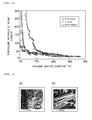
- FIG. 4 is a graph showing example moisture retention curves of artificial soils using the fibrous-mass product 1 of the present invention.
- the moisture retention curves indicate a relationship between a pressure hydraulic head (cmH 2 O) and a volume water content (%) when the fibrous-mass product 1 is used as an artificial soil particle.
- the graph shows the moisture retention curves which were obtained when the following three different fibrous-mass products were used as an artificial soil particle: (a) a fibrous-mass product having a relatively small grain size of 0.75-2 mm (open circles); (b) a fibrous-mass product having a relatively large grain size of at least 4 mm (open squares), and (c) a fibrous-mass product having a wide grain size distribution of 0.75-10 mm (open triangles).
- the volume water content varies within a broad range of about 5% to more than 30%.
- the amount of moisture retained in the core portion 3 of the fibrous-mass product 1 can be widely adjusted between the "wet state” and the "air permeable state.” Also, the comparison of the graphs (a) to (c) suggests that the volume water content can be adjusted by changing the grain size of the fibrous-mass product 1 even when the pressure hydraulic head is the same.
- the amount of retained water (i.e., the water retentivity) of the core portion 3 of the fibrous-mass product 1 can be adjusted between the "wet state” and the "air permeable state” within a volume water content range of about 0-9%.
- the fibrous-mass product 1 When the fibrous-mass product 1 is used as the artificial soil 10 which serves as a substitute for natural soil, the fibrous-mass product 1 is preferably capable of retaining nitrate nitrogen (NO 3 - ), K + , Ca 2+ , Mg 2+ , etc., which are nutrients for plants. If the capability of retaining these nutrients is not sufficient, then even when a chemical fertilizer, etc., is supplied to the artificial soil 10, the nutrients flow out due to irrigation, etc., and therefore, plants cannot effectively use the nutrients, likely leading to a failure to grow, for example.
- NO 3 - nitrate nitrogen
- Natural soil has an ability to take cations in, and therefore, has an ability to retain K + , Ca 2+ , Mg 2+ , and ammonia nitrogen (NH 4 + ), i.e., fertilizer retentivity. Plants cannot effectively use ammonia nitrogen as a nitrogen source. However, nitrifying bacteria always exist in natural soil. Nitrifying bacteria convert ammonia nitrogen into nitrate nitrogen, which is needed for plants, and supplies the nitrate nitrogen to plants. Therefore, when the fibrous-mass product 1 is used as the artificial soil 10 instead of natural soil, it is necessary to impart ion exchange capability to the fibrous-mass product 1 so that the fibrous-mass product 1 has fertilizer retentivity.
- NH 4 + ammonia nitrogen
- fibrous-mass product 1 needs to have an ability to adsorb both positive and negative ions in order to retain these nutrients. Therefore, when the fibrous-mass product 1 is formed, a cation exchange filler and an anion exchange filler are added so that ions including nitrate nitrogen (NO 3 - ), K + , Ca 2+ , and Mg 2+ , that are contained in moisture taken from the external environment, can be adsorbed in the fibrous-mass product 1. Note that NO 3 - can pollute rivers and underground water.
- a cation exchange filler and an anion exchange filler are preferably added to at least one of the void 5 of the core portion 3 and the water permeable membrane 4.
- a cation exchange filler and an anion exchange filler may be mixed with the fibers 2 during granulation of the fibers 2.
- a cation exchange filler and an anion exchange filler may be mixed with a synthetic resin or a gelling agent for the cover, and the outer surface portion of the core portion 3 may be covered with the mixture.
- a cation exchange filler and an anion exchange filler may be added to both of the core portion 3 and the water permeable membrane 4.
- a cation exchange filler and an anion exchange filler may be added to the core portion 3 and the water permeable membrane 4 separately.
- cation exchange fillers examples include smectite minerals such as montmorillonite, bentonite, beidellite, hectorite, saponite, stevensite, etc., mica minerals, vermiculite, zeolite, humus, cation exchange resin, etc.
- the cation exchange resin examples include weakly acidic cation exchange resin and strongly acidic cation exchange resin. Of them, zeolite or bentonite is preferable as a cation exchange filler used in this embodiment. These cation exchange fillers may be used in combination.
- the cation exchange capacity of the cation exchange filler is typically set to about 5-50 meq/100 g. If the cation exchange capacity is less than 5 meq/100 g, sufficient nutrients cannot be taken into the fibrous-mass product 1, and nutrients which fail to be taken are likely to flow out due to irrigation, etc. On the other hand, if the cation exchange capacity is greater than 50 meq/100 g, the fertilizer retentivity is not significantly improved, which is not cost-effective.
- anion exchange fillers include naturally-occurring layered double hydroxides having a double hydroxide as a main framework, such as hydrotalcite, manasseite, pyroaurite, sjogrenite, patina, etc., synthetic hydrotalcite and hydrotalcite-like substances, clay minerals such as allophane, imogolite, kaolinite, etc., anion exchange resin, etc.
- anion exchange resin include weakly basic anion exchange resin, strongly basic anion exchange resin, etc. Of them, hydrotalcite is preferable as an anion exchange filler used in this embodiment. These anion exchange fillers may be used in combination.
- the anion exchange capacity of the anion exchange filler is typically set to about 5-50 meq/100 g. If the anion exchange capacity is less than 5 meq/100 g, sufficient nutrients cannot be taken into the fibrous-mass product 1, and nutrients which fail to be taken are likely to flow out due to irrigation, etc. On the other hand, if the anion exchange capacity is greater than 50 meq/100 g, the fertilizer retentivity is not significantly improved, which is not cost-effective.
- microorganisms which are useful for the growth of plants such as nitrifying bacteria, VA mycorrhizal fungi, etc., may be immobilized in the water permeable membrane 4 of the fibrous-mass product 1, and the resulting fibrous-mass product 1 may be used in the artificial soil 10. As a result, the growth of plants can be promoted. If a nitrifying bacterium is immobilized in the fibrous-mass product 1, only ammonia nitrogen may be supplied as a nutrient rather than nitrate nitrogen. As a result, it is not necessary to use nitrate nitrogen, which is a high-cost fertilizer, leading to a reduction in cost of plant cultivation.
- the artificial soil 10 using the fibrous-mass product 1 as an artificial soil particle can exhibit basic functions (water retentivity, drainage performance, air permeability, and fertilizer retentivity) of soil without using natural soil. Therefore, there is not a risk of contamination by disease-causing insect pests, microorganisms, etc., and therefore, the artificial soil 10 can be safely used indoors, such as in homes, enclosed plant factories, etc. In most enclosed plant factories, hydroponic cultivation is conducted, and therefore, it has so far been difficult to cultivate root vegetables or tall plants.
- the fibrous-mass product 1 of this embodiment includes a cation exchange filler and an anion exchange filler, thereby removing cations such as the phosphate ion, ammonium ion, etc. and anions such as the nitrate ion, etc., which are present in a water environment, to improve the water environment. Therefore, the fibrous-mass product 1 may be preferably used for water treatment such as wastewater treatment, etc.
- the fibrous-mass product of the present invention is particularly preferably used as an artificial soil particle. Therefore, examples of the fibrous-mass product will be described, assuming that the fibrous-mass product is used as an artificial soil particle.
- Nine example fibrous-mass products were produced (Examples 1-9). Of the nine fibrous-mass products, the fibrous-mass products of Examples 1-3 were evaluated in terms of properties which are needed for artificial soil particles. There are eleven evaluation items described below in the section "Testing and Evaluation Methods.” A procedure for producing the fibrous-mass products of Examples 1-3 will be described below. Properties of soils (Comparative Examples 1-3) which are not an artificial soil were evaluated as a control in a manner similar to that of Examples 1-3. Comparative Examples 1 and 2 are commercially available semi-artificial soils, and Comparative Example 3 is a commercially available natural soil.
- Cotton which is a natural fiber, was used as fibers included in the fibrous-mass product. Cotton was drawn and aligned using a carding device, and cut into pieces having a length of about 3-10 mm, which were placed and tumbled between two rolling plates to form spherical core portions. Water was added to the spherical core portions, where the volume of the water was about half the volume of the spherical core portions, and was allowed to permeate into the fibers. Next, a polyethylene emulsion (SEPOLSION (registered trademark) G315 manufactured by Sumitomo Seika Chemicals Company Limited, concentration: 40% by weight) was added, where the volume of the polyethylene emulsion was half the volume of the core portions.
- SEPOLSION registered trademark
- the core portions were tumbled while allowing the emulsion to uniformly adhere to the outer surface portion and permeate into the core portions.
- the core portions impregnated with the emulsion were dried using an oven at 60°C, followed by melting the polyethylene in the emulsion at 100°C, so that the polyethylene was fused with the fibers.
- a fibrous-mass product was produced in which the outer surface portion of the core portion was covered by a water permeable membrane of porous polyethylene.
- the finished fibrous-mass product had a grain size which was within a range of 1-10 mm.
- Vinylon short fibers (manufactured by KURARAY CO., LTD.), which are a synthetic fiber, were used as fibers included in the fibrous-mass product.
- the vinylon short fiber had a length of 0.5 mm and a fiber diameter of 25 ⁇ m, and an apparent volume of 1000 cc.
- the vinylon short fibers were agitated and tumbled using an agitation/mixing granulator (manufactured by G-Labo, Inc.) for granulation while adding an approximately 10-fold dilution of the polyethylene emulsion used in Example 1 to the vinylon short fibers, thereby forming particulate core portions impregnated with the polyethylene emulsion.
- Example 2 the same polyethylene emulsion as that used in Example 1 was added, where the volume of the polyethylene emulsion was half the volume of the core portions.
- the core portions were tumbled while allowing the emulsion to uniformly adhere to the outer surface portion and permeate into the core portions.
- the core portions impregnated with the emulsion were dried using an oven at 60°C, followed by melting the polyethylene in the emulsion at 100°C, so that the polyethylene was fused with the fibers.
- a fibrous-mass product was produced in which the vinylon short fibers included in the core portion were fixed together, and the outer surface portion of the core portion was covered by a water permeable membrane of porous polyethylene.
- the finished fibrous-mass product had a grain size which was within a range of 1-10 mm.
- FIG. 5 shows a microscopic photograph showing a surface of the fibrous-mass product of this example.
- FIG. 5(A) is a photograph showing a portion of the surface of the fibrous-mass product.
- FIG. 5(B) is an enlarged photograph of (A).
- the entire surface of the core portion of the fibrous-mass product is covered by the water permeable membrane of polyethylene, and regions enclosed by ellipses which are slightly darker than the surroundings are communication holes to the core portion.
- fine polyethylene particles are aggregated on the surface of the vinylon short fibers forming the core portion to form the water permeable membrane. The interstices between the polyethylene particles are not totally filled in or blocked.
- Cellulose short fibers (length: 0.2-0.3 mm, "ARBOCEL (registered trademark)" manufactured by J. RETTENMAIER & S ⁇ HNE GmbH + Co. KG) having an apparent volume of 1000 cc were used as fibers to produce a fibrous-mass product having a core portion whose outer surface portion was covered by a water permeable membrane of porous polyethylene in a manner similar to that of Example 2.
- the finished fibrous-mass product had a grain size which was within a range of 1-5 mm.
- a soil to be tested was loaded in a chromatography column. Water was poured into the column so that the soil was completely immersed in the water. The soil was allowed to stand for one hour, followed by removal of the water from the bottom of the chromatography column. When the water did not drop from the chromatography column during a period of three minutes, the amount of the retained water was measured. The amount of the retained water was converted into that per 100 cc of the soil to be tested, which was referred to as a water retentivity.
- the amount of the retained water was measured as follows: 140 cc of a soil to be tested was loaded in a chromatography column; water was added from the top; the weight was measured after a predetermined period of time had elapsed; and the weight of the soil to be tested which had been previously measured was subtracted from that weight.
- a soil to be tested was loaded in a chromatography column. Watering was conducted at intervals of three to five minutes, so that 110 ml of water (10 ml ⁇ 5 times + 20 ml ⁇ 3 times) was poured from the top of the chromatography column. When the water did not drop from the chromatography column during a period of three minutes, the amount of the retained water was measured. The amount of the retained water was converted into that per 100 cc of the soil to be tested, which was referred to as the amount of retained water in watering. The amount of retained water was measured in a manner similar to that of (1).
- the proportion of the amount of retained water in watering to the water retentivity was referred to as a water absorption rate (%).
- a soil to be tested was loaded in a chromatography column.
- air was caused to flow upward from the bottom of the chromatography column at a rate of 1 L/min and a pressure of 0.06 MPa.
- the flow rate at the exit was measured and referred to as an air permeability.
- a soil to be tested was dried, followed by determination of the weight per 100 cc of the dried soil, which was referred to as a lightness.
- a load of 2.5 kg was applied to a soil particle to be tested.
- the soil particle was visually evaluated in terms of whether or not the soil particle was deformed or destroyed. When the external appearance of the soil particle was not changed, this result was referred to as "no".
- a soil to be tested was placed in a 150 cc container having a hole at the bottom.
- a radish after 10 days of sprouting was transplanted to the soil saturated with water. Thereafter, irrigation was not conducted, and the number of days (survival period) was counted until the radish died.
- a soil to be tested was evaluated in terms of how much the hand or a floor became dirty when a plant was transplanted or seeds were planted.
- a soil to be tested which was used in cultivation of a plant was visually evaluated in terms of changes over time in the shape of the soil particle.
- a soil to be tested which was placed in a transparent container was visually evaluated in terms of impression of external appearance, i.e., color and shape.
- the artificial soils of Examples 1-3 had a higher water retentivity and a higher water retentivity in watering than those of the semi-artificial soils of Comparative Examples 1 and 2.
- the water retentivity and the water retentivity in watering of the artificial soil of Example 3 had considerably high measured values, i.e., were very good.
- the artificial soils of Examples 1-3 were superior to the semi-artificial soil of Comparative Example 1, and the artificial soils of Examples 1 and 2 were substantially equivalent to the semi-artificial soil of Comparative Example 2.
- the artificial soils of Examples 1-3 were equivalent to Comparative Examples 1 and 2. Also, the artificial soils of Examples 1-3 had a higher water absorption rate and air permeability than those of the natural soil of Comparative Example 3, and were equivalent or superior to the natural soil of Comparative Example 3 in terms of water retentivity and water retentivity in watering, which are advantageous features of natural soils. Moreover, the artificial soils of Examples 1-3 were superior to Comparative Example 1, and substantially equivalent to Comparative Examples 2 and 3, in terms of the ability to grow without water. Thus, it was demonstrated that the artificial soils of Examples 1-3 have a good ability to retain water which is needed for plants.
- the artificial soils of Examples 1-3 have both water retentivity, which is an advantageous feature of natural soils, and air permeability, which is an advantageous feature of semi-artificial soils, and therefore, can be preferably used as a substitute for natural soil.
- the artificial soils of Examples 1-3 have high particle strength, and do not change very much over time, and therefore, may be preferably recycled. Also, the artificial soils of Examples 1-3 are lighter than the soils of Comparative Examples 1-3. In particular, the artificial soil of Example 3 is considerably lightweight, and therefore, may be preferably used on the roof of a building, the balcony of an apartment, etc. Moreover, the artificial soils of Examples 1-3 have good workability in transplantation and do not substantially make drained water dirty during watering, and have white external appearance which looks clean. The artificial soils of Examples 1-3 can be colored using a pigment, and therefore, may be preferably used as a highly ornamental indoor artificial soil.
- the fibrous-mass product inherently having high water retentivity additionally acquires fertilizer retentivity, and can be used as a well-balanced artificial soil particle for soil. Therefore, in Examples 4-9, an ion exchange filler was added to fibers, followed by granulation, to produce a fibrous-mass product (artificial soil particle).
- the fertilizer retentivity of each fibrous-mass product was evaluated using cation exchange capacity (CEC).
- CEC cation exchange capacity
- extraction liquid of artificial soil particles was prepared using the general extraction and filter unit "CEC-10 Ver.
- Vinylon short fibers (length: 0.5 mm, fiber diameter: 25 ⁇ m, manufactured by KURARAY CO., LTD.) having an apparent volume of 1000 cc were used as fibers.
- the vinylon short fibers were agitated and tumbled using an agitation/mixing granulator (manufactured by G-Labo, Inc.) for granulation while adding an approximately 10-fold dilution of the polyethylene emulsion used in Example 1, and 100 cc of zeolite ("Ryukyu-lite" manufactured by ECOWEL Inc.) as an ion exchange filler, to the vinylon short fibers, thereby forming particulate core portions impregnated with the polyethylene emulsion and carrying zeolite.
- zeolite zeolite
- Example 2 the same polyethylene emulsion as that used in Example 1 was added, where the volume of the polyethylene emulsion was half the volume of the core portions.
- the core portions were tumbled while allowing the emulsion to uniformly adhere to the outer surface portion and permeate into the core portions.
- the core portions impregnated with the emulsion were dried using an oven at 60°C, followed by melting the polyethylene in the emulsion at 100°C, so that the polyethylene was fused with the fibers.
- a fibrous-mass product was produced in which the vinylon short fibers included in the core portion were fixed together, and the outer surface portion of the core portion was covered by a water permeable membrane of porous polyethylene.
- the finished fibrous-mass product had a grain size which was within a range of 1-10 mm.
- the fibrous-mass product had a cation exchange capacity (CEC) of 4.1 meq/100 g.
- CEC cation exchange capacity
- Vinylon short fibers (length: 0.5 mm, fiber diameter: 25 ⁇ m, manufactured by KURARAY CO., LTD.) having an apparent volume of 1000 cc were used as fibers.
- the vinylon short fibers were agitated and tumbled using an agitation/mixing granulator (manufactured by G-Labo, Inc.) for granulation while adding an approximately 10-fold dilution of the polyethylene emulsion used in Example 1 to the vinylon short fibers, thereby forming particulate core portions impregnated with the polyethylene emulsion.
- zeolite (Ryukyu-lite” manufactured by ECOWEL Inc.) as an ion exchange filler, and the same polyethylene emulsion as that used in Example 1, were alternately added, where the volume of the zeolite and the polyethylene emulsion was half the volume of the core portions.
- the core portions were tumbled while allowing the zeolite and the emulsion to uniformly adhere to the outer surface portion and permeate into the core portions.
- the core portions impregnated with the emulsion were dried using an oven at 60°C, followed by melting the polyethylene in the emulsion at 100°C, so that the polyethylene was fused with the fibers.
- a fibrous-mass product was produced in which the vinylon short fibers included in the core portion were fixed together, and the outer surface portion of the core portion was covered by a water permeable membrane of porous polyethylene.
- the finished fibrous-mass product had a grain size which was within a range of 1-10 mm.
- the fibrous-mass product had a cation exchange capacity (CEC) of 2.5 meq/100 g.
- the size distribution of voids in the fibrous-mass product was measured using the mercury intrusion technique to find that the fibrous-mass product had a broad size distribution ranging from 0.1 ⁇ m to 50 ⁇ m.
- Vinylon short fibers (length: 0.5 mm, fiber diameter: 25 ⁇ m, manufactured by KURARAY CO., LTD.) having an apparent volume of 1000 cc were used as fibers.
- the vinylon short fibers were agitated and tumbled using an agitation/mixing granulator (manufactured by G-Labo, Inc.) for granulation while adding an approximately 10-fold dilution of the polyethylene emulsion used in Example 1, and 100 cc of zeolite ("Ryukyu-lite" manufactured by ECOWEL Inc.) as an ion exchange filler, to the vinylon short fibers, thereby forming particulate core portions impregnated with the polyethylene emulsion and carrying zeolite.
- zeolite zeolite
- zeolite (Ryukyu-lite” manufactured by ECOWEL Inc.) as an ion exchange filler, and the same polyethylene emulsion as that used in Example 1, were alternately added, where the volume of the zeolite and the polyethylene emulsion was half the volume of the core portions.
- the core portions were tumbled while allowing the zeolite and the emulsion to uniformly adhere to the outer surface portion and permeate into the core portions.
- the core portions impregnated with the emulsion were dried using an oven at 60°C, followed by melting the polyethylene in the emulsion at 100°C, so that the polyethylene was fused with the fibers.
- a fibrous-mass product was produced in which the vinylon short fibers included in the core portion were fixed together, and the outer surface portion of the core portion was covered by a water permeable membrane of porous polyethylene.
- the finished fibrous-mass product had a grain size which was within a range of 1-10 mm.
- the fibrous-mass product had a cation exchange capacity (CEC) of 4.5 meq/100 g.
- Cellulose short fibers (length: 0.2-0.3 mm, "ARBOCEL (registered trademark)" manufactured by J. RETTENMAIER & S ⁇ HNE GmbH + Co. KG) having an apparent volume of 1000 cc were used as fibers.
- the cellulose short fibers were agitated and tumbled using an agitation/mixing granulator (manufactured by G-Labo, Inc.) for granulation while adding an approximately 10-fold dilution of the polyethylene emulsion used in Example 1, and 100 cc of zeolite ("Ryukyu-lite" manufactured by ECOWEL Inc.) as an ion exchange filler, to the cellulose short fibers, thereby forming particulate core portions impregnated with the polyethylene emulsion and carrying zeolite.
- the same polyethylene emulsion as that used in Example 1 was added, where the volume of the polyethylene emulsion was half the volume of the core portions.
- the core portions were tumbled while allowing the emulsion to uniformly adhere to the outer surface portion and permeate into the core portions.
- the core portions impregnated with the emulsion were dried using an oven at 60°C, followed by melting the polyethylene in the emulsion at 100°C, so that the polyethylene was fused with the fibers.
- a fibrous-mass product was produced in which the cellulose short fibers included in the core portion were fixed together, and the outer surface portion of the core portion was covered by a water permeable membrane of porous polyethylene.
- the finished fibrous-mass product had a grain size which was within a range of 1-5 mm.
- the fibrous-mass product had a cation exchange capacity (CEC) of 4.6 meq/100 g.
- CEC cation exchange capacity
- Cellulose short fibers (length: 0.2-0.3 mm, "ARBOCEL (registered trademark)" manufactured by J. RETTENMAIER & S ⁇ HNE GmbH + Co. KG) having an apparent volume of 1000 cc were used as fibers.
- the cellulose short fibers were agitated and tumbled using an agitation/mixing granulator (manufactured by G-Labo, Inc.) for granulation while adding an approximately 10-fold dilution of the polyethylene emulsion used in Example 1 to the cellulose short fibers, thereby forming particulate core portions impregnated with the polyethylene emulsion.
- zeolite (Ryukyu-lite” manufactured by ECOWEL Inc.) as an ion exchange filler, and the same polyethylene emulsion as that used in Example 1, were alternately added, where the volume of the zeolite and the polyethylene emulsion was half the volume of the core portions.
- the core portions were tumbled while allowing the zeolite and the emulsion to uniformly adhere to the outer surface portion and permeate into the core portions.
- the core portions impregnated with the emulsion were dried using an oven at 60°C, followed by melting the polyethylene in the emulsion at 100°C, so that the polyethylene was fused with the fibers.
- a fibrous-mass product was produced in which the cellulose short fibers included in the core portion were fixed together, and the outer surface portion of the core portion was covered by a water permeable membrane of porous polyethylene.
- the finished fibrous-mass product had a grain size which was within a range of 1-5 mm.
- the fibrous-mass product had a cation exchange capacity (CEC) of 4.8 meq/100 g.
- Cellulose short fibers (length: 0.2-0.3 mm, "ARBOCEL (registered trademark)" manufactured by J. RETTENMAIER & S ⁇ HNE GmbH + Co. KG) having an apparent volume of 1000 cc were used as fibers.
- the cellulose short fibers were agitated and tumbled using an agitation/mixing granulator (manufactured by G-Labo, Inc.) for granulation while adding an approximately 10-fold dilution of the polyethylene emulsion used in Example 1, and 100 cc of zeolite ("Ryukyu-lite” manufactured by ECOWEL Inc.) as an ion exchange filler, to the cellulose short fibers, thereby forming particulate core portions impregnated with the polyethylene emulsion and carrying zeolite.
- agitation/mixing granulator manufactured by G-Labo, Inc.
- zeolite (Ryukyu-lite” manufactured by ECOWEL Inc.) as an ion exchange filler, and the same polyethylene emulsion as that used in Example 1, were alternately added, where the volume of the zeolite and the polyethylene emulsion was half the volume of the core portions.
- the core portions were tumbled while allowing the zeolite and the emulsion to uniformly adhere to the outer surface portion and permeate into the core portions.
- the core portions impregnated with the emulsion were dried using an oven at 60°C, followed by melting the polyethylene in the emulsion at 100°C, so that the polyethylene was fused with the fibers.
- a fibrous-mass product was produced in which the cellulose short fibers included in the core portion were fixed together, and the outer surface portion of the core portion was covered by a water permeable membrane of porous polyethylene.
- the finished fibrous-mass product had a grain size which was within a range of 1-5 mm.
- the fibrous-mass product had a cation exchange capacity (CEC) of 5.0 meq/100 g.
- the artificial soil particles of Examples 4-9 with an added ion exchange filler has at least a certain cation exchange capacity (CEC). Therefore, fertilizer retentivity can also be imparted to an artificial soil particle including the fibrous-mass product as a major component. In this case, it is possible to provide a value-added artificial soil having both good water retentivity and fertilizer retentivity.
- CEC cation exchange capacity
- the artificial soil 10 has been described as an example use of the fibrous-mass product 1 of the present invention.
- the fibrous-mass product 1 may be used in water treatment.
- the fibrous-mass product 1 includes the core portion 3 which is an aggregate of the fibers 2, and the water permeable membrane 4 which covers the outer surface portion of the core portion 3. Therefore, when the fibrous-mass product 1 of the present invention is used in excreta treatment, water treatment for fish farming, etc., anaerobic microorganisms can grow in the vicinity of the center of the core portion 3 while aerobic microorganisms can efficiently grow in the water permeable membrane 4.
- ammonia nitrogen can be converted into nitrate nitrogen by nitrifying bacteria growing in the water permeable membrane 4 while nitrate nitrogen can be converted into nitrogen gas by denitrifying bacteria growing in the vicinity of the center of the core portion 3, and the nitrogen gas can be eventually discharged out of the system.
- an anion exchange filler is preferably added to the water permeable membrane 4. Because the cell membrane of microorganisms is negatively charged, microorganisms are adsorbed by the water permeable membrane 4 due to the anion exchange filler and grow efficiently, whereby the ability to treat nitrogen can be improved.
- the fibrous-mass product of the present invention and the artificial soil using the fibrous-mass product are useful for vegetable gardens, plant factories, indoor gardening, water treatment, excreta treatment, etc.
Landscapes
- Chemical & Material Sciences (AREA)
- Life Sciences & Earth Sciences (AREA)
- Organic Chemistry (AREA)
- Environmental Sciences (AREA)
- Engineering & Computer Science (AREA)
- General Life Sciences & Earth Sciences (AREA)
- Soil Sciences (AREA)
- Materials Engineering (AREA)
- Pest Control & Pesticides (AREA)
- Chemical Kinetics & Catalysis (AREA)
- Textile Engineering (AREA)
- Cultivation Of Plants (AREA)
Abstract
Description
- The present invention relates to fibrous-mass products which include an aggregate of fibers, and artificial soils using the fibrous-mass products.
- A fibrous-mass product which includes an aggregate of fibers has voids between fibers, and therefore, has a light weight and can retain water in the voids. Therefore, fibrous-mass products can be used as a water retention material. Fibrous-mass products may, for example, also be used to carry a catalyst or a useful microorganism in the voids between fibers. Therefore, by utilizing the properties of the voids between fibers, fibrous-mass products are, for example, used as an artificial soil in the agricultural field, and as a carrier for water treatment in the environmental field.
- Artificial soil may be used to grow plants in outdoor spaces such as the roof of a building, the balcony of an apartment, etc., or indoor spaces such as a lobby, a living room, etc. In particular, for growing plants in indoor spaces, artificial soil is increasingly frequently used instead of natural soil. This is because the use of natural soil for growing plants in indoor spaces may cause problems, such as difficulty in moving the plant and soil due to its weight, poor indoor sanitation due to proliferation of microorganisms in natural soil, etc. Fibrous-mass products are lighter than the same volume of natural soil, have good drainage performance, and are hygienic, and therefore, may be a material suitable for artificial soil.
-
Patent Document 1 has proposed a horticultural fiber ball which is a molded spherical mass of palm fibers as a conventional artificial soil using fibers. - Also,
Patent Document 2 has proposed a fragment which is obtained by pulverizing solid matter which has been obtained by solidifying natural pulp using resin or glue, as a substitute for natural soil. -
- Patent Document 1: Japanese Unexamined Utility Model (Registration) Application Publication No.
S55-56564 - Patent Document 2: Japanese Unexamined Patent Application Publication No.
2004-350655 - The horticultural fiber ball of
Patent Document 1 retains externally supplied water in the hydrophilic palm fibers, thereby allowing a plant to use the water. However, the horticultural fiber ball is produced by only molding palm fibers into a simple spherical shape, and therefore, does not have sufficient strength. Also, the palm fiber is not covered, and therefore, is likely to quickly lose moisture in a dry external environment. - The plant cultivation device of
Patent Document 2 uses the fragment which is obtained by pulverizing solid matter which has been obtained by solidifying natural pulp using resin or glue, as a substitute for natural soil. The fibers of the fragment are solidified using resin or glue while containing water. As a result, the fragment retains a certain amount of moisture. Because the fibers of the fragment are solidified using resin or glue, it is difficult to cause the fragment to internally retain additional moisture supplied externally. The space between the fibers is filled with resin or glue, which causes poor air permeability in the fragment, likely leading to anaerobic conditions. Therefore, it is difficult for the roots of a plant to enter the fragment, so that the plant cannot absorb sufficient moisture from the fragment, and therefore, is likely to be prevented from growing. - With the above problems in mind, the present invention has been made. It is an object of the present invention to provide a fibrous-mass product which has both water retentivity and strength, and in addition, good air permeability, and can be used as an artificial soil particle.
- A fibrous-mass product according to the present invention for achieving the above object includes:
- a core portion which is an aggregate of fibers; and
- a water permeable membrane which covers the core portion.
- The fibrous-mass product thus configured has the core portion which is an aggregate of fibers. Therefore, voids which can retain moisture are formed between the fibers of the core portion. Also, the core portion is covered by the water permeable membrane, and therefore, a certain level of shielding capability and rigidity are provided while water permeability is ensured between the core portion of the fibrous-mass product and the external environment. As a result, the strength of the fibrous-mass product is maintained by the water permeable membrane, resulting in both good water retentivity and strength. Also, the core portion can absorb moisture from the external environment through the water permeable membrane and release moisture to the external environment, whereby the fibrous-mass product thus configured is particularly applicable to applications which involve movement of moisture, such as artificial soil particles, etc.
- In the fibrous-mass product of the present invention,
the water permeable membrane preferably has porous structure. - In the fibrous-mass product thus configured, the core portion is covered by the water permeable membrane having porous structure. Therefore, the water permeability between the core portion and the external environment is improved, and moreover, external air is allowed to pass through the porous structure of the water permeable membrane, resulting in good air permeability.
- In the fibrous-mass product of the present invention,
the water permeable membrane preferably covers at least 40% of an outer surface portion of the core portion. - In the fibrous-mass product thus configured, at least 40% of the outer surface portion of the core portion is covered by the water permeable membrane. Therefore, rapid movement of moisture between the core portion and the external environment can be prevented while the strength and durability of the fibrous-mass product can be maintained at at least a predetermined level, resulting in an appropriate moisture control.
- In the fibrous-mass product of the present invention,
the core portion preferably has a water retention material. - In the fibrous-mass product thus configured, the core portion has a water retention material. Therefore, not only the water retentivity which is inherently possessed by the core portion due to the voids between the fibers, but also the water retentivity of the water retention material, can be imparted to the fibrous-mass product. As a result, the water retentivity of the entire fibrous-mass product is further improved, whereby the fibrous-mass product is resistant to dryness.
- In the fibrous-mass product of the present invention,
ion exchange capability is preferably imparted to at least one of the core portion and the water permeable membrane. - In the fibrous-mass product thus configured, ion exchange capability is imparted to at least one of the core portion and the water permeable membrane, resulting in a high ion exchange capacity. The fibrous-mass product thus having ion exchange capability can adsorb a specific ion contained in moisture absorbed by the core portion from the external environment, and therefore, is applicable to various applications.
- In the fibrous-mass product of the present invention,
the fibrous-mass product preferably has a grain size of 1-10 mm. - The fibrous-mass product thus configured has a grain size of 1-10 mm, and therefore, a suitable interstice is formed between the fibrous-mass products, resulting in good air permeability and drainage performance.
- In the fibrous-mass product of the present invention,
the amount of moisture retained in the fibrous-mass product is preferably adjustable between a wet state in which the core portion is saturated with moisture and an air permeable state in which the core portion is not saturated with moisture. - In the fibrous-mass product thus configured, the amount of moisture retained in the fibrous-mass product is adjustable between a wet state in which the core portion is saturated with moisture and an air permeable state in which the core portion is not saturated with moisture. Therefore, for example, when the amount of moisture in the external environment is large, the core portion is allowed to absorb moisture from the external environment, and when the amount of moisture in the external environment is small, the core portion is allowed to release moisture retained therein to the external environment. Thus, the fibrous-mass product thus configured can suitably move moisture between the core portion and the external environment, and therefore, is suitable for use as an artificial soil particle having a good ability to control moisture.
- In the fibrous-mass product of the present invention,
the fiber is preferably a short fiber having a length of 0.2-0.5 mm. - In the fibrous-mass product thus configured, a short fiber having a length of 0.2-0.5 mm is used as the fiber to form the core portion which is an aggregate of the fibers, whereby the voids formed between the fibers can have a uniform size. As a result, the fibrous-mass product can have stable properties (water absorbability, water permeability, air permeability, etc.).
- An artificial soil according to the present invention for achieving the above object uses any one of the above fibrous-mass products as an artificial soil particle.
- In the artificial soil thus configured, the fibrous-mass product used as an artificial soil particle has both water retentivity and strength, and in addition, good air permeability. Therefore, the artificial soil can be preferably used as a substitute for natural soil.
-
- [
FIG. 1] FIG. 1 is a schematic diagram for describing a fibrous-mass product according to the present invention. - [
FIG. 2] FIG. 2 is a photograph showing an example of a fibrous-mass product according to an embodiment of the present invention. - [
FIG. 3] FIG. 3 is a schematic diagram for describing a situation in which a plant grows in an artificial soil using the fibrous-mass product of the present invention as an artificial soil particle. - [
FIG. 4] FIG. 4 is a graph showing example moisture retention curves of artificial soils using the fibrous-mass product of the present invention. - [
FIG. 5] FIG. 5 is a microscopic photograph showing a surface of the fibrous-mass product of the present invention. - Embodiments related to a fibrous-mass product according to the present invention and an artificial soil using the fibrous-mass product as an artificial soil particle, will be described with reference to
FIGS. 1-5 . Note that the present invention is not intended to be limited to configurations described below in the embodiments and the drawings. -
FIG. 1 is a schematic diagram for describing a fibrous-mass product 1 according to the present invention.FIG. 1(A) is an external view of the fibrous-mass product 1.FIG. 1(B) is a cross-sectional view of the fibrous-mass product 1.FIG. 2 is a photograph showing an example of the fibrous-mass product 1 of the embodiment of the present invention.FIG. 2(A) is a photograph showing a collection of the fibrous-mass products 1.FIG. 2(B) is an enlarged photograph showing the single fibrous-mass product 1. The fibrous-mass product 1 includes acore portion 3 which includes an aggregate offibers 2, and a waterpermeable membrane 4 which covers thecore portion 3. As shown inFIG. 1 , thecore portion 3 is a granulated matter which is a complicated aggregate of thefibers 2, and is formed in a spherical shape. Thecore portion 3 is covered by the waterpermeable membrane 4. The fibrous-mass product 1 is thus configured. In this embodiment, as shown inFIG. 2 , the fibrous-mass product 1 is formed in a three-dimensional shape close to a sphere. Alternatively, the fibrous-mass product 1 may, for example, be formed in the shape of a spheroid (e.g., a rugby ball), a konpeito (Japanese sugar candy which has projections), a polyhedron, or a plate having at least a certain thickness, or in an indefinite shape, etc. - The
fiber 2 used to form thecore portion 3 is in the form of a long fiber or a short fiber. The short fiber includes a powdered fiber having an extremely short fiber length. By granulating the long fibers or the short fibers, thecore portion 3 which is an aggregate of thefibers 2 is formed. A binder, such as resin, glue, etc., may optionally be used during the granulation.Voids 5 are formed between thefibers 2 aggregated in thecore portion 3. The fibrous-mass product 1 can retain moisture in thevoids 5. Therefore, the conditions of the voids 5 (e.g., the size, number, shape, etc. of the voids 5) have a relation to the amount of moisture which can be retained by the fibrous-mass product 1, i.e., water retentivity. The conditions of thevoids 5 can be adjusted by changing the amount (density) of thefibers 2 which are used, the type, thickness, or length of thefibers 2, etc., during the granulation of thecore portion 3. Note that, as to dimensions of thefiber 2, the thickness is preferably about 5-100 µm, and the length is preferably about 0.5-10 mm. Also, thefiber 2 may be a precut short fiber. In this case, the length of the short fiber is preferably about 0.2-0.5 mm. - In the fibrous-
mass product 1, thefiber 2 is preferably a hydrophilic fiber in order to allow thecore portion 3 to retain sufficient moisture. As a result, the water retentivity of the fibrous-mass product 1 can be further improved. The type of thefiber 2 may be either natural fiber or synthetic fiber, and suitably selected, depending on the purpose of use of the fibrous-mass product 1. Examples of the preferable hydrophilic fiber include natural fiber such as cotton, wool, rayon, cellulose, etc., and synthetic fiber such as vinylon, urethane, nylon, acetate, etc. Of these fibers, cotton and vinylon are more preferable. As thefiber 2, a combination of natural fiber and synthetic fiber may be used. - An outer surface portion of the
core portion 3 is covered by the waterpermeable membrane 4. The waterpermeable membrane 4 has small pores which allows water to pass therethrough. Alternatively, the waterpermeable membrane 4 may be an osmotic membrane which allows moisture to permeate the membrane from one side and move to the other side. The waterpermeable membrane 4 has a predetermined level of shielding capability and rigidity while ensuring water permeability between thecore portion 3 of the fibrous-mass product 1 and an external environment. Here, the "external environment" means an environment external to the fibrous-mass product 1. Moisture may exist in the external environment. If the waterpermeable membrane 4 covers at least 40%, preferably at least 60%, of the outer surface portion of thecore portion 3, rapid movement of moisture between thecore portion 3 and the external environment can be prevented while the strength and durability of the fibrous-mass product 1 can be maintained at at least a predetermined level, resulting in an appropriate moisture control. The water retentivity of the fibrous-mass product 1 may also be adjusted by changing the thickness or properties of the waterpermeable membrane 4. The waterpermeable membrane 4 can admit moisture from the external environment and release moisture to the external environment. Therefore, the fibrous-mass product 1 with the waterpermeable membrane 4 is particularly applicable to applications which involve movement of moisture, such as artificial soil particles, etc. - The water
permeable membrane 4 may be formed to have a thickness which slightly extends inward from the outer surface portion of thecore portion 3 so that an interlocked portion of the fibers 2 (a portion at which thefibers 2 contact each other) included in thecore portion 3 is reinforced. As a result, the strength and durability of the fibrous-mass product 1 can be further improved. The thickness of the waterpermeable membrane 4 is set to 1-500 µm, preferably 10-200 µm, more preferably 20-100 µm. - Moreover, the water
permeable membrane 4 has a porous structure to ensure sufficient air permeability between thecore portion 3 and the external environment. For example, as shown inFIG. 1(A) , a communication hole(s) 6 through which thecore portion 3 and the external environment are allowed to be in communication with each other is formed in the waterpermeable membrane 4. Thecommunication hole 6 has a size larger than that of the small pore inherently possessed by the waterpermeable membrane 4, and inevitably allows moisture to pass therethrough, so that the water permeability between thecore portion 3 and the external environment is improved. Although, in this embodiment, the waterpermeable membrane 4 has a porous structure and the communication holes 6 are directly formed in the waterpermeable membrane 4, the waterpermeable membrane 4 may be mixed with a porous filler, such as a natural mineral, synthetic polymer foam material, etc., and thecommunication hole 6 may be formed through the porous filler. The diameter of thecommunication hole 6 formed in the waterpermeable membrane 4 is set to 1-2000 µm, preferably 10-900 µm, and more preferably 300-900 µm. - The water
permeable membrane 4 is preferably formed of a material which is insoluble in water and highly resistant to oxidation. An example of such a material is a resin material. Examples of such a resin material include polyolefin resins such as polyethylene, polypropylene, etc., vinyl chloride resins such as polyvinyl chloride, polyvinylidene chloride, etc., polyester resins such as polyethylene terephthalate, etc., and styrol resins such as polystyrene, etc. Of them, polyethylene is preferable. Also, instead of the resin material, a polymeric gelling agent such as polyethylene glycol, acrylamide, etc., a naturally-occurring polysaccharide gelling agent such as alginate, carrageenan, etc., a rubber coating agent such as natural rubber, silicone rubber, etc., and the like, may be used. - The fibrous-
mass product 1 may be designed so that the water retentivity of thecore portion 3 is further improved. For example, thecore portion 3 is configured to have a water retention material. In this case, not only the water retentivity which is inherently possessed by thecore portion 3 due to thevoids 5 between thefibers 2, but also the water retentivity of the water retention material, can be imparted to the fibrous-mass product 1. The water retention material may, for example, be introduced to thecore portion 3 by adding the water retention material when thefibers 2 are granulated to form thecore portion 3. It is also effective to coat the surface of thefiber 2 with the water retention material. The water retention material introduced to thecore portion 3 by these techniques is preferably exposed in thevoid 5 of thecore portion 3. In this case, the water retentivity in thevoid 5 of the fibrous-mass product 1 is significantly improved, and therefore, the fibrous-mass product 1 is, for example, preferably used as a soil improvement material which is added to an dry environment, such as a desert, etc. - The water retention material may be a polymeric water retention material having water absorption capability. Examples of such a polymeric water retention material include synthetic polymers such as polyacrylate polymer, polysulfonate polymer, polyacrylamide polymer, polyvinyl alcohol polymer, polyalkylene oxide polymer, etc., and natural polymers such as polyaspartate polymer, polyglutamate polymer, polyalginate polymer, cellulose polymer, starch, etc. These water retention materials may be used in combination. Also, a porous material, such as ceramics, etc., may be used as the water retention material.
- The fibrous-
mass product 1 is manufactured as follows, for example. Thefibers 2, such as cotton, vinylon, etc., are aligned using a carding device, etc., before being cut into pieces having a length of about 3-10 mm. Thecut fibers 2 are granulated into grains by tumbling granulation, fluidized bed granulation, agitation granulation, compression granulation, extrusion granulation, etc., to form thecore portion 3. During the granulation, if thefibers 2 are mixed with a binder, such as resin, glue, etc., thecore portion 3 can be efficiently formed. The binder may be either an organic binder or an inorganic binder. Examples of the organic binder include synthetic resin binders such as a polyolefin binder, polyvinyl alcohol binder, polyurethane binder, polyvinyl acetate binder, etc., and naturally-occurring binders such as polysaccharides (e.g., starch, carrageenan, xanthan gum, gellan gum, alginic acid, etc.), animal proteins (e.g., an animal glue, etc.), etc. Examples of the inorganic binder include silicate binders such as water glass etc., phosphate binders such as aluminum phosphate etc., borate binders such as aluminum borate etc., and hydraulic binders such as cement etc. The organic and inorganic binders may be used in combination. Note that if, as thefibers 2, those which easily interlock (e.g., bent fibers) are used, the granulation process alone causes thefibers 2 to easily interlock. In this case, thecore portion 3 may be formed without using a binder. - Next, the
core portion 3 produced by the granulation is placed in a container. Water is added to the container, where the volume of the water is about half the volume (occupied volume) of thecore portion 3, so that the water is caused to permeate thevoids 5 of thecore portion 3. Moreover, a polyethylene emulsion is added to thecore portion 3 impregnated with water, where the volume of the polyethylene emulsion is 1/3-1/2 of the volume of thecore portion 3. The polyethylene emulsion may be mixed with an additive, such as a pigment, aroma chemical, fungicide, antimicrobial, air freshener, insecticide, etc. Thereafter, while thecore portion 3 is tumbled so that the polyethylene emulsion adheres to the outer surface portion uniformly, the polyethylene emulsion is allowed to permeate thecore portion 3 through the outer surface portion. In this case, a central portion of thecore portion 3 is already filled with water, and therefore, the polyethylene emulsion remains in the vicinity of the outer surface portion of thecore portion 3. Thereafter, thecore portion 3 with the adhering polyethylene emulsion is dried in an oven at a temperature of 60-80°C, followed by melting the polyethylene at 100°C, so that the polyethylene is fused with thefibers 2 in the vicinity of the outer surface portion of thecore portion 3 to form the waterpermeable membrane 4. As a result, the outer surface portion of thecore portion 3 is covered by the waterpermeable membrane 4 of polyethylene. Thus, the production of the fibrous-mass product 1 having strength and durability is completed. When the polyethylene is melted, a solvent contained in the polyethylene emulsion evaporates, so that a porous structure is formed in the waterpermeable membrane 4. The porous structure functions as the communication holes 6 through which thecore portion 3 is in communication with the external environment. The fibrous-mass product 1 thus obtained is optionally dried and classified so that the grain size thereof is adjusted. - When a short fiber is used as the
fiber 2 to produce thecore portion 3 by granulation, the short fiber is agitated using an agitation/mixing granulator while adding the polyethylene emulsion in small amounts. As a result, a part of the short fibers forming thecore portion 3 is fixed together, whereby thecore portion 3 can become robust. Note that the short fibers may be granulated by adding water thereto before adding the polyethylene emulsion to complete the production of thecore portion 3. -
FIG. 3 is a schematic diagram for describing a situation in which a plant grows in anartificial soil 10 using the fibrous-mass product 1 of the present invention as an artificial soil particle. As shown inFIG. 3 , a plurality of the fibrous-mass products 1 are collected to form an aggregate structure, in which acertain interstice 11 is formed between each fibrous-mass product 1. Theinterstice 11 allows air and water to pass therethrough, and therefore, an excess of moisture can be drained off while moisture needed for plants is maintained. When theartificial soil 10 is in a wet state, an excess of moisture is drained through the interstices 11. When theartificial soil 10 is in a dry state, surrounding moisture can be drawn up due to capillary action of the interstices 11. Thus, theartificial soil 10 can hold moisture needed for plants while draining an excess of moisture off, due to theinterstices 11 formed between the adjacent fibrous-mass products 1, thereby achieving good air permeability and drainage performance. Theinterstices 11 also provide spaces for allowingplant roots 20 to grow, and therefore, theplant roots 20 easily extend, which promotes the growth of the plant. - The grain size of the fibrous-
mass product 1 used in theartificial soil 10, which is suitably selected, depending on a plant to be cultivated, is preferably 1-10 mm, more preferably 2-8 mm, and even more preferably 2-5 mm. If the grain size of the fibrous-mass product 1 is within the above ranges, a suitable interstice is formed between each fibrous-mass product 1, resulting in good air permeability and drainage performance. If the grain size of the fibrous-mass product 1 is less than 1 mm, the size of theinterstice 11 decreases to the extent that an excessive amount of moisture is retained due to the capillary force of the interstices 11. As a result, the drainage performance decreases, which causes it to be difficult for theplant root 20 to absorb oxygen, likely leading to root rot. Also, if the grain size of the fibrous-mass product 1 is less than 1 mm, the produced grain has properties almost similar to those of the fiber, and therefore, is likely to have difficulty in functioning as the fibrous-mass product 1. On the other hand, if the grain size of the fibrous-mass product 1 exceeds 10 mm, it is difficult to produce the fibrous-mass product 1. Even if the particle having a grain size of greater than 10 mm is obtained, the size of theinterstice 11 increases, which is likely to cause excessive drainage performance, and therefore, it is difficult for a plant to absorb sufficient moisture, or theartificial soil 10 is likely to be sparse, which may cause a plant to fall down. The grain size of the fibrous-mass product 1 can be adjusted by sieving. The grain size of the fibrous-mass product 1 is determined by the following measurement technique. Initially, a fibrous-mass product to be measured is observed along with a ruler using a camera or a microscope. The image is obtained using an image processing software system (a two-dimensional image analysis software system "WinROOF" produced by MITANI CORPORATION). One hundred fibrous-mass products are selected from the image, and the outlines of the fibrous-mass products are traced. Based on the perimeter of the traced shape, the diameter of a circle corresponding to the perimeter of the traced shape is calculated. An average of the diameters of such circles (number: 100) obtained from the respective fibrous-mass products is referred to as the average size (unit: pixel). Thereafter, the average size is converted into a unit length (µm order to mm order) by comparing it with the ruler in the image, thereby calculating the grain size of the fibrous-mass product. Incidentally, the size of thefiber 2 included in the fibrous-mass product 1, the thickness of the waterpermeable membrane 4, and the diameter of thecommunication hole 6 formed in the waterpermeable membrane 4 are also determined by a measurement technique using this image process. - In the fibrous-
mass product 1, thecore portion 3 is covered by the waterpermeable membrane 4, whereby good water retentivity and air permeability are achieved. The amount of moisture retained by the fibrous-mass product 1 can be adjusted between a wet state in which thecore portion 3 is saturated with moisture and an air permeable state in which thecore portion 3 is not saturated with moisture. The wet state refers to a state in which no more moisture can be retained, e.g., a state in which a pF value described below is close to zero. The air permeable state refers to a state in which moisture can be retained, e.g., a state in which the pF value is greater than 0, i.e., about 2-7. For example, as shown inFIG. 3 , theplant root 20 extends in theinterstices 11 between the adjacent fibrous-mass products 1, and draws up moisture present in theinterstices 11 of theartificial soil 10. The fibrous-mass product 1 can absorb and release moisture, and therefore, if the external environment is in a dry state, moisture can be supplied to theplant root 20 from thecore portion 3 of the fibrous-mass product 1 through the waterpermeable membrane 4. Specifically, at least a portion of water is released from the fibrous-mass product 1 to the external environment, and air enters thevoid 5 of the fibrous-mass product 1 which has been formed due to the release of water, through thecommunication hole 6. In this case, as shown inFIG. 3 ,fine roots 21 which are branches of theplant root 20 are allowed to easily enter thecore portion 3 through the communication holes 6 of the fibrous-mass product 1. If water remains in the fibrous-mass product 1, the water is retained in thevoids 5 of thecore portion 3, and therefore, is not easily released from the fibrous-mass product 1 to the external environment. However, thefine root 21 of a plant entering the fibrous-mass product 1 can reach thevoid 5 of thecore portion 3, and actively draw up the remaining water thus retained. Thus, theartificial soil 10 using the fibrous-mass product 1 allows a plant to effectively use moisture retained in theartificial soil 10, and therefore, the death or growth failure of a plant can be prevented even if water is not supplied to the plant over a long period of time. - The fibrous-
mass product 1 of the present invention has good water retentivity for theartificial soil 10, and therefore, is applicable to the growth of leaf vegetables which have been mostly hydroponically cultivated. Here, the water retentivity of theartificial soil 10 can be represented by a pF value as an index. The pF value refers to the common logarithm of the absorption pressure of soil moisture which is represented by the height of a water column, and indicates the strength of pulling moisture in a soil due to the capillary force of the soil. The pF value of 2.0 corresponds to the pressure (pressure hydraulic head) of a water column of 100 cm. The pF value also serves as an index indicating how wet a soil is. If a soil contains sufficient moisture, the pF value is low, and theplant root 20 easily absorbs moisture. On the other hand, if a soil is dry, the pF value is high, and theplant root 20 is required to exert a great force in order to absorb moisture. The pF value of 0 indicates that air is not present in interstices in a soil, and all the interstices are filled with water. The pF value of 7 indicates that a soil is thermally dried at 100°C, and only water chemically united with the soil is present. - In general soils, plants can be cultivated when the pF value is within a range of 1.5-2.7. In order to sufficiently grow plants, the pF value is set to be within a range of 1.7-2.7, preferably a range of 1.7-2.3. When the pF value of a soil is within the range of 1.7-2.7, then if the volume water content of the soil is less than 10 mL/100 mL (i.e., the volume water content is 10%), it is difficult to determine the amount and timing of watering, and therefore, the soil may always be wet or may be quickly dried, likely leading to root rot, or the death of plants due to lack of water. The fibrous-
mass product 1 of the present invention can retain a large amount of water in thecore portion 3, and therefore, can avoid being dried over a long period of time, and can allow plants to grow well. Also, even if the pF value is at most 1.5, a sufficient amount of interstices is provided between the fibrous-mass products 1, and therefore, air permeability is ensured. Therefore, unlike general soils, it is unlikely that excessive watering causes root rot. Even if a lot of watering is performed without considering the amount and timing of watering, the soil environment remains substantially unchanged. As a result, not only root vegetables but also leaf vegetables can be cultivated, i.e., theartificial soil 10 is applicable to a wider variety of applications. -
FIG. 4 is a graph showing example moisture retention curves of artificial soils using the fibrous-mass product 1 of the present invention. The moisture retention curves indicate a relationship between a pressure hydraulic head (cmH2O) and a volume water content (%) when the fibrous-mass product 1 is used as an artificial soil particle. The graph shows the moisture retention curves which were obtained when the following three different fibrous-mass products were used as an artificial soil particle: (a) a fibrous-mass product having a relatively small grain size of 0.75-2 mm (open circles); (b) a fibrous-mass product having a relatively large grain size of at least 4 mm (open squares), and (c) a fibrous-mass product having a wide grain size distribution of 0.75-10 mm (open triangles). For example, as can be seen from the graph of (b), in a region where the pressure hydraulic head is at most 50 cmH2O, i.e., the pF value is low, the volume water content varies within a broad range of about 5% to more than 30%. If this wide region is applied during irrigation of the artificial soil, the amount of moisture retained in thecore portion 3 of the fibrous-mass product 1 can be widely adjusted between the "wet state" and the "air permeable state." Also, the comparison of the graphs (a) to (c) suggests that the volume water content can be adjusted by changing the grain size of the fibrous-mass product 1 even when the pressure hydraulic head is the same. For example, when the pF value is 2.0 which corresponds to a pressure hydraulic head of 100 cmH2O, then if the grain size of the fibrous-mass product is changed within a range of 0.75-4 mm, the amount of retained water (i.e., the water retentivity) of thecore portion 3 of the fibrous-mass product 1 can be adjusted between the "wet state" and the "air permeable state" within a volume water content range of about 0-9%. - When the fibrous-
mass product 1 is used as theartificial soil 10 which serves as a substitute for natural soil, the fibrous-mass product 1 is preferably capable of retaining nitrate nitrogen (NO3 -), K+, Ca2+, Mg2+, etc., which are nutrients for plants. If the capability of retaining these nutrients is not sufficient, then even when a chemical fertilizer, etc., is supplied to theartificial soil 10, the nutrients flow out due to irrigation, etc., and therefore, plants cannot effectively use the nutrients, likely leading to a failure to grow, for example. - Natural soil has an ability to take cations in, and therefore, has an ability to retain K+, Ca2+, Mg2+, and ammonia nitrogen (NH4 +), i.e., fertilizer retentivity. Plants cannot effectively use ammonia nitrogen as a nitrogen source. However, nitrifying bacteria always exist in natural soil. Nitrifying bacteria convert ammonia nitrogen into nitrate nitrogen, which is needed for plants, and supplies the nitrate nitrogen to plants. Therefore, when the fibrous-
mass product 1 is used as theartificial soil 10 instead of natural soil, it is necessary to impart ion exchange capability to the fibrous-mass product 1 so that the fibrous-mass product 1 has fertilizer retentivity. - Here, nutrients which are needed for plants include nitrate nitrogen (NO3 -), K+, Ca2+, and Mg2+, and therefore, fibrous-
mass product 1 needs to have an ability to adsorb both positive and negative ions in order to retain these nutrients. Therefore, when the fibrous-mass product 1 is formed, a cation exchange filler and an anion exchange filler are added so that ions including nitrate nitrogen (NO3 -), K+, Ca2+, and Mg2+, that are contained in moisture taken from the external environment, can be adsorbed in the fibrous-mass product 1. Note that NO3 - can pollute rivers and underground water. If an anion exchange filler is added to the fibrous-mass product 1, then even when a large amount of the nitrate-nitrogen nutrient is supplied, the outflow of NO3 - to the water environment can be reduced due to the retention of NO3 - by the fibrous-mass product 1. - In order to impart ion exchange capability to the fibrous-
mass product 1, a cation exchange filler and an anion exchange filler are preferably added to at least one of thevoid 5 of thecore portion 3 and the waterpermeable membrane 4. When ion exchange capability is imparted to thecore portion 3, a cation exchange filler and an anion exchange filler may be mixed with thefibers 2 during granulation of thefibers 2. When ion exchange capability is imparted to the waterpermeable membrane 4, a cation exchange filler and an anion exchange filler may be mixed with a synthetic resin or a gelling agent for the cover, and the outer surface portion of thecore portion 3 may be covered with the mixture. Also, a cation exchange filler and an anion exchange filler may be added to both of thecore portion 3 and the waterpermeable membrane 4. Alternatively, a cation exchange filler and an anion exchange filler may be added to thecore portion 3 and the waterpermeable membrane 4 separately. - Examples of cation exchange fillers include smectite minerals such as montmorillonite, bentonite, beidellite, hectorite, saponite, stevensite, etc., mica minerals, vermiculite, zeolite, humus, cation exchange resin, etc. Examples of the cation exchange resin include weakly acidic cation exchange resin and strongly acidic cation exchange resin. Of them, zeolite or bentonite is preferable as a cation exchange filler used in this embodiment. These cation exchange fillers may be used in combination.
- The cation exchange capacity of the cation exchange filler is typically set to about 5-50 meq/100 g. If the cation exchange capacity is less than 5 meq/100 g, sufficient nutrients cannot be taken into the fibrous-
mass product 1, and nutrients which fail to be taken are likely to flow out due to irrigation, etc. On the other hand, if the cation exchange capacity is greater than 50 meq/100 g, the fertilizer retentivity is not significantly improved, which is not cost-effective. - Examples of anion exchange fillers include naturally-occurring layered double hydroxides having a double hydroxide as a main framework, such as hydrotalcite, manasseite, pyroaurite, sjogrenite, patina, etc., synthetic hydrotalcite and hydrotalcite-like substances, clay minerals such as allophane, imogolite, kaolinite, etc., anion exchange resin, etc. Examples of the anion exchange resin include weakly basic anion exchange resin, strongly basic anion exchange resin, etc. Of them, hydrotalcite is preferable as an anion exchange filler used in this embodiment. These anion exchange fillers may be used in combination.
- The anion exchange capacity of the anion exchange filler is typically set to about 5-50 meq/100 g. If the anion exchange capacity is less than 5 meq/100 g, sufficient nutrients cannot be taken into the fibrous-
mass product 1, and nutrients which fail to be taken are likely to flow out due to irrigation, etc. On the other hand, if the anion exchange capacity is greater than 50 meq/100 g, the fertilizer retentivity is not significantly improved, which is not cost-effective. - Also, microorganisms which are useful for the growth of plants, such as nitrifying bacteria, VA mycorrhizal fungi, etc., may be immobilized in the water
permeable membrane 4 of the fibrous-mass product 1, and the resulting fibrous-mass product 1 may be used in theartificial soil 10. As a result, the growth of plants can be promoted. If a nitrifying bacterium is immobilized in the fibrous-mass product 1, only ammonia nitrogen may be supplied as a nutrient rather than nitrate nitrogen. As a result, it is not necessary to use nitrate nitrogen, which is a high-cost fertilizer, leading to a reduction in cost of plant cultivation. - The
artificial soil 10 using the fibrous-mass product 1 as an artificial soil particle can exhibit basic functions (water retentivity, drainage performance, air permeability, and fertilizer retentivity) of soil without using natural soil. Therefore, there is not a risk of contamination by disease-causing insect pests, microorganisms, etc., and therefore, theartificial soil 10 can be safely used indoors, such as in homes, enclosed plant factories, etc. In most enclosed plant factories, hydroponic cultivation is conducted, and therefore, it has so far been difficult to cultivate root vegetables or tall plants. Theartificial soil 10, which can support the grownplant root 20, makes it easier to cultivate root vegetables and tall plants. - Also, the fibrous-
mass product 1 of this embodiment includes a cation exchange filler and an anion exchange filler, thereby removing cations such as the phosphate ion, ammonium ion, etc. and anions such as the nitrate ion, etc., which are present in a water environment, to improve the water environment. Therefore, the fibrous-mass product 1 may be preferably used for water treatment such as wastewater treatment, etc. - The fibrous-mass product of the present invention is particularly preferably used as an artificial soil particle. Therefore, examples of the fibrous-mass product will be described, assuming that the fibrous-mass product is used as an artificial soil particle. Nine example fibrous-mass products were produced (Examples 1-9). Of the nine fibrous-mass products, the fibrous-mass products of Examples 1-3 were evaluated in terms of properties which are needed for artificial soil particles. There are eleven evaluation items described below in the section "Testing and Evaluation Methods." A procedure for producing the fibrous-mass products of Examples 1-3 will be described below. Properties of soils (Comparative Examples 1-3) which are not an artificial soil were evaluated as a control in a manner similar to that of Examples 1-3. Comparative Examples 1 and 2 are commercially available semi-artificial soils, and Comparative Example 3 is a commercially available natural soil.
- Cotton, which is a natural fiber, was used as fibers included in the fibrous-mass product. Cotton was drawn and aligned using a carding device, and cut into pieces having a length of about 3-10 mm, which were placed and tumbled between two rolling plates to form spherical core portions. Water was added to the spherical core portions, where the volume of the water was about half the volume of the spherical core portions, and was allowed to permeate into the fibers. Next, a polyethylene emulsion (SEPOLSION (registered trademark) G315 manufactured by Sumitomo Seika Chemicals Company Limited, concentration: 40% by weight) was added, where the volume of the polyethylene emulsion was half the volume of the core portions. The core portions were tumbled while allowing the emulsion to uniformly adhere to the outer surface portion and permeate into the core portions. The core portions impregnated with the emulsion were dried using an oven at 60°C, followed by melting the polyethylene in the emulsion at 100°C, so that the polyethylene was fused with the fibers. As a result, a fibrous-mass product was produced in which the outer surface portion of the core portion was covered by a water permeable membrane of porous polyethylene. The finished fibrous-mass product had a grain size which was within a range of 1-10 mm.
- Vinylon short fibers (manufactured by KURARAY CO., LTD.), which are a synthetic fiber, were used as fibers included in the fibrous-mass product. The vinylon short fiber had a length of 0.5 mm and a fiber diameter of 25 µm, and an apparent volume of 1000 cc. The vinylon short fibers were agitated and tumbled using an agitation/mixing granulator (manufactured by G-Labo, Inc.) for granulation while adding an approximately 10-fold dilution of the polyethylene emulsion used in Example 1 to the vinylon short fibers, thereby forming particulate core portions impregnated with the polyethylene emulsion. Next, the same polyethylene emulsion as that used in Example 1 was added, where the volume of the polyethylene emulsion was half the volume of the core portions. The core portions were tumbled while allowing the emulsion to uniformly adhere to the outer surface portion and permeate into the core portions. The core portions impregnated with the emulsion were dried using an oven at 60°C, followed by melting the polyethylene in the emulsion at 100°C, so that the polyethylene was fused with the fibers. As a result, a fibrous-mass product was produced in which the vinylon short fibers included in the core portion were fixed together, and the outer surface portion of the core portion was covered by a water permeable membrane of porous polyethylene. The finished fibrous-mass product had a grain size which was within a range of 1-10 mm.
- Here,
FIG. 5 shows a microscopic photograph showing a surface of the fibrous-mass product of this example.FIG. 5(A) is a photograph showing a portion of the surface of the fibrous-mass product.FIG. 5(B) is an enlarged photograph of (A). As shown inFIG. 5 (A) , the entire surface of the core portion of the fibrous-mass product is covered by the water permeable membrane of polyethylene, and regions enclosed by ellipses which are slightly darker than the surroundings are communication holes to the core portion. As shown inFIG. 5(B) , fine polyethylene particles are aggregated on the surface of the vinylon short fibers forming the core portion to form the water permeable membrane. The interstices between the polyethylene particles are not totally filled in or blocked. As a result, small pores which allow moisture to pass therethrough are formed over the entire surface of the water permeable membrane. When moisture adheres to the surface of the water permeable membrane, the moisture is immediately absorbed into the membrane. This holds true in the case where the water permeable membrane has an increased thickness. This suggests that a large number of small pores are present in the surface of the water permeable membrane. - Cellulose short fibers (length: 0.2-0.3 mm, "ARBOCEL (registered trademark)" manufactured by J. RETTENMAIER & SÖHNE GmbH + Co. KG) having an apparent volume of 1000 cc were used as fibers to produce a fibrous-mass product having a core portion whose outer surface portion was covered by a water permeable membrane of porous polyethylene in a manner similar to that of Example 2. The finished fibrous-mass product had a grain size which was within a range of 1-5 mm.
- A soil to be tested was loaded in a chromatography column. Water was poured into the column so that the soil was completely immersed in the water. The soil was allowed to stand for one hour, followed by removal of the water from the bottom of the chromatography column. When the water did not drop from the chromatography column during a period of three minutes, the amount of the retained water was measured. The amount of the retained water was converted into that per 100 cc of the soil to be tested, which was referred to as a water retentivity. Note that the amount of the retained water was measured as follows: 140 cc of a soil to be tested was loaded in a chromatography column; water was added from the top; the weight was measured after a predetermined period of time had elapsed; and the weight of the soil to be tested which had been previously measured was subtracted from that weight.
- A soil to be tested was loaded in a chromatography column. Watering was conducted at intervals of three to five minutes, so that 110 ml of water (10 ml × 5 times + 20 ml × 3 times) was poured from the top of the chromatography column. When the water did not drop from the chromatography column during a period of three minutes, the amount of the retained water was measured. The amount of the retained water was converted into that per 100 cc of the soil to be tested, which was referred to as the amount of retained water in watering. The amount of retained water was measured in a manner similar to that of (1).
- The proportion of the amount of retained water in watering to the water retentivity was referred to as a water absorption rate (%).
- A soil to be tested was loaded in a chromatography column. When the soil to be tested was saturated with water, air was caused to flow upward from the bottom of the chromatography column at a rate of 1 L/min and a pressure of 0.06 MPa. The flow rate at the exit was measured and referred to as an air permeability.
- A soil to be tested was dried, followed by determination of the weight per 100 cc of the dried soil, which was referred to as a lightness.
- A load of 2.5 kg was applied to a soil particle to be tested. The soil particle was visually evaluated in terms of whether or not the soil particle was deformed or destroyed. When the external appearance of the soil particle was not changed, this result was referred to as "no".
- A soil to be tested was placed in a 150 cc container having a hole at the bottom. A radish after 10 days of sprouting was transplanted to the soil saturated with water. Thereafter, irrigation was not conducted, and the number of days (survival period) was counted until the radish died.
- A soil to be tested was evaluated in terms of how much the hand or a floor became dirty when a plant was transplanted or seeds were planted.
- It was observed whether or not drained water was colored or whether or not solid matter flowed out together with drained water when a soil to be tested was watered.
- A soil to be tested which was used in cultivation of a plant was visually evaluated in terms of changes over time in the shape of the soil particle.
- A soil to be tested which was placed in a transparent container was visually evaluated in terms of impression of external appearance, i.e., color and shape.
- The results of the evaluation of the fibrous-mass products (artificial soils) of Examples 1-3 and the commercially available soils of Comparative Examples 1-3 are summarized in Table 1.
Table 1 Example 1 Example 2 Example 3 Comparative Example 1 Comparative Example 2 Comparative Example 3 Soil type Artificial soil Artificial soil Artificial soil Semi-artificial soil manufactured by company A Semi-artificial soil manufactured by company B Natural soil manufactured by company C Material External surface of cotton ball coated with polyethylene Vinylon short fiber coated with polyethylene Cellulose short fiber coated with polyethylene Surface of charcoal coated with porous ceramics Granular baked clay Organic material Grain size (mm) 1-10 1-10 1-5 4-5 2-12 ≤ 1 Water retentivity (g/100 cc) 37.8 (high) 30.0 (high) 48.6 (very high) 22.6 (low) 26.9 (low) 36.7 (low) Amount of retained water in watering (g/100 cc) 37.5 (large) 30.0 (large) 55.3 (very large) 14.2 (small) 26.8 (small) 27.7 (small) Water absorption rate 99% (fast) 98% (fast) 88% (fast) 63% (slow) 100% (fast) 75% (normal) Air permeability (L/min) 1 (good) 1 (good) 1 (good) 1 (good) 1 (good) 0.5 (bad) Lightness (g/100 cc) 16.8 (light) 28.1 (light) 0.23 (ultralight) 72.9 (heavy) 39.7 (heavy) 53.3 (heavy) Particle strength No (strong) No (strong) No (strong) Destroyed (weak) Destroyed (weak) Compressed (weak) Ability to grow without water Survival period 5 days (long) 5 days (long) 6 days (long) 1 day (short) 6 days (long) 7 days (long) Workability in transplantation Dirtiness of hand or floor Less (good) Less (good) Less (good) Less (good) Scattered dust (bad) Dirty (bad) Drainage in watering Small (good) Small (good) Small (good) Colored (bad) Colored (bad) Colored (bad) Change over time Less Less Less Peeling surface Chips and cracks Reduced volume External appearance (impression) Can be colored (good) Can be colored (good) Can be colored (good) Colorful, true sphere (good) Brick color Natural color of soil - As shown in Table 1, the artificial soils of Examples 1-3 had a higher water retentivity and a higher water retentivity in watering than those of the semi-artificial soils of Comparative Examples 1 and 2. In particular, the water retentivity and the water retentivity in watering of the artificial soil of Example 3 had considerably high measured values, i.e., were very good. As to the water absorption rate which is an advantageous feature of artificial soils, the artificial soils of Examples 1-3 were superior to the semi-artificial soil of Comparative Example 1, and the artificial soils of Examples 1 and 2 were substantially equivalent to the semi-artificial soil of Comparative Example 2. As to the air permeability which is an advantageous feature of artificial soils, the artificial soils of Examples 1-3 were equivalent to Comparative Examples 1 and 2. Also, the artificial soils of Examples 1-3 had a higher water absorption rate and air permeability than those of the natural soil of Comparative Example 3, and were equivalent or superior to the natural soil of Comparative Example 3 in terms of water retentivity and water retentivity in watering, which are advantageous features of natural soils. Moreover, the artificial soils of Examples 1-3 were superior to Comparative Example 1, and substantially equivalent to Comparative Examples 2 and 3, in terms of the ability to grow without water. Thus, it was demonstrated that the artificial soils of Examples 1-3 have a good ability to retain water which is needed for plants. According to these results, it was demonstrated that the artificial soils of Examples 1-3 have both water retentivity, which is an advantageous feature of natural soils, and air permeability, which is an advantageous feature of semi-artificial soils, and therefore, can be preferably used as a substitute for natural soil.
- The artificial soils of Examples 1-3 have high particle strength, and do not change very much over time, and therefore, may be preferably recycled. Also, the artificial soils of Examples 1-3 are lighter than the soils of Comparative Examples 1-3. In particular, the artificial soil of Example 3 is considerably lightweight, and therefore, may be preferably used on the roof of a building, the balcony of an apartment, etc. Moreover, the artificial soils of Examples 1-3 have good workability in transplantation and do not substantially make drained water dirty during watering, and have white external appearance which looks clean. The artificial soils of Examples 1-3 can be colored using a pigment, and therefore, may be preferably used as a highly ornamental indoor artificial soil.
- If fertilizer retentivity can be imparted to the fibrous-mass product of the present invention, the fibrous-mass product inherently having high water retentivity additionally acquires fertilizer retentivity, and can be used as a well-balanced artificial soil particle for soil. Therefore, in Examples 4-9, an ion exchange filler was added to fibers, followed by granulation, to produce a fibrous-mass product (artificial soil particle). The fertilizer retentivity of each fibrous-mass product was evaluated using cation exchange capacity (CEC). For evaluation in terms of cation exchange capacity (CEC), extraction liquid of artificial soil particles was prepared using the general extraction and filter unit "CEC-10 Ver. 2" manufactured by FUJIHIRA INDUSTRY CO., LTD., and was used as a sample for measurement of the cation exchange capacity. The cation exchange capacity measuring sample was analyzed using the soil plant general analyzer "SFP-3" manufactured by FUJIHIRA INDUSTRY CO., LTD., to measure the cation exchange capacity (CEC) of the artificial soil particle. A procedure for producing the fibrous-mass products of Examples 4-9, and the results of measurement of the cation exchange capacity (CEC), will now be described.
- Vinylon short fibers (length: 0.5 mm, fiber diameter: 25 µm, manufactured by KURARAY CO., LTD.) having an apparent volume of 1000 cc were used as fibers. The vinylon short fibers were agitated and tumbled using an agitation/mixing granulator (manufactured by G-Labo, Inc.) for granulation while adding an approximately 10-fold dilution of the polyethylene emulsion used in Example 1, and 100 cc of zeolite ("Ryukyu-lite" manufactured by ECOWEL Inc.) as an ion exchange filler, to the vinylon short fibers, thereby forming particulate core portions impregnated with the polyethylene emulsion and carrying zeolite. Next, the same polyethylene emulsion as that used in Example 1 was added, where the volume of the polyethylene emulsion was half the volume of the core portions. The core portions were tumbled while allowing the emulsion to uniformly adhere to the outer surface portion and permeate into the core portions. The core portions impregnated with the emulsion were dried using an oven at 60°C, followed by melting the polyethylene in the emulsion at 100°C, so that the polyethylene was fused with the fibers. As a result, a fibrous-mass product was produced in which the vinylon short fibers included in the core portion were fixed together, and the outer surface portion of the core portion was covered by a water permeable membrane of porous polyethylene. The finished fibrous-mass product had a grain size which was within a range of 1-10 mm. The fibrous-mass product had a cation exchange capacity (CEC) of 4.1 meq/100 g.
- Vinylon short fibers (length: 0.5 mm, fiber diameter: 25 µm, manufactured by KURARAY CO., LTD.) having an apparent volume of 1000 cc were used as fibers. The vinylon short fibers were agitated and tumbled using an agitation/mixing granulator (manufactured by G-Labo, Inc.) for granulation while adding an approximately 10-fold dilution of the polyethylene emulsion used in Example 1 to the vinylon short fibers, thereby forming particulate core portions impregnated with the polyethylene emulsion. Next, 30 cc of zeolite ("Ryukyu-lite" manufactured by ECOWEL Inc.) as an ion exchange filler, and the same polyethylene emulsion as that used in Example 1, were alternately added, where the volume of the zeolite and the polyethylene emulsion was half the volume of the core portions. The core portions were tumbled while allowing the zeolite and the emulsion to uniformly adhere to the outer surface portion and permeate into the core portions. The core portions impregnated with the emulsion were dried using an oven at 60°C, followed by melting the polyethylene in the emulsion at 100°C, so that the polyethylene was fused with the fibers. As a result, a fibrous-mass product was produced in which the vinylon short fibers included in the core portion were fixed together, and the outer surface portion of the core portion was covered by a water permeable membrane of porous polyethylene. The finished fibrous-mass product had a grain size which was within a range of 1-10 mm. The fibrous-mass product had a cation exchange capacity (CEC) of 2.5 meq/100 g.
- Note that the size distribution of voids in the fibrous-mass product was measured using the mercury intrusion technique to find that the fibrous-mass product had a broad size distribution ranging from 0.1 µm to 50 µm.
- Vinylon short fibers (length: 0.5 mm, fiber diameter: 25 µm, manufactured by KURARAY CO., LTD.) having an apparent volume of 1000 cc were used as fibers. The vinylon short fibers were agitated and tumbled using an agitation/mixing granulator (manufactured by G-Labo, Inc.) for granulation while adding an approximately 10-fold dilution of the polyethylene emulsion used in Example 1, and 100 cc of zeolite ("Ryukyu-lite" manufactured by ECOWEL Inc.) as an ion exchange filler, to the vinylon short fibers, thereby forming particulate core portions impregnated with the polyethylene emulsion and carrying zeolite. Next, 30 cc of zeolite ("Ryukyu-lite" manufactured by ECOWEL Inc.) as an ion exchange filler, and the same polyethylene emulsion as that used in Example 1, were alternately added, where the volume of the zeolite and the polyethylene emulsion was half the volume of the core portions. The core portions were tumbled while allowing the zeolite and the emulsion to uniformly adhere to the outer surface portion and permeate into the core portions. The core portions impregnated with the emulsion were dried using an oven at 60°C, followed by melting the polyethylene in the emulsion at 100°C, so that the polyethylene was fused with the fibers. As a result, a fibrous-mass product was produced in which the vinylon short fibers included in the core portion were fixed together, and the outer surface portion of the core portion was covered by a water permeable membrane of porous polyethylene. The finished fibrous-mass product had a grain size which was within a range of 1-10 mm. The fibrous-mass product had a cation exchange capacity (CEC) of 4.5 meq/100 g.
- Cellulose short fibers (length: 0.2-0.3 mm, "ARBOCEL (registered trademark)" manufactured by J. RETTENMAIER & SÖHNE GmbH + Co. KG) having an apparent volume of 1000 cc were used as fibers. The cellulose short fibers were agitated and tumbled using an agitation/mixing granulator (manufactured by G-Labo, Inc.) for granulation while adding an approximately 10-fold dilution of the polyethylene emulsion used in Example 1, and 100 cc of zeolite ("Ryukyu-lite" manufactured by ECOWEL Inc.) as an ion exchange filler, to the cellulose short fibers, thereby forming particulate core portions impregnated with the polyethylene emulsion and carrying zeolite. Next, the same polyethylene emulsion as that used in Example 1 was added, where the volume of the polyethylene emulsion was half the volume of the core portions. The core portions were tumbled while allowing the emulsion to uniformly adhere to the outer surface portion and permeate into the core portions. The core portions impregnated with the emulsion were dried using an oven at 60°C, followed by melting the polyethylene in the emulsion at 100°C, so that the polyethylene was fused with the fibers. As a result, a fibrous-mass product was produced in which the cellulose short fibers included in the core portion were fixed together, and the outer surface portion of the core portion was covered by a water permeable membrane of porous polyethylene. The finished fibrous-mass product had a grain size which was within a range of 1-5 mm. The fibrous-mass product had a cation exchange capacity (CEC) of 4.6 meq/100 g.
- Cellulose short fibers (length: 0.2-0.3 mm, "ARBOCEL (registered trademark)" manufactured by J. RETTENMAIER & SÖHNE GmbH + Co. KG) having an apparent volume of 1000 cc were used as fibers. The cellulose short fibers were agitated and tumbled using an agitation/mixing granulator (manufactured by G-Labo, Inc.) for granulation while adding an approximately 10-fold dilution of the polyethylene emulsion used in Example 1 to the cellulose short fibers, thereby forming particulate core portions impregnated with the polyethylene emulsion. Next, 30 0 cc of zeolite ("Ryukyu-lite" manufactured by ECOWEL Inc.) as an ion exchange filler, and the same polyethylene emulsion as that used in Example 1, were alternately added, where the volume of the zeolite and the polyethylene emulsion was half the volume of the core portions. The core portions were tumbled while allowing the zeolite and the emulsion to uniformly adhere to the outer surface portion and permeate into the core portions. The core portions impregnated with the emulsion were dried using an oven at 60°C, followed by melting the polyethylene in the emulsion at 100°C, so that the polyethylene was fused with the fibers. As a result, a fibrous-mass product was produced in which the cellulose short fibers included in the core portion were fixed together, and the outer surface portion of the core portion was covered by a water permeable membrane of porous polyethylene. The finished fibrous-mass product had a grain size which was within a range of 1-5 mm. The fibrous-mass product had a cation exchange capacity (CEC) of 4.8 meq/100 g.
- Cellulose short fibers (length: 0.2-0.3 mm, "ARBOCEL (registered trademark)" manufactured by J. RETTENMAIER & SÖHNE GmbH + Co. KG) having an apparent volume of 1000 cc were used as fibers. The cellulose short fibers were agitated and tumbled using an agitation/mixing granulator (manufactured by G-Labo, Inc.) for granulation while adding an approximately 10-fold dilution of the polyethylene emulsion used in Example 1, and 100 cc of zeolite ("Ryukyu-lite" manufactured by ECOWEL Inc.) as an ion exchange filler, to the cellulose short fibers, thereby forming particulate core portions impregnated with the polyethylene emulsion and carrying zeolite. Next, 30 cc of zeolite ("Ryukyu-lite" manufactured by ECOWEL Inc.) as an ion exchange filler, and the same polyethylene emulsion as that used in Example 1, were alternately added, where the volume of the zeolite and the polyethylene emulsion was half the volume of the core portions. The core portions were tumbled while allowing the zeolite and the emulsion to uniformly adhere to the outer surface portion and permeate into the core portions. The core portions impregnated with the emulsion were dried using an oven at 60°C, followed by melting the polyethylene in the emulsion at 100°C, so that the polyethylene was fused with the fibers. As a result, a fibrous-mass product was produced in which the cellulose short fibers included in the core portion were fixed together, and the outer surface portion of the core portion was covered by a water permeable membrane of porous polyethylene. The finished fibrous-mass product had a grain size which was within a range of 1-5 mm. The fibrous-mass product had a cation exchange capacity (CEC) of 5.0 meq/100 g.
- As described, it was demonstrated that the artificial soil particles of Examples 4-9 with an added ion exchange filler has at least a certain cation exchange capacity (CEC). Therefore, fertilizer retentivity can also be imparted to an artificial soil particle including the fibrous-mass product as a major component. In this case, it is possible to provide a value-added artificial soil having both good water retentivity and fertilizer retentivity.
- In the above embodiments, the
artificial soil 10 has been described as an example use of the fibrous-mass product 1 of the present invention. Alternatively, the fibrous-mass product 1 may be used in water treatment. The fibrous-mass product 1 includes thecore portion 3 which is an aggregate of thefibers 2, and the waterpermeable membrane 4 which covers the outer surface portion of thecore portion 3. Therefore, when the fibrous-mass product 1 of the present invention is used in excreta treatment, water treatment for fish farming, etc., anaerobic microorganisms can grow in the vicinity of the center of thecore portion 3 while aerobic microorganisms can efficiently grow in the waterpermeable membrane 4. As a result, ammonia nitrogen can be converted into nitrate nitrogen by nitrifying bacteria growing in the waterpermeable membrane 4 while nitrate nitrogen can be converted into nitrogen gas by denitrifying bacteria growing in the vicinity of the center of thecore portion 3, and the nitrogen gas can be eventually discharged out of the system. In this case, an anion exchange filler is preferably added to the waterpermeable membrane 4. Because the cell membrane of microorganisms is negatively charged, microorganisms are adsorbed by the waterpermeable membrane 4 due to the anion exchange filler and grow efficiently, whereby the ability to treat nitrogen can be improved. - The fibrous-mass product of the present invention and the artificial soil using the fibrous-mass product are useful for vegetable gardens, plant factories, indoor gardening, water treatment, excreta treatment, etc.
-
- 1
- FIBROUS-MASS PRODUCT
- 2
- FIBER
- 3
- CORE PORTION
- 4
- WATER PERMEABLE MEMBRANE
- 5
- VOID
- 6
- COMMUNICATION HOLE (POROUS STRUCTURE)
- 10
- ARTIFICIAL SOIL
Claims (9)
- A fibrous-mass product characterized in that it comprises:a core portion which is an aggregate of fibers ; anda water permeable membrane which covers the core portion.
- The fibrous-mass product of claim 1, characterized in that
the water permeable membrane has porous structure. - The fibrous-mass product of claim 1 or 2, characterized in that
the water permeable membrane covers at least 40% of an outer surface portion of the core portion. - The fibrous-mass product of any one of claims 1-3, characterized in that
the core portion has a water retention material. - The fibrous-mass product of any one of claims 1-4, characterized in that
ion exchange capability is imparted to at least one of the core portion and the water permeable membrane. - The fibrous-mass product of any one of claims 1-5, characterized in that
the fibrous-mass product has a grain size of 1-10 mm. - The fibrous-mass product of any one of claims 1-6, characterized in that
the amount of moisture retained in the fibrous-mass product is adjustable between a wet state in which the core portion is saturated with moisture and an air permeable state in which the core portion is not saturated with moisture. - The fibrous-mass product of any one of claims 1-7, characterized in that
the fiber is a short fiber having a length of 0.2-0.5 mm. - An artificial soil characterized in that it uses:the fibrous-mass product of any one of claims 1-8 as an artificial soil particle.
Applications Claiming Priority (2)
| Application Number | Priority Date | Filing Date | Title |
|---|---|---|---|
| JP2012213577 | 2012-09-27 | ||
| PCT/JP2013/074198 WO2014050519A1 (en) | 2012-09-27 | 2013-09-09 | Massive fiber body, and artificial soil produced using massive fiber body |
Publications (2)
| Publication Number | Publication Date |
|---|---|
| EP2901848A1 true EP2901848A1 (en) | 2015-08-05 |
| EP2901848A4 EP2901848A4 (en) | 2016-05-18 |
Family
ID=50387927
Family Applications (1)
| Application Number | Title | Priority Date | Filing Date |
|---|---|---|---|
| EP13840478.5A Withdrawn EP2901848A4 (en) | 2012-09-27 | 2013-09-09 | FIBROUS BODY FULL AND ARTIFICIAL SOIL PRODUCED FROM THE FIBROUS BODY FULL |
Country Status (7)
| Country | Link |
|---|---|
| US (1) | US20150232391A1 (en) |
| EP (1) | EP2901848A4 (en) |
| JP (1) | JP5615461B2 (en) |
| KR (1) | KR20150042839A (en) |
| CN (1) | CN104640436A (en) |
| PH (1) | PH12015500563A1 (en) |
| WO (1) | WO2014050519A1 (en) |
Cited By (2)
| Publication number | Priority date | Publication date | Assignee | Title |
|---|---|---|---|---|
| CN105112059A (en) * | 2015-08-19 | 2015-12-02 | 中国科学院宁波材料技术与工程研究所 | Soil heavy mental fixing agent and preparation method therefor and application thereof |
| US20220204253A1 (en) * | 2020-12-10 | 2022-06-30 | Keerti Ayakannu | Transport Container For Free-Rooted Plants |
Families Citing this family (14)
| Publication number | Priority date | Publication date | Assignee | Title |
|---|---|---|---|---|
| JP6247748B2 (en) * | 2014-04-17 | 2017-12-13 | 東洋ゴム工業株式会社 | Method for producing artificial soil particles, and artificial soil particles |
| SG11201703567YA (en) * | 2014-11-04 | 2017-05-30 | Univ Nanyang Tech | Composite bio-granule for a planting medium |
| EP3220735B1 (en) * | 2014-11-19 | 2020-07-22 | University of Wyoming | Vertical hydroponic tower array fixture system |
| US9382166B1 (en) * | 2015-04-14 | 2016-07-05 | Magic Dirt LLC | Plant nutrient composition |
| JP5875731B1 (en) * | 2015-11-30 | 2016-03-02 | 株式会社大貴 | Manufacturing method of water absorption treatment material |
| JP6173634B1 (en) * | 2017-03-24 | 2017-08-02 | 株式会社大貴 | Excrement treatment material and manufacturing method thereof |
| US10981096B2 (en) | 2017-03-29 | 2021-04-20 | Knowlton Technologies, Llc | Process for making high efficiency synthetic filter media |
| CN107235854B (en) * | 2017-07-28 | 2019-11-15 | 贵州芳瑞堂生物科技有限公司 | A kind of extracting method of Theanine in Tea |
| JP2020020517A (en) * | 2018-07-31 | 2020-02-06 | 東洋紡Stc株式会社 | Water-retained molded article, method for cooling air conditioning outdoor unit, and method for producing water-retained molded article |
| CN108865163A (en) * | 2018-08-09 | 2018-11-23 | 姜香 | A kind of preparation method of soil conditioner |
| US10927548B1 (en) | 2020-02-20 | 2021-02-23 | King Saud University | Fiber elements for soil stabilization |
| CN114586642A (en) * | 2020-12-07 | 2022-06-07 | 朱芳海 | a seed pellet |
| CN119183965A (en) * | 2024-10-15 | 2024-12-27 | 深圳市百微特生物技术有限公司 | Hydrophobic cat litter and its application system |
| CN119977454B (en) * | 2025-01-14 | 2025-11-28 | 佛山市交通科技有限公司 | A soil-stabilizing agent for excessively wet soil and its preparation method, and a method for soil-stabilizing excessively wet soil. |
Family Cites Families (26)
| Publication number | Priority date | Publication date | Assignee | Title |
|---|---|---|---|---|
| BE565392A (en) * | 1900-01-01 | |||
| JPS5556564U (en) * | 1978-10-14 | 1980-04-17 | ||
| LU85256A1 (en) * | 1984-03-19 | 1985-10-14 | Dicalite Europe Nord | POROUS ELEMENT PERMEABLE WITH WATER FOR CULTIVATION OF PLANTS, AS WELL AS METHOD FOR MANUFACTURING THIS ELEMENT |
| US4742086A (en) * | 1985-11-02 | 1988-05-03 | Lion Corporation | Process for manufacturing porous polymer |
| JP2663507B2 (en) * | 1988-05-11 | 1997-10-15 | 東洋紡績株式会社 | Organic fiber granular mass for plant culture |
| JPH02145133A (en) * | 1988-11-28 | 1990-06-04 | Kureha Chem Ind Co Ltd | Granular material for cultivating plant |
| JPH0339012A (en) * | 1989-07-04 | 1991-02-20 | Kanebo Ltd | Spherical sphagnum and preparation thereof |
| JPH0367526A (en) * | 1989-08-04 | 1991-03-22 | Toray Ind Inc | Medium for plant culture and production thereof |
| FR2691875B1 (en) * | 1992-06-05 | 1994-09-02 | Saint Gobain Isover | Modular growing media and their domestic use. |
| US5363593A (en) * | 1992-08-12 | 1994-11-15 | Glint Hsh | Synthetic cultivation medium and its method of manufacture |
| KR970011771B1 (en) * | 1994-03-29 | 1997-07-16 | 허경 | Pad Type Soil Composition |
| JPH0833420A (en) * | 1994-05-16 | 1996-02-06 | Toray Ind Inc | Medium for plant cultivation and method for producing the same |
| JPH1132608A (en) * | 1997-07-14 | 1999-02-09 | Maeda Sentan Gijutsu Kenkyusho:Kk | Pet excrement disposal material and method for producing the same |
| JP2000109388A (en) * | 1998-10-05 | 2000-04-18 | Chisso Corp | Coated granules, crop cultivation method, and soil |
| JP2003503076A (en) * | 1999-07-06 | 2003-01-28 | ケキラ オイユ | Method for producing substrate for plant growth and block for plant growth |
| JP2001204245A (en) * | 2000-01-28 | 2001-07-31 | Yoshihiro Tokashiki | Artificial aggregate and method for producing the same |
| JP2001231359A (en) * | 2000-02-21 | 2001-08-28 | Mg:Kk | Artificial soil body for growing plants |
| JP4495305B2 (en) * | 2000-06-06 | 2010-07-07 | ユニ・チャームペットケア株式会社 | Animal excrement disposal material that can be washed away in the toilet |
| FR2813750B1 (en) * | 2000-09-08 | 2003-06-06 | Tech Etancheite Ct | CUSHIONS AND WATER RETENTION CELLS, METHODS OF MAKING SAME AND APPLICATIONS THEREOF |
| ZA200506336B (en) * | 2003-02-12 | 2006-10-25 | Koch Cellulose Llc | Seedbed for growing vegetation |
| JP2004350655A (en) | 2003-05-30 | 2004-12-16 | Sanwa Norin Kk | Plant-cultivating apparatus |
| US6946496B2 (en) * | 2003-09-23 | 2005-09-20 | Mankiewicz Paul S | Artificial soil |
| US20060150494A1 (en) * | 2004-12-15 | 2006-07-13 | Masson Norman G | Plant growing media |
| US7874266B2 (en) * | 2007-09-28 | 2011-01-25 | T.F.H. Publications, Inc. | Biodegradable waste pad or litter including nutrients for promoting microbial populations |
| JP4644269B2 (en) * | 2008-05-15 | 2011-03-02 | 道雄 伊藤 | Excrement disposal material for pets |
| JP5150661B2 (en) * | 2010-02-17 | 2013-02-20 | ユニ・チャーム株式会社 | Method for producing water-decomposable animal excrement disposal material that can be poured into toilet |
-
2013
- 2013-09-09 CN CN201380048303.4A patent/CN104640436A/en active Pending
- 2013-09-09 WO PCT/JP2013/074198 patent/WO2014050519A1/en not_active Ceased
- 2013-09-09 JP JP2014512972A patent/JP5615461B2/en not_active Expired - Fee Related
- 2013-09-09 EP EP13840478.5A patent/EP2901848A4/en not_active Withdrawn
- 2013-09-09 KR KR1020157006378A patent/KR20150042839A/en not_active Ceased
- 2013-09-09 US US14/429,590 patent/US20150232391A1/en not_active Abandoned
-
2015
- 2015-03-16 PH PH12015500563A patent/PH12015500563A1/en unknown
Cited By (3)
| Publication number | Priority date | Publication date | Assignee | Title |
|---|---|---|---|---|
| CN105112059A (en) * | 2015-08-19 | 2015-12-02 | 中国科学院宁波材料技术与工程研究所 | Soil heavy mental fixing agent and preparation method therefor and application thereof |
| CN105112059B (en) * | 2015-08-19 | 2019-02-22 | 中国科学院宁波材料技术与工程研究所 | A kind of soil heavy metal fixative and its preparation method and application |
| US20220204253A1 (en) * | 2020-12-10 | 2022-06-30 | Keerti Ayakannu | Transport Container For Free-Rooted Plants |
Also Published As
| Publication number | Publication date |
|---|---|
| PH12015500563A1 (en) | 2015-05-04 |
| US20150232391A1 (en) | 2015-08-20 |
| JP5615461B2 (en) | 2014-10-29 |
| JPWO2014050519A1 (en) | 2016-08-22 |
| KR20150042839A (en) | 2015-04-21 |
| WO2014050519A1 (en) | 2014-04-03 |
| CN104640436A (en) | 2015-05-20 |
| EP2901848A4 (en) | 2016-05-18 |
Similar Documents
| Publication | Publication Date | Title |
|---|---|---|
| US20150232391A1 (en) | Fibrous-mass product, and artificial soil using fibrous-mass product | |
| Nooeaid et al. | Eco-friendly polyvinyl alcohol/polylactic acid core/shell structured fibers as controlled-release fertilizers for sustainable agriculture | |
| EP2901849A1 (en) | Artificial soil particles, artificial soil aggregates, artificial soil molded body, greening sheet, wall greening panel and gardening blocks using artificial soil molded body | |
| US9730393B2 (en) | Microenvironment for efficient uptake of fertilizers and other agrochemicals in soil | |
| JP5913452B2 (en) | Artificial soil medium | |
| US20150313102A1 (en) | Artificial soil aggregate and artificial soil medium | |
| WO2014003040A1 (en) | Artificial soils and process for producing same | |
| JP6209053B2 (en) | Plant growth medium and plant growth kit | |
| JP2015019653A (en) | Artificial soil particles | |
| JP2017104019A (en) | Antibacterial and fungicidal artificial soil particles and antibacterial and fungicidal artificial soil medium | |
| JP2017018075A (en) | Solidifying agent for artificial soil medium and method for preparing artificial soil medium | |
| JP6165259B2 (en) | Artificial soil particles and artificial soil medium | |
| WO2015072549A1 (en) | Artificial soil medium | |
| JP5634446B2 (en) | Granular plant breeding body | |
| KR101006149B1 (en) | Manufacturing method of composite porous granule for artificial soil | |
| JP6218375B2 (en) | Artificial soil particles and artificial soil medium | |
| JP6034634B2 (en) | Artificial soil molded body, greening sheet, wall greening panel, and gardening block | |
| JP2016101160A (en) | Artificial soil media adjustment method, and foliage plant cultivation method | |
| US20160083555A1 (en) | Artificial soil particle, and method for producing artificial soil particle | |
| JP2016136854A (en) | Antibacterial artificial soil particles and antibacterial artificial soil medium | |
| JP2015019652A (en) | Artificial soil particles | |
| Class et al. | Patent application title: ARTIFICIAL ENVIRONMENT FOR EFFICIENT UPTATE OF FERTILIZERS AND OTHER AGROCHEMICALS IN SOIL Inventors: Uri Shani (Ness-Ziona, IL) Uri Shani (Ness-Ziona, IR) Asher Vitner (Jerusalem, IL) Asher Vitner (Jerusalem, IR) Matti Ben-Moshe (Reut, IL) Matti Ben-Moshe (Reut, IR) Eran Segal (Kibbutz-Hulda, US) Eran Segal (Kibbutz Hulda, IL) Assignees: ADAMA MAKHTESHIM LTD. | |
| JP2015208258A (en) | Artificial soil particles and artificial soil medium | |
| JP2016136855A (en) | Antifungal artificial soil particle and antifungal artificial soil culture medium |
Legal Events
| Date | Code | Title | Description |
|---|---|---|---|
| PUAI | Public reference made under article 153(3) epc to a published international application that has entered the european phase |
Free format text: ORIGINAL CODE: 0009012 |
|
| 17P | Request for examination filed |
Effective date: 20150413 |
|
| AK | Designated contracting states |
Kind code of ref document: A1 Designated state(s): AL AT BE BG CH CY CZ DE DK EE ES FI FR GB GR HR HU IE IS IT LI LT LU LV MC MK MT NL NO PL PT RO RS SE SI SK SM TR |
|
| AX | Request for extension of the european patent |
Extension state: BA ME |
|
| DAX | Request for extension of the european patent (deleted) | ||
| RA4 | Supplementary search report drawn up and despatched (corrected) |
Effective date: 20160420 |
|
| RIC1 | Information provided on ipc code assigned before grant |
Ipc: C09K 17/18 20060101ALI20160414BHEP Ipc: D06M 15/21 20060101ALI20160414BHEP Ipc: C09K 17/32 20060101ALI20160414BHEP Ipc: A01G 9/10 20060101ALI20160414BHEP Ipc: A01G 1/00 20060101AFI20160414BHEP Ipc: A01K 1/015 20060101ALI20160414BHEP Ipc: C09K 101/00 20060101ALI20160414BHEP |
|
| 18D | Application deemed to be withdrawn |
Effective date: 20161122 |
|
| STAA | Information on the status of an ep patent application or granted ep patent |
Free format text: STATUS: THE APPLICATION IS DEEMED TO BE WITHDRAWN |