EP2895839B1 - Element zur herstellung von nachbildungen bei materialoberflächenprüfungen und verfahren zur ausführung derartiger prüfungen - Google Patents
Element zur herstellung von nachbildungen bei materialoberflächenprüfungen und verfahren zur ausführung derartiger prüfungen Download PDFInfo
- Publication number
- EP2895839B1 EP2895839B1 EP13785598.7A EP13785598A EP2895839B1 EP 2895839 B1 EP2895839 B1 EP 2895839B1 EP 13785598 A EP13785598 A EP 13785598A EP 2895839 B1 EP2895839 B1 EP 2895839B1
- Authority
- EP
- European Patent Office
- Prior art keywords
- indium
- analysed
- layer
- indium oxide
- replica
- Prior art date
- Legal status (The legal status is an assumption and is not a legal conclusion. Google has not performed a legal analysis and makes no representation as to the accuracy of the status listed.)
- Revoked
Links
Images



Classifications
-
- G—PHYSICS
- G01—MEASURING; TESTING
- G01N—INVESTIGATING OR ANALYSING MATERIALS BY DETERMINING THEIR CHEMICAL OR PHYSICAL PROPERTIES
- G01N1/00—Sampling; Preparing specimens for investigation
- G01N1/28—Preparing specimens for investigation including physical details of (bio-)chemical methods covered elsewhere, e.g. G01N33/50, C12Q
- G01N1/2806—Means for preparing replicas of specimens, e.g. for microscopal analysis
-
- C—CHEMISTRY; METALLURGY
- C01—INORGANIC CHEMISTRY
- C01G—COMPOUNDS CONTAINING METALS NOT COVERED BY SUBCLASSES C01D OR C01F
- C01G15/00—Compounds of gallium, indium or thallium
-
- C—CHEMISTRY; METALLURGY
- C22—METALLURGY; FERROUS OR NON-FERROUS ALLOYS; TREATMENT OF ALLOYS OR NON-FERROUS METALS
- C22C—ALLOYS
- C22C28/00—Alloys based on a metal not provided for in groups C22C5/00 - C22C27/00
-
- G—PHYSICS
- G01—MEASURING; TESTING
- G01N—INVESTIGATING OR ANALYSING MATERIALS BY DETERMINING THEIR CHEMICAL OR PHYSICAL PROPERTIES
- G01N1/00—Sampling; Preparing specimens for investigation
- G01N1/28—Preparing specimens for investigation including physical details of (bio-)chemical methods covered elsewhere, e.g. G01N33/50, C12Q
- G01N1/2813—Producing thin layers of samples on a substrate, e.g. smearing, spinning-on
-
- G—PHYSICS
- G02—OPTICS
- G02B—OPTICAL ELEMENTS, SYSTEMS OR APPARATUS
- G02B21/00—Microscopes
- G02B21/06—Means for illuminating specimens
-
- H—ELECTRICITY
- H01—ELECTRIC ELEMENTS
- H01J—ELECTRIC DISCHARGE TUBES OR DISCHARGE LAMPS
- H01J37/00—Discharge tubes with provision for introducing objects or material to be exposed to the discharge, e.g. for the purpose of examination or processing thereof
- H01J37/02—Details
- H01J37/20—Means for supporting or positioning the object or the material; Means for adjusting diaphragms or lenses associated with the support
-
- G—PHYSICS
- G01—MEASURING; TESTING
- G01N—INVESTIGATING OR ANALYSING MATERIALS BY DETERMINING THEIR CHEMICAL OR PHYSICAL PROPERTIES
- G01N1/00—Sampling; Preparing specimens for investigation
- G01N1/28—Preparing specimens for investigation including physical details of (bio-)chemical methods covered elsewhere, e.g. G01N33/50, C12Q
- G01N1/2813—Producing thin layers of samples on a substrate, e.g. smearing, spinning-on
- G01N2001/2826—Collecting by adsorption or absorption
-
- Y—GENERAL TAGGING OF NEW TECHNOLOGICAL DEVELOPMENTS; GENERAL TAGGING OF CROSS-SECTIONAL TECHNOLOGIES SPANNING OVER SEVERAL SECTIONS OF THE IPC; TECHNICAL SUBJECTS COVERED BY FORMER USPC CROSS-REFERENCE ART COLLECTIONS [XRACs] AND DIGESTS
- Y10—TECHNICAL SUBJECTS COVERED BY FORMER USPC
- Y10T—TECHNICAL SUBJECTS COVERED BY FORMER US CLASSIFICATION
- Y10T428/00—Stock material or miscellaneous articles
- Y10T428/31504—Composite [nonstructural laminate]
- Y10T428/31678—Of metal
Definitions
- the present invention concerns the technical field of surface investigations on materials.
- the present invention concerns the technical field of non-destructive surface investigations on materials.
- the invention concerns the technical field of the metallographic investigation carried out on the surfaces of metallic materials, commonly known as the replication method.
- said components are periodically subjected to checks intended to assess their residual operating life.
- Said checks are properly of the non-destructive type and are carried out on the surface of the component to be investigated.
- a known investigation system is the replication method, an investigation technique used for metallographic investigations carried out "on the field", which is capable of making a copy of the microstructure of the metallic surface.
- the replication method is thus an investigation technique capable of carrying out a metallographic investigation on the components of a system with no need for destructive sampling.
- the investigation method through metallographic replication is used for assessing the microstructural condition of a component subjected to pressure and used in creep conditions.
- the replication method consists, first of all, in placing an element in mutual contact with the properly prepared surface of the metallic component to be analysed, and successively in exerting a pressure on said element in order to impress the microstructure of the component being analysed on said element to a greater extent, thus obtaining the so-called "replica".
- LOM light optical microscope
- SEM scanning electron microscope
- a first known technique for making replicas makes use of an element constituted by a cellulose acetate plastic film.
- This replication method requires first of all the preparation of a collection area on the surface of the metallic component to be analysed.
- the preparation of said area includes the following steps: slight surface abrasion of the component using abrasive paper with decreasing granulometry; successive polishing using diamond suspensions with decreasing granulometry; washing and finally chemical etching with a suitable solution.
- the collection area on the surface of the sample to be analysed is wetted with acetone.
- the acetate plastic film (element) is then positioned thereon, allowing a few minutes for it to dry up.
- the acetate plastic film is removed from the collection area, thus obtaining the replica of the metallic sample to be analysed.
- the replica is then placed on a microscope glass slide. Before the microscopic examination, with both an optical and an electron microscope, the acetate replicas are subjected to gold metallization.
- a second known replication method makes use of a composite element in silicone-based resin.
- the replica is obtained by placing a small quantity of the compound on the metallic surface, applying it by means of a dispenser gun with mechanical dosing/mixing unit. Then a support sheet, glossy on the side in contact with the resin, is placed on the compound.
- the support is useful when modelling the thickness of the resin, making it easier to spread it on the surface. After a suitable solidification time, the resin adhering to the support sheet is removed from the surface, thus obtaining the replica of the metallic sample to be analysed.
- the replica is then placed on a microscope glass slide, making the side opposite the one that was in contact with the metallic surface adhere to said glass slide.
- the support sheet is fixed to the edges with adhesive tape, so that it is uniformly laid.
- the replica prepared in this way is ready for direct observation with an optical microscope, as its formulation contains finely dispersed metal powders capable of providing good contrast.
- the resin replicas for electron microscope observation are, as already mentioned, subjected to gold metallization.
- Said metallization serves both the function of reducing the electrostatic charge effect on the surface of the replica and the function of dissipating the heat produced by the scanning operation, thus stabilizing the resin against the degrading effect of the microscope's electron beam.
- US5610326 and US3768975 show examples of elements for making surface replicas.
- a first drawback of the known replication methods is constituted by the fact that the replicas show some limitations in the faithful reproduction of the microstructure of metal alloys.
- Another drawback connected to the replication method with cellulose acetate is due to the fact that cellulose acetate sheets are difficult to use. Said sheets are difficult to apply, also because of the environmental conditions or of the scarce accessibility of the system component to which the sheet must be applied.
- Another drawback of the replication method with cellulose acetate lies in that it replicates only the surface topology of the sample to be analysed, thus showing only its macro defects.
- Another drawback connected to the resin-based replication method lies in that it is not suitable for operation standardization.
- a further drawback is constituted by the fact that it has a limited replication capacity, which determines a limitation for observation with advanced microscopy techniques.
- the so-called volume images of the replica, obtained with said technique do not ensure sufficient image resolution and depth to obtain a microstructural detail that allows the required investigation to be carried out.
- a further drawback connected to the replication method of the known type is constituted by the scarce planarity of the resin replica and by the fact that its thickness is not well defined, factors which make it difficult to obtain a completely in focus field during microscopic observation.
- Another drawback connected to the replication method of the known type lies in that it allows only macro defects to be identified in the material being examined.
- the replication method of the known type does not allow, therefore, a detailed analysis of physical phenomena that would make it possible to foresee the occurrence of critical warning conditions, since it operates with excessively high dimensional scales and on physical phenomena that are not correlated with the involved microstructural evolution mechanisms.
- the main object of the present invention is therefore to at least partially solve the problems that characterize the known solutions and to propose an alternative method to said solutions.
- the present invention is based on the general consideration that it is possible to obtain a surface extraction replica, that is, to extract some elements (precipitates) that are present or that form on the surface to be examined.
- the present invention is based on the further general consideration that a surface extraction replica of a material to be analysed can be effectively made using a material like indium or indium oxide that allows an extraction replica to be obtained.
- the subject of the same is, therefore, an element for making a surface extraction replica of a metallic material to be analysed or of elements made of a metallic material to be analysed, said element comprising a layer suited to be placed in contact with a surface area of said material to be analysed in order to memorize the characteristics of said material to be analysed, wherein said layer comprises indium or indium oxide.
- the layer comprises indium or indium oxide with a concentration of impurities that is lower than or equal to 15%, preferably lower than or equal to 10%, even more preferably lower than or equal to 5%.
- the layer comprises indium with purity of at least 99%.
- the layer comprises indium oxide with purity of at least 99%.
- the layer comprises only indium (In) or indium oxide (In2O3) with the possible and/or inevitable impurities.
- the layer comprises further chemical elements whose spectra do not overlap the spectra of the precipitates of the materials to be analysed.
- the layer does not comprise tin.
- the layer further comprises one or more non-metallic chemical elements.
- non-metallic chemical elements means the elements that, in the periodic table of elements, are not classified as metals. In this way, the emission lines of the spectrum of the materials making up the layer do not overlap the emission lines of the spectrum of the precipitates of the metallic material to be analysed.
- the layer comprises a film in a metallic material.
- the film is preferably flexible.
- the element properly comprises also a layer supporting portion comprising indium or indium oxide.
- the supporting portion preferably comprises a conductive material.
- the supporting portion comprises metallic materials, like for example aluminium.
- the supporting portion comprises a conductive material, even non-metallic, like for example a conductive polymer. In further embodiments of the invention the supporting portion comprises a polymeric material.
- Said supporting portion is preferably flexible.
- surface elements of the material to be analysed preferably precipitates, are extracted and adhere to the layer comprising indium or indium oxide.
- the metallic material to be analysed comprises steel.
- the metallic material preferably comprises:
- the subject of the same is a kit comprising a casing and an element for making an extraction replica of the type described above, said casing being suited to create an environment protected from external agents that may damage or contaminate the layer of said element comprising indium or indium oxide.
- the subject of the same is a method for making a surface extraction replica of a metallic material to be analysed or of elements made of a metallic material to be analysed, said method comprising a step in which an element is placed in contact with a surface area of said material to be analysed for the memorization of the microstructural characteristics of said material to be analysed and a step in which said element is removed, and wherein said element is an element according to the description provided above.
- the method comprises a step in which the element is pressed against said surface area exerting a predetermined pressure.
- surface elements of the material to be analysed preferably precipitates, are extracted and adhere to said layer comprising indium or indium oxide.
- the method preferably comprises a preliminary step during which the surface area is prepared.
- said preliminary step comprises at least one among the following operations: abrasion, polishing, cleaning through washing or chemical etching.
- the metallic material to be analysed comprises steel.
- the metallic material preferably comprises:
- the subject of the same is a method for analysing a surface extraction replica, comprising a step of making a surface extraction replica of a material to be analysed and a step of instrumental investigation of said surface extraction replica, wherein said surface extraction replica is obtained through the method previously described.
- the instrumental investigation step comprises at least one among the investigations included in the following group: optical microscope analysis, electron microscope analysis, diffractometer analysis.
- the subject of the same concerns the use of indium or indium oxide in a method for making a surface extraction replica of a metallic material to be analysed.
- the present invention concerns the use of indium or indium oxide for the extraction and/or memorization of the macro or microstructural surface characteristics of a metallic material in a method for the surface investigation of a material to be analysed.
- Indium preferably has a concentration of impurities lower than or equal to 15%, preferably lower than or equal to 10%, and even more preferably lower than or equal to 5%. Even more preferably, indium has purity of at least 99%.
- Indium oxide preferably has a concentration of impurities lower than or equal to 15%, preferably lower than or equal to 10%, and even more preferably lower than or equal to 5%. Even more preferably, indium oxide has purity of at least 99%.
- the present invention has shown to be particularly advantageous when applied to metallographic investigation carried out on the surfaces of metallic materials, more particularly steel, a technique that is known as replication method.
- the present invention is not limited to the metallographic investigation of surfaces of metallic materials.
- the present invention can be conveniently applied in all the situations in which it is necessary to investigate the surface of materials to assess their physical conditions and their useful life, for example:
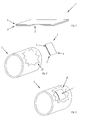
- Figure 1 shows an element 1 for making a surface extraction replica of a material to be analysed, carried out according to a preferred embodiment of the present invention.
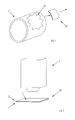
- Figures from 2 to 4 show and illustrate the method of use of said element 1 to obtain a surface extraction replica 50 of the material to be analysed, according to a preferred embodiment of the invention.
- surface extraction replica means an element in which a copy, or replica, of the microstructure of the surface of the material to be analysed is made, said copy or replica being capable of highlighting both the topological characteristics and the microstructures, thus operating on high dimensional scales and on physical phenomena that can be correlated with microstructural evolution mechanisms.
- the analysis of the extraction replica thus allows the assessment of the macro structural layer (analysis of grain boundaries, porosity, presence of defects, presence of microstructural phases: ferrite, martensite, bainite, inclusions) and of the fine microstructural layer (even deeper analysis, down to the resolution of the structure of metal, of dislocations, and to the fine dispersion of precipitates) of a component subjected to pressure and used in creep conditions, for the purpose of assessing its residual life.
- the element 1 preferably comprises a layer 2 comprising indium (In) or indium oxide (In203).
- the layer 2 preferably comprises indium (In) or indium oxide (In2O3), with a possible concentration of impurities lower than or equal to 10%.
- Indium (In) can have purity included between 90% and 100%. More particularly, indium (In) preferably has purity equal to or higher than 99%.
- the layer 2 may comprise, in addition to indium (In) or indium oxide (In203), other material chemical elements whose spectra do not overlap the spectra of the precipitates of the materials, mainly metals, to be analysed.
- the layer 2 may comprise, in addition to indium (In) or indium oxide (In203), one or more non-metallic chemical elements.
- non-metallic chemical elements means the elements that, in the periodic table of elements, are not classified as metals.
- the presence of tin in the layer 2 should preferably be avoided.
- the spectrum of tin is such as to at least partially overlap and/or at least partially alter the spectrum of the precipitates of the materials to be studied.
- the layer 2 preferably comprises a film of metallic material comprising indium (In) or indium oxide (In203). According to a further embodiment, the layer 2 comprises only indium (In) or indium oxide (In203) with the possible and/or inevitable impurities.
- the layer 2 is preferably flexible, so that it can be deformed to facilitate its application to the surface of the material to be analysed, as is better described below.
- the layer 2 is thus provided with a visible face 3 suited to be placed in contact with the surface of the material to be analysed.
- the layer 2 is associated with a supporting portion 4.
- Said supporting portion 4 substantially has the same extension as the layer 2 and preferably comprises a layer of a conductive material, preferably a metallic material, like for example aluminium, copper etc. Even more preferably, said material is sufficiently rigid to bear the pressures necessary to obtain the extraction replica.
- said layer can be made of a plastic material.
- the supporting portion 4 is preferably flexible, so that it can be deformed to facilitate the application of the element 1 to the surface of the material to be analysed, as is better described below.
- the supporting portion 4 can be made in a different way and comprise any material suited to serve as a support for the layer 2 comprising indium (In) or indium oxide (In203).
- the supporting portion 4 may comprises a layer of a conductive material, preferably a metallic material, like for example aluminium, copper etc. Even more preferably, said material is sufficiently rigid to bear the pressures necessary to obtain the extraction replica.
- the element 1 is associated with a casing having the shape of a capsule and suited to create a protected environment that surrounds the layer 2 with indium (In) or indium oxide (In203).
- the component to be analysed C is shown in the shape of a tube.
- Said component can be constituted, for example, by a critical component of a system, like an outlet tube belonging to a steam generator.
- the material of the component C to be analysed is preferably constituted by steel, more precisely by steel of the martensitic, ferritic, austenitic, austenitic-ferritic (duplex or super duplex) type, hardening through precipitation.
- the component to be analysed may be constituted by any other metallic material or, even more generally, comprise one of the materials indicated above.
- an area 20 of the external surface of the component C is prepared.
- the preparation of the surface area 20 can be carried out both manually and with the aid of suitable equipment, preferably portable equipment suited to be used on site on the component C to be analysed.
- the preparation of the surface area 20 preferably includes a step of mechanical and/or electrochemical cleaning.
- the step must be performed paying particular attention to avoid damages to the surface to be analysed that may cause creep or porosity.
- the preparation of the surface area 20 has the object of obtaining a surface with no deformations, cracks, defects and pits. Furthermore, said preparation serves to remove the elements that may affect negatively the examination of the microstructures and crystalline structures of the surface being investigated.
- the preparation of the surface area 20 is preferably carried out using portable equipment provided with a revolving head with variable speed, on which it is possible to apply small discs of abrasive paper with decreasing granulometry.
- the same revolving head is also provided with polishing cloths, using diamond suspensions with decreasing granulometry.
- the surface is properly washed with alcohol and/or acetone.
- the surface area 20, hereinafter referred to as collection area 20 is preferably subjected to an etching process with an appropriate chemical solution, depending on the sample of material to be replicated.
- the preparation of the collection area 20 can be carried out in a different way and so as to prepare the surface for the successive step.
- the quality of the surface of the collection area 20 is preferably checked by means of a portable field microscope.
- the preparation of the collection area 20, shown in Figure 2 is followed by a step in which the element 1 is applied to the collection area 20, as shown in Figure 3 .
- the element 1 is first taken from the capsule, if provided, where it is protected against external agents that may damage or contaminate it.
- the element 1 is then applied with its visible surface 3 to the collection area 20.
- the characteristics of flexibility of the element 1 advantageously allow it to adapt to the non-planar shape of the external surface of the component C.
- the element 1 is preferably applied to the collection area 20 by exerting a proper pressure on the element 1 itself.
- the exerted pressure preferably depends on the type of material of which the sample is made.
- Said pressure is preferably exerted on the supporting portion 4.
- the application of said pressure makes it possible to obtain optimal planarity and therefore optimal surface as well as topological adherence of the element to the sample C.
- the element 1 is thus modelled and assumes a shape that is topologically analogous to that of the collection area 20.
- the element 1, that is, the layer with indium 2 and the supporting portion 4 adapt to the shape and/or the surface characteristics of the component to be analysed.
- the ability of indium to extract the precipitates present on the sample to be examined has been demonstrated. More particularly, the precipitates are extracted from the sample (for example Laves, M23C6, Mx phases) and remain "attached" to indium. In other words, said precipitates are extracted from the sample C and, at least in some significant percentages, remain bonded/trapped/attached to the layer 2 with indium. For this reason, the type of replica that can be made with the method/element of the invention is called extraction replica.
- indium being a semiconductor, advantageously makes it possible to avoid the replica metallization step.
- the samples that must be examined under SEM in order to determine their morphology and microstructure need to be positioned and treated properly.
- the sample if it is not conductive by nature, as in the example described above, must be made conductive at least in its surface layer, by covering it with a thin gold layer (coating or metallization).
- the surface coating, for example with gold, of the replicas of known type makes it almost impossible to observe high-resolution images of the fine microstructure (for example: Laves, M23C6, Mx phases), or images with correlation to the elementary composition of the surface, or to perform a semi-quantitative chemical analysis of the sample, as the emission spectra that are typical of the surface materials used for metallization overlap the typical spectra of the elements making up the microstructure of the sample (for example, the precipitates).
- indium in addition to being a semi conductor with well-defined chemical-physical characteristics, has a spectrum that does not overlap the emission spectrum lines of the precipitates, as will be better explained further on in this description.
- indium is particularly suited to be used for making extraction replicas.
- the replica 50 is removed from the collection area 20, as shown in Figure 4 .
- the removal is preferably carried out taking care to perform a regular movement.
- the replica 50 is then preferably encapsulated.
- the replica 50 prepared in this way is ready to be observed directly with suitable equipment S, as schematically shown in Figure 5 .
- the replica 50 is subjected to investigation with an optical microscope.
- the observation of the replica 50 according to the invention offers higher resolution and sensitivity compared to the observations made using replicas according to the known techniques.
- the replica 50 is subjected to investigation with an electron microscope.
- the replica 50 does not need any metallization process since, as previously explained, the extraction replica proposed herein is already conductive by nature, at ambient temperature.
- the extraction replica according to the invention allows the fine microstructure of the replicated sample to be examined, to the extent that it is possible to detect different types of precipitates with a high degree of precision, for example: M23C6, Mx, Laves phases, Z phases, precipitation classes by average size, chemical composition of the precipitate, nucleation and growth of "new" Laves phases (presently not detectable with the traditional replication method).
- SEM-EBSD, SEM-EDS or XRD examination of the replica according to the invention makes it possible to highlight the dimensional distribution of Laves, M23C6 and Mx phases (with average diameter varying from 20 to 40 nm for Mx phases and from 200 to 300 micron for Laves phases), detecting a high density of precipitate dislocations in the sample of material under examination (for example, steel).
- the observation of the replica 50 according to the invention offers higher resolution and sensitivity compared to the observations made using replicas according to the known techniques.
- replica 50 is subjected to investigation with diffractometer.
- the indium-based (In) or indium oxide-based (In2O3) element comprises a supporting portion (constituted by a disc with predetermined shape and size generally made of a metal or polymer-based material) on which a thin layer of indium (In) or indium oxide (In203), just a few millimetres thick, is housed.
- a supporting portion constituted by a disc with predetermined shape and size generally made of a metal or polymer-based material
- a thin layer of indium (In) or indium oxide (In203) just a few millimetres thick
- the indium-based (In) or indium oxide-based (In2O3) element is positioned on the surface of the sample or device to be analysed, exerting a suitable pressure for the time interval (approximately 10-30 seconds) necessary to obtain the metallographic replication of the surface being examined.
- the surfaces of the sample are prepared following a standard procedure (for example according to the UNI reference standards) and then etched with acid solutions of various types depending on the material to be investigated (for example according to the UNI reference standards). Said extraction replication method is thus carried out by placing the surface to be analysed in mutual contact with the layer comprising indium (In) or indium oxide (In203).
- the layer 2 preferably comprises indium (In) or indium oxide (In203), with a possible concentration of impurities lower than or equal to 10%.
- Indium (In) can have purity included between 90% and 100%. More particularly, indium (In) preferably has purity of 99%.
- the layer 2 may comprise, in addition to indium (In) or indium oxide (In2O3), other chemical elements whose spectra do not overlap the spectra of the precipitates of the materials, mainly metals, to be analysed.
- the layer 2 may comprise, in addition to indium (In) or indium oxide (In2O3), one or more non-metallic chemical elements.
- non-metallic chemical elements means the elements that, in the periodic table of elements, are not classified as metals.
- the layer 2 comprises only indium (In) or indium oxide (In2O3) with the possible and/or inevitable impurities.
- the extraction replication method applied in this way makes it possible to obtain optimal surface planarity (which is difficult to obtain with the replication methods using acetate film and silicone or polymer-based resin) as well as to ensure correct and equal distribution of the pressures in proximity to the contact surfaces, thanks to the aid of the supporting portion which facilitates the modelling operation (meaning that it allows the thickness of the layer comprising indium (In) or indium oxide (In2O3) to be kept constant and uniform, so as to avoid having replica portions with different thicknesses) thus completing and ensuring the correct surface and topologic distribution of indium or indium oxide on the sample or device being examined.
- the supporting portion with the layer comprising indium (In) or indium oxide (In2O3) is detached from the surface of the sample and/or device to be analysed, taking care to perform a linear and regular movement.
- the extraction replica obtained in this way is re-incapsulated.
- the extraction replica obtained in this way does not need any other preparation operation, thus allowing direct observation with LM, FE-SEM, SEM-EBSD, XRD, or any other analysis device.
- the replica according to the invention faithfully reproduces the microstructure of the material, so much so that it cannot be distinguished from the original metallographic surface: LOM examination makes it possible to monitor the macro and microstructural layer of the material with a high degree of reliability, while electron microscope investigation (SEM-EBSD) makes it possible to study the fine microstructure of the sample exactly as if it were a metallographic sample.
- LOM examination makes it possible to monitor the macro and microstructural layer of the material with a high degree of reliability
- SEM-EBSD electron microscope investigation
- the extraction replica according to the invention makes it possible to examine the fine microstructure of the replicated sample, so much so that it can detect with a high degree of precision different types of precipitates, for example: M23C6, Mx, Laves phases, Z phases, precipitation classes by average size, chemical composition of the precipitate, nucleation and growth of "new" Laves phases (presently not detectable with the traditional replication method).
- M23C6, Mx, Laves phases, Z phases precipitation classes by average size, chemical composition of the precipitate, nucleation and growth of "new" Laves phases (presently not detectable with the traditional replication method).
- SEM-EBSD examination of the replica according to the invention makes it possible to highlight the dimensional distribution of Laves, M23C6 and Mx phases (with average diameter varying from 20 to 40 nm for Mx phases and from 200 to 300 micron for Laves phases), detecting a high density of precipitate dislocations in the sample of the material under examination (for example, steel).
- the results obtained with EBSD have been achieved with 0.15 micron pitch at 20Kv, operating distance 19 mm, opening at 120 micron, current probe between 0.1 and 1 nA, the maps have been obtained with backscattered electrons (BSE); Laves phases enriched with Mo, Vn, Nb are clearly visible (formation of subgrains).
- the extraction replication method according to the invention advantageously makes it possible to obtain a high degree of information thanks to the reproducibility of the macro structure and in particular of the microstructure (as this is where the microstructural evolution of the material being examined can be observed). Furthermore, said extraction replication method makes it possible to use different instrumental analysis technologies that cannot be used in the techniques of known type (due to scarce information and to the limited chemical-physical characteristics of the replicas made using the methods available today, for example replication with cellulose acetate film or polymer resin, as widely explained above).
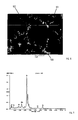
- Figures 6, 7 and 8 show high resolution images of the surface morphology and topology of a sample of martensitic steel, degree P91, obtained during SEM examination with different magnifying powers of an extraction replica obtained according to the invention.
- Figure 6 shows a SEM image with 20 ⁇ m (2000x) magnifying power
- Figures 7 and 8 respectively show two SEM images of the same extraction replica with different magnifying powers, respectively 20 ⁇ m (5000x) and 2 ⁇ m (25000x).
- Figure 8 shows microstructural details that are finely distributed on the grain boundary, like Laves phases (indicated by 100 in the Figure), M23C6+Mx phases (indicated by 101 in the Figure), and finally Laves+Mx phases (indicated by 102 in the figure).
- Figures 9 , 10 and 11 respectively show the spectra obtained through fine semi-quantitative chemical analysis (microanalysis) of the sample with the EDS probe, with which it is possible to obtain spectra to identify the elementary composition of the sample and maps of the element distribution.
- Figures 9 , 10 and 11 show the spectra obtained on different specific positions of the extraction replica, previously indicated in Figure 8 respectively by 100 (Laves phases), 101 (M23C6 + Mx phases) and 102 (Laves+Mx phases).
- Figure 12 shows the spectrum of indium (indicated by 200) overlapping the spectrum of the Laves phase (indicated by 201) obtained on sample with matrix effect.
- Figure 13 shows the spectrum of indium (indicated by 200) overlapping the spectrum of the Mx phase (indicated by 202), also obtained on sample with matrix effect.
- the present invention allows all the set objects to be achieved.
- it makes it possible to provide an element that is suitable for making an extraction replica of a surface of a material to be analysed, wherein the result of the successive observation is qualitatively and quantitatively much better than the results obtained with the techniques of known type.
Landscapes
- Chemical & Material Sciences (AREA)
- Analytical Chemistry (AREA)
- Physics & Mathematics (AREA)
- General Physics & Mathematics (AREA)
- Health & Medical Sciences (AREA)
- Life Sciences & Earth Sciences (AREA)
- Biochemistry (AREA)
- General Health & Medical Sciences (AREA)
- Immunology (AREA)
- Pathology (AREA)
- Organic Chemistry (AREA)
- Engineering & Computer Science (AREA)
- Mechanical Engineering (AREA)
- Metallurgy (AREA)
- Materials Engineering (AREA)
- Optics & Photonics (AREA)
- Inorganic Chemistry (AREA)
- Investigating And Analyzing Materials By Characteristic Methods (AREA)
- Sampling And Sample Adjustment (AREA)
- Analysing Materials By The Use Of Radiation (AREA)
- Glass Compositions (AREA)
- Soft Magnetic Materials (AREA)
Claims (26)
- Element (1) zur Herstellung eines Oberflächenextraktions-Replikats (50) eines zu analysierenden, metallischen Materials (C), wobei das besagte Element (1) eine Schicht (2) umfasst, welche geeignet ist, in Kontakt mit einem Oberflächenbereich (20) des besagten, zu analysierenden Materials (C) positioniert zu werden, um die Merkmale des besagten, zu analysierenden Materials (C) zu speichern, dadurch gekennzeichnet, dass die besagte Schicht (2) Indium (In) oder Indiumoxid (In203) enthält.
- Element (1) gemäß Patentanspruch 1, dadurch gekennzeichnet, dass die besagte Schicht (2) Indium (In) oder Indiumoxid (In203) mit einer Konzentration an Verunreinigungen enthält, die geringer als oder gleich 15 %, vorzugsweise geringer als oder gleich 10 %, und noch bevorzugter geringer als oder gleich 5 % ist.
- Element (I) gemäß Patentanspruch 2, dadurch gekennzeichnet, dass die besagte Schicht Indium (In) oder Indiumoxid (In203) mit einer Reinheit von wenigstens 99 % enthält.
- Element (1) gemäß eines jeden der vorstehenden Patentansprüche, dadurch gekennzeichnet, dass die besagte Schicht (2) nur Indium (In) oder Indiumoxid (In203) mit den möglichen und/oder unvermeidbaren Verunreinigungen enthält.
- Element (1) gemäß eines jeden der Patentansprüche von 1 bis 3, dadurch gekennzeichnet, dass die Schicht (2) des Weiteren chemische Elemente umfasst, deren Spektren die Spektren der Ausfällungen des zu analysierenden Materials nicht überlappen.
- Element (1) gemäß Patentanspruch 1, 2, 3 oder 5, dadurch gekennzeichnet, dass die Schicht (2) des Weiteren ein oder mehrere nichtmetallische chemische Elemente umfasst.
- Element (1) gemäß eines jeden der vorstehenden Patentansprüche, dadurch gekennzeichnet, dass die besagte Schicht (2) einen Film aus metallischem Material umfasst.
- Element (1) gemäß eines jeden der vorstehenden Patentansprüche, dadurch gekennzeichnet, dass der besagte Film flexibel ist.
- Element (1) gemäß eines jeden der vorstehenden Patentansprüche, dadurch gekennzeichnet, dass es auch einen tragenden Abschnitt (4) für die besagte Schicht (2) umfasst.
- Element (1) gemäß Patentanspruch 9, dadurch gekennzeichnet, dass der besagte, tragende Abschnitt (4) ein leitfähiges Material umfasst.
- Element (1) gemäß Patentanspruch 9 oder 10, dadurch gekennzeichnet, dass der besagte, tragende Abschnitt (4) flexibel ist.
- Element (1) gemäß eines jeden der vorstehenden Patentansprüche, dadurch gekennzeichnet, dass in dem besagten Extraktionsreplikat (50) Oberflächenelemente des besagten, zu analysierenden Materials (C), vorzugsweise Ausfällungen, extrahiert werden und an der besagten, Indium (In) oder Indiumoxid (In203) enthaltenden Schicht (2) anhaften.
- Element (1) gemäß eines jeden der vorstehenden Patentansprüche, dadurch gekennzeichnet, dass das besagte, metallische Material Stahl umfasst.
- Satz, ein Gehäuse und ein Element zur Herstellung eines Extraktionsreplikats umfassend, dadurch gekennzeichnet, dass das besagte Element (1) ein Element (1) gemäß eines jeden der Patentansprüche von 1 bis 13 ist, wobei das besagte Gehäuse dazu geeignet ist, eine gegen externe Einwirkungen, die die besagte, Indium (In) oder Indiumoxid (In203) enthaltende Schicht (2) des besagten Elements (1) beschädigen oder kontaminieren können, geschützte Umgebung zu schaffen.
- Verfahren zur Herstellung eines Oberflächenextraktions-Replikats (50) eines zu analysierenden, metallischen Materials (C), wobei das besagte Verfahren einen Schritt der Positionierung eines Elements (1) in Kontakt mit einem Oberflächenbereich (20) aus dem zu analysierenden Material (C) umfasst, um die Merkmale des besagten, zu analysierenden Materials (C) zu speichern, sowie einen Schritt der Entfernung des besagten Elements (1) umfasst, dadurch gekennzeichnet, dass das besagte Element (1) ein Element (1) gemäß eines jeden der Patentansprüche von 1 bis 13 ist.
- Verfahren gemäß Patentanspruch 15, dadurch gekennzeichnet, dass es einen Schritt umfasst, während dessen das besagte Element (1) unter Ausübung eines vorbestimmten Drucks gegen den besagten Oberflächenbereich (20) gepresst wird.
- Verfahren gemäß Patentanspruch 15 oder 16, dadurch gekennzeichnet, dass während des besagten Schritts der Positionierung des besagten Elements (1) in Kontakt mit dem besagten Oberflächenbereich (20) des besagten, zu analysierenden Materials (C), Oberflächenelemente, vorzugsweise Ausfällungen, extrahiert werden und an der besagten, Indium (In) oder Indiumoxid (In203) enthaltenden Schicht (2) anhaften.
- Verfahren gemäß eines jeden der Patentansprüche von 15 bis 17, dadurch gekennzeichnet, dass es einen vorausgehenden Schritt umfasst, während dessen der besagte Oberflächenbereich (20) vorbereitet wird.
- Verfahren gemäß Patentanspruch 18, dadurch gekennzeichnet, dass der besagte, vorausgehende Schritt wenigstens einen Vorgang aus der Gruppe umfasst, die folgende Schritte umfasst: Abschleifen, Polieren, Reinigen durch Waschen oder chemisches Ätzen.
- Verfahren gemäß eines jeden der Patentansprüche von 15 bis 19, dadurch gekennzeichnet, dass das besagte, metallische Material Stahl umfasst.
- Verfahren zur Analyse eines Oberflächenextraktions-Replikats (50), einen Schritt der Herstellung eines Oberflächenextraktions-Replikats (50) aus einem zu analysierenden Material (C) und einen Schritt der Untersuchung des besagten Oberflächenextraktions-Replikats (50) mit Instrumenten umfassend, dadurch gekennzeichnet, dass das Oberflächenextraktions-Replikat (50) mittels des Verfahrens gemäß eines jeden der Patentansprüche von 15 bis 20 gewonnen wird.
- Verfahren gemäß Patentanspruch 21, dadurch gekennzeichnet, dass der besagte, mit Instrumenten ausgeführte Schritt der Untersuchung wenigstens eine der in der folgenden Gruppe enthaltenen Untersuchungen umfasst: Analyse mit optischem Mikroskop, Analyse mit Elektronenmikroskop, Analyse mit Diffraktometer.
- Verwendung von Indium (In) oder Indiumoxid (In203) in einem Verfahren zur Herstellung eines Oberflächenextraktions-Replikats (50) eines zu analysierenden, metallischen Materials (C).
- Verwendung von Indium (In) oder Indiumoxid (In203) zur Speicherung der Oberflächenmerkmale eines metallischen Materials (C) in einem Verfahren zur Untersuchung der Oberfläche eines zu analysierenden Materials (C).
- Verwendung gemäß Patentanspruch 23 oder 24, wobei das Indium (In) oder Indiumoxid (In203) eine Konzentration an Verunreinigungen enthält, die geringer als oder gleich 15 %, vorzugsweise geringer als oder gleich 10 %, und noch bevorzugter geringer als oder gleich 5 % ist.
- Verwendung gemäß Patentanspruch 25, wobei das Indium (In) oder Indiumoxid (In203) eine Reinheit von wenigstens 99 % aufweist.
Applications Claiming Priority (3)
| Application Number | Priority Date | Filing Date | Title |
|---|---|---|---|
| IT000436A ITRM20120436A1 (it) | 2012-09-13 | 2012-09-13 | Elemento per la realizzazione di repliche di indagini superficiali di materiali e metodo atto a realizzare tali indagini |
| PCT/IT2012/000321 WO2014041571A1 (en) | 2012-09-13 | 2012-10-22 | Element for making replicas in material surface investigations and method suited to carry out such investigations. |
| PCT/IB2013/001978 WO2014041415A1 (en) | 2012-09-13 | 2013-09-10 | Element for making replicas in material surface investigations and method suited to carry out such investigations |
Publications (2)
| Publication Number | Publication Date |
|---|---|
| EP2895839A1 EP2895839A1 (de) | 2015-07-22 |
| EP2895839B1 true EP2895839B1 (de) | 2016-11-09 |
Family
ID=47074799
Family Applications (1)
| Application Number | Title | Priority Date | Filing Date |
|---|---|---|---|
| EP13785598.7A Revoked EP2895839B1 (de) | 2012-09-13 | 2013-09-10 | Element zur herstellung von nachbildungen bei materialoberflächenprüfungen und verfahren zur ausführung derartiger prüfungen |
Country Status (4)
| Country | Link |
|---|---|
| US (1) | US20150241323A1 (de) |
| EP (1) | EP2895839B1 (de) |
| IT (1) | ITRM20120436A1 (de) |
| WO (2) | WO2014041571A1 (de) |
Families Citing this family (3)
| Publication number | Priority date | Publication date | Assignee | Title |
|---|---|---|---|---|
| CN108845078B (zh) * | 2018-05-30 | 2020-12-15 | 中国特种设备检测研究院 | 电站锅炉高温部件蠕变寿命预测方法 |
| CN110567769B (zh) * | 2019-08-02 | 2022-11-15 | 唐山钢铁集团有限责任公司 | 一种热浸镀锌板截面铁铝合金相观察的金相制样方法 |
| CN111458210B (zh) * | 2020-04-23 | 2021-10-19 | 西安石油大学 | 一种镍基高温合金热腐蚀样品金相的制备方法 |
Citations (1)
| Publication number | Priority date | Publication date | Assignee | Title |
|---|---|---|---|---|
| EP0292250A1 (de) | 1987-05-19 | 1988-11-23 | Union Carbide Corporation | Rotierende Gasdichtung und Turbinen- und Verdichterschaufeln |
Family Cites Families (20)
| Publication number | Priority date | Publication date | Assignee | Title |
|---|---|---|---|---|
| US2347965A (en) * | 1942-01-29 | 1944-05-02 | Rca Corp | Art of electron microscopy |
| DE911413C (de) * | 1942-09-16 | 1954-05-13 | Siemens Ag | Verfahren zur Herstellung von Abdruckfolien fuer die elektronenmikroskopische Untersuchung von metallischen Oberflaechen |
| US3768975A (en) * | 1971-07-09 | 1973-10-30 | Mc Donnell Douglas Corp | Hydrogen detection means |
| JPS5249055A (en) * | 1975-10-16 | 1977-04-19 | Power Reactor & Nuclear Fuel Dev Corp | Method of measuring surface roughness |
| US4277517A (en) * | 1978-07-17 | 1981-07-07 | Rockwell International Corporation | Method of forming transparent conductor pattern |
| US4238252A (en) * | 1979-07-11 | 1980-12-09 | Hughes Aircraft Company | Process for growing indium phosphide of controlled purity |
| US4560578A (en) * | 1981-11-12 | 1985-12-24 | Scott Paper Company | Method and apparatus for surface replication on a coated sheet material |
| US4833331A (en) * | 1986-02-24 | 1989-05-23 | Hitachi, Ltd. | Method of holding an electrically insulating sample |
| US5037785A (en) * | 1989-11-17 | 1991-08-06 | Her Majesty The Queen In Right Of Canada, As Represented By The Minister Of Energy, Mines And Resources | Catalyst regeneration process using laser radiation |
| US5453297A (en) * | 1990-05-11 | 1995-09-26 | Board Of Trustees Operating Michigan State University | Process for producing finely divided metals deposited on oxidized metals |
| FR2722001B1 (fr) * | 1994-06-30 | 1996-08-02 | Snecma | Procede de caracterisation non destructif de l'etat de surface d'une piece |
| US6660680B1 (en) * | 1997-02-24 | 2003-12-09 | Superior Micropowders, Llc | Electrocatalyst powders, methods for producing powders and devices fabricated from same |
| JP4502445B2 (ja) * | 2000-03-16 | 2010-07-14 | 大日本印刷株式会社 | 反射防止フィルムの製造方法 |
| US20040150135A1 (en) * | 2002-06-26 | 2004-08-05 | Michael Hennessey | Method of melt-forming optical disk substrates |
| DE10335596A1 (de) * | 2003-08-04 | 2005-02-24 | Basf Coatings Ag | Verfahren zur Charakterisierung von Oberflächenstrukturen und seine Verwendung bei der Modifizierung, Neuentwicklung und Herstellung von Werkstoffen |
| US7462819B2 (en) * | 2005-05-16 | 2008-12-09 | The University Of Western Ontario | Statistical methods applied to surface chemistry in minerals flotation |
| EP2063265B1 (de) * | 2006-09-28 | 2022-12-14 | Shimadzu Corporation | Verfahren zur vorbereitung einer probe für maldi- (matrix-assisted laser desorption ionization-) massenspektrometrie und maldi-massenspektrometrie |
| EP2499500B1 (de) * | 2009-11-13 | 2020-12-30 | Ventana Medical Systems, Inc. | Dünnschichtverarbeitungsvorrichtungen für einstellbare volumenanpassung |
| TW201129431A (en) * | 2010-02-26 | 2011-09-01 | Fu-Tang Li | Metal molding method and products formed therefrom |
| WO2011150316A1 (en) * | 2010-05-28 | 2011-12-01 | Sridharan Rajagopalan | Obtaining analytes from a tissue specimen |
-
2012
- 2012-09-13 IT IT000436A patent/ITRM20120436A1/it unknown
- 2012-10-22 WO PCT/IT2012/000321 patent/WO2014041571A1/en not_active Ceased
-
2013
- 2013-09-10 US US14/427,273 patent/US20150241323A1/en not_active Abandoned
- 2013-09-10 EP EP13785598.7A patent/EP2895839B1/de not_active Revoked
- 2013-09-10 WO PCT/IB2013/001978 patent/WO2014041415A1/en not_active Ceased
Patent Citations (1)
| Publication number | Priority date | Publication date | Assignee | Title |
|---|---|---|---|---|
| EP0292250A1 (de) | 1987-05-19 | 1988-11-23 | Union Carbide Corporation | Rotierende Gasdichtung und Turbinen- und Verdichterschaufeln |
Non-Patent Citations (9)
| Title |
|---|
| "Commercial Indium Metal Product Data Sheet", INDIUM CORPORATION©, 2014, XP055409770 |
| ELI BAER ROTH: "Indium Replica for metallurgical Examination", THESIS FOR MSC IN MECHANICAL ENGINEERING FROM THE U.S. NAVAL POSTGRADUATE SCHOOL, 1949, XP055409738 |
| F.A. VASSALLO ET AL.: "Heat Transfer and erosion in the Ares 75 mm velocity cannon - Vol. II", CALPSAN TECHNICAL REPORT, vol. II, October 1977 (1977-10-01), pages 1 - 120, XP055409757 |
| FEDELI GABBA: "Prelievo di repliche estrattive su componenti", ENEL - DIREZIONE DELLE COSTRUZIONI UNITÀ LABORATORIO DI PIACENZA, January 1989 (1989-01-01), pages 2 - 11, 13, XP055409768 |
| G. L. KRIEGER: "Principles of operation of the Indium adhesion tester used for surface contamination measurement", UNITED STATES GOVERNMENT, 1967, XP055409760 |
| J. AYACHE ET AL.: "Sample preparation Handbook for Transmission Electron Microscopy", 2010, article "Replica Techniques", pages: 229 - 256, XP055409763 |
| J.C. DRAN ET AL.: "A multidisciplinary microprobe analysis of lunar 'Weathering", LUNAR AND PLANETARY INSTITIUTE, February 1975 (1975-02-01), pages 205 - 207, XP055409747 |
| M. J. FELDMAN: "Indium Replica Technique", SOLID STATE DIVISION SEMI ANNUAL PROGRESS REPORT, 4 March 1959 (1959-03-04), pages 3 - 30, XP055409774 |
| SHARMILA M. MUKHOPADHYAY: "Sample preparation for microscopic and spectroscopic charaterization of solid surfaces and films", SAMPLE PREPARATION TECHNIQUES IN ANALYTICAL CHEMISTRY, 2003, pages 377 - 411, XP055409754 |
Also Published As
| Publication number | Publication date |
|---|---|
| EP2895839A1 (de) | 2015-07-22 |
| WO2014041571A1 (en) | 2014-03-20 |
| WO2014041415A1 (en) | 2014-03-20 |
| ITRM20120436A1 (it) | 2014-03-14 |
| US20150241323A1 (en) | 2015-08-27 |
Similar Documents
| Publication | Publication Date | Title |
|---|---|---|
| Wang et al. | Anisotropy of microstructure and corrosion resistance of 316L stainless steel fabricated by wire and arc additive manufacturing | |
| Ghosh et al. | High temperature oxidation behavior of AISI 304L stainless steel—Effect of surface working operations | |
| Xiao et al. | Effect of roughness of substrate and sputtering power on the properties of TiN coatings deposited by magnetron sputtering for ATF | |
| Kiener et al. | Overview on established and novel FIB based miniaturized mechanical testing using in-situ SEM | |
| Cao et al. | Coupling effect of microstructure and hydrogen absorbed during service on pitting corrosion of 321 austenitic stainless steel weld joints | |
| Tushinsky | Coated metal: structure and properties of metal-coating compositions | |
| Zhang et al. | Effect of carbides on the electrochemical dissolution behavior of solid-solution strengthened cobalt-based superalloy Haynes 188 in NaNO3 solution | |
| Texier et al. | Micromechanical testing of ultrathin layered material specimens at elevated temperature | |
| Feng et al. | Effects of microstructure and morphological distribution on hydrogen-embrittlement sensitivity of Ti–6Al–4V alloy welded joint | |
| Xin et al. | The role of frequency on fretting corrosion of Alloy 690TT against 304 stainless steel in high temperature high pressure water | |
| Sarvghad et al. | On the effect of cold-rolling on the corrosion of SS316L alloy in a molten carbonate salt | |
| US20150241323A1 (en) | Element for making replicas in material surface investigations and method suited to carry out such investigations | |
| Dong et al. | Microstructure and sulfide stress corrosion cracking of the Inconel 625/X80 weld overlay fabricated by cold metal transfer process | |
| Xin et al. | The damage mechanism of Alloy 690TT against Alloy 600 caused by fretting wear in room temperature pure water | |
| Bikmukhametov et al. | A rapid preparation method for in situ nanomechanical TEM tensile specimens | |
| Lee et al. | Effect of Zr thin film on Zr foil as a FCCI barrier between lanthanide (La-Ce) and clad material | |
| Wang et al. | Passive behavior of TNB intermetallic and Inconel 625 in electrochemical machining | |
| Nguejio et al. | Diffusion processes as possible mechanisms for Cr depletion at SCC crack tip | |
| Ter-Ovanessian et al. | Quantitative assessment of intergranular damage due to PWR primary water exposure in structural Ni-based alloys | |
| Li | Advanced techniques in TEM specimen preparation | |
| Oudriss et al. | Experimental techniques for dosage and detection of hydrogen | |
| Mitchell et al. | Advanced TEM specimen preparation methods for replication of P91 steel | |
| Tsutsumi et al. | Effect of impurity elements on localized corrosion of zirconium in chloride containing environment | |
| Beaurin et al. | Microstructural and mechanical properties evolutions of plasma transferred arc deposited Norem02 hardfacing alloy at high temperature | |
| Hazarabedian et al. | Detecting intergranular phases in UNS N07725. Part II: Double-loop electrochemical potentiokinetic reactivation test validation |
Legal Events
| Date | Code | Title | Description |
|---|---|---|---|
| PUAI | Public reference made under article 153(3) epc to a published international application that has entered the european phase |
Free format text: ORIGINAL CODE: 0009012 |
|
| 17P | Request for examination filed |
Effective date: 20150408 |
|
| AK | Designated contracting states |
Kind code of ref document: A1 Designated state(s): AL AT BE BG CH CY CZ DE DK EE ES FI FR GB GR HR HU IE IS IT LI LT LU LV MC MK MT NL NO PL PT RO RS SE SI SK SM TR |
|
| AX | Request for extension of the european patent |
Extension state: BA ME |
|
| DAX | Request for extension of the european patent (deleted) | ||
| GRAP | Despatch of communication of intention to grant a patent |
Free format text: ORIGINAL CODE: EPIDOSNIGR1 |
|
| INTG | Intention to grant announced |
Effective date: 20160602 |
|
| GRAS | Grant fee paid |
Free format text: ORIGINAL CODE: EPIDOSNIGR3 |
|
| GRAA | (expected) grant |
Free format text: ORIGINAL CODE: 0009210 |
|
| AK | Designated contracting states |
Kind code of ref document: B1 Designated state(s): AL AT BE BG CH CY CZ DE DK EE ES FI FR GB GR HR HU IE IS IT LI LT LU LV MC MK MT NL NO PL PT RO RS SE SI SK SM TR |
|
| REG | Reference to a national code |
Ref country code: GB Ref legal event code: FG4D |
|
| REG | Reference to a national code |
Ref country code: AT Ref legal event code: REF Ref document number: 844393 Country of ref document: AT Kind code of ref document: T Effective date: 20161115 Ref country code: CH Ref legal event code: EP |
|
| REG | Reference to a national code |
Ref country code: IE Ref legal event code: FG4D |
|
| REG | Reference to a national code |
Ref country code: DE Ref legal event code: R096 Ref document number: 602013013910 Country of ref document: DE |
|
| RAP2 | Party data changed (patent owner data changed or rights of a patent transferred) |
Owner name: SYSTEM OPTIMAL SOLUTION S.R.L. |
|
| PG25 | Lapsed in a contracting state [announced via postgrant information from national office to epo] |
Ref country code: LV Free format text: LAPSE BECAUSE OF FAILURE TO SUBMIT A TRANSLATION OF THE DESCRIPTION OR TO PAY THE FEE WITHIN THE PRESCRIBED TIME-LIMIT Effective date: 20161109 |
|
| REG | Reference to a national code |
Ref country code: LT Ref legal event code: MG4D |
|
| REG | Reference to a national code |
Ref country code: NL Ref legal event code: MP Effective date: 20161109 |
|
| REG | Reference to a national code |
Ref country code: AT Ref legal event code: MK05 Ref document number: 844393 Country of ref document: AT Kind code of ref document: T Effective date: 20161109 |
|
| PG25 | Lapsed in a contracting state [announced via postgrant information from national office to epo] |
Ref country code: NL Free format text: LAPSE BECAUSE OF FAILURE TO SUBMIT A TRANSLATION OF THE DESCRIPTION OR TO PAY THE FEE WITHIN THE PRESCRIBED TIME-LIMIT Effective date: 20161109 Ref country code: SE Free format text: LAPSE BECAUSE OF FAILURE TO SUBMIT A TRANSLATION OF THE DESCRIPTION OR TO PAY THE FEE WITHIN THE PRESCRIBED TIME-LIMIT Effective date: 20161109 Ref country code: LT Free format text: LAPSE BECAUSE OF FAILURE TO SUBMIT A TRANSLATION OF THE DESCRIPTION OR TO PAY THE FEE WITHIN THE PRESCRIBED TIME-LIMIT Effective date: 20161109 Ref country code: NO Free format text: LAPSE BECAUSE OF FAILURE TO SUBMIT A TRANSLATION OF THE DESCRIPTION OR TO PAY THE FEE WITHIN THE PRESCRIBED TIME-LIMIT Effective date: 20170209 Ref country code: GR Free format text: LAPSE BECAUSE OF FAILURE TO SUBMIT A TRANSLATION OF THE DESCRIPTION OR TO PAY THE FEE WITHIN THE PRESCRIBED TIME-LIMIT Effective date: 20170210 |
|
| PG25 | Lapsed in a contracting state [announced via postgrant information from national office to epo] |
Ref country code: PL Free format text: LAPSE BECAUSE OF FAILURE TO SUBMIT A TRANSLATION OF THE DESCRIPTION OR TO PAY THE FEE WITHIN THE PRESCRIBED TIME-LIMIT Effective date: 20161109 Ref country code: ES Free format text: LAPSE BECAUSE OF FAILURE TO SUBMIT A TRANSLATION OF THE DESCRIPTION OR TO PAY THE FEE WITHIN THE PRESCRIBED TIME-LIMIT Effective date: 20161109 Ref country code: IS Free format text: LAPSE BECAUSE OF FAILURE TO SUBMIT A TRANSLATION OF THE DESCRIPTION OR TO PAY THE FEE WITHIN THE PRESCRIBED TIME-LIMIT Effective date: 20170309 Ref country code: FI Free format text: LAPSE BECAUSE OF FAILURE TO SUBMIT A TRANSLATION OF THE DESCRIPTION OR TO PAY THE FEE WITHIN THE PRESCRIBED TIME-LIMIT Effective date: 20161109 Ref country code: AT Free format text: LAPSE BECAUSE OF FAILURE TO SUBMIT A TRANSLATION OF THE DESCRIPTION OR TO PAY THE FEE WITHIN THE PRESCRIBED TIME-LIMIT Effective date: 20161109 Ref country code: RS Free format text: LAPSE BECAUSE OF FAILURE TO SUBMIT A TRANSLATION OF THE DESCRIPTION OR TO PAY THE FEE WITHIN THE PRESCRIBED TIME-LIMIT Effective date: 20161109 Ref country code: HR Free format text: LAPSE BECAUSE OF FAILURE TO SUBMIT A TRANSLATION OF THE DESCRIPTION OR TO PAY THE FEE WITHIN THE PRESCRIBED TIME-LIMIT Effective date: 20161109 Ref country code: PT Free format text: LAPSE BECAUSE OF FAILURE TO SUBMIT A TRANSLATION OF THE DESCRIPTION OR TO PAY THE FEE WITHIN THE PRESCRIBED TIME-LIMIT Effective date: 20170309 |
|
| PG25 | Lapsed in a contracting state [announced via postgrant information from national office to epo] |
Ref country code: CZ Free format text: LAPSE BECAUSE OF FAILURE TO SUBMIT A TRANSLATION OF THE DESCRIPTION OR TO PAY THE FEE WITHIN THE PRESCRIBED TIME-LIMIT Effective date: 20161109 Ref country code: EE Free format text: LAPSE BECAUSE OF FAILURE TO SUBMIT A TRANSLATION OF THE DESCRIPTION OR TO PAY THE FEE WITHIN THE PRESCRIBED TIME-LIMIT Effective date: 20161109 Ref country code: RO Free format text: LAPSE BECAUSE OF FAILURE TO SUBMIT A TRANSLATION OF THE DESCRIPTION OR TO PAY THE FEE WITHIN THE PRESCRIBED TIME-LIMIT Effective date: 20161109 Ref country code: SK Free format text: LAPSE BECAUSE OF FAILURE TO SUBMIT A TRANSLATION OF THE DESCRIPTION OR TO PAY THE FEE WITHIN THE PRESCRIBED TIME-LIMIT Effective date: 20161109 Ref country code: DK Free format text: LAPSE BECAUSE OF FAILURE TO SUBMIT A TRANSLATION OF THE DESCRIPTION OR TO PAY THE FEE WITHIN THE PRESCRIBED TIME-LIMIT Effective date: 20161109 |
|
| REG | Reference to a national code |
Ref country code: DE Ref legal event code: R026 Ref document number: 602013013910 Country of ref document: DE |
|
| PLBI | Opposition filed |
Free format text: ORIGINAL CODE: 0009260 |
|
| PG25 | Lapsed in a contracting state [announced via postgrant information from national office to epo] |
Ref country code: BE Free format text: LAPSE BECAUSE OF FAILURE TO SUBMIT A TRANSLATION OF THE DESCRIPTION OR TO PAY THE FEE WITHIN THE PRESCRIBED TIME-LIMIT Effective date: 20161109 Ref country code: SM Free format text: LAPSE BECAUSE OF FAILURE TO SUBMIT A TRANSLATION OF THE DESCRIPTION OR TO PAY THE FEE WITHIN THE PRESCRIBED TIME-LIMIT Effective date: 20161109 Ref country code: BG Free format text: LAPSE BECAUSE OF FAILURE TO SUBMIT A TRANSLATION OF THE DESCRIPTION OR TO PAY THE FEE WITHIN THE PRESCRIBED TIME-LIMIT Effective date: 20170209 |
|
| PLAX | Notice of opposition and request to file observation + time limit sent |
Free format text: ORIGINAL CODE: EPIDOSNOBS2 |
|
| REG | Reference to a national code |
Ref country code: FR Ref legal event code: PLFP Year of fee payment: 5 |
|
| 26 | Opposition filed |
Opponent name: RTM BREDA S.R.L. Effective date: 20170809 |
|
| PGFP | Annual fee paid to national office [announced via postgrant information from national office to epo] |
Ref country code: IT Payment date: 20170911 Year of fee payment: 5 Ref country code: CH Payment date: 20170912 Year of fee payment: 5 Ref country code: LU Payment date: 20170908 Year of fee payment: 5 Ref country code: MC Payment date: 20170911 Year of fee payment: 5 Ref country code: GB Payment date: 20170906 Year of fee payment: 5 Ref country code: DE Payment date: 20170905 Year of fee payment: 5 Ref country code: FR Payment date: 20170918 Year of fee payment: 5 |
|
| PG25 | Lapsed in a contracting state [announced via postgrant information from national office to epo] |
Ref country code: SI Free format text: LAPSE BECAUSE OF FAILURE TO SUBMIT A TRANSLATION OF THE DESCRIPTION OR TO PAY THE FEE WITHIN THE PRESCRIBED TIME-LIMIT Effective date: 20161109 |
|
| PGFP | Annual fee paid to national office [announced via postgrant information from national office to epo] |
Ref country code: IE Payment date: 20170912 Year of fee payment: 5 |
|
| RDAF | Communication despatched that patent is revoked |
Free format text: ORIGINAL CODE: EPIDOSNREV1 |
|
| STAA | Information on the status of an ep patent application or granted ep patent |
Free format text: STATUS: THE PATENT HAS BEEN GRANTED |
|
| REG | Reference to a national code |
Ref country code: DE Ref legal event code: R064 Ref document number: 602013013910 Country of ref document: DE Ref country code: DE Ref legal event code: R103 Ref document number: 602013013910 Country of ref document: DE |
|
| RDAG | Patent revoked |
Free format text: ORIGINAL CODE: 0009271 |
|
| STAA | Information on the status of an ep patent application or granted ep patent |
Free format text: STATUS: PATENT REVOKED |
|
| PG25 | Lapsed in a contracting state [announced via postgrant information from national office to epo] |
Ref country code: MT Free format text: LAPSE BECAUSE OF NON-PAYMENT OF DUE FEES Effective date: 20170910 |
|
| REG | Reference to a national code |
Ref country code: CH Ref legal event code: PL |
|
| 27W | Patent revoked |
Effective date: 20180618 |
|
| GBPR | Gb: patent revoked under art. 102 of the ep convention designating the uk as contracting state |
Effective date: 20180618 |
|
| PG25 | Lapsed in a contracting state [announced via postgrant information from national office to epo] |
Ref country code: MK Free format text: LAPSE BECAUSE OF FAILURE TO SUBMIT A TRANSLATION OF THE DESCRIPTION OR TO PAY THE FEE WITHIN THE PRESCRIBED TIME-LIMIT Effective date: 20161109 |
|
| PG25 | Lapsed in a contracting state [announced via postgrant information from national office to epo] |
Ref country code: CY Free format text: LAPSE BECAUSE OF FAILURE TO SUBMIT A TRANSLATION OF THE DESCRIPTION OR TO PAY THE FEE WITHIN THE PRESCRIBED TIME-LIMIT Effective date: 20161109 |
|
| PG25 | Lapsed in a contracting state [announced via postgrant information from national office to epo] |
Ref country code: AL Free format text: LAPSE BECAUSE OF FAILURE TO SUBMIT A TRANSLATION OF THE DESCRIPTION OR TO PAY THE FEE WITHIN THE PRESCRIBED TIME-LIMIT Effective date: 20161109 |
|
| PG25 | Lapsed in a contracting state [announced via postgrant information from national office to epo] |
Ref country code: TR Free format text: LAPSE BECAUSE OF FAILURE TO SUBMIT A TRANSLATION OF THE DESCRIPTION OR TO PAY THE FEE WITHIN THE PRESCRIBED TIME-LIMIT Effective date: 20161109 |