EP2893479B1 - System and method for deriving accurate body size measures from a sequence of 2d images - Google Patents
System and method for deriving accurate body size measures from a sequence of 2d images Download PDFInfo
- Publication number
- EP2893479B1 EP2893479B1 EP13835345.3A EP13835345A EP2893479B1 EP 2893479 B1 EP2893479 B1 EP 2893479B1 EP 13835345 A EP13835345 A EP 13835345A EP 2893479 B1 EP2893479 B1 EP 2893479B1
- Authority
- EP
- European Patent Office
- Prior art keywords
- user
- images
- sequence
- camera
- shape
- Prior art date
- Legal status (The legal status is an assumption and is not a legal conclusion. Google has not performed a legal analysis and makes no representation as to the accuracy of the status listed.)
- Active
Links
Images







Classifications
-
- G—PHYSICS
- G06—COMPUTING OR CALCULATING; COUNTING
- G06V—IMAGE OR VIDEO RECOGNITION OR UNDERSTANDING
- G06V20/00—Scenes; Scene-specific elements
- G06V20/60—Type of objects
- G06V20/64—Three-dimensional [3D] objects
- G06V20/647—Three-dimensional [3D] objects by matching two-dimensional images to three-dimensional objects
-
- A—HUMAN NECESSITIES
- A61—MEDICAL OR VETERINARY SCIENCE; HYGIENE
- A61B—DIAGNOSIS; SURGERY; IDENTIFICATION
- A61B5/00—Measuring for diagnostic purposes; Identification of persons
- A61B5/103—Measuring devices for testing the shape, pattern, colour, size or movement of the body or parts thereof, for diagnostic purposes
- A61B5/107—Measuring physical dimensions, e.g. size of the entire body or parts thereof
- A61B5/1079—Measuring physical dimensions, e.g. size of the entire body or parts thereof using optical or photographic means
-
- A—HUMAN NECESSITIES
- A61—MEDICAL OR VETERINARY SCIENCE; HYGIENE
- A61B—DIAGNOSIS; SURGERY; IDENTIFICATION
- A61B5/00—Measuring for diagnostic purposes; Identification of persons
- A61B5/48—Other medical applications
- A61B5/486—Biofeedback
-
- G—PHYSICS
- G06—COMPUTING OR CALCULATING; COUNTING
- G06T—IMAGE DATA PROCESSING OR GENERATION, IN GENERAL
- G06T17/00—Three-dimensional [3D] modelling for computer graphics
-
- G—PHYSICS
- G06—COMPUTING OR CALCULATING; COUNTING
- G06T—IMAGE DATA PROCESSING OR GENERATION, IN GENERAL
- G06T7/00—Image analysis
- G06T7/50—Depth or shape recovery
- G06T7/55—Depth or shape recovery from multiple images
- G06T7/564—Depth or shape recovery from multiple images from contours
-
- G—PHYSICS
- G06—COMPUTING OR CALCULATING; COUNTING
- G06T—IMAGE DATA PROCESSING OR GENERATION, IN GENERAL
- G06T7/00—Image analysis
- G06T7/60—Analysis of geometric attributes
- G06T7/62—Analysis of geometric attributes of area, perimeter, diameter or volume
-
- G—PHYSICS
- G06—COMPUTING OR CALCULATING; COUNTING
- G06V—IMAGE OR VIDEO RECOGNITION OR UNDERSTANDING
- G06V20/00—Scenes; Scene-specific elements
- G06V20/40—Scenes; Scene-specific elements in video content
-
- G—PHYSICS
- G06—COMPUTING OR CALCULATING; COUNTING
- G06V—IMAGE OR VIDEO RECOGNITION OR UNDERSTANDING
- G06V40/00—Recognition of biometric, human-related or animal-related patterns in image or video data
- G06V40/10—Human or animal bodies, e.g. vehicle occupants or pedestrians; Body parts, e.g. hands
- G06V40/103—Static body considered as a whole, e.g. static pedestrian or occupant recognition
-
- A—HUMAN NECESSITIES
- A41—WEARING APPAREL
- A41H—APPLIANCES OR METHODS FOR MAKING CLOTHES, e.g. FOR DRESS-MAKING OR FOR TAILORING, NOT OTHERWISE PROVIDED FOR
- A41H1/00—Measuring aids or methods
- A41H1/02—Devices for taking measurements on the human body
-
- G—PHYSICS
- G06—COMPUTING OR CALCULATING; COUNTING
- G06T—IMAGE DATA PROCESSING OR GENERATION, IN GENERAL
- G06T2207/00—Indexing scheme for image analysis or image enhancement
- G06T2207/10—Image acquisition modality
- G06T2207/10024—Color image
-
- G—PHYSICS
- G06—COMPUTING OR CALCULATING; COUNTING
- G06T—IMAGE DATA PROCESSING OR GENERATION, IN GENERAL
- G06T2207/00—Indexing scheme for image analysis or image enhancement
- G06T2207/30—Subject of image; Context of image processing
- G06T2207/30196—Human being; Person
Definitions
- the present invention relates to the field of body scanning and garment systems. More particularly, the invention relates to a system and method for body scanning to enhance the experience of garment shopping, through automated size recommendation and augmented reality visualization.
- Full body scanners - laser scanners / array of depth cameras can be used to capture three dimensional (3D) points on the body's surface, which can be used to represent the body shape as in point form (e.g. cloud of points), surface form (mesh of triangles), or other models.
- 3D three dimensional
- Such models can be analyzed to extract the required measurements.
- the waist location can be computed from body proportions and the cross section at waist height can be used to extract a list of points or a contour representing the circumference at that point.
- the perimeter is than computed from said 3D list of points / contour .
- the patent GB 2 351 426 discloses 2D image acquisitions of the body in several positions, the verification of the correct body position for each acquisition and the computation of a 3D shape model based on the 2D images.
- the present invention relates to a method for deriving accurate body size measures of a user from a sequence of 2D images, as defined in claim 1.
- the present invention relates to a system for deriving accurate body size measures of a user from a sequence of 2D images, as defined in claim 5.
- the present invention relates to a method that employs a sequence of 2D images captured through natural body movements to compute multiple linear and circumference body size measures (i.e., a body scanner) that can serve as basis to automated size recommendation for more efficient in-store or in-home shopping experience.
- a body scanner i.e., a body scanner
- These size measures can be further used to select and / or modify an avatar that best describes the user's body shape for augmented reality visualization of how the selected garment would fit or look on the user's body.
- the scanning method can be used to obtain a cloud of points or other dense 3D representation that serve as a detailed body shape model. The required measurements are derived from that model.
- the 3D representation can be converted to a surface model (like triangles) that is used by the rendering engine of the augmented reality application described above.
- the body scanner can be used anywhere, e.g., in a retail store or shopping mall or inside the user's home.
- the user stands on the floor in a state of undress, usually in a tight-fitting body suit, wherein the goal is to obtain accurate and complete body measurements, including posture and shoulder angles.
- no try-on garment is used as a basis for finding fit incongruities or to obtain an individual's feedback.
- the user's body scan measurements are turned over to a computer program for analysis.
- the program compares the user's measurements to the properties of selected garment such as garment dimensions in measured in certain key locations, fabric elasticity, garment fit & tolerance.
- the system's analysis would result in a garment that would fit the user perfectly.
- FIG. 1 and the following discussions are intended to provide a brief, general description of a suitable computing environment in which the invention may be implemented. While the invention will be described in the general context of program modules that execute in conjunction with a virtual fitting room application program that runs on an operating system on a personal computer, those skilled in the art will recognize that the invention may also be implemented in combination with other program modules.
- program modules include routines, programs, components, data structures, and other types of structures that perform particular image processing tasks.
- program modules include routines, programs, components, data structures, and other types of structures that perform particular image processing tasks.
- program modules may be located in both local and remote memory storage devices.
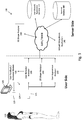
- Fig. 1 describes a system 100 for deriving accurate body size measures from a sequence of 2D images, according to an embodiment of the present invention.
- system 100 is used for body scanning and garment selection by a virtual fitting room application.
- System 100 comprises a User Feedback and Guidance Module (UFGM) 120, camera 121, a User Behavior Analyzer (UBA) 130, a 2D Shape Analyzer (2DSA) 140, a User Appearance Analyzer (UAA) 150, a 3D Shape Analyzer (3DSA) 160, a virtual fitting room application 190 and a garment database 180.
- UFA User Feedback and Guidance Module
- UDA User Behavior Analyzer
- 2DSA 2D Shape Analyzer
- UOA User Appearance Analyzer
- 3DSA 3D Shape Analyzer
- a user 110 is positioned in front of the camera 121, with a display 122 and a speaker 123 driven by the UFGM 120 to provide initial and further user guidance/assistance during the scanning process of the user's body.
- An input device such as a keyboard 124, a touch screen or voice command module, may serve to start the scanning process, enter user ID, except user consent for measurement, etc.
- Camera 121 is connected to UBA 130, which tracks the position, pose / rotation and posture of the user 110 before and during the scanning process, verifying that the user's image does not exceed the camera's field of view and that the user is following the simple instructions provided by the UFGM 120.
- Such simple instructions may include: “Enter the Scanning Area”, “Raise Your Hands”, “Turn Around”, etc.
- Camera 121 is further connected to the 2DSA 140, which extracts and encodes 2D shape data from each of a sequence of images captured by the camera 121.
- Camera 121 is further connected to the UAA 150, which extracts and encodes visual non-shape descriptors specific to the user.
- descriptors may include skin tone, hair color and style and optionally face appearance descriptors. These descriptors can be used by the virtual fitting room application 190 to enhance the visual appearance of the avatar to resemble the user - for example having a skin-tone similar to the user, having a face similar to the user, etc.
- the visual non-shape descriptors may be further used to generate clothing recommendations based on one or more of these descriptors. For example a recommended garment color and / or texture / pattern may enhance the skin tone, the hair color, and the eyes.
- Each element of system 100 can be implemented by a separate module such as a USB webcam, LCD display, connected speakers, a keyboard, a personal computer, etc.
- a separate module such as a USB webcam, LCD display, connected speakers, a keyboard, a personal computer, etc.
- certain embodiments of the present invention can be based on such devices.
- all elements of system 100 can be implemented by a user's computer based device such as a laptop computer, a tablet computer such as the iPad by Apple Inc. or even a smartphone such as the Galaxy by Samsung.
- some modules of system 100 can be implemented in a remote server, such as the 3DSA 160, and the garment database 180.
- the 3DSA 160 receives the 2D shape descriptors as well as the user position, pose and rotation data, integrating them into a 3D shape model and/or extracting 3D size measurements to be stored together with the user appearance data in a User Shape and Appearance Database 170.
- a previously scanned user logs into the system 100 (e.g., via an interface of the virtual fitting room application 190) his stored body size characteristics are used to filter/search the garment database 180 and recommend garments and their specific sizes that will be a good fit for the user.
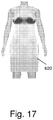
- the user will select a garment on a web shop and receive a size recommendation as well as a schematic heat map depicting the way the garment will fit the body (an example for such a schematic heat map is presented in Fig. 17 ).
- Garment database 180 includes data that digitally represent garments such as shirts, trousers, dresses, etc. and their attributes, such as size, length, width, color, etc., as commonly defined by the clothing industry.
- the system 100 may further comprise a garment detection module (not shown).
- a garment detection module not shown.
- known in the art distortion correction techniques should be used, such as using an object with known dimensions as a reference object (e.g., a Compact Disk) or a calibration pattern such as a chessboard pattern.
- the 3D shape information is further used to build an avatar that best describes the user's body shape for augmented reality visualization of how the selected garment would fit or look on the user's body.
- user appearance information as obtained from the UAA 150 is embedded into the avatar in the form of skin / hair color and also a similar face, provided that the user opted for his / her face to be captured during the scanning process.
- the 3DSA 160 can be included on such a device, further reducing computational resources and bandwidth requirements on the server side.
- Fig. 2 describes a method for foreground detection that is commonly used to detect changes in image sequences, as known in the prior art.
- a background modeling (step 220) constructs a background model as a running average of video images that do not contain foreground objects - before the user enters the scene or by inhibiting averaging in those areas where the frame-to-frame difference is high, thus signaling user presence or motion.
- An exemplary image of a background model is indicated by numeral 211.
- a background subtraction computes the pixel-by-pixel absolute difference between the video frame (as indicated by numeral 210) and the background model image 211.
- the difference image (as indicated by numeral 212) is then processed by an adaptive threshold (step 240) which sets its threshold globally or locally (per image location) just above the noise and illumination changes level to obtain a binary image (an exemplary binary image is indicated by numeral 213).
- a binary filtering step 250 may use known techniques such as connected component filtering or morphological filtering to eliminate small noise regions and small holes inside the object.
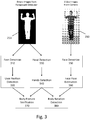
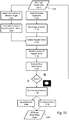
- Fig. 3 schematically illustrates, in a flowchart form, the process of analyzing user behavior by UBA 130 as part of the scanning process, according to an embodiment of the present invention.
- user behavior information may include:
- torso scanning is performed with the user assuming a "Cactus" position so that the torso area is un-occluded throughout the scanning process - as outlined by image 210 in Figs. 2 and 3 .
- User behavior is analyzed based on the binary body silhouette as obtained from the foreground detection process (as indicated by image 213 in Fig. 2 ) and the raw video images from the camera 121 ( Fig. 1 ).
- one key attribute of user behavior analysis is the reference on-floor location of the human subject.
- the human subject is requested to maneuver in a designated area throughout the scanning process, optionally using on-floor markings can be used to guide the user through the scanning process.
- the system can estimate the distance from the subject's image height and the subject's physical height, as a single size value that may be manually input to the system (e.g., via the keyboard 124 shown in Fig. 1 ).
- the system extracts the distance/location from the 2D image sequence.
- Analyzing user behavior by UBA 130 may involve the following steps: Feet detection (step 310), searches for the bottom row of the binary silhouette. Based on camera calibration that takes place in the beginning of the scanning processes, each image row (y) coordinate depicting the floor surface can be converted to a distance from the camera. For example, Fig. 4 illustrates the extraction of user distance from feet image position detection in further details. Calibrated distance lines 280, 290, 300 and 310 are shown as horizontal lines with distance values. Vertical feet position between lines can be interpolated. To assign exact distance value to the center of rotation, the system converts the bottom of feet distance to body center distance using an average value for feet size and (optionally) the body rotation angle.
- a computation window (as indicated by the dashed line 400) is constructed around the feet and the x center-of gravity converted to on-floor horizontal position (from camera calibration). This completes the user position detection (step 320).
- both y bottom coordinate and x center-of-gravity are temporally filtered, for example, by using a 5-frame averaging filter or other suitable averaging filter.
- the user distance can be estimated in a similar manner from the top of head location by detecting and tracking the head as described in the present invention. Both these methods for distance tracking - from feet detection only or from head detection only, require knowing the camera height from the floor and it tilt. While this readily available in a fixed camera installation such as in a fitting room, we may desire supporting in-home application when measuring the camera height and controlling / measuring its tilt may be annoying for a one-time user. In such a case, one may combine the embodiments according to the present invention in order to track both head and feet location, thus deriving the user's distance at each measurement frame without the camera height / tilt values.
- the UFGM 120 includes multiple of scene content and user behavior analysis algorithms as known in prior art, for detecting common problems in scene and camera setup and user behavior such as: lighting is too low or too bright, background is too busy, dynamic background such as TV monitor or computer screen in the camera field of view, moving shades, moving cast lights, camera is tilted, etc.
- head detection module can find the user's head as the top of the binary shape, near the horizontal (x) center of gravity. Further verification / fine location of head position can be based on an omega-shaped detector or other known human detection and tracking techniques based on the omega-shape features of people's head-shoulder parts.
- Hands detection module starts searching for the arms from the estimated shoulder positions, then moves up to detect the hands as the endpoints of the arms' shape.
- the binary shape e.g., see the exemplary image 213
- the hand tips can be detected as 1-connected pixels at the end of the arm skeleton tracked from center body location.
- the system goes on (step 370) to verify the body posture from the hands position and then to guide the user to rotate a full circle (the guidance can be done by UFGM 120).
- Image sequence continuity can be exploited in hand tracking. Once both hands are detected in a frontal position, they are tracked from frame to frame (e.g. using correlation search or other common Digital Image Correlation and Tracking (DIC/DDIT) methods that employ tracking and image registration techniques for accurate 2D and 3D measurements of changes in images) and prediction when the hands merge with the head silhouette.
- DICISIT Digital Image Correlation and Tracking
- Figs. 5A and 5B depict hands detection and tracking as body rotation detection cue, wherein Fig. 5A depicts the body of user 110 in a first position, while Fig. 5B depicts the body of user 110 in another position that is rotated with respect to the first position of Fig. 5A .
- Numeral 510 indicate the user's head while numerals 511 and 512 indicate the user's hands.
- body rotation detection module (step 380) tracks the evolution of the image distance in order to provide rotation angle estimates.
- Other body rotation cues can be used, independently or combined in order to increase precision.
- Applicable techniques include feature point detection and tracking [ Carlo Tomasi and Takeo Kanade, "Detection and Tracking of Point Features", Carnegie Mellon University Technical Report CMU-CS-91-132, April 1991 ].
- Body rotation can be estimated from computing an "optical flow” field of visual motion and fitting a motion model to the vector field [ John L. Barron, David J. Fleet, and Steven Beauchemin (1994), "Performance of optical flow techniques", International Journal of Computer Vision (Springer )].
- Such techniques can be augmented by face rotation tracking as described below.
- Face detection module focuses face search on the head detected by head detection module (step 330).
- a face detector such as the Viola-Jones face detector can be applied to the images in order to detect faces in a variety of frontal poses, and has been extended also to detect profile faces.
- the specific classifier providing the best score provides a sense of face pose. Accuracy is further increased by detecting multiple face landmarks and estimating pose from the relative positions and distance ratios.
- Figs. 6A and 6B schematically illustrate a body silhouette width evolution as key to body rotation, wherein Fig. 6A shows the body silhouette in a first position, while Fig. 6B shows the body silhouette in another position that is rotated with respect to the first position of Fig. 6A .
- the image with narrowest waist dimension (min of min) may be assigned 90o and the one with the widest hip dimensions (max of max) may be assigned 0o.
- the system tracks the evolution the width sequence and estimate the rotation angles in-between using interpolation, such as:
- the aforementioned process of analyzing user behavior by UBA 130 describes the user behavior analysis on a frame-by-frame basis. Segmentation and analysis errors may result in noisy measurements and / or spurious values at isolated frames. All user behavior parameters can be smoothed in the temporal domain (over time) to provide robust estimates of said parameters. As one specific example, a median filter or other robust estimator as known in statistics can be applied to the sequence of body rotation angles in order to reduce random angular errors and filter out outliers.
- Fig. 7 describes, in a flowchart form, the process of analyzing 2D shape by 2DSA 140, according to an embodiment of the present invention.
- the 2D shape analysis in the context of a specific size measurement - the waist circumference.
- 2D shape analysis requires detecting the waist image location at multiple images of the rotation sequence and then measuring the edge or contour points of the waist at each such image.
- a sub-sequence selection module employs user behavior data (step 702) from UBA 130 (as described hereinabove with respect to Fig. 3 ) to select a sub-sequence of images from the video image sequence (step 700) and its foreground image counterpart (step 701) as obtained from the foreground detection module (as described hereinabove with respect to Fig. 2 ).
- This allows to skip irrelevant images (for example when no user location data is available or when the user is not in the right posture), as well as to skip redundant images (when the user does not move or rotates very slowly).
- Vertical waist location module (step 720) then detects the vertical image location of the waist for selected images of the sub-sequence, as described hereinafter with respects to the images shown in Figs. 8A-8C .
- Silhouette endpoint detection module (step 740) then searched left and right at the image row associated with said waist vertical image location and detects the left and right silhouette endpoints as white-black crossings of the binary images. Sub-pixel precision of endpoints is obtained from the grey-level image using sub-pixel edge / zero-crossing detection as well known in the art.
- temporal vertical location filter (step 730) and temporal endpoints location filter (step 750) are applied to the sequence of values from preceding steps, in order to reduce noise and ignore outliers.
- Temporal vertical location filter (step 730) is applied to the temporal sequence of vertical waist location, e.g., as indicated by ⁇ yWaist_0, yWaist_1, ... ⁇ where _0, _1, etc. are image indices.
- Temporal endpoints location filter (step 750) is applied to the temporal sequence of left waist location, e.g., ⁇ xLft_0, xLft_1, ... ⁇ where _0, _1, etc. are image indices and similarly for the temporal sequence of right waist location.
- the process repeats for each desired circumference value such as hips, chest, etc.
- desired circumference value such as hips, chest, etc.
- the process in Fig. 7 can be easily modified to obtain multiple temporal sequences during a single processing pass of the image sequence.
- the entire contour of the silhouette is traversed and converted into a list of edge points whose location is computed at sub-pixel precision as described hereinabove.
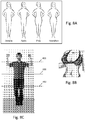
- Figs. 8A-8C schematically illustrate several cues for vertical waist location that can be executed by image analysis methods.
- the waist is defined as the narrowest point of the torso.
- a range of [ymin, ymax] image row coordinates is defined based on overall body silhouette size and a search for the smallest [x_left, x_right] interval is conducted.
- the subject's hand should be away from the body, either raised (e.g., as the user's position shown in Fig. 8C ) or in 45 degrees, to avoid interference in the measurement.
- the waist location might not be clear from the body width function.
- Another method for vertical waist detection can be used for detecting the visual feature points inside the user silhouette such as user's belly-button (as schematically illustrated in Fig. 8B ).
- the system calculates the waist location from anthropometric data which for example provides the average waist height as a fraction of the user's height.
- 'natural' anatomical locations e.g. waist, chest etc.
- the waist line is defined to be 45cm from shoulder - we will locate the very same point along the body and measure the circumference at that very point.
- a collection of images of that body parts is collected, appropriate image features (such as the Haar-like features or similar digital image features used in object recognition) are selected, and a cascade of simple classifiers is trained using the known AdaBoost algorithm or implementation of similar machine learning algorithms. These steps can be performed offline.
- the belly-button region is estimated from overall image size and the cascade of classifiers is applied, scanning the region at different scales for feature detection.
- Fig. 8C demonstrates another embodiment for vertical waist location, according to which the shoulder height and the crotch height are detected, based on silhouette analysis and the vertical waist location is proportionally defined between these two values.
- the shoulder height and the crotch height are indicated by dotted lines 801 and 802 respectively and the defined waist location in indicated by the line 803.
- the image search for specific torso height lines like the waist line, the hips line and the chest line is further constrained by using anthropometric information.
- the female waist point for 99% of all females lies between 0.578 and 0.652 of the female's height.
- knowing the subject gender and height as entered e.g., during a registration process of a user to the system, together with the camera parameters allow us to compute the vertical image span of the waist area and conduct one or more of the waist detection processes described above, only in the that vertical image span.
- Similar anthropometric data facilitate the search for other body key-points such as the shoulders, neck, hand wrist, etc.
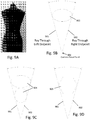
- Figs. 9A-9D schematically illustrate the principle of converting endpoints of a body silhouette 900 to a bounding angular sector.
- an orthographic (or parallel) projection model for the camera which can be justified for body parts at about the camera height or a distant camera (with respect to body dimensions).
- correction factors can be experimentally obtained per elevation angle of the specific body part, with respect to the camera optical axis and used to correct the derived size measures/derived 3D contour points.
- correction factors relate to definition of certain body size measures.
- the neck circumference is defined along a diagonal slice of the body 3D shape and a specific correction factor is applied for that measure.
- each image point can be back-projected from the camera focal point (as indicated by numeral 906 in Fig. 9B ), to describe a ray in space.
- the left and right endpoints (as indicated by numerals 901 and 902, respectively, in Figs. 9B-9D ) define an angular sector, which under the orthographic assumption / approximation lies in a plane parallel to the floor.
- the body cross section of the silhouette 900 at a specific height (such as waist, hips, etc.) is bounded by said angular sector, as indicated by numerals 903. Examples for other specific heights are indicated by numerals 904 and 905.
- Camera calibration is known in prior art. Camera field of view and lens distortion data may be available from the manufacturer. For example, when using a smartphone such as an iPhone 4S by Apple Inc., the installed body measurement application according to the present invention may inquire the device, with a known Application Programming Interface (API) for the camera parameters.
- API Application Programming Interface
- intrinsic (field of view, distortion, optical center) and extrinsic (location and orientation) camera parameters can be obtained with a calibration pattern/object.
- Calibration software packages are also available as open source.
- the camera optical axis should be parallel to the floor surface.
- the tilt can be detected and estimated from visual information such the location of the floor-wall intersection, or measured from the on-device sensors. Once the tilt information is available it is incorporated into the measurement equations to compensate for such tilt.
- a single constraint (as obtained from a single 2D image of the body) tells us very little about the actual body size, since the actual body cross section in say waist level could be one of the shapes shown in Fig. 9B such as shape 902, 903, 904 or another shape.
- another view (like a side view) reduces uncertainty and allows solving for the body circumference assuming an elliptical cross section.
- an approximation is not accurate enough to provide the proper size recommendation or visualization.
- Figs. 10A and 10B show how to obtain an accurate cross section shape (and circumference) from a sequence of images of a freely rotating user.
- the figure depicts 3 poses as designated by elliptical contours that are indicated by numerals 911, 912 and 913.
- the elliptical contour 911 depicts a bounding area derived from the first reference pose.
- the system must transform all angular sectors to the same frame of reference, chosen arbitrarily as the first or other position.
- the Euclidean transformation is defined by the translation and rotation of the human body, with respect to the reference position.
- the system repeats the process of computing bounding angular sectors at the reference coordinate system, applying the respective Euclidean transformation to each sector and intersecting with the cumulative bounding shape.
- the Boolean intersection of the sectors encloses the shape tighter and tighter, till the convex cross section is obtained.
- the Boolean intersection can be computed using the known technique of polygon intersection. This "object-space" approach as known in Computer Graphics has the advantage of computing the shape at arbitrary precision.
- an "image-based" approach renders the angular sectors one-by-one into a high-resolution bitmap which initially encompasses the entire measurement area (as indicated by the rectangle 930) and recursively applying Boolean intersection with the previous bitmap as shown in the series of exemplary black and white images in Fig. 10B .
- Fig. 11 describes, in a flowchart form, the construction of 3D size metrics and shape data from 2D shape model data store (step 1100).
- silhouette endpoints coordinates are retrieved (step 1105) with user position and rotation angle (step 1115). The latter are used to compute 2D Euclidean transformation matrix (step 1120).
- Step 1110 builds a bounding angular sector in camera coordinates, which is shifted and rotated (by step 1130) using said matrix to the reference coordinate system.
- Step 1140 renders the interior of the angular sector, using convex polygon filling techniques as known in prior art. The rendering resolution (for example 5 pixels / cm) must be fine enough to avoid digitization errors.
- Step 1150 performs the Boolean intersection of the newly rendered angular sector with the shape coverage bitmap as accumulated so far.
- the shape of the cross section is available and its contour can be traversed, by step 1160.
- the contour may be represented by an array of contour points (step 1170) which can be converted into a 3D cloud of points, when accumulated with cross section of the figure at multiple heights.
- the contour length is computed by step 1180 and serves as a circumference value for the waist.
- the obtained 3D shape model can be stored in a database (step 1190).
- Fig. 12 depicts body size measures as usually required by the garment industry.
- Several key measures can be computed from a single user rotation in raised arms (so called "Cactus") position: Bust/Chest, Waist and Hips.
- Additional body sizes are linear in nature. These include inseam, arm and height. Using calibration, such measures are extracted from a single frame, relying on user behavior analyzer 130 ( Fig. 1 ) to select a fully frontal / backwards image for that measurement. Measuring legs is important for jeans and other tightly fitting garments. As legs suffer from mutual occlusion during a full body rotation, a modification to the method of the present invention would build the knee or ankle shape from those frames without occlusion. Since the leg cross section at the knee / angle is almost circular, visibility of the individual leg contour for 120o or rotational movement is sufficient for accurate estimation of the leg's circumference.
- Figs. 13A-13C schematically illustrate the construction of 3D model representations from generated 3D data according to an embodiment of the present invention.
- Fig. 13A Such a cloud of point can be converted to the format of full 3D body scanners.
- prior art as well as several commercially available software products show how to convert the cloud of points to a series of polygons (see the illustrated triangles mesh in Fig. 13B ) which serve as a surface model (see Fig. 13C ), which may be better suited for virtual fitting room applications and for virtual clothing simulation.
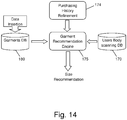
- Fig. 14 describes a Garment Recommendation Engine (GRE) 175 according to an embodiment of the present invention.
- the GRE 175 compares the user's body measurements (e.g. circumferences & lengths) to those of a selected garment and supplies recommendation regarding the best size fit.
- the GRE 175 receives the user's measurements from a user's body size measures database (e.g., such as the user shape and appearance database 170) and garments measurements from the Garments database 180.
- the garments data insertion to database 180 can be done either manually or automatically by a garment detection module.
- the GRE 175 may further receive purchasing history of the user as indicated by numeral 174.
- Each garment type e.g. shirt, trousers, dress etc.
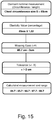
- the actual size of each garment which will be compared against the customer dimensions - depends also on parameters such as elasticity, wearing ease and tolerance.
- An exemplary size calculation flow is shown in Fig. 15 in accordance with an embodiment of the present invention.
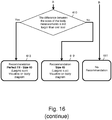
- a size recommendation is issued, as for example, described in Fig. 16 accompanied by an illustration of the body fit presented by a heat map as indicated by numeral 620 in Fig. 17 .
- GRE 175 checks if all body measurements are within the garment's size range (not larger or smaller). If yes, then at the next step (608), it checks if the difference between the sizes of the body measurements is not larger than two sizes. If yes, then at the next step (609), it checks whether the body chest point within +/- 3 cm range on the vertical axis of the pattern's chest point. Until this point, if the answer to any one of the checks of steps 607-609 is no, then no recommendation is obtained (step 611). If at step 609 the answer is yes, then at the nest step (610), the GRE 175 checks if the difference between the sizes of the body measurements is not larger than one size.
- a recommendation for a perfect fit is provided (e.g., size 40 - largest size), and the system visualize the garment on body diagram of the user (e.g., an avatar that mimics the user's appearance). If no, (step 612), a recommendation for the largest fit (e.g., size 40) is provided, but not necessarily a recommendation for a perfect fit as in step 613. For step 612, the system also visualizes the garment on body diagram of the user (e.g., an avatar that mimics the user's appearance).
- steps for issuing a size recommendation may refer only to a partial part of a much extensive logic that can include additional or other rules.
- the two size gap difference, described in the section above is just one exemplary rule from a large set of rules that can be utilized to enhance the efficiency of the size recommendation process.
- the system can be configured to build an avatar from scanned user 2D shape data and / or from computed 3D shape data and optionally non-shape user characteristics (such as skin tone, eyes color, hair color).
- the avatar is used for visualization of the user during the scanning process (the idea is to present a figure that follows the user behavior - in order to enhance the experience and optionally create a sense of privacy by not showing the actual image captured by the camera).
- the avatar can be further used for visualization of a selected garment for the user.
- Said visualization may be static or dynamic by animating the avatar with one of pre-defined / randomly generated movements.
- the avatar display can be modified (such as leaner that in reality) to enhance the user experience during scanning or to enhance the garment display during garment purchase stage.
- the body measurement process according to the present invention can be used in diverse domains outside the fashion retail industry.
- One such domain is health.
- Obesity is becoming a significant health risk and therefore it is mandatory to provide means for monitoring obesity.
- a Body Mass Index (BMI) is a simple metric which is used extensively to measure obesity.
- BMI does not reflect the distribution of fat.
- the body measurement process can be adapted for medical applications - scanning the user and analyzing the 3D shape data to produce certain health-related parameters / metrics such as obesity, fat distribution.
- the scanning is conducted repeatedly (like monthly) and the user 3D shape data are compared with a reference scan or with one or more previous scans. The comparison process generates indications of significant changes of certain shape parameters.
- the angle of the camera with respect to a reference plane on which the garment is located should be considered. This is required in order to eliminate any distortion that may occur due to the non-parallel position (or non-optimal capturing angle) between the camera lens and the plane on which the garment is located.
- Embodiments of the invention as were described hereinabove may be implemented as a computer process (method), a computing system, or as an article of manufacture, such as a computer program product or computer readable media.
- the computer program product may be a computer storage media readable by a computer system and encoding a computer program of instructions for executing a computer process.
- PC Personal Computer
- PDA personal digital assistant
Landscapes
- Engineering & Computer Science (AREA)
- Physics & Mathematics (AREA)
- Health & Medical Sciences (AREA)
- Life Sciences & Earth Sciences (AREA)
- General Physics & Mathematics (AREA)
- Theoretical Computer Science (AREA)
- Multimedia (AREA)
- Pathology (AREA)
- Biophysics (AREA)
- Computer Vision & Pattern Recognition (AREA)
- Biomedical Technology (AREA)
- Heart & Thoracic Surgery (AREA)
- Medical Informatics (AREA)
- Molecular Biology (AREA)
- Surgery (AREA)
- Animal Behavior & Ethology (AREA)
- General Health & Medical Sciences (AREA)
- Public Health (AREA)
- Veterinary Medicine (AREA)
- Geometry (AREA)
- Oral & Maxillofacial Surgery (AREA)
- Dentistry (AREA)
- Biodiversity & Conservation Biology (AREA)
- Human Computer Interaction (AREA)
- Computer Graphics (AREA)
- Software Systems (AREA)
- Image Analysis (AREA)
- Length Measuring Devices By Optical Means (AREA)
- Image Processing (AREA)
- Image Generation (AREA)
- Measurement Of The Respiration, Hearing Ability, Form, And Blood Characteristics Of Living Organisms (AREA)
Applications Claiming Priority (2)
| Application Number | Priority Date | Filing Date | Title |
|---|---|---|---|
| US201261696816P | 2012-09-05 | 2012-09-05 | |
| PCT/IL2013/050743 WO2014037939A1 (en) | 2012-09-05 | 2013-09-03 | System and method for deriving accurate body size measures from a sequence of 2d images |
Publications (3)
| Publication Number | Publication Date |
|---|---|
| EP2893479A1 EP2893479A1 (en) | 2015-07-15 |
| EP2893479A4 EP2893479A4 (en) | 2017-02-01 |
| EP2893479B1 true EP2893479B1 (en) | 2018-10-24 |
Family
ID=50236613
Family Applications (1)
| Application Number | Title | Priority Date | Filing Date |
|---|---|---|---|
| EP13835345.3A Active EP2893479B1 (en) | 2012-09-05 | 2013-09-03 | System and method for deriving accurate body size measures from a sequence of 2d images |
Country Status (7)
| Country | Link |
|---|---|
| US (1) | US9727787B2 (enExample) |
| EP (1) | EP2893479B1 (enExample) |
| JP (1) | JP6392756B2 (enExample) |
| KR (1) | KR20150079585A (enExample) |
| CN (1) | CN104813340B (enExample) |
| ES (1) | ES2693028T3 (enExample) |
| WO (1) | WO2014037939A1 (enExample) |
Cited By (1)
| Publication number | Priority date | Publication date | Assignee | Title |
|---|---|---|---|---|
| WO2022175155A1 (de) * | 2021-02-16 | 2022-08-25 | Sikora Ag | Verfahren und system zum erfassen und bereitstellen von daten für einen kauf eines bekleidungsartikels |
Families Citing this family (160)
| Publication number | Priority date | Publication date | Assignee | Title |
|---|---|---|---|---|
| US10332176B2 (en) | 2014-08-28 | 2019-06-25 | Ebay Inc. | Methods and systems for virtual fitting rooms or hybrid stores |
| CN104813340B (zh) * | 2012-09-05 | 2018-02-23 | 体通有限公司 | 从2d图像序列导出准确身体尺寸测量的系统和方法 |
| US10009579B2 (en) * | 2012-11-21 | 2018-06-26 | Pelco, Inc. | Method and system for counting people using depth sensor |
| US9367733B2 (en) | 2012-11-21 | 2016-06-14 | Pelco, Inc. | Method and apparatus for detecting people by a surveillance system |
| US10089680B2 (en) * | 2013-03-12 | 2018-10-02 | Exalibur Ip, Llc | Automatically fitting a wearable object |
| US9639747B2 (en) * | 2013-03-15 | 2017-05-02 | Pelco, Inc. | Online learning method for people detection and counting for retail stores |
| FR3010624B1 (fr) * | 2013-09-13 | 2015-09-25 | Ct Hospitalier Universitaire De Poitiers | Procede et systeme de cartographie, procede et systeme d'evaluation de l'efficacite d'une stimulation medullaire |
| US9392254B2 (en) * | 2014-02-28 | 2016-07-12 | John Clinton Barkley | Game sizing camera |
| US10247541B2 (en) * | 2014-03-31 | 2019-04-02 | Gorilla Technology Inc. | System and method of estimating the three-dimensional size of an object for packaging or storing the object |
| US10013710B2 (en) * | 2014-04-17 | 2018-07-03 | Ebay Inc. | Fashion preference analysis |
| US9436277B2 (en) * | 2014-04-21 | 2016-09-06 | Xerox Corporation | System and method for producing computer control signals from breath attributes |
| NZ631213A (en) * | 2014-05-13 | 2016-03-31 | Mport Pty Ltd | Frameworks and methodologies for enabling provision of computer implement functionalities via centralized management of data derived from three dimensional body scans |
| US10529009B2 (en) | 2014-06-25 | 2020-01-07 | Ebay Inc. | Digital avatars in online marketplaces |
| EP2960854A1 (en) * | 2014-06-27 | 2015-12-30 | Thomson Licensing | Method and device for determining a set of modifiable elements in a group of pictures |
| RU2551731C1 (ru) * | 2014-07-02 | 2015-05-27 | Константин Александрович Караваев | Способ виртуального подбора одежды |
| US10653962B2 (en) * | 2014-08-01 | 2020-05-19 | Ebay Inc. | Generating and utilizing digital avatar data for online marketplaces |
| US10366447B2 (en) | 2014-08-30 | 2019-07-30 | Ebay Inc. | Providing a virtual shopping environment for an item |
| US9639954B2 (en) * | 2014-10-27 | 2017-05-02 | Playsigh Interactive Ltd. | Object extraction from video images |
| CN107430542A (zh) * | 2014-12-23 | 2017-12-01 | 彼博迪公司 | 获取图像和制作服装的方法 |
| WO2016131022A1 (en) | 2015-02-12 | 2016-08-18 | Glowforge Inc. | Cloud controlled laser fabrication |
| US10509390B2 (en) | 2015-02-12 | 2019-12-17 | Glowforge Inc. | Safety and reliability guarantees for laser fabrication |
| US11004133B1 (en) * | 2015-04-01 | 2021-05-11 | Amazon Technologies, Inc. | Fit characteristics for comparing garments |
| US9839376B1 (en) * | 2015-04-20 | 2017-12-12 | Massachusetts Mutual Life Insurance | Systems and methods for automated body mass index calculation to determine value |
| JP6455310B2 (ja) * | 2015-05-18 | 2019-01-23 | 本田技研工業株式会社 | 動作推定装置、ロボット、及び動作推定方法 |
| WO2017007930A1 (en) * | 2015-07-07 | 2017-01-12 | Beckham Brittany Fletcher | System and network for outfit planning and wardrobe management |
| US9905019B2 (en) * | 2015-08-07 | 2018-02-27 | Selfiestyler Inc. | Virtual apparel fitting systems and methods |
| US10430867B2 (en) | 2015-08-07 | 2019-10-01 | SelfieStyler, Inc. | Virtual garment carousel |
| US10438292B1 (en) | 2015-09-17 | 2019-10-08 | Allstate Insurance Company | Determining body characteristics based on images |
| CN105184584A (zh) * | 2015-09-17 | 2015-12-23 | 北京京东方多媒体科技有限公司 | 虚拟试衣系统及方法 |
| US20170124747A1 (en) * | 2015-10-02 | 2017-05-04 | Edward KNOWLTON | Synthetically fabricated and custom fitted dressware |
| CN108289637B (zh) * | 2015-10-05 | 2021-07-02 | 斯格尔兹威尔尼斯公司 | 生成矫正产品推荐 |
| US10140832B2 (en) | 2016-01-26 | 2018-11-27 | Flir Systems, Inc. | Systems and methods for behavioral based alarms |
| CN105740688B (zh) * | 2016-02-01 | 2021-04-09 | 腾讯科技(深圳)有限公司 | 解锁的方法和装置 |
| US10587858B2 (en) * | 2016-03-14 | 2020-03-10 | Symbol Technologies, Llc | Device and method of dimensioning using digital images and depth data |
| US11559086B1 (en) * | 2016-03-24 | 2023-01-24 | Detra C. Aubert | Method to remotely fit brassieres for prosthetics wearers and mastectomy patients |
| US10068612B2 (en) | 2016-04-08 | 2018-09-04 | DISH Technologies L.L.C. | Systems and methods for generating and presenting virtual experiences |
| US10579203B2 (en) * | 2016-04-13 | 2020-03-03 | Intel Corporation | Wellness mirror |
| WO2017192888A1 (en) * | 2016-05-04 | 2017-11-09 | Styku Llc | Method and system for body scanning and display of biometric data |
| WO2018011332A1 (en) | 2016-07-13 | 2018-01-18 | Naked Labs Austria Gmbh | Method for creating a 3d-model and 3d-body-scanner |
| US11311210B2 (en) * | 2016-07-14 | 2022-04-26 | Brightday Technologies, Inc. | Posture analysis systems and methods |
| GB2552648B (en) * | 2016-07-22 | 2020-09-16 | Imperial College Sci Tech & Medicine | Estimating dimensions for an enclosed space using a multi-directional camera |
| US10251438B2 (en) | 2016-08-10 | 2019-04-09 | Lymphatech | Methods of generating compression garment measurement information for a patient body part and fitting pre-fabricated compression garments thereto |
| US10249100B2 (en) * | 2016-08-29 | 2019-04-02 | Physan, Inc. | Method and system for progressive drape update on avatar morph for virtual fitting |
| WO2018048902A1 (en) * | 2016-09-06 | 2018-03-15 | Platform Orthopedic Solutions Inc | A system, platform, device and method for personalized shopping |
| CN107865473B (zh) * | 2016-09-26 | 2019-10-25 | 华硕电脑股份有限公司 | 人体特征测距装置及其测距方法 |
| FR3058250B1 (fr) * | 2016-10-28 | 2019-07-05 | Guillaume Vandevoorde | Procede pour simuler le tombe d’un vetement sur une representation numerique d’un sujet, produit programme d’ordinateur et serveur associes |
| EP3541341A4 (en) * | 2016-11-17 | 2020-07-01 | Medici Technologies, LLC | SELF-SEALING MEMBER ENCLOSURE |
| WO2018098399A1 (en) | 2016-11-25 | 2018-05-31 | Glowforge Inc. | Controlled deceleration of moveable components in a computer numerically controlled machine |
| WO2018098398A1 (en) | 2016-11-25 | 2018-05-31 | Glowforge Inc. | Preset optical components in a computer numerically controlled machine |
| WO2018098396A1 (en) | 2016-11-25 | 2018-05-31 | Glowforge Inc. | Multi-user computer-numerically-controlled machine |
| CN110226137A (zh) | 2016-11-25 | 2019-09-10 | 格罗弗治公司 | 借助图像跟踪进行制造 |
| WO2018098393A1 (en) | 2016-11-25 | 2018-05-31 | Glowforge Inc. | Housing for computer-numerically-controlled machine |
| WO2018098397A1 (en) | 2016-11-25 | 2018-05-31 | Glowforge Inc. | Calibration of computer-numerically-controlled machine |
| WO2018098395A1 (en) | 2016-11-25 | 2018-05-31 | Glowforge Inc. | Improved engraving in a computer numerically controlled machine |
| US12420355B2 (en) | 2016-11-25 | 2025-09-23 | Glowforge Inc. | Laser fabrication with beam detection |
| US20180160777A1 (en) | 2016-12-14 | 2018-06-14 | Black Brass, Inc. | Foot measuring and sizing application |
| US10325372B2 (en) * | 2016-12-20 | 2019-06-18 | Amazon Technologies, Inc. | Intelligent auto-cropping of images |
| US11861673B2 (en) * | 2017-01-06 | 2024-01-02 | Nike, Inc. | System, platform and method for personalized shopping using an automated shopping assistant |
| JP2018124946A (ja) * | 2017-02-03 | 2018-08-09 | 有限会社Primavera | 3dボディスキャナーと型紙自動作成ソフトを使ったアパレルのビジネスモデル |
| EP3578012B1 (en) | 2017-02-06 | 2025-12-24 | Cree Lighting USA LLC | Image analysis techniques |
| CN110503681B (zh) * | 2017-02-14 | 2022-03-29 | 奥比中光科技集团股份有限公司 | 人体模型自动创建方法及三维试衣系统 |
| TWI604332B (zh) * | 2017-03-24 | 2017-11-01 | 緯創資通股份有限公司 | 遠距離的身份辨識方法及其系統與電腦可讀取記錄媒體 |
| JP6733590B2 (ja) * | 2017-03-30 | 2020-08-05 | 京セラドキュメントソリューションズ株式会社 | 商品選択支援装置 |
| US10705113B2 (en) | 2017-04-28 | 2020-07-07 | Finch Technologies Ltd. | Calibration of inertial measurement units attached to arms of a user to generate inputs for computer systems |
| CN111066051B (zh) | 2017-06-27 | 2024-09-10 | 耐克创新有限合伙公司 | 使用自动化购物助手进行个性化购物的系统、平台以及方法 |
| EP3709873A2 (en) | 2017-09-27 | 2020-09-23 | Peacs B.v. | Marker element and application method with ecg |
| US11016116B2 (en) | 2018-01-11 | 2021-05-25 | Finch Technologies Ltd. | Correction of accumulated errors in inertial measurement units attached to a user |
| CN111837152B (zh) * | 2018-01-24 | 2025-07-01 | 耐克创新有限合伙公司 | 使用虚拟购物助手进行个性化购物的系统、平台和方法 |
| AU2019200433B1 (en) * | 2018-02-14 | 2019-05-16 | Lymphatech, Inc. | Methods Of Generating Compression Garment Measurement Information For A Patient Body Part And Fitting Pre-Fabricated Compression Garments Thereto |
| EP3721325A1 (en) * | 2018-02-26 | 2020-10-14 | Seddi, Inc. | Avatar matching in on-line shopping |
| KR102028563B1 (ko) * | 2018-03-09 | 2019-10-04 | (주)펄핏 | 영상 처리를 이용한 발 사이즈 및 모양 측정 방법 |
| US11589778B2 (en) * | 2018-03-16 | 2023-02-28 | Sony Interactive Entertainment Inc. | Body size estimation apparatus, body size estimation method, and program |
| TWI790369B (zh) * | 2018-03-30 | 2023-01-21 | 日商Zozo股份有限公司 | 尺寸測定系統 |
| CN108550384B (zh) * | 2018-03-30 | 2022-05-03 | 百度在线网络技术(北京)有限公司 | 用于推送信息的方法和装置 |
| KR102036127B1 (ko) * | 2018-04-10 | 2019-11-26 | (주)오엔에스커뮤니케이션 | 영상 인식을 이용한 의류 생산 모니터링 시스템 |
| US10321728B1 (en) | 2018-04-20 | 2019-06-18 | Bodygram, Inc. | Systems and methods for full body measurements extraction |
| US11474593B2 (en) | 2018-05-07 | 2022-10-18 | Finch Technologies Ltd. | Tracking user movements to control a skeleton model in a computer system |
| US10416755B1 (en) | 2018-06-01 | 2019-09-17 | Finch Technologies Ltd. | Motion predictions of overlapping kinematic chains of a skeleton model used to control a computer system |
| TWI697861B (zh) * | 2018-05-16 | 2020-07-01 | 緯創資通股份有限公司 | 服飾試穿方法及其顯示系統與電腦可讀取記錄媒體 |
| KR101956143B1 (ko) * | 2018-07-04 | 2019-03-12 | 주식회사 프로젝트 융 | 에어샤워 게이트 |
| CN109211139A (zh) * | 2018-07-10 | 2019-01-15 | 北京三体高创科技有限公司 | 三维扫描方法及扫描装置 |
| US11009941B2 (en) * | 2018-07-25 | 2021-05-18 | Finch Technologies Ltd. | Calibration of measurement units in alignment with a skeleton model to control a computer system |
| CN109146772B (zh) * | 2018-08-03 | 2019-08-23 | 深圳市飘飘宝贝有限公司 | 一种图片处理方法、终端和计算机可读存储介质 |
| CN112566549B (zh) * | 2018-08-06 | 2024-08-27 | 国际现代科学团队(Sism) | 自动执行人的静态动态个性测试的方法 |
| CN109190519B (zh) * | 2018-08-15 | 2021-07-16 | 上海师范大学 | 一种人体图像裆部检测方法 |
| AU2019374730B2 (en) * | 2018-11-05 | 2025-08-21 | Cape Bionics Pty Ltd | Tailored compression garments and methods of tailoring compression garments for individuals |
| CN109615462B (zh) * | 2018-11-13 | 2022-07-22 | 华为技术有限公司 | 控制用户数据的方法及相关装置 |
| JP6792273B2 (ja) * | 2019-04-26 | 2020-11-25 | Arithmer株式会社 | 寸法データ算出装置、製品製造装置、及びシルエット画像生成装置 |
| US11922649B2 (en) | 2018-11-30 | 2024-03-05 | Arithmer Inc. | Measurement data calculation apparatus, product manufacturing apparatus, information processing apparatus, silhouette image generating apparatus, and terminal apparatus |
| KR102202490B1 (ko) * | 2018-11-30 | 2021-01-14 | 동국대학교 산학협력단 | 3차원 신체 모델 측정 장치 및 방법 |
| US11010896B2 (en) | 2018-12-17 | 2021-05-18 | Bodygram, Inc. | Methods and systems for generating 3D datasets to train deep learning networks for measurements estimation |
| EP3900885B1 (en) * | 2018-12-21 | 2026-01-07 | LG Electronics Inc. | Method of controlling robot |
| KR102782794B1 (ko) | 2018-12-26 | 2025-03-19 | 삼성전자주식회사 | 진정 사용자의 손을 식별하는 방법 및 이를 위한 웨어러블 기기 |
| CN109409348A (zh) * | 2018-12-29 | 2019-03-01 | 北京卡路里信息技术有限公司 | 一种用户体征的确定方法、装置、设备和存储介质 |
| US11995840B2 (en) * | 2018-12-31 | 2024-05-28 | I-Deal S.R.L. | Anthropometric data portable acquisition device and method of collecting anthropometric data |
| KR102818738B1 (ko) * | 2019-01-03 | 2025-06-11 | 엘지전자 주식회사 | 신체 측정 디바이스 및 그 제어 방법 |
| KR102132721B1 (ko) * | 2019-01-03 | 2020-07-10 | (주) 아이딕션 | 신체 사이즈 측정용 사진 획득 방법 및 이를 이용한 신체 사이즈 측정 방법, 서버 및 프로그램 |
| CN109829785B (zh) * | 2019-01-21 | 2021-07-09 | 深圳市云之梦科技有限公司 | 虚拟试衣方法、装置、电子设备和存储介质 |
| GB2581167A (en) * | 2019-02-06 | 2020-08-12 | Arbroath Capital Uk Risk Man Consulting Limited | Video processing apparatus |
| JP2020134242A (ja) * | 2019-02-15 | 2020-08-31 | オリンパス株式会社 | 計測方法、計測装置、およびプログラム |
| CN110188633B (zh) * | 2019-05-14 | 2023-04-07 | 广州虎牙信息科技有限公司 | 人体体态指标预测方法、装置、电子设备及存储介质 |
| US11134079B2 (en) * | 2019-05-21 | 2021-09-28 | International Business Machines Corporation | Cognitive behavioral and environmental access |
| EP3742397A1 (en) * | 2019-05-23 | 2020-11-25 | Koninklijke Philips N.V. | Estimating a surface area and/or volume of a body or a body part of a subject |
| EP3745352B1 (en) * | 2019-05-31 | 2023-01-18 | presize GmbH | Methods and systems for determining body measurements and providing clothing size recommendations |
| US11423630B1 (en) | 2019-06-27 | 2022-08-23 | Amazon Technologies, Inc. | Three-dimensional body composition from two-dimensional images |
| WO2021016556A1 (en) * | 2019-07-25 | 2021-01-28 | Eifle, Inc. | Digital image capture and fitting methods and systems |
| US10842680B1 (en) | 2019-08-31 | 2020-11-24 | Michael J. Weiler | Methods and systems for fitting compression garments from digital imagery |
| CN112446166B (zh) * | 2019-09-03 | 2024-05-14 | 财团法人工业技术研究院 | 材料推荐系统与材料推荐方法 |
| KR102314163B1 (ko) * | 2019-09-09 | 2021-10-18 | (주)플리츠미 | 온라인 의류 쇼핑 시스템 |
| US10976863B1 (en) | 2019-09-19 | 2021-04-13 | Finch Technologies Ltd. | Calibration of inertial measurement units in alignment with a skeleton model to control a computer system based on determination of orientation of an inertial measurement unit from an image of a portion of a user |
| US11175729B2 (en) | 2019-09-19 | 2021-11-16 | Finch Technologies Ltd. | Orientation determination based on both images and inertial measurement units |
| US11903730B1 (en) | 2019-09-25 | 2024-02-20 | Amazon Technologies, Inc. | Body fat measurements from a two-dimensional image |
| CN114745985B (zh) * | 2019-10-03 | 2025-10-17 | 康奈尔大学 | 根据乳房的3d形状优化文胸尺寸确定 |
| KR102314164B1 (ko) * | 2019-10-10 | 2021-10-18 | (주)플리츠미 | 온라인 의류 쇼핑 시스템 |
| US11250572B2 (en) * | 2019-10-21 | 2022-02-15 | Salesforce.Com, Inc. | Systems and methods of generating photorealistic garment transference in images |
| US11222434B2 (en) * | 2019-11-21 | 2022-01-11 | Shopify Inc. | Systems and methods for measuring body size |
| CN111105348A (zh) | 2019-12-25 | 2020-05-05 | 北京市商汤科技开发有限公司 | 图像处理方法及装置、图像处理设备及存储介质 |
| KR102387711B1 (ko) * | 2020-01-10 | 2022-04-18 | 주식회사 리모 | 2d 영상 기반의 3차원 체형 분석 방법, 그 시스템 및 그 프로그램 |
| WO2021146031A1 (en) | 2020-01-19 | 2021-07-22 | Udisense Inc. | Measurement calibration using patterned sheets |
| US11138771B2 (en) | 2020-02-03 | 2021-10-05 | Apple Inc. | Systems, methods, and graphical user interfaces for annotating, measuring, and modeling environments |
| KR102268801B1 (ko) * | 2020-03-05 | 2021-06-24 | (주)헬스허브 | 의료영상을 통한 신체 사이즈의 시계열적 변화 추정 장치 및 그 방법 |
| CN111307039A (zh) * | 2020-03-06 | 2020-06-19 | 珠海随变科技有限公司 | 一种物体长度识别方法、装置、终端设备和存储介质 |
| EP3882810B1 (en) | 2020-03-16 | 2023-06-07 | Carl Zeiss Vision International GmbH | Computer implemented methods and devices for determining dimensions and distances of head features |
| CN111611928B (zh) * | 2020-05-22 | 2023-07-28 | 郑泽宇 | 一种基于单目视觉与关键点识别的身高及身体尺寸测量方法 |
| CN116235210A (zh) | 2020-05-29 | 2023-06-06 | 耐克创新有限合伙公司 | 用于处理捕获的图像的系统和方法 |
| KR102981446B1 (ko) * | 2020-07-22 | 2026-06-24 | 삼성전자주식회사 | 이미지 내 오브젝트의 높이를 확인하는 전자 장치 및 그 동작 방법 |
| USD937007S1 (en) | 2020-07-30 | 2021-11-30 | Udisense Inc. | Bedsheet |
| EP4231868B1 (en) * | 2020-10-22 | 2025-12-03 | Cornell University | Methods, devices and systems to determine and visualize breast boundary, predict bra cup size and/or evaluate performance of a garment using 4d body scans of an individual |
| US11740608B2 (en) | 2020-12-24 | 2023-08-29 | Glowforge, Inc | Computer numerically controlled fabrication using projected information |
| SE545466C2 (en) * | 2021-02-05 | 2023-09-19 | Volumental AB | Method and electronic arrangement for item matching for a user´s body part |
| US11094135B1 (en) * | 2021-03-05 | 2021-08-17 | Flyreel, Inc. | Automated measurement of interior spaces through guided modeling of dimensions |
| US11698622B2 (en) | 2021-03-09 | 2023-07-11 | Glowforge Inc. | Previews for computer numerically controlled fabrication |
| EP4319633A4 (en) | 2021-04-05 | 2025-02-19 | Advanced Health Intelligence Ltd | Predicting user body volume to manage medical treatments and medication |
| US12367600B2 (en) * | 2021-05-11 | 2025-07-22 | Tam Technologies, Inc. | Methods and systems for representing a user |
| US12046374B2 (en) * | 2021-05-23 | 2024-07-23 | Zhiqing Cheng | Digital twin |
| GB2608170B (en) | 2021-06-24 | 2024-09-04 | Aistetic Ltd | Method and system for obtaining human body size information from image data |
| US11854146B1 (en) | 2021-06-25 | 2023-12-26 | Amazon Technologies, Inc. | Three-dimensional body composition from two-dimensional images of a portion of a body |
| US11961198B2 (en) * | 2021-07-20 | 2024-04-16 | Dhana Inc. | System and method for improved generation of avatars for virtual try-on of garments |
| US11887252B1 (en) | 2021-08-25 | 2024-01-30 | Amazon Technologies, Inc. | Body model composition update from two-dimensional face images |
| JP7316336B2 (ja) * | 2021-09-29 | 2023-07-27 | 株式会社Zozo | 情報処理装置、情報処理方法及び情報処理プログラム |
| US11861860B2 (en) * | 2021-09-29 | 2024-01-02 | Amazon Technologies, Inc. | Body dimensions from two-dimensional body images |
| KR20230077645A (ko) * | 2021-11-25 | 2023-06-01 | 에이아이바 주식회사 | 실감형 패션 메타버스 서비스 제공하는 방법, 그 장치 및 그 방법을 수행하는 프로그램을 저장하는 비일시적 컴퓨터 판독 가능 기록 매체 |
| CN113962853B (zh) * | 2021-12-15 | 2022-03-15 | 武汉大学 | 一种旋转线阵扫描图像位姿自动化精密解算方法 |
| US12236627B2 (en) | 2021-12-23 | 2025-02-25 | Industrial Technology Research Institute | System and method for measuring circumference of human body |
| CN114332421B (zh) * | 2021-12-29 | 2025-02-25 | 中国电子科技集团公司第三十八研究所 | 一种考虑人因的增强现实辅助装配系统 |
| JP7365435B2 (ja) * | 2022-01-05 | 2023-10-19 | 帝人フロンティア株式会社 | コンピュータにより実行される身体採寸方法 |
| CN114419135B (zh) * | 2022-03-29 | 2022-06-28 | 武汉楚精灵医疗科技有限公司 | 胰腺标志物尺寸量化方法、装置、终端及可读存储介质 |
| CN114663552B (zh) * | 2022-05-25 | 2022-08-16 | 武汉纺织大学 | 一种基于2d图像的虚拟试衣方法 |
| CN115251897B (zh) * | 2022-07-14 | 2023-11-14 | 广东工业大学 | 一种胸型量测装置及系统 |
| US12518307B1 (en) * | 2022-09-07 | 2026-01-06 | Meta Platforms Technologies, Llc | Human body scanning for size recommendation |
| US12594030B1 (en) | 2022-09-16 | 2026-04-07 | Amazon Technologies, Inc. | Regional body composition from two-dimensional color body images |
| US12265665B1 (en) | 2022-09-23 | 2025-04-01 | Apple Inc. | Heuristic for hand tracking correction modes |
| CN116399367B (zh) * | 2022-12-07 | 2026-04-24 | 阿里巴巴(中国)有限公司 | 设备姿态校准方法及装置、对象参数测量方法及装置 |
| US12597145B2 (en) | 2022-12-14 | 2026-04-07 | Industrial Technology Research Institute | Measuring method and system for body-shaped data |
| JP2026515022A (ja) | 2023-04-27 | 2026-05-13 | アイエフユー インターナショナル インコーポレイテッド | 非対面オーダーメイド服の注文と製造のための身体寸法計測方法、並びに衣類の型紙自動生成方法 |
| US12626470B1 (en) | 2023-07-03 | 2026-05-12 | Meta Platforms Technologies, Llc | Artificial reality room capture realignment |
| CN117422833A (zh) * | 2023-11-09 | 2024-01-19 | 新兴际华(北京)材料技术研究院有限公司 | 一种手部外轮廓尺寸采集方法及系统 |
| CN118542642B (zh) * | 2024-04-19 | 2024-11-22 | 安络杰医疗器械(上海)有限公司 | 一种医疗影像设备的扫描方法、系统及存储介质 |
| US20250378664A1 (en) * | 2024-06-07 | 2025-12-11 | Constructor Technology Ag | System and method for personalized avatar generation using photo image analysis |
| WO2026088051A1 (en) * | 2024-10-21 | 2026-04-30 | Esenca Digital Workwear S.R.L. | Ai based body measurement system and method thereof |
Family Cites Families (10)
| Publication number | Priority date | Publication date | Assignee | Title |
|---|---|---|---|---|
| GB2351426A (en) * | 1999-06-24 | 2000-12-27 | Stephen James Crampton | Method and apparatus for the generation of computer graphic representations of individuals |
| FR2816821B1 (fr) * | 2000-11-20 | 2003-01-17 | Telmat Ind | Installation et procede automatiques de prise de mensurations et d'acquisition de formes |
| JP2003269936A (ja) * | 2002-03-19 | 2003-09-25 | Sanyo Electric Co Ltd | 自動採寸方法 |
| WO2006071006A1 (en) * | 2004-12-30 | 2006-07-06 | G & G Cormerce Ltd | Method for converting 2d image into pseudo 3d image and user-adapted total coordination method in use artificial intelligence, and service business method thereof |
| JP4765429B2 (ja) * | 2005-06-21 | 2011-09-07 | パナソニック電工株式会社 | 体型測定機能付洗面ユニット |
| US8249334B2 (en) * | 2006-05-11 | 2012-08-21 | Primesense Ltd. | Modeling of humanoid forms from depth maps |
| US8068676B2 (en) * | 2007-11-07 | 2011-11-29 | Palo Alto Research Center Incorporated | Intelligent fashion exploration based on clothes recognition |
| WO2010019925A1 (en) * | 2008-08-15 | 2010-02-18 | Brown Technology Partnerships | Method and apparatus for estimating body shape |
| WO2011156474A2 (en) * | 2010-06-10 | 2011-12-15 | Brown University | Parameterized model of 2d articulated human shape |
| CN104813340B (zh) * | 2012-09-05 | 2018-02-23 | 体通有限公司 | 从2d图像序列导出准确身体尺寸测量的系统和方法 |
-
2013
- 2013-09-03 CN CN201380057671.5A patent/CN104813340B/zh active Active
- 2013-09-03 KR KR1020157008498A patent/KR20150079585A/ko not_active Ceased
- 2013-09-03 WO PCT/IL2013/050743 patent/WO2014037939A1/en not_active Ceased
- 2013-09-03 ES ES13835345.3T patent/ES2693028T3/es active Active
- 2013-09-03 EP EP13835345.3A patent/EP2893479B1/en active Active
- 2013-09-03 JP JP2015530549A patent/JP6392756B2/ja not_active Expired - Fee Related
-
2015
- 2015-02-06 US US14/616,247 patent/US9727787B2/en active Active
Non-Patent Citations (1)
| Title |
|---|
| None * |
Cited By (1)
| Publication number | Priority date | Publication date | Assignee | Title |
|---|---|---|---|---|
| WO2022175155A1 (de) * | 2021-02-16 | 2022-08-25 | Sikora Ag | Verfahren und system zum erfassen und bereitstellen von daten für einen kauf eines bekleidungsartikels |
Also Published As
| Publication number | Publication date |
|---|---|
| WO2014037939A1 (en) | 2014-03-13 |
| KR20150079585A (ko) | 2015-07-08 |
| JP6392756B2 (ja) | 2018-09-19 |
| JP2015534637A (ja) | 2015-12-03 |
| ES2693028T3 (es) | 2018-12-07 |
| EP2893479A1 (en) | 2015-07-15 |
| CN104813340B (zh) | 2018-02-23 |
| US9727787B2 (en) | 2017-08-08 |
| EP2893479A4 (en) | 2017-02-01 |
| CN104813340A (zh) | 2015-07-29 |
| US20150154453A1 (en) | 2015-06-04 |
Similar Documents
| Publication | Publication Date | Title |
|---|---|---|
| US9727787B2 (en) | System and method for deriving accurate body size measures from a sequence of 2D images | |
| US10546417B2 (en) | Method and apparatus for estimating body shape | |
| US9898651B2 (en) | Upper-body skeleton extraction from depth maps | |
| Weiss et al. | Home 3D body scans from noisy image and range data | |
| Ye et al. | Performance capture of interacting characters with handheld kinects | |
| US20240296579A1 (en) | Method and system for obtaining human body size information from image data | |
| Tian et al. | Handling occlusions in augmented reality based on 3D reconstruction method | |
| CN108475439B (zh) | 三维模型生成系统、三维模型生成方法和记录介质 | |
| JP6368709B2 (ja) | 3次元身体データを生成する方法 | |
| Wu et al. | Full body performance capture under uncontrolled and varying illumination: A shading-based approach | |
| JP2006249618A (ja) | 仮想試着装置 | |
| Guomundsson et al. | ToF imaging in smart room environments towards improved people tracking | |
| Haggag et al. | LGT/VOT tracking performance evaluation of depth images | |
| Guðmundsson et al. | Improved 3D reconstruction in smart-room environments using ToF imaging | |
| Chen et al. | Optimizing human model reconstruction from RGB-D images based on skin detection | |
| Wang et al. | Shape reconstruction of human foot from multi-camera images based on PCA of human shape database | |
| JP7234595B2 (ja) | 検出装置、処理装置、検出方法、及び処理プログラム | |
| Weiss et al. | Home 3D body scans from a single Kinect | |
| Liu et al. | Implementation of levels-of-detail in Bayesian tracking framework using single RGB-D sensor | |
| Kim et al. | An information delivery system for visually impaired people in dynamic environment | |
| Cahyawiajya et al. | Fast And Low Cost Automated Human 3D Modeling And Skeleton Generation | |
| Dellas et al. | Video Capture of Skin Motion using Calibrated Fabrics | |
| Demir | Motion Capture from Single Video Sequence |
Legal Events
| Date | Code | Title | Description |
|---|---|---|---|
| PUAI | Public reference made under article 153(3) epc to a published international application that has entered the european phase |
Free format text: ORIGINAL CODE: 0009012 |
|
| 17P | Request for examination filed |
Effective date: 20150402 |
|
| AK | Designated contracting states |
Kind code of ref document: A1 Designated state(s): AL AT BE BG CH CY CZ DE DK EE ES FI FR GB GR HR HU IE IS IT LI LT LU LV MC MK MT NL NO PL PT RO RS SE SI SK SM TR |
|
| AX | Request for extension of the european patent |
Extension state: BA ME |
|
| DAX | Request for extension of the european patent (deleted) | ||
| RIC1 | Information provided on ipc code assigned before grant |
Ipc: A41H 1/02 20060101ALI20160919BHEP Ipc: G06T 7/00 20060101ALI20160919BHEP Ipc: G06F 19/00 20110101AFI20160919BHEP Ipc: G06T 7/60 20060101ALI20160919BHEP Ipc: A61B 5/107 20060101ALI20160919BHEP Ipc: G06F 17/00 20060101ALI20160919BHEP |
|
| RA4 | Supplementary search report drawn up and despatched (corrected) |
Effective date: 20170105 |
|
| RIC1 | Information provided on ipc code assigned before grant |
Ipc: G06T 7/60 20170101ALI20161223BHEP Ipc: A61B 5/107 20060101ALI20161223BHEP Ipc: A41H 1/02 20060101ALI20161223BHEP Ipc: G06T 7/00 20170101ALI20161223BHEP Ipc: G06F 19/00 20110101AFI20161223BHEP Ipc: G06F 17/00 20060101ALI20161223BHEP |
|
| REG | Reference to a national code |
Ref country code: DE Ref legal event code: R079 Ref document number: 602013045694 Country of ref document: DE Free format text: PREVIOUS MAIN CLASS: G06F0019000000 Ipc: G06T0007564000 |
|
| GRAP | Despatch of communication of intention to grant a patent |
Free format text: ORIGINAL CODE: EPIDOSNIGR1 |
|
| STAA | Information on the status of an ep patent application or granted ep patent |
Free format text: STATUS: GRANT OF PATENT IS INTENDED |
|
| RIC1 | Information provided on ipc code assigned before grant |
Ipc: G06T 7/564 20170101AFI20180320BHEP Ipc: G06T 7/62 20170101ALI20180320BHEP |
|
| INTG | Intention to grant announced |
Effective date: 20180425 |
|
| GRAS | Grant fee paid |
Free format text: ORIGINAL CODE: EPIDOSNIGR3 |
|
| GRAA | (expected) grant |
Free format text: ORIGINAL CODE: 0009210 |
|
| STAA | Information on the status of an ep patent application or granted ep patent |
Free format text: STATUS: THE PATENT HAS BEEN GRANTED |
|
| RAP1 | Party data changed (applicant data changed or rights of an application transferred) |
Owner name: SIZER TECHNOLOGIES LTD |
|
| AK | Designated contracting states |
Kind code of ref document: B1 Designated state(s): AL AT BE BG CH CY CZ DE DK EE ES FI FR GB GR HR HU IE IS IT LI LT LU LV MC MK MT NL NO PL PT RO RS SE SI SK SM TR |
|
| REG | Reference to a national code |
Ref country code: CH Ref legal event code: EP |
|
| REG | Reference to a national code |
Ref country code: IE Ref legal event code: FG4D |
|
| REG | Reference to a national code |
Ref country code: AT Ref legal event code: REF Ref document number: 1057582 Country of ref document: AT Kind code of ref document: T Effective date: 20181115 |
|
| REG | Reference to a national code |
Ref country code: DE Ref legal event code: R096 Ref document number: 602013045694 Country of ref document: DE |
|
| REG | Reference to a national code |
Ref country code: ES Ref legal event code: FG2A Ref document number: 2693028 Country of ref document: ES Kind code of ref document: T3 Effective date: 20181207 |
|
| REG | Reference to a national code |
Ref country code: NL Ref legal event code: FP |
|
| REG | Reference to a national code |
Ref country code: SE Ref legal event code: TRGR |
|
| REG | Reference to a national code |
Ref country code: LT Ref legal event code: MG4D |
|
| REG | Reference to a national code |
Ref country code: AT Ref legal event code: MK05 Ref document number: 1057582 Country of ref document: AT Kind code of ref document: T Effective date: 20181024 |
|
| PG25 | Lapsed in a contracting state [announced via postgrant information from national office to epo] |
Ref country code: LT Free format text: LAPSE BECAUSE OF FAILURE TO SUBMIT A TRANSLATION OF THE DESCRIPTION OR TO PAY THE FEE WITHIN THE PRESCRIBED TIME-LIMIT Effective date: 20181024 Ref country code: NO Free format text: LAPSE BECAUSE OF FAILURE TO SUBMIT A TRANSLATION OF THE DESCRIPTION OR TO PAY THE FEE WITHIN THE PRESCRIBED TIME-LIMIT Effective date: 20190124 Ref country code: HR Free format text: LAPSE BECAUSE OF FAILURE TO SUBMIT A TRANSLATION OF THE DESCRIPTION OR TO PAY THE FEE WITHIN THE PRESCRIBED TIME-LIMIT Effective date: 20181024 Ref country code: PL Free format text: LAPSE BECAUSE OF FAILURE TO SUBMIT A TRANSLATION OF THE DESCRIPTION OR TO PAY THE FEE WITHIN THE PRESCRIBED TIME-LIMIT Effective date: 20181024 Ref country code: BG Free format text: LAPSE BECAUSE OF FAILURE TO SUBMIT A TRANSLATION OF THE DESCRIPTION OR TO PAY THE FEE WITHIN THE PRESCRIBED TIME-LIMIT Effective date: 20190124 Ref country code: FI Free format text: LAPSE BECAUSE OF FAILURE TO SUBMIT A TRANSLATION OF THE DESCRIPTION OR TO PAY THE FEE WITHIN THE PRESCRIBED TIME-LIMIT Effective date: 20181024 Ref country code: LV Free format text: LAPSE BECAUSE OF FAILURE TO SUBMIT A TRANSLATION OF THE DESCRIPTION OR TO PAY THE FEE WITHIN THE PRESCRIBED TIME-LIMIT Effective date: 20181024 Ref country code: IS Free format text: LAPSE BECAUSE OF FAILURE TO SUBMIT A TRANSLATION OF THE DESCRIPTION OR TO PAY THE FEE WITHIN THE PRESCRIBED TIME-LIMIT Effective date: 20190224 Ref country code: AT Free format text: LAPSE BECAUSE OF FAILURE TO SUBMIT A TRANSLATION OF THE DESCRIPTION OR TO PAY THE FEE WITHIN THE PRESCRIBED TIME-LIMIT Effective date: 20181024 |
|
| PG25 | Lapsed in a contracting state [announced via postgrant information from national office to epo] |
Ref country code: PT Free format text: LAPSE BECAUSE OF FAILURE TO SUBMIT A TRANSLATION OF THE DESCRIPTION OR TO PAY THE FEE WITHIN THE PRESCRIBED TIME-LIMIT Effective date: 20190224 Ref country code: GR Free format text: LAPSE BECAUSE OF FAILURE TO SUBMIT A TRANSLATION OF THE DESCRIPTION OR TO PAY THE FEE WITHIN THE PRESCRIBED TIME-LIMIT Effective date: 20190125 Ref country code: AL Free format text: LAPSE BECAUSE OF FAILURE TO SUBMIT A TRANSLATION OF THE DESCRIPTION OR TO PAY THE FEE WITHIN THE PRESCRIBED TIME-LIMIT Effective date: 20181024 Ref country code: RS Free format text: LAPSE BECAUSE OF FAILURE TO SUBMIT A TRANSLATION OF THE DESCRIPTION OR TO PAY THE FEE WITHIN THE PRESCRIBED TIME-LIMIT Effective date: 20181024 |
|
| REG | Reference to a national code |
Ref country code: DE Ref legal event code: R097 Ref document number: 602013045694 Country of ref document: DE |
|
| PG25 | Lapsed in a contracting state [announced via postgrant information from national office to epo] |
Ref country code: DK Free format text: LAPSE BECAUSE OF FAILURE TO SUBMIT A TRANSLATION OF THE DESCRIPTION OR TO PAY THE FEE WITHIN THE PRESCRIBED TIME-LIMIT Effective date: 20181024 Ref country code: IT Free format text: LAPSE BECAUSE OF FAILURE TO SUBMIT A TRANSLATION OF THE DESCRIPTION OR TO PAY THE FEE WITHIN THE PRESCRIBED TIME-LIMIT Effective date: 20181024 Ref country code: CZ Free format text: LAPSE BECAUSE OF FAILURE TO SUBMIT A TRANSLATION OF THE DESCRIPTION OR TO PAY THE FEE WITHIN THE PRESCRIBED TIME-LIMIT Effective date: 20181024 |
|
| PG25 | Lapsed in a contracting state [announced via postgrant information from national office to epo] |
Ref country code: SK Free format text: LAPSE BECAUSE OF FAILURE TO SUBMIT A TRANSLATION OF THE DESCRIPTION OR TO PAY THE FEE WITHIN THE PRESCRIBED TIME-LIMIT Effective date: 20181024 Ref country code: SM Free format text: LAPSE BECAUSE OF FAILURE TO SUBMIT A TRANSLATION OF THE DESCRIPTION OR TO PAY THE FEE WITHIN THE PRESCRIBED TIME-LIMIT Effective date: 20181024 Ref country code: EE Free format text: LAPSE BECAUSE OF FAILURE TO SUBMIT A TRANSLATION OF THE DESCRIPTION OR TO PAY THE FEE WITHIN THE PRESCRIBED TIME-LIMIT Effective date: 20181024 Ref country code: RO Free format text: LAPSE BECAUSE OF FAILURE TO SUBMIT A TRANSLATION OF THE DESCRIPTION OR TO PAY THE FEE WITHIN THE PRESCRIBED TIME-LIMIT Effective date: 20181024 |
|
| PLBE | No opposition filed within time limit |
Free format text: ORIGINAL CODE: 0009261 |
|
| STAA | Information on the status of an ep patent application or granted ep patent |
Free format text: STATUS: NO OPPOSITION FILED WITHIN TIME LIMIT |
|
| 26N | No opposition filed |
Effective date: 20190725 |
|
| PG25 | Lapsed in a contracting state [announced via postgrant information from national office to epo] |
Ref country code: SI Free format text: LAPSE BECAUSE OF FAILURE TO SUBMIT A TRANSLATION OF THE DESCRIPTION OR TO PAY THE FEE WITHIN THE PRESCRIBED TIME-LIMIT Effective date: 20181024 |
|
| PG25 | Lapsed in a contracting state [announced via postgrant information from national office to epo] |
Ref country code: TR Free format text: LAPSE BECAUSE OF FAILURE TO SUBMIT A TRANSLATION OF THE DESCRIPTION OR TO PAY THE FEE WITHIN THE PRESCRIBED TIME-LIMIT Effective date: 20181024 |
|
| PG25 | Lapsed in a contracting state [announced via postgrant information from national office to epo] |
Ref country code: MC Free format text: LAPSE BECAUSE OF FAILURE TO SUBMIT A TRANSLATION OF THE DESCRIPTION OR TO PAY THE FEE WITHIN THE PRESCRIBED TIME-LIMIT Effective date: 20181024 |
|
| REG | Reference to a national code |
Ref country code: CH Ref legal event code: PL |
|
| PG25 | Lapsed in a contracting state [announced via postgrant information from national office to epo] |
Ref country code: IE Free format text: LAPSE BECAUSE OF NON-PAYMENT OF DUE FEES Effective date: 20190903 Ref country code: LI Free format text: LAPSE BECAUSE OF NON-PAYMENT OF DUE FEES Effective date: 20190930 Ref country code: CH Free format text: LAPSE BECAUSE OF NON-PAYMENT OF DUE FEES Effective date: 20190930 Ref country code: LU Free format text: LAPSE BECAUSE OF NON-PAYMENT OF DUE FEES Effective date: 20190903 |
|
| REG | Reference to a national code |
Ref country code: BE Ref legal event code: MM Effective date: 20190930 |
|
| PG25 | Lapsed in a contracting state [announced via postgrant information from national office to epo] |
Ref country code: BE Free format text: LAPSE BECAUSE OF NON-PAYMENT OF DUE FEES Effective date: 20190930 |
|
| PG25 | Lapsed in a contracting state [announced via postgrant information from national office to epo] |
Ref country code: CY Free format text: LAPSE BECAUSE OF FAILURE TO SUBMIT A TRANSLATION OF THE DESCRIPTION OR TO PAY THE FEE WITHIN THE PRESCRIBED TIME-LIMIT Effective date: 20181024 |
|
| PG25 | Lapsed in a contracting state [announced via postgrant information from national office to epo] |
Ref country code: MT Free format text: LAPSE BECAUSE OF FAILURE TO SUBMIT A TRANSLATION OF THE DESCRIPTION OR TO PAY THE FEE WITHIN THE PRESCRIBED TIME-LIMIT Effective date: 20181024 Ref country code: HU Free format text: LAPSE BECAUSE OF FAILURE TO SUBMIT A TRANSLATION OF THE DESCRIPTION OR TO PAY THE FEE WITHIN THE PRESCRIBED TIME-LIMIT; INVALID AB INITIO Effective date: 20130903 |
|
| PG25 | Lapsed in a contracting state [announced via postgrant information from national office to epo] |
Ref country code: MK Free format text: LAPSE BECAUSE OF FAILURE TO SUBMIT A TRANSLATION OF THE DESCRIPTION OR TO PAY THE FEE WITHIN THE PRESCRIBED TIME-LIMIT Effective date: 20181024 |
|
| P01 | Opt-out of the competence of the unified patent court (upc) registered |
Effective date: 20230526 |
|
| PGFP | Annual fee paid to national office [announced via postgrant information from national office to epo] |
Ref country code: NL Payment date: 20240226 Year of fee payment: 11 |
|
| PGFP | Annual fee paid to national office [announced via postgrant information from national office to epo] |
Ref country code: SE Payment date: 20240226 Year of fee payment: 11 |
|
| PGFP | Annual fee paid to national office [announced via postgrant information from national office to epo] |
Ref country code: DE Payment date: 20240926 Year of fee payment: 12 |
|
| PGFP | Annual fee paid to national office [announced via postgrant information from national office to epo] |
Ref country code: GB Payment date: 20240924 Year of fee payment: 12 |
|
| PGFP | Annual fee paid to national office [announced via postgrant information from national office to epo] |
Ref country code: FR Payment date: 20240925 Year of fee payment: 12 |
|
| PGFP | Annual fee paid to national office [announced via postgrant information from national office to epo] |
Ref country code: ES Payment date: 20241021 Year of fee payment: 12 |
|
| REG | Reference to a national code |
Ref country code: SE Ref legal event code: EUG |
|
| REG | Reference to a national code |
Ref country code: NL Ref legal event code: MM Effective date: 20241001 |
|
| PG25 | Lapsed in a contracting state [announced via postgrant information from national office to epo] |
Ref country code: NL Free format text: LAPSE BECAUSE OF NON-PAYMENT OF DUE FEES Effective date: 20241001 |
|
| PG25 | Lapsed in a contracting state [announced via postgrant information from national office to epo] |
Ref country code: SE Free format text: LAPSE BECAUSE OF NON-PAYMENT OF DUE FEES Effective date: 20240904 |
|
| REG | Reference to a national code |
Ref country code: DE Ref legal event code: R119 Ref document number: 602013045694 Country of ref document: DE |
|
| GBPC | Gb: european patent ceased through non-payment of renewal fee |
Effective date: 20250903 |
|
| PG25 | Lapsed in a contracting state [announced via postgrant information from national office to epo] |
Ref country code: GB Free format text: LAPSE BECAUSE OF NON-PAYMENT OF DUE FEES Effective date: 20250903 |
|
| PG25 | Lapsed in a contracting state [announced via postgrant information from national office to epo] |
Ref country code: DE Free format text: LAPSE BECAUSE OF NON-PAYMENT OF DUE FEES Effective date: 20260401 |
|
| PG25 | Lapsed in a contracting state [announced via postgrant information from national office to epo] |
Ref country code: FR Free format text: LAPSE BECAUSE OF NON-PAYMENT OF DUE FEES Effective date: 20250930 |