EP2893441B1 - Generating native code from intermediate language code for an application - Google Patents
Generating native code from intermediate language code for an application Download PDFInfo
- Publication number
- EP2893441B1 EP2893441B1 EP13765843.1A EP13765843A EP2893441B1 EP 2893441 B1 EP2893441 B1 EP 2893441B1 EP 13765843 A EP13765843 A EP 13765843A EP 2893441 B1 EP2893441 B1 EP 2893441B1
- Authority
- EP
- European Patent Office
- Prior art keywords
- application
- code
- computing device
- mdil
- native
- Prior art date
- Legal status (The legal status is an assumption and is not a legal conclusion. Google has not performed a legal analysis and makes no representation as to the accuracy of the status listed.)
- Active
Links
Images



Classifications
-
- G—PHYSICS
- G06—COMPUTING OR CALCULATING; COUNTING
- G06F—ELECTRIC DIGITAL DATA PROCESSING
- G06F8/00—Arrangements for software engineering
- G06F8/40—Transformation of program code
- G06F8/41—Compilation
- G06F8/44—Encoding
- G06F8/447—Target code generation
-
- G—PHYSICS
- G06—COMPUTING OR CALCULATING; COUNTING
- G06F—ELECTRIC DIGITAL DATA PROCESSING
- G06F9/00—Arrangements for program control, e.g. control units
- G06F9/06—Arrangements for program control, e.g. control units using stored programs, i.e. using an internal store of processing equipment to receive or retain programs
- G06F9/44—Arrangements for executing specific programs
- G06F9/445—Program loading or initiating
-
- G—PHYSICS
- G06—COMPUTING OR CALCULATING; COUNTING
- G06F—ELECTRIC DIGITAL DATA PROCESSING
- G06F8/00—Arrangements for software engineering
- G06F8/40—Transformation of program code
-
- G—PHYSICS
- G06—COMPUTING OR CALCULATING; COUNTING
- G06F—ELECTRIC DIGITAL DATA PROCESSING
- G06F8/00—Arrangements for software engineering
- G06F8/40—Transformation of program code
- G06F8/41—Compilation
-
- G—PHYSICS
- G06—COMPUTING OR CALCULATING; COUNTING
- G06F—ELECTRIC DIGITAL DATA PROCESSING
- G06F8/00—Arrangements for software engineering
- G06F8/40—Transformation of program code
- G06F8/51—Source to source
-
- G—PHYSICS
- G06—COMPUTING OR CALCULATING; COUNTING
- G06F—ELECTRIC DIGITAL DATA PROCESSING
- G06F8/00—Arrangements for software engineering
- G06F8/40—Transformation of program code
- G06F8/54—Link editing before load time
-
- G—PHYSICS
- G06—COMPUTING OR CALCULATING; COUNTING
- G06F—ELECTRIC DIGITAL DATA PROCESSING
- G06F8/00—Arrangements for software engineering
- G06F8/60—Software deployment
- G06F8/61—Installation
-
- G—PHYSICS
- G06—COMPUTING OR CALCULATING; COUNTING
- G06F—ELECTRIC DIGITAL DATA PROCESSING
- G06F8/00—Arrangements for software engineering
- G06F8/60—Software deployment
- G06F8/61—Installation
- G06F8/63—Image based installation; Cloning; Build to order
-
- G—PHYSICS
- G06—COMPUTING OR CALCULATING; COUNTING
- G06F—ELECTRIC DIGITAL DATA PROCESSING
- G06F8/00—Arrangements for software engineering
- G06F8/60—Software deployment
- G06F8/65—Updates
Definitions
- JIT compilation just-in-time compilation
- a computing device receives machine dependent intermediate language code (MDIL code) generated by an online provider for an application.
- MDIL code machine dependent intermediate language code
- the computing device installs the application on the computing device by generating a native image for the application, including by binding a portion of the MDIL code with one or more libraries on the computing device.
- the native image is stored on the computing device for use when loading the application for execution.
- a computing device receives, from an online provider, an installation package for an application, where the installation package includes a set of machine dependent intermediate language files (MDIL files). Additionally, a binder of the computing device is provided at least one file of the set of MDIL files and one or more libraries to be bound to the at least one file. The binder generates a native image for the application by binding MDIL code of the at least one MDIL file using the one or more libraries.
- MDIL files machine dependent intermediate language files
- an online provider generates MDIL code from preliminary code for an application.
- a computer system generates a set of MDIL files for the application by compiling preliminary code of the application into MDIL code, then signs respective files of the set of MDIL files to indicate the respective files are trusted as being from an online marketplace.
- the computer system generates a binding list that identifies the respective files of the set of MDIL files, and also generates an installation package for the application comprising the set of MDIL files for the application and the binding list.
- the computer system then provides, at the online marketplace, the installation package for downloading.
- a computing device When it receives the installation package, a computing device receives the MDIL code and generates a native image for the application to install the application on the computing device. Additionally, a runtime engine of the computing device and/or one or more libraries used by the installed application can be updated on the computing device during an update to the computing device, and the application is automatically updated in response. The application is updated by generating an updated native image for the application using the one or more libraries that were updated. The updated native image is generated such that it is runnable using the updated runtime engine on the computing device. After the updated native image is generated, the application is run by loading the updated native image instead of the previously generated native image.
- a computing device receives MDIL code generated by an online provider for an application.
- the computing device installs the application by generating a native image for the application.
- the computing device binds a portion of the MDIL code with one or more libraries on the computing device.
- the computing device stores the native image for use when loading the application for execution.
- performance of the application can benefit from previous offline compilation of at least part of the application (to produce MDIL code appropriate for the device).
- this approach can facilitate updating of the application when there is a change to a library used by the application and/or MDIL code for the application.
- ingestion generally refers to the process in which a developer uploads an application to an online provider, which processes the application for efficient execution on one or more types of computing devices, validates the application, and makes the application available for download.
- the term installation generally refers to the process of adapting the application to run on a specific computing device, which converts the application to a form more suitable for prompt and secure execution on the device (e.g., converting MDIL code to native instructions during binding by resolving references to libraries and other resources, storing a native image that can be loaded for execution, marking the application as trusted, etc.). During execution, the trusted native image for the application can be quickly loaded and run.
- application update generally refers to the process in which an application is updated (e.g., MDIL code for the application), which can involve re-installation of the application on the device.
- computing device update generally refers to the process that follows after a runtime engine, a library or other resource referenced by an application has been updated, which typically involves re-binding applications that depend on the library or other resource that has changed.
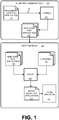
- FIG. 1 is a diagram illustrating an exemplary online provider / marketplace and exemplary computing device 100 that loads a native image 110 of an application installed by binding MDIL code 120.
- preliminary code 130 for the application is received by an online provider 140.
- the preliminary code 130 can be code for the application that is source code or code in an intermediate language such as Microsoft Intermediate Language (MSIL).
- MSIL Microsoft Intermediate Language
- the preliminary code is provided to a compiler 150 that compiles the preliminary code 130 into the MDIL code 120 for the application.
- the preliminary code 130 can be a higher level representation of the code for the application than the MDIL code 120.
- the preliminary code 130 is in an intermediate language (IL) that is at a higher level than the MDIL code 120, which is at a level closer to machine code.
- IL intermediate language
- the MDIL code 120 can be machine dependent such that it includes native code that is based on a processor instruction set.
- the processor instruction set can be an instruction set for an ARM processor, an x86 processor, or other processor.
- the MDIL code 120 can also include unresolved pseudo instructions with symbolic references which can be resolved to generate native code through binding.
- the MDIL code 120 for the application is received at the computing device 100.
- the MDIL code 120 is provided to a binder 160 that binds the MDIL code 120 to one or more libraries 170 on the device.
- the one or more libraries 170 can be code libraries and/or framework libraries for classes, types, or the like.
- the binder 160 By binding the MDIL code 120 on the computing device 100, the binder 160 generates the native image 110 of the application.
- the native image 110 includes native code for the application and is stored at the device. At 180, the native image is loaded to execute the application.
- FIG. 2 is a flow diagram of an exemplary method 200 of binding MDIL code of an application to install the application on a computing device.
- the illustrated method blocks of FIG. 2 may be merged, divided into sub-blocks, or omitted.
- a computing device receives MDIL code for the application from an online provider at 210.
- the computing device can receive one or more files which include code for the application, where the code is in an IL that is machine dependent such as code in Machine Dependent Intermediate Language as described in U.S. Patent Application Publication No.: US 2011/0258615 or in another machine dependent intermediate language.
- the MDIL code is received at the computing device from the online provider, the MDIL code can be generated from compilation by the online provider or elsewhere in the cloud. For example, the online provider compiles preliminary code for the application to generate the MDIL code for the application.
- an installation package for the application is received and the installation package includes the MDIL code for the application.
- the installation package for an application can include other information for the application such as resource files for the application.
- the MDIL code for an application can be stored on the computing device for installation of the application and for subsequent updating of the application.
- the application is installed on the computing device by generating a native image of the application, which includes binding the MDIL code of the application.
- a binder can bind the MDIL code to one or more libraries available on the computing device to generate a native image for the application that is executable.
- the application can be a managed application executed using a runtime or execution engine such as the Common Language Runtime of the .NET framework, or other runtime engine.
- a runtime engine and/or execution engine can be a software layer on which the application ultimately runs.
- a managed application is an application that executes using a framework that includes one or more shared libraries and one or more managed code runtime environments.
- libraries are base class libraries that are shared among applications.
- a library on a computing device can be an image of the library that is in native and/or machine code, which can be loaded into memory for use by a managed application that is also loaded into memory.
- the generated native image can be generated by a binder such that the native image is runnable by a runtime or execution engine that is used to run the application on the computing device.
- the binder can use and/or reference the runtime engine for the application during binding so that the binding is appropriate for execution using the runtime engine.
- the binding, of the binder resolves the MDIL code and generates native code for the application that is included in the native image for the application.
- the native code can be machine code that is executable on a particular processor and that uses instructions from a processor instruction set.
- the processor instruction set can be an instruction set for an ARM processor, an x86 processor, or other processor.
- the respective MDIL file and the one or more libraries that are to be bound to the MDIL code of the file are provided to the binder. For example, one or more file paths to MDIL files and/or library files can be provided to the binder.
- the binder binds the respective MDIL files to the libraries provided to the binder to generate the native image for the application.
- the native image can include native code such as machine code that is executable by the processor of the computing device.
- native code such as machine code that is executable by the processor of the computing device.
- at least some code for the application can be kept in an IL form, for just-in-time compilation or other compilation before the application is launched or when the application is launched. This may be useful when resources frequently changes, or when a type value or other reference cannot be resolved when the application is installed and remaining MDIL code is bound to libraries on the device.
- the application can be installed on the device by a package manager.
- a received installation package for the application can be unpacked by a package manager. If the installation package and/or one or more of the files included in the installation package are compressed, then the package manager can decompress such files. If one or more files are not compressed then the package manager does not decompress such files.
- the package manager can provide each of the MDIL files that are to be bound to the binder along with the libraries that are to be bound to the respective MDIL files. In some implementations, the package manager provides the MDIL files and/or the one or more libraries by providing references to the MDIL files and/or the one or more libraries to the binder.
- the binder binds the respective MDIL files to the provided libraries for the respective MDIL files to generate the native image of the application.
- the native image can be generated by the binder such that the native image is runnable using the runtime engine available on the computing device for running the application.
- the native image of the application is stored on the computing device for use when loading the application for execution.
- the native image generated is loaded to execute the application (and the MDIL code that is not executable is not used to execute the application).
- the native image is determined as being trusted before being loaded for execution. In other implementations, the computing device does not make any determination about whether the native image is trusted before the native image is loaded for execution.
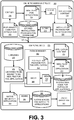
- FIG. 3 is diagram illustrating an exemplary online provider / marketplace and exemplary computing device 350 that can install one or more managed applications by generating one or more native images from code in an intermediate language such as a MDIL that is provided and generated by the online provider (or other online providers).
- an online provider 305 uses a compiler 310 to compile preliminary code 315 into one or more MDIL files 320, which are files that include code in a MDIL.
- the set of the one or more MDIL files 320 are packaged into an installation package 325 for the application.
- Each of the MDIL files can be signed as being trusted, as shown at 330.
- One or more files 335 that include support information such as resource files or application content can be included in the installation package 325.
- the installation package 325 is stored by the online provider 305 and is offered for downloading, as shown at 340. Before the installation package 325 is downloaded from the online provider 305, the installation package 325 itself can be signed as trusted, as shown at 345.
- the installation package 325 is offered as part of a catalog of applications in an online marketplace. Different versions of the installation package 325 can be offered for different types of computing devices. For example, different types of MDIL code (adapted for different types of processors) are included in different installation packages for the different types of computing devices.
- the installation packages available for different types of computing devices can also include a version with non-MDIL code (e.g., MSIL code in a XAP file) for purposes of backward compatibility.
- the computing device 350 downloads one or more installation packages, including the installation package 325, from the online provider at 355.
- the package manager 360 of the computing device 350 unpacks the one or more MDIL files 320 and the one or more files 335 that include support information for the application.
- the package manager also invokes a binder 365.
- the package manager 360 For each MDIL file of the set of the one or more MDIL files 320, the package manager 360 provides the respective MDIL file such as MDIL file 322 to the binder 365 along with the one or more libraries to be bound with the respective MDIL file, such as the one or more libraries 370.
- the binder 365 binds the respective MDIL file to the one or more libraries provided for the respective MDIL file to generate native code.
- the libraries provided for the MDIL files (such as the one or more libraries 370) are included in the set of libraries 375 that are on the computing device 350.
- the binder uses the native code generated from binding the one or more MDIL files 320 to generate a native image 380 for the application.
- the native image 380 can be generated by the binder 365 such that the native image 380 is runnable using a runtime engine on the computing device that can run the application.
- the native image 380 is stored as part of installing the application on the device, as shown at 385.
- the computing device 350 can also install one or more other applications and store generated native images corresponding to the respective other applications.
- the native image 380 can be signed as trusted code that was generated from trusted code by the binder 365.
- the native image 380 can be signed before it is stored and/or loaded for use in executing the application.
- the native image 380 is loaded to execute the application. When loaded, the native code of the native image is executed by the computing device 305 to provide the functionality of the application.
- FIG. 4 is a flow diagram of an exemplary method 400 for installing and updating an application through native code generation using code in a MDIL.
- an installation package is generated that includes MDIL code.
- the MDIL code can be included in one or more files.
- preliminary code can be compiled to generate the MDIL code.
- the MDIL code for the application includes native code based on a processor instruction set, but can also include pseudo instructions.
- a pseudo instruction includes a symbolic reference and/or field key that cannot be resolved when the MDIL is generated.
- pseudo instructions can include symbolic references to fields, types, or the like.
- the symbolic references can be tokens that identify a field or a type to be used without specifically indicating a field's offset or a type's size.
- a symbolic reference can be a token that can be interpreted by a binder to determine native code to be generated for the symbolic reference.
- a binder on a particular computing device can (1) lay out the object as it is available on the computing device through a library and (2) determine the appropriate offset for the field of the object, when generating executable instructions for the computing device.
- field offsets for objects in MDIL code can be symbolic instead of hard coded as a numeric offset (such as in a corresponding native code).
- the pseudo instruction can abstract implementation details which are to be determined and/or resolved when the pseudo instruction is bound to an appropriate library on a computing device.
- MDIL code includes pseudo instructions that include symbolic references that can be converted by a binder to produce native instructions that are executable by a processor.
- MDIL code can include pseudo instructions that can be converted by a binder into machine instructions for accessing a field of an object which is managed by a runtime engine such as the Common Language Runtime (CLR) of the .NET framework or the like.
- pseudo instructions in the MDIL code can be similar to machine code in a native language such that registers are already allocated but offsets have not been included for one or more libraries and/or classes.
- the field offset included in a native instruction as converted from the pseudo instruction can be determined by a binder and can depend on a version of a library available and/or on a computing device.
- MDIL code can include pseudo instructions that can be converted by a binder into machine instructions for looking up an instantiation or instance of a generic type or method.
- a computing device receives the MDIL code for an application.
- the computing device can receive an installation package for the application that includes MDIL files that include the MDIL code for the application.
- the installation package can include a binding list that includes a listing of the MDIL files of the application that are to be bound to generate a native image for the application and listing of the set of one or more libraries that are to be bound to the respective MDIL files.
- one or more of the libraries to be bound to the MDIL code of an application are libraries that are declared and/or included in the source code of the application.
- One or more other libraries to be bound to the MDIL code of an application can be libraries that are not declared and/or included in the source code of the application.
- the application is installed on the computing device by generating a native image for the application.
- the application can be installed by a package manager.
- the package manager can determine that the installation package is signed as trusted before using its files to install the application on the computing device, and if the installation package is not signed as trusted, the package manager does not use the installation package to install the application on the computing device.
- the package manager can provide each of the MDIL files that are to be bound to the binder along with the libraries that are to be bound to the respective MDIL files.
- the MDIL files can be determined to be signed as trusted before being used to generate a native image for the application, and MDIL files that are determined not to be signed as trusted are not used to generate a native image for the application.
- the package manager can be provided and use a binding list to automatically determine and identify the MDIL files that are to be bound and the respective libraries that are to be bound the code of the respective MDIL files for the application.
- the binding list can be in a machine readable format such as in a programming, scripting, or markup language.
- the binding list can be included in a file that includes information organized using the Extensible Markup Language (XML).
- the package manager provides the MDIL files and/or the one or more libraries to the binder by providing references to the MDIL files and/or the one or more libraries to the binder.
- the binder binds the respective MDIL files to the provided libraries for the respective MDIL files to generate the native image of the application.
- the binder reads in MDIL instructions, converts IL instructions to native instructions, and passes through instructions that are already in native form.
- a binder can bind the MDIL code to one or more libraries on the computing device to generate a native image for the application that is executable.
- the native image can be generated by the binder such that the native image is runnable using the runtime engine on the computing device, that is available to the binder, that is for running the application.
- the runtime engine can be a software layer that can ultimately run the application on the computing device.
- the binder can be run using information from a script, user input and/or other information.
- binding code the MDIL code is provided to the binder.
- the binder resolves the pseudo instructions to generate corresponding native instructions. For example, from symbolic references (e.g., field token) in pseudo instructions, the binder can generate native code by determining and specifying numeric offsets for fields based on a type layout.
- the MDIL pseudo instructions can be used to create native instructions which can differ in length from the pseudo instructions. Alternatively, the native instructions may not differ in length from the pseudo instructions.
- at least some of the MDIL code for an application can be close to the machine code included in a native image of the application; however, other parts of the MDIL code can provide a level of abstraction that allows a portion of the MDIL code to be bound to a library that can be available in one or more versions.
- the MDIL code can be used to generate executable code that executes using a particular version of the library. For example, binding MDIL code to a first set of libraries can generate executable code for the application. Or, binding the MDIL code to the set libraries with one or more of the libraries being of a different version can also generate executable code for the application.
- the sets of versions of the one or more libraries can have overlapping versions of libraries.
- binding MDIL code generates code that can be directly executed by a processor without further compilation.
- binding MDIL code to a library includes generating a native instruction from an instruction in the MDIL code.
- MDIL code includes pseudo instructions that include symbolic references that are converted and/or bound by a binder to produce native instructions that are executable by a processor.
- a binder can convert pseudo instructions into native code instructions for accessing a field of an object which can be managed by a runtime engine on the computing device.
- parts of the MDIL code can be similar to the generated native code such that registers are allocated, but in the MDIL code offsets have not been included for one or more libraries and/or classes.
- a binder can convert pseudo instructions into native code instructions for looking up an instantiation or instance of a generic type or method.
- MDIL code symbolic instructions and the generated corresponding native instructions are consistent with regard to virtual method slot assignment and/or object field layout.
- the MDIL code and the executable native code can be consistent with regard to object field layout, such that a portion of MDIL code for accessing objects that includes a field token can be used to generate native instructions (e.g., machine instructions) using numeric field offsets.
- the binder can generate a numeric offset from a symbolic reference to generate one or more executable machine instructions. For example, a symbolic reference in the MDIL code is converted by a binder into a specific field reference such that the specific field reference includes a numeric size and/or offset.
- a binder can interpret a symbolic reference that includes a token to determine native code to be generated for the symbolic reference. For example, for a field token that references a field of an object, the binder can lay out the object as it can be available on the computing device and determine the appropriate offset for the field of the object for generating executable instructions for the computing device.
- a binder that can bind MDIL code is more complicated than a linker. For example, in binding MDIL code, the binder can adjust one or more jumps in resulting native code so that the jumps are to their intended targets.
- At least some code for the application can be kept in an IL form.
- the code in IL form is further processed during just-in-time compilation or other compilation before the application is launched or when the application is launched. This may be useful when a runtime engine, a library, or other resource frequently changes. Or, it may be useful when a type value or reference cannot be resolved during the binding process in which remaining MDIL code is bound to libraries on the computing device.
- the native image is stored for use when loading the application for execution.
- the native image of the application is loaded by an execution engine or runtime such as the CLR of the .NET framework or other runtime engine.
- the computing device can include MSIL code for the application that can be compiled on the computing device using just-in-time compiling to execute the application, but instead of executing the application using the MSIL code, the native image for the application is loaded and executed to run the application.
- one or more library images or assemblies are loaded that are used by the code of the application as included in the native image.
- the native image can be loaded for execution using a runtime engine of the computing device.
- the native image for the application can be signed by the binder before it is stored, to show that the application is trusted.
- the computing device is updated at least by updating a set of libraries on the computing device.
- one or more of the libraries in the set of libraries of the computing device can be updated, replaced, or changed. This can disrupt the operation of applications that were bound to a previous version of the set of libraries.
- one or more of the applications on the computing device can be updated such that an updated native image for the respective applications can be generated.
- An updated native image for an application can be generated by binding MDIL code for the application (which is stored in MDIL form on the computing device even after installation) to at least one of the set of one or more libraries that were updated.
- the rebinding of the MDIL code for the application to one or more of the libraries on the computing device after libraries are updated can allow the native images to properly reference the one or more libraries as available on the computing device after updating the device and/or updating libraries of the device.
- complete re-compilation of code for an application is not needed every time a library changes, since the MDIL code for the application can be reused.
- re-binding using previously stored MDIL code for the respective applications can greatly simplify the process of updating native images for the respective applications.
- the computing device is updated such that the updating includes updating a runtime engine of the computing device.
- the runtime engine, of the computing device that runs one or more installed applications using native images for the applications can be updated, replaced, or changed.
- the runtime engine can be the software layer that ultimately runs an updated application so when the runtime engine is changed an updated native image for an updated application can be generated by a binder to be executable using the updated runtime engine as available to the binder and on the computing device.
- both a runtime engine and libraries of the computing device are changed upon a device update and an application can be updated so that it can be executed and/or run properly with the updated runtime engine and updated libraries.
- FIG. 5 is an exemplary method 500 of generating an installation package for an application that can be provided for download.
- the illustrated method blocks of FIG. 5 may be merged, divided into sub-blocks, or omitted.
- preliminary code for an application is received.
- a developer of an application can send code for the application in a preliminary language and/or state, and the preliminary code for the application can be received by an online provider such as an online marketplace.
- the preliminary code for the application is source code for the application.
- source code can be code written in one or more programming languages such as C++, C#, Visual Basic®, J#, J++, or other like programming languages.
- the preliminary code for the application is in an intermediate representation such as in an IL.
- source code for the application can be compiled by a compiler and/or a generator into an intermediate representation in an IL.
- the IL can be in Microsoft Intermediate Language (MSIL).
- MSIL Microsoft Intermediate Language
- the IL does not include native instructions that are machine dependent. The code in IL can be compiled, however, into code in a MDIL that includes native instructions that are machine dependent.
- resource files for the application can be received that are used by the application when it is executed.
- Resource files for applications can be one or more files that include sound information, music information, graphics information, video information, other media information, data base information, text information, and the like.
- the preliminary code can be packaged in and/or received in one or more compressed files such as a ZIP file or a XAP file. Alternatively, the preliminary code is not packaged in and/or received in one or more compressed files.
- one or more files with MDIL code for the application are received by the online provider, but MDIL files received from the developer can be discarded as untrusted files that were not generated by the online provider.
- the online provider does not discard any MDIL files received by the online provider.
- the preliminary code can be received in one or more assemblies.
- preliminary code (such as code in MSIL included in an assembly) can be compiled into code that is at a binary level.
- An assembly that includes MSIL code can be an MSIL assembly.
- an MSIL assembly can comprise one or more files.
- the preliminary code of the application is compiled to produce MDIL code which is code that is in an intermediate language that is machine dependent.
- MDIL code is code that is in an intermediate language that is machine dependent.
- decisions or references within an IL file are resolved during the compilation process, but decisions or references to a library, external source, external type, etc. are left unresolved.
- the MDIL file is thus a mix of (a) assembly instructions, native code or other device dependent instructions and (b) pseudocode instructions or other device independent instructions that are to be resolved later.
- the MDIL code compiled from the preliminary code can be in an intermediate language that is a lower level language than the language of the preliminary code.
- the preliminary code is in an intermediate language that is at a higher level (further away from machine code), and the MDIL code is at a lower level that is closer to machine code. Even so, the MDIL code is typically not directly executable without being bound, because the MDIL code includes symbolic references that are not native code. Instead, the MDIL code can be converted to executable machine code by a binder.
- the preliminary code for the application is not directly executable but can be compiled into executable code when it is compiled by a just-in-time compiler. For example, code for the application in MSIL can be just-in-time compiled to run the application from the MSIL code.
- code for an application in MSIL can be provided to a compiler to generate MDIL code for the application.
- the MSIL code does not include native instructions, nor does it include the pseudo instructions included in the MDIL code that are to be resolved and/or bound by a binder to generate native code for the application.
- the MDIL code can be included in one or more MDIL files.
- an MDIL file can have a name and/or file extension such that ".mdil" is included in the name and/or file extension of the MDIL file.
- an MDIL file can have another naming convention, such that ".mdil" is not included in the name and/or file extension of the MDIL file.
- the compiler when the preliminary code is compiled, in addition to pseudo instructions, produces one or more assemblies for the MDIL code.
- MDIL code included in an assembly can be compiled into code that is at a binary level.
- An assembly that includes MDIL code can be an MDIL assembly.
- an MDIL assembly can comprise one or more files.
- Compiling the preliminary code into MDIL code for the application before the application code is received at a target computing device (on which the application is to be executed) can provide various advantages. For example, compile time can be removed from the time it takes to install the application on the target computing device. Removing the compilation from the installation of the application on the target device can also allow for compile-time optimizations of the code to be done in the cloud, without that time being added to the time it takes to install the application on a target device. In particular, this can help avoid time-consuming re-compilation on the target computing device for multiple applications that depend on a library whenever the library is changed and/or when a runtime engine is changed.
- the compilation of the preliminary code can produce one or more native code files for the application that include native code for the application and do not include MDIL code.
- a corresponding MDIL file is generated by a compiler.
- the preliminary code can be compiled to generate MDIL code that is dependent on an instruction set for a first processor (for a first type of target computing device), and different MDIL code can be generated that is dependent on an instruction set for a second processor (for a second type of target computing device).
- compiling preliminary code for an application can produce MDIL code that can be bound to run on a device that has a first processor, and produce different MDIL code for the application that can be bound to run on another device with a different second processor.
- the first processor can be an ARM processor and the second processor can be an x86 processor.
- the MDIL code of the application is signed as trusted.
- MDIL code files generated from the preliminary code can be signed with a publisher key to indicate that the signed files include trusted code.
- native code generated by compiling preliminary code can be signed as trusted.
- native code files that are generated by a compiler can be signed with a publisher key to indicate that the signed files include trusted code.
- an installation package is generated that includes the MDIL code.
- the MDIL code can be packaged into a container such as one or more files that can be downloaded for installing the application.
- the MDIL code in one or more MDIL code files are packaged into one or more compressed files such as a ZIP file or a XAP file.
- a compressed installation package can lower the amount of data to be downloaded for the application from the online provider.
- the installation package is not in a compressed form.
- Different types of MDIL code (adapted for different types of processors) can be included in different installation packages for different types of computing devices.
- the installation packages available for different types of computing devices can also include a version with non-MDIL code (e.g., MSIL code in a XAP file) for purposes of backward compatibility.
- the installation package can include other information for the application such as resource files for the application.
- resource files for the application can be received that can be used by the application when it is executed.
- Resource files for applications can be one or more files that include sound information, music information, graphics information, video information, other media information, data base information, text information, and the like.
- the installation package can also include a listing of files that are included in the installation package.
- the listing of files can include information about the files included in the installation package.
- the installation package can include a file that includes information organized using Extensible Markup Language (XML).
- the XML file can include a list of the files that are included in the installation package. For each of the files listed, the XML file can include information associated with the listed file.
- the XML file can list each of the MDIL code files included in the installation package and indicate that each of the MDIL code files are able to be bound.
- the XML file can also indicate the one or more libraries that are to be bound to the code of respective listed MDIL code files.
- the generated installation package itself is signed as trusted.
- the installation package can be signed with a publisher key to indicate that it includes code and/or other information that is trusted.
- the installation package can be encrypted.
- the installation package is provided for downloading.
- the online provider and/or partner of the online provider can store the installation package for download.
- the online provider can be an online marketplace from which one or more applications can be downloaded for installation onto one or more computing devices.
- the application can be included in a catalogue of applications that are available for downloading from the online marketplace.
- the application can be downloaded by a computing device using the internet and/or the cloud.
- the application can be downloaded such that the installation package for the application is downloaded.
- the application can be downloaded to a computing device after the application has been purchased and authorized to be downloaded to the computing device.
- the application can be downloaded without being purchased.
- the application can be offered and downloaded for free.
- FIG. 6 is a diagram of a computing device 600 that can generate one or more updated native images 605 for one or more installed applications.
- the computing device includes one or more generated native images 610 for the one or more installed applications on the computing device.
- the computing device 600 includes updated libraries 620, which include one or more libraries that were updated after being bound to respective MDIL code of applications to generate the one or more native images 610. Because at least one of the libraries that were bound to the one or more native images 610 were updated, the computing device 600 updates the applications installed on it by generating the one or more updated native images 605 for the installed applications.
- the computing device also includes an updated runtime engine 670.
- a binder 625 In generating the one or more updated native images 605 for the installed applications, a binder 625 generates an updated native image for each of one or more installed applications. As shown in FIG. 6 , for each installed application that has a native image that was bound to at least one library that has been changed and/or updated, the package manager 630 provides the binder 625 the MDIL files of the respective application for rebinding to generate an updated native image for the application being updated, such as the updated native image 635.
- the updated native images can be generated by the binder 625 such that the native images are executable using the updated runtime engine 670.
- binder 625 is provided the respective MDIL file of the application such as MDIL file 640 and one or more libraries such as the one or more libraries 645 that are to be bound to the MDIL file.
- the one or more libraries provided for binding to the code of the MDIL file can include at least on library that has been updated and is included in the set of updated libraries 620. In some implementations, one or more libraries bound to the code of an MDIL file of an application being updated have not been updated.
- the updated native image for the application is stored as at least one of the one or more updated native images 605 for the installed applications on the computing device.
- the updated native image can also be signed as trusted code, as shown at 650, before the updated native image is used to execute the application.
- the computing device loads a generated updated native image for an application to execute the application instead of the previously generated native image for the application.
- the device can update an application when the application has changed (e.g., MDIL code of the application has changed).
- the device updates the application by generating an updated native image for the application, including binding a new portion of the MDIL code with the one or more libraries (unchanged) on the device.
- the updated native image for the application can be generated by the binder such that the native images are runnable using the updated runtime engine.
- the previously generated native image can be stored temporarily during the generation of the updated native image and/or update of the computing device 600 until the update of the application and/or computing device 600 is verified as successful. If the update to the computing device and/or to the application fails, the previously generated native image can be restored from temporary storage and again used as the native image that is loaded by the computing device to execute the application.
- FIG. 7 is an exemplary method 700 for updating an application by generating a native image for the application from code in a MDIL.
- the illustrated method blocks of FIG. 7 may be merged, divided into sub-blocks, or omitted.
- a set of one or more libraries are updated on a computing device, as shown at 710. For example, a portion or all of the one or more libraries on the computing device are changed, modified, or otherwise updated.
- the set of one or more libraries are updated and a runtime engine of the device is updated as part of a computing device update.
- At least one of the libraries of the one or more libraries that were bound to MDIL code for the respective application has been changed, modified, or otherwise updated.
- a library is updated and /or changed such that the code of the native image for an application that is bound to the library no longer corresponds properly to at least one offset for the library. For example, an offset for at least one field of an object has changed in the library, or the like.
- a set of the libraries on the computing device can be updated as part of an operating system update. Or, libraries on the computing device can be updated as part of an update to a framework and/or an execution engine update.
- the computing device can use a framework to execute managed application such as the .NET framework, and the libraries that are part of the framework are changes and/or updated and/or the runtime engine that is part of the framework is changed and/or updated.
- the base class libraries can be changed or updated to a different and/or newer version of the framework libraries. In some cases, not all the libraries on the computing device are updated and/or changed. In other cases, all the libraries on the computing device are updated and/or changed.
- the computing device generates an updated native image for an application.
- an application that was installed on the computing device by generating a native image from MDIL code for the application can be updated such that a new native image (e.g., an updated native image) is generated for the application by binding the MDIL code for the application to one or more libraries after at least one of the one or more libraries has been updated on the computing device.
- the generating of the updated native image can be similar to the generation of the native image when the application was originally installed.
- the updated native image can be generated for the application using at least one of the updated libraries of the computing device as described above for the installation process.
- the generating of an updated native image occurs after a first native image for the application has already been generated for the application and one or more of the libraries bound during the generation of the first native image have been updated and/or changed on the computing device.
- the binding of the MDIL code of the application being updated can be done such that the generated native image is executable using the updated runtime engine and the updated libraries as available on the computing device.
- an updated native image can be generated when MDIL code for the application is updated but libraries and/or runtime engines have not changed.
- the computing device receives new MDIL code for the application as part of an application update.
- the received new MDIL code for the application can be installed as described herein such as using the method 200 above.
- the computing device updates the application by generating an updated native image for the application, including binding a portion of the new MDIL code with the one or more libraries (unchanged) on the computing device.
- the native code generated for the application by a binder can be generated such that it is runnable using the runtime engine available on the device for running the application.
- the MDIL code for the application stored on the computing device for the application can be bound to one or more libraries of the device.
- a binder can bind the MDIL code to one or more libraries available on the computing device to generate an executable native image that is updated for the application. The binding resolves the MDIL code and generates native code for the application that is included in the updated native image for the application.
- the respective MDIL file and the one or more libraries that are to be bound to the MDIL code of the file are provided to the binder.
- the binder binds the respective MDIL files to the libraries provided to the binder to generate the updated native image for the application.
- the updated native image can include native code, such as machine code that is executable by the processor of the computing device, and the updated native image typically does not include unbound pseudo instructions as in the MDIL code.
- the generated updated native images can be signed as trusted code.
- the updated native image replaces the previously generated native image for the application as the native image that is loaded for executing the application.
- the updated native image is loaded to execute the application because the updated native image includes native code that is executable using the at least one of the updated libraries of the computing device.
- the previously generated native image may be unstable and/or unreliable, such that it does not function properly or as expected, because it can improperly reference an earlier version of one of the libraries available on the computing device.
- the previously generated native image is stored and/or backed up temporarily until the application and/or update to the computing device is verified as successful.
- an update to the computing device that updates libraries of the computing device can trigger the regeneration and/or updating of native images for applications. If the update to the computing device or the update of a native image for an application fails, the failed update can be rolled back and the previously generated native image of the application that is stored can be used as the native image of the application when executed.
- application data is also preserved.
- a user of the application can generate user data and/or application data before the application is updated, and, after the application is updated, the user data and/or application data can be preserved such that the generation of the updated native image does not change the user data and/or application data from the previous version of the application.
- the computing device generates an updated native image for one or more other applications installed on the device. For example, for each additional application installed on the computing device that has a native image that was generated by binding MDIL code to one or more of the libraries that were updated, an updated native image for the respective application is generated by binding the MDIL code to the one or more libraries as updated.
- the dotted lines, as shown at 730, indicate that the block 730 can be omitted from the method or included in the method in various implementations of the method 700.
- the applications of the device can be automatically updated, and updated native images for the applications can be generated, so that the applications execute properly using the updated libraries.
- the application need not be updated, and an updated native image need not be generated for the application, as the previously generated native image for the application can function properly with the libraries as available on the device.
- the updated native images for the applications can be generated such that the application is executable on the computing device using the updated runtime engine and the updated libraries as available on the computing device.
- the updated native image is stored for use when loading the application to execute the application at the computing device.
- the updated native image is loaded instead of a native image of the application generated previous to the generation of the updated native image.
- the updated native image is loaded to execute the application because the updated native image can properly reference the libraries it uses.
- FIG.8 is a system diagram depicting an exemplary mobile device 800 including a variety of optional hardware and software components, shown generally at 802.
- a component 802 in the mobile device can communicate with another component, although not all connections are shown, for ease of illustration.
- the mobile device can be any of a variety of computing devices (e.g., cell phone, smartphone, tablet computer, handheld computer, Personal Digital Assistant (PDA), etc.) and can allow wireless two-way communications with one or more mobile communications networks 804, such as a cellular or satellite network.
- PDA Personal Digital Assistant
- the illustrated mobile device 800 can include a controller or processor 810 (e.g., signal processor, microprocessor, ASIC, or other control and processing logic circuitry) for performing such tasks as signal coding, data processing, input/output processing, power control, and/or other functions.
- An operating system 812 can control the allocation and usage of the components 802 and support for one or more application programs 814 and/or one or more software programs 815 such as one that can implement one or more of the technologies described herein for generating native code from IL code on a device for applications.
- the application programs can include common mobile computing applications and software (e.g., email applications, calendars, contact managers, web browsers, messaging applications, a runtime engine), or any other computing applications.
- Functionality 813 for accessing an application store, an online marketplace, or online provider can also be used for acquiring and updating code and/or other information for application programs 814.
- the illustrated mobile device 800 can include memory 820.
- Memory 820 can include non-removable memory 822 and/or removable memory 824.
- the non-removable memory 822 can include RAM, ROM, flash memory, a hard disk, or other well-known memory storage technologies.
- the removable memory 824 can include flash memory or a Subscriber Identity Module (SIM) card, which is well known in GSM communication systems, or other well-known memory storage technologies, such as "smart cards.”
- SIM Subscriber Identity Module
- the memory 820 can be used for storing data and/or code for running the operating system 812 and the applications 814 and 815.
- Example data can include web pages, text, images, sound files, video data, or other data sets to be sent to and/or received from one or more network servers or other devices via one or more wired or wireless networks.
- the memory 820 can be used to store a subscriber identifier, such as an International Mobile Subscriber Identity (IMSI), and an equipment identifier, such as an International Mobile Equipment Identifier (IMEI).
- IMSI International Mobile Subscriber Identity
- IMEI International Mobile Equipment Identifier
- the mobile device 800 can support one or more input devices 830, such as a touchscreen 832, microphone 834, camera 836, physical keyboard 838 and/or trackball 840 and one or more output devices 850, such as a speaker 852 and a display 854.
- Other possible output devices can include piezoelectric or other haptic output devices. Some devices can serve more than one input/output function.
- touchscreen 832 and display 854 can be combined in a single input/output device.
- the input devices 830 can include a Natural User Interface (NUI).
- NUI is any interface technology that enables a user to interact with a device in a "natural" manner, free from artificial constraints imposed by input devices such as mice, keyboards, remote controls, and the like.
- NUI methods include those relying on speech recognition, touch and stylus recognition, gesture recognition both on screen and adjacent to the screen, air gestures, head and eye tracking, voice and speech, vision, touch, gestures, and machine intelligence.
- Other examples of a NUI include motion gesture detection using accelerometers/gyroscopes, facial recognition, 3D displays, head, eye , and gaze tracking, immersive augmented reality and virtual reality systems, all of which provide a more natural interface, as well as technologies for sensing brain activity using electric field sensing electrodes (EEG and related methods).
- the operating system 812 or applications 814 can comprise speech-recognition software as part of a voice user interface that allows a user to operate the device 800 via voice commands.
- the device 800 can comprise input devices and software that allows for user interaction via a user's spatial gestures, such as detecting and interpreting gestures to provide input to a gaming application or other application.
- a wireless modem 860 can be coupled to an antenna (not shown) and can support two-way communications between the processor 810 and external devices, as is well understood in the art.
- the modem 860 is shown generically and can include a cellular modem for communicating with the mobile communication network 804 and/or other radio-based modems (e.g., Bluetooth 864 or Wi-Fi 862).
- the wireless modem 860 is typically configured for communication with one or more cellular networks, such as a GSM network for data and voice communications within a single cellular network, between cellular networks, or between the mobile device and a public switched telephone network (PSTN).
- GSM Global System for Mobile communications
- PSTN public switched telephone network
- the mobile device can further include at least one input/output port 880, a power supply 882, a satellite navigation system receiver 884, such as a Global Positioning System (GPS) receiver, an accelerometer 886, and/or a physical connector 890, which can be a USB port, IEEE 1394 (FireWire) port, and/or RS-232 port.
- GPS Global Positioning System
- the illustrated components 802 are not required or all-inclusive, as any components can deleted and other components can be added.
- FIG. 9 illustrates a generalized example of a suitable implementation environment 900 in which described embodiments, techniques, and technologies may be implemented.
- various types of services are provided by a cloud 910.
- the cloud 910 can comprise a collection of computing devices, which may be located centrally or distributed, that provide cloud-based services to various types of users and devices connected via a network such as the Internet.
- the implementation environment 900 can be used in different ways to accomplish computing tasks. For example, some tasks (e.g., processing user input and presenting a user interface) can be performed on local computing devices (e.g., connected devices 930, 940, 950) while other tasks (e.g., storage of data to be used in subsequent processing) can be performed in the cloud 910.
- the cloud 910 provides services for connected devices 930, 940, 950 with a variety of screen capabilities.
- Connected device 930 represents a device with a computer screen 935 (e.g., a mid-size screen).
- connected device 930 could be a personal computer such as desktop computer, laptop, notebook, netbook, or the like.
- Connected device 940 represents a device with a mobile device screen 945 (e.g., a small size screen).
- connected device 940 could be a mobile phone, smart phone, personal digital assistant, tablet computer, or the like.
- Connected device 950 represents a device with a large screen 955.
- connected device 950 could be a television screen (e.g., a smart television) or another device connected to a television (e.g., a set-top box or gaming console) or the like.
- One or more of the connected devices 930, 940, and 950 can include touchscreen capabilities. Touchscreens can accept input in different ways. For example, capacitive touchscreens detect touch input when an object (e.g., a fingertip or stylus) distorts or interrupts an electrical current running across the surface. As another example, touchscreens can use optical sensors to detect touch input when beams from the optical sensors are interrupted. Physical contact with the surface of the screen is not necessary for input to be detected by some touchscreens.
- Devices without screen capabilities also can be used in example environment 900.
- the cloud 910 can provide services for one or more computers (e.g., server computers) without displays.
- Services can be provided by the cloud 910 through service providers 920, or through other providers of online services (not depicted).
- cloud services can be customized to the screen size, display capability, and/or touchscreen capability of a particular connected device (e.g., connected devices 930, 940, 950).
- the cloud 910 provides the technologies and solutions described herein to the various connected devices 930, 940, 950 using, at least in part, the service providers 920 and the one or more online providers 925.
- the service providers 920 can provide a centralized solution for various cloud-based services.
- the service providers 920 can manage service subscriptions for users and/or devices (e.g., for the connected devices 930, 940, 950 and/or their respective users).
- the cloud 910 can provide resources for downloading, sending, or receiving one or more one installation packages for one or more applications as discussed herein.
- intermediate language code for an application can be compiled in the cloud 910 by at least one of the online providers 925.
- a native image is generated for an application by connected device 930 from IL code downloaded from the cloud 910.
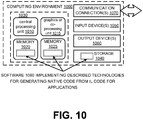
- FIG. 10 depicts a generalized example of a suitable computing environment 1000 in which the described innovations may be implemented.
- the computing environment 1000 is not intended to suggest any limitation as to scope of use or functionality, as the innovations may be implemented in diverse general-purpose or special-purpose computing systems.
- the computing environment 1000 can be any of a variety of computing devices (e.g., desktop computer, laptop computer, server computer, tablet computer, media player, gaming system, mobile device, etc.)
- the computing environment 1000 includes one or more processing units 1010, 1015 and memory 1020, 1025.
- the processing units 1010, 1015 execute computer-executable instructions.
- a processing unit can be a general-purpose central processing unit (CPU), processor in an application-specific integrated circuit (ASIC) or any other type of processor.
- ASIC application-specific integrated circuit
- FIG. 10 shows a central processing unit 1010 as well as a graphics processing unit or co-processing unit 1015.
- the tangible memory 1020, 1025 may be volatile memory (e.g., registers, cache, RAM), non-volatile memory (e.g., ROM, EEPROM, flash memory, etc.), or some combination of the two, accessible by the processing unit(s).
- the memory 1020, 1025 stores software 1080 implementing one or more innovations described herein, in the form of computer-executable instructions suitable for execution by the processing unit(s).
- a computing system may have additional features.
- the computing environment 1000 includes storage 1040, one or more input devices 1050, one or more output devices 1060, and one or more communication connections 1070.
- An interconnection mechanism such as a bus, controller, or network interconnects the components of the computing environment 1000.
- operating system software provides an operating environment for other software executing in the computing environment 1000, and coordinates activities of the components of the computing environment 1000.
- the tangible storage 1040 may be removable or non-removable, and includes magnetic disks, magnetic tapes or cassettes, CD-ROMs, DVDs, or any other medium which can be used to store information in a non-transitory way and which can be accessed within the computing environment 1000.
- the storage 1040 stores instructions for the software 1080 implementing one or more innovations described herein such as generating native code from IL code for one or more applications.
- the input device(s) 1050 may be a touch input device such as a keyboard, mouse, pen, or trackball, a voice input device, a scanning device, or another device that provides input to the computing environment 1000.
- the input device(s) 1050 may be a camera, video card, TV tuner card, or similar device that accepts video input in analog or digital form, or a CD-ROM or CD-RW that reads video samples into the computing environment 1000.
- the output device(s) 1060 may be a display, printer, speaker, CD-writer, or another device that provides output from the computing environment 1000.
- the communication connection(s) 1070 enable communication over a communication medium to another computing entity.
- the communication medium conveys information such as computer-executable instructions, audio or video input or output, or other data in a modulated data signal.
- a modulated data signal is a signal that has one or more of its characteristics set or changed in such a manner as to encode information in the signal.
- communication media can use an electrical, optical, RF, or other carrier.
- any of the disclosed methods can be implemented as computer-executable instructions stored on one or more computer-readable storage media (e.g., non-transitory computer-readable media, such as one or more optical media discs, volatile memory components (such as DRAM or SRAM), or nonvolatile memory components (such as flash memory or hard drives)) and executed on a computer (e.g., any commercially available computer, including smart phones or other mobile devices that include computing hardware).
- computer-readable storage media does not include communication connections, such as modulated data signals.
- Any of the computer-executable instructions for implementing the disclosed techniques as well as any data created and used during implementation of the disclosed embodiments can be stored on one or more computer-readable media (e.g., non-transitory computer-readable media, which excludes propagated signals).
- the computer-executable instructions can be part of, for example, a dedicated software application or a software application that is accessed or downloaded via a web browser or other software application (such as a remote computing application).
- Such software can be executed, for example, on a single local computer (e.g., any suitable commercially available computer) or in a network environment (e.g., via the Internet, a wide-area network, a local-area network, a client-server network (such as a cloud computing network), or other such network) using one or more network computers.
- a single local computer e.g., any suitable commercially available computer
- a network environment e.g., via the Internet, a wide-area network, a local-area network, a client-server network (such as a cloud computing network), or other such network
- a single local computer e.g., any suitable commercially available computer
- a network environment e.g., via the Internet, a wide-area network, a local-area network, a client-server network (such as a cloud computing network), or other such network
- client-server network such as a cloud computing network
- any functionally described herein can be performed, at least in part, by one or more hardware logic components, instead of software.
- illustrative types of hardware logic components include Field-programmable Gate Arrays (FPGAs), Program-specific Integrated Circuits (ASICs), Program-specific Standard Products (ASSPs), System-on-a-chip systems (SOCs), Complex Programmable Logic Devices (CPLDs), etc.
- any of the software-based embodiments can be uploaded, downloaded, or remotely accessed through a suitable communication means.
- suitable communication means include, for example, the Internet, the World Wide Web, an intranet, software applications, cable (including fiber optic cable), magnetic communications, electromagnetic communications (including RF, microwave, and infrared communications), electronic communications, or other such communication means.
Landscapes
- Engineering & Computer Science (AREA)
- Theoretical Computer Science (AREA)
- General Engineering & Computer Science (AREA)
- Software Systems (AREA)
- Physics & Mathematics (AREA)
- General Physics & Mathematics (AREA)
- Computer Security & Cryptography (AREA)
- Stored Programmes (AREA)
Priority Applications (1)
| Application Number | Priority Date | Filing Date | Title |
|---|---|---|---|
| EP17180650.8A EP3249526B1 (en) | 2012-09-05 | 2013-09-03 | Generating native code from intermediate language code for an application |
Applications Claiming Priority (2)
| Application Number | Priority Date | Filing Date | Title |
|---|---|---|---|
| US13/604,618 US9569184B2 (en) | 2012-09-05 | 2012-09-05 | Generating native code from intermediate language code for an application |
| PCT/US2013/057892 WO2014039458A1 (en) | 2012-09-05 | 2013-09-03 | Generating native code from intermediate language code for an application |
Related Child Applications (2)
| Application Number | Title | Priority Date | Filing Date |
|---|---|---|---|
| EP17180650.8A Division EP3249526B1 (en) | 2012-09-05 | 2013-09-03 | Generating native code from intermediate language code for an application |
| EP17180650.8A Division-Into EP3249526B1 (en) | 2012-09-05 | 2013-09-03 | Generating native code from intermediate language code for an application |
Publications (2)
| Publication Number | Publication Date |
|---|---|
| EP2893441A1 EP2893441A1 (en) | 2015-07-15 |
| EP2893441B1 true EP2893441B1 (en) | 2017-08-30 |
Family
ID=49226515
Family Applications (2)
| Application Number | Title | Priority Date | Filing Date |
|---|---|---|---|
| EP13765843.1A Active EP2893441B1 (en) | 2012-09-05 | 2013-09-03 | Generating native code from intermediate language code for an application |
| EP17180650.8A Active EP3249526B1 (en) | 2012-09-05 | 2013-09-03 | Generating native code from intermediate language code for an application |
Family Applications After (1)
| Application Number | Title | Priority Date | Filing Date |
|---|---|---|---|
| EP17180650.8A Active EP3249526B1 (en) | 2012-09-05 | 2013-09-03 | Generating native code from intermediate language code for an application |
Country Status (18)
| Country | Link |
|---|---|
| US (2) | US9569184B2 (enExample) |
| EP (2) | EP2893441B1 (enExample) |
| JP (1) | JP6294886B2 (enExample) |
| KR (1) | KR102077360B1 (enExample) |
| CN (1) | CN104781785B (enExample) |
| AU (1) | AU2013312865B2 (enExample) |
| BR (1) | BR112015004684A2 (enExample) |
| CA (1) | CA2883571A1 (enExample) |
| CL (1) | CL2015000524A1 (enExample) |
| IL (1) | IL237547A0 (enExample) |
| MX (1) | MX348681B (enExample) |
| MY (1) | MY181735A (enExample) |
| NZ (1) | NZ705379A (enExample) |
| PH (1) | PH12015500405A1 (enExample) |
| RU (1) | RU2643484C2 (enExample) |
| SG (1) | SG11201501527RA (enExample) |
| WO (1) | WO2014039458A1 (enExample) |
| ZA (1) | ZA201501182B (enExample) |
Families Citing this family (29)
| Publication number | Priority date | Publication date | Assignee | Title |
|---|---|---|---|---|
| SE537794C2 (sv) * | 2012-03-20 | 2015-10-20 | Propellerhead Software Aktiebolag | Förfaranden för att distribuera en dataprogramprodukt och ett datorsystem |
| WO2014051608A1 (en) * | 2012-09-28 | 2014-04-03 | Hewlett-Packard Development Company, L.P. | Application randomization |
| US9104504B2 (en) * | 2013-03-13 | 2015-08-11 | Dell Products Lp | Systems and methods for embedded shared libraries in an executable image |
| US11050820B2 (en) * | 2013-04-29 | 2021-06-29 | Sap Se | Cloud sharing system |
| US9612804B2 (en) * | 2013-09-06 | 2017-04-04 | Unisys Corporation | Business suite framework for developing software applications |
| US9529610B2 (en) * | 2013-12-30 | 2016-12-27 | Unisys Corporation | Updating compiled native instruction paths |
| US20160070541A1 (en) * | 2014-09-08 | 2016-03-10 | Unisys Corporation | Conversion of business suite solutions |
| RU2628920C2 (ru) * | 2015-03-31 | 2017-08-22 | Закрытое акционерное общество "Лаборатория Касперского" | Способ обнаружения вредоносных сборок |
| RU2635271C2 (ru) * | 2015-03-31 | 2017-11-09 | Закрытое акционерное общество "Лаборатория Касперского" | Способ категоризации сборок и зависимых образов |
| CN105100191B (zh) * | 2015-05-22 | 2018-09-21 | 华为技术有限公司 | 一种云编译实现Java应用安装的方法、装置及系统 |
| CN104834530A (zh) * | 2015-05-27 | 2015-08-12 | 百富计算机技术(深圳)有限公司 | 一种pos应用程序的开发方法及云端服务器 |
| US9367686B1 (en) * | 2015-07-21 | 2016-06-14 | AO Kaspersky Lab | System and method for antivirus checking of native images of software assemblies |
| GB2542355B (en) | 2015-09-15 | 2019-07-17 | Samsung Electronics Co Ltd | Methods and apparatus for distributing and installing trusted applications |
| WO2017047904A1 (ko) * | 2015-09-15 | 2017-03-23 | 삼성전자 주식회사 | 신뢰된 어플리케이션을 전자 디바이스에 설치하는 방법 및 장치 |
| RU2625052C1 (ru) * | 2016-03-18 | 2017-07-11 | Акционерное общество "Лаборатория Касперского" | Способ ограничения доступа образа машинного кода к ресурсам операционной системы |
| CN108519874B (zh) * | 2017-02-27 | 2022-03-29 | 腾讯科技(深圳)有限公司 | Python项目包的生成方法及装置 |
| CN108897562B (zh) * | 2018-06-27 | 2022-08-09 | 腾讯科技(深圳)有限公司 | 安装包更新方法、装置、介质以及设备 |
| KR102663196B1 (ko) * | 2018-11-16 | 2024-05-07 | 삼성전자주식회사 | 사용자 단말장치, 서버, 사용자 단말장치의 제어방법 및 서버의 제어방법 |
| KR102257012B1 (ko) * | 2019-01-14 | 2021-05-27 | (주) 익투스지노믹스 | 다양한 클라우드에 적용 가능한 대용량 데이터 처리용 분산 처리 시스템의 설치방법 |
| CN109814866B (zh) * | 2019-01-31 | 2022-02-08 | 天津字节跳动科技有限公司 | 页面应用转化为原生应用的处理方法和装置 |
| CN111580821B (zh) * | 2019-02-15 | 2022-10-25 | 厦门雅基软件有限公司 | 脚本绑定方法、装置、电子设备及计算机可读存储介质 |
| US11150926B2 (en) | 2019-02-22 | 2021-10-19 | International Business Machines Corporation | Native code generation for cloud services |
| KR102720005B1 (ko) * | 2019-10-18 | 2024-10-22 | 삼성전자주식회사 | 어플리케이션의 최적화 방법 및 이를 지원하는 전자 장치 |
| EP4107614A4 (en) | 2020-02-21 | 2023-10-25 | Telefonaktiebolaget Lm Ericsson (Publ) | METHOD FOR UPDATING APPLICATIONS IN CLOUD ENVIRONMENTS |
| GB202012898D0 (en) * | 2020-08-18 | 2020-09-30 | Biancco Tech Group Ip Oy | Streaming methods and systems for mobile electronic device diagnostics |
| CN112925526B (zh) * | 2021-03-30 | 2023-09-19 | 平安科技(深圳)有限公司 | 基于Leakcanary的编译方法、装置、设备及介质 |
| US11481200B1 (en) | 2021-10-11 | 2022-10-25 | International Business Machines Corporation | Checking source code validity at time of code update |
| US11947966B2 (en) | 2021-10-11 | 2024-04-02 | International Business Machines Corporation | Identifying computer instructions enclosed by macros and conflicting macros at build time |
| US20250085946A1 (en) * | 2023-09-13 | 2025-03-13 | International Business Machines Corporation | Actor-critique code-to-code translation |
Family Cites Families (26)
| Publication number | Priority date | Publication date | Assignee | Title |
|---|---|---|---|---|
| JP3602857B2 (ja) * | 1991-04-23 | 2004-12-15 | 株式会社日立製作所 | 多機種対応型情報処理システム、および、方法 |
| US5812854A (en) * | 1996-03-18 | 1998-09-22 | International Business Machines Corporation | Mechanism for integrating user-defined instructions with compiler-generated instructions and for optimizing the integrated instruction stream |
| US6484313B1 (en) * | 1999-06-30 | 2002-11-19 | Microsoft Corporation | Compiling and persisting of intermediate language code |
| US7546607B2 (en) | 2002-11-19 | 2009-06-09 | Microsoft Corporation | Native code exposing virtual machine managed object |
| JP2004192038A (ja) * | 2002-12-06 | 2004-07-08 | Sharp Corp | 情報処理装置、情報処理システム、情報処理プログラム、および該プログラムを記録した記録媒体 |
| US20040221272A1 (en) * | 2003-04-30 | 2004-11-04 | Gansha Wu | Apparatus and methods for desynchronizing object-oriented software applications in managed runtime environments |
| US7487498B2 (en) * | 2003-11-12 | 2009-02-03 | Microsoft Corporation | Strategy for referencing code resources |
| US20050188203A1 (en) * | 2004-02-19 | 2005-08-25 | Jp Mobile Operating L.P. | Method for packaging information with digitally signed software without breaking signature |
| US7409675B2 (en) * | 2004-02-27 | 2008-08-05 | Microsoft Corporation | Code rewriting |
| WO2005114403A1 (en) * | 2004-05-21 | 2005-12-01 | Computer Associates Think, Inc. | Method and apparatus for reusing a computer software library |
| US7730472B2 (en) | 2004-09-24 | 2010-06-01 | Hewlett-Packard Development Company, L.P. | Dynamic linking of modules in a pre-operating system environment |
| KR20070067207A (ko) * | 2004-10-12 | 2007-06-27 | 픽셀 (리서치) 리미티드 | 런타임 동적 링킹 |
| US20060080682A1 (en) * | 2004-10-12 | 2006-04-13 | Picsel Research Ltd. | Run time dynamic linking |
| US7730465B2 (en) | 2004-10-22 | 2010-06-01 | Microsoft Corporation | Mixed types |
| US20060136907A1 (en) * | 2004-12-20 | 2006-06-22 | Microsoft Corporation | Language-neutral and language-specific installation packages for software setup |
| US8074231B2 (en) * | 2005-10-26 | 2011-12-06 | Microsoft Corporation | Configuration of isolated extensions and device drivers |
| US7987457B2 (en) | 2007-06-25 | 2011-07-26 | Microsoft Corporation | Targeted patching for native generation images |
| US20090064196A1 (en) * | 2007-08-31 | 2009-03-05 | Microsoft Corporation | Model based device driver code generation |
| CN100478897C (zh) | 2007-12-04 | 2009-04-15 | 腾讯科技(深圳)有限公司 | 实现在游戏运行过程中自动验证支付的方法、装置和系统 |
| CN101546311B (zh) * | 2008-03-27 | 2012-05-02 | 北京铭万互联科技有限公司 | 回收站的数据处理方法及数据处理装置 |
| KR101092373B1 (ko) * | 2010-01-07 | 2011-12-09 | 한국과학기술연구원 | 소프트웨어 패키지의 생성 및 설치를 위한 시스템 및 방법 |
| US8869138B2 (en) * | 2011-11-11 | 2014-10-21 | Wyse Technology L.L.C. | Robust firmware update with recovery logic |
| US8365156B2 (en) * | 2010-04-17 | 2013-01-29 | Microsoft Corporation | Intermediate language support for change resilience |
| US8924922B2 (en) * | 2010-06-14 | 2014-12-30 | Microsoft Corporation | Pre-compiling hosted managed code |
| EP2405352A1 (en) | 2010-07-08 | 2012-01-11 | Fujitsu Limited | Instrumentation of proprietary software libraries |
| US8683462B2 (en) | 2010-10-22 | 2014-03-25 | Adobe Systems Incorporated | Handling calls to native code in a managed code environment |
-
2012
- 2012-09-05 US US13/604,618 patent/US9569184B2/en active Active
-
2013
- 2013-09-03 KR KR1020157005830A patent/KR102077360B1/ko not_active Expired - Fee Related
- 2013-09-03 MX MX2015002906A patent/MX348681B/es active IP Right Grant
- 2013-09-03 AU AU2013312865A patent/AU2013312865B2/en not_active Ceased
- 2013-09-03 MY MYPI2015700678A patent/MY181735A/en unknown
- 2013-09-03 NZ NZ705379A patent/NZ705379A/en not_active IP Right Cessation
- 2013-09-03 RU RU2015107557A patent/RU2643484C2/ru not_active IP Right Cessation
- 2013-09-03 EP EP13765843.1A patent/EP2893441B1/en active Active
- 2013-09-03 CA CA2883571A patent/CA2883571A1/en not_active Abandoned
- 2013-09-03 WO PCT/US2013/057892 patent/WO2014039458A1/en not_active Ceased
- 2013-09-03 JP JP2015530146A patent/JP6294886B2/ja not_active Expired - Fee Related
- 2013-09-03 EP EP17180650.8A patent/EP3249526B1/en active Active
- 2013-09-03 CN CN201380057733.2A patent/CN104781785B/zh active Active
- 2013-09-03 SG SG11201501527RA patent/SG11201501527RA/en unknown
- 2013-09-03 BR BR112015004684A patent/BR112015004684A2/pt not_active Application Discontinuation
-
2015
- 2015-02-20 ZA ZA2015/01182A patent/ZA201501182B/en unknown
- 2015-02-25 PH PH12015500405A patent/PH12015500405A1/en unknown
- 2015-03-04 CL CL2015000524A patent/CL2015000524A1/es unknown
- 2015-03-04 IL IL237547A patent/IL237547A0/en unknown
-
2016
- 2016-12-28 US US15/393,182 patent/US10795652B2/en active Active
Non-Patent Citations (1)
| Title |
|---|
| None * |
Also Published As
| Publication number | Publication date |
|---|---|
| KR102077360B1 (ko) | 2020-02-13 |
| US20140068583A1 (en) | 2014-03-06 |
| RU2643484C2 (ru) | 2018-02-01 |
| NZ705379A (en) | 2018-04-27 |
| MY181735A (en) | 2021-01-05 |
| CN104781785B (zh) | 2018-05-15 |
| MX2015002906A (es) | 2015-06-03 |
| PH12015500405B1 (en) | 2015-04-20 |
| BR112015004684A2 (pt) | 2017-08-08 |
| PH12015500405A1 (en) | 2015-04-20 |
| IL237547A0 (en) | 2015-04-30 |
| EP3249526B1 (en) | 2020-03-25 |
| WO2014039458A1 (en) | 2014-03-13 |
| RU2015107557A (ru) | 2016-09-27 |
| MX348681B (es) | 2017-06-23 |
| EP2893441A1 (en) | 2015-07-15 |
| CN104781785A (zh) | 2015-07-15 |
| US20170109148A1 (en) | 2017-04-20 |
| EP3249526A1 (en) | 2017-11-29 |
| CA2883571A1 (en) | 2014-03-13 |
| AU2013312865A1 (en) | 2015-03-05 |
| US10795652B2 (en) | 2020-10-06 |
| HK1212482A1 (en) | 2016-06-10 |
| JP6294886B2 (ja) | 2018-03-14 |
| US9569184B2 (en) | 2017-02-14 |
| JP2015531502A (ja) | 2015-11-02 |
| ZA201501182B (en) | 2016-10-26 |
| SG11201501527RA (en) | 2015-03-30 |
| KR20150052068A (ko) | 2015-05-13 |
| AU2013312865B2 (en) | 2018-11-08 |
| CL2015000524A1 (es) | 2015-08-28 |
Similar Documents
| Publication | Publication Date | Title |
|---|---|---|
| US10795652B2 (en) | Generating native code from intermediate language code for an application | |
| US10296323B2 (en) | System and method for fast initial and incremental deployment of apps | |
| CN111740948B (zh) | 数据包发布方法、动态更新方法、装置、设备及介质 | |
| EP3005160B1 (en) | Bundle package retrieving | |
| CN105159732B (zh) | 在移动终端安装或更新应用程序的方法和移动终端 | |
| EP3188011B1 (en) | Automatic provisioning of a software platform to a device ecosystem | |
| JP2017146966A (ja) | パッケージファイルに対する機能拡張方法およびシステム | |
| EP3005100A1 (en) | Bundle package generation | |
| CN106686200B (zh) | 移动应用程序更新方法、移动终端及更新系统 | |
| CN111506904B (zh) | 漏洞在线修复的方法和装置 | |
| CN105378740A (zh) | 捆绑包签名 | |
| US20190073198A1 (en) | Multi-flavored software execution from a singular code base | |
| CN108089870B (zh) | 用于修复应用的方法和装置 | |
| CN107092472B (zh) | 一种动态发布方法及设备 | |
| KR101845155B1 (ko) | 어플리케이션 패키지를 제공하는 방법 및 시스템, 그리고 어플리케이션을 실행하는 방법 및 시스템 | |
| KR20210099880A (ko) | 컴파일러를 이용한 난독화 방법 및 시스템 | |
| HK1212482B (en) | Generating native code from intermediate language code for an application | |
| CN107784204B (zh) | 应用脱壳方法和装置 | |
| US20250383872A1 (en) | Machine neutral containerized applications | |
| WO2025259560A1 (en) | Machine neutral containerized applications | |
| CN115934123A (zh) | 一种客户端逻辑更新方法、装置、电子设备及存储介质 |
Legal Events
| Date | Code | Title | Description |
|---|---|---|---|
| PUAI | Public reference made under article 153(3) epc to a published international application that has entered the european phase |
Free format text: ORIGINAL CODE: 0009012 |
|
| 17P | Request for examination filed |
Effective date: 20150305 |
|
| AK | Designated contracting states |
Kind code of ref document: A1 Designated state(s): AL AT BE BG CH CY CZ DE DK EE ES FI FR GB GR HR HU IE IS IT LI LT LU LV MC MK MT NL NO PL PT RO RS SE SI SK SM TR |
|
| AX | Request for extension of the european patent |
Extension state: BA ME |
|
| DAX | Request for extension of the european patent (deleted) | ||
| 17Q | First examination report despatched |
Effective date: 20161202 |
|
| GRAP | Despatch of communication of intention to grant a patent |
Free format text: ORIGINAL CODE: EPIDOSNIGR1 |
|
| INTG | Intention to grant announced |
Effective date: 20170324 |
|
| GRAS | Grant fee paid |
Free format text: ORIGINAL CODE: EPIDOSNIGR3 |
|
| GRAA | (expected) grant |
Free format text: ORIGINAL CODE: 0009210 |
|
| AK | Designated contracting states |
Kind code of ref document: B1 Designated state(s): AL AT BE BG CH CY CZ DE DK EE ES FI FR GB GR HR HU IE IS IT LI LT LU LV MC MK MT NL NO PL PT RO RS SE SI SK SM TR |
|
| REG | Reference to a national code |
Ref country code: GB Ref legal event code: FG4D |
|
| REG | Reference to a national code |
Ref country code: CH Ref legal event code: EP |
|
| REG | Reference to a national code |
Ref country code: AT Ref legal event code: REF Ref document number: 924198 Country of ref document: AT Kind code of ref document: T Effective date: 20170915 |
|
| REG | Reference to a national code |
Ref country code: FR Ref legal event code: PLFP Year of fee payment: 5 |
|
| REG | Reference to a national code |
Ref country code: IE Ref legal event code: FG4D |
|
| REG | Reference to a national code |
Ref country code: NL Ref legal event code: FP |
|
| REG | Reference to a national code |
Ref country code: DE Ref legal event code: R096 Ref document number: 602013025832 Country of ref document: DE |
|
| REG | Reference to a national code |
Ref country code: DE Ref legal event code: R079 Ref document number: 602013025832 Country of ref document: DE Free format text: PREVIOUS MAIN CLASS: G06F0009450000 Ipc: G06F0009440000 |
|
| REG | Reference to a national code |
Ref country code: LT Ref legal event code: MG4D |
|
| REG | Reference to a national code |
Ref country code: AT Ref legal event code: MK05 Ref document number: 924198 Country of ref document: AT Kind code of ref document: T Effective date: 20170830 |
|
| PG25 | Lapsed in a contracting state [announced via postgrant information from national office to epo] |
Ref country code: LT Free format text: LAPSE BECAUSE OF FAILURE TO SUBMIT A TRANSLATION OF THE DESCRIPTION OR TO PAY THE FEE WITHIN THE PRESCRIBED TIME-LIMIT Effective date: 20170830 Ref country code: NO Free format text: LAPSE BECAUSE OF FAILURE TO SUBMIT A TRANSLATION OF THE DESCRIPTION OR TO PAY THE FEE WITHIN THE PRESCRIBED TIME-LIMIT Effective date: 20171130 Ref country code: FI Free format text: LAPSE BECAUSE OF FAILURE TO SUBMIT A TRANSLATION OF THE DESCRIPTION OR TO PAY THE FEE WITHIN THE PRESCRIBED TIME-LIMIT Effective date: 20170830 Ref country code: AT Free format text: LAPSE BECAUSE OF FAILURE TO SUBMIT A TRANSLATION OF THE DESCRIPTION OR TO PAY THE FEE WITHIN THE PRESCRIBED TIME-LIMIT Effective date: 20170830 Ref country code: HR Free format text: LAPSE BECAUSE OF FAILURE TO SUBMIT A TRANSLATION OF THE DESCRIPTION OR TO PAY THE FEE WITHIN THE PRESCRIBED TIME-LIMIT Effective date: 20170830 Ref country code: SE Free format text: LAPSE BECAUSE OF FAILURE TO SUBMIT A TRANSLATION OF THE DESCRIPTION OR TO PAY THE FEE WITHIN THE PRESCRIBED TIME-LIMIT Effective date: 20170830 |
|
| PG25 | Lapsed in a contracting state [announced via postgrant information from national office to epo] |
Ref country code: IS Free format text: LAPSE BECAUSE OF FAILURE TO SUBMIT A TRANSLATION OF THE DESCRIPTION OR TO PAY THE FEE WITHIN THE PRESCRIBED TIME-LIMIT Effective date: 20171230 Ref country code: GR Free format text: LAPSE BECAUSE OF FAILURE TO SUBMIT A TRANSLATION OF THE DESCRIPTION OR TO PAY THE FEE WITHIN THE PRESCRIBED TIME-LIMIT Effective date: 20171201 Ref country code: ES Free format text: LAPSE BECAUSE OF FAILURE TO SUBMIT A TRANSLATION OF THE DESCRIPTION OR TO PAY THE FEE WITHIN THE PRESCRIBED TIME-LIMIT Effective date: 20170830 Ref country code: LV Free format text: LAPSE BECAUSE OF FAILURE TO SUBMIT A TRANSLATION OF THE DESCRIPTION OR TO PAY THE FEE WITHIN THE PRESCRIBED TIME-LIMIT Effective date: 20170830 Ref country code: RS Free format text: LAPSE BECAUSE OF FAILURE TO SUBMIT A TRANSLATION OF THE DESCRIPTION OR TO PAY THE FEE WITHIN THE PRESCRIBED TIME-LIMIT Effective date: 20170830 Ref country code: BG Free format text: LAPSE BECAUSE OF FAILURE TO SUBMIT A TRANSLATION OF THE DESCRIPTION OR TO PAY THE FEE WITHIN THE PRESCRIBED TIME-LIMIT Effective date: 20171130 |
|
| PG25 | Lapsed in a contracting state [announced via postgrant information from national office to epo] |
Ref country code: CZ Free format text: LAPSE BECAUSE OF FAILURE TO SUBMIT A TRANSLATION OF THE DESCRIPTION OR TO PAY THE FEE WITHIN THE PRESCRIBED TIME-LIMIT Effective date: 20170830 Ref country code: PL Free format text: LAPSE BECAUSE OF FAILURE TO SUBMIT A TRANSLATION OF THE DESCRIPTION OR TO PAY THE FEE WITHIN THE PRESCRIBED TIME-LIMIT Effective date: 20170830 Ref country code: DK Free format text: LAPSE BECAUSE OF FAILURE TO SUBMIT A TRANSLATION OF THE DESCRIPTION OR TO PAY THE FEE WITHIN THE PRESCRIBED TIME-LIMIT Effective date: 20170830 Ref country code: RO Free format text: LAPSE BECAUSE OF FAILURE TO SUBMIT A TRANSLATION OF THE DESCRIPTION OR TO PAY THE FEE WITHIN THE PRESCRIBED TIME-LIMIT Effective date: 20170830 |
|
| REG | Reference to a national code |
Ref country code: CH Ref legal event code: PL |
|
| PG25 | Lapsed in a contracting state [announced via postgrant information from national office to epo] |
Ref country code: SM Free format text: LAPSE BECAUSE OF FAILURE TO SUBMIT A TRANSLATION OF THE DESCRIPTION OR TO PAY THE FEE WITHIN THE PRESCRIBED TIME-LIMIT Effective date: 20170830 Ref country code: SK Free format text: LAPSE BECAUSE OF FAILURE TO SUBMIT A TRANSLATION OF THE DESCRIPTION OR TO PAY THE FEE WITHIN THE PRESCRIBED TIME-LIMIT Effective date: 20170830 Ref country code: IT Free format text: LAPSE BECAUSE OF FAILURE TO SUBMIT A TRANSLATION OF THE DESCRIPTION OR TO PAY THE FEE WITHIN THE PRESCRIBED TIME-LIMIT Effective date: 20170830 Ref country code: MC Free format text: LAPSE BECAUSE OF FAILURE TO SUBMIT A TRANSLATION OF THE DESCRIPTION OR TO PAY THE FEE WITHIN THE PRESCRIBED TIME-LIMIT Effective date: 20170830 Ref country code: EE Free format text: LAPSE BECAUSE OF FAILURE TO SUBMIT A TRANSLATION OF THE DESCRIPTION OR TO PAY THE FEE WITHIN THE PRESCRIBED TIME-LIMIT Effective date: 20170830 |
|
| REG | Reference to a national code |
Ref country code: DE Ref legal event code: R097 Ref document number: 602013025832 Country of ref document: DE |
|
| REG | Reference to a national code |
Ref country code: IE Ref legal event code: MM4A |
|
| REG | Reference to a national code |
Ref country code: BE Ref legal event code: MM Effective date: 20170930 |
|
| PG25 | Lapsed in a contracting state [announced via postgrant information from national office to epo] |
Ref country code: LU Free format text: LAPSE BECAUSE OF NON-PAYMENT OF DUE FEES Effective date: 20170903 |
|
| PLBE | No opposition filed within time limit |
Free format text: ORIGINAL CODE: 0009261 |
|
| STAA | Information on the status of an ep patent application or granted ep patent |
Free format text: STATUS: NO OPPOSITION FILED WITHIN TIME LIMIT |
|
| PG25 | Lapsed in a contracting state [announced via postgrant information from national office to epo] |
Ref country code: CH Free format text: LAPSE BECAUSE OF NON-PAYMENT OF DUE FEES Effective date: 20170930 Ref country code: IE Free format text: LAPSE BECAUSE OF NON-PAYMENT OF DUE FEES Effective date: 20170903 Ref country code: LI Free format text: LAPSE BECAUSE OF NON-PAYMENT OF DUE FEES Effective date: 20170930 |
|
| 26N | No opposition filed |
Effective date: 20180531 |
|
| REG | Reference to a national code |
Ref country code: FR Ref legal event code: PLFP Year of fee payment: 6 |
|
| PG25 | Lapsed in a contracting state [announced via postgrant information from national office to epo] |
Ref country code: BE Free format text: LAPSE BECAUSE OF NON-PAYMENT OF DUE FEES Effective date: 20170930 Ref country code: SI Free format text: LAPSE BECAUSE OF FAILURE TO SUBMIT A TRANSLATION OF THE DESCRIPTION OR TO PAY THE FEE WITHIN THE PRESCRIBED TIME-LIMIT Effective date: 20170830 |
|
| PG25 | Lapsed in a contracting state [announced via postgrant information from national office to epo] |
Ref country code: MT Free format text: LAPSE BECAUSE OF NON-PAYMENT OF DUE FEES Effective date: 20170903 |
|
| PG25 | Lapsed in a contracting state [announced via postgrant information from national office to epo] |
Ref country code: HU Free format text: LAPSE BECAUSE OF FAILURE TO SUBMIT A TRANSLATION OF THE DESCRIPTION OR TO PAY THE FEE WITHIN THE PRESCRIBED TIME-LIMIT; INVALID AB INITIO Effective date: 20130903 |
|
| PG25 | Lapsed in a contracting state [announced via postgrant information from national office to epo] |
Ref country code: CY Free format text: LAPSE BECAUSE OF FAILURE TO SUBMIT A TRANSLATION OF THE DESCRIPTION OR TO PAY THE FEE WITHIN THE PRESCRIBED TIME-LIMIT Effective date: 20170830 |
|
| PG25 | Lapsed in a contracting state [announced via postgrant information from national office to epo] |
Ref country code: MK Free format text: LAPSE BECAUSE OF FAILURE TO SUBMIT A TRANSLATION OF THE DESCRIPTION OR TO PAY THE FEE WITHIN THE PRESCRIBED TIME-LIMIT Effective date: 20170830 |
|
| REG | Reference to a national code |
Ref country code: DE Ref legal event code: R082 Ref document number: 602013025832 Country of ref document: DE |
|
| PG25 | Lapsed in a contracting state [announced via postgrant information from national office to epo] |
Ref country code: TR Free format text: LAPSE BECAUSE OF FAILURE TO SUBMIT A TRANSLATION OF THE DESCRIPTION OR TO PAY THE FEE WITHIN THE PRESCRIBED TIME-LIMIT Effective date: 20170830 |
|
| PG25 | Lapsed in a contracting state [announced via postgrant information from national office to epo] |
Ref country code: PT Free format text: LAPSE BECAUSE OF FAILURE TO SUBMIT A TRANSLATION OF THE DESCRIPTION OR TO PAY THE FEE WITHIN THE PRESCRIBED TIME-LIMIT Effective date: 20170830 |
|
| PG25 | Lapsed in a contracting state [announced via postgrant information from national office to epo] |
Ref country code: AL Free format text: LAPSE BECAUSE OF FAILURE TO SUBMIT A TRANSLATION OF THE DESCRIPTION OR TO PAY THE FEE WITHIN THE PRESCRIBED TIME-LIMIT Effective date: 20170830 |
|
| P01 | Opt-out of the competence of the unified patent court (upc) registered |
Effective date: 20230501 |
|
| PGFP | Annual fee paid to national office [announced via postgrant information from national office to epo] |
Ref country code: NL Payment date: 20240820 Year of fee payment: 12 |
|
| PGFP | Annual fee paid to national office [announced via postgrant information from national office to epo] |
Ref country code: FR Payment date: 20240820 Year of fee payment: 12 |
|
| PGFP | Annual fee paid to national office [announced via postgrant information from national office to epo] |
Ref country code: DE Payment date: 20250820 Year of fee payment: 13 |
|
| PGFP | Annual fee paid to national office [announced via postgrant information from national office to epo] |
Ref country code: GB Payment date: 20250820 Year of fee payment: 13 |