EP2889136A1 - Method and apparatus for manufacturing foamed resin metal laminated sheet - Google Patents
Method and apparatus for manufacturing foamed resin metal laminated sheet Download PDFInfo
- Publication number
- EP2889136A1 EP2889136A1 EP13830680.8A EP13830680A EP2889136A1 EP 2889136 A1 EP2889136 A1 EP 2889136A1 EP 13830680 A EP13830680 A EP 13830680A EP 2889136 A1 EP2889136 A1 EP 2889136A1
- Authority
- EP
- European Patent Office
- Prior art keywords
- foamed resin
- metal laminated
- laminated sheet
- soaking
- sheet
- Prior art date
- Legal status (The legal status is an assumption and is not a legal conclusion. Google has not performed a legal analysis and makes no representation as to the accuracy of the status listed.)
- Granted
Links
Images




Classifications
-
- B—PERFORMING OPERATIONS; TRANSPORTING
- B32—LAYERED PRODUCTS
- B32B—LAYERED PRODUCTS, i.e. PRODUCTS BUILT-UP OF STRATA OF FLAT OR NON-FLAT, e.g. CELLULAR OR HONEYCOMB, FORM
- B32B37/00—Methods or apparatus for laminating, e.g. by curing or by ultrasonic bonding
- B32B37/14—Methods or apparatus for laminating, e.g. by curing or by ultrasonic bonding characterised by the properties of the layers
- B32B37/144—Methods or apparatus for laminating, e.g. by curing or by ultrasonic bonding characterised by the properties of the layers using layers with different mechanical or chemical conditions or properties, e.g. layers with different thermal shrinkage, layers under tension during bonding
-
- B—PERFORMING OPERATIONS; TRANSPORTING
- B29—WORKING OF PLASTICS; WORKING OF SUBSTANCES IN A PLASTIC STATE IN GENERAL
- B29C—SHAPING OR JOINING OF PLASTICS; SHAPING OF MATERIAL IN A PLASTIC STATE, NOT OTHERWISE PROVIDED FOR; AFTER-TREATMENT OF THE SHAPED PRODUCTS, e.g. REPAIRING
- B29C44/00—Shaping by internal pressure generated in the material, e.g. swelling or foaming ; Producing porous or cellular expanded plastics articles
- B29C44/34—Auxiliary operations
- B29C44/3415—Heating or cooling
-
- B—PERFORMING OPERATIONS; TRANSPORTING
- B29—WORKING OF PLASTICS; WORKING OF SUBSTANCES IN A PLASTIC STATE IN GENERAL
- B29C—SHAPING OR JOINING OF PLASTICS; SHAPING OF MATERIAL IN A PLASTIC STATE, NOT OTHERWISE PROVIDED FOR; AFTER-TREATMENT OF THE SHAPED PRODUCTS, e.g. REPAIRING
- B29C44/00—Shaping by internal pressure generated in the material, e.g. swelling or foaming ; Producing porous or cellular expanded plastics articles
- B29C44/34—Auxiliary operations
- B29C44/3484—Stopping the foaming reaction until the material is heated or re-heated
-
- B—PERFORMING OPERATIONS; TRANSPORTING
- B32—LAYERED PRODUCTS
- B32B—LAYERED PRODUCTS, i.e. PRODUCTS BUILT-UP OF STRATA OF FLAT OR NON-FLAT, e.g. CELLULAR OR HONEYCOMB, FORM
- B32B15/00—Layered products comprising a layer of metal
- B32B15/04—Layered products comprising a layer of metal comprising metal as the main or only constituent of a layer, which is next to another layer of the same or of a different material
- B32B15/046—Layered products comprising a layer of metal comprising metal as the main or only constituent of a layer, which is next to another layer of the same or of a different material of foam
-
- B—PERFORMING OPERATIONS; TRANSPORTING
- B32—LAYERED PRODUCTS
- B32B—LAYERED PRODUCTS, i.e. PRODUCTS BUILT-UP OF STRATA OF FLAT OR NON-FLAT, e.g. CELLULAR OR HONEYCOMB, FORM
- B32B15/00—Layered products comprising a layer of metal
- B32B15/04—Layered products comprising a layer of metal comprising metal as the main or only constituent of a layer, which is next to another layer of the same or of a different material
- B32B15/08—Layered products comprising a layer of metal comprising metal as the main or only constituent of a layer, which is next to another layer of the same or of a different material of synthetic resin
- B32B15/085—Layered products comprising a layer of metal comprising metal as the main or only constituent of a layer, which is next to another layer of the same or of a different material of synthetic resin comprising polyolefins
-
- B—PERFORMING OPERATIONS; TRANSPORTING
- B32—LAYERED PRODUCTS
- B32B—LAYERED PRODUCTS, i.e. PRODUCTS BUILT-UP OF STRATA OF FLAT OR NON-FLAT, e.g. CELLULAR OR HONEYCOMB, FORM
- B32B37/00—Methods or apparatus for laminating, e.g. by curing or by ultrasonic bonding
- B32B37/0007—Methods or apparatus for laminating, e.g. by curing or by ultrasonic bonding involving treatment or provisions in order to avoid deformation or air inclusion, e.g. to improve surface quality
- B32B37/0015—Methods or apparatus for laminating, e.g. by curing or by ultrasonic bonding involving treatment or provisions in order to avoid deformation or air inclusion, e.g. to improve surface quality to avoid warp or curl
-
- B—PERFORMING OPERATIONS; TRANSPORTING
- B32—LAYERED PRODUCTS
- B32B—LAYERED PRODUCTS, i.e. PRODUCTS BUILT-UP OF STRATA OF FLAT OR NON-FLAT, e.g. CELLULAR OR HONEYCOMB, FORM
- B32B37/00—Methods or apparatus for laminating, e.g. by curing or by ultrasonic bonding
- B32B37/08—Methods or apparatus for laminating, e.g. by curing or by ultrasonic bonding characterised by the cooling method
-
- B—PERFORMING OPERATIONS; TRANSPORTING
- B32—LAYERED PRODUCTS
- B32B—LAYERED PRODUCTS, i.e. PRODUCTS BUILT-UP OF STRATA OF FLAT OR NON-FLAT, e.g. CELLULAR OR HONEYCOMB, FORM
- B32B37/00—Methods or apparatus for laminating, e.g. by curing or by ultrasonic bonding
- B32B37/14—Methods or apparatus for laminating, e.g. by curing or by ultrasonic bonding characterised by the properties of the layers
- B32B37/16—Methods or apparatus for laminating, e.g. by curing or by ultrasonic bonding characterised by the properties of the layers with all layers existing as coherent layers before laminating
- B32B37/18—Methods or apparatus for laminating, e.g. by curing or by ultrasonic bonding characterised by the properties of the layers with all layers existing as coherent layers before laminating involving the assembly of discrete sheets or panels only
- B32B37/182—Methods or apparatus for laminating, e.g. by curing or by ultrasonic bonding characterised by the properties of the layers with all layers existing as coherent layers before laminating involving the assembly of discrete sheets or panels only one or more of the layers being plastic
-
- B—PERFORMING OPERATIONS; TRANSPORTING
- B32—LAYERED PRODUCTS
- B32B—LAYERED PRODUCTS, i.e. PRODUCTS BUILT-UP OF STRATA OF FLAT OR NON-FLAT, e.g. CELLULAR OR HONEYCOMB, FORM
- B32B5/00—Layered products characterised by the non- homogeneity or physical structure, i.e. comprising a fibrous, filamentary, particulate or foam layer; Layered products characterised by having a layer differing constitutionally or physically in different parts
- B32B5/18—Layered products characterised by the non- homogeneity or physical structure, i.e. comprising a fibrous, filamentary, particulate or foam layer; Layered products characterised by having a layer differing constitutionally or physically in different parts characterised by features of a layer of foamed material
- B32B5/20—Layered products characterised by the non- homogeneity or physical structure, i.e. comprising a fibrous, filamentary, particulate or foam layer; Layered products characterised by having a layer differing constitutionally or physically in different parts characterised by features of a layer of foamed material foamed in situ
-
- B—PERFORMING OPERATIONS; TRANSPORTING
- B29—WORKING OF PLASTICS; WORKING OF SUBSTANCES IN A PLASTIC STATE IN GENERAL
- B29C—SHAPING OR JOINING OF PLASTICS; SHAPING OF MATERIAL IN A PLASTIC STATE, NOT OTHERWISE PROVIDED FOR; AFTER-TREATMENT OF THE SHAPED PRODUCTS, e.g. REPAIRING
- B29C35/00—Heating, cooling or curing, e.g. crosslinking or vulcanising; Apparatus therefor
- B29C35/16—Cooling
-
- B—PERFORMING OPERATIONS; TRANSPORTING
- B29—WORKING OF PLASTICS; WORKING OF SUBSTANCES IN A PLASTIC STATE IN GENERAL
- B29C—SHAPING OR JOINING OF PLASTICS; SHAPING OF MATERIAL IN A PLASTIC STATE, NOT OTHERWISE PROVIDED FOR; AFTER-TREATMENT OF THE SHAPED PRODUCTS, e.g. REPAIRING
- B29C44/00—Shaping by internal pressure generated in the material, e.g. swelling or foaming ; Producing porous or cellular expanded plastics articles
- B29C44/02—Shaping by internal pressure generated in the material, e.g. swelling or foaming ; Producing porous or cellular expanded plastics articles for articles of definite length, i.e. discrete articles
- B29C44/12—Incorporating or moulding on preformed parts, e.g. inserts or reinforcements
- B29C44/1228—Joining preformed parts by the expanding material
-
- B—PERFORMING OPERATIONS; TRANSPORTING
- B29—WORKING OF PLASTICS; WORKING OF SUBSTANCES IN A PLASTIC STATE IN GENERAL
- B29K—INDEXING SCHEME ASSOCIATED WITH SUBCLASSES B29B, B29C OR B29D, RELATING TO MOULDING MATERIALS OR TO MATERIALS FOR MOULDS, REINFORCEMENTS, FILLERS OR PREFORMED PARTS, e.g. INSERTS
- B29K2101/00—Use of unspecified macromolecular compounds as moulding material
- B29K2101/12—Thermoplastic materials
-
- B—PERFORMING OPERATIONS; TRANSPORTING
- B29—WORKING OF PLASTICS; WORKING OF SUBSTANCES IN A PLASTIC STATE IN GENERAL
- B29K—INDEXING SCHEME ASSOCIATED WITH SUBCLASSES B29B, B29C OR B29D, RELATING TO MOULDING MATERIALS OR TO MATERIALS FOR MOULDS, REINFORCEMENTS, FILLERS OR PREFORMED PARTS, e.g. INSERTS
- B29K2705/00—Use of metals, their alloys or their compounds, for preformed parts, e.g. for inserts
-
- B—PERFORMING OPERATIONS; TRANSPORTING
- B29—WORKING OF PLASTICS; WORKING OF SUBSTANCES IN A PLASTIC STATE IN GENERAL
- B29K—INDEXING SCHEME ASSOCIATED WITH SUBCLASSES B29B, B29C OR B29D, RELATING TO MOULDING MATERIALS OR TO MATERIALS FOR MOULDS, REINFORCEMENTS, FILLERS OR PREFORMED PARTS, e.g. INSERTS
- B29K2705/00—Use of metals, their alloys or their compounds, for preformed parts, e.g. for inserts
- B29K2705/02—Aluminium
-
- B—PERFORMING OPERATIONS; TRANSPORTING
- B29—WORKING OF PLASTICS; WORKING OF SUBSTANCES IN A PLASTIC STATE IN GENERAL
- B29L—INDEXING SCHEME ASSOCIATED WITH SUBCLASS B29C, RELATING TO PARTICULAR ARTICLES
- B29L2031/00—Other particular articles
- B29L2031/10—Building elements, e.g. bricks, blocks, tiles, panels, posts, beams
-
- B—PERFORMING OPERATIONS; TRANSPORTING
- B32—LAYERED PRODUCTS
- B32B—LAYERED PRODUCTS, i.e. PRODUCTS BUILT-UP OF STRATA OF FLAT OR NON-FLAT, e.g. CELLULAR OR HONEYCOMB, FORM
- B32B15/00—Layered products comprising a layer of metal
- B32B15/20—Layered products comprising a layer of metal comprising aluminium or copper
-
- B—PERFORMING OPERATIONS; TRANSPORTING
- B32—LAYERED PRODUCTS
- B32B—LAYERED PRODUCTS, i.e. PRODUCTS BUILT-UP OF STRATA OF FLAT OR NON-FLAT, e.g. CELLULAR OR HONEYCOMB, FORM
- B32B38/00—Ancillary operations in connection with laminating processes
- B32B2038/0052—Other operations not otherwise provided for
- B32B2038/0084—Foaming
-
- B—PERFORMING OPERATIONS; TRANSPORTING
- B32—LAYERED PRODUCTS
- B32B—LAYERED PRODUCTS, i.e. PRODUCTS BUILT-UP OF STRATA OF FLAT OR NON-FLAT, e.g. CELLULAR OR HONEYCOMB, FORM
- B32B2250/00—Layers arrangement
- B32B2250/40—Symmetrical or sandwich layers, e.g. ABA, ABCBA, ABCCBA
-
- B—PERFORMING OPERATIONS; TRANSPORTING
- B32—LAYERED PRODUCTS
- B32B—LAYERED PRODUCTS, i.e. PRODUCTS BUILT-UP OF STRATA OF FLAT OR NON-FLAT, e.g. CELLULAR OR HONEYCOMB, FORM
- B32B2266/00—Composition of foam
- B32B2266/02—Organic
- B32B2266/0214—Materials belonging to B32B27/00
- B32B2266/025—Polyolefin
-
- B—PERFORMING OPERATIONS; TRANSPORTING
- B32—LAYERED PRODUCTS
- B32B—LAYERED PRODUCTS, i.e. PRODUCTS BUILT-UP OF STRATA OF FLAT OR NON-FLAT, e.g. CELLULAR OR HONEYCOMB, FORM
- B32B2266/00—Composition of foam
- B32B2266/04—Inorganic
- B32B2266/045—Metal
-
- B—PERFORMING OPERATIONS; TRANSPORTING
- B32—LAYERED PRODUCTS
- B32B—LAYERED PRODUCTS, i.e. PRODUCTS BUILT-UP OF STRATA OF FLAT OR NON-FLAT, e.g. CELLULAR OR HONEYCOMB, FORM
- B32B2305/00—Condition, form or state of the layers or laminate
- B32B2305/02—Cellular or porous
- B32B2305/022—Foam
-
- B—PERFORMING OPERATIONS; TRANSPORTING
- B32—LAYERED PRODUCTS
- B32B—LAYERED PRODUCTS, i.e. PRODUCTS BUILT-UP OF STRATA OF FLAT OR NON-FLAT, e.g. CELLULAR OR HONEYCOMB, FORM
- B32B2311/00—Metals, their alloys or their compounds
- B32B2311/24—Aluminium
-
- B—PERFORMING OPERATIONS; TRANSPORTING
- B32—LAYERED PRODUCTS
- B32B—LAYERED PRODUCTS, i.e. PRODUCTS BUILT-UP OF STRATA OF FLAT OR NON-FLAT, e.g. CELLULAR OR HONEYCOMB, FORM
- B32B2323/00—Polyalkenes
- B32B2323/10—Polypropylene
-
- B—PERFORMING OPERATIONS; TRANSPORTING
- B32—LAYERED PRODUCTS
- B32B—LAYERED PRODUCTS, i.e. PRODUCTS BUILT-UP OF STRATA OF FLAT OR NON-FLAT, e.g. CELLULAR OR HONEYCOMB, FORM
- B32B2419/00—Buildings or parts thereof
Definitions
- the present invention relates to a method and an apparatus for manufacturing a foamed resin metal laminated sheet in which metal plates are laminated on both sides of a foamed resin sheet.
- a foamed resin metal laminated sheet in which metal plates are laminated on both sides of a foamed resin sheet formed by foaming a foamable resin sheet is obtained by heating a foamable resin metal laminated sheet in which metal plates are laminated on both sides of a foamable resin sheet in an unfoamed state and foaming the foamable resin sheet.
- the foamable resin metal laminated sheet can be subjected to a cold press molding. That is, the foamable resin metal laminated sheet is first formed into a desired three-dimensional curved shape, and then heated by a drying furnace or the like to foam the foamable resin sheet, thereby increasing an interval distance between two metal plates.
- a foamed resin metal laminated sheet having higher flexural rigidity and less weight than a metal plate composed of a single material with an equal plate thickness can be obtained.
- Patent Document 1 JP 2009-279922 A
- a problem of obtaining such foamed resin metal laminated sheet lies in the fact that in-plane strain of thermal contraction generated during a cooling step after heating and foaming is large enough to cause rippling phenomenon, so that a molded article having a flat shape can not be obtained.
- This problem is of small account when a molded article having a deeply drawn shape is press-molded due to its increased geometrical rigidity, however it becomes significant when a foamed resin metal laminated sheet in a flat shape, or a foamed resin metal laminated sheet having a relatively flat and smooth curved surface is to be obtained.
- a hot gas circulation type heating furnace is used for heating.
- the peripheral area of the rectangular foamable resin sheet exposed to the outside is directly blown by hot air, while the middle area of the foamable resin sheet is not heated until after the aluminum plate is heated.
- the peripheral area of the foamable resin sheet directly blown by hot air has a higher temperature rise rate than the middle area. This causes a variation in temperature distribution inside of the flat sheet in the heating furnace at the same time point, however a foaming ratio of the foamable resin sheet can be set evenly over the entire area of the foamable resin metal laminated sheet if sufficient heating time is provided (e.g. about 17 min.).
- a foamed resin sheet formed by foaming the foamable resin sheet is in a molten state having viscosity, and the foamed resin sheet has Young's modulus far smaller than that of aluminum.
- Young's modulus far smaller than that of aluminum.
- the foamed resin metal laminated sheet is cooled to room temperature after heating in the heating furnace.
- the rectangular foamed resin sheet contains many air bubbles and has a low thermal conductivity.
- heat in the middle area is dissipated to the surroundings only through the aluminum plate instead of being transferred into the in-plane direction, while heat in the peripheral area exposed to the outside is directly dissipated to the air.
- the temperature in the peripheral area of the foamed resin sheet drops faster than the middle area and reaches below a melting point thereby solidifying the peripheral area.
- the foamed resin sheet also serves as a heat storage material, the temperature of the aluminum plate in the middle area hardly drops, while the temperature of the aluminum plate in the peripheral area drops as the foamed resin sheet is solidified. This causes a big difference in thermal strain between the middle area and the peripheral area of the aluminum plate. As a result, rippling phenomenon occurs over the entire area of the foamed resin metal laminated sheet.
- An object of the present invention is to provide a method and an apparatus for manufacturing a foamed resin metal laminated sheet capable of suppressing the rippling phenomenon caused by thermal strain.
- a method for manufacturing a foamed resin metal laminated sheet of the present invention is characterized by comprising a laminating step for laminating metal plates on both sides of a foamable resin sheet in an unfoamed state to form a foamable resin metal laminated sheet, a heating step for heating the foamable resin metal laminated sheet and foaming the foamable resin sheet to form a foamed resin metal laminated sheet, and a cooling step for cooling the foamed resin metal laminated sheet to room temperature, the cooling step comprising a soaking step for cooling the foamed resin metal laminated sheet to a soaking temperature lower than a foaming temperature of the foamable resin sheet and higher than the room temperature and holding the foamed resin metal laminated sheet at the soaking temperature, and a room temperature cooling step for cooling the foamed resin metal laminated sheet to the room temperature after the soaking step.
- the foamed resin metal laminated sheet when the foamed resin metal laminated sheet is cooled to the room temperature, it is temporarily cooled to the soaking temperature and held at the soaking temperature, and then cooled to the room temperature.
- a variation in cooling speed in the foamed resin sheet can be suppressed by temporarily holding the foamed resin metal laminated sheet at the soaking temperature to make the temperature of the foamed resin sheet formed by foaming the foamable resin sheet uniform over the entire area of the foamed resin metal laminated sheet before the foamed resin metal laminated sheet is cooled to the room temperature. In this way, the rippling phenomenon due to thermal strain caused by the variation in cooling speed in the foamed resin sheet can be suppressed.
- the soaking temperature may be set in the range of not lower than Tm but not higher than 1.3Tm, where Tm represents a melting point of a foamable resin of the foamable resin sheet.
- Tm represents a melting point of a foamable resin of the foamable resin sheet.
- the initiation timing of solidifying the foamed resin sheet can be synchronized in the entire area of the foamed resin metal laminated sheet in the transition from the soaking step to a room temperature cooling step, thus the variation in cooling speed in the foamed resin sheet can be further suppressed.
- the foamed resin sheet is changed at phase from a liquid phase to a solid phase by cooling.
- the melting point described here means a congealing point in a strict sense. The melting point matches the congealing point without a hysteresis effect.
- the cooling step may further comprise a second soaking step between the soaking step and the room temperature cooling step for cooling the foamed resin metal laminated sheet at a second soaking temperature lower than the soaking temperature and higher than the room temperature and holding the foamed resin metal laminated sheet at the second soaking temperature.
- the variation in cooling speed in the foamed resin sheet can be further suppressed by holding the foamed resin metal laminated sheet at the soaking temperature first to make the temperature of the foamed resin sheet uniform over the entire area of the foamed resin metal laminated sheet, and then further holding the foamed resin metal laminated sheet at the second soaking temperature to make the temperature of the foamed resin sheet uniform over the entire area of the foamed resin metal laminated sheet.
- the second soaking step may be performed a plurality of times at the second soaking temperature lower than the previous second soaking temperature.
- the variation in cooling speed in the foamed resin sheet can be further suppressed by decreasing stepwise the temperature of the foamed resin sheet through repeating a plurality of times the step of temporally holding the foamed resin metal laminated sheet at the second soaking temperature while lowering the second soaking temperature each time to make the temperature of the foamed resin sheet uniform over the entire area of the foamed resin metal laminated sheet.
- the foamable resin sheet may contain polypropylene and the metal plates may contain aluminum. According to the configuration described above, the uniform foaming performance can be obtained by using the foamable resin sheet containing polypropylene. Rigidity and lightweight properties of the foamed resin metal laminated sheet can be improved by using the metal plates containing aluminum.
- An apparatus for manufacturing a foamed resin metal laminated sheet of the present invention is characterized by comprising a heating unit for heating a foamable resin metal laminated sheet in which metal plates are laminated on both sides of a foamable resin sheet in an unfoamed state and foaming the foamable resin sheet to form a foamed resin metal laminated sheet, and a cooling unit for cooling the foamed resin metal laminated sheet to room temperature, the cooling unit comprising a soaking unit for cooling the foamed resin metal laminated sheet to a soaking temperature lower than a foaming temperature of the foamable resin sheet and higher than the room temperature, and holding the foamed resin metal laminated sheet at the soaking temperature, and a room temperature cooling unit provided on the downstream side of the soaking unit for cooling the foamed resin metal laminated sheet to the room temperature.
- the foamed resin metal laminated sheet when the foamed resin metal laminated sheet is cooled to the room temperature, it is temporarily cooled to the soaking temperature and held at the soaking temperature, and then cooled to the room temperature.
- a variation in cooling speed in the foamed resin sheet can be suppressed by temporarily holding the foamed resin metal laminated sheet at the soaking temperature to make the temperature of the foamed resin sheet formed by foaming the foamable resin sheet uniform over the entire area of the foamed resin metal laminated sheet before the foamed resin metal laminated sheet is cooled to the room temperature. In this way, rippling phenomenon due to thermal strain caused by a variation in cooling speed in the foamed resin sheet can be suppressed.
- the soaking temperature may be set in the range of not lower than Tm but not higher than 1.3Tm, where Tm represents a melting point of a foamable resin of the foamable resin sheet.
- Tm represents a melting point of a foamable resin of the foamable resin sheet.
- the initiation timing of solidifying the foamed resin sheet can be synchronized in the entire area of the foamed resin metal laminated sheet in the transition from the soaking unit to the room temperature cooling unit, thus the variation in cooling speed in the foamed resin sheet can be further suppressed.
- the cooling unit may further comprise a second soaking unit between the soaking unit and the room temperature cooling unit for cooling the foamed resin metal laminated sheet at a second soaking temperature lower than the soaking temperature and higher than the room temperature and holding the foamed resin metal laminated sheet at the second soaking temperature.
- the variation in cooling speed in the foamed resin sheet can be further suppressed by holding the foamed resin metal laminated sheet at the soaking temperature first to make the temperature of the foamed resin sheet uniform over the entire area of the foamed resin metal laminated sheet, and then further holding the foamed resin metal laminated sheet at the second soaking temperature to make the temperature of the foamed resin sheet uniform over the entire area of the foamed resin metal laminated sheet.
- the apparatus may be provided with two or more the second soaking units in tandem so that the soaking temperature becomes lower in order of the second soaking units.
- the variation in cooling speed in the foamed resin sheet can be further suppressed by decreasing stepwise the temperature of the foamed resin sheet through repeating a plurality of times the step of temporally holding the foamed resin metal laminated sheet at the second soaking temperature while lowering the second soaking temperature each time to make the temperature of the foamed resin sheet uniform over the entire area of the foamed resin metal laminated sheet.
- the foamable resin sheet may contain polypropylene and the metal plates may contain aluminum. According to the configuration described above, the uniform foaming performance can be obtained by using the foamable resin sheet containing polypropylene. Rigidity and lightweight properties of the foamed resin metal laminated sheet can be improved by using the metal plates containing aluminum.
- the soaking unit may be a hot gas circulation type heating furnace. According to the configuration described above, metals that are not efficiently heated by a far infrared radiation heating method due to heat-ray reflection can also be suitably heated by the soaking unit using the hot gas circulation type heating furnace.
- a variation in cooling speed in a foamed resin sheet can be suppressed by temporarily holding a foamed resin metal laminated sheet at a soaking temperature to make the temperature of the foamed resin sheet formed by foaming a foamable resin sheet uniform over the entire area of the foamed resin metal laminated sheet before the foamed resin metal laminated sheet is cooled to room temperature. In this way, rippling phenomenon due to thermal strain caused by a variation in cooling speed in the foamed resin sheet can be suppressed.
- a foamed resin metal laminated sheet obtained by the method for manufacturing a foamed resin metal laminated sheet according to the present invention can be used, for example, as a material for a structure constituting a body of a bullet train, an airplane, or the like. Further, the foamed resin metal laminated sheet can be widely used as a material for a floor, a wall, or a ceiling of building or the like.
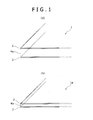
- a foamed resin metal laminated sheet 1 manufactured by a method for manufacturing a foamed resin metal laminated sheet according to a first embodiment of the present invention is composed of a foamed resin sheet 4a in a foamed state and two aluminum plates 2 laminated on both sides of the foamed resin sheet 4a.
- the foamed resin metal laminated sheet 1 is formed by heating a foamable resin metal laminated sheet 1a shown in Fig. 1 (b) and foaming a foamable resin sheet 4b in an unfoamed state.
- the foamable resin metal laminated sheet 1a is composed of the foamable resin sheet 4b in an unfoamed state and two aluminum plates 2 laminated on both sides of the foamable resin sheet 4b.
- the foamed resin sheet 4a in the foamed resin metal laminated sheet 1 includes a mass of individually independent cells (closed cells).
- the foamed resin metal laminated sheet 1 exhibits higher flexural rigidity and more lightweight than an aluminum plate composed of a single aluminum material with an equal plate thickness.
- Rigidity of the foamed resin metal laminated sheet 1 differs significantly between the case where the foamed resin metal laminated sheet 1 is formed by foaming the foamable resin sheet 4b after the foamable resin metal laminated sheet 1a is press-molded in a desired shape, and the case where a laminated sheet is obtained by laminating aluminum plates on both sides of a foamed resin sheet foamed in advance, and then the laminated sheet is press-molded in a desired shape.
- the foamable resin sheet 4b is foamed after press molding thereby maintaining a mass of closed cells and gaining high rigidity.
- the foamed resin metal laminated sheet 1 is composed of the foamed resin sheet 4a and two metal plates (aluminum plates) 2 laminated on both sides of the foamed resin sheet 4a, however, the configuration of the foamed resin metal laminated sheet is not limited thereto.
- an unfoamable resin sheet may be further disposed between the foamed resin sheet 4a and the metal plates 2, or two foamed resin sheets 4a may be alternately disposed among three metal plates 2 arranged in parallel.
- a foamed resin metal laminated sheet may be any foamed resin metal laminated sheet comprising at least one foamed resin sheet and at least two metal plates laminated on both sides of the foamed resin sheet.
- the foamable resin sheet 4b contains a matrix resin and a foaming agent.
- the matrix resin include polyolefin-based resins, polystyrene-based resins, polyurethane-based resins, polyester-based resins, and the like.
- polyolefin-based resins include polypropylene resins, polyethylene resins, polyolefin resins, EPR, EPDM, and the like.
- polystyrene-based resins include polystyrene resins, thermoplastic elastomers, ABS resins, AS resins, and the like. These resins are thermoplastic resins and have property of being softened and increasing plasticity by heating.
- the foaming agent includes an organic foaming agent and an inorganic foaming agent.
- the organic foaming agent include azo compounds, nitroso compounds, sulfonylhydrazide compounds, and the like, and specific examples include azodicarbonamide (ADCA), barium azodicarboxylate, azobisisobutyronitrile, N, N'-dinitrosopenta methylene tetramine, p-toluenesulfonyl hydrazide, p, p'-oxybis (benzenesulfonyl hydrazide), and the like.
- the inorganic foaming agent include sodium hydrogen carbonate, zinc carbonate, heat-expandable microcapsules, and the like.
- foaming agent having a foaming temperature (decomposition temperature) higher than a melting point of a matrix resin by about 20 °C.
- foaming temperature decomposition temperature
- One kind of foaming agent may be used alone or two or more kinds of foaming agents may be used in combination.
- the metal plates 2 are not limited to the aluminum plates 2 and may be metal plates such as aluminum alloy plates, stainless plates, and plating steel plates.
- the foamable resin sheet 4b and the aluminum plates 2 may be adhered using an adhesive, or welded at temperature lower than the foaming temperature of the foamable resin sheet 4b.
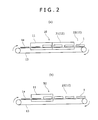
- an apparatus for manufacturing a foamed resin metal laminated sheet (manufacturing apparatus) 10 of the present embodiment is equipped with a heating furnace (heating unit) 11 and a cooling unit 12.
- a heating furnace heating unit
- a cooling unit cooling unit
- a foamable resin metal laminated sheet 1a is formed by laminating aluminum plates 2 on both sides of a foamable resin sheet 4b in an unfoamed state. More specifically, the foamable resin metal laminated sheet 1a obtained by adhering the aluminum plates 2 to both sides of the foamable resin sheet 4b is placed on a conveyor 13.
- the foamable resin metal laminated sheet 1a of the present embodiment is formed by adhering the aluminum plates 2 having the thickness of 0.15 mm to both sides of the foamable resin sheet 4b having the thickness of 0.9 mm.
- the foamable resin sheet 4b of the present embodiment uses a polypropylene resin as a matrix resin to which a foaming agent (heat decomposition temperature of 195 °C) is added and kneaded.
- a foaming agent heat decomposition temperature of 195 °C
- the final thickens of the foamed resin sheet 4a after heating and foaming is designed to become 2.7 mm (three times thicker than before foaming).
- the heating furnace 11 is a hot gas circulation type heating furnace capable of heating the aluminum plates 2, which would reflect a heat-ray in a far infrared radiation heating method. Heating temperature in the heating furnace 11 is set to 230 °C, which is higher than 210 °C of a foaming temperature of the foamable resin sheet 4b.
- the foamable resin sheet 4b is foamed by heating to become the foamed resin sheet 4a.
- the foamable resin metal laminated sheet 1a becomes the foamed resin metal laminated sheet 1.
- a temperature rise rate of the foamable resin sheet 4b is higher in the peripheral area where hot air directly hits than in the middle area of the rectangular foamable resin metal laminated sheet 1a.
- the foaming ratio of the foamable resin sheet 4b can be set evenly over the entire area of the foamable resin metal laminated sheet 1a if sufficient heating time is provided.
- the foamed resin metal laminated sheet 1 is conveyed into the cooling unit 12 to cool the foamed resin metal laminated sheet 1 to room temperature (20 °C).
- the cooling unit 12 is equipped with a soaking bath (soaking unit) 21 continuing with the heating furnace 11, and a room temperature cooling unit 22 exposed to the air.
- the soaking bath 21 is a hot gas circulation type heating furnace and the temperature inside the soaking bath 21 is kept at the soaking temperature lower than the foaming temperature of the foamable resin sheet 4b (210 °C) and higher than the room temperature (20 °C).
- the foamed resin metal laminated sheet 1 conveyed into the soaking bath 21 is cooled to the soaking temperature and temporally held at the soaking temperature.
- the soaking temperature is set in the range of not lower than Tm and not higher than (1.3 x Tm), where Tm represents a melting point of a foamed resin of the foamable resin sheet 4b (foamed resin sheet 4a).
- Tm represents a melting point of a foamed resin of the foamable resin sheet 4b (foamed resin sheet 4a).
- the foamed resin metal laminated sheet 1 conveyed into the room temperature cooling unit 22 exposed to the air is cooled from the soaking temperature to the room temperature in the air.
- the foamed resin sheet 4a in a melted state in the soaking bath 21 starts to solidify synchronously in the entire area of the foamed resin metal laminated sheet 1 after conveyed into the room temperature cooling unit 22.
- the variation in cooling speed in the foamed resin sheet 4a can be suppressed.
- the variation in cooling speed in the foamed resin sheet 4a is generated in the entire area of the foamed resin metal laminated sheet 1 when conveyed from the heating furnace 11 to the room temperature cooling unit 22 exposed to the air. More specifically, the peripheral area solidifies faster than the middle area of the rectangular foamed resin sheet 4a. Thus rippling phenomenon due to thermal strain occurs in the foamed resin metal laminated sheet 1.
- Fig. 3 (a) is a schematic view showing a temperature change when the foamed resin metal laminated sheet 1 is temporally held at the soaking temperature using the soaking bath 21. Note that dotted lines indicate surface temperature of the middle area of the foamed resin metal laminated sheet, while solid lines indicate surface temperature of the peripheral area of the aluminum plate in Figs. 3 (a) and (b) . As shown in Fig. 3 (a) , this method reduces a temperature difference in surface temperature between the middle area and the peripheral area of the aluminum plate 2 in the rectangular foamed resin metal laminated sheet 1. Thus the rippling phenomenon due to thermal strain caused by the variation in cooling speed in the foamed resin sheet 4a can be suppressed.
- a conventional cooling method without using the cooling bath 21 causes a large temperature difference in surface temperature between the middle area and the peripheral area of the aluminum plate 2 in the rectangular foamed resin metal laminated sheet 1.
- the rippling phenomenon due to thermal strain caused by the variation in cooling speed in the foamed resin sheet 4a occurs.
- the heating furnace 11 and the soaking bath 21 are separately provided in the present embodiment, however, a configuration in which the heating furnace 11 doubles as the soaking bath 21 may also be used. That is, after heating and foaming the foamable resin sheet 4b by setting the temperature of the heating furnace 11 to 230 °C higher than the foaming temperature, the foamed resin metal laminated sheet 1 may be held at the soaking temperature by lowing the temperature of the heating furnace 11 to the soaking temperature.
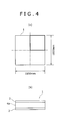
- a 1/4 symmetric model was employed as an analysis model.
- initial conditions, cooling conditions, displacement constraint conditions, and time periods of calculation were set as following.
- Case 1 represented a case where a product was manufactured by a conventional method without using the soaking bath 21
- Case 2 represented a case where a product was manufactured by the method of the present embodiment using the soaking bath 21
- a foamed resin metal laminated sheet 1 fresh from the heating furnace 11 represented the initial conditions in which the temperature was always set to 230 °C and initial strain was considered to be zero.
- a foamed resin metal laminated sheet 1, fresh from the heating furnace 11 was cooled by natural convection and radiation in the air.
- the atmospheric temperature was set to 20 °C and the surface heat transfer coefficient was set to 3W/m 2 K for natural convection, while the atmospheric temperature was set to 20 °C and emissivity was set to 0.02 for radiation.
- a foamed resin metal laminated sheet 1 fresh from the heating furnace 11 was cooled to the soaking temperature in the soaking bath 21, temporally hold at the soaking temperature, and then cooled by natural convection and radiation in the air.
- the processing time was set to 360s
- the ambient temperature was set to 160 °C
- the surface heat transfer coefficient was set to 3W/m 2 K for natural convection in the soaking bath 21, while the processing time was set to 360s
- the external temperature was set to 160 °C
- the emissivity was set to 0.02 for radiation in the soaking bath 21.
- the atmospheric temperature was set to 20 °C and the surface heat transfer coefficient was set to 3W/m 2 K for natural convection in the air, while the atmospheric temperature was set to 20 °C and the emissivity was set to 0.02 for radiation in the air.
- Displacement constraint conditions did not apply to Case 1 or Case 2, and time periods of calculation in Case 1 and Case 2 were until the temperature of representative points becomes about 100 °C or less. As shown in Fig. 5 (a) , one representative point was provided each in the central part and the peripheral area of the flat sheet.
- Fig. 6 shows a calculation result of temperature changes in a surface area 2' of the aluminum plate 2 and a middle area 4a' of the foamed resin sheet 4a (see Fig. 5 (b) ) at the representative point provided in the central part of the flat sheet.
- Fig. 7 shows a calculation result of temperature changes in a surface area 2' of the aluminum plate 2 and a middle area 4a' of the foamed resin sheet 4a at the representative point provided in the peripheral area of the flat sheet.
- Fig. 8 shows a temporal change in a temperature difference between the central part and the peripheral area of the flat sheet. Black round marks in Fig. 8 represent the timing of passing 160 °C, a melting point of polypropylene.
- the temperature difference in the surface area 2' of the aluminum plate 2 and the middle area 4a' of the foamed resin sheet 4a at this timing was compared between Case 1 and Case 2.
- the temperature difference in the middle area 4a' of the foamed resin sheet 4a is smaller by 1.9 °C in Case 2
- the temperature difference in the surface area 2' of the aluminum plate 2 is also smaller by 1.5 °C in Case 2. Therefore, providing the soaking bath 21 reduces the temperature difference between the central part and the peripheral area of the plane sheet.
- Fig. 9 (a) shows an analysis result of a maximum elastic principal strain in Case 1
- Fig. 9 (b) shows an analysis result of a maximum elastic principal strain in Case 2.
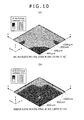
- Fig. 10 (a) shows an analysis result of a minimum elastic principal strain in Case 1
- Fig. 10 (b) shows an analysis result of a minimum elastic principal strain in Case 2.
- Both the maximum elastic principal strain and the minimum elastic principal strain are smaller in Case 2 than in Case1, demonstrating that providing the soaking bath 21 reduces thermal deformation and suppresses the rippling phenomenon.
- the foamed resin metal laminated sheet 1 As described above, according to the method for manufacturing the foamed resin metal laminated sheet 1 and the manufacturing apparatus 10 thereof, when the foamed resin metal laminated sheet 1 is cooled to the room temperature, it is temporarily cooled to the soaking temperature and held at the soaking temperature, and then cooled to the room temperature.
- a variation in cooling speed in the foamed resin sheet 4a can be suppressed by temporarily holding the foamed resin metal laminated sheet 1 at the soaking temperature to make the temperature of the foamed resin sheet 4a uniform over the entire area of the foamed resin metal laminated sheet 1, and then cooling the foamed resin metal laminated sheet 1 to the room temperature. In this way, the rippling phenomenon due to thermal strain caused by the variation in cooling speed in the foamed resin sheet 4a can be suppressed.
- the soaking temperature is set in the range of not lower than Tm but not higher than 1.3Tm, where Tm represents a melting point of the foamed resin of the foamable resin sheet 4b (foamed resin sheet 4a).
- Tm represents a melting point of the foamed resin of the foamable resin sheet 4b (foamed resin sheet 4a).
- the foamable resin sheet 4b made of polypropylene is uniformly foamed. Rigidity and lightweight properties can be improved in the foamed resin metal laminated sheet 1 containing the metal plates 2 made of aluminum.
- metals that are not efficiently heated by a far infrared radiation heating method due to heat-ray reflection can also be suitably heated by the soaking bath 21 using a hot gas circulation type heating furnace.
- the manufacturing apparatus 210 of the present embodiment is different from the manufacturing apparatus 10 of the first embodiment in that a cooling unit 12 is provided with a second soaking bath (second soaking unit) 23 between the soaking bath 21 and the room temperature cooling unit 22 as shown in Fig. 11 .
- the second soaking bath 23 is a hot gas circulation type heating furnace and its internal temperature is hold at a second soaking temperature lower than a soaking temperature equivalent to the internal temperature of the soaking bath 21 and higher than room temperature (20 °C).
- the foamed resin metal laminated sheet 1 held at the soaking temperature in the soaking bath 21 is subsequently conveyed to the second soaking bath 23, cooled to the second soaking temperature, and temporally held at the second soaking temperature. Then the foamed resin metal laminated sheet 1 was conveyed to the room temperature cooling unit 22 and cooled from the second soaking temperature to the room temperature in the air.
- the foamed resin metal laminated sheet 1 is held at the soaking temperature to make the temperature of the foamed resin sheet 4a uniform over the entire area of the foamed resin metal laminated sheet 1, and then the foamed resin metal laminated sheet 1 is held at the second soaking temperature.
- a variation in cooling speed in the foamed resin sheet 4a can be further suppressed by making the temperature of the foamed resin sheet 4a uniform over the entire area of the foamed resin metal laminated sheet 1.
- a single second soaking bath 23 is provided in the present embodiment, however, two or more second soaking bathes 23 may also be provided in tandem.
- the second soaking temperature is set lower in the second soaking bath 23 in the downstream side than in the second soaking bath 23 in the upstream side. That is, two or more second soaking bathes 23 are provided in tandem in order to sequentially lower the second soaking temperature. In this way, the temperature of the foamed resin metal laminated sheet 1 decreases stepwise from the soaking temperature to the room temperature as coming from the second soaking bathes 23 to the room temperature cooling unit 22.
- the step of temporally holding the foamed resin metal laminated sheet 1 at the second soaking temperature to make the temperature of the foamed resin sheet 4a uniform over the entire area of the foamed resin metal laminated sheet 1 is performed a plurality of times while lowering the second soaking temperature each time.
- the variation in cooling speed in the foamed resin sheet 4a can be further suppressed by decreasing stepwise the temperature of the foamed resin sheet 4a in this way.
- a configuration in which the step of making the temperature of the foamed resin sheet 4a uniform over the entire area of the foamed resin metal laminated sheet 1 is performed a plurality of times is not limited to the case where a plurality of second soaking bathes 23 are physically provided.
- the step of making the temperature of the foamed resin sheet 4a uniform over the entire area of the foamed resin metal laminated sheet 1 may be performed a plurality of times by decreasing stepwise the second soaking temperature a plurality of times within a single second soaking bath 23.
- a configuration is not limited to a case where the soaking bath 21 and the second soaking bath 23 are separately provided, and a configuration in which the soaking bath 21 doubles as the second soaking bath 23 may also be used. That is, the temperature of the soaking bath 21 may be set to the soaking temperature to keep the foamed resin sheet 4a in a melted state, and then the temperature of the soaking bath 21 may be lowered to the second soaking temperature to hold the foamed resin metal laminated sheet 1 at the second soaking temperature.
- the foamed resin metal laminated sheet 1 is held at the soaking temperature to make the temperature of the foamed resin sheet 4a uniform over the entire area of the foamed resin metal laminated sheet 1. Subsequently, the foamed resin metal laminated sheet 1 is held at the second soaking temperature to make the temperature of the foamed resin sheet 4a uniform over the entire area of the foamed resin metal laminated sheet 1.
- the variation in cooling speed in the foamed resin sheet 4a can be further suppressed.
- the step of temporally holding the foamed resin metal laminated sheet 1 at the second soaking temperature to make the temperature of the foamed resin sheet 4a uniform over the entire area of the foamed resin metal laminated sheet 1 is performed a plurality of times by setting the second soaking temperature lower than the previous step and decreasing stepwise the temperature of the foamed resin sheet 4a. In this way, the variation in cooling speed in the foamed resin sheet 4a can be further suppressed.
Landscapes
- Engineering & Computer Science (AREA)
- Mechanical Engineering (AREA)
- Quality & Reliability (AREA)
- Chemical & Material Sciences (AREA)
- Chemical Kinetics & Catalysis (AREA)
- Laminated Bodies (AREA)
- Processing And Handling Of Plastics And Other Materials For Molding In General (AREA)
Abstract
Description
- The present invention relates to a method and an apparatus for manufacturing a foamed resin metal laminated sheet in which metal plates are laminated on both sides of a foamed resin sheet.
- As disclosed in
Patent Document 1, a foamed resin metal laminated sheet in which metal plates are laminated on both sides of a foamed resin sheet formed by foaming a foamable resin sheet is obtained by heating a foamable resin metal laminated sheet in which metal plates are laminated on both sides of a foamable resin sheet in an unfoamed state and foaming the foamable resin sheet. - The foamable resin metal laminated sheet can be subjected to a cold press molding. That is, the foamable resin metal laminated sheet is first formed into a desired three-dimensional curved shape, and then heated by a drying furnace or the like to foam the foamable resin sheet, thereby increasing an interval distance between two metal plates. Thus, a foamed resin metal laminated sheet having higher flexural rigidity and less weight than a metal plate composed of a single material with an equal plate thickness can be obtained.
- Patent Document 1:
JP 2009-279922 A - A problem of obtaining such foamed resin metal laminated sheet lies in the fact that in-plane strain of thermal contraction generated during a cooling step after heating and foaming is large enough to cause rippling phenomenon, so that a molded article having a flat shape can not be obtained. This problem is of small account when a molded article having a deeply drawn shape is press-molded due to its increased geometrical rigidity, however it becomes significant when a foamed resin metal laminated sheet in a flat shape, or a foamed resin metal laminated sheet having a relatively flat and smooth curved surface is to be obtained.
- It is considered that the problem described above arises with the following mechanism. As an example, consider a rectangular foamable resin metal laminated sheet in which aluminum plates are laminated on both sides of a foamable resin sheet in an unfoamed state made of polypropylene having a melting point of 160 °C and a foaming temperature of 210 °C. Then, consider a situation where this foamable resin metal laminated sheet undergoes a thermal history starting from room temperature (20 °C), passing through a heating and a foaming process in a drying furnace (210 °C, about 17 min.), and then being cooled to the room temperature. The surface plate is made of aluminum in this example. Since a heat-ray is incapable to heat the aluminum plate due to reflection in a far infrared radiation heating method, a hot gas circulation type heating furnace is used for heating. During the heating process, the peripheral area of the rectangular foamable resin sheet exposed to the outside is directly blown by hot air, while the middle area of the foamable resin sheet is not heated until after the aluminum plate is heated. Thus, the peripheral area of the foamable resin sheet directly blown by hot air has a higher temperature rise rate than the middle area. This causes a variation in temperature distribution inside of the flat sheet in the heating furnace at the same time point, however a foaming ratio of the foamable resin sheet can be set evenly over the entire area of the foamable resin metal laminated sheet if sufficient heating time is provided (e.g. about 17 min.). A foamed resin sheet formed by foaming the foamable resin sheet is in a molten state having viscosity, and the foamed resin sheet has Young's modulus far smaller than that of aluminum. Thus, a shape of the foamed resin metal laminated sheet can be maintained flat as far as a shape of aluminum plate is flat.
- The foamed resin metal laminated sheet is cooled to room temperature after heating in the heating furnace. In this process, the rectangular foamed resin sheet contains many air bubbles and has a low thermal conductivity. Thus, heat in the middle area is dissipated to the surroundings only through the aluminum plate instead of being transferred into the in-plane direction, while heat in the peripheral area exposed to the outside is directly dissipated to the air. Thus, the temperature in the peripheral area of the foamed resin sheet drops faster than the middle area and reaches below a melting point thereby solidifying the peripheral area. Since the foamed resin sheet also serves as a heat storage material, the temperature of the aluminum plate in the middle area hardly drops, while the temperature of the aluminum plate in the peripheral area drops as the foamed resin sheet is solidified. This causes a big difference in thermal strain between the middle area and the peripheral area of the aluminum plate. As a result, rippling phenomenon occurs over the entire area of the foamed resin metal laminated sheet.
- An object of the present invention is to provide a method and an apparatus for manufacturing a foamed resin metal laminated sheet capable of suppressing the rippling phenomenon caused by thermal strain.
- A method for manufacturing a foamed resin metal laminated sheet of the present invention is characterized by comprising a laminating step for laminating metal plates on both sides of a foamable resin sheet in an unfoamed state to form a foamable resin metal laminated sheet, a heating step for heating the foamable resin metal laminated sheet and foaming the foamable resin sheet to form a foamed resin metal laminated sheet, and a cooling step for cooling the foamed resin metal laminated sheet to room temperature, the cooling step comprising a soaking step for cooling the foamed resin metal laminated sheet to a soaking temperature lower than a foaming temperature of the foamable resin sheet and higher than the room temperature and holding the foamed resin metal laminated sheet at the soaking temperature, and a room temperature cooling step for cooling the foamed resin metal laminated sheet to the room temperature after the soaking step.
- According to the configuration described above, when the foamed resin metal laminated sheet is cooled to the room temperature, it is temporarily cooled to the soaking temperature and held at the soaking temperature, and then cooled to the room temperature. A variation in cooling speed in the foamed resin sheet can be suppressed by temporarily holding the foamed resin metal laminated sheet at the soaking temperature to make the temperature of the foamed resin sheet formed by foaming the foamable resin sheet uniform over the entire area of the foamed resin metal laminated sheet before the foamed resin metal laminated sheet is cooled to the room temperature. In this way, the rippling phenomenon due to thermal strain caused by the variation in cooling speed in the foamed resin sheet can be suppressed.
- In the method for manufacturing the foamed resin metal laminated sheet of the present invention, the soaking temperature may be set in the range of not lower than Tm but not higher than 1.3Tm, where Tm represents a melting point of a foamable resin of the foamable resin sheet. According to the configuration described above, by setting the soaking temperature in the range of not lower than Tm but not higher than 1.3Tm, where Tm represents the melting point of the foamable resin of the foamable resin sheet, the foamed resin sheet can be kept melted in the entire area of the foamed resin metal laminated sheet in the soaking step for holding the foamed resin metal laminated sheet at the soaking temperature. In this way, the initiation timing of solidifying the foamed resin sheet can be synchronized in the entire area of the foamed resin metal laminated sheet in the transition from the soaking step to a room temperature cooling step, thus the variation in cooling speed in the foamed resin sheet can be further suppressed. The foamed resin sheet is changed at phase from a liquid phase to a solid phase by cooling. Thus the melting point described here means a congealing point in a strict sense. The melting point matches the congealing point without a hysteresis effect.
- In the method for manufacturing the foamed resin metal laminated sheet of the present invention, the cooling step may further comprise a second soaking step between the soaking step and the room temperature cooling step for cooling the foamed resin metal laminated sheet at a second soaking temperature lower than the soaking temperature and higher than the room temperature and holding the foamed resin metal laminated sheet at the second soaking temperature. According to the configuration described above, the variation in cooling speed in the foamed resin sheet can be further suppressed by holding the foamed resin metal laminated sheet at the soaking temperature first to make the temperature of the foamed resin sheet uniform over the entire area of the foamed resin metal laminated sheet, and then further holding the foamed resin metal laminated sheet at the second soaking temperature to make the temperature of the foamed resin sheet uniform over the entire area of the foamed resin metal laminated sheet.
- In the method for manufacturing the foamed resin metal laminated sheet of the present invention, the second soaking step may be performed a plurality of times at the second soaking temperature lower than the previous second soaking temperature. According to the configuration described above, the variation in cooling speed in the foamed resin sheet can be further suppressed by decreasing stepwise the temperature of the foamed resin sheet through repeating a plurality of times the step of temporally holding the foamed resin metal laminated sheet at the second soaking temperature while lowering the second soaking temperature each time to make the temperature of the foamed resin sheet uniform over the entire area of the foamed resin metal laminated sheet.
- In the method for manufacturing the foamed resin metal laminated sheet of the present invention, the foamable resin sheet may contain polypropylene and the metal plates may contain aluminum. According to the configuration described above, the uniform foaming performance can be obtained by using the foamable resin sheet containing polypropylene. Rigidity and lightweight properties of the foamed resin metal laminated sheet can be improved by using the metal plates containing aluminum.
- An apparatus for manufacturing a foamed resin metal laminated sheet of the present invention is characterized by comprising a heating unit for heating a foamable resin metal laminated sheet in which metal plates are laminated on both sides of a foamable resin sheet in an unfoamed state and foaming the foamable resin sheet to form a foamed resin metal laminated sheet, and a cooling unit for cooling the foamed resin metal laminated sheet to room temperature, the cooling unit comprising a soaking unit for cooling the foamed resin metal laminated sheet to a soaking temperature lower than a foaming temperature of the foamable resin sheet and higher than the room temperature, and holding the foamed resin metal laminated sheet at the soaking temperature, and a room temperature cooling unit provided on the downstream side of the soaking unit for cooling the foamed resin metal laminated sheet to the room temperature.
- According to the configuration described above, when the foamed resin metal laminated sheet is cooled to the room temperature, it is temporarily cooled to the soaking temperature and held at the soaking temperature, and then cooled to the room temperature. A variation in cooling speed in the foamed resin sheet can be suppressed by temporarily holding the foamed resin metal laminated sheet at the soaking temperature to make the temperature of the foamed resin sheet formed by foaming the foamable resin sheet uniform over the entire area of the foamed resin metal laminated sheet before the foamed resin metal laminated sheet is cooled to the room temperature. In this way, rippling phenomenon due to thermal strain caused by a variation in cooling speed in the foamed resin sheet can be suppressed.
- In the apparatus for manufacturing the foamed resin metal laminated sheet of the present invention, the soaking temperature may be set in the range of not lower than Tm but not higher than 1.3Tm, where Tm represents a melting point of a foamable resin of the foamable resin sheet. According to the configuration described above, by setting the soaking temperature in the range of not lower than Tm but not higher than 1.3Tm, where Tm represents the melting point of the foamable resin of the foamable resin sheet, the foamed resin sheet can be kept melted in the entire area of the foamed resin metal laminated sheet in the soaking unit for holding the foamed resin metal laminated sheet at the soaking temperature. In this way, the initiation timing of solidifying the foamed resin sheet can be synchronized in the entire area of the foamed resin metal laminated sheet in the transition from the soaking unit to the room temperature cooling unit, thus the variation in cooling speed in the foamed resin sheet can be further suppressed.
- In the apparatus for manufacturing the foamed resin metal laminated sheet of the present invention, the cooling unit may further comprise a second soaking unit between the soaking unit and the room temperature cooling unit for cooling the foamed resin metal laminated sheet at a second soaking temperature lower than the soaking temperature and higher than the room temperature and holding the foamed resin metal laminated sheet at the second soaking temperature. According to the configuration described above, the variation in cooling speed in the foamed resin sheet can be further suppressed by holding the foamed resin metal laminated sheet at the soaking temperature first to make the temperature of the foamed resin sheet uniform over the entire area of the foamed resin metal laminated sheet, and then further holding the foamed resin metal laminated sheet at the second soaking temperature to make the temperature of the foamed resin sheet uniform over the entire area of the foamed resin metal laminated sheet.
- In the apparatus for manufacturing the foamed resin metal laminated sheet of the present invention, the apparatus may be provided with two or more the second soaking units in tandem so that the soaking temperature becomes lower in order of the second soaking units. According to the configuration described above, the variation in cooling speed in the foamed resin sheet can be further suppressed by decreasing stepwise the temperature of the foamed resin sheet through repeating a plurality of times the step of temporally holding the foamed resin metal laminated sheet at the second soaking temperature while lowering the second soaking temperature each time to make the temperature of the foamed resin sheet uniform over the entire area of the foamed resin metal laminated sheet.
- In the apparatus for manufacturing the foamed resin metal laminated sheet of the present invention, the foamable resin sheet may contain polypropylene and the metal plates may contain aluminum. According to the configuration described above, the uniform foaming performance can be obtained by using the foamable resin sheet containing polypropylene. Rigidity and lightweight properties of the foamed resin metal laminated sheet can be improved by using the metal plates containing aluminum.
- In the apparatus for manufacturing the foamed resin metal laminated sheet of the present invention, the soaking unit may be a hot gas circulation type heating furnace. According to the configuration described above, metals that are not efficiently heated by a far infrared radiation heating method due to heat-ray reflection can also be suitably heated by the soaking unit using the hot gas circulation type heating furnace.
- According to a method and an apparatus for manufacturing foamed resin metal laminated sheet of the present invention, a variation in cooling speed in a foamed resin sheet can be suppressed by temporarily holding a foamed resin metal laminated sheet at a soaking temperature to make the temperature of the foamed resin sheet formed by foaming a foamable resin sheet uniform over the entire area of the foamed resin metal laminated sheet before the foamed resin metal laminated sheet is cooled to room temperature. In this way, rippling phenomenon due to thermal strain caused by a variation in cooling speed in the foamed resin sheet can be suppressed.
-
- [
Fig. 1] Fig. 1 (a) is a partial perspective view of a foamed resin metal laminated sheet, andFig. 1 (b) is a partial perspective view of a foamable resin metal laminated sheet. - [
Fig. 2] Fig. 2 (a) is a schematic view of a manufacturing apparatus according to a first embodiment of the present invention, andFig. 2 (b) is a schematic view of a conventional manufacturing apparatus. - [
Fig. 3] Fig. 3 (a) is a schematic view showing a temperature change, andFig. 3 (b) is a schematic view showing a temperature change in the conventional apparatus. - [
Fig. 4] Fig. 4 (a) is a plane view showing an analysis model, andFig. 4 (b) is a side view ofFig. 4 (a) . - [
Fig. 5] Fig. 5 (a) is a view showing an analysis model, andFig. 5 (b) is an enlarged view of an essential part ofFig. 5 (a) . - [
Fig. 6] Fig. 6 is a graph showing calculation results of temperature changes on the surface of the aluminum plate and in the middle area of the foamed resin sheet at a representative point provided on the central part of the flat sheet. - [
Fig. 7] Fig. 7 is a graph showing calculation results of temperature changes on the surface of the aluminum plate and in the middle area of the foamed resin sheet at a representative point provided on the peripheral area of the flat sheet. - [
Fig. 8] Fig. 8 is a graph showing temporal changes in the temperature difference between the central part and the peripheral area of the flat sheet. - [
Fig. 9] Fig. 9 (a) is a view showing an analysis result of a maximum elastic principal strain generated in the aluminum plate inCase 1, andFig. 9 (b) is a view showing an analysis result of a maximum elastic principal strain generated in the aluminum plate inCase 2. - [
Fig. 10] Fig. 10 (a) is a view showing an analysis result of a minimum elastic principal strain generate in the aluminum plate inCase 1, andFig. 9 (b) is a view showing an analysis result of a minimum elastic principal strain generate in the aluminum plate inCase 2. - [
Fig. 11] Fig. 11 is a schematic view showing a manufacturing apparatus according to a second embodiment of the present invention. - Hereinafter, preferred embodiments of the present invention will be described with reference to the drawings. A foamed resin metal laminated sheet obtained by the method for manufacturing a foamed resin metal laminated sheet according to the present invention can be used, for example, as a material for a structure constituting a body of a bullet train, an airplane, or the like. Further, the foamed resin metal laminated sheet can be widely used as a material for a floor, a wall, or a ceiling of building or the like.
- As shown in
Fig. 1 (a) , a foamed resin metal laminatedsheet 1 manufactured by a method for manufacturing a foamed resin metal laminated sheet according to a first embodiment of the present invention is composed of a foamedresin sheet 4a in a foamed state and twoaluminum plates 2 laminated on both sides of the foamedresin sheet 4a. The foamed resin metal laminatedsheet 1 is formed by heating a foamable resin metal laminatedsheet 1a shown inFig. 1 (b) and foaming afoamable resin sheet 4b in an unfoamed state. The foamable resin metal laminatedsheet 1a is composed of thefoamable resin sheet 4b in an unfoamed state and twoaluminum plates 2 laminated on both sides of thefoamable resin sheet 4b. - The foamed
resin sheet 4a in the foamed resin metal laminatedsheet 1 includes a mass of individually independent cells (closed cells). Thus, the foamed resin metal laminatedsheet 1 exhibits higher flexural rigidity and more lightweight than an aluminum plate composed of a single aluminum material with an equal plate thickness. Rigidity of the foamed resin metal laminatedsheet 1 differs significantly between the case where the foamed resin metal laminatedsheet 1 is formed by foaming thefoamable resin sheet 4b after the foamable resin metal laminatedsheet 1a is press-molded in a desired shape, and the case where a laminated sheet is obtained by laminating aluminum plates on both sides of a foamed resin sheet foamed in advance, and then the laminated sheet is press-molded in a desired shape. In the latter case, press molding is performed to the foamed resin sheet foamed in advance, thus a mass of closed cells contained in the foamed resin sheet are mostly crushed and fused to the adjacent cells thereby causing a reduction in rigidity. Whereas, in the former case, thefoamable resin sheet 4b is foamed after press molding thereby maintaining a mass of closed cells and gaining high rigidity. - The foamed resin metal laminated
sheet 1 is composed of the foamedresin sheet 4a and two metal plates (aluminum plates) 2 laminated on both sides of the foamedresin sheet 4a, however, the configuration of the foamed resin metal laminated sheet is not limited thereto. In the foamed resin metal laminatedsheet 1, an unfoamable resin sheet may be further disposed between the foamedresin sheet 4a and themetal plates 2, or two foamedresin sheets 4a may be alternately disposed among threemetal plates 2 arranged in parallel. Essentially a foamed resin metal laminated sheet may be any foamed resin metal laminated sheet comprising at least one foamed resin sheet and at least two metal plates laminated on both sides of the foamed resin sheet. - The
foamable resin sheet 4b contains a matrix resin and a foaming agent. Examples of the matrix resin include polyolefin-based resins, polystyrene-based resins, polyurethane-based resins, polyester-based resins, and the like. Examples of polyolefin-based resins include polypropylene resins, polyethylene resins, polyolefin resins, EPR, EPDM, and the like. Examples of polystyrene-based resins include polystyrene resins, thermoplastic elastomers, ABS resins, AS resins, and the like. These resins are thermoplastic resins and have property of being softened and increasing plasticity by heating. - The foaming agent includes an organic foaming agent and an inorganic foaming agent. Examples of the organic foaming agent include azo compounds, nitroso compounds, sulfonylhydrazide compounds, and the like, and specific examples include azodicarbonamide (ADCA), barium azodicarboxylate, azobisisobutyronitrile, N, N'-dinitrosopenta methylene tetramine, p-toluenesulfonyl hydrazide, p, p'-oxybis (benzenesulfonyl hydrazide), and the like. Examples of the inorganic foaming agent include sodium hydrogen carbonate, zinc carbonate, heat-expandable microcapsules, and the like. It is necessary to select a foaming agent having a foaming temperature (decomposition temperature) higher than a melting point of a matrix resin by about 20 °C. One kind of foaming agent may be used alone or two or more kinds of foaming agents may be used in combination.
- The
metal plates 2 are not limited to thealuminum plates 2 and may be metal plates such as aluminum alloy plates, stainless plates, and plating steel plates. - The
foamable resin sheet 4b and thealuminum plates 2 may be adhered using an adhesive, or welded at temperature lower than the foaming temperature of thefoamable resin sheet 4b. - As shown in
Fig. 2 (a) , an apparatus for manufacturing a foamed resin metal laminated sheet (manufacturing apparatus) 10 of the present embodiment is equipped with a heating furnace (heating unit) 11 and acooling unit 12. Hereinafter, the present embodiments will be described along with the manufacturing method. - First, a foamable resin metal laminated
sheet 1a is formed by laminatingaluminum plates 2 on both sides of afoamable resin sheet 4b in an unfoamed state. More specifically, the foamable resin metal laminatedsheet 1a obtained by adhering thealuminum plates 2 to both sides of thefoamable resin sheet 4b is placed on aconveyor 13. - The foamable resin metal laminated
sheet 1a of the present embodiment is formed by adhering thealuminum plates 2 having the thickness of 0.15 mm to both sides of thefoamable resin sheet 4b having the thickness of 0.9 mm. Thefoamable resin sheet 4b of the present embodiment uses a polypropylene resin as a matrix resin to which a foaming agent (heat decomposition temperature of 195 °C) is added and kneaded. The final thickens of the foamedresin sheet 4a after heating and foaming is designed to become 2.7 mm (three times thicker than before foaming). - Next, the foamable resin metal laminated
sheet 1a is conveyed into theheating furnace 11 to heat the foamable resin metal laminatedsheet 1a. Theheating furnace 11 is a hot gas circulation type heating furnace capable of heating thealuminum plates 2, which would reflect a heat-ray in a far infrared radiation heating method. Heating temperature in theheating furnace 11 is set to 230 °C, which is higher than 210 °C of a foaming temperature of thefoamable resin sheet 4b. Thefoamable resin sheet 4b is foamed by heating to become the foamedresin sheet 4a. Thus, the foamable resin metal laminatedsheet 1a becomes the foamed resin metal laminatedsheet 1. - During heating, a temperature rise rate of the
foamable resin sheet 4b is higher in the peripheral area where hot air directly hits than in the middle area of the rectangular foamable resin metal laminatedsheet 1a. However, the foaming ratio of thefoamable resin sheet 4b can be set evenly over the entire area of the foamable resin metal laminatedsheet 1a if sufficient heating time is provided. - Next, the foamed resin metal laminated
sheet 1 is conveyed into the coolingunit 12 to cool the foamed resin metal laminatedsheet 1 to room temperature (20 °C). The coolingunit 12 is equipped with a soaking bath (soaking unit) 21 continuing with theheating furnace 11, and a roomtemperature cooling unit 22 exposed to the air. - The soaking
bath 21 is a hot gas circulation type heating furnace and the temperature inside the soakingbath 21 is kept at the soaking temperature lower than the foaming temperature of thefoamable resin sheet 4b (210 °C) and higher than the room temperature (20 °C). The foamed resin metal laminatedsheet 1 conveyed into the soakingbath 21 is cooled to the soaking temperature and temporally held at the soaking temperature. - The soaking temperature is set in the range of not lower than Tm and not higher than (1.3 x Tm), where Tm represents a melting point of a foamed resin of the
foamable resin sheet 4b (foamedresin sheet 4a). Thus, the foamedresin sheet 4a is in a melted state in the entire area of the foamed resin metal laminatedsheet 1 held at the soaking temperature. - Subsequently, the foamed resin metal laminated
sheet 1 conveyed into the roomtemperature cooling unit 22 exposed to the air is cooled from the soaking temperature to the room temperature in the air. The foamedresin sheet 4a in a melted state in the soakingbath 21 starts to solidify synchronously in the entire area of the foamed resin metal laminatedsheet 1 after conveyed into the roomtemperature cooling unit 22. Thus the variation in cooling speed in the foamedresin sheet 4a can be suppressed. - In contrast, as shown in
Fig. 2 (b) , in aconventional manufacturing apparatus 50 having no soakingbath 21, the variation in cooling speed in the foamedresin sheet 4a is generated in the entire area of the foamed resin metal laminatedsheet 1 when conveyed from theheating furnace 11 to the roomtemperature cooling unit 22 exposed to the air. More specifically, the peripheral area solidifies faster than the middle area of the rectangular foamedresin sheet 4a. Thus rippling phenomenon due to thermal strain occurs in the foamed resin metal laminatedsheet 1. -
Fig. 3 (a) is a schematic view showing a temperature change when the foamed resin metal laminatedsheet 1 is temporally held at the soaking temperature using the soakingbath 21. Note that dotted lines indicate surface temperature of the middle area of the foamed resin metal laminated sheet, while solid lines indicate surface temperature of the peripheral area of the aluminum plate inFigs. 3 (a) and (b) . As shown inFig. 3 (a) , this method reduces a temperature difference in surface temperature between the middle area and the peripheral area of thealuminum plate 2 in the rectangular foamed resin metal laminatedsheet 1. Thus the rippling phenomenon due to thermal strain caused by the variation in cooling speed in the foamedresin sheet 4a can be suppressed. - In contrast, as shown in
Fig. 3 (b) , a conventional cooling method without using the coolingbath 21 causes a large temperature difference in surface temperature between the middle area and the peripheral area of thealuminum plate 2 in the rectangular foamed resin metal laminatedsheet 1. Thus the rippling phenomenon due to thermal strain caused by the variation in cooling speed in the foamedresin sheet 4a occurs. - As shown in
Fig. 2 (a) , theheating furnace 11 and the soakingbath 21 are separately provided in the present embodiment, however, a configuration in which theheating furnace 11 doubles as the soakingbath 21 may also be used. That is, after heating and foaming thefoamable resin sheet 4b by setting the temperature of theheating furnace 11 to 230 °C higher than the foaming temperature, the foamed resin metal laminatedsheet 1 may be held at the soaking temperature by lowing the temperature of theheating furnace 11 to the soaking temperature. - Using a 1m x 1m flat sheet (foamed resin metal laminated sheet 1) composed of the
aluminum plates 2 having the thickness of 0.15 mm and the foamedresin sheet 4a made of foamed polypropylene having the thickness of 3 mm as a analysis object, temporal changes of temperature distribution of thealuminum plates 2 and the foamedresin sheet 4a by a nonstationary heat conduction analysis, as well as temporal changes of thermal strain distribution ofaluminum plates 2 were calculated. Physical properties of thealuminum plates 2 and the foamedresin sheet 4a are shown in Table 1 and Table 2, respectively,[Table 1] Temperature Young's modulus Poisson ratio Density Specific heat Thermal conductivity Linear expansion [°C] [MPa] [-] [kg/m3] [J/kgK] [W/mK] coefficient [1/K] 20 69529 0.327 2660 900 127 2.39 x 10⁻⁵ [Table 2] Temperature Young's modulus Poisson ratio Density Specific heat Thermal conductivity Linear expansion [°C] [MPa] [-] [kg/m3] [J/kgK] [W/mK] coefficient [1/K] 20 80.3 0.45 310.2 1243 0.1 1.1 x 10⁻⁴ 40 52.0 60 34.2 80 22.0 100 10.7 120 5.4 140 1.0 160 0.1 230 0.1 0.49 - Since the foamed
resin sheet 4a melts at not lower than 160 °C, Young's modulus of the foamedresin sheet 4a at 160 °C and 230 °C was estimated as 1/10 of Young's modulus of the foamedresin sheet 4a at 140 °C in Table 2. Values of density and specific heat of the foamedresin sheet 4a containing the air at a volume ratio of 66 % are shown. As a value of linear expansion coefficient of the foamedresin sheet 4a, a value of the foamed polypropylene described in the Sankyo Kasei Sangyo Co., Ltd's home page in the internet site was used (see: http://www.sankyo-kasei.co.jp/item/seihin/y5_101_02happopp.htm). - As shown in
Figs. 4 (a) and (b) , andFigs 5 (a) and (b) , a 1/4 symmetric model was employed as an analysis model. As calculation conditions of the nonstationary heat conduction analysis, initial conditions, cooling conditions, displacement constraint conditions, and time periods of calculation were set as following. In this analysis,Case 1 represented a case where a product was manufactured by a conventional method without using the soakingbath 21, whereasCase 2 represented a case where a product was manufactured by the method of the present embodiment using the soakingbath 21, - In
Case 1 and Case2, a foamed resin metal laminatedsheet 1, fresh from theheating furnace 11 represented the initial conditions in which the temperature was always set to 230 °C and initial strain was considered to be zero. - As cooling conditions in
Case 1, a foamed resin metal laminatedsheet 1, fresh from theheating furnace 11 was cooled by natural convection and radiation in the air. The atmospheric temperature was set to 20 °C and the surface heat transfer coefficient was set to 3W/m2K for natural convection, while the atmospheric temperature was set to 20 °C and emissivity was set to 0.02 for radiation. - As cooling conditions in
Case 2, on the other hand, a foamed resin metal laminatedsheet 1, fresh from theheating furnace 11 was cooled to the soaking temperature in the soakingbath 21, temporally hold at the soaking temperature, and then cooled by natural convection and radiation in the air. The processing time was set to 360s, the ambient temperature was set to 160 °C, and the surface heat transfer coefficient was set to 3W/m2K for natural convection in the soakingbath 21, while the processing time was set to 360s, the external temperature was set to 160 °C, and the emissivity was set to 0.02 for radiation in the soakingbath 21. The atmospheric temperature was set to 20 °C and the surface heat transfer coefficient was set to 3W/m2K for natural convection in the air, while the atmospheric temperature was set to 20 °C and the emissivity was set to 0.02 for radiation in the air. - Displacement constraint conditions did not apply to
Case 1 orCase 2, and time periods of calculation inCase 1 andCase 2 were until the temperature of representative points becomes about 100 °C or less. As shown inFig. 5 (a) , one representative point was provided each in the central part and the peripheral area of the flat sheet. -
Fig. 6 shows a calculation result of temperature changes in a surface area 2' of thealuminum plate 2 and amiddle area 4a' of the foamedresin sheet 4a (seeFig. 5 (b) ) at the representative point provided in the central part of the flat sheet.Fig. 7 shows a calculation result of temperature changes in a surface area 2' of thealuminum plate 2 and amiddle area 4a' of the foamedresin sheet 4a at the representative point provided in the peripheral area of the flat sheet.Fig. 8 shows a temporal change in a temperature difference between the central part and the peripheral area of the flat sheet. Black round marks inFig. 8 represent the timing of passing 160 °C, a melting point of polypropylene. The temperature difference in the surface area 2' of thealuminum plate 2 and themiddle area 4a' of the foamedresin sheet 4a at this timing was compared betweenCase 1 andCase 2. As a result, the temperature difference in themiddle area 4a' of the foamedresin sheet 4a is smaller by 1.9 °C inCase 2, and the temperature difference in the surface area 2' of thealuminum plate 2 is also smaller by 1.5 °C inCase 2. Therefore, providing the soakingbath 21 reduces the temperature difference between the central part and the peripheral area of the plane sheet. - Analysis results of a maximum elastic principal strain and a minimum elastic principal strain generated in the
aluminum plate 2 due to the temperature difference described above when the temperature of the foamedresin sheet 4a becomes 100 °C are shown inFig. 9 (a) and (b) , andFig. 10 (a) and (b) , respectively.Fig. 9 (a) shows an analysis result of a maximum elastic principal strain inCase 1, whileFig. 9 (b) shows an analysis result of a maximum elastic principal strain inCase 2.Fig. 10 (a) shows an analysis result of a minimum elastic principal strain inCase 1, whileFig. 10 (b) shows an analysis result of a minimum elastic principal strain inCase 2. Both the maximum elastic principal strain and the minimum elastic principal strain are smaller inCase 2 than in Case1, demonstrating that providing the soakingbath 21 reduces thermal deformation and suppresses the rippling phenomenon. - As described above, according to the method for manufacturing the foamed resin metal laminated
sheet 1 and themanufacturing apparatus 10 thereof, when the foamed resin metal laminatedsheet 1 is cooled to the room temperature, it is temporarily cooled to the soaking temperature and held at the soaking temperature, and then cooled to the room temperature. A variation in cooling speed in the foamedresin sheet 4a can be suppressed by temporarily holding the foamed resin metal laminatedsheet 1 at the soaking temperature to make the temperature of the foamedresin sheet 4a uniform over the entire area of the foamed resin metal laminatedsheet 1, and then cooling the foamed resin metal laminatedsheet 1 to the room temperature. In this way, the rippling phenomenon due to thermal strain caused by the variation in cooling speed in the foamedresin sheet 4a can be suppressed. - The soaking temperature is set in the range of not lower than Tm but not higher than 1.3Tm, where Tm represents a melting point of the foamed resin of the
foamable resin sheet 4b (foamedresin sheet 4a). This can keep the foamedresin sheet 4a in a melted state in the entire area of the foamed resin metal laminatedsheet 1 in the soakingbath 21 for holding the foamed resin metal laminatedsheet 1 at the soaking temperature. In this way, the initiation timing of solidifying the foamedresin sheet 4a can be synchronized in the entire area of the foamed resin metal laminatedsheet 1 in the transition from the soakingbath 21 to the roomtemperature cooling unit 22, thus the variation in cooling speed in the foamedresin sheet 4a can be further suppressed. - Further, the
foamable resin sheet 4b made of polypropylene is uniformly foamed. Rigidity and lightweight properties can be improved in the foamed resin metal laminatedsheet 1 containing themetal plates 2 made of aluminum. - Furthermore, metals that are not efficiently heated by a far infrared radiation heating method due to heat-ray reflection can also be suitably heated by the soaking
bath 21 using a hot gas circulation type heating furnace. - Next, a
manufacturing apparatus 210 according to the second embodiment of the present invention will be described. Note that if a component is same as described above, the component bears the same reference number and its description is omitted. Themanufacturing apparatus 210 of the present embodiment is different from themanufacturing apparatus 10 of the first embodiment in that acooling unit 12 is provided with a second soaking bath (second soaking unit) 23 between the soakingbath 21 and the roomtemperature cooling unit 22 as shown inFig. 11 . - The
second soaking bath 23 is a hot gas circulation type heating furnace and its internal temperature is hold at a second soaking temperature lower than a soaking temperature equivalent to the internal temperature of the soakingbath 21 and higher than room temperature (20 °C). The foamed resin metal laminatedsheet 1 held at the soaking temperature in the soakingbath 21 is subsequently conveyed to the second soakingbath 23, cooled to the second soaking temperature, and temporally held at the second soaking temperature. Then the foamed resin metal laminatedsheet 1 was conveyed to the roomtemperature cooling unit 22 and cooled from the second soaking temperature to the room temperature in the air. - As described above, the foamed resin metal laminated
sheet 1 is held at the soaking temperature to make the temperature of the foamedresin sheet 4a uniform over the entire area of the foamed resin metal laminatedsheet 1, and then the foamed resin metal laminatedsheet 1 is held at the second soaking temperature. As such, a variation in cooling speed in the foamedresin sheet 4a can be further suppressed by making the temperature of the foamedresin sheet 4a uniform over the entire area of the foamed resin metal laminatedsheet 1. - A single
second soaking bath 23 is provided in the present embodiment, however, two or more second soaking bathes 23 may also be provided in tandem. In this case, the second soaking temperature is set lower in the second soakingbath 23 in the downstream side than in the second soakingbath 23 in the upstream side. That is, two or more second soaking bathes 23 are provided in tandem in order to sequentially lower the second soaking temperature. In this way, the temperature of the foamed resin metal laminatedsheet 1 decreases stepwise from the soaking temperature to the room temperature as coming from the second soaking bathes 23 to the roomtemperature cooling unit 22. - The step of temporally holding the foamed resin metal laminated
sheet 1 at the second soaking temperature to make the temperature of the foamedresin sheet 4a uniform over the entire area of the foamed resin metal laminatedsheet 1 is performed a plurality of times while lowering the second soaking temperature each time. The variation in cooling speed in the foamedresin sheet 4a can be further suppressed by decreasing stepwise the temperature of the foamedresin sheet 4a in this way. - A configuration in which the step of making the temperature of the foamed
resin sheet 4a uniform over the entire area of the foamed resin metal laminatedsheet 1 is performed a plurality of times is not limited to the case where a plurality of second soaking bathes 23 are physically provided. The step of making the temperature of the foamedresin sheet 4a uniform over the entire area of the foamed resin metal laminatedsheet 1 may be performed a plurality of times by decreasing stepwise the second soaking temperature a plurality of times within a singlesecond soaking bath 23. - A configuration is not limited to a case where the soaking
bath 21 and the second soakingbath 23 are separately provided, and a configuration in which the soakingbath 21 doubles as the second soakingbath 23 may also be used. That is, the temperature of the soakingbath 21 may be set to the soaking temperature to keep the foamedresin sheet 4a in a melted state, and then the temperature of the soakingbath 21 may be lowered to the second soaking temperature to hold the foamed resin metal laminatedsheet 1 at the second soaking temperature. - As described above, according to the method for manufacturing the foamed resin metal laminated
sheet 1 and themanufacturing apparatus 210 thereof, the foamed resin metal laminatedsheet 1 is held at the soaking temperature to make the temperature of the foamedresin sheet 4a uniform over the entire area of the foamed resin metal laminatedsheet 1. Subsequently, the foamed resin metal laminatedsheet 1 is held at the second soaking temperature to make the temperature of the foamedresin sheet 4a uniform over the entire area of the foamed resin metal laminatedsheet 1. Thus the variation in cooling speed in the foamedresin sheet 4a can be further suppressed. - The step of temporally holding the foamed resin metal laminated
sheet 1 at the second soaking temperature to make the temperature of the foamedresin sheet 4a uniform over the entire area of the foamed resin metal laminatedsheet 1 is performed a plurality of times by setting the second soaking temperature lower than the previous step and decreasing stepwise the temperature of the foamedresin sheet 4a. In this way, the variation in cooling speed in the foamedresin sheet 4a can be further suppressed. - The embodiments of the present invention described herein are merely illustrative of specific examples and are in no way limitative on the present invention in particular, thus a specific configuration and the like may be arbitrarily modified in designing. Further, the mode of operations and effects described in the embodiments of the present invention are mere recitations of the most preferable mode of operations and effects, which may be obtained by the present invention, and the mode of operations and effects of the present invention are in no way limitative on those described in the embodiments of the present invention.
- The present application is based on Japanese Patent Application No.
2012-185412 filed on Aug. 24, 2012 -
- 1 Foamed resin metal laminated sheet
- 1a Foamable resin metal laminated sheet
- 2 Aluminum plate (Metal plate)
- 4a Foamed resin sheet
- 4b Foamable resin sheet
- 10, 210 Manufacturing apparatuses
- 11 Heating furnace (Heating unit)
- 12 Cooling unit
- 13 Conveyor
- 21 Soaking bath (Soaking unit)
- 22 Room temperature cooling unit
- 23 Second soaking bath (Second soaking unit)
- 50 Manufacturing apparatus
Claims (11)
- A method for manufacturing a foamed resin metal laminated sheet, comprising:a laminating step for laminating metal plates on both sides of a foamable resin sheet in an unfoamed state to form a foamable resin metal laminated sheet;a heating step for heating the foamable resin metal laminated sheet and foaming the foamable resin sheet to form a foamed resin metal laminated sheet; anda cooling step for cooling the foamed resin metal laminated sheet to room temperature, the cooling step comprising:a soaking step for cooling the foamed resin metal laminated sheet to a soaking temperature lower than a foaming temperature of the foamable resin sheet and higher than the room temperature, and holding the foamed resin metal laminated sheet at the soaking temperature; anda room temperature cooling step for cooling the foamed resin metal laminated sheet to the room temperature after the soaking step.
- The method for manufacturing the foamed resin metal laminated sheet according to claim 1,
wherein the soaking temperature is set in the range of not lower than Tm but not higher than 1.3Tm, where Tm represents a melting point of a foamed resin of the foamable resin sheet. - The method for manufacturing the foamed resin metal laminated sheet according to claim 1,
wherein the cooling step further comprises a second soaking step between the soaking step and the room temperature cooling step for cooling the foamed resin metal laminated sheet at a second soaking temperature lower than the soaking temperature and higher than the room temperature, and holding the foamed resin metal laminated sheet at the second soaking temperature. - The method for manufacturing the foamed resin metal laminated sheet according to claim 3,
wherein the second soaking step is performed a plurality of times at the second soaking temperature lower than the previous time. - The method for manufacturing the foamed resin metal laminated sheet according to any one of claims 1 to 4,
wherein the foamable resin sheet contains polypropylene and the metal plate contains aluminum. - An apparatus for manufacturing a foamed resin metal laminated sheet, comprising:a heating unit for heating a foamable resin metal laminated sheet in which metal plates are laminated on both sides of a foamable resin sheet in an unfoamed state, and foaming the foamable resin sheet to form a foamed resin metal laminated sheet; anda cooling unit for cooling the foamed resin metal laminated sheet to room temperature, the cooling unit comprising;a soaking unit for cooling the foamed resin metal laminated sheet to a soaking temperature lower than a foaming temperature of the foamable resin sheet and higher than the room temperature, and holding the foamed resin metal laminated sheet at the soaking temperature; anda room temperature cooling unit provided on the downstream side of the soaking unit for cooling the foamed resin metal laminated sheet to the room temperature.
- The apparatus for manufacturing the foamed resin metal laminated sheet according to claim 6,
wherein the soaking temperature is set in the range of not lower than Tm but not higher than 1.3Tm, where Tm represents a melting point of a foamed resin of the foamable resin sheet. - The apparatus for manufacturing the foamed resin metal laminated sheet according to claim 6,
wherein the cooling unit further comprises a second soaking unit between the soaking unit and the room temperature cooling unit for cooling the foamed resin metal laminated sheet at a second soaking temperature lower than the soaking temperature and higher than the room temperature, and holding the foamed resin metal laminated sheet at the second soaking temperature. - The apparatus for manufacturing the foamed resin metal laminated sheet according to claim 8,
wherein two or more the second soaking units are provided in tandem so as to lower the second soaking temperature in order of the second soaking units. - The apparatus for manufacturing the foamed resin metal laminated sheet according to any one of claims 6 to 9,
wherein the foamable resin sheet contains polypropylene and the metal plate contains aluminum. - The apparatus for manufacturing the foamed resin metal laminated sheet according to claim 6,
wherein the soaking unit is a hot gas circulation type heating furnace.
Applications Claiming Priority (2)
| Application Number | Priority Date | Filing Date | Title |
|---|---|---|---|
| JP2012185412A JP5792695B2 (en) | 2012-08-24 | 2012-08-24 | Manufacturing method and manufacturing apparatus for foamed resin metal laminate |
| PCT/JP2013/072266 WO2014030664A1 (en) | 2012-08-24 | 2013-08-21 | Method and apparatus for manufacturing foamed resin metal laminated sheet |
Publications (3)
| Publication Number | Publication Date |
|---|---|
| EP2889136A1 true EP2889136A1 (en) | 2015-07-01 |
| EP2889136A4 EP2889136A4 (en) | 2016-04-27 |
| EP2889136B1 EP2889136B1 (en) | 2020-09-30 |
Family
ID=50149970
Family Applications (1)
| Application Number | Title | Priority Date | Filing Date |
|---|---|---|---|
| EP13830680.8A Active EP2889136B1 (en) | 2012-08-24 | 2013-08-21 | Method and apparatus for manufacturing foamed resin metal laminated sheet |
Country Status (5)
| Country | Link |
|---|---|
| US (1) | US10016965B2 (en) |
| EP (1) | EP2889136B1 (en) |
| JP (1) | JP5792695B2 (en) |
| CN (1) | CN104540675B (en) |
| WO (1) | WO2014030664A1 (en) |
Families Citing this family (6)
| Publication number | Priority date | Publication date | Assignee | Title |
|---|---|---|---|---|
| JP6536611B2 (en) | 2017-03-24 | 2019-07-03 | カシオ計算機株式会社 | Expansion device and stereoscopic image forming system |
| JP6512233B2 (en) * | 2017-03-24 | 2019-05-15 | カシオ計算機株式会社 | Expansion device |
| JP6555300B2 (en) | 2017-06-20 | 2019-08-07 | カシオ計算機株式会社 | Expansion device, stereoscopic image forming system, expansion method for thermally expandable sheet, drying method, preheating method, and program |
| CN107142391B (en) * | 2017-06-30 | 2018-11-09 | 陈明海 | A kind of gas foaming method continuously prepares the production system of foamed aluminium |
| KR102031448B1 (en) | 2017-12-24 | 2019-10-11 | 주식회사 포스코 | Composite material steel sheet |
| CN111522086B (en) * | 2020-05-12 | 2021-07-20 | 深圳大学 | Thermal Composite Grating Fabrication Process |
Family Cites Families (20)
| Publication number | Priority date | Publication date | Assignee | Title |
|---|---|---|---|---|
| US3411967A (en) * | 1964-07-14 | 1968-11-19 | Nat Distillers Chem Corp | Process of simultaneously foaming and laminating polyolefin film to a solid backing |
| JPS494829B1 (en) * | 1964-09-05 | 1974-02-04 | ||
| US3437536A (en) * | 1964-12-31 | 1969-04-08 | Dow Chemical Co | Bond strength for foam-metal laminates |
| US3499819A (en) * | 1967-04-20 | 1970-03-10 | Hercules Inc | Laminates of aluminum and polypropylene foam and method therefor |
| US4073998A (en) * | 1977-01-24 | 1978-02-14 | Bay Mills Limited | Scrim/foil laminate |
| JPS5466972A (en) * | 1977-11-08 | 1979-05-29 | Mano Takashi | Method of making laminated body of foamed body and aluminum foil |
| JPS55137920A (en) * | 1979-04-16 | 1980-10-28 | Toyo Ink Mfg Co Ltd | Manufacture of laminated object |
| SE420062B (en) * | 1979-06-01 | 1981-09-14 | Gullfiber Ab | PROCEDURE FOR CONTINUOUS CONTINUOUS MANUFACTURING OF FOAM PLASTIC |
| US4438166A (en) * | 1983-02-04 | 1984-03-20 | The Celotex Corporation | Structural laminate and method for making same |
| US4713202A (en) * | 1985-05-06 | 1987-12-15 | The Dow Chemical Company | Process for reducing the distortion of multi-layered laminates |
| JP2663598B2 (en) * | 1988-12-28 | 1997-10-15 | 東レ株式会社 | Method for producing polyolefin resin foam |
| US5128379A (en) | 1989-04-20 | 1992-07-07 | Pmc, Inc. | Process for rapid cooling of polyurethane foam |
| US5702652A (en) * | 1990-05-31 | 1997-12-30 | Crain Industries, Inc. | Controlled cooling of porous materials |
| JP2994357B1 (en) * | 1998-09-14 | 1999-12-27 | 永徳 安田 | Plastic sheet production apparatus and plastic sheet production method using the same |
| JP2004042649A (en) | 2002-07-05 | 2004-02-12 | Kobe Steel Ltd | Expanded resin laminated soundproof sheet and its manufacturing process |
| US20040005449A1 (en) * | 2002-07-05 | 2004-01-08 | Kabushiki Kaisha Kobe Seiko Sho | Foamed resin laminate sound insulation board and method for manufacturing the same |
| US20070144669A1 (en) * | 2003-12-26 | 2007-06-28 | Kaneka Corporation | Method of producing flexible laminate sheet |
| JP5280248B2 (en) | 2008-04-21 | 2013-09-04 | 株式会社神戸製鋼所 | Manufacturing method of foamed resin laminate |
| JP5645370B2 (en) * | 2009-04-23 | 2014-12-24 | 日立マクセル株式会社 | Video equipment |
| US9376359B2 (en) * | 2013-10-31 | 2016-06-28 | Chevron Oronite Company Llc | Process for preparing a para-linear alkyl-substituted hydroxyaromatic compound |
-
2012
- 2012-08-24 JP JP2012185412A patent/JP5792695B2/en active Active
-
2013
- 2013-08-21 WO PCT/JP2013/072266 patent/WO2014030664A1/en not_active Ceased
- 2013-08-21 CN CN201380042684.5A patent/CN104540675B/en active Active
- 2013-08-21 EP EP13830680.8A patent/EP2889136B1/en active Active
- 2013-08-21 US US14/419,123 patent/US10016965B2/en active Active
Also Published As
| Publication number | Publication date |
|---|---|
| US20150246518A1 (en) | 2015-09-03 |
| JP5792695B2 (en) | 2015-10-14 |
| CN104540675B (en) | 2016-05-18 |
| WO2014030664A1 (en) | 2014-02-27 |
| EP2889136A4 (en) | 2016-04-27 |
| JP2014043011A (en) | 2014-03-13 |
| CN104540675A (en) | 2015-04-22 |
| US10016965B2 (en) | 2018-07-10 |
| EP2889136B1 (en) | 2020-09-30 |
Similar Documents
| Publication | Publication Date | Title |
|---|---|---|
| EP2889136B1 (en) | Method and apparatus for manufacturing foamed resin metal laminated sheet | |
| JP2016525059A (en) | Apparatus and method for bending thin glass | |
| US9296185B2 (en) | Method for joining thermoplastic polymer material | |
| JPWO2009025013A1 (en) | Vapor chamber of foamed resin molding machine, foamed resin molding machine and foamed resin molding method | |
| CN102144081A (en) | Heat ray shield cover | |
| AU2016292180A1 (en) | Method of manufacturing a sandwich panel having an asymmetrical configuration in thickness direction | |
| US20150037542A1 (en) | Composite Material That Includes Microcellular Plastic, and Related Systems and Methods | |
| CN105358308B (en) | Mold release film | |
| CN207607203U (en) | A kind of laminating adhesive structure of expanded material production equipment | |
| JP2015033849A (en) | Thermoplastic resin foam molded body, and method of manufacturing the same | |
| CN117545632A (en) | Co-extruded sheet | |
| JP2023152225A (en) | coextruded sheet | |
| JP3874708B2 (en) | Foamed resin mold | |
| JP4239740B2 (en) | Annealing method of plate-shaped thermoplastic resin molding | |
| JP4434382B2 (en) | Manufacturing method of polystyrene resin foam sheet | |
| CN111556884B (en) | Polyester foam sheet and process for producing the same | |
| JP5096882B2 (en) | Manufacturing method of foamed resin laminate | |
| JP3701299B2 (en) | container | |
| JP2025093248A (en) | Composite laminates. | |
| JP2634263B2 (en) | Method for producing olefin-based resin open-cell foam | |
| JPS6028625Y2 (en) | How to manufacture composite panels | |
| JP2018053497A5 (en) | ||
| JP2001219435A (en) | Method for producing metal laminated foam | |
| JP2002309027A (en) | Thermoplastic resin foam sheet and foam molding | |
| JP2006289678A (en) | Honeycomb sound absorbing structure |
Legal Events
| Date | Code | Title | Description |
|---|---|---|---|
| PUAI | Public reference made under article 153(3) epc to a published international application that has entered the european phase |
Free format text: ORIGINAL CODE: 0009012 |
|
| 17P | Request for examination filed |
Effective date: 20150112 |
|
| AK | Designated contracting states |
Kind code of ref document: A1 Designated state(s): AL AT BE BG CH CY CZ DE DK EE ES FI FR GB GR HR HU IE IS IT LI LT LU LV MC MK MT NL NO PL PT RO RS SE SI SK SM TR |
|
| AX | Request for extension of the european patent |
Extension state: BA ME |
|
| DAX | Request for extension of the european patent (deleted) | ||
| RA4 | Supplementary search report drawn up and despatched (corrected) |
Effective date: 20160329 |
|
| RIC1 | Information provided on ipc code assigned before grant |
Ipc: B29C 44/12 20060101ALI20160321BHEP Ipc: B29C 35/16 20060101ALN20160321BHEP Ipc: B32B 38/00 20060101ALN20160321BHEP Ipc: B29C 44/34 20060101ALI20160321BHEP Ipc: B29K 101/12 20060101ALN20160321BHEP Ipc: B32B 37/08 20060101ALI20160321BHEP Ipc: B32B 15/085 20060101AFI20160321BHEP Ipc: B32B 5/20 20060101ALI20160321BHEP Ipc: B29C 44/56 20060101ALI20160321BHEP Ipc: B32B 37/00 20060101ALI20160321BHEP Ipc: B29L 31/10 20060101ALN20160321BHEP Ipc: B32B 15/20 20060101ALI20160321BHEP Ipc: B32B 37/14 20060101ALI20160321BHEP Ipc: B32B 37/18 20060101ALI20160321BHEP Ipc: B32B 15/04 20060101ALI20160321BHEP Ipc: B29C 71/00 20060101ALI20160321BHEP Ipc: B29K 705/00 20060101ALN20160321BHEP |
|
| GRAP | Despatch of communication of intention to grant a patent |
Free format text: ORIGINAL CODE: EPIDOSNIGR1 |
|
| STAA | Information on the status of an ep patent application or granted ep patent |
Free format text: STATUS: GRANT OF PATENT IS INTENDED |
|
| INTG | Intention to grant announced |
Effective date: 20200312 |
|
| GRAS | Grant fee paid |
Free format text: ORIGINAL CODE: EPIDOSNIGR3 |
|
| GRAA | (expected) grant |
Free format text: ORIGINAL CODE: 0009210 |
|
| STAA | Information on the status of an ep patent application or granted ep patent |
Free format text: STATUS: THE PATENT HAS BEEN GRANTED |
|
| AK | Designated contracting states |
Kind code of ref document: B1 Designated state(s): AL AT BE BG CH CY CZ DE DK EE ES FI FR GB GR HR HU IE IS IT LI LT LU LV MC MK MT NL NO PL PT RO RS SE SI SK SM TR |
|
| REG | Reference to a national code |
Ref country code: GB Ref legal event code: FG4D Ref country code: CH Ref legal event code: EP |
|
| REG | Reference to a national code |
Ref country code: AT Ref legal event code: REF Ref document number: 1318388 Country of ref document: AT Kind code of ref document: T Effective date: 20201015 Ref country code: DE Ref legal event code: R096 Ref document number: 602013072985 Country of ref document: DE |
|
| REG | Reference to a national code |
Ref country code: IE Ref legal event code: FG4D |
|
| PG25 | Lapsed in a contracting state [announced via postgrant information from national office to epo] |
Ref country code: NO Free format text: LAPSE BECAUSE OF FAILURE TO SUBMIT A TRANSLATION OF THE DESCRIPTION OR TO PAY THE FEE WITHIN THE PRESCRIBED TIME-LIMIT Effective date: 20201230 Ref country code: SE Free format text: LAPSE BECAUSE OF FAILURE TO SUBMIT A TRANSLATION OF THE DESCRIPTION OR TO PAY THE FEE WITHIN THE PRESCRIBED TIME-LIMIT Effective date: 20200930 Ref country code: BG Free format text: LAPSE BECAUSE OF FAILURE TO SUBMIT A TRANSLATION OF THE DESCRIPTION OR TO PAY THE FEE WITHIN THE PRESCRIBED TIME-LIMIT Effective date: 20201230 Ref country code: GR Free format text: LAPSE BECAUSE OF FAILURE TO SUBMIT A TRANSLATION OF THE DESCRIPTION OR TO PAY THE FEE WITHIN THE PRESCRIBED TIME-LIMIT Effective date: 20201231 Ref country code: HR Free format text: LAPSE BECAUSE OF FAILURE TO SUBMIT A TRANSLATION OF THE DESCRIPTION OR TO PAY THE FEE WITHIN THE PRESCRIBED TIME-LIMIT Effective date: 20200930 Ref country code: FI Free format text: LAPSE BECAUSE OF FAILURE TO SUBMIT A TRANSLATION OF THE DESCRIPTION OR TO PAY THE FEE WITHIN THE PRESCRIBED TIME-LIMIT Effective date: 20200930 |
|
| REG | Reference to a national code |
Ref country code: AT Ref legal event code: MK05 Ref document number: 1318388 Country of ref document: AT Kind code of ref document: T Effective date: 20200930 |
|
| PG25 | Lapsed in a contracting state [announced via postgrant information from national office to epo] |
Ref country code: LV Free format text: LAPSE BECAUSE OF FAILURE TO SUBMIT A TRANSLATION OF THE DESCRIPTION OR TO PAY THE FEE WITHIN THE PRESCRIBED TIME-LIMIT Effective date: 20200930 Ref country code: RS Free format text: LAPSE BECAUSE OF FAILURE TO SUBMIT A TRANSLATION OF THE DESCRIPTION OR TO PAY THE FEE WITHIN THE PRESCRIBED TIME-LIMIT Effective date: 20200930 |
|
| REG | Reference to a national code |
Ref country code: NL Ref legal event code: MP Effective date: 20200930 |
|
| REG | Reference to a national code |
Ref country code: LT Ref legal event code: MG4D |
|
| PG25 | Lapsed in a contracting state [announced via postgrant information from national office to epo] |
Ref country code: RO Free format text: LAPSE BECAUSE OF FAILURE TO SUBMIT A TRANSLATION OF THE DESCRIPTION OR TO PAY THE FEE WITHIN THE PRESCRIBED TIME-LIMIT Effective date: 20200930 Ref country code: SM Free format text: LAPSE BECAUSE OF FAILURE TO SUBMIT A TRANSLATION OF THE DESCRIPTION OR TO PAY THE FEE WITHIN THE PRESCRIBED TIME-LIMIT Effective date: 20200930 Ref country code: LT Free format text: LAPSE BECAUSE OF FAILURE TO SUBMIT A TRANSLATION OF THE DESCRIPTION OR TO PAY THE FEE WITHIN THE PRESCRIBED TIME-LIMIT Effective date: 20200930 Ref country code: PT Free format text: LAPSE BECAUSE OF FAILURE TO SUBMIT A TRANSLATION OF THE DESCRIPTION OR TO PAY THE FEE WITHIN THE PRESCRIBED TIME-LIMIT Effective date: 20210201 Ref country code: NL Free format text: LAPSE BECAUSE OF FAILURE TO SUBMIT A TRANSLATION OF THE DESCRIPTION OR TO PAY THE FEE WITHIN THE PRESCRIBED TIME-LIMIT Effective date: 20200930 Ref country code: EE Free format text: LAPSE BECAUSE OF FAILURE TO SUBMIT A TRANSLATION OF THE DESCRIPTION OR TO PAY THE FEE WITHIN THE PRESCRIBED TIME-LIMIT Effective date: 20200930 Ref country code: CZ Free format text: LAPSE BECAUSE OF FAILURE TO SUBMIT A TRANSLATION OF THE DESCRIPTION OR TO PAY THE FEE WITHIN THE PRESCRIBED TIME-LIMIT Effective date: 20200930 |
|
| PG25 | Lapsed in a contracting state [announced via postgrant information from national office to epo] |
Ref country code: IS Free format text: LAPSE BECAUSE OF FAILURE TO SUBMIT A TRANSLATION OF THE DESCRIPTION OR TO PAY THE FEE WITHIN THE PRESCRIBED TIME-LIMIT Effective date: 20210130 Ref country code: PL Free format text: LAPSE BECAUSE OF FAILURE TO SUBMIT A TRANSLATION OF THE DESCRIPTION OR TO PAY THE FEE WITHIN THE PRESCRIBED TIME-LIMIT Effective date: 20200930 Ref country code: ES Free format text: LAPSE BECAUSE OF FAILURE TO SUBMIT A TRANSLATION OF THE DESCRIPTION OR TO PAY THE FEE WITHIN THE PRESCRIBED TIME-LIMIT Effective date: 20200930 Ref country code: AL Free format text: LAPSE BECAUSE OF FAILURE TO SUBMIT A TRANSLATION OF THE DESCRIPTION OR TO PAY THE FEE WITHIN THE PRESCRIBED TIME-LIMIT Effective date: 20200930 Ref country code: AT Free format text: LAPSE BECAUSE OF FAILURE TO SUBMIT A TRANSLATION OF THE DESCRIPTION OR TO PAY THE FEE WITHIN THE PRESCRIBED TIME-LIMIT Effective date: 20200930 |
|
| PG25 | Lapsed in a contracting state [announced via postgrant information from national office to epo] |
Ref country code: SK Free format text: LAPSE BECAUSE OF FAILURE TO SUBMIT A TRANSLATION OF THE DESCRIPTION OR TO PAY THE FEE WITHIN THE PRESCRIBED TIME-LIMIT Effective date: 20200930 |
|
| REG | Reference to a national code |
Ref country code: DE Ref legal event code: R097 Ref document number: 602013072985 Country of ref document: DE |
|
| PLBE | No opposition filed within time limit |
Free format text: ORIGINAL CODE: 0009261 |
|
| STAA | Information on the status of an ep patent application or granted ep patent |
Free format text: STATUS: NO OPPOSITION FILED WITHIN TIME LIMIT |
|
| PG25 | Lapsed in a contracting state [announced via postgrant information from national office to epo] |
Ref country code: DK Free format text: LAPSE BECAUSE OF FAILURE TO SUBMIT A TRANSLATION OF THE DESCRIPTION OR TO PAY THE FEE WITHIN THE PRESCRIBED TIME-LIMIT Effective date: 20200930 |
|
| 26N | No opposition filed |
Effective date: 20210701 |
|
| PG25 | Lapsed in a contracting state [announced via postgrant information from national office to epo] |
Ref country code: IT Free format text: LAPSE BECAUSE OF FAILURE TO SUBMIT A TRANSLATION OF THE DESCRIPTION OR TO PAY THE FEE WITHIN THE PRESCRIBED TIME-LIMIT Effective date: 20200930 |
|
| PG25 | Lapsed in a contracting state [announced via postgrant information from national office to epo] |
Ref country code: SI Free format text: LAPSE BECAUSE OF FAILURE TO SUBMIT A TRANSLATION OF THE DESCRIPTION OR TO PAY THE FEE WITHIN THE PRESCRIBED TIME-LIMIT Effective date: 20200930 |
|
| REG | Reference to a national code |
Ref country code: CH Ref legal event code: PL |
|
| PG25 | Lapsed in a contracting state [announced via postgrant information from national office to epo] |
Ref country code: MC Free format text: LAPSE BECAUSE OF FAILURE TO SUBMIT A TRANSLATION OF THE DESCRIPTION OR TO PAY THE FEE WITHIN THE PRESCRIBED TIME-LIMIT Effective date: 20200930 |
|
| REG | Reference to a national code |
Ref country code: BE Ref legal event code: MM Effective date: 20210831 |
|
| GBPC | Gb: european patent ceased through non-payment of renewal fee |
Effective date: 20210821 |
|
| PG25 | Lapsed in a contracting state [announced via postgrant information from national office to epo] |
Ref country code: LI Free format text: LAPSE BECAUSE OF NON-PAYMENT OF DUE FEES Effective date: 20210831 Ref country code: CH Free format text: LAPSE BECAUSE OF NON-PAYMENT OF DUE FEES Effective date: 20210831 |
|
| PG25 | Lapsed in a contracting state [announced via postgrant information from national office to epo] |
Ref country code: IS Free format text: LAPSE BECAUSE OF FAILURE TO SUBMIT A TRANSLATION OF THE DESCRIPTION OR TO PAY THE FEE WITHIN THE PRESCRIBED TIME-LIMIT Effective date: 20210130 Ref country code: LU Free format text: LAPSE BECAUSE OF NON-PAYMENT OF DUE FEES Effective date: 20210821 |
|
| PG25 | Lapsed in a contracting state [announced via postgrant information from national office to epo] |
Ref country code: IE Free format text: LAPSE BECAUSE OF NON-PAYMENT OF DUE FEES Effective date: 20210821 Ref country code: GB Free format text: LAPSE BECAUSE OF NON-PAYMENT OF DUE FEES Effective date: 20210821 Ref country code: FR Free format text: LAPSE BECAUSE OF NON-PAYMENT OF DUE FEES Effective date: 20210831 Ref country code: BE Free format text: LAPSE BECAUSE OF NON-PAYMENT OF DUE FEES Effective date: 20210831 |
|
| PG25 | Lapsed in a contracting state [announced via postgrant information from national office to epo] |
Ref country code: HU Free format text: LAPSE BECAUSE OF FAILURE TO SUBMIT A TRANSLATION OF THE DESCRIPTION OR TO PAY THE FEE WITHIN THE PRESCRIBED TIME-LIMIT; INVALID AB INITIO Effective date: 20130821 |
|
| P01 | Opt-out of the competence of the unified patent court (upc) registered |
Effective date: 20230523 |
|
| PG25 | Lapsed in a contracting state [announced via postgrant information from national office to epo] |
Ref country code: CY Free format text: LAPSE BECAUSE OF FAILURE TO SUBMIT A TRANSLATION OF THE DESCRIPTION OR TO PAY THE FEE WITHIN THE PRESCRIBED TIME-LIMIT Effective date: 20200930 |
|
| PG25 | Lapsed in a contracting state [announced via postgrant information from national office to epo] |
Ref country code: MK Free format text: LAPSE BECAUSE OF FAILURE TO SUBMIT A TRANSLATION OF THE DESCRIPTION OR TO PAY THE FEE WITHIN THE PRESCRIBED TIME-LIMIT Effective date: 20200930 |
|
| PG25 | Lapsed in a contracting state [announced via postgrant information from national office to epo] |
Ref country code: MT Free format text: LAPSE BECAUSE OF FAILURE TO SUBMIT A TRANSLATION OF THE DESCRIPTION OR TO PAY THE FEE WITHIN THE PRESCRIBED TIME-LIMIT Effective date: 20200930 |
|
| PGFP | Annual fee paid to national office [announced via postgrant information from national office to epo] |
Ref country code: DE Payment date: 20250624 Year of fee payment: 13 |
|
| PG25 | Lapsed in a contracting state [announced via postgrant information from national office to epo] |
Ref country code: TR Free format text: LAPSE BECAUSE OF FAILURE TO SUBMIT A TRANSLATION OF THE DESCRIPTION OR TO PAY THE FEE WITHIN THE PRESCRIBED TIME-LIMIT Effective date: 20200930 |