EP2889135A1 - Linoleum flooring - Google Patents
Linoleum flooring Download PDFInfo
- Publication number
- EP2889135A1 EP2889135A1 EP14199437.6A EP14199437A EP2889135A1 EP 2889135 A1 EP2889135 A1 EP 2889135A1 EP 14199437 A EP14199437 A EP 14199437A EP 2889135 A1 EP2889135 A1 EP 2889135A1
- Authority
- EP
- European Patent Office
- Prior art keywords
- linoleum
- layer
- wear layer
- printed
- substrate
- Prior art date
- Legal status (The legal status is an assumption and is not a legal conclusion. Google has not performed a legal analysis and makes no representation as to the accuracy of the status listed.)
- Granted
Links
- 238000009408 flooring Methods 0.000 title claims abstract description 22
- 239000000758 substrate Substances 0.000 claims abstract description 56
- 238000000034 method Methods 0.000 claims abstract description 54
- 239000000853 adhesive Substances 0.000 claims abstract description 35
- 230000001070 adhesive effect Effects 0.000 claims abstract description 35
- 238000004519 manufacturing process Methods 0.000 claims description 13
- 239000000654 additive Substances 0.000 claims description 9
- 230000000996 additive effect Effects 0.000 claims description 9
- 238000010030 laminating Methods 0.000 claims description 9
- 238000010438 heat treatment Methods 0.000 claims description 6
- 239000008187 granular material Substances 0.000 claims description 4
- 239000002245 particle Substances 0.000 claims description 4
- -1 polyethylene terephthalate Polymers 0.000 claims description 4
- 229920000139 polyethylene terephthalate Polymers 0.000 claims description 4
- 230000001681 protective effect Effects 0.000 claims description 4
- 239000011248 coating agent Substances 0.000 claims description 2
- 238000000576 coating method Methods 0.000 claims description 2
- 239000005020 polyethylene terephthalate Substances 0.000 claims description 2
- 239000000463 material Substances 0.000 abstract description 19
- 230000000007 visual effect Effects 0.000 abstract description 14
- 239000010410 layer Substances 0.000 description 142
- 238000013461 design Methods 0.000 description 16
- 239000000976 ink Substances 0.000 description 15
- 238000010276 construction Methods 0.000 description 7
- 239000011241 protective layer Substances 0.000 description 7
- 238000003475 lamination Methods 0.000 description 6
- 239000002131 composite material Substances 0.000 description 5
- 239000002023 wood Substances 0.000 description 5
- 239000000203 mixture Substances 0.000 description 4
- 239000000049 pigment Substances 0.000 description 4
- 229920000728 polyester Polymers 0.000 description 4
- 238000012545 processing Methods 0.000 description 4
- 238000003848 UV Light-Curing Methods 0.000 description 3
- 230000008901 benefit Effects 0.000 description 3
- 238000001723 curing Methods 0.000 description 3
- 239000010438 granite Substances 0.000 description 3
- 239000004579 marble Substances 0.000 description 3
- 239000010454 slate Substances 0.000 description 3
- 239000004575 stone Substances 0.000 description 3
- RSWGJHLUYNHPMX-UHFFFAOYSA-N Abietic-Saeure Natural products C12CCC(C(C)C)=CC2=CCC2C1(C)CCCC2(C)C(O)=O RSWGJHLUYNHPMX-UHFFFAOYSA-N 0.000 description 2
- 235000019738 Limestone Nutrition 0.000 description 2
- 239000004820 Pressure-sensitive adhesive Substances 0.000 description 2
- KHPCPRHQVVSZAH-HUOMCSJISA-N Rosin Natural products O(C/C=C/c1ccccc1)[C@H]1[C@H](O)[C@@H](O)[C@@H](O)[C@@H](CO)O1 KHPCPRHQVVSZAH-HUOMCSJISA-N 0.000 description 2
- KKEYFWRCBNTPAC-UHFFFAOYSA-N Terephthalic acid Chemical compound OC(=O)C1=CC=C(C(O)=O)C=C1 KKEYFWRCBNTPAC-UHFFFAOYSA-N 0.000 description 2
- NIXOWILDQLNWCW-UHFFFAOYSA-N acrylic acid group Chemical group C(C=C)(=O)O NIXOWILDQLNWCW-UHFFFAOYSA-N 0.000 description 2
- 239000004568 cement Substances 0.000 description 2
- 239000007799 cork Substances 0.000 description 2
- 238000010586 diagram Methods 0.000 description 2
- 239000000428 dust Substances 0.000 description 2
- 229910052500 inorganic mineral Inorganic materials 0.000 description 2
- 239000006028 limestone Substances 0.000 description 2
- 235000021388 linseed oil Nutrition 0.000 description 2
- 239000000944 linseed oil Substances 0.000 description 2
- 239000007788 liquid Substances 0.000 description 2
- 239000011707 mineral Substances 0.000 description 2
- 238000012986 modification Methods 0.000 description 2
- 230000004048 modification Effects 0.000 description 2
- 239000004800 polyvinyl chloride Substances 0.000 description 2
- 229920000915 polyvinyl chloride Polymers 0.000 description 2
- 239000000843 powder Substances 0.000 description 2
- CXMXRPHRNRROMY-UHFFFAOYSA-N sebacic acid Chemical compound OC(=O)CCCCCCCCC(O)=O CXMXRPHRNRROMY-UHFFFAOYSA-N 0.000 description 2
- 229920001169 thermoplastic Polymers 0.000 description 2
- KHPCPRHQVVSZAH-UHFFFAOYSA-N trans-cinnamyl beta-D-glucopyranoside Natural products OC1C(O)C(O)C(CO)OC1OCC=CC1=CC=CC=C1 KHPCPRHQVVSZAH-UHFFFAOYSA-N 0.000 description 2
- DNIAPMSPPWPWGF-VKHMYHEASA-N (+)-propylene glycol Chemical compound C[C@H](O)CO DNIAPMSPPWPWGF-VKHMYHEASA-N 0.000 description 1
- YPFDHNVEDLHUCE-UHFFFAOYSA-N 1,3-propanediol Substances OCCCO YPFDHNVEDLHUCE-UHFFFAOYSA-N 0.000 description 1
- 240000000491 Corchorus aestuans Species 0.000 description 1
- 235000011777 Corchorus aestuans Nutrition 0.000 description 1
- 235000010862 Corchorus capsularis Nutrition 0.000 description 1
- LFQSCWFLJHTTHZ-UHFFFAOYSA-N Ethanol Chemical compound CCO LFQSCWFLJHTTHZ-UHFFFAOYSA-N 0.000 description 1
- LGRFSURHDFAFJT-UHFFFAOYSA-N Phthalic anhydride Natural products C1=CC=C2C(=O)OC(=O)C2=C1 LGRFSURHDFAFJT-UHFFFAOYSA-N 0.000 description 1
- 238000007792 addition Methods 0.000 description 1
- 238000004026 adhesive bonding Methods 0.000 description 1
- 239000012790 adhesive layer Substances 0.000 description 1
- 230000000844 anti-bacterial effect Effects 0.000 description 1
- 238000013459 approach Methods 0.000 description 1
- 230000004888 barrier function Effects 0.000 description 1
- 230000015572 biosynthetic process Effects 0.000 description 1
- JHIWVOJDXOSYLW-UHFFFAOYSA-N butyl 2,2-difluorocyclopropane-1-carboxylate Chemical compound CCCCOC(=O)C1CC1(F)F JHIWVOJDXOSYLW-UHFFFAOYSA-N 0.000 description 1
- 238000003490 calendering Methods 0.000 description 1
- 229920002678 cellulose Polymers 0.000 description 1
- 239000001913 cellulose Substances 0.000 description 1
- 239000003086 colorant Substances 0.000 description 1
- 150000001991 dicarboxylic acids Chemical class 0.000 description 1
- 239000002355 dual-layer Substances 0.000 description 1
- 239000004744 fabric Substances 0.000 description 1
- 238000013007 heat curing Methods 0.000 description 1
- 150000002531 isophthalic acids Chemical class 0.000 description 1
- GQPLMRYTRLFLPF-UHFFFAOYSA-N nitrous oxide Inorganic materials [O-][N+]#N GQPLMRYTRLFLPF-UHFFFAOYSA-N 0.000 description 1
- 230000035515 penetration Effects 0.000 description 1
- 229920000642 polymer Polymers 0.000 description 1
- 229920000166 polytrimethylene carbonate Polymers 0.000 description 1
- 229920002635 polyurethane Polymers 0.000 description 1
- 239000004814 polyurethane Substances 0.000 description 1
- 238000007761 roller coating Methods 0.000 description 1
- 239000002356 single layer Substances 0.000 description 1
- 239000002904 solvent Substances 0.000 description 1
- 238000006467 substitution reaction Methods 0.000 description 1
- 239000004416 thermosoftening plastic Substances 0.000 description 1
- 230000000699 topical effect Effects 0.000 description 1
- 239000012780 transparent material Substances 0.000 description 1
- 238000011144 upstream manufacturing Methods 0.000 description 1
Images


Classifications
-
- E—FIXED CONSTRUCTIONS
- E04—BUILDING
- E04F—FINISHING WORK ON BUILDINGS, e.g. STAIRS, FLOORS
- E04F15/00—Flooring
- E04F15/02—Flooring or floor layers composed of a number of similar elements
- E04F15/10—Flooring or floor layers composed of a number of similar elements of other materials, e.g. fibrous or chipped materials, organic plastics, magnesite tiles, hardboard, or with a top layer of other materials
- E04F15/107—Flooring or floor layers composed of a number of similar elements of other materials, e.g. fibrous or chipped materials, organic plastics, magnesite tiles, hardboard, or with a top layer of other materials composed of several layers, e.g. sandwich panels
-
- B—PERFORMING OPERATIONS; TRANSPORTING
- B32—LAYERED PRODUCTS
- B32B—LAYERED PRODUCTS, i.e. PRODUCTS BUILT-UP OF STRATA OF FLAT OR NON-FLAT, e.g. CELLULAR OR HONEYCOMB, FORM
- B32B19/00—Layered products comprising a layer of natural mineral fibres or particles, e.g. asbestos, mica
-
- B—PERFORMING OPERATIONS; TRANSPORTING
- B32—LAYERED PRODUCTS
- B32B—LAYERED PRODUCTS, i.e. PRODUCTS BUILT-UP OF STRATA OF FLAT OR NON-FLAT, e.g. CELLULAR OR HONEYCOMB, FORM
- B32B21/00—Layered products comprising a layer of wood, e.g. wood board, veneer, wood particle board
-
- B—PERFORMING OPERATIONS; TRANSPORTING
- B32—LAYERED PRODUCTS
- B32B—LAYERED PRODUCTS, i.e. PRODUCTS BUILT-UP OF STRATA OF FLAT OR NON-FLAT, e.g. CELLULAR OR HONEYCOMB, FORM
- B32B21/00—Layered products comprising a layer of wood, e.g. wood board, veneer, wood particle board
- B32B21/02—Layered products comprising a layer of wood, e.g. wood board, veneer, wood particle board the layer being formed of fibres, chips, or particles, e.g. MDF, HDF, OSB, chipboard, particle board, hardboard
-
- B—PERFORMING OPERATIONS; TRANSPORTING
- B32—LAYERED PRODUCTS
- B32B—LAYERED PRODUCTS, i.e. PRODUCTS BUILT-UP OF STRATA OF FLAT OR NON-FLAT, e.g. CELLULAR OR HONEYCOMB, FORM
- B32B27/00—Layered products comprising a layer of synthetic resin
-
- B—PERFORMING OPERATIONS; TRANSPORTING
- B32—LAYERED PRODUCTS
- B32B—LAYERED PRODUCTS, i.e. PRODUCTS BUILT-UP OF STRATA OF FLAT OR NON-FLAT, e.g. CELLULAR OR HONEYCOMB, FORM
- B32B27/00—Layered products comprising a layer of synthetic resin
- B32B27/06—Layered products comprising a layer of synthetic resin as the main or only constituent of a layer, which is next to another layer of the same or of a different material
-
- B—PERFORMING OPERATIONS; TRANSPORTING
- B32—LAYERED PRODUCTS
- B32B—LAYERED PRODUCTS, i.e. PRODUCTS BUILT-UP OF STRATA OF FLAT OR NON-FLAT, e.g. CELLULAR OR HONEYCOMB, FORM
- B32B27/00—Layered products comprising a layer of synthetic resin
- B32B27/06—Layered products comprising a layer of synthetic resin as the main or only constituent of a layer, which is next to another layer of the same or of a different material
- B32B27/08—Layered products comprising a layer of synthetic resin as the main or only constituent of a layer, which is next to another layer of the same or of a different material of synthetic resin
-
- B—PERFORMING OPERATIONS; TRANSPORTING
- B32—LAYERED PRODUCTS
- B32B—LAYERED PRODUCTS, i.e. PRODUCTS BUILT-UP OF STRATA OF FLAT OR NON-FLAT, e.g. CELLULAR OR HONEYCOMB, FORM
- B32B27/00—Layered products comprising a layer of synthetic resin
- B32B27/28—Layered products comprising a layer of synthetic resin comprising synthetic resins not wholly covered by any one of the sub-groups B32B27/30 - B32B27/42
-
- B—PERFORMING OPERATIONS; TRANSPORTING
- B32—LAYERED PRODUCTS
- B32B—LAYERED PRODUCTS, i.e. PRODUCTS BUILT-UP OF STRATA OF FLAT OR NON-FLAT, e.g. CELLULAR OR HONEYCOMB, FORM
- B32B27/00—Layered products comprising a layer of synthetic resin
- B32B27/36—Layered products comprising a layer of synthetic resin comprising polyesters
-
- B—PERFORMING OPERATIONS; TRANSPORTING
- B32—LAYERED PRODUCTS
- B32B—LAYERED PRODUCTS, i.e. PRODUCTS BUILT-UP OF STRATA OF FLAT OR NON-FLAT, e.g. CELLULAR OR HONEYCOMB, FORM
- B32B37/00—Methods or apparatus for laminating, e.g. by curing or by ultrasonic bonding
- B32B37/12—Methods or apparatus for laminating, e.g. by curing or by ultrasonic bonding characterised by using adhesives
-
- B—PERFORMING OPERATIONS; TRANSPORTING
- B32—LAYERED PRODUCTS
- B32B—LAYERED PRODUCTS, i.e. PRODUCTS BUILT-UP OF STRATA OF FLAT OR NON-FLAT, e.g. CELLULAR OR HONEYCOMB, FORM
- B32B38/00—Ancillary operations in connection with laminating processes
- B32B38/0036—Heat treatment
-
- B—PERFORMING OPERATIONS; TRANSPORTING
- B32—LAYERED PRODUCTS
- B32B—LAYERED PRODUCTS, i.e. PRODUCTS BUILT-UP OF STRATA OF FLAT OR NON-FLAT, e.g. CELLULAR OR HONEYCOMB, FORM
- B32B7/00—Layered products characterised by the relation between layers; Layered products characterised by the relative orientation of features between layers, or by the relative values of a measurable parameter between layers, i.e. products comprising layers having different physical, chemical or physicochemical properties; Layered products characterised by the interconnection of layers
-
- B—PERFORMING OPERATIONS; TRANSPORTING
- B32—LAYERED PRODUCTS
- B32B—LAYERED PRODUCTS, i.e. PRODUCTS BUILT-UP OF STRATA OF FLAT OR NON-FLAT, e.g. CELLULAR OR HONEYCOMB, FORM
- B32B7/00—Layered products characterised by the relation between layers; Layered products characterised by the relative orientation of features between layers, or by the relative values of a measurable parameter between layers, i.e. products comprising layers having different physical, chemical or physicochemical properties; Layered products characterised by the interconnection of layers
- B32B7/04—Interconnection of layers
-
- B—PERFORMING OPERATIONS; TRANSPORTING
- B32—LAYERED PRODUCTS
- B32B—LAYERED PRODUCTS, i.e. PRODUCTS BUILT-UP OF STRATA OF FLAT OR NON-FLAT, e.g. CELLULAR OR HONEYCOMB, FORM
- B32B7/00—Layered products characterised by the relation between layers; Layered products characterised by the relative orientation of features between layers, or by the relative values of a measurable parameter between layers, i.e. products comprising layers having different physical, chemical or physicochemical properties; Layered products characterised by the interconnection of layers
- B32B7/04—Interconnection of layers
- B32B7/12—Interconnection of layers using interposed adhesives or interposed materials with bonding properties
-
- B—PERFORMING OPERATIONS; TRANSPORTING
- B32—LAYERED PRODUCTS
- B32B—LAYERED PRODUCTS, i.e. PRODUCTS BUILT-UP OF STRATA OF FLAT OR NON-FLAT, e.g. CELLULAR OR HONEYCOMB, FORM
- B32B9/00—Layered products comprising a layer of a particular substance not covered by groups B32B11/00 - B32B29/00
-
- B—PERFORMING OPERATIONS; TRANSPORTING
- B32—LAYERED PRODUCTS
- B32B—LAYERED PRODUCTS, i.e. PRODUCTS BUILT-UP OF STRATA OF FLAT OR NON-FLAT, e.g. CELLULAR OR HONEYCOMB, FORM
- B32B9/00—Layered products comprising a layer of a particular substance not covered by groups B32B11/00 - B32B29/00
- B32B9/02—Layered products comprising a layer of a particular substance not covered by groups B32B11/00 - B32B29/00 comprising animal or vegetable substances, e.g. cork, bamboo, starch
-
- B—PERFORMING OPERATIONS; TRANSPORTING
- B32—LAYERED PRODUCTS
- B32B—LAYERED PRODUCTS, i.e. PRODUCTS BUILT-UP OF STRATA OF FLAT OR NON-FLAT, e.g. CELLULAR OR HONEYCOMB, FORM
- B32B9/00—Layered products comprising a layer of a particular substance not covered by groups B32B11/00 - B32B29/00
- B32B9/04—Layered products comprising a layer of a particular substance not covered by groups B32B11/00 - B32B29/00 comprising such particular substance as the main or only constituent of a layer, which is next to another layer of the same or of a different material
-
- B—PERFORMING OPERATIONS; TRANSPORTING
- B32—LAYERED PRODUCTS
- B32B—LAYERED PRODUCTS, i.e. PRODUCTS BUILT-UP OF STRATA OF FLAT OR NON-FLAT, e.g. CELLULAR OR HONEYCOMB, FORM
- B32B9/00—Layered products comprising a layer of a particular substance not covered by groups B32B11/00 - B32B29/00
- B32B9/04—Layered products comprising a layer of a particular substance not covered by groups B32B11/00 - B32B29/00 comprising such particular substance as the main or only constituent of a layer, which is next to another layer of the same or of a different material
- B32B9/045—Layered products comprising a layer of a particular substance not covered by groups B32B11/00 - B32B29/00 comprising such particular substance as the main or only constituent of a layer, which is next to another layer of the same or of a different material of synthetic resin
-
- B—PERFORMING OPERATIONS; TRANSPORTING
- B44—DECORATIVE ARTS
- B44C—PRODUCING DECORATIVE EFFECTS; MOSAICS; TARSIA WORK; PAPERHANGING
- B44C5/00—Processes for producing special ornamental bodies
-
- B—PERFORMING OPERATIONS; TRANSPORTING
- B44—DECORATIVE ARTS
- B44C—PRODUCING DECORATIVE EFFECTS; MOSAICS; TARSIA WORK; PAPERHANGING
- B44C5/00—Processes for producing special ornamental bodies
- B44C5/04—Ornamental plaques, e.g. decorative panels, decorative veneers
-
- D—TEXTILES; PAPER
- D06—TREATMENT OF TEXTILES OR THE LIKE; LAUNDERING; FLEXIBLE MATERIALS NOT OTHERWISE PROVIDED FOR
- D06N—WALL, FLOOR, OR LIKE COVERING MATERIALS, e.g. LINOLEUM, OILCLOTH, ARTIFICIAL LEATHER, ROOFING FELT, CONSISTING OF A FIBROUS WEB COATED WITH A LAYER OF MACROMOLECULAR MATERIAL; FLEXIBLE SHEET MATERIAL NOT OTHERWISE PROVIDED FOR
- D06N1/00—Linoleum, e.g. linoxyn, polymerised or oxidised resin
-
- E—FIXED CONSTRUCTIONS
- E04—BUILDING
- E04F—FINISHING WORK ON BUILDINGS, e.g. STAIRS, FLOORS
- E04F15/00—Flooring
- E04F15/02—Flooring or floor layers composed of a number of similar elements
- E04F15/0215—Flooring or floor layers composed of a number of similar elements specially adapted for being adhesively fixed to an underlayer; Fastening means therefor; Fixing by means of plastics materials hardening after application
-
- B—PERFORMING OPERATIONS; TRANSPORTING
- B32—LAYERED PRODUCTS
- B32B—LAYERED PRODUCTS, i.e. PRODUCTS BUILT-UP OF STRATA OF FLAT OR NON-FLAT, e.g. CELLULAR OR HONEYCOMB, FORM
- B32B37/00—Methods or apparatus for laminating, e.g. by curing or by ultrasonic bonding
- B32B37/12—Methods or apparatus for laminating, e.g. by curing or by ultrasonic bonding characterised by using adhesives
- B32B2037/1253—Methods or apparatus for laminating, e.g. by curing or by ultrasonic bonding characterised by using adhesives curable adhesive
-
- B—PERFORMING OPERATIONS; TRANSPORTING
- B32—LAYERED PRODUCTS
- B32B—LAYERED PRODUCTS, i.e. PRODUCTS BUILT-UP OF STRATA OF FLAT OR NON-FLAT, e.g. CELLULAR OR HONEYCOMB, FORM
- B32B2255/00—Coating on the layer surface
- B32B2255/10—Coating on the layer surface on synthetic resin layer or on natural or synthetic rubber layer
-
- B—PERFORMING OPERATIONS; TRANSPORTING
- B32—LAYERED PRODUCTS
- B32B—LAYERED PRODUCTS, i.e. PRODUCTS BUILT-UP OF STRATA OF FLAT OR NON-FLAT, e.g. CELLULAR OR HONEYCOMB, FORM
- B32B2255/00—Coating on the layer surface
- B32B2255/26—Polymeric coating
-
- B—PERFORMING OPERATIONS; TRANSPORTING
- B32—LAYERED PRODUCTS
- B32B—LAYERED PRODUCTS, i.e. PRODUCTS BUILT-UP OF STRATA OF FLAT OR NON-FLAT, e.g. CELLULAR OR HONEYCOMB, FORM
- B32B2307/00—Properties of the layers or laminate
- B32B2307/50—Properties of the layers or laminate having particular mechanical properties
- B32B2307/554—Wear resistance
-
- B—PERFORMING OPERATIONS; TRANSPORTING
- B32—LAYERED PRODUCTS
- B32B—LAYERED PRODUCTS, i.e. PRODUCTS BUILT-UP OF STRATA OF FLAT OR NON-FLAT, e.g. CELLULAR OR HONEYCOMB, FORM
- B32B2307/00—Properties of the layers or laminate
- B32B2307/70—Other properties
- B32B2307/716—Degradable
- B32B2307/7163—Biodegradable
-
- B—PERFORMING OPERATIONS; TRANSPORTING
- B32—LAYERED PRODUCTS
- B32B—LAYERED PRODUCTS, i.e. PRODUCTS BUILT-UP OF STRATA OF FLAT OR NON-FLAT, e.g. CELLULAR OR HONEYCOMB, FORM
- B32B2419/00—Buildings or parts thereof
- B32B2419/04—Tiles for floors or walls
-
- B—PERFORMING OPERATIONS; TRANSPORTING
- B32—LAYERED PRODUCTS
- B32B—LAYERED PRODUCTS, i.e. PRODUCTS BUILT-UP OF STRATA OF FLAT OR NON-FLAT, e.g. CELLULAR OR HONEYCOMB, FORM
- B32B2451/00—Decorative or ornamental articles
-
- B—PERFORMING OPERATIONS; TRANSPORTING
- B32—LAYERED PRODUCTS
- B32B—LAYERED PRODUCTS, i.e. PRODUCTS BUILT-UP OF STRATA OF FLAT OR NON-FLAT, e.g. CELLULAR OR HONEYCOMB, FORM
- B32B2471/00—Floor coverings
-
- E—FIXED CONSTRUCTIONS
- E04—BUILDING
- E04F—FINISHING WORK ON BUILDINGS, e.g. STAIRS, FLOORS
- E04F15/00—Flooring
- E04F15/16—Flooring, e.g. parquet on flexible web, laid as flexible webs; Webs specially adapted for use as flooring; Parquet on flexible web
- E04F15/163—Webs specially adapted for use as finishing layers
-
- Y—GENERAL TAGGING OF NEW TECHNOLOGICAL DEVELOPMENTS; GENERAL TAGGING OF CROSS-SECTIONAL TECHNOLOGIES SPANNING OVER SEVERAL SECTIONS OF THE IPC; TECHNICAL SUBJECTS COVERED BY FORMER USPC CROSS-REFERENCE ART COLLECTIONS [XRACs] AND DIGESTS
- Y10—TECHNICAL SUBJECTS COVERED BY FORMER USPC
- Y10T—TECHNICAL SUBJECTS COVERED BY FORMER US CLASSIFICATION
- Y10T156/00—Adhesive bonding and miscellaneous chemical manufacture
- Y10T156/10—Methods of surface bonding and/or assembly therefor
-
- Y—GENERAL TAGGING OF NEW TECHNOLOGICAL DEVELOPMENTS; GENERAL TAGGING OF CROSS-SECTIONAL TECHNOLOGIES SPANNING OVER SEVERAL SECTIONS OF THE IPC; TECHNICAL SUBJECTS COVERED BY FORMER USPC CROSS-REFERENCE ART COLLECTIONS [XRACs] AND DIGESTS
- Y10—TECHNICAL SUBJECTS COVERED BY FORMER USPC
- Y10T—TECHNICAL SUBJECTS COVERED BY FORMER US CLASSIFICATION
- Y10T428/00—Stock material or miscellaneous articles
- Y10T428/24—Structurally defined web or sheet [e.g., overall dimension, etc.]
- Y10T428/24802—Discontinuous or differential coating, impregnation or bond [e.g., artwork, printing, retouched photograph, etc.]
-
- Y—GENERAL TAGGING OF NEW TECHNOLOGICAL DEVELOPMENTS; GENERAL TAGGING OF CROSS-SECTIONAL TECHNOLOGIES SPANNING OVER SEVERAL SECTIONS OF THE IPC; TECHNICAL SUBJECTS COVERED BY FORMER USPC CROSS-REFERENCE ART COLLECTIONS [XRACs] AND DIGESTS
- Y10—TECHNICAL SUBJECTS COVERED BY FORMER USPC
- Y10T—TECHNICAL SUBJECTS COVERED BY FORMER US CLASSIFICATION
- Y10T428/00—Stock material or miscellaneous articles
- Y10T428/24—Structurally defined web or sheet [e.g., overall dimension, etc.]
- Y10T428/24802—Discontinuous or differential coating, impregnation or bond [e.g., artwork, printing, retouched photograph, etc.]
- Y10T428/24851—Intermediate layer is discontinuous or differential
- Y10T428/24868—Translucent outer layer
Definitions
- the present invention relates to flooring system, and more particularly to linoleum flooring systems and related methods for making the same.
- Linoleum flooring provides a homogeneous floor covering product that is used in a wide range of residential and commercial applications.
- Linoleum is an environmentally "green" material being naturally anti-bacterial, biodegradable, and made from natural materials like linseed oil, rosin, recycled wood powder, cork dust, limestone, and mineral pigments for color.
- the linoleum components are mixed, calendered, and bonded to a suitable backing material typically forming rolls of flooring or tiles that are then heat cured for a period of time.
- Linoleum is available in a wide range of colors and decorative patterns or designs which may replicate natural materials (e.g. wood, stone, slate, marble, granite, etc.) and/or create various geometric or free-form artistic designs.
- the decorative design elements are generally formed within the linoleum layers by incorporating additive decorative components (e.g. colored particles, granules, chips, flakes, etc.) arranged in a desired pattern into the linoleum cement during processing. Depending on the complexity and visual effect intended for the decorative design, this approach may sometimes complicate processing and increase manufacturing costs.
- the present invention provides a linoleum flooring product that includes a printed wear layer comprising a decorative indicia which is laminated onto a previously processed and formed linoleum substrate.
- the printed wear layer may be independently formed in a separate fabrication process from forming the underlying linoleum substrate.
- Decorative indicia which may include without limitation any type of image, wording, pattern, or combination thereof, may be ink printed either directly onto the wear layer or onto a thin pad coat which is then adhered to the wear layer.
- the completed printed wear layer in either of the foregoing constructions is then overlaid and adhesively bonded onto an exposed top surface of the linoleum substrate.
- a UV (ultraviolet) curable adhesive may be used.
- the printed wear layer may be made of a non-linoleum material in some embodiments, such as without limitation thermoplastic polymers, to produce a highly wear resistant hybrid linoleum-polymeric flooring product.
- the decorative design or pattern is formed in the wear layer and not physically integrated into the depth of the linoleum substrate structure, and therefore represents a topical surface application of the wear layer with decorative design onto the linoleum.
- a method for forming a printed linoleum product includes: providing a linoleum substrate formed in a first fabrication process, the linoleum substrate including at least one linoleum layer bonded to a backing layer; providing a printed wear layer comprising a inked decorative indicia formed in a second fabrication process separate from the first fabrication process, the printed wear layer including a wear layer and an ink print layer; applying an adhesive onto the linoleum substrate; partially curing the adhesive for a first period of time sufficient to produce a tacky condition; laminating the linoleum substrate with partially cured adhesive and the printed wear layer together; and curing the adhesive for a second period of time sufficient to cure the adhesive, wherein the printed wear layer becomes permanently bonded to the linoleum substrate
- the printed wear layer may be substantially clear or transparent and be formed of, for example, polyesters, including polyethylene terephthalate, and polyethylene terephtal
- a method for forming a printed linoleum product includes: providing a linoleum substrate formed in a first fabrication process, the linoleum substrate including at least one linoleum layer bonded to a backing layer; providing a printed wear layer comprising an decorative indicia formed in a second fabrication process separately from the first fabrication process, the printed wear layer including a wear layer and an ink print layer; applying an ultraviolet curable adhesive onto the linoleum substrate; exposing the adhesive to an ultraviolet light source for a period of time sufficient to partially cure the adhesive and produce a tacky condition; laminating the linoleum substrate with partially cured adhesive and the printed wear layer together; and exposing the adhesive to an ultraviolet light source for a period of time sufficient to fully cure the adhesive, wherein the printed wear layer becomes permanently bonded to the linoleum substrate.
- the method may further include heating the printed wear layer prior to laminating.
- a linoleum flooring product which may be produced by the foregoing methods, comprises a backing layer, a linoleum substrate formed on the backing layer, and a printed wear layer comprising a transparent wear layer and an inked decorative indicia.
- the printed wear layer is adhesively bonded to the linoleum substrate in this embodiment.
- the present invention is illustrated with a printed wear layer, but the wear layer can be a transparent or translucent layer without any printing applied on the layer to utilize the aesthetical features of the base linoleum layer.
- any reference to direction or orientation is merely intended for convenience of description and is not intended in any way to limit the scope of the present invention.
- Relative terms such as “lower,” “upper,” “horizontal,” “vertical,”, “above,” “below,” “up,” “down,” “top” and “bottom” as well as derivative thereof (e.g., “horizontally,” “downwardly,” “upwardly,” etc.) should be construed to refer to the orientation as then described or as shown in the drawing under discussion. These relative terms are for convenience of description only and do not require that the apparatus be constructed or operated in a particular orientation.
- FIGS. 1 and 2 depict one exemplary non-limiting embodiment of a linoleum flooring product 100 according to the present disclosure.
- the flooring product 100 includes linoleum substrate 102 and a printed layer 104.
- the linoleum substrate 102 and printed layer 104 each form separate self-supporting unitary structures on their own before being bonded together according to the process described herein.
- the substrate 102 may be comprised of (from bottom upwards) a backing layer 110, base linoleum layer 120 formed thereon, and a visual linoleum layer 130 formed thereon.
- the printed wear layer 104 may be comprised of a bottom pad coat 150, a top wear layer 170, and an ink print layer 160 comprised of ink printed to form a decorative indicia or design disposed between the pad coat or wear layer.
- An adhesive layer 140 is provided between the linoleum substrate 102 and printed wear layer 104 to bond the two structures together.
- a high performance protective top layer 180 may be formed onto the top wear layer 170 for added protection and durability.
- Backing layer 110 may be formed of any suitable backing material, such as for example jute or polyester fabric, canvas, or burlap.
- Linoleum layers 120 and 130 are homogeneous material layers which may be comprised of but not limited to linseed oil, rosin, recycled wood powder, cork dust, limestone, and mineral pigments for color.
- the visual linoleum layer 130 is a patterned layer which may include various decorative additive components such as without limitation colored particles, granules, chips, flakes, or other forms made of linoleum cement or non-linoleum materials such as various linoleum compatible polymers.
- the decorative additive components may be arranged to form designs that replicate natural materials (e.g. wood, stone, slate, marble, granite, etc.) and/or create various geometric or free-form artistic designs.
- the decorative additive components may have a different color pigment than the homogenous base color pigment of the linoleum material in layer 130.
- the decorative additive components elements may be added, mixed, pressed, or otherwise incorporated into the green linoleum material in various patterns and then laminated to fuse the components in the linoleum structure. Other methods may be used to incorporate and bond the decorative additive components with the linoleum material in the visual linoleum layer 130.
- the base linoleum layer 120 may be relatively plain in structure in some embodiments without decorative additive components like the visual linoleum layer 130.
- Base linoleum layer 120 forms an underlayment with respect to the visual linoleum layer 130.
- a single linoleum layer may alternatively be used instead of a dual layer construction. The invention is not limited to either construction.
- Base linoleum layer 120 and visual linoleum layer 130 may have representative thicknesses of about 20 mils and 60 mils, respectively.
- the visual linoleum layer 130 may be omitted and the decorative pattern may be provided entirely in the printed wear layer 104, as further described herein.
- this eliminates the need to fabricate and bond two linoleum layers.
- the backing layer 110 and duo linoleum layers 120, 130 or a single layer 120 (if alternatively used) collectively define a linoleum substrate.
- the linoleum substrate is formed in a first process separate from a second process of independently forming the printed wear layer 104 before being bonded to the linoleum substrate.
- the pad coat 150, ink print layer 160, and wear layer 170 collectively define the printed wear layer 104.
- Pad coat 150 may be a substantially clear or transparent material, or an opaque material (e.g. white ink).
- a desired decorative design or pattern may be printed onto the bottom of wear layer 170 which forms the ink print layer 160.
- the ink print layer 160 is preferably disposed between the pad coat 150 and wear layer 170.
- the pad coat 150 has a thickness less than the wear layer 170.
- any suitable type ink may be used for printing the pad coat 150 and ink print layer 160.
- Some non-limiting examples include non-PVC inks such as nitrous cellulose, UV (ultraviolet) curable ink, and acrylic ink.
- the pad coat 150 and ink print layer 160 are dried before bonding the printed wear layer 140 onto the linoleum substrate 102.
- the wear layer 170 protects the printed pad coat 150 from foot or equipment traffic in the finished linoleum flooring composite.
- the wear layer 170 may be formed from PETG (Polyethylene Terephtalate Glycol-Modified).
- PETG is a naturally clear thermoplastic with high transparency that can be extruded into sheets of varying thicknesses. Depending on thicknesses used, PETG can vary from semi-rigid to rigid and advantageously is lightweight. PETG is relatively strong and impact-resistant, as well as an effective barrier to alcohol and solvents making this material ideal for a wear layer.
- the PETG material may also be pigmented and colored during processing and still retain its transparency. This expands aesthetic design possibilities.
- a wear layer 170 formed of PETG may have a representative non-limiting thickness of about 0.5 mm.
- a representative non-limiting range of thicknesses that may be used is from about and including 2 mils (0.051 mm) to 20 mils (0.5 mm).
- the printed wear layer 104 may entirely obviate the need for a visible linoleum layer 130 wherein the decorative design is provided solely by the printed wear layer.
- This provides an advantage over standard linoleum because a single pigmented base linoleum layer 120 may be used instead of typically two layers - a first base layer 120 and a second visible layer 130 having the decorative pattern.
- the printed wear layer 104 may have designs that replicate natural materials (e.g. wood, stone, slate, marble, granite, etc.) and/or create various geometric or free-form artistic designs.
- the printed wear layer 104 linoleum composite construction is less expensive from a fabrication standpoint than using a visible wear layer 130 because various colored or patterned additive decorative components (e.g. colored particles, granules, chips, flakes, etc.) do not need to be formed in a linoleum layer, but rather are provided in the printed wear layer 104 bonded to the linoleum base layer.
- various colored or patterned additive decorative components e.g. colored particles, granules, chips, flakes, etc.
- the second visible linoleum layer 130 may still be used if desired, however, to expand the visual decorative design possibilities and add depth to the linoleum flooring product 100.
- Top protective layer 180 formed on wear layer 170 may be made of a high performance UV curable coating in one non-limiting example.
- the top protective layer may have a representative thickness of about 0.02 mm.
- multiple top protective layers 180 may be provided for added durability.
- the top protective layer 180 may be applied onto the wear layer 170 in the linoleum flooring fabrication facility after the printed wear layer 104 is bonded to the linoleum substrate 102.
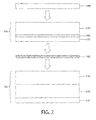
- FIG. 3 is a schematic diagram of a portion of the linoleum flooring product formation process.
- the wear layer 170 in this exemplary method is made of PETG.
- the method or process may employ a UV (ultraviolet) curable adhesive 140 to adhesively bond the printed wear layer 104 onto the linoleum substrate 102.
- adhesive 140 may be cured by a photochemical process. Examples of suitable UV curable adhesive that may be used include UV curable pressure sensitive adhesives.
- An exemplary suitable adhesive is a polyester pressure sensitive adhesive produced from 1,3-propanediol, and dicarboxylic acids, including aliphatic dicarboxylic acids, such as sebacic acid; aromatic dicarboxylic acids, such as terephthalic acid, isophthalic acids and phthalic anhydride; and mixtures thereof. Curing of the UV curable adhesive may be performed at ambient room temperatures in some embodiments. In this embodiment, a two-step UV curing process is used as further described below to increase adhesive bonding strength. Suitable adhesives for the present invention are disclosed in a provisional patent application, U.S. Ser. No.61/922,263 , that is being filed concurrently, which is herein incorporated by reference.
- the linoleum substrate 102 may be formed in a first process.
- the base and visual linoleum layers 120, 130 are formed and laminated together in a manner which is well known in the art.
- that single linoleum base layer 120 would instead be formed on the backing layer 110. Additional heat curing or other processing steps may be performed as needed to prepare the linoleum substrate 102 for receiving and bonding the printed wear layer 104 thereon.
- the printed wear layer 104 as described above formed by a second independent process is provided, which includes the desired printed decorative indicia.
- the printed wear layer 104 may include printed pad coat 150 or wear layer 170 may be directly printed without use of the pad coat.
- a UV-curable liquid adhesive 140 is first applied directly (by roller coating or another suitable) method onto the linoleum substrate 102, such as on visual linoleum layer 130 in the two linoleum layer substrate construction or on base layer 120 in a single linoleum layer construction.
- the liquid adhesive 140 may be applied to a thickness of about 2 mils; however, any suitable application thickness may be used to provide satisfactory bonding strength.
- the linoleum substrate 102 with adhesive 140 is then passed under an artificial UV light source in a first partial UV curing step for a first period of time sufficient to only partially cure the adhesive to the point where the adherence exhibits a tacky and pressure sensitive condition or quality so that objects (like the printed wear layer 104) will readily stick to the adhesive.
- an artificial UV light source may be used having an energy output of about 500 mJ (millijoules). Any suitable artificial UV light source may be used.
- the printed wear layer 104 is applied and positioned onto the partially cured and tacky adhesive 140 layer on the linoleum substrate 102 for lamination.
- the lamination may be performed in a roll-type laminator 200 comprising a spaced apart pair of rotating rolls or cylinders defining a gap or nib between them through which the printed wear layer 104 and linoleum substrate 102 passes.
- the nib is sized to sufficiently press and laminate the printed wear layer 104 and substrate 102 together.
- the linoleum substrate 102 and printed wear layer 104 are each heated before the foregoing lamination step. Heating of the linoleum substrate 102 improves bonding to the printed wear layer 104 through the laminator or calender 200.
- the linoleum substrate 102 may be heated using radiant heaters positioned proximate to the substrate. The linoleum substrate 102 may be heated to a temperature between about 160 degrees F to 200 degrees F immediately before lamination.
- the PETG wear layer 170 may be somewhat semi-rigid in structure due to the nature of PETG, heating the wear layer 170 advantageously increases its flexibility and allows it to more readily conform to the linoleum substrate 102 during the laminating process to improve handling and lamination results.
- the printed wear layer 104 may be passed under radiant heaters positioned proximate to the surface of the printed wear layer 104 and immediately upstream of and before the laminator rolls. The printed wear layer 104 may be heated to a temperature between about 160 degrees F to 200 degrees F immediately before lamination.
- a second full UV curing step is performed wherein the entire laminated linoleum substrate 102 and printed wear layer 104 composite structure is passed under a UV light source for a second period of time sufficient to fully cure the adhesive 140, thereby bonding the linoleum-printed wear layer composite together.
- the adhesive now exhibits a dried and hardened condition or quality.
- a UVA light source may be used having an energy output of about 500 mJ (millijoules).
- an energy output from the UVA light source used may be without limitation in a range of about and including 300 to 1200 mJ.
- a UVA light source having a longer wavelength than used in the first UV treatment may be used to provide sufficient penetration through printed wear layer 104 to properly cure the adhesive and bond the wear layer to the linoleum substrate.
- top protective layer(s) 180 may next be formed on wear layer 170 for added protection and durability.
- Such protective layers can be formed from a UV curable top coat composition available in the art for example as disclosed in U.S. Pat. No. 6,916,547 .
- the protective layer composition can be applied on top of the printed wear layer 104 after the printed wear layer 104 is laminated, but before the laminate with the wear layer 104 is subjected to the second UV treatment such that the adhesive and the protective composition can be simultaneously cured during the second UV treatment process.
- the linoleum product 100 may have any suitable overall thickness.
- Representative non-limiting thicknesses for linoleum flooring may range generally from about 2.5 mm - 3.2 mm in some embodiments.
Landscapes
- Engineering & Computer Science (AREA)
- Architecture (AREA)
- Ceramic Engineering (AREA)
- Life Sciences & Earth Sciences (AREA)
- Wood Science & Technology (AREA)
- Civil Engineering (AREA)
- Structural Engineering (AREA)
- Textile Engineering (AREA)
- Physics & Mathematics (AREA)
- Thermal Sciences (AREA)
- Laminated Bodies (AREA)
- Floor Finish (AREA)
Abstract
Description
- This application claims the benefit of priority from
U.S. Patent Application Serial No. 14/144,973, filed December 31, 2013 - The present invention relates to flooring system, and more particularly to linoleum flooring systems and related methods for making the same.
- Linoleum flooring provides a homogeneous floor covering product that is used in a wide range of residential and commercial applications. Linoleum is an environmentally "green" material being naturally anti-bacterial, biodegradable, and made from natural materials like linseed oil, rosin, recycled wood powder, cork dust, limestone, and mineral pigments for color. The linoleum components are mixed, calendered, and bonded to a suitable backing material typically forming rolls of flooring or tiles that are then heat cured for a period of time.
- Linoleum is available in a wide range of colors and decorative patterns or designs which may replicate natural materials (e.g. wood, stone, slate, marble, granite, etc.) and/or create various geometric or free-form artistic designs. The decorative design elements are generally formed within the linoleum layers by incorporating additive decorative components (e.g. colored particles, granules, chips, flakes, etc.) arranged in a desired pattern into the linoleum cement during processing. Depending on the complexity and visual effect intended for the decorative design, this approach may sometimes complicate processing and increase manufacturing costs.
- An improved decorative linoleum flooring product and method for making the same are desired.
- The present invention provides a linoleum flooring product that includes a printed wear layer comprising a decorative indicia which is laminated onto a previously processed and formed linoleum substrate. Accordingly, the printed wear layer may be independently formed in a separate fabrication process from forming the underlying linoleum substrate. Decorative indicia, which may include without limitation any type of image, wording, pattern, or combination thereof, may be ink printed either directly onto the wear layer or onto a thin pad coat which is then adhered to the wear layer. The completed printed wear layer in either of the foregoing constructions is then overlaid and adhesively bonded onto an exposed top surface of the linoleum substrate. In one embodiment, a UV (ultraviolet) curable adhesive may be used. The printed wear layer may be made of a non-linoleum material in some embodiments, such as without limitation thermoplastic polymers, to produce a highly wear resistant hybrid linoleum-polymeric flooring product.
- It bears noting that the decorative design or pattern is formed in the wear layer and not physically integrated into the depth of the linoleum substrate structure, and therefore represents a topical surface application of the wear layer with decorative design onto the linoleum.
- According to one exemplary embodiment, a method for forming a printed linoleum product includes: providing a linoleum substrate formed in a first fabrication process, the linoleum substrate including at least one linoleum layer bonded to a backing layer; providing a printed wear layer comprising a inked decorative indicia formed in a second fabrication process separate from the first fabrication process, the printed wear layer including a wear layer and an ink print layer; applying an adhesive onto the linoleum substrate; partially curing the adhesive for a first period of time sufficient to produce a tacky condition; laminating the linoleum substrate with partially cured adhesive and the printed wear layer together; and curing the adhesive for a second period of time sufficient to cure the adhesive, wherein the printed wear layer becomes permanently bonded to the linoleum substrate In various embodiments, the printed wear layer may be substantially clear or transparent and be formed of, for example, polyesters, including polyethylene terephthalate, and polyethylene terephtalate glycol-modified. In some embodiments, the wear layer is a polymeric film produced from polyvinyl chloride, polyester, acrylic, polyurethane and combinations thereof.
- According to another embodiment, a method for forming a printed linoleum product includes: providing a linoleum substrate formed in a first fabrication process, the linoleum substrate including at least one linoleum layer bonded to a backing layer; providing a printed wear layer comprising an decorative indicia formed in a second fabrication process separately from the first fabrication process, the printed wear layer including a wear layer and an ink print layer; applying an ultraviolet curable adhesive onto the linoleum substrate; exposing the adhesive to an ultraviolet light source for a period of time sufficient to partially cure the adhesive and produce a tacky condition; laminating the linoleum substrate with partially cured adhesive and the printed wear layer together; and exposing the adhesive to an ultraviolet light source for a period of time sufficient to fully cure the adhesive, wherein the printed wear layer becomes permanently bonded to the linoleum substrate. In various embodiments, the method may further include heating the printed wear layer prior to laminating. In the foregoing or other embodiments, the method may also include heating the linoleum substrate prior to laminating.
- A linoleum flooring product according to the present disclosure, which may be produced by the foregoing methods, comprises a backing layer, a linoleum substrate formed on the backing layer, and a printed wear layer comprising a transparent wear layer and an inked decorative indicia. The printed wear layer is adhesively bonded to the linoleum substrate in this embodiment. The present invention is illustrated with a printed wear layer, but the wear layer can be a transparent or translucent layer without any printing applied on the layer to utilize the aesthetical features of the base linoleum layer.
- The features of the exemplary embodiments of the present invention will be described with reference to the following drawings, where like elements are labeled similarly, and in which:
-
FIG. 1 is a side view of a composite linoleum flooring product according to the present disclosure; -
FIG. 2 is an exploded view thereof showing the separately formed linoleum substrate and printed wear layer structures; and -
FIG. 3 is a schematic diagram of a process for bonding the printed wear layer to the linoleum substrate. - All drawings are schematic and not necessarily to scale. Parts given a reference numerical designation in one figure may be considered to be the same parts where they appear in other figures without a numerical designation for brevity unless specifically labeled with a different part number and described herein.
- The features and benefits of the invention are illustrated and described herein by reference to exemplary embodiments. This description of exemplary embodiments is intended to be read in connection with the accompanying drawings, which are to be considered part of the entire written description. The disclosure expressly should not be limited to such exemplary embodiments described herein illustrating some possible non-limiting combination of features that may exist alone or in other combinations of features.
- In the description of embodiments disclosed herein, any reference to direction or orientation is merely intended for convenience of description and is not intended in any way to limit the scope of the present invention. Relative terms such as "lower," "upper," "horizontal," "vertical,", "above," "below," "up," "down," "top" and "bottom" as well as derivative thereof (e.g., "horizontally," "downwardly," "upwardly," etc.) should be construed to refer to the orientation as then described or as shown in the drawing under discussion. These relative terms are for convenience of description only and do not require that the apparatus be constructed or operated in a particular orientation. Terms such as "attached," "affixed," "connected," "coupled," "interconnected," and similar refer to a relationship wherein structures are secured or attached to one another either directly or indirectly through intervening structures, as well as both movable or rigid attachments or relationships, unless expressly described otherwise.
-
FIGS. 1 and2 depict one exemplary non-limiting embodiment of alinoleum flooring product 100 according to the present disclosure. Theflooring product 100 includeslinoleum substrate 102 and a printedlayer 104. Thelinoleum substrate 102 and printedlayer 104 each form separate self-supporting unitary structures on their own before being bonded together according to the process described herein. - The
substrate 102 may be comprised of (from bottom upwards) abacking layer 110,base linoleum layer 120 formed thereon, and avisual linoleum layer 130 formed thereon. The printedwear layer 104 may be comprised of abottom pad coat 150, atop wear layer 170, and anink print layer 160 comprised of ink printed to form a decorative indicia or design disposed between the pad coat or wear layer. Anadhesive layer 140 is provided between thelinoleum substrate 102 and printedwear layer 104 to bond the two structures together. In some embodiments, a high performance protectivetop layer 180 may be formed onto thetop wear layer 170 for added protection and durability. -
Backing layer 110 may be formed of any suitable backing material, such as for example jute or polyester fabric, canvas, or burlap. -
Linoleum layers visual linoleum layer 130 is a patterned layer which may include various decorative additive components such as without limitation colored particles, granules, chips, flakes, or other forms made of linoleum cement or non-linoleum materials such as various linoleum compatible polymers. The decorative additive components may be arranged to form designs that replicate natural materials (e.g. wood, stone, slate, marble, granite, etc.) and/or create various geometric or free-form artistic designs. The decorative additive components may have a different color pigment than the homogenous base color pigment of the linoleum material inlayer 130. The decorative additive components elements may be added, mixed, pressed, or otherwise incorporated into the green linoleum material in various patterns and then laminated to fuse the components in the linoleum structure. Other methods may be used to incorporate and bond the decorative additive components with the linoleum material in thevisual linoleum layer 130. - The
base linoleum layer 120 may be relatively plain in structure in some embodiments without decorative additive components like thevisual linoleum layer 130.Base linoleum layer 120 forms an underlayment with respect to thevisual linoleum layer 130. In some embodiments, a single linoleum layer may alternatively be used instead of a dual layer construction. The invention is not limited to either construction. -
Base linoleum layer 120 andvisual linoleum layer 130 may have representative thicknesses of about 20 mils and 60 mils, respectively. - Processes for forming base and visual linoleum layers and single linoleum layers are well known to those skilled in the art without further elaboration herein.
- In an embodiment, the
visual linoleum layer 130 may be omitted and the decorative pattern may be provided entirely in the printedwear layer 104, as further described herein. Advantageously, this eliminates the need to fabricate and bond two linoleum layers. - The
backing layer 110 and duo linoleum layers 120, 130 or a single layer 120 (if alternatively used) collectively define a linoleum substrate. In one embodiment, the linoleum substrate is formed in a first process separate from a second process of independently forming the printedwear layer 104 before being bonded to the linoleum substrate. - In the embodiment shown in
FIGS. 1 and2 , thepad coat 150,ink print layer 160, and wearlayer 170 collectively define the printedwear layer 104.Pad coat 150 may be a substantially clear or transparent material, or an opaque material (e.g. white ink). A desired decorative design or pattern may be printed onto the bottom ofwear layer 170 which forms theink print layer 160. Theink print layer 160 is preferably disposed between thepad coat 150 and wearlayer 170. Thepad coat 150 has a thickness less than thewear layer 170. - Any suitable type ink may be used for printing the
pad coat 150 andink print layer 160. Some non-limiting examples include non-PVC inks such as nitrous cellulose, UV (ultraviolet) curable ink, and acrylic ink. Preferably, thepad coat 150 andink print layer 160 are dried before bonding the printedwear layer 140 onto thelinoleum substrate 102. - The
wear layer 170 protects the printedpad coat 150 from foot or equipment traffic in the finished linoleum flooring composite. In one embodiment, thewear layer 170 may be formed from PETG (Polyethylene Terephtalate Glycol-Modified). PETG is a naturally clear thermoplastic with high transparency that can be extruded into sheets of varying thicknesses. Depending on thicknesses used, PETG can vary from semi-rigid to rigid and advantageously is lightweight. PETG is relatively strong and impact-resistant, as well as an effective barrier to alcohol and solvents making this material ideal for a wear layer. The PETG material may also be pigmented and colored during processing and still retain its transparency. This expands aesthetic design possibilities. In the present printedwear layer 104 construction being described, awear layer 170 formed of PETG may have a representative non-limiting thickness of about 0.5 mm. A representative non-limiting range of thicknesses that may be used is from about and including 2 mils (0.051 mm) to 20 mils (0.5 mm). - Depending on the desired decorative designs selected for the
linoleum product 100, the printedwear layer 104 may entirely obviate the need for avisible linoleum layer 130 wherein the decorative design is provided solely by the printed wear layer. This provides an advantage over standard linoleum because a single pigmentedbase linoleum layer 120 may be used instead of typically two layers - afirst base layer 120 and a secondvisible layer 130 having the decorative pattern. Accordingly, the printedwear layer 104 may have designs that replicate natural materials (e.g. wood, stone, slate, marble, granite, etc.) and/or create various geometric or free-form artistic designs. Advantageously, the printedwear layer 104 linoleum composite construction is less expensive from a fabrication standpoint than using avisible wear layer 130 because various colored or patterned additive decorative components (e.g. colored particles, granules, chips, flakes, etc.) do not need to be formed in a linoleum layer, but rather are provided in the printedwear layer 104 bonded to the linoleum base layer. It should be noted that the secondvisible linoleum layer 130 may still be used if desired, however, to expand the visual decorative design possibilities and add depth to thelinoleum flooring product 100. - Top
protective layer 180 formed onwear layer 170 may be made of a high performance UV curable coating in one non-limiting example. The top protective layer may have a representative thickness of about 0.02 mm. In some embodiments, multiple topprotective layers 180 may be provided for added durability. The topprotective layer 180 may be applied onto thewear layer 170 in the linoleum flooring fabrication facility after the printedwear layer 104 is bonded to thelinoleum substrate 102. - An exemplary method for forming a printed
linoleum flooring product 100 will now be described with reference toFIGS. 1-3 .FIG. 3 is a schematic diagram of a portion of the linoleum flooring product formation process. Thewear layer 170 in this exemplary method is made of PETG. The method or process may employ a UV (ultraviolet)curable adhesive 140 to adhesively bond the printedwear layer 104 onto thelinoleum substrate 102. Accordingly, adhesive 140 may be cured by a photochemical process. Examples of suitable UV curable adhesive that may be used include UV curable pressure sensitive adhesives. An exemplary suitable adhesive is a polyester pressure sensitive adhesive produced from 1,3-propanediol, and dicarboxylic acids, including aliphatic dicarboxylic acids, such as sebacic acid; aromatic dicarboxylic acids, such as terephthalic acid, isophthalic acids and phthalic anhydride; and mixtures thereof. Curing of the UV curable adhesive may be performed at ambient room temperatures in some embodiments. In this embodiment, a two-step UV curing process is used as further described below to increase adhesive bonding strength. Suitable adhesives for the present invention are disclosed in a provisional patent application,U.S. Ser. No.61/922,263 - The
linoleum substrate 102 may be formed in a first process. In one embodiment, the base and visual linoleum layers 120, 130 are formed and laminated together in a manner which is well known in the art. In alternative embodiments described herein in which a singlelinoleum base layer 120 also serves as the visual linoleum layer, that singlelinoleum base layer 120 would instead be formed on thebacking layer 110. Additional heat curing or other processing steps may be performed as needed to prepare thelinoleum substrate 102 for receiving and bonding the printedwear layer 104 thereon. - The printed
wear layer 104 as described above formed by a second independent process is provided, which includes the desired printed decorative indicia. The printedwear layer 104 may include printedpad coat 150 or wearlayer 170 may be directly printed without use of the pad coat. - A UV-curable liquid adhesive 140 is first applied directly (by roller coating or another suitable) method onto the
linoleum substrate 102, such as onvisual linoleum layer 130 in the two linoleum layer substrate construction or onbase layer 120 in a single linoleum layer construction. In one, theliquid adhesive 140 may be applied to a thickness of about 2 mils; however, any suitable application thickness may be used to provide satisfactory bonding strength. - The
linoleum substrate 102 with adhesive 140 is then passed under an artificial UV light source in a first partial UV curing step for a first period of time sufficient to only partially cure the adhesive to the point where the adherence exhibits a tacky and pressure sensitive condition or quality so that objects (like the printed wear layer 104) will readily stick to the adhesive. In one non-limiting embodiment, a UVA light source may be used having an energy output of about 500 mJ (millijoules). Any suitable artificial UV light source may be used. - Next, the printed
wear layer 104 is applied and positioned onto the partially cured andtacky adhesive 140 layer on thelinoleum substrate 102 for lamination. In one embodiment, the lamination may be performed in a roll-type laminator 200 comprising a spaced apart pair of rotating rolls or cylinders defining a gap or nib between them through which the printedwear layer 104 andlinoleum substrate 102 passes. The nib is sized to sufficiently press and laminate the printedwear layer 104 andsubstrate 102 together. - In one embodiment, the
linoleum substrate 102 and printedwear layer 104 are each heated before the foregoing lamination step. Heating of thelinoleum substrate 102 improves bonding to the printedwear layer 104 through the laminator orcalender 200. Thelinoleum substrate 102 may be heated using radiant heaters positioned proximate to the substrate. Thelinoleum substrate 102 may be heated to a temperature between about 160 degrees F to 200 degrees F immediately before lamination. - Because the
PETG wear layer 170 may be somewhat semi-rigid in structure due to the nature of PETG, heating thewear layer 170 advantageously increases its flexibility and allows it to more readily conform to thelinoleum substrate 102 during the laminating process to improve handling and lamination results. In one embodiment, the printedwear layer 104 may be passed under radiant heaters positioned proximate to the surface of the printedwear layer 104 and immediately upstream of and before the laminator rolls. The printedwear layer 104 may be heated to a temperature between about 160 degrees F to 200 degrees F immediately before lamination. - Following the laminating process, a second full UV curing step is performed wherein the entire
laminated linoleum substrate 102 and printedwear layer 104 composite structure is passed under a UV light source for a second period of time sufficient to fully cure the adhesive 140, thereby bonding the linoleum-printed wear layer composite together. The adhesive now exhibits a dried and hardened condition or quality. In one embodiment, a UVA light source may be used having an energy output of about 500 mJ (millijoules). In representative examples, an energy output from the UVA light source used may be without limitation in a range of about and including 300 to 1200 mJ. A UVA light source having a longer wavelength than used in the first UV treatment may be used to provide sufficient penetration through printedwear layer 104 to properly cure the adhesive and bond the wear layer to the linoleum substrate. - One or more top protective layer(s) 180 may next be formed on
wear layer 170 for added protection and durability. Such protective layers can be formed from a UV curable top coat composition available in the art for example as disclosed inU.S. Pat. No. 6,916,547 . The protective layer composition can be applied on top of the printedwear layer 104 after the printedwear layer 104 is laminated, but before the laminate with thewear layer 104 is subjected to the second UV treatment such that the adhesive and the protective composition can be simultaneously cured during the second UV treatment process. - The
linoleum product 100 may have any suitable overall thickness. Representative non-limiting thicknesses for linoleum flooring may range generally from about 2.5 mm - 3.2 mm in some embodiments.
While the foregoing description and drawings represent exemplary embodiments of the present disclosure, it will be understood that various additions, modifications and substitutions may be made therein without departing from the spirit and scope and range of equivalents of the accompanying claims. In particular, it will be clear to those skilled in the art that the present invention may be embodied in other forms, structures, arrangements, proportions, sizes, and with other elements, materials, and components, without departing from the spirit or essential characteristics thereof. In addition, numerous variations in the methods/processes described herein may be made within the scope of the present disclosure. One skilled in the art will further appreciate that the embodiments may be used with many modifications of structure, arrangement, proportions, sizes, materials, and components and otherwise, used in the practice of the disclosure, which are particularly adapted to specific environments and operative requirements without departing from the principles described herein. The presently disclosed embodiments are therefore to be considered in all respects as illustrative and not restrictive. The appended claims should be construed broadly, to include other variants and embodiments of the disclosure, which may be made by those skilled in the art without departing from the scope and range of equivalents.
Claims (14)
Applications Claiming Priority (1)
| Application Number | Priority Date | Filing Date | Title |
|---|---|---|---|
| US14/144,973 US9303354B2 (en) | 2013-12-31 | 2013-12-31 | Linoleum flooring |
Publications (2)
| Publication Number | Publication Date |
|---|---|
| EP2889135A1 true EP2889135A1 (en) | 2015-07-01 |
| EP2889135B1 EP2889135B1 (en) | 2018-10-17 |
Family
ID=52144494
Family Applications (1)
| Application Number | Title | Priority Date | Filing Date |
|---|---|---|---|
| EP14199437.6A Not-in-force EP2889135B1 (en) | 2013-12-31 | 2014-12-19 | Linoleum flooring |
Country Status (2)
| Country | Link |
|---|---|
| US (2) | US9303354B2 (en) |
| EP (1) | EP2889135B1 (en) |
Cited By (1)
| Publication number | Priority date | Publication date | Assignee | Title |
|---|---|---|---|---|
| FR3115725A1 (en) * | 2020-11-05 | 2022-05-06 | Gerflor | Multilayer structure for the realization of a floor or wall covering printed and based on linoleum |
Families Citing this family (4)
| Publication number | Priority date | Publication date | Assignee | Title |
|---|---|---|---|---|
| BE1021929B1 (en) | 2014-07-04 | 2016-01-27 | Unilin Bvba | FLOOR PANEL |
| BE1024734B1 (en) * | 2016-11-10 | 2018-06-19 | Ivc Bvba | FLOOR PANEL AND METHOD FOR MANUFACTURING A FLOOR PANEL |
| KR101925994B1 (en) * | 2017-05-17 | 2018-12-07 | 서정수 | Manufacturing apparatus for floor interior tile |
| LU504655B1 (en) * | 2023-07-03 | 2025-01-03 | Tarkett Gdl Sa | Decorative surface coverings digitally embossed |
Citations (6)
| Publication number | Priority date | Publication date | Assignee | Title |
|---|---|---|---|---|
| GB372962A (en) * | 1931-05-29 | 1932-05-19 | Rylands & Sons Ltd | Improvements in linoleum |
| US6159583A (en) * | 1998-04-20 | 2000-12-12 | Kittrich Corporation | Decorative non-adhering liner or mat |
| US6916547B2 (en) | 2002-02-01 | 2005-07-12 | Awi Licensing Company | Multi-functional unsaturated polyester polyols |
| US20100276059A1 (en) * | 2009-04-30 | 2010-11-04 | Dong Tian | UVV curable coating compositions and method for coating flooring and other substrates with same |
| DE102011105443A1 (en) * | 2011-06-24 | 2012-12-27 | Armstrong DLW GmbH | Linoleum or corkment based fabric with sublimation printing |
| WO2012175199A1 (en) * | 2011-06-24 | 2012-12-27 | Armstrong DLW GmbH | Printed linoleum or korkment-based sheet material |
Family Cites Families (18)
| Publication number | Priority date | Publication date | Assignee | Title |
|---|---|---|---|---|
| US3484335A (en) * | 1965-07-19 | 1969-12-16 | Ppg Industries Inc | Laminated articles containing oxidatively cured non-rubbery interpolymers and method for making |
| US4312686A (en) | 1980-02-11 | 1982-01-26 | American Biltrite Inc. | Printed and embossed floor covering and method and apparatus for its manufacture |
| US4421782A (en) * | 1981-10-26 | 1983-12-20 | Armstrong World Industries, Inc. | Process for providing improved radiation-curable surface coverings and products produced thereby |
| US5643666A (en) | 1995-12-20 | 1997-07-01 | Eastman Chemical Company | Solid surfaces which are prepared from copolyesters laminated onto a high resolution image |
| US6258429B1 (en) | 1997-03-11 | 2001-07-10 | Stephen G. Nelson | One-way see-thru panel and method of making same |
| US20020136862A1 (en) * | 2000-12-11 | 2002-09-26 | Daojie Dong | Decorative and/or flame retardant laminates and processes of manufacture thereof |
| US6803110B2 (en) * | 2001-01-22 | 2004-10-12 | Formica Corporation | Decorative laminate assembly and method for producing same |
| MXPA04006155A (en) | 2001-12-20 | 2005-03-31 | Johnson Diversey Inc | Surface enhancement and modification system. |
| MXPA05006536A (en) | 2002-12-18 | 2005-09-08 | Johnson Diversey Inc | Ultra-thin surface modification system. |
| DE102004015257B4 (en) | 2004-03-29 | 2008-02-07 | Armstrong Dlw Ag | Patterned linoleum fabric |
| US20050249929A1 (en) * | 2004-05-05 | 2005-11-10 | Reichwein David P | Digitally printed surface covering |
| CA2583377A1 (en) | 2004-10-12 | 2006-04-27 | 3M Innovative Properties Company | Protective films |
| CN101068872B (en) | 2004-10-12 | 2010-10-27 | 3M创新有限公司 | protective film wear layer |
| AU2008254809B2 (en) | 2007-05-17 | 2013-06-27 | Diversey, Inc. | Surface coating system and method |
| US20110097954A1 (en) | 2009-10-23 | 2011-04-28 | Skudo Manufacturing Pty Ltd | Peelable Coating |
| CA2779374A1 (en) | 2009-11-25 | 2011-06-03 | Diversey, Inc. | Surface coating system and method of using surface coating system |
| US20120276348A1 (en) | 2010-01-07 | 2012-11-01 | Clausi Robert N | Resilient flooring compositions |
| DE102011105528A1 (en) | 2011-06-24 | 2012-12-27 | Armstrong DLW GmbH | Heterogeneous linoleum or cork patches |
-
2013
- 2013-12-31 US US14/144,973 patent/US9303354B2/en not_active Expired - Fee Related
-
2014
- 2014-12-19 EP EP14199437.6A patent/EP2889135B1/en not_active Not-in-force
-
2016
- 2016-04-05 US US15/090,784 patent/US20160215507A1/en not_active Abandoned
Patent Citations (6)
| Publication number | Priority date | Publication date | Assignee | Title |
|---|---|---|---|---|
| GB372962A (en) * | 1931-05-29 | 1932-05-19 | Rylands & Sons Ltd | Improvements in linoleum |
| US6159583A (en) * | 1998-04-20 | 2000-12-12 | Kittrich Corporation | Decorative non-adhering liner or mat |
| US6916547B2 (en) | 2002-02-01 | 2005-07-12 | Awi Licensing Company | Multi-functional unsaturated polyester polyols |
| US20100276059A1 (en) * | 2009-04-30 | 2010-11-04 | Dong Tian | UVV curable coating compositions and method for coating flooring and other substrates with same |
| DE102011105443A1 (en) * | 2011-06-24 | 2012-12-27 | Armstrong DLW GmbH | Linoleum or corkment based fabric with sublimation printing |
| WO2012175199A1 (en) * | 2011-06-24 | 2012-12-27 | Armstrong DLW GmbH | Printed linoleum or korkment-based sheet material |
Cited By (3)
| Publication number | Priority date | Publication date | Assignee | Title |
|---|---|---|---|---|
| FR3115725A1 (en) * | 2020-11-05 | 2022-05-06 | Gerflor | Multilayer structure for the realization of a floor or wall covering printed and based on linoleum |
| EP3995305A1 (en) * | 2020-11-05 | 2022-05-11 | Gerflor | Multilayer structure for forming a linoleum-based printed floor or wall covering |
| US11976473B2 (en) | 2020-11-05 | 2024-05-07 | Gerflor | Multilayer structure for producing a printed and linoleum-based floor or wall covering |
Also Published As
| Publication number | Publication date |
|---|---|
| US9303354B2 (en) | 2016-04-05 |
| US20150184334A1 (en) | 2015-07-02 |
| EP2889135B1 (en) | 2018-10-17 |
| US20160215507A1 (en) | 2016-07-28 |
Similar Documents
| Publication | Publication Date | Title |
|---|---|---|
| EP2889135B1 (en) | Linoleum flooring | |
| JP7674808B2 (en) | Antibacterial decorative laminate | |
| CN109863009B (en) | Method for producing glue-free and dust-free composite floor material | |
| CN109863275B (en) | Non-glue dust-free composite floor material product | |
| ES2738309T3 (en) | Multilayer composite film stamped and laminated in molten state | |
| KR20230149872A (en) | Method to produce a coating layer, a building panel and a coated foil | |
| JP2018508382A5 (en) | ||
| KR101261090B1 (en) | Decoration Sheet Setting Printing Pattern With The Embo Pattern and Manufacturing Method Thereof | |
| US20030194540A1 (en) | Decorated panel and process for making the same | |
| US20170246845A1 (en) | Engineered Plank and Its Manufacturing Method | |
| KR101262444B1 (en) | Molding sheet having three dimensional emboss effect | |
| US20090110883A1 (en) | Laminates having printed exterior surface for use as construction materials | |
| JP7383222B2 (en) | Decorative paper, decorative material, and method for producing decorative paper | |
| KR101522520B1 (en) | Method for manufacturing synthetic resin sheet | |
| US20180178487A1 (en) | Engineered Plank and its Manufacturing Method | |
| EP4452662A1 (en) | A method of creating a textured layer on a decorative panel | |
| US9358754B2 (en) | Dimensionally stable product and process of fabricating a dimensionally stable product | |
| KR20170044354A (en) | Colorful pet surface panel and manufacturing method thereof | |
| JPH03174279A (en) | Production of decorative sheet | |
| US20240294000A1 (en) | Engineered plank and its manufacturing method | |
| KR101224615B1 (en) | Transparent Decoration Panel | |
| JPS63107780A (en) | Manufacture of decorative material | |
| EP2492109A1 (en) | A method of manufacturing a panel, and a panel | |
| JP2026016076A (en) | Decorative sheets and decorative materials | |
| JP2009108616A (en) | Decorative sheet for floor |
Legal Events
| Date | Code | Title | Description |
|---|---|---|---|
| PUAI | Public reference made under article 153(3) epc to a published international application that has entered the european phase |
Free format text: ORIGINAL CODE: 0009012 |
|
| 17P | Request for examination filed |
Effective date: 20141219 |
|
| AK | Designated contracting states |
Kind code of ref document: A1 Designated state(s): AL AT BE BG CH CY CZ DE DK EE ES FI FR GB GR HR HU IE IS IT LI LT LU LV MC MK MT NL NO PL PT RO RS SE SI SK SM TR |
|
| AX | Request for extension of the european patent |
Extension state: BA ME |
|
| REG | Reference to a national code |
Ref country code: DE Ref legal event code: R079 Ref document number: 602014034167 Country of ref document: DE Free format text: PREVIOUS MAIN CLASS: B32B0007000000 Ipc: B32B0037120000 |
|
| RIC1 | Information provided on ipc code assigned before grant |
Ipc: B32B 37/12 20060101AFI20180227BHEP Ipc: B44C 5/04 20060101ALI20180227BHEP Ipc: B32B 7/12 20060101ALI20180227BHEP Ipc: E04F 15/10 20060101ALI20180227BHEP Ipc: D06N 1/00 20060101ALI20180227BHEP Ipc: B32B 9/04 20060101ALI20180227BHEP Ipc: B32B 9/02 20060101ALI20180227BHEP |
|
| GRAP | Despatch of communication of intention to grant a patent |
Free format text: ORIGINAL CODE: EPIDOSNIGR1 |
|
| STAA | Information on the status of an ep patent application or granted ep patent |
Free format text: STATUS: GRANT OF PATENT IS INTENDED |
|
| INTG | Intention to grant announced |
Effective date: 20180406 |
|
| GRAJ | Information related to disapproval of communication of intention to grant by the applicant or resumption of examination proceedings by the epo deleted |
Free format text: ORIGINAL CODE: EPIDOSDIGR1 |
|
| STAA | Information on the status of an ep patent application or granted ep patent |
Free format text: STATUS: REQUEST FOR EXAMINATION WAS MADE |
|
| GRAR | Information related to intention to grant a patent recorded |
Free format text: ORIGINAL CODE: EPIDOSNIGR71 |
|
| GRAS | Grant fee paid |
Free format text: ORIGINAL CODE: EPIDOSNIGR3 |
|
| STAA | Information on the status of an ep patent application or granted ep patent |
Free format text: STATUS: GRANT OF PATENT IS INTENDED |
|
| GRAA | (expected) grant |
Free format text: ORIGINAL CODE: 0009210 |
|
| STAA | Information on the status of an ep patent application or granted ep patent |
Free format text: STATUS: THE PATENT HAS BEEN GRANTED |
|
| INTC | Intention to grant announced (deleted) | ||
| AK | Designated contracting states |
Kind code of ref document: B1 Designated state(s): AL AT BE BG CH CY CZ DE DK EE ES FI FR GB GR HR HU IE IS IT LI LT LU LV MC MK MT NL NO PL PT RO RS SE SI SK SM TR |
|
| INTG | Intention to grant announced |
Effective date: 20180907 |
|
| REG | Reference to a national code |
Ref country code: GB Ref legal event code: FG4D |
|
| REG | Reference to a national code |
Ref country code: CH Ref legal event code: EP |
|
| REG | Reference to a national code |
Ref country code: IE Ref legal event code: FG4D |
|
| REG | Reference to a national code |
Ref country code: DE Ref legal event code: R096 Ref document number: 602014034167 Country of ref document: DE Ref country code: AT Ref legal event code: REF Ref document number: 1053509 Country of ref document: AT Kind code of ref document: T Effective date: 20181115 |
|
| REG | Reference to a national code |
Ref country code: NL Ref legal event code: MP Effective date: 20181017 |
|
| REG | Reference to a national code |
Ref country code: LT Ref legal event code: MG4D |
|
| REG | Reference to a national code |
Ref country code: AT Ref legal event code: MK05 Ref document number: 1053509 Country of ref document: AT Kind code of ref document: T Effective date: 20181017 |
|
| PG25 | Lapsed in a contracting state [announced via postgrant information from national office to epo] |
Ref country code: NL Free format text: LAPSE BECAUSE OF FAILURE TO SUBMIT A TRANSLATION OF THE DESCRIPTION OR TO PAY THE FEE WITHIN THE PRESCRIBED TIME-LIMIT Effective date: 20181017 |
|
| PG25 | Lapsed in a contracting state [announced via postgrant information from national office to epo] |
Ref country code: FI Free format text: LAPSE BECAUSE OF FAILURE TO SUBMIT A TRANSLATION OF THE DESCRIPTION OR TO PAY THE FEE WITHIN THE PRESCRIBED TIME-LIMIT Effective date: 20181017 Ref country code: IS Free format text: LAPSE BECAUSE OF FAILURE TO SUBMIT A TRANSLATION OF THE DESCRIPTION OR TO PAY THE FEE WITHIN THE PRESCRIBED TIME-LIMIT Effective date: 20190217 Ref country code: BG Free format text: LAPSE BECAUSE OF FAILURE TO SUBMIT A TRANSLATION OF THE DESCRIPTION OR TO PAY THE FEE WITHIN THE PRESCRIBED TIME-LIMIT Effective date: 20190117 Ref country code: HR Free format text: LAPSE BECAUSE OF FAILURE TO SUBMIT A TRANSLATION OF THE DESCRIPTION OR TO PAY THE FEE WITHIN THE PRESCRIBED TIME-LIMIT Effective date: 20181017 Ref country code: PL Free format text: LAPSE BECAUSE OF FAILURE TO SUBMIT A TRANSLATION OF THE DESCRIPTION OR TO PAY THE FEE WITHIN THE PRESCRIBED TIME-LIMIT Effective date: 20181017 Ref country code: LV Free format text: LAPSE BECAUSE OF FAILURE TO SUBMIT A TRANSLATION OF THE DESCRIPTION OR TO PAY THE FEE WITHIN THE PRESCRIBED TIME-LIMIT Effective date: 20181017 Ref country code: LT Free format text: LAPSE BECAUSE OF FAILURE TO SUBMIT A TRANSLATION OF THE DESCRIPTION OR TO PAY THE FEE WITHIN THE PRESCRIBED TIME-LIMIT Effective date: 20181017 Ref country code: ES Free format text: LAPSE BECAUSE OF FAILURE TO SUBMIT A TRANSLATION OF THE DESCRIPTION OR TO PAY THE FEE WITHIN THE PRESCRIBED TIME-LIMIT Effective date: 20181017 Ref country code: NO Free format text: LAPSE BECAUSE OF FAILURE TO SUBMIT A TRANSLATION OF THE DESCRIPTION OR TO PAY THE FEE WITHIN THE PRESCRIBED TIME-LIMIT Effective date: 20190117 Ref country code: AT Free format text: LAPSE BECAUSE OF FAILURE TO SUBMIT A TRANSLATION OF THE DESCRIPTION OR TO PAY THE FEE WITHIN THE PRESCRIBED TIME-LIMIT Effective date: 20181017 |
|
| PG25 | Lapsed in a contracting state [announced via postgrant information from national office to epo] |
Ref country code: PT Free format text: LAPSE BECAUSE OF FAILURE TO SUBMIT A TRANSLATION OF THE DESCRIPTION OR TO PAY THE FEE WITHIN THE PRESCRIBED TIME-LIMIT Effective date: 20190217 Ref country code: AL Free format text: LAPSE BECAUSE OF FAILURE TO SUBMIT A TRANSLATION OF THE DESCRIPTION OR TO PAY THE FEE WITHIN THE PRESCRIBED TIME-LIMIT Effective date: 20181017 Ref country code: GR Free format text: LAPSE BECAUSE OF FAILURE TO SUBMIT A TRANSLATION OF THE DESCRIPTION OR TO PAY THE FEE WITHIN THE PRESCRIBED TIME-LIMIT Effective date: 20190118 Ref country code: RS Free format text: LAPSE BECAUSE OF FAILURE TO SUBMIT A TRANSLATION OF THE DESCRIPTION OR TO PAY THE FEE WITHIN THE PRESCRIBED TIME-LIMIT Effective date: 20181017 Ref country code: SE Free format text: LAPSE BECAUSE OF FAILURE TO SUBMIT A TRANSLATION OF THE DESCRIPTION OR TO PAY THE FEE WITHIN THE PRESCRIBED TIME-LIMIT Effective date: 20181017 |
|
| REG | Reference to a national code |
Ref country code: DE Ref legal event code: R119 Ref document number: 602014034167 Country of ref document: DE |
|
| PG25 | Lapsed in a contracting state [announced via postgrant information from national office to epo] |
Ref country code: IT Free format text: LAPSE BECAUSE OF FAILURE TO SUBMIT A TRANSLATION OF THE DESCRIPTION OR TO PAY THE FEE WITHIN THE PRESCRIBED TIME-LIMIT Effective date: 20181017 Ref country code: CZ Free format text: LAPSE BECAUSE OF FAILURE TO SUBMIT A TRANSLATION OF THE DESCRIPTION OR TO PAY THE FEE WITHIN THE PRESCRIBED TIME-LIMIT Effective date: 20181017 Ref country code: DK Free format text: LAPSE BECAUSE OF FAILURE TO SUBMIT A TRANSLATION OF THE DESCRIPTION OR TO PAY THE FEE WITHIN THE PRESCRIBED TIME-LIMIT Effective date: 20181017 |
|
| REG | Reference to a national code |
Ref country code: CH Ref legal event code: PL |
|
| PLBE | No opposition filed within time limit |
Free format text: ORIGINAL CODE: 0009261 |
|
| STAA | Information on the status of an ep patent application or granted ep patent |
Free format text: STATUS: NO OPPOSITION FILED WITHIN TIME LIMIT |
|
| PG25 | Lapsed in a contracting state [announced via postgrant information from national office to epo] |
Ref country code: MC Free format text: LAPSE BECAUSE OF FAILURE TO SUBMIT A TRANSLATION OF THE DESCRIPTION OR TO PAY THE FEE WITHIN THE PRESCRIBED TIME-LIMIT Effective date: 20181017 Ref country code: SK Free format text: LAPSE BECAUSE OF FAILURE TO SUBMIT A TRANSLATION OF THE DESCRIPTION OR TO PAY THE FEE WITHIN THE PRESCRIBED TIME-LIMIT Effective date: 20181017 Ref country code: RO Free format text: LAPSE BECAUSE OF FAILURE TO SUBMIT A TRANSLATION OF THE DESCRIPTION OR TO PAY THE FEE WITHIN THE PRESCRIBED TIME-LIMIT Effective date: 20181017 Ref country code: LU Free format text: LAPSE BECAUSE OF NON-PAYMENT OF DUE FEES Effective date: 20181219 Ref country code: SM Free format text: LAPSE BECAUSE OF FAILURE TO SUBMIT A TRANSLATION OF THE DESCRIPTION OR TO PAY THE FEE WITHIN THE PRESCRIBED TIME-LIMIT Effective date: 20181017 Ref country code: EE Free format text: LAPSE BECAUSE OF FAILURE TO SUBMIT A TRANSLATION OF THE DESCRIPTION OR TO PAY THE FEE WITHIN THE PRESCRIBED TIME-LIMIT Effective date: 20181017 |
|
| REG | Reference to a national code |
Ref country code: IE Ref legal event code: MM4A |
|
| 26N | No opposition filed |
Effective date: 20190718 |
|
| GBPC | Gb: european patent ceased through non-payment of renewal fee |
Effective date: 20190117 |
|
| REG | Reference to a national code |
Ref country code: BE Ref legal event code: MM Effective date: 20181231 |
|
| PG25 | Lapsed in a contracting state [announced via postgrant information from national office to epo] |
Ref country code: DE Free format text: LAPSE BECAUSE OF NON-PAYMENT OF DUE FEES Effective date: 20190702 Ref country code: FR Free format text: LAPSE BECAUSE OF NON-PAYMENT OF DUE FEES Effective date: 20181231 Ref country code: SI Free format text: LAPSE BECAUSE OF FAILURE TO SUBMIT A TRANSLATION OF THE DESCRIPTION OR TO PAY THE FEE WITHIN THE PRESCRIBED TIME-LIMIT Effective date: 20181017 Ref country code: IE Free format text: LAPSE BECAUSE OF NON-PAYMENT OF DUE FEES Effective date: 20181219 |
|
| PG25 | Lapsed in a contracting state [announced via postgrant information from national office to epo] |
Ref country code: BE Free format text: LAPSE BECAUSE OF NON-PAYMENT OF DUE FEES Effective date: 20181231 |
|
| PG25 | Lapsed in a contracting state [announced via postgrant information from national office to epo] |
Ref country code: GB Free format text: LAPSE BECAUSE OF NON-PAYMENT OF DUE FEES Effective date: 20190117 Ref country code: CH Free format text: LAPSE BECAUSE OF NON-PAYMENT OF DUE FEES Effective date: 20181231 Ref country code: LI Free format text: LAPSE BECAUSE OF NON-PAYMENT OF DUE FEES Effective date: 20181231 |
|
| PG25 | Lapsed in a contracting state [announced via postgrant information from national office to epo] |
Ref country code: MT Free format text: LAPSE BECAUSE OF NON-PAYMENT OF DUE FEES Effective date: 20181219 |
|
| PG25 | Lapsed in a contracting state [announced via postgrant information from national office to epo] |
Ref country code: TR Free format text: LAPSE BECAUSE OF FAILURE TO SUBMIT A TRANSLATION OF THE DESCRIPTION OR TO PAY THE FEE WITHIN THE PRESCRIBED TIME-LIMIT Effective date: 20181017 |
|
| PG25 | Lapsed in a contracting state [announced via postgrant information from national office to epo] |
Ref country code: CY Free format text: LAPSE BECAUSE OF FAILURE TO SUBMIT A TRANSLATION OF THE DESCRIPTION OR TO PAY THE FEE WITHIN THE PRESCRIBED TIME-LIMIT Effective date: 20181017 Ref country code: MK Free format text: LAPSE BECAUSE OF NON-PAYMENT OF DUE FEES Effective date: 20181017 Ref country code: HU Free format text: LAPSE BECAUSE OF FAILURE TO SUBMIT A TRANSLATION OF THE DESCRIPTION OR TO PAY THE FEE WITHIN THE PRESCRIBED TIME-LIMIT; INVALID AB INITIO Effective date: 20141219 |