EP2888083B1 - Hydraulisches aktuatorsystem - Google Patents
Hydraulisches aktuatorsystem Download PDFInfo
- Publication number
- EP2888083B1 EP2888083B1 EP13833152.5A EP13833152A EP2888083B1 EP 2888083 B1 EP2888083 B1 EP 2888083B1 EP 13833152 A EP13833152 A EP 13833152A EP 2888083 B1 EP2888083 B1 EP 2888083B1
- Authority
- EP
- European Patent Office
- Prior art keywords
- prime mover
- controller
- pump
- actuator
- displacement
- Prior art date
- Legal status (The legal status is an assumption and is not a legal conclusion. Google has not performed a legal analysis and makes no representation as to the accuracy of the status listed.)
- Active
Links
Images

Classifications
-
- F—MECHANICAL ENGINEERING; LIGHTING; HEATING; WEAPONS; BLASTING
- F15—FLUID-PRESSURE ACTUATORS; HYDRAULICS OR PNEUMATICS IN GENERAL
- F15B—SYSTEMS ACTING BY MEANS OF FLUIDS IN GENERAL; FLUID-PRESSURE ACTUATORS, e.g. SERVOMOTORS; DETAILS OF FLUID-PRESSURE SYSTEMS, NOT OTHERWISE PROVIDED FOR
- F15B11/00—Servomotor systems without provision for follow-up action; Circuits therefor
- F15B11/02—Systems essentially incorporating special features for controlling the speed or actuating force of an output member
- F15B11/04—Systems essentially incorporating special features for controlling the speed or actuating force of an output member for controlling the speed
-
- A—HUMAN NECESSITIES
- A61—MEDICAL OR VETERINARY SCIENCE; HYGIENE
- A61H—PHYSICAL THERAPY APPARATUS, e.g. DEVICES FOR LOCATING OR STIMULATING REFLEX POINTS IN THE BODY; ARTIFICIAL RESPIRATION; MASSAGE; BATHING DEVICES FOR SPECIAL THERAPEUTIC OR HYGIENIC PURPOSES OR SPECIFIC PARTS OF THE BODY
- A61H1/00—Apparatus for passive exercising; Vibrating apparatus; Chiropractic devices, e.g. body impacting devices, external devices for briefly extending or aligning unbroken bones
- A61H1/02—Stretching or bending or torsioning apparatus for exercising
- A61H1/0237—Stretching or bending or torsioning apparatus for exercising for the lower limbs
- A61H1/024—Knee
-
- A—HUMAN NECESSITIES
- A61—MEDICAL OR VETERINARY SCIENCE; HYGIENE
- A61H—PHYSICAL THERAPY APPARATUS, e.g. DEVICES FOR LOCATING OR STIMULATING REFLEX POINTS IN THE BODY; ARTIFICIAL RESPIRATION; MASSAGE; BATHING DEVICES FOR SPECIAL THERAPEUTIC OR HYGIENIC PURPOSES OR SPECIFIC PARTS OF THE BODY
- A61H1/00—Apparatus for passive exercising; Vibrating apparatus; Chiropractic devices, e.g. body impacting devices, external devices for briefly extending or aligning unbroken bones
- A61H1/02—Stretching or bending or torsioning apparatus for exercising
- A61H1/0237—Stretching or bending or torsioning apparatus for exercising for the lower limbs
- A61H1/0244—Hip
-
- A—HUMAN NECESSITIES
- A61—MEDICAL OR VETERINARY SCIENCE; HYGIENE
- A61H—PHYSICAL THERAPY APPARATUS, e.g. DEVICES FOR LOCATING OR STIMULATING REFLEX POINTS IN THE BODY; ARTIFICIAL RESPIRATION; MASSAGE; BATHING DEVICES FOR SPECIAL THERAPEUTIC OR HYGIENIC PURPOSES OR SPECIFIC PARTS OF THE BODY
- A61H1/00—Apparatus for passive exercising; Vibrating apparatus; Chiropractic devices, e.g. body impacting devices, external devices for briefly extending or aligning unbroken bones
- A61H1/02—Stretching or bending or torsioning apparatus for exercising
- A61H1/0237—Stretching or bending or torsioning apparatus for exercising for the lower limbs
- A61H1/0255—Both knee and hip of a patient, e.g. in supine or sitting position, the feet being moved together in a plane substantially parallel to the body-symmetrical plane
- A61H1/0262—Walking movement; Appliances for aiding disabled persons to walk
-
- A—HUMAN NECESSITIES
- A61—MEDICAL OR VETERINARY SCIENCE; HYGIENE
- A61H—PHYSICAL THERAPY APPARATUS, e.g. DEVICES FOR LOCATING OR STIMULATING REFLEX POINTS IN THE BODY; ARTIFICIAL RESPIRATION; MASSAGE; BATHING DEVICES FOR SPECIAL THERAPEUTIC OR HYGIENIC PURPOSES OR SPECIFIC PARTS OF THE BODY
- A61H3/00—Appliances for aiding patients or disabled persons to walk about
-
- F—MECHANICAL ENGINEERING; LIGHTING; HEATING; WEAPONS; BLASTING
- F15—FLUID-PRESSURE ACTUATORS; HYDRAULICS OR PNEUMATICS IN GENERAL
- F15B—SYSTEMS ACTING BY MEANS OF FLUIDS IN GENERAL; FLUID-PRESSURE ACTUATORS, e.g. SERVOMOTORS; DETAILS OF FLUID-PRESSURE SYSTEMS, NOT OTHERWISE PROVIDED FOR
- F15B11/00—Servomotor systems without provision for follow-up action; Circuits therefor
- F15B11/02—Systems essentially incorporating special features for controlling the speed or actuating force of an output member
- F15B11/028—Systems essentially incorporating special features for controlling the speed or actuating force of an output member for controlling the actuating force
-
- F—MECHANICAL ENGINEERING; LIGHTING; HEATING; WEAPONS; BLASTING
- F15—FLUID-PRESSURE ACTUATORS; HYDRAULICS OR PNEUMATICS IN GENERAL
- F15B—SYSTEMS ACTING BY MEANS OF FLUIDS IN GENERAL; FLUID-PRESSURE ACTUATORS, e.g. SERVOMOTORS; DETAILS OF FLUID-PRESSURE SYSTEMS, NOT OTHERWISE PROVIDED FOR
- F15B15/00—Fluid-actuated devices for displacing a member from one position to another; Gearing associated therewith
- F15B15/08—Characterised by the construction of the motor unit
-
- F—MECHANICAL ENGINEERING; LIGHTING; HEATING; WEAPONS; BLASTING
- F15—FLUID-PRESSURE ACTUATORS; HYDRAULICS OR PNEUMATICS IN GENERAL
- F15B—SYSTEMS ACTING BY MEANS OF FLUIDS IN GENERAL; FLUID-PRESSURE ACTUATORS, e.g. SERVOMOTORS; DETAILS OF FLUID-PRESSURE SYSTEMS, NOT OTHERWISE PROVIDED FOR
- F15B7/00—Systems in which the movement produced is definitely related to the output of a volumetric pump; Telemotors
- F15B7/005—With rotary or crank input
- F15B7/006—Rotary pump input
-
- A—HUMAN NECESSITIES
- A61—MEDICAL OR VETERINARY SCIENCE; HYGIENE
- A61H—PHYSICAL THERAPY APPARATUS, e.g. DEVICES FOR LOCATING OR STIMULATING REFLEX POINTS IN THE BODY; ARTIFICIAL RESPIRATION; MASSAGE; BATHING DEVICES FOR SPECIAL THERAPEUTIC OR HYGIENIC PURPOSES OR SPECIFIC PARTS OF THE BODY
- A61H2201/00—Characteristics of apparatus not provided for in the preceding codes
- A61H2201/12—Driving means
- A61H2201/1238—Driving means with hydraulic or pneumatic drive
-
- A—HUMAN NECESSITIES
- A61—MEDICAL OR VETERINARY SCIENCE; HYGIENE
- A61H—PHYSICAL THERAPY APPARATUS, e.g. DEVICES FOR LOCATING OR STIMULATING REFLEX POINTS IN THE BODY; ARTIFICIAL RESPIRATION; MASSAGE; BATHING DEVICES FOR SPECIAL THERAPEUTIC OR HYGIENIC PURPOSES OR SPECIFIC PARTS OF THE BODY
- A61H2201/00—Characteristics of apparatus not provided for in the preceding codes
- A61H2201/12—Driving means
- A61H2201/1238—Driving means with hydraulic or pneumatic drive
- A61H2201/1246—Driving means with hydraulic or pneumatic drive by piston-cylinder systems
-
- A—HUMAN NECESSITIES
- A61—MEDICAL OR VETERINARY SCIENCE; HYGIENE
- A61H—PHYSICAL THERAPY APPARATUS, e.g. DEVICES FOR LOCATING OR STIMULATING REFLEX POINTS IN THE BODY; ARTIFICIAL RESPIRATION; MASSAGE; BATHING DEVICES FOR SPECIAL THERAPEUTIC OR HYGIENIC PURPOSES OR SPECIFIC PARTS OF THE BODY
- A61H2201/00—Characteristics of apparatus not provided for in the preceding codes
- A61H2201/14—Special force transmission means, i.e. between the driving means and the interface with the user
- A61H2201/1409—Hydraulic or pneumatic means
-
- A—HUMAN NECESSITIES
- A61—MEDICAL OR VETERINARY SCIENCE; HYGIENE
- A61H—PHYSICAL THERAPY APPARATUS, e.g. DEVICES FOR LOCATING OR STIMULATING REFLEX POINTS IN THE BODY; ARTIFICIAL RESPIRATION; MASSAGE; BATHING DEVICES FOR SPECIAL THERAPEUTIC OR HYGIENIC PURPOSES OR SPECIFIC PARTS OF THE BODY
- A61H2201/00—Characteristics of apparatus not provided for in the preceding codes
- A61H2201/16—Physical interface with patient
- A61H2201/1602—Physical interface with patient kind of interface, e.g. head rest, knee support or lumbar support
- A61H2201/1614—Shoulder, e.g. for neck stretching
-
- A—HUMAN NECESSITIES
- A61—MEDICAL OR VETERINARY SCIENCE; HYGIENE
- A61H—PHYSICAL THERAPY APPARATUS, e.g. DEVICES FOR LOCATING OR STIMULATING REFLEX POINTS IN THE BODY; ARTIFICIAL RESPIRATION; MASSAGE; BATHING DEVICES FOR SPECIAL THERAPEUTIC OR HYGIENIC PURPOSES OR SPECIFIC PARTS OF THE BODY
- A61H2201/00—Characteristics of apparatus not provided for in the preceding codes
- A61H2201/16—Physical interface with patient
- A61H2201/1602—Physical interface with patient kind of interface, e.g. head rest, knee support or lumbar support
- A61H2201/1628—Pelvis
-
- A—HUMAN NECESSITIES
- A61—MEDICAL OR VETERINARY SCIENCE; HYGIENE
- A61H—PHYSICAL THERAPY APPARATUS, e.g. DEVICES FOR LOCATING OR STIMULATING REFLEX POINTS IN THE BODY; ARTIFICIAL RESPIRATION; MASSAGE; BATHING DEVICES FOR SPECIAL THERAPEUTIC OR HYGIENIC PURPOSES OR SPECIFIC PARTS OF THE BODY
- A61H2201/00—Characteristics of apparatus not provided for in the preceding codes
- A61H2201/16—Physical interface with patient
- A61H2201/1602—Physical interface with patient kind of interface, e.g. head rest, knee support or lumbar support
- A61H2201/164—Feet or leg, e.g. pedal
-
- A—HUMAN NECESSITIES
- A61—MEDICAL OR VETERINARY SCIENCE; HYGIENE
- A61H—PHYSICAL THERAPY APPARATUS, e.g. DEVICES FOR LOCATING OR STIMULATING REFLEX POINTS IN THE BODY; ARTIFICIAL RESPIRATION; MASSAGE; BATHING DEVICES FOR SPECIAL THERAPEUTIC OR HYGIENIC PURPOSES OR SPECIFIC PARTS OF THE BODY
- A61H2201/00—Characteristics of apparatus not provided for in the preceding codes
- A61H2201/16—Physical interface with patient
- A61H2201/1602—Physical interface with patient kind of interface, e.g. head rest, knee support or lumbar support
- A61H2201/165—Wearable interfaces
-
- A—HUMAN NECESSITIES
- A61—MEDICAL OR VETERINARY SCIENCE; HYGIENE
- A61H—PHYSICAL THERAPY APPARATUS, e.g. DEVICES FOR LOCATING OR STIMULATING REFLEX POINTS IN THE BODY; ARTIFICIAL RESPIRATION; MASSAGE; BATHING DEVICES FOR SPECIAL THERAPEUTIC OR HYGIENIC PURPOSES OR SPECIFIC PARTS OF THE BODY
- A61H2201/00—Characteristics of apparatus not provided for in the preceding codes
- A61H2201/50—Control means thereof
- A61H2201/5058—Sensors or detectors
- A61H2201/5061—Force sensors
-
- A—HUMAN NECESSITIES
- A61—MEDICAL OR VETERINARY SCIENCE; HYGIENE
- A61H—PHYSICAL THERAPY APPARATUS, e.g. DEVICES FOR LOCATING OR STIMULATING REFLEX POINTS IN THE BODY; ARTIFICIAL RESPIRATION; MASSAGE; BATHING DEVICES FOR SPECIAL THERAPEUTIC OR HYGIENIC PURPOSES OR SPECIFIC PARTS OF THE BODY
- A61H2201/00—Characteristics of apparatus not provided for in the preceding codes
- A61H2201/50—Control means thereof
- A61H2201/5058—Sensors or detectors
- A61H2201/5064—Position sensors
-
- A—HUMAN NECESSITIES
- A61—MEDICAL OR VETERINARY SCIENCE; HYGIENE
- A61H—PHYSICAL THERAPY APPARATUS, e.g. DEVICES FOR LOCATING OR STIMULATING REFLEX POINTS IN THE BODY; ARTIFICIAL RESPIRATION; MASSAGE; BATHING DEVICES FOR SPECIAL THERAPEUTIC OR HYGIENIC PURPOSES OR SPECIFIC PARTS OF THE BODY
- A61H2201/00—Characteristics of apparatus not provided for in the preceding codes
- A61H2201/50—Control means thereof
- A61H2201/5058—Sensors or detectors
- A61H2201/5069—Angle sensors
-
- A—HUMAN NECESSITIES
- A61—MEDICAL OR VETERINARY SCIENCE; HYGIENE
- A61H—PHYSICAL THERAPY APPARATUS, e.g. DEVICES FOR LOCATING OR STIMULATING REFLEX POINTS IN THE BODY; ARTIFICIAL RESPIRATION; MASSAGE; BATHING DEVICES FOR SPECIAL THERAPEUTIC OR HYGIENIC PURPOSES OR SPECIFIC PARTS OF THE BODY
- A61H2201/00—Characteristics of apparatus not provided for in the preceding codes
- A61H2201/50—Control means thereof
- A61H2201/5058—Sensors or detectors
- A61H2201/5071—Pressure sensors
-
- A—HUMAN NECESSITIES
- A61—MEDICAL OR VETERINARY SCIENCE; HYGIENE
- A61H—PHYSICAL THERAPY APPARATUS, e.g. DEVICES FOR LOCATING OR STIMULATING REFLEX POINTS IN THE BODY; ARTIFICIAL RESPIRATION; MASSAGE; BATHING DEVICES FOR SPECIAL THERAPEUTIC OR HYGIENIC PURPOSES OR SPECIFIC PARTS OF THE BODY
- A61H2201/00—Characteristics of apparatus not provided for in the preceding codes
- A61H2201/50—Control means thereof
- A61H2201/5058—Sensors or detectors
- A61H2201/5079—Velocity sensors
-
- A—HUMAN NECESSITIES
- A61—MEDICAL OR VETERINARY SCIENCE; HYGIENE
- A61H—PHYSICAL THERAPY APPARATUS, e.g. DEVICES FOR LOCATING OR STIMULATING REFLEX POINTS IN THE BODY; ARTIFICIAL RESPIRATION; MASSAGE; BATHING DEVICES FOR SPECIAL THERAPEUTIC OR HYGIENIC PURPOSES OR SPECIFIC PARTS OF THE BODY
- A61H2201/00—Characteristics of apparatus not provided for in the preceding codes
- A61H2201/50—Control means thereof
- A61H2201/5058—Sensors or detectors
- A61H2201/5092—Optical sensor
-
- F—MECHANICAL ENGINEERING; LIGHTING; HEATING; WEAPONS; BLASTING
- F04—POSITIVE - DISPLACEMENT MACHINES FOR LIQUIDS; PUMPS FOR LIQUIDS OR ELASTIC FLUIDS
- F04C—ROTARY-PISTON, OR OSCILLATING-PISTON, POSITIVE-DISPLACEMENT MACHINES FOR LIQUIDS; ROTARY-PISTON, OR OSCILLATING-PISTON, POSITIVE-DISPLACEMENT PUMPS
- F04C14/00—Control of, monitoring of, or safety arrangements for, machines, pumps or pumping installations
- F04C14/18—Control of, monitoring of, or safety arrangements for, machines, pumps or pumping installations characterised by varying the volume of the working chamber
- F04C14/22—Control of, monitoring of, or safety arrangements for, machines, pumps or pumping installations characterised by varying the volume of the working chamber by changing the eccentricity between cooperating members
-
- F—MECHANICAL ENGINEERING; LIGHTING; HEATING; WEAPONS; BLASTING
- F15—FLUID-PRESSURE ACTUATORS; HYDRAULICS OR PNEUMATICS IN GENERAL
- F15B—SYSTEMS ACTING BY MEANS OF FLUIDS IN GENERAL; FLUID-PRESSURE ACTUATORS, e.g. SERVOMOTORS; DETAILS OF FLUID-PRESSURE SYSTEMS, NOT OTHERWISE PROVIDED FOR
- F15B2211/00—Circuits for servomotor systems
- F15B2211/20—Fluid pressure source, e.g. accumulator or variable axial piston pump
- F15B2211/205—Systems with pumps
-
- F—MECHANICAL ENGINEERING; LIGHTING; HEATING; WEAPONS; BLASTING
- F15—FLUID-PRESSURE ACTUATORS; HYDRAULICS OR PNEUMATICS IN GENERAL
- F15B—SYSTEMS ACTING BY MEANS OF FLUIDS IN GENERAL; FLUID-PRESSURE ACTUATORS, e.g. SERVOMOTORS; DETAILS OF FLUID-PRESSURE SYSTEMS, NOT OTHERWISE PROVIDED FOR
- F15B2211/00—Circuits for servomotor systems
- F15B2211/20—Fluid pressure source, e.g. accumulator or variable axial piston pump
- F15B2211/205—Systems with pumps
- F15B2211/20507—Type of prime mover
- F15B2211/20515—Electric motor
-
- F—MECHANICAL ENGINEERING; LIGHTING; HEATING; WEAPONS; BLASTING
- F15—FLUID-PRESSURE ACTUATORS; HYDRAULICS OR PNEUMATICS IN GENERAL
- F15B—SYSTEMS ACTING BY MEANS OF FLUIDS IN GENERAL; FLUID-PRESSURE ACTUATORS, e.g. SERVOMOTORS; DETAILS OF FLUID-PRESSURE SYSTEMS, NOT OTHERWISE PROVIDED FOR
- F15B2211/00—Circuits for servomotor systems
- F15B2211/20—Fluid pressure source, e.g. accumulator or variable axial piston pump
- F15B2211/205—Systems with pumps
- F15B2211/2053—Type of pump
- F15B2211/20546—Type of pump variable capacity
-
- F—MECHANICAL ENGINEERING; LIGHTING; HEATING; WEAPONS; BLASTING
- F15—FLUID-PRESSURE ACTUATORS; HYDRAULICS OR PNEUMATICS IN GENERAL
- F15B—SYSTEMS ACTING BY MEANS OF FLUIDS IN GENERAL; FLUID-PRESSURE ACTUATORS, e.g. SERVOMOTORS; DETAILS OF FLUID-PRESSURE SYSTEMS, NOT OTHERWISE PROVIDED FOR
- F15B2211/00—Circuits for servomotor systems
- F15B2211/20—Fluid pressure source, e.g. accumulator or variable axial piston pump
- F15B2211/205—Systems with pumps
- F15B2211/2053—Type of pump
- F15B2211/20561—Type of pump reversible
-
- F—MECHANICAL ENGINEERING; LIGHTING; HEATING; WEAPONS; BLASTING
- F15—FLUID-PRESSURE ACTUATORS; HYDRAULICS OR PNEUMATICS IN GENERAL
- F15B—SYSTEMS ACTING BY MEANS OF FLUIDS IN GENERAL; FLUID-PRESSURE ACTUATORS, e.g. SERVOMOTORS; DETAILS OF FLUID-PRESSURE SYSTEMS, NOT OTHERWISE PROVIDED FOR
- F15B2211/00—Circuits for servomotor systems
- F15B2211/20—Fluid pressure source, e.g. accumulator or variable axial piston pump
- F15B2211/205—Systems with pumps
- F15B2211/20576—Systems with pumps with multiple pumps
-
- F—MECHANICAL ENGINEERING; LIGHTING; HEATING; WEAPONS; BLASTING
- F15—FLUID-PRESSURE ACTUATORS; HYDRAULICS OR PNEUMATICS IN GENERAL
- F15B—SYSTEMS ACTING BY MEANS OF FLUIDS IN GENERAL; FLUID-PRESSURE ACTUATORS, e.g. SERVOMOTORS; DETAILS OF FLUID-PRESSURE SYSTEMS, NOT OTHERWISE PROVIDED FOR
- F15B2211/00—Circuits for servomotor systems
- F15B2211/20—Fluid pressure source, e.g. accumulator or variable axial piston pump
- F15B2211/27—Directional control by means of the pressure source
-
- F—MECHANICAL ENGINEERING; LIGHTING; HEATING; WEAPONS; BLASTING
- F15—FLUID-PRESSURE ACTUATORS; HYDRAULICS OR PNEUMATICS IN GENERAL
- F15B—SYSTEMS ACTING BY MEANS OF FLUIDS IN GENERAL; FLUID-PRESSURE ACTUATORS, e.g. SERVOMOTORS; DETAILS OF FLUID-PRESSURE SYSTEMS, NOT OTHERWISE PROVIDED FOR
- F15B2211/00—Circuits for servomotor systems
- F15B2211/60—Circuit components or control therefor
- F15B2211/665—Methods of control using electronic components
- F15B2211/6651—Control of the prime mover, e.g. control of the output torque or rotational speed
-
- F—MECHANICAL ENGINEERING; LIGHTING; HEATING; WEAPONS; BLASTING
- F15—FLUID-PRESSURE ACTUATORS; HYDRAULICS OR PNEUMATICS IN GENERAL
- F15B—SYSTEMS ACTING BY MEANS OF FLUIDS IN GENERAL; FLUID-PRESSURE ACTUATORS, e.g. SERVOMOTORS; DETAILS OF FLUID-PRESSURE SYSTEMS, NOT OTHERWISE PROVIDED FOR
- F15B2211/00—Circuits for servomotor systems
- F15B2211/60—Circuit components or control therefor
- F15B2211/665—Methods of control using electronic components
- F15B2211/6652—Control of the pressure source, e.g. control of the swash plate angle
-
- F—MECHANICAL ENGINEERING; LIGHTING; HEATING; WEAPONS; BLASTING
- F15—FLUID-PRESSURE ACTUATORS; HYDRAULICS OR PNEUMATICS IN GENERAL
- F15B—SYSTEMS ACTING BY MEANS OF FLUIDS IN GENERAL; FLUID-PRESSURE ACTUATORS, e.g. SERVOMOTORS; DETAILS OF FLUID-PRESSURE SYSTEMS, NOT OTHERWISE PROVIDED FOR
- F15B2211/00—Circuits for servomotor systems
- F15B2211/60—Circuit components or control therefor
- F15B2211/665—Methods of control using electronic components
- F15B2211/6654—Flow rate control
-
- F—MECHANICAL ENGINEERING; LIGHTING; HEATING; WEAPONS; BLASTING
- F15—FLUID-PRESSURE ACTUATORS; HYDRAULICS OR PNEUMATICS IN GENERAL
- F15B—SYSTEMS ACTING BY MEANS OF FLUIDS IN GENERAL; FLUID-PRESSURE ACTUATORS, e.g. SERVOMOTORS; DETAILS OF FLUID-PRESSURE SYSTEMS, NOT OTHERWISE PROVIDED FOR
- F15B2211/00—Circuits for servomotor systems
- F15B2211/70—Output members, e.g. hydraulic motors or cylinders or control therefor
- F15B2211/71—Multiple output members, e.g. multiple hydraulic motors or cylinders
Definitions
- the present invention relates to a high efficiency, low mass hydraulic actuation system for mobile robotics, and to mobile platforms in general, where the absence of AC mains requires particular attention to overall actuator system efficiency.
- the state of the art in mobile robotic actuators is one of two varieties: (1) an electric motor coupled to each axis under control using a high ratio transmission such as a harmonic drive or ball screw; or (2) an electric motor driving a hydraulic pump in parallel with a hydraulic accumulator to create a constant pressure hydraulic supply rail and a hydraulic servo valve at each axis.
- Option (1) is the simpler solution but results in a high inertia at the axis because of the transmission, but this transmission is fundamental to the characteristics of electric motors and cannot be avoided until a conductor with a substantially lower resistance than copper can be used in electric motor design.
- Option (2) provides better performance, but at an efficiency (essentially because of the servo valves) that cannot be tolerated in a battery powered application.
- a system for hydraulically actuating at least one degree of freedom as claimed in claim 1.
- a method for controlling a hydraulic actuation system as claimed in claim 8.
- the present system is concerned with employing an hydraulic actuator with a theoretical efficiency higher than that of an electric drivetrain.
- the actuation system is based around a miniature variable displacement hydraulic pump.
- Variable displacement pumps are well known in the art of hydraulics. Like a fixed displacement pump they convert rotary shaft motion into hydraulic fluid motion but, unlike a fixed displacement pump, a variable displacement pump has a rotary shaft input and an additional input that controls the displacement of the pump.
- Variable displacement pumps have been used in hydraulic systems to provide purely mechanical system control, often to maintain a constant pressure supply by connecting the mechanism varying the pump displacement to a spring opposing the system pressure.
- variable displacement pump are over-center variable displacement pumps, that is, the displacement may be decreased to zero - at which point the pump generates no flow - and continue past zero so that the direction of the hydraulic fluid flow may be reversed purely by varying the pump displacement.
- hydraulic pumps that can be designed to be over-center variable displacement hydraulic pumps, including radial piston pumps, axial piston pumps, and vane pumps.
- the present invention uses a single variable displacement hydraulic pump to drive each axis under control.
- the power input shaft of each variable displacement pump is connected to a common rotary drive shaft, and each variable displacement pump has an individual electric motor controlling the displacement of that variable displacement pump.
- the common drive shaft is connected to one driving electric motor that acts as a prime mover.
- N actuation modules In a typical configuration of N axes, there would be one driving electric motor, and N actuation modules. Each actuation module would have one pump, one controlling motor, and one output actuator.
- the driving motor provides all the mechanical power for the system.
- Each controlling motor must provide only the power needed to overcome friction and the inertia of the part of the pump that must be moved in order to vary the displacement.
- this actuation system can achieve the control bandwidth of a similar sized hydraulic servo valve system.
- the system can, of course, be run as a one-axis system, and this arrangement may be beneficial in specific applications, but many of its unique advantages scale favorably as the number of axes increases.
- the invention has a number of advantages. Like a hydraulic system using servo valves, the weight at the axis is only the actuator, such as a hydraulic cylinder or hydraulic motor. However, the system is not controlled as by dissipating power in a valve but rather by varying the displacement of the pump to get the desired actuator output. By positioning the pump near zero displacement, the output actuator can be effectively used as a bidirectional controlled damper to slow or hold position regardless of the load on the axis. Furthermore, all loads applied to the actuators are reflected back through the variable displacement pumps onto a single drive shaft driven by a single motor.
- the common drive arrangement has four principle advantages:
- the actuation system can be used to control a mobile robotic exoskeleton.
- Exoskeletons can be used for various applications, such as aiding able bodied persons to carry extra weight and enabling paraplegics who have lost use of their lower limbs to walk.
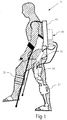
- an exoskeleton 10 has left and right legs 21 and 22, each leg having hydraulic cylinders 30 and 31 configured to respectively actuate the knee and hip of that leg.
- the four hydraulic cylinders are in communication with an actuation system 50 that forms part of a torso 60 of exoskeleton 10.
- Actuation system 50 is the primary object of this invention as actuation system 50 overcomes significant limitations of the known art.
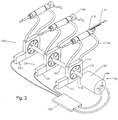
- actuation system 50 is shown that is capable of powering three degrees of freedom.
- a prime mover in this case an electric motor 101, rotates a drive shaft 102 based on signals from a controller 103.
- a controller 103 In practice, such an arrangement will require bearings, support structure, and an outer enclosure but, as these are not objects of the invention and are well understood in the art, they are not shown here.
- Three actuation modules, 110, 120, and 130, are shown coupled to drive shaft 102.
- Each actuation module is preferably equivalent. In the embodiment shown, there are three actuation modules, but in some embodiments there may be two, four, or more actuation modules. The only practical limit to the number of actuation modules is the size and strength of drive shaft 102. Below is set forth a discussion of actuation module 110, but the discussion could apply just as well to any actuation modules.
- Actuation module 110 contains the following components: displacement actuator 111, pump housing 112, pump core 113, hydraulic lines 114, output actuator 115 (which could constitute a wide range of actuators, including hydraulic cylinders 30 and 31), and feedback sensor 116.
- the pump can be any type of hydraulic pump that allows over center operation.
- Displacement actuator 111 varies the displacement of variable displacement pump by translating housing 112. In some embodiments, displacement actuator 111 could rotate pump housing 112 to vary the pump displacement. In the preferred embodiment, displacement actuator 111 is an electric actuator, such as a voice coil motor. Displacement actuator 111 does not contribute substantial power to the motion of output actuator 115, instead displacement actuator 111 controls the motion of output actuator 115 by varying the displacement of variable displacement pump 117. It should be understood, however, that the forces applied by the displacement actuator necessarily include components related to the pressure generated by the pump. These forces are generally small, but can contribute substantially to overall power loss in the system because displacement actuator 111 must overcome them. These forces can be reduced by careful design of the pump, including specialized modifications to the pump which will be discussed later.
- Hydraulic lines 114 communicate the hydraulic working fluid from the pump to output actuator 115.
- output actuator 115 is shown as a linear hydraulic actuator, but could also be a rotary hydraulic actuator.
- the motion of output actuator 115 is monitored by feedback sensor 116.
- Feedback sensor 116 could indicate the position, the velocity, or both position and velocity of output actuator 115.
- sensors well understood in the art, including without restriction, potentiometers, encoders, and LVDTs.
- a force feedback sensor 126 might be used to monitor the force produced by the actuator.
- an actuator might include feedback sensors capable of sensing both force and position. It should be understood that the feedback sensors 116 and 126 are in communication with controller 103, although the connection is not shown in Figure 1 .
- Controller 103 controls the motion of electric motor 101, and displacement actuators 111, 121, and 131.
- Controller 103 may be a digital controller, such as a microcontroller or digital signal processor, or even an analog controller. In typical operation, controller 103 will maintain a relatively constant speed of drive shaft 102.
- the prime mover may also have a speed sensor 104, to allow controller 103 to monitor and control the speed of electric motor 101 and dive shaft 102. Controller 103 further receives signals from feedback sensor 116, and force feedback sensor 126.
- controller 103 uses feedback control to move displacement actuator 111, thereby changing the displacement of the hydraulic pump and changing the flow to the corresponding output actuator 115. In the preferred embodiment, this is achieved with a PID controller, which is well understood in the art, but a more complex nonlinear control system could also be used.
- the reference value to which controller 103 controls output actuator 115 is provided from a higher level control system that is not the object of this invention. The higher level control system could reside on controller 103 or on another controller that is in communication with controller 103, or even come from a human operator.
- the maximum displacement of each pump and the respective sizes of each output actuator may not be the same, but may be configured to match the requirements of each axis under the control of the actuation system.
- the ability to optimize the size of each actuation module for each individual axis enables a higher overall system efficiency.
- the controller 103 controls to several levels of rotational speed.
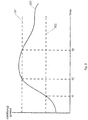
- Figure 3 depicts a plot of rotational speed 303 over time
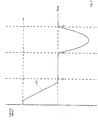
- Figure 4 depicts the control effort expended by the controller to control the rotational speed 303 of the prime mover over the same time.
- Two speed levels are shown, i.e., low set point 302, and high set point 301.
- the controller exerts control effort 305 to maintain the speed of the prime mover generally close to low set point 302.
- Low set point 302 is chosen to maintain the required flow to each output actuator given the maximum displacement of the variable displacement pump associated with each corresponding actuator.
- Low set point 302 need not, in general, be a constant value, and could change based on the flow requirements of the output actuators.
- the controller behavior is depicted as being approximately a proportional control, but it should be understood that this is merely exemplary and many types of feedback control would be appropriate.
- rotational speed 303 exceeds low set point 302, and the controller reduces control effort 305 to zero.
- control effort 305 remains zero. Because rotational speed 303 continues to increase during this time, the output actuators must be net absorbing power, although it is possible that any given output actuator could absorb power.
- rotational speed 303 has exceeded high set point 301.
- the actuation system has absorbed enough energy that the kinetic energy stored in its rotation has pushed rotational speed 303 to high set point 301.
- High set point 301 is chosen to be close to the maximum safe operating speed of the prime mover and drive shaft, a value dependent on the bearings chosen, the safe operating voltage of the controller, and other system design considerations.
- the controller applies negative control effort 305 to keep rotational speed 303 from climbing higher; during time t2 to t3, power is absorbed by the prime mover and returned to the electrical bus of the controller. This is often referred to as power regeneration as the prime mover acts as a generator, allowing the controller to return power to its corresponding power supply and extend system runtime because the power supply consists of batteries.
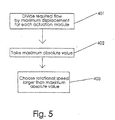
- the preferred speed of prime mover 101 is set according to three steps performed by controller 103, diagrammed in Figure 5 .
- controller 103 divides the flow required at each output actuator by the maximum displacement of the pump corresponding to that output actuator. If the maximum displacement of the pump is unequal on the two sides of the pump, the controller must take account of the sign of the flow as well. In general, the controller may estimate this flow requirement by measuring or estimating the speed of the output actuator. In some embodiments, the controller may further use the acceleration of the output actuator or other outside information to improve this estimate. In other embodiments, where actuation system 50 is part of a device, the device may signal controller 103 about future flow requirements.
- controller 103 computes the maximum of the flows for all actuation modules. In choosing step 403, controller 103 chooses a preferred speed that is slightly larger than this maximum value. How much larger the value must be depends on the application. When controller 103 operates at a higher sampling frequency, when prime mover 101 is generally overpowered with respect to the needs of the output actuators, and when the device using the actuation system does not produce rapid, dynamic motion, the preferred speed may be closer to the maximum value; when the reverse is true, the preferred speed may be required to be much larger. In some embodiments, it may be possible for controller 103 to change how much larger the preferred speed is than the maximum value based on how the device is operating.
- actuation system 50 is part of an overall device, such as exoskeleton 10, and the device can signal actuation system 50.
- this signal might be a digital command, in others an analog signal, and in yet others, a mechanical motion.
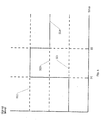
- Figure 6 depicts an embodiment of high level signal 504 over time.
- device signal 504 is at low level 501, indicating to controller 103 that the device is in a relatively non-dynamic situation, or in a situation where high efficiency is most important (e.g., when the device power source is low).
- controller 103 reduces the desired rotational speed of prime mover 101.
- device signal 504 changes to high level 502, indicating that the device needs dynamic performance at the expense of lower efficiency.
- controller 103 increases the rotational speed of prime mover 101, putting more kinetic energy into the rotational speed 303 of the drive train and prime mover, but resulting in greater frictional losses.
- device signal 504 changes to medium level 503, indicating that the device should operate at a normal level.
- controller 103 decreases the rotational speed of prime mover 101.
- device signal 504 need have three levels as in this example, but rather the resolution of device signal 504 will depend on the nature of the device using actuation system 50.
- the embodiments discussed have assumed a simple model of power loss, namely that the efficiency of actuation system 50 monotonically decreases with the speed of prime mover 101 and drive shaft 102, that can be further refined.
- the efficiency of the systems depends on the efficiency of the variable displacement hydraulic pumps, and while most variable displacement hydraulic pumps achieve maximum efficiency when they operate near their maximum displacement, the behavior is complex and highly dependent on the geometry of the pump.
- controller 103 given an accurate model of the pump efficiency, and the efficiency of the other components, can optimize the prime mover speed in order to maximize the efficiency of actuation system 50.
- Methods for optimizing the performance of a system with one unconstrained degree of freedom, in this case prime mover speed are well within the level of understanding in the art.
- controller 103 may choose the speed of prime mover 101 to maximize the life of the pump. In other embodiments, controller 103 may minimize acoustic volume so that the device is less audible, maximize actuation performance so that the device has maximum bandwidth, or minimize the temperature of the hydraulic working fluid so that the device can cool down. In each embodiment, it is only necessary to build a model of the response of the parameter of interest to prime mover speed and use optimization techniques well understood in the art. Often, these models will be very simple.
- the device may signal controller 103 which of these parameters should be optimized during operation.
- a human operator may be involved in deciding which parameter should be optimized.
- the device might possess an "eco" button that, when pressed, indicates to controller 103 that it should optimize for high efficiency at the expense of performance.
- controller 103 has more latitude to optimize performance.
- two degrees of freedom i.e., prime mover 101 and displacement actuator 111, together control the motion of output actuator 115.
- controller 103 can freely trade rotational speed of prime mover 101 and the displacement of variable displacement pump 117 without changing the performance of other actuation modules. This is particularly important in applications where there is one degree of freedom in a situation where regeneration is common.
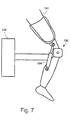
- Figure 7 One such example is shown in Figure 7 where actuation system 50 is included in transfemoral prosthetic 180 worn by person 181.
- actuation system 50 contains only one actuation module 110 with the corresponding output actuator 184 configured to control the flexion and extension of transfemoral prosthetic 180.
- the human knee will absorb mechanical power.
- most prosthetic devices cannot regenerate this absorbed power, even when the devices are powered, because the power level is too low to capture. Instead, prosthetic knees dissipate this power.
- Some embodiments, such as those illustrated in US patent 8,231,688 attempt to regenerate power with a fixed displacement pump, but cannot maximize their power regeneration and control the motion of the prosthetic at the same time because they can control only one input.
- controller 103 can control displacement actuator 111 to maximize the efficiency of power regeneration to prime mover 101. In general, this requires maximizing the displacement of variable displacement hydraulic pump 117 so that the rotational speed of prime mover 101 is maximized. In some embodiments, controller 103 may seek to target the displacement of variable displacement pump 117 near its maximum value, but low enough that controller 103 may make quick adjustments to the motion of output actuator 115 (or 184) by changing the displacement while making gross adjustments to the motion of output actuator 115 by changing the speed of prime mover 101.
- displacement actuator 111 there are many possible embodiments for displacement actuator 111 that are well known in the art, such as brushed, brushless, or stepper motors, or even electromagnets.
- a transmission e.g., gearbox, planetary gear, etc can be arranged between displacement actuator 111 and variable displacement pump 117 because the motor will not produce sufficient force.
- displacement actuator 111 and any accompanying transmission it is generally preferable for displacement actuator 111 and any accompanying transmission to be chosen such that the controlling motor may be moved by loads generated by variable displacement pump 117. This is often referred to as being "backdrivable.”
- Making displacement actuator 111 and transmission backdrivable allows forces that are working in the direction of desired motion to help with that motion. Furthermore, such designs necessarily have low friction, leading to a higher efficiency.
- Examples of preferred embodiments generally include a voice coil motor, brushless motor, toroidal motor, or any electrical actuator directly coupled to variable displacement pump 117, or coupled through a transmission that is backdrivable.
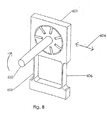
- pump housing 112 is mounted to the actuation system through a flexural element.
- flexural pump housing 601 includes first and second flexural bars 605 and 606 respectively, that allow for small motions along deflection axis 604 but generally resist motion in other axes.
- the flexural elements must withstand the strain caused by the eccentricity of the pump.
- displacement actuator 111 could be a piezoelectric device. In some embodiments, it may be beneficial to sense the deflection of the flexures with a strain gauge.
- variable displacement pump 117 may be used for variable displacement pump 117 in order to reduce loading on displacement actuator 111. Reducing loads on displacement actuator 111 directly improves the performance of actuation system 50 because power used by displacement actuator 111 is effectively lost.
- Load on the pump may occur because there is a slight asymmetry in the loading on most pumps. In some cases this loading may be static, it may vary in magnitude according to the relative pressures on the inlet and outlet of the pump, or it may vary as a function of the pump angular position due to pistons or vanes crossing the ports of the pump. In one embodiment, shown in Figure 9 , these loads may be partially canceled by building a pump 701 to have two pump cores 711 and 712 both within the same housing 702.
- the flow outputs from the two pump cores are combined so that the loads on the two pumps are equal but opposite. This may be achieved by counter-rotating the pump cores, or by porting the pump cores 180 degrees out of phase and keeping their direction of rotation identical.
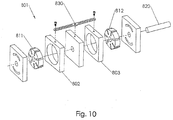
- a pump 801 contains two pump cores 811 and 812 both coupled to the same drive shaft 820.
- the outlets of the two pump cores are combined as in the previous embodiment.
- These housings have a mechanism 830 that moves them equal and opposite amounts when driven by the displacement actuator (not shown). While in the figure mechanism 830 is shown as a simple pinned lever, it should be understood that there are many simple mechanisms for generating such motion and mechanism 830 is intended only to illustrate but not restrict these possibilities.
- mechanism 830 the displacement of the two pump cores are changed in opposition, and asymmetric loads on the displacement actuator are neutralized.
- This embodiment has the advantage that only one drive shaft is required (where the embodiment of Figure 9 would require two drive shafts), but requires mechanism 830, which adds complexity to the pump.
- the losses associated with the pumps will increase, but this may be balanced by the designer against the losses associated with higher loads that must driven by the controlling motors if the pumps are not coupled.
Landscapes
- Health & Medical Sciences (AREA)
- Engineering & Computer Science (AREA)
- Rehabilitation Therapy (AREA)
- Veterinary Medicine (AREA)
- Pain & Pain Management (AREA)
- Life Sciences & Earth Sciences (AREA)
- Animal Behavior & Ethology (AREA)
- General Health & Medical Sciences (AREA)
- Public Health (AREA)
- Physical Education & Sports Medicine (AREA)
- Epidemiology (AREA)
- Physics & Mathematics (AREA)
- Fluid Mechanics (AREA)
- Mechanical Engineering (AREA)
- General Engineering & Computer Science (AREA)
- Orthopedic Medicine & Surgery (AREA)
- Fluid-Pressure Circuits (AREA)
Claims (14)
- System zum hydraulischen Betätigen mindestens eines Freiheitsgrads, wobei das System Folgendes umfasst:mindestens zwei Aktuatormodule (110,0120, 130),eine einzige Antriebsmaschine (101) für die mindestens zwei Betätigungsmodule (110, 120, 130), wobei die Antriebsmaschine (101) eine Drehbewegung erzeugt und aus einem batteriebetriebenen Elektromotor besteht, und jedes Betätigungsmodul Folgendes einschließt:1) eine Reversierpumpe (117) mit variabler Verdrängung, wobei die Pumpe Folgendes aufweist:a) eine Energieeingangsverbindung, die konfiguriert ist, um die Pumpe (117) von der Antriebsmaschine (101) aus mit Energie zu versorgen; undb) einen Verdrängungsvariierungseingang zum Variieren der Verdrängung der Pumpe (117); und2) einen Verdrängungsvariierungsaktuator (111, 121, 131), der konfiguriert ist, um den Verdrängungsvariierungseingang der Pumpe (117) zu modulieren;(3) einen Ausgangsaktuator (115) in direkter Kommunikation mit der Pumpe (117), wobei der Ausgangsaktuator (115) konfiguriert ist, um einen entsprechenden Freiheitsgrad anzutreiben; und(4) eine Rückkopplungsmessung, die eine Kraft oder Bewegung des Ausgangsaktuators (115) darstellt, wobei die Rückkopplungsmessung aus mindestens einem Sensor (116) hergestellt wird;wobei das System auch eine Steuereinheit (103) umfasst, die konfiguriert ist, um die Antriebsmaschine (101) und den Verdrängungsvariierungsaktuator (111, 121, 131) für jedes der mindestens zwei Betätigungsmodule (110, 120, 130) zu steuern, wobei die Steuereinheit (103) weiter die Bewegung der Antriebsmaschine (101) steuert und die Rückkopplungsmessung verwendet, um für ein jeweiliges der mindestens zwei Betätigungsmodule (110, 120, 130) die Kraft oder Bewegung des Ausgangsaktuators (115) durch Steuern des Verdrängungsvariierungsaktuators (111, 121, 131) zu regulieren.
- System nach Anspruch 1, wobei die Steuereinheit konfiguriert ist, um eine Geschwindigkeit der Drehbewegung zu steuern, um die Energie zu maximieren, die von der Pumpe mit variabler Verdrängung übertragen wird, wobei das Steuern der Kraft oder Bewegung des Ausgangsaktuators dazu führt, dass Energie von der Pumpe mit variabler Verdrängung übertragen wird.
- System nach Anspruch 1 oder 2, wobei die Steuereinheit konfiguriert ist, um eine Winkelgeschwindigkeit der Antriebsmaschine zu steuern, damit sie generell konstant ist.
- System nach Anspruch 1, 2 oder 3, wobei der Ausgangsaktuator einen begrenzten Weg aufweist.
- System nach einem der vorstehenden Ansprüche, wobei die Steuereinheit konfiguriert ist, um die Antriebsmaschine auf eine Drehzahl zu steuern, und die Steuereinheit konfiguriert ist, um die Drehzahl festzulegen, um die Leistung beim Regulieren der Kraft oder Bewegung des Ausgangsaktuators zu maximieren.
- System nach einem der Ansprüche 1 bis 4, wobei die Steuereinheit konfiguriert ist, um die Antriebsmaschine auf eine Drehzahl zu steuern, wobei das System konfiguriert ist, um in eine Vorrichtung integriert zu sein, und die Vorrichtung der Steuereinheit meldet, welcher von mehreren Optimierungsmodi die Steuereinheit verwenden soll, um die Drehzahl der Antriebsmaschine zu wählen, wobei die Modi mindestens zwei der folgenden einschließen: Minimieren des Energieverlusts, Maximieren der Effizienz, Maximieren der Pumpenlebensdauer, Minimieren der Lautstärke, Maximieren der Betätigungsleistung und Minimieren der Systemtemperaturen.
- System nach Anspruch 6, wobei die Vorrichtung konfiguriert ist, um von einem menschlichen Bediener betätigt zu werden, und der menschliche Bediener eine Eingabe dafür bereitstellt, welcher der Optimierungsmodi zu wählen ist.
- Verfahren zum Steuern eines hydraulischen Betätigungssystems, das mindestens einen Freiheitsgrad, eine einzige Antriebsmaschine (101) für mindestens zwei Betätigungsmodule (110, 120, 130), wobei die Antriebsmaschine (101) eine Drehbewegung erzeugt und aus einem batteriebetriebenen Elektromotor besteht, und eine Steuereinheit (103) zum Steuern der Bewegung der Antriebsmaschine (101) aufweist, wobei jedes Betätigungsmodul (110, 120, 130) Folgendes einschließt: eine Reversierpumpe(117) mit variabler Verdrängung, die eine Energieeingangsverbindung, die konfiguriert ist, um die Pumpe (117) von der Antriebsmaschine (101) aus mit Energie zu versorgen, und einen Verdrängungsvariierungseingang zum Variieren der Verdrängung der Pumpe (117) aufweist; einen Verdrängungsvariierungsaktuator (111, 121, 131), der konfiguriert ist, um den Verdrängungsvariierungseingang der Pumpe (117) zu modulieren; einen Ausgangsaktuator (115) in direkter Kommunikation mit der Pumpe (117), wobei der Ausgangsaktuator (115) konfiguriert ist, um einen entsprechenden Freiheitsgrad anzutreiben; und mindestens einen Sensor (116), der eine Rückkopplungsmessung festlegt, die eine Kraft oder Bewegung des Ausgangsaktuators (115) darstellt, wobei das Verfahren umfasst:Lesen eines Wertes jeder Rückkopplungsmessung; undSteuern der Kraft oder Bewegung des Ausgangsaktuators (115) durch Steuern der Antriebsmaschine (101) und des Verdrängungsaktuators (111, 112, 113) für den Ausgangsaktuator (115) eines jeweiligen der mindestens zwei Betätigungsmodule (110, 120, 130).
- Verfahren nach Anspruch 8, wobei die Steuereinheit die Antriebsmaschine in drei Modi steuert:1) Erzeugen von Energie, wenn eine Winkelgeschwindigkeit der Antriebsmaschine generell unter einem niedrigen Sollwert liegt,2) Nicht-Erzeugen von Energie, wenn die Winkelgeschwindigkeit der Antriebsmaschine generell über dem unteren Sollwert, aber unter einem hohen Sollwert liegt, und3) Aufnehmen von Energie, wenn die Winkelgeschwindigkeit der Antriebsmaschine generell über dem hohen Sollwert liegt.
- Verfahren nach Anspruch 8 oder 9, wobei die Steuereinheit die Antriebsmaschine auf eine Drehzahl steuert, wobei die Drehzahl durch die folgenden Schritte gewählt wird:1) die Steuereinheit teilt den Durchsatz, der von jedem Ausgangsaktuator benötigt wird, durch eine maximale Verdrängung seiner entsprechenden Pumpe mit variabler Verdrängung, was eine notwendige Antriebsmaschinengeschwindigkeit für dieses Betätigungsmodul ergibt,2) die Steuereinheit berechnet eine Höchstgeschwindigkeit, die das Maximum eines absoluten Wertes jeder der notwendigen Antriebsmaschinengeschwindigkeiten ist, und3) die Steuereinheit legt die Drehzahl fest, etwas größer als die Höchstgeschwindigkeit zu sein.
- Verfahren nach Anspruch 8 oder 9, wobei das System in eine Vorrichtung integriert ist, die Steuereinheit eine Drehzahl der Antriebsmaschine steuert und ein externes Signal von der Vorrichtung empfängt, und die Steuereinheit basierend auf dem externen Signal die Drehzahl der Antriebsmaschine zwischen mindestens zwei verschiedenen Werten ändert, wobei niedrigere Werte bedeuten, dass sich die Vorrichtung in einem Ruhezustand befindet, und höhere Werte bedeuten, dass sich die Vorrichtung in einem aktiven Zustand befindet.
- Verfahren nach Anspruch 8 oder 9, wobei die Steuereinheit die Antriebsmaschine auf eine Drehzahl steuert, die Steuereinheit ein Energieverlustmodell in dem Betätigungssystem einschließt, und die Steuereinheit die Drehzahl festlegt, um den Energieverlust zu minimieren.
- Verfahren nach Anspruch 8 oder 9, wobei die Steuereinheit die Antriebsmaschine auf eine Drehzahl steuert, und die Steuereinheit die Drehzahl festlegt, um die Lautstärke zu minimieren.
- Verfahren nach Anspruch 8 oder 9, wobei das Hydraulikbetätigungssystem in eine Vorrichtung integriert ist, wobei die Vorrichtung zukünftige Durchsatzanforderungen schätzt und diese zukünftigen Durchsatzanforderungen der Steuereinheit meldet, wobei die Steuereinheit die zukünftigen Durchsatzanforderungen anstelle eines Durchsatzes verwendet, den der Ausgangsaktuator gerade benötigt.
Applications Claiming Priority (2)
| Application Number | Priority Date | Filing Date | Title |
|---|---|---|---|
| US201261693463P | 2012-08-27 | 2012-08-27 | |
| PCT/US2013/056832 WO2014035984A2 (en) | 2012-08-27 | 2013-08-27 | Hydraulic actuator system |
Publications (3)
| Publication Number | Publication Date |
|---|---|
| EP2888083A2 EP2888083A2 (de) | 2015-07-01 |
| EP2888083A4 EP2888083A4 (de) | 2016-06-01 |
| EP2888083B1 true EP2888083B1 (de) | 2020-05-06 |
Family
ID=50184604
Family Applications (1)
| Application Number | Title | Priority Date | Filing Date |
|---|---|---|---|
| EP13833152.5A Active EP2888083B1 (de) | 2012-08-27 | 2013-08-27 | Hydraulisches aktuatorsystem |
Country Status (7)
| Country | Link |
|---|---|
| US (1) | US10352334B2 (de) |
| EP (1) | EP2888083B1 (de) |
| CN (1) | CN104582910B (de) |
| AU (1) | AU2013309005A1 (de) |
| CA (1) | CA2883185A1 (de) |
| IL (1) | IL237463A0 (de) |
| WO (1) | WO2014035984A2 (de) |
Families Citing this family (15)
| Publication number | Priority date | Publication date | Assignee | Title |
|---|---|---|---|---|
| US10561564B2 (en) | 2014-11-07 | 2020-02-18 | Unlimited Tomorrow, Inc. | Low profile exoskeleton |
| CN105114397A (zh) * | 2015-09-06 | 2015-12-02 | 哈尔滨工业大学 | 一种流体人工肌肉驱动与控制系统 |
| KR102395796B1 (ko) * | 2015-11-06 | 2022-05-10 | 삼성전자주식회사 | 동력 전달 모듈 및 이를 포함하는 운동 보조 장치 |
| CN106545535B (zh) * | 2016-11-30 | 2018-08-03 | 深圳航天科技创新研究院 | 一种机器人电机驱动液压动力系统及控制方法 |
| WO2018209198A1 (en) * | 2017-05-11 | 2018-11-15 | Board Of Regents, The University Of Texas System | Powered orthosis with combined motor and gear technology |
| JP6958374B2 (ja) * | 2018-01-18 | 2021-11-02 | トヨタ自動車株式会社 | 歩行訓練装置、及びその制御方法 |
| DE102018106846B3 (de) * | 2018-03-22 | 2019-07-04 | HAWE Altenstadt Holding GmbH | Human-Exoskelett |
| DE102018108638B3 (de) * | 2018-04-11 | 2019-05-16 | Hoerbiger Automatisierungstechnik Holding Gmbh | Hydrauliksystem |
| DE102019205297A1 (de) * | 2019-04-12 | 2020-10-15 | Robert Bosch Gmbh | Hydrostatisches Arbeitsgerät und Verfahren zu dessen Steuerung |
| US10830562B2 (en) * | 2019-04-14 | 2020-11-10 | Hamilton Sundstrand Corporation | Wearable power modules with distributed energy storage systems |
| CN114375542B (zh) * | 2019-04-17 | 2024-05-28 | 麦迪思莫迅股份有限公司 | 用于致动器装置的冲程传送器 |
| FR3123204B1 (fr) * | 2021-05-27 | 2023-11-17 | Robin Temporelli | Dispositif orthopédique comprenant au moins un actionneur |
| DE102021209477B4 (de) * | 2021-08-30 | 2023-04-20 | Robert Bosch Gesellschaft mit beschränkter Haftung | Elektrohydraulische Einheit zur Druckmittelversorgung und Verfahren zur Steuerung einer elektrohydraulischen Einheit |
| KR102814601B1 (ko) | 2022-11-14 | 2025-05-30 | 주식회사 레인보우로보틱스 | 유압 파워 유닛을 포함하는 로봇 |
| CN115978025B (zh) * | 2022-12-30 | 2025-08-01 | 中航工业南京伺服控制系统有限公司 | 一种音圈电机驱动双腔泵控作动器及其工作方法 |
Family Cites Families (17)
| Publication number | Priority date | Publication date | Assignee | Title |
|---|---|---|---|---|
| US5282460A (en) * | 1992-01-06 | 1994-02-01 | Joyce Ann Boldt | Three axis mechanical joint for a power assist device |
| AU1377997A (en) | 1996-01-10 | 1997-08-01 | Aeroquip-Vickers International Gmbh | Low-loss drive system for a plurality of hydraulic actuators |
| US6502393B1 (en) * | 2000-09-08 | 2003-01-07 | Husco International, Inc. | Hydraulic system with cross function regeneration |
| JP3674778B2 (ja) * | 2001-09-27 | 2005-07-20 | 本田技研工業株式会社 | 脚式移動ロボットの脚体関節アシスト装置 |
| JP2004011168A (ja) * | 2002-06-04 | 2004-01-15 | Komatsu Ltd | 建設機械 |
| JP2005076781A (ja) * | 2003-09-01 | 2005-03-24 | Shin Caterpillar Mitsubishi Ltd | 作業機械の駆動装置 |
| US20050076781A1 (en) * | 2003-10-14 | 2005-04-14 | Hess Spencer W. | Desiccant dehumidifier with integrated hepa filter |
| JP4008465B2 (ja) * | 2005-09-02 | 2007-11-14 | 本田技研工業株式会社 | 運動誘導装置 |
| US7883546B2 (en) | 2006-03-09 | 2011-02-08 | The Regents Of The University Of California | Power generating leg |
| JP4999404B2 (ja) | 2006-08-31 | 2012-08-15 | カヤバ工業株式会社 | 油圧制御装置 |
| US7798282B2 (en) * | 2008-03-04 | 2010-09-21 | Ford Global Technologies, Llc | Power assisted steering system |
| EP2326288B1 (de) * | 2008-05-20 | 2016-04-20 | Ekso Bionics, Inc. | Vorrichtung und verfahren zur verringerung des energieverbrauchs einer person durch verwendung eines exoskeletts der unteren gliedmassen |
| EP2331026B1 (de) | 2008-06-16 | 2018-11-07 | The Regents of The University of California | Halbbetätigte transfemorale knieprothese |
| US8096965B2 (en) | 2008-10-13 | 2012-01-17 | Argo Medical Technologies Ltd. | Locomotion assisting device and method |
| CN101846109B (zh) * | 2010-04-30 | 2012-08-29 | 太原理工大学 | 一种二通流量连续控制阀 |
| WO2012015087A1 (ko) | 2010-07-30 | 2012-02-02 | 볼보 컨스트럭션 이큅먼트 에이비 | 건설기계용 선회유량 제어시스템 및 그 제어방법 |
| DE102010040755A1 (de) | 2010-09-14 | 2012-03-15 | Zf Friedrichshafen Ag | Antriebsanordnung |
-
2013
- 2013-08-27 CA CA2883185A patent/CA2883185A1/en not_active Abandoned
- 2013-08-27 US US14/423,302 patent/US10352334B2/en active Active
- 2013-08-27 EP EP13833152.5A patent/EP2888083B1/de active Active
- 2013-08-27 AU AU2013309005A patent/AU2013309005A1/en not_active Abandoned
- 2013-08-27 WO PCT/US2013/056832 patent/WO2014035984A2/en not_active Ceased
- 2013-08-27 CN CN201380044651.4A patent/CN104582910B/zh active Active
-
2015
- 2015-02-26 IL IL237463A patent/IL237463A0/en unknown
Non-Patent Citations (1)
| Title |
|---|
| None * |
Also Published As
| Publication number | Publication date |
|---|---|
| EP2888083A4 (de) | 2016-06-01 |
| CN104582910B (zh) | 2016-11-16 |
| CN104582910A (zh) | 2015-04-29 |
| AU2013309005A1 (en) | 2015-02-26 |
| EP2888083A2 (de) | 2015-07-01 |
| WO2014035984A2 (en) | 2014-03-06 |
| CA2883185A1 (en) | 2014-03-06 |
| US20150226234A1 (en) | 2015-08-13 |
| IL237463A0 (en) | 2015-04-30 |
| WO2014035984A3 (en) | 2014-09-18 |
| US10352334B2 (en) | 2019-07-16 |
Similar Documents
| Publication | Publication Date | Title |
|---|---|---|
| EP2888083B1 (de) | Hydraulisches aktuatorsystem | |
| Pratt et al. | Series elastic actuators for legged robots | |
| JP7303840B2 (ja) | 脚付きロボット用の一体化された過負荷保護を有する伝動装置 | |
| JP6878581B2 (ja) | 脚付きロボット用のねじアクチュエータ | |
| US8731716B2 (en) | Control logic for biomimetic joint actuators | |
| Alfayad et al. | High performance integrated electro-hydraulic actuator for robotics–Part I: Principle, prototype design and first experiments | |
| JP6395733B2 (ja) | トルク伝達装置、アクチュエータ、ロボット | |
| WO2010025419A2 (en) | Method of sizing actuators for a biomimetic mechanical joint | |
| JP2006507464A (ja) | 標準化された回転アクチュエータ | |
| CN108657305B (zh) | 液态金属压力驱动型机器人关节自发电装置 | |
| Ko et al. | Underactuated four-fingered hand with five electro hydrostatic actuators in cluster | |
| Kang et al. | A robot hand driven by hydraulic cluster actuators | |
| Di Lallo et al. | Untethered Fluidic Engine for High‐Force Soft Wearable Robots | |
| Alò et al. | An innovative design of artificial knee joint actuator with energy recovery capabilities | |
| Scheidl | Digital fluid power for exoskeleton actuation-guidelines, opportunities, challenges | |
| KR20180075754A (ko) | 모터와 펌프가 일체화되고, 유압직접제어를 위한 유압회로가 내장된 소형 유압 동력 발생장치 | |
| Zhang et al. | Development and evaluation of a backdrivable vane-type rotary actuator using magnetorheological fluids | |
| Park et al. | Variable transmission mechanisms for robotic applications: A review [survey] | |
| Mammano et al. | Design and characterization of a continuous rotary minimotor based on shape-memory wires and overrunning clutches | |
| Tessari et al. | An integrated, back-drivable electro-hydrostatic actuator for a knee prosthesis | |
| CN203542621U (zh) | 一种机器人关节的旋转弹性驱动器 | |
| Alfayad et al. | Lightweight high performance integrated actuator for humanoid robotic applications: Modeling, design & realization | |
| Alò et al. | Artificial knee joints actuators with energy recovery capabilities: A comparison of performance | |
| Shimizu et al. | Downsizing the motors of a biped robot using a hydraulic direct drive system | |
| Nakanishi et al. | Toward high power-to-weight ratio electro-hydrostatic actuators for robots |
Legal Events
| Date | Code | Title | Description |
|---|---|---|---|
| PUAI | Public reference made under article 153(3) epc to a published international application that has entered the european phase |
Free format text: ORIGINAL CODE: 0009012 |
|
| 17P | Request for examination filed |
Effective date: 20150223 |
|
| AK | Designated contracting states |
Kind code of ref document: A2 Designated state(s): AL AT BE BG CH CY CZ DE DK EE ES FI FR GB GR HR HU IE IS IT LI LT LU LV MC MK MT NL NO PL PT RO RS SE SI SK SM TR |
|
| AX | Request for extension of the european patent |
Extension state: BA ME |
|
| RIN1 | Information on inventor provided before grant (corrected) |
Inventor name: ANGOLD, RUSS Inventor name: SWIFT, TIM Inventor name: BEARD, JONATHAN Inventor name: SCHEINMAN, DAVID Inventor name: MOORE, ROBERT Inventor name: NORBOE, DANIEL, P. Inventor name: EDELBERG, KYLE Inventor name: AMUNDSON, KURT |
|
| DAX | Request for extension of the european patent (deleted) | ||
| A4 | Supplementary search report drawn up and despatched |
Effective date: 20160502 |
|
| RIC1 | Information provided on ipc code assigned before grant |
Ipc: F15B 11/028 20060101ALI20160425BHEP Ipc: B25J 9/14 20060101AFI20160425BHEP Ipc: F15B 15/08 20060101ALI20160425BHEP Ipc: F15B 11/04 20060101ALI20160425BHEP Ipc: A61H 3/00 20060101ALI20160425BHEP Ipc: A61H 1/02 20060101ALI20160425BHEP Ipc: F15B 7/00 20060101ALI20160425BHEP |
|
| REG | Reference to a national code |
Ref country code: DE Ref legal event code: R079 Ref document number: 602013068889 Country of ref document: DE Free format text: PREVIOUS MAIN CLASS: B25J0009140000 Ipc: F04C0014220000 |
|
| RIC1 | Information provided on ipc code assigned before grant |
Ipc: F15B 7/00 20060101ALI20190613BHEP Ipc: F15B 11/04 20060101ALI20190613BHEP Ipc: A61H 1/02 20060101ALI20190613BHEP Ipc: A61H 3/00 20060101ALI20190613BHEP Ipc: F04C 14/22 20060101AFI20190613BHEP Ipc: F15B 11/028 20060101ALI20190613BHEP Ipc: F15B 15/08 20060101ALI20190613BHEP |
|
| GRAP | Despatch of communication of intention to grant a patent |
Free format text: ORIGINAL CODE: EPIDOSNIGR1 |
|
| STAA | Information on the status of an ep patent application or granted ep patent |
Free format text: STATUS: GRANT OF PATENT IS INTENDED |
|
| INTG | Intention to grant announced |
Effective date: 20190729 |
|
| GRAS | Grant fee paid |
Free format text: ORIGINAL CODE: EPIDOSNIGR3 |
|
| GRAA | (expected) grant |
Free format text: ORIGINAL CODE: 0009210 |
|
| STAA | Information on the status of an ep patent application or granted ep patent |
Free format text: STATUS: THE PATENT HAS BEEN GRANTED |
|
| AK | Designated contracting states |
Kind code of ref document: B1 Designated state(s): AL AT BE BG CH CY CZ DE DK EE ES FI FR GB GR HR HU IE IS IT LI LT LU LV MC MK MT NL NO PL PT RO RS SE SI SK SM TR |
|
| REG | Reference to a national code |
Ref country code: GB Ref legal event code: FG4D |
|
| REG | Reference to a national code |
Ref country code: AT Ref legal event code: REF Ref document number: 1267176 Country of ref document: AT Kind code of ref document: T Effective date: 20200515 Ref country code: CH Ref legal event code: EP |
|
| REG | Reference to a national code |
Ref country code: DE Ref legal event code: R096 Ref document number: 602013068889 Country of ref document: DE |
|
| REG | Reference to a national code |
Ref country code: IE Ref legal event code: FG4D |
|
| REG | Reference to a national code |
Ref country code: LT Ref legal event code: MG4D |
|
| REG | Reference to a national code |
Ref country code: NL Ref legal event code: MP Effective date: 20200506 |
|
| PG25 | Lapsed in a contracting state [announced via postgrant information from national office to epo] |
Ref country code: FI Free format text: LAPSE BECAUSE OF FAILURE TO SUBMIT A TRANSLATION OF THE DESCRIPTION OR TO PAY THE FEE WITHIN THE PRESCRIBED TIME-LIMIT Effective date: 20200506 Ref country code: PT Free format text: LAPSE BECAUSE OF FAILURE TO SUBMIT A TRANSLATION OF THE DESCRIPTION OR TO PAY THE FEE WITHIN THE PRESCRIBED TIME-LIMIT Effective date: 20200907 Ref country code: IS Free format text: LAPSE BECAUSE OF FAILURE TO SUBMIT A TRANSLATION OF THE DESCRIPTION OR TO PAY THE FEE WITHIN THE PRESCRIBED TIME-LIMIT Effective date: 20200906 Ref country code: NO Free format text: LAPSE BECAUSE OF FAILURE TO SUBMIT A TRANSLATION OF THE DESCRIPTION OR TO PAY THE FEE WITHIN THE PRESCRIBED TIME-LIMIT Effective date: 20200806 Ref country code: GR Free format text: LAPSE BECAUSE OF FAILURE TO SUBMIT A TRANSLATION OF THE DESCRIPTION OR TO PAY THE FEE WITHIN THE PRESCRIBED TIME-LIMIT Effective date: 20200807 Ref country code: SE Free format text: LAPSE BECAUSE OF FAILURE TO SUBMIT A TRANSLATION OF THE DESCRIPTION OR TO PAY THE FEE WITHIN THE PRESCRIBED TIME-LIMIT Effective date: 20200506 Ref country code: LT Free format text: LAPSE BECAUSE OF FAILURE TO SUBMIT A TRANSLATION OF THE DESCRIPTION OR TO PAY THE FEE WITHIN THE PRESCRIBED TIME-LIMIT Effective date: 20200506 |
|
| PG25 | Lapsed in a contracting state [announced via postgrant information from national office to epo] |
Ref country code: RS Free format text: LAPSE BECAUSE OF FAILURE TO SUBMIT A TRANSLATION OF THE DESCRIPTION OR TO PAY THE FEE WITHIN THE PRESCRIBED TIME-LIMIT Effective date: 20200506 Ref country code: BG Free format text: LAPSE BECAUSE OF FAILURE TO SUBMIT A TRANSLATION OF THE DESCRIPTION OR TO PAY THE FEE WITHIN THE PRESCRIBED TIME-LIMIT Effective date: 20200806 Ref country code: HR Free format text: LAPSE BECAUSE OF FAILURE TO SUBMIT A TRANSLATION OF THE DESCRIPTION OR TO PAY THE FEE WITHIN THE PRESCRIBED TIME-LIMIT Effective date: 20200506 Ref country code: LV Free format text: LAPSE BECAUSE OF FAILURE TO SUBMIT A TRANSLATION OF THE DESCRIPTION OR TO PAY THE FEE WITHIN THE PRESCRIBED TIME-LIMIT Effective date: 20200506 |
|
| REG | Reference to a national code |
Ref country code: AT Ref legal event code: MK05 Ref document number: 1267176 Country of ref document: AT Kind code of ref document: T Effective date: 20200506 |
|
| PG25 | Lapsed in a contracting state [announced via postgrant information from national office to epo] |
Ref country code: AL Free format text: LAPSE BECAUSE OF FAILURE TO SUBMIT A TRANSLATION OF THE DESCRIPTION OR TO PAY THE FEE WITHIN THE PRESCRIBED TIME-LIMIT Effective date: 20200506 Ref country code: NL Free format text: LAPSE BECAUSE OF FAILURE TO SUBMIT A TRANSLATION OF THE DESCRIPTION OR TO PAY THE FEE WITHIN THE PRESCRIBED TIME-LIMIT Effective date: 20200506 |
|
| PG25 | Lapsed in a contracting state [announced via postgrant information from national office to epo] |
Ref country code: AT Free format text: LAPSE BECAUSE OF FAILURE TO SUBMIT A TRANSLATION OF THE DESCRIPTION OR TO PAY THE FEE WITHIN THE PRESCRIBED TIME-LIMIT Effective date: 20200506 Ref country code: IT Free format text: LAPSE BECAUSE OF FAILURE TO SUBMIT A TRANSLATION OF THE DESCRIPTION OR TO PAY THE FEE WITHIN THE PRESCRIBED TIME-LIMIT Effective date: 20200506 Ref country code: SM Free format text: LAPSE BECAUSE OF FAILURE TO SUBMIT A TRANSLATION OF THE DESCRIPTION OR TO PAY THE FEE WITHIN THE PRESCRIBED TIME-LIMIT Effective date: 20200506 Ref country code: EE Free format text: LAPSE BECAUSE OF FAILURE TO SUBMIT A TRANSLATION OF THE DESCRIPTION OR TO PAY THE FEE WITHIN THE PRESCRIBED TIME-LIMIT Effective date: 20200506 Ref country code: DK Free format text: LAPSE BECAUSE OF FAILURE TO SUBMIT A TRANSLATION OF THE DESCRIPTION OR TO PAY THE FEE WITHIN THE PRESCRIBED TIME-LIMIT Effective date: 20200506 Ref country code: ES Free format text: LAPSE BECAUSE OF FAILURE TO SUBMIT A TRANSLATION OF THE DESCRIPTION OR TO PAY THE FEE WITHIN THE PRESCRIBED TIME-LIMIT Effective date: 20200506 Ref country code: RO Free format text: LAPSE BECAUSE OF FAILURE TO SUBMIT A TRANSLATION OF THE DESCRIPTION OR TO PAY THE FEE WITHIN THE PRESCRIBED TIME-LIMIT Effective date: 20200506 Ref country code: CZ Free format text: LAPSE BECAUSE OF FAILURE TO SUBMIT A TRANSLATION OF THE DESCRIPTION OR TO PAY THE FEE WITHIN THE PRESCRIBED TIME-LIMIT Effective date: 20200506 |
|
| REG | Reference to a national code |
Ref country code: DE Ref legal event code: R097 Ref document number: 602013068889 Country of ref document: DE |
|
| PG25 | Lapsed in a contracting state [announced via postgrant information from national office to epo] |
Ref country code: SK Free format text: LAPSE BECAUSE OF FAILURE TO SUBMIT A TRANSLATION OF THE DESCRIPTION OR TO PAY THE FEE WITHIN THE PRESCRIBED TIME-LIMIT Effective date: 20200506 Ref country code: PL Free format text: LAPSE BECAUSE OF FAILURE TO SUBMIT A TRANSLATION OF THE DESCRIPTION OR TO PAY THE FEE WITHIN THE PRESCRIBED TIME-LIMIT Effective date: 20200506 |
|
| PLBE | No opposition filed within time limit |
Free format text: ORIGINAL CODE: 0009261 |
|
| STAA | Information on the status of an ep patent application or granted ep patent |
Free format text: STATUS: NO OPPOSITION FILED WITHIN TIME LIMIT |
|
| PG25 | Lapsed in a contracting state [announced via postgrant information from national office to epo] |
Ref country code: MC Free format text: LAPSE BECAUSE OF FAILURE TO SUBMIT A TRANSLATION OF THE DESCRIPTION OR TO PAY THE FEE WITHIN THE PRESCRIBED TIME-LIMIT Effective date: 20200506 |
|
| REG | Reference to a national code |
Ref country code: CH Ref legal event code: PL |
|
| 26N | No opposition filed |
Effective date: 20210209 |
|
| GBPC | Gb: european patent ceased through non-payment of renewal fee |
Effective date: 20200827 |
|
| PG25 | Lapsed in a contracting state [announced via postgrant information from national office to epo] |
Ref country code: LU Free format text: LAPSE BECAUSE OF NON-PAYMENT OF DUE FEES Effective date: 20200827 Ref country code: CH Free format text: LAPSE BECAUSE OF NON-PAYMENT OF DUE FEES Effective date: 20200831 Ref country code: LI Free format text: LAPSE BECAUSE OF NON-PAYMENT OF DUE FEES Effective date: 20200831 |
|
| REG | Reference to a national code |
Ref country code: BE Ref legal event code: MM Effective date: 20200831 |
|
| PG25 | Lapsed in a contracting state [announced via postgrant information from national office to epo] |
Ref country code: SI Free format text: LAPSE BECAUSE OF FAILURE TO SUBMIT A TRANSLATION OF THE DESCRIPTION OR TO PAY THE FEE WITHIN THE PRESCRIBED TIME-LIMIT Effective date: 20200506 |
|
| PG25 | Lapsed in a contracting state [announced via postgrant information from national office to epo] |
Ref country code: FR Free format text: LAPSE BECAUSE OF NON-PAYMENT OF DUE FEES Effective date: 20200831 |
|
| PG25 | Lapsed in a contracting state [announced via postgrant information from national office to epo] |
Ref country code: IE Free format text: LAPSE BECAUSE OF NON-PAYMENT OF DUE FEES Effective date: 20200827 Ref country code: GB Free format text: LAPSE BECAUSE OF NON-PAYMENT OF DUE FEES Effective date: 20200827 Ref country code: BE Free format text: LAPSE BECAUSE OF NON-PAYMENT OF DUE FEES Effective date: 20200831 |
|
| PG25 | Lapsed in a contracting state [announced via postgrant information from national office to epo] |
Ref country code: TR Free format text: LAPSE BECAUSE OF FAILURE TO SUBMIT A TRANSLATION OF THE DESCRIPTION OR TO PAY THE FEE WITHIN THE PRESCRIBED TIME-LIMIT Effective date: 20200506 Ref country code: MT Free format text: LAPSE BECAUSE OF FAILURE TO SUBMIT A TRANSLATION OF THE DESCRIPTION OR TO PAY THE FEE WITHIN THE PRESCRIBED TIME-LIMIT Effective date: 20200506 Ref country code: CY Free format text: LAPSE BECAUSE OF FAILURE TO SUBMIT A TRANSLATION OF THE DESCRIPTION OR TO PAY THE FEE WITHIN THE PRESCRIBED TIME-LIMIT Effective date: 20200506 |
|
| PG25 | Lapsed in a contracting state [announced via postgrant information from national office to epo] |
Ref country code: MK Free format text: LAPSE BECAUSE OF FAILURE TO SUBMIT A TRANSLATION OF THE DESCRIPTION OR TO PAY THE FEE WITHIN THE PRESCRIBED TIME-LIMIT Effective date: 20200506 |
|
| P01 | Opt-out of the competence of the unified patent court (upc) registered |
Effective date: 20230525 |
|
| PGFP | Annual fee paid to national office [announced via postgrant information from national office to epo] |
Ref country code: DE Payment date: 20240821 Year of fee payment: 12 |
|
| REG | Reference to a national code |
Ref country code: DE Ref legal event code: R119 Ref document number: 602013068889 Country of ref document: DE |