EP2887432A1 - Lithium-manganese composite oxide in which size of vertical angle of primary particle is adjusted, and method for preparing same - Google Patents
Lithium-manganese composite oxide in which size of vertical angle of primary particle is adjusted, and method for preparing same Download PDFInfo
- Publication number
- EP2887432A1 EP2887432A1 EP12888292.5A EP12888292A EP2887432A1 EP 2887432 A1 EP2887432 A1 EP 2887432A1 EP 12888292 A EP12888292 A EP 12888292A EP 2887432 A1 EP2887432 A1 EP 2887432A1
- Authority
- EP
- European Patent Office
- Prior art keywords
- lithium
- composite oxide
- manganese composite
- primary particle
- vertical angle
- Prior art date
- Legal status (The legal status is an assumption and is not a legal conclusion. Google has not performed a legal analysis and makes no representation as to the accuracy of the status listed.)
- Withdrawn
Links
- KLARSDUHONHPRF-UHFFFAOYSA-N [Li].[Mn] Chemical compound [Li].[Mn] KLARSDUHONHPRF-UHFFFAOYSA-N 0.000 title claims abstract description 52
- 239000002131 composite material Substances 0.000 title claims abstract description 52
- 239000011164 primary particle Substances 0.000 title claims abstract description 51
- 238000000034 method Methods 0.000 title claims abstract description 25
- 239000011163 secondary particle Substances 0.000 claims description 14
- 150000001875 compounds Chemical class 0.000 claims description 13
- 239000000203 mixture Substances 0.000 claims description 10
- 150000002642 lithium compounds Chemical class 0.000 claims description 7
- 150000002697 manganese compounds Chemical class 0.000 claims description 7
- 239000002245 particle Substances 0.000 claims description 7
- 229910052782 aluminium Inorganic materials 0.000 claims description 5
- 238000002156 mixing Methods 0.000 claims description 5
- 238000010438 heat treatment Methods 0.000 claims description 4
- WNROFYMDJYEPJX-UHFFFAOYSA-K aluminium hydroxide Chemical compound [OH-].[OH-].[OH-].[Al+3] WNROFYMDJYEPJX-UHFFFAOYSA-K 0.000 claims description 3
- 229910052759 nickel Inorganic materials 0.000 claims description 3
- 229910008683 LiaMn2-b Inorganic materials 0.000 claims description 2
- 238000005054 agglomeration Methods 0.000 claims description 2
- 230000002776 aggregation Effects 0.000 claims description 2
- 229910021502 aluminium hydroxide Inorganic materials 0.000 claims description 2
- 229910001679 gibbsite Inorganic materials 0.000 claims description 2
- 239000002904 solvent Substances 0.000 claims description 2
- 238000001694 spray drying Methods 0.000 claims description 2
- 238000003756 stirring Methods 0.000 claims description 2
- 238000004519 manufacturing process Methods 0.000 abstract description 10
- 230000008569 process Effects 0.000 abstract description 6
- 238000005096 rolling process Methods 0.000 abstract description 5
- 230000000694 effects Effects 0.000 abstract description 4
- 230000015572 biosynthetic process Effects 0.000 abstract description 3
- 229910052744 lithium Inorganic materials 0.000 description 9
- WHXSMMKQMYFTQS-UHFFFAOYSA-N Lithium Chemical compound [Li] WHXSMMKQMYFTQS-UHFFFAOYSA-N 0.000 description 8
- 230000000052 comparative effect Effects 0.000 description 7
- 239000006182 cathode active material Substances 0.000 description 4
- 229910001416 lithium ion Inorganic materials 0.000 description 4
- NUJOXMJBOLGQSY-UHFFFAOYSA-N manganese dioxide Chemical compound O=[Mn]=O NUJOXMJBOLGQSY-UHFFFAOYSA-N 0.000 description 4
- 238000005259 measurement Methods 0.000 description 4
- 238000012360 testing method Methods 0.000 description 4
- 239000011149 active material Substances 0.000 description 3
- 238000001354 calcination Methods 0.000 description 3
- 239000003792 electrolyte Substances 0.000 description 3
- 239000002002 slurry Substances 0.000 description 3
- OKTJSMMVPCPJKN-UHFFFAOYSA-N Carbon Chemical compound [C] OKTJSMMVPCPJKN-UHFFFAOYSA-N 0.000 description 2
- SECXISVLQFMRJM-UHFFFAOYSA-N N-Methylpyrrolidone Chemical compound CN1CCCC1=O SECXISVLQFMRJM-UHFFFAOYSA-N 0.000 description 2
- 239000006183 anode active material Substances 0.000 description 2
- 238000007599 discharging Methods 0.000 description 2
- 150000002500 ions Chemical class 0.000 description 2
- XGZVUEUWXADBQD-UHFFFAOYSA-L lithium carbonate Chemical compound [Li+].[Li+].[O-]C([O-])=O XGZVUEUWXADBQD-UHFFFAOYSA-L 0.000 description 2
- 229910052808 lithium carbonate Inorganic materials 0.000 description 2
- 239000007937 lozenge Substances 0.000 description 2
- 239000000463 material Substances 0.000 description 2
- -1 organic acid salt Chemical class 0.000 description 2
- 239000002243 precursor Substances 0.000 description 2
- 238000012546 transfer Methods 0.000 description 2
- BVKZGUZCCUSVTD-UHFFFAOYSA-L Carbonate Chemical compound [O-]C([O-])=O BVKZGUZCCUSVTD-UHFFFAOYSA-L 0.000 description 1
- KMTRUDSVKNLOMY-UHFFFAOYSA-N Ethylene carbonate Chemical compound O=C1OCCO1 KMTRUDSVKNLOMY-UHFFFAOYSA-N 0.000 description 1
- 229910001290 LiPF6 Inorganic materials 0.000 description 1
- 229910002651 NO3 Inorganic materials 0.000 description 1
- NHNBFGGVMKEFGY-UHFFFAOYSA-N Nitrate Chemical compound [O-][N+]([O-])=O NHNBFGGVMKEFGY-UHFFFAOYSA-N 0.000 description 1
- 239000002033 PVDF binder Substances 0.000 description 1
- XAGFODPZIPBFFR-UHFFFAOYSA-N aluminium Chemical compound [Al] XAGFODPZIPBFFR-UHFFFAOYSA-N 0.000 description 1
- QVGXLLKOCUKJST-UHFFFAOYSA-N atomic oxygen Chemical compound [O] QVGXLLKOCUKJST-UHFFFAOYSA-N 0.000 description 1
- 239000011230 binding agent Substances 0.000 description 1
- 229910052799 carbon Inorganic materials 0.000 description 1
- 239000003575 carbonaceous material Substances 0.000 description 1
- 238000004891 communication Methods 0.000 description 1
- 239000004020 conductor Substances 0.000 description 1
- 230000007423 decrease Effects 0.000 description 1
- 210000001787 dendrite Anatomy 0.000 description 1
- 239000012153 distilled water Substances 0.000 description 1
- 239000007772 electrode material Substances 0.000 description 1
- JBTWLSYIZRCDFO-UHFFFAOYSA-N ethyl methyl carbonate Chemical compound CCOC(=O)OC JBTWLSYIZRCDFO-UHFFFAOYSA-N 0.000 description 1
- 239000011888 foil Substances 0.000 description 1
- XLYOFNOQVPJJNP-UHFFFAOYSA-M hydroxide Chemical compound [OH-] XLYOFNOQVPJJNP-UHFFFAOYSA-M 0.000 description 1
- 239000012535 impurity Substances 0.000 description 1
- 239000007788 liquid Substances 0.000 description 1
- AMWRITDGCCNYAT-UHFFFAOYSA-L manganese oxide Inorganic materials [Mn].O[Mn]=O.O[Mn]=O AMWRITDGCCNYAT-UHFFFAOYSA-L 0.000 description 1
- 238000002844 melting Methods 0.000 description 1
- 230000008018 melting Effects 0.000 description 1
- 229910052751 metal Inorganic materials 0.000 description 1
- 239000002184 metal Substances 0.000 description 1
- 238000012986 modification Methods 0.000 description 1
- 230000004048 modification Effects 0.000 description 1
- 239000003960 organic solvent Substances 0.000 description 1
- 229910052760 oxygen Inorganic materials 0.000 description 1
- 239000001301 oxygen Substances 0.000 description 1
- 229920002981 polyvinylidene fluoride Polymers 0.000 description 1
- 238000002360 preparation method Methods 0.000 description 1
- 238000001878 scanning electron micrograph Methods 0.000 description 1
- 239000007787 solid Substances 0.000 description 1
- 229910052596 spinel Inorganic materials 0.000 description 1
- 239000011029 spinel Substances 0.000 description 1
- 239000007921 spray Substances 0.000 description 1
- 238000003892 spreading Methods 0.000 description 1
- 230000007480 spreading Effects 0.000 description 1
- XLYOFNOQVPJJNP-UHFFFAOYSA-N water Chemical compound O XLYOFNOQVPJJNP-UHFFFAOYSA-N 0.000 description 1
Images



Classifications
-
- C—CHEMISTRY; METALLURGY
- C01—INORGANIC CHEMISTRY
- C01G—COMPOUNDS CONTAINING METALS NOT COVERED BY SUBCLASSES C01D OR C01F
- C01G45/00—Compounds of manganese
- C01G45/12—Complex oxides containing manganese and at least one other metal element
- C01G45/1221—Manganates or manganites with trivalent manganese, tetravalent manganese or mixtures thereof
- C01G45/1242—Manganates or manganites with trivalent manganese, tetravalent manganese or mixtures thereof of the type (Mn2O4)-, e.g. LiMn2O4 or Li(MxMn2-x)O4
-
- C—CHEMISTRY; METALLURGY
- C01—INORGANIC CHEMISTRY
- C01G—COMPOUNDS CONTAINING METALS NOT COVERED BY SUBCLASSES C01D OR C01F
- C01G45/00—Compounds of manganese
-
- C—CHEMISTRY; METALLURGY
- C01—INORGANIC CHEMISTRY
- C01D—COMPOUNDS OF ALKALI METALS, i.e. LITHIUM, SODIUM, POTASSIUM, RUBIDIUM, CAESIUM, OR FRANCIUM
- C01D15/00—Lithium compounds
-
- C—CHEMISTRY; METALLURGY
- C01—INORGANIC CHEMISTRY
- C01G—COMPOUNDS CONTAINING METALS NOT COVERED BY SUBCLASSES C01D OR C01F
- C01G45/00—Compounds of manganese
- C01G45/12—Complex oxides containing manganese and at least one other metal element
-
- C—CHEMISTRY; METALLURGY
- C01—INORGANIC CHEMISTRY
- C01G—COMPOUNDS CONTAINING METALS NOT COVERED BY SUBCLASSES C01D OR C01F
- C01G51/00—Compounds of cobalt
- C01G51/40—Complex oxides containing cobalt and at least one other metal element
- C01G51/42—Complex oxides containing cobalt and at least one other metal element containing alkali metals, e.g. LiCoO2
- C01G51/44—Complex oxides containing cobalt and at least one other metal element containing alkali metals, e.g. LiCoO2 containing manganese
- C01G51/52—Complex oxides containing cobalt and at least one other metal element containing alkali metals, e.g. LiCoO2 containing manganese of the type (Mn2O4)2-, e.g. Li2(CoxMn2-x)O4 or Li2(MyCoxMn2-x-y)O4
-
- C—CHEMISTRY; METALLURGY
- C01—INORGANIC CHEMISTRY
- C01G—COMPOUNDS CONTAINING METALS NOT COVERED BY SUBCLASSES C01D OR C01F
- C01G53/00—Compounds of nickel
- C01G53/40—Complex oxides containing nickel and at least one other metal element
- C01G53/42—Complex oxides containing nickel and at least one other metal element containing alkali metals, e.g. LiNiO2
- C01G53/44—Complex oxides containing nickel and at least one other metal element containing alkali metals, e.g. LiNiO2 containing manganese
- C01G53/52—Complex oxides containing nickel and at least one other metal element containing alkali metals, e.g. LiNiO2 containing manganese of the type (Mn2O4)2-, e.g. Li2(NixMn2-x)O4 or Li2(MyNixMn2-x-y)O4
-
- H—ELECTRICITY
- H01—ELECTRIC ELEMENTS
- H01M—PROCESSES OR MEANS, e.g. BATTERIES, FOR THE DIRECT CONVERSION OF CHEMICAL ENERGY INTO ELECTRICAL ENERGY
- H01M4/00—Electrodes
- H01M4/02—Electrodes composed of, or comprising, active material
- H01M4/36—Selection of substances as active materials, active masses, active liquids
- H01M4/48—Selection of substances as active materials, active masses, active liquids of inorganic oxides or hydroxides
- H01M4/50—Selection of substances as active materials, active masses, active liquids of inorganic oxides or hydroxides of manganese
- H01M4/505—Selection of substances as active materials, active masses, active liquids of inorganic oxides or hydroxides of manganese of mixed oxides or hydroxides containing manganese for inserting or intercalating light metals, e.g. LiMn2O4 or LiMn2OxFy
-
- C—CHEMISTRY; METALLURGY
- C01—INORGANIC CHEMISTRY
- C01P—INDEXING SCHEME RELATING TO STRUCTURAL AND PHYSICAL ASPECTS OF SOLID INORGANIC COMPOUNDS
- C01P2004/00—Particle morphology
- C01P2004/01—Particle morphology depicted by an image
- C01P2004/03—Particle morphology depicted by an image obtained by SEM
-
- C—CHEMISTRY; METALLURGY
- C01—INORGANIC CHEMISTRY
- C01P—INDEXING SCHEME RELATING TO STRUCTURAL AND PHYSICAL ASPECTS OF SOLID INORGANIC COMPOUNDS
- C01P2004/00—Particle morphology
- C01P2004/10—Particle morphology extending in one dimension, e.g. needle-like
-
- C—CHEMISTRY; METALLURGY
- C01—INORGANIC CHEMISTRY
- C01P—INDEXING SCHEME RELATING TO STRUCTURAL AND PHYSICAL ASPECTS OF SOLID INORGANIC COMPOUNDS
- C01P2004/00—Particle morphology
- C01P2004/20—Particle morphology extending in two dimensions, e.g. plate-like
-
- C—CHEMISTRY; METALLURGY
- C01—INORGANIC CHEMISTRY
- C01P—INDEXING SCHEME RELATING TO STRUCTURAL AND PHYSICAL ASPECTS OF SOLID INORGANIC COMPOUNDS
- C01P2004/00—Particle morphology
- C01P2004/30—Particle morphology extending in three dimensions
- C01P2004/39—Particle morphology extending in three dimensions parallelepiped-like
-
- C—CHEMISTRY; METALLURGY
- C01—INORGANIC CHEMISTRY
- C01P—INDEXING SCHEME RELATING TO STRUCTURAL AND PHYSICAL ASPECTS OF SOLID INORGANIC COMPOUNDS
- C01P2004/00—Particle morphology
- C01P2004/50—Agglomerated particles
-
- C—CHEMISTRY; METALLURGY
- C01—INORGANIC CHEMISTRY
- C01P—INDEXING SCHEME RELATING TO STRUCTURAL AND PHYSICAL ASPECTS OF SOLID INORGANIC COMPOUNDS
- C01P2004/00—Particle morphology
- C01P2004/60—Particles characterised by their size
- C01P2004/62—Submicrometer sized, i.e. from 0.1-1 micrometer
-
- C—CHEMISTRY; METALLURGY
- C01—INORGANIC CHEMISTRY
- C01P—INDEXING SCHEME RELATING TO STRUCTURAL AND PHYSICAL ASPECTS OF SOLID INORGANIC COMPOUNDS
- C01P2006/00—Physical properties of inorganic compounds
- C01P2006/40—Electric properties
-
- H—ELECTRICITY
- H01—ELECTRIC ELEMENTS
- H01M—PROCESSES OR MEANS, e.g. BATTERIES, FOR THE DIRECT CONVERSION OF CHEMICAL ENERGY INTO ELECTRICAL ENERGY
- H01M10/00—Secondary cells; Manufacture thereof
- H01M10/05—Accumulators with non-aqueous electrolyte
- H01M10/052—Li-accumulators
-
- H—ELECTRICITY
- H01—ELECTRIC ELEMENTS
- H01M—PROCESSES OR MEANS, e.g. BATTERIES, FOR THE DIRECT CONVERSION OF CHEMICAL ENERGY INTO ELECTRICAL ENERGY
- H01M4/00—Electrodes
- H01M4/02—Electrodes composed of, or comprising, active material
- H01M2004/021—Physical characteristics, e.g. porosity, surface area
-
- Y—GENERAL TAGGING OF NEW TECHNOLOGICAL DEVELOPMENTS; GENERAL TAGGING OF CROSS-SECTIONAL TECHNOLOGIES SPANNING OVER SEVERAL SECTIONS OF THE IPC; TECHNICAL SUBJECTS COVERED BY FORMER USPC CROSS-REFERENCE ART COLLECTIONS [XRACs] AND DIGESTS
- Y02—TECHNOLOGIES OR APPLICATIONS FOR MITIGATION OR ADAPTATION AGAINST CLIMATE CHANGE
- Y02E—REDUCTION OF GREENHOUSE GAS [GHG] EMISSIONS, RELATED TO ENERGY GENERATION, TRANSMISSION OR DISTRIBUTION
- Y02E60/00—Enabling technologies; Technologies with a potential or indirect contribution to GHG emissions mitigation
- Y02E60/10—Energy storage using batteries
Definitions
- the present invention relates to a lithium-manganese composite oxide in which the size of the vertical angle of a primary particle is adjusted, and a method for preparing the same. More particularly, it relates to a lithium-manganese composite oxide in which the size of the vertical angle of the polygon that constitutes a primary particle having a shape of a convex polyhedron is adjusted, and a method for preparing the same.
- a lithium manganese composite oxide having spinel structure has advantages in safety and cost, compared to other cathode active material for a lithium or lithium secondary battery of 4 volt potential, thereby being studied a lot.
- it is an actively studied material in the field of a secondary battery having large capacity for a vehicle whose most important characteristic is safety.
- the lithium secondary battery mainly uses lithium-based oxide as a cathode active material and carbon material as an anode active material.
- the lithium secondary battery comprises: a cathode electrode plate coated with a cathode active material; an anode electrode plate coated with an anode active material; an electrode assembly wound with a separator, which is located between the cathode electrode plate and the anode electrode plate, and prevents short and makes possible to transfer only Li-ion; a lithium battery case encasing the electrode assembly; an electrolyte, which is inserted inside of the case for a Li-ion secondary battery and makes possible to transfer Li-ion; and the like.
- the cathode and anode electrode plates of a Li-ion secondary battery as described above are formed through the following process: an active material, a conducting material and a binder are mixed with an organic solvent to prepare slurry, the slurry is coated on the electrode assembly and rolled to form an active material layer.
- edges of a primary particle constituting the active material becomes sharp, thereby convex-concave is formed on the electrode plate surface, and it causes non-smooth electrode plate surface. Accordingly, resistance on the surface becomes vary depending on location, and current crowding problem is occurred at the location having lower resistance.
- the present invention has been made in an effort to solve the above-described problems associated with prior art.
- the present invention is objected to provide a polyhedral lithium-manganese composite oxide in which the size of vertical angle is adjusted, which constitutes a convex polyhedron-shaped primary particle.
- the present invention is objected to provide a method for manufacturing the lithium-manganese composite oxide in which the size of vertical angle of a primary particle is adjusted.
- a lithium-manganese composite oxide in which the size of vertical angle of a primary particle is adjusted, which is a secondary particle formed by agglomeration of a plurality of primary particles, wherein the primary particle has a shape of convex polyhedron, and the size of vertical angle of the polygon constituting the convex polyhedron is 90° to 120°.
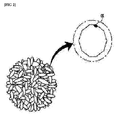
- FIG. 1 mimetically illustrates a shape of a primary particle of the conventional general lithium-manganese composite oxide
- FIG. 2 mimetically illustrates a shape of a primary particle of the lithium-manganese composite oxide according to the present invention.
- the polygon constituting the primary particle is mainly triangle or lozenge, and the vertical angle of the triangle or lozenge is 90° or less, thereby the polyhedron of the primary particle contains sharp edges.
- the process of forming an electrode plate by rolling the lithium-manganese composite oxide as a secondary particle, which is formed by agglomerating plurality of the said primary particles convex-concave is formed on the electrode plate surface by the sharp edges of the primary particles, thereby there was a problem that the electrode plate surface is not smooth.
- the vertical angle ⁇ of the polygon constituting the convex polyhedron is 90° to 120°, thereby the polyhedron of the primary particle made up of these polygons have gentle edges. Accordingly, the secondary particle of the present invention, which is formed by agglomerating a plurality of the primary particles, does not form convex-concave on the surface of the electrode plate even if it is rolled to enhance electrode density.
- all vertical angle size of the polygon constituting the convex polyhedron of the primary particle is 90° to 120°.
- the primary particle of the lithium-manganese composite oxide according to the present invention is not limited, and it may be rectangular parallelepiped, needle-shaped, plate-shaped, angular-shaped or column-shaped.
- the secondary particle of the lithium-manganese composite oxide according to the present invention may be expressed by Li a Mn 2-b M b O 4-d X d (1 ⁇ a ⁇ 1.2, 0 ⁇ b ⁇ 0.2, 0 ⁇ d ⁇ 0.65, M is any one selected from the group consisting of B, Al, Co, Ni, Cr, Mg and a combination thereof, and X is any one selected from the group consisting of F, Cl, Br, I, S and a combination thereof).
- the secondary particle of the lithium-manganese composite oxide according to the present invention may have D 50 of 20 to 30 ⁇ m.
- the present invention provides a method for preparing the lithium-manganese composite oxide in which the size of vertical angle of a primary particle is adjusted, which comprises:
- the lithium compound and the manganese compound are not particularly limited if they can be industrially available, and for example, they may be oxide, hydroxide, carbonate, nitrate and organic acid salt of each metal.
- the manganese compound may be electrolytic manganese dioxide and chemically synthesized manganese dioxide, preferably, because it is easy to be available and cheap.
- the lithium compound may be lithium carbonate, preferably, because it is easy to be available and cheap. Manufacturing process of these materials is not limited, but in order to manufacture high purity lithium-manganese composite oxide, it is preferred to contain impurity as small as possible.
- the manganese compound and the lithium compound may be used in a combination of at least one kinds of each compound.
- the M may be any one selected from the group consisting of B, Al, Co, Ni, Cr, Mg and a combination thereof, and it may be Al, preferably, and the aluminum compound may be aluminum hydroxide, preferably, because it is easy to be industrially available and cheap.
- the X may be F
- the X-containing compound may be LiF
- the method of the lithium-manganese composite oxide according to the present invention in which the size of vertical angle of a primary particle is adjusted is technically characterized in that it is conducted by: mixing the lithium compound, the manganese compound, the M-containing compound and the X-containing compound in a solid state; wet-crushing thereof until it has particle diameter of 0.5 ⁇ m or less and viscosity of 500 cp or less; and manufacturing the spherical secondary particle by spray-dyring thereof, thereby manufacturing the primary particles in which the size of vertical angle is adjusted, and the secondary particle, which is formed by agglomerating a plurality of the primary particles.
- the heating may be conducted at a temperature of 840 to 890°C.
- Calcination of the mixture may be conducted at a temperature, which can manufacture the lithium-manganese composite oxide, and the temperature may be 500 to 1100°C, preferably 600 to 1000°C, more preferably 700 to 900°C. Further, the calcination may be conducted for 1 to 24 hours, preferably 10 to 20 hours. The calcination may conducted in atmospheric or oxygen condition, but not limited thereto.
- the lithium-manganese composite oxide in which the size of the vertical angle of the primary particle is adjusted, and the method for preparing the same according to the present invention may gently adjust the size of the vertical angle of the polygon that constitutes a primary particle having a shape of a convex polyhedron in the lithium-manganese composite oxide, thus preventing the formation of convex-concave portions at the surface of an electrode plate in the process of forming the electrode plate by means of rolling during the manufacturing of a battery, thereby having an effect of improving characteristics of the battery.
- the completely crushed mixture slurry was put into a spray dryer for Lab (Ein System, Input temp.: 270 to 300°C, Output temp.: 100 to 120°C), and liquid droplets were generated through a pneumatic Atomizer-type sprayer at a pressure of 1.5 bar, thereby generating spherical cathode active material precursor particles.
- a certain amount of the prepared spherical precursor was put into a melting pot, heated at a rate of 3°C/min up to a temperature of 880°C, and calcined.
- the calcined lithium manganese composite oxide was disintegrated and classified using a disk mill and 325 mesh.
- Example 1 The procedure of Example 1 was repeated except for not adding LiF as a X compound to manufacture a lithium-manganese composite oxide.
- Example 3 The lithium-manganese composite oxides obtained in Example and Comparative Example were observed by SEM and the resulting images were shown in FIG. 3 .
- Example 10 primary particles were randomly selected from the lithium-manganese composite oxide secondary particles obtained in Example and Comparative Example, respectively, and vertical angle was measured against polygon constituting each primary particle. The results were shown in the following Table 1.
- Table 1 Example Comparative Example 1 101° 60° 2 103° 72° 3 108° 65° 4 98° 67° 5 96° 59° 6 100° 73° 7 102° 82° 8 95° 69° 9 110° 72° 10 112° 73°
- the lithium-manganese composite oxide sample obtained in Example 1 70 wt%, graphite powder 20 wt% and polyvinylidene fluoride 10 wt% were mixed and used as a cathode mix.
- the mix was dispersed in N-methyl-2-pyrrolidinone to prepare mixing paste.
- the mixing paste was coated on an aluminum foil, pressed and stamped out on a disc having diameter of 15 mm to obtain a cathode plate.
- a lithium secondary battery was manufactured using this cathode plate and members such as a separator, an anode, a current collector, a mounting device, an outer terminal and an electrolyte. Carbon having high crystallinity was used as the anode, and LiPF 6 dissolved in 1 Liter of a 1:1 mixture of ethylmethyl carbonate and ethylene carbonate was used as the electrolyte.
- the lithium-manganese composite oxide in which the size of the vertical angle of the primary particle is adjusted, and the method for preparing the same according to the present invention may gently adjust the size of the vertical angle of the polygon that constitutes a primary particle having a shape of a convex polyhedron in the lithium-manganese composite oxide, thus preventing the formation of convex-concave portions at the surface of an electrode plate in the process of forming the electrode plate by means of rolling during the manufacturing of a battery, thereby having an effect of improving characteristics of the battery.
Landscapes
- Chemical & Material Sciences (AREA)
- Organic Chemistry (AREA)
- Inorganic Chemistry (AREA)
- Chemical Kinetics & Catalysis (AREA)
- Electrochemistry (AREA)
- General Chemical & Material Sciences (AREA)
- Engineering & Computer Science (AREA)
- Materials Engineering (AREA)
- Manufacturing & Machinery (AREA)
- Battery Electrode And Active Subsutance (AREA)
- Inorganic Compounds Of Heavy Metals (AREA)
Abstract
Description
- The present invention relates to a lithium-manganese composite oxide in which the size of the vertical angle of a primary particle is adjusted, and a method for preparing the same. More particularly, it relates to a lithium-manganese composite oxide in which the size of the vertical angle of the polygon that constitutes a primary particle having a shape of a convex polyhedron is adjusted, and a method for preparing the same.
- In recent, as electrical, electronic, communication and computer industries advance rapidly, the demands for high safety lithium secondary batteries are gradually increasing. In particular, miniaturizing, slimming and lightweighting electronic devices are spreading rapidly, thereby the demands for miniaturizing and slimming of the batteries are gradually increasing.
- Further, a lithium manganese composite oxide having spinel structure has advantages in safety and cost, compared to other cathode active material for a lithium or lithium secondary battery of 4 volt potential, thereby being studied a lot. In particular, it is an actively studied material in the field of a secondary battery having large capacity for a vehicle whose most important characteristic is safety.
- The lithium secondary battery mainly uses lithium-based oxide as a cathode active material and carbon material as an anode active material. Generally, the lithium secondary battery comprises: a cathode electrode plate coated with a cathode active material; an anode electrode plate coated with an anode active material; an electrode assembly wound with a separator, which is located between the cathode electrode plate and the anode electrode plate, and prevents short and makes possible to transfer only Li-ion; a lithium battery case encasing the electrode assembly; an electrolyte, which is inserted inside of the case for a Li-ion secondary battery and makes possible to transfer Li-ion; and the like.
- The cathode and anode electrode plates of a Li-ion secondary battery as described above are formed through the following process: an active material, a conducting material and a binder are mixed with an organic solvent to prepare slurry, the slurry is coated on the electrode assembly and rolled to form an active material layer.
- However, in the process of forming the electrode plates described above by rolling, edges of a primary particle constituting the active material becomes sharp, thereby convex-concave is formed on the electrode plate surface, and it causes non-smooth electrode plate surface. Accordingly, resistance on the surface becomes vary depending on location, and current crowding problem is occurred at the location having lower resistance.
- Thus, there are problems that lithium metal is extracted by the current crowding thereby forming dendrite, or it causes rapid temperature increase. Further, if the surface is not even, the initial surface film is also unevenly formed on the electrode active material, thereby there is difference on ion conductivity. After all, there are problems that battery resistance increases, ion conductivity decreases, and life time of the last stage becomes shorter when charging/discharging continues.
- The present invention has been made in an effort to solve the above-described problems associated with prior art.
- The present invention is objected to provide a polyhedral lithium-manganese composite oxide in which the size of vertical angle is adjusted, which constitutes a convex polyhedron-shaped primary particle.
- Further, the present invention is objected to provide a method for manufacturing the lithium-manganese composite oxide in which the size of vertical angle of a primary particle is adjusted.
- In order to accomplish one object of the present invention, provided is a lithium-manganese composite oxide in which the size of vertical angle of a primary particle is adjusted, which is a secondary particle formed by agglomeration of a plurality of primary particles, wherein the primary particle has a shape of convex polyhedron, and the size of vertical angle of the polygon constituting the convex polyhedron is 90° to 120°.
-
FIG. 1 mimetically illustrates a shape of a primary particle of the conventional general lithium-manganese composite oxide,FIG. 2 mimetically illustrates a shape of a primary particle of the lithium-manganese composite oxide according to the present invention. - As shown in
FIG. 1 , in the primary particle of the conventional general lithium-manganese composite oxide, the polygon constituting the primary particle is mainly triangle or lozenge, and the vertical angle of the triangle or lozenge is 90° or less, thereby the polyhedron of the primary particle contains sharp edges. In the process of forming an electrode plate by rolling the lithium-manganese composite oxide as a secondary particle, which is formed by agglomerating plurality of the said primary particles, convex-concave is formed on the electrode plate surface by the sharp edges of the primary particles, thereby there was a problem that the electrode plate surface is not smooth. - By comparison, as shown in
FIG. 2 , in the primary particle of the lithium-manganese composite oxide according to the present invention, the vertical angle α of the polygon constituting the convex polyhedron is 90° to 120°, thereby the polyhedron of the primary particle made up of these polygons have gentle edges. Accordingly, the secondary particle of the present invention, which is formed by agglomerating a plurality of the primary particles, does not form convex-concave on the surface of the electrode plate even if it is rolled to enhance electrode density. - In the present invention, it is preferred that all vertical angle size of the polygon constituting the convex polyhedron of the primary particle is 90° to 120°.
- The primary particle of the lithium-manganese composite oxide according to the present invention is not limited, and it may be rectangular parallelepiped, needle-shaped, plate-shaped, angular-shaped or column-shaped.
- The secondary particle of the lithium-manganese composite oxide according to the present invention may be expressed by LiaMn2-bMbO4-dXd (1≤a≤1.2, 0≤b≤0.2, 0≤d≤0.65, M is any one selected from the group consisting of B, Al, Co, Ni, Cr, Mg and a combination thereof, and X is any one selected from the group consisting of F, Cl, Br, I, S and a combination thereof).
- The secondary particle of the lithium-manganese composite oxide according to the present invention may have D50 of 20 to 30 µm.
- Further, the present invention provides a method for preparing the lithium-manganese composite oxide in which the size of vertical angle of a primary particle is adjusted, which comprises:
- adding lithium compound, manganese compound, M-containing compound and X-containing compound in a solvent and mixing thereof;
- stirring and crushing the mixture until it has particle diameter of 0.5 µm or less and viscosity of 500 cp or less;
- spray-drying the crushed mixture to form spherical secondary particle; and
- heating the particle.
- In the method for preparing the lithium-manganese composite oxide according to the present invention in which the size of vertical angle of a primary particle is adjusted, the lithium compound and the manganese compound are not particularly limited if they can be industrially available, and for example, they may be oxide, hydroxide, carbonate, nitrate and organic acid salt of each metal.
- Specifically, the manganese compound may be electrolytic manganese dioxide and chemically synthesized manganese dioxide, preferably, because it is easy to be available and cheap. Further, the lithium compound may be lithium carbonate, preferably, because it is easy to be available and cheap. Manufacturing process of these materials is not limited, but in order to manufacture high purity lithium-manganese composite oxide, it is preferred to contain impurity as small as possible. The manganese compound and the lithium compound may be used in a combination of at least one kinds of each compound.
- In the method for preparing the lithium-manganese composite oxide of the present invention, the M may be any one selected from the group consisting of B, Al, Co, Ni, Cr, Mg and a combination thereof, and it may be Al, preferably, and the aluminum compound may be aluminum hydroxide, preferably, because it is easy to be industrially available and cheap.
- In the method for preparing the lithium-manganese composite oxide of the present invention, the X may be F, and the X-containing compound may be LiF.
- The method of the lithium-manganese composite oxide according to the present invention in which the size of vertical angle of a primary particle is adjusted is technically characterized in that it is conducted by: mixing the lithium compound, the manganese compound, the M-containing compound and the X-containing compound in a solid state; wet-crushing thereof until it has particle diameter of 0.5 µm or less and viscosity of 500 cp or less; and manufacturing the spherical secondary particle by spray-dyring thereof, thereby manufacturing the primary particles in which the size of vertical angle is adjusted, and the secondary particle, which is formed by agglomerating a plurality of the primary particles.
- In the method for preparing the lithium-manganese composite oxide of the present invention, the heating may be conducted at a temperature of 840 to 890°C.
- Calcination of the mixture may be conducted at a temperature, which can manufacture the lithium-manganese composite oxide, and the temperature may be 500 to 1100°C, preferably 600 to 1000°C, more preferably 700 to 900°C. Further, the calcination may be conducted for 1 to 24 hours, preferably 10 to 20 hours. The calcination may conducted in atmospheric or oxygen condition, but not limited thereto.
- The lithium-manganese composite oxide in which the size of the vertical angle of the primary particle is adjusted, and the method for preparing the same according to the present invention may gently adjust the size of the vertical angle of the polygon that constitutes a primary particle having a shape of a convex polyhedron in the lithium-manganese composite oxide, thus preventing the formation of convex-concave portions at the surface of an electrode plate in the process of forming the electrode plate by means of rolling during the manufacturing of a battery, thereby having an effect of improving characteristics of the battery.
- The above and other objects and features of the present invention will become apparent from the following description of the invention taken in conjunction with the following accompanying drawings, which respectively show:
-
FIG. 1 : a shape of a primary particle of the conventional lithium-manganese composite oxide; -
FIG. 2 : a shape of a primary particle of the lithium-manganese composite oxide according to the present invention; -
FIG. 3 : SEM images of lithium-manganese composite oxides manufactured in Example of the present invention and Comparative Example; -
FIG. 4 : a graph showing the result of measuring initial charge/discharge characteristic of a battery comprising the lithium-manganese composite oxide manufactured in Example of the present invention; and -
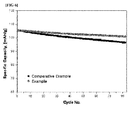
FIG. 5 andFIG. 6 : graphs showing the results of measuring charge/discharge characteristic and life time characteristic of a battery comprising the lithium-manganese composite oxide manufactured in Example of the present invention. - The following Examples illustrate the invention and are not intended to limit the same.
- Equivalent ratio of Mn3O4 as a manganese compound, Li2CO3 as a lithium compound, Al(OH)3 as a M compound and LiF as a X compound were added to distilled water, mixed and stirred in an agitator at 400 rpm for 5 min. Then, the mixture was crushed in a wet-crusher (Brand Name: NANO INTECH) until it has particle diameter (D50) of 0.5 µm or less and viscosity of 500 cp or less.
- The completely crushed mixture slurry was put into a spray dryer for Lab (Ein System, Input temp.: 270 to 300°C, Output temp.: 100 to 120°C), and liquid droplets were generated through a pneumatic Atomizer-type sprayer at a pressure of 1.5 bar, thereby generating spherical cathode active material precursor particles.
- A certain amount of the prepared spherical precursor was put into a melting pot, heated at a rate of 3°C/min up to a temperature of 880°C, and calcined. The calcined lithium manganese composite oxide was disintegrated and classified using a disk mill and 325 mesh.
- The procedure of Example 1 was repeated except for not adding LiF as a X compound to manufacture a lithium-manganese composite oxide.
- The lithium-manganese composite oxides obtained in Example and Comparative Example were observed by SEM and the resulting images were shown in
FIG. 3 . - As shown in
FIG. 3 , it can be found that vertical angle of the lithium manganese composite oxide manufactured in Example of the present invention became gentle. - 10 primary particles were randomly selected from the lithium-manganese composite oxide secondary particles obtained in Example and Comparative Example, respectively, and vertical angle was measured against polygon constituting each primary particle. The results were shown in the following Table 1.
Table 1 Example Comparative Example 1 101° 60° 2 103° 72° 3 108° 65° 4 98° 67° 5 96° 59° 6 100° 73° 7 102° 82° 8 95° 69° 9 110° 72° 10 112° 73° - As shown in Table 1, in the case of the lithium-manganese composite oxide secondary particle manufactured in Example of the present invention, it can be found that the size of the vertical angle of the polyhedron constituting the primary particle is improved, compared to Comparative Example.
- The lithium-manganese composite oxide sample obtained in Example 1 70 wt%,
graphite powder 20 wt% andpolyvinylidene fluoride 10 wt% were mixed and used as a cathode mix. The mix was dispersed in N-methyl-2-pyrrolidinone to prepare mixing paste. The mixing paste was coated on an aluminum foil, pressed and stamped out on a disc having diameter of 15 mm to obtain a cathode plate. A lithium secondary battery was manufactured using this cathode plate and members such as a separator, an anode, a current collector, a mounting device, an outer terminal and an electrolyte. Carbon having high crystallinity was used as the anode, and LiPF6 dissolved in 1 Liter of a 1:1 mixture of ethylmethyl carbonate and ethylene carbonate was used as the electrolyte. - At 50°C, 1 cycle of charge/discharge of the cathode was conducted by charging up to 4.3 V at 0.5 mA/cm2 and discharging up to 3.5 V, and discharge capacity was measured. The discharge capacity of the first cycle as the initial discharge capacity was shown in
FIG. 4 . - 80 cycles of charge/discharge were conducted as described above at a room temperature and a high temperature (45°C), and then discharge capacity and life time characteristic were measured. The results were shown in
FIG. 5 andFIG. 6 , respectively. - As shown in
FIG. 5 andFIG. 6 , in the case of the lithium-manganese composite oxide manufactured according to the present invention, it can be found that its capacity was maintained higher and more constant at a room temperature and a high temperature (45°C) than Comparative Example, thereby its life time characteristic was improved. - The lithium-manganese composite oxide in which the size of the vertical angle of the primary particle is adjusted, and the method for preparing the same according to the present invention may gently adjust the size of the vertical angle of the polygon that constitutes a primary particle having a shape of a convex polyhedron in the lithium-manganese composite oxide, thus preventing the formation of convex-concave portions at the surface of an electrode plate in the process of forming the electrode plate by means of rolling during the manufacturing of a battery, thereby having an effect of improving characteristics of the battery.
- While the invention has been described with respect to the above specific embodiments, it should be recognized that various modifications and changes may be made and also fall within the scope of the invention as defined by the claims that follow.
Claims (9)
- A lithium-manganese composite oxide in which the size of vertical angle of a primary particle is adjusted, which is a secondary particle formed by agglomeration of a plurality of primary particles, wherein the primary particle has a shape of convex polyhedron, and the size of vertical angle of the polygon constituting the convex polyhedron is 90° to 120°.
- The lithium-manganese composite oxide in which the size of vertical angle of a primary particle is adjusted according to claim 1, wherein the primary particle is rectangular parallelepiped, needle-shaped, plate-shaped, angular-shaped or column-shaped.
- The lithium-manganese composite oxide in which the size of vertical angle of a primary particle is adjusted according to claim 1, wherein the size of all vertical angle of the polygon constituting the convex polyhedron of the primary particle is 90° to 120°.
- The lithium-manganese composite oxide in which the size of vertical angle of a primary particle is adjusted according to claim 1, wherein D50 of the secondary particle is 20 to 30 µm.
- The lithium-manganese composite oxide in which the size of vertical angle of a primary particle is adjusted according to claim 1, wherein the secondary particle is expressed by LiaMn2-bMbO4-dXd (1≤a≤1.2, 0≤b≤0.2, 0≤d≤0.65, M is any one selected from the group consisting of B, Al, Co, Ni, Cr, Mg and a combination thereof, and X is any one selected from the group consisting of F, Cl, Br, I, S and a combination thereof).
- A method for preparing the lithium-manganese composite oxide in which the size of vertical angle of a primary particle is adjusted according to claim 1, which comprises:adding lithium compound, manganese compound, M-containing compound and X-containing compound in a solvent and mixing thereof;stirring and crushing the mixture until it has particle diameter of 0.5 µm or less and viscosity of 500 cp or less;spray-drying the crushed mixture to form spherical secondary particle; andheating the particle.
- The method for preparing the lithium-manganese composite oxide in which the size of vertical angle of a primary particle is adjusted according to claim 6, wherein the M is Al and the M-containing compound is Al(OH)3.
- The method for preparing the lithium-manganese composite oxide in which the size of vertical angle of a primary particle is adjusted according to claim 6, wherein the X is F and the X-containing compound is LiF.
- The method for preparing the lithium-manganese composite oxide in which the size of vertical angle of a primary particle is adjusted according to claim 6, wherein the heating is conducted at a temperature of 840 to 890°C.
Applications Claiming Priority (2)
| Application Number | Priority Date | Filing Date | Title |
|---|---|---|---|
| KR1020120129730A KR101409973B1 (en) | 2012-11-15 | 2012-11-15 | Lithium manganese composite oxide comprising primary particle having controlled vertical angle, and manufacturing method of the same |
| PCT/KR2012/010165 WO2014077445A1 (en) | 2012-11-15 | 2012-11-28 | Lithium-manganese composite oxide in which size of vertical angle of primary particle is adjusted, and method for preparing same |
Publications (2)
| Publication Number | Publication Date |
|---|---|
| EP2887432A1 true EP2887432A1 (en) | 2015-06-24 |
| EP2887432A4 EP2887432A4 (en) | 2016-02-10 |
Family
ID=50731347
Family Applications (1)
| Application Number | Title | Priority Date | Filing Date |
|---|---|---|---|
| EP12888292.5A Withdrawn EP2887432A4 (en) | 2012-11-15 | 2012-11-28 | Lithium-manganese composite oxide in which size of vertical angle of primary particle is adjusted, and method for preparing same |
Country Status (7)
| Country | Link |
|---|---|
| US (1) | US20150329374A1 (en) |
| EP (1) | EP2887432A4 (en) |
| JP (2) | JP2015515442A (en) |
| KR (1) | KR101409973B1 (en) |
| CN (1) | CN104285321A (en) |
| CA (1) | CA2877109A1 (en) |
| WO (1) | WO2014077445A1 (en) |
Families Citing this family (2)
| Publication number | Priority date | Publication date | Assignee | Title |
|---|---|---|---|---|
| KR102013310B1 (en) * | 2017-12-22 | 2019-08-23 | 주식회사 포스코 | Positive electrode active material for rechargable lithium battery and manufacturing method of the same, rechargable lithium battery |
| CN113912137B (en) * | 2021-10-09 | 2024-01-19 | 宁波容百新能源科技股份有限公司 | Polyhedral-rich composite phase precursor, preparation method thereof and lithium-rich positive electrode material |
Family Cites Families (16)
| Publication number | Priority date | Publication date | Assignee | Title |
|---|---|---|---|---|
| US5718989A (en) * | 1995-12-29 | 1998-02-17 | Japan Storage Battery Co., Ltd. | Positive electrode active material for lithium secondary battery |
| JP5199522B2 (en) * | 1999-08-17 | 2013-05-15 | 日揮触媒化成株式会社 | Spinel-type lithium / manganese composite oxide, its production method and use |
| JP3944899B2 (en) * | 2001-12-27 | 2007-07-18 | 株式会社ジーエス・ユアサコーポレーション | Non-aqueous secondary battery |
| JP4254267B2 (en) * | 2002-02-21 | 2009-04-15 | 東ソー株式会社 | Lithium manganese composite oxide granule secondary particles, method for producing the same, and use thereof |
| JP2004155631A (en) * | 2002-11-08 | 2004-06-03 | Dainippon Toryo Co Ltd | Lithium manganese-based double oxide particles for non-aqueous lithium secondary battery, method for producing the same, and non-aqueous lithium secondary battery |
| JP4305629B2 (en) * | 2003-03-27 | 2009-07-29 | 戸田工業株式会社 | Trimanganese tetroxide powder and production method thereof, positive electrode active material for nonaqueous electrolyte secondary battery and production method thereof, and nonaqueous electrolyte secondary battery |
| JP2004339027A (en) * | 2003-05-16 | 2004-12-02 | Mitsui Mining & Smelting Co Ltd | Aluminum-substituted lithium manganese oxide and method for producing the same |
| EP2337125A1 (en) * | 2006-12-26 | 2011-06-22 | Mitsubishi Chemical Corporation | Lithium transition metal based compound powder and method for manufacturing the same |
| AU2008319749B2 (en) * | 2007-11-01 | 2012-10-18 | Agc Seimi Chemical Co., Ltd. | Granulated powder of transition metal compound for raw material for positive electrode active material of lithium secondary battery, and method for producing the same |
| KR101115416B1 (en) * | 2009-06-08 | 2012-02-15 | 한양대학교 산학협력단 | Cathode active material for lithium secondary battery, method for manufacturing same and lithium secondary battery comprising same |
| KR101503436B1 (en) * | 2009-10-23 | 2015-03-17 | 주식회사 포스코이에스엠 | Manufacturing method of lithium-nickel-cobalt-manganese complex oxide, lithium-nickel-cobalt-manganese complex oxide manufactured thereby and lithium secondary battery with the same |
| KR20110044936A (en) * | 2009-10-25 | 2011-05-03 | 주식회사 휘닉스소재 | Method for producing lithium manganese composite oxide for lithium ion battery, lithium manganese composite oxide for lithium ion battery manufactured by the method, and lithium ion secondary battery comprising same |
| KR101520903B1 (en) * | 2010-03-29 | 2015-05-18 | 주식회사 포스코이에스엠 | Process for the production of lithium-manganese double oxide for lithium ion batteries and lithium-manganese double oxide for lithium ion batteries made by the same, and lithium ion batteries cotaining the same |
| JP5557715B2 (en) * | 2010-12-06 | 2014-07-23 | 株式会社日立製作所 | Positive electrode material for lithium ion secondary battery and manufacturing method thereof, positive electrode active material for lithium ion secondary battery, positive electrode for lithium ion secondary battery, lithium ion secondary battery |
| KR101250496B1 (en) * | 2011-02-18 | 2013-04-03 | 에스케이씨 주식회사 | Positive composition for Lithium secondary battery and manufacturing method thereof |
| US10017875B2 (en) * | 2011-03-28 | 2018-07-10 | Sumitomo Metal Mining Co., Ltd. | Nickel manganese composite hydroxide particles and manufacturing method thereof, cathode active material for a non-aqueous electrolyte secondary battery and manufacturing method thereof, and a non-aqueous electrolyte secondary battery |
-
2012
- 2012-11-15 KR KR1020120129730A patent/KR101409973B1/en active Active
- 2012-11-28 CA CA2877109A patent/CA2877109A1/en not_active Abandoned
- 2012-11-28 US US14/410,877 patent/US20150329374A1/en not_active Abandoned
- 2012-11-28 JP JP2015508843A patent/JP2015515442A/en active Pending
- 2012-11-28 EP EP12888292.5A patent/EP2887432A4/en not_active Withdrawn
- 2012-11-28 WO PCT/KR2012/010165 patent/WO2014077445A1/en not_active Ceased
- 2012-11-28 CN CN201280072542.9A patent/CN104285321A/en active Pending
-
2016
- 2016-11-14 JP JP2016221712A patent/JP6525279B2/en active Active
Also Published As
| Publication number | Publication date |
|---|---|
| KR101409973B1 (en) | 2014-06-19 |
| JP2017061409A (en) | 2017-03-30 |
| CN104285321A (en) | 2015-01-14 |
| WO2014077445A1 (en) | 2014-05-22 |
| KR20140062858A (en) | 2014-05-26 |
| JP2015515442A (en) | 2015-05-28 |
| JP6525279B2 (en) | 2019-06-05 |
| CA2877109A1 (en) | 2014-05-22 |
| EP2887432A4 (en) | 2016-02-10 |
| US20150329374A1 (en) | 2015-11-19 |
Similar Documents
| Publication | Publication Date | Title |
|---|---|---|
| JP6665060B2 (en) | Li-Ni composite oxide particle powder, method for producing the same, and non-aqueous electrolyte secondary battery | |
| CN103606674B (en) | Cobalt acid lithium material of a kind of surface modification treatment and preparation method thereof | |
| JP4972624B2 (en) | Positive electrode material for lithium secondary battery and lithium secondary battery using the same | |
| CN103155240B (en) | Positive electrode active material for nonaqueous electrolyte secondary battery, method for producing the same, and nonaqueous electrolyte secondary battery using the positive electrode active material | |
| US9379382B2 (en) | Positive electrode materials for lithium-ion batteries and method for preparing the same | |
| US10361433B2 (en) | Positive electrode active material for nonaqueous electrolyte secondary battery, method for producing the same, and nonaqueous electrolyte secondary battery including the same | |
| EP3000787B1 (en) | Manufacturing method of lithium-titanium composite oxide doped with sodium and zirconium, and lithium-titanium composite oxide manufactured thereby | |
| CN109997260A (en) | Non-aqueous electrolyte secondary battery positive active material and its manufacturing method and the non-aqueous electrolyte secondary battery for having used the positive active material | |
| KR20140047044A (en) | Positive electrode active material for nonaqueous electrolyte secondary batteries, method for manufacturing the same, and nonaqueous electrolyte secondary battery using said positive electrode active material | |
| CN106536418A (en) | Nickel compound hydroxide, method for producing same, cathode active material, method for producing same, and non-aqueous electrolyte secondary battery | |
| CN107408690A (en) | Non-aqueous electrolyte secondary battery positive active material and its manufacture method | |
| JP2012028026A (en) | Negative electrode active material for lithium secondary battery, and method of manufacturing the same | |
| JP7444534B2 (en) | Method for producing positive electrode active material for non-aqueous electrolyte secondary battery, and molded article | |
| CN107534144A (en) | Non-aqueous electrolyte secondary battery positive active material and its manufacture method and the non-aqueous electrolyte secondary battery for having used the positive active material | |
| CN107004849A (en) | Positive electrode active material for nonaqueous electrolyte secondary battery particle powder and its manufacture method and rechargeable nonaqueous electrolytic battery | |
| KR101566155B1 (en) | Positive composition for Lithium secondary battery using spherical mixed metal carbonate with nano-titanate and manufacturing method thereof | |
| CN106660825A (en) | Manganese composite hydroxide and method for producing same, positive electrode active material and method for producing same, and nonaqueous electrolyte secondary battery | |
| JP2022174097A (en) | Method for producing positive electrode active material for non-aqueous electrolyte secondary battery, and compact | |
| KR20160075404A (en) | Manufacuring method of cathode active material for lithium rechargeable battery, and cathode active material made by the same | |
| JP6883681B2 (en) | Positive electrode active material for lithium-ion batteries, positive electrode for lithium-ion batteries, and lithium-ion batteries | |
| JPH1072219A (en) | Lithium composite oxide, method for producing the same, and positive electrode active material for lithium secondary battery | |
| KR101632887B1 (en) | Cathode active material precursor for lithium rechargeable battery and preparation method thereof, cathode active material for lithium rechargeable battery and lithium rechargeable battery comprising the same | |
| EP2887432A1 (en) | Lithium-manganese composite oxide in which size of vertical angle of primary particle is adjusted, and method for preparing same | |
| CN103477474B (en) | Lithium ion secondary battery cathode active material and manufacture method thereof | |
| JP6008578B2 (en) | Method for producing positive electrode active material for secondary battery and secondary battery |
Legal Events
| Date | Code | Title | Description |
|---|---|---|---|
| PUAI | Public reference made under article 153(3) epc to a published international application that has entered the european phase |
Free format text: ORIGINAL CODE: 0009012 |
|
| 17P | Request for examination filed |
Effective date: 20141222 |
|
| AK | Designated contracting states |
Kind code of ref document: A1 Designated state(s): AL AT BE BG CH CY CZ DE DK EE ES FI FR GB GR HR HU IE IS IT LI LT LU LV MC MK MT NL NO PL PT RO RS SE SI SK SM TR |
|
| AX | Request for extension of the european patent |
Extension state: BA ME |
|
| RA4 | Supplementary search report drawn up and despatched (corrected) |
Effective date: 20160112 |
|
| RIC1 | Information provided on ipc code assigned before grant |
Ipc: H01M 4/139 20100101ALI20160105BHEP Ipc: C01G 53/00 20060101ALI20160105BHEP Ipc: C01G 51/00 20060101ALI20160105BHEP Ipc: C01G 45/02 20060101AFI20160105BHEP Ipc: H01M 4/505 20100101ALI20160105BHEP Ipc: H01M 10/052 20100101ALI20160105BHEP |
|
| DAX | Request for extension of the european patent (deleted) | ||
| STAA | Information on the status of an ep patent application or granted ep patent |
Free format text: STATUS: REQUEST FOR EXAMINATION WAS MADE |
|
| STAA | Information on the status of an ep patent application or granted ep patent |
Free format text: STATUS: THE APPLICATION IS DEEMED TO BE WITHDRAWN |
|
| 18D | Application deemed to be withdrawn |
Effective date: 20170601 |