EP2883902A1 - Polyolefin-based resin expanded beads - Google Patents
Polyolefin-based resin expanded beads Download PDFInfo
- Publication number
- EP2883902A1 EP2883902A1 EP14195423.0A EP14195423A EP2883902A1 EP 2883902 A1 EP2883902 A1 EP 2883902A1 EP 14195423 A EP14195423 A EP 14195423A EP 2883902 A1 EP2883902 A1 EP 2883902A1
- Authority
- EP
- European Patent Office
- Prior art keywords
- resin
- expanded
- inorganic filler
- core layer
- expanded beads
- Prior art date
- Legal status (The legal status is an assumption and is not a legal conclusion. Google has not performed a legal analysis and makes no representation as to the accuracy of the status listed.)
- Granted
Links
Images
Classifications
-
- C—CHEMISTRY; METALLURGY
- C08—ORGANIC MACROMOLECULAR COMPOUNDS; THEIR PREPARATION OR CHEMICAL WORKING-UP; COMPOSITIONS BASED THEREON
- C08J—WORKING-UP; GENERAL PROCESSES OF COMPOUNDING; AFTER-TREATMENT NOT COVERED BY SUBCLASSES C08B, C08C, C08F, C08G or C08H
- C08J9/00—Working-up of macromolecular substances to porous or cellular articles or materials; After-treatment thereof
- C08J9/22—After-treatment of expandable particles; Forming foamed products
- C08J9/228—Forming foamed products
-
- C—CHEMISTRY; METALLURGY
- C08—ORGANIC MACROMOLECULAR COMPOUNDS; THEIR PREPARATION OR CHEMICAL WORKING-UP; COMPOSITIONS BASED THEREON
- C08J—WORKING-UP; GENERAL PROCESSES OF COMPOUNDING; AFTER-TREATMENT NOT COVERED BY SUBCLASSES C08B, C08C, C08F, C08G or C08H
- C08J9/00—Working-up of macromolecular substances to porous or cellular articles or materials; After-treatment thereof
- C08J9/04—Working-up of macromolecular substances to porous or cellular articles or materials; After-treatment thereof using blowing gases generated by a previously added blowing agent
- C08J9/12—Working-up of macromolecular substances to porous or cellular articles or materials; After-treatment thereof using blowing gases generated by a previously added blowing agent by a physical blowing agent
- C08J9/122—Hydrogen, oxygen, CO2, nitrogen or noble gases
-
- B—PERFORMING OPERATIONS; TRANSPORTING
- B29—WORKING OF PLASTICS; WORKING OF SUBSTANCES IN A PLASTIC STATE IN GENERAL
- B29C—SHAPING OR JOINING OF PLASTICS; SHAPING OF MATERIAL IN A PLASTIC STATE, NOT OTHERWISE PROVIDED FOR; AFTER-TREATMENT OF THE SHAPED PRODUCTS, e.g. REPAIRING
- B29C44/00—Shaping by internal pressure generated in the material, e.g. swelling or foaming ; Producing porous or cellular expanded plastics articles
- B29C44/02—Shaping by internal pressure generated in the material, e.g. swelling or foaming ; Producing porous or cellular expanded plastics articles for articles of definite length, i.e. discrete articles
- B29C44/04—Shaping by internal pressure generated in the material, e.g. swelling or foaming ; Producing porous or cellular expanded plastics articles for articles of definite length, i.e. discrete articles consisting of at least two parts of chemically or physically different materials, e.g. having different densities
-
- B—PERFORMING OPERATIONS; TRANSPORTING
- B29—WORKING OF PLASTICS; WORKING OF SUBSTANCES IN A PLASTIC STATE IN GENERAL
- B29C—SHAPING OR JOINING OF PLASTICS; SHAPING OF MATERIAL IN A PLASTIC STATE, NOT OTHERWISE PROVIDED FOR; AFTER-TREATMENT OF THE SHAPED PRODUCTS, e.g. REPAIRING
- B29C44/00—Shaping by internal pressure generated in the material, e.g. swelling or foaming ; Producing porous or cellular expanded plastics articles
- B29C44/34—Auxiliary operations
- B29C44/3461—Making or treating expandable particles
-
- B—PERFORMING OPERATIONS; TRANSPORTING
- B29—WORKING OF PLASTICS; WORKING OF SUBSTANCES IN A PLASTIC STATE IN GENERAL
- B29C—SHAPING OR JOINING OF PLASTICS; SHAPING OF MATERIAL IN A PLASTIC STATE, NOT OTHERWISE PROVIDED FOR; AFTER-TREATMENT OF THE SHAPED PRODUCTS, e.g. REPAIRING
- B29C44/00—Shaping by internal pressure generated in the material, e.g. swelling or foaming ; Producing porous or cellular expanded plastics articles
- B29C44/34—Auxiliary operations
- B29C44/36—Feeding the material to be shaped
- B29C44/38—Feeding the material to be shaped into a closed space, i.e. to make articles of definite length
- B29C44/44—Feeding the material to be shaped into a closed space, i.e. to make articles of definite length in solid form
- B29C44/445—Feeding the material to be shaped into a closed space, i.e. to make articles of definite length in solid form in the form of expandable granules, particles or beads
-
- C—CHEMISTRY; METALLURGY
- C08—ORGANIC MACROMOLECULAR COMPOUNDS; THEIR PREPARATION OR CHEMICAL WORKING-UP; COMPOSITIONS BASED THEREON
- C08J—WORKING-UP; GENERAL PROCESSES OF COMPOUNDING; AFTER-TREATMENT NOT COVERED BY SUBCLASSES C08B, C08C, C08F, C08G or C08H
- C08J9/00—Working-up of macromolecular substances to porous or cellular articles or materials; After-treatment thereof
- C08J9/0061—Working-up of macromolecular substances to porous or cellular articles or materials; After-treatment thereof characterized by the use of several polymeric components
-
- C—CHEMISTRY; METALLURGY
- C08—ORGANIC MACROMOLECULAR COMPOUNDS; THEIR PREPARATION OR CHEMICAL WORKING-UP; COMPOSITIONS BASED THEREON
- C08J—WORKING-UP; GENERAL PROCESSES OF COMPOUNDING; AFTER-TREATMENT NOT COVERED BY SUBCLASSES C08B, C08C, C08F, C08G or C08H
- C08J9/00—Working-up of macromolecular substances to porous or cellular articles or materials; After-treatment thereof
- C08J9/0066—Use of inorganic compounding ingredients
-
- C—CHEMISTRY; METALLURGY
- C08—ORGANIC MACROMOLECULAR COMPOUNDS; THEIR PREPARATION OR CHEMICAL WORKING-UP; COMPOSITIONS BASED THEREON
- C08J—WORKING-UP; GENERAL PROCESSES OF COMPOUNDING; AFTER-TREATMENT NOT COVERED BY SUBCLASSES C08B, C08C, C08F, C08G or C08H
- C08J9/00—Working-up of macromolecular substances to porous or cellular articles or materials; After-treatment thereof
- C08J9/16—Making expandable particles
-
- C—CHEMISTRY; METALLURGY
- C08—ORGANIC MACROMOLECULAR COMPOUNDS; THEIR PREPARATION OR CHEMICAL WORKING-UP; COMPOSITIONS BASED THEREON
- C08J—WORKING-UP; GENERAL PROCESSES OF COMPOUNDING; AFTER-TREATMENT NOT COVERED BY SUBCLASSES C08B, C08C, C08F, C08G or C08H
- C08J9/00—Working-up of macromolecular substances to porous or cellular articles or materials; After-treatment thereof
- C08J9/16—Making expandable particles
- C08J9/18—Making expandable particles by impregnating polymer particles with the blowing agent
-
- C—CHEMISTRY; METALLURGY
- C08—ORGANIC MACROMOLECULAR COMPOUNDS; THEIR PREPARATION OR CHEMICAL WORKING-UP; COMPOSITIONS BASED THEREON
- C08J—WORKING-UP; GENERAL PROCESSES OF COMPOUNDING; AFTER-TREATMENT NOT COVERED BY SUBCLASSES C08B, C08C, C08F, C08G or C08H
- C08J9/00—Working-up of macromolecular substances to porous or cellular articles or materials; After-treatment thereof
- C08J9/22—After-treatment of expandable particles; Forming foamed products
- C08J9/224—Surface treatment
-
- C—CHEMISTRY; METALLURGY
- C08—ORGANIC MACROMOLECULAR COMPOUNDS; THEIR PREPARATION OR CHEMICAL WORKING-UP; COMPOSITIONS BASED THEREON
- C08J—WORKING-UP; GENERAL PROCESSES OF COMPOUNDING; AFTER-TREATMENT NOT COVERED BY SUBCLASSES C08B, C08C, C08F, C08G or C08H
- C08J9/00—Working-up of macromolecular substances to porous or cellular articles or materials; After-treatment thereof
- C08J9/22—After-treatment of expandable particles; Forming foamed products
- C08J9/228—Forming foamed products
- C08J9/232—Forming foamed products by sintering expandable particles
-
- B—PERFORMING OPERATIONS; TRANSPORTING
- B29—WORKING OF PLASTICS; WORKING OF SUBSTANCES IN A PLASTIC STATE IN GENERAL
- B29C—SHAPING OR JOINING OF PLASTICS; SHAPING OF MATERIAL IN A PLASTIC STATE, NOT OTHERWISE PROVIDED FOR; AFTER-TREATMENT OF THE SHAPED PRODUCTS, e.g. REPAIRING
- B29C44/00—Shaping by internal pressure generated in the material, e.g. swelling or foaming ; Producing porous or cellular expanded plastics articles
- B29C44/34—Auxiliary operations
- B29C44/3415—Heating or cooling
- B29C44/3426—Heating by introducing steam in the mould
-
- C—CHEMISTRY; METALLURGY
- C08—ORGANIC MACROMOLECULAR COMPOUNDS; THEIR PREPARATION OR CHEMICAL WORKING-UP; COMPOSITIONS BASED THEREON
- C08J—WORKING-UP; GENERAL PROCESSES OF COMPOUNDING; AFTER-TREATMENT NOT COVERED BY SUBCLASSES C08B, C08C, C08F, C08G or C08H
- C08J2201/00—Foams characterised by the foaming process
- C08J2201/02—Foams characterised by the foaming process characterised by mechanical pre- or post-treatments
- C08J2201/03—Extrusion of the foamable blend
-
- C—CHEMISTRY; METALLURGY
- C08—ORGANIC MACROMOLECULAR COMPOUNDS; THEIR PREPARATION OR CHEMICAL WORKING-UP; COMPOSITIONS BASED THEREON
- C08J—WORKING-UP; GENERAL PROCESSES OF COMPOUNDING; AFTER-TREATMENT NOT COVERED BY SUBCLASSES C08B, C08C, C08F, C08G or C08H
- C08J2203/00—Foams characterized by the expanding agent
- C08J2203/06—CO2, N2 or noble gases
-
- C—CHEMISTRY; METALLURGY
- C08—ORGANIC MACROMOLECULAR COMPOUNDS; THEIR PREPARATION OR CHEMICAL WORKING-UP; COMPOSITIONS BASED THEREON
- C08J—WORKING-UP; GENERAL PROCESSES OF COMPOUNDING; AFTER-TREATMENT NOT COVERED BY SUBCLASSES C08B, C08C, C08F, C08G or C08H
- C08J2323/00—Characterised by the use of homopolymers or copolymers of unsaturated aliphatic hydrocarbons having only one carbon-to-carbon double bond; Derivatives of such polymers
- C08J2323/02—Characterised by the use of homopolymers or copolymers of unsaturated aliphatic hydrocarbons having only one carbon-to-carbon double bond; Derivatives of such polymers not modified by chemical after treatment
-
- C—CHEMISTRY; METALLURGY
- C08—ORGANIC MACROMOLECULAR COMPOUNDS; THEIR PREPARATION OR CHEMICAL WORKING-UP; COMPOSITIONS BASED THEREON
- C08J—WORKING-UP; GENERAL PROCESSES OF COMPOUNDING; AFTER-TREATMENT NOT COVERED BY SUBCLASSES C08B, C08C, C08F, C08G or C08H
- C08J2323/00—Characterised by the use of homopolymers or copolymers of unsaturated aliphatic hydrocarbons having only one carbon-to-carbon double bond; Derivatives of such polymers
- C08J2323/02—Characterised by the use of homopolymers or copolymers of unsaturated aliphatic hydrocarbons having only one carbon-to-carbon double bond; Derivatives of such polymers not modified by chemical after treatment
- C08J2323/04—Homopolymers or copolymers of ethene
- C08J2323/06—Polyethene
-
- C—CHEMISTRY; METALLURGY
- C08—ORGANIC MACROMOLECULAR COMPOUNDS; THEIR PREPARATION OR CHEMICAL WORKING-UP; COMPOSITIONS BASED THEREON
- C08J—WORKING-UP; GENERAL PROCESSES OF COMPOUNDING; AFTER-TREATMENT NOT COVERED BY SUBCLASSES C08B, C08C, C08F, C08G or C08H
- C08J2323/00—Characterised by the use of homopolymers or copolymers of unsaturated aliphatic hydrocarbons having only one carbon-to-carbon double bond; Derivatives of such polymers
- C08J2323/02—Characterised by the use of homopolymers or copolymers of unsaturated aliphatic hydrocarbons having only one carbon-to-carbon double bond; Derivatives of such polymers not modified by chemical after treatment
- C08J2323/10—Homopolymers or copolymers of propene
- C08J2323/14—Copolymers of propene
-
- C—CHEMISTRY; METALLURGY
- C08—ORGANIC MACROMOLECULAR COMPOUNDS; THEIR PREPARATION OR CHEMICAL WORKING-UP; COMPOSITIONS BASED THEREON
- C08J—WORKING-UP; GENERAL PROCESSES OF COMPOUNDING; AFTER-TREATMENT NOT COVERED BY SUBCLASSES C08B, C08C, C08F, C08G or C08H
- C08J2323/00—Characterised by the use of homopolymers or copolymers of unsaturated aliphatic hydrocarbons having only one carbon-to-carbon double bond; Derivatives of such polymers
- C08J2323/02—Characterised by the use of homopolymers or copolymers of unsaturated aliphatic hydrocarbons having only one carbon-to-carbon double bond; Derivatives of such polymers not modified by chemical after treatment
- C08J2323/16—Ethene-propene or ethene-propene-diene copolymers
-
- C—CHEMISTRY; METALLURGY
- C08—ORGANIC MACROMOLECULAR COMPOUNDS; THEIR PREPARATION OR CHEMICAL WORKING-UP; COMPOSITIONS BASED THEREON
- C08J—WORKING-UP; GENERAL PROCESSES OF COMPOUNDING; AFTER-TREATMENT NOT COVERED BY SUBCLASSES C08B, C08C, C08F, C08G or C08H
- C08J2323/00—Characterised by the use of homopolymers or copolymers of unsaturated aliphatic hydrocarbons having only one carbon-to-carbon double bond; Derivatives of such polymers
- C08J2323/02—Characterised by the use of homopolymers or copolymers of unsaturated aliphatic hydrocarbons having only one carbon-to-carbon double bond; Derivatives of such polymers not modified by chemical after treatment
- C08J2323/18—Homopolymers or copolymers of hydrocarbons having four or more carbon atoms
- C08J2323/20—Homopolymers or copolymers of hydrocarbons having four or more carbon atoms having four to nine carbon atoms
-
- C—CHEMISTRY; METALLURGY
- C08—ORGANIC MACROMOLECULAR COMPOUNDS; THEIR PREPARATION OR CHEMICAL WORKING-UP; COMPOSITIONS BASED THEREON
- C08J—WORKING-UP; GENERAL PROCESSES OF COMPOUNDING; AFTER-TREATMENT NOT COVERED BY SUBCLASSES C08B, C08C, C08F, C08G or C08H
- C08J2351/00—Characterised by the use of graft polymers in which the grafted component is obtained by reactions only involving carbon-to-carbon unsaturated bonds; Derivatives of such polymers
- C08J2351/06—Characterised by the use of graft polymers in which the grafted component is obtained by reactions only involving carbon-to-carbon unsaturated bonds; Derivatives of such polymers grafted on to homopolymers or copolymers of aliphatic hydrocarbons containing only one carbon-to-carbon double bond
-
- C—CHEMISTRY; METALLURGY
- C08—ORGANIC MACROMOLECULAR COMPOUNDS; THEIR PREPARATION OR CHEMICAL WORKING-UP; COMPOSITIONS BASED THEREON
- C08J—WORKING-UP; GENERAL PROCESSES OF COMPOUNDING; AFTER-TREATMENT NOT COVERED BY SUBCLASSES C08B, C08C, C08F, C08G or C08H
- C08J2423/00—Characterised by the use of homopolymers or copolymers of unsaturated aliphatic hydrocarbons having only one carbon-to-carbon double bond; Derivatives of such polymers
- C08J2423/02—Characterised by the use of homopolymers or copolymers of unsaturated aliphatic hydrocarbons having only one carbon-to-carbon double bond; Derivatives of such polymers not modified by chemical after treatment
-
- C—CHEMISTRY; METALLURGY
- C08—ORGANIC MACROMOLECULAR COMPOUNDS; THEIR PREPARATION OR CHEMICAL WORKING-UP; COMPOSITIONS BASED THEREON
- C08J—WORKING-UP; GENERAL PROCESSES OF COMPOUNDING; AFTER-TREATMENT NOT COVERED BY SUBCLASSES C08B, C08C, C08F, C08G or C08H
- C08J2423/00—Characterised by the use of homopolymers or copolymers of unsaturated aliphatic hydrocarbons having only one carbon-to-carbon double bond; Derivatives of such polymers
- C08J2423/02—Characterised by the use of homopolymers or copolymers of unsaturated aliphatic hydrocarbons having only one carbon-to-carbon double bond; Derivatives of such polymers not modified by chemical after treatment
- C08J2423/04—Homopolymers or copolymers of ethene
- C08J2423/06—Polyethene
-
- C—CHEMISTRY; METALLURGY
- C08—ORGANIC MACROMOLECULAR COMPOUNDS; THEIR PREPARATION OR CHEMICAL WORKING-UP; COMPOSITIONS BASED THEREON
- C08J—WORKING-UP; GENERAL PROCESSES OF COMPOUNDING; AFTER-TREATMENT NOT COVERED BY SUBCLASSES C08B, C08C, C08F, C08G or C08H
- C08J2423/00—Characterised by the use of homopolymers or copolymers of unsaturated aliphatic hydrocarbons having only one carbon-to-carbon double bond; Derivatives of such polymers
- C08J2423/02—Characterised by the use of homopolymers or copolymers of unsaturated aliphatic hydrocarbons having only one carbon-to-carbon double bond; Derivatives of such polymers not modified by chemical after treatment
- C08J2423/04—Homopolymers or copolymers of ethene
- C08J2423/08—Copolymers of ethene
-
- C—CHEMISTRY; METALLURGY
- C08—ORGANIC MACROMOLECULAR COMPOUNDS; THEIR PREPARATION OR CHEMICAL WORKING-UP; COMPOSITIONS BASED THEREON
- C08J—WORKING-UP; GENERAL PROCESSES OF COMPOUNDING; AFTER-TREATMENT NOT COVERED BY SUBCLASSES C08B, C08C, C08F, C08G or C08H
- C08J2423/00—Characterised by the use of homopolymers or copolymers of unsaturated aliphatic hydrocarbons having only one carbon-to-carbon double bond; Derivatives of such polymers
- C08J2423/02—Characterised by the use of homopolymers or copolymers of unsaturated aliphatic hydrocarbons having only one carbon-to-carbon double bond; Derivatives of such polymers not modified by chemical after treatment
- C08J2423/10—Homopolymers or copolymers of propene
- C08J2423/14—Copolymers of propene
-
- C—CHEMISTRY; METALLURGY
- C08—ORGANIC MACROMOLECULAR COMPOUNDS; THEIR PREPARATION OR CHEMICAL WORKING-UP; COMPOSITIONS BASED THEREON
- C08J—WORKING-UP; GENERAL PROCESSES OF COMPOUNDING; AFTER-TREATMENT NOT COVERED BY SUBCLASSES C08B, C08C, C08F, C08G or C08H
- C08J2423/00—Characterised by the use of homopolymers or copolymers of unsaturated aliphatic hydrocarbons having only one carbon-to-carbon double bond; Derivatives of such polymers
- C08J2423/02—Characterised by the use of homopolymers or copolymers of unsaturated aliphatic hydrocarbons having only one carbon-to-carbon double bond; Derivatives of such polymers not modified by chemical after treatment
- C08J2423/16—Ethene-propene or ethene-propene-diene copolymers
-
- C—CHEMISTRY; METALLURGY
- C08—ORGANIC MACROMOLECULAR COMPOUNDS; THEIR PREPARATION OR CHEMICAL WORKING-UP; COMPOSITIONS BASED THEREON
- C08J—WORKING-UP; GENERAL PROCESSES OF COMPOUNDING; AFTER-TREATMENT NOT COVERED BY SUBCLASSES C08B, C08C, C08F, C08G or C08H
- C08J2423/00—Characterised by the use of homopolymers or copolymers of unsaturated aliphatic hydrocarbons having only one carbon-to-carbon double bond; Derivatives of such polymers
- C08J2423/26—Characterised by the use of homopolymers or copolymers of unsaturated aliphatic hydrocarbons having only one carbon-to-carbon double bond; Derivatives of such polymers modified by chemical after-treatment
-
- C—CHEMISTRY; METALLURGY
- C08—ORGANIC MACROMOLECULAR COMPOUNDS; THEIR PREPARATION OR CHEMICAL WORKING-UP; COMPOSITIONS BASED THEREON
- C08J—WORKING-UP; GENERAL PROCESSES OF COMPOUNDING; AFTER-TREATMENT NOT COVERED BY SUBCLASSES C08B, C08C, C08F, C08G or C08H
- C08J2451/00—Characterised by the use of graft polymers in which the grafted component is obtained by reactions only involving carbon-to-carbon unsaturated bonds; Derivatives of such polymers
- C08J2451/06—Characterised by the use of graft polymers in which the grafted component is obtained by reactions only involving carbon-to-carbon unsaturated bonds; Derivatives of such polymers grafted on to homopolymers or copolymers of aliphatic hydrocarbons containing only one carbon-to-carbon double bond
-
- Y—GENERAL TAGGING OF NEW TECHNOLOGICAL DEVELOPMENTS; GENERAL TAGGING OF CROSS-SECTIONAL TECHNOLOGIES SPANNING OVER SEVERAL SECTIONS OF THE IPC; TECHNICAL SUBJECTS COVERED BY FORMER USPC CROSS-REFERENCE ART COLLECTIONS [XRACs] AND DIGESTS
- Y10—TECHNICAL SUBJECTS COVERED BY FORMER USPC
- Y10T—TECHNICAL SUBJECTS COVERED BY FORMER US CLASSIFICATION
- Y10T428/00—Stock material or miscellaneous articles
- Y10T428/29—Coated or structually defined flake, particle, cell, strand, strand portion, rod, filament, macroscopic fiber or mass thereof
- Y10T428/2982—Particulate matter [e.g., sphere, flake, etc.]
- Y10T428/2991—Coated
- Y10T428/2998—Coated including synthetic resin or polymer
Definitions
- the present invention relates to polyolefin-based resin expanded beads containing an inorganic filler.
- Fusion bonding between polyolefin-based resin expanded beads may sufficiently proceed when the in-mold molding of the expanded beads is carried out using a high molding pressure.
- the expanded beads are liable to form an open cell structure or to be broken in a surface part of the molded article. Breakage of the expanded beads in a surface of the molded article causes a significant difference in density between the surface region and the inner region of the molded article, which results in a difference in content of the inorganic filler per unit volume of the molded article between in the surface region and in the inner region.
- the non-uniform distribution of the inorganic filler in the molded article may result in non-uniformity or insufficiency of the desired functionality to be imparted by the inorganic filler.
- polyolefin-based resin will be occasionally referred to as “PO resin” for the purpose of brevity.
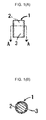
- the reference numeral 1 denotes an inorganic filler-containing, PO resin expanded bead according to the present invention.
- the expanded bead 1 has an expanded core layer 2 that contains a first PO resin and an inorganic filler, and a cover layer 3 that covers the expanded core layer 2 and contains a second PO resin.
- a part of the expanded core layer 2 may be uncovered with the cover layer 3 and exposed on the surface of the expanded bead 1, as long as the object of the present invention can be achieved and the intended effect of the present invention is not adversely affected.
- the expanded core layer 2 As an example of the structure in which the expanded core layer 2 is partially exposed, there may be mentioned a case in which the expanded core layer 2 has a cylindrical shape and in which only the peripheral surface of thereof is covered with the cover layer 3 with its top and bottom surfaces being exposed as shown in FIG. 1 (A) . Details of the constituents, structure, production method and properties of the expanded beads 1 will be described next.
- the PO resin expanded beads according to the present invention each contain an inorganic filler. It is important that the inorganic filler should be contained in the expanded core layer.
- the kind and particle size of the inorganic filler are not specifically limited. Inorganic fillers capable of being uniformly dispersed in a thermoplastic resin may be preferably used for the purpose of the present invention because such inorganic fillers can be uniformly dispersed in a PO resin. It is also preferred that the inorganic filler has a small particle size for reasons of capability thereof of being dispersed in a PO resin.
- the inorganic filler has an average particle size of about from 0.1 to 50 ⁇ m, and preferably from 0.5 to 20 ⁇ m.
- the average particle size of inorganic filler is measured using an electron photo microscope. Arbitrarily selected 100 inorganic filler are measured for their maximum diameters respectively. The average particle size is each an arithmetic mean of the maximum diameters of the 100 samples.
- the inorganic filler examples include carbons such as carbon black and graphite; fibers such as glass fibers, metal fibers and carbon fibers; inorganic hydroxides such as aluminum hydroxide, calcium hydroxide and magnesium hydroxide; inorganic carbonates such as calcium carbonate, magnesium carbonate and barium carbonate; inorganic sulfites such as calcium sulfite and magnesium sulfite; inorganic sulfates such as calcium sulfate, magnesium sulfate and aluminum sulfate; inorganic oxides such as iron oxide, aluminum oxide, zinc oxide, silicon oxide, lead oxide, magnesium oxide, cobalt oxide, titanium oxide and calcium oxide; inorganic borates such as zinc borate, calcium borate, magnesium borate and aluminum borate; and clay or natural minerals such as talc, clay, kaolin and zeolite. These inorganic fillers may be used alone or in combination of two or more thereof.
- inorganic oxides are preferred.
- metal oxides such as iron oxide, aluminum oxide, zinc oxide, silicon oxide, lead oxide, calcium oxide, magnesium oxide, cobalt oxide and titanium oxide, are more preferred.
- titanium oxide is particularly preferably used as the inorganic filler for reasons of good abrasion resistance.
- Titanium oxide may contain one or more other metal components such as iron, aluminum, zinc, lead, magnesium and cobalt.
- the expanded core layer has a multiplicity of cells defined by cell walls of a first PO resin composition and may be formed by foaming and expanding inorganic filler-containing, multilayer resin particles, described hereinafter, using a blowing agent.
- the first PO resin contained in the first PO resin composition of the expanded core layer may be one selected from (a) olefin homopolymers, (b) copolymers of at least two olefins, (c) copolymers of at least 50% by weight of one or more olefins and less than less than 50% by weight of one or more comonomers other than an olefin, and (d) mixtures of two or more of these homopolymers and copolymers.
- the first PO resin composition may contain other thermoplastic resin and/or elastomer in an amount less than the weight of the first PO resin.
- Examples of the olefin homopolymer (a) include polypropylene, polyethylene, polybutene and polypentene.
- Examples of the olefin copolymers (b) and (c) include ethylene copolymers containing at least 50% by weight of ethylene, such as ethylene-propylene copolymers, ethylene-butene copolymers, ethylene-vinyl acetate copolymers, ethylene-methacrylic acid copolymers, ethylene-methyl methacrylate copolymers and ethylene-maleic anhydride copolymers; ethylene-based ionomers obtained by cross-linking ethylene-methacrylic acid copolymers with metal ions; and propylene copolymers containing at least 50% by weight of propylene, such as propylene-ethylene copolymers, propylene-butene copolymers, propylene-ethylene-butene terpolymers, propylene-acrylic acid copolymers and prop
- the first PO resin used in the first PO resin composition for forming the expanded core layer is preferably a polypropylene-based resin for reasons of its excellent rigidity, abrasion resistance, processability and low costs.
- Specific examples of the polypropylene-based resin include polypropylene (propylene homopolymer) and propylene copolymers containing at least 50% by weight of propylene such as propylene-ethylene random propylene-butene random propylene-ethylene-butene terpolymers and mixtures of two or more of these homopolymer and copolymers.
- the first PO resin may be in a cross-linked form which is obtained by treatment with a peroxide or a radiation irradiation. Because of its easiness in obtaining uniform mixture with an inorganic filler, however, the first PO resin is preferably in a non-cross-linked form.
- the first PO resin of the expanded core layer is a mixture of an acid-free PO resin with a carboxylic acid-modified or carboxylic acid anhydride-modified PO resin.
- the term "acid-free PO resin" as used herein is intended to refer to PO resin that contains no carboxylic acids or carboxylic acid anhydrides.
- the acid-free PO resin may be preferably selected from the afore-mentioned first PO resins (a) to (d) provided that they contain no carboxylic acid or carboxylic acid anhydride components such as methacrylic acid and maleic anhydride.
- the carboxylic acid-modified or carboxylic acid anhydride-modified PO resin (hereinafter occasionally referred to as "acid-modified PO resin) is obtained by copolymerizing one or more monomers selected from acid anhydrides such as acetic anhydride, succinic anhydride, maleic anhydride and phthalic anhydride, and carboxylic acids such as methacrylic acid, maleic acid and acrylic acid, with a PO resin such as an acid-free PO resin described above.
- Particularly preferred acid-modified PO resin is a maleic anhydride-modified polypropylene.
- the first PO resin of the expanded core layer contains the acid-modified PO resin in such an amount that a carboxylic acid or carboxylic acid anhydride component content of the first PO resin is 0.15 to 10% by weight, more preferably 0.2 to 8% by weight, still more preferably 0.3 to 6% by weight.
- the carboxylic acid or carboxylic acid anhydride component content in the first PO resin of the expanded core layer is determined by the amount of the acid-modified PO resin mixed to the acid-free PO resin and the carboxylic acid or carboxylic acid anhydride modification amount of the acid-modified PO resin (i.e. amount of the carboxylic acid or carboxylic acid anhydride component based on the weight of the acid-modified PO resin).
- the acid-modified PO resin preferably has a carboxylic acid or carboxylic acid anhydride modification amount of 0.5 to 15% by weight, more preferably 1 to 8% by weight, for reasons of compatibility between the first PO resin and the inorganic filler.
- the acid-modified PO resin is contained in the expanded core layer in an amount of 3 to 30% by weight, more preferably 5 to 25% by weight, still more preferably 6 to 20% by weight, based on the weight of the expanded core layer.
- the first PO resin when incorporated with an acid-modified PO resin, has an improved compatibility with the inorganic filler so that local variation in the apparent density of the expanded core layer is minimized.
- cells of the expanded core layer are more likely to be broken during the preparation of the PO resin expanded beads or during the preparation of a molded article from the PO resin expanded beads, because the inorganic filler acts as cell breaking sites.
- the breakage of the cells has been found to be suppressed by using the acid-modified PO resin in a controlled amount.
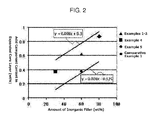
- x and y meet the following formula (1): 0.008 ⁇ x + 0.300 ⁇ y ⁇ 0.008 ⁇ x - 0.125
- the preferred range is also shown in FIG. 2 .
- the inorganic filler should be contained in the expanded core layer and may be optionally also contained in the cover layer.
- the amount of the inorganic filler contained in the expanded core layer should be 5 to 90% by weight based on the weight of the expanded core layer.
- the expanded core layer should contain the inorganic filler in a weight percentage amount of 5 to 90%.
- the amount of the inorganic filler is preferably 30 to 85% by weight, more preferably 40 to 80% by weight, still more preferably 50 to 80% by weight, based on the weight of the expanded core layer for reasons of effectively imparting the function of the inorganic filler to the PO resin expanded beads and of obtaining good dispersed state of the inorganic filler in the expanded core layer.
- the first PO resin composition that constitutes the expanded core layer may contain an additive such as an antioxidant, a UV absorbing agent, a flame retardant, an antistatic agent, a pigment, a dye, a nucleating agent and a cell controlling agent, if desired, as long as the effect of the present invention is not adversely affected.
- an additive such as an antioxidant, a UV absorbing agent, a flame retardant, an antistatic agent, a pigment, a dye, a nucleating agent and a cell controlling agent, if desired, as long as the effect of the present invention is not adversely affected.
- the cover layer that covers the above-described expanded core layer of the PO resin expanded bead is constituted of a second PO resin composition containing a second PO resin.
- the second PO resin may be selected from those which are described above as examples of the first PO resin.
- the cover layer contains no inorganic filler or contains an inorganic filler, which is the same or different from the inorganic filler contained in the expanded core layer, in a weight percentage amount lower than that of the inorganic filler in the expanded core layer.
- the weight percentage amount of the inorganic filler in the cover layer is less than that in the expanded core layer, the fusion-bonding property of the cover layer is better than that of the expanded core layer and, hence, the PO resin expanded beads having such a layer structure (multi-layered PO resin expanded beads) can be more tightly fusion-bonded to each other during an in-mold molding step as compared with single layer PO resin expanded beads having the same composition as that of the expanded core layer.
- the better fusion-bonding property of the multi-layered PO resin expanded beads permit the in-mold molding step to be carried out at a lower molding pressure or may eliminate a pretreatment with a pressurized air for increasing inside pressure of the beads. This may also minimize a difference in apparent density between inside and outside regions of the obtained expanded beads molded articles.
- the weight percentage amount of the inorganic filler contained in the cover layer is preferably less than two thirds, more preferably less than half, still more preferably less than one fourths of that in the expanded core layer.
- the weight percentage amount of the inorganic filler contained in the cover layer is preferably less than 20% by weight, more preferably less than 10% by weight, still more preferably less than 5% by weight, particularly preferably contains no inorganic filler, based on the weight of the cover layer.
- the cover layer may be in an expanded or unexpanded state.
- the cover layer preferably has a lower expansion ratio than the expanded core layer and, more preferably is in an unexpanded or substantially unexpanded state.
- a weight ratio of the cover layer to the expanded core layer is 1:99 to 20:80 in order to properly cover the expanded core layer with the cover layer and to obtain expanded beads having excellent fusion bonding property even when the expanded core layer contains a large amount of the inorganic filler. From this point of view, the weight ratio of the cover layer to the expanded core layer is preferably 1:99 to 15:85, more preferably 1:99 to 10:90.
- the second PO resin of the cover layer shows no melting point or has a melting point (MP2) lower than the melting point (MP1) of the first PO resin of the expanded core layer in order to obtain a desired expanded beads molded article even when the in-mold molding is carried out using a relatively low heated steam pressure.
- a difference (MP1-MP2) in melting point between the first and second PO resins is preferably not lower than 0 and not greater than 50°C (50 ⁇ (MP1-MP2) ⁇ 0), more preferably greater than 0 and not greater than 45°C (45 ⁇ (MP1-MP2) >0), still more preferably not lower than 5°C and not greater than 40°C (40 ⁇ (MP1-MP2) ⁇ 5).
- the Vicat softening point of the second PO resin is preferably lower, more preferably lower by at least 5°C, than a melting point of the first PO resin constituting the expanded core layer.
- the upper limit of the difference between the melting point of the first PO resin and the Vicat softening point of the second PO resin is generally about 100°C.
- the PO resin expanded beads in which the first PO resin of the expanded core layers and the second PO resin of the cover layers meet the foregoing requirements, can be fuse-bonded to each other without need of a high heated steam pressure and can produce a desired expanded beads molded article by in-mold molding using a relatively low heated steam pressure.
- the PO resin expanded beads of the present invention when measured by heat flux differential scanning calorimetry in which 2 to 10 mg thereof are heated from 23°C to 220°C at a heating rate of 10°C/min, give a DSC curve (first heating run DSC curve) having an endothermic peak "A” which is intrinsic to the polypropylene-based resin (hereinafter occasionally referred to simply as “intrinsic peak”) and one or more endothermic peaks "B” (hereinafter occasionally referred to simply as "high temperature peak”) which are located on a higher temperature side of the intrinsic peak.
- DSC curve first heating run DSC curve
- a percentage proportion of the heat of fusion of the high temperature peak (hereinafter occasionally referred to as "high temperature peak calorific value") based on a total heat of fusion of the endothermic peaks (the total of the heat of fusion of the intrinsic peak and the heat of fusion of the high temperature peak) is 10% or more, more preferably 15% or more, still more preferably 20% or more.
- the upper limit of the percentage proportion of the high temperature peak calorific value is generally 40%, preferably 30%.
- the first time run heating DSC curve, heat of fusion of the intrinsic peak and heat of fusion of the high temperature peak are measured by a measuring method according to JIS K7122 (1987).
- the high temperature peak of expanded beads may be controlled by conventional method such as a method disclosed in U. S. patent No. 7531116 .
- the average particle diameter of the PO resin expanded beads of the present invention is preferably 0.5 to 10 mm, more preferably 0.8 to 5 mm, still more preferably 1 to 3 mm.
- the average particle diameter as used herein is measured as follows. Expanded beads are placed in the atmosphere of 23°C, 1 atm and a relative humidity of 50% for 2 days, from which 200 beads are chosen at random. Each of the 200 beads is measured for its maximum length using a caliper. The arithmetic mean of the measured maximum lengths of the 200 beads is the average particle diameter of the PO resin expanded beads.
- the shape of the PO resin expanded beads of the present invention is not specifically limited and may be, for example, a cylindrical column, a sphere, a rectangular column, an oval sphere or a cylinder.
- the PO resin expanded beads of the present invention preferably have a bulk density of 0.03 to 1.5 g/cm 3 , more preferably 0.05 to 1.2 g/cm 3 , still more preferably 0.05 to 0.8 g/cm 3 .
- the expanded core layer thereof contains an inorganic filler in a weight percentage amount of 5 to 90%, while the cover layer contains no inorganic filler or contains an inorganic filler in a weight percentage amount lower than that of the inorganic filler in the expanded core layer. Therefore, the PO resin expanded bead shows good fusion bonding property in its surface, even when its inorganic filler content is high.
- two-layer resin particles each composed of a PO resin particle core layer and a PO resin particle cover layer which covers the particle core layer are first prepared.
- a first extruder for forming the resin particle core layer and a second extruder for forming the cover layer, which are connected to a coextrusion die are provided.
- a first PO resin, an inorganic filler and, if needed, additives such as a cell controlling agent are fed to the first extruder and melted and kneaded to obtain a first melt.
- a second PO resin and, if needed, additives such as an inorganic filler are fed to the second extruder and melted and kneaded to obtain a second melt.
- the first and second melts are fed to the coextrusion die and extruded therethrough in the form of a plurality of strands each having a core-sheath structure in which the first melt for forming the resin particle core layer is surrounded by and laminated with the second melt for forming the resin particle cover layer.
- the acid-modified PO resin may be fed to the first extruder as such or in the form of a master batch using an acid-free PO resin.
- the inorganic filler to be fed to the first extruder is first kneaded and pretreated with the acid-modified PO resin, the resulting mixture being then introduced into the first extruder and kneaded with the acid-free PO resin. In this manner, the first melt for forming the resin particle core layer of the PO resin particles may be prepared.
- the PO resin expanded beads of the present invention may be prepared from the above-described two-layer resin particles by a method, in which the resin particles are dispersed in a dispersing medium, such as water, contained in a closed vessel such as autoclave together with a physical blowing agent, etc.
- a dispersing medium such as water
- the dispersing medium is then heated to impregnate the resin particles with the blowing agent.
- an end portion of the closed vessel is opened to release the blowing agent-impregnated resin particles together with the dispersing medium from the closed vessel to an atmosphere which is maintained at a pressure lower than that in the closed vessel, generally atmospheric pressure, to foam and expand the resin particles, thereby obtaining the expanded beads of the present invention.
- the blowing agent-impregnated expandable resin particles are taken out of the closed vessel and heated with a suitable heating medium such steam to foam and expand the resin particles.
- the PO resin expanded beads thus obtained each have an expanded PO resin core layer, which is formed from the resin particle core and a PO resin cover layer which covers the PO resin expanded core layer and which is formed from the resin particle cover layer.
- the blowing agent may be an organic or inorganic physical blowing agent.
- the organic physical blowing agent include aliphatic hydrocarbons such as propane, butane, pentane, hexane and heptane, and alicyclic hydrocarbons such as cyclobutane and cyclohexane.
- the inorganic physical blowing agent include air, nitrogen, carbon dioxide, oxygen, argon and water.
- a PO resin expanded beads molded article with any desired shape may be produced by using the above-described PO resin expanded beads each having a PO resin expanded core layer and a PO resin cover layer.
- the molded article has a suitable apparent density and good fusion bonding strength between the expanded beads.
- the PO resin expanded molded article generally has an apparent density of 0.05 to 0.8 g/cm 3 .
- the apparent density of the molded article may be calculated by dividing its weight by its volume that is determined from its outer dimensions.
- the expanded molded article preferably shows a high fusion bonding strength between its expanded beads of at least 60%, more preferably at least 70%, still more preferably at least 80%, from the standpoint of its mechanical strength such as bending strength.
- fusion bonding strength as used herein is intended to refer to a material failure percentage that is measured as follows. A sample of the molded article is bent and ruptured. The ruptured cross section is observed to count a number (C1) of the expanded beads present on the ruptured surface and a number (C2) of the broken expanded beads among them. The percentage (C2/C1 ⁇ 100) of the broken expanded beads based on the expanded beads present on the surface is calculated as a material failure percentage. The above procedure was repeated on five different samples in total. The arithmetic mean of the five material failure percentages represents the fusion bonding strength. The measurement should be done on a ruptured cross section including at least 100 expanded beads.
- the molded article according to the present invention may be produced by filling the above-described PO resin expanded beads in a mold cavity and heating the expanded beads with steam by customarily known method.
- the cover layers of neighboring expanded beads are fusion-bonded to each other and, additionally, the expanded beads in the mold cavity are further expanded (secondary expansion) to fill the void spaces between the expanded beads, thereby forming an integral molded product composed of mutually fusion-bonded expanded beads.
- the molded product is then cooled and taken out of the mold to obtain a PO resin expanded beads molded article.
- cover layer of the PO resin expanded beads of the present invention show good fusion bonding property at the temperature at which the in-mold molding by steam heating is carried out, it is possible to use a lower heated steam pressure than that required for in-mold molding of single-layer PO expanded beads which do not have the PO resin cover layer and which are composed of the same composition as that of the PO expanded core layer.
- the molded article thus produced exhibit various functionalities by appropriately selecting the amount and kind of the inorganic filler and may be used for various applications.
- PO resins used for the preparation of PO resin expanded beads are shown in Table 1.
- Table 1 PO resin No. PO resin MFR (g/10min) Tensile modulus (MPa) Melting point (°C) Resin 1 Ethylene-propylene random copolymer 8 660 136 Resin 2 Ethylene-butene-propylene terpolymer 6 670 131 Resin 3 Ethylene-butene-propylene terpolymer 7 700 125 Resin 4 linear low density polyethylene 2 114 100
- the first PO resin composition for forming an expanded core layer of PO resin expanded beads of Examples 1 to 5 contained a first PO resin and an inorganic filler.
- Resin 1 shown in Table 1 was used in combination with an acid-modified PO resin which is a maleic anhydride-modified polypropylene (hereinafter referred to as MPP for brevity) manufactured by Toyobo Co., Ltd. (product name: H3000P) and having a maleic anhydride modification amount (maleic anhydride component content) of 5% by weight.
- MPP maleic anhydride-modified polypropylene
- the weight ratio of Resin 1 to MPP (Resin 1/MPP), and the kind, average particle size and amount (weight percentage amount based on the first PO resin composition) of the inorganic filler were as shown in Table 2.
- the first PO resin and the inorganic filler were fed to a twin screw extruder with an inside diameter of 30 mm, where it was melted and kneaded at 200 to 220°C. The kneaded mass was extruded in the form of strands, cooled and cut to obtain the first PO resin composition in the form of pellets.
- MAH content is a weight percentage amount of the maleic anhydride component based on the weight of the first polyolefin-based resin (total weight of Resin 1 and MPP);
- difference in melting point is a difference in melting point between Resin 1 and Resin 2, 3 or 4;
- core/cover weight ratio is a weight percentage ratio of the particle core layer to the particle cover layer of the resin particles produced from the first and second PO resin compositions, respectively, in the manner as described below.
- An extrusion device having a first extruder for forming a resin particle core layer (inside diameter: 65 mm), a second extruder for forming a resin particle cover layer (inside diameter: 30 mm) and a coextrusion die for forming multi-layer strands which was attached to exits of the extruders was used.
- the pelletized first PO resin composition obtained above was fed to the first extruder, while the second PO resin composition (composed only of the second PO resin shown in Table 2) was fed to the second extruder.
- the feed amounts of the first and second PO resin compositions were controlled so as to provide the core/cover weight percentage ratio shown in Table 2.
- the materials thus fed were each heated, melted and kneaded and thereafter introduced into the coextrusion die and combined.
- the combined stream was then coextruded in the form of multi-layer strands through small holes of a mouthpiece attached to a die exit of the extruder.
- the strands each had a core-sheath structure in which the peripheral surface of a core layer was covered with an outer layer.
- the coextruded strands were cooled with water and cut with a pelletizer into columnar two-layer resin particles.
- the obtained two-layer resin particles (800 g) were charged in a 5 L closed vessel together with 3 L of water as a dispersing medium, to which 0.3 parts by weight of kaolin as a dispersing agent, 0.4 parts by weight (as an active component) of a surfactant (sodium alkylbenzenesulfonate, Trade name: Neogen, manufactured by Dai-ichi Kogyou Seiyaku Co., Ltd.) and 0.01 parts of aluminum sulfate per 100 parts by weight of the two-layer resin particles were added. Carbon dioxide as a blowing agent was then injected into the closed vessel in an amount shown in Table 3.
- a surfactant sodium alkylbenzenesulfonate, Trade name: Neogen, manufactured by Dai-ichi Kogyou Seiyaku Co., Ltd.
- the contents were heated with stirring to a temperature 5°C lower than the foaming temperature shown in Table 3 and then maintained at that temperature for 15 minutes to adjust high temperature peak calorific value. After having been heated to the foaming temperature shown in Table 3 and maintained at that temperature for another 15 minutes, the contents were released to atmospheric pressure together with the water to obtain two-layered expanded beads.
- the bulk density, high temperature peak calorific value, percentage proportion of the high temperature calorific value based on a total heat of fusion of the endothermic peaks of the obtained two-layered PO resin expanded beads are summarized in Table 3.
- Example 1 145.0 2.4 0.14 5.3 27.2
- Example 2 144.5 2.7 0.14 6.6 29.4
- Example 3 145.0 2.1 0.14 6.5 28.7
- Example 4 147.5 1.9 0.14 9.3 24.0
- Example 5 145.0 2.4 0.21 1.8 29.5 Comparative Example 1 145.0 2.4 0.16 7.2 30.2
- the above obtained expanded beads were placed, by a cracking filling method, in a mold cavity adapted for forming a flat plate having a length of 300 mm, a width of 200 mm and a thickness of 60 mm, and subjected to in-mold molding by steam heating to obtain plate-like foamed molded articles.
- the heating was performed in such a way that steam was fed for 5 seconds for preheating (air purging step) while maintaining drain valves on both side molds in an open state and, thereafter, one-direction flow heating was carried out at a pressure lower by 0.08 MPa(G) than that for full heating as shown in Table 4. Then, reversed one-direction flow heating was performed at a pressure lower by 0.04 MPa(G) than that for the full heating.
- the expanded beads obtained in Comparative Example 1 were treated with pressurized air to increase the inside pressure thereof to a value shown in Table 4 and to improve the secondary expansion property thereof. Thereafter, the treated expanded beads were subjected to an in-mold molding process under the condition shown in Table 4. As a result a molded article having the property shown in Table 4 was obtained. However, the molded article showed poor fusion bonding strength. Unlike Examples 1 to 5 of the present invention, the expanded beads of Comparative Example 1 were unable to give a satisfactory molded article when the thickness thereof was relatively large.
- the properties of the expanded beads and expanded beads molded articles were measured or evaluated by the following methods.
- the bulk density of expanded beads was measured by the following method. Expanded beads were filled in an empty 1 L graduated cylinder up to the 1 L mark. The weight (g) of the expanded beads contained in the graduated cylinder was then measured, from which the bulk density (g/cm 3 ) was determined.
- the apparent density of a molded article was determined by dividing its weight (g) by its volume (cm 3 ) measured from its outer dimensions.
- Fusion bonding strength was evaluated in the manner described previously and was rated as follows:
Landscapes
- Chemical & Material Sciences (AREA)
- Engineering & Computer Science (AREA)
- Materials Engineering (AREA)
- Health & Medical Sciences (AREA)
- Chemical Kinetics & Catalysis (AREA)
- Medicinal Chemistry (AREA)
- Polymers & Plastics (AREA)
- Organic Chemistry (AREA)
- Inorganic Chemistry (AREA)
- Manufacture Of Porous Articles, And Recovery And Treatment Of Waste Products (AREA)
- Compositions Of Macromolecular Compounds (AREA)
- Laminated Bodies (AREA)
Abstract
Description
- The present invention relates to polyolefin-based resin expanded beads containing an inorganic filler.
- There has been developed a technology in which an inorganic filler is incorporated into polyolefin-based resin expanded beads for the purpose of imparting improved mechanical strength or a desired functionality such as flame retardancy to molded articles obtained from the expanded beads. For example,
U.S. patent Application Publication No. 2008/0108717 A1 corresponding to Japanese Patent Application Publication No.2008-512502 U. S. patent No. 7,671,820 disclose production of a dielectric molded article from polyolefin-based resin expanded beads containing an inorganic filler. - When polyolefin-based resin expanded beads contain a large amount of an inorganic filler, production of molded articles from the expanded beads encounters problems such as formation of open cells and insufficient fusion bonding between the expanded beads. When the fusion bonding between the expanded beads is deteriorated, the obtained molded articles become very brittle. Insufficient fusion bonding between the expanded beads is significant especially when molded articles produced have a large thickness.
- Fusion bonding between polyolefin-based resin expanded beads may sufficiently proceed when the in-mold molding of the expanded beads is carried out using a high molding pressure. In this case, however, the expanded beads are liable to form an open cell structure or to be broken in a surface part of the molded article. Breakage of the expanded beads in a surface of the molded article causes a significant difference in density between the surface region and the inner region of the molded article, which results in a difference in content of the inorganic filler per unit volume of the molded article between in the surface region and in the inner region. The non-uniform distribution of the inorganic filler in the molded article may result in non-uniformity or insufficiency of the desired functionality to be imparted by the inorganic filler.
- It is an object of the present invention to provide an inorganic filler-containing, polyolefin-based resin expanded beads which show good in-mold moldability such as fusion-bonding property notwithstanding their inclusion of the inorganic filler.
- In accomplishing the above object, there is provided in accordance with one aspect of the present invention:
- (1) A polyolefin-based resin expanded bead, comprising an expanded core layer comprising a first polyolefin-based resin, and a cover layer that covers the expanded core layer and that comprises a second polyolefin-based resin,
wherein a weight ratio of the cover layer to the expanded core layer is 1:99 to 20:80,
the expanded core layer contains an inorganic filler in a weight percentage amount of 5 to 90%, and
the cover layer contains no inorganic filler or contains an inorganic filler, which is the same or different from the inorganic filler contained in the expanded core layer, in a weight percentage amount lower than that of the inorganic filler in the expanded core layer.
The present invention also provides: - (2) The polyolefin-based resin expanded bead according to above (1), wherein the weight percentage amount of the inorganic filler in the expanded core layer is 30% or more and 90% or less.
- (3) The polyolefin-based resin expanded bead according to above (1) or (2), wherein the first polyolefin-based resin contains a carboxylic acid-modified or carboxylic acid anhydride-modified polyolefin resin in such an amount that a carboxylic acid or carboxylic acid anhydride component content of the first polyolefin-based resin is 0.15 to 10% by weight.
- (4) The polyolefin-based resin expanded bead according to above (1) to (3), wherein the weight percentage amount of the inorganic filler in the cover layer is less than 5% or no inorganic filler is contained in the cover layer.
- Hereinafter, "polyolefin-based resin" will be occasionally referred to as "PO resin" for the purpose of brevity.
- Other objects, features and advantages of the present invention will become apparent from the detailed description of the preferred embodiments of the invention which follows, when considered in light of the accompanying drawings in which:
-
FIG. 1 (A) is a side view schematically illustrating an example of a PO resin expanded bead according to the present invention; -
FIG. 1 (B) is a cross-sectional view taken along the line A-A inFIG. 1 (A) ; and -
FIG. 2 is a graph showing a preferred range of a weight percentage amount of carboxylic acid or carboxylic acid anhydride component in an expanded core layer relative to a weight percentage amount of an inorganic filler in the expanded core layer. - Referring to
FIG. 1 (A) and FIG. 1 (B) , the reference numeral 1 denotes an inorganic filler-containing, PO resin expanded bead according to the present invention. The expanded bead 1 has an expandedcore layer 2 that contains a first PO resin and an inorganic filler, and acover layer 3 that covers the expandedcore layer 2 and contains a second PO resin. In such an expanded bead, a part of the expandedcore layer 2 may be uncovered with thecover layer 3 and exposed on the surface of the expanded bead 1, as long as the object of the present invention can be achieved and the intended effect of the present invention is not adversely affected. As an example of the structure in which the expandedcore layer 2 is partially exposed, there may be mentioned a case in which the expandedcore layer 2 has a cylindrical shape and in which only the peripheral surface of thereof is covered with thecover layer 3 with its top and bottom surfaces being exposed as shown inFIG. 1 (A) . Details of the constituents, structure, production method and properties of the expanded beads 1 will be described next. - The PO resin expanded beads according to the present invention each contain an inorganic filler. It is important that the inorganic filler should be contained in the expanded core layer. The kind and particle size of the inorganic filler are not specifically limited. Inorganic fillers capable of being uniformly dispersed in a thermoplastic resin may be preferably used for the purpose of the present invention because such inorganic fillers can be uniformly dispersed in a PO resin. It is also preferred that the inorganic filler has a small particle size for reasons of capability thereof of being dispersed in a PO resin.
- Generally, the inorganic filler has an average particle size of about from 0.1 to 50 µm, and preferably from 0.5 to 20 µm. The average particle size of inorganic filler is measured using an electron photo microscope. Arbitrarily selected 100 inorganic filler are measured for their maximum diameters respectively. The average particle size is each an arithmetic mean of the maximum diameters of the 100 samples.
- Examples of the inorganic filler include carbons such as carbon black and graphite; fibers such as glass fibers, metal fibers and carbon fibers; inorganic hydroxides such as aluminum hydroxide, calcium hydroxide and magnesium hydroxide; inorganic carbonates such as calcium carbonate, magnesium carbonate and barium carbonate; inorganic sulfites such as calcium sulfite and magnesium sulfite; inorganic sulfates such as calcium sulfate, magnesium sulfate and aluminum sulfate; inorganic oxides such as iron oxide, aluminum oxide, zinc oxide, silicon oxide, lead oxide, magnesium oxide, cobalt oxide, titanium oxide and calcium oxide; inorganic borates such as zinc borate, calcium borate, magnesium borate and aluminum borate; and clay or natural minerals such as talc, clay, kaolin and zeolite. These inorganic fillers may be used alone or in combination of two or more thereof.
- Above all, inorganic oxides are preferred. For reasons of excellency in uniform dispersibility, abrasion resistance and scratch resistance, metal oxides such as iron oxide, aluminum oxide, zinc oxide, silicon oxide, lead oxide, calcium oxide, magnesium oxide, cobalt oxide and titanium oxide, are more preferred. Among the metal oxides, titanium oxide is particularly preferably used as the inorganic filler for reasons of good abrasion resistance. Titanium oxide may contain one or more other metal components such as iron, aluminum, zinc, lead, magnesium and cobalt.
- The expanded core layer has a multiplicity of cells defined by cell walls of a first PO resin composition and may be formed by foaming and expanding inorganic filler-containing, multilayer resin particles, described hereinafter, using a blowing agent.
- The first PO resin contained in the first PO resin composition of the expanded core layer may be one selected from (a) olefin homopolymers, (b) copolymers of at least two olefins, (c) copolymers of at least 50% by weight of one or more olefins and less than less than 50% by weight of one or more comonomers other than an olefin, and (d) mixtures of two or more of these homopolymers and copolymers. The first PO resin composition may contain other thermoplastic resin and/or elastomer in an amount less than the weight of the first PO resin.
- Examples of the olefin homopolymer (a) include polypropylene, polyethylene, polybutene and polypentene. Examples of the olefin copolymers (b) and (c) include ethylene copolymers containing at least 50% by weight of ethylene, such as ethylene-propylene copolymers, ethylene-butene copolymers, ethylene-vinyl acetate copolymers, ethylene-methacrylic acid copolymers, ethylene-methyl methacrylate copolymers and ethylene-maleic anhydride copolymers; ethylene-based ionomers obtained by cross-linking ethylene-methacrylic acid copolymers with metal ions; and propylene copolymers containing at least 50% by weight of propylene, such as propylene-ethylene copolymers, propylene-butene copolymers, propylene-ethylene-butene terpolymers, propylene-acrylic acid copolymers and propylene-maleic anhydride copolymers. These copolymers may be block copolymers, random copolymers or graft copolymers.
- The first PO resin used in the first PO resin composition for forming the expanded core layer is preferably a polypropylene-based resin for reasons of its excellent rigidity, abrasion resistance, processability and low costs. Specific examples of the polypropylene-based resin include polypropylene (propylene homopolymer) and propylene copolymers containing at least 50% by weight of propylene such as propylene-ethylene random propylene-butene random propylene-ethylene-butene terpolymers and mixtures of two or more of these homopolymer and copolymers.
- The first PO resin may be in a cross-linked form which is obtained by treatment with a peroxide or a radiation irradiation. Because of its easiness in obtaining uniform mixture with an inorganic filler, however, the first PO resin is preferably in a non-cross-linked form.
- It is particularly preferred that the first PO resin of the expanded core layer is a mixture of an acid-free PO resin with a carboxylic acid-modified or carboxylic acid anhydride-modified PO resin. The term "acid-free PO resin" as used herein is intended to refer to PO resin that contains no carboxylic acids or carboxylic acid anhydrides. The acid-free PO resin may be preferably selected from the afore-mentioned first PO resins (a) to (d) provided that they contain no carboxylic acid or carboxylic acid anhydride components such as methacrylic acid and maleic anhydride. The carboxylic acid-modified or carboxylic acid anhydride-modified PO resin (hereinafter occasionally referred to as "acid-modified PO resin) is obtained by copolymerizing one or more monomers selected from acid anhydrides such as acetic anhydride, succinic anhydride, maleic anhydride and phthalic anhydride, and carboxylic acids such as methacrylic acid, maleic acid and acrylic acid, with a PO resin such as an acid-free PO resin described above. Particularly preferred acid-modified PO resin is a maleic anhydride-modified polypropylene.
- It is preferred that the first PO resin of the expanded core layer contains the acid-modified PO resin in such an amount that a carboxylic acid or carboxylic acid anhydride component content of the first PO resin is 0.15 to 10% by weight, more preferably 0.2 to 8% by weight, still more preferably 0.3 to 6% by weight.
- The carboxylic acid or carboxylic acid anhydride component content in the first PO resin of the expanded core layer is determined by the amount of the acid-modified PO resin mixed to the acid-free PO resin and the carboxylic acid or carboxylic acid anhydride modification amount of the acid-modified PO resin (i.e. amount of the carboxylic acid or carboxylic acid anhydride component based on the weight of the acid-modified PO resin).
- The acid-modified PO resin preferably has a carboxylic acid or carboxylic acid anhydride modification amount of 0.5 to 15% by weight, more preferably 1 to 8% by weight, for reasons of compatibility between the first PO resin and the inorganic filler.
- It is preferred that the acid-modified PO resin is contained in the expanded core layer in an amount of 3 to 30% by weight, more preferably 5 to 25% by weight, still more preferably 6 to 20% by weight, based on the weight of the expanded core layer. The first PO resin, when incorporated with an acid-modified PO resin, has an improved compatibility with the inorganic filler so that local variation in the apparent density of the expanded core layer is minimized.
- With an increase of the using amount of the inorganic filler, cells of the expanded core layer are more likely to be broken during the preparation of the PO resin expanded beads or during the preparation of a molded article from the PO resin expanded beads, because the inorganic filler acts as cell breaking sites. The breakage of the cells has been found to be suppressed by using the acid-modified PO resin in a controlled amount. Thus, when the amount of the inorganic filler contained in the expanded core layer is made to be x % by weight and the amount of the carboxylic acid or carboxylic acid anhydride component (acid component) contained in the expanded core layer is made to be y % by weight, it is preferred that x and y meet the following formula (1):

The preferred range is also shown inFIG. 2 . - As described previously, the inorganic filler should be contained in the expanded core layer and may be optionally also contained in the cover layer. The amount of the inorganic filler contained in the expanded core layer should be 5 to 90% by weight based on the weight of the expanded core layer. In other words, the expanded core layer should contain the inorganic filler in a weight percentage amount of 5 to 90%. The amount of the inorganic filler is preferably 30 to 85% by weight, more preferably 40 to 80% by weight, still more preferably 50 to 80% by weight, based on the weight of the expanded core layer for reasons of effectively imparting the function of the inorganic filler to the PO resin expanded beads and of obtaining good dispersed state of the inorganic filler in the expanded core layer.
- The first PO resin composition that constitutes the expanded core layer may contain an additive such as an antioxidant, a UV absorbing agent, a flame retardant, an antistatic agent, a pigment, a dye, a nucleating agent and a cell controlling agent, if desired, as long as the effect of the present invention is not adversely affected.
- The cover layer that covers the above-described expanded core layer of the PO resin expanded bead is constituted of a second PO resin composition containing a second PO resin. The second PO resin may be selected from those which are described above as examples of the first PO resin.
- The cover layer contains no inorganic filler or contains an inorganic filler, which is the same or different from the inorganic filler contained in the expanded core layer, in a weight percentage amount lower than that of the inorganic filler in the expanded core layer.
- Since the weight percentage amount of the inorganic filler in the cover layer is less than that in the expanded core layer, the fusion-bonding property of the cover layer is better than that of the expanded core layer and, hence, the PO resin expanded beads having such a layer structure (multi-layered PO resin expanded beads) can be more tightly fusion-bonded to each other during an in-mold molding step as compared with single layer PO resin expanded beads having the same composition as that of the expanded core layer. The better fusion-bonding property of the multi-layered PO resin expanded beads permit the in-mold molding step to be carried out at a lower molding pressure or may eliminate a pretreatment with a pressurized air for increasing inside pressure of the beads. This may also minimize a difference in apparent density between inside and outside regions of the obtained expanded beads molded articles. From this point of view, the weight percentage amount of the inorganic filler contained in the cover layer is preferably less than two thirds, more preferably less than half, still more preferably less than one fourths of that in the expanded core layer.
- From the same point of view, the weight percentage amount of the inorganic filler contained in the cover layer is preferably less than 20% by weight, more preferably less than 10% by weight, still more preferably less than 5% by weight, particularly preferably contains no inorganic filler, based on the weight of the cover layer.
- The cover layer may be in an expanded or unexpanded state. For reasons of high fusion bonding strength between expanded beads of expanded beads molded articles, however, the cover layer preferably has a lower expansion ratio than the expanded core layer and, more preferably is in an unexpanded or substantially unexpanded state.
- It is important that a weight ratio of the cover layer to the expanded core layer is 1:99 to 20:80 in order to properly cover the expanded core layer with the cover layer and to obtain expanded beads having excellent fusion bonding property even when the expanded core layer contains a large amount of the inorganic filler. From this point of view, the weight ratio of the cover layer to the expanded core layer is preferably 1:99 to 15:85, more preferably 1:99 to 10:90.
- It is preferred that the second PO resin of the cover layer shows no melting point or has a melting point (MP2) lower than the melting point (MP1) of the first PO resin of the expanded core layer in order to obtain a desired expanded beads molded article even when the in-mold molding is carried out using a relatively low heated steam pressure.
- Thus, a difference (MP1-MP2) in melting point between the first and second PO resins is preferably not lower than 0 and not greater than 50°C (50≥ (MP1-MP2) ≥0), more preferably greater than 0 and not greater than 45°C (45≥ (MP1-MP2) >0), still more preferably not lower than 5°C and not greater than 40°C (40≥ (MP1-MP2) ≥5). When the second PO resin of the cover layer shows no melting point, as in the case of an amorphous polyolefin resin, the Vicat softening point of the second PO resin is preferably lower, more preferably lower by at least 5°C, than a melting point of the first PO resin constituting the expanded core layer. The upper limit of the difference between the melting point of the first PO resin and the Vicat softening point of the second PO resin is generally about 100°C.
- The PO resin expanded beads, in which the first PO resin of the expanded core layers and the second PO resin of the cover layers meet the foregoing requirements, can be fuse-bonded to each other without need of a high heated steam pressure and can produce a desired expanded beads molded article by in-mold molding using a relatively low heated steam pressure.
- It is preferred that the PO resin expanded beads of the present invention, when measured by heat flux differential scanning calorimetry in which 2 to 10 mg thereof are heated from 23°C to 220°C at a heating rate of 10°C/min, give a DSC curve (first heating run DSC curve) having an endothermic peak "A" which is intrinsic to the polypropylene-based resin (hereinafter occasionally referred to simply as "intrinsic peak") and one or more endothermic peaks "B" (hereinafter occasionally referred to simply as "high temperature peak") which are located on a higher temperature side of the intrinsic peak. It is also preferred that a percentage proportion of the heat of fusion of the high temperature peak (hereinafter occasionally referred to as "high temperature peak calorific value") based on a total heat of fusion of the endothermic peaks (the total of the heat of fusion of the intrinsic peak and the heat of fusion of the high temperature peak) is 10% or more, more preferably 15% or more, still more preferably 20% or more. The upper limit of the percentage proportion of the high temperature peak calorific value is generally 40%, preferably 30%. When the high temperature peak calorific value is within the above range, it is possible to fuse-bond the expanded beads while controlling the secondary expansion thereof, so that an expanded beads molded article having a uniform density is obtainable.
- The first time run heating DSC curve, heat of fusion of the intrinsic peak and heat of fusion of the high temperature peak are measured by a measuring method according to JIS K7122 (1987). The high temperature peak of expanded beads may be controlled by conventional method such as a method disclosed in
U. S. patent No. 7531116 . - The average particle diameter of the PO resin expanded beads of the present invention is preferably 0.5 to 10 mm, more preferably 0.8 to 5 mm, still more preferably 1 to 3 mm. The average particle diameter as used herein is measured as follows. Expanded beads are placed in the atmosphere of 23°C, 1 atm and a relative humidity of 50% for 2 days, from which 200 beads are chosen at random. Each of the 200 beads is measured for its maximum length using a caliper. The arithmetic mean of the measured maximum lengths of the 200 beads is the average particle diameter of the PO resin expanded beads. The shape of the PO resin expanded beads of the present invention is not specifically limited and may be, for example, a cylindrical column, a sphere, a rectangular column, an oval sphere or a cylinder.
- The PO resin expanded beads of the present invention preferably have a bulk density of 0.03 to 1.5 g/cm3, more preferably 0.05 to 1.2 g/cm3, still more preferably 0.05 to 0.8 g/cm3.
- As described in the foregoing, in the PO resin expanded bead according to the present invention, the expanded core layer thereof contains an inorganic filler in a weight percentage amount of 5 to 90%, while the cover layer contains no inorganic filler or contains an inorganic filler in a weight percentage amount lower than that of the inorganic filler in the expanded core layer. Therefore, the PO resin expanded bead shows good fusion bonding property in its surface, even when its inorganic filler content is high.
- Therefore, when such PO resin expanded beads having a high inorganic filler content are subjected to an in-mold molding process, the molding pressure can be lowered. Yet, the obtained expanded beads molded article has good bead-to-bead fusion bonding strength and uniform inorganic filler distribution. Further, it is possible to produce expanded beads molded articles having various inorganic filler contents at will.
- Description will next be made of a method for producing the PO resin expanded beads of the present invention.
- In one preferred method, two-layer resin particles each composed of a PO resin particle core layer and a PO resin particle cover layer which covers the particle core layer are first prepared. Thus, a first extruder for forming the resin particle core layer and a second extruder for forming the cover layer, which are connected to a coextrusion die, are provided. A first PO resin, an inorganic filler and, if needed, additives such as a cell controlling agent are fed to the first extruder and melted and kneaded to obtain a first melt. On the other hand, a second PO resin and, if needed, additives such as an inorganic filler are fed to the second extruder and melted and kneaded to obtain a second melt. The first and second melts are fed to the coextrusion die and extruded therethrough in the form of a plurality of strands each having a core-sheath structure in which the first melt for forming the resin particle core layer is surrounded by and laminated with the second melt for forming the resin particle cover layer. By cutting the strands into suitable lengths after having been passed through water or by simultaneously cutting and cooling the strands as soon as the melt has been extruded through the die into water, two-layer resin particles each having a desired weight may be obtained.
- When an acid-modified PO resin is to be incorporated into the first PO resin, the acid-modified PO resin may be fed to the first extruder as such or in the form of a master batch using an acid-free PO resin. Alternatively, the inorganic filler to be fed to the first extruder is first kneaded and pretreated with the acid-modified PO resin, the resulting mixture being then introduced into the first extruder and kneaded with the acid-free PO resin. In this manner, the first melt for forming the resin particle core layer of the PO resin particles may be prepared.
- The PO resin expanded beads of the present invention may be prepared from the above-described two-layer resin particles by a method, in which the resin particles are dispersed in a dispersing medium, such as water, contained in a closed vessel such as autoclave together with a physical blowing agent, etc. The dispersing medium is then heated to impregnate the resin particles with the blowing agent. Then, an end portion of the closed vessel is opened to release the blowing agent-impregnated resin particles together with the dispersing medium from the closed vessel to an atmosphere which is maintained at a pressure lower than that in the closed vessel, generally atmospheric pressure, to foam and expand the resin particles, thereby obtaining the expanded beads of the present invention. In an alternative method, the blowing agent-impregnated expandable resin particles are taken out of the closed vessel and heated with a suitable heating medium such steam to foam and expand the resin particles. The PO resin expanded beads thus obtained each have an expanded PO resin core layer, which is formed from the resin particle core and a PO resin cover layer which covers the PO resin expanded core layer and which is formed from the resin particle cover layer.
- The blowing agent may be an organic or inorganic physical blowing agent. Examples of the organic physical blowing agent include aliphatic hydrocarbons such as propane, butane, pentane, hexane and heptane, and alicyclic hydrocarbons such as cyclobutane and cyclohexane. Examples of the inorganic physical blowing agent include air, nitrogen, carbon dioxide, oxygen, argon and water.
- A PO resin expanded beads molded article with any desired shape may be produced by using the above-described PO resin expanded beads each having a PO resin expanded core layer and a PO resin cover layer. The molded article has a suitable apparent density and good fusion bonding strength between the expanded beads.
- The PO resin expanded molded article generally has an apparent density of 0.05 to 0.8 g/cm3. The apparent density of the molded article may be calculated by dividing its weight by its volume that is determined from its outer dimensions.
- The expanded molded article preferably shows a high fusion bonding strength between its expanded beads of at least 60%, more preferably at least 70%, still more preferably at least 80%, from the standpoint of its mechanical strength such as bending strength.
- The term "fusion bonding strength" as used herein is intended to refer to a material failure percentage that is measured as follows. A sample of the molded article is bent and ruptured. The ruptured cross section is observed to count a number (C1) of the expanded beads present on the ruptured surface and a number (C2) of the broken expanded beads among them. The percentage (C2/C1×100) of the broken expanded beads based on the expanded beads present on the surface is calculated as a material failure percentage. The above procedure was repeated on five different samples in total. The arithmetic mean of the five material failure percentages represents the fusion bonding strength. The measurement should be done on a ruptured cross section including at least 100 expanded beads.
- The molded article according to the present invention may be produced by filling the above-described PO resin expanded beads in a mold cavity and heating the expanded beads with steam by customarily known method. As a result of the heating of the expanded beads in the mold cavity, the cover layers of neighboring expanded beads are fusion-bonded to each other and, additionally, the expanded beads in the mold cavity are further expanded (secondary expansion) to fill the void spaces between the expanded beads, thereby forming an integral molded product composed of mutually fusion-bonded expanded beads. The molded product is then cooled and taken out of the mold to obtain a PO resin expanded beads molded article.
- Because the cover layer of the PO resin expanded beads of the present invention show good fusion bonding property at the temperature at which the in-mold molding by steam heating is carried out, it is possible to use a lower heated steam pressure than that required for in-mold molding of single-layer PO expanded beads which do not have the PO resin cover layer and which are composed of the same composition as that of the PO expanded core layer.
- The molded article thus produced exhibit various functionalities by appropriately selecting the amount and kind of the inorganic filler and may be used for various applications.
- The following examples and comparative example will further illustrate the present invention.
- PO resins used for the preparation of PO resin expanded beads are shown in Table 1.
Table 1 PO resin No. PO resin MFR (g/10min) Tensile modulus (MPa) Melting point (°C) Resin 1 Ethylene-propylene random copolymer 8 660 136 Resin 2Ethylene-butene-propylene terpolymer 6 670 131 Resin 3Ethylene-butene-propylene terpolymer 7 700 125 Resin 4linear low density polyethylene 2 114 100 - The first PO resin composition for forming an expanded core layer of PO resin expanded beads of Examples 1 to 5 contained a first PO resin and an inorganic filler. As the first PO resin, Resin 1 shown in Table 1 was used in combination with an acid-modified PO resin which is a maleic anhydride-modified polypropylene (hereinafter referred to as MPP for brevity) manufactured by Toyobo Co., Ltd. (product name: H3000P) and having a maleic anhydride modification amount (maleic anhydride component content) of 5% by weight. The weight ratio of Resin 1 to MPP (Resin 1/MPP), and the kind, average particle size and amount (weight percentage amount based on the first PO resin composition) of the inorganic filler were as shown in Table 2. The first PO resin and the inorganic filler were fed to a twin screw extruder with an inside diameter of 30 mm, where it was melted and kneaded at 200 to 220°C. The kneaded mass was extruded in the form of strands, cooled and cut to obtain the first PO resin composition in the form of pellets.
Table 2 First PO resin composition Second PO resin composition Properties of resin particles First PO resin Inorganic filler Second PO resin Difference in melting point (°C) Core/cover weight ratio Kind Amount (wt%) Melting point (°C) MAH content (wt%) Kind Particle size (µm) Amount (wt%) Kind wt% Melting point (°C) (°C) - Example 1 Resin1/MPP 27.5/12.5 136 1.56 TiO 24 60 Resin 2100 131 5 93.7/6.3 Example 2 Resin 1/MPP 27.5/12.5 136 1.56 Fe2O3 10 60 Resin 2100 131 5 93.7/6.3 Example 3 Resin 1/MPP 27.5/12.5 136 1.56 Mg(OH)2 1 60 Resin 3100 125 11 93.7/6.3 Example 4 Resin 1/MPP 62.5/7.5 136 0.54 TiO2 6 30 Resin 2100 131 5 95.2/4.8 Example 5 Resin 1/MPP 2.5/17.5 136 4.38 TiO 24 80 Resin 4100 100 36 90.1/9.9 Comparative Example 1 Resin 1/MPP 32.5/7.5 136 0.94 TiO 24 60 - - - - 100/0 - In Table 2, "MAH content" is a weight percentage amount of the maleic anhydride component based on the weight of the first polyolefin-based resin (total weight of Resin 1 and MPP); "difference in melting point" is a difference in melting point between Resin 1 and
Resin - An extrusion device having a first extruder for forming a resin particle core layer (inside diameter: 65 mm), a second extruder for forming a resin particle cover layer (inside diameter: 30 mm) and a coextrusion die for forming multi-layer strands which was attached to exits of the extruders was used. The pelletized first PO resin composition obtained above was fed to the first extruder, while the second PO resin composition (composed only of the second PO resin shown in Table 2) was fed to the second extruder. The feed amounts of the first and second PO resin compositions were controlled so as to provide the core/cover weight percentage ratio shown in Table 2. The materials thus fed were each heated, melted and kneaded and thereafter introduced into the coextrusion die and combined. The combined stream was then coextruded in the form of multi-layer strands through small holes of a mouthpiece attached to a die exit of the extruder. The strands each had a core-sheath structure in which the peripheral surface of a core layer was covered with an outer layer. The coextruded strands were cooled with water and cut with a pelletizer into columnar two-layer resin particles.
- The obtained two-layer resin particles (800 g) were charged in a 5 L closed vessel together with 3 L of water as a dispersing medium, to which 0.3 parts by weight of kaolin as a dispersing agent, 0.4 parts by weight (as an active component) of a surfactant (sodium alkylbenzenesulfonate, Trade name: Neogen, manufactured by Dai-ichi Kogyou Seiyaku Co., Ltd.) and 0.01 parts of aluminum sulfate per 100 parts by weight of the two-layer resin particles were added. Carbon dioxide as a blowing agent was then injected into the closed vessel in an amount shown in Table 3. The contents were heated with stirring to a
temperature 5°C lower than the foaming temperature shown in Table 3 and then maintained at that temperature for 15 minutes to adjust high temperature peak calorific value. After having been heated to the foaming temperature shown in Table 3 and maintained at that temperature for another 15 minutes, the contents were released to atmospheric pressure together with the water to obtain two-layered expanded beads. The bulk density, high temperature peak calorific value, percentage proportion of the high temperature calorific value based on a total heat of fusion of the endothermic peaks of the obtained two-layered PO resin expanded beads are summarized in Table 3.Table 3 Foaming temperature Carbon dioxide pressure Bulk density High temperature peak calorific value Proportion of high temperature peak calorific value °C MPa(G) g/cm3 J/g % Example 1 145.0 2.4 0.14 5.3 27.2 Example 2 144.5 2.7 0.14 6.6 29.4 Example 3 145.0 2.1 0.14 6.5 28.7 Example 4 147.5 1.9 0.14 9.3 24.0 Example 5 145.0 2.4 0.21 1.8 29.5 Comparative Example 1 145.0 2.4 0.16 7.2 30.2 - The above obtained expanded beads were placed, by a cracking filling method, in a mold cavity adapted for forming a flat plate having a length of 300 mm, a width of 200 mm and a thickness of 60 mm, and subjected to in-mold molding by steam heating to obtain plate-like foamed molded articles. The heating was performed in such a way that steam was fed for 5 seconds for preheating (air purging step) while maintaining drain valves on both side molds in an open state and, thereafter, one-direction flow heating was carried out at a pressure lower by 0.08 MPa(G) than that for full heating as shown in Table 4. Then, reversed one-direction flow heating was performed at a pressure lower by 0.04 MPa(G) than that for the full heating. Finally, the full heating was performed at a molding steam pressure shown in Table 4. After completion of the heating, the pressure was released and was cooled with air for 30 seconds. The mold was then opened. The molded article was taken out of the mold cavity and aged in an oven at 80°C for 12 hours, thereby obtaining the expanded beads molded article having physical properties shown in Table 4.
Table 4 Molding conditions and properties of the molded articles Inside pressure of expanded beads Molding steam pressure Apparent density Fusion bonding strength MPa(G) MPa(G) g/cm3 Example 1 0 0.20 0.17 excellent Example 2 0 0.22 0.16 excellent Example 3 0 0.14 0.18 excellent Example 4 0 0.20 0.17 excellent Example 5 0 0.24 0.26 excellent Comparative Example 1 0 0.20 Molded article was not obtained because of poor fusion bonding 0.16 0.26 0.17 poor - In Comparative Example 1, resin particles were produced in the same manner as that in Example 1 except that no particle cover layer was formed. Namely, as shown in Table 2, single layer resin particles were prepared using a first PO resin composition containing 40% by weight of a first PO resin and 60% by weight of an inorganic filler. The obtained resin particles were foamed and expanded in the same manner as that in Example 1 to obtain single layer PO resin expanded beads having properties shown in Table 3. When the obtained expanded beads were subjected to an in-mold molding process under the same conditions as those in Example 1, a molded article was not obtainable because of poor fusion bonding properties of the expanded beads. When the molding steam pressure was increased for the purpose of forcedly fusion-bond the expanded beads, the cells of the expanded beads were converted into open-cells and, therefore, a molded article was not obtained.
- The expanded beads obtained in Comparative Example 1 were treated with pressurized air to increase the inside pressure thereof to a value shown in Table 4 and to improve the secondary expansion property thereof. Thereafter, the treated expanded beads were subjected to an in-mold molding process under the condition shown in Table 4. As a result a molded article having the property shown in Table 4 was obtained. However, the molded article showed poor fusion bonding strength. Unlike Examples 1 to 5 of the present invention, the expanded beads of Comparative Example 1 were unable to give a satisfactory molded article when the thickness thereof was relatively large.
- The properties of the expanded beads and expanded beads molded articles were measured or evaluated by the following methods.
- The bulk density of expanded beads was measured by the following method. Expanded beads were filled in an empty 1 L graduated cylinder up to the 1 L mark. The weight (g) of the expanded beads contained in the graduated cylinder was then measured, from which the bulk density (g/cm3) was determined.
- The apparent density of a molded article was determined by dividing its weight (g) by its volume (cm3) measured from its outer dimensions.
- Fusion bonding strength was evaluated in the manner described previously and was rated as follows:
- Excellent: Fusion bonding strength is 80% or more
- Good: Fusion bonding strength is 60% or more and less than 80%
- Poor: Fusion bonding strength is less than 60%
- From produced expanded beads, ten (10) expanded beads were sampled at random. Each sample was measured for its DSC curve, from which a high temperature peak calorific value and a percentage of the high temperature peak calorific value based on a total heat of fusion of the endothermic peaks were determined in the manner as described previously. Arithmetic mean of the high temperature peak calorific values of the ten expanded bead samples represents the high temperature peak calorific value of the expanded beads product. Similarly, arithmetic mean of the percentage proportions of the ten expanded bead samples represents the percentage proportion of the high temperature peak calorific value of the expanded beads product.
- The invention may be embodied in other specific forms without departing from the spirit or essential characteristics thereof. The present embodiments are therefore to be considered in all respects as illustrative and not restrictive, the scope of the invention being indicated by the appended claims rather than by the foregoing description, and all the changes which come within the meaning and range of equivalency of the claims are therefore intended to be embraced therein.
- The teachings of Japanese Patent Application No.
2013-256534, filed December 11, 2013
Claims (4)
- A polyolefin-based resin expanded bead, comprising an expanded core layer comprising a first polyolefin-based resin, and a cover layer that covers the expanded core layer and that comprises a second polyolefin-based resin,
wherein a weight ratio of the cover layer to the expanded core layer is 1:99 to 20:80,
the expanded core layer contains an inorganic filler in a weight percentage amount of 5 to 90%, and
the cover layer contains no inorganic filler or contains an inorganic filler, which is the same or different from the inorganic filler contained in the expanded core layer, in a weight percentage amount lower than that of the inorganic filler in the expanded core layer. - The polyolefin-based resin expanded bead according to claim 1, wherein the weight percentage amount of the inorganic filler in the expanded core layer is 30% or more and 90% or less.
- The polyolefin-based resin expanded bead according to claims 1 or 2, wherein the first polyolefin-based resin contains a carboxylic acid-modified or carboxylic acid anhydride-modified polyolefin resin in such an amount that a carboxylic acid or carboxylic acid anhydride component content in the first polyolefin-based resin is 0.15 to 10% by weight.
- The polyolefin-based resin expanded bead according to claims 1 to 3, wherein the weight percentage amount of the inorganic filler in the cover layer is less than 5% or no inorganic filler is contained in the cover layer.
Applications Claiming Priority (1)
| Application Number | Priority Date | Filing Date | Title |
|---|---|---|---|
| JP2013256534A JP6211913B2 (en) | 2013-12-11 | 2013-12-11 | Polyolefin resin expanded particles |
Publications (2)
| Publication Number | Publication Date |
|---|---|
| EP2883902A1 true EP2883902A1 (en) | 2015-06-17 |
| EP2883902B1 EP2883902B1 (en) | 2020-02-26 |
Family
ID=52101016
Family Applications (1)
| Application Number | Title | Priority Date | Filing Date |
|---|---|---|---|
| EP14195423.0A Active EP2883902B1 (en) | 2013-12-11 | 2014-11-28 | Polyolefin-based resin expanded beads |
Country Status (6)
| Country | Link |
|---|---|
| US (1) | US9410025B2 (en) |
| EP (1) | EP2883902B1 (en) |
| JP (1) | JP6211913B2 (en) |
| KR (1) | KR102290816B1 (en) |
| CN (1) | CN104710645B (en) |
| TW (1) | TWI633138B (en) |
Families Citing this family (12)
| Publication number | Priority date | Publication date | Assignee | Title |
|---|---|---|---|---|
| WO2015107847A1 (en) | 2014-01-17 | 2015-07-23 | 株式会社ジェイエスピー | Propylene-based resin foam particle and foam particle molded body |
| WO2016199693A1 (en) * | 2015-06-10 | 2016-12-15 | 株式会社ジェイエスピー | Thermoplastic resin expanded particles |
| JP6060220B1 (en) | 2015-07-15 | 2017-01-11 | 株式会社ジェイエスピー | Propylene-based resin expanded particles and expanded molded articles |
| EP3993094A4 (en) * | 2019-06-28 | 2023-12-20 | Zeon Corporation | Company parties for electrochemical element and process for its production, binder composition for a functional layer of an electrochemical element and process for its manufacture, conductive material paste for an electrode layer, electrode for an electrochemical element and electrochemical element |
| CN112759843A (en) * | 2019-10-21 | 2021-05-07 | 中国石油化工股份有限公司 | Polyolefin composite foaming bead and preparation method thereof |
| US12305013B2 (en) | 2021-03-12 | 2025-05-20 | Jsp Corporation | Polypropylene-based resin expanded beads and method for producing polypropylene-based resin expanded beads |
| JP7189477B1 (en) * | 2022-01-26 | 2022-12-14 | 株式会社ジェイエスピー | Method for producing expanded polypropylene resin particles and method for producing expanded particle molding |
| JP7137099B1 (en) * | 2021-06-09 | 2022-09-14 | 株式会社ジェイエスピー | Expanded polypropylene resin particles, method for producing the same, and expanded polypropylene resin bead molded product |
| US12275831B2 (en) | 2021-03-12 | 2025-04-15 | Jsp Corporation | Method for producing polypropylene-based resin expanded beads and polypropylene-based resin expanded beads |
| JP7777940B2 (en) * | 2021-08-06 | 2025-12-01 | 株式会社ジェイエスピー | Polypropylene resin expanded particles and their manufacturing method |
| CN113583437A (en) * | 2021-08-31 | 2021-11-02 | 浙江理工大学绍兴柯桥研究院有限公司 | Polymer composite material and preparation method thereof |
| EP4410877A4 (en) * | 2021-09-29 | 2025-08-13 | Kaneka Corp | Extruded polypropylene-based foam particles, molded bodies made of polypropylene-based resin foam, and laminated foam bodies |
Citations (6)
| Publication number | Priority date | Publication date | Assignee | Title |
|---|---|---|---|---|
| EP1593475A1 (en) * | 2004-03-23 | 2005-11-09 | JSP Corporation | Continuous production of foam molding from expanded polyolefin resin beads |
| JP2008512502A (en) | 2004-09-10 | 2008-04-24 | 株式会社ジェイエスピー | Polypropylene resin foamed particles for dielectric molding and dielectric lens member molded from the polypropylene resin foamed particles |
| US20080230956A1 (en) * | 2005-08-23 | 2008-09-25 | Basf Se | Process for Producing Foam Boards |
| US7531116B2 (en) | 2001-11-01 | 2009-05-12 | Jsp Corporation | Process of producing foamed molding from expanded polypropylene resin beads |
| US7671820B2 (en) | 2004-09-10 | 2010-03-02 | Sumitomo Electric Industries, Ltd. | Luneberg dielectric lens and method of producing same |
| EP2447311A1 (en) * | 2009-06-26 | 2012-05-02 | JSP Corporation | Expanded polypropylene resin beads and expanded bead molding |
Family Cites Families (14)
| Publication number | Priority date | Publication date | Assignee | Title |
|---|---|---|---|---|
| US4207378A (en) * | 1973-03-16 | 1980-06-10 | Max Klein | Expanded styrene-polymers and polyolefin micro-bits and their preparation |
| JPS57164432A (en) * | 1981-04-02 | 1982-10-09 | Fuji Photo Film Co Ltd | Magnetic recording medium |
| JPH09202837A (en) * | 1996-01-25 | 1997-08-05 | Jsp Corp | Conductive polypropylene resin expanded particles and method for producing the same |
| JP3418081B2 (en) | 1996-07-10 | 2003-06-16 | 三菱化学フォームプラスティック株式会社 | Expanded resin particles |
| CN1122071C (en) * | 1997-01-16 | 2003-09-24 | 三菱化学巴斯夫株式会社 | Expanded resin beads |
| US6956067B2 (en) * | 2000-09-20 | 2005-10-18 | Jsp Corporation | Expanded polypropylene resin bead and process of producing same |
| JP4001269B2 (en) | 2002-02-04 | 2007-10-31 | 株式会社ジェイエスピー | Polyolefin resin foamed particles and foamed moldings thereof |
| JP2004176047A (en) * | 2002-11-13 | 2004-06-24 | Jsp Corp | Expanded polypropylene resin particles and in-mold molded article using the same |
| JP4334924B2 (en) * | 2003-06-25 | 2009-09-30 | 株式会社ジェイエスピー | Method for producing in-mold foam molding |
| JP4669301B2 (en) * | 2005-02-23 | 2011-04-13 | 株式会社ジェイエスピー | Conductive thermoplastic resin foam particles and foamed moldings thereof |
| TWI361201B (en) * | 2006-10-26 | 2012-04-01 | Sekisui Plastics | Formable polystyrene resin particles and production process thereof, pre-foamed particles and foam molded product |
| JP5281317B2 (en) * | 2008-05-22 | 2013-09-04 | 株式会社カネカ | Polypropylene resin pre-expanded particles |
| US20120270052A1 (en) * | 2009-11-27 | 2012-10-25 | Basf Se | Coating composition for foam particles |
| JP5727210B2 (en) * | 2010-12-15 | 2015-06-03 | 株式会社ジェイエスピー | Method for producing polyolefin resin expanded particle molded body, and polyolefin resin expanded resin molded body |
-
2013
- 2013-12-11 JP JP2013256534A patent/JP6211913B2/en active Active
-
2014
- 2014-11-14 TW TW103139575A patent/TWI633138B/en active
- 2014-11-28 EP EP14195423.0A patent/EP2883902B1/en active Active
- 2014-11-28 US US14/555,967 patent/US9410025B2/en active Active
- 2014-12-02 CN CN201410721186.XA patent/CN104710645B/en active Active
- 2014-12-03 KR KR1020140171857A patent/KR102290816B1/en active Active
Patent Citations (7)
| Publication number | Priority date | Publication date | Assignee | Title |
|---|---|---|---|---|
| US7531116B2 (en) | 2001-11-01 | 2009-05-12 | Jsp Corporation | Process of producing foamed molding from expanded polypropylene resin beads |
| EP1593475A1 (en) * | 2004-03-23 | 2005-11-09 | JSP Corporation | Continuous production of foam molding from expanded polyolefin resin beads |
| JP2008512502A (en) | 2004-09-10 | 2008-04-24 | 株式会社ジェイエスピー | Polypropylene resin foamed particles for dielectric molding and dielectric lens member molded from the polypropylene resin foamed particles |
| US20080108717A1 (en) | 2004-09-10 | 2008-05-08 | Hisao Tokoro | Expanded Polypropylene Bead for Forming a Dielectric Material and Dielectric Lens Member Formed by the Expanded Polypropylene Beads |
| US7671820B2 (en) | 2004-09-10 | 2010-03-02 | Sumitomo Electric Industries, Ltd. | Luneberg dielectric lens and method of producing same |
| US20080230956A1 (en) * | 2005-08-23 | 2008-09-25 | Basf Se | Process for Producing Foam Boards |
| EP2447311A1 (en) * | 2009-06-26 | 2012-05-02 | JSP Corporation | Expanded polypropylene resin beads and expanded bead molding |
Also Published As
| Publication number | Publication date |
|---|---|
| US9410025B2 (en) | 2016-08-09 |
| US20150158990A1 (en) | 2015-06-11 |
| CN104710645A (en) | 2015-06-17 |
| EP2883902B1 (en) | 2020-02-26 |
| JP6211913B2 (en) | 2017-10-11 |
| KR20150068295A (en) | 2015-06-19 |
| TW201527371A (en) | 2015-07-16 |
| TWI633138B (en) | 2018-08-21 |
| KR102290816B1 (en) | 2021-08-17 |
| CN104710645B (en) | 2017-08-22 |
| JP2015113403A (en) | 2015-06-22 |
Similar Documents
| Publication | Publication Date | Title |
|---|---|---|
| EP2883902B1 (en) | Polyolefin-based resin expanded beads | |
| JP5498162B2 (en) | Polypropylene resin foamed particles and molded articles thereof | |
| EP2719721B1 (en) | Molded article of polyolefin-based resin expanded beads | |
| EP0159384B1 (en) | Composition and process for foaming olefinic resin | |
| JP5314411B2 (en) | Method for producing polypropylene resin expanded particle molded body, and molded body | |
| EP2835243A2 (en) | Method for producing skin-covered polyolefin resin foamed molded article | |
| TW201708334A (en) | Thermoplastic resin foaming particle | |
| JPWO2009001934A1 (en) | Polyolefin resin foam board and method for producing the same | |
| EP4112678A1 (en) | Polypropylene-based resin foamed particles, method for producing same, and polypropylene-based resin foam molded body | |
| EP1182225B9 (en) | Process for preparing polyolefin pre-expanded particles | |
| JP2011207959A (en) | Foamed resin sheet and method for producing the same | |
| JP7537873B2 (en) | Foam material containing polyphenylene sulfide polymer (PPS) | |
| JP2010037367A (en) | Polyolefin resin foam and production method thereof | |
| EP4393986B1 (en) | Expanded polypropylene-based-resin particles and method for producing molded expanded-particle object | |
| EP4306582B1 (en) | Method for producing polypropylene resin foam particles, and method for producing foam particle molded body | |
| JPWO2007004524A1 (en) | Foam board for heat insulating building material and method for manufacturing the same | |
| JP4001269B2 (en) | Polyolefin resin foamed particles and foamed moldings thereof | |
| CN1331933C (en) | Foaming resin composition and propenyl resin aerated plastic | |
| JP6434584B2 (en) | Polyolefin resin expanded particles | |
| JP4855138B2 (en) | Polypropylene resin foam particles and method for producing the same | |
| JP3792371B2 (en) | Method for producing polyolefin resin foam | |
| JP2025068915A (en) | Polyolefin resin foam sheet, cylindrical body, and method for producing polyolefin resin foam sheet | |
| CN115703899A (en) | Polypropylene resin foamed particles and process for producing the same | |
| CN117355564A (en) | Polypropylene-based resin expanded particles, manufacturing method thereof, and polypropylene-based resin expanded particle molded body | |
| JPH03126736A (en) | Production of polypropylene crosslinked form |
Legal Events
| Date | Code | Title | Description |
|---|---|---|---|
| PUAI | Public reference made under article 153(3) epc to a published international application that has entered the european phase |
Free format text: ORIGINAL CODE: 0009012 |
|
| 17P | Request for examination filed |
Effective date: 20141128 |
|
| AK | Designated contracting states |
Kind code of ref document: A1 Designated state(s): AL AT BE BG CH CY CZ DE DK EE ES FI FR GB GR HR HU IE IS IT LI LT LU LV MC MK MT NL NO PL PT RO RS SE SI SK SM TR |
|
| AX | Request for extension of the european patent |
Extension state: BA ME |
|
| R17P | Request for examination filed (corrected) |
Effective date: 20151208 |
|
| RBV | Designated contracting states (corrected) |
Designated state(s): AL AT BE BG CH CY CZ DE DK EE ES FI FR GB GR HR HU IE IS IT LI LT LU LV MC MK MT NL NO PL PT RO RS SE SI SK SM TR |
|
| GRAP | Despatch of communication of intention to grant a patent |
Free format text: ORIGINAL CODE: EPIDOSNIGR1 |
|
| STAA | Information on the status of an ep patent application or granted ep patent |
Free format text: STATUS: GRANT OF PATENT IS INTENDED |
|
| INTG | Intention to grant announced |
Effective date: 20191011 |
|
| GRAS | Grant fee paid |
Free format text: ORIGINAL CODE: EPIDOSNIGR3 |
|
| GRAA | (expected) grant |
Free format text: ORIGINAL CODE: 0009210 |
|
| STAA | Information on the status of an ep patent application or granted ep patent |
Free format text: STATUS: THE PATENT HAS BEEN GRANTED |
|
| AK | Designated contracting states |
Kind code of ref document: B1 Designated state(s): AL AT BE BG CH CY CZ DE DK EE ES FI FR GB GR HR HU IE IS IT LI LT LU LV MC MK MT NL NO PL PT RO RS SE SI SK SM TR |
|
| REG | Reference to a national code |
Ref country code: GB Ref legal event code: FG4D |
|
| REG | Reference to a national code |
Ref country code: CH Ref legal event code: EP |
|
| REG | Reference to a national code |
Ref country code: AT Ref legal event code: REF Ref document number: 1237564 Country of ref document: AT Kind code of ref document: T Effective date: 20200315 |
|
| REG | Reference to a national code |
Ref country code: IE Ref legal event code: FG4D |
|
| REG | Reference to a national code |
Ref country code: DE Ref legal event code: R096 Ref document number: 602014061450 Country of ref document: DE |
|
| PG25 | Lapsed in a contracting state [announced via postgrant information from national office to epo] |
Ref country code: RS Free format text: LAPSE BECAUSE OF FAILURE TO SUBMIT A TRANSLATION OF THE DESCRIPTION OR TO PAY THE FEE WITHIN THE PRESCRIBED TIME-LIMIT Effective date: 20200226 Ref country code: NO Free format text: LAPSE BECAUSE OF FAILURE TO SUBMIT A TRANSLATION OF THE DESCRIPTION OR TO PAY THE FEE WITHIN THE PRESCRIBED TIME-LIMIT Effective date: 20200526 Ref country code: FI Free format text: LAPSE BECAUSE OF FAILURE TO SUBMIT A TRANSLATION OF THE DESCRIPTION OR TO PAY THE FEE WITHIN THE PRESCRIBED TIME-LIMIT Effective date: 20200226 |
|
| REG | Reference to a national code |
Ref country code: NL Ref legal event code: MP Effective date: 20200226 |
|
| REG | Reference to a national code |
Ref country code: LT Ref legal event code: MG4D |
|
| PG25 | Lapsed in a contracting state [announced via postgrant information from national office to epo] |
Ref country code: BG Free format text: LAPSE BECAUSE OF FAILURE TO SUBMIT A TRANSLATION OF THE DESCRIPTION OR TO PAY THE FEE WITHIN THE PRESCRIBED TIME-LIMIT Effective date: 20200526 Ref country code: HR Free format text: LAPSE BECAUSE OF FAILURE TO SUBMIT A TRANSLATION OF THE DESCRIPTION OR TO PAY THE FEE WITHIN THE PRESCRIBED TIME-LIMIT Effective date: 20200226 Ref country code: LV Free format text: LAPSE BECAUSE OF FAILURE TO SUBMIT A TRANSLATION OF THE DESCRIPTION OR TO PAY THE FEE WITHIN THE PRESCRIBED TIME-LIMIT Effective date: 20200226 Ref country code: SE Free format text: LAPSE BECAUSE OF FAILURE TO SUBMIT A TRANSLATION OF THE DESCRIPTION OR TO PAY THE FEE WITHIN THE PRESCRIBED TIME-LIMIT Effective date: 20200226 Ref country code: IS Free format text: LAPSE BECAUSE OF FAILURE TO SUBMIT A TRANSLATION OF THE DESCRIPTION OR TO PAY THE FEE WITHIN THE PRESCRIBED TIME-LIMIT Effective date: 20200626 Ref country code: GR Free format text: LAPSE BECAUSE OF FAILURE TO SUBMIT A TRANSLATION OF THE DESCRIPTION OR TO PAY THE FEE WITHIN THE PRESCRIBED TIME-LIMIT Effective date: 20200527 |
|
| PG25 | Lapsed in a contracting state [announced via postgrant information from national office to epo] |
Ref country code: NL Free format text: LAPSE BECAUSE OF FAILURE TO SUBMIT A TRANSLATION OF THE DESCRIPTION OR TO PAY THE FEE WITHIN THE PRESCRIBED TIME-LIMIT Effective date: 20200226 |
|
| PG25 | Lapsed in a contracting state [announced via postgrant information from national office to epo] |
Ref country code: EE Free format text: LAPSE BECAUSE OF FAILURE TO SUBMIT A TRANSLATION OF THE DESCRIPTION OR TO PAY THE FEE WITHIN THE PRESCRIBED TIME-LIMIT Effective date: 20200226 Ref country code: SM Free format text: LAPSE BECAUSE OF FAILURE TO SUBMIT A TRANSLATION OF THE DESCRIPTION OR TO PAY THE FEE WITHIN THE PRESCRIBED TIME-LIMIT Effective date: 20200226 Ref country code: CZ Free format text: LAPSE BECAUSE OF FAILURE TO SUBMIT A TRANSLATION OF THE DESCRIPTION OR TO PAY THE FEE WITHIN THE PRESCRIBED TIME-LIMIT Effective date: 20200226 Ref country code: LT Free format text: LAPSE BECAUSE OF FAILURE TO SUBMIT A TRANSLATION OF THE DESCRIPTION OR TO PAY THE FEE WITHIN THE PRESCRIBED TIME-LIMIT Effective date: 20200226 Ref country code: ES Free format text: LAPSE BECAUSE OF FAILURE TO SUBMIT A TRANSLATION OF THE DESCRIPTION OR TO PAY THE FEE WITHIN THE PRESCRIBED TIME-LIMIT Effective date: 20200226 Ref country code: PT Free format text: LAPSE BECAUSE OF FAILURE TO SUBMIT A TRANSLATION OF THE DESCRIPTION OR TO PAY THE FEE WITHIN THE PRESCRIBED TIME-LIMIT Effective date: 20200719 Ref country code: RO Free format text: LAPSE BECAUSE OF FAILURE TO SUBMIT A TRANSLATION OF THE DESCRIPTION OR TO PAY THE FEE WITHIN THE PRESCRIBED TIME-LIMIT Effective date: 20200226 Ref country code: SK Free format text: LAPSE BECAUSE OF FAILURE TO SUBMIT A TRANSLATION OF THE DESCRIPTION OR TO PAY THE FEE WITHIN THE PRESCRIBED TIME-LIMIT Effective date: 20200226 Ref country code: DK Free format text: LAPSE BECAUSE OF FAILURE TO SUBMIT A TRANSLATION OF THE DESCRIPTION OR TO PAY THE FEE WITHIN THE PRESCRIBED TIME-LIMIT Effective date: 20200226 |
|
| REG | Reference to a national code |
Ref country code: AT Ref legal event code: MK05 Ref document number: 1237564 Country of ref document: AT Kind code of ref document: T Effective date: 20200226 |
|
| REG | Reference to a national code |
Ref country code: DE Ref legal event code: R097 Ref document number: 602014061450 Country of ref document: DE |
|
| PLBE | No opposition filed within time limit |
Free format text: ORIGINAL CODE: 0009261 |
|
| STAA | Information on the status of an ep patent application or granted ep patent |
Free format text: STATUS: NO OPPOSITION FILED WITHIN TIME LIMIT |
|
| PG25 | Lapsed in a contracting state [announced via postgrant information from national office to epo] |
Ref country code: AT Free format text: LAPSE BECAUSE OF FAILURE TO SUBMIT A TRANSLATION OF THE DESCRIPTION OR TO PAY THE FEE WITHIN THE PRESCRIBED TIME-LIMIT Effective date: 20200226 Ref country code: IT Free format text: LAPSE BECAUSE OF FAILURE TO SUBMIT A TRANSLATION OF THE DESCRIPTION OR TO PAY THE FEE WITHIN THE PRESCRIBED TIME-LIMIT Effective date: 20200226 |
|
| 26N | No opposition filed |
Effective date: 20201127 |
|
| PG25 | Lapsed in a contracting state [announced via postgrant information from national office to epo] |
Ref country code: SI Free format text: LAPSE BECAUSE OF FAILURE TO SUBMIT A TRANSLATION OF THE DESCRIPTION OR TO PAY THE FEE WITHIN THE PRESCRIBED TIME-LIMIT Effective date: 20200226 Ref country code: PL Free format text: LAPSE BECAUSE OF FAILURE TO SUBMIT A TRANSLATION OF THE DESCRIPTION OR TO PAY THE FEE WITHIN THE PRESCRIBED TIME-LIMIT Effective date: 20200226 |
|
| PG25 | Lapsed in a contracting state [announced via postgrant information from national office to epo] |
Ref country code: MC Free format text: LAPSE BECAUSE OF FAILURE TO SUBMIT A TRANSLATION OF THE DESCRIPTION OR TO PAY THE FEE WITHIN THE PRESCRIBED TIME-LIMIT Effective date: 20200226 |
|
| REG | Reference to a national code |
Ref country code: CH Ref legal event code: PL |
|
| PG25 | Lapsed in a contracting state [announced via postgrant information from national office to epo] |
Ref country code: LU Free format text: LAPSE BECAUSE OF NON-PAYMENT OF DUE FEES Effective date: 20201128 |
|
| REG | Reference to a national code |
Ref country code: BE Ref legal event code: MM Effective date: 20201130 |
|
| PG25 | Lapsed in a contracting state [announced via postgrant information from national office to epo] |
Ref country code: CH Free format text: LAPSE BECAUSE OF NON-PAYMENT OF DUE FEES Effective date: 20201130 Ref country code: LI Free format text: LAPSE BECAUSE OF NON-PAYMENT OF DUE FEES Effective date: 20201130 |
|
| PG25 | Lapsed in a contracting state [announced via postgrant information from national office to epo] |
Ref country code: IE Free format text: LAPSE BECAUSE OF NON-PAYMENT OF DUE FEES Effective date: 20201128 |
|
| PG25 | Lapsed in a contracting state [announced via postgrant information from national office to epo] |
Ref country code: TR Free format text: LAPSE BECAUSE OF FAILURE TO SUBMIT A TRANSLATION OF THE DESCRIPTION OR TO PAY THE FEE WITHIN THE PRESCRIBED TIME-LIMIT Effective date: 20200226 Ref country code: MT Free format text: LAPSE BECAUSE OF FAILURE TO SUBMIT A TRANSLATION OF THE DESCRIPTION OR TO PAY THE FEE WITHIN THE PRESCRIBED TIME-LIMIT Effective date: 20200226 Ref country code: CY Free format text: LAPSE BECAUSE OF FAILURE TO SUBMIT A TRANSLATION OF THE DESCRIPTION OR TO PAY THE FEE WITHIN THE PRESCRIBED TIME-LIMIT Effective date: 20200226 |
|
| PG25 | Lapsed in a contracting state [announced via postgrant information from national office to epo] |
Ref country code: MK Free format text: LAPSE BECAUSE OF FAILURE TO SUBMIT A TRANSLATION OF THE DESCRIPTION OR TO PAY THE FEE WITHIN THE PRESCRIBED TIME-LIMIT Effective date: 20200226 Ref country code: AL Free format text: LAPSE BECAUSE OF FAILURE TO SUBMIT A TRANSLATION OF THE DESCRIPTION OR TO PAY THE FEE WITHIN THE PRESCRIBED TIME-LIMIT Effective date: 20200226 |
|
| PG25 | Lapsed in a contracting state [announced via postgrant information from national office to epo] |
Ref country code: BE Free format text: LAPSE BECAUSE OF NON-PAYMENT OF DUE FEES Effective date: 20201130 |
|
| P01 | Opt-out of the competence of the unified patent court (upc) registered |
Effective date: 20230420 |
|
| REG | Reference to a national code |
Ref country code: DE Ref legal event code: R082 Ref document number: 602014061450 Country of ref document: DE Representative=s name: KBN IP PATENTANWAELTE PARTNERSCHAFT MBB, DE |
|
| PGFP | Annual fee paid to national office [announced via postgrant information from national office to epo] |
Ref country code: FR Payment date: 20250930 Year of fee payment: 12 |
|
| PGFP | Annual fee paid to national office [announced via postgrant information from national office to epo] |
Ref country code: DE Payment date: 20250930 Year of fee payment: 12 |
|
| PGFP | Annual fee paid to national office [announced via postgrant information from national office to epo] |
Ref country code: GB Payment date: 20251001 Year of fee payment: 12 |