EP2881417A1 - Polyamide acid resin composition, polyimide film using same, and method for producing said polyimide film - Google Patents
Polyamide acid resin composition, polyimide film using same, and method for producing said polyimide film Download PDFInfo
- Publication number
- EP2881417A1 EP2881417A1 EP13824982.6A EP13824982A EP2881417A1 EP 2881417 A1 EP2881417 A1 EP 2881417A1 EP 13824982 A EP13824982 A EP 13824982A EP 2881417 A1 EP2881417 A1 EP 2881417A1
- Authority
- EP
- European Patent Office
- Prior art keywords
- chemical formula
- polyamic acid
- resin composition
- carbon atoms
- acid
- Prior art date
- Legal status (The legal status is an assumption and is not a legal conclusion. Google has not performed a legal analysis and makes no representation as to the accuracy of the status listed.)
- Granted
Links
- 239000011342 resin composition Substances 0.000 title claims abstract description 49
- 229920001721 polyimide Polymers 0.000 title claims description 36
- 238000004519 manufacturing process Methods 0.000 title claims description 10
- 239000002253 acid Substances 0.000 title description 16
- 239000004952 Polyamide Substances 0.000 title 1
- 229920002647 polyamide Polymers 0.000 title 1
- 239000000126 substance Substances 0.000 claims abstract description 113
- 229920005575 poly(amic acid) Polymers 0.000 claims abstract description 81
- 150000001875 compounds Chemical class 0.000 claims abstract description 77
- 125000004432 carbon atom Chemical group C* 0.000 claims abstract description 48
- 239000002966 varnish Substances 0.000 claims abstract description 47
- 229910052760 oxygen Inorganic materials 0.000 claims abstract description 19
- 239000001301 oxygen Substances 0.000 claims abstract description 19
- 125000004435 hydrogen atom Chemical group [H]* 0.000 claims abstract description 17
- 125000000962 organic group Chemical group 0.000 claims abstract description 16
- 229910052717 sulfur Inorganic materials 0.000 claims abstract description 14
- MYMOFIZGZYHOMD-UHFFFAOYSA-N Dioxygen Chemical compound O=O MYMOFIZGZYHOMD-UHFFFAOYSA-N 0.000 claims abstract description 4
- 125000006575 electron-withdrawing group Chemical group 0.000 claims abstract description 4
- 125000004434 sulfur atom Chemical group 0.000 claims abstract description 4
- 125000001183 hydrocarbyl group Chemical group 0.000 claims abstract 4
- IJGRMHOSHXDMSA-UHFFFAOYSA-N Atomic nitrogen Chemical compound N#N IJGRMHOSHXDMSA-UHFFFAOYSA-N 0.000 claims description 66
- 239000000758 substrate Substances 0.000 claims description 37
- 229910052757 nitrogen Inorganic materials 0.000 claims description 33
- XUIMIQQOPSSXEZ-UHFFFAOYSA-N Silicon Chemical compound [Si] XUIMIQQOPSSXEZ-UHFFFAOYSA-N 0.000 claims description 18
- 229910052710 silicon Inorganic materials 0.000 claims description 18
- 238000000576 coating method Methods 0.000 claims description 16
- 239000010703 silicon Substances 0.000 claims description 16
- QVGXLLKOCUKJST-UHFFFAOYSA-N atomic oxygen Chemical compound [O] QVGXLLKOCUKJST-UHFFFAOYSA-N 0.000 claims description 15
- 239000011248 coating agent Substances 0.000 claims description 15
- 239000011521 glass Substances 0.000 claims description 14
- 238000001035 drying Methods 0.000 claims description 13
- 238000010438 heat treatment Methods 0.000 claims description 13
- 239000002904 solvent Substances 0.000 claims description 12
- 239000004642 Polyimide Substances 0.000 claims description 11
- NINIDFKCEFEMDL-UHFFFAOYSA-N Sulfur Chemical compound [S] NINIDFKCEFEMDL-UHFFFAOYSA-N 0.000 claims description 10
- 125000004429 atom Chemical group 0.000 claims description 10
- 239000011593 sulfur Substances 0.000 claims description 10
- ZOXJGFHDIHLPTG-UHFFFAOYSA-N Boron Chemical compound [B] ZOXJGFHDIHLPTG-UHFFFAOYSA-N 0.000 claims description 9
- OAICVXFJPJFONN-UHFFFAOYSA-N Phosphorus Chemical compound [P] OAICVXFJPJFONN-UHFFFAOYSA-N 0.000 claims description 9
- 229910052796 boron Inorganic materials 0.000 claims description 9
- 229910052736 halogen Inorganic materials 0.000 claims description 9
- 150000002367 halogens Chemical class 0.000 claims description 9
- 229910052698 phosphorus Inorganic materials 0.000 claims description 9
- 239000011574 phosphorus Substances 0.000 claims description 9
- OKTJSMMVPCPJKN-UHFFFAOYSA-N Carbon Chemical compound [C] OKTJSMMVPCPJKN-UHFFFAOYSA-N 0.000 claims description 7
- 229910052799 carbon Inorganic materials 0.000 claims description 7
- UFHFLCQGNIYNRP-UHFFFAOYSA-N Hydrogen Chemical compound [H][H] UFHFLCQGNIYNRP-UHFFFAOYSA-N 0.000 claims description 6
- 239000001257 hydrogen Substances 0.000 claims description 6
- 229910052739 hydrogen Inorganic materials 0.000 claims description 6
- 125000005103 alkyl silyl group Chemical group 0.000 claims description 4
- 150000004985 diamines Chemical class 0.000 abstract description 20
- 150000008065 acid anhydrides Chemical class 0.000 abstract description 9
- 230000009257 reactivity Effects 0.000 abstract description 4
- 238000001556 precipitation Methods 0.000 abstract description 3
- SECXISVLQFMRJM-UHFFFAOYSA-N N-Methylpyrrolidone Chemical compound CN1CCCC1=O SECXISVLQFMRJM-UHFFFAOYSA-N 0.000 description 102
- -1 amine compound Chemical class 0.000 description 86
- 238000003756 stirring Methods 0.000 description 70
- 239000010408 film Substances 0.000 description 41
- WYURNTSHIVDZCO-UHFFFAOYSA-N Tetrahydrofuran Chemical compound C1CCOC1 WYURNTSHIVDZCO-UHFFFAOYSA-N 0.000 description 40
- 238000005406 washing Methods 0.000 description 34
- 239000000243 solution Substances 0.000 description 32
- 238000006116 polymerization reaction Methods 0.000 description 30
- 239000003795 chemical substances by application Substances 0.000 description 27
- 150000002430 hydrocarbons Chemical group 0.000 description 21
- 238000006243 chemical reaction Methods 0.000 description 19
- 238000001816 cooling Methods 0.000 description 19
- 238000005259 measurement Methods 0.000 description 19
- 229920005989 resin Polymers 0.000 description 19
- 239000011347 resin Substances 0.000 description 19
- LFQSCWFLJHTTHZ-UHFFFAOYSA-N Ethanol Chemical compound CCO LFQSCWFLJHTTHZ-UHFFFAOYSA-N 0.000 description 16
- 230000015572 biosynthetic process Effects 0.000 description 16
- 238000004090 dissolution Methods 0.000 description 15
- 230000000052 comparative effect Effects 0.000 description 14
- VHYFNPMBLIVWCW-UHFFFAOYSA-N 4-Dimethylaminopyridine Chemical compound CN(C)C1=CC=NC=C1 VHYFNPMBLIVWCW-UHFFFAOYSA-N 0.000 description 13
- 238000003786 synthesis reaction Methods 0.000 description 13
- 150000000000 tetracarboxylic acids Chemical class 0.000 description 13
- 239000003431 cross linking reagent Substances 0.000 description 12
- MLIREBYILWEBDM-UHFFFAOYSA-N cyanoacetic acid Chemical compound OC(=O)CC#N MLIREBYILWEBDM-UHFFFAOYSA-N 0.000 description 10
- WASQWSOJHCZDFK-UHFFFAOYSA-N diketene Chemical compound C=C1CC(=O)O1 WASQWSOJHCZDFK-UHFFFAOYSA-N 0.000 description 10
- LZCLXQDLBQLTDK-UHFFFAOYSA-N ethyl 2-hydroxypropanoate Chemical compound CCOC(=O)C(C)O LZCLXQDLBQLTDK-UHFFFAOYSA-N 0.000 description 10
- 239000010410 layer Substances 0.000 description 10
- ARCGXLSVLAOJQL-UHFFFAOYSA-N trimellitic acid Chemical compound OC(=O)C1=CC=C(C(O)=O)C(C(O)=O)=C1 ARCGXLSVLAOJQL-UHFFFAOYSA-N 0.000 description 10
- ZMXDDKWLCZADIW-UHFFFAOYSA-N N,N-Dimethylformamide Chemical compound CN(C)C=O ZMXDDKWLCZADIW-UHFFFAOYSA-N 0.000 description 9
- 150000002148 esters Chemical class 0.000 description 9
- 238000001914 filtration Methods 0.000 description 9
- 238000009413 insulation Methods 0.000 description 9
- 238000000034 method Methods 0.000 description 9
- WKDNYTOXBCRNPV-UHFFFAOYSA-N bpda Chemical compound C1=C2C(=O)OC(=O)C2=CC(C=2C=C3C(=O)OC(C3=CC=2)=O)=C1 WKDNYTOXBCRNPV-UHFFFAOYSA-N 0.000 description 8
- ANSXAPJVJOKRDJ-UHFFFAOYSA-N furo[3,4-f][2]benzofuran-1,3,5,7-tetrone Chemical compound C1=C2C(=O)OC(=O)C2=CC2=C1C(=O)OC2=O ANSXAPJVJOKRDJ-UHFFFAOYSA-N 0.000 description 8
- 239000010954 inorganic particle Substances 0.000 description 8
- 239000000463 material Substances 0.000 description 8
- SKTCDJAMAYNROS-UHFFFAOYSA-N methoxycyclopentane Chemical compound COC1CCCC1 SKTCDJAMAYNROS-UHFFFAOYSA-N 0.000 description 8
- 239000004094 surface-active agent Substances 0.000 description 8
- WTQZSMDDRMKJRI-UHFFFAOYSA-N 4-diazoniophenolate Chemical class [O-]C1=CC=C([N+]#N)C=C1 WTQZSMDDRMKJRI-UHFFFAOYSA-N 0.000 description 7
- KFZMGEQAYNKOFK-UHFFFAOYSA-N Isopropanol Chemical compound CC(C)O KFZMGEQAYNKOFK-UHFFFAOYSA-N 0.000 description 7
- 125000004018 acid anhydride group Chemical group 0.000 description 7
- 125000003277 amino group Chemical group 0.000 description 7
- 239000004065 semiconductor Substances 0.000 description 7
- ZWEHNKRNPOVVGH-UHFFFAOYSA-N 2-Butanone Chemical compound CCC(C)=O ZWEHNKRNPOVVGH-UHFFFAOYSA-N 0.000 description 6
- YEJRWHAVMIAJKC-UHFFFAOYSA-N 4-Butyrolactone Chemical compound O=C1CCCO1 YEJRWHAVMIAJKC-UHFFFAOYSA-N 0.000 description 6
- 229960000549 4-dimethylaminophenol Drugs 0.000 description 6
- CSCPPACGZOOCGX-UHFFFAOYSA-N Acetone Chemical compound CC(C)=O CSCPPACGZOOCGX-UHFFFAOYSA-N 0.000 description 6
- 229940126062 Compound A Drugs 0.000 description 6
- IAZDPXIOMUYVGZ-UHFFFAOYSA-N Dimethylsulphoxide Chemical compound CS(C)=O IAZDPXIOMUYVGZ-UHFFFAOYSA-N 0.000 description 6
- XEKOWRVHYACXOJ-UHFFFAOYSA-N Ethyl acetate Chemical compound CCOC(C)=O XEKOWRVHYACXOJ-UHFFFAOYSA-N 0.000 description 6
- NLDMNSXOCDLTTB-UHFFFAOYSA-N Heterophylliin A Natural products O1C2COC(=O)C3=CC(O)=C(O)C(O)=C3C3=C(O)C(O)=C(O)C=C3C(=O)OC2C(OC(=O)C=2C=C(O)C(O)=C(O)C=2)C(O)C1OC(=O)C1=CC(O)=C(O)C(O)=C1 NLDMNSXOCDLTTB-UHFFFAOYSA-N 0.000 description 6
- 229920000877 Melamine resin Polymers 0.000 description 6
- OKKJLVBELUTLKV-UHFFFAOYSA-N Methanol Chemical compound OC OKKJLVBELUTLKV-UHFFFAOYSA-N 0.000 description 6
- YXFVVABEGXRONW-UHFFFAOYSA-N Toluene Chemical compound CC1=CC=CC=C1 YXFVVABEGXRONW-UHFFFAOYSA-N 0.000 description 6
- GTDPSWPPOUPBNX-UHFFFAOYSA-N ac1mqpva Chemical compound CC12C(=O)OC(=O)C1(C)C1(C)C2(C)C(=O)OC1=O GTDPSWPPOUPBNX-UHFFFAOYSA-N 0.000 description 6
- 230000009477 glass transition Effects 0.000 description 6
- ZSIAUFGUXNUGDI-UHFFFAOYSA-N hexan-1-ol Chemical compound CCCCCCO ZSIAUFGUXNUGDI-UHFFFAOYSA-N 0.000 description 6
- JDSHMPZPIAZGSV-UHFFFAOYSA-N melamine Chemical compound NC1=NC(N)=NC(N)=N1 JDSHMPZPIAZGSV-UHFFFAOYSA-N 0.000 description 6
- XLYOFNOQVPJJNP-UHFFFAOYSA-N water Substances O XLYOFNOQVPJJNP-UHFFFAOYSA-N 0.000 description 6
- QQGYZOYWNCKGEK-UHFFFAOYSA-N 5-[(1,3-dioxo-2-benzofuran-5-yl)oxy]-2-benzofuran-1,3-dione Chemical compound C1=C2C(=O)OC(=O)C2=CC(OC=2C=C3C(=O)OC(C3=CC=2)=O)=C1 QQGYZOYWNCKGEK-UHFFFAOYSA-N 0.000 description 5
- VYPSYNLAJGMNEJ-UHFFFAOYSA-N Silicium dioxide Chemical compound O=[Si]=O VYPSYNLAJGMNEJ-UHFFFAOYSA-N 0.000 description 5
- 239000003513 alkali Substances 0.000 description 5
- 239000013256 coordination polymer Substances 0.000 description 5
- 238000011161 development Methods 0.000 description 5
- 125000001495 ethyl group Chemical group [H]C([H])([H])C([H])([H])* 0.000 description 5
- 229940116333 ethyl lactate Drugs 0.000 description 5
- 239000012948 isocyanate Substances 0.000 description 5
- 150000002513 isocyanates Chemical class 0.000 description 5
- 125000002496 methyl group Chemical group [H]C([H])([H])* 0.000 description 5
- LLHKCFNBLRBOGN-UHFFFAOYSA-N propylene glycol methyl ether acetate Chemical compound COCC(C)OC(C)=O LLHKCFNBLRBOGN-UHFFFAOYSA-N 0.000 description 5
- 238000003860 storage Methods 0.000 description 5
- NSGXIBWMJZWTPY-UHFFFAOYSA-N 1,1,1,3,3,3-hexafluoropropane Chemical compound FC(F)(F)CC(F)(F)F NSGXIBWMJZWTPY-UHFFFAOYSA-N 0.000 description 4
- RWSOTUBLDIXVET-UHFFFAOYSA-N Dihydrogen sulfide Chemical class S RWSOTUBLDIXVET-UHFFFAOYSA-N 0.000 description 4
- 239000004129 EU approved improving agent Substances 0.000 description 4
- UFWIBTONFRDIAS-UHFFFAOYSA-N Naphthalene Chemical compound C1=CC=CC2=CC=CC=C21 UFWIBTONFRDIAS-UHFFFAOYSA-N 0.000 description 4
- ATUOYWHBWRKTHZ-UHFFFAOYSA-N Propane Chemical compound CCC ATUOYWHBWRKTHZ-UHFFFAOYSA-N 0.000 description 4
- 229910052794 bromium Inorganic materials 0.000 description 4
- 229910052801 chlorine Inorganic materials 0.000 description 4
- JHIVVAPYMSGYDF-UHFFFAOYSA-N cyclohexanone Chemical compound O=C1CCCCC1 JHIVVAPYMSGYDF-UHFFFAOYSA-N 0.000 description 4
- SWXVUIWOUIDPGS-UHFFFAOYSA-N diacetone alcohol Chemical compound CC(=O)CC(C)(C)O SWXVUIWOUIDPGS-UHFFFAOYSA-N 0.000 description 4
- 229930195733 hydrocarbon Natural products 0.000 description 4
- 125000002887 hydroxy group Chemical group [H]O* 0.000 description 4
- 229910052740 iodine Inorganic materials 0.000 description 4
- 150000002576 ketones Chemical class 0.000 description 4
- 229910052751 metal Inorganic materials 0.000 description 4
- 239000002184 metal Substances 0.000 description 4
- ISWSIDIOOBJBQZ-UHFFFAOYSA-N phenol group Chemical group C1(=CC=CC=C1)O ISWSIDIOOBJBQZ-UHFFFAOYSA-N 0.000 description 4
- 239000002798 polar solvent Substances 0.000 description 4
- 238000012545 processing Methods 0.000 description 4
- DYHSDKLCOJIUFX-UHFFFAOYSA-N tert-butoxycarbonyl anhydride Chemical compound CC(C)(C)OC(=O)OC(=O)OC(C)(C)C DYHSDKLCOJIUFX-UHFFFAOYSA-N 0.000 description 4
- YLQBMQCUIZJEEH-UHFFFAOYSA-N tetrahydrofuran Natural products C=1C=COC=1 YLQBMQCUIZJEEH-UHFFFAOYSA-N 0.000 description 4
- WZCQRUWWHSTZEM-UHFFFAOYSA-N 1,3-phenylenediamine Chemical compound NC1=CC=CC(N)=C1 WZCQRUWWHSTZEM-UHFFFAOYSA-N 0.000 description 3
- ARXJGSRGQADJSQ-UHFFFAOYSA-N 1-methoxypropan-2-ol Chemical compound COCC(C)O ARXJGSRGQADJSQ-UHFFFAOYSA-N 0.000 description 3
- AQDHXMBUTDLAMD-UHFFFAOYSA-N 2-(4-methylphenyl)sulfonylacetic acid Chemical compound CC1=CC=C(S(=O)(=O)CC(O)=O)C=C1 AQDHXMBUTDLAMD-UHFFFAOYSA-N 0.000 description 3
- PTTPXKJBFFKCEK-UHFFFAOYSA-N 2-Methyl-4-heptanone Chemical compound CC(C)CC(=O)CC(C)C PTTPXKJBFFKCEK-UHFFFAOYSA-N 0.000 description 3
- WFDIJRYMOXRFFG-UHFFFAOYSA-N Acetic anhydride Chemical compound CC(=O)OC(C)=O WFDIJRYMOXRFFG-UHFFFAOYSA-N 0.000 description 3
- 239000004215 Carbon black (E152) Substances 0.000 description 3
- HBBGRARXTFLTSG-UHFFFAOYSA-N Lithium ion Chemical compound [Li+] HBBGRARXTFLTSG-UHFFFAOYSA-N 0.000 description 3
- FXHOOIRPVKKKFG-UHFFFAOYSA-N N,N-Dimethylacetamide Chemical compound CN(C)C(C)=O FXHOOIRPVKKKFG-UHFFFAOYSA-N 0.000 description 3
- 239000004677 Nylon Substances 0.000 description 3
- CBENFWSGALASAD-UHFFFAOYSA-N Ozone Chemical compound [O-][O+]=O CBENFWSGALASAD-UHFFFAOYSA-N 0.000 description 3
- 239000004698 Polyethylene Substances 0.000 description 3
- KWYUFKZDYYNOTN-UHFFFAOYSA-M Potassium hydroxide Chemical compound [OH-].[K+] KWYUFKZDYYNOTN-UHFFFAOYSA-M 0.000 description 3
- HEMHJVSKTPXQMS-UHFFFAOYSA-M Sodium hydroxide Chemical compound [OH-].[Na+] HEMHJVSKTPXQMS-UHFFFAOYSA-M 0.000 description 3
- ZMANZCXQSJIPKH-UHFFFAOYSA-N Triethylamine Chemical compound CCN(CC)CC ZMANZCXQSJIPKH-UHFFFAOYSA-N 0.000 description 3
- 239000000654 additive Substances 0.000 description 3
- 230000000996 additive effect Effects 0.000 description 3
- 239000000853 adhesive Substances 0.000 description 3
- 230000001070 adhesive effect Effects 0.000 description 3
- 229910052782 aluminium Inorganic materials 0.000 description 3
- XAGFODPZIPBFFR-UHFFFAOYSA-N aluminium Chemical compound [Al] XAGFODPZIPBFFR-UHFFFAOYSA-N 0.000 description 3
- 125000003118 aryl group Chemical group 0.000 description 3
- 239000011230 binding agent Substances 0.000 description 3
- 125000003178 carboxy group Chemical group [H]OC(*)=O 0.000 description 3
- 238000004140 cleaning Methods 0.000 description 3
- JNGZXGGOCLZBFB-IVCQMTBJSA-N compound E Chemical compound N([C@@H](C)C(=O)N[C@@H]1C(N(C)C2=CC=CC=C2C(C=2C=CC=CC=2)=N1)=O)C(=O)CC1=CC(F)=CC(F)=C1 JNGZXGGOCLZBFB-IVCQMTBJSA-N 0.000 description 3
- 238000004132 cross linking Methods 0.000 description 3
- 239000012954 diazonium Substances 0.000 description 3
- 150000001989 diazonium salts Chemical class 0.000 description 3
- RTZKZFJDLAIYFH-UHFFFAOYSA-N ether Substances CCOCC RTZKZFJDLAIYFH-UHFFFAOYSA-N 0.000 description 3
- 238000011156 evaluation Methods 0.000 description 3
- FVIZARNDLVOMSU-UHFFFAOYSA-N ginsenoside K Natural products C1CC(C2(CCC3C(C)(C)C(O)CCC3(C)C2CC2O)C)(C)C2C1C(C)(CCC=C(C)C)OC1OC(CO)C(O)C(O)C1O FVIZARNDLVOMSU-UHFFFAOYSA-N 0.000 description 3
- 239000011229 interlayer Substances 0.000 description 3
- 229910001416 lithium ion Inorganic materials 0.000 description 3
- QSHDDOUJBYECFT-UHFFFAOYSA-N mercury Chemical compound [Hg] QSHDDOUJBYECFT-UHFFFAOYSA-N 0.000 description 3
- 229910052753 mercury Inorganic materials 0.000 description 3
- 229920001778 nylon Polymers 0.000 description 3
- 150000004714 phosphonium salts Chemical class 0.000 description 3
- 229920000573 polyethylene Polymers 0.000 description 3
- LVTJOONKWUXEFR-FZRMHRINSA-N protoneodioscin Natural products O(C[C@@H](CC[C@]1(O)[C@H](C)[C@@H]2[C@]3(C)[C@H]([C@H]4[C@@H]([C@]5(C)C(=CC4)C[C@@H](O[C@@H]4[C@H](O[C@H]6[C@@H](O)[C@@H](O)[C@@H](O)[C@H](C)O6)[C@@H](O)[C@H](O[C@H]6[C@@H](O)[C@@H](O)[C@@H](O)[C@H](C)O6)[C@H](CO)O4)CC5)CC3)C[C@@H]2O1)C)[C@H]1[C@H](O)[C@H](O)[C@H](O)[C@@H](CO)O1 LVTJOONKWUXEFR-FZRMHRINSA-N 0.000 description 3
- 238000001953 recrystallisation Methods 0.000 description 3
- 230000035945 sensitivity Effects 0.000 description 3
- 125000006850 spacer group Chemical group 0.000 description 3
- 238000004528 spin coating Methods 0.000 description 3
- 125000000542 sulfonic acid group Chemical group 0.000 description 3
- 238000012360 testing method Methods 0.000 description 3
- 239000010409 thin film Substances 0.000 description 3
- UHUUYVZLXJHWDV-UHFFFAOYSA-N trimethyl(methylsilyloxy)silane Chemical compound C[SiH2]O[Si](C)(C)C UHUUYVZLXJHWDV-UHFFFAOYSA-N 0.000 description 3
- RYHBNJHYFVUHQT-UHFFFAOYSA-N 1,4-Dioxane Chemical compound C1COCCO1 RYHBNJHYFVUHQT-UHFFFAOYSA-N 0.000 description 2
- CBCKQZAAMUWICA-UHFFFAOYSA-N 1,4-phenylenediamine Chemical compound NC1=CC=C(N)C=C1 CBCKQZAAMUWICA-UHFFFAOYSA-N 0.000 description 2
- RSWGJHLUYNHPMX-UHFFFAOYSA-N 1,4a-dimethyl-7-propan-2-yl-2,3,4,4b,5,6,10,10a-octahydrophenanthrene-1-carboxylic acid Chemical compound C12CCC(C(C)C)=CC2=CCC2C1(C)CCCC2(C)C(O)=O RSWGJHLUYNHPMX-UHFFFAOYSA-N 0.000 description 2
- JOLQKTGDSGKSKJ-UHFFFAOYSA-N 1-ethoxypropan-2-ol Chemical compound CCOCC(C)O JOLQKTGDSGKSKJ-UHFFFAOYSA-N 0.000 description 2
- SBASXUCJHJRPEV-UHFFFAOYSA-N 2-(2-methoxyethoxy)ethanol Chemical compound COCCOCCO SBASXUCJHJRPEV-UHFFFAOYSA-N 0.000 description 2
- GPXCORHXFPYJEH-UHFFFAOYSA-N 3-[[3-aminopropyl(dimethyl)silyl]oxy-dimethylsilyl]propan-1-amine Chemical compound NCCC[Si](C)(C)O[Si](C)(C)CCCN GPXCORHXFPYJEH-UHFFFAOYSA-N 0.000 description 2
- HLBLWEWZXPIGSM-UHFFFAOYSA-N 4-Aminophenyl ether Chemical compound C1=CC(N)=CC=C1OC1=CC=C(N)C=C1 HLBLWEWZXPIGSM-UHFFFAOYSA-N 0.000 description 2
- PAPDRIKTCIYHFI-UHFFFAOYSA-N 4-[3,5-bis(4-aminophenoxy)phenoxy]aniline Chemical compound C1=CC(N)=CC=C1OC1=CC(OC=2C=CC(N)=CC=2)=CC(OC=2C=CC(N)=CC=2)=C1 PAPDRIKTCIYHFI-UHFFFAOYSA-N 0.000 description 2
- ADUMIBSPEHFSLA-UHFFFAOYSA-N 4-[bis(4-aminophenyl)methyl]aniline Chemical compound C1=CC(N)=CC=C1C(C=1C=CC(N)=CC=1)C1=CC=C(N)C=C1 ADUMIBSPEHFSLA-UHFFFAOYSA-N 0.000 description 2
- HDHQZCHIXUUSMK-UHFFFAOYSA-N 4-hydroxy-2-quinolone Chemical compound C1=CC=C2C(O)=CC(=O)NC2=C1 HDHQZCHIXUUSMK-UHFFFAOYSA-N 0.000 description 2
- OLIGPHACAFRDEN-UHFFFAOYSA-N 4-naphthoquinonediazidesulfonyl group Chemical group [N-]=[N+]=C1C=C(C2=C(C=CC=C2)C1=O)S(=O)=O OLIGPHACAFRDEN-UHFFFAOYSA-N 0.000 description 2
- KHLBYJOGKPIERQ-UHFFFAOYSA-N 5-naphthoquinonediazidesulfonyl group Chemical group [N-]=[N+]=C1C=CC2=C(C=CC=C2S(=O)=O)C1=O KHLBYJOGKPIERQ-UHFFFAOYSA-N 0.000 description 2
- WDJHALXBUFZDSR-UHFFFAOYSA-N Acetoacetic acid Natural products CC(=O)CC(O)=O WDJHALXBUFZDSR-UHFFFAOYSA-N 0.000 description 2
- VTYYLEPIZMXCLO-UHFFFAOYSA-L Calcium carbonate Chemical compound [Ca+2].[O-]C([O-])=O VTYYLEPIZMXCLO-UHFFFAOYSA-L 0.000 description 2
- RYGMFSIKBFXOCR-UHFFFAOYSA-N Copper Chemical compound [Cu] RYGMFSIKBFXOCR-UHFFFAOYSA-N 0.000 description 2
- ROSDSFDQCJNGOL-UHFFFAOYSA-N Dimethylamine Chemical compound CNC ROSDSFDQCJNGOL-UHFFFAOYSA-N 0.000 description 2
- SNRUBQQJIBEYMU-UHFFFAOYSA-N Dodecane Natural products CCCCCCCCCCCC SNRUBQQJIBEYMU-UHFFFAOYSA-N 0.000 description 2
- 239000004593 Epoxy Substances 0.000 description 2
- PIICEJLVQHRZGT-UHFFFAOYSA-N Ethylenediamine Chemical compound NCCN PIICEJLVQHRZGT-UHFFFAOYSA-N 0.000 description 2
- KRHYYFGTRYWZRS-UHFFFAOYSA-N Fluorane Chemical compound F KRHYYFGTRYWZRS-UHFFFAOYSA-N 0.000 description 2
- XEEYBQQBJWHFJM-UHFFFAOYSA-N Iron Chemical compound [Fe] XEEYBQQBJWHFJM-UHFFFAOYSA-N 0.000 description 2
- AFVFQIVMOAPDHO-UHFFFAOYSA-N Methanesulfonic acid Chemical compound CS(O)(=O)=O AFVFQIVMOAPDHO-UHFFFAOYSA-N 0.000 description 2
- BAVYZALUXZFZLV-UHFFFAOYSA-N Methylamine Chemical compound NC BAVYZALUXZFZLV-UHFFFAOYSA-N 0.000 description 2
- AFCARXCZXQIEQB-UHFFFAOYSA-N N-[3-oxo-3-(2,4,6,7-tetrahydrotriazolo[4,5-c]pyridin-5-yl)propyl]-2-[[3-(trifluoromethoxy)phenyl]methylamino]pyrimidine-5-carboxamide Chemical compound O=C(CCNC(=O)C=1C=NC(=NC=1)NCC1=CC(=CC=C1)OC(F)(F)F)N1CC2=C(CC1)NN=N2 AFCARXCZXQIEQB-UHFFFAOYSA-N 0.000 description 2
- PXHVJJICTQNCMI-UHFFFAOYSA-N Nickel Chemical compound [Ni] PXHVJJICTQNCMI-UHFFFAOYSA-N 0.000 description 2
- CTQNGGLPUBDAKN-UHFFFAOYSA-N O-Xylene Chemical compound CC1=CC=CC=C1C CTQNGGLPUBDAKN-UHFFFAOYSA-N 0.000 description 2
- KDLHZDBZIXYQEI-UHFFFAOYSA-N Palladium Chemical compound [Pd] KDLHZDBZIXYQEI-UHFFFAOYSA-N 0.000 description 2
- 239000004743 Polypropylene Substances 0.000 description 2
- 239000004793 Polystyrene Substances 0.000 description 2
- 229910006074 SO2NH2 Inorganic materials 0.000 description 2
- 229910006069 SO3H Inorganic materials 0.000 description 2
- CDBYLPFSWZWCQE-UHFFFAOYSA-L Sodium Carbonate Chemical compound [Na+].[Na+].[O-]C([O-])=O CDBYLPFSWZWCQE-UHFFFAOYSA-L 0.000 description 2
- XLOMVQKBTHCTTD-UHFFFAOYSA-N Zinc monoxide Chemical compound [Zn]=O XLOMVQKBTHCTTD-UHFFFAOYSA-N 0.000 description 2
- 230000002378 acidificating effect Effects 0.000 description 2
- 150000001298 alcohols Chemical class 0.000 description 2
- 150000001408 amides Chemical class 0.000 description 2
- 150000001412 amines Chemical class 0.000 description 2
- 125000004397 aminosulfonyl group Chemical group NS(=O)(=O)* 0.000 description 2
- 150000004945 aromatic hydrocarbons Chemical class 0.000 description 2
- TZCXTZWJZNENPQ-UHFFFAOYSA-L barium sulfate Chemical compound [Ba+2].[O-]S([O-])(=O)=O TZCXTZWJZNENPQ-UHFFFAOYSA-L 0.000 description 2
- HFACYLZERDEVSX-UHFFFAOYSA-N benzidine Chemical group C1=CC(N)=CC=C1C1=CC=C(N)C=C1 HFACYLZERDEVSX-UHFFFAOYSA-N 0.000 description 2
- IISBACLAFKSPIT-UHFFFAOYSA-N bisphenol A Chemical compound C=1C=C(O)C=CC=1C(C)(C)C1=CC=C(O)C=C1 IISBACLAFKSPIT-UHFFFAOYSA-N 0.000 description 2
- 125000003917 carbamoyl group Chemical group [H]N([H])C(*)=O 0.000 description 2
- PFKFTWBEEFSNDU-UHFFFAOYSA-N carbonyldiimidazole Chemical compound C1=CN=CN1C(=O)N1C=CN=C1 PFKFTWBEEFSNDU-UHFFFAOYSA-N 0.000 description 2
- 239000013522 chelant Substances 0.000 description 2
- 239000007810 chemical reaction solvent Substances 0.000 description 2
- 229910052802 copper Inorganic materials 0.000 description 2
- 239000010949 copper Substances 0.000 description 2
- PAFZNILMFXTMIY-UHFFFAOYSA-N cyclohexylamine Chemical compound NC1CCCCC1 PAFZNILMFXTMIY-UHFFFAOYSA-N 0.000 description 2
- BGTOWKSIORTVQH-UHFFFAOYSA-N cyclopentanone Chemical compound O=C1CCCC1 BGTOWKSIORTVQH-UHFFFAOYSA-N 0.000 description 2
- WOWBFOBYOAGEEA-UHFFFAOYSA-N diafenthiuron Chemical compound CC(C)C1=C(NC(=S)NC(C)(C)C)C(C(C)C)=CC(OC=2C=CC=CC=2)=C1 WOWBFOBYOAGEEA-UHFFFAOYSA-N 0.000 description 2
- SBZXBUIDTXKZTM-UHFFFAOYSA-N diglyme Chemical compound COCCOCCOC SBZXBUIDTXKZTM-UHFFFAOYSA-N 0.000 description 2
- 238000003618 dip coating Methods 0.000 description 2
- ZUOUZKKEUPVFJK-UHFFFAOYSA-N diphenyl Chemical compound C1=CC=CC=C1C1=CC=CC=C1 ZUOUZKKEUPVFJK-UHFFFAOYSA-N 0.000 description 2
- 150000002170 ethers Chemical class 0.000 description 2
- 229910052731 fluorine Inorganic materials 0.000 description 2
- 125000003709 fluoroalkyl group Chemical group 0.000 description 2
- NAQMVNRVTILPCV-UHFFFAOYSA-N hexane-1,6-diamine Chemical compound NCCCCCCN NAQMVNRVTILPCV-UHFFFAOYSA-N 0.000 description 2
- 125000005462 imide group Chemical group 0.000 description 2
- 150000002540 isothiocyanates Chemical class 0.000 description 2
- 125000005647 linker group Chemical group 0.000 description 2
- 229940018564 m-phenylenediamine Drugs 0.000 description 2
- 150000002739 metals Chemical class 0.000 description 2
- DOBFTMLCEYUAQC-UHFFFAOYSA-N naphthalene-2,3,6,7-tetracarboxylic acid Chemical compound OC(=O)C1=C(C(O)=O)C=C2C=C(C(O)=O)C(C(=O)O)=CC2=C1 DOBFTMLCEYUAQC-UHFFFAOYSA-N 0.000 description 2
- 239000002245 particle Substances 0.000 description 2
- 125000001997 phenyl group Chemical group [H]C1=C([H])C([H])=C(*)C([H])=C1[H] 0.000 description 2
- XNGIFLGASWRNHJ-UHFFFAOYSA-N phthalic acid Chemical compound OC(=O)C1=CC=CC=C1C(O)=O XNGIFLGASWRNHJ-UHFFFAOYSA-N 0.000 description 2
- BASFCYQUMIYNBI-UHFFFAOYSA-N platinum Chemical compound [Pt] BASFCYQUMIYNBI-UHFFFAOYSA-N 0.000 description 2
- 229920001155 polypropylene Polymers 0.000 description 2
- 229920002223 polystyrene Polymers 0.000 description 2
- 229920001343 polytetrafluoroethylene Polymers 0.000 description 2
- 239000004810 polytetrafluoroethylene Substances 0.000 description 2
- BWHMMNNQKKPAPP-UHFFFAOYSA-L potassium carbonate Chemical compound [K+].[K+].[O-]C([O-])=O BWHMMNNQKKPAPP-UHFFFAOYSA-L 0.000 description 2
- 230000008569 process Effects 0.000 description 2
- 239000001294 propane Substances 0.000 description 2
- CYIDZMCFTVVTJO-UHFFFAOYSA-N pyromellitic acid Chemical compound OC(=O)C1=CC(C(O)=O)=C(C(O)=O)C=C1C(O)=O CYIDZMCFTVVTJO-UHFFFAOYSA-N 0.000 description 2
- 239000000377 silicon dioxide Substances 0.000 description 2
- 239000007787 solid Substances 0.000 description 2
- 238000005507 spraying Methods 0.000 description 2
- 229910001220 stainless steel Inorganic materials 0.000 description 2
- 239000010935 stainless steel Substances 0.000 description 2
- 125000000020 sulfo group Chemical group O=S(=O)([*])O[H] 0.000 description 2
- 229940124530 sulfonamide Drugs 0.000 description 2
- 150000003456 sulfonamides Chemical class 0.000 description 2
- JOXIMZWYDAKGHI-UHFFFAOYSA-N toluene-4-sulfonic acid Chemical compound CC1=CC=C(S(O)(=O)=O)C=C1 JOXIMZWYDAKGHI-UHFFFAOYSA-N 0.000 description 2
- 125000002023 trifluoromethyl group Chemical group FC(F)(F)* 0.000 description 2
- GETQZCLCWQTVFV-UHFFFAOYSA-N trimethylamine Chemical compound CN(C)C GETQZCLCWQTVFV-UHFFFAOYSA-N 0.000 description 2
- 229910001930 tungsten oxide Inorganic materials 0.000 description 2
- 239000003643 water by type Substances 0.000 description 2
- 239000008096 xylene Substances 0.000 description 2
- NAWXUBYGYWOOIX-SFHVURJKSA-N (2s)-2-[[4-[2-(2,4-diaminoquinazolin-6-yl)ethyl]benzoyl]amino]-4-methylidenepentanedioic acid Chemical compound C1=CC2=NC(N)=NC(N)=C2C=C1CCC1=CC=C(C(=O)N[C@@H](CC(=C)C(O)=O)C(O)=O)C=C1 NAWXUBYGYWOOIX-SFHVURJKSA-N 0.000 description 1
- GGAUUQHSCNMCAU-ZXZARUISSA-N (2s,3r)-butane-1,2,3,4-tetracarboxylic acid Chemical compound OC(=O)C[C@H](C(O)=O)[C@H](C(O)=O)CC(O)=O GGAUUQHSCNMCAU-ZXZARUISSA-N 0.000 description 1
- WYTZZXDRDKSJID-UHFFFAOYSA-N (3-aminopropyl)triethoxysilane Chemical compound CCO[Si](OCC)(OCC)CCCN WYTZZXDRDKSJID-UHFFFAOYSA-N 0.000 description 1
- LOCTYHIHNCOYJZ-UHFFFAOYSA-N (4-aminophenyl) 4-aminobenzoate Chemical compound C1=CC(N)=CC=C1OC(=O)C1=CC=C(N)C=C1 LOCTYHIHNCOYJZ-UHFFFAOYSA-N 0.000 description 1
- LTQBNYCMVZQRSD-UHFFFAOYSA-N (4-ethenylphenyl)-trimethoxysilane Chemical compound CO[Si](OC)(OC)C1=CC=C(C=C)C=C1 LTQBNYCMVZQRSD-UHFFFAOYSA-N 0.000 description 1
- QYGBYAQGBVHMDD-XQRVVYSFSA-N (z)-2-cyano-3-thiophen-2-ylprop-2-enoic acid Chemical compound OC(=O)C(\C#N)=C/C1=CC=CS1 QYGBYAQGBVHMDD-XQRVVYSFSA-N 0.000 description 1
- ABJFBJGGLJVMAQ-UHFFFAOYSA-N 1,4-dihydroquinoxaline-2,3-dione Chemical compound C1=CC=C2NC(=O)C(=O)NC2=C1 ABJFBJGGLJVMAQ-UHFFFAOYSA-N 0.000 description 1
- FRASJONUBLZVQX-UHFFFAOYSA-N 1,4-dioxonaphthalene Natural products C1=CC=C2C(=O)C=CC(=O)C2=C1 FRASJONUBLZVQX-UHFFFAOYSA-N 0.000 description 1
- 125000001140 1,4-phenylene group Chemical group [H]C1=C([H])C([*:2])=C([H])C([H])=C1[*:1] 0.000 description 1
- BOKGTLAJQHTOKE-UHFFFAOYSA-N 1,5-dihydroxynaphthalene Chemical compound C1=CC=C2C(O)=CC=CC2=C1O BOKGTLAJQHTOKE-UHFFFAOYSA-N 0.000 description 1
- VLDPXPPHXDGHEW-UHFFFAOYSA-N 1-chloro-2-dichlorophosphoryloxybenzene Chemical compound ClC1=CC=CC=C1OP(Cl)(Cl)=O VLDPXPPHXDGHEW-UHFFFAOYSA-N 0.000 description 1
- 238000005160 1H NMR spectroscopy Methods 0.000 description 1
- JTTIOYHBNXDJOD-UHFFFAOYSA-N 2,4,6-triaminopyrimidine Chemical compound NC1=CC(N)=NC(N)=N1 JTTIOYHBNXDJOD-UHFFFAOYSA-N 0.000 description 1
- BVSIAYQIMUUCRW-UHFFFAOYSA-N 2-(1,2-benzoxazol-3-yl)acetic acid Chemical compound C1=CC=C2C(CC(=O)O)=NOC2=C1 BVSIAYQIMUUCRW-UHFFFAOYSA-N 0.000 description 1
- PAHBQZDBRVLNDI-UHFFFAOYSA-N 2-(2-ethoxyethoxy)ethanol 1-(2-ethoxyethoxy)-2-methoxyethane Chemical compound COCCOCCOCC.C(C)OCCOCCO PAHBQZDBRVLNDI-UHFFFAOYSA-N 0.000 description 1
- IKSUMZCUHPMCQV-UHFFFAOYSA-N 2-(3-aminophenyl)-1,3-benzoxazol-5-amine Chemical compound NC1=CC=CC(C=2OC3=CC=C(N)C=C3N=2)=C1 IKSUMZCUHPMCQV-UHFFFAOYSA-N 0.000 description 1
- VSMRWFMFAFOGGD-UHFFFAOYSA-N 2-(3-aminophenyl)-1,3-benzoxazol-6-amine Chemical compound NC1=CC=CC(C=2OC3=CC(N)=CC=C3N=2)=C1 VSMRWFMFAFOGGD-UHFFFAOYSA-N 0.000 description 1
- UMGYJGHIMRFYSP-UHFFFAOYSA-N 2-(4-aminophenyl)-1,3-benzoxazol-5-amine Chemical compound C1=CC(N)=CC=C1C1=NC2=CC(N)=CC=C2O1 UMGYJGHIMRFYSP-UHFFFAOYSA-N 0.000 description 1
- IBKFNGCWUPNUHY-UHFFFAOYSA-N 2-(4-aminophenyl)-1,3-benzoxazol-6-amine Chemical compound C1=CC(N)=CC=C1C1=NC2=CC=C(N)C=C2O1 IBKFNGCWUPNUHY-UHFFFAOYSA-N 0.000 description 1
- JKNCOURZONDCGV-UHFFFAOYSA-N 2-(dimethylamino)ethyl 2-methylprop-2-enoate Chemical compound CN(C)CCOC(=O)C(C)=C JKNCOURZONDCGV-UHFFFAOYSA-N 0.000 description 1
- GOLSFPMYASLXJC-UHFFFAOYSA-N 2-(dimethylamino)ethyl acetate Chemical compound CN(C)CCOC(C)=O GOLSFPMYASLXJC-UHFFFAOYSA-N 0.000 description 1
- FJQLMAYWPRQCCP-UHFFFAOYSA-N 2-[3-(5-amino-1,3-benzoxazol-2-yl)phenyl]-1,3-benzoxazol-5-amine Chemical compound NC1=CC=C2OC(C=3C=CC=C(C=3)C=3OC4=CC=C(C=C4N=3)N)=NC2=C1 FJQLMAYWPRQCCP-UHFFFAOYSA-N 0.000 description 1
- DIXHWJYQQGNWTI-UHFFFAOYSA-N 2-[4-(5-amino-1,3-benzoxazol-2-yl)phenyl]-1,3-benzoxazol-5-amine Chemical compound NC1=CC=C2OC(C3=CC=C(C=C3)C=3OC4=CC=C(C=C4N=3)N)=NC2=C1 DIXHWJYQQGNWTI-UHFFFAOYSA-N 0.000 description 1
- SFZGLHDSSSDCHH-UHFFFAOYSA-N 2-[4-(6-amino-1,3-benzoxazol-2-yl)phenyl]-1,3-benzoxazol-6-amine Chemical compound C1=C(N)C=C2OC(C3=CC=C(C=C3)C3=NC4=CC=C(C=C4O3)N)=NC2=C1 SFZGLHDSSSDCHH-UHFFFAOYSA-N 0.000 description 1
- KECOIASOKMSRFT-UHFFFAOYSA-N 2-amino-4-(3-amino-4-hydroxyphenyl)sulfonylphenol Chemical compound C1=C(O)C(N)=CC(S(=O)(=O)C=2C=C(N)C(O)=CC=2)=C1 KECOIASOKMSRFT-UHFFFAOYSA-N 0.000 description 1
- MSTZGVRUOMBULC-UHFFFAOYSA-N 2-amino-4-[2-(3-amino-4-hydroxyphenyl)-1,1,1,3,3,3-hexafluoropropan-2-yl]phenol Chemical compound C1=C(O)C(N)=CC(C(C=2C=C(N)C(O)=CC=2)(C(F)(F)F)C(F)(F)F)=C1 MSTZGVRUOMBULC-UHFFFAOYSA-N 0.000 description 1
- UHIDYCYNRPVZCK-UHFFFAOYSA-N 2-amino-4-[2-(3-amino-4-hydroxyphenyl)propan-2-yl]phenol Chemical compound C=1C=C(O)C(N)=CC=1C(C)(C)C1=CC=C(O)C(N)=C1 UHIDYCYNRPVZCK-UHFFFAOYSA-N 0.000 description 1
- NLGOBIIKXFNGQR-UHFFFAOYSA-N 2-amino-4-[9-(3-amino-4-hydroxyphenyl)fluoren-9-yl]phenol Chemical compound C1=C(O)C(N)=CC(C2(C3=CC=CC=C3C3=CC=CC=C32)C=2C=C(N)C(O)=CC=2)=C1 NLGOBIIKXFNGQR-UHFFFAOYSA-N 0.000 description 1
- BFSVOASYOCHEOV-UHFFFAOYSA-N 2-diethylaminoethanol Chemical compound CCN(CC)CCO BFSVOASYOCHEOV-UHFFFAOYSA-N 0.000 description 1
- OTTZHAVKAVGASB-UHFFFAOYSA-N 2-heptene Natural products CCCCC=CC OTTZHAVKAVGASB-UHFFFAOYSA-N 0.000 description 1
- NYEHUAQIJXERLP-UHFFFAOYSA-N 2-methylsulfonylacetic acid Chemical compound CS(=O)(=O)CC(O)=O NYEHUAQIJXERLP-UHFFFAOYSA-N 0.000 description 1
- NUIURNJTPRWVAP-UHFFFAOYSA-N 3,3'-Dimethylbenzidine Chemical group C1=C(N)C(C)=CC(C=2C=C(C)C(N)=CC=2)=C1 NUIURNJTPRWVAP-UHFFFAOYSA-N 0.000 description 1
- HSTOKWSFWGCZMH-UHFFFAOYSA-N 3,3'-diaminobenzidine Chemical group C1=C(N)C(N)=CC=C1C1=CC=C(N)C(N)=C1 HSTOKWSFWGCZMH-UHFFFAOYSA-N 0.000 description 1
- WMNWJTDAUWBXFJ-UHFFFAOYSA-N 3,3,4-trimethylheptane-2,2-diamine Chemical compound CCCC(C)C(C)(C)C(C)(N)N WMNWJTDAUWBXFJ-UHFFFAOYSA-N 0.000 description 1
- BZBCEXMFOPDPCR-UHFFFAOYSA-N 3,5-bis(4-aminophenyl)aniline Chemical compound NC1=CC=C(C=C1)C=1C=C(N)C=C(C1)C1=CC=C(C=C1)N BZBCEXMFOPDPCR-UHFFFAOYSA-N 0.000 description 1
- UENRXLSRMCSUSN-UHFFFAOYSA-N 3,5-diaminobenzoic acid Chemical compound NC1=CC(N)=CC(C(O)=O)=C1 UENRXLSRMCSUSN-UHFFFAOYSA-N 0.000 description 1
- GWHLJVMSZRKEAQ-UHFFFAOYSA-N 3-(2,3-dicarboxyphenyl)phthalic acid Chemical compound OC(=O)C1=CC=CC(C=2C(=C(C(O)=O)C=CC=2)C(O)=O)=C1C(O)=O GWHLJVMSZRKEAQ-UHFFFAOYSA-N 0.000 description 1
- NBAUUNCGSMAPFM-UHFFFAOYSA-N 3-(3,4-dicarboxyphenyl)phthalic acid Chemical compound C1=C(C(O)=O)C(C(=O)O)=CC=C1C1=CC=CC(C(O)=O)=C1C(O)=O NBAUUNCGSMAPFM-UHFFFAOYSA-N 0.000 description 1
- LJGHYPLBDBRCRZ-UHFFFAOYSA-N 3-(3-aminophenyl)sulfonylaniline Chemical group NC1=CC=CC(S(=O)(=O)C=2C=C(N)C=CC=2)=C1 LJGHYPLBDBRCRZ-UHFFFAOYSA-N 0.000 description 1
- ZBMISJGHVWNWTE-UHFFFAOYSA-N 3-(4-aminophenoxy)aniline Chemical compound C1=CC(N)=CC=C1OC1=CC=CC(N)=C1 ZBMISJGHVWNWTE-UHFFFAOYSA-N 0.000 description 1
- ZMPZWXKBGSQATE-UHFFFAOYSA-N 3-(4-aminophenyl)sulfonylaniline Chemical compound C1=CC(N)=CC=C1S(=O)(=O)C1=CC=CC(N)=C1 ZMPZWXKBGSQATE-UHFFFAOYSA-N 0.000 description 1
- RNLHGQLZWXBQNY-UHFFFAOYSA-N 3-(aminomethyl)-3,5,5-trimethylcyclohexan-1-amine Chemical compound CC1(C)CC(N)CC(C)(CN)C1 RNLHGQLZWXBQNY-UHFFFAOYSA-N 0.000 description 1
- TYKLCAKICHXQNE-UHFFFAOYSA-N 3-[(2,3-dicarboxyphenyl)methyl]phthalic acid Chemical compound OC(=O)C1=CC=CC(CC=2C(=C(C(O)=O)C=CC=2)C(O)=O)=C1C(O)=O TYKLCAKICHXQNE-UHFFFAOYSA-N 0.000 description 1
- FGWQCROGAHMWSU-UHFFFAOYSA-N 3-[(4-aminophenyl)methyl]aniline Chemical compound C1=CC(N)=CC=C1CC1=CC=CC(N)=C1 FGWQCROGAHMWSU-UHFFFAOYSA-N 0.000 description 1
- UCFMKTNJZCYBBJ-UHFFFAOYSA-N 3-[1-(2,3-dicarboxyphenyl)ethyl]phthalic acid Chemical compound C=1C=CC(C(O)=O)=C(C(O)=O)C=1C(C)C1=CC=CC(C(O)=O)=C1C(O)=O UCFMKTNJZCYBBJ-UHFFFAOYSA-N 0.000 description 1
- UWRKLSNNNKRXSF-UHFFFAOYSA-N 3-[2,3-bis(3-aminophenyl)phenyl]aniline Chemical compound NC1=CC=CC(C=2C(=C(C=3C=C(N)C=CC=3)C=CC=2)C=2C=C(N)C=CC=2)=C1 UWRKLSNNNKRXSF-UHFFFAOYSA-N 0.000 description 1
- DFSUKONUQMHUKQ-UHFFFAOYSA-N 3-[2-(2,3-dicarboxyphenyl)-1,1,1,3,3,3-hexafluoropropan-2-yl]phthalic acid Chemical compound OC(=O)C1=CC=CC(C(C=2C(=C(C(O)=O)C=CC=2)C(O)=O)(C(F)(F)F)C(F)(F)F)=C1C(O)=O DFSUKONUQMHUKQ-UHFFFAOYSA-N 0.000 description 1
- PAHZZOIHRHCHTH-UHFFFAOYSA-N 3-[2-(2,3-dicarboxyphenyl)propan-2-yl]phthalic acid Chemical compound C=1C=CC(C(O)=O)=C(C(O)=O)C=1C(C)(C)C1=CC=CC(C(O)=O)=C1C(O)=O PAHZZOIHRHCHTH-UHFFFAOYSA-N 0.000 description 1
- QMAQHCMFKOQWML-UHFFFAOYSA-N 3-[2-[2-(3-aminophenoxy)phenyl]sulfonylphenoxy]aniline Chemical compound NC1=CC=CC(OC=2C(=CC=CC=2)S(=O)(=O)C=2C(=CC=CC=2)OC=2C=C(N)C=CC=2)=C1 QMAQHCMFKOQWML-UHFFFAOYSA-N 0.000 description 1
- JHYZHLNKNMVBSP-UHFFFAOYSA-N 3-[3,5-bis(3-aminophenoxy)phenoxy]aniline Chemical compound NC1=CC=CC(OC=2C=C(OC=3C=C(N)C=CC=3)C=C(OC=3C=C(N)C=CC=3)C=2)=C1 JHYZHLNKNMVBSP-UHFFFAOYSA-N 0.000 description 1
- DKKYOQYISDAQER-UHFFFAOYSA-N 3-[3-(3-aminophenoxy)phenoxy]aniline Chemical compound NC1=CC=CC(OC=2C=C(OC=3C=C(N)C=CC=3)C=CC=2)=C1 DKKYOQYISDAQER-UHFFFAOYSA-N 0.000 description 1
- GIYJSTDNERTULV-UHFFFAOYSA-N 3-[4-[2-[4-(2,3-dicarboxyphenoxy)phenyl]-1,1,1,3,3,3-hexafluoropropan-2-yl]phenoxy]phthalic acid Chemical compound OC(=O)C1=CC=CC(OC=2C=CC(=CC=2)C(C=2C=CC(OC=3C(=C(C(O)=O)C=CC=3)C(O)=O)=CC=2)(C(F)(F)F)C(F)(F)F)=C1C(O)=O GIYJSTDNERTULV-UHFFFAOYSA-N 0.000 description 1
- XZWYIEAOALEANP-UHFFFAOYSA-N 3-[4-[2-[4-(2,3-dicarboxyphenoxy)phenyl]propan-2-yl]phenoxy]phthalic acid Chemical compound C=1C=C(OC=2C(=C(C(O)=O)C=CC=2)C(O)=O)C=CC=1C(C)(C)C(C=C1)=CC=C1OC1=CC=CC(C(O)=O)=C1C(O)=O XZWYIEAOALEANP-UHFFFAOYSA-N 0.000 description 1
- WHNPOQXWAMXPTA-UHFFFAOYSA-N 3-methylbut-2-enamide Chemical compound CC(C)=CC(N)=O WHNPOQXWAMXPTA-UHFFFAOYSA-N 0.000 description 1
- SJECZPVISLOESU-UHFFFAOYSA-N 3-trimethoxysilylpropan-1-amine Chemical compound CO[Si](OC)(OC)CCCN SJECZPVISLOESU-UHFFFAOYSA-N 0.000 description 1
- ICNFHJVPAJKPHW-UHFFFAOYSA-N 4,4'-Thiodianiline Chemical compound C1=CC(N)=CC=C1SC1=CC=C(N)C=C1 ICNFHJVPAJKPHW-UHFFFAOYSA-N 0.000 description 1
- YBRVSVVVWCFQMG-UHFFFAOYSA-N 4,4'-diaminodiphenylmethane Chemical compound C1=CC(N)=CC=C1CC1=CC=C(N)C=C1 YBRVSVVVWCFQMG-UHFFFAOYSA-N 0.000 description 1
- JKETWUADWJKEKN-UHFFFAOYSA-N 4-(3,4-diaminophenyl)sulfonylbenzene-1,2-diamine Chemical compound C1=C(N)C(N)=CC=C1S(=O)(=O)C1=CC=C(N)C(N)=C1 JKETWUADWJKEKN-UHFFFAOYSA-N 0.000 description 1
- UITKHKNFVCYWNG-UHFFFAOYSA-N 4-(3,4-dicarboxybenzoyl)phthalic acid Chemical compound C1=C(C(O)=O)C(C(=O)O)=CC=C1C(=O)C1=CC=C(C(O)=O)C(C(O)=O)=C1 UITKHKNFVCYWNG-UHFFFAOYSA-N 0.000 description 1
- AIVVXPSKEVWKMY-UHFFFAOYSA-N 4-(3,4-dicarboxyphenoxy)phthalic acid Chemical compound C1=C(C(O)=O)C(C(=O)O)=CC=C1OC1=CC=C(C(O)=O)C(C(O)=O)=C1 AIVVXPSKEVWKMY-UHFFFAOYSA-N 0.000 description 1
- LFBALUPVVFCEPA-UHFFFAOYSA-N 4-(3,4-dicarboxyphenyl)phthalic acid Chemical compound C1=C(C(O)=O)C(C(=O)O)=CC=C1C1=CC=C(C(O)=O)C(C(O)=O)=C1 LFBALUPVVFCEPA-UHFFFAOYSA-N 0.000 description 1
- AVCOFPOLGHKJQB-UHFFFAOYSA-N 4-(3,4-dicarboxyphenyl)sulfonylphthalic acid Chemical compound C1=C(C(O)=O)C(C(=O)O)=CC=C1S(=O)(=O)C1=CC=C(C(O)=O)C(C(O)=O)=C1 AVCOFPOLGHKJQB-UHFFFAOYSA-N 0.000 description 1
- JTWYIRAWVVAUBZ-UHFFFAOYSA-N 4-(4-amino-2,3-dimethylphenyl)-2,3-dimethylaniline Chemical group C1=C(N)C(C)=C(C)C(C=2C(=C(C)C(N)=CC=2)C)=C1 JTWYIRAWVVAUBZ-UHFFFAOYSA-N 0.000 description 1
- GPQSJXRIHLUAKX-UHFFFAOYSA-N 4-(4-amino-2-ethylphenyl)-3-ethylaniline Chemical group CCC1=CC(N)=CC=C1C1=CC=C(N)C=C1CC GPQSJXRIHLUAKX-UHFFFAOYSA-N 0.000 description 1
- QYIMZXITLDTULQ-UHFFFAOYSA-N 4-(4-amino-2-methylphenyl)-3-methylaniline Chemical group CC1=CC(N)=CC=C1C1=CC=C(N)C=C1C QYIMZXITLDTULQ-UHFFFAOYSA-N 0.000 description 1
- OUOAFMZIPXCUBR-UHFFFAOYSA-N 4-(4-amino-3,4-dimethylcyclohexa-2,5-dien-1-ylidene)-1,2-dimethylcyclohexa-2,5-dien-1-amine Chemical group C1=CC(N)(C)C(C)=CC1=C1C=C(C)C(C)(N)C=C1 OUOAFMZIPXCUBR-UHFFFAOYSA-N 0.000 description 1
- VLZIZQRHZJOXDM-UHFFFAOYSA-N 4-(4-amino-3-ethylphenyl)-2-ethylaniline Chemical group C1=C(N)C(CC)=CC(C=2C=C(CC)C(N)=CC=2)=C1 VLZIZQRHZJOXDM-UHFFFAOYSA-N 0.000 description 1
- IWXCYYWDGDDPAC-UHFFFAOYSA-N 4-[(3,4-dicarboxyphenyl)methyl]phthalic acid Chemical compound C1=C(C(O)=O)C(C(=O)O)=CC=C1CC1=CC=C(C(O)=O)C(C(O)=O)=C1 IWXCYYWDGDDPAC-UHFFFAOYSA-N 0.000 description 1
- DZIHTWJGPDVSGE-UHFFFAOYSA-N 4-[(4-aminocyclohexyl)methyl]cyclohexan-1-amine Chemical compound C1CC(N)CCC1CC1CCC(N)CC1 DZIHTWJGPDVSGE-UHFFFAOYSA-N 0.000 description 1
- IJJNNSUCZDJDLP-UHFFFAOYSA-N 4-[1-(3,4-dicarboxyphenyl)ethyl]phthalic acid Chemical compound C=1C=C(C(O)=O)C(C(O)=O)=CC=1C(C)C1=CC=C(C(O)=O)C(C(O)=O)=C1 IJJNNSUCZDJDLP-UHFFFAOYSA-N 0.000 description 1
- SYBFZFROLBNDDF-UHFFFAOYSA-N 4-[2,3-bis(4-aminophenyl)phenyl]aniline Chemical compound C1=CC(N)=CC=C1C1=CC=CC(C=2C=CC(N)=CC=2)=C1C1=CC=C(N)C=C1 SYBFZFROLBNDDF-UHFFFAOYSA-N 0.000 description 1
- APXJLYIVOFARRM-UHFFFAOYSA-N 4-[2-(3,4-dicarboxyphenyl)-1,1,1,3,3,3-hexafluoropropan-2-yl]phthalic acid Chemical compound C1=C(C(O)=O)C(C(=O)O)=CC=C1C(C(F)(F)F)(C(F)(F)F)C1=CC=C(C(O)=O)C(C(O)=O)=C1 APXJLYIVOFARRM-UHFFFAOYSA-N 0.000 description 1
- GEYAGBVEAJGCFB-UHFFFAOYSA-N 4-[2-(3,4-dicarboxyphenyl)propan-2-yl]phthalic acid Chemical compound C=1C=C(C(O)=O)C(C(O)=O)=CC=1C(C)(C)C1=CC=C(C(O)=O)C(C(O)=O)=C1 GEYAGBVEAJGCFB-UHFFFAOYSA-N 0.000 description 1
- WUPRYUDHUFLKFL-UHFFFAOYSA-N 4-[3-(4-aminophenoxy)phenoxy]aniline Chemical compound C1=CC(N)=CC=C1OC1=CC=CC(OC=2C=CC(N)=CC=2)=C1 WUPRYUDHUFLKFL-UHFFFAOYSA-N 0.000 description 1
- JCRRFJIVUPSNTA-UHFFFAOYSA-N 4-[4-(4-aminophenoxy)phenoxy]aniline Chemical compound C1=CC(N)=CC=C1OC(C=C1)=CC=C1OC1=CC=C(N)C=C1 JCRRFJIVUPSNTA-UHFFFAOYSA-N 0.000 description 1
- IOUVQFAYPGDXFG-UHFFFAOYSA-N 4-[4-[2-[4-(3,4-dicarboxyphenoxy)phenyl]-1,1,1,3,3,3-hexafluoropropan-2-yl]phenoxy]phthalic acid Chemical compound C1=C(C(O)=O)C(C(=O)O)=CC=C1OC1=CC=C(C(C=2C=CC(OC=3C=C(C(C(O)=O)=CC=3)C(O)=O)=CC=2)(C(F)(F)F)C(F)(F)F)C=C1 IOUVQFAYPGDXFG-UHFFFAOYSA-N 0.000 description 1
- KJLPSBMDOIVXSN-UHFFFAOYSA-N 4-[4-[2-[4-(3,4-dicarboxyphenoxy)phenyl]propan-2-yl]phenoxy]phthalic acid Chemical compound C=1C=C(OC=2C=C(C(C(O)=O)=CC=2)C(O)=O)C=CC=1C(C)(C)C(C=C1)=CC=C1OC1=CC=C(C(O)=O)C(C(O)=O)=C1 KJLPSBMDOIVXSN-UHFFFAOYSA-N 0.000 description 1
- HHLMWQDRYZAENA-UHFFFAOYSA-N 4-[4-[2-[4-(4-aminophenoxy)phenyl]-1,1,1,3,3,3-hexafluoropropan-2-yl]phenoxy]aniline Chemical compound C1=CC(N)=CC=C1OC1=CC=C(C(C=2C=CC(OC=3C=CC(N)=CC=3)=CC=2)(C(F)(F)F)C(F)(F)F)C=C1 HHLMWQDRYZAENA-UHFFFAOYSA-N 0.000 description 1
- KMKWGXGSGPYISJ-UHFFFAOYSA-N 4-[4-[2-[4-(4-aminophenoxy)phenyl]propan-2-yl]phenoxy]aniline Chemical compound C=1C=C(OC=2C=CC(N)=CC=2)C=CC=1C(C)(C)C(C=C1)=CC=C1OC1=CC=C(N)C=C1 KMKWGXGSGPYISJ-UHFFFAOYSA-N 0.000 description 1
- LDFYRFKAYFZVNH-UHFFFAOYSA-N 4-[4-[4-(4-aminophenoxy)phenoxy]phenoxy]aniline Chemical compound C1=CC(N)=CC=C1OC(C=C1)=CC=C1OC(C=C1)=CC=C1OC1=CC=C(N)C=C1 LDFYRFKAYFZVNH-UHFFFAOYSA-N 0.000 description 1
- HYDATEKARGDBKU-UHFFFAOYSA-N 4-[4-[4-(4-aminophenoxy)phenyl]phenoxy]aniline Chemical group C1=CC(N)=CC=C1OC1=CC=C(C=2C=CC(OC=3C=CC(N)=CC=3)=CC=2)C=C1 HYDATEKARGDBKU-UHFFFAOYSA-N 0.000 description 1
- UTDAGHZGKXPRQI-UHFFFAOYSA-N 4-[4-[4-(4-aminophenoxy)phenyl]sulfonylphenoxy]aniline Chemical compound C1=CC(N)=CC=C1OC1=CC=C(S(=O)(=O)C=2C=CC(OC=3C=CC(N)=CC=3)=CC=2)C=C1 UTDAGHZGKXPRQI-UHFFFAOYSA-N 0.000 description 1
- NVKGJHAQGWCWDI-UHFFFAOYSA-N 4-[4-amino-2-(trifluoromethyl)phenyl]-3-(trifluoromethyl)aniline Chemical group FC(F)(F)C1=CC(N)=CC=C1C1=CC=C(N)C=C1C(F)(F)F NVKGJHAQGWCWDI-UHFFFAOYSA-N 0.000 description 1
- KIFDSGGWDIVQGN-UHFFFAOYSA-N 4-[9-(4-aminophenyl)fluoren-9-yl]aniline Chemical compound C1=CC(N)=CC=C1C1(C=2C=CC(N)=CC=2)C2=CC=CC=C2C2=CC=CC=C21 KIFDSGGWDIVQGN-UHFFFAOYSA-N 0.000 description 1
- GBHRFRGWXUDXOE-UHFFFAOYSA-N 4-[[1,3-bis(4-aminophenoxy)-2,4-dihydrotriazin-5-yl]oxy]aniline Chemical compound C1=CC(N)=CC=C1ON1NN(OC=2C=CC(N)=CC=2)C=C(OC=2C=CC(N)=CC=2)C1 GBHRFRGWXUDXOE-UHFFFAOYSA-N 0.000 description 1
- XPAQFJJCWGSXGJ-UHFFFAOYSA-N 4-amino-n-(4-aminophenyl)benzamide Chemical compound C1=CC(N)=CC=C1NC(=O)C1=CC=C(N)C=C1 XPAQFJJCWGSXGJ-UHFFFAOYSA-N 0.000 description 1
- QTXQKGOIFURMDJ-UHFFFAOYSA-N 4-amino-n-[5-[3-[(4-aminobenzoyl)amino]-4-hydroxyphenyl]sulfonyl-2-hydroxyphenyl]benzamide Chemical compound C1=CC(N)=CC=C1C(=O)NC1=CC(S(=O)(=O)C=2C=C(NC(=O)C=3C=CC(N)=CC=3)C(O)=CC=2)=CC=C1O QTXQKGOIFURMDJ-UHFFFAOYSA-N 0.000 description 1
- SNLFYGIUTYKKOE-UHFFFAOYSA-N 4-n,4-n-bis(4-aminophenyl)benzene-1,4-diamine Chemical compound C1=CC(N)=CC=C1N(C=1C=CC(N)=CC=1)C1=CC=C(N)C=C1 SNLFYGIUTYKKOE-UHFFFAOYSA-N 0.000 description 1
- JVERADGGGBYHNP-UHFFFAOYSA-N 5-phenylbenzene-1,2,3,4-tetracarboxylic acid Chemical compound OC(=O)C1=C(C(O)=O)C(C(=O)O)=CC(C=2C=CC=CC=2)=C1C(O)=O JVERADGGGBYHNP-UHFFFAOYSA-N 0.000 description 1
- SNCJAJRILVFXAE-UHFFFAOYSA-N 9h-fluorene-2,7-diamine Chemical compound NC1=CC=C2C3=CC=C(N)C=C3CC2=C1 SNCJAJRILVFXAE-UHFFFAOYSA-N 0.000 description 1
- JBRZTFJDHDCESZ-UHFFFAOYSA-N AsGa Chemical compound [As]#[Ga] JBRZTFJDHDCESZ-UHFFFAOYSA-N 0.000 description 1
- SDDLEVPIDBLVHC-UHFFFAOYSA-N Bisphenol Z Chemical compound C1=CC(O)=CC=C1C1(C=2C=CC(O)=CC=2)CCCCC1 SDDLEVPIDBLVHC-UHFFFAOYSA-N 0.000 description 1
- QHBMIUUASKVLPX-UHFFFAOYSA-N CC(CC(Nc(cc1)ccc1Oc(cc1)ccc1NC(CC(C)=O)=O)=O)=O Chemical compound CC(CC(Nc(cc1)ccc1Oc(cc1)ccc1NC(CC(C)=O)=O)=O)=O QHBMIUUASKVLPX-UHFFFAOYSA-N 0.000 description 1
- PALGFPROYMYNCY-UHFFFAOYSA-N C[SiH2]C.OC(=O)c1ccccc1C(O)=O.OC(=O)c1ccccc1C(O)=O Chemical compound C[SiH2]C.OC(=O)c1ccccc1C(O)=O.OC(=O)c1ccccc1C(O)=O PALGFPROYMYNCY-UHFFFAOYSA-N 0.000 description 1
- QAZWDPRVYISXIQ-UHFFFAOYSA-N Cc(cc1)ccc1S(CC(Nc(cc1)ccc1Oc(cc1)ccc1NC(CS(c1ccc(C)cc1)(=O)=O)=O)=O)(=O)=O Chemical compound Cc(cc1)ccc1S(CC(Nc(cc1)ccc1Oc(cc1)ccc1NC(CS(c1ccc(C)cc1)(=O)=O)=O)=O)(=O)=O QAZWDPRVYISXIQ-UHFFFAOYSA-N 0.000 description 1
- ZPAKUZKMGJJMAA-UHFFFAOYSA-N Cyclohexane-1,2,4,5-tetracarboxylic acid Chemical compound OC(=O)C1CC(C(O)=O)C(C(O)=O)CC1C(O)=O ZPAKUZKMGJJMAA-UHFFFAOYSA-N 0.000 description 1
- MQJKPEGWNLWLTK-UHFFFAOYSA-N Dapsone Chemical compound C1=CC(N)=CC=C1S(=O)(=O)C1=CC=C(N)C=C1 MQJKPEGWNLWLTK-UHFFFAOYSA-N 0.000 description 1
- VIZORQUEIQEFRT-UHFFFAOYSA-N Diethyl adipate Chemical compound CCOC(=O)CCCCC(=O)OCC VIZORQUEIQEFRT-UHFFFAOYSA-N 0.000 description 1
- IAZDPXIOMUYVGZ-WFGJKAKNSA-N Dimethyl sulfoxide Chemical compound [2H]C([2H])([2H])S(=O)C([2H])([2H])[2H] IAZDPXIOMUYVGZ-WFGJKAKNSA-N 0.000 description 1
- VGGSQFUCUMXWEO-UHFFFAOYSA-N Ethene Chemical compound C=C VGGSQFUCUMXWEO-UHFFFAOYSA-N 0.000 description 1
- 239000005977 Ethylene Substances 0.000 description 1
- 229910001218 Gallium arsenide Inorganic materials 0.000 description 1
- NTIZESTWPVYFNL-UHFFFAOYSA-N Methyl isobutyl ketone Chemical compound CC(C)CC(C)=O NTIZESTWPVYFNL-UHFFFAOYSA-N 0.000 description 1
- UIHCLUNTQKBZGK-UHFFFAOYSA-N Methyl isobutyl ketone Natural products CCC(C)C(C)=O UIHCLUNTQKBZGK-UHFFFAOYSA-N 0.000 description 1
- YTMGBWTYXPVHMM-UHFFFAOYSA-N N#CCC(Nc(cc1)ccc1Oc(cc1)ccc1NC(CC#N)=O)=O Chemical compound N#CCC(Nc(cc1)ccc1Oc(cc1)ccc1NC(CC#N)=O)=O YTMGBWTYXPVHMM-UHFFFAOYSA-N 0.000 description 1
- UEEJHVSXFDXPFK-UHFFFAOYSA-N N-dimethylaminoethanol Chemical compound CN(C)CCO UEEJHVSXFDXPFK-UHFFFAOYSA-N 0.000 description 1
- KQOLFNFWFFJCKY-UHFFFAOYSA-N NC1=CC=C(C(=O)NC2C=C(C=CC2(O)O)C2=CC(=CC=C2)NC(C2=CC=C(C=C2)N)=O)C=C1 Chemical group NC1=CC=C(C(=O)NC2C=C(C=CC2(O)O)C2=CC(=CC=C2)NC(C2=CC=C(C=C2)N)=O)C=C1 KQOLFNFWFFJCKY-UHFFFAOYSA-N 0.000 description 1
- TVQSGAFDYVYOAZ-UHFFFAOYSA-N NC1=CC=C(C(=O)NC=2C(CC(=CC2)C2=CC=C(C=C2)NC(C2=CC=C(C=C2)N)=O)(O)O)C=C1 Chemical group NC1=CC=C(C(=O)NC=2C(CC(=CC2)C2=CC=C(C=C2)NC(C2=CC=C(C=C2)N)=O)(O)O)C=C1 TVQSGAFDYVYOAZ-UHFFFAOYSA-N 0.000 description 1
- JJLGRMTZNKLKBT-UHFFFAOYSA-N NC=1C=C(C(=O)NC2C=C(C=CC2(O)O)C2=CC(=CC=C2)NC(C2=CC(=CC=C2)N)=O)C=CC1 Chemical group NC=1C=C(C(=O)NC2C=C(C=CC2(O)O)C2=CC(=CC=C2)NC(C2=CC(=CC=C2)N)=O)C=CC1 JJLGRMTZNKLKBT-UHFFFAOYSA-N 0.000 description 1
- JCMNWUCHJZJFEZ-UHFFFAOYSA-N NC=1C=C(C(=O)NC=2C(CC(=CC2)C2=CC=C(C=C2)NC(C2=CC(=CC=C2)N)=O)(O)O)C=CC1 Chemical group NC=1C=C(C(=O)NC=2C(CC(=CC2)C2=CC=C(C=C2)NC(C2=CC(=CC=C2)N)=O)(O)O)C=CC1 JCMNWUCHJZJFEZ-UHFFFAOYSA-N 0.000 description 1
- YREPYPXKSPMRJN-UHFFFAOYSA-N Nc1ccc(cc1)C(=O)Nc1cc(O)c(NC(=O)c2ccc(N)cc2)cc1O Chemical compound Nc1ccc(cc1)C(=O)Nc1cc(O)c(NC(=O)c2ccc(N)cc2)cc1O YREPYPXKSPMRJN-UHFFFAOYSA-N 0.000 description 1
- AJWJCJALXSUZFJ-UHFFFAOYSA-N Nc1ccc(cc1)C(=O)Nc1cc(ccc1O)C1(c2ccccc2-c2ccccc12)c1ccc(O)c(NC(=O)c2ccc(N)cc2)c1 Chemical compound Nc1ccc(cc1)C(=O)Nc1cc(ccc1O)C1(c2ccccc2-c2ccccc12)c1ccc(O)c(NC(=O)c2ccc(N)cc2)c1 AJWJCJALXSUZFJ-UHFFFAOYSA-N 0.000 description 1
- ZICGGTDYPXQLDA-UHFFFAOYSA-N Nc1ccc2nc(oc2c1)-c1cccc(c1)-c1nc2ccc(N)cc2o1 Chemical compound Nc1ccc2nc(oc2c1)-c1cccc(c1)-c1nc2ccc(N)cc2o1 ZICGGTDYPXQLDA-UHFFFAOYSA-N 0.000 description 1
- HILPQOJMFQGOSF-UHFFFAOYSA-N Nc1cccc(c1)C(=O)Nc1cc(O)c(NC(=O)c2cccc(N)c2)cc1O Chemical compound Nc1cccc(c1)C(=O)Nc1cc(O)c(NC(=O)c2cccc(N)c2)cc1O HILPQOJMFQGOSF-UHFFFAOYSA-N 0.000 description 1
- OIYIWNLLTXHZPT-UHFFFAOYSA-N Nc1cccc(c1)C(=O)Nc1cc(ccc1O)C1(c2ccccc2-c2ccccc12)c1ccc(O)c(NC(=O)c2cccc(N)c2)c1 Chemical compound Nc1cccc(c1)C(=O)Nc1cc(ccc1O)C1(c2ccccc2-c2ccccc12)c1ccc(O)c(NC(=O)c2cccc(N)c2)c1 OIYIWNLLTXHZPT-UHFFFAOYSA-N 0.000 description 1
- QSJASRPTIQTRLI-UHFFFAOYSA-N Nc1cccc(c1)C(=O)Nc1cc(ccc1O)S(=O)(=O)c1ccc(O)c(NC(=O)c2cccc(N)c2)c1 Chemical compound Nc1cccc(c1)C(=O)Nc1cc(ccc1O)S(=O)(=O)c1ccc(O)c(NC(=O)c2cccc(N)c2)c1 QSJASRPTIQTRLI-UHFFFAOYSA-N 0.000 description 1
- SLDSBJIMYDMSRU-UHFFFAOYSA-N Nc1cccc(c1)C(c1cccc(N)c1)c1cccc(N)c1 Chemical compound Nc1cccc(c1)C(c1cccc(N)c1)c1cccc(N)c1 SLDSBJIMYDMSRU-UHFFFAOYSA-N 0.000 description 1
- QVDZMJZCHOTHIM-UHFFFAOYSA-N OC(=O)C([PH2]=O)(c1ccccc1)c1ccccc1 Chemical compound OC(=O)C([PH2]=O)(c1ccccc1)c1ccccc1 QVDZMJZCHOTHIM-UHFFFAOYSA-N 0.000 description 1
- 229920003171 Poly (ethylene oxide) Polymers 0.000 description 1
- KJTLSVCANCCWHF-UHFFFAOYSA-N Ruthenium Chemical compound [Ru] KJTLSVCANCCWHF-UHFFFAOYSA-N 0.000 description 1
- 206010070834 Sensitisation Diseases 0.000 description 1
- 239000006087 Silane Coupling Agent Substances 0.000 description 1
- BQCADISMDOOEFD-UHFFFAOYSA-N Silver Chemical compound [Ag] BQCADISMDOOEFD-UHFFFAOYSA-N 0.000 description 1
- UCKMPCXJQFINFW-UHFFFAOYSA-N Sulphide Chemical compound [S-2] UCKMPCXJQFINFW-UHFFFAOYSA-N 0.000 description 1
- 239000004809 Teflon Substances 0.000 description 1
- 229920006362 Teflon® Polymers 0.000 description 1
- ATJFFYVFTNAWJD-UHFFFAOYSA-N Tin Chemical compound [Sn] ATJFFYVFTNAWJD-UHFFFAOYSA-N 0.000 description 1
- GWEVSGVZZGPLCZ-UHFFFAOYSA-N Titan oxide Chemical compound O=[Ti]=O GWEVSGVZZGPLCZ-UHFFFAOYSA-N 0.000 description 1
- RTAQQCXQSZGOHL-UHFFFAOYSA-N Titanium Chemical compound [Ti] RTAQQCXQSZGOHL-UHFFFAOYSA-N 0.000 description 1
- 239000007983 Tris buffer Substances 0.000 description 1
- HCHKCACWOHOZIP-UHFFFAOYSA-N Zinc Chemical compound [Zn] HCHKCACWOHOZIP-UHFFFAOYSA-N 0.000 description 1
- 150000007513 acids Chemical class 0.000 description 1
- JZKNMIIVCWHHGX-UHFFFAOYSA-N adamantane-1,2,2,3-tetracarboxylic acid Chemical compound C1C(C2)CC3CC1(C(=O)O)C(C(O)=O)(C(O)=O)C2(C(O)=O)C3 JZKNMIIVCWHHGX-UHFFFAOYSA-N 0.000 description 1
- 125000001931 aliphatic group Chemical group 0.000 description 1
- 125000003545 alkoxy group Chemical group 0.000 description 1
- AFVLVVWMAFSXCK-VMPITWQZSA-N alpha-cyano-4-hydroxycinnamic acid Chemical group OC(=O)C(\C#N)=C\C1=CC=C(O)C=C1 AFVLVVWMAFSXCK-VMPITWQZSA-N 0.000 description 1
- 238000004458 analytical method Methods 0.000 description 1
- YUTJCNNFTOIOGT-UHFFFAOYSA-N anthracene-1,8,9-triol Chemical compound C1=CC(O)=C2C(O)=C3C(O)=CC=CC3=CC2=C1 YUTJCNNFTOIOGT-UHFFFAOYSA-N 0.000 description 1
- NDMVXIYCFFFPLE-UHFFFAOYSA-N anthracene-9,10-diamine Chemical compound C1=CC=C2C(N)=C(C=CC=C3)C3=C(N)C2=C1 NDMVXIYCFFFPLE-UHFFFAOYSA-N 0.000 description 1
- TZIQWQARHPGHIG-UHFFFAOYSA-N anthrarobin Chemical compound C1=CC=CC2=CC3=C(O)C(O)=CC=C3C(O)=C21 TZIQWQARHPGHIG-UHFFFAOYSA-N 0.000 description 1
- 239000007864 aqueous solution Substances 0.000 description 1
- ANUAIBBBDSEVKN-UHFFFAOYSA-N benzene-1,2,4,5-tetramine Chemical compound NC1=CC(N)=C(N)C=C1N ANUAIBBBDSEVKN-UHFFFAOYSA-N 0.000 description 1
- RPHKINMPYFJSCF-UHFFFAOYSA-N benzene-1,3,5-triamine Chemical compound NC1=CC(N)=CC(N)=C1 RPHKINMPYFJSCF-UHFFFAOYSA-N 0.000 description 1
- SRSXLGNVWSONIS-UHFFFAOYSA-N benzenesulfonic acid Chemical compound OS(=O)(=O)C1=CC=CC=C1 SRSXLGNVWSONIS-UHFFFAOYSA-N 0.000 description 1
- 229940092714 benzenesulfonic acid Drugs 0.000 description 1
- 150000004718 beta keto acids Chemical class 0.000 description 1
- 239000004305 biphenyl Substances 0.000 description 1
- 235000010290 biphenyl Nutrition 0.000 description 1
- 229910052797 bismuth Inorganic materials 0.000 description 1
- JCXGWMGPZLAOME-UHFFFAOYSA-N bismuth atom Chemical compound [Bi] JCXGWMGPZLAOME-UHFFFAOYSA-N 0.000 description 1
- 239000001273 butane Substances 0.000 description 1
- QDHFHIQKOVNCNC-UHFFFAOYSA-N butane-1-sulfonic acid Chemical compound CCCCS(O)(=O)=O QDHFHIQKOVNCNC-UHFFFAOYSA-N 0.000 description 1
- 229910000019 calcium carbonate Inorganic materials 0.000 description 1
- 239000004202 carbamide Substances 0.000 description 1
- 150000001732 carboxylic acid derivatives Chemical class 0.000 description 1
- 239000000919 ceramic Substances 0.000 description 1
- 125000004218 chloromethyl group Chemical group [H]C([H])(Cl)* 0.000 description 1
- 229910017052 cobalt Inorganic materials 0.000 description 1
- 239000010941 cobalt Substances 0.000 description 1
- GUTLYIVDDKVIGB-UHFFFAOYSA-N cobalt atom Chemical compound [Co] GUTLYIVDDKVIGB-UHFFFAOYSA-N 0.000 description 1
- 229910052681 coesite Inorganic materials 0.000 description 1
- 229920001577 copolymer Polymers 0.000 description 1
- 229910052906 cristobalite Inorganic materials 0.000 description 1
- CURBACXRQKTCKZ-UHFFFAOYSA-N cyclobutane-1,2,3,4-tetracarboxylic acid Chemical compound OC(=O)C1C(C(O)=O)C(C(O)=O)C1C(O)=O CURBACXRQKTCKZ-UHFFFAOYSA-N 0.000 description 1
- YMHQVDAATAEZLO-UHFFFAOYSA-N cyclohexane-1,1-diamine Chemical compound NC1(N)CCCCC1 YMHQVDAATAEZLO-UHFFFAOYSA-N 0.000 description 1
- VKIRRGRTJUUZHS-UHFFFAOYSA-N cyclohexane-1,4-diamine Chemical compound NC1CCC(N)CC1 VKIRRGRTJUUZHS-UHFFFAOYSA-N 0.000 description 1
- UKJLNMAFNRKWGR-UHFFFAOYSA-N cyclohexatrienamine Chemical group NC1=CC=C=C[CH]1 UKJLNMAFNRKWGR-UHFFFAOYSA-N 0.000 description 1
- WOSVXXBNNCUXMT-UHFFFAOYSA-N cyclopentane-1,2,3,4-tetracarboxylic acid Chemical compound OC(=O)C1CC(C(O)=O)C(C(O)=O)C1C(O)=O WOSVXXBNNCUXMT-UHFFFAOYSA-N 0.000 description 1
- 229960002887 deanol Drugs 0.000 description 1
- 230000003247 decreasing effect Effects 0.000 description 1
- 230000000994 depressogenic effect Effects 0.000 description 1
- 239000011903 deuterated solvents Substances 0.000 description 1
- 238000007607 die coating method Methods 0.000 description 1
- ZBCBWPMODOFKDW-UHFFFAOYSA-N diethanolamine Chemical compound OCCNCCO ZBCBWPMODOFKDW-UHFFFAOYSA-N 0.000 description 1
- 229940043237 diethanolamine Drugs 0.000 description 1
- HPNMFZURTQLUMO-UHFFFAOYSA-N diethylamine Chemical compound CCNCC HPNMFZURTQLUMO-UHFFFAOYSA-N 0.000 description 1
- XXJWXESWEXIICW-UHFFFAOYSA-N diethylene glycol monoethyl ether Chemical compound CCOCCOCCO XXJWXESWEXIICW-UHFFFAOYSA-N 0.000 description 1
- 229940075557 diethylene glycol monoethyl ether Drugs 0.000 description 1
- 239000000539 dimer Substances 0.000 description 1
- KPUWHANPEXNPJT-UHFFFAOYSA-N disiloxane Chemical class [SiH3]O[SiH3] KPUWHANPEXNPJT-UHFFFAOYSA-N 0.000 description 1
- 239000000428 dust Substances 0.000 description 1
- BXKDSDJJOVIHMX-UHFFFAOYSA-N edrophonium chloride Chemical compound [Cl-].CC[N+](C)(C)C1=CC=CC(O)=C1 BXKDSDJJOVIHMX-UHFFFAOYSA-N 0.000 description 1
- 230000000694 effects Effects 0.000 description 1
- 238000010894 electron beam technology Methods 0.000 description 1
- 125000003700 epoxy group Chemical group 0.000 description 1
- CCIVGXIOQKPBKL-UHFFFAOYSA-M ethanesulfonate Chemical compound CCS([O-])(=O)=O CCIVGXIOQKPBKL-UHFFFAOYSA-M 0.000 description 1
- CWMKZYCJCZVSHO-UHFFFAOYSA-N ethenethione Chemical class C=C=S CWMKZYCJCZVSHO-UHFFFAOYSA-N 0.000 description 1
- FWDBOZPQNFPOLF-UHFFFAOYSA-N ethenyl(triethoxy)silane Chemical compound CCO[Si](OCC)(OCC)C=C FWDBOZPQNFPOLF-UHFFFAOYSA-N 0.000 description 1
- NKSJNEHGWDZZQF-UHFFFAOYSA-N ethenyl(trimethoxy)silane Chemical compound CO[Si](OC)(OC)C=C NKSJNEHGWDZZQF-UHFFFAOYSA-N 0.000 description 1
- 239000011888 foil Substances 0.000 description 1
- 125000000524 functional group Chemical group 0.000 description 1
- 238000005227 gel permeation chromatography Methods 0.000 description 1
- 238000001879 gelation Methods 0.000 description 1
- PCHJSUWPFVWCPO-UHFFFAOYSA-N gold Chemical compound [Au] PCHJSUWPFVWCPO-UHFFFAOYSA-N 0.000 description 1
- 229910052737 gold Inorganic materials 0.000 description 1
- 239000010931 gold Substances 0.000 description 1
- 125000005843 halogen group Chemical group 0.000 description 1
- UJILXQCBVWMDMC-UHFFFAOYSA-N heptane-1,1,1,2-tetracarboxylic acid Chemical compound CCCCCC(C(O)=O)C(C(O)=O)(C(O)=O)C(O)=O UJILXQCBVWMDMC-UHFFFAOYSA-N 0.000 description 1
- 125000000623 heterocyclic group Chemical group 0.000 description 1
- SYECJBOWSGTPLU-UHFFFAOYSA-N hexane-1,1-diamine Chemical compound CCCCCC(N)N SYECJBOWSGTPLU-UHFFFAOYSA-N 0.000 description 1
- XMBWDFGMSWQBCA-UHFFFAOYSA-N hydrogen iodide Chemical class I XMBWDFGMSWQBCA-UHFFFAOYSA-N 0.000 description 1
- 238000007654 immersion Methods 0.000 description 1
- 239000011261 inert gas Substances 0.000 description 1
- 229910052742 iron Inorganic materials 0.000 description 1
- 239000007788 liquid Substances 0.000 description 1
- 229910044991 metal oxide Inorganic materials 0.000 description 1
- 150000004706 metal oxides Chemical class 0.000 description 1
- LQZGZICAOHKELC-UHFFFAOYSA-N methane;2-sulfinylacetic acid Chemical compound C.OC(=O)C=S=O LQZGZICAOHKELC-UHFFFAOYSA-N 0.000 description 1
- 229940098779 methanesulfonic acid Drugs 0.000 description 1
- 125000000325 methylidene group Chemical group [H]C([H])=* 0.000 description 1
- 239000000203 mixture Substances 0.000 description 1
- 239000000178 monomer Substances 0.000 description 1
- KBJFYLLAMSZSOG-UHFFFAOYSA-N n-(3-trimethoxysilylpropyl)aniline Chemical compound CO[Si](OC)(OC)CCCNC1=CC=CC=C1 KBJFYLLAMSZSOG-UHFFFAOYSA-N 0.000 description 1
- DIOQZVSQGTUSAI-UHFFFAOYSA-N n-butylhexane Natural products CCCCCCCCCC DIOQZVSQGTUSAI-UHFFFAOYSA-N 0.000 description 1
- OFBQJSOFQDEBGM-UHFFFAOYSA-N n-pentane Natural products CCCCC OFBQJSOFQDEBGM-UHFFFAOYSA-N 0.000 description 1
- OBKARQMATMRWQZ-UHFFFAOYSA-N naphthalene-1,2,5,6-tetracarboxylic acid Chemical compound OC(=O)C1=C(C(O)=O)C=CC2=C(C(O)=O)C(C(=O)O)=CC=C21 OBKARQMATMRWQZ-UHFFFAOYSA-N 0.000 description 1
- UIMPSNPKHVULAQ-UHFFFAOYSA-N naphthalene-1,2,5,6-tetramine Chemical compound NC1=C(N)C=CC2=C(N)C(N)=CC=C21 UIMPSNPKHVULAQ-UHFFFAOYSA-N 0.000 description 1
- OLAPPGSPBNVTRF-UHFFFAOYSA-N naphthalene-1,4,5,8-tetracarboxylic acid Chemical compound C1=CC(C(O)=O)=C2C(C(=O)O)=CC=C(C(O)=O)C2=C1C(O)=O OLAPPGSPBNVTRF-UHFFFAOYSA-N 0.000 description 1
- PCILLCXFKWDRMK-UHFFFAOYSA-N naphthalene-1,4-diol Chemical compound C1=CC=C2C(O)=CC=C(O)C2=C1 PCILLCXFKWDRMK-UHFFFAOYSA-N 0.000 description 1
- KQSABULTKYLFEV-UHFFFAOYSA-N naphthalene-1,5-diamine Chemical compound C1=CC=C2C(N)=CC=CC2=C1N KQSABULTKYLFEV-UHFFFAOYSA-N 0.000 description 1
- FZZQNEVOYIYFPF-UHFFFAOYSA-N naphthalene-1,6-diol Chemical compound OC1=CC=CC2=CC(O)=CC=C21 FZZQNEVOYIYFPF-UHFFFAOYSA-N 0.000 description 1
- ZUVBIBLYOCVYJU-UHFFFAOYSA-N naphthalene-1,7-diol Chemical compound C1=CC=C(O)C2=CC(O)=CC=C21 ZUVBIBLYOCVYJU-UHFFFAOYSA-N 0.000 description 1
- DKYADULMEONPQX-UHFFFAOYSA-N naphthalene-2,3,6,7-tetramine Chemical compound NC1=C(N)C=C2C=C(N)C(N)=CC2=C1 DKYADULMEONPQX-UHFFFAOYSA-N 0.000 description 1
- JRNGUTKWMSBIBF-UHFFFAOYSA-N naphthalene-2,3-diol Chemical compound C1=CC=C2C=C(O)C(O)=CC2=C1 JRNGUTKWMSBIBF-UHFFFAOYSA-N 0.000 description 1
- GOGZBMRXLADNEV-UHFFFAOYSA-N naphthalene-2,6-diamine Chemical compound C1=C(N)C=CC2=CC(N)=CC=C21 GOGZBMRXLADNEV-UHFFFAOYSA-N 0.000 description 1
- MNZMMCVIXORAQL-UHFFFAOYSA-N naphthalene-2,6-diol Chemical compound C1=C(O)C=CC2=CC(O)=CC=C21 MNZMMCVIXORAQL-UHFFFAOYSA-N 0.000 description 1
- DFQICHCWIIJABH-UHFFFAOYSA-N naphthalene-2,7-diol Chemical compound C1=CC(O)=CC2=CC(O)=CC=C21 DFQICHCWIIJABH-UHFFFAOYSA-N 0.000 description 1
- 229910052759 nickel Inorganic materials 0.000 description 1
- 150000004767 nitrides Chemical class 0.000 description 1
- RGHXWDVNBYKJQH-UHFFFAOYSA-N nitroacetic acid Chemical compound OC(=O)C[N+]([O-])=O RGHXWDVNBYKJQH-UHFFFAOYSA-N 0.000 description 1
- DDLUSQPEQUJVOY-UHFFFAOYSA-N nonane-1,1-diamine Chemical compound CCCCCCCCC(N)N DDLUSQPEQUJVOY-UHFFFAOYSA-N 0.000 description 1
- QGLKJKCYBOYXKC-UHFFFAOYSA-N nonaoxidotritungsten Chemical compound O=[W]1(=O)O[W](=O)(=O)O[W](=O)(=O)O1 QGLKJKCYBOYXKC-UHFFFAOYSA-N 0.000 description 1
- TWNQGVIAIRXVLR-UHFFFAOYSA-N oxo(oxoalumanyloxy)alumane Chemical compound O=[Al]O[Al]=O TWNQGVIAIRXVLR-UHFFFAOYSA-N 0.000 description 1
- RVTZCBVAJQQJTK-UHFFFAOYSA-N oxygen(2-);zirconium(4+) Chemical compound [O-2].[O-2].[Zr+4] RVTZCBVAJQQJTK-UHFFFAOYSA-N 0.000 description 1
- 229960003540 oxyquinoline Drugs 0.000 description 1
- 229910052763 palladium Inorganic materials 0.000 description 1
- NFHFRUOZVGFOOS-UHFFFAOYSA-N palladium;triphenylphosphane Chemical compound [Pd].C1=CC=CC=C1P(C=1C=CC=CC=1)C1=CC=CC=C1.C1=CC=CC=C1P(C=1C=CC=CC=1)C1=CC=CC=C1.C1=CC=CC=C1P(C=1C=CC=CC=1)C1=CC=CC=C1.C1=CC=CC=C1P(C=1C=CC=CC=1)C1=CC=CC=C1 NFHFRUOZVGFOOS-UHFFFAOYSA-N 0.000 description 1
- KJOMYNHMBRNCNY-UHFFFAOYSA-N pentane-1,1-diamine Chemical compound CCCCC(N)N KJOMYNHMBRNCNY-UHFFFAOYSA-N 0.000 description 1
- FVDOBFPYBSDRKH-UHFFFAOYSA-N perylene-3,4,9,10-tetracarboxylic acid Chemical compound C=12C3=CC=C(C(O)=O)C2=C(C(O)=O)C=CC=1C1=CC=C(C(O)=O)C2=C1C3=CC=C2C(=O)O FVDOBFPYBSDRKH-UHFFFAOYSA-N 0.000 description 1
- 230000000704 physical effect Effects 0.000 description 1
- 229910052697 platinum Inorganic materials 0.000 description 1
- 229920003210 poly(4-hydroxy benzoic acid) Polymers 0.000 description 1
- 229920000058 polyacrylate Polymers 0.000 description 1
- 239000009719 polyimide resin Substances 0.000 description 1
- 230000000379 polymerizing effect Effects 0.000 description 1
- 229920001451 polypropylene glycol Polymers 0.000 description 1
- 239000011148 porous material Substances 0.000 description 1
- 229910000027 potassium carbonate Inorganic materials 0.000 description 1
- 239000002243 precursor Substances 0.000 description 1
- 238000007639 printing Methods 0.000 description 1
- 230000001737 promoting effect Effects 0.000 description 1
- AOHJOMMDDJHIJH-UHFFFAOYSA-N propylenediamine Chemical compound CC(N)CN AOHJOMMDDJHIJH-UHFFFAOYSA-N 0.000 description 1
- 238000000425 proton nuclear magnetic resonance spectrum Methods 0.000 description 1
- JRDBISOHUUQXHE-UHFFFAOYSA-N pyridine-2,3,5,6-tetracarboxylic acid Chemical compound OC(=O)C1=CC(C(O)=O)=C(C(O)=O)N=C1C(O)=O JRDBISOHUUQXHE-UHFFFAOYSA-N 0.000 description 1
- MCJGNVYPOGVAJF-UHFFFAOYSA-N quinolin-8-ol Chemical compound C1=CN=C2C(O)=CC=CC2=C1 MCJGNVYPOGVAJF-UHFFFAOYSA-N 0.000 description 1
- AQLYZDRHNHZHIS-UHFFFAOYSA-N quinoline-2,6-diol Chemical compound N1C(=O)C=CC2=CC(O)=CC=C21 AQLYZDRHNHZHIS-UHFFFAOYSA-N 0.000 description 1
- 229910052703 rhodium Inorganic materials 0.000 description 1
- 239000010948 rhodium Substances 0.000 description 1
- MHOVAHRLVXNVSD-UHFFFAOYSA-N rhodium atom Chemical compound [Rh] MHOVAHRLVXNVSD-UHFFFAOYSA-N 0.000 description 1
- 238000007363 ring formation reaction Methods 0.000 description 1
- 229910052707 ruthenium Inorganic materials 0.000 description 1
- 229910052594 sapphire Inorganic materials 0.000 description 1
- 239000010980 sapphire Substances 0.000 description 1
- 230000008313 sensitization Effects 0.000 description 1
- 150000003377 silicon compounds Chemical class 0.000 description 1
- 229910052814 silicon oxide Inorganic materials 0.000 description 1
- 229910052709 silver Inorganic materials 0.000 description 1
- 239000004332 silver Substances 0.000 description 1
- 239000005361 soda-lime glass Substances 0.000 description 1
- 229910000029 sodium carbonate Inorganic materials 0.000 description 1
- 238000003892 spreading Methods 0.000 description 1
- 230000007480 spreading Effects 0.000 description 1
- 229910052682 stishovite Inorganic materials 0.000 description 1
- 125000000475 sulfinyl group Chemical group [*:2]S([*:1])=O 0.000 description 1
- 150000003457 sulfones Chemical class 0.000 description 1
- 230000003746 surface roughness Effects 0.000 description 1
- 229920003002 synthetic resin Polymers 0.000 description 1
- 239000000057 synthetic resin Substances 0.000 description 1
- QEMXHQIAXOOASZ-UHFFFAOYSA-N tetramethylammonium Chemical compound C[N+](C)(C)C QEMXHQIAXOOASZ-UHFFFAOYSA-N 0.000 description 1
- 230000000930 thermomechanical effect Effects 0.000 description 1
- 229910052718 tin Inorganic materials 0.000 description 1
- XOLBLPGZBRYERU-UHFFFAOYSA-N tin dioxide Chemical compound O=[Sn]=O XOLBLPGZBRYERU-UHFFFAOYSA-N 0.000 description 1
- 229910001887 tin oxide Inorganic materials 0.000 description 1
- 239000010936 titanium Substances 0.000 description 1
- 229910052719 titanium Inorganic materials 0.000 description 1
- OGIDPMRJRNCKJF-UHFFFAOYSA-N titanium oxide Inorganic materials [Ti]=O OGIDPMRJRNCKJF-UHFFFAOYSA-N 0.000 description 1
- 229910052905 tridymite Inorganic materials 0.000 description 1
- JXUKBNICSRJFAP-UHFFFAOYSA-N triethoxy-[3-(oxiran-2-ylmethoxy)propyl]silane Chemical compound CCO[Si](OCC)(OCC)CCCOCC1CO1 JXUKBNICSRJFAP-UHFFFAOYSA-N 0.000 description 1
- 229940086542 triethylamine Drugs 0.000 description 1
- 239000013638 trimer Substances 0.000 description 1
- DQZNLOXENNXVAD-UHFFFAOYSA-N trimethoxy-[2-(7-oxabicyclo[4.1.0]heptan-4-yl)ethyl]silane Chemical compound C1C(CC[Si](OC)(OC)OC)CCC2OC21 DQZNLOXENNXVAD-UHFFFAOYSA-N 0.000 description 1
- BPSIOYPQMFLKFR-UHFFFAOYSA-N trimethoxy-[3-(oxiran-2-ylmethoxy)propyl]silane Chemical compound CO[Si](OC)(OC)CCCOCC1CO1 BPSIOYPQMFLKFR-UHFFFAOYSA-N 0.000 description 1
- WFKWXMTUELFFGS-UHFFFAOYSA-N tungsten Chemical compound [W] WFKWXMTUELFFGS-UHFFFAOYSA-N 0.000 description 1
- 239000010937 tungsten Substances 0.000 description 1
- XJIAZXYLMDIWLU-UHFFFAOYSA-N undecane-1,1-diamine Chemical compound CCCCCCCCCCC(N)N XJIAZXYLMDIWLU-UHFFFAOYSA-N 0.000 description 1
- 238000001291 vacuum drying Methods 0.000 description 1
- 229910052725 zinc Inorganic materials 0.000 description 1
- 239000011701 zinc Substances 0.000 description 1
- 239000011787 zinc oxide Substances 0.000 description 1
- 229910001928 zirconium oxide Inorganic materials 0.000 description 1
Classifications
-
- C—CHEMISTRY; METALLURGY
- C08—ORGANIC MACROMOLECULAR COMPOUNDS; THEIR PREPARATION OR CHEMICAL WORKING-UP; COMPOSITIONS BASED THEREON
- C08G—MACROMOLECULAR COMPOUNDS OBTAINED OTHERWISE THAN BY REACTIONS ONLY INVOLVING UNSATURATED CARBON-TO-CARBON BONDS
- C08G69/00—Macromolecular compounds obtained by reactions forming a carboxylic amide link in the main chain of the macromolecule
- C08G69/02—Polyamides derived from amino-carboxylic acids or from polyamines and polycarboxylic acids
- C08G69/26—Polyamides derived from amino-carboxylic acids or from polyamines and polycarboxylic acids derived from polyamines and polycarboxylic acids
- C08G69/32—Polyamides derived from amino-carboxylic acids or from polyamines and polycarboxylic acids derived from polyamines and polycarboxylic acids from aromatic diamines and aromatic dicarboxylic acids with both amino and carboxylic groups aromatically bound
-
- C—CHEMISTRY; METALLURGY
- C08—ORGANIC MACROMOLECULAR COMPOUNDS; THEIR PREPARATION OR CHEMICAL WORKING-UP; COMPOSITIONS BASED THEREON
- C08L—COMPOSITIONS OF MACROMOLECULAR COMPOUNDS
- C08L79/00—Compositions of macromolecular compounds obtained by reactions forming in the main chain of the macromolecule a linkage containing nitrogen with or without oxygen or carbon only, not provided for in groups C08L61/00 - C08L77/00
- C08L79/04—Polycondensates having nitrogen-containing heterocyclic rings in the main chain; Polyhydrazides; Polyamide acids or similar polyimide precursors
- C08L79/08—Polyimides; Polyester-imides; Polyamide-imides; Polyamide acids or similar polyimide precursors
-
- C—CHEMISTRY; METALLURGY
- C03—GLASS; MINERAL OR SLAG WOOL
- C03C—CHEMICAL COMPOSITION OF GLASSES, GLAZES OR VITREOUS ENAMELS; SURFACE TREATMENT OF GLASS; SURFACE TREATMENT OF FIBRES OR FILAMENTS MADE FROM GLASS, MINERALS OR SLAGS; JOINING GLASS TO GLASS OR OTHER MATERIALS
- C03C17/00—Surface treatment of glass, not in the form of fibres or filaments, by coating
- C03C17/28—Surface treatment of glass, not in the form of fibres or filaments, by coating with organic material
- C03C17/32—Surface treatment of glass, not in the form of fibres or filaments, by coating with organic material with synthetic or natural resins
-
- C—CHEMISTRY; METALLURGY
- C08—ORGANIC MACROMOLECULAR COMPOUNDS; THEIR PREPARATION OR CHEMICAL WORKING-UP; COMPOSITIONS BASED THEREON
- C08G—MACROMOLECULAR COMPOUNDS OBTAINED OTHERWISE THAN BY REACTIONS ONLY INVOLVING UNSATURATED CARBON-TO-CARBON BONDS
- C08G73/00—Macromolecular compounds obtained by reactions forming a linkage containing nitrogen with or without oxygen or carbon in the main chain of the macromolecule, not provided for in groups C08G12/00 - C08G71/00
- C08G73/06—Polycondensates having nitrogen-containing heterocyclic rings in the main chain of the macromolecule
- C08G73/10—Polyimides; Polyester-imides; Polyamide-imides; Polyamide acids or similar polyimide precursors
- C08G73/1003—Preparatory processes
- C08G73/1035—Preparatory processes from tetracarboxylic acids or derivatives and diisocyanates
-
- C—CHEMISTRY; METALLURGY
- C08—ORGANIC MACROMOLECULAR COMPOUNDS; THEIR PREPARATION OR CHEMICAL WORKING-UP; COMPOSITIONS BASED THEREON
- C08G—MACROMOLECULAR COMPOUNDS OBTAINED OTHERWISE THAN BY REACTIONS ONLY INVOLVING UNSATURATED CARBON-TO-CARBON BONDS
- C08G73/00—Macromolecular compounds obtained by reactions forming a linkage containing nitrogen with or without oxygen or carbon in the main chain of the macromolecule, not provided for in groups C08G12/00 - C08G71/00
- C08G73/06—Polycondensates having nitrogen-containing heterocyclic rings in the main chain of the macromolecule
- C08G73/10—Polyimides; Polyester-imides; Polyamide-imides; Polyamide acids or similar polyimide precursors
- C08G73/1042—Copolyimides derived from at least two different tetracarboxylic compounds or two different diamino compounds
-
- C—CHEMISTRY; METALLURGY
- C08—ORGANIC MACROMOLECULAR COMPOUNDS; THEIR PREPARATION OR CHEMICAL WORKING-UP; COMPOSITIONS BASED THEREON
- C08G—MACROMOLECULAR COMPOUNDS OBTAINED OTHERWISE THAN BY REACTIONS ONLY INVOLVING UNSATURATED CARBON-TO-CARBON BONDS
- C08G73/00—Macromolecular compounds obtained by reactions forming a linkage containing nitrogen with or without oxygen or carbon in the main chain of the macromolecule, not provided for in groups C08G12/00 - C08G71/00
- C08G73/06—Polycondensates having nitrogen-containing heterocyclic rings in the main chain of the macromolecule
- C08G73/10—Polyimides; Polyester-imides; Polyamide-imides; Polyamide acids or similar polyimide precursors
- C08G73/1046—Polyimides containing oxygen in the form of ether bonds in the main chain
- C08G73/1053—Polyimides containing oxygen in the form of ether bonds in the main chain with oxygen only in the tetracarboxylic moiety
-
- C—CHEMISTRY; METALLURGY
- C08—ORGANIC MACROMOLECULAR COMPOUNDS; THEIR PREPARATION OR CHEMICAL WORKING-UP; COMPOSITIONS BASED THEREON
- C08G—MACROMOLECULAR COMPOUNDS OBTAINED OTHERWISE THAN BY REACTIONS ONLY INVOLVING UNSATURATED CARBON-TO-CARBON BONDS
- C08G73/00—Macromolecular compounds obtained by reactions forming a linkage containing nitrogen with or without oxygen or carbon in the main chain of the macromolecule, not provided for in groups C08G12/00 - C08G71/00
- C08G73/06—Polycondensates having nitrogen-containing heterocyclic rings in the main chain of the macromolecule
- C08G73/10—Polyimides; Polyester-imides; Polyamide-imides; Polyamide acids or similar polyimide precursors
- C08G73/1067—Wholly aromatic polyimides, i.e. having both tetracarboxylic and diamino moieties aromatically bound
-
- C—CHEMISTRY; METALLURGY
- C08—ORGANIC MACROMOLECULAR COMPOUNDS; THEIR PREPARATION OR CHEMICAL WORKING-UP; COMPOSITIONS BASED THEREON
- C08G—MACROMOLECULAR COMPOUNDS OBTAINED OTHERWISE THAN BY REACTIONS ONLY INVOLVING UNSATURATED CARBON-TO-CARBON BONDS
- C08G73/00—Macromolecular compounds obtained by reactions forming a linkage containing nitrogen with or without oxygen or carbon in the main chain of the macromolecule, not provided for in groups C08G12/00 - C08G71/00
- C08G73/06—Polycondensates having nitrogen-containing heterocyclic rings in the main chain of the macromolecule
- C08G73/10—Polyimides; Polyester-imides; Polyamide-imides; Polyamide acids or similar polyimide precursors
- C08G73/1067—Wholly aromatic polyimides, i.e. having both tetracarboxylic and diamino moieties aromatically bound
- C08G73/1071—Wholly aromatic polyimides containing oxygen in the form of ether bonds in the main chain
-
- C—CHEMISTRY; METALLURGY
- C08—ORGANIC MACROMOLECULAR COMPOUNDS; THEIR PREPARATION OR CHEMICAL WORKING-UP; COMPOSITIONS BASED THEREON
- C08J—WORKING-UP; GENERAL PROCESSES OF COMPOUNDING; AFTER-TREATMENT NOT COVERED BY SUBCLASSES C08B, C08C, C08F, C08G or C08H
- C08J5/00—Manufacture of articles or shaped materials containing macromolecular substances
- C08J5/18—Manufacture of films or sheets
-
- C—CHEMISTRY; METALLURGY
- C09—DYES; PAINTS; POLISHES; NATURAL RESINS; ADHESIVES; COMPOSITIONS NOT OTHERWISE PROVIDED FOR; APPLICATIONS OF MATERIALS NOT OTHERWISE PROVIDED FOR
- C09D—COATING COMPOSITIONS, e.g. PAINTS, VARNISHES OR LACQUERS; FILLING PASTES; CHEMICAL PAINT OR INK REMOVERS; INKS; CORRECTING FLUIDS; WOODSTAINS; PASTES OR SOLIDS FOR COLOURING OR PRINTING; USE OF MATERIALS THEREFOR
- C09D179/00—Coating compositions based on macromolecular compounds obtained by reactions forming in the main chain of the macromolecule a linkage containing nitrogen, with or without oxygen, or carbon only, not provided for in groups C09D161/00 - C09D177/00
- C09D179/04—Polycondensates having nitrogen-containing heterocyclic rings in the main chain; Polyhydrazides; Polyamide acids or similar polyimide precursors
- C09D179/08—Polyimides; Polyester-imides; Polyamide-imides; Polyamide acids or similar polyimide precursors
-
- C—CHEMISTRY; METALLURGY
- C08—ORGANIC MACROMOLECULAR COMPOUNDS; THEIR PREPARATION OR CHEMICAL WORKING-UP; COMPOSITIONS BASED THEREON
- C08L—COMPOSITIONS OF MACROMOLECULAR COMPOUNDS
- C08L2203/00—Applications
- C08L2203/16—Applications used for films
-
- Y—GENERAL TAGGING OF NEW TECHNOLOGICAL DEVELOPMENTS; GENERAL TAGGING OF CROSS-SECTIONAL TECHNOLOGIES SPANNING OVER SEVERAL SECTIONS OF THE IPC; TECHNICAL SUBJECTS COVERED BY FORMER USPC CROSS-REFERENCE ART COLLECTIONS [XRACs] AND DIGESTS
- Y10—TECHNICAL SUBJECTS COVERED BY FORMER USPC
- Y10T—TECHNICAL SUBJECTS COVERED BY FORMER US CLASSIFICATION
- Y10T428/00—Stock material or miscellaneous articles
- Y10T428/31504—Composite [nonstructural laminate]
- Y10T428/31551—Of polyamidoester [polyurethane, polyisocyanate, polycarbamate, etc.]
- Y10T428/31623—Next to polyamide or polyimide
Definitions
- the present invention relates to a polyamic acid resin composition. More specifically, the invention relates to a polyamic acid resin composition that can be used favorably as material for surface protect film and interlayer insulation film of semiconductor elements, insulation layers and spacer layers of organic electroluminescent elements (organic EL elements), planarizing film of thin film transistor substrates, insulation layers of organic transistors, flexible printed boards, substrates for flexible display, substrates for flexible electronic paper, substrates for flexible solar batteries, substrates for flexible color filters, binders for electrodes of lithium ion secondary batteries, and adhesives for semiconductors.
- organic electroluminescent elements organic electroluminescent elements
- varnish a solution containing polyamic acid as a precursor of a polyimide is commonly used to form polyimide film through coating and curing steps for conversion.
- a varnish may be a solution as obtained from polymerization of polyamic acid or may be prepared by dissolving polyamic acid in a solvent.
- Patent documents 1 and 2 have disclosed methods in which diamine is added to a varnish of polyamic acid having an acid anhydride group at a chain end so that the molar ratio between the acid anhydride group in the dianhydride and the amino group in the multivalent amine compound or diamine compound is adjusted to one.
- the degree of polymerization of polyamic acid is controlled by changing the molar ratio between the acid dianhydride and the diamine compound to allow the viscosity of the varnish to be adjusted appropriately.
- the diamine added reacts with the polyamic acid during curing of coat film, thereby providing a polyimide with a high degree of polymerization.
- Patent document 1 it is essential to cap the chain end of the polyamic acid by reacting the acid anhydride terminal group with water or alcohol and it is necessary to take measures to prevent a reaction with the diamine added.
- Patent document 2 furthermore, it is necessary to protect the amino group with t-butyloxycarbonyl group and there is the disadvantage that the protected diamine tends to precipitate in the varnish because it contains urea bonds with a high cohesive force.
- An object of the present invention is to solve the above problem. Specifically, it aims to provide a polyamic acid resin composition that can form a varnish with a low viscosity and serves to produce, through curing, coat film with good mechanical characteristics. It also aims to provide a polyamic acid resin composition in which the acid anhydride terminal group is low in reactivity with diamine and which can give a varnish that does not suffer significant precipitation of diamine.
- the present invention provides a polyamic acid resin composition that contains: (a) polyamic acid and (b) a compound as represented by chemical formula (1).
- Z is a di- or higher-valent organic group containing 2 or more carbon atoms
- V is a structure as represented by chemical formula (2)
- k is an integer of 2 or more.
- ⁇ represents oxygen or sulfur atom and W represents an electron-withdrawing group
- R 11 and R 12 represent independently a hydrogen atom or a hydrocarbon group containing 1 to 10 carbon atoms.
- the invention can provide polyamic acid resin composition that can form a varnish with a low viscosity and serves to produce, through curing, coat film with good mechanical characteristics. It can also provide a polyamic acid resin composition in which the acid anhydride group and the like at the chain end of polyamic acid are low in reactivity with diamine and which can give a varnish that does not suffer significant precipitation of diamine.
- the present invention provides a polyamic acid resin composition that contains: (a) polyamic acid and (b) a compound as represented by chemical formula (1).
- Z is a di- or higher-valent organic group containing 2 or more carbon atoms
- V is a structure as represented by chemical formula (2)
- k is an integer of 2 or more.
- ⁇ represents oxygen or sulfur atom and W represents an electron-withdrawing group
- R 11 and R 12 represent independently a hydrogen atom or a hydrocarbon group containing 1 to 10 carbon atoms.
- W in the above chemical formula (2) is preferably represented by any of chemical formulae (3) to (10) given below.
- R 21 to R 28 are independently a hydrocarbon group containing 1 to 10 carbon atoms or an organic group containing 1 to 10 carbon atoms and comprising hydrogen and carbon as essential elements and 1 to 10 other atoms of elements selected from the group of boron, oxygen, sulfur, nitrogen, phosphorus, silicon, and halogens.
- V in the above chemical formula (1) is preferably represented by any of chemical formulae (11) to (13) given below.
- ⁇ represents CR 21 (in chemical formula (3)), CR 22 (in chemical formula (4)), CR 23 (in chemical formula (5)), SR 25 (in chemical formula (6)), S(O)R 26 (in chemical formula (7)), PR 27 R 28 (in chemical formula (8)), or N + O - (in chemical formula (9)).
- ⁇ represents O (in chemical formulae (3) and (6) to (9)), S (in chemical formula (4)), or NR 24 (in chemical formula (5)).
- an imide group will be formed as shown by chemical formula (24). Accordingly, a polyimide with a high polymerization degree can be produced through a reaction with a polyamic acid having an acid anhydride group at, for example, a chain end. Furthermore, a polyimide with a high polymerization degree can also be produced if dimers or trimers are formed through a reaction between isocyanates as shown by chemical formula (25). (It should be noted that reactions as given by chemical formula (24) and chemical formula (25) can occur when the isocyanate is an isothiocyanate.) As a result, it will be possible to obtain polyimide film with improved mechanical characteristics.
- R denotes a divalent organic group.
- Compound (b), which is represented by chemical formula (1), can be derived from a multivalent amine compound or a diamine compound as described later.
- Z in chemical formula (1) of compound (b) is a group derived from a residue of either a multivalent amine compound or a diamine compound.
- Z is preferably a di- or higher-valent hydrocarbon group containing 2 to 80 carbon atoms and may be a di- or higher-valent organic group containing 2 to 80 carbon atoms and including hydrogen and carbon as essential elements and one or more other atoms of elements selected from the group of boron, oxygen, sulfur, nitrogen, phosphorus, silicon, and halogens.
- the number of atoms included is preferably in the range of 20 or less, more preferably in the range of 10 or less.
- multivalent amine compounds and diamine compounds that give compound (b), which is represented by chemical formula (1) are listed below.
- multivalent amine compounds and diamine compounds containing an aromatic ring include monocyclic aromatic diamine compounds such as m-phenylene diamine, p-phenylene diamine, and 3,5-diaminobenzoic acid; naphthalene or polycyclic aromatic diamine compounds such as 1,5-naphthalene diamine, 2,6-naphthalene diamine, 9,10-anthracene diamine, and 2,7-diaminofluorene; bis(diaminophenyl) compounds or various derivatives thereof such as 4,4'-diaminobenzanilide, 3,4'-diaminodiphenyl ether, 4,4'-diaminodiphenyl ether, 3-carboxy-4,4'-diaminodiphenyl ether, 3-sulfonic acid-4,4'-diaminodiphenyl
- aliphatic multivalent amine compounds include aliphatic diamine compounds such as ethylene diamine, propylene diamine, butane diamine, pentane diamine, hexane diamine, octane diamine, nonane diamine, decane diamine, undecane diamine, dodecane diamine, tetramethyl hexane diamine, 1,12-(4,9-dioxa) dodecane diamine, 1,8-(3,6-dioxa) octane diamine, and 1,3-bis(3-aminopropyl) tetramethyl disiloxane; alicyclic diamine compounds such as cyclohexane diamine, 4,4'-methylene bis(cyclohexyl amine), and isophorone diamine; the polyoxyethylene amine and polyoxypropylene amine products under the trade name of Jeffamine (manufactured by Huntsman Corporation) and copolymer compounds thereof.
- a structure as represented by chemical formula (15), on the other hand, is converted into an acid anhydride group when cured, and therefore, it reacts with the compound represented by chemical formula (1) to form imide bonds, thereby producing a polyimide with a high degree of polymerization.
- X denotes a tri- or higher-valent organic group containing 2 or more carbon atoms.
- Y denotes a tri- or higher-valent organic group containing 2 or more carbon atoms, and R 1 denotes a hydrogen atom, a hydrocarbon group containing 1 to 10 carbon atoms, or an alkylsilyl group containing 1 to 10 carbon atoms.
- X and Y are preferably a tetravalent hydrocarbon group containing 2 to 80 carbon atoms and may be a tetravalent organic group containing 2 to 80 carbon atoms and including hydrogen and carbon as essential elements and one or more other atoms of elements selected from the group of boron, oxygen, sulfur, nitrogen, phosphorus, silicon, and halogens.
- the number of atoms included is preferably in the range of 20 or less, more preferably in the range of 10 or less.
- the polyamic acid preferably has a structure as represented by chemical formula (16) or (17).
- X in chemical formula (14) and Y in chemical formula (15) be a residue of tetracarboxylic acid as represented by X 1 and Y 1 , respectively, and that the residue of tetracarboxylic acid is located at a chain end of the polyamic acid.
- X 1 denotes a residue of tetracarboxylic acid containing 2 or more carbon atoms
- T denotes a residue of diamine containing 2 or more carbon atoms
- m a positive integer.
- Y 1 denotes a residue of tetracarboxylic acid containing 2 or more carbon atoms
- U denotes a residue of diamine containing 2 or more carbon atoms
- n denotes a positive integer
- R 1 to R 7 independently denote a hydrogen atom, a hydrocarbon group containing 1 to 10 carbon atoms, or an alkylsilyl group containing 1 to 10 carbon atoms.
- tetracarboxylic acid that can give X or Y are as follows.
- aromatic tetracarboxylic acid include monocyclic aromatic tetracarboxylic acid compounds such as pyromellitic acid and 2,3,5,6-pyridine tetracarboxylic acid; various isomers of biphenyl tetracarboxylic acid such as 3,3',4,4'-biphenyl tetracarboxylic acid, 2,3,3',4'-biphenyl tetracarboxylic acid, 2,2',3,3'-biphenyl tetracarboxylic acid, 3,3',4,4'-benzophenone tetracarboxylic acid, and 2,2',3,3'-benzophenone tetracarboxylic acid; bis(dicarboxyphenyl) compounds such as 2,2-bis(3,4-dicarboxyphenyl) hexafluoropropane, 2,2-bis(
- aliphatic tetracarboxylic acid examples include chain aliphatic tetracarboxylic acid compounds such as butane tetracarboxylic acid; and alicyclic tetracarboxylic acid compounds such as cyclobutane tetracarboxylic acid, 1,2,3,4-cyclopentane tetracarboxylic acid, 1,2,4,5-cyclohexane tetracarboxylic acid, bicyclo[2.2.1.]heptane tetracarboxylic acid, bicyclo[3.3.1.]tetracarboxylic acid, bicyclo[3.1.1.]hept-2-ene tetracarboxylic acid, bicyclo[2.2.2.]octane tetracarboxylic acid, and adamantane tetracarboxylic acid.
- chain aliphatic tetracarboxylic acid compounds such as butane tetracarboxylic acid
- aromatic tetracarboxylic acids account for 50 mol% or more of the total quantity of tetracarboxylic acids.
- tetracarboxylic acid containing a silicon atom such as dimethylsilane diphthalic acid and 1,3-bis(phthalic acid)tetramethyl disiloxane can serve to increase the adhesion to a support and the resistance to oxygen plasma used for cleaning and the like and to UV ozone processing. It is preferable that these tetracarboxylic acids containing a silicon atom account for 1 to 30 mol% of the total quantity of tetracarboxylic acids.
- one or more of the hydrogen atoms contained in a tetracarboxylic acid residue may be replaced with a hydrocarbon group containing 1 to 10 carbon atoms such as methyl group and ethyl group; a fluoroalkyl group containing 1 to 10 carbon atoms such as trifluoromethyl group; or other groups such as F, Cl, Br, and I.
- a hydrocarbon group containing 1 to 10 carbon atoms such as methyl group and ethyl group
- a fluoroalkyl group containing 1 to 10 carbon atoms such as trifluoromethyl group
- other groups such as F, Cl, Br, and I.
- an acidic group such as OH, COOH, SO 3 H, CONH 2 , and SO 2 NH 2
- T and U are preferably a divalent hydrocarbon group containing 2 to 80 carbon atoms and may be a divalent organic group containing 2 to 80 carbon atoms and including hydrogen and carbon as essential elements and one or more other atoms of elements selected from the group of boron, oxygen, sulfur, nitrogen, phosphorus, silicon, and halogens.
- the number of atoms included is preferably in the range of 20 or less, more preferably in the range of 10 or less.
- diamine compounds that give T or U include those diamine compounds which are included in the above-mentioned list of multivalent amine compounds and diamine compounds that give compound (b), which is represented by chemical formula (1) (hereinafter occasionally referred to as diamine compounds that give compound (b), which is represented by chemical formula (1)).
- diamines may be used in their original form or in the form of a corresponding trimethylsilylated diamine. Two or more thereof may be used in combination.
- aromatic diamine compounds account for 50 mol% or more of the total diamine compounds.
- a silicon-containing diamine such as 1,3-bis(3-aminopropyl)tetramethyl disiloxane and 1,3-bis(4-anilino)tetramethyl disiloxane
- diamine component can serve to increase the contact with the support and the resistance to oxygen plasma used for cleaning and the like and to UV ozone processing. It is preferable that these silicon-containing diamine compounds account for 1 to 30 mol% of the total quantity of diamine compounds.
- the diamine compounds that give T or U also include the diamine compounds that give compound (b), which is represented by chemical formula (1), in which one or more of the hydrogen atoms contained are replaced with a hydrocarbon group containing 1 to 10 carbon atoms such as methyl group and ethyl group, a fluoroalkyl group containing 1 to 10 carbon atoms such as trifluoromethyl group, or others such as F, Cl, Br, and I.
- compound (b) which is represented by chemical formula (1), in which one or more of the hydrogen atoms contained are replaced with a hydrocarbon group containing 1 to 10 carbon atoms such as methyl group and ethyl group, a fluoroalkyl group containing 1 to 10 carbon atoms such as trifluoromethyl group, or others such as F, Cl, Br, and I.
- the number of repetitions of the polyamic acid unit is preferably 5 or more, more preferably 10 or more. In addition, it is preferably 500 or less, more preferably 200 or less. If it is in this range, the molecular weight can be controlled in a preferable range.
- m in chemical formula (16) and n in chemical formula (17) it is only necessary to meet the requirement for the preferable number of repetitions of the polyamic acid units according to the present invention. Accordingly, m and n are preferably 5 or more, more preferably 10 or more. In addition, it is preferably 500 or less, more preferably 200 or less.
- the polyamic acid resin composition according to the present invention can be used as varnish.
- a film containing polyamic acid can be produced by spreading such a varnish over the surface of various supports.
- a polyimide film can be produced by imidizing the polyamic acid in this film.
- Useful solvents include aprotic polar solvents such as N-methyl-2-pyrolidone, ⁇ -butyrolactone, N,N-dimethyl formamide, N,N-dimethyl acetamide, and dimethyl sulfoxide; ethers such as tetrahydrofuran, dioxane, propylene glycol monomethyl ether, propylene glycol monoethyl ether, diethylene glycol monomethyl ether, diethylene glycol monoethyl ether, diethylene glycol ethyl methyl ether, and diethylene glycol dimethyl ether; ketones such as acetone, methyl ethyl ketone, diisobutyl ketone, diacetone alcohol, and cyclohexanone; esters such as ethyl acetate, propylene glycol monomethyl ether acetate, and ethyl lactate; and aromatic hydrocarbons such as toluene, xylene, which may be used sing
- a varnish with a low viscosity can be obtained even if it contains the polyamic acid resin composition according to the present invention at a high concentration. Accordingly, there are no specific limitations on the preferable content of the solvent, but it is preferably 50 parts by mass or more, more preferably 100 parts by mass or more, and preferably 2,000 parts by mass or less, more preferably 1,500 parts by mass or less, per 100 parts by mass of polyamic acid (a). If it is in the range where these requirements are met, a viscosity suitable for coating can be ensured to allow easy production of a coat with an appropriately controlled thickness.
- a substrate laminated with a film containing a polyamic acid resin composition produced by coating a substrate with a varnish containing a polyamic acid resin composition and drying to remove the solvent is referred to as a film-coated substrate.
- the polyamic acid according to the present invention has a polystyrene-based weight average molecular weight of preferably 100,000 or less, more preferably 80,000 or less, and still more preferably 50,000 or less, as determined by gel permeation chromatography. If it is in this range, an increase in viscosity of a varnish can be depressed more effectively even if the varnish has a high concentration. Furthermore, the weight average molecular weight is preferably 2,000 or more, more preferably 3,000 or more, and still more preferably 5,000 or more. If the weight average molecular weight is 2,000 or more, it is possible to avoid resulting in a varnish with an excessively low viscosity and ensure good coatability.
- the polyamic acid resin composition according to the present invention can be converted into a photosensitive resin composition by adding a photoacid generating agent.
- a photoacid generating agent works to produce an acid in the irradiated portion so that the irradiated portion increases in solubility in an aqueous alkali solution, allowing a positive type relief pattern to be formed after dissolution of the irradiated portion.
- an epoxy compound or a thermal crosslinking agent as described later along with the photoacid generating agent allows the acid formed in the irradiated portion to serve for promotion of the crosslinking reaction of the epoxy compound and the thermal crosslinking agent, leading to the formation of a negative type relief pattern as a result of insolubilization of the irradiated portion.
- Examples of such a photoacid generating agent include quinone diazide compounds, sulfonium salts, phosphonium salts, diazonium salts, and iodonium salts. Two or more thereof may be added to obtain a photosensitive resin composition with a high sensitivity.
- quinone diazide compounds examples include polyhydroxy compounds bonded to sulfonic acid of quinone diazide through ester linkage, polyamino compounds bonded to sulfonic acid of quinone diazide through sulfonamide linkage, and polyhydroxypolyaminno compounds bonded to sulfonic acid of quinone diazide through ester linkage and/or sulfonamide linkage. It is preferable that 50 mol% or more of the functional groups in the polyhydroxy compounds and polyamino compounds be replaced with quinone diazide.
- both 5-naphthoquinone diazide sulfonyl group and 4-naphthoquinone diazide sulfonyl group are preferred.
- a 4-naphthoquinone diazide sulfonyl ester compound absorbs light in the i-line range of mercury lamps, and therefore, it is suitable for i-line light exposure.
- a 5-naphthoquinone diazide sulfonyl ester compound absorbs light in a region including the g-line of mercury lamps, and therefore, it is suitable for g-line light exposure.
- the agent may contain a naphthoquinone diazide sulfonyl ester compound having both a 4-naphthoquinone diazide sulfonyl group and a 5-naphthoquinone diazide sulfonyl group in one molecule, or the resin composition to be used may contain both a 4-naphthoquinone diazide sulfonyl ester compound and a 5-naphthoquinone diazide sulfonyl ester compound.
- the sulfonium salt, phosphonium salt, and diazonium salt are preferable because they can stabilize moderately the acid component produced by light exposure.
- the sulfonium salt is particularly preferable.
- a sensitization agent and the like may also be contained as needed.
- the content of the photoacid generating agent is preferably 0.01 to 50 parts by mass per 100 parts by mass of polyamic acid (a) from the viewpoint of increasing the sensitivity.
- the quinone diazide compound preferably accounts for 3 to 40 parts by mass.
- the total content of the sulfonium salt, phosphonium salt, and diazonium salt is preferably 0.5 to 20 parts by mass.
- the photosensitive resin composition according to the present invention may contain a thermal crosslinking agent as shown by chemical formula (31) given below or a thermal crosslinking agent having a structure as shown by chemical formula (32) given below (hereinafter, both are referred to as thermal crosslinking agent).
- thermal crosslinking agents can crosslink between compounds that fall under polyamic acid (a) or with other additive components, thereby serving to produce polyimide film with enhanced chemical resistance and hardness.
- R 31 denotes a di- to tetra-valent linking group.
- R 32 denotes a monovalent hydrocarbon group containing 1 to 20 carbon atoms, Cl, Br, I, or F.
- R 33 and R 34 independently denote CH 2 OR 36 (where R 36 is a hydrogen atom or a monovalent hydrocarbon containing 1 to 6 carbon atoms).
- R 35 is a hydrogen atom, methyl group, or ethyl group.
- s is an integer of 0 to 2
- t is an integer of 2 to 4. If a plurality of R 32 s exist, they may be identical to or different from each other. If a plurality of R 33 s and R 34 s exist, they may be identical to or different from each other. If a plurality of R 35 s exist, they may be identical to or different from each other. Examples of the linking group R 31 are listed below.)
- R 41 to R 60 denote a hydrogen atom or a monovalent hydrocarbon group containing 1 to 20 carbon atoms in which one or more of the hydrogen atoms may be replaced with Cl, Br, I, or F.
- R 37 denotes a hydrogen atom or a monovalent hydrocarbon containing carbon 1 to 6 atoms. Further, u denotes 1 or 2 and v denotes 0 or 1. Here, u + v is equal to 1 or 2)).
- R 33 and R 34 denote CH 2 OR 36 (where R 36 is a hydrogen atom or a monovalent hydrocarbon containing 1 to 6 carbon atoms) which is a thermally crosslinkable group.
- R 36 is preferably a monovalent hydrocarbon group containing 1 to 4 carbon atoms, more preferably a methyl group or ethyl group, to allow the thermal crosslinking agent of chemical formula (31) to maintain a moderate degree of reactivity and high storage stability.
- thermal crosslinking agents containing a structure as represented by chemical formula (31) are listed below.
- R 37 denotes a hydrogen atom or a monovalent hydrocarbon group containing 1 to 6 carbon atoms, preferably a monovalent hydrocarbon group containing 1 to 4 carbon atoms. Furthermore, from the viewpoint of stability of the compound and storage stability of the photosensitive resin composition, R 37 is preferably a methyl group or ethyl group and the compound preferably contains 8 or less (CH 2 OR 37 ) groups.
- thermal crosslinking agents containing a group as represented by chemical formula (32) are listed below.
- the content of the thermal crosslinking agent is preferably 10 parts by mass or more and 100 parts by mass or less per 100 parts by mass of polyamic acid (a). If the content of the thermal crosslinking agent is 10 parts by mass or more and 100 parts by mass or less, a polyimide film with high strength and a photosensitive resin composition with high storage stability will be obtained.
- the polyamic acid resin composition according to the present invention may further contain a thermal acid-forming agent.
- a thermal acid-forming agent works to generate an acid when heated after development as described later, promote the crosslinking reaction between polyamic acid (a) and the thermal crosslinking agent, and also promote the cyclization of imide rings in polyamic acid (a). This serves to provide polyimide film with an improved chemical resistance and a reduced film loss.
- the acid generated by the thermal acid-forming agent is preferably a strong acid, which is preferably an aryl sulfonic acid such as p-toluene sulfonic acid and benzene sulfonic acid or an alkyl sulfonic acid such as methane sulfonic acid, ethane sulfonic acid, and butane sulfonic acid.
- the thermal acid-forming agent is preferably an aliphatic sulfonic acid compound as represented by chemical formula (33) or (34), and two or more of such compounds may be contained.
- R 61 to R 63 may be identical to or different from each other and may have an organic group containing 1 to 20 carbon atoms, which is preferably a hydrocarbon group containing 1 to 20 carbon atoms. They may be an organic group containing 1 to 20 carbon atoms and including hydrogen and carbon as essential elements and one or more atoms of elements selected from the group of boron, oxygen, sulfur, nitrogen, phosphorus, silicon, and halogens.
- the content of the thermal acid-forming agent is preferably 0.5 part by mass or more and 10 parts by mass or less per 100 parts by mass of polyamic acid (a) from the viewpoint of promoting the crosslinking reaction.
- compounds with a phenolic hydroxyl group include, for example, the products available from Honshu Chemical Industry Co., Ltd., under the following trade names: Bis-Z, BisOC-Z, BisOPP-Z, BisP-CP, Bis26X-Z, BisOTBP-Z, BisOCHP-Z, BisOCR-CP, BisP-MZ, BisP-EZ, Bis26X-CP, BisP-PZ, BisP-IPZ, BisCR-IPZ, BisOCP-IPZ, BisOIPP-CP, Bis26X-IPZ, BisOTBP-CP, TekP-4HBPA (tetrakis P-DO-BPA), TrisP-HAP, TrisP-PA, TrisP-PHBA, TrisP-SA, TrisOCR-PA, BisOFP-Z, BisRS-2P, BisPG-26X, BisRS-3P, BisOC-OC
- the resulting photosensitive resin composition will be scarcely dissolved in an alkaline developer before exposure, but will be easily dissolved in an alkaline developer after exposure, leading to a decreased film loss during development and ensuring rapid and easy development. Accordingly, the sensitivity will improve easily.
- Such a compound with a phenolic hydroxyl group preferably accounts for 3 parts by mass or more and 40 parts by mass or less per 100 parts by mass of polyamic acid (a).
- the photosensitive resin composition according to the present invention may contain a contact improving agent.
- contact improving agents include silane coupling agents such as vinyl trimethoxysilane, vinyl triethoxysilane, epoxy cyclohexyl ethyl trimethoxysilane, 3-glycidoxy propyl trimethoxysilane, 3-glycidoxy propyl triethoxysilane, p-styryl trimethoxysilane, 3-aminopropyl trimethoxysilane, 3-aminopropyl triethoxysilane, and N-phenyl-3-aminopropyl trimethoxysilane, as well as titanium chelate agents and aluminum chelate agents.
- alkoxysilane-containing aromatic amine compounds and alkoxysilane-containing aromatic amide compounds as listed below.
- compounds produced through a reaction between an aromatic amine compound and an alkoxy-containing silicon compound can also be used.
- Such compounds include, for example, those produced by reacting an aromatic amine compound with an alkoxysilane compound having a group reactive with an amino group such as epoxy group and chloromethyl group.
- Two or more of the above contact improving agents may be contained. If these contact improving agents are contained, the photosensitive resin film can come in stronger contact with the substrate material such as silicon wafer, ITO, SiO 2 , and nitride silicon during the development step.
- improved contact between the polyimide film and the substrate material can increase the resistance to oxygen plasma and UV ozone treatment performed for cleaning.
- the content of the contact improving agent is preferably 0.01 to 10 parts by mass per 100 parts by mass of polyamic acid (a).
- the polyamic acid resin composition according to the present invention may contain inorganic particles with the aim of improving the heat resistance.
- Materials of inorganic particles used for this aim include metals such as platinum, gold, palladium, silver, copper, nickel, zinc, aluminum, iron, cobalt, rhodium, ruthenium, tin, lead, bismuth, and tungsten and metal oxides such as silicon oxide (silica), titanium oxide, aluminum oxide, zinc oxide, tin oxide, tungsten oxide, zirconium oxide, calcium carbonate, and barium sulfate.
- silicon oxide silicon oxide
- titanium oxide aluminum oxide
- zinc oxide zinc oxide
- tin oxide tungsten oxide
- zirconium oxide zirconium oxide
- calcium carbonate and barium sulfate.
- shape of these inorganic particles there are no specific limitations on the shape of these inorganic particles, and they may be spherical, elliptic, flattened, rod-like, or fibrous.
- the average particle diameter of the inorganic particles is preferably 1 nm or more and 100 nm or less, more preferably 1 nm or more and 50 nm or less, and still more preferably 1 nm or more and 30 nm or less.
- the content of the inorganic particles is preferably 3 parts by mass or more, more preferably 5 parts by mass or more, and still more preferably 10 parts by mass or more, and preferably 100 parts by mass or less, more preferably 80 parts by mass or less, and still more preferably 50 parts by mass or less, per 100 parts by mass of polyamic acid (a).
- the heat resistance will be sufficiently high if the content of the inorganic particles is 3 parts by mass or more, and the resulting cured film will have sufficiently high toughness if it is 100 parts by mass or less.
- the polyamic acid resin composition according to the present invention may contain a surface active agent in order to improve the coatability.
- a surface active agent include fluorochemical surface active agents such as Fluorad (registered trademark) manufactured by Sumitomo 3M, Megafac (registered trademark) manufactured by DIC, Surflon (registered trademark) manufactured by Asahi Glass Co., Ltd.; organic siloxane surface active agents such as KP341 manufactured by Shin-Etsu Chemical Co., Ltd.
- Polyamic acid (a) can be polymerized by a known method. Specifically, it can be produced by polymerizing an acid component such as tetracarboxylic acid and a corresponding acid dianhydride, active ester, and active amide with a diamine component such as diamine and a corresponding trimethylsilylated diamine in a reaction solvent. Furthermore, a polyamic acid compound having a structure as represented by chemical formula (14) or (15) at a chain end can be obtained by adjusting the molar ratio between the acid component and the diamine component to larger than one.
- an acid component such as tetracarboxylic acid and a corresponding acid dianhydride, active ester, and active amide
- a diamine component such as diamine and a corresponding trimethylsilylated diamine
- a polyamic acid compound having a structure as represented by chemical formula (14) or (15) at a chain end can be obtained by adjusting the molar ratio between the acid component and the diamine component to larger than
- Useful reaction solvents include aprotic polar solvents such as N-methyl-2-pyrolidone, ⁇ -butyrolactone, N,N-dimethyl formamide, N,N-dimethyl acetamide, and dimethyl sulfoxide; ethers such as tetrahydrofuran, dioxane, propylene glycol monomethyl ether, propylene glycol monoethyl ether, diethylene glycol monomethyl ether, diethylene glycol monoethyl ether diethylene glycol ethyl methyl ether, and diethylene glycol dimethyl ether; ketones such as acetone, methyl ethyl ketone, diisobutyl ketone, diacetone alcohol, and cyclohexanone; esters such as ethyl acetate, propylene glycol monomethyl ether acetate, and ethyl lactate; and aromatic hydrocarbons such as toluene, xylene, which may be used sing
- the carboxyl group in the polyamic acid used for the present invention may be esterified with a hydrocarbon group containing 1 to 10 carbon atoms or an alkylsilyl group containing 1 to 10 carbon atoms.
- Compound (b) which is represented by chemical formula (1), can be derived from a multivalent amine compound or a diamine compound. Specifically, it can be obtained by reacting an amino group in a multivalent amine compound or diamine compound with a compound that gives a structure as chemical formula (2) through reaction with an amino group.
- Examples of such compounds that react with an amino group to form a structure as shown by chemical formula (1) include diketene, ⁇ -keto acid, ⁇ -thioketo acid, ⁇ -ketimino acid, ⁇ -sulfinyl carboxylic acid, ⁇ -sulfonyl carboxylic acid, ⁇ -phosphinoyl carboxylic acid, ⁇ -nitro carboxylic acid, ⁇ -cyano carboxylic acid, and derivatives thereof.
- such compounds include diketene, acetoacetic acid, thioketene dimers, 1,2-benzo isoxazole-3-acetic acid, methane sulfinyl acetic acid, methane sulfonyl acetic acid, 2-(p-toluenesulfonyl) acetic acid, diphenyl phosphinoyl acetic acid, nitro acetic acid, and cyanoacetic acid.
- diketene, acetoacetic acid, 2-(p-toluenesulfonyl) acetic acid, and cyano acetic acid are preferable.
- a varnish can be produced by dissolving polyamic acid (a) and compound (b), which is represented by chemical formula (1) in addition to solvent, along with a photoacid generating agent, dissolution adjusting agent, contact improving agent, inorganic particles, surface active agent, etc., as required.
- This dissolution can be carried out by stirring, heating, etc.
- a photoacid generating agent is contained, an appropriate heating temperature is adopted in a range, commonly from room temperature to 80°C, where a photosensitive resin composition with unimpaired performance is obtained.
- the compound with the lowest solubility may be dissolved first followed by others in the order of solubility.
- the dissolution of those components that are likely to form bubbles when dissolved by stirring such as surface active agents and some contact improving agents, may be postponed to the other components so that the dissolution of the latter will not be hindered by bubble formation.
- the resulting varnish is preferably filtrated through a filter to remove dust and particles.
- Filters with a pore size of, for example, 10 ⁇ m, 3 ⁇ m, 1 ⁇ m, 0.5 ⁇ m, 0.2 ⁇ m, 0.1 ⁇ m, 0.07 ⁇ m, or 0.05 ⁇ m are available, though there are no specific limitations on the size.
- the filter to be used for filtration may be of such a material as polypropylene (PP), polyethylene (PE), nylon (NY), and polytetrafluoroethylene (PTFE), of which polyethylene and nylon are preferable.
- a varnish is spread over a support.
- Useful supports include wafer substrates of silicon, gallium arsenide, or the like; glass substrates of sapphire glass, soda lime glass, alkali-free glass, or the like; metal substrates of stainless steel, copper, or the like, and others such as metal foil and ceramics substrate, of which use of a glass substrate is preferable.
- Useful varnish coating methods include spin coating, slit coating, dip coating, spray coating, and printing, which may be used in combination.
- the support Before the coating step, the support may be pre-treated with a contact improving agent as described above.
- a contact improving agent may be dissolved to 0.5 to 20 wt% in a solvent such as isopropanol, ethanol, methanol, water, tetrahydrofuran, propylene glycol monomethyl ether acetate, propylene glycol monomethyl ether, ethyl lactate, and diethyl adipate to prepare a solution, which is then used to treat the support surface by an appropriate technique such as spin coating, slit die coating, bar coating, dip coating, spray coating, and steam processing. Vacuum drying may be carried out as required, followed by heat treatment at 50°C to 300°C to accelerate the reaction between the support and the contact improving agent.
- the coating step is commonly followed by drying the varnish coating film.
- Useful drying methods include reduced pressure drying methods, thermal drying methods, and combinations thereof.
- the reduced pressure drying methods include, for example, a process in which a support with a coating film formed on its surface is put in a vacuum chamber, followed by reducing the pressure in the vacuum chamber.
- Thermal drying is performed by using a tool such as hot plate, oven, and infrared ray.
- the coating film is put directly on the plate or held on jigs such as proxy pins fixed on the plate while being dried by heating.
- proxy pins of different materials including metals such as aluminum and stainless steel and synthetic resins such as polyimide resin and Teflon (registered trademark), but any types of proxy pins may work effectively if they have heat resistance.
- An appropriate proxy pin height may be adopted depending on the support size, type of the solvent used in the varnish, drying method used, etc., but it is preferably about 0.1 to 10 mm.
- heating is performed preferably at a temperature in the range of room temperature to 180°C for 1 minute to several hours.
- a pattern can be formed by processing the dried coat film by the method described below.
- An actinic ray is applied to the coat film through a mask of an intended pattern.
- Actinic rays available for exposure include ultraviolet ray, visible light, electron beam, and X-ray, of which the i-line (365 nm), h-line (405 nm), and g-line (436 nm) of mercury lamp are preferred for the invention.
- the film is positively photosensitive, the exposed parts are dissolved by a developer. If the film is negatively photosensitive, the exposed parts harden and become insoluble in a developer.
- a developer is used to remove the exposed parts of a positive film or unexposed parts of a negative film to form an intended pattern.
- preferable developers include an aqueous solution of alkaline compounds such as tetramethyl ammonium, diethanol amine, diethyl aminoethanol, sodium hydroxide, potassium hydroxide, sodium carbonate, potassium carbonate, trimethyl amine, diethyl amine, methyl amine, dimethyl amine, dimethylaminoethyl acetate, dimethyl aminoethanol, dimethylaminoethyl methacrylate, cyclohexyl amine, ethylene diamine, and hexamethylene diamine.
- alkaline compounds such as tetramethyl ammonium, diethanol amine, diethyl aminoethanol, sodium hydroxide, potassium hydroxide, sodium carbonate, potassium carbonate, trimethyl amine, diethyl amine, methyl amine, dimethyl amine, dimethylaminoethyl acetate, dimethyl aminoethanol,
- polar solvents such as N-methyl-2-pyrolidone, N,N-dimethyl formamide, N,N-dimethyl acetamide, dimethyl sulfoxide, ⁇ -butyrolactone, and dimethyl acrylamide; alcohols such as methanol, ethanol and isopropanol; esters such as ethyl lactate and propylene glycol monomethyl ether acetate; and ketones such as cyclopentanone, cyclohexaone, isobutyl ketone, and methyl isobutyl ketone may be added singly or in combination to these aqueous alkali solution.
- polar solvents for negative films, it is also possible to use such polar solvents as above that contain no aqueous alkali solution, or alcohols, esters, or ketones, which may be added singly or in combination.
- rinsing in water is performed after the development step.
- the water used for rinsing may contain an alcohol such as ethanol and isopropyl alcohol, and an ester such as ethyl lactate and propylene glycol monomethyl ether acetate.
- polyamic acid contained in the resin film that contains polyamic acid is imidized during this curing step to produce polyimide film.
- Such polyimide film produced through the imidization step can be used favorably as material for surface protect film and interlayer insulation film of semiconductor elements, insulation layers and spacer layers of organic electroluminescent elements (organic EL elements), planarizing film of thin film transistor substrates, insulation layers of organic transistors, flexible printed boards, substrates for flexible display, substrates for flexible electronic paper, substrates for flexible solar batteries, substrates for flexible color filters, binders for electrodes of lithium ion secondary batteries, and adhesives for semiconductors.
- a varnish prepared was dissolved in N-methyl-2-pyrolidone to prepare a solution with a solid content of 10 mass% and measurement was performed at 25°C using a viscometer (TVE-22H, manufactured by Toki Sangyo Co., Ltd.).
- the polystyrene-based weight average molecular weight was measured using a gel permeation chromatograph (Waters 2690, manufactured by Nihon Waters K. K.).
- TOSOH TXK-GEL ⁇ -2500 and ⁇ -4000 columns supplied by Tosoh Corporation were used along with a N-methyl-2-pyrolidone moving layer.
- a varnish was subjected to filtration under pressure using a 1 ⁇ m filter to remove foreign objects.
- spin coating was performed on a 6-inch silicon wafer in such a way that the film thickness after pre-baking for 4 minutes at 140°C would be 15 ⁇ m, and then such pre-baking was carried out.
- the pre-baked film was heat-treated at 350°C for 30 minutes in a nitrogen air flow (oxygen concentration 20 ppm or less) in an inert gas oven (INH-21CD, manufactured by Koyo Thermo Systems Co., Ltd.) to produce polyimide film.
- the polyimide film was separated from the silicon wafer substrate by immersion in hydrofluoric acid for 4 minutes and then it was air-dried.
- the polyimide film thus obtained was used for measurement in paragraphs (4) to (7).
- thermomechanical analysis apparatus EXSTAR6000 TMA/SS6100, manufactured by SII NanoTechnology Inc. Heating was performed under the following conditions. A specimen was heated up to 200°C in the first stage to remove adsorbed water and cooled to room temperature in the second stage. In the third stage, measurements were made at a heating rate of 5°C/min to determine the glass transition temperature.
- a thermal mass measuring apparatus (TGA-50, manufactured by Shimadzu Corporation) was used to make measurements in a nitrogen air flow. Heating was performed under the following conditions. A specimen was heated up to 150°C in the first stage to remove adsorbed water and cooled to room temperature in the second stage. In the third stage, measurements were made at a heating rate of 10°C/min to determine the 5% mass decrease temperature.
- a magnetic nuclear resonance apparatus (EX-270, manufactured by JEOL Ltd.) was used along with deuterated dimethyl sulfoxide as deuterated solvent to measure the 1 H-NMR spectrum
- thermometer and a stirring rod equipped with stirring blades were fitted on a 300 mL four-necked flask. Then, 100 g of THF was added under a dry nitrogen flow and stirred at room temperature. Then, 10.00 g (49.94 mmol) of DAE and 61.01 mg (499.4 ⁇ mol) of DMAP were added and washing was performed with 10 g of THF. After cooling to 10°C or below, 8.607 g (102.4 mmol) of diketene diluted with 10 g of THF was dropped. After finishing the dropping, the temperature was raised to 30°C and stirring was performed for 1 hour. After the cooling, the deposit was recovered by filtration. It was dried to provide compound A as represented by chemical formula (A). The yield was 12.03 g (percent yield 65%).
- thermometer and a stirring rod equipped with stirring blades were fitted on a 300 mL four-necked flask. Then, 100 g of THF was added under a dry nitrogen flow and stirred at room temperature. Then, 10.00 g (92.47 mmol) of p-PDA and 113.0 mg (924.7 ⁇ mol) of DMAP were added and washing was performed with 10 g of THF. After cooling to 10°C or below, 15.94 g (189.6 mmol) of diketene diluted with 10 g of THF was dropped. After finishing the dropping, the temperature was raised to 30°C and stirring was performed for 1 hour. After the cooling, the deposit was recovered by filtration. Recrystallization was performed with ethanol, followed by drying to provide compound B as represented by chemical formula (B) given below. The yield was 19.99 g (percent yield 78%).
- thermometer and a stirring rod equipped with stirring blades were fitted on a 300 mL four-necked flask. Then, 100 g of CPME was added under a dry nitrogen flow and stirred at room temperature. Then, 10.00 g (92.47 mmol) of m-PDA and 113.0 mg (924.7 ⁇ mol) of DMAP were added and washing was performed with 10 g of CPME. After cooling to 10°C or below, 15.94 g (189.6 mmol) of diketene diluted with 10 g of CPME was dropped. After finishing the dropping, the temperature was raised to 30°C and stirring was performed for 1 hour. After the cooling, the deposit was recovered by filtration. Recrystallization was performed with ethanol, followed by drying to provide compound C as represented by chemical formula (C) given below. The yield was 14.48 g (percent yield 57%).
- thermometer and a stirring rod equipped with stirring blades were fitted on a 300 mL four-necked flask. Then, 100 g of CPME was added under a dry nitrogen flow and stirred at room temperature. Then, 10.00 g (87.57 mmol) of CHDA was added and washing was performed with 10 g of CPME. After cooling to 10°C or below, 15.09 g (179.5 mmol) of diketene diluted with 10 g of CPME was dropped. After finishing the dropping, the temperature was raised to 30°C and stirring was performed for 1 hour. After the cooling, the deposit was recovered by filtration. Recrystallization was performed with ethanol, followed by drying to provide compound D as represented by chemical formula (D) given below. The yield was 16.24 g (yield 66%).
- thermometer and a stirring rod equipped with stirring blades were fitted on a 300 mL four-necked flask. Then, 80 g of THF was added under a dry nitrogen flow and stirred at room temperature. Then, 10.00 g (34.56 mmol) of TAM and 63.33 mg (518.4 ⁇ mol) of DMAP were added and washing was performed with 10 g of THF. After cooling to 10°C or below, 9.152 g (108.9 mmol) of diketene diluted with 10 g of THF was dropped. After finishing the dropping, the temperature was raised to 30°C and stirring was performed for 1 hour. After the cooling, the deposit was recovered by filtration. It was dried to provide compound E as represented by chemical formula (E). The yield was 16.66 g (yield 89%).
- a thermometer and a stirring rod equipped with stirring blades were fitted on a 300 mL four-necked flask. Then, 80 g of NMP was added under a dry nitrogen flow and stirring was performed at room temperature. Then, 10.00 g (25.04 mmol) of TAB was added and washing was performed with 10 g of NMP. After cooling to 10°C or below, 6.31 g (75.11 mmol) of diketene diluted with 10 g of NMP was dropped. After finishing the dropping, the temperature was raised to 40°C and stirring was performed for 1 hour. After the cooling, the reaction solution was used as NMP solution of compound F as represented by chemical formula (F).
- a thermometer and a stirring rod equipped with stirring blades were fitted on a 300 mL four-necked flask. Then, 130 g of NMP was added under a dry nitrogen flow and stirring was performed at room temperature. Then, 10.00 g (79.29 mmol) of melamine was added and washing was performed with 10 g ofNMP. After cooling to 10°C or below, 20.00 g (237.9 mmol) of diketene diluted with 10 g of NMP was dropped. After finishing the dropping, the temperature was raised to 60°C and stirring was performed for 2 hours. After the cooling, the reaction solution was used as NMP solution of compound G as represented by chemical formula (G).
- thermometer and a stirring rod equipped with stirring blades were fitted on a 300 mL four-necked flask. Then, 70 g of NMP was added under a dry nitrogen flow. Subsequently, while stirring was performed at room temperature, 8.496 g (99.88 mmol) of cyanoacetic acid was added and washing was performed with 10 g of NMP. After confirming the dissolution of cyanoacetic acid, the solution was cooled to 10°C or below. After the cooling, 16.60 g (102.4 mmol) of carbonyl diimidazole was added and washing was performed with 10 g of NMP. After the addition, stirring was continued overnight at room temperature.
- thermometer and a stirring rod equipped with stirring blades were fitted on a 300 mL four-necked flask. Then, 70 g of NMP was added under a dry nitrogen flow. Subsequently, while stirring was performed at room temperature, 21.40 g (99.88 mmol) of 2-(p-toluenesulfonyl) acetic acid was added and washing was performed with 10 g of NMP. After confirming the dissolution of cyanoacetic acid, the solution was cooled to 10°C or below. After the cooling, 16.60 g (102.4 mmol) of carbonyl diimidazole was added and washing was performed with 10 g of NMP. After the addition, stirring was continued overnight at room temperature.
- thermometer and a stirring rod equipped with stirring blades were fitted on a 300 mL four-necked flask. Then, 100 g of THF was added under a dry nitrogen flow and stirred at room temperature. Then, 10.00 g (49.94 mmol) of DAE, 11.12 g (109.9 mmol) of triethyl amine, and 61.01 mg (49.94 ⁇ mol) of DMAP were added and washing was performed with 10 g of THF. After cooling to 10°C or below, 10.71 g (104.9 mmol) of acetic anhydride diluted with 10 g of THF was dropped. After finishing the dropping, the temperature was raised to 40°C and stirring was performed for 1 hour. After the cooling, the deposit was recovered by filtration. It was dried to provide compound J as represented by chemical formula (J). The yield was 9.120 g (yield 55%).
- thermometer and a stirring rod equipped with stirring blades were fitted on a 300 mL four-necked flask. Then, 100 g of THF was added under a dry nitrogen flow and stirred at room temperature. Then, 10.00 g (87.57 mmol) of CHDA was added and washing was performed with 10 g of THF. After cooling to 10°C or below, 39.18 g (179.5 mmol) of DIBOC diluted with 10 g of THF was dropped. After the addition, the solution was heated to room temperature. After one week, the deposit was recovered by filtration. It was dried to provide compound K as represented by chemical formula (K). The yield was 17.90 g (yield 90%).
- Polymerization example 1 resin a (Examples 1 to 3 and 5 to 8 and Comparative examples 2 and 3) A thermometer and a stirring rod equipped with stirring blades were fitted on a 200 mL four-necked flask. Then, 85 g of NMP was added under a dry nitrogen flow, and the temperature was elevated to 40°C. After the temperature elevation, while stirring is continued at room temperature, 11.41 g (57.00 mmol) of DAE was added and washing was performed with 10 g of NMP. After confirming the dissolution of DAE, 13.09 g (60.00 mmol) of PMDA was added and washing was performed with 10 g of NMP. After 2 hours, the solution was cooled.
- thermometer and a stirring rod equipped with stirring blades were fitted on a 200 mL four-necked flask. Then, 85 g of NMP was added under a dry nitrogen flow, and the temperature was elevated to 40°C. After the temperature elevation, while stirring is performed at room temperature, 6.007 g (30.00 mmol) of DAE was added and washing was performed with 10 g of NMP. After confirming the dissolution of DAE, 6.544 g (30.00 mmol) of PMDA was added and washing was performed with 10 g of NMP. After 2 hours, the solution was cooled.
- thermometer and a stirring rod equipped with stirring blades were fitted on a 200 mL four-necked flask. Then, 85 g of NMP was added under a dry nitrogen flow, and the temperature was elevated to 40°C. After the temperature elevation, while stirring is performed at room temperature, 11.41 g (57.00 mmol) of DAE was added and washing was performed with 10 g of NMP. After confirming the dissolution of DAE, 13.09 g (60.00 mmol) of PMDA was added and washing was performed with 10 g of NMP. After 2 hours, 1-hexanol (6.000 mmol) was added and washing was performed with 5 g of NMP. After 1 hour, the solution was cooled.
- Polymerization example 4 resin d (Examples 9 and 10 and Comparative example 8)
- thermometer and a stirring rod equipped with stirring blades were fitted on a 200 mL four-necked flask. Then, 100 g of NMP was added under a dry nitrogen flow, and the temperature was elevated to 60°C. After the temperature elevation, while stirring is performed at room temperature, 6.164 g (57.00 mmol) of p-PDA was added and washing was performed with 10 g of NMP. After confirming the dissolution of p-PDA, 17.65 g (60.00 mmol) of BPDA was added and washing was performed with 10 g of NMP. After 4 hours, the solution was cooled.
- Polymerization example 5 resin e (Comparative example 7)
- thermometer and a stirring rod equipped with stirring blades were fitted on a 200 mL four-necked flask. Then, 85 g of NMP was added under a dry nitrogen flow, and the temperature was elevated to 60°C. After the temperature elevation, while stirring is performed at room temperature, 3.244 g (30.00 mmol) of p-PDA was added and washing was performed with 10 g of NMP. After confirming the dissolution of p-PDA, 8.827 g (30.00 mmol) of BPDA was added and washing was performed with 10 g of NMP. After a period of time, the viscosity of the polymerization solution increased, making it impossible to continue stirring any longer.
- thermometer and a stirring rod equipped with stirring blades were fitted on a 200 mL four-necked flask. Then, 75 g of NMP was added under a dry nitrogen flow, and the temperature was elevated to 60°C. After the temperature elevation, while stirring is continued at room temperature, 5.424 g (47.50 mmol) of CHDA was added and washing was performed with 10 g of NMP. After confirming the dissolution of CHDA, 10.30 g (35.00 mmol) of BPDA and 4.653 g (15.00 mmol) of ODPA were added and washing was performed with 10 g of NMP. After 4 hours, the solution was cooled.
- Polymerization example 7 resin g (Comparative example 5)
- thermometer and a stirring rod equipped with stirring blades were fitted on a 200 mL four-necked flask. Then, 85 g of NMP was added under a dry nitrogen flow, and the temperature was elevated to 40°C. After the temperature elevation, while stirring is continued at room temperature, 11.41 g (57.00 mmol) of DAE and 868.1 g (2.000 mmol) of TAM were added and washing was performed with 10 g of NMP. After confirming the dissolution of DAE and TAM, 13.09 g (60.00 mmol) of PMDA was added and washing was performed with 10 g of NMP. After a period of time, the polymerization solution gelated, making it impossible to continue stirring any longer.
- Polymerization example 8 resin h (Comparative example 6)
- thermometer and a stirring rod equipped with stirring blades were fitted on a 200 mL four-necked flask. Then, 85 g of NMP was added under a dry nitrogen flow, and the temperature was elevated to 40°C. After the temperature elevation, while stirring is continued at room temperature, 11.41 g (57.00 mmol) of DAE and 1.198 g (2.000 mmol) of TAB were added and washing was performed with 10 g of NMP. After confirming the dissolution of DAE and TAB, 13.09 g (60.00 mmol) of PMDA was added and washing was performed with 10 g of NMP. After a period of time, the polymerization solution gelated, making it impossible to continue stirring any longer.
- thermometer and a stirring rod equipped with stirring blades were fitted on a 200 mL four-necked flask. Then, 100 g of NMP was added under a dry nitrogen flow, and the temperature was elevated to 60°C. After the temperature elevation, while stirring is performed at room temperature, 6.164 g (57.00 mmol) of p-PDA and 378.4 mg (2.000 mmol) of melamine was added and washing was performed with 10 g of NMP. Subsequently, 17.65 g (60.00 mmol) of BPDA was added and washing was performed with 10 g of NMP. After 4 hours, the solution was cooled, but melamine was found precipitated without undergoing reaction.
- Tables 1 and 2 show results of evaluation of the varnish specimens prepared in Examples 1 to 11 and Comparative examples 1 to 11 and measurements of the ultimate tensile elongation, ultimate tensile stress, Young's modulus, coefficient of thermal expansion, glass transition temperature, and 5% thermal mass decrease temperature of the polyimide films produced from the varnish specimens.
- a varnish specimen with a viscosity of about 2,000 cP (actually a viscosity of 1970 cP) was prepared from resin a and compound A at the same ratio as adopted in Example 1. After storage at 23°C for 1 week, the varnish had a viscosity of 1940 cP.
- Example 12 Except for using DAE instead of compound A, the same procedure as in Example 12 was carried out to prepare a varnish with a viscosity of about 2,000 cP (actually with a viscosity of 2010 cP). After storage at 23°C for 1 week, the varnish had a largely increased viscosity of 2920 cP.
- a varnish with a solid content of 15% prepared from resin a and compound A at the molar ratio adopted in Example 1 was spread over a glass substrate with a thickness of 0.7 mm by slit coating to form a liquid film with a thickness of 200 ⁇ m. It was dried at 140°C for 10 minutes, and a glass substrate with a 30 ⁇ m coat film was obtained after the drying step.
- this glass substrate was heated in nitrogen at 350°C for 30 minutes to provide a glass substrate coated with polyimide film with a film thickness of 20 ⁇ m.
- the present invention serves to produce polyamic acid resin composition that can form a low-viscosity solution.
- the coat film shows good physical properties and can be used favorably as material for surface protect film and interlayer insulation film of semiconductor elements, insulation layers and spacer layers of organic electroluminescent elements (organic EL elements), planarizing film of thin film transistor substrates, insulation layers of organic transistors, flexible printed boards, substrates for flexible display, substrates for flexible electronic paper, substrates for flexible solar batteries, substrates for flexible color filters, binders for electrodes of lithium ion secondary batteries, and adhesives for semiconductors.
- organic electroluminescent elements organic electroluminescent elements
Landscapes
- Chemical & Material Sciences (AREA)
- Chemical Kinetics & Catalysis (AREA)
- Organic Chemistry (AREA)
- Health & Medical Sciences (AREA)
- Medicinal Chemistry (AREA)
- Polymers & Plastics (AREA)
- Engineering & Computer Science (AREA)
- Materials Engineering (AREA)
- Manufacturing & Machinery (AREA)
- Life Sciences & Earth Sciences (AREA)
- General Chemical & Material Sciences (AREA)
- Geochemistry & Mineralogy (AREA)
- Wood Science & Technology (AREA)
- Macromolecular Compounds Obtained By Forming Nitrogen-Containing Linkages In General (AREA)
- Compositions Of Macromolecular Compounds (AREA)
- Laminated Bodies (AREA)
- Surface Treatment Of Glass (AREA)
Abstract
Description
- The present invention relates to a polyamic acid resin composition. More specifically, the invention relates to a polyamic acid resin composition that can be used favorably as material for surface protect film and interlayer insulation film of semiconductor elements, insulation layers and spacer layers of organic electroluminescent elements (organic EL elements), planarizing film of thin film transistor substrates, insulation layers of organic transistors, flexible printed boards, substrates for flexible display, substrates for flexible electronic paper, substrates for flexible solar batteries, substrates for flexible color filters, binders for electrodes of lithium ion secondary batteries, and adhesives for semiconductors.
- With good electrical insulating properties, heat resistance, and mechanical characteristics, polyimides have been used in a variety of fields including semiconductor production. Polyimides generally tend to be insoluble in solvents and thermally infusible and accordingly, difficult to mold or process directly. For film formation, therefore, a solution (hereinafter, referred to as varnish) containing polyamic acid as a precursor of a polyimide is commonly used to form polyimide film through coating and curing steps for conversion. Such a varnish may be a solution as obtained from polymerization of polyamic acid or may be prepared by dissolving polyamic acid in a solvent.
- In general, mechanical characteristics (elongation percentage and ultimate stress) of polyimide film can be improved effectively by increasing the degree of polymerization of the polyimide. As the degree of polymerization of polyamic acid increases, however, the viscosity of the polymerization solution increases, often causing troubles in the polymerization process. In addition, it will be difficult to adjust the varnish to a viscosity suitable for coating. The viscosity of a varnish can be adjusted appropriately through control of the polymerization degree of polyamic acid by changing the molar ratio between the acid anhydride group in the acid dianhydride monomer used and the amino group in the multivalent amine compound or diamine compound during the polymerization of polyamic acid. However, polyimides produced from this varnish have the same polymerization degree as the polymerization degree of the original polyamic acid, making it impossible to achieve high mechanical characteristics.
- In this regard, Patent documents 1 and 2 have disclosed methods in which diamine is added to a varnish of polyamic acid having an acid anhydride group at a chain end so that the molar ratio between the acid anhydride group in the dianhydride and the amino group in the multivalent amine compound or diamine compound is adjusted to one.
- In the methods described in Patent documents 1 and 2, the degree of polymerization of polyamic acid is controlled by changing the molar ratio between the acid dianhydride and the diamine compound to allow the viscosity of the varnish to be adjusted appropriately. In addition, the diamine added reacts with the polyamic acid during curing of coat film, thereby providing a polyimide with a high degree of polymerization.
-
- Patent document 1: Japanese Unexamined Patent Publication (Kokai) No.
2001-31764 - Patent document 2: Japanese Unexamined Patent Publication (Kokai) No.
2009-109588 - However, the problems described below still remain unsolved by the methods proposed in Patent documents 1 and 2. In Patent document 1, it is essential to cap the chain end of the polyamic acid by reacting the acid anhydride terminal group with water or alcohol and it is necessary to take measures to prevent a reaction with the diamine added. In Patent document 2, furthermore, it is necessary to protect the amino group with t-butyloxycarbonyl group and there is the disadvantage that the protected diamine tends to precipitate in the varnish because it contains urea bonds with a high cohesive force.
- An object of the present invention is to solve the above problem. Specifically, it aims to provide a polyamic acid resin composition that can form a varnish with a low viscosity and serves to produce, through curing, coat film with good mechanical characteristics. It also aims to provide a polyamic acid resin composition in which the acid anhydride terminal group is low in reactivity with diamine and which can give a varnish that does not suffer significant precipitation of diamine.
- The present invention provides a polyamic acid resin composition that contains: (a) polyamic acid and (b) a compound as represented by chemical formula (1).
- [Chemical formula 1]
Z(̵V)k (1)
- (In chemical formula (1), Z is a di- or higher-valent organic group containing 2 or more carbon atoms, V is a structure as represented by chemical formula (2), and k is an integer of 2 or more.)

- (In chemical formula (2), δ represents oxygen or sulfur atom and W represents an electron-withdrawing group, and R11 and R12 represent independently a hydrogen atom or a hydrocarbon group containing 1 to 10 carbon atoms.
- The invention can provide polyamic acid resin composition that can form a varnish with a low viscosity and serves to produce, through curing, coat film with good mechanical characteristics. It can also provide a polyamic acid resin composition in which the acid anhydride group and the like at the chain end of polyamic acid are low in reactivity with diamine and which can give a varnish that does not suffer significant precipitation of diamine.
- The present invention provides a polyamic acid resin composition that contains: (a) polyamic acid and (b) a compound as represented by chemical formula (1).
- [Chemical formula 3]
Z(̵V)k (1)
- (In chemical formula (1), Z is a di- or higher-valent organic group containing 2 or more carbon atoms, V is a structure as represented by chemical formula (2), and k is an integer of 2 or more.)

- (In chemical formula (2), δ represents oxygen or sulfur atom and W represents an electron-withdrawing group, and R11 and R12 represent independently a hydrogen atom or a hydrocarbon group containing 1 to 10 carbon atoms.)
- For the polyamic acid resin composition, W in the above chemical formula (2) is preferably represented by any of chemical formulae (3) to (10) given below.

- (R21 to R28 are independently a hydrocarbon group containing 1 to 10 carbon atoms or an organic group containing 1 to 10 carbon atoms and comprising hydrogen and carbon as essential elements and 1 to 10 other atoms of elements selected from the group of boron, oxygen, sulfur, nitrogen, phosphorus, silicon, and halogens.)
- For the polyamic acid resin composition, V in the above chemical formula (1) is preferably represented by any of chemical formulae (11) to (13) given below.
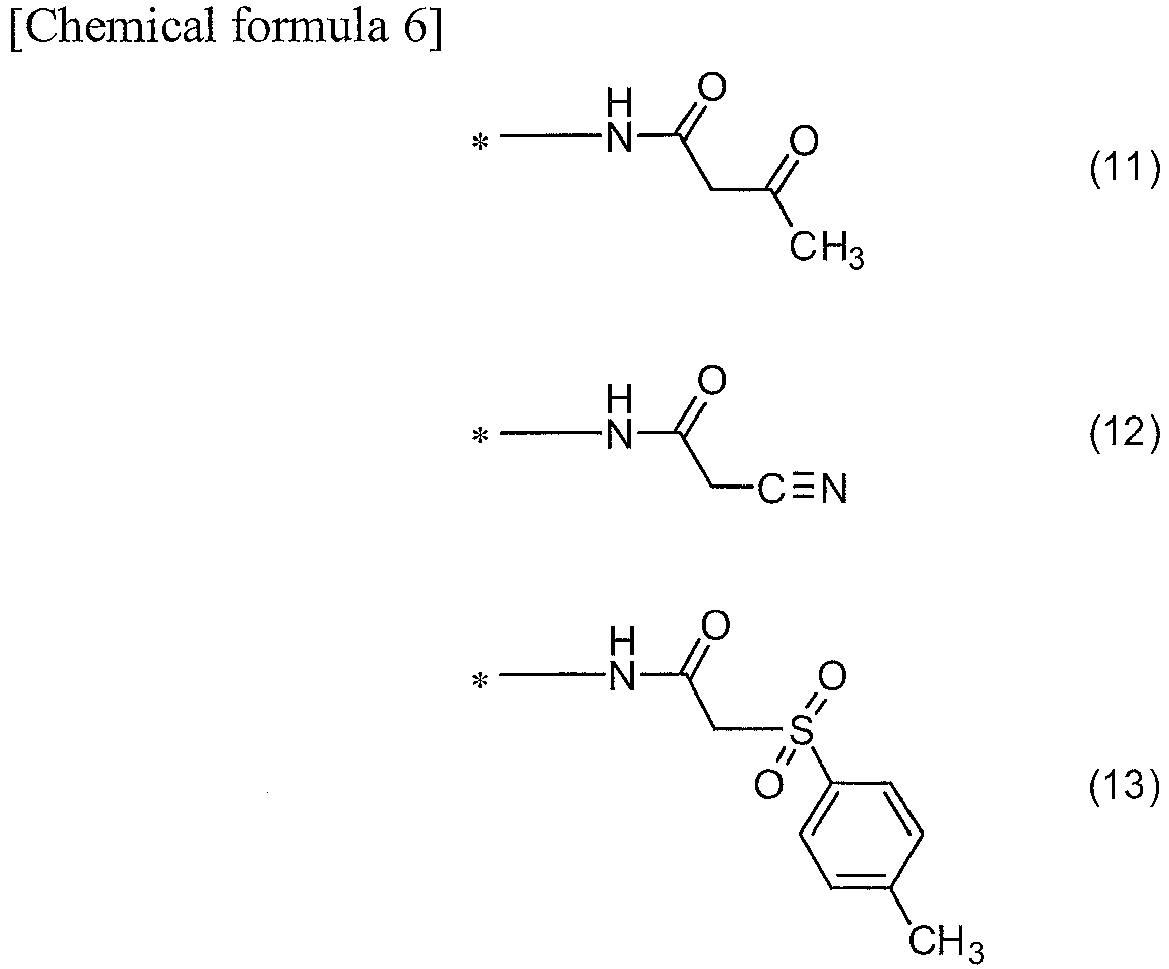
- It is known that the structure given by the above chemical formula (11) can be converted into an isocyanate by heating as represented by chemical formula (21), as reported by, for example, T. Mukaiyama, M. Tokizawa, H. Nohira, and H. Takei, J. Org. Chem., 26, 4381 (1961).

- Furthermore, also in the case where δ in chemical formula (2) is oxygen while W is a group as represented by any of chemical formulae (3) to (10), the structure is expected to be converted into an isocyanate when heated, as shown in chemical formula (22) (when W is a group as represented by any of chemical formulae (3) to (9)) or in chemical formula (23) (when W is a group as represented by chemical formula (10)), in the same way as in chemical formula (21). (Here, chemical formula (22) and chemical formula (23) show reactions that occur when δ is oxygen, but it is expected that thermal conversion into an isothiocyanate also occurs through a similar reaction when δ is sulfur.)

- (In chemical formula (22), α represents CR21 (in chemical formula (3)), CR22 (in chemical formula (4)), CR23 (in chemical formula (5)), SR25 (in chemical formula (6)), S(O)R26 (in chemical formula (7)), PR27R28 (in chemical formula (8)), or N+O- (in chemical formula (9)). β represents O (in chemical formulae (3) and (6) to (9)), S (in chemical formula (4)), or NR24 (in chemical formula (5)).)
- If an isocyanate is reacted with an acid anhydride group, an imide group will be formed as shown by chemical formula (24). Accordingly, a polyimide with a high polymerization degree can be produced through a reaction with a polyamic acid having an acid anhydride group at, for example, a chain end. Furthermore, a polyimide with a high polymerization degree can also be produced if dimers or trimers are formed through a reaction between isocyanates as shown by chemical formula (25). (It should be noted that reactions as given by chemical formula (24) and chemical formula (25) can occur when the isocyanate is an isothiocyanate.) As a result, it will be possible to obtain polyimide film with improved mechanical characteristics.

-

- Compound (b), which is represented by chemical formula (1), can be derived from a multivalent amine compound or a diamine compound as described later. In such a case, therefore, Z in chemical formula (1) of compound (b) is a group derived from a residue of either a multivalent amine compound or a diamine compound. Z is preferably a di- or higher-valent hydrocarbon group containing 2 to 80 carbon atoms and may be a di- or higher-valent organic group containing 2 to 80 carbon atoms and including hydrogen and carbon as essential elements and one or more other atoms of elements selected from the group of boron, oxygen, sulfur, nitrogen, phosphorus, silicon, and halogens. For each of boron, oxygen, sulfur, nitrogen, phosphorus, silicon, and halogens, the number of atoms included is preferably in the range of 20 or less, more preferably in the range of 10 or less. In chemical formula (1), k is preferably 2 or 3, and the compound can be derived from a diamine compound when k = 2 while it can be derived from a triamine compound when k = 3.
- Typical multivalent amine compounds and diamine compounds that give compound (b), which is represented by chemical formula (1), are listed below. Examples of multivalent amine compounds and diamine compounds containing an aromatic ring include monocyclic aromatic diamine compounds such as m-phenylene diamine, p-phenylene diamine, and 3,5-diaminobenzoic acid; naphthalene or polycyclic aromatic diamine compounds such as 1,5-naphthalene diamine, 2,6-naphthalene diamine, 9,10-anthracene diamine, and 2,7-diaminofluorene; bis(diaminophenyl) compounds or various derivatives thereof such as 4,4'-diaminobenzanilide, 3,4'-diaminodiphenyl ether, 4,4'-diaminodiphenyl ether, 3-carboxy-4,4'-diaminodiphenyl ether, 3-sulfonic acid-4,4'-diaminodiphenyl ether, 3,4'-diaminodiphenyl methane, 4,4'-diaminodiphenyl methane, 3,4'-diaminodiphenyl sulfone, 4,4'-diaminodiphenyl sulfone, 3,4'-diaminodiphenyl sulfide, 4,4'-diaminodiphenyl sulfide, 4-aminobenzoic acid 4-aminophenyl ester, 9,9-bis(4-aminophenyl) fluoren, and 1,3-bis(4-anilino)tetramethyl disiloxane; 4,4'-diaminobiphenyl or various derivatives thereof such as 4,4'-diaminobiphenyl, 2,2'-dimethyl-4,4'-diaminobiphenyl, 2,2'-diethyl-4,4'-diaminobiphenyl, 3,3'-dimethyl-4,4'-diaminobiphenyl, 3,3'-diethyl-4,4'-diaminobiphenyl, 2,2',3,3'-tetramethyl-4,4'-diaminobiphenyl, 3,3',4,4'-tetramethyl-4,4'-diaminobiphenyl, and 2,2'-di(trifluoro methyl)-4,4'-diaminobiphenyl; bis(aminophenoxy) compounds such as bis(4-aminophenoxy phenyl) sulfone, bis(3-aminophenoxy phenyl) sulfone, bis(4-aminophenoxy) biphenyl, bis[4-(4-aminophenoxy) phenyl] ether, 2,2-bis[4-(4-aminophenoxy) phenyl] propane, 2,2-bis[4-(4-aminophenoxy) phenyl] hexafluoropropane, 1,4-bis(4-aminophenoxy) benzene, 1,3-bis(3-aminophenoxy) benzene, and 1,3-bis(4-aminophenoxy) benzene; bis(3-amino-4-hydroxyphenyl) compounds such as bis(3-amino-4-hydroxyphenyl) hexafluoropropane, bis(3-amino-4-hydroxyphenyl) sulfone, bis(3-amino-4-hydroxyphenyl) propane, bis(3-amino-4-hydroxyphenyl) methylene, bis(3-amino-4-hydroxyphenyl) ether, bis(3-amino-4-hydroxy) biphenyl, and 9,9-bis(3-amino-4-hydroxyphenyl) fluorene; bis(aminobenzoyl) compounds such as 2,2'-bis[N-(3-aminobenzoyl)-3-amino-4-hydroxyphenyl] hexafluoropropane, 2,2'-bis[N-(4-aminobenzoyl)-3-amino-4-hydroxyphenyl] hexafluoropropane, 2,2'-bis[N-(3-aminobenzoyl)-3-amino-4-hydroxyphenyl] propane, 2,2'-bis[N-(4-aminobenzoyl)-3-amino-4-hydroxyphenyl] propane, bis[N-(3-aminobenzoyl)-3-amino-4-hydroxyphenyl] sulfone, bis[N-(4-aminobenzoyl)-3-amino-4-hydroxyphenyl] sulfone, 9,9-bis[N-(3-aminobenzoyl)-3-amino-4-hydroxyphenyl] fluorene, 9,9-bis[N-(4-aminobenzoyl)-3-amino-4-hydroxyphenyl] fluorene, N, N'-bis(3-aminobenzoyl)-2,5-diamino-1,4-dihydroxy benzene, N, N'-bis(4-aminobenzoyl)-2,5-diamino-1,4-dihydroxy benzene, N, N'-bis(3-aminobenzoyl)-4,4'-diamino-3,3-dihydroxy biphenyl, N, N'-bis(4-aminobenzoyl)-4,4'-diamino-3,3-dihydroxy biphenyl, N, N'-bis(3-aminobenzoyl)-3,3'-diamino-4,4-dihydroxy biphenyl, and N, N'-bis(4-aminobenzoyl)-3,3'-diamino-4,4-dihydroxy biphenyl; heterocyclic containing diamine compounds such as 2-(4-aminophenyl)-5-aminobenzoxazole, 2-(3-aminophenyl)-5-aminobenzoxazole, 2-(4-aminophenyl)-6-aminobenzoxazole, 2-(3-aminophenyl)-6-aminobenzoxazole, 1,4-bis(5-amino-2-benzoxazolyl) benzene, 1,4-bis(6-amino-2-benzoxazolyl) benzene, 1,3-bis(5-amino-2-benzoxazolyl) benzene, 1,3-bis(6-amino-2-benzoxazolyl) benzene, 2,6-bis(4-aminophenyl) benzobisoxazole, 2,6-bis(3-aminophenyl) benzobisoxazole, 2,2'-bis[(3-aminophenyl)-5-benzoxazolyl] hexafluoropropane, 2,2'-bis[(4-aminophenyl)-5-benzoxazolyl] hexafluoropropane, bis[(3-aminophenyl)-5-benzoxazolyl], bis[(4-aminophenyl)-5-benzoxazolyl], bis[(3-aminophenyl)-6-benzoxazolyl], and bis[(4-aminophenyl)-6-benzoxazolyl]; aromatic triamine compounds such as 1,3,5-triamino benzene, tris(3-aminophenyl) methane, tris(4-aminophenyl) methane, tris(3-aminophenyl) amine, tris(4-aminophenyl) amine, tris(3-aminophenyl) benzene, tris(4-aminophenyl) benzene, 1,3,5-tris(3-aminophenoxy) benzene, 1,3,5-tris(4-aminophenoxy) benzene, 1,3,5-tris(4-aminophenoxy) triazine, melamine, 2,4,6-triamino pyrimidine, and 3,5-bis(4-aminophenyl) aniline; aromatic tetraamine compounds such as 1,2,4,5-tetraaminobenzene, 3,3',4,4'-tetraaminobiphenyl, 3,3',4,4'-tetraaminodiphenyl sulfone, 3,3',4,4'-tetraaminodiphenyl sulfide, 2,3,6,7-tetraaminonaphthalene, and 1,2,5,6-tetraaminonaphthalene; and compounds produced from these multivalent amine compounds or diamine compounds by replacing one or more of the hydrogen atoms bonded to their aromatic rings with hydrocarbons or halogen atoms. Examples of aliphatic multivalent amine compounds include aliphatic diamine compounds such as ethylene diamine, propylene diamine, butane diamine, pentane diamine, hexane diamine, octane diamine, nonane diamine, decane diamine, undecane diamine, dodecane diamine, tetramethyl hexane diamine, 1,12-(4,9-dioxa) dodecane diamine, 1,8-(3,6-dioxa) octane diamine, and 1,3-bis(3-aminopropyl) tetramethyl disiloxane; alicyclic diamine compounds such as cyclohexane diamine, 4,4'-methylene bis(cyclohexyl amine), and isophorone diamine; the polyoxyethylene amine and polyoxypropylene amine products under the trade name of Jeffamine (manufactured by Huntsman Corporation) and copolymer compounds thereof.
- Polyamic acid (a), which is contained in the polyamic acid resin composition according to the present invention, preferably contains a structure as represented by chemical formula (14) or (15). If the polyamic acid contains a structure as represented by chemical formula (14), it reacts, when cured, with the compound represented by chemical formula (1) to form imide bonds as described above, thereby producing a polyimide with a high degree of polymerization. A structure as represented by chemical formula (15), on the other hand, is converted into an acid anhydride group when cured, and therefore, it reacts with the compound represented by chemical formula (1) to form imide bonds, thereby producing a polyimide with a high degree of polymerization.

- (In chemical formula (14), X denotes a tri- or higher-valent organic group containing 2 or more carbon atoms. In chemical formula (15), Y denotes a tri- or higher-valent organic group containing 2 or more carbon atoms, and R1 denotes a hydrogen atom, a hydrocarbon group containing 1 to 10 carbon atoms, or an alkylsilyl group containing 1 to 10 carbon atoms.)
- X and Y are preferably a tetravalent hydrocarbon group containing 2 to 80 carbon atoms and may be a tetravalent organic group containing 2 to 80 carbon atoms and including hydrogen and carbon as essential elements and one or more other atoms of elements selected from the group of boron, oxygen, sulfur, nitrogen, phosphorus, silicon, and halogens. For each of boron, oxygen, sulfur, nitrogen, phosphorus, silicon, and halogens, the number of atoms included is preferably in the range of 20 or less, more preferably in the range of 10 or less.
- Furthermore, the polyamic acid preferably has a structure as represented by chemical formula (16) or (17). Specifically, it is preferable that X in chemical formula (14) and Y in chemical formula (15) be a residue of tetracarboxylic acid as represented by X1 and Y1, respectively, and that the residue of tetracarboxylic acid is located at a chain end of the polyamic acid.
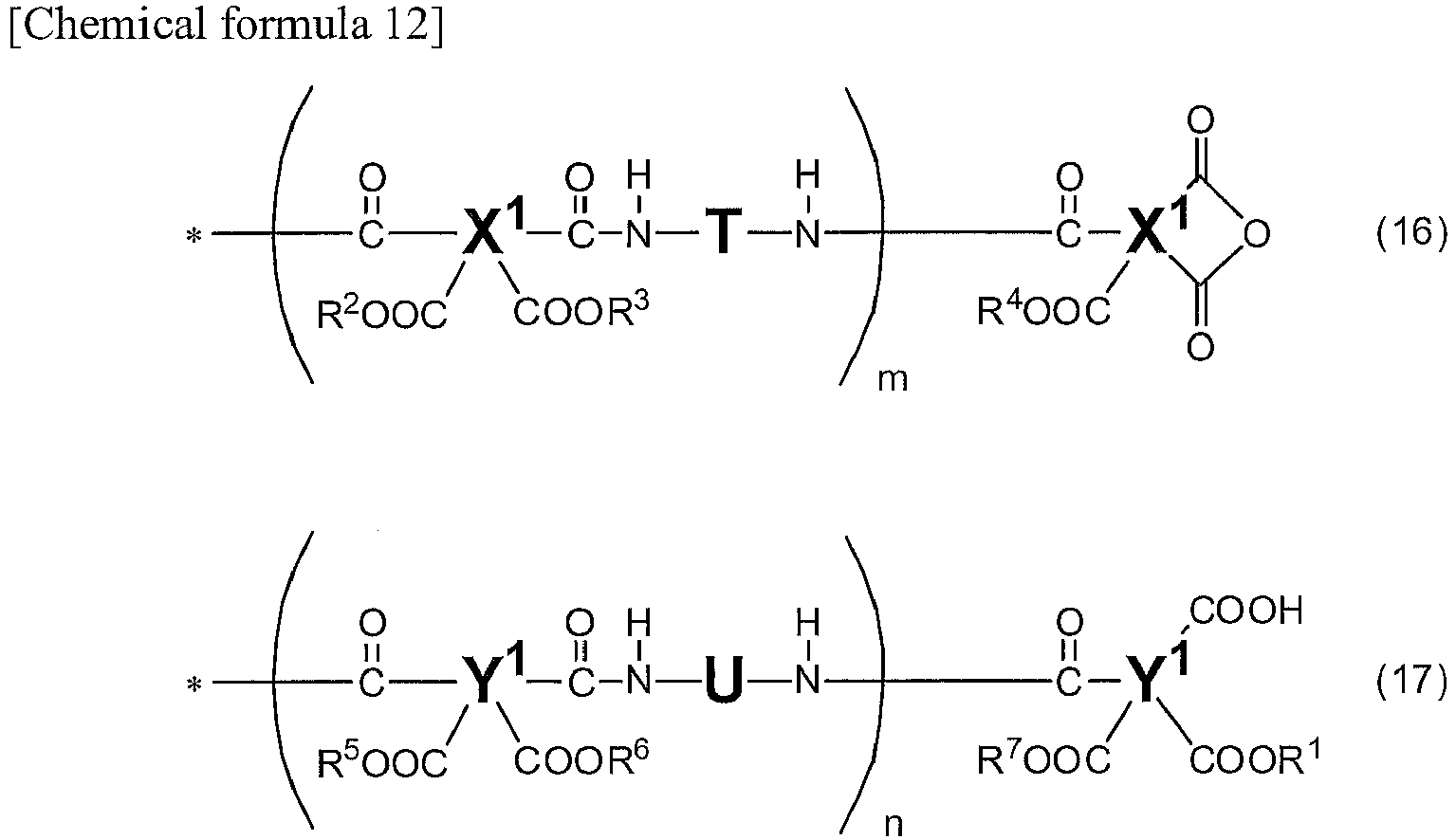
- (In chemical formula (16), X1 denotes a residue of tetracarboxylic acid containing 2 or more carbon atoms, T denotes a residue of diamine containing 2 or more carbon atoms, and m a positive integer. (In chemical formula (17), Y1 denotes a residue of tetracarboxylic acid containing 2 or more carbon atoms, U denotes a residue of diamine containing 2 or more carbon atoms, n denotes a positive integer, and R1 to R7 independently denote a hydrogen atom, a hydrocarbon group containing 1 to 10 carbon atoms, or an alkylsilyl group containing 1 to 10 carbon atoms.)
- Examples of tetracarboxylic acid that can give X or Y are as follows. Examples of such aromatic tetracarboxylic acid include monocyclic aromatic tetracarboxylic acid compounds such as pyromellitic acid and 2,3,5,6-pyridine tetracarboxylic acid; various isomers of biphenyl tetracarboxylic acid such as 3,3',4,4'-biphenyl tetracarboxylic acid, 2,3,3',4'-biphenyl tetracarboxylic acid, 2,2',3,3'-biphenyl tetracarboxylic acid, 3,3',4,4'-benzophenone tetracarboxylic acid, and 2,2',3,3'-benzophenone tetracarboxylic acid; bis(dicarboxyphenyl) compounds such as 2,2-bis(3,4-dicarboxyphenyl) hexafluoropropane, 2,2-bis(2,3-dicarboxyphenyl) hexafluoropropane, 2,2-bis(3,4-dicarboxyphenyl) propane, 2,2-bis(2,3-dicarboxyphenyl) propane, 1,1-bis(3,4-dicarboxyphenyl) ethane, 1,1-bis(2,3-dicarboxyphenyl) ethane, bis(3,4-dicarboxyphenyl) methane, bis(2,3-dicarboxyphenyl) methane, bis(3,4-dicarboxyphenyl) sulfone, and bis(3,4-dicarboxyphenyl) ether; bis(dicarboxyphenoxy phenyl) compounds such as 2,2-bis[4-(3,4-dicarboxyphenoxy) phenyl] hexafluoropropane, 2,2-bis[4-(2,3-dicarboxyphenoxy) phenyl] hexafluoropropane, 2,2-bis[4-(3,4-dicarboxyphenoxy) phenyl] propane, 2,2-bis[4-(2,3-dicarboxyphenoxy) phenyl] propane, 2,2-bis[4-(3,4-dicarboxyphenoxy) phenyl] sulfone, and 2,2-bis[4-(3,4-dicarboxyphenoxy) phenyl] ether; various isomers of naphthalene or polycyclic aromatic tetracarboxylic acid such as 1,2,5,6-naphthalene tetracarboxylic acid, 1,4,5,8-naphthalene tetracarboxylic acid, 2,3,6,7-naphthalene tetracarboxylic acid, 2,3,6,7-naphthalene tetracarboxylic acid, and 3,4,9,10-perylene tetracarboxylic acid; and bis(trimellitic acid monoester acid anhydride) compounds such as p-phenylene bis(trimellitic acid monoester acid anhydride), p-biphenylene bis(trimellitic acid monoester acid anhydride), ethylene bis(trimellitic acid monoester acid anhydride), and bisphenol A bis(trimellitic acid monoester acid anhydride). Examples of such aliphatic tetracarboxylic acid include chain aliphatic tetracarboxylic acid compounds such as butane tetracarboxylic acid; and alicyclic tetracarboxylic acid compounds such as cyclobutane tetracarboxylic acid, 1,2,3,4-cyclopentane tetracarboxylic acid, 1,2,4,5-cyclohexane tetracarboxylic acid, bicyclo[2.2.1.]heptane tetracarboxylic acid, bicyclo[3.3.1.]tetracarboxylic acid, bicyclo[3.1.1.]hept-2-ene tetracarboxylic acid, bicyclo[2.2.2.]octane tetracarboxylic acid, and adamantane tetracarboxylic acid.
- These acids may be used as they are or in the form of an acid anhydride, active ester, or active amide. Two or more thereof may be used in combination. For uses where heat resistance is required, it is preferable that the aromatic tetracarboxylic acids account for 50 mol% or more of the total quantity of tetracarboxylic acids.
- The use of a tetracarboxylic acid containing a silicon atom such as dimethylsilane diphthalic acid and 1,3-bis(phthalic acid)tetramethyl disiloxane can serve to increase the adhesion to a support and the resistance to oxygen plasma used for cleaning and the like and to UV ozone processing. It is preferable that these tetracarboxylic acids containing a silicon atom account for 1 to 30 mol% of the total quantity of tetracarboxylic acids.
- For the tetracarboxylic acids given above as examples, one or more of the hydrogen atoms contained in a tetracarboxylic acid residue may be replaced with a hydrocarbon group containing 1 to 10 carbon atoms such as methyl group and ethyl group; a fluoroalkyl group containing 1 to 10 carbon atoms such as trifluoromethyl group; or other groups such as F, Cl, Br, and I. Furthermore, if they are replaced with an acidic group such as OH, COOH, SO3H, CONH2, and SO2NH2, it is preferable in the case of the use as a photosensitive resin composition as described later because they serve to improve the solubility of the resin in an aqueous alkali solution.
- T and U are preferably a divalent hydrocarbon group containing 2 to 80 carbon atoms and may be a divalent organic group containing 2 to 80 carbon atoms and including hydrogen and carbon as essential elements and one or more other atoms of elements selected from the group of boron, oxygen, sulfur, nitrogen, phosphorus, silicon, and halogens. For each of boron, oxygen, sulfur, nitrogen, phosphorus, silicon, and halogens, the number of atoms included is preferably in the range of 20 or less, more preferably in the range of 10 or less.
- Examples of diamine compounds that give T or U include those diamine compounds which are included in the above-mentioned list of multivalent amine compounds and diamine compounds that give compound (b), which is represented by chemical formula (1) (hereinafter occasionally referred to as diamine compounds that give compound (b), which is represented by chemical formula (1)).
- These diamines may be used in their original form or in the form of a corresponding trimethylsilylated diamine. Two or more thereof may be used in combination. For uses where heat resistance is required, it is preferable that the aromatic diamine compounds account for 50 mol% or more of the total diamine compounds.
- The use of a silicon-containing diamine, such as 1,3-bis(3-aminopropyl)tetramethyl disiloxane and 1,3-bis(4-anilino)tetramethyl disiloxane, as diamine component can serve to increase the contact with the support and the resistance to oxygen plasma used for cleaning and the like and to UV ozone processing. It is preferable that these silicon-containing diamine compounds account for 1 to 30 mol% of the total quantity of diamine compounds.
- In addition to those listed above, the diamine compounds that give T or U also include the diamine compounds that give compound (b), which is represented by chemical formula (1), in which one or more of the hydrogen atoms contained are replaced with a hydrocarbon group containing 1 to 10 carbon atoms such as methyl group and ethyl group, a fluoroalkyl group containing 1 to 10 carbon atoms such as trifluoromethyl group, or others such as F, Cl, Br, and I. Furthermore, if they are replaced with an acidic group such as OH, COOH, SO3H, CONH2, and SO2NH2, it is preferable in the case of the use as a photosensitive resin composition as described later because they serve to improve the solubility of the resin in an aqueous alkali solution.
- For the polyamic acid compounds that contain a structure as represented by chemical formula (16) or chemical formula (17), the number of repetitions of the polyamic acid unit is preferably 5 or more, more preferably 10 or more. In addition, it is preferably 500 or less, more preferably 200 or less. If it is in this range, the molecular weight can be controlled in a preferable range. For m in chemical formula (16) and n in chemical formula (17), it is only necessary to meet the requirement for the preferable number of repetitions of the polyamic acid units according to the present invention. Accordingly, m and n are preferably 5 or more, more preferably 10 or more. In addition, it is preferably 500 or less, more preferably 200 or less.
- After adding a solvent, the polyamic acid resin composition according to the present invention can be used as varnish. As described later, a film containing polyamic acid can be produced by spreading such a varnish over the surface of various supports. A polyimide film can be produced by imidizing the polyamic acid in this film. Useful solvents include aprotic polar solvents such as N-methyl-2-pyrolidone, γ-butyrolactone, N,N-dimethyl formamide, N,N-dimethyl acetamide, and dimethyl sulfoxide; ethers such as tetrahydrofuran, dioxane, propylene glycol monomethyl ether, propylene glycol monoethyl ether, diethylene glycol monomethyl ether, diethylene glycol monoethyl ether, diethylene glycol ethyl methyl ether, and diethylene glycol dimethyl ether; ketones such as acetone, methyl ethyl ketone, diisobutyl ketone, diacetone alcohol, and cyclohexanone; esters such as ethyl acetate, propylene glycol monomethyl ether acetate, and ethyl lactate; and aromatic hydrocarbons such as toluene, xylene, which may be used singly or in combination as a mixture of two or more thereof.
- A varnish with a low viscosity can be obtained even if it contains the polyamic acid resin composition according to the present invention at a high concentration. Accordingly, there are no specific limitations on the preferable content of the solvent, but it is preferably 50 parts by mass or more, more preferably 100 parts by mass or more, and preferably 2,000 parts by mass or less, more preferably 1,500 parts by mass or less, per 100 parts by mass of polyamic acid (a). If it is in the range where these requirements are met, a viscosity suitable for coating can be ensured to allow easy production of a coat with an appropriately controlled thickness. For the present invention, a substrate laminated with a film containing a polyamic acid resin composition produced by coating a substrate with a varnish containing a polyamic acid resin composition and drying to remove the solvent is referred to as a film-coated substrate.
- The polyamic acid according to the present invention has a polystyrene-based weight average molecular weight of preferably 100,000 or less, more preferably 80,000 or less, and still more preferably 50,000 or less, as determined by gel permeation chromatography. If it is in this range, an increase in viscosity of a varnish can be depressed more effectively even if the varnish has a high concentration. Furthermore, the weight average molecular weight is preferably 2,000 or more, more preferably 3,000 or more, and still more preferably 5,000 or more. If the weight average molecular weight is 2,000 or more, it is possible to avoid resulting in a varnish with an excessively low viscosity and ensure good coatability.
- The polyamic acid resin composition according to the present invention can be converted into a photosensitive resin composition by adding a photoacid generating agent. The inclusion of a photoacid generating agent works to produce an acid in the irradiated portion so that the irradiated portion increases in solubility in an aqueous alkali solution, allowing a positive type relief pattern to be formed after dissolution of the irradiated portion. The inclusion of an epoxy compound or a thermal crosslinking agent as described later along with the photoacid generating agent allows the acid formed in the irradiated portion to serve for promotion of the crosslinking reaction of the epoxy compound and the thermal crosslinking agent, leading to the formation of a negative type relief pattern as a result of insolubilization of the irradiated portion.
- Examples of such a photoacid generating agent include quinone diazide compounds, sulfonium salts, phosphonium salts, diazonium salts, and iodonium salts. Two or more thereof may be added to obtain a photosensitive resin composition with a high sensitivity.
- Examples of such quinone diazide compounds include polyhydroxy compounds bonded to sulfonic acid of quinone diazide through ester linkage, polyamino compounds bonded to sulfonic acid of quinone diazide through sulfonamide linkage, and polyhydroxypolyaminno compounds bonded to sulfonic acid of quinone diazide through ester linkage and/or sulfonamide linkage. It is preferable that 50 mol% or more of the functional groups in the polyhydroxy compounds and polyamino compounds be replaced with quinone diazide.
- For the quinone diazide used for the present invention, both 5-naphthoquinone diazide sulfonyl group and 4-naphthoquinone diazide sulfonyl group are preferred. A 4-naphthoquinone diazide sulfonyl ester compound absorbs light in the i-line range of mercury lamps, and therefore, it is suitable for i-line light exposure. A 5-naphthoquinone diazide sulfonyl ester compound absorbs light in a region including the g-line of mercury lamps, and therefore, it is suitable for g-line light exposure. For the present invention, it is preferable to adopt either a 4-naphthoquinone diazide sulfonyl ester compound or a 5-naphthoquinone diazide sulfonyl ester compound depending on the wavelength of the light used for exposure. Furthermore, the agent may contain a naphthoquinone diazide sulfonyl ester compound having both a 4-naphthoquinone diazide sulfonyl group and a 5-naphthoquinone diazide sulfonyl group in one molecule, or the resin composition to be used may contain both a 4-naphthoquinone diazide sulfonyl ester compound and a 5-naphthoquinone diazide sulfonyl ester compound.
- Of the examples of photoacid generating agents, the sulfonium salt, phosphonium salt, and diazonium salt are preferable because they can stabilize moderately the acid component produced by light exposure. The sulfonium salt is particularly preferable. In addition, a sensitization agent and the like may also be contained as needed.
- For the present invention, the content of the photoacid generating agent is preferably 0.01 to 50 parts by mass per 100 parts by mass of polyamic acid (a) from the viewpoint of increasing the sensitivity. Of these, the quinone diazide compound preferably accounts for 3 to 40 parts by mass. The total content of the sulfonium salt, phosphonium salt, and diazonium salt is preferably 0.5 to 20 parts by mass.
- The photosensitive resin composition according to the present invention may contain a thermal crosslinking agent as shown by chemical formula (31) given below or a thermal crosslinking agent having a structure as shown by chemical formula (32) given below (hereinafter, both are referred to as thermal crosslinking agent). These thermal crosslinking agents can crosslink between compounds that fall under polyamic acid (a) or with other additive components, thereby serving to produce polyimide film with enhanced chemical resistance and hardness.

- (In the above chemical formula (31), R31 denotes a di- to tetra-valent linking group. R32 denotes a monovalent hydrocarbon group containing 1 to 20 carbon atoms, Cl, Br, I, or F. R33 and R34 independently denote CH2OR36 (where R36 is a hydrogen atom or a monovalent hydrocarbon containing 1 to 6 carbon atoms). R35 is a hydrogen atom, methyl group, or ethyl group. Furthermore, s is an integer of 0 to 2, and t is an integer of 2 to 4. If a plurality of R32s exist, they may be identical to or different from each other. If a plurality of R33s and R34s exist, they may be identical to or different from each other. If a plurality of R35s exist, they may be identical to or different from each other. Examples of the linking group R31 are listed below.)


- (In the above chemical formula, R41 to R60 denote a hydrogen atom or a monovalent hydrocarbon group containing 1 to 20 carbon atoms in which one or more of the hydrogen atoms may be replaced with Cl, Br, I, or F.)
[Chemical formula 15]
*-N(CH2OR37)u(H)v (32)
- (In the above chemical formula (32), R37 denotes a hydrogen atom or a monovalent hydrocarbon containing carbon 1 to 6 atoms. Further, u denotes 1 or 2 and v denotes 0 or 1. Here, u + v is equal to 1 or 2)).
- In the above formula (31), R33 and R34 denote CH2OR36 (where R36 is a hydrogen atom or a monovalent hydrocarbon containing 1 to 6 carbon atoms) which is a thermally crosslinkable group. R36 is preferably a monovalent hydrocarbon group containing 1 to 4 carbon atoms, more preferably a methyl group or ethyl group, to allow the thermal crosslinking agent of chemical formula (31) to maintain a moderate degree of reactivity and high storage stability.
- Preferable examples of thermal crosslinking agents containing a structure as represented by chemical formula (31) are listed below.

- In chemical formula (32), R37 denotes a hydrogen atom or a monovalent hydrocarbon group containing 1 to 6 carbon atoms, preferably a monovalent hydrocarbon group containing 1 to 4 carbon atoms. Furthermore, from the viewpoint of stability of the compound and storage stability of the photosensitive resin composition, R37 is preferably a methyl group or ethyl group and the compound preferably contains 8 or less (CH2OR37) groups.
- Preferable examples of thermal crosslinking agents containing a group as represented by chemical formula (32) are listed below.


- The content of the thermal crosslinking agent is preferably 10 parts by mass or more and 100 parts by mass or less per 100 parts by mass of polyamic acid (a). If the content of the thermal crosslinking agent is 10 parts by mass or more and 100 parts by mass or less, a polyimide film with high strength and a photosensitive resin composition with high storage stability will be obtained.
- The polyamic acid resin composition according to the present invention may further contain a thermal acid-forming agent. A thermal acid-forming agent works to generate an acid when heated after development as described later, promote the crosslinking reaction between polyamic acid (a) and the thermal crosslinking agent, and also promote the cyclization of imide rings in polyamic acid (a). This serves to provide polyimide film with an improved chemical resistance and a reduced film loss. The acid generated by the thermal acid-forming agent is preferably a strong acid, which is preferably an aryl sulfonic acid such as p-toluene sulfonic acid and benzene sulfonic acid or an alkyl sulfonic acid such as methane sulfonic acid, ethane sulfonic acid, and butane sulfonic acid. For the present invention, the thermal acid-forming agent is preferably an aliphatic sulfonic acid compound as represented by chemical formula (33) or (34), and two or more of such compounds may be contained.

- In the chemical formulae (33) and (34), R61 to R63 may be identical to or different from each other and may have an organic group containing 1 to 20 carbon atoms, which is preferably a hydrocarbon group containing 1 to 20 carbon atoms. They may be an organic group containing 1 to 20 carbon atoms and including hydrogen and carbon as essential elements and one or more atoms of elements selected from the group of boron, oxygen, sulfur, nitrogen, phosphorus, silicon, and halogens.
- Specific examples of such compounds represented by chemical formula (33) are listed below.

- Specific examples of such compounds represented by chemical formula (34) are listed below.

- The content of the thermal acid-forming agent is preferably 0.5 part by mass or more and 10 parts by mass or less per 100 parts by mass of polyamic acid (a) from the viewpoint of promoting the crosslinking reaction.
- It may contain a compound having a phenolic hydroxyl group as required to help the alkaline developer in developing the photosensitive resin composition. Examples of compounds with a phenolic hydroxyl group include, for example, the products available from Honshu Chemical Industry Co., Ltd., under the following trade names: Bis-Z, BisOC-Z, BisOPP-Z, BisP-CP, Bis26X-Z, BisOTBP-Z, BisOCHP-Z, BisOCR-CP, BisP-MZ, BisP-EZ, Bis26X-CP, BisP-PZ, BisP-IPZ, BisCR-IPZ, BisOCP-IPZ, BisOIPP-CP, Bis26X-IPZ, BisOTBP-CP, TekP-4HBPA (tetrakis P-DO-BPA), TrisP-HAP, TrisP-PA, TrisP-PHBA, TrisP-SA, TrisOCR-PA, BisOFP-Z, BisRS-2P, BisPG-26X, BisRS-3P, BisOC-OCHP, BisPC-OCHP, Bis25X-OCHP, Bis26X-OCHP, BisOCHP-OC, Bis236T-OCHP, methylene tris-FR-CR, BisRS-26X, and BisRS-OCHP; the products available from Asahi Organic Chemicals Industry Co., Ltd., under the following trade names: BIR-OC, BIP-PC, BIR-PC, BIR-PTBP, BIR-PCHP, BIP-BIOC-F, 4PC, BIR-BIPC-F, and TEP-BIP-A; and others including 1,4-dihydroxy naphthalene, 1,5-dihydroxy naphthalene, 1,6-dihydroxy naphthalene, 1,7-dihydroxy naphthalene, 2,3-dihydroxy naphthalene, 2,6-dihydroxy naphthalene, 2,7-dihydroxy naphthalene, 2,4-dihydroxy quinoline, 2,6-dihydroxy quinoline, 2,3-dihydroxy quinoxaline, anthracene-1,2,10-triol, anthracene-1,8,9-triol, and 8-quinolinol. If such a compound with a phenolic hydroxyl group is contained, the resulting photosensitive resin composition will be scarcely dissolved in an alkaline developer before exposure, but will be easily dissolved in an alkaline developer after exposure, leading to a decreased film loss during development and ensuring rapid and easy development. Accordingly, the sensitivity will improve easily.
- Such a compound with a phenolic hydroxyl group preferably accounts for 3 parts by mass or more and 40 parts by mass or less per 100 parts by mass of polyamic acid (a).
- The photosensitive resin composition according to the present invention may contain a contact improving agent. Examples of such contact improving agents include silane coupling agents such as vinyl trimethoxysilane, vinyl triethoxysilane, epoxy cyclohexyl ethyl trimethoxysilane, 3-glycidoxy propyl trimethoxysilane, 3-glycidoxy propyl triethoxysilane, p-styryl trimethoxysilane, 3-aminopropyl trimethoxysilane, 3-aminopropyl triethoxysilane, and N-phenyl-3-aminopropyl trimethoxysilane, as well as titanium chelate agents and aluminum chelate agents. There are others including alkoxysilane-containing aromatic amine compounds and alkoxysilane-containing aromatic amide compounds as listed below.


- Besides, compounds produced through a reaction between an aromatic amine compound and an alkoxy-containing silicon compound can also be used. Such compounds include, for example, those produced by reacting an aromatic amine compound with an alkoxysilane compound having a group reactive with an amino group such as epoxy group and chloromethyl group. Two or more of the above contact improving agents may be contained. If these contact improving agents are contained, the photosensitive resin film can come in stronger contact with the substrate material such as silicon wafer, ITO, SiO2, and nitride silicon during the development step. Besides, improved contact between the polyimide film and the substrate material can increase the resistance to oxygen plasma and UV ozone treatment performed for cleaning. The content of the contact improving agent is preferably 0.01 to 10 parts by mass per 100 parts by mass of polyamic acid (a).
- The polyamic acid resin composition according to the present invention may contain inorganic particles with the aim of improving the heat resistance. Materials of inorganic particles used for this aim include metals such as platinum, gold, palladium, silver, copper, nickel, zinc, aluminum, iron, cobalt, rhodium, ruthenium, tin, lead, bismuth, and tungsten and metal oxides such as silicon oxide (silica), titanium oxide, aluminum oxide, zinc oxide, tin oxide, tungsten oxide, zirconium oxide, calcium carbonate, and barium sulfate. There are no specific limitations on the shape of these inorganic particles, and they may be spherical, elliptic, flattened, rod-like, or fibrous. To prevent an increase in the surface roughness of the polyimide film produced from a polyamic acid resin composition containing these inorganic particles, the average particle diameter of the inorganic particles is preferably 1 nm or more and 100 nm or less, more preferably 1 nm or more and 50 nm or less, and still more preferably 1 nm or more and 30 nm or less.
- The content of the inorganic particles is preferably 3 parts by mass or more, more preferably 5 parts by mass or more, and still more preferably 10 parts by mass or more, and preferably 100 parts by mass or less, more preferably 80 parts by mass or less, and still more preferably 50 parts by mass or less, per 100 parts by mass of polyamic acid (a). The heat resistance will be sufficiently high if the content of the inorganic particles is 3 parts by mass or more, and the resulting cured film will have sufficiently high toughness if it is 100 parts by mass or less.
- The polyamic acid resin composition according to the present invention may contain a surface active agent in order to improve the coatability. Useful surface active agents include fluorochemical surface active agents such as Fluorad (registered trademark) manufactured by Sumitomo 3M, Megafac (registered trademark) manufactured by DIC, Surflon (registered trademark) manufactured by Asahi Glass Co., Ltd.; organic siloxane surface active agents such as KP341 manufactured by Shin-Etsu Chemical Co., Ltd. DBE manufactured by Chisso Corporation, Polyflow (registered trademark) and Glanol (registered trademark) manufactured by Kyoeisha Chemical Co., Ltd., and BYK manufactured by BYK-Chemie; and acrylic polymer surface active agents such as Polyflow manufactured by Kyoeisha Chemical Co., Ltd. The content of these surface active agent is preferably 0.01 to 10 parts by mass per 100 parts by mass of polyamic acid (a).
- Described below is the production method for the polyamic acid resin composition according to the present invention.
- Polyamic acid (a) can be polymerized by a known method. Specifically, it can be produced by polymerizing an acid component such as tetracarboxylic acid and a corresponding acid dianhydride, active ester, and active amide with a diamine component such as diamine and a corresponding trimethylsilylated diamine in a reaction solvent. Furthermore, a polyamic acid compound having a structure as represented by chemical formula (14) or (15) at a chain end can be obtained by adjusting the molar ratio between the acid component and the diamine component to larger than one.
- Useful reaction solvents include aprotic polar solvents such as N-methyl-2-pyrolidone, γ-butyrolactone, N,N-dimethyl formamide, N,N-dimethyl acetamide, and dimethyl sulfoxide; ethers such as tetrahydrofuran, dioxane, propylene glycol monomethyl ether, propylene glycol monoethyl ether, diethylene glycol monomethyl ether, diethylene glycol monoethyl ether diethylene glycol ethyl methyl ether, and diethylene glycol dimethyl ether; ketones such as acetone, methyl ethyl ketone, diisobutyl ketone, diacetone alcohol, and cyclohexanone; esters such as ethyl acetate, propylene glycol monomethyl ether acetate, and ethyl lactate; and aromatic hydrocarbons such as toluene, xylene, which may be used singly or in combination with one or more thereof. Furthermore, a solvent adopted to prepare the intended varnish may be used here to produce the varnish without isolating the resin after the production step.
- Moreover, the carboxyl group in the polyamic acid used for the present invention may be esterified with a hydrocarbon group containing 1 to 10 carbon atoms or an alkylsilyl group containing 1 to 10 carbon atoms.
- Compound (b), which is represented by chemical formula (1), can be derived from a multivalent amine compound or a diamine compound. Specifically, it can be obtained by reacting an amino group in a multivalent amine compound or diamine compound with a compound that gives a structure as chemical formula (2) through reaction with an amino group. Examples of such compounds that react with an amino group to form a structure as shown by chemical formula (1) include diketene, β-keto acid, β-thioketo acid, β-ketimino acid, α-sulfinyl carboxylic acid, α-sulfonyl carboxylic acid, α-phosphinoyl carboxylic acid, α-nitro carboxylic acid, α-cyano carboxylic acid, and derivatives thereof. More specifically, such compounds include diketene, acetoacetic acid, thioketene dimers, 1,2-benzo isoxazole-3-acetic acid, methane sulfinyl acetic acid, methane sulfonyl acetic acid, 2-(p-toluenesulfonyl) acetic acid, diphenyl phosphinoyl acetic acid, nitro acetic acid, and cyanoacetic acid. Of these, diketene, acetoacetic acid, 2-(p-toluenesulfonyl) acetic acid, and cyano acetic acid are preferable.
- Next, a method for producing a varnish from the polyamic acid resin composition according to the present invention is explained below. For example, a varnish can be produced by dissolving polyamic acid (a) and compound (b), which is represented by chemical formula (1) in addition to solvent, along with a photoacid generating agent, dissolution adjusting agent, contact improving agent, inorganic particles, surface active agent, etc., as required. This dissolution can be carried out by stirring, heating, etc. If a photoacid generating agent is contained, an appropriate heating temperature is adopted in a range, commonly from room temperature to 80°C, where a photosensitive resin composition with unimpaired performance is obtained. There are no specific limitations on the order of dissolving these components, and for instance, the compound with the lowest solubility may be dissolved first followed by others in the order of solubility. Or, the dissolution of those components that are likely to form bubbles when dissolved by stirring, such as surface active agents and some contact improving agents, may be postponed to the other components so that the dissolution of the latter will not be hindered by bubble formation.
- The resulting varnish is preferably filtrated through a filter to remove dust and particles. Filters with a pore size of, for example, 10 µm, 3 µm, 1 µm, 0.5 µm, 0.2 µm, 0.1 µm, 0.07 µm, or 0.05 µm are available, though there are no specific limitations on the size. The filter to be used for filtration may be of such a material as polypropylene (PP), polyethylene (PE), nylon (NY), and polytetrafluoroethylene (PTFE), of which polyethylene and nylon are preferable.
- Next, a method for producing polyimide film using a varnish prepared from the polyamic acid resin composition according to the present invention is explained below.
- First, a varnish is spread over a support. Useful supports include wafer substrates of silicon, gallium arsenide, or the like; glass substrates of sapphire glass, soda lime glass, alkali-free glass, or the like; metal substrates of stainless steel, copper, or the like, and others such as metal foil and ceramics substrate, of which use of a glass substrate is preferable. Useful varnish coating methods include spin coating, slit coating, dip coating, spray coating, and printing, which may be used in combination.
- Before the coating step, the support may be pre-treated with a contact improving agent as described above. For example, a contact improving agent may be dissolved to 0.5 to 20 wt% in a solvent such as isopropanol, ethanol, methanol, water, tetrahydrofuran, propylene glycol monomethyl ether acetate, propylene glycol monomethyl ether, ethyl lactate, and diethyl adipate to prepare a solution, which is then used to treat the support surface by an appropriate technique such as spin coating, slit die coating, bar coating, dip coating, spray coating, and steam processing. Vacuum drying may be carried out as required, followed by heat treatment at 50°C to 300°C to accelerate the reaction between the support and the contact improving agent.
- The coating step is commonly followed by drying the varnish coating film. Useful drying methods include reduced pressure drying methods, thermal drying methods, and combinations thereof. The reduced pressure drying methods include, for example, a process in which a support with a coating film formed on its surface is put in a vacuum chamber, followed by reducing the pressure in the vacuum chamber. Thermal drying is performed by using a tool such as hot plate, oven, and infrared ray. When using a hot plate, the coating film is put directly on the plate or held on jigs such as proxy pins fixed on the plate while being dried by heating.
- There are various proxy pins of different materials including metals such as aluminum and stainless steel and synthetic resins such as polyimide resin and Teflon (registered trademark), but any types of proxy pins may work effectively if they have heat resistance. An appropriate proxy pin height may be adopted depending on the support size, type of the solvent used in the varnish, drying method used, etc., but it is preferably about 0.1 to 10 mm.
- Depending on the type and purpose of the solvent used in the varnish, heating is performed preferably at a temperature in the range of room temperature to 180°C for 1 minute to several hours.
- When the polyamic acid resin composition according to the present invention contains a photoacid generating agent, a pattern can be formed by processing the dried coat film by the method described below. An actinic ray is applied to the coat film through a mask of an intended pattern. Actinic rays available for exposure include ultraviolet ray, visible light, electron beam, and X-ray, of which the i-line (365 nm), h-line (405 nm), and g-line (436 nm) of mercury lamp are preferred for the invention. If the film is positively photosensitive, the exposed parts are dissolved by a developer. If the film is negatively photosensitive, the exposed parts harden and become insoluble in a developer.
- After the exposure step, a developer is used to remove the exposed parts of a positive film or unexposed parts of a negative film to form an intended pattern. Regardless of whether the film is positive or negative, preferable developers include an aqueous solution of alkaline compounds such as tetramethyl ammonium, diethanol amine, diethyl aminoethanol, sodium hydroxide, potassium hydroxide, sodium carbonate, potassium carbonate, trimethyl amine, diethyl amine, methyl amine, dimethyl amine, dimethylaminoethyl acetate, dimethyl aminoethanol, dimethylaminoethyl methacrylate, cyclohexyl amine, ethylene diamine, and hexamethylene diamine. In some cases, polar solvents such as N-methyl-2-pyrolidone, N,N-dimethyl formamide, N,N-dimethyl acetamide, dimethyl sulfoxide, γ-butyrolactone, and dimethyl acrylamide; alcohols such as methanol, ethanol and isopropanol; esters such as ethyl lactate and propylene glycol monomethyl ether acetate; and ketones such as cyclopentanone, cyclohexaone, isobutyl ketone, and methyl isobutyl ketone may be added singly or in combination to these aqueous alkali solution. For negative films, it is also possible to use such polar solvents as above that contain no aqueous alkali solution, or alcohols, esters, or ketones, which may be added singly or in combination. Commonly, rinsing in water is performed after the development step. Here again, the water used for rinsing may contain an alcohol such as ethanol and isopropyl alcohol, and an ester such as ethyl lactate and propylene glycol monomethyl ether acetate.
- Finally, heat treatment is performed in the range of 180°C or more and 600°C or less to cure the coating film. The polyamic acid contained in the resin film that contains polyamic acid is imidized during this curing step to produce polyimide film. Such polyimide film produced through the imidization step can be used favorably as material for surface protect film and interlayer insulation film of semiconductor elements, insulation layers and spacer layers of organic electroluminescent elements (organic EL elements), planarizing film of thin film transistor substrates, insulation layers of organic transistors, flexible printed boards, substrates for flexible display, substrates for flexible electronic paper, substrates for flexible solar batteries, substrates for flexible color filters, binders for electrodes of lithium ion secondary batteries, and adhesives for semiconductors.
- The present invention will be illustrated below in greater detail with reference to Examples, but it should be understood that the invention is not construed as being limited thereto. With respect to the number of measurements n, n = 1 unless otherwise specified.
- A varnish prepared was dissolved in N-methyl-2-pyrolidone to prepare a solution with a solid content of 10 mass% and measurement was performed at 25°C using a viscometer (TVE-22H, manufactured by Toki Sangyo Co., Ltd.).
- The polystyrene-based weight average molecular weight was measured using a gel permeation chromatograph (Waters 2690, manufactured by Nihon Waters K. K.). TOSOH TXK-GEL α-2500 and α-4000 columns supplied by Tosoh Corporation were used along with a N-methyl-2-pyrolidone moving layer.
- A varnish was subjected to filtration under pressure using a 1 µm filter to remove foreign objects. Using a coater-developer apparatus Mark-7 (manufactured by Tokyo Electron Ltd.), spin coating was performed on a 6-inch silicon wafer in such a way that the film thickness after pre-baking for 4 minutes at 140°C would be 15 µm, and then such pre-baking was carried out. The pre-baked film was heat-treated at 350°C for 30 minutes in a nitrogen air flow (oxygen concentration 20 ppm or less) in an inert gas oven (INH-21CD, manufactured by Koyo Thermo Systems Co., Ltd.) to produce polyimide film. Subsequently, the polyimide film was separated from the silicon wafer substrate by immersion in hydrofluoric acid for 4 minutes and then it was air-dried. The polyimide film thus obtained was used for measurement in paragraphs (4) to (7).
- (4) Measurement of ultimate tensile elongation, ultimate tensile stress, Young's modulus Measurements were made using a Tensilon universal testing machine (RTM-100, manufactured by Orientec Co., Ltd.) according to Japanese Industrial Standard (JIS K 7127: 1999).
- Measuring conditions were as follows: width of test piece 10 mm, chuck interval 50 mm, test speed 50 mm/min, number of measurements n = 10.
- Measurements were made in a nitrogen air flow using a thermomechanical analysis apparatus (EXSTAR6000 TMA/SS6100, manufactured by SII NanoTechnology Inc.) Heating was performed under the following conditions. A specimen was heated up to 200°C in the first stage to remove adsorbed water and cooled to room temperature in the second stage. In the third stage, measurements were made at a heating rate of 5°C/min to determine the glass transition temperature.
- Measurements were made using the same apparatus and under the same conditions as used for the measurement of glass transition temperature to determine the average coefficient of linear expansion in the range of 50 to 200°C.
- A thermal mass measuring apparatus (TGA-50, manufactured by Shimadzu Corporation) was used to make measurements in a nitrogen air flow. Heating was performed under the following conditions. A specimen was heated up to 150°C in the first stage to remove adsorbed water and cooled to room temperature in the second stage. In the third stage, measurements were made at a heating rate of 10°C/min to determine the 5% mass decrease temperature.
- A magnetic nuclear resonance apparatus (EX-270, manufactured by JEOL Ltd.) was used along with deuterated dimethyl sulfoxide as deuterated solvent to measure the 1H-NMR spectrum
- Listed below are abbreviations of the compounds used in Synthesis examples, Polymerization examples, Examples, and Comparative examples.
- CHDA: trans-1,4-cyclohexane diamine
- DAE: 4,4'-diaminodiphenyl ether
- p-PDA: p-phenylene diamine
- m-PDA: m-phenylene diamine
- TAM: tris(4-aminophenyl) methane
- TAB: 1,3,5-tris(4-aminophenoxy) benzene
- BPDA: 3,3',4,4'-biphenyl tetracarboxylic dianhydride
- ODPA: bis(3,4-dicarboxyphenyl) ether dianhydride
- PMDA: pyromellitic dianhydride
- DIBOC: di-tert-butyl dicarbonate
- DMAP: N,N-dimethyl-4-aminopyridine
- CPME: cyclopentyl methyl ether
- NMP: N-methyl-2-pyrolidone
- THF: tetrahydrofuran
- A thermometer and a stirring rod equipped with stirring blades were fitted on a 300 mL four-necked flask. Then, 100 g of THF was added under a dry nitrogen flow and stirred at room temperature. Then, 10.00 g (49.94 mmol) of DAE and 61.01 mg (499.4 µmol) of DMAP were added and washing was performed with 10 g of THF. After cooling to 10°C or below, 8.607 g (102.4 mmol) of diketene diluted with 10 g of THF was dropped. After finishing the dropping, the temperature was raised to 30°C and stirring was performed for 1 hour. After the cooling, the deposit was recovered by filtration. It was dried to provide compound A as represented by chemical formula (A). The yield was 12.03 g (percent yield 65%).

- A thermometer and a stirring rod equipped with stirring blades were fitted on a 300 mL four-necked flask. Then, 100 g of THF was added under a dry nitrogen flow and stirred at room temperature. Then, 10.00 g (92.47 mmol) of p-PDA and 113.0 mg (924.7 µmol) of DMAP were added and washing was performed with 10 g of THF. After cooling to 10°C or below, 15.94 g (189.6 mmol) of diketene diluted with 10 g of THF was dropped. After finishing the dropping, the temperature was raised to 30°C and stirring was performed for 1 hour. After the cooling, the deposit was recovered by filtration. Recrystallization was performed with ethanol, followed by drying to provide compound B as represented by chemical formula (B) given below. The yield was 19.99 g (percent yield 78%).

- A thermometer and a stirring rod equipped with stirring blades were fitted on a 300 mL four-necked flask. Then, 100 g of CPME was added under a dry nitrogen flow and stirred at room temperature. Then, 10.00 g (92.47 mmol) of m-PDA and 113.0 mg (924.7 µmol) of DMAP were added and washing was performed with 10 g of CPME. After cooling to 10°C or below, 15.94 g (189.6 mmol) of diketene diluted with 10 g of CPME was dropped. After finishing the dropping, the temperature was raised to 30°C and stirring was performed for 1 hour. After the cooling, the deposit was recovered by filtration. Recrystallization was performed with ethanol, followed by drying to provide compound C as represented by chemical formula (C) given below. The yield was 14.48 g (percent yield 57%).
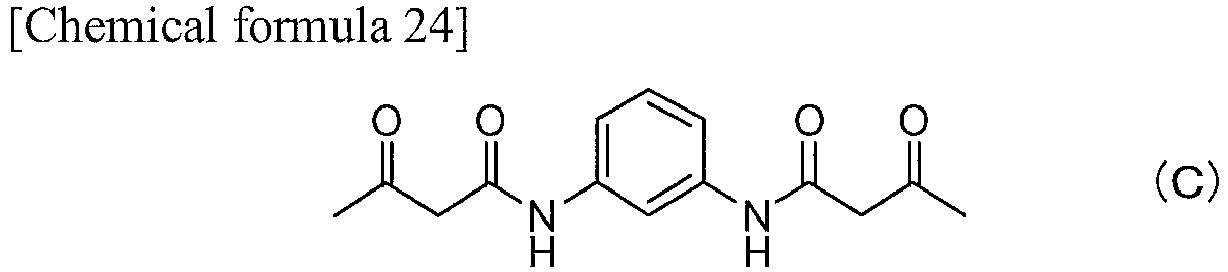
- A thermometer and a stirring rod equipped with stirring blades were fitted on a 300 mL four-necked flask. Then, 100 g of CPME was added under a dry nitrogen flow and stirred at room temperature. Then, 10.00 g (87.57 mmol) of CHDA was added and washing was performed with 10 g of CPME. After cooling to 10°C or below, 15.09 g (179.5 mmol) of diketene diluted with 10 g of CPME was dropped. After finishing the dropping, the temperature was raised to 30°C and stirring was performed for 1 hour. After the cooling, the deposit was recovered by filtration. Recrystallization was performed with ethanol, followed by drying to provide compound D as represented by chemical formula (D) given below. The yield was 16.24 g (yield 66%).

- A thermometer and a stirring rod equipped with stirring blades were fitted on a 300 mL four-necked flask. Then, 80 g of THF was added under a dry nitrogen flow and stirred at room temperature. Then, 10.00 g (34.56 mmol) of TAM and 63.33 mg (518.4 µmol) of DMAP were added and washing was performed with 10 g of THF. After cooling to 10°C or below, 9.152 g (108.9 mmol) of diketene diluted with 10 g of THF was dropped. After finishing the dropping, the temperature was raised to 30°C and stirring was performed for 1 hour. After the cooling, the deposit was recovered by filtration. It was dried to provide compound E as represented by chemical formula (E). The yield was 16.66 g (yield 89%).


- A thermometer and a stirring rod equipped with stirring blades were fitted on a 300 mL four-necked flask. Then, 80 g of NMP was added under a dry nitrogen flow and stirring was performed at room temperature.. Then, 10.00 g (25.04 mmol) of TAB was added and washing was performed with 10 g of NMP. After cooling to 10°C or below, 6.31 g (75.11 mmol) of diketene diluted with 10 g of NMP was dropped. After finishing the dropping, the temperature was raised to 40°C and stirring was performed for 1 hour. After the cooling, the reaction solution was used as NMP solution of compound F as represented by chemical formula (F).
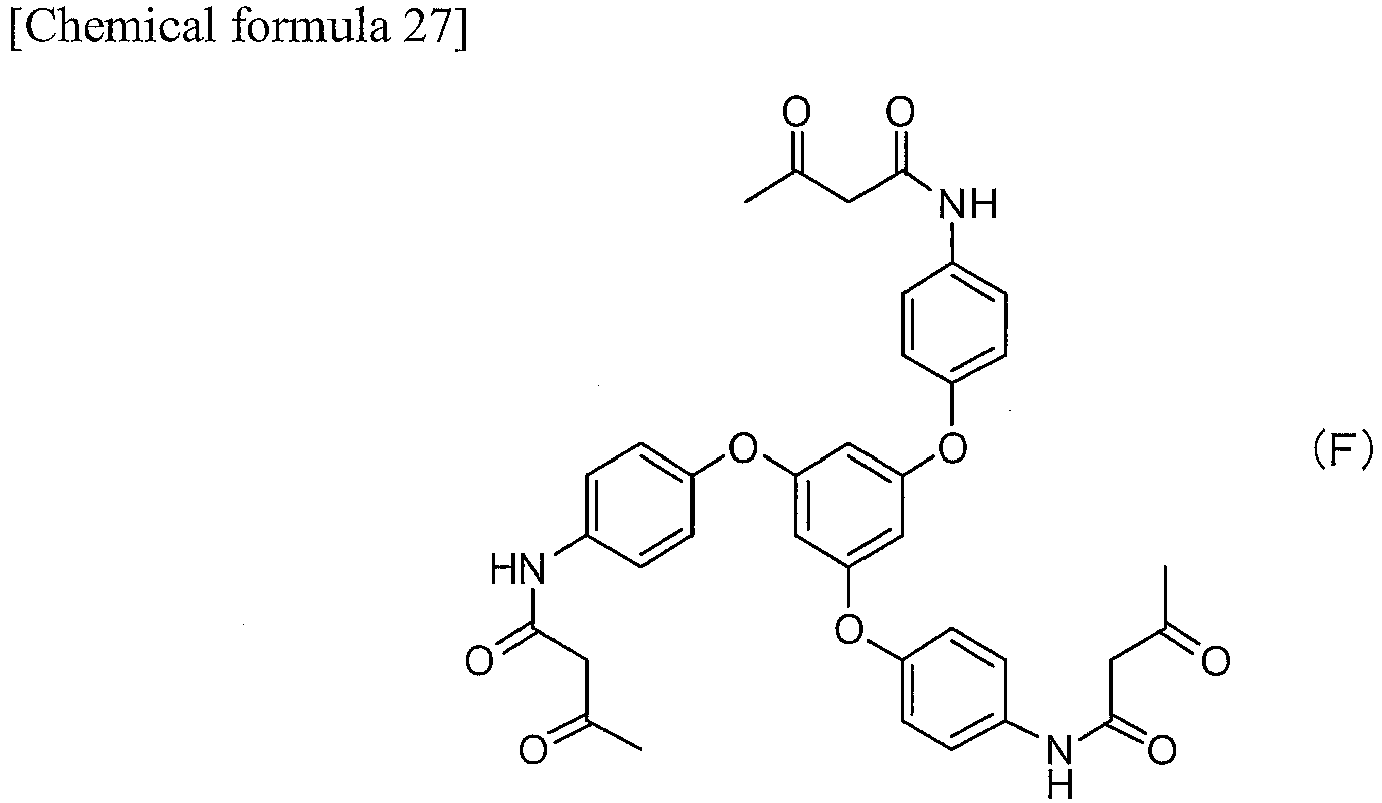
- A thermometer and a stirring rod equipped with stirring blades were fitted on a 300 mL four-necked flask. Then, 130 g of NMP was added under a dry nitrogen flow and stirring was performed at room temperature.. Then, 10.00 g (79.29 mmol) of melamine was added and washing was performed with 10 g ofNMP. After cooling to 10°C or below, 20.00 g (237.9 mmol) of diketene diluted with 10 g of NMP was dropped. After finishing the dropping, the temperature was raised to 60°C and stirring was performed for 2 hours. After the cooling, the reaction solution was used as NMP solution of compound G as represented by chemical formula (G).

- A thermometer and a stirring rod equipped with stirring blades were fitted on a 300 mL four-necked flask. Then, 70 g of NMP was added under a dry nitrogen flow. Subsequently, while stirring was performed at room temperature, 8.496 g (99.88 mmol) of cyanoacetic acid was added and washing was performed with 10 g of NMP. After confirming the dissolution of cyanoacetic acid, the solution was cooled to 10°C or below. After the cooling, 16.60 g (102.4 mmol) of carbonyl diimidazole was added and washing was performed with 10 g of NMP. After the addition, stirring was continued overnight at room temperature. On the next day, 10.00 g (49.94 mmol) of DAE was added and washing was performed with 10 g of NMP. After the addition, stirring was additionally continued overnight at room temperature. The reaction solution was used as NMP solution of compound H as represented by chemical formula (H).

- A thermometer and a stirring rod equipped with stirring blades were fitted on a 300 mL four-necked flask. Then, 70 g of NMP was added under a dry nitrogen flow. Subsequently, while stirring was performed at room temperature, 21.40 g (99.88 mmol) of 2-(p-toluenesulfonyl) acetic acid was added and washing was performed with 10 g of NMP. After confirming the dissolution of cyanoacetic acid, the solution was cooled to 10°C or below. After the cooling, 16.60 g (102.4 mmol) of carbonyl diimidazole was added and washing was performed with 10 g of NMP. After the addition, stirring was continued overnight at room temperature. On the next day, 10.00 g (49.94 mmol) of DAE was added and washing was performed with 10 g of NMP. After the addition, stirring was additionally continued overnight at room temperature. The reaction solution was used as NMP solution of compound I as represented by chemical formula (I).

- A thermometer and a stirring rod equipped with stirring blades were fitted on a 300 mL four-necked flask. Then, 100 g of THF was added under a dry nitrogen flow and stirred at room temperature. Then, 10.00 g (49.94 mmol) of DAE, 11.12 g (109.9 mmol) of triethyl amine, and 61.01 mg (49.94 µmol) of DMAP were added and washing was performed with 10 g of THF. After cooling to 10°C or below, 10.71 g (104.9 mmol) of acetic anhydride diluted with 10 g of THF was dropped. After finishing the dropping, the temperature was raised to 40°C and stirring was performed for 1 hour. After the cooling, the deposit was recovered by filtration. It was dried to provide compound J as represented by chemical formula (J). The yield was 9.120 g (yield 55%).

- A thermometer and a stirring rod equipped with stirring blades were fitted on a 300 mL four-necked flask. Then, 100 g of THF was added under a dry nitrogen flow and stirred at room temperature. Then, 10.00 g (87.57 mmol) of CHDA was added and washing was performed with 10 g of THF. After cooling to 10°C or below, 39.18 g (179.5 mmol) of DIBOC diluted with 10 g of THF was dropped. After the addition, the solution was heated to room temperature. After one week, the deposit was recovered by filtration. It was dried to provide compound K as represented by chemical formula (K). The yield was 17.90 g (yield 90%).

- Polymerization example 1: resin a (Examples 1 to 3 and 5 to 8 and Comparative examples 2 and 3) A thermometer and a stirring rod equipped with stirring blades were fitted on a 200 mL four-necked flask. Then, 85 g of NMP was added under a dry nitrogen flow, and the temperature was elevated to 40°C. After the temperature elevation, while stirring is continued at room temperature, 11.41 g (57.00 mmol) of DAE was added and washing was performed with 10 g of NMP. After confirming the dissolution of DAE, 13.09 g (60.00 mmol) of PMDA was added and washing was performed with 10 g of NMP. After 2 hours, the solution was cooled.
- A thermometer and a stirring rod equipped with stirring blades were fitted on a 200 mL four-necked flask. Then, 85 g of NMP was added under a dry nitrogen flow, and the temperature was elevated to 40°C. After the temperature elevation, while stirring is performed at room temperature, 6.007 g (30.00 mmol) of DAE was added and washing was performed with 10 g of NMP. After confirming the dissolution of DAE, 6.544 g (30.00 mmol) of PMDA was added and washing was performed with 10 g of NMP. After 2 hours, the solution was cooled.
- A thermometer and a stirring rod equipped with stirring blades were fitted on a 200 mL four-necked flask. Then, 85 g of NMP was added under a dry nitrogen flow, and the temperature was elevated to 40°C. After the temperature elevation, while stirring is performed at room temperature, 11.41 g (57.00 mmol) of DAE was added and washing was performed with 10 g of NMP. After confirming the dissolution of DAE, 13.09 g (60.00 mmol) of PMDA was added and washing was performed with 10 g of NMP. After 2 hours, 1-hexanol (6.000 mmol) was added and washing was performed with 5 g of NMP. After 1 hour, the solution was cooled.
- A thermometer and a stirring rod equipped with stirring blades were fitted on a 200 mL four-necked flask. Then, 100 g of NMP was added under a dry nitrogen flow, and the temperature was elevated to 60°C. After the temperature elevation, while stirring is performed at room temperature, 6.164 g (57.00 mmol) of p-PDA was added and washing was performed with 10 g of NMP. After confirming the dissolution of p-PDA, 17.65 g (60.00 mmol) of BPDA was added and washing was performed with 10 g of NMP. After 4 hours, the solution was cooled.
- A thermometer and a stirring rod equipped with stirring blades were fitted on a 200 mL four-necked flask. Then, 85 g of NMP was added under a dry nitrogen flow, and the temperature was elevated to 60°C. After the temperature elevation, while stirring is performed at room temperature, 3.244 g (30.00 mmol) of p-PDA was added and washing was performed with 10 g of NMP. After confirming the dissolution of p-PDA, 8.827 g (30.00 mmol) of BPDA was added and washing was performed with 10 g of NMP. After a period of time, the viscosity of the polymerization solution increased, making it impossible to continue stirring any longer.
- A thermometer and a stirring rod equipped with stirring blades were fitted on a 200 mL four-necked flask. Then, 75 g of NMP was added under a dry nitrogen flow, and the temperature was elevated to 60°C. After the temperature elevation, while stirring is continued at room temperature, 5.424 g (47.50 mmol) of CHDA was added and washing was performed with 10 g of NMP. After confirming the dissolution of CHDA, 10.30 g (35.00 mmol) of BPDA and 4.653 g (15.00 mmol) of ODPA were added and washing was performed with 10 g of NMP. After 4 hours, the solution was cooled.
- A thermometer and a stirring rod equipped with stirring blades were fitted on a 200 mL four-necked flask. Then, 85 g of NMP was added under a dry nitrogen flow, and the temperature was elevated to 40°C. After the temperature elevation, while stirring is continued at room temperature, 11.41 g (57.00 mmol) of DAE and 868.1 g (2.000 mmol) of TAM were added and washing was performed with 10 g of NMP. After confirming the dissolution of DAE and TAM, 13.09 g (60.00 mmol) of PMDA was added and washing was performed with 10 g of NMP. After a period of time, the polymerization solution gelated, making it impossible to continue stirring any longer.
- A thermometer and a stirring rod equipped with stirring blades were fitted on a 200 mL four-necked flask. Then, 85 g of NMP was added under a dry nitrogen flow, and the temperature was elevated to 40°C. After the temperature elevation, while stirring is continued at room temperature, 11.41 g (57.00 mmol) of DAE and 1.198 g (2.000 mmol) of TAB were added and washing was performed with 10 g of NMP. After confirming the dissolution of DAE and TAB, 13.09 g (60.00 mmol) of PMDA was added and washing was performed with 10 g of NMP. After a period of time, the polymerization solution gelated, making it impossible to continue stirring any longer.
- A thermometer and a stirring rod equipped with stirring blades were fitted on a 200 mL four-necked flask. Then, 100 g of NMP was added under a dry nitrogen flow, and the temperature was elevated to 60°C. After the temperature elevation, while stirring is performed at room temperature, 6.164 g (57.00 mmol) of p-PDA and 378.4 mg (2.000 mmol) of melamine was added and washing was performed with 10 g of NMP. Subsequently, 17.65 g (60.00 mmol) of BPDA was added and washing was performed with 10 g of NMP. After 4 hours, the solution was cooled, but melamine was found precipitated without undergoing reaction.
- Compounds A to K obtained in Synthesis examples 1 to 11 and solutions of resins a to i obtained in Polymerization examples 1 to 9 were used to prepare varnish specimens with the molar ratios given in Tables 1 and 2.
- Tables 1 and 2 show results of evaluation of the varnish specimens prepared in Examples 1 to 11 and Comparative examples 1 to 11 and measurements of the ultimate tensile elongation, ultimate tensile stress, Young's modulus, coefficient of thermal expansion, glass transition temperature, and 5% thermal mass decrease temperature of the polyimide films produced from the varnish specimens.
[Table 1] Example 1 2 3 4 5 6 7 8 9 10 11 molar ratio resin acid dianhydride PMDA 100 100 100 100 100 100 100 100 BPDA 100 100 70 ODPA 30 diamine compound DAE 95 95 95 95 95 95 95 95 p-PDA 95 95 CHDA 95 end capping agent 1-hexanol 10 additive compound A 5 5 compound B 5 5 compound C 5 compound D 5 compound E 3.33 compound F 3.33 compound G 3.33 compound H 5 compound I 5 evaluation item unit weight average molecular weight of resin 69900 69900 69900 82000 69900 69900 69900 69900 26000 26000 29200 viscosity of varnish (10 mass% NMP) cP 585 672 449 823 545 511 578 554 105 84 55 ultimate tensile elongation MPa 93 106 96 94 76 72 101 98 16 28 12 ultimate tensile stress % 238 232 200 211 205 192 233 229 293 255 209 Young's modulus GPa 1.5 2.0 2.0 2.0 1.7 2.4 1.6 1.5 7.3 7.1 5.1 coefficient of thermal expansion ppm/°C 36 37 37 36 35 34 37 36 7.5 10.3 26 glass transition temperature °C 371 367 368 362 365 364 370 368 358 355 259 5% heat mass decrease temperature °C 580 580 578 578 572 579 580 579 > 600 > 600 500 [Table 2] Comparative example 1 2 3 4 5 6 7 8 9 10 11 molar ratio resin acid dianhydride PMDA 100 100 100 100 100 100 BPDA 100 100 100 70 70 ODPA 30 30 diamine compound DAE 100 95 95 95 95 95 p-PDA 100 95 95 CHDA 95 95 TAM 3.33 TAB 3.33 melamine 3.33 end capping agent 1-hexanol 10 additive compound J 5 compound K 5 evaluation item unit weight average molecular weight of resin 89600 69900 69900 82000 N.D.*1 N.D.*1 102600 26000 N.D.*3 29200 29200 viscosity of varnish (10 mass% NMP) cP 2819 844 529 1038 N.D.*1 N.D.*1 > 40000 122 N.D.*3 62 N.D.*5 ultimate tensile elongation % 101 52 60 79 N.D.*1 N.D.*1 N.D.*2 8 N.D.*3 N.D.*4 N.D.*5 ultimate tensile stress MPa 228 128 135 141 N.D.*1 N.D.*1 N.D.*2 230 N.D.*3 N.D.*4 N.D.*5 Young's modulus GPa 1.6 2.0 2.6 2.0 N.D.*1 N.D.*1 N.D.*2 6.8 N.D.*3 N.D.*4 N.D.*5 coefficient of thermal expansion ppm/°C 32 35 36 34 N.D.*1 N.D.*1 N.D.*2 6.3 N.D.*3 N.D.*4 N.D.*5 glass transition temperature roc 372 366 369 366 N.D.*1 N.D.*1 N.D.*2 364 N.D.*3 N.D.*4 N.D.*5 5% heat mass decrease temperature °C 590 589 598 587 N.D.*1 N.D.*1 N.D.*2 > 600 N.D.*3 N.D.*4 N.D.*5 *1: No Data (Gelation occurred during polymerization.)
*2: No Data (Varnish viscosity was too high to use for coating.)
*3: No Data (Melamine did not dissolve.)
*4: No Data (Cured film was so brittle that it was broken when removed from the substrate.)
*5: No Data (Compound F did not dissolve and it was impssoibe to prepare a varnish.) - A varnish specimen with a viscosity of about 2,000 cP (actually a viscosity of 1970 cP) was prepared from resin a and compound A at the same ratio as adopted in Example 1. After storage at 23°C for 1 week, the varnish had a viscosity of 1940 cP.
- Except for using DAE instead of compound A, the same procedure as in Example 12 was carried out to prepare a varnish with a viscosity of about 2,000 cP (actually with a viscosity of 2010 cP). After storage at 23°C for 1 week, the varnish had a largely increased viscosity of 2920 cP.
- A varnish with a solid content of 15% prepared from resin a and compound A at the molar ratio adopted in Example 1 was spread over a glass substrate with a thickness of 0.7 mm by slit coating to form a liquid film with a thickness of 200 µm. It was dried at 140°C for 10 minutes, and a glass substrate with a 30 µm coat film was obtained after the drying step.
- Subsequently, this glass substrate was heated in nitrogen at 350°C for 30 minutes to provide a glass substrate coated with polyimide film with a film thickness of 20 µm.
- The present invention serves to produce polyamic acid resin composition that can form a low-viscosity solution. After being cured, the coat film shows good physical properties and can be used favorably as material for surface protect film and interlayer insulation film of semiconductor elements, insulation layers and spacer layers of organic electroluminescent elements (organic EL elements), planarizing film of thin film transistor substrates, insulation layers of organic transistors, flexible printed boards, substrates for flexible display, substrates for flexible electronic paper, substrates for flexible solar batteries, substrates for flexible color filters, binders for electrodes of lithium ion secondary batteries, and adhesives for semiconductors.
Claims (10)
- A polyamic acid resin composition comprising (a) polyamic acid and (b) a compound as represented by chemical formula (1):
[Chemical fonnula 1]
Z(̵V)k (1)
wherein Z is a di- or higher-valent organic group containing 2 or more carbon atoms, V is a structure as represented by chemical formula (2), and k is an integer of 2 or more.
- A polyamic acid resin composition as described in claim 1, wherein W in chemical formula (2) given above is represented by any one of chemical formulae (3) to (10):

- A polyamic acid resin composition as described in either claim 1 or 2, wherein V in chemical formula (1) given above is represented by any one of chemical formulae (11) to (13):

- A polyamic acid resin composition as described in any one of claims 1 to 3, wherein k in chemical formula (1) is an integer of 2 or 3.
- A polyamic acid resin composition as described in any one of claims 1 to 4, wherein "(a) polyamic acid" contains a structure as represented by chemical formula (14) or (15):

- Polyimide film comprising polyimide as produced by imidizing a polyamic acid resin composition as described in any one of claims 1 to 5.
- A production method for polyimide film comprising a step for imidizing a polyamic acid resin composition as described in any one of claims 1 to 5.
- A coated glass substrate produced by coating a glass substrate with a varnish containing a polyamic acid resin composition as described in any one of claims 1 to 5 and removing the solvent by drying.
- A glass substrate coated with polyimide film produced by heating the coated glass substrate at a temperature of 180°C to 600°C.
- A production method for a glass substrate coated with polyimide film comprising a step for imidizing, by heating, a coated glass substrate as described in claim 8.
Applications Claiming Priority (2)
| Application Number | Priority Date | Filing Date | Title |
|---|---|---|---|
| JP2012170829 | 2012-08-01 | ||
| PCT/JP2013/070610 WO2014021319A1 (en) | 2012-08-01 | 2013-07-30 | Polyamide acid resin composition, polyimide film using same, and method for producing said polyimide film |
Publications (3)
| Publication Number | Publication Date |
|---|---|
| EP2881417A1 true EP2881417A1 (en) | 2015-06-10 |
| EP2881417A4 EP2881417A4 (en) | 2016-01-27 |
| EP2881417B1 EP2881417B1 (en) | 2017-02-22 |
Family
ID=50027992
Family Applications (1)
| Application Number | Title | Priority Date | Filing Date |
|---|---|---|---|
| EP13824982.6A Not-in-force EP2881417B1 (en) | 2012-08-01 | 2013-07-30 | Polyamide acid resin composition, polyimide film using same, and method for producing said polyimide film |
Country Status (9)
| Country | Link |
|---|---|
| US (1) | US9850347B2 (en) |
| EP (1) | EP2881417B1 (en) |
| JP (1) | JP5488772B1 (en) |
| KR (1) | KR101931997B1 (en) |
| CN (1) | CN104508008B (en) |
| PH (1) | PH12015500103B1 (en) |
| SG (1) | SG11201500493YA (en) |
| TW (1) | TWI619743B (en) |
| WO (1) | WO2014021319A1 (en) |
Families Citing this family (25)
| Publication number | Priority date | Publication date | Assignee | Title |
|---|---|---|---|---|
| US11497681B2 (en) | 2012-02-28 | 2022-11-15 | Corning Incorporated | Glass articles with low-friction coatings |
| CN107540242B (en) | 2012-02-28 | 2020-11-20 | 康宁股份有限公司 | Glass article with low friction coating |
| US10737973B2 (en) | 2012-02-28 | 2020-08-11 | Corning Incorporated | Pharmaceutical glass coating for achieving particle reduction |
| US10273048B2 (en) | 2012-06-07 | 2019-04-30 | Corning Incorporated | Delamination resistant glass containers with heat-tolerant coatings |
| US9034442B2 (en) | 2012-11-30 | 2015-05-19 | Corning Incorporated | Strengthened borosilicate glass containers with improved damage tolerance |
| RU2691189C2 (en) | 2014-09-05 | 2019-06-11 | Корнинг Инкорпорейтед | Glass articles and methods of improving reliability of glass articles |
| EP3118247A1 (en) | 2015-07-15 | 2017-01-18 | Basf Se | Polyamides with improved optical properties |
| EP3150564B1 (en) | 2015-09-30 | 2018-12-05 | Corning Incorporated | Halogenated polyimide siloxane chemical compositions and glass articles with halogenated polylmide siloxane low-friction coatings |
| US20170121058A1 (en) * | 2015-10-30 | 2017-05-04 | Corning Incorporated | Glass articles with mixed polymer and metal oxide coatings |
| CN108431135B (en) * | 2015-12-11 | 2020-06-23 | 东丽株式会社 | Resin composition, method for producing resin film, and method for producing electronic device |
| KR102532485B1 (en) * | 2017-09-07 | 2023-05-16 | 도레이 카부시키가이샤 | Resin composition, manufacturing method of resin film, and manufacturing method of electronic device |
| CN109666171B (en) * | 2017-10-17 | 2022-02-01 | 中国石油化工股份有限公司 | Preparation method of uniform polyimide film |
| JP6568290B1 (en) * | 2018-04-27 | 2019-08-28 | 住友化学株式会社 | Optical film |
| JP2020128527A (en) * | 2019-02-06 | 2020-08-27 | ユニチカ株式会社 | Coating polyamic acid solution to glass substrate |
| CN113474156B (en) * | 2019-02-26 | 2022-04-29 | 东丽株式会社 | Polyamic acid resin composition, polyimide resin film, method for producing the same, laminate, and electronic device and method for producing the same |
| KR102718203B1 (en) * | 2019-06-20 | 2024-10-15 | 스미토모 덴키 고교 가부시키가이샤 | Resin composition, method for producing resin composition and insulating wire |
| US20220336761A1 (en) * | 2019-09-24 | 2022-10-20 | Toray Industries, Inc. | Resin film, electronic device, method of manufacturing resin film, and method of manufacturing electronic device |
| JP7225427B2 (en) * | 2019-10-03 | 2023-02-20 | 三井化学株式会社 | Polyimide film, polyamic acid and varnish containing the same, polyimide laminate and method for producing the same |
| JP7437997B2 (en) * | 2020-03-31 | 2024-02-26 | 東京応化工業株式会社 | Varnish composition, polyimide resin manufacturing method, and additives |
| CN111621260B (en) * | 2020-06-18 | 2022-01-25 | 株洲时代新材料科技股份有限公司 | Polyamide acid coating adhesive and preparation method thereof |
| WO2022051645A2 (en) | 2020-09-04 | 2022-03-10 | Corning Incorporated | Ultraviolet light-blocking coated pharmaceutical packages |
| JP2022096910A (en) * | 2020-12-18 | 2022-06-30 | 住友化学株式会社 | Laminate and display device equipped with the same |
| JP2022096909A (en) * | 2020-12-18 | 2022-06-30 | 住友化学株式会社 | Front plate for display device |
| CN114940675B (en) * | 2022-05-10 | 2023-05-02 | 波米科技有限公司 | Compound, preparation method thereof, resin prepared by using compound and low-temperature curing resin composition |
| CN118931372B (en) * | 2024-08-23 | 2025-03-25 | 湖北武洲新材料科技有限公司 | Environmentally friendly high temperature resistant electrical steel insulating coating and its preparation method and application |
Family Cites Families (7)
| Publication number | Priority date | Publication date | Assignee | Title |
|---|---|---|---|---|
| JPH11302375A (en) * | 1997-11-20 | 1999-11-02 | Kanegafuchi Chem Ind Co Ltd | Metal-containing polyamic acid composition, polyimide film, flexible printed wiring board comprising the same, and methods for producing them |
| JP4589471B2 (en) * | 1998-11-25 | 2010-12-01 | ユニチカ株式会社 | Polyimide precursor solution and production method thereof, coating film obtained therefrom and production method thereof |
| JP2001031746A (en) | 1999-07-22 | 2001-02-06 | Japan Steel Works Ltd:The | Method for producing polylactic acid |
| JP5120047B2 (en) * | 2007-05-02 | 2013-01-16 | Jsr株式会社 | Vertical alignment type liquid crystal aligning agent and liquid crystal display element |
| JP5068627B2 (en) * | 2007-10-26 | 2012-11-07 | 旭化成イーマテリアルズ株式会社 | Photosensitive resin composition, photosensitive resin composition film, and resin pattern using them |
| CN101230196B (en) * | 2008-02-26 | 2010-06-02 | 东南大学 | In-Situ Polymerization of PI Modified Nylon Composites |
| CN102051185B (en) * | 2009-11-03 | 2013-07-17 | 奇美实业股份有限公司 | Liquid crystal alignment agent, liquid crystal alignment film and liquid crystal display element |
-
2013
- 2013-07-30 CN CN201380039541.9A patent/CN104508008B/en not_active Expired - Fee Related
- 2013-07-30 US US14/417,083 patent/US9850347B2/en not_active Expired - Fee Related
- 2013-07-30 WO PCT/JP2013/070610 patent/WO2014021319A1/en not_active Ceased
- 2013-07-30 EP EP13824982.6A patent/EP2881417B1/en not_active Not-in-force
- 2013-07-30 JP JP2013538381A patent/JP5488772B1/en not_active Expired - Fee Related
- 2013-07-30 KR KR1020157003989A patent/KR101931997B1/en not_active Expired - Fee Related
- 2013-07-30 SG SG11201500493YA patent/SG11201500493YA/en unknown
- 2013-07-31 TW TW102127362A patent/TWI619743B/en not_active IP Right Cessation
-
2015
- 2015-01-14 PH PH12015500103A patent/PH12015500103B1/en unknown
Also Published As
| Publication number | Publication date |
|---|---|
| WO2014021319A1 (en) | 2014-02-06 |
| CN104508008B (en) | 2016-08-17 |
| CN104508008A (en) | 2015-04-08 |
| US9850347B2 (en) | 2017-12-26 |
| KR101931997B1 (en) | 2018-12-24 |
| TWI619743B (en) | 2018-04-01 |
| TW201412823A (en) | 2014-04-01 |
| SG11201500493YA (en) | 2015-04-29 |
| EP2881417A4 (en) | 2016-01-27 |
| PH12015500103B1 (en) | 2019-11-20 |
| JP5488772B1 (en) | 2014-05-14 |
| JPWO2014021319A1 (en) | 2016-07-21 |
| EP2881417B1 (en) | 2017-02-22 |
| US20150203631A1 (en) | 2015-07-23 |
| PH12015500103A1 (en) | 2015-04-06 |
| KR20150038089A (en) | 2015-04-08 |
Similar Documents
| Publication | Publication Date | Title |
|---|---|---|
| EP2881417B1 (en) | Polyamide acid resin composition, polyimide film using same, and method for producing said polyimide film | |
| JP7323522B2 (en) | Polyimide resin and method for producing the same, and polyimide film and method for producing the same | |
| US9822281B2 (en) | Polyamide acid and resin composition containing same | |
| TWI502003B (en) | A substrate manufacturing method and a composition for use in the method | |
| CN108431135B (en) | Resin composition, method for producing resin film, and method for producing electronic device | |
| CN102666659B (en) | Optical film, optical film manufacturing method, transparent substrate, image display device, and solar cell | |
| CN107949597B (en) | Polyamic acid solution composition and polyimide film | |
| JP6333560B2 (en) | Substrate applied to flexible electronic device having predetermined structure and method for manufacturing the same | |
| KR20140051430A (en) | Polyamic acid resin composition, polyimide resin composition, polyimide oxazole resin composition, and flexible substrate containing same | |
| TW202003639A (en) | Photosensitive resin composition and method for producing cured relief pattern capable of achieving a higher resolution and an excellent elongation | |
| TWI714703B (en) | Hardened film and its manufacturing method | |
| TW201942194A (en) | Polyimide, polyimide solution composition, polyimide film, and substrate | |
| JP6974956B2 (en) | Polyimide precursor and polyimide | |
| TW202134318A (en) | Polyimide resin, varnish and polyimide film | |
| TW202309657A (en) | Photosensitive polyimide resin composition | |
| WO2022124195A1 (en) | Polyimide resin, polyimide film and manufacturing method therefor | |
| CN101048442A (en) | Poly(imide-formimide) copolymer, poly(amic acid-formimine) copolymer and positive photosensitive resin composition | |
| TW201815892A (en) | Composition for flexible substrate, method for producing the same, and flexible substrate |
Legal Events
| Date | Code | Title | Description |
|---|---|---|---|
| PUAI | Public reference made under article 153(3) epc to a published international application that has entered the european phase |
Free format text: ORIGINAL CODE: 0009012 |
|
| 17P | Request for examination filed |
Effective date: 20150217 |
|
| AK | Designated contracting states |
Kind code of ref document: A1 Designated state(s): AL AT BE BG CH CY CZ DE DK EE ES FI FR GB GR HR HU IE IS IT LI LT LU LV MC MK MT NL NO PL PT RO RS SE SI SK SM TR |
|
| AX | Request for extension of the european patent |
Extension state: BA ME |
|
| DAX | Request for extension of the european patent (deleted) | ||
| RA4 | Supplementary search report drawn up and despatched (corrected) |
Effective date: 20160108 |
|
| RIC1 | Information provided on ipc code assigned before grant |
Ipc: C08G 73/10 20060101AFI20151223BHEP |
|
| GRAP | Despatch of communication of intention to grant a patent |
Free format text: ORIGINAL CODE: EPIDOSNIGR1 |
|
| INTG | Intention to grant announced |
Effective date: 20160908 |
|
| GRAS | Grant fee paid |
Free format text: ORIGINAL CODE: EPIDOSNIGR3 |
|
| GRAA | (expected) grant |
Free format text: ORIGINAL CODE: 0009210 |
|
| AK | Designated contracting states |
Kind code of ref document: B1 Designated state(s): AL AT BE BG CH CY CZ DE DK EE ES FI FR GB GR HR HU IE IS IT LI LT LU LV MC MK MT NL NO PL PT RO RS SE SI SK SM TR |
|
| REG | Reference to a national code |
Ref country code: GB Ref legal event code: FG4D |
|
| REG | Reference to a national code |
Ref country code: CH Ref legal event code: EP |
|
| REG | Reference to a national code |
Ref country code: AT Ref legal event code: REF Ref document number: 869222 Country of ref document: AT Kind code of ref document: T Effective date: 20170315 |
|
| REG | Reference to a national code |
Ref country code: IE Ref legal event code: FG4D |
|
| REG | Reference to a national code |
Ref country code: DE Ref legal event code: R096 Ref document number: 602013017805 Country of ref document: DE |
|
| REG | Reference to a national code |
Ref country code: LT Ref legal event code: MG4D |
|
| REG | Reference to a national code |
Ref country code: NL Ref legal event code: MP Effective date: 20170222 |
|
| REG | Reference to a national code |
Ref country code: AT Ref legal event code: MK05 Ref document number: 869222 Country of ref document: AT Kind code of ref document: T Effective date: 20170222 |
|
| PG25 | Lapsed in a contracting state [announced via postgrant information from national office to epo] |
Ref country code: HR Free format text: LAPSE BECAUSE OF FAILURE TO SUBMIT A TRANSLATION OF THE DESCRIPTION OR TO PAY THE FEE WITHIN THE PRESCRIBED TIME-LIMIT Effective date: 20170222 Ref country code: NO Free format text: LAPSE BECAUSE OF FAILURE TO SUBMIT A TRANSLATION OF THE DESCRIPTION OR TO PAY THE FEE WITHIN THE PRESCRIBED TIME-LIMIT Effective date: 20170522 Ref country code: LT Free format text: LAPSE BECAUSE OF FAILURE TO SUBMIT A TRANSLATION OF THE DESCRIPTION OR TO PAY THE FEE WITHIN THE PRESCRIBED TIME-LIMIT Effective date: 20170222 Ref country code: GR Free format text: LAPSE BECAUSE OF FAILURE TO SUBMIT A TRANSLATION OF THE DESCRIPTION OR TO PAY THE FEE WITHIN THE PRESCRIBED TIME-LIMIT Effective date: 20170523 Ref country code: FI Free format text: LAPSE BECAUSE OF FAILURE TO SUBMIT A TRANSLATION OF THE DESCRIPTION OR TO PAY THE FEE WITHIN THE PRESCRIBED TIME-LIMIT Effective date: 20170222 |
|
| PG25 | Lapsed in a contracting state [announced via postgrant information from national office to epo] |
Ref country code: LV Free format text: LAPSE BECAUSE OF FAILURE TO SUBMIT A TRANSLATION OF THE DESCRIPTION OR TO PAY THE FEE WITHIN THE PRESCRIBED TIME-LIMIT Effective date: 20170222 Ref country code: AT Free format text: LAPSE BECAUSE OF FAILURE TO SUBMIT A TRANSLATION OF THE DESCRIPTION OR TO PAY THE FEE WITHIN THE PRESCRIBED TIME-LIMIT Effective date: 20170222 Ref country code: SE Free format text: LAPSE BECAUSE OF FAILURE TO SUBMIT A TRANSLATION OF THE DESCRIPTION OR TO PAY THE FEE WITHIN THE PRESCRIBED TIME-LIMIT Effective date: 20170222 Ref country code: RS Free format text: LAPSE BECAUSE OF FAILURE TO SUBMIT A TRANSLATION OF THE DESCRIPTION OR TO PAY THE FEE WITHIN THE PRESCRIBED TIME-LIMIT Effective date: 20170222 Ref country code: NL Free format text: LAPSE BECAUSE OF FAILURE TO SUBMIT A TRANSLATION OF THE DESCRIPTION OR TO PAY THE FEE WITHIN THE PRESCRIBED TIME-LIMIT Effective date: 20170222 Ref country code: ES Free format text: LAPSE BECAUSE OF FAILURE TO SUBMIT A TRANSLATION OF THE DESCRIPTION OR TO PAY THE FEE WITHIN THE PRESCRIBED TIME-LIMIT Effective date: 20170222 Ref country code: PT Free format text: LAPSE BECAUSE OF FAILURE TO SUBMIT A TRANSLATION OF THE DESCRIPTION OR TO PAY THE FEE WITHIN THE PRESCRIBED TIME-LIMIT Effective date: 20170622 Ref country code: BG Free format text: LAPSE BECAUSE OF FAILURE TO SUBMIT A TRANSLATION OF THE DESCRIPTION OR TO PAY THE FEE WITHIN THE PRESCRIBED TIME-LIMIT Effective date: 20170522 |
|
| PG25 | Lapsed in a contracting state [announced via postgrant information from national office to epo] |
Ref country code: IT Free format text: LAPSE BECAUSE OF FAILURE TO SUBMIT A TRANSLATION OF THE DESCRIPTION OR TO PAY THE FEE WITHIN THE PRESCRIBED TIME-LIMIT Effective date: 20170222 Ref country code: EE Free format text: LAPSE BECAUSE OF FAILURE TO SUBMIT A TRANSLATION OF THE DESCRIPTION OR TO PAY THE FEE WITHIN THE PRESCRIBED TIME-LIMIT Effective date: 20170222 Ref country code: SK Free format text: LAPSE BECAUSE OF FAILURE TO SUBMIT A TRANSLATION OF THE DESCRIPTION OR TO PAY THE FEE WITHIN THE PRESCRIBED TIME-LIMIT Effective date: 20170222 Ref country code: RO Free format text: LAPSE BECAUSE OF FAILURE TO SUBMIT A TRANSLATION OF THE DESCRIPTION OR TO PAY THE FEE WITHIN THE PRESCRIBED TIME-LIMIT Effective date: 20170222 Ref country code: CZ Free format text: LAPSE BECAUSE OF FAILURE TO SUBMIT A TRANSLATION OF THE DESCRIPTION OR TO PAY THE FEE WITHIN THE PRESCRIBED TIME-LIMIT Effective date: 20170222 |
|
| REG | Reference to a national code |
Ref country code: DE Ref legal event code: R097 Ref document number: 602013017805 Country of ref document: DE |
|
| PG25 | Lapsed in a contracting state [announced via postgrant information from national office to epo] |
Ref country code: SM Free format text: LAPSE BECAUSE OF FAILURE TO SUBMIT A TRANSLATION OF THE DESCRIPTION OR TO PAY THE FEE WITHIN THE PRESCRIBED TIME-LIMIT Effective date: 20170222 Ref country code: DK Free format text: LAPSE BECAUSE OF FAILURE TO SUBMIT A TRANSLATION OF THE DESCRIPTION OR TO PAY THE FEE WITHIN THE PRESCRIBED TIME-LIMIT Effective date: 20170222 Ref country code: PL Free format text: LAPSE BECAUSE OF FAILURE TO SUBMIT A TRANSLATION OF THE DESCRIPTION OR TO PAY THE FEE WITHIN THE PRESCRIBED TIME-LIMIT Effective date: 20170222 |
|
| PLBE | No opposition filed within time limit |
Free format text: ORIGINAL CODE: 0009261 |
|
| STAA | Information on the status of an ep patent application or granted ep patent |
Free format text: STATUS: NO OPPOSITION FILED WITHIN TIME LIMIT |
|
| 26N | No opposition filed |
Effective date: 20171123 |
|
| PG25 | Lapsed in a contracting state [announced via postgrant information from national office to epo] |
Ref country code: SI Free format text: LAPSE BECAUSE OF FAILURE TO SUBMIT A TRANSLATION OF THE DESCRIPTION OR TO PAY THE FEE WITHIN THE PRESCRIBED TIME-LIMIT Effective date: 20170222 |
|
| REG | Reference to a national code |
Ref country code: CH Ref legal event code: PL |
|
| GBPC | Gb: european patent ceased through non-payment of renewal fee |
Effective date: 20170730 |
|
| REG | Reference to a national code |
Ref country code: FR Ref legal event code: ST Effective date: 20180330 |
|
| PG25 | Lapsed in a contracting state [announced via postgrant information from national office to epo] |
Ref country code: LI Free format text: LAPSE BECAUSE OF NON-PAYMENT OF DUE FEES Effective date: 20170731 Ref country code: CH Free format text: LAPSE BECAUSE OF NON-PAYMENT OF DUE FEES Effective date: 20170731 Ref country code: GB Free format text: LAPSE BECAUSE OF NON-PAYMENT OF DUE FEES Effective date: 20170730 |
|
| REG | Reference to a national code |
Ref country code: IE Ref legal event code: MM4A |
|
| PG25 | Lapsed in a contracting state [announced via postgrant information from national office to epo] |
Ref country code: FR Free format text: LAPSE BECAUSE OF NON-PAYMENT OF DUE FEES Effective date: 20170731 |
|
| REG | Reference to a national code |
Ref country code: BE Ref legal event code: MM Effective date: 20170731 |
|
| PG25 | Lapsed in a contracting state [announced via postgrant information from national office to epo] |
Ref country code: LU Free format text: LAPSE BECAUSE OF NON-PAYMENT OF DUE FEES Effective date: 20170730 |
|
| PG25 | Lapsed in a contracting state [announced via postgrant information from national office to epo] |
Ref country code: IE Free format text: LAPSE BECAUSE OF NON-PAYMENT OF DUE FEES Effective date: 20170730 |
|
| PG25 | Lapsed in a contracting state [announced via postgrant information from national office to epo] |
Ref country code: BE Free format text: LAPSE BECAUSE OF NON-PAYMENT OF DUE FEES Effective date: 20170731 |
|
| PG25 | Lapsed in a contracting state [announced via postgrant information from national office to epo] |
Ref country code: MT Free format text: LAPSE BECAUSE OF NON-PAYMENT OF DUE FEES Effective date: 20170730 |
|
| PG25 | Lapsed in a contracting state [announced via postgrant information from national office to epo] |
Ref country code: HU Free format text: LAPSE BECAUSE OF FAILURE TO SUBMIT A TRANSLATION OF THE DESCRIPTION OR TO PAY THE FEE WITHIN THE PRESCRIBED TIME-LIMIT; INVALID AB INITIO Effective date: 20130730 Ref country code: MC Free format text: LAPSE BECAUSE OF FAILURE TO SUBMIT A TRANSLATION OF THE DESCRIPTION OR TO PAY THE FEE WITHIN THE PRESCRIBED TIME-LIMIT Effective date: 20170222 |
|
| PG25 | Lapsed in a contracting state [announced via postgrant information from national office to epo] |
Ref country code: CY Free format text: LAPSE BECAUSE OF FAILURE TO SUBMIT A TRANSLATION OF THE DESCRIPTION OR TO PAY THE FEE WITHIN THE PRESCRIBED TIME-LIMIT Effective date: 20170222 |
|
| PG25 | Lapsed in a contracting state [announced via postgrant information from national office to epo] |
Ref country code: MK Free format text: LAPSE BECAUSE OF FAILURE TO SUBMIT A TRANSLATION OF THE DESCRIPTION OR TO PAY THE FEE WITHIN THE PRESCRIBED TIME-LIMIT Effective date: 20170222 |
|
| PG25 | Lapsed in a contracting state [announced via postgrant information from national office to epo] |
Ref country code: TR Free format text: LAPSE BECAUSE OF FAILURE TO SUBMIT A TRANSLATION OF THE DESCRIPTION OR TO PAY THE FEE WITHIN THE PRESCRIBED TIME-LIMIT Effective date: 20170222 |
|
| PG25 | Lapsed in a contracting state [announced via postgrant information from national office to epo] |
Ref country code: AL Free format text: LAPSE BECAUSE OF FAILURE TO SUBMIT A TRANSLATION OF THE DESCRIPTION OR TO PAY THE FEE WITHIN THE PRESCRIBED TIME-LIMIT Effective date: 20170222 Ref country code: IS Free format text: LAPSE BECAUSE OF FAILURE TO SUBMIT A TRANSLATION OF THE DESCRIPTION OR TO PAY THE FEE WITHIN THE PRESCRIBED TIME-LIMIT Effective date: 20170622 |
|
| PGFP | Annual fee paid to national office [announced via postgrant information from national office to epo] |
Ref country code: DE Payment date: 20210630 Year of fee payment: 9 |
|
| REG | Reference to a national code |
Ref country code: DE Ref legal event code: R119 Ref document number: 602013017805 Country of ref document: DE |
|
| PG25 | Lapsed in a contracting state [announced via postgrant information from national office to epo] |
Ref country code: DE Free format text: LAPSE BECAUSE OF NON-PAYMENT OF DUE FEES Effective date: 20230201 |