EP2877647B1 - Bande a joints en fibres de verre et procédé de jointement - Google Patents
Bande a joints en fibres de verre et procédé de jointement Download PDFInfo
- Publication number
- EP2877647B1 EP2877647B1 EP13744755.3A EP13744755A EP2877647B1 EP 2877647 B1 EP2877647 B1 EP 2877647B1 EP 13744755 A EP13744755 A EP 13744755A EP 2877647 B1 EP2877647 B1 EP 2877647B1
- Authority
- EP
- European Patent Office
- Prior art keywords
- fibers
- strip
- joint tape
- tape
- reinforcing
- Prior art date
- Legal status (The legal status is an assumption and is not a legal conclusion. Google has not performed a legal analysis and makes no representation as to the accuracy of the status listed.)
- Not-in-force
Links
- 239000003365 glass fiber Substances 0.000 title claims description 22
- 238000000034 method Methods 0.000 title claims description 5
- 239000000835 fiber Substances 0.000 claims description 34
- 239000012783 reinforcing fiber Substances 0.000 claims description 29
- 239000011248 coating agent Substances 0.000 claims description 9
- 238000000576 coating method Methods 0.000 claims description 9
- 239000004820 Pressure-sensitive adhesive Substances 0.000 claims description 8
- 238000010276 construction Methods 0.000 claims description 4
- 229920001971 elastomer Polymers 0.000 claims description 4
- 239000000806 elastomer Substances 0.000 claims description 4
- 239000000853 adhesive Substances 0.000 claims description 3
- 239000004744 fabric Substances 0.000 claims description 3
- 239000002759 woven fabric Substances 0.000 claims 2
- PPBRXRYQALVLMV-UHFFFAOYSA-N Styrene Chemical compound C=CC1=CC=CC=C1 PPBRXRYQALVLMV-UHFFFAOYSA-N 0.000 description 6
- 239000011152 fibreglass Substances 0.000 description 6
- 229920000642 polymer Polymers 0.000 description 5
- 229910052602 gypsum Inorganic materials 0.000 description 4
- 239000010440 gypsum Substances 0.000 description 4
- 241001639412 Verres Species 0.000 description 3
- YFXPPSKYMBTNAV-UHFFFAOYSA-N bensultap Chemical compound C=1C=CC=CC=1S(=O)(=O)SCC(N(C)C)CSS(=O)(=O)C1=CC=CC=C1 YFXPPSKYMBTNAV-UHFFFAOYSA-N 0.000 description 3
- 239000011521 glass Substances 0.000 description 3
- VSKJLJHPAFKHBX-UHFFFAOYSA-N 2-methylbuta-1,3-diene;styrene Chemical compound CC(=C)C=C.C=CC1=CC=CC=C1.C=CC1=CC=CC=C1 VSKJLJHPAFKHBX-UHFFFAOYSA-N 0.000 description 2
- 229920001400 block copolymer Polymers 0.000 description 2
- 229920001577 copolymer Polymers 0.000 description 2
- 239000012943 hotmelt Substances 0.000 description 2
- 239000000203 mixture Substances 0.000 description 2
- 239000004570 mortar (masonry) Substances 0.000 description 2
- 239000011505 plaster Substances 0.000 description 2
- 229920005996 polystyrene-poly(ethylene-butylene)-polystyrene Polymers 0.000 description 2
- 239000004925 Acrylic resin Substances 0.000 description 1
- 229920000178 Acrylic resin Polymers 0.000 description 1
- VGGSQFUCUMXWEO-UHFFFAOYSA-N Ethene Chemical compound C=C VGGSQFUCUMXWEO-UHFFFAOYSA-N 0.000 description 1
- 239000005977 Ethylene Substances 0.000 description 1
- 244000043261 Hevea brasiliensis Species 0.000 description 1
- XTXRWKRVRITETP-UHFFFAOYSA-N Vinyl acetate Chemical compound CC(=O)OC=C XTXRWKRVRITETP-UHFFFAOYSA-N 0.000 description 1
- QYKIQEUNHZKYBP-UHFFFAOYSA-N Vinyl ether Chemical class C=COC=C QYKIQEUNHZKYBP-UHFFFAOYSA-N 0.000 description 1
- 239000003513 alkali Substances 0.000 description 1
- 239000011230 binding agent Substances 0.000 description 1
- MTAZNLWOLGHBHU-UHFFFAOYSA-N butadiene-styrene rubber Chemical compound C=CC=C.C=CC1=CC=CC=C1 MTAZNLWOLGHBHU-UHFFFAOYSA-N 0.000 description 1
- 229920005549 butyl rubber Polymers 0.000 description 1
- 239000004568 cement Substances 0.000 description 1
- 239000003795 chemical substances by application Substances 0.000 description 1
- 230000000694 effects Effects 0.000 description 1
- BXOUVIIITJXIKB-UHFFFAOYSA-N ethene;styrene Chemical group C=C.C=CC1=CC=CC=C1 BXOUVIIITJXIKB-UHFFFAOYSA-N 0.000 description 1
- 239000000945 filler Substances 0.000 description 1
- 239000004615 ingredient Substances 0.000 description 1
- 238000009434 installation Methods 0.000 description 1
- 239000004816 latex Substances 0.000 description 1
- 229920000126 latex Polymers 0.000 description 1
- 239000007788 liquid Substances 0.000 description 1
- 229920003052 natural elastomer Polymers 0.000 description 1
- 229920001194 natural rubber Polymers 0.000 description 1
- 239000004745 nonwoven fabric Substances 0.000 description 1
- 239000003960 organic solvent Substances 0.000 description 1
- 230000002093 peripheral effect Effects 0.000 description 1
- 229920000058 polyacrylate Polymers 0.000 description 1
- 239000002952 polymeric resin Substances 0.000 description 1
- QQONPFPTGQHPMA-UHFFFAOYSA-N propylene Natural products CC=C QQONPFPTGQHPMA-UHFFFAOYSA-N 0.000 description 1
- 238000004064 recycling Methods 0.000 description 1
- 239000011347 resin Substances 0.000 description 1
- 229920005989 resin Polymers 0.000 description 1
- 239000011435 rock Substances 0.000 description 1
- 229920003002 synthetic resin Polymers 0.000 description 1
- 239000004753 textile Substances 0.000 description 1
- XLYOFNOQVPJJNP-UHFFFAOYSA-N water Substances O XLYOFNOQVPJJNP-UHFFFAOYSA-N 0.000 description 1
Images
Classifications
-
- E—FIXED CONSTRUCTIONS
- E04—BUILDING
- E04F—FINISHING WORK ON BUILDINGS, e.g. STAIRS, FLOORS
- E04F13/00—Coverings or linings, e.g. for walls or ceilings
- E04F13/02—Coverings or linings, e.g. for walls or ceilings of plastic materials hardening after applying, e.g. plaster
- E04F13/04—Bases for plaster
- E04F13/042—Joint tapes
-
- D—TEXTILES; PAPER
- D03—WEAVING
- D03D—WOVEN FABRICS; METHODS OF WEAVING; LOOMS
- D03D1/00—Woven fabrics designed to make specified articles
-
- D—TEXTILES; PAPER
- D03—WEAVING
- D03D—WOVEN FABRICS; METHODS OF WEAVING; LOOMS
- D03D15/00—Woven fabrics characterised by the material, structure or properties of the fibres, filaments, yarns, threads or other warp or weft elements used
- D03D15/20—Woven fabrics characterised by the material, structure or properties of the fibres, filaments, yarns, threads or other warp or weft elements used characterised by the material of the fibres or filaments constituting the yarns or threads
- D03D15/242—Woven fabrics characterised by the material, structure or properties of the fibres, filaments, yarns, threads or other warp or weft elements used characterised by the material of the fibres or filaments constituting the yarns or threads inorganic, e.g. basalt
- D03D15/267—Glass
-
- D—TEXTILES; PAPER
- D03—WEAVING
- D03D—WOVEN FABRICS; METHODS OF WEAVING; LOOMS
- D03D15/00—Woven fabrics characterised by the material, structure or properties of the fibres, filaments, yarns, threads or other warp or weft elements used
- D03D15/40—Woven fabrics characterised by the material, structure or properties of the fibres, filaments, yarns, threads or other warp or weft elements used characterised by the structure of the yarns or threads
- D03D15/43—Woven fabrics characterised by the material, structure or properties of the fibres, filaments, yarns, threads or other warp or weft elements used characterised by the structure of the yarns or threads with differing diameters
-
- D—TEXTILES; PAPER
- D03—WEAVING
- D03D—WOVEN FABRICS; METHODS OF WEAVING; LOOMS
- D03D3/00—Woven fabrics characterised by their shape
- D03D3/005—Tapes or ribbons not otherwise provided for
-
- D—TEXTILES; PAPER
- D03—WEAVING
- D03D—WOVEN FABRICS; METHODS OF WEAVING; LOOMS
- D03D9/00—Open-work fabrics
-
- D—TEXTILES; PAPER
- D04—BRAIDING; LACE-MAKING; KNITTING; TRIMMINGS; NON-WOVEN FABRICS
- D04B—KNITTING
- D04B21/00—Warp knitting processes for the production of fabrics or articles not dependent on the use of particular machines; Fabrics or articles defined by such processes
- D04B21/10—Open-work fabrics
-
- D—TEXTILES; PAPER
- D10—INDEXING SCHEME ASSOCIATED WITH SUBLASSES OF SECTION D, RELATING TO TEXTILES
- D10B—INDEXING SCHEME ASSOCIATED WITH SUBLASSES OF SECTION D, RELATING TO TEXTILES
- D10B2101/00—Inorganic fibres
- D10B2101/02—Inorganic fibres based on oxides or oxide ceramics, e.g. silicates
- D10B2101/06—Glass
-
- D—TEXTILES; PAPER
- D10—INDEXING SCHEME ASSOCIATED WITH SUBLASSES OF SECTION D, RELATING TO TEXTILES
- D10B—INDEXING SCHEME ASSOCIATED WITH SUBLASSES OF SECTION D, RELATING TO TEXTILES
- D10B2505/00—Industrial
-
- Y—GENERAL TAGGING OF NEW TECHNOLOGICAL DEVELOPMENTS; GENERAL TAGGING OF CROSS-SECTIONAL TECHNOLOGIES SPANNING OVER SEVERAL SECTIONS OF THE IPC; TECHNICAL SUBJECTS COVERED BY FORMER USPC CROSS-REFERENCE ART COLLECTIONS [XRACs] AND DIGESTS
- Y10—TECHNICAL SUBJECTS COVERED BY FORMER USPC
- Y10T—TECHNICAL SUBJECTS COVERED BY FORMER US CLASSIFICATION
- Y10T442/00—Fabric [woven, knitted, or nonwoven textile or cloth, etc.]
- Y10T442/10—Scrim [e.g., open net or mesh, gauze, loose or open weave or knit, etc.]
-
- Y—GENERAL TAGGING OF NEW TECHNOLOGICAL DEVELOPMENTS; GENERAL TAGGING OF CROSS-SECTIONAL TECHNOLOGIES SPANNING OVER SEVERAL SECTIONS OF THE IPC; TECHNICAL SUBJECTS COVERED BY FORMER USPC CROSS-REFERENCE ART COLLECTIONS [XRACs] AND DIGESTS
- Y10—TECHNICAL SUBJECTS COVERED BY FORMER USPC
- Y10T—TECHNICAL SUBJECTS COVERED BY FORMER US CLASSIFICATION
- Y10T442/00—Fabric [woven, knitted, or nonwoven textile or cloth, etc.]
- Y10T442/20—Coated or impregnated woven, knit, or nonwoven fabric which is not [a] associated with another preformed layer or fiber layer or, [b] with respect to woven and knit, characterized, respectively, by a particular or differential weave or knit, wherein the coating or impregnation is neither a foamed material nor a free metal or alloy layer
- Y10T442/2738—Coating or impregnation intended to function as an adhesive to solid surfaces subsequently associated therewith
-
- Y—GENERAL TAGGING OF NEW TECHNOLOGICAL DEVELOPMENTS; GENERAL TAGGING OF CROSS-SECTIONAL TECHNOLOGIES SPANNING OVER SEVERAL SECTIONS OF THE IPC; TECHNICAL SUBJECTS COVERED BY FORMER USPC CROSS-REFERENCE ART COLLECTIONS [XRACs] AND DIGESTS
- Y10—TECHNICAL SUBJECTS COVERED BY FORMER USPC
- Y10T—TECHNICAL SUBJECTS COVERED BY FORMER US CLASSIFICATION
- Y10T442/00—Fabric [woven, knitted, or nonwoven textile or cloth, etc.]
- Y10T442/30—Woven fabric [i.e., woven strand or strip material]
-
- Y—GENERAL TAGGING OF NEW TECHNOLOGICAL DEVELOPMENTS; GENERAL TAGGING OF CROSS-SECTIONAL TECHNOLOGIES SPANNING OVER SEVERAL SECTIONS OF THE IPC; TECHNICAL SUBJECTS COVERED BY FORMER USPC CROSS-REFERENCE ART COLLECTIONS [XRACs] AND DIGESTS
- Y10—TECHNICAL SUBJECTS COVERED BY FORMER USPC
- Y10T—TECHNICAL SUBJECTS COVERED BY FORMER US CLASSIFICATION
- Y10T442/00—Fabric [woven, knitted, or nonwoven textile or cloth, etc.]
- Y10T442/30—Woven fabric [i.e., woven strand or strip material]
- Y10T442/3049—Including strand precoated with other than free metal or alloy
-
- Y—GENERAL TAGGING OF NEW TECHNOLOGICAL DEVELOPMENTS; GENERAL TAGGING OF CROSS-SECTIONAL TECHNOLOGIES SPANNING OVER SEVERAL SECTIONS OF THE IPC; TECHNICAL SUBJECTS COVERED BY FORMER USPC CROSS-REFERENCE ART COLLECTIONS [XRACs] AND DIGESTS
- Y10—TECHNICAL SUBJECTS COVERED BY FORMER USPC
- Y10T—TECHNICAL SUBJECTS COVERED BY FORMER US CLASSIFICATION
- Y10T442/00—Fabric [woven, knitted, or nonwoven textile or cloth, etc.]
- Y10T442/40—Knit fabric [i.e., knit strand or strip material]
-
- Y—GENERAL TAGGING OF NEW TECHNOLOGICAL DEVELOPMENTS; GENERAL TAGGING OF CROSS-SECTIONAL TECHNOLOGIES SPANNING OVER SEVERAL SECTIONS OF THE IPC; TECHNICAL SUBJECTS COVERED BY FORMER USPC CROSS-REFERENCE ART COLLECTIONS [XRACs] AND DIGESTS
- Y10—TECHNICAL SUBJECTS COVERED BY FORMER USPC
- Y10T—TECHNICAL SUBJECTS COVERED BY FORMER US CLASSIFICATION
- Y10T442/00—Fabric [woven, knitted, or nonwoven textile or cloth, etc.]
- Y10T442/40—Knit fabric [i.e., knit strand or strip material]
- Y10T442/419—Including strand precoated with other than free metal or alloy
Definitions
- the present invention relates to fiberglass joint strips, particularly suitable for jointing plates at the corners.
- the idea underlying the present invention was to facilitate the longitudinal folding of a joint strip by "guiding" with one or more reinforcing fibers, located on the middle line or in the immediate vicinity thereof .
- These longitudinal reinforcing fibers give the band a good rigidity without unduly increasing the structure of the band.
- the greater rigidity of the middle fiber or the few median fibers could even allow the use of finer glass fibers as weft threads and peripheral warp threads and generally result in lighter joint webs.
- the traction means is a strip glued to the fiber grid.
- the present invention differs from this embodiment in that the reinforcing fiber is one of the longitudinal fibers of the woven or knitted fabric.
- the traction means may be formed by the longitudinal fibers themselves. It is indicated that the longitudinal fibers (630) may have a higher tensile strength (Figure 6) or equal ( Figure 6A) than that of the transverse fibers (625).
- This joint strip is however not particularly suitable to be stuck in the corners. Indeed, in the first embodiment, the traction means creates a zone of increased rigidity difficult or impossible to bend. In the second embodiment, all the fibers have the same thickness and do not allow effective guidance of the tape at the angle.
- the present invention therefore relates to a strip-like joint strip formed by a warp knit or an open-knit fiberglass weave, said knit or woven having parallel fibers at length of the ribbon (warp fibers ) and fibers perpendicular to the length of the tape (weft fibers), said tape being characterized in that at least one fiberglass, called reinforcing fiber, parallel to the length of the tape and located in the central zone of it has a linear density at least two times higher, preferably two to ten times higher, in particular three to eight times higher than the linear density of the other warp and weft fibers.
- the glass fibers used in the present invention are formed by fine individual filaments, generally provided with a size, gathered together in a son of greater thickness.
- the textile structures of the present invention do not encompass the nonwovens or weft knits, but only the grids, or woven, and knitted warp knots, generally bound by a binder or polymer coating, preventing the sliding of the glass fibers one against the other.
- any type of glass fiber may be used, for example type E, C, R or AR glass fibers (alkali resistant).
- glass fibers used in the present invention also includes rock fibers made from basalt. Particularly preferred is AR glass or E-glass provided that it is coated with a polymer coating, for example EVA or SBR elastomer or acrylic polymer, which protects it against the alkalinity of the cement present in the coating or the mortar.
- all the glass fibers of the strip are coated with an elastomer.
- the linear density of the reinforcing fibers is generally between 30 and 300 dtex, preferably between 60 and 120 dtex.
- the linear density of the other fibers is at least two times lower than that of the reinforcing fiber or the reinforcing fibers. It is preferably between 20 and 120 dtex, in particular between 30 and 70 dtex.
- the joint strips of the present invention generally have a width of between 30 mm and 80 mm, preferably between 45 and 55 mm. They are produced in the form of endless ribbon and packaged in rolled form.
- the reinforcing fibers when there are several, are all in the middle zone of the ribbon. This median zone extends over at most 10% of the width of the joint strips of the present invention.
- the joint strip comprises a single continuous reinforcing fiber, preferably located on the center line of the strip.
- the joint strip comprises two reinforcing fibers, preferably adjacent to each other.
- adjacent does not mean here that the two reinforcing fibers are in contact with each other, but simply means that the two reinforcing fibers are adjacent, that is to say are not separate by one or more thinner fibers.
- Normal glass fibers finer than the reinforcing fibers, can all have the same fineness.
- the transverse fibers are thinner than the longitudinal fibers, which facilitates the longitudinal folding of the joint strips.
- the joint strips of the present invention have an open mesh structure.
- the meshes must be large enough to allow the passage of the plaster or mortar applied on the plasterboard and other elements of constructions to be joined. They may be of square shape, in case all the glass fibers are equidistant, or have a rectangular shape, for example where the weft fibers are more spaced from each other than the warp fibers.
- the mesh size is expressed in the present invention by means of the equivalent diameter, which is equal to the diameter of the circle of the same surface as the opening in question.
- equivalent diameter is equal to the diameter of the circle of the same surface as the opening in question.
- the average equivalent diameter of the open meshes of the joint strips of the present invention is preferably between 2 mm and 7 mm, in particular between 3 and 6 mm.
- the seal strip preferably has on one of its faces a self-adhesive coating, generally a pressure sensitive adhesive (PSA) type coating.
- PSA pressure sensitive adhesive
- the band For an easy installation of the band, it must have an initial stickiness sufficient to adhere by simple contact / pressure on a clean and dry wall and not to peel off under the effect of its own weight. In a known manner, however, this tack must not exceed a certain value so that the strip remains easily peelable and repositionable.
- the pressure-sensitive adhesives usable in the present invention are known. They can be deposited in the form of a liquid composition based on organic solvent or water (latex) or they can be hot melt polymers, that is to say polymers of low molecular weight which, at molten state, have a sufficiently low viscosity to spread appropriately.
- PSAs are generally based on an elastomeric resin which may contain a tackifier (tackifier).
- the polymer resin is conventionally chosen from acrylic resins, butyl rubber, ethylene / vinyl acetate (EVA) copolymers, natural rubber, vinyl ethers, and styrene-based block copolymers such as styrene-based copolymers.
- EVA ethylene / vinyl acetate
- SEBS styrene-ethylene / butylene-styrene
- SEP styrene-ethylene / propylene
- SIS styrene-isoprene-styrene
- EVA and block copolymers based on styrene have the advantage of being hot melt elastomers and can therefore be applied as a solvent-free composition.
- the fiberglass strips of the present invention are used to join together gypsum board or to join gypsum boards to other building elements, particularly at the corners.
- the present invention therefore also relates to a method of joining two flat building elements forming, with respect to each other, an angle of less than 180 °, said method comprising the application of a strip to joints as described above, straddling the two building elements so that the reinforcing fiber is superimposed on the junction line between the two building elements.
- One of the two building elements is preferably a plasterboard.
- the two building elements are plasterboard.
- the angle formed by the two building elements is preferably an angle between 60 and 120 °, in particular an angle close to 90 °.
- the building elements including the joining zone, are generally covered with a uniform coating.
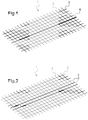
- FIGS 1 and 2 represent two embodiments of the joint strip of the present application.
- the Figure 1 shows a portion of a joint strip 1 consisting of longitudinal glass fibers 2, parallel to the length of the strip, and transverse glass fibers 3 perpendicular to the length of the strip.
- the joint strip shown in this figure comprises nine longitudinal fibers including a reinforcing fiber 4 thicker than the other eight fibers on either side of this central fiber.
- the joint strip is intended to be folded so that the reinforcing fiber is in the angle formed by two gypsum boards.
- the joint strip shown in Figure 2 is identical to that of the Figure 1 except that it comprises not only one but two adjacent reinforcing fibers 4 having a thickness greater than that of the other longitudinal fibers.
- the joint strip is intended to be folded between the two reinforcing fibers.
Landscapes
- Engineering & Computer Science (AREA)
- Textile Engineering (AREA)
- Architecture (AREA)
- Civil Engineering (AREA)
- Structural Engineering (AREA)
- Inorganic Chemistry (AREA)
- Chemical & Material Sciences (AREA)
- Laminated Bodies (AREA)
- Woven Fabrics (AREA)
- Building Environments (AREA)
- Adhesive Tapes (AREA)
- Knitting Of Fabric (AREA)
- Treatments For Attaching Organic Compounds To Fibrous Goods (AREA)
- Finishing Walls (AREA)
Description
- La présente invention concerne des bandes à joints en fibres de verre, particulièrement appropriées pour le jointement de plaques au niveau des angles.
- Il est connu d'utiliser des grilles de fibres de verre en tant qu'éléments de jointement entre deux plaques de plâtre ou entre une plaque de plâtre et d'autres éléments de construction. Ces grilles de verre sont parfois autoadhésives. Elles sont mises en place et collées à cheval sur la zone de liaison entre deux plaques de plâtre adjacentes, puis sont généralement recouvertes d'enduit.
- Lorsque les plaques de plâtre ou éléments de construction forment l'un par rapport à l'autre un angle significativement inférieur à 180 °, l'application aisée de la bande à joints nécessite le pliage préalable de celle-ci dans le sens de la longueur. L'élasticité des fibres de verre rend toutefois difficile le pliage de la bande selon la ligne médiane. La bande a spontanément tendance à revenir vers sa forme plate initiale. Cette tendance pourrait, certes, être atténuée en utilisant des fibres de verre plus fines, mais seulement au prix d'une diminution des propriétés de résistance mécanique.
- L'idée à la base de la présente invention a été de faciliter le pliage longitudinal d'une bande à joints en le « guidant » grâce à une ou plusieurs fibres de renfort, situées sur la ligne médiane ou à proximité immédiate de celle-ci. Ces fibres de renfort longitudinales confèrent à la bande une bonne rigidité sans excessivement alourdir la structure de la bande. La plus grande rigidité de la fibre médiane ou des quelques fibres médianes pourrait même permettre l'utilisation de fibres de verre plus fines en tant que fils de trame et fils de chaîne périphériques et aboutir globalement à des bandes à joints plus légères.
- La demande de brevet
US 2007/0199271 décrit une bande à joints conçue avec un moyen de traction (pull strip), parallèle au bord longitudinal de la bande et permettant de la retirer aisément de son support en vue du recyclage de ce dernier. - Ce document décrit différents modes de réalisation de ce moyen de traction.
- Dans un premier mode de réalisation, représenté aux
figures 2 , 3, 3A et 3B de D1, le moyen de traction est une bandelette collée sur la grille de fibres. La présente invention se distingue de ce mode de réalisation par le fait que la fibre de renfort est une des fibres longitudinales du tissé ou tricot. - Dans un deuxième mode de réalisation, représenté aux figures 6 et 6A et décrit au paragraphe [0043], le moyen de traction peut être formé par les fibres longitudinales elles-mêmes. Il est indiqué que les fibres longitudinales (630) peuvent avoir une résistance à la traction supérieure (Figure 6) ou égale (Figure 6A) à celle des fibres transversales (625).
- Cette bande à joints n'est toutefois pas particulièrement appropriée pour être collée dans les angles. En effet, dans le premier mode de réalisation, le moyen de traction crée une zone de rigidité accrue difficile voire impossible à plier. Dans le deuxième mode de réalisation, toutes les fibres ont la même épaisseur et ne permettent pas un guidage efficace du ruban au niveau de l'angle.
- Il persiste ainsi un besoin d'une bande à joints tout particulièrement appropriée pour être collée dans les angles.
- La présente invention a par conséquent pour objet une bande à joints, en forme de ruban, formée par un tricot chaîne ou un tissé de fibres de verre à mailles ouvertes, ledit tricot ou tissé comportant des fibres parallèles à longueur du ruban (fibres de chaîne) et des fibres perpendiculaires à la longueur du ruban (fibres de trame), ladite bande étant caractérisée par le fait qu'au moins une fibre de verre, appelée fibre de renfort, parallèle à la longueur du ruban et située dans la zone centrale de celui-ci, a une densité linéaire au moins deux fois plus élevée, de préférence de deux à dix fois plus élevée, en particulier de trois à huit fois plus élevée que la densité linéaire des autres fibres de chaîne et de trame.
- La présente invention a plus particulièrement pour objet une bande à joints, en forme de ruban, formée par un tricot chaîne ou un tissé de fibres de verre à mailles ouvertes, ledit tricot chaîne ou tissé étant formé par
- des fibres de verre parallèles à longueur du ruban, appelées fibres longitudinales, et
- des fibres de verre perpendiculaires à la longueur du ruban, appelées fibres transversales,
- Les fibres de verre utilisées dans la présente invention sont formées par des filaments individuels fins, généralement pourvus d'un ensimage, rassemblés en un fils d'épaisseur plus importante.
- Les structures textiles de la présente invention n'englobent ni les non-tissés ni les tricots trame, mais uniquement les grilles, ou tissés, et tricots chaîne, généralement liés par un liant ou enrobage en polymère, empêchant le glissement des fibres de verre les unes par rapport aux autres.
- On peut en principe utiliser n'importe quel type de fibres de verre, par exemple des fibres en verre de type E, C, R ou AR (résistant aux alcalis). L'expression « fibres de verre » utilisée dans la présente invention englobe également les fibres de roche fabriquées à partir de basalte. On préfère en particulier le verre AR ou le verre E à condition qu'il soit enrobé d'un revêtement polymère, par exemple en élastomère EVA ou SBR ou en polymère acrylique, qui le protège contre l'alcalinité du ciment présent dans l'enduit ou le mortier.
- Dans un mode de réalisation préféré de la présente invention, toutes les fibres de verre de la bande sont revêtues d'un élastomère.
- Les bandes à joints de la présente invention contiennent donc au moins deux types de fibres différents :
- la ou les fibres de renfort, et
- les fibres de verre normales, longitudinales ou transversales, plus fines que les fibres de renfort.
- La densité linéaire des fibres de renfort est généralement comprise entre 30 et 300 dtex, de préférence entre 60 et 120 dtex.
- La densité linéaire des autres fibres est au moins deux fois inférieure à celles de la fibre de renfort ou des fibres de renfort. Elle est de préférence comprise entre 20 et 120 dtex, en particulier entre 30 et 70 dtex.
- Les bandes à joints de la présente invention ont généralement une largeur comprise entre 30 mm et 80 mm, de préférence entre 45 et 55 mm. Elles sont produites sous forme de ruban sans fin et conditionnées sous forme enroulée.
- Les fibres de renfort, lorsqu'il y en a plusieurs, se trouvent toutes dans la zone médiane du ruban. Cette zone médiane s'étend sur au plus 10 % de la largeur des bandes à joints de la présente invention.
- Dans un mode de réalisation de la présente invention, la bande à joints comporte une seule fibre de renfort continue, située de préférence sur la ligne médiane de la bande.
- Dans un autre mode de réalisation de la présente invention, la bande à joints comporte deux fibres de renfort, de préférence adjacentes l'une à l'autre. L'adjectif « adjacent » ne signifie pas ici que les deux fibres de renfort sont en contact l'une avec l'autre, mais signifie simplement que les deux fibres de renfort sont voisines, c'est-à-dire ne sont pas séparées par une ou plusieurs fibres plus minces.
- Les fibres de verre normales, plus fines que les fibres de renfort, peuvent avoir toutes la même finesse. Dans un autre mode de réalisation particulier, les fibres transversales sont plus fines que les fibres longitudinales, ce qui facilite le pliage longitudinal des bandes à joints.
- Les bandes à joints de la présente invention ont une structure à mailles ouvertes. Les mailles doivent être suffisamment grandes pour permettre le passage de l'enduit ou du mortier appliqué sur les plaques de plâtres et autres éléments de constructions à joindre. Elles peuvent être de forme carrée, au cas où toutes les fibres de verre sont équidistantes, ou bien avoir une forme rectangulaire, au cas par exemple où les fibres de trame sont plus espacées les unes des autres que les fibres de chaîne.
- Pour s'affranchir de ces considérations de forme, la taille des mailles est exprimée dans la présente invention au moyen du diamètre équivalent, qui est égal au diamètre du cercle de même surface que l'ouverture considérée. Ainsi une maille carrée de X cm de côté (surface X2 cm2) présente un diamètre équivalent égal à 2(X2/π)1/2 cm.
- Le diamètre équivalent moyen des mailles ouvertes des bandes à joints de la présente invention est de préférence compris entre 2 mm et 7 mm, en particulier entre 3 et 6 mm.
- La bande à joints comporte de préférence, sur une de ses faces, un revêtement autoadhésif, généralement un revêtement de type adhésif sensible à la pression (PSA).
- Pour une pose facile de la bande, celle-ci doit avoir une pégosité (tack) initiale suffisante pour adhérer par simple contact/pression sur un mur propre et sec et pour ne pas se décoller sous l'effet de son propre poids. De manière connue, cette pégosité ne doit toutefois pas excéder une certaine valeur pour que la bande reste facilement pelable et repositionnable.
- L'ajustement de cette force d'adhésion fait partie des connaissances générales de l'homme du métier qui saura choisir la nature et les concentrations des différents ingrédients de l'adhésif sensible à la pression (tels que les polymères, l'agent tackifiant, charges etc.) ou encore la géométrie ou l'épaisseur de la couche de PSA.
- Les adhésifs sensibles à la pression utilisables dans la présente invention sont connus. Ils peuvent être déposés sous forme d'une composition liquide à base de solvant organique ou d'eau (latex) ou bien ils peuvent être des polymères thermofusibles, c'est-à-dire des polymères de faible masse moléculaire qui, à l'état fondu, ont une viscosité suffisamment basse pour s'étaler de manière approprié.
- Les PSA sont généralement à base d'une résine élastomère qui peut contenir un agent augmentant la pégosité (agent tackifiant).
- La résine polymère est classiquement choisie parmi les résines acryliques, le caoutchouc butyle, les copolymères d'éthylène/acétate de vinyle (EVA), le caoutchouc naturel, les éthers vinyliques, et les copolymères séquencés à base de styrène tels que les copolymères styrène-butadiène-styrène (SBS), styrène-éthylène/butylène-styrène (SEBS), styrène-éthylène/propylène (SEP), styrène-isoprène-styrène (SIS).
- L'EVA et les copolymères séquencés à base de styrène présentent l'avantage d'être des élastomères thermofusibles et peuvent donc être appliqués sous forme de composition exempte de solvant.
- Comme expliqué en introduction, les bandes en fibres de verre de la présente invention sont utilisées pour joindre entre elles des plaques de plâtre ou pour joindre des plaques de plâtre à d'autres éléments de construction, en particulier au niveau des angles.
- La présente invention a par conséquent en outre pour objet un procédé de jointement de deux éléments de construction plats formant, l'un par rapport à l'autre, un angle inférieur à 180 °, ledit procédé comprenant l'application d'une bande à joints telle que décrite ci-avant, à cheval sur les deux éléments de construction de manière à ce que la fibre de renfort soit superposée à la ligne de jonction entre les deux éléments de construction.
- L'un des deux éléments de construction est de préférence une plaque de plâtre. De manière particulièrement préférée, les deux éléments de construction sont des plaques de plâtre. L'angle que forment les deux éléments de construction est de préférence un angle compris entre 60 et 120 °, en particulier un angle proche de 90 °.
- Après application de la bande à joints, les éléments de construction, y compris la zone de jonction, sont généralement couverts d'un revêtement d'enduit uniforme.
- Les
Figures 1 et 2 représentent deux modes de réalisation de la bande à joints de la présente demande. - Plus particulièrement, la
Figure 1 montre un partie d'une bande à joints 1 constituée de fibres de verre longitudinales 2, parallèles à la longueur de la bande, et de fibres de verre transversales 3 perpendiculaires à la longueur de la bande. La bande à joints représentée sur cette figure comporte neuf fibres longitudinales dont une fibre de renfort 4 plus épaisse que les huit autres fibres de part et d'autre de cette fibre centrale. Dans ce mode de réalisation, la bande à joints est destinée à être pliée de manière à ce que la fibre de renfort se trouve dans l'angle formé par deux plaques de plâtre. - La bande à joints représentée à la
Figure 2 est identique à celle de laFigure 1 à ceci près qu'elle comporte non pas une seule mais deux fibres de renfort 4 voisines ayant une épaisseur supérieure à celle des autres fibres longitudinales. Dans ce mode de réalisation, la bande à joints est destinée à être pliée entre les deux fibres de renfort.
Claims (9)
- Bande à joints, en forme de ruban, formée par un tricot chaîne ou un tissé de fibres de verre à mailles ouvertes, ledit tricot chaîne ou tissé étant formé par- des fibres de verre parallèles à longueur du ruban, appelées fibres longitudinales, et- des fibres de verre perpendiculaires à la longueur du ruban, appelées fibres transversales,ladite bande étant caractérisée par le fait qu'au moins une des fibres longitudinales, appelée fibre de renfort, située dans la zone centrale du ruban, a une densité linéaire au moins deux fois plus élevée, que la densité linéaire des autres fibres longitudinales, et par le fait qu'elle comporte une seule fibre de renfort ou deux fibres de renforts.
- Bande à joints selon la revendication 1, caractérisée par le fait que lorsque la bande comporte deux fibres de renfort, elles sont adjacentes l'une à l'autre.
- Bande à joints selon l'une quelconque des revendications précédentes, caractérisée par le fait qu'elle a une largeur comprise entre 30 mm et 80 mm, de préférence entre 45 et 55 mm.
- Bande à joints selon l'une quelconque des revendications précédentes, caractérisée par le fait que la ou les fibres de renfort ont une densité linéaire comprise entre 30 et 300 dtex, de préférence entre 60 et 120 dtex.
- Bande à joints selon l'une quelconque des revendications précédentes, caractérisée par le fait que les autres fibres de verre ont une densité linéaire comprise entre 20 et 120 dtex, de préférence entre 30 et 70 dtex.
- Bande à joints selon l'une quelconque des revendications précédentes, caractérisée par le fait que les mailles ouvertes ont un diamètre équivalent compris entre 2 mm et 7 mm, de préférence entre 3 et 6 mm.
- Bande à joints selon l'une quelconque des revendications précédentes, caractérisée par le fait qu'elle comporte, sur une de ses faces, un revêtement autoadhésif, de préférence un revêtement de type adhésif sensible à la pression (PSA).
- Bande à joints selon l'une quelconque des revendications précédentes, caractérisée par le fait que toutes les fibres de verre sont enrobées d'un revêtement élastomère.
- Procédé de jointement de deux éléments de construction plats formant, l'un par rapport à l'autre, un angle inférieur à 180 °, ledit procédé comprenant l'application d'une bande à joints selon l'une quelconque des revendications précédentes, à cheval sur les deux éléments de construction de manière à ce que la fibre de renfort soit superposée à la ligne de jonction entre les deux éléments de construction.
Applications Claiming Priority (2)
| Application Number | Priority Date | Filing Date | Title |
|---|---|---|---|
| FR1256875A FR2993592B1 (fr) | 2012-07-17 | 2012-07-17 | Bande a joints en fibres de verre |
| PCT/FR2013/051706 WO2014013185A1 (fr) | 2012-07-17 | 2013-07-16 | Bande a joints en fibres de verre |
Publications (2)
| Publication Number | Publication Date |
|---|---|
| EP2877647A1 EP2877647A1 (fr) | 2015-06-03 |
| EP2877647B1 true EP2877647B1 (fr) | 2019-01-23 |
Family
ID=46826828
Family Applications (1)
| Application Number | Title | Priority Date | Filing Date |
|---|---|---|---|
| EP13744755.3A Not-in-force EP2877647B1 (fr) | 2012-07-17 | 2013-07-16 | Bande a joints en fibres de verre et procédé de jointement |
Country Status (6)
| Country | Link |
|---|---|
| US (1) | US20150204077A1 (fr) |
| EP (1) | EP2877647B1 (fr) |
| JP (1) | JP6306582B2 (fr) |
| CN (1) | CN104641057B (fr) |
| FR (1) | FR2993592B1 (fr) |
| WO (1) | WO2014013185A1 (fr) |
Families Citing this family (5)
| Publication number | Priority date | Publication date | Assignee | Title |
|---|---|---|---|---|
| US10563408B2 (en) * | 2013-10-02 | 2020-02-18 | United States Gypsum Company | Drywall joint tape and method |
| CN106757674A (zh) * | 2016-12-30 | 2017-05-31 | 山东天舜环保科技有限公司 | 玻璃纤维起圈布 |
| JP7445671B2 (ja) * | 2019-02-19 | 2024-03-07 | クナウフ ギプス コマンディトゲゼルシャフト | 接合テープ |
| WO2021133912A1 (fr) * | 2019-12-27 | 2021-07-01 | Certain Teed Gypsum, Inc. | Structures d'angle |
| US20230366133A1 (en) * | 2020-09-29 | 2023-11-16 | Php Fibers Gmbh | Adhesive ribbon yarn |
Citations (2)
| Publication number | Priority date | Publication date | Assignee | Title |
|---|---|---|---|---|
| US1467127A (en) * | 1921-08-20 | 1923-09-04 | Frank A Maslen | Building structure |
| EP2395139A1 (fr) * | 2009-02-06 | 2011-12-14 | Finetrack | Ruban de renforcement, tissu produit par couture dudit ruban de renforcement, et structure de bande utilisant ledit ruban de renforcement |
Family Cites Families (12)
| Publication number | Priority date | Publication date | Assignee | Title |
|---|---|---|---|---|
| GB1361669A (en) * | 1972-09-06 | 1974-07-30 | Bennett J | Reinforcing tapes |
| US6226946B1 (en) * | 1994-08-26 | 2001-05-08 | E-Z Taping System, Inc. | Self-adhesive drywall tape for fire wall |
| DE19729905A1 (de) * | 1997-07-12 | 1999-01-14 | Beiersdorf Ag | Trägermaterial für medizinische Zwecke |
| JP2002302846A (ja) * | 2001-04-10 | 2002-10-18 | Nippon Electric Glass Co Ltd | 粘着ガラステープ |
| CH696347A5 (de) * | 2003-05-23 | 2007-05-15 | Sia Abrasives Ind Ag | Verfahren zum Kalibrieren und/oder Verzwirnen von mit Kunststoff beschichteten Fasern. |
| JP4027291B2 (ja) * | 2003-09-22 | 2007-12-26 | 株式会社ツヅキ | 化粧パネル材の取付金物及び化粧パネル材の取付金物製造方法 |
| JP4000319B2 (ja) * | 2004-05-17 | 2007-10-31 | 嘉郎 大橋 | 目地処理方法および目地処理テープ |
| US7799708B2 (en) * | 2006-02-10 | 2010-09-21 | Cerex Advanced Fabrics, Inc. | Coated fabrics with increased abrasion resistance |
| US20070199271A1 (en) * | 2006-02-27 | 2007-08-30 | Little W Frank | Tape |
| CN101216488A (zh) * | 2008-01-10 | 2008-07-09 | 中国农业科学院哈尔滨兽医研究所 | 检测猪繁殖与呼吸综合症抗体的试纸条及其制备方法 |
| JP5302822B2 (ja) * | 2009-08-18 | 2013-10-02 | 吉野石膏株式会社 | 壁体及びその製造方法 |
| JP2011002858A (ja) * | 2010-10-01 | 2011-01-06 | Sumitomo Electric Ind Ltd | 一括融着接続方法 |
-
2012
- 2012-07-17 FR FR1256875A patent/FR2993592B1/fr not_active Expired - Fee Related
-
2013
- 2013-07-16 US US14/415,036 patent/US20150204077A1/en not_active Abandoned
- 2013-07-16 JP JP2015522152A patent/JP6306582B2/ja not_active Expired - Fee Related
- 2013-07-16 WO PCT/FR2013/051706 patent/WO2014013185A1/fr not_active Ceased
- 2013-07-16 CN CN201380038128.0A patent/CN104641057B/zh not_active Expired - Fee Related
- 2013-07-16 EP EP13744755.3A patent/EP2877647B1/fr not_active Not-in-force
Patent Citations (2)
| Publication number | Priority date | Publication date | Assignee | Title |
|---|---|---|---|---|
| US1467127A (en) * | 1921-08-20 | 1923-09-04 | Frank A Maslen | Building structure |
| EP2395139A1 (fr) * | 2009-02-06 | 2011-12-14 | Finetrack | Ruban de renforcement, tissu produit par couture dudit ruban de renforcement, et structure de bande utilisant ledit ruban de renforcement |
Also Published As
| Publication number | Publication date |
|---|---|
| WO2014013185A1 (fr) | 2014-01-23 |
| US20150204077A1 (en) | 2015-07-23 |
| FR2993592B1 (fr) | 2015-02-27 |
| JP6306582B2 (ja) | 2018-04-04 |
| EP2877647A1 (fr) | 2015-06-03 |
| JP2015531007A (ja) | 2015-10-29 |
| CN104641057A (zh) | 2015-05-20 |
| CN104641057B (zh) | 2018-08-17 |
| FR2993592A1 (fr) | 2014-01-24 |
Similar Documents
| Publication | Publication Date | Title |
|---|---|---|
| EP2877647A1 (fr) | Bande a joints en fibres de verre | |
| EP2855762B1 (fr) | Toile de verre autoadhesive et activable par l'eau | |
| US20190002737A1 (en) | Film backings for peel release mounting | |
| MXPA06014971A (es) | Laminado no tejido-elastomerico con mejor union entre elastomero y hoja no tejida. | |
| FR2751338A1 (fr) | Adhesif double face demontable | |
| EP3433215B1 (fr) | Procede de fabrication de matelas de laine minerale autoadhesifs | |
| WO2007089795A1 (fr) | Structure de support d'article et équipement de fixation d'article | |
| CN107920715A (zh) | 粘合清洁器 | |
| CN102471647A (zh) | 粘接胶带卷 | |
| FR2914548A1 (fr) | Bande auto-adhesive double face pour la jonction murale etanche des bordures d'appareils sanitaires | |
| US8268442B2 (en) | Adhesive tape and its use | |
| EP3258023B1 (fr) | Membrane adhésive barrière contre l'air et l'humidité et perméable à la vapeur d'eau | |
| US20190359861A1 (en) | Film backings for stretch release mounting | |
| JP2014508825A (ja) | 特に輸送中の固定のために使用できる粘着テープ | |
| CA2581395C (fr) | Membrane d'etancheite bitumineuse resistante aux u.v., systeme integrant une telle membrane et procede de fabrication | |
| KR102033651B1 (ko) | 다층 접착 결합 요소 | |
| EP0400711B1 (fr) | Membrane d'étanchéité bitumineuse | |
| CN108138015B (zh) | 超小型固定用带和包括其的物品 | |
| EP1130190A1 (fr) | Substrat pour la réalisation de l'isolation acoustique d'une dalle flottante | |
| EP1809831B1 (fr) | Panneau muni d`une toile metallique | |
| FR3053976B1 (fr) | Element adhesif a double encollage | |
| FR3068058B1 (fr) | Dispositif de renovation d'une surface murale par recouvrement | |
| US20070079918A1 (en) | Tear propagation resistant film-backed adhesive tape | |
| DK2898032T3 (en) | Sealing tape | |
| FR2884580A1 (fr) | Dispositif coupe-feu pour la fermeture provisoire d'ouvertures sur des parois et/ou des ponts |
Legal Events
| Date | Code | Title | Description |
|---|---|---|---|
| PUAI | Public reference made under article 153(3) epc to a published international application that has entered the european phase |
Free format text: ORIGINAL CODE: 0009012 |
|
| 17P | Request for examination filed |
Effective date: 20150217 |
|
| AK | Designated contracting states |
Kind code of ref document: A1 Designated state(s): AL AT BE BG CH CY CZ DE DK EE ES FI FR GB GR HR HU IE IS IT LI LT LU LV MC MK MT NL NO PL PT RO RS SE SI SK SM TR |
|
| AX | Request for extension of the european patent |
Extension state: BA ME |
|
| DAX | Request for extension of the european patent (deleted) | ||
| STAA | Information on the status of an ep patent application or granted ep patent |
Free format text: STATUS: EXAMINATION IS IN PROGRESS |
|
| 17Q | First examination report despatched |
Effective date: 20180312 |
|
| REG | Reference to a national code |
Ref country code: DE Ref legal event code: R079 Ref document number: 602013050210 Country of ref document: DE Free format text: PREVIOUS MAIN CLASS: E04F0013040000 Ipc: D04B0021100000 |
|
| GRAP | Despatch of communication of intention to grant a patent |
Free format text: ORIGINAL CODE: EPIDOSNIGR1 |
|
| STAA | Information on the status of an ep patent application or granted ep patent |
Free format text: STATUS: GRANT OF PATENT IS INTENDED |
|
| RIC1 | Information provided on ipc code assigned before grant |
Ipc: D03D 9/00 20060101ALI20180828BHEP Ipc: D03D 3/00 20060101ALI20180828BHEP Ipc: D03D 15/00 20060101ALI20180828BHEP Ipc: D04B 21/10 20060101AFI20180828BHEP Ipc: E04F 13/04 20060101ALI20180828BHEP Ipc: D03D 1/00 20060101ALI20180828BHEP |
|
| INTG | Intention to grant announced |
Effective date: 20180914 |
|
| RIN1 | Information on inventor provided before grant (corrected) |
Inventor name: MIKULECKY, BOHUSLAV Inventor name: MRAZ, JAN |
|
| GRAS | Grant fee paid |
Free format text: ORIGINAL CODE: EPIDOSNIGR3 |
|
| GRAA | (expected) grant |
Free format text: ORIGINAL CODE: 0009210 |
|
| STAA | Information on the status of an ep patent application or granted ep patent |
Free format text: STATUS: THE PATENT HAS BEEN GRANTED |
|
| AK | Designated contracting states |
Kind code of ref document: B1 Designated state(s): AL AT BE BG CH CY CZ DE DK EE ES FI FR GB GR HR HU IE IS IT LI LT LU LV MC MK MT NL NO PL PT RO RS SE SI SK SM TR |
|
| REG | Reference to a national code |
Ref country code: GB Ref legal event code: FG4D Free format text: NOT ENGLISH |
|
| REG | Reference to a national code |
Ref country code: CH Ref legal event code: EP |
|
| REG | Reference to a national code |
Ref country code: AT Ref legal event code: REF Ref document number: 1091537 Country of ref document: AT Kind code of ref document: T Effective date: 20190215 |
|
| REG | Reference to a national code |
Ref country code: IE Ref legal event code: FG4D Free format text: LANGUAGE OF EP DOCUMENT: FRENCH |
|
| REG | Reference to a national code |
Ref country code: DE Ref legal event code: R096 Ref document number: 602013050210 Country of ref document: DE |
|
| REG | Reference to a national code |
Ref country code: NL Ref legal event code: FP |
|
| PG25 | Lapsed in a contracting state [announced via postgrant information from national office to epo] |
Ref country code: PT Free format text: LAPSE BECAUSE OF FAILURE TO SUBMIT A TRANSLATION OF THE DESCRIPTION OR TO PAY THE FEE WITHIN THE PRESCRIBED TIME-LIMIT Effective date: 20190523 Ref country code: SE Free format text: LAPSE BECAUSE OF FAILURE TO SUBMIT A TRANSLATION OF THE DESCRIPTION OR TO PAY THE FEE WITHIN THE PRESCRIBED TIME-LIMIT Effective date: 20190123 Ref country code: FI Free format text: LAPSE BECAUSE OF FAILURE TO SUBMIT A TRANSLATION OF THE DESCRIPTION OR TO PAY THE FEE WITHIN THE PRESCRIBED TIME-LIMIT Effective date: 20190123 Ref country code: NO Free format text: LAPSE BECAUSE OF FAILURE TO SUBMIT A TRANSLATION OF THE DESCRIPTION OR TO PAY THE FEE WITHIN THE PRESCRIBED TIME-LIMIT Effective date: 20190423 Ref country code: ES Free format text: LAPSE BECAUSE OF FAILURE TO SUBMIT A TRANSLATION OF THE DESCRIPTION OR TO PAY THE FEE WITHIN THE PRESCRIBED TIME-LIMIT Effective date: 20190123 Ref country code: LT Free format text: LAPSE BECAUSE OF FAILURE TO SUBMIT A TRANSLATION OF THE DESCRIPTION OR TO PAY THE FEE WITHIN THE PRESCRIBED TIME-LIMIT Effective date: 20190123 Ref country code: PL Free format text: LAPSE BECAUSE OF FAILURE TO SUBMIT A TRANSLATION OF THE DESCRIPTION OR TO PAY THE FEE WITHIN THE PRESCRIBED TIME-LIMIT Effective date: 20190123 |
|
| REG | Reference to a national code |
Ref country code: AT Ref legal event code: MK05 Ref document number: 1091537 Country of ref document: AT Kind code of ref document: T Effective date: 20190123 |
|
| PG25 | Lapsed in a contracting state [announced via postgrant information from national office to epo] |
Ref country code: IS Free format text: LAPSE BECAUSE OF FAILURE TO SUBMIT A TRANSLATION OF THE DESCRIPTION OR TO PAY THE FEE WITHIN THE PRESCRIBED TIME-LIMIT Effective date: 20190523 Ref country code: GR Free format text: LAPSE BECAUSE OF FAILURE TO SUBMIT A TRANSLATION OF THE DESCRIPTION OR TO PAY THE FEE WITHIN THE PRESCRIBED TIME-LIMIT Effective date: 20190424 Ref country code: RS Free format text: LAPSE BECAUSE OF FAILURE TO SUBMIT A TRANSLATION OF THE DESCRIPTION OR TO PAY THE FEE WITHIN THE PRESCRIBED TIME-LIMIT Effective date: 20190123 Ref country code: HR Free format text: LAPSE BECAUSE OF FAILURE TO SUBMIT A TRANSLATION OF THE DESCRIPTION OR TO PAY THE FEE WITHIN THE PRESCRIBED TIME-LIMIT Effective date: 20190123 Ref country code: LV Free format text: LAPSE BECAUSE OF FAILURE TO SUBMIT A TRANSLATION OF THE DESCRIPTION OR TO PAY THE FEE WITHIN THE PRESCRIBED TIME-LIMIT Effective date: 20190123 Ref country code: BG Free format text: LAPSE BECAUSE OF FAILURE TO SUBMIT A TRANSLATION OF THE DESCRIPTION OR TO PAY THE FEE WITHIN THE PRESCRIBED TIME-LIMIT Effective date: 20190423 |
|
| REG | Reference to a national code |
Ref country code: DE Ref legal event code: R097 Ref document number: 602013050210 Country of ref document: DE |
|
| PG25 | Lapsed in a contracting state [announced via postgrant information from national office to epo] |
Ref country code: CZ Free format text: LAPSE BECAUSE OF FAILURE TO SUBMIT A TRANSLATION OF THE DESCRIPTION OR TO PAY THE FEE WITHIN THE PRESCRIBED TIME-LIMIT Effective date: 20190123 Ref country code: RO Free format text: LAPSE BECAUSE OF FAILURE TO SUBMIT A TRANSLATION OF THE DESCRIPTION OR TO PAY THE FEE WITHIN THE PRESCRIBED TIME-LIMIT Effective date: 20190123 Ref country code: EE Free format text: LAPSE BECAUSE OF FAILURE TO SUBMIT A TRANSLATION OF THE DESCRIPTION OR TO PAY THE FEE WITHIN THE PRESCRIBED TIME-LIMIT Effective date: 20190123 Ref country code: DK Free format text: LAPSE BECAUSE OF FAILURE TO SUBMIT A TRANSLATION OF THE DESCRIPTION OR TO PAY THE FEE WITHIN THE PRESCRIBED TIME-LIMIT Effective date: 20190123 Ref country code: SK Free format text: LAPSE BECAUSE OF FAILURE TO SUBMIT A TRANSLATION OF THE DESCRIPTION OR TO PAY THE FEE WITHIN THE PRESCRIBED TIME-LIMIT Effective date: 20190123 Ref country code: AL Free format text: LAPSE BECAUSE OF FAILURE TO SUBMIT A TRANSLATION OF THE DESCRIPTION OR TO PAY THE FEE WITHIN THE PRESCRIBED TIME-LIMIT Effective date: 20190123 |
|
| PG25 | Lapsed in a contracting state [announced via postgrant information from national office to epo] |
Ref country code: SM Free format text: LAPSE BECAUSE OF FAILURE TO SUBMIT A TRANSLATION OF THE DESCRIPTION OR TO PAY THE FEE WITHIN THE PRESCRIBED TIME-LIMIT Effective date: 20190123 |
|
| PLBE | No opposition filed within time limit |
Free format text: ORIGINAL CODE: 0009261 |
|
| STAA | Information on the status of an ep patent application or granted ep patent |
Free format text: STATUS: NO OPPOSITION FILED WITHIN TIME LIMIT |
|
| PG25 | Lapsed in a contracting state [announced via postgrant information from national office to epo] |
Ref country code: AT Free format text: LAPSE BECAUSE OF FAILURE TO SUBMIT A TRANSLATION OF THE DESCRIPTION OR TO PAY THE FEE WITHIN THE PRESCRIBED TIME-LIMIT Effective date: 20190123 |
|
| 26N | No opposition filed |
Effective date: 20191024 |
|
| PG25 | Lapsed in a contracting state [announced via postgrant information from national office to epo] |
Ref country code: SI Free format text: LAPSE BECAUSE OF FAILURE TO SUBMIT A TRANSLATION OF THE DESCRIPTION OR TO PAY THE FEE WITHIN THE PRESCRIBED TIME-LIMIT Effective date: 20190123 Ref country code: MC Free format text: LAPSE BECAUSE OF FAILURE TO SUBMIT A TRANSLATION OF THE DESCRIPTION OR TO PAY THE FEE WITHIN THE PRESCRIBED TIME-LIMIT Effective date: 20190123 |
|
| REG | Reference to a national code |
Ref country code: CH Ref legal event code: PL |
|
| PG25 | Lapsed in a contracting state [announced via postgrant information from national office to epo] |
Ref country code: TR Free format text: LAPSE BECAUSE OF FAILURE TO SUBMIT A TRANSLATION OF THE DESCRIPTION OR TO PAY THE FEE WITHIN THE PRESCRIBED TIME-LIMIT Effective date: 20190123 |
|
| PG25 | Lapsed in a contracting state [announced via postgrant information from national office to epo] |
Ref country code: LU Free format text: LAPSE BECAUSE OF NON-PAYMENT OF DUE FEES Effective date: 20190716 Ref country code: CH Free format text: LAPSE BECAUSE OF NON-PAYMENT OF DUE FEES Effective date: 20190731 Ref country code: LI Free format text: LAPSE BECAUSE OF NON-PAYMENT OF DUE FEES Effective date: 20190731 |
|
| PG25 | Lapsed in a contracting state [announced via postgrant information from national office to epo] |
Ref country code: IE Free format text: LAPSE BECAUSE OF NON-PAYMENT OF DUE FEES Effective date: 20190716 |
|
| PG25 | Lapsed in a contracting state [announced via postgrant information from national office to epo] |
Ref country code: CY Free format text: LAPSE BECAUSE OF FAILURE TO SUBMIT A TRANSLATION OF THE DESCRIPTION OR TO PAY THE FEE WITHIN THE PRESCRIBED TIME-LIMIT Effective date: 20190123 |
|
| PG25 | Lapsed in a contracting state [announced via postgrant information from national office to epo] |
Ref country code: MT Free format text: LAPSE BECAUSE OF FAILURE TO SUBMIT A TRANSLATION OF THE DESCRIPTION OR TO PAY THE FEE WITHIN THE PRESCRIBED TIME-LIMIT Effective date: 20190123 Ref country code: HU Free format text: LAPSE BECAUSE OF FAILURE TO SUBMIT A TRANSLATION OF THE DESCRIPTION OR TO PAY THE FEE WITHIN THE PRESCRIBED TIME-LIMIT; INVALID AB INITIO Effective date: 20130716 |
|
| PGFP | Annual fee paid to national office [announced via postgrant information from national office to epo] |
Ref country code: IT Payment date: 20210610 Year of fee payment: 9 |
|
| PGFP | Annual fee paid to national office [announced via postgrant information from national office to epo] |
Ref country code: GB Payment date: 20210623 Year of fee payment: 9 Ref country code: BE Payment date: 20210617 Year of fee payment: 9 Ref country code: NL Payment date: 20210716 Year of fee payment: 9 |
|
| PGFP | Annual fee paid to national office [announced via postgrant information from national office to epo] |
Ref country code: FR Payment date: 20210729 Year of fee payment: 9 |
|
| PGFP | Annual fee paid to national office [announced via postgrant information from national office to epo] |
Ref country code: DE Payment date: 20210622 Year of fee payment: 9 |
|
| PG25 | Lapsed in a contracting state [announced via postgrant information from national office to epo] |
Ref country code: MK Free format text: LAPSE BECAUSE OF FAILURE TO SUBMIT A TRANSLATION OF THE DESCRIPTION OR TO PAY THE FEE WITHIN THE PRESCRIBED TIME-LIMIT Effective date: 20190123 |
|
| REG | Reference to a national code |
Ref country code: DE Ref legal event code: R119 Ref document number: 602013050210 Country of ref document: DE |
|
| REG | Reference to a national code |
Ref country code: NL Ref legal event code: MM Effective date: 20220801 |
|
| GBPC | Gb: european patent ceased through non-payment of renewal fee |
Effective date: 20220716 |
|
| REG | Reference to a national code |
Ref country code: BE Ref legal event code: MM Effective date: 20220731 |
|
| PG25 | Lapsed in a contracting state [announced via postgrant information from national office to epo] |
Ref country code: FR Free format text: LAPSE BECAUSE OF NON-PAYMENT OF DUE FEES Effective date: 20220731 |
|
| PG25 | Lapsed in a contracting state [announced via postgrant information from national office to epo] |
Ref country code: GB Free format text: LAPSE BECAUSE OF NON-PAYMENT OF DUE FEES Effective date: 20220716 Ref country code: DE Free format text: LAPSE BECAUSE OF NON-PAYMENT OF DUE FEES Effective date: 20230201 Ref country code: BE Free format text: LAPSE BECAUSE OF NON-PAYMENT OF DUE FEES Effective date: 20220731 |
|
| PG25 | Lapsed in a contracting state [announced via postgrant information from national office to epo] |
Ref country code: NL Free format text: LAPSE BECAUSE OF NON-PAYMENT OF DUE FEES Effective date: 20220801 |
|
| PG25 | Lapsed in a contracting state [announced via postgrant information from national office to epo] |
Ref country code: IT Free format text: LAPSE BECAUSE OF NON-PAYMENT OF DUE FEES Effective date: 20220716 |