EP2875001B1 - Nitrogenous heterocyclic derivatives and their application in drugs - Google Patents
Nitrogenous heterocyclic derivatives and their application in drugs Download PDFInfo
- Publication number
- EP2875001B1 EP2875001B1 EP13819193.7A EP13819193A EP2875001B1 EP 2875001 B1 EP2875001 B1 EP 2875001B1 EP 13819193 A EP13819193 A EP 13819193A EP 2875001 B1 EP2875001 B1 EP 2875001B1
- Authority
- EP
- European Patent Office
- Prior art keywords
- mmol
- mixture
- alkyl
- stirred
- concentrated
- Prior art date
- Legal status (The legal status is an assumption and is not a legal conclusion. Google has not performed a legal analysis and makes no representation as to the accuracy of the status listed.)
- Active
Links
- 0 CC(*1c2ccc(CCCC=C=*3CCOCC3)c(*)c2)=*C(C)=CC1=O Chemical compound CC(*1c2ccc(CCCC=C=*3CCOCC3)c(*)c2)=*C(C)=CC1=O 0.000 description 9
- AOTXVULEJLDALM-UHFFFAOYSA-N CC(N=C1COc(cc2)cc(F)c2F)=CCN1c(cc1)cc(F)c1NCCO Chemical compound CC(N=C1COc(cc2)cc(F)c2F)=CCN1c(cc1)cc(F)c1NCCO AOTXVULEJLDALM-UHFFFAOYSA-N 0.000 description 1
Classifications
-
- A—HUMAN NECESSITIES
- A61—MEDICAL OR VETERINARY SCIENCE; HYGIENE
- A61K—PREPARATIONS FOR MEDICAL, DENTAL OR TOILETRY PURPOSES
- A61K31/00—Medicinal preparations containing organic active ingredients
- A61K31/33—Heterocyclic compounds
- A61K31/395—Heterocyclic compounds having nitrogen as a ring hetero atom, e.g. guanethidine or rifamycins
- A61K31/435—Heterocyclic compounds having nitrogen as a ring hetero atom, e.g. guanethidine or rifamycins having six-membered rings with one nitrogen as the only ring hetero atom
- A61K31/44—Non condensed pyridines; Hydrogenated derivatives thereof
- A61K31/4412—Non condensed pyridines; Hydrogenated derivatives thereof having oxo groups directly attached to the heterocyclic ring
-
- A—HUMAN NECESSITIES
- A61—MEDICAL OR VETERINARY SCIENCE; HYGIENE
- A61K—PREPARATIONS FOR MEDICAL, DENTAL OR TOILETRY PURPOSES
- A61K31/00—Medicinal preparations containing organic active ingredients
- A61K31/33—Heterocyclic compounds
- A61K31/395—Heterocyclic compounds having nitrogen as a ring hetero atom, e.g. guanethidine or rifamycins
- A61K31/495—Heterocyclic compounds having nitrogen as a ring hetero atom, e.g. guanethidine or rifamycins having six-membered rings with two or more nitrogen atoms as the only ring heteroatoms, e.g. piperazine or tetrazines
- A61K31/496—Non-condensed piperazines containing further heterocyclic rings, e.g. rifampin, thiothixene or sparfloxacin
-
- A—HUMAN NECESSITIES
- A61—MEDICAL OR VETERINARY SCIENCE; HYGIENE
- A61K—PREPARATIONS FOR MEDICAL, DENTAL OR TOILETRY PURPOSES
- A61K31/00—Medicinal preparations containing organic active ingredients
- A61K31/33—Heterocyclic compounds
- A61K31/395—Heterocyclic compounds having nitrogen as a ring hetero atom, e.g. guanethidine or rifamycins
- A61K31/495—Heterocyclic compounds having nitrogen as a ring hetero atom, e.g. guanethidine or rifamycins having six-membered rings with two or more nitrogen atoms as the only ring heteroatoms, e.g. piperazine or tetrazines
- A61K31/505—Pyrimidines; Hydrogenated pyrimidines, e.g. trimethoprim
- A61K31/513—Pyrimidines; Hydrogenated pyrimidines, e.g. trimethoprim having oxo groups directly attached to the heterocyclic ring, e.g. cytosine
-
- A—HUMAN NECESSITIES
- A61—MEDICAL OR VETERINARY SCIENCE; HYGIENE
- A61K—PREPARATIONS FOR MEDICAL, DENTAL OR TOILETRY PURPOSES
- A61K31/00—Medicinal preparations containing organic active ingredients
- A61K31/33—Heterocyclic compounds
- A61K31/395—Heterocyclic compounds having nitrogen as a ring hetero atom, e.g. guanethidine or rifamycins
- A61K31/535—Heterocyclic compounds having nitrogen as a ring hetero atom, e.g. guanethidine or rifamycins having six-membered rings with at least one nitrogen and one oxygen as the ring hetero atoms, e.g. 1,2-oxazines
- A61K31/5375—1,4-Oxazines, e.g. morpholine
- A61K31/5377—1,4-Oxazines, e.g. morpholine not condensed and containing further heterocyclic rings, e.g. timolol
-
- A—HUMAN NECESSITIES
- A61—MEDICAL OR VETERINARY SCIENCE; HYGIENE
- A61K—PREPARATIONS FOR MEDICAL, DENTAL OR TOILETRY PURPOSES
- A61K31/00—Medicinal preparations containing organic active ingredients
- A61K31/33—Heterocyclic compounds
- A61K31/395—Heterocyclic compounds having nitrogen as a ring hetero atom, e.g. guanethidine or rifamycins
- A61K31/54—Heterocyclic compounds having nitrogen as a ring hetero atom, e.g. guanethidine or rifamycins having six-membered rings with at least one nitrogen and one sulfur as the ring hetero atoms, e.g. sulthiame
- A61K31/541—Non-condensed thiazines containing further heterocyclic rings
-
- A—HUMAN NECESSITIES
- A61—MEDICAL OR VETERINARY SCIENCE; HYGIENE
- A61P—SPECIFIC THERAPEUTIC ACTIVITY OF CHEMICAL COMPOUNDS OR MEDICINAL PREPARATIONS
- A61P1/00—Drugs for disorders of the alimentary tract or the digestive system
- A61P1/16—Drugs for disorders of the alimentary tract or the digestive system for liver or gallbladder disorders, e.g. hepatoprotective agents, cholagogues, litholytics
-
- A—HUMAN NECESSITIES
- A61—MEDICAL OR VETERINARY SCIENCE; HYGIENE
- A61P—SPECIFIC THERAPEUTIC ACTIVITY OF CHEMICAL COMPOUNDS OR MEDICINAL PREPARATIONS
- A61P1/00—Drugs for disorders of the alimentary tract or the digestive system
- A61P1/18—Drugs for disorders of the alimentary tract or the digestive system for pancreatic disorders, e.g. pancreatic enzymes
-
- A—HUMAN NECESSITIES
- A61—MEDICAL OR VETERINARY SCIENCE; HYGIENE
- A61P—SPECIFIC THERAPEUTIC ACTIVITY OF CHEMICAL COMPOUNDS OR MEDICINAL PREPARATIONS
- A61P11/00—Drugs for disorders of the respiratory system
-
- A—HUMAN NECESSITIES
- A61—MEDICAL OR VETERINARY SCIENCE; HYGIENE
- A61P—SPECIFIC THERAPEUTIC ACTIVITY OF CHEMICAL COMPOUNDS OR MEDICINAL PREPARATIONS
- A61P13/00—Drugs for disorders of the urinary system
- A61P13/08—Drugs for disorders of the urinary system of the prostate
-
- A—HUMAN NECESSITIES
- A61—MEDICAL OR VETERINARY SCIENCE; HYGIENE
- A61P—SPECIFIC THERAPEUTIC ACTIVITY OF CHEMICAL COMPOUNDS OR MEDICINAL PREPARATIONS
- A61P13/00—Drugs for disorders of the urinary system
- A61P13/12—Drugs for disorders of the urinary system of the kidneys
-
- A—HUMAN NECESSITIES
- A61—MEDICAL OR VETERINARY SCIENCE; HYGIENE
- A61P—SPECIFIC THERAPEUTIC ACTIVITY OF CHEMICAL COMPOUNDS OR MEDICINAL PREPARATIONS
- A61P17/00—Drugs for dermatological disorders
-
- A—HUMAN NECESSITIES
- A61—MEDICAL OR VETERINARY SCIENCE; HYGIENE
- A61P—SPECIFIC THERAPEUTIC ACTIVITY OF CHEMICAL COMPOUNDS OR MEDICINAL PREPARATIONS
- A61P17/00—Drugs for dermatological disorders
- A61P17/02—Drugs for dermatological disorders for treating wounds, ulcers, burns, scars, keloids, or the like
-
- A—HUMAN NECESSITIES
- A61—MEDICAL OR VETERINARY SCIENCE; HYGIENE
- A61P—SPECIFIC THERAPEUTIC ACTIVITY OF CHEMICAL COMPOUNDS OR MEDICINAL PREPARATIONS
- A61P21/00—Drugs for disorders of the muscular or neuromuscular system
-
- A—HUMAN NECESSITIES
- A61—MEDICAL OR VETERINARY SCIENCE; HYGIENE
- A61P—SPECIFIC THERAPEUTIC ACTIVITY OF CHEMICAL COMPOUNDS OR MEDICINAL PREPARATIONS
- A61P25/00—Drugs for disorders of the nervous system
-
- A—HUMAN NECESSITIES
- A61—MEDICAL OR VETERINARY SCIENCE; HYGIENE
- A61P—SPECIFIC THERAPEUTIC ACTIVITY OF CHEMICAL COMPOUNDS OR MEDICINAL PREPARATIONS
- A61P25/00—Drugs for disorders of the nervous system
- A61P25/28—Drugs for disorders of the nervous system for treating neurodegenerative disorders of the central nervous system, e.g. nootropic agents, cognition enhancers, drugs for treating Alzheimer's disease or other forms of dementia
-
- A—HUMAN NECESSITIES
- A61—MEDICAL OR VETERINARY SCIENCE; HYGIENE
- A61P—SPECIFIC THERAPEUTIC ACTIVITY OF CHEMICAL COMPOUNDS OR MEDICINAL PREPARATIONS
- A61P35/00—Antineoplastic agents
-
- A—HUMAN NECESSITIES
- A61—MEDICAL OR VETERINARY SCIENCE; HYGIENE
- A61P—SPECIFIC THERAPEUTIC ACTIVITY OF CHEMICAL COMPOUNDS OR MEDICINAL PREPARATIONS
- A61P41/00—Drugs used in surgical methods, e.g. surgery adjuvants for preventing adhesion or for vitreum substitution
-
- A—HUMAN NECESSITIES
- A61—MEDICAL OR VETERINARY SCIENCE; HYGIENE
- A61P—SPECIFIC THERAPEUTIC ACTIVITY OF CHEMICAL COMPOUNDS OR MEDICINAL PREPARATIONS
- A61P43/00—Drugs for specific purposes, not provided for in groups A61P1/00-A61P41/00
-
- A—HUMAN NECESSITIES
- A61—MEDICAL OR VETERINARY SCIENCE; HYGIENE
- A61P—SPECIFIC THERAPEUTIC ACTIVITY OF CHEMICAL COMPOUNDS OR MEDICINAL PREPARATIONS
- A61P9/00—Drugs for disorders of the cardiovascular system
-
- C—CHEMISTRY; METALLURGY
- C07—ORGANIC CHEMISTRY
- C07D—HETEROCYCLIC COMPOUNDS
- C07D213/00—Heterocyclic compounds containing six-membered rings, not condensed with other rings, with one nitrogen atom as the only ring hetero atom and three or more double bonds between ring members or between ring members and non-ring members
- C07D213/02—Heterocyclic compounds containing six-membered rings, not condensed with other rings, with one nitrogen atom as the only ring hetero atom and three or more double bonds between ring members or between ring members and non-ring members having three double bonds between ring members or between ring members and non-ring members
- C07D213/04—Heterocyclic compounds containing six-membered rings, not condensed with other rings, with one nitrogen atom as the only ring hetero atom and three or more double bonds between ring members or between ring members and non-ring members having three double bonds between ring members or between ring members and non-ring members having no bond between the ring nitrogen atom and a non-ring member or having only hydrogen or carbon atoms directly attached to the ring nitrogen atom
- C07D213/60—Heterocyclic compounds containing six-membered rings, not condensed with other rings, with one nitrogen atom as the only ring hetero atom and three or more double bonds between ring members or between ring members and non-ring members having three double bonds between ring members or between ring members and non-ring members having no bond between the ring nitrogen atom and a non-ring member or having only hydrogen or carbon atoms directly attached to the ring nitrogen atom with hetero atoms or with carbon atoms having three bonds to hetero atoms with at the most one bond to halogen, e.g. ester or nitrile radicals, directly attached to ring carbon atoms
- C07D213/62—Oxygen or sulfur atoms
- C07D213/63—One oxygen atom
- C07D213/64—One oxygen atom attached in position 2 or 6
-
- C—CHEMISTRY; METALLURGY
- C07—ORGANIC CHEMISTRY
- C07D—HETEROCYCLIC COMPOUNDS
- C07D239/00—Heterocyclic compounds containing 1,3-diazine or hydrogenated 1,3-diazine rings
- C07D239/02—Heterocyclic compounds containing 1,3-diazine or hydrogenated 1,3-diazine rings not condensed with other rings
- C07D239/24—Heterocyclic compounds containing 1,3-diazine or hydrogenated 1,3-diazine rings not condensed with other rings having three or more double bonds between ring members or between ring members and non-ring members
- C07D239/28—Heterocyclic compounds containing 1,3-diazine or hydrogenated 1,3-diazine rings not condensed with other rings having three or more double bonds between ring members or between ring members and non-ring members with hetero atoms or with carbon atoms having three bonds to hetero atoms with at the most one bond to halogen, directly attached to ring carbon atoms
- C07D239/32—One oxygen, sulfur or nitrogen atom
- C07D239/34—One oxygen atom
- C07D239/36—One oxygen atom as doubly bound oxygen atom or as unsubstituted hydroxy radical
-
- C—CHEMISTRY; METALLURGY
- C07—ORGANIC CHEMISTRY
- C07D—HETEROCYCLIC COMPOUNDS
- C07D239/00—Heterocyclic compounds containing 1,3-diazine or hydrogenated 1,3-diazine rings
- C07D239/02—Heterocyclic compounds containing 1,3-diazine or hydrogenated 1,3-diazine rings not condensed with other rings
- C07D239/24—Heterocyclic compounds containing 1,3-diazine or hydrogenated 1,3-diazine rings not condensed with other rings having three or more double bonds between ring members or between ring members and non-ring members
- C07D239/28—Heterocyclic compounds containing 1,3-diazine or hydrogenated 1,3-diazine rings not condensed with other rings having three or more double bonds between ring members or between ring members and non-ring members with hetero atoms or with carbon atoms having three bonds to hetero atoms with at the most one bond to halogen, directly attached to ring carbon atoms
- C07D239/32—One oxygen, sulfur or nitrogen atom
- C07D239/42—One nitrogen atom
-
- C—CHEMISTRY; METALLURGY
- C07—ORGANIC CHEMISTRY
- C07D—HETEROCYCLIC COMPOUNDS
- C07D401/00—Heterocyclic compounds containing two or more hetero rings, having nitrogen atoms as the only ring hetero atoms, at least one ring being a six-membered ring with only one nitrogen atom
- C07D401/02—Heterocyclic compounds containing two or more hetero rings, having nitrogen atoms as the only ring hetero atoms, at least one ring being a six-membered ring with only one nitrogen atom containing two hetero rings
- C07D401/04—Heterocyclic compounds containing two or more hetero rings, having nitrogen atoms as the only ring hetero atoms, at least one ring being a six-membered ring with only one nitrogen atom containing two hetero rings directly linked by a ring-member-to-ring-member bond
-
- C—CHEMISTRY; METALLURGY
- C07—ORGANIC CHEMISTRY
- C07D—HETEROCYCLIC COMPOUNDS
- C07D401/00—Heterocyclic compounds containing two or more hetero rings, having nitrogen atoms as the only ring hetero atoms, at least one ring being a six-membered ring with only one nitrogen atom
- C07D401/02—Heterocyclic compounds containing two or more hetero rings, having nitrogen atoms as the only ring hetero atoms, at least one ring being a six-membered ring with only one nitrogen atom containing two hetero rings
- C07D401/10—Heterocyclic compounds containing two or more hetero rings, having nitrogen atoms as the only ring hetero atoms, at least one ring being a six-membered ring with only one nitrogen atom containing two hetero rings linked by a carbon chain containing aromatic rings
-
- C—CHEMISTRY; METALLURGY
- C07—ORGANIC CHEMISTRY
- C07D—HETEROCYCLIC COMPOUNDS
- C07D401/00—Heterocyclic compounds containing two or more hetero rings, having nitrogen atoms as the only ring hetero atoms, at least one ring being a six-membered ring with only one nitrogen atom
- C07D401/02—Heterocyclic compounds containing two or more hetero rings, having nitrogen atoms as the only ring hetero atoms, at least one ring being a six-membered ring with only one nitrogen atom containing two hetero rings
- C07D401/12—Heterocyclic compounds containing two or more hetero rings, having nitrogen atoms as the only ring hetero atoms, at least one ring being a six-membered ring with only one nitrogen atom containing two hetero rings linked by a chain containing hetero atoms as chain links
-
- C—CHEMISTRY; METALLURGY
- C07—ORGANIC CHEMISTRY
- C07D—HETEROCYCLIC COMPOUNDS
- C07D401/00—Heterocyclic compounds containing two or more hetero rings, having nitrogen atoms as the only ring hetero atoms, at least one ring being a six-membered ring with only one nitrogen atom
- C07D401/14—Heterocyclic compounds containing two or more hetero rings, having nitrogen atoms as the only ring hetero atoms, at least one ring being a six-membered ring with only one nitrogen atom containing three or more hetero rings
-
- C—CHEMISTRY; METALLURGY
- C07—ORGANIC CHEMISTRY
- C07D—HETEROCYCLIC COMPOUNDS
- C07D403/00—Heterocyclic compounds containing two or more hetero rings, having nitrogen atoms as the only ring hetero atoms, not provided for by group C07D401/00
- C07D403/02—Heterocyclic compounds containing two or more hetero rings, having nitrogen atoms as the only ring hetero atoms, not provided for by group C07D401/00 containing two hetero rings
- C07D403/04—Heterocyclic compounds containing two or more hetero rings, having nitrogen atoms as the only ring hetero atoms, not provided for by group C07D401/00 containing two hetero rings directly linked by a ring-member-to-ring-member bond
-
- C—CHEMISTRY; METALLURGY
- C07—ORGANIC CHEMISTRY
- C07D—HETEROCYCLIC COMPOUNDS
- C07D403/00—Heterocyclic compounds containing two or more hetero rings, having nitrogen atoms as the only ring hetero atoms, not provided for by group C07D401/00
- C07D403/02—Heterocyclic compounds containing two or more hetero rings, having nitrogen atoms as the only ring hetero atoms, not provided for by group C07D401/00 containing two hetero rings
- C07D403/06—Heterocyclic compounds containing two or more hetero rings, having nitrogen atoms as the only ring hetero atoms, not provided for by group C07D401/00 containing two hetero rings linked by a carbon chain containing only aliphatic carbon atoms
-
- C—CHEMISTRY; METALLURGY
- C07—ORGANIC CHEMISTRY
- C07D—HETEROCYCLIC COMPOUNDS
- C07D403/00—Heterocyclic compounds containing two or more hetero rings, having nitrogen atoms as the only ring hetero atoms, not provided for by group C07D401/00
- C07D403/02—Heterocyclic compounds containing two or more hetero rings, having nitrogen atoms as the only ring hetero atoms, not provided for by group C07D401/00 containing two hetero rings
- C07D403/10—Heterocyclic compounds containing two or more hetero rings, having nitrogen atoms as the only ring hetero atoms, not provided for by group C07D401/00 containing two hetero rings linked by a carbon chain containing aromatic rings
-
- C—CHEMISTRY; METALLURGY
- C07—ORGANIC CHEMISTRY
- C07D—HETEROCYCLIC COMPOUNDS
- C07D403/00—Heterocyclic compounds containing two or more hetero rings, having nitrogen atoms as the only ring hetero atoms, not provided for by group C07D401/00
- C07D403/02—Heterocyclic compounds containing two or more hetero rings, having nitrogen atoms as the only ring hetero atoms, not provided for by group C07D401/00 containing two hetero rings
- C07D403/12—Heterocyclic compounds containing two or more hetero rings, having nitrogen atoms as the only ring hetero atoms, not provided for by group C07D401/00 containing two hetero rings linked by a chain containing hetero atoms as chain links
-
- C—CHEMISTRY; METALLURGY
- C07—ORGANIC CHEMISTRY
- C07D—HETEROCYCLIC COMPOUNDS
- C07D405/00—Heterocyclic compounds containing both one or more hetero rings having oxygen atoms as the only ring hetero atoms, and one or more rings having nitrogen as the only ring hetero atom
- C07D405/02—Heterocyclic compounds containing both one or more hetero rings having oxygen atoms as the only ring hetero atoms, and one or more rings having nitrogen as the only ring hetero atom containing two hetero rings
- C07D405/12—Heterocyclic compounds containing both one or more hetero rings having oxygen atoms as the only ring hetero atoms, and one or more rings having nitrogen as the only ring hetero atom containing two hetero rings linked by a chain containing hetero atoms as chain links
-
- C—CHEMISTRY; METALLURGY
- C07—ORGANIC CHEMISTRY
- C07D—HETEROCYCLIC COMPOUNDS
- C07D413/00—Heterocyclic compounds containing two or more hetero rings, at least one ring having nitrogen and oxygen atoms as the only ring hetero atoms
- C07D413/02—Heterocyclic compounds containing two or more hetero rings, at least one ring having nitrogen and oxygen atoms as the only ring hetero atoms containing two hetero rings
- C07D413/04—Heterocyclic compounds containing two or more hetero rings, at least one ring having nitrogen and oxygen atoms as the only ring hetero atoms containing two hetero rings directly linked by a ring-member-to-ring-member bond
-
- C—CHEMISTRY; METALLURGY
- C07—ORGANIC CHEMISTRY
- C07D—HETEROCYCLIC COMPOUNDS
- C07D413/00—Heterocyclic compounds containing two or more hetero rings, at least one ring having nitrogen and oxygen atoms as the only ring hetero atoms
- C07D413/02—Heterocyclic compounds containing two or more hetero rings, at least one ring having nitrogen and oxygen atoms as the only ring hetero atoms containing two hetero rings
- C07D413/10—Heterocyclic compounds containing two or more hetero rings, at least one ring having nitrogen and oxygen atoms as the only ring hetero atoms containing two hetero rings linked by a carbon chain containing aromatic rings
-
- C—CHEMISTRY; METALLURGY
- C07—ORGANIC CHEMISTRY
- C07D—HETEROCYCLIC COMPOUNDS
- C07D413/00—Heterocyclic compounds containing two or more hetero rings, at least one ring having nitrogen and oxygen atoms as the only ring hetero atoms
- C07D413/02—Heterocyclic compounds containing two or more hetero rings, at least one ring having nitrogen and oxygen atoms as the only ring hetero atoms containing two hetero rings
- C07D413/12—Heterocyclic compounds containing two or more hetero rings, at least one ring having nitrogen and oxygen atoms as the only ring hetero atoms containing two hetero rings linked by a chain containing hetero atoms as chain links
-
- C—CHEMISTRY; METALLURGY
- C07—ORGANIC CHEMISTRY
- C07D—HETEROCYCLIC COMPOUNDS
- C07D413/00—Heterocyclic compounds containing two or more hetero rings, at least one ring having nitrogen and oxygen atoms as the only ring hetero atoms
- C07D413/14—Heterocyclic compounds containing two or more hetero rings, at least one ring having nitrogen and oxygen atoms as the only ring hetero atoms containing three or more hetero rings
-
- C—CHEMISTRY; METALLURGY
- C07—ORGANIC CHEMISTRY
- C07D—HETEROCYCLIC COMPOUNDS
- C07D417/00—Heterocyclic compounds containing two or more hetero rings, at least one ring having nitrogen and sulfur atoms as the only ring hetero atoms, not provided for by group C07D415/00
- C07D417/02—Heterocyclic compounds containing two or more hetero rings, at least one ring having nitrogen and sulfur atoms as the only ring hetero atoms, not provided for by group C07D415/00 containing two hetero rings
- C07D417/04—Heterocyclic compounds containing two or more hetero rings, at least one ring having nitrogen and sulfur atoms as the only ring hetero atoms, not provided for by group C07D415/00 containing two hetero rings directly linked by a ring-member-to-ring-member bond
-
- C—CHEMISTRY; METALLURGY
- C07—ORGANIC CHEMISTRY
- C07D—HETEROCYCLIC COMPOUNDS
- C07D417/00—Heterocyclic compounds containing two or more hetero rings, at least one ring having nitrogen and sulfur atoms as the only ring hetero atoms, not provided for by group C07D415/00
- C07D417/02—Heterocyclic compounds containing two or more hetero rings, at least one ring having nitrogen and sulfur atoms as the only ring hetero atoms, not provided for by group C07D415/00 containing two hetero rings
- C07D417/10—Heterocyclic compounds containing two or more hetero rings, at least one ring having nitrogen and sulfur atoms as the only ring hetero atoms, not provided for by group C07D415/00 containing two hetero rings linked by a carbon chain containing aromatic rings
-
- C—CHEMISTRY; METALLURGY
- C07—ORGANIC CHEMISTRY
- C07D—HETEROCYCLIC COMPOUNDS
- C07D471/00—Heterocyclic compounds containing nitrogen atoms as the only ring hetero atoms in the condensed system, at least one ring being a six-membered ring with one nitrogen atom, not provided for by groups C07D451/00 - C07D463/00
- C07D471/02—Heterocyclic compounds containing nitrogen atoms as the only ring hetero atoms in the condensed system, at least one ring being a six-membered ring with one nitrogen atom, not provided for by groups C07D451/00 - C07D463/00 in which the condensed system contains two hetero rings
- C07D471/04—Ortho-condensed systems
-
- C—CHEMISTRY; METALLURGY
- C07—ORGANIC CHEMISTRY
- C07D—HETEROCYCLIC COMPOUNDS
- C07D487/00—Heterocyclic compounds containing nitrogen atoms as the only ring hetero atoms in the condensed system, not provided for by groups C07D451/00 - C07D477/00
- C07D487/02—Heterocyclic compounds containing nitrogen atoms as the only ring hetero atoms in the condensed system, not provided for by groups C07D451/00 - C07D477/00 in which the condensed system contains two hetero rings
- C07D487/04—Ortho-condensed systems
-
- C—CHEMISTRY; METALLURGY
- C07—ORGANIC CHEMISTRY
- C07D—HETEROCYCLIC COMPOUNDS
- C07D487/00—Heterocyclic compounds containing nitrogen atoms as the only ring hetero atoms in the condensed system, not provided for by groups C07D451/00 - C07D477/00
- C07D487/02—Heterocyclic compounds containing nitrogen atoms as the only ring hetero atoms in the condensed system, not provided for by groups C07D451/00 - C07D477/00 in which the condensed system contains two hetero rings
- C07D487/10—Spiro-condensed systems
-
- C—CHEMISTRY; METALLURGY
- C07—ORGANIC CHEMISTRY
- C07D—HETEROCYCLIC COMPOUNDS
- C07D491/00—Heterocyclic compounds containing in the condensed ring system both one or more rings having oxygen atoms as the only ring hetero atoms and one or more rings having nitrogen atoms as the only ring hetero atoms, not provided for by groups C07D451/00 - C07D459/00, C07D463/00, C07D477/00 or C07D489/00
- C07D491/02—Heterocyclic compounds containing in the condensed ring system both one or more rings having oxygen atoms as the only ring hetero atoms and one or more rings having nitrogen atoms as the only ring hetero atoms, not provided for by groups C07D451/00 - C07D459/00, C07D463/00, C07D477/00 or C07D489/00 in which the condensed system contains two hetero rings
- C07D491/08—Bridged systems
-
- C—CHEMISTRY; METALLURGY
- C07—ORGANIC CHEMISTRY
- C07D—HETEROCYCLIC COMPOUNDS
- C07D491/00—Heterocyclic compounds containing in the condensed ring system both one or more rings having oxygen atoms as the only ring hetero atoms and one or more rings having nitrogen atoms as the only ring hetero atoms, not provided for by groups C07D451/00 - C07D459/00, C07D463/00, C07D477/00 or C07D489/00
- C07D491/02—Heterocyclic compounds containing in the condensed ring system both one or more rings having oxygen atoms as the only ring hetero atoms and one or more rings having nitrogen atoms as the only ring hetero atoms, not provided for by groups C07D451/00 - C07D459/00, C07D463/00, C07D477/00 or C07D489/00 in which the condensed system contains two hetero rings
- C07D491/10—Spiro-condensed systems
- C07D491/107—Spiro-condensed systems with only one oxygen atom as ring hetero atom in the oxygen-containing ring
-
- C—CHEMISTRY; METALLURGY
- C07—ORGANIC CHEMISTRY
- C07D—HETEROCYCLIC COMPOUNDS
- C07D498/00—Heterocyclic compounds containing in the condensed system at least one hetero ring having nitrogen and oxygen atoms as the only ring hetero atoms
- C07D498/02—Heterocyclic compounds containing in the condensed system at least one hetero ring having nitrogen and oxygen atoms as the only ring hetero atoms in which the condensed system contains two hetero rings
- C07D498/04—Ortho-condensed systems
-
- C—CHEMISTRY; METALLURGY
- C07—ORGANIC CHEMISTRY
- C07D—HETEROCYCLIC COMPOUNDS
- C07D498/00—Heterocyclic compounds containing in the condensed system at least one hetero ring having nitrogen and oxygen atoms as the only ring hetero atoms
- C07D498/02—Heterocyclic compounds containing in the condensed system at least one hetero ring having nitrogen and oxygen atoms as the only ring hetero atoms in which the condensed system contains two hetero rings
- C07D498/08—Bridged systems
-
- C—CHEMISTRY; METALLURGY
- C07—ORGANIC CHEMISTRY
- C07F—ACYCLIC, CARBOCYCLIC OR HETEROCYCLIC COMPOUNDS CONTAINING ELEMENTS OTHER THAN CARBON, HYDROGEN, HALOGEN, OXYGEN, NITROGEN, SULFUR, SELENIUM OR TELLURIUM
- C07F9/00—Compounds containing elements of Groups 5 or 15 of the Periodic Table
- C07F9/02—Phosphorus compounds
- C07F9/547—Heterocyclic compounds, e.g. containing phosphorus as a ring hetero atom
- C07F9/6564—Heterocyclic compounds, e.g. containing phosphorus as a ring hetero atom having phosphorus atoms, with or without nitrogen, oxygen, sulfur, selenium or tellurium atoms, as ring hetero atoms
- C07F9/6581—Heterocyclic compounds, e.g. containing phosphorus as a ring hetero atom having phosphorus atoms, with or without nitrogen, oxygen, sulfur, selenium or tellurium atoms, as ring hetero atoms having phosphorus and nitrogen atoms with or without oxygen or sulfur atoms, as ring hetero atoms
- C07F9/6584—Heterocyclic compounds, e.g. containing phosphorus as a ring hetero atom having phosphorus atoms, with or without nitrogen, oxygen, sulfur, selenium or tellurium atoms, as ring hetero atoms having phosphorus and nitrogen atoms with or without oxygen or sulfur atoms, as ring hetero atoms having one phosphorus atom as ring hetero atom
- C07F9/65842—Cyclic amide derivatives of acids of phosphorus, in which one nitrogen atom belongs to the ring
- C07F9/65846—Cyclic amide derivatives of acids of phosphorus, in which one nitrogen atom belongs to the ring the phosphorus atom being part of a six-membered ring which may be condensed with another ring system
Definitions
- the present invention relates to the field of medicine.
- novel nitrogenous heterocyclic compounds their combinations, their methods of preparation and their uses as drugs, especially for treatment and prevention of tissue fibrosis.
- Tissue fibrosis Slight fibrosis of organ or tissue be called fibrosis, severe fibrosis can cause damage of tissues leading to organ scarring.
- Tissue fibrosis is not only in lung and liver, but in all the organs and systems of the human body.
- a variety of factors (such as inflammation, immune response, poison, ischemia and changes of hemodynamics, and so on) cause parenchymal cellular damage. This leads to parenchymal cells inflammation, deformation, necrosis, and activates the corresponding macrophages to release cytokines and growth factors which in turn activate the resting extracellular martrix (ECM) to produce cells, and then transform the cells into myofibroblasts.
- ECM resting extracellular martrix
- Myofibroblasts can synthesize a lot of collagen of ECM. ECM degradation is decreased at the same time causing organ and tissue fibrosis. Therefore, the occurrence and development of organ and tissue fibrosis is a result of the interactions between multiple factors, such as cell, cytokine and ECM.
- Cell produced by ECM is important for the formation of organ or tissue fibrosis. Therefore, one of the drug targets for treating organ and tissue fibrosis is the cell produced by ECM. Therapeutic goal can be achieved by inhibiting the cell proliferation, activation and inducing the cell apoptosis.
- each organ or tissue has different functions, morphologies and different main component cells, different organ or tissue fibrosis have commonness and individuality in the pathogenesises.
- Cells can be produced by ECM, while hepatic stellate cells are produced in liver, glomerular mesangial cells are produced in glomerulus, renal interstitial fibroblasts are produced in renal interstitium, lung fibroblasts are produced in lung, cardiac fibroblasts are produced in heart and peritoneal mesothelial cells are produced in peritoneal. Therefore, there are some differences in the pathogenesises and therapeutic targets of different organs or tissues fibrosis.
- Anti-fibrotic compounds are already known from the prior art WO2009149118 characterized by a 2(1H)-pyrimidone moiety.
- PFD 5-methyl-1-phenyl-2-(1H) -pyridone
- new compounds or pharmaceutical compositions that may be more effective to prevent or treat human or animal tissue fibrosis.
- each R 7 is independently H, C 1-6 alkyl, C 1-4 alkoxy-C 1-6 -alkyl, or and each R 7a is independently C 1-6 alkyl, C 1-4 alkoxy-C 1-6 -alkyl, or
- a pharmaceutical composition comprising a compound disclosed herein, or a stereoisomer, geometric isomer, tautomer, nitrogen oxide, hydrate, solvate, metabolite, or pharmaceutically acceptable salt thereof; and an optionally pharmaceutically acceptable carrier, excipient, diluent, adjuvant, vehicle or a combination thereof.
- provided herein is the compound disclosed herein for use in preventing, or treating tissue or organ fibrosis, or lessening the severity of a tissue or organ fibrotic disease in a patient.
- compositions disclosed herein for use in preventing, or treating tissue or organ fibrosis, or lessening the severity of a tissue or organ fibrotic disease in a patient.
- the compound or pharmaceutical composition disclosed herein for use in preventing, or treating tissue or organ fibrosis, or lessening the severity of a tissue or organ fibrotic disease in patient, which comprises administering a pharmaceutically effective amount of the (a) compound or pharmaceutical composition disclosed herein to the patient.
- the tissue or organ fibrosis disorder is renal interstitial fibrosis, glomerulosclerosis, liver fibrosis, pulmonary fibrosis, peritoneum fibrosis, myocardial fibrosis, dermatofibrosis, post-surgery adhesions, benign prostatic hypertrophy, skeletal muscle fibrosis, dermatosclerosis, multiple sclerosis, pancreatic fibrosis, liver cirrhosis, myosarcoma, neurofibroma, pulmonary interstitial fibrosis, diabetic nephropathy, alzheimer disease or vascular fibrosis.
- post-surgery adhesions is the scar healing.
- provided herein include methods of preparing, methods of separating, and methods of purifying compounds of Formula (VII).
- compounds may optionally be substituted with one or more substituents, such as those illustrated above, or as exemplified by particular classes, subclasses, and species disclosed herein.
- substituents such as those illustrated above, or as exemplified by particular classes, subclasses, and species disclosed herein.
- the phrase “optionally substituted” is used interchangeably with the phrase “substituted or unsubstituted”.
- substituted whether preceded by the term “optionally” or not, refers to the replacement of one or more hydrogen radicals in a given structure with the radical of a specified substituent.
- an optionally substituted group may have a substituent at each substitutable position of the group.
- aliphatic refers to a straight-chain (i.e., unbranched) or branched, substituted or unsubstituted hydrocarbon chain that is completely saturated or that contains one or more units of unsaturation. Unless otherwise specified, aliphatic groups contain 1-20 carbon atoms. In some embodiments, aliphatic groups contain 1-10 carbon atoms. In other embodiments, aliphatic groups contain 1-8 carbon atoms. In still other embodiments, aliphatic groups contain 1-6 carbon atoms. In yet other embodiments, aliphatic groups contain 1-4 carbon atoms and in yet other embodiments, aliphatic groups contain 1-3 carbon atoms.
- Suitable aliphatic groups include, but are not limited to, linear or branched, substituted or unsubstituted alkyl, alkenyl, or alkynyl groups, such as methyl, ethyl, propyl, isopropyl, butyl, tert -butyl, hexyl, isobutyl, sec -butyl, ethenyl, and the like.
- haloaliphatic refers to an aliphatic group substituted by one or more of the same or different halogen atoms, wherein the aliphatic group is as defined herein, halogen atoms refer to F, Cl, Br or I.
- halogen atoms refer to F, Cl, Br or I.
- Some non-limiting examples include trifluoromethyl, trifluoroethyl, chloromethyl, 2-chloroethylene, and the like.
- hydroxyaliphatic refers to an aliphatic group substituted by one or more hydroxy groups, wherein the aliphatic group is as defined herein. Some non-limiting examples include hydroxyethyl, 2-hydroxypropyl, hydroxymethyl, and the like.
- aminoaliphatic refers to an aliphatic group substituted by one or more amino groups, wherein the aliphatic group is as defined herein. Some non-limiting examples include aminomethyl, 2-aminoethyl, 2-aminoisopropyl, and the like.
- alkyl refers to a saturated linear or branched-chain monovalent hydrocarbon radical of 1-20 carbon atoms, 1-10 carbon atoms, 1-6 carbon atoms, 1-4 carbon atoms, or 1-3 carbon atoms, wherein the alkyl radical may be optionally substituted independently with one or more substituents described below.
- alkyl groups include, but are not limited to, methyl (Me, -CH 3 ), ethyl (Et, -CH 2 CH 3 ), 1-propyl ( n -Pr, n -propyl, -CH 2 CH 2 CH 3 ), 2-propyl ( i -Pr, i -propyl, -CH(CH 3 ) 2 ), 1-butyl ( n -Bu, n -butyl, -CH 2 CH 2 CH 2 CH 3 ), 2-methyl-1-propyl ( i -Bu, i -butyl, -CH 2 CH(CH 3 ) 2 ), 2-butyl ( s -Bu, s-butyl, -CH(CH 3 )CH 2 CH 3 ), 2-methyl-2-propyl ( t -Bu, t -butyl, -C(CH 3 ) 3 ), 1-pentyl (n-pentyl, -CH 2 CH 2
- alkyl and the prefix “alk-” are inclusive of both straight chain and branched saturated carbon chain.
- alkylene represents a saturated divalent hydrocarbon group derived from a straight or branched chain saturated hydrocarbon by the removal of two hydrogen atoms, and is exemplified by methylene, ethylene, isopropylene, and the like.
- alkylene refers to alkyl system having two connection points connected to the rest of the molecule, wherein alkyl radical is as defined herein.
- alkenyl refers to a linear or branched-chain monovalent hydrocarbon radical of 2-12 carbon atoms, 2-8 carbon atoms, 2-6 carbon atoms, or 2-4 carbon atoms, with at least one site of unsaturation, i.e., a carbon-carbon, sp 2 double bond, wherein the alkenyl radical may be optionally substituted independently with one or more substituents described herein, and includes radicals having " cis " and " trans “ orientations, or alternatively, "E” and " Z " orientations.
- alkenylene refers to alkenyl system having two connection points connected to the rest of the molecule, wherein alkenyl radical is as defined herein.
- alkynyl refers to a linear or branched-chain monovalent hydrocarbon radical of 2-12 carbon atoms, 2-8 carbon atoms, 2-6 carbon atoms, or 2-4 carbon atoms, with at least one site of unsaturation, i.e ., a carbon-carbon, sp triple bond, wherein the alkynyl radical may be optionally substituted independently with one or more substituents described herein.
- Some non-limiting examples include ethynyl (-C ⁇ CH), 2-propynyl (-CH 2 C ⁇ CH), and the like.
- alkynylene refers to alkynyl system having two connection points connected to the rest of the molecule, wherein alkynyl radical is as defined herein.
- hydroxy-substituted alkyl refers to an alkyl group substituted with one or more hydroxy groups, wherein the alkyl group is as defined herein. Some non-limiting examples include hydroxymethyl, hydroxyethyl, 1,2-dihydroxyethyl, and the like.
- carboxy-substituted alkyl refers to an alkyl group substituted with one or more carboxy groups, wherein the alkyl group is as defined herein. Some non-limiting examples include carboxymethyl, carboxyethyl, and the like.
- cycloaliphatic refers to a monovalent or multivalent, non-aromatic, saturated or partially unsaturated ring, and not containing heteroatoms, having 3 to 12 carbon atoms as a monocyclic ring or 7 to 12 carbon atoms as a bicyclic ring or a tricyclic ring.
- Bicyclic carbocycles having 7 to 12 atoms can be arranged, for example, as a bicyclo [4,5], [5,5], [5,6] or [6,6] system, and bicyclic carbocycles having 9 or 10 ring atoms can be arranged as a bicyclo [5,6] or [6,6] system.
- cycloaliphatic groups include cycloalkyl, cycloalkenyl, and cycloalkynyl. Further examples of cycloaliphatic groups include cyclopropyl, cyclobutyl, cyclopentyl, 1-cyclopent-1-enyl, 1-cyclopent-2-enyl, 1-cyclopent-3-enyl, cyclohexyl, 1-cyclohex-1-enyl, 1-cyclohex-2-enyl, l-cyclohex-3-enyl, cyclohexadienyl, cycloheptyl, cyclooctyl, cyclononyl, cyclodecyl, cycloundecyl, cyclododecyl, adamantyl, and the like.
- carbocyclylene refers to carbocyclyl system having two connection points connected to the rest of the molecule, wherein carbocyclyl radical is as defined herein.
- carbocyclyl (hydroxyalkoxy) refers to a hydroxyalkoxy group substituted with one or more carbocyclyl groups, wherein the carbocyclyl group and hydroxyalkoxy group are as defined herein.
- Some non-limiting examples include cyclopropyl hydroxymethyl, cyclopropyl hydroxyethyl, cyclopropyl hydroxypropyl, cyclohexyl hydroxypropyl, cyclohexyl hydroxymethyl, and the like.
- cycloalkyloxy or “carbocyclyloxy” refers to an optionally substituted cycloalkyl radical or carbocyclyl radical, as defined hererin, attached to an oxygen atom, which is connected to the rest of the molecule.
- Some non-limiting examples include cyclopropyloxy, cyclopentyloxy, cyclohexyloxy, hydroxy-substituted cyclopropyloxy, and the like.
- cycloalkylamino refers to an amino group substituted with one or two cycloalkyl groups, wherein the cycloalkyl group is as defined herein.
- Some non-limiting examples include cyclopropylamino, cyclopentylamino, cyclohexylamino, hydroxy-substituted cyclopropylamino, dicyclohexylamino, dicyclopropylamino, and the like.
- carbocyclyloxyalkoxy refers to an alkoxy group substituted with one or more carbocyclyloxy groups, wherein the alkoxy group and carbocyclyloxy group are as defined herein.
- Some non-limiting examples include cyclopropyloxymethoxy, cyclopropyloxyethoxy, cyclopentyloxyethoxy, cyclohexyl oxyethoxy, cyclohexenyl-3-oxyethoxy, and the like.
- cycloalkyloxyaliphatic refers to an aliphatic group substituted with one or more cycloalkyloxy groups, wherein the aliphatic group and cycloalkyloxy group are as defined herein.
- Some non-limiting examples include cyclopropyloxymethyl, cyclopropyloxyethyl, cyclopentyloxymethyl, cyclopentyloxyethyl, cyclohexyloxyethyl, halocyclopropyloxyethyl, and the like.
- cycloalkylaminoaliphatic refers to an aliphatic group substituted with one or more cycloalkylamino groups, wherein the aliphatic group and cycloalkylamino group are as defined herein.
- Some non-limiting examples include cyclopropylaminomethyl, cyclopropylaminoethyl, cyclopentylaminomethyl, cyclopentylaminoethyl, cyclohexylaminoethyl, halocyclopropylaminoethyl, and the like.
- cycloalkylaliphatic or “carbocyclylaliphatic” refers to an aliphatic group substituted with one or more cycloalkyl groups or carbocyclyl groups, wherein the carbocyclyl group, cycloalkyl group and aliphatic group are as defined herein.
- Some non-limiting examples include cyclopropylmethyl, cyclopropylethyl, cyclopropylpropyl, cyclopentylmethyl, cyclohexylethyl, and the like.
- cycloalkylalkoxy refers to an alkoxy group substituted with one or more cycloalkyl groups or carbocyclyl groups, wherein the carbocyclyl group, cycloalkyl group and alkoxy group are as defined herein.
- Some non-limiting examples include cyclopropylmethoxy, cyclopropylethoxy, cyclopentylethoxy, cyclohexylethoxy, cyclohexylmethoxy, cyclopropylpropoxy, and the like.
- cycloalkylalkylamino refers to an alkylamino group substituted with one or more cycloalkyl groups or carbocyclyl groups, wherein the carbocyclyl group, cycloalkyl group and alkylamino group are as defined herein.
- Some non-limiting examples include cyclopropylmethylamino, cyclopropylethylamino, cyclopentylethylamino, cyclohexylethylamino, cyclohexylmethylamino, cyclopropylpropylamino, and the like.
- heterocycle refers to a monocyclic, bicyclic, or tricyclic ring system in which one or more ring members are an independently selected heteroatom and that is completely saturated or that contains one or more units of unsaturation, but not aromatic having a single point of attachment to the rest of the molecule.
- One or more ring atoms are optionally substituted independently with one or more substituents described herein.
- the "heterocycle", “heterocyclyl”, “heterocycloaliphatic” or “heterocyclic” group is a monocycle having 3 to 7 ring members ( e.g ., 1 to 6 carbon atoms and 1 to 3 heteroatoms selected from N, O, P or S, wherein the S or P is optionally substituted with one or more oxo to provide the group SO or SO 2 , PO or PO 2 , with the proviso that when the ring is a 3-membered ring, there is only one heteroatom) or a bicycle having 7 to 10 ring members ( e.g ., 4 to 9 carbon atoms and 1 to 3 heteroatoms selected from N, O, P or S, wherein the S or P is optionally substituted with one or more oxo to provide the group SO or SO 2 , PO or PO 2 ).
- 3 to 7 ring members e.g ., 1 to 6 carbon atoms and 1 to 3 heteroatoms selected from N, O, P
- heterocyclyl may be a carbon radical or heteroatom radical.
- Heterocyclyl also includes radicals where heterocycle radicals are fused with a saturated, partially unsaturated ring, or heterocyclic ring.
- Some non-limiting examples of heterocyclic rings include pyrrolidinyl, tetrahydrofuranyl, dihydrofuranyl, tetrahydrothienyl, tetrahydropyranyl, dihydropyranyl, tetrahydrothiopyranyl, piperidino, morpholino, thiomorpholino, thioxanyl, piperazinyl, homopiperazinyl, azetidinyl, oxetanyl, thietanyl, piperidino, homopiperidinyl, epoxypropyl, azepanyl, oxepanyl, thiepanyl, 4-methoxy-piperidin-1-yl, 1,2,3,6-tetrahydr
- heterocyclylene refers to heterocyclyl system having two connection points connected to the rest of the molecule, wherein heterocyclyl radical is as defined herein.
- heterocyclylalkyl refers to heterocyclic-substituted alkyl radical.
- heterocyclylalkoxy refers to hetercyclic-substituted alkoxy radical wherein oxygen atom serves as the attaching point to the rest of the molecule.
- heterocyclylalkylamino refers to heterocyclic-substituted alkylamino radical wherein nitrogen atom serves as the attaching point to the rest of the molecule.
- heterocyclyl, alkyl, alkoxy and alkylamino include pyrrol-2-ylmethyl, morpholin-4-ylethyl, morpholin-4-ylethoxy, piperazin-4-ylethoxy, piperidin-4-ylethylamino, and the like.
- heterocyclylaliphatic refers to heterocyclic-substituted aliphatic group, wherein the heterocyclic radical and aliphatic group are as defined herein.
- Some non-limiting examples include pyrrol-2-ylmethyl, piperidin-2-ylethyl, piperazin-2-ylethyl, piperidin-2-ylmethyl, and the like.
- heterocyclyloxy refers to optionally substituted heterocyclyl radical, as defined herein, connected to an oxygen atom, and the oxygen atom serves as the attaching point to the rest of the molecule.
- Some non-limiting examples include pyrrol-2-yloxy, pyrrol-3-yloxy, piperidin-2-yloxy, piperidin-3-yloxy, piperazin-2-yloxy, piperidin-4-yloxy, and the like.
- heterocyclylamino refers to an amino group substituted with one or two heterocyclyl groups, wherein the heterocyclyl group is as defined herein.
- Some non-limiting examples include pyrrol-2-ylamino, pyrrol-3-ylamino, piperidin-2-ylamino, piperidin-3-ylamino, piperidin-4-ylamino, piperazin-2-ylamino, dipyrrol-2-ylamino, and the like.
- heterocyclyloxyalkoxy refers to an alkoxy radical substituted with one or more heterocyclyloxy groups, wherein the alkoxy radical and heterocyclyloxy group are as defined herein.
- Some non-limiting examples include pyrrol-2-yloxymethoxy, pyrrol-3-yloxyethoxy, piperidin-2-yloxyethoxy, piperidin-3-yloxyethoxy, piperazin-2-yloxyethoxy, piperidin-4-yloxyethoxy, and the like.
- heterocyclyloxyaliphatic refers to an aliphatic group substituted with one or more heterocyclyloxy groups, wherein the aliphatic group and heterocyclyloxy group are as defined herein.
- Some non-limiting examples include pyrrol-2-yloxymethyl, piperazin-3-yloxyethyl, piperazin-2-yloxyethyl, morpholin-2-yloxymethyl, piperidin-2-yloxyethyl, and the like.
- heterocyclylaminoaliphatic refers to an aliphatic group substituted with one or more heterocyclylamino groups, wherein the aliphatic group and heterocyclylamino group are as defined herein.
- Some non-limiting examples include pyrrol-2-ylaminomethyl, piperazin-3-lyaminoethyl, piperazin-2-lyaminoethyl, piperidin-2-lyaminoethyl, morpholin-2-lyaminomethyl, and the like.
- heterocyclyl(hydroxyalkoxy) refers to a hydroxyalkoxy group substituted with one or more heterocyclyl groups, wherein the heterocyclyl group and hydroxyalkoxy group are as defined herein.
- Some non-limiting examples include pyrrol-2-ylhydroxymethoxy and morpholin-4-ylhydroxymethoxy.
- heteroatom refers to one or more of oxygen, sulfur, nitrogen, phosphorus, or silicon, including any oxidized form of nitrogen, sulfur, or phosphorus; the quaternized form of any basic nitrogen; or a substitutable nitrogen of a heterocyclic ring, for example, N (as in 3,4-dihydro-2H-pyrrolyl), NH (as in pyrrolidinyl) or NR (as in N-substituted pyrrolidinyl).
- halogen refers to F, Cl, Br or I.
- unsaturated refers to a moiety having one or more units of unsaturation.
- alkoxy refers to an alkyl group, as previously defined, attached to the principal carbon chain through an oxygen (“alkoxy”) atom.
- alkoxy an oxygen
- Some non-limiting examples include methoxy, ethoxy, propoxy, butoxy, and the like.
- the alkoxy defined above may be substituted or unsubstituted, wherein the substituent may be, but is not limited to, hydroxy, amino, halo, cyano, alkoxy, alkyl, alkenyl, alkynyl, thiol, nitro, and the like.
- hydroxy-substituted alkoxy or "hydroxyalkoxy” refers to an alkoxy group substituted with one or more hydroxy groups, wherein the alkoxy group is as defined above.
- Some non-limiting examples include hydroxymethoxy, 2-hydroxyethoxy, 2-hydroxypropoxy, 2-hydroxyisopropoxy, and the like.
- aminoalkoxy refers to an alkoxy group substituted with one or more amino groups, wherein the alkoxy group is as defined above.
- Some non-limiting examples include aminomethoxy, 2-aminoethoxy, 2-aminopropoxy, 2-aminoisopropoxy, and the like.
- hydroxy-substituted aminoalkoxy refers to an aminoalkoxy group substituted with one or more hydroxy groups, wherein the aminoalkoxy group is as defined above.
- Some non-limiting examples include hydroxyaminomethoxy, 2-hydroxy-2-aminoethoxy, and the like.
- azidoalkoxy refers to an alkoxy group substituted with one or more azido groups, wherein the alkoxy group is as defined above.
- Some non-limiting examples include 2-azidoethoxy, 3-azidopropoxy, 2-azidopropoxy, and the like.
- alkoxyalkoxy refers to an alkoxy group substituted with one or more alkoxy groups, wherein the alkoxy group is as defined above.
- alkoxy group is as defined above.
- Some non-limiting examples include methoxymethoxy, methoxyethoxy, ethoxymethoxy, ethoxyethoxy, ethoxypropoxy, and the like.
- alkoxyaliphatic refers to an aliphatic group substituted with one or more alkoxy groups, wherein the aliphatic group and alkoxy group are as defined herein. Some non-limiting examples include methoxymethyl, ethoxymethyl, ethoxyethyl, ethoxypropenyl, and the like.
- alkylaminoaliphatic refers to an aliphatic group substituted with one or more alkylamino groups, wherein the aliphatic group and alkylamino group are as defined herein.
- Some non-limiting examples include dimethylaminoethyl, methylaminoethyl, diethylaminomethyl, diethylaminoethyl, and the like.
- alkylthioaliphatic refers to an aliphatic group substituted with one or more alkylthio groups, wherein the aliphatic group and alkylthio group are as defined herein. Some non-limiting examples include methylthioethyl, methylthiopropyl, ethylthioethyl, methylthiopropenyl, and the like.
- haloalkyl refers to an alkyl group, alkenyl group or alkoxy group substituted with one or more halogen atoms. Some non-limiting examples include trifluoromethyl, 2-chloro-ethenyl, trifluoromethoxy, and the like.
- amino-substituted haloalkoxy refers to a haloalkoxy group substituted with one or more amino groups, wherein the haloalkoxy is as defined herein.
- Some non-limiting examples include 3-amino-2-chloropropoxy, and the like.
- alkylaminoalkoxy refers to an alkoxy group substituted with one or more alkylamino groups, wherein the alkoxy group and alkylamino group are as defined herein. Some non-limiting examples include 3-methylamino-2-propoxy, and the like.
- alkylaminohaloalkoxy refers to a haloalkoxy group substituted with one or more alkylamino groups, wherein the haloalkoxy group and alkylamino group are as defined herein. Some non-limiting examples include 3-methylamino-2-chloropropoxy, and the like.
- hydroxy-substituted haloalkoxy refers to a haloalkoxy group substituted with one or more hydroxy groups, wherein the haloalkoxy is as defined herein.
- Some non-limiting examples include 3-hydroxy-2-fluoropropoxy, hydroxymethyl trifluoromethoxy, and the like.
- aryl used alone or as part of a larger moiety as in “aralkyl”, “arylalkoxy” or “aryloxyalkyl” refers to monocyclic, bicyclic, and tricyclic carbocyclic ring systems having a total of six to fourteen ring members, wherein at least one ring in the system is aromatic, wherein each ring in the system contains 3 to 7 ring members and that has a single point of attachment to the rest of the molecule.
- aryl may be used interchangeably with the term “aryl ring”.
- Some non-limiting examples of aryl rings include phenyl, naphthyl, and anthracene.
- fluorophenyl or "fluoro-substituted phenyl” refers to a phenyl group substituted with one or more fluorine atoms.
- arylene refers to aryl system having two connection points connected to the rest of the molecule, wherein aryl radical is as defined herein.
- arylaliphatic refers to an aliphatic group substituted with one or more aryl groups, wherein the aliphatic group and the aryl group are as defined herein. Some non-limiting examples include phenylethyl, phenylmethyl, (p-tolyl)ethyl, styryl, and the like.
- aryloxy refers to optionally substituted aryl radicals, as defined herein, attached to an oxygen atom, wherein the oxygen atom serves as the attaching point to the rest of the molecule. Wherein the aryl radical is as defined herein. Some non-limiting examples include phenyloxy, methylphenyloxy, ethylphenyloxy, and the like.
- arylamino refers to an amino group substituted with one or two aryl groups, wherein the aryl group is as defined herein. Some non-limiting examples include phenylamino, (p-fluorophenyl)amino, diphenylamino, ditolylamino, (di-p-tolyl)amino, and the like.
- aryloxyalkoxy refers to an alkoxy group substituted with one or more aryloxy groups, wherein the alkoxy group and the aryloxy group are as defined herein. Such examples include phenyloxymethoxy, phenyloxyethoxy, phenyloxypropoxy, and the like.
- heteroaryloxyalkoxy refers to an alkoxy group substituted with one or more heteroaryloxy groups, wherein the alkoxy group and the heteroaryloxy group are as defined herein.
- Some non-limiting examples include pyridyloxymethoxy, pyrimidinyloxyethoxy, thiazoloxypropoxy, and the like.
- aryloxyaliphatic refers to an aliphatic group substituted with one or more aryloxy groups, wherein the aryloxy group and the aliphatic group are as defined herein. Some non-limiting examples include phenyloxymethyl, phenyloxyethyl, phenyloxypropyl, and the like.
- heteroaryloxyaliphatic refers to an aliphatic group may be substituted with one or more heteroaryloxy groups, wherein the heteroaryloxy group and the aliphatic group are as defined herein.
- Some non-limiting examples include furanyloxymethyl, pyrimidinyloxyethyl, and the like.
- arylaminoaliphatic refers to an aliphatic group substituted with one or more arylamino groups, wherein the arylamino group and the aliphatic group are as defined herein.
- Some non-limiting examples include phenylaminomethyl, phenylaminoethyl, tolylaminoethyl, phenylaminopropyl, phenylaminoallyl, and the like.
- aryl(hydroxyalkoxy) refers to a hydroxyalkoxy group substituted with one or more aryl groups, wherein the aryl group and the hydroxyalkoxy group are as defined herein. Some non-limiting examples include phenylhydroxymethyl, phenylhydroxyethyl, (p-tolyl)hydroxyethyl, and the like.
- arylalkoxy refers to an alkoxy group substituted with one or more aryl groups, wherein the aryl group and the alkoxy group are as defined herein. Some non-limiting examples include phenylmethoxy, phenylethoxy, (p-tolyl)methoxy, phenylpropoxy, and the like.
- arylalkylamino refers to an alkylamino group substituted with one or more aryl groups, wherein the aryl group and the alkylamino group are as defined herein. Some non-limiting examples include phenylmethylamino, phenylethylamino, phenylpropylamino, (p-tolyl)methylamino, and the like.
- heteroaryl used alone or as part of a larger moiety as in “heteroaralkyl” or “heteroarylalkoxy” refers to monocyclic, bicyclic, and tricyclic ring systems having a total of five to fourteen ring members, wherein at least one ring in the system is aromatic, at least one ring in the system contains one or more heteroatoms, wherein each ring in the system contains 3 to 7 ring members and that has a single point of attachment to the rest of the molecule.
- heteroaryl may be used interchangeably with the term “heteroaryl ring” or the term “heteroaromatic”.
- suitable heteroaryl rings include the following monocycles: 2-furanyl, 3-furanyl, N-imidazolyl, 2-imidazolyl, 4-imidazolyl, 5-imidazolyl, 3-isoxazolyl, 4-isoxazolyl, 5-isoxazolyl, 2-oxazolyl, 4-oxazolyl, 5-oxazolyl, 4-methylisoxazol-5-yl, N-pyrrolyl, 2-pyrrolyl, 3-pyrrolyl, 2-pyridyl, 3-pyridyl, 4-pyridyl, 2-pyrimidinyl, 4-pyrimidinyl, 5-pyrimidinyl, pyridazinyl (e.g., 3-pyridazinyl), 2-thiazolyl, 4-thiazolyl, 5-thiazolyl, tetrazolyl (e.g., 5-tetrazolyl), triazolyl (e.g., 2-triazolyl and 5-tri
- heteroarylene refers to heteroaryl system having two connection points connected to the rest of the molecule, wherein heteroaryl radical is as defined herein.
- heteroaryloxy refers to optionally substituted aryl radicals, as defined herein, attached to an oxygen atom, wherein the oxygen atom serves as the attaching point to the rest of the molecule.
- Some non-limiting examples include pyrid-2-yloxy, thiazol-2-yloxy, imidazol-2-yloxy, pyrimidin-2-yloxy, and the like.
- heteroaryloxyaliphatic refers to an aliphatic group substituted with one or more heteroaryloxy groups, wherein the aliphatic group and the heteroaryloxy group are as defined herein. Some non-limiting examples include pyrid-2-yloxyethyl, thiazol-2-yloxymethyl, imidazol-2-yloxyethyl, pyrimidin-2-yloxypropyl, and the like.
- sulfonyl whether used alone or linked to other terms such as alkylsulfonyl, refers to respectively divalent radicals -SO 2 -.
- alkylsulfonyl refers to a sulfonyl radical substituted with an alkyl radical, forming an alkylsulfonyl (-SO 2 CH 3 ).
- sulfamyl refers to a sulfonyl radical substituted with an amine radical, forming a sulfonamide (-SO 2 NH 2 ).
- carboxy or “carboxyl”, whether used alone or with other terms, such as “carboxyalkyl”, refers to -CO 2 H.
- carboxyalkoxy refers to an alkoxy group substituted with one or more carboxy groups, wherein the alkoxy group and the carboxy group are as defined herein. Some non-limiting examples include carboxymethoxy, carboxyethoxy, and the like.
- alkylcarbonyl refers to optionally substituted alkyl connected to a carbonyl radical, and the carbonyl radical connected to the rest of the molecule, wherein alkyl is as defined above. Some non-limiting examples include methylcarbonyl, ethylcarbonyl, and the like.
- hydroxyalkylcarbonyl refers to hydroxy-substituted alkyl connected to a carbonyl radical, and the carbonyl radical connected to the rest of the molecule, wherein alkyl is as defined above.
- alkyl is as defined above.
- Some non-limiting examples include hydroxymethylcarbonyl, 1,2-dihydroxyethylcarbonyl, and the like.
- aralkyl refers to aryl-substituted alkyl radicals.
- aralkyl radicals are "lower aralkyl” radicals having aryl radicals attached to alkyl radicals having one to six carbon atoms.
- aralkyl radicals are "phenylalkylenyl” attached to alkyl portions having one to three carbon atoms.
- Some non-limiting examples of such radicals include benzyl, diphenylmethyl and phenylethyl.
- the aryl in said aralkyl can be additionally substituted with halo, alkyl, alkoxy, haloalkyl or haloalkoxy.
- alkylthio refers to radicals containing a linear or branched alkyl radical, of one to ten carbon atoms, attached to a divalent sulfur atom.
- alkylthio radicals are lower alkylthio radicals having one to three carbon atoms.
- alkylthio include methylthio (CH 3 S-).
- haloalkylthio refers to radicals containing a haloalkyl radical, of one to ten carbon atoms, attached to a divalent sulfur atom.
- haloalkylthio radicals are lower haloalkylthio radicals having one to three carbon atoms.
- Some non-limiting examples of "haloalkylthio" include trifluoromethylthio.
- alkylamino refers to " N -alkylamino" and " N,N -dialkylamino” where amino groups are independently substituted with one alkyl radical or with two alkyl radicals, respectively.
- alkylamino radicals are "lower alkylamino” radicals having one or two alkyl radicals of one to six carbon atoms, attached to a nitrogen atom.
- alkylamino radicals are lower alkylamino radicals having one to three carbon atoms.
- suitable alkylamino radicals include mono or dialkylamino such as N-methylamino, N-ethylamino, N,N-dimethylamino, N,N-diethylamino, and the like.
- alkylaminohaloalkoxy refers to a haloalkoxy group substituted with one or more alkylamino groups, wherein the haloalkoxy group and the alkylamino group are as defined herein.
- Some non-limiting examples include methylaminodifluoromethoxy, ethylaminotrifluoromethoxy, and the like.
- heteroarylamino refers to amino groups substituted with one or two heteroaryl radicals, wherein the heteroaryl radical is as defined herein. Some non-limiting examples of heteroarylamino include N-thienylamino, and the like. In other embodiments, the "heteroarylamino" radicals include substituted on the heteroaryl ring portion of the radical.
- heteroarylaliphatic refers to aliphatic groups substituted with one or more heteroaryl radicals, wherein the heteroaryl radical and the aliphatic group are as defined herein.
- heteroarylaliphatic include thiophen-2-ylpropenyl, pyridin-4-ylethyl, imidazol-2-methyl, furan-2-ethyl, indole-3-methyl, and the like.
- heteroarylalkyl refers to alkyl groups substituted with one or more heteroaryl radicals, wherein the heteroaryl radical and the alkyl group are as defined herein.
- heteroarylalkyl include imidazol-2-methyl, furan-2-ethyl, indole-3-methyl, and the like.
- heteroarylalkylamino refers to nitrogen-containing heteroarylalkyl radicals attached through a nitrogen atom to other radicals, wherein the heteroarylalkyl radicals is as defined herein.
- heteroarylalkylamino include pyridin-2-methylamino, thiazol-2-ethylamino, imidazol-2-ethylamino, pyrimidin-2-propylamino, pyrimidin-2-methylamino, and the like.
- aminoalkyl refers to a linear or branched alkyl radical having one to ten carbon atoms, substituted with one or more amino radicals.
- aminoalkyl radicals are "lower aminoalkyl” radicals having one to six carbon atoms and one or more amino radicals.
- Some non-limiting examples of such radicals include aminomethyl, aminoethyl, aminopropyl, aminobutyl or aminohexyl.
- alkylaminoalkyl refers to alkyl radicals substituted with alkylamino radicals.
- alkylaminoalkyl radicals are "lower alkylaminoalkyl” radicals having alkyl radicals of one to six carbon atoms.
- alkylaminoalkyl radicals are lower alkylaminoalkyl radicals having alkyl radicals of one to three carbon atoms.
- suitable alkylaminoalkyl radicals include mono or dialkyl substituted, such as N -methylaminomethyl, N,N -dimethyl-aminoethyl, N,N -diethylaminomethyl, and the like.
- alkylaminoalkoxy refers to alkoxy radicals substituted with alkylamino radicals.
- suitable alkylaminoalkoxy radicals include mono or dialkyl substituted, such as N-methylaminoethoxy, N,N -dimethylaminoethoxy, N,N -diethylaminoethoxy, and the like.
- alkylaminoalkoxyalkoxy refers to alkoxy radicals substituted with alkylaminoalkoxy radicals.
- suitable alkylaminoalkoxyalkoxy radicals include mono or dialkyl substituted, such as N -methylaminomethoxyethoxy, N -methylaminoethoxyethoxy, N,N -dimethylminoethoxyethoxy, N,N-diethylaminomethoxymethoxy, and the like.
- carboxyalkyl refers to a linear or branched alkyl radical having one to about ten carbon atoms, substituted with one or more carboxy radicals. Some non-limiting examples of such radicals include carboxymethyl, carboxypropyl, and the like.
- heteroarylalkoxy refers to oxy-containing heteroarylalkyl radicals attached through an oxygen atom to other radicals, wherein the heteroarylalkyl radical is as defined herein.
- Some non-limiting examples of such radicals include pyridin-2-ylmethoxy, thiazol-2-ylethoxy, imidazol-2-ylethoxy, pyrimidin-2-ylpropoxy, pyrimidin-2-ylmethoxy, and the like.
- cycloalkylalkyl refers to cycloalkyl-substituted alkyl radicals. Some non-limiting examples of such radicals include cyclohexylmethyl.
- the cycloalkyl in the radicals may be additionally substituted with halo, alkyl, alkoxy or hydroxy.
- fused bicyclic refers to saturated or unsaturated bridged ring system, which refers to a bicyclic ring system that is not aromatic. Such a system may contain isolated or conjugated unsaturation, but not aromatic or heteroaromatic rings in its core structure (but may have aromatic substitution thereon).
- Each cyclic ring in the fused bicyclyl can be either a carbocyclic or a heteroalicyclic.
- fused bicyclic ring system examples include hexahydro-furo[3,2-b]furan, 2,3,3a,4,7,7a-hexahydro-1H-indene, 7-azabicyclo[2.3.0]heptane, fused bicyclo[3.3.0]octane, fused bicyclo[3.1.0]hexane, 1,2,3,4,4a,5,8,8a-octahydro-naphthalene, and the like.
- fused bicyclylene refers to fused bicyclyl system having two connection points connected to the rest of the molecule, wherein fused bicyclyl radical is as defined herein.
- fused heterobicyclyl refers to saturated or unsaturated bridged ring system, which refers to a bicyclic ring system that is not aromatic. Such a system may contain isolated or conjugated unsaturation, but not aromatic or heteroaromatic rings in its core structure (but may have aromatic substitution thereon).
- At least one ring in the system contains one or more heteroatoms, wherein each ring in the system contains 3 to 7 ring members and that contains one to six carbon atoms and one to three heteroatoms selected from N, O, P, S, wherein the S or P is optionally substituted with one or more oxo to provide the group SO, SO 2 , PO or PO 2 ,
- fused heterobicyclic ring system include hexahydro-furo[3,2-b]furan, 7-azabicyclo[2.3.0]heptane, and the like.
- fused heterobicyclylene refers to fused heterobicyclyl system having two connection points connected to the rest of the molecule, wherein fused heterobicyclyl radical is as defined herein.
- fused bicyclylaliphatic refers to aliphatic groups substituted with one or more fused bicyclyl groups, wherein the aliphatic group and the fused bicyclyl group are as defined herein.
- Some non-limiting examples include 1,2,3,4,4a,5,8,8a-octahydro-naphthylethyl, 1,2,3,4,4a,5,8,8a-octahydro-naphthylmethyl, 1,2,3,4,4a,5,8,8a-octahydro-naphthylpropyl, fused bicyclo[3.3.0]octylmethyl, fused bicyclo[3.1.0]hexylethyl, and the like.
- fused heterobicyclylaliphatic refers to aliphatic groups substituted with one or more fused heterobicyclyl groups, wherein the aliphatic group and the fused heterobicyclyl group are as defined herein.
- Some non-limiting examples include hexahydro-furo[3,2-b]furan-2-ylethyl, hexahydro-furo[3,2-b]furan-2-ylmethyl, 7-azabicyclo[2.3.0]hept-2-ylmethyl, 7-azabicyclo[2.3.0]hept-2-ylethyl, 7-azabicyclo[2.3.0]hept-4-ylmethyl, and the like.
- fused bicycloxy refers to optionally substituted fused bicyclyl radicals, as defined herein, oxy-containing fused bicyclyl radicals attached through an oxygen atom to other radicals, wherein the fused bicyclyl radical is as defined herein.
- fused bicyclyl radical is as defined herein.
- Some non-limiting examples include 1,2,3,4,4 a,5,8,8a-octahydro-naphthyloxy, fused bicyclo[3.3.0]oct-2-yloxy, fused bicyclo[3.1.0]hex-2-yloxy, and the like.
- fused heterobicycloxy refers to optionally substituted fused heterobicyclyl radicals, as defined herein, oxy-containing fused heterobicyclyl radicals attached through an oxygen atom to other radicals.
- fused heterobicyclyl radicals as defined herein, oxy-containing fused heterobicyclyl radicals attached through an oxygen atom to other radicals.
- Some non-limiting examples include hexahydro-furo[3,2-b]furan-2-yloxy, 7-azabicyclo[2.3.0]hept-2-yloxy, 7-azabicyclo[2.3.0]hept-4-yloxy, and the like.
- fused bicyclylamino refers to an amino group substituted with one or two fused bicyclyl groups, wherein the fused bicyclyl group is as defined herein.
- Some non-limiting examples include 1,2,3,4,4a,5,8,8a-octahydro-naphthylamino, di(1,2,3,4,4a,5,8,8a-octahydro-naphthyl)amino, fused bicyclo[3.3.0]octylamino, fused bicyclo[3.1.0]hexylamino, and the like.
- fused heterobicyclylamino refers to an amino group substituted with one or two fused heterobicyclyl groups, wherein the fused heterobicyclyl group is as defined herein.
- fused heterobicyclyl group is as defined herein.
- Some non-limiting examples include hexahydro-furo[3,2-b]furan-2-ylamino, 7-azabicyclo[2.3.0]hept-2-ylamino, 7-azabicyclo[2.3.0]hept-4-ylamino, and the like.
- fused bicyclylalkylamino refers to alkylamino groups substituted with one or more fused bicyclyl groups, wherein the fused bicyclyl group is as defined herein.
- Some non-limiting examples include 1,2,3,4,4a,5,8,8a-octahydro-naphthylmethylamino, di(1,2,3,4,4a,5,8,8a-octahydro-naphthyl) methylamino, fused bicyclo[3.3.0]octylmethylamino, fused bicyclo[3.1.0]hexylmethylamino, and the like.
- fused heterobicyclylalkyamino refers to alkylamino groups substituted with one or more fused heterobicyclyl groups, wherein the fused heterobicyclyl group is as defined herein.
- fused heterobicyclyl group is as defined herein.
- Some non-limiting examples include hexahydro-furo[3,2-b]furan-2-ylmethylamino, 7-azabicyclo[2.3.0]hept-2-ylmethylamino, 7-azabicyclo[2.3.0]hept-4-ylmethylamino, and the like.
- fused bicyclylalkoxy refers to alkoxy groups substituted with one or more fused bicyclyl groups, wherein the fused bicyclyl group is as defined herein.
- Some non-limiting examples include 1,2,3,4,4a,5,8,8a-octahydro-naphthylmethoxy, 1,2,3,4,4a,5,8,8a-octahydro-naphthylethoxy, fused bicyclo[3.3.0]octylethoxy, fused bicyclo[3.1.0]hexylpropoxy, and the like.
- fused heterobicyclylalkoxy refers to alkoxy groups substituted with one or more fused heterobicyclyl groups, wherein the fused heterobicyclyl group is as defined herein.
- Some non-limiting examples include hexahydro-furo[3,2-b]furan-2-ylpropoxy, 7-azabicyclo[2.2.1]hept-2-ylethoxy, 7-azabicyclo[2.3.0]hept-4-ylpropoxy, hexahydro-furo[3,2-b]furan-2-ylethoxy, 7-azabicyclo[2.3.0]hept-4-ylpropoxy, 7-azabicyclo[2.3.0]hept-4-ylethoxy, and the like.
- fused bicycloxyalkoxy refers to alkoxy groups substituted with one or more fused bicycloxy groups, wherein the alkoxy group and the fused bicycloxy group are as defined herein.
- Some non-limiting examples include 1,2,3,4,4a,5,8,8a-octahydro-naphthyloxymethoxy, 1,2,3,4,4a,5,8,8a-octahydro-naphthyloxymethoxy, 1,2,3,4,4a,5,8,8a-octahydro-naphthyloxyethoxy, fused bicyclo[3.3.0]oct-2-yloxyethoxy, fused bicyclo[3.1.0]hex-2-yloxypropoxy, and the like.
- fused heterobicycloxyalkoxy refers to alkoxy groups substituted with one or more fused heterobicycloxy groups, wherein the alkoxy group and the fused heterobicyclyl group are as defined herein.
- Some non-limiting examples include hexahydro-furo[3,2-b]furan-2-yloxypropoxy, 7-azabicyclo[2.2.1]hept-2-yloxyethoxy, 7-azabicyclo[2.3.0]hept-4-yloxypropoxy, hexahydro-furo[3,2-b]furan-2-yloxyethoxy, 7-azabicyclo[2.3.0]hept-2-yloxypropoxy, 7-azabicyclo[2.3.0]hept-4-yloxyethoxy, and the like.
- fused bicyclylaminoalkoxy refers to alkoxy groups substituted with one or more fused bicyclylamino groups, wherein the alkoxy group and the fused bicyclylamino group are as defined herein.
- Some non-limiting examples include 1,2,3,4,4a,5,8,8a-octahydro-naphthylaminoethoxy, 1,2,3,4,4a,5,8,8a-octahydro-naphthylaminopropoxy, di(1,2,3,4,4a,5,8,8a-octahydro-naphthyl)aminopropoxy, fused bicyclo[3.3.0]oct-2-ylaminoethoxy, fused bicyclo[3.1.0]hex-2-ylaminopropoxy, and the like.
- fused heterobicyclylaminoalkoxy refers to alkoxy groups substituted with one or more fused heterobicyclylamino groups, wherein the alkoxy group and the fused heterobicyclylamino group are as defined herein.
- Some non-limiting examples include 7-azabicyclo[2.2.1]hept-2-ylaminoethoxy, 7-azabicyclo[2.3.0]hept-4-ylaminopropoxy, hexahydro-furo[3,2-b]furan-2-ylaminoethoxy, hexahydro-furo[3,2-b]furan-2-ylaminopropoxy, hexahydro-furo[3,2-b]furan-2-ylaminomethoxy, and the like.
- spirocyclyl refers to a ring originating from a particular annular carbon of another ring.
- a saturated bridged ring system (ring B and B') is termed as "fused bicyclic”
- ring A and ring B share an atom between the two saturated ring system, which terms as a "spirocyclyl” or "spiro bicyclyl”.
- Each cyclic ring in the spirocyclyl or spiro bicyclyl can be either a carbocyclic or a heteroalicyclic.
- Some non-limiting examples include 2,7-diaza-spiro[4.4]non-2-yl, 7-oxo-2-azaspiro[4.5]dec2-yl, 4-azaspiro[2.4]hept-5-yl, 4-oxaspiro[2.4]hept-5-yl, 5-azaspiro[2.4]hept5-yl, spiro[2.4]heptyl, spiro[4.4]nonyl, 7-hydroxy-5-azaspiro[2.4]hept-5-yl, and the like.
- spiro bicyclylene refers to spiro bicyclyl system having two connection points connected to the rest of the molecule, wherein spiro bicyclyl radical is as defined herein.
- spiro heterobicyclyl refers to a ring originating from a particular annular carbon of another ring.
- a saturated bridged ring system (ring B and B') is termed as "fused bicyclic"
- ring A and ring B share an carbon atom between the two saturated ring system, which terms as a “spirocyclyl” or "spiro bicyclyl”.
- At least one ring in the system contains one or more heteroatoms, wherein each ring in the system contains 3 to 7 ring members and that contains one to six carbon atoms and one to three heteroatoms selected from N, O, P, S, wherein the S or P is optionally substituted with one or more oxo to provide the group SO, SO 2 , PO or PO 2 .
- spiro heterobicyclic ring system include 4-azaspiro[2.4]hept-5-yl, 4-oxaspiro[2.4]hept-5-yl, 5-azaspiro[2.4]hept-5-yl, 7-hydroxy-5-azaspiro[2.4]hept-5-yl, and the like.
- spiro heterobicyclylene refers to spiro heterobicyclyl system having two connection points connected to the rest of the molecule, wherein spiro heterobicyclyl radical is as defined herein.
- spiro bicyclylaliphatic refers to aliphatic groups substituted with one or more spiro bicyclyl groups, wherein the aliphatic group and the spiro bicyclyl group are as defined herein.
- Some non-limiting examples include spiro[2.4]heptylmethyl, spiro[2.4]heptylethyl, spiro[2.4]heptylpropyl, spiro[4.4]nonylmethyl, spiro[4.4]nonylethyl, 4-azaspiro[2.4]hept-5-yl-methyl, 4-azaspiro[2.4]hept-5-yl-ethyl, 4-oxaspiro[2.4]hept-5-yl-ethyl, 5-azaspiro[2.4]hept-5-yl-propyl, 7-hydroxy-5-azaspiro[2.4]hept-5-yl-propyl, and the like.
- spiro heterobicyclylaliphatic refers to aliphatic groups substituted with one or more spiro heterobicyclyl groups, wherein the aliphatic group and the fused heterobicyclyl group are as defined herein.
- Some non-limiting examples include 4-azaspiro[2.4]hept-5-yl-methyl, 4-azaspiro[2.4]hept-5-yl-ethyl, 4-oxaspiro[2.4]hept-5-yl-ethyl, 5-azaspiro[2.4]hept-5-yl-propyl, 7-hydroxy-5-azaspiro[2.4]hept-5-yl-propyl, and the like.
- spiro bicycloxy refers to optionally substituted spiro bicyclyl radicals, as defined herein, oxy-containing spiro bicyclyl radicals attached through an oxygen atom to other radicals, wherein the spiro bicyclyl radical is as defined herein.
- Some non-limiting examples include spiro[2.4]heptyl-2-oxy, spiro[2.4]heptyl-3-oxy, spiro[2.4]heptyl-4-oxy, spiro[4.4]nonyl-2-oxy, spiro[4.4]nonyl-4-oxy, 4-azaspiro[2.4]hept-5-oxy, and the like.
- spiro heterobicycloxy refers to optionally substituted spiro heterobicyclyl radicals, as defined herein, oxy-containing spiro heterobicyclyl radicals attached through an oxygen atom to other radicals.
- Some non-limiting examples include 4-azaspiro[2.4]hept-5-yloxy, 4-oxaspiro[2.4]hept-5-yloxy, 5-azaspiro[2.4]hept-5-yloxy, and the like.
- spiro bicyclylamino refers to an amino group substituted with one or two spiro bicyclyl groups, wherein the spiro bicyclyl group is as defined herein.
- Some non-limiting examples include spiro[2.4]heptyl-2-amino, spiro[2.4]heptyl-3-amino, spiro[2.4]heptyl-4-amino, spiro[4.4]nonyl-2-amino, spiro[4.4]nonyl-4-amino, 4-azaspiro[2.4]hept-5-amino, and the like.
- spiro heterobicyclylamino refers to an amino group substituted with one or two spiro heterobicyclyl groups, wherein the spiro heterobicyclyl group is as defined herein.
- Some non-limiting examples include 4-azaspiro[2.4]hept-5-ylamino, 4-oxaspiro[2.4]hept-2-ylamino, 4-oxaspiro[2.4]hept-5-ylamino, 5-azaspiro[2.4]hept-5-ylamino, and the like.
- spiro bicyclylalkoxy refers to alkoxy groups substituted with one or more spiro bicyclyl groups, wherein the spiro bicyclyl group is as defined herein.
- Some non-limiting examples include spiro[2.4]heptyl-2-methoxy, spiro[2.4]heptyl-3-ethoxy, spiro[2.4]heptyl-4-ethoxy, spiro[4.4]nonyl-2-methoxy, spiro[4.4]nonyl-4-propoxy, 4-azaspiro[2.4]hept-5-methoxy, and the like.
- spiro heterobicyclylalkoxy refers to alkoxy groups substituted with one or more spiro heterobicyclyl groups, wherein the spiro heterobicyclyl group is as defined herein.
- Some non-limiting examples include 4-azaspiro[2.4]hept-5-yl-methoxy, 4-azaspiro[2.4]hept-2-yl-ethoxy, 4-oxaspiro[2.4]hept-5-yl-ethoxy, 5-azaspiro[2.4]hept-5-yl-propoxy, and the like.
- spiro bicyclylalkyamino refers to alkylamino groups substituted with one or more spiro bicyclyl groups, wherein the spiro bicyclyl group is as defined herein.
- Some non-limiting examples include spiro[2.4]heptyl-2-methylamino, spiro[2.4]heptyl-3-ethylamino, spiro[2.4]heptyl-4-ethylamino, spiro[4.4]nonyl-2-methylamino, spiro[4.4]nonyl-4-propylamino, 4-azaspiro[2.4]hept-5-methylamino, and the like.
- spiro heterobicyclylalkyamino refers to alkylamino groups substituted with one or more spiro heterobicyclyl groups, wherein the spiro heterobicyclyl group is as defined herein.
- Some non-limiting examples include 4-azaspiro[2.4]hept-5-yl-methylamino, 4-azaspiro[2.4]hept-2-yl-ethylamino, 4-oxaspiro[2.4]hept-5-yl-ethylamino, 5-azaspiro[2.4]hept-5-yl-propylamino, and the like.
- spiro bicycloxyalkoxy refers to alkoxy groups substituted with one or more spiro bicycloxy groups, wherein the alkoxy group and the spiro bicyclyl group are as defined herein.
- Some non-limiting examples include spiro[2.4]heptyl-2-oxyethoxy, spiro[2.4]heptyl-3-oxypropoxy, spiro[2.4]heptyl-4-oxypropoxy, spiro[4.4]nonyl-2-oxyethoxy, spiro[4.4]nonyl-4-oxypropoxy, 4-azaspiro[2.4]hept-5-oxypropoxy, and the like,
- spiro heterobicycloxyalkoxy refers to alkoxy groupsn substituted with one or more spiro heterobicycloxy groups, wherein the alkoxy group and the spiro heterobicyclyl group are as defined herein.
- Some non-limiting examples include 4-azaspiro[2.4]hept-5-yloxyethoxy, 4-oxaspiro[2.4]hept-5-yloxyethoxy, 5-azaspiro[2.4]hept-5-yloxyethoxy, 4-azaspiro[2.4]hept-5-yloxypropoxy, 4-oxaspiro[2.4]hept-5-yloxypropoxy, 5-azaspiro[2.4]hept-5-yloxypropoxy, and the like.
- spiro bicyclylaminoalkoxy refers to alkoxy groups substituted with one or more spiro bicyclylamino groups, wherein the alkoxy group and the spiro bicyclylamino group are as defined herein.
- Some non-limiting examples include spiro[2.4]heptyl-2-aminoethoxy, spiro[2.4]heptyl-3-aminopropoxy, spiro[2.4]heptyl-4-aminoethoxy, spiro[4.4]nonyl-2-aminoethoxy, spiro[4.4]nonyl-4-aminopropoxy, 4-azaspiro[2.4]hept-5-aminopropoxy, and the like.
- spiro heterobicyclylaminoalkoxy refers to alkoxy groups substituted with one or more spiro heterobicyclylamino groups, wherein the alkoxy group and the spiro heterobicyclylamino group are as defined herein.
- Some non-limiting examples include 4-azaspiro[2.4]hept-5-ylaminoethoxy, 4-oxaspiro[2.4]hept-2-ylaminopropoxy, 4-oxaspiro[2.4]hept-5-ylaminoethoxy, 5-azaspiro[2.4]hept-5-ylaminopropoxy, and the like.
- a bond drawn from a substituent to the center of one ring within a ring system represents substitution of the substituent at any substitutable position on the ring A and ring B.
- Figure a represents possible substitution in any of the positions on the A ring and B ring shown in Figure b.
- a dot line drawn together with a bond within a ring system represents either a double bond or a single bond.
- structure in Figure c represents any structures selected from Figure d.
- E and E' may be used interchangeably with each other.
- structures depicted herein are also meant to include all isomeric (e.g ., enantiomeric, diastereomeric, and geometric (or conformational)) forms of the structure, for example, the R and S configurations for each asymmetric center, ( Z ) and ( E ) double bond isomers, and (Z) and ( E ) conformational isomers. Therefore, single stereochemical isomers as well as enantiomeric, diastereomeric, or geometric (or conformational) mixtures of the present compounds are within the scope disclosed herein.
- prodrug refers to a compound that is transformed in vivo into a compound of Formula (I). Such a transformation can be affected, for example, by hydrolysis in blood or enzymatic transformation of the prodrug form to the parent form in blood or tissue.
- Prodrugs of the compounds disclosed herein may be, for example, esters. Esters that may be utilized as prodrugs in the present invention are phenyl esters, aliphatic (C 1 -C 24 ) esters, acyloxymethyl esters, carbonates, carbamates, and amino acid esters. For example, a compound disclosed herein that contains an OH group may be acylated at this position in its prodrug form.
- prodrug forms include phosphates, such as, for example those phosphates resulting from the phosphonation of an OH group on the parent compound.
- phosphates such as, for example those phosphates resulting from the phosphonation of an OH group on the parent compound.
- a thorough discussion of prodrugs is provided in Higuchi et al., Pro-drugs as Novel Delivery Systems, Vol. 14, A.C.S. Symposium Series ; Roche et al., ed., Bioreversible Carriers in Drug Design, American Pharmaceutical Association and Pergamon Press, 1987 ; Rautio et al., Prodrugs: Design and Clinical Applications, Nature Reviews Drug Discovery, 2008, 7, 255-270 , and Hecker et al., Prodrugs of Phosphates and Phosphonates, J Med. Chem., 2008, 51, 2328-2345 .
- a “metabolite” is a product produced through metabolism in the body of a specified compound or salt thereof. Metabolites of a compound may be identified using routine techniques known in the art and their activities determined using tests such as those described herein. Such products may result for example from the oxidation, reduction, hydrolysis, amidation, deamidation, esterification, deesterification, enzymatic cleavage, and the like, of the administered compound. Accordingly, the invention includes metabolites of compounds disclosed herein, including compounds produced by a process comprising contacting a compound disclosed herein with a mammal for a period of time sufficient to yield a metabolic product thereof.
- optically active compounds i.e ., they have the ability to rotate the plane of plane-polarized light.
- the prefixes D and L, or R and S are used to denote the absolute configuration of the molecule about its chiral center(s).
- the prefixes d and 1 or (+) and (-) are employed to designate the sign of rotation of plane-polarized light by the compound, with (-) or 1 meaning that the compound is levorotatory.
- a compound prefixed with (+) or d is dextrorotatory. For a given chemical structure, these stereoisomers are identical except that they are mirror images of one another.
- a specific stereoisomer may also be referred to as an enantiomer, and a mixture of such isomers is often called an enantiomeric mixture.
- a 50:50 mixture of enantiomers is referred to as a racemic mixture or a racemate, which may occur where there has been no stereoselection or stereospecificity in a chemical reaction or process.
- the term "racemic mixture” or “racemate” refers to an equimolar mixture of two enantiomeric species, devoid of optical activity.
- tautomer or “tautomeric form” refers to structural isomers of different energies which are interconvertible via a low energy barrier.
- proton tautomers also known as prototropic tautomers
- Valence tautomers include interconversions by reorganization of some of the bonding electrons.
- a “pharmaceutically acceptable salts” refers to organic or inorganic salts of a compound disclosed herein.
- Pharmaceutically acceptable salts are well known in the art. For example, Berge et al., describe pharmaceutically acceptable salts in detail in J. Pharmacol Sci, 1977, 66, 1-19 .
- Some non-limiting examples of pharmaceutically acceptable salts include salts of an amino group formed with inorganic acids such as hydrochloric acid, hydrobromic acid, phosphoric acid, sulfuric acid and perchloric acid or with organic acids such as acetic acid, oxalic acid, maleic acid, tartaric acid, citric acid, succinic acid or malonic acidor by using other methods used in the art such as ion exchange.
- salts include adipate, malic acid salts, 2-hydracrylic acid salt, alginate, ascorbate, aspartate, benzenesulfonate, benzoate, bisulfate, borate, butyrate, camphorate, camphorsulfonate, cyclopentanepropionate, digluconate, dodecylsulfate, ethanesulfonate, formate, fumarate, glucoheptonate, glycerophosphate, gluconate, hemisulfate, heptanoate, hexanoate, hydroiodide, 2-hydroxy-ethanesulfonate, lactobionate, lactate, laurate, lauryl sulfate, malate, malonate, methanesulfonate, 2-naphthalenesulfonate, nicotinate, nitrate, oleate, palmitate, pamoate, pectinate
- Salts derived from appropriate bases include alkali metal, alkaline earth metal, ammonium and N + (C 1-4 alkyl) 4 salts.
- This invention also envisions the quaternization of any basic nitrogen-containing groups of the compounds disclosed herein. Water or oilsoluble or dispersable products may be obtained by such quaternization.
- Representative alkali or alkaline earth metal salts include sodium, lithium, potassium, calcium, magnesium, and the like.
- Further pharmaceutically acceptable salts include, when appropriate, nontoxic ammonium, quaternary ammonium, and amine cations formed using counterions such as halide, hydroxide, carboxylate, sulfate, phosphate, nitrate, C 1-8 sulfonate or aryl sulfonate.
- a “solvate” refers to an association or complex of one or more solvent molecules and a compound disclosed herein.
- solvents that form solvates include water, isopropanol, ethanol, methanol, DMSO, ethyl acetate, acetic acid, and ethanolamine.
- hydrate refers to the complex where the solvent molecule is water.
- protecting group refers to a substituent that is commonly employed to block or protect a particular functionality while reacting with other functional groups on the compound.
- an “amino-protecting group” is a substituent attached to an amino group that blocks or protects the amino functionality in the compound.
- suitable amino-protecting groups include acetyl, trifluoroacetyl, t-butoxycarbonyl (Boc), benzyloxycarbonyl (Cbz) and 9-fluorenylmethylenoxycarbonyl (Fmoc).
- a "hydroxy-protecting group” refers to a substituent of a hydroxy group that blocks or protects the hydroxy functionality.
- suitable hydroxy-protecting groups include acetyl and silyl.
- a "carboxy-protecting group” refers to a substituent of the carboxy group that blocks or protects the carboxy functionality.
- Some non-limiting examples of common carboxy-protecting groups include -CH 2 CH 2 SO 2 Ph, cyanoethyl, 2-(trimethylsilyl) ethyl, 2-(trimethylsilyl) ethoxymethyl, 2-(p-toluenesulfonyl) ethyl, 2-(p-nitrophenylsulfonyl) ethyl, 2-(diphenyl phosphino)-ethyl, nitroethyl, and the like.
- new compounds or pharmaceutical compositions that may be more effective to prevent or treat human or animal tissue fibrosis.
- each R 7 is independently H, C 1-6 alkyl, C 1-4 alkoxy-C 1-6 -alkyl, and each R 7a is independently C 1-6 alkyl, C 1-4 alkoxy-C 1-6 -alkyl,
- provided herein are one of the compounds as follows, or a stereoisomer, geometric isomer, tautomer, nitrogen oxide, hydrate, solvate, or pharmaceutically acceptable salt thereof, and not limited to:
- a pharmaceutical composition comprising a therapeutically effective amount of a compound of Formula (VII) in association with at least one pharmaceutically acceptable carrier, excipient, diluent, adjuvant or vehicle,
- composition comprising a compound disclosed herein, or a stereoisomer, geometric isomer, tautomer, nitrogen oxide, hydrate, solvate, metabolite, or pharmaceutically acceptable salt thereof; and an optionally pharmaceutically acceptable carrier, excipient, diluent, adjuvant, vehicle or a combination thereof.
- the tissue or organ fibrosis disorder is renal interstitial fibrosis, glomerulosclerosis, liver fibrosis, pulmonary fibrosis, peritoneum fibrosis, myocardial fibrosis, dermatofibrosis, post-surgery adhesions, benign prostatic hypertrophy, skeletal muscle fibrosis, dermatosclerosis, multiple sclerosis, pancreatic fibrosis, liver cirrhosis, myosarcoma, neurofibroma, pulmonary interstitial fibrosis, diabetic nephropathy, alzheimer disease or vascular fibrosis.
- post-surgery adhesions is the scar healing.
- the salt is a pharmaceutically acceptable salt.
- pharmaceutically acceptable refers to that the substance or composition must be compatible chemically and/or toxicologically, with the other ingredients comprising a Formulation, and/or the mammal being treated therewith.
- the compounds disclosed herein also include salts of such compounds which are not necessarily pharmaceutically acceptable salts, and which may be useful as intermediates for preparing and/or purifying compounds of Formula (VII) and/or for separating enantiomers of compounds of Formula (VII).
- the desired salt may be prepared by any suitable method available in the art, for example, treatment of the free base with an inorganic acid, such as hydrochloric acid, hydrobromic acid, sulfuric acid, nitric acid, phosphoric acid, and the like.
- an inorganic acid such as hydrochloric acid, hydrobromic acid, sulfuric acid, nitric acid, phosphoric acid, and the like.
- an organic acid such as acetic acid, maleic acid, succinic acid, mandelic acid, fumaric acid, malonic acid, pyruvic acid, oxalic acid, glycolic acid, salicylic acid; a pyranosidyl acid, such as glucuronic acid or galacturonic acid; an alpha hydroxy acid, such as citric acid or tartaric acid; an amino acid, such as aspartic acid or glutamic acid; an aromatic acid, such as benzoic acid or cinnamic acid, a sulfonic acid, such as p-toluenesulfonic acid or ethanesulfonic acid, and the like.
- an organic acid such as acetic acid, maleic acid, succinic acid, mandelic acid, fumaric acid, malonic acid, pyruvic acid, oxalic acid, glycolic acid, salicylic acid; a pyranosidyl acid, such as glucuronic acid or galacturonic
- the desired salt may be prepared by any suitable method, for example, treatment of the free acid with an inorganic or organic base, such as an amine (primary, secondary or tertiary), an alkali metal hydroxide or alkaline earth metal hydroxide, and the like.
- suitable salts include organic salts derived from amino acids, such as glycine and arginine, ammonia, primary, secondary, and tertiary amines, and cyclic amines, such as piperidine, morpholine and piperazine, and inorganic salts derived from sodium, calcium, potassium, magnesium, manganese, iron, copper, zinc, aluminum, lithium, and the like.
- the invention features pharmaceutical compositions that include a compound of Formula (VII), a compound listed herein, or a compound named in Examples 1-72, and a pharmaceutically acceptable carrier, adjuvant, or vehicle.
- the amount of the compound in the compositions disclosed herein is such that is effective to detectably treat or lessen the severity of a tissue or organ fibrotic disease in a patient.
- certain of the compounds disclosed herein can exist in free form for treatment, or where appropriate, as a pharmaceutically acceptable derivative thereof.
- pharmaceutically acceptable derivative include pharmaceutically acceptable prodrugs, salts, esters, salts of such esters, or any other adducts or derivatives which upon administration to a patient in need is capable of providing, directly or indirectly, a compound as otherwise described herein, or a metabolite or residue thereof.
- compositions disclosed herein additionally comprise a pharmaceutically acceptable carrier, adjuvant, or vehicle, which, as used herein, includes any and all solvents, diluents, or other liquid vehicle, dispersion or suspension aids, surface active agents, isotonic agents, thickening or emulsifying agents, preservatives, solid binders, lubricants and the like, as suited to the particular dosage form desired.
- a pharmaceutically acceptable carrier includes any and all solvents, diluents, or other liquid vehicle, dispersion or suspension aids, surface active agents, isotonic agents, thickening or emulsifying agents, preservatives, solid binders, lubricants and the like, as suited to the particular dosage form desired.
- Some non-limiting examples of materials which can serve as pharmaceutically acceptable carriers include ion exchangers, alumina, aluminum stearate, lecithin, serum proteins, such as human serum albumin, buffer substances such as phosphates, glycine, sorbic acid, or potassium sorbate, partial glyceride mixtures of saturated vegetable fatty acids, water, salts or electrolytes, such as protamine sulfate, disodium hydrogen phosphate, potassium hydrogen phosphate, sodium chloride, zinc salts, colloidal silica, magnesium trisilicate, polyvinyl pyrrolidone, polyacrylates, waxes, polyethylene-polyoxypropylene-block polymers, wool fat, sugars such as lactose, glucose and sucrose; starches such as corn starch and potato starch; cellulose and its derivatives such as sodium carboxymethyl cellulose, ethyl cellulose and cellulose acetate; powdered tragacanth; malt; gelatin; talc; excip
- compositions disclosed herein may be administered orally, parenterally, by inhalation spray, topically, rectally, nasally, buccally, vaginally or via an implanted reservoir.
- pharmaceutically acceptable compositions disclosed herein include orally administered in any orally acceptable dosage form including, but not limited to, capsules, tablets, pills, powders, granules, aqueous suspensions or solutions.
- compositions disclosed herein can be orally administered in the following dosage forms: tablets, pellets, capsules, dispensable powders, particles or suspensions, syrup, and elixirs.
- the compositions disclosed herein can be for external use in the form of ointment, gel, or medicated patch; or they can be administered parenterally in the form of sterile injectable solution or suspension.
- the compounds disclosed herein may be administered parenterally or intraperitoneally.
- the compounds disclosed herein (as free bases or pharmaceutically acceptable salt) may be formulated into solutions or suspensions in water suitably mixed with surfactant (e.g. hydroxypropyl cellulose, polyvinyl pyrrolidone).
- Dispersion can also be prepared from a mixture of the active compounds in glycerin, liquid, polyethylene glycol and oil. In the normal condition of storage and usage, these preparations may contain preservatives to prevent the growth of microorganisms.
- the pharmaceutical forms suitable for injection include sterile water or dispersion and sterile powder (used for the temporary preparation of sterile injectable solutions or dispersions). In all the cases, these forms must be sterile, and they must be fluidic to allow their discharge from the injection syringe. These forms must be stable in the condition of production and storage, and they must prevent from the pollution of microorganisms (such as bacteria and fungi).
- the carriers may be solvents or dispersion media, including, for example, water, alcohols (such as glycerin, propylene glycol and liquid polyethylene glycol), plant oil and combinations thereof.
- the compounds disclosed herein can be administered in a local rather than systemic manner, for example, via injection of the compound directly into organ, often in a depot or sustained release formulation.
- the pharmaceutical composition comprising a compound disclosed herein can be administered in a targeted drug delivery system, for example, in a liposome coated with organ-specific antibody. The liposomes may be targeted to and taken up selectively by the organ.
- the pharmaceutical compositions comprising a compound disclosed herein may be provided in the form of a rapid release formulation, in the form of an extended release formulation, or in the form of an intermediate release formulation.
- the compounds disclosed herein may be in a form as an aerosol, a mist or a powder.
- the pharmaceutical compositions comprising a compound disclosed herein may be conveniently delivered in the form of an aerosol spray presentation from pressurized packs or a nebulizer, with the use of a suitable propellant, e.g., dichlorodifluoromethane, trichlorofluoromethane, dichlorotetrafluoroethane, carbon dioxide or other suitable gas.
- a suitable propellant e.g., dichlorodifluoromethane, trichlorofluoromethane, dichlorotetrafluoroethane, carbon dioxide or other suitable gas.
- the dosage unit may be determined by providing a value to deliver a metered amount.
- Capsules and cartridges such as, by way of example only, gelatin for use in an inhaler or insufflators maybe formulated containing a powder mix of the compound disclosed herein and a suitable powder base such as lactose or starch.
- the compounds disclosed herein may also be formulated in rectal compositions such as enemas, rectal gels, rectal foams, rectal aerosol, suppositories, jelly suppositories, or retention enemas, containing conventional suppository bases such as cocoa butter or other glycerides, as well as any synthetic polymers suitable for preparing suppository bases such as polyvinylpyrrolidone, PEG, and the like.
- a low-melting wax such as, but not limited to, a mixture of fatty acid glycerides, optionally in combination with cocoa butter is first melted.
- the compound disclosed herein may be used in combination with other agents of treating fibrosis, such as, but not limited to, ivacaftor, roflumilast, pirfenidone, miglustat, losartan, ACTIMMUNE® (interferon gamma-1B), dornase alfa, VELDONA® (interferon alfa), ataluren, cortical hormone, methotrexate, tacrolimus and combinations thereof.
- agents of treating fibrosis such as, but not limited to, ivacaftor, roflumilast, pirfenidone, miglustat, losartan, ACTIMMUNE® (interferon gamma-1B), dornase alfa, VELDONA® (interferon alfa), ataluren, cortical hormone, methotrexate, tacrolimus and combinations thereof.
- compositions disclosed herein may be formulated in conventional manner using one or more physiologically acceptable carriers comprising excipients and auxiliaries which facilitate processing of the active compounds into preparations which may be used pharmaceutically. Proper formulation is dependent upon the route of administration chosen. Any of the well-known techniques, carriers, and excipients may be used as suitable and as understood in the art.
- the pharmaceutical compositions comprising a compound disclosed herein may be manufactured in a conventional manner, such as, by way of example, by means of conventional mixing, dissolving, granulating, dragee-making, levigating, emulsifying, encapsulating, entrapping, or compression processes.
- compositions disclosed herein include at least one pharmaceutically acceptable carrier, diluent or excipient and a compound disclosed herein as an active ingredient in free-acid or free-base form, or in a pharmaceutically acceptable salt form.
- pharmaceutical compositions disclosed herein include other medicinal or pharmaceutical agents, carriers, adjuvants, such as preserving, stabilizing, wetting or emulsifying agents, solution promoters, salts for regulating the osmotic pressure, and /or buffers.
- the pharmaceutical compositions contain other therapeutically valuable substances.
- Methods for the preparation of the pharmaceutical compositions disclosed herein include formulating the compounds disclosed herein with one or more inert, pharmaceutically acceptable excipients or carriers to form a solid, semi-solid or liquid.
- solid compositions include powders, tablets, dispersible granules, capsules, cachets, and suppositories.
- liquid compositions include solutions in which a compound is dissolved, emulsions comprising a compound, or a solution containing liposomes, micelles, or nanoparticles comprising a compound as disclosed herein.
- Some non-limiting examples of semi-solid compositions include gels, suspensions and creams.
- compositions may be in liquid solutions or suspensions, solid forms suitable for solution or suspension in a liquid prior to use, or as emulsions.
- the pharmaceutical compositions disclosed herein may also contain minor amounts of nontoxic, auxiliary substances, such as wetting or emulsifying agents, pH buffering agents, and so forth.
- the compounds disclosed herein are preferably formulated in dosage unit form for ease of administration and uniformity of dosage.
- dosage unit form refers to a physically discrete unit of agent appropriate for the patient to be treated. It will be understood, however, that the total daily usage of the compounds and compositions disclosed herein will be decided by the attending physician within the scope of sound medical judgment.
- the specific effective dose level for any particular patient or organism will depend upon a variety of factors including the disorder being treated and the severity of the disorder; the activity of the specific compound employed; the specific composition employed; the age, body weight, general health, sex and diet of the patient; the time of administration, route of administration, and rate of excretion of the specific compound employed; the duration of the treatment; drugs used in combination or coincidental with the specific compound employed, and like factors well known in the medical arts.
- the effective dose of the active ingredients used may vary with the compound used, the administration mode and the severity of the disease to be treated. However, typically, a desirable result can be achieved when the compound disclosed herein is administered at a dose of about 0.25-1000 mg/kg animal body weight per day. More preferably, it is administered in 2-4 separated dosages per day, or in the form of slow release. For most of the large mammals, the total dose per day is about 1-100 mg/kg, more preferably about 2-80 mg/kg.
- the dosage form suitable for inner use comprises about 0.25-500 mg active compound sufficiently mixed with a solid or liquid pharmaceutically acceptable carrier. The dosage may be adjusted to provide the best treatment response. In addition, upon urgent requirement of the condition to be treated, several separate dosages per day may be administered, or the dosage may be reduced in proportion.
- the selective biological properties of the compounds may be enhanced through being modified by additional appropriate functional groups.
- modification is known in the field herein and includes the modification of penetrate to biological cavities (such as blood, lymphatic system, central nervous system), improves oral effectiveness and improves the solubility so that it can be administered by injection, alter metabolism and change the excretion.
- the compound or pharmaceutically acceptable salt or hydrate disclosed herein may be used effectively for preventing, managing, treating or lessening the severity of tissue or organ fibrosis in a patient, especially in renal interstitial fibrosis, glomerulosclerosis, liver fibrosis, pulmonary fibrosis, peritoneum fibrosis, myocardial fibrosis, dermatofibrosis, postsurgery adhesions, benign prostatic hypertrophy, skeletal muscle fibrosis, dermatosclerosis, multiple sclerosis, pancreatic fibrosis, liver cirrhosis, myosarcoma, neurofibroma, pulmonary interstitial fibrosis, diabetic nephropathy, alzheimer disease or vascular fibrosis.
- the compounds disclosed herein may be prepared by methods described herein, wherein the substituents are as defined for Formula (VII), above, except where further noted.
- the following non-limiting schemes and examples are presented to further exemplify the invention.
- Anhydrous THF, dioxane, toluene, and ether were obtained by refluxing the solvent with sodium.
- Anhydrous CH 2 Cl 2 and CHCl 3 were obtained by refluxing the solvent with CaH 2 .
- EtOAc, PE, hexane, DMAC and DMF were treated with anhydrous Na 2 SO 4 prior to use.
- reaction flasks were typically fitted with rubber septa for the introduction of substrates and reagents via syringe. Glassware was oven dried and/or heat dried.
- MS data were also determined on an Agilent 6320 series LC-MS spectrometer equipped with G1312A binary pumps, a G1316A TCC (Temperature Control of Column, maintained at 30 °C), a G1329A autosampler and a G1315B DAD detector were used in the analysis, An ESI source was used on the LC-MS spectrometer.
- MS data were also determined on an Agilent 6120 series LC-MS spectrometer equipped with G1311A Quaternary pump, a G1316A TCC (Temperature Control of Column, maintained at 30 °C), a G1329A autosampler and a G1315D DAD detector were used in the analysis, An ESI source was used on the LC-MS spectrometer.
- Both LC-MS spectrometers were equipped with an Agilent Zorbax SB-C18, 2.1 x 30 mm, 5 ⁇ m column. Injection volumn was decided by the sample concentration. The flow rate was 0.6 mL/min. The HPLC peaks were recorded by UV-Vis wavelength at 210 nm and 254 nm. The mobile phase was 0.1% formic acid in acetonitrile (phase A) and 0.1 % formic acid in ultrapure water (phase B).
- Table 1 Time(min) A (CH 3 CN, 0.1% HCOOH) B (H 2 O, 0,1% HCOOH) 0 - 3 5 - 100 95 - 0 3 - 6 100 0 6 - 6.1 100 - 5 0 - 95 6.1 - 8 5 95
- Compound 3 wherein each of V 1 , V 2 , V 3 , V 4 , A, B and X is as defined above, can be prepared by the process illustrated in Scheme 1.
- a base such as potassium carbonate, cesium carbonate, potassium phosphate, etc.
- a ligand such as 8-hydroxyquinoline, ethyl 2-oxocyclohexanecarboxylate, N,
- Compound 6, wherein each of R 2 , R 4 , X and B is as defined above, can be prepared by the process illustrated in Scheme 2.
- a base such as potassium carbonate, cesium carbonate, potassium phosphate, etc.
- a ligand such as 8-hydroxyquinoline, ethyl 2-oxocyclohexanecarboxylate,
- Compound 13, wherein each of R 1 , R 3 and B is as defined herein, can be prepared by the process illustrated in Scheme 4.
- Amines 11 can be prepared through catalytic hydrogenation of nitro derivative 10. The amines 11 is then reacted with compound 12 under the action of trimethylaluminium in organic solvent (such as dichloromethane, etc.) to give the target compound 13.
- Compound 16, wherein each of R 1 , R 3 and B is as defined herein, can be prepared by the process illustrated in Scheme 5.
- Thiazole derivative 7 can be transformed to nitro derivative 14 under the action of strong acid (such as concentrated nitric acid, concentrated sulfuric acid, etc.). The nitro derivative 14 is then reduced through catalytic hydrogenation to afford amine 15 followed by reacting with compound 12 under the action of trimethylaluminum in organic solvent (such as dichloromethane, etc.) to give the target compound 16.
- Step 3) 3-(3-fluoro-4-thiomorpholinophenyl)-2,6-dimethylpyrimidin-4(3 H )-one
- 3-fluoro-4-thiomorpholinoaniline (1.20 g, 5.65 mmol) in anhydrous CH 2 Cl 2 (60 mL)
- trimethylaluminium (28.5 mL, 28.5 mmol, 1 M in heptane) carefully dropwise under the protection of N 2 .
- the mixture was stirred at rt for 40 min, followed by the addition of a solution of methyl 3-acetaminocrotonate (2.66 g, 16.92 mmol) in anhydrous CH 2 Cl 2 (20 mL).
- reaction mixture was stirred at rt for another 6 h, then quenched with water and extracted with CH 2 Cl 2 . The combined organic phases were washed with brine, dried over anhydrous Na 2 SO 4 and concentrated in vacuo to give the title compound as pale yellow solid (0.91 g, 67%).
- reaction mixture was stirred at rt for another 15 h, then quenched with an appropriate amount of water and extracted with CH 2 Cl 2 . The combined organic phases were washed with brine, dried and concentrated in vacuo to give the title compound as a yellow solid (0.81 g, 47%).
- Step 2) N' , N' -di- n -butyl-2-fluorobenzene-1,4-diamine
- N' -di- n -butyl-2-fluorobenzene-1,4-diamine (1.10 g, 4.62 mmol) in CH 2 Cl 2 (20 mL) was added trimethylaluminum (23 mL, 23 mmol, 1 M in heptane) slowly at rt.
- the reaction mixture was stirred at rt for 0.5 h, followed by the addition of a solution of methyl 3-acetaminocrotonate (798 mg, 5.08 mmol) in CH 2 Cl 2 (10 mL).
- N 1 -(3-ethoxypropyl)-2-fluorobenzene-1,4-diamine 5.52 g, 26 mmol
- CH 2 Cl 2 40 mL
- trimethylaluminium 52 mL, 104 mmol, 2 M in toluene
- the reaction mixture was stirred at rt for 0.5 h, followed by the addition of a solution of methyl 3-acetaminocrotonate (4.87 g, 31 mmol) in CH 2 Cl 2 (10 mL).
- the reaction mixture was stirred at rt for 72 h, then quenched with saturated NH 4 Cl aqueous solution and extracted with CH 2 Cl 2 (150 mL x 3).
- Step 2) N -(3-(1 H -imidazol-1-yl)propyl)-2-fluoro-4-nitroaniline
- Step 2) N -(3-(1 H -tetrazol-1-yl)propyl)-2-fluoro-4-nitroaniline
- Step 2) N 1 -(2-(1 H -indol-2-yl)ethyl)-2-fluorobenzene-1,4-diamine
- Step 3 3-(4-((2-(1 H -indol-2-yl)ethyl)amino)-3-fluorophenyl)-2,6-dimethyl-pyrimidin-4(3 H )-one
- Step 2) 2-chloro- N 1 , N 1 -dihexylbenzene-1,4-diamine
- Step 2) 2-cyano- N 1 , N 1 -dihexylbenzene-1,4-diamine
- Step 2) N 1 -(2-(adamantan-1-yl)ethyl)-2-fluorobenzene-1,4-diamine
- Step 2) 2-chloro- N 1 -(2-methyl-1-(naphthalen-2-yl)propan-2-yl)benzene-1,4-diamine
- Step 2) 2-((3,4-difluorophenoxy)methyl)-3-(3-fluoro-4-morpholinophenyl)-6-methyl-pyrimidin-4(3 H )-one
- Step 2) 2-((3,5-difluorophenoxy)methyl)-3-(3-fluoro-4-morpholinophenyl)-6-methyl-pyrimidin-4(3 H )-one
- Step 2) 2-(((3-fluorophenyl)thio)methyl)-3-(3-fluoro-4-morpholinophenyl)-6-methyl-pyrimidin-4(3 H )-one
- Step 2 ( Z )-methyl 3-(3-(3-fluorophenyl)propanamido)but-2-enoate
- Step 1) 4-bromo- N -(3-fluoro-4-morpholinophenyl)-3-oxobutanamide
- Step 2) N -(3-fluoro-4-morpholinophenyl)-4-(3-fluorophenoxy)-3-oxobutan amide
- Step 2) 3-(3-chloro-4-morpholinophenyl)-2-((3-chlorophenoxy)methyl)-6-methyl-pyrimidin-4(3 H )-one
- Step 2 3-((1-(3-chloro-4-morpholinophenyl)-4-methyl-6-oxo-1,6-dihydro pyrimidin-2-yl) methoxy)benzonitrile
- Step 5 4-(2-fluoro-4-(2-((3-fluorophenoxy)methyl)-4-methy)-6-oxopyrimidin-1 (6 H )-yl)phenylin-3-one
- Step 2 3-(3-chloro-4-morpholinophenyl)-2-(((4-chloronaphthalen-1-yl)oxy) methyl)-6-methylpyrimidin-4(3 H )-one
- Step 2 3-(3-chloro-4-morpholinophenyl)-2-((3-ethynylphenoxy)methyl)-6-methyl- pyrimidin-4(3 H )-one
- Step 2) 3-(3-fluoro-4-morpholinophenyl)-2-((3-methoxyphenoxy)methyl)-6-methyl-pyrimidin-4(3 H )-one
- Step 2) 1-(3-fluoro-4-(morpholinomethyl)phenyl)-5-methylpyridin-2(1 H )-one
- Step 2) 1-(3-fluoro-4-((4-methylpiperazin-1-yl)methyl)phenyl)-3,5-dimethyl pyridin-2(1 H )-one
- Step 2) N -ethyl- N -(2-fluoro-4-iodobenzyl) ethanamine
- N -ethyl- N -(2-fluoro-4-iodobenzyl)ethanamine (1.72 g, 5.60 mmol) in dioxane (50 mL) was added 3,5-dimethyl-pyridone (0.69 g, 5.60 mmol), N , N '-dimethyl ethane-1,2-diamine (0.20 g, 2.24 mmol), CuI (0.21 g, 1.12 mmol) and potassium phosphate (2.38 g, 11.20 mmol) under N 2 .
- the reaction mixture was heated at 110 °C for 9 h, then cooled to rt and poured into CH 2 Cl 2 (200 mL).
- Step 1) 9-fluoro-7-nitro-2,3,3 a ,4-tetrahydro-1 H -benzo[ b ]pyrrolo[1,2- d ][1,4] oxazine
- Step 2) 9-fluoro-2,3,3 a ,4-tetrahydro-1 H -benzo[ b ]pyrrolo[1,2- d ][1,4]oxazin-7-amine
Landscapes
- Chemical & Material Sciences (AREA)
- Organic Chemistry (AREA)
- Health & Medical Sciences (AREA)
- General Health & Medical Sciences (AREA)
- Life Sciences & Earth Sciences (AREA)
- Animal Behavior & Ethology (AREA)
- Medicinal Chemistry (AREA)
- Pharmacology & Pharmacy (AREA)
- Public Health (AREA)
- Veterinary Medicine (AREA)
- General Chemical & Material Sciences (AREA)
- Nuclear Medicine, Radiotherapy & Molecular Imaging (AREA)
- Chemical Kinetics & Catalysis (AREA)
- Bioinformatics & Cheminformatics (AREA)
- Engineering & Computer Science (AREA)
- Epidemiology (AREA)
- Neurology (AREA)
- Biomedical Technology (AREA)
- Neurosurgery (AREA)
- Dermatology (AREA)
- Urology & Nephrology (AREA)
- Gastroenterology & Hepatology (AREA)
- Physical Education & Sports Medicine (AREA)
- Cardiology (AREA)
- Hospice & Palliative Care (AREA)
- Pulmonology (AREA)
- Heart & Thoracic Surgery (AREA)
- Orthopedic Medicine & Surgery (AREA)
- Psychiatry (AREA)
- Surgery (AREA)
- Biochemistry (AREA)
- Molecular Biology (AREA)
- Pharmaceuticals Containing Other Organic And Inorganic Compounds (AREA)
- Pyridine Compounds (AREA)
- Plural Heterocyclic Compounds (AREA)
- Nitrogen And Oxygen Or Sulfur-Condensed Heterocyclic Ring Systems (AREA)
Description
- This application claims the benefit of Chinese Patent Application No.
201210250660.6, filed July 18, 2012 - The present invention relates to the field of medicine. Provided herein are novel nitrogenous heterocyclic compounds, their combinations, their methods of preparation and their uses as drugs, especially for treatment and prevention of tissue fibrosis.
- Slight fibrosis of organ or tissue be called fibrosis, severe fibrosis can cause damage of tissues leading to organ scarring. Tissue fibrosis is not only in lung and liver, but in all the organs and systems of the human body. A variety of factors (such as inflammation, immune response, poison, ischemia and changes of hemodynamics, and so on) cause parenchymal cellular damage. This leads to parenchymal cells inflammation, deformation, necrosis, and activates the corresponding macrophages to release cytokines and growth factors which in turn activate the resting extracellular martrix (ECM) to produce cells, and then transform the cells into myofibroblasts. Myofibroblasts proliferate and secrete cytokines which act on macrophages through paracrine. Myofibroblasts can synthesize a lot of collagen of ECM. ECM degradation is decreased at the same time causing organ and tissue fibrosis. Therefore, the occurrence and development of organ and tissue fibrosis is a result of the interactions between multiple factors, such as cell, cytokine and ECM. Cell produced by ECM is important for the formation of organ or tissue fibrosis. Therefore, one of the drug targets for treating organ and tissue fibrosis is the cell produced by ECM. Therapeutic goal can be achieved by inhibiting the cell proliferation, activation and inducing the cell apoptosis.
- It is because each organ or tissue has different functions, morphologies and different main component cells, different organ or tissue fibrosis have commonness and individuality in the pathogenesises. Cells can be produced by ECM, while hepatic stellate cells are produced in liver, glomerular mesangial cells are produced in glomerulus, renal interstitial fibroblasts are produced in renal interstitium, lung fibroblasts are produced in lung, cardiac fibroblasts are produced in heart and peritoneal mesothelial cells are produced in peritoneal. Therefore, there are some differences in the pathogenesises and therapeutic targets of different organs or tissues fibrosis. Anti-fibrotic compounds are already known from the prior art
WO2009149118 characterized by a 2(1H)-pyrimidone moiety. - An anti-fibrotic drug named pirfenidone (PFD, 5-methyl-1-phenyl-2-(1H) -pyridone) was disclosed in patent
EP1138329A . Experiments show that PFD could prevent ECM gathering, or even reverse it in animal experiments of renal fibrosis, pulmonary fibrosis, and in clinical trials of patients with specific lung fibrosis. - Provided herein are new compounds or pharmaceutical compositions that may be more effective to prevent or treat human or animal tissue fibrosis.
- In one aspect, provided herein are compounds having Formula (VII) as shown below:

- wherein R1 is H, F, Cl, Br, I, cyano, C1-6 alkyl, C1-6 haloalkyl, C1-6 alkoxy, C1-6 hydroxyalkoxy, C1-6 aminoalkoxy, C1-6 haloalkoxy, C6-10 aryl-(CH2)p-G-(CH2)m-, C1-9 heteroaryl-(CH2)p-G-(CH2)m-, C2-10 heterocyclyl-(CH2)p-G-(CH2)m-, or C3-10 cycloalkyl-(CH2)p-G-(CH2)m-, wherein each G is O, S, NR5, C(=O), -C(=O)NH-, -OC(=O)NH-, -OC(-O)- or -NHC(=O)NH-; each p and m is independently 0, 1, 2 or 3; or wherein each of the C6-10 aryl-(CH2)p-G-(CH2)m-, C1-9 heteroaryl-(CH2)p-G-(CH2)m-, C2-10 heterocyclyl-(CH2)p-G-(CH2)m-, and C3-10 cycloalkyl-(CH2)p-G-(CH2)m- is optionally substituted by one or more F, Cl, Br, I, methyl, ethyl, propyl, cyano, ethynyl, methoxy, ethoxy, or propynyl;
- R3 is H, F, Cl, I, cyano, C1-6 alkyl, C1-6 haloalkyl, C1-6 alkoxy, C1-6 hydroxyalkoxy, C1-6 aminoalkoxy, C1-6 haloalkoxy, C6-10 aryl-(CH2)p-G-(CH2)m-, C1-9 heteroaryl-(CH2)p-G-(CH2)m-, C2-10 heterocyclyl-(CH2)p-G-(CH2)m-, or C3-10 cycloalkyl-(CH2)p-G-(CH2)m-, wherein each G is O, S, NR5, C(=O), -C(=O)NH-, -OC(=O)NH-, -OC(=O)- or -NHC(=O)NH-; each p and m is independently 0, 1, 2 or 3;
- each R5 is independently H, C1-3 alkyl, C1-3 haloalkyl, C1-3 hydroxyalkyl, C1-3 aminoalkyl, C1-3 alkoxy-C1-3-alkyl, C1-3 alkylamino-C1-3-alkyl, C1-3 alkylthio-C1-3-alkyl, C6-10 aryl-C1-3-alkyl, C1-9 heteroaryl-C1-3-alkyl, C2-10 heterocyclyl-C1-3-alkyl, C3-10 cycloalkyl-C1-3-alkyl, C6-10 aryl, C1-9 heteroaryl, C2-10 heterocyclyl or C3-10 carbocyclyl;
- each R7 is independently H, C1-6 alkyl, C1-6 haloaliphatic, C1-6 hydroxyaliphatic, C1-6 aminoaliphatic, C1-6 alkoxy-C1-6-aliphatic, C1-6 alkylamino-C1-6-aliphatic, C1-6 alkylthio-C1-6-aliphatic, C6-10 aryl-C1-6-aliphatic, C1-9 heteroaryl-C1-6-aliphatic, C2-10 heterocyclyl-C1-6-aliphatic, C3-10 cycloalkyl-C1-6-aliphatic, C6-10 aryl, C1-9 heteroaryl, C2-10 heterocyclyl or C3-10 carbocyclyl;
- each R7a is independently C1-6 alkyl, C1-6 haloaliphatic, C1-6 hydroxyaliphatic, C1-6 aminoaliphatic, C1-6 alkoxy-C1-6-aliphatic, C1-6 alkylamino-C1-6-aliphatic, C1-6 alkylthio-C1-6-aliphatic, C6-10 aryl-C1-6-aliphatic, C1-9 heteroaryl-C1-6-aliphatic, C2-10 heterocyclyl-C1-6-aliphatic, C3-10 cycloalkyl-C1-6-aliphatic, C6-10 aryl, C1-9 heteroaryl, C2-10 heterocyclyl or C3-10 carbocyclyl; or
- R7 and R7a, together with the nitrogen atom they are attached to, optionally form a substituted or unsubstituted 3-8 membered ring;
- each R8a is independently H, hydroxy, amino, F, Cl, Br, I, -N(CH3)2, cyano, nitro, mercapto, C1-4 alkyl, trifluoromethyl, C1-4 alkoxy, C1-4 alkylamino, C1-4 alkylthio, C6-10 aryl, or C1-9 heteroaryl; and
- n is 0, 1, 2 or 3.
- In some embodiments, each R7 is independently H, C1-6 alkyl, C1-4 alkoxy-C1-6-alkyl,
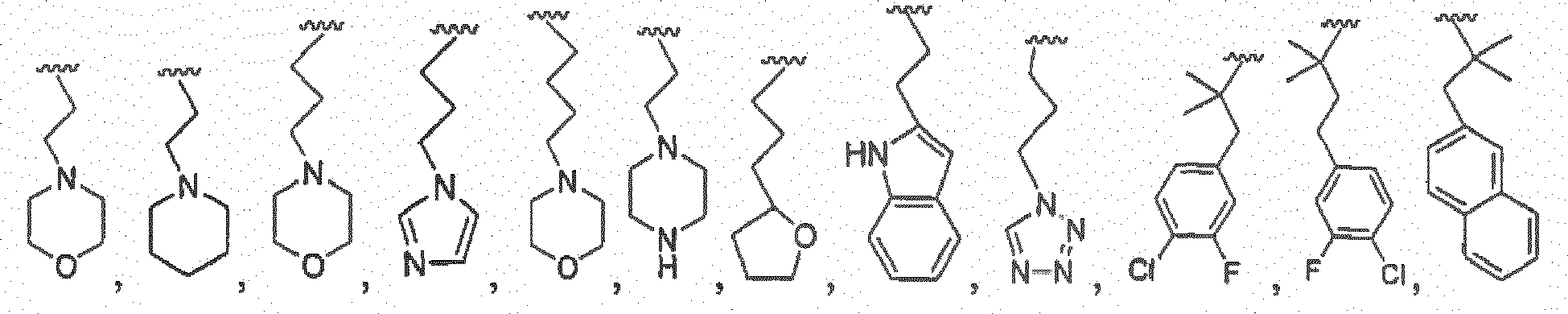


- In one aspect, provided herein is a pharmaceutical composition comprising a compound disclosed herein, or a stereoisomer, geometric isomer, tautomer, nitrogen oxide, hydrate, solvate, metabolite, or pharmaceutically acceptable salt thereof; and an optionally pharmaceutically acceptable carrier, excipient, diluent, adjuvant, vehicle or a combination thereof.
- In another aspect, provided herein is the compound disclosed herein for use in preventing, or treating tissue or organ fibrosis, or lessening the severity of a tissue or organ fibrotic disease in a patient.
- In one aspect, provided herein is the pharmaceutical composition disclosed herein for use in preventing, or treating tissue or organ fibrosis, or lessening the severity of a tissue or organ fibrotic disease in a patient.
- In another aspect, provided herein is the compound or pharmaceutical composition disclosed herein for use in preventing, or treating tissue or organ fibrosis, or lessening the severity of a tissue or organ fibrotic disease in patient, which comprises administering a pharmaceutically effective amount of the (a) compound or pharmaceutical composition disclosed herein to the patient.
- In some embodiments, the tissue or organ fibrosis disorder is renal interstitial fibrosis, glomerulosclerosis, liver fibrosis, pulmonary fibrosis, peritoneum fibrosis, myocardial fibrosis, dermatofibrosis, post-surgery adhesions, benign prostatic hypertrophy, skeletal muscle fibrosis, dermatosclerosis, multiple sclerosis, pancreatic fibrosis, liver cirrhosis, myosarcoma, neurofibroma, pulmonary interstitial fibrosis, diabetic nephropathy, alzheimer disease or vascular fibrosis. In other embodiments, post-surgery adhesions is the scar healing.
- In another aspect, provided herein include methods of preparing, methods of separating, and methods of purifying compounds of Formula (VII).
- The foregoing merely summarizes certain aspects disclosed herein and is not intended to be limiting in nature. These aspects and other aspects and embodiments are described more fully below.
- Reference will now be made in detail to certain embodiments disclosed herein, examples of which are illustrated in the accompanying structures and formulas. The invention is intended to cover all alternatives, modifications, and equivalents that may be included within the scope disclosed herein as defined by the claims. One skilled in the art will recognize many methods and materials similar or equivalent to those described herein, which could be used in the practice disclosed herein. Described herein is in no way limited to the methods and materials. In the event that one or more of the incorporated literature, patents, and similar materials differ from or contradict this application, including but not limited to defined terms, term usage, described techniques, or the like, this application controls.
- As used herein, the following definitions shall be applied unless otherwise indicated. For purposes disclosed herein, the chemical elements are identified in accordance with the Periodic Table of the Elements, CAS version, and the Handbook of Chemistry and Physics, 75th Ed. 1994. Additionally, general principles of organic chemistry are described in Sorrell et al., "Organic Chemistry", University Science Books, Sausalito: 1999, and Smith et al., "March's Advanced Organic Chemistry", John Wiley & Sons, Inc., New York: 2007.
- As described herein, compounds may optionally be substituted with one or more substituents, such as those illustrated above, or as exemplified by particular classes, subclasses, and species disclosed herein. It will be appreciated that the phrase "optionally substituted" is used interchangeably with the phrase "substituted or unsubstituted". In general, the term "substituted" whether preceded by the term "optionally" or not, refers to the replacement of one or more hydrogen radicals in a given structure with the radical of a specified substituent. Unless otherwise indicated, an optionally substituted group may have a substituent at each substitutable position of the group. When more than one position in a given structure may be substituted with more than one substituent selected from a specified group, the substituent may be either the same or different at each position. Wherein the substituents include, but are not limited to, hydroxy, amino, halo, cyano, aryl, heteroaryl, alkoxy, alkylamino, alkylthio, alkyl, haloalkyl, alkenly, alkynyl, heterocyclyl, thiol, nitro, aryloxy, heteroaryloxy, oxo (O=), carboxy, hydroxy-substituted alkoxy, hydroxy-substituted alkyl-C(=O)-, alkyl-C(=O)-, alkyl-S(=O)-, alkyl-S(=O)2-, hydroxy-substituted alkyl-S(=O)-, hydroxy-substituted alkyl-S(=O)2-, carboxyalkoxy, and the like.
- The term "aliphatic" or "aliphatic group" refers to a straight-chain (i.e., unbranched) or branched, substituted or unsubstituted hydrocarbon chain that is completely saturated or that contains one or more units of unsaturation. Unless otherwise specified, aliphatic groups contain 1-20 carbon atoms. In some embodiments, aliphatic groups contain 1-10 carbon atoms. In other embodiments, aliphatic groups contain 1-8 carbon atoms. In still other embodiments, aliphatic groups contain 1-6 carbon atoms. In yet other embodiments, aliphatic groups contain 1-4 carbon atoms and in yet other embodiments, aliphatic groups contain 1-3 carbon atoms. Suitable aliphatic groups include, but are not limited to, linear or branched, substituted or unsubstituted alkyl, alkenyl, or alkynyl groups, such as methyl, ethyl, propyl, isopropyl, butyl, tert-butyl, hexyl, isobutyl, sec-butyl, ethenyl, and the like.
- The term "haloaliphatic" refers to an aliphatic group substituted by one or more of the same or different halogen atoms, wherein the aliphatic group is as defined herein, halogen atoms refer to F, Cl, Br or I. Some non-limiting examples include trifluoromethyl, trifluoroethyl, chloromethyl, 2-chloroethylene, and the like.
- The term "hydroxyaliphatic" refers to an aliphatic group substituted by one or more hydroxy groups, wherein the aliphatic group is as defined herein. Some non-limiting examples include hydroxyethyl, 2-hydroxypropyl, hydroxymethyl, and the like.
- The term "aminoaliphatic" refers to an aliphatic group substituted by one or more amino groups, wherein the aliphatic group is as defined herein. Some non-limiting examples include aminomethyl, 2-aminoethyl, 2-aminoisopropyl, and the like.
- The term "alkyl" refers to a saturated linear or branched-chain monovalent hydrocarbon radical of 1-20 carbon atoms, 1-10 carbon atoms, 1-6 carbon atoms, 1-4 carbon atoms, or 1-3 carbon atoms, wherein the alkyl radical may be optionally substituted independently with one or more substituents described below. Further examples of alkyl groups include, but are not limited to, methyl (Me, -CH3), ethyl (Et, -CH2CH3), 1-propyl (n-Pr, n-propyl, -CH2CH2CH3), 2-propyl (i-Pr, i-propyl, -CH(CH3)2), 1-butyl (n-Bu, n-butyl, -CH2CH2CH2CH3), 2-methyl-1-propyl (i-Bu, i-butyl, -CH2CH(CH3)2), 2-butyl (s-Bu, s-butyl, -CH(CH3)CH2CH3), 2-methyl-2-propyl (t-Bu, t-butyl, -C(CH3)3), 1-pentyl (n-pentyl, -CH2CH2CH2CH2CH3), 2-pentyl (-CH(CH3)CH2CH2CH3), 3-pentyl (-CH(CH2CH3)2), 2-methyl-2-butyl (-C(CH3)2CH2CH3), 3-methyl-2-butyl (-CH(CH3)CH(CH3)2), 3-methyl-1-butyl (-CH2CH2CH(CH3)2), 2-methyl-1-butyl (-CH2CH(CH3)CH2CH3), 1-hexyl (-CH2CH2CH2CH2CH2CH3), 2-hexyl (-CH(CH3)CH2CH2CH2CH3), 3-hexyl (-CH(CH2CH3)(CH2CH2CH3)), 2-methyl-2-pentyl (-C(CH3)2CH2CH2CH3), 3-methyl-2-pentyl (-CH(CH3)CH(CH3)CH2CH3), 4-methyl-2-pentyl (-CH(CH3)CH2CH(CH3)2), 3-methyl-3-pentyl (-C(CH3)(CH2CH3)2), 2-methyl-3-pentyl (-CH(CH2CH3)CH(CH3)2), 2,3-dimethyl-2-butyl (-C(CH3)2CH(CH3)2), 3,3-dimethyl-2-butyl (-CH(CH3)C(CH3)3, 1-heptyl, 1-octyl, and the like. The terms "alkyl" and the prefix "alk-" are inclusive of both straight chain and branched saturated carbon chain. The term "alkylene", as used herein, represents a saturated divalent hydrocarbon group derived from a straight or branched chain saturated hydrocarbon by the removal of two hydrogen atoms, and is exemplified by methylene, ethylene, isopropylene, and the like.
- The term "alkylene" refers to alkyl system having two connection points connected to the rest of the molecule, wherein alkyl radical is as defined herein.
- The term "alkenyl" refers to a linear or branched-chain monovalent hydrocarbon radical of 2-12 carbon atoms, 2-8 carbon atoms, 2-6 carbon atoms, or 2-4 carbon atoms, with at least one site of unsaturation, i.e., a carbon-carbon, sp2 double bond, wherein the alkenyl radical may be optionally substituted independently with one or more substituents described herein, and includes radicals having "cis" and "trans" orientations, or alternatively, "E" and "Z" orientations. Some non-limiting examples include ethenyl or vinyl (-CH=CH2), allyl (-CH2CH=CH2), and the like.
- The term "alkenylene" refers to alkenyl system having two connection points connected to the rest of the molecule, wherein alkenyl radical is as defined herein.
- The term "alkynyl" refers to a linear or branched-chain monovalent hydrocarbon radical of 2-12 carbon atoms, 2-8 carbon atoms, 2-6 carbon atoms, or 2-4 carbon atoms, with at least one site of unsaturation, i.e., a carbon-carbon, sp triple bond, wherein the alkynyl radical may be optionally substituted independently with one or more substituents described herein. Some non-limiting examples include ethynyl (-C≡CH), 2-propynyl (-CH2C≡CH), and the like.
- The term "alkynylene" refers to alkynyl system having two connection points connected to the rest of the molecule, wherein alkynyl radical is as defined herein.
- The term "hydroxy-substituted alkyl" refers to an alkyl group substituted with one or more hydroxy groups, wherein the alkyl group is as defined herein. Some non-limiting examples include hydroxymethyl, hydroxyethyl, 1,2-dihydroxyethyl, and the like.
- The term "carboxy-substituted alkyl" refers to an alkyl group substituted with one or more carboxy groups, wherein the alkyl group is as defined herein. Some non-limiting examples include carboxymethyl, carboxyethyl, and the like.
- The term "cycloaliphatic", "carbocycle", "carbocyclyl" or "cycloalkyl" refers to a monovalent or multivalent, non-aromatic, saturated or partially unsaturated ring, and not containing heteroatoms, having 3 to 12 carbon atoms as a monocyclic ring or 7 to 12 carbon atoms as a bicyclic ring or a tricyclic ring. Bicyclic carbocycles having 7 to 12 atoms can be arranged, for example, as a bicyclo [4,5], [5,5], [5,6] or [6,6] system, and bicyclic carbocycles having 9 or 10 ring atoms can be arranged as a bicyclo [5,6] or [6,6] system. Some non-limiting examples of cycloaliphatic groups include cycloalkyl, cycloalkenyl, and cycloalkynyl. Further examples of cycloaliphatic groups include cyclopropyl, cyclobutyl, cyclopentyl, 1-cyclopent-1-enyl, 1-cyclopent-2-enyl, 1-cyclopent-3-enyl, cyclohexyl, 1-cyclohex-1-enyl, 1-cyclohex-2-enyl, l-cyclohex-3-enyl, cyclohexadienyl, cycloheptyl, cyclooctyl, cyclononyl, cyclodecyl, cycloundecyl, cyclododecyl, adamantyl, and the like. And "cycloaliphatic", "carbocycle", "carbocyclyl", or "cycloalkyl" may be substituted or unsubstituted, wherein the substituent may be, but is not limited to, hydroxy, amino, halo, cyano, aryl, heteroaryl, alkoxy, alkylamino, alkyl, haloalkyl, alkenyl, alkynyl, heterocyclyl, thiol, nitro, aryloxy, hydroxy-substituted alkoxy, hydroxy-substituted -C(=O)-, alkyl-C(=O)-, alkyl-S(=O)-, alkyl-S(=O)2-, hydroxy-substituted alkyl-S(-O)-, hydroxy-substituted alkyl-S(=O)2-, carboxyalkoxy, and the like.
- The term "carbocyclylene" refers to carbocyclyl system having two connection points connected to the rest of the molecule, wherein carbocyclyl radical is as defined herein.
- The term "carbocyclyl (hydroxyalkoxy)" refers to a hydroxyalkoxy group substituted with one or more carbocyclyl groups, wherein the carbocyclyl group and hydroxyalkoxy group are as defined herein. Some non-limiting examples include cyclopropyl hydroxymethyl, cyclopropyl hydroxyethyl, cyclopropyl hydroxypropyl, cyclohexyl hydroxypropyl, cyclohexyl hydroxymethyl, and the like.
- The term "cycloalkyloxy" or "carbocyclyloxy" refers to an optionally substituted cycloalkyl radical or carbocyclyl radical, as defined hererin, attached to an oxygen atom, which is connected to the rest of the molecule. Some non-limiting examples include cyclopropyloxy, cyclopentyloxy, cyclohexyloxy, hydroxy-substituted cyclopropyloxy, and the like.
- The term "cycloalkylamino" refers to an amino group substituted with one or two cycloalkyl groups, wherein the cycloalkyl group is as defined herein. Some non-limiting examples include cyclopropylamino, cyclopentylamino, cyclohexylamino, hydroxy-substituted cyclopropylamino, dicyclohexylamino, dicyclopropylamino, and the like.
- The term "carbocyclyloxyalkoxy" refers to an alkoxy group substituted with one or more carbocyclyloxy groups, wherein the alkoxy group and carbocyclyloxy group are as defined herein. Some non-limiting examples include cyclopropyloxymethoxy, cyclopropyloxyethoxy, cyclopentyloxyethoxy, cyclohexyl oxyethoxy, cyclohexenyl-3-oxyethoxy, and the like.
- The term "cycloalkyloxyaliphatic" refers to an aliphatic group substituted with one or more cycloalkyloxy groups, wherein the aliphatic group and cycloalkyloxy group are as defined herein. Some non-limiting examples include cyclopropyloxymethyl, cyclopropyloxyethyl, cyclopentyloxymethyl, cyclopentyloxyethyl, cyclohexyloxyethyl, halocyclopropyloxyethyl, and the like.
- The term "cycloalkylaminoaliphatic" refers to an aliphatic group substituted with one or more cycloalkylamino groups, wherein the aliphatic group and cycloalkylamino group are as defined herein. Some non-limiting examples include cyclopropylaminomethyl, cyclopropylaminoethyl, cyclopentylaminomethyl, cyclopentylaminoethyl, cyclohexylaminoethyl, halocyclopropylaminoethyl, and the like.
- The term "cycloalkylaliphatic" or "carbocyclylaliphatic" refers to an aliphatic group substituted with one or more cycloalkyl groups or carbocyclyl groups, wherein the carbocyclyl group, cycloalkyl group and aliphatic group are as defined herein. Some non-limiting examples include cyclopropylmethyl, cyclopropylethyl, cyclopropylpropyl, cyclopentylmethyl, cyclohexylethyl, and the like.
- The term "cycloalkylalkoxy" ("carbocyclylalkoxy") refers to an alkoxy group substituted with one or more cycloalkyl groups or carbocyclyl groups, wherein the carbocyclyl group, cycloalkyl group and alkoxy group are as defined herein. Some non-limiting examples include cyclopropylmethoxy, cyclopropylethoxy, cyclopentylethoxy, cyclohexylethoxy, cyclohexylmethoxy, cyclopropylpropoxy, and the like.
- The term "cycloalkylalkylamino" ("carbocyclylalkylamino") refers to an alkylamino group substituted with one or more cycloalkyl groups or carbocyclyl groups, wherein the carbocyclyl group, cycloalkyl group and alkylamino group are as defined herein. Some non-limiting examples include cyclopropylmethylamino, cyclopropylethylamino, cyclopentylethylamino, cyclohexylethylamino, cyclohexylmethylamino, cyclopropylpropylamino, and the like.
- The term "heterocycle", "heterocyclyl", "heterocycloaliphatic", or "heterocyclic" as used interchangeably herein refers to a monocyclic, bicyclic, or tricyclic ring system in which one or more ring members are an independently selected heteroatom and that is completely saturated or that contains one or more units of unsaturation, but not aromatic having a single point of attachment to the rest of the molecule. One or more ring atoms are optionally substituted independently with one or more substituents described herein. In some embodiments, the "heterocycle", "heterocyclyl", "heterocycloaliphatic" or "heterocyclic" group is a monocycle having 3 to 7 ring members (e.g., 1 to 6 carbon atoms and 1 to 3 heteroatoms selected from N, O, P or S, wherein the S or P is optionally substituted with one or more oxo to provide the group SO or SO2, PO or PO2, with the proviso that when the ring is a 3-membered ring, there is only one heteroatom) or a bicycle having 7 to 10 ring members (e.g., 4 to 9 carbon atoms and 1 to 3 heteroatoms selected from N, O, P or S, wherein the S or P is optionally substituted with one or more oxo to provide the group SO or SO2, PO or PO2).
- The heterocyclyl may be a carbon radical or heteroatom radical. "Heterocyclyl" also includes radicals where heterocycle radicals are fused with a saturated, partially unsaturated ring, or heterocyclic ring. Some non-limiting examples of heterocyclic rings include pyrrolidinyl, tetrahydrofuranyl, dihydrofuranyl, tetrahydrothienyl, tetrahydropyranyl, dihydropyranyl, tetrahydrothiopyranyl, piperidino, morpholino, thiomorpholino, thioxanyl, piperazinyl, homopiperazinyl, azetidinyl, oxetanyl, thietanyl, piperidino, homopiperidinyl, epoxypropyl, azepanyl, oxepanyl, thiepanyl, 4-methoxy-piperidin-1-yl, 1,2,3,6-tetrahydropyridin-1-yl, oxazepinyl, diazepinyl, thiazepinyl, pyrrolin-1-yl, 2-pyrrolinyl, 3-pyrrolinyl, indolinyl, 2H-pyranyl, 4H-pyranyl, dioxanyl, 1,3-dioxolanyl, pyrazolinyl, dithianyl, dithiolanyl, dihydrothienyl, pyrazolidinylimidazolinyl, imidazolidinyl, 1,2,3,4-tetrahydroisoquinolinyl, 1,2,6-thiadiazane-1-1-dioxo-2-yl, 4-hydroxy-1,4-azaphosphine-4-oxid-1-yl, 2-hydroxy-1-(piperazin-1-yl)ethanon-4-yl, 2-hydroxy-1-(5,6-dihydro-1,2,4-triazin-1(4H)-yl)ethanon-4-yl, 5,6-dihydro-4H-1,2,4-oxadiazin-4-yl, 2-hydroxy-1-(5,6-dihydropyridin-1(2H)-yl)ethanon-4-yl, 3-azabicyco[3.1.0]hexanyl, 3-azabicyclo[4.1.0]heptanyl, azabicyclo[2.2.2]hexanyl, 2-methyl-5,6,7,8-tetrahydro-[1,2,4]triazolo[1,5-c]pyrimidin-6-yl, 4,5,6,7-tetrahydroisoxazol[4,3-c]pyridin-5-yl, 3H-indolyl-2-oxo-5-azabicyclo[2.2.1]heptan-5-yl, 2-oxo-5-azabicyclo[2.2.2]octan-5-yl, quinolizinyl and N-pyridyl urea. Some non-limiting examples of a heterocyclic ring include 1,1-dioxo-thiomorpholinyl and heterocyclic group wherein 2 carbon atoms on the ring are substituted with oxo (=O) moieties are pyrimidindionyl. The heterocyclic group herein may be substituted or unsubstituted, wherein the substituent may be, but is not limited to, oxo (=O), hydroxy, amino, halo, cyano, heteroaryl, alkoxy, alkylamino, alkyl, haloalkyl, alkenyl, alkynyl, heterocyclyl, thiol, nitro, aryloxy, hydroxy-substituted alkoxy, hydroxy-substituted alkyl-C(=O)-, alkyl-C(=O)-, alkyl-S(=O)-, alkyl-S(=O)2-, hydroxy-substituted alkyl-S(=O)-, hydroxy-substituted alkyl-S(=O)2-, carboxyalkoxy, and the like.
- The term "heterocyclylene" refers to heterocyclyl system having two connection points connected to the rest of the molecule, wherein heterocyclyl radical is as defined herein.
- The term "heterocyclylalkyl" refers to heterocyclic-substituted alkyl radical. The term "heterocyclylalkoxy" refers to hetercyclic-substituted alkoxy radical wherein oxygen atom serves as the attaching point to the rest of the molecule. The term "heterocyclylalkylamino" refers to heterocyclic-substituted alkylamino radical wherein nitrogen atom serves as the attaching point to the rest of the molecule. Some non-limiting examples of heterocyclyl, alkyl, alkoxy and alkylamino include pyrrol-2-ylmethyl, morpholin-4-ylethyl, morpholin-4-ylethoxy, piperazin-4-ylethoxy, piperidin-4-ylethylamino, and the like.
- The term "heterocyclylaliphatic" refers to heterocyclic-substituted aliphatic group, wherein the heterocyclic radical and aliphatic group are as defined herein. Some non-limiting examples include pyrrol-2-ylmethyl, piperidin-2-ylethyl, piperazin-2-ylethyl, piperidin-2-ylmethyl, and the like.
- The term "heterocyclyloxy" refers to optionally substituted heterocyclyl radical, as defined herein, connected to an oxygen atom, and the oxygen atom serves as the attaching point to the rest of the molecule. Some non-limiting examples include pyrrol-2-yloxy, pyrrol-3-yloxy, piperidin-2-yloxy, piperidin-3-yloxy, piperazin-2-yloxy, piperidin-4-yloxy, and the like.
- The term "heterocyclylamino" refers to an amino group substituted with one or two heterocyclyl groups, wherein the heterocyclyl group is as defined herein. Some non-limiting examples include pyrrol-2-ylamino, pyrrol-3-ylamino, piperidin-2-ylamino, piperidin-3-ylamino, piperidin-4-ylamino, piperazin-2-ylamino, dipyrrol-2-ylamino, and the like.
- The term "heterocyclyloxyalkoxy" refers to an alkoxy radical substituted with one or more heterocyclyloxy groups, wherein the alkoxy radical and heterocyclyloxy group are as defined herein. Some non-limiting examples include pyrrol-2-yloxymethoxy, pyrrol-3-yloxyethoxy, piperidin-2-yloxyethoxy, piperidin-3-yloxyethoxy, piperazin-2-yloxyethoxy, piperidin-4-yloxyethoxy, and the like.
- The term "heterocyclyloxyaliphatic" refers to an aliphatic group substituted with one or more heterocyclyloxy groups, wherein the aliphatic group and heterocyclyloxy group are as defined herein. Some non-limiting examples include pyrrol-2-yloxymethyl, piperazin-3-yloxyethyl, piperazin-2-yloxyethyl, morpholin-2-yloxymethyl, piperidin-2-yloxyethyl, and the like.
- The term "heterocyclylaminoaliphatic" refers to an aliphatic group substituted with one or more heterocyclylamino groups, wherein the aliphatic group and heterocyclylamino group are as defined herein. Some non-limiting examples include pyrrol-2-ylaminomethyl, piperazin-3-lyaminoethyl, piperazin-2-lyaminoethyl, piperidin-2-lyaminoethyl, morpholin-2-lyaminomethyl, and the like.
- The term "heterocyclyl(hydroxyalkoxy)" refers to a hydroxyalkoxy group substituted with one or more heterocyclyl groups, wherein the heterocyclyl group and hydroxyalkoxy group are as defined herein. Some non-limiting examples include pyrrol-2-ylhydroxymethoxy and morpholin-4-ylhydroxymethoxy.
- The term "heteroatom" refers to one or more of oxygen, sulfur, nitrogen, phosphorus, or silicon, including any oxidized form of nitrogen, sulfur, or phosphorus; the quaternized form of any basic nitrogen; or a substitutable nitrogen of a heterocyclic ring, for example, N (as in 3,4-dihydro-2H-pyrrolyl), NH (as in pyrrolidinyl) or NR (as in N-substituted pyrrolidinyl).
- The term "halogen" refers to F, Cl, Br or I.
- The term "unsaturated" refers to a moiety having one or more units of unsaturation.
- The term "alkoxy" refers to an alkyl group, as previously defined, attached to the principal carbon chain through an oxygen ("alkoxy") atom. Some non-limiting examples include methoxy, ethoxy, propoxy, butoxy, and the like. And the alkoxy defined above may be substituted or unsubstituted, wherein the substituent may be, but is not limited to, hydroxy, amino, halo, cyano, alkoxy, alkyl, alkenyl, alkynyl, thiol, nitro, and the like.
- The term "hydroxy-substituted alkoxy" or "hydroxyalkoxy" refers to an alkoxy group substituted with one or more hydroxy groups, wherein the alkoxy group is as defined above. Some non-limiting examples include hydroxymethoxy, 2-hydroxyethoxy, 2-hydroxypropoxy, 2-hydroxyisopropoxy, and the like.
- The term "aminoalkoxy" refers to an alkoxy group substituted with one or more amino groups, wherein the alkoxy group is as defined above. Some non-limiting examples include aminomethoxy, 2-aminoethoxy, 2-aminopropoxy, 2-aminoisopropoxy, and the like.
- The term "hydroxy-substituted aminoalkoxy" refers to an aminoalkoxy group substituted with one or more hydroxy groups, wherein the aminoalkoxy group is as defined above. Some non-limiting examples include hydroxyaminomethoxy, 2-hydroxy-2-aminoethoxy, and the like.
- The term "azidoalkoxy" refers to an alkoxy group substituted with one or more azido groups, wherein the alkoxy group is as defined above. Some non-limiting examples include 2-azidoethoxy, 3-azidopropoxy, 2-azidopropoxy, and the like.
- The term "alkoxyalkoxy" refers to an alkoxy group substituted with one or more alkoxy groups, wherein the alkoxy group is as defined above. Some non-limiting examples include methoxymethoxy, methoxyethoxy, ethoxymethoxy, ethoxyethoxy, ethoxypropoxy, and the like.
- The term "alkoxyaliphatic" refers to an aliphatic group substituted with one or more alkoxy groups, wherein the aliphatic group and alkoxy group are as defined herein. Some non-limiting examples include methoxymethyl, ethoxymethyl, ethoxyethyl, ethoxypropenyl, and the like.
- The term "alkylaminoaliphatic" refers to an aliphatic group substituted with one or more alkylamino groups, wherein the aliphatic group and alkylamino group are as defined herein. Some non-limiting examples include dimethylaminoethyl, methylaminoethyl, diethylaminomethyl, diethylaminoethyl, and the like.
- The term "alkylthioaliphatic" refers to an aliphatic group substituted with one or more alkylthio groups, wherein the aliphatic group and alkylthio group are as defined herein. Some non-limiting examples include methylthioethyl, methylthiopropyl, ethylthioethyl, methylthiopropenyl, and the like.
- The term "haloalkyl", "haloalkenyl" or "haloalkoxy" refers to an alkyl group, alkenyl group or alkoxy group substituted with one or more halogen atoms. Some non-limiting examples include trifluoromethyl, 2-chloro-ethenyl, trifluoromethoxy, and the like.
- The term "amino-substituted haloalkoxy" refers to a haloalkoxy group substituted with one or more amino groups, wherein the haloalkoxy is as defined herein. Some non-limiting examples include 3-amino-2-chloropropoxy, and the like.
- The term "alkylaminoalkoxy" refers to an alkoxy group substituted with one or more alkylamino groups, wherein the alkoxy group and alkylamino group are as defined herein. Some non-limiting examples include 3-methylamino-2-propoxy, and the like.
- The term "alkylaminohaloalkoxy" refers to a haloalkoxy group substituted with one or more alkylamino groups, wherein the haloalkoxy group and alkylamino group are as defined herein. Some non-limiting examples include 3-methylamino-2-chloropropoxy, and the like.
- The term "hydroxy-substituted haloalkoxy" refers to a haloalkoxy group substituted with one or more hydroxy groups, wherein the haloalkoxy is as defined herein. Some non-limiting examples include 3-hydroxy-2-fluoropropoxy, hydroxymethyl trifluoromethoxy, and the like.
- The term "aryl" used alone or as part of a larger moiety as in "aralkyl", "arylalkoxy" or "aryloxyalkyl" refers to monocyclic, bicyclic, and tricyclic carbocyclic ring systems having a total of six to fourteen ring members, wherein at least one ring in the system is aromatic, wherein each ring in the system contains 3 to 7 ring members and that has a single point of attachment to the rest of the molecule. The term "aryl" may be used interchangeably with the term "aryl ring". Some non-limiting examples of aryl rings include phenyl, naphthyl, and anthracene. And the aryl defined herein may be substituted or unsubstituted, wherein the substituent may be, but is not limited to, hydroxy, amino, halogen, cyano, aryl, heteroaryl, alkoxy, alkylamino, alkyl, haloalkyl, alkenyl, alkynyl, heterocyclyl, thiol, nitro, aryloxy, hydroxy-substituted alkoxy, hydroxy-substituted alkyl-C(=O)-, alkyl-C(=O)-, alkyl-S(=O)-, alkyl-S(=O)2-, hydroxy-substituted alkyl-S(=O)-, hydroxy-substituted alkyl-S(=O)2-, carboxyalkoxy, and the like.
- The term "fluorophenyl" or "fluoro-substituted phenyl" refers to a phenyl group substituted with one or more fluorine atoms.
- The term "arylene" refers to aryl system having two connection points connected to the rest of the molecule, wherein aryl radical is as defined herein.
- The term "arylaliphatic" refers to an aliphatic group substituted with one or more aryl groups, wherein the aliphatic group and the aryl group are as defined herein. Some non-limiting examples include phenylethyl, phenylmethyl, (p-tolyl)ethyl, styryl, and the like.
- The term "aryloxy" refers to optionally substituted aryl radicals, as defined herein, attached to an oxygen atom, wherein the oxygen atom serves as the attaching point to the rest of the molecule. Wherein the aryl radical is as defined herein. Some non-limiting examples include phenyloxy, methylphenyloxy, ethylphenyloxy, and the like.
- The term "arylamino" refers to an amino group substituted with one or two aryl groups, wherein the aryl group is as defined herein. Some non-limiting examples include phenylamino, (p-fluorophenyl)amino, diphenylamino, ditolylamino, (di-p-tolyl)amino, and the like.
- The term "aryloxyalkoxy" refers to an alkoxy group substituted with one or more aryloxy groups, wherein the alkoxy group and the aryloxy group are as defined herein. Such examples include phenyloxymethoxy, phenyloxyethoxy, phenyloxypropoxy, and the like.
- The term "heteroaryloxyalkoxy" refers to an alkoxy group substituted with one or more heteroaryloxy groups, wherein the alkoxy group and the heteroaryloxy group are as defined herein. Some non-limiting examples include pyridyloxymethoxy, pyrimidinyloxyethoxy, thiazoloxypropoxy, and the like.
- The term "aryloxyaliphatic" refers to an aliphatic group substituted with one or more aryloxy groups, wherein the aryloxy group and the aliphatic group are as defined herein. Some non-limiting examples include phenyloxymethyl, phenyloxyethyl, phenyloxypropyl, and the like.
- The term "heteroaryloxyaliphatic" refers to an aliphatic group may be substituted with one or more heteroaryloxy groups, wherein the heteroaryloxy group and the aliphatic group are as defined herein. Some non-limiting examples include furanyloxymethyl, pyrimidinyloxyethyl, and the like.
- The term "arylaminoaliphatic" refers to an aliphatic group substituted with one or more arylamino groups, wherein the arylamino group and the aliphatic group are as defined herein. Some non-limiting examples include phenylaminomethyl, phenylaminoethyl, tolylaminoethyl, phenylaminopropyl, phenylaminoallyl, and the like.
- The term "aryl(hydroxyalkoxy)" refers to a hydroxyalkoxy group substituted with one or more aryl groups, wherein the aryl group and the hydroxyalkoxy group are as defined herein. Some non-limiting examples include phenylhydroxymethyl, phenylhydroxyethyl, (p-tolyl)hydroxyethyl, and the like.
- The term "arylalkoxy" refers to an alkoxy group substituted with one or more aryl groups, wherein the aryl group and the alkoxy group are as defined herein. Some non-limiting examples include phenylmethoxy, phenylethoxy, (p-tolyl)methoxy, phenylpropoxy, and the like. The aryl defined herein may be substituted or unsubstituted, wherein the substituent may be, but is not limited to, hydroxy, amino, halogen, cyano, aryl, heteroaryl, alkoxy, alkylamino, alkyl, haloalkyl, alkenyl, alkynyl, heterocyclyl, thiol, nitro, aryloxy, hydroxy-substituted alkoxy, hydroxy-substituted alkyl-C(=O)-, alkyl-C(=O)-, alkyl-S(=O)-, alkyl-S(=O)2-, hydroxy-substituted alkyl-S(=O)-, hydroxy-substituted alkyl-S(=O)2-, carboxyalkoxy, and the like.
- The term "arylalkylamino" refers to an alkylamino group substituted with one or more aryl groups, wherein the aryl group and the alkylamino group are as defined herein. Some non-limiting examples include phenylmethylamino, phenylethylamino, phenylpropylamino, (p-tolyl)methylamino, and the like.
- The term "heteroaryl" used alone or as part of a larger moiety as in "heteroaralkyl" or "heteroarylalkoxy" refers to monocyclic, bicyclic, and tricyclic ring systems having a total of five to fourteen ring members, wherein at least one ring in the system is aromatic, at least one ring in the system contains one or more heteroatoms, wherein each ring in the system contains 3 to 7 ring members and that has a single point of attachment to the rest of the molecule. The term "heteroaryl" may be used interchangeably with the term "heteroaryl ring" or the term "heteroaromatic". And the heteroaryl defined herein may be substituted or unsubstituted, wherein the substituent may be, but is not limited to, hydroxy, amino, halogen, cyano, aryl, heteroaryl, alkoxy, alkylamino, alkyl, haloalkyl, alkenyl, alkynyl, heterocyclyl, thiol, nitro, aryloxy, hydroxy-substituted alkoxy, hydroxy-substituted alkyl-C(=O)-, alkyl-C(=O), alkyl-S(=O)-, alkyl-S(=O)2-, hydroxy-substituted alkyl-S(=O)-, hydroxy-substituted alkyl-S(=O)2-, carboxyalkoxy, and the like.
- Some non-limiting examples of suitable heteroaryl rings include the following monocycles: 2-furanyl, 3-furanyl, N-imidazolyl, 2-imidazolyl, 4-imidazolyl, 5-imidazolyl, 3-isoxazolyl, 4-isoxazolyl, 5-isoxazolyl, 2-oxazolyl, 4-oxazolyl, 5-oxazolyl, 4-methylisoxazol-5-yl, N-pyrrolyl, 2-pyrrolyl, 3-pyrrolyl, 2-pyridyl, 3-pyridyl, 4-pyridyl, 2-pyrimidinyl, 4-pyrimidinyl, 5-pyrimidinyl, pyridazinyl (e.g., 3-pyridazinyl), 2-thiazolyl, 4-thiazolyl, 5-thiazolyl, tetrazolyl (e.g., 5-tetrazolyl), triazolyl (e.g., 2-triazolyl and 5-triazolyl), 2-thienyl, 3-thienyl, pyrazolyl (e.g., 2-pyrazolyl), isothiazolyl, 1,2,3-oxadiazolyl, 1,2,5-oxadiazolyl, 1,2,4-oxadiazolyl, 1,2,3-triazolyl, 1,2,3-thiadiazolyl, 1,3,4-thiadiazolyl, 1,2,5-thiadiazolyl, 1,3,4-thiadiazol-2-yl, pyrazinyl, 2-pyrazinyl, 1,3,5-triazinyl, benzo[d]thiazol-2-yl, imidazo[1,5-a]pyridyl and the following bicycles include: benzimidazolyl, benzofuryl, benzothiophenyl, benzothiazolyl, indolyl (e.g., 2-indolyl), purinyl, quinolinyl (e.g., 2-quinolinyl, 3-quinolinyl, 4-quinolinyl), or isoquinolinyl (e.g., 1-isoquinolinyl, 3-isoquinolinyl, or 4-isoquinolinyl).
- The term "heteroarylene" refers to heteroaryl system having two connection points connected to the rest of the molecule, wherein heteroaryl radical is as defined herein.
- The term "heteroaryloxy" refers to optionally substituted aryl radicals, as defined herein, attached to an oxygen atom, wherein the oxygen atom serves as the attaching point to the rest of the molecule. Some non-limiting examples include pyrid-2-yloxy, thiazol-2-yloxy, imidazol-2-yloxy, pyrimidin-2-yloxy, and the like.
- The term "heteroaryloxyaliphatic" refers to an aliphatic group substituted with one or more heteroaryloxy groups, wherein the aliphatic group and the heteroaryloxy group are as defined herein. Some non-limiting examples include pyrid-2-yloxyethyl, thiazol-2-yloxymethyl, imidazol-2-yloxyethyl, pyrimidin-2-yloxypropyl, and the like. The term "sulfonyl", whether used alone or linked to other terms such as alkylsulfonyl, refers to respectively divalent radicals -SO2-. The term "alkylsulfonyl", refers to a sulfonyl radical substituted with an alkyl radical, forming an alkylsulfonyl (-SO2CH3).
- The term "sulfamyl", "aminosulfonyl" or "sulfonamidyl" refers to a sulfonyl radical substituted with an amine radical, forming a sulfonamide (-SO2NH2).
- The term "carboxy" or "carboxyl", whether used alone or with other terms, such as "carboxyalkyl", refers to -CO2H. The term "carbonyl", whether used alone or with other terms, such as "aminocarbonyl" or "carbonyloxy", refers to -(C=O)-.
- The term "carboxyalkoxy" refers to an alkoxy group substituted with one or more carboxy groups, wherein the alkoxy group and the carboxy group are as defined herein. Some non-limiting examples include carboxymethoxy, carboxyethoxy, and the like.
- The term "alkylcarbonyl" refers to optionally substituted alkyl connected to a carbonyl radical, and the carbonyl radical connected to the rest of the molecule, wherein alkyl is as defined above. Some non-limiting examples include methylcarbonyl, ethylcarbonyl, and the like.
- The term "hydroxyalkylcarbonyl" refers to hydroxy-substituted alkyl connected to a carbonyl radical, and the carbonyl radical connected to the rest of the molecule, wherein alkyl is as defined above. Some non-limiting examples include hydroxymethylcarbonyl, 1,2-dihydroxyethylcarbonyl, and the like.
- The term "aralkyl" or "arylalkyl" refers to aryl-substituted alkyl radicals. In some embodiments, aralkyl radicals are "lower aralkyl" radicals having aryl radicals attached to alkyl radicals having one to six carbon atoms. In other embodiments, aralkyl radicals are "phenylalkylenyl" attached to alkyl portions having one to three carbon atoms. Some non-limiting examples of such radicals include benzyl, diphenylmethyl and phenylethyl. The aryl in said aralkyl can be additionally substituted with halo, alkyl, alkoxy, haloalkyl or haloalkoxy.
- The term "alkylthio" refers to radicals containing a linear or branched alkyl radical, of one to ten carbon atoms, attached to a divalent sulfur atom. In other embodiments, alkylthio radicals are lower alkylthio radicals having one to three carbon atoms. Some non-limiting examples of "alkylthio" include methylthio (CH3S-).
- The term "haloalkylthio" refers to radicals containing a haloalkyl radical, of one to ten carbon atoms, attached to a divalent sulfur atom. In other embodiments, haloalkylthio radicals are lower haloalkylthio radicals having one to three carbon atoms. Some non-limiting examples of "haloalkylthio" include trifluoromethylthio.
- The term "alkylamino" refers to "N-alkylamino" and "N,N-dialkylamino" where amino groups are independently substituted with one alkyl radical or with two alkyl radicals, respectively. In other embodiments, alkylamino radicals are "lower alkylamino" radicals having one or two alkyl radicals of one to six carbon atoms, attached to a nitrogen atom. In still other embodiments, alkylamino radicals are lower alkylamino radicals having one to three carbon atoms. Some non-limiting examples of suitable alkylamino radicals include mono or dialkylamino such as N-methylamino, N-ethylamino, N,N-dimethylamino, N,N-diethylamino, and the like.
- The term "alkylaminohaloalkoxy" refers to a haloalkoxy group substituted with one or more alkylamino groups, wherein the haloalkoxy group and the alkylamino group are as defined herein. Some non-limiting examples include methylaminodifluoromethoxy, ethylaminotrifluoromethoxy, and the like.
- The term "heteroarylamino" refers to amino groups substituted with one or two heteroaryl radicals, wherein the heteroaryl radical is as defined herein. Some non-limiting examples of heteroarylamino include N-thienylamino, and the like. In other embodiments, the "heteroarylamino" radicals include substituted on the heteroaryl ring portion of the radical.
- The term "heteroarylaliphatic" refers to aliphatic groups substituted with one or more heteroaryl radicals, wherein the heteroaryl radical and the aliphatic group are as defined herein. Some non-limiting examples of heteroarylaliphatic include thiophen-2-ylpropenyl, pyridin-4-ylethyl, imidazol-2-methyl, furan-2-ethyl, indole-3-methyl, and the like.
- The term "heteroarylalkyl" refers to alkyl groups substituted with one or more heteroaryl radicals, wherein the heteroaryl radical and the alkyl group are as defined herein. Some non-limiting examples of heteroarylalkyl include imidazol-2-methyl, furan-2-ethyl, indole-3-methyl, and the like.
- The term "heteroarylalkylamino" refers to nitrogen-containing heteroarylalkyl radicals attached through a nitrogen atom to other radicals, wherein the heteroarylalkyl radicals is as defined herein. Some non-limiting examples of heteroarylalkylamino include pyridin-2-methylamino, thiazol-2-ethylamino, imidazol-2-ethylamino, pyrimidin-2-propylamino, pyrimidin-2-methylamino, and the like.
- The term "aminoalkyl" refers to a linear or branched alkyl radical having one to ten carbon atoms, substituted with one or more amino radicals. In some embodiments, aminoalkyl radicals are "lower aminoalkyl" radicals having one to six carbon atoms and one or more amino radicals. Some non-limiting examples of such radicals include aminomethyl, aminoethyl, aminopropyl, aminobutyl or aminohexyl.
- The term "alkylaminoalkyl" refers to alkyl radicals substituted with alkylamino radicals. In some embodiments, alkylaminoalkyl radicals are "lower alkylaminoalkyl" radicals having alkyl radicals of one to six carbon atoms. In other embodiments, alkylaminoalkyl radicals are lower alkylaminoalkyl radicals having alkyl radicals of one to three carbon atoms. Some non-limiting examples of suitable alkylaminoalkyl radicals include mono or dialkyl substituted, such as N-methylaminomethyl, N,N-dimethyl-aminoethyl, N,N-diethylaminomethyl, and the like.
- The term "alkylaminoalkoxy" refers to alkoxy radicals substituted with alkylamino radicals. Some non-limiting examples of suitable alkylaminoalkoxy radicals include mono or dialkyl substituted, such as N-methylaminoethoxy, N,N-dimethylaminoethoxy, N,N-diethylaminoethoxy, and the like.
- The term "alkylaminoalkoxyalkoxy" refers to alkoxy radicals substituted with alkylaminoalkoxy radicals. Some non-limiting examples of suitable alkylaminoalkoxyalkoxy radicals include mono or dialkyl substituted, such as N-methylaminomethoxyethoxy, N-methylaminoethoxyethoxy, N,N-dimethylminoethoxyethoxy, N,N-diethylaminomethoxymethoxy, and the like.
- The term "carboxyalkyl" refers to a linear or branched alkyl radical having one to about ten carbon atoms, substituted with one or more carboxy radicals. Some non-limiting examples of such radicals include carboxymethyl, carboxypropyl, and the like.
- The term "heteroarylalkoxy" refers to oxy-containing heteroarylalkyl radicals attached through an oxygen atom to other radicals, wherein the heteroarylalkyl radical is as defined herein. Some non-limiting examples of such radicals include pyridin-2-ylmethoxy, thiazol-2-ylethoxy, imidazol-2-ylethoxy, pyrimidin-2-ylpropoxy, pyrimidin-2-ylmethoxy, and the like.
- The term "cycloalkylalkyl" refers to cycloalkyl-substituted alkyl radicals. Some non-limiting examples of such radicals include cyclohexylmethyl. The cycloalkyl in the radicals may be additionally substituted with halo, alkyl, alkoxy or hydroxy.
- The term "fused bicyclic", "fused cyclic", "fused bicyclyl" or "fused cyclyl" refers to saturated or unsaturated bridged ring system, which refers to a bicyclic ring system that is not aromatic. Such a system may contain isolated or conjugated unsaturation, but not aromatic or heteroaromatic rings in its core structure (but may have aromatic substitution thereon). Each cyclic ring in the fused bicyclyl can be either a carbocyclic or a heteroalicyclic. Some non-limiting examples of fused bicyclic ring system include hexahydro-furo[3,2-b]furan, 2,3,3a,4,7,7a-hexahydro-1H-indene, 7-azabicyclo[2.3.0]heptane, fused bicyclo[3.3.0]octane, fused bicyclo[3.1.0]hexane, 1,2,3,4,4a,5,8,8a-octahydro-naphthalene, and the like. And the fused bicyclyl defined herein may be substituted or unsubstituted, wherein the substituents include, but are not limited to, oxo (=O), hydroxy, amino, halogen, cyano, aryl, heteroaryl, alkoxy, alkylamino, alkyl, haloalkyl, alkenyl, alkynyl, heterocyclyl, thiol, nitro, aryloxy, hydroxy-substituted alkoxy, hydroxy-substituted alkyl-C(=O)-, alkyl-C(=O)-, alkyl-S(=O)-, alkyl-S(=O)2-, hydroxy-substituted alkyl-S(=O)-, hydroxy-substituted alkyl-S(=O)2-, carboxy alkoxy, and the like.
- The term "fused bicyclylene" refers to fused bicyclyl system having two connection points connected to the rest of the molecule, wherein fused bicyclyl radical is as defined herein.
- The term "fused heterobicyclyl" refers to saturated or unsaturated bridged ring system, which refers to a bicyclic ring system that is not aromatic. Such a system may contain isolated or conjugated unsaturation, but not aromatic or heteroaromatic rings in its core structure (but may have aromatic substitution thereon). Wherein at least one ring in the system contains one or more heteroatoms, wherein each ring in the system contains 3 to 7 ring members and that contains one to six carbon atoms and one to three heteroatoms selected from N, O, P, S, wherein the S or P is optionally substituted with one or more oxo to provide the group SO, SO2, PO or PO2, Some non-limiting examples of fused heterobicyclic ring system include hexahydro-furo[3,2-b]furan, 7-azabicyclo[2.3.0]heptane, and the like. And the fused heterobicyclyl defined herein may be substituted or unsubstituted, wherein the substituents include, but are not limited to, oxo (=O), hydroxy, amino, halogen, cyano, aryl, heteroaryl, alkoxy, alkylamino, alkyl, haloalkyl, alkenyl, alkynyl, heterocyclyl, thiol, nitro, aryloxy, hydroxy-substituted alkoxy, hydroxy-substituted alkyl-C(=O)-, alkyl-C(=O)-, alkyl-S(=O)-, alkyl-S(=O)2-, hydroxy-substituted alkyl-S(=O)-, hydroxy-substituted alkyl-S(=O)2-, carboxyalkoxy, and the like.
- The term "fused heterobicyclylene" refers to fused heterobicyclyl system having two connection points connected to the rest of the molecule, wherein fused heterobicyclyl radical is as defined herein.
- The term "fused bicyclylaliphatic" refers to aliphatic groups substituted with one or more fused bicyclyl groups, wherein the aliphatic group and the fused bicyclyl group are as defined herein. Some non-limiting examples include 1,2,3,4,4a,5,8,8a-octahydro-naphthylethyl, 1,2,3,4,4a,5,8,8a-octahydro-naphthylmethyl, 1,2,3,4,4a,5,8,8a-octahydro-naphthylpropyl, fused bicyclo[3.3.0]octylmethyl, fused bicyclo[3.1.0]hexylethyl, and the like.
- The term "fused heterobicyclylaliphatic" refers to aliphatic groups substituted with one or more fused heterobicyclyl groups, wherein the aliphatic group and the fused heterobicyclyl group are as defined herein. Some non-limiting examples include hexahydro-furo[3,2-b]furan-2-ylethyl, hexahydro-furo[3,2-b]furan-2-ylmethyl, 7-azabicyclo[2.3.0]hept-2-ylmethyl, 7-azabicyclo[2.3.0]hept-2-ylethyl, 7-azabicyclo[2.3.0]hept-4-ylmethyl, and the like.
- The term "fused bicycloxy" refers to optionally substituted fused bicyclyl radicals, as defined herein, oxy-containing fused bicyclyl radicals attached through an oxygen atom to other radicals, wherein the fused bicyclyl radical is as defined herein. Some non-limiting examples include 1,2,3,4,4 a,5,8,8a-octahydro-naphthyloxy, fused bicyclo[3.3.0]oct-2-yloxy, fused bicyclo[3.1.0]hex-2-yloxy, and the like.
- The term "fused heterobicycloxy" refers to optionally substituted fused heterobicyclyl radicals, as defined herein, oxy-containing fused heterobicyclyl radicals attached through an oxygen atom to other radicals. Some non-limiting examples include hexahydro-furo[3,2-b]furan-2-yloxy, 7-azabicyclo[2.3.0]hept-2-yloxy, 7-azabicyclo[2.3.0]hept-4-yloxy, and the like.
- The term "fused bicyclylamino" refers to an amino group substituted with one or two fused bicyclyl groups, wherein the fused bicyclyl group is as defined herein. Some non-limiting examples include 1,2,3,4,4a,5,8,8a-octahydro-naphthylamino, di(1,2,3,4,4a,5,8,8a-octahydro-naphthyl)amino, fused bicyclo[3.3.0]octylamino, fused bicyclo[3.1.0]hexylamino, and the like.
- The term "fused heterobicyclylamino" refers to an amino group substituted with one or two fused heterobicyclyl groups, wherein the fused heterobicyclyl group is as defined herein. Some non-limiting examples include hexahydro-furo[3,2-b]furan-2-ylamino, 7-azabicyclo[2.3.0]hept-2-ylamino, 7-azabicyclo[2.3.0]hept-4-ylamino, and the like.
- The term "fused bicyclylalkylamino" refers to alkylamino groups substituted with one or more fused bicyclyl groups, wherein the fused bicyclyl group is as defined herein. Some non-limiting examples include 1,2,3,4,4a,5,8,8a-octahydro-naphthylmethylamino, di(1,2,3,4,4a,5,8,8a-octahydro-naphthyl) methylamino, fused bicyclo[3.3.0]octylmethylamino, fused bicyclo[3.1.0]hexylmethylamino, and the like.
- The term "fused heterobicyclylalkyamino" refers to alkylamino groups substituted with one or more fused heterobicyclyl groups, wherein the fused heterobicyclyl group is as defined herein. Some non-limiting examples include hexahydro-furo[3,2-b]furan-2-ylmethylamino, 7-azabicyclo[2.3.0]hept-2-ylmethylamino, 7-azabicyclo[2.3.0]hept-4-ylmethylamino, and the like.
- The term "fused bicyclylalkoxy" refers to alkoxy groups substituted with one or more fused bicyclyl groups, wherein the fused bicyclyl group is as defined herein. Some non-limiting examples include 1,2,3,4,4a,5,8,8a-octahydro-naphthylmethoxy, 1,2,3,4,4a,5,8,8a-octahydro-naphthylethoxy, fused bicyclo[3.3.0]octylethoxy, fused bicyclo[3.1.0]hexylpropoxy, and the like.
- The term "fused heterobicyclylalkoxy" refers to alkoxy groups substituted with one or more fused heterobicyclyl groups, wherein the fused heterobicyclyl group is as defined herein. Some non-limiting examples include hexahydro-furo[3,2-b]furan-2-ylpropoxy, 7-azabicyclo[2.2.1]hept-2-ylethoxy, 7-azabicyclo[2.3.0]hept-4-ylpropoxy, hexahydro-furo[3,2-b]furan-2-ylethoxy, 7-azabicyclo[2.3.0]hept-4-ylpropoxy, 7-azabicyclo[2.3.0]hept-4-ylethoxy, and the like.
- The term "fused bicycloxyalkoxy" refers to alkoxy groups substituted with one or more fused bicycloxy groups, wherein the alkoxy group and the fused bicycloxy group are as defined herein. Some non-limiting examples include 1,2,3,4,4a,5,8,8a-octahydro-naphthyloxymethoxy, 1,2,3,4,4a,5,8,8a-octahydro-naphthyloxymethoxy, 1,2,3,4,4a,5,8,8a-octahydro-naphthyloxyethoxy, fused bicyclo[3.3.0]oct-2-yloxyethoxy, fused bicyclo[3.1.0]hex-2-yloxypropoxy, and the like.
- The term "fused heterobicycloxyalkoxy" refers to alkoxy groups substituted with one or more fused heterobicycloxy groups, wherein the alkoxy group and the fused heterobicyclyl group are as defined herein. Some non-limiting examples include hexahydro-furo[3,2-b]furan-2-yloxypropoxy, 7-azabicyclo[2.2.1]hept-2-yloxyethoxy, 7-azabicyclo[2.3.0]hept-4-yloxypropoxy, hexahydro-furo[3,2-b]furan-2-yloxyethoxy, 7-azabicyclo[2.3.0]hept-2-yloxypropoxy, 7-azabicyclo[2.3.0]hept-4-yloxyethoxy, and the like.
- The term "fused bicyclylaminoalkoxy" refers to alkoxy groups substituted with one or more fused bicyclylamino groups, wherein the alkoxy group and the fused bicyclylamino group are as defined herein. Some non-limiting examples include 1,2,3,4,4a,5,8,8a-octahydro-naphthylaminoethoxy, 1,2,3,4,4a,5,8,8a-octahydro-naphthylaminopropoxy, di(1,2,3,4,4a,5,8,8a-octahydro-naphthyl)aminopropoxy, fused bicyclo[3.3.0]oct-2-ylaminoethoxy, fused bicyclo[3.1.0]hex-2-ylaminopropoxy, and the like.
- The term "fused heterobicyclylaminoalkoxy" refers to alkoxy groups substituted with one or more fused heterobicyclylamino groups, wherein the alkoxy group and the fused heterobicyclylamino group are as defined herein. Some non-limiting examples include 7-azabicyclo[2.2.1]hept-2-ylaminoethoxy, 7-azabicyclo[2.3.0]hept-4-ylaminopropoxy, hexahydro-furo[3,2-b]furan-2-ylaminoethoxy, hexahydro-furo[3,2-b]furan-2-ylaminopropoxy, hexahydro-furo[3,2-b]furan-2-ylaminomethoxy, and the like.
- The term "spirocyclyl", "spirocyclic", "spiro bicyclyl" or "spiro bicyclic" refers to a ring originating from a particular annular carbon of another ring. For example, as depicted below, a saturated bridged ring system (ring B and B') is termed as "fused bicyclic", whereas ring A and ring B share an atom between the two saturated ring system, which terms as a "spirocyclyl" or "spiro bicyclyl". Each cyclic ring in the spirocyclyl or spiro bicyclyl can be either a carbocyclic or a heteroalicyclic. Some non-limiting examples include 2,7-diaza-spiro[4.4]non-2-yl, 7-oxo-2-azaspiro[4.5]dec2-yl, 4-azaspiro[2.4]hept-5-yl, 4-oxaspiro[2.4]hept-5-yl, 5-azaspiro[2.4]hept5-yl, spiro[2.4]heptyl, spiro[4.4]nonyl, 7-hydroxy-5-azaspiro[2.4]hept-5-yl, and the like. The spirocyclyl or spiro bicyclyl can be optionally substituted, wherein the substituents can be, but are not limited to, oxo (=O), hydroxy, amino, halogen, cyano, aryl, heteroaryl, alkoxy, alkylamino, alkyl, haloalkyl, alkenyl, alkynyl, heterocyclyl, thiol, nitro, aryloxy, hydroxy-substituted alkoxy, hydroxy-substituted alkyl-C(=O)-, alkyl-C(=O)-, alkyl-S(=O)-, alkyl-S(=O)2-, hydroxy-substituted alkyl-S(=O)-, hydroxy-substituted alkyl-S(=O)2-, carboxy alkoxy, and the like.

- The term "spiro bicyclylene" refers to spiro bicyclyl system having two connection points connected to the rest of the molecule, wherein spiro bicyclyl radical is as defined herein.
- The term "spiro heterobicyclyl" refers to a ring originating from a particular annular carbon of another ring. For example, as depicted above, a saturated bridged ring system (ring B and B') is termed as "fused bicyclic", whereas ring A and ring B share an carbon atom between the two saturated ring system, which terms as a "spirocyclyl" or "spiro bicyclyl". Wherein at least one ring in the system contains one or more heteroatoms, wherein each ring in the system contains 3 to 7 ring members and that contains one to six carbon atoms and one to three heteroatoms selected from N, O, P, S, wherein the S or P is optionally substituted with one or more oxo to provide the group SO, SO2, PO or PO2. Some non-limiting examples of spiro heterobicyclic ring system include 4-azaspiro[2.4]hept-5-yl, 4-oxaspiro[2.4]hept-5-yl, 5-azaspiro[2.4]hept-5-yl, 7-hydroxy-5-azaspiro[2.4]hept-5-yl, and the like. And the spiro heterobicyclyl defined herein may be substituted or unsubstituted, wherein the substituents include, but are not limited to, oxo (=O), hydroxy, amino, halogen, cyano, aryl, heteroaryl, alkoxy, alkylamino, alkyl, haloalkyl, alkenyl, alkynyl, heterocyclyl, thiol, nitro, aryloxy, hydroxy-substituted alkoxy, hydroxy-substituted alkyl-C(=O)-, alkyl-C(=O)-, alkyl-S(=O)-, alkyl-S(=O)2-, hydroxy-substituted alkyl-S(=O)-, hydroxy-substituted alkyl-S(=O)2-, carboxyalkoxy, and the like.
- The term "spiro heterobicyclylene" refers to spiro heterobicyclyl system having two connection points connected to the rest of the molecule, wherein spiro heterobicyclyl radical is as defined herein.
- The term "spiro bicyclylaliphatic" refers to aliphatic groups substituted with one or more spiro bicyclyl groups, wherein the aliphatic group and the spiro bicyclyl group are as defined herein. Some non-limiting examples include spiro[2.4]heptylmethyl, spiro[2.4]heptylethyl, spiro[2.4]heptylpropyl, spiro[4.4]nonylmethyl, spiro[4.4]nonylethyl, 4-azaspiro[2.4]hept-5-yl-methyl, 4-azaspiro[2.4]hept-5-yl-ethyl, 4-oxaspiro[2.4]hept-5-yl-ethyl, 5-azaspiro[2.4]hept-5-yl-propyl, 7-hydroxy-5-azaspiro[2.4]hept-5-yl-propyl, and the like.
- The term "spiro heterobicyclylaliphatic" refers to aliphatic groups substituted with one or more spiro heterobicyclyl groups, wherein the aliphatic group and the fused heterobicyclyl group are as defined herein. Some non-limiting examples include 4-azaspiro[2.4]hept-5-yl-methyl, 4-azaspiro[2.4]hept-5-yl-ethyl, 4-oxaspiro[2.4]hept-5-yl-ethyl, 5-azaspiro[2.4]hept-5-yl-propyl, 7-hydroxy-5-azaspiro[2.4]hept-5-yl-propyl, and the like.
- The term "spiro bicycloxy" refers to optionally substituted spiro bicyclyl radicals, as defined herein, oxy-containing spiro bicyclyl radicals attached through an oxygen atom to other radicals, wherein the spiro bicyclyl radical is as defined herein. Some non-limiting examples include spiro[2.4]heptyl-2-oxy, spiro[2.4]heptyl-3-oxy, spiro[2.4]heptyl-4-oxy, spiro[4.4]nonyl-2-oxy, spiro[4.4]nonyl-4-oxy, 4-azaspiro[2.4]hept-5-oxy, and the like.
- The term "spiro heterobicycloxy" refers to optionally substituted spiro heterobicyclyl radicals, as defined herein, oxy-containing spiro heterobicyclyl radicals attached through an oxygen atom to other radicals. Some non-limiting examples include 4-azaspiro[2.4]hept-5-yloxy, 4-oxaspiro[2.4]hept-5-yloxy, 5-azaspiro[2.4]hept-5-yloxy, and the like.
- The term "spiro bicyclylamino" refers to an amino group substituted with one or two spiro bicyclyl groups, wherein the spiro bicyclyl group is as defined herein. Some non-limiting examples include spiro[2.4]heptyl-2-amino, spiro[2.4]heptyl-3-amino, spiro[2.4]heptyl-4-amino, spiro[4.4]nonyl-2-amino, spiro[4.4]nonyl-4-amino, 4-azaspiro[2.4]hept-5-amino, and the like.
- The term "spiro heterobicyclylamino" refers to an amino group substituted with one or two spiro heterobicyclyl groups, wherein the spiro heterobicyclyl group is as defined herein. Some non-limiting examples include 4-azaspiro[2.4]hept-5-ylamino, 4-oxaspiro[2.4]hept-2-ylamino, 4-oxaspiro[2.4]hept-5-ylamino, 5-azaspiro[2.4]hept-5-ylamino, and the like.
- The term "spiro bicyclylalkoxy" refers to alkoxy groups substituted with one or more spiro bicyclyl groups, wherein the spiro bicyclyl group is as defined herein. Some non-limiting examples include spiro[2.4]heptyl-2-methoxy, spiro[2.4]heptyl-3-ethoxy, spiro[2.4]heptyl-4-ethoxy, spiro[4.4]nonyl-2-methoxy, spiro[4.4]nonyl-4-propoxy, 4-azaspiro[2.4]hept-5-methoxy, and the like.
- The term "spiro heterobicyclylalkoxy" refers to alkoxy groups substituted with one or more spiro heterobicyclyl groups, wherein the spiro heterobicyclyl group is as defined herein. Some non-limiting examples include 4-azaspiro[2.4]hept-5-yl-methoxy, 4-azaspiro[2.4]hept-2-yl-ethoxy, 4-oxaspiro[2.4]hept-5-yl-ethoxy, 5-azaspiro[2.4]hept-5-yl-propoxy, and the like.
- The term "spiro bicyclylalkyamino" refers to alkylamino groups substituted with one or more spiro bicyclyl groups, wherein the spiro bicyclyl group is as defined herein. Some non-limiting examples include spiro[2.4]heptyl-2-methylamino, spiro[2.4]heptyl-3-ethylamino, spiro[2.4]heptyl-4-ethylamino, spiro[4.4]nonyl-2-methylamino, spiro[4.4]nonyl-4-propylamino, 4-azaspiro[2.4]hept-5-methylamino, and the like.
- The term "spiro heterobicyclylalkyamino" refers to alkylamino groups substituted with one or more spiro heterobicyclyl groups, wherein the spiro heterobicyclyl group is as defined herein. Some non-limiting examples include 4-azaspiro[2.4]hept-5-yl-methylamino, 4-azaspiro[2.4]hept-2-yl-ethylamino, 4-oxaspiro[2.4]hept-5-yl-ethylamino, 5-azaspiro[2.4]hept-5-yl-propylamino, and the like.
- The term "spiro bicycloxyalkoxy" refers to alkoxy groups substituted with one or more spiro bicycloxy groups, wherein the alkoxy group and the spiro bicyclyl group are as defined herein. Some non-limiting examples include spiro[2.4]heptyl-2-oxyethoxy, spiro[2.4]heptyl-3-oxypropoxy, spiro[2.4]heptyl-4-oxypropoxy, spiro[4.4]nonyl-2-oxyethoxy, spiro[4.4]nonyl-4-oxypropoxy, 4-azaspiro[2.4]hept-5-oxypropoxy, and the like,
- The term "spiro heterobicycloxyalkoxy" refers to alkoxy groupsn substituted with one or more spiro heterobicycloxy groups, wherein the alkoxy group and the spiro heterobicyclyl group are as defined herein. Some non-limiting examples include 4-azaspiro[2.4]hept-5-yloxyethoxy, 4-oxaspiro[2.4]hept-5-yloxyethoxy, 5-azaspiro[2.4]hept-5-yloxyethoxy, 4-azaspiro[2.4]hept-5-yloxypropoxy, 4-oxaspiro[2.4]hept-5-yloxypropoxy, 5-azaspiro[2.4]hept-5-yloxypropoxy, and the like.
- The term "spiro bicyclylaminoalkoxy" refers to alkoxy groups substituted with one or more spiro bicyclylamino groups, wherein the alkoxy group and the spiro bicyclylamino group are as defined herein. Some non-limiting examples include spiro[2.4]heptyl-2-aminoethoxy, spiro[2.4]heptyl-3-aminopropoxy, spiro[2.4]heptyl-4-aminoethoxy, spiro[4.4]nonyl-2-aminoethoxy, spiro[4.4]nonyl-4-aminopropoxy, 4-azaspiro[2.4]hept-5-aminopropoxy, and the like.
- The term "spiro heterobicyclylaminoalkoxy" refers to alkoxy groups substituted with one or more spiro heterobicyclylamino groups, wherein the alkoxy group and the spiro heterobicyclylamino group are as defined herein. Some non-limiting examples include 4-azaspiro[2.4]hept-5-ylaminoethoxy, 4-oxaspiro[2.4]hept-2-ylaminopropoxy, 4-oxaspiro[2.4]hept-5-ylaminoethoxy, 5-azaspiro[2.4]hept-5-ylaminopropoxy, and the like.
- As described herein, a bond drawn from a substituent to the center of one ring within a ring system (as shown below) represents substitution of the substituent at any substitutable position on the ring A and ring B. For example, Figure a represents possible substitution in any of the positions on the A ring and B ring shown in Figure b.

- As described herein, a dot line drawn together with a bond within a ring system (as shown in Figure c) represents either a double bond or a single bond. For example, structure in Figure c represents any structures selected from Figure d.


- As described herein, two attaching points either E or E', within a ring system (as shown in Figure e), attach to the rest of the molecule, e.g., E and E' may be used interchangeably with each other.
- Unless otherwise stated, structures depicted herein are also meant to include all isomeric (e.g., enantiomeric, diastereomeric, and geometric (or conformational)) forms of the structure, for example, the R and S configurations for each asymmetric center, (Z) and (E) double bond isomers, and (Z) and (E) conformational isomers. Therefore, single stereochemical isomers as well as enantiomeric, diastereomeric, or geometric (or conformational) mixtures of the present compounds are within the scope disclosed herein.
- The term "prodrug" refers to a compound that is transformed in vivo into a compound of Formula (I). Such a transformation can be affected, for example, by hydrolysis in blood or enzymatic transformation of the prodrug form to the parent form in blood or tissue. Prodrugs of the compounds disclosed herein may be, for example, esters. Esters that may be utilized as prodrugs in the present invention are phenyl esters, aliphatic (C1-C24) esters, acyloxymethyl esters, carbonates, carbamates, and amino acid esters. For example, a compound disclosed herein that contains an OH group may be acylated at this position in its prodrug form. Other prodrug forms include phosphates, such as, for example those phosphates resulting from the phosphonation of an OH group on the parent compound. A thorough discussion of prodrugs is provided in Higuchi et al., Pro-drugs as Novel Delivery Systems, Vol. 14, A.C.S. Symposium Series; Roche et al., ed., Bioreversible Carriers in Drug Design, American Pharmaceutical Association and Pergamon Press, 1987; Rautio et al., Prodrugs: Design and Clinical Applications, Nature Reviews Drug Discovery, 2008, 7, 255-270, and Hecker et al., Prodrugs of Phosphates and Phosphonates, J Med. Chem., 2008, 51, 2328-2345.
- Unless otherwise stated, all tautomeric forms of the compounds disclosed herein are within the scope of the invention. Additionally, unless otherwise stated, structures depicted herein are also meant to include compounds that differ only in the presence of one or more isotopically enriched atoms.
- A "metabolite" is a product produced through metabolism in the body of a specified compound or salt thereof. Metabolites of a compound may be identified using routine techniques known in the art and their activities determined using tests such as those described herein. Such products may result for example from the oxidation, reduction, hydrolysis, amidation, deamidation, esterification, deesterification, enzymatic cleavage, and the like, of the administered compound. Accordingly, the invention includes metabolites of compounds disclosed herein, including compounds produced by a process comprising contacting a compound disclosed herein with a mammal for a period of time sufficient to yield a metabolic product thereof.
- Stereochemical definitions and conventions used herein generally follow Parker et al., McGraw-Hill Dictionary of Chemical Terms (1984) McGraw-Hill Book Company, New York and Eliel et al., "Stereochemistry of Organic Compounds", John Wiley & Sons, Inc., New York, 1994. The compounds disclosed herein may contain asymmetric or chiral centers, and therefore exist in different stereoisomeric forms. It is intended that all stereoisomeric forms of the compounds disclosed herein, including but not limited to, diastereomers, enantiomers and atropisomers, as well as mixtures thereof such as racemic mixtures, form part of the present invention. Many organic compounds exist in optically active forms, i.e., they have the ability to rotate the plane of plane-polarized light. In describing an optically active compound, the prefixes D and L, or R and S, are used to denote the absolute configuration of the molecule about its chiral center(s). The prefixes d and 1 or (+) and (-) are employed to designate the sign of rotation of plane-polarized light by the compound, with (-) or 1 meaning that the compound is levorotatory. A compound prefixed with (+) or d is dextrorotatory. For a given chemical structure, these stereoisomers are identical except that they are mirror images of one another. A specific stereoisomer may also be referred to as an enantiomer, and a mixture of such isomers is often called an enantiomeric mixture. A 50:50 mixture of enantiomers is referred to as a racemic mixture or a racemate, which may occur where there has been no stereoselection or stereospecificity in a chemical reaction or process. The term "racemic mixture" or "racemate" refers to an equimolar mixture of two enantiomeric species, devoid of optical activity.
- The term "tautomer" or "tautomeric form" refers to structural isomers of different energies which are interconvertible via a low energy barrier. Some non-limiting examples of proton tautomers (also known as prototropic tautomers) include interconversions via migration of a proton, such as keto-enol and imine-enamine isomerizations. Valence tautomers include interconversions by reorganization of some of the bonding electrons.
- A "pharmaceutically acceptable salts" refers to organic or inorganic salts of a compound disclosed herein. Pharmaceutically acceptable salts are well known in the art. For example, Berge et al., describe pharmaceutically acceptable salts in detail in J. Pharmacol Sci, 1977, 66, 1-19. Some non-limiting examples of pharmaceutically acceptable salts include salts of an amino group formed with inorganic acids such as hydrochloric acid, hydrobromic acid, phosphoric acid, sulfuric acid and perchloric acid or with organic acids such as acetic acid, oxalic acid, maleic acid, tartaric acid, citric acid, succinic acid or malonic acidor by using other methods used in the art such as ion exchange. Other pharmaceutically acceptable salts include adipate, malic acid salts, 2-hydracrylic acid salt, alginate, ascorbate, aspartate, benzenesulfonate, benzoate, bisulfate, borate, butyrate, camphorate, camphorsulfonate, cyclopentanepropionate, digluconate, dodecylsulfate, ethanesulfonate, formate, fumarate, glucoheptonate, glycerophosphate, gluconate, hemisulfate, heptanoate, hexanoate, hydroiodide, 2-hydroxy-ethanesulfonate, lactobionate, lactate, laurate, lauryl sulfate, malate, malonate, methanesulfonate, 2-naphthalenesulfonate, nicotinate, nitrate, oleate, palmitate, pamoate, pectinate, persulfate, 3-phenylpropionate, picrate, pivalate, propionate, stearate, thiocyanate, p-toluenesulfonate, undecanoate, valerate salts, and the like. Salts derived from appropriate bases include alkali metal, alkaline earth metal, ammonium and N+(C1-4 alkyl)4 salts. This invention also envisions the quaternization of any basic nitrogen-containing groups of the compounds disclosed herein. Water or oilsoluble or dispersable products may be obtained by such quaternization. Representative alkali or alkaline earth metal salts include sodium, lithium, potassium, calcium, magnesium, and the like. Further pharmaceutically acceptable salts include, when appropriate, nontoxic ammonium, quaternary ammonium, and amine cations formed using counterions such as halide, hydroxide, carboxylate, sulfate, phosphate, nitrate, C1-8 sulfonate or aryl sulfonate.
- A "solvate" refers to an association or complex of one or more solvent molecules and a compound disclosed herein. Some non-limiting examples of solvents that form solvates include water, isopropanol, ethanol, methanol, DMSO, ethyl acetate, acetic acid, and ethanolamine. The term "hydrate" refers to the complex where the solvent molecule is water.
- The term "protecting group" or "Pg" refers to a substituent that is commonly employed to block or protect a particular functionality while reacting with other functional groups on the compound. For example, an "amino-protecting group" is a substituent attached to an amino group that blocks or protects the amino functionality in the compound. Some non-limiting examples of suitable amino-protecting groups include acetyl, trifluoroacetyl, t-butoxycarbonyl (Boc), benzyloxycarbonyl (Cbz) and 9-fluorenylmethylenoxycarbonyl (Fmoc). Similarly, a "hydroxy-protecting group" refers to a substituent of a hydroxy group that blocks or protects the hydroxy functionality. Some non-limiting examples of suitable hydroxy-protecting groups include acetyl and silyl. A "carboxy-protecting group"" refers to a substituent of the carboxy group that blocks or protects the carboxy functionality. Some non-limiting examples of common carboxy-protecting groups include -CH2CH2SO2Ph, cyanoethyl, 2-(trimethylsilyl) ethyl, 2-(trimethylsilyl) ethoxymethyl, 2-(p-toluenesulfonyl) ethyl, 2-(p-nitrophenylsulfonyl) ethyl, 2-(diphenyl phosphino)-ethyl, nitroethyl, and the like. For a general description of protecting groups and their use, see Greene et al., Protective Groups in Organic Synthesis, John Wiley & Sons, New York, 1991 and Kocienski et al., Protecting Groups, Thieme, Stuttgart, 2005.
- Provided herein are new compounds or pharmaceutical compositions that may be more effective to prevent or treat human or animal tissue fibrosis.
- In one aspect, provided herein are compounds having Formula (VII) as shown below:

- wherein R1 is H, F, Cl, Br, I, cyano, C1-6 alkyl, C1-6 haloalkyl, C1-6 alkoxy, C1-6 hydroxyalkoxy, C1-6 aminoalkoxy, C1-6 haloalkoxy, C6-10 aryl-(CH2)p-G-(CH2)m-, C1-9 heteroaryl-(CH2)p-G-(CH2)m-, C2-10 heterocyclyl-(CH2)p-G-(CH2)m-, or C3-10 cycloalkyl-(CH2)p-G-(CH2)m-, wherein each G is O, S, NR5, C(=O), -C(=O)NH-, -OC(=O)NH-, -OC(=O)- or -NHC(=O)NH-; each p and m is independently 0, 1, 2 or 3; or wherein each of the C6-10 aryl-(CH2)p-G-(CH2)m-, C1-9 heteroaryl-(CH2)p-G-(CH2)m-, C2-10 heterocyclyl-(CH2)p-G-(CH2)m-, and C3-10 cycloalkyl-(CH2)p-G-(CH2)m- is optionally substituted by one or more F, Cl, Br, I, methyl, ethyl, propyl, cyano, ethynyl, methoxy, ethoxy, or propynyl;
- R3 is H, F, Cl, I, cyano, C1-6 alkyl, C1-6 haloalkyl, C1-6 alkoxy, C1-6 hydroxyalkoxy, C1-6 aminoalkoxy, C1-6 haloalkoxy, C6-10 aryl-(CH2)p-G-(CH2)m-, C1-9 heteroaryl-(CH2)p-G-(CH2)m-, C2-10 heterocyclyl-(CH2)p-G-(CH2)m-, or C3-10 cycloalkyl-(CH2)p-G-(CH2)m-, wherein each G is O, S, NR5, C(=O), -C(=O)NH-, -OC(=O)NH-, -OC(=O)- or -NHC(=O)NH-; each p and m is independently 0, 1, 2 or 3;
- each R5 is independently H, C1-3 alkyl, C1-3 haloalkyl, C1-3 hydroxyalkyl, C1-3 aminoalkyl, C1-3 alkoxy-C1-3-alkyl, C1-3 alkylamino-C1-3-alkyl, C1-3 alkylthio-C1-3-alkyl, C6-10 aryl-C1-3-alkyl, C1-9 heteroaryl-C1-3-alkyl, C2-10 heterocyclyl-C1-3-alkyl, C3-10 cycloalkyl-C1-3-alkyl, C6-10 aryl, C1-9 heteroaryl, C2-10 heterocyclyl or C3-10 carbocyclyl;
- each R7 is independently H, C1-6 alkyl, C1-6 haloaliphatic, C1-6 hydroxyaliphatic, C1-6 aminoaliphatic, C1-6 alkoxy-C1-6-aliphatic, C1-6 alkylamino-C1-6-aliphatic, C1-6 alkylthio-C1-6-aliphatic, C6-10 aryl-C1-6-aliphatic, C1-9 heteroaryl-C1-6-aliphatic, C2-10 heterocyclyl-C1-6-aliphatic, C3-10 cycloalkyl-C1-6-aliphatic, C6-10 aryl, C1-9 heteroaryl, C2-10 heterocyclyl or C3-10 carbocyclyl;
- each R7a is independently C1-6 alkyl, C1-6 haloaliphatic, C1-6 hydroxyaliphatic, C1-6 aminoaliphatic, C1-6 alkoxy-C1-6-aliphatic, C1-6 alkylamino-C1-6-aliphatic, C1-6 alkylthio-C1-6-aliphatic, C6-10 aryl-C1-6-aliphatic, C1-9 heteroaryl-C1-6-aliphatic, C2-10 heterocyclyl-C1-6-aliphatic, C3-10 cycloalkyl-C1-6-aliphatic, C6-10 aryl, C1-9 heteroaryl, C2-10 heterocyclyl or C3-10 carbocyclyl; or
- R7 and R7a, together with the nitrogen atom they are attached to, optionally form a substituted or unsubstituted 3-8 membered ring;
- each R8a is independently H, hydroxy, amino, F, Cl, Br, I, -N(CH3)2, cyano, nitro, mercapto, C1-4 alkyl, trifluoromethyl, C1-4 alkoxy, C1-4 alkylamino, C1-4 alkylthio, C6-10 aryl, or C1-9 heteroaryl; and
- n is 0, 1, 2 or 3.
- In some embodiments, each R7 is independently H, C1-6 alkyl, C1-4 alkoxy-C1-6-alkyl,


- In another aspect, provided herein are one of the compounds as follows, or a stereoisomer, geometric isomer, tautomer, nitrogen oxide, hydrate, solvate, or pharmaceutically acceptable salt thereof, and not limited to:


- Provided herein includes the use of a compound disclosed herein, or a pharmaceutically acceptable salt thereof, in the manufacture of a medicament for treating the severity of tissue or organ fibrosis in a patient, including those described herein. Provided herein is a pharmaceutical composition comprising a therapeutically effective amount of a compound of Formula (VII) in association with at least one pharmaceutically acceptable carrier, excipient, diluent, adjuvant or vehicle,
- Provided herein is a pharmaceutical composition comprising a compound disclosed herein, or a stereoisomer, geometric isomer, tautomer, nitrogen oxide, hydrate, solvate, metabolite, or pharmaceutically acceptable salt thereof; and an optionally pharmaceutically acceptable carrier, excipient, diluent, adjuvant, vehicle or a combination thereof.
- Also provided herein is the compound of Formula (VII) or the composition thereof for use in preventing or treating tissue or organ fibrosis, or lessening the severity of tissue or organ fibrosis in a patient.
- Provided herein, the tissue or organ fibrosis disorder is renal interstitial fibrosis, glomerulosclerosis, liver fibrosis, pulmonary fibrosis, peritoneum fibrosis, myocardial fibrosis, dermatofibrosis, post-surgery adhesions, benign prostatic hypertrophy, skeletal muscle fibrosis, dermatosclerosis, multiple sclerosis, pancreatic fibrosis, liver cirrhosis, myosarcoma, neurofibroma, pulmonary interstitial fibrosis, diabetic nephropathy, alzheimer disease or vascular fibrosis. In other embodiments, post-surgery adhesions is the scar healing.
- Unless otherwise stated, all stereoisomers, geometric isomers, tautomers, nitrogen oxides, hydrates, solvates, metabolites, salts, and pharmaceutically acceptable prodrugs of the compounds disclosed herein are within the scope of the invention.
- In certain embodiments, the salt is a pharmaceutically acceptable salt. The phrase "pharmaceutically acceptable" refers to that the substance or composition must be compatible chemically and/or toxicologically, with the other ingredients comprising a Formulation, and/or the mammal being treated therewith.
- The compounds disclosed herein also include salts of such compounds which are not necessarily pharmaceutically acceptable salts, and which may be useful as intermediates for preparing and/or purifying compounds of Formula (VII) and/or for separating enantiomers of compounds of Formula (VII).
- If the compound disclosed herein is a base, the desired salt may be prepared by any suitable method available in the art, for example, treatment of the free base with an inorganic acid, such as hydrochloric acid, hydrobromic acid, sulfuric acid, nitric acid, phosphoric acid, and the like. Or with an organic acid, such as acetic acid, maleic acid, succinic acid, mandelic acid, fumaric acid, malonic acid, pyruvic acid, oxalic acid, glycolic acid, salicylic acid; a pyranosidyl acid, such as glucuronic acid or galacturonic acid; an alpha hydroxy acid, such as citric acid or tartaric acid; an amino acid, such as aspartic acid or glutamic acid; an aromatic acid, such as benzoic acid or cinnamic acid, a sulfonic acid, such as p-toluenesulfonic acid or ethanesulfonic acid, and the like.
- If the compound disclosed herein is an acid, the desired salt may be prepared by any suitable method, for example, treatment of the free acid with an inorganic or organic base, such as an amine (primary, secondary or tertiary), an alkali metal hydroxide or alkaline earth metal hydroxide, and the like. Some non-limiting examples of suitable salts include organic salts derived from amino acids, such as glycine and arginine, ammonia, primary, secondary, and tertiary amines, and cyclic amines, such as piperidine, morpholine and piperazine, and inorganic salts derived from sodium, calcium, potassium, magnesium, manganese, iron, copper, zinc, aluminum, lithium, and the like.
- According to another aspect, the invention features pharmaceutical compositions that include a compound of Formula (VII), a compound listed herein, or a compound named in Examples 1-72, and a pharmaceutically acceptable carrier, adjuvant, or vehicle. The amount of the compound in the compositions disclosed herein is such that is effective to detectably treat or lessen the severity of a tissue or organ fibrotic disease in a patient.
- It will also be appreciated that certain of the compounds disclosed herein can exist in free form for treatment, or where appropriate, as a pharmaceutically acceptable derivative thereof. Some non-limiting examples of the pharmaceutically acceptable derivative include pharmaceutically acceptable prodrugs, salts, esters, salts of such esters, or any other adducts or derivatives which upon administration to a patient in need is capable of providing, directly or indirectly, a compound as otherwise described herein, or a metabolite or residue thereof.
- As described above, the pharmaceutically acceptable compositions disclosed herein additionally comprise a pharmaceutically acceptable carrier, adjuvant, or vehicle, which, as used herein, includes any and all solvents, diluents, or other liquid vehicle, dispersion or suspension aids, surface active agents, isotonic agents, thickening or emulsifying agents, preservatives, solid binders, lubricants and the like, as suited to the particular dosage form desired. Troy et al., Remington: The Science and Practice of Pharmacy, 21st ed., 2005, Lippincott Williams & Wilkins, Philadelphia and Swarbrick et al., Encyclopedia of Pharmaceutical Technology, eds., 1988-1999, Marcel Dekker, New York, are disclosed various carriers used in Formulating pharmaceutically acceptable compositions and known techniques for the preparation thereof. Except insofar as any conventional carrier medium is incompatible with the compounds disclosed herein, such as by producing any undesirable biological effect or otherwise interacting in a deleterious manner with any other component(s) of the pharmaceutically acceptable composition, its use is contemplated to be within the scope of this invention.
- Some non-limiting examples of materials which can serve as pharmaceutically acceptable carriers include ion exchangers, alumina, aluminum stearate, lecithin, serum proteins, such as human serum albumin, buffer substances such as phosphates, glycine, sorbic acid, or potassium sorbate, partial glyceride mixtures of saturated vegetable fatty acids, water, salts or electrolytes, such as protamine sulfate, disodium hydrogen phosphate, potassium hydrogen phosphate, sodium chloride, zinc salts, colloidal silica, magnesium trisilicate, polyvinyl pyrrolidone, polyacrylates, waxes, polyethylene-polyoxypropylene-block polymers, wool fat, sugars such as lactose, glucose and sucrose; starches such as corn starch and potato starch; cellulose and its derivatives such as sodium carboxymethyl cellulose, ethyl cellulose and cellulose acetate; powdered tragacanth; malt; gelatin; talc; excipients such as cocoa butter and suppository waxes; oils such as peanut oil, cottonseed oil, safflower oil, sesame oil, olive oil, corn oil and soybean oil; glycols such as propylene glycol or polyethylene glycol; esters such as ethyl oleate and ethyl laurate; agar; buffering agents such as magnesium hydroxide and aluminum hydroxide; alginic acid; pyrogen-free water; isotonic saline; Ringer's solution; ethyl alcohol, and phosphate buffer solutions, as well as other non-toxic compatible lubricants such as sodium lauryl sulfate and magnesium stearate, as well as coloring agents, releasing agents, coating agents, sweetening, flavoring and perfuming agents, preservatives and antioxidants.
- The compositions disclosed herein may be administered orally, parenterally, by inhalation spray, topically, rectally, nasally, buccally, vaginally or via an implanted reservoir. The pharmaceutically acceptable compositions disclosed herein include orally administered in any orally acceptable dosage form including, but not limited to, capsules, tablets, pills, powders, granules, aqueous suspensions or solutions.
- The compositions disclosed herein can be orally administered in the following dosage forms: tablets, pellets, capsules, dispensable powders, particles or suspensions, syrup, and elixirs. Alternatively, the compositions disclosed herein can be for external use in the form of ointment, gel, or medicated patch; or they can be administered parenterally in the form of sterile injectable solution or suspension.
- The compounds disclosed herein may be administered parenterally or intraperitoneally. The compounds disclosed herein (as free bases or pharmaceutically acceptable salt) may be formulated into solutions or suspensions in water suitably mixed with surfactant (e.g. hydroxypropyl cellulose, polyvinyl pyrrolidone). Dispersion can also be prepared from a mixture of the active compounds in glycerin, liquid, polyethylene glycol and oil. In the normal condition of storage and usage, these preparations may contain preservatives to prevent the growth of microorganisms.
- The pharmaceutical forms suitable for injection include sterile water or dispersion and sterile powder (used for the temporary preparation of sterile injectable solutions or dispersions). In all the cases, these forms must be sterile, and they must be fluidic to allow their discharge from the injection syringe. These forms must be stable in the condition of production and storage, and they must prevent from the pollution of microorganisms (such as bacteria and fungi). The carriers may be solvents or dispersion media, including, for example, water, alcohols (such as glycerin, propylene glycol and liquid polyethylene glycol), plant oil and combinations thereof.
- The compounds disclosed herein can be administered in a local rather than systemic manner, for example, via injection of the compound directly into organ, often in a depot or sustained release formulation. Furthermore, the pharmaceutical composition comprising a compound disclosed herein can be administered in a targeted drug delivery system, for example, in a liposome coated with organ-specific antibody. The liposomes may be targeted to and taken up selectively by the organ. In addition, the pharmaceutical compositions comprising a compound disclosed herein may be provided in the form of a rapid release formulation, in the form of an extended release formulation, or in the form of an intermediate release formulation.
- For administration by inhalation, the compounds disclosed herein may be in a form as an aerosol, a mist or a powder. The pharmaceutical compositions comprising a compound disclosed herein may be conveniently delivered in the form of an aerosol spray presentation from pressurized packs or a nebulizer, with the use of a suitable propellant, e.g., dichlorodifluoromethane, trichlorofluoromethane, dichlorotetrafluoroethane, carbon dioxide or other suitable gas. In the case of a pressurized aerosol, the dosage unit may be determined by providing a value to deliver a metered amount. Capsules and cartridges, such as, by way of example only, gelatin for use in an inhaler or insufflators maybe formulated containing a powder mix of the compound disclosed herein and a suitable powder base such as lactose or starch.
- The compounds disclosed herein may also be formulated in rectal compositions such as enemas, rectal gels, rectal foams, rectal aerosol, suppositories, jelly suppositories, or retention enemas, containing conventional suppository bases such as cocoa butter or other glycerides, as well as any synthetic polymers suitable for preparing suppository bases such as polyvinylpyrrolidone, PEG, and the like. In suppository forms of the compositions, a low-melting wax such as, but not limited to, a mixture of fatty acid glycerides, optionally in combination with cocoa butter is first melted.
- Additionally, the compound disclosed herein may be used in combination with other agents of treating fibrosis, such as, but not limited to, ivacaftor, roflumilast, pirfenidone, miglustat, losartan, ACTIMMUNE® (interferon gamma-1B), dornase alfa, VELDONA® (interferon alfa), ataluren, cortical hormone, methotrexate, tacrolimus and combinations thereof.
- The pharmaceutical compositions disclosed herein may be formulated in conventional manner using one or more physiologically acceptable carriers comprising excipients and auxiliaries which facilitate processing of the active compounds into preparations which may be used pharmaceutically. Proper formulation is dependent upon the route of administration chosen. Any of the well-known techniques, carriers, and excipients may be used as suitable and as understood in the art. The pharmaceutical compositions comprising a compound disclosed herein may be manufactured in a conventional manner, such as, by way of example, by means of conventional mixing, dissolving, granulating, dragee-making, levigating, emulsifying, encapsulating, entrapping, or compression processes.
- The pharmaceutical compositions disclosed herein include at least one pharmaceutically acceptable carrier, diluent or excipient and a compound disclosed herein as an active ingredient in free-acid or free-base form, or in a pharmaceutically acceptable salt form. In addition, the pharmaceutical compositions disclosed herein include other medicinal or pharmaceutical agents, carriers, adjuvants, such as preserving, stabilizing, wetting or emulsifying agents, solution promoters, salts for regulating the osmotic pressure, and /or buffers. In addition, the pharmaceutical compositions contain other therapeutically valuable substances.
- Methods for the preparation of the pharmaceutical compositions disclosed herein include formulating the compounds disclosed herein with one or more inert, pharmaceutically acceptable excipients or carriers to form a solid, semi-solid or liquid. Some non-limiting examples of solid compositions include powders, tablets, dispersible granules, capsules, cachets, and suppositories. Some non-limiting examples of liquid compositions include solutions in which a compound is dissolved, emulsions comprising a compound, or a solution containing liposomes, micelles, or nanoparticles comprising a compound as disclosed herein. Some non-limiting examples of semi-solid compositions include gels, suspensions and creams. The compositions may be in liquid solutions or suspensions, solid forms suitable for solution or suspension in a liquid prior to use, or as emulsions. The pharmaceutical compositions disclosed herein may also contain minor amounts of nontoxic, auxiliary substances, such as wetting or emulsifying agents, pH buffering agents, and so forth.
- The compounds disclosed herein are preferably formulated in dosage unit form for ease of administration and uniformity of dosage. The expression "dosage unit form" refers to a physically discrete unit of agent appropriate for the patient to be treated. It will be understood, however, that the total daily usage of the compounds and compositions disclosed herein will be decided by the attending physician within the scope of sound medical judgment. The specific effective dose level for any particular patient or organism will depend upon a variety of factors including the disorder being treated and the severity of the disorder; the activity of the specific compound employed; the specific composition employed; the age, body weight, general health, sex and diet of the patient; the time of administration, route of administration, and rate of excretion of the specific compound employed; the duration of the treatment; drugs used in combination or coincidental with the specific compound employed, and like factors well known in the medical arts.
- The effective dose of the active ingredients used may vary with the compound used, the administration mode and the severity of the disease to be treated. However, typically, a desirable result can be achieved when the compound disclosed herein is administered at a dose of about 0.25-1000 mg/kg animal body weight per day. More preferably, it is administered in 2-4 separated dosages per day, or in the form of slow release. For most of the large mammals, the total dose per day is about 1-100 mg/kg, more preferably about 2-80 mg/kg. The dosage form suitable for inner use comprises about 0.25-500 mg active compound sufficiently mixed with a solid or liquid pharmaceutically acceptable carrier. The dosage may be adjusted to provide the best treatment response. In addition, upon urgent requirement of the condition to be treated, several separate dosages per day may be administered, or the dosage may be reduced in proportion.
- The selective biological properties of the compounds may be enhanced through being modified by additional appropriate functional groups. Such modification is known in the field herein and includes the modification of penetrate to biological cavities (such as blood, lymphatic system, central nervous system), improves oral effectiveness and improves the solubility so that it can be administered by injection, alter metabolism and change the excretion.
- The compound or pharmaceutically acceptable salt or hydrate disclosed herein may be used effectively for preventing, managing, treating or lessening the severity of tissue or organ fibrosis in a patient, especially in renal interstitial fibrosis, glomerulosclerosis, liver fibrosis, pulmonary fibrosis, peritoneum fibrosis, myocardial fibrosis, dermatofibrosis, postsurgery adhesions, benign prostatic hypertrophy, skeletal muscle fibrosis, dermatosclerosis, multiple sclerosis, pancreatic fibrosis, liver cirrhosis, myosarcoma, neurofibroma, pulmonary interstitial fibrosis, diabetic nephropathy, alzheimer disease or vascular fibrosis.
- Generally, the compounds disclosed herein may be prepared by methods described herein, wherein the substituents are as defined for Formula (VII), above, except where further noted. The following non-limiting schemes and examples are presented to further exemplify the invention.
- Persons skilled in the art will recognize that the chemical reactions described may be readily adapted to prepare a number of other compounds disclosed herein, and alternative methods for preparing the compounds disclosed herein are deemed to be within the scope disclosed herein. For example, the synthesis of non-exemplified compounds according to the invention may be successfully performed by modifications apparent to those skilled in the art, e.g., by appropriately protecting interfering groups, by utilizing other suitable reagents known in the art other than those described, and/or by making routine modifications of reaction conditions. Alternatively, other reactions disclosed herein or known in the art will be recognized as having applicability for preparing other compounds disclosed herein.
- In the examples described below, unless otherwise indicated all temperatures are set forth in degrees Celsius. Reagents were purchased from commercial suppliers such as Aldrich Chemical Company, Arco Chemical Company and Alfa Chemical Company, and were used without further purification unless otherwise indicated. Common solvents were purchased from commercial suppliers such as Shantou XiLong Chemical Factory, Guangdong Guanghua Reagent Chemical Factory Co. Ltd., Guangzhou Reagent Chemical Factory, Tianjin YuYu Fine Chemical Ltd., Qingdao Tenglong Reagent Chemical Ltd., and Qingdao Ocean Chemical Factory.
- Anhydrous THF, dioxane, toluene, and ether were obtained by refluxing the solvent with sodium. Anhydrous CH2Cl2 and CHCl3 were obtained by refluxing the solvent with CaH2. EtOAc, PE, hexane, DMAC and DMF were treated with anhydrous Na2SO4 prior to use.
- The reactions set forth below were done generally under a positive pressure of nitrogen or argon or with a drying tube (unless otherwise stated) in anhydrous solvents, and the reaction flasks were typically fitted with rubber septa for the introduction of substrates and reagents via syringe. Glassware was oven dried and/or heat dried.
- Column chromatography was conducted using a silica gel column. Silica gel (300 - 400 mesh) was purchased from Qingdao Ocean Chemical Factory. 1H NMR spectra were recorded with a Bruker 400 MHz spectrometer at ambient temperature. 1H NMR spectra were obtained as CDCl3, d6 -DMSO, CD3OD or d6 -acetone solutions (reported in ppm), using TMS (0 ppm) or chloroform (7.25 ppm) as the reference standard. When peak multiplicities are reported, the following abbreviations are used: s (singlet), d (doublet), t (triplet), m (multiplet), br (broadened), dd (doublet of doublets), dt (doublet of triplets). Coupling constants, when given, are reported in Hertz (Hz).
- Low-resolution mass spectral (MS) data were also determined on an Agilent 6320 series LC-MS spectrometer equipped with G1312A binary pumps, a G1316A TCC (Temperature Control of Column, maintained at 30 °C), a G1329A autosampler and a G1315B DAD detector were used in the analysis, An ESI source was used on the LC-MS spectrometer.
- Low-resolution mass spectral (MS) data were also determined on an Agilent 6120 series LC-MS spectrometer equipped with G1311A Quaternary pump, a G1316A TCC (Temperature Control of Column, maintained at 30 °C), a G1329A autosampler and a G1315D DAD detector were used in the analysis, An ESI source was used on the LC-MS spectrometer.
- Both LC-MS spectrometers were equipped with an Agilent Zorbax SB-C18, 2.1 x 30 mm, 5 µm column. Injection volumn was decided by the sample concentration. The flow rate was 0.6 mL/min. The HPLC peaks were recorded by UV-Vis wavelength at 210 nm and 254 nm. The mobile phase was 0.1% formic acid in acetonitrile (phase A) and 0.1 % formic acid in ultrapure water (phase B). The gradient condition is shown in Table 1:
Table 1 Time(min) A (CH3CN, 0.1% HCOOH) B (H2O, 0,1% HCOOH) 0 - 3 5 - 100 95 - 0 3 - 6 100 0 6 - 6.1 100 - 5 0 - 95 6.1 - 8 5 95 - Purities of compounds were also assessed by Agilent 1100 Series high performance liquid chromatography (HPLC) with UV detection at 210 nm and 254 nm (Zorbax SB-C18, 2.1 x 30 mm, 4 micron, 10 min, 0.6 mL/min flow rate, 5 to 95% (0.1% formic acid in CH3CN) in (0.1% formic acid in H2O). Column was operated at 40 °C.
- The following abbreviations are used throughout the specification:
- BPO benzoyl peroxide
- NH4Cl ammonium chloride
- BOC, Boc tert-butyloxycarbonyl
- Boc2O Di-tert-butyl dicarbonate
- Cs2CO3 cesium carbonate
- CHCl3 chloroform
- CCl4 carbon tetrachloride
- CDCl3 chloroform deuterated
- CuI copper (I) iodide
- DMAC N,N-Dimethylacetamide
- DMF dimethylformamide
- DMAP 4-dimethylaminopyridine
- DMSO dimethylsulfoxide
- EtOAc ethyl acetate
- g gram
- h hour(s)
- min minute(s)
- HCl hydrochloric acid
- H2 hydrogen
- MeOH, CH3OH methanol
- EtOH ethanol
- CH2Cl2, DCM dichloromethane
- mL, ml milliliter
- N2 nitrogen
- Pd/C palladium on carbon
- PE petroleum ether (60 - 90 °C)
- K2CO3 potassium carbonate
- RT, rt, room temperature
- NaHCO3 sodium bicarbonate
- NaCl sodium chloride
- Na2SO4 sodium sulfate
- NaOH sodium hydroxide
- THF tetrahydrofuran
- Et3N, TEA triethylamine
- NBS N-bromosuccinimide
- H2O water
- AlMe3 trimethylaluminium
- Lawesson's Reagent 1,3,2,4-dithiadiphosphetane,2,4-bis(4-methoxyphenyl)-,2,4-disulfide
- TBAB tetrabutyl ammonium bromide
- Rh2(OAc)2 Rhodium (II) acetate

- Compound 3, wherein each of V1, V2, V3, V4, A, B and X is as defined above, can be prepared by the process illustrated in Scheme 1. A mixture of compound 1, compound 2, a base (such as potassium carbonate, cesium carbonate, potassium phosphate, etc.) and a ligand (such as 8-hydroxyquinoline, ethyl 2-oxocyclohexanecarboxylate, N,N'-dimethylethane-1,2-diamine, etc.) dissolved in a solvent (such as dioxane, N,N-dimethyl formamide or dimethyl sulfoxide) is heated at an appropriate temperature (such as 50 - 140 °C) under a nitrogen atmosphere to give the target compound 3.

- Compound 6, wherein each of R2, R4, X and B is as defined above, can be prepared by the process illustrated in Scheme 2. A mixture of iodine-containing derivative 4, pyridone derivative 5, a base (such as potassium carbonate, cesium carbonate, potassium phosphate, etc.) and a ligand (such as 8-hydroxyquinoline, ethyl 2-oxocyclohexanecarboxylate, N,N'-dimethyl ethane-1,2-diamine, etc.) dissolved in a solvent (such as dioxane, N,N-dimethyl formamide or dimethyl sulfoxide) is heated at an appropriate temperature (such as 50 - 140 °C) under a nitrogen atmosphere to give the compound 6.

- Compound 9, wherein each of R2, R4 and B is as defined above, can be prepared by the process illustrated in Scheme 3. Thiazole derivative 7 is reacted with NBS to afford a bromine-containing derivative 8. A mixture of bromine-containing derivative 8, pyridone derivatives 5, a base (such as potassium carbonate, cesium carbonate, potassium phosphate, etc.), a ligand (such as 8-hydroxyquinolinemorpholine, ethyl 2-oxocyclohexanecarboxylate, N,N'-dimethyl ethane-1,2-diamine, etc.) dissolved in a solvent (such as dioxane, N,N-dimethyl formamide or dimethyl sulfoxide) is heated at an appropriate temperature (such as 50 - 140 °C) under a nitrogen atmosphere to give the compound 9.

- Compound 13, wherein each of R1, R3 and B is as defined herein, can be prepared by the process illustrated in Scheme 4. Amines 11 can be prepared through catalytic hydrogenation of nitro derivative 10. The amines 11 is then reacted with compound 12 under the action of trimethylaluminium in organic solvent (such as dichloromethane, etc.) to give the target compound 13.
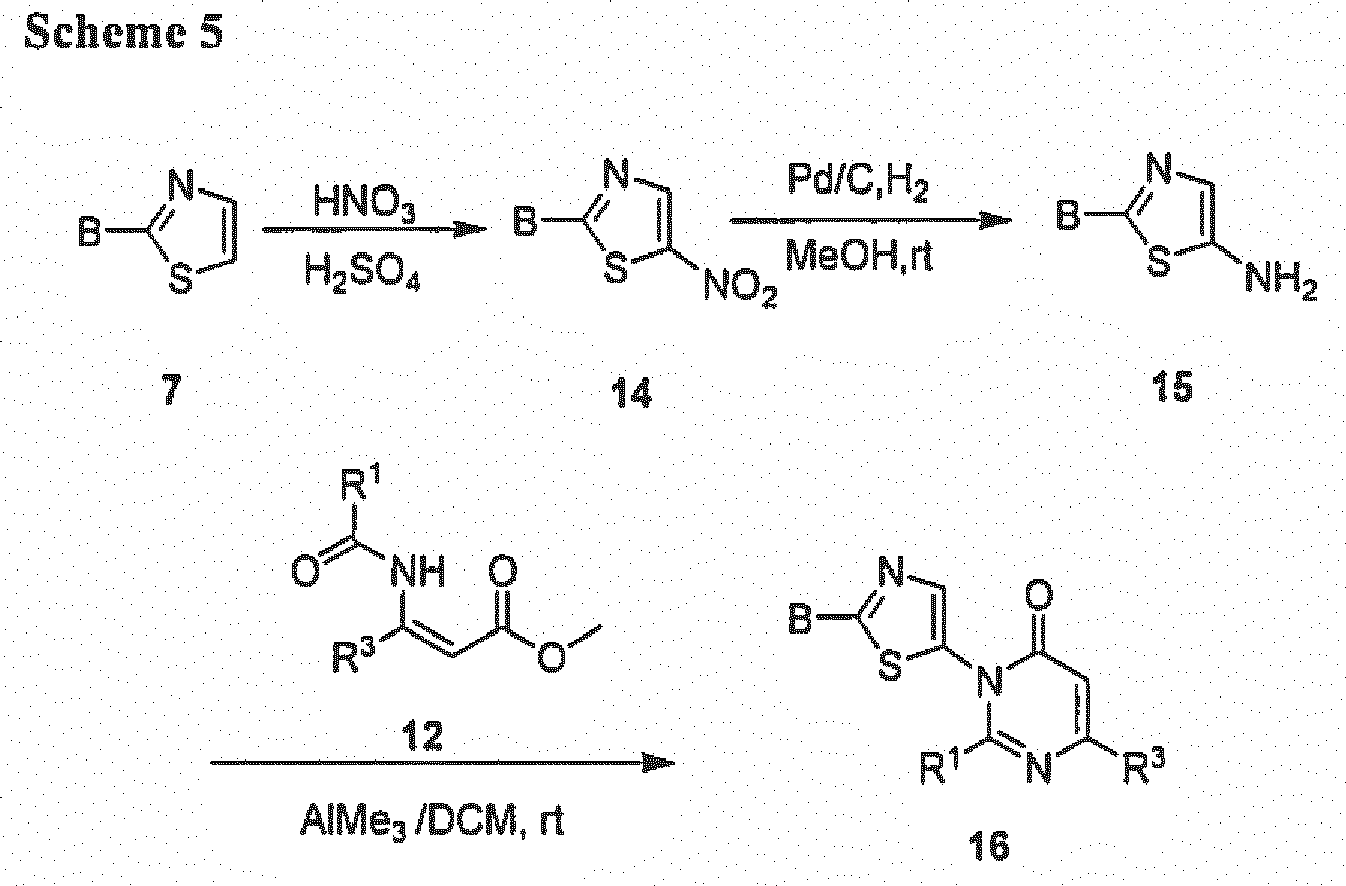

- Compound 18, wherein each of R1, R3, R5a, n and D is as defined herein, can be prepared by the process illustrated in Scheme 6. Fused tricyclic compound 17 is reacted with compound 12 under the action of trimethylaluminium in organic solvent (such as dichloromethane, etc.) to give the target compound 18.
-

- To a solution of 1-methyl-2-fluoro-4-nitrobenzene (4.96 g, 32 mmol) and NBS (6.05 g, 34 mmol) in CCl4 (80 mL) was added BPO (0.39 g, 1.6 mmol). The mixture was heated at 68 °C for 5 h, then filtered and concentrated in vacuo. The residue was purified by a silica gel column chromatography (PE / EtOAc (V / V) = 20 : 1) to give the title compound as a yellow solid (4.53 g, 60%).
- To a solution of 1-(bromomethyl)-2-fluoro-4-nitrobenzene (3.04 g, 13 mmol) in CH2Cl2 (50 mL) were added morpholine (1.74 g, 20 mmol) and Et3N (2.63 g, 26 mmol). The reaction was refluxed overnight, and then concentrated in vacuo. The residue was purified by a silica gel column chromatography (PE / EtOAc (V / V) = 4 : 1) to give the title compound as a yellow solid (2.05 g, 65%).
- To a solution of 4-(2-fluoro-4-nitrobenzyl) morpholine (14.80 g, 62 mmol) in MeOH (100 mL) was added Pd/C (4.0 g). The reaction mixture was stirred at rt under H2 overnight and filtered. The filtrate was concentrated in vacuo. The residue was purified by a silica gel column chromatography (PE / EtOAc (V / V) = 1 : 1) to give the title compound as a claybank solid (11.27 g, 87%).
- A mixture of 3-fluoro-4-(morpholinomethyl)aniline (0.21 g, 1.00 mmol), anhydrous CH2Cl2 (10 mL) and trimethylaluminum (4.5 mL, 4.5 mmol, 1.0 M in heptane) was stirred at rt for 20 min under N2, followed by the addition of a solution of methyl 3-acetaminocrotonate (0.19 g, 1.20 mmol) in CH2Cl2 (5 mL). The reaction mixture was stirred at rt for 10 h, then quenched with saturated NH4Cl aqueous solution and extracted with CH2Cl2. The combined organic phases were washed with saturated NaHCO3 aqueous solution and brine, dried over anhydrous Na2SO4 and concentrated in vacuo. The residue was purified by a silica gel column chromatography (PE / EtOAc (V / V) = 1 : 1) to give the title compound as a pale yellow solid (0.105 g, 30%). The compound was characterized by the following spectroscopic data:
MS (ESI, pos.ion) m/z: 318.2 (M+1);
1H-NMR (400 MHz, CDCl3): δ 2.18 (s, 3 H), 2.31 (s, 3 H), 2.53 (s, 4 H), 3.62 (m, 2 H), 3.74 (s, 4 H), 6.3 (s, 1 H), 6.96 (m, 2 H), 7.61 (s, 1 H). -
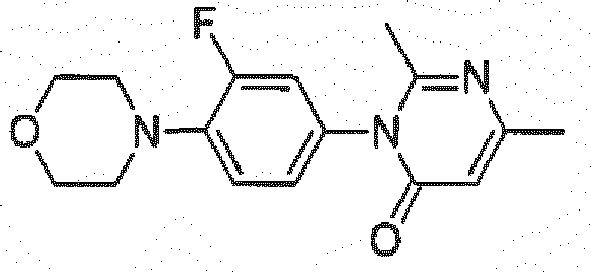
- To a solution of morpholine (12.04 g, 0.14 mol) and Et3N (13.97 g, 0.14 mol) in EtOAc was added 3,4-difluoronitrobenzene (20.0 g, 0.13 mol) dropwise in an ice bath. The reaction mixture was warmed to rt slowly, stirred at rt overnight, and then filtered. The filter cake was washed with water, dried in vacuo to obtain the 1st crop of product. The organic phase was separated from the filtrate, and the water phase was washed with EtOAc. The combined organic phases were dried over anhydrous Na2SO4 and concentrated in vacuo to obtain the 2nd crop of product. The solids of 1st crop and 2nd crop were combined to give the title compound as a yellow solid (28.0 g, 99%).
- To a solution of 4-(2-fluoro-4-nitrophenyl) morpholine (15.0 g, 66 mmol) in THF (100 mL) was added Pd/C (3.0 g). The reaction mixture was stirred at rt under H2 for 12 h. The mixture was filtered through a celite pad, and the filtrate was concentrated in vacuo to give the title compound as a white solid (11.55 g, 89%).
- To acetic anhydride (300 mL, 3.04 mol) was added methyl-2-aminocrotonate (100 g, 0.87 mol). The mixture was stirred at 75 °C for 3 h, cooled to rt and concentrated in vacuo. The crude product was recrystallized from EtOH (150 mL) to give the title compound as a white solid (46 g, 34%).
- To a solution of 3-fluoro-4-morpholinoaniline (11.0 g, 56 mmol) in CH2Cl2 (200 mL) was added trimethylaluminium (168 mL, 168 mmol, 1 M in heptane) dropwise carefully under N2. The mixture was stirred at rt for 20 min, followed by the addition of a solution of methyl 3-acetaminocrotonate (10.57 g, 67 mmol) in CH2Cl2 (30 mL). The reaction was stirred at rt for 5 h, then quenched with saturated NH4Cl aqueous solution and extracted with CH2Cl2. The combined organic phases were washed with water, dried over anhydrous Na2SO4 and concentrated in vacuo. The residue was recrystallized from EtOAc to give the title compound as a pale yellow solid (11.39 g, 67%). The compound was characterized by the following spectroscopic data:
MS (ESI, pos.ion) m/z: 304.2(M+1);
1H-NMR (400 MHz, CDCl3): δ 2.19 (s, 3 H), 2.30 (s, 3 H), 3.09-3.22 (m, 4 H), 3.88 (t, 4 H,
J = 4.6 Hz), 6.28 (s, 1 H), 6.90-6.94 (m, 2 H), 7.01-7.06 (m, 1 H). -

- To a solution of diethylamine (2.53 g, 34.59 mmol) and Et3N (3.82 g, 37.75 mmol) in EtOAc (40 mL) was added 3,4-difluoronitrobenzene (5.00 g, 31.43 mmol) dropwise over a period of 30 min in an ice bath. Upon the end of addition the reaction was warmed to rt slowly, and solid was precipitated out. The mixture was filtered. The filter cake was washed with an appropriate amount of water, and dried in vacuo to obtain the 1st crop of product. The filtrate was extracted with EtOAc. The combined organic phases were dried over anhydrous Na2SO4 and concentrated in vacuo to obtain the 2nd crop of product. The solids of 1st crop and 2nd crop were combined to give the title compound as a yellow solid (7.20 g, 99%).
- To a solution of N,N-diethyl-2-fluoro-4-nitroaniline (4.00 g, 18.84 mmol) in THF (50 mL) was added Pd/C (1.50 g). The reaction mixture was stirred at rt under H2 for 12 h. The mixture was filtered, and the filtrate was concentrated in vacuo to give the title compound as an offwhite solid (3.20 g, 93%).
- To a solution of N',N'-diethyl-2-fluorobenzene-1,4-diamine (1.50 g, 8.23 mmol) in anhydrous CH2Cl2 (60 mL) was added trimethylaluminium (33 mL, 33 mmol, 1 M in heptane) dropwise slowly under N2. Upon the end of addition the mixture was stirred at rt for 40 min. To this mixture was added a solution of methyl 3-acetaminocrotonate (2.58 g, 16.40 mmol) in anhydrous CH2Cl2 (20 mL). The resulting reaction mixture was stirred at rt for another 6 h, then quenched with water. The organic phase was washed with brine, dried over anhydrous Na2SO4 and concentrated in vacuo. The crude product was recrystallized from EtOAc to give the title compound as a pale yellow solid (1.60 g, 67%). The compound was characterized by the following spectroscopic data:
MS (ESI, pos.ion) m/z: 290.2 (M+1);
1H-NMR (400 MHz, DMSO): δ 1.07 (t, 6 H, J = 7.04 Hz), 2.08 (s, 3 H), 2.19 (s, 3 H),
3.22-3.27 (m, 4 H), 6.22 (s, 1 H), 6.98-7.06 (m, 2 H), 7.16-7.20 (m, 1 H). -

- To a solution of thiomorpholine (3.57 g, 34.56 mmol) and Et3N (3.50 g, 34.56 mmol) in EtOAc was added 3,4-difluoronitrobenzene (5.00 g, 31.43 mmol) dropwise over a period of 30 min in an ice bath. Upon the end of addition the reaction mixture was warmed to rt slowly, and solid was precipitated out. The mixture was filtered. The filter cake was washed with an appropriate amount of water, dried in vacuo to obtain the 1st crop of product. The filtrate was extracted with EtOAc. The combined organic phases were dried over anhydrous Na2SO4 and concentrated in vacuo to obtain the 2nd crop of product. The solids of 1st crop and 2nd crop were combined to give the title compound as a yellow solid (5.50 g, 72%).
- To a solution of 4-(2-fluoro-4-nitrophenyl) thiomorpholine (4.00 g, 16.51 mmol) in THF (50 mL) was added Pd/C (1.30 g). The reaction mixture was stirred at rt under H2 for 12 h. The mixture was filtered, and the filtrate was concentrated in vacuo to give the title compound as an offwhite solid (3.40 g, 97%).
- Step 3) 3-(3-fluoro-4-thiomorpholinophenyl)-2,6-dimethylpyrimidin-4(3H)-one To a solution of 3-fluoro-4-thiomorpholinoaniline (1.20 g, 5.65 mmol) in anhydrous CH2Cl2 (60 mL) was added trimethylaluminium (28.5 mL, 28.5 mmol, 1 M in heptane) carefully dropwise under the protection of N2. Upon the end of addition the mixture was stirred at rt for 40 min, followed by the addition of a solution of methyl 3-acetaminocrotonate (2.66 g, 16.92 mmol) in anhydrous CH2Cl2 (20 mL). Upon the end of addition the reaction mixture was stirred at rt for another 6 h, then quenched with water and extracted with CH2Cl2. The combined organic phases were washed with brine, dried over anhydrous Na2SO4 and concentrated in vacuo to give the title compound as pale yellow solid (0.91 g, 67%). The compound was characterized by the following spectroscopic data:
MS (ESI, pos.ion) m/z: 320.2 (M+1);
1H-NMR (400 MHz, CDCl3): δ 2.07 (s, 3 H), 2.19 (s, 3 H), 2.77 (t, 4 H, J = 4.76 Hz), 3.33 (d, 4 H, J = 4.12 Hz), 6.23 (s, 1 H), 7.08-7.11 (m, 1 H), 7.16-7.20 (m, 1 H), 7.25-7.29 (m, 1 H). -

- To a suspension of K2CO3 (5.53 g, 40 mmol) and 1,1-dioxo-thio-morpholinehydrochloride (3.60 g, 21 mmol) in DMSO (50 mL) was added 3,4-difluoronitrobenzene (3.18 g, 20 mmol). The reaction was heated at 100 °C for 12 h. The mixture was diluted with water (150 mL) and extracted with CH2Cl2 (100 mL x 2). The combined organic phases were dried over anhydrous Na2SO4 and concentrated in vacuo to give the title compound as a yellow solid (6.04 g, 70%).
- To a solution of 4-(2-fluoro-4-nitrophenyl)1,1-dioxidothiomorpholine (4.00 g, 14.58 mmol) in THF (50 mL) was added Pd/C (1.30 g). The reaction mixture was stirred at rt under H2 for 12 h. The mixture was filtered, and the filtrate was concentrated in vacuo to give the title compound as an offwhite solid (2.40 g, 67%).
- To a solution of 4-(4-amino-2-fluorophenyl)1,1-dioxidothiomorpholine (1.20 g, 4.91 mmol) in anhydrous CH2Cl2 (100 mL) was added trimethylaluminium (28.5 mL, 28.5 mmol, 1 M in heptane) carefully dropwise under N2. Upon the end of addition the mixture was stirred at rt for 20 min, followed by the addition of a solution of methyl 3-acetaminocrotonate (2.32 g, 14.76 mmol) in anhydrous CH2Cl2 (30 mL). Upon the end of addition the reaction mixture was stirred at rt for another 15 h, then quenched with an appropriate amount of water and extracted with CH2Cl2. The combined organic phases were washed with brine, dried and concentrated in vacuo to give the title compound as a yellow solid (0.81 g, 47%). The compound was characterized by the following spectroscopic data:
MS (ESI, pos.ion) m/z: 352.1 (M+1);
1H-NMR (400 MHz, DMSO-d6 ): δ 2.07 (s, 3 H), 2.20 (s, 3 H), 3.29 (t, 4 H, J = 4.4 Hz), 3.58 (d, 4 H, J = 4.4 Hz), 6.23 (s, 1 H), 7.13-7.11 (m, 1 H), 7.26-7.28 (m, 1 H), 7.31-7.35 (m, 1 H). -

- To a solution of piperidine (5.88 g, 69 mmol) and Et3N (6.98 g, 69 mmol) in EtOAc (60 mL) was added 1,2-difluoro-4-nitrobenzene (10.00 g, 63 mmol) dropwise. The mixture was stirred at rt overnight. The resulting mixture was washed with brine, dried over anhydrous Na2SO4 and concentrated in vacuo to give the title compound as a yellow solid (14.00 g, 99%).
- To a solution of 1-(2-fluoro-4-nitrophenyl) piperidine (14.00 g, 62 mmol) in THF (80 mL) was added Pd/C (3.00 g). The reaction mixture was stirred at rt under H2 overnight. The mixture was filtered, and the filtrate was concentrated in vacuo to give the title compound as a claybank solid (11.00 g, 87%).
- To a solution of 3-fluoro-4-(piperidin-1-yl) aniline (10.00 g, 51 mmol) in anhydrous CH2Cl2 (100 mL) was added trimethylaluminum (155 mL, 155 mmol, 1.0 M in toluene) under N2. The mixture was stirred at rt for 20 min, followed by the addition of a solution of methyl 3-acetaminocrotonate (9.72 g, 62 mmol) in anhydrous CH2Cl2 (20 mL). The reaction mixture was stirred at rt for 5 h, then quenched with saturated NH4Cl aqueous solution and extracted with CH2Cl2. The combined organic phases were washed with brine, dried over anhydrous Na2SO4 and concentrated in vacuo. The residue was purified by a silica gel column chromatography (PE / EtOAc (V / V) = 2 : 1) to give the title compound as a pale yellow solid (11.02 g, 71%). The compound was characterized by the following spectroscopic data:
MS (ESI, pos.ion) m/z: 302.2 (M+1);
1H-NMR (400 MHz, CDCl3): δ 1.57-1.63 (m, 2 H), 1.78-1.72 (m, 4 H), 2.18 (s, 3 H), 2.29 (s, 3 H), 3.07-3.01 (m, 2 H), 3.11-3.16 (m, 2 H), 6.28 (s, 1 H), 6.86-6.88 (m, 1 H), 6.89-6.90 (m, 1 H), 7.02-7.06 (m, 1 H). -

- To a solution of 1-methylpiperazine (6.91 g, 69 mmol) and Et3N (6.98 g, 69 mmol) in EtOAc (60 mL) was added 1,2-difluoro-4-nitrobenzene (10.02 g, 63 mmol) dropwise with stirring and the mixture was stirred at rt overnight. The reaction mixture was washed with brine, dried over anhydrous Na2SO4 and concentrated in vacuo to give the title compound as a yellow solid (14.75 g, 98%).
- To a solution of 1-(2-fluoro-4-nitrophenyl)-4-methylpiperazine (14.76 g, 61.70 mmol) in THF (80 mL) was added Pd/C (3.00 g). The reaction was stirred at rt under H2 overnight. The mixture was filtered, and the filtrate was concentrated in vacuo to give the title compound as an offwhite solid (11.99 g, 93%).
- To a solution of 3-fluoro-4-(4-methylpiperazin-1-yl)aniline (11.01 g, 52.60 mol) in anhydrous CH2Cl2 (200 mL) was added trimethylaluminum (158 mL, 158 mmol, 1.0 M in toluene) slowly under N2. The mixture was stirred at rt for 20 min, followed by the addition of a solution of methyl 3-acetaminocrotonate (9.92 g, 63.10 mmol) in anhydrous CH2Cl2 (20 mL). The reaction mixture was stirred at rt for another 5 h, then quenched with saturated NH4Cl aqueous solution and extracted with CH2Cl2. The combined organic phases were washed with brine, dried over anhydrous Na2SO4 and concentrated in vacuo. The residue was purified by a silica gel column chromatography (CH2Cl2/ MeOH (V / V) = 5 : 1) to give the title compound as a white solid (11.31 g, 68%). The compound was characterized by the following spectroscopic data:
MS (ESI, pos.ion) m/z: 317.2(M+1);
1H-NMR (400 MHz, CDCl3): δ 2.19 (s, 3 H), 2.29 (s, 3 H), 2.37 (s, 3 H), 2.61 (s, 4 H), 3.14-3.24 (m, 4 H), 6.28 (s, 1 H), 6.88-6.91 (m, 2 H), 7.05 (t, 1 H, J = 8.8 Hz). -

- To a solution of 1,2-difluoro-4-nitrobenzene (1.59 g, 10 mmol) in DMSO (15 mL) were added K2CO3 (3.04 g, 22 mmol) and pyrrole (0.74 g, 11 mmol) with stirring. The reaction mixture was heated at 90 °C for 18 h, and cooled to rt. The mixture was diluted with water (50 mL), filtered and the filter cake was dried to give the title compound as a yellow solid (2.00 g, 97%).
- To a solution of 1-(2-fluoro-4-nitrophenyl)-1H-pyrrole (2.00 g, 9.70 mmol) in CH2Cl2 (35 mL) was added catalyst Pd/C (0.20 g). The reaction mixture was stirred at rt under H2 for 5 h, and filtered. The filtrate was concentrated in vacuo. The residue was purified by a silica gel column chromatography (PE / CH2Cl2 (V / V) = 3 : 1) to give the title compound as a white solid (1.30 g, 76%).
- To a solution of 3-fluoro-4-(1H-pyrrol-1-yl) aniline (0.80 g, 4.55 mmol) in CH2Cl2 (30 mL) was added trimethylaluminum (23 mL, 23 mmol, 1 M in heptane) slowly. The reaction mixture was stirred at rt for 0.5 h, followed by the addition of a solution of methyl 3-acetaminocrotonate (785 mg, 5.0 mmol) in CH2Cl2 (10 mL). The reaction mixture was stirred at rt for 3 days, then quenched with saturated NH4Cl aqueous solution and extracted with CH2Cl2(100 mL x 3). The combined organic phases were dried over anhydrous Na2SO4 and concentrated in vacuo. The residue was purified by a silica gel column chromatography (PE / EtOAc (V / V) = 3 : 2) to give the title compound as a pale yellow solid (450 mg, 35%). The compound was characterized by the following spectroscopic data:
MS (ESI, pos.ion) m/z: 284.2 (M+1);
1H-NMR (400 MHz, CDCl3): δ 2.25 (s, 3 H), 2.32 (s, 3 H), 6.32 (s, 1 H), 6.40 (t, 2 H, J = 2.2 Hz), 7.08-7.11 (m, 3 H), 7.13 (dd, 1 H, J1 = 2.2 Hz, J2 = 10.8 Hz), 7.54 (t, 1 H, J = 8.4 Hz). -

- To a solution of 1,2-difluoro-4-nitrobenzene (3.18 g, 20 mmol) in DMSO (35 mL) were added K2CO3 (6.08 g, 44 mmol) and pyrazole (1.50 g, 22 mmol) with stirring. The reaction mixture was heated at 90 °C for 18 h, and cooled to rt. The mixture was diluted with water (50 mL) and filtered. The filtrate was extracted with DCM (50 mL x 3), the combined organic phases were concentrated in vacuo. The crude product was purified by a silica gel column chromatography (PE / CH2Cl2 (V / V) = 1 : 1) to give the title compound as a yellow solid (3.31 g, 80%).
- To a solution of 1-(2-fluoro-4-nitrophenyl)-1H-pyrazole (3.31 g, 16 mmol) in CH2Cl2 (60 mL) was added catalyst Pd/C (0.33 g). The reaction mixture was stirred at rt under H2 overnight, and filtered. The filtrate was concentrated in vacuo. The residue was purified by a silica gel column chromatography (PE / CH2Cl2 (V / V) = 1 : 1) to give the title compound as a white solid (1.30 g, 46%).
- To a solution of 3-fluoro-4-(1H-pyrazol-1-yl) aniline (0.65 g, 3.68 mmol) in CH2Cl2 (30 mL) was added trimethylaluminum (18.4 mL, 36.8 mmol, 2 M in heptane) slowly. The reaction mixture was stirred at rt for 0.5 h, followed by the addition of a solution of methyl 3-acetaminocrotonate (634 mg, 4.04 mmol) in CH2Cl2 (10 mL). The reaction was stirred at rt for 3 days, then quenched with saturated NH4Cl aqueous solution and extracted with CH2Cl2 (100 mL x 3). The combined organic phases were dried over anhydrous Na2SO4 and concentrated in vacuo. The residue was purified by a silica gel column chromatography (PE / EtOAc (V / V) = 1 : 2) to give the title compound as a white solid (400 mg, 38%). The compound was characterized by the following spectroscopic data:
MS (ESI, pos.ion) m/z: 285.2 (M+1);
1H-NMR (400 MHz, CDCl3): δ 2.23 (s, 3 H), 2.32 (s, 3 H), 6.32 (s, 1 H), 6.54 (t, 1 H, J = 2.0 Hz), 7.13-7.19 (m, 2 H), 7.78 (d, 1 H, J = 4.0 Hz), 8.08 (t, 1 H, J = 2.0 Hz), 8.12-8.16 (m, 1 H). -

- A mixture of methyl 3-aminocrotonate (3.20 g, 27.79 mmol) and pyridine (2.64 g, 33.33 mmol) in CH2Cl2 (60 mL) was stirred at -20 °C for 20 min. To the mixture was added a solution of bromoacetyl bromide (5.61 g, 27.79 mmol) in CH2Cl2 (20 mL) dropwise. The mixture was stirred at rt for 2 h. The organic phase was washed with brine (100 mL x 3), dried over anhydrous Na2SO4 and concentrated in vacuo. The residue was purified by a silica gel column chromatography (PE / EtOAc (V / V) = 5 : 1) to give the title compound as a reddish solid (0.99 g, 15%).
- To a suspension of K2CO3 (0.37 g, 2.68 mmol) in acetone (10 mL) were added 3-fluorophenol (0.30 g, 2.68 mmol) and methyl 3-(2-bromoacetamido)crotonate (0.76 g, 3.22 mmol), the mixture was refluxed for 5 h and cooled to rt. The mixture was concentrated in vacuo and the residue was dissolved in CH2Cl2 (40 mL), washed with brine (40 mL x 3). The organic phase was dried over anhydrous Na2SO4 and concentrated in vacuo. The residue was purified by a silica gel column chromatography (PE / EtOAc (V / V) = 10 : 1) to give the title compound as a yellowish solid (0.50 g, 70%).
- To a solution of 3-fluoro-4-morpholinoaniline (0.55 g, 2.80 mmol) in anhydrous CH2Cl2 (40 mL) was added trimethylaluminium (2.0 mL, 4 mmol, 2 M in heptane) carefully under N2 at rt. The mixture was stirred at rt for 30 min, followed by the addition of a solution of methyl 3-(2-(3-fluorophenoxy)acetamido)crotonate (0.75 g, 2.80 mmol) in anhydrous CH2Cl2 (10 mL). The reaction mixture was stirred for another 7 h, then quenched with an appropriate amount of water and washed with brine twice. The organic phase was dried over anhydrous Na2SO4 and concentrated in vacuo. The crude product was purified by a silica gel column chromatography (PE / EtOAc (V / V) = 1 : 1) to give the title compound as a white solid (0.24 g, 62%). The compound was characterized by the following spectroscopic data:
MS (ESI, pos.ion) m/z: 414.3 (M+1);
1H-NMR (400 MHz, CDCl3): δ 2.34 (s, 3 H), 3.03-3.14 (m, 4 H), 3.85 (t, 4 H, J = 4.8 Hz), 4.67 (s, 2 H), 6.38 (s, 1 H), 6.45-6.49 (m, 1 H), 6.53-6.55 (m, 1 H), 6.64-6.68 (m, 1 H), 6.95-6.98 (m, 3 H), 7.13-7.19 (m, 1 H). -

- To a solution of pyrrolidine (0.78 g, 11 mmol) in EtOAc (15 mL) and Et3N (1.52 g, 15 mmol) was added 1,2-difluoro-4-nitrobenzene (1.59 g, 10 mmol) in an ice bath. The mixture was stirred at rt overnight and filtered. The filter cake was washed with water and dried to give the title compound as a yellow solid (1.60 g, 76%).
- To a solution of 1-(2-fluoro-4-nitrophenyl) pyrrolidine (1.60 g, 7.62 mmol) in mixed solvents of CH2Cl2 (20 mL) and MeOH (20 mL) was added catalyst Pd/C (0.16 g). The reaction was stirred at rt under H2 overnight, and filtered. The filtrate was concentrated in vacuo. The residue was purified by a silica gel column chromatography (PE / EtOAc (V / V) = 5 : 1) to give the title compound as a white solid (1.20 g, 88%).
- To a solution of 3-fluoro-4-(pyrrolidin-1-yl)aniline (0.50 g, 2.78 mmol) in CH2Cl2 (20 mL) was added trimethylaluminum (14 mL, 14 mmol, 1 M in heptane) slowly at rt. The reaction mixture was stirred at rt for 0.5 h, followed by the addition of a solution of methyl 3-acetaminocrotonate (480 mg, 3.06 mmol) in CH2Cl2 (10 mL). The reaction mixure was stirred at rt for 3 days, then quenched with saturated NH4Cl aqueous solution and extracted with CH2Cl2 (100 mL x 3). The combined organic phases were dried over anhydrous Na2SO4 and concentrated in vacuo. The residue was purified by a silica gel column chromatography (PE / EtOAc (V / V) = 1 : 1) to give the title compound as a pale yellow solid (300 mg, 38%). The compound was characterized by the following spectroscopic data:
MS (ESI, pos.ion) m/z: 288.3 (M+1);
1H-NMR (400 MHz, CDCl3): δ 1.96-1.99 (m, 4 H), 2.21 (s, 3 H), 2.29 (s, 3 H), 3.43-3.48 (m, 4 H), 6.28 (s, 1 H), 6.71 (t, 1 H, J = 8.8 Hz), 6.78-6.84 (m, 2 H). -

- To a solution of 3,4-difluoronitrobenzene (3.18 g, 20 mmol) in DMSO (25 mL) were added K2CO3 (6.08 g, 44 mmol) and di-n-butylamine (2.84 g, 22 mmol) with stirring. The mixture was heated at 90 °C overnight, then cooled to rt, diluted with water (100 mL) and extracted with CH2Cl2 (80 mL x 3). The combined organic phases were dried over anhydrous Na2SO4 and concentrated in vacuo. The residue was purified by a silica gel column chromatography (PE / CH2Cl2 (V / V) = 10 : 1) to give the title compound as yellow oil (4.03 g, 75%).
- To a solution of N,N-di-n-butyl-2-fluoro-4-nitroaniline (4.03 g, 15 mmol) in mixed solvents of CH2Cl2 (70 mL) and MeOH (20 mL) was added catalyst Pd/C (0.40 g). The reaction mixture was stirred at rt under H2 overnight, and filtered. The filtrate was concentrated in vacuo. The residue was purified by a silica gel column chromatography (PE / CH2Cl2 (V / V) = 8 : 1) to give the title compound as colorless oil (2.32 g, 65%).
- To a solution of N',N'-di-n-butyl-2-fluorobenzene-1,4-diamine (1.10 g, 4.62 mmol) in CH2Cl2 (20 mL) was added trimethylaluminum (23 mL, 23 mmol, 1 M in heptane) slowly at rt. The reaction mixture was stirred at rt for 0.5 h, followed by the addition of a solution of methyl 3-acetaminocrotonate (798 mg, 5.08 mmol) in CH2Cl2 (10 mL). The reaction was stirred at rt for 3 days, then quenched with saturated NH4Cl aqueous solution and extracted with CH2Cl2 (100 mL x 3). The combined organic phases were dried over anhydrous Na2SO4 and concentrated in vacuo. The residue was purified by a silica gel column chromatography (PE / EtOAc (V / V) = 3 : 2) to give the title compound as pale yellow oil (800 mg, 50%). The compound was characterized by the following spectroscopic data:
MS (ESI, pos.ion) m/z: 346.3 (M+1);
1H-NMR (400 MHz, CDCl3): δ 0.93 (t, 6 H, J = 7.4 Hz), 1.26-1.36 (m, 4 H), 1.55 (t, 4 H, J = 8.0 Hz), 2.20 (s, 3 H), 2.29 (s, 3 H), 3.21 (t, 4 H, J = 7.6 Hz), 6.28 (s, 1H), 6.80-6.85 (m, 2 H), 6.88-6.93 (m, 1 H). -

- To a solution of 3,4-difluoronitrobenzene (1.59 g, 10 mmol) in DMSO (15 mL) were added K2CO3 (3.04 g, 22 mmol) and diisobutylamine (1.42 g, 11 mmol). The mixture was heated at 90 °C overnight, then cooled to rt, diluted with water (50 mL) and extracted with CH2Cl2 (50 mL x 3). The combined organic phases were dried over anhydrous Na2SO4 and concentrated in vacuo. The residue was purified by a silica gel column chromatography (PE / EtOAc (V / V) = 10 : 1) to give the title compound as pale yellow oil (0.80 g, 30%).
- To a solution of 2-fluoro-N,N-diisobutyl-4-nitroaniline (0.8 g, 3 mmol) in mixed solvents of CH2Cl2 (15 mL) and MeOH (15 mL) was added catalyst Pd/C (80 mg). The reaction mixture was stirred at rt under H2 overnight, and filtered. The filtrate was concentrated in vacuo. The residue was purified by a silica gel column chromatography (PE / EtOAc (V / V) = 8 : 1) to give the title compound as pale yellow oil (0.40 g, 56%).
- To a solution of 2-fluoro-N',N'-diisobutylbenzene-1,4-diamine (0.40 g, 1.68 mmol) in CH2Cl2 (20 mL) was added trimethylaluminum (8.4 mL, 8.4 mmol, 1 M in heptane) slowly at rt. The reaction mixture was stirred at rt for 0.5 h, followed by the addition of a solution of methyl 3-acetaminocrotonate (290 mg, 1.85 mmol) in CH2Cl2 (10 mL). The reaction mixture was stirred at rt for 3 days, then quenched with saturated NH4Cl aqueous solution and extracted with CH2Cl2 (100 mL x 3). The combined organic phases were dried over anhydrous Na2SO4 and concentrated in vacuo. The residue was purified by a silica gel column chromatography (PE / EtOAc (V / V) = 1 : 1) to give the title compound as pale yellow oil (280 mg, 48%). The compound was characterized by the following spectroscopic data:
MS (ESI, pos.ion) m/z: 346.4 (M+1);
1H-NMR (400 MHz, CDCl3): δ 0.88-0.90 (m, 12 H), 1.87-1.94 (m, 2 H), 2.20 (s, 3 H), 2.29 (s, 3 H), 3.00-3.10 (m, 4 H), 6.28 (s, 1 H), 6.80-6.84 (m, 2 H), 6.95 (t, 1 H, J = 12.9 Hz). -

- To a solution of 3,4-difluoronitrobenzene (1.59 g, 10 mmol) in DMSO (15 mL) were added K2CO3 (3.04 g, 22 mmol) and di-n-hexylamine (2.04 g, 11 mmol). The mixture was heated at 90 °C overnight, then cooled to rt, diluted with water (50 mL) and extracted with CH2Cl2 (50 mL x 3). The combined organic phases were dried over anhydrous Na2SO4 and concentrated in vacuo. The residue was purified by a silica gel column chromatography (PE / CH2Cl2 (V / V) = 10 : 1) to give the title compound as pale yellow oil (2.79 g, 86%).
- To a solution of 2-fluoro-N,N-di-n-hexyl-4-nitroaniline (2.79 g, 8.64 mmol) in MeOH (50 mL) was added catalyst Pd/C (0.28 g). The reaction mixture was stirred at rt under H2 overnight, and filtered. The filtrate was concentrated in vacuo. The residue was purified by a silica gel column chromatography (PE / EtOAc (V / V) = 10 : 1) to give the title compound as pale yellow oil (1.60 g, 63%).
- To a solution of 2-fluoro-N',N'-di-n-hexyl benzene-1,4-diamine (0.58 g, 1.97 mmol) in CH2Cl2 (20 mL) was added trimethylaluminum (9.9 mL, 19.8 mmol, 2 M in heptane) slowly at rt. The reaction mixture was stirred at rt for 0.5 h, followed by the addition of a solution of methyl 3-acetaminocrotonate (341 mg, 2.17 mmol) in CH2Cl2 (5 mL). The reaction mixture was stirred at rt for 3 days, then quenched with saturated NH4Cl aqueous solution and extracted with CH2Cl2 (100 mL x 3). The combined organic phases were dried over anhydrous Na2SO4 and concentrated in vacuo. The residue was purified by a silica gel column chromatography (PE / EtOAc (V / V) = 2 : 1) to give the title compound as pale yellow oil (500 mg, 63%). The compound was characterized by the following spectroscopic data:
MS (ESI, pos.ion) m/z: 402.3 (M+1);
1H-NMR (400 MHz, CDCl3): δ 0.89 (t, 6 H, J = 7.0 Hz), 1.31 (t, 12 H, J = 7.8 Hz), 1.55 (t, 4 H, J = 7.2 Hz), 2.20 (s, 3 H), 2.29 (s, 3 H), 3.18-3.21 (m, 4 H), 6.28 (s, 1 H), 6.79-6.82 (m, 2 H), 6.84-6.92 (m, 1 H). -

- To a solution of piperidin-4-ol (11.11 g, 0.11 mol) and Et3N (12.14 g, 0.12 mol) in EtOAc (500 mL) was added 1,2-difluoro-4-nitrobenzene (15.91 g, 0.10 mol). The mixture was stirred at rt for 24 h, and washed with water (200 mL x 4). The organic phase was dried over anhydrous Na2SO4 and concentrated in vacuo to give the title compound as orange oil (19.35 g, 80%).
- To a solution of 1-(2-fluoro-4-nitrophenyl) piperidin-4-ol (2.67 g, 11 mmol) in MeOH (100 mL) was added catalyst Pd/C (1.00 g). The reaction mixture was stirred at rt under H2 for 6 h, then filtered. The filtrate was concentrated in vacuo to give the crude product (2.50 g) for the next step without further purification.
- To a solution of 1-(4-amino-2-fluorophenyl)piperidin-4-ol (1.68 g, 8.00 mmol) in CH2Cl2 (20 mL) was added trimethylaluminium (32 mL, 64 mmol, 2 M in heptane) carefully under N2. The mixture was stirred at rt for 30 min, followed by the addition of a solution of methyl 3-acetaminocrotonate (1.40 g, 8.90 mol) in CH2Cl2 (5 mL). The reaction mixture was stirred at rt for another 5 h, then quenched with saturated NH4Cl aqueous solution (100 mL). The organic phase was dried over anhydrous Na2SO4 and concentrated in vacuo. The residue was purified by recrystallized from EtOAc to give the title compound as a yellow solid (1.25 g, 50%). The compound was characterized by the following spectroscopic data:
MS (ESI, pos.ion) m/z: 318.2 (M+1);
1H-NMR (400 MHz, CDCl3): δ 1.74-1.77 (m, 2 H), 2.02-2.05 (m, 2 H), 2.18 (s, 3 H), 2.29 (s, 3 H), 2.85-2.99 (m, 2 H), 3.36-3.48 (m, 2 H), 3.84-3.92 (m, 1 H), 6.28 (s, 1 H), 6.90 (d, 1 H, J = 1.2 Hz), 7.05 (t, 1 H, J = 0.8 Hz). -

- To a suspension of K2CO3 (6.50 g, 47 mmol) and morpholine (3.75 g, 43 mmol) in acetonitrile (30 mL) was added 2-bromoacetonitrile (5.16 g, 43 mmol) in one portion under the protection of N2 in an ice bath. The mixture was stirred at rt for 2 h, then filtered. The filtrate was concentrated in vacuo to give the title compound as a yellow solid (5.41 g, 100%).
- To anhydrous THF (35 mL) was added LiAlH4 (3.19 g, 84 mmol) in one portion in an ice bath. The mixture was stirred at 0 °C for 20 min, and a solution of 2-morpholinoacetonitrile (3.50 g, 28 mmol) in anhydrous THF (10 mL) was added dropwise. Upon the end of addition the mixture was refluxed for 3 h, then cooled to rt, diluted with water (20 mL), filtered and concentrated in vacuo to give the title compound as yellow oil (2.62 g, 72%).
- A solution of 2-morpholinoethanamine (0.90 g, 6.91 mmol), 1,2-difluoro-4-nitrobenzene (1.10 g, 6.91 mmol) and Et3N (1.40 g, 13.82 mmol) in EtOAc (10 mL) was refluxed under N2 for 24 h, then cooled to rt and concentrated in vacuo. The residue was purified by a silica gel column chromatography (PE / EtOAc (V / V) = 4 : 1) to give the title compound as yellow oil (1.57 g, 84%).
- To a solution of 2-fluoro-N-(2-morpholinoethyl)-4-nitroaniline (0.60 g, 2.23 mmol) in THF (8.0 mL) was added catalyst Pd/C (0.03 g). The reaction mixture was stirred at rt under H2 overnight, then filtered. The filtrate was concentrated in vacuo to give the title compound as yellow oil (0.50 g, 94%).
- To a solution of 2-fluoro-N'-(2-morpholinoethyl) benzene-1,4-diamine (0.50 g, 2.09 mmol) in CH2Cl2 (20 mL) was added trimethylaluminum (3.2 mL, 6.40 mmol, 2 M in toluene) slowly at rt. The reaction mixture was stirred at rt for 0.5 h, followed by the addition of a solution of methyl 3-acetaminocrotonate (0.65 g, 4.13 mmol) in CH2Cl2 (5 mL). The reaction mixture was stirred at rt for 36 h, then quenched with saturated NH4Cl aqueous solution and extracted with CH2Cl2 (100 mL x 3). The combined organic phases were dried over anhydrous Na2SO4 and concentrated in vacuo. The residue was purified by a silica gel column chromatography (EtOAc / MeOH (V / V) = 30 : 1) to give the title compound as a white solid (0.50 g, 24%). The compound was characterized by the following spectroscopic data:
MS (ESI, pos.ion) m/z: 347.2 (M+1);
1H-NMR (400 MHz, CDCl3): δ 2.08 (s, 3 H), 2.18 (m, 3 H), 2.43 (s, 4 H), 2.57 (s, 2 H,), 3.25 (m, 2 H), 3.58 (t, 4 H, J = 4.32 Hz), 5.52 (s, 1 H), 6.20 (s, 1 H), 6.79-6.83 (m, 1 H), 6.91-6.93 (m, 1 H), 7.08-7.12 (m, 1 H). -

- To a suspension of 3-(3-fluoro-4-((2-morpholinoethyl)amino)phenyl)-2,6-dimethyl pyrimidin-4(3H)-one (0.24 g, 0.69 mmol) and K2CO3 (0.48 g, 3.47 mmol) in acetonitrile (15 mL) was added CH3l (0.30 g, 2.11 mmol). The mixture was stirred at rt for 36 h, then filtered and concentrated in vacuo. The residue was purified by a silica gel column chromatography (EtOAc / MeOH (V / V) = 50 : 1) to give the title compound as a white solid (50 mg, 20%). The compound was characterized by the following spectroscopic data:
MS (ESI, pos.ion) m/z: 361.2 (M+1);
1H-NMR (400 MHz, CDCl3): δ 1.26(s, 3 H), 2.16 (s, 3 H), 2.26 (s, 3 H), 2.62 (m, 4 H), 3.48 (m, 2 H), 3.69-3.74 (m, 2 H), 4.00 (m, 4 H), 6.17 (s, 1 H), 6.755-6.84 (m, 2 H), 7.03 (m, 1 H). -

- A suspension of 2-morpholinoethanamine (5.34 g, 41 mmol), 2,4-dichloro-1-nitrobenzene (7.87 g, 41 mmol) and Cs2CO3 (26.73 g, 82 mmol) in acetonitrile (100 mL) was refluxed for 6 h under N2, then cooled to rt, filtered and concentrated in vacuo. The residue was purified by a silica gel column chromatography (PE / EtOAc (V / V) = 4 : 1) to give the title compound as a yellow solid (5.90 g, 50%).
- To a solution of 3-chloro-N-(2-morpholinoethyl)-4-nitroaniline (3.50 g, 12.25 mmol) in EtOAc (60 mL) was added catalyst Pd/C (0.73 g). The reaction was stirred at rt under H2 overnight, then filtered. The filtrate was concentrated in vacuo to give the crude product for the next step without further purification.
- To a solution of 3-chloro-N'-(2-morpholinoethyl) benzene- 1,4-diamine (0,70 g, 1.93 mmol) in CH2Cl2 (20 mL) was added trimethylaluminum (6.8 mL, 13.6 mmol, 2 M in toluene) slowly at rt. The reaction mixture was stirred at rt for 0.5 h, followed by the addition of a solution of methyl 3-acetaminocrotonate (0.43 g, 2.74 mmol) in CH2Cl2 (5 mL). The reaction mixture was stirred at rt for another 72 h, then quenched with saturated NH4Cl aqueous solution and extracted with CH2Cl2 (50 mL x 3). The combined organic phases were dried over anhydrous Na2SO4 and concentrated in vacuo. The residue was purified by a silica gel column chromatography (EtOAc / MeOH (V / V) = 30 : 1) to give the title compound as a yellowish solid (0.33 g, 47%). The compound was characterized by the following spectroscopic data:
MS (ESI, pos.ion) m/z: 363.1 (M+1);
1H-NMR (400 MHz, CDCl3): δ 2.17 (s, 3 H), 2.33 (s, 3 H), 2.42-2.43 (m, 4 H), 2.50-2.64 (m, 2 H), 3.09-3.13 (m, 2 H), 3.59-3.63 (m, 4 H), 4.55-4.57 (t, 1 H), 6.32 (s, 1 H), 6.76-6.81 (m, 1 H), 6.80-6.81 (m, 1 H), 6.89-6.91 (m, 1 H). -

- To a suspension of 1-bromo-3-chloropropane (0.79 g, 5.00 mmol) and K2CO3 (1.38 g, 10.00 mmol) in EtOAc (20 mL) was added a solution of morpholine (0.44 g, 5.05 mmol) in EtOAc (20 mL) dropwise at rt under N2. The mixture was stirred at rt overnight, then filtered and concentrated in vacuo to give the crude product for the next step without further purification.
- To a suspension of 4-(3-chloropropyl) morpholine (1.64 g, 10 mmol) and K2CO3 (4.14 g, 30 mmol) in acetonitrile (20 mL) was added 2-fluoro-4-nitroaniline (1.56 g, 10 mmol) dropwise. The mixture was stirred at rt for 24 h, then filtered and concentrated in vacuo. The residue was purified by a silica gel column chromatography (PE / EtOAc (V / V) = 1 : 1) to give the title compound as yellow oil (1.78 g, 63%).
- To a solution of 2-fluoro-N-(3-morpholinopropyl)-4-nitroaniline (1.78 g, 6.28 mmol) in mixed solvents of EtOAc (15 mL) and MeOH (15 mL) was added catalyst Pd/C (0.30 g). The reaction was stirred at rt under H2 for 2 h, then filtered. The filtrate was concentrated in vacuo to give the crude product for the next step without further purification.
- To a solution of 2-fluoro-N'-(3-morpholinopropyl)benzene-1,4-diamine (1.60 g, 6.23 mmol) in CH2Cl2 (30 mL) was added trimethylaluminum (22 mL, 44 mmol, 2 M in toluene) slowly at rt. The reaction mixture was stirred at rt for 0.5 h, followed by the addition of a solution of methyl 3-acetaminocrotonate (1.98 g, 12.59 mmol) in CH2Cl2 (10 mL). The reaction was stirred at rt overnight, then quenched with saturated NH4Cl aqueous solution and extracted with CH2Cl2 (50 mL x 3). The combined organic phases were dried over anhydrous Na2SO4 and concentrated in vacuo. The residue was purified by a silica gel column chromatography (PE / EtOAc (V / V) = 2 : 1) to give the title compound as a pale yellow solid (0.60 g, 27%). The compound was characterized by the following spectroscopic data:
MS (ESI, pos.ion) m/z: 361.2 (M+1);
1H-NMR (400 MHz, CDCl3): δ 1.85-1.88 (m, 2 H), 2.21 (s, 3 H), 2.29 (s, 3 H), 2.49 (m, 4 H), 2.53-2.56 (t, 2 H), 3.20-3.31 (m, 2 H), 3.75-3.77 (t, 4 H), 6.28 (s, 1 H), 6.70-6.74 (t, 1 H), 6.81-6.84 (m, 2 H). -

- To a suspension of K2CO3 (8.28 g, 60 mmol) and morpholine (4.35 g, 50 mmol) in acetonitrile (50 mL) was added 4-bromobutyronitrile (7.40 g, 50 mmol) dropwise at rt under N2. The mixture was stirred at rt for 6 h, filtered and concentrated in vacuo to give the title compound (7.26 g, 94.2%).
- To anhydrous THF (70 mL) was added LiAlH4 (5.37 g, 142 mmol) in one portion. The mixture was stirred at 0 °C for 20 min, and a solution of 4-morpholinobutanenitrile (7.26 g, 47 mmol) in anhydrous THF (40 mL) was added dropwise. Upon the end of addition the mixture was refluxed for 4 h, then cooled to 0 °C, diluted with water (20 mL) and filtered. The filtrate was concentrated in vacuo to give the crude product for the next step without further purification.
- A suspension of 4-morpliolinobutan-1-amine (0.63 g, 4.00 mmol), 1,2-difluoro-4-nitrobenzene (0.64 g, 4.00 mmol) and K2CO3 (1.10 g, 8.00 mmol) in acetonitrile (20 mL) was stirred at rt for 19 h under N2, then filtered. The filtrate was concentrated in vacuo to give the crude product for the next step without further purification.
- To a solution of 2-fluoro-N-(4-morpholinobutyl)-4-nitroaniline (1.19 g, 4.00 mmol) in mixed solvents of EtOAc (20 mL) and MeOH (20 mL) was added catalyst Pd/C (0.30 g). The reaction was stirred at rt under H2 for 2 h, then filtered. The filtrate was concentrated in vacuo. The residue was purified by a silica gel column chromatography (EtOAc / MeOH (V / V) = 10 : 1) to give the title compound as a white solid (1.07 g, 100%).
- To a solution of 2-fluoro-N'-(4-morpholinobutyl) benzene-1,4-diamine (1.07 g, 4.00 mmol) in CH2Cl2 (30 mL) was added trimethylaluminum (14 mL, 28 mmol, 2 M in toluene) slowly at rt. The reaction mixture was stirred at rt for 0.5 h, followed by the addition of a solution of methyl 3-acetaminocrotonate (1.30 g, 8.27 mmol) in CH2Cl2 (5 mL). The reaction mixture was stirred at rt overnight, then quenched with saturated NH4Cl aqueous solution and extracted with CH2Cl2 (50 mL x 3). The combined organic phases were dried over anhydrous Na2SO4 and concentrated in vacuo. The residue was purified by a silica gel column chromatography (PE / EtOAc (V / V) = 2 : 1) to give the title compound as a yellowish solid (0.26 g, 17%). The compound was characterized by the following spectroscopic data:
MS (ESI, pos.ion) m/z: 375.2 (M+1);
1H-NMR (400 MHz, CDCl3): δ 1.63-1.74 (m, 4 H), 2.20 (s, 3 H), 2.29 (s, 3 H), 2.39-2.43 (t, 2 H), 2.47 (t, 4 H), 3.19-3.22 (m, 2 H), 3.73-3.75 (t, 4 H), 6.28 (s, 1 H), 6.72-6.76 (t, 1 H), 6.81-6.83 (d, 2 H). -

- To a solution of 2,2'-azanediyldiethanol (4.21 g, 40 mmol) in acetonitrile (50 mL) was added a solution of Boc2O (9.60 g, 44 mmol) in acetonitrile (50 mL) under N2. The reaction mixture was stirred at rt for 3.5 h, and concentrated in vacuo to give the title compound as colorless oil (8.20 g, 100%).
- To a solution of tert-butyl bis(2-hydroxyethyl)carbamate (8.20 g, 40 mmol) in hexane (30 mL) was added a solution of NaOH (8.00 g, 200 mmol) in water (30 mL), 1-bromopropane (9.84 g, 80 mmol) and TBAB (1.00 g) under N2. The reaction mixture was refluxed overnight, then cooled to rt and poured into CH2Cl2 (100 mL). The organic phase was washed with water (100 mL x 3), dried over anhydrous Na2SO4 and concentrated in vacuo. The residue was purified by a silica gel column chromatography (PE / EtOAc (V / V) = 4 : 1) to give the title compound as colorless oil (1.78 g, 15%).
- To a solution of HCl in EtOAc (15 mL, 30 mmol, 2 M) was added tert-butyl bis(2-propoxyethyl)carbamate (1.78 g, 6.15 mmol). The reaction mixture was stirred at rt overnight, then concentrated in vacuo to give the title compound as colorless oil (1.16 g, 100%).
- To a solution of 1,2-difluoro-4-nitrobenzene (2.94 g, 18.45 mmol) in DMF (30 mL) were added Et3N (3.11 g, 30.75 mmol) and bis(2-propoxyethyl)amine (1.16 g, 6.15 mmol) with stirring. The reaction mixture was heated at 90 °C overnight, then cooled to rt and poured into CH2Cl2 (100 mL). The organic phase was washed with water (100 mL x 3), dried over anhydrous Na2SO4 and concentrated in vacuo. The residue was purified by a silica gel column chromatography (PE / EtOAc (V / V) = 10 : 1) to give the title compound as yellow oil (1.47 g, 73%).
- To a solution of 2-fluoro-4-nitro-N,N-bis(2-propoxyethyl) aniline (1.47 g, 4.48 mmol) in MeOH (50 mL) was added catalyst Pd/C (0.15 g). The reaction was stirred at rt under H2 overnight, then filtered. The filtrate was concentrated in vacuo. The residue was purified by a silica gel column chromatography (PE / EtOAc (V / V) = 4 : 1) to give the title compound as blackish oil (0.50 g, 34%).
- To a solution of 2-fluoro-N',N'-bis(2-propoxyethyl) benzene-1,4-diamine (0.50 g, 1.68 mmol) in CH2Cl2 (10 mL) was added trimethylaluminum (3.4 mL, 6.8 mmol, 2 M in toluene) slowly. The reaction mixture was stirred at rt for 0.5 h, followed by the addition of a solution of methyl 3-acetaminocrotonate (0.32 g, 2.02 mmol) in CH2Cl2 (2 mL). The reaction mixture was stirred at rt for 72 h, then quenched with saturated NH4Cl aqueous solution and extracted with CH2Cl2 (50 mL x 3). The combined organic phases were dried over anhydrous Na2SO4 and concentrated in vacuo. The residue was purified by a silica gel column chromatography (PE / EtOAc (V / V) = 2 : 1) to give the title compound as pale yellow oil (0.53 g, 78%). The compound was characterized by the following spectroscopic data:
MS (ESI, pos.ion) m/z: 406.2 (M+1);
1H-NMR (400 MHz, DMSO-d6 ): δ 0.83 (t, 6 H, J = 7.4 Hz), 1.42-1.51 (m, 4 H), 2.38 (t, 3 H, J = 4.4 Hz), 2.50-2.51 (m, 3 H), 3.32 (t, 4 H, J = 6.5 Hz), 3.50-3.54 (m, 8 H), 6.53 (s, 1 H), 7.07-7.09 (m, 1 H), 7.15 (t, 1 H, J = 9.2 Hz), 7.20-7.24 (m, 1 H). -

- To a solution of 3,4-difluoronitrobenzene (3.18 g, 20 mmol) in EtOAc (50 mL) were added Et3N (2.43 g, 24 mmol) and hexan-1-amine (2.02 g, 20 mmol). The reaction mixture was refluxed overnight, then cooled to rt and concentrated in vacuo to give the title compound as yellow oil (4.37 g, 91%).
- To a solution of 2-fluoro-N-hexyl-4-nitroaniline (4.37 g, 18.2 mmol) in MeOH (50 mL) was added catalyst Pd/C (0.50 g). The reaction mixture was stirred at rt under H2 overnight. The mixture was filtered, and the filtrate was concentrated in vacuo. The residue was purified by a silica gel column chromatography (PE / EtOAc (V / V) = 4 : 1) to give the title compound as blackish oil (3.36 g, 88%).
- To a solution of 2-fluoro-N1 -hexylbenzene-1,4-diamine (3.36 g, 16 mmol) in CH2Cl2 (20 mL) was added trimethylaluminium (40 mL, 80 mmol, 2 M in toluene) slowly. The mixture was stirred at rt for 0.5 h, followed by the addition of a solution of methyl 3-acetaminocrotonate (3.02 g, 19.2 mmol) in CH2Cl2 (5 mL). The reaction mixture was stirred at rt for 72 h, then quenched with saturated NH4Cl aqueous solution and extracted with CH2Cl2 (150 mL x 3). The combined organic phases were washed with brine, dried over anhydrous Na2SO4 and concentrated in vacuo. The residue was purified by a silica gel column chromatography (PE / EtOAc (V / V) = 4 : 1) to give the title compound as pale yellow oil (1.57 g, 31%). The compound was characterized by the following spectroscopic data:
MS (ESI, pos.ion) m/z: 318.2 (M+1);
1H-NMR (400 MHz, MeOD): δ 0.92 (t, 3 H, J = 7.0 Hz), 1.17 (t, 1 H, J = 7.1 Hz), 1.35-1.37 (m, 4 H), 1.63-1.70 (m, 2 H), 2.45 (s, 3 H), 2.49 (s, 3 H), 3.22 (t, 2 H, J = 7.2 Hz), 3.30-3.31 (m, 3 H), 3.58-3.63 (m, 1 H), 6.54 (s, 1 H), 6.89 (t, 1 H, J = 8.7 Hz), 7.00-7.07 (m, 2 H). -

- To a solution of 3,4-difluoronitrobenzene (6.36 g, 40 mmol) in EtOAc (60 mL) were added Et3N (12.14 g, 120 mmol) and 3-ethoxypropan-1-amine (4.54 g, 44 mmol). The reaction mixture was refluxed overnight, then cooled to rt and concentrated in vacuo to give the title compound as yellow oil (8.68 g, 90%).
- To a solution of N-(3-ethoxypropyl)-2-fluoro-4-nitroaniline (8.68 g, 36 mmol) in MeOH (50 mL) was added catalyst Pd/C (0.87 g). The reaction mixture was stirred at rt under H2 overnight. The mixture was filtered, and the filtrate was concentrated in vacuo. The residue was purified by a silica gel column chromatography (PE / EtOAc (V / V) = 1 : 1) to give the title compound as blackish oil (5.52 g, 72%).
- To a solution of N1 -(3-ethoxypropyl)-2-fluorobenzene-1,4-diamine (5.52 g, 26 mmol) in CH2Cl2 (40 mL) was added trimethylaluminium (52 mL, 104 mmol, 2 M in toluene) slowly. The mixture was stirred at rt for 0.5 h, followed by the addition of a solution of methyl 3-acetaminocrotonate (4.87 g, 31 mmol) in CH2Cl2 (10 mL). The reaction mixture was stirred at rt for 72 h, then quenched with saturated NH4Cl aqueous solution and extracted with CH2Cl2 (150 mL x 3). The combined organic phases were washed with brine, dried over anhydrous Na2SO4 and concentrated in vacuo. The residue was purified by a silica gel column chromatography (PE / EtOAc (V / V) = 1 : 1) to give the title compound as pale yellow oil (2.22 g, 27%). The compound was characterized by the following spectroscopic data:
MS (ESI, pos.ion) m/z: 320.2 (M+1);
1H-NMR (400 MHz, CDCl3): δ 1.23 (t, 3 H, J = 7.0 Hz), 1.91-1.97 (m, 2 H), 2.20 (s, 3 H), 2.28 (s, 3 H), 3.26-3.33 (m, 2 H), 3.47-3.52 (m, 2 H), 3.55-3.61 (m, 2 H), 4.74 (brs, 1 H), 6.27 (s, 1 H), 6.75 (t, 1 H, J = 8.5 Hz), 6.82 (d, 2 H, J = 9.3 Hz). -

- Anhydrous THF (25 mL) was cooled in an ice bath. After NaH (1.40 g, 35 mmol, 60%) was added to the THF in one portion, the mixture was stirred at rt for 30 min and cooled in an ice bath. Then a solution of 1H-imidazole (2.00 g, 30 mmol) in anhydrous THF (6 mL) was added dropwise. The reaction mixture was then warmed to rt and stirred at rt for 1.5 h. To the mixture was added 1-bromo-3-chloropropane (4.60 g, 30 mmol) dropwise, and stirred at rt overnight. To the resulting mixture was added MeOH (5 mL) in one portion. The resulting mixtue was filtered and the filtrate was concertrated in vacuo. The residue was purified by a silica gel column chromatography (DCM / MeOH (V / V) = 30 : 1) to give the title compound as pale yellow oil (3.10 g, 73%).
- To a solution of 1-(3-chloropropyl)-1H-imidazole (1.90 g, 13.14 mmol), cesium carbonate (4.28 g, 13.14 mmol) and a catalytic amount of KI in DMF (30 mL) cooled in an ice-bath was added 2-fluoro-4-nitroaniline (1.38 g, 8.84 mmol) in one portion. At the end of addition, the mixture was refluxed and stirred further for 36 h. The reaction mixture was cooled to rt and filtered. The filtrate was concentrated in vacuo. To the residue was added water (50 mL) and the resulting mixture was extracted with DCM (20 mL x 2). The combined organic layers were washed with brine (20 mL x 2) and concentrated in vacuo. The residue was purified by a silica gel column chromatography (DCM / MeOH (V / V) = 15 : 1) to give the title compound as yellow oil (2.85 g, 82%).
- To a solution of N-(3-(1H-imidazol-1-yl)propyl)-2-fluoro-4-nitroaniline (1.20 g, 4.54 mmol) in THF (20 mL) was added catalyst Pd/C (0.30 g). The reaction mixture was stirred at rt under H2 overnight. The mixture was filtered, and the filtrate was concentrated in vacuo to give the title compound as yellow oil (1.00 g, 94%).
- To a solution of N1 -(3-(1H-imidazol-1-yl)propyl)-2-fluorobenzene-1,4-diamine (1.00 g, 4.27 mmol) in CH2Cl2 (30 mL) was added trimethylaluminium (16.4 mL, 32.8 mmol, 2 M in toluene) slowly. The mixture was stirred at rt for 0.5 h, followed by the addition of a solution of methyl 3-acetaminocrotonate (1.00 g, 6.36 mmol) in CH2Cl2 (8 mL). The reaction mixture was stirred at rt for 24 h, then quenched with saturated NH4Cl aqueous solution and extracted with CH2Cl2 (50 mL x 3). The combined organic phases were washed with brine, dried over anhydrous Na2SO4 and concentrated in vacuo. The residue was purified by a silica gel column chromatography (DCM / MeOH (V / V) = 20 : 1) to give the title compound as pale yellow oil (0.22 g, 15%). The compound was characterized by the following spectroscopic data:
MS (ESI, pos.ion) m/z: 342.2 (M+1);
1H-NMR (400 MHz, DMSO-d6 ): δ 2.01 (m, 2 H), 2.07 (s, 3 H), 2.18 (s, 3 H), 3.07 (t, 2 H, J = 6.6 Hz), 4.07 (t, 2 H, J = 7.0 Hz), 6.19 (s, 1 H), 6.69-6.74 (m, 1 H), 6.89-6.91 (m, 2 H), 7.07-7.11 (m, 1 H), 7.20-7.21 (m, 1 H), 7.65 (s, 1 H). -

- To a suspension of 2-(piperidin-1-yl) ethanamine (0.90 g, 7.02 mmol) and K2CO3 (0.97 g, 7.02 mmol) in acetone (30 mL) was added 1,2-difluoro-4-nitrobenzene (1.11 g, 6.98 mmol) in one portion in an ice bath and the mixture was refluxed overnight, cooled to rt and filtered. The filtrate was concentrated in vacuo to give the crude product, which was used for next step without further purification.
- To a solution of 2-fluoro-4-nitro-N-(2-(piperidin-1-yl)ethyl)aniline (1.87 g, 7.00 mmol) in THF (20 mL) was added catalyst Pd/C (0.50 g). The reaction mixture was stirred at rt under H2 overnight. The mixture was filtered, and the filtrate was concentrated in vacuo. The residue was purified by a silica gel column chromatography (DCM / MeOH (V / V) = 15 : 1) to give the title compound as yellow oil (1.50 g, 90%).
- To a solution of 2-fluoro-N'-(2-(piperidin-1-yl)ethyl)benzene-1,4-diamine (1.00 g, 4.21 mmol) in CH2Cl2 (30 mL) was added trimethylaluminium (6.3 mL, 12.6 mmol, 2 M in toluene) slowly. The mixture was stirred at rt for 0.5 h, followed by the addition of a solution of methyl 3-acetaminocrotonate (1.6 g, 10.18 mmol) in CH2Cl2 (8 mL). The reaction mixture was stirred at rt for 24 h, then quenched with saturated NH4Cl aqueous solution and extracted with CH2Cl2 (50 mL x 3). The combined organic phases were washed with brine, dried over anhydrous Na2SO4 and concentrated in vacuo. The residue was purified by a silica gel column chromatography (DCM / MeOH (V / V) = 20 : 1) to give the title compound as a pale yellow solid (0.07 g, 5%). The compound was characterized by the following spectroscopic data:
MS (ESI, pos.ion) m/z: 345.3 (M+1);
1H-NMR (400 MHz, DMSO-d6 ): δ 1.43 (s, 2 H), 1.57 (s, 4 H), 2.08 (s, 3 H), 2.19 (s, 3 H), 2.45 (m, 4 H), 2.60 (m, 2 H), 3.35 (m, 2 H), 6.20 (s, 1 H), 6.81-6.86 (m, 1 H), 6.92-6.95 (m, 1 H), 7.10-7.13 (m, 1H). -

- To anhydrous DMF (25 mL) was added NaH (0.70 g, 17.50 mmol, 60%) in one portion in an ice bath, and the mixture was warmed to rt and stirred at rt for 30 min. Then a solution of 1H-tetrazole (1.00 g, 14.28 mmol) in anhydrous DMF (6 mL) was added dropwise to the mixture cooled in an ice bath. The reaction mixture was then warmed to rt and stirred for 1.5 h followed by dropwise addition of 1-bromo-3-chloropropane (2.35 g, 14.93 mmol) to the mixture. The reaction mixture was stirred further at rt overnight. MeOH (1 mL) was added in one portion, and the mixtue was filtered. The filtrate was concertrated in vacuo to give the crude product, which was used for next step without further purification.
- To a mixture of 1-(3-chloropropyl)-1H-tetrazole (2.10 g, 14.33 mmol), cesium carbonate (4.66 g, 14.33 mmol) and a catalytic amount of KI in DMF (30 mL) in an ice bath was added 2-fluoro-4-nitroaniline (1.50 g, 9.61 mmol) in one portion. After the mixture was refluxed for 35 h, the mixture was cooled to rt and filtered. The filtrate was concentrated in vacuo. To the residue was added water (50 mL) and the resulting mixture was extracted with DCM (20 mL x 2). The combined organic layers were washed with brine (20 mL x 2) and concentrated in vacuo. The residue was purified by a silica gel column chromatography (PE / EtOAc (V / V) = 2 : 1) to give the title compound as oil (0.36 g, 10%).
- To a solution of N-(3-(1H-tetrazol-1-yl)propyl)-2-fluoro-4-nitroaniline (0.36 g, 1.35 mmol) in THF (10 mL) was added catalyst Pd/C (0.12 g). The reaction mixture was stirred at rt under H2 overnight. The mixture was filtered, and the filtrate was concentrated in vacuo. The residue was purified by a silica gel column chromatography (PE / EtOAc (V / V) = 2 : 1) to give the title compound as red oil (0.20 g, 63%).
- To a solution of N1 -(3-(1H-imidazol-1-yl)propyl)-2-fluorobenzene-1,4-diamine (0.20 g, 0.85 mmol) in CH2Cl2 (20 mL) was added trimethylaluminium (1.3 mL, 2.6 mmol, 2 M in toluene) slowly. The mixture was stirred at rt for 0.5 h, followed by the addition of a solution of methyl 3-acetaminocrotonate (0.20 g, 1.27 mmol) in CH2Cl2 (5 mL). The reaction mixture was stirred further at rt for 24 h, then quenched with saturated NH4Cl aqueous solution and extracted with CH2Cl2 (20 mL x 2). The combined organic phases were washed with brine (20 mL x 3), dried over anhydrous Na2SO4 and concentrated in vacuo. The residue was purified by a silica gel column chromatography (PE / EtOAc (V / V) = 1 : 1) to give the title compound as a pale yellow solid (0.16 g, 55%). The compound was characterized by the following spectroscopic data:
MS (ESI, pos.ion) m/z: 344.1 (M+1);
1H-NMR (400 MHz, DMSO-d6 ): δ 2.08 (s, 3 H), 2.18 (s, 3 H), 2.24 (m, 2 H), 3.18 (t, 2 H, J = 6.60 Hz), 4.83 (t, 2 H, J = 6.96 Hz), 6.20 (s, 1 H), 6.74-6.78 (m, 1 H), 6.89-6.91 (m, 1 H), 7.08-7.12 (m, 1 H), 8.97 (s, 1 H). -

- To a suspension of 1,2-difluoro-4-nitrobenzene (1.59 g, 10 mmol) and K2CO3 (6.90 g, 50 mmol) in DCM (40 mL) was added 2-(1H-indol-2-yl)ethanamine (1.96 g, 10 mmol) in one portion under N2 and the mixture was stirred at rt for 24 h. The mixture was then filtered, and the filtrate was concentrated in vacuo. The residue was purified by a silica gel column chromatography (PE / EtOAc (V / V) = 10 : 1) to give the title compound as a yellow solid (2.32 g, 78%).
- A mixture of N-(2-(1H-indol-2-yl)ethyl)-2-fluoro-4-nitroaniline (2.32 g, 7.75 mmol) and Pd/C (0.60 g) in mixed solvents of EtOAc (25 mL) and MeOH (25 mL) was stirred at rt under H2 overnight. The mixture was then filtered, and the filtrate was concentrated in vacuo to give the crude product, which was used for next step without further purification.
- To a solution of N 1-(2-(1H-indol-2-yl)ethyl)-2-fluorobenzene-1,4-diamine (2.09 g, 7.76 mmol) in CH2Cl2 (30 mL) was added trimethylaluminium (19.4 mL, 38.8 mmol, 2 M in toluene) slowly. The mixture was stirred at rt for 1 h, followed by the addition of a solution of methyl 3-acetaminocrotonate (2.44 g, 15.52 mmol) in CH2Cl2 (10 mL). The reaction mixture was stirred further at rt for 72 h, then quenched with saturated NH4Cl aqueous solution and extracted with CH2Cl2 (50 mL x 2). The combined organic phases were washed with brine (50 mL x 3), dried over anhydrous Na2SO4 and concentrated in vacuo. The residue was purified by a silica gel column chromatography (PE / EtOAc (V / V) = 1 : 1) to give the title compound as a pale yellow solid (0.95 g, 33%). The compound was characterized by the following spectroscopic data:
MS (ESI, pos.ion) m/z: 377.2 (M+1);
1H-NMR (400 MHz, CDCl3): δ 2.18 (s, 3 H), 2.28 (s, 3 H), 3.10-3.14 (m, 2 H), 3.48-3.53 (m, 2 H), 4.21-4.22 (m, 1H), 6.28 (s, 1 H), 6.74-6.81 (m, 3 H), 7.03-7.04 (d, 1H), 7.11-7.15 (m, 1 H), 7.18-7.23 (m, 1 H), 7.35-7.37 (m, 1 H), 7.60-7.62 (d, 1 H). -

- To a suspension of 3-(3-fluoro-4-(piperazin-1-yl)phenyl)-2,6-dimethylpyrimidin -4(3H)-one (0.30 g, 1.00 mmol) and K2CO3 (0.69 g, 5.00 mmol) in CH3CN (15 mL) was added 3-bromoprop-1-yne (0.12 g, 1.01 mmol) and the mixture was stirred at rt for 36 h. The mixture was then filtered, and the filtrate was concentrated in vacuo. The residue was purified by a silica gel column chromatography (PE / EtOAc (V / V) = 1 : 1) to give the title compound as a white solid (0.15 g, 44%). The compound was characterized by the following spectroscopic data:
MS (ESI, pos.ion) m/z: 341.3 (M+1);
1H-NMR (400 MHz, CDCl3): δ 2.18 (s, 3 H), 2.29 (s, 3 H), 2.29 (s, 1H), 2.76-2.78 (t, 4 H), 3.17-3.38 (m, 4 H), 3.38 (s, 2 H), 6.28 (s, 1 H), 6.89-6.92 (m, 2 H), 7.03-7.05 (m, 1 H). -

- To a solution of 2-chloro-4-fluoro-1-nitrobenzene (17.55 g, 0.10 mol) in DMF (100 mL) were added K2CO3 (27.64 g, 0.20 mol) and dihexylamine (18.54 g, 0.10 mol) and the mixture was stirred at 90 °C for 72 h. The mixture was cooled to rt and filtered. The filtrate was concentrated to 50 mL. The resulting solution was poured into 150 mL of DCM and washed with water (150 mL x 3), brine (150 mL), dried over anhydrous Na2SO4 and concentrated in vacuo. The residue was purified by a silica gel column chromatography (PE / EtOAc (V / V) = 10 : 1) to give the title compound as yellow oil (23.64 g, 69%).
- A mixture of concentrated hydrochloric acid (1.0 mL), water (50 mL) and iron powder (5.58 g, 100 mmol) was stirred at 65 °C for 15 min. The aqueous layer of the mixture was poured out, and a solution of 2-chloro-N,N-dihexyl-4-nitroaniline (3.41 g, 10 mmol) in MeOH (100 mL) was added to the above processed iron powder. The mixture was acidified to pH 3 with hydrochloric acid and stirred at 65 °C for 45 min. The mixture was then cooled to rt, adjusted to pH 10 with Et3N and filtered. The filtrate was concentrated in vacuo and the residue was dissolved in 150 mL of DCM. The solution was washed with water (100 mL x 3) and brine (100 mL), dried over anhydrous Na2SO4 and concentrated in vacuo to give the title compound as colorless oil (3.00 g, 97%).
- To a solution of 2-chloro-N 1,N 1-dihexylbenzene-1,4-diamine (3.11 g, 10 mmol) in toluene (50 mL) was added acetyl ketene (1.68 g, 20 mmol) and the mixture was stirred at 80 °C overnight. The mixture was cooled to rt and concentrated in vacuo to give the title compound as blackish oil (3.94 g, 100%).
- A mixture of N-(3-chloro-4-(dihexylamino)phenyl)-3-oxobutanamide (3.94 g, 10 mmol), MeOH (50 mL) and ammonia (50 mL) was stirred at rt overnight. The mixture was then concentrated in vacuo to give the title compound as black oil (3.94 g, 100%).
- A mixture of (Z)-3-amino-N-(3-chloro-4-(dihexylamino)phenyl)but-2-enamide (3.94 g, 10 mmol) and triethyl orthoacetate (80 mL) was stirred at 150 °C overnight. The mixture was then cooled to rt and concentrated in vacuo. The residue was purified by a silica gel column chromatography (PE / EtOAc (V / V) = 2 : 1) to give the title compound as pale yellow oil (1.36 g, 33%). The compound was characterized by the following spectroscopic data:
MS (ESI, pos.ion) m/z: 418.3 (M+1);
1H-NMR (400 MHz, DMSO-d6 ): δ 0.83-0.89 (m, 6 H), 1.24-1.31 (m, 12 H), 1.46-1.51 (m, 4 H), 2.19 (s, 3 H), 2.29 (s, 3 H), 3.08-3.12 (m, 4 H), 6.28 (s, 1 H), 6.98-7.01 (m, 1 H), 7.14-7.19 (m, 1 H), 7.19 (d, 1 H, J = 2.5 Hz). -

- To a mixture of 2-fluoro-5-nitroaniline (9.45 g, 60.5 mmol) and CuBr2 (16.22 g, 72.6 mmol) in CH3CN (200 mL) was added tert-Butyl nitrite (10.8 mL, 90.1 mmol) dropwise and the mixture was refluxed for 3.5 h. The mixture was then cooled to rt and poured into 200 mL of EtOAc. The resulting mixture was washed with diluted hydrochloric acid (150 mL x 2, 2 M), water (150 mL) and brine (150 mL x 2), dried over anhydrous Na2SO4 and concentrated in vacuo to give the title compound, which was used for next step without further purification.
- To a solution of 2-bromo-4-fluoro-1-nitrobenzene (13.30 g, 60.5 mmol) in DMF (100 mL) were added K2CO3 (16.78 g, 121 mmol) and dihexylamine (11.22 g, 60.5 mmol), and the mixture was stirred at 90 °C for 48 h. The mixture was cooled to rt and filtered and the filtrate was concentrated to 30 mL. The resulting solution was poured into 150 mL of DCM and washed with water (150 mL x 3), brine (150 mL), dried over anhydrous Na2SO4 and concentrated in vacuo. The residue was purified by a silica gel column chromatography (PE / EtOAc (V / V) = 10 : 1) to give the title compound as yellow oil (9.28 g, 40%).
- A mixture of concentrated hydrochloric acid (4.0 mL), water (100 mL) and iron powder (13.44 g, 241 mmol) was stirred at 65 °C for 15 min. The aqueous layer of the mixture was poured out, and a solution of 2-bromo-N,N-dihexyl-4-nitroaniline (9.28 g, 24.1 mmol) in MeOH (150 mL) was added to the above processed iron powder. The mixture was acidified to pH 3 with hydrochloric acid and stirred at 65 °C for 30 min. The mixture was then cooled to rt, adjusted to pH 10 with Et3N and filtered and the filtrate was concentrated. The residue was dissolved in 150 mL of DCM and the solution was washed with water (100 mL x 3) and brine (100 mL), dried over anhydrous Na2SO4 and concentrated in vacuo. The residue was purified by a silica gel column chromatography (PE /EtOAc (V / V) = 20 : 1) to give the title compound as colorless oil (4.40 g, 51%).
- To a solution of 2-bromo-N 1,N 1-dihexylbenzene-1,4-diamine (4.40 g, 12.4 mmol) in EtOAc (120 mL) was added acetyl ketene (1.57 g, 18.7 mmol), and the mixture was stirred at 80 °C overnight. The mixture was cooled to rt and concentrated in vacuo. The residue was purified by a silica gel column chromatography (PE / EtOAc (V / V) = 10 : 1) to give the title compound as colorless oil (5.10 g, 94%).
- A mixture of N-(3-bromo-4-(dihexylamino)phenyl)-3-oxobutanamide (5.10 g, 11.6 mmol), MeOH (60 mL) and ammonia (60 mL) was stirred at rt overnight. The mixture was then concentrated in vacuo to give the title compound as black oil (5.10 g, 100%).
- A mixture of (Z)-3-amino-N-(3-bromo-4-(dihexylamino)phenyl)but-2-enamide (5.10 g, 11.6 mmol) and triethyl orthoacetate (100 mL) was stirred at 150 °C overnight. The mixture was then cooled to rt and concentrated in vacuo. The residue was purified by a silica gel column chromatography (PE / EtOAc (V / V) = 2 : 1) to give the title compound as pale yellow oil (1.74 g, 33%). The compound was characterized by the following spectroscopic data:
MS (ESI, pos.ion) m/z: 464.3 (M+1);
1H-NMR (400 MHz, DMSO-d6 ): δ 0.81-0.84 (m, 6 H), 1.22-1.25 (m, 12 H), 1.40-1.42 (m, 4 H), 2.01 (s, 3 H), 2.19 (s, 3 H), 3.02-3.07 (m, 4 H), 6.23 (s, 1 H), 7.26-7.33 (m, 2 H), 7.61 (d, 1 H, J = 2.32 Hz). -

- To a solution of 2-fluoro-5-nitrobenzonitrile (1.83 g, 10.0 mmol) in CH3CN (20 mL) were added K2CO3 (2.76 g, 20.0 mmol) and dihexylamine (1.85 g, 9.98 mmol) and the mixture was stirred at 80 °C for 40 h. The mixture was cooled to rt, poured into 100 mL of DCM and washed with water (100 mL x 3), brine (100 mL), dried over anhydrous Na2SO4 and concentrated in vacuo. The residue was purified by a silica gel column chromatography (PE / EtOAc (V / V) = 125 : 2) to give the title compound as yellow oil (2.89 g, 87%).
- A mixture of 2-cyano-N,N-dihexyl-4-nitroaniline (2.89 g, 8.72 mmol) and Pd/C (0.30 g) in MeOH (30 mL) under H2 was stirred at rt overnight. The mixture was filtered, and the filtrate was concentrated in vacuo. The residue was purified by a silica gel column chromatography (PE / EtOAc (V / V) = 5 : 1) to give the title compound as colorless oil (1.55 g, 59%).
- To a solution of 2-cyano-N 1,N 1-dihexylbenzene-1,4-diamine (1.55 g, 5.14 mmol) in EtOAc (30 mL) was added acetyl ketene (0.52 g, 6.19 mmol) with stirring and the mixture was stirred at 80 °C overnight. The mixture was then cooled to rt and concentrated in vacuo. The residue was purified by a silica gel column chromatography (PE / EtOAc (V / V) = 2 : 1) to give the title compound as yellow oil (1.47 g, 74%).
- A mixture of N-(3-cyano-4-(dihexylamino)phenyl)-3-oxobutanamide (1.47 g, 3.81 mmol), MeOH (15 mL) and ammonia (15 mL) was stirred at rt overnight. The mixture was concentrated in vacuo to give the title compound as black oil (1.30 g, 88%).
- A mixture of (Z)-3-amino-N-(3-cyano-4-(dihexylamino)phenyl)but-2-enamide (1.30 g, 3.38 mmol) and triethyl orthoacetate (30 mL) was stirred at 150 °C overnight. The mixture was then cooled to rt and concentrated in vacuo. The residue was purified by a silica gel column chromatography (PE / EtOAc (V / V) = 50 : 1) to give the title compound as pale yellow oil (60 mg, 4%). The compound was characterized by the following spectroscopic data:
MS (ESI, pos.ion) m/z: 409.3 (M+1);
1H-NMR (400 MHz, DMSO-d6 ): δ 0.88-0.91 (m, 6 H), 1.26-1.36 (m, 12 H), 1.63-1.67 (m, 4 H), 2.20 (s, 3 H), 2.29 (s, 3 H), 3.43 (t, 4 H, J = 7.8 Hz), 6.28 (s, 1H), 6.90 (d, 1H, J = 9.16 Hz), 7.14 (dd, 1 H, J1 = 2.68 Hz, J2 = 9.12 Hz), 7.29 (d, 1 H, J = 2.64 Hz). -

- To a solution of 2-fluoro-4-nitroaniline (2.34 g, 15.0 mmol) in DMF (30 mL) were added K2CO3 (4.2 g, 30.4 mmol), KI (0.5 g, 3.01 mmol) and 1-(2-bromoethyl) adamantane (3.65 g, 15.0 mmol) and the mixture was stirred at 140 °C for 12 h. The mixture was then cooled to rt and filtered. The filtrate was diluted with 150 mL of DCM and washed with water (50 mL x 3), brine (150 mL), dried over anhydrous Na2SO4 and concentrated in vacuo. The residue was purified by a silica gel column chromatography (PE / EtOAc (V / V) = 8 : 1) to give the title compound as a yellow solid (477 mg, 10%).
- To a mixture of water (50 mL) and iron powder (0.88 g, 15.8 mmol) at 65 °C was added concentrated hydrochloric acid (1 mL) dropwise and the mixture was stirred for 15 min. The aqueous layer of the mixture was poured out, and a solution of N-(2-(adamantan-1-yl)ethyl)-2-fluoro-4-nitroaniline (0.5 g, 1.57 mmol) in MeOH (50 mL) was added to the above processed iron powder. The mixture was further stirred at 65 °C for 30 min. The mixture was then cooled to rt and filtered. The filtrate was concentrated and the residue was purified by a silica gel column chromatography (PE / EtOAc (V / V) = 4 : 1) to give the title compound as a white solid (382 mg, 84%).
- To a solution of N 1-(2-(adamantan-1-yl)ethyl)-2-fluorobenzene-1,4-diamine (0.38 g, 1.32 mmol) in EtOAc (20 mL) was added acetyl ketene (0.22 g, 2.62 mmol) and the mixture was stirred at 90 °C overnight. The mixture was then cooled to rt and concentrated in vacuo. The residue was purified by a silica gel column chromatography (PE / EtOAc (V / V) = 4 : 1) to give the title compound as a white solid (317 mg, 64%).
- A mixture of N-(4-((2-(-adamantan-1-yl)ethyl)amino)-3-fluorophenyl)-3-oxobutanamide (0.31 g, 0.83 mmol), MeOH (10 mL) and ammonia (10 mL) was stirred at rt overnight. The mixture was then concentrated in vacuo to give the title compound, which was used for next step without further purification.
- A mixture of (Z)-N-(4-((2-(adamantan-1-yl)ethyl)amino)-3-fluorophenyl)-3-aminobut-2-enamide (0.31 g, 0.83 mmol) and triethyl orthoacetate (20 mL) was stirred at 150 °C for 12 h. The mixture was cooled to rt and concentrated in vacuo. The residue was purified by a silica gel column chromatography (PE / EtOAc (V / V) = 4 : 1) to give the title compound as a red brown solid (10 mg, 3%). The compound was characterized by the following spectroscopic data:
MS (ESI, pos.ion) m/z: 396.2 (M+1);
1H-NMR (400 MHz, DMSO-d6 ): δ 1.57 (d, 2 H), 1.58 (m, 6 H), 1.98 (m, 6 H), 2.22 (m, 6 H), 2.28 (s, 3 H), 3.17 (d, 2 H), 3.97 (s, 1 H), 6.28 (s, 1 H), 6.74-6.83 (m, 3 H). -

- A mixture of 3-(furan-2-yl)propanoic acid (11.0 g, 80.0 mmol) and Pd/C (1.1 g, 10%) in MeOH (110 mL) was stirred at 60 °C under 30 bar of H2 overnight. The mixture was then filtered and the filtrate was concentrated in vacuo to give the title compound, which was used for next step without further purification.
- To a solution of 3-(tetrahydrofuran-2-yl) propanoic acid (11.5 g, 80.0 mmol) in anhydrous THF (200 mL) was added borane (160 mL, 160 mmol, 1 mol/L in THF) dropwise under N2 and the mixture was stirred at rt overnight. The reaction mixture was quenched with MeOH and concentrated in vacuo to give the title compound, which was used for next step without further purification.
- To 3-(tetrahydrofuran-2-yl) propan-1-ol (3.90 g, 30.0 mmol) was added dichlorosulfoxide (15 mL) dropwise under N2 and the mixture was refluxed for 3.5 h. It was then cooled to rt and concentrated in vacuo. To the residue was added water (30 mL) and the resulting mixture was extracted with DCM (30 mL x 4). The combined organic layers were washed with brine (40 mL x 2), dried over anhydrous Na2SO4 and concentrated in vacuo to give the title compound as yellow liquid, which was used for next step without further purification.
- To a mixture of 2-fluoro-4-nitroaniline (7.02 g, 45.0 mmol), Cs2CO3 (29.3 g, 90.0 mmol), KI (16.6 g, 100 mmol) and DMF (100 mL) was added 2-(3-chloropropyl)tetrahydrofuran (7.43 g, 50.0 mmol) dropwise under N2 and the mixture was stirred at 140 °C for 48 h. The mixture was cooled to rt and filtered and the filtrate was concentrated in vacuo. To the residue was added water (30 mL) and the mixture was extracted with DCM (30 mL x 4). The combined organic layers were washed with brine (40 mL x 2), dried over anhydrous Na2SO4 and concentrated in vacuo. The residue was purified by a silica gel column chromatography (PE / EtOAc (V / V) = 20 : 1) to give the title compound as a yellow solid (3.74 g, 31%).
- A mixture of 2-fluoro-4-nitro-N-(3-(tetrahydrofuran-2-yl)propyl)aniline (480 mg, 1.79 mmol), MeOH (40 mL), water (20 mL), iron powder (504 mg, 9.03 mmol) and NH4Cl (193 mg, 3.61 mmol) was stirred at 60 °C overnight. The mixture was then cooled to rt and saturated NaHCO3 aqueous solution was added. The resulting mixture was filtered and the filtrate was extracted with DCM (30 mL x 4). The combined organic layers were washed with brine (40 mL x 3), dried over anhydrous Na2SO4 and concentrated in vacuo. The residue was purified by a silica gel column chromatography (PE / EtOAc (V / V) = 2 : 1) to give the title compound as red liquid (260 mg, 61%).
- To a solution of 2-fluoro-N 1-(3-(tetrahydrofuran-2-yl)propyl)benzene-1,4-diamine (260 mg, 1.09 mmol) in EtOAc (10 mL) was added acetyl ketene (110 mg, 1.31 mmol) and the mixture was stirred at 80 °C overnight. The mixture was cooled to rt and concentrated in vacuo. The residue was purified by a silica gel column chromatography (PE / EtOAc (V / V) = 2 : 1) to give the title compound as yellow liquid (83 mg, 24%).
- A mixture of N-(3-fluoro-4-((3-(tetrahydrofuran-2-yl)propyl)amino)phenyl)-3-oxobutanamide (250 mg, 0.78 mmol), acetamide (92 mg, 1.56 mmol), titanium tetraisopropanolate (1.9 mL) and xylene (10 mL) was stirred at 165 °C for 24 h. The mixture was then cooled to rt. 60 mL of toluene and 60 mL of saturated NH4Cl aqueous solution were added and the resulting mixture was stirred further at rt overnight. The mixture was then filtered and the filtrate was extracted with DCM (15 mL x 3). The combined organic layers were washed with brine (15 mL x 2), dried over anhydrous Na2SO4 and concentrated in vacuo. The residue was purified by a silica gel column chromatography (PE / EtOAc (V / V) = 1: 2) to give the title compound as a yellow solid (80 mg, 29%). The compound was characterized by the following spectroscopic data:
MS (ESI, pos.ion) m/z: 346.2 (M+1);
1H-NMR (400 MHz, CDCl3): δ 1.52-1.43 (m, 2 H), 1.81-1.75 (m, 2 H), 1.94-1.87 (m, 2 H), 2.04-2.09 (m, 2 H), 2.20 (s, 3 H), 2.28 (s, 3 H), 3.23-3.19 (t, 2 H, J = 6.6 Hz), 3.76-3.73 (m, 1 H), 3.89-3.83 (m, 2 H), 4.29 (brs, 1 H), 6.27 (s, 1 H), 6.76-6.72 (t, 1 H, J = 8.7 Hz), 6.82-6.80 (d, 2 H, J = 9.1 Hz). -

- A mixture of 2-methyl-1-(naphthalen-2-yl)propan-2-amine hydrochloride (5.9 g, 25.0 mmol), 3-chloro-4-fluoro-1-nitrobenzene (5.27 g, 30.0 mmol) and K2CO3 (6.9 g, 50.0 mmol) in DMSO (50 mL) was stirred at 140 °C overnight. The mixture was cooled to rt and poured into 150 mL of water. The mixture was then extracted with EtOAc (50 mL x 3). The combined organic layers were dried over anhydrous Na2SO4 and concentrated in vacuo. The residue was purified by a silica gel column chromatography (PE / DCM (V / V) = 10 : 1) to give the title compound as yellow foam (3.78 g, 43%).
- To a mixture of water (50 mL) and iron powder (3.78 g, 67.7 mmol) at 65 °C was added concentrated hydrochloric acid (1.0 mL) dropwise and the mixture was stirred for 15 min. The aqueous layer of the mixture was poured out and a solution of 2-chloro-N-(2-methyl-1-(naphthalen-2-yl)propan-2-yl)-4-nitroaniline (2.4 g, 6.76 mmol) in THF (50 mL) was added to the above processed iron powder. The mixture was stirred further at 65 °C for 30 min. The mixture was then cooled to rt and filtered, and the filtrate was concentrated in vacuo. The residue was purified by a silica gel column chromatography (PE / EtOAc (V / V) = 8 : 1) to give the title compound as a white solid (1.86 g, 84%).
- To a solution of 2-chloro-N 1-(2-methyl-1-(naphthalen-2-yl)propan-2-yl)benzene-1,4-diamine (2.0 g, 6.16 mmol) in EtOAc (30 mL) was added acetyl ketene (1.55 g, 1.84 mmol) and the mixture was stirred at 90 °C overnight. The mixture was cooled to rt and concentrated in vacuo. The residue was purified by a silica gel column chromatography (PE / EtOAc (V / V) = 1 : 1) to give the title compound as a white solid (2.00 g, 79%).
- A mixture of N-(3-chloro-4-((2-methyl-1-(naphthalen-2-yl)propan-2-yl)amino) phenyl)-3-oxobutanamide (2.0 g, 4.89 mmol), MeOH (15 mL) and ammonia (15 mL) was stirred at rt overnight. The mixture was then concentrated in vacuo to give the title compound, which was used for next step without further purification.
- A mixture of (Z)-3-amino-N-(3-chloro-4-((2-methyl-1-(naphthalen-2-yl)propan-2-yl) amino)phenyl)but-2-enamideand (2.0 g, 4.90 mmol) and triethyl orthoacetate (20 mL) was stirred at 150 °C for 12 h. The mixture was cooled to rt and concentrated in vacuo. The residue was purified by a silica gel column chromatography (PE / EtOAc (V / V) = 1 : 1) to give the title compound as a pale yellow solid (1.59 g, 76%). The compound was characterized by the following spectroscopic data:
MS (ESI, pos.ion) m/z: 432.3 (M+1 );
1H-NMR (400 MHz, CDCl3): δ 1.43 (s, 6 H), 2.11 (s, 3 H), 2.19 (s, 3 H), 3.20 (d, 2 H), 4.63 (s, 1 H), 6.23 (s, 1H), 7.11-7.83 (m, 10 H). -

- To a solution of morpholine (1.1 mL, 12.6 mmol) in DMF (30 mL) were added 2-chloro-1-fluoro-4-nitrobenzene (1.76 g, 10.0 mmol) and Et3N (4.2 mL, 30.1 mmol) with stirring and the mixture was stirred at rt overnight. The mixture was then filtered and the organic phase was poured into 150 mL of DCM, washed with water (150 mL x 3) and brine (150 mL), dried over anhydrous Na2SO4 and concentrated in vacuo. The residue was purified by a silica gel column chromatography (PE / DCM (V / V) = 10 : 1) to give the title compound as a yellow solid (1.53 g, 63%).
- To a mixture of concentrated hydrochloric acid (1.0 mL) and water (50 mL) was added iron powder (7.55 g, 135 mmol) in one portion and the mixture was stirred at 65 °C for 15 min. The aqueous layer of the mixture was poured out and a solution of 4-(2-chloro-4-nitrophenyl) morpholine (3.28 g, 13.5 mmol) in MeOH (50 mL) was added to the above processed iron powder. The mixture was acidified to pH 3 with hydrochloric acid and stirred further at 65 °C for 45 min. The mixture was then cooled to rt, adjusted to pH 10 with Et3N and filtered and the filtrate was concentrated in vacuo. The residue was dissolved in DCM (150 mL) and the solution was washed with water (100 mL x 3) and brine (100 mL), dried over anhydrous Na2SO4 and concentrated in vacuo to give the title compound as a white solid (2.05 g, 71%).
- To a solution of 3-chloro-4-morpholinoaniline (2.05 g, 9.64 mmol) in EtOAc (30 mL) was added acetyl ketene (1.62 g, 19.3 mmol) with stirring and the mixture was stirred at 80 °C overnight. The mixture was cooled to rt and concentrated in vacuo. The residue was purified by a silica gel column chromatography (PE / EtOAc (V / V) = 3 : 1) to give the title compound as a pale yellow solid (2.59 g, 91%).
- A mixture of N-(3-chloro-4-morpholinophenyl)-3-oxobutanamide (2.0 g, 6.74 mmol), MeOH (15 mL) and ammonia (15 mL) was stirred at rt overnight. The mixture was then concentrated in vacuo to give the title compound, which was used for next step without further purification.
- A mixture of (Z)-3-amino-N-(3-chloro-4-morpholinophenyl)but-2-enamide (2.0 g, 6.76 mmol) and triethyl orthoacetate (20 mL) was stirred at 150 °C for 12 h. The mixture was cooled to rt and concentrated in vacuo. The residue was purified by a silica gel column chromatography (PE / EtOAc (V / V) = 1 : 1) to give the title compound as a pale yellow solid (1.63 g, 76%). The compound was characterized by the following spectroscopic data:
MS (ESI, pos.ion) m/z: 320.1 (M+1);
1H-NMR (400 MHz, CDCl3): δ 2.19 (s, 3 H), 2.30 (s, 3 H), 3.06 (m, 4 H), 3.88 (t, 4 H), 6.28 (s, 1 H), 7.07-7.28 (m, 3 H). -

- A mixture of 1-fluoro-4-nitro-2-(trifluoromethyl)benzene (4.18 g, 20.0 mmol), morpholine (2.09 g, 24.0 mmol), Et3N (6.07 g, 60.0 mmol) and EtOAc (30 mL) was stirred at rt for 5 h. The mixture was then concentrated in vacuo. The residue was purified by a silica gel column chromatography (PE / EtOAc (V / V) = 1: 1) to give the title compound as a yellow solid (5.0 g, 91%).
- A mixture of 4-(4-nitro-2-(trifluoromethyl)phenyl)morpholine (5.0 g, 18.1 mmol), MeOH (20 mL) and Pd/C (500 mg, 10%) under H2 was stirred at rt overnight. The mixture was then filtered and the filtrate was concentrated in vacuo. The residue was purified by a silica gel column chromatography (PE / EtOAc (V / V) = 2 : 1) to give the title compound as a pale yellow solid (4.01 g, 90%).
- A mixture of 3-trifluoromethyl-4-morpholinoaniline (4.0 g, 16.2 mmol), EtOAc (30 mL) and acetyl ketene (2.73 g, 32.5 mmol) was stirred at 90 °C overnight. The mixture was cooled to rt and concentrated in vacuo. The residue was purified by a silica gel column chromatography (PE / EtOAc (V / V) = 1 : 1) to give the title compound as a yellow solid (4.0 g, 75%).
- A mixture of N-(3-trifluoromethyl-4-morpholinophenyl)-3-oxobutanamide (4.0 g, 12.1 mmol), MeOH (20 mL) and ammonia (20 mL) was stirred at rt overnight. The mixture was then concentrated in vacuo to give the title compound, which was used for next step without further purification.
- A mixture of (Z)-3-amino-N-(3-trifluoromethyl-4-morpholinophenyl) but-2-enamide (4.0 g, 12.1 mmol) and triethyl orthoacetate (10 mL) was stirred at 150 °C overnight. The mixture was cooled to rt and concentrated in vacuo. The residue was purified by a silica gel column chromatography (PE / EtOAc (V / V) = 1 : 1) to give the title compound as a pale yellow solid (3.00 g, 70%). The compound was characterized by the following spectroscopic data:
MS (ESI, pos.ion) m/z: 354.2 (M+1);
1H-NMR (400 MHz, CDCl3): δ 2.05 (s, 3 H), 2.21 (s, 3 H), 2.92 (t, 4 H), 3.72 (m, 4 H), 6.26 (s, 1 H), 7.66-7.77 (m, 3 H). -

- To a suspension of K2CO3 (1.38 g, 10.0 mmol) in acetone (50 mL) were added 3,4-difluorophenol (0.78 g, 6.00 mmol) and (Z)-methyl-3-(2-bromoacetamido)but-2-enoate (1.18 g, 5.00 mmol) and the mixture was refluxed for 5 h. The mixture was cooled to rt and filtered and the filtrate was concentrated in vacuo. To the residue was added DCM (100 mL) and the mixture was washed with water (100 mL x 2) and brine (100 mL), dried over anhydrous Na2SO4 and concentrated in vacuo. The residue was purified by a silica gel column chromatography (PE / EtOAc (V / V) = 5 : 1) to give the title compound as a white solid (0.85 g, 59%).
- To a solution of 3-fluoro-4-morpholinoaniline (0.39 g, 2.00 mmol) in DCM (15 mL) was added trimethylaluminium (3.5 mL, 7.0 mmol, 2 M in toluene) and the mixture was stirred at rt for 0.5 h. A solution of (Z)-methyl-3-(2-(3,4-difluorophenoxy)acetamido)but-2-enoate (0.57 g, 2.00 mmol) in DCM (5 mL) was added slowly and the resulting mixture was stirred further at rt for 12 h. The mixture was then quenched with saturated NH4Cl aqueous solution and extracted with CH2Cl2 (50 mL x 2). The combined organic phases were washed with brine (100 mL), dried over anhydrous Na2SO4 and concentrated in vacuo. The residue was purified by a silica gel column chromatography (PE / EtOAc (V / V) = 1 : 1) to give the title compound as a pale brown solid (0.50 g, 58%). The compound was characterized by the following spectroscopic data:
MS (ESI, pos.ion) m/z: 432.1 (M+1);
1H-NMR(400 MHz, CDCl3): δ 2.35 (s, 3 H), 3.04-3.17 (m, 4 H), 3.86 (t, 4 H, J = 4.7 Hz), 4.65 (s, 2 H), 6.39 (s, 1 H), 6.46-6.51 (m, 1 H), 6.58-6.64 (m, 1 H), 6.95-6.98 (m, 3 H), 7.03 (t, 1 H, J = 9.4 Hz). -
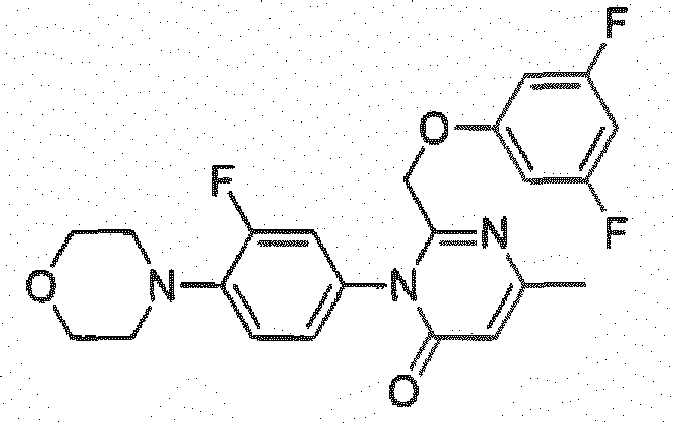
- To a suspension of K2CO3 (1.38 g, 10.0 mmol) in acetone (50 mL) were added 3,5-difluorophenol (0.78 g, 6.00 mmol) and (Z)-methyl-3-(2-bromoacetamido)but-2-enoate (1.18 g, 5.00 mmol) and the mixture was refluxed for 5 h. The mixture was cooled to rt and filtered and the filtrate was concentrated in vacuo. To the residue was added DCM (100 mL) and the mixture was washed with water (100 mL x 2) and brine (100 mL), dried over anhydrous Na2SO4 and concentrated in vacuo. The residue was purified by a silica gel column chromatography (PE / EtOAc (V / V) = 5 : 1) to give the title compound as a white solid (1.18 g, 83%).
- To a solution of 3-fluoro-4-morpholinoaniline (0.81 g, 4.13 mmol) in DCM (15 mL) was added trimethylaluminium (6.2 mL, 12.4 mmol, 2 M in toluene) and the mixture was stirred at rt for 0.5 h. A solution of (Z)-methyl-3-(2-(3,5-difluorophenoxy)acetamido)but-2-enoate (1.18 g, 4.14 mmol) in DCM (5 mL) was added slowly and the resulting mixture was stirred at rt for 12 h. The mixture was quenched with saturated NH4Cl aqueous solution and extracted with CH2Cl2 (50 mL x 2). The combined organic phases were washed with brine (100 mL), dried over anhydrous Na2SO4 and concentrated in vacuo. The residue was purified by a silica gel column chromatography (PE / EtOAc (V / V) 3 = 1 : 1) to give the title compound as a pale brown solid (1.08 g, 61%). The compound was characterized by the following spectroscopic data:
MS (ESI, pos.ion) m/z: 432.0 (M+1);
1H-NMR (400 MHz, CDCl3): δ 2.35 (s, 3 H), 3.05-3.16 (m, 4 H), 3.86 (t, 4 H, J = 4.6 Hz), 4.67 (s, 2 H), 6.30-6.33 (m, 2 H), 6.39 (s, 1 H), 6.39-6.45 (m, 1 H), 6.95-6.98 (m, 3 H). -

- To a suspension of K2CO3 (1.38 g, 10.0 mmol) in acetone (50 mL) were added 3-fluorobenzenethiol (0.77 g, 6.01 mmol) and (Z)-methyl-3-(2-bromoacetamido)but-2-enoate (1.18 g, 5.00 mmol) and the mixture was refluxed for 5 h. The mixture was cooled to rt and filtered and the filtrate was concentrated in vacuo. To the residue was added DCM (100 mL) and the mixture was washed with water (100 mL x 2) and brine (100 mL), dried over anhydrous Na2SO4 and concentrated in vacuo. The residue was purified by a silica gel column chromatography (PE / EtOAc (V / V) = 5 : 1) to give the title compound as a white solid (0.78 g, 55%).
- To a solution of 3-fluoro-4-morpholinoaniline (0.54 g, 2.75 mmol) in DCM (15 mL) was added trimethylaluminium (4.8 mL, 9.60 mmol, 2 M in toluene) and the mixture was stirred at rt for 0.5 h. A solution of (Z)-methyl-3-(2-((3-fluorophenyl)thio)acetamido)but-2-enoate (0.78 g, 2.75 mmol) in DCM (5 mL) was added slowly and the resulting mixture was stirred at rt for 12 h. The mixture was quenched with saturated NH4Cl aqueous solution and extracted with CH2Cl2 (50 mL x 2). The combined organic phases were washed with brine (100 mL), dried over anhydrous Na2SO4 and concentrated in vacuo. The residue was purified by a silica gel column chromatography (PE / EtOAc (V / V) = 1 : 1) to give the title compound as a pale brown solid (0.79 g, 67%). The compound was characterized by the following spectroscopic data:
MS (ESI, pos.ion) m/z: 430.3 (M+1);
1H-NMR (400 MHz, CDCl3): δ 2.26 (s, 3 H), 3.09-3.21 (m, 4 H), 3.81 (s, 2 H), 3.89 (t, 4 H, J = 4.7 Hz), 6.30 (s, 1 H), 6.91-7.03 (m, 4 H), 7.06-7.10 (m, 2 H), 7.20-7.24 (m, 1 H). -

- A mixture of 3-(3-fluorophenyl)propanoic acid (2.50 g, 14.9 mmol) and dichlorosulfane (10 mL) under N2 was refluxed for 3 h. The mixture was cooled to rt and concentrated in vacuo to give the title compound, which was used for next step without further purification.
- To a solution of (Z)-methyl 3-aminobut-2-enoate (1.70 g, 14.8 mmol) and pyridine (1.30 g, 16.4 mmol) in DCM (25 mL) was added a solution of 3-(3-fluorophenyl) propanoyl chloride (2,77 g, 14.8 mmol) in DCM (5 mL) dropwise with stirring. At the end of addition, the mixture was stirred further at rt for 1 h. It was then washed with brine (50 mL x 3), dried over anhydrous Na2SO4 and concentrated in vacuo. The residue was purified by a silica gel column chromatography (PE / EtOAc (V / V) = 3 : 1) to give the title compound as a white solid (2.00 g, 51%).
- To a solution of 3-fluoro-4-morpholinoaniline (1.10 g, 5.61 mmol) in DCM (20 mL) was added trimethylaluminium (5.7 mL, 11.4 mmol, 2 M in toluene) and the mixture was stirred at rt for 0.5 h. A solution of (Z)-methyl-3-(3-(3-fluorophenyl)propanamido)but-2-enoate (1.00 g, 3.77 mmol) in DCM (8 mL) was added slowly and the resulting mixture was stirred at rt for 24 h. The mixture was then quenched with saturated NH4Cl aqueous solution and extracted with CH2Cl2 (50 mL x 2). The combined organic phases were washed with brine (100 mL), dried over anhydrous Na2SO4 and concentrated in vacuo. The residue was purified by a silica gel column chromatography (EtOAc) to give the title compound as an orange solid (1.10 g, 71%). The compound was characterized by the following spectroscopic data:
MS (ESI, pos.ion) m/z: 412.3 (M+1);
1H-NMR (400 MHz, CDCl3): δ 2.25 (s, 3 H), 2.57 (t, 3 H, J = 7.5 Hz), 2.91 (t, 3 H, J = 7.8 Hz), 3.02-3.06 (m, 4 H), 3.75 (t, 4 H, J = 4.6 Hz), 6.26 (s, 1 H), 6.88-6.91 (m, 2 H), 6.96-7.01 (m, 1 H), 7.04-7.06 (m, 1 H), 7.10-7.14 (m, 1 H), 7.17-7.21 (m, 1 H), 7.24-7.29 (m, 1 H). -

- A mixture of 3-fluorophenol (6.00 g, 53.5 mmol), ethyl 4-bromobutanoate (15.70 g, 80.5 mmol) and Cs2CO3 (26.20 g, 80.4 mmol) in DMF (25 mL) under N2 was refluxed overnight. The mixture was then cooled to rt and 150 mL of water was added. The resulting mixture was extracted with DCM (100 mL x 2) and the combined organic phases were washed with brine (100 mL x 2), dried over anhydrous Na2SO4 and concentrated in vacuo. The residue was purified by a silica gel column chromatography (PE / EtOAc (V / V) = 10 : 1) to give the title compound as colorless oil (12.0 g, 99%).
- To a solution of KOH (0.24 g, 4.28 mmol) in mixed solvents of water (3 mL) and ethanol (3 mL) under N2 was added ethyl 4-(3-fluorophenoxy)butanoate (0.30 g, 1.33 mmol) in one portion and the mixture was stirred at 40 °C for 4 h. It was then cooled to rt and 20 mL of DCM was added. The organic layer was washed with brine (20 mL x 2), dried over anhydrous Na2SO4 and concentrated in vacuo to give the title compound as a white solid (0.25 g, 96%).
- A solution of 4-(3-fluorophenoxy) butanoic acid (3.00 g, 15.1 mmol) in dichlorosulfane (15 mL) under N2 was refluxed for 3 h. The mixture was cooled to rt and concentrated in vacuo to give the title compound, which was used for next step without further purification.
- To a solution of (Z)-methyl-3-aminobut-2-enoate (1.70 g, 14.8 mmol) and pyridine (1.20 g, 15.2 mmol) in DCM (25 mL) was added a solution of 4-(3-fluorophenoxy)butanoyl chloride (3.28 g, 15.1 mmol) in DCM (5 mL) with stirring and the mixture was stirred for 1 h. It was then washed with brine (50 mL x 3), dried over anhydrous Na2SO4 and concentrated in vacuo. The residue was purified by a silica gel column chromatography (PE / EtOAc (V / V) = 3 : 1) to give the title compound as a white solid (1.20 g, 28 %).
- To a solution of 3-fluoro-4-morpholinoaniline (0.36 g, 1.83 mmol) in DCM (20 mL) was added trimethylaluminium (2.7 mL, 5.40 mmol, 2 M in toluene) and the mixture was stirred at rt for 0.5 h. A solution of (Z)-methyl-3-(4-(3-fluorophenoxy)butanamido)but-2-enoate (0.80 g, 2.71 mmol) in DCM (4 mL) was added slowly and the resulting mixture was stirred at rt for 24 h. The mixture was quenched with saturated NH4Cl aqueous solution and extracted with CH2Cl2 (50 mL x 2). The combined organic phases were washed with brine (100 mL), dried over anhydrous Na2SO4 and concentrated in vacuo. The residue was purified by a silica gel column chromatography (EtOAc) to give the title compound as a pale yellow solid (0.40 g, 49%). The compound was characterized by the following spectroscopic data:
MS (ESI, pos.ion) m/z: 442.3 (M+1);
1H-NMR (400 MHz, CDCl3): δ 2.00 (m, 2 H), 2.22 (s, 3 H), 2.44 (m, 2 H), 3.07 (m, 4 H), 3.76 (t, 4 H, J = 4.6 Hz), 3.95 (t, 2 H, J = 6.4 Hz), 6.22 (s, 1 H), 6.73-6.74 (m, 3 H), 7.07-7.08 (m, 2 H), 7.12-7.28 (m, 2 H). -

- To a solution of N-(3-fluoro-4-morpholinophenyl)-3-oxobutanamide (11.2 g, 40.0 mmol) and AcOH (100 mL) under N2 was added Br2 (2.4 mL) at rt. At end of addition, the mixture was stirred further at rt for 24 h. The mixture was then concentrated in vacuo and 40 mL of water was added. The resulting mixture was extracted with EtOAc (30 mL x 4). The combined organic phases were washed with brine (40 mL x 3), dried over anhydrous Na2SO4 and concentrated in vacuo. The residue was purified by a silica gel column chromatography (PE / EtOAc (V /V) = 2 : 1) to give the title compound as a yellow solid (6.80 g, 47%).
- To a solution of 3-fluorophenol (2.33 g, 20.8 mmol) in anhydrous THF (20 mL) was added NaH (909 mg, 22.7 mmol, 60%) and the mixture was stirred at rt for 3 h. A solution of 4-bromo-N-(3-fluoro-4-morpholinophenyl)-3-oxobutanamide (6.8 g, 18.9 mmol) in THF (40 mL) was added. The resulting mixture was stirred at rt overnight. The reaction mixture was then poured into 100 mL of water and the mixture was extracted with EtOAc (30 mL x 5). The combined organic phases were washed with brine (50 mL x 2), dried over anhydrous Na2SO4 and concentrated in vacuo. The residue was purified by a silica gel column chromatography (PE / EtOAc (V / V) = 2 : 1) to give the title compound as a yellow solid (0.16 g, 2%).
- A mixture of N-(3-fluoro-4-morpholinophenyl)-4-(3-fluorophenoxy)-3-oxobutanamide (510 mg, 1.31 mmol), acetamide (154 mg, 2.61 mmol) and titanium tetraisopropanolate (3.2 mL) in xylene (10 mL) was stirred at 165 °C for 24 h. The mixture was cooled to rt and 60 mL of toluene and 60 mL of saturated NH4Cl aqueous solution were added. The resulting mixture was stirred at rt overnight. The mixture was then filtered and the filtrate was extracted with DCM (20 mL x 4). The combined organic phases were washed with brine (30 mL x 2), dried over anhydrous Na2SO4 and concentrated in vacuo. The residue was purified by a silica gel column chromatography (PE / EtOAc (V / V) = 1 : 1) to give the title compound as a yellow solid (0.09 g, 17%). The compound was characterized by the following spectroscopic data:
MS (ESI, pos.ion) m/z: 414.1 (M+1);
1H-NMR (400 MHz, DMSO-d6 ): δ 2.12 (s, 3 H), 3.07 (d, 4 H, J = 5.4 Hz), 3.76 (t, 4 H, J = 4.5 Hz), 4.97 (s, 2 H), 6.41 (s, 1 H), 6.84-6.80 (m, 1 H), 6.99-6.91 (m, 2 H), 7.16-7.14 (m, 2 H), 7.38-7.31 (m, 2 H). -

- To a solution of 3-fluoro-4-(4-methylpiperazin-1-yl)aniline (0.63 g, 3.01 mmol) in DCM (15 mL) was added trimethylaluminium (5.3 mL, 10.6 mmol, 2 M in toluene) and the mixture was stirred at rt for 0.5 h. A solution of (Z)-methyl-3-(2-(3-fluorophenoxy)acetamido)but-2 -enoate (0.80 g, 2.99 mmol) in DCM (5 mL) was added slowly and the resulting mixture was stirred at rt for 12 h. The mixture was then quenched with saturated NH4Cl aqueous solution and extracted with CH2Cl2 (50 mL x 2). The combined organic phases were washed with brine (100 mL), dried over anhydrous Na2SO4 and concentrated in vacuo. The residue was purified by a silica gel column chromatography (PE / EtOAc (V / V) = 1 : 1) to give the title compound as a pale yellow solid (0.94 g, 73%). The compound was characterized by the following spectroscopic data:
MS (ESI, pos.ion) m/z: 427.2 (M+1);
1H-NMR (400 MHz, CDCl3): δ 2.34 (s, 3 H), 2.35 (s, 3 H), 2.58 (t, 4 H, J = 4.8 Hz), 3.08-3.16 (m, 4 H), 4.68 (s, 2 H), 6.38 (d, 1 H, J = 0.8 Hz), 6.49 (tt, 1 H, J1 = 2.4 Hz, J2 = 10.6 Hz), 6.54 (dd, 1 H, J1 = 2.3 Hz, J2 = 5.3 Hz), 6.64-6.60 (m, 1 H), 6.94-6.98 (m, 3 H), 7.14-7.20 (m,1 H). -

- A mixture of 2-bromoethanol (27.9 g, 223 mmol), morpholine (40 g, 459 mmol) and K2CO3 (48.4 g, 350 mmol) in CH3CN (30 mL) was refluxed for 3 h. The mixture was then cooled to rt and filtered. The filtrate was concentrated in vacuo to give the title compound as a yellow solid (24.40 g, 83%), which was used for next step without further purification.
- A mixture of 1,2-difluoro-4-nitrobenzene (1.0 g, 6.29 mmol), 2-morpholinoethanol (1.0 g, 7.62 mmol) and CS2CO3 in DMF (10 mL) was stirred at 75 °C for 12 h. 30 mL of water was then added and the resulting mixture was extracted with DCM (30 mL x 2). The combined organic phases were washed with brine (30 mL x 3), dried over anhydrous Na2SO4 and concentrated in vacuo. The residue was purified by a silica gel column chromatography (PE / EtOAc (V / V) = 4 : 1) to give the title compound as yellow oil (1.30 g, 76%).
- A mixture of 4-(2-(2-fluoro-4-nitrophenoxy)ethyl)morpholine (1.3 g, 4.81 mmol) and Pd/C (0.4 g, 10%) in THF (12 mL) under H2 was stirred at rt overnight. The mixture was then filtered and the filtrate was concentrated in vacuo to give the title compound as yellow oil (1.00 g, 86%), the crude product was used for next step without further purification.
- To a solution of 3-fluoro-4-(2-morpholinoethoxy)aniline (0.33 g, 1.37 mmol) in DCM (20 mL) was added trimethylaluminium (2.7 mL, 5.40 mmol, 2 M in toluene) and the mixture was stirred at rt for 0.5 h. A solution of (Z)-methyl-3-(2-(3-fluorophenoxy)acetamido)but-2 -enoate (0.37 g, 1.38 mmol) in DCM (5 mL) was added slowly and the resulting mixture was stirred at rt for 24 h. The mixture was quenched with saturated NH4Cl aqueous solution and extracted with CH2Cl2 (50 mL x 2). The combined organic phases were washed with brine (100 mL), dried over anhydrous Na2SO4 and concentrated in vacuo. The residue was purified by a silica gel column chromatography (PE / EtOAc (V / V) = 30 : 1) to give the title compound as a pale yellow solid (0.19 g, 30%). The compound was characterized by the following spectroscopic data:
MS (ESI, pos.ion) m/z: 458.1 (M+1);
1H-NMR (400 MHz, CDCl3): δ 2.24 (s, 3 H), 2.45 (t, 4 H, J = 4.34 Hz), 2.66 (t, 2 H, J = 5.58 Hz), 3.55 (t, 4 H, J = 4.56 Hz), 4.15 (m, 2 H), 4.72 (s, 2 H), 6.37 (s, 1H), 6.63-6.75 (m, 3 H),7.17-7.27 (m, 3H), 7.38-7.41 (m, 1 H). -

- To a solution of 2-fluoro-N1-(2-morpholinoethyl)benzene-1,4-diamine (0.33 g, 1.38 mmol) in DCM (20 mL) was added trimethylaluminium (2.1 mL, 4.2 mmol, 2 M in toluene) slowly and the mixture was stirred at rt for 0.5 h. A solution of (Z)-methyl-3-(2-(3-fluorophenoxy)acetamido)but-2-enoate (0.37 g, 1.38 mmol) in DCM (5 mL) was added slowly and the resulting mixture was stirred at rt for 24 h. 50 mL of water was then added to the mixture slowly and the mixture was extracted with CH2Cl2 (50 mL x 2). The combined organic phases were washed with brine (100 mL x 3), dried over anhydrous Na2SO4 and concentrated in vacuo. The residue was purified by a silica gel column chromatography (EtOAc) to give the title compound as a pale yellow solid (0.5 g, 79%). The compound was characterized by the following spectroscopic data:
MS (ESI, pos.ion) m/z: 457.2 (M+1);
1H-NMR (400 MHz, CDCl3): δ 2.22 (s, 3 H), 2.44 (m, 4 H), 3.19 (t, 2 H, J = 3.19 Hz), 3.76 (t, 4 H, J = 2.24 Hz), 4.70 (s, 2 H), 6.34 (s, 1 H), 6.52-6.64 (m, 2 H), 6.53-6.56 (m, 1 H), 6.69-6.81 (m, 3 H), 6.98-7.01 (m, 1 H), 7.14-7.21 (m, 1 H), 7.21-7.28 (m, 1 H). -

- To a mixture of cyclohexanol (2.40 g, 24.0 mmol) and Rh2(OAc)4 (50 mg, 0.11 mmol) in DCM (50 mL) was added ethyl 2-diazoacetate (2.73 g, 23.9 mmol) and the mixture was stirred at rt for 5 min. It was then filtered and the filtrate was concentrated in vacuo. The residue was purified by a silica gel column chromatography (PE / EtOAc (V / V) = 15 : 1) to give the title compound as colorless oil (3.8 g, 85%).
- To a solution of NaOH (4.89 g, 122 mmol) in a mixture of water (20 mL) and MeOH (20 mL) in an ice bath was added a solution of ethyl 2-(cyclohexyloxy)acetate (3.8 g, 20.4 mmol) in MeOH (10 mL) slowly and the mixture was stirred at rt for 2 h. It was then acidified to pH 4 with concentrated hydrochloric acid and extracted with DCM (20 mL x 2). The combined organic layers were washed with brine (40 mL x 2), dried over anhydrous Na2SO4 and concentrated in vacuo. The residue was purified by a silica gel column chromatography (EtOAc) to give the title compound as pale yellow oil (2.7 g, 84 %).
- A mixture of 2-(cyclohexyloxy) acetic acid (0.90 g, 5.69 mmol) and dichlorosulfane (10 mL) was refluxed for 2 h. The mixture was cooled to rt and concentrated in vacuo to give the title compound as yellow oil, which was used for next step without further purification.
- To 15 mL of NH4OH (25-28%) was added a solution of 2-(cyclohexyloxy) acetyl chloride (1.01 g, 5.72 mmol) in DCM (2 mL) in an ice bath and the mixture was stirred at rt for 5 min and extracted with DCM (20 mL x 3). The combined organic layers were washed with brine (20 mL x 2), dried over anhydrous Na2SO4 and concentrated in vacuo to give the title compound as a white solid (0.5 g, 56%).
- A mixture of 2-(cyclohexyloxy)acetamide (0.4 g, 2.54 mmol), N-(3-fluoro-4-morpholinophenyl)-3-oxobutanamide (0.7 g, 2.50 mmol) and titanium tetraisopropanolate (5.8 g, 20.4 mmol) in xylene (16 mL) was stirred at 165 °C for 30 h. The mixture was then cooled to rt and 60 mL of EtOAc and 60 mL of water were added. The resulting mixture was filtered and the filtrate was concentrated in vacuo. The residue was purified by a silica gel column chromatography (PE / EtOAc (V / V) = 2 : 1) to give the title compound as yellow oil (0.16 g, 16%). The compound was characterized by the following spectroscopic data:
MS (ESI, pos.ion) m/z: 402.2 (M+1);
1H-NMR (400 MHz, CDCl3): δ 1.04 (m, 6 H), 1.23 (m, 4 H), 2.21 (s, 3 H), 2.9 (m, 1 H), 3.05 (m, 4 H), 3.76 (t, 4 H, J = 4.60 Hz), 4.07 (s, 2 H), 6.32 (s, 1 H), 7.08-7.15 (m, 2 H), 7.21-7.24 (m, 1 H). -

- To a mixture of pyridin-3-ol (4.0 g, 42.1 mmol) and K2CO3 (6.96 g, 50.4 mmol) in CH3CN (6 mL) was added dropwise 2-bromoacetonitrile (2.52 g, 21.0 mmol) at rt and the mixture was stirred at rt for 40 h. The mixture was filtered and the filtrate was concentrated in vacuo. The residue was purified by a silica gel column chromatography (PE / EtOAc (V / V) = 2 : 1) to give the title compound as a yellow solid (0.45 g, 16%).
- To a mixture of 2-(pyridin-3-yloxy)acetonitrile (100 mg, 0.75 mmol), K2CO3 (103 mg, 0.75 mmol) and DMSO (0.1 mL) in H2O (2 mL) was added H2O2 (0.1 mL, 30%) dropwise in an ice bath and the mixture was stirred at rt for 5 min. It was then concentrated in vacuo and the residue was purified by a silica gel column chromatography (EtOAc) to give the title compound as a white solid (62.2 mg, 55%).
- A mixture of 2-(pyridin-3-yloxy) acetamide (120 mg, 0.79 mmol), N-(3-fluoro-4-morpholinophenyl)-3-oxobutanamide (221.1 mg, 0.79 mmol) and titanium tetraisopropanolate (1.79 g, 6.30 mmol) in xylene (16 mL) was stirred at 165 °C for 50 h. The mixture was then cooled to rt and 30 mL of EtOAc and 5 mL of water were added. The resulting mixture was filtered and the filtrate was concentrated in vacuo. The residue was purified by a silica gel column chromatography (EtOAc) to give the title compound as a yellow solid (0.90 g, 29%). The compound was characterized by the following spectroscopic data:
MS (ESI, pos.ion) m/z: 397.2 (M+1);
1H-NMR (400 MHz, CDCl3): δ 2.21 (s, 3 H), 2.97 (m, 4 H), 3.72 (t, 4 H, J = 4.62 Hz), 4.79 (s, 2 H), 6.37 (s, 1 H), 7.04-7.08 (m, 1 H), 7.17-7.20 (m, 1 H), 7.23-7.27 (m, 2 H), 7.32-7.35 (m, 1 H), 7.67-7.74 (m, 1 H), 8.14-8.15 (m, 2 H). -

- To a mixture of 5-fluoropyridin-3-ol (0.95 g, 8.40 mmol) and K2CO3 (1.16 g, 8.40 mmol) in CH3CN (6 mL) was added dropwise 2-bromoacetonitrile (1.01 g, 8.42 mmol) at rt and upon the end of addition the mixture was stirred at rt for 40 h. The mixture was filtered and the filtrate was concentrated in vacuo. The residue was purified by a silica gel column chromatography (PE / EtOAc (V / V) = 3 : 1) to give the title compound as a yellow solid (0.55 g, 43%).
- To a mixture of 2-((5-fluoropyridin-3-yl)oxy)acetonitrile (0.55 g, 3.62 mmol), K2CO3 (0.60 g, 4.34 mmol) and DMSO (0.55 mL) in H2O (8 mL) was added H2O2 (0.55 mL, 30%) dropwise in an ice bath and the mixture was stirred at rt for 5 min. It was then concentrated in vacuo and the residue was purified by a silica gel column chromatography (EtOAc) to give the title compound as a white solid (0.37 g, 60%).
- To a mixture of 2-((5-fluoropyridin-3-yl)oxy)acetamide (200 mg, 1.18 mmol) and N-(3-fluoro-4-morpholinophenyl)-3-oxobutanamide (330 mg, 1.18 mmol) in xylene (10 mL) was added titanium tetraisopropanolate (2.7 mg, 9.5 mmol) and the mixture was refluxed for 50 h. The mixture was cooled to rt and 60 mL of EtOAc and 10 mL of water were added. The resulting mixture was filtered and the filtrate was concentrated in vacuo. The residue was purified by a silica gel column chromatography (PE / EtOAc (V / V) = 1 : 1) to give the title compound as a yellow solid (130 mg, 27%). The compound was characterized by the following spectroscopic data:
MS (ESI, pos.ion) m/z: 415.2 (M+1);
1H-NMR (400 MHz, DMSO-d6 ): δ 2.21 (s, 3 H), 2.98 (m, 4 H), 3.73 (t, 4 H, J = 4.62 Hz), 4.84 (s, 2 H), 6.37 (s, 1 H), 7.04-7.08 (m, 1 H), 7.18-7.21 (m, 1 H), 7.32-7.37 (m, 2 H), 8.07-8.08 (m, 1 H), 8.16 (m, 1 H). -

- A mixture of 3-fluorophenol (3.36 g, 30.0 mmol), ethyl 2-bromo-2-methylpropanoate (8.78 g, 45.0 mmol) and K2CO3 (6.22 g, 45.0 mmol) in acetone (50 mL) was refluxed overnight. The mixture was cooled to rt and 60 mL of water was added. The resulting mixture was extracted with DCM (40 mL x 2). The combined organic phases were washed with brine (40 mL x 2), dried over anhydrous Na2SO4 and concentrated in vacuo. The residue was purified by a silica gel column chromatography (PE / EtOAc (V / V) = 4 : 1) to give the title compound as colorless liquid (3.20 g, 47%).
- To a solution of KOH (2.38 g, 42.4 mmol) in mixed solvents of water (50 mL) and ethanol (70 mL) was added ethyl-2-(3-fluorophenoxy)-2-methylpropanoate (3.20 g, 14.1 mmol) in one portion and the mixture was stirred at 40 °C for 2 h. The mixture was cooled to 0 °C, acidified to pH 3 with concentrated hydrochloric acid and extracted with DCM (20 mL x 2). The combined organic layers were washed with brine (20 mL x 2), dried over anhydrous Na2SO4 and concentrated in vacuo to give the title compound as a white solid (1.70 g, 61%).
- To 2-(3-fluorophenoxy)-2-methylpropanoic acid (1.70 g, 8.58 mmol) was added dichlorosulfane (15 mL) dropwise under N2 and the mixture was refluxed for 3 h. The mixture was cooled to rt and concentrated in vacuo to give the title compound as yellow oil, which was used for next step without further purification.
- To a solution of (Z)-methyl-3-aminobut-2-enoate (0.90 g, 7.82 mmol) and pyridine (0.80 g, 10.1 mmol) in DCM (20 mL) was added a solution of 2-bromo-2-methylpropanoyl chloride (1.86 g, 8.59 mmol) in DCM (5 mL) under N2 and the mixture was stirred at rt overnight. It was then washed with brine (20 mL x 3), dried over anhydrous Na2SO4 and concentrated in vacuo. The residue was purified by a silica gel column chromatography (PE / EtOAc (V /V) = 20 : 1) to give the title compound as a yellow solid (1.13 g, 49%).
- To a solution of 3-fluoro-4-morpholinoaniline (0.50 g, 2.55 mmol) in anhydrous DCM (40 mL) was added trimethylaluminium (3.9 mL, 7.8 mmol, 2 M in toluene) under N2 and the mixture was stirred at rt for 0.5 h. A solution of (Z)-methyl-3-(2-(3-fluorophenoxy) -2-methylpropanamido)but-2-enoate (1.13 g, 3.83 mmol) in DCM (5 mL) was added dropwise slowly and the resulting mixture was stirred at rt for 3 days. The mixture was then quenched with saturated NH4Cl aqueous solution (50 mL) and extracted with CH2Cl2 (30 mL x 3). The combined organic phases were washed with brine (30 mL x 3), dried over anhydrous Na2SO4 and concentrated in vacuo. The residue was purified by a silica gel column chromatography (PE / EtOAc (V / V) = 3 : 1) to give the title compound as a pale yellow solid (0.17 g, 15%). The compound was characterized by the following spectroscopic data:
MS (ESI, pos.ion) m/z: 442.2 (M+1);
1H-NMR (400 MHz, CDCl3): δ 1.55 (s, 3 H), 1.68-1.65 (d, 3 H, J = 12.8 Hz), 2.35 (s, 3 H), 3.17-3.06 (m, 4 H), 3.88-3.85 (m, 4 H), 6.24-6.20 (dt, 1 H, J1 = 10.8 Hz, J2 = 2.4 Hz), 6.31-6.28 (dd, 1 H, J1 = 8.2 Hz, J2 = 2.2 Hz), 6.35 (s,1 H), 6.60-6.56 (dd, 1 H, J1 = 12.9 Hz, J2 = 2.4 Hz), 6.71-6.65 (m, 2 H), 6.85-6.80 (t, 1 H, J = 8.8 Hz), 7.17-7.11 (m, 1 H). -

- To a solution of 2-fluoro-N 1,N 1-dihexylbenzene-1,4-diamine (2.94 g, 10.0 mmol) in toluene (50 mL) was added acetyl ketene (0.84 g, 10.0 mmol) and the mixture was stirred at 80 °C overnight. The mixture was cooled to rt and concentrated in vacuo. The residue was purified by a silica gel column chromatography (PE / EtOAc (V / V) = 1 : 4) to give the title compound as yellow oil (2.67 g, 70%).
- A mixture of 3-fluorophenol (11.2 g, 100 mmol), 2-bromoacetamide (13.8 g, 100 mmol), K2CO3 (13.82 g, 100 mmol) and Cs2CO3 (32.58 g, 100 mmol) in acetone (150 mL) was refluxed overnight. The mixture was cooled to rt and filtered and the filtrate was concentrated in vacuo. The residue was purified by a silica gel column chromatography (PE / EtOAc (V / V) = 1 : 1) to give the title compound as a white solid (5.06 g, 30%).
- To a mixture of N-(4-(dihexylamino)-3-fluorophenyl)-3-oxobutanamide (2.67 g, 7.05 mmol), and 2-(3-fluorophenoxy)acetamide (2.37 g, 14.0 mmol) in xylene (20 mL) was added titanium tetraisopropanolate (5.97 g, 21.0 mmol) and the mixture was stirred at 165 °C for 24 h. The mixture was cooled to rt and 120 mL of toluene and 150 mL of saturated NH4Cl aqueous solution were added. The resulting mixture stirred at rt overnight and filtered and the filtrate was extracted with DCM (150 mL x 3). The combined organic layers were dried over anhydrous Na2SO4 and concentrated in vacuo. The residue was purified by a silica gel column chromatography (PE / EtOAc (V / V) = 2 : 1) to give the title compound as a yellow solid (0.95 g, 26%). The compound was characterized by the following spectroscopic data:
MS (ESI, pos.ion) m/z: 512.3(M+1);
1H-NMR (400 MHz, DMSO-d6 ): δ 0.88 (t, 6 H, J = 7.2 Hz), 1.25-1.30 (m, 16 H), 2.42 (s, 3 H), 3.62 (t, 4 H, J = 7.8 Hz), 4.84 (s, 2 H), 6.54 (s, 1 H), 6.54 (s, 1 H), 6.58-6.60 (m, 1 H), 6.64-6.66 (m, 1 H), 6.68-6.73 (m, 1 H), 7.21-7.27 (m, 1 H), 7.60 (d, 1 H, J = 8.6 Hz), 7.74-7.77 (m, 1 H), 7.96 (t, 1 H, J = 8.3 Hz). -
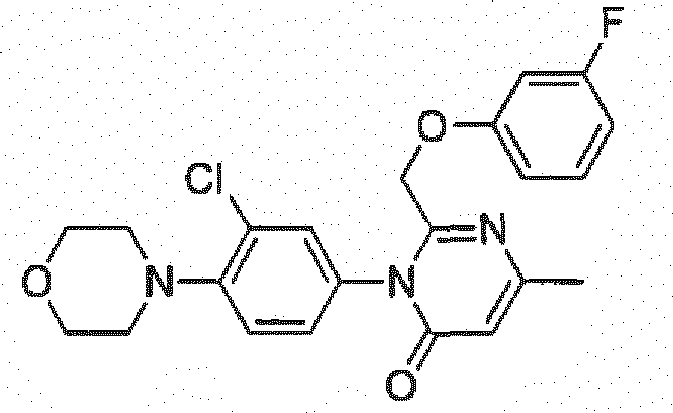
- A mixture of N-(3-chloro-4-morpholinophenyl)-3-oxobutanamide (0.89 g, 3.00 mmol), 2-(3-fluorophenoxy) acetamide (1.01 g, 5.97 mmol) and titanium tetraisopropanolate (7.2 mL) in xylene (20 mL) was stirred at 165 °C for 24 h. The mixture was cooled to rt and 45 mL of toluene and 60 mL of saturated NH4Cl aqueous solution were added. The resulting mixture stirred at rt overnight and filtered and the filtrate was extracted with DCM (60 mL x 3). The combined organic layers were washed with brine, dried over anhydrous Na2SO4 and concentrated in vacuo. The residue was purified by a silica gel column chromatography (PE / EtOAc (V / V) = 1 : 1) to give the title compound as a yellow solid (0.29 g, 23%). The compound was characterized by the following spectroscopic data:
MS (ESI, pos.ion) m/z: 430.1 (M+1);
1H-NMR (400 MHz, DMSO-d6 ): δ 2.35 (s, 3 H), 3.00-3.06 (m, 4 H), 3.85-3.87 (m, 4 H), 4.68 (d, 2 H, J = 5.12 Hz), 6.39 (s, 1 H), 6.45-6.49 (m, 1 H), 6.54 (dd, 1 H, J1 = 2.32 Hz, J2 = 8.34 Hz), 6.64-6.68 (m, 1 H), 7.07 (s, 1 H), 7.11-7.19 (m, 2 H), 7.29 (d, 1 H, J = 2.4 Hz). -

- A mixture of 3-chlorophenol (2.57 g, 20.0 mmol), 2-bromoacetamide (2.76 g, 20.0 mmol) and K2CO3 (5.53 g, 40.0 mmol) in acetone (40 mL) was stirred at 70 °C overnight. The mixture was then cooled to rt and filtered and the filtrate was concentrated in vacuo. The residue was purified by a silica gel column chromatography (PE / EtOAc (V / V) = 1 : 1) to give the title compound as a white solid (3.22 g, 87%).
- A mixture of N-(3-chloro-4-morpholinophenyl)-3-oxobutanamide (0.48 g, 1.62 mmol), 2-(3-chlorophenoxy) acetamide (0.60 g, 3.24 mmol) and titanium tetraisopropanolate (2.4 mL) in xylene (10 mL) was stirred at 165 °C for 24 h. The mixture was cooled to rt and 60 mL of toluene and 60 mL of saturated NH4Cl aqueous solution were added. The resulting mixture was stirred at rt overnight and filtered and the filtrate was extracted with DCM (20 mL x 4). The combined organic layers were washed with brine (30 mL x 2), dried over anhydrous Na2SO4 and concentrated in vacuo. The residue was purified by a silica gel column chromatography (PE / EtOAc (V / V) = 1 : 1) to give the title compound as a yellow solid (0.46 g, 64%). The compound was characterized by the following spectroscopic data:
MS (ESI, pos.ion) m/z: 446.1 (M+1);
1H-NMR (400 MHz, CDCl3): δ 2.35 (s, 3 H), 3.08-2.99 (m, 4 H), 3.87-3.85 (t, 4 H, J = 4.6 Hz), 4.69-4.68 (d, 2 H, J = 6.2 Hz), 6.39 (s, 1 H), 6.67-6.64 (m, 1 H), 6.75-6.74 (t, 1 H, J = 2.2 Hz), 6.95-6.92 (m, 1 H), 7.07-7.05 (d, 1 H, J = 8.5 Hz), 7.16-7.11 (m, 2 H), 7.29 (s, 1 H). -

- A mixture of 3-hydroxybenzonitrile (2.38 g, 20.0 mmol), 2-bromoacetamide (3.04 g, 22.0 mmol) and K2CO3 (5.53 g, 40.0 mmol) in acetone (20 mL) was stirred at 70 °C for 17.5 h. The mixture was cooled to rt and filtered and the filtrate was concentrated in vacuo. The residue was purified by a silica gel column chromatography (PE / EtOAc (V / V) = 1 : 1) to give the title compound as a white solid (2.70 g, 77%).
- A mixture of N-(3-chloro-4-morpholinophenyl)-3-oxobutanamide (0.59 g, 2.00 mmol), 2-(3-cyanophenoxy) acetamide (0.71 g, 4.03 mmol) and titanium tetraisopropanolate (4.8 mL) in xylene (20 mL) was stirred at 165 °C for 24 h. The mixture was cooled to rt and 30 mL of toluene and 40 mL of saturated NH4Cl aqueous solution were added. The resulting mixture was stirred at rt overnight and filtered and the filtrate was extracted with DCM (50 mL x 3). The combined organic layers were dried over anhydrous Na2SO4 and concentrated in vacuo. The residue was purified by a silica gel column chromatography (PE / EtOAc (V / V) = 1 : 1) to give the title compound as a yellow solid (0.51 g, 59%). The compound was characterized by the following spectroscopic data:
MS (ESI, pos.ion) m/z: 437.1 (M+1);
1H-NMR (400 MHz, CDCl3): δ 2.35 (s, 3 H), 2.98-3.11 (m, 4 H), 3.85-3.87 (m, 4 H), 4.68-4.76 (m, 2 H), 6.39 (d, 1 H, J = 0.84 Hz), 7.02-7.05 (m, 3 H), 7.13 (dd, 1 H, J1 = 2.36 Hz, J2 = 8.52 Hz), 7.25-7.34 (m, 3 H). -

- A mixture of 3-fluorophenol (5.61 g, 50.0 mmol), 2-bromoacetamide (7.59 g, 55.0 mmol) and K2CO3 (13.82 g, 100 mmol) in acetone (80 mL) was stirred at 70 °C overnight. The mixture was cooled to rt and filtered and the filtrate was concentrated in vacuo. The residue was purified by a silica gel column chromatography (PE / EtOAc (V / V) = 1 : 1) to give the title compound as a white solid. (7.89 g, 93%)
- A mixture of 1,2-difluoro-4-nitrobenzene (7.95 g, 50.0 mmol), morpholin-3-one (5.06 g, 50.0 mmol) and K2CO3 (13.82 g, 100 mmol) in DMF (80 mL) was stirred at 140 °C overnight. The mixture was cooled to rt and filtered and the filtrate was concentrated in vacuo. The residue was purified by a silica gel column chromatography (PE / EtOAc (V / V) = 3 : 1) to give the title compound as a yellow solid (5.00 g, 42%).
- A mixture of iron powder (8.8 g, 158 mmol), water (60 mL) and hydrochloric acid (2 mL) was stirred at 65 °C for 20 min. It was then cooled to rt and the aqenous layer was poured out. A solution of 4-(2-fluoro-4-nitrophenyl)morpholin-3-one (3.8 g, 15.8 mmol) in MeOH (100 mL) was added and the resuting mixture was acidified to pH 2 with hydrochloric acid and stirred at 65 °C for 4 h. The mixture was cooled to rt, adjusted to pH 8 with saturated NaHCO3 aqueous solution and filtered. The MeOH was removed in vacuo and the mixture was extracted with EtOAc (20 mL x 3). The combined organic layers were washed with brine (20 mL x 4), dried over anhydrous Na2SO4 and concentrated in vacuo. The residue was purified by a silica gel column chromatography (PE / EtOAc (V / V) = 1 : 2) to give the title compound as a white solid (1.89 g, 57%).
- A mixture of 4-(4-amino-2-fluorophenyl)morpholin-3-one (2.51 g, 11.9 mmol) and acetyl ketene (2.51 g, 29.9 mmol) in EtOAc (40 mL) was stirred at 80 °C for 24 h. The mixture was cooled to rt and concentrated in vacuo. The residue was purified by a silica gel column chromatography (PE / EtOAc (V / V) = 1 : 4) to give the title compound as a yellow solid (2.15 g, 61%).
- A mixture of N-(3-fluoro-4-(3-oxomorpholino)phenyl)-3-oxobutanamide (0.59 g, 2.00 mmol), 2-(3-fluorophenoxy)acetamide (0.94 g, 5.56 mmol) and titanium tetraisopropanolate (4.8 mL) in xylene (10 mL) was stirred at 165 °C for 24 h. The mixture was cooled to rt and 60 mL of toluene and 60 mL of saturated NH4Cl aqueous solution were added. The resulting mixture was stirred at rt overnight and filtered and the filtrate was extracted with DCM (20 mL x 4). The combined organic layers were washed with brine (30 mL x 2), dried over anhydrous Na2SO4 and concentrated in vacuo. The residue was purified by a silica gel column chromatography (PE / EtOAc (V / V) = 1 : 2) to give the title compound as a yellow solid (0.06 g, 7%). The compound was characterized by the following spectroscopic data:
MS (ESI, pos.ion) m/z: 428.1 (M+1);
1H-NMR (400 MHz, CDCl3): δ 2.36 (s, 3 H), 3.70 (d, 2 H, J = 3.12 Hz), 4.03 (t, 2 H, J = 4.6 Hz), 4.35 (s, 2 H), 4.73 (s, 2 H), 6.38 (s, 1 H), 6.55-6.53 (m, 2 H), 6.67 (t, 1 H, J = 7.3 Hz), 7.21-7.11 (m, 3 H), 7.44 (t, 1 H, J = 8.2 Hz). -

- A mixture of 4-chloronaphthalen-1-ol (3.57 g, 20.0 mmol), 2-bromoacetamide (2.76 g, 20.0 mmol) and K2CO3 (5.53 g, 40.0 mmol) in acetone (40 mL) was stirred at 70 °C overnight. The mixture was cooled to rt and filtered and the filtrate was concentrated in vacuo. The residue was purified by a silica gel column chromatography (PE / EtOAc (V / V) = 1 : 1) to give the title compound as a white solid (2.32 g, 49%).
- A mixture of N-(3-chloro-4-morpholinophenyl)-3-oxobutanamide (0.59 g, 2.0 mmol), 2-((4-chloronaphthalen-1-yl)oxy)acetamide (0.94 g, 4.0 mmol) and titanium tetraisopropanolate (4.8 mL) in xylene (10 mL) was stirred at 165 °C for 24 h. The mixture was cooled to rt and 60 mL of toluene and 60 mL of saturated NH4Cl aqueous solution were added. The resulting mixture was stirred at rt overnight and filtered and the filtrate was extracted with DCM (20 mL x 4). The combined organic layers were washed with brine (30 mL x 2), dried over anhydrous Na2SO4 and concentrated in vacuo. The residue was purified by a silica gel column chromatography (PE / EtOAc (V / V) = 1 : 1) to give the title compound as a yellow solid (0.56 g, 56%). The compound was characterized by the following spectroscopic data:
MS (ESI, pos.ion) m/z: 496.1 (M+1);
1H-NMR (400 MHz, CDCl3): δ 2.37 (s, 3 H), 2.96-2.86 (m, 4 H), 3.83-3.80 (t, 4 H, J = 4.6 Hz), 4.93-4.92 (d, 2 H, J = 4.9 Hz), 6.41 (s, 1 H), 6.62-6.60 (d, 1 H, J = 8.3 Hz), 6.89-6.87 (d, 1 H, J = 8.5 Hz), 7.09-7.07 (dd, 1 H, J1 = 2.5 Hz, J2 = 8.5 Hz), 7.27-7.26 (m, 1 H), 7.35-7.33 (d, 1 H, J = 8.2 Hz), 7.55-7.51 (m, 1 H), 7.64-7.60 (m, 1 H), 8.04-8.02 (d, 1 H, J = 8.3 Hz), 8.18-8.16 (d, 1 H, J = 8.2 Hz). -

- A mixture of 3-ethynylphenol (3.31 g, 28.0 mmol), 2-bromoacetamide (2.36 g, 17.1 mmol) and K2CO3 (5.53 g, 40.0 mmol) in acetone (50 mL) was stirred at 70 °C for 7 h. The mixture was cooled to rt and filtered and the filtrate was concentrated in vacuo. The residue was purified by a silica gel column chromatography (PE / EtOAc (V / V) = 1 : 1) to give the title compound as a white solid (2.70 g, 90%).
- A mixture of N-(3-chloro-4-morpholinophenyl)-3-oxobutanamide (0.80 g, 2.85 mmol), 2-(3-ethynylphenoxy) acetamide (1.0 g, 5.71 mmol) and titanium tetraisopropanolate (6.76 mL) in xylene (20 mL) was stirred at 165 °C for 24 h. The mixture was cooled to rt and 50 mL of toluene and 60 mL of saturated NH4Cl aqueous solution were added. The resulting mixture was stirred at rt overnight and filtered and the filtrate was extracted with DCM (150 mL x 3). The combined organic layers were dried over anhydrous Na2SO4 and concentrated in vacuo. The residue was purified by a silica gel column chromatography (PE / EtOAc (V / V) = 1 : 1) to give the title compound as a yellow solid (0.60 g, 50%). The compound was characterized by the following spectroscopic data:
MS (ESI, pos.ion) m/z: 420.1 (M+1);
1H-NMR (400 MHz, CDCl3): δ 2.34 (s, 3 H), 3.03-3.11 (m, 5 H), 3.83 (t, 4 H), 4.68 (s, 2 H), 6.38 (s, 1 H), 6.76-7.19 (m, 7 H). -

- A mixture of 3-fluorophenol (2.24 g, 20.0 mmol), ethyl 2-bromo-2,2-difluoroacetate (8.12 g, 40.0 mmol) and K2CO3 (6.91 g, 50.0 mmol) in MeOH (20 mL) was stirred at 70 °C overnight. It was then cooled to rt and filtered and the filtrate was concentrated in vacuo to give the title compound, which was used for next step without further purification.
- A mixture of ethyl 2,2-difluoro-2-(3-fluorophenoxy)acetate (3.5 g, 14.9 mmol), MeOH (10 mL) and ammonia (5.09 g) in a 20 mL of sealing tube was stirred at 100 °C for 24 h. The mixture was cooled to rt and concentrated in vacuo to give the title compound, which was used for next step without further purification.
- A mixture of N-(3-fluoro-4-morpholinophenyl)-3-oxobutanamide (0.60 g, 2.14 mmol), 2,2-difluoro-2-(3-fluorophenoxy)acetamide (0.88 g, 4.29 mmol) and titanium tetraisopropanolate (4.87 g, 17.1 mmol) in xylene (20 mL) was stirred at 165 °C for 24 h. The mixture was cooled to rt and 60 mL of toluene and 80 mL of saturated NH4Cl aqueous solution were added. The resulting mixture was stirred at rt overnight and filtered and the filtrate was extracted with DCM (150 mL x 3). The combined organic layers were dried over anhydrous Na2SO4 and concentrated in vacuo. The residue was purified by a silica gel column chromatography (PE / EtOAc (V / V) = 1 : 1) to give the title compound as a yellow solid (0.38 g, 40%). The compound was characterized by the following spectroscopic data:
MS (ESI, pos.ion) m/z: 450.1 (M+1);
1H-NMR (400 MHz, CDCl3): δ 2.43 (s, 3 H), 3.15 (t, 4 H), 3.85 (m, 4 H), 6.36-7.27 (m, 8 H). -
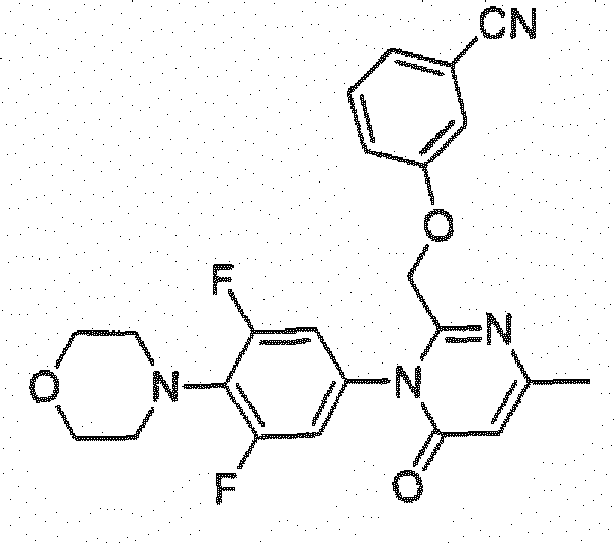
- A mixture of 1,2,3-trifluoro-5-nitrobenzene (3.54 g, 20.0 mmol), morpholine (2.0 mL, 23.0 mmol) and Et3N (8.5 mL, 61.0 mmol) in EtOAc (30 mL) was stirred at rt for 5 h. The mixture was concentrated in vacuo, and the residue was purified by a silica gel column chromatography (PE / EtOAc (V / V) = 8 : 1) to give the title compound as a yellow solid (4.76 g, 98%).
- A mixture of 4-(2,6-difluoro-4-nitrophenyl)morpholine (4.71 g, 19.3 mmol), THF (30 mL), ethanol (30 mL) and Pd/C (2.0 g, 10%) was stirred at rt under H2 overnight. The mixture was filtered and concentrated in vacuo and the residue was purified by a silica gel column chromatography (PE / EtOAc (V / V) = 8 : 1) to give the title compound as a yellow solid (3.62 g, 88%).
- A mixture of 3,5-difluoro-4-morpholinoaniline (3.42 g, 16.0 mmol) and acetyl ketene (1.61 g, 19.2 mmol) in EtOAc (20 mL) was stirred at 83 °C overnight. The mixture was cooled to rt and concentrated in vacuo. The residue was purified by a silica gel column chromatography (PE / EtOAc (V / V) = 1 : 1) to give the title compound as a yellow solid (3.10 g, 65%).
- A mixture of 3-hydroxybenzonitrile (2.38 g, 20.0 mmol), 2-bromoacetamide (3.04 g, 22.0 mmol) and K2CO3 (5.53 g, 40.0 mmol) in acetone (30 mL) was stirred at 75 °C overnight. It was then cooled to rt and filtered and the filtrate was concentrated in vacuo. The residue was purified by a silica gel column chromatography (PE / EtOAc (V / V) = 1 : 1) to give the title compound as a white solid (1.00 g, 28%).
- A mixture of N-(3,5-difluoro-4-morpholinophenyl)-3-oxobutanamide (0.79 g, 2.65 mmol), 2-(3-cyanophenoxy)acetamide (0.93 g, 5.28 mmol) and titanium tetraisopropanolate (6.3 mL) in xylene (25 mL) was stirred at 165 °C for 24 h. The mixture was cooled to rt and 60 mL of toluene and 60 mL of saturated NH4Cl aqueous solution were added. The resulting mixture was stirred at rt overnight and filtered and the filtrate was extracted with DCM (20 mL x 4). The combined organic layers were washed with brine (30 mL x 2), dried over anhydrous Na2SO4 and concentrated in vacuo. The residue was purified by a silica gel column chromatography (PE / EtOAc (V / V) = 1 : 2) to give the title compound as a yellow solid (0.29 g, 25%). The compound was characterized by the following spectroscopic data:
MS (ESI, pos.ion) m/z: 439.1 (M+1);
1H-NMR (400 MHz, CDCl3): δ 2.34 (s, 3 H), 3.20 (s, 4 H), 3.80-3.77 (t, 4 H, J = 4.4 Hz), 4.77 (s, 2 H), 6.37 (s, 1 H), 6.83-6.81 (d, 2 H, J = 8.9 Hz), 7.08-7.06 (dd, 2 H, J1 = 7.5 Hz, J2 = 1.0 Hz), 7.29-7.27 (d, 1 H, J = 6.4 Hz), 7.39-7.35 (m, 1 H). -
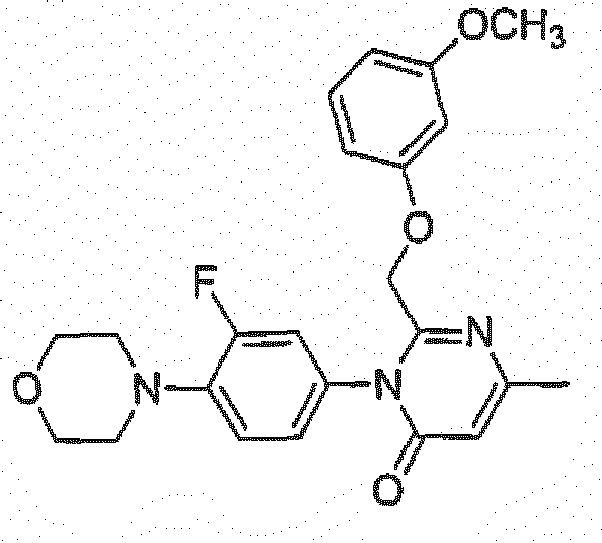
- A mixture of 3-methoxyphenol (2.48 g, 20.0 mmol), 2-bromoacetamide (3.31 g, 24.0 mmol) and K2CO3 (5.53 g, 40.0 mmol) in acetone (30 mL) was stirred at 70 °C for 9 h. The mixture was cooled to rt and filtered and the filtrate was concentrated in vacuo. The residue was purified by a silica gel column chromatography (PE / EtOAc (V / V) = 1 : 1) to give the title compound as a white solid (3.0 g, 83%).
- A mixture of N-(3-fluoro-4-morpholinophenyl)-3-oxobutanamide (1.0 g, 3.57 mmol), 2-(3-methoxyphenoxy) acetamide (1.29 g, 7.12 mmol) and titanium tetraisopropanolate (8.11 g, 28.5 mmol) in xylene (30 mL) was stirred at 165 °C for 24 h. The mixture was cooled to rt and 80 mL of toluene and 100 mL of saturated NH4Cl aqueous solution were added. The resulting mixture was stirred at rt overnight and filtered and the filtrate was extracted with DCM (150 mL x 3). The combined organic layers were dried over anhydrous Na2SO4 and concentrated in vacuo. The residue was purified by a silica gel column chromatography (PE / EtOAc (V / V) = 1 : 1) to give the title compound as a yellow solid (0.61 g, 40%). The compound was characterized by the following spectroscopic data:
MS (ESI, pos.ion) m/z: 426.1 (M+1);
1H-NMR (400 MHz, CDCl3): δ 2.25 (s, 3 H), 2.97 (t, 4 H), 3.69 (s, 3 H), 3.71 (m, 4 H), 4,69 (s, 2 H), 6.33-7.31 (m, 8 H). -

- To a mixture of 4-bromo-1-chloro-2-fluorobenzene (20.90 g, 100.0 mmol) and acetylacetone (30 mL, 300.0 mmol) in DMSO (100 mL) were added tripotassium phosphate (63.70 g, 300.0 mmol) and CuI (3.00 g, 15.80 mmol) under N2 and the mixture was stirred at 110 °C for 23 h. The mixture was cooled to rt and hydrochloric acid (300 mL, 2 M) was added. The resulting mixture was extracted with EtOAc (100 mL x 3) and the combined organic phases were washed with brine (100 mL x 2), dried over anhydrous Na2SO4 (50 g), and filtered. The filtrate was concentrated in vacuo. The residue was purified by a silica gel column chromatography (PE / EtOAc (V / V) = 10 : 1) to give the tilte compound as yellow liquid (9.02 g, 48.2%).
- To a solution of methylmagnesium bromide (100 mL, 100.0 mmol, 1.0 M in THF) was added a solution of 1-(4-chloro-3-fluorophenyl)propan-2-one (9.00 g, 48.20 mmol) in THF (20 mL) dropwise at 0 °C under N2 and the reaction mixture was heated at 76 °C for 12 h. It was then cooled to rt and quenched with saturated NH4Cl aqueous solution (50 mL) and the mixture was poured into water (200 mL). The resulting mixture was extracted with EtOAc (100 mL x 4) and the combined organic phases were washed with brine (100 mL x 2), dried over anhydrous Na2SO4 (50 g) and concentrated in vacuo. The residue was purified by a silica gel column chromatography (PE / EtOAc (V / V) = 8 : 1) to give the tilte compound as yellow liquid (8.61 g, 88.2%).
- To a mixture of 1-(4-chloro-3-fluorophenyl)-2-methylpropan-2-ol (8.61 g, 42.50 mmol), acetonitrile (13 mL, 255.0 mmol) and acetic acid (80 mL) was added sulfuric acid (13 mL) dropwise and the mixture was heated at 65 °C for 5 h. The mixture was cooled to rt and poured into ice water (400 mL) and the resulting mixture was adjusted to pH > 11 with NaOH, and extracted with EtOAc (150 mL x 3). The combined organic phases were washed with brine (150 mL x 2), dried over anhydrous Na2SO4 (40 g) and filtered. The filtrate was concentrated in vacuo. The residue was purified by a silica gel column chromatography (PE / EtOAc (V / V) = 2 : 1) to give the tilte compound as a yellow solid (4.38 g, 42.1%). The compound was characterized by the following spectroscopic data:
MS (ESI, pos.ion) m/z: 244.2 (M+1);
1H NMR (400 MHz, CDCl3) δ 7.29 (dd, 1 H, J1 = 10.7 Hz, J2 = 5.2 Hz), 6.94 (dd, 1 H, J1 = 10.2 Hz, J2 = 1.9 Hz), 6.87 (dd, 1 H, J1 = 8.1 Hz, J2 = 1.5 Hz), 5.21 (s, 1 H), 3.08 (s, 2 H), 1.95 (s, 3 H), 1.32 (s, 6 H). - A mixture of N-(1-(4-chloro-3-fluorophenyl)-2-methylpropan-2-yl) acetamide (3.36 g, 13.80 mmol) and concentrated hydrochloric acid (60 mL) was heated at 120 °C for 16.5 h. The mixture was cooled to rt and poured into ice water and the resulting mixture was adjusted to pH > 12 with NaOH and extracted with EtOAc (80 mL x 5). The combined organic phases were washed with brine (100 mL x 2), dried over anhydrous Na2SO4 and filtered. The filtrate was concentrated in vacuo. The residue was dissolved in concentrated hydrochloric acid (60 mL) and the mixture was stirred at 120 °C for 20 h. The reaction mixture was cooled to rt and 100 mL of water was added. The resulting mixture was washed with EtOAc (50 mL x 3). The aqueous phase was adjusted to pH > 11 with NaOH and extracted with EtOAc (50 mL x 3). The combined organic phases were washed with brine (80 mL x 2), dried over anhydrous Na2SO4 (20 g) and concentrated in vacuo to give the tile compound as a yellow solid (0.484 g, 17.4%). The compound was characterized by the following spectroscopic data:
MS (ESI, pos.ion) m/z: 202.1 (M+1). - A mixture of 3-chloro-4-fluoro-1-nitrobenzene (421 mg, 2.40 mmol) and 1-(4-chloro-3-fluorophenyl)-2-methylpropan-2-amine (484 mg, 2.40 mmol) in DMSO (10 mL) was heated at 90 °C under N2 for 3 h. The mixture was cooled to rt and stirred at rt for 38.5 h. It was then heated and stirred further at 90 °C for 81.5 h. The mixture was cooled to rt and 80 mL of water was added. The resulting mixture was extracted with EtOAc (30 mL x 3). The combined organic layers were dried over anhydrous Na2SO4 (10 g) and concentrated in vacuo. The residue was purified by a silica gel column chromatography (PE / DCM (V / V) = 20 : 1) to give the title compound as yellow oil (490 mg, 57.2%). The compound was characterized by the following spectroscopic data:
MS (ESI, pos.ion) m/z: 357.2 (M+1);
1H NMR (400 MHz, CDCl3) δ 8.24 (d, 1 H, J = 2.6 Hz), 8.10 (dd, 1 H, J1 = 9.2 Hz, J2 = 2.6 Hz), 7.34-7.26 (m, 1 H), 7.04-6.98 (m, 1 H), 6.86 (dd, 1H, J1 = 9.9 Hz, J2 = 2.0 Hz), 6.77 (dd, 1 H, J1 = 8.2 Hz, J2 = 1.5 Hz), 5.00 (s, 1 H), 3.04 (s, 2 H), 1.48 (s, 6 H). - To a mixture of water (20 mL) and iron powder (697 mg, 12.50 mmol) at 65 °C was added concentrated hydrochloric acid (0.2 mL) dropwise and the mixture was stirred for 15 min. The aqueous layer of the mixture was poured out and a solution of 2-chloro-N-(1-(4-chloro-3-fluorophenyl)-2-methylpropan-2-yl)-4-nitroaniline (446 mg, 1.25 mmol) in MeOH (20 mL) was added to the above processed iron powder. The mixture was adjusted to pH 2-3 and stirred at 65 °C for 20 min. The mixture was then cooled to rt, adjusted to pH 11 with Et3N, and filtered and the filtrate was concentrated in vacuo, The residue was dissolved in EtOAc (100 mL) and the solution was washed with water (30 mL x 3) and brine (30 mL x 2), dried over anhydrous Na2SO4 (10 g) and concentrated in vacuo to give the crude product, which was used for next step with out further purification. The compound was characterized by the following spectroscopic data:
MS (ESI, pos.ion) m/z: 327.1(M+1). - To a solution of 2-chloro-N 1-(1-(4-chloro-3-fluorophenyl)-2-methylpropan-2-yl) benzene-1,4-diamine (408 mg, 1.25 mmol) in toluene (15 mL) was added trimethylaluminium (2.5 mL, 5.00 mmol, 2.0 M in toluene) dropwise under N2 and the mixture was stirred at rt for 30 min after addition was completed. A solution of (Z)-methyl 3-(2-(3-fluorophenoxy)acetamido)but-2-enoate (295 mg, 1.88 mmol) in toluene (5 mL) was added slowly and the resulting mixture was stirred at rt for 22 h. Trimethylaluminium (2.0 mL, 4.00 mmol, 2 M in toluene) was then added dropwise and the mixture was stirred at rt for 30 min. A solution of (Z)-methyl 3-(2-(3-fluorophenoxy)acetamido)but-2-enoate (295 mg, 1.88 mmol) in toluene (3 mL) was added and the mixture was stirred further for 18 h. The mixture was quenched with saturated NH4Cl aqueous solution (50 mL) and filtered and the organic phase was separated from the filtrate. The aqueous phase was extracted with EtOAc (30 mL x 3). The combined organic layers were washed with brine (30 mL x 2), dried over anhydrous Na2SO4 (15 g) and concentrated in vacuo. The residue was purified by a silica gel column chromatography (PE / EtOAc (V / V) = 2 : 3) to give the title compound as a yellow solid (183 mg, 33.7%). The compound was characterized by the following spectroscopic data:
MS (ESI, pos.ion) m/z: 434.2(M+1);
1H NMR (400 MHz, CDCl3) δ 7.31 (t, 1 H, J = 8.0 Hz), 7.16 (d, 1 H, J = 2.5 Hz), 7.11 (d, 1 H, J = 8.7 Hz), 6.98 (dd, 1 H, J1 = 8.7 Hz, J2 = 2.5 Hz), 6.90 (dd, 1 H, J1 = 10.1 Hz, J2 = 1.9 Hz), 6.83 (dd, 1 H, J1 = 8.2 Hz, J2 = 1.5 Hz), 6.30 (d, 1 H, J = 9.9 Hz), 4.48 (s, 1 H), 3.01 (dd, 2 H, J1 = 32.3 Hz, J2 = 13.6 Hz,), 2.33 (s, 3 H), 2.27 (s, 3 H), 1.44 (s, 3 H), 1.42 (s, 3 H). - Following is examples of compounds not covered by the claims:
-

- To a solution of 2-fluoro-4-iodotoluene (23.60 g, 0.10 mol) in CHCl3 (1000 mL) was added BPO (0.55 g, 2.27 mmol) and NBS (24.92 g, 0.14 mol) under N2. The reaction mixture was refluxed for 6 h, then cooled and filtered. The filtrate was concentrated in vacuo. The residue was added to a solution of morpholine (43.56 g, 0.50 mol) in EtOH (1000 mL) under N2. The resulting mixture was stirred at rt overnight, and concentrated in vacuo. The residue was purified by a silica gel column chromatography (PE / EtOAc (V / V) = 3 : 1) to give the title compound as a white solid (4.82 g, 15%).
- A mixture of CuI (0.19 g, 1 mmol), Cs2CO3 (6.85 g, 20 mmol) and ethyl 2-oxocyclohexanecarboxylate (0.34 g, 2 mmol) in DMSO (10 mL) was stirred at rt for 30 min under N2. Then to the reaction mixture was added a solution of 5-methylpyridone (1.09 g, 10 mmol) and 4-(2-fluoro-4-iodobenzyl) morpholine (3.21 g, 10 mmol) in DMSO (12 mL) via syringe. The reaction mixture was heated at 100 °C overnight, cooled to rt and filtered. The filtrate diluted with H2O (50 mL) was extracted with CH2Cl2 (50 mL x 3). The combined organic phases were concentrated in vacuo. The residue was purified by a silica gel column chromatography (PE / EtOAc (V / V) = 10 : 1) to give the title compound as a white solid (0.70 g, 23%). The compound was characterized by the following spectroscopic data:
MS (ESI, pos.ion) m/z: 303.2 (M+1);
1H-NMR (400 MHz, CDCl3): δ 2.06 (s, 3 H), 3.16-3.32 (m, 4 H), 3.86-3.97 (m, 4 H), 4.44 (s, 2 H), 6.47 (d, 1 H, J = 9.6 Hz), 7.39-7.44 (m, 2 H), 7.48 (s, 1 H), 7.52-7.55 (m, 1 H), 7.99 (t, 1 H, J = 8.2 Hz). -

- A mixture of 3,5-dimethylpyridin-2(1H)-one (0.22 g, 1.80 mmol), 4-(2-fluoro-4-iodobenzyl)morpholine (0.58 g, 1.80 mmol), K2CO3 (2.48 g, 18 mmol), CuI (0.02 g, 0.1 mmol) and DMF (3 mL) was refluxed under N2. The reaction process was monitored by TLC. The reaction mixture was cooled to rt and filtered. To the filtrate was added H2O (10 mL) and CH2Cl2 (20 mL). The CH2Cl2 layer was separated, and the aqueous layer was extracted with CH2Cl2 (20 mL x 2). The combined organic phases were dried over Na2SO4 and concentrated in vacuo. The residue was purified by a silica gel column chromatography (PE / EtOAc (V / V) = 1 : 1) to give the title compound as a white solid (0.28 g, 50%). The compound was characterized by the following spectroscopic data:
MS (ESI, pos.ion) m/z: 317.1 (M+1);
1H-NMR (400 MHz, CDCl3): δ 2.06 (s, 3 H), 2.16 (s, 3 H), 2.61 (s, 2 H), 4.10 (m, 4 H), 4.32 (m, 4 H), 6.97 (s, 1 H), 7.09 (s, 1 H), 7.24 (d, 1 H), 7.31 (d, 1 H), 8.1 (s, 1 H). -

- To a mixture of 2-fluoro-4-iodotoluene (0.94 g, 4.0 mmol) in CCl4 (40 mL) were added BPO (0.02 g, 0.08 mmol) and NBS (0.78 g, 4.4 mmol) under N2. The reaction mixture was refluxed for 5 h, then cooled and concentrated in vacuo. To the residue was added a solution of methylpiperazine (2.00 g, 20 mmol) in EtOH (40 mL) under N2. The mixture was stirred at rt overnight and concentrated in vacuo. The resulting residue was purified by a silica gel column chromatography (PE / EtOAc (V / V) = 10 : 1) to give the title compound as a white solid (0.69 g, 52%).
- A mixture of 3,5-dimethylpyridin-2(1H)-one (0.07 g, 0.57 mmol), 1-(2-fluoro-4-iodobenzyl)-4-methylpiperazine (0.19 g, 0.57 mmol), K2CO3 (0.08 g, 0.58 mmol), CuI (0.005 g, 0.026 mmol) and DMF (1 mL) was refluxed under N2. The reaction process was monitored by TLC. After the reaction was completed, the mixture was cooled to rt. To the resulting mixture was added H2O (5 mL) and CH2Cl2 (10 mL x 3). The organic phase was separated, dried over Na2SO4 and concentrated in vacuo. The residue was purified by a silica gel column chromatography (PE / EtOAc (V / V) = 1 : 1) to give the title compound as a pale yellow solid (0.07 g, 37%). The compound was characterized by the following spectroscopic data:
MS (ESI, pos.ion) m/z: 317.1 (M+1);
1H-NMR (400 MHz, CDCl3): δ 2.08 (s, 3 H), 2.17 (s, 3 H), 2.29 (s, 3 H), 2.46-2.54 (m, 8 H), 3.61 (s, 2 H), 6.97 (s, 1 H), 7.11-7.15 (m, 3 H), 7.47-7.511 (m, 1 H). -

- To a solution of 2-fluoro-4-iodotoluene (2.83 g, 12 mmol) in CCl4 (120 mL) were added NBS (2.24 g, 12.6 mmol) and BPO (0.06 g, 0.24 mmol). The reaction mixture was refluxed for 9 h under N2, then cooled to rt and concentrated in vacuo. The residue was purified by a silica gel column chromatography (PE) to give the title compound as a white solid (2.16 g, 57%).
- A mixture of 1-(bromomethyl)-2-fluoro-4-iodobenzene (1.89 g, 6.0 mmol) and a solution of diethylamine (2.19 g, 30 mmol) in EtOH (60 mL) was stirred at rt overnight under N2, then concentrated in vacuo. The residue was dissolved in EtOAc (100 mL), and washed with water (100 mL x 3) followed by brine (100 mL). The organic phase was concentrated in vacuo to give the title compound as colorless oil (1.72 g, 94%).
- To a solution of N-ethyl-N-(2-fluoro-4-iodobenzyl)ethanamine (1.72 g, 5.60 mmol) in dioxane (50 mL) was added 3,5-dimethyl-pyridone (0.69 g, 5.60 mmol), N,N'-dimethyl ethane-1,2-diamine (0.20 g, 2.24 mmol), CuI (0.21 g, 1.12 mmol) and potassium phosphate (2.38 g, 11.20 mmol) under N2. The reaction mixture was heated at 110 °C for 9 h, then cooled to rt and poured into CH2Cl2 (200 mL). The mixture was filtered, and the filtrate was washed with water (200 mL x 3) and brine (200 mL). The organic phase was concentrated in vacuo. The residue was purified by a silica gel column chromatography (CH2Cl2 / MeOH (V / V) = 10 : 1) to give the title compound as a yellow solid (0.23 g, 14%). The compound was characterized by the following spectroscopic data:
MS (ESI, pos.ion) m/z: 303.7 (M+1);
1H-NMR (400 MHz, CDCl3): δ 1.06 (t, 6 H, J = 7.2 Hz), 2.07 (s, 3 H), 2.17 (s, 3 H), 2.53-2.58 (m, 4 H), 3.65 (s, 2 H), 6.98 (s, 1 H), 7.15-7.09 (m, 3 H), 7.55 (t, 1 H, J = 8.2 Hz). -

- To a mixture of 4-hydroxybenzothioamide (30.64 g, 0.20 mol) and 2-bromo-1,1-dimethoxyethane (31.00 g, 0.20 mol) in EtOH (600 mL) was added 4-methylbenzenesulfonic acid (34.44 g, 0.20 mol) with stirring at rt. The reaction mixture was heated at 90 °C for 24 h, then cooled to rt and concentrated in vacuo. The mixture was diluted with H2O (200 mL), adjusted to pH 10 with saturated NaHCO3 aqueous solution and extracted with DCM (200 mL x 3). The combined organic phases were concentrated in vacuo to give the title compound as s yellow solid (21.3 g, 60%).
- To a mixture of 2-(4-hydroxyphenyl) thiazole (21.27 g, 0.12 mol) and K2CO3 (82.93 g, 0.60 mol) in acetone (1000 mL) was added bromoethane (39.24 g, 0.36 mol) with stirring at rt. The reaction mixture was heated at 60 °C for 11 h, then cooled to rt, filtered and concentrated in vacuo to give the title compound as a white solid (24.54 g, 100 %).
- To a solution of 2-(4-ethoxyphenyl) thiazole (1.03 g, 5.00 mmol) in DCM (30 mL) were added NBS (0.98 g, 5.50 mmol) and acetic acid (0.3 mL) with stirring at rt under N2. The reaction was stirred at 48 °C for 3 h, then cooled to rt and concentrated in vacuo. The residue was purified by a silica gel column chromatography (PE / EtOAc (V / V) = 1 : 1) to give the title compound as a white solid (1.34 g, 94%).
- A mixture of CuI (0.038 g, 0.20 mmol), Cs2CO3 (0.98 g, 3.00 mmol) and 8-hydroxyquinoline ligand (0.029 g, 0.20 mmol) in DMSO (2 mL) was stirred at rt for 30 min under N2. Then to the reaction mixture was added a solution of 3,5-dimethylpyridin-2(1H)-one (0.30 g, 2.40 mmol) and 5-bromo-2-(4-ethoxyphenyl)thiazole (0.57 g, 2.00 mmol) in DMSO (2 mL) via syringe. The reaction mixture was heated at 130 °C for 12 h, then cooled to rt and filtered. The filtrate was diluted with H2O (10 mL) and extracted with CH2Cl2 (20 mL x 3). The combined organic phases were concentrated in vacuo. The residue was purified by a silica gel column chromatography (PE / EtOAc (V / V) = 1 : 10) to give the title compound (0.17 g, 26%). The compound was characterized by the following spectroscopic data:
MS (ESI, pos.ion) m/z: 327 (M+1);
1H-NMR (400 MHz, CDCl3): δ 1.44 (t, 3 H, J = 7.0 Hz), 2.15 (s, 3 H), 2.21 (s, 3 H), 4.07-4.12 (m, 2 H), 6.95 (d, 2 H, J = 8.8 Hz), 7.16 (s, 1 H), 7.36 (s, 1 H), 7.82 (s, 1H), 7.88 (d, 2 H, J = 8.8 Hz). -

- To a suspension of prolinol (2.74 g, 27.11 mmol) and KOH (3.17 g, 56.47 mmol) in DMSO (30 mL) was added 1,2,3-trifluoro-5-nitrobenzene (4.00 g, 22.59 mmol) at rt. The reaction mixture was heated at 65 °C for 4 h. The mixture was diluted with water (150 mL) and extracted with CH2Cl2 (100 mL x 2). The combined organic phases were dried over anhydrous Na2SO4 and concentrated in vacuo to give the title compound as a yellow solid (5.00 g, 93%).
- To a solution of 9-fluoro-7-nitro-2,3,3a,4-tetrahydro-1H-benzo[b]pyrrolo[1,2-d][1,4] oxazine (4.00 g, 16.79 mmol) in THF (40 mL) was added Pd/C (1.50 g). The reaction mixture was stirred at rt under H2 for 12 h. The mixture was filtered through a celite pad, and the filtrate was concentrated in vacuo to give the title compound as an offwhite solid (3.00 g, 85%).
- To a solution of 9-fluoro-2,3,3a,4-tetrahydro-1H-benzo[b]pyrrolo[1,2-d][1,4]oxazin-7-amine (2.00 g, 9.61 mmol) in anhydrous CH2Cl2 (50 mL) was added trimethylaluminum (48 mL, 48 mmol, 1 M in heptane) slowly under N2. Upon the end of addition the mixture was stirred at rt for 40 min, followed by addition of a solution of methyl 3-acetaminocrotonate (2.66 g, 16.92 mmol) in anhydrous CH2Cl2 (30 mL) dropwise. The reaction mixture was stirred at rt for another 5 h, then quenched with an appropriate amount of water. The organic phase was washed with brine, dried over anhydrous Na2SO4 and concentrated in vacuo to give the title compound as a white solid (1.00 g, 33.0%). The compound was characterized by the following spectroscopic data:
MS (ESI, pos.ion) m/z: 316.2 (M+1);
1H-NMR (400 MHz, DMSO-d6 ): δ 1.52-1.56 (m, 1 H), 1.88-1.90 (m, 2 H), 2.10 (s, 3 H), 2.18 (s, 3 H), 2.31(s, 1 H), 3.12-3.18 (q, 1 H), 3.37-3.40 (m, 2 H), 3.79-3.84 (m, 1 H), 4.35 (d, 1 H, J = 9.5 Hz), 6.20 (s, 1 H), 6.71 (s, 1 H), 6.82 (d, 1 H, J = 1.7 Hz). -

- To a solution of 4-aminobenzamide (6.81 g, 50 mmol) in DMF (70 mL) were added NaI (22.48 g, 150 mmol) and K2CO3 (13.82 g, 100 mmol) followed by bromoethane (13.62 g, 125 mmol) with stirring. The reaction mixture was heated at 110 °C overnight, followed by the addition of bromoethane (13.62 g, 125 mmol). The reaction mixture was stirred further at 110 °C for another 6 h, then cooled to rt. DMF was removed in vacuo. To the residue was added water (100 mL). The mixture was stirred for 10 min, filtered and the filter cake was dried in vacuo to give the title compound as a yellow solid (7.40 g, 77%).
- To a solution of 4-(diethylamino) benzamide (5.66 g, 29.43 mmol) in THF (80 mL) was added P2S5 (9.81 g, 44.14 mmol) at 50 °C over a period of 1 h. The mixture was heated at 55 °C for 8 h, then cooled to rt, filtered and the filtrate was concentrated in vacuo. The residue was purified by a silica gel column chromatography (PE / EtOAc (V / V) = 2 : 1) to give the title compound as a yellow solid (1.23 g, 20%).
- To a solution of 4-(diethylamino)benzothioamide (2.29 g, 11 mmol) in EtOH (60 mL) were added 2-bromo-1,1-dimethoxyethane (1.86 g, 11 mmol) and p-toluenesulfonic acid (1,89 g, 11 mmol). The reaction mixture was heated at 95°C overnight, then cooled to rt and concentrated in vacuo. The residue was purified by a silica gel column chromatography (PE / EtOAc / Et3N (V / V / V) = 2 : 1 : 0.05) to give the title compound as a white solid (1.40 g, 55%).
- To a mixture of N,N-diethyl-4-(thiazol-2-yl)aniline (1.39 g, 6.00 mmol) and concentrated sulfuric acid (10 mL) was added concentrated nitric acid (0.45 mL) at -10 °C. The reaction mixture was stirred at 0 °C for 3 h, then poured into ice water and extracted with CH2Cl2 (30 mL x 3). The organic phase was dried over Na2SO4 and concentrated in vacuo. The residue was purified by a silica gel column chromatography (PE / CH2Cl2 (V / V) = 1 : 1) to give the title compound as a yellow solid (0.73 g, 44%).
- To a solution of N,N-diethyl-4-(5-nitrothiazol-2-yl)aniline (0.73 g, 2.64 mmol) in MeOH (30 mL) was added Pd/C (73 mg). The reaction mixture was stirred at rt under H2 overnight, then filtered. The filtrate was concentrated in vacuo. The residue was purified by a silica gel column chromatography (PE / EtOAc (V / V) = 5 : 1) to give the title compound as a white solid (0.45 g, 69%).
- To a solution of 2-(4-(diethylamino)phenyl)thiazol-5-amine (0.45 g, 1.82 mmol) in CH2Cl2 (20 mL) was added trimethylaluminum (4.5 mL, 9.0 mmol, 2 M in toluene) dropwise at rt. The reaction mixture was stirred at rt for 1 h, followed by the addition of a solution of methyl 3-acetaminocrotonate ((315 mg, 2 mmol) in anhydrous CH2Cl2 (5 mL). The reaction mixture was stirred at rt for 3 days, then quenched with saturated NH4Cl aqueous solution and extracted with CH2Cl2 (50 mL x 3). The combined organic phases were dried over Na2SO4 and concentrated in vacuo. The residue was purified by a silica gel column chromatography to give the title compound as a yellow solid (22 mg, 3%). The compound was characterized by the following spectroscopic data:
MS (ESI, pos.ion) m/z: 355.2 (M+1);
1H-NMR (400 MHz, DMSO-d6 ): δ 0.89 (t, 6 H, J = 12.0 Hz), 2.08 (s, 3 H), 2.23 (s, 3 H), 2.95-3.02 (m, 4 H), 6.33 (s, 1 H), 7.29 (d, 1 H, J = 12.0 Hz), 7.72-7.74 (m, 2 H), 7.87 (d, 1 H, J = 4.0 Hz), 7.95-7.98 (m, 1 H). -

- To a solution of 4-aminobenzamide (6.81 g, 50 mmol) in DMF (70 mL) were added NaI (22.48 g, 150 mmol) and K2CO3 (13.82 g, 100 mmol). The mixture was heated to 140 °C and 2,2'-dichlorodiethyl ether (14.30 g, 100 mmol) was added. The reaction mixture was heated at 150 °C for 5 h, and cooled to rt. The mixture was diluted with water (100 mL), stirred for 10 min, and filtered. The filter cake was washed with water and dried to give the title compound as a yellow solid (6.60 g, 64%).
- To a solution of 4-morpholinobenzamide (4.91 g, 23.80 mmol) in THF (70 mL) was added Lawesson's Reagent (10.60 g, 26.20 mmol) with stirring. The mixture was heated at 70 °C for 4 h, then cooled to rt and concentrated in vacuo. CH2Cl2 (30 mL) and water (100 mL) was added to the residue. The mixture was then filtered and the filter cake was washed with water and dried to give the title compound as a yellow solid (4.41 g, 83.3%).
- To a solution of 4-morpholinobenzothioamide (2.22 g, 10 mmol) in EtOH (50 mL) were added 2-bromo-1,1-dimethoxyethane (1.69 g, 10 mmol) and p-toluenesulfonic acid (1.90 g, 10 mmol). The reaction mixture was heated at 95 °C overnight, then cooled to rt and filtered. The filter cake was dried to give the title compound as a yellow solid (2.00 g, 81%).
- To a mixture of 4-(4-(thiazol-2-yl)phenyl)morpholine (2.00 g, 8.13 mmol) and concentrated sulfuric acid (25 mL) was added concentrated nitric acid (0.60 mL) at -10 °C. The reaction mixture was stirred at 0 °C for 4.5 h, then poured into ice water, and extracted with CH2Cl2 (60 mL x 3). The organic phase was dried over Na2SO4 and concentrated in vacuo to give the title compound as a yellow solid (0.70 g, 30%).
- To a solution of 4-(4-(5-nitrothiazol-2-yl) phenyl) morpholine (0.70 g, 2.44 mmol) in CH2Cl2 (20 mL) was added Pd/C (70 mg). The reaction mixture was stirred at rt under H2 overnight, and filtered. The filtrate was concentrated in vacuo to give the title compound as an offwhite solid (0.20 g, 32%).
- To a solution of 2-(4-morpholinophenyl)thiazol-5-amine (0.20 g, 0.77 mmol) in CH2Cl2 (20 mL) was added trimethylaluminum (2.3 mL, 4.6 mmol, 2 M in toluene) dropwise at rt. The reaction mixture was stirred at rt for 1 h, followed by the addition of a solution of methyl 3-acetaminocrotonate (132 mg, 0.84 mmol) in anhydrous CH2Cl2 (5 mL). The reaction mixture was stirred at rt overnight, then quenched with saturated NH4Cl aqueous solution and extracted with CH2Cl2 (50 mL x 3). The combined organic phases were dried over anhydrous Na2SO4 and concentrated in vacuo. The residue was purified by preparative TLC to give the title compound as a pale yellow solid (20 mg, 7%). The compound was characterized by the following spectroscopic data:
MS (ESI, pos.ion) m/z: 369.1 (M+1);
1H-NMR (400 MHz, DMSO-d6 ): δ 2.20 (s, 3 H), 2.34 (s, 3 H), 2.62-2.84 (m, 2 H), 3.06-3.10 (s, 2 H), 3.63-3.66 (m, 4 H), 6.32 (s, 1 H), 7.26 (d, 1 H, J=4.2 Hz), 7.32 (d, 2 H, J = 3.2 Hz), 7.77 (d, 1 H, J = 2.4 Hz), 7.84 (d, 1 H, J = 3.6 Hz), 8.02-8.05 (m, 1 H). -

- To a solution of 3-nitroaniline (6.91 g, 50 mmol) in THF (150 mL) were added Boc2O (13.10 g, 60 mmol) and DMAP (1.53 g, 12.5 mmol) with stirring. The reaction mixture was refluxed overnight under N2, then cooled to rt and concentrated in vacuo. The residue was dissolved in CH2Cl2 (200 mL). The solution was then washed with water (200 mL x 3) and brine (200 mL), dried over anhydrous Na2SO4 and concentrated in vacuo. The crude product was purified by a silica gel column chromatography (PE / EtOAc (V / V) = 4 : 1) to give the title compound as a pale yellow solid (10.75 g, 90%).
- To a solution of tert-butyl (3-nitrophenyl) carbamate (10.75 g, 45.12 mmol) in MeOH (150 mL) was added catalyst 10% Pd/C (0.48 g). The reaction mixture was stirred at rt under H2 overnight, and filtered. The filtrate was concentrated in vacuo. The residue was purified by a silica gel column chromatography (PE / EtOAc (V / V) = 4 : 1) to give the title compound as a pale yellow solid (7.59 g, 81%).
- To a suspension of tert-butyl (3-aminophenyl)carbamate (7.59 g, 36.40 mmol), K2CO3 (10.06 g, 72.80 mmol) and NaI (16.37 g, 109.20 mmol) in DMF (300 mL) was added 2,2'-dichlorodiethyl ether (5.73 g, 40.1 mmol) slowly at 150 °C under N2. The reaction mixture was stirred at 150 °C overnight, then cooled to rt, poured into water (700 mL) and extracted with CH2Cl2 (200 mL x 3). The combined organic phases were washed with water (200 mL x 3) and brine (200 mL), dried over anhydrous Na2SO4 and concentrated in vacuo. The residue was purified by a silica gel column chromatography (PE / EtOAc (V / V) = 4 : 1) to give the title compound as a yellow solid (5.91 g, 58%).
- A solution of tert-butyl (3-morpholinophenyl) carbamate (5.91 g, 21.20 mmol) in a solution of HCl (106 mL, 106.0 mmol, 1 M in MeOH) was stirred at rt overnight, then concentrated in vacuo. The residue was dissolved in water (100 mL). The soltution was basified with saturated Na2CO3 aqueous solution and extracted with CH2Cl2 (100 mL x 3). The combined organic phases were washed with brine (150 mL), dried over anhydrous Na2SO4 and concentrated in vacuo to give the title compound as a light brown solid (3.42 g, 91%).
- To a solution of 3-morpholinylaniline (3.42 g, 19.20 mmol) in CH2Cl2 (100 mL) was added trimethylaluminum (96 mL, 96 mmol, 1 M in toluene) carefully under N2. The reaction mixture was stirred at rt for 30 min, followed by the addition of a solution of methyl 3-acetaminocrotonate (3.29 g, 19.20 mmol) in anhydrous CH2Cl2 (50 mL). The reaction mixture was stirred at rt overnight, then quenched with saturated NH4Cl aqueous solution (200 mL) and extracted with CH2Cl2 (200 mL x 3). The combined organic phases were washed with brine (300 mL), dried over anhydrous Na2SO4 and concentrated in vacuo. The residue was purified by a silica gel column chromatography (PE / EtOAc (V / V) = 1 : 1) to give the title compound as a yellow solid (0.73 g, 13%). The compound was characterized by the following spectroscopic data:
MS (ESI, pos.ion) m/z: 286.3(M+1);
1H-NMR (400 MHz, CDCl3): δ 2.19 (s, 3 H), 2.29 (s, 3 H), 3.17-3.19 (m, 4 H), 3.84 (t, 4 H, J = 4.8 Hz), 6.28 (s, 1 H), 6.66 (d, 2 H, J = 8.0 Hz), 6.98 (d, 1 H, J = 9.3 Hz), 7.40 (t, 1 H, J = 8.2 Hz). -

- To a solution of 2-fluoro-5-nitroaniline (4.68 g, 30 mmol) in THF (150 mL) were added Boc2O (9.82 g, 45 mmol) and DMAP (7.33 g, 60 mmol). The reaction mixture was refluxed overnight under N2, then cooled to rt and concentrated in vacuo. The residue was dissolved in EtOAc (250 mL), and the organic phase was washed with water (200 mL x 3) and brine (200 mL), dried over anhydrous Na2SO4 and concentrated in vacuo. The crude product was purified by a silica gel column chromatography (PE / EtOAc (V / V) = 8 : 1) to give the title compound as a yellowish solid (3.54 g, 40%).
- To a solution of tert-butyl (2-fluoro-5-nitrophenyl) carbamate (3.54 g, 13.8 mmol) in MeOH (100 mL) was added catalyst 10% Pd/C (0.15 g). The reaction was stirred at rt under H2 overnight, and filtered. The filtrate was concentrated in vacuo. The residue was purified by a silica gel column chromatography (PE / EtOAc (V / V) = 4 : 1) to give the title compound as a yellowish solid (2.02 g, 65%).
- To a mixture of tert-butyl (2-fluoro-5-aminophenyl) carbamate (2.02 g, 8.93 mmol), K2CO3 (2.47 g, 17.86 mmoll) and NaI (4.02 g, 26.79 mmol) in DMF (60 mL) was added 2,2'-dichlorodiethyl ether (1.28 g, 8.93 mmol) slowly at 150 °C under N2. The reaction was heated at 150 °C overnight, then cooled to rt, poured into water (200 mL) and extracted with CH2Cl2 (200 mL x 2). The combined organic phases were washed with wter (200 mL x 2) and brine (200 mL), dried over anhydrous Na2SO4 and concentrated in vacuo. The residue was purified by a silica gel column chromatography (PE / EtOAc (V / V) = 4 : 1) to give the title compound as a yellow solid (0.93 g, 35%).
- A mixture of tert-butyl (2-fluoro-5-morpholinophenyl) carbamate (0.93 g, 3.14 mmol) and a solution of HCl (31 mL, 31 mmol, 1 M in MeOH) was stirred at rt overnight, then concentrated in vacuo. The residue was dissolved in water (150 mL). The soltution was basified with saturated Na2CO3 aqueous solution and extracted with CH2Cl2 (100 mL x 3). The combined organic phases were washed with brine (150 mL), dried over anhydrous Na2SO4 and concentrated in vacuo to give the title compound as a light brown solid (0.35 g, 57%).
- To a solution of 2-fluoro-5-morpholinoaniline (0.35 g, 1.78 mmol) in CH2Cl2 (20 mL) was added trimethylaluminum (3.3 mL, 6.6 mmol, 2 M in toluene) dropwise. The reaction mixture was stirred at rt for 20 min, followed by the addition of a solution of methyl 3-acetaminocrotonate (0.30 g, 1.78 mmol) in anhydrous CH2Cl2 (10 mL). The reaction mixture was stirred at rt overnight, then quenched with saturated NH4Cl aqueous solution (80 mL) and extracted with CH2Cl2 (100 mL x 3). The combined organic phases were washed with brine (150 mL), dried over anhydrous Na2SO4 and concentrated in vacuo. The residue was purified by a silica gel column chromatography (PE / EtOAc (V / V) = 1 : 2) to give the title compound as a yellow solid (0.37 g, 69%). The compound was characterized by the following spectroscopic data:
MS (ESI, pos.ion) m/z: 304.2 (M+1);
1H-NMR (400 MHz, CDCl3): δ 2.23 (s, 3 H), 2.30 (s, 3 H), 3.11-3.14 (m, 4 H), 3.85 (t, 4 H, J = 4.8 Hz), 6.29 (s, 1 H), 6.70-6.71 (m, 1 H), 6.96-7.00 (m, 1 H), 7.18 (t, 1 H, J = 9.0 Hz). -

- A mixture of 2-chloro-5-nitropyridine (3.17 g, 20 mmol), morpholine (2.00 g, 23 mmol) and Et3N (2.43 g, 24 mmol) in EtOAc (200 mL) was refluxed for 3 h, then cooled to rt, and washed with water (100 mL x 3). The organic phase was dried over anhydrous Na2SO4 and concentrated in vacuo to give the title compound as a yellow solid (3.89 g, 93%).
- To a solution of 4-(5-nitropyridin-2-yl) morpholine (3.89 g, 18.60 mmol) in THF (100 mL) was added catalyst Pd/C (0.5 g). The reaction was stirred at rt under H2 overnight, and filtered. The filtrate was concentrated in vacuo to give the title compound as a brown-red solid (3.30 g, 99%).
- To a solution of 6-morpholinopyridin-3-amine (1.79 g, 10 mmol) in CH2Cl2 (100 mL) was added trimethylaluminium (40 mL, 40 mmol, 1 M in heptane) carefully under N2. The mixture was stirred at rt for 30 min, followed by the addition of a solution of methyl 3-acetaminocrotonate (1.89 g, 12 mmol) in CH2Cl2 (5 mL). The reaction was stirred at rt for 6 h, then quenched with saturated NH4Cl aqueous solution (100 mL). The organic phase was dried over anhydrous Na2SO4 and concentrated in vacuo. The residue was purified by recrystallized from EtOAc to give the title compound as a pale yellow solid (1.11 g, 39%). The compound was characterized by the following spectroscopic data:
MS (ESI, pos.ion) m/z: 287.2 (M+1);
1H-NMR (400 MHz, CDCl3): δ 2.22 (s, 3 H), 2.30 (s, 3 H), 3.54-3.60 (m, 4 H), 3.83 (t, 4 H, J = 4.9 Hz), 6.29 (s, 1 H), 6.74 (d, 1 H, J = 8.8 Hz), 7.33 (dd, 1 H, J1 = 2.1 Hz, J 2 = 8.8 Hz), 8.00 (d, 1 H, J = 2.6 Hz). -

- To a mixture of NaH (3.0 g, 75.0 mmol, 60%) in DMF (20 mL) were added a solution of 6-nitro-1H-indole (4.86 g, 30.0 mmol) in DMF (10 mL) and a solution of 3-hydroxybenzonitrile (3.57 g, 30.0 mmol) in DMF (10 mL) at 0 °C and the mixture was stirred at rt for 2 h. To the reaction mixture was added a solution of diiodomethane (7.5 mL, 90.0 mmol) in DMF (10 mL) slowly without light and the mixture was stirred at rt for 20 h. The mixture was then quenched with water and filtered. The filtrate was extracted with DCM (30 mL x 6) and the combined organic layers were washed with brine (50 mL x 3), dried over anhydrous Na2SO4 and concentrated in vacuo. The residue was purified by a silica gel column chromatography (PE / EtOAc (V / V) = 1 : 1) to give the title compound as a yellow solid (4.47 g, 51%).
- To a mixture of 3-((6-nitro-1H-indol-1-yl)methoxy)benzonitrile (3.0 g, 10.2 mmol), THF (80 mL) and water (40 mL) were added iron powder (2.86 g, 51.2 mmol) and NH4Cl (1.09 g, 20.4 mmol) and the mixture was stirred at 64 °C overnight. The mixture was then cooled to rt and to the resulting mixture was added saturated NaHCO3 aqueous solution. The mixture was filtered and the filtrate was extracted with EtOAc (30 mL x 4). The combined organic layers were washed with brine (40 mL x 3), dried over anhydrous Na2SO4 and concentrated in vacuo. The residue was purified by a silica gel column chromatography (PE / EtOAc (V / V) = 2 : 1) to give the title compound as a yellow solid (1.76 g, 65%).
- To a solution of 3-((6-amino-1H-indol-1-yl)methoxy)benzonitrile (2.62 g, 9.95 mmol) in EtOAc (20 mL) was added acetyl ketene (1.0 g, 11.9 mmol) and the mixture was stirred at 80 °C overnight. The mixture was cooled to rt and concentrated in vacuo. The residue was purified by a silica gel column chromatography (PE / EtOAc (V / V) = 1 : 1) to give the title compound as a yellow solid (2.70 g, 78%).
- A mixture of N-(1-((3-cyanophenoxy) methyl)-1H-indol-6-yl)-3-oxobutanamide (1.04 g, 2.99 mmol), MeOH (20 mL) and ammonia (20 mL) was stirred at rt overnight. The mixture was concentrated in vacuo to give the title compound, which was used for next step without further purification.
- A mixture of (Z)-3-amino-N-(1-((3-cyanophenoxy)methyl)-1H-indol-6-yl)but-2-enamide (1.04 g, 3.00 mmol) and triethyl orthoacetate (20 mL) was stirred at 130 °C overnight. The mixture was cooled to rt and concentrated in vacuo. The residue was purified by a silica gel column chromatography (PE / EtOAc (V / V) = 1 : 1) to give the title compound as a yellow solid (272 mg, 25%). The compound was characterized by the following spectroscopic data:
MS (ESI, pos.ion) m/z: 371.1 (M+1);
1H-NMR (400 MHz, DMSO-d6 ): δ 2.05 (s, 3 H), 2.21 (s, 3 H), 6.25 (s, 1 H), 6.29 (s, 2 H), 6.64-6.63 (d, 1 H, J = 3.2 Hz), 7.01-6.99 (dd, 1 H, J1 = 1.4 Hz, J2 = 8.3 Hz), 7.39-7.37 (m, 1 H), 7.51-7.44 (m, 2 H), 7.63 (s, 1 H), 7.72-7.68 (m, 3 H). - Taking BHK-21 cells which in exponential growth phase, collecting and counting the cells which had digestive transfer culture after fusion growth 85-95%, adjusting the cell density to 2 x 10⁴ cells per milliliter, seeding the cells into 96-well plates, 100 µl / well, the cells were incubated in a 5% CO2 incubator at 37 °C.
- The upper clear liquid of the 96-well plates was removed after the cells adhering to the wall 24 hours. The above compounds were confected into solutions of different concentration and the solutions were added to the wells, 100 µl / well. Each concentration solution in 3 replicates, the cells were subcultured 48 hours after dosing.
- 10 µl of CCK-8 solution was added to each well 48 hours after dosing, and incubated for 2 hours. The optical density (A) of each well was determined by a microplate reader at 450 nm wavelength. Calculating the inhibition ratio of cell proliferation of each compound is based on A and the inhibition ratio of cell proliferation (inhibition ratio, IR) = (1 - value of experimental group (Ai) / value of control group (Ao)) x100% and the IC50 of each compound at 48 hours was calculated by data processing software.
Table 2 Activity Data example IC50(mM) The ratio with PFD (multiple) example IC50(mM) The ratio with PFD (multiple) 1 B F 40 A E 7 B G 41 A E 8 C G 42 A E 10 D H 45 A E 11 C G 46 C G 12 C G 47 B G 13 C G 48 B F 15 B G 49 A E 18 B G 50 A E 19 C G 51 A E 20 A E 52 B F 21 C G 53 B F 22 B E 55 A E example IC50(mM) The ratio with PFD (multiple) example IC50(mM ) The ratio with PFD (multiple) 23 B E 56 A E 24 A E 57 A E 27 N/A N/A 58 B E 28 D G 59 B E 29 C G 60 B F 30 B F 62 B E 31 D G 63 A E 32 B G 64 B F 33 B E 65 A E 34 D G 66 B F 35 D G 67 B E 36 D G 68 B E 37 D G 69 A E 38 B F 70 N/A N/A 39 N/A N/A 71 A E N/A: There is no inhibitory activity in the range of testing concentration of the compound and the inhibitory activity does not increase with the testing concentration.
A: IC50 = 0 - 0.10; B: IC50 = 0.11 - 1.00; C: IC50 = 1.01 - 2.00; D: IC50 > 2.00; E: The ratio with PFD > 20; F: The ratio with PFD = 10 - 20; G: The ratio with PFD = 1-10; H: The ratio with PFD = 0-1. - Multiple is the ratio of Pirfenidone IC50 from the compound IC50; the bigger the multiple, the better the vitro inhibitory activity of the compound.
- Common characteristic of organic fibrosis is expanding of extracellular matrix (ECM) and structural remodeling of organs and tissues, where many cytokines (CK) participate in the process. It showed that in experimental screening in vitro, compounds disclosed herein are more active than BFNT, and a part of the compounds are more than 20 times as active as BFNT. Compounds disclosed herein can avoid the phototoxic reaction produced by BFNT, which are effective in anti-fibrosis.
Claims (6)
- A compound having Formula (VII):
 wherein R1 is H, F, Cl, Br, I, cyano, C1-6 alkyl, C1-6 haloalkyl, C1-6 alkoxy, C1-6 hydroxyalkoxy, C1-6 aminoalkoxy, C1-6 haloalkoxy, C6-10 aryl-(CH2)p-G-(CH2)m-, C1-9 heteroaryl-(CH2)p-G-(CH2)m-, C2-10 heterocyclyl-(CH2)p-G-(CH2)m-, or C3-10 cycloalkyl-(CH2)p-G-(CH2)m-, wherein each G is O, S, NR5, C(=O), -C(=O)NH-,-OC(=O)NH-, -OC(=O)- or -NHC(=O)NH-; each p and m is independently 0, 1, 2 or 3; or wherein each of the C6-10 aryl-(CH2)p-G-(CH2)m-, C1-9 heteroaryl-(CH2)p-G-(CH2)m-, C2-10 heterocyclyl-(CH2)p-G-(CH2)m-, and C3-10 cycloalkyl-(CH2)p-G-(CH2)m- is optionally substituted by one or more F, Cl, Br, I, methyl, ethyl, propyl, cyano, ethynyl, methoxy, ethoxy, or propynyl;R3 is H, F, Cl, I, cyano, C1-6 alkyl, C1-6 haloalkyl, C1-6 alkoxy, C1-6 hydroxyalkoxy, C1-6 aminoalkoxy, C1-6 haloalkoxy, C6-10 aryl-(CH2)p-G-(CH2)m-, C1-9 heteroaryl-(CH2)p-G-(CH2)m-, C2-10 heterocyclyl-(CH2)p-G-(CH2)m-, or C3-10 cycloalkyl-(CH2)p-G-(CH2)m-, wherein each G is O, S, NR5, C(=O), -C(=O)NH-,-OC(=O)NH-, -OC(=O)- or -NHC(=O)NH-; each p and m is independently 0, 1, 2 or 3;each R5 is independently H, C1-3 alkyl, C1-3 haloalkyl, C1-3 hydroxyalkyl, C1-3 aminoalkyl, C1-3 alkoxy-C1-3-alkyl, C1-3 alkylamino-C1-3-alkyl, C1-3 alkylthio-C1-3-alkyl, C6-10 aryl-C1-3-alkyl, C1-9 heteroaryl-C1-3-alkyl, C2-10 heterocyclyl-C1-3-alkyl, C3-10 cycloalkyl-C1-3-alkyl, C6-10 aryl, C1-9 heteroaryl, C2-10 heterocyclyl or C3-10 carbocyclyl;each R7 is independently H, C1-6 alkyl, C1-6 haloaliphatic, C1-6 hydroxyaliphatic, C1-6 aminoaliphatic, C1-6 alkoxy-C1-6-aliphatic, C1-6 alkylamino-C1-6-aliphatic, C1-6 alkylthio-C1-6-aliphatic, C6-10 aryl-C1-6-aliphatic, C1-9 heteroaryl-C1-6-aliphatic, C2-10 heterocyclyl-C1-6-aliphatic, C3-10 cycloalkyl-C1-6-aliphatic, C6-10 aryl, C1-9 heteroaryl, C2-10 heterocyclyl or C3-10 carbocyclyl;each R7a is independently C1-6 alkyl, C1-6 haloaliphatic, C1-6 hydroxyaliphatic, C1-6 aminoaliphatic, C1-6 alkoxy-C1-6-aliphatic, C1-6 alkylamino-C1-6-aliphatic, C1-6 alkylthio-C1-6-aliphatic, C6-10 aryl-C1-6-aliphatic, C1-9 heteroaryl-C1-6-aliphatic, C2-10 heterocyclyl-C1-6-aliphatic, C3-10 cycloalkyl-C1-6-aliphatic, C6-10 aryl, C1-9 heteroaryl, C2-10 heterocyclyl or C3-10 carbocyclyl; orR7 and R7a, together with the nitrogen atom they are attached to, optionally form a substituted or unsubstituted 3-8 membered ring;each R8a is independently H, hydroxy, amino, F, Cl, Br, I, -N(CH3)2, cyano, nitro, mercapto, C1-4 alkyl, trifluoromethyl, C1-4 alkoxy, C1-4 alkylamino, C1-4 alkylthio, C6-10 aryl, or C1-9 heteroaryl; andn is 0, 1, 2 or 3.
 - The compound according to claim 1, wherein each R7 is independently H, C1-6 alkyl, C1-4 alkoxy-C1-6-alkyl,
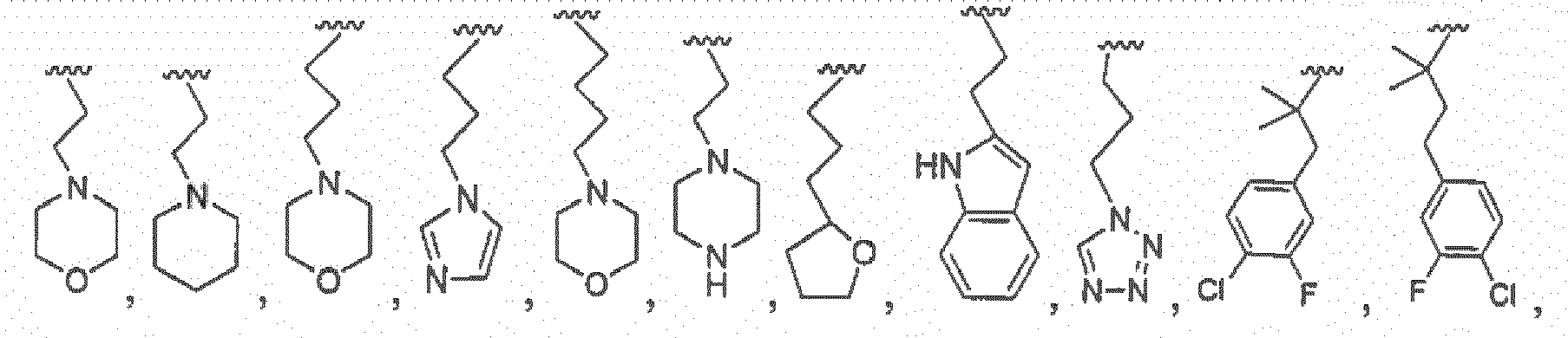


- The compound according to claim 1 having one of the following structures:





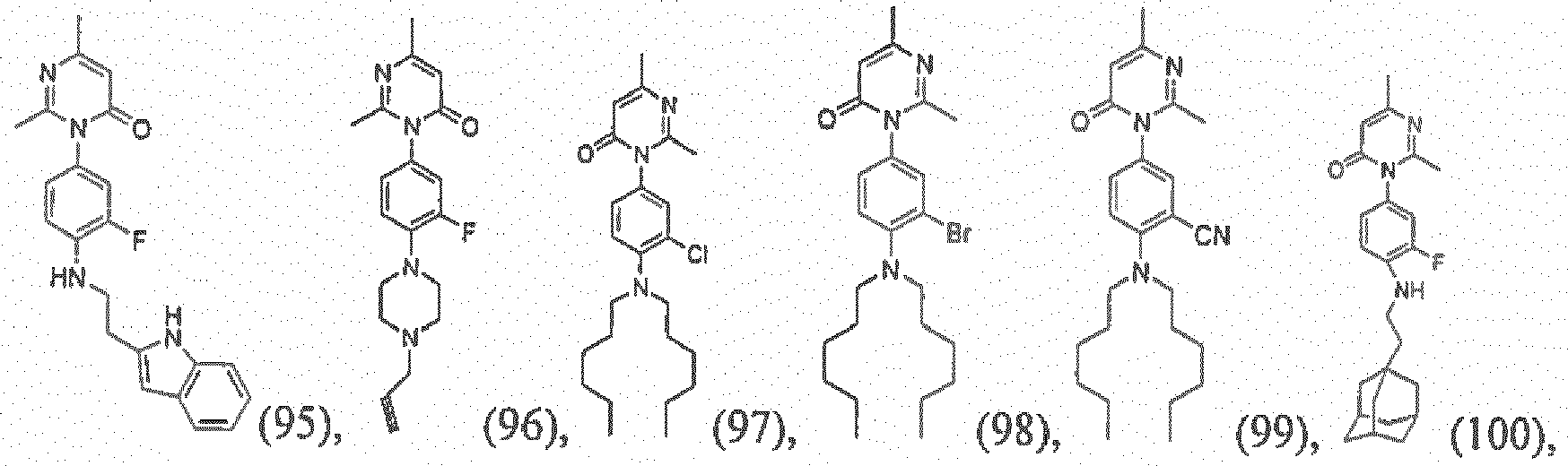


- A pharmaceutical composition comprising the compound according to any one of claims 1 to 3; and a pharmaceutically acceptable carrier, excipient, diluent, adjuvant, vehicle or a combination thereof.
- The compound according to any one of claims 1 to 3 or the pharmaceutical composition according to claim 4 for use in preventing or treating tissue or organ fibrosis, or lessening the severity of tissue or organ fibrosis in a patient.
- The compound or pharmaceutical composition according to claim 5, wherein the tissue or organ fibrosis disorder is renal interstitial fibrosis, glomerulosclerosis, liver fibrosis, pulmonary fibrosis, peritoneum fibrosis, myocardial fibrosis, dermatofibrosis, post-surgery adhesions, benign prostatic hypertrophy, skeletal muscle fibrosis, dermatosclerosis, multiple sclerosis, pancreatic fibrosis, liver cirrhosis, myosarcoma, neurofibroma, pulmonary interstitial fibrosis, diabetic nephropathy, alzheimer disease or vascular fibrosis; and
wherein the post-surgery adhesions is scarring or scar healing.
Applications Claiming Priority (2)
| Application Number | Priority Date | Filing Date | Title |
|---|---|---|---|
| CN201210250660 | 2012-07-18 | ||
| PCT/CN2013/000860 WO2014012360A1 (en) | 2012-07-18 | 2013-07-18 | Nitrogenous heterocyclic derivatives and their application in drugs |
Publications (3)
| Publication Number | Publication Date |
|---|---|
| EP2875001A1 EP2875001A1 (en) | 2015-05-27 |
| EP2875001A4 EP2875001A4 (en) | 2016-06-01 |
| EP2875001B1 true EP2875001B1 (en) | 2019-01-09 |
Family
ID=49948222
Family Applications (1)
| Application Number | Title | Priority Date | Filing Date |
|---|---|---|---|
| EP13819193.7A Active EP2875001B1 (en) | 2012-07-18 | 2013-07-18 | Nitrogenous heterocyclic derivatives and their application in drugs |
Country Status (12)
| Country | Link |
|---|---|
| US (1) | US9434695B2 (en) |
| EP (1) | EP2875001B1 (en) |
| JP (1) | JP6186434B2 (en) |
| KR (1) | KR102057877B1 (en) |
| CN (1) | CN103570630B (en) |
| AU (1) | AU2013292950C1 (en) |
| BR (1) | BR112014030284B1 (en) |
| CA (1) | CA2872110C (en) |
| ES (1) | ES2716008T3 (en) |
| MX (1) | MX2015000830A (en) |
| RU (1) | RU2701156C9 (en) |
| WO (1) | WO2014012360A1 (en) |
Families Citing this family (23)
| Publication number | Priority date | Publication date | Assignee | Title |
|---|---|---|---|---|
| DK3219705T3 (en) | 2005-12-28 | 2020-04-14 | Vertex Pharma | PHARMACEUTICAL COMPOSITIONS OF THE AMORPHIC FORM OF N- [2,4-BIS (1,1-DIMETHYLETHYL) -5-HYDROXYPHENYL] -1,4-DIHYDRO-4-OXOQUINOLIN-3-CARBOXAMIDE |
| AR092742A1 (en) | 2012-10-02 | 2015-04-29 | Intermune Inc | ANTIFIBROTIC PYRIDINONES |
| US9902712B2 (en) | 2013-12-19 | 2018-02-27 | Sunshine Lake Pharma Co., Ltd. | Nitrogenous heterocyclic derivatives and their application in drugs |
| US10233195B2 (en) | 2014-04-02 | 2019-03-19 | Intermune, Inc. | Anti-fibrotic pyridinones |
| CN107250113B (en) | 2014-10-07 | 2019-03-29 | 弗特克斯药品有限公司 | Co-crystals of modulators of cystic fibrosis transmembrane conductance regulator proteins |
| CN106397408B (en) * | 2015-07-30 | 2019-04-02 | 四川大学 | 5- methyl -2 (1H) Pyridione derivatives and its preparation method and application |
| FR3046793B1 (en) * | 2016-01-14 | 2018-01-05 | Les Laboratoires Servier | NOVEL PHOSPHINAN DERIVATIVES AND AZAPHOSPHINANES, PROCESS FOR THEIR PREPARATION AND PHARMACEUTICAL COMPOSITIONS CONTAINING THEM |
| CN106083817B (en) * | 2016-06-14 | 2019-01-18 | 四川大学 | Pirfenidone derivative and preparation method thereof |
| CN106045971B (en) * | 2016-06-16 | 2018-12-21 | 杨若一 | Pirfenidone derivative and preparation method thereof |
| CN109311820B (en) * | 2016-07-27 | 2022-09-27 | 广东东阳光药业有限公司 | Salts of 2, 6-dimethylpyrimidinone derivatives and use thereof |
| KR102455383B1 (en) * | 2016-07-27 | 2022-10-18 | 선샤인 레이크 파르마 컴퍼니 리미티드 | Salts of 2,6-dimethylpyrimidone derivatives and uses thereof |
| JP7393325B2 (en) * | 2017-07-14 | 2023-12-06 | サンシャイン・レイク・ファーマ・カンパニー・リミテッド | Method for preparing pyrimidone compounds |
| CN112770757B (en) * | 2018-10-19 | 2024-01-16 | 广东东阳光药业股份有限公司 | A pharmaceutical combination or pharmaceutical composition for treating fibrotic diseases |
| US20230065740A1 (en) | 2018-12-28 | 2023-03-02 | Spv Therapeutics Inc. | Cyclin-dependent kinase inhibitors |
| EA202191890A1 (en) | 2019-01-18 | 2022-02-03 | Астразенека Аб | PCSK9 INHIBITORS AND METHODS FOR THEIR USE |
| US11248001B2 (en) | 2019-01-18 | 2022-02-15 | Astrazeneca Ab | PCSK9 inhibitors and methods of use thereof |
| CN109734618B (en) * | 2019-02-27 | 2021-08-17 | 宜春学院 | A kind of preparation method of phenoxyacetamide compound and phenoxyacetamide compound |
| CN109942497A (en) * | 2019-05-06 | 2019-06-28 | 南京工业大学 | Polysubstituted pyrimidone compound and preparation method thereof |
| WO2021198191A1 (en) | 2020-03-30 | 2021-10-07 | Enyo Pharma | Quinazolinone derivatives and uses thereof for treating a cancer |
| KR20230175222A (en) | 2021-04-05 | 2023-12-29 | 할리아 테라퓨틱스, 인코포레이티드 | NEK7 inhibitor |
| WO2022226182A1 (en) | 2021-04-22 | 2022-10-27 | Halia Therapeutics, Inc. | Nek7 inhibitors |
| CN115957221B (en) * | 2021-10-09 | 2026-01-06 | 广东东阳光药业股份有限公司 | Anti-fibrotic composition |
| KR102762725B1 (en) * | 2022-03-24 | 2025-02-06 | 주식회사 케이에스비튜젠 | Pharmaceutical composition for preventing or treating muscle disease containing Levodropropizine as an active ingredient |
Family Cites Families (74)
| Publication number | Priority date | Publication date | Assignee | Title |
|---|---|---|---|---|
| US3185689A (en) | 1965-05-25 | Tolyl-x-(jh)-pyrimidones | ||
| DE2808193A1 (en) | 1978-02-25 | 1979-09-06 | Basf Ag | PYRIDAZONE CONNECTIONS |
| DE3202678A1 (en) | 1982-01-28 | 1983-08-04 | Basf Ag, 6700 Ludwigshafen | SUBSTITUTED 4,5-DIMETHOXY-PYRIDAZONE, METHOD FOR THE PRODUCTION THEREOF, THE HERBICIDES CONTAINING IT AND THEIR USE AS HERBICIDES |
| US5149810A (en) | 1988-04-22 | 1992-09-22 | Imperial Chemical Industries Plc | Pyrimidine compounds |
| GB8818560D0 (en) | 1988-08-04 | 1988-09-07 | Ici Plc | Novel compounds |
| JPH02215719A (en) | 1989-02-15 | 1990-08-28 | Yamauchi Akitomo | Agent for repairing fibrosing lesion tissue and preventing fibrosing lesion |
| GB8908638D0 (en) | 1989-04-17 | 1989-06-01 | Ici Plc | Novel compounds |
| GB8915962D0 (en) | 1989-07-12 | 1989-08-31 | Ici Plc | Novel compounds |
| AU627906B2 (en) * | 1989-07-14 | 1992-09-03 | Nissan Chemical Industries Ltd. | Uracil derivatives and herbicides containing the same as active ingredient |
| IE912114A1 (en) | 1990-07-02 | 1992-01-15 | Union Pharma Scient Appl | Novel pyrimidine derivatives which are angiotensin ii¹receptor antagonists, their methods of preparation and¹pharmaceutical compositions in which they are present |
| GB9022445D0 (en) | 1990-10-16 | 1990-11-28 | Ici Plc | Heterocyclic compounds |
| US5470975A (en) | 1990-10-16 | 1995-11-28 | E.R. Squibb & Sons, Inc. | Dihydropyrimidine derivatives |
| TW229142B (en) | 1992-04-15 | 1994-09-01 | Nissan Detrochem Corp | |
| BR9301666A (en) | 1992-04-28 | 1993-11-03 | Sumitomo Chemical Co | COMPOUND, INTERMEDIATE COMPOUND, HERBICIDE COMPOSITION, PROCESS FOR EXTERMINING UNWANTED WEEDS, USE OF THIS COMPOUND AND PROCESS TO PRODUCE IT |
| JPH09504010A (en) | 1993-10-20 | 1997-04-22 | ジ・アップジョン・カンパニー | Pyrimidinone as an anti-arthritic and anti-inflammatory agent |
| DE4343528A1 (en) * | 1993-12-16 | 1995-06-22 | Schering Ag | New di-heterocyclyl-benzene or pyridine derivs. |
| DE4431218A1 (en) | 1994-09-02 | 1996-03-07 | Bayer Ag | Substituted pyrimidine (thi) one |
| DE4432888A1 (en) | 1994-09-15 | 1996-03-21 | Bayer Ag | Use of aryluracils in the semi and non-selective area of weed control |
| KR100300566B1 (en) | 1994-09-17 | 2001-11-22 | 조생현 | Pyrimidinone derivative and method for preparation thereof |
| DE19520613A1 (en) | 1995-06-06 | 1996-12-12 | Bayer Ag | Phenylpyridazinones |
| US6369067B1 (en) | 1997-10-27 | 2002-04-09 | Dr. Reddy's Research Foundation | Monocyclic compounds and their use in medicine: process for their preparation and pharmaceutical compositions containing them |
| WO1999052878A1 (en) | 1998-04-09 | 1999-10-21 | Bayer Aktiengesellschaft | Substituted phenyl pyridazinones |
| PT1300396E (en) | 2000-06-12 | 2009-04-20 | Eisai R&D Man Co Ltd | 1,2-dihydropyridine compounds, process for preparation of the same and use thereof |
| EP1359910A4 (en) | 2000-12-29 | 2006-07-05 | Alteon Inc | METHOD FOR THE TREATMENT OF GLAUKOM II B |
| EP1441732A2 (en) * | 2001-11-08 | 2004-08-04 | Fujisawa Pharmaceutical Co., Ltd. | Thiazole derivative and pharmaceutical use thereof |
| US7030141B2 (en) * | 2001-11-29 | 2006-04-18 | Christopher Franklin Bigge | Inhibitors of factor Xa and other serine proteases involved in the coagulation cascade |
| AU2003209321A1 (en) | 2002-01-18 | 2003-07-30 | Pharmacia Corporation | Substituted pyridazinones as inhibitors of p38 |
| ES2334990T3 (en) | 2002-02-14 | 2010-03-18 | Pharmacia Corporation | PIRIDINONES REPLACED AS MODULATORS OF P38 MAP QUINASA. |
| TW200307667A (en) | 2002-05-06 | 2003-12-16 | Bristol Myers Squibb Co | Sulfonylaminovalerolactams and derivatives thereof as factor Xa inhibitors |
| CN1218942C (en) * | 2002-06-11 | 2005-09-14 | 中南大学湘雅医学院 | Anti-fibrosis pyridone compound and its production process |
| US7183287B2 (en) * | 2003-04-03 | 2007-02-27 | Pharmacia Corporation | Substituted pyrimidinones |
| CA2529790A1 (en) * | 2003-06-27 | 2005-01-27 | Banyu Pharmaceutical Co., Ltd. | Heteroaryloxy nitrogenous saturated heterocyclic derivative |
| NL1026826C2 (en) | 2003-08-13 | 2007-01-04 | Pharmacia Corp | Substituted pyridinones. |
| KR20060041309A (en) | 2003-08-13 | 2006-05-11 | 다케다 야쿠힌 고교 가부시키가이샤 | 4-pyrimidone derivatives and their use as peptidyl peptidase inhibitors |
| JP2007505121A (en) | 2003-09-08 | 2007-03-08 | 武田薬品工業株式会社 | Dipeptidyl peptidase inhibitor |
| CA2545813C (en) | 2003-11-14 | 2011-01-04 | Shanghai Genomics, Inc. | The derivatives of pyridone and use thereof |
| JPWO2005085200A1 (en) | 2004-03-05 | 2008-01-17 | 萬有製薬株式会社 | Pyridone derivative |
| JP5020073B2 (en) * | 2004-06-18 | 2012-09-05 | ミレニアム ファーマシューティカルズ インク. | Factor Xa inhibitor |
| CN1308028C (en) | 2004-09-10 | 2007-04-04 | 石药集团中奇制药技术(石家庄)有限公司 | Medication for treating hepatic fibrosis, and preparation method |
| EP1809611A4 (en) * | 2004-10-06 | 2009-11-25 | Nps Pharma Inc | INVERSE PYRIMIDINONE COMPOUNDS AS CALCILYTICS |
| CA2584246C (en) * | 2004-10-13 | 2011-08-09 | Pharmacia & Upjohn Company Llc | Crystalline forms of 3-[5-chloro-4-[(2,4-difluorobenzyl)oxy]-6-oxopyrimidin-1(6h)-yl]-n-(2-hydroxyethyl)-4-methylbenzamide |
| JP4912314B2 (en) | 2004-10-26 | 2012-04-11 | ジヤンセン・フアーマシユーチカ・ナームローゼ・フエンノートシヤツプ | Factor Xa compound |
| CN1846699A (en) | 2005-04-13 | 2006-10-18 | 中南大学湘雅医院 | Application of 1- (substituted phenyl) -5-methyl-2- (1H) pyridone (I) compound in preparing medicines for resisting fibrosis of other organs or fibrosis of tissues except renal interstitial fibrosis |
| CA2630117A1 (en) | 2005-11-22 | 2007-05-31 | Smithkline Beecham Corporation | Calcilytic compounds |
| US20070129379A1 (en) | 2005-12-01 | 2007-06-07 | Bristol-Myers Squibb Company | Hiv integrase inhibitors |
| EA015942B1 (en) * | 2006-05-05 | 2011-12-30 | Милленниум Фамэсьютикэлс, Инк. | Substituted imidazoles, composition based thereon, a method for preventing or treating undesired thrombosis using thereof and method for inhibiting the coagulation of a blood sample |
| PE20080150A1 (en) | 2006-06-02 | 2008-04-11 | Janssen Pharmaceutica Nv | PYRIDINONE DERIVATIVES N-ARIL AND N-HETEROARYL SUBSTITUTED AS ANTAGONISTS OF THE MELANIN-CONCENTRATING HORMONE (MCH) RECEPTOR |
| WO2007142217A1 (en) | 2006-06-07 | 2007-12-13 | Banyu Pharmaceutical Co., Ltd. | 1-phenylpyridone derivative |
| AU2007275682B2 (en) * | 2006-07-20 | 2012-05-17 | Amgen Inc. | Substituted pyridone compounds and methods of use |
| CA2657183A1 (en) | 2006-08-25 | 2008-02-28 | Boehringer Ingelheim International Gmbh | New pyridone derivatives with mch antagonistic activity and medicaments comprising these compounds |
| WO2008041090A1 (en) | 2006-10-06 | 2008-04-10 | Pfizer Limited | Malanin concentrating hormone receptor-1 antagonist pyridinones |
| JP5290192B2 (en) | 2006-12-05 | 2013-09-18 | ジヤンセン・フアーマシユーチカ・ナームローゼ・フエンノートシヤツプ | Novel substituted diaza-spiro-pyridinone derivatives for use in diseases mediated by MCH-1 |
| EP2114930A2 (en) * | 2007-01-05 | 2009-11-11 | Millennium Pharmaceuticals, Inc. | Factor xa inhibitors |
| CA2689607A1 (en) | 2007-06-06 | 2008-12-18 | Tyrogenex, Inc. | Kinase inhibitor compounds |
| WO2008156607A1 (en) | 2007-06-12 | 2008-12-24 | Neurogen Corporation | Substituted pyrimidinones |
| DE102007028320A1 (en) | 2007-06-20 | 2008-12-24 | Bayer Healthcare Ag | Substituted oxazolidinones and their use |
| RU2479580C2 (en) | 2007-06-27 | 2013-04-20 | Астразенека Аб | Pyrazinone derivatives and use thereof in treatment of lung diseases |
| RU2486187C2 (en) * | 2007-09-11 | 2013-06-27 | Эбботт Лэборетриз | OCTAHYDRO-PYRROLO[3,4-b]PYRROL N-OXIDES |
| US8329711B2 (en) | 2007-10-23 | 2012-12-11 | Msd K.K. | Pyridone-substituted-dihydropyrazolopyrimidinone derivative |
| GB0724342D0 (en) | 2007-12-13 | 2008-01-30 | Prolysis Ltd | Anitbacterial compositions |
| US8153813B2 (en) * | 2007-12-20 | 2012-04-10 | Abbott Laboratories | Benzothiazole and benzooxazole derivatives and methods of use |
| RU2525389C2 (en) | 2008-02-21 | 2014-08-10 | Мерк Шарп И Доум Корп. | Compounds which are erk inhibitors |
| CN101235013A (en) * | 2008-03-10 | 2008-08-06 | 广东东阳光药业有限公司 | Crystalline 1-(3-fluorophenyl)-5-methyl-2-(1H)pyridone, its preparation method, its composition and application |
| JP5627574B2 (en) | 2008-06-03 | 2014-11-19 | インターミューン, インコーポレイテッド | Compounds and methods for treating inflammatory and fibrotic diseases |
| EP2389227A4 (en) | 2009-01-26 | 2012-08-08 | Intermune Inc | METHODS OF TREATING ACUTE MYOCARDIAL INFARCTION AND RELATED DISORDERS |
| SG174125A1 (en) | 2009-04-02 | 2011-10-28 | Merck Serono Sa | Dihydroorotate dehydrogenase inhibitors |
| WO2010135972A1 (en) * | 2009-05-25 | 2010-12-02 | 中南大学 | Preparation methods and uses of 1-(substituted aryl)-5-trifluoromethyl-2-(1h)-pyridone compounds and their salts |
| CN102149683B (en) | 2009-05-25 | 2013-10-02 | 中南大学 | 1-(Substituted benzyl)-5-trifluoromethyl-2-(1H)pyridone compound and its salt, its preparation method and use |
| CN101921225B (en) | 2009-06-11 | 2013-04-03 | 北京凯得尔森生物技术有限公司 | Pirfenidone compound, preparation method and application thereof |
| MX336711B (en) | 2010-03-04 | 2016-01-28 | Merck Sharp & Dohme | Inhibitors of catechol o-methyl transferase and their use in the treatment of psychotic disorders. |
| JPWO2012011592A1 (en) | 2010-07-23 | 2013-09-09 | 武田薬品工業株式会社 | Heterocyclic compounds and uses thereof |
| WO2012096928A2 (en) * | 2011-01-10 | 2012-07-19 | Glaxosmithkline Llc | Pyrimidinone derivatives as fatty acid synthase inhibitors |
| US9056110B2 (en) | 2011-12-06 | 2015-06-16 | Confluence Life Sciences, Inc. | Substituted pyrimidinone-phenyl-pyrimidinyl compounds |
| US8859559B2 (en) | 2011-12-20 | 2014-10-14 | Boehringer Ingelheim International Gmbh | Substituted pyrazines and their use in the treatment of disease |
-
2013
- 2013-07-18 ES ES13819193T patent/ES2716008T3/en active Active
- 2013-07-18 US US14/396,754 patent/US9434695B2/en active Active
- 2013-07-18 WO PCT/CN2013/000860 patent/WO2014012360A1/en not_active Ceased
- 2013-07-18 AU AU2013292950A patent/AU2013292950C1/en active Active
- 2013-07-18 MX MX2015000830A patent/MX2015000830A/en unknown
- 2013-07-18 JP JP2015521942A patent/JP6186434B2/en active Active
- 2013-07-18 KR KR1020157002193A patent/KR102057877B1/en active Active
- 2013-07-18 RU RU2015105262A patent/RU2701156C9/en active
- 2013-07-18 CN CN201310303212.2A patent/CN103570630B/en active Active
- 2013-07-18 EP EP13819193.7A patent/EP2875001B1/en active Active
- 2013-07-18 BR BR112014030284-7A patent/BR112014030284B1/en active IP Right Grant
- 2013-07-18 CA CA2872110A patent/CA2872110C/en active Active
Non-Patent Citations (1)
| Title |
|---|
| None * |
Also Published As
| Publication number | Publication date |
|---|---|
| BR112014030284A2 (en) | 2017-06-27 |
| KR20150036223A (en) | 2015-04-07 |
| WO2014012360A1 (en) | 2014-01-23 |
| EP2875001A1 (en) | 2015-05-27 |
| EP2875001A4 (en) | 2016-06-01 |
| RU2701156C2 (en) | 2019-09-25 |
| AU2013292950C1 (en) | 2016-01-21 |
| JP6186434B2 (en) | 2017-08-23 |
| AU2013292950A1 (en) | 2014-11-13 |
| JP2015526411A (en) | 2015-09-10 |
| CN103570630B (en) | 2016-04-20 |
| CA2872110A1 (en) | 2014-01-23 |
| MX2015000830A (en) | 2015-10-26 |
| CA2872110C (en) | 2019-08-06 |
| RU2015105262A (en) | 2016-09-10 |
| ES2716008T3 (en) | 2019-06-07 |
| HK1207065A1 (en) | 2016-01-22 |
| US20150087639A1 (en) | 2015-03-26 |
| US9434695B2 (en) | 2016-09-06 |
| CN103570630A (en) | 2014-02-12 |
| AU2013292950B2 (en) | 2015-09-10 |
| KR102057877B1 (en) | 2019-12-20 |
| RU2701156C9 (en) | 2019-12-18 |
| BR112014030284B1 (en) | 2021-11-30 |
Similar Documents
| Publication | Publication Date | Title |
|---|---|---|
| US9434695B2 (en) | Nitrogenous heterocyclic derivatives and their application in drugs | |
| EP3083584B1 (en) | Nitrogenous heterocyclic derivatives and their application in the treatment of tissue fibrosis | |
| CN118076597A (en) | Azaquinolinone derivative, preparation method and use thereof | |
| CA3230123A1 (en) | Spiro indoline inhibitors of kif18a | |
| WO2019001396A1 (en) | Dihydropyrimidine compounds and uses thereof in medicine | |
| CA3251124A1 (en) | 4',5'-dihydrospiro[piperidine-4,7'-thieno[2,3-c]pyran] derivatives as inhibitors of apol1 and methods of using same | |
| AU2009345802A1 (en) | Phenoxymethyl heterocyclic compounds | |
| EP3750885A1 (en) | Compound having bet inhibitory activity and preparation method and use therefor | |
| WO2023215803A2 (en) | Cytochrome bd oxidase inhibitors and uses thereof | |
| CN104530046B (en) | Diaza spiro compounds and the application in medicine thereof | |
| WO2007039578A1 (en) | Imidazolyl-substituted azabenzophenone compounds | |
| HK1207065B (en) | Nitrogenous heterocyclic derivatives and their application in drugs | |
| HK1227028A1 (en) | Nitrogenous heterocyclic derivatives and their application in the treatment of tissue fibrosis | |
| HK1227028B (en) | Nitrogenous heterocyclic derivatives and their application in the treatment of tissue fibrosis | |
| CN106065018A (en) | Substituted benzazolyl compounds and using method thereof and purposes | |
| CN104530080B (en) | Oxazolidinone compounds and application thereof in drugs | |
| TW202540096A (en) | Bifunctional chimeric heterocyclic compound for targeted degradation of androgen receptor and its use | |
| WO2007039581A1 (en) | Imidazolyl-substituted diazabenzophenone compounds |
Legal Events
| Date | Code | Title | Description |
|---|---|---|---|
| PUAI | Public reference made under article 153(3) epc to a published international application that has entered the european phase |
Free format text: ORIGINAL CODE: 0009012 |
|
| 17P | Request for examination filed |
Effective date: 20141022 |
|
| AK | Designated contracting states |
Kind code of ref document: A1 Designated state(s): AL AT BE BG CH CY CZ DE DK EE ES FI FR GB GR HR HU IE IS IT LI LT LU LV MC MK MT NL NO PL PT RO RS SE SI SK SM TR |
|
| AX | Request for extension of the european patent |
Extension state: BA ME |
|
| DAX | Request for extension of the european patent (deleted) | ||
| REG | Reference to a national code |
Ref country code: HK Ref legal event code: DE Ref document number: 1207065 Country of ref document: HK |
|
| RIC1 | Information provided on ipc code assigned before grant |
Ipc: A61P 13/12 20060101ALI20160215BHEP Ipc: C07D 213/64 20060101AFI20160215BHEP Ipc: A61P 43/00 20060101ALI20160215BHEP Ipc: A61K 31/4412 20060101ALI20160215BHEP |
|
| RA4 | Supplementary search report drawn up and despatched (corrected) |
Effective date: 20160429 |
|
| RIC1 | Information provided on ipc code assigned before grant |
Ipc: C07D 403/06 20060101ALI20160422BHEP Ipc: A61K 31/4412 20060101ALI20160422BHEP Ipc: C07D 417/04 20060101ALI20160422BHEP Ipc: C07D 405/12 20060101ALI20160422BHEP Ipc: C07D 239/36 20060101ALI20160422BHEP Ipc: C07D 401/12 20060101ALI20160422BHEP Ipc: C07D 403/12 20060101ALI20160422BHEP Ipc: C07D 213/64 20060101AFI20160422BHEP Ipc: A61P 43/00 20060101ALI20160422BHEP Ipc: C07D 498/04 20060101ALI20160422BHEP Ipc: A61P 13/12 20060101ALI20160422BHEP |
|
| STAA | Information on the status of an ep patent application or granted ep patent |
Free format text: STATUS: EXAMINATION IS IN PROGRESS |
|
| 17Q | First examination report despatched |
Effective date: 20170516 |
|
| GRAP | Despatch of communication of intention to grant a patent |
Free format text: ORIGINAL CODE: EPIDOSNIGR1 |
|
| STAA | Information on the status of an ep patent application or granted ep patent |
Free format text: STATUS: GRANT OF PATENT IS INTENDED |
|
| INTG | Intention to grant announced |
Effective date: 20181004 |
|
| GRAS | Grant fee paid |
Free format text: ORIGINAL CODE: EPIDOSNIGR3 |
|
| GRAA | (expected) grant |
Free format text: ORIGINAL CODE: 0009210 |
|
| STAA | Information on the status of an ep patent application or granted ep patent |
Free format text: STATUS: THE PATENT HAS BEEN GRANTED |
|
| AK | Designated contracting states |
Kind code of ref document: B1 Designated state(s): AL AT BE BG CH CY CZ DE DK EE ES FI FR GB GR HR HU IE IS IT LI LT LU LV MC MK MT NL NO PL PT RO RS SE SI SK SM TR |
|
| REG | Reference to a national code |
Ref country code: GB Ref legal event code: FG4D |
|
| REG | Reference to a national code |
Ref country code: CH Ref legal event code: EP Ref country code: AT Ref legal event code: REF Ref document number: 1087115 Country of ref document: AT Kind code of ref document: T Effective date: 20190115 |
|
| REG | Reference to a national code |
Ref country code: IE Ref legal event code: FG4D |
|
| REG | Reference to a national code |
Ref country code: DE Ref legal event code: R096 Ref document number: 602013049672 Country of ref document: DE |
|
| REG | Reference to a national code |
Ref country code: NL Ref legal event code: MP Effective date: 20190109 |
|
| REG | Reference to a national code |
Ref country code: LT Ref legal event code: MG4D |
|
| REG | Reference to a national code |
Ref country code: ES Ref legal event code: FG2A Ref document number: 2716008 Country of ref document: ES Kind code of ref document: T3 Effective date: 20190607 |
|
| PG25 | Lapsed in a contracting state [announced via postgrant information from national office to epo] |
Ref country code: NL Free format text: LAPSE BECAUSE OF FAILURE TO SUBMIT A TRANSLATION OF THE DESCRIPTION OR TO PAY THE FEE WITHIN THE PRESCRIBED TIME-LIMIT Effective date: 20190109 |
|
| REG | Reference to a national code |
Ref country code: AT Ref legal event code: MK05 Ref document number: 1087115 Country of ref document: AT Kind code of ref document: T Effective date: 20190109 |
|
| PG25 | Lapsed in a contracting state [announced via postgrant information from national office to epo] |
Ref country code: FI Free format text: LAPSE BECAUSE OF FAILURE TO SUBMIT A TRANSLATION OF THE DESCRIPTION OR TO PAY THE FEE WITHIN THE PRESCRIBED TIME-LIMIT Effective date: 20190109 Ref country code: SE Free format text: LAPSE BECAUSE OF FAILURE TO SUBMIT A TRANSLATION OF THE DESCRIPTION OR TO PAY THE FEE WITHIN THE PRESCRIBED TIME-LIMIT Effective date: 20190109 Ref country code: LT Free format text: LAPSE BECAUSE OF FAILURE TO SUBMIT A TRANSLATION OF THE DESCRIPTION OR TO PAY THE FEE WITHIN THE PRESCRIBED TIME-LIMIT Effective date: 20190109 Ref country code: PT Free format text: LAPSE BECAUSE OF FAILURE TO SUBMIT A TRANSLATION OF THE DESCRIPTION OR TO PAY THE FEE WITHIN THE PRESCRIBED TIME-LIMIT Effective date: 20190509 Ref country code: NO Free format text: LAPSE BECAUSE OF FAILURE TO SUBMIT A TRANSLATION OF THE DESCRIPTION OR TO PAY THE FEE WITHIN THE PRESCRIBED TIME-LIMIT Effective date: 20190409 Ref country code: PL Free format text: LAPSE BECAUSE OF FAILURE TO SUBMIT A TRANSLATION OF THE DESCRIPTION OR TO PAY THE FEE WITHIN THE PRESCRIBED TIME-LIMIT Effective date: 20190109 |
|
| PG25 | Lapsed in a contracting state [announced via postgrant information from national office to epo] |
Ref country code: HR Free format text: LAPSE BECAUSE OF FAILURE TO SUBMIT A TRANSLATION OF THE DESCRIPTION OR TO PAY THE FEE WITHIN THE PRESCRIBED TIME-LIMIT Effective date: 20190109 Ref country code: RS Free format text: LAPSE BECAUSE OF FAILURE TO SUBMIT A TRANSLATION OF THE DESCRIPTION OR TO PAY THE FEE WITHIN THE PRESCRIBED TIME-LIMIT Effective date: 20190109 Ref country code: LV Free format text: LAPSE BECAUSE OF FAILURE TO SUBMIT A TRANSLATION OF THE DESCRIPTION OR TO PAY THE FEE WITHIN THE PRESCRIBED TIME-LIMIT Effective date: 20190109 Ref country code: IS Free format text: LAPSE BECAUSE OF FAILURE TO SUBMIT A TRANSLATION OF THE DESCRIPTION OR TO PAY THE FEE WITHIN THE PRESCRIBED TIME-LIMIT Effective date: 20190509 Ref country code: BG Free format text: LAPSE BECAUSE OF FAILURE TO SUBMIT A TRANSLATION OF THE DESCRIPTION OR TO PAY THE FEE WITHIN THE PRESCRIBED TIME-LIMIT Effective date: 20190409 Ref country code: GR Free format text: LAPSE BECAUSE OF FAILURE TO SUBMIT A TRANSLATION OF THE DESCRIPTION OR TO PAY THE FEE WITHIN THE PRESCRIBED TIME-LIMIT Effective date: 20190410 |
|
| REG | Reference to a national code |
Ref country code: DE Ref legal event code: R097 Ref document number: 602013049672 Country of ref document: DE |
|
| PG25 | Lapsed in a contracting state [announced via postgrant information from national office to epo] |
Ref country code: EE Free format text: LAPSE BECAUSE OF FAILURE TO SUBMIT A TRANSLATION OF THE DESCRIPTION OR TO PAY THE FEE WITHIN THE PRESCRIBED TIME-LIMIT Effective date: 20190109 Ref country code: AT Free format text: LAPSE BECAUSE OF FAILURE TO SUBMIT A TRANSLATION OF THE DESCRIPTION OR TO PAY THE FEE WITHIN THE PRESCRIBED TIME-LIMIT Effective date: 20190109 Ref country code: RO Free format text: LAPSE BECAUSE OF FAILURE TO SUBMIT A TRANSLATION OF THE DESCRIPTION OR TO PAY THE FEE WITHIN THE PRESCRIBED TIME-LIMIT Effective date: 20190109 Ref country code: CZ Free format text: LAPSE BECAUSE OF FAILURE TO SUBMIT A TRANSLATION OF THE DESCRIPTION OR TO PAY THE FEE WITHIN THE PRESCRIBED TIME-LIMIT Effective date: 20190109 Ref country code: AL Free format text: LAPSE BECAUSE OF FAILURE TO SUBMIT A TRANSLATION OF THE DESCRIPTION OR TO PAY THE FEE WITHIN THE PRESCRIBED TIME-LIMIT Effective date: 20190109 Ref country code: SK Free format text: LAPSE BECAUSE OF FAILURE TO SUBMIT A TRANSLATION OF THE DESCRIPTION OR TO PAY THE FEE WITHIN THE PRESCRIBED TIME-LIMIT Effective date: 20190109 Ref country code: DK Free format text: LAPSE BECAUSE OF FAILURE TO SUBMIT A TRANSLATION OF THE DESCRIPTION OR TO PAY THE FEE WITHIN THE PRESCRIBED TIME-LIMIT Effective date: 20190109 |
|
| PLBE | No opposition filed within time limit |
Free format text: ORIGINAL CODE: 0009261 |
|
| STAA | Information on the status of an ep patent application or granted ep patent |
Free format text: STATUS: NO OPPOSITION FILED WITHIN TIME LIMIT |
|
| PG25 | Lapsed in a contracting state [announced via postgrant information from national office to epo] |
Ref country code: SM Free format text: LAPSE BECAUSE OF FAILURE TO SUBMIT A TRANSLATION OF THE DESCRIPTION OR TO PAY THE FEE WITHIN THE PRESCRIBED TIME-LIMIT Effective date: 20190109 |
|
| REG | Reference to a national code |
Ref country code: DE Ref legal event code: R082 Ref document number: 602013049672 Country of ref document: DE Representative=s name: BECKER-KURIG-STRAUS PATENTANWAELTE PARTNERSCHA, DE Ref country code: DE Ref legal event code: R081 Ref document number: 602013049672 Country of ref document: DE Owner name: NORTH & SOUTH BROTHER PHARMACY INVESTMENT CO.,, HK Free format text: FORMER OWNER: SUNSHINE LAKE PHARMA CO., LTD., DONGGUAN, GUANGDONG, CN Ref country code: DE Ref legal event code: R082 Ref document number: 602013049672 Country of ref document: DE Representative=s name: BECKER & KURIG PARTNERSCHAFT PATENTANWAELTE MB, DE Ref country code: DE Ref legal event code: R082 Ref document number: 602013049672 Country of ref document: DE Representative=s name: BECKER & KURIG PARTNERSCHAFT PATENTANWAELTE PA, DE Ref country code: DE Ref legal event code: R081 Ref document number: 602013049672 Country of ref document: DE Owner name: SUNSHINE LAKE PHARMA CO., LTD., DONGGUAN, CN Free format text: FORMER OWNER: SUNSHINE LAKE PHARMA CO., LTD., DONGGUAN, GUANGDONG, CN |
|
| 26N | No opposition filed |
Effective date: 20191010 |
|
| PG25 | Lapsed in a contracting state [announced via postgrant information from national office to epo] |
Ref country code: SI Free format text: LAPSE BECAUSE OF FAILURE TO SUBMIT A TRANSLATION OF THE DESCRIPTION OR TO PAY THE FEE WITHIN THE PRESCRIBED TIME-LIMIT Effective date: 20190109 Ref country code: MC Free format text: LAPSE BECAUSE OF FAILURE TO SUBMIT A TRANSLATION OF THE DESCRIPTION OR TO PAY THE FEE WITHIN THE PRESCRIBED TIME-LIMIT Effective date: 20190109 |
|
| REG | Reference to a national code |
Ref country code: CH Ref legal event code: PL |
|
| PG25 | Lapsed in a contracting state [announced via postgrant information from national office to epo] |
Ref country code: TR Free format text: LAPSE BECAUSE OF FAILURE TO SUBMIT A TRANSLATION OF THE DESCRIPTION OR TO PAY THE FEE WITHIN THE PRESCRIBED TIME-LIMIT Effective date: 20190109 |
|
| REG | Reference to a national code |
Ref country code: BE Ref legal event code: MM Effective date: 20190731 |
|
| PG25 | Lapsed in a contracting state [announced via postgrant information from national office to epo] |
Ref country code: BE Free format text: LAPSE BECAUSE OF NON-PAYMENT OF DUE FEES Effective date: 20190731 Ref country code: CH Free format text: LAPSE BECAUSE OF NON-PAYMENT OF DUE FEES Effective date: 20190731 Ref country code: LU Free format text: LAPSE BECAUSE OF NON-PAYMENT OF DUE FEES Effective date: 20190718 Ref country code: LI Free format text: LAPSE BECAUSE OF NON-PAYMENT OF DUE FEES Effective date: 20190731 |
|
| REG | Reference to a national code |
Ref country code: DE Ref legal event code: R082 Ref document number: 602013049672 Country of ref document: DE Representative=s name: BECKER & KURIG PARTNERSCHAFT PATENTANWAELTE MB, DE Ref country code: DE Ref legal event code: R081 Ref document number: 602013049672 Country of ref document: DE Owner name: SUNSHINE LAKE PHARMA CO., LTD., DONGGUAN, CN Free format text: FORMER OWNER: NORTH & SOUTH BROTHER PHARMACY INVESTMENT CO., LTD., HONGKONG, HK |
|
| PG25 | Lapsed in a contracting state [announced via postgrant information from national office to epo] |
Ref country code: IE Free format text: LAPSE BECAUSE OF NON-PAYMENT OF DUE FEES Effective date: 20190718 |
|
| PG25 | Lapsed in a contracting state [announced via postgrant information from national office to epo] |
Ref country code: CY Free format text: LAPSE BECAUSE OF FAILURE TO SUBMIT A TRANSLATION OF THE DESCRIPTION OR TO PAY THE FEE WITHIN THE PRESCRIBED TIME-LIMIT Effective date: 20190109 |
|
| PG25 | Lapsed in a contracting state [announced via postgrant information from national office to epo] |
Ref country code: HU Free format text: LAPSE BECAUSE OF FAILURE TO SUBMIT A TRANSLATION OF THE DESCRIPTION OR TO PAY THE FEE WITHIN THE PRESCRIBED TIME-LIMIT; INVALID AB INITIO Effective date: 20130718 Ref country code: MT Free format text: LAPSE BECAUSE OF FAILURE TO SUBMIT A TRANSLATION OF THE DESCRIPTION OR TO PAY THE FEE WITHIN THE PRESCRIBED TIME-LIMIT Effective date: 20190109 |
|
| PG25 | Lapsed in a contracting state [announced via postgrant information from national office to epo] |
Ref country code: MK Free format text: LAPSE BECAUSE OF FAILURE TO SUBMIT A TRANSLATION OF THE DESCRIPTION OR TO PAY THE FEE WITHIN THE PRESCRIBED TIME-LIMIT Effective date: 20190109 |
|
| P01 | Opt-out of the competence of the unified patent court (upc) registered |
Effective date: 20231228 |
|
| PGFP | Annual fee paid to national office [announced via postgrant information from national office to epo] |
Ref country code: ES Payment date: 20250819 Year of fee payment: 13 |
|
| PGFP | Annual fee paid to national office [announced via postgrant information from national office to epo] |
Ref country code: DE Payment date: 20250722 Year of fee payment: 13 |
|
| PGFP | Annual fee paid to national office [announced via postgrant information from national office to epo] |
Ref country code: IT Payment date: 20250731 Year of fee payment: 13 |
|
| PGFP | Annual fee paid to national office [announced via postgrant information from national office to epo] |
Ref country code: GB Payment date: 20250724 Year of fee payment: 13 |
|
| PGFP | Annual fee paid to national office [announced via postgrant information from national office to epo] |
Ref country code: FR Payment date: 20250722 Year of fee payment: 13 |