EP2859932A1 - Filter - Google Patents
Filter Download PDFInfo
- Publication number
- EP2859932A1 EP2859932A1 EP20130004899 EP13004899A EP2859932A1 EP 2859932 A1 EP2859932 A1 EP 2859932A1 EP 20130004899 EP20130004899 EP 20130004899 EP 13004899 A EP13004899 A EP 13004899A EP 2859932 A1 EP2859932 A1 EP 2859932A1
- Authority
- EP
- European Patent Office
- Prior art keywords
- filter
- seal
- nozzle
- sealing material
- edge
- Prior art date
- Legal status (The legal status is an assumption and is not a legal conclusion. Google has not performed a legal analysis and makes no representation as to the accuracy of the status listed.)
- Granted
Links
- 239000012528 membrane Substances 0.000 claims description 18
- 238000007493 shaping process Methods 0.000 claims description 3
- 230000037452 priming Effects 0.000 claims description 2
- 238000001746 injection moulding Methods 0.000 abstract description 8
- 239000003566 sealing material Substances 0.000 description 22
- 239000000835 fiber Substances 0.000 description 18
- 239000004033 plastic Substances 0.000 description 14
- 229920003023 plastic Polymers 0.000 description 14
- 238000007639 printing Methods 0.000 description 14
- 239000004744 fabric Substances 0.000 description 7
- 238000002347 injection Methods 0.000 description 5
- 239000007924 injection Substances 0.000 description 5
- 238000000034 method Methods 0.000 description 5
- 238000007789 sealing Methods 0.000 description 5
- 239000004743 Polypropylene Substances 0.000 description 4
- 239000000446 fuel Substances 0.000 description 4
- -1 polypropylene Polymers 0.000 description 4
- 229920001155 polypropylene Polymers 0.000 description 4
- 229920001971 elastomer Polymers 0.000 description 3
- 239000000806 elastomer Substances 0.000 description 3
- 229920001296 polysiloxane Polymers 0.000 description 3
- 229920001169 thermoplastic Polymers 0.000 description 3
- 239000004416 thermosoftening plastic Substances 0.000 description 3
- XLYOFNOQVPJJNP-UHFFFAOYSA-N water Substances O XLYOFNOQVPJJNP-UHFFFAOYSA-N 0.000 description 3
- 239000004952 Polyamide Substances 0.000 description 2
- 239000011324 bead Substances 0.000 description 2
- 238000003490 calendering Methods 0.000 description 2
- 238000004132 cross linking Methods 0.000 description 2
- 230000000694 effects Effects 0.000 description 2
- 230000005611 electricity Effects 0.000 description 2
- 239000006260 foam Substances 0.000 description 2
- 239000011521 glass Substances 0.000 description 2
- 238000009434 installation Methods 0.000 description 2
- 239000000463 material Substances 0.000 description 2
- 239000002184 metal Substances 0.000 description 2
- 238000000465 moulding Methods 0.000 description 2
- 239000003921 oil Substances 0.000 description 2
- 229920002647 polyamide Polymers 0.000 description 2
- 229920000728 polyester Polymers 0.000 description 2
- 239000011148 porous material Substances 0.000 description 2
- 239000000565 sealant Substances 0.000 description 2
- 239000012812 sealant material Substances 0.000 description 2
- 239000011343 solid material Substances 0.000 description 2
- 125000006850 spacer group Chemical group 0.000 description 2
- OKTJSMMVPCPJKN-UHFFFAOYSA-N Carbon Chemical compound [C] OKTJSMMVPCPJKN-UHFFFAOYSA-N 0.000 description 1
- 229910052799 carbon Inorganic materials 0.000 description 1
- 238000005266 casting Methods 0.000 description 1
- 230000001427 coherent effect Effects 0.000 description 1
- 238000005520 cutting process Methods 0.000 description 1
- 238000005562 fading Methods 0.000 description 1
- 238000001914 filtration Methods 0.000 description 1
- 239000000155 melt Substances 0.000 description 1
- 239000000203 mixture Substances 0.000 description 1
- 239000004745 nonwoven fabric Substances 0.000 description 1
- 238000007645 offset printing Methods 0.000 description 1
- 238000012856 packing Methods 0.000 description 1
- 235000011837 pasties Nutrition 0.000 description 1
- 230000000149 penetrating effect Effects 0.000 description 1
- 230000035515 penetration Effects 0.000 description 1
- 230000002028 premature Effects 0.000 description 1
- 238000003825 pressing Methods 0.000 description 1
- 238000007650 screen-printing Methods 0.000 description 1
- 238000007711 solidification Methods 0.000 description 1
- 230000008023 solidification Effects 0.000 description 1
- 230000000087 stabilizing effect Effects 0.000 description 1
- 239000003351 stiffener Substances 0.000 description 1
- 239000004575 stone Substances 0.000 description 1
- 230000008961 swelling Effects 0.000 description 1
- 229920001187 thermosetting polymer Polymers 0.000 description 1
Images

Classifications
-
- H—ELECTRICITY
- H01—ELECTRIC ELEMENTS
- H01M—PROCESSES OR MEANS, e.g. BATTERIES, FOR THE DIRECT CONVERSION OF CHEMICAL ENERGY INTO ELECTRICAL ENERGY
- H01M8/00—Fuel cells; Manufacture thereof
- H01M8/02—Details
- H01M8/0271—Sealing or supporting means around electrodes, matrices or membranes
- H01M8/0273—Sealing or supporting means around electrodes, matrices or membranes with sealing or supporting means in the form of a frame
-
- B—PERFORMING OPERATIONS; TRANSPORTING
- B01—PHYSICAL OR CHEMICAL PROCESSES OR APPARATUS IN GENERAL
- B01D—SEPARATION
- B01D29/00—Filters with filtering elements stationary during filtration, e.g. pressure or suction filters, not covered by groups B01D24/00 - B01D27/00; Filtering elements therefor
- B01D29/01—Filters with filtering elements stationary during filtration, e.g. pressure or suction filters, not covered by groups B01D24/00 - B01D27/00; Filtering elements therefor with flat filtering elements
- B01D29/012—Making filtering elements
-
- B—PERFORMING OPERATIONS; TRANSPORTING
- B01—PHYSICAL OR CHEMICAL PROCESSES OR APPARATUS IN GENERAL
- B01D—SEPARATION
- B01D46/00—Filters or filtering processes specially modified for separating dispersed particles from gases or vapours
- B01D46/0001—Making filtering elements
-
- B—PERFORMING OPERATIONS; TRANSPORTING
- B01—PHYSICAL OR CHEMICAL PROCESSES OR APPARATUS IN GENERAL
- B01D—SEPARATION
- B01D46/00—Filters or filtering processes specially modified for separating dispersed particles from gases or vapours
- B01D46/10—Particle separators, e.g. dust precipitators, using filter plates, sheets or pads having plane surfaces
-
- H—ELECTRICITY
- H01—ELECTRIC ELEMENTS
- H01M—PROCESSES OR MEANS, e.g. BATTERIES, FOR THE DIRECT CONVERSION OF CHEMICAL ENERGY INTO ELECTRICAL ENERGY
- H01M8/00—Fuel cells; Manufacture thereof
- H01M8/02—Details
- H01M8/0202—Collectors; Separators, e.g. bipolar separators; Interconnectors
- H01M8/0267—Collectors; Separators, e.g. bipolar separators; Interconnectors having heating or cooling means, e.g. heaters or coolant flow channels
-
- H—ELECTRICITY
- H01—ELECTRIC ELEMENTS
- H01M—PROCESSES OR MEANS, e.g. BATTERIES, FOR THE DIRECT CONVERSION OF CHEMICAL ENERGY INTO ELECTRICAL ENERGY
- H01M8/00—Fuel cells; Manufacture thereof
- H01M8/02—Details
- H01M8/0271—Sealing or supporting means around electrodes, matrices or membranes
- H01M8/0276—Sealing means characterised by their form
-
- H—ELECTRICITY
- H01—ELECTRIC ELEMENTS
- H01M—PROCESSES OR MEANS, e.g. BATTERIES, FOR THE DIRECT CONVERSION OF CHEMICAL ENERGY INTO ELECTRICAL ENERGY
- H01M8/00—Fuel cells; Manufacture thereof
- H01M8/02—Details
- H01M8/0271—Sealing or supporting means around electrodes, matrices or membranes
- H01M8/0286—Processes for forming seals
-
- B—PERFORMING OPERATIONS; TRANSPORTING
- B01—PHYSICAL OR CHEMICAL PROCESSES OR APPARATUS IN GENERAL
- B01D—SEPARATION
- B01D2201/00—Details relating to filtering apparatus
- B01D2201/34—Seals or gaskets for filtering elements
- B01D2201/342—Axial sealings
-
- B—PERFORMING OPERATIONS; TRANSPORTING
- B01—PHYSICAL OR CHEMICAL PROCESSES OR APPARATUS IN GENERAL
- B01D—SEPARATION
- B01D2271/00—Sealings for filters specially adapted for separating dispersed particles from gases or vapours
- B01D2271/02—Gaskets, sealings
- B01D2271/022—Axial sealings
-
- Y—GENERAL TAGGING OF NEW TECHNOLOGICAL DEVELOPMENTS; GENERAL TAGGING OF CROSS-SECTIONAL TECHNOLOGIES SPANNING OVER SEVERAL SECTIONS OF THE IPC; TECHNICAL SUBJECTS COVERED BY FORMER USPC CROSS-REFERENCE ART COLLECTIONS [XRACs] AND DIGESTS
- Y02—TECHNOLOGIES OR APPLICATIONS FOR MITIGATION OR ADAPTATION AGAINST CLIMATE CHANGE
- Y02E—REDUCTION OF GREENHOUSE GAS [GHG] EMISSIONS, RELATED TO ENERGY GENERATION, TRANSMISSION OR DISTRIBUTION
- Y02E60/00—Enabling technologies; Technologies with a potential or indirect contribution to GHG emissions mitigation
- Y02E60/30—Hydrogen technology
- Y02E60/50—Fuel cells
Definitions
- the invention relates to a filter with a seal and / or a frame having the features of the preamble of claim 1.
- filter is a preferably flat, d. H. in relation to length and width thin filter medium, for example, a woven, knitted, knitted fabric or fleece meant, the fibers consist for example of metal, plastic or glass.
- the lists are exemplary and not exhaustive.
- the filter may be flat or have a three-dimensional shape, for example zig-zag, meandering, cylindrical, frusto-conical or two-dimensional curved.
- the filter has a preferably linear seal, in particular along an edge, wherein the seal may also be planar.
- the edge may be an outer edge or, if the filter has one or more holes, an inner edge.
- the seal may also extend within the filter at a distance from edges of the filter.
- the seal consists in particular of a technical, permanently elastic plastic, for example an elastomer, hard plastic, polyamide, polyester, for example fluorosilicone for an oil filter or for example polypropylene as a carrier and not necessarily as a filter of a membrane walked.
- the seal is in particular a solid material, ie no foam, ie it has no intended pores, gas inclusions, voids or the like cavities.
- the filter may have a frame that gives the filter a greater or lesser stability.
- a sticking or otherwise attaching a prefabricated seal on a filter It is known, for example, a sticking or otherwise attaching a prefabricated seal on a filter. It is also possible to attach a seal by injection molding to a filter, for which purpose the filter is inserted into an injection mold. Injection molding requires an injection mold that has the shape of the seal to be made as a cavity, referred to as a cavity. In order for a plasticized mass to completely fill the cavity during injection molding, a sufficient cross section of the cavity is required, which also depends on the length of the cavity to be flowed through. A height of 400 microns of the cavity is considered today as the lower limit of the feasible in plastic injection molding, as far as surfaces, with which the plasticized plastic comes into contact during injection molding, are smooth. If there is a tissue, fleece or the like.
- Filter medium in the cavity the cavity must be considerably higher due to a braking effect of the filter medium, it is assumed that at least twice to three times the height of the cavity.
- the filter medium not only brakes the plasticized and injected under pressure into the cavity plastic, but the flowing plastic pushes fibers of the filter medium in front of him and knautsch the fibers together so that they block the cavity.
- the object of the invention is to propose a filter with a seal, wherein a small height of the seal should be possible.
- height of the seal is meant elevation thereof over an upper or upper surface of the filter, that is, an imaginary surface which contacts fibers of the filter at outermost points.
- the seal is produced without forming tools by prototyping and at the same time attached to the filter or molded onto the filter.
- molding toolless means that no molding tool such as a casting or injection mold is used, which has the shape of the seal to be produced as a cavity, ie as a cavity, neither complete nor portions of the seal.
- the invention enables a thin and low seal, because a plasticized sealant material does not have to flow through a cavity during forming, which requires a minimum thickness or minimum height of the seal. Scrap is avoided by premature solidification of a plasticized sealant or by penetration of the sealant in an injection mold in areas of the filter, which should have no seal.
- a preferred embodiment of the invention provides that the seal is applied with a nozzle on the filter.
- Another embodiment of the invention provides for printing the seal.
- the seal With a nozzle, the seal can normally attach to the filter in one pass in the desired thickness, with multiple passes for a greater width and / or height of the seal are possible.
- the nozzle can be shaping, ie a mouth of the nozzle has a contour corresponding to a cross section of the urzustormenden seal, if necessary, taking into account a fading or possibly swelling of the sealing material.
- the seal can also be applied to the filter with a conventional, for example frusto-conical or flat, straight or obliquely cut nozzle, the plasticized sealing material forms into a kind of bead penetrating the filter and on a top and / or bottom of the filter a forms a linear sealing bead.
- a conventional, for example frusto-conical or flat, straight or obliquely cut nozzle the plasticized sealing material forms into a kind of bead penetrating the filter and on a top and / or bottom of the filter a forms a linear sealing bead.
- Sealant material can be used that can be applied to the filter at room temperature.
- the sealing material is heated and applied with a water, electricity or otherwise tempered nozzle on the filter.
- the sealing material in this case, for example, a plasticized thermoset or thermoplastic or a thermally crosslinking plastic such as silicone.
- the gasket can be applied in one or more layers for a greater thickness or height of the gasket.
- printing methods for applying the seal on the filter possible, so for example, high, flat, gravure, screen, flexographic or offset printing.
- the sealing medium is applied as dots, it is important to ensure that the sealing medium flows so far that the points merge to create a continuous seal with no apertures.
- the sealing material penetrates the filter medium, so that the sealing material sealingly encloses fibers of the filter medium without passages.
- the sealing material by being attached to the filter medium by prototyping, penetrates the filter medium and encloses fibers of the filter so that the fibers of the filter are held. For example, if the filter is cut along the gasket after priming the gasket, the gasket will retain filtering fibers at the edge of the filter and prevent short pieces of the filter from getting into a medium to be filtered.
- an embodiment of the invention provides that the seal surrounds the edge of the filter, ie the seal forms a kind of socket for the edge of the filter. This embodiment of the invention improves a sealing effect and avoids loosening short fibers formed by cutting the filter at the edge of the filter.
- An embodiment of the invention provides that the filter rests upon application of the seal on a support which has a recess, for example a groove for a linear seal in the region of the seal.
- This embodiment of the invention allows the attachment of a seal on the filter, which penetrates the filter and rises on both sides via top or top surfaces of the filter.
- An embodiment of the invention provides that the filter forms a carrier for a membrane, for example for a fuel cell.
- the filter in this case serves as a mechanical support of the membrane and does not necessarily have the function of a filter.
- An embodiment of the invention provides a height of the seal over a top or top surface of the filter of about 500 microns or less, preferably from about 200 microns or less, and more preferably from about 20 microns or less.
- the invention allows a seal with arbitrarily small height above the top or top surface of the filter starting from a height of zero.
- An embodiment of the invention provides a three-dimensionally shaped filter.
- a further development of the invention provides that at least one elevation, such as the seal, is attached to the filter without the use of shaping tools, which is higher than the seal.
- the elevation may consist of the same material as the seal.
- the at least one increase, for example, a foot or spacer for positioning or for the installation of the filter or for gripping, in particular an automatic gripping the filter, for example with a robot, for handling the filter, for example, when packing or unpacking or installation of the filter serve.
- the elevation has a height of one or more mm above a top or bottom Top surface of the filter and, if it can not be attached because of their height in a single passage or a layer on the filter, by multiple application, for example, with a nozzle or by printing in a corresponding number of layers on the filter.
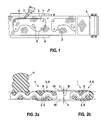
- filter 1 comprises a fabric 2 made of plastic fibers, the machine-preferably withdrawn from a supply roll 3 and a CNC-controlled, in the X and Y direction, ie longitudinally and transversely to the fabric 2 movable table 4, the forms a support for the filter 1 for attaching a seal 8, is placed.
- the fabric for example, a knit, knitted fabric or nonwoven fabric can be used.
- the fibers may for example also consist of glass, metal, carbon or stone or mixtures.
- An outer edge 5 and inner edges 6 of the filter 1 are in FIG. 1 shown with lines. The inner edges 6 surround holes in the filter 1 for example, passages or fittings of a filter or machine housing, not shown, having a parting plane into which the filter 1 is arranged.
- a sealing material along the edges 5, 6 on the filter. 1 applied.
- the sealing material is applied pasty and forms after curing a permanently elastic, linear seal 8 along the edges 5, 6 of the filter 1.
- the seal 8 can also be applied flat and / or within the seal 1 and not only at the edges 5, 6 (not shown).
- the fabric 2 of the filter 1 and encloses its fibers 9, so that a hermetically sealed seal without passages between the fibers 9 is formed.
- the seal 8 is thin, it rises in the embodiment only by about 20 microns over a top or top surface 10 of the filter 1.
- the top or top surface 10 is an imaginary surface, the fibers 9 of the filter 1 at the outermost points touched.
- the filter 1 has a thickness D of about 150 microns, wherein the elevation of the seal 8 designated h is not proportional to the thickness D of the filter 1 but basically independent of the thickness D of the filter 1.
- the elevation h of the seal 8 over the top or top surface 10 of the filter 1 can also be smaller, they can in principle be arbitrarily between zero, a few microns, some 10 microns or a few 100 microns high.
- the nozzle 7 is tempered, for example, water tempered for applying, for example, silicone or, for example, current tempered for applying, for example, thermoplastics.
- the sealing material is heated and plasticized, if it is not self-flowing, and applied with the water, electricity or otherwise tempered nozzle 7 on the filter 1.
- the sealing material is for example a plasticized duroplastic or thermoplastic, an elastomer or a thermally crosslinking plastic such as silicone.
- the invention does not exclude a sealing material that can be applied to the filter 1 at room temperature with a non-tempered nozzle 7.
- the table 4, which as stated forms a support for the filter 1 for attaching the seal 8, has a groove along the edges 5, 6 of the seal 1, so that also on an underside of the filter 1, a survey of the seal. 8 forms over the top or top surface 10 of the seal 1.
- the height h of the elevation of the seal 8 over the top or top surface 10 of the filter 1 may be the same or different sizes on both sides of the filter 1.
- the order of the seal 8 with the nozzle 1 allows a seal 8, which is thinner or whose elevation h over the top or top surface 10 of the filter 1 is smaller than is possible with an injection molding of a seal in an injection mold.
- the inner edges 6 are cut and the filter 1 is cut along the outer edge 5.
- the edges 5, 6 of the filter 1 are cut within the seal 8, the seal 8 fixes the fibers 9 at the edges 5, 6 and prevents short fiber pieces resulting from the cut from detaching from the filter 1 in use.
- the gasket 8 When the gasket 8 is attached to an edge of the filter 1 when the filter 1 is cut or punched before attaching the gasket 8, the gasket 8 encloses as in FIG FIG. 2b to see the edge of the filter 1.
- elevations 11 can be produced, for example, by repeated “spotting” of sealing material or another mass or in a direction away from the filter 1, for example straight or helical movement of the nozzle 7.
- the elevations 11 may serve, for example, feet as spacers or for aligning the filter 1 or for automated handling of the filter 1 with a robot, not shown.
- FIG. 3 shows an alternatively applied by printing, for example, with a pressure roller 12 to a filter 1 seal 8.
- a pressure roller 12 to a filter 1 seal 8.
- the filter 1 penetrates and hermetically encloses fibers of the filter 1.
- the sealing material can be printed several times, ie in layers on the filter 1.
- all printing methods such as letterpress, flat, gravure, offset screen or flexographic printing are possible, whereby in printing processes, the individual dots (pixels) print a process parameter such as flowability of the sealing material and its pressure on and in the fabric of the filter 1 should be chosen so that the individual pressure points flow into each other and forms a coherent, linear or possibly even sheet-like seal 8 without interruptions.
- the sealing material may be pressed, for example, calendered with one or more rolls, as long as it has not yet hardened (fully).
- individual dots printed from sealing material can be converted into an uninterruptible seal 8 and connected and / or a thickness and / or elevation h of the seal 8 can be calibrated or set to a desired level via the top or top surface 10 of the filter 1.
- the pressing or calendering is also in the seal 8 off Figures 1 and 2 possible, which is applied to the nozzle 7.
- the sealing material is, for example, an elastomer, a hard plastic such as polyamide, polyester, for industrial oils, for example fluorosilicone or as a carrier for a membrane for a fuel cell, for example polypropylene.
- the seal 8 is permanently elastic.
- the seal 8 is made of a technical plastic and has no intended cavities, so it is not a foam but a permanently elastic solid material without intended pores or the like. This applies to both the printed as well as for the nozzle 7 mounted seal. 8
- seal 8 may also be a frame, for example made of a hard plastic in the same manner as the seal 8 may be attached to the filter 1. It can also form the seal 8 at the same time a frame of the filter 1.
- the filter 1 can in the same way as a frame its edge (s) also have stiffeners or braces within its surface.
- FIG. 4 shows a nonwoven with fibers of polypropylene as a carrier 13 for a membrane 14 of a fuel cell, not shown.
- the nonwoven can also be considered as a filter, but primarily it serves as a carrier for the membrane 14.
- the carrier 13 forming fleece is placed on a CNC controlled in the X and Y direction movable suction table 15, wherein the Fleece the membrane 14 and a film 16 is placed on it for evacuation.
- the film 16 overlaps the membrane 14 and the fleece 13, so that edges 17 of the film 16 rest laterally outside the fleece and the membrane 14 on the suction table 15.
- the suction table 15 is penetrated by suction channels 18 and has an evacuation chamber 19 on its underside, through which air can be sucked with a vacuum pump 20, so that the laid-up film 16 sucks the membrane 14 onto the nonwoven forming the carrier 13.
- FIG. 1 described with a nozzle 7, a plasticized sealing material along edges of the membrane 14 and the nonwoven applied, which forms after curing a linear, permanently elastic seal 8, which surrounds the membrane 14 and the carrier 13 forming the edge and penetrates into the web.
- the membrane 14 is mechanically connected by the seal 8 with the fleece and has the seal 8 at its edge.
- the film 16 melts when the sealing material is applied, so that it can easily be lifted off the membrane 14.
- the seal 8 by applying to the nozzle 7 or in principle by printing thin and with any lower, starting at zero elevation over a top or top surface of the membrane 14 and attach the carrier 13 forming fleece attach.
- the invention also allows a seal 8 which is thinner and / or has a lower elevation over the top or top surface of the membrane 14 and of the carrier 13 than would be possible by injection molding.
- the seal 8 is made of polypropylene, for example.
- FIG. 4 a gutter-shaped recess 21 in the suction table 15 in the region of the seal 8 can be seen, so that the seal 8 rises on the side facing away from the nozzle 7 on the top or top surface of the carrier 13 forming web.
- the invention also makes it possible to connect a multi-layer filter to a sealing tool and / or frame by means of prototyping at the edges and / or within a surface of the filter.
Landscapes
- Chemical & Material Sciences (AREA)
- Chemical Kinetics & Catalysis (AREA)
- Sustainable Development (AREA)
- Life Sciences & Earth Sciences (AREA)
- Sustainable Energy (AREA)
- Manufacturing & Machinery (AREA)
- Engineering & Computer Science (AREA)
- Electrochemistry (AREA)
- General Chemical & Material Sciences (AREA)
- Filtering Materials (AREA)
- Filtration Of Liquid (AREA)
- Fuel Cell (AREA)
- Filtering Of Dispersed Particles In Gases (AREA)
Abstract
Description
- Die Erfindung betrifft ein Filter mit einer Dichtung und/oder einem Rahmen mit den Merkmalen des Oberbegriffs des Anspruchs 1.
- Mit Filter ist ein vorzugsweise flächiges, d. h. im Verhältnis zu Länge und Breite dünnes Filtermedium, beispielsweise ein Gewebe, Gewirke, Gestrick oder Vlies gemeint, dessen Fasern beispielsweise aus Metall, Kunststoff oder Glas bestehen. Die Aufzählungen sind beispielhaft und nicht abschließend. Das Filter kann eben sein oder eine dreidimensionale Form aufweisen, beispielsweise zick-zack-, mäander-, zylinder-, kegelstumpfförmig oder zweidimensional gewölbt sein.
- Das Filter weist eine vorzugsweise linienförmige Dichtung insbesondere entlang eines Randes auf, wobei die Dichtung auch flächenförmig sein kann. Der Rand kann ein Außenrand oder, wenn das Filter ein oder mehrere Löcher aufweist, ein Innenrand sein. Die Dichtung kann auch innerhalb des Filters mit Abstand von Rändern des Filters verlaufen. Die Dichtung besteht insbesondere aus einem technischen, dauerelastischen Kunststoff, beispielsweise einem Elastomer, Hartkunststoff, Polyamid, Polyester, beispielsweise Fluorsilikon für ein Ölfilter oder beispielsweise Polypropylen als Träger und nicht unbedingt als Filter einer Memb-ßend. Die Dichtung ist insbesondere ein Vollmaterial, also kein Schaum, d. h. sie weist keine beabsichtigten Poren, Gaseinschlüsse, Lunker oder dgl. Hohlräume auf.
- Anstelle der Dichtung oder zusätzlich zu der Dichtung kann das Filter einen Rahmen aufweisen, der dem Filter eine mehr oder weniger große Stabilität gibt.
- Bekannt ist beispielsweise ein Aufkleben oder sonstiges Anbringen einer vorgefertigten Dichtung an einem Filter. Auch ist es möglich, eine Dichtung durch Spritzgießen an einem Filter anzubringen, wozu das Filter in eine Spritzgießform eingelegt wird. Ein Spritzgießen erfordert ein Spritzgießwerkzeug, das die Form der herzustellenden Dichtung als Hohlraum aufweist, der als Kavität bezeichnet wird. Damit eine plastifizierte Masse beim Spritzgießen die Kavität vollständig ausfüllt ist ein ausreichender Querschnitt der Kavität erforderlich, die auch von der zu durchströmenden Länge der Kavität abhängt. Eine Höhe von 400 µm der Kavität wird heute als Untergrenze des machbaren beim Kunststoff-Spritzgießen angesehen, sofern Oberflächen, mit denen der plastifizierte Kunststoff beim Spritzgießen in Berührung kommt, glatt sind. Befindet sich ein Gewebe, Vlies oder dgl. Filtermedium in der Kavität, muss die Kavität wegen einer Bremswirkung des Filtermediums erheblich höher sein, es wird von mindestens der doppelten bis dreifachen Höhe der Kavität ausgegangen. Das Filtermedium bremst nicht nur den plastifizierten und unter Druck in die Kavität gespritzten Kunststoff, sondern der fließende Kunststoff schiebt Fasern des Filtermediums vor sich her und knautscht die Fasern zusammen, so dass sie die Kavität versperren.
- Aufgabe der Erfindung ist ein Filter mit einer Dichtung vorzuschlagen, wobei eine kleine Höhe der Dichtung möglich sein soll. Mit Höhe der Dichtung ist deren Erhebung über eine Ober- oder Deckfläche des Filters gemeint, also eine gedachte Fläche, die Fasern des Filters an äußersten Stellen berührt.
- Diese Aufgabe wird erfindungsgemäß durch die Merkmale des Anspruchs 1 gelöst. Erfindungsgemäß ist die Dichtung formgebungswerkzeuglos durch Urformen hergestellt und zugleich am Filter angebracht bzw. an das Filter angeformt. Mit "formgebungswerkzeuglos" ist gemeint, dass kein formgebendes Werkzeug wie eine Gieß- oder Spritzgießform verwendet wird, das die Form der herzustellenden Dichtung als Hohlraum, d. h. als Kavität aufweist, weder vollständig noch Abschnitte der Dichtung.
- Die Erfindung ermöglicht eine dünne und niedrige Dichtung, weil ein plastifiziertes Dichtungsmaterial beim Umformen keine Kavität durchströmen muss, die eine Mindestdicke oder Mindesthöhe der Dichtung erfordert. Ausschuss durch vorzeitiges Erstarren einer plastifizierten Dichtungsmasse oder durch Eindringen der Dichtungsmasse in ein Spritzgießwerkzeug in Bereiche des Filters, die keine Dichtung aufweisen sollen, wird vermieden.
- Anstelle der Dichtung oder zusätzlich zu der Dichtung kann das Filter einen Rahmen aufweisen, der dem Filter eine mehr oder weniger große Stabilität gibt. Es kann auch die Dichtung zugleich einen Rahmen bilden, der das Filter stabilisiert. Das Filter kann auch innerhalb seiner Fläche stabilisierende Streben, ein Gitter oder dgl. aufweisen. Erfindungsgemäß ist der Rahmen in gleicher Weise formgebungswerkzeuglos durch Urformen angebracht wie die Dichtung.
- Eine bevorzugte Ausgestaltung der Erfindung sieht vor, dass die Dichtung mit einer Düse auf das Filter aufgetragen wird. Eine andere Ausgestaltung der Erfindung sieht ein Drucken der Dichtung vor. Mit einer Düse lässt sich die Dichtung normalerweise in einem Durchlauf in gewünschter Dicke am Filter anbringen, wobei mehrere Durchläufe für eine größere Breite und/oder Höhe der Dichtung möglich sind. Die Düse kann formgebend sein, d. h. eine Mündung der Düse weist eine einem Querschnitt der urzuformenden Dichtung entsprechende Kontur auf ggf. unter Berücksichtigung eines Schwundes oder evtl. eines Aufquellens des Dichtungsmaterials. Die Dichtung kann allerdings auch mit einer gewöhnlichen, beispielsweise kegelstumpfförmigen oder flachen, gerade oder schräg angeschnittenen Düse auf das Filter aufgebracht werden, die plastifiziertes Dichtungsmaterial zu einer Art Raupe formt, die das Filter durchdringt und auf einer Ober- und/oder Unterseite des Filters einen linienförmigen Dichtwulst bildet.
- Es ist Dichtungsmaterial verwendbar, das bei Raumtemperatur auf das Filter aufgebracht werden kann. Vorzugsweise wird das Dichtungsmaterial erwärmt und mit einer wasser-, strom- oder in anderer Weise temperierten Düse auf das Filter aufgebracht. Das Dichtungsmaterial ist in diesem Fall beispielsweise ein plastifizierter Duro- oder Thermoplast oder ein thermisch vernetzender Kunststoff wie beispielsweise Silikon.
- Durch Drucken lässt sich die Dichtung in einer oder mehreren Schichten für eine größere Dicke bzw. Höhe der Dichtung aufbringen. Es sind grundsätzlich alle bekannten Druckverfahren zum Aufbringen der Dichtung auf das Filter möglich, also beispielsweise Hoch-, Flach-, Tief-, Sieb-, Flexo- oder Offset-Druck. Bei Druckverfahren wie dem Sieb-, oder Flexodruck, bei denen das Dichtungsmedium als Punkte aufgebracht wird, ist darauf zu achten, dass das Dichtungsmedium so weit verfließt, dass sich die Punkte vereinigen um eine durchgehende Dichtung ohne Durchlässe zu schaffen. Sowohl beim Aufbringen mit einer Düse als auch beim Aufdrucken der Dichtung durchdringt das Dichtungsmaterial das Filtermedium, so dass das Dichtungsmaterial Fasern des Filtermediums ohne Durchlässe abdichtend umschließt. Ein weiterer Vorteil der Erfindung ist, dass das Dichtungsmaterial dadurch, dass es durch Urformen am Filtermedium angebracht wird, das Filtermedium durchdringt und Fasern des Filters umschließt, so dass die Fasern des Filters gehalten sind. Wird beispielsweise das Filter nach dem urformenden Anbringen der Dichtung entlang der Dichtung geschnitten, hält die Dichtung Filterfasern am Rand des Filters und vermeidet, dass kurze Faserstücke des Filters in ein zu filterndes Medium gelangen.
- Ist die Dichtung an einem (Außen- oder Innen-)Rand des Filters angebracht, sieht eine Ausgestaltung der Erfindung vor, dass die Dichtung den Rand des Filters umgreift, d. h. die Dichtung eine Art Fassung für den Rand des Filters bildet. Diese Ausgestaltung der Erfindung verbessert eine Dichtwirkung und vermeidet ein Lösen kurzer, durch Schneiden des Filters entstandener Fasern am Rand des Filters.
- Eine Ausgestaltung der Erfindung sieht vor, dass das Filter beim Anbringen der Dichtung auf einer Auflage aufliegt, die in dem Bereich der Dichtung eine Vertiefung, beispielsweise eine Rinne für eine linienförmige Dichtung aufweist. Diese Ausgestaltung der Erfindung ermöglicht das Anbringen einer Dichtung am Filter, die das Filter durchdringt und sich beidseitig über Ober- bzw. Deckflächen des Filters erhebt.
- Eine Ausgestaltung der Erfindung sieht vor, dass das Filter einen Träger für eine Membran beispielsweise für eine Brennstoffzelle bildet. Das Filter, dient in diesem Fall als mechanischer Träger der Membran und hat nicht unbedingt die Funktion eines Filters.
- Eine Ausgestaltung der Erfindung sieht eine Höhe der Dichtung über eine Ober- bzw. Deckfläche des Filters von etwa 500 µm oder weniger, vorzugsweise von etwa 200 µm oder weniger und besonders bevorzugt von etwa 20 µm oder weniger vor. Grundsätzlich ermöglicht die Erfindung eine Dichtung mit beliebig kleiner Höhe über der Ober- bzw. Deckfläche des Filters beginnend ab einer Höhe von Null.
- Eine Ausgestaltung der Erfindung sieht ein dreidimensional umgeformtes Filter vor. Dazu wird ein ebenes oder eindimensional gewölbtes, beispielsweise gerolltes Filter nach dem Anbringen der Dichtung beispielsweise durch eine Art Tiefziehen dreidimensional zu einem beispielsweise gewölbten Körper umgeformt.
- Eine Weiterbildung der Erfindung sieht vor, dass am Filter mindestens eine Erhöhung wie die Dichtung formgebungswerkzeuglos durch Urformen angebracht ist, die höher als die Dichtung ist. Die Erhöhung kann aus demselben Material wie die Dichtung bestehen. Die mindestens eine Erhöhung kann beispielsweise einen Fuß oder Abstandshalter zum Positionieren oder für den Einbau des Filters oder auch zum Greifen, insbesondere einem automatischen Greifen des Filters beispielsweise mit einem Roboter, zur Handhabung des Filters beispielsweise bei einem Ver- oder Auspacken oder einem Einbau des Filters dienen. Die Erhöhung hat beispielsweise eine Höhe von ein oder mehreren mm über einer Ober- oder Deckfläche des Filters und kann, wenn sie sich wegen ihrer Höhe nicht in einem Durchgang bzw. einer Schicht am Filter anbringen lässt, durch mehrfachen Auftrag beispielsweise mit einer Düse oder durch Drucken in entsprechend vielen Schichten am Filter angebracht sein.
- Die Erfindung wird nachfolgend anhand in der Zeichnung dargestellter Ausführungsbeispiele näher erläutert. Es zeigen:
- Figur 1
- eine Aufsicht auf ein erfindungsgemäßes Filter;
- Figuren 2a, b
- Schnitte durch das Filter aus
Figur 1 im Bereich einer Dichtung in größerer Darstellung; - Figur 3
- ein zweites Ausführungsbeispiel der Erfindung; und
- Figur 4
- ein drittes Ausführungsbeispiel der Erfindung.
- Das in
Figur 1 gezeigte, erfindungsgemäße Filter 1 weist ein Gewebe 2 aus Kunststofffasern auf, das -vorzugsweise maschinell- von einer Vorratsrolle 3 abgezogen und auf einen CNC-gesteuerten, in X- und Y-Richtung, d. h. längs und quer zum Gewebe 2 verfahrbaren Tisch 4, der eine Auflage für das Filter 1 zum Anbringen einer Dichtung 8 bildet, aufgelegt wird. Anstelle des Gewebes ist beispielsweise auch ein Gestrick, Gewirk oder Vlies verwendbar. Anstatt aus Kunststoff können die Fasern beispielsweise auch aus Glas, Metall, Kohlenstoff oder Stein oder Mischungen bestehen. Ein Außenrand 5 und Innenränder 6 des Filters 1 sind inFigur 1 mit Linien dargestellt. Die Innenränder 6 umschießen Löcher im Filter 1 für beispielsweise Durchführungen oder Verschraubungen eines nicht dargestellten Filter- oder Maschinengehäuses, das eine Trennebene aufweist, in die der das Filter 1 angeordnet wird. - Mit einer Düse 7, die in
Figur 1 um 90° zur Seite gekippt gezeichnet ist und die in einer Normalebene schräg oder senkrecht zum Filter 1 bzw. zum Tisch 4 angeordnet ist, wird ein Dichtungsmaterial entlang der Ränder 5, 6 auf das Filter 1 aufgetragen. Das Dichtungsmaterial wird pastös aufgetragen und bildet nach einem Aushärten eine dauerelastische, linienförmige Dichtung 8 entlang der Ränder 5, 6 des Filters 1. Die Dichtung 8 lässt sich auch flächig und/oder innerhalb der Dichtung 1 und nicht nur an den Rändern 5, 6 auftragen (nicht dargestellt). Wie im Schnitt derFigur 2a zu sehen durchdringt die Dichtung 8 das Gewebe 2 des Filters 1 und umschließt dessen Fasern 9, so dass eine hermetisch dichte Abdichtung ohne Durchlässe zwischen den Fasern 9 gebildet ist. Die Dichtung 8 ist dünn, sie erhebt sich im Ausführungsbeispiel nur um etwa 20 µm über eine Ober- bzw. Deckfläche 10 des Filters 1. Die Ober- oder Deckfläche 10 ist eine gedachte Fläche, die die Fasern 9 des Filters 1 an deren äußersten Punkten berührt. Im Ausführungsbeispiel hat das Filter 1 eine Dicke D von etwa 150 µm, wobei die mit h bezeichnete Erhebung der Dichtung 8 nicht proportional zur Dicke D des Filters 1 sondern grundsätzlich unabhängig von der Dicke D des Filters 1 ist. Die Erhebung h der Dichtung 8 über die Ober- bzw. Deckfläche 10 des Filters 1 kann auch kleiner sein, sie kann grundsätzlich beliebig zwischen Null, einigen µm, einigen 10 µm oder einigen 100 µm hoch sein. - Im beschriebenen Ausführungsbeispiel der Erfindung ist die Düse 7 temperiert, beispielsweise wassertemperiert zum Auftragen von beispielsweise Silikon oder beispielsweise stromtemperiert zum Auftragen von beispielsweise Thermoplasten. Zum Auftragen auf das Filter 1 wird das Dichtungsmaterial erwärmt und plastifiziert, wenn es nicht von sich aus fließfähig ist, und mit der wasser-, stromoder in anderer Weise temperierten Düse 7 auf das Filter 1 aufgebracht. Das Dichtungsmaterial ist beispielsweise ein plastifizierter Duro- oder Thermoplast, ein Elastomer oder ein thermisch vernetzender Kunststoff wie beispielsweise Silikon. Allerdings schließt die Erfindung ein Dichtungsmaterial, das mit einer nicht temperierten Düse 7 bei Raumtemperatur auf das Filter 1 aufgebracht werden kann, nicht aus.
- Der Tisch 4, der wie gesagt eine Auflage für das Filter 1 zum Anbringen der Dichtung 8 bildet, weist eine Rinne entlang der Ränder 5, 6 der Dichtung 1 auf, so dass sich auch an einer Unterseite des Filters 1 eine Erhebung der Dichtung 8 über die Ober- bzw. Deckfläche 10 der Dichtung 1 bildet. Die Höhe h der Erhebung der Dichtung 8 über die Ober- bzw. Deckfläche 10 des Filters 1 kann auf beiden Seiten des Filters 1 gleich oder verschieden groß sein. Der Auftrag der Dichtung 8 mit der Düse 1 ermöglicht eine Dichtung 8, die dünner bzw. deren Erhebung h über die Ober- bzw. Deckfläche 10 des Filters 1 kleiner ist als es mit einem Spritzgießen einer Dichtung in einem Spritzgießwerkzeug möglich ist.
- Nach dem Anbringen der Dichtung 8 werden die Innenränder 6 geschnitten und das Filter 1 entlang des Außenrandes 5 ausgeschnitten. Die Ränder 5, 6 des Filters 1 werden innerhalb der Dichtung 8 geschnitten, die Dichtung 8 fixiert die Fasern 9 an den Rändern 5, 6 und verhindert, dass durch den Schnitt entstehende kurze Faserstücke sich beim Gebrauch vom Filter 1 lösen.
- Wird die Dichtung 8 an einem Rand des Filters 1 angebracht, wenn das Filter 1 vor dem Anbringen der Dichtung 8 geschnitten oder gestanzt wird, umschließt die Dichtung 8 wie in
Figur 2b zu sehen den Rand des Filters 1. - Wie in
Figur 2a links zu sehen lässt sich das Dichtungsmaterial oder eine andere Masse auch höher als die Dichtung 8 zu Erhöhungen 11 "auftürmen". Die Erhöhungen 11 können beispielsweise durch mehrmaliges "Auftupfen" von Dichtungsmaterial oder einer anderen Masse oder in einer vom Filter 1 weg gerichteten, beispielsweise geraden oder schraubenlinienförmigen Bewegung der Düse 7 herstellen. Die Erhöhungen 11 können beispielsweise Füße als Abstandshalter oder zu einem Ausrichten des Filters 1 oder zu einer automatisierten Handhabung des Filters 1 mit einem nicht dargestellten Roboter dienen. - Nach dem Anbringen der Dichtung 8 durch Auftrag mit der Düse 7 oder durch Aufdrucken kann das Filter 1 beispielsweise durch eine Art Tiefziehen gewölbt, d. h. dreidimensional umgeformt werden (nicht dargestellt).
-
Figur 3 zeigt eine alternativ durch Drucken beispielsweise mit einer Druckwalze 12 auf ein Filter 1 aufgebrachte Dichtung 8. Anstelle von Druckfarbe wird Dichtungsmaterial auf das Filter 1 aufgebracht, das wie zuFiguren 1 und 2 beschrieben das Filter 1 durchdringt und Fasern des Filters 1 hermetisch dicht umschließt. Zur Erzielung einer größeren Dicke der Dichtung 8 kann das Dichtungsmaterial mehrfach, d. h. in Schichten auf das Filter 1 aufgedruckt werden. Es sind grundsätzlich alle Druckmethoden wie Hoch-, Flach-, Tief-, Offset-Sieb- oder Flexodruck möglich, wobei bei Druckverfahren, die einzelne Punkte (Pixel) drucken ein Verfahrensparameter wie Fliesfähigkeit des Dichtungsmaterials und dessen Andruck an und in das Gewebe des Filters 1 so gewählt werden sollten, dass die einzelnen Druckpunkte ineinander fließen und sich eine zusammenhängende, linien- oder evtl. auch flächenförmige Dichtung 8 ohne Unterbrechungen bildet. Nach dem Drucken der Dichtung 8 kann das Dichtungsmaterial gepresst, beispielsweise mit einer oder mehreren Walzen kalandriert werden, so lange es noch nicht (voll) ausgehärtet ist. Dadurch lassen sich einzelne aus Dichtungsmaterial gedruckte Punkte zu einer unterbrechungsfreien Dichtung 8 umformen und verbinden und/oder eine Dicke und/oder Erhebung h der Dichtung 8 über die Ober- oder Deckfläche 10 des Filters 1 auf ein gewünschtes Maß kalibrieren bzw. einstellen. Das Pressen oder Kalandrieren ist auch bei der Dichtung 8 ausFiguren 1 und 2 möglich, die mit der Düse 7 aufgetragen ist. - Das Dichtungsmaterial ist beispielsweise ein Elastomer, ein Hartkunststoff wie Polyamid, Polyester, für technische Öle beispielsweise Fluorsilikon oder als Träger für eine Membran für eine Brennstoffzelle beispielsweise Polypropylen. Nach dem Aushärten des Dichtungsmaterials ist die Dichtung 8 dauerelastisch. Die Dichtung 8 besteht aus einem technischen Kunststoff und weist keine beabsichtigten Hohlräume auf, ist also kein Schaum sondern ein dauerelastisches Vollmaterial ohne beabsichtigte Poren oder dgl. Das gilt sowohl für die gedruckte- als auch für die mit der Düse 7 angebrachte Dichtung 8.
- Anstelle der Dichtung 8 oder zusätzlich zur Dichtung 8 kann auch ein Rahmen beispielsweise aus einem Hartkunststoff in gleicher Weise wie die Dichtung 8 am Filter 1 angebracht sein. Es kann auch die Dichtung 8 zugleich einen Rahmen des Filters 1 bilden. Das Filter 1 kann in gleicher Weise wie einen Rahmen an seinem/n Rand/Rändern auch Versteifungen oder Verstrebungen innerhalb seiner Fläche aufweisen.
-
Figur 4 zeigt ein Vlies mit Fasern aus Polypropylen als Träger 13 für eine Membran 14 einer nicht dargestellten Brennstoffzelle. Das Vlies kann zwar auch als Filter aufgefasst werden, in erster Linie dient es allerdings wie gesagt als Träger für die Membran 14. Das den Träger 13 bildende Vlies ist auf einen CNCgesteuert in X- und Y-Richtung verfahrbaren Saugtisch 15 aufgelegt, wobei auf das Vlies die Membran 14 und darauf eine Folie 16 zum Evakuieren aufgelegt ist. Die Folie 16 überlappt die Membran 14 und das Vlies 13, so dass Ränder 17 der Folie 16 seitlich außerhalb des Vlies und der Membran 14 auf dem Saugtisch 15 aufliegen. Der Saugtisch 15 ist mit Saugkanälen 18 durchsetzt und weist eine Evakuierkammer 19 an seiner Unterseite auf, durch die Luft mit einer Vakuumpumpe 20 absaugbar ist, so dass die aufgelegte Folie 16 die Membran 14 auf das den Träger 13 bildende Vlies saugt. Wie zuFigur 1 beschrieben wird mit einer Düse 7 ein plastifiziertes Dichtungsmaterial entlang von Rändern der Membran 14 und des Vlies aufgebracht, das nach Aushärten eine linienförmige, dauerelastische Dichtung 8 bildet, die die Membran 14 und das den Träger 13 bildende am Rand umgreift und in das Vlies eindringt. Die Membran 14 ist durch die Dichtung 8 mechanisch mit dem Vlies verbunden und weist die Dichtung 8 an ihrem Rand auf. Die Folie 16 schmilzt beim Aufbringen des Dichtungsmaterials, so dass sie sich ohne Weiteres von der Membran 14 abheben lässt. Auch hier lässt sich die Dichtung 8 durch das Auftragen mit der Düse 7 oder grundsätzlich auch durch Drucken dünn und mit beliebig niedriger, bei Null beginnender Erhebung über eine Ober- oder Deckfläche der Membran 14 und des den Träger 13 bildenden Vlies anbringen. Die Erfindung ermöglicht auch hier eine Dichtung 8, die dünner ist und/oder eine niedrigere Erhebung über die Ober- oder Deckfläche der Membran 14 und des Trägers 13 aufweist, als es durch Spritzgießen möglich wäre. Als Träger 13 für die Membran 14 einer Brennstoffzelle besteht die Dichtung 8 beispielsweise aus Polypropylen. - In
Figur 4 ist eine rinnenförmige Vertiefung 21 im Saugtisch 15 im Bereich der Dichtung 8 zu sehen, so dass sich die Dichtung 8 auch auf der der Düse 7 abgewandten Seite über die Ober- bzw. Deckfläche des den Träger 13 bildenden Vlies erhebt. - Die Erfindung ermöglicht auch ein mehrlagiges Filter mit einer formgebungswerkzeuglos durch Urformen an den Rändern und/oder innerhalb einer Fläche des Filters angebrachten Dichtung und/oder Rahmen zu verbinden.
Claims (11)
- Filter mit einer Dichtung (8), dadurch gekennzeichnet, dass die Dichtung (8) formgebungswerkzeuglos durch Urformen am Filter (1) angebracht ist.
- Filter nach Anspruch 1, dadurch gekennzeichnet, dass die Dichtung (8) mit einer Düse (7) auf das Filter (1) aufgetragen ist.
- Filter nach Anspruch 2, dadurch gekennzeichnet, dass die Dichtung (8) mit einer temperierten Düse (7) auf das Filter (1) aufgetragen ist.
- Filter nach Anspruch 1, dadurch gekennzeichnet, dass die Dichtung (8) auf das Filter (1) gedruckt ist.
- Filter nach einem der vorhergehenden Ansprüche, dadurch gekennzeichnet, dass das Filter (1) einen Rahmen aufweist, der formgebungswerkzeuglos durch Urformen am Filter (1) angebracht ist.
- Filter nach einem der vorhergehenden Ansprüche, dadurch gekennzeichnet, dass die Dichtung (8) und/oder der Rahmen an einem Rand (5, 6) des Filters (1) angebracht ist und insbesondere den Rand (5, 6) umgreift.
- Filter nach einem der vorhergehenden Ansprüche, dadurch gekennzeichnet, dass das Filter (1) beim Anbringen der Dichtung (8) und/oder des Rahmens auf einer Auflage (4; 15) aufliegt, die eine Vertiefung (21) im Bereich der Dichtung (8) und/oder des Rahmens aufweist.
- Filter nach einem der vorhergehenden Ansprüche, dadurch gekennzeichnet, dass das Filter (1) einen Träger (13) einer Membran (14) bildet.
- Filter nach einem der vorhergehenden Ansprüche, dadurch gekennzeichnet, dass die Dichtung (8) und/oder der Rahmen eine Erhebung (h) über dem Filter (1) von bis zu etwa 500 µm, vorzugsweise von bis zu etwa 200 µm und besonders bevorzugt von bis zu etwa 20 µm aufweist.
- Filter nach einem der vorhergehenden Annsprüche, dadurch gekennzeichnet, dass das Filter (1) dreidimensional umgeformt ist.
- Filter nach einem der vorhergehenden Annsprüche, dadurch gekennzeichnet, dass das Filter (1) mindestens eine urformend und formgebungswerkzeuglos aufgebrachte Erhöhung (11) aufweist, die höher als die Dichtung (8) ist.
Priority Applications (5)
| Application Number | Priority Date | Filing Date | Title |
|---|---|---|---|
| EP13004899.4A EP2859932B1 (de) | 2013-10-11 | 2013-10-11 | Filter |
| EP14003760.7A EP2859933A3 (de) | 2013-10-11 | 2013-10-11 | Filter |
| US14/268,297 US20150104730A1 (en) | 2013-10-11 | 2014-05-02 | Filter |
| JP2014209215A JP5980291B2 (ja) | 2013-10-11 | 2014-10-10 | フィルターの製造方法 |
| US15/671,027 US10601055B2 (en) | 2013-10-11 | 2017-08-07 | Filter |
Applications Claiming Priority (1)
| Application Number | Priority Date | Filing Date | Title |
|---|---|---|---|
| EP13004899.4A EP2859932B1 (de) | 2013-10-11 | 2013-10-11 | Filter |
Related Child Applications (2)
| Application Number | Title | Priority Date | Filing Date |
|---|---|---|---|
| EP14003760.7A Division-Into EP2859933A3 (de) | 2013-10-11 | 2013-10-11 | Filter |
| EP14003760.7A Division EP2859933A3 (de) | 2013-10-11 | 2013-10-11 | Filter |
Publications (2)
| Publication Number | Publication Date |
|---|---|
| EP2859932A1 true EP2859932A1 (de) | 2015-04-15 |
| EP2859932B1 EP2859932B1 (de) | 2019-08-07 |
Family
ID=49378004
Family Applications (2)
| Application Number | Title | Priority Date | Filing Date |
|---|---|---|---|
| EP14003760.7A Withdrawn EP2859933A3 (de) | 2013-10-11 | 2013-10-11 | Filter |
| EP13004899.4A Not-in-force EP2859932B1 (de) | 2013-10-11 | 2013-10-11 | Filter |
Family Applications Before (1)
| Application Number | Title | Priority Date | Filing Date |
|---|---|---|---|
| EP14003760.7A Withdrawn EP2859933A3 (de) | 2013-10-11 | 2013-10-11 | Filter |
Country Status (3)
| Country | Link |
|---|---|
| US (2) | US20150104730A1 (de) |
| EP (2) | EP2859933A3 (de) |
| JP (1) | JP5980291B2 (de) |
Families Citing this family (1)
| Publication number | Priority date | Publication date | Assignee | Title |
|---|---|---|---|---|
| EP3135385B2 (de) * | 2015-08-25 | 2022-02-09 | Andreas Massold | Deckel für einen flüssigkeitsbehälter für eine spritzpistole |
Citations (2)
| Publication number | Priority date | Publication date | Assignee | Title |
|---|---|---|---|---|
| EP1306915A2 (de) * | 2001-10-23 | 2003-05-02 | Carl Freudenberg KG | Verfahren zur Herstellung einer Träger-Dichtung |
| WO2008070699A1 (en) * | 2006-12-06 | 2008-06-12 | Baldwin Filters, Inc. | Method and apparatus for winding a filter element |
Family Cites Families (12)
| Publication number | Priority date | Publication date | Assignee | Title |
|---|---|---|---|---|
| US2599604A (en) * | 1949-07-13 | 1952-06-10 | Jordan V Bauer | Filter element |
| DE3344187A1 (de) * | 1983-12-07 | 1985-07-04 | Seitz-Filter-Werke Theo & Geo Seitz GmbH und Co, 6550 Bad Kreuznach | Filtermembran mit abdichtung und verfahren zu ihrer herstellung |
| JPH02104294U (de) * | 1989-02-03 | 1990-08-20 | ||
| EP0529084B1 (de) * | 1991-02-13 | 1997-05-28 | Nihon Millipore Kogyo Kabushiki Kaisha | Verfahren zur bestimmung der zahl lebender mikroorganismen |
| DE19901545A1 (de) * | 1999-01-16 | 2000-07-20 | Edf Polymer Applikation Maschi | Vorrichtung zum Verarbeiten und/oder Herstellen von Mehrkomponentengemischen |
| JP2001349436A (ja) * | 2000-06-07 | 2001-12-21 | Uchiyama Mfg Corp | ガスケット |
| US7235115B2 (en) * | 2004-07-09 | 2007-06-26 | 3M Innovative Properties Company | Method of forming self-supporting pleated filter media |
| JP4715756B2 (ja) * | 2007-01-15 | 2011-07-06 | 国産部品工業株式会社 | シール層転写式メタルガスケット |
| EP2131433A1 (de) * | 2008-06-05 | 2009-12-09 | Reinz-Dichtungs-Gmbh | Elektrochemische Zelle und Verfahren zur ihrer Herstellung |
| ES2676296T3 (es) * | 2009-09-11 | 2018-07-18 | Breathe Safely Inc. | Máscara facial pasiva de filtrado desechable con junta dentro de junta y junta con puente opcional |
| US8802326B2 (en) * | 2010-11-23 | 2014-08-12 | GM Global Technology Operations LLC | Fuel cell separator plate |
| US9105883B2 (en) * | 2011-10-10 | 2015-08-11 | Daimler Ag | Assembling bipolar plates for fuel cells using microencapsulated adhesives |
-
2013
- 2013-10-11 EP EP14003760.7A patent/EP2859933A3/de not_active Withdrawn
- 2013-10-11 EP EP13004899.4A patent/EP2859932B1/de not_active Not-in-force
-
2014
- 2014-05-02 US US14/268,297 patent/US20150104730A1/en not_active Abandoned
- 2014-10-10 JP JP2014209215A patent/JP5980291B2/ja not_active Expired - Fee Related
-
2017
- 2017-08-07 US US15/671,027 patent/US10601055B2/en not_active Expired - Fee Related
Patent Citations (2)
| Publication number | Priority date | Publication date | Assignee | Title |
|---|---|---|---|---|
| EP1306915A2 (de) * | 2001-10-23 | 2003-05-02 | Carl Freudenberg KG | Verfahren zur Herstellung einer Träger-Dichtung |
| WO2008070699A1 (en) * | 2006-12-06 | 2008-06-12 | Baldwin Filters, Inc. | Method and apparatus for winding a filter element |
Also Published As
| Publication number | Publication date |
|---|---|
| EP2859932B1 (de) | 2019-08-07 |
| US20170358807A1 (en) | 2017-12-14 |
| JP5980291B2 (ja) | 2016-08-31 |
| JP2015075237A (ja) | 2015-04-20 |
| EP2859933A3 (de) | 2015-06-03 |
| US20150104730A1 (en) | 2015-04-16 |
| US10601055B2 (en) | 2020-03-24 |
| EP2859933A2 (de) | 2015-04-15 |
Similar Documents
| Publication | Publication Date | Title |
|---|---|---|
| DE102014007869B4 (de) | Vorrichtung und Verfahren zum Infiltrieren von Fasermaterial mit Harz zur Herstellung eines Faserverbundbauteils | |
| DE102013006940B4 (de) | Fließhilfe für Infusionsaufbau, Infusionsaufbau mit Fließhilfe sowie Verfahren zum Infiltrieren von Fasermaterial mit Harz | |
| DE102009017512A1 (de) | Herstellen eines Verbundbauteils | |
| DE102009026456A1 (de) | Vorrichtung und Verfahren zur Herstellung eines Verbundbauteils | |
| WO2011080289A1 (de) | Infusionsverfahren und aufbau eines infusionsverfahrens | |
| DE102013109259A1 (de) | Druckentlastungsvorrichtung für ein explosionsgeschütztes Gehäuse und Verfahren zu deren Herstellung | |
| WO2013149865A1 (de) | Werkstück-saughalter sowie verfahren zu seiner herstellung | |
| DE102014100659B4 (de) | Stützeinlage eines Membranmoduls | |
| DE102013012005A1 (de) | Verfahren zur Herstellung eines Bauteils aus einem Faserverbundwerkstoff | |
| DE102014208200B3 (de) | Filterelement und Verfahren zu dessen Herstellung | |
| EP3818194A1 (de) | Verfahren zum erzeugen eines dichtelements an einer gasdiffusionslage einer elektrochemischen einheit und baugruppe aus einer gasdiffusionslage und einem dichtelement | |
| EP2403630B1 (de) | Mikrostrukturierter formkörper mit perforierten teilen und verfahren zu dessen herstellung | |
| DD141820A5 (de) | Verfahren und vorrichtung zur waermebehandlung von glas | |
| DE10233888A1 (de) | Verfahren zur Herstellung eines Polyurethanschaumformteils mit integriertem Insert und Aufschäumform dafür | |
| WO2016169574A1 (de) | Prägeblech und prägeblechanordnung | |
| EP2859932A1 (de) | Filter | |
| DE102014206176A1 (de) | Vorrichtung und Verfahren zum Herstellen eines dreidimensionalen Objekts | |
| DE102015216325A1 (de) | Verfahren zur Herstellung eines Dekorbauteils mit einer erhaben geprägten Sichtoberfläche sowie durch das Verfahren hergestelltes Dekorbauteil | |
| WO2002072334A2 (de) | Verfahren zum herstellen von formteilen aus kunststoff mit einer blasform und einer injektionslanze | |
| DE102017212860A1 (de) | Vorrichtung und Verfahren zur Herstellung eines gekrümmten Faservorformlings aus einem bi- oder multidirektionalen Faserhalbzeug | |
| EP4197736B1 (de) | Formwerkzeug zur herstellung eines partikelschaumformteils | |
| DE102015014515A1 (de) | Elektrolytleiter, Verfahren zur Herstellung eines Elektrolytleiters sowie ein elektrochemischer Gassensor und ein Gasmessgerät mit einem solchen | |
| DE3311965C2 (de) | Vorrichtung zur Herstellung von Betonplatten | |
| DE4311592A1 (de) | Verfahren und Vorrichtung zum Herstellen von Kunststoff enthaltenden Teilen | |
| DE29906831U1 (de) | Spritzgußform zum Umspritzen von Kunststoff um ein Filtermaterial und Filter zum Filtern von Fluiden |
Legal Events
| Date | Code | Title | Description |
|---|---|---|---|
| PUAI | Public reference made under article 153(3) epc to a published international application that has entered the european phase |
Free format text: ORIGINAL CODE: 0009012 |
|
| 17P | Request for examination filed |
Effective date: 20141004 |
|
| AK | Designated contracting states |
Kind code of ref document: A1 Designated state(s): AL AT BE BG CH CY CZ DE DK EE ES FI FR GB GR HR HU IE IS IT LI LT LU LV MC MK MT NL NO PL PT RO RS SE SI SK SM TR |
|
| AX | Request for extension of the european patent |
Extension state: BA ME |
|
| RBV | Designated contracting states (corrected) |
Designated state(s): AL AT BE BG CH CY CZ DE DK EE ES FI FR GB GR HR HU IE IS IT LI LT LU LV MC MK MT NL NO PL PT RO RS SE SI SK SM TR |
|
| 17Q | First examination report despatched |
Effective date: 20160726 |
|
| STAA | Information on the status of an ep patent application or granted ep patent |
Free format text: STATUS: EXAMINATION IS IN PROGRESS |
|
| GRAP | Despatch of communication of intention to grant a patent |
Free format text: ORIGINAL CODE: EPIDOSNIGR1 |
|
| STAA | Information on the status of an ep patent application or granted ep patent |
Free format text: STATUS: GRANT OF PATENT IS INTENDED |
|
| INTG | Intention to grant announced |
Effective date: 20190409 |
|
| GRAS | Grant fee paid |
Free format text: ORIGINAL CODE: EPIDOSNIGR3 |
|
| GRAA | (expected) grant |
Free format text: ORIGINAL CODE: 0009210 |
|
| STAA | Information on the status of an ep patent application or granted ep patent |
Free format text: STATUS: THE PATENT HAS BEEN GRANTED |
|
| AK | Designated contracting states |
Kind code of ref document: B1 Designated state(s): AL AT BE BG CH CY CZ DE DK EE ES FI FR GB GR HR HU IE IS IT LI LT LU LV MC MK MT NL NO PL PT RO RS SE SI SK SM TR |
|
| REG | Reference to a national code |
Ref country code: GB Ref legal event code: FG4D Free format text: NOT ENGLISH |
|
| REG | Reference to a national code |
Ref country code: CH Ref legal event code: EP Ref country code: AT Ref legal event code: REF Ref document number: 1162957 Country of ref document: AT Kind code of ref document: T Effective date: 20190815 |
|
| REG | Reference to a national code |
Ref country code: DE Ref legal event code: R096 Ref document number: 502013013291 Country of ref document: DE |
|
| REG | Reference to a national code |
Ref country code: IE Ref legal event code: FG4D Free format text: LANGUAGE OF EP DOCUMENT: GERMAN |
|
| REG | Reference to a national code |
Ref country code: NL Ref legal event code: MP Effective date: 20190807 |
|
| REG | Reference to a national code |
Ref country code: LT Ref legal event code: MG4D |
|
| PGFP | Annual fee paid to national office [announced via postgrant information from national office to epo] |
Ref country code: GB Payment date: 20190930 Year of fee payment: 7 |
|
| PG25 | Lapsed in a contracting state [announced via postgrant information from national office to epo] |
Ref country code: BG Free format text: LAPSE BECAUSE OF FAILURE TO SUBMIT A TRANSLATION OF THE DESCRIPTION OR TO PAY THE FEE WITHIN THE PRESCRIBED TIME-LIMIT Effective date: 20191107 Ref country code: PT Free format text: LAPSE BECAUSE OF FAILURE TO SUBMIT A TRANSLATION OF THE DESCRIPTION OR TO PAY THE FEE WITHIN THE PRESCRIBED TIME-LIMIT Effective date: 20191209 Ref country code: NO Free format text: LAPSE BECAUSE OF FAILURE TO SUBMIT A TRANSLATION OF THE DESCRIPTION OR TO PAY THE FEE WITHIN THE PRESCRIBED TIME-LIMIT Effective date: 20191107 Ref country code: NL Free format text: LAPSE BECAUSE OF FAILURE TO SUBMIT A TRANSLATION OF THE DESCRIPTION OR TO PAY THE FEE WITHIN THE PRESCRIBED TIME-LIMIT Effective date: 20190807 Ref country code: FI Free format text: LAPSE BECAUSE OF FAILURE TO SUBMIT A TRANSLATION OF THE DESCRIPTION OR TO PAY THE FEE WITHIN THE PRESCRIBED TIME-LIMIT Effective date: 20190807 Ref country code: LT Free format text: LAPSE BECAUSE OF FAILURE TO SUBMIT A TRANSLATION OF THE DESCRIPTION OR TO PAY THE FEE WITHIN THE PRESCRIBED TIME-LIMIT Effective date: 20190807 Ref country code: HR Free format text: LAPSE BECAUSE OF FAILURE TO SUBMIT A TRANSLATION OF THE DESCRIPTION OR TO PAY THE FEE WITHIN THE PRESCRIBED TIME-LIMIT Effective date: 20190807 Ref country code: SE Free format text: LAPSE BECAUSE OF FAILURE TO SUBMIT A TRANSLATION OF THE DESCRIPTION OR TO PAY THE FEE WITHIN THE PRESCRIBED TIME-LIMIT Effective date: 20190807 |
|
| PGFP | Annual fee paid to national office [announced via postgrant information from national office to epo] |
Ref country code: DE Payment date: 20191031 Year of fee payment: 7 |
|
| PG25 | Lapsed in a contracting state [announced via postgrant information from national office to epo] |
Ref country code: ES Free format text: LAPSE BECAUSE OF FAILURE TO SUBMIT A TRANSLATION OF THE DESCRIPTION OR TO PAY THE FEE WITHIN THE PRESCRIBED TIME-LIMIT Effective date: 20190807 Ref country code: LV Free format text: LAPSE BECAUSE OF FAILURE TO SUBMIT A TRANSLATION OF THE DESCRIPTION OR TO PAY THE FEE WITHIN THE PRESCRIBED TIME-LIMIT Effective date: 20190807 Ref country code: AL Free format text: LAPSE BECAUSE OF FAILURE TO SUBMIT A TRANSLATION OF THE DESCRIPTION OR TO PAY THE FEE WITHIN THE PRESCRIBED TIME-LIMIT Effective date: 20190807 Ref country code: RS Free format text: LAPSE BECAUSE OF FAILURE TO SUBMIT A TRANSLATION OF THE DESCRIPTION OR TO PAY THE FEE WITHIN THE PRESCRIBED TIME-LIMIT Effective date: 20190807 Ref country code: IS Free format text: LAPSE BECAUSE OF FAILURE TO SUBMIT A TRANSLATION OF THE DESCRIPTION OR TO PAY THE FEE WITHIN THE PRESCRIBED TIME-LIMIT Effective date: 20191207 Ref country code: GR Free format text: LAPSE BECAUSE OF FAILURE TO SUBMIT A TRANSLATION OF THE DESCRIPTION OR TO PAY THE FEE WITHIN THE PRESCRIBED TIME-LIMIT Effective date: 20191108 |
|
| PG25 | Lapsed in a contracting state [announced via postgrant information from national office to epo] |
Ref country code: TR Free format text: LAPSE BECAUSE OF FAILURE TO SUBMIT A TRANSLATION OF THE DESCRIPTION OR TO PAY THE FEE WITHIN THE PRESCRIBED TIME-LIMIT Effective date: 20190807 |
|
| PG25 | Lapsed in a contracting state [announced via postgrant information from national office to epo] |
Ref country code: IT Free format text: LAPSE BECAUSE OF FAILURE TO SUBMIT A TRANSLATION OF THE DESCRIPTION OR TO PAY THE FEE WITHIN THE PRESCRIBED TIME-LIMIT Effective date: 20190807 Ref country code: DK Free format text: LAPSE BECAUSE OF FAILURE TO SUBMIT A TRANSLATION OF THE DESCRIPTION OR TO PAY THE FEE WITHIN THE PRESCRIBED TIME-LIMIT Effective date: 20190807 Ref country code: PL Free format text: LAPSE BECAUSE OF FAILURE TO SUBMIT A TRANSLATION OF THE DESCRIPTION OR TO PAY THE FEE WITHIN THE PRESCRIBED TIME-LIMIT Effective date: 20190807 Ref country code: EE Free format text: LAPSE BECAUSE OF FAILURE TO SUBMIT A TRANSLATION OF THE DESCRIPTION OR TO PAY THE FEE WITHIN THE PRESCRIBED TIME-LIMIT Effective date: 20190807 Ref country code: RO Free format text: LAPSE BECAUSE OF FAILURE TO SUBMIT A TRANSLATION OF THE DESCRIPTION OR TO PAY THE FEE WITHIN THE PRESCRIBED TIME-LIMIT Effective date: 20190807 |
|
| PG25 | Lapsed in a contracting state [announced via postgrant information from national office to epo] |
Ref country code: MC Free format text: LAPSE BECAUSE OF FAILURE TO SUBMIT A TRANSLATION OF THE DESCRIPTION OR TO PAY THE FEE WITHIN THE PRESCRIBED TIME-LIMIT Effective date: 20190807 Ref country code: CZ Free format text: LAPSE BECAUSE OF FAILURE TO SUBMIT A TRANSLATION OF THE DESCRIPTION OR TO PAY THE FEE WITHIN THE PRESCRIBED TIME-LIMIT Effective date: 20190807 Ref country code: IS Free format text: LAPSE BECAUSE OF FAILURE TO SUBMIT A TRANSLATION OF THE DESCRIPTION OR TO PAY THE FEE WITHIN THE PRESCRIBED TIME-LIMIT Effective date: 20200224 Ref country code: SK Free format text: LAPSE BECAUSE OF FAILURE TO SUBMIT A TRANSLATION OF THE DESCRIPTION OR TO PAY THE FEE WITHIN THE PRESCRIBED TIME-LIMIT Effective date: 20190807 Ref country code: SM Free format text: LAPSE BECAUSE OF FAILURE TO SUBMIT A TRANSLATION OF THE DESCRIPTION OR TO PAY THE FEE WITHIN THE PRESCRIBED TIME-LIMIT Effective date: 20190807 |
|
| REG | Reference to a national code |
Ref country code: CH Ref legal event code: PL |
|
| REG | Reference to a national code |
Ref country code: DE Ref legal event code: R097 Ref document number: 502013013291 Country of ref document: DE |
|
| PLBE | No opposition filed within time limit |
Free format text: ORIGINAL CODE: 0009261 |
|
| STAA | Information on the status of an ep patent application or granted ep patent |
Free format text: STATUS: NO OPPOSITION FILED WITHIN TIME LIMIT |
|
| PG2D | Information on lapse in contracting state deleted |
Ref country code: IS |
|
| PG25 | Lapsed in a contracting state [announced via postgrant information from national office to epo] |
Ref country code: LU Free format text: LAPSE BECAUSE OF NON-PAYMENT OF DUE FEES Effective date: 20191011 Ref country code: CH Free format text: LAPSE BECAUSE OF NON-PAYMENT OF DUE FEES Effective date: 20191031 Ref country code: LI Free format text: LAPSE BECAUSE OF NON-PAYMENT OF DUE FEES Effective date: 20191031 |
|
| 26N | No opposition filed |
Effective date: 20200603 |
|
| REG | Reference to a national code |
Ref country code: BE Ref legal event code: MM Effective date: 20191031 |
|
| PG25 | Lapsed in a contracting state [announced via postgrant information from national office to epo] |
Ref country code: BE Free format text: LAPSE BECAUSE OF NON-PAYMENT OF DUE FEES Effective date: 20191031 Ref country code: SI Free format text: LAPSE BECAUSE OF FAILURE TO SUBMIT A TRANSLATION OF THE DESCRIPTION OR TO PAY THE FEE WITHIN THE PRESCRIBED TIME-LIMIT Effective date: 20190807 |
|
| PG25 | Lapsed in a contracting state [announced via postgrant information from national office to epo] |
Ref country code: IE Free format text: LAPSE BECAUSE OF NON-PAYMENT OF DUE FEES Effective date: 20191011 Ref country code: FR Free format text: LAPSE BECAUSE OF NON-PAYMENT OF DUE FEES Effective date: 20191031 |
|
| REG | Reference to a national code |
Ref country code: AT Ref legal event code: MM01 Ref document number: 1162957 Country of ref document: AT Kind code of ref document: T Effective date: 20191011 |
|
| PG25 | Lapsed in a contracting state [announced via postgrant information from national office to epo] |
Ref country code: AT Free format text: LAPSE BECAUSE OF NON-PAYMENT OF DUE FEES Effective date: 20191011 |
|
| REG | Reference to a national code |
Ref country code: DE Ref legal event code: R119 Ref document number: 502013013291 Country of ref document: DE |
|
| PG25 | Lapsed in a contracting state [announced via postgrant information from national office to epo] |
Ref country code: CY Free format text: LAPSE BECAUSE OF FAILURE TO SUBMIT A TRANSLATION OF THE DESCRIPTION OR TO PAY THE FEE WITHIN THE PRESCRIBED TIME-LIMIT Effective date: 20190807 |
|
| GBPC | Gb: european patent ceased through non-payment of renewal fee |
Effective date: 20201011 |
|
| PG25 | Lapsed in a contracting state [announced via postgrant information from national office to epo] |
Ref country code: HU Free format text: LAPSE BECAUSE OF FAILURE TO SUBMIT A TRANSLATION OF THE DESCRIPTION OR TO PAY THE FEE WITHIN THE PRESCRIBED TIME-LIMIT; INVALID AB INITIO Effective date: 20131011 Ref country code: MT Free format text: LAPSE BECAUSE OF FAILURE TO SUBMIT A TRANSLATION OF THE DESCRIPTION OR TO PAY THE FEE WITHIN THE PRESCRIBED TIME-LIMIT Effective date: 20190807 Ref country code: DE Free format text: LAPSE BECAUSE OF NON-PAYMENT OF DUE FEES Effective date: 20210501 |
|
| PG25 | Lapsed in a contracting state [announced via postgrant information from national office to epo] |
Ref country code: GB Free format text: LAPSE BECAUSE OF NON-PAYMENT OF DUE FEES Effective date: 20201011 |
|
| PG25 | Lapsed in a contracting state [announced via postgrant information from national office to epo] |
Ref country code: MK Free format text: LAPSE BECAUSE OF FAILURE TO SUBMIT A TRANSLATION OF THE DESCRIPTION OR TO PAY THE FEE WITHIN THE PRESCRIBED TIME-LIMIT Effective date: 20190807 |