EP2858153A1 - Thin plate having excellent corrosion resistance, electroconductivity, and moldability, and method for manufacturing same - Google Patents
Thin plate having excellent corrosion resistance, electroconductivity, and moldability, and method for manufacturing same Download PDFInfo
- Publication number
- EP2858153A1 EP2858153A1 EP13796440.9A EP13796440A EP2858153A1 EP 2858153 A1 EP2858153 A1 EP 2858153A1 EP 13796440 A EP13796440 A EP 13796440A EP 2858153 A1 EP2858153 A1 EP 2858153A1
- Authority
- EP
- European Patent Office
- Prior art keywords
- thin plate
- powder
- corrosion resistance
- amorphous
- ultraquenching
- Prior art date
- Legal status (The legal status is an assumption and is not a legal conclusion. Google has not performed a legal analysis and makes no representation as to the accuracy of the status listed.)
- Granted
Links
Images



Classifications
-
- H—ELECTRICITY
- H01—ELECTRIC ELEMENTS
- H01B—CABLES; CONDUCTORS; INSULATORS; SELECTION OF MATERIALS FOR THEIR CONDUCTIVE, INSULATING OR DIELECTRIC PROPERTIES
- H01B1/00—Conductors or conductive bodies characterised by the conductive materials; Selection of materials as conductors
- H01B1/14—Conductive material dispersed in non-conductive inorganic material
- H01B1/18—Conductive material dispersed in non-conductive inorganic material the conductive material comprising carbon-silicon compounds, carbon or silicon
-
- B—PERFORMING OPERATIONS; TRANSPORTING
- B22—CASTING; POWDER METALLURGY
- B22D—CASTING OF METALS; CASTING OF OTHER SUBSTANCES BY THE SAME PROCESSES OR DEVICES
- B22D23/00—Casting processes not provided for in groups B22D1/00 - B22D21/00
- B22D23/003—Moulding by spraying metal on a surface
-
- B—PERFORMING OPERATIONS; TRANSPORTING
- B22—CASTING; POWDER METALLURGY
- B22F—WORKING METALLIC POWDER; MANUFACTURE OF ARTICLES FROM METALLIC POWDER; MAKING METALLIC POWDER; APPARATUS OR DEVICES SPECIALLY ADAPTED FOR METALLIC POWDER
- B22F3/00—Manufacture of workpieces or articles from metallic powder characterised by the manner of compacting or sintering; Apparatus specially adapted therefor ; Presses and furnaces
- B22F3/115—Manufacture of workpieces or articles from metallic powder characterised by the manner of compacting or sintering; Apparatus specially adapted therefor ; Presses and furnaces by spraying molten metal, i.e. spray sintering, spray casting
-
- C—CHEMISTRY; METALLURGY
- C21—METALLURGY OF IRON
- C21D—MODIFYING THE PHYSICAL STRUCTURE OF FERROUS METALS; GENERAL DEVICES FOR HEAT TREATMENT OF FERROUS OR NON-FERROUS METALS OR ALLOYS; MAKING METAL MALLEABLE, e.g. BY DECARBURISATION OR TEMPERING
- C21D1/00—General methods or devices for heat treatment, e.g. annealing, hardening, quenching or tempering
- C21D1/18—Hardening; Quenching with or without subsequent tempering
-
- C—CHEMISTRY; METALLURGY
- C22—METALLURGY; FERROUS OR NON-FERROUS ALLOYS; TREATMENT OF ALLOYS OR NON-FERROUS METALS
- C22C—ALLOYS
- C22C1/00—Making non-ferrous alloys
- C22C1/02—Making non-ferrous alloys by melting
-
- C—CHEMISTRY; METALLURGY
- C22—METALLURGY; FERROUS OR NON-FERROUS ALLOYS; TREATMENT OF ALLOYS OR NON-FERROUS METALS
- C22C—ALLOYS
- C22C1/00—Making non-ferrous alloys
- C22C1/11—Making amorphous alloys
-
- C—CHEMISTRY; METALLURGY
- C22—METALLURGY; FERROUS OR NON-FERROUS ALLOYS; TREATMENT OF ALLOYS OR NON-FERROUS METALS
- C22C—ALLOYS
- C22C19/00—Alloys based on nickel or cobalt
- C22C19/03—Alloys based on nickel or cobalt based on nickel
- C22C19/05—Alloys based on nickel or cobalt based on nickel with chromium
- C22C19/058—Alloys based on nickel or cobalt based on nickel with chromium without Mo and W
-
- C—CHEMISTRY; METALLURGY
- C22—METALLURGY; FERROUS OR NON-FERROUS ALLOYS; TREATMENT OF ALLOYS OR NON-FERROUS METALS
- C22C—ALLOYS
- C22C45/00—Amorphous alloys
-
- C—CHEMISTRY; METALLURGY
- C22—METALLURGY; FERROUS OR NON-FERROUS ALLOYS; TREATMENT OF ALLOYS OR NON-FERROUS METALS
- C22C—ALLOYS
- C22C45/00—Amorphous alloys
- C22C45/04—Amorphous alloys with nickel or cobalt as the major constituent
-
- C—CHEMISTRY; METALLURGY
- C23—COATING METALLIC MATERIAL; COATING MATERIAL WITH METALLIC MATERIAL; CHEMICAL SURFACE TREATMENT; DIFFUSION TREATMENT OF METALLIC MATERIAL; COATING BY VACUUM EVAPORATION, BY SPUTTERING, BY ION IMPLANTATION OR BY CHEMICAL VAPOUR DEPOSITION, IN GENERAL; INHIBITING CORROSION OF METALLIC MATERIAL OR INCRUSTATION IN GENERAL
- C23C—COATING METALLIC MATERIAL; COATING MATERIAL WITH METALLIC MATERIAL; SURFACE TREATMENT OF METALLIC MATERIAL BY DIFFUSION INTO THE SURFACE, BY CHEMICAL CONVERSION OR SUBSTITUTION; COATING BY VACUUM EVAPORATION, BY SPUTTERING, BY ION IMPLANTATION OR BY CHEMICAL VAPOUR DEPOSITION, IN GENERAL
- C23C4/00—Coating by spraying the coating material in the molten state, e.g. by flame, plasma or electric discharge
- C23C4/04—Coating by spraying the coating material in the molten state, e.g. by flame, plasma or electric discharge characterised by the coating material
- C23C4/06—Metallic material
-
- C—CHEMISTRY; METALLURGY
- C23—COATING METALLIC MATERIAL; COATING MATERIAL WITH METALLIC MATERIAL; CHEMICAL SURFACE TREATMENT; DIFFUSION TREATMENT OF METALLIC MATERIAL; COATING BY VACUUM EVAPORATION, BY SPUTTERING, BY ION IMPLANTATION OR BY CHEMICAL VAPOUR DEPOSITION, IN GENERAL; INHIBITING CORROSION OF METALLIC MATERIAL OR INCRUSTATION IN GENERAL
- C23C—COATING METALLIC MATERIAL; COATING MATERIAL WITH METALLIC MATERIAL; SURFACE TREATMENT OF METALLIC MATERIAL BY DIFFUSION INTO THE SURFACE, BY CHEMICAL CONVERSION OR SUBSTITUTION; COATING BY VACUUM EVAPORATION, BY SPUTTERING, BY ION IMPLANTATION OR BY CHEMICAL VAPOUR DEPOSITION, IN GENERAL
- C23C4/00—Coating by spraying the coating material in the molten state, e.g. by flame, plasma or electric discharge
- C23C4/04—Coating by spraying the coating material in the molten state, e.g. by flame, plasma or electric discharge characterised by the coating material
- C23C4/10—Oxides, borides, carbides, nitrides or silicides; Mixtures thereof
-
- C—CHEMISTRY; METALLURGY
- C23—COATING METALLIC MATERIAL; COATING MATERIAL WITH METALLIC MATERIAL; CHEMICAL SURFACE TREATMENT; DIFFUSION TREATMENT OF METALLIC MATERIAL; COATING BY VACUUM EVAPORATION, BY SPUTTERING, BY ION IMPLANTATION OR BY CHEMICAL VAPOUR DEPOSITION, IN GENERAL; INHIBITING CORROSION OF METALLIC MATERIAL OR INCRUSTATION IN GENERAL
- C23C—COATING METALLIC MATERIAL; COATING MATERIAL WITH METALLIC MATERIAL; SURFACE TREATMENT OF METALLIC MATERIAL BY DIFFUSION INTO THE SURFACE, BY CHEMICAL CONVERSION OR SUBSTITUTION; COATING BY VACUUM EVAPORATION, BY SPUTTERING, BY ION IMPLANTATION OR BY CHEMICAL VAPOUR DEPOSITION, IN GENERAL
- C23C4/00—Coating by spraying the coating material in the molten state, e.g. by flame, plasma or electric discharge
- C23C4/12—Coating by spraying the coating material in the molten state, e.g. by flame, plasma or electric discharge characterised by the method of spraying
-
- H—ELECTRICITY
- H01—ELECTRIC ELEMENTS
- H01M—PROCESSES OR MEANS, e.g. BATTERIES, FOR THE DIRECT CONVERSION OF CHEMICAL ENERGY INTO ELECTRICAL ENERGY
- H01M8/00—Fuel cells; Manufacture thereof
- H01M8/02—Details
- H01M8/0202—Collectors; Separators, e.g. bipolar separators; Interconnectors
- H01M8/0204—Non-porous and characterised by the material
- H01M8/0206—Metals or alloys
-
- H—ELECTRICITY
- H01—ELECTRIC ELEMENTS
- H01M—PROCESSES OR MEANS, e.g. BATTERIES, FOR THE DIRECT CONVERSION OF CHEMICAL ENERGY INTO ELECTRICAL ENERGY
- H01M8/00—Fuel cells; Manufacture thereof
- H01M8/02—Details
- H01M8/0202—Collectors; Separators, e.g. bipolar separators; Interconnectors
- H01M8/0204—Non-porous and characterised by the material
- H01M8/0223—Composites
-
- B—PERFORMING OPERATIONS; TRANSPORTING
- B22—CASTING; POWDER METALLURGY
- B22D—CASTING OF METALS; CASTING OF OTHER SUBSTANCES BY THE SAME PROCESSES OR DEVICES
- B22D23/00—Casting processes not provided for in groups B22D1/00 - B22D21/00
- B22D23/06—Melting-down metal, e.g. metal particles, in the mould
-
- B—PERFORMING OPERATIONS; TRANSPORTING
- B22—CASTING; POWDER METALLURGY
- B22F—WORKING METALLIC POWDER; MANUFACTURE OF ARTICLES FROM METALLIC POWDER; MAKING METALLIC POWDER; APPARATUS OR DEVICES SPECIALLY ADAPTED FOR METALLIC POWDER
- B22F2998/00—Supplementary information concerning processes or compositions relating to powder metallurgy
- B22F2998/10—Processes characterised by the sequence of their steps
-
- H—ELECTRICITY
- H01—ELECTRIC ELEMENTS
- H01M—PROCESSES OR MEANS, e.g. BATTERIES, FOR THE DIRECT CONVERSION OF CHEMICAL ENERGY INTO ELECTRICAL ENERGY
- H01M8/00—Fuel cells; Manufacture thereof
- H01M8/10—Fuel cells with solid electrolytes
- H01M2008/1095—Fuel cells with polymeric electrolytes
-
- H—ELECTRICITY
- H01—ELECTRIC ELEMENTS
- H01M—PROCESSES OR MEANS, e.g. BATTERIES, FOR THE DIRECT CONVERSION OF CHEMICAL ENERGY INTO ELECTRICAL ENERGY
- H01M2250/00—Fuel cells for particular applications; Specific features of fuel cell system
- H01M2250/10—Fuel cells in stationary systems, e.g. emergency power source in plant
-
- H—ELECTRICITY
- H01—ELECTRIC ELEMENTS
- H01M—PROCESSES OR MEANS, e.g. BATTERIES, FOR THE DIRECT CONVERSION OF CHEMICAL ENERGY INTO ELECTRICAL ENERGY
- H01M2250/00—Fuel cells for particular applications; Specific features of fuel cell system
- H01M2250/20—Fuel cells in motive systems, e.g. vehicle, ship, plane
-
- H—ELECTRICITY
- H01—ELECTRIC ELEMENTS
- H01M—PROCESSES OR MEANS, e.g. BATTERIES, FOR THE DIRECT CONVERSION OF CHEMICAL ENERGY INTO ELECTRICAL ENERGY
- H01M2250/00—Fuel cells for particular applications; Specific features of fuel cell system
- H01M2250/30—Fuel cells in portable systems, e.g. mobile phone, laptop
-
- Y—GENERAL TAGGING OF NEW TECHNOLOGICAL DEVELOPMENTS; GENERAL TAGGING OF CROSS-SECTIONAL TECHNOLOGIES SPANNING OVER SEVERAL SECTIONS OF THE IPC; TECHNICAL SUBJECTS COVERED BY FORMER USPC CROSS-REFERENCE ART COLLECTIONS [XRACs] AND DIGESTS
- Y02—TECHNOLOGIES OR APPLICATIONS FOR MITIGATION OR ADAPTATION AGAINST CLIMATE CHANGE
- Y02B—CLIMATE CHANGE MITIGATION TECHNOLOGIES RELATED TO BUILDINGS, e.g. HOUSING, HOUSE APPLIANCES OR RELATED END-USER APPLICATIONS
- Y02B90/00—Enabling technologies or technologies with a potential or indirect contribution to GHG emissions mitigation
- Y02B90/10—Applications of fuel cells in buildings
-
- Y—GENERAL TAGGING OF NEW TECHNOLOGICAL DEVELOPMENTS; GENERAL TAGGING OF CROSS-SECTIONAL TECHNOLOGIES SPANNING OVER SEVERAL SECTIONS OF THE IPC; TECHNICAL SUBJECTS COVERED BY FORMER USPC CROSS-REFERENCE ART COLLECTIONS [XRACs] AND DIGESTS
- Y02—TECHNOLOGIES OR APPLICATIONS FOR MITIGATION OR ADAPTATION AGAINST CLIMATE CHANGE
- Y02E—REDUCTION OF GREENHOUSE GAS [GHG] EMISSIONS, RELATED TO ENERGY GENERATION, TRANSMISSION OR DISTRIBUTION
- Y02E60/00—Enabling technologies; Technologies with a potential or indirect contribution to GHG emissions mitigation
- Y02E60/10—Energy storage using batteries
-
- Y—GENERAL TAGGING OF NEW TECHNOLOGICAL DEVELOPMENTS; GENERAL TAGGING OF CROSS-SECTIONAL TECHNOLOGIES SPANNING OVER SEVERAL SECTIONS OF THE IPC; TECHNICAL SUBJECTS COVERED BY FORMER USPC CROSS-REFERENCE ART COLLECTIONS [XRACs] AND DIGESTS
- Y02—TECHNOLOGIES OR APPLICATIONS FOR MITIGATION OR ADAPTATION AGAINST CLIMATE CHANGE
- Y02E—REDUCTION OF GREENHOUSE GAS [GHG] EMISSIONS, RELATED TO ENERGY GENERATION, TRANSMISSION OR DISTRIBUTION
- Y02E60/00—Enabling technologies; Technologies with a potential or indirect contribution to GHG emissions mitigation
- Y02E60/30—Hydrogen technology
- Y02E60/50—Fuel cells
-
- Y—GENERAL TAGGING OF NEW TECHNOLOGICAL DEVELOPMENTS; GENERAL TAGGING OF CROSS-SECTIONAL TECHNOLOGIES SPANNING OVER SEVERAL SECTIONS OF THE IPC; TECHNICAL SUBJECTS COVERED BY FORMER USPC CROSS-REFERENCE ART COLLECTIONS [XRACs] AND DIGESTS
- Y02—TECHNOLOGIES OR APPLICATIONS FOR MITIGATION OR ADAPTATION AGAINST CLIMATE CHANGE
- Y02P—CLIMATE CHANGE MITIGATION TECHNOLOGIES IN THE PRODUCTION OR PROCESSING OF GOODS
- Y02P70/00—Climate change mitigation technologies in the production process for final industrial or consumer products
- Y02P70/50—Manufacturing or production processes characterised by the final manufactured product
-
- Y—GENERAL TAGGING OF NEW TECHNOLOGICAL DEVELOPMENTS; GENERAL TAGGING OF CROSS-SECTIONAL TECHNOLOGIES SPANNING OVER SEVERAL SECTIONS OF THE IPC; TECHNICAL SUBJECTS COVERED BY FORMER USPC CROSS-REFERENCE ART COLLECTIONS [XRACs] AND DIGESTS
- Y02—TECHNOLOGIES OR APPLICATIONS FOR MITIGATION OR ADAPTATION AGAINST CLIMATE CHANGE
- Y02T—CLIMATE CHANGE MITIGATION TECHNOLOGIES RELATED TO TRANSPORTATION
- Y02T90/00—Enabling technologies or technologies with a potential or indirect contribution to GHG emissions mitigation
- Y02T90/40—Application of hydrogen technology to transportation, e.g. using fuel cells
Definitions
- the present invention relates to a thin plate having excellent corrosion resistance, conductivity and formability as an industrial material, and the manufacturing method therefor.
- a polymer electrolyte fuel cell extracts energy as electric power from the reaction between hydrogen and oxygen to generate water, which is expected to be useful for future society as a clean power source with no CO 2 emission.
- PEFCs such as for automobiles, household use fuel cells, and mobile phones, is well known.
- a component called a separator is used inside the PEFCs. This is mainly a component that forms a flow path for hydrogen and oxygen and allows electricity to flow between cells.
- PEFC separators For the material of PEFC separators, two kinds of material, carbon and metal, are generally used. On the basis of the reasoning that carbon is poor in workability and thick, thus increasing size, metallic separators are anticipated in automotive PEFCs. The development thereof has been underway not only at manufacturers but also at research institutions such as universities.
- Non Patent Literature 1 formability, corrosion resistance, contact resistance, and power generation characteristics at a supercooled liquid temperature range are reported for the separator of a metallic glass material.
- Patent Literature 1 discloses a manufacturing method in which stainless steel is applied as a base, and in order to make the stainless steel conductive as well, a passive layer is passed through with a deposition, thereby increasing the conductivity between the stainless interior and its surface.
- a passive layer has high electric resistance, so that contact resistance increases (conductivity deteriorates) when the surface of a material is covered therewith.
- Patent Literatures 2 and 3 the material, in which a passive layer is formed on a surface thereof to improve corrosion resistance, is selected, and similarly as described above, special treatment such as plating is performed on the surface in order to improve conductivity.
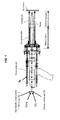
- Fig. 1 shows the structure of an injection gun as a primary device. With this injection gun, a film is formed on a substrate surface while flying powder particles are quenched, finally followed by the release of the film from the substrate so as to obtain an amorphous thin plate.
- Non Patent Literature 1 and Patent Literature 1 it is said that non-conductive oxide grows on a material surface when applying current, so that power generation characteristics degrade.
- Patent Literatures 2 and 3 there seems to be a cost issue for practical uses because special treatment is required for a surface and an expensive material is used.
- the present invention proposes a metallic separator for PEFCs that satisfies all corrosion resistance, conductivity and formability without requiring a complex procedure, or a thin plate applicable as a material for the separator and the like, and a manufacturing method therefor.
- the ultraquenching transition control injector as shown in Fig. 1 or Fig. 2 is used so as to prepare a metallic thin plate.
- These injectors are capable of forming, by using a powder raw material, a quenched coating of a melted powder material, on a substrate surface, and further preparing a quenched thin plate obtained by releasing the coating from the substrate.
- the injector is capable of obtaining an amorphous coating and thin plate. Specifically, the powder material that was completely melted in flame during flying is quenched with refrigerant such as nitrogen gas and mist before reaching the substrate. As a result, the coating formed on the substrate surface will be amorphous.
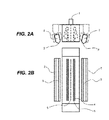
- the difference between the ultraquenching transition control injectors in Fig. 1 and Fig. 2 is the width of coatings formed at a time.
- the width is 15 mm
- the width is 300 mm.
- the ultraquenching transition control injector coatings and thin plates of the same quality may be obtained.
- the ultraquenching transition control injector in Fig. 2 is more suitable, so that in the present invention, mainly this injector is used to prepare thin plates.
- conductive powder is mixed into the composition that tends to become amorphous, or the like.
- the metal having a composition that becomes amorphous when there is a certain substance resulting in a core of crystallization, such as the conductive powder that is mixed this time, the metal is easily crystallized, instead of being amorphous, and then solidified.
- the use of the ultraquenching transition control injector as in Fig. 1 and Fig. 2 can prevent crystallization. This is because the metal powder having a composition that becomes amorphous and the conductive powder are not in a mixed state during flying, but these powders fly discretely and (the metal powder having a composition to be amorphous) solidify. That is, by using the ultraquenching transition control injector as in Fig. 1 or Fig.
- Ni 65 Cr 15 P 16 B 4 as the metal powder having a composition that becomes amorphous and C, B 4 C as the conductive powder were selected, and an amorphous thin plate was prepared by the above-described method with the use of the ultraquenching transition control injector in Fig. 1 .
- an amorphous rate was calculated from the thermal energy of the thin plate measured by DSC (with the thermal energy of the amorphous Ni 65 Cr 15 P 16 B 4 ribbon as 100%)
- the thin plates mixed with either C or B 4 C conductive powder had the amorphous rate of 89 to 95%. This result is the same as the Ni 65 Cr 15 P 16 B 4 thin plate without mixed conductive powder.
- DSC Differential Scanning Calorimetry, which measures a difference in amount of heat between a measurement sample and a reference material. With this measurement, it is possible to obtain a thermal energy value when a measurement sample is crystallized from the amorphous state.
- amorphous and crystal-structure metal such as stainless steel
- metallic glass though amorphous it is, has a temperature range in which to turn into a supercooled liquid, so that if the metallic glass is formed in this temperature range, it is possible to perform processing at excellent dimensional accuracy without generating cracks.
- boron (B) or the like dissolves in a matrix in a large amount to deteriorate workability (Solution Hardening).
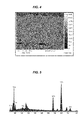
- Fig. 4 shows a cross-sectional picture of a thin plate that was actually prepared. This is the cross-sectional picture of a thin plate that was formed from the powder material, which was the mixture of SUS316L powder and 2.5 wt% of B 4 C, with the ultraquenching transition control injector in Fig. 2 . A dark gray area in a dotted circle is B 4 C. Furthermore, Fig.
- EDX Energy Dispersive X-ray Spectrometry. This is an element analysis method, which detects X-rays generated when a sample is irradiated with electron beams, with an energy dispersive detector, and examines substances that make up the sample and its concentrations on the basis of the energy and intensity of the X-rays.
- the horizontal axis corresponds to energy; and the vertical axis corresponds to intensity.
- the metal materials to be examined in the present invention form a passive layer to exhibit corrosion resistance, so that the contact resistance is considered large unless treated. Therefore, in order to reduce the contact resistance, it is required to mix a conductive material powder allowing electricity to flow in the passive layer.
- the ultraquenching transition control injector for use in the present invention melts a metal powder material at about 2000°C with reducing flame with a reduced supply of oxygen, so that when the melting point of conductive powder is higher than that temperature, the conductive powder can remain in a thin plate without melting.
- Fig. 4 shows a specific example of a thin plate that was actually prepared by the ultraquenching transition control injector. It is possible to find the remaining B 4 C (in a dotted circle) in the thin plate, and this B 4 C is also one of the components to be used as the conductive powder.
- the present invention enables the production of metallic separators for PEFCs having excellent corrosion resistance, conductivity, and formability at low cost.
- As for the thickness of thin plates in a case of using steel coils, an increase in rolling costs may be considered as the plates become thinner.
- a reduction in plate thickness can be easily adjusted by decreasing the feed rates of the material powder, decreasing the relative speeds between a substrate and an injection gun, etc.
- the thin plate of the present invention has high corrosion resistance at a matrix portion and has excellent conductivity because of having a conductive material.
- the plate is also advantageous in terms of formability and manufacturing costs, so that it is highly suitable as a metallic separator for PEFCs.
- a gas atomized powder having the composition of Ni 65 Cr 15 P 16 B 4 (at%) and being classified as +38/-63 ⁇ m in diameter was used. This is a composition that solidifies as metallic glass when quenched, and this composition was selected also in the present invention in order to achieve the formation in a supercooled liquid range.
- artificial graphite (AGB-5 from Ito Graphite Co., Ltd.) having the average particle size of 5 ⁇ m was used (hereinafter, referred to as carbon). This powder is obtained by pulverizing artificial graphite electrodes, and is available at low cost.
- Ni 65 Cr 15 P 16 B 4 and 0.3wt% of carbon powder were mixed and stirred to obtain a material for injection. After mixing, water was removed by keeping the material warm in a drying oven under the condition of 80°C for two hours. This is performed for a purpose of achieving stable powder supply without clogging or the like inside a supply path during the injection of the powder material.
- the ultraquenching transition control injector shown in Fig. 2 was used for the injection gun.
- Mixed gas of oxygen and propane is used for fuel, and combustion flame is ejected from flame vents 5 outside of powder ejection ports 6, which are arranged at equal intervals in the widthwise direction.
- the powder material ejected from the powder ejection ports 6 is completely melted once in the combustion flame.
- the material is deposited on the surface of a substrate while being quenched, right after being melted, with a refrigerant mist ejected from a mist ejection port 3 arranged outside the powder ejection ports 6, thereby forming a film.
- This injection gun injects the material uniformly in the widthwise direction, and thus, it is possible to prepare a thin plate having a uniform thickness in the widthwise direction.
- the above-described ultraquenching transition control injector was installed in the thin plate production line shown in Fig. 3 .
- a pickled steel coil of 2 mm in thickness x 300 mm in width is set between a payoff reel 7 and a coil winder 13, and the coil is moved toward the coil winder 13.
- the coil is heated with propane flame by a preheater 8.
- the coil shape was corrected by a leveler 9
- the coil was heated up to the target temperature of 250°C by a thin plate substrate heating and heat-equalizing device 10.
- An upstream mist angle and a downstream mist angle in Table 1 show a positional relationship, relative to the coil movement direction, of a mist ejection nozzle 2 and an inclination from the direction at right angles to the plane of the coil. The conditions are illustrated in Fig. 6 .
- the thin plate obtained thereby had a size of 300 ⁇ m in thickness x 300 mm in width.
- the thin plate was confirmed by DSC to have 85% amorphous rate in comparison with an amorphous ribbon material which has 100% amorphous rate.
- Fig. 7 is a cross-sectional picture of the thin plate obtained thereby. It is observed that C (in a dotted circle) remains in the Ni 65 Cr 15 P 16 B 4 matrix.
- the prepared thin plates were cut out in the size of 35-mm square with a micro cutter.
- the amorphous thin plates were treated by a router to have a flat and smooth surface on the side opposite to the coil (having had a surface roughness of about Ra 10 ⁇ m since they remained as they were after injection).
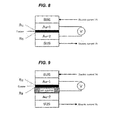
- a constant current of 1A was applied to a circuit shown in Fig. 8 to measure a potential difference between gold layers (Au-1 - Au-2), and a resistance value was calculated on the basis of Ohm's law.
- This resistance value being a contact resistance of Au - Carbon (C) paper existing at two locations in the circuit, was divided by 2 to give Rc (contact resistance of Au-C paper).
- contact pressure was changed from 1 to 7 kgf/cm 2 .
- Fig. 10 shows the measurement result of contact resistance.
- the amorphous material of Ni 65 Cr 15 P 16 B 4 exhibits corrosion resistance by passivation on its surface.
- a passive layer is formed during the sulfuric acid immersing process before the test.
- a reason why the contact resistance value of the C admixture is low at any contact pressure may be that C, a conductor, is present also in the passive layer. Accordingly, it is possible to say that the contact resistance that increases with passivation may be reduced by preparing a metallic thin plate with a powder material mixed with C by using an ultraquenching transition control injector.
- the prepared No. 2 thin plate (with mixed C) was cut out in the size of 20-mm square with a micro cutter, and was then experimented.
- the weight of the test specimen was measured before and after immersion, and corrosion rate ( ⁇ m/year) was calculated from weight changes and specific gravity.
- a thin plate with a mixed conductive powder of the present invention can satisfy conductivity and corrosion resistance necessary for a separator for PEFCs.
Landscapes
- Chemical & Material Sciences (AREA)
- Engineering & Computer Science (AREA)
- Mechanical Engineering (AREA)
- Organic Chemistry (AREA)
- Metallurgy (AREA)
- Materials Engineering (AREA)
- Chemical Kinetics & Catalysis (AREA)
- Physics & Mathematics (AREA)
- Manufacturing & Machinery (AREA)
- Plasma & Fusion (AREA)
- General Chemical & Material Sciences (AREA)
- Sustainable Energy (AREA)
- Sustainable Development (AREA)
- Life Sciences & Earth Sciences (AREA)
- Electrochemistry (AREA)
- Composite Materials (AREA)
- Inorganic Chemistry (AREA)
- Thermal Sciences (AREA)
- Crystallography & Structural Chemistry (AREA)
- Dispersion Chemistry (AREA)
- Fuel Cell (AREA)
- Coating By Spraying Or Casting (AREA)
Abstract
Description
- The present invention relates to a thin plate having excellent corrosion resistance, conductivity and formability as an industrial material, and the manufacturing method therefor.
- A polymer electrolyte fuel cell (PEFC) extracts energy as electric power from the reaction between hydrogen and oxygen to generate water, which is expected to be useful for future society as a clean power source with no CO2 emission. The use of PEFCs, such as for automobiles, household use fuel cells, and mobile phones, is well known. A component called a separator is used inside the PEFCs. This is mainly a component that forms a flow path for hydrogen and oxygen and allows electricity to flow between cells.
- For the material of PEFC separators, two kinds of material, carbon and metal, are generally used. On the basis of the reasoning that carbon is poor in workability and thick, thus increasing size, metallic separators are anticipated in automotive PEFCs. The development thereof has been underway not only at manufacturers but also at research institutions such as universities.
- In
Non Patent Literature 1, formability, corrosion resistance, contact resistance, and power generation characteristics at a supercooled liquid temperature range are reported for the separator of a metallic glass material. -
Patent Literature 1 discloses a manufacturing method in which stainless steel is applied as a base, and in order to make the stainless steel conductive as well, a passive layer is passed through with a deposition, thereby increasing the conductivity between the stainless interior and its surface. A passive layer has high electric resistance, so that contact resistance increases (conductivity deteriorates) when the surface of a material is covered therewith. - Also in
Patent Literatures - In Patent Literature 4, the manufacturing apparatus for preparing an amorphous thin plate and the method therefor are disclosed, allowing for a thin plate in a size required for PEFC separators.
Fig. 1 shows the structure of an injection gun as a primary device. With this injection gun, a film is formed on a substrate surface while flying powder particles are quenched, finally followed by the release of the film from the substrate so as to obtain an amorphous thin plate. - [NPL 1] Masanori Yokoyama, Shinichi Yamamura, Hisamichi Kimura, Akihisa Inoue; "Hot Press Workability of Ni-based Metallic Glass in Supercooled Liquid State and Prototype of Fuel Cell Separators," Powder and Powder Metallurgy, 54 (2007), 773-777
-
- [PTL 1] Japanese Unexamined Patent Application Publication No.
2003-193206 - [PTL 2] Japanese Unexamined Patent Application Publication No.
2006-210320 - [PTL 3] Japanese Unexamined Patent Application Publication No.
H10-228914 - [PTL 4] Japanese Patent Publication No.
4579317 - The practical use of metallic separators for PEFCs has been considered difficult because of problems in obtaining a material satisfying all corrosion resistance, conductivity, formability, and cost. In
Non Patent Literature 1 andPatent Literature 1, it is said that non-conductive oxide grows on a material surface when applying current, so that power generation characteristics degrade. InPatent Literatures - In the present invention, the ultraquenching transition control injector as shown in
Fig. 1 orFig. 2 is used so as to prepare a metallic thin plate. These injectors are capable of forming, by using a powder raw material, a quenched coating of a melted powder material, on a substrate surface, and further preparing a quenched thin plate obtained by releasing the coating from the substrate. When a powder material having a composition which can easily become amorphous is used, the injector is capable of obtaining an amorphous coating and thin plate. Specifically, the powder material that was completely melted in flame during flying is quenched with refrigerant such as nitrogen gas and mist before reaching the substrate. As a result, the coating formed on the substrate surface will be amorphous. The difference between the ultraquenching transition control injectors inFig. 1 andFig. 2 is the width of coatings formed at a time. InFig. 1 , the width is 15 mm, and inFig. 2 , the width is 300 mm. With either ultraquenching transition control injector, coatings and thin plates of the same quality may be obtained. However, in considering production efficiency per ultraquenching transition control injector, the ultraquenching transition control injector inFig. 2 is more suitable, so that in the present invention, mainly this injector is used to prepare thin plates. - In the present invention, for the powder material supplied to the above-mentioned ultraquenching transition control injector, conductive powder is mixed into the composition that tends to become amorphous, or the like.
- Normally in the process of solidifying the metal having a composition that becomes amorphous, when there is a certain substance resulting in a core of crystallization, such as the conductive powder that is mixed this time, the metal is easily crystallized, instead of being amorphous, and then solidified. However, the use of the ultraquenching transition control injector as in
Fig. 1 andFig. 2 can prevent crystallization. This is because the metal powder having a composition that becomes amorphous and the conductive powder are not in a mixed state during flying, but these powders fly discretely and (the metal powder having a composition to be amorphous) solidify. That is, by using the ultraquenching transition control injector as inFig. 1 orFig. 2 with the powder material in which the metal powder having the composition that can become easily amorphous and the conductive powder are mixed, it is possible to prepare a thin plate having the conductive material mixed in a metal matrix which is amorphous or includes an amorphous structure. - For this, in order to actually confirm this beforehand, Ni65Cr15P16B4 as the metal powder having a composition that becomes amorphous and C, B4C as the conductive powder were selected, and an amorphous thin plate was prepared by the above-described method with the use of the ultraquenching transition control injector in
Fig. 1 . When an amorphous rate was calculated from the thermal energy of the thin plate measured by DSC (with the thermal energy of the amorphous Ni65Cr15P16B4 ribbon as 100%), the thin plates mixed with either C or B4C conductive powder had the amorphous rate of 89 to 95%. This result is the same as the Ni65Cr15P16B4 thin plate without mixed conductive powder. It was confirmed that the amorphization of Ni65Cr15P16B4 was not affected by mixed conductive powder. It is noted that DSC stands for Differential Scanning Calorimetry, which measures a difference in amount of heat between a measurement sample and a reference material. With this measurement, it is possible to obtain a thermal energy value when a measurement sample is crystallized from the amorphous state. - For a metal material having corrosion resistance as a base material (matrix), the use of amorphous and crystal-structure metal such as stainless steel can be considered. Metallic glass, though amorphous it is, has a temperature range in which to turn into a supercooled liquid, so that if the metallic glass is formed in this temperature range, it is possible to perform processing at excellent dimensional accuracy without generating cracks. Also, in the stainless steel, in a case where a plate-shaped product is produced with a general manufacturing method, when boron (B) or the like is added in large quantity to form a conductive deposition, boron (B) or the like dissolves in a matrix in a large amount to deteriorate workability (Solution Hardening). However, when the above-described manufacturing method using the ultraquenching transition control injector in
Fig. 1 orFig. 2 is used, the component of the conductive material powder to be mixed does not dissolve in a stainless matrix and exists solely in a thin plate, so that workability deterioration is not expected to be generated.Fig. 4 shows a cross-sectional picture of a thin plate that was actually prepared. This is the cross-sectional picture of a thin plate that was formed from the powder material, which was the mixture of SUS316L powder and 2.5 wt% of B4C, with the ultraquenching transition control injector inFig. 2 . A dark gray area in a dotted circle is B4C. Furthermore,Fig. 5 shows a result of an EDX analysis of SUS316L matrix points in this cross-sectional picture. It was actually confirmed that B did not dissolve in the stainless matrix as described above because the peak of B was not detected herein. EDX stands for Energy Dispersive X-ray Spectrometry. This is an element analysis method, which detects X-rays generated when a sample is irradiated with electron beams, with an energy dispersive detector, and examines substances that make up the sample and its concentrations on the basis of the energy and intensity of the X-rays. InFig. 5 , the horizontal axis corresponds to energy; and the vertical axis corresponds to intensity. - The metal materials to be examined in the present invention form a passive layer to exhibit corrosion resistance, so that the contact resistance is considered large unless treated. Therefore, in order to reduce the contact resistance, it is required to mix a conductive material powder allowing electricity to flow in the passive layer.
- For the conductive powder material, the use of a non-metallic C-based powder was considered. The reason for this is that most of the non-metallic conductive powders remain stable at ph = 3 and 80°C as the driving environment of PEFC, and these powders are inexpensive; however, as long as cost and the effect of characteristics match, various components may be used for the conductive powder. That is because the ultraquenching transition control injector for use in the present invention melts a metal powder material at about 2000°C with reducing flame with a reduced supply of oxygen, so that when the melting point of conductive powder is higher than that temperature, the conductive powder can remain in a thin plate without melting.
Fig. 4 shows a specific example of a thin plate that was actually prepared by the ultraquenching transition control injector. It is possible to find the remaining B4C (in a dotted circle) in the thin plate, and this B4C is also one of the components to be used as the conductive powder. - The present invention enables the production of metallic separators for PEFCs having excellent corrosion resistance, conductivity, and formability at low cost. As for the thickness of thin plates, in a case of using steel coils, an increase in rolling costs may be considered as the plates become thinner. However, in the manufacturing method of the present invention, a reduction in plate thickness can be easily adjusted by decreasing the feed rates of the material powder, decreasing the relative speeds between a substrate and an injection gun, etc.
- The thin plate of the present invention has high corrosion resistance at a matrix portion and has excellent conductivity because of having a conductive material. The plate is also advantageous in terms of formability and manufacturing costs, so that it is highly suitable as a metallic separator for PEFCs.
-
- [
Fig. 1] Fig. 1 is a side view showing the usage of an ultraquenching transition control injector. - [
Fig. 2] Fig. 2A is a side view andFig. 2B is a bottom view each showing a large ultraquenching transition control injector. - [
Fig. 3] Fig. 3 is a side view showing the overall production line of thin plates. - [
Fig. 4] Fig. 4 is microscopic structure photography showing the cross section of a SUS316L thin plate mixed with B4C at 2.5 wt%. - [
Fig. 5] Fig. 5 is a graph showing the EDX result of a SUS316L matrix ofFig. 4 . - [
Fig. 6] Fig. 6 is a side view showing upstream and downstream mist angles of the ultraquenching transition control injector ofFig. 2 . - [
Fig. 7] Fig. 7 is microscopic structure photography showing the cross section of a Ni65Cr15P16B4 thin plate mixed with C at 0.3 wt%. - [
Fig. 8] Fig. 8 is a diagram illustrating acircuit 1 of measurement. - [
Fig. 9] Fig. 9 is a diagram illustrating acircuit 2 of measurement. - [
Fig. 10] Fig. 10 is a graph showing the result of contact resistance measurement. - For a metal material for use in an injection gun (ultraquenching transition control injector), a gas atomized powder having the composition of Ni65Cr15P16B4 (at%) and being classified as +38/-63 µm in diameter was used. This is a composition that solidifies as metallic glass when quenched, and this composition was selected also in the present invention in order to achieve the formation in a supercooled liquid range.
- For a conductive powder to be mixed in the metal material mentioned above, artificial graphite (AGB-5 from Ito Graphite Co., Ltd.) having the average particle size of 5 µm was used (hereinafter, referred to as carbon). This powder is obtained by pulverizing artificial graphite electrodes, and is available at low cost.
- Ni65Cr15P16B4 and 0.3wt% of carbon powder were mixed and stirred to obtain a material for injection. After mixing, water was removed by keeping the material warm in a drying oven under the condition of 80°C for two hours. This is performed for a purpose of achieving stable powder supply without clogging or the like inside a supply path during the injection of the powder material.
- For the injection gun, the ultraquenching transition control injector shown in
Fig. 2 was used. Mixed gas of oxygen and propane is used for fuel, and combustion flame is ejected fromflame vents 5 outside ofpowder ejection ports 6, which are arranged at equal intervals in the widthwise direction. The powder material ejected from thepowder ejection ports 6 is completely melted once in the combustion flame. The material is deposited on the surface of a substrate while being quenched, right after being melted, with a refrigerant mist ejected from amist ejection port 3 arranged outside thepowder ejection ports 6, thereby forming a film. This injection gun injects the material uniformly in the widthwise direction, and thus, it is possible to prepare a thin plate having a uniform thickness in the widthwise direction. - The above-described ultraquenching transition control injector was installed in the thin plate production line shown in
Fig. 3 . A pickled steel coil of 2 mm in thickness x 300 mm in width is set between apayoff reel 7 and acoil winder 13, and the coil is moved toward thecoil winder 13. First, the coil is heated with propane flame by apreheater 8. Then, after the coil shape was corrected by aleveler 9, the coil was heated up to the target temperature of 250°C by a thin plate substrate heating and heat-equalizingdevice 10. - On the surface of the coil that was heated up to the target temperature of 250°C, a film was formed with the mixed powder by an ultraquenching
transition control injector 11. Immediately after the film formation, 10% reduction was applied thereon with a rollingmill 12. Before being wound on thecoil winder 13, the film was released from the coil, thus obtaining athin plate 14. At this time, the film temperature is 220 to 280°C right after the reduction applied with the rollingmill 12. It is noted that in a series of operations, a coil speed was constant at 5.7 m/min. The above-described condition for manufacturing thin plates is shown in Table 1. An upstream mist angle and a downstream mist angle in Table 1 show a positional relationship, relative to the coil movement direction, of amist ejection nozzle 2 and an inclination from the direction at right angles to the plane of the coil. The conditions are illustrated inFig. 6 .[Table 1] Feed Rate of Alloy Powder (g/s) 30 Flow Rate of Propane Gas (m3/h) 34 Oxygen Flow Rate (m3/h) 120 Rectified Nitrogen Flow Rate (m3/h) 400 Injection Distance to Coil (mm) 600 Upstream Mist Angle (°) 9 Upstream Mist Flow Rate (liter/min) 4 Downstream Mist Angle (°) 9 Downstream Mist Flow Rate (liter/min) 4 Coil Surface Temperature Before Injection 250 Rolling Speed (m/min) 5.7 - The thin plate obtained thereby had a size of 300 µm in thickness x 300 mm in width. The thin plate was confirmed by DSC to have 85% amorphous rate in comparison with an amorphous ribbon material which has 100% amorphous rate.
Fig. 7 is a cross-sectional picture of the thin plate obtained thereby. It is observed that C (in a dotted circle) remains in the Ni65Cr15P16B4 matrix. - Further, in order to confirm a difference in contact resistance between the cases with or without the conductive powder, an amorphous thin plate was also prepared from Ni65Cr15P16B4 powder having no mixed carbon powder, in the same procedures as described above. Finally, the following two types of thin plates were prepared.
[Table 2] Sample No. Composition of Metal Matrix (at%) Conductive Powder Mixing Rate of Conductive Powder (wt%) 1 Ni65Cr15P16B4 None - 2 Ni65Cr15P16B4 C 0.3 - The prepared thin plates were cut out in the size of 35-mm square with a micro cutter. The amorphous thin plates were treated by a router to have a flat and smooth surface on the side opposite to the coil (having had a surface roughness of about
Ra 10 µm since they remained as they were after injection). - In order to passivate the material surface, the plates were immersed for two hours in sulfuric acid of ph = 3 at 80°C and then experimented on.
- A constant current of 1A was applied to a circuit shown in
Fig. 8 to measure a potential difference between gold layers (Au-1 - Au-2), and a resistance value was calculated on the basis of Ohm's law. This resistance value, being a contact resistance of Au - Carbon (C) paper existing at two locations in the circuit, was divided by 2 to give Rc (contact resistance of Au-C paper). To determine Rc per 1 kgf/cm2, contact pressure was changed from 1 to 7 kgf/cm2. - Then, a constant current of 1A was similarly applied to a circuit shown in
Fig. 9 to measure a potential difference between Au-1 and the test specimen, and a resistance value Ra was calculated on the basis of Ohm's law. Similar to the above description, to determine Ra per 1 kgf/cm2, contact pressure was changed from 1 to 7 kgf/cm2. Finally, according to the formula below, a contact resistance value Rs between the test specimen and the C paper was calculated, and conductivity was evaluated on the basis of this value.
-
Fig. 10 shows the measurement result of contact resistance. The amorphous material of Ni65Cr15P16B4 exhibits corrosion resistance by passivation on its surface. On the surface of both test specimens, a passive layer is formed during the sulfuric acid immersing process before the test. A reason why the contact resistance value of the C admixture is low at any contact pressure may be that C, a conductor, is present also in the passive layer. Accordingly, it is possible to say that the contact resistance that increases with passivation may be reduced by preparing a metallic thin plate with a powder material mixed with C by using an ultraquenching transition control injector. - The prepared No. 2 thin plate (with mixed C) was cut out in the size of 20-mm square with a micro cutter, and was then experimented. As an immersion solution, sulfuric acid of ph = 3 (80°C) was prepared, and immersion was performed for 24 hours. The weight of the test specimen was measured before and after immersion, and corrosion rate (µm/year) was calculated from weight changes and specific gravity.
- The result was 3 µm/year, confirming that it had sufficient corrosion resistance as a separator for PEFCs.
- As described above, it was confirmed that a thin plate with a mixed conductive powder of the present invention can satisfy conductivity and corrosion resistance necessary for a separator for PEFCs.
-
- 1
- Powder Supply Pipe
- 2
- Mist Ejection Nozzle
- 3
- Mist Ejection Port
- 4
- Inert Gas Ejection Port
- 5
- Flame Vent
- 6
- Powder Ejection Port
- 7
- Payoff Reel
- 8
- Preheater
- 9
- Leveler
- 10
- Thin plate substrate heating and heat-equalizing device
- 11
- Ultraquenching Transition Control Injector
- 12
- Rolling Mill
- 13
- Coil Winder
- 14
- Released Thin Plate
Claims (6)
- A thin plate, the thin plate having a conductive material component that exists, without dissolving, in a metal matrix exhibiting corrosion resistance by passivation, except one that is subjected to press forming.
- The thin plate according to claim 1, wherein the metal matrix is amorphous.
- The thin plate according to claim 1 or 2, wherein the conductive material component is C or B4C.
- A method for manufacturing the thin plate according to any one of claims 1 to 3, the method comprising:injecting a metal powder used for the metal matrix and a powder of the conductive material from an injection gun with flame toward a substrate so that the both powders are melted, and then cooling with cooling gas before the flame reaches the substrate so as to provide a composite plate with a coating laminated on the substrate.
- The method for manufacturing the thin plate, according to claim 4, wherein the coating is released from the composite plate to provide the thin plate.
- The method for manufacturing the thin plate, according to claim 4 or 5, wherein a metal powder having a composition that becomes amorphous by quenching is used as the metal powder, to make the metal matrix in the coating and the thin plate amorphous.
Applications Claiming Priority (2)
| Application Number | Priority Date | Filing Date | Title |
|---|---|---|---|
| JP2012121286A JP5973790B2 (en) | 2012-05-28 | 2012-05-28 | Thin plate excellent in corrosion resistance, conductivity and moldability, and method for producing the same |
| PCT/JP2013/064700 WO2013180093A1 (en) | 2012-05-28 | 2013-05-28 | Thin plate having excellent corrosion resistance, electroconductivity, and moldability, and method for manufacturing same |
Publications (3)
| Publication Number | Publication Date |
|---|---|
| EP2858153A1 true EP2858153A1 (en) | 2015-04-08 |
| EP2858153A4 EP2858153A4 (en) | 2016-02-17 |
| EP2858153B1 EP2858153B1 (en) | 2018-10-10 |
Family
ID=49673287
Family Applications (2)
| Application Number | Title | Priority Date | Filing Date |
|---|---|---|---|
| EP13796440.9A Active EP2858153B1 (en) | 2012-05-28 | 2013-05-28 | Method for manufacturing a thin plate having excellent corrosion resistance, electroconductivity, and moldability, and use of the resulting plate |
| EP13796865.7A Active EP2858154B1 (en) | 2012-05-28 | 2013-05-28 | Separator material for solid polymer fuel cells having excellent corrosion resistance, conductivity and formability, and method for manufacturing same |
Family Applications After (1)
| Application Number | Title | Priority Date | Filing Date |
|---|---|---|---|
| EP13796865.7A Active EP2858154B1 (en) | 2012-05-28 | 2013-05-28 | Separator material for solid polymer fuel cells having excellent corrosion resistance, conductivity and formability, and method for manufacturing same |
Country Status (6)
| Country | Link |
|---|---|
| US (2) | US9959950B2 (en) |
| EP (2) | EP2858153B1 (en) |
| JP (1) | JP5973790B2 (en) |
| KR (2) | KR102089021B1 (en) |
| CN (2) | CN104521048B (en) |
| WO (2) | WO2013180093A1 (en) |
Families Citing this family (10)
| Publication number | Priority date | Publication date | Assignee | Title |
|---|---|---|---|---|
| JP6367567B2 (en) * | 2014-01-31 | 2018-08-01 | 吉川工業株式会社 | Corrosion-resistant thermal spray coating, method for forming the same, and thermal spraying apparatus for forming the same |
| RU2664954C2 (en) * | 2014-03-11 | 2018-08-23 | Александр Яковлевич Стрельцов | Streltsov method for improvement of 3d printers, intended for production of articles from metal |
| KR101652390B1 (en) * | 2014-12-23 | 2016-08-31 | 재단법인 포항산업과학연구원 | Amorphous metal molding and method for manufacturing the same |
| KR101698687B1 (en) | 2015-10-07 | 2017-01-20 | 박철희 | device of bundie tape |
| CN107475544A (en) * | 2017-08-29 | 2017-12-15 | 天津理工大学 | A kind of method that glassy metal is prepared under the condition of high temperature |
| JP2019084585A (en) * | 2017-11-01 | 2019-06-06 | 木内 学 | Plate-shaped molding having fine three-dimensional surface, separator for fuel cell, manufacturing method thereof, and manufacturing facility therefor |
| WO2019088154A1 (en) * | 2017-11-01 | 2019-05-09 | 臼井国際産業株式会社 | Thin-sheet molded-member having fine three-dimensional surface pattern, fuel cell separator, and method and facility for manufacturing same |
| JP7316835B2 (en) * | 2019-04-26 | 2023-07-28 | 学 木内 | METHOD FOR MANUFACTURING MICRO-MOLDED PRODUCTS BY METAL SPRAYING |
| JP7222805B2 (en) * | 2019-04-26 | 2023-02-15 | 学 木内 | MULTILAYER SLAY MOLDED PRODUCT INCLUDING CARBONATE MATERIAL LAYER AND METHOD FOR MANUFACTURING THE SAME |
| CN115548364A (en) * | 2022-09-02 | 2022-12-30 | 上海氢蓝新能源科技有限公司 | Corrosion-resistant conductive metal bipolar plate and preparation method thereof |
Family Cites Families (26)
| Publication number | Priority date | Publication date | Assignee | Title |
|---|---|---|---|---|
| US4647305A (en) * | 1983-07-19 | 1987-03-03 | Nippon Kinzoku Co., Ltd. | Process for manufacturing amorphous alloy powders |
| US4621031A (en) * | 1984-11-16 | 1986-11-04 | Dresser Industries, Inc. | Composite material bonded by an amorphous metal, and preparation thereof |
| US4762678A (en) * | 1987-11-03 | 1988-08-09 | Allied-Signal Inc. | Method of preparing a bulk amorphous metal article |
| JP3854682B2 (en) | 1997-02-13 | 2006-12-06 | アイシン高丘株式会社 | Fuel cell separator |
| US6203898B1 (en) * | 1997-08-29 | 2001-03-20 | 3M Innovatave Properties Company | Article comprising a substrate having a silicone coating |
| US20030148024A1 (en) * | 2001-10-05 | 2003-08-07 | Kodas Toivo T. | Low viscosity precursor compositons and methods for the depositon of conductive electronic features |
| JP3365385B2 (en) * | 2000-01-31 | 2003-01-08 | 住友金属工業株式会社 | Method for producing stainless steel material for separator of polymer electrolyte fuel cell |
| JP3857873B2 (en) | 2000-11-09 | 2006-12-13 | 三洋電機株式会社 | FUEL CELL SEPARATOR, ITS MANUFACTURING METHOD, AND FUEL CELL |
| JP2003231203A (en) * | 2001-08-21 | 2003-08-19 | Toshiba Corp | Carbon film coated member |
| WO2003049220A1 (en) | 2001-12-07 | 2003-06-12 | Honda Giken Kogyo Kabushiki Kaisha | Metal separator for fuel cell and its production method |
| JP2003187829A (en) * | 2001-12-21 | 2003-07-04 | Honda Motor Co Ltd | Metal separator for fuel cell and method of manufacturing the same |
| JP4078966B2 (en) | 2002-12-02 | 2008-04-23 | 住友金属工業株式会社 | Stainless steel for separator of polymer electrolyte fuel cell and polymer electrolyte fuel cell |
| JP2005126795A (en) * | 2003-10-27 | 2005-05-19 | Takao Kurahashi | Amorphous film formation method |
| CN103320783B (en) * | 2004-03-25 | 2016-01-20 | 东北泰克诺亚奇股份有限公司 | Metallic glass laminate, its manufacture method and application thereof |
| WO2006034054A1 (en) * | 2004-09-16 | 2006-03-30 | Belashchenko Vladimir E | Deposition system, method and materials for composite coatings |
| JP4904772B2 (en) | 2004-12-28 | 2012-03-28 | 日立電線株式会社 | FUEL CELL SEPARATOR, ITS MANUFACTURING METHOD, AND CONDUCTIVE CORROSION RESISTANT METAL |
| JP2006339045A (en) * | 2005-06-02 | 2006-12-14 | Daido Steel Co Ltd | Metal separator for fuel cell, method for producing metal separator for fuel cell, and fuel cell |
| DE602006016001D1 (en) | 2005-10-03 | 2010-09-16 | Eth Zuerich | COMPOSITE MATERIAL MASSIVE GLASS AND GRAPHITE COMPOSITE MATERIALS |
| US7618500B2 (en) * | 2005-11-14 | 2009-11-17 | Lawrence Livermore National Security, Llc | Corrosion resistant amorphous metals and methods of forming corrosion resistant amorphous metals |
| JP4702304B2 (en) * | 2007-02-22 | 2011-06-15 | トヨタ自動車株式会社 | Fuel cell separator, fuel cell separator manufacturing method, and fuel cell |
| JP4579317B2 (en) * | 2008-07-15 | 2010-11-10 | 株式会社中山製鋼所 | Amorphous film forming apparatus and method |
| KR101209791B1 (en) * | 2009-12-04 | 2012-12-10 | 현대자동차주식회사 | Metal separator of fuel cell and method for treating surface of the same |
| KR101242986B1 (en) * | 2010-03-22 | 2013-03-12 | 현대하이스코 주식회사 | Metal separator for fuel cell and method of manufacturing the same |
| CN102364738B (en) | 2011-11-15 | 2013-05-08 | 大连交通大学 | Polymeric electrolyte membrane fuel cell bulk metallic glass bipolar plate and manufacturing method thereof |
| WO2013105297A1 (en) * | 2012-01-13 | 2013-07-18 | 株式会社中山製鋼所 | Method for manufacturing amorphous plate and device for manufacturing same |
| JP5905265B2 (en) * | 2012-01-13 | 2016-04-20 | 株式会社中山アモルファス | High production efficiency amorphous sheet manufacturing method and manufacturing equipment |
-
2012
- 2012-05-28 JP JP2012121286A patent/JP5973790B2/en active Active
-
2013
- 2013-05-28 KR KR1020147035563A patent/KR102089021B1/en active Active
- 2013-05-28 KR KR1020147035562A patent/KR102089022B1/en active Active
- 2013-05-28 WO PCT/JP2013/064700 patent/WO2013180093A1/en not_active Ceased
- 2013-05-28 EP EP13796440.9A patent/EP2858153B1/en active Active
- 2013-05-28 US US14/404,495 patent/US9959950B2/en active Active
- 2013-05-28 US US14/404,509 patent/US10032537B2/en active Active
- 2013-05-28 CN CN201380028380.3A patent/CN104521048B/en active Active
- 2013-05-28 EP EP13796865.7A patent/EP2858154B1/en active Active
- 2013-05-28 CN CN201380028452.4A patent/CN104350637B/en active Active
- 2013-05-28 WO PCT/JP2013/064701 patent/WO2013180094A1/en not_active Ceased
Also Published As
| Publication number | Publication date |
|---|---|
| US20150137045A1 (en) | 2015-05-21 |
| CN104350637A (en) | 2015-02-11 |
| CN104521048A (en) | 2015-04-15 |
| KR20150027102A (en) | 2015-03-11 |
| EP2858154A1 (en) | 2015-04-08 |
| US20150111132A1 (en) | 2015-04-23 |
| EP2858153A4 (en) | 2016-02-17 |
| CN104521048B (en) | 2017-02-22 |
| KR102089021B1 (en) | 2020-03-13 |
| JP5973790B2 (en) | 2016-08-23 |
| KR20150027103A (en) | 2015-03-11 |
| EP2858153B1 (en) | 2018-10-10 |
| EP2858154B1 (en) | 2020-03-18 |
| US10032537B2 (en) | 2018-07-24 |
| WO2013180093A1 (en) | 2013-12-05 |
| JP2013247036A (en) | 2013-12-09 |
| US9959950B2 (en) | 2018-05-01 |
| WO2013180094A1 (en) | 2013-12-05 |
| CN104350637B (en) | 2017-10-03 |
| EP2858154A4 (en) | 2016-05-11 |
| KR102089022B1 (en) | 2020-03-16 |
Similar Documents
| Publication | Publication Date | Title |
|---|---|---|
| EP2858153B1 (en) | Method for manufacturing a thin plate having excellent corrosion resistance, electroconductivity, and moldability, and use of the resulting plate | |
| Razmjooei et al. | Improving plasma sprayed Raney-type nickel–molybdenum electrodes towards high-performance hydrogen evolution in alkaline medium | |
| CN101688285A (en) | Material for covering surface of hot dip galvanizing bath member, process for producing the material, and hot dip galvanizing bath member | |
| CN102059218A (en) | Method and device for preparing polymer-based composite material surface metallization coating | |
| KR102110462B1 (en) | Method for corrosion resistance alloy thin film with amorphous phase | |
| US20180269496A1 (en) | Carbon separator for solid polymer fuel cell, solid polymer fuel cell, and solid polymer fuel cell stack | |
| JP5980167B2 (en) | Separator material for polymer electrolyte fuel cell having excellent corrosion resistance, conductivity and moldability, and method for producing the same | |
| JP4889271B2 (en) | Metal glass composite material and member for electronic and electrical equipment using the same | |
| EP3706220A1 (en) | Thin-sheet molded-member having fine three-dimensional surface pattern, fuel cell separator, and method and facility for manufacturing same | |
| CA3073388C (en) | A method of fabrication of inert anodes | |
| CN118086894B (en) | A medium-entropy alloy laser metal deposition layer and preparation method | |
| CN109768295B (en) | Production method of corrosion-resistant high-conductivity fuel cell metal bipolar plate | |
| CA3061532C (en) | Method for manufacturing fuel cell separator by forming a conductive oxide film on a surface of a metal substrate using a mist cvd method | |
| EP3181728B1 (en) | Metal material and current-carrying component using said metal material | |
| Hilger et al. | Towards sustainable interconnects for solid oxide cells: An integrated technical and environmental evaluation of coating methods | |
| Funke et al. | Laser-based production of reduced graphene oxide coatings on metallic bipolar plates for improved corrosion resistance and interfacial contract resistance in PEM-FC | |
| US10833335B2 (en) | Stainless steel substrate | |
| WO2019088154A1 (en) | Thin-sheet molded-member having fine three-dimensional surface pattern, fuel cell separator, and method and facility for manufacturing same |
Legal Events
| Date | Code | Title | Description |
|---|---|---|---|
| PUAI | Public reference made under article 153(3) epc to a published international application that has entered the european phase |
Free format text: ORIGINAL CODE: 0009012 |
|
| 17P | Request for examination filed |
Effective date: 20141209 |
|
| AK | Designated contracting states |
Kind code of ref document: A1 Designated state(s): AL AT BE BG CH CY CZ DE DK EE ES FI FR GB GR HR HU IE IS IT LI LT LU LV MC MK MT NL NO PL PT RO RS SE SI SK SM TR |
|
| AX | Request for extension of the european patent |
Extension state: BA ME |
|
| RIN1 | Information on inventor provided before grant (corrected) |
Inventor name: MIMURA, TSUNEHIRO Inventor name: KAKUDOU, SHIGEO Inventor name: KURAHASHI, RYUROU Inventor name: TAKEHARA, JUNJI Inventor name: KIUCHI, MANABU |
|
| DAX | Request for extension of the european patent (deleted) | ||
| REG | Reference to a national code |
Ref country code: DE Ref legal event code: R079 Ref document number: 602013044928 Country of ref document: DE Free format text: PREVIOUS MAIN CLASS: H01M0008020000 Ipc: C22C0001000000 |
|
| RA4 | Supplementary search report drawn up and despatched (corrected) |
Effective date: 20160114 |
|
| RIC1 | Information provided on ipc code assigned before grant |
Ipc: C23C 4/06 20060101ALI20160108BHEP Ipc: C23C 4/12 20060101ALI20160108BHEP Ipc: C23C 4/10 20060101ALI20160108BHEP Ipc: C22C 45/04 20060101ALI20160108BHEP Ipc: C22C 1/00 20060101AFI20160108BHEP Ipc: H01M 8/10 20060101ALI20160108BHEP Ipc: C22C 19/05 20060101ALI20160108BHEP Ipc: C22C 1/10 20060101ALI20160108BHEP Ipc: H01M 8/02 20060101ALI20160108BHEP |
|
| GRAP | Despatch of communication of intention to grant a patent |
Free format text: ORIGINAL CODE: EPIDOSNIGR1 |
|
| STAA | Information on the status of an ep patent application or granted ep patent |
Free format text: STATUS: GRANT OF PATENT IS INTENDED |
|
| INTG | Intention to grant announced |
Effective date: 20180420 |
|
| GRAS | Grant fee paid |
Free format text: ORIGINAL CODE: EPIDOSNIGR3 |
|
| GRAA | (expected) grant |
Free format text: ORIGINAL CODE: 0009210 |
|
| STAA | Information on the status of an ep patent application or granted ep patent |
Free format text: STATUS: THE PATENT HAS BEEN GRANTED |
|
| RAP1 | Party data changed (applicant data changed or rights of an application transferred) |
Owner name: USUI CO., LTD. |
|
| AK | Designated contracting states |
Kind code of ref document: B1 Designated state(s): AL AT BE BG CH CY CZ DE DK EE ES FI FR GB GR HR HU IE IS IT LI LT LU LV MC MK MT NL NO PL PT RO RS SE SI SK SM TR |
|
| REG | Reference to a national code |
Ref country code: GB Ref legal event code: FG4D |
|
| REG | Reference to a national code |
Ref country code: CH Ref legal event code: EP Ref country code: AT Ref legal event code: REF Ref document number: 1051323 Country of ref document: AT Kind code of ref document: T Effective date: 20181015 |
|
| REG | Reference to a national code |
Ref country code: IE Ref legal event code: FG4D |
|
| REG | Reference to a national code |
Ref country code: DE Ref legal event code: R096 Ref document number: 602013044928 Country of ref document: DE |
|
| REG | Reference to a national code |
Ref country code: SE Ref legal event code: TRGR |
|
| REG | Reference to a national code |
Ref country code: NL Ref legal event code: MP Effective date: 20181010 |
|
| REG | Reference to a national code |
Ref country code: LT Ref legal event code: MG4D |
|
| REG | Reference to a national code |
Ref country code: AT Ref legal event code: MK05 Ref document number: 1051323 Country of ref document: AT Kind code of ref document: T Effective date: 20181010 |
|
| PG25 | Lapsed in a contracting state [announced via postgrant information from national office to epo] |
Ref country code: NL Free format text: LAPSE BECAUSE OF FAILURE TO SUBMIT A TRANSLATION OF THE DESCRIPTION OR TO PAY THE FEE WITHIN THE PRESCRIBED TIME-LIMIT Effective date: 20181010 |
|
| PG25 | Lapsed in a contracting state [announced via postgrant information from national office to epo] |
Ref country code: IS Free format text: LAPSE BECAUSE OF FAILURE TO SUBMIT A TRANSLATION OF THE DESCRIPTION OR TO PAY THE FEE WITHIN THE PRESCRIBED TIME-LIMIT Effective date: 20190210 Ref country code: ES Free format text: LAPSE BECAUSE OF FAILURE TO SUBMIT A TRANSLATION OF THE DESCRIPTION OR TO PAY THE FEE WITHIN THE PRESCRIBED TIME-LIMIT Effective date: 20181010 Ref country code: PL Free format text: LAPSE BECAUSE OF FAILURE TO SUBMIT A TRANSLATION OF THE DESCRIPTION OR TO PAY THE FEE WITHIN THE PRESCRIBED TIME-LIMIT Effective date: 20181010 Ref country code: HR Free format text: LAPSE BECAUSE OF FAILURE TO SUBMIT A TRANSLATION OF THE DESCRIPTION OR TO PAY THE FEE WITHIN THE PRESCRIBED TIME-LIMIT Effective date: 20181010 Ref country code: BG Free format text: LAPSE BECAUSE OF FAILURE TO SUBMIT A TRANSLATION OF THE DESCRIPTION OR TO PAY THE FEE WITHIN THE PRESCRIBED TIME-LIMIT Effective date: 20190110 Ref country code: AT Free format text: LAPSE BECAUSE OF FAILURE TO SUBMIT A TRANSLATION OF THE DESCRIPTION OR TO PAY THE FEE WITHIN THE PRESCRIBED TIME-LIMIT Effective date: 20181010 Ref country code: LT Free format text: LAPSE BECAUSE OF FAILURE TO SUBMIT A TRANSLATION OF THE DESCRIPTION OR TO PAY THE FEE WITHIN THE PRESCRIBED TIME-LIMIT Effective date: 20181010 Ref country code: NO Free format text: LAPSE BECAUSE OF FAILURE TO SUBMIT A TRANSLATION OF THE DESCRIPTION OR TO PAY THE FEE WITHIN THE PRESCRIBED TIME-LIMIT Effective date: 20190110 Ref country code: LV Free format text: LAPSE BECAUSE OF FAILURE TO SUBMIT A TRANSLATION OF THE DESCRIPTION OR TO PAY THE FEE WITHIN THE PRESCRIBED TIME-LIMIT Effective date: 20181010 Ref country code: FI Free format text: LAPSE BECAUSE OF FAILURE TO SUBMIT A TRANSLATION OF THE DESCRIPTION OR TO PAY THE FEE WITHIN THE PRESCRIBED TIME-LIMIT Effective date: 20181010 |
|
| PG25 | Lapsed in a contracting state [announced via postgrant information from national office to epo] |
Ref country code: AL Free format text: LAPSE BECAUSE OF FAILURE TO SUBMIT A TRANSLATION OF THE DESCRIPTION OR TO PAY THE FEE WITHIN THE PRESCRIBED TIME-LIMIT Effective date: 20181010 Ref country code: PT Free format text: LAPSE BECAUSE OF FAILURE TO SUBMIT A TRANSLATION OF THE DESCRIPTION OR TO PAY THE FEE WITHIN THE PRESCRIBED TIME-LIMIT Effective date: 20190210 Ref country code: RS Free format text: LAPSE BECAUSE OF FAILURE TO SUBMIT A TRANSLATION OF THE DESCRIPTION OR TO PAY THE FEE WITHIN THE PRESCRIBED TIME-LIMIT Effective date: 20181010 Ref country code: GR Free format text: LAPSE BECAUSE OF FAILURE TO SUBMIT A TRANSLATION OF THE DESCRIPTION OR TO PAY THE FEE WITHIN THE PRESCRIBED TIME-LIMIT Effective date: 20190111 |
|
| REG | Reference to a national code |
Ref country code: DE Ref legal event code: R097 Ref document number: 602013044928 Country of ref document: DE |
|
| PG25 | Lapsed in a contracting state [announced via postgrant information from national office to epo] |
Ref country code: CZ Free format text: LAPSE BECAUSE OF FAILURE TO SUBMIT A TRANSLATION OF THE DESCRIPTION OR TO PAY THE FEE WITHIN THE PRESCRIBED TIME-LIMIT Effective date: 20181010 Ref country code: DK Free format text: LAPSE BECAUSE OF FAILURE TO SUBMIT A TRANSLATION OF THE DESCRIPTION OR TO PAY THE FEE WITHIN THE PRESCRIBED TIME-LIMIT Effective date: 20181010 |
|
| PLBE | No opposition filed within time limit |
Free format text: ORIGINAL CODE: 0009261 |
|
| STAA | Information on the status of an ep patent application or granted ep patent |
Free format text: STATUS: NO OPPOSITION FILED WITHIN TIME LIMIT |
|
| PG25 | Lapsed in a contracting state [announced via postgrant information from national office to epo] |
Ref country code: SK Free format text: LAPSE BECAUSE OF FAILURE TO SUBMIT A TRANSLATION OF THE DESCRIPTION OR TO PAY THE FEE WITHIN THE PRESCRIBED TIME-LIMIT Effective date: 20181010 Ref country code: RO Free format text: LAPSE BECAUSE OF FAILURE TO SUBMIT A TRANSLATION OF THE DESCRIPTION OR TO PAY THE FEE WITHIN THE PRESCRIBED TIME-LIMIT Effective date: 20181010 Ref country code: EE Free format text: LAPSE BECAUSE OF FAILURE TO SUBMIT A TRANSLATION OF THE DESCRIPTION OR TO PAY THE FEE WITHIN THE PRESCRIBED TIME-LIMIT Effective date: 20181010 Ref country code: SM Free format text: LAPSE BECAUSE OF FAILURE TO SUBMIT A TRANSLATION OF THE DESCRIPTION OR TO PAY THE FEE WITHIN THE PRESCRIBED TIME-LIMIT Effective date: 20181010 |
|
| 26N | No opposition filed |
Effective date: 20190711 |
|
| PG25 | Lapsed in a contracting state [announced via postgrant information from national office to epo] |
Ref country code: SI Free format text: LAPSE BECAUSE OF FAILURE TO SUBMIT A TRANSLATION OF THE DESCRIPTION OR TO PAY THE FEE WITHIN THE PRESCRIBED TIME-LIMIT Effective date: 20181010 |
|
| REG | Reference to a national code |
Ref country code: CH Ref legal event code: PL |
|
| PG25 | Lapsed in a contracting state [announced via postgrant information from national office to epo] |
Ref country code: CH Free format text: LAPSE BECAUSE OF NON-PAYMENT OF DUE FEES Effective date: 20190531 Ref country code: LI Free format text: LAPSE BECAUSE OF NON-PAYMENT OF DUE FEES Effective date: 20190531 Ref country code: MC Free format text: LAPSE BECAUSE OF FAILURE TO SUBMIT A TRANSLATION OF THE DESCRIPTION OR TO PAY THE FEE WITHIN THE PRESCRIBED TIME-LIMIT Effective date: 20181010 |
|
| REG | Reference to a national code |
Ref country code: BE Ref legal event code: MM Effective date: 20190531 |
|
| PG25 | Lapsed in a contracting state [announced via postgrant information from national office to epo] |
Ref country code: LU Free format text: LAPSE BECAUSE OF NON-PAYMENT OF DUE FEES Effective date: 20190528 |
|
| PG25 | Lapsed in a contracting state [announced via postgrant information from national office to epo] |
Ref country code: TR Free format text: LAPSE BECAUSE OF FAILURE TO SUBMIT A TRANSLATION OF THE DESCRIPTION OR TO PAY THE FEE WITHIN THE PRESCRIBED TIME-LIMIT Effective date: 20181010 |
|
| PG25 | Lapsed in a contracting state [announced via postgrant information from national office to epo] |
Ref country code: IE Free format text: LAPSE BECAUSE OF NON-PAYMENT OF DUE FEES Effective date: 20190528 |
|
| PG25 | Lapsed in a contracting state [announced via postgrant information from national office to epo] |
Ref country code: BE Free format text: LAPSE BECAUSE OF NON-PAYMENT OF DUE FEES Effective date: 20190531 |
|
| PG25 | Lapsed in a contracting state [announced via postgrant information from national office to epo] |
Ref country code: CY Free format text: LAPSE BECAUSE OF FAILURE TO SUBMIT A TRANSLATION OF THE DESCRIPTION OR TO PAY THE FEE WITHIN THE PRESCRIBED TIME-LIMIT Effective date: 20181010 |
|
| PG25 | Lapsed in a contracting state [announced via postgrant information from national office to epo] |
Ref country code: MT Free format text: LAPSE BECAUSE OF FAILURE TO SUBMIT A TRANSLATION OF THE DESCRIPTION OR TO PAY THE FEE WITHIN THE PRESCRIBED TIME-LIMIT Effective date: 20181010 Ref country code: HU Free format text: LAPSE BECAUSE OF FAILURE TO SUBMIT A TRANSLATION OF THE DESCRIPTION OR TO PAY THE FEE WITHIN THE PRESCRIBED TIME-LIMIT; INVALID AB INITIO Effective date: 20130528 |
|
| PG25 | Lapsed in a contracting state [announced via postgrant information from national office to epo] |
Ref country code: MK Free format text: LAPSE BECAUSE OF FAILURE TO SUBMIT A TRANSLATION OF THE DESCRIPTION OR TO PAY THE FEE WITHIN THE PRESCRIBED TIME-LIMIT Effective date: 20181010 |
|
| PGFP | Annual fee paid to national office [announced via postgrant information from national office to epo] |
Ref country code: DE Payment date: 20250528 Year of fee payment: 13 |
|
| PGFP | Annual fee paid to national office [announced via postgrant information from national office to epo] |
Ref country code: GB Payment date: 20250522 Year of fee payment: 13 |
|
| PGFP | Annual fee paid to national office [announced via postgrant information from national office to epo] |
Ref country code: IT Payment date: 20250530 Year of fee payment: 13 |
|
| PGFP | Annual fee paid to national office [announced via postgrant information from national office to epo] |
Ref country code: FR Payment date: 20250526 Year of fee payment: 13 |
|
| PGFP | Annual fee paid to national office [announced via postgrant information from national office to epo] |
Ref country code: SE Payment date: 20250522 Year of fee payment: 13 |