EP2857452A1 - Adhesive composition or underfill composition - Google Patents
Adhesive composition or underfill composition Download PDFInfo
- Publication number
- EP2857452A1 EP2857452A1 EP13801069.9A EP13801069A EP2857452A1 EP 2857452 A1 EP2857452 A1 EP 2857452A1 EP 13801069 A EP13801069 A EP 13801069A EP 2857452 A1 EP2857452 A1 EP 2857452A1
- Authority
- EP
- European Patent Office
- Prior art keywords
- group
- formula
- polymer
- composition
- underfill
- Prior art date
- Legal status (The legal status is an assumption and is not a legal conclusion. Google has not performed a legal analysis and makes no representation as to the accuracy of the status listed.)
- Withdrawn
Links
- 0 C*(C)c(ccc(-c(cc1)cc(OC)c1N1COc2ccc(C(C)(C)c(cc3C4)ccc3OCN4*(C)C)cc2C1)c1)c1OC Chemical compound C*(C)c(ccc(-c(cc1)cc(OC)c1N1COc2ccc(C(C)(C)c(cc3C4)ccc3OCN4*(C)C)cc2C1)c1)c1OC 0.000 description 3
- ILNDSSCEZZFNGE-UHFFFAOYSA-N CC(C)(C)c1cc(C(C)(C)C)ccc1 Chemical compound CC(C)(C)c1cc(C(C)(C)C)ccc1 ILNDSSCEZZFNGE-UHFFFAOYSA-N 0.000 description 1
- RZTDESRVPFKCBH-UHFFFAOYSA-N Cc(cc1)ccc1-c1ccc(C)cc1 Chemical compound Cc(cc1)ccc1-c1ccc(C)cc1 RZTDESRVPFKCBH-UHFFFAOYSA-N 0.000 description 1
Classifications
-
- C—CHEMISTRY; METALLURGY
- C09—DYES; PAINTS; POLISHES; NATURAL RESINS; ADHESIVES; COMPOSITIONS NOT OTHERWISE PROVIDED FOR; APPLICATIONS OF MATERIALS NOT OTHERWISE PROVIDED FOR
- C09J—ADHESIVES; NON-MECHANICAL ASPECTS OF ADHESIVE PROCESSES IN GENERAL; ADHESIVE PROCESSES NOT PROVIDED FOR ELSEWHERE; USE OF MATERIALS AS ADHESIVES
- C09J179/00—Adhesives based on macromolecular compounds obtained by reactions forming in the main chain of the macromolecule a linkage containing nitrogen, with or without oxygen, or carbon only, not provided for in groups C09J161/00 - C09J177/00
- C09J179/04—Polycondensates having nitrogen-containing heterocyclic rings in the main chain; Polyhydrazides; Polyamide acids or similar polyimide precursors
-
- C—CHEMISTRY; METALLURGY
- C08—ORGANIC MACROMOLECULAR COMPOUNDS; THEIR PREPARATION OR CHEMICAL WORKING-UP; COMPOSITIONS BASED THEREON
- C08G—MACROMOLECULAR COMPOUNDS OBTAINED OTHERWISE THAN BY REACTIONS ONLY INVOLVING UNSATURATED CARBON-TO-CARBON BONDS
- C08G14/00—Condensation polymers of aldehydes or ketones with two or more other monomers covered by at least two of the groups C08G8/00 - C08G12/00
- C08G14/02—Condensation polymers of aldehydes or ketones with two or more other monomers covered by at least two of the groups C08G8/00 - C08G12/00 of aldehydes
- C08G14/04—Condensation polymers of aldehydes or ketones with two or more other monomers covered by at least two of the groups C08G8/00 - C08G12/00 of aldehydes with phenols
- C08G14/06—Condensation polymers of aldehydes or ketones with two or more other monomers covered by at least two of the groups C08G8/00 - C08G12/00 of aldehydes with phenols and monomers containing hydrogen attached to nitrogen
-
- C—CHEMISTRY; METALLURGY
- C08—ORGANIC MACROMOLECULAR COMPOUNDS; THEIR PREPARATION OR CHEMICAL WORKING-UP; COMPOSITIONS BASED THEREON
- C08G—MACROMOLECULAR COMPOUNDS OBTAINED OTHERWISE THAN BY REACTIONS ONLY INVOLVING UNSATURATED CARBON-TO-CARBON BONDS
- C08G73/00—Macromolecular compounds obtained by reactions forming a linkage containing nitrogen with or without oxygen or carbon in the main chain of the macromolecule, not provided for in groups C08G12/00 - C08G71/00
- C08G73/06—Polycondensates having nitrogen-containing heterocyclic rings in the main chain of the macromolecule
-
- C—CHEMISTRY; METALLURGY
- C08—ORGANIC MACROMOLECULAR COMPOUNDS; THEIR PREPARATION OR CHEMICAL WORKING-UP; COMPOSITIONS BASED THEREON
- C08G—MACROMOLECULAR COMPOUNDS OBTAINED OTHERWISE THAN BY REACTIONS ONLY INVOLVING UNSATURATED CARBON-TO-CARBON BONDS
- C08G73/00—Macromolecular compounds obtained by reactions forming a linkage containing nitrogen with or without oxygen or carbon in the main chain of the macromolecule, not provided for in groups C08G12/00 - C08G71/00
- C08G73/06—Polycondensates having nitrogen-containing heterocyclic rings in the main chain of the macromolecule
- C08G73/0622—Polycondensates containing six-membered rings, not condensed with other rings, with nitrogen atoms as the only ring hetero atoms
- C08G73/0638—Polycondensates containing six-membered rings, not condensed with other rings, with nitrogen atoms as the only ring hetero atoms with at least three nitrogen atoms in the ring
- C08G73/0644—Poly(1,3,5)triazines
-
- C—CHEMISTRY; METALLURGY
- C08—ORGANIC MACROMOLECULAR COMPOUNDS; THEIR PREPARATION OR CHEMICAL WORKING-UP; COMPOSITIONS BASED THEREON
- C08K—Use of inorganic or non-macromolecular organic substances as compounding ingredients
- C08K11/00—Use of ingredients of unknown constitution, e.g. undefined reaction products
-
- C—CHEMISTRY; METALLURGY
- C09—DYES; PAINTS; POLISHES; NATURAL RESINS; ADHESIVES; COMPOSITIONS NOT OTHERWISE PROVIDED FOR; APPLICATIONS OF MATERIALS NOT OTHERWISE PROVIDED FOR
- C09J—ADHESIVES; NON-MECHANICAL ASPECTS OF ADHESIVE PROCESSES IN GENERAL; ADHESIVE PROCESSES NOT PROVIDED FOR ELSEWHERE; USE OF MATERIALS AS ADHESIVES
- C09J11/00—Features of adhesives not provided for in group C09J9/00, e.g. additives
- C09J11/02—Non-macromolecular additives
- C09J11/04—Non-macromolecular additives inorganic
-
- C—CHEMISTRY; METALLURGY
- C09—DYES; PAINTS; POLISHES; NATURAL RESINS; ADHESIVES; COMPOSITIONS NOT OTHERWISE PROVIDED FOR; APPLICATIONS OF MATERIALS NOT OTHERWISE PROVIDED FOR
- C09J—ADHESIVES; NON-MECHANICAL ASPECTS OF ADHESIVE PROCESSES IN GENERAL; ADHESIVE PROCESSES NOT PROVIDED FOR ELSEWHERE; USE OF MATERIALS AS ADHESIVES
- C09J161/00—Adhesives based on condensation polymers of aldehydes or ketones; Adhesives based on derivatives of such polymers
- C09J161/34—Condensation polymers of aldehydes or ketones with monomers covered by at least two of the groups C09J161/04, C09J161/18 and C09J161/20
-
- H—ELECTRICITY
- H10—SEMICONDUCTOR DEVICES; ELECTRIC SOLID-STATE DEVICES NOT OTHERWISE PROVIDED FOR
- H10W—GENERIC PACKAGES, INTERCONNECTIONS, CONNECTORS OR OTHER CONSTRUCTIONAL DETAILS OF DEVICES COVERED BY CLASS H10
- H10W74/00—Encapsulations, e.g. protective coatings
- H10W74/40—Encapsulations, e.g. protective coatings characterised by their materials
- H10W74/47—Encapsulations, e.g. protective coatings characterised by their materials comprising organic materials, e.g. plastics or resins
-
- C—CHEMISTRY; METALLURGY
- C09—DYES; PAINTS; POLISHES; NATURAL RESINS; ADHESIVES; COMPOSITIONS NOT OTHERWISE PROVIDED FOR; APPLICATIONS OF MATERIALS NOT OTHERWISE PROVIDED FOR
- C09J—ADHESIVES; NON-MECHANICAL ASPECTS OF ADHESIVE PROCESSES IN GENERAL; ADHESIVE PROCESSES NOT PROVIDED FOR ELSEWHERE; USE OF MATERIALS AS ADHESIVES
- C09J2203/00—Applications of adhesives in processes or use of adhesives in the form of films or foils
- C09J2203/326—Applications of adhesives in processes or use of adhesives in the form of films or foils for bonding electronic components such as wafers, chips or semiconductors
Definitions
- the present invention relates to an adhesive composition or an underfill composition. More specifically, the present invention relates to an adhesive composition for bonding stacked materials to each other or an underfill composition used for flip-chip bonding in processes for manufacturing optical devices such as LEDs and CMOS image sensors and semiconductor devices typified by IC chips.
- flip-chip bonding is known as a method of mounting an IC chip on a substrate.
- This bonding is a method of providing a plurality of bumps (protruding terminals) on an IC chip and electrically connecting the bumps to electrode terminals of a substrate.
- An underfill agent is used to fill the gap between the substrate and the IC chip and to protect the IC chip from moisture and external stress.
- the underfill agent used is a composition containing an epoxy resin (for example, Patent Document 1 and Patent Document 2).
- the underfill agent is typically injected after bump connection between a substrate and an IC chip (post-applied underfilling) and then is thermally cured.
- thermosetting resin composition containing a compound having a benzoxazine ring is known (for example, Patent Document 3), and the benzoxazine resin is known to have heat resistance.
- a dihydrobenzoxazine ring-containing compound contained in the resin composition for sealing described in Patent Document 3 is a monomer, and thus there is a risk of, for example, generation of voids due to the sublimation of the low molecular weight component during thermal curing and deterioration of the reliability due to the void generation.
- An object of the present invention is to provide an adhesive composition or an underfill composition that does not require a temperature of 250°C or higher for thermal curing and generates no void during thermal curing.
- the present invention provides an adhesive composition or an underfill composition
- the halogen atom is exemplified by a fluorine atom.
- the divalent organic group of Formula (2) is represented by, for example, Formula (2-a) or Formula (2-b):
- the divalent organic group of Formula (3) is represented by, for example, Formula (3-a), Formula (3-b), or Formula (3-c):
- the polymer has a weight average molecular weight of 1,000 to 100,000 or 2,000 to 10,000, for example.
- the weight average molecular weight is a value determined by gel permeation chromatography (GPC) by using polystyrene as a standard sample.
- the polymer is not limited to the cases of having a single type of the structural unit of Formula (1) but may have two types of the structural unit, for example.
- composition of the present invention can be cured at a comparatively low temperature of 200°C or lower.
- a film formed of the composition of the present invention generates no void, has good adhesiveness, is unlikely to cause exfoliation after adhesion, and has excellent heat resistance and low leakage current.
- the composition of the present invention is thus useful as an adhesive or an underfill agent.
- the adhesive composition or the underfill composition of the present invention is a coating solution of a polymer exclusively including at least one structural unit of Formula (1) as the repeating unit except terminals dissolving in an organic solvent.
- the coating solution has spin coating properties within the range of a solution viscosity of 0.001 to 5,000 Pa ⁇ s.
- the organic solvent may be any solvents usable in processes of manufacturing semiconductor devices, and examples preferably used include ketones such as cyclohexanone, cyclopentanone, methyl isoamyl ketone, 2-butanone, and 2-heptanone; polyhydric alcohols and derivatives thereof, such as ethylene glycol, ethylene glycol monoacetate, diethylene glycol, diethylene glycol monoacetate, propylene glycol, propylene glycol monoacetate, dipropylene glycol, dipropylene glycol monoacetate, and monomethyl ethers, monoethyl ethers, monopropyl ethers, monobutyl ethers, and monophenyl ethers thereof; cyclic ethers such as dioxane; and esters such as methyl lactate, ethyl lactate, methyl acetate, ethyl acetate, butyl acetate, methyl pyruvate, ethyl pyruvate, methyl meth
- the solid content which is the ratio of the adhesive composition or the underfill composition of the present invention except the organic solvent, is 1% by mass to 70% by mass, for example.
- the polymer included in the adhesive composition or the underfill composition of the present invention is obtained by, for example, causing a solution of a bisphenol compound, a diamine compound, and an aldehyde compound dissolved in a solvent to react under heat for a predetermined time.
- bisphenol compound examples include 2,2-bis(4-hydroxyphenyl)propane [bisphenol A], bis(4-hydroxyphenyl)sulfone [bisphenol S], 2,2-bis(4-hydroxyphenyl)hexafluoropropane [bisphenol AF], bis(4-hydroxyphenyl)methane [bisphenol F], 1,1-bis(4-hydroxyphenyl)ethane [bisphenol E], 1,3-bis[2-(4-hydroxyphenyl)-2-propyl]benzene [bisphenol M], 1,4-bis[2-(4-hydroxyphenyl)-2-propyl]benzene [bisphenol P], and 2,2'-bis(4-hydroxy-3-methylphenyl)propane.
- diamine compound examples include 4,4'-diamino-3,3'-dimethyldiphenylmethane, 4,4'-diamino-3,3'-diethyldiphenylmethane, 4,4'-diamino-3,3',5,5'-tetramethyldiphenylmethane, o-dianisidine, o-phenylenediamine, m-phenylenediamine, p-phenylenediamine, bis[4-(3-aminophenoxy)phenyl]sulfone, 3,3'-sulfonyldianiline, 4,4'-sulfonyldianiline, 2,4-diamino-1,3,5-triazine, 2,4-diamino-6-vinyl-1,3,5-triazine, and 2,4-diamino-6-methyl-1,3,5-triazine.
- aldehyde compound examples include paraformaldehyde and formaldehyde.
- solvent examples include toluene, xylenes, dioxane, tetrahydrofuran, chloroform, dichloromethane, cyclohexanone, cyclopentanone, methyl ethyl ketone, and N-methyl-2-pyrrolidone.
- the adhesive composition or the underfill composition of the present invention may further contain additives such as an inorganic filler, a silane coupling agent, a surfactant, a rheology control agent, and a crosslinking agent, as necessary.
- additives such as an inorganic filler, a silane coupling agent, a surfactant, a rheology control agent, and a crosslinking agent, as necessary.
- examples of the inorganic filler include sols of silica, aluminum nitride, boron nitride, zirconia, alumina, and other inorganic substances having a particle diameter of 700 nm or smaller.
- silane coupling agent examples include vinyltrimethoxysilane, vinyltriethoxysilane, 3 -methacryloxypropyltriethoxysilane, 3-methacryloxypropyltrimethoxysilane, 3-glycidoxypropyltrimethoxysilane, 3-glycidoxypropyltriethoxysilane, 3-aminopropyltriethoxysilane, and 3-aminopropyltrimethoxysilane.
- rheology control agent examples include phthalic acid derivatives such as dimethyl phthalate, diethyl phthalate, diisobutyl phthalate, dihexyl phthalate, and butyl isodecyl phthalate; adipic acid derivatives such as di-n-butyl adipate, diisobutyl adipate, diisooctyl adipate, and octyl decyl adipate; maleic acid derivatives such as di-n-butyl maleate, diethyl maleate, and dinonyl maleate; oleic acid derivatives such as methyl oleate, butyl oleate, and tetrahydrofurfuryl oleate; and stearic acid derivatives such as n-butyl stearate and glyceryl stearate.
- phthalic acid derivatives such as dimethyl phthalate, diethyl phthalate, diiso
- surfactant examples include nonionic surfactants including polyoxyethylene alkyl ethers such as polyoxyethylene lauryl ether, polyoxyethylene stearyl ether, polyoxyethylene cetyl ether, and polyoxyethylene oleyl ether, polyoxyethylene alkylaryl ethers such as polyoxyethylene octylphenyl ether and polyoxyethylene nonylphenyl ether, polyoxyethylene-polyoxypropylene block copolymers, sorbitan fatty acid esters such as sorbitan monolaurate, sorbitan monopalmitate, sorbitan monostearate, sorbitan monooleate, sorbitan trioleate, and sorbitan tristearate, polyoxyethylene sorbitan fatty acid esters such as polyoxyethylene sorbitan monolaurate, polyoxyethylene sorbitan monopalmitate, polyoxyethylene sorbitan monostearate, polyoxyethylene sorbitan trioleate, and polyoxyethylene sorbitan tristearate,
- the adhesive composition or the underfill composition of the present invention does not necessarily contain the crosslinking agent.
- the crosslinking agent is exemplified by nitrogen-containing compounds having a nitrogen atom that are substituted with an alkoxymethyl group such as a methoxymethyl group, an ethoxymethyl group, a butoxymethyl group, and a hexyloxymethyl group or a hydroxymethyl group.
- the crosslinking agent include epoxy group-containing compounds, epoxy group-containing polymers, allyl group-containing compounds, allyl group-containing polymers, isocyanate group-containing compounds, and isocyanate group-containing polymers.
- nitrogen-containing compounds examples include nitrogen-containing compounds such as hexamethoxymethylmelamine, tetramethoxymethylbenzoguanamine, 1,3,4,6-tetrakis(butoxymethyl)glycoluril, 1,3,4,6-tetrakis(hydroxymethyl)glycoluril, 1,3-bis(hydroxymethyl)urea, 1,1,3,3-tetrakis(butoxymethyl)urea, 1,1,3,3-tetrakis(methoxymethyl)urea, 1,3-bis(hydroxyrnethyl)-4,5-dihydroxy-2-imidazolinone, and 1,3-bis(methoxymethyl)-4,5-dimethoxy-2-imidazolinone.
- nitrogen-containing compounds such as hexamethoxymethylmelamine, tetramethoxymethylbenzoguanamine, 1,3,4,6-tetrakis(butoxymethyl)glycoluril, 1,3,4,6-tetrakis(hydroxymethyl)glycoluril,
- crosslinking agent further include commercially available compounds such as methoxymethyl melamine compounds (trade name: CYMEL (registered trademark) 300, CYMEL 301, CYMEL 303, and CYMEL 350), butoxymethyl melamine compounds (trade name: Mycoat (registered trademark) 506 and Mycoat 508), glycoluril compounds (trade name: CYMEL (registered trademark) 1170 and POWDERLINK (registered trademark) 1174), a methylated urea resin (trade name: UFR65), and butylated urea resins (trade name: UFR300, U-VAN10S60, U-VAN10R, and U-VAN11HV) manufactured by Nihon Cytec Industries Inc. and urea/formaldehyde resins (highly condensed resins, trade name: Beckamine (registered trademark) J-300S, Beckamine P-955, and Beckamine N) manufactured by DIC Corporation.
- CYMEL registered trademark
- the epoxy group-containing crosslinking agent may be a compound having at least one epoxy ring, for example, compounds having one to six epoxy rings or two to four epoxy rings.
- the compound include 1,4-butanediol diglycidyl ether, 1,2-epoxy-4-(epoxyethyl)cyclohexane, glycerol triglycidyl ether, diethylene glycol diglycidyl ether, 2,6-diglycidylphenyl glycidyl ether, 1,1,3-tris[p-(2,3-epoxypropoxy)phenyl]propane, 1,2-cyclohexanedicarboxylic acid diglycidyl ester, 4,4'-methylenebis(N,N-diglycidylaniline), 3,4-epoxycyclohexylmethyl-3,4-epoxycyclohexane carboxylate, trimethylolethane triglycidyl ether, triglycidyl
- crosslinking agents may be used singly or in combination of two or more of them.
- the crosslinking agent can be used in an amount of 1 % by mass to 50% by mass, 8% by mass to 40% by mass, or 15% by mass to 30% by mass relative to the amount of the polymer included in the adhesive composition or the underfill composition of the present invention.
- the adhesive composition or the underfill composition of the present invention may contain a crosslinking catalyst together with the crosslinking agent.
- the crosslinking catalyst is used to accelerate the reaction by the crosslinking agent.
- crosslinking catalyst examples include p-toluenesulfonic acid, trifluoromethanesulfonic acid, methanesulfonic acid, pyridinium p-toluenesulfonate, salicylic acid, camphorsulfonic acid, 5-sulfosalicylic acid, citric acid, benzoic acid, hydroxybenzoic acids, 4-chlorobenzenesulfonic acid, 4-hydroxybenzenesulfonic acid, benzenedisulfonic acid, and 1-naphthalenesulfonic acid. These crosslinking catalysts may be used singly or in combination of two or more of them.
- the crosslinking catalyst can be used in an amount of 0.01 % by mass to 10% by mass, 0.05% by mass to 8% by mass, 0.1% by mass to 5% by mass, 0.3% by mass to 3% by mass, or 0.5% by mass to 1 % by mass relative to the amount of the polymer included in the adhesive composition or the underfill composition of the present invention.
- the adhesive composition or the underfill composition of the present invention may further contain miscible additives including common additives such as an additional resin for improving performance of an adhesive, a tackifier, a plasticizer, an adhesion aid, a stabilizer, a coloring agent, and a defoaming agent within a range not to impair essential characteristics in the present invention.
- miscible additives including common additives such as an additional resin for improving performance of an adhesive, a tackifier, a plasticizer, an adhesion aid, a stabilizer, a coloring agent, and a defoaming agent within a range not to impair essential characteristics in the present invention.
- Examples of the additional resin (polymer) for improving performance of an adhesive include addition polymers and polycondensation polymers such as polyester, polystyrene, polyimide, acrylic polymer, methacryl polymer, polyvinyl ether, phenol novolac, naphthol novolac, polyether, polyamide, and polycarbonate.
- Polymers having an aromatic ring such as a benzene ring, a naphthalene ring, an anthracene ring, a triazine ring, a quinoline ring, and a quinoxaline ring are preferably used.
- the polymer having a triazine ring is exemplified by polyesters having the structural unit of Formula (5). (In the formula, Q is a divalent organic group)
- the additional resin (polymer) examples include addition polymers containing, as the structural unit, an addition polymerizable monomer such as benzyl acrylate, benzyl methacrylate, phenyl acrylate, naphthyl acrylate, anthryl methacrylate, anthrylmethyl methacrylate, styrene, hydroxystyrene, benzyl vinyl ether, and N-phenylmaleimide and polycondensation polymers such as phenol novolac and naphthol novolac.
- the additional resin (polymer) may be polymers having no aromatic ring.
- polystyrene resin examples include addition polymers exclusively containing, as the structural unit, an addition polymerizable monomer having no aromatic ring, such as alkyl acrylate, alkyl methacrylate, vinyl ether, alkyl vinyl ether, acrylonitrile, maleimide, N-alkyl maleimide, and maleic anhydride.
- addition polymer may be a homopolymer or a copolymer.
- the additional resin (polymer) used in the adhesive composition or the underfill composition of the present invention has a molecular weight of, for example, 1,000 to 1,000,000, 3,000 to 300,000, 5,000 to 200,000, or 10,000 to 100,000 in terms of weight average molecular weight. If the additional resin (polymer) is contained in the adhesive composition or the underfill composition of the present invention, the amount is, for example, 40% by mass or less, 20% by mass or less, or 1 to 19% by mass in the solid content.
- the tackifier is added to control elastic modulus, viscosity, and surface conditions.
- the tackifier is preferably selected in consideration of the viscosity
- Examples of the tackifier include aliphatic petroleum resins, aromatic petroleum resins, aliphatic/aromatic copolymerized petroleum resins, alicyclic hydrogenated petroleum resins, alkylphenol resins, xylene resins, coumarone indene resins, terpene resins, terpene phenol resins, aromatic-modified terpene resins, hydrogenated terpene resins, rosin resins, hydrogenated rosin resins, disproportionated rosin resins, dimerized rosin resins, and esterified rosin resins.
- tackifiers may be used singly or in combination of two or more of them.
- the tackifier may be contained, for example, in a ratio of 100% by mass or less or 50% by mass or less relative to the amount of the polymer included in the adhesive composition or the underfill composition of the present invention.
- the obtained solution was then added dropwise to a mixed solution of water and methanol having a volume ratio of 1:9, giving a precipitate.
- the precipitate was collected by suction filtration through a Buchner funnel and washed with a mixed solution of water and methanol having a volume ratio of 1:9 twice.
- the obtained powder was dried in a vacuum dryer for 12 hours, yielding the polymer.
- GPC analysis of the obtained polymer revealed a weight average molecular weight of 2,500 in terms of standard polystyrene.
- the obtained polymer is supposed to have the structural unit of Formula (6).
- the obtained solution was then added dropwise to a mixed solution of water and methanol having a volume ratio of 1:9, giving a precipitate.
- the precipitate was collected by suction filtration through a Buchner funnel and washed with a mixed solution of water and methanol having a volume ratio of 1:9 twice.
- the obtained powder was dried in a vacuum dryer for 12 hours, yielding the polymer.
- GPC analysis of the obtained polymer revealed a weight average molecular weight of 4,500 in terms of standard polystyrene.
- the obtained polymer is supposed to have the structural unit of Formula (7).
- the precipitate was collected by suction filtration through a Buchner funnel and washed with a mixed solution of water and methanol having a volume ratio of 1:9 twice.
- the obtained powder was dried in a vacuum dryer for 12 hours, yielding the polymer.
- GPC analysis of the obtained polymer revealed a weight average molecular weight of 2,500 in terms of standard polystyrene.
- the obtained polymer is supposed to have the structural unit of Formula (8).
- the system was purged with nitrogen, and the mixture was allowed to react at 90°C for 20 hours, giving a solution containing a polymer.
- the obtained solution was then added dropwise to a mixed solution of water and methanol having a volume ratio of 1:9, giving a precipitate.
- the precipitate was collected by suction filtration through a Buchner funnel and washed with a mixed solution of water and methanol having a volume ratio of 1:9 twice.
- the obtained powder was dried in a vacuum dryer for 12 hours, yielding the polymer.
- GPC analysis of the obtained polymer revealed a weight average molecular weight of 2,600 in terms of standard polystyrene.
- the obtained polymer is supposed to have the two structural units of Formula (9).
- the collected filtrate was mixed with 30 mL of a mixed solution of N-methyl-2-pyrrolidone and 2 mol/L hydrochloric acid having a volume ratio of 90:10.
- the mixture was poured into methanol and purified by reprecipitation.
- the precipitate was then washed with methanol and water, and dried under vacuum at 85°C for a day, yielding an aromatic polyether that was to be used in Comparative Example 3 and had the structural unit of Formula (10).
- GPC analysis of the obtained aromatic polyether revealed a weight average molecular weight of 16,700 in terms of standard polystyrene.
- the obtained solution was then added dropwise to ethanol, giving a precipitate.
- the precipitate was collected by suction filtration through a Buchner funnel and washed with ethanol twice.
- the obtained powder was dried in a vacuum dryer for 12 hours, yielding the polymer.
- GPC analysis of the obtained polymer revealed a weight average molecular weight of 10,000 in terms of standard polystyrene.
- the obtained polymer is supposed to have the structural unit of Formula (11).
- the obtained solution was then added dropwise to methanol, giving a precipitate.
- the precipitate was collected by suction filtration through a Buchner funnel and washed with methanol twice.
- the obtained powder was dried in a vacuum dryer for 12 hours, yielding the polymer.
- GPC analysis of the obtained polymer revealed a weight average molecular weight of 117,000 in terms of standard polystyrene.
- the obtained polymer is supposed to have the two structural units of Formula (12).
- Polymethyl methacrylate (manufactured by Wako Pure Chemical Industries, Ltd.) as an acrylic resin was prepared.
- the polymethyl methacrylate was dissolved in cyclohexanone.
- the solution was filtered through a polyethylene microfilter having a pore diameter of 1.0 ⁇ m, thus giving a composition having a solid content of 20% by mass.
- compositions prepared in Examples 1, 2, 3, and 4 and the compositions prepared in Comparative Examples 1, 2, and 3 were applied onto a silicon wafer with a spin coater.
- the coated wafer was placed on a hot plate and baked at 200°C for 5 minutes, giving a cured film having a film thickness of 1 ⁇ m.
- the film was immersed in N-methyl-2-pyrrolidone at 23°C for 2 minutes.
- a film having a change in film thickness of less than 5% was evaluated as ⁇ , and a film having a change in film thickness of 5% or more was evaluated as ⁇ .
- Table 1 shows the results.
- a composition giving the film evaluated as ⁇ is indicated to have curing properties at a low temperature (200°C).
- compositions prepared in Examples 1, 2, 3, and 4 and the compositions prepared in Comparative Examples 1, 2, 3, 4, and 5 were applied onto a silicon wafer having a size of 4 inch by spin coating in coating conditions at 1,000 rpm for 30 seconds.
- the coated wafer was baked at 100°C for 2 minutes and at 150°C for 2 minutes, giving a film.
- the film formed on the silicon wafer was then bonded to a 4-inch glass wafer by using a bonding apparatus (manufactured by Ayumi Industries Co., Ltd., VJ-300) in conditions at a vacuum pressure of 10 Pa or less, a temperature of 100°C (Example 1) or 160°C (Examples 2, 3 and 4 and Comparative Examples 1, 2, 3, 4, and 5), and an applied load of 800 kg.
- a film successfully bonded without voids was evaluated as ⁇ , and a film giving voids and showing adhesion defect was evaluated as ⁇ . Table 1 shows the results.
- the sample successfully bonded in the evaluation of adhesiveness was heated at 200°C for 5 minutes and then placed on a hot plate at 250°C to determine whether exfoliation occurred.
- a sample causing no exfoliation at 1 hour or more after the sample was placed on the hot plate was evaluated as ⁇ , and a sample causing exfoliation within 1 hour was evaluated as ⁇ .
- Table 1 shows the results.
- compositions prepared in Examples 1, 2, 3, and 4 and the compositions prepared in Comparative Examples 1, 2, and 3 were applied onto a silicon wafer with a spin coater.
- the coated wafer was placed on a hot plate and baked at 200°C for 5 minutes, giving a cured film having a film thickness of 1 ⁇ m.
- the film formed was scraped from the silicon wafer.
- the collected film was heated with TG-DTA (manufactured by Bruker AXS GmbH, TG/DTA2010SR) at a temperature rise rate of 10°C/min, and the change in mass of the collected film was observed.
- the heat resistance was evaluated from a heat resistance temperature, at which the mass decrease reached 5% by mass.
- a film having a heat resistance temperature of 350°C or higher was evaluated as ⁇ , and a film having a heat resistance temperature of lower than 350°C was evaluated as ⁇ .
- Table 1 shows the results.
- compositions prepared in Examples 1, 2, and 3 and the compositions prepared in Comparative Examples 1 and 2 were applied onto a silicon wafer with a spin coater. The coated wafer was placed on a hot plate and baked at 200°C for 5 minutes, giving a cured film having a film thickness of 500 nm.
- an electric field of 1 MV/cm was applied with Cvmap 92B (manufactured by Four Dimensions Inc.), and the leakage current was determined.
- a sample having a current density of less than 1 ⁇ 10 -9 A/cm 2 was evaluated as ⁇ , and a sample having a current density of 1 ⁇ 10 -9 A/cm 2 or more was evaluated as ⁇ . Table 1 shows the results.
Landscapes
- Chemical & Material Sciences (AREA)
- Organic Chemistry (AREA)
- Chemical Kinetics & Catalysis (AREA)
- Health & Medical Sciences (AREA)
- Medicinal Chemistry (AREA)
- Polymers & Plastics (AREA)
- Inorganic Chemistry (AREA)
- Adhesives Or Adhesive Processes (AREA)
- Compositions Of Macromolecular Compounds (AREA)
- Phenolic Resins Or Amino Resins (AREA)
- Structures Or Materials For Encapsulating Or Coating Semiconductor Devices Or Solid State Devices (AREA)
Abstract

Description
- The present invention relates to an adhesive composition or an underfill composition. More specifically, the present invention relates to an adhesive composition for bonding stacked materials to each other or an underfill composition used for flip-chip bonding in processes for manufacturing optical devices such as LEDs and CMOS image sensors and semiconductor devices typified by IC chips.
- In recent years, highly integrated semiconductor devices have been required for smaller and more sophisticated electronic devices such as cell phones and IC cards. To achieve such devices, micromachining of semiconductor elements and stack structures in which semiconductor elements are vertically stacked have been studied. To produce the stack structure, an adhesive is used to bond semiconductor elements to each other. However, acrylic resins, epoxy resins, and silicone resins, which are known adhesives, have a low heat resistance of about 250°C, and thus cannot be used in processes requiring a high temperature of 250°C or higher, such as electrode assembling of metal bumps and ion diffusing.
- In the production of the stack structure, flip-chip bonding is known as a method of mounting an IC chip on a substrate. This bonding is a method of providing a plurality of bumps (protruding terminals) on an IC chip and electrically connecting the bumps to electrode terminals of a substrate. An underfill agent is used to fill the gap between the substrate and the IC chip and to protect the IC chip from moisture and external stress. The underfill agent used is a composition containing an epoxy resin (for example, Patent Document 1 and Patent Document 2). Conventionally, the underfill agent is typically injected after bump connection between a substrate and an IC chip (post-applied underfilling) and then is thermally cured. However, bumps having smaller sizes and smaller pitches and IC chips having larger sizes make the post-applying of an underfill agent difficult. To address this disadvantage, an underfill agent is previously formed on a wafer with bumps, then the wafer is diced, and the diced IC chip is subjected to flip-chip bonding. Such pre-applied underfilling will be mainly employed in the future.
- A thermosetting resin composition containing a compound having a benzoxazine ring is known (for example, Patent Document 3), and the benzoxazine resin is known to have heat resistance. However, a dihydrobenzoxazine ring-containing compound contained in the resin composition for sealing described in Patent Document 3 is a monomer, and thus there is a risk of, for example, generation of voids due to the sublimation of the low molecular weight component during thermal curing and deterioration of the reliability due to the void generation.
-
- Patent Document 1: Japanese Patent No.
4887850 JP 4887850 B2 - Patent Document 2: Japanese Patent No.
4931079 JP 4931079 B2 - Patent Document 3: Japanese Patent No.
4570419 JP 4570419 B2 - An object of the present invention is to provide an adhesive composition or an underfill composition that does not require a temperature of 250°C or higher for thermal curing and generates no void during thermal curing.
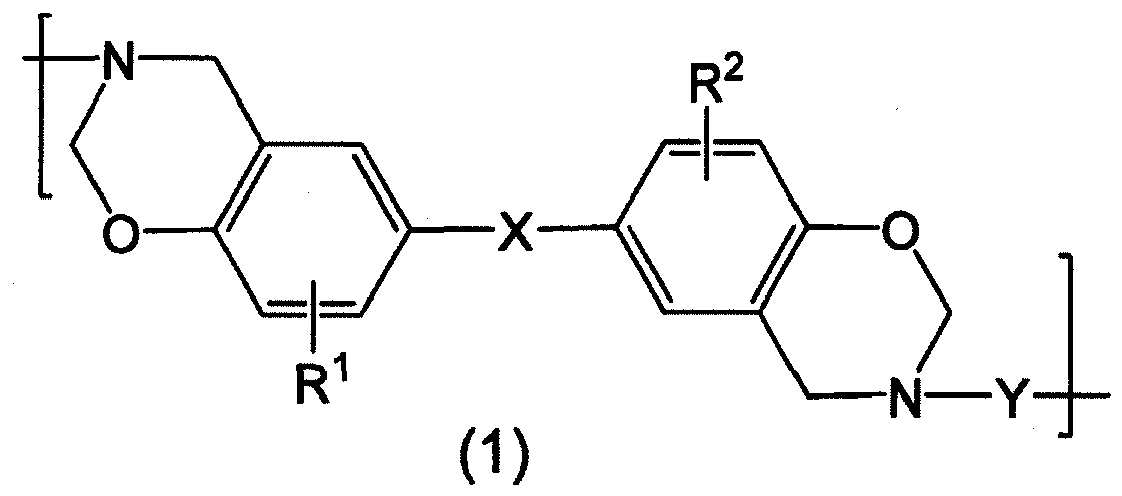
- The present invention provides an adhesive composition or an underfill composition comprising: a polymer that exclusively includes at least one structural unit of Formula (1) as a repeating unit except a terminal:


- The halogen atom is exemplified by a fluorine atom.
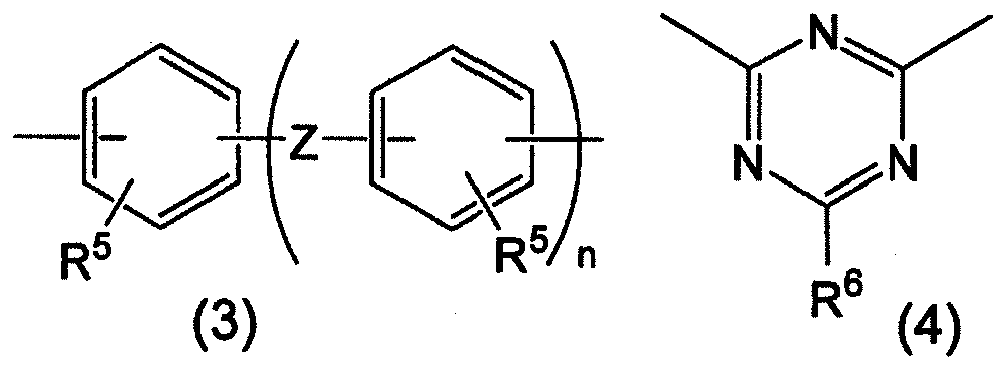
- The divalent organic group of Formula (2) is represented by, for example, Formula (2-a) or Formula (2-b):

- The divalent organic group of Formula (3) is represented by, for example, Formula (3-a), Formula (3-b), or Formula (3-c):


- The polymer has a weight average molecular weight of 1,000 to 100,000 or 2,000 to 10,000, for example. The weight average molecular weight is a value determined by gel permeation chromatography (GPC) by using polystyrene as a standard sample.
- The polymer is not limited to the cases of having a single type of the structural unit of Formula (1) but may have two types of the structural unit, for example.
- The composition of the present invention can be cured at a comparatively low temperature of 200°C or lower. A film formed of the composition of the present invention generates no void, has good adhesiveness, is unlikely to cause exfoliation after adhesion, and has excellent heat resistance and low leakage current. The composition of the present invention is thus useful as an adhesive or an underfill agent.
- The adhesive composition or the underfill composition of the present invention is a coating solution of a polymer exclusively including at least one structural unit of Formula (1) as the repeating unit except terminals dissolving in an organic solvent. The coating solution has spin coating properties within the range of a solution viscosity of 0.001 to 5,000 Pa·s.
- The organic solvent may be any solvents usable in processes of manufacturing semiconductor devices, and examples preferably used include ketones such as cyclohexanone, cyclopentanone, methyl isoamyl ketone, 2-butanone, and 2-heptanone; polyhydric alcohols and derivatives thereof, such as ethylene glycol, ethylene glycol monoacetate, diethylene glycol, diethylene glycol monoacetate, propylene glycol, propylene glycol monoacetate, dipropylene glycol, dipropylene glycol monoacetate, and monomethyl ethers, monoethyl ethers, monopropyl ethers, monobutyl ethers, and monophenyl ethers thereof; cyclic ethers such as dioxane; and esters such as methyl lactate, ethyl lactate, methyl acetate, ethyl acetate, butyl acetate, methyl pyruvate, ethyl pyruvate, methyl methoxypropionate, and ethyl ethoxypropionate. These solvents may be used singly or in combination of two or more of them.
- The solid content, which is the ratio of the adhesive composition or the underfill composition of the present invention except the organic solvent, is 1% by mass to 70% by mass, for example.
- The polymer included in the adhesive composition or the underfill composition of the present invention is obtained by, for example, causing a solution of a bisphenol compound, a diamine compound, and an aldehyde compound dissolved in a solvent to react under heat for a predetermined time.
- Examples of the bisphenol compound include 2,2-bis(4-hydroxyphenyl)propane [bisphenol A], bis(4-hydroxyphenyl)sulfone [bisphenol S], 2,2-bis(4-hydroxyphenyl)hexafluoropropane [bisphenol AF], bis(4-hydroxyphenyl)methane [bisphenol F], 1,1-bis(4-hydroxyphenyl)ethane [bisphenol E], 1,3-bis[2-(4-hydroxyphenyl)-2-propyl]benzene [bisphenol M], 1,4-bis[2-(4-hydroxyphenyl)-2-propyl]benzene [bisphenol P], and 2,2'-bis(4-hydroxy-3-methylphenyl)propane.
- Examples of the diamine compound include 4,4'-diamino-3,3'-dimethyldiphenylmethane, 4,4'-diamino-3,3'-diethyldiphenylmethane, 4,4'-diamino-3,3',5,5'-tetramethyldiphenylmethane, o-dianisidine, o-phenylenediamine, m-phenylenediamine, p-phenylenediamine, bis[4-(3-aminophenoxy)phenyl]sulfone, 3,3'-sulfonyldianiline, 4,4'-sulfonyldianiline, 2,4-diamino-1,3,5-triazine, 2,4-diamino-6-vinyl-1,3,5-triazine, and 2,4-diamino-6-methyl-1,3,5-triazine.
- Examples of the aldehyde compound include paraformaldehyde and formaldehyde.
- Examples of the solvent include toluene, xylenes, dioxane, tetrahydrofuran, chloroform, dichloromethane, cyclohexanone, cyclopentanone, methyl ethyl ketone, and N-methyl-2-pyrrolidone.
- The adhesive composition or the underfill composition of the present invention may further contain additives such as an inorganic filler, a silane coupling agent, a surfactant, a rheology control agent, and a crosslinking agent, as necessary.
- Examples of the inorganic filler include sols of silica, aluminum nitride, boron nitride, zirconia, alumina, and other inorganic substances having a particle diameter of 700 nm or smaller.
- Examples of the silane coupling agent include vinyltrimethoxysilane, vinyltriethoxysilane, 3 -methacryloxypropyltriethoxysilane, 3-methacryloxypropyltrimethoxysilane, 3-glycidoxypropyltrimethoxysilane, 3-glycidoxypropyltriethoxysilane, 3-aminopropyltriethoxysilane, and 3-aminopropyltrimethoxysilane.
- Examples of the rheology control agent include phthalic acid derivatives such as dimethyl phthalate, diethyl phthalate, diisobutyl phthalate, dihexyl phthalate, and butyl isodecyl phthalate; adipic acid derivatives such as di-n-butyl adipate, diisobutyl adipate, diisooctyl adipate, and octyl decyl adipate; maleic acid derivatives such as di-n-butyl maleate, diethyl maleate, and dinonyl maleate; oleic acid derivatives such as methyl oleate, butyl oleate, and tetrahydrofurfuryl oleate; and stearic acid derivatives such as n-butyl stearate and glyceryl stearate.
- Examples of the surfactant include nonionic surfactants including polyoxyethylene alkyl ethers such as polyoxyethylene lauryl ether, polyoxyethylene stearyl ether, polyoxyethylene cetyl ether, and polyoxyethylene oleyl ether, polyoxyethylene alkylaryl ethers such as polyoxyethylene octylphenyl ether and polyoxyethylene nonylphenyl ether, polyoxyethylene-polyoxypropylene block copolymers, sorbitan fatty acid esters such as sorbitan monolaurate, sorbitan monopalmitate, sorbitan monostearate, sorbitan monooleate, sorbitan trioleate, and sorbitan tristearate, polyoxyethylene sorbitan fatty acid esters such as polyoxyethylene sorbitan monolaurate, polyoxyethylene sorbitan monopalmitate, polyoxyethylene sorbitan monostearate, polyoxyethylene sorbitan trioleate, and polyoxyethylene sorbitan tristearate; fluorochemical surfactants including EFTOP (registered trademark) EF301, EFTOP EF303, and EFTOP EF352 (manufactured by Mitsubishi Materials Electronic Chemicals Co., Ltd.), MEGAFAC (registered trademark) F171, MEGAFAC F173, MEGAFAC R30, and MEGAFAC R30N (manufactured by DIC Corporation), Fluorad FC 430 and Fluorad FC431 (manufactured by Sumitomo 3M Ltd.), and Asahiguard (registered trademark) AG710, Surflon (registered trademark) S-382, Surflon SC101, Surflon SC102, Surflon SC103, Surflon SC104, Surflon SC105, and Surflon SC106 (manufactured by Asahi Glass Co., Ltd.); and organosiloxane polymer KP341 (manufactured by Shin-Etsu Chemical Co., Ltd.). These surfactants may be added singly or in combination of two or more of them.
- The adhesive composition or the underfill composition of the present invention does not necessarily contain the crosslinking agent. If used, the crosslinking agent is exemplified by nitrogen-containing compounds having a nitrogen atom that are substituted with an alkoxymethyl group such as a methoxymethyl group, an ethoxymethyl group, a butoxymethyl group, and a hexyloxymethyl group or a hydroxymethyl group. Other examples of the crosslinking agent include epoxy group-containing compounds, epoxy group-containing polymers, allyl group-containing compounds, allyl group-containing polymers, isocyanate group-containing compounds, and isocyanate group-containing polymers.
- Examples of the nitrogen-containing compounds include nitrogen-containing compounds such as hexamethoxymethylmelamine, tetramethoxymethylbenzoguanamine, 1,3,4,6-tetrakis(butoxymethyl)glycoluril, 1,3,4,6-tetrakis(hydroxymethyl)glycoluril, 1,3-bis(hydroxymethyl)urea, 1,1,3,3-tetrakis(butoxymethyl)urea, 1,1,3,3-tetrakis(methoxymethyl)urea, 1,3-bis(hydroxyrnethyl)-4,5-dihydroxy-2-imidazolinone, and 1,3-bis(methoxymethyl)-4,5-dimethoxy-2-imidazolinone.
- Examples of the crosslinking agent further include commercially available compounds such as methoxymethyl melamine compounds (trade name: CYMEL (registered trademark) 300, CYMEL 301, CYMEL 303, and CYMEL 350), butoxymethyl melamine compounds (trade name: Mycoat (registered trademark) 506 and Mycoat 508), glycoluril compounds (trade name: CYMEL (registered trademark) 1170 and POWDERLINK (registered trademark) 1174), a methylated urea resin (trade name: UFR65), and butylated urea resins (trade name: UFR300, U-VAN10S60, U-VAN10R, and U-VAN11HV) manufactured by Nihon Cytec Industries Inc. and urea/formaldehyde resins (highly condensed resins, trade name: Beckamine (registered trademark) J-300S, Beckamine P-955, and Beckamine N) manufactured by DIC Corporation.
- The epoxy group-containing crosslinking agent may be a compound having at least one epoxy ring, for example, compounds having one to six epoxy rings or two to four epoxy rings. Examples of the compound include 1,4-butanediol diglycidyl ether, 1,2-epoxy-4-(epoxyethyl)cyclohexane, glycerol triglycidyl ether, diethylene glycol diglycidyl ether, 2,6-diglycidylphenyl glycidyl ether, 1,1,3-tris[p-(2,3-epoxypropoxy)phenyl]propane, 1,2-cyclohexanedicarboxylic acid diglycidyl ester, 4,4'-methylenebis(N,N-diglycidylaniline), 3,4-epoxycyclohexylmethyl-3,4-epoxycyclohexane carboxylate, trimethylolethane triglycidyl ether, triglycidyl-p-aminophenol, tetraglycidyl-m-xylenediamine, tetraglycidyldiaminodiphenylmethane, tetraglycidyl-1,3-bis-aminomethylcyclohexane, bisphenol-A-diglycidyl ether, bisphenol-S-diglycidyl ether, pentaerythritol tetraglycidyl ether resorcinol diglycidyl ether, diglycidyl phthalate, neopentyl glycol diglycidyl ether, polypropylene glycol diglycidyl ether, tetrabromobisphenol-A-diglycidyl ether, bisphenol hexafluoroacetone diglycidyl ether, pentaerythritol diglycidyl ether, tris-(2,3-epoxypropyl) isocyanurate, monoallyl diglycidyl isocyanurate, diglycerol polydiglycidyl ether, pentaerythritol polyglycidyl ether, 1,4-bis(2,3-epoxypropoxyperfluoroisopropyl)cyclohexane, sorbitol polyglycidyl ether, trimethylolpropane polyglycidyl ether, resorcin diglycidyl ether, 1,6-hexanediol diglycidyl ether, polyethylene glycol diglycidyl ether, phenyl glycidyl ether, p-tertiary butylphenyl glycidyl ether, adipic acid diglycidyl ether, o-phthalic acid diglycidyl ether, dibromophenyl glycidyl ether, 1,2,7,8-diepoxyoctane, 1,6-dimethylolperfluorohexane diglycidyl ether, 4,4'-bis(2,3-epoxypropoxyperfluoroisopropyl)diphenyl ether, 2,2-bis(4-glycidyloxyphenyl)propane, 3,4-epoxycyclohexylmethyl-3',4'-epoxycyclohexane carboxylate, 3,4-epoxycyclohexyloxirane, 2-(3,4-epoxycyclohexyl)-3',4'-epoxy-1,3-dioxane-5-spirocyclohexane, 1,2-ethylenedioxy-bis(3,4-epoxycyclohexylmethane), 4',5'-epoxy-2'-methylcyclohexylmethyl-4,5-epoxy-2-methylcyclohexane carboxylate, ethylene glycol-bis(3,4-epoxycyclohexane carboxylate), bis-(3,4-epoxycyclohexylmethyl) adipate, bis(2,3-epoxycyclopentyl) ether, tetra(3,4-epoxycyclohexylmethyl) butanetetracarboxylate-modified ε-caprolactone, ε-caprolactone-modified 3',4'-epoxycyclohexylmethyl-3,4-epoxycyclohexane carboxylate, 1,2-epoxy-4-vinylcyclohexane, 1,2-epoxy-4-(2-methyloxiranyl)-1-methylcyclohexane, 1,2-epoxy-4-(2-oxiranyl)cyclohexane adducts of 2,2-bis(hydroxymethyl)-1-butanol, epoxidized polybutadienes, 3,4-epoxycyclohexylmethyl methacrylate, polyglycidyl methacrylate, epoxidized products of styrene-butadiene block copolymers, and polyphenol glycidyl ether-derived resins.
- These crosslinking agents may be used singly or in combination of two or more of them. The crosslinking agent can be used in an amount of 1 % by mass to 50% by mass, 8% by mass to 40% by mass, or 15% by mass to 30% by mass relative to the amount of the polymer included in the adhesive composition or the underfill composition of the present invention.
- The adhesive composition or the underfill composition of the present invention may contain a crosslinking catalyst together with the crosslinking agent. The crosslinking catalyst is used to accelerate the reaction by the crosslinking agent.
- Examples of the crosslinking catalyst include p-toluenesulfonic acid, trifluoromethanesulfonic acid, methanesulfonic acid, pyridinium p-toluenesulfonate, salicylic acid, camphorsulfonic acid, 5-sulfosalicylic acid, citric acid, benzoic acid, hydroxybenzoic acids, 4-chlorobenzenesulfonic acid, 4-hydroxybenzenesulfonic acid, benzenedisulfonic acid, and 1-naphthalenesulfonic acid. These crosslinking catalysts may be used singly or in combination of two or more of them. The crosslinking catalyst can be used in an amount of 0.01 % by mass to 10% by mass, 0.05% by mass to 8% by mass, 0.1% by mass to 5% by mass, 0.3% by mass to 3% by mass, or 0.5% by mass to 1 % by mass relative to the amount of the polymer included in the adhesive composition or the underfill composition of the present invention.
- The adhesive composition or the underfill composition of the present invention may further contain miscible additives including common additives such as an additional resin for improving performance of an adhesive, a tackifier, a plasticizer, an adhesion aid, a stabilizer, a coloring agent, and a defoaming agent within a range not to impair essential characteristics in the present invention.
- Examples of the additional resin (polymer) for improving performance of an adhesive include addition polymers and polycondensation polymers such as polyester, polystyrene, polyimide, acrylic polymer, methacryl polymer, polyvinyl ether, phenol novolac, naphthol novolac, polyether, polyamide, and polycarbonate. Polymers having an aromatic ring such as a benzene ring, a naphthalene ring, an anthracene ring, a triazine ring, a quinoline ring, and a quinoxaline ring are preferably used. The polymer having a triazine ring is exemplified by polyesters having the structural unit of Formula (5).

- Examples of the additional resin (polymer) include addition polymers containing, as the structural unit, an addition polymerizable monomer such as benzyl acrylate, benzyl methacrylate, phenyl acrylate, naphthyl acrylate, anthryl methacrylate, anthrylmethyl methacrylate, styrene, hydroxystyrene, benzyl vinyl ether, and N-phenylmaleimide and polycondensation polymers such as phenol novolac and naphthol novolac. The additional resin (polymer) may be polymers having no aromatic ring. Examples of such a polymer include addition polymers exclusively containing, as the structural unit, an addition polymerizable monomer having no aromatic ring, such as alkyl acrylate, alkyl methacrylate, vinyl ether, alkyl vinyl ether, acrylonitrile, maleimide, N-alkyl maleimide, and maleic anhydride. When used as the additional resin (polymer), the addition polymer may be a homopolymer or a copolymer.
- The additional resin (polymer) used in the adhesive composition or the underfill composition of the present invention has a molecular weight of, for example, 1,000 to 1,000,000, 3,000 to 300,000, 5,000 to 200,000, or 10,000 to 100,000 in terms of weight average molecular weight. If the additional resin (polymer) is contained in the adhesive composition or the underfill composition of the present invention, the amount is, for example, 40% by mass or less, 20% by mass or less, or 1 to 19% by mass in the solid content.
- The tackifier is added to control elastic modulus, viscosity, and surface conditions. The tackifier is preferably selected in consideration of the viscosity Examples of the tackifier include aliphatic petroleum resins, aromatic petroleum resins, aliphatic/aromatic copolymerized petroleum resins, alicyclic hydrogenated petroleum resins, alkylphenol resins, xylene resins, coumarone indene resins, terpene resins, terpene phenol resins, aromatic-modified terpene resins, hydrogenated terpene resins, rosin resins, hydrogenated rosin resins, disproportionated rosin resins, dimerized rosin resins, and esterified rosin resins. These tackifiers may be used singly or in combination of two or more of them. The tackifier may be contained, for example, in a ratio of 100% by mass or less or 50% by mass or less relative to the amount of the polymer included in the adhesive composition or the underfill composition of the present invention.
- The present invention will next be described in further detail with reference to examples but is not limited to the examples.
- The gel permeation chromatography (GPC) analysis of polymers obtained in Synthesis Examples described below was carried out with the following apparatus in the following conditions.
- Apparatus: integral high-speed GPC system, HLC-8220GPC, manufactured by Tosoh Corporation
- Column: KF-G, KF804L
- Column temperature: 40°C
- Solvent: tetrahydrofuran (THF)
- Flow rate: 1.0 mL/min
- Standard sample: polystyrene
- Detector: RI
- In 70.37 g of N-methyl-2-pyrrolidone, 11.20 g of 4,4'-diamino-3,3'-dimethyldiphenylmethane (manufactured by Tokyo Chemical Industry Co., Ltd.), 12.56 g of bisphenol A (manufactured by Tokyo Chemical Industry Co., Ltd.), 5.29 g of paraformaldehyde (manufactured by Tokyo Chemical Industry Co., Ltd.), and 1.11 g of triethylamine were dissolved. The system was purged with nitrogen, and the mixture was allowed to react at 90°C for 20 hours, giving a solution containing a polymer. The obtained solution was then added dropwise to a mixed solution of water and methanol having a volume ratio of 1:9, giving a precipitate. The precipitate was collected by suction filtration through a Buchner funnel and washed with a mixed solution of water and methanol having a volume ratio of 1:9 twice. The obtained powder was dried in a vacuum dryer for 12 hours, yielding the polymer. GPC analysis of the obtained polymer revealed a weight average molecular weight of 2,500 in terms of standard polystyrene. The obtained polymer is supposed to have the structural unit of Formula (6).

- In 69.98 g of N-methyl-2-pyrrolidone, 9.17 g of 4,4'-diamino-3,3'-dimethyldiphenylmethane (manufactured by Tokyo Chemical Industry Co., Ltd.), 15.59 g of bisphenol M (manufactured by Mitsui Fine Chemicals, Inc.), 4.32 g of paraformaldehyde (manufactured by Tokyo Chemical Industry Co., Ltd.), and 0.91 g of triethylamine were dissolved. The system was purged with nitrogen, and the mixture was allowed to react at 90°C for 20 hours, giving a solution containing a polymer. The obtained solution was then added dropwise to a mixed solution of water and methanol having a volume ratio of 1:9, giving a precipitate. After the dropwise addition, the precipitate was collected by suction filtration through a Buchner funnel and washed with a mixed solution of water and methanol having a volume ratio of 1:9 twice. The obtained powder was dried in a vacuum dryer for 12 hours, yielding the polymer. GPC analysis of the obtained polymer revealed a weight average molecular weight of 4,500 in terms of standard polystyrene. The obtained polymer is supposed to have the structural unit of Formula (7).

- In 69.18 g of N-methyl-2-pyrrolidone, 8.79 g of o-dianisidine (manufactured by Tokyo Chemical Industry Co., Ltd.), 9.13 g of bisphenol A (manufactured by Tokyo Chemical Industry Co., Ltd.), 4.32 g of paraformaldehyde (manufactured by Tokyo Chemical Industry Co., Ltd.), and 0.81 g of triethylamine were dissolved. The system was purged with nitrogen, and the mixture was allowed to react at 90°C for 20 hours, giving a solution containing a polymer. The obtained solution was then added dropwise to a mixed solution of water and methanol having a volume ratio of 1:9, giving a precipitate. After the dropwise addition, the precipitate was collected by suction filtration through a Buchner funnel and washed with a mixed solution of water and methanol having a volume ratio of 1:9 twice. The obtained powder was dried in a vacuum dryer for 12 hours, yielding the polymer. GPC analysis of the obtained polymer revealed a weight average molecular weight of 2,500 in terms of standard polystyrene. The obtained polymer is supposed to have the structural unit of Formula (8).

- In 74.26 g of N-methyl-2-pyrrolidone, 14.12 g of 4,4'-diamino-3,3'-dimethyldiphenylmethane (manufactured by Tokyo Chemical Industry Co., Ltd.), 6.66 g of 2,2'-bis(4-hydroxy-3-methylphenyl)propane (manufactured by Tokyo Chemical Industry Co., Ltd.), 1.98 g of bisphenol A (manufactured by Tokyo Chemical Industry Co., Ltd.), 2.91 g of paraformaldehyde (manufactured by Tokyo Chemical Industry Co., Ltd.), and 1.05 g of triethylamine were dissolved. The system was purged with nitrogen, and the mixture was allowed to react at 90°C for 20 hours, giving a solution containing a polymer. The obtained solution was then added dropwise to a mixed solution of water and methanol having a volume ratio of 1:9, giving a precipitate. After the dropwise addition, the precipitate was collected by suction filtration through a Buchner funnel and washed with a mixed solution of water and methanol having a volume ratio of 1:9 twice. The obtained powder was dried in a vacuum dryer for 12 hours, yielding the polymer. GPC analysis of the obtained polymer revealed a weight average molecular weight of 2,600 in terms of standard polystyrene. The obtained polymer is supposed to have the two structural units of Formula (9).

- In a flask equipped with a stirrer, a reflux condenser, a thermometer, and a dropping chamber, 15.00 g of 4,4'-dichlorodiphenyl-sulfone (manufactured by Tokyo Chemical Industry Co., Ltd.), 12.56 g of 2,2-bis(4-hydroxyphenyl)propane (manufactured by Tokyo Chemical Industry Co., Ltd.), 8.37 g of potassium carbonate, and 82.61 g of N-methyl-2-pyrrolidone were placed. The system in the flask was purged with nitrogen, and the mixture was heated to 160°C and allowed to react for 20 hours. The obtained reaction product was cooled to room temperature and filtered. The collected filtrate was mixed with 30 mL of a mixed solution of N-methyl-2-pyrrolidone and 2 mol/L hydrochloric acid having a volume ratio of 90:10. The mixture was poured into methanol and purified by reprecipitation. The precipitate was then washed with methanol and water, and dried under vacuum at 85°C for a day, yielding an aromatic polyether that was to be used in Comparative Example 3 and had the structural unit of Formula (10). GPC analysis of the obtained aromatic polyether revealed a weight average molecular weight of 16,700 in terms of standard polystyrene.

- In 51.99 g of chloroform, 10.39 g of α,α'-bis(4-hydroxyphenyl)-1,4-diisopropylbenzene (manufactured by Tokyo Chemical Industry Co., Ltd.), 8.62 g of 2,2-bis[4-(4-aminophenoxy)phenyl]propane (manufactured by Tokyo Chemical Industry Co., Ltd.), 2.66 g of paraformaldehyde (manufactured by Tokyo Chemical Industry Co., Ltd.), and 0.61 g of triethylamine were dissolved. The system was purged with nitrogen, and the mixture was allowed to react under reflux for 20 hours, giving a solution containing a polymer. The obtained solution was then added dropwise to ethanol, giving a precipitate. The precipitate was collected by suction filtration through a Buchner funnel and washed with ethanol twice. The obtained powder was dried in a vacuum dryer for 12 hours, yielding the polymer. GPC analysis of the obtained polymer revealed a weight average molecular weight of 10,000 in terms of standard polystyrene. The obtained polymer is supposed to have the structural unit of Formula (11).

- In 51.56 g of chloroform, 6.54 g of 4,4'-diaminodiphenylmethane (manufactured by Tokyo Chemical Industry Co., Ltd.), 9.70 g of bisphenol A (manufactured by Tokyo Chemical Industry Co., Ltd.), 1.01 g of 4,4'-dihydroxybenzophenone (manufactured by Tokyo Chemical Industry Co., Ltd.), 4.18 g of paraformaldehyde (manufactured by Tokyo Chemical Industry Co., Ltd.), and 0.67 g of triethylamine were dissolved. The system was purged with nitrogen, and the mixture was allowed to react under reflux for 12 hours, giving a solution containing a polymer. The obtained solution was then added dropwise to methanol, giving a precipitate. The precipitate was collected by suction filtration through a Buchner funnel and washed with methanol twice. The obtained powder was dried in a vacuum dryer for 12 hours, yielding the polymer. GPC analysis of the obtained polymer revealed a weight average molecular weight of 117,000 in terms of standard polystyrene. The obtained polymer is supposed to have the two structural units of Formula (12).

- In 7.5 g of cyclohexanone, 5 g of the polymer obtained in Synthesis Example 1 was dissolved. The solution was filtered through a polyethylene microfilter having a pore diameter of 1.0 µm, thus giving a composition having a solid content of 40% by mass.
- In 7.5 g of cyclohexanone, 5 g of the polymer obtained in Synthesis Example 2 was dissolved. The solution was filtered through a polyethylene microfilter having a pore diameter of 1.0 µm, thus giving a composition having a solid content of 40% by mass.
- In 7.5 g of cyclohexanone, 5 g of the polymer obtained in Synthesis Example 3 was dissolved. The solution was filtered through a polyethylene microfilter having a pore diameter of 1.0 µm, thus giving a composition having a solid content of 40% by mass.
- In 7.5 g of cyclohexanone, 5 g of the polymer obtained in Synthesis Example 4 was dissolved. The solution was filtered through a polyethylene microfilter having a pore diameter of 1.0 µm, thus giving a composition having a solid content of 40% by mass.
- To 10 g of poly(pyromellitic dianhydride-co-4,4'-oxydianiline) amic acid solution (16% by mass Pyre-ML RC-5019 solution in N-methyl-2-pyrrolidone, manufactured by Sigma-Aldrich Japan) as a polyimide precursor, 10 g of N-methyl-2-pyrrolidone was added, and the mixture was filtered through a polyethylene microfilter having a pore diameter of 1.0 µm, giving a composition.
- Polymethyl methacrylate (manufactured by Wako Pure Chemical Industries, Ltd.) as an acrylic resin was prepared. The polymethyl methacrylate was dissolved in cyclohexanone. The solution was filtered through a polyethylene microfilter having a pore diameter of 1.0 µm, thus giving a composition having a solid content of 20% by mass.
- In N-methyl-2-pyrrolidone, the aromatic polyether obtained in Comparative Synthesis Example 1 was dissolved. The solution was filtered through a polyethylene microfilter having a pore diameter of 1.0 µm, thus giving a composition having a solid content of 10% by mass.
- In 6.5 g of cyclohexanone, 3.5 g of the polymer obtained in Comparative Synthesis Example 2 was dissolved. The solution was filtered through a polyethylene microfilter having a pore diameter of 1.0 µm, thus giving a composition having a solid content of 35% by mass.
- In 6.5 g of cyclohexanone, 3.5 g of the polymer obtained in Comparative Synthesis Example 3 was dissolved. The solution was filtered through a polyethylene microfilter having a pore diameter of 1.0 µm, thus giving a composition having a solid content of 35% by mass.
- Each of the polymers used in Examples 1, 2, 3, and 4 (the polymers obtained in Synthesis Examples 1, 2, 3 and 4), the polymer compounds used in Comparative Examples 1, 2, and 3, and the polymers used in Comparative Examples 4 and 5 (the polymers obtained in Comparative Synthesis Examples 2 and 3) was dissolved in cyclohexanone. The polymer or the polymer compound dissolved at 35% by mass or more in cyclohexanone was evaluated as ○, and the polymer or the polymer compound dissolved at less than 35% by mass was evaluated as ×. Table 1 shows the results.
- Each of the compositions prepared in Examples 1, 2, 3, and 4 and the compositions prepared in Comparative Examples 1, 2, and 3 was applied onto a silicon wafer with a spin coater. The coated wafer was placed on a hot plate and baked at 200°C for 5 minutes, giving a cured film having a film thickness of 1 µm. The film was immersed in N-methyl-2-pyrrolidone at 23°C for 2 minutes. A film having a change in film thickness of less than 5% was evaluated as ○, and a film having a change in film thickness of 5% or more was evaluated as ×. Table 1 shows the results. A composition giving the film evaluated as ○ is indicated to have curing properties at a low temperature (200°C).
- Each of the compositions prepared in Examples 1, 2, 3, and 4 and the compositions prepared in Comparative Examples 1, 2, 3, 4, and 5 was applied onto a silicon wafer having a size of 4 inch by spin coating in coating conditions at 1,000 rpm for 30 seconds. The coated wafer was baked at 100°C for 2 minutes and at 150°C for 2 minutes, giving a film. The film formed on the silicon wafer was then bonded to a 4-inch glass wafer by using a bonding apparatus (manufactured by Ayumi Industries Co., Ltd., VJ-300) in conditions at a vacuum pressure of 10 Pa or less, a temperature of 100°C (Example 1) or 160°C (Examples 2, 3 and 4 and Comparative Examples 1, 2, 3, 4, and 5), and an applied load of 800 kg. A film successfully bonded without voids was evaluated as ○, and a film giving voids and showing adhesion defect was evaluated as ×. Table 1 shows the results.
- The sample successfully bonded in the evaluation of adhesiveness was heated at 200°C for 5 minutes and then placed on a hot plate at 250°C to determine whether exfoliation occurred. A sample causing no exfoliation at 1 hour or more after the sample was placed on the hot plate was evaluated as ○, and a sample causing exfoliation within 1 hour was evaluated as ×. Table 1 shows the results.
- Each of the compositions prepared in Examples 1, 2, 3, and 4 and the compositions prepared in Comparative Examples 1, 2, and 3 was applied onto a silicon wafer with a spin coater. The coated wafer was placed on a hot plate and baked at 200°C for 5 minutes, giving a cured film having a film thickness of 1 µm. The film formed was scraped from the silicon wafer. The collected film was heated with TG-DTA (manufactured by Bruker AXS GmbH, TG/DTA2010SR) at a temperature rise rate of 10°C/min, and the change in mass of the collected film was observed. The heat resistance was evaluated from a heat resistance temperature, at which the mass decrease reached 5% by mass. A film having a heat resistance temperature of 350°C or higher was evaluated as ○, and a film having a heat resistance temperature of lower than 350°C was evaluated as ×. Table 1 shows the results.
- Each of the compositions prepared in Examples 1, 2, and 3 and the compositions prepared in Comparative Examples 1 and 2 was applied onto a silicon wafer with a spin coater. The coated wafer was placed on a hot plate and baked at 200°C for 5 minutes, giving a cured film having a film thickness of 500 nm. To the produced sample, an electric field of 1 MV/cm was applied with Cvmap 92B (manufactured by Four Dimensions Inc.), and the leakage current was determined. A sample having a current density of less than 1 × 10⁻⁹ A/cm2 was evaluated as ○, and a sample having a current density of 1 × 10⁻⁹ A/cm2 or more was evaluated as ×. Table 1 shows the results.
- [Table 1]
Solubility Dissolution in solvent Adhesiveness Heat resistance after adhesion Film heat resistance Leakage current Example 1 ○ ○ ○ ○ ○ ○ Example 2 ○ ○ ○ ○ ○ ○ Example 3 ○ ○ ○ ○ ○ ○ Example 4 ○ ○ ○ ○ ○ - Comparative Example 1 × × × - ○ × Comparative Example 2 ○ × ○ × × × Comparative Example 3 × × × - ○ - Comparative Example 4 ○ - × - - - Comparative Example 5 ○ - × - - - - The evaluation results of adhesiveness and heat resistance after adhesion shown in Table 1 revealed that the films formed of the compositions prepared in Examples 1, 2, 3, and 4 had better adhesiveness than those of the compositions prepared in Comparative Examples 1, 2, 3, 4, and 5. The evaluation results of dissolution in solvent, film heat resistance, and leakage current shown in Table 1 revealed that the compositions prepared in Examples 1, 2, 3, and 4 are usable as the underfill agent.
Claims (6)
- An adhesive composition or an underfill composition comprising:a polymer that exclusively includes at least one structural unit of Formula (1) as a repeating unit except a terminal:
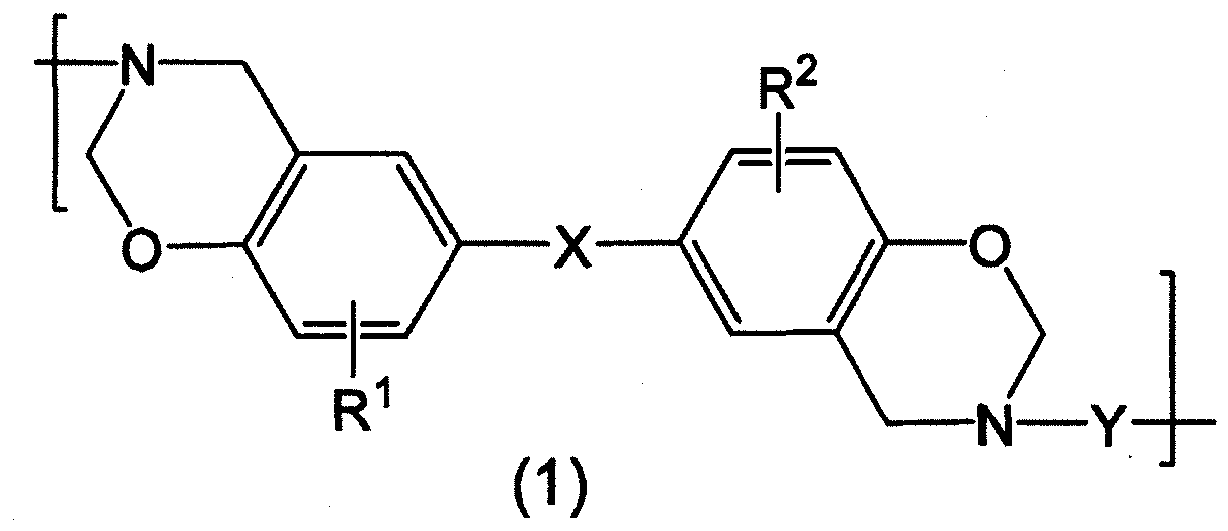

 an organic solvent.
 - The adhesive composition or the underfill composition according to claim 1, wherein
the divalent organic group of Formula (2) is represented by Formula (2-a) or Formula (2-b):
- The adhesive composition or the underfill composition according to claim 1 or 2, wherein
the divalent organic group of Formula (3) is represented by Formula (3-a), Formula (3-b), or Formula (3-c):


- The adhesive composition or the underfill composition according to any one of claims 1 to 3, wherein
the polymer has a weight average molecular weight of 1,000 to 100,000. - The adhesive composition or the underfill composition according to any one of claims 1 to 4, wherein
the polymer has two types of the structural unit of Formula (1). - The adhesive composition or the underfill composition according to any one of claims 1 to 5, further comprising an inorganic filler.
Applications Claiming Priority (2)
| Application Number | Priority Date | Filing Date | Title |
|---|---|---|---|
| JP2012127829 | 2012-06-05 | ||
| PCT/JP2013/065611 WO2013183679A1 (en) | 2012-06-05 | 2013-06-05 | Adhesive composition or underfill composition |
Publications (2)
| Publication Number | Publication Date |
|---|---|
| EP2857452A1 true EP2857452A1 (en) | 2015-04-08 |
| EP2857452A4 EP2857452A4 (en) | 2016-01-20 |
Family
ID=49712068
Family Applications (1)
| Application Number | Title | Priority Date | Filing Date |
|---|---|---|---|
| EP13801069.9A Withdrawn EP2857452A4 (en) | 2012-06-05 | 2013-06-05 | ADHESIVE COMPOSITION OR UNDERLYING FILLING COMPOSITION |
Country Status (8)
| Country | Link |
|---|---|
| US (1) | US20150184044A1 (en) |
| EP (1) | EP2857452A4 (en) |
| JP (1) | JP6226141B2 (en) |
| KR (1) | KR101935035B1 (en) |
| CN (1) | CN104302699A (en) |
| SG (1) | SG11201408125TA (en) |
| TW (1) | TWI617593B (en) |
| WO (1) | WO2013183679A1 (en) |
Families Citing this family (4)
| Publication number | Priority date | Publication date | Assignee | Title |
|---|---|---|---|---|
| WO2015104973A1 (en) * | 2014-01-07 | 2015-07-16 | Dic株式会社 | Polyarylene ether resin, production method for polyarylene ether resin, curable resin material, cured product thereof, semiconductor sealing material, prepreg, circuit board, and build-up film |
| JP6553980B2 (en) * | 2015-08-13 | 2019-07-31 | 株式会社ダイセル | Curable composition and cured product thereof |
| WO2018043342A1 (en) * | 2016-08-30 | 2018-03-08 | 日産化学工業株式会社 | Photosensitive adhesive composition |
| KR102772596B1 (en) | 2023-02-08 | 2025-02-26 | 이아이씨티코리아 주식회사 | Underfill Adhesive Composition |
Family Cites Families (14)
| Publication number | Priority date | Publication date | Assignee | Title |
|---|---|---|---|---|
| US5900447A (en) * | 1997-05-01 | 1999-05-04 | Edison Polymer Innovation Corporation | Composition for forming high thermal conductivity polybenzoxazine-based material and method |
| JP3937259B2 (en) * | 1998-02-17 | 2007-06-27 | 日立化成工業株式会社 | Flame retardant resin composition for copper clad laminate and method for producing copper clad laminate using the same |
| JP2003064180A (en) * | 2001-06-11 | 2003-03-05 | Nippon Steel Chem Co Ltd | Curable resin having dihydrobenzoxazine ring structure and heat-resistant cured resin |
| US20030023007A1 (en) * | 2001-07-27 | 2003-01-30 | Hycomp, Inc. | Enhancement of thermal properties of benzoxazine polymers by use of aromatic polyamines to incorporate internal benzoxazine groups within the monomer |
| JP4570419B2 (en) | 2004-08-20 | 2010-10-27 | ナミックス株式会社 | Liquid sealing resin composition |
| CN101421324A (en) * | 2006-02-20 | 2009-04-29 | 积水化学工业株式会社 | Method for producing thermosetting resin, thermosetting composition containing the same, molded body, cured body, and electronic device containing the same |
| JP4887850B2 (en) | 2006-03-16 | 2012-02-29 | 住友ベークライト株式会社 | Liquid resin composition for underfill, semiconductor device manufacturing method using the same, and semiconductor device |
| JP2008291070A (en) * | 2007-05-22 | 2008-12-04 | Sekisui Chem Co Ltd | Method for producing thermosetting resin and thermosetting resin |
| JP4931079B2 (en) | 2007-12-21 | 2012-05-16 | パナソニック株式会社 | Liquid thermosetting resin composition for underfill and semiconductor device using the same |
| JP4805413B2 (en) * | 2009-09-30 | 2011-11-02 | 積水化学工業株式会社 | Thermosetting resin having benzoxazine ring and method for producing the same |
| KR20120130337A (en) * | 2010-03-19 | 2012-11-30 | 케이스 웨스턴 리저브 유니버시티 | Main-chain benzoxazine oligomer compositions, and method for the preparation thereof |
| JP2012021084A (en) * | 2010-07-15 | 2012-02-02 | Gun Ei Chem Ind Co Ltd | Molded product obtained by heat curing thermosetting molding material |
| JP2012036319A (en) * | 2010-08-10 | 2012-02-23 | Gun Ei Chem Ind Co Ltd | Thermosetting resin and cured product of the same |
| JP2012036318A (en) * | 2010-08-10 | 2012-02-23 | Gun Ei Chem Ind Co Ltd | Thermosetting resin |
-
2013
- 2013-06-05 US US14/405,930 patent/US20150184044A1/en not_active Abandoned
- 2013-06-05 TW TW102119923A patent/TWI617593B/en active
- 2013-06-05 CN CN201380025900.5A patent/CN104302699A/en active Pending
- 2013-06-05 KR KR1020147037057A patent/KR101935035B1/en active Active
- 2013-06-05 SG SG11201408125TA patent/SG11201408125TA/en unknown
- 2013-06-05 JP JP2014520032A patent/JP6226141B2/en active Active
- 2013-06-05 EP EP13801069.9A patent/EP2857452A4/en not_active Withdrawn
- 2013-06-05 WO PCT/JP2013/065611 patent/WO2013183679A1/en not_active Ceased
Also Published As
| Publication number | Publication date |
|---|---|
| JP6226141B2 (en) | 2017-11-08 |
| SG11201408125TA (en) | 2015-01-29 |
| KR20150023560A (en) | 2015-03-05 |
| TWI617593B (en) | 2018-03-11 |
| TW201402653A (en) | 2014-01-16 |
| US20150184044A1 (en) | 2015-07-02 |
| CN104302699A (en) | 2015-01-21 |
| KR101935035B1 (en) | 2019-01-04 |
| JPWO2013183679A1 (en) | 2016-02-01 |
| WO2013183679A1 (en) | 2013-12-12 |
| EP2857452A4 (en) | 2016-01-20 |
Similar Documents
| Publication | Publication Date | Title |
|---|---|---|
| JP6098825B2 (en) | POLYMER, COMPOSITION CONTAINING SAME, AND ADHESIVE COMPOSITION | |
| JP7109159B2 (en) | Film-forming composition containing thermosetting resin | |
| JP6226141B2 (en) | Adhesive composition or underfill composition | |
| KR101981788B1 (en) | Heat-curable resin composition containing polymer having specific terminal structure | |
| CN106800909A (en) | Chip lamilate and preparation method | |
| KR101967369B1 (en) | Heat-curable resin composition |
Legal Events
| Date | Code | Title | Description |
|---|---|---|---|
| PUAI | Public reference made under article 153(3) epc to a published international application that has entered the european phase |
Free format text: ORIGINAL CODE: 0009012 |
|
| 17P | Request for examination filed |
Effective date: 20141218 |
|
| AK | Designated contracting states |
Kind code of ref document: A1 Designated state(s): AL AT BE BG CH CY CZ DE DK EE ES FI FR GB GR HR HU IE IS IT LI LT LU LV MC MK MT NL NO PL PT RO RS SE SI SK SM TR |
|
| AX | Request for extension of the european patent |
Extension state: BA ME |
|
| DAX | Request for extension of the european patent (deleted) | ||
| RA4 | Supplementary search report drawn up and despatched (corrected) |
Effective date: 20151223 |
|
| RIC1 | Information provided on ipc code assigned before grant |
Ipc: C08G 73/06 20060101ALI20151217BHEP Ipc: C09J 161/34 20060101ALI20151217BHEP Ipc: H01L 21/56 20060101ALI20151217BHEP Ipc: H01L 23/29 20060101ALI20151217BHEP Ipc: C08G 14/06 20060101ALI20151217BHEP Ipc: C08L 61/34 20060101AFI20151217BHEP Ipc: C09J 179/04 20060101ALI20151217BHEP |
|
| STAA | Information on the status of an ep patent application or granted ep patent |
Free format text: STATUS: THE APPLICATION IS DEEMED TO BE WITHDRAWN |
|
| 18D | Application deemed to be withdrawn |
Effective date: 20160722 |