EP2852257B1 - Digital current equalizing device, analog current equalizing device, current equalizing method and system - Google Patents
Digital current equalizing device, analog current equalizing device, current equalizing method and system Download PDFInfo
- Publication number
- EP2852257B1 EP2852257B1 EP13788423.5A EP13788423A EP2852257B1 EP 2852257 B1 EP2852257 B1 EP 2852257B1 EP 13788423 A EP13788423 A EP 13788423A EP 2852257 B1 EP2852257 B1 EP 2852257B1
- Authority
- EP
- European Patent Office
- Prior art keywords
- module
- digital
- current
- output
- signal
- Prior art date
- Legal status (The legal status is an assumption and is not a legal conclusion. Google has not performed a legal analysis and makes no representation as to the accuracy of the status listed.)
- Active
Links
Images



Classifications
-
- H—ELECTRICITY
- H02—GENERATION; CONVERSION OR DISTRIBUTION OF ELECTRIC POWER
- H02M—APPARATUS FOR CONVERSION BETWEEN AC AND AC, BETWEEN AC AND DC, OR BETWEEN DC AND DC, AND FOR USE WITH MAINS OR SIMILAR POWER SUPPLY SYSTEMS; CONVERSION OF DC OR AC INPUT POWER INTO SURGE OUTPUT POWER; CONTROL OR REGULATION THEREOF
- H02M3/00—Conversion of DC power input into DC power output
- H02M3/02—Conversion of DC power input into DC power output without intermediate conversion into AC
- H02M3/04—Conversion of DC power input into DC power output without intermediate conversion into AC by static converters
-
- H—ELECTRICITY
- H02—GENERATION; CONVERSION OR DISTRIBUTION OF ELECTRIC POWER
- H02M—APPARATUS FOR CONVERSION BETWEEN AC AND AC, BETWEEN AC AND DC, OR BETWEEN DC AND DC, AND FOR USE WITH MAINS OR SIMILAR POWER SUPPLY SYSTEMS; CONVERSION OF DC OR AC INPUT POWER INTO SURGE OUTPUT POWER; CONTROL OR REGULATION THEREOF
- H02M3/00—Conversion of DC power input into DC power output
- H02M3/02—Conversion of DC power input into DC power output without intermediate conversion into AC
- H02M3/04—Conversion of DC power input into DC power output without intermediate conversion into AC by static converters
- H02M3/10—Conversion of DC power input into DC power output without intermediate conversion into AC by static converters using discharge tubes with control electrode or semiconductor devices with control electrode
- H02M3/145—Conversion of DC power input into DC power output without intermediate conversion into AC by static converters using discharge tubes with control electrode or semiconductor devices with control electrode using devices of a triode or transistor type requiring continuous application of a control signal
- H02M3/155—Conversion of DC power input into DC power output without intermediate conversion into AC by static converters using discharge tubes with control electrode or semiconductor devices with control electrode using devices of a triode or transistor type requiring continuous application of a control signal using semiconductor devices only
- H02M3/156—Conversion of DC power input into DC power output without intermediate conversion into AC by static converters using discharge tubes with control electrode or semiconductor devices with control electrode using devices of a triode or transistor type requiring continuous application of a control signal using semiconductor devices only with automatic control of output voltage or current, e.g. switching regulators
- H02M3/157—Conversion of DC power input into DC power output without intermediate conversion into AC by static converters using discharge tubes with control electrode or semiconductor devices with control electrode using devices of a triode or transistor type requiring continuous application of a control signal using semiconductor devices only with automatic control of output voltage or current, e.g. switching regulators with digital control
-
- H—ELECTRICITY
- H02—GENERATION; CONVERSION OR DISTRIBUTION OF ELECTRIC POWER
- H02M—APPARATUS FOR CONVERSION BETWEEN AC AND AC, BETWEEN AC AND DC, OR BETWEEN DC AND DC, AND FOR USE WITH MAINS OR SIMILAR POWER SUPPLY SYSTEMS; CONVERSION OF DC OR AC INPUT POWER INTO SURGE OUTPUT POWER; CONTROL OR REGULATION THEREOF
- H02M3/00—Conversion of DC power input into DC power output
- H02M3/02—Conversion of DC power input into DC power output without intermediate conversion into AC
- H02M3/04—Conversion of DC power input into DC power output without intermediate conversion into AC by static converters
- H02M3/10—Conversion of DC power input into DC power output without intermediate conversion into AC by static converters using discharge tubes with control electrode or semiconductor devices with control electrode
- H02M3/145—Conversion of DC power input into DC power output without intermediate conversion into AC by static converters using discharge tubes with control electrode or semiconductor devices with control electrode using devices of a triode or transistor type requiring continuous application of a control signal
- H02M3/155—Conversion of DC power input into DC power output without intermediate conversion into AC by static converters using discharge tubes with control electrode or semiconductor devices with control electrode using devices of a triode or transistor type requiring continuous application of a control signal using semiconductor devices only
- H02M3/156—Conversion of DC power input into DC power output without intermediate conversion into AC by static converters using discharge tubes with control electrode or semiconductor devices with control electrode using devices of a triode or transistor type requiring continuous application of a control signal using semiconductor devices only with automatic control of output voltage or current, e.g. switching regulators
- H02M3/158—Conversion of DC power input into DC power output without intermediate conversion into AC by static converters using discharge tubes with control electrode or semiconductor devices with control electrode using devices of a triode or transistor type requiring continuous application of a control signal using semiconductor devices only with automatic control of output voltage or current, e.g. switching regulators including plural semiconductor devices as final control devices for a single load
- H02M3/1584—Conversion of DC power input into DC power output without intermediate conversion into AC by static converters using discharge tubes with control electrode or semiconductor devices with control electrode using devices of a triode or transistor type requiring continuous application of a control signal using semiconductor devices only with automatic control of output voltage or current, e.g. switching regulators including plural semiconductor devices as final control devices for a single load with a plurality of power processing stages connected in parallel
-
- H—ELECTRICITY
- H02—GENERATION; CONVERSION OR DISTRIBUTION OF ELECTRIC POWER
- H02M—APPARATUS FOR CONVERSION BETWEEN AC AND AC, BETWEEN AC AND DC, OR BETWEEN DC AND DC, AND FOR USE WITH MAINS OR SIMILAR POWER SUPPLY SYSTEMS; CONVERSION OF DC OR AC INPUT POWER INTO SURGE OUTPUT POWER; CONTROL OR REGULATION THEREOF
- H02M1/00—Details of apparatus for conversion
- H02M1/0003—Details of control, feedback or regulation circuits
- H02M1/0009—Devices or circuits for detecting current in a converter
-
- H—ELECTRICITY
- H05—ELECTRIC TECHNIQUES NOT OTHERWISE PROVIDED FOR
- H05B—ELECTRIC HEATING; ELECTRIC LIGHT SOURCES NOT OTHERWISE PROVIDED FOR; CIRCUIT ARRANGEMENTS FOR ELECTRIC LIGHT SOURCES, IN GENERAL
- H05B47/00—Circuit arrangements for operating light sources in general, i.e. where the type of light source is not relevant
- H05B47/10—Controlling the light source
Definitions
- the disclosure relates to the field of communication, and in particular to a digital current equalizer, an analog current equalizer, and a current equalizing method and system.
- a number of power supply modules are often used in parallel by using a distributed system.
- a current share on each module may differ from one another, leading to difference in current stress and thermal stress on each module, thereby reducing system reliability.
- current equalization has to be supported for power supply modules in parallel connection.
- a switching power supply is experiencing a transition from one with analog control to one with digital control.
- a digital power supply is efficient and has a high power density.
- an efficient digital power supply wins increasing popularity in users.
- complete replacement of any analog power supply by a digital power supply is yet to be achieved. That is, both digital and analog power supplies will be inserted and used in parallel in an existing power supply system.
- current equalization has to be supported too in case both digital and analog power supplies are inserted, which poses a challenge.
- the proposed control scheme makes use of the nature of fast response of the inner current loop and the share bus injected signal to improve the response of the power system. It reduces the unbalance of current distribution during the transient state and avoids the fault alarm for the current limit.
- the design of the proposed control can be used by the multi-loop control method.
- a design example of a system of two 400V/48V 20A modules is set up and experimental recordings verify the performance of current sharing.
- the LM5080 is a simple and cost effective load share controller that provides all functions required to balance the currents delivered from multiple power converters operated in parallel.
- the LM5080 implements an average program (AP) method of active load share control which adjusts the output voltage of individual power stages either up or down to deliver nearly equal currents to a common load.
- the average program method improves stability and reduces the output voltage tolerance when compared to other common load sharing methods.
- the LM5080 supports two common applications for load share controllers: external control in which the load share circuit balances currents between separate power modules (bricks), and internal control where the load share circuit is integrated into the voltage regulation loop of each power converter module or circuit.
- US 2008/0012742 A1 discloses a control circuit for a multi-phase converter including an analog front-end circuit for receiving and processing an output voltage and current of the converter circuits and an average output current; a digital circuit for producing an output voltage reference for setting a desired output voltage of the converter; and an error circuit for comparing the output voltage reference and a parameter related to said output voltage and current for generating control signals for controlling the converter circuits, said error circuit including an Analog to Digital Converter circuit, further comprising a digital PWM generation circuit controlled by said Analog to Digital converter circuit for generating digital control signals for controlling the converter circuits.
- US 2006/0239046 A1 provides a converter module for use as a phase in a multiphase DC-DC converter having a data bus for transferring currentsharing information.
- the converter module comprises a power stage and a controller.
- the power stage comprises an input for receiving an input voltage and an output for providing an output voltage and an output current.
- the controller is coupled to the power stage to receive a feedback signal from the power stage.
- the controller further comprises a data bus port configured to receive the currentsharing information from the data bus and provide updated current-sharing information to the data bus.
- the controller is also configured to: (1) determine a current level being provided by said power stage, (2) update the current-sharing information based upon the determined current level, (3) determine a current error based upon the determined current level and the updated current-sharing information, (4) control an operation of said power stage based upon the current error, and (5) provide the updated current-sharing information to the data bus.
- a multiphase DC-DC power converter comprising a first phase, a second phase, and a data bus is provided.
- a method of sharing current information between phases of a multiphase DC-DC converter is provided.
- a power supply system includes a unique circuit including an analog summer circuit, an analog-to-digital converter, and a digital controller.
- An output voltage feedback control loop of the power supply system feeds back the output voltage to the analog sunnner circuit.
- the analog sunnner circuit generates an analog error voltage signal based on: i) the output voltage received from the output voltage feedback loop, ii) an analog reference voltage signal, and iii) an analog reference voltage adjustment signal.
- the analog reference voltage adjustment signal varies depending on a magnitude of current provided by the output voltage to the dynamic load.
- the analog summer circuit can be configured to support adaptive voltage positioning.
- the analog-to-digital converter converts the analog error voltage signal into a digital error voltage signal.
- a controller generates output voltage control signal(s) based on the digital error voltage signal.
- CN 2750544Y discloses a switch power supply for scheduling a communication system.
- a current equalizing controller When a plurality of power supply modules operating in parallel and a local module outputs a current I1 less than an average output current I0, a current equalizing controller outputs a saturate positive Vi, a diode D1 is reverse biased, and Vi has no impact on reference input of a voltage error amplifier A1; only when output current I1 of the local module is larger than the average output current I0, is Vi adjusted downward from the saturate positive output, until diode D1 is forward biased, lowering reference input of the voltage error amplifier A, thereby reducing the output voltage of the local power module, equalizing output currents of the power modules.
- Embodiments of the disclosure provide a digital current equalizer, an analog current equalizer, and a current equalizing method and system, capable of implementing effective current equalization in case both digital and analog power supplies are inserted in one power supply system.
- Fig.1 is a block diagram of a structure of a digital current equalizer according to an embodiment of the disclosure.
- the digital current equalizer includes an output-current sampling-and-amplifying module 102, a digital processing module 104, and a primary power converting module 106.
- An input terminal of the output-current sampling-and-amplifying module 102 may be connected to an output loop of a power supply.
- An output terminal of the output-current sampling-and-amplifying module 102 may be connected, via a resistor R0, to a current equalizing bus.
- the digital processing module 104 may be configured for: adjusting, according to a difference between an output voltage signal V2 of the output-current sampling-and-amplifying module 102 and a voltage signal Vbus of the current equalizing bus, an output voltage reference signal Vr; and controlling, according to the adjusted output voltage reference signal Vr', the primary power converting module 106 to perform voltage adjustment.
- the digital current equalizer With the digital current equalizer, current equalization for a digital power supply may be implemented. In addition, with a processing basis same as that for analog current equalization, the digital current equalizer also applies to digital current equalization in case both digital and analog power supplies are inserted in one power supply system.
- the digital current equalizer is easy to implement and may implement current equalization in case both digital and analog power supplies are inserted in one power supply system, thereby enhancing reliability of a power supply module and of the entire power supply system.
- Fig.2 is a block diagram of a first structure of a digital current equalizer according to an embodiment of the disclosure.
- the digital current equalizer may further include a current equalization controlling module 202.
- a first input terminal of the current equalization controlling module 202 may be connected to the output voltage signal V2 of the output-current sampling-and-amplifying module 102.
- a second input terminal of the current equalization controlling module 202 may be connected to the voltage signal Vbus of the current equalizing bus.
- An output terminal of the current equalization controlling module 202 may be connected to the digital processing module 104.
- the current equalization controlling module 202 may be configured for outputting a voltage signal V3 that can represent the difference between the output voltage signal V2 of the output-current sampling-and-amplifying module 102 and the voltage signal Vbus of the current equalizing bus.
- the digital processing module 104 may be configured for: adjusting, according to the voltage signal V3 output by the current equalization controlling module 202, the output voltage reference signal Vr; and controlling, according to the adjusted output voltage reference signal Vr', the primary power converting module 106 to perform voltage adjustment.
- the current equalization controlling module 202 may generate the current equalizing signal V3 via an analog circuit.
- the current equalization controlling module 202 may be implemented by an analog current equalization controller circuit or an operation amplifier circuit.
- the digital processing module 104 may adjust the output of a digital power supply by adjusting the output voltage reference signal according to the output signal of the current equalization controlling module 202 to achieve current equalization.
- a digital processing peripheral module may be added to perform pre-conversion on an input of the digital processing module 104.
- Fig.3 is a block diagram of a second structure of a digital current equalizer according to an embodiment of the disclosure. As shown in Fig.3 , the digital current equalizer may further include a digital processing peripheral module 302 and an output voltage feedback module 304. The output of the output voltage feedback module 304 and the output of the current equalization controlling module 202 may be connected to the digital processing module 104 via the digital processing peripheral module 302. The output voltage feedback module 304 may be configured for obtaining an output voltage feedback signal Vf according to an actual output voltage V0 of the power supply.
- the digital processing peripheral module 302 may be configured for converting the voltage signal V3 output by the current equalization controlling module 202 and the output voltage feedback signal Vf output by the output voltage feedback module 304 respectively to signals V3' and Vf' prepared for an analog to digital conversion and sampling operation by the digital processing module 104.
- the digital processing module 104 may be configured for: adjusting the output voltage reference signal Vr according to the signal V3' obtained after converting the voltage signal V3 by the digital processing peripheral module 302; and controlling the primary power converting module 106 to perform voltage adjustment according to the signal Vf' obtained after converting the output voltage feedback signal Vf by the digital processing peripheral module 302 and according to the adjusted output voltage reference signal Vr'.
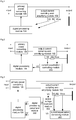
- Fig.4 is a block diagram of a first structure of a digital processing module 104 according to an embodiment of the disclosure.
- the digital processing module 104 may include a first A/D sample converting channel 402, a biasing module 404, a first PI regulation module 406, a first digital operation module 408, a second digital operation module 410, a second PI regulation module 412, and a first modulating signal producing module 414.
- the first A/D sample converting channel 402 may be configured for converting the signals V3' and Vf' (obtained after conversion by the digital processing peripheral module 302) respectively to digital signals V3' and Vf'.
- the biasing module 404 may be configured for biasing the digital signal V3' to obtain a current equalizing loop error.
- the first PI regulation module 406 may be configured for performing PI regulation on the current equalizing loop error to obtain a current equalizing loop output.
- the first digital operation module 408 may be configured for performing digital operation on digital output voltage reference signal Vr and the current equalizing loop output to obtain the adjusted output voltage reference signal Vr'.
- the digital operation may be weighted addition in case that a backward input terminal of the current equalization controlling module 202 is connected to the output voltage signal V2 of the output-current sampling-and-amplifying module 102 and a forward input terminal of the current equalization controlling module 202 is connected to the voltage signal Vbus of the current equalizing bus.
- the digital operation may be weighted subtraction with the digital output voltage reference signal Vr as a minuend and the current equalizing loop output as a subtrahend in case that a forward input terminal of the current equalization controlling module 202 is connected to the output voltage signal V2 of the output-current sampling-and-amplifying module 102 and a backward input terminal of the current equalization controlling module 202 is connected to the voltage signal Vbus of the current equalizing bus.
- the second digital operation module 410 may be configured for performing digital operation on the adjusted output voltage reference signal Vr' and the digital signal Vf' obtained after conversion to obtain a voltage loop error.
- the digital operation may be weighted subtraction with the Vr' as a minuend and the digital signal Vf' as a subtrahend.
- the second PI regulation module 412 may be configured for performing PI regulation on the voltage loop error to obtain a voltage loop output.
- the first modulating signal producing module 414 may be configured for producing, according to the voltage loop output, a modulating signal.
- Fig.5 is a block diagram of a third structure of a digital current equalizer according to an embodiment of the disclosure.
- the output of the output-current sampling-and-amplifying module 102 and the current equalizing bus may be connected to the digital processing module 104.
- the digital processing module 104 may determine the difference between the output voltage signal V2 of the output-current sampling-and-amplifying module 102 and the voltage signal Vbus of the current equalizing bus to adjust the output voltage reference signal Vr and adjust the output of a digital power supply to achieve current equalization.
- a digital processing peripheral module may be added to perform pre-conversion on an input of the digital processing module 104.
- Fig.6 is a block diagram of a fourth structure of a digital current equalizer according to an embodiment of the disclosure.
- the digital current equalizer may further include a digital processing peripheral module 602 and an output voltage feedback module 604.
- An output terminal of the output voltage feedback module 604, the output terminal of the output-current sampling-and-amplifying module 102, and an output terminal of the current equalizing bus may be connected to the digital processing module 104 via the digital processing peripheral module 602.
- the output voltage feedback module 604 may be configured for obtaining an output voltage feedback signal Vf according to an actual output voltage V0 of the power supply.
- the digital processing peripheral module 602 may be configured for converting the output voltage signal V2 of the output-current sampling-and-amplifying module 102, the voltage signal Vbus of the current equalizing bus, and the output voltage feedback signal Vf output by the output voltage feedback module 604 respectively to signals V2', Vbus', and Vf' prepared for an analog to digital conversion and sampling operation by the digital processing module 104.
- the digital processing module 104 may be configured for: adjusting the output voltage reference signal Vr according to the signal V2' obtained after converting the output voltage signal V2 by the digital processing peripheral module 602 and the signal Vbus' obtained after converting the voltage signal Vbus by the digital processing peripheral module 602; and controlling the primary power converting module 106 to perform voltage adjustment according to the signal Vf' obtained after converting the output voltage feedback signal Vf by the digital processing peripheral module 602 and according to the adjusted output voltage reference signal Vr'.
- Fig.7 is a block diagram of a second structure of a digital processing module 104 according to an embodiment of the disclosure.
- the digital processing module 104 may include a second A/D sample converting channel 702, a third digital operation module 704, a third PI regulation module 706, a fourth digital operation module 708, a fifth digital operation module 710, a fourth PI regulation module 712, and a second modulating signal producing module 714.
- the second A/D sample converting channel 702 may be configured for converting the signals V2', Vbus', and Vf' obtained after conversion by the digital processing peripheral module 602 respectively to digital signals V2', Vbus', and Vf'.
- the third digital operation module 704 may be configured for performing digital operation on the digital signals V2' and Vbus' to obtain a current equalizing loop error.
- the digital operation may be weighted subtraction with the digital signal V2' as a minuend and the digital signal Vbus' as a subtrahend, or with the digital signal Vbus' as a minuend and the digital signal V2' as a subtrahend.
- the third PI regulation module 706 may be configured for performing PI regulation on the current equalizing loop error to obtain a current equalizing loop output.
- the fourth digital operation module 708 may be configured for performing digital operation on the current equalizing loop output and the digital output voltage reference signal Vr to obtain the adjusted output voltage reference signal Vr'.
- the digital operation may be weighted subtraction with the digital output voltage reference signal Vr as a minuend and the current equalizing loop output as a subtrahend in case that the digital signal V2' serves as the minuend and the digital signal Vbus' serves as the subtrahend.
- the digital operation may be weighted addition in case that the digital signal Vbus' serves as the minuend and the digital signal V2' serves as the subtrahend.
- the fifth digital operation module 710 may be configured for performing digital operation on the adjusted output voltage reference signal Vr' and the digital signal Vf' obtained after conversion to obtain a voltage loop error.
- the digital operation may be weighted subtraction with the Vr' as a minuend and the digital signal Vf' as a subtrahend.
- the fourth PI regulation module 712 may be configured for performing PI regulation on the voltage loop error to obtain a voltage loop output.
- the second modulating signal producing module 714 may be configured for producing, according to the voltage loop output, a modulating signal.
- Fig.8 is a block diagram of a fifth structure of a digital current equalizer according to an embodiment of the disclosure.
- the digital current equalizer may further include a driving module 802 configured for producing a driving signal under the control of the digital processing module 104.
- the primary power converting module 106 may be configured for performing voltage adjustment according to the driving signal.
- Fig.9 is a block diagram of a sixth structure of a digital current equalizer according to an embodiment of the disclosure.
- the output-current sampling-and-amplifying module 102 may include an output current sampling module 902 and a current sample amplifying module 904.
- the output current sampling module 902 may be connected to a positive terminal of the output loop or a negative terminal of the output loop.
- An output signal of the output current sampling module 902 may serve as an input signal of the current sample amplifying module 904.
- An output terminal of the current sample amplifying module 904 may be connected to the current equalizing bus via the resistor R0.
- the output-current sampling-and-amplifying module 102, the primary power converting module 106, the current equalization controlling module 202, the digital processing peripheral module 302, the output voltage feedback module 304, the digital processing peripheral module 602, the output voltage feedback module 604, the driving module 802, the output current sampling module 902 and the current sample amplifying module 904 may all be implemented by circuits.
- the digital processing module 104 may be implemented by a digital processor. Any module inside the digital processing module 104 may be implemented by running relevant codes inside the digital processing module 104.
- Embodiments of the disclosure further provide an analog current equalizer, which may be configured in an analog power supply to implement current equalization.
- Fig.10 is an analog current equalizer according to an embodiment of the disclosure.
- the analog current equalizer may include an output-current sampling-and-amplifying module 1002, a current equalization controlling module 1004, an adjusting module 1006, a voltage error amplifying module 1008, and a primary power converting module 1010.
- An input terminal of the output-current sampling-and-amplifying module 1002 may be connected to an output loop of an analog power supply.
- An output terminal of the output-current sampling-and-amplifying module 1002 may be connected to a current equalizing bus via a resistor R0.
- a first input terminal of the current equalization controlling module 1004 may be connected to an output voltage signal V2 of the output-current sampling-and-amplifying module 1002.
- a second input terminal of the current equalization controlling module 1004 may be connected to a voltage signal Vbus of the current equalizing bus.
- the current equalization controlling module 1004 may be configured for outputting a voltage signal V3 that can represent a difference between the output voltage signal V2 of the output-current sampling-and-amplifying module and the voltage signal Vbus of the current equalizing bus.
- the adjusting module 1006 may be configured for adjusting an output voltage reference signal Vr according to the voltage signal V3.
- An opposite-phase input terminal of the voltage error amplifying module 1008 may be connected to the output voltage feedback signal Vf.
- a same-phase input terminal of the voltage error amplifying module1008 may be connected to an adjusted output voltage reference signal Vr' output by the adjusting module 1006.
- the voltage error amplifying module 1008 may be configured for controlling the primary power converting module 1010 to perform voltage adjustment according to the adjusted output voltage reference signal Vr' and the output voltage feedback signal Vf.
- the analog current equalizer With the analog current equalizer, current equalization of a power supply may be implemented.
- the analog current equalizer uses a basis for controlling current equalization same as that used by the digital current equalizer. Therefore, in case both digital and analog power supplies are inserted in one power supply system, an analog power supply configured with an analog current equalizer and a digital power supply configured with a digital current equalizer may work effectively at the same time.
- control of current equalization for both analog and digital power supplies can be implemented at the same time, implementing current equalization in this case and enhancing reliability of a power supply module and of the entire power supply system.
- the output-current sampling-and-amplifying module 1002 also may include an output current sampling module and a current sample amplifying module.
- the output current sampling module may be connected to a positive terminal of the output loop or a negative terminal of the output loop.
- An output signal of the output current sampling module may serve as an input signal of the current sample amplifying module.
- An output terminal of the current sample amplifying module may be connected to the current equalizing bus via the resistor R0.
- an analog current equalizer also may include a driving module configured for producing a driving signal under the control of the digital processing module 1004.
- the primary power converting module 1006 may be configured for performing voltage adjustment according to the driving signal.
- the output-current sampling-and-amplifying module 1002, the current equalization controlling module 1004, the adjusting module 1006, the voltage error amplifying module 1008, the primary power converting module 1010, the driving module, the output current sampling module, and the current sample amplifying module may all be implemented by circuits.
- Embodiments of the disclosure further provide a current equalizing system.
- Fig.11 is a block diagram of a structure of a current equalizing system according to an embodiment of the disclosure. As shown in Fig.11 , the system may include one or more analog power supplies and one or more digital power supplies. Outputs of such power supplies may be connected in parallel. Current equalizing buses of such power supplies may be connected to each other. Such a digital power supply may include an aforementioned digital current equalizer. Such an analog power supply may include an aforementioned analog current equalizer.
- Fig.12 is a flowchart of a current equalizing method according to an embodiment of the disclosure. As shown in Fig.12 , the method may include steps as follows.
- an output voltage reference signal Vr is adjusted according to a difference between an output voltage signal V2 of an output-current sampling-and-amplifying module and a voltage signal Vbus of a current equalizing bus.
- An input terminal of the output-current sampling-and-amplifying module is connected to an output loop of a power supply.
- An output terminal of the output-current sampling-and-amplifying module is connected, via a resistor R0, to the current equalizing bus.
- step S1204 voltage adjustment is performed on a power supply according to the adjusted output voltage reference signal Vr'.
- the method it is possible to implement control of current equalization for both analog and digital power supplies.
- the method may include, but is not limited to, an application in a case with both digital and analog power supplies inserted in one power supply system. It is possible to implement control of current equalization for both analog and digital power supplies at the same time, implementing current equalization in case both digital and analog power supplies are inserted in one power supply system and enhancing reliability of a power supply module and of the entire power supply system.
- the embodiment provides an automatic current equalizer for digital and analog hybrid control.
- automatic current equalization current equalization can be implemented in case both digital and analog power supplies are inserted in one power supply system.
- Fig.13 is a schematic diagram of digital and analog power supplies inserted in parallel according to an embodiment of the disclosure. As shown in Fig.13 , multiple power supply modules are used in parallel. For simplicity, only two power supply modules are shown in Fig.13 .
- a power supply module 1301 is analog.
- a power supply module 1302 is digital.
- the omission mark denotes any other power supply module not shown. In case both digital and analog power supplies are inserted in one power supply system, outputs of the power supply modules are directly connected in parallel, and external current equalizing buses of the power supply modules are also directly connected to each other.
- the automatic current equalizer may include a current equalizing circuit inside an analog power supply and a current equalizing circuit inside a digital power supply.
- Fig.14 is a block diagram of a current equalizing circuit inside an analog power supply according to an embodiment of the disclosure.
- a current equalizing circuit inside an analog power supply may include an output current sampling circuit 11, an output current amplifying circuit 12, a current equalization controller circuit 13, a voltage error amplifying circuit 15, an output voltage feedback circuit 14, a signal producing and driving unit circuit 16 for converting an error voltage output by the voltage error amplifying circuit into a driving signal, and a primary power changing circuit 17.
- the output current sampling circuit 11 may be located on an output loop. The output signal of the output current sampling circuit 11 may serve as an input signal of the current sample amplifying circuit 12.
- An output signal of the current sample amplifying circuit 12 may be connected to a current equalizing bus via a resistor R0.
- a first input terminal of the current equalization controller 13 may be connected to the output signal of the current sample amplifying circuit 12.
- a second input terminal of the current equalization controller 13 may be connected to the voltage signal of the current equalizing bus.
- the output voltage reference after current equalization may be obtained via analog circuit operation of the output signal of the current equalization controller 13 and an output voltage reference signal.
- the output voltage feedback signal may be obtained from an actual output voltage via the output voltage feedback circuit 14.
- the output voltage feedback signal may serve as an opposite-phase input of the voltage error amplifier 15.
- the output voltage reference after current equalization may serve as a same-phase input of the voltage error amplifier 15.
- a driving signal may be obtained from an output signal of the voltage error amplifier via the signal producing and driving unit circuit 16.
- a relevant power device in the primary power changing circuit 17 may be driven by the driving signal.
- Fig.15 is a block diagram of a current equalizing circuit with an analog current equalization controller inside a digital power supply according to an embodiment of the disclosure.
- the current equalizing circuit inside the digital power supply with an analog current equalization controlling circuit may include an output current sampling circuit 21, an output current amplifying circuit 22, an output voltage feedback circuit 24, a current equalization controller circuit 28, a digital processor peripheral circuit 23, a digital processor 25, a driving circuit 26, and a primary power changing circuit 27.
- the output current sampling circuit 21 may be located on an output loop.
- An output signal of the output current sampling circuit 21 may serve as an input signal of the current sample amplifying circuit 22.
- An output signal of the current sample amplifying circuit 22 may be connected to a current equalizing bus via a resistor R0.
- a first input terminal of the current equalization controller 28 may be connected to the output signal of the current sample amplifying circuit 22.
- a second input terminal of the current equalization controller 28 may be connected to the voltage signal of the current equalizing bus.
- An output voltage feedback signal may be obtained from an actual output voltage via the output voltage feedback circuit 24.
- An output of the current equalization controller 28 and the output voltage feedback signal may be sent to the digital processor 25 via the digital processor peripheral circuit 23.
- the digital processor 25 may output a modulating signal by performing sampling and related operation on the two signals.
- the modulating signal may produce a driving signal via the driving circuit 26.
- the driving signal may drive a relevant power device in the primary power changing circuit 27.
- Fig.16 is a block diagram of a current equalizing circuit without any analog current equalization controller inside a digital power supply according to an embodiment of the disclosure.
- the current equalizing circuit inside the digital power supply without any analog current equalization controlling circuit may include an output current sampling circuit 31, an output current amplifying circuit 32, an output voltage feedback circuit 34, a digital processor peripheral circuit 33, a digital processor 35, a driving circuit 36, and a primary power changing circuit 37.
- the output current sampling circuit 31 may be located on an output loop.
- An output signal of the output current sampling circuit 31 may serve as an input signal of the current sample amplifying circuit 32.
- An output signal of the current sample amplifying circuit 32 may be connected to a current equalizing bus via a resistor R0.
- An output voltage feedback signal may be obtained from an actual output voltage via the output voltage feedback circuit 34.
- the output signal of the current sample amplifying circuit 32, the voltage signal of the current equalizing bus and the output voltage feedback signal may be sent to the digital processor 35 via the digital processor peripheral circuit 33.
- the digital processor 35 may output a modulating signal by performing sampling and related operation on the three signals.
- the modulating signal may produce a driving signal via the driving circuit 36.
- the driving signal may drive a relevant power device in the primary power changing circuit 37.
- the voltage Vbus of the current equalizing bus reflects the average of the voltage signal V2 obtained after output currents of power supply modules are processed by the output current sampling circuit and the current sample amplifying circuit; i.e., Vbus reflects the average of currents output by the modules.
- Vbus reflects the average of currents output by the modules.
- the output of the current equalization controller 13 will adjust the same-phase input terminal of the voltage error amplifier 15 to output a voltage reference.
- the output current of a module may be regulated by adjusting the output voltage of the module.
- the output of the current equalization controller 28 may adjust the output voltage reference in the digital processor 25.
- the output current of a module may be regulated by adjusting the output voltage of the module.
- the output voltage reference may be adjusted by obtaining a difference between V2 and Vbus via digital operation in the digital processor 35.
- the output current of a module may be regulated by adjusting the output voltage of the module.
- a power supply module may include, but is not limited to, a switching power supply; a power supply system may include, but is not limited to, a communication power supply system.
- an output current sampling circuit discussed here may be located at the positive terminal or the negative terminal of the output loop.
- a current sampling device in an output current sampling circuit discussed here may include, but is not limited to, a bi-terminal shunt, a quadri-terminal shunt, a current transformer, a current sensor, or the like.
- a current equalization controller circuit discussed here may include, but is not limited to, a dedicated analog current equalization controller circuit or an operation amplifier circuit.
- the embodiment is easy to implement and may implement current equalization in case both digital and analog power supplies are inserted in one power supply system, enhancing reliability of a power supply module and of the entire power supply system.
- the digital power supply 1302 may include an analog current equalization controller.
- a block diagram of a current equalizing circuit in the analog power supply 1301 is as shown in Fig.14 .
- a block diagram of a current equalizing circuit in the digital power supply 1302 is as shown in Fig.15 .
- Vbus may be obtained from a current equalizing bus, which is connected, via a resistor R0, to amplified signals of output currents of the analog power supply 1301 and the digital power supply 1302.
- Vbus reflects the average of output currents of the analog power supply 1301 and the digital power supply 1302.
- a voltage signal V2 is obtained after an output current I0 passes through an output current sampling circuit 11 and a current sampling amplifying circuit 12.
- V2 reflects the size of the output current of a local power supple module, and serves as a first input of the current equalization controller 13.
- Vbus reflects the average of output currents of the two power supplies, and serves as a second input of the current equalization controller 13.
- V3 is the output of the current equalization controller 13.
- V3 affects output voltage reference Vr, and further affects a new output voltage reference Vr' obtained via analog circuit operation of V3 and Vr.
- Vr' serves as a same-phase input of the voltage error amplifier 15 of the voltage error amplifying module terminal.
- Vr' and the terminal output voltage feedback Vf (an opposite-phase input of the voltage error amplifier 15) again affect the output Ve of the voltage error amplifier 15.
- Ve alters the driving signal via signal producing and driving unit circuit 16.
- an output voltage is adjusted by regulating the working state of the primary power changing circuit 17 to achieve output current equalization. For example, when V2 of a module is less than Vbus, i.e., the output current of the module is less than the average current.
- the output V3 of the current equalization controller 13 increases.
- the output voltage reference increases accordingly. Then, the output voltage of the module increases, increasing the output current of the module, thereby achieving current equalization. Vice versa (when V2 is greater than Vbus).
- a voltage signal V2 is obtained after the output current I0 passes through the output current sampling 21 circuit and the current sample amplifying 22 circuit.
- V2 reflects the size of the output current of a local power supple module, and serves as a first input of the current equalization controller 28.
- Vbus reflects the average of output currents of the two power supplies, and serves as a second input of the current equalization controller 28.
- V3 is the output of the current equalization controller 28.
- Vf is the output voltage feedback signal obtained after the actual output voltage V0 passes though the output voltage feedback 24 circuit.
- V3 and Vf pass through the digital processor peripheral circuit 23 to obtain analog signals V3' and Vf' that are ready for A/D conversion and sampling operation by the digital processor 25.
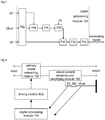
- Fig.17 is a schematic diagram of current equalization control inside a digital processor according to Embodiment 2 of the disclosure. Control as shown in Fig.17 is performed in digital processor 25.
- the analog signals V3' and Vf' are converted to digital signals via an A/D sample converting channel of the digital processor 25.
- the digital signal V3' is then biased to obtain the current equalizing loop error.
- the current equalizing loop output is obtained by PI regulation of the current equalizing loop error.
- a new output voltage reference is obtained by performing digital operation on the current equalizing loop output and the digital output voltage reference.
- the voltage loop error is obtained by performing digital operation on the new output voltage reference and the digital signal Vf'.
- the voltage loop output is obtained via PI regulation of the voltage loop error.
- the modulating signal is produced by processing the voltage loop output.
- the driving signal is produced after the modulating signal output by the digital processor 25 passes through the driving circuit 26.
- the driving signal adjusts the output voltage by regulating the working state of the primary power changing circuit 27 to achieve output current equalization. For example, when V2 of a module is less than Vbus, i.e., the output current of the module is less than the average current.
- the output V3 of the current equalization controller 13 increases.
- the output voltage reference increases with a positive current equalizing loop output in the digital processor 25. Then, the output voltage of the module increases, increasing the output current of the module, thereby achieving current equalization. And vice versa.
- FIG.13 current equalization is performed for the analog power supply 1301 and the digital power supply 1302 in parallel.
- the digital power supply 1302 may include no analog current equalization controller.
- a block diagram of a current equalizing circuit in the analog power supply 1301 is as shown in Fig.14 .
- a block diagram of a current equalizing circuit in the digital power supply 1302 is as shown in Fig.16 .
- Vbus may be obtained from a current equalizing bus, which is connected, via a resistor R0, to amplified signals of output currents of the analog power supply 1301 and the digital power supply 1302.
- Vbus reflects the average of output currents of the analog power supply 1301 and the digital power supply 1302.
- a voltage signal V2 is obtained after the output current I0 passes through the output current sampling 31 circuit and the current sample amplifying 32 circuit.
- V2 reflects the size of the output current of a local power supple module.
- the output voltage feedback signal Vf is obtained after the output voltage passes though the output voltage feedback 34 circuit.
- V2, Vbus and Vf pass through the corresponding digital processor peripheral circuit 33 to obtain analog signals V2', Vbus', and Vf' that are ready for A/D conversion and sampling operation by the digital processor 35.
- Fig.18 is a schematic diagram of current equalization control inside a digital processor according to Embodiment 3 of the disclosure. Control as shown in Fig.18 is performed in digital processor 35.
- the analog signals V2', Vbus', and Vf' are converted to digital signals via an A/D sample converting channel of the digital processor 35.
- the current equalizing loop error is obtained via digital operation of the digital signals V2' and Vbus'.
- the current equalizing loop output is obtained by PI regulation of the current equalizing loop error.
- a new output voltage reference is obtained by performing digital operation on the current equalizing loop output and the digital output voltage reference.
- the voltage loop error is obtained by performing digital operation on the new output voltage reference and the digital signal Vf'.
- the voltage loop output is obtained via PI regulation of the voltage loop error.
- the modulating signal is produced by processing the voltage loop output.
- the driving signal is produced after the modulating signal output by the digital processor 35 passes through the driving circuit 36.
- the driving signal adjusts the output voltage by regulating the working state of the primary power changing circuit 37 to achieve output current equalization. For example, when V2 of a module is less than Vbus, i.e., the output current of the module is less than the average current.
- the current equalizing loop error in the digital processor 35 is positive.
- the current equalizing loop output after PI regulation is positive, increasing the output voltage reference. Then, the output voltage of the module increases, increasing the output current of the module, thereby achieving current equalization. And vice versa.
- Embodiment 2 and Embodiment 3 are described with an example of current equalization of two power supplies.
- the design of current equalization for N modules in parallel is similar.
- the solution provided by an aforementioned embodiment is capable of implementing effective current equalization in case both digital and analog power supplies are inserted in one power supply system.
- the solution is easy to implement, and can enhance reliability of a power supply module and of the entire power supply system.
- modules or steps of the disclosure may be realized using a universal computing device, and may be integrated in a single computing device or distributed in a network formed by multiple computing devices.
- they may be realized using computing device executable program codes, and thus may be stored in a storage device and executed by a computing device.
- the steps may be executed in an order different from that illustrated or described here, or may each be made into an Integrated Circuit module.
- Multiple modules or steps herein may be realized by being made into a single Integrated Circuit module.
- an embodiment of the disclosure is not limited to a specific combination of hardware and software.
Landscapes
- Engineering & Computer Science (AREA)
- Power Engineering (AREA)
- Dc-Dc Converters (AREA)
- Amplifiers (AREA)
- Control Of Voltage And Current In General (AREA)
- Cable Transmission Systems, Equalization Of Radio And Reduction Of Echo (AREA)
Description
- The disclosure relates to the field of communication, and in particular to a digital current equalizer, an analog current equalizer, and a current equalizing method and system.
- To meet a reliability requirement and a power requirement of a load, in a power supply system, a number of power supply modules are often used in parallel by using a distributed system. During parallel use, as power supply modules differ, a current share on each module may differ from one another, leading to difference in current stress and thermal stress on each module, thereby reducing system reliability. To ensure equal currents (uniform current distribution) on multiple power supply modules in the system as well as uniform distribution of the current stress and thermal stress, current equalization has to be supported for power supply modules in parallel connection.
- At present, a switching power supply is experiencing a transition from one with analog control to one with digital control. A digital power supply is efficient and has a high power density. Along with the notion of energy conservation, an efficient digital power supply wins increasing popularity in users. However, in an existing power supply system, complete replacement of any analog power supply by a digital power supply is yet to be achieved. That is, both digital and analog power supplies will be inserted and used in parallel in an existing power supply system. To ensure system and module reliability, current equalization has to be supported too in case both digital and analog power supplies are inserted, which poses a challenge.
- At present, most modes of automatic current equalization control are based on analog-to-analog control or digital-to-digital control. There is a major difference in current equalization for analog power supplies and for digital power supplies. With such differentiated designs, either analog current equalization is adopted, in which case no current equalization can be performed on an inserted digital power supply; or digital current equalization is adopted, in which case no current equalization can be performed on an inserted analog power supply. Thus, no effective current equalization can be implemented in case both digital and analog power supplies are inserted in one power supply system. There is an existing challenge of implementing current equalization in case both digital and analog power supplies are inserted in one power supply system, so as to ensure reliability of a power supply module and of the entire power supply system.
- With differentiated designs for digital current equalization and for analog current equalization in related art, no solution has been proposed for implementing effective current equalization in case both digital and analog power supplies are inserted in one power supply system.
- LIN C ET AL: "Single-wire current-share paralleling of current-mode controlled DC power supplies", POWER ELECTRONICS SPECIALISTS CONFERENCE, 1998. PESC 98 RECORD. 29TH ANNUAL IEEE FUKUOKA, JAPAN 17-22 MAY 1998, NEW YORK, NY, USA, IEEE, US, vol. 1, 17 May 1998 (1998-05-17), pages 52-58, XP010294862, DOI: 10.1109/PESC.1998. 701878 ISBN: 978-0-7803-4489-1 presents a new single-wire autonomous current-share paralleling of current-mode controlled DC power supplies. The proposed control scheme makes use of the nature of fast response of the inner current loop and the share bus injected signal to improve the response of the power system. It reduces the unbalance of current distribution during the transient state and avoids the fault alarm for the current limit. Through the theoretical derivation, the design of the proposed control can be used by the multi-loop control method. A design example of a system of two 400V/48V 20A modules is set up and experimental recordings verify the performance of current sharing.
- According to "lm5080 Modular Current Sharing Controller", 3 October 2011 (2011-10-03), XP055204287, the LM5080 is a simple and cost effective load share controller that provides all functions required to balance the currents delivered from multiple power converters operated in parallel. The LM5080 implements an average program (AP) method of active load share control which adjusts the output voltage of individual power stages either up or down to deliver nearly equal currents to a common load. The average program method improves stability and reduces the output voltage tolerance when compared to other common load sharing methods. The LM5080 supports two common applications for load share controllers: external control in which the load share circuit balances currents between separate power modules (bricks), and internal control where the load share circuit is integrated into the voltage regulation loop of each power converter module or circuit.
-
US 2008/0012742 A1 discloses a control circuit for a multi-phase converter including an analog front-end circuit for receiving and processing an output voltage and current of the converter circuits and an average output current; a digital circuit for producing an output voltage reference for setting a desired output voltage of the converter; and an error circuit for comparing the output voltage reference and a parameter related to said output voltage and current for generating control signals for controlling the converter circuits, said error circuit including an Analog to Digital Converter circuit, further comprising a digital PWM generation circuit controlled by said Analog to Digital converter circuit for generating digital control signals for controlling the converter circuits. - KELLY A ET AL: "Masterless Multirate Control of Parallel DC-DC Converters", APPLIED POWER ELECTRONICS CONFERENCE AND EXPOSITION (APEC), 2010 TWENTY-FIFTH ANNUAL IEEE, IEEE, PISCATAWAY, NJ, USA, 21 February 2010 (2010-02-21), pages 2189-2193, XP031649740, ISBN: 978-1-4244-4782-4 introduces a new masterless multirate control scheme for current share in DC-DC converters. Comprising of a multirate digital controller, decoupling interactions between control loops, a single wire digital communication bus, facilitating simple and reliable communication between devices, and a modular current share architecture. Results show excellent static and dynamic current matching, and have beencommercially proven.
-
US 2006/0239046 A1 provides a converter module for use as a phase in a multiphase DC-DC converter having a data bus for transferring currentsharing information. The converter module comprises a power stage and a controller. The power stage comprises an input for receiving an input voltage and an output for providing an output voltage and an output current. The controller is coupled to the power stage to receive a feedback signal from the power stage. The controller further comprises a data bus port configured to receive the currentsharing information from the data bus and provide updated current-sharing information to the data bus. The controller is also configured to: (1) determine a current level being provided by said power stage, (2) update the current-sharing information based upon the determined current level, (3) determine a current error based upon the determined current level and the updated current-sharing information, (4) control an operation of said power stage based upon the current error, and (5) provide the updated current-sharing information to the data bus. In another embodiment, a multiphase DC-DC power converter comprising a first phase, a second phase, and a data bus is provided. In yet another embodiment, a method of sharing current information between phases of a multiphase DC-DC converter is provided. - According to
US 2010/0188062 A1 , a power supply system includes a unique circuit including an analog summer circuit, an analog-to-digital converter, and a digital controller. An output voltage feedback control loop of the power supply system feeds back the output voltage to the analog sunnner circuit. The analog sunnner circuit generates an analog error voltage signal based on: i) the output voltage received from the output voltage feedback loop, ii) an analog reference voltage signal, and iii) an analog reference voltage adjustment signal. The analog reference voltage adjustment signal varies depending on a magnitude of current provided by the output voltage to the dynamic load. Accordingly, the analog summer circuit can be configured to support adaptive voltage positioning. The analog-to-digital converter converts the analog error voltage signal into a digital error voltage signal. A controller generates output voltage control signal(s) based on the digital error voltage signal. -
CN 1287398A discloses a full-load-range precise current equalizer in a distributed DC power system, including a voltage error amplifier and a current equalizing controller; the current equalizing controller includes: a resistor R9 and a capacitor C3 connected in parallel across a negative imput and an output of an operational amplifier; R10, R11 and a + 5V power supply constituting a bias circuit connected to a positive input of the operational amplifier; and a feedback resistor R9 meeting R10 + R11 = 2R9. -
CN 2750544Y discloses a switch power supply for scheduling a communication system. When a plurality of power supply modules operating in parallel and a local module outputs a current I1 less than an average output current I0, a current equalizing controller outputs a saturate positive Vi, a diode D1 is reverse biased, and Vi has no impact on reference input of a voltage error amplifier A1; only when output current I1 of the local module is larger than the average output current I0, is Vi adjusted downward from the saturate positive output, until diode D1 is forward biased, lowering reference input of the voltage error amplifier A, thereby reducing the output voltage of the local power module, equalizing output currents of the power modules. - Embodiments of the disclosure provide a digital current equalizer, an analog current equalizer, and a current equalizing method and system, capable of implementing effective current equalization in case both digital and analog power supplies are inserted in one power supply system.
- The invention is defined by the features of
independent device claim 1, and the preferable features according to the present invention are defined in the dependent claims. - With embodiments of the disclosure, it is possible to implement effective current equalization in case both digital and analog power supplies are inserted in one power supply system. The solution is easy to implement, and can enhance reliability of a power supply module and of the entire power supply system.
-
-
Fig.1 is a block diagram of a structure of a digital current equalizer according to an embodiment of the disclosure; -
Fig.2 is a block diagram of a first structure of a digital current equalizer according to an embodiment of the disclosure; -
Fig.3 is a block diagram of a second structure of a digital current equalizer according to an embodiment of the disclosure; -
Fig.4 is a block diagram of a first structure of adigital processing module 104 according to an embodiment of the disclosure; -
Fig.5 is a block diagram of a third structure of a digital current equalizer according to an embodiment of the disclosure; -
Fig.6 is a block diagram of a fourth structure of a digital current equalizer according to an embodiment of the disclosure; -
Fig.7 is a block diagram of a second structure of adigital processing module 104 according to an embodiment of the disclosure; -
Fig.8 is a block diagram of a fifth structure of a digital current equalizer according to an embodiment of the disclosure; -
Fig.9 is a block diagram of a sixth structure of a digital current equalizer according to an embodiment of the disclosure; -
Fig.10 is an analog current equalizer according to an embodiment of the disclosure; -
Fig.11 is a block diagram of a structure of a current equalizing system according to an embodiment of the disclosure; -
Fig.12 is a flowchart of a current equalizing method according to an embodiment of the disclosure; -
Fig.13 is a schematic diagram of digital and analog power supplies inserted in parallel according to an embodiment of the disclosure; -
Fig.14 is a block diagram of a current equalizing circuit inside an analog power supply according to an embodiment of the disclosure; -
Fig.15 is a block diagram of a current equalizing circuit with an analog current equalization controller inside a digital power supply according to an embodiment of the disclosure; -
Fig.16 is a block diagram of a current equalizing circuit without any analog current equalization controller inside a digital power supply according to an embodiment of the disclosure; -
Fig.17 is a schematic diagram of current equalization control inside a digital processor according to an Embodiment 2 of the disclosure; and -
Fig.18 is a schematic diagram of current equalization control inside a digital processor according to an Embodiment 3 of the disclosure. - The disclosure is elaborated below with reference to drawings and embodiments. Note that in case of no conflict, embodiments and characteristics thereof in the disclosure may be combined with each other.
- There is a major difference in current equalization for analog power supplies and for digital power supplies. With such differentiated designs, either analog current equalization is adopted, in which case no current equalization can be performed on an inserted digital power supply; or digital current equalization is adopted, in which case no current equalization can be performed on an inserted analog power supply. Thus, no effective current equalization can be implemented in case both digital and analog power supplies are inserted in one power supply system. In view of this, a digital current equalizer is provided in an embodiment.
-
Fig.1 is a block diagram of a structure of a digital current equalizer according to an embodiment of the disclosure. As shown inFig.1 , the digital current equalizer includes an output-current sampling-and-amplifyingmodule 102, adigital processing module 104, and a primarypower converting module 106. An input terminal of the output-current sampling-and-amplifyingmodule 102 may be connected to an output loop of a power supply. An output terminal of the output-current sampling-and-amplifyingmodule 102 may be connected, via a resistor R0, to a current equalizing bus. Thedigital processing module 104 may be configured for: adjusting, according to a difference between an output voltage signal V2 of the output-current sampling-and-amplifyingmodule 102 and a voltage signal Vbus of the current equalizing bus, an output voltage reference signal Vr; and controlling, according to the adjusted output voltage reference signal Vr', the primarypower converting module 106 to perform voltage adjustment. - With the digital current equalizer, current equalization for a digital power supply may be implemented. In addition, with a processing basis same as that for analog current equalization, the digital current equalizer also applies to digital current equalization in case both digital and analog power supplies are inserted in one power supply system. The digital current equalizer is easy to implement and may implement current equalization in case both digital and analog power supplies are inserted in one power supply system, thereby enhancing reliability of a power supply module and of the entire power supply system.
-
Fig.2 is a block diagram of a first structure of a digital current equalizer according to an embodiment of the disclosure. As shown inFig.2 , the digital current equalizer may further include a currentequalization controlling module 202. A first input terminal of the currentequalization controlling module 202 may be connected to the output voltage signal V2 of the output-current sampling-and-amplifyingmodule 102. A second input terminal of the currentequalization controlling module 202 may be connected to the voltage signal Vbus of the current equalizing bus. An output terminal of the currentequalization controlling module 202 may be connected to thedigital processing module 104. The currentequalization controlling module 202 may be configured for outputting a voltage signal V3 that can represent the difference between the output voltage signal V2 of the output-current sampling-and-amplifyingmodule 102 and the voltage signal Vbus of the current equalizing bus. Thedigital processing module 104 may be configured for: adjusting, according to the voltage signal V3 output by the currentequalization controlling module 202, the output voltage reference signal Vr; and controlling, according to the adjusted output voltage reference signal Vr', the primarypower converting module 106 to perform voltage adjustment. - The current
equalization controlling module 202 may generate the current equalizing signal V3 via an analog circuit. The currentequalization controlling module 202 may be implemented by an analog current equalization controller circuit or an operation amplifier circuit. Thedigital processing module 104 may adjust the output of a digital power supply by adjusting the output voltage reference signal according to the output signal of the currentequalization controlling module 202 to achieve current equalization. - To facilitate signal processing by the
digital processing module 104, a digital processing peripheral module may be added to perform pre-conversion on an input of thedigital processing module 104.Fig.3 is a block diagram of a second structure of a digital current equalizer according to an embodiment of the disclosure. As shown inFig.3 , the digital current equalizer may further include a digital processingperipheral module 302 and an outputvoltage feedback module 304. The output of the outputvoltage feedback module 304 and the output of the currentequalization controlling module 202 may be connected to thedigital processing module 104 via the digital processingperipheral module 302. The outputvoltage feedback module 304 may be configured for obtaining an output voltage feedback signal Vf according to an actual output voltage V0 of the power supply. The digital processingperipheral module 302 may be configured for converting the voltage signal V3 output by the currentequalization controlling module 202 and the output voltage feedback signal Vf output by the outputvoltage feedback module 304 respectively to signals V3' and Vf' prepared for an analog to digital conversion and sampling operation by thedigital processing module 104. Thedigital processing module 104 may be configured for: adjusting the output voltage reference signal Vr according to the signal V3' obtained after converting the voltage signal V3 by the digital processingperipheral module 302; and controlling the primarypower converting module 106 to perform voltage adjustment according to the signal Vf' obtained after converting the output voltage feedback signal Vf by the digital processingperipheral module 302 and according to the adjusted output voltage reference signal Vr'. -
Fig.4 is a block diagram of a first structure of adigital processing module 104 according to an embodiment of the disclosure. As shown inFig.4 , thedigital processing module 104 may include a first A/Dsample converting channel 402, abiasing module 404, a firstPI regulation module 406, a firstdigital operation module 408, a second digital operation module 410, a second PI regulation module 412, and a first modulatingsignal producing module 414. The first A/Dsample converting channel 402 may be configured for converting the signals V3' and Vf' (obtained after conversion by the digital processing peripheral module 302) respectively to digital signals V3' and Vf'. Thebiasing module 404 may be configured for biasing the digital signal V3' to obtain a current equalizing loop error. The firstPI regulation module 406 may be configured for performing PI regulation on the current equalizing loop error to obtain a current equalizing loop output. The firstdigital operation module 408 may be configured for performing digital operation on digital output voltage reference signal Vr and the current equalizing loop output to obtain the adjusted output voltage reference signal Vr'. The digital operation may be weighted addition in case that a backward input terminal of the currentequalization controlling module 202 is connected to the output voltage signal V2 of the output-current sampling-and-amplifyingmodule 102 and a forward input terminal of the currentequalization controlling module 202 is connected to the voltage signal Vbus of the current equalizing bus. The digital operation may be weighted subtraction with the digital output voltage reference signal Vr as a minuend and the current equalizing loop output as a subtrahend in case that a forward input terminal of the currentequalization controlling module 202 is connected to the output voltage signal V2 of the output-current sampling-and-amplifyingmodule 102 and a backward input terminal of the currentequalization controlling module 202 is connected to the voltage signal Vbus of the current equalizing bus. The second digital operation module 410 may be configured for performing digital operation on the adjusted output voltage reference signal Vr' and the digital signal Vf' obtained after conversion to obtain a voltage loop error. The digital operation may be weighted subtraction with the Vr' as a minuend and the digital signal Vf' as a subtrahend. The second PI regulation module 412 may be configured for performing PI regulation on the voltage loop error to obtain a voltage loop output. The first modulatingsignal producing module 414 may be configured for producing, according to the voltage loop output, a modulating signal. -
Fig.5 is a block diagram of a third structure of a digital current equalizer according to an embodiment of the disclosure. As shown inFig.5 , the output of the output-current sampling-and-amplifyingmodule 102 and the current equalizing bus may be connected to thedigital processing module 104. Thedigital processing module 104 may determine the difference between the output voltage signal V2 of the output-current sampling-and-amplifyingmodule 102 and the voltage signal Vbus of the current equalizing bus to adjust the output voltage reference signal Vr and adjust the output of a digital power supply to achieve current equalization. - To facilitate signal processing by the
digital processing module 104, a digital processing peripheral module may be added to perform pre-conversion on an input of thedigital processing module 104.Fig.6 is a block diagram of a fourth structure of a digital current equalizer according to an embodiment of the disclosure. As shown inFig.6 , the digital current equalizer may further include a digital processing peripheral module 602 and an outputvoltage feedback module 604. An output terminal of the outputvoltage feedback module 604, the output terminal of the output-current sampling-and-amplifyingmodule 102, and an output terminal of the current equalizing bus may be connected to thedigital processing module 104 via the digital processing peripheral module 602. The outputvoltage feedback module 604 may be configured for obtaining an output voltage feedback signal Vf according to an actual output voltage V0 of the power supply. The digital processing peripheral module 602 may be configured for converting the output voltage signal V2 of the output-current sampling-and-amplifyingmodule 102, the voltage signal Vbus of the current equalizing bus, and the output voltage feedback signal Vf output by the outputvoltage feedback module 604 respectively to signals V2', Vbus', and Vf' prepared for an analog to digital conversion and sampling operation by thedigital processing module 104. Thedigital processing module 104 may be configured for: adjusting the output voltage reference signal Vr according to the signal V2' obtained after converting the output voltage signal V2 by the digital processing peripheral module 602 and the signal Vbus' obtained after converting the voltage signal Vbus by the digital processing peripheral module 602; and controlling the primarypower converting module 106 to perform voltage adjustment according to the signal Vf' obtained after converting the output voltage feedback signal Vf by the digital processing peripheral module 602 and according to the adjusted output voltage reference signal Vr'. -
Fig.7 is a block diagram of a second structure of adigital processing module 104 according to an embodiment of the disclosure. As shown inFig.7 , thedigital processing module 104 may include a second A/Dsample converting channel 702, a thirddigital operation module 704, a thirdPI regulation module 706, a fourthdigital operation module 708, a fifthdigital operation module 710, a fourthPI regulation module 712, and a second modulatingsignal producing module 714. The second A/Dsample converting channel 702 may be configured for converting the signals V2', Vbus', and Vf' obtained after conversion by the digital processing peripheral module 602 respectively to digital signals V2', Vbus', and Vf'. The thirddigital operation module 704 may be configured for performing digital operation on the digital signals V2' and Vbus' to obtain a current equalizing loop error. The digital operation may be weighted subtraction with the digital signal V2' as a minuend and the digital signal Vbus' as a subtrahend, or with the digital signal Vbus' as a minuend and the digital signal V2' as a subtrahend. The thirdPI regulation module 706 may be configured for performing PI regulation on the current equalizing loop error to obtain a current equalizing loop output. The fourthdigital operation module 708 may be configured for performing digital operation on the current equalizing loop output and the digital output voltage reference signal Vr to obtain the adjusted output voltage reference signal Vr'. The digital operation may be weighted subtraction with the digital output voltage reference signal Vr as a minuend and the current equalizing loop output as a subtrahend in case that the digital signal V2' serves as the minuend and the digital signal Vbus' serves as the subtrahend. The digital operation may be weighted addition in case that the digital signal Vbus' serves as the minuend and the digital signal V2' serves as the subtrahend. The fifthdigital operation module 710 may be configured for performing digital operation on the adjusted output voltage reference signal Vr' and the digital signal Vf' obtained after conversion to obtain a voltage loop error. The digital operation may be weighted subtraction with the Vr' as a minuend and the digital signal Vf' as a subtrahend. The fourthPI regulation module 712 may be configured for performing PI regulation on the voltage loop error to obtain a voltage loop output. The second modulatingsignal producing module 714 may be configured for producing, according to the voltage loop output, a modulating signal. -
Fig.8 is a block diagram of a fifth structure of a digital current equalizer according to an embodiment of the disclosure. As shown inFig.8 , the digital current equalizer may further include adriving module 802 configured for producing a driving signal under the control of thedigital processing module 104. The primarypower converting module 106 may be configured for performing voltage adjustment according to the driving signal. -
Fig.9 is a block diagram of a sixth structure of a digital current equalizer according to an embodiment of the disclosure. As shown inFig.9 , the output-current sampling-and-amplifyingmodule 102 may include an outputcurrent sampling module 902 and a currentsample amplifying module 904. The outputcurrent sampling module 902 may be connected to a positive terminal of the output loop or a negative terminal of the output loop. An output signal of the outputcurrent sampling module 902 may serve as an input signal of the currentsample amplifying module 904. An output terminal of the currentsample amplifying module 904 may be connected to the current equalizing bus via the resistor R0. - Note that the output-current sampling-and-amplifying
module 102, the primarypower converting module 106, the currentequalization controlling module 202, the digital processingperipheral module 302, the outputvoltage feedback module 304, the digital processing peripheral module 602, the outputvoltage feedback module 604, thedriving module 802, the outputcurrent sampling module 902 and the currentsample amplifying module 904 may all be implemented by circuits. Thedigital processing module 104 may be implemented by a digital processor. Any module inside thedigital processing module 104 may be implemented by running relevant codes inside thedigital processing module 104. - Embodiments of the disclosure further provide an analog current equalizer, which may be configured in an analog power supply to implement current equalization.
Fig.10 is an analog current equalizer according to an embodiment of the disclosure. As shown inFig.10 , the analog current equalizer may include an output-current sampling-and-amplifying module 1002, a currentequalization controlling module 1004, anadjusting module 1006, a voltageerror amplifying module 1008, and a primary power converting module 1010. An input terminal of the output-current sampling-and-amplifying module 1002 may be connected to an output loop of an analog power supply. An output terminal of the output-current sampling-and-amplifying module 1002 may be connected to a current equalizing bus via a resistor R0. A first input terminal of the currentequalization controlling module 1004 may be connected to an output voltage signal V2 of the output-current sampling-and-amplifying module 1002. A second input terminal of the currentequalization controlling module 1004 may be connected to a voltage signal Vbus of the current equalizing bus. The currentequalization controlling module 1004 may be configured for outputting a voltage signal V3 that can represent a difference between the output voltage signal V2 of the output-current sampling-and-amplifying module and the voltage signal Vbus of the current equalizing bus. Theadjusting module 1006 may be configured for adjusting an output voltage reference signal Vr according to the voltage signal V3. An opposite-phase input terminal of the voltageerror amplifying module 1008 may be connected to the output voltage feedback signal Vf. A same-phase input terminal of the voltage error amplifying module1008 may be connected to an adjusted output voltage reference signal Vr' output by theadjusting module 1006. The voltageerror amplifying module 1008 may be configured for controlling the primary power converting module 1010 to perform voltage adjustment according to the adjusted output voltage reference signal Vr' and the output voltage feedback signal Vf. - With the analog current equalizer, current equalization of a power supply may be implemented. In addition, the analog current equalizer uses a basis for controlling current equalization same as that used by the digital current equalizer. Therefore, in case both digital and analog power supplies are inserted in one power supply system, an analog power supply configured with an analog current equalizer and a digital power supply configured with a digital current equalizer may work effectively at the same time. Thus, in case both digital and analog power supplies are inserted in one power supply system, control of current equalization for both analog and digital power supplies can be implemented at the same time, implementing current equalization in this case and enhancing reliability of a power supply module and of the entire power supply system.
- In an analog current equalizer, the output-current sampling-and-amplifying module 1002 also may include an output current sampling module and a current sample amplifying module. The output current sampling module may be connected to a positive terminal of the output loop or a negative terminal of the output loop. An output signal of the output current sampling module may serve as an input signal of the current sample amplifying module. An output terminal of the current sample amplifying module may be connected to the current equalizing bus via the resistor R0.
- Furthermore, an analog current equalizer also may include a driving module configured for producing a driving signal under the control of the
digital processing module 1004. The primarypower converting module 1006 may be configured for performing voltage adjustment according to the driving signal. - Note that the output-current sampling-and-amplifying module 1002, the current
equalization controlling module 1004, theadjusting module 1006, the voltageerror amplifying module 1008, the primary power converting module 1010, the driving module, the output current sampling module, and the current sample amplifying module may all be implemented by circuits. - Embodiments of the disclosure further provide a current equalizing system.
Fig.11 is a block diagram of a structure of a current equalizing system according to an embodiment of the disclosure. As shown inFig.11 , the system may include one or more analog power supplies and one or more digital power supplies. Outputs of such power supplies may be connected in parallel. Current equalizing buses of such power supplies may be connected to each other. Such a digital power supply may include an aforementioned digital current equalizer. Such an analog power supply may include an aforementioned analog current equalizer. -
Fig.12 is a flowchart of a current equalizing method according to an embodiment of the disclosure. As shown inFig.12 , the method may include steps as follows. - In step S1202, an output voltage reference signal Vr is adjusted according to a difference between an output voltage signal V2 of an output-current sampling-and-amplifying module and a voltage signal Vbus of a current equalizing bus. An input terminal of the output-current sampling-and-amplifying module is connected to an output loop of a power supply. An output terminal of the output-current sampling-and-amplifying module is connected, via a resistor R0, to the current equalizing bus.
- In step S1204, voltage adjustment is performed on a power supply according to the adjusted output voltage reference signal Vr'.
- With the method, it is possible to implement control of current equalization for both analog and digital power supplies. The method may include, but is not limited to, an application in a case with both digital and analog power supplies inserted in one power supply system. It is possible to implement control of current equalization for both analog and digital power supplies at the same time, implementing current equalization in case both digital and analog power supplies are inserted in one power supply system and enhancing reliability of a power supply module and of the entire power supply system.
- The constitution and principle of a current equalizing solution provided by the disclosure is elaborated below with embodiments.
- The embodiment provides an automatic current equalizer for digital and analog hybrid control. By automatic current equalization, current equalization can be implemented in case both digital and analog power supplies are inserted in one power supply system.
Fig.13 is a schematic diagram of digital and analog power supplies inserted in parallel according to an embodiment of the disclosure. As shown inFig.13 , multiple power supply modules are used in parallel. For simplicity, only two power supply modules are shown inFig.13 . Apower supply module 1301 is analog. Apower supply module 1302 is digital. The omission mark denotes any other power supply module not shown. In case both digital and analog power supplies are inserted in one power supply system, outputs of the power supply modules are directly connected in parallel, and external current equalizing buses of the power supply modules are also directly connected to each other. - The automatic current equalizer may include a current equalizing circuit inside an analog power supply and a current equalizing circuit inside a digital power supply.
-
Fig.14 is a block diagram of a current equalizing circuit inside an analog power supply according to an embodiment of the disclosure. As shown inFig.14 , in the automatic current equalizer, a current equalizing circuit inside an analog power supply may include an outputcurrent sampling circuit 11, an outputcurrent amplifying circuit 12, a currentequalization controller circuit 13, a voltageerror amplifying circuit 15, an outputvoltage feedback circuit 14, a signal producing and drivingunit circuit 16 for converting an error voltage output by the voltage error amplifying circuit into a driving signal, and a primarypower changing circuit 17. The outputcurrent sampling circuit 11 may be located on an output loop. The output signal of the outputcurrent sampling circuit 11 may serve as an input signal of the currentsample amplifying circuit 12. An output signal of the currentsample amplifying circuit 12 may be connected to a current equalizing bus via a resistor R0. A first input terminal of thecurrent equalization controller 13 may be connected to the output signal of the currentsample amplifying circuit 12. A second input terminal of thecurrent equalization controller 13 may be connected to the voltage signal of the current equalizing bus. The output voltage reference after current equalization may be obtained via analog circuit operation of the output signal of thecurrent equalization controller 13 and an output voltage reference signal. The output voltage feedback signal may be obtained from an actual output voltage via the outputvoltage feedback circuit 14. The output voltage feedback signal may serve as an opposite-phase input of thevoltage error amplifier 15. The output voltage reference after current equalization may serve as a same-phase input of thevoltage error amplifier 15. A driving signal may be obtained from an output signal of the voltage error amplifier via the signal producing and drivingunit circuit 16. Finally, a relevant power device in the primarypower changing circuit 17 may be driven by the driving signal. - There may be two processing modes inside a digital power supply in the automatic current equalizer, that is, one with an analog current equalization controlling circuit, the other without any analog current equalization controlling circuit.
-
Fig.15 is a block diagram of a current equalizing circuit with an analog current equalization controller inside a digital power supply according to an embodiment of the disclosure. As shown inFig.15 , the current equalizing circuit inside the digital power supply with an analog current equalization controlling circuit may include an outputcurrent sampling circuit 21, an outputcurrent amplifying circuit 22, an outputvoltage feedback circuit 24, a currentequalization controller circuit 28, a digital processorperipheral circuit 23, adigital processor 25, a drivingcircuit 26, and a primarypower changing circuit 27. The outputcurrent sampling circuit 21 may be located on an output loop. An output signal of the outputcurrent sampling circuit 21 may serve as an input signal of the currentsample amplifying circuit 22. An output signal of the currentsample amplifying circuit 22 may be connected to a current equalizing bus via a resistor R0. A first input terminal of thecurrent equalization controller 28 may be connected to the output signal of the currentsample amplifying circuit 22. A second input terminal of thecurrent equalization controller 28 may be connected to the voltage signal of the current equalizing bus. An output voltage feedback signal may be obtained from an actual output voltage via the outputvoltage feedback circuit 24. An output of thecurrent equalization controller 28 and the output voltage feedback signal may be sent to thedigital processor 25 via the digital processorperipheral circuit 23. Thedigital processor 25 may output a modulating signal by performing sampling and related operation on the two signals. The modulating signal may produce a driving signal via the drivingcircuit 26. Finally, the driving signal may drive a relevant power device in the primarypower changing circuit 27. -
Fig.16 is a block diagram of a current equalizing circuit without any analog current equalization controller inside a digital power supply according to an embodiment of the disclosure. As shown inFig.16 , in the automatic current equalizer, the current equalizing circuit inside the digital power supply without any analog current equalization controlling circuit may include an outputcurrent sampling circuit 31, an outputcurrent amplifying circuit 32, an outputvoltage feedback circuit 34, a digital processorperipheral circuit 33, adigital processor 35, a drivingcircuit 36, and a primarypower changing circuit 37. The outputcurrent sampling circuit 31 may be located on an output loop. An output signal of the outputcurrent sampling circuit 31 may serve as an input signal of the currentsample amplifying circuit 32. An output signal of the currentsample amplifying circuit 32 may be connected to a current equalizing bus via a resistor R0. An output voltage feedback signal may be obtained from an actual output voltage via the outputvoltage feedback circuit 34. The output signal of the currentsample amplifying circuit 32, the voltage signal of the current equalizing bus and the output voltage feedback signal may be sent to thedigital processor 35 via the digital processorperipheral circuit 33. Thedigital processor 35 may output a modulating signal by performing sampling and related operation on the three signals. The modulating signal may produce a driving signal via the drivingcircuit 36. Finally, the driving signal may drive a relevant power device in the primarypower changing circuit 37. - Here, in case of digital and analog power supplies inserted in parallel, the voltage Vbus of the current equalizing bus reflects the average of the voltage signal V2 obtained after output currents of power supply modules are processed by the output current sampling circuit and the current sample amplifying circuit; i.e., Vbus reflects the average of currents output by the modules. When currents output by the modules differ from each other, V2 of the modules are not the same; i.e., a V2 differs from Vbus. In an analog power supply, the output of the
current equalization controller 13 will adjust the same-phase input terminal of thevoltage error amplifier 15 to output a voltage reference. Finally, the output current of a module may be regulated by adjusting the output voltage of the module. In a digital power supply with an analog current equalization controller, the output of thecurrent equalization controller 28 may adjust the output voltage reference in thedigital processor 25. Finally, the output current of a module may be regulated by adjusting the output voltage of the module. In a digital power supply without any analog current equalization controller, the output voltage reference may be adjusted by obtaining a difference between V2 and Vbus via digital operation in thedigital processor 35. Finally, the output current of a module may be regulated by adjusting the output voltage of the module. When current equalization is achieved in the modules, the output voltage reference of each module is no longer adjusted. The output voltage remains the same, such that current equalization among the modules is maintained. - The embodiment may in general apply to a power supply system of multiple power supplies in parallel, in particular to a power supply system with digital and analog power supplies inserted in parallel. Here, a power supply module may include, but is not limited to, a switching power supply; a power supply system may include, but is not limited to, a communication power supply system.
- Furthermore, an output current sampling circuit discussed here may be located at the positive terminal or the negative terminal of the output loop.
- A current sampling device in an output current sampling circuit discussed here may include, but is not limited to, a bi-terminal shunt, a quadri-terminal shunt, a current transformer, a current sensor, or the like.
- A current equalization controller circuit discussed here may include, but is not limited to, a dedicated analog current equalization controller circuit or an operation amplifier circuit.
- The embodiment is easy to implement and may implement current equalization in case both digital and analog power supplies are inserted in one power supply system, enhancing reliability of a power supply module and of the entire power supply system.
- As shown in
Fig.13 , current equalization is performed for theanalog power supply 1301 and thedigital power supply 1302 in parallel. Thedigital power supply 1302 may include an analog current equalization controller. A block diagram of a current equalizing circuit in theanalog power supply 1301 is as shown inFig.14 . A block diagram of a current equalizing circuit in thedigital power supply 1302 is as shown inFig.15 . - Vbus may be obtained from a current equalizing bus, which is connected, via a resistor R0, to amplified signals of output currents of the
analog power supply 1301 and thedigital power supply 1302. Vbus reflects the average of output currents of theanalog power supply 1301 and thedigital power supply 1302. - As shown in
Fig.14 , in an analog power supply, a voltage signal V2 is obtained after an output current I0 passes through an outputcurrent sampling circuit 11 and a currentsampling amplifying circuit 12. V2 reflects the size of the output current of a local power supple module, and serves as a first input of thecurrent equalization controller 13. Vbus reflects the average of output currents of the two power supplies, and serves as a second input of thecurrent equalization controller 13. V3 is the output of thecurrent equalization controller 13. V3 affects output voltage reference Vr, and further affects a new output voltage reference Vr' obtained via analog circuit operation of V3 and Vr. Vr' serves as a same-phase input of thevoltage error amplifier 15 of the voltage error amplifying module terminal. Vr' and the terminal output voltage feedback Vf (an opposite-phase input of the voltage error amplifier 15) again affect the output Ve of thevoltage error amplifier 15. Ve alters the driving signal via signal producing and drivingunit circuit 16. Finally, an output voltage is adjusted by regulating the working state of the primarypower changing circuit 17 to achieve output current equalization. For example, when V2 of a module is less than Vbus, i.e., the output current of the module is less than the average current. The output V3 of thecurrent equalization controller 13 increases. The output voltage reference increases accordingly. Then, the output voltage of the module increases, increasing the output current of the module, thereby achieving current equalization. Vice versa (when V2 is greater than Vbus). - As shown in
Fig.15 , in a digital power supply with an analogcurrent equalization controller 28 circuit, a voltage signal V2 is obtained after the output current I0 passes through the outputcurrent sampling 21 circuit and the current sample amplifying 22 circuit. V2 reflects the size of the output current of a local power supple module, and serves as a first input of thecurrent equalization controller 28. Vbus reflects the average of output currents of the two power supplies, and serves as a second input of thecurrent equalization controller 28. V3 is the output of thecurrent equalization controller 28. Vf is the output voltage feedback signal obtained after the actual output voltage V0 passes though theoutput voltage feedback 24 circuit. V3 and Vf pass through the digital processorperipheral circuit 23 to obtain analog signals V3' and Vf' that are ready for A/D conversion and sampling operation by thedigital processor 25. -
Fig.17 is a schematic diagram of current equalization control inside a digital processor according to Embodiment 2 of the disclosure. Control as shown inFig.17 is performed indigital processor 25. The analog signals V3' and Vf' are converted to digital signals via an A/D sample converting channel of thedigital processor 25. The digital signal V3' is then biased to obtain the current equalizing loop error. The current equalizing loop output is obtained by PI regulation of the current equalizing loop error. A new output voltage reference is obtained by performing digital operation on the current equalizing loop output and the digital output voltage reference. The voltage loop error is obtained by performing digital operation on the new output voltage reference and the digital signal Vf'. The voltage loop output is obtained via PI regulation of the voltage loop error. The modulating signal is produced by processing the voltage loop output. The driving signal is produced after the modulating signal output by thedigital processor 25 passes through the drivingcircuit 26. The driving signal adjusts the output voltage by regulating the working state of the primarypower changing circuit 27 to achieve output current equalization. For example, when V2 of a module is less than Vbus, i.e., the output current of the module is less than the average current. The output V3 of thecurrent equalization controller 13 increases. The output voltage reference increases with a positive current equalizing loop output in thedigital processor 25. Then, the output voltage of the module increases, increasing the output current of the module, thereby achieving current equalization. And vice versa. - As shown in
Fig.13 , current equalization is performed for theanalog power supply 1301 and thedigital power supply 1302 in parallel. Thedigital power supply 1302 may include no analog current equalization controller. A block diagram of a current equalizing circuit in theanalog power supply 1301 is as shown inFig.14 . A block diagram of a current equalizing circuit in thedigital power supply 1302 is as shown inFig.16 . - Vbus may be obtained from a current equalizing bus, which is connected, via a resistor R0, to amplified signals of output currents of the
analog power supply 1301 and thedigital power supply 1302. Vbus reflects the average of output currents of theanalog power supply 1301 and thedigital power supply 1302. - The mechanism of regulating current equalization in an analog power supply is the same as in Embodiment 2, and therefore is not repeated.
- As shown in
Fig.16 , in a digital power supply without any analog current equalization controller circuit, a voltage signal V2 is obtained after the output current I0 passes through the outputcurrent sampling 31 circuit and the current sample amplifying 32 circuit. V2 reflects the size of the output current of a local power supple module. The output voltage feedback signal Vf is obtained after the output voltage passes though theoutput voltage feedback 34 circuit. V2, Vbus and Vf pass through the corresponding digital processorperipheral circuit 33 to obtain analog signals V2', Vbus', and Vf' that are ready for A/D conversion and sampling operation by thedigital processor 35. -
Fig.18 is a schematic diagram of current equalization control inside a digital processor according to Embodiment 3 of the disclosure. Control as shown inFig.18 is performed indigital processor 35. The analog signals V2', Vbus', and Vf' are converted to digital signals via an A/D sample converting channel of thedigital processor 35. The current equalizing loop error is obtained via digital operation of the digital signals V2' and Vbus'. The current equalizing loop output is obtained by PI regulation of the current equalizing loop error. A new output voltage reference is obtained by performing digital operation on the current equalizing loop output and the digital output voltage reference. The voltage loop error is obtained by performing digital operation on the new output voltage reference and the digital signal Vf'. The voltage loop output is obtained via PI regulation of the voltage loop error. The modulating signal is produced by processing the voltage loop output. The driving signal is produced after the modulating signal output by thedigital processor 35 passes through the drivingcircuit 36. The driving signal adjusts the output voltage by regulating the working state of the primarypower changing circuit 37 to achieve output current equalization. For example, when V2 of a module is less than Vbus, i.e., the output current of the module is less than the average current. The current equalizing loop error in thedigital processor 35 is positive. The current equalizing loop output after PI regulation is positive, increasing the output voltage reference. Then, the output voltage of the module increases, increasing the output current of the module, thereby achieving current equalization. And vice versa. - Embodiment 2 and Embodiment 3 are described with an example of current equalization of two power supplies. The design of current equalization for N modules in parallel is similar.
- It thus may be seen that the solution provided by an aforementioned embodiment is capable of implementing effective current equalization in case both digital and analog power supplies are inserted in one power supply system. The solution is easy to implement, and can enhance reliability of a power supply module and of the entire power supply system.
- Clearly, those skilled in the art will know that modules or steps of the disclosure may be realized using a universal computing device, and may be integrated in a single computing device or distributed in a network formed by multiple computing devices. Optionally, they may be realized using computing device executable program codes, and thus may be stored in a storage device and executed by a computing device. In some cases, the steps may be executed in an order different from that illustrated or described here, or may each be made into an Integrated Circuit module. Multiple modules or steps herein may be realized by being made into a single Integrated Circuit module. Thus, an embodiment of the disclosure is not limited to a specific combination of hardware and software.
- What described are merely embodiments of the disclosure, and are not for limiting the disclosure. Variations and modifications are possible within the scope of the appended claims.
Claims (8)
- A digital current equalizer, comprising an output-current sampling-and-amplifying module (102), a digital processing module (104), and a primary power converting module (106), an input terminal of the output-current sampling-and-amplifying module (102) being connected to an output loop of a power supply, and an output terminal of the output-current sampling-and-amplifying module (102) being connected, via a resistor R0, to a current equalizing bus,
the digital current equalizer further comprises a current equalization controlling module (202), a digital processing peripheral module (302) and an output voltage feedback module (304), an output of the output voltage feedback module (304) and an output of the current equalization controlling module (202) being connected, via the digital processing peripheral module (302), to the digital processing module (104), the output voltage feedback module (304) being further configured for obtaining, according to an actual output voltage V0 of the power supply, an output voltage feedback signal Vf; characterized in that:the digital processing peripheral module (302) is configured for converting a voltage signal V3 output by the current equalization controlling module (202) and the output voltage feedback signal Vf output by the output voltage feedback module (304) respectively to signals V3' and Vf' prepared for an analog to digital conversion and sampling operation by the digital processing module (104);the digital processing module (104) is configured for: adjusting, according to the signal V3' obtained after converting the voltage signal V3 by the digital processing peripheral module (302), an output voltage reference signal Vr; and controlling, according to an adjusted output voltage reference signal Vr', the primary power converting module (106), to perform voltage adjustment;wherein the digital processing module (104) comprises:a first A/D sample converting channel (402) configured for converting the signals V3' and Vf' obtained after conversion by the digital processing peripheral module (302) respectively to digital signals V3' and Vf';a biasing module (404) configured for biasing the digital signal V3' to obtain a current equalizing loop error;a first PI regulation module (406) configured for performing PI regulation on the current equalizing loop error to obtain a current equalizing loop output;a first digital operation module (408) configured for performing digital operation on the output voltage reference signal Vr and the current equalizing loop output to obtain the adjusted output voltage reference signal Vr', the digital operation being weighted addition in case that a backward input terminal of the current equalization controlling module (202) is connected to an output voltage signal V2 of the output-current sampling-and-amplifying module (102) and a forward input terminal of the current equalization controlling module (202) is connected to a voltage signal Vbus of the current equalizing bus, or the digital operation being weighted subtraction with the digital output voltage reference signal Vr as a minuend and the current equalizing loop output as a subtrahend in case that a forward input terminal of the current equalization controlling module (202) is connected to the output voltage signal V2 of the output-current sampling-and-amplifying module (102) and a backward input terminal of the current equalization controlling module (202) is connected to the voltage signal Vbus of the current equalizing bus;a second digital operation module (410) configured for performing digital operation on the adjusted output voltage reference signal Vr' and the digital signal Vf' obtained after conversion to obtain a voltage loop error, the digital operation being weighted subtraction with the Vr' as a minuend and the digital signal Vf' as a subtrahend;a second PI regulation module (412) configured for performing PI regulation on the voltage loop error to obtain a voltage loop output; anda first modulating signal producing module (414) configured for producing, according to the voltage loop output, a modulating signal. - The digital current equalizer according to claim 1, wherein a first input terminal of the current equalization controlling module (202) being connected to the output voltage signal V2 of the output-current sampling-and-amplifying module (102), a second input terminal of the current equalization controlling module (202) being connected to the voltage signal Vbus of the current equalizing bus, and an output terminal of the current equalization controlling module (202) being connected to the digital processing module (104), wherein
the current equalization controlling module (202) is configured for outputting the voltage signal V3 representing the difference between the output voltage signal V2 of the output-current sampling-and-amplifying module (102) and the voltage signal Vbus of the current equalizing bus. - The digital current equalizer according to claim 2, wherein the current equalization controlling module (202) comprises one of an analog current equalization controller circuit and an operation amplifier circuit.
- The digital current equalizer according to claim 1, wherein the output terminal of the output-current sampling-and-amplifying module (102) and the current equalizing bus are connected to the digital processing module (104).
- The digital current equalizer according to claim 4, wherein an output terminal of the output voltage feedback module (304), the output terminal of the output-current sampling-and-amplifying module (102), and the output terminal of the current equalizing bus being connected, via the digital processing peripheral module (302), to the digital processing module (104), wherein
the digital processing peripheral module (302) is configured for converting the output voltage signal V2 of the output-current sampling-and-amplifying module (102), the voltage signal Vbus of the current equalizing bus, and the output voltage feedback signal Vf output by the output voltage feedback module (304) respectively to signals V2', Vbus', and Vf' prepared for an analog to digital conversion and sampling operation by the digital processing module (104); and
the digital processing module (104) is configured for: adjusting, according to the signal V2' obtained after converting the output voltage signal V2 by the digital processing peripheral module (302) and the signal Vbus' obtained after converting the voltage signal Vbus by the digital processing peripheral module (302), the output voltage reference signal Vr; and controlling, according to the signal Vf' obtained after converting the output voltage feedback signal Vf by the digital processing peripheral module (302) and the adjusted output voltage reference signal Vr', the primary power converting module (106), to perform voltage adjustment. - The digital current equalizer according to claim 5, wherein the digital processing module (104) comprises:a second A/D sample converting channel (702) configured for converting the signals V2', Vbus', and Vf' obtained after conversion by the digital processing peripheral module (302) respectively to digital signals V2', Vbus', and Vf';a third digital operation module (704) configured for performing digital operation on the digital signals V2' and Vbus' to obtain the current equalizing loop error, the digital operation being weighted subtraction with the digital signal V2' as a minuend and the digital signal Vbus' as a subtrahend, or with the digital signal Vbus' as a minuend and the digital signal V2' as a subtrahend;a third PI regulation module (706) configured for performing PI regulation on the current equalizing loop error to obtain the current equalizing loop output;a fourth digital operation module (708) configured for performing digital operation on the current equalizing loop output and the digital output voltage reference signal Vr to obtain the adjusted output voltage reference signal Vr', the digital operation being weighted subtraction with the digital output voltage reference signal Vr as a minuend and the current equalizing loop output as a subtrahend in case that the digital signal V2' serves as the minuend and the digital signal Vbus' serves as the subtrahend, or the digital operation being weighted addition in case that the digital signal Vbus' serves as the minuend and the digital signal V2' serves as the subtrahend;a fifth digital operation module (710) configured for performing digital operation on the adjusted output voltage reference signal Vr' and the digital signal Vf' obtained after conversion to obtain the voltage loop error, the digital operation being weighted subtraction with the Vr' as a minuend and the digital signal Vf' as a subtrahend;a fourth PI regulation module (712) configured for performing PI regulation on the voltage loop error to obtain the voltage loop output; anda second modulating signal producing module (714) configured for producing, according to the voltage loop output, the modulating signal.
- The digital current equalizer according to any of claims 1-6, further comprising a driving module (802) configured for producing, under the control of the digital processing module (104), a driving signal, wherein
the primary power converting module (106), is configured for performing voltage adjustment according to the driving signal. - The digital current equalizer according to any of claims 1-6, wherein the output-current sampling-and-amplifying module (102) comprises an output current sampling module (902) and a current sample amplifying module (904), the output current sampling module (902) being connected to a positive terminal or a negative terminal of the output loop, an output signal of the output current sampling module (902) serving as an input signal of the current sample amplifying module (904), and an output terminal of the current sample amplifying module (904) being connected, via the resistor R0, to the current equalizing bus.
Applications Claiming Priority (2)
| Application Number | Priority Date | Filing Date | Title |
|---|---|---|---|
| CN201210450994.8A CN103812508B (en) | 2012-11-12 | 2012-11-12 | Current equalization device, method and system |
| PCT/CN2013/077719 WO2013167003A1 (en) | 2012-11-12 | 2013-06-21 | Digital current equalizing device, analog current equalizing device, current equalizing method and system |
Publications (3)
| Publication Number | Publication Date |
|---|---|
| EP2852257A1 EP2852257A1 (en) | 2015-03-25 |
| EP2852257A4 EP2852257A4 (en) | 2015-09-02 |
| EP2852257B1 true EP2852257B1 (en) | 2019-11-13 |
Family
ID=49550156
Family Applications (1)
| Application Number | Title | Priority Date | Filing Date |
|---|---|---|---|
| EP13788423.5A Active EP2852257B1 (en) | 2012-11-12 | 2013-06-21 | Digital current equalizing device, analog current equalizing device, current equalizing method and system |
Country Status (7)
| Country | Link |
|---|---|
| US (1) | US9467041B2 (en) |
| EP (1) | EP2852257B1 (en) |
| JP (1) | JP6125006B2 (en) |
| CN (1) | CN103812508B (en) |
| IN (1) | IN2015DN00001A (en) |
| RU (1) | RU2632820C2 (en) |
| WO (1) | WO2013167003A1 (en) |
Families Citing this family (17)
| Publication number | Priority date | Publication date | Assignee | Title |
|---|---|---|---|---|
| CN103677028B (en) * | 2013-12-19 | 2015-05-27 | 华为技术有限公司 | Digital current equalizing method and power supply module |
| CN204068695U (en) * | 2014-06-13 | 2014-12-31 | 株式会社村田制作所 | Power conversion system |
| CN104600978A (en) * | 2015-01-13 | 2015-05-06 | 艾德克斯电子(南京)有限公司 | Parallel current-sharing device and control method of bus without current sharing |
| CN108964418B (en) * | 2017-05-25 | 2021-08-17 | 中兴通讯股份有限公司 | Voltage sampling circuit and circuit system |
| CN107728694B (en) * | 2017-10-25 | 2020-01-31 | 深圳市华星光电半导体显示技术有限公司 | Power supply device and current equalizing method thereof |
| CN109768693B (en) * | 2017-11-07 | 2022-05-10 | 中兴通讯股份有限公司 | A current sharing control method, device, system and computer readable storage medium |
| CN108808685B (en) * | 2018-03-26 | 2020-12-11 | 北京航天发射技术研究所 | A system and method for digital compensation of power supply voltage |
| CN110542786B (en) * | 2018-05-29 | 2022-04-26 | 中兴通讯股份有限公司 | Current sharing control method, device and equipment and computer readable storage medium |
| CN110429352B (en) * | 2019-07-23 | 2024-07-09 | 广东电网有限责任公司广州供电局 | Constant current balancing module and constant current balancing device |
| WO2021056517A1 (en) * | 2019-09-29 | 2021-04-01 | 天津铁路信号有限责任公司 | Current sharing device and method for power system, and power modules |
| US11258447B2 (en) | 2020-02-20 | 2022-02-22 | Apple Inc. | Integration of analog circuits inside digital blocks |
| CN111555424A (en) * | 2020-04-14 | 2020-08-18 | 科华恒盛股份有限公司 | Slave open-loop control method and master-slave parallel system |
| CN114362541B (en) * | 2021-12-30 | 2023-11-24 | 天水七四九电子有限公司 | High-power module power supply parallel current equalizing circuit and control method |
| JP2024099391A (en) * | 2023-01-12 | 2024-07-25 | オムロン株式会社 | Power conversion device and DC power supply system |
| CN118539399B (en) * | 2024-04-16 | 2025-02-18 | 西安麦格米特电气有限公司 | Power parallel control circuit and method, power management circuit, and electronic equipment |
| CN119045596B (en) * | 2024-10-31 | 2025-02-18 | 深圳市永联科技股份有限公司 | Current control method and current control device |
| CN121332872B (en) * | 2025-12-12 | 2026-03-27 | 苏州元脑智能科技有限公司 | Power supply circuit and biplane redundant power supply system |
Family Cites Families (20)
| Publication number | Priority date | Publication date | Assignee | Title |
|---|---|---|---|---|
| JPH04117134A (en) * | 1990-09-04 | 1992-04-17 | Fujitsu Ltd | Power supply |
| JP3615400B2 (en) * | 1998-09-30 | 2005-02-02 | 品川白煉瓦株式会社 | Unfired carbon-containing refractories and molten metal containers |
| CN1112749C (en) * | 1999-10-27 | 2003-06-25 | 深圳市中兴通讯股份有限公司 | Full-load range precise current-equalizing device |
| JP4489238B2 (en) * | 2000-03-29 | 2010-06-23 | 正行 服部 | Electric motor control device |
| JP2004117134A (en) | 2002-09-26 | 2004-04-15 | Fuji Kiki Kogyo Kk | Method for calculating calibration curve in analyzer |
| US6963186B2 (en) * | 2003-02-28 | 2005-11-08 | Raymond Hobbs | Battery charger and method of charging a battery |
| US6894466B2 (en) * | 2003-02-28 | 2005-05-17 | Astec International Limited | Active current sharing circuit |
| CN100435448C (en) * | 2003-03-03 | 2008-11-19 | 艾斯泰克国际公司 | active current sharing system |
| JP2005086846A (en) | 2003-09-04 | 2005-03-31 | Tdk Corp | Switching power supply |
| CN100553066C (en) * | 2004-05-19 | 2009-10-21 | 力博特公司 | Power system and method for realizing current sharing |
| CN2750544Y (en) * | 2004-12-25 | 2006-01-04 | 潍坊华光通讯有限公司 | Switching power supply of scheduling communication system |
| US7479772B2 (en) * | 2005-02-25 | 2009-01-20 | The Regents Of The University Of Colorado | Active current sharing multiphase DC-DC converter |
| US8067927B2 (en) * | 2006-07-11 | 2011-11-29 | International Rectifier Corporation | Digital PWM controller |
| US7888918B2 (en) * | 2006-08-10 | 2011-02-15 | International Rectifier Corporation | Control circuit for multi-phase converter |
| JP4384161B2 (en) | 2006-10-26 | 2009-12-16 | 株式会社東芝 | Power supply |
| JP2008187850A (en) | 2007-01-31 | 2008-08-14 | Yokogawa Electric Corp | Redundant power supply |
| US7772821B2 (en) * | 2007-06-12 | 2010-08-10 | Analog Devices, Inc. | Digital current share bus interface |
| JP2009142028A (en) | 2007-12-05 | 2009-06-25 | Tdk-Lambda Corp | Parallel power supply system |
| US8816661B2 (en) * | 2009-01-28 | 2014-08-26 | International Rectifier Corporation | Hybrid analog/digital power supply circuit including analog summer circuit to produce an error voltage |
| CN102545899B (en) * | 2012-03-05 | 2014-11-05 | 中达电通股份有限公司 | Current equalization control method for analog power module and digital power module hybrid plug power system |
-
2012
- 2012-11-12 CN CN201210450994.8A patent/CN103812508B/en active Active
-
2013
- 2013-06-21 WO PCT/CN2013/077719 patent/WO2013167003A1/en not_active Ceased
- 2013-06-21 IN IN1DEN2015 patent/IN2015DN00001A/en unknown
- 2013-06-21 EP EP13788423.5A patent/EP2852257B1/en active Active
- 2013-06-21 RU RU2015103946A patent/RU2632820C2/en active
- 2013-06-21 US US14/404,971 patent/US9467041B2/en active Active
- 2013-06-21 JP JP2015520804A patent/JP6125006B2/en active Active
Non-Patent Citations (1)
| Title |
|---|
| None * |
Also Published As
| Publication number | Publication date |
|---|---|
| CN103812508B (en) | 2019-03-15 |
| JP6125006B2 (en) | 2017-05-10 |
| EP2852257A4 (en) | 2015-09-02 |
| EP2852257A1 (en) | 2015-03-25 |
| RU2015103946A (en) | 2017-01-10 |
| JP2015523844A (en) | 2015-08-13 |
| US9467041B2 (en) | 2016-10-11 |
| WO2013167003A1 (en) | 2013-11-14 |
| IN2015DN00001A (en) | 2015-05-22 |
| US20150130426A1 (en) | 2015-05-14 |
| CN103812508A (en) | 2014-05-21 |
| RU2632820C2 (en) | 2017-10-10 |
Similar Documents
| Publication | Publication Date | Title |
|---|---|---|
| US9467041B2 (en) | Digital current equalizing device, analog current equalizing device, current equalizing method and system | |
| TWI479788B (en) | Switching regulator controller and method of controlling switching regulator | |
| US11418117B2 (en) | Single inductor multi-output buck-boost converter and control method thereof | |
| EP2911282B1 (en) | Power source and power source voltage regulating method | |
| EP2019479B1 (en) | A single-desk power supply and a method for providing a power supply | |
| JP5889307B2 (en) | Switched mode power converter apparatus using bridge topology and control method thereof | |
| US11855531B2 (en) | Hybrid power converter | |
| US20090167279A1 (en) | DC Power Converter and Mode-Switching Method | |
| WO2016082395A1 (en) | Power control method and apparatus | |
| EP2596573A2 (en) | Buck switch-mode power converter large signal transient response optimizer | |
| TWI848683B (en) | Control circuit, control method of multiphase power supply, and multiphase power supply | |
| EP4254764A1 (en) | Switching power supply, and control circuit and control method thereof | |
| JP2018033304A (en) | Voltage converting apparatus and method of controlling the same | |
| KR20230125219A (en) | Method for input current regulation and active-power filter with input voltage feedforward and output load feedforward | |
| JP2018014855A (en) | Dc/dc converter, control circuit thereof, and system power supply | |
| US11056964B2 (en) | Power supply device with multiple wide-volt age range outputs and control method thereof | |
| CN105612683A (en) | Voltage regulator with charge pump for generating second voltage source | |
| WO2016192299A1 (en) | Method and circuit for equalizing current by controlling input current | |
| WO2019080303A1 (en) | Power supply device, and current equalization method therefor | |
| KR20160082232A (en) | Feedback scheme for non-isolated power supply | |
| CN110932524A (en) | Controller and Current Balancing Method for Multiphase Power Conversion | |
| TW202301780A (en) | Load balancing architecture for ganging voltage regulators | |
| CN115296538A (en) | Switch integrated circuit, switch power supply system and control method | |
| CN108767967B (en) | Communication equipment, power supply module and processing method thereof | |
| CN218124368U (en) | Multi-module parallel current-sharing control circuit |
Legal Events
| Date | Code | Title | Description |
|---|---|---|---|
| PUAI | Public reference made under article 153(3) epc to a published international application that has entered the european phase |
Free format text: ORIGINAL CODE: 0009012 |
|
| 17P | Request for examination filed |
Effective date: 20141205 |
|
| AK | Designated contracting states |
Kind code of ref document: A1 Designated state(s): AL AT BE BG CH CY CZ DE DK EE ES FI FR GB GR HR HU IE IS IT LI LT LU LV MC MK MT NL NO PL PT RO RS SE SI SK SM TR |
|
| AX | Request for extension of the european patent |
Extension state: BA ME |
|
| RA4 | Supplementary search report drawn up and despatched (corrected) |
Effective date: 20150804 |
|
| RIC1 | Information provided on ipc code assigned before grant |
Ipc: H02J 1/10 20060101ALI20150729BHEP Ipc: H02M 3/158 20060101ALI20150729BHEP Ipc: H02M 3/04 20060101ALI20150729BHEP Ipc: H02M 1/00 20070101ALI20150729BHEP Ipc: H02M 3/157 20060101ALI20150729BHEP Ipc: H05B 37/02 20060101AFI20150729BHEP |
|
| DAX | Request for extension of the european patent (deleted) | ||
| STAA | Information on the status of an ep patent application or granted ep patent |
Free format text: STATUS: EXAMINATION IS IN PROGRESS |
|
| 17Q | First examination report despatched |
Effective date: 20181026 |
|
| GRAP | Despatch of communication of intention to grant a patent |
Free format text: ORIGINAL CODE: EPIDOSNIGR1 |
|
| STAA | Information on the status of an ep patent application or granted ep patent |
Free format text: STATUS: GRANT OF PATENT IS INTENDED |
|
| INTG | Intention to grant announced |
Effective date: 20190606 |
|
| GRAS | Grant fee paid |
Free format text: ORIGINAL CODE: EPIDOSNIGR3 |
|
| GRAA | (expected) grant |
Free format text: ORIGINAL CODE: 0009210 |
|
| STAA | Information on the status of an ep patent application or granted ep patent |
Free format text: STATUS: THE PATENT HAS BEEN GRANTED |
|
| AK | Designated contracting states |
Kind code of ref document: B1 Designated state(s): AL AT BE BG CH CY CZ DE DK EE ES FI FR GB GR HR HU IE IS IT LI LT LU LV MC MK MT NL NO PL PT RO RS SE SI SK SM TR |
|
| REG | Reference to a national code |
Ref country code: CH Ref legal event code: EP Ref country code: AT Ref legal event code: REF Ref document number: 1203073 Country of ref document: AT Kind code of ref document: T Effective date: 20191115 |
|
| REG | Reference to a national code |
Ref country code: DE Ref legal event code: R096 Ref document number: 602013062892 Country of ref document: DE |
|
| REG | Reference to a national code |
Ref country code: IE Ref legal event code: FG4D |
|
| REG | Reference to a national code |
Ref country code: NL Ref legal event code: MP Effective date: 20191113 |
|
| REG | Reference to a national code |
Ref country code: LT Ref legal event code: MG4D |
|
| PG25 | Lapsed in a contracting state [announced via postgrant information from national office to epo] |
Ref country code: LV Free format text: LAPSE BECAUSE OF FAILURE TO SUBMIT A TRANSLATION OF THE DESCRIPTION OR TO PAY THE FEE WITHIN THE PRESCRIBED TIME-LIMIT Effective date: 20191113 Ref country code: SE Free format text: LAPSE BECAUSE OF FAILURE TO SUBMIT A TRANSLATION OF THE DESCRIPTION OR TO PAY THE FEE WITHIN THE PRESCRIBED TIME-LIMIT Effective date: 20191113 Ref country code: ES Free format text: LAPSE BECAUSE OF FAILURE TO SUBMIT A TRANSLATION OF THE DESCRIPTION OR TO PAY THE FEE WITHIN THE PRESCRIBED TIME-LIMIT Effective date: 20191113 Ref country code: PL Free format text: LAPSE BECAUSE OF FAILURE TO SUBMIT A TRANSLATION OF THE DESCRIPTION OR TO PAY THE FEE WITHIN THE PRESCRIBED TIME-LIMIT Effective date: 20191113 Ref country code: LT Free format text: LAPSE BECAUSE OF FAILURE TO SUBMIT A TRANSLATION OF THE DESCRIPTION OR TO PAY THE FEE WITHIN THE PRESCRIBED TIME-LIMIT Effective date: 20191113 Ref country code: NL Free format text: LAPSE BECAUSE OF FAILURE TO SUBMIT A TRANSLATION OF THE DESCRIPTION OR TO PAY THE FEE WITHIN THE PRESCRIBED TIME-LIMIT Effective date: 20191113 Ref country code: GR Free format text: LAPSE BECAUSE OF FAILURE TO SUBMIT A TRANSLATION OF THE DESCRIPTION OR TO PAY THE FEE WITHIN THE PRESCRIBED TIME-LIMIT Effective date: 20200214 Ref country code: NO Free format text: LAPSE BECAUSE OF FAILURE TO SUBMIT A TRANSLATION OF THE DESCRIPTION OR TO PAY THE FEE WITHIN THE PRESCRIBED TIME-LIMIT Effective date: 20200213 Ref country code: BG Free format text: LAPSE BECAUSE OF FAILURE TO SUBMIT A TRANSLATION OF THE DESCRIPTION OR TO PAY THE FEE WITHIN THE PRESCRIBED TIME-LIMIT Effective date: 20200213 Ref country code: PT Free format text: LAPSE BECAUSE OF FAILURE TO SUBMIT A TRANSLATION OF THE DESCRIPTION OR TO PAY THE FEE WITHIN THE PRESCRIBED TIME-LIMIT Effective date: 20200313 Ref country code: FI Free format text: LAPSE BECAUSE OF FAILURE TO SUBMIT A TRANSLATION OF THE DESCRIPTION OR TO PAY THE FEE WITHIN THE PRESCRIBED TIME-LIMIT Effective date: 20191113 |
|
| PG25 | Lapsed in a contracting state [announced via postgrant information from national office to epo] |
Ref country code: RS Free format text: LAPSE BECAUSE OF FAILURE TO SUBMIT A TRANSLATION OF THE DESCRIPTION OR TO PAY THE FEE WITHIN THE PRESCRIBED TIME-LIMIT Effective date: 20191113 Ref country code: HR Free format text: LAPSE BECAUSE OF FAILURE TO SUBMIT A TRANSLATION OF THE DESCRIPTION OR TO PAY THE FEE WITHIN THE PRESCRIBED TIME-LIMIT Effective date: 20191113 Ref country code: IS Free format text: LAPSE BECAUSE OF FAILURE TO SUBMIT A TRANSLATION OF THE DESCRIPTION OR TO PAY THE FEE WITHIN THE PRESCRIBED TIME-LIMIT Effective date: 20200313 |
|
| PG25 | Lapsed in a contracting state [announced via postgrant information from national office to epo] |
Ref country code: AL Free format text: LAPSE BECAUSE OF FAILURE TO SUBMIT A TRANSLATION OF THE DESCRIPTION OR TO PAY THE FEE WITHIN THE PRESCRIBED TIME-LIMIT Effective date: 20191113 |
|
| PG25 | Lapsed in a contracting state [announced via postgrant information from national office to epo] |
Ref country code: CZ Free format text: LAPSE BECAUSE OF FAILURE TO SUBMIT A TRANSLATION OF THE DESCRIPTION OR TO PAY THE FEE WITHIN THE PRESCRIBED TIME-LIMIT Effective date: 20191113 Ref country code: RO Free format text: LAPSE BECAUSE OF FAILURE TO SUBMIT A TRANSLATION OF THE DESCRIPTION OR TO PAY THE FEE WITHIN THE PRESCRIBED TIME-LIMIT Effective date: 20191113 Ref country code: DK Free format text: LAPSE BECAUSE OF FAILURE TO SUBMIT A TRANSLATION OF THE DESCRIPTION OR TO PAY THE FEE WITHIN THE PRESCRIBED TIME-LIMIT Effective date: 20191113 Ref country code: EE Free format text: LAPSE BECAUSE OF FAILURE TO SUBMIT A TRANSLATION OF THE DESCRIPTION OR TO PAY THE FEE WITHIN THE PRESCRIBED TIME-LIMIT Effective date: 20191113 |
|
| REG | Reference to a national code |
Ref country code: DE Ref legal event code: R097 Ref document number: 602013062892 Country of ref document: DE |
|
| REG | Reference to a national code |
Ref country code: AT Ref legal event code: MK05 Ref document number: 1203073 Country of ref document: AT Kind code of ref document: T Effective date: 20191113 |
|
| PG25 | Lapsed in a contracting state [announced via postgrant information from national office to epo] |
Ref country code: SK Free format text: LAPSE BECAUSE OF FAILURE TO SUBMIT A TRANSLATION OF THE DESCRIPTION OR TO PAY THE FEE WITHIN THE PRESCRIBED TIME-LIMIT Effective date: 20191113 Ref country code: SM Free format text: LAPSE BECAUSE OF FAILURE TO SUBMIT A TRANSLATION OF THE DESCRIPTION OR TO PAY THE FEE WITHIN THE PRESCRIBED TIME-LIMIT Effective date: 20191113 |
|
| PLBE | No opposition filed within time limit |
Free format text: ORIGINAL CODE: 0009261 |
|
| STAA | Information on the status of an ep patent application or granted ep patent |
Free format text: STATUS: NO OPPOSITION FILED WITHIN TIME LIMIT |
|
| 26N | No opposition filed |
Effective date: 20200814 |
|
| PG25 | Lapsed in a contracting state [announced via postgrant information from national office to epo] |
Ref country code: SI Free format text: LAPSE BECAUSE OF FAILURE TO SUBMIT A TRANSLATION OF THE DESCRIPTION OR TO PAY THE FEE WITHIN THE PRESCRIBED TIME-LIMIT Effective date: 20191113 Ref country code: AT Free format text: LAPSE BECAUSE OF FAILURE TO SUBMIT A TRANSLATION OF THE DESCRIPTION OR TO PAY THE FEE WITHIN THE PRESCRIBED TIME-LIMIT Effective date: 20191113 |
|
| PG25 | Lapsed in a contracting state [announced via postgrant information from national office to epo] |
Ref country code: MC Free format text: LAPSE BECAUSE OF FAILURE TO SUBMIT A TRANSLATION OF THE DESCRIPTION OR TO PAY THE FEE WITHIN THE PRESCRIBED TIME-LIMIT Effective date: 20191113 Ref country code: IT Free format text: LAPSE BECAUSE OF FAILURE TO SUBMIT A TRANSLATION OF THE DESCRIPTION OR TO PAY THE FEE WITHIN THE PRESCRIBED TIME-LIMIT Effective date: 20191113 |
|
| REG | Reference to a national code |
Ref country code: CH Ref legal event code: PL |
|
| PG25 | Lapsed in a contracting state [announced via postgrant information from national office to epo] |
Ref country code: LU Free format text: LAPSE BECAUSE OF NON-PAYMENT OF DUE FEES Effective date: 20200621 |
|
| REG | Reference to a national code |
Ref country code: BE Ref legal event code: MM Effective date: 20200630 |
|
| PG25 | Lapsed in a contracting state [announced via postgrant information from national office to epo] |
Ref country code: CH Free format text: LAPSE BECAUSE OF NON-PAYMENT OF DUE FEES Effective date: 20200630 Ref country code: LI Free format text: LAPSE BECAUSE OF NON-PAYMENT OF DUE FEES Effective date: 20200630 Ref country code: IE Free format text: LAPSE BECAUSE OF NON-PAYMENT OF DUE FEES Effective date: 20200621 |
|
| PG25 | Lapsed in a contracting state [announced via postgrant information from national office to epo] |
Ref country code: BE Free format text: LAPSE BECAUSE OF NON-PAYMENT OF DUE FEES Effective date: 20200630 |
|
| PG25 | Lapsed in a contracting state [announced via postgrant information from national office to epo] |
Ref country code: TR Free format text: LAPSE BECAUSE OF FAILURE TO SUBMIT A TRANSLATION OF THE DESCRIPTION OR TO PAY THE FEE WITHIN THE PRESCRIBED TIME-LIMIT Effective date: 20191113 Ref country code: MT Free format text: LAPSE BECAUSE OF FAILURE TO SUBMIT A TRANSLATION OF THE DESCRIPTION OR TO PAY THE FEE WITHIN THE PRESCRIBED TIME-LIMIT Effective date: 20191113 Ref country code: CY Free format text: LAPSE BECAUSE OF FAILURE TO SUBMIT A TRANSLATION OF THE DESCRIPTION OR TO PAY THE FEE WITHIN THE PRESCRIBED TIME-LIMIT Effective date: 20191113 |
|
| PG25 | Lapsed in a contracting state [announced via postgrant information from national office to epo] |
Ref country code: MK Free format text: LAPSE BECAUSE OF FAILURE TO SUBMIT A TRANSLATION OF THE DESCRIPTION OR TO PAY THE FEE WITHIN THE PRESCRIBED TIME-LIMIT Effective date: 20191113 |
|
| PGFP | Annual fee paid to national office [announced via postgrant information from national office to epo] |
Ref country code: GB Payment date: 20260408 Year of fee payment: 14 |
|
| PGFP | Annual fee paid to national office [announced via postgrant information from national office to epo] |
Ref country code: DE Payment date: 20260331 Year of fee payment: 14 |
|
| PGFP | Annual fee paid to national office [announced via postgrant information from national office to epo] |
Ref country code: FR Payment date: 20260401 Year of fee payment: 14 |