EP2840519A1 - Procédé de traitement de données représentatives des performances d'un joueur de tennis - Google Patents
Procédé de traitement de données représentatives des performances d'un joueur de tennis Download PDFInfo
- Publication number
- EP2840519A1 EP2840519A1 EP14181528.2A EP14181528A EP2840519A1 EP 2840519 A1 EP2840519 A1 EP 2840519A1 EP 14181528 A EP14181528 A EP 14181528A EP 2840519 A1 EP2840519 A1 EP 2840519A1
- Authority
- EP
- European Patent Office
- Prior art keywords
- player
- during
- period
- closed contour
- type
- Prior art date
- Legal status (The legal status is an assumption and is not a legal conclusion. Google has not performed a legal analysis and makes no representation as to the accuracy of the status listed.)
- Withdrawn
Links
Images

Classifications
-
- G—PHYSICS
- G16—INFORMATION AND COMMUNICATION TECHNOLOGY [ICT] SPECIALLY ADAPTED FOR SPECIFIC APPLICATION FIELDS
- G16H—HEALTHCARE INFORMATICS, i.e. INFORMATION AND COMMUNICATION TECHNOLOGY [ICT] SPECIALLY ADAPTED FOR THE HANDLING OR PROCESSING OF MEDICAL OR HEALTHCARE DATA
- G16H20/00—ICT specially adapted for therapies or health-improving plans, e.g. for handling prescriptions, for steering therapy or for monitoring patient compliance
- G16H20/30—ICT specially adapted for therapies or health-improving plans, e.g. for handling prescriptions, for steering therapy or for monitoring patient compliance relating to physical therapies or activities, e.g. physiotherapy, acupressure or exercising
-
- A—HUMAN NECESSITIES
- A63—SPORTS; GAMES; AMUSEMENTS
- A63B—APPARATUS FOR PHYSICAL TRAINING, GYMNASTICS, SWIMMING, CLIMBING, OR FENCING; BALL GAMES; TRAINING EQUIPMENT
- A63B24/00—Electric or electronic controls for exercising apparatus of preceding groups; Controlling or monitoring of exercises, sportive games, training or athletic performances
- A63B24/0003—Analysing the course of a movement or motion sequences during an exercise or trainings sequence, e.g. swing for golf or tennis
-
- A—HUMAN NECESSITIES
- A63—SPORTS; GAMES; AMUSEMENTS
- A63B—APPARATUS FOR PHYSICAL TRAINING, GYMNASTICS, SWIMMING, CLIMBING, OR FENCING; BALL GAMES; TRAINING EQUIPMENT
- A63B24/00—Electric or electronic controls for exercising apparatus of preceding groups; Controlling or monitoring of exercises, sportive games, training or athletic performances
- A63B24/0062—Monitoring athletic performances, e.g. for determining the work of a user on an exercise apparatus, the completed jogging or cycling distance
-
- A—HUMAN NECESSITIES
- A63—SPORTS; GAMES; AMUSEMENTS
- A63B—APPARATUS FOR PHYSICAL TRAINING, GYMNASTICS, SWIMMING, CLIMBING, OR FENCING; BALL GAMES; TRAINING EQUIPMENT
- A63B69/00—Training appliances or apparatus for special sports
- A63B69/38—Training appliances or apparatus for special sports for tennis
-
- A—HUMAN NECESSITIES
- A63—SPORTS; GAMES; AMUSEMENTS
- A63B—APPARATUS FOR PHYSICAL TRAINING, GYMNASTICS, SWIMMING, CLIMBING, OR FENCING; BALL GAMES; TRAINING EQUIPMENT
- A63B71/00—Games or sports accessories not covered in groups A63B1/00 - A63B69/00
- A63B71/06—Indicating or scoring devices for games or players, or for other sports activities
- A63B71/0619—Displays, user interfaces and indicating devices, specially adapted for sport equipment, e.g. display mounted on treadmills
-
- A—HUMAN NECESSITIES
- A63—SPORTS; GAMES; AMUSEMENTS
- A63B—APPARATUS FOR PHYSICAL TRAINING, GYMNASTICS, SWIMMING, CLIMBING, OR FENCING; BALL GAMES; TRAINING EQUIPMENT
- A63B24/00—Electric or electronic controls for exercising apparatus of preceding groups; Controlling or monitoring of exercises, sportive games, training or athletic performances
- A63B24/0062—Monitoring athletic performances, e.g. for determining the work of a user on an exercise apparatus, the completed jogging or cycling distance
- A63B2024/0065—Evaluating the fitness, e.g. fitness level or fitness index
-
- A—HUMAN NECESSITIES
- A63—SPORTS; GAMES; AMUSEMENTS
- A63B—APPARATUS FOR PHYSICAL TRAINING, GYMNASTICS, SWIMMING, CLIMBING, OR FENCING; BALL GAMES; TRAINING EQUIPMENT
- A63B24/00—Electric or electronic controls for exercising apparatus of preceding groups; Controlling or monitoring of exercises, sportive games, training or athletic performances
- A63B24/0062—Monitoring athletic performances, e.g. for determining the work of a user on an exercise apparatus, the completed jogging or cycling distance
- A63B2024/0068—Comparison to target or threshold, previous performance or not real time comparison to other individuals
-
- A—HUMAN NECESSITIES
- A63—SPORTS; GAMES; AMUSEMENTS
- A63B—APPARATUS FOR PHYSICAL TRAINING, GYMNASTICS, SWIMMING, CLIMBING, OR FENCING; BALL GAMES; TRAINING EQUIPMENT
- A63B2220/00—Measuring of physical parameters relating to sporting activity
- A63B2220/17—Counting, e.g. counting periodical movements, revolutions or cycles, or including further data processing to determine distances or speed
Definitions
- the invention relates to a method of processing data representative of the performance of a tennis player on a display device.
- a means of visualizing the evolution of the performances of a player over time in particular with a portable display device, such as a mobile phone, a tablet or a laptop.
- Sensors located in the racket can measure a number of parameters, including the number of shots and the characteristics of these shots, and transfer them into a portable display device.
- a player's performance can be represented in multiple ways and with multiple clues, making visualization difficult and synthetic.
- the object of the invention proposes a new process for processing data representative of the performances of a tennis player making it possible to visualize, by means of particular processing and display techniques, a certain number of parameters by which the player or his entourage can have a global overview of its performance.
- a tennis player can quickly visualize, thanks to a glance at a screen of his display device, an overview of his performances based on at least three parameters and appreciate their relevance thanks to the variations of the area delimited by the closed contour, which reflect the playing frequency of the player.
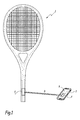
- the method of the invention is implemented with a tennis racket 1 equipped with a system 2 for measuring game data D.
- the measurement system 2 comprises unrepresented sensors able to measure, when the player is typing. a ball with the racket 1, data D comprising physical quantities such as the linear acceleration and the angular speed of the racket 1 in three directions perpendicular to each other and fixed relative to the terrestrial reference.
- the measurement system 2 may comprise a triaxial accelerometer and a triaxial gyrometer.
- the game data D is measured, in a first step 100 of the method according to the invention, by the measurement system 2 when a player makes series of shots (shot right lifted, service, slicé backhand ).
- a display device 3 such as a computer, a tablet or a mobile phone, so as to download, in a step 101, the data D collected to step 100, in the display device which, in the example shown, is a mobile phone 3.
- connection between the display device 3 and the racket 1 can be achieved via a wired connection, for example of the USB type, or a wireless connection, for example of the Bluetooth type.
- the display device 3 comprises an integrated calculation system 4 capable of automatically calculating, in a step 102, and from the data D downloaded in the step 101, three parameters representative of the performances of the player. These three parameters may be, for example, a parameter P1 representative of the power developed by the player during the last game session, a parameter P2 representative of the endurance of the player during the game period, and a parameter P3 representative of the technical abilities of the player, based on the regularity and variety of shots made during the period of play.
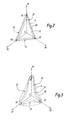
- a step 103 on the basis of the values of the parameters P1, P2 and P3, the method automatically displays, on a screen 5 of the display device 3, the three parameters on a diagram comprising three axes forming a three-pointed star, each axis corresponding to one of the parameters P1, P2 and P3.
- the respective values V1, V2 and V3 of the parameters P1, P2 and P3 are represented on the axes P1, P2 and P3 by points V1, V2 and V3.
- the three points V1, V2 and V3 define a closed contour A of generally triangular shape which encompasses or passes through points V1, V2, and V3.
- the term "generally triangular shape" means that the closed contour A has generally three elongate portions respectively extending between the points V1 and V2, between the points V1 and V3 and between the points V2 and V3 and forming angles between them.
- the closed contour A forms a triangle in the geometric sense of the term.
- the points V1, V2 and V3 are connected by C1, C2 and C3 sides formed by line segments.
- the sides C1, C2 and C3 can pass around points V1, V2 and V3.
- the closed contour A comprises three curved lines C1 and C2 and C3 extending between the points V1, V2 and V3, and connected together in pairs around the points V1, V2 and V3.
- the curves C1, C2 and C3 can also pass through the points V1, V2 and V3.
- step 104 the actual playing time T of the tennis player on the last game session is calculated from the data D downloaded in step 101.
- the actual playing time T is calculated during the acquisition of the data by the measurement system 2, by measuring the time interval between each shot executed by the player. When this time interval is greater than a predetermined time, indicating that the player is no longer actually beating, this time interval is not considered to be actual playing time and is not taken into account.
- the closed contour A represented in step 103 is modified in a step 105 in order to increase and decrease alternately the area which it delimits according to a predetermined frequency of variation F.
- the frequency of variation is called F in the following "beat frequency".
- the area of the closed contour A varies between a minimum area delimited by an outline A1 and a maximum area delimited by an outline A2.
- the variations of area are obtained by increasing and decreasing the length of the sides C1, C2 and C3, making homotheties of the closed contour A.
- the variations in the area of the closed contour A are obtained by modifying the curvature of the curves C1, C2 and C3 and / or by modifying the total length of the closed contour A, especially in the vicinity of the points V1, V2 and V3.
- the various ways of displaying the closed contour A and of varying the area it delimits can be combined within the scope of the invention.
- the beat frequency F of the closed contour A is limited to a maximum value F 0 , for example 150 beats per minute, corresponding to 150 variations of area per minute.
- the maximum beat frequency F 0 of the closed contour A is reached when the last game session whose data D is downloaded comprises a maximum effective play time greater than a predetermined value ⁇ T1, for example forty minutes. This means that, for example, if the player downloads a one-hour game session, corresponding to forty-five minutes of actual play T, the actual playing time taken into account is forty minutes and triggers a "beat" of the closed outline. A at 150 beats per minute.
- the "beat" of the closed contour A has a limited duration in time. If the player does not bring new data D for a certain time ⁇ T2 after the last data download, for example one week, the beat frequency F decreases to a predetermined value, for example 110 beats per minute. If after a new period of time ⁇ T3, for example a week, the player has still not downloaded new data D in the calculation system 4, the beat frequency F drops to zero.
- the delays from which the beat frequency F begins to decrease and the number of steps used may be different.
- the downloading of a game session comprising an effective playing time T that is not zero but less than forty minutes makes it possible to increase the frequency of beat F for a certain period of time.
- an effective playing time T of ten minutes makes it possible to prolong the period during which the closed contour A will "beat" for a period of time ⁇ T4 equal to four days. If at the moment when these ten minutes of play are taken into account by the calculation system, the beat frequency F is equal to 50 beats per minute, the taking into account of this new amount of effective playing time T also allows increase the beat frequency F to 100 beats per minute, as an example.
- each blow made by the player during the game period is classified in a type of blow defined among a list L of types of shots having at least two types of shots.
- the hit type list L includes four types of shots, including forehand, backhand, serve and smash.
- the list L of types of moves may comprise more than four strokes. We assign each type of move the variable i, i being between 1 and 4.
- the method may include a step 109 occurring prior to step 106 and selecting the hit types from the hit type list L.
- the calculation system 4 determines the number of Ni strokes performed for each type of stroke i by adding, at each data download at step 101, the numbers of strokes each type of move played during each game session whose data is downloaded.
- the calculation system 4 comprises for each of the four types of shots i of the list L of shots, the total number of shots Ni made by the player since his first use of the racket.
- a player's level of play is determined. To achieve this level, the player must have made a predetermined number of moves in each type of move. Initially, the player is at level zero and evolves to level 1 once he has performed, for example, a CD1 number of forehands, a reverse number RE1, a number SE1 of services and a number SM1 of smashes .
- the numbers CD1, RE1, SE1 and SM1 are respectively equal to 200, 200, 50 and 5.
- the player To pass to level 2, the player must perform a number CD2, for example 500, straight shots, a number RE2, for example 400 of setbacks, a number SE2, for example 100 , services and a number SM2, for example 20, smashs.
- the move to each higher level is conditioned by the execution of a predetermined number of moves for each type of move.
- the surface delimited by the closed contour A is colored by a predetermined color tone.
- level 0 is represented by the dark blue color.
- the player reaches, for each type of hit i, the number of moves CD1, CD2, ..., RE1, RE2, ..., SE1, SE2, ..., SM1, SM2, ... required to access the higher level, exceeding the number of shot types triggers the change of color tint of the surface delimited by the closed contour A to adopt the color corresponding to the upper level.
- the predefined number of moves for each type of move required to move to the next level is increased to new values.
- a player ranked in a certain level has made enough hits i in one or more of the types of moves i, but has not performed enough moves in at least one other type of move, he can not move to higher level.
- the calculation system 4 can be parameterized so that seven levels can be reached.
- seven different colors are provided for the area of the surface delimited by the outline A.
- a quick glance at the screen 5 allows the player to know his level.
- the beat frequency F of the closed contour A decreases to zero
- the numbers of strokes Ni for each type of strokes i accumulated by the player also begin to decrease.
- the player can lose 25% of the hits accumulated in each type of stroke.
- its level can decrease if it does not play during a period ⁇ T5 equal, in the example, to one week.
- the calculation system 4 can warn the player a certain time, for example one day, before the beat frequency reaches zero, for example by a message that appears on the screen 5 of the display device 3.
- the display device 3 can be connected to a network such as the Internet, so that different players can compare their performance.
- a network such as the Internet
- the average of the values of the three parameters P1, P2 and P3 is calculated, in the display device 3 or else in another system, in particular with a website, during a step 110.
- the average values calculated in step 110 are compared with each other during a step 111 in order to rank the players with respect to each other according to their performance.
- Step 111 is preferably performed on a website to which the players connect and on which they can download the data concerning them.
- comparisons between players can also be made from the numbers of shots Ni in each type of shot i, levels, or beat frequencies F of the closed contour A of the different players.
- the processing method is able to calculate more than three parameters representative of the player's performance.
- the calculation system 4 can notably calculate representative parameters, for example the player's level of strategy, his level of aggressiveness, or his mental level.
- the shape of the closed contour A displayed in step 103 is generally polygonal and the diagram comprises as many axes as parameters calculated in step 102.
Landscapes
- Health & Medical Sciences (AREA)
- Physical Education & Sports Medicine (AREA)
- General Health & Medical Sciences (AREA)
- Engineering & Computer Science (AREA)
- Biophysics (AREA)
- Life Sciences & Earth Sciences (AREA)
- Epidemiology (AREA)
- Medical Informatics (AREA)
- Primary Health Care (AREA)
- Public Health (AREA)
- Human Computer Interaction (AREA)
- User Interface Of Digital Computer (AREA)
- Processing Or Creating Images (AREA)
Applications Claiming Priority (1)
| Application Number | Priority Date | Filing Date | Title |
|---|---|---|---|
| FR1358106A FR3009876B1 (fr) | 2013-08-21 | 2013-08-21 | Procede de traitement de donnees representatives des performances d'un joueur de tennis |
Publications (1)
| Publication Number | Publication Date |
|---|---|
| EP2840519A1 true EP2840519A1 (fr) | 2015-02-25 |
Family
ID=50289701
Family Applications (1)
| Application Number | Title | Priority Date | Filing Date |
|---|---|---|---|
| EP14181528.2A Withdrawn EP2840519A1 (fr) | 2013-08-21 | 2014-08-20 | Procédé de traitement de données représentatives des performances d'un joueur de tennis |
Country Status (4)
| Country | Link |
|---|---|
| US (1) | US9597577B2 (enExample) |
| EP (1) | EP2840519A1 (enExample) |
| JP (1) | JP2015042250A (enExample) |
| FR (1) | FR3009876B1 (enExample) |
Families Citing this family (4)
| Publication number | Priority date | Publication date | Assignee | Title |
|---|---|---|---|---|
| KR101759456B1 (ko) * | 2003-12-01 | 2017-07-18 | 인터디지탈 테크날러지 코포레이션 | 사용자 개시 핸드오프에 기초한 세션 개시 프로토콜(sip) |
| US10706740B2 (en) * | 2014-12-24 | 2020-07-07 | Sony Corporation | System and method for processing sensor data |
| US20250001258A1 (en) * | 2023-06-27 | 2025-01-02 | Lindsey Lombardi Thomas | Method and system for assessing racket stroke heaviness |
| US11857862B1 (en) * | 2023-01-11 | 2024-01-02 | Lindsey Lombardi Thomas | Method and system for assessing tennis stroke heaviness |
Citations (3)
| Publication number | Priority date | Publication date | Assignee | Title |
|---|---|---|---|---|
| US20110183787A1 (en) * | 2009-09-25 | 2011-07-28 | Ralf Schwenger | Methods and apparatuses for enhancing performance in racket sports |
| US20130053190A1 (en) * | 2011-08-29 | 2013-02-28 | Icuemotion, Llc | Racket sport inertial sensor motion tracking and analysis |
| CH705403A1 (de) * | 2011-08-26 | 2013-02-28 | Kitris Ag | Vorrichtung zur Erfassung von Tennis-Spieldaten. |
Family Cites Families (3)
| Publication number | Priority date | Publication date | Assignee | Title |
|---|---|---|---|---|
| JP2009000248A (ja) * | 2007-06-21 | 2009-01-08 | Otodesigners Co Ltd | ゲーム機 |
| JPWO2009091060A1 (ja) * | 2008-01-18 | 2011-05-26 | 株式会社アソボウズ | ゴルフスコアリングシステム、ゴルフプレイデータ配信システム及び実プレイ連動ゴルフゲームシステム |
| US8337366B2 (en) * | 2010-11-01 | 2012-12-25 | Nexersys Corporation | Interactive system and method for boxing and martial arts |
-
2013
- 2013-08-21 FR FR1358106A patent/FR3009876B1/fr not_active Expired - Fee Related
-
2014
- 2014-08-15 US US14/460,775 patent/US9597577B2/en not_active Expired - Fee Related
- 2014-08-20 EP EP14181528.2A patent/EP2840519A1/fr not_active Withdrawn
- 2014-08-20 JP JP2014167280A patent/JP2015042250A/ja active Pending
Patent Citations (3)
| Publication number | Priority date | Publication date | Assignee | Title |
|---|---|---|---|---|
| US20110183787A1 (en) * | 2009-09-25 | 2011-07-28 | Ralf Schwenger | Methods and apparatuses for enhancing performance in racket sports |
| CH705403A1 (de) * | 2011-08-26 | 2013-02-28 | Kitris Ag | Vorrichtung zur Erfassung von Tennis-Spieldaten. |
| US20130053190A1 (en) * | 2011-08-29 | 2013-02-28 | Icuemotion, Llc | Racket sport inertial sensor motion tracking and analysis |
Also Published As
| Publication number | Publication date |
|---|---|
| JP2015042250A (ja) | 2015-03-05 |
| FR3009876A1 (fr) | 2015-02-27 |
| FR3009876B1 (fr) | 2016-12-09 |
| US9597577B2 (en) | 2017-03-21 |
| US20150057777A1 (en) | 2015-02-26 |
Similar Documents
| Publication | Publication Date | Title |
|---|---|---|
| US10292648B2 (en) | Energy expenditure device | |
| EP3212115B1 (fr) | Procédé de contrôle d'un traitement orthodontique | |
| US9626641B2 (en) | Tennis game analysis using inertial sensors | |
| CH699779A2 (fr) | Procédé et dispositif permettant à un athlète de déterminer puis de contrôler la vitesse de déplacement d'une masse. | |
| FR3009876A1 (fr) | Procede de traitement de donnees representatives des performances d'un joueur de tennis | |
| US20180020819A1 (en) | Toothbrush | |
| FR3009874A1 (fr) | Methode de calcul d'un parametre representatif de l'endurance d'un joueur de tennis | |
| KR20210100723A (ko) | 미리 결정된 오프라인 정보를 고려한 획득 스트로크 성능 메트릭을 볼 비행 데이터로부터 계산하기 위한 시스템 및 방법 | |
| JP2019088492A5 (enExample) | ||
| WO2015027133A1 (en) | Energy expenditure device | |
| JP2019084272A5 (enExample) | ||
| EP2381845A1 (fr) | Dispositif et methode de caracterisation de mouvements | |
| FR2991080A1 (fr) | Methode de calcul d'un indice de repetabilite lors de l'utilisation d'une raquette de tennis | |
| EP3811032A1 (fr) | Analyse de la foulee d'un pieton en marche | |
| JP2019103628A5 (enExample) | ||
| EP2602779A3 (en) | Device, method and computer-program for fitting tennis racket | |
| JP2019088595A5 (enExample) | ||
| JP2015042250A5 (enExample) | ||
| JP2019088593A5 (enExample) | ||
| US8608313B2 (en) | Training and/or measuring visual focusing and vergence abilities using a plurality of optical elements | |
| FR3053490A1 (fr) | Capteur, systeme d'analyse statistique et procede de determination et d'affichage de la hauteur d'un saut effectue par un sportif | |
| JP2015043978A (ja) | テニスプレイヤの技術レベルを表すパラメータを演算する方法 | |
| JP2016140558A (ja) | ゴルフスイングの評価方法、ゴルフスイングのシミュレーション方法及びゴルフクラブの選定方法 | |
| JP2019080828A5 (enExample) | ||
| CN117571533B (zh) | 一种轮胎橡胶的耐切割性能测试方法及装置 |
Legal Events
| Date | Code | Title | Description |
|---|---|---|---|
| PUAI | Public reference made under article 153(3) epc to a published international application that has entered the european phase |
Free format text: ORIGINAL CODE: 0009012 |
|
| 17P | Request for examination filed |
Effective date: 20140820 |
|
| AK | Designated contracting states |
Kind code of ref document: A1 Designated state(s): AL AT BE BG CH CY CZ DE DK EE ES FI FR GB GR HR HU IE IS IT LI LT LU LV MC MK MT NL NO PL PT RO RS SE SI SK SM TR |
|
| AX | Request for extension of the european patent |
Extension state: BA ME |
|
| R17P | Request for examination filed (corrected) |
Effective date: 20150817 |
|
| RBV | Designated contracting states (corrected) |
Designated state(s): AL AT BE BG CH CY CZ DE DK EE ES FI FR GB GR HR HU IE IS IT LI LT LU LV MC MK MT NL NO PL PT RO RS SE SI SK SM TR |
|
| 17Q | First examination report despatched |
Effective date: 20180914 |
|
| STAA | Information on the status of an ep patent application or granted ep patent |
Free format text: STATUS: THE APPLICATION IS DEEMED TO BE WITHDRAWN |
|
| 18D | Application deemed to be withdrawn |
Effective date: 20190326 |