EP2839595B1 - Progressive modulation für downstream-zugriff - Google Patents
Progressive modulation für downstream-zugriff Download PDFInfo
- Publication number
- EP2839595B1 EP2839595B1 EP13778670.3A EP13778670A EP2839595B1 EP 2839595 B1 EP2839595 B1 EP 2839595B1 EP 13778670 A EP13778670 A EP 13778670A EP 2839595 B1 EP2839595 B1 EP 2839595B1
- Authority
- EP
- European Patent Office
- Prior art keywords
- payload
- cpes
- headend
- rank
- predetermined
- Prior art date
- Legal status (The legal status is an assumption and is not a legal conclusion. Google has not performed a legal analysis and makes no representation as to the accuracy of the status listed.)
- Not-in-force
Links
- 230000000750 progressive effect Effects 0.000 title description 5
- 230000005540 biological transmission Effects 0.000 claims description 30
- 238000000034 method Methods 0.000 claims description 18
- 229920006235 chlorinated polyethylene elastomer Polymers 0.000 claims description 16
- 238000000136 cloud-point extraction Methods 0.000 claims description 16
- 230000003247 decreasing effect Effects 0.000 claims 6
- 238000011144 upstream manufacturing Methods 0.000 description 27
- 238000005516 engineering process Methods 0.000 description 8
- 230000003595 spectral effect Effects 0.000 description 7
- 238000004891 communication Methods 0.000 description 5
- 241000246142 Chamaecytisus Species 0.000 description 4
- 238000010586 diagram Methods 0.000 description 4
- 230000008901 benefit Effects 0.000 description 3
- 238000012937 correction Methods 0.000 description 3
- 239000000835 fiber Substances 0.000 description 3
- VZCCETWTMQHEPK-QNEBEIHSSA-N gamma-linolenic acid Chemical compound CCCCC\C=C/C\C=C/C\C=C/CCCCC(O)=O VZCCETWTMQHEPK-QNEBEIHSSA-N 0.000 description 3
- 239000003550 marker Substances 0.000 description 2
- 230000008054 signal transmission Effects 0.000 description 2
- RYGMFSIKBFXOCR-UHFFFAOYSA-N Copper Chemical compound [Cu] RYGMFSIKBFXOCR-UHFFFAOYSA-N 0.000 description 1
- 241000196324 Embryophyta Species 0.000 description 1
- 230000006978 adaptation Effects 0.000 description 1
- 230000004075 alteration Effects 0.000 description 1
- 230000003321 amplification Effects 0.000 description 1
- 238000013459 approach Methods 0.000 description 1
- 239000000969 carrier Substances 0.000 description 1
- 239000000470 constituent Substances 0.000 description 1
- 229910052802 copper Inorganic materials 0.000 description 1
- 239000010949 copper Substances 0.000 description 1
- 125000004122 cyclic group Chemical group 0.000 description 1
- 238000011161 development Methods 0.000 description 1
- 230000016507 interphase Effects 0.000 description 1
- 238000012986 modification Methods 0.000 description 1
- 230000004048 modification Effects 0.000 description 1
- 238000012544 monitoring process Methods 0.000 description 1
- 238000003199 nucleic acid amplification method Methods 0.000 description 1
- 230000003287 optical effect Effects 0.000 description 1
- 238000005192 partition Methods 0.000 description 1
- 230000008569 process Effects 0.000 description 1
- 230000009467 reduction Effects 0.000 description 1
- 238000000638 solvent extraction Methods 0.000 description 1
- 230000002123 temporal effect Effects 0.000 description 1
Images


Classifications
-
- H—ELECTRICITY
- H04—ELECTRIC COMMUNICATION TECHNIQUE
- H04L—TRANSMISSION OF DIGITAL INFORMATION, e.g. TELEGRAPHIC COMMUNICATION
- H04L12/00—Data switching networks
- H04L12/28—Data switching networks characterised by path configuration, e.g. LAN [Local Area Networks] or WAN [Wide Area Networks]
- H04L12/2854—Wide area networks, e.g. public data networks
- H04L12/2856—Access arrangements, e.g. Internet access
- H04L12/2858—Access network architectures
- H04L12/2861—Point-to-multipoint connection from the data network to the subscribers
-
- H—ELECTRICITY
- H04—ELECTRIC COMMUNICATION TECHNIQUE
- H04B—TRANSMISSION
- H04B7/00—Radio transmission systems, i.e. using radiation field
- H04B7/14—Relay systems
- H04B7/15—Active relay systems
- H04B7/155—Ground-based stations
- H04B7/15557—Selecting relay station operation mode, e.g. between amplify and forward mode, decode and forward mode or FDD - and TDD mode
-
- H—ELECTRICITY
- H04—ELECTRIC COMMUNICATION TECHNIQUE
- H04L—TRANSMISSION OF DIGITAL INFORMATION, e.g. TELEGRAPHIC COMMUNICATION
- H04L12/00—Data switching networks
- H04L12/28—Data switching networks characterised by path configuration, e.g. LAN [Local Area Networks] or WAN [Wide Area Networks]
- H04L12/2801—Broadband local area networks
-
- H—ELECTRICITY
- H04—ELECTRIC COMMUNICATION TECHNIQUE
- H04L—TRANSMISSION OF DIGITAL INFORMATION, e.g. TELEGRAPHIC COMMUNICATION
- H04L5/00—Arrangements affording multiple use of the transmission path
- H04L5/14—Two-way operation using the same type of signal, i.e. duplex
- H04L5/16—Half-duplex systems; Simplex/duplex switching; Transmission of break signals non-automatically inverting the direction of transmission
Definitions
- This disclosure is related to a communication network and more particularly to progressive modulation of downstream traffic transmissions in Access Networks that use time-division duplexing (TDD).
- TDD time-division duplexing
- MoCA Multimedia over coax alliance
- MoCA Multimedia over coax alliance
- MoCA is commonly used to form a home network, which conveys Ethernet frames among different rooms in the home over existing coaxial cabling.
- MoCA's traffic model is known as multipoint-to-multipoint, because generally every MoCA device in the home can communicate directly with any other MoCA device in the home.
- One of the MoCA devices in the home is designated the Network Coordinator and becomes responsible for coordinating and scheduling all traffic on the MoCA home network.
- MoCA devices form burst transmissions that are launched on the coax cables as radio-frequency (RF) signal transmissions.
- RF radio-frequency
- the Network Coordinator schedules the time and spacing of individual burst transmissions so they do not destructively collide (e.g., overlap in time) at the intended receiver(s).
- This scheduled arrangement for sharing a communication channel on the coax medium for traffic from and to various endpoints is commonly known as time-division multiple access (TDMA).
- TDMA time-division multiple access
- Entropic's c.LINK® technology is a coax access system that has some elements similar to MoCA technology for Access Networks.
- the c.LINK access networks have been deployed in China to service multiple-dwelling units (MDU) (e.g., apartment buildings) over coax cable plants.
- MDU multiple-dwelling units
- Access Networks are typically deployed by operator/service providers (OSPs) to provide paid high-speed access to the internet and other OSP-provided services.
- the OSP typically deploys equipment at some headend (e.g., located in an OSP's central office site, or near some residential neighborhood, or in the basement of an MDU), which communicates with each of one or more (typically a plurality of) customer premise equipments (CPEs) deployed at endpoint sites such as individual residences or businesses.
- CPEs customer premise equipments
- the headend can transmit messages downstream (DS) over the access network to CPEs (aka point-to-multipoint), and the CPE endpoints can transmit messages upstream (US) to the headend in the opposite direction over the access network (aka multipoint-to-point).
- Access networks can be based on various media types, such as:
- the access network medium may contain a cascade of various active components (such as signal amplifiers), as well as lossy passive components (such as splitters or taps), deployed at various fixed locations in the network. Also, the distances, or medium pathlength, from the headend will generally vary for each CPE. These differences generally result in differing propagation times among the various branches in the network, as well as differing arrival amplitudes of transmitted signals. Consequently, the path between the headend and each CPE will vary, and the associated signal attenuation, or pathloss, will vary correspondingly. If the pathloss is relatively low, the CPE may be characterized as nearby the headend. If the pathloss is relatively high, the CPE may be characterized as distant from the headend.
- various active components such as signal amplifiers
- lossy passive components such as splitters or taps
- Upstream (US) transmissions are formed and launched by CPEs, but are generally not continuous, so upstream traffic from a plurality of CPEs is typically coordinated by the headend in order to ensure that those non-continuous or burst transmissions from various CPEs do not collide (overlap in time) and that the headend receiver will observe an orderly sequential arrival of burst transmissions from different CPEs in a predictable order and at predictable times (within some tolerance of time-jitter).
- This approach is often called time-division multiple access (TDMA).
- TDMA time-division multiple access
- Some OSPs operate their access network such that upstream traffic and downstream traffic use different frequencies or wavelengths, enabling transmissions in both directions, simultaneously and independently (i.e., full duplex).
- This particular duplexing strategy is called frequency division duplex (FDD).
- the headend has exclusive use and access to the downstream frequencies, and the headend can coordinate/schedule use of the upstream frequencies independently from the downstream.
- FDD is relatively common on access networks today, even though FDD operation does incur overheads that reduce spectral efficiency, such as the spectral guard band imposed by inflexible diplex filters distributed throughout the access network cascade (e.g., to isolate the US and DS traffic from each other).
- TDD time-division duplex
- US upstream
- DS downstream
- OSPs wish to consider such a mode due to TDD's increased flexibility (compared to FDD) for adapting to the evolution of future US and DS traffic patterns.
- TDD time division duplex demodulation
- symmetry or asymmetry of the US and DS capacities is a relatively simple (and realtime) adjustment of the duty-cycle phasing of the TDD Cycle.
- Use of TDD in the Access Network enables a more flexible way for OSPs to easily, quickly and inexpensively adjust the relative throughput capacity of the upstream and downstream directions within a single spectral allocation.
- FDD requires paired spectral allocations typically established by inflexible diplex filters distributed throughout the access network cascade.
- TDD's single spectral allocation can be made as wide as the sum of FDD's paired allocations, enabling TDD's burst datarate capability in either direction being approximately double that of FDD in either direction (for symmetric US and DS FDD allocations).
- a more extensive discussion of TDD is available at the website located at http://www.ieee802.org/3/epoc/public/may12/barr_01_0512.pdf
- TDD Time Division Duplex
- c.LINK Access which is typically used to service MDUs in China.
- new access network technologies currently under development (e.g., in the IEEE 802.3bn EPoC Task Force, and in ITU-T G.fast) which are being designed to leverage the inherent flexibility of TDD.
- TDD operation has certain overheads that reduce temporal efficiency. For example, it is necessary for the headend scheduler to avoid collisions in the TDD mode of operation by segregating the upstream traffic from downstream traffic with a time gap, such as an inter-phase gap (IPG) between TDD phases.
- IPG inter-phase gap
- An IPG may include time intervals for transmissions to complete their propagation from transmitter(s) to intended receiver(s), time for the medium to sufficiently quiesce (if necessary) after reception(s), and time for destination transceiver(s) to switch (if necessary) from receive to transmit mode.
- a TDD Cycle 10 the sequential combination of any two adjacent TDD phases (i.e., a single downstream phase 12 plus a single upstream phase 16 ) is called a TDD Cycle 10.
- TDD Cycles 10 with duration on the order of 1 millisecond are commonly deployed in access networks employing TDD (although longer or shorter durations can be used).
- TDD mode of operation it is common for each transmitter to prepend a preamble signal at the beginning of each of its transmissions.
- These preambles include reference signals which can be useful to facilitate receivers in detecting and acquiring the physical layer (PHY) parameters required to properly decode the transmission, such as gain, frequency-offset and timing information.
- PHY physical layer
- the time intervals that preambles consume on the medium are generally accounted as overhead for TDD.
- the PHY of each CPE typically starts its burst transmission with a preamble as shown in Fig. 2 , where preamble 18 is transmitted first, followed by payload 20 (message-information or user-data carrying portion) of the transmission.
- upstream preambles facilitate the headend receiver to detect and acquire the PHY layer parameters which in general are unique to each individual CPE device.
- the differing pathloss from each CPE to the headend generally results in differences in arrival amplitude at the headend from each CPE's upstream transmissions. These differences in arrival amplitude correspond in general to different SNRs as received at the headend.
- SNRs SNRs as received at the headend.
- the pathloss When a CPE is nearby the headend, the pathloss may be low, the arrival amplitude may be high, and the SNR may be high, yielding a higher channel capacity to or from that particular CPE. Conversely, when a CPE is distant from the headend, the pathloss may be high, the arrival amplitude may be low, and the SNR may be low, yielding a lower channel capacity to or from that particular CPE.
- the headend being aware of these differences in reception, generally schedules each CPE to transmit its payload information using a modulation profile that corresponds to the particular SNR that can be received from that particular CPE. For example, the headend might schedule a higher modulation profile for nearby CPEs, and a lower modulation profile for distant CPEs.
- Modulation Profile generally refers to various combinations of modulation density with forward error correction, or MCS modulation and coding scheme, as discussed in the website located at http://en.wikipedia.org/wiki/Modulation_and_coding_scheme.
- Different Modulation Profiles are generally chosen to adapt communication signal transmissions to the particular conditions experienced on the communications channel.
- a high modulation profile generally corresponds to a relatively high-density modulation (e.g., 1024-QAM, being higher than 256-QAM), and/or a relatively high coding rate for forward error correction.
- a lower modulation profile corresponds to a relatively low-density modulation (e.g., 256-QAM, being lower than 1024-QAM), and/or a relatively lower coding rate for forward error correction.
- a high modulation profile carries more information bits per second (or per symbol) than a lower modulation profile.
- high modulation profiles are more difficult to receive and decode (i.e., low receptivity), requiring better channel conditions (e.g., higher SNR) than would otherwise be required with a lower modulation profile that is easier to receive and decode (i.e., having higher receptivity).
- the headend must resort to transmitting lower modulation profiles and suffer the lower bits-per-second information rate. It would be better for the OSP if the headend could transmit high modulation profiles whenever possible, enabling nearby CPEs whose channel conditions are sufficiently good to realize the higher bits-per-second information rate.
- preambles represent the overhead associated with the headend changing modulation profiles, and these overheads work against the benefits that otherwise could be realized by using different modulation profiles.
- EP 2 200 304 A2 discloses systems and methods for concatenating messages in MoCA devices that are connected via a coax network.
- One embodiment of a system according to the invention includes a home network having a plurality of nodes. The network is implemented over coaxial cable. The network includes a plurality of networked nodes. A transmitter of at least one of the networked nodes is configurable to transmit a concatenated burst.
- the concatenated burst includes a preamble, a first payload frame and a second payload frame. The first payload frame and the second payload frame are separated by a cyclic prefix of a first symbol of the second payload frame.
- US 2008/0151790 A1 discloses that a time division duplex (TDD) amplifier switches direction of amplification to amplify signals in both directions as needed for the direction of signal flow in the network.
- the TDD amplifier switching is controlled by monitoring the time slot information of the communication channel to determine the schedule of transmissions in each direction.
- the amplifier direction is switched during the inter-frame gaps of the TDD data transmissions.
- the TDD amplifier can be used for WAN access to homes and in a LAN operating within a home.
- the presently claimed Progressive Modulation invention improves the efficiency of downstream traffic transmissions in Access Networks that use TDD time-division duplexing. By concatenating payloads in rank order of progressively increasing modulation profile, the headend no longer needs to transmit intervening preambles before each new modulation profile.
- the headend transmits a preamble to facilitate the CPE receiver, followed by a payload whose modulation profile is chosen to adapt to the particular channel conditions for the particular intended CPE receiver.
- the channel properties may in general be different from the upstream case, such as the pathloss (which may be characterized as distance), SNR, channel capacity, and receptivity, and these properties may vary per CPE.
- a preamble is broadly defined as to other well know methods having substantially the same purpose, such as: Header, PHY Header, Start Marker, PHY Start marker, Pilot Tones, Pilot Carriers or the like.
- the preamble may carry some information about how the subsequent payload is to be decoded (e.g., some indication of the modulation profile).
- the headend needs to send a different payload to a different CPE, it transmits another preamble first, followed by the payload adapted to the channel conditions for that particular CPE.
- the second preamble is needed to facilitate the second CPE receiver, because, although the second receiver would be able to detect and acquire the PHY layer parameters from the first preamble, the second CPE receiver is in general unable to receive and decode the first payload because it uses some other modulation profile, so the second receiver loses track of the headend's transmission.
- the second preamble is needed for the second CPE receiver to re-detect and re-acquire the signal from the headend before the second payload arrives.
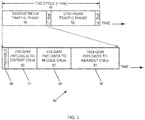
- the presently claimed invention teaches headend 30 to concatenate two or more of the downstream payloads, where each may have different modulation profiles, without requiring intervening preambles to be transmitted.
- Headend 30 transmits a single preamble 38 at the start of downstream phase 46, followed by the concatenated payloads 32, 34, 36.
- this disclosure in the examples described only three payloads are described, this disclosure is intended to include any number of payloads. If two such payloads are concatenated by headend 30, then the presently claimed invention eliminates the need for the headend to transmit a second intervening preamble between them.
- the presently claimed invention eliminates the need for the headend to transmit a second and third intervening preamble.
- a similar result is obtained for 4 or more such payloads that are concatenated by the headend.
- Headend 30 may concatenate in this fashion for as long as it has downstream data available for transmission to CPEs, or until reaching the end of downstream phase 46 of the current TDD Cycle 48. The headend would restart the process for each downstream phase of subsequent TDD Cycles.
- An example of the claimed invention advances the state of the art because the amount of overhead consumed by downstream preambles is reduced, thereby making more channel-time available per downstream phase 46 for headend 30 to schedule information-carrying payloads. Furthermore, the overhead associated with employing a high order modulation profile for nearby CPEs is reduced, enabling the headend to more readily achieve the higher information-rates for those CPEs. This reduction in preamble overhead can be quite significant if many preambles are eliminated, such as the case when the headend is actively servicing a large number of CPEs and/or when there are many relatively short payloads to be transmitted downstream that are latency-sensitive. Making the downstream transmissions more efficient, the claimed invention enables the headend to sustain a higher downstream throughput capacity. Alternatively, the headend can schedule less time for downstream phases 46, thereby allowing for a greater volume of upstream traffic in upstream phases 50 to be transmitted, or allowing for shortened TDD Cycles 48 to reduce latency.
- An example of the claimed invention teaches headend 30 to concatenate payloads in rank order of progressively increasing modulation profile. That is, a first payload 32 of a concatenated set of payloads has the lowest modulation profile of the set, and a last payload 36 of a concatenated set has the highest modulation profile in the set, and payloads in the middle 34 of a concatenated set have intermediate modulation profiles.
- the payloads intended for the most distant CPEs 40 are transmitted by headend 30 shortly after preamble 38, followed by payloads intended for mid-range CPEs 42, then finally ending with payloads intended for the most nearby CPEs 44.
- This rank ordering by Progressive Modulation Profile is important, since it enables all of the intended CPEs to not only detect and acquire the PHY layer parameters from single leading preamble 38, but also to keep track of the headend's transmissions up to and including the particular payloads intended for those CPEs.
- Each CPE is typically informed by headend 30 beforehand which payloads within downstream phase 46 are intended for it (e.g., Headend 30 can inform this via a scheduling message(s) sent to CPEs beforehand, such as a well-known media access plan (MAP) message).
- MAP media access plan
- Most distant CPE 40 receives single leading preamble 38, from which it detects and acquires the PHY layer parameters required to properly decode the subsequent payload, such as gain, frequency-offset and timing information.
- Very first payload 32 arriving after single leading preamble 38 is the payload with the lowest modulation profile (e.g., intended for the most distant CPE 40, for example 256-QAM). Consequently, this most distant CPE 40 is able to accurately track the headend's transmission for the duration of first payload 32, and accurately receive and decode the payload information bits intended for this most distant CPE 40.
- Second payload 34 might possibly have the same modulation profile as first payload 32, but in general would have a higher modulation profile than first payload 32 (e.g., being intended for the next most distant CPE 42 to receive downstream traffic in the concatenated set, for example 512-QAM).
- This rank order by Progressive Modulation Profile is imposed by headend 30 according to the claimed invention.
- Second payload 34, having higher modulation profile is more difficult for the most distant CPE 40 to track and decode accurately, and, in general, may not be accurately decoded.
- most distant CPE 40 has already received and decoded first payload 32 to which it was intended, and there is no longer any need for most distant CPE 40 to track or decode any more payloads in downstream phase 46 of current TDD Cycle 48.
- Most nearby CPE 44 receives single leading preamble 38, from which it detects and acquires the PHY layer parameters required to properly decode subsequent payloads, such as gain, frequency-offset and timing information.
- First payload 32 arriving after single leading preamble 38 is the payload with the lowest modulation profile (e.g., intended for most distant CPE 40 ). Consequently, most nearby CPE 44 is easily able to accurately track the headend's transmission for the duration of first payload 32.
- Next to arrive at most nearby CPE 44 is second payload 34 in the concatenated set of payloads.
- Second payload 34 might possibly have the same modulation profile as first payload 32, but in general would have a higher modulation profile than the first payload. Nevertheless, most nearby CPE 44 is able to continue accurately tracking the headend's transmission for the duration of second payload 34. Similarly, most nearby CPE 44 is able to continue accurately tracking all the subsequent payloads in downstream phase 46, even as their modulation profiles increase progressively. Finally, last payload 36 in the concatenated set, having the highest modulation profile of all (e.g., 1024-QAM), arrives at most nearby CPE 44. Last payload 36 is specifically intended for most nearby CPE 44, so it can be accurately tracked and decoded.
- a group of items linked with the conjunction "and” should not be read as requiring that each and every one of those items be present in the grouping, but rather should be read as “and/or” unless expressly stated otherwise.
- a group of items linked with the conjunction "or” should not be read as requiring mutual exclusivity among that group, but rather should also be read as “and/or” unless expressly stated otherwise.
- items, elements or components of the disclosed method and apparatus may be described or claimed in the singular, the plural is contemplated to be within the scope thereof unless limitation to the singular is explicitly stated.
- module does not imply that the components or functionality described or claimed as part of the module are all configured in a common package. Indeed, any or all of the various components of a module, whether control logic or other components, can be combined in a single package or separately maintained and can further be distributed in multiple groupings or packages or across multiple locations.
Landscapes
- Engineering & Computer Science (AREA)
- Signal Processing (AREA)
- Computer Networks & Wireless Communication (AREA)
- Time-Division Multiplex Systems (AREA)
- Mobile Radio Communication Systems (AREA)
- Radio Relay Systems (AREA)
Claims (6)
- Ein Verfahren zum Übertragen mindestens zweier Nutzlasten (32, 34, 36) in einer Downstream Verkehrsphase (46) eines time-division duplex, TDD, Zyklus (48), wobei das Verfahren die folgenden Schritte aufweist:Ordnen nach einem Rang einer ersten Nutzlast (32) und mindestens einer nächsten Nutzlast (34, 36) der mindestens zwei Nutzlasten von einer Kopfstation (30);Übertragen der mindestens zwei Nutzlasten (32, 34, 36) zu mindestens zwei vorbestimmten Teilnehmerstandort-Geräten, CPEs, (40, 42, 46); undwobei der Schritt des Ordnens nach einem Rang dadurch gekennzeichnet ist, dass nach einem zunehmenden Modulationsprofil geordnet wird.
- Das Verfahren gemäß Anspruch 1, ferner gekennzeichnet durch den Schritt eine einzelne Präambel (38) in der Kopfstation (30) voranzustellen und / oder ferner gekennzeichnet durch den Schritt des Verkettens der geordneten ersten Nutzlast (32) mit der mindestens einen nächsten Nutzlast (34, 36) ohne dabei in die Präambeln einzugreifen und / oder wobei der Schritt des Ordnens nach einem Rang dadurch gekennzeichnet ist, dass nach abnehmendem Pfadverlust zu den mindestens zwei vorbestimmten Teilnehmerstandort-Geräten, CPEs, (40, 42, 46) geordnet wird und / oder der Schritt des Ordnens nach einem Rang dadurch gekennzeichnet ist, dass nach abnehmender Empfänglichkeit an den mindestens zwei vorbestimmten CPEs (40, 42, 46) geordnet wird und / oder wobei der Schritt des Ordnens nach einem Rang dadurch gekennzeichnet ist, dass nach einer aufsteigenden Signal-Rausch-Verhältnis-Rate, SNR, an den mindestens zwei vorbestimmten CPEs (40, 42, 46) geordnet wird und / oder wobei die Kopfstation (30) gekennzeichnet ist durch Nutzlastinformation, die den mindestens zwei vorbestimmten CPEs (40, 42, 46) entspricht und / oder ferner dadurch gekennzeichnet ist durch den Schritt das Verfahren für eine nächste Downstream-Phase zu wiederholen.
- Ein System zur Übertragung mindestens zweier Nutzlasten (32, 34, 36) in einer Downstream Verkehrsphase (46) eines time-division duplex, TDD, Zyklus (48), wobei das System aufweist:Mittel zum Ordnen nach einem Rang einer ersten Nutzlast (32) undmindestens einer nächsten Nutzlast (34, 36) der mindestens zwei Nutzlasten von einer Kopfstation (30);Mittel zum Übertragen der mindestens zwei Nutzlasten (32, 34 und 36) zu mindestens zwei vorbestimmten Teilnehmerstandort-Geräten, CPEs, (40, 42, 46); undwobei das Mittel zum Ordnen nach einem Rang gekennzeichnet ist durch ein Mittel zum Ordnen nach einem zunehmenden Modulationsprofil.
- Das System gemäß Anspruch 3 weiterhin gekennzeichnet durch ein Mittel zum Voranstellen einer einzelne Präambel (38) in der Kopfstation (30) und / oder ferner gekennzeichnet durch ein Mittel zum Verketten der geordneten ersten Nutzlast (32) mit der mindestens einen nächsten Nutzlast (34, 36) ohne dabei in die Präambeln einzugreifen und / oder wobei das Mittel zum Ordnen nach einem Rang gekennzeichnet ist durch ein Mittel zum Ordnen durch ordnen nach abnehmendem Pfadverlust zu den mindestens zwei vorbestimmten Teilnehmerstandort-Geräten, CPEs, (40, 42, 46) und / oder wobei das Mittel zum Ordnen nach einem Rang gekennzeichnet ist durch ein Mittel zum Ordnen durch ordnen nach abnehmender Empfänglichkeit an den mindestens zwei vorbestimmten CPEs, (40, 42, 46) und / oder wobei das Mittel zum Ordnen nach einem Rang gekennzeichnet ist durch ein Mittel zum Ordnen nach einer aufsteigenden Signal-Rausch-Verhältnis-Rate, SNR, an den mindestens zwei vorbestimmten CPEs (40, 42, 46) und / oder wobei die Kopfstation (30) gekennzeichnet ist durch Nutzlastinformation, die den mindestens zwei vorbestimmten CPEs, (40, 42, 46) entspricht.
- Ein nicht-flüchtiges computerausführbares Speichermedium, welches computerausführbare Programminstruktionen aufweist um eine Übertragung mindestens zweier Nutzlasten (32, 34, 36) in einer Downstream Verkehrsphase (46) eines time-division duplex, TDD, Zyklus (48) zu implementieren, wobei das nicht-flüchtige computerausführbare Speichermedium aufweist:Programminstruktionen, die zum Ordnen nach einem Rang einer ersten Nutzlast (32) und mindestens einer nächsten Nutzlast (34, 36) der mindestens zwei Nutzlasten von einer Kopfstation (30) führen;Programminstruktionen, die zum Übertragen der mindestens zwei Nutzlasten (32, 34, 36) zu mindestens zwei vorbestimmten Teilnehmerstandort-Geräten, CPEs, (40, 42, 46) führen; undwobei die Programminstruktionen, die zum Ordnen nach einem Rang führen gekennzeichnet sind durch Ordnen nach einem zunehmenden Modulationsprofil.
- Das nicht-flüchtige computerausführbare Speichermedium gemäß Anspruch 5, ferner gekennzeichnet durch Programminstruktionen, die zum Voranstellen einer einzelnen Präambel (38) in der Kopfstation (30) führen und / oder ferner gekennzeichnet durch Programminstruktionen, die zum Verketten der geordneten ersten Nutzlast (32) mit der mindestens einen nächsten Nutzlast (34, 36) führen, ohne dabei in die Präambeln einzugreifen und / oder wobei die Programminstruktionen, die zum Ordnen nach einem Rang führen gekennzeichnet sind durch ordnen nach abnehmendem Pfadverlust zu den mindestens zwei vorbestimmten Teilnehmerstandort-Geräten, CPEs, (40, 42, 46) und / oder wobei die Programminstruktionen, die zum Ordnen nach einem Rang führen gekennzeichnet sind durch ordnen nach abnehmender Empfänglichkeit an den mindestens zwei vorbestimmten CPEs (40, 42, 46) und / oder wobei die Programminstruktionen, die zum Ordnen nach einem Rang führen gekennzeichnet sind durch ordnen nach einer aufsteigenden Signal-Rausch-Verhältnis-Ratem, SNR, an den mindestens zwei vorbestimmten CPEs (40, 42, 46) und / oder wobei die Kopfstation (30) gekennzeichnet ist durch Nutzlastinformation, die den mindestens zwei vorbestimmten CPEs, (40, 42, 46) entspricht und / oder ferner gekennzeichnet durch Programminstruktionen, die zum Wiederholen der Programminstruktionen zur Übertragung in einer nächsten Downstream-Phase führen.
Applications Claiming Priority (2)
| Application Number | Priority Date | Filing Date | Title |
|---|---|---|---|
| US201261624546P | 2012-04-16 | 2012-04-16 | |
| PCT/US2013/036724 WO2013158604A1 (en) | 2012-04-16 | 2013-04-16 | Progressive modulation for downstream access |
Publications (3)
| Publication Number | Publication Date |
|---|---|
| EP2839595A1 EP2839595A1 (de) | 2015-02-25 |
| EP2839595A4 EP2839595A4 (de) | 2015-11-18 |
| EP2839595B1 true EP2839595B1 (de) | 2017-01-18 |
Family
ID=49383992
Family Applications (1)
| Application Number | Title | Priority Date | Filing Date |
|---|---|---|---|
| EP13778670.3A Not-in-force EP2839595B1 (de) | 2012-04-16 | 2013-04-16 | Progressive modulation für downstream-zugriff |
Country Status (6)
| Country | Link |
|---|---|
| US (5) | US9780962B2 (de) |
| EP (1) | EP2839595B1 (de) |
| JP (1) | JP2015519799A (de) |
| CN (1) | CN104541464A (de) |
| MX (1) | MX2014012438A (de) |
| WO (1) | WO2013158604A1 (de) |
Families Citing this family (7)
| Publication number | Priority date | Publication date | Assignee | Title |
|---|---|---|---|---|
| EP2839595B1 (de) | 2012-04-16 | 2017-01-18 | Entropic Communications, Inc. | Progressive modulation für downstream-zugriff |
| US9906325B2 (en) * | 2012-11-06 | 2018-02-27 | Avago Technologies General Ip (Singapore) Pte. Ltd. | Simplified multi-modulation coding set (MCS) or multiple profile transmission (MPT) scheme for communications |
| US20140255029A1 (en) * | 2013-03-05 | 2014-09-11 | Qualcomm Incorporated | Orthogonal frequency-division multiplexing burst markers |
| US9948754B2 (en) * | 2016-02-18 | 2018-04-17 | Mitsubishi Electric Research Laboratories, Inc. | System and method for decoding asynchronously transmitted packets |
| US10178697B2 (en) * | 2017-02-22 | 2019-01-08 | Mitsubishi Electric Research Laboratories | Systems and methods for separating collided packets in shared wireless channels |
| US10383101B1 (en) * | 2017-03-06 | 2019-08-13 | Sprint Spectrum L.P. | Dynamic link adaptation |
| US11863500B2 (en) * | 2021-02-25 | 2024-01-02 | Sony Semiconductor Solutions Corporation | Communication apparatus, communications system, and communication method |
Family Cites Families (15)
| Publication number | Priority date | Publication date | Assignee | Title |
|---|---|---|---|---|
| US6961314B1 (en) * | 1998-10-30 | 2005-11-01 | Broadcom Corporation | Burst receiver for cable modem system |
| KR100450948B1 (ko) * | 2001-07-12 | 2004-10-02 | 삼성전자주식회사 | 통신시스템에서 변조방식 결정장치 및 방법 |
| CN1836391A (zh) * | 2003-07-14 | 2006-09-20 | 松下电器产业株式会社 | 多载波发送设备、多载波接收设备和多载波通讯方法 |
| US7447232B2 (en) * | 2003-09-30 | 2008-11-04 | Intel Corporation | Data burst transmission methods in WLAN devices and systems |
| EP1608100A1 (de) * | 2004-06-17 | 2005-12-21 | Mitsubishi Electric Information Technology Centre Europe B.V. | Verfahren zur Übertragung von TDD-Rahmen mit erhöhten Nutzdaten |
| US20080151790A1 (en) * | 2006-12-20 | 2008-06-26 | Lee Ronald B | Time division duplex amplifier for network signals |
| US20100020776A1 (en) * | 2007-11-27 | 2010-01-28 | Google Inc. | Wireless network-based location approximation |
| US8542683B2 (en) * | 2008-06-30 | 2013-09-24 | Entropic Communications, Inc. | Dynamic bitloading |
| EP2151939B1 (de) * | 2008-08-08 | 2013-03-27 | Nokia Siemens Networks OY | Verbindungsqualitätsanzeige für ein zum Verwenden verschiedener Modulationsschemen fähiges Kommunikationssystem |
| US8254413B2 (en) * | 2008-12-22 | 2012-08-28 | Broadcom Corporation | Systems and methods for physical layer (“PHY”) concatenation in a multimedia over coax alliance network |
| KR20110108341A (ko) * | 2009-01-14 | 2011-10-05 | 엔트로픽 커뮤니케이션즈, 인크. | 통신 네트워크에서의 재전송 및 프래그먼트화를 위한 시스템 및 방법 |
| US8650341B2 (en) * | 2009-04-23 | 2014-02-11 | Microchip Technology Incorporated | Method for CAN concatenating CAN data payloads |
| US8456919B1 (en) * | 2011-11-10 | 2013-06-04 | Sandisk Technologies Inc. | Method and apparatus to provide data including hard bit data and soft bit data to a rank modulation decoder |
| US9230652B2 (en) * | 2012-03-08 | 2016-01-05 | California Institute Of Technology | Flash memories using minimum push up, multi-cell and multi-permutation schemes for data storage |
| EP2839595B1 (de) * | 2012-04-16 | 2017-01-18 | Entropic Communications, Inc. | Progressive modulation für downstream-zugriff |
-
2013
- 2013-04-16 EP EP13778670.3A patent/EP2839595B1/de not_active Not-in-force
- 2013-04-16 CN CN201380025156.9A patent/CN104541464A/zh active Pending
- 2013-04-16 US US14/394,800 patent/US9780962B2/en active Active
- 2013-04-16 JP JP2015507103A patent/JP2015519799A/ja active Pending
- 2013-04-16 WO PCT/US2013/036724 patent/WO2013158604A1/en not_active Ceased
- 2013-04-16 MX MX2014012438A patent/MX2014012438A/es not_active Application Discontinuation
-
2017
- 2017-09-27 US US15/717,550 patent/US10129048B2/en active Active
-
2018
- 2018-11-13 US US16/188,962 patent/US10771278B2/en active Active
-
2021
- 2021-11-22 US US17/532,726 patent/US11706047B2/en active Active
-
2023
- 2023-05-23 US US18/200,676 patent/US12081360B2/en active Active
Non-Patent Citations (1)
| Title |
|---|
| None * |
Also Published As
| Publication number | Publication date |
|---|---|
| EP2839595A4 (de) | 2015-11-18 |
| US20190081815A1 (en) | 2019-03-14 |
| US20150304125A1 (en) | 2015-10-22 |
| JP2015519799A (ja) | 2015-07-09 |
| CN104541464A (zh) | 2015-04-22 |
| US10771278B2 (en) | 2020-09-08 |
| WO2013158604A1 (en) | 2013-10-24 |
| US20230299998A1 (en) | 2023-09-21 |
| US20180019892A1 (en) | 2018-01-18 |
| EP2839595A1 (de) | 2015-02-25 |
| US20220158864A1 (en) | 2022-05-19 |
| US11706047B2 (en) | 2023-07-18 |
| US10129048B2 (en) | 2018-11-13 |
| US9780962B2 (en) | 2017-10-03 |
| MX2014012438A (es) | 2015-04-14 |
| US12081360B2 (en) | 2024-09-03 |
Similar Documents
| Publication | Publication Date | Title |
|---|---|---|
| US12081360B2 (en) | Progressive modulation for downstream access | |
| EP2253112B1 (de) | Unterträgerausrichtungsmechanismus für ofdm-mehrträgersysteme | |
| US10057024B2 (en) | Transmission scheme for communication systems | |
| US20210195632A1 (en) | Communication techniques | |
| CN103477652B (zh) | Catv线缆相同频率的时分双工数据传输的方法 | |
| CA2974213A1 (en) | Dynamic adjustment of downlink/uplink allocation ratio in tdd wireless systems | |
| WO2017219148A1 (en) | System, method, and apparatus for end-to-end synchronization, adaptive link resource reservation and data tunnelling | |
| CN103248617A (zh) | 基于同轴电缆的以太网无源光网络的物理层连接和调谐 | |
| CN101911547A (zh) | 通过调整现有tdd技术来实现fdd能力 | |
| EP2611078B1 (de) | Konvergenzschicht, die über mehrere Träger gebunden ist | |
| EP2709376A1 (de) | Ethernet PON über Koaxialkabel (EPoC) und Auto-Negotiation | |
| WO2015017397A1 (en) | Method and apparatus for combined access network and home network using a dual-role device | |
| US20170006154A1 (en) | Multi-operator vectoring in digital subscriber line modems | |
| JP4741663B2 (ja) | 時分割複信伝送に関する装置と方法 | |
| JPWO2010116411A1 (ja) | 局側通信装置、光通信システムおよびリソース割り当て方法 | |
| US9473328B2 (en) | Wideband signal generation for channel estimation in time-division-duplexing communication systems | |
| WO2014063014A1 (en) | TIME DIVISION DUPLEXING FOR EPoC | |
| JP4613224B2 (ja) | ビジー信号用トランシーバ | |
| HK1193293A (en) | Ethernet passive optical network over coaxial (epoc) physical layer link and auto-negotiation | |
| WO2014026182A1 (en) | TIME DIVISION DUPLEXING FOR EPoC |
Legal Events
| Date | Code | Title | Description |
|---|---|---|---|
| PUAI | Public reference made under article 153(3) epc to a published international application that has entered the european phase |
Free format text: ORIGINAL CODE: 0009012 |
|
| 17P | Request for examination filed |
Effective date: 20141029 |
|
| AK | Designated contracting states |
Kind code of ref document: A1 Designated state(s): AL AT BE BG CH CY CZ DE DK EE ES FI FR GB GR HR HU IE IS IT LI LT LU LV MC MK MT NL NO PL PT RO RS SE SI SK SM TR |
|
| AX | Request for extension of the european patent |
Extension state: BA ME |
|
| DAX | Request for extension of the european patent (deleted) | ||
| RA4 | Supplementary search report drawn up and despatched (corrected) |
Effective date: 20151021 |
|
| RIC1 | Information provided on ipc code assigned before grant |
Ipc: H04J 3/00 20060101AFI20151015BHEP |
|
| GRAP | Despatch of communication of intention to grant a patent |
Free format text: ORIGINAL CODE: EPIDOSNIGR1 |
|
| INTG | Intention to grant announced |
Effective date: 20160829 |
|
| GRAS | Grant fee paid |
Free format text: ORIGINAL CODE: EPIDOSNIGR3 |
|
| GRAA | (expected) grant |
Free format text: ORIGINAL CODE: 0009210 |
|
| AK | Designated contracting states |
Kind code of ref document: B1 Designated state(s): AL AT BE BG CH CY CZ DE DK EE ES FI FR GB GR HR HU IE IS IT LI LT LU LV MC MK MT NL NO PL PT RO RS SE SI SK SM TR |
|
| REG | Reference to a national code |
Ref country code: GB Ref legal event code: FG4D |
|
| REG | Reference to a national code |
Ref country code: CH Ref legal event code: EP |
|
| REG | Reference to a national code |
Ref country code: AT Ref legal event code: REF Ref document number: 863449 Country of ref document: AT Kind code of ref document: T Effective date: 20170215 |
|
| REG | Reference to a national code |
Ref country code: IE Ref legal event code: FG4D |
|
| REG | Reference to a national code |
Ref country code: DE Ref legal event code: R096 Ref document number: 602013016779 Country of ref document: DE |
|
| REG | Reference to a national code |
Ref country code: NL Ref legal event code: MP Effective date: 20170118 |
|
| REG | Reference to a national code |
Ref country code: LT Ref legal event code: MG4D |
|
| REG | Reference to a national code |
Ref country code: AT Ref legal event code: MK05 Ref document number: 863449 Country of ref document: AT Kind code of ref document: T Effective date: 20170118 |
|
| PG25 | Lapsed in a contracting state [announced via postgrant information from national office to epo] |
Ref country code: NL Free format text: LAPSE BECAUSE OF FAILURE TO SUBMIT A TRANSLATION OF THE DESCRIPTION OR TO PAY THE FEE WITHIN THE PRESCRIBED TIME-LIMIT Effective date: 20170118 |
|
| PG25 | Lapsed in a contracting state [announced via postgrant information from national office to epo] |
Ref country code: FI Free format text: LAPSE BECAUSE OF FAILURE TO SUBMIT A TRANSLATION OF THE DESCRIPTION OR TO PAY THE FEE WITHIN THE PRESCRIBED TIME-LIMIT Effective date: 20170118 Ref country code: IS Free format text: LAPSE BECAUSE OF FAILURE TO SUBMIT A TRANSLATION OF THE DESCRIPTION OR TO PAY THE FEE WITHIN THE PRESCRIBED TIME-LIMIT Effective date: 20170518 Ref country code: LT Free format text: LAPSE BECAUSE OF FAILURE TO SUBMIT A TRANSLATION OF THE DESCRIPTION OR TO PAY THE FEE WITHIN THE PRESCRIBED TIME-LIMIT Effective date: 20170118 Ref country code: GR Free format text: LAPSE BECAUSE OF FAILURE TO SUBMIT A TRANSLATION OF THE DESCRIPTION OR TO PAY THE FEE WITHIN THE PRESCRIBED TIME-LIMIT Effective date: 20170419 Ref country code: NO Free format text: LAPSE BECAUSE OF FAILURE TO SUBMIT A TRANSLATION OF THE DESCRIPTION OR TO PAY THE FEE WITHIN THE PRESCRIBED TIME-LIMIT Effective date: 20170418 Ref country code: HR Free format text: LAPSE BECAUSE OF FAILURE TO SUBMIT A TRANSLATION OF THE DESCRIPTION OR TO PAY THE FEE WITHIN THE PRESCRIBED TIME-LIMIT Effective date: 20170118 |
|
| PG25 | Lapsed in a contracting state [announced via postgrant information from national office to epo] |
Ref country code: PT Free format text: LAPSE BECAUSE OF FAILURE TO SUBMIT A TRANSLATION OF THE DESCRIPTION OR TO PAY THE FEE WITHIN THE PRESCRIBED TIME-LIMIT Effective date: 20170518 Ref country code: BG Free format text: LAPSE BECAUSE OF FAILURE TO SUBMIT A TRANSLATION OF THE DESCRIPTION OR TO PAY THE FEE WITHIN THE PRESCRIBED TIME-LIMIT Effective date: 20170418 Ref country code: ES Free format text: LAPSE BECAUSE OF FAILURE TO SUBMIT A TRANSLATION OF THE DESCRIPTION OR TO PAY THE FEE WITHIN THE PRESCRIBED TIME-LIMIT Effective date: 20170118 Ref country code: SE Free format text: LAPSE BECAUSE OF FAILURE TO SUBMIT A TRANSLATION OF THE DESCRIPTION OR TO PAY THE FEE WITHIN THE PRESCRIBED TIME-LIMIT Effective date: 20170118 Ref country code: LV Free format text: LAPSE BECAUSE OF FAILURE TO SUBMIT A TRANSLATION OF THE DESCRIPTION OR TO PAY THE FEE WITHIN THE PRESCRIBED TIME-LIMIT Effective date: 20170118 Ref country code: PL Free format text: LAPSE BECAUSE OF FAILURE TO SUBMIT A TRANSLATION OF THE DESCRIPTION OR TO PAY THE FEE WITHIN THE PRESCRIBED TIME-LIMIT Effective date: 20170118 Ref country code: RS Free format text: LAPSE BECAUSE OF FAILURE TO SUBMIT A TRANSLATION OF THE DESCRIPTION OR TO PAY THE FEE WITHIN THE PRESCRIBED TIME-LIMIT Effective date: 20170118 Ref country code: AT Free format text: LAPSE BECAUSE OF FAILURE TO SUBMIT A TRANSLATION OF THE DESCRIPTION OR TO PAY THE FEE WITHIN THE PRESCRIBED TIME-LIMIT Effective date: 20170118 |
|
| REG | Reference to a national code |
Ref country code: DE Ref legal event code: R097 Ref document number: 602013016779 Country of ref document: DE |
|
| PG25 | Lapsed in a contracting state [announced via postgrant information from national office to epo] |
Ref country code: RO Free format text: LAPSE BECAUSE OF FAILURE TO SUBMIT A TRANSLATION OF THE DESCRIPTION OR TO PAY THE FEE WITHIN THE PRESCRIBED TIME-LIMIT Effective date: 20170118 Ref country code: EE Free format text: LAPSE BECAUSE OF FAILURE TO SUBMIT A TRANSLATION OF THE DESCRIPTION OR TO PAY THE FEE WITHIN THE PRESCRIBED TIME-LIMIT Effective date: 20170118 Ref country code: SK Free format text: LAPSE BECAUSE OF FAILURE TO SUBMIT A TRANSLATION OF THE DESCRIPTION OR TO PAY THE FEE WITHIN THE PRESCRIBED TIME-LIMIT Effective date: 20170118 Ref country code: IT Free format text: LAPSE BECAUSE OF FAILURE TO SUBMIT A TRANSLATION OF THE DESCRIPTION OR TO PAY THE FEE WITHIN THE PRESCRIBED TIME-LIMIT Effective date: 20170118 Ref country code: CZ Free format text: LAPSE BECAUSE OF FAILURE TO SUBMIT A TRANSLATION OF THE DESCRIPTION OR TO PAY THE FEE WITHIN THE PRESCRIBED TIME-LIMIT Effective date: 20170118 |
|
| REG | Reference to a national code |
Ref country code: DE Ref legal event code: R119 Ref document number: 602013016779 Country of ref document: DE |
|
| PLBE | No opposition filed within time limit |
Free format text: ORIGINAL CODE: 0009261 |
|
| STAA | Information on the status of an ep patent application or granted ep patent |
Free format text: STATUS: NO OPPOSITION FILED WITHIN TIME LIMIT |
|
| PG25 | Lapsed in a contracting state [announced via postgrant information from national office to epo] |
Ref country code: DK Free format text: LAPSE BECAUSE OF FAILURE TO SUBMIT A TRANSLATION OF THE DESCRIPTION OR TO PAY THE FEE WITHIN THE PRESCRIBED TIME-LIMIT Effective date: 20170118 Ref country code: SM Free format text: LAPSE BECAUSE OF FAILURE TO SUBMIT A TRANSLATION OF THE DESCRIPTION OR TO PAY THE FEE WITHIN THE PRESCRIBED TIME-LIMIT Effective date: 20170118 |
|
| REG | Reference to a national code |
Ref country code: CH Ref legal event code: PL |
|
| 26N | No opposition filed |
Effective date: 20171019 |
|
| GBPC | Gb: european patent ceased through non-payment of renewal fee |
Effective date: 20170418 |
|
| REG | Reference to a national code |
Ref country code: IE Ref legal event code: MM4A |
|
| REG | Reference to a national code |
Ref country code: FR Ref legal event code: ST Effective date: 20171229 |
|
| PG25 | Lapsed in a contracting state [announced via postgrant information from national office to epo] |
Ref country code: DE Free format text: LAPSE BECAUSE OF NON-PAYMENT OF DUE FEES Effective date: 20171103 Ref country code: FR Free format text: LAPSE BECAUSE OF NON-PAYMENT OF DUE FEES Effective date: 20170502 Ref country code: MC Free format text: LAPSE BECAUSE OF FAILURE TO SUBMIT A TRANSLATION OF THE DESCRIPTION OR TO PAY THE FEE WITHIN THE PRESCRIBED TIME-LIMIT Effective date: 20170118 |
|
| PG25 | Lapsed in a contracting state [announced via postgrant information from national office to epo] |
Ref country code: LI Free format text: LAPSE BECAUSE OF NON-PAYMENT OF DUE FEES Effective date: 20170430 Ref country code: SI Free format text: LAPSE BECAUSE OF FAILURE TO SUBMIT A TRANSLATION OF THE DESCRIPTION OR TO PAY THE FEE WITHIN THE PRESCRIBED TIME-LIMIT Effective date: 20170118 Ref country code: LU Free format text: LAPSE BECAUSE OF NON-PAYMENT OF DUE FEES Effective date: 20170416 Ref country code: GB Free format text: LAPSE BECAUSE OF NON-PAYMENT OF DUE FEES Effective date: 20170418 Ref country code: CH Free format text: LAPSE BECAUSE OF NON-PAYMENT OF DUE FEES Effective date: 20170430 |
|
| REG | Reference to a national code |
Ref country code: BE Ref legal event code: MM Effective date: 20170430 |
|
| PG25 | Lapsed in a contracting state [announced via postgrant information from national office to epo] |
Ref country code: IE Free format text: LAPSE BECAUSE OF NON-PAYMENT OF DUE FEES Effective date: 20170416 |
|
| PG25 | Lapsed in a contracting state [announced via postgrant information from national office to epo] |
Ref country code: BE Free format text: LAPSE BECAUSE OF NON-PAYMENT OF DUE FEES Effective date: 20170430 |
|
| PG25 | Lapsed in a contracting state [announced via postgrant information from national office to epo] |
Ref country code: MT Free format text: LAPSE BECAUSE OF NON-PAYMENT OF DUE FEES Effective date: 20170416 |
|
| PG25 | Lapsed in a contracting state [announced via postgrant information from national office to epo] |
Ref country code: HU Free format text: LAPSE BECAUSE OF FAILURE TO SUBMIT A TRANSLATION OF THE DESCRIPTION OR TO PAY THE FEE WITHIN THE PRESCRIBED TIME-LIMIT; INVALID AB INITIO Effective date: 20130416 |
|
| PG25 | Lapsed in a contracting state [announced via postgrant information from national office to epo] |
Ref country code: CY Free format text: LAPSE BECAUSE OF FAILURE TO SUBMIT A TRANSLATION OF THE DESCRIPTION OR TO PAY THE FEE WITHIN THE PRESCRIBED TIME-LIMIT Effective date: 20170118 |
|
| PG25 | Lapsed in a contracting state [announced via postgrant information from national office to epo] |
Ref country code: MK Free format text: LAPSE BECAUSE OF FAILURE TO SUBMIT A TRANSLATION OF THE DESCRIPTION OR TO PAY THE FEE WITHIN THE PRESCRIBED TIME-LIMIT Effective date: 20170118 |
|
| PG25 | Lapsed in a contracting state [announced via postgrant information from national office to epo] |
Ref country code: TR Free format text: LAPSE BECAUSE OF FAILURE TO SUBMIT A TRANSLATION OF THE DESCRIPTION OR TO PAY THE FEE WITHIN THE PRESCRIBED TIME-LIMIT Effective date: 20170118 |
|
| PG25 | Lapsed in a contracting state [announced via postgrant information from national office to epo] |
Ref country code: AL Free format text: LAPSE BECAUSE OF FAILURE TO SUBMIT A TRANSLATION OF THE DESCRIPTION OR TO PAY THE FEE WITHIN THE PRESCRIBED TIME-LIMIT Effective date: 20170118 |