EP2832698A1 - Antimony-doped tin oxide powder and process for manufacturing same - Google Patents
Antimony-doped tin oxide powder and process for manufacturing same Download PDFInfo
- Publication number
- EP2832698A1 EP2832698A1 EP13768195.3A EP13768195A EP2832698A1 EP 2832698 A1 EP2832698 A1 EP 2832698A1 EP 13768195 A EP13768195 A EP 13768195A EP 2832698 A1 EP2832698 A1 EP 2832698A1
- Authority
- EP
- European Patent Office
- Prior art keywords
- ionic radius
- average
- antimony
- tin oxide
- doped tin
- Prior art date
- Legal status (The legal status is an assumption and is not a legal conclusion. Google has not performed a legal analysis and makes no representation as to the accuracy of the status listed.)
- Withdrawn
Links
- 239000000843 powder Substances 0.000 title claims abstract description 92
- XOLBLPGZBRYERU-UHFFFAOYSA-N tin dioxide Chemical compound O=[Sn]=O XOLBLPGZBRYERU-UHFFFAOYSA-N 0.000 title claims abstract description 78
- 229910001887 tin oxide Inorganic materials 0.000 title claims abstract description 78
- 238000000034 method Methods 0.000 title claims description 18
- 238000004519 manufacturing process Methods 0.000 title description 3
- 229910052787 antimony Inorganic materials 0.000 claims abstract description 41
- 229910052718 tin Inorganic materials 0.000 claims abstract description 37
- 150000002500 ions Chemical class 0.000 claims abstract description 19
- 238000002834 transmittance Methods 0.000 claims description 64
- 239000007864 aqueous solution Substances 0.000 claims description 47
- HPGGPRDJHPYFRM-UHFFFAOYSA-J tin(iv) chloride Chemical compound Cl[Sn](Cl)(Cl)Cl HPGGPRDJHPYFRM-UHFFFAOYSA-J 0.000 claims description 32
- FAPDDOBMIUGHIN-UHFFFAOYSA-K antimony trichloride Chemical compound Cl[Sb](Cl)Cl FAPDDOBMIUGHIN-UHFFFAOYSA-K 0.000 claims description 31
- 229910021627 Tin(IV) chloride Inorganic materials 0.000 claims description 29
- 239000000463 material Substances 0.000 claims description 29
- 230000005855 radiation Effects 0.000 claims description 29
- 239000011248 coating agent Substances 0.000 claims description 25
- 238000000576 coating method Methods 0.000 claims description 25
- 150000004679 hydroxides Chemical class 0.000 claims description 22
- VMPVEPPRYRXYNP-UHFFFAOYSA-I antimony(5+);pentachloride Chemical compound Cl[Sb](Cl)(Cl)(Cl)Cl VMPVEPPRYRXYNP-UHFFFAOYSA-I 0.000 claims description 19
- 229920005989 resin Polymers 0.000 claims description 18
- 239000011347 resin Substances 0.000 claims description 18
- 239000006185 dispersion Substances 0.000 claims description 17
- 239000002994 raw material Substances 0.000 claims description 16
- 229910021626 Tin(II) chloride Inorganic materials 0.000 claims description 15
- AXZWODMDQAVCJE-UHFFFAOYSA-L tin(II) chloride (anhydrous) Chemical compound [Cl-].[Cl-].[Sn+2] AXZWODMDQAVCJE-UHFFFAOYSA-L 0.000 claims description 15
- 238000010304 firing Methods 0.000 claims description 13
- 239000002904 solvent Substances 0.000 claims description 8
- 238000002156 mixing Methods 0.000 claims description 6
- 239000000243 solution Substances 0.000 description 18
- 239000000203 mixture Substances 0.000 description 17
- 229910052751 metal Inorganic materials 0.000 description 15
- 239000002184 metal Substances 0.000 description 15
- HEMHJVSKTPXQMS-UHFFFAOYSA-M Sodium hydroxide Chemical compound [OH-].[Na+] HEMHJVSKTPXQMS-UHFFFAOYSA-M 0.000 description 9
- 230000000052 comparative effect Effects 0.000 description 9
- 239000007788 liquid Substances 0.000 description 8
- 239000002244 precipitate Substances 0.000 description 7
- XLYOFNOQVPJJNP-UHFFFAOYSA-N water Substances O XLYOFNOQVPJJNP-UHFFFAOYSA-N 0.000 description 7
- KFZMGEQAYNKOFK-UHFFFAOYSA-N Isopropanol Chemical compound CC(C)O KFZMGEQAYNKOFK-UHFFFAOYSA-N 0.000 description 6
- 239000012670 alkaline solution Substances 0.000 description 6
- 239000006228 supernatant Substances 0.000 description 6
- 238000002441 X-ray diffraction Methods 0.000 description 5
- WATWJIUSRGPENY-UHFFFAOYSA-N antimony atom Chemical compound [Sb] WATWJIUSRGPENY-UHFFFAOYSA-N 0.000 description 5
- 239000011521 glass Substances 0.000 description 5
- VEXZGXHMUGYJMC-UHFFFAOYSA-N Hydrochloric acid Chemical compound Cl VEXZGXHMUGYJMC-UHFFFAOYSA-N 0.000 description 4
- 239000004035 construction material Substances 0.000 description 4
- 230000001747 exhibiting effect Effects 0.000 description 4
- AMGQUBHHOARCQH-UHFFFAOYSA-N indium;oxotin Chemical compound [In].[Sn]=O AMGQUBHHOARCQH-UHFFFAOYSA-N 0.000 description 4
- ZWEHNKRNPOVVGH-UHFFFAOYSA-N 2-Butanone Chemical compound CCC(C)=O ZWEHNKRNPOVVGH-UHFFFAOYSA-N 0.000 description 3
- 229920002799 BoPET Polymers 0.000 description 3
- KWYUFKZDYYNOTN-UHFFFAOYSA-M Potassium hydroxide Chemical compound [OH-].[K+] KWYUFKZDYYNOTN-UHFFFAOYSA-M 0.000 description 3
- YXFVVABEGXRONW-UHFFFAOYSA-N Toluene Chemical compound CC1=CC=CC=C1 YXFVVABEGXRONW-UHFFFAOYSA-N 0.000 description 3
- 239000012298 atmosphere Substances 0.000 description 3
- 239000013078 crystal Substances 0.000 description 3
- -1 methyl ethyl ketone Chemical compound 0.000 description 3
- VLKZOEOYAKHREP-UHFFFAOYSA-N n-Hexane Chemical compound CCCCCC VLKZOEOYAKHREP-UHFFFAOYSA-N 0.000 description 3
- SKRWFPLZQAAQSU-UHFFFAOYSA-N stibanylidynetin;hydrate Chemical compound O.[Sn].[Sb] SKRWFPLZQAAQSU-UHFFFAOYSA-N 0.000 description 3
- QGZKDVFQNNGYKY-UHFFFAOYSA-N Ammonia Chemical compound N QGZKDVFQNNGYKY-UHFFFAOYSA-N 0.000 description 2
- LFQSCWFLJHTTHZ-UHFFFAOYSA-N Ethanol Chemical compound CCO LFQSCWFLJHTTHZ-UHFFFAOYSA-N 0.000 description 2
- CDBYLPFSWZWCQE-UHFFFAOYSA-L Sodium Carbonate Chemical compound [Na+].[Na+].[O-]C([O-])=O CDBYLPFSWZWCQE-UHFFFAOYSA-L 0.000 description 2
- 238000004833 X-ray photoelectron spectroscopy Methods 0.000 description 2
- 239000000654 additive Substances 0.000 description 2
- 229910000410 antimony oxide Inorganic materials 0.000 description 2
- 238000006243 chemical reaction Methods 0.000 description 2
- 238000000975 co-precipitation Methods 0.000 description 2
- 238000010586 diagram Methods 0.000 description 2
- 238000001035 drying Methods 0.000 description 2
- 230000000694 effects Effects 0.000 description 2
- 230000002349 favourable effect Effects 0.000 description 2
- 238000010438 heat treatment Methods 0.000 description 2
- 238000005259 measurement Methods 0.000 description 2
- VTRUBDSFZJNXHI-UHFFFAOYSA-N oxoantimony Chemical compound [Sb]=O VTRUBDSFZJNXHI-UHFFFAOYSA-N 0.000 description 2
- 239000002245 particle Substances 0.000 description 2
- BWHMMNNQKKPAPP-UHFFFAOYSA-L potassium carbonate Chemical compound [K+].[K+].[O-]C([O-])=O BWHMMNNQKKPAPP-UHFFFAOYSA-L 0.000 description 2
- 238000001556 precipitation Methods 0.000 description 2
- 150000003839 salts Chemical class 0.000 description 2
- 238000003756 stirring Methods 0.000 description 2
- NAWXUBYGYWOOIX-SFHVURJKSA-N (2s)-2-[[4-[2-(2,4-diaminoquinazolin-6-yl)ethyl]benzoyl]amino]-4-methylidenepentanedioic acid Chemical compound C1=CC2=NC(N)=NC(N)=C2C=C1CCC1=CC=C(C(=O)N[C@@H](CC(=C)C(O)=O)C(O)=O)C=C1 NAWXUBYGYWOOIX-SFHVURJKSA-N 0.000 description 1
- XDRLAGOBLZATBG-UHFFFAOYSA-N 1-phenylpenta-1,4-dien-3-one Chemical compound C=CC(=O)C=CC1=CC=CC=C1 XDRLAGOBLZATBG-UHFFFAOYSA-N 0.000 description 1
- RSWGJHLUYNHPMX-UHFFFAOYSA-N Abietic-Saeure Natural products C12CCC(C(C)C)=CC2=CCC2C1(C)CCCC2(C)C(O)=O RSWGJHLUYNHPMX-UHFFFAOYSA-N 0.000 description 1
- 229920000178 Acrylic resin Polymers 0.000 description 1
- 239000004925 Acrylic resin Substances 0.000 description 1
- JOYRKODLDBILNP-UHFFFAOYSA-N Ethyl urethane Chemical compound CCOC(N)=O JOYRKODLDBILNP-UHFFFAOYSA-N 0.000 description 1
- 239000004372 Polyvinyl alcohol Substances 0.000 description 1
- KHPCPRHQVVSZAH-HUOMCSJISA-N Rosin Natural products O(C/C=C/c1ccccc1)[C@H]1[C@H](O)[C@@H](O)[C@@H](O)[C@@H](CO)O1 KHPCPRHQVVSZAH-HUOMCSJISA-N 0.000 description 1
- 229920001800 Shellac Polymers 0.000 description 1
- 239000005456 alcohol based solvent Substances 0.000 description 1
- 239000003513 alkali Substances 0.000 description 1
- 229910052783 alkali metal Inorganic materials 0.000 description 1
- 150000001340 alkali metals Chemical class 0.000 description 1
- 229920000180 alkyd Polymers 0.000 description 1
- 229920003180 amino resin Polymers 0.000 description 1
- 229910021529 ammonia Inorganic materials 0.000 description 1
- 239000003963 antioxidant agent Substances 0.000 description 1
- 239000011230 binding agent Substances 0.000 description 1
- QHIWVLPBUQWDMQ-UHFFFAOYSA-N butyl prop-2-enoate;methyl 2-methylprop-2-enoate;prop-2-enoic acid Chemical compound OC(=O)C=C.COC(=O)C(C)=C.CCCCOC(=O)C=C QHIWVLPBUQWDMQ-UHFFFAOYSA-N 0.000 description 1
- 150000004649 carbonic acid derivatives Chemical class 0.000 description 1
- 239000003054 catalyst Substances 0.000 description 1
- 239000012461 cellulose resin Substances 0.000 description 1
- 239000003795 chemical substances by application Substances 0.000 description 1
- HGAZMNJKRQFZKS-UHFFFAOYSA-N chloroethene;ethenyl acetate Chemical compound ClC=C.CC(=O)OC=C HGAZMNJKRQFZKS-UHFFFAOYSA-N 0.000 description 1
- 229920006026 co-polymeric resin Polymers 0.000 description 1
- 238000007796 conventional method Methods 0.000 description 1
- 238000010908 decantation Methods 0.000 description 1
- 230000006866 deterioration Effects 0.000 description 1
- 239000002270 dispersing agent Substances 0.000 description 1
- 229920001971 elastomer Polymers 0.000 description 1
- 238000004993 emission spectroscopy Methods 0.000 description 1
- 239000003822 epoxy resin Substances 0.000 description 1
- 239000005038 ethylene vinyl acetate Substances 0.000 description 1
- 238000001879 gelation Methods 0.000 description 1
- LNEPOXFFQSENCJ-UHFFFAOYSA-N haloperidol Chemical compound C1CC(O)(C=2C=CC(Cl)=CC=2)CCN1CCCC(=O)C1=CC=C(F)C=C1 LNEPOXFFQSENCJ-UHFFFAOYSA-N 0.000 description 1
- 238000009616 inductively coupled plasma Methods 0.000 description 1
- 239000003112 inhibitor Substances 0.000 description 1
- 239000005453 ketone based solvent Substances 0.000 description 1
- 238000004898 kneading Methods 0.000 description 1
- 239000000025 natural resin Substances 0.000 description 1
- 239000012454 non-polar solvent Substances 0.000 description 1
- 239000003208 petroleum Substances 0.000 description 1
- 229920001568 phenolic resin Polymers 0.000 description 1
- 239000005011 phenolic resin Substances 0.000 description 1
- 229920001200 poly(ethylene-vinyl acetate) Polymers 0.000 description 1
- 229920000647 polyepoxide Polymers 0.000 description 1
- 229920001225 polyester resin Polymers 0.000 description 1
- 239000004645 polyester resin Substances 0.000 description 1
- 238000006116 polymerization reaction Methods 0.000 description 1
- 229920002451 polyvinyl alcohol Polymers 0.000 description 1
- 229910000027 potassium carbonate Inorganic materials 0.000 description 1
- 238000007650 screen-printing Methods 0.000 description 1
- 239000004208 shellac Substances 0.000 description 1
- ZLGIYFNHBLSMPS-ATJNOEHPSA-N shellac Chemical compound OCCCCCC(O)C(O)CCCCCCCC(O)=O.C1C23[C@H](C(O)=O)CCC2[C@](C)(CO)[C@@H]1C(C(O)=O)=C[C@@H]3O ZLGIYFNHBLSMPS-ATJNOEHPSA-N 0.000 description 1
- 229940113147 shellac Drugs 0.000 description 1
- 235000013874 shellac Nutrition 0.000 description 1
- 229920002050 silicone resin Polymers 0.000 description 1
- 238000005245 sintering Methods 0.000 description 1
- 229910000029 sodium carbonate Inorganic materials 0.000 description 1
- 238000004528 spin coating Methods 0.000 description 1
- 239000000758 substrate Substances 0.000 description 1
- 239000013077 target material Substances 0.000 description 1
- 229920002803 thermoplastic polyurethane Polymers 0.000 description 1
- 229920001187 thermosetting polymer Polymers 0.000 description 1
- KHPCPRHQVVSZAH-UHFFFAOYSA-N trans-cinnamyl beta-D-glucopyranoside Natural products OC1C(O)C(O)C(CO)OC1OCC=CC1=CC=CC=C1 KHPCPRHQVVSZAH-UHFFFAOYSA-N 0.000 description 1
- 238000005406 washing Methods 0.000 description 1
Images
Classifications
-
- C—CHEMISTRY; METALLURGY
- C09—DYES; PAINTS; POLISHES; NATURAL RESINS; ADHESIVES; COMPOSITIONS NOT OTHERWISE PROVIDED FOR; APPLICATIONS OF MATERIALS NOT OTHERWISE PROVIDED FOR
- C09D—COATING COMPOSITIONS, e.g. PAINTS, VARNISHES OR LACQUERS; FILLING PASTES; CHEMICAL PAINT OR INK REMOVERS; INKS; CORRECTING FLUIDS; WOODSTAINS; PASTES OR SOLIDS FOR COLOURING OR PRINTING; USE OF MATERIALS THEREFOR
- C09D7/00—Features of coating compositions, not provided for in group C09D5/00; Processes for incorporating ingredients in coating compositions
- C09D7/40—Additives
- C09D7/60—Additives non-macromolecular
- C09D7/61—Additives non-macromolecular inorganic
- C09D7/62—Additives non-macromolecular inorganic modified by treatment with other compounds
-
- C—CHEMISTRY; METALLURGY
- C01—INORGANIC CHEMISTRY
- C01G—COMPOUNDS CONTAINING METALS NOT COVERED BY SUBCLASSES C01D OR C01F
- C01G19/00—Compounds of tin
- C01G19/02—Oxides
-
- C—CHEMISTRY; METALLURGY
- C01—INORGANIC CHEMISTRY
- C01G—COMPOUNDS CONTAINING METALS NOT COVERED BY SUBCLASSES C01D OR C01F
- C01G30/00—Compounds of antimony
-
- C—CHEMISTRY; METALLURGY
- C09—DYES; PAINTS; POLISHES; NATURAL RESINS; ADHESIVES; COMPOSITIONS NOT OTHERWISE PROVIDED FOR; APPLICATIONS OF MATERIALS NOT OTHERWISE PROVIDED FOR
- C09C—TREATMENT OF INORGANIC MATERIALS, OTHER THAN FIBROUS FILLERS, TO ENHANCE THEIR PIGMENTING OR FILLING PROPERTIES ; PREPARATION OF CARBON BLACK ; PREPARATION OF INORGANIC MATERIALS WHICH ARE NO SINGLE CHEMICAL COMPOUNDS AND WHICH ARE MAINLY USED AS PIGMENTS OR FILLERS
- C09C3/00—Treatment in general of inorganic materials, other than fibrous fillers, to enhance their pigmenting or filling properties
- C09C3/06—Treatment with inorganic compounds
-
- C—CHEMISTRY; METALLURGY
- C09—DYES; PAINTS; POLISHES; NATURAL RESINS; ADHESIVES; COMPOSITIONS NOT OTHERWISE PROVIDED FOR; APPLICATIONS OF MATERIALS NOT OTHERWISE PROVIDED FOR
- C09D—COATING COMPOSITIONS, e.g. PAINTS, VARNISHES OR LACQUERS; FILLING PASTES; CHEMICAL PAINT OR INK REMOVERS; INKS; CORRECTING FLUIDS; WOODSTAINS; PASTES OR SOLIDS FOR COLOURING OR PRINTING; USE OF MATERIALS THEREFOR
- C09D17/00—Pigment pastes, e.g. for mixing in paints
- C09D17/004—Pigment pastes, e.g. for mixing in paints containing an inorganic pigment
- C09D17/007—Metal oxide
-
- C—CHEMISTRY; METALLURGY
- C09—DYES; PAINTS; POLISHES; NATURAL RESINS; ADHESIVES; COMPOSITIONS NOT OTHERWISE PROVIDED FOR; APPLICATIONS OF MATERIALS NOT OTHERWISE PROVIDED FOR
- C09D—COATING COMPOSITIONS, e.g. PAINTS, VARNISHES OR LACQUERS; FILLING PASTES; CHEMICAL PAINT OR INK REMOVERS; INKS; CORRECTING FLUIDS; WOODSTAINS; PASTES OR SOLIDS FOR COLOURING OR PRINTING; USE OF MATERIALS THEREFOR
- C09D201/00—Coating compositions based on unspecified macromolecular compounds
-
- C—CHEMISTRY; METALLURGY
- C09—DYES; PAINTS; POLISHES; NATURAL RESINS; ADHESIVES; COMPOSITIONS NOT OTHERWISE PROVIDED FOR; APPLICATIONS OF MATERIALS NOT OTHERWISE PROVIDED FOR
- C09D—COATING COMPOSITIONS, e.g. PAINTS, VARNISHES OR LACQUERS; FILLING PASTES; CHEMICAL PAINT OR INK REMOVERS; INKS; CORRECTING FLUIDS; WOODSTAINS; PASTES OR SOLIDS FOR COLOURING OR PRINTING; USE OF MATERIALS THEREFOR
- C09D5/00—Coating compositions, e.g. paints, varnishes or lacquers, characterised by their physical nature or the effects produced; Filling pastes
- C09D5/24—Electrically-conducting paints
-
- C—CHEMISTRY; METALLURGY
- C09—DYES; PAINTS; POLISHES; NATURAL RESINS; ADHESIVES; COMPOSITIONS NOT OTHERWISE PROVIDED FOR; APPLICATIONS OF MATERIALS NOT OTHERWISE PROVIDED FOR
- C09D—COATING COMPOSITIONS, e.g. PAINTS, VARNISHES OR LACQUERS; FILLING PASTES; CHEMICAL PAINT OR INK REMOVERS; INKS; CORRECTING FLUIDS; WOODSTAINS; PASTES OR SOLIDS FOR COLOURING OR PRINTING; USE OF MATERIALS THEREFOR
- C09D5/00—Coating compositions, e.g. paints, varnishes or lacquers, characterised by their physical nature or the effects produced; Filling pastes
- C09D5/32—Radiation-absorbing paints
-
- C—CHEMISTRY; METALLURGY
- C09—DYES; PAINTS; POLISHES; NATURAL RESINS; ADHESIVES; COMPOSITIONS NOT OTHERWISE PROVIDED FOR; APPLICATIONS OF MATERIALS NOT OTHERWISE PROVIDED FOR
- C09D—COATING COMPOSITIONS, e.g. PAINTS, VARNISHES OR LACQUERS; FILLING PASTES; CHEMICAL PAINT OR INK REMOVERS; INKS; CORRECTING FLUIDS; WOODSTAINS; PASTES OR SOLIDS FOR COLOURING OR PRINTING; USE OF MATERIALS THEREFOR
- C09D7/00—Features of coating compositions, not provided for in group C09D5/00; Processes for incorporating ingredients in coating compositions
- C09D7/40—Additives
-
- G—PHYSICS
- G02—OPTICS
- G02B—OPTICAL ELEMENTS, SYSTEMS OR APPARATUS
- G02B1/00—Optical elements characterised by the material of which they are made; Optical coatings for optical elements
- G02B1/10—Optical coatings produced by application to, or surface treatment of, optical elements
-
- G—PHYSICS
- G02—OPTICS
- G02B—OPTICAL ELEMENTS, SYSTEMS OR APPARATUS
- G02B5/00—Optical elements other than lenses
- G02B5/20—Filters
- G02B5/208—Filters for use with infrared or ultraviolet radiation, e.g. for separating visible light from infrared and/or ultraviolet radiation
-
- H—ELECTRICITY
- H01—ELECTRIC ELEMENTS
- H01B—CABLES; CONDUCTORS; INSULATORS; SELECTION OF MATERIALS FOR THEIR CONDUCTIVE, INSULATING OR DIELECTRIC PROPERTIES
- H01B1/00—Conductors or conductive bodies characterised by the conductive materials; Selection of materials as conductors
- H01B1/06—Conductors or conductive bodies characterised by the conductive materials; Selection of materials as conductors mainly consisting of other non-metallic substances
- H01B1/08—Conductors or conductive bodies characterised by the conductive materials; Selection of materials as conductors mainly consisting of other non-metallic substances oxides
-
- C—CHEMISTRY; METALLURGY
- C01—INORGANIC CHEMISTRY
- C01P—INDEXING SCHEME RELATING TO STRUCTURAL AND PHYSICAL ASPECTS OF SOLID INORGANIC COMPOUNDS
- C01P2002/00—Crystal-structural characteristics
- C01P2002/50—Solid solutions
-
- C—CHEMISTRY; METALLURGY
- C01—INORGANIC CHEMISTRY
- C01P—INDEXING SCHEME RELATING TO STRUCTURAL AND PHYSICAL ASPECTS OF SOLID INORGANIC COMPOUNDS
- C01P2002/00—Crystal-structural characteristics
- C01P2002/50—Solid solutions
- C01P2002/52—Solid solutions containing elements as dopants
- C01P2002/54—Solid solutions containing elements as dopants one element only
-
- C—CHEMISTRY; METALLURGY
- C01—INORGANIC CHEMISTRY
- C01P—INDEXING SCHEME RELATING TO STRUCTURAL AND PHYSICAL ASPECTS OF SOLID INORGANIC COMPOUNDS
- C01P2002/00—Crystal-structural characteristics
- C01P2002/70—Crystal-structural characteristics defined by measured X-ray, neutron or electron diffraction data
- C01P2002/72—Crystal-structural characteristics defined by measured X-ray, neutron or electron diffraction data by d-values or two theta-values, e.g. as X-ray diagram
-
- C—CHEMISTRY; METALLURGY
- C01—INORGANIC CHEMISTRY
- C01P—INDEXING SCHEME RELATING TO STRUCTURAL AND PHYSICAL ASPECTS OF SOLID INORGANIC COMPOUNDS
- C01P2002/00—Crystal-structural characteristics
- C01P2002/80—Crystal-structural characteristics defined by measured data other than those specified in group C01P2002/70
- C01P2002/82—Crystal-structural characteristics defined by measured data other than those specified in group C01P2002/70 by IR- or Raman-data
-
- C—CHEMISTRY; METALLURGY
- C01—INORGANIC CHEMISTRY
- C01P—INDEXING SCHEME RELATING TO STRUCTURAL AND PHYSICAL ASPECTS OF SOLID INORGANIC COMPOUNDS
- C01P2006/00—Physical properties of inorganic compounds
- C01P2006/12—Surface area
-
- C—CHEMISTRY; METALLURGY
- C01—INORGANIC CHEMISTRY
- C01P—INDEXING SCHEME RELATING TO STRUCTURAL AND PHYSICAL ASPECTS OF SOLID INORGANIC COMPOUNDS
- C01P2006/00—Physical properties of inorganic compounds
- C01P2006/40—Electric properties
Definitions
- the present invention relates to an antimony tin oxide powder excellent in infrared cut-off characteristics and a method of producing the same.
- the window materials for housing and the glass plates used in showcases in addition to transparency, electrical conductivity for preventing electrostatic charges and infrared cut-off characteristics are required in some cases.
- indium tin oxide powders and antimony-doped tin oxide powders have been known.
- indium tin oxide powders exhibit excellent transparency and infrared cutting performance and are thus advantageous, it incurs a high cost because they are expensive.
- Patent Document 1 Japanese Unexamined Patent Application, First Publication No. S 58-91777
- the present invention is intended to solve the above problems, with an object of providing an antimony-doped tin oxide powder exhibiting high electrical conductivity and high infrared cut-off characteristics.
- the present invention relates to the antimony-doped tin oxide powder and the production method thereof that solves the above problems by the following configurations.
- an antimony-doped tin oxide powder with high electrical conductivity and high infrared cut-off characteristics.
- the dispersion described in [5] and coating material described in [6] can easily be applied to the construction materials and window materials for vehicles, such as automobiles, trains, ships and airplanes, the window materials for housing, and the glass plates used in showcases or the like.
- the ratio (average Sn ionic radius) : (average Sb ionic radius) is preferably 1: (0.98 to 1.04) and more preferably 1: (0.98 to 1.02).
- the Sb content is preferably from 8 to 25 moles and more preferably from 9 to 22 moles relative to a total of 100 moles of Sb and Sn.
- the ionic radius of Sn 4+ is 74 pm
- the ionic radius of Sn 2+ is 93 pm
- the ionic radius of Sb 5+ is 62 pm
- the ionic radius of Sb 3+ is 89 pm.
- the ratio of the ionic radius of Sn 4+ and Sb 5+ will be about (1: 0.84), and if the amount of Sb is increased in order to improve the infrared cut-off characteristics, a portion of antimony would not be incorporated into the crystal lattice of tin oxide and would not be doped. In addition, the crystallinity of antimony-doped tin oxide is reduced, and the electrical conductivity is lowered.
- the ratio of the ionic radius of Sn 4+ and Sb 3+ will be about (1:1.20), and if the amount of Sb is increased, a portion of antimony would not be incorporated into the crystal lattice of tin oxide and would not be doped. In addition, the crystallinity of antimony-doped tin oxide is reduced, and the electrical conductivity is lowered.
- Table 1 shows the ratio of the average ionic radius when using Sn 4+ as Sn ions and Sb 5+ and Sb 3+ as Sb ions.
- the average Sb ionic radius is determined by the weighted average of the ratio of Sb 5+ and the ratio of Sb 3+ .
- the ionic radius of Sb 5+ is denoted as R Sb5 and the ionic radius of Sb 3+ is denoted as R Sb3
- R Sb ionic radius (R Sb ) when the molar ratio of Sb 5+ relative to the total of 1 mole of the molar ratio of Sb 5+ and the molar ratio of Sb 3+ is x mole, is shown in the following formula (2).
- R Sb R Sb ⁇ 5 ⁇ x + R Sb ⁇ 3 ⁇ 1 - x
- Table 2 shows the ratio of the average ionic radius when using Sb 3+ as Sb ions and Sn 4+ and Sn 2+ as Sn ions.
- the average Sn ionic radius is determined by the weighted average of the ratio of Sn 4+ and the ratio of Sn 2+ .
- the ionic radius of Sn 4+ is denoted as R Sn4 and the ionic radius of Sn 2+ is denoted as R Sn2
- R Sn the average Sn ionic radius (R Sn ) when the molar ratio of Sn 4+ relative to the total of 1 mole of the molar ratio of Sn 4+ and the molar ratio of Sn 2+ is y mole, is shown in the following formula (4).
- R Sn R Sb ⁇ 4 ⁇ y + R Sn ⁇ 2 ⁇ 1 - y
- Table 3 shows the ratio of the average ionic radius when using Sb 5+ and Sb 3+ at a molar ratio of 1:2 (average Sb ionic radius: 80 pm) as Sb ions and Sn 4+ and Sn 2+ as Sn ions.
- the average Sn ionic radius is determined by the weighted average of the ratio of Sn 4+ and the ratio of Sn 2+ .
- R Sn4 the ionic radius of Sn 4+
- R Sn2 the ionic radius of Sn 2+
- R Sn2 the average Sn ionic radius (R Sn ) when the molar ratio of Sn 4+ relative to the total of 1 mole of the molar ratio of Sn 4+ and the molar ratio of Sn 2+ is p mole, is shown in the following formula (6).
- R S ⁇ n R S ⁇ n ⁇ 4 ⁇ p + R S ⁇ n ⁇ 2 ⁇ 1 - p
- the average Sb ionic radius is determined by the weighted average of the ratio of Sb 5+ and the ratio of Sb 3+ .
- the ionic radius of Sb 5+ is denoted as R Sb5 and the ionic radius of Sb 3+ is denoted as R Sb3
- the average Sb ionic radius (R Sb ) when the molar ratio of Sb 5+ relative to the total of 1 mole of the molar ratio of Sb 5+ and the molar ratio of Sb 3+ is q mole, is shown in the following formula (7).
- R Sb R Sb ⁇ 5 ⁇ q + R Sb ⁇ 3 ⁇ 1 - q
- the ratio of the average ionic radius, when using Sb 5+ and Sb 3+ as Sb ions and Sn 4+ and Sn 2+ as Sn ions, is determined by the formula (8).
- the Sb content is from 5 to 25 moles relative to a total of 100 moles of Sb and Sn, and is preferably from 8 to 25 moles in order to enhance the infrared cut-off characteristics.
- the quantitative measurement of Sb and Sn is carried out by inductively coupled plasma emission spectrometry.
- the antimony-doped tin oxide powder have a color indicated by an L value of 50 or less in the Lab color system because the infrared cut-off characteristics increase, and an L value of 40 or less is more preferred because the infrared cut-off characteristics increase.
- the L value is measured using a color computer (model number: SM-7) manufactured by Suga Test Instruments Co., Ltd. It should be noted that the L value is preferably 6 or more from the viewpoint of the transparency of the heat-ray shielding transparent film that contains the antimony-doped tin oxide powder.
- the antimony-doped tin oxide powder have a BET specific surface area of 50 m 2 /g or more because the infrared cut-off characteristics increase, and a BET specific surface area of 70 m 2 /g or more is more preferred because the infrared cut-off characteristics increase. It should be noted that the BET specific surface area is preferably not greater than 120 m 2 /g from the viewpoint of the handling properties of the antimony-doped tin oxide powder.
- the powder volume resistivity of the antimony-doped tin oxide powder can be made to be 20 ⁇ •cm or less.
- a sample powder is placed in a pressure vessel and compressed at 980 N, and the powder volume resistivity is measured by a digital multimeter using the resulting compressed powder.
- the infrared cut-off characteristics can be evaluated by measuring the visible light transmittance (% Tv, wavelength range: 380 to 780 nm) and the solar radiation transmittance (% Ts, wavelength range: 300 to 2,500 nm) and calculating a ratio [(% Tv) / (% Ts)].
- the antimony-doped tin oxide powder is first dispersed, and the resulting dispersed liquid is mixed with a resin to form a coating material.
- the thus obtained coating material is applied onto a transparent film and is then dried to produce a heat-ray shielding composition film.
- the visible light transmittance and solar radiation transmittance of the film on which no coating material has been applied as a background are measured using a spectrophotometer (model number: U-4000) manufactured by Hitachi, Ltd.
- an Sn-containing aqueous solution including SnCl 2 and SnCl 4 which contains SnCl 4 in an amount of 2 to 40 moles relative to a total of 100 moles of SnCl 2 and SnCl 4
- an Sb-added aqueous solution including SbCl 3 and SbCl 5 which contains SbCl 5 in an amount of 44 to 66 moles relative to a total of 100 moles of SbCl 3 and SbCl 5
- an aqueous hydrochloric acid solution as an aqueous solution of at least three types selected from the group consisting of SnCl 2 , SnCl 4 , SbCl 3 and SbCl 5 , from the viewpoints of the solubility of the raw materials and the uniformity of the co-precipitation reaction.
- concentrations of SnCl 2 , SnCl 4 , SbCl 3 and SbCl 5 in the aqueous solution is preferably from 1 to 80% by mass, from the viewpoints of the solubility of the raw materials, the uniformity of the co-precipitation reaction, and the productivity.
- An aqueous alkaline solution is used in order to co-precipitate the hydroxides of Sb and Sn from the aqueous solution of raw materials.
- the alkali used in the aqueous alkaline solution include the hydroxides and carbonates of alkali metals, such as sodium hydroxide, potassium hydroxide, sodium carbonate and potassium carbonate, ammonia, or the like, and these may be used alone or two or more types thereof may be mixed.
- a method known to those skilled in the art may be adopted as a method to dropwise add the aqueous alkaline solution to the solution of raw materials. When the dropwise addition is conducted, it is preferable that the aqueous alkaline solution have a pH of 10 or less, and be heated to 40 to 100°C.
- the residual salt is removed by decantation to dry. It is preferable to stop the washing for removing the residual salt at a point where hydrochloric acid remains only slightly, for example, when the electrical conductivity of the hydroxides of Sb and Sn becomes 0.4 mS/cm or less.
- the firing is preferably carried out at 400 to 900°C. If the temperature is less than 400°C, sufficient electrical conductivity cannot be obtained, whereas if the temperature is higher than 900°C, the sintering of antimony-doped tin oxide powder would start, the particle size would be ⁇ /4 or more in the visible light region, and deteriorations in the transparency and haze would occur when the powder is applied onto or kneaded into a film, which is undesirable. However, when it is used as a raw material of a target material or the like, the particle size would be suitable in view of formability. In addition, it is possible to increase the transparency of the antimony-doped tin oxide powder by carrying out the firing in the atmosphere.
- the transparent conductive antimony-doped tin oxide powder of the present embodiment can be used as a dispersion by being dispersed in a solvent.
- the solvent is not particularly limited and it is possible to use various solvents, but water, alcohol-based solvents such as ethanol and isopropyl alcohol (IPA), ketone-based solvents such as methyl ethyl ketone, and non-polar solvents such as hexane and toluene are preferred.
- the content of antimony-doped tin oxide powder in the dispersion is, based on the mass, from 1 to 70% by mass, and is preferably from 10 to 60% by mass.
- the effect of adding the powder would be small, whereas when the content exceeds 70% by mass, gelation occurs at times, and auxiliaries and the like would be required.
- additives may be added to the dispersion within a range that does not impair the purpose thereof.
- additives include dispersants, dispersion aids, polymerization inhibitors, curing catalysts, antioxidants, leveling agents, and film-forming resins.
- the resin for example, polyvinyl alcohol resins, vinyl chloride-vinyl acetate resins, acrylic resins, epoxy resins, urethane resins, alkyd resins, polyester resins, ethylene-vinyl acetate copolymer resins, acryl-styrene copolymer resins, cellulose resins, phenolic resins, amino resins, fluororesins, silicone resins, petroleum resins, and natural resins, such as shellac, rosin derivatives and rubber derivatives.
- the resin for example, polyvinyl alcohol resins, vinyl chloride-vinyl acetate resins, acrylic resins, epoxy resins, urethane resins, alkyd resins, polyester resins, ethylene-vinyl acetate copolymer resins, acryl-styrene copolymer resins, cellulose resins, phenolic resins, amino resins, fluororesins, silicone resins, petroleum resins, and natural resins, such as shella
- the amount of the antimony-doped tin oxide powder added to the resin is from 0.1 to 950 parts by mass and is preferably from 0.7 to 800 parts by mass, relative to 100 parts by mass of the resin.
- the preferred value changes depending on the electrical resistivity, infrared cut-off characteristics and film thickness of the transparent conductive film that are required.
- the antimony-doped tin oxide powder and a resin to form a coating material.
- a solvent may be added. It is as described above for the resin and solvent to be used and the amount of resin added in the antimony-doped tin oxide powder, and the solvent may be appropriately added in order to adjust the viscosity of the coating material.
- the dispersion or coating material By applying and drying the dispersion or coating material on the construction materials and window materials for vehicles, such as automobiles, trains, ships and airplanes, the window materials for housing, the glass plates used in showcases, or the like, it is possible to obtain a heat-ray shielding transparent film exhibiting high electrical conductivity and high infrared cut-off characteristics.
- the application of the dispersion, coating material or the like onto a glass plate can be carried out by conventional methods, for example, techniques such as roll coating, spin coating, screen printing, and the use of an applicator. Thereafter, a binder component is heated if necessary to evaporate the solvent, and the coating film is solidified by drying. At this time, it may be heated or irradiated with ultraviolet rays or the like.
- the thickness of the heat-ray shielding transparent film is preferably from 0.1 to 5 ⁇ m, and more preferably from 0.5 to 3 ⁇ m. However, if it is kneaded into a resin, the thickness is not limited.
- the visible light transmittance of the heat-ray shielding transparent film is from 83 to 87%, if the value of [(visible light transmittance) / (solar radiation transmittance)] is 1.25 or more, the infrared cut-off characteristics can be improved.
- the antimony-doped tin oxide powder is dispersed, the resulting dispersed liquid is mixed with a resin to form a coating material, and the thus obtained coating material is applied onto a transparent film and is then dried, to produce a heat-ray shielding composition film.
- the visible light transmittance and solar radiation transmittance of the film on which a heat-ray shielding composition film has been formed are measured using a spectrophotometer (model number: U-4000) manufactured by Hitachi, Ltd.
- a spectrophotometer model number: U-4000
- the visible light transmittance of the heat-ray shielding transparent film is from 83 to 87%
- the value of [(visible light transmittance) / (solar radiation transmittance)] of the heat-ray shielding transparent film would be from 1.25 to 1.50.
- the antimony-doped tin oxide powder of the present embodiment it is possible to supply in the forms of dispersions, coating materials, or the like.
- the heat-ray shielding transparent film formed by these can be widely applied to the construction materials and window materials for vehicles, such as automobiles, trains, ships and airplanes, the window materials for housing, the glass plates used in showcases, or the like.
- the present invention is not limited to these Examples.
- the L values of the antimony-doped tin oxide powders were measured using a color computer (model number: SM-7) manufactured by Suga Test Instruments Co., Ltd.
- the BET specific surface areas were measured using a fluid-type, specific surface area automatic measuring device (model number: FlowSorb 2310) manufactured by Shimadzu Corporation.
- a measuring device (model number: DM-7561) manufactured by Yokogawa Electric Corporation, 5 g of a sample was placed in a mold having a cross-sectional area S of 4.9 cm 2 and pressurized at 980 N to measure the resistance value (R) and the sample thickness (H) at the time of pressurization, and the powder volume resistivity was determined based on a formula: R ( ⁇ ) ⁇ S (cm 2 ) / H (cm).
- the visible light transmittance (% Tv, wavelength range: 380 to 780 nm) and the solar radiation transmittance (% Ts, wavelength range: 300 to 2,500 nm) were measured as follows.
- an antimony-doped tin oxide powder was dispersed in 30 g of ion-exchanged water, and the resulting dispersion was diluted 2-fold (mass ratio) with water.
- 50.0 g of the diluted solution was mixed with 45.5 g of an aqueous solution of 22% by mass of an urethane-based thermosetting resin (dispersion type) to give a mass ratio of the antimony-doped tin oxide powder and the resin of 1:1, thereby producing a coating material.
- the mixed coating material was applied with a thickness of 2 ⁇ m onto PET film (thickness: 100 ⁇ m, haze: 2.0%, total light transmittance: 90%).
- the resulting mixture was added dropwise into an aqueous solution of NaOH (90 g/ 1.2 dm 3 ) with stirring under heating at 80°C, and the final pH was adjusted to 7 to co-precipitate the hydroxides of Sn and Sb. Then, the resultant was left to stand to precipitate the co-precipitated hydroxides of Sn and Sb, the supernatant liquid was removed, followed by the addition of ion-exchanged water, and an operation of the standing/precipitation and the supernatant liquid removal was carried out repeatedly until the electrical conductivity of the supernatant liquid became 200 ⁇ S/cm or less.
- the precipitates of the co-precipitated hydroxides of Sn and Sb were filtered, dried, and then fired for 2 hours in the atmosphere at 600°C.
- the specific surface area, the chromaticity (L, a, b) and the powder volume resistivity of the thus obtained antimony-doped tin oxide powder were measured.
- 20 g of the antimony-doped tin oxide powder was dispersed in 20 g of ion-exchanged water, and using the resulting dispersion, the visible light transmittance (% Tv) and the solar radiation transmittance (% Ts) were determined to calculate the ratio of (visible light transmittance) / (solar radiation transmittance) ([(% Tv) / (% Ts)]).
- Antimony-doped tin oxide powders were produced in the same manner as in Example 1, with the exception that the ratios were those shown in Table 4, and the respective characteristics of the thus obtained antimony-doped tin oxide powders were measured.
- the results when Sn 4+ was combined with Sb 3+ and Sb 5+ are shown in Table 4.
- Antimony-doped tin oxide powders were produced in the same manner as in Example 4, with the exception that the ratios were those shown in Table 5, and the respective characteristics of the thus obtained antimony-doped tin oxide powders were measured. The results when Sn 4+ and Sn 2+ were combined with Sb 3+ are shown in Table 5.
- Example 7 Case of combining Sn 4+ and Sn 2+ with Sb 3+ and Sb 5+ ]
- a tin chloride mixture B was prepared, which was a mixture of 64.7 g of a 40% by mass aqueous SnCl 2 solution (containing 16.2 g (0.136 mol) of a Sn metal) and 165.9 g of a 50% by mass aqueous SnCl 4 solution (containing 37.8 g (0.318 mol) of a Sn metal). Then, the antimony chloride mixture A was mixed with the tin chloride mixture B. The rest of the operation was carried out by the method described in Example 1. These results are shown in Table 6.
- Antimony-doped tin oxide powders were produced in the same manner as in Example 7, with the exception that the ratios were those shown in Table 6, and the respective characteristics of the thus obtained antimony-doped tin oxide powders were measured. The results when Sn 4+ and Sn 2+ were combined with Sb 3+ and Sb 5+ are shown in Table 6. [Table 4] Comp. Ex. 1 Ex. 1 Ex. 2 Ex. 3 Comp. Ex.
- the resulting mixture was added dropwise into an aqueous solution of NaOH (110 g/ 1.2 dm 3 ) with stirring under heating at 80°C, and the final pH was adjusted to 7 to co-precipitate the hydroxides of Sn and Sb. Then, the resultant was left to stand to precipitate the co-precipitated hydroxides of Sn and Sb, the supernatant liquid was removed, followed by the addition of ion-exchanged water, and an operation of the standing/precipitation and the supernatant liquid removal was carried out repeatedly until the electrical conductivity of the supernatant liquid became 200 ⁇ S/cm or less.
- the precipitates of the co-precipitated hydroxides of Sn and Sb were filtered, dried, and then fired for 2 hours in the atmosphere at 650°C to obtain an antimony-doped tin oxide powder.
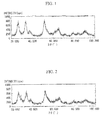
- the specific surface area, the chromaticity (L, a, b), the powder volume resistivity and the X-ray diffraction of the thus obtained antimony-doped tin oxide powder were measured. The results of X-ray diffraction are shown in FIG. 1 .
- Example 10 where the ionic radius was controlled, the peak of antimony oxide was not observed, whereas in Comparative Example 6, the peak of antimony oxide occurred at an angle 2 ⁇ of 29°(indicated by the white triangle in FIG. 2 ). It was confirmed, also from this observation, that the efficiency of doping is increased by controlling the ionic radius.
- Example 10 the powder volume resistivity of the antimony-doped tin oxide powder was lower than that in Comparative Example 6.
- the heat-ray shielding transparent films containing these antimony-doped tin oxide powders exhibited low solar radiation transmittance, the ratio of (visible light transmittance) / (solar radiation transmittance) ([(% Tv) / (% Ts)]) of the heat-ray shielding transparent film had shown a high value, and the infrared cut-off characteristics were favorable. It should be noted that in Comparative Example 6, the ratio of (visible light transmittance) / (solar radiation transmittance) ([(% Tv) / (% Ts)]) was 1.24, and the powder volume resistivity was as high as 3.3 ⁇ •cm.
Landscapes
- Chemical & Material Sciences (AREA)
- Organic Chemistry (AREA)
- Engineering & Computer Science (AREA)
- Life Sciences & Earth Sciences (AREA)
- Materials Engineering (AREA)
- Wood Science & Technology (AREA)
- Inorganic Chemistry (AREA)
- Physics & Mathematics (AREA)
- General Physics & Mathematics (AREA)
- Optics & Photonics (AREA)
- Health & Medical Sciences (AREA)
- Toxicology (AREA)
- Inorganic Compounds Of Heavy Metals (AREA)
- Conductive Materials (AREA)
Abstract
This antimony-doped tin oxide powder is an antimony-doped tin oxide powder characterized by: (A) including at least three kinds of ions selected from the group consisting of Sn 2+ , Sn 4+ , Sb 3+ and Sb 5+ ; (B) having a ratio of average Sn ionic radius to average Sb ionic radius of 1 : (0.96 to 1.04); and (C) having an Sb content of 5 to 25 moles relative to a total of 100 moles of Sb and Sn, wherein the average Sn ionic radius is the average of ionic radii of Sn 2+ and Sn 4+ , while the average Sb ionic radius is the average of ionic radii of Sb 3+ and Sb 5+ .
Description
- The present invention relates to an antimony tin oxide powder excellent in infrared cut-off characteristics and a method of producing the same.
- Priority is claimed on Japanese Patent Application No.
2012-076044, filed March 29,2012 - For the construction materials and window materials for vehicles, such as automobiles, trains, ships and airplanes, the window materials for housing and the glass plates used in showcases, in addition to transparency, electrical conductivity for preventing electrostatic charges and infrared cut-off characteristics are required in some cases. As materials for such applications, indium tin oxide powders and antimony-doped tin oxide powders have been known. Here, although indium tin oxide powders exhibit excellent transparency and infrared cutting performance and are thus advantageous, it incurs a high cost because they are expensive. On the other hand, although antimony-doped tin oxide powders are inexpensive as compared with indium tin oxide powders, there are problems not only of low visible light transmittance which makes it impossible to cope with the demand for high transparency, but also of the infrared cutting performance being inferior to that of indium tin oxide powders.
- On the other hand, although there are applications as long as the infrared cut-off characteristics are favorable even if the visible light transmittance is about 70%, the currently available antimony-doped tin oxide powders do not necessarily exhibit satisfactory infrared cut-off characteristics.
- Although the inventors of the present invention considered that an increase in the amount of antimony added was necessary in order to improve the infrared cut-off characteristics of antimony-doped tin oxide powders, if the amount of antimony addition was increased by a known method (see Patent Document 1), there were problems in that a portion of antimony was not incorporated into the crystal lattice of tin oxide and was not doped, and that the crystallinity of antimony-doped tin oxide was reduced, which lowered the electrical conductivity.
- Patent Document 1: Japanese Unexamined Patent Application, First Publication No.
S 58-91777 - The present invention is intended to solve the above problems, with an object of providing an antimony-doped tin oxide powder exhibiting high electrical conductivity and high infrared cut-off characteristics.
- The present invention relates to the antimony-doped tin oxide powder and the production method thereof that solves the above problems by the following configurations.
- [1] An antimony-doped tin oxide powder characterized by:
- (A) including at least three kinds of ions selected from the group consisting of Sn2+, Sn4+, Sb3+ and Sb5+;
- (B) having a ratio of an average Sn ionic radius (an average of Sn2+ ionic radius and Sn4+ ionic radius) to an average Sb ionic radius (an average of Sb3+ ionic radius and Sb5+ ionic radius) which is represented by the following formula (1); and
- (C) having an Sb content of 5 to 25 moles relative to a total of 100 moles of Sb and Sn, wherein

- [2] A method of producing an antimony-doped tin oxide powder, the method characterized by:
- co-precipitating hydroxides of Sb and Sn from an aqueous solution of a raw material; and
- firing co-precipitated hydroxides,
- wherein the raw material includes at least three types selected from the group consisting of SnCl2, SnCl4, SbCl3 and SbCl5,
- a ratio of an average Sn ionic radius (an average of Sn2+ ionic radius and Sn4+ ionic radius) to an average Sb ionic radius (an average of Sb3+ ionic radius and Sb5+ ionic radius) is represented by the following formula (2); and
- an Sb content is 5 to 25 moles relative to a total of 100 moles of Sb and Sn, wherein

- [3] The method of producing an antimony-doped tin oxide powder according to the above aspect [2], further including:
- a step of preparing an Sn-containing aqueous solution including SnCl2 and SnCl4, which contains SnCl4 in an amount of 2 to 40 moles relative to a total of 100 moles of SnCl2 and SnCl4,
- a step of preparing an Sb-added aqueous solution containing SbCl3, and
- a step of mixing the Sn-containing aqueous solution and the Sb-added aqueous solution to prepare an Sb-added, Sn-containing aqueous solution, wherein
- hydroxides of Sb and Sn are co-precipitated from the Sb-added, Sn-containing aqueous solution.
- [4] The method of producing an antimony-doped tin oxide powder according to the above aspect [2], further including:
- a step of preparing an Sb-added aqueous solution including SbCl3 and SbCl5, which contains SbCl5 in an amount of 44 to 66 moles relative to a total of 100 moles of SbCl3 and SbCl5,
- a step of preparing an Sn-containing aqueous solution containing SnCl4, and
- a step of mixing the Sb-added aqueous solution and the Sn-containing aqueous solution to prepare an Sb-added, Sn-containing aqueous solution, wherein
- hydroxides of Sb and Sn are co-precipitated from the Sb-added, Sn-containing aqueous solution.
- [5] A dispersion obtained by dispersing the antimony-doped tin oxide powder according to the above aspect [1].
- [6] A coating material including the antimony-doped tin oxide powder according to the above aspect [1], and a resin.
- [7] A heat-ray shielding transparent film including the antimony-doped tin oxide powder according to the above aspect [1].
- [8] The heat-ray shielding transparent film according to the above aspect [7], wherein a value of [(visible light transmittance) / (solar radiation transmittance)] is at least 1.25 when the visible light transmittance is from 83 to 87%.
- According to the aspect [1] of the present invention, it is possible to provide an antimony-doped tin oxide powder with high electrical conductivity and high infrared cut-off characteristics.
- In addition, according to the aspect [2] of the present invention, it is possible to easily produce an antimony-doped tin oxide powder with high electrical conductivity and high infrared cut-off characteristics.
- Since a coating film exhibiting high electrical conductivity and high infrared cut-off characteristics can be easily obtained according to the aspect [5] or [6] of the present invention, the dispersion described in [5] and coating material described in [6] can easily be applied to the construction materials and window materials for vehicles, such as automobiles, trains, ships and airplanes, the window materials for housing, and the glass plates used in showcases or the like.
-
-
FIG. 1 is a diagram showing the results of X-ray diffraction of the antimony tin oxide powder of Example 10. -
FIG. 2 is a diagram showing the result of X-ray diffraction of the antimony tin oxide powder of Comparative Example 6. - Hereinafter, the present invention will be described in more detail based on embodiments thereof. It should be noted that the symbol"%" refers to "% by mass", unless indicated otherwise, and except those cases where it is specific to the numerical value.
- An antimony-doped tin oxide powder according to the present embodiment is characterized by:
- (A) including at least three kinds of ions selected from the group consisting of Sn2+, Sn4+, Sb3+ and Sb5+;
- (B) having a ratio of an average Sn ionic radius (an average of Sn2+ ionic radius and Sn4+ ionic radius) to an average Sb ionic radius (an average of Sb3+ ionic radius and Sb5+ ionic radius) which is represented by the following formula (1); and
- (C) having an Sb content of 5 to 25 moles relative to a total of 100 moles of Sb and Sn, wherein

- It should be noted that the ratio (average Sn ionic radius) : (average Sb ionic radius) is preferably 1: (0.98 to 1.04) and more preferably 1: (0.98 to 1.02).
- In addition, the Sb content is preferably from 8 to 25 moles and more preferably from 9 to 22 moles relative to a total of 100 moles of Sb and Sn.
- First, a relationship between the average Sn ionic radius and the average Sb ionic radius will be described. The ionic radius of Sn4+ is 74 pm, the ionic radius of Sn2+ is 93 pm, the ionic radius of Sb5+ is 62 pm and the ionic radius of Sb3+ is 89 pm. In the case of producing an antimony-doped tin oxide from Sn4+ and Sb5+, the ratio of the ionic radius of Sn4+ and Sb5+ will be about (1: 0.84), and if the amount of Sb is increased in order to improve the infrared cut-off characteristics, a portion of antimony would not be incorporated into the crystal lattice of tin oxide and would not be doped. In addition, the crystallinity of antimony-doped tin oxide is reduced, and the electrical conductivity is lowered. On the other hand, in the case of producing from Sn4+ and Sb3+, the ratio of the ionic radius of Sn4+ and Sb3+ will be about (1:1.20), and if the amount of Sb is increased, a portion of antimony would not be incorporated into the crystal lattice of tin oxide and would not be doped. In addition, the crystallinity of antimony-doped tin oxide is reduced, and the electrical conductivity is lowered.
- Table 1 shows the ratio of the average ionic radius when using Sn4+ as Sn ions and Sb5+ and Sb3+ as Sb ions. The average Sb ionic radius is determined by the weighted average of the ratio of Sb5+ and the ratio of Sb3+. Here, the ionic radius of Sb5+ is denoted as RSb5 and the ionic radius of Sb3+ is denoted as RSb3, and the average Sb ionic radius (RSb), when the molar ratio of Sb5+ relative to the total of 1 mole of the molar ratio of Sb5+ and the molar ratio of Sb3+ is x mole, is shown in the following formula (2).

- It should be noted that the ratio of Sb5+ and the ratio of Sb3+ shown in Table 1 are expressed in molar ratios.
- Further, the ratio of the average ionic radius, when using Sn4+ as Sn ions and Sb5+ and Sb3+ as Sb ions, is determined by the formula (3).

[Table 1] Sb5+ ratio 0.00 0.10 0.30 0.40 0.44 0.50 0.60 0.66 0.70 0.90 1.00 Sb3+ ratio 1.00 0.90 0.70 0.60 0.56 0.50 0.40 0.34 0.30 0.10 0.00 Average Sb ionic radius 89.0 86.3 80.9 78.2 77.1 75.5 72.8 71.2 70.1 64.7 62.0 Ratio of average ionic radius (Sn = 1) 1.20 1.17 1.09 1.06 1.04 1.02 0.98 0.96 0.95 0.87 0.84 - As can be seen from Table 1, in the case of using Sn4+ as Sn ions, if Sb5+ is from 0.44 to 0.66 moles relative to the total of 1 mole of Sb5+ and Sb3+, the ratio (average Sn ionic radius) : (average Sb ionic radius) would be 1: (1.04 to 0.96), and even when the amount of Sb addition is increased in order to enhance the infrared cut-off characteristics, it is possible to obtain an antimony-doped tin oxide powder in which the crystallinity of the antimony-doped tin oxide is high, in other words, the electrical conductivity is high.
- Next, Table 2 shows the ratio of the average ionic radius when using Sb3+ as Sb ions and Sn4+ and Sn2+ as Sn ions. The average Sn ionic radius is determined by the weighted average of the ratio of Sn4+ and the ratio of Sn2+. Here, the ionic radius of Sn4+ is denoted as RSn4 and the ionic radius of Sn2+ is denoted as RSn2, and the average Sn ionic radius (RSn), when the molar ratio of Sn4+ relative to the total of 1 mole of the molar ratio of Sn4+ and the molar ratio of Sn2+ is y mole, is shown in the following formula (4).

- It should be noted that the ratio of Sn4+ and the ratio of Sn2+ shown in Table 2 are expressed in molar ratios.
- Further, the ratio of the average ionic radius, when using Sb3+ as Sb ions and Sn4+ and Sn2+ as Sn ions, is determined by the formula (5).

[Table 2] Sn4+ ratio 0.0 0.02 0.10 0.30 0.40 0.50 0.60 0.70 0.80 0.90 1.00 Sn2+ ratio 1.0 0.98 0.90 0.70 0.60 0.50 0.40 0.30 0.20 0.10 0.00 Average Sn ionic radius 93.0 92.6 91.1 87.3 85.4 83.5 81.6 79.7 77.8 75.9 74.0 Ratio of average ionic radius (Sn = 1) 0.957 0.961 0.98 1.02 1.04 1.07 1.09 1.12 1.14 1.17 1.20 - As can be seen from Table 2, in the case of using Sb3+ as Sb ions, if Sn4+ is from 0.02 to 0.40 moles relative to the total of 1 mole of Sn4+ and Sn2+, the ratio (average Sn ionic radius) : (average Sb ionic radius) would be 1: (0.96 to 1.04), and even when the amount of Sb addition is increased in order to enhance the infrared cut-off characteristics, it is possible to obtain an antimony-doped tin oxide powder in which the crystallinity of the antimony-doped tin oxide is high, in other words, the electrical conductivity is high.
- Next, Table 3 shows the ratio of the average ionic radius when using Sb5+ and Sb3+ at a molar ratio of 1:2 (average Sb ionic radius: 80 pm) as Sb ions and Sn4+ and Sn2+ as Sn ions. The average Sn ionic radius is determined by the weighted average of the ratio of Sn4+ and the ratio of Sn2+. Here, the ionic radius of Sn4+ is denoted as RSn4 and the ionic radius of Sn2+ is denoted as RSn2, and the average Sn ionic radius (RSn), when the molar ratio of Sn4+ relative to the total of 1 mole of the molar ratio of Sn4+ and the molar ratio of Sn2+ is p mole, is shown in the following formula (6).

- It should be noted that the ratio of Sn4+ and the ratio of Sn2+ shown in Table 3 are expressed in molar ratios.
- The average Sb ionic radius is determined by the weighted average of the ratio of Sb5+ and the ratio of Sb3+. Here, the ionic radius of Sb5+ is denoted as RSb5 and the ionic radius of Sb3+ is denoted as RSb3, and the average Sb ionic radius (RSb), when the molar ratio of Sb5+ relative to the total of 1 mole of the molar ratio of Sb5+ and the molar ratio of Sb3+ is q mole, is shown in the following formula (7).

- Further, the ratio of the average ionic radius, when using Sb5+ and Sb3+ as Sb ions and Sn4+ and Sn2+ as Sn ions, is determined by the formula (8).

[Table 3] Sn4+ ratio 0.00 0.10 0.20 0.40 0.51 0.60 0.70 0.80 0.84 0.90 1.00 Sn2+ ratio 1.00 0.90 0.80 0.60 0.49 0.40 0.30 0.20 0.16 0.10 0.00 Average Sn ionic radius 93.0 91.1 89.2 85.4 83.3 81.6 79.7 77.8 77.0 75.9 74.0 Ratio of average ionic radius (Sn = 1) 0.86 0.88 0.90 0.94 0.96 0.98 1.00 1.03 1.04 1.05 1.08 - As can be seen from Table 3, in the case of using Sb5+ and Sb3+ at a molar ratio of 1:2 as Sb ions, if Sn4+ is from 0.51 to 0.84 moles relative to the total of 1 mole of Sn4+ and Sn2+, the ratio (average Sn ionic radius) : (average Sb ionic radius) would be 1: (0.96 to 1.04), and even when the amount of Sb addition is increased in order to enhance the infrared cut-off characteristics, it is possible to obtain an antimony-doped tin oxide powder in which the crystallinity of the antimony-doped tin oxide is high, in other words, the electrical conductivity is high. Since it is possible to control the electrical conductivity of antimony-doped tin oxide powder by the ratio of Sn4+ and Sn2+, in the case of using four types of raw materials, by adjusting the ratio of Sn4+ and Sn2+ so as to attain a desired electrical conductivity, it is also possible to back calculate the molar ratio of Sb5+ and Sb3+ such that the desired ratio of the average Sn ionic radius and the average Sb ionic radius is achieved. Here, the quantitative determination of Sn2+, Sn4+, Sb3+ and Sb5+ is carried out by X-ray photoelectron spectroscopy (XPS).
- Next, the Sb content is from 5 to 25 moles relative to a total of 100 moles of Sb and Sn, and is preferably from 8 to 25 moles in order to enhance the infrared cut-off characteristics. Here, the quantitative measurement of Sb and Sn is carried out by inductively coupled plasma emission spectrometry.
- It is preferable that the antimony-doped tin oxide powder have a color indicated by an L value of 50 or less in the Lab color system because the infrared cut-off characteristics increase, and an L value of 40 or less is more preferred because the infrared cut-off characteristics increase. Here, the L value is measured using a color computer (model number: SM-7) manufactured by Suga Test Instruments Co., Ltd. It should be noted that the L value is preferably 6 or more from the viewpoint of the transparency of the heat-ray shielding transparent film that contains the antimony-doped tin oxide powder.
- It is preferable that the antimony-doped tin oxide powder have a BET specific surface area of 50 m2/g or more because the infrared cut-off characteristics increase, and a BET specific surface area of 70 m2/g or more is more preferred because the infrared cut-off characteristics increase. It should be noted that the BET specific surface area is preferably not greater than 120 m2/g from the viewpoint of the handling properties of the antimony-doped tin oxide powder.
- The powder volume resistivity of the antimony-doped tin oxide powder can be made to be 20 Ω•cm or less. Here, a sample powder is placed in a pressure vessel and compressed at 980 N, and the powder volume resistivity is measured by a digital multimeter using the resulting compressed powder.
- The infrared cut-off characteristics can be evaluated by measuring the visible light transmittance (% Tv, wavelength range: 380 to 780 nm) and the solar radiation transmittance (% Ts, wavelength range: 300 to 2,500 nm) and calculating a ratio [(% Tv) / (% Ts)]. Here, in order to measure the visible light transmittance and the solar radiation transmittance, the antimony-doped tin oxide powder is first dispersed, and the resulting dispersed liquid is mixed with a resin to form a coating material. Next, the thus obtained coating material is applied onto a transparent film and is then dried to produce a heat-ray shielding composition film. Then, after measuring the visible light transmittance and solar radiation transmittance of the film on which no coating material has been applied as a background, the visible light transmittance and solar radiation transmittance of the film on which a heat-ray shielding composition film has been formed are measured using a spectrophotometer (model number: U-4000) manufactured by Hitachi, Ltd.
- A method of producing an antimony-doped tin oxide powder according to the present embodiment is characterized by:
- co-precipitating hydroxides of Sb and Sn from an aqueous solution of a raw material; and
- firing the co-precipitated hydroxides, wherein
- the raw material includes at least three types selected from the group consisting of SnCl2, SnCl4, SbCl3 and SbCl5,
- a ratio of an average Sn ionic radius (an average of Sn2+ ionic radius and Sn4+ ionic radius) to an average Sb ionic radius (an average of Sb3+ ionic radius and Sb5+ ionic radius) is represented by the following formula (9);
- and an Sb content is from 5 to 25 moles relative to a total of 100 moles of Sb and Sn, wherein

- When using SnCl2, SnCl4 and SbCl3 as raw materials, it is preferable to mix an Sn-containing aqueous solution including SnCl2 and SnCl4, which contains SnCl4 in an amount of 2 to 40 moles relative to a total of 100 moles of SnCl2 and SnCl4, with
an Sn-containing aqueous solution containing SbCl3 to thereby prepare an Sb-added, Sn-containing aqueous solution, and
to co-precipitate the hydroxides of Sb and Sn from the Sb-added, Sn-containing aqueous solution, because the ratio represented by the formula (10) is achieved:
- As described above, if an SbCl3 aqueous solution is used when mixing SbCl3, it is possible to easily make the Sb-added, Sn-containing aqueous solution uniform, which is preferable.
- Further, when using SnCl4, SbCl3 and SbCl5 as raw materials,
it is preferable to mix an Sb-added aqueous solution including SbCl3 and SbCl5, which contains SbCl5 in an amount of 44 to 66 moles relative to a total of 100 moles of SbCl3 and SbCl5, with
an Sn-containing aqueous solution containing SnCl4 to thereby prepare an Sb-added, Sn-containing aqueous solution, and
to co-precipitate the hydroxides of Sb and Sn from the Sb-added, Sn-containing aqueous solution, because the ratio represented by the formula (11) is achieved:
- As described above, if an SnCl4 aqueous solution is used when mixing SnCl4, it is possible to easily make the Sb-added, Sn-containing aqueous solution uniform, which is preferable.
- It is preferable to use an aqueous hydrochloric acid solution, as an aqueous solution of at least three types selected from the group consisting of SnCl2, SnCl4, SbCl3 and SbCl5, from the viewpoints of the solubility of the raw materials and the uniformity of the co-precipitation reaction. Further, the concentrations of SnCl2, SnCl4, SbCl3 and SbCl5 in the aqueous solution is preferably from 1 to 80% by mass, from the viewpoints of the solubility of the raw materials, the uniformity of the co-precipitation reaction, and the productivity.
- An aqueous alkaline solution is used in order to co-precipitate the hydroxides of Sb and Sn from the aqueous solution of raw materials. Examples of the alkali used in the aqueous alkaline solution include the hydroxides and carbonates of alkali metals, such as sodium hydroxide, potassium hydroxide, sodium carbonate and potassium carbonate, ammonia, or the like, and these may be used alone or two or more types thereof may be mixed. A method known to those skilled in the art may be adopted as a method to dropwise add the aqueous alkaline solution to the solution of raw materials. When the dropwise addition is conducted, it is preferable that the aqueous alkaline solution have a pH of 10 or less, and be heated to 40 to 100°C.
- It should be noted that in the case of using SnCl2, SnCl4 and SbCl3 as the raw materials described above, when including SbCl3 in the Sn-containing aqueous solution, it is possible to add the aqueous alkaline solution at the same time. Further, in the case of using SnCl4, SbCl3 and SbCl5 as the raw materials described above, when including SnCl4 in the Sb-added aqueous solution, it is possible to add the aqueous alkaline solution at the same time.
- After co-precipitating the hydroxides of Sb and Sn, the residual salt is removed by decantation to dry. It is preferable to stop the washing for removing the residual salt at a point where hydrochloric acid remains only slightly, for example, when the electrical conductivity of the hydroxides of Sb and Sn becomes 0.4 mS/cm or less.
- In the case of using the powder for applications of coating onto a film or kneading into a substrate, the firing is preferably carried out at 400 to 900°C. If the temperature is less than 400°C, sufficient electrical conductivity cannot be obtained, whereas if the temperature is higher than 900°C, the sintering of antimony-doped tin oxide powder would start, the particle size would be λ/4 or more in the visible light region, and deteriorations in the transparency and haze would occur when the powder is applied onto or kneaded into a film, which is undesirable. However, when it is used as a raw material of a target material or the like, the particle size would be suitable in view of formability. In addition, it is possible to increase the transparency of the antimony-doped tin oxide powder by carrying out the firing in the atmosphere.
- As described above, it is possible to produce an antimony-doped tin oxide powder exhibiting high electrical conductivity and high infrared cut-off characteristics.
- The transparent conductive antimony-doped tin oxide powder of the present embodiment can be used as a dispersion by being dispersed in a solvent. Here, the solvent is not particularly limited and it is possible to use various solvents, but water, alcohol-based solvents such as ethanol and isopropyl alcohol (IPA), ketone-based solvents such as methyl ethyl ketone, and non-polar solvents such as hexane and toluene are preferred.
- The content of antimony-doped tin oxide powder in the dispersion is, based on the mass, from 1 to 70% by mass, and is preferably from 10 to 60% by mass.
- When the content is less than 1% by mass, the effect of adding the powder would be small, whereas when the content exceeds 70% by mass, gelation occurs at times, and auxiliaries and the like would be required.
- Various conventional additives may be added to the dispersion within a range that does not impair the purpose thereof. Examples of such additives include dispersants, dispersion aids, polymerization inhibitors, curing catalysts, antioxidants, leveling agents, and film-forming resins.
- In addition, it is possible to add a resin to the dispersion described above and use the resultant as a coating material. It is preferable to form a coating material using the dispersion in view of achieving a reduction in the dispersion energy or the like at the time of forming the coating material. Here, as the resin, for example, polyvinyl alcohol resins, vinyl chloride-vinyl acetate resins, acrylic resins, epoxy resins, urethane resins, alkyd resins, polyester resins, ethylene-vinyl acetate copolymer resins, acryl-styrene copolymer resins, cellulose resins, phenolic resins, amino resins, fluororesins, silicone resins, petroleum resins, and natural resins, such as shellac, rosin derivatives and rubber derivatives.
- The amount of the antimony-doped tin oxide powder added to the resin is from 0.1 to 950 parts by mass and is preferably from 0.7 to 800 parts by mass, relative to 100 parts by mass of the resin. The preferred value changes depending on the electrical resistivity, infrared cut-off characteristics and film thickness of the transparent conductive film that are required.
- Further, it is also possible to mix the antimony-doped tin oxide powder and a resin to form a coating material. In this case, a solvent may be added. It is as described above for the resin and solvent to be used and the amount of resin added in the antimony-doped tin oxide powder, and the solvent may be appropriately added in order to adjust the viscosity of the coating material.
- By applying and drying the dispersion or coating material on the construction materials and window materials for vehicles, such as automobiles, trains, ships and airplanes, the window materials for housing, the glass plates used in showcases, or the like, it is possible to obtain a heat-ray shielding transparent film exhibiting high electrical conductivity and high infrared cut-off characteristics.
- The application of the dispersion, coating material or the like onto a glass plate can be carried out by conventional methods, for example, techniques such as roll coating, spin coating, screen printing, and the use of an applicator. Thereafter, a binder component is heated if necessary to evaporate the solvent, and the coating film is solidified by drying. At this time, it may be heated or irradiated with ultraviolet rays or the like.
- From the viewpoints of the transparency, the electrical conductivity and the infrared cut-off characteristics, in the case of a coating film, the thickness of the heat-ray shielding transparent film is preferably from 0.1 to 5 µm, and more preferably from 0.5 to 3 µm. However, if it is kneaded into a resin, the thickness is not limited.
- In addition, when the visible light transmittance of the heat-ray shielding transparent film is from 83 to 87%, if the value of [(visible light transmittance) / (solar radiation transmittance)] is 1.25 or more, the infrared cut-off characteristics can be improved. Here, for the measurements of the visible light transmittance and the solar radiation transmittance, the antimony-doped tin oxide powder is dispersed, the resulting dispersed liquid is mixed with a resin to form a coating material, and the thus obtained coating material is applied onto a transparent film and is then dried, to produce a heat-ray shielding composition film. After measuring the visible light transmittance and solar radiation transmittance of the transparent film on which no coating material has been applied as a background, the visible light transmittance and solar radiation transmittance of the film on which a heat-ray shielding composition film has been formed are measured using a spectrophotometer (model number: U-4000) manufactured by Hitachi, Ltd. At this time, if the visible light transmittance of the heat-ray shielding transparent film is from 83 to 87%, the value of [(visible light transmittance) / (solar radiation transmittance)] of the heat-ray shielding transparent film would be from 1.25 to 1.50.
- As described above, using the antimony-doped tin oxide powder of the present embodiment, it is possible to supply in the forms of dispersions, coating materials, or the like. In addition, the heat-ray shielding transparent film formed by these can be widely applied to the construction materials and window materials for vehicles, such as automobiles, trains, ships and airplanes, the window materials for housing, the glass plates used in showcases, or the like.
- As follows is a more detailed description of the present invention based on a series of Examples, although the present invention is not limited to these Examples. In Examples, the L values of the antimony-doped tin oxide powders were measured using a color computer (model number: SM-7) manufactured by Suga Test Instruments Co., Ltd. The BET specific surface areas were measured using a fluid-type, specific surface area automatic measuring device (model number: FlowSorb 2310) manufactured by Shimadzu Corporation. Using a measuring device (model number: DM-7561) manufactured by Yokogawa Electric Corporation, 5 g of a sample was placed in a mold having a cross-sectional area S of 4.9 cm2 and pressurized at 980 N to measure the resistance value (R) and the sample thickness (H) at the time of pressurization, and the powder volume resistivity was determined based on a formula: R (Ω) × S (cm2) / H (cm). The visible light transmittance (% Tv, wavelength range: 380 to 780 nm) and the solar radiation transmittance (% Ts, wavelength range: 300 to 2,500 nm) were measured as follows. First, 20 g of an antimony-doped tin oxide powder was dispersed in 30 g of ion-exchanged water, and the resulting dispersion was diluted 2-fold (mass ratio) with water. 50.0 g of the diluted solution was mixed with 45.5 g of an aqueous solution of 22% by mass of an urethane-based thermosetting resin (dispersion type) to give a mass ratio of the antimony-doped tin oxide powder and the resin of 1:1, thereby producing a coating material. The mixed coating material was applied with a thickness of 2 µm onto PET film (thickness: 100 µm, haze: 2.0%, total light transmittance: 90%). Then, using a spectrophotometer (model number: U-4000) manufactured by Hitachi, Ltd., after measuring the visible light transmittance and solar radiation transmittance of the PET film on which no coating material had been applied as a background, the visible light transmittance and solar radiation transmittance of the PET film on which a heat-ray shielding composition film had been formed were measured, thereby determining the visible light transmittance and solar radiation transmittance of the heat-ray shielding composition film and calculating the ratio of (visible light transmittance) / (solar radiation transmittance) ([(% Tv) / (% Ts)]).
- 9.9 g of a 50% by mass aqueous SbCl3 solution (containing 2.64 g (0.022 mol) of a Sb metal) was mixed with 16.2 g of a 40% by mass aqueous SbCl5 solution (containing 3.36 g (0.028 mol) of a Sb metal) such that the molar ratio of Sb will be a ratio of 9.8 moles relative to a total of 100 moles of Sb and Sn, and the resulting antimony chloride mixture was further mixed with 237.0 g of a 50% by mass aqueous SnCl4 solution (containing 54 g (0.455 mol) of a Sn metal). The resulting mixture was added dropwise into an aqueous solution of NaOH (90 g/ 1.2 dm3) with stirring under heating at 80°C, and the final pH was adjusted to 7 to co-precipitate the hydroxides of Sn and Sb. Then, the resultant was left to stand to precipitate the co-precipitated hydroxides of Sn and Sb, the supernatant liquid was removed, followed by the addition of ion-exchanged water, and an operation of the standing/precipitation and the supernatant liquid removal was carried out repeatedly until the electrical conductivity of the supernatant liquid became 200 µS/cm or less. The precipitates of the co-precipitated hydroxides of Sn and Sb were filtered, dried, and then fired for 2 hours in the atmosphere at 600°C. The specific surface area, the chromaticity (L, a, b) and the powder volume resistivity of the thus obtained antimony-doped tin oxide powder were measured. Furthermore, 20 g of the antimony-doped tin oxide powder was dispersed in 20 g of ion-exchanged water, and using the resulting dispersion, the visible light transmittance (% Tv) and the solar radiation transmittance (% Ts) were determined to calculate the ratio of (visible light transmittance) / (solar radiation transmittance) ([(% Tv) / (% Ts)]).
- Antimony-doped tin oxide powders were produced in the same manner as in Example 1, with the exception that the ratios were those shown in Table 4, and the respective characteristics of the thus obtained antimony-doped tin oxide powders were measured. The results when Sn4+ was combined with Sb3+ and Sb5+ are shown in Table 4.
- 209.2 g of a 40% by mass aqueous SnCl2 solution (containing 52.38 g (0.441 mol) of a Sn metal) was mixed with 7.1 g of a 50% by mass aqueous SnCl4 solution (containing 1.62 g (0.014 mol) of a Sn metal) such that the molar ratio of Sb will be a ratio of 9.8 moles relative to a total of 100 moles of Sb and Sn, and 22.5 g of a 50% by mass aqueous SbCl3 solution (containing 6.0 g (0.049 mol) of a Sb metal) was further mixed with the tin chloride mixture. The rest of the operation was carried out by the method described in Example 1. These results are shown in Table 5.
- Antimony-doped tin oxide powders were produced in the same manner as in Example 4, with the exception that the ratios were those shown in Table 5, and the respective characteristics of the thus obtained antimony-doped tin oxide powders were measured. The results when Sn4+ and Sn2+ were combined with Sb3+ are shown in Table 5.
- 15.0 g of a 50% by mass aqueous SbCl3 solution (containing 4.0 g (0.033 mol) of a Sb metal) was mixed with 12.3 g of a 40% by mass aqueous SbCl5 solution (containing 2.0 g (0.016 mol) of a Sb metal) such that the molar ratio of Sb will be a ratio of 9.8 moles relative to a total of 100 moles of Sb and Sn, to prepare an antimony chloride mixture A. Then, a tin chloride mixture B was prepared, which was a mixture of 64.7 g of a 40% by mass aqueous SnCl2 solution (containing 16.2 g (0.136 mol) of a Sn metal) and 165.9 g of a 50% by mass aqueous SnCl4 solution (containing 37.8 g (0.318 mol) of a Sn metal). Then, the antimony chloride mixture A was mixed with the tin chloride mixture B. The rest of the operation was carried out by the method described in Example 1. These results are shown in Table 6.
- Antimony-doped tin oxide powders were produced in the same manner as in Example 7, with the exception that the ratios were those shown in Table 6, and the respective characteristics of the thus obtained antimony-doped tin oxide powders were measured. The results when Sn4+ and Sn2+ were combined with Sb3+ and Sb5+ are shown in Table 6.
[Table 4] Comp. Ex. 1 Ex. 1 Ex. 2 Ex. 3 Comp. Ex. 2 Sb5+ ratio 0.3 0.44 0.5 0.6 0.7 Sb3+ ratio 0.7 0.56 0.5 0.4 0.3 Ratio of average ionic radius (Sn = 1) 1.09 1.04 1.02 0.98 0.95 Firing temperature (°C) 600 600 600 600 600 Firing time (hour) 2 2 2 2 2 L value 39.5 38.3 38.0 38.5 39.3 BET specific surface area (m2/g) 76 73 74 71 79 Powder volume resistivity (Ω·cm) 1.4 0.6 0.5 0.9 1.7 Visible light transmittance (% Tv) 86.1 85.2 85.3 84.6 85.9 Solar radiation transmittance (% Ts) 69.2 66.1 66.0 65.8 70.0 (% Tv) / (% Ts) 1.24 1.29 1.29 1.29 1.23 [Table 5] Comp. Ex. 3 Ex. 4 Ex. 5 Ex. 6 Comp. Ex. 4 Sn4+ ratio 0.00 0.03 0.1 0.3 0.5 Sn2+ ratio 1.00 0.97 0.9 0.7 0.5 Ratio of average ionic radius (Sn = 1) 0.957 0.963 0.98 1.02 1.07 Firing temperature (°C) 600 600 600 600 600 Firing time (hour) 2 2 2 2 2 L value 40.0 37.9 37.1 38.5 39.6 BET specific surface area (m2/g) 84 84 82 83 80 Powder volume resistivity (Ω·cm) 1.8 0.9 0.5 0.7 1.6 Visible light transmittance (% Tv) 86.2 85.6 85.7 85.9 85.8 Solar radiation transmittance (% Ts) 70.2 67.7 67.7 67.8 70.0 (% Tv) / (% Ts) 1.23 1.26 1.27 1.27 1.23 [Table 6] Comp. Ex. 5 Ex. 7 Ex. 8 Ex. 9 Sn4+ ratio 0.4 0.7 0.8 0.6 Sn2+ ratio 0.6 0.3 0.2 0.4 Ratio of average ionic radius (Sn = 1) 0.94 1.00 1.03 0.98 Firing temperature (°C) 600 600 600 600 Firing time (hour) 2 2 2 2 L value 39.3 38.3 36.3 37.1 BET specific surface area (m2/g) 84 83 78 77 Powder volume resistivity (Ω·cm) 1.5 0.6 0.7 0.9 Visible light transmittance (% Tv) 85.9 85.8 85.4 85.6 Solar radiation transmittance (% Ts) 70.2 67.6 67.9 67.1 (% Tv) / (% Ts) 1.22 1.27 1.26 1.27 - As can be seen from Tables 4 to 6, it was confirmed that in all of Examples 1 to 9 where the ratio of the ionic radii of Sb and Sn was controlled, the powder volume resistivity was reduced. It is thought that this is due to an increase in the degree of crystallinity. In addition, in all of Examples 1 to 9, the ratio of [(visible light transmittance) / (solar radiation transmittance)] had shown a very high value of 1.26 or more, and it was found that the heat ray cutoff performance was improved significantly. It should be noted that in all of Examples 1 to 9, the L values were not greater than 50 and the specific surface areas were at least 50 m2/g, which were within the desired ranges. On the other hand, in Comparative Examples 1 to 5 where the ratio of the ionic radii of Sb and Sn was outside the predetermined range, the ratio of (visible light transmittance) / (solar radiation transmittance) was as low as 1.24 or less.
- 29.3 g of a 50% by mass aqueous SbCl3 solution (containing 7.81 g (0.064 mol) of a Sb metal) was mixed with 48.0 g of a 40% by mass aqueous SbCl5 solution (containing 7.81 g (0.064 mol) of a Sb metal) such that the molar ratio of Sb will be a ratio of 22 moles relative to a total of 100 moles of Sb and Sn, and the resulting antimony chloride mixture was further mixed with 237.0 g of a 50% by mass aqueous SnCl4 solution (containing 54 g (0.455 mol) of a Sn metal). The resulting mixture was added dropwise into an aqueous solution of NaOH (110 g/ 1.2 dm3) with stirring under heating at 80°C, and the final pH was adjusted to 7 to co-precipitate the hydroxides of Sn and Sb. Then, the resultant was left to stand to precipitate the co-precipitated hydroxides of Sn and Sb, the supernatant liquid was removed, followed by the addition of ion-exchanged water, and an operation of the standing/precipitation and the supernatant liquid removal was carried out repeatedly until the electrical conductivity of the supernatant liquid became 200 µS/cm or less. The precipitates of the co-precipitated hydroxides of Sn and Sb were filtered, dried, and then fired for 2 hours in the atmosphere at 650°C to obtain an antimony-doped tin oxide powder. The specific surface area, the chromaticity (L, a, b), the powder volume resistivity and the X-ray diffraction of the thus obtained antimony-doped tin oxide powder were measured. The results of X-ray diffraction are shown in
FIG. 1 . Furthermore, 20 g of the antimony-doped tin oxide powder was dispersed in 30 g of ion-exchanged water, and using the resulting dispersion, the visible light transmittance (% Tv) and the solar radiation transmittance (% Ts) were determined to calculate the ratio of (visible light transmittance) / (solar radiation transmittance) ([(% Tv) / (% Ts)]). These results are shown in Table 7. - 58.5 g of a 50% by mass aqueous SbCl3 solution (containing 15.6 g (0.128 mol) of a Sb metal) was mixed with the antimony chloride mixture and 237.0 g of a 50% by mass aqueous SnCl4 solution (containing 54 g (0.455 mol) of a Sn metal), such that the molar ratio of Sb will be a ratio of 22 moles relative to a total of 100 moles of Sb and Sn. The rest was carried out by the method described in Example 10 to prepare an antimony-doped tin oxide powder, and the antimony-doped tin oxide powder was evaluated. These results are shown in Table 7, and the results of X-ray diffraction are shown in
FIG. 2 .[Table 7] Ex. 10 Comp. Ex. 6 Sb5+ ratio 0.5 0.0 Sb3+ ratio 0.5 1.0 Ratio of average ionic radius (Sn = 1) 1.02 1.20 Firing temperature (°C) 650 650 Firing time (hour) 2 2 L value 36.5 39.5 BET specific surface area (m2/g) 78 84 Powder volume resistivity (Ω·cm) 1.2 3.3 Visible light transmittance (% Tv) 83.9 83.8 Solar radiation transmittance (% Ts) 60.1 67.3 (% Tv) / (% Ts) 1.40 1.24 - As is apparent by comparing
FIG. 1 and FIG. 2 , even when the ratios of Sn and Sb were the same, in Example 10 where the ionic radius was controlled, the peak of antimony oxide was not observed, whereas in Comparative Example 6, the peak of antimony oxide occurred at an angle 2θ of 29°(indicated by the white triangle inFIG. 2 ). It was confirmed, also from this observation, that the efficiency of doping is increased by controlling the ionic radius. In addition, as can be seen from Table 7, in Example 10, the powder volume resistivity of the antimony-doped tin oxide powder was lower than that in Comparative Example 6. The heat-ray shielding transparent films containing these antimony-doped tin oxide powders exhibited low solar radiation transmittance, the ratio of (visible light transmittance) / (solar radiation transmittance) ([(% Tv) / (% Ts)]) of the heat-ray shielding transparent film had shown a high value, and the infrared cut-off characteristics were favorable. It should be noted that in Comparative Example 6, the ratio of (visible light transmittance) / (solar radiation transmittance) ([(% Tv) / (% Ts)]) was 1.24, and the powder volume resistivity was as high as 3.3 Ω•cm.
Claims (8)
- An antimony-doped tin oxide powder comprising the following (A) to (C):(A) including at least three kinds of ions selected from the group consisting of Sn2+, Sn4+, Sb3+ and Sb5+;(B) having a ratio of an average Sn ionic radius (an average of Sn2+ ionic radius and Sn4+ ionic radius) to an average Sb ionic radius (an average of Sb3+ ionic radius and Sb5+ ionic radius) which is represented by the following formula (1); and(C) having an Sb content of 5 to 25 moles relative to a total of 100 moles of Sb and Sn, wherein

- A method of producing an antimony-doped tin oxide powder, the method comprising:co-precipitating hydroxides of Sb and Sn from an aqueous solution of a raw material; andfiring co-precipitated hydroxides, whereinthe raw material comprises at least three types selected from the group consisting of SnCl2, SnCl4, SbCl3 and SbCl5,a ratio of an average Sn ionic radius (an average of Sn2+ ionic radius and Sn4+ ionic radius) to an average Sb ionic radius (an average of Sb3+ ionic radius and Sb5+ ionic radius) is represented by the following formula (2); andan Sb content is 5 to 25 moles relative to a total of 100 moles of Sb and Sn, wherein

- The method of producing an antimony-doped tin oxide powder according to Claim 2, further comprising:a step of preparing an Sn-containing aqueous solution including SnCl2 and SnCl4, which contains SnCl4 in an amount of 2 to 40 moles relative to a total of 100 moles of SnCl2 and SnCl4;a step of preparing a Sb-added aqueous solution containing SbCl3; anda step of mixing the Sn-containing aqueous solution and the Sb-added aqueous solution to prepare a Sb-added, Sn-containing aqueous solution, whereinhydroxides of Sb and Sn are co-precipitated from the Sb-added, Sn-containing aqueous solution.
- The method of producing an antimony-doped tin oxide powder according to Claim 2, further comprising:a step of preparing a Sb-added aqueous solution including SbCl3 and SbCl5, which contains SbCl5 in an amount of 44 to 66 moles relative to a total of 100 moles of SbCl3 and SbCl5;a step of preparing an Sn-containing aqueous solution including SnCl4; anda step of mixing the Sb-added aqueous solution and the Sn-containing aqueous solution to prepare a Sb-added, Sn-containing aqueous solution, whereinhydroxides of Sb and Sn are co-precipitated from the Sb-added, Sn-containing aqueous solution.
- A dispersion obtained by dispersing the antimony-doped tin oxide powder according to Claim 1 in a solvent.
- A coating material comprising:the antimony-doped tin oxide powder according to Claim 1; anda resin.
- A heat-ray shielding transparent film comprising the antimony-doped tin oxide powder according to Claim 1.
- The heat-ray shielding transparent film according to Claim 7, wherein
a value of [(visible light transmittance) / (solar radiation transmittance)] is at least 1.25 when the visible light transmittance is from 83 to 87%.
Applications Claiming Priority (2)
| Application Number | Priority Date | Filing Date | Title |
|---|---|---|---|
| JP2012076044 | 2012-03-29 | ||
| PCT/JP2013/059276 WO2013147029A1 (en) | 2012-03-29 | 2013-03-28 | Antimony-doped tin oxide powder and process for manufacturing same |
Publications (1)
| Publication Number | Publication Date |
|---|---|
| EP2832698A1 true EP2832698A1 (en) | 2015-02-04 |
Family
ID=49260274
Family Applications (1)
| Application Number | Title | Priority Date | Filing Date |
|---|---|---|---|
| EP13768195.3A Withdrawn EP2832698A1 (en) | 2012-03-29 | 2013-03-28 | Antimony-doped tin oxide powder and process for manufacturing same |
Country Status (6)
| Country | Link |
|---|---|
| US (1) | US9513408B2 (en) |
| EP (1) | EP2832698A1 (en) |
| JP (1) | JP5798240B2 (en) |
| KR (1) | KR101568629B1 (en) |
| CN (1) | CN104271510B (en) |
| WO (1) | WO2013147029A1 (en) |
Families Citing this family (18)
| Publication number | Priority date | Publication date | Assignee | Title |
|---|---|---|---|---|
| WO2015068290A1 (en) * | 2013-11-08 | 2015-05-14 | 共同印刷株式会社 | Infrared-absorptive intaglio printing ink |
| WO2015068292A1 (en) * | 2013-11-08 | 2015-05-14 | 共同印刷株式会社 | Printed article |
| WO2015068276A1 (en) * | 2013-11-08 | 2015-05-14 | 共同印刷株式会社 | Infrared-absorptive flexographic printing ink |
| WO2015068280A1 (en) * | 2013-11-08 | 2015-05-14 | 共同印刷株式会社 | Infrared-absorptive gravure printing ink |
| WO2015068289A1 (en) * | 2013-11-08 | 2015-05-14 | 共同印刷株式会社 | Infrared-absorptive letterpress printing ink |
| WO2015068282A1 (en) * | 2013-11-08 | 2015-05-14 | 共同印刷株式会社 | Infrared-absorptive inkjet printing ink |
| WO2015068281A1 (en) * | 2013-11-08 | 2015-05-14 | 共同印刷株式会社 | Infrared-absorptive screen printing ink |
| WO2015068291A1 (en) * | 2013-11-08 | 2015-05-14 | 共同印刷株式会社 | Printed article |
| WO2015068283A1 (en) * | 2013-11-08 | 2015-05-14 | 共同印刷株式会社 | Infrared-absorptive offset printing ink |
| KR102553348B1 (en) * | 2015-09-30 | 2023-07-07 | 스미토모 긴조쿠 고잔 가부시키가이샤 | Infrared absorbing fine particles, dispersion using the same, dispersion, laminated transparent substrate, film, glass, and manufacturing method thereof |
| JP6680543B2 (en) * | 2016-01-20 | 2020-04-15 | 三菱マテリアル電子化成株式会社 | Heat ray cut film and paint for forming this heat ray cut film |
| ES2908476T3 (en) * | 2016-03-18 | 2022-04-29 | Basf Se | Metal doped tin oxide for electrocatalysis applications |
| CN106315666A (en) * | 2016-07-29 | 2017-01-11 | 深圳大学 | ATO nanocrystal, ATO nanometer slurry, ATO/macromolecular polymer compound and preparation methods |
| CN106986376B (en) * | 2017-04-27 | 2018-08-31 | 柳州豪祥特科技有限公司 | Nano ATO raw powder's production technology |
| CN107010665B (en) * | 2017-04-27 | 2018-11-20 | 柳州豪祥特科技有限公司 | The preparation process of new A TO nano-powder |
| CN107098379B (en) * | 2017-04-27 | 2018-08-14 | 柳州豪祥特科技有限公司 | The preparation method of stibium doping nano-tin dioxide |
| US11474444B2 (en) | 2021-01-08 | 2022-10-18 | Ricoh Company, Ltd. | Intermediate transfer belt and image forming apparatus |
| CN116901563A (en) * | 2023-06-28 | 2023-10-20 | 厦门长塑实业有限公司 | A thin film for current collector and preparation method thereof |
Family Cites Families (10)
| Publication number | Priority date | Publication date | Assignee | Title |
|---|---|---|---|---|
| JPS5891777A (en) | 1981-11-25 | 1983-05-31 | Mitsubishi Metal Corp | Electrically conductive clear paint |
| US5330833A (en) * | 1991-07-24 | 1994-07-19 | Tokuyama Soda Kabushiki Kaisha | Tin oxide fiber and a process for producing the same |
| FR2691918B1 (en) * | 1992-06-09 | 1994-07-22 | Kodak Pathe | PREPARATION OF CONDUCTIVE POWDERS OF METAL OXIDES. |
| JP3250125B2 (en) * | 1993-06-30 | 2002-01-28 | 三菱マテリアル株式会社 | Infrared cutoff powder |
| US5788887A (en) * | 1996-11-01 | 1998-08-04 | E. I. Du Pont De Nemours And Company | Antimony doped tin oxide electroconductive powder |
| JP4088721B2 (en) * | 1997-03-13 | 2008-05-21 | 日産化学工業株式会社 | Conductive tin oxide fine powder and method for producing conductive tin oxide sol |
| JP2003176132A (en) | 2001-09-28 | 2003-06-24 | Sumitomo Metal Mining Co Ltd | Antimony tin oxide particles for solar shading, coating solution for forming solar shading film, and solar shading film |
| JP4182825B2 (en) | 2002-07-01 | 2008-11-19 | 住友金属鉱山株式会社 | Antimony tin oxide fine particles for sunscreen, dispersion for forming sunscreen using the same, sunscreen and transparent substrate for sunscreen |
| JP4193036B2 (en) | 2002-10-29 | 2008-12-10 | 日産化学工業株式会社 | Method for producing conductive tin oxide |
| WO2008127409A2 (en) | 2006-11-07 | 2008-10-23 | Ppg Industries Ohio, Inc. | Infrared absorber |
-
2013
- 2013-03-28 US US14/388,478 patent/US9513408B2/en active Active
- 2013-03-28 KR KR1020147026903A patent/KR101568629B1/en active Active
- 2013-03-28 WO PCT/JP2013/059276 patent/WO2013147029A1/en not_active Ceased
- 2013-03-28 CN CN201380016607.2A patent/CN104271510B/en active Active
- 2013-03-28 JP JP2014508030A patent/JP5798240B2/en active Active
- 2013-03-28 EP EP13768195.3A patent/EP2832698A1/en not_active Withdrawn
Non-Patent Citations (1)
| Title |
|---|
| See references of WO2013147029A1 * |
Also Published As
| Publication number | Publication date |
|---|---|
| WO2013147029A1 (en) | 2013-10-03 |
| JPWO2013147029A1 (en) | 2015-12-14 |
| CN104271510A (en) | 2015-01-07 |
| KR20140129287A (en) | 2014-11-06 |
| US20150090943A1 (en) | 2015-04-02 |
| KR101568629B1 (en) | 2015-11-11 |
| JP5798240B2 (en) | 2015-10-21 |
| US9513408B2 (en) | 2016-12-06 |
| CN104271510B (en) | 2016-06-08 |
Similar Documents
| Publication | Publication Date | Title |
|---|---|---|
| US9513408B2 (en) | Antimony-doped tin oxide powder and method of producing the same | |
| JP5754580B2 (en) | Indium tin oxide powder | |
| AU2016372155B2 (en) | Composition for anti-counterfeit ink, anti-counterfeit ink, printed article for counterfeit prevention, and method of producing composition for anti-counterfeit ink | |
| CN113727941B (en) | Zirconium nitride powder coated with alumina and method for producing the same | |
| DE102014018464A1 (en) | THERMOCHROMIC PIGMENTS, THERMOCHROME COATING, METHOD FOR THE PRODUCTION THEREOF AND THEIR USE | |
| EP2832699A1 (en) | Infrared cut material | |
| EP3357865B1 (en) | Infrared absorbing particles, and dispersion liquid, dispersion, laminated transparent substrate, film, and glass using same, and method for manufacturing same | |
| JP4389368B2 (en) | Conductive pigment powder and transparent conductive film made using the same | |
| JPWO2004089829A1 (en) | Composite indium oxide particles, production method thereof, conductive paint, conductive coating film and conductive sheet | |
| KR101650611B1 (en) | Ito powder and method of producing same | |
| JP4906027B2 (en) | Composite indium oxide particles and method for producing the same, and conductive paint, conductive coating film and conductive sheet | |
| JP4120887B2 (en) | In4Sn3O12 composite oxide fine particles for solar radiation shielding, method for producing the same, coating liquid for solar radiation shielding film formation, solar radiation shielding film, and solar radiation shielding substrate | |
| EP2650341B1 (en) | Infrared cut material, infrared cut material dispersion liquid, composition for forming infrared cut film, and infrared cut film | |
| EP2599751B1 (en) | Indium tin oxide powder, production method therefor, and a transparent conductive composition | |
| KR20150088551A (en) | Tungsten Oxide Complex Doped with Alkalimetal Oxide, Transparent Conducting Composition, Coating Film, Optical Device Comprising The Same | |
| JP2013139366A (en) | Indium tin oxide powder and method for producing the same | |
| EP4005979B1 (en) | Printing ink and method for producing same | |
| JP6530673B2 (en) | Composition for forming phosphorus-doped tin oxide conductive film and phosphorus-doped tin oxide conductive film | |
| JP2005179096A (en) | Aluminum-substituted tin-containing indium oxide particles and method for producing the same, and conductive paint, conductive coating film and conductive sheet using the particles | |
| JP2005322626A (en) | Conductive oxide needle powder | |
| JP2010040397A (en) | Conductive particulate and its manufacturing method | |
| US20250304462A1 (en) | Metal oxide fine particles and dispersion of metal oxide fine particles | |
| HK40059053A (en) | Zirconium nitride powder coated with alumina and method for producing same | |
| KR20100117317A (en) | Transparent conductive composition comprising yb doped zno, coating film and optical device comprising the same | |
| JP2009302020A (en) | Conductive particle and its manufacturing method |
Legal Events
| Date | Code | Title | Description |
|---|---|---|---|
| PUAI | Public reference made under article 153(3) epc to a published international application that has entered the european phase |
Free format text: ORIGINAL CODE: 0009012 |
|
| 17P | Request for examination filed |
Effective date: 20140926 |
|
| AK | Designated contracting states |
Kind code of ref document: A1 Designated state(s): AL AT BE BG CH CY CZ DE DK EE ES FI FR GB GR HR HU IE IS IT LI LT LU LV MC MK MT NL NO PL PT RO RS SE SI SK SM TR |
|
| AX | Request for extension of the european patent |
Extension state: BA ME |
|
| STAA | Information on the status of an ep patent application or granted ep patent |
Free format text: STATUS: THE APPLICATION HAS BEEN WITHDRAWN |
|
| 18W | Application withdrawn |
Effective date: 20150318 |