EP2829606A1 - Verfahren zur herstellung von viralen vektoren - Google Patents
Verfahren zur herstellung von viralen vektoren Download PDFInfo
- Publication number
- EP2829606A1 EP2829606A1 EP13763874.8A EP13763874A EP2829606A1 EP 2829606 A1 EP2829606 A1 EP 2829606A1 EP 13763874 A EP13763874 A EP 13763874A EP 2829606 A1 EP2829606 A1 EP 2829606A1
- Authority
- EP
- European Patent Office
- Prior art keywords
- cell
- culture medium
- virus vector
- virus
- retrovirus
- Prior art date
- Legal status (The legal status is an assumption and is not a legal conclusion. Google has not performed a legal analysis and makes no representation as to the accuracy of the status listed.)
- Withdrawn
Links
- 238000004519 manufacturing process Methods 0.000 title claims abstract description 16
- 239000013603 viral vector Substances 0.000 title 1
- 239000001963 growth medium Substances 0.000 claims abstract description 97
- 239000013598 vector Substances 0.000 claims abstract description 87
- 241000700605 Viruses Species 0.000 claims abstract description 78
- 239000000126 substance Substances 0.000 claims abstract description 30
- 229930002330 retinoic acid Natural products 0.000 claims abstract description 26
- 229960001727 tretinoin Drugs 0.000 claims abstract description 23
- 239000013522 chelant Substances 0.000 claims abstract description 21
- 239000004480 active ingredient Substances 0.000 claims abstract description 14
- 238000012258 culturing Methods 0.000 claims abstract description 5
- 241001430294 unidentified retrovirus Species 0.000 claims description 58
- 238000000034 method Methods 0.000 claims description 39
- SHGAZHPCJJPHSC-YCNIQYBTSA-N all-trans-retinoic acid Chemical compound OC(=O)\C=C(/C)\C=C\C=C(/C)\C=C\C1=C(C)CCCC1(C)C SHGAZHPCJJPHSC-YCNIQYBTSA-N 0.000 claims description 35
- 229940121372 histone deacetylase inhibitor Drugs 0.000 claims description 24
- 239000003276 histone deacetylase inhibitor Substances 0.000 claims description 24
- 150000003839 salts Chemical class 0.000 claims description 11
- RTKIYFITIVXBLE-UHFFFAOYSA-N Trichostatin A Natural products ONC(=O)C=CC(C)=CC(C)C(=O)C1=CC=C(N(C)C)C=C1 RTKIYFITIVXBLE-UHFFFAOYSA-N 0.000 claims description 8
- RTKIYFITIVXBLE-QEQCGCAPSA-N trichostatin A Chemical compound ONC(=O)/C=C/C(/C)=C/[C@@H](C)C(=O)C1=CC=C(N(C)C)C=C1 RTKIYFITIVXBLE-QEQCGCAPSA-N 0.000 claims description 8
- 208000037265 diseases, disorders, signs and symptoms Diseases 0.000 claims description 7
- 201000010099 disease Diseases 0.000 claims description 6
- 239000003814 drug Substances 0.000 claims description 6
- 239000008194 pharmaceutical composition Substances 0.000 claims description 6
- MFBOGIVSZKQAPD-UHFFFAOYSA-M sodium butyrate Chemical compound [Na+].CCCC([O-])=O MFBOGIVSZKQAPD-UHFFFAOYSA-M 0.000 claims description 6
- UOQHWNPVNXSDDO-UHFFFAOYSA-N 3-bromoimidazo[1,2-a]pyridine-6-carbonitrile Chemical group C1=CC(C#N)=CN2C(Br)=CN=C21 UOQHWNPVNXSDDO-UHFFFAOYSA-N 0.000 claims description 4
- 229940099563 lactobionic acid Drugs 0.000 claims description 4
- 230000002463 transducing effect Effects 0.000 claims description 3
- 102000003964 Histone deacetylase Human genes 0.000 abstract description 4
- 108090000353 Histone deacetylase Proteins 0.000 abstract description 4
- -1 retinoic acid compound Chemical class 0.000 abstract description 4
- 230000002401 inhibitory effect Effects 0.000 abstract 2
- 210000004027 cell Anatomy 0.000 description 117
- 108090000623 proteins and genes Proteins 0.000 description 54
- 239000006228 supernatant Substances 0.000 description 36
- 238000010361 transduction Methods 0.000 description 25
- 230000026683 transduction Effects 0.000 description 25
- 230000003612 virological effect Effects 0.000 description 16
- RHEMCSSAABKPLI-SQCCMBKESA-L calcium;(2r,3r,4r,5r)-2,3,5,6-tetrahydroxy-4-[(2s,3r,4s,5r,6r)-3,4,5-trihydroxy-6-(hydroxymethyl)oxan-2-yl]oxyhexanoate Chemical compound [Ca+2].[O-]C(=O)[C@H](O)[C@@H](O)[C@@H]([C@H](O)CO)O[C@@H]1O[C@H](CO)[C@H](O)[C@H](O)[C@H]1O.[O-]C(=O)[C@H](O)[C@@H](O)[C@@H]([C@H](O)CO)O[C@@H]1O[C@H](CO)[C@H](O)[C@H](O)[C@H]1O RHEMCSSAABKPLI-SQCCMBKESA-L 0.000 description 10
- 239000002609 medium Substances 0.000 description 10
- 239000000243 solution Substances 0.000 description 10
- 238000010790 dilution Methods 0.000 description 9
- 239000012895 dilution Substances 0.000 description 9
- 238000004806 packaging method and process Methods 0.000 description 9
- 238000005119 centrifugation Methods 0.000 description 8
- 150000002632 lipids Chemical class 0.000 description 8
- 239000002970 Calcium lactobionate Substances 0.000 description 7
- 229940050954 calcium lactobionate Drugs 0.000 description 7
- 235000019307 calcium lactobionate Nutrition 0.000 description 7
- 208000015181 infectious disease Diseases 0.000 description 7
- 108020004707 nucleic acids Proteins 0.000 description 7
- 102000039446 nucleic acids Human genes 0.000 description 7
- 150000007523 nucleic acids Chemical class 0.000 description 7
- 239000007640 basal medium Substances 0.000 description 6
- 238000004113 cell culture Methods 0.000 description 6
- 239000002245 particle Substances 0.000 description 6
- 239000006285 cell suspension Substances 0.000 description 5
- 238000001415 gene therapy Methods 0.000 description 5
- 230000001965 increasing effect Effects 0.000 description 5
- 239000000203 mixture Substances 0.000 description 5
- 239000013612 plasmid Substances 0.000 description 5
- 238000002360 preparation method Methods 0.000 description 5
- 241000725303 Human immunodeficiency virus Species 0.000 description 4
- 108010071390 Serum Albumin Proteins 0.000 description 4
- 102000007562 Serum Albumin Human genes 0.000 description 4
- 235000014113 dietary fatty acids Nutrition 0.000 description 4
- 229930195729 fatty acid Natural products 0.000 description 4
- 239000000194 fatty acid Substances 0.000 description 4
- 150000004665 fatty acids Chemical class 0.000 description 4
- 239000012091 fetal bovine serum Substances 0.000 description 4
- 238000013411 master cell bank Methods 0.000 description 4
- 239000004017 serum-free culture medium Substances 0.000 description 4
- 239000006144 Dulbecco’s modified Eagle's medium Substances 0.000 description 3
- 206010028980 Neoplasm Diseases 0.000 description 3
- 201000011510 cancer Diseases 0.000 description 3
- KRKNYBCHXYNGOX-UHFFFAOYSA-N citric acid Chemical compound OC(=O)CC(O)(C(O)=O)CC(O)=O KRKNYBCHXYNGOX-UHFFFAOYSA-N 0.000 description 3
- 230000000052 comparative effect Effects 0.000 description 3
- 230000000694 effects Effects 0.000 description 3
- 238000000684 flow cytometry Methods 0.000 description 3
- 238000001802 infusion Methods 0.000 description 3
- 239000004615 ingredient Substances 0.000 description 3
- 238000005259 measurement Methods 0.000 description 3
- 108010056030 retronectin Proteins 0.000 description 3
- 102000009027 Albumins Human genes 0.000 description 2
- 108010088751 Albumins Proteins 0.000 description 2
- KXDAEFPNCMNJSK-UHFFFAOYSA-N Benzamide Chemical compound NC(=O)C1=CC=CC=C1 KXDAEFPNCMNJSK-UHFFFAOYSA-N 0.000 description 2
- 108091003079 Bovine Serum Albumin Proteins 0.000 description 2
- 208000035473 Communicable disease Diseases 0.000 description 2
- RGHNJXZEOKUKBD-SQOUGZDYSA-N D-gluconic acid Chemical compound OC[C@@H](O)[C@@H](O)[C@H](O)[C@@H](O)C(O)=O RGHNJXZEOKUKBD-SQOUGZDYSA-N 0.000 description 2
- KCXVZYZYPLLWCC-UHFFFAOYSA-N EDTA Chemical compound OC(=O)CN(CC(O)=O)CCN(CC(O)=O)CC(O)=O KCXVZYZYPLLWCC-UHFFFAOYSA-N 0.000 description 2
- 108091006905 Human Serum Albumin Proteins 0.000 description 2
- 102000008100 Human Serum Albumin Human genes 0.000 description 2
- 241000713666 Lentivirus Species 0.000 description 2
- 241000713869 Moloney murine leukemia virus Species 0.000 description 2
- QPCDCPDFJACHGM-UHFFFAOYSA-N N,N-bis{2-[bis(carboxymethyl)amino]ethyl}glycine Chemical compound OC(=O)CN(CC(O)=O)CCN(CC(=O)O)CCN(CC(O)=O)CC(O)=O QPCDCPDFJACHGM-UHFFFAOYSA-N 0.000 description 2
- NBIIXXVUZAFLBC-UHFFFAOYSA-N Phosphoric acid Chemical compound OP(O)(O)=O NBIIXXVUZAFLBC-UHFFFAOYSA-N 0.000 description 2
- 241000713311 Simian immunodeficiency virus Species 0.000 description 2
- 108020004459 Small interfering RNA Proteins 0.000 description 2
- YDONNITUKPKTIG-UHFFFAOYSA-N [Nitrilotris(methylene)]trisphosphonic acid Chemical compound OP(O)(=O)CN(CP(O)(O)=O)CP(O)(O)=O YDONNITUKPKTIG-UHFFFAOYSA-N 0.000 description 2
- 239000002253 acid Substances 0.000 description 2
- 229940092233 albuminar Drugs 0.000 description 2
- 239000000427 antigen Substances 0.000 description 2
- 102000036639 antigens Human genes 0.000 description 2
- 108091007433 antigens Proteins 0.000 description 2
- YZXBAPSDXZZRGB-DOFZRALJSA-N arachidonic acid Chemical compound CCCCC\C=C/C\C=C/C\C=C/C\C=C/CCCC(O)=O YZXBAPSDXZZRGB-DOFZRALJSA-N 0.000 description 2
- MUALRAIOVNYAIW-UHFFFAOYSA-N binap Chemical compound C1=CC=CC=C1P(C=1C(=C2C=CC=CC2=CC=1)C=1C2=CC=CC=C2C=CC=1P(C=1C=CC=CC=1)C=1C=CC=CC=1)C1=CC=CC=C1 MUALRAIOVNYAIW-UHFFFAOYSA-N 0.000 description 2
- 239000002738 chelating agent Substances 0.000 description 2
- 239000012141 concentrate Substances 0.000 description 2
- 239000012228 culture supernatant Substances 0.000 description 2
- NFDRPXJGHKJRLJ-UHFFFAOYSA-N edtmp Chemical compound OP(O)(=O)CN(CP(O)(O)=O)CCN(CP(O)(O)=O)CP(O)(O)=O NFDRPXJGHKJRLJ-UHFFFAOYSA-N 0.000 description 2
- 238000011156 evaluation Methods 0.000 description 2
- 239000000706 filtrate Substances 0.000 description 2
- RWSXRVCMGQZWBV-WDSKDSINSA-N glutathione Chemical compound OC(=O)[C@@H](N)CCC(=O)N[C@@H](CS)C(=O)NCC(O)=O RWSXRVCMGQZWBV-WDSKDSINSA-N 0.000 description 2
- 238000003306 harvesting Methods 0.000 description 2
- IPCSVZSSVZVIGE-UHFFFAOYSA-N hexadecanoic acid Chemical compound CCCCCCCCCCCCCCCC(O)=O IPCSVZSSVZVIGE-UHFFFAOYSA-N 0.000 description 2
- 238000002347 injection Methods 0.000 description 2
- 239000007924 injection Substances 0.000 description 2
- 208000032839 leukemia Diseases 0.000 description 2
- AGBQKNBQESQNJD-UHFFFAOYSA-N lipoic acid Chemical compound OC(=O)CCCCC1CCSS1 AGBQKNBQESQNJD-UHFFFAOYSA-N 0.000 description 2
- 229940016409 methylsulfonylmethane Drugs 0.000 description 2
- 239000002504 physiological saline solution Substances 0.000 description 2
- 230000002265 prevention Effects 0.000 description 2
- 102000004169 proteins and genes Human genes 0.000 description 2
- 230000010076 replication Effects 0.000 description 2
- 210000002966 serum Anatomy 0.000 description 2
- 239000004055 small Interfering RNA Substances 0.000 description 2
- HHVIBTZHLRERCL-UHFFFAOYSA-N sulfonyldimethane Chemical compound CS(C)(=O)=O HHVIBTZHLRERCL-UHFFFAOYSA-N 0.000 description 2
- 239000000725 suspension Substances 0.000 description 2
- 238000012546 transfer Methods 0.000 description 2
- 241000701161 unidentified adenovirus Species 0.000 description 2
- JWOGUUIOCYMBPV-GMFLJSBRSA-N (3S,6S,9S,12R)-3-[(2S)-Butan-2-yl]-6-[(1-methoxyindol-3-yl)methyl]-9-(6-oxooctyl)-1,4,7,10-tetrazabicyclo[10.4.0]hexadecane-2,5,8,11-tetrone Chemical compound N1C(=O)[C@H](CCCCCC(=O)CC)NC(=O)[C@H]2CCCCN2C(=O)[C@H]([C@@H](C)CC)NC(=O)[C@@H]1CC1=CN(OC)C2=CC=CC=C12 JWOGUUIOCYMBPV-GMFLJSBRSA-N 0.000 description 1
- OYHQOLUKZRVURQ-NTGFUMLPSA-N (9Z,12Z)-9,10,12,13-tetratritiooctadeca-9,12-dienoic acid Chemical compound C(CCCCCCC\C(=C(/C\C(=C(/CCCCC)\[3H])\[3H])\[3H])\[3H])(=O)O OYHQOLUKZRVURQ-NTGFUMLPSA-N 0.000 description 1
- WRIDQFICGBMAFQ-UHFFFAOYSA-N (E)-8-Octadecenoic acid Natural products CCCCCCCCCC=CCCCCCCC(O)=O WRIDQFICGBMAFQ-UHFFFAOYSA-N 0.000 description 1
- PHIQHXFUZVPYII-ZCFIWIBFSA-N (R)-carnitine Chemical compound C[N+](C)(C)C[C@H](O)CC([O-])=O PHIQHXFUZVPYII-ZCFIWIBFSA-N 0.000 description 1
- BJEPYKJPYRNKOW-REOHCLBHSA-N (S)-malic acid Chemical compound OC(=O)[C@@H](O)CC(O)=O BJEPYKJPYRNKOW-REOHCLBHSA-N 0.000 description 1
- QRPSQQUYPMFERG-LFYBBSHMSA-N (e)-5-[3-(benzenesulfonamido)phenyl]-n-hydroxypent-2-en-4-ynamide Chemical compound ONC(=O)\C=C\C#CC1=CC=CC(NS(=O)(=O)C=2C=CC=CC=2)=C1 QRPSQQUYPMFERG-LFYBBSHMSA-N 0.000 description 1
- MDAXKAUIABOHTD-UHFFFAOYSA-N 1,4,8,11-tetraazacyclotetradecane Chemical compound C1CNCCNCCCNCCNC1 MDAXKAUIABOHTD-UHFFFAOYSA-N 0.000 description 1
- JFJNVIPVOCESGZ-UHFFFAOYSA-N 2,3-dipyridin-2-ylpyridine Chemical compound N1=CC=CC=C1C1=CC=CN=C1C1=CC=CC=N1 JFJNVIPVOCESGZ-UHFFFAOYSA-N 0.000 description 1
- NEAQRZUHTPSBBM-UHFFFAOYSA-N 2-hydroxy-3,3-dimethyl-7-nitro-4h-isoquinolin-1-one Chemical class C1=C([N+]([O-])=O)C=C2C(=O)N(O)C(C)(C)CC2=C1 NEAQRZUHTPSBBM-UHFFFAOYSA-N 0.000 description 1
- LQJBNNIYVWPHFW-UHFFFAOYSA-N 20:1omega9c fatty acid Natural products CCCCCCCCCCC=CCCCCCCCC(O)=O LQJBNNIYVWPHFW-UHFFFAOYSA-N 0.000 description 1
- UZOVYGYOLBIAJR-UHFFFAOYSA-N 4-isocyanato-4'-methyldiphenylmethane Chemical compound C1=CC(C)=CC=C1CC1=CC=C(N=C=O)C=C1 UZOVYGYOLBIAJR-UHFFFAOYSA-N 0.000 description 1
- OBKXEAXTFZPCHS-UHFFFAOYSA-N 4-phenylbutyric acid Chemical compound OC(=O)CCCC1=CC=CC=C1 OBKXEAXTFZPCHS-UHFFFAOYSA-N 0.000 description 1
- QSBYPNXLFMSGKH-UHFFFAOYSA-N 9-Heptadecensaeure Natural products CCCCCCCC=CCCCCCCCC(O)=O QSBYPNXLFMSGKH-UHFFFAOYSA-N 0.000 description 1
- SHGAZHPCJJPHSC-ZVCIMWCZSA-N 9-cis-retinoic acid Chemical compound OC(=O)/C=C(\C)/C=C/C=C(/C)\C=C\C1=C(C)CCCC1(C)C SHGAZHPCJJPHSC-ZVCIMWCZSA-N 0.000 description 1
- 208000030507 AIDS Diseases 0.000 description 1
- ROFVEXUMMXZLPA-UHFFFAOYSA-N Bipyridyl Chemical compound N1=CC=CC=C1C1=CC=CC=N1 ROFVEXUMMXZLPA-UHFFFAOYSA-N 0.000 description 1
- FERIUCNNQQJTOY-UHFFFAOYSA-M Butyrate Chemical compound CCCC([O-])=O FERIUCNNQQJTOY-UHFFFAOYSA-M 0.000 description 1
- FERIUCNNQQJTOY-UHFFFAOYSA-N Butyric acid Natural products CCCC(O)=O FERIUCNNQQJTOY-UHFFFAOYSA-N 0.000 description 1
- KXDHJXZQYSOELW-UHFFFAOYSA-N Carbamic acid Chemical compound NC(O)=O KXDHJXZQYSOELW-UHFFFAOYSA-N 0.000 description 1
- 102000053642 Catalytic RNA Human genes 0.000 description 1
- 108090000994 Catalytic RNA Proteins 0.000 description 1
- 206010010356 Congenital anomaly Diseases 0.000 description 1
- 108010069514 Cyclic Peptides Proteins 0.000 description 1
- 102000001189 Cyclic Peptides Human genes 0.000 description 1
- 108090000695 Cytokines Proteins 0.000 description 1
- 102000004127 Cytokines Human genes 0.000 description 1
- ZAKOWWREFLAJOT-CEFNRUSXSA-N D-alpha-tocopherylacetate Chemical compound CC(=O)OC1=C(C)C(C)=C2O[C@@](CCC[C@H](C)CCC[C@H](C)CCCC(C)C)(C)CCC2=C1C ZAKOWWREFLAJOT-CEFNRUSXSA-N 0.000 description 1
- RGHNJXZEOKUKBD-UHFFFAOYSA-N D-gluconic acid Natural products OCC(O)C(O)C(O)C(O)C(O)=O RGHNJXZEOKUKBD-UHFFFAOYSA-N 0.000 description 1
- 241000702421 Dependoparvovirus Species 0.000 description 1
- 229940120146 EDTMP Drugs 0.000 description 1
- 102000004190 Enzymes Human genes 0.000 description 1
- 108090000790 Enzymes Proteins 0.000 description 1
- DBVJJBKOTRCVKF-UHFFFAOYSA-N Etidronic acid Chemical compound OP(=O)(O)C(O)(C)P(O)(O)=O DBVJJBKOTRCVKF-UHFFFAOYSA-N 0.000 description 1
- 206010073306 Exposure to radiation Diseases 0.000 description 1
- 108700028146 Genetic Enhancer Elements Proteins 0.000 description 1
- 108700007698 Genetic Terminator Regions Proteins 0.000 description 1
- 108010024636 Glutathione Proteins 0.000 description 1
- 206010061598 Immunodeficiency Diseases 0.000 description 1
- 208000029462 Immunodeficiency disease Diseases 0.000 description 1
- 208000026350 Inborn Genetic disease Diseases 0.000 description 1
- IMQLKJBTEOYOSI-GPIVLXJGSA-N Inositol-hexakisphosphate Chemical compound OP(O)(=O)O[C@H]1[C@H](OP(O)(O)=O)[C@@H](OP(O)(O)=O)[C@H](OP(O)(O)=O)[C@H](OP(O)(O)=O)[C@@H]1OP(O)(O)=O IMQLKJBTEOYOSI-GPIVLXJGSA-N 0.000 description 1
- FFEARJCKVFRZRR-UHFFFAOYSA-N L-Methionine Natural products CSCCC(N)C(O)=O FFEARJCKVFRZRR-UHFFFAOYSA-N 0.000 description 1
- LEVWYRKDKASIDU-IMJSIDKUSA-N L-cystine Chemical compound [O-]C(=O)[C@@H]([NH3+])CSSC[C@H]([NH3+])C([O-])=O LEVWYRKDKASIDU-IMJSIDKUSA-N 0.000 description 1
- 235000019393 L-cystine Nutrition 0.000 description 1
- 239000004158 L-cystine Substances 0.000 description 1
- FFEARJCKVFRZRR-BYPYZUCNSA-N L-methionine Chemical compound CSCC[C@H](N)C(O)=O FFEARJCKVFRZRR-BYPYZUCNSA-N 0.000 description 1
- 229930195722 L-methionine Natural products 0.000 description 1
- 241001465754 Metazoa Species 0.000 description 1
- 208000037942 Methicillin-resistant Staphylococcus aureus infection Diseases 0.000 description 1
- 241000711408 Murine respirovirus Species 0.000 description 1
- 229930193140 Neomycin Natural products 0.000 description 1
- 102000007339 Nerve Growth Factor Receptors Human genes 0.000 description 1
- 108010032605 Nerve Growth Factor Receptors Proteins 0.000 description 1
- JWOGUUIOCYMBPV-UHFFFAOYSA-N OT-Key 11219 Natural products N1C(=O)C(CCCCCC(=O)CC)NC(=O)C2CCCCN2C(=O)C(C(C)CC)NC(=O)C1CC1=CN(OC)C2=CC=CC=C12 JWOGUUIOCYMBPV-UHFFFAOYSA-N 0.000 description 1
- ZQPPMHVWECSIRJ-UHFFFAOYSA-N Oleic acid Natural products CCCCCCCCC=CCCCCCCCC(O)=O ZQPPMHVWECSIRJ-UHFFFAOYSA-N 0.000 description 1
- 239000005642 Oleic acid Substances 0.000 description 1
- 235000021314 Palmitic acid Nutrition 0.000 description 1
- BELBBZDIHDAJOR-UHFFFAOYSA-N Phenolsulfonephthalein Chemical compound C1=CC(O)=CC=C1C1(C=2C=CC(O)=CC=2)C2=CC=CC=C2S(=O)(=O)O1 BELBBZDIHDAJOR-UHFFFAOYSA-N 0.000 description 1
- IMQLKJBTEOYOSI-UHFFFAOYSA-N Phytic acid Natural products OP(O)(=O)OC1C(OP(O)(O)=O)C(OP(O)(O)=O)C(OP(O)(O)=O)C(OP(O)(O)=O)C1OP(O)(O)=O IMQLKJBTEOYOSI-UHFFFAOYSA-N 0.000 description 1
- 102000001708 Protein Isoforms Human genes 0.000 description 1
- 108010029485 Protein Isoforms Proteins 0.000 description 1
- 239000012980 RPMI-1640 medium Substances 0.000 description 1
- 102000006382 Ribonucleases Human genes 0.000 description 1
- 108010083644 Ribonucleases Proteins 0.000 description 1
- 108091008874 T cell receptors Proteins 0.000 description 1
- 102000016266 T-Cell Antigen Receptors Human genes 0.000 description 1
- 208000000389 T-cell leukemia Diseases 0.000 description 1
- 208000028530 T-cell lymphoblastic leukemia/lymphoma Diseases 0.000 description 1
- 210000001744 T-lymphocyte Anatomy 0.000 description 1
- 229930189037 Trapoxin Natural products 0.000 description 1
- 241000700618 Vaccinia virus Species 0.000 description 1
- DGEZNRSVGBDHLK-UHFFFAOYSA-N [1,10]phenanthroline Chemical compound C1=CN=C2C3=NC=CC=C3C=CC2=C1 DGEZNRSVGBDHLK-UHFFFAOYSA-N 0.000 description 1
- ZVQOOHYFBIDMTQ-UHFFFAOYSA-N [methyl(oxido){1-[6-(trifluoromethyl)pyridin-3-yl]ethyl}-lambda(6)-sulfanylidene]cyanamide Chemical compound N#CN=S(C)(=O)C(C)C1=CC=C(C(F)(F)F)N=C1 ZVQOOHYFBIDMTQ-UHFFFAOYSA-N 0.000 description 1
- JHIDGGPPGFZMES-UHFFFAOYSA-N acetic acid;n-(2-aminoethyl)hydroxylamine Chemical compound CC(O)=O.CC(O)=O.CC(O)=O.NCCNO JHIDGGPPGFZMES-UHFFFAOYSA-N 0.000 description 1
- 239000000654 additive Substances 0.000 description 1
- 230000000996 additive effect Effects 0.000 description 1
- 229960001445 alitretinoin Drugs 0.000 description 1
- BJEPYKJPYRNKOW-UHFFFAOYSA-N alpha-hydroxysuccinic acid Natural products OC(=O)C(O)CC(O)=O BJEPYKJPYRNKOW-UHFFFAOYSA-N 0.000 description 1
- DTOSIQBPPRVQHS-PDBXOOCHSA-N alpha-linolenic acid Chemical compound CC\C=C/C\C=C/C\C=C/CCCCCCCC(O)=O DTOSIQBPPRVQHS-PDBXOOCHSA-N 0.000 description 1
- 235000020661 alpha-linolenic acid Nutrition 0.000 description 1
- 229910000147 aluminium phosphate Inorganic materials 0.000 description 1
- 150000001413 amino acids Chemical class 0.000 description 1
- 230000000692 anti-sense effect Effects 0.000 description 1
- 238000009175 antibody therapy Methods 0.000 description 1
- 239000002246 antineoplastic agent Substances 0.000 description 1
- 229940041181 antineoplastic drug Drugs 0.000 description 1
- 108010082820 apicidin Proteins 0.000 description 1
- 229930186608 apicidin Natural products 0.000 description 1
- 229940114079 arachidonic acid Drugs 0.000 description 1
- 235000021342 arachidonic acid Nutrition 0.000 description 1
- 210000004369 blood Anatomy 0.000 description 1
- 239000008280 blood Substances 0.000 description 1
- 238000010322 bone marrow transplantation Methods 0.000 description 1
- 229940098773 bovine serum albumin Drugs 0.000 description 1
- 230000003139 buffering effect Effects 0.000 description 1
- 150000001720 carbohydrates Chemical class 0.000 description 1
- YCIMNLLNPGFGHC-UHFFFAOYSA-L catecholate(2-) Chemical compound [O-]C1=CC=CC=C1[O-] YCIMNLLNPGFGHC-UHFFFAOYSA-L 0.000 description 1
- 239000003795 chemical substances by application Substances 0.000 description 1
- 235000012000 cholesterol Nutrition 0.000 description 1
- 150000001841 cholesterols Chemical class 0.000 description 1
- 238000011109 contamination Methods 0.000 description 1
- 150000003983 crown ethers Chemical class 0.000 description 1
- 238000012136 culture method Methods 0.000 description 1
- 210000004748 cultured cell Anatomy 0.000 description 1
- 229960003067 cystine Drugs 0.000 description 1
- NIJJYAXOARWZEE-UHFFFAOYSA-N di-n-propyl-acetic acid Natural products CCCC(C(O)=O)CCC NIJJYAXOARWZEE-UHFFFAOYSA-N 0.000 description 1
- 230000006806 disease prevention Effects 0.000 description 1
- 229940079593 drug Drugs 0.000 description 1
- 238000002651 drug therapy Methods 0.000 description 1
- 230000002708 enhancing effect Effects 0.000 description 1
- 238000001914 filtration Methods 0.000 description 1
- 108091006047 fluorescent proteins Proteins 0.000 description 1
- 230000008014 freezing Effects 0.000 description 1
- 238000007710 freezing Methods 0.000 description 1
- 208000016361 genetic disease Diseases 0.000 description 1
- 239000000174 gluconic acid Substances 0.000 description 1
- 235000012208 gluconic acid Nutrition 0.000 description 1
- 229960003180 glutathione Drugs 0.000 description 1
- 150000002327 glycerophospholipids Chemical class 0.000 description 1
- 208000006454 hepatitis Diseases 0.000 description 1
- 231100000283 hepatitis Toxicity 0.000 description 1
- 230000007813 immunodeficiency Effects 0.000 description 1
- 238000009169 immunotherapy Methods 0.000 description 1
- 206010022000 influenza Diseases 0.000 description 1
- 230000010354 integration Effects 0.000 description 1
- 238000001361 intraarterial administration Methods 0.000 description 1
- 230000003834 intracellular effect Effects 0.000 description 1
- 238000007912 intraperitoneal administration Methods 0.000 description 1
- 238000001990 intravenous administration Methods 0.000 description 1
- GJRGEVKCJPPZIT-UHFFFAOYSA-N isomugineic acid Natural products OC(=O)C(O)CCNC(C(O)=O)C(O)CN1CCC1C(O)=O GJRGEVKCJPPZIT-UHFFFAOYSA-N 0.000 description 1
- QXJSBBXBKPUZAA-UHFFFAOYSA-N isooleic acid Natural products CCCCCCCC=CCCCCCCCCC(O)=O QXJSBBXBKPUZAA-UHFFFAOYSA-N 0.000 description 1
- 239000003446 ligand Substances 0.000 description 1
- 229960004488 linolenic acid Drugs 0.000 description 1
- KQQKGWQCNNTQJW-UHFFFAOYSA-N linolenic acid Natural products CC=CCCC=CCC=CCCCCCCCC(O)=O KQQKGWQCNNTQJW-UHFFFAOYSA-N 0.000 description 1
- 235000019136 lipoic acid Nutrition 0.000 description 1
- 210000004698 lymphocyte Anatomy 0.000 description 1
- 239000001630 malic acid Substances 0.000 description 1
- 235000011090 malic acid Nutrition 0.000 description 1
- 239000003550 marker Substances 0.000 description 1
- 229910021645 metal ion Inorganic materials 0.000 description 1
- 229960004452 methionine Drugs 0.000 description 1
- GJRGEVKCJPPZIT-JBDRJPRFSA-N mugineic acid Chemical compound OC(=O)[C@@H](O)CCN[C@H](C(O)=O)[C@@H](O)CN1CC[C@H]1C(O)=O GJRGEVKCJPPZIT-JBDRJPRFSA-N 0.000 description 1
- QOSWSNDWUATJBJ-UHFFFAOYSA-N n,n'-diphenyloctanediamide Chemical compound C=1C=CC=CC=1NC(=O)CCCCCCC(=O)NC1=CC=CC=C1 QOSWSNDWUATJBJ-UHFFFAOYSA-N 0.000 description 1
- WQEPLUUGTLDZJY-UHFFFAOYSA-N n-Pentadecanoic acid Natural products CCCCCCCCCCCCCCC(O)=O WQEPLUUGTLDZJY-UHFFFAOYSA-N 0.000 description 1
- 239000013642 negative control Substances 0.000 description 1
- 229960004927 neomycin Drugs 0.000 description 1
- MGFYIUFZLHCRTH-UHFFFAOYSA-N nitrilotriacetic acid Chemical compound OC(=O)CN(CC(O)=O)CC(O)=O MGFYIUFZLHCRTH-UHFFFAOYSA-N 0.000 description 1
- ZQPPMHVWECSIRJ-KTKRTIGZSA-N oleic acid Chemical compound CCCCCCCC\C=C/CCCCCCCC(O)=O ZQPPMHVWECSIRJ-KTKRTIGZSA-N 0.000 description 1
- 229960002969 oleic acid Drugs 0.000 description 1
- 235000021313 oleic acid Nutrition 0.000 description 1
- 150000007524 organic acids Chemical class 0.000 description 1
- 235000005985 organic acids Nutrition 0.000 description 1
- 238000010979 pH adjustment Methods 0.000 description 1
- 238000007911 parenteral administration Methods 0.000 description 1
- 229960003330 pentetic acid Drugs 0.000 description 1
- 239000007793 ph indicator Substances 0.000 description 1
- 239000000546 pharmaceutical excipient Substances 0.000 description 1
- 229960003531 phenolsulfonphthalein Drugs 0.000 description 1
- 229950009215 phenylbutanoic acid Drugs 0.000 description 1
- 239000008363 phosphate buffer Substances 0.000 description 1
- 150000003904 phospholipids Chemical class 0.000 description 1
- UEZVMMHDMIWARA-UHFFFAOYSA-M phosphonate Chemical compound [O-]P(=O)=O UEZVMMHDMIWARA-UHFFFAOYSA-M 0.000 description 1
- 229940068041 phytic acid Drugs 0.000 description 1
- 239000011148 porous material Substances 0.000 description 1
- 150000004032 porphyrins Chemical class 0.000 description 1
- 230000003449 preventive effect Effects 0.000 description 1
- 238000001959 radiotherapy Methods 0.000 description 1
- 108020003175 receptors Proteins 0.000 description 1
- 102000005962 receptors Human genes 0.000 description 1
- 238000011160 research Methods 0.000 description 1
- 150000004508 retinoic acid derivatives Chemical class 0.000 description 1
- 230000001177 retroviral effect Effects 0.000 description 1
- 108091092562 ribozyme Proteins 0.000 description 1
- OHRURASPPZQGQM-UHFFFAOYSA-N romidepsin Natural products O1C(=O)C(C(C)C)NC(=O)C(=CC)NC(=O)C2CSSCCC=CC1CC(=O)NC(C(C)C)C(=O)N2 OHRURASPPZQGQM-UHFFFAOYSA-N 0.000 description 1
- 108010091666 romidepsin Proteins 0.000 description 1
- 239000003381 stabilizer Substances 0.000 description 1
- 150000003431 steroids Chemical class 0.000 description 1
- 238000007920 subcutaneous administration Methods 0.000 description 1
- 230000002195 synergetic effect Effects 0.000 description 1
- 206010052366 systemic mycosis Diseases 0.000 description 1
- TUNFSRHWOTWDNC-HKGQFRNVSA-N tetradecanoic acid Chemical compound CCCCCCCCCCCCC[14C](O)=O TUNFSRHWOTWDNC-HKGQFRNVSA-N 0.000 description 1
- 229940124597 therapeutic agent Drugs 0.000 description 1
- 238000002560 therapeutic procedure Methods 0.000 description 1
- 238000000015 thermotherapy Methods 0.000 description 1
- 229960002663 thioctic acid Drugs 0.000 description 1
- 229940042585 tocopherol acetate Drugs 0.000 description 1
- 238000001890 transfection Methods 0.000 description 1
- 108010060597 trapoxin A Proteins 0.000 description 1
- 150000003626 triacylglycerols Chemical class 0.000 description 1
- 201000008827 tuberculosis Diseases 0.000 description 1
- MSRILKIQRXUYCT-UHFFFAOYSA-M valproate semisodium Chemical compound [Na+].CCCC(C(O)=O)CCC.CCCC(C([O-])=O)CCC MSRILKIQRXUYCT-UHFFFAOYSA-M 0.000 description 1
- 229960000604 valproic acid Drugs 0.000 description 1
- 229930003231 vitamin Natural products 0.000 description 1
- 229940088594 vitamin Drugs 0.000 description 1
- 239000011782 vitamin Substances 0.000 description 1
- 235000013343 vitamin Nutrition 0.000 description 1
- XLYOFNOQVPJJNP-UHFFFAOYSA-N water Substances O XLYOFNOQVPJJNP-UHFFFAOYSA-N 0.000 description 1
Images
Classifications
-
- C—CHEMISTRY; METALLURGY
- C12—BIOCHEMISTRY; BEER; SPIRITS; WINE; VINEGAR; MICROBIOLOGY; ENZYMOLOGY; MUTATION OR GENETIC ENGINEERING
- C12N—MICROORGANISMS OR ENZYMES; COMPOSITIONS THEREOF; PROPAGATING, PRESERVING, OR MAINTAINING MICROORGANISMS; MUTATION OR GENETIC ENGINEERING; CULTURE MEDIA
- C12N15/00—Mutation or genetic engineering; DNA or RNA concerning genetic engineering, vectors, e.g. plasmids, or their isolation, preparation or purification; Use of hosts therefor
- C12N15/09—Recombinant DNA-technology
- C12N15/63—Introduction of foreign genetic material using vectors; Vectors; Use of hosts therefor; Regulation of expression
- C12N15/79—Vectors or expression systems specially adapted for eukaryotic hosts
- C12N15/85—Vectors or expression systems specially adapted for eukaryotic hosts for animal cells
- C12N15/86—Viral vectors
-
- A—HUMAN NECESSITIES
- A61—MEDICAL OR VETERINARY SCIENCE; HYGIENE
- A61K—PREPARATIONS FOR MEDICAL, DENTAL OR TOILETRY PURPOSES
- A61K35/00—Medicinal preparations containing materials or reaction products thereof with undetermined constitution
- A61K35/12—Materials from mammals; Compositions comprising non-specified tissues or cells; Compositions comprising non-embryonic stem cells; Genetically modified cells
- A61K35/13—Tumour cells, irrespective of tissue of origin
-
- A—HUMAN NECESSITIES
- A61—MEDICAL OR VETERINARY SCIENCE; HYGIENE
- A61P—SPECIFIC THERAPEUTIC ACTIVITY OF CHEMICAL COMPOUNDS OR MEDICINAL PREPARATIONS
- A61P1/00—Drugs for disorders of the alimentary tract or the digestive system
- A61P1/16—Drugs for disorders of the alimentary tract or the digestive system for liver or gallbladder disorders, e.g. hepatoprotective agents, cholagogues, litholytics
-
- A—HUMAN NECESSITIES
- A61—MEDICAL OR VETERINARY SCIENCE; HYGIENE
- A61P—SPECIFIC THERAPEUTIC ACTIVITY OF CHEMICAL COMPOUNDS OR MEDICINAL PREPARATIONS
- A61P31/00—Antiinfectives, i.e. antibiotics, antiseptics, chemotherapeutics
- A61P31/12—Antivirals
-
- A—HUMAN NECESSITIES
- A61—MEDICAL OR VETERINARY SCIENCE; HYGIENE
- A61P—SPECIFIC THERAPEUTIC ACTIVITY OF CHEMICAL COMPOUNDS OR MEDICINAL PREPARATIONS
- A61P35/00—Antineoplastic agents
-
- C—CHEMISTRY; METALLURGY
- C12—BIOCHEMISTRY; BEER; SPIRITS; WINE; VINEGAR; MICROBIOLOGY; ENZYMOLOGY; MUTATION OR GENETIC ENGINEERING
- C12N—MICROORGANISMS OR ENZYMES; COMPOSITIONS THEREOF; PROPAGATING, PRESERVING, OR MAINTAINING MICROORGANISMS; MUTATION OR GENETIC ENGINEERING; CULTURE MEDIA
- C12N5/00—Undifferentiated human, animal or plant cells, e.g. cell lines; Tissues; Cultivation or maintenance thereof; Culture media therefor
- C12N5/0018—Culture media for cell or tissue culture
-
- C—CHEMISTRY; METALLURGY
- C12—BIOCHEMISTRY; BEER; SPIRITS; WINE; VINEGAR; MICROBIOLOGY; ENZYMOLOGY; MUTATION OR GENETIC ENGINEERING
- C12N—MICROORGANISMS OR ENZYMES; COMPOSITIONS THEREOF; PROPAGATING, PRESERVING, OR MAINTAINING MICROORGANISMS; MUTATION OR GENETIC ENGINEERING; CULTURE MEDIA
- C12N7/00—Viruses; Bacteriophages; Compositions thereof; Preparation or purification thereof
-
- A—HUMAN NECESSITIES
- A61—MEDICAL OR VETERINARY SCIENCE; HYGIENE
- A61K—PREPARATIONS FOR MEDICAL, DENTAL OR TOILETRY PURPOSES
- A61K48/00—Medicinal preparations containing genetic material which is inserted into cells of the living body to treat genetic diseases; Gene therapy
-
- C—CHEMISTRY; METALLURGY
- C12—BIOCHEMISTRY; BEER; SPIRITS; WINE; VINEGAR; MICROBIOLOGY; ENZYMOLOGY; MUTATION OR GENETIC ENGINEERING
- C12N—MICROORGANISMS OR ENZYMES; COMPOSITIONS THEREOF; PROPAGATING, PRESERVING, OR MAINTAINING MICROORGANISMS; MUTATION OR GENETIC ENGINEERING; CULTURE MEDIA
- C12N2740/00—Reverse transcribing RNA viruses
- C12N2740/00011—Details
- C12N2740/10011—Retroviridae
- C12N2740/10041—Use of virus, viral particle or viral elements as a vector
-
- C—CHEMISTRY; METALLURGY
- C12—BIOCHEMISTRY; BEER; SPIRITS; WINE; VINEGAR; MICROBIOLOGY; ENZYMOLOGY; MUTATION OR GENETIC ENGINEERING
- C12N—MICROORGANISMS OR ENZYMES; COMPOSITIONS THEREOF; PROPAGATING, PRESERVING, OR MAINTAINING MICROORGANISMS; MUTATION OR GENETIC ENGINEERING; CULTURE MEDIA
- C12N2740/00—Reverse transcribing RNA viruses
- C12N2740/00011—Details
- C12N2740/10011—Retroviridae
- C12N2740/10051—Methods of production or purification of viral material
-
- C—CHEMISTRY; METALLURGY
- C12—BIOCHEMISTRY; BEER; SPIRITS; WINE; VINEGAR; MICROBIOLOGY; ENZYMOLOGY; MUTATION OR GENETIC ENGINEERING
- C12N—MICROORGANISMS OR ENZYMES; COMPOSITIONS THEREOF; PROPAGATING, PRESERVING, OR MAINTAINING MICROORGANISMS; MUTATION OR GENETIC ENGINEERING; CULTURE MEDIA
- C12N2740/00—Reverse transcribing RNA viruses
- C12N2740/00011—Details
- C12N2740/10011—Retroviridae
- C12N2740/10051—Methods of production or purification of viral material
- C12N2740/10052—Methods of production or purification of viral material relating to complementing cells and packaging systems for producing virus or viral particles
Definitions
- the present invention relates to a method of producing a virus vector and a culture medium for production of a virus vector.
- Gene therapy using a virus vector has been developed for the purposes of treating cancer and infection disease as well as congenital genetic disease, and many clinical trials have been conducted. In particular, many attempts for gene therapy using a retrovirus vector or an adenovirus vector have been made.
- Examples of a transfer vector used for producing a recombinant retrovirus vector used for integration of a desired gene include pLXSN (Genbank Accession M28248) and pMFG which are derived from the wild-type Moloney murine leukemia virus (MoMLV) wherein viral particle-structual protein genes (gag, pol, env) are removed from the genome.
- MoMLV Moloney murine leukemia virus
- a further modified vector is used in clinical trials for human.
- a recombinant retrovirus vector is produced by transfecting a packaging cell (Psi-Crip, GP+E86, GP+envAm12, PG13, etc.) with a DNA vector in which a desired gene is inserted to induce a virus producer cell, culturing the virus producer cell, and then harvesting a supernatant containing the desired virus vector. Then, a packaging cell may be infected again with the supernatant, and from among the infected cells, a clone of a producer cell that can stably produce a retrovirus vector for expression of the desired gene may be selected. Through such a process, a master cell bank (MCB) and then a working cell bank (WCB) are prepared, and therefrom a recombinant retrovirus vector for gene therapy is stably produced.
- a packaging cell Psi-Crip, GP+E86, GP+envAm12, PG13, etc.
- Culture of a retrovirus producer cell is very important for increasing the titer of a virus produced from the retrovirus producer cell. In other words, it is required to examine culture conditions for attaining higher viral titer.
- Methods of increasing viral titer so far as known involve multiple infection (for example, Non-Patent Literature 1), or addition of sodium butyrate or trichostatin A which is a histone deacetylase inhibitor
- Non-Patent Literatures 2 and 3 for example, Non-Patent Literatures 2 and 3.
- these known methods do not produce remarkable effects.
- Objectives of the present invention are to develop a culture medium used for production of a virus vector, in particular, a culture medium used for culture of a virus producer cell that can maintain higher viral titer, and provide a method of producing a virus vector which comprises using the culture medium and a method of producing a transduced cell population which comprises using the virus vector that is produced by the method of producing a virus vector.
- the present inventors intensively studied to solve the above problems, and as a result, found that enhanced viral production could be continued for a long period and a virus supernatant having surprisingly high viral titer could be obtained when a virus producer cell was cultured using a culture medium containing retinoic acid, a histone deacetylase inhibitor and a substance capable of forming a chelate as active ingredients.
- a virus producer cell was cultured using a culture medium containing retinoic acid, a histone deacetylase inhibitor and a substance capable of forming a chelate as active ingredients.
- the present invention relates to:
- a virus supernatant having high viral titer can be easily obtained by using the culture medium of the present invention, a virus vector and a high titer composition containing the virus vector can be easily prepared.
- the virus vector and the composition obtained by using the culture medium of the present invention are very useful in the field of gene therapy.
- the present invention discloses a culture medium suitable for culture of a cell producing a virus vector.
- the culture medium comprises a basal medium which is prepared by mixing necessary ingredients for cell culture and further contains retinoic acid and a histone deacetylase inhibitor and a substance capable of forming a chelate as active ingredients.
- the culture medium may further contain lipid.
- the "retinoic acid” is also called vitamin A acid, and may be either all-trans-retinoic acid, in which all double bonds on the chain part are in the trans form, or 9-cis-retinoic acid, in which a double bond at the 9-position is in the cis form.
- Other retinoic acid isomers, retinoic acid derivatives, and synthetic retinoids that are artificially synthesized can be also used in the present invention.
- the above-described retinoic acids, retinoic acid isomers, retinoic acid derivatives, synthetic retinoids that are artificially synthesized, and their salts are collectively referred to as retinoic acid.
- the retinoic acid used in the present invention may be one kind of retinoic acid or a combination of plural kinds of retinoic acid.
- the concentration of the retinoic acid used in the present invention in the culture medium is not particularly limited as long as it is such a concentration that the retinoic acid behaves as the active ingredient.
- the concentration is, for example, preferably 1 nM to 10 ⁇ M, more preferably 5 nM to 200 nM, still more preferably 10 nM to 100 nM.
- the "histone deacetylase inhibitor” may be any substance having histone deacetylase activity.
- the histone deacetylase inhibitor that can be used in the present invention include (1) fatty acids, such as sodium butyrate, butyrate, phenyl butyrate, valproic acid, and their salts, derivatives, and the like (2) hydroxamic acids, such as trichostatin A, oxamflatin, suberoylanilide, and their salts, derivatives, and the like, (3) cyclic peptides, such as trapoxin, apicidin, FK228, and their salts, derivatives, and the like, and (4) benzamide, and its salts, derivatives, and the like.
- the histone deacetylase inhibitor used in the present invention may be one kind of histone deacetylase inhibitor or a combination of plural kinds of histone deacetylase inhibitors.
- Preferred examples of the histone deacetylase inhibitor include, but not limited to, sodium butyrate (hereinafter, referred to as NaB), and trichostatin A (hereinafter, referred to as TSA) which can inhibit a broad range of isoforms of histone deacetylases.
- NaB sodium butyrate
- TSA trichostatin A
- the present inventors have found that not only NaB but also TSA produces a synergistic effect when the histone deacetylase inhibitor is used in combination with retinoic acid.
- the concentration of the histone deacetylase inhibitor used in the present invention in the culture medium is not particularly limited as long as it is such a concentration that the histone deacetylase inhibitor behaves as the active ingredient.
- the concentration is, for example, preferably 10 nM to 50 ⁇ M, more preferably 20 nM to 10 ⁇ M, still more preferably 100 nM to 3 ⁇ M.
- the concentration is, for example, preferably 1 nM to 50 mM, more preferably 1 mM to 10 mM.
- the culture medium containing retinoic acid and a histone deacetylase inhibitor of the present invention may further contain lipid.
- the lipid that can be used in the present invention include fatty acids (arachidonic acid, linoleic acid, linolenic acid, myristic acid, oleic acid, palmitoylic acid, palmitic acid, and their salts, and the like); steroids such as cholesterols, and dexamethasones; tocopherol acetate; triglycerides; and phospholipids (glycerophospholipid, sphingophospholipid, inositolphospholipid, and the like).
- the culture medium may contain a fatty acid concentrate as it is, which is commercially available as a medium additive to substitute for serum components.
- the concentration in the culture medium of any lipid selected from the above-described lipids that can be used in the present invention is not particularly limited as long as it is such a concentration that the lipid behaves as the active ingredient.
- the total lipid concentration in the culture medium is preferably 0.01 mg/L to 8.0 mg/L, more preferably 0.03 mg/L to 5.0 mg/L, still more preferably 0.1 mg/L to 4.0 mg/L.
- the concentration in terms of a volume ratio is preferably 1/10,000 to 1/50 (V/V), more preferably 1/3,000 to 1/75 (V/V), still more preferably 1/1,000 to 1/100 (V/V).
- the "substance capable of forming a chelate” may be any substance that can coordinate to a metal ion to form a complex.
- the substance capable of forming a chelate that can be used in the present invention include EDTA (ethylenediaminetetraacetic acid), NTA (nitrilotriacetic acid), DTPA (diethylenetriaminepentaacetic acid), HEDTA (hydroxyethylenediamine triacetic acid) and the like, as aminocarboxylate chelators; HEDP (hydroxyethylidenephosphonic acid), NTMP [nitrilotris(methylenephosphonic acid)], EDTMP [ethylenediamine tetra(methylenephosphonic acid)] and the like, as phosphonate chelators; bipyridine, phenanthroline, porphyrin, crown ether, cyclam, terpyridine, catecholate, BINAP [2,2'-bis(diphenylphosphino)-1,1'
- Preferred examples of the substance capable of forming a chelate include, but not limited to, lactobionic acid and a salt thereof (for example, calcium lactobionate).
- the concentration of the substance capable of forming a chelate that is used in the present invention in the culture medium is not particularly limited as long as it is such a concentration that the substance capable of forming a chelate behaves as the active ingredient.
- the concentration is, for example, preferably a final concentration of 2 ⁇ M to 200 mM, more preferably a final concentration of 20 ⁇ M to 20 mM, still more preferably a final concentration of 200 ⁇ M to 2 mM.
- ingredients of the basal medium include energy sources such as amino acids, saccharides and organic acids, vitamins, buffering ingredients for pH adjustment, and inorganic salts.
- the basal medium may also contain a pH indicator such as phenol red.
- examples of the basal medium that may be used include known serum-free culture media, such as DMEM, IMDM, and Ham's F12 medium which are commercially available from Invitrogen, Sigma, and the like.
- Commercially available culture media such as Opti-ProSFM, VP-SFM, 293SFMII (which are manufactured by Invitrogen), and HyQ SFM4MegaVir (manufactured by HyClone Laboratories Inc) can be also used.
- a serum-free culture medium is preferably used in order to prevent contamination with serum-derived unknown viruses.
- a serum-free culture medium a serum-free culture medium containing serum albumin highly purified from human blood (e.g., a serum albumin preparation approved as a drug), highly purified serum albumin derived from an animal, or recombinant serum albumin is preferably used ( JP-A 2007-105033 ).
- a virus producer cell to be cultured in the culture medium of the present invention is not particularly limited, and for example, preferred is a retrovirus producer cell.
- the present invention relates to a method of producing a virus vector which comprises using the culture medium as described above.
- the virus vector that can be produced according to the present invention is not particularly limited.
- the virus vector include retrovirus vectors (including oncovirus vectors, lentivirus vectors, and their modified forms), adenovirus vectors, adeno-associated virus vectors, simian virus vectors, vaccinia virus vectors, and sendaivirus vectors.
- Preferred examples of the virus vector include retrovirus vectors and recombinant retrovirus vectors.
- a retrovirus vector lacking the replication ability so as to prevent unlimited infection or gene transfer is preferably used in the present invention.
- a nucleic acid to be enclosed within the viral particle of a recombinant retrovirus vector is usually provided by a plasmid.
- retrovirus vector plasmids for providing a nucleic acid to be enclosed within the viral particle of a retrovirus vector lacking the replication ability
- retrovirus vector plasmids such as a MFG vector, an ⁇ -SGC vector ( WO92/07943 ), pBabe [ Nucleic Acids Research, vol. 18, pp. 3587-3596 (1990 )], pLXIN (manufactured by Clontech), and pDON-AI (manufactured by TAKARA BIO INC.), lentivirus vectors [human immunodeficiency virus (HIV)-derived vectors, simian immunodeficiency virus (SIV)-derived vectors, etc.], and vector plasmids obtained by modifying them.
- retrovirus vector plasmids such as a MFG vector, an ⁇ -SGC vector ( WO92/07943 ), pBabe [ Nucleic Acids Research, vol. 18, pp. 3587-3596 (1990
- the nucleic acid to be enclosed within the viral particle may contain any foreign gene.
- the foreign gene is not particularly limited, and any gene [a gene encoding protein such as an enzyme, a cytokine, or a receptor, as well as a gene encoding an intracellular antibody, an antisense nucleic acid, an siRNA (small interfering RNA), or ribozyme] can be used depending on the intended uses of a cell population transduced with the virus vector produced according to the present invention as described below.
- the foreign gene examples include, for the purpose of medical use of cells, a gene for expressing MazF which is a sequence-specific ribonuclease (e.g., WO 2007/020873 and WO 2008/133137 ), a gene encoding an antibody variable region that recognizes a tumor antigen or a viral antigen, or a T cell receptor, and a gene which is lacked or whose function is lost in a patient.
- the nucleic acid to be enclosed within the viral particle may contain a suitable marker gene that allows for selection of a gene-transduced cell, such as an extracellular domain gene of a low affinity nerve growth factor receptor ( ⁇ LNGFR), a neomycin-resistant gene, or a fluorescent protein gene.
- ⁇ LNGFR low affinity nerve growth factor receptor
- the foreign gene can be loaded into the virus vector in such a manner that the gene is expressed under the control of a suitable promoter.
- An enhancer sequence, a terminator sequence, or an intron sequence may be also present in the vector.
- the production of the retrovirus vector is carried out by transfecting a DNA for providing the nucleic acid to be enclosed within the viral particle of the retrovirus vector into a retrovirus packaging cell line to prepare a retrovirus producer cell, and culturing the retrovirus producer cell in the culture medium of the present invention.
- the packaging cell line is not particularly limited, and a known packaging cell line, such as PG13 (ATCC CRL-10686), PA317 (ATCC CRL-9078), GP+E-86 or GP+envAm-12 ( USP 5,278,056 ), or Psi-Crip [ Proc. Natl. Acad. Sci. USA, vol. 85, pp. 6460-6464 (1988 )] can be used.
- a packaging plasmid carrying genes necessary for production of retroviral particles (Retrovirus Packaging Kit manufactured by TAKARA BIO INC., etc.) can be also transfected into a 293 cell or a 293 T cell having a high transfection efficiency to prepare packaging cells.
- the method of the present invention can be applied to either a virus producer cell line prepared so as to transiently produce a recombinant virus vector, or a virus producer cell line capable of continuously producing a virus.
- a frozen stock of the virus producer cell line such as a master cell bank (MCB) or a working cell bank (WCB) is thawed by a suitable means, and then directly seeded in the culture medium to start the culture, and the cell is grown to allow the cell to produce the virus.
- MBC master cell bank
- WB working cell bank
- an acclimation step for adapting the virus producer cell line to the culture medium is further added.
- the virus producer cell can be cultured under conventional culture conditions. Examples of the culture conditions include, but not limited to, culture at 95% of humidity and 5% CO 2 .
- the culture of the virus producer cell can be carried out, for example at 30 to 37 °C. However, the culture of the virus producer cell may be carried out at a temperature falling outside the above-described range as long as it is such a temperature that the growth of the desired cell and the production of the virus vector can be attained.
- production of a retrovirus vector is carried out by harvesting a supernatant from the culture solution thus obtained.
- the virus vector may be the above-described supernatant as it is, or a filtrate obtained by filtering the supernatant, or may be concentrated or purified by a known method.
- the virus vector is kept by a suitable means, for example by freezing, until use.
- the present invention also provides a method of producing a cell population containing transduced cells which comprises transducing a target cell with the virus vector produced by the method of the present invention.
- the number of the desired genes to be transduced into a cell by the virus vector is not limited. One gene or two or more genes may be transduced by the virus vector.
- the transduction of the target cell with the virus vector may be carried out by a known method suitable for the virus vector. For example, when a retrovirus vector is used, a substance capable of enhancing gene transduction efficiency such as RetroNectin (registered trademark; manufactured by TAKARA BIO INC.) can be also used at the time of carrying out gene transduction.
- RetroNectin registered trademark; manufactured by TAKARA BIO INC.
- a virus vector with high viral titer can be obtained according to the present invention, a cell population comprising a high percentage of cells retaining a desired gene can be obtained by using the virus vector.
- the present invention provides a cell population obtained by the method of producing a cell population of the present invention, and use of the cell population.
- the cell population obtained by the method of the present invention can be used for various purposes, for example for production of useful substances.
- the cell population itself can be also used for treatment of disease.
- a cell population containing cells retaining a therapeutically useful foreign gene can be obtained.
- the cell population can be used for treatment of various diseases, such as cancer, leukemia, malignant tumors, hepatitis, infectious diseases [e.g., influenza, tuberculosis, HIV (Human Immunodeficiency virus) infection, AIDS, MRSA infection, VRE infection, and deep mycosis], and the like.
- infectious diseases e.g., influenza, tuberculosis, HIV (Human Immunodeficiency virus) infection, AIDS, MRSA infection, VRE infection, and deep mycosis
- the cell population produced by the method of the present invention can be also utilized in combination with a conventional therapeutic method, such as donor lymphocyte infusion for the purpose of prevention of infectious disease in an immunodeficiency state after bone marrow transplantation, exposure to radiation, or the like, or remission of relapsed leukemia, anticancer drug therapy, radiation therapy, antibody therapy, thermotherapy, or other immunotherapy.
- a conventional therapeutic method such as donor lymphocyte infusion for the purpose of prevention of infectious disease in an immunodeficiency state after bone marrow transplantation, exposure to radiation, or the like, or remission of relapsed leukemia, anticancer drug therapy, radiation therapy, antibody therapy, thermotherapy, or other immunotherapy.
- an effective amount of the cell is administered to a subject for the treatment or prevention, that is, a human or a non-human animal.
- a method of administration of the cell population may be selected appropriately depending on the disease. Examples of the administration method include intravenous administration, intraarterial administration, subcutaneous administration, and intraperitoneal administration, by injection or infusion.
- the cell population obtained according to the present invention can be formulated into a pharmaceutical composition, that is, a therapeutic agent or a preventive agent for disease.
- the pharmaceutical composition can be formulated can be produced by formulating the cell population according to a method known in the pharmaceutical filed.
- the cell population produced by the method of the present invention as the active ingredient can be mixed with a known organic or inorganic carrier, excipient or stabilizer which is suitable for parenteral administration, or the like to prepare an infusion or an injection.
- DMEM medium manufactured by Gibco
- FBS inactivated fetal bovine serum
- V/V solution ratio
- each culture medium is shown in Table 1.
- Table 1 Culture medium LaCa ATRA NaB V-1 20 ⁇ M - - V-2 200 ⁇ M V-3 2 mM W-1 20 ⁇ M 100 nM 5 mM W-2 200 ⁇ M W-3 2 mM X-1 20 ⁇ M - 5 mM X-2 200 ⁇ M X-3 2 mM Y-1 20 ⁇ M 100 nM - Y-2 200 ⁇ M Y-3 2 mM
- a working cell bank (WCB) of a retrovirus producer cell capable of producing a mouse-derived recombinant retrovirus vector carrying a fluorescent reporter protein (ZsGreen) gene (PG13: ATCC CRL-10686 was used as a packaging cell) was thawed in a water bath at 37°C. The cell solution thus thawed was put into a 15 mL centrifuging tube. After addition of 10 mL of a complete medium (a DMEM medium containing 10% FBS), the tube was subjected to centrifugation (500 ⁇ g, 5 minutes, 20°C). After the centrifugation, a supernatant was removed, and the cells were suspended in 10 mL of the complete medium and then counted.
- a complete medium a DMEM medium containing 10% FBS
- the cell suspension was adjusted with the complete medium to 78.5 ⁇ 10 4 cells/mL.
- To a 100 mm dish for cell culture (manufactured by IWAKI) were added 1 mL of the cell suspension and 14.7 mL of the complete medium.
- the cell culture was carried out in a CO 2 incubator (37°C, 95% of humidity, 5% CO 2 ).
- the cell was subcultured at intervals of 3 days.
- the cell suspension was seeded at the cell density of 1 ⁇ 10 4 cells/cm 2 and the volume of 0.2 mL/cm 2 .
- the cell culture was carried out at 32°C, 95% of humidity and 5% CO 2 .
- the collection and replacement of the culture medium were carried out a total of 3 times for consecutive 3 days, provided that for the 3rd time, only the collection of the culture medium was carried out and a fresh culture medium thereof was not added.
- the collected culture supernatants (the 1st, 2nd, and 3rd times) were mixed and then filtered through a filter with pore size of 0.22 ⁇ m (manufactured by Millipore). The filtrate was used as a retrovirus supernatant.
- each retrovirus supernatant collected using culture media V-1 to Y-3 as described above was determined.
- Each of the retrovirus supernatants collected using media V-1 to Y-3 was diluted to prepare 20-fold and 40-fold virus diluted solutions.
- a physiological saline containing 5% by volume of ACD-A (manufactured by Terumo Corporation) and human serum albumin "Albuminar 25%" (manufactured by CSL Behring) at a final albumin concentration of 2% was used.
- a 24-well nontreated plate manufactured by BD Falcon
- the 24-well nontreated plate was treated at 4°C overnight with addition of 0.5 mL/well of a solution of RetroNectin (registered trademark, manufactured by TAKARA BIO INC.) which was previously diluted with ACD-A so as to have a final concentration of 20 ⁇ g/mL.
- RetroNectin registered trademark, manufactured by TAKARA BIO INC.
- the plate was washed 2 times by addition of 0.5 mL of ACD-A to each well and then removal of the ACD-A.
- To each well of the washed plate was added 1 mL of each virus diluted solution. The plate was subjected to centrifugation (32°C, 2000 ⁇ g, 2 hours).
- a supernatant of the virus diluted solution was removed from each well.
- Each well was washed 3 times with 0.5 mL of a diluted solution of human serum albumin "Albuminar 25%" which was prepared by addition of a physiological saline so as to have a final albumin concentration of 1.5%.
- a human T-cell leukemia cell line CCRF-CEM (ATCC CCL-119) was suspended at 1 ⁇ 10 6 cells/mL in a medium for culture of CCRF-CEM [a RPMI1640 medium (manufactured by Sigma) containing 10% FBS].
- Flow cytometry measurement was carried out using a BD FACSCanto II flow cytometer (Becton, Dickinson and Company) according to the instructions attached to the equipment.
- a BD FACSCanto II flow cytometer Becton, Dickinson and Company
- the above-described suspension was provided to the flow cytometer.
- a 2-parameter histogram of a forward scattered light (FSC) and a side scattered light (x-axis: FSC, y-axis: SSC) a cell population to be measured was gated.
- ZsGreen fluorescent intensities of cells within the gate were measured and developed with a histogram (x-axis: fluorescence intensity of ZsGreen, y-axis: cell counts).
- a cell having a higher ZsGreen fluorescence intensity than an isotype control was defined as a ZsGreen-positive cell.
- the rate (%) of the number of ZsGreen-positive cells relative to the number of cells within the gate (GT%: gene transduction efficiency) and the mean fluorescence intensity (MFI) were calculated by the following equations.
- GT % the number of ZsGreen - positive cells / the number of cells within a gate ⁇ 100
- MFI Mean value of fluorescence intensities of ZsGreen - positive cells
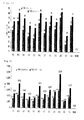
- the gene transduction efficiencies of the retrovirus supernatants collected using culture media W-1, W-2 and W-3 were about 1.5 to 2 times higher than those of the retrovirus supernatants collected using comparative culture media V-1, V-2 and V-3.
- this result means that a virus obtained using a culture medium containing the combination of calcium lactobionate, retinoic acid and a histone deacetylase inhibitor exhibits a higher gene transduction efficiency than a virus obtained using a culture medium supplemented with only calcium lactobionate which is capable of forming a chelate.
- NGMC means a cell that has not been transduced with a gene, and represents a negative control.
- NGMC has the same meaning.
- the fluorescence intensities of the cells transduced with the retrovirus supernatants collected using culture media W-1, W-2 and W-3 were about 1.5 to 2 times higher than those of the cells transduced with the retrovirus supernatants collected using culture media V-1, V-2 and V-3.
- Transduction with the virus obtained using a culture medium containing the combination of calcium lactobionate, retinoic acid and a histone deacetylase inhibitor produced a cell population having a higher ZsGreen fluorescent intensity, as compared with transduction with the virus obtained using a culture medium supplemented with only calcium lactobionate. This result shows a higher gene transduction efficiency, like the above-described result.
- Example 2 In the same manner as Example 1, to culture media V-1, V-2 and V-3 were added ATRA at a final concentration of 100 nM and NaB at a final concentration of 5 mM to prepare culture media W-1, W-2 and W-3 respectively. At the same time, culture medium W which was not supplemented with LaCa was prepared. The composition of each culture medium is shown in Table 2. [Table 2] Culture medium LaCa ATRA NaB W - 100 nM 5 mM W-1 20 ⁇ M W-2 200 ⁇ M W-3 2 mM
- Example 3 The four kinds of culture media as prepared in Example 3 were used to prepare retrovirus supernatants in the same manner as Example 2. For each retrovirus supernatant, a gene transduction efficiency and a mean fluorescent intensity were determined.
- the gene transduction efficiencies of the retrovirus supernatants collected using culture media W-1, W-2 and W-3 were about 1.5 to 2 times higher than that of the retrovirus supernatant collected using culture medium W which did not contain LaCa.
- this result means that when a culture medium containing the combination of retinoic acid and a histone deacetylase inhibitor is supplemented with calcium lactobionate which is capable of forming a chelate, a retrovirus supernatant having a high gene transduction efficiency is obtained by using the culture medium.
- the ZsGreen-derived mean fluorescence intensities of the cells transduced with the retrovirus supernatants collected using culture media W-1, W-2 and W-3 were about 1.6 to 2.6 times higher than that of the cells transduced with the retrovirus supernatant collected using culture medium W which did not contain LaCa.
- the increased mean fluorescent intensities probably result from increase of the copy number of the ZsGreen gene transduced into the cells.
- this result means that when a culture medium containing the combination of retinoic acid and a histone deacetylase inhibitor is supplemented with LaCa which is capable of forming a chelate, a retrovirus supernatant having a high gene transduction efficiency is obtained by using the culture medium.
- culture medium V was supplemented with only LaCa to prepare culture media V-1 (final concentration: 20 ⁇ M), V-2 (final concentration: 200 ⁇ M) and V-3 (final concentration: 2mM).
- the composition of each culture medium is shown in Table 5.
- the gene transduction efficiencies of the retrovirus supernatants collected using culture media V-1, V-2 and V-3 were about the same as that of the retrovirus supernatant collected using culture medium V which did not contain LaCa.
- this result means that when a culture medium is supplemented with only LaCa which is capable of forming a chelate (when retinoic acid and a histone deacetylase inhibitor do not coexist with LaCa in a culture medium), the gene transduction efficiency of a retrovirus supernatant obtained by using the culture medium is not increased.
- the ZsGreen-derived mean fluorescence intensities of the cells transduced with the retrovirus supernatants collected using culture media V-1, V-2 and V-3 were about the same as that of the cells transduced with the retrovirus supernatant collected using culture medium V which did not contain LaCa.
- This result also shows that when a culture medium is supplemented with only LaCa which is capable of forming a chelate, the gene transduction efficiency of a retrovirus supernatant obtained by using the culture medium is not increased.
- a culture medium suitable for culture of cells in particular, virus producer cells is provided.
- viral production can be continued for a longer period than ever before, and thereby high viral titer can be obtained. Therefore, according to the present invention, a large amount of a virus can be collected by one round of culture preparation. Furthermore, according to the present invention, it is possible to increase efficiency of infection to a target cell, etc.
Landscapes
- Health & Medical Sciences (AREA)
- Life Sciences & Earth Sciences (AREA)
- Engineering & Computer Science (AREA)
- Chemical & Material Sciences (AREA)
- Organic Chemistry (AREA)
- Genetics & Genomics (AREA)
- Biomedical Technology (AREA)
- Zoology (AREA)
- Bioinformatics & Cheminformatics (AREA)
- Biotechnology (AREA)
- Wood Science & Technology (AREA)
- General Health & Medical Sciences (AREA)
- Virology (AREA)
- Medicinal Chemistry (AREA)
- General Engineering & Computer Science (AREA)
- Microbiology (AREA)
- Biochemistry (AREA)
- Veterinary Medicine (AREA)
- Public Health (AREA)
- Animal Behavior & Ethology (AREA)
- Pharmacology & Pharmacy (AREA)
- Cell Biology (AREA)
- Immunology (AREA)
- General Chemical & Material Sciences (AREA)
- Chemical Kinetics & Catalysis (AREA)
- Nuclear Medicine, Radiotherapy & Molecular Imaging (AREA)
- Epidemiology (AREA)
- Developmental Biology & Embryology (AREA)
- Physics & Mathematics (AREA)
- Biophysics (AREA)
- Molecular Biology (AREA)
- Plant Pathology (AREA)
- Communicable Diseases (AREA)
- Gastroenterology & Hepatology (AREA)
- Oncology (AREA)
- Micro-Organisms Or Cultivation Processes Thereof (AREA)
- Medicines Containing Material From Animals Or Micro-Organisms (AREA)
- Medicines That Contain Protein Lipid Enzymes And Other Medicines (AREA)
Applications Claiming Priority (2)
| Application Number | Priority Date | Filing Date | Title |
|---|---|---|---|
| JP2012065857 | 2012-03-22 | ||
| PCT/JP2013/057184 WO2013141133A1 (ja) | 2012-03-22 | 2013-03-14 | ウイルスベクターの製造方法 |
Publications (2)
| Publication Number | Publication Date |
|---|---|
| EP2829606A1 true EP2829606A1 (de) | 2015-01-28 |
| EP2829606A4 EP2829606A4 (de) | 2016-02-24 |
Family
ID=49222592
Family Applications (1)
| Application Number | Title | Priority Date | Filing Date |
|---|---|---|---|
| EP13763874.8A Withdrawn EP2829606A4 (de) | 2012-03-22 | 2013-03-14 | Verfahren zur herstellung von viralen vektoren |
Country Status (4)
| Country | Link |
|---|---|
| US (1) | US9399780B2 (de) |
| EP (1) | EP2829606A4 (de) |
| JP (1) | JP6014119B2 (de) |
| WO (1) | WO2013141133A1 (de) |
Cited By (1)
| Publication number | Priority date | Publication date | Assignee | Title |
|---|---|---|---|---|
| WO2017210337A1 (en) * | 2016-05-31 | 2017-12-07 | The Trustees Of Columbia University In The City Of New York | Method for significantly increasing lentiviral production |
Families Citing this family (1)
| Publication number | Priority date | Publication date | Assignee | Title |
|---|---|---|---|---|
| CN119955742B (zh) * | 2025-04-10 | 2025-07-08 | 北京华诺泰生物医药科技有限公司 | 一种用于人偏肺病毒的培养基及应用 |
Family Cites Families (19)
| Publication number | Priority date | Publication date | Assignee | Title |
|---|---|---|---|---|
| US5278056A (en) | 1988-02-05 | 1994-01-11 | The Trustees Of Columbia University In The City Of New York | Retroviral packaging cell lines and process of using same |
| EP0556345B2 (de) | 1990-10-31 | 2005-10-12 | Cell Genesys, Inc. | Nützliche retrovirale vektoren für die gentherapie |
| US5470726A (en) | 1991-02-22 | 1995-11-28 | Fred Hutchinson Cancer Research Center | Retrovirus packaging and producer cell lines based on gibbon ape leukemia virus |
| US20030064949A1 (en) | 1998-02-17 | 2003-04-03 | Loretta Nielsen | Combined tumor suppressor gene therapy and chemotherapy in the treatment of neoplasms |
| WO2000001836A1 (en) | 1998-07-01 | 2000-01-13 | Takara Shuzo Co., Ltd. | Gene transfer methods |
| EP1129175A2 (de) | 1998-10-16 | 2001-09-05 | Novartis AG | Förderung der selbsterneuerungsaktivität und verbesserte gentransduktion in hematopoietischen stammzellen durch inhibierung des histon-deacetylases |
| WO2001096532A2 (en) | 2000-06-15 | 2001-12-20 | Tanja Dominko | Method of generating pluripotent mammalian cells by fusion of a cytoplast fragment with a karyoplast |
| WO2002060430A1 (en) | 2001-02-01 | 2002-08-08 | Cornell Research Foundation, Inc. | Use of retinoids plus histone deacetylase inhibitors to inhibit the growth of solid tumors |
| ES2342050T3 (es) | 2001-07-06 | 2010-07-01 | Institut National De La Sante Et De La Recherche Medicale (Inserm) | Lineas celulares de hepatomas humanos, su obtencion y sus aplicaciones. |
| KR20040095280A (ko) | 2002-03-12 | 2004-11-12 | 아크 테라퓨틱스 리미티드 | 조작된 바쿨로바이러스 및 그것의 용도 |
| KR101272896B1 (ko) | 2005-08-16 | 2013-06-25 | 다카라 바이오 가부시키가이샤 | 면역 결핍 바이러스 감염의 치료 또는 예방을 위한 핵산 |
| US7485448B2 (en) | 2005-09-13 | 2009-02-03 | Takara Bio Inc. | Serum-free medium for producing retroviruses |
| JP4921083B2 (ja) | 2005-09-13 | 2012-04-18 | タカラバイオ株式会社 | レトロウィルス産生用無血清培地 |
| CN101663397B (zh) | 2007-04-20 | 2015-04-22 | 宝生物工程株式会社 | 用于基因治疗的载体 |
| EP2172547B1 (de) | 2007-06-11 | 2016-01-06 | Takara Bio Inc. | Verfahren zur expression eines spezifischen gens |
| WO2009048024A1 (ja) | 2007-10-09 | 2009-04-16 | Hiroshima University | 目的遺伝子を染色体外で高度に増幅させるためのベクターおよびその利用 |
| EP2291514B1 (de) * | 2008-05-22 | 2020-12-23 | Vesta Therapeutics, Inc. | Verfahren zur differenzierung von säugervorläuferzellen zu insulinproduzierenden pankreas-inselzellen |
| KR101651661B1 (ko) | 2008-06-30 | 2016-08-26 | 얀센 바이오테크 인코포레이티드 | 만능 줄기 세포의 분화 |
| US9102943B2 (en) | 2010-10-05 | 2015-08-11 | Takara Bio Inc. | Method for producing virus vector |
-
2013
- 2013-03-14 US US14/381,721 patent/US9399780B2/en not_active Expired - Fee Related
- 2013-03-14 JP JP2014506177A patent/JP6014119B2/ja active Active
- 2013-03-14 WO PCT/JP2013/057184 patent/WO2013141133A1/ja not_active Ceased
- 2013-03-14 EP EP13763874.8A patent/EP2829606A4/de not_active Withdrawn
Cited By (2)
| Publication number | Priority date | Publication date | Assignee | Title |
|---|---|---|---|---|
| WO2017210337A1 (en) * | 2016-05-31 | 2017-12-07 | The Trustees Of Columbia University In The City Of New York | Method for significantly increasing lentiviral production |
| US10562939B2 (en) | 2016-05-31 | 2020-02-18 | The Trustees Of Columbia University In The City Of New York | Method for significantly increasing lentiviral production |
Also Published As
| Publication number | Publication date |
|---|---|
| US20150079050A1 (en) | 2015-03-19 |
| JPWO2013141133A1 (ja) | 2015-08-03 |
| US9399780B2 (en) | 2016-07-26 |
| EP2829606A4 (de) | 2016-02-24 |
| JP6014119B2 (ja) | 2016-10-25 |
| WO2013141133A1 (ja) | 2013-09-26 |
Similar Documents
| Publication | Publication Date | Title |
|---|---|---|
| EP2612909B1 (de) | Verfahren zur herstellung von virusvektoren | |
| RU2618864C2 (ru) | ЛЕНТИВИРУСНЫЕ ВЕКТОРЫ, ПСЕВДОТИПИРОВАННЫЕ МУТАНТНЫМИ BaEV ГЛИКОПРОТЕИНАМИ | |
| US11976301B2 (en) | Method for producing culture containing megakaryocytes, and method for producing platelets using same | |
| US10570372B2 (en) | Method for manufacturing platelets by rotary stirring culture method | |
| EP3208329A1 (de) | Verfahren zur herstellung von gamma-delta-t-zellen und arzneimittel | |
| US9399780B2 (en) | Method for producing viral vector | |
| US12350284B2 (en) | BCL11A microRNAs for treating hemoglobinopathies | |
| WO2019210301A1 (en) | Use of lentivector-transduced t-rapa cells for amelioration of lysosomal storage disorders | |
| US7485448B2 (en) | Serum-free medium for producing retroviruses | |
| JP4921083B2 (ja) | レトロウィルス産生用無血清培地 | |
| Miller et al. | Transfer of genes into human somatic cells using retrovirus vectors | |
| KR101043871B1 (ko) | 동종 제대혈 혈청 또는 혈장을 사용하는 유전자 도입 방법 | |
| WO2013146480A1 (ja) | 遺伝子導入方法 |
Legal Events
| Date | Code | Title | Description |
|---|---|---|---|
| PUAI | Public reference made under article 153(3) epc to a published international application that has entered the european phase |
Free format text: ORIGINAL CODE: 0009012 |
|
| 17P | Request for examination filed |
Effective date: 20140911 |
|
| AK | Designated contracting states |
Kind code of ref document: A1 Designated state(s): AL AT BE BG CH CY CZ DE DK EE ES FI FR GB GR HR HU IE IS IT LI LT LU LV MC MK MT NL NO PL PT RO RS SE SI SK SM TR |
|
| AX | Request for extension of the european patent |
Extension state: BA ME |
|
| DAX | Request for extension of the european patent (deleted) | ||
| RIC1 | Information provided on ipc code assigned before grant |
Ipc: C12N 15/09 20060101AFI20150930BHEP Ipc: A61K 48/00 20060101ALI20150930BHEP Ipc: C12N 5/10 20060101ALI20150930BHEP |
|
| RA4 | Supplementary search report drawn up and despatched (corrected) |
Effective date: 20160127 |
|
| RIC1 | Information provided on ipc code assigned before grant |
Ipc: C12N 15/09 20060101AFI20160121BHEP Ipc: C12N 5/10 20060101ALI20160121BHEP Ipc: A61K 48/00 20060101ALI20160121BHEP |
|
| STAA | Information on the status of an ep patent application or granted ep patent |
Free format text: STATUS: THE APPLICATION IS DEEMED TO BE WITHDRAWN |
|
| 18D | Application deemed to be withdrawn |
Effective date: 20160823 |