EP2827699B1 - Method of indoor mushroom cultivation - Google Patents
Method of indoor mushroom cultivation Download PDFInfo
- Publication number
- EP2827699B1 EP2827699B1 EP13717309.2A EP13717309A EP2827699B1 EP 2827699 B1 EP2827699 B1 EP 2827699B1 EP 13717309 A EP13717309 A EP 13717309A EP 2827699 B1 EP2827699 B1 EP 2827699B1
- Authority
- EP
- European Patent Office
- Prior art keywords
- liquid
- bed
- drip irrigation
- casing layer
- irrigation pipes
- Prior art date
- Legal status (The legal status is an assumption and is not a legal conclusion. Google has not performed a legal analysis and makes no representation as to the accuracy of the status listed.)
- Active
Links
- 235000001674 Agaricus brunnescens Nutrition 0.000 title claims description 30
- 238000000034 method Methods 0.000 title claims description 25
- 238000003973 irrigation Methods 0.000 claims description 42
- 230000002262 irrigation Effects 0.000 claims description 42
- XLYOFNOQVPJJNP-UHFFFAOYSA-N water Substances O XLYOFNOQVPJJNP-UHFFFAOYSA-N 0.000 claims description 29
- 239000007788 liquid Substances 0.000 claims description 24
- 239000000758 substrate Substances 0.000 claims description 23
- 230000008020 evaporation Effects 0.000 claims description 8
- 238000001704 evaporation Methods 0.000 claims description 8
- 230000001276 controlling effect Effects 0.000 claims description 2
- 230000001105 regulatory effect Effects 0.000 claims description 2
- 238000007599 discharging Methods 0.000 claims 1
- 235000015097 nutrients Nutrition 0.000 claims 1
- 239000002361 compost Substances 0.000 description 7
- 238000004519 manufacturing process Methods 0.000 description 5
- 238000005259 measurement Methods 0.000 description 4
- 238000010586 diagram Methods 0.000 description 3
- 238000003306 harvesting Methods 0.000 description 3
- 231100000241 scar Toxicity 0.000 description 3
- 241000222519 Agaricus bisporus Species 0.000 description 2
- 230000007423 decrease Effects 0.000 description 2
- 201000010099 disease Diseases 0.000 description 2
- 208000037265 diseases, disorders, signs and symptoms Diseases 0.000 description 2
- 239000002689 soil Substances 0.000 description 2
- 239000007921 spray Substances 0.000 description 2
- 238000005507 spraying Methods 0.000 description 2
- 241001327634 Agaricus blazei Species 0.000 description 1
- 241000404030 Anacyclus clavatus Species 0.000 description 1
- 208000032544 Cicatrix Diseases 0.000 description 1
- 235000002469 Clitocybe nuda Nutrition 0.000 description 1
- 244000290281 Lepista nuda Species 0.000 description 1
- 235000019738 Limestone Nutrition 0.000 description 1
- 241000607479 Yersinia pestis Species 0.000 description 1
- 230000004075 alteration Effects 0.000 description 1
- 230000001580 bacterial effect Effects 0.000 description 1
- 230000033228 biological regulation Effects 0.000 description 1
- 230000015556 catabolic process Effects 0.000 description 1
- 230000008859 change Effects 0.000 description 1
- 238000009264 composting Methods 0.000 description 1
- 230000003750 conditioning effect Effects 0.000 description 1
- 239000000356 contaminant Substances 0.000 description 1
- 230000003247 decreasing effect Effects 0.000 description 1
- 238000006731 degradation reaction Methods 0.000 description 1
- 230000001419 dependent effect Effects 0.000 description 1
- 230000002708 enhancing effect Effects 0.000 description 1
- 238000002474 experimental method Methods 0.000 description 1
- 239000001963 growth medium Substances 0.000 description 1
- 238000003780 insertion Methods 0.000 description 1
- 230000037431 insertion Effects 0.000 description 1
- 239000006028 limestone Substances 0.000 description 1
- 239000000463 material Substances 0.000 description 1
- 238000012986 modification Methods 0.000 description 1
- 230000004048 modification Effects 0.000 description 1
- 230000008520 organization Effects 0.000 description 1
- 238000009928 pasteurization Methods 0.000 description 1
- 239000003415 peat Substances 0.000 description 1
- 230000037387 scars Effects 0.000 description 1
- 230000007480 spreading Effects 0.000 description 1
- 238000009736 wetting Methods 0.000 description 1
Images

Classifications
-
- A—HUMAN NECESSITIES
- A01—AGRICULTURE; FORESTRY; ANIMAL HUSBANDRY; HUNTING; TRAPPING; FISHING
- A01G—HORTICULTURE; CULTIVATION OF VEGETABLES, FLOWERS, RICE, FRUIT, VINES, HOPS OR SEAWEED; FORESTRY; WATERING
- A01G18/00—Cultivation of mushrooms
- A01G18/60—Cultivation rooms; Equipment therefor
- A01G18/69—Arrangements for managing the environment, e.g. sprinklers
-
- A—HUMAN NECESSITIES
- A01—AGRICULTURE; FORESTRY; ANIMAL HUSBANDRY; HUNTING; TRAPPING; FISHING
- A01G—HORTICULTURE; CULTIVATION OF VEGETABLES, FLOWERS, RICE, FRUIT, VINES, HOPS OR SEAWEED; FORESTRY; WATERING
- A01G18/00—Cultivation of mushrooms
- A01G18/20—Culture media, e.g. compost
Definitions
- Embodiments of the invention relate to methods of indoor mushroom cultivation, growing or production.
- the trays or beds typically include a substrate such as compost and a casing soil that is disposed above the substrate.
- the casing soil serves as a water reservoir for the mushrooms and a typical watering technique employed includes spraying the beds or trays from above. While using such a spraying technique it is normally required during certain stages of mushroom growth to stop the watering in order to limit the sprayed water from coming into contact with the developing mushrooms. Wet mushrooms may also enhance occurrence of mushroom diseases such as bacterial blotch. At this time, since watering is halted, the water content in the casing and substrate may decrease to below optimal levels.
- WO 2006/090965 describes a certain type of drip irrigation tube with scar cuts that are formed on rubber dripping elements. These scars are prevented from direct exposure with the culture medium layer in order to prevent mycelia from being coated in these scar cuts which will clog the exit for water.
- the ability to effectively add water to the casing layer without wetting the mushrooms may be seen to have the advantages of: adding the needed water to the mushrooms during the entire crop cycle, minimizing the incidence of mushroom diseases, enhancing mushroom quality, and reducing costs of casing and energy.
- Embodiments of the present invention relate to methods for irrigation and cultivating mushrooms using drip irrigation pipes in an indoor environment. By irrigating mushroom with drip pipes as opposed to conventional irrigation with sprinklers, damage to mushrooms may be avoided or limited and irrigation may be performed during longer and more regular intervals.
- the method may comprise steps of providing a horizontally extending bed in which a substrate layer and a casing layer that is disposed over the substrate layer are provided. And, the drip irrigation pipes are disposed in the bed preferably in the casing layer.
- irrigation via the drip irrigation pipes is affected by measurements of water evaporation in the indoor environment outside of the bed. These measurements may derive a value M which may be taken periodically. Possibly these measurements can be taken every N hours with N being either a fraction smaller than 1 hour or any value larger than 1 hour.
- an amount of liquid to be irrigated can be derived and irrigated preferably in pulses to the bed and/or mushrooms.
- the irrigated liquid may be used to maintain a generally constant liquid content in the casing layer while gradually decreasing the liquid content in the substrate preferably compost layer.
- Possibly relative short liquid pulses optionally with long intervals between pulses may result in an irrigation procedure in which liquid is maintained more in the casing layer and seeps less towards the substrate later below the casing layer.
- Longer irrigation pulses optionally with shorter intervals between pulses may result in more liquid that is irrigated to the bed that then seeps down towards the substrate layer. Since the preferable compost material of the substrate may physically change over time resulting in its reduced liquid holding capacity - it may be preferable as irrigation proceeds to limit the amount of liquid reaching the substrate layer. And this may be achieved by changing pulse length and time intervals between pulses.
- an indoor commercial bed 10 for mushroom cultivation, growth and/or production may include a tray (not shown) upon which a substrate layer 12 may be laid.
- Substrate layer 12 optionally consists of compost, and a casing layer 14 optionally consisting of peat moss and/or limestone may be laid upon it.
- drip irrigation pipes 16 may be disposed for irrigating mushrooms such as White Button mushrooms/Champignon and Portobello (scientifically named Agaricus bisporus), Agaricus blazei, Lepista nuda, or the like.
- Typical phases of mushroom cultivation may be defined as: Phase I (composting), Phase II (pasteurization and conditioning), Phase III (Spawning and mycelium growth), Casing, Pinning and harvest.
- the casing phase is when casing layer 14 is laid upon substrate 12 and after that the irrigation pipes 16 can be disposed into the casing layer 14. Irrigation from that point can take place during the entire crop cycle, especially during pinning before the first flush (i.e. harvest of mushrooms) and between flushes when spray irrigation is typically avoided.
- the irrigation can include water and nutrient-amendments.
- a mechanical device 18 that travels above the bed 10 may be used.
- Device 18 can be used optionally, by traveling in a horizontal direction H1, for spreading the drip pipes 16 upon the bed 10 ( Fig. 1 ), and then in an opposing second horizontal direction H2, for disposing the drip pipes 16 into casing later 14.
- An optional roller 17 that trails after device 18 as it disposes the drip pipes into the casing layer can be used to slightly compress the casing layer back into place where it was before the insertion of the pipes ( Fig. 2 ).
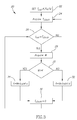
- provision of irrigation to the bed by an irrigation system including the drip irrigation pipes 16 may be controlled in accordance with an algorithm 20 having a flow diagram similar to that shown in Fig. 3 .
- the flow diagram delineates an optionally diurnal water provision cycle in which the irrigation system provides pulses of water to the bed.
- Tcal is a time during the diurnal cycle at which the irrigation system acquires a measure M of water evaporation in the indoor environment outside of the bed.
- K is a threshold value of water evaporation
- Fu is a factor used when M is greater than K
- Fd is a factor used when M is not greater than K.
- step 24 algorithm 20 checks a system clock (not shown) to acquire a reading of the time, "Tclock".
- the needed water amount A may be divided into pulses of irrigation, that are provided at optionally given time intervals, until the amount A has been fed to the bed.
- a mushroom production bed may be sized and equipped such that it has: a width of 1 . 3 meters, a length of 24 meters, 8 drip lines that are disposed in parallel in the casing layer, with about 6 drip emitters per meter length having each a regulated discharge rate of 0.7 liter/hour.
- Teal can initially be set to 5 hours
- K can be equal to 40 gram/m 2
- Fu can be equal to 2
- Fd can be equal to 1.3.
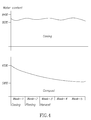
- Fig. 4 shows optimal water content graphs, for the substrate and casing layers that are applicable to certain conditions and certain bed configurations that were tested by the inventors. It has been found over a period of time, during which drip irrigation can be provided, that the casing layer's water content may optimally be kept during the entire crop cycle at the needed level.
- the substrate i.e.
- compost on the other hand, it has been found that its water content may optimally be reduced over the same period due to physical degradation that the substrate undergoes which decreases its water holding capacity.
- shorter pulses of water tend to affect more the humidity of the casing layer while longer pulses affect also the humidity of the substrate (compost) layer.
- the average length of the pulses may become shorter in order to substantially maintain the same level of humidity in the casing while reducing water content of the compost.
- each of the verbs, "comprise” “include” and “have”, and conjugates thereof, are used to indicate that the object or objects of the verb are not necessarily a complete listing of members, components, elements or parts of the subject or subjects of the verb.
Landscapes
- Life Sciences & Earth Sciences (AREA)
- Mycology (AREA)
- Environmental Sciences (AREA)
- Mushroom Cultivation (AREA)
- Hydroponics (AREA)
- Cultivation Receptacles Or Flower-Pots, Or Pots For Seedlings (AREA)
Description
- Embodiments of the invention relate to methods of indoor mushroom cultivation, growing or production.
- Indoor commercial production of mushrooms allows for tight regulation of growing conditions such as air, temperature and relative humidity while substantially eliminating contaminants and pests. This technique typically employs trays or beds for growing the mushrooms which provides the advantages of scalability and easier harvesting. The trays or beds typically include a substrate such as compost and a casing soil that is disposed above the substrate.
- The casing soil serves as a water reservoir for the mushrooms and a typical watering technique employed includes spraying the beds or trays from above. While using such a spraying technique it is normally required during certain stages of mushroom growth to stop the watering in order to limit the sprayed water from coming into contact with the developing mushrooms. Wet mushrooms may also enhance occurrence of mushroom diseases such as bacterial blotch. At this time, since watering is halted, the water content in the casing and substrate may decrease to below optimal levels.
-
WO 2006/090965 describes a certain type of drip irrigation tube with scar cuts that are formed on rubber dripping elements. These scars are prevented from direct exposure with the culture medium layer in order to prevent mycelia from being coated in these scar cuts which will clog the exit for water. - The ability to effectively add water to the casing layer without wetting the mushrooms may be seen to have the advantages of: adding the needed water to the mushrooms during the entire crop cycle, minimizing the incidence of mushroom diseases, enhancing mushroom quality, and reducing costs of casing and energy.
- The following embodiments and aspects thereof are described and illustrated in conjunction with systems, tools and methods which are meant to be exemplary and illustrative, not limiting in scope.
- The present invention is expressed by the features of the independent claim.
- The dependent claims refer to preferred embodiments. Embodiments of the present invention relate to methods for irrigation and cultivating mushrooms using drip irrigation pipes in an indoor environment. By irrigating mushroom with drip pipes as opposed to conventional irrigation with sprinklers, damage to mushrooms may be avoided or limited and irrigation may be performed during longer and more regular intervals.
- In one form of the present invention the method may comprise steps of providing a horizontally extending bed in which a substrate layer and a casing layer that is disposed over the substrate layer are provided. And, the drip irrigation pipes are disposed in the bed preferably in the casing layer.
- In one aspect of the present invention irrigation via the drip irrigation pipes is affected by measurements of water evaporation in the indoor environment outside of the bed. These measurements may derive a value M which may be taken periodically. Possibly these measurements can be taken every N hours with N being either a fraction smaller than 1 hour or any value larger than 1 hour.
- In various forms of the present invention from the measurements of water evaporation an amount of liquid to be irrigated can be derived and irrigated preferably in pulses to the bed and/or mushrooms.
- In one aspect of the present invention the irrigated liquid may be used to maintain a generally constant liquid content in the casing layer while gradually decreasing the liquid content in the substrate preferably compost layer. Possibly relative short liquid pulses optionally with long intervals between pulses may result in an irrigation procedure in which liquid is maintained more in the casing layer and seeps less towards the substrate later below the casing layer. Longer irrigation pulses optionally with shorter intervals between pulses may result in more liquid that is irrigated to the bed that then seeps down towards the substrate layer. Since the preferable compost material of the substrate may physically change over time resulting in its reduced liquid holding capacity - it may be preferable as irrigation proceeds to limit the amount of liquid reaching the substrate layer. And this may be achieved by changing pulse length and time intervals between pulses.
- Exemplary embodiments are illustrated in referenced figures. It is intended that the embodiments and figures disclosed herein are to be considered illustrative, rather than restrictive. The invention, however, both as to organization and method of operation, together with objects, features, and advantages thereof, may best be understood by reference to the following detailed description when read with the accompanying figures, in which:
-
Figs. 1 and 2 show side views of a bed for mushroom cultivation during optional steps of disposal of drip irrigation pipes therein in accordance with an embodiment of the present invention; -
Fig. 3 shows a flow diagram of an algorithm for controlling irrigation of the bed in accordance with an embodiment of the present invention; and -
Fig. 4 shows graphs for substrate and casing layers optimal water content during the mushroom growth cycle when irrigation can be provided. - It will be appreciated that for simplicity and clarity of illustration, elements shown in the figures have not necessarily been drawn to scale. For example, the dimensions of some of the elements may be exaggerated relative to other elements for clarity. Further, where considered appropriate, reference numerals may be repeated within the figures to indicate like elements.
- Attention is first drawn to
Figs 1 and 2 . In an embodiment of the present invention, an indoorcommercial bed 10 for mushroom cultivation, growth and/or production; may include a tray (not shown) upon which asubstrate layer 12 may be laid.Substrate layer 12 optionally consists of compost, and acasing layer 14 optionally consisting of peat moss and/or limestone may be laid upon it. Within thecasing layer 14drip irrigation pipes 16 may be disposed for irrigating mushrooms such as White Button mushrooms/Champignon and Portobello (scientifically named Agaricus bisporus), Agaricus blazei, Lepista nuda, or the like. - Typical phases of mushroom cultivation may be defined as: Phase I (composting), Phase II (pasteurization and conditioning), Phase III (Spawning and mycelium growth), Casing, Pinning and harvest. The casing phase is when
casing layer 14 is laid uponsubstrate 12 and after that theirrigation pipes 16 can be disposed into thecasing layer 14. Irrigation from that point can take place during the entire crop cycle, especially during pinning before the first flush (i.e. harvest of mushrooms) and between flushes when spray irrigation is typically avoided. The irrigation can include water and nutrient-amendments. - For the disposal of the
drip irrigation pipes 16 into the casing layer 14 amechanical device 18 that travels above thebed 10 may be used.Device 18 can be used optionally, by traveling in a horizontal direction H1, for spreading thedrip pipes 16 upon the bed 10 (Fig. 1 ), and then in an opposing second horizontal direction H2, for disposing thedrip pipes 16 into casing later 14. Anoptional roller 17 that trails afterdevice 18 as it disposes the drip pipes into the casing layer can be used to slightly compress the casing layer back into place where it was before the insertion of the pipes (Fig. 2 ). - In some embodiments of the invention, provision of irrigation to the bed by an irrigation system including the
drip irrigation pipes 16 may be controlled in accordance with analgorithm 20 having a flow diagram similar to that shown inFig. 3 . The flow diagram delineates an optionally diurnal water provision cycle in which the irrigation system provides pulses of water to the bed. - In a
block 22, optionally values for parameters that control the liquid provision cycle: Tcal, K, Fu and Fd can be determined by optionally being manually inputted by a grower using the irrigation system or his advisor. Tcal is a time during the diurnal cycle at which the irrigation system acquires a measure M of water evaporation in the indoor environment outside of the bed. K is a threshold value of water evaporation, and Fu is a factor used when M is greater than K and Fd is a factor used when M is not greater than K. - In
step 24algorithm 20 checks a system clock (not shown) to acquire a reading of the time, "Tclock". In adecision block 26 the time Tclock is checked to see if it is about equal to Tcal. If it is not, then the algorithm returns to block 24 to acquire a new reading for Tclock. If on the other hand Tclock is about equal to Tcal,algorithm 20 advances to ablock 28 and acquires a reading of M of the water evaporation in the indoor environment outside of the bed. The algorithm then proceeds todecision block 30 to check if the acquired reading of M is greater than the threshold value K. If it is not, then the algorithm proceeds to block 32 to determine an amount A of water to be irrigated to the bed according to the equation A = M x Teal x Fd. If on the other hand reading M is greater than the threshold value K then the algorithm proceeds to block 34 to determine the amount A of water to be irrigated to the bed according to the equation A = M x T cal x Fu. After eitherblock block 36 where T clock is initialized to zero and from there the algorithm returns todecision block 26 to start a consecutive cycle that will lead to a consecutive irrigation cycle. - The needed water amount A, may be divided into pulses of irrigation, that are provided at optionally given time intervals, until the amount A has been fed to the bed.
- By way of an example, a mushroom production bed may be sized and equipped such that it has: a width of 1.3 meters, a length of 24 meters, 8 drip lines that are disposed in parallel in the casing layer, with about 6 drip emitters per meter length having each a regulated discharge rate of 0.7 liter/hour. In such a setup, Teal can initially be set to 5 hours, K can be equal to 40 gram/m2, Fu can be equal to 2 and Fd can be equal to 1.3. Following this example, If a measure M of the water evaporation in the indoor environment outside of the bed is equal to 50 gram/m^2 then A = 50 x 5 x 2 = 500 gram (i.e. 0.5 liter). This amount can be divided into pulses of 0.25 liter that are provided twice to the bed with a time difference of optionally 2 hours between the pulses. If on the other hand the measure M is equal to 30 gram/m^2 then A = 30 x 5 x 1.3 = 195 gram (i.e. about 0.2 liter), and this amount can optionally be divided into pulses of 0.1 liter that are provided twice to the bed with a time difference of 2 hours between the pulses.
- In experiments conducted by the inventors, it was demonstrated, that while typical casing layer thickness of 5.5 centimeters is used, when conventional spray irrigation is provided, with drip irrigation, it was possible to reduce the thickness of the casing layer to 3.2 centimeters, without harming the yield or the quality of the mushrooms. Attention is now drawn to
Fig. 4 that shows optimal water content graphs, for the substrate and casing layers that are applicable to certain conditions and certain bed configurations that were tested by the inventors. It has been found over a period of time, during which drip irrigation can be provided, that the casing layer's water content may optimally be kept during the entire crop cycle at the needed level. With respect to the substrate (i.e. compost), on the other hand, it has been found that its water content may optimally be reduced over the same period due to physical degradation that the substrate undergoes which decreases its water holding capacity. Optionally, for conditions in a bed to substantially follow this water content pattern, it has been found that shorter pulses of water tend to affect more the humidity of the casing layer while longer pulses affect also the humidity of the substrate (compost) layer. As a result, as the production of mushrooms progresses and time passes the average length of the pulses may become shorter in order to substantially maintain the same level of humidity in the casing while reducing water content of the compost. - In the description and claims of the present application, each of the verbs, "comprise" "include" and "have", and conjugates thereof, are used to indicate that the object or objects of the verb are not necessarily a complete listing of members, components, elements or parts of the subject or subjects of the verb.
- Although the present embodiments have been described to a certain degree of particularity, it should be understood that various alterations and modifications could be made without departing from the scope of the invention as hereinafter claimed.
Claims (15)
- A method of indoor mushroom cultivation comprising the steps of:providing a horizontally extending bed comprising a substrate layer and a casing layer that is disposed over the substrate layer, andproviding drip irrigation pipes characterised in that the drip irrigation pipes are being disposed in the casing layer.
- The method according to claim 1, wherein the disposing of the drip irrigation pipes in the casing layer is performed after the casing layer has been disposed over the substrate layer.
- The method according to claims 1 or 2, wherein the disposing of the drip irrigation pipes in the casing layer is by urging the drip irrigation pipes into the casing layer.
- The method according to claim 3, and comprising a device for urging the drip irrigation pipes into the casing layer, the device being adapted to move in a horizontal direction above the casing layer.
- The method according to claim 4, wherein as the device moves above a given portion of the casing layer it urges at least some of the drip irrigation pipes to be disposed into that given portion.
- The method according to anyone of the preceding claims, wherein the drip irrigation pipes are disposed in the casing layer such that their apertures for discharging liquid face substantially the same given direction, wherein preferably the given direction is up.
- The method according to anyone of claims 1 to 6, and further comprising a step of irrigating liquid using the disposed drip irrigation pipes, and wherein an amount A of liquid irrigated is determined according to parameters monitored in the indoor environment outside of the bed and parameters monitored in the bed, wherein preferably the amount A of liquid irrigated is irrigated in pulses.
- The method according to claim 7, wherein the parameters monitored in the indoor environment outside of the bed are associated to at least one of: a bellow communicating air to and from the indoor environment, a shutter controlling communication of air to and from the indoor environment, a temperature gauge measuring the temperature within the indoor environment outside of the bed.
- The method according to claim 7, wherein the parameters monitored in the bed are at least one of: a moisture sensor in the casing layer, a moisture sensor in the substrate layer, a tensiometer in the casing layer, a tensiometer in the substrate layer.
- The method according anyone of claims 7 to 9, wherein the liquid irrigated comprises water and/or nutrient amendments.
- The method according anyone of claims 7 to 10, wherein the drip irrigation pipes comprise at each aperture in a respective pipe a drip emitter through which liquid passes before being discharged out of the pipe.
- The method according to claim 11, wherein each one of the drip emitters has a discharge-pressure threshold greater than zero so that only when local liquid pressure at a location of an emitter in the pipe is greater than zero the emitter will discharge liquid from the pipe.
- The method according to claim 12, wherein each one of the drip emitters is a regulated drip emitter that has a discharge rate of liquid out of the pipe that is substantially independent of variations in local liquid pressure at the location of the emitter in the pipe.
- The method according to claim 13, wherein the discharge rate of liquid out of the each drip emitter is lower than 1 liter/hour, preferably substantiality 0.7 liter/hour.
- The method according to anyone of claims 1 to 6, and further comprising a step of irrigating liquid using the disposed drip irrigation pipes, and wherein an amount A of liquid irrigated is determined according to a measure M taken of water evaporation in the indoor environment outside of the bed, wherein preferably the measure of water evaporation in the indoor environment outside of the bed is taken every N hours, and further preferably the determination of the amount A of liquid irrigated is according to A = M x N x F, wherein F is a parameter determined according to the value of M.
Priority Applications (1)
| Application Number | Priority Date | Filing Date | Title |
|---|---|---|---|
| EP16180989.2A EP3106025B1 (en) | 2012-03-19 | 2013-02-04 | Method of indoor mushroom cultivation |
Applications Claiming Priority (2)
| Application Number | Priority Date | Filing Date | Title |
|---|---|---|---|
| US201261612698P | 2012-03-19 | 2012-03-19 | |
| PCT/IB2013/050945 WO2013140270A2 (en) | 2012-03-19 | 2013-02-04 | Method of indoor mushroom cultivation |
Related Child Applications (1)
| Application Number | Title | Priority Date | Filing Date |
|---|---|---|---|
| EP16180989.2A Division EP3106025B1 (en) | 2012-03-19 | 2013-02-04 | Method of indoor mushroom cultivation |
Publications (2)
| Publication Number | Publication Date |
|---|---|
| EP2827699A2 EP2827699A2 (en) | 2015-01-28 |
| EP2827699B1 true EP2827699B1 (en) | 2016-08-03 |
Family
ID=48142023
Family Applications (2)
| Application Number | Title | Priority Date | Filing Date |
|---|---|---|---|
| EP16180989.2A Not-in-force EP3106025B1 (en) | 2012-03-19 | 2013-02-04 | Method of indoor mushroom cultivation |
| EP13717309.2A Active EP2827699B1 (en) | 2012-03-19 | 2013-02-04 | Method of indoor mushroom cultivation |
Family Applications Before (1)
| Application Number | Title | Priority Date | Filing Date |
|---|---|---|---|
| EP16180989.2A Not-in-force EP3106025B1 (en) | 2012-03-19 | 2013-02-04 | Method of indoor mushroom cultivation |
Country Status (9)
| Country | Link |
|---|---|
| US (1) | US9743592B2 (en) |
| EP (2) | EP3106025B1 (en) |
| AU (3) | AU2013237448B2 (en) |
| CA (1) | CA2863361C (en) |
| HU (1) | HUE030179T2 (en) |
| IL (1) | IL233748A (en) |
| PL (1) | PL2827699T3 (en) |
| WO (1) | WO2013140270A2 (en) |
| ZA (1) | ZA201405308B (en) |
Families Citing this family (2)
| Publication number | Priority date | Publication date | Assignee | Title |
|---|---|---|---|---|
| US20170079213A1 (en) * | 2015-08-28 | 2017-03-23 | Davood Ahmadi | Mechanized cultivation system and method to produce edible mushroom |
| CN113812305B (en) * | 2021-10-25 | 2022-12-06 | 霍山县天下泽雨生物科技发展有限公司 | Single-plant multi-row planting mechanism for planting lucid ganoderma and planting method thereof |
Family Cites Families (30)
| Publication number | Priority date | Publication date | Assignee | Title |
|---|---|---|---|---|
| DE1243111B (en) * | 1963-07-05 | 1967-06-22 | Paul Niederwemmer Dipl Ing | Work vehicle for the production of an irrigation system |
| US3361359A (en) * | 1966-01-10 | 1968-01-02 | Richard D. Chapin | Soil soaking system |
| BE791865A (en) * | 1971-11-26 | 1973-03-16 | Sykes Ltd Henry | MACHINE AND METHOD FOR CLOSING TRENCHES OR PITS |
| US3810327A (en) * | 1972-12-29 | 1974-05-14 | J Giansante | Atmosphere control system for growing mushrooms and the like |
| US4001966A (en) * | 1973-10-03 | 1977-01-11 | Rudolf Paul Metzner | Growing tray structure, as for mushrooms |
| US4059227A (en) * | 1976-05-17 | 1977-11-22 | The Toro Company | Moisture sensing apparatus and method |
| US4462184A (en) * | 1979-05-18 | 1984-07-31 | Cunningham Percy C | System for improving synthetic surfaces |
| US4337594A (en) * | 1980-04-18 | 1982-07-06 | Castle & Cooke, Inc. | Mushroom casing composition and process |
| GB2174429A (en) | 1985-04-16 | 1986-11-05 | Pal Gal | Rood heat insulation and energy-saving air-conditioning of agricultural buildings |
| DK171285A (en) * | 1985-04-16 | 1986-10-17 | Niels Thorkild Jensen | Irrigation system control in a greenhouse |
| US4833820A (en) * | 1987-03-24 | 1989-05-30 | Kurimoto Ltd. | Method of growing mushrooms and apparatus thereof |
| WO1989005574A1 (en) * | 1987-12-15 | 1989-06-29 | 3M Australia Pty. Ltd. | Method for the cultivation of mushrooms |
| AR243720A1 (en) * | 1990-07-19 | 1993-09-30 | Filippi Felipe De | A watering device for flower pots and/or similar. |
| BR9906139A (en) * | 1999-12-17 | 2001-09-18 | Scharman Ind E Com De Generos | Closed chamber mushroom production process |
| KR100520756B1 (en) | 2001-02-27 | 2005-10-12 | (주)이엔이티 | Salt tolerant mushroom strains, method for preparing the same and disposing food stuff by using the same |
| US7407340B2 (en) * | 2002-06-20 | 2008-08-05 | Joe Don Byles | Modular, self contained, engineered irrigation landscape and flower bed panel |
| US20100005716A1 (en) * | 2002-06-20 | 2010-01-14 | Byles Joe D | Portable Apparatus for Promoting and Containing Plant Growth |
| US6748696B1 (en) * | 2002-07-30 | 2004-06-15 | Tony F. Davidson | Self-automated mushroom growing system |
| US7168207B2 (en) * | 2003-04-08 | 2007-01-30 | Brian L. Andersen | Potato drip irrigation system and method |
| US7712253B2 (en) * | 2004-05-10 | 2010-05-11 | Developmental Technologies, Llc | Fluid and nutrient delivery system and associated methods |
| AU2005328025A1 (en) * | 2005-02-24 | 2006-08-31 | Min Song Kim | A drip irrigation system |
| KR20050028001A (en) * | 2005-02-24 | 2005-03-21 | 주두심 | A drip irrigation system |
| GB2426906B (en) * | 2005-06-08 | 2009-09-23 | Kieran Joseph Walsh | A method of growing mushrooms |
| US7237982B2 (en) * | 2005-06-23 | 2007-07-03 | Crea Brian J | Agricultural implement for installing an irrigation system |
| CA2528416A1 (en) * | 2005-11-29 | 2007-05-29 | Richard Theoret | Hydro-thermo irrigation mat |
| US20090025287A1 (en) * | 2007-07-25 | 2009-01-29 | Yu Mei Lee | Plant growing system |
| NL2001865C2 (en) * | 2007-10-15 | 2009-04-16 | Gerbrandus Janus Appels | Growing device for growing mushrooms. |
| BRPI0916114B8 (en) * | 2008-11-03 | 2018-01-09 | P I P Blue White Ltd | "Apparatus and method for operating a group of normally compensated pressure-compensated drippers at relatively low net flow rates" |
| WO2010095932A1 (en) * | 2009-02-20 | 2010-08-26 | Verdellen Beheer B.V. | Cultivating bed for mushrooms and device and method for cultivating mushrooms |
| US20100319251A1 (en) | 2009-06-22 | 2010-12-23 | Jui-Chang Su | Fallow-free aerobic garden |
-
2013
- 2013-02-04 EP EP16180989.2A patent/EP3106025B1/en not_active Not-in-force
- 2013-02-04 PL PL13717309T patent/PL2827699T3/en unknown
- 2013-02-04 EP EP13717309.2A patent/EP2827699B1/en active Active
- 2013-02-04 CA CA2863361A patent/CA2863361C/en active Active
- 2013-02-04 AU AU2013237448A patent/AU2013237448B2/en active Active
- 2013-02-04 US US14/386,073 patent/US9743592B2/en active Active
- 2013-02-04 WO PCT/IB2013/050945 patent/WO2013140270A2/en not_active Ceased
- 2013-02-04 HU HUE13717309A patent/HUE030179T2/en unknown
-
2014
- 2014-07-18 ZA ZA2014/05308A patent/ZA201405308B/en unknown
- 2014-07-22 IL IL233748A patent/IL233748A/en active IP Right Grant
-
2017
- 2017-01-24 AU AU2017200474A patent/AU2017200474A1/en not_active Abandoned
-
2019
- 2019-02-26 AU AU2019201327A patent/AU2019201327B2/en active Active
Also Published As
| Publication number | Publication date |
|---|---|
| HUE030179T2 (en) | 2017-04-28 |
| ZA201405308B (en) | 2015-12-23 |
| AU2019201327A1 (en) | 2019-03-21 |
| PL2827699T3 (en) | 2017-01-31 |
| IL233748A (en) | 2017-07-31 |
| AU2017200474A1 (en) | 2017-02-09 |
| US9743592B2 (en) | 2017-08-29 |
| WO2013140270A3 (en) | 2013-11-28 |
| AU2013237448A1 (en) | 2014-08-07 |
| CA2863361C (en) | 2017-05-02 |
| WO2013140270A2 (en) | 2013-09-26 |
| AU2013237448B2 (en) | 2016-11-17 |
| AU2019201327B2 (en) | 2019-09-12 |
| IL233748A0 (en) | 2014-09-30 |
| EP3106025A1 (en) | 2016-12-21 |
| US20150096224A1 (en) | 2015-04-09 |
| EP3106025B1 (en) | 2022-01-26 |
| CA2863361A1 (en) | 2013-09-26 |
| EP2827699A2 (en) | 2015-01-28 |
Similar Documents
| Publication | Publication Date | Title |
|---|---|---|
| CN107223484B (en) | Inclined greenhouse system and greenhouse planting method | |
| Hartz | Water management in drip-irrigated vegetable production | |
| US20120290140A1 (en) | Method and System to Control Irrigation Across Large Geographic Areas Using Remote Sensing, Weather and Field Level Data | |
| JP6306384B2 (en) | Method for controlling irrigation supply in plant cultivation and controller thereof | |
| Al-Ghobari et al. | Automated irrigation systems for wheat and tomato crops in arid regions | |
| JP6218075B2 (en) | Automatic irrigation system | |
| Coolong | Using irrigation to manage weeds: A focus on drip irrigation | |
| AU2019201327B2 (en) | Method of indoor mushroom cultivation | |
| KR101582386B1 (en) | Method for controlling irrigation amount in soilless culture | |
| DeTar | Using a subsurface drip irrigation system to measure crop water use | |
| Coolong et al. | Evaluation of irrigation threshold and duration for tomato grown in a silt loam soil | |
| CN109006256B (en) | Greenhouse tomato cultivation method based on small-flow irrigation emitter | |
| CN115989763B (en) | Greenhouse irrigation control method, device, system and equipment | |
| JP6006182B2 (en) | Water supply device for cultivation tank | |
| Pulatov | Using resource-efficient irrigation methods in the fergana valley | |
| Owen et al. | Advanced irrigation management for container-grown ornamental crop production | |
| Leib et al. | Placement and interpretation of soil moisture sensors for irrigated cotton production in humid regions | |
| CN204070009U (en) | Root fills with water-saving temp control digital signal device | |
| Chwietczuk | Proposals of universal algorithms for the automation of the irrigation process of plant crops | |
| Sanford et al. | Irrigation management in Wisconsin | |
| Medrano et al. | Incorporation of a model to predict crop transpiration in a commercial irrigation equipment as a control method for water supply to soilless horticultural crops | |
| Klocke et al. | Sunflower response to irrigation from limited water supplies with no-till management | |
| CN122030238A (en) | Efficient water and fertilizer integrated intelligent irrigation system and method for economic forest | |
| Meeks | Agronomic evaluation of subsurface drip and overhead irrigation for cotton in Georgia | |
| Shortridge | Irrigation Scheduling in Humid Climates Using the Checkbook Method |
Legal Events
| Date | Code | Title | Description |
|---|---|---|---|
| PUAI | Public reference made under article 153(3) epc to a published international application that has entered the european phase |
Free format text: ORIGINAL CODE: 0009012 |
|
| 17P | Request for examination filed |
Effective date: 20140916 |
|
| AK | Designated contracting states |
Kind code of ref document: A2 Designated state(s): AL AT BE BG CH CY CZ DE DK EE ES FI FR GB GR HR HU IE IS IT LI LT LU LV MC MK MT NL NO PL PT RO RS SE SI SK SM TR |
|
| AX | Request for extension of the european patent |
Extension state: BA ME |
|
| DAX | Request for extension of the european patent (deleted) | ||
| GRAP | Despatch of communication of intention to grant a patent |
Free format text: ORIGINAL CODE: EPIDOSNIGR1 |
|
| INTG | Intention to grant announced |
Effective date: 20151127 |
|
| INTG | Intention to grant announced |
Effective date: 20151209 |
|
| INTG | Intention to grant announced |
Effective date: 20151218 |
|
| INTG | Intention to grant announced |
Effective date: 20160111 |
|
| GRAJ | Information related to disapproval of communication of intention to grant by the applicant or resumption of examination proceedings by the epo deleted |
Free format text: ORIGINAL CODE: EPIDOSDIGR1 |
|
| GRAP | Despatch of communication of intention to grant a patent |
Free format text: ORIGINAL CODE: EPIDOSNIGR1 |
|
| INTG | Intention to grant announced |
Effective date: 20160219 |
|
| GRAS | Grant fee paid |
Free format text: ORIGINAL CODE: EPIDOSNIGR3 |
|
| GRAA | (expected) grant |
Free format text: ORIGINAL CODE: 0009210 |
|
| AK | Designated contracting states |
Kind code of ref document: B1 Designated state(s): AL AT BE BG CH CY CZ DE DK EE ES FI FR GB GR HR HU IE IS IT LI LT LU LV MC MK MT NL NO PL PT RO RS SE SI SK SM TR |
|
| REG | Reference to a national code |
Ref country code: GB Ref legal event code: FG4D |
|
| REG | Reference to a national code |
Ref country code: CH Ref legal event code: EP Ref country code: AT Ref legal event code: REF Ref document number: 816723 Country of ref document: AT Kind code of ref document: T Effective date: 20160815 |
|
| REG | Reference to a national code |
Ref country code: IE Ref legal event code: FG4D |
|
| REG | Reference to a national code |
Ref country code: DE Ref legal event code: R096 Ref document number: 602013010058 Country of ref document: DE |
|
| REG | Reference to a national code |
Ref country code: NL Ref legal event code: FP |
|
| REG | Reference to a national code |
Ref country code: LT Ref legal event code: MG4D |
|
| REG | Reference to a national code |
Ref country code: AT Ref legal event code: MK05 Ref document number: 816723 Country of ref document: AT Kind code of ref document: T Effective date: 20160803 |
|
| PG25 | Lapsed in a contracting state [announced via postgrant information from national office to epo] |
Ref country code: IT Free format text: LAPSE BECAUSE OF FAILURE TO SUBMIT A TRANSLATION OF THE DESCRIPTION OR TO PAY THE FEE WITHIN THE PRESCRIBED TIME-LIMIT Effective date: 20160803 Ref country code: LT Free format text: LAPSE BECAUSE OF FAILURE TO SUBMIT A TRANSLATION OF THE DESCRIPTION OR TO PAY THE FEE WITHIN THE PRESCRIBED TIME-LIMIT Effective date: 20160803 Ref country code: FI Free format text: LAPSE BECAUSE OF FAILURE TO SUBMIT A TRANSLATION OF THE DESCRIPTION OR TO PAY THE FEE WITHIN THE PRESCRIBED TIME-LIMIT Effective date: 20160803 Ref country code: HR Free format text: LAPSE BECAUSE OF FAILURE TO SUBMIT A TRANSLATION OF THE DESCRIPTION OR TO PAY THE FEE WITHIN THE PRESCRIBED TIME-LIMIT Effective date: 20160803 Ref country code: IS Free format text: LAPSE BECAUSE OF FAILURE TO SUBMIT A TRANSLATION OF THE DESCRIPTION OR TO PAY THE FEE WITHIN THE PRESCRIBED TIME-LIMIT Effective date: 20161203 Ref country code: NO Free format text: LAPSE BECAUSE OF FAILURE TO SUBMIT A TRANSLATION OF THE DESCRIPTION OR TO PAY THE FEE WITHIN THE PRESCRIBED TIME-LIMIT Effective date: 20161103 Ref country code: RS Free format text: LAPSE BECAUSE OF FAILURE TO SUBMIT A TRANSLATION OF THE DESCRIPTION OR TO PAY THE FEE WITHIN THE PRESCRIBED TIME-LIMIT Effective date: 20160803 |
|
| PG25 | Lapsed in a contracting state [announced via postgrant information from national office to epo] |
Ref country code: PT Free format text: LAPSE BECAUSE OF FAILURE TO SUBMIT A TRANSLATION OF THE DESCRIPTION OR TO PAY THE FEE WITHIN THE PRESCRIBED TIME-LIMIT Effective date: 20161205 Ref country code: GR Free format text: LAPSE BECAUSE OF FAILURE TO SUBMIT A TRANSLATION OF THE DESCRIPTION OR TO PAY THE FEE WITHIN THE PRESCRIBED TIME-LIMIT Effective date: 20161104 Ref country code: SE Free format text: LAPSE BECAUSE OF FAILURE TO SUBMIT A TRANSLATION OF THE DESCRIPTION OR TO PAY THE FEE WITHIN THE PRESCRIBED TIME-LIMIT Effective date: 20160803 Ref country code: AT Free format text: LAPSE BECAUSE OF FAILURE TO SUBMIT A TRANSLATION OF THE DESCRIPTION OR TO PAY THE FEE WITHIN THE PRESCRIBED TIME-LIMIT Effective date: 20160803 Ref country code: ES Free format text: LAPSE BECAUSE OF FAILURE TO SUBMIT A TRANSLATION OF THE DESCRIPTION OR TO PAY THE FEE WITHIN THE PRESCRIBED TIME-LIMIT Effective date: 20160803 Ref country code: LV Free format text: LAPSE BECAUSE OF FAILURE TO SUBMIT A TRANSLATION OF THE DESCRIPTION OR TO PAY THE FEE WITHIN THE PRESCRIBED TIME-LIMIT Effective date: 20160803 |
|
| PG25 | Lapsed in a contracting state [announced via postgrant information from national office to epo] |
Ref country code: EE Free format text: LAPSE BECAUSE OF FAILURE TO SUBMIT A TRANSLATION OF THE DESCRIPTION OR TO PAY THE FEE WITHIN THE PRESCRIBED TIME-LIMIT Effective date: 20160803 Ref country code: RO Free format text: LAPSE BECAUSE OF FAILURE TO SUBMIT A TRANSLATION OF THE DESCRIPTION OR TO PAY THE FEE WITHIN THE PRESCRIBED TIME-LIMIT Effective date: 20160803 |
|
| REG | Reference to a national code |
Ref country code: HU Ref legal event code: AG4A Ref document number: E030179 Country of ref document: HU |
|
| REG | Reference to a national code |
Ref country code: DE Ref legal event code: R097 Ref document number: 602013010058 Country of ref document: DE |
|
| PG25 | Lapsed in a contracting state [announced via postgrant information from national office to epo] |
Ref country code: BE Free format text: LAPSE BECAUSE OF FAILURE TO SUBMIT A TRANSLATION OF THE DESCRIPTION OR TO PAY THE FEE WITHIN THE PRESCRIBED TIME-LIMIT Effective date: 20160803 Ref country code: SK Free format text: LAPSE BECAUSE OF FAILURE TO SUBMIT A TRANSLATION OF THE DESCRIPTION OR TO PAY THE FEE WITHIN THE PRESCRIBED TIME-LIMIT Effective date: 20160803 Ref country code: BG Free format text: LAPSE BECAUSE OF FAILURE TO SUBMIT A TRANSLATION OF THE DESCRIPTION OR TO PAY THE FEE WITHIN THE PRESCRIBED TIME-LIMIT Effective date: 20161103 Ref country code: CZ Free format text: LAPSE BECAUSE OF FAILURE TO SUBMIT A TRANSLATION OF THE DESCRIPTION OR TO PAY THE FEE WITHIN THE PRESCRIBED TIME-LIMIT Effective date: 20160803 Ref country code: SM Free format text: LAPSE BECAUSE OF FAILURE TO SUBMIT A TRANSLATION OF THE DESCRIPTION OR TO PAY THE FEE WITHIN THE PRESCRIBED TIME-LIMIT Effective date: 20160803 Ref country code: DK Free format text: LAPSE BECAUSE OF FAILURE TO SUBMIT A TRANSLATION OF THE DESCRIPTION OR TO PAY THE FEE WITHIN THE PRESCRIBED TIME-LIMIT Effective date: 20160803 |
|
| PLBE | No opposition filed within time limit |
Free format text: ORIGINAL CODE: 0009261 |
|
| STAA | Information on the status of an ep patent application or granted ep patent |
Free format text: STATUS: NO OPPOSITION FILED WITHIN TIME LIMIT |
|
| 26N | No opposition filed |
Effective date: 20170504 |
|
| PG25 | Lapsed in a contracting state [announced via postgrant information from national office to epo] |
Ref country code: SI Free format text: LAPSE BECAUSE OF FAILURE TO SUBMIT A TRANSLATION OF THE DESCRIPTION OR TO PAY THE FEE WITHIN THE PRESCRIBED TIME-LIMIT Effective date: 20160803 |
|
| PG25 | Lapsed in a contracting state [announced via postgrant information from national office to epo] |
Ref country code: MC Free format text: LAPSE BECAUSE OF FAILURE TO SUBMIT A TRANSLATION OF THE DESCRIPTION OR TO PAY THE FEE WITHIN THE PRESCRIBED TIME-LIMIT Effective date: 20160803 |
|
| REG | Reference to a national code |
Ref country code: CH Ref legal event code: PL |
|
| PG25 | Lapsed in a contracting state [announced via postgrant information from national office to epo] |
Ref country code: CH Free format text: LAPSE BECAUSE OF NON-PAYMENT OF DUE FEES Effective date: 20170228 Ref country code: LI Free format text: LAPSE BECAUSE OF NON-PAYMENT OF DUE FEES Effective date: 20170228 |
|
| REG | Reference to a national code |
Ref country code: DE Ref legal event code: R079 Ref document number: 602013010058 Country of ref document: DE Free format text: PREVIOUS MAIN CLASS: A01G0001040000 Ipc: A01G0018000000 |
|
| REG | Reference to a national code |
Ref country code: FR Ref legal event code: ST Effective date: 20171031 |
|
| PG25 | Lapsed in a contracting state [announced via postgrant information from national office to epo] |
Ref country code: LU Free format text: LAPSE BECAUSE OF NON-PAYMENT OF DUE FEES Effective date: 20170204 |
|
| PG25 | Lapsed in a contracting state [announced via postgrant information from national office to epo] |
Ref country code: FR Free format text: LAPSE BECAUSE OF NON-PAYMENT OF DUE FEES Effective date: 20170228 |
|
| PG25 | Lapsed in a contracting state [announced via postgrant information from national office to epo] |
Ref country code: MT Free format text: LAPSE BECAUSE OF NON-PAYMENT OF DUE FEES Effective date: 20170204 |
|
| PG25 | Lapsed in a contracting state [announced via postgrant information from national office to epo] |
Ref country code: AL Free format text: LAPSE BECAUSE OF FAILURE TO SUBMIT A TRANSLATION OF THE DESCRIPTION OR TO PAY THE FEE WITHIN THE PRESCRIBED TIME-LIMIT Effective date: 20160803 |
|
| PG25 | Lapsed in a contracting state [announced via postgrant information from national office to epo] |
Ref country code: CY Free format text: LAPSE BECAUSE OF FAILURE TO SUBMIT A TRANSLATION OF THE DESCRIPTION OR TO PAY THE FEE WITHIN THE PRESCRIBED TIME-LIMIT Effective date: 20160803 |
|
| PG25 | Lapsed in a contracting state [announced via postgrant information from national office to epo] |
Ref country code: MK Free format text: LAPSE BECAUSE OF FAILURE TO SUBMIT A TRANSLATION OF THE DESCRIPTION OR TO PAY THE FEE WITHIN THE PRESCRIBED TIME-LIMIT Effective date: 20160803 |
|
| PG25 | Lapsed in a contracting state [announced via postgrant information from national office to epo] |
Ref country code: TR Free format text: LAPSE BECAUSE OF FAILURE TO SUBMIT A TRANSLATION OF THE DESCRIPTION OR TO PAY THE FEE WITHIN THE PRESCRIBED TIME-LIMIT Effective date: 20160803 |
|
| PGFP | Annual fee paid to national office [announced via postgrant information from national office to epo] |
Ref country code: NL Payment date: 20250224 Year of fee payment: 13 |
|
| PGFP | Annual fee paid to national office [announced via postgrant information from national office to epo] |
Ref country code: HU Payment date: 20250205 Year of fee payment: 13 |
|
| PGFP | Annual fee paid to national office [announced via postgrant information from national office to epo] |
Ref country code: DE Payment date: 20250226 Year of fee payment: 13 |
|
| PGFP | Annual fee paid to national office [announced via postgrant information from national office to epo] |
Ref country code: IE Payment date: 20250217 Year of fee payment: 13 |
|
| PGFP | Annual fee paid to national office [announced via postgrant information from national office to epo] |
Ref country code: PL Payment date: 20250120 Year of fee payment: 13 |
|
| PGFP | Annual fee paid to national office [announced via postgrant information from national office to epo] |
Ref country code: GB Payment date: 20250218 Year of fee payment: 13 |