EP2824076A2 - Herstellung von Skutterudit - Google Patents
Herstellung von Skutterudit Download PDFInfo
- Publication number
- EP2824076A2 EP2824076A2 EP14175815.1A EP14175815A EP2824076A2 EP 2824076 A2 EP2824076 A2 EP 2824076A2 EP 14175815 A EP14175815 A EP 14175815A EP 2824076 A2 EP2824076 A2 EP 2824076A2
- Authority
- EP
- European Patent Office
- Prior art keywords
- group
- elements
- skutterudite
- gas
- thermoelectric
- Prior art date
- Legal status (The legal status is an assumption and is not a legal conclusion. Google has not performed a legal analysis and makes no representation as to the accuracy of the status listed.)
- Granted
Links
Images



Classifications
-
- C—CHEMISTRY; METALLURGY
- C01—INORGANIC CHEMISTRY
- C01G—COMPOUNDS CONTAINING METALS NOT COVERED BY SUBCLASSES C01D OR C01F
- C01G51/00—Compounds of cobalt
- C01G51/80—Compounds containing cobalt, with or without oxygen or hydrogen, and containing one or more other elements
- C01G51/82—Compounds containing cobalt, with or without oxygen or hydrogen, and containing two or more other elements
-
- H—ELECTRICITY
- H10—SEMICONDUCTOR DEVICES; ELECTRIC SOLID-STATE DEVICES NOT OTHERWISE PROVIDED FOR
- H10N—ELECTRIC SOLID-STATE DEVICES NOT OTHERWISE PROVIDED FOR
- H10N10/00—Thermoelectric devices comprising a junction of dissimilar materials, i.e. devices exhibiting Seebeck or Peltier effects
- H10N10/01—Manufacture or treatment
-
- H—ELECTRICITY
- H10—SEMICONDUCTOR DEVICES; ELECTRIC SOLID-STATE DEVICES NOT OTHERWISE PROVIDED FOR
- H10N—ELECTRIC SOLID-STATE DEVICES NOT OTHERWISE PROVIDED FOR
- H10N10/00—Thermoelectric devices comprising a junction of dissimilar materials, i.e. devices exhibiting Seebeck or Peltier effects
- H10N10/80—Constructional details
- H10N10/85—Thermoelectric active materials
- H10N10/851—Thermoelectric active materials comprising inorganic compositions
- H10N10/853—Thermoelectric active materials comprising inorganic compositions comprising arsenic, antimony or bismuth
Definitions
- the invention relates to the effective and robust production of the thermoelectric material skutterudite with a defined material stoichiometry.
- this material composition can be dispensed with purest elements. This is supported by an integrated cleaning process during the gas atomization process.
- the process chain is optimized for the skutterudite composition R i SyA 4 B 12-y , wherein at least one R i element from the group of rare earths (for example Ce) and / or the group 1 and 2 (for example Ba) and S y from the Group 13 and / or 14 (such as In, Ga, Sn).
- Thermoelectric materials such as the material class of the multiple-filled skutterudites, are produced in the prior art in an expensive and time-consuming process.
- Multiple filled skutterudites have the chemical formula R i S y A 4 B 12-y .
- A denotes a chemical element from the group of transition metals (for example Co) and B denotes a chemical element from group 15 (for example Sb).
- A can be stoichiometrically replaced by T elements of group 8 and 10 (for example Co through Fe) (A 4-u T u ) group.
- T elements of group 8 and 10 for example Co through Fe
- a 4-u T u the extended chemical formula for a multiple-filled skutterudite
- Thermoelectrically effective skutterudite materials usually consist of the basic compositions CoSb 3 or FeSb 3 and have electrons or holes as majority charge carriers. New findings related to the use of Group 13 and 14 elements have shown that these elements (such as In, Ga, and Sn) can occupy two different lattice sites in skutterudite.
- a skutterudite usually requires the use of ultrapure materials, which, among other things, have a high affinity for oxidation have (for example Ce in CeO 2 ).
- the (partial) oxidation of the educts has the consequence that the material composition can not be respected or can not even arise. This in turn adversely affects the effectiveness of a thermoelectric material.
- Oxide compounds of the reactants may also be toxic (for example, Ba x O y ) and further, the starting elements partially react with a strong exothermic reaction (for example, Ce and Sb). For technical handling these points represent a major obstacle.
- the production process according to the invention comprises the preparation of the precursors, the processing of the alloy and other educts in a gas atomization process and the compacting of the powder material by means of a current-controlled sintering press.
- the current-guided sintering plant can replace the usual heat treatment of skutterudite.
- Precursors can be prepared by two variants in this manufacturing method of the invention.
- Variant 1 relates to the preparation of an alloy of the elements the skutterudite composition (for example, using an arc furnace, electron beam method).
- Variant 2 relates to the encapsulation of oxygen-sensitive elements by means of a high-temperature-resistant film.
- the film consists of one element, or elements of Skutteruditkomposition and is hermetically sealed by a mechanical device.
- Variation 1 has the advantage that a strong exothermic reaction is prevented in the use of elementary educts during the gas atomization process. Damage to the gas atomization system is thereby prevented. Furthermore, the alloys show less oxygen-sensitive. This is especially true for compounds with rare earth elements.
- Variant 2 has the advantage of easy handling of oxygen-sensitive elements. Furthermore, with encapsulated elements, a superstoichiometric initial weight can be prevented. The superstoichiometric weight is necessary if the individual elements have very different melting temperatures and thus can develop high partial vapor pressures. These elements settle on the interior walls of the furnace in the gas atomization plant and there is a final stoichiometry of the material which is different from the initial stoichiometry. This is especially true for elements such as indium, which has a much lower melting point than cobalt or antimony.
- the encapsulated element can be reflected only in the inner wall of the film. Due to the high melting temperature of the film, evaporation of the individual element is prevented. When the film melts, the encapsulated material immediately undergoes a chemical reaction with the film Environment. The stoichiometry can thus be preserved. Both variants for the preparation of the precursors are carried out under an inert atmosphere.
- the material can then be melted in the gas atomization plant and homogenized as a melt.
- the melt is passed through a small opening in the system and abruptly cooled by a gas jet.
- the gas jet conventionally includes an inert gas.
- the gas for the gas jet consists in particular of an inert fraction (for example Ar) and a reactive fraction (for example H 2 ).
- the reactive portion of the gas mixture may have a volume fraction of the gas of up to 5%. Due to the special property of the gas jet and the direct contact with the melt, existing oxygen and carbon components in the melt can enter into a chemical reaction with the reactive portion of the gas jet and are thereby released from the skutterudite material.
- the powder material obtained from the gas atomization process has the target stoichiometry of the thermoelectric material, but does not have the desired crystal structure of the skutterudite phase.
- the fine-grained powder has the property that only short diffusion paths of the atoms are necessary to achieve crystal transformation, and hence is superior to conventional powder production methods in terms of homogenization and handling.
- various elements used can not be used in a conventional powder manufacturing process For example, it is not possible to grind indium at or above room temperature.
- a current-guided compaction is carried out, which is characterized by simultaneous heating of the Joule heat and compacting.
- the current-guided compaction step can last from several minutes to a few hours, and is thus significantly different from other conventional heat treatment steps for the skutterudite material, which are typically conducted at higher temperatures and longer duration (up to one week).
- the produced skutterudite material is characterized by a high phase purity with a small proportion of finely divided impurities.
- This fine distribution of impurities caused by the gas atomization process can help increase the thermal conductivity of the overall material. This is possible due to an increased density of the grain boundaries, which contribute significantly to the heat transfer. Furthermore, due to the fine distribution, Ostwald ripening of the contamination, ie growth of similar phases, is made more difficult by the local separation. Due to the presence of contamination, especially at grain boundaries of the skutterudite phase, the foreign phases can also cause an increase in material hardness. This is of great importance for technical application of the thermoelectric material.
- Thermoelectric materials can generate a measurable voltage from a temperature difference by utilizing the Seebeck effect. This effect can be used in a thermoelectric thermogenerator to convert thermal energy into electrical energy.
- step 1 illustrates the preparation of the precursors.
- the precursors can be produced by means of variant 1 or variant 2.
- Variant 1 is carried out under inert conditions (that is typically in a hermetically sealed room under an argon atmosphere) and starts with the elemental starting materials. These may be elemental Ba and Co, for example. These are fused together in a stoichiometric ratio of 1 to 10 by means of an electric arc furnace under an exothermic reaction. The melt product is stable against oxidation and can therefore be removed from the hermetically sealed space. The further handling is thus facilitated and the exothermic reaction proceeds already before the Gasverdüsungs vide.
- Variant 2 is also carried out under inert conditions and starts with the elemental starting materials (for example indium and cobalt), at least one of which has the form of a film (for example cobalt foil).
- the elemental starting materials for example indium and cobalt
- One of the starting products for example In
- two foils for example Co
- the film is folded and cut by a mechanical device on the outer edges.
- the starting product within the films is next to further oxidation and pollution protected.
- the handling is facilitated and the enclosed starting material is provided by the high melting temperature of the film (the melting temperature of cobalt is 1495 ° C or indium 157 ° C) late in the chemical reaction and does not adhere to the inner wall of the crucible in the Gas atomization plant down.
- step 2 the precursors from step 1 and other necessary starting materials are transferred to the gas atomization plant.
- the other educts are mainly the main products of Skutteruditkomposition (for example, Sb, Fe, Co).
- the starting materials are like the precursors in a lumpy form, that is, it is dispensed with the use of powders, which in turn means easier handling and safety measures.
- the present invention discloses that first, in a first step (step 1) precursors are prepared, which are then transferred in a next step (step 2) with further necessary educts in a gas atomization plant. This leads to a significantly lower formation of by-products and thus to an improved efficiency of the thermoelectric skutterudite material.
- step 3 the materials are melted.
- the melting temperature is about 1150 ° C. After homogenization of the melt, this is passed through a small opening.
- the melt jet then strikes the gas mixture and abruptly cools to room temperature (20 to 25 ° C).
- the gas consists of an inert part (for example Ar) and a reactive part (for example N 2 , H 2 ).
- the reactive part the impurities contained in the material (for example O, C) can undergo a chemical reaction and can be removed from the skutterudite composition. Due to the reactive part of the gas, the oxidation-prone newly formed powder can be protected from oxidation.
- the powder produced has the desired skutterudite composition (for example Ba x In x 2 Co 4 Sb 12-x 2 ).
- the other products, which are obtained by reaction of the reactive part of the gas with the material may be volatile or are very finely dispersed in the powder as precipitates. As a result, an improvement of the thermoelectric skutterudite material can
- step 4 the powder is compacted and transferred via the heat and the applied pressure in the Skutteruditphase.
- the powder is previously filled in a graphite mold and transferred into the chamber of a direct current sintering plant.
- the temperature is through Thermocouple measured.
- the heat (for example 600 ° C) is introduced into the mold and into the powder via the feed of current (Joule heat).
- a hydraulic system can build up the required pressure in parallel (for example 50 MPa) and compress the powder material. The process takes several minutes to a few hours, so that the phase transformation can proceed almost completely.
- the compact produced has a cylindrical shape and has the desired skutterudite phase with the desired skutterudite composition.
Landscapes
- Chemical & Material Sciences (AREA)
- Inorganic Chemistry (AREA)
- Organic Chemistry (AREA)
- Engineering & Computer Science (AREA)
- Manufacturing & Machinery (AREA)
- Powder Metallurgy (AREA)
- Manufacture Of Metal Powder And Suspensions Thereof (AREA)
Abstract
Description
- Gegenstand der Erfindung ist die effektive und robuste Herstellung des thermoelektrischen Materials Skutterudit mit einer definierten Materialstöchiometrie.
- Zur Herstellung der Vorprodukte dieser Materialkomposition kann hierbei auf Reinstelemente verzichtet werden. Unterstützt wird dies durch ein integriertes Reinigungsverfahren während des Gasverdüsungsprozesses. Die Verfahrenskette ist für die Skutteruditkomposition RiSyA4B12-y optimiert, dabei ist mindestens ein Ri Element aus der Gruppe der Seltenen Erden (beispielsweise Ce) und/oder der Gruppe 1 und 2 (beispielsweise Ba) und Sy aus der Gruppe 13 und/oder 14 (wie beispielsweise In, Ga, Sn).
- Thermoelektrische Materialien, wie die Materialklasse der mehrfach gefüllten Skutterudite, werden im Stand der Technik in einem aufwands- und zeitintensiven Prozess hergestellt. Mehrfach gefüllte Skutterudite habe die chemische Formel RiSyA4B12-y. Ribezeichnet dabei mehrere Elemente (i=1,2,3,...) aus der Gruppe der (Erd-)-Alkalielemente, der Gruppe der Seltenen Erden (beispielsweise Ce, La) und Sy aus der Gruppe 13 und 14 (wie beispielsweise In, Ga, Sn)-Gruppe. A bezeichnet ein chemisches Element aus der Gruppe der Übergangsmetallen (beispielsweise Co) und B bezeichnet ein chemisches Element aus der Gruppe 15 (beispielsweise Sb). A kann durch T Elemente der Gruppe 8 und 10 (beispielsweise Co durch Fe) stöchiometrisch ersetzt werden (A4-uTu)Gruppe. Somit lautet die erweiterte chemische Formel für einen mehrfach gefüllten Skutterudit RiSyA4-uTuB12-y. Thermoelektrisch effektive Skutteruditmaterialien bestehen meistens aus den Basiskompositionen CoSb3 bzw. FeSb3 und haben Elektronen beziehungsweise Löcher als Majoritätsladungsträger. Neue Erkenntnisse bezogen auf die Verwendung von Elementen aus der Gruppe 13 und 14 haben ergeben, dass diese Elemente (wie beispielsweise In, Ga und Sn) zwei verschiedene Gitterplätze im Skutterudit besetzen können. Hierbei besetzen die Elemente aus der Gruppe 13 und 14 den Gitterplatz Ri und den Gitterplatz B im Skutterudit RiSyA4-uTuB12-y. Somit muss die Stöchiometrie des Elements B bei Verwendung der Elemente aus Gruppe 13 und 14 angepasst werden.
- Die typischen Auswirkungen verschiedener Ri Atome auf das Basismaterial A4B12 bzw. AB3 (ungefüllter Skutterudit) sind eine Erhöhung der elektrischen Leitfähigkeit σ, die Erniedrigung der Gitterwärmeleitfähigkeit κ und die moderate Erniedrigung des absoluten Seebeckkoeffizienten |S|. Alle drei Parameter sind maßgebend für die thermoelektrische Effizienz des Materials und kann mathematisch im thermoelektrischen Gütefaktor zusammengefasst werden: Z= σS2/κ.
- Die Herstellung eines Skutterudits benötigt zumeist die Verwendung von Reinstmaterialien, die unter anderem eine hohe Affinität zur Oxidation aufweisen (beispielsweise Ce in CeO2). Die (teilweise) Oxidation der Edukte hat zur Folge, dass die Materialkomposition nicht eingehalten werden bzw. gar nicht erst entstehen kann. Dies wiederum beeinträchtigt die Effektivität eines thermoelektrischen Materials nachhaltig. Oxidverbindungen der Edukte können zudem giftig sein (beispielsweise BaxOy) und weiterhin reagieren die Ausgangselemente teilweise mit einer starken exothermen Reaktion (beispielsweise Ce und Sb). Für die technische Handhabbarkeit stellen diese Punkte ein großes Hindernis dar.
- Verschiedene Herstellungsvarianten für das Skutteruditmaterial sind in der Literatur angegeben (siehe Tabelle 1)
Literaturnr. Komposition Jahr Stöchiometrie Prekusor Tiegelmaterial Schmelzvorgang Wärmebehandlung Methode Kompaktierungs vorgang Zeit in h T. in °C Zeit in h T. in °C Zeit in min. T in °C 1 KyCo4Sb12 2006 stöchiometrisch Graphit 1077 172 677 SPS 10 527 2 BayCo4Sb12 2001 Sb3Ba - 24 1050 72 700 SPS 15 600 3 Yb0.3Co4Sb12+y 2008 Sb (bis +0.05%) SiO2 20 1100 0 Melt spinning SPS 5 550 4 InxCeyCo4Sb12 2009 stöchiometrisch SiO2 30 1100 168 680 SPS 5 630 5 Ca0.1CexCo4Sb12 2009 Sb (+0.25%) SiO2 48 1000 168 620 HUP 120 500 6 InyYb0.2Co4Sb12 2009 stöchiometrisch SiO2 24 1050 72 650 SPS 20 600 7 CaXCo4Sb12 2004 He/H2 84 750 84 620 HUP 120 700 8 TlxCo4-yFeySb12 2000 stöchiometrisch SiO2 30 1050 48 500 HUP 40 500 9 CamCenFexCo4-x Sb12 2006 stöchiometrisch SiO2 30 1100 168 680 SPS 7 630 10 MmFe4Sb12 2009 Sb(+1%) FeSb2 + Sb SiO2 950 72 600 HUP 400 11 BaxInyCo4Sb12-z 2007 Graphit 24 1100 120 660 SPS 7 630 12 InxCo4Sb12 2011 stöchiometrisch CeCo Quarzglas 1 1150 168 700 DSP 30 630 - [1] Pei, et al., Synthesis and thermoelectric properties of KyCo4Sb12, Applied Physics Letters, AIP, 2006, 89, 221107
- [2] Chen, et al., Anomalous barium filling fraction and n-type thermoelectric performance of BayCo4Sb12, Journal of Applied Physics, AIP, 2001, 90, 1864-1868
- [3] Li, et al., Rapid preparation method of bulk nanostructured Yb0.3Co4Sb12+y compounds and their improved thermoelectric performance, Applied Physics Letters, AIP, 2008, 93, 252109
- [4] Li, et al., High performance InxCeyCo4Sb12 thermoelectric materials with in situ forming nanostructured InSb phase, Applied Physics Letters, AIP, 2009, 94, 102114
- [5] Li, et al., Synthesis and high temperature thermoelectric properties of calcium and cerium double-filled skutterudites Ca0.1CexCo4Sb12, Journal of Physics D: Applied Physics, 2009, 42, 105408
- [6] Peng, et al., Synthesis and Thermoelectric Properties of the Double-Filled skutterudite Yb0.2InyCo4Sb12, Journal of Electronic Materials, 2009, 38, 981-984
- [7] Puyet, et al., Synthesis and crystal structure of CaxCo4Sb12 skutterudites, Journal of Solid State Chemistry, 2004, 177, 2138 - 2143
- [8] Sales, et al., Thermoelectric properties of thallium-filled skutterudites, Phys. Rev. B, American Physical Society, 2000, 61, 2475-2481
- [9] Tang, et al., Synthesis and thermoelectric properties of double-atom-filled skutterudite compounds CamCenFexCO4-xSb12, Journal of Applied Physics, AIP, 2006, 100, 123702
- [10] MmFe4Sb12- and CoSb3-based nano-skutterudites prepared by ball milling: Kinetics of formation and transport properties, Journal of Alloys and Compounds, 2009, 481, 106 - 115
- [11] Synthesis and high temperature transport properties of barium and indium double-filled skutterudites BaxInyCo4Sb12-z Journal of Applied Physics, AIP, 2007, 102, 113708
- [12] Sesselmann, A., Investigation on the Thermoelectric and Structural Properties of Cobalt-Antimony based Skutterudites and Modifications with Indium and Rare-Earth Elements, PhD thesis, University of Augsburg, 2012
- Das erfindungsgemäße Herstellungsverfahren umfasst die Herstellung der Vorprodukte, die Verarbeitung der Legierung und anderer Edukte in einem Gasverdüsungsprozess und das Kompaktieren des Pulvermaterials mittels einer stromgeführten Sinterpresse. Hierbei kann die stromgeführte Sinteranlage die übliche Wärmebehandlung des Skutterudits ersetzen.
- Eine erste Ausführungsform der vorliegenden Erfindung betrifft ein Verfahren zur Herstellung von Skutterudit der chemischen Formel
RiSyA4B12-y,
wobei - Ri für ein oder mehrere Elemente (i=1,2,3,...) aus der Gruppe der (Erd-)Alkalielemente, der Gruppe der Seltenen Erden (beispielsweise Ce, La), steht,
- Sy für Füllelemente der Gruppe 13 und 14, die teilweise den Gitterplatz des Atoms B besetzen (insbesondere Sn, In, Ga), steht,
- A für wenigstens ein chemisches Element aus der Gruppe 15 (insbesondere Sb) steht, wobei A durch wenigstens ein Element der Gruppe 8 und 10 (insbesondere Co durch Ni) stöchiometrisch ersetzt werden kann, und
- B für wenigstens ein chemisches Element aus der Gruppe der Übergangsmetalle steht (beispielsweise Co, Fe), wobei B durch wenigstens ein Element der Gruppe 14 und 16 ersetzt werden kann (beispielsweise Sb durch Sn) durch
- (a) Verschmelzen der elementaren Metalle und gegebenenfalls weiterer Edukte in einem Lichtbogen unter Inertgasatmosphäre,
- (b) anschließendes Überführen in eine Gasverdüsungsanlage,
- (c) anschließendes Abkühlen auf Raumtemperatur (20 bis 25 °C) und
- (d) anschließendes Kompaktieren des erhaltenen Pulvers unter Wärmezufuhr und Druck.
- Vorprodukte können bei diesem erfindungsgemäßen Herstellungsverfahren durch zwei Varianten hergestellt werden. Variante 1 betrifft die Herstellung einer Legierung aus den Elementen der Skutteruditkomposition (beispielsweise mit Hilfe eines Lichtbogenofens, Elektronenstrahlverfahren). Variante 2 betrifft die Einkapselung Sauerstoff-sensitiver Elemente mit Hilfe einer hochtemperaturbeständigen Folie. Die Folie besteht dabei aus einem Element, beziehungsweise Elementen der Skutteruditkomposition und wird durch eine mechanische Vorrichtung luftdicht verschlossen.
- Variante 1 hat den Vorteil, dass eine starke exotherme Reaktion bei dem Gebrauch von elementaren Edukten während des Gasverdüsungsprozesses verhindert wird. Einer Beschädigung der Gasverdüsungsanlage wird dadurch vorgebeugt. Weiterhin zeigen sich die Legierungen weniger Sauerstoff-sensitiv. Dies gilt vor allem für Verbindungen mit Seltene Erden Elementen.
- Variante 2 hat den Vorteil der einfachen Handhabung von Sauerstoffsensitiven Elementen. Des Weiteren kann bei eingekapselten Elementen eine überstöchiometrische Einwaage vorgebeugt werden. Die überstöchiometrische Einwaage ist dann notwendig, wenn die einzelnen Elemente stark unterschiedliche Schmelztemperaturen besitzen und sich somit hohe Partialdampfdrücke entwickeln können. Diese Elemente setzen sich an den Innenwänden des Ofens in der Gasverdüsungsanlage ab und es entsteht eine Endstöchiometrie des Materials, die verschieden von der Anfangsstöchiometrie ist. Dies gilt vor allem für Elemente wie Indium, die einen wesentlich niedrigeren Schmelzpunkt gegenüber Kobalt oder Antimon besitzt. Durch Variante 2 kann sich das eingekapselte Element nur in der Innenwand der Folie niederschlagen. Durch die hohe Schmelztemperatur der Folie wird ein Abdampfen des einzelnen Elements unterbunden. Beim Aufschmelzen der Folie geht das eingekapselte Material sofort eine chemische Reaktion mit der Umgebung ein. Die Stöchiometrie kann somit erhalten bleiben. Beide Varianten zur Herstellung der Vorprodukte werden unter inerter Atmosphäre durchgeführt.
- Das Material kann in der Gasverdüsungsanlage anschließend aufgeschmolzen und als Schmelze homogenisiert werden. Die Schmelze wird innerhalb der Anlage durch eine kleine Öffnung geführt und durch einen Gasstrahl abrupt abgekühlt. Der Gasstrahl beinhaltet herkömmlicherweise ein inertes Gas. Für den zu beschreibenden Herstellungsprozess besteht das Gas für den Gasstrahl insbesondere aus einem inerten Anteil (beispielsweise Ar) und einem reaktiven Anteil (beispielsweise H2). Der reaktive Anteil des Gasgemischs kann einen Volumenanteil des Gases von bis zu 5% aufweisen. Durch die besondere Eigenschaft des Gasstrahls und den direkten Kontakt mit der Schmelze können vorhandene Sauerstoff- und Kohlenstoffanteile in der Schmelze mit dem reaktiven Anteil des Gasstrahls eine chemische Reaktion eingehen und werden dabei aus dem Skutteruditmaterial gelöst.
- Das aus dem Gasverdüsungsverfahren gewonnene Pulvermaterial hat die Ziel-Stöchiometrie des thermoelektrischen Materials, verfügt jedoch nicht über die gewünschte Kristallstruktur der Skutteruditphase. Das feinkörnige Pulver besitzt jedoch die Eigenschaft, dass nur kurze Diffusionswege der Atome notwendig sind, um eine Kristallumwandlung zu erreichen und ist demnach herkömmlichen Pulverherstellungsmethoden im Sinne der Homogenisierung und Handhabung überlegen. Weiterhin lassen sich verschiedene eingesetzte Elemente nicht in einem herkömmlichen Pulverherstellungsverfahren bearbeiten, da es beispielsweise nicht möglich ist, Indium bei beziehungsweise oberhalb der Raumtemperatur zu mahlen.
- Anschließend wird eine stromgeführte Kompaktierung durchgeführt, die sich durch gleichzeitiges Erhitzen über die Joulsche Wärme und Kompaktieren auszeichnet. Durch die Druck- und Wärmebehandlung des Pulvers wird eine fast vollständige Kristallstrukturumwandlung in die Skutteruditphase erzielt. Der stromgeführte Kompaktierungsschritt kann eine Dauer von mehreren Minuten bis zu wenigen Stunden haben und unterscheidet sich somit maßgeblich von anderen herkömmlichen Wärmebehandlungsschritten für das Skutteruditmaterial, die typischerweise bei höheren Temperaturen und längerer Dauer durchgeführt werden (bis zu einer Woche).
- Das hergestellte Skutteruditmaterial zeichnet sich durch eine hohe Phasenreinheit mit einem geringen Anteil an fein verteilten Verunreinigungen aus. Diese feine Verteilung der Verunreinigungen, die durch das Gasverdüsungsverfahren hervorgerufen worden ist, kann dazu beitragen die Wärmeleitfähigkeit des Gesamtmaterials zu erhöhen. Dies ist möglich durch eine erhöhte Dichte der Korngrenzen, die zum Wärmeübertrag bedeutend beitragen. Weiterhin ist durch die feine Verteilung eine Ostwald-Reifung der Verunreinigung, also ein Wachstum gleichartiger Phasen, durch die örtliche Trennung erschwert. Durch die Präsenz der Verunreinigung vor allem an Korngrenzen der Skutteruditphase können die Fremdphasen ebenso eine Erhöhung der Materialhärte hervorrufen. Dies ist für technische Anwendung des thermoelektrischen Materials von großer Bedeutung. Thermoelektrische Materialien können unter Ausnutzung des Seebeck-Effekts, aus einem Temperaturunterschied eine messbare Spannung erzeugen. Dieser Effekt kann in einem thermoelektrischen Thermogenerator dazu genutzt werden, um Wärmeenergie in elektrische Energie umzuwandeln.
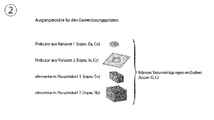
- In Schritt 1 (siehe
Fig. 1 ) wird die Herstellung der Vorprodukte illustriert. Dabei können die Vorprodukte mittels Variante 1 oder Variante 2 hergestellt werden. - Variante 1 wird unter inerten Bedingungen durchgeführt (das heißt typischerweise in einem hermetisch abgeschlossenen Raum unter Argon Atmosphäre) und beginnt mit den elementaren Ausgangsprodukten. Diese können beispielsweise elementares Ba und Co sein. Diese werden in einem stöchiometrischen Verhältnis 1 zu 10 mittels Lichtbogenofen miteinander unter einer exothermen Reaktion verschmolzen. Das Schmelzprodukt ist stabil gegen Oxidation und kann somit aus dem hermetisch abgeschlossenen Raum entnommen werden. Die weitere Handhabung wird somit erleichtert und die exotherme Reaktion läuft bereits vor dem Gasverdüsungsverfahren ab.
- Variante 2 wird ebenfalls unter inerten Bedingungen durchgeführt und beginnt mit den elementaren Ausgangsprodukten (beispielsweise Indium und Kobalt), von denen mindestens eines die Form einer Folie besitzt (beispielsweise Kobaltfolie). Eines der Ausgangsprodukte (beispielsweise In) wird durch zwei Folien (beispielsweise Co) abgedeckt. Anschließend wird die Folie durch eine mechanische Vorrichtung an den äußeren Kanten gefalzt und abgeschnitten. Das Ausgangprodukt innerhalb der Folien ist daneben vor weiterer Oxidation und Verunreinigung geschützt. Die Handhabung ist erleichtert und das eingeschlossene Ausgangsprodukt wird durch die hohe Schmelztemperatur der Folie (die Schmelztemperatur für Kobalt beträgt 1495°C bzw. für Indium 157°C) erst spät für die chemische Reaktion bereitgestellt und schlägt sich nicht an der Innenwand des Tiegels in der Gasverdüsungsanlage nieder.
- In Schritt 2 werden die Vorprodukte aus Schritt 1 und weitere notwendigen Edukte in die Gasverdüsungsanlage überführt. Die weiteren Edukte sind vor allem die Hauptprodukte der Skutteruditkomposition (beispielsweise Sb, Fe, Co). Die Edukte liegen wie die Vorprodukte in einer stückigen Form vor, das heißt es wird auf die Verwendung von Pulvern verzichtet, was wiederum eine Erleichterung der Handhabung und der Sicherheitsmaßnahmen bedeutet.
- Dabei ist die Reihenfolge, in der die Elemente des Skutterudits in die Schmelze eingebracht werden aufgrund der Reaktionskinetik von erheblicher Relevanz. Das gleichzeitige Aufschmelzen aller Bestandteile des Skutterudits, wie es im Stand der Technik beschrieben ist, führt zur Ausbildung unerwünschter Nebenprodukte. Im Besonderen neigt Eisen dazu eine Reaktion mit den Metallen der seltenen Erden (3. Nebengruppe des Periodensystems und die Lanthanoide) einzugehen, die für die weitere chemische Reaktion in die Skutteruditphase nachteilhaft ist. Das wirkt sich anschließend negativ auf die Effizienz des thermoelektrischen Skutteruditmaterials aus.
- Im Gegensatz hierzu offenbart die vorliegende Erfindung, dass zunächst in einem ersten Schritt (Schritt 1) Vorprodukte hergestellt werden, welche anschließend in einem nächsten Schritt (Schritt 2) mit weiter notwendigen Edukten in eine Gasverdüsungsanlage überführt werden. Dies führt zu einer deutlich geringeren Ausbildung von Nebenprodukten und damit zu einer verbesserten Effizienz des thermoelektrischen Skutteruditmaterials.
- In Schritt 3 werden die Materialien aufgeschmolzen. Die Schmelztemperatur beträgt etwa 1150°C. Nach der Homogenisierung der Schmelze wird diese durch eine kleine Öffnung geführt. Der Schmelzstrahl trifft dann auf das Gasgemisch und kühlt abrupt auf Raumtemperatur (20 bis 25 °C) ab. Das Gas besteht aus einem inerten Teil (beispielsweise Ar) und einem reaktiven Teil (beispielsweise N2, H2). Mit dem reaktiven Teil können die im Material enthaltenen Verunreinigungen (beispielsweise O, C) eine chemische Reaktion eingehen und können dabei aus der Skutteruditkomposition entfernt werden. Durch den reaktiven Teil des Gases kann das oxidationsanfällige neu gebildete Pulver vor Oxidation geschützt werden. Das hergestellte Pulver hat die gewünschte Skutteruditkomposition (beispielsweise Bax1Inx2Co4Sb12-x2). Die anderen Produkte, welche durch Reaktion des reaktiven Teils des Gases mit dem Material erhalten werden, können flüchtig sein beziehungsweise sind im Pulver als Ausscheidungen sehr fein verteilt. Hierdurch kann eine Verbesserung des thermoelektrischen Skutteruditmaterials erzielt werden.
- In Schritt 4 wird das Pulver kompaktiert und über die Wärmezufuhr und den angelegten Druck in die Skutteruditphase überführt. Das Pulver wird davor in eine Graphitpressform eingefüllt und in die Kammer einer Direktstrom-Sinteranlage überführt. Die Temperatur wird durch ein Thermoelement gemessen. Die Wärme (beispielsweise 600°C) wird über die Einspeisung von Strom in die Pressform und in das Pulver eingebracht (Joulsche Wärme). Eine Hydraulik kann parallel dazu den erforderlichen Druck aufbauen (beispielsweise 50 MPa) und das Pulvermaterial verdichten. Der Vorgang dauert mehrere Minuten bis zu wenigen Stunden, so dass die Phasenumwandlung nahezu vollständig ablaufen kann. Der hergestellte Pressling hat eine zylindrische Form und besitzt die gewünschte Skutteruditphase mit der erwünschten Skutteruditkomposition.
Claims (8)
- Verfahren zur Herstellung von Skutterudit der chemischen Formel
RiSyA4B12-y,
wobeiRi für ein oder mehrere Elemente (i=1,2,3,...) aus der Gruppe der (Erd-)Alkalielemente, der Gruppe der Seltenen Erden steht.Sy für Füllelemente der Gruppe 13 und 14, die teilweise den Gitterplatz des Atoms B besetzen (bspw. Sn, In, Ga), steht.A für wenigstens ein oder mehrere chemische Elemente der Gruppe der Übergangsmetalle steht, wobei A durch wenigstens ein oder mehrere Elemente der Gruppe 8 und 10 stöchiometrisch ersetzt werden kann undB für wenigstens ein chemisches Element der Gruppe 15 steht, wobei B durch wenigstens ein oder mehrere Elemente der Gruppe 14 und 16 ersetzt werden kann durch(a) Verschmelzen der elementaren Metalle und gegebenenfalls weiterer Edukte in einem Lichtbogen unter Inertgasatmosphäre,(b) anschließendes Überführen der Schmelze in eine Gasverdüsungsanlage,(c) anschließendes Abkühlen auf Raumtemperatur (20 bis 25 °C) und(d) anschließendes Kompaktieren des erhaltenen Pulvers unter Wärmezufuhr und Druck. - Verfahren nach Anspruch 1, dadurch gekennzeichnet, dass man die Edukte in stückiger Form einsetzt.
- Verfahren nach Anspruch 1 oder 2, dadurch gekennzeichnet, dass man wenigstens eines der Ausgangsmaterialien in Form einer geschlossenen Folie einsetzt, in die wenigstens ein Ausgangsmaterial eingeschlossen ist.
- Verfahren nach einem der Ansprüche 1 bis 3, dadurch gekennzeichnet, dass Ri für Ce, La Ga und Sy für In, Ga und/oder Sn steht.
- Verfahren nach einem der Ansprüche 1 bis 4, dadurch gekennzeichnet, dass A für Co oder Fe steht, wobei A durch Ni stöchiometrisch ersetzt werden kann.
- Verfahren nach einem der Ansprüche 1 bis 5, dadurch gekennzeichnet, dass B für Sb steht, wobei B durch Sn teilweise ersetzt werden kann.
- Verfahren nach einem der Ansprüche 1 bis 6, dadurch gekennzeichnet, dass man in der Gasverdüsungsanlage ein Gasgemisch mit einem Inertanteil, insbesondere Stickstoff und gegebenenfalls einem Reaktivanteil, insbesondere Wasserstoff einsetzt.
- Verfahren nach Anspruch 7, dadurch gekennzeichnet, dass der Reaktivgasanteil bis zu 5 Volumen % beträgt.
Applications Claiming Priority (1)
| Application Number | Priority Date | Filing Date | Title |
|---|---|---|---|
| DE201310213334 DE102013213334A1 (de) | 2013-07-08 | 2013-07-08 | Herstellung von Skutterudit |
Publications (3)
| Publication Number | Publication Date |
|---|---|
| EP2824076A2 true EP2824076A2 (de) | 2015-01-14 |
| EP2824076A3 EP2824076A3 (de) | 2015-01-28 |
| EP2824076B1 EP2824076B1 (de) | 2016-11-16 |
Family
ID=51059369
Family Applications (1)
| Application Number | Title | Priority Date | Filing Date |
|---|---|---|---|
| EP14175815.1A Not-in-force EP2824076B1 (de) | 2013-07-08 | 2014-07-04 | Herstellung von Skutterudit |
Country Status (3)
| Country | Link |
|---|---|
| EP (1) | EP2824076B1 (de) |
| DE (1) | DE102013213334A1 (de) |
| DK (1) | DK2824076T3 (de) |
Family Cites Families (4)
| Publication number | Priority date | Publication date | Assignee | Title |
|---|---|---|---|---|
| CN100385694C (zh) * | 1999-03-10 | 2008-04-30 | 日立金属株式会社 | 热电转换材料及其制作方法 |
| CN100459201C (zh) * | 2002-11-28 | 2009-02-04 | 住友电气工业株式会社 | 热电材料及其制造方法 |
| EP2662466A3 (de) * | 2004-04-21 | 2014-08-06 | Showa Denko K.K. | Verfahren zur Herstellung von thermoelektrischer Halbleiterlegierung, thermoelektrisches Umwandlungsmodul, Vorrichtung zur Erzeugung von thermoelektrischer Energie, Seltenerdlegierung, Verfahren zu deren Herstellung, thermoelektrisches Umwandlungsmaterial, und thermoelektrisches Umwandlungssystem unter Verwendung von gefüllter Legierung auf Skutteruditbasis |
| US20110120517A1 (en) * | 2009-11-13 | 2011-05-26 | Brookhaven Science Associates, Llc | Synthesis of High-Efficiency Thermoelectric Materials |
-
2013
- 2013-07-08 DE DE201310213334 patent/DE102013213334A1/de not_active Withdrawn
-
2014
- 2014-07-04 DK DK14175815.1T patent/DK2824076T3/en active
- 2014-07-04 EP EP14175815.1A patent/EP2824076B1/de not_active Not-in-force
Non-Patent Citations (12)
Also Published As
| Publication number | Publication date |
|---|---|
| EP2824076A3 (de) | 2015-01-28 |
| EP2824076B1 (de) | 2016-11-16 |
| DK2824076T3 (en) | 2017-02-27 |
| DE102013213334A1 (de) | 2015-01-08 |
Similar Documents
| Publication | Publication Date | Title |
|---|---|---|
| EP2308109B1 (de) | Thermoelektrische materialien und chalcogenidverbindungen | |
| US8968589B2 (en) | Filled-skutterudite composite material and method of preparing the same | |
| CN107078201A (zh) | 热电转换材料 | |
| US9634219B2 (en) | Method for producing a thermoelectric object for a thermoelectric conversion device | |
| KR102059674B1 (ko) | P형 스커테루다이트 열전재료, 이의 제조 방법 및 이를 포함하는 열전 소자 | |
| EP2460195B1 (de) | Verfahren zur herstellung thermoelektrischer halbleitermaterialien und schenkel | |
| DE102011085828A1 (de) | THERMOELEKTRISCHES MATERIAL AUS EINER VERBINDUNG AUF Mg2Si-BASIS UND HERSTELLUNGSVERFAHREN DAFÜR | |
| US10818831B2 (en) | Method for producing a thermoelectric object for a thermoelectric conversion device | |
| EP2459762A2 (de) | Verfahren zum sintern von thermoelektrischen materialien | |
| DE102006057750B4 (de) | Thermoelektrisches Material und thermoelektrische Umwandlungsvorrichtung unter Verwendung desselben | |
| KR102094451B1 (ko) | 칼코겐 화합물, 이의 제조 방법 및 이를 포함하는 열전소자 | |
| US11309476B2 (en) | Chalcogen-containing compound, its preparation method and thermoelectric element comprising the same | |
| EP2824076B1 (de) | Herstellung von Skutterudit | |
| WO2018226023A1 (ko) | 컬로겐 화합물, 이의 제조 방법 및 이를 포함하는 열전소자 | |
| EP3633745B1 (de) | Thermoelektrisches material und thermoelektrisches element damit | |
| KR102121436B1 (ko) | 칼코겐 화합물, 이의 제조 방법, 및 이를 포함하는 열전소자 | |
| AT514911B1 (de) | Intermetallische Clathratverbindungen | |
| EP3507241A1 (de) | Thermoelektrisches material |
Legal Events
| Date | Code | Title | Description |
|---|---|---|---|
| PUAL | Search report despatched |
Free format text: ORIGINAL CODE: 0009013 |
|
| 17P | Request for examination filed |
Effective date: 20140704 |
|
| AK | Designated contracting states |
Kind code of ref document: A2 Designated state(s): AL AT BE BG CH CY CZ DE DK EE ES FI FR GB GR HR HU IE IS IT LI LT LU LV MC MK MT NL NO PL PT RO RS SE SI SK SM TR |
|
| AX | Request for extension of the european patent |
Extension state: BA ME |
|
| PUAI | Public reference made under article 153(3) epc to a published international application that has entered the european phase |
Free format text: ORIGINAL CODE: 0009012 |
|
| AK | Designated contracting states |
Kind code of ref document: A3 Designated state(s): AL AT BE BG CH CY CZ DE DK EE ES FI FR GB GR HR HU IE IS IT LI LT LU LV MC MK MT NL NO PL PT RO RS SE SI SK SM TR |
|
| AX | Request for extension of the european patent |
Extension state: BA ME |
|
| RIC1 | Information provided on ipc code assigned before grant |
Ipc: C01G 51/00 20060101AFI20141219BHEP Ipc: H01L 35/08 20060101ALI20141219BHEP Ipc: H01L 35/34 20060101ALI20141219BHEP |
|
| R17P | Request for examination filed (corrected) |
Effective date: 20150724 |
|
| RBV | Designated contracting states (corrected) |
Designated state(s): AL AT BE BG CH CY CZ DE DK EE ES FI FR GB GR HR HU IE IS IT LI LT LU LV MC MK MT NL NO PL PT RO RS SE SI SK SM TR |
|
| GRAP | Despatch of communication of intention to grant a patent |
Free format text: ORIGINAL CODE: EPIDOSNIGR1 |
|
| INTG | Intention to grant announced |
Effective date: 20160406 |
|
| GRAS | Grant fee paid |
Free format text: ORIGINAL CODE: EPIDOSNIGR3 |
|
| GRAJ | Information related to disapproval of communication of intention to grant by the applicant or resumption of examination proceedings by the epo deleted |
Free format text: ORIGINAL CODE: EPIDOSDIGR1 |
|
| GRAL | Information related to payment of fee for publishing/printing deleted |
Free format text: ORIGINAL CODE: EPIDOSDIGR3 |
|
| INTC | Intention to grant announced (deleted) | ||
| GRAR | Information related to intention to grant a patent recorded |
Free format text: ORIGINAL CODE: EPIDOSNIGR71 |
|
| GRAA | (expected) grant |
Free format text: ORIGINAL CODE: 0009210 |
|
| AK | Designated contracting states |
Kind code of ref document: B1 Designated state(s): AL AT BE BG CH CY CZ DE DK EE ES FI FR GB GR HR HU IE IS IT LI LT LU LV MC MK MT NL NO PL PT RO RS SE SI SK SM TR |
|
| INTG | Intention to grant announced |
Effective date: 20161007 |
|
| REG | Reference to a national code |
Ref country code: GB Ref legal event code: FG4D Free format text: NOT ENGLISH |
|
| REG | Reference to a national code |
Ref country code: CH Ref legal event code: EP |
|
| REG | Reference to a national code |
Ref country code: IE Ref legal event code: FG4D Free format text: LANGUAGE OF EP DOCUMENT: GERMAN |
|
| REG | Reference to a national code |
Ref country code: AT Ref legal event code: REF Ref document number: 845727 Country of ref document: AT Kind code of ref document: T Effective date: 20161215 |
|
| REG | Reference to a national code |
Ref country code: DE Ref legal event code: R096 Ref document number: 502014001963 Country of ref document: DE |
|
| REG | Reference to a national code |
Ref country code: DK Ref legal event code: T3 Effective date: 20170221 |
|
| PG25 | Lapsed in a contracting state [announced via postgrant information from national office to epo] |
Ref country code: LV Free format text: LAPSE BECAUSE OF FAILURE TO SUBMIT A TRANSLATION OF THE DESCRIPTION OR TO PAY THE FEE WITHIN THE PRESCRIBED TIME-LIMIT Effective date: 20161116 |
|
| REG | Reference to a national code |
Ref country code: NL Ref legal event code: MP Effective date: 20161116 |
|
| REG | Reference to a national code |
Ref country code: LT Ref legal event code: MG4D |
|
| REG | Reference to a national code |
Ref country code: NO Ref legal event code: T2 Effective date: 20161116 |
|
| PG25 | Lapsed in a contracting state [announced via postgrant information from national office to epo] |
Ref country code: NL Free format text: LAPSE BECAUSE OF FAILURE TO SUBMIT A TRANSLATION OF THE DESCRIPTION OR TO PAY THE FEE WITHIN THE PRESCRIBED TIME-LIMIT Effective date: 20161116 Ref country code: LT Free format text: LAPSE BECAUSE OF FAILURE TO SUBMIT A TRANSLATION OF THE DESCRIPTION OR TO PAY THE FEE WITHIN THE PRESCRIBED TIME-LIMIT Effective date: 20161116 Ref country code: SE Free format text: LAPSE BECAUSE OF FAILURE TO SUBMIT A TRANSLATION OF THE DESCRIPTION OR TO PAY THE FEE WITHIN THE PRESCRIBED TIME-LIMIT Effective date: 20161116 Ref country code: GR Free format text: LAPSE BECAUSE OF FAILURE TO SUBMIT A TRANSLATION OF THE DESCRIPTION OR TO PAY THE FEE WITHIN THE PRESCRIBED TIME-LIMIT Effective date: 20170217 |
|
| PG25 | Lapsed in a contracting state [announced via postgrant information from national office to epo] |
Ref country code: FI Free format text: LAPSE BECAUSE OF FAILURE TO SUBMIT A TRANSLATION OF THE DESCRIPTION OR TO PAY THE FEE WITHIN THE PRESCRIBED TIME-LIMIT Effective date: 20161116 Ref country code: PL Free format text: LAPSE BECAUSE OF FAILURE TO SUBMIT A TRANSLATION OF THE DESCRIPTION OR TO PAY THE FEE WITHIN THE PRESCRIBED TIME-LIMIT Effective date: 20161116 Ref country code: PT Free format text: LAPSE BECAUSE OF FAILURE TO SUBMIT A TRANSLATION OF THE DESCRIPTION OR TO PAY THE FEE WITHIN THE PRESCRIBED TIME-LIMIT Effective date: 20170316 Ref country code: HR Free format text: LAPSE BECAUSE OF FAILURE TO SUBMIT A TRANSLATION OF THE DESCRIPTION OR TO PAY THE FEE WITHIN THE PRESCRIBED TIME-LIMIT Effective date: 20161116 Ref country code: ES Free format text: LAPSE BECAUSE OF FAILURE TO SUBMIT A TRANSLATION OF THE DESCRIPTION OR TO PAY THE FEE WITHIN THE PRESCRIBED TIME-LIMIT Effective date: 20161116 Ref country code: RS Free format text: LAPSE BECAUSE OF FAILURE TO SUBMIT A TRANSLATION OF THE DESCRIPTION OR TO PAY THE FEE WITHIN THE PRESCRIBED TIME-LIMIT Effective date: 20161116 |
|
| REG | Reference to a national code |
Ref country code: FR Ref legal event code: PLFP Year of fee payment: 4 |
|
| PG25 | Lapsed in a contracting state [announced via postgrant information from national office to epo] |
Ref country code: RO Free format text: LAPSE BECAUSE OF FAILURE TO SUBMIT A TRANSLATION OF THE DESCRIPTION OR TO PAY THE FEE WITHIN THE PRESCRIBED TIME-LIMIT Effective date: 20161116 Ref country code: SK Free format text: LAPSE BECAUSE OF FAILURE TO SUBMIT A TRANSLATION OF THE DESCRIPTION OR TO PAY THE FEE WITHIN THE PRESCRIBED TIME-LIMIT Effective date: 20161116 Ref country code: CZ Free format text: LAPSE BECAUSE OF FAILURE TO SUBMIT A TRANSLATION OF THE DESCRIPTION OR TO PAY THE FEE WITHIN THE PRESCRIBED TIME-LIMIT Effective date: 20161116 Ref country code: EE Free format text: LAPSE BECAUSE OF FAILURE TO SUBMIT A TRANSLATION OF THE DESCRIPTION OR TO PAY THE FEE WITHIN THE PRESCRIBED TIME-LIMIT Effective date: 20161116 |
|
| REG | Reference to a national code |
Ref country code: DE Ref legal event code: R097 Ref document number: 502014001963 Country of ref document: DE |
|
| PG25 | Lapsed in a contracting state [announced via postgrant information from national office to epo] |
Ref country code: SM Free format text: LAPSE BECAUSE OF FAILURE TO SUBMIT A TRANSLATION OF THE DESCRIPTION OR TO PAY THE FEE WITHIN THE PRESCRIBED TIME-LIMIT Effective date: 20161116 Ref country code: IT Free format text: LAPSE BECAUSE OF FAILURE TO SUBMIT A TRANSLATION OF THE DESCRIPTION OR TO PAY THE FEE WITHIN THE PRESCRIBED TIME-LIMIT Effective date: 20161116 Ref country code: BG Free format text: LAPSE BECAUSE OF FAILURE TO SUBMIT A TRANSLATION OF THE DESCRIPTION OR TO PAY THE FEE WITHIN THE PRESCRIBED TIME-LIMIT Effective date: 20170216 |
|
| PLBE | No opposition filed within time limit |
Free format text: ORIGINAL CODE: 0009261 |
|
| STAA | Information on the status of an ep patent application or granted ep patent |
Free format text: STATUS: NO OPPOSITION FILED WITHIN TIME LIMIT |
|
| 26N | No opposition filed |
Effective date: 20170817 |
|
| PG25 | Lapsed in a contracting state [announced via postgrant information from national office to epo] |
Ref country code: SI Free format text: LAPSE BECAUSE OF FAILURE TO SUBMIT A TRANSLATION OF THE DESCRIPTION OR TO PAY THE FEE WITHIN THE PRESCRIBED TIME-LIMIT Effective date: 20161116 |
|
| REG | Reference to a national code |
Ref country code: CH Ref legal event code: PL |
|
| REG | Reference to a national code |
Ref country code: IE Ref legal event code: MM4A |
|
| PG25 | Lapsed in a contracting state [announced via postgrant information from national office to epo] |
Ref country code: CH Free format text: LAPSE BECAUSE OF NON-PAYMENT OF DUE FEES Effective date: 20170731 Ref country code: IE Free format text: LAPSE BECAUSE OF NON-PAYMENT OF DUE FEES Effective date: 20170704 Ref country code: LI Free format text: LAPSE BECAUSE OF NON-PAYMENT OF DUE FEES Effective date: 20170731 |
|
| REG | Reference to a national code |
Ref country code: BE Ref legal event code: MM Effective date: 20170731 |
|
| REG | Reference to a national code |
Ref country code: FR Ref legal event code: PLFP Year of fee payment: 5 |
|
| PG25 | Lapsed in a contracting state [announced via postgrant information from national office to epo] |
Ref country code: LU Free format text: LAPSE BECAUSE OF NON-PAYMENT OF DUE FEES Effective date: 20170704 |
|
| PG25 | Lapsed in a contracting state [announced via postgrant information from national office to epo] |
Ref country code: BE Free format text: LAPSE BECAUSE OF NON-PAYMENT OF DUE FEES Effective date: 20170731 |
|
| PG25 | Lapsed in a contracting state [announced via postgrant information from national office to epo] |
Ref country code: MT Free format text: LAPSE BECAUSE OF FAILURE TO SUBMIT A TRANSLATION OF THE DESCRIPTION OR TO PAY THE FEE WITHIN THE PRESCRIBED TIME-LIMIT Effective date: 20161116 |
|
| PG25 | Lapsed in a contracting state [announced via postgrant information from national office to epo] |
Ref country code: MC Free format text: LAPSE BECAUSE OF FAILURE TO SUBMIT A TRANSLATION OF THE DESCRIPTION OR TO PAY THE FEE WITHIN THE PRESCRIBED TIME-LIMIT Effective date: 20161116 Ref country code: HU Free format text: LAPSE BECAUSE OF FAILURE TO SUBMIT A TRANSLATION OF THE DESCRIPTION OR TO PAY THE FEE WITHIN THE PRESCRIBED TIME-LIMIT; INVALID AB INITIO Effective date: 20140704 |
|
| PG25 | Lapsed in a contracting state [announced via postgrant information from national office to epo] |
Ref country code: CY Free format text: LAPSE BECAUSE OF FAILURE TO SUBMIT A TRANSLATION OF THE DESCRIPTION OR TO PAY THE FEE WITHIN THE PRESCRIBED TIME-LIMIT Effective date: 20161116 |
|
| PG25 | Lapsed in a contracting state [announced via postgrant information from national office to epo] |
Ref country code: MK Free format text: LAPSE BECAUSE OF FAILURE TO SUBMIT A TRANSLATION OF THE DESCRIPTION OR TO PAY THE FEE WITHIN THE PRESCRIBED TIME-LIMIT Effective date: 20161116 |
|
| PG25 | Lapsed in a contracting state [announced via postgrant information from national office to epo] |
Ref country code: TR Free format text: LAPSE BECAUSE OF FAILURE TO SUBMIT A TRANSLATION OF THE DESCRIPTION OR TO PAY THE FEE WITHIN THE PRESCRIBED TIME-LIMIT Effective date: 20161116 |
|
| PG25 | Lapsed in a contracting state [announced via postgrant information from national office to epo] |
Ref country code: AL Free format text: LAPSE BECAUSE OF FAILURE TO SUBMIT A TRANSLATION OF THE DESCRIPTION OR TO PAY THE FEE WITHIN THE PRESCRIBED TIME-LIMIT Effective date: 20161116 Ref country code: IS Free format text: LAPSE BECAUSE OF FAILURE TO SUBMIT A TRANSLATION OF THE DESCRIPTION OR TO PAY THE FEE WITHIN THE PRESCRIBED TIME-LIMIT Effective date: 20170316 |
|
| PGFP | Annual fee paid to national office [announced via postgrant information from national office to epo] |
Ref country code: NO Payment date: 20200625 Year of fee payment: 7 Ref country code: FR Payment date: 20200619 Year of fee payment: 7 Ref country code: DK Payment date: 20200625 Year of fee payment: 7 |
|
| PGFP | Annual fee paid to national office [announced via postgrant information from national office to epo] |
Ref country code: GB Payment date: 20200630 Year of fee payment: 7 |
|
| REG | Reference to a national code |
Ref country code: AT Ref legal event code: MM01 Ref document number: 845727 Country of ref document: AT Kind code of ref document: T Effective date: 20190704 |
|
| PG25 | Lapsed in a contracting state [announced via postgrant information from national office to epo] |
Ref country code: AT Free format text: LAPSE BECAUSE OF NON-PAYMENT OF DUE FEES Effective date: 20190704 |
|
| REG | Reference to a national code |
Ref country code: DK Ref legal event code: EBP Effective date: 20210731 |
|
| REG | Reference to a national code |
Ref country code: NO Ref legal event code: MMEP |
|
| GBPC | Gb: european patent ceased through non-payment of renewal fee |
Effective date: 20210704 |
|
| PG25 | Lapsed in a contracting state [announced via postgrant information from national office to epo] |
Ref country code: GB Free format text: LAPSE BECAUSE OF NON-PAYMENT OF DUE FEES Effective date: 20210704 |
|
| PG25 | Lapsed in a contracting state [announced via postgrant information from national office to epo] |
Ref country code: NO Free format text: LAPSE BECAUSE OF NON-PAYMENT OF DUE FEES Effective date: 20210731 Ref country code: FR Free format text: LAPSE BECAUSE OF NON-PAYMENT OF DUE FEES Effective date: 20210731 |
|
| PG25 | Lapsed in a contracting state [announced via postgrant information from national office to epo] |
Ref country code: DK Free format text: LAPSE BECAUSE OF NON-PAYMENT OF DUE FEES Effective date: 20210731 |
|
| PGFP | Annual fee paid to national office [announced via postgrant information from national office to epo] |
Ref country code: DE Payment date: 20240613 Year of fee payment: 11 |
|
| REG | Reference to a national code |
Ref country code: DE Ref legal event code: R119 Ref document number: 502014001963 Country of ref document: DE |
|
| PG25 | Lapsed in a contracting state [announced via postgrant information from national office to epo] |
Ref country code: DE Free format text: LAPSE BECAUSE OF NON-PAYMENT OF DUE FEES Effective date: 20260203 |