EP2821040A1 - Absorbent article - Google Patents
Absorbent article Download PDFInfo
- Publication number
- EP2821040A1 EP2821040A1 EP13755536.3A EP13755536A EP2821040A1 EP 2821040 A1 EP2821040 A1 EP 2821040A1 EP 13755536 A EP13755536 A EP 13755536A EP 2821040 A1 EP2821040 A1 EP 2821040A1
- Authority
- EP
- European Patent Office
- Prior art keywords
- chain hydrocarbon
- acid
- ester
- hydrocarbon moiety
- absorbent article
- Prior art date
- Legal status (The legal status is an assumption and is not a legal conclusion. Google has not performed a legal analysis and makes no representation as to the accuracy of the status listed.)
- Granted
Links
- 239000002250 absorbent Substances 0.000 title claims abstract description 181
- 230000002745 absorbent Effects 0.000 title claims abstract description 173
- -1 polyoxy Polymers 0.000 claims description 229
- 210000004369 blood Anatomy 0.000 claims description 204
- 239000008280 blood Substances 0.000 claims description 204
- 150000002430 hydrocarbons Chemical class 0.000 claims description 189
- 235000014113 dietary fatty acids Nutrition 0.000 claims description 183
- 229930195729 fatty acid Natural products 0.000 claims description 183
- 239000000194 fatty acid Substances 0.000 claims description 183
- 229930195733 hydrocarbon Natural products 0.000 claims description 160
- 150000004665 fatty acids Chemical class 0.000 claims description 148
- 239000004215 Carbon black (E152) Substances 0.000 claims description 147
- 125000001931 aliphatic group Chemical group 0.000 claims description 118
- 239000003795 chemical substances by application Substances 0.000 claims description 107
- LYCAIKOWRPUZTN-UHFFFAOYSA-N ethylene glycol Natural products OCCO LYCAIKOWRPUZTN-UHFFFAOYSA-N 0.000 claims description 107
- RTZKZFJDLAIYFH-UHFFFAOYSA-N ether Substances CCOCC RTZKZFJDLAIYFH-UHFFFAOYSA-N 0.000 claims description 103
- LFQSCWFLJHTTHZ-UHFFFAOYSA-N Ethanol Chemical compound CCO LFQSCWFLJHTTHZ-UHFFFAOYSA-N 0.000 claims description 102
- 150000001875 compounds Chemical class 0.000 claims description 102
- 150000002148 esters Chemical class 0.000 claims description 98
- WGCNASOHLSPBMP-UHFFFAOYSA-N hydroxyacetaldehyde Natural products OCC=O WGCNASOHLSPBMP-UHFFFAOYSA-N 0.000 claims description 65
- XLYOFNOQVPJJNP-UHFFFAOYSA-N water Substances O XLYOFNOQVPJJNP-UHFFFAOYSA-N 0.000 claims description 52
- 125000003178 carboxy group Chemical group [H]OC(*)=O 0.000 claims description 48
- 239000007788 liquid Substances 0.000 claims description 48
- 239000002253 acid Substances 0.000 claims description 39
- 125000002887 hydroxy group Chemical group [H]O* 0.000 claims description 39
- 238000002844 melting Methods 0.000 claims description 38
- 230000008018 melting Effects 0.000 claims description 38
- 229910052739 hydrogen Inorganic materials 0.000 claims description 31
- 239000001257 hydrogen Substances 0.000 claims description 31
- UFHFLCQGNIYNRP-UHFFFAOYSA-N Hydrogen Chemical compound [H][H] UFHFLCQGNIYNRP-UHFFFAOYSA-N 0.000 claims description 30
- XSTXAVWGXDQKEL-UHFFFAOYSA-N Trichloroethylene Chemical compound ClC=C(Cl)Cl XSTXAVWGXDQKEL-UHFFFAOYSA-N 0.000 claims description 18
- 125000004435 hydrogen atom Chemical group [H]* 0.000 claims description 18
- 125000003545 alkoxy group Chemical group 0.000 claims description 17
- 150000001261 hydroxy acids Chemical class 0.000 claims description 17
- 150000004715 keto acids Chemical class 0.000 claims description 17
- 125000001820 oxy group Chemical group [*:1]O[*:2] 0.000 claims description 17
- OFOBLEOULBTSOW-UHFFFAOYSA-N Malonic acid Chemical compound OC(=O)CC(O)=O OFOBLEOULBTSOW-UHFFFAOYSA-N 0.000 claims description 13
- 150000002576 ketones Chemical class 0.000 claims description 11
- 150000001335 aliphatic alkanes Chemical class 0.000 claims description 10
- BVKZGUZCCUSVTD-UHFFFAOYSA-L Carbonate Chemical compound [O-]C([O-])=O BVKZGUZCCUSVTD-UHFFFAOYSA-L 0.000 claims description 7
- 125000002915 carbonyl group Chemical group [*:2]C([*:1])=O 0.000 claims description 6
- 125000001183 hydrocarbyl group Chemical group 0.000 claims 24
- 150000001735 carboxylic acids Chemical class 0.000 claims 1
- 230000006835 compression Effects 0.000 abstract description 19
- 238000007906 compression Methods 0.000 abstract description 19
- 239000002699 waste material Substances 0.000 abstract 1
- PEDCQBHIVMGVHV-UHFFFAOYSA-N Glycerine Chemical compound OCC(O)CO PEDCQBHIVMGVHV-UHFFFAOYSA-N 0.000 description 132
- 235000019441 ethanol Nutrition 0.000 description 112
- 235000011187 glycerol Nutrition 0.000 description 67
- 239000000047 product Substances 0.000 description 63
- 125000004432 carbon atom Chemical group C* 0.000 description 44
- WXZMFSXDPGVJKK-UHFFFAOYSA-N pentaerythritol Chemical compound OCC(CO)(CO)CO WXZMFSXDPGVJKK-UHFFFAOYSA-N 0.000 description 44
- 229920003002 synthetic resin Polymers 0.000 description 44
- 239000000057 synthetic resin Substances 0.000 description 44
- 239000000463 material Substances 0.000 description 35
- 150000005691 triesters Chemical class 0.000 description 31
- 150000005690 diesters Chemical class 0.000 description 27
- WWZKQHOCKIZLMA-UHFFFAOYSA-N Caprylic acid Natural products CCCCCCCC(O)=O WWZKQHOCKIZLMA-UHFFFAOYSA-N 0.000 description 26
- 230000002175 menstrual effect Effects 0.000 description 25
- 239000010410 layer Substances 0.000 description 24
- KCXVZYZYPLLWCC-UHFFFAOYSA-N EDTA Chemical compound OC(=O)CN(CC(O)=O)CCN(CC(O)=O)CC(O)=O KCXVZYZYPLLWCC-UHFFFAOYSA-N 0.000 description 23
- POULHZVOKOAJMA-UHFFFAOYSA-N dodecanoic acid Chemical compound CCCCCCCCCCCC(O)=O POULHZVOKOAJMA-UHFFFAOYSA-N 0.000 description 23
- 238000010521 absorption reaction Methods 0.000 description 21
- 150000001298 alcohols Chemical class 0.000 description 21
- 210000003608 fece Anatomy 0.000 description 19
- 210000000601 blood cell Anatomy 0.000 description 18
- 238000004519 manufacturing process Methods 0.000 description 18
- 230000002093 peripheral effect Effects 0.000 description 18
- 150000004671 saturated fatty acids Chemical class 0.000 description 18
- 238000000576 coating method Methods 0.000 description 17
- 239000000835 fiber Substances 0.000 description 16
- DNIAPMSPPWPWGF-UHFFFAOYSA-N Propylene glycol Chemical compound CC(O)CO DNIAPMSPPWPWGF-UHFFFAOYSA-N 0.000 description 15
- 239000011248 coating agent Substances 0.000 description 15
- 229920001451 polypropylene glycol Polymers 0.000 description 15
- 238000000034 method Methods 0.000 description 14
- 239000003921 oil Substances 0.000 description 13
- OBETXYAYXDNJHR-UHFFFAOYSA-N alpha-ethylcaproic acid Natural products CCCCC(CC)C(O)=O OBETXYAYXDNJHR-UHFFFAOYSA-N 0.000 description 12
- LQZZUXJYWNFBMV-UHFFFAOYSA-N dodecan-1-ol Chemical compound CCCCCCCCCCCCO LQZZUXJYWNFBMV-UHFFFAOYSA-N 0.000 description 12
- 239000004745 nonwoven fabric Substances 0.000 description 12
- IPCSVZSSVZVIGE-UHFFFAOYSA-N hexadecanoic acid Chemical compound CCCCCCCCCCCCCCCC(O)=O IPCSVZSSVZVIGE-UHFFFAOYSA-N 0.000 description 11
- 230000005012 migration Effects 0.000 description 11
- 238000013508 migration Methods 0.000 description 11
- 229960002446 octanoic acid Drugs 0.000 description 11
- 235000003441 saturated fatty acids Nutrition 0.000 description 11
- 235000021122 unsaturated fatty acids Nutrition 0.000 description 11
- GHVNFZFCNZKVNT-UHFFFAOYSA-N Decanoic acid Natural products CCCCCCCCCC(O)=O GHVNFZFCNZKVNT-UHFFFAOYSA-N 0.000 description 10
- 238000010586 diagram Methods 0.000 description 10
- 229920000728 polyester Polymers 0.000 description 10
- TUNFSRHWOTWDNC-UHFFFAOYSA-N tetradecanoic acid Chemical compound CCCCCCCCCCCCCC(O)=O TUNFSRHWOTWDNC-UHFFFAOYSA-N 0.000 description 10
- 150000004670 unsaturated fatty acids Chemical class 0.000 description 10
- PUPZLCDOIYMWBV-UHFFFAOYSA-N (+/-)-1,3-Butanediol Chemical compound CC(O)CCO PUPZLCDOIYMWBV-UHFFFAOYSA-N 0.000 description 9
- 239000004820 Pressure-sensitive adhesive Substances 0.000 description 9
- 239000012790 adhesive layer Substances 0.000 description 9
- 238000004049 embossing Methods 0.000 description 9
- 229920001519 homopolymer Polymers 0.000 description 9
- 230000004048 modification Effects 0.000 description 9
- 238000012986 modification Methods 0.000 description 9
- 229920005989 resin Polymers 0.000 description 9
- 239000011347 resin Substances 0.000 description 9
- 150000003839 salts Chemical class 0.000 description 9
- GYSCBCSGKXNZRH-UHFFFAOYSA-N 1-benzothiophene-2-carboxamide Chemical compound C1=CC=C2SC(C(=O)N)=CC2=C1 GYSCBCSGKXNZRH-UHFFFAOYSA-N 0.000 description 8
- 150000001336 alkenes Chemical class 0.000 description 8
- 229920001971 elastomer Polymers 0.000 description 8
- 229920000642 polymer Polymers 0.000 description 8
- 239000004831 Hot glue Substances 0.000 description 7
- 239000000853 adhesive Substances 0.000 description 7
- 230000001070 adhesive effect Effects 0.000 description 7
- 150000002334 glycols Chemical class 0.000 description 7
- 230000003647 oxidation Effects 0.000 description 7
- 238000007254 oxidation reaction Methods 0.000 description 7
- 210000001519 tissue Anatomy 0.000 description 7
- SVTBMSDMJJWYQN-UHFFFAOYSA-N 2-methylpentane-2,4-diol Chemical compound CC(O)CC(C)(C)O SVTBMSDMJJWYQN-UHFFFAOYSA-N 0.000 description 6
- PPBRXRYQALVLMV-UHFFFAOYSA-N Styrene Chemical compound C=CC1=CC=CC=C1 PPBRXRYQALVLMV-UHFFFAOYSA-N 0.000 description 6
- 239000011358 absorbing material Substances 0.000 description 6
- 230000015556 catabolic process Effects 0.000 description 6
- 210000004027 cell Anatomy 0.000 description 6
- 238000006731 degradation reaction Methods 0.000 description 6
- 239000000806 elastomer Substances 0.000 description 6
- 210000003743 erythrocyte Anatomy 0.000 description 6
- 230000014759 maintenance of location Effects 0.000 description 6
- 239000000123 paper Substances 0.000 description 6
- 210000002381 plasma Anatomy 0.000 description 6
- 210000002966 serum Anatomy 0.000 description 6
- 238000012360 testing method Methods 0.000 description 6
- VSKJLJHPAFKHBX-UHFFFAOYSA-N 2-methylbuta-1,3-diene;styrene Chemical compound CC(=C)C=C.C=CC1=CC=CC=C1.C=CC1=CC=CC=C1 VSKJLJHPAFKHBX-UHFFFAOYSA-N 0.000 description 5
- 229920001131 Pulp (paper) Polymers 0.000 description 5
- NIXOWILDQLNWCW-UHFFFAOYSA-N acrylic acid group Chemical group C(C=C)(=O)O NIXOWILDQLNWCW-UHFFFAOYSA-N 0.000 description 5
- 125000002947 alkylene group Chemical group 0.000 description 5
- FACXGONDLDSNOE-UHFFFAOYSA-N buta-1,3-diene;styrene Chemical compound C=CC=C.C=CC1=CC=CC=C1.C=CC1=CC=CC=C1 FACXGONDLDSNOE-UHFFFAOYSA-N 0.000 description 5
- 150000001732 carboxylic acid derivatives Chemical class 0.000 description 5
- 238000006243 chemical reaction Methods 0.000 description 5
- 239000002131 composite material Substances 0.000 description 5
- 230000001595 contractor effect Effects 0.000 description 5
- 229920001577 copolymer Polymers 0.000 description 5
- GPLRAVKSCUXZTP-UHFFFAOYSA-N diglycerol Chemical compound OCC(O)COCC(O)CO GPLRAVKSCUXZTP-UHFFFAOYSA-N 0.000 description 5
- 238000005259 measurement Methods 0.000 description 5
- 239000000203 mixture Substances 0.000 description 5
- JRZJOMJEPLMPRA-UHFFFAOYSA-N olefin Natural products CCCCCCCC=C JRZJOMJEPLMPRA-UHFFFAOYSA-N 0.000 description 5
- 239000003208 petroleum Substances 0.000 description 5
- 229920001748 polybutylene Polymers 0.000 description 5
- 229920000139 polyethylene terephthalate Polymers 0.000 description 5
- 239000005020 polyethylene terephthalate Substances 0.000 description 5
- 229920000468 styrene butadiene styrene block copolymer Polymers 0.000 description 5
- 229920001935 styrene-ethylene-butadiene-styrene Polymers 0.000 description 5
- LQJBNNIYVWPHFW-UHFFFAOYSA-N 20:1omega9c fatty acid Natural products CCCCCCCCCCC=CCCCCCCCC(O)=O LQJBNNIYVWPHFW-UHFFFAOYSA-N 0.000 description 4
- 206010021639 Incontinence Diseases 0.000 description 4
- 241001465754 Metazoa Species 0.000 description 4
- 235000021314 Palmitic acid Nutrition 0.000 description 4
- 241001494479 Pecora Species 0.000 description 4
- 150000007513 acids Chemical class 0.000 description 4
- 230000015572 biosynthetic process Effects 0.000 description 4
- 238000005520 cutting process Methods 0.000 description 4
- LOKCTEFSRHRXRJ-UHFFFAOYSA-I dipotassium trisodium dihydrogen phosphate hydrogen phosphate dichloride Chemical compound P(=O)(O)(O)[O-].[K+].P(=O)(O)([O-])[O-].[Na+].[Na+].[Cl-].[K+].[Cl-].[Na+] LOKCTEFSRHRXRJ-UHFFFAOYSA-I 0.000 description 4
- UKMSUNONTOPOIO-UHFFFAOYSA-N docosanoic acid Chemical compound CCCCCCCCCCCCCCCCCCCCCC(O)=O UKMSUNONTOPOIO-UHFFFAOYSA-N 0.000 description 4
- 238000010438 heat treatment Methods 0.000 description 4
- MNWFXJYAOYHMED-UHFFFAOYSA-N heptanoic acid Chemical compound CCCCCCC(O)=O MNWFXJYAOYHMED-UHFFFAOYSA-N 0.000 description 4
- VKOBVWXKNCXXDE-UHFFFAOYSA-N icosanoic acid Chemical compound CCCCCCCCCCCCCCCCCCCC(O)=O VKOBVWXKNCXXDE-UHFFFAOYSA-N 0.000 description 4
- 229920000092 linear low density polyethylene Polymers 0.000 description 4
- 239000004707 linear low-density polyethylene Substances 0.000 description 4
- FBUKVWPVBMHYJY-UHFFFAOYSA-N nonanoic acid Chemical compound CCCCCCCCC(O)=O FBUKVWPVBMHYJY-UHFFFAOYSA-N 0.000 description 4
- 239000002953 phosphate buffered saline Substances 0.000 description 4
- 238000006068 polycondensation reaction Methods 0.000 description 4
- 230000000717 retained effect Effects 0.000 description 4
- 239000007787 solid Substances 0.000 description 4
- 239000004094 surface-active agent Substances 0.000 description 4
- 238000010998 test method Methods 0.000 description 4
- OBETXYAYXDNJHR-SSDOTTSWSA-M (2r)-2-ethylhexanoate Chemical compound CCCC[C@@H](CC)C([O-])=O OBETXYAYXDNJHR-SSDOTTSWSA-M 0.000 description 3
- 229940043375 1,5-pentanediol Drugs 0.000 description 3
- QTBSBXVTEAMEQO-UHFFFAOYSA-N Acetic acid Chemical compound CC(O)=O QTBSBXVTEAMEQO-UHFFFAOYSA-N 0.000 description 3
- QZCLKYGREBVARF-UHFFFAOYSA-N Acetyl tributyl citrate Chemical compound CCCCOC(=O)CC(C(=O)OCCCC)(OC(C)=O)CC(=O)OCCCC QZCLKYGREBVARF-UHFFFAOYSA-N 0.000 description 3
- KFZMGEQAYNKOFK-UHFFFAOYSA-N Isopropanol Chemical compound CC(C)O KFZMGEQAYNKOFK-UHFFFAOYSA-N 0.000 description 3
- OKKJLVBELUTLKV-UHFFFAOYSA-N Methanol Chemical compound OC OKKJLVBELUTLKV-UHFFFAOYSA-N 0.000 description 3
- ZQPPMHVWECSIRJ-UHFFFAOYSA-N Oleic acid Natural products CCCCCCCCC=CCCCCCCCC(O)=O ZQPPMHVWECSIRJ-UHFFFAOYSA-N 0.000 description 3
- 239000004372 Polyvinyl alcohol Substances 0.000 description 3
- GOOHAUXETOMSMM-UHFFFAOYSA-N Propylene oxide Chemical group CC1CO1 GOOHAUXETOMSMM-UHFFFAOYSA-N 0.000 description 3
- 229920000297 Rayon Polymers 0.000 description 3
- 235000021355 Stearic acid Nutrition 0.000 description 3
- DKGAVHZHDRPRBM-UHFFFAOYSA-N Tert-Butanol Chemical compound CC(C)(C)O DKGAVHZHDRPRBM-UHFFFAOYSA-N 0.000 description 3
- HGKOWIQVWAQWDS-UHFFFAOYSA-N bis(16-methylheptadecyl) 2-hydroxybutanedioate Chemical compound CC(C)CCCCCCCCCCCCCCCOC(=O)CC(O)C(=O)OCCCCCCCCCCCCCCCC(C)C HGKOWIQVWAQWDS-UHFFFAOYSA-N 0.000 description 3
- ZFMQKOWCDKKBIF-UHFFFAOYSA-N bis(3,5-difluorophenyl)phosphane Chemical compound FC1=CC(F)=CC(PC=2C=C(F)C=C(F)C=2)=C1 ZFMQKOWCDKKBIF-UHFFFAOYSA-N 0.000 description 3
- 229920002678 cellulose Polymers 0.000 description 3
- 235000010980 cellulose Nutrition 0.000 description 3
- KRKNYBCHXYNGOX-UHFFFAOYSA-N citric acid Chemical compound OC(=O)CC(O)(C(O)=O)CC(O)=O KRKNYBCHXYNGOX-UHFFFAOYSA-N 0.000 description 3
- 239000008367 deionised water Substances 0.000 description 3
- 229910021641 deionized water Inorganic materials 0.000 description 3
- 230000000694 effects Effects 0.000 description 3
- ZQPPMHVWECSIRJ-MDZDMXLPSA-N elaidic acid Chemical compound CCCCCCCC\C=C\CCCCCCCC(O)=O ZQPPMHVWECSIRJ-MDZDMXLPSA-N 0.000 description 3
- 150000002170 ethers Chemical class 0.000 description 3
- 238000005227 gel permeation chromatography Methods 0.000 description 3
- 229940051250 hexylene glycol Drugs 0.000 description 3
- QXJSBBXBKPUZAA-UHFFFAOYSA-N isooleic acid Natural products CCCCCCCC=CCCCCCCCCC(O)=O QXJSBBXBKPUZAA-UHFFFAOYSA-N 0.000 description 3
- 229920001684 low density polyethylene Polymers 0.000 description 3
- 239000004702 low-density polyethylene Substances 0.000 description 3
- 239000000178 monomer Substances 0.000 description 3
- FUZZWVXGSFPDMH-UHFFFAOYSA-N n-hexanoic acid Natural products CCCCCC(O)=O FUZZWVXGSFPDMH-UHFFFAOYSA-N 0.000 description 3
- QIQXTHQIDYTFRH-UHFFFAOYSA-N octadecanoic acid Chemical compound CCCCCCCCCCCCCCCCCC(O)=O QIQXTHQIDYTFRH-UHFFFAOYSA-N 0.000 description 3
- OQCDKBAXFALNLD-UHFFFAOYSA-N octadecanoic acid Natural products CCCCCCCC(C)CCCCCCCCC(O)=O OQCDKBAXFALNLD-UHFFFAOYSA-N 0.000 description 3
- WCVRQHFDJLLWFE-UHFFFAOYSA-N pentane-1,2-diol Chemical compound CCCC(O)CO WCVRQHFDJLLWFE-UHFFFAOYSA-N 0.000 description 3
- 229920001495 poly(sodium acrylate) polymer Polymers 0.000 description 3
- 229920002647 polyamide Polymers 0.000 description 3
- 229920002451 polyvinyl alcohol Polymers 0.000 description 3
- 229920005604 random copolymer Polymers 0.000 description 3
- 239000002964 rayon Substances 0.000 description 3
- NNMHYFLPFNGQFZ-UHFFFAOYSA-M sodium polyacrylate Chemical compound [Na+].[O-]C(=O)C=C NNMHYFLPFNGQFZ-UHFFFAOYSA-M 0.000 description 3
- 239000004711 α-olefin Substances 0.000 description 3
- YWWVWXASSLXJHU-AATRIKPKSA-N (9E)-tetradecenoic acid Chemical compound CCCC\C=C\CCCCCCCC(O)=O YWWVWXASSLXJHU-AATRIKPKSA-N 0.000 description 2
- CUXYLFPMQMFGPL-UHFFFAOYSA-N (9Z,11E,13E)-9,11,13-Octadecatrienoic acid Natural products CCCCC=CC=CC=CCCCCCCCC(O)=O CUXYLFPMQMFGPL-UHFFFAOYSA-N 0.000 description 2
- WRIDQFICGBMAFQ-UHFFFAOYSA-N (E)-8-Octadecenoic acid Natural products CCCCCCCCCC=CCCCCCCC(O)=O WRIDQFICGBMAFQ-UHFFFAOYSA-N 0.000 description 2
- LDVVTQMJQSCDMK-UHFFFAOYSA-N 1,3-dihydroxypropan-2-yl formate Chemical compound OCC(CO)OC=O LDVVTQMJQSCDMK-UHFFFAOYSA-N 0.000 description 2
- BBMCTIGTTCKYKF-UHFFFAOYSA-N 1-heptanol Chemical compound CCCCCCCO BBMCTIGTTCKYKF-UHFFFAOYSA-N 0.000 description 2
- QSBYPNXLFMSGKH-UHFFFAOYSA-N 9-Heptadecensaeure Natural products CCCCCCCC=CCCCCCCCC(O)=O QSBYPNXLFMSGKH-UHFFFAOYSA-N 0.000 description 2
- 235000021357 Behenic acid Nutrition 0.000 description 2
- FERIUCNNQQJTOY-UHFFFAOYSA-N Butyric acid Chemical compound CCCC(O)=O FERIUCNNQQJTOY-UHFFFAOYSA-N 0.000 description 2
- VTYYLEPIZMXCLO-UHFFFAOYSA-L Calcium carbonate Chemical compound [Ca+2].[O-]C([O-])=O VTYYLEPIZMXCLO-UHFFFAOYSA-L 0.000 description 2
- 239000005635 Caprylic acid (CAS 124-07-2) Substances 0.000 description 2
- 229920002134 Carboxymethyl cellulose Polymers 0.000 description 2
- 229920000742 Cotton Polymers 0.000 description 2
- 239000009261 D 400 Substances 0.000 description 2
- VGGSQFUCUMXWEO-UHFFFAOYSA-N Ethene Chemical compound C=C VGGSQFUCUMXWEO-UHFFFAOYSA-N 0.000 description 2
- JOYRKODLDBILNP-UHFFFAOYSA-N Ethyl urethane Chemical compound CCOC(N)=O JOYRKODLDBILNP-UHFFFAOYSA-N 0.000 description 2
- 239000005977 Ethylene Substances 0.000 description 2
- 108010010803 Gelatin Proteins 0.000 description 2
- 244000299507 Gossypium hirsutum Species 0.000 description 2
- 241000282412 Homo Species 0.000 description 2
- VQTUBCCKSQIDNK-UHFFFAOYSA-N Isobutene Chemical compound CC(C)=C VQTUBCCKSQIDNK-UHFFFAOYSA-N 0.000 description 2
- XBLJCYOUYPSETL-UHFFFAOYSA-N Isopropyl citrate Chemical compound CC(C)O.CC(=O)CC(O)(C(O)=O)CC(O)=O XBLJCYOUYPSETL-UHFFFAOYSA-N 0.000 description 2
- 239000002310 Isopropyl citrate Substances 0.000 description 2
- 241001313288 Labia Species 0.000 description 2
- ARIWANIATODDMH-UHFFFAOYSA-N Lauric acid monoglyceride Natural products CCCCCCCCCCCC(=O)OCC(O)CO ARIWANIATODDMH-UHFFFAOYSA-N 0.000 description 2
- LRHPLDYGYMQRHN-UHFFFAOYSA-N N-Butanol Chemical compound CCCCO LRHPLDYGYMQRHN-UHFFFAOYSA-N 0.000 description 2
- 241000047703 Nonion Species 0.000 description 2
- 239000005642 Oleic acid Substances 0.000 description 2
- 229920003171 Poly (ethylene oxide) Polymers 0.000 description 2
- 239000004698 Polyethylene Substances 0.000 description 2
- 229920002535 Polyethylene Glycol 1500 Polymers 0.000 description 2
- 239000002202 Polyethylene glycol Substances 0.000 description 2
- 239000004743 Polypropylene Substances 0.000 description 2
- 229920002125 Sokalan® Polymers 0.000 description 2
- 229920002472 Starch Polymers 0.000 description 2
- ZFOZVQLOBQUTQQ-UHFFFAOYSA-N Tributyl citrate Chemical compound CCCCOC(=O)CC(O)(C(=O)OCCCC)CC(=O)OCCCC ZFOZVQLOBQUTQQ-UHFFFAOYSA-N 0.000 description 2
- DRRMRHKHTQRWMB-UHFFFAOYSA-N [3-(2-ethylhexanoyloxy)-2,2-bis(2-ethylhexanoyloxymethyl)propyl] 2-ethylhexanoate Chemical compound CCCCC(CC)C(=O)OCC(COC(=O)C(CC)CCCC)(COC(=O)C(CC)CCCC)COC(=O)C(CC)CCCC DRRMRHKHTQRWMB-UHFFFAOYSA-N 0.000 description 2
- GORMSINSWZJIKL-UHFFFAOYSA-N [3-(2-ethylhexanoyloxy)-2,2-dimethylpropyl] 2-ethylhexanoate Chemical compound CCCCC(CC)C(=O)OCC(C)(C)COC(=O)C(CC)CCCC GORMSINSWZJIKL-UHFFFAOYSA-N 0.000 description 2
- 230000001154 acute effect Effects 0.000 description 2
- WNLRTRBMVRJNCN-UHFFFAOYSA-N adipic acid Chemical compound OC(=O)CCCCC(O)=O WNLRTRBMVRJNCN-UHFFFAOYSA-N 0.000 description 2
- 125000005907 alkyl ester group Chemical group 0.000 description 2
- 150000005215 alkyl ethers Chemical class 0.000 description 2
- 125000000217 alkyl group Chemical group 0.000 description 2
- DTOSIQBPPRVQHS-PDBXOOCHSA-N alpha-linolenic acid Chemical compound CC\C=C/C\C=C/C\C=C/CCCCCCCC(O)=O DTOSIQBPPRVQHS-PDBXOOCHSA-N 0.000 description 2
- 235000020661 alpha-linolenic acid Nutrition 0.000 description 2
- YZXBAPSDXZZRGB-DOFZRALJSA-N arachidonic acid Chemical compound CCCCC\C=C/C\C=C/C\C=C/C\C=C/CCCC(O)=O YZXBAPSDXZZRGB-DOFZRALJSA-N 0.000 description 2
- 239000012298 atmosphere Substances 0.000 description 2
- TZCXTZWJZNENPQ-UHFFFAOYSA-L barium sulfate Chemical compound [Ba+2].[O-]S([O-])(=O)=O TZCXTZWJZNENPQ-UHFFFAOYSA-L 0.000 description 2
- 229940116226 behenic acid Drugs 0.000 description 2
- GONOPSZTUGRENK-UHFFFAOYSA-N benzyl(trichloro)silane Chemical compound Cl[Si](Cl)(Cl)CC1=CC=CC=C1 GONOPSZTUGRENK-UHFFFAOYSA-N 0.000 description 2
- 229920001400 block copolymer Polymers 0.000 description 2
- 210000001124 body fluid Anatomy 0.000 description 2
- 239000010839 body fluid Substances 0.000 description 2
- BTANRVKWQNVYAZ-UHFFFAOYSA-N butan-2-ol Chemical compound CCC(C)O BTANRVKWQNVYAZ-UHFFFAOYSA-N 0.000 description 2
- 229910052799 carbon Inorganic materials 0.000 description 2
- 239000001913 cellulose Substances 0.000 description 2
- 230000006378 damage Effects 0.000 description 2
- MWKFXSUHUHTGQN-UHFFFAOYSA-N decan-1-ol Chemical compound CCCCCCCCCCO MWKFXSUHUHTGQN-UHFFFAOYSA-N 0.000 description 2
- DOIRQSBPFJWKBE-UHFFFAOYSA-N dibutyl phthalate Chemical compound CCCCOC(=O)C1=CC=CC=C1C(=O)OCCCC DOIRQSBPFJWKBE-UHFFFAOYSA-N 0.000 description 2
- KFEVDPWXEVUUMW-UHFFFAOYSA-N docosanoic acid Natural products CCCCCCCCCCCCCCCCCCCCCC(=O)OCCC1=CC=C(O)C=C1 KFEVDPWXEVUUMW-UHFFFAOYSA-N 0.000 description 2
- 238000001035 drying Methods 0.000 description 2
- 238000000635 electron micrograph Methods 0.000 description 2
- 238000011156 evaluation Methods 0.000 description 2
- 239000008273 gelatin Substances 0.000 description 2
- 229920000159 gelatin Polymers 0.000 description 2
- 235000019322 gelatine Nutrition 0.000 description 2
- 235000011852 gelatine desserts Nutrition 0.000 description 2
- 239000011521 glass Substances 0.000 description 2
- JFCQEDHGNNZCLN-UHFFFAOYSA-N glutaric acid Chemical compound OC(=O)CCCC(O)=O JFCQEDHGNNZCLN-UHFFFAOYSA-N 0.000 description 2
- GOQYKNQRPGWPLP-UHFFFAOYSA-N heptadecan-1-ol Chemical compound CCCCCCCCCCCCCCCCCO GOQYKNQRPGWPLP-UHFFFAOYSA-N 0.000 description 2
- KEMQGTRYUADPNZ-UHFFFAOYSA-N heptadecanoic acid Chemical compound CCCCCCCCCCCCCCCCC(O)=O KEMQGTRYUADPNZ-UHFFFAOYSA-N 0.000 description 2
- XMHIUKTWLZUKEX-UHFFFAOYSA-N hexacosanoic acid Chemical compound CCCCCCCCCCCCCCCCCCCCCCCCCC(O)=O XMHIUKTWLZUKEX-UHFFFAOYSA-N 0.000 description 2
- BXWNKGSJHAJOGX-UHFFFAOYSA-N hexadecan-1-ol Chemical compound CCCCCCCCCCCCCCCCO BXWNKGSJHAJOGX-UHFFFAOYSA-N 0.000 description 2
- ZSIAUFGUXNUGDI-UHFFFAOYSA-N hexan-1-ol Chemical compound CCCCCCO ZSIAUFGUXNUGDI-UHFFFAOYSA-N 0.000 description 2
- 239000004700 high-density polyethylene Substances 0.000 description 2
- 150000002431 hydrogen Chemical class 0.000 description 2
- BTFJIXJJCSYFAL-UHFFFAOYSA-N icosan-1-ol Chemical compound CCCCCCCCCCCCCCCCCCCCO BTFJIXJJCSYFAL-UHFFFAOYSA-N 0.000 description 2
- KQNPFQTWMSNSAP-UHFFFAOYSA-N isobutyric acid Chemical compound CC(C)C(O)=O KQNPFQTWMSNSAP-UHFFFAOYSA-N 0.000 description 2
- 235000019300 isopropyl citrate Nutrition 0.000 description 2
- 239000002655 kraft paper Substances 0.000 description 2
- 229910052751 metal Inorganic materials 0.000 description 2
- 239000002184 metal Substances 0.000 description 2
- ZWRUINPWMLAQRD-UHFFFAOYSA-N nonan-1-ol Chemical compound CCCCCCCCCO ZWRUINPWMLAQRD-UHFFFAOYSA-N 0.000 description 2
- BDJRBEYXGGNYIS-UHFFFAOYSA-N nonanedioic acid Chemical compound OC(=O)CCCCCCCC(O)=O BDJRBEYXGGNYIS-UHFFFAOYSA-N 0.000 description 2
- UTOPWMOLSKOLTQ-UHFFFAOYSA-N octacosanoic acid Chemical compound CCCCCCCCCCCCCCCCCCCCCCCCCCCC(O)=O UTOPWMOLSKOLTQ-UHFFFAOYSA-N 0.000 description 2
- GLDOVTGHNKAZLK-UHFFFAOYSA-N octadecan-1-ol Chemical compound CCCCCCCCCCCCCCCCCCO GLDOVTGHNKAZLK-UHFFFAOYSA-N 0.000 description 2
- BARWIPMJPCRCTP-CLFAGFIQSA-N oleyl oleate Chemical compound CCCCCCCC\C=C/CCCCCCCCOC(=O)CCCCCCC\C=C/CCCCCCCC BARWIPMJPCRCTP-CLFAGFIQSA-N 0.000 description 2
- SECPZKHBENQXJG-FPLPWBNLSA-N palmitoleic acid Chemical compound CCCCCC\C=C/CCCCCCCC(O)=O SECPZKHBENQXJG-FPLPWBNLSA-N 0.000 description 2
- 239000012466 permeate Substances 0.000 description 2
- WLJVNTCWHIRURA-UHFFFAOYSA-N pimelic acid Chemical compound OC(=O)CCCCCC(O)=O WLJVNTCWHIRURA-UHFFFAOYSA-N 0.000 description 2
- 239000004014 plasticizer Substances 0.000 description 2
- 239000004584 polyacrylic acid Substances 0.000 description 2
- 229920000573 polyethylene Polymers 0.000 description 2
- 229920001223 polyethylene glycol Polymers 0.000 description 2
- 238000006116 polymerization reaction Methods 0.000 description 2
- 229920000098 polyolefin Polymers 0.000 description 2
- 229920002503 polyoxyethylene-polyoxypropylene Polymers 0.000 description 2
- 229920001155 polypropylene Polymers 0.000 description 2
- 229920002689 polyvinyl acetate Polymers 0.000 description 2
- 239000011118 polyvinyl acetate Substances 0.000 description 2
- 238000003825 pressing Methods 0.000 description 2
- 230000002035 prolonged effect Effects 0.000 description 2
- BDERNNFJNOPAEC-UHFFFAOYSA-N propan-1-ol Chemical compound CCCO BDERNNFJNOPAEC-UHFFFAOYSA-N 0.000 description 2
- 239000005871 repellent Substances 0.000 description 2
- 239000005060 rubber Substances 0.000 description 2
- CXMXRPHRNRROMY-UHFFFAOYSA-N sebacic acid Chemical compound OC(=O)CCCCCCCCC(O)=O CXMXRPHRNRROMY-UHFFFAOYSA-N 0.000 description 2
- 238000000926 separation method Methods 0.000 description 2
- 239000007921 spray Substances 0.000 description 2
- 239000008107 starch Substances 0.000 description 2
- 235000019698 starch Nutrition 0.000 description 2
- 239000007858 starting material Substances 0.000 description 2
- 229920006132 styrene block copolymer Polymers 0.000 description 2
- TYFQFVWCELRYAO-UHFFFAOYSA-N suberic acid Chemical compound OC(=O)CCCCCCC(O)=O TYFQFVWCELRYAO-UHFFFAOYSA-N 0.000 description 2
- 239000000126 substance Substances 0.000 description 2
- KDYFGRWQOYBRFD-UHFFFAOYSA-N succinic acid Chemical compound OC(=O)CCC(O)=O KDYFGRWQOYBRFD-UHFFFAOYSA-N 0.000 description 2
- 229920001059 synthetic polymer Polymers 0.000 description 2
- HLZKNKRTKFSKGZ-UHFFFAOYSA-N tetradecan-1-ol Chemical compound CCCCCCCCCCCCCCO HLZKNKRTKFSKGZ-UHFFFAOYSA-N 0.000 description 2
- 229920002725 thermoplastic elastomer Polymers 0.000 description 2
- VHOCUJPBKOZGJD-UHFFFAOYSA-N triacontanoic acid Chemical compound CCCCCCCCCCCCCCCCCCCCCCCCCCCCCC(O)=O VHOCUJPBKOZGJD-UHFFFAOYSA-N 0.000 description 2
- NQPDZGIKBAWPEJ-UHFFFAOYSA-N valeric acid Chemical compound CCCCC(O)=O NQPDZGIKBAWPEJ-UHFFFAOYSA-N 0.000 description 2
- 229940099259 vaseline Drugs 0.000 description 2
- 229920003169 water-soluble polymer Polymers 0.000 description 2
- BITHHVVYSMSWAG-KTKRTIGZSA-N (11Z)-icos-11-enoic acid Chemical compound CCCCCCCC\C=C/CCCCCCCCCC(O)=O BITHHVVYSMSWAG-KTKRTIGZSA-N 0.000 description 1
- XSXIVVZCUAHUJO-AVQMFFATSA-N (11e,14e)-icosa-11,14-dienoic acid Chemical compound CCCCC\C=C\C\C=C\CCCCCCCCCC(O)=O XSXIVVZCUAHUJO-AVQMFFATSA-N 0.000 description 1
- NAWXUBYGYWOOIX-SFHVURJKSA-N (2s)-2-[[4-[2-(2,4-diaminoquinazolin-6-yl)ethyl]benzoyl]amino]-4-methylidenepentanedioic acid Chemical compound C1=CC2=NC(N)=NC(N)=C2C=C1CCC1=CC=C(C(=O)N[C@@H](CC(=C)C(O)=O)C(O)=O)C=C1 NAWXUBYGYWOOIX-SFHVURJKSA-N 0.000 description 1
- UNSRRHDPHVZAHH-YOILPLPUSA-N (5Z,8Z,11Z)-icosatrienoic acid Chemical compound CCCCCCCC\C=C/C\C=C/C\C=C/CCCC(O)=O UNSRRHDPHVZAHH-YOILPLPUSA-N 0.000 description 1
- HXQHFNIKBKZGRP-URPRIDOGSA-N (5Z,9Z,12Z)-octadecatrienoic acid Chemical compound CCCCC\C=C/C\C=C/CC\C=C/CCCC(O)=O HXQHFNIKBKZGRP-URPRIDOGSA-N 0.000 description 1
- HOBAELRKJCKHQD-UHFFFAOYSA-N (8Z,11Z,14Z)-8,11,14-eicosatrienoic acid Natural products CCCCCC=CCC=CCC=CCCCCCCC(O)=O HOBAELRKJCKHQD-UHFFFAOYSA-N 0.000 description 1
- ALSTYHKOOCGGFT-KTKRTIGZSA-N (9Z)-octadecen-1-ol Chemical compound CCCCCCCC\C=C/CCCCCCCCO ALSTYHKOOCGGFT-KTKRTIGZSA-N 0.000 description 1
- BJEPYKJPYRNKOW-REOHCLBHSA-N (S)-malic acid Chemical compound OC(=O)[C@@H](O)CC(O)=O BJEPYKJPYRNKOW-REOHCLBHSA-N 0.000 description 1
- ZXSQEZNORDWBGZ-UHFFFAOYSA-N 1,3-dihydropyrrolo[2,3-b]pyridin-2-one Chemical compound C1=CN=C2NC(=O)CC2=C1 ZXSQEZNORDWBGZ-UHFFFAOYSA-N 0.000 description 1
- VXNZUUAINFGPBY-UHFFFAOYSA-N 1-Butene Chemical compound CCC=C VXNZUUAINFGPBY-UHFFFAOYSA-N 0.000 description 1
- KBPLFHHGFOOTCA-UHFFFAOYSA-N 1-Octanol Chemical compound CCCCCCCCO KBPLFHHGFOOTCA-UHFFFAOYSA-N 0.000 description 1
- HBXWUCXDUUJDRB-UHFFFAOYSA-N 1-octadecoxyoctadecane Chemical compound CCCCCCCCCCCCCCCCCCOCCCCCCCCCCCCCCCCCC HBXWUCXDUUJDRB-UHFFFAOYSA-N 0.000 description 1
- HECLRDQVFMWTQS-RGOKHQFPSA-N 1755-01-7 Chemical compound C1[C@H]2[C@@H]3CC=C[C@@H]3[C@@H]1C=C2 HECLRDQVFMWTQS-RGOKHQFPSA-N 0.000 description 1
- WLAMNBDJUVNPJU-BYPYZUCNSA-N 2-Methylbutanoic acid Natural products CC[C@H](C)C(O)=O WLAMNBDJUVNPJU-BYPYZUCNSA-N 0.000 description 1
- YIWUKEYIRIRTPP-UHFFFAOYSA-N 2-ethylhexan-1-ol Chemical compound CCCCC(CC)CO YIWUKEYIRIRTPP-UHFFFAOYSA-N 0.000 description 1
- WLAMNBDJUVNPJU-UHFFFAOYSA-N 2-methylbutyric acid Chemical compound CCC(C)C(O)=O WLAMNBDJUVNPJU-UHFFFAOYSA-N 0.000 description 1
- LEEDMQGKBNGPDN-UHFFFAOYSA-N 2-methylnonadecane Chemical compound CCCCCCCCCCCCCCCCCC(C)C LEEDMQGKBNGPDN-UHFFFAOYSA-N 0.000 description 1
- UPMLOUAZCHDJJD-UHFFFAOYSA-N 4,4'-Diphenylmethane Diisocyanate Chemical compound C1=CC(N=C=O)=CC=C1CC1=CC=C(N=C=O)C=C1 UPMLOUAZCHDJJD-UHFFFAOYSA-N 0.000 description 1
- KBIWNQVZKHSHTI-UHFFFAOYSA-N 4-n,4-n-dimethylbenzene-1,4-diamine;oxalic acid Chemical compound OC(=O)C(O)=O.CN(C)C1=CC=C(N)C=C1 KBIWNQVZKHSHTI-UHFFFAOYSA-N 0.000 description 1
- UNSRRHDPHVZAHH-UHFFFAOYSA-N 6beta,11alpha-Dihydroxy-3alpha,5alpha-cyclopregnan-20-on Natural products CCCCCCCCC=CCC=CCC=CCCCC(O)=O UNSRRHDPHVZAHH-UHFFFAOYSA-N 0.000 description 1
- YWWVWXASSLXJHU-UHFFFAOYSA-N 9E-tetradecenoic acid Natural products CCCCC=CCCCCCCCC(O)=O YWWVWXASSLXJHU-UHFFFAOYSA-N 0.000 description 1
- RSWGJHLUYNHPMX-UHFFFAOYSA-N Abietic-Saeure Natural products C12CCC(C(C)C)=CC2=CCC2C1(C)CCCC2(C)C(O)=O RSWGJHLUYNHPMX-UHFFFAOYSA-N 0.000 description 1
- WWXUGNUFCNYMFK-UHFFFAOYSA-N Acetyl citrate Chemical compound CC(=O)OC(=O)CC(O)(C(O)=O)CC(O)=O WWXUGNUFCNYMFK-UHFFFAOYSA-N 0.000 description 1
- 241000609240 Ambelania acida Species 0.000 description 1
- 235000017166 Bambusa arundinacea Nutrition 0.000 description 1
- 235000017491 Bambusa tulda Nutrition 0.000 description 1
- QQXWWCIEPUFZQL-YAJBEHDUSA-N Bosseopentaenoic acid Natural products CCCCCC=C/C=C/C=C/C=CCC=C/CCCC(=O)O QQXWWCIEPUFZQL-YAJBEHDUSA-N 0.000 description 1
- DKPFZGUDAPQIHT-UHFFFAOYSA-N Butyl acetate Natural products CCCCOC(C)=O DKPFZGUDAPQIHT-UHFFFAOYSA-N 0.000 description 1
- 244000025254 Cannabis sativa Species 0.000 description 1
- 235000012766 Cannabis sativa ssp. sativa var. sativa Nutrition 0.000 description 1
- 235000012765 Cannabis sativa ssp. sativa var. spontanea Nutrition 0.000 description 1
- 239000005632 Capric acid (CAS 334-48-5) Substances 0.000 description 1
- OKTJSMMVPCPJKN-UHFFFAOYSA-N Carbon Chemical compound [C] OKTJSMMVPCPJKN-UHFFFAOYSA-N 0.000 description 1
- 241000218631 Coniferophyta Species 0.000 description 1
- 229920002785 Croscarmellose sodium Polymers 0.000 description 1
- 229920000089 Cyclic olefin copolymer Polymers 0.000 description 1
- ODBLHEXUDAPZAU-ZAFYKAAXSA-N D-threo-isocitric acid Chemical compound OC(=O)[C@H](O)[C@@H](C(O)=O)CC(O)=O ODBLHEXUDAPZAU-ZAFYKAAXSA-N 0.000 description 1
- FEWJPZIEWOKRBE-JCYAYHJZSA-N Dextrotartaric acid Chemical compound OC(=O)[C@H](O)[C@@H](O)C(O)=O FEWJPZIEWOKRBE-JCYAYHJZSA-N 0.000 description 1
- MQIUGAXCHLFZKX-UHFFFAOYSA-N Di-n-octyl phthalate Natural products CCCCCCCCOC(=O)C1=CC=CC=C1C(=O)OCCCCCCCC MQIUGAXCHLFZKX-UHFFFAOYSA-N 0.000 description 1
- 235000021298 Dihomo-γ-linolenic acid Nutrition 0.000 description 1
- 235000021297 Eicosadienoic acid Nutrition 0.000 description 1
- IAYPIBMASNFSPL-UHFFFAOYSA-N Ethylene oxide Chemical compound C1CO1 IAYPIBMASNFSPL-UHFFFAOYSA-N 0.000 description 1
- OPGOLNDOMSBSCW-CLNHMMGSSA-N Fursultiamine hydrochloride Chemical compound Cl.C1CCOC1CSSC(\CCO)=C(/C)N(C=O)CC1=CN=C(C)N=C1N OPGOLNDOMSBSCW-CLNHMMGSSA-N 0.000 description 1
- 240000000797 Hibiscus cannabinus Species 0.000 description 1
- ODBLHEXUDAPZAU-FONMRSAGSA-N Isocitric acid Natural products OC(=O)[C@@H](O)[C@H](C(O)=O)CC(O)=O ODBLHEXUDAPZAU-FONMRSAGSA-N 0.000 description 1
- 235000021353 Lignoceric acid Nutrition 0.000 description 1
- CQXMAMUUWHYSIY-UHFFFAOYSA-N Lignoceric acid Natural products CCCCCCCCCCCCCCCCCCCCCCCC(=O)OCCC1=CC=C(O)C=C1 CQXMAMUUWHYSIY-UHFFFAOYSA-N 0.000 description 1
- OYHQOLUKZRVURQ-HZJYTTRNSA-N Linoleic acid Chemical compound CCCCC\C=C/C\C=C/CCCCCCCC(O)=O OYHQOLUKZRVURQ-HZJYTTRNSA-N 0.000 description 1
- AMQJEAYHLZJPGS-UHFFFAOYSA-N N-Pentanol Chemical compound CCCCCO AMQJEAYHLZJPGS-UHFFFAOYSA-N 0.000 description 1
- 239000004677 Nylon Substances 0.000 description 1
- 229920000305 Nylon 6,10 Polymers 0.000 description 1
- MUBZPKHOEPUJKR-UHFFFAOYSA-N Oxalic acid Natural products OC(=O)C(O)=O MUBZPKHOEPUJKR-UHFFFAOYSA-N 0.000 description 1
- 235000021319 Palmitoleic acid Nutrition 0.000 description 1
- YGYAWVDWMABLBF-UHFFFAOYSA-N Phosgene Chemical compound ClC(Cl)=O YGYAWVDWMABLBF-UHFFFAOYSA-N 0.000 description 1
- 244000082204 Phyllostachys viridis Species 0.000 description 1
- 235000015334 Phyllostachys viridis Nutrition 0.000 description 1
- 239000004952 Polyamide Substances 0.000 description 1
- 229920000805 Polyaspartic acid Polymers 0.000 description 1
- 108010020346 Polyglutamic Acid Proteins 0.000 description 1
- 239000004721 Polyphenylene oxide Substances 0.000 description 1
- 239000004793 Polystyrene Substances 0.000 description 1
- 229910052774 Proactinium Inorganic materials 0.000 description 1
- HXQHFNIKBKZGRP-UHFFFAOYSA-N Ranuncelin-saeure-methylester Natural products CCCCCC=CCC=CCCC=CCCCC(O)=O HXQHFNIKBKZGRP-UHFFFAOYSA-N 0.000 description 1
- KHPCPRHQVVSZAH-HUOMCSJISA-N Rosin Natural products O(C/C=C/c1ccccc1)[C@H]1[C@H](O)[C@@H](O)[C@@H](O)[C@@H](CO)O1 KHPCPRHQVVSZAH-HUOMCSJISA-N 0.000 description 1
- FAPWRFPIFSIZLT-UHFFFAOYSA-M Sodium chloride Chemical compound [Na+].[Cl-] FAPWRFPIFSIZLT-UHFFFAOYSA-M 0.000 description 1
- UCKMPCXJQFINFW-UHFFFAOYSA-N Sulphide Chemical compound [S-2] UCKMPCXJQFINFW-UHFFFAOYSA-N 0.000 description 1
- YSMRWXYRXBRSND-UHFFFAOYSA-N TOTP Chemical compound CC1=CC=CC=C1OP(=O)(OC=1C(=CC=CC=1)C)OC1=CC=CC=C1C YSMRWXYRXBRSND-UHFFFAOYSA-N 0.000 description 1
- FEWJPZIEWOKRBE-UHFFFAOYSA-N Tartaric acid Natural products [H+].[H+].[O-]C(=O)C(O)C(O)C([O-])=O FEWJPZIEWOKRBE-UHFFFAOYSA-N 0.000 description 1
- GWEVSGVZZGPLCZ-UHFFFAOYSA-N Titan oxide Chemical compound O=[Ti]=O GWEVSGVZZGPLCZ-UHFFFAOYSA-N 0.000 description 1
- 235000021322 Vaccenic acid Nutrition 0.000 description 1
- UWHZIFQPPBDJPM-FPLPWBNLSA-M Vaccenic acid Natural products CCCCCC\C=C/CCCCCCCCCC([O-])=O UWHZIFQPPBDJPM-FPLPWBNLSA-M 0.000 description 1
- XTXRWKRVRITETP-UHFFFAOYSA-N Vinyl acetate Chemical compound CC(=O)OC=C XTXRWKRVRITETP-UHFFFAOYSA-N 0.000 description 1
- 150000001242 acetic acid derivatives Chemical class 0.000 description 1
- 239000003377 acid catalyst Substances 0.000 description 1
- 125000005396 acrylic acid ester group Chemical group 0.000 description 1
- 229960000250 adipic acid Drugs 0.000 description 1
- 235000011037 adipic acid Nutrition 0.000 description 1
- 229920003232 aliphatic polyester Polymers 0.000 description 1
- 150000001345 alkine derivatives Chemical class 0.000 description 1
- 150000001351 alkyl iodides Chemical class 0.000 description 1
- JAZBEHYOTPTENJ-JLNKQSITSA-N all-cis-5,8,11,14,17-icosapentaenoic acid Chemical compound CC\C=C/C\C=C/C\C=C/C\C=C/C\C=C/CCCC(O)=O JAZBEHYOTPTENJ-JLNKQSITSA-N 0.000 description 1
- AHANXAKGNAKFSK-PDBXOOCHSA-N all-cis-icosa-11,14,17-trienoic acid Chemical compound CC\C=C/C\C=C/C\C=C/CCCCCCCCCC(O)=O AHANXAKGNAKFSK-PDBXOOCHSA-N 0.000 description 1
- CUXYLFPMQMFGPL-SUTYWZMXSA-N all-trans-octadeca-9,11,13-trienoic acid Chemical compound CCCC\C=C\C=C\C=C\CCCCCCCC(O)=O CUXYLFPMQMFGPL-SUTYWZMXSA-N 0.000 description 1
- CUXYLFPMQMFGPL-FWSDQLJQSA-N alpha-Eleostearic acid Natural products CCCCC=CC=C\C=C\CCCCCCCC(O)=O CUXYLFPMQMFGPL-FWSDQLJQSA-N 0.000 description 1
- HSFWRNGVRCDJHI-UHFFFAOYSA-N alpha-acetylene Natural products C#C HSFWRNGVRCDJHI-UHFFFAOYSA-N 0.000 description 1
- BJEPYKJPYRNKOW-UHFFFAOYSA-N alpha-hydroxysuccinic acid Natural products OC(=O)C(O)CC(O)=O BJEPYKJPYRNKOW-UHFFFAOYSA-N 0.000 description 1
- 150000001412 amines Chemical class 0.000 description 1
- 238000004873 anchoring Methods 0.000 description 1
- 238000013459 approach Methods 0.000 description 1
- 235000021342 arachidonic acid Nutrition 0.000 description 1
- 229940114079 arachidonic acid Drugs 0.000 description 1
- 150000004945 aromatic hydrocarbons Chemical class 0.000 description 1
- 125000003118 aryl group Chemical group 0.000 description 1
- 238000000889 atomisation Methods 0.000 description 1
- 229960002255 azelaic acid Drugs 0.000 description 1
- 239000010905 bagasse Substances 0.000 description 1
- 239000011425 bamboo Substances 0.000 description 1
- OGBUMNBNEWYMNJ-UHFFFAOYSA-N batilol Chemical class CCCCCCCCCCCCCCCCCCOCC(O)CO OGBUMNBNEWYMNJ-UHFFFAOYSA-N 0.000 description 1
- 239000011324 bead Substances 0.000 description 1
- 238000005452 bending Methods 0.000 description 1
- BJQHLKABXJIVAM-UHFFFAOYSA-N bis(2-ethylhexyl) phthalate Chemical compound CCCCC(CC)COC(=O)C1=CC=CC=C1C(=O)OCC(CC)CCCC BJQHLKABXJIVAM-UHFFFAOYSA-N 0.000 description 1
- QQXWWCIEPUFZQL-JMFSJNRSSA-N bosseopentaenoic acid Chemical compound CCCCC\C=C/C=C/C=C/C=C\C\C=C/CCCC(O)=O QQXWWCIEPUFZQL-JMFSJNRSSA-N 0.000 description 1
- 239000006085 branching agent Substances 0.000 description 1
- 229910000019 calcium carbonate Inorganic materials 0.000 description 1
- 238000004364 calculation method Methods 0.000 description 1
- 235000009120 camo Nutrition 0.000 description 1
- 150000001721 carbon Chemical group 0.000 description 1
- 239000004359 castor oil Substances 0.000 description 1
- 235000019438 castor oil Nutrition 0.000 description 1
- 229920002301 cellulose acetate Polymers 0.000 description 1
- 229920003174 cellulose-based polymer Polymers 0.000 description 1
- 238000005119 centrifugation Methods 0.000 description 1
- 235000005607 chanvre indien Nutrition 0.000 description 1
- KRVSOGSZCMJSLX-UHFFFAOYSA-L chromic acid Substances O[Cr](O)(=O)=O KRVSOGSZCMJSLX-UHFFFAOYSA-L 0.000 description 1
- SECPZKHBENQXJG-UHFFFAOYSA-N cis-palmitoleic acid Natural products CCCCCCC=CCCCCCCCC(O)=O SECPZKHBENQXJG-UHFFFAOYSA-N 0.000 description 1
- 235000015165 citric acid Nutrition 0.000 description 1
- 238000005345 coagulation Methods 0.000 description 1
- 230000015271 coagulation Effects 0.000 description 1
- 239000003086 colorant Substances 0.000 description 1
- 238000009833 condensation Methods 0.000 description 1
- 230000005494 condensation Effects 0.000 description 1
- 239000000470 constituent Substances 0.000 description 1
- 238000007334 copolymerization reaction Methods 0.000 description 1
- 238000003851 corona treatment Methods 0.000 description 1
- 238000012937 correction Methods 0.000 description 1
- 239000006059 cover glass Substances 0.000 description 1
- 239000001767 crosslinked sodium carboxy methyl cellulose Substances 0.000 description 1
- 235000010947 crosslinked sodium carboxy methyl cellulose Nutrition 0.000 description 1
- LDHQCZJRKDOVOX-NSCUHMNNSA-N crotonic acid Chemical compound C\C=C\C(O)=O LDHQCZJRKDOVOX-NSCUHMNNSA-N 0.000 description 1
- 125000000753 cycloalkyl group Chemical group 0.000 description 1
- 238000001514 detection method Methods 0.000 description 1
- 150000001993 dienes Chemical class 0.000 description 1
- 238000000113 differential scanning calorimetry Methods 0.000 description 1
- HOBAELRKJCKHQD-QNEBEIHSSA-N dihomo-γ-linolenic acid Chemical compound CCCCC\C=C/C\C=C/C\C=C/CCCCCCC(O)=O HOBAELRKJCKHQD-QNEBEIHSSA-N 0.000 description 1
- XBDQKXXYIPTUBI-UHFFFAOYSA-N dimethylselenoniopropionate Natural products CCC(O)=O XBDQKXXYIPTUBI-UHFFFAOYSA-N 0.000 description 1
- IXLCRBHDOFCYRY-UHFFFAOYSA-N dioxido(dioxo)chromium;mercury(2+) Chemical compound [Hg+2].[O-][Cr]([O-])(=O)=O IXLCRBHDOFCYRY-UHFFFAOYSA-N 0.000 description 1
- 229960005135 eicosapentaenoic acid Drugs 0.000 description 1
- JAZBEHYOTPTENJ-UHFFFAOYSA-N eicosapentaenoic acid Natural products CCC=CCC=CCC=CCC=CCC=CCCCC(O)=O JAZBEHYOTPTENJ-UHFFFAOYSA-N 0.000 description 1
- 235000020673 eicosapentaenoic acid Nutrition 0.000 description 1
- IQLUYYHUNSSHIY-HZUMYPAESA-N eicosatetraenoic acid Chemical compound CCCCCCCCCCC\C=C\C=C\C=C\C=C\C(O)=O IQLUYYHUNSSHIY-HZUMYPAESA-N 0.000 description 1
- PRHHYVQTPBEDFE-UHFFFAOYSA-N eicosatrienoic acid Natural products CCCCCC=CCC=CCCCCC=CCCCC(O)=O PRHHYVQTPBEDFE-UHFFFAOYSA-N 0.000 description 1
- 229940108623 eicosenoic acid Drugs 0.000 description 1
- BITHHVVYSMSWAG-UHFFFAOYSA-N eicosenoic acid Natural products CCCCCCCCC=CCCCCCCCCCC(O)=O BITHHVVYSMSWAG-UHFFFAOYSA-N 0.000 description 1
- 239000003480 eluent Substances 0.000 description 1
- 230000002357 endometrial effect Effects 0.000 description 1
- 238000005516 engineering process Methods 0.000 description 1
- 210000003617 erythrocyte membrane Anatomy 0.000 description 1
- 125000005677 ethinylene group Chemical group [*:2]C#C[*:1] 0.000 description 1
- HCPOCMMGKBZWSJ-UHFFFAOYSA-N ethyl 3-hydrazinyl-3-oxopropanoate Chemical compound CCOC(=O)CC(=O)NN HCPOCMMGKBZWSJ-UHFFFAOYSA-N 0.000 description 1
- 230000029142 excretion Effects 0.000 description 1
- 239000004744 fabric Substances 0.000 description 1
- GFAUNYMRSKVDJL-UHFFFAOYSA-N formyl chloride Chemical compound ClC=O GFAUNYMRSKVDJL-UHFFFAOYSA-N 0.000 description 1
- 238000005194 fractionation Methods 0.000 description 1
- AWJWCTOOIBYHON-UHFFFAOYSA-N furo[3,4-b]pyrazine-5,7-dione Chemical compound C1=CN=C2C(=O)OC(=O)C2=N1 AWJWCTOOIBYHON-UHFFFAOYSA-N 0.000 description 1
- LQJBNNIYVWPHFW-QXMHVHEDSA-N gadoleic acid Chemical compound CCCCCCCCCC\C=C/CCCCCCCC(O)=O LQJBNNIYVWPHFW-QXMHVHEDSA-N 0.000 description 1
- VZCCETWTMQHEPK-UHFFFAOYSA-N gamma-Linolensaeure Natural products CCCCCC=CCC=CCC=CCCCCC(O)=O VZCCETWTMQHEPK-UHFFFAOYSA-N 0.000 description 1
- VZCCETWTMQHEPK-QNEBEIHSSA-N gamma-linolenic acid Chemical compound CCCCC\C=C/C\C=C/C\C=C/CCCCC(O)=O VZCCETWTMQHEPK-QNEBEIHSSA-N 0.000 description 1
- 235000020664 gamma-linolenic acid Nutrition 0.000 description 1
- 229960002733 gamolenic acid Drugs 0.000 description 1
- 238000002309 gasification Methods 0.000 description 1
- ZEMPKEQAKRGZGQ-XOQCFJPHSA-N glycerol triricinoleate Natural products CCCCCC[C@@H](O)CC=CCCCCCCCC(=O)OC[C@@H](COC(=O)CCCCCCCC=CC[C@@H](O)CCCCCC)OC(=O)CCCCCCCC=CC[C@H](O)CCCCCC ZEMPKEQAKRGZGQ-XOQCFJPHSA-N 0.000 description 1
- 150000002314 glycerols Chemical class 0.000 description 1
- 229920000578 graft copolymer Polymers 0.000 description 1
- 229910001385 heavy metal Inorganic materials 0.000 description 1
- 239000011487 hemp Substances 0.000 description 1
- 229920001903 high density polyethylene Polymers 0.000 description 1
- 239000008240 homogeneous mixture Substances 0.000 description 1
- 230000006872 improvement Effects 0.000 description 1
- 230000005764 inhibitory process Effects 0.000 description 1
- 239000011256 inorganic filler Substances 0.000 description 1
- 229910003475 inorganic filler Inorganic materials 0.000 description 1
- 238000007689 inspection Methods 0.000 description 1
- 230000007794 irritation Effects 0.000 description 1
- 229920004889 linear high-density polyethylene Polymers 0.000 description 1
- 229960004232 linoleic acid Drugs 0.000 description 1
- 229960004488 linolenic acid Drugs 0.000 description 1
- 125000005481 linolenic acid group Chemical group 0.000 description 1
- FPYJFEHAWHCUMM-UHFFFAOYSA-N maleic anhydride Chemical class O=C1OC(=O)C=C1 FPYJFEHAWHCUMM-UHFFFAOYSA-N 0.000 description 1
- 239000001630 malic acid Substances 0.000 description 1
- 235000011090 malic acid Nutrition 0.000 description 1
- 239000004750 melt-blown nonwoven Substances 0.000 description 1
- 239000012968 metallocene catalyst Substances 0.000 description 1
- 150000002739 metals Chemical class 0.000 description 1
- 239000003607 modifier Substances 0.000 description 1
- 235000021281 monounsaturated fatty acids Nutrition 0.000 description 1
- 238000000465 moulding Methods 0.000 description 1
- DUWWHGPELOTTOE-UHFFFAOYSA-N n-(5-chloro-2,4-dimethoxyphenyl)-3-oxobutanamide Chemical compound COC1=CC(OC)=C(NC(=O)CC(C)=O)C=C1Cl DUWWHGPELOTTOE-UHFFFAOYSA-N 0.000 description 1
- 229910052759 nickel Inorganic materials 0.000 description 1
- WSGCRAOTEDLMFQ-UHFFFAOYSA-N nonan-5-one Chemical compound CCCCC(=O)CCCC WSGCRAOTEDLMFQ-UHFFFAOYSA-N 0.000 description 1
- 229920001778 nylon Polymers 0.000 description 1
- 229940055577 oleyl alcohol Drugs 0.000 description 1
- XMLQWXUVTXCDDL-UHFFFAOYSA-N oleyl alcohol Natural products CCCCCCC=CCCCCCCCCCCO XMLQWXUVTXCDDL-UHFFFAOYSA-N 0.000 description 1
- 230000003287 optical effect Effects 0.000 description 1
- 150000002894 organic compounds Chemical class 0.000 description 1
- 125000006353 oxyethylene group Chemical group 0.000 description 1
- 238000004806 packaging method and process Methods 0.000 description 1
- 239000002245 particle Substances 0.000 description 1
- 230000035699 permeability Effects 0.000 description 1
- 150000002978 peroxides Chemical class 0.000 description 1
- IUGYQRQAERSCNH-UHFFFAOYSA-N pivalic acid Chemical compound CC(C)(C)C(O)=O IUGYQRQAERSCNH-UHFFFAOYSA-N 0.000 description 1
- 238000009832 plasma treatment Methods 0.000 description 1
- 229920003023 plastic Polymers 0.000 description 1
- 239000004033 plastic Substances 0.000 description 1
- 229920002401 polyacrylamide Polymers 0.000 description 1
- 108010064470 polyaspartate Proteins 0.000 description 1
- 229920000570 polyether Polymers 0.000 description 1
- 229920002643 polyglutamic acid Polymers 0.000 description 1
- 229920005862 polyol Polymers 0.000 description 1
- 229920006124 polyolefin elastomer Polymers 0.000 description 1
- 150000003077 polyols Chemical class 0.000 description 1
- 229920002223 polystyrene Polymers 0.000 description 1
- 229920002742 polystyrene-block-poly(ethylene/propylene) -block-polystyrene Polymers 0.000 description 1
- 150000003097 polyterpenes Chemical class 0.000 description 1
- 229920002635 polyurethane Polymers 0.000 description 1
- 239000004814 polyurethane Substances 0.000 description 1
- 235000019260 propionic acid Nutrition 0.000 description 1
- 108090000623 proteins and genes Proteins 0.000 description 1
- 102000004169 proteins and genes Human genes 0.000 description 1
- 230000009467 reduction Effects 0.000 description 1
- 239000004627 regenerated cellulose Substances 0.000 description 1
- 238000007789 sealing Methods 0.000 description 1
- 150000003333 secondary alcohols Chemical class 0.000 description 1
- 238000007493 shaping process Methods 0.000 description 1
- LKZMBDSASOBTPN-UHFFFAOYSA-L silver carbonate Substances [Ag].[O-]C([O-])=O LKZMBDSASOBTPN-UHFFFAOYSA-L 0.000 description 1
- 229910001958 silver carbonate Inorganic materials 0.000 description 1
- 239000000243 solution Substances 0.000 description 1
- 239000002904 solvent Substances 0.000 description 1
- 230000006641 stabilisation Effects 0.000 description 1
- 238000011105 stabilization Methods 0.000 description 1
- 229920003179 starch-based polymer Polymers 0.000 description 1
- JIWBIWFOSCKQMA-UHFFFAOYSA-N stearidonic acid Natural products CCC=CCC=CCC=CCC=CCCCCC(O)=O JIWBIWFOSCKQMA-UHFFFAOYSA-N 0.000 description 1
- 238000003756 stirring Methods 0.000 description 1
- 238000003860 storage Methods 0.000 description 1
- 229960005137 succinic acid Drugs 0.000 description 1
- 229920000247 superabsorbent polymer Polymers 0.000 description 1
- 239000004583 superabsorbent polymers (SAPs) Substances 0.000 description 1
- 239000006228 supernatant Substances 0.000 description 1
- 210000004243 sweat Anatomy 0.000 description 1
- 239000011975 tartaric acid Substances 0.000 description 1
- 235000002906 tartaric acid Nutrition 0.000 description 1
- QZZGJDVWLFXDLK-UHFFFAOYSA-N tetracosanoic acid Chemical compound CCCCCCCCCCCCCCCCCCCCCCCC(O)=O QZZGJDVWLFXDLK-UHFFFAOYSA-N 0.000 description 1
- 230000008719 thickening Effects 0.000 description 1
- 239000002562 thickening agent Substances 0.000 description 1
- ODBLHEXUDAPZAU-UHFFFAOYSA-N threo-D-isocitric acid Natural products OC(=O)C(O)C(C(O)=O)CC(O)=O ODBLHEXUDAPZAU-UHFFFAOYSA-N 0.000 description 1
- OGIDPMRJRNCKJF-UHFFFAOYSA-N titanium oxide Inorganic materials [Ti]=O OGIDPMRJRNCKJF-UHFFFAOYSA-N 0.000 description 1
- KHPCPRHQVVSZAH-UHFFFAOYSA-N trans-cinnamyl beta-D-glucopyranoside Natural products OC1C(O)C(O)C(CO)OC1OCC=CC1=CC=CC=C1 KHPCPRHQVVSZAH-UHFFFAOYSA-N 0.000 description 1
- LDHQCZJRKDOVOX-UHFFFAOYSA-N trans-crotonic acid Natural products CC=CC(O)=O LDHQCZJRKDOVOX-UHFFFAOYSA-N 0.000 description 1
- UWHZIFQPPBDJPM-BQYQJAHWSA-N trans-vaccenic acid Chemical compound CCCCCC\C=C\CCCCCCCCCC(O)=O UWHZIFQPPBDJPM-BQYQJAHWSA-N 0.000 description 1
- UFTFJSFQGQCHQW-UHFFFAOYSA-N triformin Chemical compound O=COCC(OC=O)COC=O UFTFJSFQGQCHQW-UHFFFAOYSA-N 0.000 description 1
- 239000006097 ultraviolet radiation absorber Substances 0.000 description 1
- 229920002554 vinyl polymer Polymers 0.000 description 1
- 238000005406 washing Methods 0.000 description 1
- 239000002759 woven fabric Substances 0.000 description 1
Images





Classifications
-
- A—HUMAN NECESSITIES
- A61—MEDICAL OR VETERINARY SCIENCE; HYGIENE
- A61F—FILTERS IMPLANTABLE INTO BLOOD VESSELS; PROSTHESES; DEVICES PROVIDING PATENCY TO, OR PREVENTING COLLAPSING OF, TUBULAR STRUCTURES OF THE BODY, e.g. STENTS; ORTHOPAEDIC, NURSING OR CONTRACEPTIVE DEVICES; FOMENTATION; TREATMENT OR PROTECTION OF EYES OR EARS; BANDAGES, DRESSINGS OR ABSORBENT PADS; FIRST-AID KITS
- A61F13/00—Bandages or dressings; Absorbent pads
- A61F13/15—Absorbent pads, e.g. sanitary towels, swabs or tampons for external or internal application to the body; Supporting or fastening means therefor; Tampon applicators
- A61F13/51—Absorbent pads, e.g. sanitary towels, swabs or tampons for external or internal application to the body; Supporting or fastening means therefor; Tampon applicators characterised by the outer layers of the pads
- A61F13/511—Topsheet, i.e. the permeable cover or layer facing the skin
- A61F13/512—Topsheet, i.e. the permeable cover or layer facing the skin characterised by its apertures, e.g. perforations
- A61F13/5126—Topsheet, i.e. the permeable cover or layer facing the skin characterised by its apertures, e.g. perforations characterised by the planar distribution of the apertures, e.g. in a predefined pattern
-
- A—HUMAN NECESSITIES
- A61—MEDICAL OR VETERINARY SCIENCE; HYGIENE
- A61F—FILTERS IMPLANTABLE INTO BLOOD VESSELS; PROSTHESES; DEVICES PROVIDING PATENCY TO, OR PREVENTING COLLAPSING OF, TUBULAR STRUCTURES OF THE BODY, e.g. STENTS; ORTHOPAEDIC, NURSING OR CONTRACEPTIVE DEVICES; FOMENTATION; TREATMENT OR PROTECTION OF EYES OR EARS; BANDAGES, DRESSINGS OR ABSORBENT PADS; FIRST-AID KITS
- A61F13/00—Bandages or dressings; Absorbent pads
- A61F13/15—Absorbent pads, e.g. sanitary towels, swabs or tampons for external or internal application to the body; Supporting or fastening means therefor; Tampon applicators
- A61F13/45—Absorbent pads, e.g. sanitary towels, swabs or tampons for external or internal application to the body; Supporting or fastening means therefor; Tampon applicators characterised by the shape
- A61F13/47—Sanitary towels, incontinence pads or napkins
- A61F13/472—Sanitary towels, incontinence pads or napkins specially adapted for female use
-
- A—HUMAN NECESSITIES
- A61—MEDICAL OR VETERINARY SCIENCE; HYGIENE
- A61F—FILTERS IMPLANTABLE INTO BLOOD VESSELS; PROSTHESES; DEVICES PROVIDING PATENCY TO, OR PREVENTING COLLAPSING OF, TUBULAR STRUCTURES OF THE BODY, e.g. STENTS; ORTHOPAEDIC, NURSING OR CONTRACEPTIVE DEVICES; FOMENTATION; TREATMENT OR PROTECTION OF EYES OR EARS; BANDAGES, DRESSINGS OR ABSORBENT PADS; FIRST-AID KITS
- A61F13/00—Bandages or dressings; Absorbent pads
- A61F13/15—Absorbent pads, e.g. sanitary towels, swabs or tampons for external or internal application to the body; Supporting or fastening means therefor; Tampon applicators
- A61F13/45—Absorbent pads, e.g. sanitary towels, swabs or tampons for external or internal application to the body; Supporting or fastening means therefor; Tampon applicators characterised by the shape
- A61F13/47—Sanitary towels, incontinence pads or napkins
- A61F13/472—Sanitary towels, incontinence pads or napkins specially adapted for female use
- A61F13/47218—Sanitary towels, incontinence pads or napkins specially adapted for female use with a raised crotch region, e.g. hump
-
- A—HUMAN NECESSITIES
- A61—MEDICAL OR VETERINARY SCIENCE; HYGIENE
- A61F—FILTERS IMPLANTABLE INTO BLOOD VESSELS; PROSTHESES; DEVICES PROVIDING PATENCY TO, OR PREVENTING COLLAPSING OF, TUBULAR STRUCTURES OF THE BODY, e.g. STENTS; ORTHOPAEDIC, NURSING OR CONTRACEPTIVE DEVICES; FOMENTATION; TREATMENT OR PROTECTION OF EYES OR EARS; BANDAGES, DRESSINGS OR ABSORBENT PADS; FIRST-AID KITS
- A61F13/00—Bandages or dressings; Absorbent pads
- A61F13/15—Absorbent pads, e.g. sanitary towels, swabs or tampons for external or internal application to the body; Supporting or fastening means therefor; Tampon applicators
- A61F13/51—Absorbent pads, e.g. sanitary towels, swabs or tampons for external or internal application to the body; Supporting or fastening means therefor; Tampon applicators characterised by the outer layers of the pads
- A61F13/511—Topsheet, i.e. the permeable cover or layer facing the skin
- A61F13/51104—Topsheet, i.e. the permeable cover or layer facing the skin the top sheet having a three-dimensional cross-section, e.g. corrugations, embossments, recesses or projections
- A61F13/51108—Topsheet, i.e. the permeable cover or layer facing the skin the top sheet having a three-dimensional cross-section, e.g. corrugations, embossments, recesses or projections the top sheet having corrugations or embossments having one axis relatively longer than the other axis, e.g. forming channels or grooves in a longitudinal direction
-
- A—HUMAN NECESSITIES
- A61—MEDICAL OR VETERINARY SCIENCE; HYGIENE
- A61F—FILTERS IMPLANTABLE INTO BLOOD VESSELS; PROSTHESES; DEVICES PROVIDING PATENCY TO, OR PREVENTING COLLAPSING OF, TUBULAR STRUCTURES OF THE BODY, e.g. STENTS; ORTHOPAEDIC, NURSING OR CONTRACEPTIVE DEVICES; FOMENTATION; TREATMENT OR PROTECTION OF EYES OR EARS; BANDAGES, DRESSINGS OR ABSORBENT PADS; FIRST-AID KITS
- A61F13/00—Bandages or dressings; Absorbent pads
- A61F13/15—Absorbent pads, e.g. sanitary towels, swabs or tampons for external or internal application to the body; Supporting or fastening means therefor; Tampon applicators
- A61F13/51—Absorbent pads, e.g. sanitary towels, swabs or tampons for external or internal application to the body; Supporting or fastening means therefor; Tampon applicators characterised by the outer layers of the pads
- A61F13/511—Topsheet, i.e. the permeable cover or layer facing the skin
- A61F13/51113—Topsheet, i.e. the permeable cover or layer facing the skin comprising an additive, e.g. lotion or odour control
-
- A—HUMAN NECESSITIES
- A61—MEDICAL OR VETERINARY SCIENCE; HYGIENE
- A61F—FILTERS IMPLANTABLE INTO BLOOD VESSELS; PROSTHESES; DEVICES PROVIDING PATENCY TO, OR PREVENTING COLLAPSING OF, TUBULAR STRUCTURES OF THE BODY, e.g. STENTS; ORTHOPAEDIC, NURSING OR CONTRACEPTIVE DEVICES; FOMENTATION; TREATMENT OR PROTECTION OF EYES OR EARS; BANDAGES, DRESSINGS OR ABSORBENT PADS; FIRST-AID KITS
- A61F13/00—Bandages or dressings; Absorbent pads
- A61F13/15—Absorbent pads, e.g. sanitary towels, swabs or tampons for external or internal application to the body; Supporting or fastening means therefor; Tampon applicators
- A61F13/53—Absorbent pads, e.g. sanitary towels, swabs or tampons for external or internal application to the body; Supporting or fastening means therefor; Tampon applicators characterised by the absorbing medium
- A61F13/531—Absorbent pads, e.g. sanitary towels, swabs or tampons for external or internal application to the body; Supporting or fastening means therefor; Tampon applicators characterised by the absorbing medium having a homogeneous composition through the thickness of the pad
- A61F13/532—Absorbent pads, e.g. sanitary towels, swabs or tampons for external or internal application to the body; Supporting or fastening means therefor; Tampon applicators characterised by the absorbing medium having a homogeneous composition through the thickness of the pad inhomogeneous in the plane of the pad
- A61F13/533—Absorbent pads, e.g. sanitary towels, swabs or tampons for external or internal application to the body; Supporting or fastening means therefor; Tampon applicators characterised by the absorbing medium having a homogeneous composition through the thickness of the pad inhomogeneous in the plane of the pad having discontinuous areas of compression
-
- A—HUMAN NECESSITIES
- A61—MEDICAL OR VETERINARY SCIENCE; HYGIENE
- A61F—FILTERS IMPLANTABLE INTO BLOOD VESSELS; PROSTHESES; DEVICES PROVIDING PATENCY TO, OR PREVENTING COLLAPSING OF, TUBULAR STRUCTURES OF THE BODY, e.g. STENTS; ORTHOPAEDIC, NURSING OR CONTRACEPTIVE DEVICES; FOMENTATION; TREATMENT OR PROTECTION OF EYES OR EARS; BANDAGES, DRESSINGS OR ABSORBENT PADS; FIRST-AID KITS
- A61F13/00—Bandages or dressings; Absorbent pads
- A61F13/15—Absorbent pads, e.g. sanitary towels, swabs or tampons for external or internal application to the body; Supporting or fastening means therefor; Tampon applicators
- A61F13/51—Absorbent pads, e.g. sanitary towels, swabs or tampons for external or internal application to the body; Supporting or fastening means therefor; Tampon applicators characterised by the outer layers of the pads
- A61F13/511—Topsheet, i.e. the permeable cover or layer facing the skin
- A61F2013/51186—Topsheet, i.e. the permeable cover or layer facing the skin specially shaped topsheets
-
- A—HUMAN NECESSITIES
- A61—MEDICAL OR VETERINARY SCIENCE; HYGIENE
- A61F—FILTERS IMPLANTABLE INTO BLOOD VESSELS; PROSTHESES; DEVICES PROVIDING PATENCY TO, OR PREVENTING COLLAPSING OF, TUBULAR STRUCTURES OF THE BODY, e.g. STENTS; ORTHOPAEDIC, NURSING OR CONTRACEPTIVE DEVICES; FOMENTATION; TREATMENT OR PROTECTION OF EYES OR EARS; BANDAGES, DRESSINGS OR ABSORBENT PADS; FIRST-AID KITS
- A61F13/00—Bandages or dressings; Absorbent pads
- A61F13/15—Absorbent pads, e.g. sanitary towels, swabs or tampons for external or internal application to the body; Supporting or fastening means therefor; Tampon applicators
- A61F13/51—Absorbent pads, e.g. sanitary towels, swabs or tampons for external or internal application to the body; Supporting or fastening means therefor; Tampon applicators characterised by the outer layers of the pads
- A61F13/511—Topsheet, i.e. the permeable cover or layer facing the skin
- A61F13/512—Topsheet, i.e. the permeable cover or layer facing the skin characterised by its apertures, e.g. perforations
- A61F2013/5128—Topsheet, i.e. the permeable cover or layer facing the skin characterised by its apertures, e.g. perforations characterized by open targets or acquisitions or vulnerability zones
Definitions
- the present invention relates to an absorbent article, such as a sanitary napkin, panty liner, disposable diaper, incontinence pad or incontinence liner.
- Conventional absorbent articles are provided with a liquid-permeable top sheet, a liquid-impermeable back sheet and an absorbent body provided between the top sheet and the back sheet, with liquids permeating through the top sheet being absorbed and retained by the absorbent body.
- Various modifications have also been implemented to prevent excessive compression of absorbent bodies during deformation of absorbent articles, which causes liquid that has been absorbed and retained in the absorbent body to flow back and leak from the top sheet (rewetting).
- PTL Patent Literature
- the invention provides an absorbent article comprising a liquid-permeable sheet, a liquid-impermeable sheet and an absorbent body provided between the liquid-permeable sheet and the liquid-impermeable sheet, wherein the liquid-permeable sheet has an extensible region having an extendable bellows structure, and a flexible region encompassing the extensible region, which are formed in a liquid-receiving region that receives a liquid supplied to the liquid-permeable sheet.
- the absorbent article of the invention When the absorbent article of the invention is folded at the liquid-receiving region of the liquid-permeable sheet and is deformed outward toward the liquid-receiving region side, the extensible region of the liquid-receiving region becomes extended, and therefore the absorbent body is not easily subjected to pressing force by the liquid-receiving region. Thus, excessive compression of the absorbent body due to deformation of the absorbent article, and the consequent rewetting, are prevented.
- a novel absorbent article that prevents excessive compression on the absorbent body, caused by deformation of the absorbent article, and the rewetting that occurs as a result.
- the liquid-receiving region is a region appropriately defined in the liquid-permeable sheet depending on the type and purpose of the absorbent article, and there are no particular restrictions on the location and area of the liquid-receiving region defined in the liquid-permeable sheet.
- the liquid-receiving region may be defined as roughly the same region as a region in which liquid is actually to be supplied, or it may be defined as a larger region, but from the viewpoint of preventing leakage of liquid to the exterior, it is preferably defined as a larger region than the region to which liquid is actually to be supplied.
- the extensible region is a region that is extendable by extension of the bellows structure.
- the bellows structure has a repeating structure of mountain and valley folds, and thus is extendable in a surface direction of the extensible region.
- the bellows structure may also have a contractive property in addition to extensibility. However, even if the bellows structure has a contractive property, the bellows structure may not completely contract to its original state, depending on the quality of the bellows structure and the number of bellows, and will often remain in a slightly more extended state than the original state.
- the flexible region is a region with elastic recoverability (repulsion) against deformation.
- the flexible region may undergo extension by force applied during deformation, but from the viewpoint of increasing elastic recoverability against deformation, it preferably undergoes essentially no extension by force applied during deformation.
- the flexible region in the absorbent article of the invention encompasses all or part of the surrounding portion of the extensible region.
- the flexible region preferably encompasses 30-100%, more preferably encompasses 50-100% and most preferably encompasses 100% of the entire surrounding portion of the extensible region.
- a plurality of extensible regions each having an extendable bellows structure are formed in the liquid-receiving region, and the flexible region encompasses each of the extensible regions.
- extension of the extensible regions which prevents excessive compression of the absorbent body, and elastic recoverability of the flexible region which prevents distortion of the liquid-permeable sheet, are effectively produced when the absorbent article is deformed outward.
- the flexible region is formed in a net-like pattern, and each of the extensible regions is formed on the inner side of a mesh unit of the net-like pattern.
- a plurality of extensible regions, and a flexible region encompassing each of the extensible regions are disposed, in order to effectively produce extension of the extensible regions which prevents excessive compression of the absorbent body, and elastic recoverability of the flexible region which prevents distortion of the liquid-permeable sheet, during outward deformation of the absorbent article.
- the flexible region has roughly linear first regions laid out in a direction crossing a lengthwise direction of the absorbent article and aligned in an approximately parallel manner, and roughly linear second regions laid out in a direction crossing the first regions and aligned in an approximately parallel manner.
- the net-like flexible region is disposed so as to effectively produce extension of the extensible regions which prevents excessive compression of the absorbent body, and elastic recoverability of the flexible region which prevents distortion of the liquid-permeable sheet, during outward deformation of the absorbent article.
- the bellows structure has mountain and valley folds that are laid out in a lengthwise direction of the absorbent article, are aligned in a widthwise direction of the absorbent article, and have a wavy cross-section along the widthwise direction.
- the bellows structure extends in the widthwise direction of the absorbent article when the absorbent article is folded along the lengthwise direction and thus deformed outward toward the liquid-receiving region side, and therefore excessive compression of the absorbent body due to the outward deformation, and consequent rewetting, are effectively prevented.
- a liquid permeation hole is formed in the extensible region, and no liquid permeation hole is formed in the flexible region.
- the liquid permeation hole is formed in the extensible region which is not directly subjected to tension when the absorbent article is deformed outward, while no liquid permeation hole is formed in the flexible region which is directly subjected to tension, and therefore stretching of the liquid permeation hole by tension and exposure of the absorbent body are prevented.
- a compressed groove is formed at the perimeter of the liquid-receiving region.
- the compressed groove is a recess formed by integrating the perimeter of the liquid-receiving region and the absorbent body by compression. According to Aspect 6, the absorbent article easily and stably undergoes outward deformation starting from the compressed groove, and therefore extension of the extensible region which prevents excessive compression of the absorbent body, and elastic recoverability of the flexible region which prevents distortion of the liquid-permeable sheet, are effectively produced during outward deformation of the absorbent article.
- the liquid-permeable sheet comprises a blood modifying agent with an IOB of 0.00-0.60, a melting point of 45°C or less, and a water solubility of 0.00-0.05 g in 100 g of water at 25°C.
- the blood modifying agent when a menstrual blood is a liquid to be absorbed by the absorbent article, the blood modifying agent has contact with a menstrual blood that has been discharged onto the liquid-permeable sheet, and makes property modification of the menstrual blood.
- the blood modifying agent is selected from the group consisting of following items (i)-(iii) and combinations thereof:
- the blood modifying agent is selected from the group consisting of following items (i')-(iii') and combinations thereof:
- the blood modifying agent is selected from the group consisting of following items (A)-(F) and combinations thereof:
- the blood modifying agent is selected from the group consisting of (a 1 ) an ester of a chain hydrocarbon tetraol and at least one fatty acid, (a 2 ) an ester of a chain hydrocarbon triol and at least one fatty acid, (a 3 ) an ester of a chain hydrocarbon diol and at least one fatty acid, (b 1 ) an ether of a chain hydrocarbon tetraol and at least one aliphatic monohydric alcohol, (b 2 ) an ether of a chain hydrocarbon triol and at least one aliphatic monohydric alcohol, (b 3 ) an ether of a chain hydrocarbon diol and at least one aliphatic monohydric alcohol, (C 1 ) an ester of a chain hydrocarbon tetracarboxylic acid, hydroxy acid, alkoxy acid or oxoacid with 4 carboxyl groups, and at least one aliphatic monohydr
- Aspects 1 to 11 may be combined for the absorbent article of the invention.
- absorbent articles include sanitary products and sanitary articles such as sanitary napkins, panty liners, disposable diapers, incontinence pads, incontinence liners and perspiration sheets, which may be for humans or animals other than humans, such as pets.
- liquid to be absorbed by the absorbent article and for example, it may be liquid excreta or body fluid of the user.
- Embodiments of the absorbent article of the invention will now be described, using a sanitary napkin as an example.
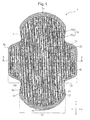
- a sanitary napkin 1 As shown in Fig. 1 and Fig. 2 , a sanitary napkin 1 according to the first embodiment comprises a liquid-permeable top sheet 2, a liquid-impermeable back sheet 3, and an absorbent body 4 formed between the top sheet 2 and the back sheet 3.
- Fig. 1 the X-axial direction is the widthwise direction of the sanitary napkin 1
- the Y-axial direction is the lengthwise direction of the sanitary napkin 1
- the direction of the plane extending in the X-axial and Y-axial directions corresponds to the planar direction of the sanitary napkin 1.
- Fig. 2 is a schematic cross-sectional view, omitting bellows structures 210 formed in the top sheet 2.
- the sanitary napkin 1 is worn by a user to absorb liquid excreta (such as menstrual blood).
- liquid excreta such as menstrual blood
- the user wears it in such a manner that the top sheet 2 is on the skin side of the user, and the back sheet 3 is located on the side of the clothing (underwear) of the user.
- the liquid excreta passes through the top sheet 2 and permeates the absorbent body 4, and is absorbed and retained in the absorbent body 4. Leakage of liquid excreta that has been absorbed into the absorbent body 4 is prevented by the back sheet 3.
- the top sheet 2 and back sheet 3 have their edges bonded together in the lengthwise direction by seal sections 7a, 7b, forming the body section 11, while having their edges bonded together in the widthwise direction by seal sections 8a, 8b, forming roughly rectangular wing sections 12a, 12b that extend out in the widthwise direction from the body section 11.
- the shape of the body section 11 may be appropriately modified within a range suitable for the female body and underwear, and for example, it may be roughly rectangular, roughly elliptical or roughly gourd-shaped.
- the dimension of extension in the lengthwise direction of the body section 11 is preferably 100 to 500 mm and more preferably 150 to 350 mm, while the dimension of extension in the widthwise direction of the body section 11 is preferably 30 to 200 mm and more preferably 40 to 180 mm.
- the bonding method for the seal sections 7a, 7b, 8a, 8b may be embossing, ultrasonic waves or a hot-melt adhesive.
- two or more different bonding methods may be combined (for example, bonding with a hot-melt adhesive followed by embossing).
- the top sheet 2 and back sheet 3 may be passed together between a patterned embossing roll and a flat roll, for embossing (a method known as round sealing).
- embossing a method known as round sealing
- each sheet is softened so that the seal sections become more distinct.
- emboss patterns include lattice-like patterns, zigzag patterns and wavy patterns.
- the emboss pattern is preferably intermittently elongated.
- hot-melt adhesives include pressure-sensitive adhesives and heat-sensitive adhesives composed mainly of rubber-based compounds such as styrene-ethylene-butadiene-styrene (SEBS), styrene-butadiene-styrene (SBS) or styrene-isoprene-styrene (SIS), or composed mainly of olefin-based compounds such as linear low-density polyethylene; and water-sensitive adhesives comprising water-soluble polymers (such as polyvinyl alcohol, carboxylmethyl cellulose and gelatin) or water-swelling polymers (such as polyvinyl acetate and sodium polyacrylate).
- Specific examples of adhesive coating methods include spiral coating application, coater application, curtain coater application and summit-gun coating.
- pressure-sensitive adhesive sections 9a, 9b are provided on the clothing side of the back sheet 3 forming the wing sections 12a, 12b, and a pressure-sensitive adhesive section 9c is provided on the clothing side of the back sheet 3 forming the body section 11.
- the pressure-sensitive adhesive section 9c is attached to the crotch section of underwear, while the wing sections 12a, 12b are folded toward the outer wall of the underwear and the pressure-sensitive adhesive sections 9a, 9b are attached to the crotch section of the underwear, thereby stably anchoring the sanitary napkin 1 to the underwear.
- pressure-sensitive adhesives examples include styrene-based polymers such as styrene-ethylenebutylene-styrene block copolymer, styrene-butylene polymer, styrene-butylene-styrene block copolymer and styrene-isobutylene-styrene copolymer; tackifiers such as C5 petroleum resins, C9 petroleum resins, dicyclopentadiene-based petroleum resins, rosin-based petroleum resins, polyterpene resins and terpenephenol resins; monomer plasticizers such as tricresyl phosphate, dibutyl phthalate and dioctyl phthalate; and polymer plasticizers such as vinyl polymer and polyester.
- styrene-based polymers such as styrene-ethylenebutylene-styrene block copolymer, styrene-butylene polymer
- the top sheet 2 is provided on the side in contact with the skin of the user, to improve the feel on the skin when the sanitary napkin 1 is worn by the user.
- the excreta-receiving region 20 includes an excretory opening contact region 20a with which the excretory opening of the user (for example, the labia minora, labia majora or vaginal opening) contacts, and a peripheral region 20b located in the surrounding portion of the excretory opening contact region 20a, the length of the excreta-receiving region 20 being usually 50 to 200 mm and preferably 70 to 150 mm, and the width being usually 10 to 80 mm and preferably 20 to 50 mm.
- the excretory opening contact region 20a is wider than the region in which the excretory opening of the user actually contacts.
- the peripheral region 20b is disposed in the surrounding portion of the excretory opening contact region 20a, in order to prevent leakage of liquid excreta that has not been absorbed from the excretory opening contact region 20a.
- the peripheral region 20b effectively prevents leakage of liquid excreta that has not been absorbed from the excretory opening contact region 20a, and especially leakage from the widthwise direction of the sanitary napkin 1.
- the top sheet 2 is composed of a flexible material.
- the flexible material is a material with elastic recoverability (repulsion) against deformation.
- the flexible material may undergo extension by force applied during deformation, but from the viewpoint of increasing elastic recoverability against deformation, it preferably undergoes essentially no extension by force applied during deformation.
- Examples of flexible materials include synthetic resins, with examples of synthetic resins including copolymers of olefins with other monomers such as acrylic acid esters and vinyl acetate; polyolefins such as low-density polyethylene, linear low-density polyethylene, high-density polyethylene and polypropylene; polyesters such as polyethylene terephthalate; polyamides; and cellulose acetate, among which copolymers of olefins with other monomers, and polyolefins, are preferred from the viewpoint of high flexibility and low irritation to skin.
- the flexible material may be a mixed material of two or more different synthetic resins, such as a mixed material of 20-60% low-density polyethylene, 30-60% linear low-density polyethylene and 5-20% high-density polyethylene.
- flexible regions 22 are formed in the top sheet 2 in a net-like pattern over roughly the entirety including the excreta-receiving region 20, and each of extensible regions 21 is formed on the inner side of a mesh unit (a mesh cell) of the net-like pattern.
- the extensible regions 21 have extensibility due to extension of the bellows structures 210, while the flexible regions 22 have flexibility (elastic recoverability against deformation) due to the flexible material composing the top sheet 2.
- the flexible regions 22 are generally flat, and do not have the structural extensibility of the extensible regions 21.
- the extensible regions 21 there are formed bellows structures 210 with a repeating structure of mountain and valley folds.
- the extensible regions 21 are extendable in the surface direction of the extensible regions 21.
- the upward-facing protrusions are the mountain folds
- the downward-facing protrusions are the valley folds.
- the mountain and valley folds of the bellows structures 210 are laid out in the lengthwise direction of the sanitary napkin 1, while being aligned in the widthwise direction of the sanitary napkin 1.
- This configuration effectively produces extension of the bellows structures 210 (extension in the widthwise direction of the sanitary napkin 1), which prevents excessive compression of the absorbent body 4, when the sanitary napkin 1 is folded along the lengthwise direction, being deformed outward toward the top sheet 2 side.
- the cross-section of the bellows structures 210 along the widthwise direction of the sanitary napkin 1 is essentially wavy.
- the term "essentially wavy" includes modified forms such as a straightened form of the curve of a U-shape, a block-like U-shape, and more V-like U-shapes.
- the widths of the uppermost sections of the mountain folds and the widths of the lowermost sections of the valley folds will usually be 0.1 to 2.0 mm and are preferably 0.2 to 1.5 mm
- the heights of the mountain folds and the depths of the valley folds will usually be 0.3 to 3.0 mm and are preferably 0.5 to 1.5 mm
- the widths between the uppermost sections of adjacent mountain folds and the widths between the lowermost sections of adjacent valley folds will usually be 0.3 to 3.0 mm and are preferably 0.5 to 2.0 mm.
- the bellows structures 210 may also have a contractive property in addition to extensibility. However, even if the bellows structures 210 have a contractive property, the extended bellows structures 210 may not completely contract to their original state, depending on the quality of the bellows structures 210 and the number of bellows, often remaining in a slightly more extended state than the original state.
- elastomers include polyester-based, urethane-based, olefin-based, styrene-based and polyamide-based thermoplastic elastomers, and low-density polyethylene or ethylene- ⁇ -olefin copolymers using metallocene catalysts, as well as combinations of the foregoing.
- polyester-based elastomers include ones that contain an amorphous polyether, aliphatic polyester or the like as a soft segment in an aromatic polyester hard segment
- examples of urethane-based elastomers include polyurethanes comprising a polyester, low molecular glycol or methylenebisphenyl isocyanate as a thermoplastic elastomer
- examples of olefin-based elastomers include random copolymers of ethylene and ⁇ -olefins, and random copolymers of ethylene, ⁇ -olefins and dienes
- examples of styrene-based elastomers include block copolymers such as SEBS, SIS, SEPS and SBS
- polyamide-based elastomers include ones containing nylon as the hard segment and a polyester or polyol as the soft segment.
- the flexible regions 22 have m regions that are laid out in a direction crossing the lengthwise direction of the sanitary napkin 1 and are roughly linear and aligned in an approximately parallel manner (hereunder referred to as "regions A 1-m "), and n regions that are laid out in a direction crossing the regions A 1-m and are roughly linear and aligned in an approximately parallel manner (hereunder referred to as "regions B 1-n ").
- the flexible regions 22 are formed in a net-like pattern by intersection of the regions A 1-m and B 1-n .
- the angle ⁇ 1 at which the regions A 1-m cross the lengthwise direction of the sanitary napkin 1 will usually be 1° ⁇ ⁇ 1 ⁇ 90°, preferably 10° ⁇ ⁇ 1 ⁇ 80° and even more preferably 30° ⁇ ⁇ 1 ⁇ 60°.
- the angle ⁇ 2 at which the regions B 1-n cross the lengthwise direction of the sanitary napkin 1 (with the proviso that the angle at which the regions B 1-n cross the regions A 1-m is ⁇ 1 + ⁇ 2 ) will usually be 1° ⁇ ⁇ 2 ⁇ 90°, preferably 10° ⁇ ⁇ 2 ⁇ 80° and even more preferably 30° ⁇ ⁇ 2 ⁇ 60°.
- ⁇ 1 and ⁇ 2 are selected so that ⁇ 1 + ⁇ 2 is not 180°. If ⁇ 1 and ⁇ 2 are within these ranges, the regions A 1-m and B 1-n will be located on both sides sandwiching the lengthwise direction of the sanitary napkin 1, and therefore when the sanitary napkin 1 folds along the lengthwise direction being deformed outward, the repulsion (recoverability) of the flexible regions 22 against outward deformation is more easily exhibited, and the dimensions of each mesh unit necessary to form the bellows structures 210 in the extensible regions 21 is ensured.
- the number (m) of regions A 1-m and the number (n) of regions B 1-n are not limited to the numbers shown in Fig. 1 , and they may be appropriately modified according to the size of the sanitary napkin 1.
- the numbers m and n may have identical or different numerical values, and the numerical ranges for m and n will usually be 4-60, preferably 8-40 and even more preferably 10-35.
- the widths of the regions for the regions A 1-m and B 1-n will usually be 0.1 to 5 mm, preferably 0.3 to 3 mm and even more preferably 0.5 to 2 mm. If the widths of the regions A 1-m and B 1-n are within this range, the repulsion (recoverability) of the flexible regions 22 against outward deformation will be more easily exhibited, and the dimensions of each mesh unit necessary to form the bellows structures 210 in the extensible regions 21 will be ensured.
- the shapes of the mesh units formed by intersection of the regions A 1-m and B 1-n are roughly rhomboid.
- the shapes of the mesh units may be approximately polygonal, such as roughly triangular, roughly quadrilateral or roughly pentagonal. Approximately polygonal shapes include modified forms of these shapes with rounded corners, or curves instead of the straight lines forming the sides.
- the regions A 1-m and B 1-n may be curved, the shapes of the mesh units being roughly circular or ellipsoid.
- the sizes of the mesh units in the lengthwise direction and the widthwise direction of the sanitary napkin 1 will usually be 3 to 40 mm, preferably 5 to 30 mm and even more preferably 10 to 20 mm. If the size of the mesh units are within this range, the repulsion (recoverability) of the flexible regions 22 against outward deformation will be more easily exhibited, and the dimensions of each mesh unit necessary to form the bellows structures 210 in the extensible regions 21 will be ensured.
- the total number of mountain and valley folds formed in each mesh unit will usually be at least 3, and is preferably 5-19 and even more preferably 7-15. However, this is with the proviso that the total number of mountain and valley folds is odd. If the total number of mountain and valley folds of the bellows structures 210 is within this range, extension of the bellows structures 210 that prevents excessive compression of the absorbent body 4 will be effectively produced when the sanitary napkin 1 is deformed outward.
- the flexible regions 22 encompass the entire surrounding portions of the extensible regions 21, with connection between adjacent extensible regions being blocked by the flexible regions 22.
- some of the surrounding portions of the extensible regions 21 may be encompassed by flexible regions 22.
- the flexible regions 22 preferably encompass at least 30% and more preferably encompass at least 50% of the entire surrounding portion of the extensible regions.
- the flexible regions 22 are connected with the perimeters of the extensible regions 21. Also, as shown in Fig. 3 , the flexible regions 22 are connected with the uppermost sections of the mountain folds in the bellows structures 210. As an additional modification to this embodiment, the flexible regions 22 may be connected with the lowermost sections of the valley folds in the bellows structures 210. However, from the viewpoint of giving the top sheet 2 a smooth feel on the skin when the flexible regions 22 are on the skin surface side, the flexible regions 22 are preferably connected with the uppermost sections of the mountain folds in the bellows structures 210, as shown in Fig. 3 .
- a plurality of liquid permeation holes 26 are formed in the top sheet 2, and liquid excreta can permeate to the absorbent body 4 through the liquid permeation holes 26.
- the liquid permeation holes 26 are formed in the extensible regions 21 that are not directly subjected to tension during outward deformation (the side sections 25 of the bellows structures 210 which connect the uppermost sections of the mountain folds and the lowermost sections of the valley folds) within the excreta-receiving region 20 of the top sheet 2, but they are not formed in the flexible regions 22 that are not directly subjected to tension during outward deformation.
- the liquid permeation holes 26 are not easily stretched by tension, and this prevents the absorbent body 4 that has absorbed liquid excreta from being exposed and contacting the skin of the user, and causing a sticky and unpleasant feel for the user.
- each liquid permeation hole 26 is preferably 0.001 to 1 mm 2 and even more preferably 0.01 to 0.1 mm 2 . If the open area of each liquid permeation hole 26 is smaller than 0.001 mm 2 it may be difficult for liquid excreta to penetrate, and if it exceeds 1 mm 2 , liquid excreta that has been absorbed into the absorbent body 4 may flow back through the liquid permeation holes 26, or the concealing property of the top sheet 2 may be reduced.
- the proportion of the total open area with respect to the area of the top sheet 2, i.e. the open area ratio of the top sheet 2, is preferably 5% to 20%. If the open area ratio of the top sheet 2 is lower than 5%, permeability of liquid excreta in the top sheet 2 may be poor, and if the open area ratio of the top sheet 2 is higher than 20%, body fluid that has been absorbed into the absorbent body 4 may flow back through the liquid permeation holes 26, or liquid excreta that has been absorbed into the absorbent body 4 may become visible through the liquid permeation holes 26.
- the thickness and basis weight of the top sheet 2 may be appropriately adjusted from the viewpoint of formability of the bellows structures 210 of the extensible regions 21, and flexibility of the flexible regions 22.
- the basis weight of the top sheet 2 will usually be 10 g/m 2 or greater (for example, 10 to 40 g/m 2 ) and preferably 20 to 30 g/m 2 , and the thickness of the top sheet 2 will usually be 0.01 to 3.0 mm and preferably 0.1 to 1.5 mm.
- an inorganic filler such as titanium oxide, barium sulfate or calcium carbonate may be added to the top sheet 2.
- the top sheet 2 may also be a laminated film.
- laminated films include laminated films of a synthetic resin film layer and a fiber aggregate layer provided on the clothing side surface.
- Fiber aggregate layers include sheets or nonwoven fabrics of hydrophilic fiber aggregates, for example.
- a nonwoven fabric to be used as the fiber aggregate layer is preferably a tissue.
- a "tissue" is thin paper with a basis weight of at least 10 g/m 2 and no greater than 20 g/m 2 , composed mainly of Kraft pulp or rayon for wet strength.
- the thickness of the fiber aggregate layer is preferably 0.1 to 0.5 mm.
- a fiber aggregate layer can also impart hydrophilicity and flexibility to the top sheet 2.
- tissue for the fiber aggregate layer is also convenient as tissue sheets are less expensive than other sheets or nonwoven fabrics and are abundantly available on the market. While the strength of a tissue layer is low, its use together with a synthetic resin film layer will ensure strength for the top sheet 2.
- compressed grooves 5a, 5b are formed in each of the perimeters of the excretory opening contact region 20a and peripheral region 20b of the top sheet 2. Since the sanitary napkin 1 stably undergoes outward deformation starting from the compressed grooves 5a, 5b, extension of the extensible regions 21 which prevents excessive compression of the absorbent body 4, and elastic recoverability of the flexible regions 22 which prevents distortion of the top sheet 2, are effectively produced during outward deformation of the sanitary napkin 1.
- the compressed grooves 5a, 5b are formed by compressing and integrating the perimeters of the excretory opening contact region 20a and peripheral region 20b, and the absorbent body 4 by, for example, embossing using a heating roller.
- the compressed grooves 5a, 5b are formed over the entire perimeters of excretory opening contact region 20a and peripheral region 20b.
- the compressed grooves 5a, 5b may be formed over a portion of the perimeters of the excretory opening contact region 20a and peripheral region 20b.
- an adhesive layer S is provided between the absorbent body 4 and the back sheet 3, and the absorbent body 4 is anchored to the back sheet 3 by the adhesive layer S.
- the adhesive layer S is formed over roughly the entire bonding surfaces of the absorbent body 4 and back sheet 3, but as an additional modification to this embodiment, the adhesive layer S may be formed over portions of the bonding surfaces of the absorbent body 4 and back sheet.
- Examples for the adhesive in the adhesive layer S include hot-melt adhesives, with examples of hot-melt adhesives including pressure-sensitive adhesives and heat-sensitive adhesives composed mainly of rubber-based compounds such as styrene-ethylene-butadiene-styrene (SEBS), styrene-butadiene-styrene (SBS) or styrene-isoprene-styrene (SIS), or composed mainly of olefin-based compounds such as linear low-density polyethylene; and water-sensitive adhesives comprising water-soluble polymers (such as polyvinyl alcohol, carboxylmethyl cellulose and gelatin) or water-swelling polymers (such as polyvinyl acetate and sodium polyacrylate).
- Specific examples of adhesive coating methods include spiral coating application, coater application, curtain coater application and summit-gun coating.
- the perimeters of the excretory opening contact region 20a and the peripheral region 20b are anchored to the absorbent body 4 through the compressed grooves 5a, 5b, and the absorbent body 4 is anchored to the back sheet 3 through the adhesive layer S. That is, the perimeter of the excretory opening contact region 20a is anchored to the back sheet 3 through the compressed groove 5a and the adhesive layer S, while the perimeter of the peripheral region 20b is anchored to the back sheet 3 through the compressed groove 5b and the adhesive layer S.
- the space between the top sheet 2 and the back sheet 3 is divided by the compressed grooves 5a, 5b, forming a space 6a closed by the compressed groove 5a and a space 6b closed by the compressed grooves 5a, 5b, between the top sheet 2 and the back sheet 3.
- the absorbent body 4 is divided into an absorbent body 4a present in the space 6a and an absorbent body 4b present in the space 6b, by the compressed grooves 5a, 5b.
- the absorbent body 4a causes the thickness of the excretory opening contact region 20a to already be protruding out, which can induce stabilized outward deformation of the excretory opening contact region 20a by the compressed grooves 5a, 5b, thus improving the fitting property of the excretory opening contact region 20a for the user. Since the absorbent body 4b has higher density than the absorbent body 4a, and easily maintains rigidity even after absorption of excreta, twisting of the sanitary napkin 1 as a whole after absorption of excreta is prevented.
- the back sheet 3 is provided on the side in contact with the clothing (underwear) of the user, to prevent leakage of liquid excreta that has been absorbed in the absorbent body 4.
- the back sheet 3 is preferably moisture-permeable in addition to being liquid-impermeable, in order to reduce mustiness during wear.
- the back sheet 3 is, for example, a waterproof treated nonwoven fabric, a film of a synthetic resin (such as polyethylene, polypropylene and polyethylene terephthalate), a composite sheet comprising a nonwoven fabric and a synthetic resin film (such as a composite film having an air permeable synthetic resin film bonded to a spunbond or spunlace nonwoven fabric), or an SMS nonwoven fabric comprising a highly water-resistant meltblown nonwoven fabric sandwiched between high-strength spunbond nonwoven fabrics.
- a waterproof treated nonwoven fabric such as polyethylene, polypropylene and polyethylene terephthalate
- a composite sheet comprising a nonwoven fabric and a synthetic resin film (such as a composite film having an air permeable synthetic resin film bonded to a spunbond or spunlace nonwoven fabric)
- SMS nonwoven fabric comprising a highly water-resistant meltblown nonwoven fabric sandwiched between high-strength spunbond nonwoven fabrics.
- the absorbent body 4 has an absorbent material layer.
- the absorbent material contained in the absorbent material layer is not particularly restricted so long as it can absorb liquid excreta of the user.
- the absorbent material may be, for example, water-absorbent fibers or a high-water-absorbing material (for example, a high-water-absorbent resin or high-water-absorbent fibers).
- the absorbent material layer may also include an antiblocking agent, ultraviolet absorber, thickening/branching agent, delustering agent, coloring agent, or different types of modifiers.
- water-absorbent fibers include wood pulp obtained using a conifer or broadleaf tree material as the starting material (for example, mechanical pulp such as groundwood pulp, refiner ground pulp, thermomechanical pulp and chemithermomechanical pulp; chemical pulp such as Kraft pulp, sulfide pulp and alkaline pulp; and semichemical pulp); mercerized pulp or crosslinked pulp obtained by chemical treatment of wood pulp; nonwood pulp such as bagasse, kenaf, bamboo, hemp and cotton (for example, cotton linter); regenerated cellulose such as rayon and fibril rayon; and semi-synthetic celluloses such as acetates and triacetates, among which ground pulp is preferred from the viewpoint of low cost and easy shaping.
- wood pulp obtained using a conifer or broadleaf tree material as the starting material
- mechanical pulp such as groundwood pulp, refiner ground pulp, thermomechanical pulp and chemithermomechanical pulp
- chemical pulp such as Kraft pulp, sulfide pulp and alkaline pulp
- semichemical pulp mercerized
- high-water-absorbing materials include starch-based, cellulose-based and synthetic polymer high-water-absorbing materials.
- starch-based or cellulose-based high-water-absorbing materials include starch-acrylic acid (salt) graft copolymer, saponified starch-acrylonitrile copolymer and crosslinked sodium carboxymethyl cellulose
- synthetic polymer-based high-water-absorbing materials include polyacrylic acid salt-based, polysulfonic acid salt-based, maleic anhydride salt-based, polyacrylamide-based, polyvinyl alcohol-based, polyethylene oxide-based, polyaspartic acid salt-based, polyglutamic acid salt-based, polyalginic acid salt-based, starch-based and cellulose-based high water-absorbent resins (Superabsorbent Polymers: SAP), among which polyacrylic acid salt-based (especially sodium polyacrylate-based) high water-absorbent resins are preferred.
- high-water-absorbing material forms include particulate, filamentous
- the amount of highly absorbent material contained in the absorbent material layer may be appropriately changed according to the properties to be exhibited by the sanitary napkin 1 (for example, absorption properties and lightweight properties), but it will usually be 0 to 50 mass%, preferably 3 to 30 mass% and more preferably 5 to 15 mass% of the absorbent material layer.
- the thickness, basis weight and density of the absorbent material layer may also be appropriately changed according to the properties to be exhibited by the sanitary napkin 1 (for example, absorption properties and lightweight properties).
- the thickness of the absorbent material layer will usually be 1 to 20 mm, preferably 2 to 15 mm and more preferably 2 to 10 mm, the basis weight will usually be 100 to 1000 g/m 2 , preferably 150 to 700 g/m 2 and more preferably 200 to 500 g/m 2 , and the density will usually be 0.005 to 0.5 g/cm 3 , preferably 0.01 to 0.2 g/cm 3 and more preferably 0.01 to 0.1 g/cm 3 .
- the thickness, basis weight and density of the absorbent material layer may vary before and after forming the compressed grooves 5a, 5b.
- the absorbent body 4 preferably has a cushion layer.
- the cushion layer may be formed, for example, on the surface on the top sheet 2 side or back sheet 3 side of the absorbent material layer, and preferably the surface on the top sheet 2 side, in which case the absorbent body 4 takes the form of a layered body with an absorbent material layer and a cushion layer.
- the absorbent body 4 may be covered with a covering material.
- the covering material is not particularly restricted so long as it has liquid-permeable and absorbent body-holding properties, and from the viewpoint of low cost and absorbent body-holding properties, it is preferably a tissue composed mainly of ground pulp and formed by a wet method.
- the sanitary napkin 1 When the sanitary napkin 1 is inserted in the crotch of a user and folded at the excreta-receiving region 20 of the top sheet 2, being deformed outward toward the excreta-receiving region 20 side, it exhibits the following effect.
- elastic recoverability (repulsion) of the flexible regions 22 causes the top sheet 2 to easily follow deformation of the sanitary napkin 1, thus preventing distortion of the top sheet 2 due to extension of the extensible regions 21, and sticking of the distorted sheet onto skin.
- a blood modifying agent is coated onto the surface of the top sheet 2 of the sanitary napkin 1.
- Menstrual blood that has been discharged onto the top sheet 2 has its viscosity and surface tension lowered by the blood modifying agent, and it therefore rapidly migrates from the top sheet 2 into the absorbent body 4 and is absorbed into the absorbent body 4.
- the increased absorption rate of menstrual blood into the absorbent body 4 helps prevent residue of highly viscous menstrual blood into the top sheet 2, reduces stickiness of the top sheet 2 and improves the surface drying property of the top sheet 2, while also leaving less of a visually unpleasant image for the wearer.
- leakage of menstrual blood that has been discharged onto the top sheet 2, from the widthwise direction side of the sanitary napkin 1, is also prevented.
- the region coated with the blood modifying agent may be the entirety of the surface of the top sheet 2 or only a portion thereof, but preferably it includes at least the region contacting the excretory opening (vaginal opening) of the user.
- the blood modifying agent is preferably adhered to the top sheet 2 in the form of droplets or particulates, so that the liquid permeation holes of the top sheet 2 are not obstructed.
- the coated basis weight of the blood modifying agent on the top sheet 2 is preferably 1 to 30 g/m 2 and more preferably 3 to 10 g/m 2 . If the coating basis weight of the blood modifying agent is smaller than 1 g/m 2 , it may be difficult to coat the blood modifying agent on the top sheet 2 in a stable manner, and if the coating basis weight of the blood modifying agent is greater than 30 g/m 2 , the top sheet 2 may become greasy.
- the method of coating the blood modifying agent may be, for example, a method of heating the blood modifying agent to a prescribed temperature, and then coating it using a contact coater such as a slot coater, or a non-contact coater such as a spray coater, curtain coater or spiral coater.
- a contact coater such as a slot coater
- a non-contact coater such as a spray coater, curtain coater or spiral coater.
- a method of coating using a non-contact coater is preferred from the viewpoint of allowing the blood modifying agent to be evenly dispersed as droplets in the top sheet 2, and not incurring damage to the top sheet 2.
- the blood modifying agent is preferably coated onto the top sheet 2 in the step of producing the sanitary napkin 1.
- the blood modifying agent is preferably coated onto the top sheet 2 in a step near the final step, from the viewpoint of avoiding reduction in the blood modifying agent.
- the top sheet 2 may be coated with the blood modifying agent just before the step of wrapping the sanitary napkin 1.
- the region of the top sheet 2 that is to be coated with the blood modifying agent may also be coated with a hydrophilic agent, water-repellent agent or the like, or it may be rendered hydrophilic by corona treatment or plasma treatment. This will allow the hydrophilic areas and lipophilic areas to be mutually isolated in the blood modifying agent-coated region when the blood modifying agent is lipophilic, and both the hydrophilic components (mainly plasma) and lipophilic components (mainly blood cells) in menstrual blood will rapidly migrate from the top sheet 2 into the absorbent body 4.
- a hydrophilic agent mainly plasma
- lipophilic components mainly blood cells
- the blood modifying agent will be described in detail in a separate section.
- the production method comprises a step of forming an absorbent body 4 (step 1A), a step of layering a top sheet 2 on an absorbent body 4 (step 2A), a step of forming compressed grooves in the layered body (step 3A), a step of layering a back sheet 3 (step 4A), a step of cutting out a sanitary napkin 1 (step 5A) and a step of coating the sanitary napkin 1 with a blood modifying agent (step 6A), and the production apparatus 100 shown in Fig. 5 is used.
- Recesses 124 are formed at a prescribed pitch in the circumferential direction on the peripheral surface of a suction drum 120 rotating in the machine direction MD, as a molding form in which the absorbent body material 122 is to be packed.
- the suction section 126 acts on the recesses 124 and the absorbent body material 122 supplied from the material feeder 121 is vacuum suctioned into the recesses 124.
- the material feeder 121 is formed to cover the suction drum 120, and the material feeder 121 supplies the absorbent body material 122 into the recesses 124 by air transport, forming an absorbent body 4 in the recesses 124.
- the absorbent body 4 formed in the recesses 124 is transferred onto a carrier sheet 110 advancing in the machine direction MD.
- the top sheet 2 is layered on the absorbent body 4, forming a layered body 262.
- a method for producing the top sheet 2 will be described below.
- the layered body 262 passes between the upper roll 131 and lower roll 132 of the embossing apparatus 130, forming compressed grooves in the layered body 262. Heights (not shown) with shapes corresponding to the compressed grooves are provided on the outer peripheral surface of the upper roll 131.
- the lower roll 132 is a plain roll having a smooth outer peripheral surface.
- the compressed grooves 5a, 5b are formed, respectively, on the perimeters of the excretory opening contact region 20a and peripheral region 20b of the top sheet 2, and formation of the compressed grooves 5a, 5b causes the perimeters of the excretory opening contact region 20a and the peripheral region 20b to become integrated with the absorbent body 4.
- the back sheet 3 supplied from the back sheet roll 140 is layered on the surface of the lower side of the layered body 134 on which the compressed grooves have been formed (the side opposite the top sheet), via an adhesive layer S, to form a continuous section 144 of the sanitary napkin 1.
- a cutter 150 is used to cut the continuous section 144 of the sanitary napkin 1, thereby cutting out a sanitary napkin 1.
- a blood modifying agent-coating spray 160 is used to coat the blood modifying agent 161 onto the center region of the sanitary napkin 1, forming a blood modifying agent layer on the surface of the top sheet 2.
- the blood modifying agent layer is preferably formed in at least the excretory opening contact region 20a in the excreta-receiving region 20 of the top sheet 2.
- the blood modifying agent was coated after cutting out the sanitary napkin 1, but it may instead be coated at any stage before cutting, or it may be coated during the production steps for the top sheet 2, described below.
- the blood modifying agent is preferably coated at a downstream stage of the production process, such as immediately before packaging of the sanitary napkin 1.
- the method for producing the sanitary napkin 1 comprises, in addition to steps 1A to 6A, also a step of forming seal sections 7a, 7b, 8a, 8b and a step of forming pressure-sensitive adhesive sections 9a, 9b, 9c.
- a working embodiment of a method for producing a liquid-permeable sheet according to the invention will now be described, as an example of a method for producing the top sheet 2 of a sanitary napkin 1.
- the production method according to this embodiment comprises a step (1B) of forming recesses in a synthetic resin film sheet and a step (2B) of gear stretching the synthetic resin film sheet.
- the synthetic resin film sheet 212 supplied from a roll 210 passes through a recess-forming roll 220 and recesses 2141 are formed in the synthetic resin film sheet 212 (see Fig. 7 ).
- the recess-forming roll 220 comprises a roulette roll 221 and a preheated roll 222 with a smooth surface.
- Fig. 6(a) and (b) show examples of the roulette roll 221.
- Fig. 6(a) shows the entire roulette roll 221
- Fig. 6(b) is a magnified view of section 223 having concavoconvexities on the outer peripheral surface of the roulette roll 221.
- Fig. 6(c) shows an example of the preheated roll 222 which has a smooth surface.
- Lattice-like heights 224 are formed on the surface 223 of the roulette roll 221.
- rhomboid recesses 225 are formed in the surface of the roulette roll 221.
- the shapes of the recesses 225 of the roulette roll 221 are not limited to being rhomboid, and may instead be square, rectangular, parallelogram-shaped, trapezoid, triangular, hexagonal, or the like.
- the center line spacing between the heights 224 arranged parallel on the lattice-like heights 224, i.e. the pitch of the lattice-like heights 224, is usually preferred to be 0.2 to 10 mm, and more preferably 0.4 to 2 mm.
- the widths of the lattice-like heights 224 are preferably 0.01 to 1 mm and more preferably 0.03 to 0.1 mm.
- the lengths of the sides of the rhomboid recesses 225 are preferably 0.1 to 5 mm and more preferably 0.2 to 1 mm. These ranges are preferred from the viewpoint of improving formability of the recesses in the synthetic resin film sheet.
- the preheated roll 222 with a smooth surface is kept at a temperature between 70°C and 100°C, and it heats the supplied synthetic resin film sheet 212. This softens the synthetic resin film sheet 212 and facilitates formation.
- the synthetic resin film sheet 212 When the synthetic resin film sheet 212 passes between the rolls 221 and 222, the synthetic resin film sheet 212 receives strong pressure in the thickness direction at the sections in contact with the lattice-like heights 224. This causes thin recesses 2141 to form in the synthetic resin film sheet 214, as shown in Fig. 7 .
- the recesses 2141 formed in the synthetic resin film sheet 214 are actually smaller than shown in Fig. 7 , and the number of recesses 2141 per unit area is greater than shown in Fig. 8 .
- the recesses 2141 are formed in the region 2143 of the synthetic resin film sheet 214 corresponding to the center region of the sanitary napkin 1.
- the region of the synthetic resin film sheet 214 corresponding to the sanitary napkin 1 is the region indicated by the dotted line labeled 2142.
- the regions of the synthetic resin film sheet 214 corresponding to the extensible regions 21 of the top sheet 2 become folded, producing a synthetic resin film sheet 216 in which bellows structures 210 are formed.
- the bellows structures 210 in the synthetic resin film sheet 216 are laid out in the machine direction (MD) and aligned in the widthwise direction, the cross-sectional shapes along the widthwise direction being wavy with a combination of roughly U-shaped curves.
- the bellows structures 210 extending in the machine direction are interrupted at multiple locations in the synthetic resin film sheet 216. That is, the bellows structures 210 are formed in a discontinuous manner in the synthetic resin film sheet 216, the synthetic resin film sheet 214 being not folded at the discontinuous sections.
- the discontinuous sections correspond to the flexible regions 22 of the top sheet 2.
- the stretching gear roll 230 comprises an upper roll 231 and a lower roll 232.
- Fig. 8(a) is a diagram illustrating the upper roll 231 of the stretching gear roll 230
- Fig. 8(b) is a diagram illustrating the gear teeth 233 situated on the peripheral surface of the upper roll 231
- Fig. 8(c) is a cross-sectional view of Fig. 8(b) along line B-B.
- the gear teeth 233 extend in a discontinuous manner in the circumferential direction of the upper roll 231. That is, the gear teeth 233 extending in the circumferential direction of the upper roll 231 are interrupted at multiple locations along them.
- the locations 234 where the gear teeth 233 are interrupted result in formation of discontinuous sections corresponding to the flexible regions 22 of the top sheet 2.
- the locations 234 where the gear teeth 233 are interrupted are disposed along a straight line in a direction diagonal to the direction in which the gear teeth 233 extend.
- the widths of the gear teeth 233 are 0.3 mm to 0.5 mm, for example, and the distance between the centers of the adjacent gear teeth 233 are 1.0 to 1.2 mm, for example.
- Fig. 9(a) is a diagram showing the lower roll 232 of the stretching gear roll 230
- Fig. 9(b) is a diagram showing the gear teeth 235 situated on the peripheral surface of the lower roll 232
- Fig. 9(c) is a cross-sectional view of Fig. 9(b) along line C-C.
- the gear teeth 235 extend in the circumferential direction of the lower roll 232.
- the lower roll 232 unlike the upper roll 231, is not interrupted at multiple locations along it.
- the widths of the gear teeth 235 may be equal to the widths of the gear teeth 233 of the upper roll 231, for example, and the distance between the centers of adjacent gear teeth 235 may be equal to the distance between the centers of the gear teeth 233 of the upper roll 231, for example.
- the length of the upper roll 231 in the radial direction at the section where the gear teeth 233 of the upper roll 231 engage with the gear teeth 235 of the lower roll 232, i.e. the mesh depth, is 1.25 mm, for example.
- the gaps between the gear teeth 233 of the upper roll 231 and the gear teeth 235 of the lower roll 232, when the gear teeth 233 of the upper roll 231 and the gear teeth 235 of the lower roll 232 have been meshed, are 0.25 to 0.45 mm, for example.
- the synthetic resin film sheet 214 is stretched to a large degree at the sections 236 where the gear teeth 233 of the upper roll 231 and the gear teeth 235 of the lower roll 232 are meshed. Since the synthetic resin film sheet 214 is thinner at the sections in which the recesses 2141 (see Fig. 7 ) have been formed in the recess-forming step, and they are also the sections that have been damaged by the lattice-like heights 224 of the roulette roll 221, their strength is weak and the recesses 2141 of the synthetic resin film sheet 214 tear when subjected to stretching. As a result, the recesses 2141 of the synthetic resin film sheet 214 tear at the sections 236 of the synthetic resin film sheet 214 that have been stretched, such that the torn sections of the synthetic resin film sheet 214 widen, forming openings.
- the synthetic resin film sheet 214 is not significantly stretched at the sections 237, 238 where the gear teeth 233 of the upper roll 231 and the gear teeth 235 of the lower roll 232 are not meshed. Consequently, even when the synthetic resin film sheet 214 passes through the stretching gear roll 230, the recesses 2141 formed in the recess-forming step are not torn and do not become openings at the sections 237, 238 of the synthetic resin film sheet 214 where the gear teeth 233 of the upper roll 231 and the gear teeth 235 of the lower roll 232 are not meshed.
- the synthetic resin film sheet 214 is not torn, and therefore no openings are formed, at the section 236 where the gear teeth 233 of the upper roll 231 and the gear teeth 235 of the lower roll 232 are meshed, even when the synthetic resin film sheet 214 is stretched to a high degree.
- the blood modifying agent of the present invention has an IOB of about 0.00-0.60, a melting point of about 45°C or less, and a water solubility of about 0.00-0.05 g in 100 g of water at 25°C.
- the IOB Inorganic Organic Balance
- IOB inorganic value / organic value .
- the inorganic value and the organic value are based on the organic paradigm described in " Organic compound predictions and organic paradigms" by Fujita A., Kagaku no Ryoiki (Journal of Japanese Chemistry), Vol.11, No.10 (1957) p.719-725 .
- Table 1 The organic values and inorganic values of major groups, according to Fujita, are summarized in Table 1 below.
- Table 1 Group Inorganic value Organic value -COOH 150 0 -OH 100 0 -O-CO-O- 80 0 -CO- 65 0 -COOR 60 0 -O- 20 0 Triple bond 3 0 Double bond 2 0 CH 2 0 20 iso -branch 0 -10 tert -branch 0 -20 Light metal (salt) ⁇ 500 0 Heavy metal (salt), amine, NH 3 salt ⁇ 400 0
- the IOB is about 0.00-0.60, preferably about 0.00-0.50, more preferably about 0.00-0.40 and even more preferably about 0.00-0.30. This is because a lower IOB is associated with higher organicity and higher affinity with blood cells.
- melting point refers to the peak top temperature for the endothermic peak during conversion from solid to liquid, upon measurement with a differential scanning calorimetry analyzer at a temperature-elevating rate of 10°C/min.
- the melting point may be measured using a Model DSC-60 DSC measuring apparatus by Shimadzu Corp., for example.
- the blood modifying agent has a melting point of about 45°C or less, it may be either liquid or solid at room temperature, or in other words, the melting point may be either about 25°C or higher or below about 25°C, and for example, it may have a melting point of about -5°C or about -20°C. The reason why the blood modifying agent should have a melting point of about 45°C or less will be explained below.
- the blood modifying agent does not have a lower limit for the melting point, but the vapor pressure is preferably low.
- the vapor pressure of the blood modifying agent is preferably about 0-200 Pa, more preferably about 0-100 Pa, even more preferably about 0-10 Pa, even more preferably about 0-1 Pa, and even more preferably about 0.0-0.1 Pa at 25°C (1 atmosphere).
- the vapor pressure is preferably about 0-700 Pa, more preferably about 0-100 Pa, even more preferably about 0-10 Pa, even more preferably about 0-1 Pa, and even more preferably 0.0-0.1 Pa, at 40°C (1 atmosphere). If the vapor pressure is high, gasification may occur during storage and the amount of blood modifying agent may be reduced, and as a consequence problems, such as odor during wear, may be created.
- the melting point of the blood modifying agent may also differ depending on the weather or duration of wear. For example, in regions with a mean atmospheric temperature of about 10°C or less, using a blood modifying agent with a melting point of about 10°C or less may allow the blood modifying agent to stably modify blood after excretion of menstrual blood, even if it has been cooled by the ambient temperature.
- the melting point of the blood modifying agent is preferably at the high end of the range of about 45°C or less. This is because the blood modifying agent is not easily affected by sweat or friction during wearing, and will not easily migrate even during prolonged wearing.
- a water solubility of 0.00-0.05 g can be confirmed by adding 0.05 g of sample to 100 g of deionized water at 25°C, allowing the mixture to stand for 24 hours, and gently stirring after 24 hours if necessary and then visually evaluating whether or not the sample has dissolved.
- solubility used herein in regard to water solubility includes cases where the sample completely dissolves in deionized water to form a homogeneous mixture, and cases where the sample is completely emulsified. Here, “completely” means that no mass of the sample remains in the deionized water.
- top sheet surfaces are coated with surfactants in order to alter the surface tension of blood and promote rapid absorption of blood.
- surfactants generally have high water solubility
- the surfactant-coated top sheet is highly miscible with hydrophilic components (such as, blood plasma) in the blood and therefore, instead, they tend to cause residue of blood on the top sheet.
- the aforementioned blood modifying agent has low water solubility and therefore, unlike conventionally known surfactants, it does not cause residue of blood on the top sheet and allows rapid migration into the absorbent body.
- water solubility As used herein, a water solubility in 100 g of water at 25°C may be simply referred to as "water solubility".
- the weight-average molecular weights are the values measured by gel permeation chromatography (GPC), based on polystyrene.
- the GPC measuring conditions may be the following, for example.
- weight-average molecular weights listed in the examples of the present specification were measured under the conditions described below.
- the blood modifying agent is selected from the group consisting of following items (i)-(iii), and combinations thereof:
- hydrocarbon refers to a compound composed of carbon and hydrogen, and it may be a chain hydrocarbon, such as a paraffinic hydrocarbon (containing no double bond or triple bond, also referred to as alkane), an olefin-based hydrocarbon (containing one double bond, also referred to as alkene), an acetylene-based hydrocarbon (containing one triple bond, also referred to as alkyne), or a hydrocarbon comprising two or more bonds selected from the group consisting of double bonds and triple bonds, and cyclic hydrocarbon, such as aromatic hydrocarbons and alicyclic hydrocarbons.
- hydrocarbons are chain hydrocarbons and alicyclic hydrocarbons, with chain hydrocarbons being more preferred, paraffinic hydrocarbons, olefin-based hydrocarbons and hydrocarbons with two or more double bonds (containing no triple bond) being more preferred, and paraffinic hydrocarbons being even more preferred.
- Chain hydrocarbons include linear hydrocarbons and branched hydrocarbons.
- the blood modifying agent is selected from the group consisting of following items (i')-(iii'), and combinations thereof:
- bonds are not adjacent to each other, and at least one carbon atom lies between each of the bonds.
- the blood modifying agent is more preferably a compound with no more than about 1.8 carbonyl bonds (-CO-), no more than 2 ester bonds (-COO-), no more than about 1.5 carbonate bonds (-OCOO-), no more than about 6 ether bonds (-O-), no more than about 0.8 carboxyl groups (-COOH) and/or no more than about 1.2 hydroxyl groups (-OH), per 10 carbon atoms in the hydrocarbon moiety.
- the blood modifying agent is selected from the group consisting of following items (A)-(F), and combinations thereof:
- Examples of (A1) a compound having a chain hydrocarbon moiety and 2-4 hydroxyl groups substituted for hydrogens on the chain hydrocarbon moiety include chain hydrocarbon tetraols, such as alkanetetraols, including pentaerythritol, chain hydrocarbon triols, such as alkanetriols, including glycerins, and chain hydrocarbon diols, such as alkanediols, including glycols.
- Examples of (A2) a compound having a chain hydrocarbon moiety and 1 carboxyl group substituted for a hydrogen on the chain hydrocarbon moiety include compounds in which one hydrogen on the hydrocarbon is substituted with one carboxyl group (-COOH), such as fatty acids.
- Examples for compound (A) include (a 1 ) an ester of a chain hydrocarbon tetraol and at least one fatty acid, (a 2 ) an ester of a chain hydrocarbon triol and at least one fatty acid, and (a 3 ) an ester of a chain hydrocarbon diol and at least one fatty acids.
- Examples of an ester of a chain hydrocarbon tetraol and at least one fatty acid include tetraesters of pentaerythritol and fatty acids, represented by the following formula (1): triesters of pentaerythritol and fatty acids, represented by the following formula (2): diesters of pentaerythritol and fatty acids, represented by the following formula (3): and monoesters of pentaerythritol and fatty acids, represented by the following formula (4).
- R 1 -R 4 each represent a chain hydrocarbon.
- the fatty acids consisting of the esters of pentaerythritol and fatty acids are not particularly restricted so long as the pentaerythritol and fatty acid esters satisfy the conditions for the IOB, melting point and water solubility, and for example, there may be mentioned saturated fatty acids, such as a C 2 -C 30 saturated fatty acids, including acetic acid (C 2 ) (C 2 representing the number of carbons, corresponding to the number of carbons of each of R 1 C, R 2 C, R 3 C or R 4 C, same hereunder), propanoic acid (C 3 ), butanoic acid (C 4 ) and its isomers, such as 2-methylpropanoic acid (C 4 ), pentanoic acid (C 5 ) and its isomers, such as 2-methylbutanoic acid (C 5 ) and 2,2-dimethylpropanoic acid (C 5 ), hexa
- saturated fatty acids such as a C 2 -C 30 saturated fatty acids,
- the fatty acid may also be an unsaturated fatty acid.
- unsaturated fatty acids include C 3 -C 20 unsaturated fatty acids, such as monounsaturated fatty acids including crotonic acid (C 4 ), myristoleic acid (C 14 ), palmitoleic acid (C 16 ), oleic acid (C 18 ), elaidic acid (C 18 ), vaccenic acid (C 18 ), gadoleic acid (C 20 ) and eicosenoic acid (C 20 ), di-unsaturated fatty acids including linolic acid (C 18 ) and eicosadienoic acid (C 20 ), tri-unsaturated fatty acids including linolenic acids, such as ⁇ -linolenic acid (C 18 ) and ⁇ -linolenic acid (C 18 ), pinolenic acid (C 18 ), eleostearic acids, such as ⁇ -eleostearic acid (C 18 )
- the ester of pentaerythritol and a fatty acid is preferably an ester of pentaerythritol and a fatty acid, which is derived from a saturated fatty acid, i.e., an ester of pentaerythritol and a saturated fatty acid.
- the ester of pentaerythritol and a fatty acid is preferably a diester, triester or tetraester, more preferably a triester or tetraester, and even more preferably a tetraester.
- the IOB is 0.60 if the total number of carbons of the fatty acid consisting of the tetraester of the pentaerythritol and fatty acid, i.e., the total number of carbons of the R 1 C, R 2 C, R 3 C and R 4 C portions in formula (1), is 15.
- the IOB satisfies the condition of being within about 0.00 to 0.60.
- tetraesters of pentaerythritol and fatty acids include tetraesters of pentaerythritol with hexanoic acid (C 6 ), heptanoic acid (C 7 ), octanoic acid (C 8 ), such as 2-ethylhexanoic acid (C 8 ), nonanoic acid (C 9 ), decanoic acid (C 10 ) and/or dodecanoic acid (C 12 ).
- the IOB is 0.58 if the total number of carbons of the fatty acid consisting of the triester of the pentaerythritol and fatty acid, i.e., the total number of carbons of the R 1 C, R 2 C and R 3 C portions in formula (2), is 19.
- the IOB satisfies the condition of being within about 0.00 to 0.60.
- the IOB is 0.59 if the total number of carbons of the fatty acid consisting of the diester of the pentaerythritol and fatty acid, i.e., the total number of carbons of the R 1 C and R 2 C portion in formula (3), is 22.
- the IOB satisfies the condition of being within about 0.00 to 0.60.
- the IOB is 0.60 if the total number of carbons of the fatty acid consisting of the monoester of the pentaerythritol and fatty acid, i.e. the total number of carbons of the R 1 C portion in formula (4), is 25.
- the IOB satisfies the condition of being within about 0.00 to 0.60.
- esters of pentaerythritol and fatty acids include UNISTAR H-408BRS and H-2408BRS-22 (mixed product) (both products of NOF Corp.).
- esters of a chain hydrocarbon triol and at least one fatty acid examples include triesters of glycerin and fatty acids, represented by formula (5): diesters of glycerin and fatty acids, represented by the following formula (6): and monoesters of glycerin and fatty acids, represented by the following formula (7): wherein R 5 -R 7 each represent a chain hydrocarbon.
- the fatty acid consisting of the ester of glycerin and a fatty acid is not particularly restricted so long as the ester of glycerin and a fatty acid satisfies the conditions for the IOB, melting point and water solubility, and for example, there may be mentioned the fatty acids mentioned for the "(a 1 ) Ester of a chain hydrocarbon tetraol and at least one fatty acid", namely saturated fatty acids and unsaturated fatty acids, and in consideration of the potential for degradation by oxidation and the like, the ester is preferably a glycerin and fatty acid ester, which is derived from a saturated fatty acid, i.e., an ester of glycerin and a saturated fatty acid.
- the ester of glycerin and a fatty acid is preferably a diester or triester, and more preferably a triester.
- a triester of glycerin and a fatty acid is also known as a triglyceride, and examples include triesters of glycerin and octanoic acid (C 8 ), triesters of glycerin and decanoic acid (C 10 ), triesters of glycerin and dodecanoic acid (C 12 ), triesters of glycerin and 2 or more different fatty acids, and mixtures of the foregoing.
- Examples of triesters of glycerin and 2 or more fatty acids include triesters of glycerin with octanoic acid (C 8 ) and decanoic acid (C 10 ), triesters of glycerin with octanoic acid (C 8 ), decanoic acid (C 10 ) and dodecanoic acid (C 12 ), and triesters of glycerin with octanoic acid (C 8 ), decanoic acid (C 10 ), dodecanoic acid (C 12 ), tetradecanoic acid (C 14 ), hexadecanoic acid (C 16 ) and octadecanoic acid (C 10 ).
- preferred triesters of glycerin and fatty acids are those with no more than about 40 as the total number of carbons of the fatty acid consisting of the triester of glycerin and the fatty acid, i.e., the total number of carbons of the R 5 C, R 6 C and R 7 C sections in formula (5).
- the IOB value is 0.60 when the total number of carbons of the fatty acid consisting of the triester of glycerin and the fatty acid, i.e., the total number of carbons of the R 5 C, R 6 C and R 7 C portions in formula (5), is 12.
- the IOB satisfies the condition of being within about 0.00 to 0.60.
- Triesters of glycerin and fatty acids being aliphatic and therefore potential constituent components of the human body are preferred from the viewpoint of safety.
- triesters of glycerin and fatty acids include tri-coconut fatty acid glycerides, NA36, PANACET 800, PANACET 800B and PANACET 810S, and tri-C2L oil fatty acid glycerides and tri-CL oil fatty acid glycerides (all products of NOF Corp.).
- a diester of glycerin and a fatty acid is also known as a diglyceride, and examples include diesters of glycerin and decanoic acid (C 10 ), diesters of glycerin and dodecanoic acid (C 12 ), diesters of glycerin and hexadecanoic acid (C 16 ), diesters of glycerin and 2 or more different fatty acids, and mixtures of the foregoing.
- the IOB is 0.58 if the total number of carbons of the fatty acid consisting of the diester of the glycerin and fatty acid, i.e., the total number of carbons of the R 5 C and R 6 C portions in formula (6), is 16.
- the IOB satisfies the condition of being about 0.00 to 0.60.
- Monoesters of glycerin and fatty acids are also known as monoglycerides, and examples include glycerin and eicosanoic acid (C 20 ) monoester, and glycerin and docosanoic acid (C 22 ) monoester.
- the IOB is 0.59 if the total number of carbons of the fatty acid consisting of the monoester of the glycerin and fatty acid, i.e. the number of carbons of the R 5 C portion in formula (7), is 19.
- the IOB satisfies the condition of being about 0.00 to 0.60.
- Examples of an ester of a chain hydrocarbon diol and at least one fatty acid include monoesters and diesters of fatty acids with C 2 -C 6 chain hydrocarbon diols, such as C 2 -C 6 glycols, including ethylene glycol, propylene glycol, butylene glycol, pentylene glycol and hexylene glycol.
- examples of an ester of a chain hydrocarbon diol and at least one fatty acid include diesters of C 2 -C 6 glycols and fatty acids, represented by the following formula (8): R 8 COOC k H 2k OCOR 9 (8) wherein k represents an integer of 2-6, and R 8 and R 9 each represent a chain hydrocarbon, and monoesters of C 2 -C 6 glycols and fatty acids, represented by the following formula (9): R 8 COOC k H 2k OH (9) wherein k represents an integer of 2-6, and R 8 is a chain hydrocarbon.
- the fatty acid to be esterified in an ester of a C 2 -C 6 glycol and a fatty acid is not particularly restricted so long as the ester of the C 2 -C 6 glycol and fatty acid satisfies the conditions for the IOB, melting point and water solubility, and for example, there may be mentioned the fatty acids mentioned above for the "(a 1 ) Ester of a chain hydrocarbon tetraol and at least one fatty acid", namely saturated fatty acids and unsaturated fatty acids, and in consideration of the potential for degradation by oxidation and the like, it is preferably a saturated fatty acid.
- IOB is 0.60 when the total number of carbons of the R 8 C and R 9 C portions is 6.
- the IOB satisfies the condition of being about 0.00-0.60.
- IOB is 0.57 when the total number of carbons of the R 8 C portion is 12.
- the IOB satisfies the condition of being about 0.00-0.60.
- the ester of the C 2 -C 6 glycol and fatty acid is preferably a C 2 -C 6 glycol and fatty acid ester derived from a saturated fatty acid, or in other words, an ester of a C 2 -C 6 glycol and a saturated fatty acid.
- the ester of the C 2 -C 6 glycol and fatty acid is preferably a glycol and fatty acid ester derived from a glycol with a greater number of carbons, such as an ester of a glycol and a fatty acid derived from butylene glycol, pentylene glycol or hexylene glycol.
- the ester of a C 2 -C 6 glycol and fatty acid is preferably a diester.
- Examples of commercial products of esters of C 2 -C 6 glycols and fatty acids include COMPOL BL and COMPOL BS (both products of NOF Corp.).
- Examples of (B1) a compound having a chain hydrocarbon moiety and 2-4 hydroxyl groups substituted for hydrogens on the chain hydrocarbon moiety include those mentioned for “compound (A)” as compound (A1), such as pentaerythritol, glycerin and glycol.
- Examples of (B2) a compound having a chain hydrocarbon moiety and 1 hydroxyl group substituted for a hydrogen on the chain hydrocarbon moiety include compounds wherein 1 hydrogen on the hydrocarbon is substituted with 1 hydroxyl group (-OH), such as aliphatic monohydric alcohols, including saturated aliphatic monohydric alcohols and unsaturated aliphatic monohydric alcohols.
- saturated aliphatic monohydric alcohols include C 1 -C 20 saturated aliphatic monohydric alcohols, such as methyl alcohol (C 1 ) (C 1 representing the number of carbon atoms, same hereunder), ethyl alcohol (C 2 ), propyl alcohol (C 3 ) and its isomers, including isopropyl alcohol (C 3 ), butyl alcohol (C 4 ) and its isomers, including sec-butyl alcohol (C 4 ) and tert-butyl alcohol (C 4 ), pentyl alcohol (C 5 ), hexyl alcohol (C 6 ), heptyl alcohol (C 7 ), octyl alcohol (C 8 ) and its isomers, including 2-ethylhexyl alcohol (C 8 ), nonyl alcohol (C 9 ), decyl alcohol (C 10 ), dodecyl alcohol (C 12 ), tetradecyl alcohol (C 14 ), hexadecyl alcohol (C 1
- Examples for compound (B) include (b 1 ) an ether of a chain hydrocarbon tetraol and at least one aliphatic monohydric alcohol, such as monoethers, diethers, triethers and tetraethers, preferably diethers, triethers and tetraethers, more preferably triethers and tetraethers and even more preferably tetraethers, (b 2 ) an ether of a chain hydrocarbon triol and at least one aliphatic monohydric alcohol, such as monoethers, diethers and triethers, preferably diethers and triethers and more preferably triethers, and (b 3 ) an ether of a chain hydrocarbon diol and at least one aliphatic monohydric alcohol, such as monoethers and diethers, and preferably diethers.
- an ether of a chain hydrocarbon tetraol and at least one aliphatic monohydric alcohol such as monoethers, diethers, triethers and
- Examples of an ether of a chain hydrocarbon tetraol and at least one aliphatic monohydric alcohol include tetraethers, triethers, diethers and monoethers of pentaerythritol and aliphatic monohydric alcohols, represented by the following formulas (10)-(13): wherein R 10 -R 13 each represent a chain hydrocarbon.
- Examples of an ether of a chain hydrocarbon triol and at least one aliphatic monohydric alcohol include triethers, diethers and monoethers of glycerin and aliphatic monohydric alcohols, represented by the following formulas (14)-(16): wherein R 14 -R 16 each represent a chain hydrocarbon.
- Examples of an ether of a chain hydrocarbon diol and at least one aliphatic monohydric alcohol include diethers of C 2 -C 6 glycols and aliphatic monohydric alcohols, represented by the following formula (17): R 17 OC n H 2n OR 18 (17) wherein n is an integer of 2-6, and R 17 and R 18 are each a chain hydrocarbon, and monoethers of C 2 -C 6 glycols and aliphatic monohydric alcohols, represented by the following formula (18) : R 17 OC n H 2n OH (18) wherein n is an integer of 2-6, and R 17 is a chain hydrocarbon.
- the IOB is 0.44 when the total number of carbon atoms of the aliphatic monohydric alcohol consisting of the tetraether of pentaerythritol and the aliphatic monohydric alcohol, i.e., the total number of carbon atoms of the R 10 , R 11 , R 12 and R 13 portions in formula (10), is 4.
- the IOB value satisfies the condition of being within about 0.00 to 0.60.
- the IOB is 0.57 when the total number of carbon atoms of the aliphatic monohydric alcohol consisting of the triether of pentaerythritol and the aliphatic monohydric alcohol, i.e., the total number of carbon atoms of the R 10 , R 11 and R 12 portions in formula (11), is 9.
- the IOB value satisfies the condition of being within about 0.00 to 0.60.
- the IOB is 0.60 when the total number of carbon atoms of the aliphatic monohydric alcohol consisting of the diether of pentaerythritol and the aliphatic monohydric alcohol, i.e., the total number of carbon atoms of the R 10 and R 11 portions in formula (12), is 15.
- the IOB value satisfies the condition of being within about 0.00 to 0.60.
- the IOB is 0.59 when the number of carbon atoms of the aliphatic monohydric alcohol consisting of the monoether of pentaerythritol and the aliphatic monohydric alcohol, i.e. the number of carbon atoms of the R 10 portion in formula (13), is 22.
- the IOB value satisfies the condition of being within about 0.00 to 0.60.
- the IOB is 0.50 when the total number of carbon atoms of the aliphatic monohydric alcohol consisting of the triether of glycerin and the aliphatic monohydric alcohol, i.e., the total number of carbon atoms of the R 14 , R 15 and R 16 portions in formula (14), is 3.
- the IOB value satisfies the condition of being within about 0.00 to 0.60.
- the IOB is 0.58 when the total number of carbon atoms of the aliphatic monohydric alcohol consisting of the diether of glycerin and the aliphatic monohydric alcohol, i.e., the total number of carbon atoms of the R 14 and R 15 portions in formula (15), is 9.
- the IOB value satisfies the condition of being within about 0.00 to 0.60.
- the IOB is 0.58 when the number of carbon atoms of the aliphatic monohydric alcohol consisting of the monoether of glycerin and the aliphatic monohydric alcohol, i.e., the number of carbon atoms of the R 14 portion in formula (16), is 16.
- the IOB value satisfies the condition of being within about 0.00 to 0.60.
- the IOB is 0.33 when the total number of carbon atoms of the R 17 and R 18 portions is 2.
- the IOB value satisfies the condition of being within about 0.00-0.60.
- the IOB is 0.60 when the number of carbon atoms of the R 17 portion is 8.
- the IOB value satisfies the condition of being within about 0.00 to 0.60.
- Compound (B) may be produced by dehydrating condensation of compound (B1) and compound (B2) in the presence of an acid catalyst.
- Examples of (C1) a carboxylic acid, hydroxy acid, alkoxy acid or oxoacid comprising a chain hydrocarbon moiety and 2-4 carboxyl groups substituted for hydrogens on the chain hydrocarbon moiety include chain hydrocarbon carboxylic acids with 2-4 carboxyl groups, such as chain hydrocarbon dicarboxylic acids including alkanedicarboxylic acids, such as ethanedioic acid, propanedioic acid, butanedioic acid, pentanedioic acid, hexanedioic acid, heptanedioic acid, octanedioic acid, nonanedioic acid and decanedioic acid, chain hydrocarbon tricarboxylic acids, including alkanetricarboxylic acids, such as propanetrioic acid, butanetrioic acid, pentanetrioic acid, hexanetrioic acid
- Compound (C1) includes chain hydrocarbon hydroxy acids with 2-4 carboxyl groups, such as malic acid, tartaric acid, citric acid and isocitric acid, chain hydrocarbon alkoxy acids with 2-4 carboxyl groups, such as O-acetylcitric acid, and chain hydrocarbon oxoacids with 2-4 carboxyl groups.
- Compound having a chain hydrocarbon moiety and 1 hydroxyl group substituted for a hydrogen on the chain hydrocarbon moiety includes those mentioned for "compound (B)", such as aliphatic monohydric alcohols.
- Compound (C) may be (c 1 ) an ester, for example a monoester, diester, triester or tetraester, preferably a diester, triester or tetraester, more preferably a triester or tetraester and even more preferably a tetraester, of a chain hydrocarbon tetracarboxylic acid, hydroxy acid, alkoxy acid or oxoacid with 4 carboxyl groups, and at least one aliphatic monohydric alcohol, (c 2 ) an ester, for example, a monoester, diester or triester, preferably a diester or triester and more preferably a triester, of a chain hydrocarbon tricarboxylic acid, hydroxy acid, alkoxy acid or oxoacid with 3 carboxyl groups, and at least one aliphatic monohydric alcohol, or (c 3 ) an ester, for example, a monoester or diester, and
- Examples for compound (C) include dioctyl adipate, diisostearyl malate, tributyl citrate and tributyl O-acetylcitrate, of which commercially available products exist.
- the (D) compound having a chain hydrocarbon moiety and one bond selected from the group consisting of an ether bond (-O-), carbonyl bond (-CO-), ester bond (-COO-) and carbonate bond (-OCOO-) inserted between a C-C single bond of the chain hydrocarbon moiety may be (d 1 ) an ether of an aliphatic monohydric alcohol and an aliphatic monohydric alcohol, (d 2 ) a dialkyl ketone, (d 3 ) an ester of a fatty acid and an aliphatic monohydric alcohol, or (d 4 ) a dialkyl carbonate.
- Ethers of an aliphatic monohydric alcohol and an aliphatic monohydric alcohol include compounds having the following formula (19): R 19 OR 20 (19) wherein R 19 and R 20 each represent a chain hydrocarbon.
- the aliphatic monohydric alcohol consisting of the ether is not particularly restricted so long as the ether satisfies the conditions for the IOB, melting point and water solubility, and for example, it may be one of the aliphatic monohydric alcohols mentioned for "compound (B)".
- the IOB is 0.50 when the total number of carbon atoms of the aliphatic monohydric alcohols consisting of the ether, i.e., the total number of carbons of the R 19 and R 20 portions in formula (19), is 2, and therefore when the total number of carbons of the aliphatic monohydric alcohols consisting of the ether is about 2 or greater, this condition for the IOB is satisfied.
- the water solubility is as high as about 2 g, which is problematic from the viewpoint of vapor pressure as well.
- the total number of carbons of the aliphatic monohydric alcohols consisting of the ether is preferably about 8 or greater.
- the dialkyl ketone may be a compound of the following formula (20): R 21 COR 22 (20) wherein R 21 and R 22 are each an alkyl group.
- the IOB is 0.54 when the total number of carbon atoms of R 21 and R 22 is 5, and therefore this condition for the IOB is satisfied if the total number of carbons is about 5 or greater.
- the total number of carbons of dialkyl ketone is preferably about 8 or greater.
- the number of carbon atoms of dialkyl ketone is preferably about 10 or greater and more preferably about 12 or greater.
- the melting point is approximately -50°C and the vapor pressure is about 230 Pa at 20°C.
- the dialkyl ketone may be a commercially available product, or it may be obtained by a known method, such as by oxidation of a secondary alcohol with chromic acid or the like.
- esters of a fatty acid and an aliphatic monohydric alcohol include compounds having the following formula (21): R 23 COOR 24 (21) wherein R 23 and R 24 each represent a chain hydrocarbon.
- fatty acids consisting of these esters include the fatty acids mentioned for the "(a 1 ) an ester of a chain hydrocarbon tetraol and at least one fatty acids", and specifically these include saturated fatty acids and unsaturated fatty acids, with saturated fatty acids being preferred in consideration of the potential for degradation by oxidation and the like.
- the aliphatic monohydric alcohol consisting of the ester may be one of the aliphatic monohydric alcohols mentioned for "compound (B)".
- the IOB is 0.60 when the total number of carbon atoms of the fatty acid and aliphatic monohydric alcohol, i.e. the total number of carbon atoms of the R 23 C and R 24 portions in formula (21), is 5, and therefore this condition for the IOB is satisfied when the total number of carbon atoms of the R 23 C and R 24 portions is about 5 or greater.
- the vapor pressure is high at greater than 2,000 Pa. In consideration of vapor pressure, therefore, the total number of carbon atoms is preferably about 12 or greater. If the total number of carbon atoms is about 11 or greater, it will be possible to satisfy the condition of a water solubility of about 0.00-0.05 g.
- esters of such fatty acids and aliphatic monohydric alcohols include esters of dodecanoic acid (C 12 ) and dodecyl alcohol (C 12 ) and esters of tetradecanoic acid (C 14 ) and dodecyl alcohol (C 12 ), and examples of commercial products of esters of such fatty acids and aliphatic monohydric alcohols include ELECTOL WE20 and ELECTOL WE40 (both products of NOF Corp.).
- the IOB is 0.57 when the total number of carbon atoms of R 25 and R 26 is 6, and therefore this condition for the IOB is satisfied if the total number of carbons of R 25 and R 26 is about 6 or greater.
- the total number of carbon atoms of R 25 and R 26 is preferably about 7 or greater and more preferably about 9 or greater.
- the dialkyl carbonate may be a commercially available product, or it may be synthesized by reaction between phosgene and an alcohol, reaction between formic chloride and an alcohol or alcoholate, or reaction between silver carbonate and an alkyl iodide.
- the (E) polyoxy C 2 -C 6 alkylene glycol, or alkyl ester or alkyl ether thereof may be (e 1 ) a polyoxy C 2 -C 6 alkylene glycol, (e 2 ) an ester of a polyoxy C 2 -C 6 alkylene glycol and at least one fatty acid, (e 3 ) an ether of a polyoxy C 2 -C 6 alkylene glycol and at least one aliphatic monohydric alcohol, (e 4 ) an ester of a polyoxy C 2 -C 6 alkylene glycol and a chain hydrocarbon tetracarboxylic acid, chain hydrocarbon tricarboxylic acid or chain hydrocarbon dicarboxylic acid, or (e 5 ) an ether of a polyoxy C 2 -C 6 alkylene glycol and a chain hydrocarbon tetraol, chain hydrocarbon triol or chain hydrocarbon diol.
- Polyoxy C 2 -C 6 alkylene glycols refer to i) one or more homopolymers having a unit selected from the group consisting of oxy C 2 -C 6 alkylene units, such as oxyethylene unit, oxypropylene unit, oxybutylene unit, oxypentylene unit and oxyhexylene unit and having hydroxyl groups at both ends, ii) one or more block copolymers having 2 or more units selected from oxy C 2 -C 6 alkylene units described above and oxyhexylene unit and having hydroxyl groups at both ends, or iii) random copolymers having 2 or more units selected from oxy C 2 -C 6 alkylene units described above and having hydroxyl groups at both ends.
- the oxy C 2 -C 6 alkylene units are preferably oxypropylene unit, oxybutylene unit, oxypentylene unit or oxyhexylene unit, and more preferably oxybutylene unit, oxypentylene unit and oxyhexylene unit, from the viewpoint of reducing the value of IOB.
- the polyoxy C 2 -C 6 alkylene glycol can be represented by the following formula (23): HO-(C m H 2m O)n-H (23) wherein m represents an integer of 2-6.
- homopolymers of formula (23) may include propylene glycol, butylene glycol, pentylene glycol or hexylene glycol homopolymer.
- n in formula (23) is about 3 to 6 and preferably about 4 to 6, and n is 2 or greater.
- n in formula (23) is a value such that the polyoxy C 2 -C 6 alkylene glycol has an IOB of about 0.00-0.60, a melting point of about 45°C or less and a water solubility of about 0.00-0.05 g in 100 g of water at 25°C.
- the weight-average molecular weight of the polyoxy C 4 -C 6 alkylene glycol is preferably between about 200 and about 10,000, more preferably between about 250 and about 8,000, and even more preferably in the range of about 250 to about 5,000.
- the weight-average molecular weight of a polyoxy C 3 alkylene glycol is preferably between about 1,000 and about 10,000, more preferably between about 3,000 and about 8,000, and even more preferably between about 4,000 and about 5,000. This is because if the weight-average molecular weight is less than about 1,000, the condition for the water solubility will not be satisfied, and a larger weight-average molecular weight will particularly tend to increase the migration rate into the absorbent body and the whiteness of the top sheet.
- Examples of commercial products of polyoxy C 2 -C 6 alkylene glycols include UNIOLTM D-1000, D-1200, D-2000, D-3000, D-4000, PB-500, PB-700, PB-1000 and PB-2000 (all products of NOF Corp.).
- Examples of an ester of a polyoxy C 2 -C 6 alkylene glycol and at least one fatty acids include the polyoxy C 2 -C 6 alkylene glycols mentioned for (e 1 ) Polyoxy C 2 -C 6 alkylene glycol" in which one or both OH ends have been esterified with fatty acids, i.e. monoesters and diesters.
- fatty acids to be esterified in the ester of a polyoxy C 2 -C 6 alkylene glycol and at least one fatty acid include the fatty acids mentioned for the "(a 1 ) Ester of a chain hydrocarbon tetraol and at least one fatty acid", and specifically these include saturated fatty acids and unsaturated fatty acids, with saturated fatty acids being preferred in consideration of the potential for degradation by oxidation and the like.
- Examples of an ether of a polyoxy C 2 -C 6 alkylene glycols and at least one aliphatic monohydric alcohol include the polyoxy C 2 -C 6 alkylene glycols mentioned for "(e 1 ) Polyoxy C 2 -C 6 alkylene glycol" wherein one or both OH ends have been etherified by an aliphatic monohydric alcohol, i.e. monoethers and diethers.
- the aliphatic monohydric alcohol to be etherified may be an aliphatic monohydric alcohol among those mentioned for "compound (B)".
- the polyoxy C 2 -C 6 alkylene glycol to be esterified for the aforementioned ester of a polyoxy C 2 -C 6 alkylene glycol and a chain hydrocarbon tetracarboxylic acid, chain hydrocarbon tricarboxylic acid or chain hydrocarbon dicarboxylic acid may be any of the polyoxy C 2 -C 6 alkylene glycols mentioned above under "(e 1 ) Polyoxy C 2 -C 6 alkylene glycol".
- the chain hydrocarbon tetracarboxylic acid, chain hydrocarbon tricarboxylic acid or chain hydrocarbon dicarboxylic acid to be esterified may be any of those mentioned above for "compound (C)".
- the ester of a polyoxy C 2 -C 6 alkylene glycol and a chain hydrocarbon tetracarboxylic acid, chain hydrocarbon tricarboxylic acid or chain hydrocarbon dicarboxylic acid may be a commercially available product, or it may be produced by polycondensation of a C 2 -C 6 alkylene glycol with a chain hydrocarbon tetracarboxylic acid, chain hydrocarbon tricarboxylic acid or chain hydrocarbon dicarboxylic acid under known conditions.
- the polyoxy C 2 -C 6 alkylene glycol to be etherified for the aforementioned ether of a polyoxy C 2 -C 6 alkylene glycol and a chain hydrocarbon tetraol, chain hydrocarbon triol or chain hydrocarbon diol may be any of the polyoxy C 2 -C 6 alkylene glycols mentioned above under "(e 1 ) polyoxy C 2 -C 6 alkylene glycol".
- the chain hydrocarbon tetraol, chain hydrocarbon triol or chain hydrocarbon diol to be etherified may be, for example, pentaerythritol, glycerin or glycol, mentioned above for "compound (A)".
- Examples of commercially available ethers of polyoxy C 2 -C 6 alkylene glycols and chain hydrocarbon tetraols, chain hydrocarbon triols and chain hydrocarbon diols include UNILUBETM 5TP-300KB and UNIOLTM TG-3000 and TG-4000 (products of NOF Corp.).
- UNILUBETM 5TP-300KB is a compound obtained by polycondensation of 65 mol of propylene glycol and 5 mol of ethylene glycol with 1 mol of pentaerythritol, and it has an IOB of 0.39, a melting point of below 45°C, and a water solubility of less than 0.05 g.
- UNIOLTM TG-3000 is a compound obtained by polycondensation of 50 mol of propylene glycol with 1 mol of glycerin, and it has an IOB of 0.42, a melting point of below 45°C, a water solubility of less than 0.05 g, and a weight-average molecular weight of about 3,000.
- UNIOLTM TG-4000 is a compound obtained by polycondensation of 70 mol of propylene glycol with 1 mol of glycerin, and it has an IOB of 0.40, a melting point of below 45°C, a water solubility of less than 0.05 g, and a weight-average molecular weight of about 4,000.
- the ether of a polyoxy C 2 -C 6 alkylene glycol and a chain hydrocarbon tetraol, chain hydrocarbon triol or chain hydrocarbon diol may also be produced by adding a C 2 -C 6 alkylene oxide to a chain hydrocarbon tetraol, chain hydrocarbon triol or chain hydrocarbon diol under known conditions.
- the chain hydrocarbon has an inorganic value of 0 and thus an IOB of 0.00, while the water solubility is also approximately 0 g, and therefore if the melting point is about 45°C or less it may be included among the aforementioned blood modifying agents.
- chain hydrocarbons include (f 1 ) a chain alkane, such as linear alkanes and branched alkanes, and linear alkanes generally include those with no more than 22 carbons, in consideration of a melting point of about 45°C or less. In consideration of vapor pressure, they generally include those with 13 or more carbons. Branched alkanes generally include those with 22 or more carbons, since their melting points are often lower than linear alkanes, given the same number of carbon atoms.
- hydrocarbon products examples include PARLEAM 6 (NOF Corp.).
- the blood modifying agent has been found to have at least a function of lowering blood viscosity and surface tension, which will be considered in detail in the examples.
- Menstrual blood to be absorbed by the absorbent article unlike ordinary blood, contains proteins of the endometrial wall, for example, which act to bind together blood cells so that the blood cells form a rouleau state. Menstrual blood which is to be absorbed by the absorbent article therefore tends to have high viscosity, and when the top sheet and second sheet are nonwoven fabrics or woven fabric, the menstrual blood becomes clogged between the fibers creating a residual sticky feel for the wearer, while the menstrual blood also diffuses on the surface of the top sheet and tends to leak.
- the blood modifying agent which has an IOB of about 0.00 to 0.60 has high organicity and readily infiltrates between blood cells, and it therefore stabilizes the blood cells and can prevent formation of a rouleau structure by the blood cells.
- an absorbent article comprising an acrylic super-absorbent polymer, or SAP
- absorption of menstrual blood is known to lead to covering of the SAP surface by rouleau-formed blood cells and inhibition of the absorption performance of the SAP, but presumably stabilization of the blood cells allows the absorption performance of the SAP to be exhibited more easily.
- the blood modifying agent which has high affinity with erythrocytes protects the erythrocyte membranes, and therefore may minimize destruction of the erythrocytes.
- the weight-average molecular weight of the blood modifying agent is preferably about 2,000 or less, and more preferably about 1,000 or less.
- a high weight-average molecular weight will tend to result in high viscosity of the blood modifying agent, and it will be difficult to lower the viscosity of the blood modifying agent by heating, to a viscosity suitable for coating. As a result, it will sometimes be necessary to dilute the blood modifying agent with a solvent.
- tack may result in the blood modifying agent itself, tending to create a feeling of unpleasantness for the wearer.
- a commercially available sanitary napkin was prepared.
- the sanitary napkin was formed from a top sheet, formed of a hydrophilic agent-treated air-through nonwoven fabric (composite fiber composed of polyester and polyethylene terephthalate, basis weight: 35 g/m 2 ), a second sheet, formed of an air-through nonwoven fabric (composite fiber composed of polyester and polyethylene terephthalate, basis weight: 30 g/m 2 ), an absorbent body comprising pulp (basis weight: 150-450 g/m 2 , increased at the center section), an acrylic super-absorbent polymer (basis weight: 15 g/m 2 ) and tissue as a core wrap, a water-repellent agent-treated side sheet, and a back sheet composed of a polyethylene film.
- a hydrophilic agent-treated air-through nonwoven fabric composite fiber composed of polyester and polyethylene terephthalate, basis weight: 35 g/m 2
- a second sheet formed of an air-through nonwoven fabric (compo
- the blood modifying agents used for testing are listed below. [(a 1 ) Ester of a chain hydrocarbon tetraols and at least one fatty acid]
- Glycerin and fatty acid triester with oleic acid or stearylic acid as the fatty acid.
- Tri-C2L oil fatty acid glyceride product of NOF Corp.
- Tri-CL oil fatty acid glyceride product of NOF Corp.
- Tri-coconut fatty acid glyceride product of NOF Corp.
- Weight-average molecular weight approximately 400
- Weight-average molecular weight approximately 380
- Polypropylene glycol weight-average molecular weight: approximately 1,000
- Polypropylene glycol weight-average molecular weight: approximately 1,200
- Polybutylene glycol weight-average molecular weight: approximately 500
- Polybutylene glycol weight-average molecular weight: approximately 1000
- Polyoxyethylenepolyoxypropylene pentaerythritol ether produced by addition of 5 mol of ethylene oxide and 65 mol of propylene oxide to 1 mol of pentaerythritol, weight-average molecular weight: 4,130
- Glyceryl ether of polypropylene glycol approximately 16 repeating units, weight-average molecular weight: approximately 3,000
- Glyceryl ether of polypropylene glycol approximately 16 repeating units, weight-average molecular weight: approximately 4,000
- Branched chain hydrocarbon produced by copolymerization of liquid isoparaffin, isobutene and n-butene followed by hydrogen addition, polymerization degree: approximately 5-10, weight-average molecular weight: approximately 330
- Glycerin and fatty acid triester obtained by addition of hydrogen to NA36 for reduced proportion of double bonds from unsaturated fatty acid starting material, weight-average molecular weight: approximately 880
- Glycerin and fatty acid monoester with octanoic acid (C 8 ) and decanoic acid (C 10 ) at a mass ratio of about 85:15, weight-average molecular weight: approximately 220
- Weight-average molecular weight approximately 230 • Diisostearyl malate
- Weight-average molecular weight approximately 640 • UNIOL D-400, product of NOF Corp.
- Polypropylene glycol weight-average molecular weight: approximately 400
- Polyethylene glycol weight-average molecular weight: approximately 1,500-1,600
- Polyoxyethylene monostearate approximately 7 repeating units, weight-average molecular weight: approximately 880
- Glyceryl ether of polypropylene glycol approximately 6 repeating units, weight-average molecular weight: approximately 330
- Glyceryl ether of polypropylene glycol approximately 16 repeating units, weight-average molecular weight: approximately 1,000
- Diglyceryl ether of polypropylene glycol approximately 9 repeating units, weight-average molecular weight: approximately 700
- Polyoxyethylene hydrogenated castor oil weight-average molecular weight: approximately 3,570
- the IOBs, melting points and water solubilities of the samples are shown in Table 2.
- the water solubility was measured by the method described above, and samples that dissolved 24 hours after addition of 20.0 g to 100 g of desalted water were evaluated as "20 g ⁇ ", and samples of which 0.05 g dissolved in 100 g of desalted water but 1.00 g did not dissolve were evaluated as 0.05-1.00 g.
- the skin contact surface of the top sheet of the sanitary napkin was coated with the aforementioned blood modifying agent.
- Each blood modifying agent was used directly, when the blood modifying agent was liquid at room temperature, or when the blood modifying agent was solid at room temperature it was heated to its melting point +20°C, and a control seam HMA gun was used for atomization of the blood modifying agent and coating onto the entire skin contact surface of the top sheet to a basis weight of about 5 g/m 2 .
- Fig. 11 is an electron micrograph of the skin contact surface of a top sheet in a sanitary napkin (No.2-5) wherein the top sheet comprises tri-C2L oil fatty acid glycerides. As clearly seen in Fig. 11 , the tri-C2L oil fatty acid glycerides are adhering onto the fiber surfaces as fine particulates.
- the "absorbent body migration rate" was also measured as the time until migration of blood from the top sheet to the absorbent body after the second dropping of blood.
- the absorbent body migration rate is the time from introducing the blood onto the top sheet, until the redness of the blood could be seen on the surface and in the interior of the top sheet.
- VG Very Good: Virtually no redness of blood remaining, and no clear delineation between areas with and without blood.
- F Slight redness of blood remaining, areas with blood discernible.
- the rewetting rate was 22.7% and the absorbent body migration rate was greater than 60 seconds, but the glycerin and fatty acid triesters all produced rewetting rates of no greater than 7.0% and absorbent body migration rates of no longer than 8 seconds, and therefore significantly improved the absorption performance.
- the glycerin and fatty acid triesters no great improvement in absorption performance was seen with NA50 which had a melting point of above 45°C.
- the absorption performance was also significantly improved with blood modifying agents having an IOB of about 0.00-0.60, a melting point of about 45°C or less, and a water solubility of about 0.00-0.05 g in 100 g of water at 25°C.
- the rewetting rate was evaluated for blood from different animals, by the procedure described above. The following blood was used for the test.
- Serum or blood plasma Supernatant obtained after centrifugation of defibrinated blood or EDTA blood for 10 minutes at room temperature at about 1900 G.
- Blood cells Obtained by removing the serum from the blood, washing twice with phosphate buffered saline (PBS), and adding phosphate buffered saline to the removed serum portion.
- PBS phosphate buffered saline
- An absorbent article was produced in the same manner as Example 2, except that the tri-C2L oil fatty acid glyceride was coated at a basis weight of about 5 g/m 2 , and the rewetting rate of each of the aforementioned blood samples was evaluated. Measurement was performed 3 times for each blood sample, and the average value was recorded.
- the blood retention was evaluated for a top sheet comprising a blood modifying agent and a top sheet comprising no blood modifying agent.
- the measurement was conducted 3 times, and the average value was recorded.
- top sheets comprising blood modifying agents had low blood retentions, suggesting that blood rapidly migrated into the absorbent body after absorption.
- the viscosity of the blood modifying agent-containing blood was measured using a Rheometric Expansion System ARES (Rheometric Scientific, Inc.). After adding 2 mass% of PANACET 810s to horse defibrinated blood, the mixture was gently agitated to form a sample, the sample was placed on a 50 mm-diameter parallel plate, with a gap of 100 ⁇ m, and the viscosity was measured at 37 ⁇ 0.5°C. The sample was not subjected to a uniform shear rate due to the parallel plate, but the average shear rate indicated by the device was 10 s -1 .
- the viscosity of the horse defibrinated blood containing 2 mass% PANACET 810s was 5.9 mPa ⁇ s, while the viscosity of the horse defibrinated blood containing no blood modifying agent was 50.4 mPa ⁇ s.
- the horse defibrinated blood containing 2 mass% PANACET 810s clearly had an approximately 90% lower viscosity than the blood containing no blood modifying agent.
- blood contains components, such as blood cells and has thixotropy, and it is believed that the blood modifying agent of this disclosure can lower blood viscosity in the low viscosity range. Lowering the blood viscosity presumably allows absorbed menstrual blood to rapidly migrate from the top sheet to the absorbent body.
- Menstrual blood was sampled from healthy volunteers onto thin plastic wrap, and PANACET 810s dispersed in a 10-fold mass of phosphate-buffered saline was added to a portion thereof to a PANACET 810s concentration of 1 mass%.
- the menstrual blood was dropped onto a slide glass, a cover glass was placed thereover, and the state of the erythrocytes was observed with an optical microscope.
- a photomicrograph of menstrual blood containing no blood modifying agent is shown in Fig. 12(a)
- a photomicrograph of menstrual blood containing PANACET 810s is shown in Fig. 12(b) .
- Fig. 12 From Fig. 12 it is seen that the erythrocytes formed aggregates, such as rouleaux in the menstrual blood containing no blood modifying agent, while the erythrocytes were stably dispersed in the menstrual blood containing PANACET 810s. This suggests that the blood modifying agent functions to stabilize erythrocytes in blood.
- the surface tension of blood containing a blood modifying agent was measured by the pendant drop method, using a Drop Master500 contact angle meter by Kyowa Interface Science Co., Ltd. The surface tension was measured after adding a prescribed amount of blood modifying agent to sheep defibrinated blood, and thoroughly shaking.
- the density ⁇ was measured at the temperatures listed in Table 5, according to JIS K 2249-1995, "Density test methods and density/mass/volume conversion tables", "5. Vibrating density test method”.
- the measurement was accomplished using a DA-505 by Kyoto Electronics Co., Ltd.
- Table 5 shows that the blood modifying agent can lower the surface tension of blood despite its very low solubility in water, as seen by a water solubility of about 0.00-0.05 g in 100 g of water at 25°C.
Landscapes
- Health & Medical Sciences (AREA)
- Epidemiology (AREA)
- Engineering & Computer Science (AREA)
- Biomedical Technology (AREA)
- Heart & Thoracic Surgery (AREA)
- Vascular Medicine (AREA)
- Life Sciences & Earth Sciences (AREA)
- Animal Behavior & Ethology (AREA)
- General Health & Medical Sciences (AREA)
- Public Health (AREA)
- Veterinary Medicine (AREA)
- Absorbent Articles And Supports Therefor (AREA)
- Orthopedics, Nursing, And Contraception (AREA)
Abstract
Description
- The present invention relates to an absorbent article, such as a sanitary napkin, panty liner, disposable diaper, incontinence pad or incontinence liner.
- Conventional absorbent articles are provided with a liquid-permeable top sheet, a liquid-impermeable back sheet and an absorbent body provided between the top sheet and the back sheet, with liquids permeating through the top sheet being absorbed and retained by the absorbent body. Various modifications have also been implemented to prevent excessive compression of absorbent bodies during deformation of absorbent articles, which causes liquid that has been absorbed and retained in the absorbent body to flow back and leak from the top sheet (rewetting).
- One such modification that has been proposed is to form a plurality of slits in the top sheet, so that the top sheet is essentially closed when in a state of non-tension, but the top sheet becomes stretched and perforated, thereby opening, when subjected to tension (Patent Literature (PTL) 1).
- With the absorbent article described in
PTL 1, however, tension during wear by the user after absorption of liquid excreta from the user results in opening of the slits formed in the top sheet and exposure of the absorbent body, the exposed absorbent body contacting the skin of the user and producing a sticky and unpleasant feel for the user. - [PTL 1] Japanese Patent Public Inspection No.
2002-528174 - It is an object of the present invention to provide a novel absorbent article that prevents excessive compression on the absorbent body, caused by deformation of the absorbent article, and the rewetting that occurs as a result.
- In order to solve the problems described above, the invention provides an absorbent article comprising a liquid-permeable sheet, a liquid-impermeable sheet and an absorbent body provided between the liquid-permeable sheet and the liquid-impermeable sheet, wherein the liquid-permeable sheet has an extensible region having an extendable bellows structure, and a flexible region encompassing the extensible region, which are formed in a liquid-receiving region that receives a liquid supplied to the liquid-permeable sheet.
- When the absorbent article of the invention is folded at the liquid-receiving region of the liquid-permeable sheet and is deformed outward toward the liquid-receiving region side, the extensible region of the liquid-receiving region becomes extended, and therefore the absorbent body is not easily subjected to pressing force by the liquid-receiving region. Thus, excessive compression of the absorbent body due to deformation of the absorbent article, and the consequent rewetting, are prevented.
- Also, when the absorbent article of the invention is deformed while the folding angle is varied (for example, when the folding angle of the absorbent article becomes an acute angle or an obtuse angle, by changes in the posture of the wearer of the absorbent article), elastic recoverability (repulsion) of the flexible region causes the liquid-permeable sheet to follow deformation of the absorbent article, and therefore distortion of the liquid-permeable sheet due to extension of the extensible region, and sticking of the distorted sheet to the skin, are prevented.
- According to the invention there is provided a novel absorbent article that prevents excessive compression on the absorbent body, caused by deformation of the absorbent article, and the rewetting that occurs as a result.
-
-
Fig. 1 is a plan view of a sanitary napkin according to an embodiment of the invention. -
Fig. 2 is a schematic cross-sectional view showing a cross-section ofFig. 1 along line A-A. -
Fig. 3 is a partial cutaway perspective view showing a magnified view of an extensible region and flexible region of a top sheet in a sanitary napkin according to an embodiment of the invention. -
Fig. 4 is a perspective view of a sanitary napkin according to an embodiment of the invention, when it is deformed outward. -
Fig. 5 is a diagram illustrating a method for producing a sanitary napkin according to an embodiment of the invention. -
Fig. 6 is a diagram illustrating a recess-forming roll to be used for production of a sanitary napkin according to an embodiment of the invention. -
Fig. 7 is a diagram illustrating the region of a top sheet in which recesses are formed by a recess-forming roll. -
Fig. 8 is a diagram illustrating the upper roll of a stretching gear roll to be used for production of a sanitary napkin according to an embodiment of the invention. -
Fig. 9 is a diagram illustrating the lower roll of a stretching gear roll to be used for production of a sanitary napkin according to an embodiment of the invention. -
Fig. 10 is an illustration of a top sheet stretched by a stretching gear roll. -
Fig. 11 is an electron micrograph of the skin contact surface of a top sheet in a sanitary napkin wherein the top sheet comprises tri-C2L oil fatty acid glycerides. -
Fig. 12 is a pair of photomicrographs of menstrual blood containing and not containing a blood modifying agent. -
Fig. 13 is a diagram illustrating a method of measuring surface tension. - The absorbent article of the invention will now be described.
- In the absorbent article of the invention, the liquid-receiving region is a region appropriately defined in the liquid-permeable sheet depending on the type and purpose of the absorbent article, and there are no particular restrictions on the location and area of the liquid-receiving region defined in the liquid-permeable sheet. The liquid-receiving region may be defined as roughly the same region as a region in which liquid is actually to be supplied, or it may be defined as a larger region, but from the viewpoint of preventing leakage of liquid to the exterior, it is preferably defined as a larger region than the region to which liquid is actually to be supplied.
- In the absorbent article of the invention, the extensible region is a region that is extendable by extension of the bellows structure. The bellows structure has a repeating structure of mountain and valley folds, and thus is extendable in a surface direction of the extensible region. The bellows structure may also have a contractive property in addition to extensibility. However, even if the bellows structure has a contractive property, the bellows structure may not completely contract to its original state, depending on the quality of the bellows structure and the number of bellows, and will often remain in a slightly more extended state than the original state.
- In the absorbent article of the invention, the flexible region is a region with elastic recoverability (repulsion) against deformation. The flexible region may undergo extension by force applied during deformation, but from the viewpoint of increasing elastic recoverability against deformation, it preferably undergoes essentially no extension by force applied during deformation.
- The flexible region in the absorbent article of the invention encompasses all or part of the surrounding portion of the extensible region. From the viewpoint of effectively producing extension of the extensible region which prevents excessive compression of the absorbent body and elastic recoverability of the flexible region which prevents distortion of the liquid-permeable sheet, when the absorbent article is deformed outward, the flexible region preferably encompasses 30-100%, more preferably encompasses 50-100% and most preferably encompasses 100% of the entire surrounding portion of the extensible region.
- In a preferred aspect of the absorbent article of the invention (Aspect 1), a plurality of extensible regions each having an extendable bellows structure are formed in the liquid-receiving region, and the flexible region encompasses each of the extensible regions. According to
Aspect 1, extension of the extensible regions which prevents excessive compression of the absorbent body, and elastic recoverability of the flexible region which prevents distortion of the liquid-permeable sheet, are effectively produced when the absorbent article is deformed outward. - In a preferred aspect of Aspect 1 (Aspect 2), the flexible region is formed in a net-like pattern, and each of the extensible regions is formed on the inner side of a mesh unit of the net-like pattern. According to
Aspect 2, a plurality of extensible regions, and a flexible region encompassing each of the extensible regions, are disposed, in order to effectively produce extension of the extensible regions which prevents excessive compression of the absorbent body, and elastic recoverability of the flexible region which prevents distortion of the liquid-permeable sheet, during outward deformation of the absorbent article. - In a preferred aspect of Aspect 2 (Aspect 3), the flexible region has roughly linear first regions laid out in a direction crossing a lengthwise direction of the absorbent article and aligned in an approximately parallel manner, and roughly linear second regions laid out in a direction crossing the first regions and aligned in an approximately parallel manner. According to
Aspect 3, the net-like flexible region is disposed so as to effectively produce extension of the extensible regions which prevents excessive compression of the absorbent body, and elastic recoverability of the flexible region which prevents distortion of the liquid-permeable sheet, during outward deformation of the absorbent article. - In a preferred aspect of the absorbent article of the invention (Aspect 4), the bellows structure has mountain and valley folds that are laid out in a lengthwise direction of the absorbent article, are aligned in a widthwise direction of the absorbent article, and have a wavy cross-section along the widthwise direction. According to
Aspect 4, the bellows structure extends in the widthwise direction of the absorbent article when the absorbent article is folded along the lengthwise direction and thus deformed outward toward the liquid-receiving region side, and therefore excessive compression of the absorbent body due to the outward deformation, and consequent rewetting, are effectively prevented. - In a preferred aspect of the absorbent article of the invention (Aspect 5), a liquid permeation hole is formed in the extensible region, and no liquid permeation hole is formed in the flexible region. According to Aspect 5, the liquid permeation hole is formed in the extensible region which is not directly subjected to tension when the absorbent article is deformed outward, while no liquid permeation hole is formed in the flexible region which is directly subjected to tension, and therefore stretching of the liquid permeation hole by tension and exposure of the absorbent body are prevented.
- In a preferred aspect of the absorbent article of the invention (Aspect 6), a compressed groove is formed at the perimeter of the liquid-receiving region. The compressed groove is a recess formed by integrating the perimeter of the liquid-receiving region and the absorbent body by compression. According to Aspect 6, the absorbent article easily and stably undergoes outward deformation starting from the compressed groove, and therefore extension of the extensible region which prevents excessive compression of the absorbent body, and elastic recoverability of the flexible region which prevents distortion of the liquid-permeable sheet, are effectively produced during outward deformation of the absorbent article.
- In a preferred aspect of the absorbent article of the invention (Aspect 7), the liquid-permeable sheet comprises a blood modifying agent with an IOB of 0.00-0.60, a melting point of 45°C or less, and a water solubility of 0.00-0.05 g in 100 g of water at 25°C. According to
Aspect 7, when a menstrual blood is a liquid to be absorbed by the absorbent article, the blood modifying agent has contact with a menstrual blood that has been discharged onto the liquid-permeable sheet, and makes property modification of the menstrual blood. This helps prevent residue of highly viscous menstrual blood into the liquid-permeable sheet, reduces stickiness of the liquid-permeable sheet, and improves the surface drying property of the liquid-permeable sheet, while also leaving less of a visually unpleasant image for the wearer. - In a preferred aspect of Aspect 7 (Aspect 8), the blood modifying agent is selected from the group consisting of following items (i)-(iii) and combinations thereof:
- (i) a hydrocarbon;
- (ii) a compound having (ii-1) a hydrocarbon moiety, and (ii-2) one or more, same or different groups selected from the group consisting of carbonyl group (-CO-) and oxy group (-O-) inserted between a C-C single bond of the hydrocarbon moiety; and
- (iii) a compound having (iii-1) a hydrocarbon moiety, (iii-2) one or more, same or different groups selected from the group consisting of carbonyl group (-CO-) and oxy group (-O-) inserted between a C-C single bond of the hydrocarbon moiety, and (iii-3) one or more, same or different groups selected from the group consisting of carboxyl group (-COOH) and hydroxyl group (-OH) substituted for a hydrogen of the hydrocarbon moiety;
- In a preferred aspect of
Aspect 7 or 8 (Aspect 9), the blood modifying agent is selected from the group consisting of following items (i')-(iii') and combinations thereof: - (i') a hydrocarbon;
- (ii') a compound having (ii'-1) a hydrocarbon moiety, and (ii'-2) one or more, same or different bonds selected from the group consisting of carbonyl bond (-CO-), ester bond (-COO-), carbonate bond (-OCOO-), and ether bond (-O-) inserted between a C-C single bond of the hydrocarbon moiety; and
- (iii') a compound having (iii'-1) a hydrocarbon moiety, (iii'-2) one or more, same or different bonds selected from the group consisting of carbonyl bond (-CO-), ester bond (-COO-), carbonate bond (-OCOO-), and ether bond (-O-) inserted between a C-C single bond of the hydrocarbon moiety, and (iii'-3) one or more, same or different groups selected from the group consisting of carboxyl group (-COOH) and hydroxyl group (-OH) substituted for a hydrogen on the hydrocarbon moiety;
with the proviso that when 2 or more same or different bonds are inserted in a compound of (ii') or (iii'), the bonds are not adjacent. - In a preferred aspect of
Aspects 7 to 9 (Aspect 10), the blood modifying agent is selected from the group consisting of following items (A)-(F) and combinations thereof: - (A) an ester of (A1) a compound having a chain hydrocarbon moiety and 2-4 hydroxyl groups substituted for hydrogens on the chain hydrocarbon moiety, and (A2) a compound having a chain hydrocarbon moiety and 1 carboxyl group substituted for a hydrogen on the chain hydrocarbon moiety;
- (B) an ether of (B1) a compound having a chain hydrocarbon moiety and 2-4 hydroxyl groups substituted for hydrogens on the chain hydrocarbon moiety, and (B2) a compound having a chain hydrocarbon moiety and 1 hydroxyl group substituted for a hydrogen on the chain hydrocarbon moiety;
- (C) an ester of (C1) a carboxylic acid, hydroxy acid, alkoxy acid or oxoacid comprising a chain hydrocarbon moiety and 2-4 carboxyl groups substituted for hydrogens on the chain hydrocarbon moiety, and (C2) a compound having a chain hydrocarbon moiety and 1 hydroxyl group substituted for a hydrogen on the chain hydrocarbon moiety;
- (D) a compound having a chain hydrocarbon moiety and one bond selected from the group consisting of ether bonds (-O-), carbonyl bonds (-CO-), ester bonds (-COO-) and carbonate bonds (-OCOO-) inserted between a C-C single bond of the chain hydrocarbon moiety;
- (E) a polyoxy C2-C6 alkylene glycol, or its ester or ether; and
- (F) a chain hydrocarbon.
- In a preferred aspect of Aspects 7 to 10 (Aspect 11), the blood modifying agent is selected from the group consisting of (a1) an ester of a chain hydrocarbon tetraol and at least one fatty acid, (a2) an ester of a chain hydrocarbon triol and at least one fatty acid, (a3) an ester of a chain hydrocarbon diol and at least one fatty acid, (b1) an ether of a chain hydrocarbon tetraol and at least one aliphatic monohydric alcohol, (b2) an ether of a chain hydrocarbon triol and at least one aliphatic monohydric alcohol, (b3) an ether of a chain hydrocarbon diol and at least one aliphatic monohydric alcohol, (C1) an ester of a chain hydrocarbon tetracarboxylic acid, hydroxy acid, alkoxy acid or oxoacid with 4 carboxyl groups, and at least one aliphatic monohydric alcohol, (C2) an ester of a chain hydrocarbon tricarboxylic acid, hydroxy acid, alkoxy acid or oxoacid with 3 carboxyl groups, and at least one aliphatic monohydric alcohol, (C3) an ester of a chain hydrocarbon dicarboxylic acid, hydroxy acid, alkoxy acid or oxoacid with 2 carboxyl groups, and at least one aliphatic monohydric alcohol, (d1) an ether of an aliphatic monohydric alcohol and an aliphatic monohydric alcohol, (d2) a dialkyl ketone, (d3) an ester of a fatty acid and an aliphatic monohydric alcohol, (d4) a dialkyl carbonate, (e1) a polyoxy C2-C6 alkylene glycol, (e2) an ester of a polyoxy C2-C6 alkylene glycols and at least one fatty acid, (e3) an ether of a polyoxy C2-C6 alkylene glycol and at least one aliphatic monohydric alcohol, (e4) an ester of a polyoxy C2-C6 alkylene glycols and a chain hydrocarbon tetracarboxylic acid, chain hydrocarbon tricarboxylic acid or chain hydrocarbon dicarboxylic acid, (e5) an ether of a polyoxy C2-C6 alkylene glycol and a chain hydrocarbon tetraol, chain hydrocarbon triol or chain hydrocarbon diol, and (f1) a chain alkane, and combinations thereof.
- Two or more of
Aspects 1 to 11 may be combined for the absorbent article of the invention. - There are no particular restrictions on the type or purpose of the absorbent article of the invention, and for example, absorbent articles include sanitary products and sanitary articles such as sanitary napkins, panty liners, disposable diapers, incontinence pads, incontinence liners and perspiration sheets, which may be for humans or animals other than humans, such as pets. There are no particular restrictions on the liquid to be absorbed by the absorbent article, and for example, it may be liquid excreta or body fluid of the user.
- Embodiments of the absorbent article of the invention will now be described, using a sanitary napkin as an example.
- As shown in
Fig. 1 andFig. 2 , asanitary napkin 1 according to the first embodiment comprises a liquid-permeabletop sheet 2, a liquid-impermeable back sheet 3, and anabsorbent body 4 formed between thetop sheet 2 and theback sheet 3. - In
Fig. 1 , the X-axial direction is the widthwise direction of thesanitary napkin 1, the Y-axial direction is the lengthwise direction of thesanitary napkin 1, and the direction of the plane extending in the X-axial and Y-axial directions corresponds to the planar direction of thesanitary napkin 1. The same applies to the other drawings as well.Fig. 2 is a schematic cross-sectional view, omitting bellowsstructures 210 formed in thetop sheet 2. - The
sanitary napkin 1 is worn by a user to absorb liquid excreta (such as menstrual blood). The user wears it in such a manner that thetop sheet 2 is on the skin side of the user, and theback sheet 3 is located on the side of the clothing (underwear) of the user. The liquid excreta passes through thetop sheet 2 and permeates theabsorbent body 4, and is absorbed and retained in theabsorbent body 4. Leakage of liquid excreta that has been absorbed into theabsorbent body 4 is prevented by theback sheet 3. - As shown in
Fig. 1 andFig. 2 , thetop sheet 2 andback sheet 3 have their edges bonded together in the lengthwise direction byseal sections body section 11, while having their edges bonded together in the widthwise direction byseal sections rectangular wing sections body section 11. By bonding the perimeters of thetop sheet 2 andback sheet 3 with theseal sections sanitary napkin 1 can be prevented. - The shape of the
body section 11 may be appropriately modified within a range suitable for the female body and underwear, and for example, it may be roughly rectangular, roughly elliptical or roughly gourd-shaped. The dimension of extension in the lengthwise direction of thebody section 11 is preferably 100 to 500 mm and more preferably 150 to 350 mm, while the dimension of extension in the widthwise direction of thebody section 11 is preferably 30 to 200 mm and more preferably 40 to 180 mm. - The bonding method for the
seal sections - As an example of embossing, the
top sheet 2 andback sheet 3 may be passed together between a patterned embossing roll and a flat roll, for embossing (a method known as round sealing). By heating the embossing roll and/or flat roll by this method, each sheet is softened so that the seal sections become more distinct. Examples of emboss patterns include lattice-like patterns, zigzag patterns and wavy patterns. In order to impede bending of thesanitary napkin 1 at the borders of the seal sections, the emboss pattern is preferably intermittently elongated. - Examples of hot-melt adhesives include pressure-sensitive adhesives and heat-sensitive adhesives composed mainly of rubber-based compounds such as styrene-ethylene-butadiene-styrene (SEBS), styrene-butadiene-styrene (SBS) or styrene-isoprene-styrene (SIS), or composed mainly of olefin-based compounds such as linear low-density polyethylene; and water-sensitive adhesives comprising water-soluble polymers (such as polyvinyl alcohol, carboxylmethyl cellulose and gelatin) or water-swelling polymers (such as polyvinyl acetate and sodium polyacrylate). Specific examples of adhesive coating methods include spiral coating application, coater application, curtain coater application and summit-gun coating.
- As shown in
Fig. 2 , pressure-sensitive adhesive sections back sheet 3 forming thewing sections sensitive adhesive section 9c is provided on the clothing side of theback sheet 3 forming thebody section 11. The pressure-sensitive adhesive section 9c is attached to the crotch section of underwear, while thewing sections sensitive adhesive sections sanitary napkin 1 to the underwear. - Examples of pressure-sensitive adhesives to be used in the pressure-
sensitive adhesive sections - The
top sheet 2 is provided on the side in contact with the skin of the user, to improve the feel on the skin when thesanitary napkin 1 is worn by the user. - As shown in
Fig. 1 andFig. 2 , there is defined in thetop sheet 2 an excreta-receivingregion 20 which receives supply of liquid excreta from the user. The excreta-receivingregion 20 includes an excretoryopening contact region 20a with which the excretory opening of the user (for example, the labia minora, labia majora or vaginal opening) contacts, and aperipheral region 20b located in the surrounding portion of the excretoryopening contact region 20a, the length of the excreta-receivingregion 20 being usually 50 to 200 mm and preferably 70 to 150 mm, and the width being usually 10 to 80 mm and preferably 20 to 50 mm. In order to increase the absorption property for liquid excreta, the excretoryopening contact region 20a is wider than the region in which the excretory opening of the user actually contacts. Theperipheral region 20b is disposed in the surrounding portion of the excretoryopening contact region 20a, in order to prevent leakage of liquid excreta that has not been absorbed from the excretoryopening contact region 20a. Theperipheral region 20b effectively prevents leakage of liquid excreta that has not been absorbed from the excretoryopening contact region 20a, and especially leakage from the widthwise direction of thesanitary napkin 1. - The
top sheet 2 is composed of a flexible material. The flexible material is a material with elastic recoverability (repulsion) against deformation. The flexible material may undergo extension by force applied during deformation, but from the viewpoint of increasing elastic recoverability against deformation, it preferably undergoes essentially no extension by force applied during deformation. - Examples of flexible materials include synthetic resins, with examples of synthetic resins including copolymers of olefins with other monomers such as acrylic acid esters and vinyl acetate; polyolefins such as low-density polyethylene, linear low-density polyethylene, high-density polyethylene and polypropylene; polyesters such as polyethylene terephthalate; polyamides; and cellulose acetate, among which copolymers of olefins with other monomers, and polyolefins, are preferred from the viewpoint of high flexibility and low irritation to skin. The flexible material may be a mixed material of two or more different synthetic resins, such as a mixed material of 20-60% low-density polyethylene, 30-60% linear low-density polyethylene and 5-20% high-density polyethylene.
- As shown in
Fig. 1 andFig. 3 ,flexible regions 22 are formed in thetop sheet 2 in a net-like pattern over roughly the entirety including the excreta-receivingregion 20, and each ofextensible regions 21 is formed on the inner side of a mesh unit (a mesh cell) of the net-like pattern. Theextensible regions 21 have extensibility due to extension of thebellows structures 210, while theflexible regions 22 have flexibility (elastic recoverability against deformation) due to the flexible material composing thetop sheet 2. As shown inFig. 3 , theflexible regions 22 are generally flat, and do not have the structural extensibility of theextensible regions 21. - As shown in
Fig. 3 , throughout theextensible regions 21 there are formedbellows structures 210 with a repeating structure of mountain and valley folds. By stretching the mountain and valley folds of thebellows structures 210, theextensible regions 21 are extendable in the surface direction of theextensible regions 21. InFig. 3 , assuming thetop sheet 2 side to be facing upward and theback sheet 3 side to be facing downward, the upward-facing protrusions are the mountain folds, and the downward-facing protrusions are the valley folds. - As shown in
Fig. 1 andFig. 3 , the mountain and valley folds of thebellows structures 210 are laid out in the lengthwise direction of thesanitary napkin 1, while being aligned in the widthwise direction of thesanitary napkin 1. This configuration effectively produces extension of the bellows structures 210 (extension in the widthwise direction of the sanitary napkin 1), which prevents excessive compression of theabsorbent body 4, when thesanitary napkin 1 is folded along the lengthwise direction, being deformed outward toward thetop sheet 2 side. - As shown in
Fig. 3 , the cross-section of thebellows structures 210 along the widthwise direction of thesanitary napkin 1 is essentially wavy. The term "essentially wavy" includes modified forms such as a straightened form of the curve of a U-shape, a block-like U-shape, and more V-like U-shapes. - The widths of the uppermost sections of the mountain folds and the widths of the lowermost sections of the valley folds will usually be 0.1 to 2.0 mm and are preferably 0.2 to 1.5 mm, the heights of the mountain folds and the depths of the valley folds will usually be 0.3 to 3.0 mm and are preferably 0.5 to 1.5 mm, and the widths between the uppermost sections of adjacent mountain folds and the widths between the lowermost sections of adjacent valley folds will usually be 0.3 to 3.0 mm and are preferably 0.5 to 2.0 mm.
- The
bellows structures 210 may also have a contractive property in addition to extensibility. However, even if thebellows structures 210 have a contractive property, theextended bellows structures 210 may not completely contract to their original state, depending on the quality of thebellows structures 210 and the number of bellows, often remaining in a slightly more extended state than the original state. - When the
bellows structures 210 are to be given a contractive property, it is sufficient to mix an elastomer material with the flexible material composing thetop sheet 2. Examples of elastomers include polyester-based, urethane-based, olefin-based, styrene-based and polyamide-based thermoplastic elastomers, and low-density polyethylene or ethylene-α-olefin copolymers using metallocene catalysts, as well as combinations of the foregoing. - Examples of polyester-based elastomers include ones that contain an amorphous polyether, aliphatic polyester or the like as a soft segment in an aromatic polyester hard segment, examples of urethane-based elastomers include polyurethanes comprising a polyester, low molecular glycol or methylenebisphenyl isocyanate as a thermoplastic elastomer, examples of olefin-based elastomers include random copolymers of ethylene and α-olefins, and random copolymers of ethylene, α-olefins and dienes, examples of styrene-based elastomers include block copolymers such as SEBS, SIS, SEPS and SBS, and polyamide-based elastomers include ones containing nylon as the hard segment and a polyester or polyol as the soft segment.
- As shown in
Fig. 1 andFig. 3 , theflexible regions 22 have m regions that are laid out in a direction crossing the lengthwise direction of thesanitary napkin 1 and are roughly linear and aligned in an approximately parallel manner (hereunder referred to as "regions A1-m"), and n regions that are laid out in a direction crossing the regions A1-m and are roughly linear and aligned in an approximately parallel manner (hereunder referred to as "regions B1-n"). Theflexible regions 22 are formed in a net-like pattern by intersection of the regions A1-m and B1-n. - The angle α1 at which the regions A1-m cross the lengthwise direction of the
sanitary napkin 1 will usually be 1° ≤ α1 ≤ 90°, preferably 10° ≤ α1 ≤ 80° and even more preferably 30° ≤ α1 ≤ 60°. The angle α2 at which the regions B1-n cross the lengthwise direction of the sanitary napkin 1 (with the proviso that the angle at which the regions B1-n cross the regions A1-m is α1 + α2) will usually be 1° ≤ α2 ≤ 90°, preferably 10° ≤ α2 ≤ 80° and even more preferably 30° ≤ α2 ≤ 60°. However, α1 and α2 are selected so that α1 + α2 is not 180°. If α1 and α2 are within these ranges, the regions A1-m and B1-n will be located on both sides sandwiching the lengthwise direction of thesanitary napkin 1, and therefore when thesanitary napkin 1 folds along the lengthwise direction being deformed outward, the repulsion (recoverability) of theflexible regions 22 against outward deformation is more easily exhibited, and the dimensions of each mesh unit necessary to form thebellows structures 210 in theextensible regions 21 is ensured. - The number (m) of regions A1-m and the number (n) of regions B1-n are not limited to the numbers shown in
Fig. 1 , and they may be appropriately modified according to the size of thesanitary napkin 1. The numbers m and n may have identical or different numerical values, and the numerical ranges for m and n will usually be 4-60, preferably 8-40 and even more preferably 10-35. - The widths of the regions for the regions A1-m and B1-n will usually be 0.1 to 5 mm, preferably 0.3 to 3 mm and even more preferably 0.5 to 2 mm. If the widths of the regions A1-m and B1-n are within this range, the repulsion (recoverability) of the
flexible regions 22 against outward deformation will be more easily exhibited, and the dimensions of each mesh unit necessary to form thebellows structures 210 in theextensible regions 21 will be ensured. - As shown in
Fig. 1 andFig. 3 , the shapes of the mesh units formed by intersection of the regions A1-m and B1-n are roughly rhomboid. As a modification of this embodiment, the shapes of the mesh units may be approximately polygonal, such as roughly triangular, roughly quadrilateral or roughly pentagonal. Approximately polygonal shapes include modified forms of these shapes with rounded corners, or curves instead of the straight lines forming the sides. As a modification to this embodiment, the regions A1-m and B1-n may be curved, the shapes of the mesh units being roughly circular or ellipsoid. - The sizes of the mesh units in the lengthwise direction and the widthwise direction of the
sanitary napkin 1 will usually be 3 to 40 mm, preferably 5 to 30 mm and even more preferably 10 to 20 mm. If the size of the mesh units are within this range, the repulsion (recoverability) of theflexible regions 22 against outward deformation will be more easily exhibited, and the dimensions of each mesh unit necessary to form thebellows structures 210 in theextensible regions 21 will be ensured. - The total number of mountain and valley folds formed in each mesh unit will usually be at least 3, and is preferably 5-19 and even more preferably 7-15. However, this is with the proviso that the total number of mountain and valley folds is odd. If the total number of mountain and valley folds of the
bellows structures 210 is within this range, extension of thebellows structures 210 that prevents excessive compression of theabsorbent body 4 will be effectively produced when thesanitary napkin 1 is deformed outward. - As shown in
Fig. 1 andFig. 3 , theflexible regions 22 encompass the entire surrounding portions of theextensible regions 21, with connection between adjacent extensible regions being blocked by theflexible regions 22. As an additional modification to this embodiment, some of the surrounding portions of theextensible regions 21 may be encompassed byflexible regions 22. In this case, from the viewpoint of effectively producing extension of thebellows structures 210 which prevents excessive compression of theabsorbent body 4 and elastic recoverability of theflexible regions 22 which prevents distortion of thetop sheet 2, during outward deformation of thesanitary napkin 1, theflexible regions 22 preferably encompass at least 30% and more preferably encompass at least 50% of the entire surrounding portion of the extensible regions. - As shown in
Fig. 1 andFig. 3 , theflexible regions 22 are connected with the perimeters of theextensible regions 21. Also, as shown inFig. 3 , theflexible regions 22 are connected with the uppermost sections of the mountain folds in thebellows structures 210. As an additional modification to this embodiment, theflexible regions 22 may be connected with the lowermost sections of the valley folds in thebellows structures 210. However, from the viewpoint of giving the top sheet 2 a smooth feel on the skin when theflexible regions 22 are on the skin surface side, theflexible regions 22 are preferably connected with the uppermost sections of the mountain folds in thebellows structures 210, as shown inFig. 3 . - As shown in
Fig. 3 , a plurality of liquid permeation holes 26 are formed in thetop sheet 2, and liquid excreta can permeate to theabsorbent body 4 through the liquid permeation holes 26. As shown inFig. 3 , the liquid permeation holes 26 are formed in theextensible regions 21 that are not directly subjected to tension during outward deformation (theside sections 25 of thebellows structures 210 which connect the uppermost sections of the mountain folds and the lowermost sections of the valley folds) within the excreta-receivingregion 20 of thetop sheet 2, but they are not formed in theflexible regions 22 that are not directly subjected to tension during outward deformation. Thus, the liquid permeation holes 26 are not easily stretched by tension, and this prevents theabsorbent body 4 that has absorbed liquid excreta from being exposed and contacting the skin of the user, and causing a sticky and unpleasant feel for the user. - The open area of each liquid permeation hole 26 is preferably 0.001 to 1 mm2 and even more preferably 0.01 to 0.1 mm2. If the open area of each liquid permeation hole 26 is smaller than 0.001 mm2 it may be difficult for liquid excreta to penetrate, and if it exceeds 1 mm2, liquid excreta that has been absorbed into the
absorbent body 4 may flow back through the liquid permeation holes 26, or the concealing property of thetop sheet 2 may be reduced. - The proportion of the total open area with respect to the area of the
top sheet 2, i.e. the open area ratio of thetop sheet 2, is preferably 5% to 20%. If the open area ratio of thetop sheet 2 is lower than 5%, permeability of liquid excreta in thetop sheet 2 may be poor, and if the open area ratio of thetop sheet 2 is higher than 20%, body fluid that has been absorbed into theabsorbent body 4 may flow back through the liquid permeation holes 26, or liquid excreta that has been absorbed into theabsorbent body 4 may become visible through the liquid permeation holes 26. - The thickness and basis weight of the
top sheet 2 may be appropriately adjusted from the viewpoint of formability of thebellows structures 210 of theextensible regions 21, and flexibility of theflexible regions 22. The basis weight of thetop sheet 2 will usually be 10 g/m2 or greater (for example, 10 to 40 g/m2) and preferably 20 to 30 g/m2, and the thickness of thetop sheet 2 will usually be 0.01 to 3.0 mm and preferably 0.1 to 1.5 mm. - From the viewpoint of increasing the concealing property of the
top sheet 2, an inorganic filler such as titanium oxide, barium sulfate or calcium carbonate may be added to thetop sheet 2. - The
top sheet 2 may also be a laminated film. Examples of laminated films include laminated films of a synthetic resin film layer and a fiber aggregate layer provided on the clothing side surface. Fiber aggregate layers include sheets or nonwoven fabrics of hydrophilic fiber aggregates, for example. A nonwoven fabric to be used as the fiber aggregate layer is preferably a tissue. A "tissue" is thin paper with a basis weight of at least 10 g/m2 and no greater than 20 g/m2, composed mainly of Kraft pulp or rayon for wet strength. The thickness of the fiber aggregate layer is preferably 0.1 to 0.5 mm. A fiber aggregate layer can also impart hydrophilicity and flexibility to thetop sheet 2. Using a tissue for the fiber aggregate layer is also convenient as tissue sheets are less expensive than other sheets or nonwoven fabrics and are abundantly available on the market. While the strength of a tissue layer is low, its use together with a synthetic resin film layer will ensure strength for thetop sheet 2. - As shown in
Fig. 1 andFig. 2 ,compressed grooves opening contact region 20a andperipheral region 20b of thetop sheet 2. Since thesanitary napkin 1 stably undergoes outward deformation starting from thecompressed grooves extensible regions 21 which prevents excessive compression of theabsorbent body 4, and elastic recoverability of theflexible regions 22 which prevents distortion of thetop sheet 2, are effectively produced during outward deformation of thesanitary napkin 1. - The
compressed grooves opening contact region 20a andperipheral region 20b, and theabsorbent body 4 by, for example, embossing using a heating roller. - As shown in
Fig. 1 andFig. 2 , thecompressed grooves opening contact region 20a andperipheral region 20b. As an additional modification to this embodiment, thecompressed grooves opening contact region 20a andperipheral region 20b. - As shown in
Fig. 2 , an adhesive layer S is provided between theabsorbent body 4 and theback sheet 3, and theabsorbent body 4 is anchored to theback sheet 3 by the adhesive layer S. The adhesive layer S is formed over roughly the entire bonding surfaces of theabsorbent body 4 andback sheet 3, but as an additional modification to this embodiment, the adhesive layer S may be formed over portions of the bonding surfaces of theabsorbent body 4 and back sheet. - Examples for the adhesive in the adhesive layer S include hot-melt adhesives, with examples of hot-melt adhesives including pressure-sensitive adhesives and heat-sensitive adhesives composed mainly of rubber-based compounds such as styrene-ethylene-butadiene-styrene (SEBS), styrene-butadiene-styrene (SBS) or styrene-isoprene-styrene (SIS), or composed mainly of olefin-based compounds such as linear low-density polyethylene; and water-sensitive adhesives comprising water-soluble polymers (such as polyvinyl alcohol, carboxylmethyl cellulose and gelatin) or water-swelling polymers (such as polyvinyl acetate and sodium polyacrylate). Specific examples of adhesive coating methods include spiral coating application, coater application, curtain coater application and summit-gun coating.
- The perimeters of the excretory
opening contact region 20a and theperipheral region 20b are anchored to theabsorbent body 4 through thecompressed grooves absorbent body 4 is anchored to theback sheet 3 through the adhesive layer S. That is, the perimeter of the excretoryopening contact region 20a is anchored to theback sheet 3 through thecompressed groove 5a and the adhesive layer S, while the perimeter of theperipheral region 20b is anchored to theback sheet 3 through thecompressed groove 5b and the adhesive layer S. Consequently, separation of the excretoryopening contact region 20a andperipheral region 20b with theback sheet 3 is prevented when thesanitary napkin 1 is deformed outward, and tension is effectively applied to theflexible regions 22, while extension of theextensible regions 21 which prevents excessive compression of theabsorbent body 4, and elastic recoverability of theflexible regions 22 which prevents distortion of thetop sheet 2, are effectively produced. - As shown in
Fig. 2 , the space between thetop sheet 2 and theback sheet 3 is divided by thecompressed grooves compressed groove 5a and aspace 6b closed by thecompressed grooves top sheet 2 and theback sheet 3. Theabsorbent body 4 is divided into anabsorbent body 4a present in the space 6a and anabsorbent body 4b present in thespace 6b, by thecompressed grooves absorbent body 4a causes the thickness of the excretoryopening contact region 20a to already be protruding out, which can induce stabilized outward deformation of the excretoryopening contact region 20a by thecompressed grooves opening contact region 20a for the user. Since theabsorbent body 4b has higher density than theabsorbent body 4a, and easily maintains rigidity even after absorption of excreta, twisting of thesanitary napkin 1 as a whole after absorption of excreta is prevented. - The
back sheet 3 is provided on the side in contact with the clothing (underwear) of the user, to prevent leakage of liquid excreta that has been absorbed in theabsorbent body 4. Theback sheet 3 is preferably moisture-permeable in addition to being liquid-impermeable, in order to reduce mustiness during wear. - The
back sheet 3 is, for example, a waterproof treated nonwoven fabric, a film of a synthetic resin (such as polyethylene, polypropylene and polyethylene terephthalate), a composite sheet comprising a nonwoven fabric and a synthetic resin film (such as a composite film having an air permeable synthetic resin film bonded to a spunbond or spunlace nonwoven fabric), or an SMS nonwoven fabric comprising a highly water-resistant meltblown nonwoven fabric sandwiched between high-strength spunbond nonwoven fabrics. - The
absorbent body 4 has an absorbent material layer. The absorbent material contained in the absorbent material layer is not particularly restricted so long as it can absorb liquid excreta of the user. The absorbent material may be, for example, water-absorbent fibers or a high-water-absorbing material (for example, a high-water-absorbent resin or high-water-absorbent fibers). The absorbent material layer may also include an antiblocking agent, ultraviolet absorber, thickening/branching agent, delustering agent, coloring agent, or different types of modifiers. - Examples of water-absorbent fibers include wood pulp obtained using a conifer or broadleaf tree material as the starting material (for example, mechanical pulp such as groundwood pulp, refiner ground pulp, thermomechanical pulp and chemithermomechanical pulp; chemical pulp such as Kraft pulp, sulfide pulp and alkaline pulp; and semichemical pulp); mercerized pulp or crosslinked pulp obtained by chemical treatment of wood pulp; nonwood pulp such as bagasse, kenaf, bamboo, hemp and cotton (for example, cotton linter); regenerated cellulose such as rayon and fibril rayon; and semi-synthetic celluloses such as acetates and triacetates, among which ground pulp is preferred from the viewpoint of low cost and easy shaping.
- Examples of high-water-absorbing materials include starch-based, cellulose-based and synthetic polymer high-water-absorbing materials. Examples of starch-based or cellulose-based high-water-absorbing materials include starch-acrylic acid (salt) graft copolymer, saponified starch-acrylonitrile copolymer and crosslinked sodium carboxymethyl cellulose, and examples of synthetic polymer-based high-water-absorbing materials include polyacrylic acid salt-based, polysulfonic acid salt-based, maleic anhydride salt-based, polyacrylamide-based, polyvinyl alcohol-based, polyethylene oxide-based, polyaspartic acid salt-based, polyglutamic acid salt-based, polyalginic acid salt-based, starch-based and cellulose-based high water-absorbent resins (Superabsorbent Polymers: SAP), among which polyacrylic acid salt-based (especially sodium polyacrylate-based) high water-absorbent resins are preferred. Examples of high-water-absorbing material forms include particulate, filamentous and scaly forms, and in the case of particulates, the particle size is preferably 50 to 1000 µm and more preferably 100 to 600 µm.
- The amount of highly absorbent material contained in the absorbent material layer may be appropriately changed according to the properties to be exhibited by the sanitary napkin 1 (for example, absorption properties and lightweight properties), but it will usually be 0 to 50 mass%, preferably 3 to 30 mass% and more preferably 5 to 15 mass% of the absorbent material layer.
- The thickness, basis weight and density of the absorbent material layer may also be appropriately changed according to the properties to be exhibited by the sanitary napkin 1 (for example, absorption properties and lightweight properties). The thickness of the absorbent material layer will usually be 1 to 20 mm, preferably 2 to 15 mm and more preferably 2 to 10 mm, the basis weight will usually be 100 to 1000 g/m2, preferably 150 to 700 g/m2 and more preferably 200 to 500 g/m2, and the density will usually be 0.005 to 0.5 g/cm3, preferably 0.01 to 0.2 g/cm3 and more preferably 0.01 to 0.1 g/cm3. The thickness, basis weight and density of the absorbent material layer may vary before and after forming the
compressed grooves - From the viewpoint of improving the cushioning properties of the
absorbent body 4, theabsorbent body 4 preferably has a cushion layer. The cushion layer may be formed, for example, on the surface on thetop sheet 2 side or backsheet 3 side of the absorbent material layer, and preferably the surface on thetop sheet 2 side, in which case theabsorbent body 4 takes the form of a layered body with an absorbent material layer and a cushion layer. - The
absorbent body 4 may be covered with a covering material. The covering material is not particularly restricted so long as it has liquid-permeable and absorbent body-holding properties, and from the viewpoint of low cost and absorbent body-holding properties, it is preferably a tissue composed mainly of ground pulp and formed by a wet method. - When the
sanitary napkin 1 is inserted in the crotch of a user and folded at the excreta-receivingregion 20 of thetop sheet 2, being deformed outward toward the excreta-receivingregion 20 side, it exhibits the following effect. - As shown in
Fig. 4 , when thesanitary napkin 1 is deformed outward, thetop sheet 2 andback sheet 3 are deformed outward while sandwiching theabsorbent body 4. When this occurs, since theextensible regions 21 in the liquid-receivingregion 20 of thetop sheet 2 are extendable in the widthwise direction of thesanitary napkin 1, theabsorbent body 4 is not easily subjected to pressing force by the liquid-receivingregion 20. Thus, excessive compression of theabsorbent body 4 due to deformation of thesanitary napkin 1, and the consequent rewetting, are prevented. - Also, when the
sanitary napkin 1 undergoes deformation while the folding angle is varied (for example, when the wearer of thesanitary napkin 1 changes posture causing the folding angle of thesanitary napkin 1 to become acute or obtuse), elastic recoverability (repulsion) of theflexible regions 22 causes thetop sheet 2 to easily follow deformation of thesanitary napkin 1, thus preventing distortion of thetop sheet 2 due to extension of theextensible regions 21, and sticking of the distorted sheet onto skin. - According to the second embodiment, a blood modifying agent is coated onto the surface of the
top sheet 2 of thesanitary napkin 1. Menstrual blood that has been discharged onto thetop sheet 2 has its viscosity and surface tension lowered by the blood modifying agent, and it therefore rapidly migrates from thetop sheet 2 into theabsorbent body 4 and is absorbed into theabsorbent body 4. The increased absorption rate of menstrual blood into theabsorbent body 4 helps prevent residue of highly viscous menstrual blood into thetop sheet 2, reduces stickiness of thetop sheet 2 and improves the surface drying property of thetop sheet 2, while also leaving less of a visually unpleasant image for the wearer. Furthermore, leakage of menstrual blood that has been discharged onto thetop sheet 2, from the widthwise direction side of thesanitary napkin 1, is also prevented. - The region coated with the blood modifying agent may be the entirety of the surface of the
top sheet 2 or only a portion thereof, but preferably it includes at least the region contacting the excretory opening (vaginal opening) of the user. The blood modifying agent is preferably adhered to thetop sheet 2 in the form of droplets or particulates, so that the liquid permeation holes of thetop sheet 2 are not obstructed. - The coated basis weight of the blood modifying agent on the
top sheet 2 is preferably 1 to 30 g/m2 and more preferably 3 to 10 g/m2. If the coating basis weight of the blood modifying agent is smaller than 1 g/m2, it may be difficult to coat the blood modifying agent on thetop sheet 2 in a stable manner, and if the coating basis weight of the blood modifying agent is greater than 30 g/m2, thetop sheet 2 may become greasy. - The method of coating the blood modifying agent may be, for example, a method of heating the blood modifying agent to a prescribed temperature, and then coating it using a contact coater such as a slot coater, or a non-contact coater such as a spray coater, curtain coater or spiral coater. A method of coating using a non-contact coater is preferred from the viewpoint of allowing the blood modifying agent to be evenly dispersed as droplets in the
top sheet 2, and not incurring damage to thetop sheet 2. - There are no particular restrictions on the time point at which the blood modifying agent is coated onto the
top sheet 2, but from the viewpoint of limiting equipment investment, the blood modifying agent is preferably coated onto thetop sheet 2 in the step of producing thesanitary napkin 1. When the blood modifying agent is to be coated onto thetop sheet 2 in the step of producing thesanitary napkin 1, the blood modifying agent is preferably coated onto thetop sheet 2 in a step near the final step, from the viewpoint of avoiding reduction in the blood modifying agent. For example, thetop sheet 2 may be coated with the blood modifying agent just before the step of wrapping thesanitary napkin 1. - The region of the
top sheet 2 that is to be coated with the blood modifying agent may also be coated with a hydrophilic agent, water-repellent agent or the like, or it may be rendered hydrophilic by corona treatment or plasma treatment. This will allow the hydrophilic areas and lipophilic areas to be mutually isolated in the blood modifying agent-coated region when the blood modifying agent is lipophilic, and both the hydrophilic components (mainly plasma) and lipophilic components (mainly blood cells) in menstrual blood will rapidly migrate from thetop sheet 2 into theabsorbent body 4. - The blood modifying agent will be described in detail in a separate section.
- An embodiment of a method for producing an absorbent article will now be described, using a method for producing a sanitary napkin as an example.
- The production method according to this embodiment comprises a step of forming an absorbent body 4 (step 1A), a step of layering a
top sheet 2 on an absorbent body 4 (step 2A), a step of forming compressed grooves in the layered body (step 3A), a step of layering a back sheet 3 (step 4A), a step of cutting out a sanitary napkin 1 (step 5A) and a step of coating thesanitary napkin 1 with a blood modifying agent (step 6A), and theproduction apparatus 100 shown inFig. 5 is used. -
Recesses 124 are formed at a prescribed pitch in the circumferential direction on the peripheral surface of asuction drum 120 rotating in the machine direction MD, as a molding form in which theabsorbent body material 122 is to be packed. When thesuction drum 120 is rotated and therecesses 124 approach the material feeder 121, thesuction section 126 acts on therecesses 124 and theabsorbent body material 122 supplied from the material feeder 121 is vacuum suctioned into therecesses 124. The material feeder 121 is formed to cover thesuction drum 120, and the material feeder 121 supplies theabsorbent body material 122 into therecesses 124 by air transport, forming anabsorbent body 4 in therecesses 124. Theabsorbent body 4 formed in therecesses 124 is transferred onto a carrier sheet 110 advancing in the machine direction MD. - The
top sheet 2 is layered on theabsorbent body 4, forming alayered body 262. A method for producing thetop sheet 2 will be described below. - The
layered body 262 passes between theupper roll 131 andlower roll 132 of theembossing apparatus 130, forming compressed grooves in thelayered body 262. Heights (not shown) with shapes corresponding to the compressed grooves are provided on the outer peripheral surface of theupper roll 131. Thelower roll 132 is a plain roll having a smooth outer peripheral surface. When thelayered body 262 passes between theupper roll 131 andlower roll 132 of theembossing apparatus 130, thelayered body 262 becomes compressed in the thickness direction, andcompressed grooves layered body 262. Thecompressed grooves opening contact region 20a andperipheral region 20b of thetop sheet 2, and formation of thecompressed grooves opening contact region 20a and theperipheral region 20b to become integrated with theabsorbent body 4. - The
back sheet 3 supplied from theback sheet roll 140 is layered on the surface of the lower side of thelayered body 134 on which the compressed grooves have been formed (the side opposite the top sheet), via an adhesive layer S, to form acontinuous section 144 of thesanitary napkin 1. - A
cutter 150 is used to cut thecontinuous section 144 of thesanitary napkin 1, thereby cutting out asanitary napkin 1. - A blood modifying agent-
coating spray 160 is used to coat theblood modifying agent 161 onto the center region of thesanitary napkin 1, forming a blood modifying agent layer on the surface of thetop sheet 2. - The blood modifying agent layer is preferably formed in at least the excretory
opening contact region 20a in the excreta-receivingregion 20 of thetop sheet 2. - For this embodiment, the blood modifying agent was coated after cutting out the
sanitary napkin 1, but it may instead be coated at any stage before cutting, or it may be coated during the production steps for thetop sheet 2, described below. In order to prevent dripping down of the blood modifying agent that has been coated during production, the blood modifying agent is preferably coated at a downstream stage of the production process, such as immediately before packaging of thesanitary napkin 1. - The method for producing the
sanitary napkin 1 comprises, in addition to steps 1A to 6A, also a step of formingseal sections sensitive adhesive sections - A working embodiment of a method for producing a liquid-permeable sheet according to the invention will now be described, as an example of a method for producing the
top sheet 2 of asanitary napkin 1. - The production method according to this embodiment comprises a step (1B) of forming recesses in a synthetic resin film sheet and a step (2B) of gear stretching the synthetic resin film sheet.
- As shown in
Fig. 5 , the synthetic resin film sheet 212 supplied from aroll 210 passes through a recess-forming roll 220 andrecesses 2141 are formed in the synthetic resin film sheet 212 (seeFig. 7 ). The recess-forming roll 220 comprises aroulette roll 221 and apreheated roll 222 with a smooth surface. -
Fig. 6(a) and (b) show examples of theroulette roll 221.Fig. 6(a) shows theentire roulette roll 221, andFig. 6(b) is a magnified view ofsection 223 having concavoconvexities on the outer peripheral surface of theroulette roll 221.Fig. 6(c) shows an example of thepreheated roll 222 which has a smooth surface. Lattice-like heights 224 are formed on thesurface 223 of theroulette roll 221. As a result,rhomboid recesses 225 are formed in the surface of theroulette roll 221. The shapes of therecesses 225 of theroulette roll 221 are not limited to being rhomboid, and may instead be square, rectangular, parallelogram-shaped, trapezoid, triangular, hexagonal, or the like. - The center line spacing between the
heights 224 arranged parallel on the lattice-like heights 224, i.e. the pitch of the lattice-like heights 224, is usually preferred to be 0.2 to 10 mm, and more preferably 0.4 to 2 mm. The widths of the lattice-like heights 224 are preferably 0.01 to 1 mm and more preferably 0.03 to 0.1 mm. The lengths of the sides of therhomboid recesses 225 are preferably 0.1 to 5 mm and more preferably 0.2 to 1 mm. These ranges are preferred from the viewpoint of improving formability of the recesses in the synthetic resin film sheet. - The
preheated roll 222 with a smooth surface is kept at a temperature between 70°C and 100°C, and it heats the supplied synthetic resin film sheet 212. This softens the synthetic resin film sheet 212 and facilitates formation. - When the synthetic resin film sheet 212 passes between the
rolls like heights 224. This causesthin recesses 2141 to form in the syntheticresin film sheet 214, as shown inFig. 7 . Therecesses 2141 formed in the syntheticresin film sheet 214 are actually smaller than shown inFig. 7 , and the number ofrecesses 2141 per unit area is greater than shown inFig. 8 . Therecesses 2141 are formed in theregion 2143 of the syntheticresin film sheet 214 corresponding to the center region of thesanitary napkin 1. The region of the syntheticresin film sheet 214 corresponding to thesanitary napkin 1 is the region indicated by the dotted line labeled 2142. - By passing the recess-formed synthetic
resin film sheet 214 through the stretchinggear roll 230, the regions of the syntheticresin film sheet 214 corresponding to theextensible regions 21 of thetop sheet 2 become folded, producing a synthetic resin film sheet 216 in which bellowsstructures 210 are formed. Thebellows structures 210 in the synthetic resin film sheet 216 are laid out in the machine direction (MD) and aligned in the widthwise direction, the cross-sectional shapes along the widthwise direction being wavy with a combination of roughly U-shaped curves. Thebellows structures 210 extending in the machine direction are interrupted at multiple locations in the synthetic resin film sheet 216. That is, thebellows structures 210 are formed in a discontinuous manner in the synthetic resin film sheet 216, the syntheticresin film sheet 214 being not folded at the discontinuous sections. The discontinuous sections correspond to theflexible regions 22 of thetop sheet 2. - The stretching
gear roll 230 comprises anupper roll 231 and alower roll 232.Fig. 8(a) is a diagram illustrating theupper roll 231 of the stretchinggear roll 230,Fig. 8(b) is a diagram illustrating thegear teeth 233 situated on the peripheral surface of theupper roll 231, andFig. 8(c) is a cross-sectional view ofFig. 8(b) along line B-B. Thegear teeth 233 extend in a discontinuous manner in the circumferential direction of theupper roll 231. That is, thegear teeth 233 extending in the circumferential direction of theupper roll 231 are interrupted at multiple locations along them. Thelocations 234 where thegear teeth 233 are interrupted result in formation of discontinuous sections corresponding to theflexible regions 22 of thetop sheet 2. Thelocations 234 where thegear teeth 233 are interrupted are disposed along a straight line in a direction diagonal to the direction in which thegear teeth 233 extend. - The widths of the
gear teeth 233 are 0.3 mm to 0.5 mm, for example, and the distance between the centers of theadjacent gear teeth 233 are 1.0 to 1.2 mm, for example. -
Fig. 9(a) is a diagram showing thelower roll 232 of the stretchinggear roll 230,Fig. 9(b) is a diagram showing thegear teeth 235 situated on the peripheral surface of thelower roll 232, andFig. 9(c) is a cross-sectional view ofFig. 9(b) along line C-C. Thegear teeth 235 extend in the circumferential direction of thelower roll 232. Thelower roll 232, unlike theupper roll 231, is not interrupted at multiple locations along it. The widths of thegear teeth 235 may be equal to the widths of thegear teeth 233 of theupper roll 231, for example, and the distance between the centers ofadjacent gear teeth 235 may be equal to the distance between the centers of thegear teeth 233 of theupper roll 231, for example. - The length of the
upper roll 231 in the radial direction at the section where thegear teeth 233 of theupper roll 231 engage with thegear teeth 235 of thelower roll 232, i.e. the mesh depth, is 1.25 mm, for example. The gaps between thegear teeth 233 of theupper roll 231 and thegear teeth 235 of thelower roll 232, when thegear teeth 233 of theupper roll 231 and thegear teeth 235 of thelower roll 232 have been meshed, are 0.25 to 0.45 mm, for example. - When the synthetic
resin film sheet 214 passes through the stretchinggear roll 230, openings are formed in theregion 2143 of the syntheticresin film sheet 214 in which therecesses 2141 have been formed (seeFig. 7 ), corresponding to the liquid permeation holes 26 of the top sheet 2 (seeFig. 3 ). - The principle by which openings are formed in the synthetic
resin film sheet 214 after the syntheticresin film sheet 214 has passed through the stretchinggear roll 230 will now be explained with reference toFig. 10 . The explanation of this principle is not intended to limit the scope of the invention. - The synthetic
resin film sheet 214 is stretched to a large degree at thesections 236 where thegear teeth 233 of theupper roll 231 and thegear teeth 235 of thelower roll 232 are meshed. Since the syntheticresin film sheet 214 is thinner at the sections in which the recesses 2141 (seeFig. 7 ) have been formed in the recess-forming step, and they are also the sections that have been damaged by the lattice-like heights 224 of theroulette roll 221, their strength is weak and therecesses 2141 of the syntheticresin film sheet 214 tear when subjected to stretching. As a result, therecesses 2141 of the syntheticresin film sheet 214 tear at thesections 236 of the syntheticresin film sheet 214 that have been stretched, such that the torn sections of the syntheticresin film sheet 214 widen, forming openings. - The synthetic
resin film sheet 214 is not significantly stretched at thesections gear teeth 233 of theupper roll 231 and thegear teeth 235 of thelower roll 232 are not meshed. Consequently, even when the syntheticresin film sheet 214 passes through the stretchinggear roll 230, therecesses 2141 formed in the recess-forming step are not torn and do not become openings at thesections resin film sheet 214 where thegear teeth 233 of theupper roll 231 and thegear teeth 235 of thelower roll 232 are not meshed. - In the regions of the synthetic
resin film sheet 214 where norecesses 2141 have been formed, the syntheticresin film sheet 214 is not torn, and therefore no openings are formed, at thesection 236 where thegear teeth 233 of theupper roll 231 and thegear teeth 235 of thelower roll 232 are meshed, even when the syntheticresin film sheet 214 is stretched to a high degree. - The blood modifying agent of the present invention has an IOB of about 0.00-0.60, a melting point of about 45°C or less, and a water solubility of about 0.00-0.05 g in 100 g of water at 25°C.
- The IOB (Inorganic Organic Balance) is an indicator of the hydrophilic-lipophilic balance, and as used herein, it is the value calculated by the following formula by Oda et al.:

- The inorganic value and the organic value are based on the organic paradigm described in "Organic compound predictions and organic paradigms" by Fujita A., Kagaku no Ryoiki (Journal of Japanese Chemistry), Vol.11, No.10 (1957) p.719-725.
- The organic values and inorganic values of major groups, according to Fujita, are summarized in Table 1 below.
Table 1 Group Inorganic value Organic value - COOH 150 0 - OH 100 0 -O-CO-O- 80 0 -CO- 65 0 -COOR 60 0 -O- 20 0 Triple bond 3 0 Double bond 2 0 CH 20 20 iso-branch 0 -10 tert-branch 0 -20 Light metal (salt) ≥500 0 Heavy metal (salt), amine, NH3 salt ≥400 0 - For example, in the case of an ester of tetradecanoic acid which has 14 carbon atoms and dodecyl alcohol which has 12 carbon atoms, the organic value is 520 (CH2, 20 x 26) and the inorganic value is 60 (-COOR, 60 x 1), and therefore IOB = 0.12.
- In the blood modifying agent, the IOB is about 0.00-0.60, preferably about 0.00-0.50, more preferably about 0.00-0.40 and even more preferably about 0.00-0.30. This is because a lower IOB is associated with higher organicity and higher affinity with blood cells.
- As used herein, the term "melting point" refers to the peak top temperature for the endothermic peak during conversion from solid to liquid, upon measurement with a differential scanning calorimetry analyzer at a temperature-elevating rate of 10°C/min. The melting point may be measured using a Model DSC-60 DSC measuring apparatus by Shimadzu Corp., for example.
- If the blood modifying agent has a melting point of about 45°C or less, it may be either liquid or solid at room temperature, or in other words, the melting point may be either about 25°C or higher or below about 25°C, and for example, it may have a melting point of about -5°C or about -20°C. The reason why the blood modifying agent should have a melting point of about 45°C or less will be explained below.
- The blood modifying agent does not have a lower limit for the melting point, but the vapor pressure is preferably low. The vapor pressure of the blood modifying agent is preferably about 0-200 Pa, more preferably about 0-100 Pa, even more preferably about 0-10 Pa, even more preferably about 0-1 Pa, and even more preferably about 0.0-0.1 Pa at 25°C (1 atmosphere). Considering that the absorbent article is to be used in contact with the human body, the vapor pressure is preferably about 0-700 Pa, more preferably about 0-100 Pa, even more preferably about 0-10 Pa, even more preferably about 0-1 Pa, and even more preferably 0.0-0.1 Pa, at 40°C (1 atmosphere). If the vapor pressure is high, gasification may occur during storage and the amount of blood modifying agent may be reduced, and as a consequence problems, such as odor during wear, may be created.
- The melting point of the blood modifying agent may also differ depending on the weather or duration of wear. For example, in regions with a mean atmospheric temperature of about 10°C or less, using a blood modifying agent with a melting point of about 10°C or less may allow the blood modifying agent to stably modify blood after excretion of menstrual blood, even if it has been cooled by the ambient temperature.
- Also, when the absorbent article is used for a prolonged period of time, the melting point of the blood modifying agent is preferably at the high end of the range of about 45°C or less. This is because the blood modifying agent is not easily affected by sweat or friction during wearing, and will not easily migrate even during prolonged wearing.
- A water solubility of 0.00-0.05 g can be confirmed by adding 0.05 g of sample to 100 g of deionized water at 25°C, allowing the mixture to stand for 24 hours, and gently stirring after 24 hours if necessary and then visually evaluating whether or not the sample has dissolved.
- The term "solubility" used herein in regard to water solubility includes cases where the sample completely dissolves in deionized water to form a homogeneous mixture, and cases where the sample is completely emulsified. Here, "completely" means that no mass of the sample remains in the deionized water.
- In the art, top sheet surfaces are coated with surfactants in order to alter the surface tension of blood and promote rapid absorption of blood. However, because surfactants generally have high water solubility, the surfactant-coated top sheet is highly miscible with hydrophilic components (such as, blood plasma) in the blood and therefore, instead, they tend to cause residue of blood on the top sheet. The aforementioned blood modifying agent has low water solubility and therefore, unlike conventionally known surfactants, it does not cause residue of blood on the top sheet and allows rapid migration into the absorbent body.
- As used herein, a water solubility in 100 g of water at 25°C may be simply referred to as "water solubility".
- As used herein, "weight-average molecular weight" includes the concept of a polydisperse compound (for example, a compound produced by stepwise polymerization, an ester formed from a plurality of fatty acids and a plurality of aliphatic monohydric alcohols), and a simple compound (for example, an ester formed from one fatty acid and one aliphatic monohydric alcohol), and in a system comprising Ni molecules with molecular weight Mi (i = 1, or i = 1, 2 . . .), it refers to Mw determined by the following formula.

- As used herein, the weight-average molecular weights are the values measured by gel permeation chromatography (GPC), based on polystyrene.
- The GPC measuring conditions may be the following, for example.
- Device: Lachrom Elite high-speed liquid chromatogram by Hitachi High-Technologies Corp.
- Columns: SHODEX KF-801, KF-803 and KF-804, by Showa Denko K.K.
- Eluent: THF
- Flow rate: 1.0 mL/min
- Driving volume: 100 µL
- Detection: RI (differential refractometer)
- The weight-average molecular weights listed in the examples of the present specification were measured under the conditions described below.
- Preferably, the blood modifying agent is selected from the group consisting of following items (i)-(iii), and combinations thereof:
- (i) a hydrocarbon;
- (ii) a compound having (ii-1) a hydrocarbon moiety, and (ii-2) one or more, same or different groups selected from the group consisting of carbonyl group (-CO-) and oxy group (-O-) inserted between a C-C single bond of the hydrocarbon moiety; and
- (iii) a compound having (iii-1) a hydrocarbon moiety, (iii-2) one or more, same or different groups selected from the group consisting of carbonyl group (-CO-) and oxy group (-O-) inserted between a C-C single bond of the hydrocarbon moiety, and (iii-3) one or more, same or different groups selected from the group consisting of carboxyl group (-COOH) and hydroxyl group (-OH) substituted for a hydrogen of the hydrocarbon moiety.
- As used herein, "hydrocarbon" refers to a compound composed of carbon and hydrogen, and it may be a chain hydrocarbon, such as a paraffinic hydrocarbon (containing no double bond or triple bond, also referred to as alkane), an olefin-based hydrocarbon (containing one double bond, also referred to as alkene), an acetylene-based hydrocarbon (containing one triple bond, also referred to as alkyne), or a hydrocarbon comprising two or more bonds selected from the group consisting of double bonds and triple bonds, and cyclic hydrocarbon, such as aromatic hydrocarbons and alicyclic hydrocarbons.
- Preferred as such hydrocarbons are chain hydrocarbons and alicyclic hydrocarbons, with chain hydrocarbons being more preferred, paraffinic hydrocarbons, olefin-based hydrocarbons and hydrocarbons with two or more double bonds (containing no triple bond) being more preferred, and paraffinic hydrocarbons being even more preferred.
- Chain hydrocarbons include linear hydrocarbons and branched hydrocarbons.
- When two or more oxy groups (-O-) are inserted in the compounds of (ii) and (iii) above, the oxy groups (-O-) are not adjacent each other. Thus, compounds (ii) and (iii) do not include compounds with continuous oxy groups (i.e., peroxides).
- In the compounds of (iii), compounds in which at least one hydrogen on the hydrocarbon moiety is substituted with a hydroxyl group (-OH) are preferred over compounds in which at least one hydrogen on the hydrocarbon moiety is substituted with a carboxyl group (-COOH). As shown in Table 1, the carboxyl groups bond with metals and the like in menstrual blood, drastically increasing the inorganic value from 150 to 400 or greater, and therefore a blood modifying agent with carboxyl groups can increase the IOB value to more than about 0.60 during use, potentially lowering the affinity with blood cells.
- More preferably, the blood modifying agent is selected from the group consisting of following items (i')-(iii'), and combinations thereof:
- (i') a hydrocarbon;
- (ii') a compound having (ii'-1) a hydrocarbon moiety, and (ii'-2) one or more, same or different bonds selected from the group consisting of carbonyl bond (-CO-), ester bond (-COO-), carbonate bond (-OCOO-), and ether bond (-O-) inserted between a C-C single bond of the hydrocarbon moiety; and
- (iii') a compound having (iii'-1) a hydrocarbon moiety, (iii'-2) one or more, same or different bonds selected from the group consisting of carbonyl bond (-CO-), ester bond (-COO-), carbonate bond (-OCOO-), and ether bond (-O-) inserted between a C-C single bond of the hydrocarbon moiety, and (iii'-3) one or more, same or different groups selected from the group consisting of carboxyl group (-COOH) and hydroxyl group (-OH) substituted for a hydrogen on the hydrocarbon moiety.
- When 2 or more same or different bonds are inserted in the compound of (ii') or (iii'), i.e., when 2 or more same or different bonds selected from the group consisting carbonyl bonds (-CO-), ester bonds (-COO-), carbonate bonds (-OCOO-) and ether bonds (-O-) are inserted, the bonds are not adjacent to each other, and at least one carbon atom lies between each of the bonds.
- The blood modifying agent is more preferably a compound with no more than about 1.8 carbonyl bonds (-CO-), no more than 2 ester bonds (-COO-), no more than about 1.5 carbonate bonds (-OCOO-), no more than about 6 ether bonds (-O-), no more than about 0.8 carboxyl groups (-COOH) and/or no more than about 1.2 hydroxyl groups (-OH), per 10 carbon atoms in the hydrocarbon moiety.
- Even more preferably, the blood modifying agent is selected from the group consisting of following items (A)-(F), and combinations thereof:
- (A) an ester of (A1) a compound having a chain hydrocarbon moiety and 2-4 hydroxyl groups substituted for hydrogens on the chain hydrocarbon moiety, and (A2) a compound having a chain hydrocarbon moiety and 1 carboxyl group substituted for a hydrogen on the chain hydrocarbon moiety;
- (B) an ether of (B1) a compound having a chain hydrocarbon moiety and 2-4 hydroxyl groups substituted for hydrogens on the chain hydrocarbon moiety, and (B2) a compound having a chain hydrocarbon moiety and 1 hydroxyl group substituted for a hydrogen on the chain hydrocarbon moiety;
- (C) an ester of (C1) a carboxylic acid, hydroxy acid, alkoxy acid or oxoacid comprising a chain hydrocarbon moiety and 2-4 carboxyl groups substituted for hydrogens on the chain hydrocarbon moiety, and (C2) a compound having a chain hydrocarbon moiety and 1 hydroxyl group substituted for a hydrogen on the chain hydrocarbon moiety;
- (D) a compound having a chain hydrocarbon moiety and one bond selected from the group consisting of ether bonds (-O-), carbonyl bonds (-CO-), ester bonds (-COO-) and carbonate bonds (-OCOO-) inserted between a C-C single bond of the chain hydrocarbon moiety;
- (E) a polyoxy C2-C6C2-6 alkylene glycol, or its ester or ether; and
- (F) a chain hydrocarbon.
- The blood modifying agent in accordance with (A) to (F) will now be described in detail.
- [(A) Ester of (A1) a compound having a chain hydrocarbon moiety and 2-4 hydroxyl groups substituted for hydrogens on the chain hydrocarbon moiety, and (A2) a compound having a chain hydrocarbon moiety and 1 carboxyl group substituted for a hydrogen on the chain hydrocarbon moiety]
- In the (A) ester of (A1) a compound having a chain hydrocarbon moiety and 2-4 hydroxyl groups substituted for hydrogens on the chain hydrocarbon moiety, and (A2) a compound having a chain hydrocarbon moiety and 1 carboxyl group substituted for a hydrogen on the chain hydrocarbon moiety (hereunder also referred to as "compound (A)"), it is not necessary for all of the hydroxyl groups to be esterified so long as the IOB, melting point and water solubility are within the aforementioned ranges.
- Examples of (A1) a compound having a chain hydrocarbon moiety and 2-4 hydroxyl groups substituted for hydrogens on the chain hydrocarbon moiety (hereunder also referred to as "compound (A1)") include chain hydrocarbon tetraols, such as alkanetetraols, including pentaerythritol, chain hydrocarbon triols, such as alkanetriols, including glycerins, and chain hydrocarbon diols, such as alkanediols, including glycols.
- Examples of (A2) a compound having a chain hydrocarbon moiety and 1 carboxyl group substituted for a hydrogen on the chain hydrocarbon moiety (hereunder also referred to as "compound (A2)") include compounds in which one hydrogen on the hydrocarbon is substituted with one carboxyl group (-COOH), such as fatty acids.
- Examples for compound (A) include (a1) an ester of a chain hydrocarbon tetraol and at least one fatty acid, (a2) an ester of a chain hydrocarbon triol and at least one fatty acid, and (a3) an ester of a chain hydrocarbon diol and at least one fatty acids.
- Examples of an ester of a chain hydrocarbon tetraol and at least one fatty acid include tetraesters of pentaerythritol and fatty acids, represented by the following formula (1):


- The fatty acids consisting of the esters of pentaerythritol and fatty acids (R1COOH, R2COOH, R3COOH, and R4COOH) are not particularly restricted so long as the pentaerythritol and fatty acid esters satisfy the conditions for the IOB, melting point and water solubility, and for example, there may be mentioned saturated fatty acids, such as a C2-C30 saturated fatty acids, including acetic acid (C2) (C2 representing the number of carbons, corresponding to the number of carbons of each of R1C, R2C, R3C or R4C, same hereunder), propanoic acid (C3), butanoic acid (C4) and its isomers, such as 2-methylpropanoic acid (C4), pentanoic acid (C5) and its isomers, such as 2-methylbutanoic acid (C5) and 2,2-dimethylpropanoic acid (C5), hexanoic acid (C6), heptanoic acid (C7), octanoic acid (C8) and its isomers, such as 2-ethylhexanoic acid (C8), nonanoic acid (C9), decanoic acid (C10), dodecanoic acid (C12), tetradecanoic acid (C14), hexadecanoic acid (C16), heptadecanoic acid (C17), octadecanoic acid (C18), eicosanoic acid (C20), docosanoic acid (C22), tetracosanoic acid (C24), hexacosanoic acid (C26), octacosanoic acid (C28), triacontanoic acid (C30), as well as isomers of the foregoing (excluding those mentioned above).
- The fatty acid may also be an unsaturated fatty acid. Examples of unsaturated fatty acids include C3-C20 unsaturated fatty acids, such as monounsaturated fatty acids including crotonic acid (C4), myristoleic acid (C14), palmitoleic acid (C16), oleic acid (C18), elaidic acid (C18), vaccenic acid (C18), gadoleic acid (C20) and eicosenoic acid (C20), di-unsaturated fatty acids including linolic acid (C18) and eicosadienoic acid (C20), tri-unsaturated fatty acids including linolenic acids, such as α-linolenic acid (C18) and γ-linolenic acid (C18), pinolenic acid (C18), eleostearic acids, such as α-eleostearic acid (C18) and β-eleostearic acid (C18), Mead acid (C20), dihomo-γ-linolenic acid (C20) and eicosatrienoic acid (C20), tetra-unsaturated fatty acids including stearidonic acid (C20), arachidonic acid (C20) and eicosatetraenoic acid (C20), penta-unsaturated fatty acids including bosseopentaenoic acid (C18) and eicosapentaenoic acid (C20), and partial hydrogen adducts of the foregoing.
- Considering the potential for degradation by oxidation and the like, the ester of pentaerythritol and a fatty acid is preferably an ester of pentaerythritol and a fatty acid, which is derived from a saturated fatty acid, i.e., an ester of pentaerythritol and a saturated fatty acid.
- Also, in order to lower the IOB and result in greater hydrophobicity, the ester of pentaerythritol and a fatty acid is preferably a diester, triester or tetraester, more preferably a triester or tetraester, and even more preferably a tetraester.
- In a tetraester of pentaerythritol and a fatty acid, the IOB is 0.60 if the total number of carbons of the fatty acid consisting of the tetraester of the pentaerythritol and fatty acid, i.e., the total number of carbons of the R1C, R2C, R3C and R4C portions in formula (1), is 15. Thus, when the total number of carbons of the fatty acid consisting of the tetraester of the pentaerythritol and fatty acid is approximately 15 or greater, the IOB satisfies the condition of being within about 0.00 to 0.60.
- Examples of tetraesters of pentaerythritol and fatty acids include tetraesters of pentaerythritol with hexanoic acid (C6), heptanoic acid (C7), octanoic acid (C8), such as 2-ethylhexanoic acid (C8), nonanoic acid (C9), decanoic acid (C10) and/or dodecanoic acid (C12).
- In a triester of pentaerythritol and a fatty acid, the IOB is 0.58 if the total number of carbons of the fatty acid consisting of the triester of the pentaerythritol and fatty acid, i.e., the total number of carbons of the R1C, R2C and R3C portions in formula (2), is 19. Thus, when the total number of carbons of the fatty acid consisting of the triester of the pentaerythritol and fatty acid is approximately 19 or greater, the IOB satisfies the condition of being within about 0.00 to 0.60.
- In a diester of pentaerythritol and a fatty acid, the IOB is 0.59 if the total number of carbons of the fatty acid consisting of the diester of the pentaerythritol and fatty acid, i.e., the total number of carbons of the R1C and R2C portion in formula (3), is 22. Thus, when the total number of carbons of the fatty acid consisting of the diester of the pentaerythritol and fatty acid is approximately 22 or greater, the IOB satisfies the condition of being within about 0.00 to 0.60.
- In a monoester of pentaerythritol and a fatty acid, the IOB is 0.60 if the total number of carbons of the fatty acid consisting of the monoester of the pentaerythritol and fatty acid, i.e. the total number of carbons of the R1C portion in formula (4), is 25. Thus, when the number of carbons of the fatty acid consisting of the monoester of the pentaerythritol and fatty acid is approximately 25 or greater, the IOB satisfies the condition of being within about 0.00 to 0.60.
- The effects of double bonds, triple bonds, iso-branches and tert-branches are not considered in this calculation.
- Commercial products which are esters of pentaerythritol and fatty acids include UNISTAR H-408BRS and H-2408BRS-22 (mixed product) (both products of NOF Corp.).
- Examples of esters of a chain hydrocarbon triol and at least one fatty acid include triesters of glycerin and fatty acids, represented by formula (5):


- The fatty acid consisting of the ester of glycerin and a fatty acid (R5COOH, R6COOH and R7COOH) is not particularly restricted so long as the ester of glycerin and a fatty acid satisfies the conditions for the IOB, melting point and water solubility, and for example, there may be mentioned the fatty acids mentioned for the "(a1) Ester of a chain hydrocarbon tetraol and at least one fatty acid", namely saturated fatty acids and unsaturated fatty acids, and in consideration of the potential for degradation by oxidation and the like, the ester is preferably a glycerin and fatty acid ester, which is derived from a saturated fatty acid, i.e., an ester of glycerin and a saturated fatty acid.
- Also, in order to lower the IOB and result in greater hydrophobicity, the ester of glycerin and a fatty acid is preferably a diester or triester, and more preferably a triester.
- A triester of glycerin and a fatty acid is also known as a triglyceride, and examples include triesters of glycerin and octanoic acid (C8), triesters of glycerin and decanoic acid (C10), triesters of glycerin and dodecanoic acid (C12), triesters of glycerin and 2 or more different fatty acids, and mixtures of the foregoing.
- Examples of triesters of glycerin and 2 or more fatty acids include triesters of glycerin with octanoic acid (C8) and decanoic acid (C10), triesters of glycerin with octanoic acid (C8), decanoic acid (C10) and dodecanoic acid (C12), and triesters of glycerin with octanoic acid (C8), decanoic acid (C10), dodecanoic acid (C12), tetradecanoic acid (C14), hexadecanoic acid (C16) and octadecanoic acid (C10).
- In order to obtain a melting point of about 45°C or less, preferred triesters of glycerin and fatty acids are those with no more than about 40 as the total number of carbons of the fatty acid consisting of the triester of glycerin and the fatty acid, i.e., the total number of carbons of the R5C, R6C and R7C sections in formula (5).
- In a triester of glycerin and a fatty acid, the IOB value is 0.60 when the total number of carbons of the fatty acid consisting of the triester of glycerin and the fatty acid, i.e., the total number of carbons of the R5C, R6C and R7C portions in formula (5), is 12. Thus, when the total number of carbons of the fatty acid consisting of the triester of the glycerin and fatty acid is approximately 12 or greater, the IOB satisfies the condition of being within about 0.00 to 0.60.
- Triesters of glycerin and fatty acids, being aliphatic and therefore potential constituent components of the human body are preferred from the viewpoint of safety.
- Commercial products of triesters of glycerin and fatty acids include tri-coconut fatty acid glycerides, NA36, PANACET 800, PANACET 800B and PANACET 810S, and tri-C2L oil fatty acid glycerides and tri-CL oil fatty acid glycerides (all products of NOF Corp.).
- A diester of glycerin and a fatty acid is also known as a diglyceride, and examples include diesters of glycerin and decanoic acid (C10), diesters of glycerin and dodecanoic acid (C12), diesters of glycerin and hexadecanoic acid (C16), diesters of glycerin and 2 or more different fatty acids, and mixtures of the foregoing.
- In a diester of glycerin and a fatty acid, the IOB is 0.58 if the total number of carbons of the fatty acid consisting of the diester of the glycerin and fatty acid, i.e., the total number of carbons of the R5C and R6C portions in formula (6), is 16. Thus, when the total number of carbons of the fatty acid consisting of the diester of the glycerin and fatty acid is approximately 16 or greater, the IOB satisfies the condition of being about 0.00 to 0.60.
- Monoesters of glycerin and fatty acids are also known as monoglycerides, and examples include glycerin and eicosanoic acid (C20) monoester, and glycerin and docosanoic acid (C22) monoester.
- In a monoester of glycerin and a fatty acid, the IOB is 0.59 if the total number of carbons of the fatty acid consisting of the monoester of the glycerin and fatty acid, i.e. the number of carbons of the R5C portion in formula (7), is 19. Thus, when the number of carbons of the fatty acid consisting of the monoester of the glycerin and fatty acid is approximately 19 or greater, the IOB satisfies the condition of being about 0.00 to 0.60.
- Examples of an ester of a chain hydrocarbon diol and at least one fatty acid include monoesters and diesters of fatty acids with C2-C6 chain hydrocarbon diols, such as C2-C6 glycols, including ethylene glycol, propylene glycol, butylene glycol, pentylene glycol and hexylene glycol.
- Specifically, examples of an ester of a chain hydrocarbon diol and at least one fatty acid include diesters of C2-C6 glycols and fatty acids, represented by the following formula (8):
R8COOCkH2kOCOR9 (8)
wherein k represents an integer of 2-6, and R8 and R9 each represent a chain hydrocarbon,
and monoesters of C2-C6 glycols and fatty acids,
represented by the following formula (9):
R8COOCkH2kOH (9)
wherein k represents an integer of 2-6, and R8 is a chain hydrocarbon. - The fatty acid to be esterified in an ester of a C2-C6 glycol and a fatty acid (corresponding to R8COOH and R9COOH in formula (8) and formula (9)) is not particularly restricted so long as the ester of the C2-C6 glycol and fatty acid satisfies the conditions for the IOB, melting point and water solubility, and for example, there may be mentioned the fatty acids mentioned above for the "(a1) Ester of a chain hydrocarbon tetraol and at least one fatty acid", namely saturated fatty acids and unsaturated fatty acids, and in consideration of the potential for degradation by oxidation and the like, it is preferably a saturated fatty acid.
- In a diester of butylene glycol (k = 4) and a fatty acid represented by formula (8), IOB is 0.60 when the total number of carbons of the R8C and R9C portions is 6. Thus, when the total number of carbon atoms in a diester of butylene glycol (k = 4) and a fatty acid represented by formula (8) is approximately 6 or greater, the IOB satisfies the condition of being about 0.00-0.60. In a monoester of ethylene glycol (k = 2) and a fatty acid represented by formula (9), IOB is 0.57 when the total number of carbons of the R8C portion is 12. Thus, when the total number of carbon atoms in the fatty acid consisting of a monoester of ethylene glycol (k = 2) and a fatty acid represented by formula (9) is approximately 12 or greater, the IOB satisfies the condition of being about 0.00-0.60.
- Considering the potential for degradation by oxidation and the like, the ester of the C2-C6 glycol and fatty acid is preferably a C2-C6 glycol and fatty acid ester derived from a saturated fatty acid, or in other words, an ester of a C2-C6 glycol and a saturated fatty acid.
- Also, in order to lower the IOB and result in greater hydrophobicity, the ester of the C2-C6 glycol and fatty acid is preferably a glycol and fatty acid ester derived from a glycol with a greater number of carbons, such as an ester of a glycol and a fatty acid derived from butylene glycol, pentylene glycol or hexylene glycol.
- Also, in order to lower the IOB and result in greater hydrophobicity, the ester of a C2-C6 glycol and fatty acid is preferably a diester.
- Examples of commercial products of esters of C2-C6 glycols and fatty acids include COMPOL BL and COMPOL BS (both products of NOF Corp.).
- [(B) Ether of (B1) a compound having a chain hydrocarbon moiety and 2-4 hydroxyl groups substituted for hydrogens on the chain hydrocarbon moiety and (B2) a compound having a chain hydrocarbon moiety and 1 hydroxyl group substituted for a hydrogen on the chain hydrocarbon moiety]
- In the (B) ether of (B1) a compound having a chain hydrocarbon moiety and 2-4 hydroxyl groups substituted for hydrogens on the chain hydrocarbon moiety and (B2) a compound having a chain hydrocarbon moiety and 1 hydroxyl group substituted for a hydrogen on the chain hydrocarbon moiety (hereunder also referred to as "compound (B)"), it is not necessary for all of the hydroxyl groups to be etherified so long as the IOB, melting point and water solubility are within the aforementioned ranges.
- Examples of (B1) a compound having a chain hydrocarbon moiety and 2-4 hydroxyl groups substituted for hydrogens on the chain hydrocarbon moiety (hereunder also referred to as "compound (B1)") include those mentioned for "compound (A)" as compound (A1), such as pentaerythritol, glycerin and glycol.
- Examples of (B2) a compound having a chain hydrocarbon moiety and 1 hydroxyl group substituted for a hydrogen on the chain hydrocarbon moiety (hereunder also referred to as "compound (B2)") include compounds wherein 1 hydrogen on the hydrocarbon is substituted with 1 hydroxyl group (-OH), such as aliphatic monohydric alcohols, including saturated aliphatic monohydric alcohols and unsaturated aliphatic monohydric alcohols.
- Examples of saturated aliphatic monohydric alcohols include C1-C20 saturated aliphatic monohydric alcohols, such as methyl alcohol (C1) (C1 representing the number of carbon atoms, same hereunder), ethyl alcohol (C2), propyl alcohol (C3) and its isomers, including isopropyl alcohol (C3), butyl alcohol (C4) and its isomers, including sec-butyl alcohol (C4) and tert-butyl alcohol (C4), pentyl alcohol (C5), hexyl alcohol (C6), heptyl alcohol (C7), octyl alcohol (C8) and its isomers, including 2-ethylhexyl alcohol (C8), nonyl alcohol (C9), decyl alcohol (C10), dodecyl alcohol (C12), tetradecyl alcohol (C14), hexadecyl alcohol (C16), heptadecyl alcohol (C17), octadecyl alcohol (C18) and eicosyl alcohol (C20), as well as their isomers other than those mentioned.
- Unsaturated aliphatic monohydric alcohols include those wherein 1 C-C single bond of a saturated aliphatic monohydric alcohol mentioned above is replaced with a C=C double bond, such as oleyl alcohol, and for example, such alcohols are commercially available by New Japan Chemical Co., Ltd. as the RIKACOL Series and UNJECOL Series.
- Examples for compound (B) include (b1) an ether of a chain hydrocarbon tetraol and at least one aliphatic monohydric alcohol, such as monoethers, diethers, triethers and tetraethers, preferably diethers, triethers and tetraethers, more preferably triethers and tetraethers and even more preferably tetraethers, (b2) an ether of a chain hydrocarbon triol and at least one aliphatic monohydric alcohol, such as monoethers, diethers and triethers, preferably diethers and triethers and more preferably triethers, and (b3) an ether of a chain hydrocarbon diol and at least one aliphatic monohydric alcohol, such as monoethers and diethers, and preferably diethers.
- Examples of an ether of a chain hydrocarbon tetraol and at least one aliphatic monohydric alcohol include tetraethers, triethers, diethers and monoethers of pentaerythritol and aliphatic monohydric alcohols, represented by the following formulas (10)-(13):
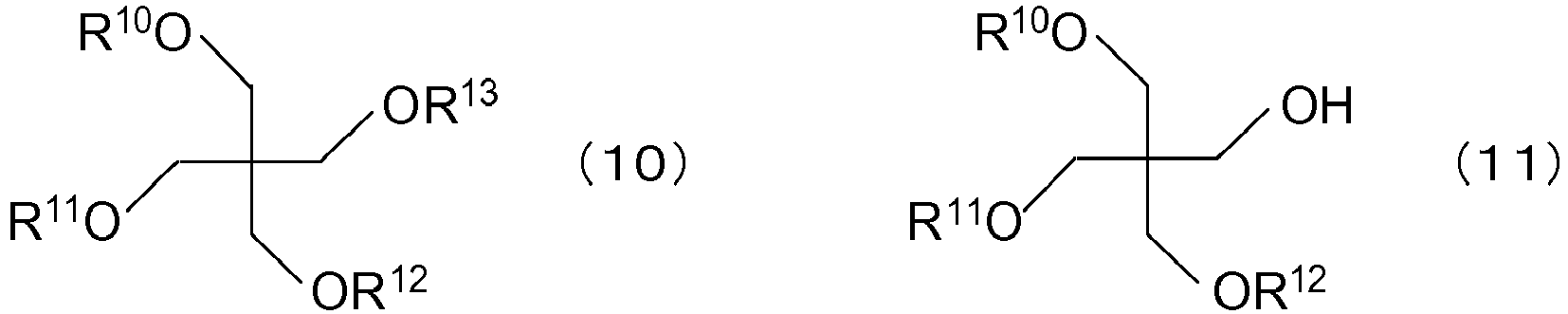

- Examples of an ether of a chain hydrocarbon triol and at least one aliphatic monohydric alcohol include triethers, diethers and monoethers of glycerin and aliphatic monohydric alcohols, represented by the following formulas (14)-(16):


- Examples of an ether of a chain hydrocarbon diol and at least one aliphatic monohydric alcohol include diethers of C2-C6 glycols and aliphatic monohydric alcohols, represented by the following formula (17):
R17OCnH2nOR18 (17)
wherein n is an integer of 2-6, and R17 and R18 are each a chain hydrocarbon,
and monoethers of C2-C6 glycols and aliphatic monohydric alcohols, represented by the following formula (18) :
R17OCnH2nOH (18)
wherein n is an integer of 2-6, and R17 is a chain hydrocarbon. - In the tetraether of pentaerythritol and an aliphatic monohydric alcohol, the IOB is 0.44 when the total number of carbon atoms of the aliphatic monohydric alcohol consisting of the tetraether of pentaerythritol and the aliphatic monohydric alcohol, i.e., the total number of carbon atoms of the R10, R11, R12 and R13 portions in formula (10), is 4. Thus, when the total number of carbon atoms of the aliphatic monohydric alcohol consisting of a tetraether of pentaerythritol and an aliphatic monohydric alcohol is approximately 4 or greater, the IOB value satisfies the condition of being within about 0.00 to 0.60.
- In the triether of pentaerythritol and an aliphatic monohydric alcohol, the IOB is 0.57 when the total number of carbon atoms of the aliphatic monohydric alcohol consisting of the triether of pentaerythritol and the aliphatic monohydric alcohol, i.e., the total number of carbon atoms of the R10, R11 and R12 portions in formula (11), is 9. Thus, when the total number of carbon atoms of the aliphatic monohydric alcohol consisting of a triether of pentaerythritol and an aliphatic monohydric alcohol is approximately 9 or greater, the IOB value satisfies the condition of being within about 0.00 to 0.60.
- In the diether of pentaerythritol and an aliphatic monohydric alcohol, the IOB is 0.60 when the total number of carbon atoms of the aliphatic monohydric alcohol consisting of the diether of pentaerythritol and the aliphatic monohydric alcohol, i.e., the total number of carbon atoms of the R10 and R11 portions in formula (12), is 15. Thus, when the total number of carbon atoms of the aliphatic monohydric alcohol consisting of a diether of pentaerythritol and an aliphatic monohydric alcohol is approximately 15 or greater, the IOB value satisfies the condition of being within about 0.00 to 0.60.
- In the monoether of pentaerythritol and an aliphatic monohydric alcohol, the IOB is 0.59 when the number of carbon atoms of the aliphatic monohydric alcohol consisting of the monoether of pentaerythritol and the aliphatic monohydric alcohol, i.e. the number of carbon atoms of the R10 portion in formula (13), is 22. Thus, when the total number of carbon atoms of the aliphatic monohydric alcohol consisting of a monoether of pentaerythritol and an aliphatic monohydric alcohol is approximately 22 or greater, the IOB value satisfies the condition of being within about 0.00 to 0.60.
- In the triether of glycerin and an aliphatic monohydric alcohol, the IOB is 0.50 when the total number of carbon atoms of the aliphatic monohydric alcohol consisting of the triether of glycerin and the aliphatic monohydric alcohol, i.e., the total number of carbon atoms of the R14, R15 and R16 portions in formula (14), is 3. Thus, when the total number of carbon atoms of the aliphatic monohydric alcohol consisting of a triether of glycerin and an aliphatic monohydric alcohol is approximately 3 or greater, the IOB value satisfies the condition of being within about 0.00 to 0.60.
- In the diether of glycerin and an aliphatic monohydric alcohol, the IOB is 0.58 when the total number of carbon atoms of the aliphatic monohydric alcohol consisting of the diether of glycerin and the aliphatic monohydric alcohol, i.e., the total number of carbon atoms of the R14 and R15 portions in formula (15), is 9. Thus, when the total number of carbon atoms of the aliphatic monohydric alcohol consisting of a diether of glycerin and an aliphatic monohydric alcohol is approximately 9 or greater, the IOB value satisfies the condition of being within about 0.00 to 0.60.
- In the monoether of glycerin and an aliphatic monohydric alcohol, the IOB is 0.58 when the number of carbon atoms of the aliphatic monohydric alcohol consisting of the monoether of glycerin and the aliphatic monohydric alcohol, i.e., the number of carbon atoms of the R14 portion in formula (16), is 16. Thus, when the total number of carbon atoms of the aliphatic monohydric alcohol consisting of a monoether of glycerin and an aliphatic monohydric alcohol is approximately 16 or greater, the IOB value satisfies the condition of being within about 0.00 to 0.60.
- In a diether of butylene glycol (n = 4) and aliphatic monohydric alcohol represented by formula (17), the IOB is 0.33 when the total number of carbon atoms of the R17 and R18 portions is 2. Thus, when the number of carbon atoms of the aliphatic monohydric alcohol in a diether of butylene glycol (n = 4) and an aliphatic monohydric alcohol represented by formula (17) is approximately 2 or greater, the IOB value satisfies the condition of being within about 0.00-0.60. Also, in a monoether of ethylene glycol (n = 2) and aliphatic monohydric alcohol represented by formula (18), the IOB is 0.60 when the number of carbon atoms of the R17 portion is 8. Thus, when the number of carbon atoms of the aliphatic monohydric alcohol consisting of a monoether of ethylene glycol (n = 2) and an aliphatic monohydric alcohol represented by formula (18) is approximately 8 or greater, the IOB value satisfies the condition of being within about 0.00 to 0.60.
- Compound (B) may be produced by dehydrating condensation of compound (B1) and compound (B2) in the presence of an acid catalyst.
- [(C) Ester of (C1) a carboxylic acid, hydroxy acid, alkoxy acid or oxoacid comprising a chain hydrocarbon moiety and 2-4 carboxyl groups substituted for hydrogens on the chain hydrocarbon moiety and (C2) a compound having a chain hydrocarbon moiety and 1 hydroxyl group substituted for a hydrogen on the chain hydrocarbon moiety]
- In the (C) ester of (C1) a carboxylic acid, hydroxy acid, alkoxy acid or oxoacid comprising a chain hydrocarbon moiety and 2-4 carboxyl groups substituted for hydrogens on the chain hydrocarbon moiety and (C2) a compound having a chain hydrocarbon moiety and 1 hydroxyl group substituted for a hydrogen on the chain hydrocarbon moiety (hereunder also referred to as "compound (C)"), it is not necessary for all of the carboxyl groups to be esterified so long as the IOB, melting point and water solubility are within the aforementioned ranges.
- Examples of (C1) a carboxylic acid, hydroxy acid, alkoxy acid or oxoacid comprising a chain hydrocarbon moiety and 2-4 carboxyl groups substituted for hydrogens on the chain hydrocarbon moiety (hereunder also referred to as "compound (C1)") include chain hydrocarbon carboxylic acids with 2-4 carboxyl groups, such as chain hydrocarbon dicarboxylic acids including alkanedicarboxylic acids, such as ethanedioic acid, propanedioic acid, butanedioic acid, pentanedioic acid, hexanedioic acid, heptanedioic acid, octanedioic acid, nonanedioic acid and decanedioic acid, chain hydrocarbon tricarboxylic acids, including alkanetricarboxylic acids, such as propanetrioic acid, butanetrioic acid, pentanetrioic acid, hexanetrioic acid, heptanetrioic acid, octanetrioic acid, nonanetrioic acid and decanetrioic acid, and chain hydrocarbon tetracarboxylic acids, including alkanetetracarboxylic acids, such as butanetetraoic acid, pentanetetraoic acid, hexanetetraoic acid, heptanetetraoic acid, octanetetraoic acid, nonanetetraoic acid and decanetetraoic acid.
- Compound (C1) includes chain hydrocarbon hydroxy acids with 2-4 carboxyl groups, such as malic acid, tartaric acid, citric acid and isocitric acid, chain hydrocarbon alkoxy acids with 2-4 carboxyl groups, such as O-acetylcitric acid, and chain hydrocarbon oxoacids with 2-4 carboxyl groups.
- (C2) Compound having a chain hydrocarbon moiety and 1 hydroxyl group substituted for a hydrogen on the chain hydrocarbon moiety includes those mentioned for "compound (B)", such as aliphatic monohydric alcohols.
- Compound (C) may be (c1) an ester, for example a monoester, diester, triester or tetraester, preferably a diester, triester or tetraester, more preferably a triester or tetraester and even more preferably a tetraester, of a chain hydrocarbon tetracarboxylic acid, hydroxy acid, alkoxy acid or oxoacid with 4 carboxyl groups, and at least one aliphatic monohydric alcohol, (c2) an ester, for example, a monoester, diester or triester, preferably a diester or triester and more preferably a triester, of a chain hydrocarbon tricarboxylic acid, hydroxy acid, alkoxy acid or oxoacid with 3 carboxyl groups, and at least one aliphatic monohydric alcohol, or (c3) an ester, for example, a monoester or diester, and preferably a diester, of a chain hydrocarbon dicarboxylic acid, hydroxy acid, alkoxy acid or oxoacid with 2 carboxyl groups, and at least one aliphatic monohydric alcohol.
- Examples for compound (C) include dioctyl adipate, diisostearyl malate, tributyl citrate and tributyl O-acetylcitrate, of which commercially available products exist.
- [(D) Compound having a chain hydrocarbon moiety and one bond selected from the group consisting of an ether bond (-O-), carbonyl bond (-CO-), ester bond (-COO-) and carbonate bond (-OCOO-) inserted between a C-C single bond of the chain hydrocarbon moiety]
- The (D) compound having a chain hydrocarbon moiety and one bond selected from the group consisting of an ether bond (-O-), carbonyl bond (-CO-), ester bond (-COO-) and carbonate bond (-OCOO-) inserted between a C-C single bond of the chain hydrocarbon moiety (hereunder also referred to as "compound (D)") may be (d1) an ether of an aliphatic monohydric alcohol and an aliphatic monohydric alcohol, (d2) a dialkyl ketone, (d3) an ester of a fatty acid and an aliphatic monohydric alcohol, or (d4) a dialkyl carbonate.
- Ethers of an aliphatic monohydric alcohol and an aliphatic monohydric alcohol include compounds having the following formula (19):
R19OR20 (19)
wherein R19 and R20 each represent a chain hydrocarbon. - The aliphatic monohydric alcohol consisting of the ether (corresponding to R19OH and R20OH in formula (19)) is not particularly restricted so long as the ether satisfies the conditions for the IOB, melting point and water solubility, and for example, it may be one of the aliphatic monohydric alcohols mentioned for "compound (B)".
- In an ether of an aliphatic monohydric alcohol and an aliphatic monohydric alcohol, the IOB is 0.50 when the total number of carbon atoms of the aliphatic monohydric alcohols consisting of the ether, i.e., the total number of carbons of the R19 and R20 portions in formula (19), is 2, and therefore when the total number of carbons of the aliphatic monohydric alcohols consisting of the ether is about 2 or greater, this condition for the IOB is satisfied. However, when the total number of carbons of the aliphatic monohydric alcohols consisting of the ether is about 6, the water solubility is as high as about 2 g, which is problematic from the viewpoint of vapor pressure as well. In order to satisfy the condition of a water solubility of about 0.00-0.05 g, the total number of carbons of the aliphatic monohydric alcohols consisting of the ether is preferably about 8 or greater.
- The dialkyl ketone may be a compound of the following formula (20):
R21COR22 (20)
wherein R21 and R22 are each an alkyl group. - In a dialkyl ketone, the IOB is 0.54 when the total number of carbon atoms of R21 and R22 is 5, and therefore this condition for the IOB is satisfied if the total number of carbons is about 5 or greater. However, when the total number of carbons of dialkyl ketone is about 5, the water solubility is as high as about 2 g. Therefore, in order to satisfy the condition of a water solubility of about 0.00-0.05 g, the total number of carbons of dialkyl ketone is preferably about 8 or greater. In consideration of vapor pressure, the number of carbon atoms of dialkyl ketone is preferably about 10 or greater and more preferably about 12 or greater.
- If the total number of carbon atoms of dialkyl ketone is about 8, such as in 5-nonanone, for example, the melting point is approximately -50°C and the vapor pressure is about 230 Pa at 20°C.
- The dialkyl ketone may be a commercially available product, or it may be obtained by a known method, such as by oxidation of a secondary alcohol with chromic acid or the like.
- Examples of esters of a fatty acid and an aliphatic monohydric alcohol include compounds having the following formula (21):
R23COOR24 (21)
wherein R23 and R24 each represent a chain hydrocarbon. - Examples of fatty acids consisting of these esters (corresponding to R23COOH in formula (21)) include the fatty acids mentioned for the "(a1) an ester of a chain hydrocarbon tetraol and at least one fatty acids", and specifically these include saturated fatty acids and unsaturated fatty acids, with saturated fatty acids being preferred in consideration of the potential for degradation by oxidation and the like. The aliphatic monohydric alcohol consisting of the ester (corresponding to R24OH in formula (21)) may be one of the aliphatic monohydric alcohols mentioned for "compound (B)".
- In an ester of such a fatty acid and aliphatic monohydric alcohol, the IOB is 0.60 when the total number of carbon atoms of the fatty acid and aliphatic monohydric alcohol, i.e. the total number of carbon atoms of the R23C and R24 portions in formula (21), is 5, and therefore this condition for the IOB is satisfied when the total number of carbon atoms of the R23C and R24 portions is about 5 or greater. However, with butyl acetate in which the total number of carbon atoms is 6, the vapor pressure is high at greater than 2,000 Pa. In consideration of vapor pressure, therefore, the total number of carbon atoms is preferably about 12 or greater. If the total number of carbon atoms is about 11 or greater, it will be possible to satisfy the condition of a water solubility of about 0.00-0.05 g.
- Examples of esters of such fatty acids and aliphatic monohydric alcohols include esters of dodecanoic acid (C12) and dodecyl alcohol (C12) and esters of tetradecanoic acid (C14) and dodecyl alcohol (C12), and examples of commercial products of esters of such fatty acids and aliphatic monohydric alcohols include ELECTOL WE20 and ELECTOL WE40 (both products of NOF Corp.).
- The dialkyl carbonate may be a compound of the following formula (22):
R2OC(=O)OR26 (22)
wherein R25 and R26 are each an alkyl group. - In a dialkyl carbonate, the IOB is 0.57 when the total number of carbon atoms of R25 and R26 is 6, and therefore this condition for the IOB is satisfied if the total number of carbons of R25 and R26 is about 6 or greater.
- In consideration of water solubility, the total number of carbon atoms of R25 and R26 is preferably about 7 or greater and more preferably about 9 or greater.
- The dialkyl carbonate may be a commercially available product, or it may be synthesized by reaction between phosgene and an alcohol, reaction between formic chloride and an alcohol or alcoholate, or reaction between silver carbonate and an alkyl iodide.
- The (E) polyoxy C2-C6 alkylene glycol, or alkyl ester or alkyl ether thereof (hereunder also referred to as "compound (E)") may be (e1) a polyoxy C2-C6 alkylene glycol, (e2) an ester of a polyoxy C2-C6 alkylene glycol and at least one fatty acid, (e3) an ether of a polyoxy C2-C6 alkylene glycol and at least one aliphatic monohydric alcohol, (e4) an ester of a polyoxy C2-C6 alkylene glycol and a chain hydrocarbon tetracarboxylic acid, chain hydrocarbon tricarboxylic acid or chain hydrocarbon dicarboxylic acid, or (e5) an ether of a polyoxy C2-C6 alkylene glycol and a chain hydrocarbon tetraol, chain hydrocarbon triol or chain hydrocarbon diol. These will now be explained.
- Polyoxy C2-C6 alkylene glycols refer to i) one or more homopolymers having a unit selected from the group consisting of oxy C2-C6 alkylene units, such as oxyethylene unit, oxypropylene unit, oxybutylene unit, oxypentylene unit and oxyhexylene unit and having hydroxyl groups at both ends, ii) one or more block copolymers having 2 or more units selected from oxy C2-C6 alkylene units described above and oxyhexylene unit and having hydroxyl groups at both ends, or iii) random copolymers having 2 or more units selected from oxy C2-C6 alkylene units described above and having hydroxyl groups at both ends.
- The oxy C2-C6 alkylene units are preferably oxypropylene unit, oxybutylene unit, oxypentylene unit or oxyhexylene unit, and more preferably oxybutylene unit, oxypentylene unit and oxyhexylene unit, from the viewpoint of reducing the value of IOB.
- The polyoxy C2-C6 alkylene glycol can be represented by the following formula (23):
HO-(CmH2mO)n-H (23)
wherein m represents an integer of 2-6. - The present inventors have confirmed that in polyethylene glycol (corresponding to the homopolymer of formula (23) where m = 2), when n ≥ 45 (the weight-average molecular weight exceeds about 2,000), the condition for IOB of about 0.00 to about 0.60 is satisfied, but the condition for the water solubility is not satisfied even when the weight-average molecular weight exceeds about 4,000. Therefore, ethylene glycol homopolymer is not included in the (e1) polyoxy C2-C6 alkylene glycol, and ethylene glycol should be included in the (e1) polyoxy C2-C6 alkylene glycol only as a copolymer or random polymer with another glycol.
- Thus, homopolymers of formula (23) may include propylene glycol, butylene glycol, pentylene glycol or hexylene glycol homopolymer.
- For this reason, m in formula (23) is about 3 to 6 and preferably about 4 to 6, and n is 2 or greater.
- The value of n in formula (23) is a value such that the polyoxy C2-C6 alkylene glycol has an IOB of about 0.00-0.60, a melting point of about 45°C or less and a water solubility of about 0.00-0.05 g in 100 g of water at 25°C.
- For example, when formula (23) is polypropylene glycol (m = 3, homopolymer), the IOB is 0.58 when n = 12. Thus, when formula (23) is polypropylene glycol (m = 3, homopolymer), the condition for the IOB is satisfied when m is equal to or greater than about 12.
- Also, when formula (23) is polybutylene glycol (m = 4, homopolymer), the IOB is 0.57 when n = 7. Thus, when formula (23) is polybutylene glycol (m = 4, homopolymer), the condition for the IOB is satisfied when n is equal to or greater than about 7.
- From the viewpoint of IOB, melting point and water solubility, the weight-average molecular weight of the polyoxy C4-C6 alkylene glycol is preferably between about 200 and about 10,000, more preferably between about 250 and about 8,000, and even more preferably in the range of about 250 to about 5,000.
- Also from the viewpoint of IOB, melting point and water solubility, the weight-average molecular weight of a polyoxy C3 alkylene glycol, i.e. polypropylene glycol, is preferably between about 1,000 and about 10,000, more preferably between about 3,000 and about 8,000, and even more preferably between about 4,000 and about 5,000. This is because if the weight-average molecular weight is less than about 1,000, the condition for the water solubility will not be satisfied, and a larger weight-average molecular weight will particularly tend to increase the migration rate into the absorbent body and the whiteness of the top sheet.
- Examples of commercial products of polyoxy C2-C6 alkylene glycols include UNIOL™ D-1000, D-1200, D-2000, D-3000, D-4000, PB-500, PB-700, PB-1000 and PB-2000 (all products of NOF Corp.).
- Examples of an ester of a polyoxy C2-C6 alkylene glycol and at least one fatty acids include the polyoxy C2-C6 alkylene glycols mentioned for (e1) Polyoxy C2-C6 alkylene glycol" in which one or both OH ends have been esterified with fatty acids, i.e. monoesters and diesters.
- Examples of fatty acids to be esterified in the ester of a polyoxy C2-C6 alkylene glycol and at least one fatty acid include the fatty acids mentioned for the "(a1) Ester of a chain hydrocarbon tetraol and at least one fatty acid", and specifically these include saturated fatty acids and unsaturated fatty acids, with saturated fatty acids being preferred in consideration of the potential for degradation by oxidation and the like.
- An example of a commercially available ester of a polyoxy C2-C6 alkylene glycol and a fatty acid is WILBRITE cp9 (product of NOF Corp.).
- Examples of an ether of a polyoxy C2-C6 alkylene glycols and at least one aliphatic monohydric alcohol include the polyoxy C2-C6 alkylene glycols mentioned for "(e1) Polyoxy C2-C6 alkylene glycol" wherein one or both OH ends have been etherified by an aliphatic monohydric alcohol, i.e. monoethers and diethers.
- In an ether of a polyoxy C2-C6 alkylene glycol and at least one aliphatic monohydric alcohol, the aliphatic monohydric alcohol to be etherified may be an aliphatic monohydric alcohol among those mentioned for "compound (B)".
- The polyoxy C2-C6 alkylene glycol to be esterified for the aforementioned ester of a polyoxy C2-C6 alkylene glycol and a chain hydrocarbon tetracarboxylic acid, chain hydrocarbon tricarboxylic acid or chain hydrocarbon dicarboxylic acid may be any of the polyoxy C2-C6 alkylene glycols mentioned above under "(e1) Polyoxy C2-C6 alkylene glycol". Also, the chain hydrocarbon tetracarboxylic acid, chain hydrocarbon tricarboxylic acid or chain hydrocarbon dicarboxylic acid to be esterified may be any of those mentioned above for "compound (C)".
- The ester of a polyoxy C2-C6 alkylene glycol and a chain hydrocarbon tetracarboxylic acid, chain hydrocarbon tricarboxylic acid or chain hydrocarbon dicarboxylic acid may be a commercially available product, or it may be produced by polycondensation of a C2-C6 alkylene glycol with a chain hydrocarbon tetracarboxylic acid, chain hydrocarbon tricarboxylic acid or chain hydrocarbon dicarboxylic acid under known conditions.
- The polyoxy C2-C6 alkylene glycol to be etherified for the aforementioned ether of a polyoxy C2-C6 alkylene glycol and a chain hydrocarbon tetraol, chain hydrocarbon triol or chain hydrocarbon diol may be any of the polyoxy C2-C6 alkylene glycols mentioned above under "(e1) polyoxy C2-C6 alkylene glycol". Also, the chain hydrocarbon tetraol, chain hydrocarbon triol or chain hydrocarbon diol to be etherified may be, for example, pentaerythritol, glycerin or glycol, mentioned above for "compound (A)".
- Examples of commercially available ethers of polyoxy C2-C6 alkylene glycols and chain hydrocarbon tetraols, chain hydrocarbon triols and chain hydrocarbon diols include UNILUBE™ 5TP-300KB and UNIOL™ TG-3000 and TG-4000 (products of NOF Corp.).
- UNILUBE™ 5TP-300KB is a compound obtained by polycondensation of 65 mol of propylene glycol and 5 mol of ethylene glycol with 1 mol of pentaerythritol, and it has an IOB of 0.39, a melting point of below 45°C, and a water solubility of less than 0.05 g.
- UNIOL™ TG-3000 is a compound obtained by polycondensation of 50 mol of propylene glycol with 1 mol of glycerin, and it has an IOB of 0.42, a melting point of below 45°C, a water solubility of less than 0.05 g, and a weight-average molecular weight of about 3,000.
- UNIOL™ TG-4000 is a compound obtained by polycondensation of 70 mol of propylene glycol with 1 mol of glycerin, and it has an IOB of 0.40, a melting point of below 45°C, a water solubility of less than 0.05 g, and a weight-average molecular weight of about 4,000.
- The ether of a polyoxy C2-C6 alkylene glycol and a chain hydrocarbon tetraol, chain hydrocarbon triol or chain hydrocarbon diol may also be produced by adding a C2-C6 alkylene oxide to a chain hydrocarbon tetraol, chain hydrocarbon triol or chain hydrocarbon diol under known conditions.
- The chain hydrocarbon has an inorganic value of 0 and thus an IOB of 0.00, while the water solubility is also approximately 0 g, and therefore if the melting point is about 45°C or less it may be included among the aforementioned blood modifying agents. Examples of such chain hydrocarbons include (f1) a chain alkane, such as linear alkanes and branched alkanes, and linear alkanes generally include those with no more than 22 carbons, in consideration of a melting point of about 45°C or less. In consideration of vapor pressure, they generally include those with 13 or more carbons. Branched alkanes generally include those with 22 or more carbons, since their melting points are often lower than linear alkanes, given the same number of carbon atoms.
- Examples of commercially available hydrocarbon products include PARLEAM 6 (NOF Corp.).
- The blood modifying agent has been found to have at least a function of lowering blood viscosity and surface tension, which will be considered in detail in the examples. Menstrual blood to be absorbed by the absorbent article, unlike ordinary blood, contains proteins of the endometrial wall, for example, which act to bind together blood cells so that the blood cells form a rouleau state. Menstrual blood which is to be absorbed by the absorbent article therefore tends to have high viscosity, and when the top sheet and second sheet are nonwoven fabrics or woven fabric, the menstrual blood becomes clogged between the fibers creating a residual sticky feel for the wearer, while the menstrual blood also diffuses on the surface of the top sheet and tends to leak.
- The blood modifying agent which has an IOB of about 0.00 to 0.60 has high organicity and readily infiltrates between blood cells, and it therefore stabilizes the blood cells and can prevent formation of a rouleau structure by the blood cells. For example, with an absorbent article comprising an acrylic super-absorbent polymer, or SAP, absorption of menstrual blood is known to lead to covering of the SAP surface by rouleau-formed blood cells and inhibition of the absorption performance of the SAP, but presumably stabilization of the blood cells allows the absorption performance of the SAP to be exhibited more easily. In addition, the blood modifying agent which has high affinity with erythrocytes protects the erythrocyte membranes, and therefore may minimize destruction of the erythrocytes.
- The weight-average molecular weight of the blood modifying agent is preferably about 2,000 or less, and more preferably about 1,000 or less. A high weight-average molecular weight will tend to result in high viscosity of the blood modifying agent, and it will be difficult to lower the viscosity of the blood modifying agent by heating, to a viscosity suitable for coating. As a result, it will sometimes be necessary to dilute the blood modifying agent with a solvent. In addition, if the weight-average molecular weight is higher, tack may result in the blood modifying agent itself, tending to create a feeling of unpleasantness for the wearer.
- The present invention will now be explained by examples, with the understanding that the present invention is not meant to be limited to the examples.
- A commercially available sanitary napkin was prepared. The sanitary napkin was formed from a top sheet, formed of a hydrophilic agent-treated air-through nonwoven fabric (composite fiber composed of polyester and polyethylene terephthalate, basis weight: 35 g/m2), a second sheet, formed of an air-through nonwoven fabric (composite fiber composed of polyester and polyethylene terephthalate, basis weight: 30 g/m2), an absorbent body comprising pulp (basis weight: 150-450 g/m2, increased at the center section), an acrylic super-absorbent polymer (basis weight: 15 g/m2) and tissue as a core wrap, a water-repellent agent-treated side sheet, and a back sheet composed of a polyethylene film.
- The blood modifying agents used for testing are listed below. [(a1) Ester of a chain hydrocarbon tetraols and at least one fatty acid]
- UNISTAR H-408BRS, product of NOF Corp. Pentaerythritol tetra(2-ethylhexanoate), weight-average molecular weight: approximately 640
- UNISTAR H-2408BRS-22, product of NOF Corp.
Mixture of pentaerythritol tetra(2-ethylhexanoate) and neopentylglycol di(2-ethylhexanoate) (58:42 as weight ratio), weight-average molecular weight: approximately 520 - Glycerin and fatty acid triester, with oleic acid or stearylic acid as the fatty acid.
- Glycerin and fatty acid triester with C14 fatty acid:C16 fatty acid:C10 fatty acid:C20 fatty acid (including both saturated fatty acids and unsaturated fatty acids) at a mass ratio of about 0.2:11:88:0.8, weight-average molecular weight: 880
- Glycerin and fatty acid triester with C8 fatty acid:C10 fatty acid:C12 fatty acid at a mass ratio of about 37:7:56, weight-average molecular weight: approximately 570
- Glycerin and fatty acid triester with C8 fatty acid:C12 fatty acid at a mass ratio of about 44:56, weight-average molecular weight: approximately 570
- Glycerin and fatty acid triester with C8 fatty acid:C10 fatty acid at a mass ratio of about 85:15, weight-average molecular weight: approximately 480
- Glycerin and fatty acid triester with octanoic acid (C8) as the entire fatty acid portion, weight-average molecular weight: approximately 470
- Glycerin and fatty acid triester with 2-ethylhexanoic acid (C8) as the entire fatty acid portion, weight-average molecular weight: approximately 470 •NA36, product of NOF Corp.
- Glycerin and fatty acid triester with C16 fatty acid:C18 fatty acid:C20 fatty acid (including both saturated fatty acids and unsaturated fatty acids) at a mass ratio of about 5:92:3, weight-average molecular weight: approximately 880
- Glycerin and fatty acid triester with C8 fatty acid:C10 fatty acid:C12 fatty acid:C14 fatty acid:C16 fatty acid (including both saturated fatty acids and unsaturated fatty acids) at a mass ratio of about 4:8:60:25:3, weight-average molecular weight: 670
- Glycerin and fatty acid diester with octanoic acid as the fatty acid, weight-average molecular weight: approximately 340
- Dodecanoic acid (C12) monoester of butylene glycol, weight-average molecular weight: approximately 270
- Octadecanoic acid (C18) monoester of butylene glycol, weight-average molecular weight: approximately 350
- Neopentyl glycol di(2-ethylhexanoate), weight-average molecular weight: approximately 360
- Weight-average molecular weight: approximately 400
- Weight-average molecular weight: approximately 380
- Ester of dodecanoic acid (C12) and dodecyl alcohol (C12), weight-average molecular weight: approximately 360
- Ester of tetradecanoic acid (C14) and dodecyl alcohol (C12), weight-average molecular weight: approximately 390
- Polypropylene glycol, weight-average molecular weight: approximately 1,000
- Polypropylene glycol, weight-average molecular weight: approximately 1,200
- Polypropylene glycol, weight-average molecular weight: approximately 3,000
- Polypropylene glycol, weight-average molecular weight: approximately 4,000
- Polybutylene glycol, weight-average molecular weight: approximately 500
- Polyoxybutylene polyoxypropylene glycol, weight-average molecular weight: approximately 700
- Polybutylene glycol, weight-average molecular weight: approximately 1000
- Polybutylene glycol compound with OH groups at both ends esterified by hexadecanoic acid (C16), weight-average molecular weight: approximately 1,150
- Stearyl ether of polypropylene glycol, approximately 15 repeating units, weight-average molecular weight: approximately 1,140
- Polyoxyethylenepolyoxypropylene pentaerythritol ether, produced by addition of 5 mol of ethylene oxide and 65 mol of propylene oxide to 1 mol of pentaerythritol, weight-average molecular weight: 4,130
- Glyceryl ether of polypropylene glycol, approximately 16 repeating units, weight-average molecular weight: approximately 3,000
- Glyceryl ether of polypropylene glycol, approximately 16 repeating units, weight-average molecular weight: approximately 4,000
- Branched chain hydrocarbon, produced by copolymerization of liquid isoparaffin, isobutene and n-butene followed by hydrogen addition, polymerization degree: approximately 5-10, weight-average molecular weight: approximately 330
- Glycerin and fatty acid triester obtained by addition of hydrogen to NA36 for reduced proportion of double bonds from unsaturated fatty acid starting material, weight-average molecular weight: approximately 880
- Glycerin and fatty acid monoester, with octanoic acid (C8) and decanoic acid (C10) at a mass ratio of about 85:15, weight-average molecular weight: approximately 220
- Weight-average molecular weight: approximately 230 • Diisostearyl malate
- Weight-average molecular weight: approximately 640 • UNIOL D-400, product of NOF Corp.
- Polypropylene glycol, weight-average molecular weight: approximately 400
- Polyethylene glycol, weight-average molecular weight: approximately 1,500-1,600
- Polyoxyethylene monostearate, approximately 7 repeating units, weight-average molecular weight: approximately 880
- Polyoxyethylene polyoxypropylene polyoxybutylene glycerin, weight-average molecular weight: approximately 960
- Glyceryl ether of polypropylene glycol, approximately 6 repeating units, weight-average molecular weight: approximately 330
- Glyceryl ether of polypropylene glycol, approximately 16 repeating units, weight-average molecular weight: approximately 1,000
- Diglyceryl ether of polypropylene glycol, approximately 9 repeating units, weight-average molecular weight: approximately 700
- Polyoxyethylene hydrogenated castor oil, weight-average molecular weight: approximately 3,570
- Petroleum-derived hydrocarbon, semi-solid
- The IOBs, melting points and water solubilities of the samples are shown in Table 2.
- The water solubility was measured by the method described above, and samples that dissolved 24 hours after addition of 20.0 g to 100 g of desalted water were evaluated as "20 g<", and samples of which 0.05 g dissolved in 100 g of desalted water but 1.00 g did not dissolve were evaluated as 0.05-1.00 g.
- For the melting point, "<45" indicates a melting point of below 45°C.
- The skin contact surface of the top sheet of the sanitary napkin was coated with the aforementioned blood modifying agent. Each blood modifying agent was used directly, when the blood modifying agent was liquid at room temperature, or when the blood modifying agent was solid at room temperature it was heated to its melting point +20°C, and a control seam HMA gun was used for atomization of the blood modifying agent and coating onto the entire skin contact surface of the top sheet to a basis weight of about 5 g/m2.
-
Fig. 11 is an electron micrograph of the skin contact surface of a top sheet in a sanitary napkin (No.2-5) wherein the top sheet comprises tri-C2L oil fatty acid glycerides. As clearly seen inFig. 11 , the tri-C2L oil fatty acid glycerides are adhering onto the fiber surfaces as fine particulates. - The rewetting rate and absorbent body migration rate were measured by the procedure described above. The results are shown in Table 2 below.
- An acrylic board with an opened hole (200 mm x 100 mm, 125 g, with a 40 mm x 10 mm hole opened at the center) was placed on a top sheet comprising each blood modifying agent, and 3.0 g of horse EDTA blood at 37±1°C (obtained by adding ethylenediaminetetraacetic acid (hereunder, "EDTA") to horse blood to prevent coagulation) was dropped through the hole using a pipette (once), and after 1 minute, 3.0 g of horse EDTA blood at 37±1°C was again added dropwise through the acrylic board hole with a pipette (twice).
- After the second dropping of blood, the acrylic board was immediately removed and 10 sheets of filter paper (Advantec Toyo Kaisha, Ltd, Qualitative Filter Paper No.2, 50 mm x 35 mm, total mass of the 10 sheets of filter paper: FW0 (g)) were placed on the location where the blood had been dropped, and then a weight was placed thereover to a pressure of 30 g/cm2. After 1 minute, the filter paper was removed, total mass of 10 sheets of filter paper (FW1 (g)) was measured, and the "rewetting rate" was calculated by the following formula.

- In addition to the rewetting rate evaluation, the "absorbent body migration rate" was also measured as the time until migration of blood from the top sheet to the absorbent body after the second dropping of blood. The absorbent body migration rate is the time from introducing the blood onto the top sheet, until the redness of the blood could be seen on the surface and in the interior of the top sheet.
- The results for the rewetting rate and absorbent body migration rate are shown below in Table 2.
- Next, the whiteness of the skin contact surface of the top sheet after the absorbent body migration rate test was visually evaluated on the following scale.
- VG (Very Good): Virtually no redness of blood remaining, and no clear delineation between areas with and without blood.
- G (Good): Slight redness of blood remaining, but difficult to delineate between areas with and without blood.
- F (Fair): Slight redness of blood remaining, areas with blood discernible.
- P (Poor): Redness of blood completely remaining.
- The results are summarized in Table 2.
Table 2 No. Blood modifying agent IOB Melting pt. (°C) Water solubility (g) Weight-average mol. wt. Rewetting rate (%) Absorbent body migration rate (sec) Top sheet whiteness Type Product name 2-1 (a1) H-408BRS 0.13 <-5 <0.05 640 1.2 3 VG 2-2 H-2408BRS-22 0.18 <-5 <0.05 520 2.0 3 VG 2-3 (a2) Cetiol SB45DEO 0.16 44 <0.05 7.0 6 VG 2-4 SOY42 0.16 43 <0.05 880 5.8 8 VG 2-5 Tri C2L oil fatty acid glyceride 0.27 37 <0.05 570 0.3 3 VG 2-6 Tri CL oil fatty acid glyceride 0.28 38 <0.05 570 1.7 3 VG 2-7 PANACET 810s 0.32 -5 <0.05 480 2.8 3 VG 2-8 PANACET 800 0.33 -5 <0.05 470 0.3 3 VG 2-9 PANACET 800B 0.33 -5 <0.05 470 2.0 3 VG 2-10 NA36 0.16 37 <0.05 880 3.9 5 VG 2-11 Tri-coconut fatty acid glyceride 0.28 30 <0.05 670 4.3 5 VG 2-12 Caprylic diglyceride 0.58 <45 <0.05 340 4.2 9 G 2-13 (a3) COMPOL BL 0.50 2 <0.05 270 2.0 5 G 2-14 COMPOL BS 0.36 37 <0.05 350 7.9 9 G 2-15 H-208BRS 0.24 <-5 <0.05 360 2.0 5 VG 2-16 (c2) Tributyl O-acetylcitrate 0.60 <45 <0.05 400 6.2 8 VG 2-17 (c3) Dioctyl adipate 0.27 <45 <0.05 380 1.7 6 VG 2-18 (d3) ELECTOL WE20 0.13 29 <0.05 360 1.8 5 VG 2-19 ELECTOL WE40 0.12 37 <0.05 390 1.8 4 VG 2-20 (e1) UNIOL D-1000 0.51 <45 <0.05 1,000 6.8 15 F 2-21 UNIOL D-1200 0.48 <45 <0.05 1,160 0.5 11 F 2-22 UNIOL D-3000 0.39 <45 <0.05 3,000 1.7 10 F 2-23 UNIOL D-4000 0.38 <45 <0.05 4,000 1.0 7 G 2-24 (e1) UNIOL PB500 0.44 <45 <0.05 500 4.5 4 G 2-25 UNIOL PB700 0.49 -5 <0.05 700 2.8 5 G 2-26 UNIOL PB1000R 0.40 <45 <0.05 1,000 4.0 4 G 2-27 (e2) WILBRITE cp9 0.21 35 <0.05 1,150 1.4 3 G 2-28 (e3) UNILUBE MS-70K 0.30 <-10 <0.05 1,140 6.7 3 G 2-29 (e5) UNILUBE 5TP-300KB 0.39 <45 <0.05 4,130 2.0 6 G 2-30 UNIOL TG-3000 0.42 <45 <0.05 3,000 0.8 6 G 2-31 UNIOL TG-4000 0.40 <45 <0.05 4,000 2.0 6 G 2-32 (f1) PARLEAM 6 0.00 -5 <0.05 330 6.0 8 VG 2-33 NA50 0.18 52 <0.05 880 15.5 60 P 2-34 (Caprylic/capric) monoglyceride 1.15 <45 20< 220 4.0 4 P 2-35 90-L2 Lauric acid monoglyceride 0.87 58 20< 6.2 7 P 2-36 Isopropyl citrate 1.56 <45 20< 230 12.2 5 G 2-37 Diisostearyl malate 0.28 <45 20< 640 5.5 8 F 2-38 UNIOL D-400 0.76 <45 0.05< 400 8.7 40 P 2-39 PEG1500 0.78 40 20< 1,500-1,600 11.0 38 P 2-40 NONION S-6 0.44 37 0.05< 880 8.4 7 P 2-41 WILBRITE s753 0.67 -5 20< 960 9.3 9 F 2-42 UNIOL TG-330 1.27 <45 0.05< 330 - - - 2-43 UNIOL TG-1000 0.61 <45 <0.05 1,000 14.2 7 G 2-44 UNILUBE DGP-700 0.91 <0 0.05< 700 8.0 10 F 2-45 UNIOX HC60 0.46 33 0.05-1.00 3,570 14.6 46 P 2-46 Vaseline 0.00 55 <0.05 9.7 10 F 2-47 None - - - - 22.7 60< P - In the absence of a blood modifying agent, the rewetting rate was 22.7% and the absorbent body migration rate was greater than 60 seconds, but the glycerin and fatty acid triesters all produced rewetting rates of no greater than 7.0% and absorbent body migration rates of no longer than 8 seconds, and therefore significantly improved the absorption performance. Of the glycerin and fatty acid triesters, however, no great improvement in absorption performance was seen with NA50 which had a melting point of above 45°C.
- Similarly, the absorption performance was also significantly improved with blood modifying agents having an IOB of about 0.00-0.60, a melting point of about 45°C or less, and a water solubility of about 0.00-0.05 g in 100 g of water at 25°C.
- The rewetting rate was evaluated for blood from different animals, by the procedure described above. The following blood was used for the test.
-
- (1) Human
- (2) Horse
- (3) Sheep
-
- Defibrinated blood: blood sampled and agitated together with glass beads in an Erlenmeyer flask for approximately 5 minutes.
- EDTA blood: 65 mL of venous blood with addition of 0.5 mL of a 12% EDTA · 2K isotonic sodium chloride solution.
- Serum or blood plasma: Supernatant obtained after centrifugation of defibrinated blood or EDTA blood for 10 minutes at room temperature at about 1900 G.
- Blood cells: Obtained by removing the serum from the blood, washing twice with phosphate buffered saline (PBS), and adding phosphate buffered saline to the removed serum portion.
- An absorbent article was produced in the same manner as Example 2, except that the tri-C2L oil fatty acid glyceride was coated at a basis weight of about 5 g/m2, and the rewetting rate of each of the aforementioned blood samples was evaluated. Measurement was performed 3 times for each blood sample, and the average value was recorded.
- The results are shown in Table 3 below.
Table 3 No. Animal species Type of blood Rewetting rate (%) With blood modifying agent Without blood modifying agent 1 Human Defibrinated blood 1.6 5.0 2 Defibrinated serum 0.2 2.6 3 Defibrinated blood cells 0.2 1.8 4 EDTA blood 2.6 10.4 5 EDTA plasma 0.0 5.8 6 EDTA blood cells 0.2 4.3 7 Horse Defibrinated blood 0.0 8.6 8 Defibrinated serum 0.2 4.2 9 Defibrinated blood cells 0.2 1.0 10 EDTA blood 6.0 15.7 11 EDTA plasma 0.1 9.0 12 EDTA blood cells 0.1 1.8 13 Sheep Defibrinated blood 0.2 5.4 14 Defibrinated serum 0.3 1.2 15 Defibrinated blood cells 0.1 1.1 16 EDTA blood 2.9 8.9 17 EDTA plasma 0.0 4.9 18 EDTA blood cells 0.2 1.6 - The blood retention was evaluated for a top sheet comprising a blood modifying agent and a top sheet comprising no blood modifying agent.
-
- (1) A tri-C2L oil fatty acid glyceride was atomized on the skin contact surface of a top sheet formed from an air-through nonwoven fabric (composite fiber composed of polyester and polyethylene terephthalate, basis weight: 35 g/m2), using a control seam HMA gun, for coating to a basis weight of about 5 g/m2. For comparison, there was also prepared a sheet without coating with the tri-C2L oil fatty acid glyceride. Next, both the tri-C2L oil fatty acid glyceride-coated top sheet and the non-coated top sheet were cut to a size of 0.2 g, and the mass: a (g) of the cell strainer + top sheet was precisely measured.
- (2) After adding about 2 mL of horse EDTA blood from the skin contact surface side, it was allowed to stand for 1 minute.
- (3) The cell strainer was set in a centrifuge tube, and subjected to spin-down to remove the excess horse EDTA blood.
- (4) The mass: b (g) of the top sheet containing the cell strainer + horse EDTA blood was measured.
- (5) The initial absorption (g) per 1 g of top sheet was calculated by the following formula.

- (6) The cell strainer was again set in the centrifuge tube and centrifuged at room temperature for 1 minute at approximately 1,200 G.
- (7) The mass: c (g) of the top sheet containing the cell strainer + horse EDTA blood was measured.
- (8) The post-test absorption (g) per 1 g of top sheet was calculated by the following formula.

- (9) The blood retention (%) was calculated according to the following formula.

- The measurement was conducted 3 times, and the average value was recorded.
- The results are shown in Table 4 below.
Table 4 Blood retention (%) With blood modifying agent Without blood modifying agent Horse EDTA blood 3.3 9.2 - The top sheets comprising blood modifying agents had low blood retentions, suggesting that blood rapidly migrated into the absorbent body after absorption.
- The viscosity of the blood modifying agent-containing blood was measured using a Rheometric Expansion System ARES (Rheometric Scientific, Inc.). After adding 2 mass% of PANACET 810s to horse defibrinated blood, the mixture was gently agitated to form a sample, the sample was placed on a 50 mm-diameter parallel plate, with a gap of 100 µm, and the viscosity was measured at 37±0.5°C. The sample was not subjected to a uniform shear rate due to the parallel plate, but the average shear rate indicated by the device was 10 s-1.
- The viscosity of the horse defibrinated blood containing 2 mass% PANACET 810s was 5.9 mPa·s, while the viscosity of the horse defibrinated blood containing no blood modifying agent was 50.4 mPa·s. Thus, the horse defibrinated blood containing 2 mass% PANACET 810s clearly had an approximately 90% lower viscosity than the blood containing no blood modifying agent.
- It is known that blood contains components, such as blood cells and has thixotropy, and it is believed that the blood modifying agent of this disclosure can lower blood viscosity in the low viscosity range. Lowering the blood viscosity presumably allows absorbed menstrual blood to rapidly migrate from the top sheet to the absorbent body.
- Menstrual blood was sampled from healthy volunteers onto thin plastic wrap, and PANACET 810s dispersed in a 10-fold mass of phosphate-buffered saline was added to a portion thereof to a PANACET 810s concentration of 1 mass%. The menstrual blood was dropped onto a slide glass, a cover glass was placed thereover, and the state of the erythrocytes was observed with an optical microscope. A photomicrograph of menstrual blood containing no blood modifying agent is shown in
Fig. 12(a) , and a photomicrograph of menstrual blood containing PANACET 810s is shown inFig. 12(b) . - From
Fig. 12 it is seen that the erythrocytes formed aggregates, such as rouleaux in the menstrual blood containing no blood modifying agent, while the erythrocytes were stably dispersed in the menstrual blood containing PANACET 810s. This suggests that the blood modifying agent functions to stabilize erythrocytes in blood. - The surface tension of blood containing a blood modifying agent was measured by the pendant drop method, using a Drop Master500 contact angle meter by Kyowa Interface Science Co., Ltd. The surface tension was measured after adding a prescribed amount of blood modifying agent to sheep defibrinated blood, and thoroughly shaking.
- The measurement was accomplished automatically with a device, and the surface tension γ was determined by the following formula (see
Fig. 13 ).
g: Gravitational constant
1/H: Correction factor determined from ds/de
p: Density
de: Maximum diameter
ds: Diameter at location of increase by de from dropping edge - The density ρ was measured at the temperatures listed in Table 5, according to JIS K 2249-1995, "Density test methods and density/mass/volume conversion tables", "5. Vibrating density test method".
- The measurement was accomplished using a DA-505 by Kyoto Electronics Co., Ltd.
- The results are shown in Table 5 below.
Table 5 No. Blood modifying agent Measuring temperature (°C ) Surface tension (mN/m) Type Amount (mass%) 1 - - 35 62.1 2 PANACET 810s 0.01 35 61.5 3 0.05 35 58.2 4 0.10 35 51.2 5 ELECTOL WE20 0.10 35 58.8 6 PARLEAM 6 0.10 35 57.5 7 - - 50 56.3 8 WILBRITE cp9 0.10 50 49.1 - Table 5 shows that the blood modifying agent can lower the surface tension of blood despite its very low solubility in water, as seen by a water solubility of about 0.00-0.05 g in 100 g of water at 25°C.
- Lowering the surface tension of blood presumably allows absorbed blood to rapidly migrate from the top sheet to the absorbent body, without being retained between the top sheet fibers.
-
- 1 Sanitary napkin (absorbent article)
- 2 Top sheet (liquid-permeable sheet)
- 3 Back sheet (liquid-impermeable sheet)
- 4 Absorbent body
- 20 Excreta-receiving region (liquid-receiving region)
- 21 Extensible region
- 22 Flexible region
- 210 Bellows structure
Claims (12)
- An absorbent article comprising a liquid-permeable sheet, a liquid-impermeable sheet and an absorbent body provided between the liquid-permeable sheet and the liquid-impermeable sheet,
wherein the liquid-permeable sheet has an extensible region having an extendable bellows structure, and a flexible region encompassing the extensible region, which are formed in a liquid-receiving region that receives a liquid supplied to the liquid-permeable sheet. - The absorbent article according to claim 1, wherein a plurality of extensible regions each having an extendable bellows structure are formed in the liquid-receiving region, and the flexible region encompasses each of the extensible regions.
- The absorbent article according to claim 2, wherein the flexible region is formed in a net-like pattern, and each of the extensible regions is formed on the inner side of a mesh unit of the net-like pattern.
- The absorbent article according to claim 3, wherein the flexible region has roughly linear first regions laid out in a direction crossing a lengthwise direction of the absorbent article and aligned in an approximately parallel manner, and roughly linear second regions laid out in a direction crossing the first regions and aligned in an approximately parallel manner.
- The absorbent article according to any one of claims 1 to 4, wherein the bellows structure has mountain and valley folds that are laid out in the lengthwise direction of the absorbent article, are aligned in a widthwise direction of the absorbent article, and have a wavy cross-section along the widthwise direction.
- The absorbent article according to any one of claims 1 to 5, wherein a liquid permeation hole is formed in the extensible region, and no liquid permeation hole is formed in the flexible region.
- The absorbent article according to any one of claims 1 to 6, wherein a compressed groove is formed on the perimeter of the liquid-receiving region.
- The absorbent article according to any one of claims 1 to 7, wherein the liquid-permeable sheet comprises a blood modifying agent with an IOB of 0.00-0.60, a melting point of 45°C or less, and a water solubility of 0.00-0.05 g in 100 g of water at 25°C.
- The absorbent article according to claim 8, wherein the blood modifying agent is selected from the group consisting of following items (i)-(iii) and combinations thereof:(i) a hydrocarbon;(ii) a compound having (ii-1) a hydrocarbon moiety, and (ii-2) one or more, same or different groups selected from the group consisting of carbonyl group (-CO-) and oxy group (-O-) inserted between a C-C single bond of the hydrocarbon moiety; and(iii) a compound having (iii-1) a hydrocarbon moiety, (iii-2) one or more, same or different groups selected from the group consisting of carbonyl group (-CO-) and oxy group (-O-) inserted between a C-C single bond of the hydrocarbon moiety, and (iii-3) one or more, same or different groups selected from the group consisting of carboxyl group (-COOH) and hydroxyl group (-OH) substituted for a hydrogen of the hydrocarbon moiety;with the proviso that when 2 or more oxy groups are inserted in the compound of (ii) or (iii), the oxy groups are not adjacent.
- The absorbent article according to claim 8 or 9, wherein the blood modifying agent is selected from the group consisting of following items (i')-(iii') and combinations thereof:(i') a hydrocarbon;(ii') a compound having (ii'-1) a hydrocarbon moiety, and (ii'-2) one or more, same or different bonds selected from the group consisting of carbonyl bond (-CO-), ester bond (-COO-), carbonate bond (-OCOO-), and ether bond (-O-) inserted between a C-C single bond of the hydrocarbon moiety; and(iii') a compound having (iii'-1) a hydrocarbon moiety, (iii'-2) one or more, same or different bonds selected from the group consisting of carbonyl bond (-CO-), ester bond (-COO-), carbonate bond (-OCOO-), and ether bond (-O-) inserted between a C-C single bond of the hydrocarbon moiety, and (iii'-3) one or more, same or different groups selected from the group consisting of carboxyl group (-COOH) and hydroxyl group (-OH) substituted for a hydrogen on the hydrocarbon moiety;
with the proviso that when 2 or more same or different bonds are inserted in a compound of (ii') or (iii'), the bonds are not adjacent. - The absorbent article according to any one of claims 8 to 10, wherein the blood modifying agent is selected from the group consisting of following items (A)-(F) and combinations thereof:(A) an ester of (A1) a compound having a chain hydrocarbon moiety and 2-4 hydroxyl groups substituted for hydrogens on the chain hydrocarbon moiety, and (A2) a compound having a chain hydrocarbon moiety and 1 carboxyl group substituted for a hydrogen on the chain hydrocarbon moiety;(B) an ether of (B1) a compound having a chain hydrocarbon moiety and 2-4 hydroxyl groups substituted for hydrogens on the chain hydrocarbon moiety, and (B2) a compound having a chain hydrocarbon moiety and 1 hydroxyl group substituted for a hydrogen on the chain hydrocarbon moiety;(C) an ester of (C1) a carboxylic acid, hydroxy acid, alkoxy acid or oxoacid comprising a chain hydrocarbon moiety and 2-4 carboxyl groups substituted for hydrogens on the chain hydrocarbon moiety, and (C2) a compound having a chain hydrocarbon moiety and 1 hydroxyl group substituted for a hydrogen on the chain hydrocarbon moiety;(D) a compound having a chain hydrocarbon moiety and one bond selected from the group consisting of ether bonds (-O-), carbonyl bonds (-CO-), ester bonds (-COO-) and carbonate bonds (-OCOO-) inserted between a C-C single bond of the chain hydrocarbon moiety;(E) a polyoxy C2-C6 alkylene glycol, or its ester or ether; and(F) a chain hydrocarbon.
- The absorbent article according to any one of claims 8 to 11, wherein the blood modifying agent is selected from the group consisting of (a1) an ester of a chain hydrocarbon tetraol and at least one fatty acid, (a2) an ester of a chain hydrocarbon triol and at least one fatty acid, (a3) an ester of a chain hydrocarbon diol and at least one fatty acid, (b1) an ether of a chain hydrocarbon tetraol and at least one aliphatic monohydric alcohol, (b2) an ether of a chain hydrocarbon triol and at least one aliphatic monohydric alcohol, (b3) an ether of a chain hydrocarbon diol and at least one aliphatic monohydric alcohol, (c1) an ester of a chain hydrocarbon tetracarboxylic acid, hydroxy acid, alkoxy acid or oxoacid with 4 carboxyl groups, and at least one aliphatic monohydric alcohol, (c2) an ester of a chain hydrocarbon tricarboxylic acid, hydroxy acid, alkoxy acid or oxoacid with 3 carboxyl groups, and at least one aliphatic monohydric alcohol, (c3) an ester of a chain hydrocarbon dicarboxylic acid, hydroxy acid, alkoxy acid or oxoacid with 2 carboxyl groups, and at least one aliphatic monohydric alcohol, (d1) an ether of an aliphatic monohydric alcohol and an aliphatic monohydric alcohol, (d2) a dialkyl ketone, (d3) an ester of a fatty acid and an aliphatic monohydric alcohol, (d4) a dialkyl carbonate, (e1) a polyoxy C2-C6 alkylene glycol, (e2) an ester of a polyoxy C2-C6 alkylene glycols and at least one fatty acid, (e3) an ether of a polyoxy C2-C6 alkylene glycol and at least one aliphatic monohydric alcohol, (e4) an ester of a polyoxy C2-C6 alkylene glycols and a chain hydrocarbon tetracarboxylic acid, chain hydrocarbon tricarboxylic acid or chain hydrocarbon dicarboxylic acid, (e5) an ether of a polyoxy C2-C6 alkylene glycol and a chain hydrocarbon tetraol, chain hydrocarbon triol or chain hydrocarbon diol, and (f1) a chain alkane, and combinations thereof.
Applications Claiming Priority (5)
| Application Number | Priority Date | Filing Date | Title |
|---|---|---|---|
| JP2012044575 | 2012-02-29 | ||
| JP2012044439 | 2012-02-29 | ||
| JP2012044524 | 2012-02-29 | ||
| JP2012082514A JP5726123B2 (en) | 2012-03-30 | 2012-03-30 | Absorbent articles |
| PCT/JP2013/054796 WO2013129327A1 (en) | 2012-02-29 | 2013-02-25 | Absorbent article |
Publications (3)
| Publication Number | Publication Date |
|---|---|
| EP2821040A1 true EP2821040A1 (en) | 2015-01-07 |
| EP2821040A4 EP2821040A4 (en) | 2015-10-21 |
| EP2821040B1 EP2821040B1 (en) | 2017-07-12 |
Family
ID=49082524
Family Applications (1)
| Application Number | Title | Priority Date | Filing Date |
|---|---|---|---|
| EP13755536.3A Not-in-force EP2821040B1 (en) | 2012-02-29 | 2013-02-25 | Absorbent article |
Country Status (7)
| Country | Link |
|---|---|
| US (1) | US9387135B2 (en) |
| EP (1) | EP2821040B1 (en) |
| CN (1) | CN104271094B (en) |
| AR (1) | AR090195A1 (en) |
| AU (1) | AU2013227192B2 (en) |
| TW (1) | TWI577353B (en) |
| WO (1) | WO2013129327A1 (en) |
Cited By (1)
| Publication number | Priority date | Publication date | Assignee | Title |
|---|---|---|---|---|
| EP2760405A4 (en) * | 2011-09-30 | 2015-06-24 | Unicharm Corp | Absorbent article |
Families Citing this family (12)
| Publication number | Priority date | Publication date | Assignee | Title |
|---|---|---|---|---|
| JP6031428B2 (en) * | 2013-11-05 | 2016-11-24 | 大王製紙株式会社 | Absorbent articles |
| CN204616664U (en) * | 2015-01-15 | 2015-09-09 | 江苏中恒宠物用品股份有限公司 | Central absorbent pet urine pad |
| US10709806B2 (en) * | 2015-07-22 | 2020-07-14 | Everyone's Earth Inc. | Biodegradable absorbent articles |
| JP6058852B1 (en) * | 2016-05-13 | 2017-01-11 | ユニ・チャーム株式会社 | Nonwoven fabric for absorbent articles |
| CN110248628A (en) * | 2017-01-31 | 2019-09-17 | 宝洁公司 | Molding supatex fabric and product including the fabric |
| WO2019005906A1 (en) | 2017-06-30 | 2019-01-03 | The Procter & Gamble Company | Shaped nonwoven |
| WO2019005910A1 (en) | 2017-06-30 | 2019-01-03 | The Procter & Gamble Company | Method for making a shaped nonwoven |
| CN112638341A (en) * | 2018-09-27 | 2021-04-09 | 宝洁公司 | Garment-like absorbent article |
| CN113473955B (en) | 2019-03-18 | 2023-03-28 | 宝洁公司 | Shaped nonwoven fabric exhibiting high visual resolution |
| USD915583S1 (en) * | 2019-03-28 | 2021-04-06 | Audree Blaikie | Incontinence article |
| US12043019B2 (en) | 2019-05-03 | 2024-07-23 | The Procter & Gamble Company | Nonwoven webs with one or more repeat units |
| CN117203303A (en) * | 2021-02-24 | 2023-12-08 | 卡斯特罗尔有限公司 | Dielectric thermal management fluids and methods of use |
Family Cites Families (109)
| Publication number | Priority date | Publication date | Assignee | Title |
|---|---|---|---|---|
| US3929135A (en) | 1974-12-20 | 1975-12-30 | Procter & Gamble | Absorptive structure having tapered capillaries |
| JPS5717081A (en) | 1981-05-25 | 1982-01-28 | Noriko Ikegami | Electronic interpreter |
| US4588630A (en) | 1984-06-13 | 1986-05-13 | Chicopee | Apertured fusible fabrics |
| EP0304617B1 (en) | 1987-07-30 | 1995-01-11 | Kao Corporation | Sanitary article |
| JPH0775616B2 (en) | 1987-07-30 | 1995-08-16 | 花王株式会社 | Surface material for sanitary goods |
| US4759754A (en) | 1987-08-26 | 1988-07-26 | Personal Products Company | Sanitary napkin |
| JPH082364B2 (en) | 1987-12-16 | 1996-01-17 | 花王株式会社 | Sanitary goods surface materials |
| JPH0720856B2 (en) | 1988-12-01 | 1995-03-08 | 株式会社大塚製薬工場 | Composition for sterilizing and cleaning skin |
| JP2728921B2 (en) | 1989-03-01 | 1998-03-18 | 花王株式会社 | Method for producing nonwoven fabric having irregularities |
| US5334176A (en) | 1991-07-23 | 1994-08-02 | The Procter & Gamble Company | Absorbent core for use in catamenial products |
| CA2092197C (en) | 1991-07-23 | 1999-07-20 | Theresa Louise Johnson | Curved, shaped absorbent article |
| MA22660A1 (en) | 1991-10-01 | 1993-04-01 | Procter & Gamble | ABSORBENT ARTICLE COMPRISING FLAPS AND DIFFERENTIAL EXTENSIBILITY AREAS. |
| JP3091283B2 (en) | 1991-12-09 | 2000-09-25 | 花王株式会社 | Sanitary napkin |
| JP3640667B2 (en) * | 1992-02-18 | 2005-04-20 | マクニール−ピーピーシー・インコーポレイテッド | Fabric-like porous plastic film |
| JPH065614A (en) | 1992-06-17 | 1994-01-14 | Murata Mfg Co Ltd | Heat treatment equipment |
| EP0699063A1 (en) | 1993-05-21 | 1996-03-06 | The Procter & Gamble Company | Absorbent article having anti-wicking crimp seal |
| JPH0784697A (en) | 1993-09-10 | 1995-03-31 | Canon Inc | Information processing equipment |
| US5614283A (en) | 1994-12-22 | 1997-03-25 | Tredegar Industries | Absorbent composite with three-dimensional film surface for use in absorbent disposable products |
| JP2974934B2 (en) | 1995-06-02 | 1999-11-10 | ザ、プロクター、エンド、ギャンブル、カンパニー | Sanitary napkin |
| SE507050C2 (en) * | 1996-04-30 | 1998-03-23 | Moelnlycke Ab | Wrap layer for absorbent articles having wave form and comprising perpendicular rows of rows of through openings and method of fabricating the layer |
| US5650214A (en) * | 1996-05-31 | 1997-07-22 | The Procter & Gamble Company | Web materials exhibiting elastic-like behavior and soft, cloth-like texture |
| US5891126A (en) | 1996-08-30 | 1999-04-06 | The Procter & Gamble Company | Absorbent interlabial device treated with a polysiloxane emollient |
| JPH1095810A (en) | 1996-09-24 | 1998-04-14 | Oji Paper Co Ltd | Super water absorbent resin and method for producing the same |
| ZA985679B (en) * | 1997-06-30 | 1999-01-26 | Procter & Gamble | Absorbent article with multi-layered extensible wings |
| JP2000510376A (en) | 1997-12-05 | 2000-08-15 | ザ、プロクター、エンド、ギャンブル、カンパニー | Composite sanitary napkin that fits body with flap and stretch zone |
| US6262331B1 (en) | 1998-06-05 | 2001-07-17 | The Procter & Gamble Company | Absorbent article having a topsheet that includes selectively openable and closable openings |
| EP1034804A1 (en) | 1999-03-05 | 2000-09-13 | The Procter & Gamble Company | Articles comprising an oxidising agent and a hemolytic agent |
| US6730819B1 (en) | 1999-03-05 | 2004-05-04 | The Procter & Gamble Company | Articles comprising oxidizing and hemolytic agents |
| US6153209A (en) | 1999-09-28 | 2000-11-28 | The Procter & Gamble Company | Article having a transferable breathable skin care composition thereon |
| JP3748743B2 (en) | 1999-10-04 | 2006-02-22 | ユニ・チャーム株式会社 | Absorbent article and manufacturing method thereof |
| JP3611761B2 (en) | 1999-11-02 | 2005-01-19 | 花王株式会社 | Absorbent articles |
| US20010044614A1 (en) | 1999-12-23 | 2001-11-22 | Damay Emmanuelle Cecile | Reducing agents for feminine care products |
| JP3701208B2 (en) | 2000-03-13 | 2005-09-28 | ユニ・チャーム株式会社 | An apertured sheet, an absorbent article using the apertured sheet, and a method for producing the apertured sheet. |
| EP1250940B1 (en) | 2001-04-17 | 2010-01-06 | The Procter & Gamble Company | An absorbent article comprising an agent able to convey a perception to the wearer |
| JP3926587B2 (en) | 2001-07-12 | 2007-06-06 | ユニ・チャーム株式会社 | Absorbent articles |
| JP4855606B2 (en) | 2001-08-10 | 2012-01-18 | ユニ・チャーム株式会社 | Absorbent articles |
| SE519783C2 (en) | 2001-08-31 | 2003-04-08 | Sca Hygiene Prod Ab | Absorbent articles including apertures in the absorbent body |
| US20030082219A1 (en) | 2001-10-01 | 2003-05-01 | The Procter & Gamble Company | Skin care compositions comprising low concentrations of skin treatment agents |
| SG103382A1 (en) | 2002-01-11 | 2004-04-29 | Uni Charm Corp | Colored absorbent article |
| JP4278963B2 (en) | 2002-03-26 | 2009-06-17 | ユニ・チャーム株式会社 | Absorbent articles |
| JP4693847B2 (en) | 2002-03-26 | 2011-06-01 | ユニ・チャーム株式会社 | Absorbent article and manufacturing method thereof |
| ATE426417T1 (en) | 2002-06-12 | 2009-04-15 | Sca Hygiene Prod Ab | ABSORBENT ARTICLE CONTAINING A SKINCARE COMPOSITION |
| JP3949020B2 (en) | 2002-07-19 | 2007-07-25 | 花王株式会社 | Absorbent articles |
| US9035123B2 (en) | 2002-10-01 | 2015-05-19 | The Procter & Gamble Company | Absorbent article having a lotioned topsheet |
| US8030535B2 (en) | 2002-12-18 | 2011-10-04 | The Procter & Gamble Company | Sanitary napkin for clean body benefit |
| JP2005095759A (en) | 2003-09-24 | 2005-04-14 | San-Dia Polymer Ltd | Absorbent and absorbing article comprising the absorbent |
| US20050096614A1 (en) | 2003-10-29 | 2005-05-05 | Perez Roberto C. | Cover layer for an absorbent article |
| JP4476102B2 (en) | 2003-12-11 | 2010-06-09 | 花王株式会社 | Absorbent article surface sheet |
| CN1968663B (en) | 2004-06-21 | 2012-01-11 | 宝洁公司 | Absorbent article with lotion-containing topsheet |
| JP4459013B2 (en) | 2004-10-20 | 2010-04-28 | 花王株式会社 | Absorbent articles |
| US8211078B2 (en) | 2005-02-17 | 2012-07-03 | The Procter And Gamble Company | Sanitary napkins capable of taking complex three-dimensional shape in use |
| JP4514630B2 (en) | 2005-03-16 | 2010-07-28 | 花王株式会社 | Absorbent article surface sheet |
| JP4523866B2 (en) | 2005-03-31 | 2010-08-11 | ユニ・チャーム株式会社 | Absorbent articles |
| EP1885315A1 (en) | 2005-06-02 | 2008-02-13 | The Procter and Gamble Company | Absorbent article having traverse reinforcing element |
| JP4792249B2 (en) | 2005-07-11 | 2011-10-12 | ユニ・チャーム株式会社 | Body fluid absorbent article |
| JP4939026B2 (en) | 2005-09-30 | 2012-05-23 | ユニ・チャーム株式会社 | Absorbent articles |
| CN101400329B (en) | 2006-03-14 | 2014-02-19 | 宝洁公司 | Absorbent articles with lotions |
| JP5123513B2 (en) | 2006-06-23 | 2013-01-23 | ユニ・チャーム株式会社 | Absorber |
| JP5328089B2 (en) | 2006-06-23 | 2013-10-30 | ユニ・チャーム株式会社 | Multilayer nonwoven fabric and method for producing multilayer nonwoven fabric |
| MY151019A (en) | 2006-06-23 | 2014-03-31 | Uni Charm Corp | Absorbent article |
| JP5069890B2 (en) | 2006-06-23 | 2012-11-07 | ユニ・チャーム株式会社 | Non-woven |
| JP5154048B2 (en) | 2006-06-23 | 2013-02-27 | ユニ・チャーム株式会社 | Non-woven |
| JP5123497B2 (en) | 2006-06-23 | 2013-01-23 | ユニ・チャーム株式会社 | Nonwoven fabric, nonwoven fabric manufacturing method and nonwoven fabric manufacturing apparatus |
| JP5328088B2 (en) | 2006-06-23 | 2013-10-30 | ユニ・チャーム株式会社 | Non-woven |
| JP5123505B2 (en) | 2006-06-23 | 2013-01-23 | ユニ・チャーム株式会社 | Non-woven |
| JP5069891B2 (en) | 2006-06-23 | 2012-11-07 | ユニ・チャーム株式会社 | Non-woven |
| JP5123511B2 (en) | 2006-06-23 | 2013-01-23 | ユニ・チャーム株式会社 | Non-woven |
| JP5123512B2 (en) | 2006-06-23 | 2013-01-23 | ユニ・チャーム株式会社 | Non-woven |
| MY154960A (en) | 2006-07-05 | 2015-08-28 | Kao Corp | Absorbent article |
| JP5021380B2 (en) | 2006-07-05 | 2012-09-05 | 花王株式会社 | Absorbent articles |
| JP4986673B2 (en) | 2007-03-27 | 2012-07-25 | 花王株式会社 | Absorbent articles |
| JP4939196B2 (en) | 2006-12-12 | 2012-05-23 | ユニ・チャーム株式会社 | Nonwoven fabric, method for producing nonwoven fabric, and absorbent article |
| ATE528425T1 (en) | 2006-12-05 | 2011-10-15 | Uni Charm Corp | NON-WOVEN MATERIAL, METHOD FOR PRODUCING NON-WOVEN FABRIC AND ABSORBENT BODY |
| JP4939192B2 (en) | 2006-12-05 | 2012-05-23 | ユニ・チャーム株式会社 | Nonwoven fabric, method for producing nonwoven fabric, and absorbent article |
| WO2008072675A1 (en) | 2006-12-13 | 2008-06-19 | Uni-Charm Corporation | Absorbent article |
| US8044255B2 (en) * | 2006-12-15 | 2011-10-25 | Kimberly-Clark Worldwide, Inc. | Treatment of personal care products to reduce leakage |
| AR065378A1 (en) | 2007-02-16 | 2009-06-03 | Procter & Gamble | ABSORBENT ARTICLE WITH LOTION THAT INCLUDES A POLYPROPYLENE GLYCOL MATERIAL |
| JP4979423B2 (en) | 2007-03-20 | 2012-07-18 | 花王株式会社 | Absorbent articles |
| JP4979424B2 (en) | 2007-03-20 | 2012-07-18 | 花王株式会社 | Absorbent articles |
| JP4879074B2 (en) | 2007-04-17 | 2012-02-15 | ユニ・チャーム株式会社 | Nonwoven fabric manufacturing method |
| US8273941B2 (en) | 2007-04-17 | 2012-09-25 | Uni-Charm Corporation | Nonwoven fabric, method for producing nonwoven fabric, and absorbent article |
| JP5114087B2 (en) | 2007-04-17 | 2013-01-09 | ユニ・チャーム株式会社 | Nonwoven fabric and absorbent article |
| ATE515275T1 (en) | 2007-05-15 | 2011-07-15 | Procter & Gamble | USE OF A LOTION COMPOSITION ON AN ABSORBENT ARTICLE TO REDUCE FECAL OR MENSES ADHESION TO THE SKIN |
| JP5161491B2 (en) | 2007-05-30 | 2013-03-13 | ユニ・チャーム株式会社 | Absorbent articles |
| JP5568210B2 (en) | 2007-06-13 | 2014-08-06 | ユニ・チャーム株式会社 | Non-woven sheet manufacturing method |
| JP5497987B2 (en) | 2007-06-22 | 2014-05-21 | ユニ・チャーム株式会社 | Nonwoven fabric and method for producing the same |
| JP2009005767A (en) | 2007-06-26 | 2009-01-15 | Kao Corp | Absorbent articles |
| JP4652387B2 (en) | 2007-10-03 | 2011-03-16 | 王子製紙株式会社 | Absorber product with folded part |
| EP2242519A2 (en) | 2008-02-15 | 2010-10-27 | The Procter & Gamble Company | Absorbent article with lotion comprising a polypropylene glycol material |
| JP2009201878A (en) * | 2008-02-29 | 2009-09-10 | Uni Charm Corp | Absorbent article |
| JP5173616B2 (en) | 2008-06-10 | 2013-04-03 | 花王株式会社 | Absorbent articles |
| JP5371361B2 (en) | 2008-10-10 | 2013-12-18 | ユニ・チャーム株式会社 | Absorbent article and method for manufacturing absorbent article |
| JP5455363B2 (en) | 2008-12-25 | 2014-03-26 | ユニ・チャーム株式会社 | Thin absorbent article |
| JP5520124B2 (en) | 2009-05-14 | 2014-06-11 | ユニ・チャーム株式会社 | Liquid permeable non-woven fabric |
| WO2010134456A1 (en) | 2009-05-20 | 2010-11-25 | 花王株式会社 | Absorbent body and absorbent article |
| JP5401177B2 (en) | 2009-06-04 | 2014-01-29 | 花王株式会社 | Absorbent articles |
| JP5590834B2 (en) | 2009-08-11 | 2014-09-17 | ユニ・チャーム株式会社 | Nonwoven fabric and method for producing the same |
| JP2011067484A (en) | 2009-09-28 | 2011-04-07 | Kao Corp | Absorbent article |
| JP5623052B2 (en) | 2009-09-29 | 2014-11-12 | ユニ・チャーム株式会社 | Nonwoven manufacturing method |
| JP5530693B2 (en) | 2009-09-30 | 2014-06-25 | 大王製紙株式会社 | Absorbent articles |
| JP5421720B2 (en) | 2009-10-09 | 2014-02-19 | ユニ・チャーム株式会社 | Non-woven |
| JP5395630B2 (en) | 2009-11-13 | 2014-01-22 | 花王株式会社 | Absorbent articles |
| JP5466489B2 (en) * | 2009-11-16 | 2014-04-09 | 花王株式会社 | Absorbent articles |
| JP5551926B2 (en) | 2009-12-09 | 2014-07-16 | 花王株式会社 | Absorbent articles |
| JP5506519B2 (en) | 2010-04-16 | 2014-05-28 | ユニ・チャーム株式会社 | A method for easily manufacturing a nonwoven fabric having irregularities, and a method for easily processing a nonwoven fabric |
| JP5506520B2 (en) | 2010-04-16 | 2014-05-28 | ユニ・チャーム株式会社 | A nonwoven fabric having irregularities, including an extensible fiber and a stretchable fiber, and a method for producing the nonwoven fabric |
| JP5749907B2 (en) | 2010-08-31 | 2015-07-15 | ユニ・チャーム株式会社 | Absorbent article and sanitary napkin |
| US8921640B2 (en) * | 2010-10-08 | 2014-12-30 | The Procter & Gamble Company | Absorbent article with philic anhydrous lotion |
| TWI448277B (en) | 2011-03-31 | 2014-08-11 | Uni Charm Corp | Absorbent items |
-
2013
- 2013-02-25 US US14/381,952 patent/US9387135B2/en not_active Expired - Fee Related
- 2013-02-25 AU AU2013227192A patent/AU2013227192B2/en not_active Ceased
- 2013-02-25 WO PCT/JP2013/054796 patent/WO2013129327A1/en not_active Ceased
- 2013-02-25 CN CN201380022687.2A patent/CN104271094B/en not_active Expired - Fee Related
- 2013-02-25 EP EP13755536.3A patent/EP2821040B1/en not_active Not-in-force
- 2013-02-27 TW TW102106978A patent/TWI577353B/en not_active IP Right Cessation
- 2013-02-28 AR ARP130100638A patent/AR090195A1/en unknown
Cited By (2)
| Publication number | Priority date | Publication date | Assignee | Title |
|---|---|---|---|---|
| EP2760405A4 (en) * | 2011-09-30 | 2015-06-24 | Unicharm Corp | Absorbent article |
| US9770526B2 (en) | 2011-09-30 | 2017-09-26 | Unicharm Corporation | Absorbent article |
Also Published As
| Publication number | Publication date |
|---|---|
| TWI577353B (en) | 2017-04-11 |
| AU2013227192B2 (en) | 2017-06-08 |
| TW201400099A (en) | 2014-01-01 |
| AU2013227192A1 (en) | 2014-09-18 |
| AR090195A1 (en) | 2014-10-29 |
| EP2821040B1 (en) | 2017-07-12 |
| US20150057627A1 (en) | 2015-02-26 |
| CN104271094A (en) | 2015-01-07 |
| WO2013129327A1 (en) | 2013-09-06 |
| CN104271094B (en) | 2016-05-04 |
| EP2821040A4 (en) | 2015-10-21 |
| US9387135B2 (en) | 2016-07-12 |
Similar Documents
| Publication | Publication Date | Title |
|---|---|---|
| EP2821040B1 (en) | Absorbent article | |
| EP2835120B1 (en) | Absorbent article | |
| EP2821037B1 (en) | Absorbent article | |
| EP2799048B1 (en) | Absorbent article | |
| EP2832329B1 (en) | Absorbent and absorbent article provided therewith | |
| JP2013208384A (en) | Absorbent article | |
| US9375365B2 (en) | Absorbent article | |
| EP2837371A1 (en) | Absorbent article | |
| EP2821036B1 (en) | Absorbent article | |
| WO2013047867A1 (en) | Absorbent Article | |
| WO2013047865A1 (en) | Absorbent article, top sheet for absorbent article and method for producing top sheet | |
| WO2013047868A1 (en) | Absorbent Article, Top Sheet For Absorbent Article and Method For Producing Top Sheet | |
| JP5769655B2 (en) | Absorbent articles | |
| JP5726123B2 (en) | Absorbent articles | |
| JP5713950B2 (en) | Absorbent articles | |
| JP5762345B2 (en) | Absorbent articles | |
| JP5709789B2 (en) | Absorbent articles | |
| WO2013129326A1 (en) | Absorbent article | |
| WO2013129332A1 (en) | Absorbent article | |
| WO2013129325A1 (en) | Absorbent article |
Legal Events
| Date | Code | Title | Description |
|---|---|---|---|
| PUAI | Public reference made under article 153(3) epc to a published international application that has entered the european phase |
Free format text: ORIGINAL CODE: 0009012 |
|
| 17P | Request for examination filed |
Effective date: 20140923 |
|
| AK | Designated contracting states |
Kind code of ref document: A1 Designated state(s): AL AT BE BG CH CY CZ DE DK EE ES FI FR GB GR HR HU IE IS IT LI LT LU LV MC MK MT NL NO PL PT RO RS SE SI SK SM TR |
|
| AX | Request for extension of the european patent |
Extension state: BA ME |
|
| DAX | Request for extension of the european patent (deleted) | ||
| RA4 | Supplementary search report drawn up and despatched (corrected) |
Effective date: 20150917 |
|
| RIC1 | Information provided on ipc code assigned before grant |
Ipc: A61F 13/15 20060101AFI20150911BHEP Ipc: A61F 13/472 20060101ALI20150911BHEP Ipc: A61F 13/511 20060101ALI20150911BHEP |
|
| 17Q | First examination report despatched |
Effective date: 20160708 |
|
| REG | Reference to a national code |
Ref country code: DE Ref legal event code: R079 Ref document number: 602013023448 Country of ref document: DE Free format text: PREVIOUS MAIN CLASS: A61F0013150000 Ipc: A61F0013511000 |
|
| GRAP | Despatch of communication of intention to grant a patent |
Free format text: ORIGINAL CODE: EPIDOSNIGR1 |
|
| RIC1 | Information provided on ipc code assigned before grant |
Ipc: A61F 13/511 20060101AFI20170125BHEP Ipc: A61F 13/15 20060101ALI20170125BHEP Ipc: A61F 13/472 20060101ALI20170125BHEP Ipc: A61F 13/512 20060101ALI20170125BHEP |
|
| INTG | Intention to grant announced |
Effective date: 20170224 |
|
| GRAS | Grant fee paid |
Free format text: ORIGINAL CODE: EPIDOSNIGR3 |
|
| GRAA | (expected) grant |
Free format text: ORIGINAL CODE: 0009210 |
|
| AK | Designated contracting states |
Kind code of ref document: B1 Designated state(s): AL AT BE BG CH CY CZ DE DK EE ES FI FR GB GR HR HU IE IS IT LI LT LU LV MC MK MT NL NO PL PT RO RS SE SI SK SM TR |
|
| REG | Reference to a national code |
Ref country code: GB Ref legal event code: FG4D |
|
| REG | Reference to a national code |
Ref country code: CH Ref legal event code: EP |
|
| REG | Reference to a national code |
Ref country code: AT Ref legal event code: REF Ref document number: 907652 Country of ref document: AT Kind code of ref document: T Effective date: 20170715 |
|
| REG | Reference to a national code |
Ref country code: IE Ref legal event code: FG4D |
|
| REG | Reference to a national code |
Ref country code: DE Ref legal event code: R096 Ref document number: 602013023448 Country of ref document: DE |
|
| REG | Reference to a national code |
Ref country code: NL Ref legal event code: MP Effective date: 20170712 |
|
| REG | Reference to a national code |
Ref country code: LT Ref legal event code: MG4D |
|
| REG | Reference to a national code |
Ref country code: AT Ref legal event code: MK05 Ref document number: 907652 Country of ref document: AT Kind code of ref document: T Effective date: 20170712 |
|
| REG | Reference to a national code |
Ref country code: FR Ref legal event code: PLFP Year of fee payment: 6 |
|
| PG25 | Lapsed in a contracting state [announced via postgrant information from national office to epo] |
Ref country code: LT Free format text: LAPSE BECAUSE OF FAILURE TO SUBMIT A TRANSLATION OF THE DESCRIPTION OR TO PAY THE FEE WITHIN THE PRESCRIBED TIME-LIMIT Effective date: 20170712 Ref country code: NL Free format text: LAPSE BECAUSE OF FAILURE TO SUBMIT A TRANSLATION OF THE DESCRIPTION OR TO PAY THE FEE WITHIN THE PRESCRIBED TIME-LIMIT Effective date: 20170712 Ref country code: NO Free format text: LAPSE BECAUSE OF FAILURE TO SUBMIT A TRANSLATION OF THE DESCRIPTION OR TO PAY THE FEE WITHIN THE PRESCRIBED TIME-LIMIT Effective date: 20171012 Ref country code: HR Free format text: LAPSE BECAUSE OF FAILURE TO SUBMIT A TRANSLATION OF THE DESCRIPTION OR TO PAY THE FEE WITHIN THE PRESCRIBED TIME-LIMIT Effective date: 20170712 Ref country code: SE Free format text: LAPSE BECAUSE OF FAILURE TO SUBMIT A TRANSLATION OF THE DESCRIPTION OR TO PAY THE FEE WITHIN THE PRESCRIBED TIME-LIMIT Effective date: 20170712 Ref country code: FI Free format text: LAPSE BECAUSE OF FAILURE TO SUBMIT A TRANSLATION OF THE DESCRIPTION OR TO PAY THE FEE WITHIN THE PRESCRIBED TIME-LIMIT Effective date: 20170712 Ref country code: AT Free format text: LAPSE BECAUSE OF FAILURE TO SUBMIT A TRANSLATION OF THE DESCRIPTION OR TO PAY THE FEE WITHIN THE PRESCRIBED TIME-LIMIT Effective date: 20170712 |
|
| PG25 | Lapsed in a contracting state [announced via postgrant information from national office to epo] |
Ref country code: PL Free format text: LAPSE BECAUSE OF FAILURE TO SUBMIT A TRANSLATION OF THE DESCRIPTION OR TO PAY THE FEE WITHIN THE PRESCRIBED TIME-LIMIT Effective date: 20170712 Ref country code: GR Free format text: LAPSE BECAUSE OF FAILURE TO SUBMIT A TRANSLATION OF THE DESCRIPTION OR TO PAY THE FEE WITHIN THE PRESCRIBED TIME-LIMIT Effective date: 20171013 Ref country code: RS Free format text: LAPSE BECAUSE OF FAILURE TO SUBMIT A TRANSLATION OF THE DESCRIPTION OR TO PAY THE FEE WITHIN THE PRESCRIBED TIME-LIMIT Effective date: 20170712 Ref country code: BG Free format text: LAPSE BECAUSE OF FAILURE TO SUBMIT A TRANSLATION OF THE DESCRIPTION OR TO PAY THE FEE WITHIN THE PRESCRIBED TIME-LIMIT Effective date: 20171012 Ref country code: LV Free format text: LAPSE BECAUSE OF FAILURE TO SUBMIT A TRANSLATION OF THE DESCRIPTION OR TO PAY THE FEE WITHIN THE PRESCRIBED TIME-LIMIT Effective date: 20170712 Ref country code: IS Free format text: LAPSE BECAUSE OF FAILURE TO SUBMIT A TRANSLATION OF THE DESCRIPTION OR TO PAY THE FEE WITHIN THE PRESCRIBED TIME-LIMIT Effective date: 20171112 Ref country code: ES Free format text: LAPSE BECAUSE OF FAILURE TO SUBMIT A TRANSLATION OF THE DESCRIPTION OR TO PAY THE FEE WITHIN THE PRESCRIBED TIME-LIMIT Effective date: 20170712 |
|
| REG | Reference to a national code |
Ref country code: DE Ref legal event code: R097 Ref document number: 602013023448 Country of ref document: DE |
|
| PG25 | Lapsed in a contracting state [announced via postgrant information from national office to epo] |
Ref country code: RO Free format text: LAPSE BECAUSE OF FAILURE TO SUBMIT A TRANSLATION OF THE DESCRIPTION OR TO PAY THE FEE WITHIN THE PRESCRIBED TIME-LIMIT Effective date: 20170712 Ref country code: CZ Free format text: LAPSE BECAUSE OF FAILURE TO SUBMIT A TRANSLATION OF THE DESCRIPTION OR TO PAY THE FEE WITHIN THE PRESCRIBED TIME-LIMIT Effective date: 20170712 Ref country code: DK Free format text: LAPSE BECAUSE OF FAILURE TO SUBMIT A TRANSLATION OF THE DESCRIPTION OR TO PAY THE FEE WITHIN THE PRESCRIBED TIME-LIMIT Effective date: 20170712 |
|
| PLBE | No opposition filed within time limit |
Free format text: ORIGINAL CODE: 0009261 |
|
| STAA | Information on the status of an ep patent application or granted ep patent |
Free format text: STATUS: NO OPPOSITION FILED WITHIN TIME LIMIT |
|
| PG25 | Lapsed in a contracting state [announced via postgrant information from national office to epo] |
Ref country code: SM Free format text: LAPSE BECAUSE OF FAILURE TO SUBMIT A TRANSLATION OF THE DESCRIPTION OR TO PAY THE FEE WITHIN THE PRESCRIBED TIME-LIMIT Effective date: 20170712 Ref country code: SK Free format text: LAPSE BECAUSE OF FAILURE TO SUBMIT A TRANSLATION OF THE DESCRIPTION OR TO PAY THE FEE WITHIN THE PRESCRIBED TIME-LIMIT Effective date: 20170712 Ref country code: EE Free format text: LAPSE BECAUSE OF FAILURE TO SUBMIT A TRANSLATION OF THE DESCRIPTION OR TO PAY THE FEE WITHIN THE PRESCRIBED TIME-LIMIT Effective date: 20170712 Ref country code: IT Free format text: LAPSE BECAUSE OF FAILURE TO SUBMIT A TRANSLATION OF THE DESCRIPTION OR TO PAY THE FEE WITHIN THE PRESCRIBED TIME-LIMIT Effective date: 20170712 |
|
| 26N | No opposition filed |
Effective date: 20180413 |
|
| PG25 | Lapsed in a contracting state [announced via postgrant information from national office to epo] |
Ref country code: SI Free format text: LAPSE BECAUSE OF FAILURE TO SUBMIT A TRANSLATION OF THE DESCRIPTION OR TO PAY THE FEE WITHIN THE PRESCRIBED TIME-LIMIT Effective date: 20170712 |
|
| REG | Reference to a national code |
Ref country code: CH Ref legal event code: PL |
|
| PG25 | Lapsed in a contracting state [announced via postgrant information from national office to epo] |
Ref country code: MC Free format text: LAPSE BECAUSE OF FAILURE TO SUBMIT A TRANSLATION OF THE DESCRIPTION OR TO PAY THE FEE WITHIN THE PRESCRIBED TIME-LIMIT Effective date: 20170712 |
|
| REG | Reference to a national code |
Ref country code: IE Ref legal event code: MM4A |
|
| REG | Reference to a national code |
Ref country code: BE Ref legal event code: MM Effective date: 20180228 |
|
| PG25 | Lapsed in a contracting state [announced via postgrant information from national office to epo] |
Ref country code: LU Free format text: LAPSE BECAUSE OF NON-PAYMENT OF DUE FEES Effective date: 20180225 Ref country code: LI Free format text: LAPSE BECAUSE OF NON-PAYMENT OF DUE FEES Effective date: 20180228 Ref country code: CH Free format text: LAPSE BECAUSE OF NON-PAYMENT OF DUE FEES Effective date: 20180228 |
|
| PG25 | Lapsed in a contracting state [announced via postgrant information from national office to epo] |
Ref country code: IE Free format text: LAPSE BECAUSE OF NON-PAYMENT OF DUE FEES Effective date: 20180225 |
|
| PG25 | Lapsed in a contracting state [announced via postgrant information from national office to epo] |
Ref country code: BE Free format text: LAPSE BECAUSE OF NON-PAYMENT OF DUE FEES Effective date: 20180228 |
|
| PGFP | Annual fee paid to national office [announced via postgrant information from national office to epo] |
Ref country code: FR Payment date: 20190111 Year of fee payment: 7 Ref country code: DE Payment date: 20190212 Year of fee payment: 7 Ref country code: GB Payment date: 20190220 Year of fee payment: 7 |
|
| PG25 | Lapsed in a contracting state [announced via postgrant information from national office to epo] |
Ref country code: MT Free format text: LAPSE BECAUSE OF NON-PAYMENT OF DUE FEES Effective date: 20180225 |
|
| PG25 | Lapsed in a contracting state [announced via postgrant information from national office to epo] |
Ref country code: TR Free format text: LAPSE BECAUSE OF FAILURE TO SUBMIT A TRANSLATION OF THE DESCRIPTION OR TO PAY THE FEE WITHIN THE PRESCRIBED TIME-LIMIT Effective date: 20170712 |
|
| PG25 | Lapsed in a contracting state [announced via postgrant information from national office to epo] |
Ref country code: PT Free format text: LAPSE BECAUSE OF FAILURE TO SUBMIT A TRANSLATION OF THE DESCRIPTION OR TO PAY THE FEE WITHIN THE PRESCRIBED TIME-LIMIT Effective date: 20170712 Ref country code: HU Free format text: LAPSE BECAUSE OF FAILURE TO SUBMIT A TRANSLATION OF THE DESCRIPTION OR TO PAY THE FEE WITHIN THE PRESCRIBED TIME-LIMIT; INVALID AB INITIO Effective date: 20130225 |
|
| PG25 | Lapsed in a contracting state [announced via postgrant information from national office to epo] |
Ref country code: CY Free format text: LAPSE BECAUSE OF FAILURE TO SUBMIT A TRANSLATION OF THE DESCRIPTION OR TO PAY THE FEE WITHIN THE PRESCRIBED TIME-LIMIT Effective date: 20170712 Ref country code: MK Free format text: LAPSE BECAUSE OF NON-PAYMENT OF DUE FEES Effective date: 20170712 |
|
| PG25 | Lapsed in a contracting state [announced via postgrant information from national office to epo] |
Ref country code: AL Free format text: LAPSE BECAUSE OF FAILURE TO SUBMIT A TRANSLATION OF THE DESCRIPTION OR TO PAY THE FEE WITHIN THE PRESCRIBED TIME-LIMIT Effective date: 20170712 |
|
| REG | Reference to a national code |
Ref country code: DE Ref legal event code: R119 Ref document number: 602013023448 Country of ref document: DE |
|
| GBPC | Gb: european patent ceased through non-payment of renewal fee |
Effective date: 20200225 |
|
| PG25 | Lapsed in a contracting state [announced via postgrant information from national office to epo] |
Ref country code: DE Free format text: LAPSE BECAUSE OF NON-PAYMENT OF DUE FEES Effective date: 20200901 Ref country code: GB Free format text: LAPSE BECAUSE OF NON-PAYMENT OF DUE FEES Effective date: 20200225 Ref country code: FR Free format text: LAPSE BECAUSE OF NON-PAYMENT OF DUE FEES Effective date: 20200229 |