EP2820003B9 - Diaminophenothiazinderivate zur markierung von biomolekülen, verfahren und substrat zur markierung von oligonucleotiden und dadurch gewonnene oligonucleotide - Google Patents
Diaminophenothiazinderivate zur markierung von biomolekülen, verfahren und substrat zur markierung von oligonucleotiden und dadurch gewonnene oligonucleotide Download PDFInfo
- Publication number
- EP2820003B9 EP2820003B9 EP13710497.2A EP13710497A EP2820003B9 EP 2820003 B9 EP2820003 B9 EP 2820003B9 EP 13710497 A EP13710497 A EP 13710497A EP 2820003 B9 EP2820003 B9 EP 2820003B9
- Authority
- EP
- European Patent Office
- Prior art keywords
- carbon atoms
- group
- diaminophenothiazinium
- represent
- another
- Prior art date
- Legal status (The legal status is an assumption and is not a legal conclusion. Google has not performed a legal analysis and makes no representation as to the accuracy of the status listed.)
- Active
Links
Images
Classifications
-
- C—CHEMISTRY; METALLURGY
- C07—ORGANIC CHEMISTRY
- C07F—ACYCLIC, CARBOCYCLIC OR HETEROCYCLIC COMPOUNDS CONTAINING ELEMENTS OTHER THAN CARBON, HYDROGEN, HALOGEN, OXYGEN, NITROGEN, SULFUR, SELENIUM OR TELLURIUM
- C07F9/00—Compounds containing elements of Groups 5 or 15 of the Periodic Table
- C07F9/02—Phosphorus compounds
- C07F9/547—Heterocyclic compounds, e.g. containing phosphorus as a ring hetero atom
- C07F9/6536—Heterocyclic compounds, e.g. containing phosphorus as a ring hetero atom having nitrogen and sulfur atoms with or without oxygen atoms, as the only ring hetero atoms
- C07F9/6544—Six-membered rings
- C07F9/6547—Six-membered rings condensed with carbocyclic rings or carbocyclic ring systems
-
- C—CHEMISTRY; METALLURGY
- C07—ORGANIC CHEMISTRY
- C07D—HETEROCYCLIC COMPOUNDS
- C07D279/00—Heterocyclic compounds containing six-membered rings having one nitrogen atom and one sulfur atom as the only ring hetero atoms
- C07D279/10—1,4-Thiazines; Hydrogenated 1,4-thiazines
- C07D279/14—1,4-Thiazines; Hydrogenated 1,4-thiazines condensed with carbocyclic rings or ring systems
- C07D279/18—[b, e]-condensed with two six-membered rings
-
- C—CHEMISTRY; METALLURGY
- C07—ORGANIC CHEMISTRY
- C07H—SUGARS; DERIVATIVES THEREOF; NUCLEOSIDES; NUCLEOTIDES; NUCLEIC ACIDS
- C07H1/00—Processes for the preparation of sugar derivatives
-
- C—CHEMISTRY; METALLURGY
- C07—ORGANIC CHEMISTRY
- C07H—SUGARS; DERIVATIVES THEREOF; NUCLEOSIDES; NUCLEOTIDES; NUCLEIC ACIDS
- C07H21/00—Compounds containing two or more mononucleotide units having separate phosphate or polyphosphate groups linked by saccharide radicals of nucleoside groups, e.g. nucleic acids
-
- C—CHEMISTRY; METALLURGY
- C09—DYES; PAINTS; POLISHES; NATURAL RESINS; ADHESIVES; COMPOSITIONS NOT OTHERWISE PROVIDED FOR; APPLICATIONS OF MATERIALS NOT OTHERWISE PROVIDED FOR
- C09B—ORGANIC DYES OR CLOSELY-RELATED COMPOUNDS FOR PRODUCING DYES, e.g. PIGMENTS; MORDANTS; LAKES
- C09B21/00—Thiazine dyes
Definitions
- the present invention relates to the technical field of biomolecule markers. More specifically, the present invention relates to novel diaminophenothiazinium derivatives of the same family as methylene blue, and of a structure adapted to be incorporated into oligonucleotides, directly during their synthesis.
- the subject of the invention is also the processes for the growth of oligonucleotides using such derivatives, the oligonucleotides thus obtained and synthesis supports for oligonucleotides on which diaminophenothiazinium derivatives are grafted.
- Methylene blue is a molecule with multiple properties. It is, among other things, an electroactive molecule that has the property of passing from a reduced state to an oxidized state under the action of an oxidation potential, by releasing 2 electrons ( Farjami, E .; Clima, L .; Gothelf, KV; Ferapontova, EE Analyst 2010, 135, 1443-1448 ). Methylene blue is also a colored molecule, which absorbs at the wavelength of 665 nm in an aqueous medium and a fluorescent molecule, whose excitation wavelength is 665 nm and that of emission is 682 nm. nm.
- methylene blue is a very effective biological marker, whether for performing optical detection or electrochemical detection of the labeled biological entity.
- This protecting group is removed by acid treatment, for example with trichloroacetic acid, and the 5 'end of the oligonucleotide thus released is then coupled with a nucleotide construct substituted at its 3' end with a phosphoramidite derivative.
- the activating agent of the coupling reaction is, for example, tetrazole which reacts with the phosphoramidite function of the synthon, forming in situ a highly reactive intermediate with respect to the deprotected alcohol function present at the end. of the oligonucleotide attached to the support.
- the sequence of a reaction can be repeated a large number of times, for example up to 150 times.
- an oligonucleotide of desired sequence is synthesized, it is released from the support by a basic treatment which also makes it possible to eliminate the various protective groups.
- the oligonucleotide obtained can then be purified by HPLC or by gel electrophoresis.
- the synthesis chemistry of the oligonucleotides in the solid phase therefore requires a final step of deprotection of the nucleotides forming the oligonucleotide and stalling of the support, in a basic medium, typically in an aqueous solution of NH 4 OH 30% by volume or K 2 CO 3 to 0.05M.
- a basic medium typically in an aqueous solution of NH 4 OH 30% by volume or K 2 CO 3 to 0.05M.
- the inventors propose novel diaminophenothiazinium derivatives which can be directly integrated in biomolecules, and in particular in oligonucleotides during their synthesis.
- the dimethylamine groups of methylene blue have been replaced by longer and more congested chains, in order to obtain a methylene blue derivative which, once integrated into an oligonucleotide, is more stable, in particular in basic conditions.
- a derivative is therefore compatible with a use in the synthesis of supported oligonucleotides which require in the final step a basic treatment to release the oligonucleotide formed from the synthesis support and / or to deprotect the nucleotides.
- a 1 and A 2 are linear alkylene chains or branched, wherein 2 to 6 consecutive carbon atoms separate the oxygen and nitrogen atoms.
- R 5 and R 6 represent, for example, a hydrogen atom, as in the case of methylene blue.
- the group R 7 can be of the type -P (NR'aR'b) R'c (and thus forms a phosphoramidite with -OA 1 -), -P (O) (OH) (OR'd) (and therefore forms a phosphodiester with -OA 1 -) or -P (O) (OH) H (and thus forms a hydrogenophosphonate with -OA 1 -), in which R'a, R'b, R'c and R'd are, for example, optionally substituted alkyl or phenyl groups.
- R 7 may more generally represent a group -P ⁇ N [(C 2 -C 12 ) alkyl] 2 ⁇ (OCH 2 CH 2 C ⁇ N)
- R 7 may also represent a group such as O- (2-chlorophenylphosphate) ) or O -2- (1-methylimidazol-2-yl) phenylphosphate, so as to form a phosphodiester with OA 1
- R 7 may also represent a group -P (O) (OH) H.
- Such diaminophenothiazinium derivatives may be prepared according to techniques well known to those skilled in the art, in particular by analogy with the techniques described in the examples. Essentially, it is possible to form amine derivatives of phenothiazinium by reaction, especially at room temperature, of a phenothiazinium salt, such as phenothiazinium tetraiodide, with a dialkylamine, a dihydroxyalkylamine or an alkyl (hydroxyalkyl) amine in an alcohol such as methanol or a chlorinated solvent such as dichloromethane,
- a phenothiazinium salt such as phenothiazinium tetraiodide
- a new reaction will be carried out with another amine under analogous conditions.
- At least one of the amines used is substituted with a hydroxyalkyl group.
- a coupling is then carried out on the hydroxyl function with at least one halogenated derivative, and in particular a chlorinated derivative Cl-R 7 or Cl-R 8 , to obtain the desired -OR 7 or -OR 8 function .
- Such coupling is carried out under conditions well known to those skilled in the art, especially in the presence of diisopropylethylamine in acetonitrile. Two successive couplings can be made to obtain two different functionalizations, in the case where at least two hydroxyl functions are present,
- the derivatives according to the invention may be integrated into an oligonucleotide, in a conventional supported synthesis method, in place of a nucleotide.
- oligonucleotide refers to a sequence of at least 2 nucleotides (deoxyribonucleotides or ribonucleotides, or both), natural or modified, capable of hybridizing, under appropriate hybridization conditions, with an at least partially complementary oligonucleotide.
- nucleotides is meant an organic compound consisting of a purine base or pyrimidine linked to an ose (ribose or deoxyribose) and to a phosphate group.
- modified nucleotide is meant, for example, a nucleotide having a base modified and / or having a modification at the level of the internucleotide and / or at the backbone.
- modified base mention may be made of inosine, methyl-5-deoxycytidine, dimethylamino-5-deoxyuridine, diamino-2,6-purine and bromo-5-deoxyuridine.
- modified internucleotide linkage there may be mentioned phosphorothioate, N-alkylphosphoramidate, alkylphosphonate and alkylphosphotriester linkages.
- the subject of the present invention is also a process for labeling an oligonucleotide with a diaminophenothiazinium derivative according to the invention, which comprises the growth of an oligonucleotide grafted onto a solid support, and the replacement of one or more nucleotides with one or more of said diaminophenothiazinium derivatives according to the invention, before the oligonucleotide is detached from the support solid.
- At least one substitution with a diaminophenothiazinium derivative may be performed at the 3 'or 5' positions on the first or the last nucleotide, respectively.
- a diaminophenothiazinium derivative according to the invention on any position of an oligonucleotide sequence. Moreover, it is possible to incorporate a large number of diaminophenothiazinium derivatives into an oligonucleotide sequence, by synthesis. supported. According to a particular embodiment, at least two insertions, for example consecutive, are made. It should be noted that such a marking process was already described in the application. WO 03/068787 in the case of ferrocene derivative, however, the replacement of a ferrocene type marker with a diaminophenothiazinium derivative will be able to bring about a noticeable improvement in terms of marking performance.
- the markers according to the invention transfer two electrons per oxidation wave, instead of an electron transferred in the case of ferrocene.
- the diaminophenothiazinium derivatives are also more stable with respect to the oxidizing conditions and more sensitive to their steric and ionic environment, in the medium.
- the subject of the present invention is also the labeled oligonucleotides obtainable by the labeling method according to the invention or from the supports described hereinafter.
- diaminophenothiazinium derivatives according to the invention are very reactive and can also be used to react effectively with another type of biomolecule, polymer or a flat or particulate support, bearing alcohol or amine functions in particular.
- the support may especially be chosen from resins, in particular from resins based on polystyrene, polyacrylamide, polyethylene glycol, cellulose, polyethylene, polyester, latex, polyamide, polydimethylacrylamide, synthetic or natural hydrophilic polymers, controlled porosity glasses and silicas, glass beads, silica gels.
- This type of support generally comprises surface amine functions that will be modified to reveal surface acid functions that will then be able to be coupled to hydroxyalkylamino functions carried by the heterocycle to lead to the supports (Sa) and (Sb) ci -above.
- alkyl is meant a saturated monovalent hydrocarbon group, linear or branched.
- alkyl group there may be mentioned methyl, ethyl, n-propyl, isopropyl, n-butyl, isobutyl, sec-butyl, t-butyl, n-pentyl, n-hexyl.
- alkenyl is meant an unsaturated monovalent hydrocarbon group comprising at least one double bond, linear or branched.
- alkynyl is meant an unsaturated monovalent hydrocarbon group comprising at least one triple bond, linear or branched.
- alkylene is meant a saturated bivalent hydrocarbon group, linear or branched.
- alkylene group comprising from 2 to 12 carbon atoms
- Oxygen and nitrogen atoms being separated by at least two consecutive carbon atoms means that a linear alkylene chain comprising at least two carbon atoms separates the oxygen atom from the nitrogen atom ( we have at least the -NCCO- sequence, the other carbon atoms, in the case of a branched alkylene chain comprising more than 2 carbon atoms, which can then be on the branches.
- a group protecting the hydroxyl functions under oligonucleotide synthesis conditions is for example chosen from trityl, 4-O-monomethoxytrityl and 4,4'-O-dimethoxytrityl groups, tert-butyldimethylsilyl, acetyl, trifluoroacetyl, 9-phenylxanthen-9-yl (pixyl) (the pixyl protecting group is described in particular in the document Chattopadhyaya and Reese, Chem. Soc Chem, Comm., 1978, 639-640 ) and fluorenylmethyloxycarbonyl (Fmoc).
- the amines of the nucleotide synthons used are protected, in order to avoid any parasitic reactions with the phosphorus functions of the nucleotide synthons reacted during the synthesis of the oligonucleotide (step 3).
- These protection techniques are well known to those skilled in the art.
- the exocyclic amine function may be protected by a phenoxyacetyl group
- the exocyclic amino function may be protected by an acetyl group
- the function amine exocyclic may be protected by an isopropylphenoxyacetyl group ...
- steps 2), 3), 4) and 5) are followed by rinsing to remove unreacted reagents.
- Steps 2) to 5) are repeated as many times as necessary, with the selected nucleotide constructs that can vary from one cycle to another, to have the desired oligonucleotide sequence.
- step 3 the nucleotide synthon carrying a phosphodiester function is coupled in the presence of 1-mesitylenesulfonyl-3-1,2,4-nitro triazole (MSNT) and 1-methylimidazole. There is no oxidation step 5).
- MSNT 1-mesitylenesulfonyl-3-1,2,4-nitro triazole
- step 5 a treatment with a solution of syn-2-nitrobenzaldoxime and 1,1,3,3-tetramethylguanidine in aqueous dioxane is carried out, as described for example in the chapter 4 of the book edited by Gait, M., Oligonucleotide synthesis. A practical approach (1984) IRL Press, Oxford ,
- step 3 the nucleotide construct carrying a hydrogen phosphonate function is coupled in the presence of pivaloyl chloride dissolved in acetonitrile.
- Steps 2) to 4) are repeated as many times as necessary to have the desired oligonucleotide sequence.
- the oxidation step 5) is carried out at the very end of synthesis.
- a final step in basic medium is carried out, for example, either with a basic solution of sodium hydroxide, ammonia, or potassium carbonate or a solution of methylamine and ammonia or a solution of diisopropylamine and ⁇ -mercaptoethanol, either with ammonia or with methylamine in the gas phase.
- This basic treatment makes it possible to deprotect the nucleotides present in the oligonucleotide formed and, in the case of the method using phosphoramidite or hydrogenophosphonate synthons, also allows the release of the support of the oligonucleotide formed, in the case of the method using synthons phosphodiesters, this stall occurs during treatment with a mixture of syn-2-nitrobenzaldoxime and 1,1,3,3-tetramethylguanidine, More specifically, it is possible to use either a basic solution of sodium hydroxide for example at a concentration of 0, 1 to 0.5 M nucleotides, in a solvent such as a water / methanol mixture, at a temperature of 15 to 80 ° C, or by means of an ammonia solution for example at a concentration of 20 to 40% by weight, at a temperature of 15 to 65 ° C, ie a solution of potassium carbonate for example at a concentration of 0.02 to 0.1 M in a solvent such as methanol, at a temperature
- step 1) of the first cycle a support (Sa) according to the invention, which will allow to introduce at the end 3 'of the oligonucleotide synthesized a diaminophenothiazinium derivative.
- step 3 it is also possible during any cycle to use a diaminophenothiazinium derivative (I), and especially (Ia) or (Ib) in step 3) in place of the nucleotide synthon carrying a phosphoramidite function and a protected hydroxyl function.
- This makes it possible to integrate a diaminophenothiazinium derivative inside the oligonucleotide, in place of a nucleotide.
- step 3) of the last ring of a diaminophenothiazinium derivative (Ic) will allow the introduction to the 3 'end of the diaminophenothiazinium group.
- Dimethoxytrityl (dibutylamino) - (diethanolamino) phenothiazinium phosphoramidite is prepared according to SCHEME 1 below.
- Phenothiazinium tetraiodide (14.5 g, 20 mmol) is dissolved in 290 mL of methanol at room temperature.
- the dibutylamine (6.7 mL, 40 mmol, 2 eq) is added dropwise to the phenothiazinium solution, with magnetic stirring.
- the reaction mixture is monitored by TLC in an eluent consisting of a mixture CH 2 Cl 2 / CH 3 OH 95/5 (v / v).
- the (dibutylamino) phenothiazinium iodide (7.45 g, 10.5 mmol) is dissolved in 150 mL of methanol at room temperature (22 ° C).
- a solution of diethanolamine (2.22 g, 21 mmol, 2 eq) diluted in methanol (35 mL) is prepared and then added dropwise by a dropping funnel to the phenothiazinium solution, with magnetic stirring at room temperature. room.
- the reaction mixture is monitored by TLC in an eluent consisting of a mixture CH 2 Cl 2 / CH 3 OH 9/1 (v / v).
- the (dibutylamino) - (diethanolamino) phenothiazinium iodide (2.85 g, 5.13 mmol) is introduced into a 500 ml flask previously dried in an oven.
- the anhydrous acetonitrile 300 mL is added under an argon atmosphere.
- Diisopropylethylamine DIPEA (900 ⁇ l, 5.13 mmol, 1 eq) is added and then a solution of chlorodimethoxytrityl (1.56 g, 4.62 mmol, 0.9 eq) in 80 ml of anhydrous acetonitrile is added dropwise to the syringe.
- the reaction medium is stirred at room temperature.
- the reaction is monitored by TLC in DCM / MeOH / TEA 89/10/1, v / v / v.
- Dimethoxytrityl- (dibutylamino) - (diethanolamino) phenothiazinium iodide (2.28 g, 2.66 mmol) is co-evaporated twice in 20 mL of anhydrous acetonitrile and then taken up in 50 mL of anhydrous acetonitrile.
- Diisopropylethylamine (930 ⁇ L, 5.32 mmol, 2 eq) is added under an argon atmosphere, then the chlorophosphine (710 ⁇ L, 3.19 mmol, 1.2 eq) is added dropwise to the syringe.
- the reaction medium is stirred at room temperature.
- the reaction is monitored by TLC in CH 2 Cl 2 / CH 3 CN / Et 3 N 49/49/2, v / v / v.
- A represents adenosine, C cytidine, guanosine, T thymidine, X (dibutylamino) (diethanolamino) phenothiazinium and Y 1,2-dithiane which will allow the grafting of the oligonucleotide on a gold surface for electrochemical characterizations.
- the synthesis is carried out using the corresponding phosphoramidite synthons protected at the 5 'position by a dimethoxytrityl group.
- the exocyclic amine function is protected by the phenoxyacetyl group.
- the function Exocyclic amine is protected by the acetyl group.
- the exocyclic amine function is protected by the isopropylphenoxyacetyl group.
- the dimethoxytrityl group of the dithiane molecule grafted onto the CPG is cleaved by treatment with trichloroacetic acid at 3% by weight in dichloromethane, at room temperature for 120s, releasing a hydroxyl function,
- a synthon carrying a phosphoramidite function and a hydroxyl function protected with a dimethoxytrityl group at a concentration of 0.1 M in acetonitrile is coupled in the presence of tetrazole to a concentration of 0.45 M in the acetonitrile, at room temperature, for 30s for phosphoramidites A, T, C and G, 360s for dithiane phosphoramidite and 60s for (dibutylamino) - (diethanolamino) phenothiazinium phosphoramidite.
- a third step the hydroxyl functions which have not reacted in the previous step are blocked by a solution of phenoxyacetic anhydride / pyridine / tetrahydrofuran (1: 1: 8), in the presence of methylimidazole at 16% by weight in tetrahydrofuran, at room temperature for 20s.
- the phosphite triester is oxidized to phosphate triester by an iodine solution at a concentration of 0.02 M in a water / pyridine / tetrahydrofuran (1: 2: 7) mixture, at room temperature for 30s.
- the oligonucleotide is separated from the support by treatment with 0.05 M potassium carbonate in anhydrous methanol (1 mL), at room temperature for 6 hours. The solution is then neutralized by adding 1.5 ml of 2M tetraethylammonium acetate in water and then filtered on Amicon 3K filters (Millipore) to remove the salts and compounds resulting from the deprotection of the oligonucleotide.
- the oligonucleotide is purified by high performance liquid chromatography (HPLC) on a Licrospher RP18 reverse phase column. Elution of the oligonucleotide labeled with the phenothiazinium derivative is followed by visible absorption at 677 nm. The corresponding fractions are collected and concentrated in a SpeedVac evaporator.
- HPLC high performance liquid chromatography
- the product is analyzed by MALDI-ToF mass spectrometry by co-crystallization in a 3-hydroxypicolinic acid matrix.
- the mass measured (18813 Da) corresponds to the calculated mass (18814 Da) which proves that the phenothiazinium derivative was not degraded under the conditions of synthesis and deprotection of the oligonucleotide.
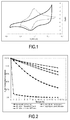
- a comparison of the oxidoreductive properties of dimethylamino phenothiazinium (methylene blue) and synthon (dibutylamino) - (diethanolamino) phenothiazinium incorporated on an oligonucleotide is performed using an electrochemical cell consisting of a gold working electrode, a counter-electrode in platinum and a reference to saturated calomel.
- the technique used is cyclic voltammetry.
- the buffer used is Na 2 HPO 4 / KH 2 PO 4 buffer 20mM KCl 250mM pH 6.7.
- Phenothiazinium tetraiodide (145 mg, 0.2 mmol) is dissolved in 4 mL of methanol at room temperature. Butylbutanolamine (115 ⁇ l, 1 mmol, 5 eq) is added dropwise to the phenothiazinium solution, with magnetic stirring. The reaction mixture is monitored by TLC in an eluent consisting of a mixture CH 2 Cl 2 / CH 3 OH 9/1 (v / v).
- This compound is prepared as in Example 1, 4) and 5).
Landscapes
- Chemical & Material Sciences (AREA)
- Organic Chemistry (AREA)
- Health & Medical Sciences (AREA)
- Life Sciences & Earth Sciences (AREA)
- Biochemistry (AREA)
- Molecular Biology (AREA)
- General Health & Medical Sciences (AREA)
- Engineering & Computer Science (AREA)
- Biotechnology (AREA)
- Genetics & Genomics (AREA)
- Saccharide Compounds (AREA)
Claims (15)
- Diaminophenothiazin-Derivate der Formel (I):
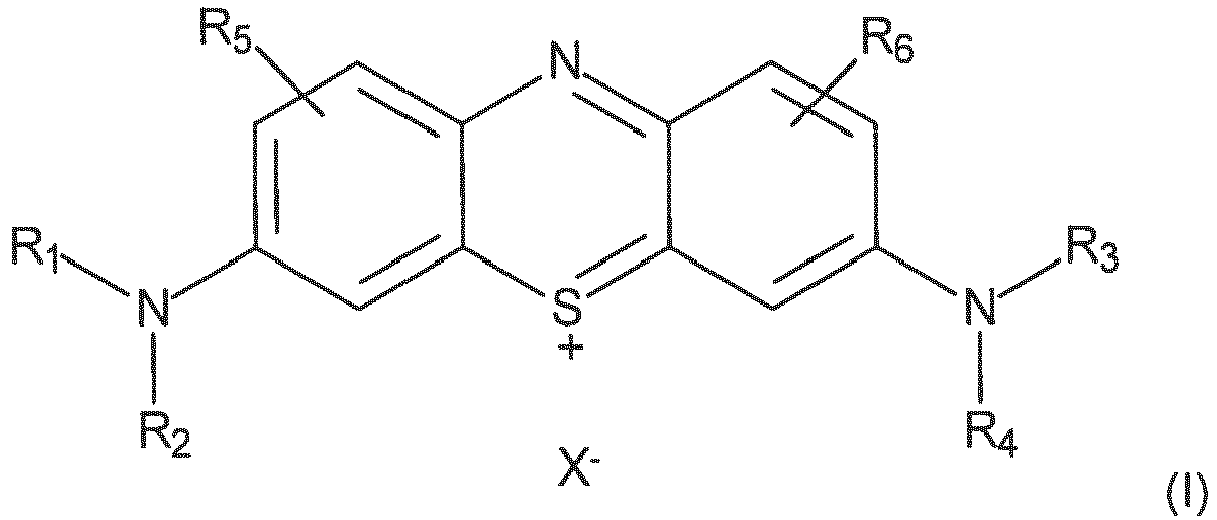 - eine der Gruppen R1, R2, R3 und R4 -A1-OR7 darstellt, wobei A1 eine lineare oder verzweigte Alkylenkette mit 2 bis 12 Kohlenstoffen darstellt, wobei die Sauerstoff-und Stickstoffatome durch wenigstens zwei aufeinanderfolgende Kohlenstoffatome getrennt sind, und wobei R7 eine Phosphorgruppe darstellt, die in der Lage ist, mit einem freien Hydroxyl unter Bedingungen einer Oligonukleotid-Synthese zu reagieren, wobei die Gruppe mit OA1, an das sie gebunden ist, eine Phosphoramidit-, Phosphodiester- oder Hydrogenphosphonat-Gruppe bildet,- die anderen Gruppen R1, R2, R3 und R4, die identisch oder unterschiedlich sind, unabhängig voneinander darstellen:∘ eine -A2-OR8-Gruppe, wobei A2 eine lineare oder verzweigte Alkylenkette mit 2 bis 12 Kohlenstoffen darstellt, wobei die Sauerstoff- und Stickstoffatome durch wenigstens zwei aufeinanderfolgende Kohlenstoffatome getrennt sind, und wobei R8 eine Gruppe, die aus den Trityl-, 4-O-Monomethoxytrityl-, 4,4'-O-Dimethoxytrityl-, tert-Butyldimethylsilyl-, Acetyl-, Trifluoracetyl-, 9-Phenylxanthen-9-yl- und Fluorenylmethyloxycarbonyl-Gruppen ausgewählt ist, darstellt,∘ eine Alkylgruppe mit 2 bis 12 Kohlenstoffatomen, oder aber∘ R1 und R2 oder R3 und R4 untereinander verbunden sind, um mit dem Stickstoffatom, an das sie gebunden sind, eine Piperidinyl- oder Pyrrolidinyl-Gruppe zu bilden,- R5 und R6, die identisch oder unterschiedlich sind, unabhängig voneinander ein Wasserstoff-, Chlor-, Brom-, lod- oder Fluoratom oder eine Alkylgruppe mit 1 bis 12 Kohlenstoffatomen, eine Alkenylgruppe mit 2 bis 12 Kohlenstoffatomen, eine Alkynylgruppe mit 2 bis 12 Kohlenstoffatomen, eine Acylgruppe oder eine Phenylgruppe darstellen,- X- ein Anion, das vorzugsweise aus Cl-, I- , ClO4 -, NO3 - ausgewählt ist, darstellt.
 - Diaminophenothiazin-Derivate nach Anspruch 1, dadurch gekennzeichnet, dass A1 und A2 lineare oder verzweigte Alkylenketten sind, bei denen 2 bis 6 aufeinanderfolgende Kohlenstoffatome die Sauerstoff- und Stickstoffatome trennen.
- Diaminophenothiazin-Derivate nach Anspruch 1 oder 2, dadurch gekennzeichnet, dass wenigstens eine der Gruppen R1, R2, R3 und R4 nicht eine -A2-OR8-Gruppe, wie sie in Anspruch 1 definiert ist, darstellt und die Gruppe oder Gruppen R1, R2, R3 oder R4, die von -A1-OR1 und von -A2-OR8 verschieden ist/sind, eine Alkylgruppe mit 2 bis 12 Kohlenstoffatomen, vorzugsweise mit 4 bis 12 Kohlenstoffatomen, darstellt/darstellen.
- Diaminophenothiazin-Derivate nach einem der Ansprüche 1 bis 3, dadurch gekennzeichnet, dass R5 = R6 = H.
- Diaminophenothiazin-Derivate nach einem der Ansprüche 1 bis 4, dadurch gekennzeichnet, dass R7 eine -P{N[(C2-C12)alkyl]2}(OCH2CH2C≡N)-Gruppe, wie die -P[N(iPr)2](OCH2CH2C≡N)-Gruppe darstellt.
- Diaminophenothiazin-Derivate nach einem der vorhergehenden Ansprüche, der Formel (la):
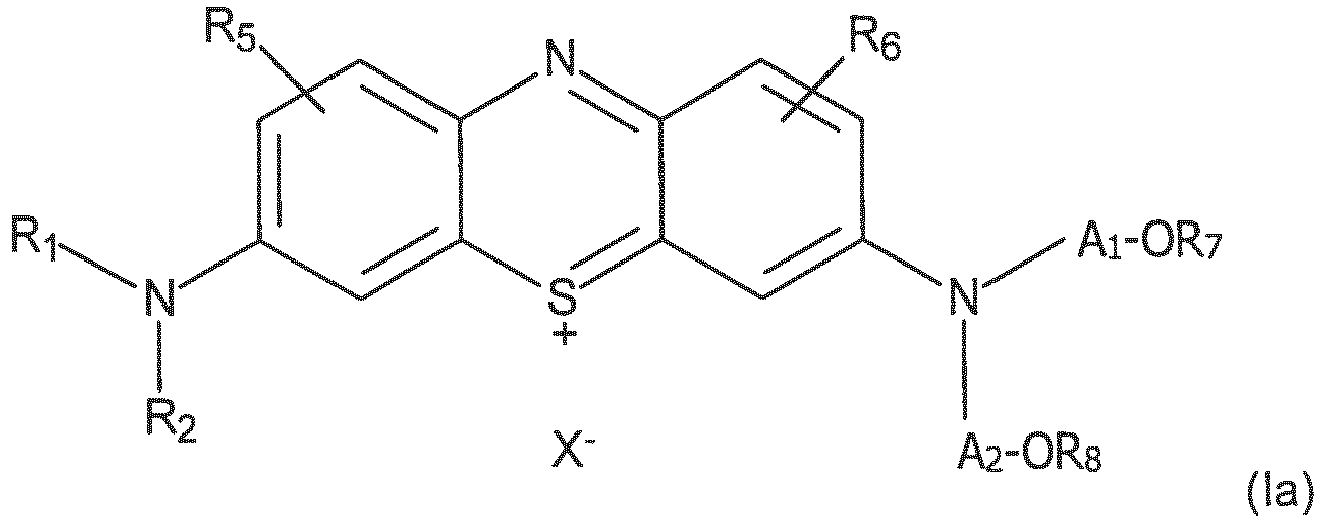 - A1, A2, R5, R6 R7, R8 und X- derart sind, wie sie in den Ansprüchen 1, 2, 4 oder 5 definiert sind,- R1 und R2, die identisch oder unterschiedlich sind, unabhängig voneinander eine Alkylgruppe mit 2 bis 12 Kohlenstoffatomen, vorzugsweise mit 4 bis 12 Kohlenstoffatomen darstellen oder R1 und R2 untereinander verbunden sind, um mit dem Stickstoffatom, an das sie gebunden sind, eine Piperidinyl- oder Pyrrolidinyl-Gruppe zu bilden.
 - Diaminophenothiazin-Derivate nach einem der Ansprüche 1 bis 5, der Formel (Ib):
 - A1, A2, R5, R6 R7, R8 und X- derart sind, wie sie in den Ansprüchen 1, 2, 4 oder 5 definiert sind,- R2 und R4, die identisch oder unterschiedlich sind, unabhängig voneinander eine Alkylgruppe mit 2 bis 12 Kohlenstoffatomen, vorzugsweise mit 4 bis 12 Kohlenstoffatomen darstellen.
 - Diaminophenothiazin-Derivate nach einem der Ansprüche 1 bis 5, der Formel (Ic):
 - A1, R5, R6, R7 und X- derart sind, wie sie in den Ansprüchen 1, 2, 4 oder 5 definiert sind,- R1 und R2, die identisch oder unterschiedlich sind, unabhängig voneinander eine Alkylgruppe mit 2 bis 12 Kohlenstoffatomen, vorzugsweise mit 4 bis 12 Kohlenstoffatomen darstellen oder R1 und R2 untereinander verbunden sind, um mit dem Stickstoffatom, an das sie gebunden sind, eine Piperidinyl- oder Pyrrolidinyl-Gruppe zu bilden.
 - Verfahren zur Markierung eines Oligonukleotids mit einem Diaminophenothiazin-Derivat nach einem der vorhergehenden Ansprüche, das das Wachstum eines auf einen festen Träger gepfropften Oligonukleotids und das Ersetzen von einem oder mehreren der Nukleotide, die es bilden, durch ein oder mehrere der Diaminophenothiazin-Derivate, bevor das Oligonukleotid von dem festen Träger abgelöst wird, umfasst.
- Markierungsverfahren nach Anspruch 9, dadurch gekennzeichnet, dass wenigstens ein Ersetzen durch ein Diaminophenothiazin-Derivat vor dem Ende des Wachstums des Oligonukleotids vollzogen wird.
- Markierungsverfahren nach Anspruch 9 oder 10, dadurch gekennzeichnet, dass wenigstens eine Substitution durch ein Diaminophenothiazin-Derivat in 3'- oder 5'-Stellung an dem ersten bzw. dem letzten Nukleotid vorgenommen wird.
- Markierungsverfahren nach einem der Ansprüche 9 bis 11, dadurch gekennzeichnet, dass es einen abschließenden Schritt zur Behandlung in basischem Medium, entweder dank einer basischen Lösung von Natriumkarbonat, Ammoniakwasser oder Kaliumkarbonat oder einer Lösung von Methylamin und Ammoniakwasser oder einer Lösung von Diisopropylamin und von β-Mercaptoethanol, oder dank Ammoniak oder Methylamin in der Gasphase umfasst.
- Träger zur Oligonukleotidsynthese, umfassend wenigstens ein an der Oberfläche kovalent gepfropftes Diaminophenothiazin-Derivat, entsprechend der Verkettung:
 - R5, R6 und X- derart sind, wie sie in Anspruch 1 oder 4 definiert sind,- R'1 und R'2, die identisch oder unterschiedlich sind, unabhängig voneinander eine Alkylgruppe mit 2 bis 12 Kohlenstoffatomen, vorzugsweise mit 4 bis 12 Kohlenstoffatomen darstellen oder R1 und R2 untereinander verbunden sind, um mit dem Stickstoffatom, an das sie gebunden sind, eine Piperidinyl- oder Pyrrolidinyl-Gruppe zu bilden,- A1' und A1", die identisch oder unterschiedlich sind, unabhängig voneinander eine A1-Kette, wie sie in Anspruch 1 oder 2 definiert ist, darstellen, und- R9 eine Gruppe, die aus den Trityl-, 4-O-Monomethoxytrityl-, 4,4'-O-Dimethoxytrityl-, tert-Butyldimethylsilyl-, Acetyl-, Trifluoracetyl-, 9-Phenylxanthen-9-yl-und Fluorenylmethyloxycarbonyl-Gruppen ausgewählt ist, darstellt, und- R10 einen -CO-A3-CO-NH-Träger darstellt, wobei A3 eine lineare oder verzweigte Alkylenkette mit 1 bis 6 Kohlenstoffatomen darstellt, oder
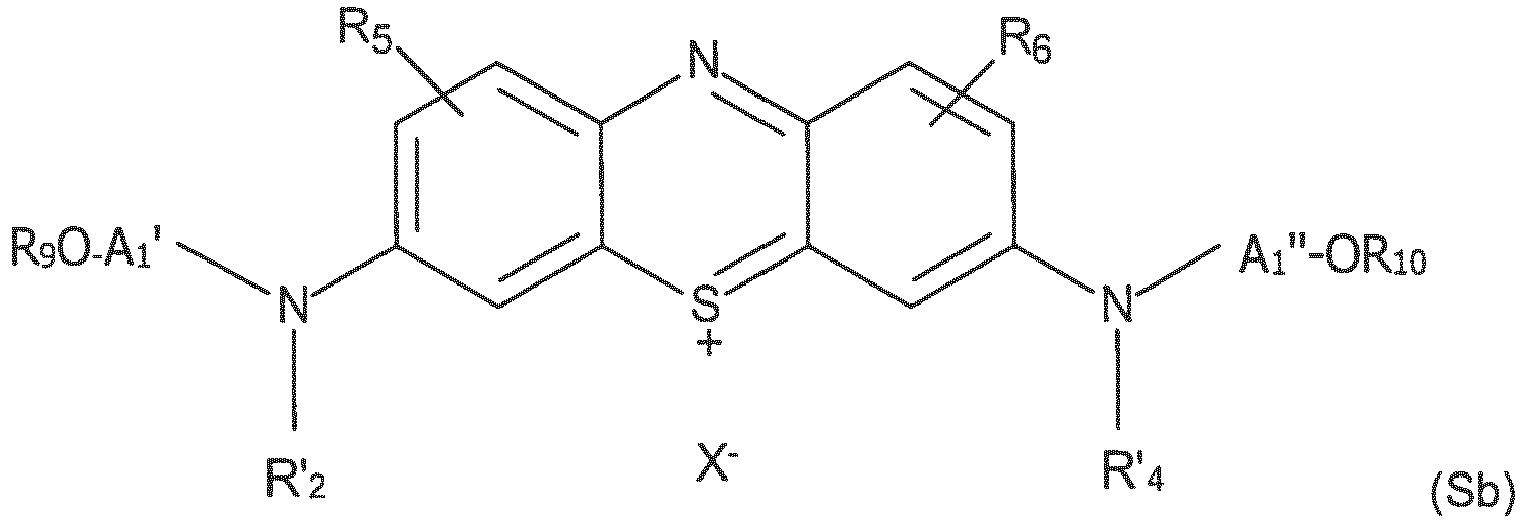 - R5, R6 und X- derart sind, wie sie in Anspruch 1 oder 4 definiert sind,- R'2 und R'4, die identisch oder unterschiedlich sind, unabhängig voneinander eine Alkylgruppe mit 2 bis 12 Kohlenstoffatomen, vorzugsweise mit 4 bis 12 Kohlenstoffatomen darstellen,- A1' und A1", die identisch oder unterschiedlich sind, unabhängig voneinander eine A1-Kette, wie sie in Anspruch 1 oder 2 definiert ist, darstellen, und- R9 eine Gruppe, die aus den Trityl-, 4-O-Monomethoxytrityl-, 4,4'-O-Dimethoxytrityl-, tert-Butyldimethylsilyl-, Acetyl-, Trifluoracetyl-, 9-Phenylxanthen-9-yl-und Fluorenylmethyloxycarbonyl-Gruppen ausgewählt ist, darstellt, und- R10 einen -CO-A3-CO-NH-Träger darstellt, wobei A3 eine lineare oder verzweigte Alkylenkette mit 1 bis 6 Kohlenstoffatomen darstellt.
 - Träger zur Oligonukleotidsynthese nach Anspruch 13, dadurch gekennzeichnet, dass der Träger aus Harzen, insbesondere aus Harzen auf Basis von Polystyrol, Polyacrylamid, Polyethylenglycol, Cellulose, Polyethylen, Polyester, Latex, Polyamid, Polydimethylacrylamid, synthetischen oder natürlichen hydrophilen Polymeren, Gläsern und Silika mit kontrollierter Porosität, Glaskugeln, Kieselgelen ausgewählt ist.
- Markierte Oligonukleotide, dadurch gekennzeichnet, dass sie durch das Markierungsverfahren nach einem der Ansprüche 9 bis 12 oder mittels eines festen Trägers, wie er in Anspruch 13 oder 14 definiert ist, erhalten werden.
Applications Claiming Priority (2)
| Application Number | Priority Date | Filing Date | Title |
|---|---|---|---|
| FR1251739A FR2987359B1 (fr) | 2012-02-27 | 2012-02-27 | Derives du diaminophenothiazinium pour le marquage de biomolecules, procede et support de marquage d'oligonucleotides et oligonucleotides obtenus |
| PCT/FR2013/050356 WO2013128099A1 (fr) | 2012-02-27 | 2013-02-21 | Derives du diaminophenothiazinium pour le marquage de biomolecules, procede et support de marquage d'oligonucleotides et oligonucleotides obtenus |
Publications (3)
| Publication Number | Publication Date |
|---|---|
| EP2820003A1 EP2820003A1 (de) | 2015-01-07 |
| EP2820003B1 EP2820003B1 (de) | 2016-08-10 |
| EP2820003B9 true EP2820003B9 (de) | 2017-05-03 |
Family
ID=47901210
Family Applications (1)
| Application Number | Title | Priority Date | Filing Date |
|---|---|---|---|
| EP13710497.2A Active EP2820003B9 (de) | 2012-02-27 | 2013-02-21 | Diaminophenothiazinderivate zur markierung von biomolekülen, verfahren und substrat zur markierung von oligonucleotiden und dadurch gewonnene oligonucleotide |
Country Status (5)
| Country | Link |
|---|---|
| US (1) | US9540405B2 (de) |
| EP (1) | EP2820003B9 (de) |
| ES (1) | ES2602304T3 (de) |
| FR (1) | FR2987359B1 (de) |
| WO (1) | WO2013128099A1 (de) |
Families Citing this family (3)
| Publication number | Priority date | Publication date | Assignee | Title |
|---|---|---|---|---|
| US10153510B2 (en) | 2014-06-23 | 2018-12-11 | University Of Kentucky Research Foundation | Non-aqueous redox flow batteries including 3,7-perfluoroalkylated phenothiazine derivatives |
| CN107253936B (zh) * | 2017-06-23 | 2021-07-23 | 复旦大学 | 一类可用于次氯酸检测的荧光探针及其制备方法和应用 |
| WO2019067635A1 (en) | 2017-09-27 | 2019-04-04 | Ultima Genomics, Inc. | METHODS AND SYSTEMS FOR NUCLEIC ACID SEQUENCING |
Family Cites Families (1)
| Publication number | Priority date | Publication date | Assignee | Title |
|---|---|---|---|---|
| FR2835836B1 (fr) | 2002-02-14 | 2006-03-17 | Bio Merieux | Metallocenes bifonctionnalises, procede d'obtention, utilisation pour le marquage de molecules biologiques |
-
2012
- 2012-02-27 FR FR1251739A patent/FR2987359B1/fr not_active Expired - Fee Related
-
2013
- 2013-02-21 ES ES13710497.2T patent/ES2602304T3/es active Active
- 2013-02-21 US US14/379,417 patent/US9540405B2/en active Active
- 2013-02-21 WO PCT/FR2013/050356 patent/WO2013128099A1/fr not_active Ceased
- 2013-02-21 EP EP13710497.2A patent/EP2820003B9/de active Active
Also Published As
| Publication number | Publication date |
|---|---|
| EP2820003A1 (de) | 2015-01-07 |
| EP2820003B1 (de) | 2016-08-10 |
| FR2987359B1 (fr) | 2014-04-25 |
| WO2013128099A1 (fr) | 2013-09-06 |
| US20150011712A1 (en) | 2015-01-08 |
| US9540405B2 (en) | 2017-01-10 |
| FR2987359A1 (fr) | 2013-08-30 |
| ES2602304T3 (es) | 2017-02-20 |
Similar Documents
| Publication | Publication Date | Title |
|---|---|---|
| EP1954707B1 (de) | Polynukleotid, das ein phosphatmimetikum enthält | |
| EP0617047B1 (de) | Farbstoffmarkierte Phosphoramaditen | |
| US7271258B2 (en) | Methods of synthesizing oligonucleotides using carbonate protecting groups and alpha-effect nucleophile deprotection | |
| EP0438203B1 (de) | Nucleosidderivate und ihre Verwendung in der Oligonucleotid-Synthese | |
| US7193077B2 (en) | Exocyclic amine triaryl methyl protecting groups in two-step polynucleotide synthesis | |
| CA2726260C (fr) | Procede de synthese d'arn par voie chimique | |
| EP1510523A1 (de) | Vorläuferverbindungen für die in zwei Schritten Polynukleotidsynthese | |
| EP0543889A1 (de) | Einführung selektiv spaltbarer und/oder abasischer stellen in oligonukleotidketten und reagenzien dafür | |
| FR2607507A1 (fr) | Nouveaux derives a-d-oligonucleotides, leur preparation et leur emploi | |
| WO1988004301A1 (fr) | OLIGONUCLEOTIDES alpha | |
| EP2820003B1 (de) | Diaminophenothiazinderivate zur markierung von biomolekülen, verfahren und substrat zur markierung von oligonucleotiden und dadurch gewonnene oligonucleotide | |
| FR2707296A1 (fr) | Procédé de synthèse d'acides nucléiques sur support solide et composés utiles notamment comme support solide dans ledit procédé. | |
| JP7452549B2 (ja) | ホスホロアミダイト活性化剤 | |
| DE69912443T2 (de) | Oligomerreinigung durch selektion mittels zweier enden | |
| EP2834253B1 (de) | Thiolverbindungen und verwendung davon zur herstellung von modifizierten oligonukleotiden | |
| FR2636633A1 (fr) | Procede de synthese d'oligoribonucleotides alpha et composes utiles dans le procede | |
| JP2025532629A (ja) | 改善されたオリゴヌクレオチド合成 | |
| US6486313B1 (en) | Oligonucleotides having alkylphosphonate linkages and methods for their preparation | |
| JP2010527945A (ja) | オリゴヌクレオチドの合成 | |
| US7456309B2 (en) | Reusable universal polymer support for repetitive oligonucleotide synthesis | |
| US20130158248A1 (en) | Maleimide-furanyl compounds that can be used in a general method for preparing maleimide-oligonucleotide derivatives | |
| HK1126224B (en) | Polynucleotide containing a phosphate mimetic |
Legal Events
| Date | Code | Title | Description |
|---|---|---|---|
| PUAI | Public reference made under article 153(3) epc to a published international application that has entered the european phase |
Free format text: ORIGINAL CODE: 0009012 |
|
| 17P | Request for examination filed |
Effective date: 20140808 |
|
| AK | Designated contracting states |
Kind code of ref document: A1 Designated state(s): AL AT BE BG CH CY CZ DE DK EE ES FI FR GB GR HR HU IE IS IT LI LT LU LV MC MK MT NL NO PL PT RO RS SE SI SK SM TR |
|
| AX | Request for extension of the european patent |
Extension state: BA ME |
|
| RIN1 | Information on inventor provided before grant (corrected) |
Inventor name: CHAIX, CAROLE Inventor name: DE CROZALS, GABRIEL |
|
| DAX | Request for extension of the european patent (deleted) | ||
| 17Q | First examination report despatched |
Effective date: 20150724 |
|
| GRAP | Despatch of communication of intention to grant a patent |
Free format text: ORIGINAL CODE: EPIDOSNIGR1 |
|
| RIC1 | Information provided on ipc code assigned before grant |
Ipc: C07D 279/18 20060101AFI20160222BHEP Ipc: C09B 49/06 20060101ALI20160222BHEP Ipc: C07H 21/04 20060101ALI20160222BHEP Ipc: C07F 9/6547 20060101ALI20160222BHEP Ipc: C09B 21/00 20060101ALI20160222BHEP |
|
| INTG | Intention to grant announced |
Effective date: 20160315 |
|
| GRAS | Grant fee paid |
Free format text: ORIGINAL CODE: EPIDOSNIGR3 |
|
| GRAA | (expected) grant |
Free format text: ORIGINAL CODE: 0009210 |
|
| AK | Designated contracting states |
Kind code of ref document: B1 Designated state(s): AL AT BE BG CH CY CZ DE DK EE ES FI FR GB GR HR HU IE IS IT LI LT LU LV MC MK MT NL NO PL PT RO RS SE SI SK SM TR |
|
| REG | Reference to a national code |
Ref country code: GB Ref legal event code: FG4D Free format text: NOT ENGLISH |
|
| REG | Reference to a national code |
Ref country code: CH Ref legal event code: EP Ref country code: AT Ref legal event code: REF Ref document number: 818901 Country of ref document: AT Kind code of ref document: T Effective date: 20160815 |
|
| REG | Reference to a national code |
Ref country code: IE Ref legal event code: FG4D Free format text: LANGUAGE OF EP DOCUMENT: FRENCH |
|
| REG | Reference to a national code |
Ref country code: DE Ref legal event code: R096 Ref document number: 602013010276 Country of ref document: DE |
|
| REG | Reference to a national code |
Ref country code: NL Ref legal event code: FP |
|
| REG | Reference to a national code |
Ref country code: CH Ref legal event code: NV Representative=s name: BOVARD AG, CH |
|
| REG | Reference to a national code |
Ref country code: LT Ref legal event code: MG4D |
|
| REG | Reference to a national code |
Ref country code: NO Ref legal event code: T2 Effective date: 20160810 |
|
| REG | Reference to a national code |
Ref country code: AT Ref legal event code: MK05 Ref document number: 818901 Country of ref document: AT Kind code of ref document: T Effective date: 20160810 |
|
| REG | Reference to a national code |
Ref country code: FR Ref legal event code: PLFP Year of fee payment: 5 |
|
| PG25 | Lapsed in a contracting state [announced via postgrant information from national office to epo] |
Ref country code: IS Free format text: LAPSE BECAUSE OF FAILURE TO SUBMIT A TRANSLATION OF THE DESCRIPTION OR TO PAY THE FEE WITHIN THE PRESCRIBED TIME-LIMIT Effective date: 20161210 Ref country code: HR Free format text: LAPSE BECAUSE OF FAILURE TO SUBMIT A TRANSLATION OF THE DESCRIPTION OR TO PAY THE FEE WITHIN THE PRESCRIBED TIME-LIMIT Effective date: 20160810 Ref country code: FI Free format text: LAPSE BECAUSE OF FAILURE TO SUBMIT A TRANSLATION OF THE DESCRIPTION OR TO PAY THE FEE WITHIN THE PRESCRIBED TIME-LIMIT Effective date: 20160810 Ref country code: LT Free format text: LAPSE BECAUSE OF FAILURE TO SUBMIT A TRANSLATION OF THE DESCRIPTION OR TO PAY THE FEE WITHIN THE PRESCRIBED TIME-LIMIT Effective date: 20160810 Ref country code: RS Free format text: LAPSE BECAUSE OF FAILURE TO SUBMIT A TRANSLATION OF THE DESCRIPTION OR TO PAY THE FEE WITHIN THE PRESCRIBED TIME-LIMIT Effective date: 20160810 |
|
| REG | Reference to a national code |
Ref country code: ES Ref legal event code: FG2A Ref document number: 2602304 Country of ref document: ES Kind code of ref document: T3 Effective date: 20170220 |
|
| PG25 | Lapsed in a contracting state [announced via postgrant information from national office to epo] |
Ref country code: PL Free format text: LAPSE BECAUSE OF FAILURE TO SUBMIT A TRANSLATION OF THE DESCRIPTION OR TO PAY THE FEE WITHIN THE PRESCRIBED TIME-LIMIT Effective date: 20160810 Ref country code: LV Free format text: LAPSE BECAUSE OF FAILURE TO SUBMIT A TRANSLATION OF THE DESCRIPTION OR TO PAY THE FEE WITHIN THE PRESCRIBED TIME-LIMIT Effective date: 20160810 Ref country code: PT Free format text: LAPSE BECAUSE OF FAILURE TO SUBMIT A TRANSLATION OF THE DESCRIPTION OR TO PAY THE FEE WITHIN THE PRESCRIBED TIME-LIMIT Effective date: 20161212 Ref country code: AT Free format text: LAPSE BECAUSE OF FAILURE TO SUBMIT A TRANSLATION OF THE DESCRIPTION OR TO PAY THE FEE WITHIN THE PRESCRIBED TIME-LIMIT Effective date: 20160810 Ref country code: GR Free format text: LAPSE BECAUSE OF FAILURE TO SUBMIT A TRANSLATION OF THE DESCRIPTION OR TO PAY THE FEE WITHIN THE PRESCRIBED TIME-LIMIT Effective date: 20161111 Ref country code: SE Free format text: LAPSE BECAUSE OF FAILURE TO SUBMIT A TRANSLATION OF THE DESCRIPTION OR TO PAY THE FEE WITHIN THE PRESCRIBED TIME-LIMIT Effective date: 20160810 |
|
| PG25 | Lapsed in a contracting state [announced via postgrant information from national office to epo] |
Ref country code: EE Free format text: LAPSE BECAUSE OF FAILURE TO SUBMIT A TRANSLATION OF THE DESCRIPTION OR TO PAY THE FEE WITHIN THE PRESCRIBED TIME-LIMIT Effective date: 20160810 Ref country code: RO Free format text: LAPSE BECAUSE OF FAILURE TO SUBMIT A TRANSLATION OF THE DESCRIPTION OR TO PAY THE FEE WITHIN THE PRESCRIBED TIME-LIMIT Effective date: 20160810 |
|
| REG | Reference to a national code |
Ref country code: DE Ref legal event code: R097 Ref document number: 602013010276 Country of ref document: DE |
|
| PG25 | Lapsed in a contracting state [announced via postgrant information from national office to epo] |
Ref country code: BG Free format text: LAPSE BECAUSE OF FAILURE TO SUBMIT A TRANSLATION OF THE DESCRIPTION OR TO PAY THE FEE WITHIN THE PRESCRIBED TIME-LIMIT Effective date: 20161110 Ref country code: SK Free format text: LAPSE BECAUSE OF FAILURE TO SUBMIT A TRANSLATION OF THE DESCRIPTION OR TO PAY THE FEE WITHIN THE PRESCRIBED TIME-LIMIT Effective date: 20160810 Ref country code: DK Free format text: LAPSE BECAUSE OF FAILURE TO SUBMIT A TRANSLATION OF THE DESCRIPTION OR TO PAY THE FEE WITHIN THE PRESCRIBED TIME-LIMIT Effective date: 20160810 Ref country code: CZ Free format text: LAPSE BECAUSE OF FAILURE TO SUBMIT A TRANSLATION OF THE DESCRIPTION OR TO PAY THE FEE WITHIN THE PRESCRIBED TIME-LIMIT Effective date: 20160810 Ref country code: SM Free format text: LAPSE BECAUSE OF FAILURE TO SUBMIT A TRANSLATION OF THE DESCRIPTION OR TO PAY THE FEE WITHIN THE PRESCRIBED TIME-LIMIT Effective date: 20160810 |
|
| PLBE | No opposition filed within time limit |
Free format text: ORIGINAL CODE: 0009261 |
|
| STAA | Information on the status of an ep patent application or granted ep patent |
Free format text: STATUS: NO OPPOSITION FILED WITHIN TIME LIMIT |
|
| 26N | No opposition filed |
Effective date: 20170511 |
|
| PG25 | Lapsed in a contracting state [announced via postgrant information from national office to epo] |
Ref country code: SI Free format text: LAPSE BECAUSE OF FAILURE TO SUBMIT A TRANSLATION OF THE DESCRIPTION OR TO PAY THE FEE WITHIN THE PRESCRIBED TIME-LIMIT Effective date: 20160810 |
|
| PG25 | Lapsed in a contracting state [announced via postgrant information from national office to epo] |
Ref country code: MC Free format text: LAPSE BECAUSE OF FAILURE TO SUBMIT A TRANSLATION OF THE DESCRIPTION OR TO PAY THE FEE WITHIN THE PRESCRIBED TIME-LIMIT Effective date: 20160810 |
|
| REG | Reference to a national code |
Ref country code: IE Ref legal event code: MM4A |
|
| PG25 | Lapsed in a contracting state [announced via postgrant information from national office to epo] |
Ref country code: LU Free format text: LAPSE BECAUSE OF NON-PAYMENT OF DUE FEES Effective date: 20170221 |
|
| REG | Reference to a national code |
Ref country code: FR Ref legal event code: PLFP Year of fee payment: 6 |
|
| PG25 | Lapsed in a contracting state [announced via postgrant information from national office to epo] |
Ref country code: IE Free format text: LAPSE BECAUSE OF NON-PAYMENT OF DUE FEES Effective date: 20170221 |
|
| PG25 | Lapsed in a contracting state [announced via postgrant information from national office to epo] |
Ref country code: MT Free format text: LAPSE BECAUSE OF FAILURE TO SUBMIT A TRANSLATION OF THE DESCRIPTION OR TO PAY THE FEE WITHIN THE PRESCRIBED TIME-LIMIT Effective date: 20160810 |
|
| PG25 | Lapsed in a contracting state [announced via postgrant information from national office to epo] |
Ref country code: AL Free format text: LAPSE BECAUSE OF FAILURE TO SUBMIT A TRANSLATION OF THE DESCRIPTION OR TO PAY THE FEE WITHIN THE PRESCRIBED TIME-LIMIT Effective date: 20160810 |
|
| PG25 | Lapsed in a contracting state [announced via postgrant information from national office to epo] |
Ref country code: HU Free format text: LAPSE BECAUSE OF FAILURE TO SUBMIT A TRANSLATION OF THE DESCRIPTION OR TO PAY THE FEE WITHIN THE PRESCRIBED TIME-LIMIT; INVALID AB INITIO Effective date: 20130221 |
|
| PG25 | Lapsed in a contracting state [announced via postgrant information from national office to epo] |
Ref country code: CY Free format text: LAPSE BECAUSE OF FAILURE TO SUBMIT A TRANSLATION OF THE DESCRIPTION OR TO PAY THE FEE WITHIN THE PRESCRIBED TIME-LIMIT Effective date: 20160810 |
|
| PG25 | Lapsed in a contracting state [announced via postgrant information from national office to epo] |
Ref country code: MK Free format text: LAPSE BECAUSE OF FAILURE TO SUBMIT A TRANSLATION OF THE DESCRIPTION OR TO PAY THE FEE WITHIN THE PRESCRIBED TIME-LIMIT Effective date: 20160810 |
|
| PG25 | Lapsed in a contracting state [announced via postgrant information from national office to epo] |
Ref country code: TR Free format text: LAPSE BECAUSE OF FAILURE TO SUBMIT A TRANSLATION OF THE DESCRIPTION OR TO PAY THE FEE WITHIN THE PRESCRIBED TIME-LIMIT Effective date: 20160810 |
|
| PGFP | Annual fee paid to national office [announced via postgrant information from national office to epo] |
Ref country code: NO Payment date: 20210219 Year of fee payment: 9 Ref country code: NL Payment date: 20210217 Year of fee payment: 9 Ref country code: IT Payment date: 20210222 Year of fee payment: 9 |
|
| PGFP | Annual fee paid to national office [announced via postgrant information from national office to epo] |
Ref country code: BE Payment date: 20210217 Year of fee payment: 9 |
|
| PGFP | Annual fee paid to national office [announced via postgrant information from national office to epo] |
Ref country code: ES Payment date: 20210422 Year of fee payment: 9 |
|
| REG | Reference to a national code |
Ref country code: NO Ref legal event code: MMEP |
|
| REG | Reference to a national code |
Ref country code: NL Ref legal event code: MM Effective date: 20220301 |
|
| REG | Reference to a national code |
Ref country code: BE Ref legal event code: MM Effective date: 20220228 |
|
| PG25 | Lapsed in a contracting state [announced via postgrant information from national office to epo] |
Ref country code: NO Free format text: LAPSE BECAUSE OF NON-PAYMENT OF DUE FEES Effective date: 20220228 |
|
| PG25 | Lapsed in a contracting state [announced via postgrant information from national office to epo] |
Ref country code: NL Free format text: LAPSE BECAUSE OF NON-PAYMENT OF DUE FEES Effective date: 20220301 |
|
| PG25 | Lapsed in a contracting state [announced via postgrant information from national office to epo] |
Ref country code: BE Free format text: LAPSE BECAUSE OF NON-PAYMENT OF DUE FEES Effective date: 20220228 |
|
| REG | Reference to a national code |
Ref country code: DE Ref legal event code: R082 Ref document number: 602013010276 Country of ref document: DE Representative=s name: CBDL PATENTANWAELTE GBR, DE Ref country code: DE Ref legal event code: R082 Ref document number: 602013010276 Country of ref document: DE Representative=s name: CBDL PATENTANWAELTE EGBR, DE |
|
| REG | Reference to a national code |
Ref country code: ES Ref legal event code: FD2A Effective date: 20230509 |
|
| PG25 | Lapsed in a contracting state [announced via postgrant information from national office to epo] |
Ref country code: IT Free format text: LAPSE BECAUSE OF NON-PAYMENT OF DUE FEES Effective date: 20220221 |
|
| P01 | Opt-out of the competence of the unified patent court (upc) registered |
Effective date: 20230530 |
|
| PG25 | Lapsed in a contracting state [announced via postgrant information from national office to epo] |
Ref country code: ES Free format text: LAPSE BECAUSE OF NON-PAYMENT OF DUE FEES Effective date: 20220222 |
|
| REG | Reference to a national code |
Ref country code: CH Ref legal event code: U11 Free format text: ST27 STATUS EVENT CODE: U-0-0-U10-U11 (AS PROVIDED BY THE NATIONAL OFFICE) Effective date: 20260301 |
|
| PGFP | Annual fee paid to national office [announced via postgrant information from national office to epo] |
Ref country code: GB Payment date: 20260219 Year of fee payment: 14 |
|
| PGFP | Annual fee paid to national office [announced via postgrant information from national office to epo] |
Ref country code: DE Payment date: 20260218 Year of fee payment: 14 |
|
| PGFP | Annual fee paid to national office [announced via postgrant information from national office to epo] |
Ref country code: FR Payment date: 20260218 Year of fee payment: 14 |
|
| PGFP | Annual fee paid to national office [announced via postgrant information from national office to epo] |
Ref country code: CH Payment date: 20260301 Year of fee payment: 14 |